WO2012144484A1 - Élément d'étanchéité adhésif pour piles à combustible - Google Patents
Élément d'étanchéité adhésif pour piles à combustible Download PDFInfo
- Publication number
- WO2012144484A1 WO2012144484A1 PCT/JP2012/060333 JP2012060333W WO2012144484A1 WO 2012144484 A1 WO2012144484 A1 WO 2012144484A1 JP 2012060333 W JP2012060333 W JP 2012060333W WO 2012144484 A1 WO2012144484 A1 WO 2012144484A1
- Authority
- WO
- WIPO (PCT)
- Prior art keywords
- seal member
- less
- rubber
- fuel cell
- adhesive seal
- Prior art date
- Legal status (The legal status is an assumption and is not a legal conclusion. Google has not performed a legal analysis and makes no representation as to the accuracy of the status listed.)
- Ceased
Links
Images



Classifications
-
- H—ELECTRICITY
- H01—ELECTRIC ELEMENTS
- H01M—PROCESSES OR MEANS, e.g. BATTERIES, FOR THE DIRECT CONVERSION OF CHEMICAL ENERGY INTO ELECTRICAL ENERGY
- H01M8/00—Fuel cells; Manufacture thereof
- H01M8/02—Details
- H01M8/0271—Sealing or supporting means around electrodes, matrices or membranes
- H01M8/028—Sealing means characterised by their material
- H01M8/0284—Organic resins; Organic polymers
-
- C—CHEMISTRY; METALLURGY
- C08—ORGANIC MACROMOLECULAR COMPOUNDS; THEIR PREPARATION OR CHEMICAL WORKING-UP; COMPOSITIONS BASED THEREON
- C08L—COMPOSITIONS OF MACROMOLECULAR COMPOUNDS
- C08L23/00—Compositions of homopolymers or copolymers of unsaturated aliphatic hydrocarbons having only one carbon-to-carbon double bond; Compositions of derivatives of such polymers
- C08L23/02—Compositions of homopolymers or copolymers of unsaturated aliphatic hydrocarbons having only one carbon-to-carbon double bond; Compositions of derivatives of such polymers not modified by chemical after-treatment
- C08L23/16—Ethylene-propylene or ethylene-propylene-diene copolymers
-
- H—ELECTRICITY
- H01—ELECTRIC ELEMENTS
- H01M—PROCESSES OR MEANS, e.g. BATTERIES, FOR THE DIRECT CONVERSION OF CHEMICAL ENERGY INTO ELECTRICAL ENERGY
- H01M8/00—Fuel cells; Manufacture thereof
- H01M8/02—Details
- H01M8/0202—Collectors; Separators, e.g. bipolar separators; Interconnectors
- H01M8/0258—Collectors; Separators, e.g. bipolar separators; Interconnectors characterised by the configuration of channels, e.g. by the flow field of the reactant or coolant
- H01M8/026—Collectors; Separators, e.g. bipolar separators; Interconnectors characterised by the configuration of channels, e.g. by the flow field of the reactant or coolant characterised by grooves, e.g. their pitch or depth
-
- H—ELECTRICITY
- H01—ELECTRIC ELEMENTS
- H01M—PROCESSES OR MEANS, e.g. BATTERIES, FOR THE DIRECT CONVERSION OF CHEMICAL ENERGY INTO ELECTRICAL ENERGY
- H01M8/00—Fuel cells; Manufacture thereof
- H01M8/02—Details
- H01M8/0202—Collectors; Separators, e.g. bipolar separators; Interconnectors
- H01M8/0267—Collectors; Separators, e.g. bipolar separators; Interconnectors having heating or cooling means, e.g. heaters or coolant flow channels
-
- H—ELECTRICITY
- H01—ELECTRIC ELEMENTS
- H01M—PROCESSES OR MEANS, e.g. BATTERIES, FOR THE DIRECT CONVERSION OF CHEMICAL ENERGY INTO ELECTRICAL ENERGY
- H01M8/00—Fuel cells; Manufacture thereof
- H01M8/02—Details
- H01M8/0271—Sealing or supporting means around electrodes, matrices or membranes
-
- H—ELECTRICITY
- H01—ELECTRIC ELEMENTS
- H01M—PROCESSES OR MEANS, e.g. BATTERIES, FOR THE DIRECT CONVERSION OF CHEMICAL ENERGY INTO ELECTRICAL ENERGY
- H01M8/00—Fuel cells; Manufacture thereof
- H01M8/02—Details
- H01M8/0271—Sealing or supporting means around electrodes, matrices or membranes
- H01M8/0276—Sealing means characterised by their form
-
- H—ELECTRICITY
- H01—ELECTRIC ELEMENTS
- H01M—PROCESSES OR MEANS, e.g. BATTERIES, FOR THE DIRECT CONVERSION OF CHEMICAL ENERGY INTO ELECTRICAL ENERGY
- H01M8/00—Fuel cells; Manufacture thereof
- H01M8/24—Grouping of fuel cells, e.g. stacking of fuel cells
- H01M8/241—Grouping of fuel cells, e.g. stacking of fuel cells with solid or matrix-supported electrolytes
-
- H—ELECTRICITY
- H01—ELECTRIC ELEMENTS
- H01M—PROCESSES OR MEANS, e.g. BATTERIES, FOR THE DIRECT CONVERSION OF CHEMICAL ENERGY INTO ELECTRICAL ENERGY
- H01M8/00—Fuel cells; Manufacture thereof
- H01M8/24—Grouping of fuel cells, e.g. stacking of fuel cells
- H01M8/2457—Grouping of fuel cells, e.g. stacking of fuel cells with both reactants being gaseous or vaporised
-
- C—CHEMISTRY; METALLURGY
- C08—ORGANIC MACROMOLECULAR COMPOUNDS; THEIR PREPARATION OR CHEMICAL WORKING-UP; COMPOSITIONS BASED THEREON
- C08K—Use of inorganic or non-macromolecular organic substances as compounding ingredients
- C08K5/00—Use of organic ingredients
- C08K5/04—Oxygen-containing compounds
- C08K5/14—Peroxides
-
- Y—GENERAL TAGGING OF NEW TECHNOLOGICAL DEVELOPMENTS; GENERAL TAGGING OF CROSS-SECTIONAL TECHNOLOGIES SPANNING OVER SEVERAL SECTIONS OF THE IPC; TECHNICAL SUBJECTS COVERED BY FORMER USPC CROSS-REFERENCE ART COLLECTIONS [XRACs] AND DIGESTS
- Y02—TECHNOLOGIES OR APPLICATIONS FOR MITIGATION OR ADAPTATION AGAINST CLIMATE CHANGE
- Y02E—REDUCTION OF GREENHOUSE GAS [GHG] EMISSIONS, RELATED TO ENERGY GENERATION, TRANSMISSION OR DISTRIBUTION
- Y02E60/00—Enabling technologies; Technologies with a potential or indirect contribution to GHG emissions mitigation
- Y02E60/30—Hydrogen technology
- Y02E60/50—Fuel cells
Definitions
- the present invention relates to an adhesive seal member for sealing a fuel cell component, and more particularly to an adhesive seal member having good sealability even at very low temperatures.
- Fuel cells that generate electricity by the electrochemical reaction of gases have high power generation efficiency, clean exhaust gases, and very little impact on the environment. Above all, polymer electrolyte fuel cells can be operated at relatively low temperatures and have large power density. For this reason, various uses, such as an electric power supply and a motor vehicle power supply, are anticipated.
- a cell in which a membrane electrode assembly (MEA) or the like is sandwiched by separators is a power generation unit.
- the MEA includes a polymer membrane (electrolyte membrane) serving as an electrolyte, and a pair of electrode catalyst layers (fuel electrode (anode) catalyst layer, oxygen electrode (cathode) catalyst layer) disposed on both sides in the thickness direction of the electrolyte membrane. It consists of On the surface of the pair of electrode catalyst layers, a porous layer for diffusing a gas is further disposed. A fuel gas such as hydrogen is supplied to the fuel electrode side, and an oxidant gas such as oxygen or air is supplied to the oxygen electrode side.
- the polymer electrolyte fuel cell is configured by clamping a cell stack in which a large number of the cells are stacked, with end plates or the like arranged at both ends in the cell stacking direction.
- a flow path of a gas supplied to each electrode, and a flow path of a refrigerant for reducing heat generation at the time of power generation are formed.
- mixing of the gases supplied to the respective electrodes causes problems such as a decrease in power generation efficiency.
- the electrolyte membrane has proton conductivity in the state of containing water. For this reason, at the time of operation, it is necessary to keep the electrolyte membrane wet. Therefore, in order to prevent gas mixture, gas and refrigerant leakage, and to keep the inside of the cell wet, it is important to secure the seal around the MEA and porous layer, and between adjacent separators. It becomes.
- seal members for sealing these constituent members for example, in Patent Documents 1 and 2, rubber materials using ethylene-propylene rubber (EPM), ethylene-propylene-diene rubber (EPDM) or the like are proposed.
- a polymer membrane such as an all-fluorinated sulfonic acid membrane is used.
- an electrolyte membrane may not deteriorate by the heating at the time of bridge
- the rubber composition constituting the seal member described in Patent Documents 1 and 2 can be crosslinked in a relatively short time at a low temperature of 130 ° C. or less. Therefore, the sealing member is also applicable to the vicinity of the electrolyte membrane. Moreover, the said sealing member contains an adhesion component. Therefore, it is possible to adhere to the member without using any other adhesive. However, at a very low temperature of about -20 to -30 ° C., the rubber elasticity of EPM or EPDM may be lost. For this reason, when using a fuel cell in a cold district etc., it is difficult to secure a desired sealability.
- the present invention has been made in view of such a situation, and it is possible to provide an adhesive seal member for a fuel cell, which can be crosslinked at a low temperature and in a short time, and has excellent sealability even at extremely low temperatures. It will be an issue.
- the first adhesive seal member for a fuel cell of the present invention (hereinafter appropriately referred to as “the first adhesive seal member of the present invention") comprises the following (A) to (E) And a cross-linked product of the rubber composition, and sealing the components of the fuel cell.
- A One or more rubber components selected from ethylene-propylene rubber and ethylene-propylene-diene rubber.
- B An organic peroxide having a one-hour half-life temperature of 130 ° C. or less.
- C Crosslinking auxiliary agent.
- D One or more adhesive components selected from resorcinol compounds and melamine compounds, aluminate coupling agents, and silane coupling agents.
- Softener having a pour point of -40 ° C or less.
- Patent Documents 3 and 4 disclose a rubber composition containing a softener such as poly- ⁇ -olefin. According to this document, the softener is only blended to improve the lubricity and flexibility of the rubber molded body. Thus, the pour point of the softener is not considered at all.
- the first adhesive seal member of the present invention contains a softener having a pour point of ⁇ 40 ° C. or less ((E) above).
- the first adhesive seal member of the present invention is excellent in sealability even at extremely low temperatures.
- a second adhesive seal member for a fuel cell according to the present invention is a rubber composition containing the following (A) to (D)
- the present invention is characterized in that the components of the fuel cell are sealed.
- A) One or more rubber components selected from ethylene-propylene rubber and ethylene-propylene-diene rubber having an ethylene content of 53% by mass or less.
- B) An organic peroxide having a one-hour half-life temperature of 130 ° C. or less.
- C Crosslinking auxiliary agent.
- the ethylene content of EPM and EPDM is not taken into consideration.
- the ethylene content of EPM and EPDM used as a rubber component was limited. EPM and EPDM are less likely to be crystallized at extremely low temperatures of about -20 to -30 ° C. as the ethylene content is lower. That is, EPM and EPDM having a low ethylene content are unlikely to reduce rubber elasticity even at extremely low temperatures.
- the second adhesive seal member of the present invention uses, as a rubber component, one or more of EPM and EPDM having a low ethylene content of 53% by mass or less. Therefore, when a softener having a pour point of ⁇ 40 ° C. or less is included, it is possible to maintain rubber elasticity at a very low temperature, even without including the softener. Therefore, the second adhesive seal member of the present invention is excellent in sealability even at extremely low temperatures.
- the first and second adhesive seal members of the present invention both contain an adhesive component ((D) above).
- the adhesive seal member of the present invention can be adhered to the member without using any other adhesive.
- the adhesive component contains a resorcinol compound and a melamine compound
- the melamine compound is a methylene donor
- the resorcinol compound is a methylene donor.
- a chemical bond is formed between the resorcinol compound and the rubber component, and between the resorcinol compound and the member to be bonded, by donating a methylene group.
- the rubber component (adhesive seal member) and the member are adhered.
- the adhesive seal member and the member are adhered via the aluminate coupling agent.
- a silane coupling agent is contained as the adhesive component, the adhesive seal member and the member are adhered via the silane coupling agent.
- the adhesion of these adhesive components is large.
- the adhesion is unlikely to be reduced even in the fuel cell operating environment. Therefore, according to the adhesive seal member of the present invention, good sealability is secured even when the fuel cell is operated for a long time. That is, the operation reliability of the fuel cell can be improved.
- to seal the components of the fuel cell means to seal around the components and between the components.
- the adhesive seal member of the present invention has rubber elasticity in a wide temperature range from the operating temperature of the fuel cell to about -30.degree. For this reason, according to the adhesive seal member of the present invention, not only sealing by adhesion but also sealing by stress becomes possible. For example, when the adhesive seal member of the present invention is disposed between opposing members, a mode in which the adhesive seal member of the present invention is adhered to only one member and the other member is sealed by stress. It can be adopted. Of course, the adhesive seal member of the present invention may be adhered to both members to form an adhesive seal between the members.
- the adhesive seal member of the present invention When the rubber elasticity is lost at a low temperature, the sealability of the stress seal is apt to be reduced rather than the adhesive seal.
- the rubber elasticity is maintained even at a very low temperature, so that the sealability is unlikely to be deteriorated even if it is a stress seal.
- an organic peroxide having a one-hour half-life temperature of 130 ° C. or less is used as the crosslinking agent (the above (B)).
- the “half life” is the time until the concentration of the organic peroxide reaches half of the initial value. Therefore, the “half-life temperature” is an index indicating the decomposition temperature of the organic peroxide.
- the “one-hour half-life temperature” is a temperature at which the half-life is one hour. That is, the lower the one-hour half-life temperature, the easier it is to decompose at low temperature.
- crosslinking can be performed at a lower temperature (specifically, 150 ° C. or less) and in a short time. Therefore, for example, the adhesive seal member of the present invention can be used also in the vicinity of the electrolyte membrane of a polymer electrolyte fuel cell.
- FIG. 1 is a perspective view of a polymer electrolyte fuel cell using the adhesive seal member of the present invention. It is a perspective view of the laminated
- the adhesive seal member for a fuel cell of the present invention is not limited to the following embodiment, and various changes, improvements, etc. which can be made by those skilled in the art without departing from the scope of the present invention. It can implement in a form.
- the first adhesive seal member of the present invention is composed of a crosslinked product of the rubber composition containing the above (A) to (E).
- the second adhesive seal member of the present invention comprises a cross-linked product of the rubber composition containing the above (A) to (D).
- the rubber component of (A) will be described.
- the rubber component used for the first adhesive seal member of the present invention is one or more selected from ethylene-propylene rubber (EPM) and ethylene-propylene-diene rubber (EPDM).
- EPM ethylene-propylene rubber
- EPDM ethylene-propylene-diene rubber
- one of EPM and EPDM may be used, or both may be mixed and used.
- two or more of the same kind of rubber having different ethylene content etc. described later may be mixed and used.
- the rubber component desirably contains EPDM.
- EPM and EPDM having a low ethylene content are unlikely to reduce rubber elasticity even at extremely low temperatures. Therefore, it is desirable to use EPM and EPDM having an ethylene content of 53% by mass or less as the rubber component from the viewpoint of suppressing a decrease in rubber elasticity at a very low temperature and improving the sealability. EPM and EPDM having an ethylene content of 50% by mass or less are more preferable. On the other hand, if the ethylene content is too low, the physical properties of the rubber may be degraded. Therefore, it is desirable to use EPM and EPDM having an ethylene content of 40% by mass or more as the rubber component from the viewpoint of securing the elongation and tensile strength necessary for the adhesive seal member.
- the rubber component used for the second adhesive seal member of the present invention is at least one selected from ethylene-propylene rubber (EPM) and ethylene-propylene-diene rubber (EPDM) having an ethylene content of 53% by mass or less. If the ethylene content is 53% by mass or less, one of EPM and EPDM may be used, or both may be mixed and used. In addition, two or more of the same kind of rubber different in ethylene content etc. may be mixed and used. Similar to the first adhesive seal member of the present invention described above, in consideration of acid resistance and water resistance in the operating environment of the fuel cell, the rubber component desirably contains EPDM.
- EPM ethylene-propylene rubber
- EPDM ethylene-propylene-diene rubber
- EPM and EPDM having an ethylene content of 50% by mass or less are more preferable from the viewpoint of suppressing the decrease in rubber elasticity at a very low temperature and further improving the sealability.
- the ethylene content is too low, the physical properties of the rubber may be degraded. Therefore, it is desirable to use EPM and EPDM having an ethylene content of 40% by mass or more as the rubber component from the viewpoint of securing the elongation and tensile strength necessary for the adhesive seal member.
- organic peroxide (B) examples include peroxyketal, peroxy ester, diacyl peroxide, peroxy dicarbonate and the like.
- peroxyketals and peroxyesters having a one-hour half-life temperature of 100 ° C. or more are easy to crosslink at a temperature of about 130 ° C. and have excellent handleability of the rubber composition kneaded with the addition of a crosslinking agent. It is desirable to adopt at least one of In particular, those having a one-hour half-life temperature of 110 ° C. or higher are preferable.
- crosslinking can be performed in a shorter time by using a peroxyester.
- peroxyketal examples include n-butyl 4,4-di (t-butylperoxy) valerate, 2,2-di (t-butylperoxy) butane, 2,2-di (4,4-di) (T-Butylperoxy) cyclohexyl) propane, 1,1-di (t-butylperoxy) cyclohexane, 1,1-di (t-hexylperoxy) cyclohexane, 1,1-di (t-hexylperoxy) And the like), -3, 3,5-trimethylcyclohexane, 1,1-di (t-butylperoxy) -2-methylcyclohexane and the like.
- peroxy ester for example, t-butyl peroxybenzoate, t-butyl peroxy acetate, t-hexyl peroxybenzoate, 2,5-dimethyl-2,5-di (benzoylperoxy) hexane, t -Butyl peroxy 2-ethylhexyl monocarbonate, t-butyl peroxy laurate, t-butyl peroxy isopropyl monocarbonate, t-butyl peroxy-3,5,5-trimethylhexanoate, t-butyl peroxymaleine An acid, t-hexylperoxyisopropyl monocarbonate and the like can be mentioned.
- 1,1-di (t-butylperoxy) cyclohexane, t-butylperoxyacetate, and t-butylperoxyisopropyl monocarbonate are preferred because the reaction with the rubber component is relatively fast. .
- crosslinking can be performed in a shorter time.
- the crosslinking aid may be appropriately selected according to the type of the organic peroxide (B).
- the crosslinking assistant include maleimide compounds, triallyl cyanurate (TAC), triallyl isocyanurate (TAIC), and trimethylolpropane trimethacrylate (TMPT).
- TAC triallyl cyanurate
- TAIC triallyl isocyanurate
- TMPT trimethylolpropane trimethacrylate
- the rubber component When the rubber component is crosslinked, the molecules are constrained at the crosslinking point. For this reason, the rubber component is less likely to crystallize as the number of crosslinking points increases. That is, by increasing the crosslinking density, crystallization of the rubber component at a very low temperature can be suppressed.
- the compounding amount of the organic peroxide (B) or the coagent (C) may be increased. From such a viewpoint, it is desirable that the blending amount of the organic peroxide is 1 part by mass or more with respect to 100 parts by mass of the rubber component.
- the blending amount of the organic peroxide is desirably 10 parts by mass or less with respect to 100 parts by mass of the rubber component.
- the blending amount of the crosslinking aid is desirably 0.1 parts by mass or more with respect to 100 parts by mass of the rubber component.
- the blending amount of the crosslinking aid is preferably 3 parts by mass or less.
- the adhesive component (D) is at least one selected from resorcinol compounds and melamine compounds, aluminate coupling agents, and silane coupling agents. That is, a resorcinol compound and a melamine compound, an aluminate coupling agent, and a silane coupling agent may be used alone. In addition, it is possible to use a combination of resorcinol compound and melamine compound with aluminate coupling agent, resorcinol compound and melamine compound with silane coupling agent, aluminate coupling agent and silane coupling agent, respectively. Good. Furthermore, all of resorcinol compounds and melamine compounds, aluminate coupling agents, and silane coupling agents may be used.
- resorcinol compounds include resorcin, modified resorcin / formaldehyde resin, resorcin / formaldehyde (RF) resin and the like. One of these may be used alone, or two or more may be mixed and used. Among them, the modified resorcinol / formaldehyde resin is preferable in terms of low volatility, low hygroscopicity, and excellent compatibility with rubber. Examples of the modified resorcin / formaldehyde resin include those represented by the following general formulas (1) to (3). In particular, those represented by the general formula (1) are preferable.
- the blending amount of the resorcinol compound is desirably 0.1 parts by mass or more with respect to 100 parts by mass of the rubber component. It is more preferable that it is 0.5 mass part or more. Moreover, since excessive compounding causes deterioration in the physical properties of the rubber, the compounding amount of the resorcinol compound is desirably 10 parts by mass or less. It is more preferable that it is 5 parts by mass or less.
- a melamine type compound the methylated thing of a formaldehyde * melamine polymer, hexamethylene tetramine, etc. are mentioned, for example. One of these may be used alone, or two or more may be mixed and used. These decompose under heating during crosslinking and supply formaldehyde to the system. Among them, methylated products of formaldehyde / melamine polymers are preferable in view of low volatility, low hygroscopicity, and excellent compatibility with rubber.
- the compounding ratio of the resorcinol compound to the melamine compound is preferably in the range of 1: 0.5 to 1: 2 by mass ratio.
- the range of 1: 0.77 to 1: 1.5 is more preferable.
- the aluminate coupling agent may be appropriately selected from aluminum organic compounds having a hydrolyzable alkoxy group and a portion having an affinity to the rubber component, in consideration of adhesion and the like.
- aluminum alkylacetoacetate / diisopropylate, aluminum ethylacetoacetate / diisopropylate, and aluminum trisethylacetoacetate are preferable.
- the compounding amount of the aluminate coupling agent is desirably 0.5 parts by mass or more with respect to 100 parts by mass of the rubber component. It is more preferable that it is 2 mass parts or more. In addition, excessive blending may lead to deterioration of the physical properties of the rubber, which may also reduce the processability. Therefore, the compounding amount of the aluminate coupling agent is preferably 10 parts by mass or less. It is more preferable that it is 6 parts by mass or less.
- the silane coupling agent may be appropriately selected from the group of compounds having an epoxy group, an amino group, a vinyl group or the like as a functional group, in consideration of adhesion and the like.
- One of these may be used alone, or two or more may be mixed and used. Above all, when one or more selected from a compound group having an epoxy group is used, the adhesion is improved, and the adhesion is not easily reduced even in the working environment of the fuel cell. Specifically, 3-glycidoxypropyltrimethoxysilane, 3-glycidoxypropyltriethoxysilane, 3-glycidoxypropylmethyldiethoxysilane, 2- (3,4-epoxycyclohexyl) ethyltrimethoxysilane Etc. are preferred.
- the blending amount of the silane coupling agent is desirably 0.5 parts by mass or more with respect to 100 parts by mass of the rubber component. It is more preferable that it is 2 mass parts or more. In addition, excessive blending may lead to deterioration of the physical properties of the rubber, which may also reduce the processability. For this reason, it is desirable for the compounding quantity of a silane coupling agent to be 10 mass parts or less. It is more preferable that it is 6 parts by mass or less.
- a softener having a pour point of ⁇ 40 ° C. or less is essential in the first adhesive seal member of the present invention, but is optional in the second adhesive seal member of the present invention. Also in the second adhesive seal member (rubber composition) of the present invention, it is desirable that a softener having a pour point of ⁇ 40 ° C. or less is included.
- Examples of the softener having a pour point of ⁇ 40 ° C. or less include poly ⁇ -olefin, dioctyl phthalate (DOP), dioctyl adipate (DOA), dioctyl sebacate (DOS), and dibutyl sebacate (DBS).
- DOP dioctyl phthalate
- DOA dioctyl adipate
- DOS dioctyl sebacate
- DBS dibutyl sebacate
- poly- ⁇ -olefins are preferable from the viewpoint of good compatibility with the rubber component and less bleeding.
- the poly ⁇ -olefin is obtained by polymerizing an ⁇ -olefin having 6 to 16 carbon atoms.
- the pour point of the more preferable softener is -50 ° C or less.
- the pour point of the softener is preferably ⁇ 80 ° C. or higher. The measurement of the pour point may be performed according to JIS K 2269 (1987).
- the blending amount of the softener is desirably 5 parts by mass or more with respect to 100 parts by mass of the rubber component.
- the first adhesive seal member of the present invention can maintain good sealability without losing its rubber elasticity even at very low temperatures.
- the sealability under cryogenic temperature can be improved. More preferably, it is 10 parts by mass or more, and further preferably 20 parts by mass or more.
- the compounding quantity of a softener is desirable to be 50 mass parts or less with respect to 100 mass parts of rubber components. More preferably, it is 40 parts by mass or less, and more preferably 30 parts by mass or less.
- the rubber composition constituting the adhesive seal member of the present invention may contain, in addition to the above (A) to (E), various additives which are usually used as additives for rubber.
- various additives which are usually used as additives for rubber.
- carbon black as a reinforcing agent.
- the grade of carbon black is not particularly limited, and may be appropriately selected from SAF, ISAF, HAF, MAF, FEF, GPF, SRF, FT, MT, and the like.
- the compounding amount of carbon black is increased, the adhesive seal member becomes hard. Thereby, there is a possibility that tensile strength and elongation may fall. For this reason, it is desirable to make the compounding quantity of carbon black into 10 mass parts or more and 70 mass parts or less with respect to 100 mass parts of a rubber component.
- additives include anti-aging agents, tackifiers, processing aids and the like.
- anti-aging agents phenols, imidazoles, waxes and the like can be mentioned.
- the antioxidant may be blended in an amount of about 0.5 to 10 parts by mass with respect to 100 parts by mass of the rubber component. Further, together with the above-mentioned softener (E), a softener having a pour point higher than ⁇ 40 ° C. may be blended.
- softeners that can be used in combination include process oils, lubricating oils, petroleum softeners such as paraffin, liquid paraffin, petrolatum and the like, castor oil, linseed oil, rapeseed oil, fatty oils such as rapeseed oil, coconut oil, tall oil And waxes such as beeswax, carnauba wax and lanolin, linoleic acid, palmitic acid, stearic acid, lauric acid and the like.
- petroleum softeners such as paraffin, liquid paraffin, petrolatum and the like, castor oil, linseed oil, rapeseed oil, fatty oils such as rapeseed oil, coconut oil, tall oil And waxes such as beeswax, carnauba wax and lanolin, linoleic acid, palmitic acid, stearic acid, lauric acid and the like.
- the first adhesive seal member of the present invention is produced by crosslinking the rubber composition containing the above (A) to (E) and, if necessary, various additives.
- the second adhesive seal member of the present invention is produced by crosslinking the rubber composition containing the above-mentioned (A) to (D) and, if necessary, the softening agent of (E) and various additives.
- the rubber composition may be prepared, for example, as follows. First, materials other than (B) organic peroxide, (C) cross-linking aid, and (D) adhesive component are premixed and kneaded at 80 to 140 ° C. for several minutes.
- the resulting kneaded product is cooled, and (B) organic peroxide, (C) crosslinking aid, and (D) adhesive component are added. Then, using rolls such as an open roll, kneading is carried out at a roll temperature of 40 to 70 ° C. for 5 to 30 minutes.
- the adhesive component (D) may be blended at the preliminary mixing stage.
- the prepared rubber composition is crosslinked at a predetermined temperature.
- the rubber composition becomes the adhesive seal member of the present invention.
- the crosslinking temperature is desirably 150 ° C. or less.
- the adhesive seal member of the present invention can be used, for example, also in the vicinity of the electrolyte membrane of a polymer electrolyte fuel cell.
- the adhesive seal member can be attached to the member to be easily crosslinked and adhered. In this case, since the complicated alignment of the constituent members of the fuel cell becomes unnecessary, continuous processing becomes easy. In addition, if the adhesive seal member is laminated on the member in advance, the bonding operation is further facilitated. Thus, by making the adhesive seal member of the present invention in the form of a film, for example, the productivity of the fuel cell can be further improved. Further, it is also possible to integrally mold by putting a component such as MEA of a fuel cell, a separator and the like and the adhesive sealing member of the present invention in a mold and heating.
- the crosslink density should be high.
- the value of 100% modulus can be used as an index.
- the 100% modulus of the adhesive seal member of the present invention is desirably 2 MPa or more and 4 MPa or less.
- the 100% modulus is a value obtained by dividing the tensile force when the dumbbell-shaped test piece is elongated 100% by the initial cross-sectional area of the dumbbell-shaped test piece.
- the 100% modulus may be measured according to JIS K6251 (2010).
- the adhesive seal member of the present invention is excellent in sealability even at extremely low temperatures. This is also apparent from the fact that the Gehman torsion test temperature T2 of the adhesive seal member of the present invention is ⁇ 40 ° C. or lower, as will be shown later in the Examples.
- the Gehman torsion test may be performed according to JIS K6261 (2006).
- T2 is a temperature at which the specific modulus is doubled with respect to the modulus at room temperature (23 ° C. ⁇ 2 ° C.).
- T 2 is ⁇ 40 ° C. or less, rubber elasticity is maintained even at a very low temperature, and desired sealability can be secured.
- the adhesive seal member of the present invention seals components of a fuel cell.
- the fuel cell to be applied may be one that operates at a temperature at which the rubber component of the adhesive seal member of the present invention can be used.
- a polymer electrolyte fuel cell PEFC
- DMFC direct methanol fuel cell
- the part to be sealed varies depending on the type and structure of the fuel cell. That is, the adhesive seal member of the present invention is required to be airtight and liquid tight, and can be used for any portion where the seal member has been conventionally disposed. In addition, the adhesive seal member of the present invention may be used in all parts where sealing is required in a fuel cell, or in part of parts where sealing is necessary.
- part between the separators and separators which pinched
- FIG. 1 shows a perspective view of a polymer electrolyte fuel cell using the adhesive seal member of the present invention.
- the polymer electrolyte fuel cell 1 is configured by stacking a large number of cells C.
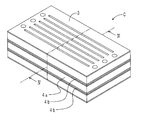
- FIG. 2 shows a perspective view of the stacked cells C (only three pieces).
- FIG. 3 shows an exploded perspective view of a single cell C.
- FIG. 4 shows a IV-IV cross-sectional view of FIG.
- the cell C includes the MEA 2, the separator 3, and the adhesive seal member 4 a.
- the MEA 2 includes an electrolyte membrane 20 and a pair of electrodes 21a and 21b.
- the electrolyte membrane 20 has a rectangular thin plate shape.
- the pair of electrodes 21a and 21b have a rectangular thin plate shape.
- the pair of electrodes 21 a and 21 b are disposed on both sides in the stacking direction (vertical direction) with the electrolyte membrane 20 interposed therebetween.
- the separator 3 is made of metal and has a rectangular thin plate shape.
- the separator 3 is provided with a total of six grooves extending in the longitudinal direction.
- the cross section of the separator 3 has an uneven shape due to the groove (see FIG. 4).
- the separators 3 are disposed to face each other on both sides in the stacking direction of the MEA 2.
- a gas flow path 30 for supplying a gas to the electrodes 21a and 21b is partitioned between the MEA 2 and the separator 3 by using the uneven shape.
- a refrigerant flow path 31 for flowing the refrigerant is partitioned between the separators 3 facing each other in the cell C adjacent in the stacking direction, using the uneven shape.
- the adhesive seal member 4a has a rectangular frame shape with a large thickness in the stacking direction.
- the adhesive seal member 4 a is bonded to the periphery of the MEA 2 and the separator 3 to be stacked. Moreover, the adhesive seal member 4 a seals the periphery of the MEA 2 between the facing separators 3.
- An adhesive seal member 4 b is interposed between the facing separators 3 of the cells C adjacent in the stacking direction.
- the adhesive seal member 4 b has a rectangular frame shape with a thin thickness in the stacking direction.
- the lower surface of the adhesive seal member 4b is bonded to the upper surface of the separator 3 disposed below.
- a frame-shaped lip portion 40b is formed on the upper surface peripheral portion of the adhesive seal member 4b (in FIG. 3, the adhesive seal member 4b shown above the cell C is shown by hatching).
- the lip portion 40 b is in contact with the lower surface of the separator 3 disposed above.
- the lip portion 40 b is pressed and deformed by the fastening force in the stacking direction when the solid electrolyte fuel cell 1 is assembled by stacking the cells C. Thereby, the seal line is formed, and the leakage of the refrigerant is suppressed.
- Adhesive seal members 4a and 4b are included in the adhesive seal member of the present invention.
- the polymer electrolyte fuel cell 1 fuel gas and oxidant gas are respectively supplied through the gas flow path 30.
- the refrigerant flows through the refrigerant flow path 31 in order to reduce the heat generation at the time of power generation.
- the periphery of the MEA 2 is sealed by the adhesive seal member 4 a.
- the adhesive seal member 4a can be bonded at a low temperature of about 150 ° C. and in a short time. Therefore, there is little possibility that the electrolyte membrane 20 may be deteriorated at the time of adhesion processing.
- the adhesive seal member 4 b also seals between the separators 3 facing each other in the cells C adjacent in the stacking direction. For this reason, the refrigerant is unlikely to leak out of the refrigerant channel 31. In addition, the sealability of the adhesive seal members 4a and 4b is unlikely to decrease even at a very low temperature of about -20 to -30 ° C. Furthermore, the adhesiveness of the adhesive seal members 4 a and 4 b is unlikely to be degraded even in the operating environment of the polymer electrolyte fuel cell 1. Therefore, the polymer electrolyte fuel cell 1 is excellent in durability. That is, the polymer electrolyte fuel cell 1 can be stably operated over a long period of time.
- EPDM (4): "Keltan (registered trademark) 4903” manufactured by DSM (ethylene content 48% by mass).
- C Crosslinking auxiliary maleimide compound: "Barnock (registered trademark) PM” manufactured by Ouchi Emerging Chemical Industry Co., Ltd.
- Adhesive component resorcinol compound "Takkirol (registered trademark) 620” manufactured by Taoka Chemical Industry Co., Ltd.
- the rubber compositions of Examples 1 to 13 and Comparative Example 1 were crosslinked by holding at 150 ° C. for 10 minutes to produce a seal member.
- the seal members of Examples 1-11 are included in both the first and second adhesive seal members of the present invention.
- the seal member of Example 12 is included in the first adhesive seal member of the present invention.
- the seal member of Example 13 is included in the second adhesive seal member of the present invention.
- the 100% modulus of each of the seal members of the example was 2 MPa or more, and was larger than the 100% modulus of the seal member of Comparative Example 1.
- the blending amount of the crosslinking aid is larger than that of the seal members of the comparative example. For this reason, in the seal member of the example, the crosslink density increased and the 100% modulus increased.
- a 90 ° peel test in accordance with JIS K 6256-2 (2006) was conducted to evaluate the adhesiveness of the seal members of the examples and comparative examples.
- a flat rubber composition having a width of 25 mm, a length of 60 mm and a thickness of 5 mm was disposed on the surface of a stainless steel plate having a width of 25 mm, a length of 60 mm and a thickness of 2 mm.
- a test piece was produced by holding at 150 ° C. for 10 minutes for crosslinking and adhesion.
- the produced test piece was attached to a predetermined
- the peel strength of each test piece in the 90 ° peel test is summarized in Table 1 above.
- Table 1 when the peel strength of the seal member of Comparative Example 1 is used as a reference (100), the index of the peel strength of each seal member is shown.
- the peel strengths of the seal members of the examples were all the same as the peel strength of the seal member of Comparative Example 1. Thus, the adhesiveness of the seal member of the example is good.
- T2 of the seal member of Comparative Example 1 was -31.degree. C.
- T2 of the seal members of the examples was -40.degree. C. or less. From this result, it is understood that the seal member of the example is hard to be hard even at a very low temperature of ⁇ 20 to ⁇ 30 ° C., and the rubber elasticity can be maintained.
- Example 12 using the same EPDM is compared with Comparative Example 1, the seal member of Example 12 containing poly ⁇ -olefin (2) having a pour point of -48 ° C has a pour point of -15 ° C. T2 was lower than that of the seal member of Comparative Example 1 containing paraffinic process oil. From this result, it is possible to confirm the effect of suppressing the decrease in rubber elasticity by the softener having a pour point of -40 ° C or less.
- Example 13 containing only paraffinic process oil having a pour point of -15 ° C. is compared with Comparative Example 1 as a softener, EPDM (4) having an ethylene content of 48% by mass is used.
- the seal member had a lower T2 than the seal member of Comparative Example 1 using EPDM (1) having an ethylene content of 54% by mass. From this result, it can be confirmed that when the ethylene content of EPDM is 53% by mass or less, crystallization at a very low temperature is suppressed, and a decrease in rubber elasticity can be suppressed.
- the seal member of Example 2 contains, as a softener, both of poly ⁇ -olefin (1) having a pour point of ⁇ 60 ° C. and paraffinic process oil having a pour point of ⁇ 15 ° C. For this reason, in the seal member of Example 2, T2 was slightly increased as compared with the seal member of Example 1 containing the same amount of poly ⁇ -olefin (1) having a pour point of -60 ° C.
- compression set strain test The compression set test based on JIS K6262 (2006) was performed on the seal members of the example and the comparative example.
- the compression set test was performed in two types, a low temperature test at ⁇ 30 ° C. and a high temperature test at 100 ° C.
- a low temperature test After compression at -30 ° C. for 24 hours, it was released, and the thickness after 30 minutes under the same temperature was measured to calculate the compression set.
- the high temperature test after compression at 100 ° C. for 24 hours, it was released, and the thickness after 30 minutes at room temperature was measured to calculate the compression set.
- the compression rate was 25% in all the tests.
- Table 1 The measurement results are summarized in Table 1 above. In Table 1, the compression set at ⁇ 30 ° C. and 100 ° C.
- the compression set was smaller than that of the seal member of Comparative Example 1 including the paraffinic process oil having a pour point of -15.degree. From this result, it is possible to confirm the effect of suppressing the decrease in rubber elasticity by the softener having a pour point of -40 ° C or less. Further, when Example 13 containing only paraffinic process oil having a pour point of -15 ° C. is compared with Comparative Example 1 as a softener, EPDM (4) having an ethylene content of 48% by mass is used. The compression set of the seal member was smaller than that of the seal member of Comparative Example 1 in which EPDM (1) having an ethylene content of 54% by mass was used. From this result, it can be confirmed that when the ethylene content of EPDM is 53% by mass or less, crystallization at a very low temperature is suppressed, and a decrease in rubber elasticity can be suppressed.
- the seal member of the example is resistant to settling at a high temperature of 100 ° C. and a cryogenic temperature of ⁇ 30 ° C. Therefore, according to the adhesive seal member of the present invention, it is possible to realize the improvement of the sealing property under the cryogenic temperature without sacrificing the sealing property under the high temperature.
- the adhesive seal member of the present invention adhesion to the member is possible at a low temperature and in a short time without using any other adhesive.
- the adhesive seal member of the present invention does not lose its rubber elasticity even at a very low temperature of about -20 to -30 ° C. For this reason, a good sealing performance is exhibited even in cold regions.
- both adhesive and stress seals are possible over the wide temperature range in which the fuel cell is used.
Landscapes
- Chemical & Material Sciences (AREA)
- Chemical Kinetics & Catalysis (AREA)
- Sustainable Development (AREA)
- Life Sciences & Earth Sciences (AREA)
- Sustainable Energy (AREA)
- Manufacturing & Machinery (AREA)
- Engineering & Computer Science (AREA)
- Electrochemistry (AREA)
- General Chemical & Material Sciences (AREA)
- Health & Medical Sciences (AREA)
- Medicinal Chemistry (AREA)
- Polymers & Plastics (AREA)
- Organic Chemistry (AREA)
- Fuel Cell (AREA)
Abstract
L'invention concerne un élément d'étanchéité adhésif pour piles à combustible formé à partir d'un produit réticulé constitué d'une composition de caoutchouc contenant les constituants (A)-(E) suivants. (A) Un ou plusieurs types de constituants de caoutchouc sélectionnés parmi des caoutchoucs d'éthylène-propylène et des caoutchoucs d'éthylène-propylène-diène ; (B) un peroxyde organique ayant une température de demi-vie d'une heure de 130˚C ou moins ; (C) un agent de réticulation ; (D) un ou plusieurs types de constituants adhésifs sélectionnés parmi des composés de résorcinol, des composés de mélamine, des agents de pontage à base d'alumine et des agents de pontage à base de silane ; et (E) un agent d'amollissement ayant un point de coulée de -40˚C ou moins. Dans les cas où la teneur en éthylène des caoutchoucs d'éthylène-propylène et des caoutchoucs d'éthylène-propylène-diène, en tant que constituant (A), est de 53 % en masse ou moins, la composition de caoutchouc ne contient pas nécessairement de constituant (E) en tant qu'agent d'amollissement ayant un point de coulée de -40˚C ou moins.
Priority Applications (2)
| Application Number | Priority Date | Filing Date | Title |
|---|---|---|---|
| EP12774093.4A EP2701224B1 (fr) | 2011-04-18 | 2012-04-17 | Élément d'étanchéité adhésif pour piles à combustible |
| US13/738,095 US20130157173A1 (en) | 2011-04-18 | 2013-01-10 | Adhesive seal member for fuel cell |
Applications Claiming Priority (4)
| Application Number | Priority Date | Filing Date | Title |
|---|---|---|---|
| JP2011092165A JP5719669B2 (ja) | 2011-04-18 | 2011-04-18 | 燃料電池用接着性シール部材 |
| JP2011092159A JP5719668B2 (ja) | 2011-04-18 | 2011-04-18 | 燃料電池用接着性シール部材 |
| JP2011-092165 | 2011-04-18 | ||
| JP2011-092159 | 2011-04-18 |
Related Child Applications (1)
| Application Number | Title | Priority Date | Filing Date |
|---|---|---|---|
| US13/738,095 Continuation US20130157173A1 (en) | 2011-04-18 | 2013-01-10 | Adhesive seal member for fuel cell |
Publications (1)
| Publication Number | Publication Date |
|---|---|
| WO2012144484A1 true WO2012144484A1 (fr) | 2012-10-26 |
Family
ID=47041590
Family Applications (1)
| Application Number | Title | Priority Date | Filing Date |
|---|---|---|---|
| PCT/JP2012/060333 Ceased WO2012144484A1 (fr) | 2011-04-18 | 2012-04-17 | Élément d'étanchéité adhésif pour piles à combustible |
Country Status (3)
| Country | Link |
|---|---|
| US (1) | US20130157173A1 (fr) |
| EP (1) | EP2701224B1 (fr) |
| WO (1) | WO2012144484A1 (fr) |
Cited By (2)
| Publication number | Priority date | Publication date | Assignee | Title |
|---|---|---|---|---|
| WO2013147020A1 (fr) * | 2012-03-30 | 2013-10-03 | 東海ゴム工業株式会社 | Composition de caoutchouc et pile à combustible scellée de manière étanche |
| EP2919309A4 (fr) * | 2013-03-28 | 2015-12-30 | Sumitomo Riko Co Ltd | Élément de scellement pour pile à combustible et corps de scellement pour pile à combustible l'utilisant |
Families Citing this family (3)
| Publication number | Priority date | Publication date | Assignee | Title |
|---|---|---|---|---|
| FR3008428B1 (fr) * | 2013-07-11 | 2015-08-07 | Ceth² | Joint pour pile d'electrolyseur et pile d'electrolyseur equipee d'un tel joint |
| US10680256B2 (en) * | 2016-03-31 | 2020-06-09 | Sumitomo Riko Company Limited | Sealing member for a fuel cell |
| CN110799585A (zh) * | 2017-06-28 | 2020-02-14 | Nok株式会社 | 橡胶组合物及燃料电池隔板用密封材料 |
Citations (5)
| Publication number | Priority date | Publication date | Assignee | Title |
|---|---|---|---|---|
| EP0315363A2 (fr) | 1987-11-02 | 1989-05-10 | Ford Motor Company Limited | Compositions élastomères à souplesse élevée à basse température |
| JP2004150591A (ja) | 2002-10-31 | 2004-05-27 | Nsk Ltd | シール |
| JP2009094056A (ja) | 2007-09-21 | 2009-04-30 | Tokai Rubber Ind Ltd | 燃料電池用接着性シール部材 |
| JP2010146781A (ja) | 2008-12-17 | 2010-07-01 | Tokai Rubber Ind Ltd | 燃料電池用接着性シール部材 |
| JP2010244690A (ja) * | 2009-04-01 | 2010-10-28 | Tokai Rubber Ind Ltd | 燃料電池モジュールの製造方法、および燃料電池の製造方法 |
Family Cites Families (3)
| Publication number | Priority date | Publication date | Assignee | Title |
|---|---|---|---|---|
| JP3396178B2 (ja) * | 1999-02-10 | 2003-04-14 | 住友ゴム工業株式会社 | 低弾性率ゴム組成物 |
| FI20002884L (fi) * | 2000-10-12 | 2002-04-13 | Duraban Oy | Elastomeerien polyalfaolefiinipehmittimet |
| US8487033B2 (en) * | 2007-05-16 | 2013-07-16 | Exxonmobil Chemical Patents Inc. | Thermoplastic elastomer compositions, methods for making the same, and articles made therefrom |
-
2012
- 2012-04-17 WO PCT/JP2012/060333 patent/WO2012144484A1/fr not_active Ceased
- 2012-04-17 EP EP12774093.4A patent/EP2701224B1/fr active Active
-
2013
- 2013-01-10 US US13/738,095 patent/US20130157173A1/en not_active Abandoned
Patent Citations (5)
| Publication number | Priority date | Publication date | Assignee | Title |
|---|---|---|---|---|
| EP0315363A2 (fr) | 1987-11-02 | 1989-05-10 | Ford Motor Company Limited | Compositions élastomères à souplesse élevée à basse température |
| JP2004150591A (ja) | 2002-10-31 | 2004-05-27 | Nsk Ltd | シール |
| JP2009094056A (ja) | 2007-09-21 | 2009-04-30 | Tokai Rubber Ind Ltd | 燃料電池用接着性シール部材 |
| JP2010146781A (ja) | 2008-12-17 | 2010-07-01 | Tokai Rubber Ind Ltd | 燃料電池用接着性シール部材 |
| JP2010244690A (ja) * | 2009-04-01 | 2010-10-28 | Tokai Rubber Ind Ltd | 燃料電池モジュールの製造方法、および燃料電池の製造方法 |
Non-Patent Citations (1)
| Title |
|---|
| See also references of EP2701224A4 * |
Cited By (3)
| Publication number | Priority date | Publication date | Assignee | Title |
|---|---|---|---|---|
| WO2013147020A1 (fr) * | 2012-03-30 | 2013-10-03 | 東海ゴム工業株式会社 | Composition de caoutchouc et pile à combustible scellée de manière étanche |
| EP2919309A4 (fr) * | 2013-03-28 | 2015-12-30 | Sumitomo Riko Co Ltd | Élément de scellement pour pile à combustible et corps de scellement pour pile à combustible l'utilisant |
| US9543596B2 (en) | 2013-03-28 | 2017-01-10 | Sumitomo Riko Company Limited | Seal member for fuel cell and fuel cell seal body using same |
Also Published As
| Publication number | Publication date |
|---|---|
| EP2701224A4 (fr) | 2014-09-10 |
| EP2701224A1 (fr) | 2014-02-26 |
| US20130157173A1 (en) | 2013-06-20 |
| EP2701224B1 (fr) | 2016-03-09 |
Similar Documents
| Publication | Publication Date | Title |
|---|---|---|
| JP5186317B2 (ja) | 燃料電池用接着性シール部材 | |
| JP5396337B2 (ja) | 燃料電池用接着性シール部材 | |
| JP5219774B2 (ja) | 燃料電池用接着性シール部材 | |
| JP4526093B2 (ja) | 燃料電池モジュール | |
| JP6681247B2 (ja) | 燃料電池用シール部材 | |
| JP6190607B2 (ja) | 燃料電池シール体 | |
| US20140287340A1 (en) | Rubber composition and fuel cell sealed body | |
| US9543596B2 (en) | Seal member for fuel cell and fuel cell seal body using same | |
| EP4223510A1 (fr) | Corps multicouche | |
| JP5719669B2 (ja) | 燃料電池用接着性シール部材 | |
| WO2012144484A1 (fr) | Élément d'étanchéité adhésif pour piles à combustible | |
| JP6067417B2 (ja) | 積層体の製法 | |
| JP6688718B2 (ja) | 燃料電池用シール部材 | |
| JP6190608B2 (ja) | 燃料電池シール体 | |
| JP5941804B2 (ja) | 積層体およびその製法 | |
| JP5719668B2 (ja) | 燃料電池用接着性シール部材 | |
| JP5268313B2 (ja) | 燃料電池用接着性シール部材 | |
| US10680256B2 (en) | Sealing member for a fuel cell | |
| JP7742711B2 (ja) | 燃料電池用シール部材 | |
| JP6681246B2 (ja) | 燃料電池用シール部材の製造方法 | |
| CN110799585A (zh) | 橡胶组合物及燃料电池隔板用密封材料 | |
| EP3647355A1 (fr) | Composition de caoutchouc, et matériau de scellement pour séparateur de pile à combustible | |
| WO2025028231A1 (fr) | Stratifié pour pile à combustible |
Legal Events
| Date | Code | Title | Description |
|---|---|---|---|
| 121 | Ep: the epo has been informed by wipo that ep was designated in this application |
Ref document number: 12774093 Country of ref document: EP Kind code of ref document: A1 |
|
| WWE | Wipo information: entry into national phase |
Ref document number: 2012774093 Country of ref document: EP |
|
| NENP | Non-entry into the national phase |
Ref country code: DE |