WO2012146569A1 - Verfahren zur herstellung von 2-chlorallylthiocyanat und 2-chlorallylisothiocyanat - Google Patents

Verfahren zur herstellung von 2-chlorallylthiocyanat und 2-chlorallylisothiocyanat Download PDF

Info

Publication number
WO2012146569A1
WO2012146569A1 PCT/EP2012/057431 EP2012057431W WO2012146569A1 WO 2012146569 A1 WO2012146569 A1 WO 2012146569A1 EP 2012057431 W EP2012057431 W EP 2012057431W WO 2012146569 A1 WO2012146569 A1 WO 2012146569A1
Authority
WO
WIPO (PCT)
Prior art keywords
formula
iii
thiocyanate
propene
dichloro
Prior art date
Legal status (The legal status is an assumption and is not a legal conclusion. Google has not performed a legal analysis and makes no representation as to the accuracy of the status listed.)
Ceased
Application number
PCT/EP2012/057431
Other languages
English (en)
French (fr)
Inventor
Thomas Himmler
Matthias Decker
Ralf Dunkel
Peter Gerdes
Martin Littmann
Norbert Lui
Albert Schnatterer
Current Assignee (The listed assignees may be inaccurate. Google has not performed a legal analysis and makes no representation or warranty as to the accuracy of the list.)
Bayer Intellectual Property GmbH
Original Assignee
Bayer Intellectual Property GmbH
Priority date (The priority date is an assumption and is not a legal conclusion. Google has not performed a legal analysis and makes no representation as to the accuracy of the date listed.)
Filing date
Publication date
Application filed by Bayer Intellectual Property GmbH filed Critical Bayer Intellectual Property GmbH
Priority to JP2014506829A priority Critical patent/JP2014516936A/ja
Priority to BR112013027675A priority patent/BR112013027675A2/pt
Priority to US14/113,739 priority patent/US8785673B2/en
Priority to MX2013012377A priority patent/MX2013012377A/es
Priority to CN201280020498.7A priority patent/CN103502210A/zh
Priority to KR1020137030895A priority patent/KR20140023374A/ko
Priority to EP12717115.5A priority patent/EP2702040A1/de
Publication of WO2012146569A1 publication Critical patent/WO2012146569A1/de
Priority to IL229031A priority patent/IL229031A0/en
Anticipated expiration legal-status Critical
Ceased legal-status Critical Current

Links

Classifications

    • CCHEMISTRY; METALLURGY
    • C07ORGANIC CHEMISTRY
    • C07CACYCLIC OR CARBOCYCLIC COMPOUNDS
    • C07C331/00Derivatives of thiocyanic acid or of isothiocyanic acid
    • C07C331/16Isothiocyanates
    • C07C331/18Isothiocyanates having isothiocyanate groups bound to acyclic carbon atoms
    • C07C331/22Isothiocyanates having isothiocyanate groups bound to acyclic carbon atoms of an unsaturated carbon skeleton

Definitions

  • the present invention relates to a process for the preparation of 2-chloroallyl thiocyanate of the formula (I) and 2-chloroallyl isothiocyanate of the formula (II).
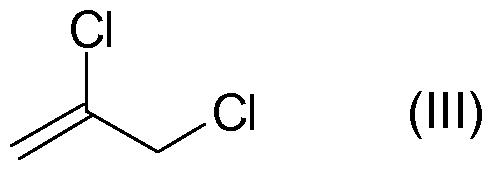
  • 2-chloroallyl thiocyanate of the formula (I) is a known compound (see, for example, EP 0761649). It is also already known that 2-chloroallyl thiocyanate of the formula (I) can be prepared by reacting a 2,3-dihalogeno-1-propene, preferably 2,3-dichloro-1-propene, of the formula (III)
  • M is a metal cation or an ammonium group and n is from 1 to 4, corresponding to the charge number of the cation, in a diluent.
  • suitable diluents for the known processes are acetonitrile (EP 446913, CN 1401646) or toluene, optionally with the addition of a phase transfer catalyst (Shanghai Huagong 27 (2002) 25-27, J. Agric. Food Chem. 56 (2008) 10805-10810 ).
  • a phase transfer catalyst Shanghai Huagong 27 (2002) 25-27, J. Agric. Food Chem. 56 (2008) 10805-10810 .
  • the use of such diluents is disadvantageous for a technical process.
  • the dilution of the starting materials can lead to a significant reduction in the reaction rate and thus to an extension of the required reaction time.
  • a diluent also requires additional workup steps.
  • the diluent must be separated by distillation, care being taken to recover it in such purity that it can be recycled back to the process. Otherwise, a costly and possibly environmentally harmful disposal is necessary.
  • M is a metal cation or an ammonium group and n is 1 to 4 in accordance with the charge number of the cation, in the presence of a phase transfer catalyst of the general formula (V)
  • R 1 , R 2 , R 3 and R 4 independently of one another are hydrogen, C 1 -C 24 -alkyl, benzyl or C 1 -C 10 -aryl, the latter optionally substituted by halogen, C 1 -C 6 -alkyl, C 1 -C 6 -alkoxy, C 1 -C 4 -alkyl Ce- alkylamino, C 1 -C 6 -dialkylamino, hydroxy or phenyl and
  • X is an anion, without diluent or in the presence of only a very small amount of diluent of up to 15 weight percent, based on 2,3-dichloropropene of formula (III), and simultaneously in the presence of an excess of 10 to 200 mole percent of 2 , 3-dichloro-1-propene of the formula (III), based on the thiocyanate of the formula (IV).
  • Suitable diluents which may be used are polar and nonpolar organic diluents and water.
  • examples include hydrocarbons such as toluene, xylenes, hexane, heptane, methylcyclohexane; halogenated hydrocarbons, such as dichloromethane, 1, 2-dichloroethane; Alcohols such as methanol, ethanol, propanol, isopropanol, butanol; Esters, such as methyl acetate, ethyl acetate, butyl acetate; Ketones such as acetone, methyl ethyl ketone, methyl isobutyl ketone and nitriles such as acetonitrile, butyronitrile, isobutyronitrile.
  • the process according to the invention is preferably carried out by reacting 2,3-dichloro-1-propene
  • M is Li + , Na + , K + or NH 4 + and n is 1, in the presence of a phase transfer catalyst of the general formula (V) R1
  • R 1 , R 2 , R 3 and R 4 independently of one another represent hydrogen, C 1 -C 24 -alkyl, benzyl or phenyl and
  • X is an anion from the series fluoride, chloride, bromide, hydrogen sulfate, hydroxide or acetate, in the presence of 0 to 10 percent by weight of diluent, based on 2,3-dichloro-1-propene of the formula (III), and simultaneously in the presence an excess of 10 to 200 mole percent of 2,3-dichloro-1-propene of the formula (III), based on the thiocyanate of the formula (IV).
  • Preferred diluents which may be used are toluene, methylcyclohexane, dichloromethane, methanol, ethanol, propanol, isopropanol, butanol, methyl acetate, ethyl acetate, butyl acetate, acetone, methyl ethyl ketone, methyl isobutyl ketone, acetonitrile, butyronitrile, isobutyronitrile and water Application.
  • no further diluent is used in the reaction.
  • the total amount of diluent then results from the sum of the diluent contents of the educts of the formula (III) and of the thiocyanate.
  • this total amount is less than 10 or preferably less than 5 weight percent based on the compound of formula (III).
  • the process according to the invention is particularly preferably carried out by reacting 2,3-dichloro-1-propene of the formula (III)
  • M is Na + or NH 4 and n is 1, in the presence of a phase transfer catalyst of the general formula (V)
  • R 1 , R 2 , R 3 and R 4 independently of one another represent hydrogen, C 1 -C 24 -alkyl, benzyl or phenyl and
  • X is an anion from the series chloride, bromide, hydrogen sulfate or hydroxide, in the presence of 0 to 5 percent by weight of diluent, based on 2,3-dichloro-1-propene of the formula (III), and simultaneously in the presence of an excess of 30 to 100 mole percent of 2,3-dichloro-1-propene of the formula (III), based on the thiocyanate of the formula (IV), is reacted.
  • Optional diluents used include toluene, dichloromethane, methanol, ethyl acetate, butyl acetate, acetone, methyl ethyl ketone, methyl isobutyl ketone, acetonitrile, butyronitrile, isobutyronitrile and water.
  • the inventive method has advantages over the known prior art. Thus eliminating the need for its processing and possibly disposal by the substantial omission of a diluent. At the same time, the space-time yield of the method according to the invention is higher than that of the prior art methods.
  • the inventive method is carried out at temperatures between 30 and 150 ° C. Preference is given to working at temperatures between 50 and 100 ° C.
  • the process of the invention is usually carried out at atmospheric pressure, but can also be carried out under elevated or reduced pressure.
  • the reaction time in the process according to the invention is between 0, 1 and 10 hours. Preference is given to working between 0.5 and 7 hours, more preferably between 1 and 5 hours.
  • phase transfer catalyst of the general formula (V) can be varied within wide limits in the process according to the invention. It is customary to use amounts of from 0.1 to 10% by weight, based on 2,3-dichloro-1-propene of the formula (III). Preferably used amounts between 1 and 7 weight percent.
  • Suitable phase transfer catalysts of the general formula (V) are, for example: tetrabutylammonium fluoride, chloride, bromide, iodide, acetate, hydrogen sulfate, tetraethylammonium bromide, iodide, methyltributylammonium chloride, bromide, iodide, acetate, hydrogensulfate , Benzyldodecyldimethylammonium chloride, bromide, benzyltriethylammonium bromide, chloride, dodecyltrimethylammonium chloride, bromide, tetradecyltrimethylammonium chloride, bromide, methyltrioctylammonium chloride, methyl-1-tridecylammonium chloride,
  • 1-Methyl trioctylammonium chloride (trade name Aliquat ® 336; is in a mixture with methyl tridecylammoniumchlorid before ⁇ methyl-tridecylammoniumchlorid, bromide, tetraoctylammonium bromide, chloride, dodecyltrimethylammonium chloride, bromide, tetradecyl trimethyl ammonium chloride, bromide, didecyl-dimethyl- ammonium chloride, bromide and benzyldodecyldimethylammonium chloride or bromide.
  • Aliquat ® 336 is in a mixture with methyl tridecylammoniumchlorid before ⁇ methyl-tridecylammoniumchlorid, bromide, tetraoctylammonium bromide, chloride, dodecyltrimethylammonium chloride, bromide
  • phase transfer catalyst of the general formula (V) may optionally be omitted if the 2,3-dichloro-1-propene of the formula (III) used for the reaction was not purified by distillation and thus already contains sufficient amount of a phase transfer catalyst as a result of its technical preparation process.
  • the 2,3-dichloro-1-propene of the formula (III) is usually prepared by reacting 1,2,3-trichloropropane of the formula (VI) with a base:
  • Suitable bases here are organic and inorganic bases.
  • suitable organic bases are trimethylamine, triethylamine, tributylamine, pyridine, 5-ethyl-2-methylpyridine or quinoline.
  • Suitable inorganic bases include, for example, alkali metal hydroxides such as NaOH and KOH, alkaline earth metal hydroxides such as Ca (OH) 2, alkali hydrogen carbonates such as NaHCO 3 and KHCO3, or alkali metal carbonates such as Na2CÜ3, K2CO3 or CS2CO3 in question.
  • a base such as NaOH or KOH
  • a phase transfer catalyst is used to achieve a sufficient reaction rate. If the workup of the 2,3-dichloro-1-propene of the formula (III) is limited to a simple phase separation, the 2,3-dichloro-1-propene contains at least partly the phase transfer catalyst used for its preparation.
  • the amount of residue after distillation is 313.6 g and consists according to analysis by quantitative 'H-NMR spectroscopy to 82.3 weight percent of 2-Chlorallylthiocyanat of formula (I) and 2-Chlorallylisothiocyanat of formula (II), which a yield of 97% of theory based on sodium thiocyanate results.
  • the mixture is stirred 150 g of distilled 2,3-dichloro-l-propene (GC analysis: 97.3%>ig; water (KF): ⁇ 0.1%>) for 30 minutes with 6 g of Aliquat ® 336 and 50 ml Water and then separates the phases.
  • This pretreated 2,3-dichloro-1-propene (water (KF): 0.6%) is used together with 333.3 g of technical grade 2,3-dichloro-1-propene (GC analysis: 89.4%) % water (KF): 0.45%) in a 2-liter jacketed reaction vessel with stirrer and reflux condenser. 165.46 g of sodium thiocyanate (98% strength) are added with stirring.
  • the amount of residue after distillation is 288.7 g and consists according to GC analysis to 17.8 area percent of 2-Chlorallylthiocyanat of formula (I) and 64.4 area percent of 2-Chlorallylisothiocyanat of formula (II), which a yield of 89% of theory, based on sodium thiocyanate, gives.

Landscapes

  • Chemical & Material Sciences (AREA)
  • Organic Chemistry (AREA)
  • Organic Low-Molecular-Weight Compounds And Preparation Thereof (AREA)
  • Low-Molecular Organic Synthesis Reactions Using Catalysts (AREA)

Abstract

Es wird ein Verfahren zur Herstellung von 2-Chlorallylisothiocyanat aus 2,3-Dichlor-1-propen b eschrieben, in dem das 2,3-Dichlor-1-propen mit einem Thiocyanat in Gegenwart eines Phasentransferkatalysators, ohne Verdünnungsmittel oder in Gegenwart von bis zu 15 Gewichtsprozent bezogen auf 2,3-Dichlorpropen und gleichzeitig in Gegenwart eines Überschusses von 10 bis 200 Molprozent an 2,3-Dichlor-1-propen der bezogen auf das Thiocyanat umgesetzt wird. Ferner wird ein Verfahren ausgehend von 1,2,3 Trichlorpropan beschrieben.

Description

Verfahren zur Herstellung von 2-Chlorallylthiocyanat und 2-Chlorallylisothiocvanat
Die vorliegende Erfindung betrifft ein Verfahren zur Herstellung von 2-Chlorallylthiocyanat der Formel (I) und 2-Chlorallylisothiocyanat der Formel (II).
Figure imgf000002_0001
2-Chlorallylthiocyanat der Formel (I) ist eine bekannte Verbindung (siehe beispielsweise EP 0761649). Es ist auch bereits bekannt, dass 2-Chlorallylthiocyanat der Formel (I) dadurch hergestellt werden kann, dass man ein 2,3-Dihalogen-l-propen, bevorzugt 2,3-Dichlor-l-propen der Formel (III)
Figure imgf000002_0002
mit einem Thiocyanat der allgemeinen Formel (IV)
M(SCN)n (IV), in welcher
M für ein Metallkation oder eine Ammoniumgruppe steht und n entsprechend der Ladungszahl des Kations für 1 bis 4 steht, in einem Verdünnungsmittel umsetzt. Als geeignete Verdünnungsmittel für die bekannten Verfahren werden beispielsweise Acetonitril (EP 446913; CN 1401646) oder Toluol, gegebenenfalls unter Zusatz eines Phasentransferkatalysators (Shanghai Huagong 27 (2002) 25-27; J. Agric. Food Chem. 56 (2008) 10805-10810) beschrieben. Der Einsatz solcher Verdünnungsmittel ist für einen technischen Prozess jedoch nachteilig. So kann beispielsweise die Verdünnung der Ausgangsmaterialien zu einer deutlichen Verringerung der Reaktionsgeschwindigkeit und dadurch zu einer Verlängerung der erforderlichen Reaktionszeit führen. Ganz grundsätzlich erfordert der Einsatz eines Verdünnungsmittels auch zusätzliche Aufarbeitungsschritte. So muß das Verdünnungsmittel beispielsweise destillativ abgetrennt werden, wobei darauf zu achten ist, dass es in einer solchen Reinheit zurückgewonnen wird, dass es wieder in den Prozess zurückgeführt werden kann. Anderenfalls ist eine kostenintensive und gegebenenfalls umweltbelastende Entsorgung notwendig.
Dies gilt auch für die bekannte Verwendung von Wasser als Verdünnungsmittel (EP 0761649; J. Agric. Food Chem. 52 (2004) 1918-1922). Hier wird der Prozess im Gemisch zweier flüssiger Phasen (Wasser und organische Phase) in Gegenwart eines Phasentransferkatalysators durchgeführt. Es müssen dann unter Umständen erhebliche Abwassermengen entsorgt werden. Ebenfalls bereits bekannt ist, dass sich das 2-Chlorallylthiocyanat der Formel (I) bei Temperaturen oberhalb der Raumtemperatur zu 2-Chlorallylisothiocyanat der Formel (II) umlagert (EP 446913 ; EP 761649; J. Agric. Food Chem. 52 (2004) 1918-1922). Bei der Herstellung von 2-Chlorallylthiocyanat der Formel (I) aus 2,3-Dichlor-l -propen der Formel (III) und einem Thiocyanat der Formel (IV) erhält man deshalb in der Regel Gemische der Verbindungen der Formeln (I) und (II). Üblicherweise wird in technischen Prozessen ein solches Gemisch durch Erwärmen, beispielsweise während einer destillativen Aufarbeitung, vollständig in das 2-Chlorallylisothiocyanat der Formel (II) überführt. Der gesamte Prozess kann dementsprechend durch folgendes Schema veranschaulicht werden:
Figure imgf000003_0001
('") (I) (II) (II) 2-Chlorallylisothiocyanat der Formel (II) dient beispielsweise als Zwischenprodukt bei der Herstellung von Pflanzenschutzmitteln (EP 446913).
Es bestand also weiterhin Bedarf an einem weiter verbesserten Verfahren zur Herstellung von 2- Chlorallylthiocyanat der Formel (I) und 2-Chlorallylisothiocyanat der Formel (II) unter technisch vorteilhaften Bedingungen. Es wurde nun überraschend ein neues Verfahren zur Herstellung von 2-Chlorallylthiocyanat der Formel (I) und 2-Chlorallylisothiocyanat der Formel (II) gefunden, dadurch gekennzeichnet, dass man 2,3- Dichlor-l -propen der Formel (III)
Figure imgf000003_0002
mit einem Thiocyanat der allgemeinen Formel (IV)
M(SCN)n (IV), in welcher
M für ein Metallkation oder eine Ammoniumgruppe steht und n entsprechend der Ladungszahl des Kations für 1 bis 4 steht, in Gegenwart eines Phasentransferkatalysators der allgemeinen Formel (V)
R1
U
R4-N-R2 x- (V)j in welcher die Reste
R1, R2, R3 und R4 unabhängig voneinander für Wasserstoff, Ci - C24-Alkyl, Benzyl oder Ce - Cio-Aryl, letzteres gegebenenfalls substituiert durch Halogen, Ci - Cö-Alkyl, Ci - Cö-Alkoxy, Ci - Ce- Alkylamino, Ci - C6-Dialkylamino, Hydroxy oder Phenyl stehen und
X für ein Anion steht, ohne Verdünnungsmittel oder in Gegenwart einer nur sehr kleinen Menge an Verdünnungsmittel von bis zu 15 Gewichtsprozent, bezogen auf 2,3-Dichlorpropen der Formel (III), und gleichzeitig in Gegenwart eines Überschusses von 10 bis 200 Molprozent an 2,3-Dichlor-l -propen der Formel (III), bezogen auf das Thiocyanat der Formel (IV), umsetzt.
Als gegebenenfalls verwendete Verdünnunsgmittel kommen polare und unpolare organische Verdünnungsmittel sowie Wasser in Betracht. Beispielhaft seien Kohlenwasserstoffe wie Toluol, Xylole, Hexan, Heptan, Methylcyclohexan; halogenierte Kohlenwasserstoffe wie Dichlormethan, 1 ,2- Dichlorethan; Alkohole wie Methanol, Ethanol, Propanol, Isopropanol, Butanol ; Ester wie Essigsäuremethylester, Essigsäureethylester, Essigsäurebutylester; Ketone wie Aceton, Methyl-ethyl- keton, Methyl-isobutyl-keton und Nitrile wie Acetonitril, Butyronitril, Isobutyronitril genannt.
Bevorzugt wird das erfindungsgemäße Verfahren durchgeführt, indem man 2,3-Dichlor-l -propen der
Formel (III)
Figure imgf000004_0001
mit einem Thiocyanat der allgemeinen Formel (IV)
M(SCN)n in welcher
M für Li+, Na+, K+ oder NH4 + und n für 1 steht, in Gegenwart eines Phasentransferkatalysators der allgemeinen Formel (V) R1
R4-N-R2 X- (V)
R3
in welcher die Reste
R1, R2, R3 und R4 unabhängig voneinander für Wasserstoff, Ci - C24-Alkyl, Benzyl oder Phenyl stehen und
X für ein Anion aus der Reihe Fluorid, Chlorid, Bromid, Hydrogensulfat, Hydroxid oder Acetat steht, in Gegenwart von 0 bis 10 Gewichtsprozent Verdünnungsmittel, bezogen auf 2,3-Dichlor-l -propen der Formel (III), und gleichzeitig in Gegenwart eines Überschusses von 10 bis 200 Molprozent an 2,3- Dichlor-l -propen der Formel (III), bezogen auf das Thiocyanat der Formel (IV), umsetzt.
Als gegebenenfalls verwendete Verdünnunsgmittel kommen bevorzugt Toluol, Methylcyclohexan, Dichlormethan, Methanol, Ethanol, Propanol, Isopropanol, Butanol, Essigsäuremethylester, Essigsäureethylester, Essigsäurebutylester, Aceton, Methyl- ethyl-keton, Methyl-isobutyl-keton, Acetonitril, Butyronitril, Isobutyronitril sowie Wasser zur Anwendung.
Vorzugsweise wird in die Reaktion kein weiteres Verdünnungsmittel eingesetzt. Die Gesamtmenge an Verdünnungsmittel ergibt sich dann aus der Summe der Verdünnungsmittelgehalte der Edukte der Formel (III) sowie des Thiocyanats. Üblicherweise liegt diese Gesamtmenge unter 10 oder bevorzugt unter 5 Gewichtsprozent bezogen auf die Verbindung der Formel (III).
Besonders bevorzugt wird das erfindungsgemäße Verfahren durchgeführt, indem man 2,3-Dichlor-l - propen der Formel (III)
Figure imgf000005_0001
mit einem Thiocyanat der allgemeinen Formel (IV)
M(SCN)n in welcher
+
M für Na+ oder NH4 und n für 1 steht, in Gegenwart eines Phasentransferkatalysators der allgemeinen Formel (V)
R1
U
R4-N-R2 x- (V)j
R3
in welcher die Reste
R1, R2, R3 und R4 unabhängig voneinander für Wasserstoff, Ci - C24-Alkyl, Benzyl oder Phenyl stehen und
X für ein Anion aus der Reihe Chlorid, Bromid , Hydrogensulfat oder Hydroxid steht, in Gegenwart von 0 bis 5 Gewichtsprozent Verdünnungsmittel, bezogen auf 2,3-Dichlor-l -propen der Formel (III), und gleichzeitig in Gegenwart eines Überschusses von 30 bis 100 Molprozent an 2,3- Dichlor-l -propen der Formel (III), bezogen auf das Thiocyanat der Formel (IV), umsetzt. Als gegebenenfalls verwendete Verdünnunsgmittel kommen b es onders bevorzugt To luo l, Dichlormethan, Methanol, Essigsäureethylester, Essigsäurebutylester, Aceton, Methyl-ethyl-keton, Methyl-isobutyl-keton, Acetonitril, Butyronitril, Isobutyronitril sowie Wasser zur Anwendung.
Das erfindungsgemäße Verfahren weist gegenüber dem bekannten Stand der Technik Vorteile auf. So entfällt durch den weitgehenden Verzicht auf ein Verdünnungsmittel die Notwendigkeit zu dessen Aufarbeitung und gegebenenfalls Entsorgung. Gleichzeitig ist die Raum-Zeit- Ausb eute des erfindungsgemäßen Verfahrens höher als die der dem bekannten Stand der Technik entsprechenden Verfahren.
Das erfindungsgemäße Verfahren wird bei Temperaturen zwischen 30 und 150°C durchgeführt. Bevorzugt arbeitet man bei Temperaturen zwischen 50 und 100°C. Das erfindungsgemäße Verfahren wird üblicherweise bei Normaldruck durchgeführt, kann aber auch unter erhöhtem oder vermindertem Druck durchgeführt werden.
Die Reaktionszeit im erfindungsgemäßen Verfahren liegt zwischen 0, 1 und 10 Stunden. Bevorzugt arbeitet man zwischen 0,5 und 7 Stunden, besonders bevorzugt zwischen 1 und 5 Stunden.
Die Menge an Phasentransferkatalysator der allgemeinen Formel (V) kann im erfindungsge-mäßen Verfahren in weiten Grenzen variiert werden. Üblicherweise setzt man Mengen von 0, 1 bis 10 Gewichtsprozent, bezogen auf 2,3-Dichlor-l -propen der Formel (III), ein. Bevorzugt verwendet man Mengen zwischen 1 und 7 Gewichtsprozent. Als Phasentransferkatalysatoren der allgemeinen Formel (V) kommen beispielsweise in Betracht: Tetrabutylammoniumfluorid, -chlorid, -bromid, -iodid, -acetat, -hydrogensulfat, Tetraethyl- ammoniumbromid, -iodid, Methyltributylammoniumchlorid, -bromid, -iodid, -acetat, -hydrogensulfat, Benzyl-dodecyl-dimethylammoniumchlorid, -bromid, Benzyltriethylammonium- bromid, -chlorid, Dodecyltrimethylammoniumchlorid, -bromid, Tetradecyl-trimethylammoniumchlorid, -bromid, Methyl-trioctylammoniumc h l o r i d , M e t h y 1-tridecylammoniumchlorid,
Tetraoctylammoniumbromid, -chlorid, Didecyl-dimethyl-ammoniumchlorid, -bromid.
Bevorzugt verwendet man Methy 1-trioctylammoniumchlorid (Handelsname Aliquat® 336; liegt in Mischung mit Methyl-tridecylammoniumchlorid vor^ Methyl-tridecylammoniumchlorid, -bromid, Tetraoctylammoniumbromid, -chlorid, Dodecyltrimethylammoniumchlorid, -bromid, Tetradecyl- trimethylammoniumchlorid, -bromid, Didecyl-dimethyl-ammoniumchlorid, -bromid und Benzyl- dodecyl-dimethylammonium- chlorid oder -bromid.
Der Zusatz eines Phasentransferkatalysators der allgemeinen Formel (V) kann gegebenenfalls entfallen, wenn das zur Reaktion eingesetzte 2,3-Dichlor-l -propen der Formel (III) nicht destillativ gereinigt wurde und so infolge seines technischen Herstellungsverfahrens bereits ausreichende Menge eines Phasentransferkatalysators enthält.
D as 2,3-Dichlor-l -propen der Formel (III) wird üblicherweise so hergestellt, dass man 1,2,3- Trichlorpropan der Formel (VI) mit einer Base umsetzt:
Figure imgf000007_0001
(VI) (I II)
Als Basen können hierbei organische und anorganische Basen verwendet werden. Als organische Basen seien beispielhaft Trimethylamin, Triethylamin, Tributylamin, Pyridin, 5-Ethyl-2-methylpyridin oder Chinolin genannt.. Als anorganische Basen kommen beispielsweise Alkalihydroxide wie NaOH und KOH, Erdalkalihydroxide wie beispielsweise Ca(OH)2, Alkalihydrogencarbonate wie beispielssweise NaHCÜ3 und KHCO3, oder Alkalicarbonate wie beispielsweise Na2CÜ3, K2CO3 oder CS2CO3 in Frage. Typischerweise verwendet man eine Base wie NaOH oder KOH, und führt das Verfahren zur Herstellung von 2,3-Dichlor-l -propen der Formel (III) aus 1 ,2,3-Trichlorpropan der Formel (VI) in Wasser durch. Da bei dieser Arbeitsweise ein Zweiphasensystem resultiert, setzt man zur Erzielung einer ausreichenden Reaktionsgeschwindigkeit einen Phasentransferkatalysator zu. Beschränkt sich nun die Aufarbeitung des 2,3-Dichlor-l -propen der Formel (III) auf eine einfache Phasentrennung, so enthält das 2,3-Dichlor-l -propen zumindest teilweise den zu seiner Herstellung eingesetzten Phasentransferkatalysator. Abschließend kann das gegebenenfalls erhaltene Gemisch aus 2-Chlorallylthiocyanat der Formel (I) und 2-Chlorallylisothiocyanat der Formel (II) durch Erhitzen, beispielsweise bei einer destillativen Reinigung, in das 2-Chlorallylisothiocyanat der Formel (II) überführt werden.
Das erfindungsgemäße Verfahren soll durch die folgenden Beispiele veranschaulicht werden, ohne auf diese eingeschränkt zu sein.
Beispiel 1
In einem 2-Liter-Doppelmantel-Reaktionsgefäß mit Rührer und Rückflußkühler legt man 496,5 g 2,3- Dichlor-l-propen technischer Qualität (GC-Analyse: 89,4%ig; Wasser (KF): 0,45%) vor und erwärmt auf 70°C. Bei dieser Temperatur gibt man unter Rühren 165,46 g Natriumthiocyanat (98%ig) in drei Portionen zu. Anschließend erwärmt man auf 80°C, rührt 90 Minuten bei dieser Temperatur, kühlt wieder auf 70°C ab und gibt 500 ml Wasser hinzu. Die organische Phase wird bei Raumtemperatur abgetrennt. Man erhält 530,3 g organische Phase, die nach GC-Analyse 41,8 Flächenprozent 2,3- Dichlor-l-propen, 24,9 Flächenprozent 2-Chlorallylthiocyanat der Formel (I) und 24,5 Flächenprozent 2-Chlorallylisothiocyanat der Formel (II) enthält. Diese organische Phase wird andestilliert (bis 75°C Badtemperatur bei 250 mbar). Dadurch erhält man 212,7 g Destillat mit laut GC-Analyse 207,6 g 2,3-Dichlor-l-propen, die in den Prozess zurückgeführt werden können.
Der Menge an Rückstand nach der Destillation beträgt 313,6 g und besteht nach Analyse durch quantitative 'H-NMR-Spektroskopie zu 82,3 Gewichtsprozent aus 2-Chlorallylthiocyanat der Formel (I) und 2-Chlorallylisothiocyanat der Formel (II), womit sich eine Ausbeute von 97% der Theorie, bezogen auf Natriumthiocyanat, ergibt.
Beispiel 2
Man verrührt 150 g destilliertes 2,3-Dichlor-l-propen (GC-Analyse: 97,3%>ig; Wasser (KF): < 0,1%>) für 30 Minuten mit 6 g Aliquat® 336 und 50 ml Wasser und trennt dann die Phasen. Dieses so vorbehandelte 2,3-Dichlor-l-propen (Wasser (KF): 0,6%>) wird zusammen mit 333,3 g 2,3-Dichlor-l- propen technischer Qualität (GC-Analyse: 89,4%>ig; Wasser (KF): 0,45%>) in einem 2-Liter- Doppelmantel-Reaktionsgefäß mit Rührer und Rückflußkühler vorgelegt. Man gibt unter Rühren 165,46 g Natriumthiocyanat (98%>ig) hinzu. Anschließend erwärmt man auf 80°C, rührt zwei Stunden bei dieser Temperatur, kühlt auf 70°C ab und gibt 500 ml Wasser hinzu. Die organische Phase wird bei Raumtemperatur abgetrennt. Man erhält 512,4 g organische Phase, die nach GC-Analyse 44,2 Flächenprozent 2,3-Dichlor-l-propen, 20 Flächenprozent 2-Chlorallylthiocyanat der Formel (I) und 27,9 Flächenprozent 2-Chlorallylisothiocyanat der Formel (II) enthält. Diese organische Phase wird andestilliert (bis 75°C Badtemperatur bei 250 mbar). Dadurch erhält man 221,2 g Destillat mit laut GC-Analyse 217,8 g 2,3-Dichlor-l-propen, die in den Prozess zurückgeführt werden können.
Der Menge an Rückstand nach der Destillation beträgt 288,7 g und besteht nach GC-Analyse zu 17,8 Flächenprozent aus 2-Chlorallylthiocyanat der Formel (I) und zu 64,4 Flächenprozent aus 2- Chlorallylisothiocyanat der Formel (II), womit sich eine Ausbeute von 89% der Theorie, bezogen auf Natriumthiocyanat, ergibt.
Beispiel 3
In einem 2-Liter-Doppelmantel-Reaktionsgefäß mit Rührer und Rückflußkühler legt man 495,4 g 2,3- Dichlor- 1-propen technischer Qualität (GC-Analyse: 89,6%>ig; Wasser (KF): 0,45%>) vor und erwärmt auf 70°C. Bei dieser Temperatur gibt man unter Rühren 155,35 g Ammoniumthiocyanat (98%>ig) in zwei Portionen zu. Anschließend erwärmt man auf 80°C, rührt zwei Stunden bei dieser Temperatur, kühlt wieder auf 70°C ab und gibt 500 ml Wasser hinzu. Die organische Phase wird bei Raumtemperatur abgetrennt. Man erhält 514,9 g organische Phase, die nach GC-Analyse 58,8 Flächenprozent 2,3- Dichlor- 1-propen, 13,8 Flächenprozent Chlorallylthiocyanat der Formel (I) und 19,05 Flächenprozent 2- Chlorallylisothiocyanat der Formel (II) enthält. Damit ergibt sich eine Ausbeute von 99%> der Theorie, bezogen auf umgesetztes 2,3-Dichlor-l-propen.
Beispiel 4
In einem 2-Liter-Doppelmantel-Reaktionsgefäß mit Rührer und Rückflußkühler legt man 495,4 g 2,3- Dichlor- 1-propen technischer Qualität (GC-Analyse: 89,6%>ig; Wasser (KF): 0,45%>) vor und erwärmt auf 70°C. Bei dieser Temperatur gibt man unter Rühren 220,55 g Natriumthiocyanat (98%>ig) in zwei Portionen zu. Anschließend erwärmt man auf 80°C, rührt zwei Stunden bei dieser Temperatur, kühlt wieder auf 70°C ab und gibt 500 ml Wasser hinzu. Die organische Phase wird bei Raumtemperatur abgetrennt. Man erhält 548,7 g organische Phase, die nach GC-Analyse 28,3 Flächenprozent 2,3- Dichlor- 1-propen, 27,05 Flächenprozent Chlorallylthiocyanat der Formel (I) und 37,1 Flächenprozent 2- Chlorallylisothiocyanat der Formel (II) enthält. Damit ergibt sich eine Ausbeute von 99%> der Theorie, bezogen auf Natriumthiocyanat.
Beispiel 5
In einem 2-Liter-Doppelmantel-Reaktionsgefäß mit Rührer und Rückflußkühler legt man 496,5 g 2,3- Dichlor- 1-propen technischer Qualität (GC-Analyse: 89,4%>ig; Wasser (KF): 0,45%>) vor und erwärmt auf 70°C. Bei dieser Temperatur gibt man unter Rühren 165,46 g Natriumthiocyanat (98%>ig) in zwei Portionen zu. Anschließend erwärmt man auf 80°C, rührt zwei Stunden bei dieser Temperatur, kühlt wieder auf 70°C ab und gibt 340 ml Wasser hinzu. Die organische Phase wird bei 70°C abgetrennt. Man erhält 523,4 g organische Phase, die nach GC-Analyse 48,4 Flächenprozent 2,3-Dichlor-l-propen, 18,55 Flächenprozent 2-Chlorallylthiocyanat der Formel (I) und 23,9 Flächenprozent 2- Chlorallylisothiocyanat der Formel (II) enthält, womit sich eine Ausbeute von 81 % der Theorie, bezogen auf Natriumthiocyanat, ergibt.

Claims

Patentansprüche
1. Verfahren zur Herstellung von 2-Chlorallylisothiocyanat der Formel (II),
Figure imgf000011_0001
(Ii)
gekennzeichnet dadurch, dass man 2,3-Dichlor-l -propen der Formel (III),
Figure imgf000011_0002
(Iii)
mit einem Thiocyanat der allgemeinen Formel (IV),
M(SCN)n (IV), in welcher
M für ein Metallkation oder eine Ammoniumgruppe steht und n entsprechend der Ladungszahl des Kations für 1 bis 4 steht, in Gegenwart eines Phasentransferkatalysators der allgemeinen Formel (V),
R1
U
R4-N-R2 x- (V)j
R3
in welcher die Reste
R1, R2, R3 und R4 unabhängig voneinander für Wasserstoff, Ci - C24-Alkyl, Benzyl oder Ce - Cio- Aryl, letzteres gegebenenfalls substituiert durch Halogen, Ci - Ce-Alkyl, Ci - Cö-Alkoxy, Ci - C6-Alkylamino, Ci - C6-Dialkylamino, Hydroxy oder Phenyl stehen und
X für ein Anion steht, ohne Verdünnungsmittel oder in Gegenwart von bis zu 15 Gewichtsprozent, bezogen auf 2,3- Dichlorpropen der Formel (III) und gleichzeitig in Gegenwart eines Überschusses von 10 bis 200 Molprozent an 2,3-Dichlor-l-propen der Formel (III) bezogen auf das Thiocyanat der Formel (IV), umsetzt.
2. Verfahren gemäß Anspruch 1, gekennzeichnet dadurch, dass bis zu 10 Gewichtsprozent eines Verdünnungsmittels bezogen auf das 2,3-Dichlorpropen der Formel (III) eingesetzt werden. 3. Verfahren gemäß Anspruch 1, wobei bis zu 5 Gewichtsprozent eines Verdünnungsmittels bezogen auf das 2,
3-Dichlorpropen der Formel (III) eingesetzt werden.
4. Verfahren gemäß einem der Ansprüche 1 bis 3, wobei die Reaktion in einem Temperaturbereich von 50 bis 100 °C abläuft.
5. Verfahren zur Herstellung von 2-Chlorallylisothiocyanat der Formel (II),
Figure imgf000012_0001
(VI)
mit einer Base umsetzt und anschließend das so erhaltene 2,3-Dichlor-l-propen der Formel (III)
Figure imgf000012_0002
(III)
mit einem Thiocyanat der allgemeinen Formel (IV),
M(SCN)n (IV), in welcher
M für ein Metallkation oder eine Ammoniumgruppe steht und n entsprechend der Ladungszahl des Kations für 1 bis 4 steht, in Gegenwart eines Phasentransferkatalysators der allgemeinen Formel (V), R1
R4-N-R2 X- (V)
R3
in welcher die Reste
R1, R2, R3 und R4 unabhängig voneinander für Wasserstoff, Ci - C24-Alkyl, Benzyl oder Ce - Cio- Aryl, letzteres gegebenenfalls substituiert durch Halogen, Ci - Cö-Alkyl, Ci - Cö-Alkoxy, Ci - C6-Alkylamino, Ci - C6-Dialkylamino, Hydroxy oder Phenyl stehen und
X für ein Anion steht, ohne Verdünnungsmittel oder in Gegenwart von bis zu 15 Gewichtsprozent, bezogen auf 2,3-Dichlorpropen der Formel (III) und gleichzeitig in Gegenwart eines Überschusses von 10 bis 200 Molprozent an 2,3-Dichlor-l -propen der Formel (III) bezogen auf das Thiocyanat der Formel (IV), umsetzt.
Verfahren gemäß einem der Ansprüche 1 bis 5, gekennzeichnet dadurch, dass
M für Na+ oder NH4 +,
n für 1 steht,
R1, R2, R3 und R4 unabhängig voneinander für Wasserstoff, Ci - C24-Alkyl, Benzyl oder Phenyl stehen und
Xfür ein Anion aus der Reihe Chlorid, Bromid , Hydrogensulfat oder Hydroxid steht.
PCT/EP2012/057431 2011-04-26 2012-04-24 Verfahren zur herstellung von 2-chlorallylthiocyanat und 2-chlorallylisothiocyanat Ceased WO2012146569A1 (de)

Priority Applications (8)

Application Number Priority Date Filing Date Title
JP2014506829A JP2014516936A (ja) 2011-04-26 2012-04-24 2−クロロアリルチオシアネート及び2−クロロアリルイソチオシアネートを製造する方法
BR112013027675A BR112013027675A2 (pt) 2011-04-26 2012-04-24 processo para produzir 2-cloroalil tiocianato e 2-cloroalil isotiocianato
US14/113,739 US8785673B2 (en) 2011-04-26 2012-04-24 Method for producing 2-chloroallyl thiocyanate and 2-chloroallyl isothiocyanate
MX2013012377A MX2013012377A (es) 2011-04-26 2012-04-24 Procedimiento para la produccion de tiocianato de 2-cloroalilo e isotiocianato de 2-cloroalilo.
CN201280020498.7A CN103502210A (zh) 2011-04-26 2012-04-24 用于制备2-氯烯丙基硫氰酸酯和2-氯烯丙基异硫氰酸酯的方法
KR1020137030895A KR20140023374A (ko) 2011-04-26 2012-04-24 2-클로로알릴 티오시아네이트 및 2-클로로알릴 이소티오시아네이트의 제조 방법
EP12717115.5A EP2702040A1 (de) 2011-04-26 2012-04-24 Verfahren zur herstellung von 2-chlorallylthiocyanat und 2-chlorallylisothiocyanat
IL229031A IL229031A0 (en) 2011-04-26 2013-10-23 Method for producing 2-chloroallyl thiocyanate and 2-chloroallyl isothiocyanate

Applications Claiming Priority (2)

Application Number Priority Date Filing Date Title
EP11163718.7 2011-04-26
EP11163718 2011-04-26

Publications (1)

Publication Number Publication Date
WO2012146569A1 true WO2012146569A1 (de) 2012-11-01

Family

ID=44679214

Family Applications (1)

Application Number Title Priority Date Filing Date
PCT/EP2012/057431 Ceased WO2012146569A1 (de) 2011-04-26 2012-04-24 Verfahren zur herstellung von 2-chlorallylthiocyanat und 2-chlorallylisothiocyanat

Country Status (9)

Country Link
US (1) US8785673B2 (de)
EP (1) EP2702040A1 (de)
JP (1) JP2014516936A (de)
KR (1) KR20140023374A (de)
CN (1) CN103502210A (de)
BR (1) BR112013027675A2 (de)
IL (1) IL229031A0 (de)
MX (1) MX2013012377A (de)
WO (1) WO2012146569A1 (de)

Families Citing this family (6)

* Cited by examiner, † Cited by third party
Publication number Priority date Publication date Assignee Title
CN108484524A (zh) * 2018-06-21 2018-09-04 岳阳景嘉化工有限公司 一种氯甲基硫氮茂的合成方法
CN108892630A (zh) * 2018-06-21 2018-11-27 岳阳景嘉化工有限公司 一种1-异硫氰酸基-2-氯-2-丙烯的合成方法
CN109438304B (zh) * 2018-12-12 2021-03-16 湖南海利常德农药化工有限公司 一种2-氯丙烯基异硫氰酸酯的制备方法
CN110240555A (zh) * 2019-06-24 2019-09-17 宁夏贝利特生物科技有限公司 一种1-异硫氰酸基-2-氯-2-丙烯的合成方法
CN112191270A (zh) * 2020-10-14 2021-01-08 湖南莱万特化工有限公司 1,2,3-三氯丙烷转化2,3-二氯丙烯中的催化剂及应用方法
CN114539114B (zh) * 2022-02-26 2023-11-24 河北野田农用化学有限公司 异酯连续化生产工艺及反应器

Citations (4)

* Cited by examiner, † Cited by third party
Publication number Priority date Publication date Assignee Title
ZA753527B (en) * 1974-07-24 1976-04-28 Merck & Co Inc 1.3.4-thiadiazole compounds
EP0446913A1 (de) 1990-03-16 1991-09-18 Takeda Chemical Industries, Ltd. Verfahren zur Herstellung von Chlorothiazolderivaten
EP0761649A2 (de) 1995-09-12 1997-03-12 Takeda Chemical Industries, Ltd. Verfahren zur Herstellung von Isothiocyanat-Derivaten
CN1401646A (zh) 2001-08-08 2003-03-12 南通江山农药化工股份有限公司 一种杀虫化合物及生产方法

Patent Citations (4)

* Cited by examiner, † Cited by third party
Publication number Priority date Publication date Assignee Title
ZA753527B (en) * 1974-07-24 1976-04-28 Merck & Co Inc 1.3.4-thiadiazole compounds
EP0446913A1 (de) 1990-03-16 1991-09-18 Takeda Chemical Industries, Ltd. Verfahren zur Herstellung von Chlorothiazolderivaten
EP0761649A2 (de) 1995-09-12 1997-03-12 Takeda Chemical Industries, Ltd. Verfahren zur Herstellung von Isothiocyanat-Derivaten
CN1401646A (zh) 2001-08-08 2003-03-12 南通江山农药化工股份有限公司 一种杀虫化合物及生产方法

Non-Patent Citations (4)

* Cited by examiner, † Cited by third party
Title
J. AGRIC. FOOD CHEM., vol. 52, 2004, pages 1918 - 1922
J. AGRIC. FOOD CHEM., vol. 56, 2008, pages 10805 - 10810
QINGMIN WANG, ET AL.: "Synthesis and herbicidal activity of 2-cyano-3-(2-chlorothiazol-5-yl)methylaminoacrylates", JOURNAL OF AGRICULTURAL AND FOOD CHEMISTRY, vol. 52, 4 March 2004 (2004-03-04), American Chemical Society, Washington, DC, US, pages 1918 - 1922, XP003016013, ISSN: 0021-8561, DOI: 10.1021/jf035312a *
SHANGHAI HUAGONG, vol. 27, 2002, pages 25 - 27

Also Published As

Publication number Publication date
JP2014516936A (ja) 2014-07-17
MX2013012377A (es) 2013-12-06
IL229031A0 (en) 2013-12-31
EP2702040A1 (de) 2014-03-05
US20140107367A1 (en) 2014-04-17
CN103502210A (zh) 2014-01-08
BR112013027675A2 (pt) 2016-12-27
US8785673B2 (en) 2014-07-22
KR20140023374A (ko) 2014-02-26

Similar Documents

Publication Publication Date Title
EP2702040A1 (de) Verfahren zur herstellung von 2-chlorallylthiocyanat und 2-chlorallylisothiocyanat
EP2534130B1 (de) Verfahren zur herstellung von astaxanthin-dimethyldisuccinat
EP2739602A1 (de) Verfahren zur herstellung von kernhalogenierten n,n-dialkylbenzylaminen
DE102012215900A1 (de) Verfahren zur Herstellung und Aufarbeitung eines Triacetonamin-haltigen Reaktionsgemisches
DE2820710C2 (de)
EP2931703B1 (de) Verfahren zur herstellung von bis(3-aminophenyl)-disulfiden und 3-aminothiolen
DE69904545T2 (de) Verfahren zum Herstellen von Allyl 2-hydroxyisobutyrat
EP0970052B1 (de) Verfahren zur herstellung von 5-aminomethyl-2-chlorpyridinen
DE3043230A1 (de) Herstellung von monoalkylaethern von hydroxyphenolen
EP0087585A1 (de) Verfahren zur Herstellung von 3-Alkoxi-acrylnitrilen
EP1658259B1 (de) VERFAHREN ZUR HERSTELLUNG VON a-FLUOR-MALONSÄUREDIALKYLESTERN
DE102005031348B4 (de) Verfahren zur Herstellung von 3,4-Dichlorisothiazolcarbonsäure
DE69011977T2 (de) In bezug auf die Umwelt sicheres Verfahren zur Herstellung eines bestimmten Dialkylamins.
EP1019356B1 (de) Verfahren zur herstellung von 3-hydroxy-2-methylbenzoesäure
EP0565826A1 (de) Verfahren zur Herstellung von substituiertem oder unsubstituiertem Chlormethylcyclopropan und Brommethylcyclopropan
DE19754322B4 (de) Verfahren zur Herstellung von Salzen cyclischer Amidine
DE10017882A1 (de) Verfahren zur Herstellung von 4-Brom-und 4-Chlor-2-nitro-1-trifluormethoxy-benzol
DE69209258T2 (de) Verfahren zur Herstellung von Dichlormethylpyridinen
EP3507270A1 (de) Verfahren zur herstellung von dialkyldicarbonaten unter verwendung tertiärer amine als katalysatoren
EP1832568A1 (de) Verfahren zur Herstellung von Chlor-1,4-Dimethoxybenzol
EP0104352B1 (de) Verfahren zur Herstellung von O,S-Dimethyl-thiolophosphorsäureamid
DE1643899C3 (de) Verfahren zur Herstellung von Acetalen bzw. Ketalen a-chlorierter Aldehyde bzw. Ketone
DE69227890T2 (de) Verfahren zur herstellung von 5-amino-3-methylpyrazol
DE10209583B4 (de) Verfahren zur Herstellung von 4-(6-Bromhexyloxy)-butylbenzol
EP0042352A1 (de) Verfahren zur Herstellung von N-(1&#39;-Alkoxycarbonyläthyl)-2,6-dialkylanilinen

Legal Events

Date Code Title Description
121 Ep: the epo has been informed by wipo that ep was designated in this application

Ref document number: 12717115

Country of ref document: EP

Kind code of ref document: A1

REEP Request for entry into the european phase

Ref document number: 2012717115

Country of ref document: EP

WWE Wipo information: entry into national phase

Ref document number: 2012717115

Country of ref document: EP

WWE Wipo information: entry into national phase

Ref document number: MX/A/2013/012377

Country of ref document: MX

ENP Entry into the national phase

Ref document number: 2014506829

Country of ref document: JP

Kind code of ref document: A

NENP Non-entry into the national phase

Ref country code: DE

ENP Entry into the national phase

Ref document number: 20137030895

Country of ref document: KR

Kind code of ref document: A

WWE Wipo information: entry into national phase

Ref document number: 14113739

Country of ref document: US

REG Reference to national code

Ref country code: BR

Ref legal event code: B01A

Ref document number: 112013027675

Country of ref document: BR

ENP Entry into the national phase

Ref document number: 112013027675

Country of ref document: BR

Kind code of ref document: A2

Effective date: 20131025