WO2012147529A1 - Article moulé en résine expansée - Google Patents
Article moulé en résine expansée Download PDFInfo
- Publication number
- WO2012147529A1 WO2012147529A1 PCT/JP2012/060016 JP2012060016W WO2012147529A1 WO 2012147529 A1 WO2012147529 A1 WO 2012147529A1 JP 2012060016 W JP2012060016 W JP 2012060016W WO 2012147529 A1 WO2012147529 A1 WO 2012147529A1
- Authority
- WO
- WIPO (PCT)
- Prior art keywords
- nucleating agent
- foamed resin
- resin molded
- molding
- foamed
- Prior art date
- Legal status (The legal status is an assumption and is not a legal conclusion. Google has not performed a legal analysis and makes no representation as to the accuracy of the status listed.)
- Ceased
Links
Images


Classifications
-
- B—PERFORMING OPERATIONS; TRANSPORTING
- B29—WORKING OF PLASTICS; WORKING OF SUBSTANCES IN A PLASTIC STATE IN GENERAL
- B29C—SHAPING OR JOINING OF PLASTICS; SHAPING OF MATERIAL IN A PLASTIC STATE, NOT OTHERWISE PROVIDED FOR; AFTER-TREATMENT OF THE SHAPED PRODUCTS, e.g. REPAIRING
- B29C45/00—Injection moulding, i.e. forcing the required volume of moulding material through a nozzle into a closed mould; Apparatus therefor
- B29C45/0001—Injection moulding, i.e. forcing the required volume of moulding material through a nozzle into a closed mould; Apparatus therefor characterised by the choice of material
-
- B—PERFORMING OPERATIONS; TRANSPORTING
- B29—WORKING OF PLASTICS; WORKING OF SUBSTANCES IN A PLASTIC STATE IN GENERAL
- B29C—SHAPING OR JOINING OF PLASTICS; SHAPING OF MATERIAL IN A PLASTIC STATE, NOT OTHERWISE PROVIDED FOR; AFTER-TREATMENT OF THE SHAPED PRODUCTS, e.g. REPAIRING
- B29C44/00—Shaping by internal pressure generated in the material, e.g. swelling or foaming ; Producing porous or cellular expanded plastics articles
- B29C44/02—Shaping by internal pressure generated in the material, e.g. swelling or foaming ; Producing porous or cellular expanded plastics articles for articles of definite length, i.e. discrete articles
- B29C44/04—Shaping by internal pressure generated in the material, e.g. swelling or foaming ; Producing porous or cellular expanded plastics articles for articles of definite length, i.e. discrete articles consisting of at least two parts of chemically or physically different materials, e.g. having different densities
-
- B—PERFORMING OPERATIONS; TRANSPORTING
- B29—WORKING OF PLASTICS; WORKING OF SUBSTANCES IN A PLASTIC STATE IN GENERAL
- B29C—SHAPING OR JOINING OF PLASTICS; SHAPING OF MATERIAL IN A PLASTIC STATE, NOT OTHERWISE PROVIDED FOR; AFTER-TREATMENT OF THE SHAPED PRODUCTS, e.g. REPAIRING
- B29C44/00—Shaping by internal pressure generated in the material, e.g. swelling or foaming ; Producing porous or cellular expanded plastics articles
- B29C44/34—Auxiliary operations
- B29C44/3469—Cell or pore nucleation
-
- B—PERFORMING OPERATIONS; TRANSPORTING
- B32—LAYERED PRODUCTS
- B32B—LAYERED PRODUCTS, i.e. PRODUCTS BUILT-UP OF STRATA OF FLAT OR NON-FLAT, e.g. CELLULAR OR HONEYCOMB, FORM
- B32B5/00—Layered products characterised by the non- homogeneity or physical structure, i.e. comprising a fibrous, filamentary, particulate or foam layer; Layered products characterised by having a layer differing constitutionally or physically in different parts
- B32B5/18—Layered products characterised by the non- homogeneity or physical structure, i.e. comprising a fibrous, filamentary, particulate or foam layer; Layered products characterised by having a layer differing constitutionally or physically in different parts characterised by features of a layer of foamed material
- B32B5/20—Layered products characterised by the non- homogeneity or physical structure, i.e. comprising a fibrous, filamentary, particulate or foam layer; Layered products characterised by having a layer differing constitutionally or physically in different parts characterised by features of a layer of foamed material foamed in situ
-
- C—CHEMISTRY; METALLURGY
- C08—ORGANIC MACROMOLECULAR COMPOUNDS; THEIR PREPARATION OR CHEMICAL WORKING-UP; COMPOSITIONS BASED THEREON
- C08J—WORKING-UP; GENERAL PROCESSES OF COMPOUNDING; AFTER-TREATMENT NOT COVERED BY SUBCLASSES C08B, C08C, C08F, C08G or C08H
- C08J9/00—Working-up of macromolecular substances to porous or cellular articles or materials; After-treatment thereof
- C08J9/0066—Use of inorganic compounding ingredients
-
- C—CHEMISTRY; METALLURGY
- C08—ORGANIC MACROMOLECULAR COMPOUNDS; THEIR PREPARATION OR CHEMICAL WORKING-UP; COMPOSITIONS BASED THEREON
- C08J—WORKING-UP; GENERAL PROCESSES OF COMPOUNDING; AFTER-TREATMENT NOT COVERED BY SUBCLASSES C08B, C08C, C08F, C08G or C08H
- C08J9/00—Working-up of macromolecular substances to porous or cellular articles or materials; After-treatment thereof
- C08J9/04—Working-up of macromolecular substances to porous or cellular articles or materials; After-treatment thereof using blowing gases generated by a previously added blowing agent
- C08J9/06—Working-up of macromolecular substances to porous or cellular articles or materials; After-treatment thereof using blowing gases generated by a previously added blowing agent by a chemical blowing agent
- C08J9/08—Working-up of macromolecular substances to porous or cellular articles or materials; After-treatment thereof using blowing gases generated by a previously added blowing agent by a chemical blowing agent developing carbon dioxide
-
- C—CHEMISTRY; METALLURGY
- C08—ORGANIC MACROMOLECULAR COMPOUNDS; THEIR PREPARATION OR CHEMICAL WORKING-UP; COMPOSITIONS BASED THEREON
- C08J—WORKING-UP; GENERAL PROCESSES OF COMPOUNDING; AFTER-TREATMENT NOT COVERED BY SUBCLASSES C08B, C08C, C08F, C08G or C08H
- C08J9/00—Working-up of macromolecular substances to porous or cellular articles or materials; After-treatment thereof
- C08J9/34—Chemical features in the manufacture of articles consisting of a foamed macromolecular core and a macromolecular surface layer having a higher density than the core
-
- C—CHEMISTRY; METALLURGY
- C08—ORGANIC MACROMOLECULAR COMPOUNDS; THEIR PREPARATION OR CHEMICAL WORKING-UP; COMPOSITIONS BASED THEREON
- C08J—WORKING-UP; GENERAL PROCESSES OF COMPOUNDING; AFTER-TREATMENT NOT COVERED BY SUBCLASSES C08B, C08C, C08F, C08G or C08H
- C08J2205/00—Foams characterised by their properties
- C08J2205/04—Foams characterised by their properties characterised by the foam pores
- C08J2205/048—Bimodal pore distribution, e.g. micropores and nanopores coexisting in the same foam
-
- Y—GENERAL TAGGING OF NEW TECHNOLOGICAL DEVELOPMENTS; GENERAL TAGGING OF CROSS-SECTIONAL TECHNOLOGIES SPANNING OVER SEVERAL SECTIONS OF THE IPC; TECHNICAL SUBJECTS COVERED BY FORMER USPC CROSS-REFERENCE ART COLLECTIONS [XRACs] AND DIGESTS
- Y10—TECHNICAL SUBJECTS COVERED BY FORMER USPC
- Y10T—TECHNICAL SUBJECTS COVERED BY FORMER US CLASSIFICATION
- Y10T428/00—Stock material or miscellaneous articles
- Y10T428/249921—Web or sheet containing structurally defined element or component
- Y10T428/249953—Composite having voids in a component [e.g., porous, cellular, etc.]
- Y10T428/249987—With nonvoid component of specified composition
- Y10T428/249988—Of about the same composition as, and adjacent to, the void-containing component
- Y10T428/249989—Integrally formed skin
Definitions
- the present invention relates to a foamed resin molded body molded by an injection foam molding method or the like.
- the foamed resin molded body has a higher proportion of bubbles (foamed cells), that is, the higher the foaming ratio, the lighter the weight, and the smaller the diameter of the foamed resin molded body, the better the physical properties such as impact resistance. Therefore, it is preferable that the foam cells formed in the foamed resin molded body have a small diameter and a large number.
- the molding method of the foamed resin molding is roughly divided into two types, physical foaming and chemical foaming.
- Physical foaming is a method in which air, carbon dioxide, nitrogen, or a volatile solvent pressurized in a cylinder of an injection molding machine is dissolved in a resin.
- Chemical foaming is a method in which a chemical foaming agent is introduced together with a base material from a hopper port of an injection molding machine, and gases such as carbon dioxide, nitrogen, water, and ammonia are mixed into the resin by thermal decomposition or chemical reaction.
- the pressure and temperature can be easily adjusted, so carbon dioxide and nitrogen in a supercritical state can be directly injected into the resin.
- supercritical fluid has compressibility like liquid and diffusibility like gas, it can impart high diffusivity and high solubility to carbon dioxide and nitrogen.
- the foamed cells formed in the foamed resin molded body have a small diameter and a large number of foamed molded bodies.
- a nucleating agent is added to a resin for the purpose of reducing the pore diameter of foamed cells in the foamed resin molded body and increasing the number of foamed cells. This is based on the feature that bubbles are generated starting from the surface of the object, and the generation point of bubbles can be increased by the nucleating agent. Therefore, the nucleating agent is particularly effective in chemical foaming. .
- an organic substance such as a citric acid type has been conventionally used.
- these organic substances are decomposed by heat, and a tar-like substance is generated.
- a certain high temperature is required.
- the above nucleating agent composed of organic substances decomposes or deteriorates. In some cases, the temperature may be higher. In this case, the decomposed or deteriorated nucleating agent may impair the appearance of the surface of the foamed resin molded body, roughen the foamed cells, or cause odor. Will drop significantly.
- nucleating agent in order to make the nucleating agent resistant to heat, not an organic substance but an inorganic substance or a combination of an organic substance and an inorganic substance is used as a nucleating agent.
- Patent Document 1 showing an example of chemical foaming includes a melted resin, a foaming agent, and calcium carbonate, talc, mica, or the like as a nucleating agent having a particle size of 2 to 50 ⁇ m, particularly preferably 5 to 20 ⁇ m. It is shown that the inorganic compound powder is mixed.
- an inorganic talc having a particle size of about 1 to 100 ⁇ m is used as a nucleating agent.
- this nucleating agent has an effect of increasing the number of bubbles, the number of bubbles is not sufficient to form a cell structure having a large number of fine foam cells in the molded foamed resin molded article.
- This invention is made
- the foamed resin molded body of the present invention has a surface formed of a skin layer and an interior formed of a foam layer.
- a plurality of first foam cells and a plurality of second foam cells formed between the first foam cells and smaller than the first foam cells are formed.
- a large number of fine foam cells can be formed in the foam layer of the foamed resin molded body, and the impact resistance and rigidity of the foamed resin molded body can be improved.
- the foamed resin molded body molded by the present invention is obtained by mixing a foaming agent with a thermoplastic resin as a base resin, and further, as a nucleating agent, on the surface of the first nucleating agent from the first nucleating agent. Is obtained by injection foaming a mixture of a composite formed by adhering a second nucleating agent having a small average particle size.
- base material resin As the base material resin used in the present invention, polyolefin resins such as polypropylene and polyethylene are preferably used, but are not limited thereto.
- polystyrene resins such as polystyrene, ABS (acrylonitrile, butadiene, styrene copolymer synthesis) resin, AS (acrylonitrile, styrene copolymer synthesis) resin; polyamide resins such as nylon 6, nylon 66, nylon 12; polyethylene terephthalate ( PET), polybutylene terephthalate (PBT), polytrimethylene terephthalate (PTT), polyethylene naphthalate (PEN), polyester resins such as polylactic acid; polyvinyl chloride; polycarbonate (PC); polyacetal (POM); polyimide; Ether ether ketone (PEEK), etc. can be used. These matrix resins may be modified. Two or more kinds of resins may be used in combination.
- Foaming agent As the foaming agent used in the present invention, a thermal decomposition type or reactive type foaming agent using a chemical foaming agent is used. Specifically, azo compounds such as azodicarbonamide, nitroso compounds such as N, N-dinitrosopentamethylenetetramine, hydrazine derivatives such as 4,4′-oxybis (benzenesulfonylhydrazide), hydrazodicarbonamide, hydrogen carbonate A bicarbonate such as sodium, a carbonate such as sodium carbonate or ammonium carbonate, a nitrite such as ammonium nitrite, a semicarbazide compound, an azide compound, a tetrazole compound, an isocyanate compound, or a hydroxide is preferably used.
- azo compounds such as azodicarbonamide, nitroso compounds such as N, N-dinitrosopentamethylenetetramine, hydrazine derivatives such as 4,4′-oxybis (benzen
- Foaming aids such as urea, organic nucleating agents such as sodium citrate, talc, or calcium carbonate or inorganic nucleating agents may be added in combination. These foaming agents may be used in combination of two or more kinds of foaming agents.
- a master batch of sodium hydrogen carbonate and sodium citrate, a nucleating agent is preferably used.
- the nucleating agent of the present invention comprises a complex of the first nucleating agent and the second nucleating agent having an average particle size smaller than that of the first nucleating agent.
- the 1st nucleating agent and the 2nd nucleating agent mentioned later have a function used as the starting point from which the bubble used as the foaming cell of a foaming resin molding is generated.
- silicates such as talc, mica, silica, clay, montmorillonite and kaolin; carbonates such as calcium carbonate, lithium carbonate and magnesium carbonate; metal oxides such as alumina, titanium oxide and zinc oxide Metals such as aluminum, iron, silver and copper; hydroxides such as aluminum hydroxide and magnesium hydroxide; sulfides such as barium sulfate; carbides such as charcoal and bamboo charcoal; titanium such as potassium titanate and barium titanate And the like.
- talc is particularly preferable.
- the particle size of the first nucleating agent using the inorganic material is preferably 0.5 to 1000 ⁇ m, more preferably 1 to 10 ⁇ m. If the particle size is 0.5 ⁇ m or more, the fine particles of the first nucleating agent can be easily produced. Furthermore, by attaching a large number of nano-sized (less than 1 ⁇ m) second nucleating agents to the surface of the first nucleating agent, the first nucleating agent is incorporated into the base resin. It becomes possible to function as a carrier for dispersing the agent. Moreover, if a particle size is 1000 micrometers or less, in the foamed resin molding after shaping
- plant fiber such as plant fiber, cellulose fiber, cellulose acetate fiber, polyethylene terephthalate fiber, nylon fiber, polyethylene naphthalate fiber, aramid fiber, vinylon fiber, or polyarylate
- Fiber powders such as fibers can be used.
- the fiber powder may be a core-sheath type or side-by-side type composite fiber in order to improve dispersibility and adhesion to the base resin.
- a hollow fiber may be used for weight reduction and heat resistance improvement.
- These fiber powders are desirably fine fibers having an average fiber diameter of 0.5 to 250 ⁇ m and an average fiber length of 1 to 3000 ⁇ m. Further, the average fiber diameter is preferably 1 to 100 ⁇ m and the average fiber length is preferably 10 to 500 ⁇ m, more preferably the average fiber diameter is 1 to 40 ⁇ m and the average fiber length is 20 to 300 ⁇ m.
- Examples of the second nucleating agent include silicates such as talc, silica, clay, montmorillonite, and kaolin; carbonates such as calcium carbonate, lithium carbonate, and magnesium carbonate; metal oxides such as alumina, titanium oxide, and zinc oxide.
- Metals such as aluminum, iron, silver and copper; hydroxides such as aluminum hydroxide and magnesium hydroxide; sulfides such as barium sulfate; carbides such as charcoal and bamboo charcoal; titanium such as potassium titanate and barium titanate And the like; celluloses such as cellulose microfibrils and cellulose acetate; carbons such as fullerenes and carbon nanotubes.
- calcium carbonate mica, montmorillonite, and titanium oxide are preferable.
- calcium carbonate is preferred because nanosized particles can be produced or obtained relatively easily and inexpensively.
- the shape of the second nucleating agent may be any shape such as a spherical shape, a plate shape, a fiber shape, and a hollow shape. Moreover, fine particles having a specific shape may be used alone, or two or more kinds of fine particles having different shapes may be used in combination.
- the second nucleating agent of the present invention includes not only primary particles but also secondary or higher particles as long as they fall within the size (particle size) range of the second nucleating agent described later. It is.
- the size of the second nucleating agent needs to be nano-sized with an average particle size of less than 1 ⁇ m. Specifically, the average particle diameter is 10 to 500 nm. When the average particle size is 10 nm or more, it is advantageous in terms of enhancing the dispersibility of the second nucleating agent, and when the average particle size is 500 nm or less, the specific surface area is increased to increase the starting point where bubbles are generated. This is advantageous in terms of miniaturization.
- the size of the second nucleating agent is more preferably 20 to 200 nm, and particularly preferably 50 to 100 nm.
- first nucleating agent and second nucleating agent are mixed with the base material resin in a complex formed by adhering the second nucleating agent to the surface of the first nucleating agent. Is done.
- the first nucleating agent and the second nucleating agent are previously pulverized to the above-mentioned sizes or adjusted by the precipitation method. Then, the composite is obtained by stirring the first nucleating agent, the second nucleating agent, and stearic acid together with a Henschel mixer for surface treatment described later at a high speed.
- the stirring conditions are preferably dry and the peripheral speed of the rotary blade is 20 m / s or more.
- the nano-sized second nucleating agent is attached so as to cover the surface of the first nucleating agent to form a complex.
- the above-mentioned base material resin and the above-mentioned composite are biaxially formed at a ratio of 1 to 80% by mass (more preferably 3 to 50% by mass, particularly preferably 5 to 20% by mass) of the composite based on the weight of the base resin. Put into a kneading extruder and knead and mix. At this time, since the composite is separated and dispersed into the first nucleating agent and the second nucleating agent in the base material resin, the second nucleating agents come to exist independently.
- the second nucleating agent is surface-treated with stearic acid so that the second nucleating agent becomes hydrophobic, the affinity between the second nucleating agent and the base resin is high. It becomes high and it becomes difficult to re-aggregate.
- a master batch in which the composite is blended with the resin at a high concentration may be produced, and this master batch may be further blended with the resin.
- a base material resin mixed with the composite and a foaming agent, and if necessary, a masterbatch containing a pigment corresponding to a desired color variation of the foamed resin molding is dry blended.
- the dry blended mixture is supplied to an injection molding machine, and is injected into a space formed by two molds, that is, cavities in a state where foaming of the foaming agent is suppressed under a certain pressure condition. Then, after the skin layer is formed, one mold is retracted with respect to the other mold, thereby reducing the density of the mixture and releasing the pressure. This is the so-called cavity expansion method. Thereby, the foaming agent is decomposed, and bubbles such as carbon dioxide gas and nitrogen gas are generated starting from the surfaces of the first nucleating agent and the second nucleating agent. This bubble becomes a foam cell, a foam layer is formed, and a foamed resin molded product is molded.
- a short shot method, an egress method, or the like may be used as a method for molding the foamed resin molded body.
- the first nucleating agent and the second nucleating agent are uniformly dispersed in the base material resin. Therefore, in the foamed resin molded body according to the present invention, the first foamed cell due to the bubbles generated on the surface of the first nucleating agent and the second foamed cell due to the bubbles generated on the surface of the second nucleating agent. Is formed almost uniformly in the foamed resin molding.
- Example 1 and Example 2 a foamed resin molded body molded by the molding method of the present invention and a foamed resin molded body molded by the molding method of the related art (Comparative Example 1 and Comparative Example below) Example 2) was compared.
- Comparative Example 1 since foaming is not performed, a resin molded body is molded instead of a foamed resin molded body.
- Example 1 10 parts by mass of the composite of the first nucleating agent (talc) and the second nucleating agent (calcium carbonate) and 3 parts by mass of the foaming agent with respect to 90 parts by mass of the polypropylene resin as the base material resin Mixing at a ratio, injection foam molding was performed so that the expansion ratio was doubled, and a foamed resin molded body was molded.
- the composite was obtained by high-speed stirring with a Henschel mixer in advance so that the talc content was 60% by mass and calcium carbonate was 40% by mass.
- the talc of the first nucleating agent has an average particle size of 3.2 ⁇ m, and the average particle size of calcium carbonate of the second nucleating agent is 80 nm.
- Example 2 The composite was composed of 75% talc and 25% calcium carbonate. Other than that was carried out similarly to Example 1, and shape
- Comparative Example 1 In Comparative Example 1, a resin molded body was molded by injection molding according to the related art using the polypropylene resin used as the base material resin in Example 1 and Example 2. The first nucleating agent, the second nucleating agent, and the foaming agent are not mixed, and foam injection molding is not performed.
- Comparative Example 2 In Comparative Example 2, a polypropylene resin is used as a base material resin as in Examples 1 and 2, and 3 parts by mass of the foaming agent and 10 parts of the first nucleating agent are used with respect to 90 parts by mass of the base material resin. The mixture was mixed at a ratio of part by mass, and injection foaming was performed so that the foaming ratio was doubled to form a foamed resin molded body. In addition, although talc was used as a 1st nucleating agent similarly to Example 1 and Example 2, the 2nd nucleating agent is not used. That is, Comparative Example 2 is related art foam injection molding.
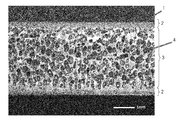
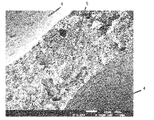
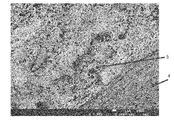
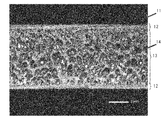
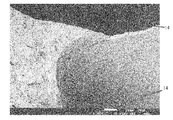
- FIG. 2 to 4 are enlarged photographs of the cross section of the foamed resin molded article of Example 1.
- FIG. 2 shows a magnification of 17 times
- FIG. 3 shows a magnification of 1000 times
- FIG. 4 shows a magnification of 3000 times
- 5 to 7 are enlarged photographs of the cross section of the foamed resin molded article of Comparative Example 2.
- FIG. 5 shows a magnification of 17 times
- FIG. 6 shows a magnification of 1000 times
- FIG. 7 shows a magnification of 3000 times. .
- Example 1 a foamed resin molded body 1 having a thickness of about 3 mm is molded, and a skin layer 2 having a thickness of about 0.2 to 0.6 mm is formed on the surface of the foamed resin molded body 1.
- the first foam cell 4 having a pore diameter of 10 to 500 ⁇ m (a foam cell that can be confirmed in the foam layer 3 in FIG. 2) is provided. It turns out that many are formed.
- Example 1 the pore diameter is approximately between the first foamed cells 4 (hereinafter referred to as “cell walls”) due to the second nucleating agent. It can be seen that a large number of fine second foam cells 5 of 10 to 1000 nm are formed. In addition, the small hole of the cell wall which can be confirmed in FIG. 3 and the small hole of the cell wall which can be confirmed in FIG. 4 are all the second foamed cells.
- a foamed resin molded body 11 having a thickness of about 3 mm is formed, and a skin layer 12 having a thickness of about 0.2 to 0.6 mm is formed on the surface of the foamed resin molded body 11. Yes. Due to the first nucleating agent, the foam layer 13 sandwiched between the skin layers 12 has a large number of first foam cells 14 having a pore diameter of 10 to 1000 ⁇ m (foam cells that can be confirmed in the foam layer 13 in FIG. 5). It can be seen that it is formed.
- Example 1 the fine foam cell which can be confirmed in Example 1 cannot be confirmed on the cell wall of the foamed resin molded body 11 of Comparative Example 2 in FIGS.
- the foamed resin molded body 1 of the present invention can make the first foamed cell 4 smaller than the foamed resin molded body 11 of the related art that does not use the second nucleating agent.
- a large number of very fine second foam cells 5 can be formed on the cell wall. That is, in the foamed resin molded body 1 of the present invention, the pore diameter of the foamed cells can be reduced and the number can be increased as compared with the foamed resin molded body 11 of the related art.
- the first foam cell 4 in the foamed resin molded body 1 of the present invention is smaller than the first foam cell 14 in the foamed resin molded body 11 of the related art.
- the amount of gas generated in the matrix resin by the blowing agent is the same.
- the generated gas generates bubbles due to the first nucleating agent.
- the fine second nucleating agent is used in addition to the first nucleating agent, a part of the generated gas is freed of bubbles due to the first nucleating agent. The other part of the generated gas is generated due to the second nucleating agent.
- the first foamed cell 4 is considered to be small.
- the particles of the second nucleating agent are very small and are uniformly dispersed in the base material resin, the bubbles generated due to the second nucleating agent are small, and the bubbles are combined to form large bubbles.
- the second foam cell 5 is small. From this, it is thought that the 2nd foaming cell 5 does not become large.
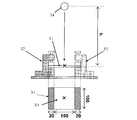
- the atmosphere was ⁇ 30 ° C., and a weight 34 having a spherical head with a radius of 25 mm and a mass of 500 g was dropped from above the center of the striking surface 33.
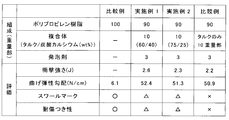
- This test was performed by changing the height h at which the weight 34 was dropped, and the test was performed five times for each height h. After dropping the weight 34, the state of the test piece 31 was observed, and the test piece 31 with no change or whitening was marked with “ ⁇ ”, and the cracked or broken one was marked with “X”. From this result, the height h at which the number of ⁇ was 50% was calculated, and the impact strength was calculated from the height h. The result is shown in FIG.
- the test machine was equipped with a support base and an indenter with a radius of 2 mm, and the test was carried out at a distance between supporting points of 100 mm and a test speed of 50 mm / s.
- the test results are average values of MD and TD and are shown in FIG.
- Comparative Example 1 which is a resin molded body obtained by simple injection molding
- Examples 1 and 2 and Comparative Example 2 which are foamed resin molded bodies
- the bending elastic gradient is compared with Comparative Example 1 which is a simple injection molded body.
- Examples 1 and 2 and Comparative Example 2 which are foamed resin moldings are significantly larger. That is, it can be seen that Examples 1 and 2 and Comparative Example 2 which are foamed resin molded bodies have significantly improved rigidity as compared with Comparative Example 1 which is a simple injection molded body.
- Example 1 and Example 2 The excellent impact resistance of Example 1 and Example 2 is considered to be due to the second foamed cell resulting from the nano-sized second nucleating agent.
- Example 1 and Example 2 are improved as compared to Comparative Example 2. That is, the design property is improved as compared with Comparative Example 2.
- the foamed resin molded body of the present invention can reduce the amount of coating compared to the foamed resin molded body of the related art, and can reduce the cost. Furthermore, products and applications to which the foamed resin molded body can be applied can be expanded.
- the weight ratio of the first nucleating agent to the second nucleating agent in the composite is preferably between 75:25 and 60:40. Moreover, it is preferable that 10 mass parts or more is mixed in the mixture with respect to 100 mass parts of base material resin.
Landscapes
- Chemical & Material Sciences (AREA)
- Engineering & Computer Science (AREA)
- Materials Engineering (AREA)
- Medicinal Chemistry (AREA)
- Health & Medical Sciences (AREA)
- Chemical Kinetics & Catalysis (AREA)
- Polymers & Plastics (AREA)
- Organic Chemistry (AREA)
- Inorganic Chemistry (AREA)
- General Chemical & Material Sciences (AREA)
- Manufacturing & Machinery (AREA)
- Mechanical Engineering (AREA)
- Injection Moulding Of Plastics Or The Like (AREA)
- Manufacture Of Porous Articles, And Recovery And Treatment Of Waste Products (AREA)
- Molding Of Porous Articles (AREA)
Abstract
Cette invention concerne un article moulé en résine expansée comportant une pluralité de fines alvéoles. Les surfaces dudit article moulé en résine expansée (1) sont formées à partir d'une couche de peau (2) et l'intérieur est formé à partir d'une couche de mousse (3). Une pluralité de premières alvéoles (4) et une pluralité de secondes alvéoles (5), qui sont plus petites que les premières alvéoles (4) et qui sont formées entre des groupes de premières alvéoles (4), sont formées dans la couche de mousse (3).
Priority Applications (1)
| Application Number | Priority Date | Filing Date | Title |
|---|---|---|---|
| US14/114,180 US20140044954A1 (en) | 2011-04-28 | 2012-04-12 | Foamed resin molded article |
Applications Claiming Priority (2)
| Application Number | Priority Date | Filing Date | Title |
|---|---|---|---|
| JP2011-101712 | 2011-04-28 | ||
| JP2011101712A JP5755016B2 (ja) | 2011-04-28 | 2011-04-28 | 発泡樹脂成形体 |
Publications (1)
| Publication Number | Publication Date |
|---|---|
| WO2012147529A1 true WO2012147529A1 (fr) | 2012-11-01 |
Family
ID=47072051
Family Applications (1)
| Application Number | Title | Priority Date | Filing Date |
|---|---|---|---|
| PCT/JP2012/060016 Ceased WO2012147529A1 (fr) | 2011-04-28 | 2012-04-12 | Article moulé en résine expansée |
Country Status (3)
| Country | Link |
|---|---|
| US (1) | US20140044954A1 (fr) |
| JP (1) | JP5755016B2 (fr) |
| WO (1) | WO2012147529A1 (fr) |
Cited By (9)
| Publication number | Priority date | Publication date | Assignee | Title |
|---|---|---|---|---|
| WO2014171430A1 (fr) * | 2013-04-17 | 2014-10-23 | ユニチカ株式会社 | Mousse moulée |
| WO2014199276A1 (fr) | 2013-06-12 | 2014-12-18 | Kimberly-Clark Worldwide, Inc. | Matériau polymère destiné à être utilisé en isolation thermique |
| WO2015019203A1 (fr) | 2013-08-09 | 2015-02-12 | Kimberly-Clark Worldwide, Inc. | Matériau polymère souple à propriétés de rétention de forme |
| CN105263996A (zh) * | 2013-06-12 | 2016-01-20 | 金伯利-克拉克环球有限公司 | 孔引发技术 |
| CN105431479A (zh) * | 2013-08-09 | 2016-03-23 | 金伯利-克拉克环球有限公司 | 用于选择性控制聚合物材料的孔隙率的方法 |
| CN105492513A (zh) * | 2013-08-09 | 2016-04-13 | 金伯利-克拉克环球有限公司 | 各向异性的聚合物材料 |
| US20160102185A1 (en) * | 2013-06-12 | 2016-04-14 | Kimberly-Clark Worldwide, Inc. | Polymeric Material with a Multimodal Pore Size Distribution |
| US20160120247A1 (en) * | 2013-06-12 | 2016-05-05 | Kimberly-Clark Worldwide, Inc. | Garment Containing a Porous Polymer Material |
| CN105283492B (zh) * | 2013-06-12 | 2018-11-16 | 金伯利-克拉克环球有限公司 | 能量吸收件 |
Families Citing this family (14)
| Publication number | Priority date | Publication date | Assignee | Title |
|---|---|---|---|---|
| US10753023B2 (en) | 2010-08-13 | 2020-08-25 | Kimberly-Clark Worldwide, Inc. | Toughened polylactic acid fibers |
| US8975305B2 (en) | 2012-02-10 | 2015-03-10 | Kimberly-Clark Worldwide, Inc. | Rigid renewable polyester compositions having a high impact strength and tensile elongation |
| MX378767B (es) | 2013-06-12 | 2025-03-10 | Kimberly Clark Co | Material de poliolefina que tiene baja densidad. |
| US11965083B2 (en) | 2013-06-12 | 2024-04-23 | Kimberly-Clark Worldwide, Inc. | Polyolefin material having a low density |
| KR101831079B1 (ko) * | 2013-08-09 | 2018-02-21 | 킴벌리-클라크 월드와이드, 인크. | 복수모드 포어 분포를 갖는 미세입자 |
| CN107124874A (zh) * | 2014-06-06 | 2017-09-01 | 金伯利-克拉克环球有限公司 | 由多孔聚合物片材形成的热成型制品 |
| WO2016085712A1 (fr) | 2014-11-26 | 2016-06-02 | Kimberly-Clark Worldwide, Inc. | Matériau de polyoléfine poreux recuit |
| CN107205871B (zh) | 2015-01-30 | 2019-11-29 | 金伯利-克拉克环球有限公司 | 用于吸收制品的具有降低的噪声的膜 |
| US10869790B2 (en) | 2015-01-30 | 2020-12-22 | Kimberly-Clark Worldwide, Inc. | Absorbent article package with reduced noise |
| JP6043897B1 (ja) * | 2015-11-06 | 2016-12-14 | バンドー化学株式会社 | 発泡成形品の製造方法及び発泡成形品 |
| JP6311852B2 (ja) | 2016-03-11 | 2018-04-18 | トヨタ紡織株式会社 | 発泡樹脂成形体及びその製造方法 |
| JPWO2021015191A1 (fr) * | 2019-07-23 | 2021-01-28 | ||
| CN112092277B (zh) * | 2020-08-05 | 2022-02-25 | 江苏佳境生态工程技术有限公司 | 透水塑胶道路面层颗粒制造工艺 |
| WO2022220148A1 (fr) * | 2021-04-15 | 2022-10-20 | 株式会社プライムポリマー | Corps en mousse moulé par injection |
Citations (4)
| Publication number | Priority date | Publication date | Assignee | Title |
|---|---|---|---|---|
| JP2002079545A (ja) * | 2000-06-22 | 2002-03-19 | Mitsui Chemicals Inc | 射出発泡成形方法、並びにそれに適した射出成形機および樹脂組成物 |
| WO2003018677A1 (fr) * | 2001-08-31 | 2003-03-06 | Honda Motor Co., Ltd. | Composition elastomere thermoplastique pour moussage par injection et procede de moussage par injection utilisant ladite composition |
| WO2006080491A1 (fr) * | 2005-01-31 | 2006-08-03 | Jsr Corporation | Procede de formation d’une mousse moulee et mousse moulee |
| JP2008024914A (ja) * | 2006-06-22 | 2008-02-07 | Jsr Corp | 発泡成形体、及びその製造方法 |
Family Cites Families (6)
| Publication number | Priority date | Publication date | Assignee | Title |
|---|---|---|---|---|
| PT1465941E (pt) * | 2002-01-04 | 2006-06-30 | Dow Global Technologies Inc | Espuma polimerica multimodal contendo uma argila absorvente |
| US8568632B2 (en) * | 2003-11-26 | 2013-10-29 | Owens Corning Intellectual Capital, Llc | Method of forming thermoplastic foams using nano-particles to control cell morphology |
| US8092626B2 (en) * | 2007-03-12 | 2012-01-10 | University Of Washington | Foaming methods for making cellular thermoplastic materials |
| EP2251373B1 (fr) * | 2008-03-07 | 2013-08-28 | Toray Industries, Inc. | Matériau d'isolation thermique |
| US8507568B2 (en) * | 2008-05-28 | 2013-08-13 | The Ohio State University | Suspension polymerization and foaming of water containing activated carbon-nano/microparticulate polymer composites |
| CA2780126C (fr) * | 2009-11-25 | 2017-09-05 | Stephane Costeux | Mousse polymere nanoporeuse a haute porosite |
-
2011
- 2011-04-28 JP JP2011101712A patent/JP5755016B2/ja not_active Expired - Fee Related
-
2012
- 2012-04-12 US US14/114,180 patent/US20140044954A1/en not_active Abandoned
- 2012-04-12 WO PCT/JP2012/060016 patent/WO2012147529A1/fr not_active Ceased
Patent Citations (4)
| Publication number | Priority date | Publication date | Assignee | Title |
|---|---|---|---|---|
| JP2002079545A (ja) * | 2000-06-22 | 2002-03-19 | Mitsui Chemicals Inc | 射出発泡成形方法、並びにそれに適した射出成形機および樹脂組成物 |
| WO2003018677A1 (fr) * | 2001-08-31 | 2003-03-06 | Honda Motor Co., Ltd. | Composition elastomere thermoplastique pour moussage par injection et procede de moussage par injection utilisant ladite composition |
| WO2006080491A1 (fr) * | 2005-01-31 | 2006-08-03 | Jsr Corporation | Procede de formation d’une mousse moulee et mousse moulee |
| JP2008024914A (ja) * | 2006-06-22 | 2008-02-07 | Jsr Corp | 発泡成形体、及びその製造方法 |
Cited By (30)
| Publication number | Priority date | Publication date | Assignee | Title |
|---|---|---|---|---|
| WO2014171430A1 (fr) * | 2013-04-17 | 2014-10-23 | ユニチカ株式会社 | Mousse moulée |
| JPWO2014171430A1 (ja) * | 2013-04-17 | 2017-02-23 | ユニチカ株式会社 | 発泡成形体 |
| US20160102185A1 (en) * | 2013-06-12 | 2016-04-14 | Kimberly-Clark Worldwide, Inc. | Polymeric Material with a Multimodal Pore Size Distribution |
| CN105263997B (zh) * | 2013-06-12 | 2018-10-26 | 金伯利-克拉克环球有限公司 | 具有多模态的孔径分布的聚合物材料 |
| CN105263996A (zh) * | 2013-06-12 | 2016-01-20 | 金伯利-克拉克环球有限公司 | 孔引发技术 |
| US11084916B2 (en) * | 2013-06-12 | 2021-08-10 | Kimberly-Clark Worldwide, Inc. | Polymeric material with a multimodal pore size distribution |
| CN105283492B (zh) * | 2013-06-12 | 2018-11-16 | 金伯利-克拉克环球有限公司 | 能量吸收件 |
| US11286362B2 (en) * | 2013-06-12 | 2022-03-29 | Kimberly-Clark Worldwide, Inc. | Polymeric material for use in thermal insulation |
| AU2014279700B2 (en) * | 2013-06-12 | 2017-09-14 | Kimberly-Clark Worldwide, Inc. | Polymeric material with a multimodal pore size distribution |
| CN105246955A (zh) * | 2013-06-12 | 2016-01-13 | 金伯利-克拉克环球有限公司 | 用于隔热的聚合材料 |
| US20160120247A1 (en) * | 2013-06-12 | 2016-05-05 | Kimberly-Clark Worldwide, Inc. | Garment Containing a Porous Polymer Material |
| US20160122491A1 (en) * | 2013-06-12 | 2016-05-05 | Kimberly-Clark Worldwide, Inc. | Polymeric Material for Use in Thermal Insulation |
| EP3008120A4 (fr) * | 2013-06-12 | 2017-01-25 | Kimberly-Clark Worldwide, Inc. | Matériau polymère destiné à être utilisé en isolation thermique |
| WO2014199276A1 (fr) | 2013-06-12 | 2014-12-18 | Kimberly-Clark Worldwide, Inc. | Matériau polymère destiné à être utilisé en isolation thermique |
| CN105246955B (zh) * | 2013-06-12 | 2018-10-26 | 金伯利-克拉克环球有限公司 | 用于隔热的聚合材料 |
| CN105263996B (zh) * | 2013-06-12 | 2018-10-09 | 金伯利-克拉克环球有限公司 | 孔引发技术 |
| CN105492513A (zh) * | 2013-08-09 | 2016-04-13 | 金伯利-克拉克环球有限公司 | 各向异性的聚合物材料 |
| AU2014304179B2 (en) * | 2013-08-09 | 2017-08-17 | Kimberly-Clark Worldwide, Inc. | Anisotropic polymeric material |
| AU2014304181B2 (en) * | 2013-08-09 | 2017-08-17 | Kimberly-Clark Worldwide, Inc. | Flexible polymeric material with shape retention properties |
| EP3030606A4 (fr) * | 2013-08-09 | 2017-03-22 | Kimberly-Clark Worldwide, Inc. | Matériau polymère anisotrope |
| EP3030605A4 (fr) * | 2013-08-09 | 2017-03-22 | Kimberly-Clark Worldwide, Inc. | Matériau polymère souple à propriétés de rétention de forme |
| KR20160042974A (ko) * | 2013-08-09 | 2016-04-20 | 킴벌리-클라크 월드와이드, 인크. | 형상 보유 특성을 구비한 연성 중합체 물질 |
| CN105431479A (zh) * | 2013-08-09 | 2016-03-23 | 金伯利-克拉克环球有限公司 | 用于选择性控制聚合物材料的孔隙率的方法 |
| CN105431479B (zh) * | 2013-08-09 | 2018-11-16 | 金伯利-克拉克环球有限公司 | 用于选择性控制聚合物材料的孔隙率的方法 |
| CN105408403B (zh) * | 2013-08-09 | 2018-12-21 | 金伯利-克拉克环球有限公司 | 具有形状保持性能的挠性聚合物材料 |
| CN105492513B (zh) * | 2013-08-09 | 2019-03-08 | 金伯利-克拉克环球有限公司 | 各向异性的聚合物材料 |
| CN105408403A (zh) * | 2013-08-09 | 2016-03-16 | 金伯利-克拉克环球有限公司 | 具有形状保持性能的挠性聚合物材料 |
| KR102334602B1 (ko) | 2013-08-09 | 2021-12-06 | 킴벌리-클라크 월드와이드, 인크. | 형상 보유 특성을 구비한 연성 중합체 물질 |
| WO2015019203A1 (fr) | 2013-08-09 | 2015-02-12 | Kimberly-Clark Worldwide, Inc. | Matériau polymère souple à propriétés de rétention de forme |
| US11434340B2 (en) | 2013-08-09 | 2022-09-06 | Kimberly-Clark Worldwide, Inc. | Flexible polymeric material with shape retention properties |
Also Published As
| Publication number | Publication date |
|---|---|
| JP5755016B2 (ja) | 2015-07-29 |
| US20140044954A1 (en) | 2014-02-13 |
| JP2012233055A (ja) | 2012-11-29 |
Similar Documents
| Publication | Publication Date | Title |
|---|---|---|
| JP5755016B2 (ja) | 発泡樹脂成形体 | |
| Altan | Thermoplastic foams: Processing, manufacturing, and characterization | |
| JPH0511745B2 (fr) | ||
| CN104987526B (zh) | 聚丙烯系树脂复合发泡颗粒及其制备方法与应用 | |
| WO2018047754A1 (fr) | Procédé de fabrication de feuille | |
| JP5280725B2 (ja) | 射出発泡体の製造方法 | |
| JP4612266B2 (ja) | 木質感に優れた熱可塑性樹脂成形体及びその製造方法 | |
| JP2014172381A (ja) | 発泡樹脂製プレート及びその製造方法 | |
| JPH03170536A (ja) | 高温に耐えるストラクチュラルフォームの製造のためのポリアリーレンスルフィドの使用、このフォームの製造方法、及びこの方法によって得ることができる成形品 | |
| JP6551146B2 (ja) | 発泡成形体およびその製造方法、並びに、発泡成形体用樹脂材料の製造方法 | |
| JP4573505B2 (ja) | 樹脂発泡体の製造方法及び樹脂発泡体 | |
| JP4684304B2 (ja) | 樹脂発泡体の製造方法及び樹脂発泡体 | |
| JP3307721B2 (ja) | 複合成形体よりなる自動車用内装部品の製造方法 | |
| JP4263539B2 (ja) | 熱可塑性樹脂の押出成形方法、押出成形物 | |
| JP2020045384A (ja) | 射出発泡成形体 | |
| JP2007210339A (ja) | 被覆シート付発泡樹脂押出成形体の製造方法 | |
| CN117924784A (zh) | 成型体和成型体的制造方法 | |
| JP2013082117A (ja) | 軽量化された発泡木質プラスチック成形体の製造方法 | |
| JP2022141139A (ja) | 発泡構造体 | |
| JP2003112354A (ja) | 被覆シート付発泡樹脂押出成形体の製造方法 | |
| JP2008142997A (ja) | 射出発泡成形体の製造方法および該方法によって得られる成形体 | |
| GB2585635A (en) | Compositions and methods for use in the preparation of hydrophobic surfaces | |
| JP7474405B2 (ja) | 発泡樹脂シートの成形方法 | |
| JP7440743B2 (ja) | 発泡成形体 | |
| JP5034710B2 (ja) | 熱可塑性樹脂組成物発泡成形体及びその製造方法 |
Legal Events
| Date | Code | Title | Description |
|---|---|---|---|
| 121 | Ep: the epo has been informed by wipo that ep was designated in this application |
Ref document number: 12777145 Country of ref document: EP Kind code of ref document: A1 |
|
| WWE | Wipo information: entry into national phase |
Ref document number: 14114180 Country of ref document: US |
|
| NENP | Non-entry into the national phase |
Ref country code: DE |
|
| 122 | Ep: pct application non-entry in european phase |
Ref document number: 12777145 Country of ref document: EP Kind code of ref document: A1 |