WO2012147555A1 - Procédé et dispositif d'obtention de carbonate de lithium - Google Patents
Procédé et dispositif d'obtention de carbonate de lithium Download PDFInfo
- Publication number
- WO2012147555A1 WO2012147555A1 PCT/JP2012/060285 JP2012060285W WO2012147555A1 WO 2012147555 A1 WO2012147555 A1 WO 2012147555A1 JP 2012060285 W JP2012060285 W JP 2012060285W WO 2012147555 A1 WO2012147555 A1 WO 2012147555A1
- Authority
- WO
- WIPO (PCT)
- Prior art keywords
- lithium
- carbonate
- ions
- lithium carbonate
- solution containing
- Prior art date
- Legal status (The legal status is an assumption and is not a legal conclusion. Google has not performed a legal analysis and makes no representation as to the accuracy of the status listed.)
- Ceased
Links
Images



Classifications
-
- H—ELECTRICITY
- H01—ELECTRIC ELEMENTS
- H01M—PROCESSES OR MEANS, e.g. BATTERIES, FOR THE DIRECT CONVERSION OF CHEMICAL ENERGY INTO ELECTRICAL ENERGY
- H01M10/00—Secondary cells; Manufacture thereof
- H01M10/54—Reclaiming serviceable parts of waste accumulators
-
- C—CHEMISTRY; METALLURGY
- C01—INORGANIC CHEMISTRY
- C01D—COMPOUNDS OF ALKALI METALS, i.e. LITHIUM, SODIUM, POTASSIUM, RUBIDIUM, CAESIUM, OR FRANCIUM
- C01D15/00—Lithium compounds
- C01D15/08—Carbonates; Bicarbonates
-
- C—CHEMISTRY; METALLURGY
- C25—ELECTROLYTIC OR ELECTROPHORETIC PROCESSES; APPARATUS THEREFOR
- C25B—ELECTROLYTIC OR ELECTROPHORETIC PROCESSES FOR THE PRODUCTION OF COMPOUNDS OR NON-METALS; APPARATUS THEREFOR
- C25B7/00—Electrophoretic production of compounds or non-metals
-
- H—ELECTRICITY
- H01—ELECTRIC ELEMENTS
- H01M—PROCESSES OR MEANS, e.g. BATTERIES, FOR THE DIRECT CONVERSION OF CHEMICAL ENERGY INTO ELECTRICAL ENERGY
- H01M4/00—Electrodes
- H01M4/02—Electrodes composed of, or comprising, active material
- H01M4/36—Selection of substances as active materials, active masses, active liquids
- H01M4/48—Selection of substances as active materials, active masses, active liquids of inorganic oxides or hydroxides
- H01M4/483—Selection of substances as active materials, active masses, active liquids of inorganic oxides or hydroxides for non-aqueous cells
-
- Y—GENERAL TAGGING OF NEW TECHNOLOGICAL DEVELOPMENTS; GENERAL TAGGING OF CROSS-SECTIONAL TECHNOLOGIES SPANNING OVER SEVERAL SECTIONS OF THE IPC; TECHNICAL SUBJECTS COVERED BY FORMER USPC CROSS-REFERENCE ART COLLECTIONS [XRACs] AND DIGESTS
- Y02—TECHNOLOGIES OR APPLICATIONS FOR MITIGATION OR ADAPTATION AGAINST CLIMATE CHANGE
- Y02E—REDUCTION OF GREENHOUSE GAS [GHG] EMISSIONS, RELATED TO ENERGY GENERATION, TRANSMISSION OR DISTRIBUTION
- Y02E60/00—Enabling technologies; Technologies with a potential or indirect contribution to GHG emissions mitigation
- Y02E60/10—Energy storage using batteries
-
- Y—GENERAL TAGGING OF NEW TECHNOLOGICAL DEVELOPMENTS; GENERAL TAGGING OF CROSS-SECTIONAL TECHNOLOGIES SPANNING OVER SEVERAL SECTIONS OF THE IPC; TECHNICAL SUBJECTS COVERED BY FORMER USPC CROSS-REFERENCE ART COLLECTIONS [XRACs] AND DIGESTS
- Y02—TECHNOLOGIES OR APPLICATIONS FOR MITIGATION OR ADAPTATION AGAINST CLIMATE CHANGE
- Y02W—CLIMATE CHANGE MITIGATION TECHNOLOGIES RELATED TO WASTEWATER TREATMENT OR WASTE MANAGEMENT
- Y02W30/00—Technologies for solid waste management
- Y02W30/50—Reuse, recycling or recovery technologies
- Y02W30/84—Recycling of batteries or fuel cells
Definitions
- the present invention relates to a method for producing lithium carbonate and an apparatus for producing lithium carbonate capable of efficiently producing high purity lithium carbonate.
- Lithium carbonate is used as a material for lithium secondary batteries and electrolyte materials used in compounding materials such as heat-resistant glass and optical glass, ceramic materials, mobile phones, and laptop computers.
- Lithium-ion secondary batteries are secondary batteries that are lighter, have higher capacity, and have higher electromotive force than conventional lead-acid batteries and nickel-cadmium secondary batteries.
- Mobile devices such as mobile phones and notebook computers It is widely used in secondary batteries for electric vehicles, and the demand is expected to increase in the future.
- lithium cobaltate LiCoO 2
- lithium manganate LiMn 2 O 4
- lithium which is a rare valuable substance, is used. include. Therefore, it is desired to recover these valuable substances from the used lithium ion secondary battery and to recycle them as a positive electrode material for the lithium ion secondary battery.
- lithium carbonate is generally produced by crystallization, since it is a rare metal, a high recovery rate in the production process is desired. Furthermore, as described above, in applications as electronic materials, impurities may deteriorate electrical characteristics, and higher purity lithium carbonate is required.
- lithium becomes lithium oxide (Li 2 O), and when this fired product is leached with water, lithium hydroxide (LiOH), in water, lithium ions and hydroxides
- LiPF 6 is used as an electrolyte, which is attributed to this.
- the sulfuric acid is considered to be leached as S derived from an electrolyte additive such as (CF 3 SO 2 ) 2 NLi as sulfuric acid.
- the lithium content is not so large with respect to the weight of the battery or the positive electrode material, and the concentration of the liquid from which lithium is leached is relatively low. For these reasons, when recovering lithium in the liquid as lithium carbonate, a recovery method with higher yield and less impurities is desired.
- Patent Document 1 discloses a method for improving the yield of lithium carbonate by heating an aqueous solution containing lithium by crystallization to 90 ° C. or more and blowing carbon dioxide gas.
- Patent Document 2 proposes a method of increasing the purity of lithium carbonate by heating a lithium-containing aqueous solution separated by filtration to 30 ° C. to 100 ° C. and blowing carbon dioxide gas.
- these proposed methods make use of the fact that the solubility of lithium carbonate decreases with increasing temperature, and when the lithium ion concentration in the liquid is lower than the solubility of lithium carbonate, lithium is recovered. There is a problem that can not be.
- the present invention makes it a subject to solve the said various problems in the past and to achieve the following objectives. That is, the present invention can efficiently produce high-purity lithium carbonate from a solution containing lithium ions and carbonate ions. In particular, lithium obtained by leaching a fired product containing a positive electrode material of a lithium ion secondary battery in water. Another object of the present invention is to provide a lithium carbonate production method and a lithium carbonate production apparatus capable of producing lithium carbonate with high yield and high purity from a solution containing impurities such as fluorine and sulfuric acid.
- the method for producing lithium carbonate of the present invention is characterized in that lithium carbonate is deposited by energizing a solution containing lithium ions and carbonate ions.
- the apparatus for producing lithium carbonate of the present invention has an energizing means for energizing a solution containing lithium ions and carbonate ions to precipitate lithium carbonate, A crystallization tank for storing a solution containing lithium ions and carbonate ions; And a cathode and an anode for energizing the solution containing the lithium ions and carbonate ions.
- high-purity lithium carbonate can be efficiently produced from a solution containing lithium ions and carbonate ions, and in particular, a fired product containing a positive electrode material for a lithium ion secondary battery.
- a lithium carbonate production method and a lithium carbonate production apparatus capable of producing lithium carbonate with high yield and high purity from a solution containing impurities such as fluorine and sulfuric acid obtained by leaching water into water Can do.
- FIG. 1A is a top view showing an example of the lithium carbonate production apparatus of the present invention.
- FIG. 1B is a side view showing an example of the lithium carbonate production apparatus of the present invention.
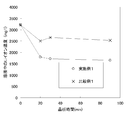
- FIG. 2 is a graph showing the transition of the lithium ion concentration in the liquid over time in Example 1 and Comparative Example 1.
- FIG. 3 is a graph showing changes in lithium ion concentration in the liquid over time in Example 3 and Comparative Example 2.
- the method for producing lithium carbonate of the present invention includes an energizing step of energizing a solution containing lithium ions and carbonate ions, preferably a heating step of heating a solution containing lithium ions and carbonate ions, and at least containing lithium ions.
- the lithium carbonate production apparatus of the present invention has an energization means, preferably a heating means and a carbon dioxide supply means, and further comprises other means as required.
- the lithium carbonate production method and lithium carbonate production apparatus of the present invention will be described in detail.
- the energizing step is a step of energizing a solution containing lithium ions and carbonate ions, and is performed by energizing means.
- the energizing means includes a crystallization tank for storing a solution containing the lithium ions and carbonate ions, and a cathode and an anode for energizing the solution containing the lithium ions and carbonate ions, and other if necessary.
- the member is provided.
- the solution containing lithium ions and carbonate ions is not particularly limited as long as it contains lithium ions and carbonate ions at a concentration at which lithium carbonate can be deposited by energization, and may be appropriately selected according to the purpose. it can.
- the concentration of lithium ions during energization is preferably 1,500 mg / L or more, more preferably 3,000 mg / L or more.
- the concentration of carbonate ions during energization is preferably 1,000 mg / L or more, more preferably 1,450 mg / L or more.
- the solution containing lithium ions and carbonate ions is not particularly limited as long as it contains lithium ions and carbonate ions, and can be appropriately selected according to the purpose.
- a solution containing at least lithium ions A solution obtained by supplying carbon dioxide can be suitably used. The supply of carbon dioxide will be described in the carbon dioxide supply step described later.
- the solution containing at least lithium ions is not particularly limited as long as it contains lithium ions, and can be appropriately selected according to the purpose.
- a positive electrode material of a lithium ion secondary battery is sulfuric acid
- Lithium ion secondary battery positive electrode material after dissolving cobalt and nickel (iii) Waste lithium ion secondary battery was baked and lithium was leached into water. Liquid, (iv) hot spring water, (v) salt lake water, and the like.
- a liquid obtained by firing a waste lithium ion secondary battery and leaching lithium into water is particularly preferable.
- the positive electrode material of the lithium ion secondary battery in the fired product including the positive electrode material of the lithium ion secondary battery used as a raw material is not particularly limited and can be appropriately selected according to the purpose. However, lithium cobalt oxide (LiCoO 2 ), And at least one of lithium manganate (LiMn 2 O 4 ). As the positive electrode material, it is preferable to use a material obtained from a used lithium ion secondary battery because lithium can be recycled.
- the atmosphere is preferably aerated during firing.
- the air atmosphere means an atmosphere using air (air) in which oxygen is 21% by mass and nitrogen is 78% by mass.
- the oxidizing atmosphere means an atmosphere containing 1% by mass to 21% by mass of oxygen in an inert atmosphere such as nitrogen or argon, and an atmosphere containing 1% by mass to 5% by mass of oxygen is preferable.
- the inert atmosphere means an atmosphere made of nitrogen or argon.
- the reducing atmosphere means an atmosphere containing CO, H 2 , H 2 S, SO 2 , etc. in an inert atmosphere such as nitrogen or argon.
- the firing is preferably performed using a firing furnace.
- a firing furnace There is no restriction
- the firing temperature is not particularly limited and may be appropriately selected depending on the purpose. It is more preferably 400 ° C. or higher in an air atmosphere, 600 ° C. or higher in an inert atmosphere, and 400 ° C.
- the upper limit temperature is preferably 1,200 ° C. or lower. If the firing temperature is less than 400 ° C., for example, the lithium ion secondary battery may not be destroyed because the crystal structure of the positive electrode of the lithium ion secondary battery cannot be destroyed. In addition, since the fired product is sintered, a pulverization step may be necessary.
- the crystallization tank is not particularly limited as long as it has a cathode and an anode in the tank or a part or all of the tank, and can be appropriately selected according to the purpose. What constitutes the inner wall is preferred.
- the cathode itself is the inner wall of the crystallization tank, lithium ions migrate to the inner wall of the crystallization tank, which increases the local lithium ion concentration in the vicinity of the cathode and the cathode, thereby efficiently depositing lithium carbonate. Can be made.
- anode or the cathode is disposed in the center of the crystallization tank, a diaphragm is disposed on a concentric circle, and the inside of the crystallization tank or the crystallization tank itself is a counter electrode.
- the energization is preferably performed in a state where a solution containing lithium ions and carbonate ions is heated, and energization may be started while the temperature of the solution is raised.
- the current density to be applied between the cathode and the anode is preferably 0.5A / dm 2 ⁇ 50A / dm 2, 1A / dm 2 ⁇ 30A / dm 2 Is more preferable.
- the current density is lower than 0.5 A / dm 2 , migration of lithium ions may take time, and when it exceeds 50 A / dm 2 , much energy is used for generation of hydrogen and oxygen. Efficiency may be reduced.
- the distance between the anode and the cathode is preferably 0.5 cm to 20 m, more preferably 1 cm to 5 m. If the distance is less than 0.5 cm, there is a risk of short-circuit due to a short circuit. If the distance exceeds 20 m, the voltage increases and power consumption increases, which is not economical.
- the heating step is a step of heating the solution containing the lithium ions and carbonate ions, and is performed by a heating means.
- the heating is preferably performed before energization, at the same time as energization, or immediately after energization (while the lithium ion concentration gradient is maintained), but in order to reduce the power consumption of energization, in the vicinity of the solubility of lithium carbonate in advance.
- the heating temperature is not particularly limited as long as the solubility of lithium carbonate is saturated or higher, and can be appropriately selected according to the purpose. Specifically, it is preferably 70 ° C or higher, and 80 ° C or higher. Is more preferable, and 80 ° C. to 100 ° C. is particularly preferable.
- the heating temperature is less than 70 ° C.
- the solubility of lithium carbonate increases, and the recovery rate of lithium carbonate may decrease.
- a heating means to heat the solution containing the said lithium ion and carbonate ion According to the objective, it can select suitably, For example, a heater etc. are mentioned.
- the cathode is integrated with a heating means, that is, by using a heater as a cathode, a concentration gradient and a temperature gradient can be produced in the vicinity of the cathode and the cathode, and lithium carbonate can be efficiently crystallized.
- the cathode in order to make it easy to collect
- the vicinity of the cathode means a range up to a distance of 1 cm from the cathode.
- the carbon dioxide supply step is a step of supplying carbon dioxide to the solution containing the lithium ions and carbonate ions, and is performed by carbon dioxide supply means.
- the method for supplying carbon dioxide into the solution containing at least lithium ions is not particularly limited and can be appropriately selected according to the purpose. For example, by blowing carbon dioxide into a crystallization tank.
- the carbon dioxide can be supplied before energization, at the same time as energization, or immediately after energization (while the lithium ion concentration gradient is maintained). May be repeated.
- carbon dioxide is blown after the energization is stopped, it is preferable to perform the blowing operation of carbon dioxide while the concentration gradient of the solution containing at least lithium ions is maintained.
- the carbon dioxide is preferably supplied near the cathode and in the vicinity of the cathode from the viewpoint of increasing the purification efficiency of lithium carbonate.
- the vicinity of the cathode means a range up to a distance of 1 cm from the cathode.
- the pH of the solution in the step of precipitating lithium carbonate by energizing the solution containing lithium ions and carbonate ions is preferably 5 to 13, and more preferably 6 to 10. If the pH is less than 5, the amount of carbonate used and the amount of carbon dioxide blown may be excessive, which is not economical. On the other hand, if the pH exceeds 13, the amount of carbonate used and the amount of carbon dioxide blown may be insufficient, and the yield may decrease.
- the separation means for solid-liquid separation of the cathode and lithium carbonate deposited in the vicinity of the cathode is not particularly limited and may be appropriately selected depending on the intended purpose. Examples thereof include filtration, centrifugation, and thickener.
- the said cathode is an inner wall of a crystallization tank, it is preferable to have a scraping member which scrapes off the lithium carbonate deposited on the said cathode. Examples of the scraping member include a scraper.
- FIG. 1A and FIG. 1B are schematic views showing an example of the lithium carbonate production apparatus of the present invention.
- the lithium carbonate production apparatus includes a crystallization tank body 4 for storing a solution containing lithium ions and carbonate ions, an anode 1 located at the center of the crystallization tank, a cathode 2 that is an inner wall of the crystallization tank, A heating means 3 for heating a solution containing lithium ions, a power source 5 for energizing between the anode 1 and the cathode 2, and a scraper 6 for scraping off lithium carbonate deposited on the cathode 2 which is the inner wall of the crystallization tank are provided. ing.
- the cooler which cools the solution containing lithium ion and carbonate ion is provided in the crystallization tank.
- the power source 5 is operated and the anode 1 and the cathode 2 are energized, so that lithium ions in the solution containing lithium ions and carbonate ions can be obtained. Since the lithium ion concentration increases in the vicinity of the cathode 2 and the solution containing lithium ions and carbonate ions is heated by the heating means 3 and the solubility of lithium carbonate decreases, the carbonic acid carbonate is present in the vicinity of the cathode and the cathode. Lithium is deposited.
- the temperature is controlled by the heating means 3 and the cooler so that the liquid temperature becomes constant.
- Lithium carbonate deposited on the cathode 2 which is the inner wall of the crystallization tank can be scraped and recovered by rotating a scraper 6 as scraping means.
- impurities such as fluorine and sulfuric acid in the solution containing lithium ions and carbonate ions move to the anode 1 side by energization, the impurities can be removed and the purity of lithium carbonate is improved.
- high purity lithium carbonate can be efficiently produced from a solution containing lithium ions and carbonate ions.
- a solution obtained by leaching lithium from a fired product containing a positive electrode material of a lithium ion secondary battery is used, lithium ions can be concentrated on the cathode side while separating impurities in the solution.
- high-purity lithium carbonate can be produced efficiently, and the lithium ion secondary battery can be recycled.
- Example 1 Preparation of lithium-containing solution using reagent> A lithium-containing solution was prepared by dissolving lithium hydroxide monohydrate (manufactured by Wako Pure Chemical Industries, Ltd.) in distilled water so that the lithium ion concentration was 3,210 mg / L.
- a lithium-containing solution using 1.75 L of the above reagent was poured into a crystallization tank in which an anode and a cathode were arranged, and carbon dioxide gas was aerated at 0.4 L / min until the pH reached 8.5. Thereafter, aeration of carbon dioxide gas was stopped, and heating was started.
- a current of 10 A was passed between the anode and the cathode to start energization.
- the distance between the electrodes at this time was 5 cm, the current density was 33.3 A / dm 2 , and the voltage was 8V.
- an electrode obtained by coating platinum on titanium oxide is used for the anode, and a commercially available titanium water heater (GTNH-1105, manufactured by Izumi Denki Co., Ltd., 100 V, 500 W) is used for the cathode.
- GTNH-1105 manufactured by Izumi Denki Co., Ltd., 100 V, 500 W
- a water cooling cooler was also provided in the crystallization tank. The temperature was controlled with the heater and cooler so that the liquid temperature was kept constant at 85 ° C., and after 90 minutes had elapsed from the start of heating, the obtained lithium carbonate was subjected to solid-liquid separation. When crystallization was completed and the lithium ion concentration of the filtrate after solid-liquid separation was measured, it was 1,652 mg / L.
- the yield of lithium carbonate (lithium conversion) by this crystallization operation was calculated from the difference between the lithium ion concentration (3,210 mg / L) of the original lithium-containing solution and the lithium ion concentration of the filtrate, and was 48.5% by mass.
- Table 1 shows the transition of the lithium ion concentration in the solution with the passage of time after the start of heating and the yield of lithium carbonate (in terms of lithium). Moreover, the transition of the lithium ion concentration in the liquid over time is shown in FIG. Moreover, the power consumption in the energization operation in this step was 107 Wh because the current was energized for 80 minutes at a current of 10 A and a voltage of 8 V.
- Example 2 In Example 1, lithium carbonate was obtained in the same manner as in Example 1 except that the current was 0.5 A and the current density was 1.67 A / dm 2 .
- the yield of lithium carbonate (lithium conversion) by this crystallization operation was calculated from the difference between the lithium ion concentration (3,210 mg / L) of the original lithium-containing solution and the lithium ion concentration of the filtrate. Met. Table 1 shows the transition of the lithium ion concentration in the solution with the passage of time after the start of heating and the yield of lithium carbonate (in terms of lithium).
- the power consumption in the energization operation in this step was 2 Wh because the current was energized for 80 minutes at a current of 0.5 A and a voltage of 3 V.
- Example 1 (Comparative Example 1) In Example 1, crystallization was performed under the same conditions as in Example 1 except that no electrode was provided in the crystallization tank, only a heater was used instead of the cathode, and no energization was performed. The results are shown in Table 1 and FIG. When crystallization was completed and the lithium ion concentration of the filtrate after solid-liquid separation was measured, it was 2,531 mg / L. The yield of lithium carbonate (in terms of lithium) by this crystallization operation was calculated from the difference between the lithium ion concentration (3,210 mg / L) of the original lithium-containing solution and the lithium ion concentration of the filtrate, and was 21.2% by mass. Met.
- Comparative Example 1 since the yield of lithium carbonate was low, in order to obtain the same yield as in Example 1, it was necessary to concentrate it 1.5 times. When this was concentrated by heating, it took another 60 minutes in addition to the reaction time of 90 minutes of Comparative Example 1 with a 500 W heater to concentrate 1.5 times, and the power consumption was 500 Wh. From this, it was confirmed that Example 1 crystallizing while energizing was extremely advantageous in terms of cost compared to the normal concentrated crystallization of Comparative Example 1.
- Example 3 ⁇ Separation of positive electrode materials for lithium ion secondary batteries as recycled materials>
- a commercially available used lithium-ion secondary battery for personal computers (positive electrode is ternary positive electrode material made of cobalt, manganese, nickel oxide, graphite is used for negative electrode) is fired at 700 ° C in an air atmosphere for 1 hour.
- the obtained fired product was crushed with a hammer crusher.
- the crushed material is screened with a test sieve.
- a positive electrode material powder having a sieve opening of 1 mm or less was obtained. Firing was performed in a box furnace (manufactured by KOYO LINDBERG).
- Crystallization was performed using a lithium-containing solution (composition shown in Table 2) prepared using the above-mentioned recycled raw material (used lithium ion secondary battery), and the liquid temperature was controlled at 80 ° C. with a heater and a cooler.
- Example 2 a lithium-containing solution prepared using the above-mentioned recycled raw material (used lithium ion secondary battery), and the liquid temperature was controlled at 80 ° C. with a heater and a cooler.
- Example 2 The yield of lithium carbonate (lithium conversion) by this crystallization operation was calculated from the difference between the lithium ion concentration (2,909 mg / L) of the original lithium-containing solution and the lithium ion concentration of the filtrate. It was mass%.
- Table 3 shows the transition of the lithium ion concentration in the solution with the passage of time after the start of heating of lithium in the solution with the passage of time after the start of heating, and the yield of lithium carbonate. Moreover, the transition of the lithium ion concentration in the liquid over time is shown in FIG. Moreover, when the impurity concentration in the obtained lithium carbonate was measured, the fluorine content was 0.21% by mass and the sulfuric acid was 0.17% by mass. The results are shown in Table 4.
- Example 2 lithium carbonate was produced in the same manner as in Example 3, except that no electrode was provided in the crystallization tank, only a heater was used instead of the cathode, and no energization was performed.
- the results are shown in Table 3 and FIG.
- the yield of lithium carbonate (lithium conversion) by this crystallization treatment was calculated from the difference between the lithium ion concentration (2,909 mg / L) of the original lithium-containing solution and the lithium ion concentration of the filtrate, and was 4.1% by mass. Met.
- fluorine content was 0.25 mass% and sulfuric acid was 0.4 mass%. The results are shown in Table 4.
- Example 3 From the results of Table 3, FIG. 3, and Table 4, it was found that the yield of lithium carbonate was higher in Example 3 also in the lithium leaching solution leached from the fired product of the used lithium ion secondary battery. Moreover, it was thought that the yield of Example 3 was lower than Example 1 due to the difference in liquid temperature and the difference in impurity concentration. Moreover, it was confirmed that the fluorine content and sulfuric acid content, which are impurities of the lithium carbonate obtained in Example 3, were lower than those in Comparative Example 2. This was considered to be due to the fact that in Example 3 where crystallization was performed by energization, impurities such as fluorine and sulfuric acid migrated in the vicinity of the anode and the concentration in the vicinity of the cathode decreased. Thus, according to the present invention, it has been found that not only the yield of lithium carbonate is improved, but also the impurity concentration can be reduced when applied to lithium recycling from a waste lithium ion secondary battery.
- the aspect of the present invention is as follows.
- ⁇ 1> A method for producing lithium carbonate, characterized in that lithium carbonate is precipitated by energizing a solution containing lithium ions and carbonate ions.
- ⁇ 2> The method for producing lithium carbonate according to ⁇ 1>, wherein energization is performed at a current density of 0.5 A / dm 2 to 50 A / dm 2 .
- ⁇ 3> The method for producing lithium carbonate according to any one of ⁇ 1> to ⁇ 2>, wherein a solution containing lithium ions and carbonate ions is heated.
- ⁇ 4> The method for producing lithium carbonate according to ⁇ 3>, wherein the heating is performed at a temperature of 70 ° C. or higher.
- ⁇ 5> The method for producing lithium carbonate according to any one of ⁇ 1> to ⁇ 4>, wherein carbon dioxide is supplied to a solution containing at least lithium ions to obtain a solution containing lithium ions and carbonate ions.
- ⁇ 6> The method for producing lithium carbonate according to ⁇ 5>, wherein the solution containing at least lithium ions is a liquid obtained by calcining a waste lithium ion secondary battery and leaching lithium into water.
- ⁇ 7> The method for producing lithium carbonate according to any one of ⁇ 1> to ⁇ 6>, wherein the precipitated lithium carbonate is solid-liquid separated.
- ⁇ 8> having an energizing means for energizing a solution containing lithium ions and carbonate ions to precipitate lithium carbonate;
- a crystallization tank for storing a solution containing lithium ions and carbonate ions;
- An apparatus for producing lithium carbonate comprising: a cathode and an anode for energizing a solution containing the lithium ions and carbonate ions.
- the lithium carbonate production apparatus according to ⁇ 8> further including a heating unit that heats a solution containing lithium ions and carbonate ions.
- the lithium carbonate production apparatus according to any one of ⁇ 8> to ⁇ 10>, further including carbon dioxide supply means for supplying carbon dioxide to a solution containing at least lithium ions.
- carbon dioxide supply means for supplying carbon dioxide to a solution containing at least lithium ions.
- the cathode is an inner wall of a crystallization tank.
- a separation unit configured to solid-liquid separate lithium carbonate deposited in the vicinity of the cathode and the cathode.
- ⁇ 14> The production of lithium carbonate according to any one of ⁇ 11> to ⁇ 13>, wherein the solution containing at least lithium ions is a liquid obtained by calcining a waste lithium ion secondary battery and leaching lithium into water. Device.
- the method for producing lithium carbonate and the apparatus for producing lithium carbonate of the present invention can efficiently produce high purity lithium carbonate from a solution containing lithium ions and carbonate ions, and in particular, firing including a positive electrode material of a lithium ion secondary battery.
- Lithium carbonate can be produced in high yield and purity from lithium obtained by leaching an object into water and a solution containing impurities such as fluorine and sulfuric acid, and the lithium ion secondary battery can be reused. .
- Anode Cathode (Inner Crystal Wall) 3 Heating means 4 Crystallization tank body 5 Power supply 6 Scraper
Landscapes
- Chemical & Material Sciences (AREA)
- Engineering & Computer Science (AREA)
- Materials Engineering (AREA)
- Electrochemistry (AREA)
- Chemical Kinetics & Catalysis (AREA)
- Organic Chemistry (AREA)
- General Chemical & Material Sciences (AREA)
- Inorganic Chemistry (AREA)
- Manufacturing & Machinery (AREA)
- Health & Medical Sciences (AREA)
- Life Sciences & Earth Sciences (AREA)
- Molecular Biology (AREA)
- Metallurgy (AREA)
- Secondary Cells (AREA)
- Battery Electrode And Active Subsutance (AREA)
Abstract
L'invention concerne un procédé d'obtention de carbonate de lithium dans lequel une solution qui contient des ions de lithium et des ions carbonates est électrifiée pour précipiter le carbonate de lithium.
Applications Claiming Priority (2)
| Application Number | Priority Date | Filing Date | Title |
|---|---|---|---|
| JP2011-098497 | 2011-04-26 | ||
| JP2011098497A JP5872788B2 (ja) | 2011-04-26 | 2011-04-26 | 炭酸リチウムの製造方法及び炭酸リチウムの製造装置 |
Publications (1)
| Publication Number | Publication Date |
|---|---|
| WO2012147555A1 true WO2012147555A1 (fr) | 2012-11-01 |
Family
ID=47072077
Family Applications (1)
| Application Number | Title | Priority Date | Filing Date |
|---|---|---|---|
| PCT/JP2012/060285 Ceased WO2012147555A1 (fr) | 2011-04-26 | 2012-04-16 | Procédé et dispositif d'obtention de carbonate de lithium |
Country Status (2)
| Country | Link |
|---|---|
| JP (1) | JP5872788B2 (fr) |
| WO (1) | WO2012147555A1 (fr) |
Cited By (3)
| Publication number | Priority date | Publication date | Assignee | Title |
|---|---|---|---|---|
| US20220194806A1 (en) * | 2020-12-22 | 2022-06-23 | Pukyong National University Industry-University Cooperation Foundation | Lithium oxide recovery method from lithium manganese oxide (lmo) |
| CN115536045A (zh) * | 2022-11-01 | 2022-12-30 | 甘肃睿思科新材料有限公司 | 一种高效连续制备粒度均一的超纯碳酸锂的方法 |
| CN117534093A (zh) * | 2023-11-16 | 2024-02-09 | 中南大学 | 一种纳米碳酸锂的制备方法 |
Families Citing this family (4)
| Publication number | Priority date | Publication date | Assignee | Title |
|---|---|---|---|---|
| WO2021090571A1 (fr) * | 2019-11-08 | 2021-05-14 | Dowaエコシステム株式会社 | Procédé de séparation du lithium |
| JP6869444B1 (ja) * | 2019-11-08 | 2021-05-12 | Dowaエコシステム株式会社 | リチウムの分離方法 |
| JP7767705B2 (ja) * | 2021-04-15 | 2025-11-12 | Dowaエコシステム株式会社 | リチウムイオン二次電池からのリチウムの回収方法 |
| WO2024107207A1 (fr) * | 2022-11-18 | 2024-05-23 | Ascend Elements, Inc. | Récupération de lithium à partir de batteries au lithium-ion |
Citations (5)
| Publication number | Priority date | Publication date | Assignee | Title |
|---|---|---|---|---|
| JPS6270203A (ja) * | 1985-09-20 | 1987-03-31 | Nippon Paionikusu Kk | 水素ガスの除去方法 |
| JPS62161973A (ja) * | 1985-08-30 | 1987-07-17 | Sumitomo Chem Co Ltd | 高純度炭酸リチウムの製造方法 |
| JP2000192273A (ja) * | 1998-12-25 | 2000-07-11 | Japan Energy Corp | 金属炭酸塩の製造方法 |
| JP2001508925A (ja) * | 1997-06-23 | 2001-07-03 | パシフィック・リシアム・リミテッド | リチウムの回収および精製 |
| JP2006004884A (ja) * | 2004-06-21 | 2006-01-05 | Toyota Motor Corp | リチウム電池処理方法 |
Family Cites Families (1)
| Publication number | Priority date | Publication date | Assignee | Title |
|---|---|---|---|---|
| JPH10102272A (ja) * | 1996-09-26 | 1998-04-21 | Ngk Spark Plug Co Ltd | Li抽出装置 |
-
2011
- 2011-04-26 JP JP2011098497A patent/JP5872788B2/ja not_active Expired - Fee Related
-
2012
- 2012-04-16 WO PCT/JP2012/060285 patent/WO2012147555A1/fr not_active Ceased
Patent Citations (5)
| Publication number | Priority date | Publication date | Assignee | Title |
|---|---|---|---|---|
| JPS62161973A (ja) * | 1985-08-30 | 1987-07-17 | Sumitomo Chem Co Ltd | 高純度炭酸リチウムの製造方法 |
| JPS6270203A (ja) * | 1985-09-20 | 1987-03-31 | Nippon Paionikusu Kk | 水素ガスの除去方法 |
| JP2001508925A (ja) * | 1997-06-23 | 2001-07-03 | パシフィック・リシアム・リミテッド | リチウムの回収および精製 |
| JP2000192273A (ja) * | 1998-12-25 | 2000-07-11 | Japan Energy Corp | 金属炭酸塩の製造方法 |
| JP2006004884A (ja) * | 2004-06-21 | 2006-01-05 | Toyota Motor Corp | リチウム電池処理方法 |
Cited By (3)
| Publication number | Priority date | Publication date | Assignee | Title |
|---|---|---|---|---|
| US20220194806A1 (en) * | 2020-12-22 | 2022-06-23 | Pukyong National University Industry-University Cooperation Foundation | Lithium oxide recovery method from lithium manganese oxide (lmo) |
| CN115536045A (zh) * | 2022-11-01 | 2022-12-30 | 甘肃睿思科新材料有限公司 | 一种高效连续制备粒度均一的超纯碳酸锂的方法 |
| CN117534093A (zh) * | 2023-11-16 | 2024-02-09 | 中南大学 | 一种纳米碳酸锂的制备方法 |
Also Published As
| Publication number | Publication date |
|---|---|
| JP5872788B2 (ja) | 2016-03-01 |
| JP2012229471A (ja) | 2012-11-22 |
Similar Documents
| Publication | Publication Date | Title |
|---|---|---|
| KR102606562B1 (ko) | 리튬 배터리 캐소드용 전구체 화합물의 제조 방법 | |
| CA3143966C (fr) | Procedes d'extraction de lithium a partir de spodumene | |
| EP3821043B1 (fr) | Procédé de récupération de métal de transition | |
| US12152287B2 (en) | Process for the recovery of lithium and transition metal using heat | |
| JP5872788B2 (ja) | 炭酸リチウムの製造方法及び炭酸リチウムの製造装置 | |
| CN103199320B (zh) | 镍钴锰三元正极材料回收利用的方法 | |
| KR100448273B1 (ko) | 폐리튬이온전지로부터 코발트를 회수하는 방법 | |
| CN105355996B (zh) | 一种从废锂电池负极材料中分离锂和石墨并资源化利用的方法 | |
| CN115472948B (zh) | 一种利用废旧锰酸锂再生钠电正极材料的方法 | |
| JP2012121780A (ja) | 酸化リチウムの製造方法 | |
| JP2012200666A (ja) | Li溶液回収装置及びLi溶液回収方法 | |
| JP2020029613A (ja) | リチウムの回収方法 | |
| JP7220340B1 (ja) | リチウムイオン電池からの金属回収方法 | |
| CN119768953A (zh) | 用于从废锂离子电池回收金属的方法及系统 | |
| TW202545828A (zh) | 從廢棄鋰鈦氧化物電池的陰極材料中回收金屬的方法 | |
| JP2013117065A (ja) | 溶融塩電解によるリチウムの製造方法及びその製造方法に使用する装置 | |
| CA3136878C (fr) | Procede de preparation de precurseurs de batterie | |
| CN118183803A (zh) | 一种废旧磷酸锰铁锂正极材料中锂元素的回收方法 | |
| CN121247895A (zh) | 一种电化学回收废弃金属氧化物正极的方法及其应用 | |
| CN118255371A (zh) | 一种回收退役磷酸铁锂电池中金属元素的方法及其应用 | |
| BR112021025730B1 (pt) | Métodos para extrair lítio a partir de um minério contendo lítio ou de sais de lítio e métodos para extrair lítio a partir do espodumênio |
Legal Events
| Date | Code | Title | Description |
|---|---|---|---|
| 121 | Ep: the epo has been informed by wipo that ep was designated in this application |
Ref document number: 12776358 Country of ref document: EP Kind code of ref document: A1 |
|
| NENP | Non-entry into the national phase |
Ref country code: DE |
|
| 122 | Ep: pct application non-entry in european phase |
Ref document number: 12776358 Country of ref document: EP Kind code of ref document: A1 |