WO2012147718A1 - 通信システム - Google Patents
通信システム Download PDFInfo
- Publication number
- WO2012147718A1 WO2012147718A1 PCT/JP2012/060919 JP2012060919W WO2012147718A1 WO 2012147718 A1 WO2012147718 A1 WO 2012147718A1 JP 2012060919 W JP2012060919 W JP 2012060919W WO 2012147718 A1 WO2012147718 A1 WO 2012147718A1
- Authority
- WO
- WIPO (PCT)
- Prior art keywords
- cell
- information
- scheduling
- comp
- cells
- Prior art date
- Legal status (The legal status is an assumption and is not a legal conclusion. Google has not performed a legal analysis and makes no representation as to the accuracy of the status listed.)
- Ceased
Links
Images















Classifications
-
- H—ELECTRICITY
- H04—ELECTRIC COMMUNICATION TECHNIQUE
- H04L—TRANSMISSION OF DIGITAL INFORMATION, e.g. TELEGRAPHIC COMMUNICATION
- H04L5/00—Arrangements affording multiple use of the transmission path
- H04L5/003—Arrangements for allocating sub-channels of the transmission path
- H04L5/0058—Allocation criteria
-
- H—ELECTRICITY
- H04—ELECTRIC COMMUNICATION TECHNIQUE
- H04L—TRANSMISSION OF DIGITAL INFORMATION, e.g. TELEGRAPHIC COMMUNICATION
- H04L5/00—Arrangements affording multiple use of the transmission path
- H04L5/003—Arrangements for allocating sub-channels of the transmission path
- H04L5/0032—Distributed allocation, i.e. involving a plurality of allocating devices, each making partial allocation
-
- H—ELECTRICITY
- H04—ELECTRIC COMMUNICATION TECHNIQUE
- H04L—TRANSMISSION OF DIGITAL INFORMATION, e.g. TELEGRAPHIC COMMUNICATION
- H04L5/00—Arrangements affording multiple use of the transmission path
- H04L5/003—Arrangements for allocating sub-channels of the transmission path
- H04L5/0032—Distributed allocation, i.e. involving a plurality of allocating devices, each making partial allocation
- H04L5/0035—Resource allocation in a cooperative multipoint environment
-
- H—ELECTRICITY
- H04—ELECTRIC COMMUNICATION TECHNIQUE
- H04W—WIRELESS COMMUNICATION NETWORKS
- H04W72/00—Local resource management
- H04W72/20—Control channels or signalling for resource management
-
- H—ELECTRICITY
- H04—ELECTRIC COMMUNICATION TECHNIQUE
- H04B—TRANSMISSION
- H04B7/00—Radio transmission systems, i.e. using radiation field
- H04B7/02—Diversity systems; Multi-antenna system, i.e. transmission or reception using multiple antennas
- H04B7/022—Site diversity; Macro-diversity
- H04B7/024—Co-operative use of antennas of several sites, e.g. in co-ordinated multipoint or co-operative multiple-input multiple-output [MIMO] systems
-
- H—ELECTRICITY
- H04—ELECTRIC COMMUNICATION TECHNIQUE
- H04W—WIRELESS COMMUNICATION NETWORKS
- H04W92/00—Interfaces specially adapted for wireless communication networks
- H04W92/16—Interfaces between hierarchically similar devices
- H04W92/20—Interfaces between hierarchically similar devices between access points
-
- Y—GENERAL TAGGING OF NEW TECHNOLOGICAL DEVELOPMENTS; GENERAL TAGGING OF CROSS-SECTIONAL TECHNOLOGIES SPANNING OVER SEVERAL SECTIONS OF THE IPC; TECHNICAL SUBJECTS COVERED BY FORMER USPC CROSS-REFERENCE ART COLLECTIONS [XRACs] AND DIGESTS
- Y02—TECHNOLOGIES OR APPLICATIONS FOR MITIGATION OR ADAPTATION AGAINST CLIMATE CHANGE
- Y02D—CLIMATE CHANGE MITIGATION TECHNOLOGIES IN INFORMATION AND COMMUNICATION TECHNOLOGIES [ICT], I.E. INFORMATION AND COMMUNICATION TECHNOLOGIES AIMING AT THE REDUCTION OF THEIR OWN ENERGY USE
- Y02D30/00—Reducing energy consumption in communication networks
- Y02D30/70—Reducing energy consumption in communication networks in wireless communication networks
Definitions
- the present invention relates to a communication system that performs wireless communication between a plurality of communication terminal apparatuses and a base station apparatus.
- the W-CDMA Wideband Code Division Multiple Access
- HS-DSCH High-Speed-Downlink Shared Channel
- HSDPA High-Speed-Downlink-Packet-Access
- HSUPA High-Speed-Uplink-Packet-Access
- W-CDMA is a communication system defined by 3GPP (3rd Generation Partnership Project), which is a standardization organization for mobile communication systems, and standardized versions of release 10 editions are compiled.
- the entire system configuration including a long term evolution (LTE) and a core network (also simply referred to as a network) is used for the radio section.
- LTE long term evolution
- core network also simply referred to as a network
- SAE System Architecture Evolution
- This communication method is also called a 3.9G (3.9 generation) system.
- W-CDMA uses code division multiple access (Code-Division-Multiple-Access)
- LTE uses OFDM (Orthogonal Frequency-Division-Multiplexing) in the downlink direction and SC-FDMA (Single in the uplink direction).
- Code-Division-Multiple-Access code division multiple access
- LTE uses OFDM (Orthogonal Frequency-Division-Multiplexing) in the downlink direction and SC-FDMA (Single in the uplink direction).
- SC-FDMA Single in the uplink direction.
- a communication system is configured using a new core network different from GPRS (General Packet Radio Service), which is a W-CDMA core network. Therefore, LTE is an independent radio access network different from the W-CDMA network. Defined. Therefore, in order to distinguish from the W-CDMA communication system, in the LTE communication system, a base station (Base station) that communicates with a mobile terminal (User Equipment: UE) is referred to as an eNB (E-UTRAN NodeB). A base station controller (Radio Network Controller) that exchanges control data and user data with the base station is called EPC (Evolved Packet Core) or aGW (Access Gateway).
- EPC Evolved Packet Core
- GW Access Gateway
- a unicast service and an E-MBMS service (Evolved Multimedia Broadcast Service) are provided.
- the E-MBMS service is a broadcast-type multimedia service and may be simply referred to as MBMS. Mass broadcast contents such as news, weather forecasts, and mobile broadcasts are transmitted to a plurality of mobile terminals. This is also called a point-to-multipoint service.
- Non-Patent Document 1 (Chapter 4) describes the current decisions regarding the overall architecture (Architecture) of the LTE system in 3GPP.
- the overall architecture will be described with reference to FIG.
- FIG. 1 is an explanatory diagram illustrating a configuration of an LTE communication system.
- a control protocol for the mobile terminal 101 for example, RRC (Radio Resource Control), a user plane such as PDCP (Packet Data Convergence Protocol), RLC (Radio Link Control), MAC (Medium Access Control), PHY (Physical Layer) E-UTRAN (Evolved102Universal Terrestrial Radio Access) is composed of one or more base stations 102.
- RRC Radio Resource Control
- PDCP Packet Data Convergence Protocol
- RLC Radio Link Control
- MAC Medium Access Control
- PHY Physical Layer
- E-UTRAN Evolved102Universal Terrestrial Radio Access
- the base station 102 performs scheduling (scheduling) and transmission of a paging signal (also called a paging message or paging message) notified from an MME (Mobility Management Entity) 103.
- Base stations 102 are connected to each other via an X2 interface.
- the base station 102 is connected to an EPC (Evolved Packet Core) via an S1 interface. More specifically, the base station 102 is connected to an MME (Mobility Management Entity) 103 via an S1_MME interface, and is connected to an S-GW (Serving Gateway) 104 via an S1_U interface.
- EPC Evolved Packet Core
- the MME 103 distributes a paging signal to a plurality or a single base station 102. Further, the MME 103 performs mobility control (Mobility control) in a standby state (Idle State). The MME 103 manages a tracking area (Tracking Area) list when the mobile terminal is in a standby state and in an active state (Active State).
- Mobility control mobility control
- Idle State standby state
- the MME 103 manages a tracking area (Tracking Area) list when the mobile terminal is in a standby state and in an active state (Active State).
- the S-GW 104 transmits / receives user data to / from one or a plurality of base stations 102.
- the S-GW 104 becomes a local mobility anchor point (Mobility Anchor Point) during handover between base stations.
- the EPC further includes a P-GW (PDN Gateway), which performs packet filtering and UE-ID address allocation for each user.
- PDN Gateway PDN Gateway
- the control protocol RRC between the mobile terminal 101 and the base station 102 performs broadcast, paging, RRC connection management (RRC connection management), and the like.
- RRC connection management There are RRC_IDLE and RRC_CONNECTED as states of the base station and the mobile terminal in RRC.
- RRC_IDLE PLMN (Public Land Mobile Mobile Network) selection, system information (System Information: SI) notification, paging, cell re-selection, mobility, and the like are performed.
- RRC_CONNECTED a mobile terminal has an RRC connection (connection), can transmit and receive data to and from the network, and performs handover (Handover: HO), measurement of a neighbor cell (Neighbour cell), and the like.
- Non-Patent Document 1 (Chapter 5) describes the current decisions regarding the frame configuration in the LTE system in 3GPP, with reference to FIG.
- FIG. 2 is an explanatory diagram showing a configuration of a radio frame used in the LTE communication system.
- one radio frame (Radio frame) is 10 ms.
- the radio frame is divided into ten equally sized subframes.
- the subframe is divided into two equally sized slots.
- a downlink synchronization signal (Downlink Synchronization Signal: SS) is included in the first and sixth subframes for each radio frame.
- the synchronization signal includes a first synchronization signal (Primary Synchronization Signal: P-SS) and a second synchronization signal (Secondary Synchronization Signal: S-SS).
- MBSFN transmission is a simultaneous broadcast transmission technology (simulcast transmission technique) realized by transmitting the same waveform from a plurality of cells at the same time.
- MBSFN transmissions from multiple cells in the MBSFN area are seen as one transmission by the mobile terminal.
- the MBSFN is a network that supports such MBSFN transmission.
- a subframe for MBSFN transmission is referred to as an MBSFN subframe (MBSFN subframe).
- Non-Patent Document 2 describes a signaling example at the time of MBSFN subframe allocation.
- FIG. 3 is an explanatory diagram showing the configuration of the MBSFN frame.
- a radio frame including an MBSFN subframe is allocated every allocation period (radio
- the MBSFN subframe is a subframe allocated for MBSFN in a radio frame defined by an allocation period and an allocation offset (radioradiFrame Allocation Offset), and is a subframe for transmitting multimedia data.
- a radio frame satisfying the following expression (1) is a radio frame including an MBSFN subframe.
- radioFrameAllocationPeriod radioFrameAllocationOffset (1) MBSFN subframe allocation is performed with 6 bits.
- the leftmost bit defines the second (# 1) MBSFN allocation in the subframe.
- the second bit is the third subframe (# 2), the third bit is the fourth subframe (# 3), the fourth bit is the seventh subframe (# 6), the fifth bit is the subframe 8
- the th (# 7) and sixth bits define the ninth (# 8) MBSFN allocation of the subframe. When the bit indicates “1”, it indicates that the corresponding subframe is allocated for MBSFN.
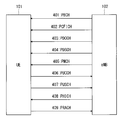
- Non-Patent Document 1 (Chapter 5) describes the current decisions regarding the channel configuration in the LTE system in 3GPP. It is assumed that the CSG cell (ClosednSubscriber Group ⁇ ⁇ ⁇ ⁇ cell) uses the same channel configuration as the non-CSG cell. A physical channel will be described with reference to FIG. FIG. 4 is an explanatory diagram illustrating physical channels used in the LTE communication system.
- a physical broadcast channel (PBCH) 401 is a channel for downlink transmission from the base station 102 to the mobile terminal 101.
- a BCH transport block (transport block) is mapped to four subframes in a 40 ms interval. There is no obvious signaling of 40ms timing.
- a physical control channel format indicator channel (Physical Control Format Indicator Indicator Channel: PCFICH) 402 is a channel for downlink transmission from the base station 102 to the mobile terminal 101. PCFICH notifies base station 102 to mobile terminal 101 about the number of OFDM symbols used for PDCCHs. PCFICH is transmitted for each subframe.
- a physical downlink control channel (Physical Downlink Control Channel: PDCCH) 403 is a channel for downlink transmission from the base station 102 to the mobile terminal 101.
- PDCCH is a resource allocation (allocation) of DL-SCH (downlink shared channel which is one of transport channels shown in FIG. 5 described later) and PCH (paging channel which is one of transport channels shown in FIG. 5). ), And HARQ (Hybrid Automatic Repeat reQuest) information about DL-SCH.
- the PDCCH carries an uplink scheduling grant (Uplink Scheduling Grant).
- the PDCCH carries Ack (Acknowledgement) / Nack (Negative Acknowledgment) which is a response signal for uplink transmission.
- the PDCCH is also called an L1 / L2 control signal.
- a physical downlink shared channel (PDSCH) 404 is a channel for downlink transmission from the base station 102 to the mobile terminal 101.
- a DL-SCH (downlink shared channel) that is a transport channel and a PCH that is a transport channel are mapped.
- a physical multicast channel (PMCH) 405 is a channel for downlink transmission from the base station 102 to the mobile terminal 101.
- a multicast channel (Multicast Channel: MCH) that is a transport channel is mapped to the PMCH.
- a physical uplink control channel (Physical Uplink Control Channel: PUCCH) 406 is a channel for uplink transmission from the mobile terminal 101 to the base station 102.
- the PUCCH carries Ack / Nack which is a response signal (response signal) for downlink transmission.
- the PUCCH carries a CQI (Channel Quality Indicator) report.
- CQI is quality information indicating the quality of received data or channel quality.
- the PUCCH carries a scheduling request (SR).
- a physical uplink shared channel (Physical-Uplink-Shared-Channel: PUSCH) 407 is a channel for uplink transmission from the mobile terminal 101 to the base station 102.
- UL-SCH uplink shared channel which is one of the transport channels shown in FIG. 5 is mapped to PUSCH.
- the physical HARQ indicator channel (Physical Hybrid ARQ Indicator Channel: PHICH) 408 is a channel for downlink transmission from the base station 102 to the mobile terminal 101.
- PHICH carries Ack / Nack which is a response signal for uplink transmission.
- a physical random access channel (Physical Random Access Channel: PRACH) 409 is a channel for uplink transmission from the mobile terminal 101 to the base station 102.
- the PRACH carries a random access preamble.
- the downlink reference signal is a symbol known as a mobile communication system.
- the following five types of downlink reference signals are defined.
- Cell-specific reference signals Cell-specific Reference Signals: CRS
- MBSFN reference signals MBSFN reference signals
- UE-specific reference signals UE-specific reference signals
- Data demodulation reference signals Demodulation Reference Signals: DM-RS
- Position determination reference signals Position determination reference signals
- PRS Position determination reference signals
- Channel information reference signals Channel information reference signals
- CSI-RS Channel Information Reference Signals
- RSRP reference signal received power
- FIG. 5 is an explanatory diagram for explaining a transport channel used in an LTE communication system.
- FIG. 5A shows the mapping between the downlink transport channel and the downlink physical channel.
- FIG. 5B shows mapping between the uplink transport channel and the uplink physical channel.
- the broadcast channel (Broadcast Channel: BCH) is broadcast to the entire coverage of the base station (cell).
- BCH is mapped to the physical broadcast channel (PBCH).
- HARQ Hybrid ARQ
- DL-SCH downlink shared channel
- the DL-SCH can be broadcast to the entire coverage of the base station (cell).
- DL-SCH supports dynamic or semi-static resource allocation. Quasi-static resource allocation is also referred to as persistent scheduling.
- DL-SCH supports discontinuous reception (DRX) of a mobile terminal in order to reduce power consumption of the mobile terminal.
- the DL-SCH is mapped to the physical downlink shared channel (PDSCH).
- the Paging Channel supports DRX of the mobile terminal in order to enable low power consumption of the mobile terminal.
- the PCH is required to be broadcast to the entire coverage of the base station (cell).
- the PCH is mapped to a physical resource such as a physical downlink shared channel (PDSCH) that can be dynamically used for traffic.
- PDSCH physical downlink shared channel
- a multicast channel (Multicast Channel: MCH) is used for broadcasting to the entire coverage of a base station (cell).
- the MCH supports SFN combining of MBMS services (MTCH and MCCH) in multi-cell transmission.
- the MCH supports quasi-static resource allocation.
- MCH is mapped to PMCH.
- HARQ Hybrid ARQ
- UL-SCH Uplink Shared Channel
- PUSCH physical uplink shared channel
- the random access channel (Random Access Channel: RACH) shown in FIG. 5B is limited to control information. RACH is at risk of collision.
- RACH is mapped to a physical random access channel (PRACH).
- PRACH physical random access channel
- HARQ is a technique for improving the communication quality of a transmission path by combining an automatic repeat request (AutomaticAutoRepeat reQuest: ARQ) and error correction (Forward Error Correction).
- ARQ automatic repeat request
- FEC Correction Forward Error Correction
- HARQ has an advantage that error correction functions effectively by retransmission even for a transmission path whose communication quality changes. In particular, further quality improvement can be obtained by combining the initial transmission reception result and the retransmission reception result upon retransmission.
- Chase combining is a method of transmitting the same data in initial transmission and retransmission, and is a method of improving gain by combining initial transmission data and retransmission data in retransmission. This means that even if there is an error in the initial transmission data, the data is partially accurate, and the data is transmitted with higher accuracy by combining the correct initial transmission data and the retransmission data. It is based on the idea that it can be done.
- Another example of the HARQ method is IR (Incremental Redundancy). IR is to increase the redundancy, and by transmitting parity bits in retransmission, the redundancy is increased in combination with the initial transmission, and the quality is improved by the error correction function.
- FIG. 6 is an explanatory diagram illustrating logical channels used in the LTE communication system.
- FIG. 6A shows mapping between the downlink logical channel and the downlink transport channel.
- FIG. 6B shows mapping between the uplink logical channel and the uplink transport channel.
- Broadcast Control Channel is a downlink channel for broadcast system control information.
- the BCCH that is a logical channel is mapped to a broadcast channel (BCH) that is a transport channel or a downlink shared channel (DL-SCH).
- BCH broadcast channel
- DL-SCH downlink shared channel
- the paging control channel (Paging Control Channel: PCCH) is a downlink channel for transmitting changes in paging information (Paging Information) and system information (System Information).
- PCCH is used when the network does not know the cell location of the mobile terminal.
- the PCCH that is a logical channel is mapped to a paging channel (PCH) that is a transport channel.
- PCH paging channel
- the common control channel (Common Control Channel: CCCH) is a channel for transmission control information between the mobile terminal and the base station. CCCH is used when the mobile terminal does not have an RRC connection with the network.
- CCCH is mapped to a downlink shared channel (DL-SCH) that is a transport channel.
- DL-SCH downlink shared channel
- UL-SCH uplink shared channel
- the multicast control channel (Multicast Control Channel: MCCH) is a downlink channel for one-to-many transmission.
- the MCCH is used for transmission of MBMS control information for one or several MTCHs from the network to the mobile terminal.
- MCCH is used only for mobile terminals that are receiving MBMS.
- the MCCH is mapped to a multicast channel (MCH) that is a transport channel.
- the dedicated control channel (Dedicated Control Channel: DCCH) is a channel for transmitting individual control information between the mobile terminal and the network on a one-to-one basis.
- DCCH is used when the mobile terminal is in RRC connection.
- the DCCH is mapped to the uplink shared channel (UL-SCH) in the uplink, and is mapped to the downlink shared channel (DL-SCH) in the downlink.
- the dedicated traffic channel (Dedicated Traffic Channel: DTCH) is a channel for one-to-one communication to individual mobile terminals for transmitting user information.
- DTCH exists for both uplink and downlink.
- the DTCH is mapped to the uplink shared channel (UL-SCH) in the uplink, and is mapped to the downlink shared channel (DL-SCH) in the downlink.
- UL-SCH uplink shared channel
- DL-SCH downlink shared channel
- the multicast traffic channel is a downlink channel for transmitting traffic data from the network to the mobile terminal.
- MTCH is a channel used only for a mobile terminal that is receiving MBMS.
- the MTCH is mapped to a multicast channel (MCH).
- GCI is a global cell identifier (Global Cell Identity).
- CSG cells Cell Subscriber Group cell
- LTE Long Term Evolution Advanced
- LTE-A Long Evolution Advanced
- UMTS Universal Mobile Telecommunication System
- a CSG cell (Closed Subscriber Group cell) is a cell in which an operator identifies an available subscriber (hereinafter may be referred to as a “specific subscriber cell”).
- Identified subscribers are allowed to access one or more cells of the PLMN (Public Land Mobile Mobile Network).
- PLMN Public Land Mobile Mobile Network
- One or more cells to which the identified subscribers are allowed access are called “CSG cells (CSG cell (s))”.
- CSG cell broadcasts a unique CSG identity (CSG identity: CSG ID; CSG-ID) and is a part of the PLMN that broadcasts “TRUE” by CSG indication (CSG Indication).
- CSG identity CSG identity: CSG ID; CSG-ID
- CSG Indication CSG indication
- the CSG-ID is broadcast by the CSG cell or cell. There are a plurality of CSG-IDs in a mobile communication system. The CSG-ID is then used by the mobile terminal (UE) to facilitate access of CSG related members.
- the location tracking of the mobile terminal is performed in units of areas composed of one or more cells.
- the position tracking is performed to track the position of the mobile terminal and call the mobile terminal even in the standby state, in other words, to enable the mobile terminal to receive a call.
- This area for tracking the location of the mobile terminal is called a tracking area.
- the CSG white list (CSG White List) is a list that may be stored in a USIM (Universal Subscriber Identity Module) in which all CSG IDs of CSG cells to which a subscriber belongs are recorded.
- the CSG white list may be simply referred to as a white list or an allowed CSG list (Allowed CSG List).
- the MME performs access control (refer to non-patent document 9, 4.3.1.2).
- Specific examples of mobile terminal access include attach, combined attach (combineddetachattach), detach (detach), service request (service request), tracking area update procedure (Tracking Area Update procedure), etc. (Refer to Chapter 9, 4.3.1.2).
- the service type of the mobile terminal in the standby state will be described below (see Non-Patent Document 3, Chapter 4.3).
- a service type of a mobile terminal in a standby state there are a limited service (also referred to as a limited service), a standard service (Normal service), and an operator service (Operator service).
- the restricted services are emergency calls (Emergency calls), ETWS (Earthquake and Tsunami warning systems), and CMAS (Commercial Mobile Alert Systems), which will be described later.
- the standard service also referred to as normal service or normal service
- the operator service is a service only for an operator on a reserve cell to be described later.
- Suitable cell is described below.
- a “suitable cell” is a cell that the UE may camp on (Camp ON) to receive normal service. Such a cell shall satisfy the following conditions (1) and (2).
- the cell is a selected PLMN or a registered PLMN, or a part of the PLMN in the “Equivalent PLMN list”.
- the latest information provided by NAS must satisfy the following conditions (a) to (d).
- Acceptable cell is a cell in which a UE may camp on to receive limited services. Such a cell shall satisfy all the following requirements (1) and (2).
- the cell is not a forbidden cell (also called “Barred ⁇ ⁇ cell”). (2) The cell satisfies the cell selection evaluation criteria.
- Barred cell is indicated by system information. “Reserved cell” is instructed by system information.
- Cell camp on cell means that the UE has completed cell selection (cell ⁇ selection) or cell reselection (cell reselection) processing, and the UE selects a cell for monitoring system information and paging information. It is in a state.
- a cell where the UE camps on may be referred to as a “serving cell”.
- Non-Patent Document 4 discloses three different modes of access to HeNB and HNB. Specifically, an open access mode (Open access mode), a closed access mode (Closed access mode), and a hybrid access mode (Hybrid access mode).
- Open access mode Open access mode
- closed access mode closed access mode
- Hybrid access mode Hybrid access mode
- Each mode has the following characteristics.
- the HeNB or HNB In the open access mode, the HeNB or HNB is operated as a normal cell of a normal operator.
- the closed access mode the HeNB or HNB is operated as a CSG cell. This is a CSG cell accessible only to CSG members.
- the hybrid access mode non-CSG members are also operated as CSG cells to which access is permitted at the same time.
- a cell in hybrid access mode (also referred to as a hybrid cell) is a cell that supports both an open access mode and a closed access mode.
- PCI split there is a PCI range reserved by the network for use by the CSG cell among all PCI (Physical Cell Identity) (refer to Chapter 10.5.1.1 of Non-Patent Document 1). Dividing the PCI range may be referred to as PCI split.
- the PCI split information is reported from the base station to the mobile terminals being served by the system information. Being served by a base station means that the base station is a serving cell.
- Non-Patent Document 5 discloses a basic operation of a mobile terminal using PCI split. A mobile terminal that does not have PCI split information needs to perform cell search using all PCIs, for example, using all 504 codes. On the other hand, a mobile terminal having PCI split information can perform a cell search using the PCI split information.
- LTE-A Long Term Evolution Advanced
- the relay node in order to obtain a high communication speed, a high throughput at a cell edge, a new coverage area, etc., it is considered to support a relay (Relay) and a relay node (RN).
- the relay node is wirelessly connected to the radio access network via a donor cell (Donor cell; Donor eNB; DeNB).
- Donor cell Donor cell; Donor eNB; DeNB
- the link from the network (NW) to the relay node shares the same frequency band (hereinafter sometimes referred to as “frequency band”) as the link from the network to the UE.
- a Release 8 UE can also be connected to the donor cell.
- the link between the donor cell and the relay node is referred to as a backhaul link, and the link between the relay node and the UE is referred to as an access link.
- transmission from DeNB to RN is performed in a downlink (DL) frequency band
- transmission from RN to DeNB is performed in an uplink (UL) frequency band.
- DL downlink
- UL uplink
- a link from DeNB to RN and a link from RN to UE are time-division multiplexed in one frequency band
- a link from RN to DeNB and a link from UE to RN are also one frequency band. Is time-division multiplexed. By doing so, it is possible to prevent the relay transmission from interfering with the reception of the own relay in the relay.
- eNB macro cell
- pico eNB pico cell
- HeNB HeNB
- CSG cell HeNB
- RRH Remote Radio Head
- So-called local nodes such as repeaters are being studied.
- a network composed of various types of cells as described above is sometimes referred to as a heterogeneous network.
- Non-Patent Document 8 describes the frequency band.
- a downlink frequency band hereinafter may be referred to as “downlink frequency band” and an uplink frequency band (hereinafter referred to as “uplink frequency band”) paired therewith may be used.
- the upstream frequency band is different from the downstream frequency band. This is because downlink and uplink are always required for communication such as conventional voice, and transmission and reception can be performed simultaneously by dividing the frequency between downlink and uplink in FDD. Because.
- an interval (TX) between a carrier frequency of a resource used for downlink (hereinafter also referred to as “downlink carrier frequency”) and a carrier frequency of a resource used for uplink (hereinafter also referred to as “uplink carrier frequency”) The default value of -RX frequency TX-RX frequency interval) is determined for each frequency band.
- Non-Patent Document 8 describes a default value of the TX-RX frequency interval.
- a cell broadcasts frequency band information and uplink carrier frequency operated by its own cell as broadcast information to UEs being served thereby.
- the frequency band information is included in SIB1.
- the uplink carrier frequency is included in SIB2. If the uplink carrier frequency is not included in SIB2, the uplink carrier frequency is derived from the downlink carrier frequency using the default value of the TX-RX frequency interval.
- the UE can obtain the frequency band and the uplink carrier frequency operated by the cell by recognizing the downlink carrier frequency by selecting or reselecting the cell and receiving broadcast information from the cell. Become.
- Release 8 or 9 compatible UEs that are LTE capable can transmit and receive only on CCs corresponding to one serving cell, whereas Release 10 compatible UEs can transmit and receive on CCs corresponding to multiple serving cells simultaneously. Alternatively, it is considered to have a capability (capability) for receiving only or transmitting only.
- Each CC uses a configuration of Release 8 or 9, and CA supports CCs with different frequency bandwidths, continuous CCs, non-continuous CCs. It is impossible for the UE to configure the number of uplink CCs (UL CCs) equal to or greater than the number of downlink CCs (DL CCs). CCs configured from the same eNB need not provide the same coverage. CC is compatible with Release 8 or 9.
- CA there is one independent HARQ entity for each serving cell for both uplink and downlink.
- a transport block is generated for each TTI for each serving cell.
- Each transport block and HARQ retransmission are mapped to a single serving cell.
- UE When CA is configured, UE has only one RRC connection (RRC connection) with NW.
- RRC connection In the RRC connection, one serving cell provides NAS mobility information and security input. This cell is referred to as a primary cell (PCell).
- a carrier corresponding to PCell is a downlink primary component carrier (Downlink Primary Component Carrier: DL PCC).
- the carrier corresponding to the PCell in the uplink is an uplink primary component carrier (Uplink Primary Component Carrier: UL PCC).
- a secondary cell (Secondary Cell: SCell) is configured to form a set of a PCell and a serving cell.
- the carrier corresponding to the SCell in the downlink is a downlink secondary component carrier (Downlink Secondary Component Carrier: DL SCC).
- the carrier corresponding to the SCell in the uplink is an uplink secondary component carrier (Uplink Secondary Component Carrier: UL SCC).
- a set of one PCell and a serving cell composed of one or more SCells is configured for one UE.
- each SCell in addition to the downlink (DL) resource, the uplink (UL) resource can be used by the UE.
- the number of DL SCCs is equal to or greater than the number of UL SCCs.
- each UL resource belongs to only one serving cell. The number of serving cells depends on the UE capabilities.
- PCell is changed only by HO procedure.
- PCell is used for transmission of PUCCH. Note that the PUCCH for DL-SCH HARQ without UL-SCH is transmitted only by UL PCC. PCells are not de-activated (unlike SCells).
- Reconfiguration, addition, and removal of SCells are performed by RRC. Also in handover within LTE, the RRC adds, removes, and reconfigures SCells used with the target PCell.
- dedicated RRC signaling (dedicated RRC signaling) is used to transmit all necessary system information (SI) of the SCell. That is, it is performed in the connected mode, and the UE does not need to receive SI broadcast from the SCell.
- Non-Patent Document 2 It has been studied that the addition of SCell (addition) and modification (modification) is notified by the PCell to the mobile terminal using “RRC Connection Reconfiguration message” of individual RRC signaling (see Non-Patent Document 2). It is considered that the release of the SCell is notified by the PCell to the mobile terminal using “RRC Connection Reconfiguration message” of the individual RRC signaling or triggered by “RRC Connection re-establishment” (non-existing). Patent Document 2). “RRC Connection Reconfiguration message” of dedicated RRC signaling includes “SCell To AddModList” and “SCell To ReleaseList”.
- SIB2 indicates the carrier frequency of the uplink resource.
- the local node is arranged to complement the macro cell according to various service requests such as high-speed and large-capacity communication. Therefore, a local node may be installed within the macro cell coverage. In this case, interference may occur from the mobile terminal to the local node.
- LTE-A LTE Advanced
- Non-Patent Document 6 and Non-Patent Document 7 LTE Advanced
- New technologies include a technology that supports a wider bandwidth (Wider bandwidth extension), and a coordinated ⁇ ⁇ ⁇ Multiple Point transmission and reception (CoMP) technology.
- CoMP being studied for LTE-A by 3GPP is described in Non-Patent Document 6 and Non-Patent Document 7.
- CoMP is a technology that aims to expand coverage at a high data rate, improve throughput at the cell edge, and increase throughput in a communication system by performing coordinated transmission or reception between geographically separated multipoints. is there.
- CoMP includes downlink CoMP (DL CoMP) and uplink CoMP (UL CoMP).
- PDSCH to one mobile terminal is transmitted in cooperation between multiple points (multipoint).
- the PDSCH for one UE may be transmitted from one point of the multipoint or may be transmitted from a plurality of points of the multipoint.
- a serving cell is a single cell that transmits resource allocation through PDCCH.
- JP joint processing
- CS coordinated scheduling
- CB coordinate beamforming
- JP can use data at each point in the CoMP cooperating set.
- JP includes joint transmission (Joint Transmission: JT) and dynamic cell selection (Dynamic Cell Selection: DCS).
- JT Joint Transmission
- DCS Dynamic Cell Selection
- JT PDSCH is transmitted from a plurality of points at a certain point in time, specifically, from a part or all of a CoMP cooperating set.
- DCS PDSCH is transmitted from one point in the CoMP cooperating set at a certain point in time.
- CS / CB In CS / CB, it can be used only for data transmission from a serving cell, but user scheduling or beamforming is determined together with adjustment between cells corresponding to the CoMP cooperating set.
- the CoMP set (CoMP set) is a general term for a CoMP cooperating set or a CoMP measurement set.
- the CoMP co-operating set is a set of points that are directly or indirectly related to transmission of PDSCH to the UE.
- the CoMP transmission point (CoMP transmission point (s)) is a point or a set of points for actively transmitting the PDSCH to the UE, and is a subset of the CoMP co-operating set.
- a CoMP transmission point is a point in the CoMP cooperating set.
- one point becomes a transmission point in every subframe.
- the transmission point can be changed dynamically within the CoMP co-operating set.
- a CoMP transmission point corresponds to a serving cell.
- the CoMP measurement set is a set of cells in which channel state and statistical information related to the link to the UE is reported.
- the CoMP measurement set and the CoMP co-operating set may be the same.
- Base stations NB, eNB, HNB, HeNB
- RRU Remote Radio Unit
- RRE Remote Radio Equipment
- Relay Node relay node
- a unit (cell) that performs multipoint coordinated transmission is referred to as a multipoint unit (multipoint cell).
- uplink data from one mobile terminal (UE) is received in cooperation between multiple points (multipoint). By combining data received at multiple points, it is possible to improve the uplink reception quality from the UE.
- reception in UL CoMP joint reception of signals transmitted by a plurality of reception points (Joint Reception: JR) and determination of CS (Coordinated Scheduling) between cells for interference control are being considered.
- a scheduling method for DL CoMP is being studied by 3GPP.
- each multipoint unit includes a UE that is not a CoMP target under its own multipoint unit and a UE that is a CoMP target under another multipoint unit. Schedule together.
- centralized scheduling In centralized scheduling (hereinafter sometimes referred to as “centralized scheduling”), a centralized node is provided, and the centralized node performs scheduling of all UEs being served by all multipoint units performing CoMP.
- An object of the present invention is to provide a communication system capable of suppressing the influence of delay between a plurality of base station apparatuses as much as possible in scheduling for communicating with a terminal apparatus in cooperation with a plurality of base station apparatuses. That is.
- a communication system is a communication system including a plurality of base station apparatuses that are communicably connected and a terminal apparatus that can wirelessly communicate with each of the base station apparatuses.
- a processing unit configured to be able to communicate with the terminal device in cooperation with a base station device, performing scheduling for allocating radio resources for communication with the terminal device, and the terminal based on a result of the scheduling by the processing unit
- An acquisition unit to be acquired, and the processing unit is notified from the other base station apparatus and is acquired by the acquisition unit from among the information for scheduling It is a communication system characterized by that performs the scheduling without using information for one or the scheduling is notified from a plurality of base stations is configured to be.
- the processing unit of the base station apparatus notifies from one or a plurality of base station apparatuses of scheduling information notified from other base station apparatuses and acquired by the acquiring unit. It is possible to perform scheduling without using information for scheduling. Therefore, in the scheduling for cooperation with a plurality of base station apparatuses to communicate with the terminal apparatus, it is possible to suppress the influence of delay between the plurality of base station apparatuses as much as possible.
- FIG. 2 is an explanatory diagram showing a configuration of a radio frame used in an LTE communication system. It is explanatory drawing which shows the structure of a MBSFN frame. It is explanatory drawing explaining the physical channel used with the communication system of a LTE system. It is explanatory drawing explaining the transport channel used with the communication system of a LTE system. It is explanatory drawing explaining the logical channel used with the communication system of a LTE system. It is a block diagram which shows the whole structure of the mobile communication system of the LTE system currently discussed in 3GPP. It is a block diagram which shows the structure of the mobile terminal (mobile terminal 71 of FIG. 7) which concerns on this invention.
- FIG. 7 It is a block diagram which shows the structure of the base station (base station 72 of FIG. 7) based on this invention. It is a block diagram which shows the structure of MME which concerns on this invention (MME part 73 of FIG. 7). It is a block diagram which shows the structure of HeNBGW74 shown in FIG. 7 which is HeNBGW which concerns on this invention.
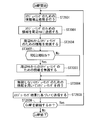
- 5 is a flowchart illustrating an outline from a cell search to a standby operation performed by a mobile terminal (UE) in an LTE communication system. It is a figure which shows the concept of JT. It is a figure which shows the concept of DCS. It is a figure which shows the concept of CS / CB. It is a figure which shows the concept of distributed scheduling.
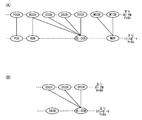
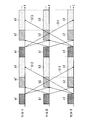
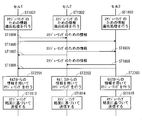
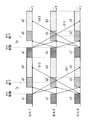
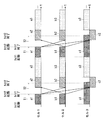
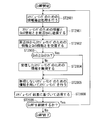
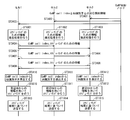
- FIG. 7 is a timing chart showing an example of the operation of each cell when performing night CoMP in Embodiment 1 of the present invention when the processing delay of one cell is large. It is a figure which shows an example of a sequence when performing CoMP in Embodiment 1 of this invention when the processing delay of one cell is large. 6 is a timing chart showing an example of operation of each cell when performing CoMP in Embodiment 1 of the present invention when a predetermined timing is set as a timer. It is a flowchart which shows an example of the process sequence of each cell when performing CoMP in Embodiment 1 of this invention when a predetermined
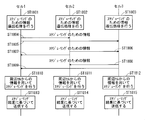
- FIG. 3 shows an example of the sequence when turning on and off the CoMP function in Embodiment 3 of this invention.
- An example of a sequence for turning on and off the CoMP function when information from neighboring cells or information on whether to ignore scheduling information is used as the information for turning on the CoMP function is shown.
- FIG. An example of a sequence for turning on and off the CoMP function when information from neighboring cells or information on whether to ignore scheduling information is used as the information for turning on the CoMP function is shown.
- FIG. It is a figure which shows an example of a sequence when determining whether each cell turns ON a CoMP function. It is a figure which shows an example of a sequence when determining whether each cell turns ON a CoMP function. It is a figure which shows an example of the sequence of a scheduling when performing CoMP in Embodiment 4 of this invention.
- FIG. 7 is a block diagram showing an overall configuration of an LTE mobile communication system currently under discussion in 3GPP.
- CSG Cell Subscriber Group
- E-UTRAN Home-eNodeB Home-eNodeB
- HeNB HeNB
- UTRAN Home-NB HNB
- non-CSG cells E-UTRAN eNodeB (eNB), UTRAN NodeB (NB), and GERAN BSS
- eNB E-UTRAN Home-eNodeB
- NB UTRAN NodeB
- GERAN BSS GERAN BSS
- a mobile terminal device (hereinafter referred to as “mobile terminal” or “UE”) 71 is capable of wireless communication with a base station device (hereinafter referred to as “base station”) 72, and transmits and receives signals by wireless communication.
- the mobile terminal device corresponds to a communication terminal device.
- the base station 72 is classified into an eNB 72-1 that is a macro cell and a Home-eNB 72-2 that is a local node.
- the eNB 72-1 has a relatively large large-scale coverage as a coverage that can be communicated with the mobile terminal (UE) 71.
- the Home-eNB 72-2 has a relatively small small-scale coverage.
- the eNB 72-1 is connected to the MME, S-GW, or the MME / S-GW unit (hereinafter also referred to as “MME unit”) 73 including the MME and S-GW through the S 1 interface. Control information is communicated with the unit 73.
- MME unit MME / S-GW unit
- a plurality of MME units 73 may be connected to one eNB 72-1.
- the eNBs 72-1 are connected by the X2 interface, and control information is communicated between the eNBs 72-1.
- the Home-eNB 72-2 is connected to the MME unit 73 via the S1 interface, and control information is communicated between the Home-eNB 72-2 and the MME unit 73.
- a plurality of Home-eNBs 72-2 are connected to one MME unit 73.
- the Home-eNB 72-2 is connected to the MME unit 73 via a HeNBGW (Home-eNB GateWay) 74.
- Home-eNB 72-2 and HeNBGW 74 are connected via an S1 interface, and HeNBGW 74 and MME unit 73 are connected via an S1 interface.
- One or a plurality of Home-eNBs 72-2 are connected to one HeNBGW 74, and information is communicated through the S1 interface.
- the HeNBGW 74 is connected to one or a plurality of MME units 73, and information is communicated through the S1 interface.
- the MME unit 73 and the HeNBGW 74 are higher-level node devices, and control connection between the eNB 72-1 and the Home-eNB 72-2 that are base stations and the mobile terminal (UE) 71.
- the X2 interface between Home-eNB 72-2 is supported. That is, the Home-eNB 72-2 is connected by the X2 interface, and control information is communicated between the Home-eNB 72-2. From the MME unit 73, the HeNBGW 74 appears as a Home-eNB 72-2. From the Home-eNB 72-2, the HeNBGW 74 appears as the MME unit 73. In any case where the Home-eNB 72-2 is connected to the MME unit 73 via the HeNBGW 74 or directly connected to the MME unit 73, the interface between the Home-eNB 72-2 and the MME unit 73 is , S1 interface is the same. The HeNBGW 74 does not support mobility to the Home-eNB 72-2 or mobility from the Home-eNB 72-2 that spans a plurality of MME units 73. Home-eNB 72-2 supports only one cell.
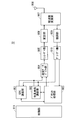
- FIG. 8 is a block diagram showing a configuration of a mobile terminal (mobile terminal 71 in FIG. 7) according to the present invention.
- a transmission process of the mobile terminal 71 shown in FIG. 8 will be described.
- control data from the protocol processing unit 801 and user data from the application unit 802 are stored in the transmission data buffer unit 803.
- the data stored in the transmission data buffer unit 803 is transferred to the encoder unit 804 and subjected to encoding processing such as error correction.
- the data encoded by the encoder unit 804 is modulated by the modulation unit 805.
- the modulated data is converted into a baseband signal, and then output to the frequency conversion unit 806, where it is converted into a radio transmission frequency.
- a transmission signal is transmitted from the antenna 807 to the base station 72.
- the reception process of the mobile terminal 71 is executed as follows.
- a radio signal from the base station 72 is received by the antenna 807.
- the reception signal is converted from a radio reception frequency to a baseband signal by the frequency conversion unit 806, and demodulated by the demodulation unit 808.
- the demodulated data is passed to the decoder unit 809 and subjected to decoding processing such as error correction.
- control data is passed to the protocol processing unit 801, and user data is passed to the application unit 802.
- a series of processing of the mobile terminal 71 is controlled by the control unit 810. Therefore, the control unit 810 is connected to the respective units 801 to 809, which is omitted in FIG.
- FIG. 9 is a block diagram showing the configuration of the base station (base station 72 in FIG. 7) according to the present invention.
- the transmission process of the base station 72 shown in FIG. 9 will be described.
- the EPC communication unit 901 transmits and receives data between the base station 72 and the EPC (MME unit 73, HeNBGW 74, etc.).
- the other base station communication unit 902 transmits / receives data to / from other base stations.
- the EPC communication unit 901 and the other base station communication unit 902 exchange information with the protocol processing unit 903, respectively. Control data from the protocol processing unit 903 and user data and control data from the EPC communication unit 901 and the other base station communication unit 902 are stored in the transmission data buffer unit 904.
- the data stored in the transmission data buffer unit 904 is transferred to the encoder unit 905 and subjected to encoding processing such as error correction. There may exist data that is directly output from the transmission data buffer unit 904 to the modulation unit 906 without performing the encoding process.
- the encoded data is subjected to modulation processing by the modulation unit 906.
- the modulated data is converted into a baseband signal, and then output to the frequency conversion unit 907 to be converted into a radio transmission frequency. Thereafter, a transmission signal is transmitted from the antenna 908 to one or a plurality of mobile terminals 71.
- the reception process of the base station 72 is executed as follows. Radio signals from one or a plurality of mobile terminals 71 are received by the antenna 908. The reception signal is converted from a radio reception frequency to a baseband signal by the frequency conversion unit 907, and demodulated by the demodulation unit 909. The demodulated data is transferred to the decoder unit 910 and subjected to decoding processing such as error correction. Of the decoded data, the control data is passed to the protocol processing unit 903 or the EPC communication unit 901 and the other base station communication unit 902, and the user data is passed to the EPC communication unit 901 and the other base station communication unit 902. A series of processing of the base station 72 is controlled by the control unit 911. Therefore, although not shown in FIG. 9, the control unit 911 is connected to the units 901 to 910.
- the other base station communication unit 902 corresponds to a notification unit and an acquisition unit.
- the transmission data buffer unit 904, the encoder unit 905, the modulation unit 906, the frequency conversion unit 907, the antenna 908, the demodulation unit 909, and the decoder unit 910 correspond to a communication unit.
- the functions of Home-eNB 72-2 currently being discussed in 3GPP are shown below (see Non-Patent Document 1, Chapter 4.6.2).
- the Home-eNB 72-2 has the same function as the eNB 72-1.
- the Home-eNB 72-2 has a function of finding an appropriate serving HeNBGW 74.
- the Home-eNB 72-2 is only connected to one HeNBGW 74. That is, in the case of connection with the HeNBGW 74, the Home-eNB 72-2 does not use the Flex function in the S1 interface.
- the Home-eNB 72-2 is not simultaneously connected to another HeNBGW 74 or another MME unit 73.
- the TAC and PLMN ID of the Home-eNB 72-2 are supported by the HeNBGW 74.
- the selection of the MME unit 73 in “UE attachment” is performed by the HeNBGW 74 instead of the Home-eNB 72-2.
- Home-eNB 72-2 may be deployed without network planning. In this case, Home-eNB 72-2 is moved from one geographic region to another. Therefore, the Home-eNB 72-2 in this case needs to be connected to different HeNBGW 74 depending on the position.
- FIG. 10 is a block diagram showing the configuration of the MME according to the present invention.
- FIG. 10 shows a configuration of the MME 73a included in the MME unit 73 shown in FIG.
- the PDN GW communication unit 1001 transmits and receives data between the MME 73a and the PDN GW.
- the base station communication unit 1002 performs data transmission / reception between the MME 73a and the base station 72 using the S1 interface. If the data received from the PDN GW is user data, the user data is passed from the PDN GW communication unit 1001 to the base station communication unit 1002 via the user plane communication unit 1003 to one or a plurality of base stations 72. Sent. When the data received from the base station 72 is user data, the user data is passed from the base station communication unit 1002 to the PDN GW communication unit 1001 via the user plane communication unit 1003 and transmitted to the PDN GW.
- control data is passed from the PDN GW communication unit 1001 to the control plane control unit 1005.
- control data is transferred from the base station communication unit 1002 to the control plane control unit 1005.
- the HeNBGW communication unit 1004 is provided when the HeNBGW 74 exists, and performs data transmission / reception through an interface (IF) between the MME 73a and the HeNBGW 74 according to the information type.
- the control data received from the HeNBGW communication unit 1004 is passed from the HeNBGW communication unit 1004 to the control plane control unit 1005.
- the result of processing in the control plane control unit 1005 is transmitted to the PDN GW via the PDN GW communication unit 1001. Further, the result processed by the control plane control unit 1005 is transmitted to one or a plurality of base stations 72 via the S1 interface via the base station communication unit 1002, and to one or a plurality of HeNBGWs 74 via the HeNBGW communication unit 1004. Sent.
- the control plane control unit 1005 includes a NAS security unit 1005-1, an SAE bearer control unit 1005-2, an idle state mobility management unit 1005-3, and the like, and performs overall processing for the control plane.
- the NAS security unit 1005-1 performs security of a NAS (Non-Access Stratum) message.
- the SAE bearer control unit 1005-2 manages a bearer of SAE (System Architecture) Evolution.
- the idle state mobility management unit 1005-3 manages mobility in a standby state (LTE-IDLE state, also simply referred to as idle), generation and control of a paging signal in the standby state, and one or a plurality of mobile terminals 71 being served thereby Add, delete, update, search, and track area list (TA ⁇ ⁇ ⁇ List) management.
- LTE-IDLE state also simply referred to as idle
- TA ⁇ ⁇ ⁇ List Add, delete, update, search, and track area list
- the MME 73a starts a paging protocol by transmitting a paging message to a cell belonging to a tracking area (tracking area: Tracking Area: TA) in which the UE is registered.
- the idle state mobility management unit 1005-3 may perform CSG management, CSG-ID management, and whitelist management of the Home-eNB 72-2 connected to the MME 73a.
- the relationship between the mobile terminal corresponding to the CSG-ID and the CSG cell is managed (added, deleted, updated, searched). For example, it may be a relationship between one or a plurality of mobile terminals registered for user access with a certain CSG-ID and a CSG cell belonging to the CSG-ID.
- white list management the relationship between a mobile terminal and a CSG-ID is managed (added, deleted, updated, searched). For example, one or a plurality of CSG-IDs registered by a certain mobile terminal as a user may be stored in the white list. Management related to these CSGs may be performed in other parts of the MME 73a. A series of processing of the MME 73a is controlled by the control unit 1006. Therefore, although not shown in FIG. 10, the control unit 1006 is connected to the units 1001 to 1005.
- the functions of MME73a currently being discussed in 3GPP are shown below (refer to Chapter 4.6.2 of Non-Patent Document 1).
- the MME 73a performs access control of one or a plurality of mobile terminals of CSG (Closed Subscriber ⁇ ⁇ ⁇ ⁇ Groups).
- the MME 73a accepts execution of paging optimization (Paging optimization) as an option.
- FIG. 11 is a block diagram showing a configuration of the HeNBGW 74 shown in FIG. 7 which is the HeNBGW according to the present invention.
- the EPC communication unit 1101 performs data transmission / reception between the HeNBGW 74 and the MME 73a using the S1 interface.
- the base station communication unit 1102 performs data transmission / reception between the HeNBGW 74 and the Home-eNB 72-2 via the S1 interface.
- the location processing unit 1103 performs processing for transmitting registration information and the like among data from the MME 73a passed via the EPC communication unit 1101 to a plurality of Home-eNBs 72-2.
- the data processed by the location processing unit 1103 is passed to the base station communication unit 1102 and transmitted to one or more Home-eNBs 72-2 via the S1 interface.
- Data that does not require processing in the location processing unit 1103 and is simply passed (transmitted) is passed from the EPC communication unit 1101 to the base station communication unit 1102 and is sent to one or a plurality of Home-eNBs 72-2 via the S1 interface. Sent. A series of processing of the HeNBGW 74 is controlled by the control unit 1104. Therefore, although not shown in FIG. 11, the control unit 1104 is connected to the units 1101 to 1103.
- HeNBGW74 The functions of HeNBGW74 currently being discussed in 3GPP are shown below (see Non-Patent Document 1, Chapter 4.6.2).
- the HeNBGW 74 relays for the S1 application. Although part of the procedure of the MME 73a to the Home-eNB 72-2, the HeNBGW 74 terminates for the S1 application not related to the mobile terminal 71.
- the HeNBGW 74 When the HeNBGW 74 is deployed, procedures unrelated to the mobile terminal 71 are communicated between the Home-eNB 72-2 and the HeNBGW 74, and between the HeNBGW 74 and the MME 73a.
- the X2 interface is not set between the HeNBGW 74 and other nodes.
- the HeNBGW 74 recognizes execution of paging optimization (Paging optimization) as an option.
- Paging optimization paging optimization
- FIG. 12 is a flowchart showing an outline from a cell search to a standby operation performed by a mobile terminal (UE) in an LTE communication system.
- the mobile terminal uses the first synchronization signal (P-SS) and the second synchronization signal (S-SS) transmitted from the neighboring base stations in step ST1201, and the slot timing, frame Synchronize timing.
- a synchronization code corresponding to one-to-one PCI (Physical (Cell Identity) assigned to each cell is assigned to the synchronization signal (SS) by combining P-SS and S-SS.
- PCI Physical (Cell Identity) assigned to each cell
- SS synchronization signal
- 504 PCIs are being studied, and the 504 PCIs are used for synchronization, and the PCI of the synchronized cell is detected (specified).
- a cell-specific reference signal that is a reference signal (reference signal: RS) transmitted from the base station to each cell is detected.
- RS received power also referred to as RSRP
- the reference signal uses a code corresponding to PCI one-to-one, and can be separated from other cells by correlating with the code. It is possible to detect the RS and measure the received power of the RS by deriving the RS code of the cell from the PCI specified in step ST1201.
- a cell having the best RS reception quality for example, a cell having the highest RS reception power, that is, the best cell is selected from one or more cells detected up to step ST1202.
- step ST1204 the PBCH of the best cell is received, and the BCCH that is broadcast information is obtained.
- MIB Master Information Block
- the MIB information includes, for example, DL (downlink) system bandwidth (also called transmission bandwidth setting (transmission bandwidth configuration: dl-bandwidth)), the number of transmission antennas, SFN (System frame number), and the like.
- SIB1 System Information Block 1 in the broadcast information BCCH.
- SIB1 includes information related to access to the cell, information related to cell selection, and scheduling information of other SIBs (SIBk; an integer of k ⁇ 2). Also, SIB1 includes TAC (Tracking Area Code).
- step ST1206 the mobile terminal compares the TAC of SIB1 received in step ST1205 with the TAC in the TA (Tracking Area) list already owned by the mobile terminal. As a result of the comparison, if the TAC received in step ST1205 is the same as the TAC included in the TA (Tracking Area) list, the cell enters a standby operation. In comparison, if the TAC received in step ST1205 is not included in the TA (Tracking Area) list, the mobile terminal passes through the cell to the core network (Core Network, EPC) (including MME etc.). Requests change of TA (Tracking Area) to perform Area Update.
- the core network Core Network, EPC
- the core network updates the TA (Tracking Area) list based on the identification number (UE-ID or the like) of the mobile terminal sent from the mobile terminal together with the TAU request signal.
- the core network transmits an updated TA (Tracking Area) list to the mobile terminal.
- the mobile terminal rewrites (updates) the TAC list held by the mobile terminal with the received TA (Tracking Area) list. Thereafter, the mobile terminal enters a standby operation in the cell.
- CSG Cell Subscriber Group
- a CSG cell and one or a plurality of registered mobile terminals constitute one CSG.
- a CSG configured in this way is given a unique identification number called CSG-ID.
- a single CSG may have a plurality of CSG cells.
- Home-eNB in LTE and LTE-A and Home-NB in UMTS may be used as a CSG cell.
- the mobile terminal registered in the CSG cell has a white list.
- the white list is stored in SIM (Subscriber Identity Module) / USIM.
- the white list stores CSG information of CSG cells registered by the mobile terminal.
- CSG-ID, TAI (Tracking Area Identity), TAC, etc. can be considered as the CSG information.
- Either of the CSG-ID and the TAC may be used as long as they are associated with each other.
- GCI may be used as long as CSG-ID and TAC are associated with GCI (Global Cell Identity).
- a mobile terminal that does not have a white list cannot access a CSG cell, and only accesses a non-CSG cell. Can not.
- a mobile terminal having a white list can access both a CSG cell of a registered CSG-ID and a non-CSG cell.
- PCI Physical Cell Identity
- Non-Patent Document 1 3GPP discusses dividing all PCI (Physical Cell Identity) into a CSG cell and a non-CSG cell (see Non-Patent Document 1).
- PCI split a PCI range reserved by the network for use by the CSG cell.
- the PCI split information is reported from the base station to the mobile terminals being served by the system information.
- Non-Patent Document 5 discloses a basic operation of a mobile terminal using PCI split.
- a mobile terminal that does not have PCI split information needs to perform cell search using all PCIs, for example, using all 504 codes.
- a mobile terminal having PCI split information can perform a cell search using the PCI split information.
- PCI for hybrid cells is not included in the PCI range for CSG cells (see Non-Patent Document 1, Chapter 10.7).
- a mobile terminal selects or reselects a CSG cell.
- the first is an automatic mode.
- Selection or reselection is performed using an allowed CSG list (Allowed CSG ID List) in the mobile terminal.
- the camp is performed on one cell in the selected PLMN only when the non-CSG cell or the CSG cell with the CSG ID existing in the allowed CSG list is used. If the allowed CSG list of the mobile terminal is empty, the mobile terminal stops the CSG cell autonomous search function (see Non-Patent Document 3, Chapter 5.4.2.8.1).
- the second is Manual mode.
- the features of the manual mode are shown below.
- the mobile terminal presents to the user a list of CSGs that are available on the currently selected PLMN.
- the list of CSG provided to the user by the mobile terminal is not limited to the CSG included in the allowed CSG list stored in the mobile terminal. After the user selects a CSG based on the CSG list, the mobile terminal camps on the cell with the selected CSG ID and tries to register (see Non-Patent Document 3).
- the HeNB and HNB are required to support various services. For example, an operator increases a radio resource that can be used by a mobile terminal by allowing the mobile terminal to be registered in a certain HeNB and HNB and allowing only the registered mobile terminal to access the HeNB and HNB cells. To enable high-speed communication. Accordingly, the service is such that the operator sets the charging fee higher than usual.
- CSG cell Cell
- Many CSG cells are required to be installed in shopping streets, condominiums, schools, companies, and the like.
- a CSG cell is installed for each store in a shopping street, each room in a condominium, each classroom in a school, and each section in a company, and only a user registered in each CSG cell can use the CSG cell.
- HeNB / HNB is required not only to complement communication outside the coverage of the macro cell (area supplement type HeNB / HNB) but also to support various services as described above (service provision type HeNB / HNB). Yes. For this reason, a case where the HeNB / HNB is installed in the coverage of the macro cell may occur.
- Downlink CoMP (DL CoMP) is being studied as a new technology for LTE-A.
- JP Joint Processing
- CS / CB Coordinated Beamforming
- JP includes JT (Joint Transmission) and DCS (Dynamic Cell Selection).
- FIG. 13 is a diagram showing the concept of JT.
- the first multipoint unit 1301 and the second multipoint unit 1302 are units that perform DL CoMP, that is, downlink multipoint coordinated transmission.
- a DL CoMP target mobile terminal (UE) 1303 is configured with a first multipoint unit 1301 serving as a serving cell, a coverage 1306 configured by the first multipoint unit 1301, and a second multipoint unit 1302.
- a case where the data exists in the coverage 1307 is shown.
- a signal transmitted from the first multipoint unit 1301 to the UE 1303 is indicated by an arrow 1304.
- a signal transmitted from the second multipoint unit 1302 to the UE 1303 is indicated by an arrow 1305.
- signals 1304 and 1305 are simultaneously transmitted from a plurality of multipoint units 1301 and 1302 to a UE 1303 that is a target of CoMP.
- FIG. 14 is a diagram showing the concept of DCS.
- the first multipoint unit 1401 and the second multipoint unit 1402 are units that perform DL CoMP, that is, coordinated transmission between downlink multipoints.
- a DL CoMP target mobile terminal (UE) 1403 is configured in the coverage 1406 configured by the first multipoint unit 1401 and the second multipoint unit 1402 using the first multipoint unit 1401 as a serving cell.
- a signal transmitted from the first multipoint unit 1401 to the UE 1403 is indicated by an arrow 1404.
- a signal transmitted from the second multipoint unit 1402 to the UE 1403 is indicated by an arrow 1405.
- a signal is transmitted from one multipoint unit to a CoMP target UE at a time.
- One multi-point unit transmitted to the CoMP target UE is dynamically changed.
- the signal 1404 is transmitted from the first multipoint unit 1401 at a certain time to the UE 1403 that is the target of CoMP, and the signal 1405 is transmitted from the second multipoint unit 1402 at another certain time. .
- FIG. 15 is a diagram showing the concept of CS / CB.
- FIG. 15A shows the concept of CS.
- FIG. 15B is a diagram showing the concept of CB.
- the first multipoint unit 1501 and the second multipoint unit 1502 are units that perform DL CoMP, that is, downlink multipoint coordinated transmission.
- DL CoMP target mobile terminals (UEs) 1503 and 1507 exist in the coverage 1505 configured by the first multipoint unit 1501 and the coverage 1506 configured by the second multipoint unit 1502. Indicates.
- a signal transmitted from the first multipoint unit 1501 to the UE 1503 is indicated by an arrow 1504.
- a signal transmitted from the first multipoint unit 1501 to the first UE 1503 is indicated by an arrow 1504, and a signal transmitted from the first multipoint unit 1501 to the second UE 1507 is This is indicated by an arrow 1508.
- a signal transmitted from the second multipoint unit 1502 to the first UE 1503 is indicated by an arrow 1510, and a signal transmitted from the second multipoint unit 1502 to the second UE 1507 is This is indicated by an arrow 1509.
- a signal is transmitted from a multipoint unit serving as a serving cell of a CoMP target UE to the CoMP target UE.
- the second multipoint unit 1502 performs transmission by CoMP based on scheduling such as not transmitting a signal.
- the first multipoint unit 1501 which is the serving cell of the first UE 1503 subject to CoMP, transmits a signal 1504 in the direction of the first UE 1503 by beamforming
- the multipoint unit 1502 is made null by beam forming so as not to transmit the signal 1510 in the direction of the first UE 1503.
- the second multipoint unit 1502 serving as the serving cell of the second UE 1507 subject to CoMP transmits a signal 1509 in the direction of the second UE 1507 by beamforming
- the first multipoint unit 1501 Null is performed by beam forming so that the signal 1508 is not transmitted in the direction of the UE 1507.
- Non-patent Document 10 A scheduling method for CoMP is being studied by 3GPP. As scheduling methods for co-operation between multipoints, distributed scheduling and centralized scheduling have been proposed (3GPP R1-110106 (hereinafter “Non-patent Document 10”). See)).
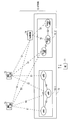
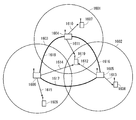
- FIG. 16 is a diagram showing the concept of distributed scheduling.
- the first multipoint unit 1604, the second multipoint unit 1605, and the third multipoint unit 1606 are units that perform DL CoMP, that is, downlink multipoint coordinated transmission.
- the DL CoMP target mobile terminal (UE) 1619 is within the coverage (hereinafter also referred to as “the coverage of the first multipoint unit 1604”) 1601 configured by the first multipoint unit 1604 and the second multipoint unit 1605.
- 1602 hereinafter sometimes referred to as “coverage of second multipoint unit 1605” 1602.
- the first UE 1607 which is a UE that is not subject to CoMP under the control of the first multipoint unit 1604, exists in the coverage 1601 of the first multipoint unit 1604.
- a second UE 1608 that is a UE that is not a CoMP target under the control of the second multipoint unit 1605 exists in the coverage 1602 of the second multipoint unit 1605.
- a third UE 1609, which is a UE that is not a CoMP target under the third multipoint unit 1606, exists in the coverage 1603 configured by the third multipoint unit 1606.
- a signal transmitted from the first multipoint unit 1604 to the first UE 1607 is indicated by an arrow 1610
- a signal transmitted from the first multipoint unit 1604 to the DL CoMP target UE 1619 is indicated by an arrow 1611.
- the signal transmitted from the second multipoint unit 1605 to the DL CoMP target UE 1619 is indicated by an arrow 1612
- the signal transmitted from the second multipoint unit 1605 to the second UE 1608 is indicated by an arrow 1613. Show.
- FIG. 1610 a signal transmitted from the first multipoint unit 1604 to the first UE 1607
- a signal transmitted from the first multipoint unit 1604 to the DL CoMP target UE 1619 is indicated by an arrow 1611.
- the signal transmitted from the second multipoint unit 1605 to the DL CoMP target UE 1619 is indicated by an arrow 1612
- the signal transmitted from the second multipoint unit 1605 to the second UE 1608 is indicated by an arrow 1613. Show.
- FIG. 1610 a signal transmitted
- a signal transmitted from the third multipoint unit 1606 to the DL CoMP target UE 1619 is indicated by an arrow 1614
- a signal transmitted from the third multipoint unit 1606 to the third UE 1609 is indicated by an arrow 1615.
- the first multipoint unit 1604 and the second multipoint unit 1605 are connected by an interface 1616.
- the first multipoint unit 1604 and the second multipoint unit 1605 transmit and receive information via the interface 1616.
- the second multipoint unit 1605 and the third multipoint unit 1606 are connected by an interface 1617.
- the second multipoint unit 1605 and the third multipoint unit 1606 transmit and receive information via the interface 1617.
- the third multipoint unit 1606 and the first multipoint unit 1604 are connected by an interface 1618.
- the third multipoint unit 1606 and the first multipoint unit 1604 transmit and receive information via the interface 1618.
- each multipoint unit 1604, 1605, 1606 combines UE1607, 1608, 1609 that is not subject to CoMP under its own multipoint unit and UE1619 that is subject to CoMP under other multipoint unit, Perform scheduling.
- the outline of the distributed scheduling procedure is shown below.
- each multipoint unit 1604, 1605, 1606 performs scheduling, and exchanges scheduling information representing the result of scheduling between the multipoint units 1604, 1605, 1606.
- each multipoint unit 1604, 1605, 1606 performs scheduling using scheduling information notified from other multipoint units.
- each multipoint unit 1604, 1605, 1606 transmits signals 1610 to 1615 to each UE 1607, 1608, 1609, 1619 based on the scheduling result of each multipoint unit 1604, 1605, 1606. .
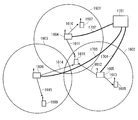
- FIG. 17 is a diagram showing the concept of centralized scheduling.
- a centralized node 1701 is provided.
- the first multipoint unit 1604 and the central node 1701 are connected by an interface 1702.
- the first multipoint unit 1604 and the central node 1701 transmit and receive information via the interface 1702.
- the second multipoint unit 1605 and the central node 1701 are connected by an interface 1704.
- the second multipoint unit 1605 and the central node 1701 transmit and receive information via the interface 1704.
- the third multipoint unit 1606 and the central node 1701 are connected by an interface 1703.
- the third multipoint unit 1606 and the central node 1701 transmit and receive information via the interface 1703.
- the centralized node 1701 performs scheduling for all UEs 1607, 1608, 1609, and 1619 under the control of all multipoint units 1604, 1605, and 1606 that perform CoMP.
- the outline of the centralized scheduling procedure is shown below.
- the centralized node 1701 performs scheduling for all UEs 1607, 1608, 1609 and 1619 under the umbrella of all multipoint units 1604, 1605 and 1606 using the resources of all multipoint units 1604, 1605 and 1606. Do.
- the centralized node 1701 notifies the multipoint units 1604, 1605, 1606 of the scheduling results for the multipoint units 1604, 1605, 1606.
- each multipoint unit 1604, 1605, 1606 transmits signals 1610 to 1615 to each UE 1607, 1608, 1609, 1619 based on the scheduling result notified from the concentrated node 1701.
- the central node 1701 performs scheduling for all UEs 1607, 1608, 1609, and 1619 under the umbrella of all multipoint units 1604, 1605, and 1606 that perform CoMP, but the central node 1701 performs scheduling. Necessary UE scheduling may be performed. Further, the central node 1701 may be provided in any one multipoint unit, or may be provided in MME, HeNBGW, or OAM (Operation Administration and Maintenance).
- a CoMP that is, a multipoint unit that performs multipoint coordinated transmission / reception may be a cell. Also, when one eNB configures a plurality of cells, CoMP is supported between the cells. CoMP supported between cells is referred to as intra-eNB CoMP. In the following description, unless otherwise specified, a cell including a multipoint unit and an eNB is referred to as a “cell”. A cell is equivalent to a base station apparatus including the cell which a multipoint unit and eNB comprise.
- Non-Patent Document 10 Specific methods of conventional distributed scheduling include iterative CoMP scheduling (iterative ⁇ ⁇ ⁇ ⁇ ⁇ ⁇ ⁇ ⁇ CoMP scheduling) as shown in Non-Patent Document 10 and 3GPP R1-110355 (hereinafter referred to as “Non-Patent Document 11”).
- each cell performing CoMP provisionally performs non-cooperative scheduling for a UE being served thereby.
- each cell exchanges scheduling information representing the result of scheduling performed in each cell between cells performing CoMP.
- each cell performs not only the scheduling of its own cell but also the scheduling information notified from other cells that perform CoMP, and performs improved (refine) scheduling. .
- Each cell may perform refined scheduling and beam selection.
- each cell transmits a signal based on the converged scheduling result. In this way, each cell performs scheduling while cooperating with other cells that perform CoMP.
- this method has a problem that the delay increases because information exchange is repeated between cells until the scheduling result converges to a predetermined value.
- Non-patent Document 12 proposes non-iterative CoMP scheduling (non-iterative CoMP scheduling) in order to improve the above-described problem that the delay becomes large.
- FIG. 18 is a diagram illustrating an example of a non-repetitive CoMP scheduling sequence.
- Cell 1, cell 2, and cell 3 are cells that perform CoMP.
- step ST1801 step ST1802, and step ST1803, each of the cells 1 to 3 performs a process for deriving information for scheduling (hereinafter referred to as “information deriving process”).
- the cells 1 to 3 exchange information for scheduling with other cells that perform CoMP. Specifically, cell 1 transmits scheduling information to cell 2 in step ST1804, and transmits scheduling information to cell 3 in step ST1805. In step ST1806, the cell 2 transmits information for scheduling to the cell 3, and in step ST1807, the cell 2 transmits information for scheduling to the cell 1. In step ST1808, the cell 3 transmits scheduling information to the cell 2, and in step ST1809, the cell 3 transmits scheduling information to the cell 1.
- step ST1810 When cell 1 receives the scheduling information transmitted from cells 2 and 3 in steps ST1807 and ST1809, it moves to step ST1810.
- step ST1811 When cell 2 receives the scheduling information transmitted from cells 1 and 3 in steps ST1804 and ST1808, the cell2 moves to step ST1811.
- step ST1812 When cell 3 receives the scheduling information transmitted from cells 1 and 2 in steps ST1805 and ST1806, it moves to step ST1812.
- each cell 1 to 3 performs scheduling using information for scheduling notified from other cells performing CoMP.
- other cells that perform CoMP are also referred to as “neighboring cells”.
- the cell 1 moves to step ST1813 after finishing the process of step ST1810.
- the cell 2 moves to step ST1814 after finishing the process of step ST1811.
- the cell 3 moves to step ST1815 after finishing the process of step ST1812.
- Step ST1813, Step ST1814, and Step ST1815 each of the cells 1 to 3 transmits a signal based on the result of the scheduling performed in Step ST1810, Step ST1811, and Step ST1812.
- FIG. 19 is a timing chart showing an example of the operation of each cell in non-repetitive CoMP scheduling.
- the arrows in FIG. 19 indicate exchange of information between cells, in other words, transmission / reception of information.
- a signal a based on the scheduling result a1 the information exchange period with the neighboring cells 2 and 3, the scheduling period a2 using information from the neighboring cells, and the scheduling result This is followed by a period a3 during which transmission is performed.
- information derivation processing for scheduling is performed again. In this manner, each process from the information derivation process for scheduling to the transmission process based on the scheduling result in each cell is repeated.
- the period b1 of the information derivation process for scheduling the information exchange period with the cells 1 and 3 as the neighboring cells, the scheduling period b2 using information from the neighboring cells, the scheduling This is followed by a period b3 in which signal transmission is performed based on the result of.
- cell 2 transmits a signal based on the scheduling result, and then performs information derivation processing for scheduling again.
- each process from the information derivation process for scheduling to the transmission process based on the scheduling result in each cell is repeatedly performed.
- cell 3 As in cell 1, information derivation process period c1 for scheduling, information exchange period with cell 1 and cell 2 that are neighboring cells, scheduling period c2 using information from neighboring cells, scheduling This is followed by a period c3 in which signal transmission is performed based on the result of. Then, similarly to cell 1, cell 3 transmits a signal based on the scheduling result, and then performs information derivation processing for scheduling again. As described above, in the cell 3, as in the cell 1, each process from the information derivation process for scheduling to the transmission process based on the scheduling result in each cell is repeatedly performed.
- Time synchronization is established between cells performing CoMP. For example, in the case of JT, periods a3, b3, and c3 in which each cell transmits a signal based on a scheduling result are performed at the same timing. In the case of DCS and CS / CB, the transmission method from each cell is different from that in JT, but the periods a3, b3, and c3 in which each cell transmits a signal based on the scheduling result are the same timing. Done.
- a delay due to information derivation processing for scheduling in each cell and a delay due to an inter-cell interface occur. Therefore, the scheduling process of each cell is limited by the delay amount in the neighboring cells and the delay amount in the inter-cell interface. If there is a large delay amount in the neighboring cells and the delay amount in the inter-cell interface, as a result, the scheduling process in each cell is delayed, and the timing of signal transmission based on the scheduling result is delayed. . ⁇ Since transmission periods are synchronized between cells performing CoMP, if any one of the cells performing CoMP is delayed, it is necessary to delay the transmission period for performing CoMP. As a result, the amount of performance improvement such as throughput due to inter-cell cooperative scheduling decreases.
- FIG. 20 is a timing chart showing an example of the operation of each cell when the delay amount of the inter-cell interface is large.
- the same processes as those shown in FIG. Further, the arrows in FIG. 20 indicate the exchange of information between cells, in other words, the transmission / reception of information.
- FIG. 20 shows a case where the delay amount of the interface (Interface: IF) between the cell 1 and the cell 3 is larger than the delay amount of the other inter-cell IF.
- IF the delay amount of the interface
- Cell 1 performs information exchange with cell 2 and cell 3 which are neighboring cells after period a1 of information derivation processing for scheduling.
- the period required for information exchange with the cell 2 and the cell 3 depends on the delay amount of the inter-cell IF between the cell 2 and the cell 3.
- the cell 1 receives the scheduling information from the cell 2 early.
- the reception of the information for scheduling from the cell 3 indicated by the reference symbol “S3” is delayed by the amount of delay.
- Cell 1 waits until receiving information for scheduling from cell 3 and, after receiving the information, performs scheduling using information from neighboring cells. Therefore, the scheduling process using the information from the neighboring cells is delayed by the delay in receiving the information for scheduling from the cell 3.
- the signal transmission processing performed based on the scheduling result is also delayed by that amount.
- the scheduling process using information from the neighboring cells is not greatly delayed.
- the transmission timing of each cell performing CoMP is synchronized, the transmission timing of cell 2 is also delayed by the delay amount D of cell 1 and cell 3 in coordination with the transmission timing of cell 1 and cell 3. Necessity arises. That is, the CoMP transmission timings of cell 1, cell 2, and cell 3 are all delayed.
- the cell performs scheduling without using information for scheduling from one or a plurality of other cells among the information for scheduling notified from other cells in the CoMP set. Configured to be possible.
- the protocol processing unit 903 that is a processing unit of the base station 72 is notified from another base station and the other base station communication unit 902 Among the acquired scheduling information, the scheduling can be performed without using the scheduling information notified from one or more other base stations.
- the following two are disclosed as methods that do not require the use of information for scheduling of other cells.
- the cell ignores scheduling information notified from one or more other cells in the CoMP set.
- the cell does not notify scheduling information to one or more other cells in the CoMP set.
- the CoMP set may be a CoMP co-operating set or a CoMP transmission point set.
- Specific examples of information for scheduling include scheduling information, information indicating a UE measurement report result, and channel state information derived therefrom. Scheduling information includes resource allocation information and MCS (Modulation and Coding Scheme) information.
- the scheduling information may be DCI (Downlink Control Information) (see 3GPP TS36.212V10.0.0 (hereinafter referred to as “Non-Patent Document 13”)).
- DCI Downlink Control Information
- Non-Patent Document 13 By setting the scheduling information to DCI, a common format can be used as a system, and there is no need to provide a special format as CoMP in each cell. Therefore, the control for CoMP scheduling can be simplified.
- the information for scheduling may be information for scheduling of CoMP target UEs. By making the information for scheduling information for scheduling of CoMP target UEs, the amount of information exchanged between cells can be reduced.
- FIG. 21 is a timing chart showing an example of the operation of each cell when CoMP is performed using a method of ignoring scheduling information notified from other cells.
- the same processing as shown in FIG. 20 is denoted by the same reference numeral, and the common description is omitted.
- the arrows in FIG. 21 indicate exchange of information between cells, in other words, transmission / reception of information.
- FIG. 21 shows a case where the IF delay amount between the cell 1 and the cell 3 is larger than the delay amount of other inter-cell IFs as in FIG.
- the cell 1 can early receive information for scheduling from the cell 2, but from the cell 3 indicated by the reference symbol “S13” The reception of information for scheduling is delayed by the amount of delay.
- the cell 3 can quickly receive the information for scheduling from the cell 2, but the reception of the information for scheduling from the cell 1 indicated by the reference symbol “S11” has a delay amount. It will be delayed by a large amount.
- Cell 2 can receive information for scheduling from cell 1 or cell 3 early because a large delay does not occur in the IF with cell 1 or cell 3.
- the cell 1 ignores the information S13 for scheduling received from the cell 3 having a large delay amount.
- the cell 3 ignores the information S11 for scheduling received from the cell 1 having a large delay amount. In this way, each cell performs scheduling using information for scheduling from other cells, ignoring information for scheduling from cells that are notified with a large delay.
- Each cell that performs scheduling transmits a signal based on the scheduling result. Since each cell ignores the scheduling information notified with a large delay, the timing of cooperative transmission between cells in the CoMP set is not greatly delayed.
- the coordinated transmission between cells means that coordinated transmission is performed for UEs that perform CoMP, including whether or not to transmit for each cell.
- the UE that performs CoMP transmits from a plurality of cells simultaneously in cooperation between cells (JT), and the transmission from one cell at a time in cooperation between cells.
- JT cells
- DCS, CS / CB there are things
- the number of OFDM symbols used for PDCCHs varies from cell to cell or from subframe to subframe. Therefore, there are cases where symbols to which PDSCHs transmitted in cooperation are mapped differ in each cell in the CoMP set. In this case, a symbol in which a PDSCH of a UE that is a CoMP target is mapped in a certain cell in the CoMP set, and a PDCCH is mapped in another cell in the CoMP set. Therefore, it becomes impossible to transmit cooperatively from each cell in the CoMP set.
- the following five (1) to (5) are disclosed as methods for solving this problem.
- a symbol to which PDSCH is mapped in a subframe in which CoMP transmission is performed is determined in advance.
- the same value may be determined as a communication system or within a CoMP set.
- the symbols may be continuous in time or discrete. As a determination method in the case of continuous, there are a symbol start value and the number of symbols, or a symbol start value and end value.
- the number of OFDM symbols used for PDCCHs or the value of PCFICH in a subframe for CoMP transmission is determined in advance.
- the same value may be determined as a communication system or within a CoMP set.
- a cell in the CoMP set is determined in advance as “3” as an OFDM symbol used for PDCCHs.
- the leading value of a symbol mapping PDSCH in a subframe to be transmitted with CoMP is determined in advance.
- the same value may be determined as a communication system or within a CoMP set.
- the leading value of the symbol mapping the PDSCH of the subframe for CoMP transmission is determined as the fourth symbol in advance.
- the predetermined values in the above (1) to (3) may be statically determined in advance by a standard or the like, or may be notified from the CoMP control node to the cells in the CoMP set. With these methods, it is possible to unify symbols for mapping PDSCH for CoMP transmission in each cell in the CoMP set. Further, as in the above (1) to (3), the symbol to which PDSCH is mapped, the number of OFDM symbols used for PDCCHs, the value of PCFICH, the leading value of the symbol to which PDSCH is mapped, etc. are determined in advance. Therefore, stable CoMP operation can be achieved.
- the cell is a UE that is a CoMP target of the neighboring cell. Is transmitted after being mapped to the fourth and subsequent symbols of the own cell. In this case, the cell may not transmit anything in the third symbol of its own cell, or may map and transmit data to other UEs.
- the own cell may recognize which symbol is mapped to the PDSCH to the CoMP target UE in the neighboring cell.
- each cell in the CoMP set notifies a neighboring cell of information related to a symbol to which the PDSCH of the own cell is mapped in information for scheduling or together with the information.
- Specific examples of information on symbols to which the PDSCH is mapped include a symbol to which the PDSCH is mapped, the number of OFDM symbols used for PDCCHs, a PCFICH value, or a leading value of a symbol to which the PDSCH is mapped.
- each cell in the CoMP set notifies the neighboring cell of information on the symbol to which the PDSCH of the own cell is mapped, so that each cell in the CoMP set recognizes the symbol to which the PDSCH of the neighboring cell is mapped. can do. As a result, it is possible to reliably perform CoMP transmission by using the same symbol for mapping data to the CoMP target UE in the own cell and neighboring cells.
- Only cells with the same symbol to which the PDSCH is mapped are included in the CoMP set. Only cells having the same number of OFDM symbols used for PDCCHs, the value of PCFICH, or the head value of symbols mapping PDSCH may be included in the CoMP set. Specifically, for example, for a CoMP target UE, a CoMP set is configured with a cell whose leading value of a symbol mapping PDSCH is a fourth symbol. By doing as described in (5) above, the symbols to which the PDSCH of the cells in the CoMP set are mapped are the same, and the symbols to which the PDSCH for CoMP transmission is mapped can be unified.
- the information about the symbol to which the PDSCH of each cell is mapped may be notified in advance from each cell to a node constituting the CoMP set, for example, a concentrated node, a CoMP control node, an MME, a HeNB, a HeNBGW, or the like. Or you may make it notify to a neighboring cell via the node which comprises a CoMP set from each cell.
- a node constituting the CoMP set for example, a concentrated node, a CoMP control node, an MME, a HeNB, a HeNBGW, or the like. Or you may make it notify to a neighboring cell via the node which comprises a CoMP set from each cell.
- information on symbols to which PDSCH is mapped may be exchanged between the cells.
- the method (5) may be applied.
- at least one of CP information and subcarrier frequency interval information may be used.
- at least one of CP information and subcarrier frequency interval information may be added to the information about the symbol to which the PDSCH of (5) is mapped.
- the CP information of each cell or the frequency interval information of subcarriers may be notified in advance from each cell to a node constituting a CoMP set, for example, a concentrated node, a CoMP control node, an MME, a HeNB, a HeNBGW, or the like. Or you may make it notify to a neighboring cell via the node which comprises a CoMP set from each cell.
- a node constituting a CoMP set for example, a concentrated node, a CoMP control node, an MME, a HeNB, a HeNBGW, or the like. Or you may make it notify to a neighboring cell via the node which comprises a CoMP set from each cell.
- at least one of CP information and subcarrier frequency interval information may be exchanged between the cells.
- FIG. 22 is a diagram illustrating an example of a sequence when performing CoMP according to Embodiment 1 of the present invention. Since the sequence shown in FIG. 22 is similar to the sequence shown in FIG. 18, the same steps are denoted by the same step numbers and common description is omitted.
- each cell performs information derivation processing for scheduling.
- each cell exchanges information for scheduling with other cells that perform CoMP.
- step ST2201 the cell 1 ignores the scheduling information received from the cell 3, and performs scheduling using the scheduling information received from the cell 2.
- the cell 1 performs scheduling using the scheduling information received from the cell 2 without using the scheduling information received from the cell 3.
- cell 1 considers the scheduling information of its own cell. And perform scheduling.
- Step ST1813 the cell 1 transmits a signal based on the scheduling result of Step ST2201.
- the cell 3 ignores the scheduling information received from the cell 1, and performs scheduling using the scheduling information received from the cell 2. Alternatively, the cell 3 performs scheduling using the scheduling information received from the cell 2 without using the scheduling information received from the cell 1. In either case of ignoring scheduling information received from cell 1 or not using scheduling information received from cell 1, cell 3 considers information for scheduling of its own cell. And perform scheduling.
- Step ST1815 the cell 3 transmits a signal based on the scheduling result of Step ST2203.
- step ST2202 the cell 2 performs scheduling using the scheduling information received from the cell 1 and the cell 3. At this time, the cell 2 performs scheduling in consideration of information for scheduling of the own cell.
- the cell 2 moves to step ST1814 after finishing the process of step ST2202.
- Step ST1814 the cell 2 transmits a signal based on the scheduling result of Step ST2202.
- each cell notifies the neighboring cell of scheduling information and receives scheduling information from the neighboring cell.
- each cell is configured to notify the neighboring cell of the cell identifier of the own cell accompanying the scheduling information.
- a cell identifier an identification number, Cell-ID, GCI, PCI, or the like may be used.
- step ST2201 By attaching the cell identifier of the own cell to the information for scheduling, the cell that has received the information can recognize from which cell the information is transmitted. Thereby, in step ST2201, step ST2202, and step ST2203, each cell can ignore information for scheduling from a specific cell.
- the timing of cooperative transmission between cells in the CoMP set is not greatly delayed.
- FIG. 23 is a timing chart showing an example of the operation of each cell when performing CoMP according to Embodiment 1 of the present invention when the processing delay of one cell is large.
- the same processes as shown in FIG. 19 are denoted by the same reference numerals, and the common description is omitted.
- the arrows in FIG. 23 indicate the exchange of information between cells, in other words, the transmission / reception of information.
- FIG. 23 shows a case where the delay of the information derivation process for scheduling of cell 3 is greater than that of other cells.
- the cell 1 can early receive the information for scheduling from the cell 2, but from the cell 3 indicated by the reference symbol “S13” The reception of information for scheduling is delayed by the amount of delay.
- cell 2 can receive information for scheduling from cell 1 early, but the amount of delay in receiving information for scheduling from cell 3 indicated by reference symbol “S23” is It will be delayed by a large amount.
- Cell 3 can quickly receive information for scheduling from cell 1 or cell 2.
- the cell 1 ignores the information S13 for scheduling received from the cell 3 having a large delay amount.
- the cell 2 ignores the information S23 for scheduling received from the cell 3 having a large delay amount.
- each cell performs scheduling using information for scheduling from other cells, ignoring information for scheduling from cells that are notified with a large delay.
- Each cell that performs scheduling transmits a signal based on the result of the scheduling. Since each cell ignores the scheduling information notified with a large delay, the timing of cooperative transmission between cells in the CoMP set is not greatly delayed.
- FIG. 24 is a diagram showing an example of a sequence when performing CoMP in the first embodiment of the present invention when the processing delay of one cell is large.
- the sequence shown in FIG. 24 is similar to the sequence shown in FIG. 18. Therefore, the same steps are denoted by the same step numbers and common description is omitted.
- each cell performs information derivation processing for scheduling.
- each cell exchanges information for scheduling with other cells performing CoMP.
- the cell 1 ignores the scheduling information transmitted from the cell 3, and performs scheduling using the scheduling information received from the cell 2.
- the cell 1 performs scheduling using the scheduling information received from the cell 2 without using the scheduling information transmitted from the cell 3.
- the cell 1 is the information for scheduling of the own cell. Perform scheduling in consideration of
- Step ST1813 the cell 1 transmits a signal based on the scheduling result of Step ST2401.
- Step ST2402 the cell 2 ignores the scheduling information transmitted from the cell 3, and performs scheduling using the scheduling information received from the cell 1.
- the cell 2 performs scheduling using the scheduling information received from the cell 1 without using the scheduling information transmitted from the cell 3.
- the cell 2 is the information for scheduling of the own cell. Perform scheduling in consideration of
- Step ST1814 the cell 2 transmits a signal based on the scheduling result of Step ST2402.
- Step ST2403 the cell 3 performs scheduling using the scheduling information received from the cell 1 and the cell 2. At this time, the cell 3 performs scheduling in consideration of information for scheduling of the own cell. If the cell 3 performs scheduling, the cell 3 moves to step ST1815. In Step ST1815, the cell 3 transmits a signal based on the scheduling result of Step ST2403.
- the cell does not use scheduling information from one or more other cells among scheduling information notified from other cells in the CoMP set. It is possible to perform scheduling. Specifically, the cell ignores information for scheduling notified from a cell with a large delay and does not use it for inter-cell cooperative scheduling. Thereby, the influence of delay between a plurality of cells can be suppressed as much as possible. Therefore, it is possible to improve performance such as throughput in the communication system.
- scheduling information notified from a cell whose delay has increased for some reason For example, when radio, for example, a millimeter wave is used as the backhaul line, the delay may be increased depending on the radio wave environment. In such a case, by ignoring scheduling information notified from a cell with a large delay, it is possible to synchronize without greatly delaying the timing of cooperative transmission between cells in the CoMP set. .
- each cell may be provided with a reference for determining that the delay is large.
- a specific method for determining that each cell has a large delay is disclosed below.
- Each cell ignores information from a cell that is not notified within a predetermined timing or a predetermined time.
- scheduling information notified from other cells is not notified within a predetermined timing or within a predetermined time corresponds to a non-use condition.
- Each cell performs scheduling using information that does not satisfy a non-use condition without using information that satisfies a predetermined non-use condition among pieces of scheduling information notified and acquired from other cells.
- the information that is not notified within the predetermined timing or the predetermined time corresponds to information that satisfies the non-use condition, and the information that is notified within the predetermined timing or the predetermined time does not satisfy the non-use condition. It corresponds to information.
- the following six (1) to (6) are disclosed as specific examples of the predetermined timing or the predetermined time.
- the timing is a predetermined time after the end timing of the information derivation process for scheduling, and the information notified thereafter is ignored. To do.
- the timing is a predetermined time before the beginning of the next transmission subframe, and information notified thereafter is ignored.
- a predetermined timing or a predetermined time may be set as a timer.
- the predetermined timing or the predetermined time may be determined in advance by a standard or an operator as a static value.
- each cell may be notified as a quasi-static value by a node for managing and controlling a cell in the CoMP set, for example, a CoMP control node, MME, HeNBGW, or OAM.
- a CoMP dedicated IF may be used, or a CoMP control node and inter-cell IF, S1-IF, X2-IF, OAM IF, or the like may be used.
- a predetermined timing or a predetermined time as a timer corresponds to the passage of a predetermined time from the scheduled time at which information for scheduling is notified from another cell under the above non-use condition. That is, each cell was acquired after a predetermined time from the scheduled time when the scheduling information is notified from the other cell among the scheduling information notified from the other cell and acquired. Scheduling is performed using information acquired within a predetermined time without using information.
- FIG. 25 is a timing chart showing an example of the operation of each cell when performing CoMP in the first embodiment of the present invention when a predetermined timing is set as a timer.
- FIG. 25 the same processing as shown in FIG.
- arrows in FIG. 25 indicate exchange of information between cells, in other words, transmission / reception of information.
- FIG. 25 shows a case where the IF delay amount between the cell 1 and the cell 3 is large as in FIG.
- Each cell starts a timer at the end timing of the information derivation process for scheduling.
- the timer time is Tx, and the scheduling information from other cells received after the time Tx has elapsed is ignored.
- the scheduling information S11 notified from the cell 1 reaches the cell 3 after the timer time Tx elapses.
- the scheduling information S13 notified from the cell 3 arrives at the cell 1 after the timer time Tx elapses.
- the cell 1 ignores the information S13 for scheduling from the cell 3 received after the timer time Tx has elapsed.
- the cell 3 ignores the information S11 for scheduling from the cell 1 received after the timer time Tx has elapsed.
- the scheduling information from any cell is not ignored.
- Each cell resets the timer after the timer time Tx elapses, and starts the timer again at the end timing of the information derivation process for the next scheduling.
- the end timing of the information derivation process for scheduling may be an allowable end timing.
- each cell performs an information derivation process for scheduling before the allowable end timing.
- the allowable end timing may be set to the same value for all cells, or may be set for each cell.
- FIG. 26 is a flowchart showing an example of the processing procedure of each cell when performing CoMP according to Embodiment 1 of the present invention when a predetermined timing is set as a timer.
- Each cell performs information derivation processing for scheduling in step ST2601.
- the mobile terminal makes a transition to step ST2602.
- step ST2602 each cell starts a timer at the end timing of the information derivation process for scheduling in step ST2601.
- the mobile terminal makes a transition to step ST2603.
- each cell transmits information for scheduling to neighboring cells.
- the information for scheduling is information used for scheduling.
- each cell determines whether or not the timer has expired.
- the cell moves to Step ST2605.
- each cell receives information for scheduling from neighboring cells.
- each cell returns to step ST2604 and repeats the determination of whether or not the timer has expired. If each cell determines in step ST2604 that the timer has expired, the mobile terminal makes a transition to step ST2606.
- step ST2606 each cell ignores information received after the timer end time. If information received after the timer end time is ignored, the process proceeds to step ST2607.
- each cell performs scheduling using information received before the timer end time. At this time, each cell performs scheduling in consideration of information for scheduling of the own cell.
- the mobile terminal makes a transition to step ST2608.
- each cell transmits a signal based on the scheduling result in step ST2607.
- the mobile terminal makes a transition to step ST2609.
- step ST2609 each cell determines whether or not to continue the CoMP operation. If it is determined in step ST2609 that each cell continues the CoMP operation, the process returns to step ST2601, and if it is determined that the CoMP operation is not continued, the CoMP operation is terminated.
- each cell sets a predetermined timing as a reference for determining that the delay is large as a timer.
- time management can be clarified, and commonality among a plurality of cells can be achieved. Therefore, CoMP operation between cells in the CoMP set can be facilitated.
- each cell that transmits information for scheduling may be one or a plurality of cells, or may be selectively determined. For example, each cell determines a cell having a higher received power among cells other than the serving cell as a cell to transmit information for scheduling, based on the measurement report of the UE.
- the UE may be transmitted to one or a plurality of cells other than the serving cell. For example, an identification code common to the cells is provided, and the UE scrambles and transmits the transmission data with the identification code common to the cells and the identification code for each UE.
- the cell is descrambled and received with an identification code common to the cells and an identification code for each UE.
- Each cell may exchange in advance the identification codes of UEs being served by neighboring cells.
- the common cell identification code may be used as the sequence code for the uplink reference signal.
- Specific examples of the uplink reference signal include an uplink reference signal for transmitting downlink CoMP feedback information and an uplink reference signal for uplink CoMP.
- the identification code common to the cells may be common among cells constituting the CoMP set. Further, it may be different for each CoMP set. Alternatively, the system may be common to all cells.
- the cell common identification code may be a cell common identifier. Further, the identification code common to the cells may be determined in advance by the standard or the operator, or may be determined semi-statically by the CoMP control node so that the cell notifies the UE being served thereby. Some identification codes may be determined in advance, and which one of them is used may be determined semi-statically.
- the UE may not recognize that it transmits to one or a plurality of cells other than the serving cell. For example, the UE scrambles the transmission data with the serving cell identification code and the identification code for each UE and transmits the transmission data. The cell is descrambled and received with the identification code of the neighboring cell and the identification code for each UE. The cells may be exchanged in advance for the identification codes of neighboring cells. This eliminates the need to transmit a plurality of signals using a plurality of cell identifiers, thereby facilitating control and reducing power consumption for control.
- each cell ignores information for scheduling notified from a cell having a large delay.
- each cell is configured not to notify the neighboring cells of scheduling information when a predetermined time has elapsed for information derivation processing for scheduling.
- FIG. 27 is a timing chart showing an example of the operation of each cell when performing CoMP in the first modification of the first embodiment of the present invention.
- the same processes as shown in FIG. 23 are denoted by the same reference numerals, and the common description is omitted.
- the arrows in FIG. 27 indicate the exchange of information between cells, in other words, the transmission / reception of information.
- FIG. 27 shows a case where the delay of the information derivation process for scheduling of cell 3 becomes large, as in FIG.
- a plurality of the above timers may be set.
- the example shown in FIG. 27 shows a case where two types of timers are set.
- the two types of timers are timer 1 whose timer period is T1 and timer 2 whose timer period is T2.
- the timer 1 is used to determine whether or not to notify scheduling cells of information for scheduling.
- the timer 2 is used to determine whether to ignore the received scheduling information.
- Each cell starts timer 1 at the start timing of the information derivation process for scheduling. If the information derivation process for scheduling is completed before the time T1 of the timer 1 elapses, each cell notifies the neighboring cells of the information for scheduling, and the information derivation process for scheduling is completed. Otherwise, each cell does not notify neighboring cells of scheduling information.
- Each cell starts timer 2 when timer 1 ends. Each cell ignores information for scheduling received from other cells after the time T2 of the timer 2 has elapsed.
- the delay amount of the information derivation process for scheduling is small in cell 1 and cell 2, the information derivation process for scheduling ends before the time T1 of timer 1 elapses. Therefore, cell 1 and cell 2 notify the neighboring cells of scheduling information.
- the cell 3 since the delay amount of the information derivation process for scheduling is large, the cell 3 does not end the information derivation process for scheduling until the time T1 of the timer 1 elapses. Therefore, the cell 3 does not notify the neighboring cell of information for scheduling.
- Cell 1 performs scheduling using information for scheduling from cell 2 received before time T2 of timer 2 elapses. At this time, the cell 1 performs scheduling in consideration of information for scheduling of the own cell. At this time, since the information for scheduling is not notified from the cell 3, the cell 1 does not use the information for scheduling from the cell 3.
- the cell 2 performs scheduling using information for scheduling from the cell 1 received before the time T2 of the timer 2 elapses. At this time, the cell 2 performs scheduling in consideration of information for scheduling of the own cell. At this time, since information for scheduling is not notified from the cell 3, the cell 2 does not use the information for scheduling from the cell 3.
- Cell 3 performs scheduling using information for scheduling from cell 1 and cell 2 received before time T2 of timer 2 elapses. At this time, the cell 3 performs scheduling in consideration of information for scheduling of the own cell.
- Timer 1 and timer 2 are reset after the set times T1 and T2, respectively, and are started again at the next timer start timing.
- a cell with a large delay amount of information derivation processing for scheduling does not notify information for scheduling. Therefore, each cell performs scheduling using information for scheduling from other neighboring cells without using information for scheduling from a cell having a large delay in information derivation processing for scheduling.
- Each cell that performs scheduling transmits a signal based on the result of the scheduling. Therefore, the timing of cooperative transmission between cells in the CoMP set is not greatly delayed.
- the same effect as that obtained in the first embodiment can be obtained.
- the signaling load can be reduced.
- Embodiment 1 Modification 2 The predetermined timing disclosed in the first embodiment or the predetermined time may be set for each cell.
- a method for setting a predetermined timing or a predetermined time for each cell is disclosed.
- FIG. 28 is a timing chart showing an example of the operation of each cell when performing CoMP in Modification 2 of Embodiment 1 of the present invention.
- the same processes as shown in FIG. 25 are denoted by the same reference numerals, and the common description is omitted.
- the arrow in FIG. It shows the exchange of information between cells, in other words, the transmission and reception of information.
- FIG. 28 discloses a method for setting a predetermined timing or a predetermined time set for each cell, which is different from that of FIG. 25 described above.
- a predetermined timing or a predetermined time set for each cell is set to a predetermined timing or a predetermined time from the beginning of a transmission timing for transmitting a signal based on a scheduling result.
- the time from the beginning of the next transmission timing set in cell 1 is Tc1.
- the cell 1 determines whether or not to ignore information for scheduling from neighboring cells based on whether or not the timing before the time Tc1 has elapsed from the next transmission timing.
- the time from the beginning of the next transmission timing set in the cell 2 is Tc2.
- the cell 2 determines whether or not to ignore the scheduling information from the neighboring cells based on whether or not the timing before the time Tc2 has elapsed from the next transmission timing.
- the time from the beginning of the next transmission timing set in the cell 3 is Tc3.
- the cell 3 determines whether or not to ignore the scheduling information from the neighboring cells based on whether or not the timing before the time Tc3 has elapsed from the next transmission timing.
- the times Tc1, Tc2, and Tc3 from the beginning of the next transmission timing are individually set in each cell, but may be set in common for each cell. Also, some of the cells in the CoMP may be common, and other cells may be set individually.
- the cell 1 receives the scheduling information from the cell 2 before the timing before the time Tc1 from the beginning of the next transmission timing.
- the cell 1 receives the scheduling information from the cell 3 indicated by the reference symbol “S33” after the timing before the time Tc1 from the beginning of the next transmission timing.
- the cell 1 ignores the information received after the timing before the time Tc1 from the beginning of the next transmission timing, that is, the information S33 for scheduling from the cell 3, and before the timing before the time Tc1 from the beginning of the next transmission timing.
- Scheduling is performed using the information received in the above step, that is, information for scheduling from the cell 2.
- the cell 1 performs scheduling in consideration of information for scheduling of the own cell.
- Cell 1 transmits a signal based on the scheduling result.
- the cell 2 receives the scheduling information from the cell 3 indicated by the reference symbol “S43” after the timing before the time Tc2 from the beginning of the next transmission timing.
- the cell 2 receives the scheduling information from the cell 1 before the timing before the time Tc2 from the beginning of the next transmission timing.
- the cell 2 ignores information received after the timing before the time Tc2 from the beginning of the next transmission timing, that is, the information S43 for scheduling from the cell 3, and before the timing before the time Tc2 from the beginning of the next transmission timing.
- Scheduling is performed using the information received in step 1, that is, information for scheduling from the cell 1.
- the cell 2 performs scheduling in consideration of information for scheduling of the own cell.
- Cell 2 transmits a signal based on the scheduling result.
- the cell 3 receives the scheduling information from the cell 1 before the timing before the time Tc3 from the beginning of the next transmission timing.
- the cell 3 receives the scheduling information from the cell 2 before the timing before the time Tc3 from the beginning of the next transmission timing.
- Cell 3 performs scheduling using information received before the timing Tc3 before the beginning of the next transmission timing, that is, information for scheduling from cell 1 and cell 2. At this time, the cell 3 performs scheduling in consideration of information for scheduling of the own cell.
- the cell 3 transmits a signal based on the scheduling result.
- an appropriate timing can be set according to at least one of the processing load and the processing speed for each cell. Therefore, since it becomes easier to immediately reflect the radio wave environment in the surrounding cell to the own cell, the performance such as the throughput in the communication system can be further improved.
- the predetermined timing or the predetermined time set for each cell may be determined in advance by a standard or an operator as a static value. Thereby, signaling can be omitted. Moreover, you may make it notify to each cell by the CoMP control node which is a node for managing and controlling the cell in a CoMP set, MME, HeNBGW, and OAM as a quasi-static or dynamic value. For this notification, a CoMP dedicated IF may be used, or a CoMP control node and inter-cell IF, S1-IF, X2-IF, OAM IF, or the like may be used.
- each cell may be determined semi-statically or dynamically reflecting the state of the own cell. As a result, it becomes possible to take into consideration the situation peculiar to each cell in the CoMP set, so that the overall scheduling efficiency can be increased, and further the throughput performance in the communication system can be improved.
- Embodiment 2 The method of ignoring the information for scheduling notified from one or more other cells in the CoMP set can be applied in addition to the case where the delay disclosed in the first embodiment is large. For example, even if unimportant data is transmitted from a plurality of cells by CoMP, the resource usage efficiency deteriorates. Therefore, the throughput of the communication system cannot be improved.
- a method of ignoring scheduling information notified from one or more other cells in the CoMP set may be applied.
- each cell may ignore information for scheduling notified from one or more other cells in the CoMP set according to various situations.
- Each cell ignores the information for scheduling notified from one or more other cells in the CoMP set based on the information.
- Information for determining whether to ignore or not corresponds to non-usability information.
- QoS Quality of service
- each cell ignores the scheduling information notified from the neighboring cells according to the QoS of the transmission data.
- QoS information representing QoS is used.
- Each cell notifies the neighboring cells of QoS information as information for determining whether to ignore together with information for scheduling.
- each cell ignores the scheduling information notified from the neighboring cells according to the type of transmission data.
- Information indicating the type of transmission data is used as information for determining whether to ignore.
- Each cell notifies the neighboring cells of information indicating the type of transmission data as information for determining whether or not to ignore together with information for scheduling.
- each cell ignores the scheduling information notified from the neighboring cells depending on whether or not the transmission data is information related to an emergency call.
- information for determining whether or not to ignore information indicating whether or not the information is related to an emergency call is used.
- Each cell notifies the neighboring cells of information indicating whether or not it is information related to an emergency call as information for determining whether or not to ignore the scheduling information.
- the following three (a) to (c) are disclosed as specific examples of emergency calls.
- the emergency call is required to reliably communicate with the UE. Therefore, when transmission data to be subjected to CoMP includes information related to an emergency call, each cell may not ignore information for scheduling notified from neighboring cells for the transmission data.
- each cell ignores the scheduling information notified from the neighboring cells according to the amount of resources required for transmission data.
- information for determining whether to ignore information indicating the amount of resources required for transmission data is used.
- Each cell notifies the neighboring cells of information indicating the amount of resources required for transmission data as information for determining whether to ignore the information, as well as information for scheduling.
- each cell ignores the scheduling information notified from the neighboring cells according to the number of UEs performing CoMP.
- information for determining whether to ignore information indicating the number of UEs performing CoMP is used.
- Each cell notifies the neighboring cells of information indicating the number of UEs that perform CoMP in its own cell as information for determining whether to ignore the information, as well as information for scheduling.
- the cell that has received the information may ignore the scheduling information from each cell according to the information indicating the number of UEs performing CoMP for each cell. Or the cell which received this information may be made as follows. First, the cell that has received the information derives the total number of UEs that perform CoMP using at least one of the information indicating the number of UEs that perform CoMP in each cell and the number of UEs that perform CoMP in its own cell. Then, the cell that has received the information selects one or a plurality of cells that ignore information for scheduling so that the total number of UEs is equal to or less than the number of UEs capable of CoMP. You may ignore the information for.
- each cell ignores the information according to the cell that has notified the scheduling information notified from the neighboring cells.
- information for determining whether to ignore information indicating from which cell the information is notified is used.
- Each cell notifies the neighboring cells of information for recognizing the own cell as information for determining whether to ignore the information as well as information for scheduling.
- a cell identifier or a CoMP cell index (CoMP cell index) disclosed in a fourth embodiment described later may be used.
- At least one of the resource block (RB) number and the number of RBs of transmission data for performing CoMP At least one of the resource block (RB) number and the number of RBs of transmission data for performing CoMP.
- each cell ignores the scheduling information notified from the neighboring cells according to at least one of the RB number and the number of RBs of transmission data to be subjected to CoMP.
- information for determining whether to ignore information indicating at least one of the RB number and the number of RBs of transmission data to be subjected to CoMP is used.
- Each cell notifies the neighboring cells of information indicating at least one of the RB number and the number of RBs of transmission data to be subjected to CoMP as information for determining whether to ignore the scheduling information.
- Information about symbols to which PDSCH is mapped For example, the symbol to which PDSCH is mapped, the number of OFDM symbols used for PDCCHs, the value of PCFICH, or the leading value of the symbol to which PDSCH is mapped.
- each cell ignores the scheduling information notified from the neighboring cells according to the information on the symbol to which the PDSCH is mapped.
- information for determining whether or not to ignore information on a symbol to which the PDSCH is mapped is used.
- Each cell notifies the neighboring cell of information on a symbol to which the PDSCH of the own cell is mapped as information for determining whether or not to ignore the information for scheduling.
- Each cell ignores the scheduling information notified from the neighboring cells according to the QoS of the transmission data.
- QoS information is used as information for determining whether to ignore.
- Each cell notifies QoS information as information for determining whether or not to ignore together with information for scheduling to neighboring cells.
- Each cell sets a QoS threshold (hereinafter also referred to as “QoSth”) as a threshold for determining whether to ignore each cell.
- QoSth may be different for each cell, may be common among cells in the CoMP set, or may be common among cells as a system.
- FIG. 29 is a flowchart showing an example of the processing procedure of each cell when performing CoMP in Embodiment 2 of the present invention. Since the flowchart shown in FIG. 29 is similar to the flowchart shown in FIG. 26, the same steps are denoted by the same step numbers, and the common description is omitted.
- Each cell performs information derivation processing for scheduling in step ST2601.
- the cell moves to step ST2901.
- step ST2901 each cell notifies neighboring cells of scheduling information and QoS information of transmission data to be subjected to CoMP.
- the cell moves to step ST2902.
- Step ST2902 each cell receives information for scheduling and QoS information of transmission data for performing CoMP in each neighboring cell from the neighboring cells.
- Step ST2903 each cell receives the information for scheduling and the QoS information of the transmission data for performing CoMP in each neighboring cell.
- each cell determines whether or not the QoS of transmission data to be subjected to CoMP notified from each neighboring cell is equal to or higher than the QoS threshold (QoS ⁇ QoSth). If it is determined in step ST2903 that the QoS is equal to or higher than the QoS threshold (QoS ⁇ QoSth), each cell moves to step ST2905 without ignoring the scheduling information of the cell that has notified the QoS. Or each cell transfers to step ST2905, without ignoring the scheduling information of the transmission data of this QoS of the cell which notified this QoS. If it is determined in step ST2903 that the QoS is smaller than the QoS threshold (QoS ⁇ QoSth), each cell moves to step ST2904.
- QoS ⁇ QoSth the QoS threshold
- Step ST2904 each cell ignores the scheduling information of the cell that has notified the QoS, and moves to Step ST2905. Or each cell ignores the scheduling information of the transmission data of the QoS of the cell that notified the QoS in Step ST2904, and moves to Step ST2905.
- step ST2905 each cell performs scheduling using information for scheduling that is not ignored. At this time, each cell performs scheduling in consideration of information for scheduling of the own cell.
- the mobile terminal makes a transition to step ST2608.
- each cell transmits a signal based on the scheduling result in step ST2905.
- Each cell moves to step ST2609 after transmitting a signal based on the scheduling result.
- step ST2609 each cell determines whether or not to continue the CoMP operation. If it is determined in step ST2609 that each cell continues the CoMP operation, the process returns to step ST2601, and if it is determined that the CoMP operation is not continued, the CoMP operation is terminated.
- each cell determines whether or not the QoS of transmission data for performing CoMP notified from each neighboring cell is equal to or higher than the QoS threshold, and ignores information for scheduling. Whether or not to do so is determined, but is not limited to such a configuration.
- Each cell determines whether it is equal to or higher than the QoS threshold including not only the QoS of transmission data to be subjected to CoMP notified from each neighboring cell but also the QoS of transmission data to perform CoMP of its own cell. It may be determined whether or not to ignore the information.
- the scheduling information notified from the neighboring cells is ignored according to the QoS of the transmission data to be subjected to CoMP. Therefore, CoMP is not used for transmission data whose QoS may be low. It is possible to allocate resources for other UEs that are scheduled to be used for CoMP. As a result, it is not necessary to transmit data with low QoS from a plurality of cells by CoMP, so that the resource use efficiency can be improved. Therefore, the throughput in the communication system can be improved.
- Threshold values for determining whether or not to ignore other situations may also be set.
- CoMP may be performed according to the processing procedure of the flowchart similar to the specific example described above.
- the threshold for determining whether to ignore or not set in each cell may be determined in advance by the standard or operator as a static value. Thereby, the signaling for notifying the threshold can be omitted.
- the threshold value is notified to each cell as a semi-static or dynamic value by a CoMP control node, MME, HeNBGW or OAM which is a node for managing and controlling a cell in the CoMP set.
- a CoMP dedicated IF may be used, or a CoMP control node and inter-cell IF, S1-IF, X2-IF, OAM IF, or the like may be used. This makes it possible to reflect various situations in the CoMP set, and to further improve the throughput performance in the communication system.
- the threshold value may be determined semi-statically or dynamically by reflecting the situation of each cell. As a result, various conditions specific to each cell in the CoMP set can be taken into consideration, so that the overall scheduling efficiency can be increased and the throughput performance in the communication system can be further improved.
- Embodiment 2 Modification 1 In the method disclosed in the above-described second embodiment, each cell receives the scheduling information received based on the information received from the neighboring cells together with the scheduling information and used to determine whether to ignore. In this modification, another method is disclosed.
- each cell is not notified of scheduling information to one or more other cells in the CoMP set according to various situations.
- each cell may not notify part or all of the information for scheduling.
- Each cell may not notify the scheduling information to one or a plurality of other cells in the CoMP set based on the information for determining whether to notify.
- Each cell determines whether to notify scheduling information to one or a plurality of other cells in the CoMP set based on the information for determining whether to notify.
- the method disclosed in the second embodiment may be applied.
- the setting of information for determining whether to notify and the threshold value for determining whether to notify in each cell it is determined whether to ignore or not disclosed in the above-described second embodiment.
- the method disclosed regarding the setting of information and the threshold value for determining whether to ignore in each cell may be applied.
- QoS information is used as information for determining whether to notify.
- a QoS threshold (hereinafter sometimes referred to as “QoSth”) is set as a threshold for determining whether to ignore each cell. QoSth may be different for each cell, may be common among cells in the CoMP set, or may be common among cells as a system.
- FIG. 30 is a flowchart showing an example of the processing procedure of each cell when performing CoMP in the first modification of the second embodiment of the present invention.
- the flowchart shown in FIG. 30 is similar to the flowchart shown in FIG. 26, and therefore, the same steps are denoted by the same reference numerals and common description is omitted.
- Each cell performs information derivation processing for scheduling in step ST2601.
- the mobile terminal makes a transition to step ST3501.
- each cell determines whether or not the QoS of transmission data to be subjected to CoMP is equal to or higher than a QoS threshold (QoS ⁇ QoSth).
- QoS ⁇ QoSth a QoS threshold
- the cell proceeds to Step ST3503.
- Step ST3501 when each cell determines that the QoS is smaller than the QoS threshold (QoS ⁇ QoSth), the cell moves to Step ST3502.
- each cell transmits information for scheduling of transmission data for performing CoMP having the QoS to neighboring cells.
- Each cell when transmitting information for scheduling to neighboring cells, moves to Step ST2604.
- Step ST3502 each cell moves to Step ST2604 without transmitting information for scheduling of transmission data for performing CoMP having the QoS to neighboring cells.
- the processes in steps ST3501 to ST3503 may be repeated for the number of transmission data.
- each cell receives information for scheduling from neighboring cells. If the information for scheduling is received from the periphery cell, it will transfer to step ST3504.
- step ST3504 each cell performs scheduling using the scheduling information notified from each neighboring cell. At this time, each cell performs scheduling in consideration of information for scheduling of the own cell.
- the mobile terminal makes a transition to step ST2608.
- each cell transmits a signal based on the result of scheduling.
- Each cell moves to step ST2609 after transmitting a signal based on the scheduling result.
- step ST2609 each cell determines whether or not to continue the CoMP operation. If it is determined in step ST2609 that each cell continues the CoMP operation, the process returns to step ST2601, and if it is determined that the CoMP operation is not continued, the CoMP operation is terminated.
- the determination of whether or not the QoS of transmission data to be subjected to CoMP is equal to or higher than the QoS threshold may be performed before the information derivation process for scheduling in step ST2601.
- the information derivation process for scheduling is performed, and the information for scheduling is transmitted to the neighboring cells.
- the information derivation process for scheduling may be omitted.
- the information derivation process for scheduling is omitted, information for scheduling is not transmitted to neighboring cells.
- Embodiment 2 Modification 2 This modification discloses a method of ignoring scheduling information notified from one or more other cells in the CoMP set depending on the situation of the own cell.
- the throughput of the system can be improved. In such a case, scheduling that takes into account information from neighboring cells wastes processing time and power consumption.
- each cell ignores information for scheduling notified from one or more other cells in the CoMP set depending on the situation of the own cell.
- Each cell ignores the information for scheduling notified from one or more other cells in the CoMP set based on the information.
- each cell ignores the scheduling information notified from the neighboring cells according to the load of the own cell.
- Information indicating the load of the own cell is used as information for determining whether to ignore.
- an indicator indicating a low load, a medium load, a high load, and an overload state may be used.
- the information indicating the load of the own cell is not limited thereto, and may be information indicating the load state of the own cell.
- each cell ignores the scheduling information notified from the neighboring cells according to the number of UEs being served by the own cell.
- information for determining whether to ignore information indicating the number of UEs being served by the own cell is used.
- each cell ignores the scheduling information notified from the neighboring cells according to the number of UEs in the RRC_connected state being served by the own cell.
- information for determining whether to ignore information indicating the number of UEs in the RRC_connected state being served by the own cell is used.
- the information for determining whether to ignore is not limited to the number of UEs in the RRC_connected state being served by the own cell, but may be the number of UEs in communication.
- each cell ignores the scheduling information notified from the neighboring cells according to the resource amount necessary for scheduling of UEs being served by the own cell.
- information for determining whether to ignore information indicating the amount of resources necessary for scheduling of UEs being served by the own cell is used.
- Information indicating the resource amount necessary for scheduling of UEs being served by the own cell may be, for example, an RB number or an RB number.
- each cell ignores the scheduling information notified from the neighboring cells according to the presence or absence of the emergency call being served by the own cell or the number of emergency calls.
- information for determining whether to ignore information indicating the presence / absence of an emergency call being served by the own cell or information indicating the number of emergency calls being served by the own cell is used.
- the following three (a) to (c) are disclosed as specific examples of emergency calls.
- CMAS Common Mobile Alert System.
- the emergency call is required to reliably communicate with the UE. Therefore, the own cell may determine whether or not to ignore the scheduling information notified from the neighboring cell when there is an emergency call being served by the cell or the number is larger than a predetermined threshold. As a result, it is possible to give priority to UEs communicating with emergency calls under the control of the own cell.
- each cell ignores the scheduling information notified from the neighboring cells according to the scheduling processing capability or processing speed of the own cell.
- information for determining whether or not to ignore information indicating the scheduling processing capability or processing speed of the own cell is used.
- Radio wave propagation path status with UE being served by own cell each cell ignores the scheduling information notified from the neighboring cells according to the radio wave propagation path status with the UE being served by the own cell.
- information for determining whether or not to ignore information indicating the radio wave propagation path status of the UE being served by the own cell is used.
- Information about symbols to which PDSCH is mapped For example, the symbol to which PDSCH is mapped, the number of OFDM symbols used for PDCCHs, the value of PCFICH, or the leading value of the symbol to which PDSCH is mapped.
- each cell ignores the scheduling information notified from the neighboring cells according to the information on the symbol to which the PDSCH of the own cell is mapped.
- information for determining whether or not to ignore information on a symbol to which the PDSCH of the own cell is mapped is used.
- the situation of the own cell shows the case of the amount of resources necessary for scheduling of UEs being served by the own cell in the specific example (4).
- the resource amount is the number of RBs.
- Each cell ignores scheduling information notified from neighboring cells according to the number of RBs necessary for scheduling of UEs being served by the own cell.
- RB number information necessary for scheduling of UEs being served by the own cell is used.
- a threshold for determining whether to ignore in each cell an RB number threshold (hereinafter also referred to as “RBQth”) is set. The RBQth may be different for each cell.
- FIG. 31 is a flowchart showing an example of the processing procedure of each cell when performing CoMP in the second modification of the second embodiment of the present invention. Since the flowchart shown in FIG. 31 is similar to the flowchart shown in FIG. 26, the same steps are denoted by the same reference numerals, and common description is omitted.
- Each cell performs information derivation processing for scheduling in step ST2601.
- the mobile terminal makes a transition to step ST3001.
- each cell transmits information for scheduling to neighboring cells. If the information for scheduling is transmitted to a periphery cell, it will transfer to step ST2604.
- each cell receives information for scheduling from neighboring cells. If the information for scheduling is received from the periphery cell, it will transfer to step ST3002.
- each cell has a number of RBs necessary for scheduling of UEs being served by the own cell (hereinafter may be referred to as “the number of RBs for the UE being served by the own cell” or “RBQ”) equal to or greater than an RB number threshold (RBQ ⁇ RBQth). ) Or not. If each cell determines in step ST3002 that the number of RBs for the UE being served by the own cell is equal to or greater than the RB number threshold (RBQ ⁇ RBQth), the cell moves to step ST3003. In Step ST3002, when each cell determines that the number of RBs for UEs being served by the own cell is smaller than the RB number threshold (RBQ ⁇ RBQth), the cell proceeds to Step ST3004.
- each cell ignores information for scheduling from neighboring cells. If the information for scheduling is ignored, it moves to step ST3004.
- step ST3004 each cell performs scheduling using information for scheduling that is not ignored.
- the mobile terminal makes a transition to step ST2608.
- each cell transmits a signal based on the scheduling result in step ST2608.
- the mobile terminal makes a transition to step ST2609.
- step ST2609 each cell determines whether or not to continue the CoMP operation. If it is determined in step ST2609 that each cell continues the CoMP operation, the process returns to step ST2601, and if it is determined that the CoMP operation is not continued, the CoMP operation is terminated.
- the scheduling information notified from the neighboring cell is ignored according to the number of RBs necessary for scheduling of UEs being served by the own cell.
- the number of RBs required for the own cell is large, each cell does not need to schedule resources for transmission data of UEs that perform CoMP being served by neighboring cells. Therefore, resource usage efficiency can be improved, and throughput in the communication system can be improved.
- step ST3002 it may be determined whether or not the number of RBs necessary for scheduling of UEs being served by the own cell in step ST3002 is greater than or equal to the RB number threshold before the process of step ST2604.
- the cell moves to step ST3003 and performs scheduling from neighboring cells in step ST3003. Therefore, the process proceeds to step ST3004.
- each cell determines in step ST3002 that the number of RBs necessary for scheduling of UEs being served by the own cell is smaller than the RB number threshold, the cell moves to step ST2604, and information for scheduling from neighboring cells in step ST2604 And moves to step ST3004.
- each cell may perform scheduling using information for scheduling that is not ignored.
- each cell ignores scheduling information from neighboring cells, but may not receive scheduling information from neighboring cells. Accordingly, each cell can omit the process of receiving information for scheduling from the neighboring cells, so that the power consumption in each cell can be reduced.
- Threshold values for determining whether or not to ignore other situations may also be set.
- CoMP may be performed according to the processing procedure of the flowchart similar to the above-described specific example. By ignoring scheduling information according to various situations, it is possible to more effectively improve performance such as throughput in the communication system.
- the threshold for determining whether to ignore or not set in each cell may be determined in advance by the standard or operator as a static value. Thereby, signaling can be omitted.
- the threshold value is notified to each cell as a quasi-static or dynamic value by the CoMP control node, MME, HeNBGW and OAM which are nodes for managing and controlling the cells in the CoMP set. Good.
- a CoMP dedicated IF may be used, or a CoMP control node and inter-cell IF, S1-IF, X2-IF, OAM IF, or the like may be used. This makes it possible to reflect various situations in the CoMP set, and to further improve the throughput performance in the communication system.
- the threshold value may be determined semi-statically or dynamically by each cell reflecting its own cell status. As a result, it becomes possible to consider various conditions specific to each cell in the CoMP set, so that the overall scheduling efficiency can be improved. Furthermore, it is possible to improve the throughput performance in the communication system.
- Each cell determines whether to ignore information for scheduling from neighboring cells based on the threshold value for determining whether to ignore the information.
- Each cell may determine whether or not to determine whether to ignore.
- the CoMP control node may determine whether or not to determine the own cell and notify each cell. Thereby, the cooperative operation between cells in the CoMP set can be easily performed. Therefore, it is possible to improve the throughput performance in the communication system.
- Each cell may ignore the scheduling information notified from a part or all of the neighboring cells in the CoMP set depending on the situation of the own cell.
- each cell may ignore part or all of the scheduling information notified from the neighboring cells depending on the situation of the own cell.
- highly accurate scheduling can be performed.
- Embodiment 3 FIG. Cells configured in the CoMP set support CoMP transmission.
- Non-Patent Document 5 does not disclose a method of turning on (ON) and turning off (OFF) the CoMP function of these cells.
- a method of turning on (ON) and turning off (OFF) the CoMP function is disclosed.
- Cells in the CoMP set execute CoMP when the CoMP function is turned on (ON), and do not execute CoMP when the CoMP function is turned off (OFF).
- the cells in the CoMP set always turn on the CoMP function.
- the cell for which the CoMP function is turned on performs processing for CoMP transmission and transmission of data for CoMP transmission.
- the predetermined transmission subframe may be one or a plurality of transmission subframes.
- the CoMP function After the CoMP function is turned on, if no information for scheduling is received from other cells in the CoMP set for a predetermined period, the CoMP function is turned off.
- a timer may be provided as the predetermined period. Whether or not to turn off the CoMP function may be determined depending on whether or not the timer has expired.
- the CoMP function After turning on the CoMP function, if no information for scheduling is received from a UE being served by a cell in the CoMP set for a predetermined period, the CoMP function is turned off.
- a timer may be provided as the predetermined period. Whether or not to turn off the CoMP function may be determined depending on whether or not the timer has expired.
- FIG. 32 is a diagram showing an example of a sequence for turning on and off the CoMP function according to Embodiment 3 of the present invention. Since the sequence shown in FIG. 32 is similar to the sequence shown in FIG. 18, the same steps are denoted by the same step numbers, and the common description is omitted.
- a method of turning on the CoMP function a method of turning on the CoMP function when receiving scheduling information from at least one other cell in the CoMP set of the specific example (2) is used. Show about.
- a method for turning off the CoMP function a method is used in which the CoMP function in the specific example (1) is turned on, CoMP transmission is performed in a predetermined transmission subframe, and then the CoMP function is turned off. Show about. As the predetermined transmission subframe, one transmission subframe is shown.
- each cell performs information derivation processing for scheduling.
- each cell exchanges information for scheduling with other cells that perform CoMP.
- Step ST1807 and Step ST1809 when the cell 1 receives the scheduling information transmitted from the cells 2 and 3, the cell 1 moves to Step ST3101.
- Step ST1804 and Step ST1808 when the cell 2 receives the scheduling information transmitted from the cells 1 and 3, the cell 2 moves to Step ST3102.
- step ST1805 and step ST1806 when the cell 3 receives the scheduling information transmitted from the cells 1 and 2, the cell 3 moves to step ST3103.
- the cell 1 receives the information for scheduling from the neighboring cells, and turns on the CoMP function in step ST3101.
- the cell 1 with the CoMP function turned on moves to step ST3104.
- Step ST3104 the cell 1 performs scheduling for CoMP transmission using information for scheduling from neighboring cells.
- the mobile terminal makes a transition to step ST1813.
- Step ST1813 the cell 1 performs CoMP transmission in the same subframe based on the scheduling result in Step ST3104. If the cell 1 performs CoMP transmission, the cell 1 moves to step ST3107. In Step ST3107, the cell 1 turns off the CoMP function. When the cell 1 receives the information for scheduling again after turning off the CoMP function, the cell 1 turns on the CoMP function.
- cell 2 turns on the CoMP function (ON) in step ST3102 upon receiving information for scheduling from neighboring cells.
- the cell 2 with the CoMP function turned on moves to step ST3105.
- Step ST3105 the cell 2 performs scheduling for CoMP transmission using information for scheduling from neighboring cells.
- the mobile terminal makes a transition to step ST1814.
- Step ST1814 the cell 2 performs CoMP transmission in the same subframe based on the scheduling result in Step ST3105.
- the cell 2 moves to step ST3108.
- Step ST3108 the cell 2 turns off the CoMP function.
- the cell 2 receives information for scheduling again after turning off the CoMP function, the cell 2 turns on the CoMP function.
- cell 3 receives the information for scheduling from the neighboring cells, and turns on the CoMP function in step ST3103.
- the cell 3 with the CoMP function turned on moves to step ST3106.
- step ST3106 the cell 3 performs scheduling for CoMP transmission using information for scheduling from neighboring cells.
- the mobile terminal makes a transition to step ST1815.
- Step ST1815 the cell 3 performs CoMP transmission in the same subframe based on the scheduling result in Step ST3106. If the cell 3 performs CoMP transmission, the cell 3 moves to step ST3109. In Step ST3109, the cell 3 turns off the CoMP function. When the cell 3 receives the information for scheduling again after turning off the CoMP function, the cell 3 turns on the CoMP function.
- each cell the operation of turning on (ON) and turning off (OFF) the CoMP function is defined.
- coordinated transmission with neighboring cells is performed. It is also possible to recognize that cooperative transmission is not performed. Accordingly, in a predetermined transmission subframe, each cell in the CoMP set can perform CoMP transmission.
- the CoMP control node notifies one or more cells in the CoMP set of information for turning on the CoMP function. Whether or not to turn on the CoMP function for each cell may be determined by the CoMP control node. Further, in order to determine whether the CoMP function for each cell is on, the CoMP control node may inquire the load status of each cell from the MME. A message requesting notification of the load status of each cell in the CoMP set is sent from the CoMP control node to the MME, and the MME notifies the load status of each cell to the CoMP control node in response to the request message. May be.
- information for turning on the CoMP function A specific example of information for turning on the CoMP function is shown below.
- information for turning on the CoMP function information on whether to ignore information from neighboring cells or information for scheduling is used.
- Information for turning on the CoMP function corresponds to collaboration availability information.
- FIG. 33 and FIG. 34 turn on and off the CoMP function when information from neighboring cells or information on whether to ignore scheduling is used as information for turning on the CoMP function. It is a figure which shows an example of the sequence at the time. 33 and FIG. 34 are connected at the position of the boundary line BL1. Since the sequences shown in FIGS. 33 and 34 are similar to the sequence shown in FIG. 18, the same steps are denoted by the same step numbers and the common description is omitted.
- a method of turning off the CoMP function a method of turning on the CoMP function in the specific example (1), performing CoMP transmission in a predetermined transmission subframe, and then turning off the CoMP function was used. Show the case. As the predetermined transmission subframe, one transmission subframe is shown.
- step ST3201 step ST3202 and step ST3203, the CoMP control node notifies each cell in the CoMP set, here cells 1 to 3 whether or not to ignore information from neighboring cells.
- step ST1801 the cell 1 that has received information on whether to ignore information from neighboring cells in step ST3203 performs information derivation processing for scheduling. Thereafter, cell 1 transmits information for scheduling to neighboring cells in the CoMP set in step ST1804 and step ST1805.
- step ST1802 the cell 2 that has received information on whether to ignore information from neighboring cells in step ST3202 performs information derivation processing for scheduling. Thereafter, in step ST1806 and step ST1807, cell 2 transmits information for scheduling to neighboring cells in the CoMP set.
- step ST1803 the cell 3 that has received information on whether to ignore information from neighboring cells in step ST3201 performs information derivation processing for scheduling. Thereafter, cell 3 transmits information for scheduling to neighboring cells in the CoMP set in steps ST1808 and ST1809.
- step ST3204 the cell 1 determines whether to ignore information from the neighboring cell according to the information on whether to ignore the information from the neighboring cell received in step ST3203. In Step ST3204, if the information on whether to ignore the information from the neighboring cell indicates that the information from the neighboring cell is ignored, the cell 1 determines to ignore the information from the neighboring cell, The process proceeds to step ST3207.
- step ST3207 the cell 1 turns off the CoMP function or does not turn on the CoMP function. After the process of step ST3207 is complete
- step ST3213 the cell 1 ignores information from the neighboring cells. After the process of step ST3213 is complete
- Step ST3219 the cell 1 performs scheduling in consideration of information for scheduling of the own cell.
- the mobile terminal makes a transition to step ST1813.
- step ST3204 if the information on whether to ignore the information from the neighboring cell indicates that the information from the neighboring cell is not ignored, the cell 1 determines that the information from the neighboring cell is not ignored. The process proceeds to step ST3208.
- step ST3208 the cell 1 turns on the CoMP function. After the process of step ST3208 is complete
- step ST3214 cell 1 considers information from neighboring cells. After finishing the process of step ST3214, it transfers to step ST3219.
- Step ST3219 the cell 1 performs scheduling in consideration of information from neighboring cells and information for scheduling of the own cell.
- the mobile terminal makes a transition to step ST1813.
- Step ST1813 the cell 1 performs CoMP transmission or non-CoMP transmission in the same subframe based on the scheduling result of Step ST3219. If the cell 1 performs CoMP transmission or non-CoMP transmission, the cell 1 moves to step ST3107. In Step ST3107, the cell 1 turns off the CoMP function. Alternatively, when the CoMP function is off, the CoMP function is kept off. After that, when receiving information for scheduling again, the cell 1 determines whether or not to ignore information from neighboring cells, and turns on or off the CoMP function based on the determination result.
- step ST3205 the cell 2 determines whether to ignore the information from the neighboring cell according to the information on whether to ignore the information from the neighboring cell received in step ST3202. In Step ST3205, if the information on whether to ignore the information from the neighboring cell indicates that the information from the neighboring cell is to be ignored, the cell 2 determines to ignore the information from the neighboring cell, The process proceeds to step ST3209.
- step ST3209 the cell 2 turns off the CoMP function or does not turn on the CoMP function. After the process of step ST3209 is complete
- step ST3215 the cell 2 ignores information from the neighboring cells. After the process of step ST3215 is complete
- step ST3220 the cell 2 performs scheduling in consideration of information for scheduling of the own cell.
- the mobile terminal makes a transition to step ST1814.
- step ST3205 if the information on whether to ignore the information from the neighboring cell indicates that the information from the neighboring cell is not ignored, the cell 2 determines that the information from the neighboring cell is not ignored. The process proceeds to step ST3210.
- step ST3210 the cell 2 turns on the CoMP function. After the process of step ST3210 is complete
- step ST3216 the cell 2 considers information from neighboring cells. After the process of step ST3216 is complete
- Step ST3220 the cell 2 performs scheduling in consideration of information from neighboring cells and information for scheduling of the own cell.
- the mobile terminal makes a transition to step ST1814.
- Step ST1814 the cell 2 performs CoMP transmission or non-CoMP transmission in the same subframe based on the scheduling result of Step ST3220. If the cell 2 performs CoMP transmission or non-CoMP transmission, the cell 2 moves to step ST3108. In Step ST3108, the cell 2 turns off the CoMP function. Alternatively, when the CoMP function is off, the CoMP function is kept off. Thereafter, when receiving information for scheduling again, the cell 2 determines whether or not to ignore information from neighboring cells, and turns the CoMP function on or off based on the determination result.
- step ST3206 the cell 3 determines whether to ignore information from the neighboring cell according to the information on whether to ignore the information from the neighboring cell received in step ST3201. In Step ST3206, if the information on whether to ignore the information from the neighboring cell indicates that the information from the neighboring cell is ignored, the cell 3 determines to ignore the information from the neighboring cell, The process proceeds to step ST3211.
- step ST3211 the cell 3 does not turn off the CoMP function, or does not turn on the CoMP function. After the process of step ST3211 is complete
- step ST3217 the cell 3 ignores information from the neighboring cells. After the process of step ST3217 is complete
- step ST3221 the cell 3 performs scheduling in consideration of information for scheduling of the own cell.
- the mobile terminal makes a transition to step ST1815.
- step ST3206 if the information on whether to ignore the information from the neighboring cell indicates that the information from the neighboring cell is not ignored, the cell 3 determines that the information from the neighboring cell is not ignored. The process proceeds to step ST3212.
- step ST3212 the cell 3 turns on the CoMP function. After finishing the process of step ST3212, it transfers to step ST3218.
- step ST3218 the cell 3 considers information from neighboring cells. After the process of step ST3218 is complete
- step ST3221 the cell 3 performs scheduling in consideration of information from neighboring cells and information for scheduling of the own cell.
- scheduling the mobile terminal makes a transition to step ST1815.
- Step ST1815 the cell 3 performs CoMP transmission or non-CoMP transmission in the same subframe based on the scheduling result of Step ST3221. If the cell 3 performs CoMP transmission or non-CoMP transmission, the cell 3 moves to step ST3109. In Step ST3109, the cell 3 turns off the CoMP function. Alternatively, when the CoMP function is off, the CoMP function is kept off. After that, when receiving information for scheduling again, the cell 3 determines whether to ignore information from neighboring cells, and turns the CoMP function on or off based on the determination result.
- information regarding whether to ignore information for scheduling from neighboring cells is used as information for turning on the CoMP function.
- each cell can ignore the information from the neighboring cells, so that the throughput performance in the communication system can be improved. Further, by not performing scheduling taking into account information from neighboring cells, it is possible to reduce processing time and power consumption.
- the CoMP control node determines whether to turn on or off the CoMP function, and determines whether to ignore information for scheduling from neighboring cells. It is possible to perform scheduling for CoMP transmission in consideration of the situation of all the cells in the network. This makes it possible to improve resource usage efficiency.
- the CoMP control node is configured to determine whether to turn on the CoMP function for each cell according to the load status of each cell. It is preferable to apply the situation of the own cell disclosed in the second modification of the second embodiment.
- Each cell may notify the CoMP control node of the status of its own cell in advance or periodically. Alternatively, each cell may notify the CoMP control node of the status of its own cell via the MME.
- the decision to turn on and off the CoMP function in each cell is made after receiving information for scheduling from the neighboring cells.
- the present invention is not limited to such a configuration. Before performing the information derivation process, it may be determined to turn the CoMP function on and off. If it is determined that the CoMP function is not turned on, at least one of information derivation processing for scheduling UEs being served by neighboring cells and information reception processing for scheduling from neighboring cells may be omitted. Good.
- each cell may make a decision to turn on and off the CoMP function before receiving information for scheduling.
- information reception processing for scheduling from neighboring cells may be omitted.
- the information derivation process for scheduling of UEs being served by neighboring cells or the reception process of information for scheduling from neighboring cells in each cell can be omitted, and low power consumption Can be achieved.
- a CoMP set may be configured by a cell with the CoMP function turned on. Accordingly, a CoMP set can be configured according to the operation of turning on and off the CoMP function of the cell, and the number of cells in the CoMP set can be flexibly changed according to the situation. Therefore, it becomes possible to reduce the amount of signaling for CoMP between cells.
- Embodiment 3 Modification 1 In the above-described third embodiment, the case where the CoMP control node determines whether to turn on the CoMP function of each cell in the CoMP set has been disclosed. However, in this modification, another method is disclosed. .
- each cell determines whether to turn on the CoMP function.
- Each cell turns the CoMP function on and off.
- FIG. 35 and FIG. 36 are diagrams illustrating an example of a sequence for determining whether or not each cell turns on the CoMP function.
- FIG. 35 and FIG. 36 are connected at the position of the boundary line BL2.
- the sequence shown in FIGS. 35 and 36 is similar to the sequence shown in FIG. 18, and therefore, the same steps are denoted by the same step numbers and common description is omitted.
- a method of turning off the CoMP function the method of turning on the CoMP function in the above-described specific example (1), performing CoMP transmission in a predetermined transmission subframe, and then turning off the CoMP function is used. The case where there was.
- As the predetermined transmission subframe one transmission subframe is shown.
- each cell performs information derivation processing for scheduling.
- each cell exchanges information for scheduling with other cells that perform CoMP.
- Step ST1807 and Step ST1809 when receiving information for scheduling transmitted from the cells 2 and 3, the cell 1 moves to Step ST3301.
- step S1804 and step ST1808 when the cell 2 receives the scheduling information transmitted from the cells 1 and 3, the cell 2 moves to step ST3302.
- step ST1805 and step ST1806 when the cell 3 receives the scheduling information transmitted from the cells 1 and 2, the cell 3 moves to step ST3303.
- step ST3301 cell 1 determines whether or not to perform scheduling only in its own cell. That is, the CoMP function is turned on, and it is determined whether or not to perform scheduling for CoMP transmission in consideration of scheduling information from neighboring cells received in steps ST1807 and ST1809.
- Step ST3301 when the cell 1 determines to perform scheduling only in its own cell, the cell 1 moves to Step ST3304.
- Step ST3304 the cell 1 turns off the CoMP function or does not turn on the CoMP function. After the process of step ST3304 is complete
- Step ST3310 the cell 1 ignores the information from the neighboring cells and moves to Step ST3316.
- Step ST3316 the cell 1 performs scheduling in consideration of information for scheduling of the own cell. When scheduling is performed, the mobile terminal makes a transition to step ST1813.
- Step ST3301 when the cell 1 determines not to perform scheduling only by its own cell, the cell 1 moves to Step ST3305. In Step ST3305, the cell 1 turns on the CoMP function. After the process of step ST3305 is complete
- step ST3311 cell 1 considers information from neighboring cells. After finishing the process of step ST3311, it transfers to step ST3316.
- Step ST3316 the cell 1 performs scheduling in consideration of information from neighboring cells and information for scheduling of the own cell. When scheduling is performed, the mobile terminal makes a transition to step ST1813.
- Step ST1813 the cell 1 performs CoMP transmission or non-CoMP transmission in the same subframe based on the scheduling result of Step ST3316. If the cell 1 performs CoMP transmission or non-CoMP transmission, the cell 1 moves to step ST3107. In Step ST3107, the cell 1 turns off the CoMP function. Alternatively, when the CoMP function is off, the CoMP function is kept off. Thereafter, when receiving information for scheduling again, the cell 1 determines whether or not to perform scheduling only in its own cell, and turns the CoMP function on or off based on the determination result.
- step ST3302 the cell 2 determines whether to perform scheduling only in its own cell. That is, the CoMP function is turned on, and it is determined whether or not to perform scheduling for CoMP transmission in consideration of scheduling information from neighboring cells received in steps ST1804 and ST1808. If it is determined in step ST3302 that the cell 2 performs scheduling only in the own cell, the cell 2 moves to step ST3306.
- Step ST3306 the cell 2 turns off the CoMP function or does not turn on the CoMP function. After the process of step ST3306 is complete
- step ST3312 the cell 2 ignores information from the neighboring cells. After the process of step ST3312, the process moves to step ST3317.
- Step ST3317 the cell 2 performs scheduling in consideration of information for scheduling of the own cell.
- the mobile terminal makes a transition to step ST1814.
- Step ST3302 when the cell 2 determines not to perform scheduling only by its own cell, the cell 2 moves to Step ST3307.
- step ST3307 the cell 2 turns on the CoMP function. After finishing the process of step ST3307, it transfers to step ST3313.
- Step ST3313 the cell 2 considers information from neighboring cells. After the process of step ST3313 is complete
- Step ST3317 the cell 2 performs scheduling in consideration of information from neighboring cells and information for scheduling of the own cell. When scheduling is performed, the mobile terminal makes a transition to step ST1814.
- Step ST1814 the cell 2 performs CoMP transmission or non-CoMP transmission in the same subframe based on the scheduling result of Step ST3317. If the cell 2 performs CoMP transmission or non-CoMP transmission, the cell 2 moves to step ST3108. In Step ST3108, the cell 2 turns off the CoMP function. Alternatively, when the CoMP function is off, the CoMP function is kept off. After that, when receiving information for scheduling again, the cell 2 determines whether or not to perform scheduling only in its own cell, and turns the CoMP function on or off based on the determination result.
- step ST3303 the cell 3 determines whether to perform scheduling only in its own cell. That is, the CoMP function is turned on, and it is determined whether or not to perform scheduling for CoMP transmission in consideration of scheduling information received from neighboring cells received in Step ST1805 and Step ST1806. In Step ST3303, when the cell 3 determines to perform scheduling only in its own cell, the cell 3 moves to Step ST3308.
- step ST3308 the cell 3 turns off the CoMP function or does not turn on the CoMP function. After the process of step ST3308 is complete
- Step ST3314 the cell 3 ignores information from the neighboring cells and moves to Step ST3318.
- Step ST3318 the cell 3 performs scheduling in consideration of information for scheduling of the own cell. When scheduling is performed, the mobile terminal makes a transition to step ST1815.
- Step ST3303 when the cell 3 determines not to perform scheduling only with its own cell, the mobile terminal moves to Step ST3309.
- Step ST3309 the cell 3 turns on the CoMP function. After finishing the process of step ST3309, it transfers to step ST3315.
- step ST3315 the cell 3 considers information from neighboring cells. After the process of step ST3315 is complete
- Step ST3318 the cell 3 performs scheduling in consideration of information from the neighboring cells and information for scheduling of the own cell.
- the mobile terminal makes a transition to step ST1815.
- Step ST1815 the cell 3 performs CoMP transmission or non-CoMP transmission in the same subframe based on the scheduling result of Step ST3318. If the cell 3 performs CoMP transmission or non-CoMP transmission, the cell 3 moves to step ST3109. In Step ST3109, the cell 3 turns off the CoMP function. Alternatively, when the CoMP function is off, the CoMP function is kept off. Thereafter, when receiving information for scheduling again, the cell 3 determines whether or not to perform scheduling only in its own cell, and turns the CoMP function on or off based on the determination result.
- each cell determines whether to turn on or off the CoMP function and determines whether to ignore information for scheduling from neighboring cells.
- Each cell can perform CoMP transmission in which the scheduling information from neighboring cells is ignored or taken into account according to the situation unique to the own cell. Therefore, each cell does not necessarily need to perform CoMP transmission with neighboring cells. As a result, the throughput performance of the communication system can be improved.
- each cell can reduce processing time and power consumption by not performing scheduling taking into account information from neighboring cells.
- each cell is configured to make a decision to turn on and off the CoMP function after receiving information for scheduling from neighboring cells.
- the present invention is not limited to such a configuration. Before performing the information deriving process for the above, it may be determined to turn the CoMP function on and off. If it is determined that the CoMP function is not turned on, at least one of information derivation processing for scheduling UEs being served by neighboring cells and information reception processing for scheduling from neighboring cells may be omitted. Good.
- each cell may make a decision to turn on and off the CoMP function before receiving information for scheduling.
- information reception processing for scheduling from neighboring cells may be omitted.
- the information derivation process for scheduling of UEs being served by neighboring cells or the reception process of information for scheduling from neighboring cells in each cell can be omitted, and low power consumption Can be achieved.
- each cell performs scheduling by turning on the CoMP function and ignoring information from one or a plurality of neighboring cells in the CoMP set according to the situation of the own cell. Also good. In addition, each cell may ignore part or all of the scheduling information notified from the neighboring cells depending on the situation of the own cell. As a result, highly accurate scheduling can be performed. By considering the situation of the neighboring cell and the situation of the own cell together, it becomes possible to perform a more flexible CoMP operation. Further, it is possible to improve the throughput in the communication system.
- a cell that decides to turn off the CoMP function or not turn on the CoMP function may notify the neighboring cell that the CoMP function is turned off.
- Information indicating that the CoMP function is turned off may be provided and transmitted to neighboring cells.
- the cell identifier of the own cell may be transmitted to the neighboring cells.
- the neighboring cells can recognize which cell has the CoMP function turned off.
- Each cell in the CoMP set may not notify the scheduling information to the cell that has decided to turn off the CoMP function. Alternatively, it may be excluded from the CoMP set.
- the cell that has decided to turn on the CoMP function may notify the neighboring cells that the CoMP function is turned on.
- Information indicating that the CoMP function is turned on may be provided and transmitted to neighboring cells.
- the cell identifier of the own cell may be transmitted to the neighboring cells. As a result, the neighboring cell can recognize which cell has the CoMP function turned on.
- the CoMP function is turned on. It is preferable to notify the information for scheduling or to add it to the CoMP set by receiving the information to the effect.
- a cell that becomes a CoMP transmission point may be configured by a cell with the CoMP function turned on.
- the CoMP set may be a CoMP co-operating set or a CoMP transmission point set.
- the CoMP set may be a CoMP co-operating set, and a set of cells serving as a CoMP transmission point with the CoMP function turned on may be configured in the set. This makes it possible to clarify the operation of turning on and off the CoMP function of a cell serving as a CoMP transmission point, and enables a CoMP operation between cells.
- Embodiment 4 In the first modification of the first to third embodiments described above, when exchanging information for scheduling between cells, in order to be able to identify which cell is the information transmitted from the cell, it has been disclosed that a cell identifier, for example, an identification number, Cell-ID, GCI, PCI, or the like is attached to information for scheduling.
- a cell identifier for example, an identification number, Cell-ID, GCI, PCI, or the like is attached to information for scheduling.
- the above-described cell identifier has a large amount of necessary information such as a number that can be identified in the PLMN, or about the second power of 9 (2 9 ). Therefore, when the amount of information exchange between cells increases, the signaling load at the interface between cells increases. An increase in the signaling load leads to an increase in the delay amount of the inter-cell interface, and there is a problem that the throughput in the communication system is reduced.
- a CoMP cell index is provided as a cell identifier in the CoMP set.
- the CoMP cell index is configured by the number of cells in the CoMP set. For example, if the CoMP set is composed of nine cells, there are nine CoMP cell indexes. For example, an index of “0” to “8” is attached to each cell. Since the CoMP set is composed of a part of the PLMN cells, the number of cells in the CoMP set is considered to be less than the number of PLMN cells or about the second power of 9 (2 9 ). Therefore, by providing a CoMP cell index and associating the cell identifier with the CoMP cell index, it is possible to reduce the amount of information for identifying each cell in the CoMP set.
- a CoMP cell index is used instead of an identification number, Cell-ID, PCI, CGI, or the like.
- FIG. 37 is a diagram showing an example of a scheduling sequence when performing CoMP according to Embodiment 4 of the present invention. Since the sequence shown in FIG. 37 is similar to the sequence shown in FIG. 18, the same steps are denoted by the same step numbers, and the common description is omitted.
- step ST3401 step ST3402 and step ST3403, the CoMP control node represents the correspondence between the cell identifiers of all the cells in the CoMP set and the CoMP cell index to each cell in the CoMP set, here cells 1 to 3.
- Information hereinafter referred to as “correlation information between CoMP cell index and cell identifier” is notified.
- step ST1801 the cell 1 that has received the correspondence information between the CoMP cell index and the cell identifier in step ST3403 performs information derivation processing for scheduling. Thereafter, in Step ST3404 and Step ST3405, the cell 1 transmits its own CoMP cell index and scheduling information to neighboring cells in the CoMP set.
- step ST1802 the cell 2 that has received the correspondence information between the CoMP cell index and the cell identifier in step ST3402 performs information derivation processing for scheduling. Thereafter, in Step ST3406 and Step ST3407, the cell 2 transmits its own CoMP cell index and scheduling information to neighboring cells in the CoMP set.
- step ST1803 the cell 3 that has received the correspondence information between the CoMP cell index and the cell identifier in step ST3401 performs information derivation processing for scheduling. Thereafter, in Step ST3408 and Step ST3409, the cell 3 transmits its own CoMP cell index and scheduling information to neighboring cells in the CoMP set.
- the CoMP cell index may be included in the information for scheduling.
- the value of the CoMP cell index of the own cell is derived from the cell identifier of the own cell using the correspondence information between the CoMP cell index and the cell identifier received from the CoMP control node.
- step ST3410 When cell 1 receives the CoMP cell index and scheduling information from neighboring cells in steps ST3407 and ST3409, it moves to step ST3410.
- Step ST3410 the cell 1 derives a cell identifier from each CoMP cell index using the correspondence information between the CoMP cell index and the cell identifier received from the CoMP control node, and which cell has the information for each scheduling. Recognize whether the information is sent from.
- the mobile terminal makes a transition to step ST1810.
- Step ST1810 the cell 1 performs scheduling using information for scheduling from the cell 2 and the cell 3 which are neighboring cells.
- the mobile terminal makes a transition to step ST1813.
- Step ST1813 the cell 1 transmits a signal based on the scheduling result of Step ST1810.
- cell 2 receives the CoMP cell index and scheduling information from neighboring cells in step ST3404 and step ST3408, the cell 2 moves to step ST3411.
- Step ST3411 the cell 2 derives a cell identifier from each CoMP cell index using the correspondence information between the CoMP cell index and the cell identifier received from the CoMP control node, and which cell has information for each scheduling. Recognize whether the information is sent from.
- the mobile terminal makes a transition to step ST1811.
- step ST1811 the cell 2 performs scheduling using information for scheduling from the cell 3 and the cell 1 which are neighboring cells.
- the mobile terminal makes a transition to step ST1814.
- Step ST1814 the cell 2 transmits a signal based on the scheduling result of Step ST1811.
- step ST3405 when cell 3 receives the CoMP cell index and scheduling information from neighboring cells in step ST3405 and step ST3406, it moves to step ST3412.
- Step ST3412 the cell 3 derives a cell identifier from each CoMP cell index using the correspondence information between the CoMP cell index and the cell identifier received from the CoMP control node, and which cell has information for each scheduling. Recognize whether the information is sent from.
- the mobile terminal makes a transition to step ST1812.
- Step ST1812 the cell 3 performs scheduling using information for scheduling from the cell 1 and the cell 2 which are neighboring cells.
- the mobile terminal makes a transition to step ST1815.
- step ST1815 the cell 3 transmits a signal based on the scheduling result in step ST1812.
- a CoMP cell index is provided in the CoMP set and attached to each cell in the CoMP set.
- the number of cells in the CoMP set is limited to a small number, so that the value of the CoMP cell index can be kept small.
- each cell in the CoMP set can share the CoMP cell index of all cells in the CoMP set. Therefore, information can be exchanged between cells with a small amount of information, and an increase in signaling load between cells can be suppressed. Thereby, the delay amount in the inter-cell interface can be suppressed, and the throughput in the communication system can be improved.
- This embodiment can also be applied when the UE needs to recognize the identifier of a cell in the CoMP set. What is necessary is just to notify the correspondence information of the identifier of the cell which comprises a CoMP set, and a CoMP cell index to UE from a serving cell. For example, when a UE measures a cell in a CoMP set and reports the measurement result to a serving cell or a desired cell in the CoMP set, the CoMP cell index indicates which cell the measurement result belongs to. You may make it show by. What is necessary is just to attach a CoMP cell index to the measurement result of a predetermined cell transmitted from a UE to a serving cell or a desired cell in a CoMP set. Thereby, the signaling load between the cell and the UE can be reduced.
- the CoMP control node is configured to notify each cell of correspondence information between the CoMP cell index and the cell identifier of all cells in the CoMP set.
- the cell identifier of the cell in the CoMP set may be shared by each cell, and the cell identifier and the CoMP cell index may be associated with each other according to a predetermined method.
- the CoMP control node notifies each cell of the cell identifiers of all cells in the CoMP set.
- cell identifier information is exchanged in advance between cells in the CoMP set, in other words, cell identifier information is transmitted and received.
- Each cell arranges the cell identifiers in the CoMP set including the identifier of the own cell in ascending order, and assigns CoMP cell indexes to “0”, “1”,.
- the CoMP cell indexes of all the cells in the CoMP set including the own cell are determined.
- the CoMP cell index can be set to the same value in each cell in the CoMP set.
- each cell sequentially arranges the cell identifiers in the CoMP set including the identifier of the own cell is not limited to ascending order but may be descending order.
- the rule to arrange in order should just be decided beforehand.
- the CoMP cell index can be set to the same value in each cell in the CoMP set.
- it may be preliminarily determined by a standard and an operator. In this way, each cell in the CoMP set can share the CoMP cell index of all the cells in the CoMP set.
- the amount of signaling from the CoMP control node to each cell can be reduced. Also, the complexity for managing and controlling the CoMP cell index at the CoMP control node can be reduced, and the flexibility of the configuration of the CoMP set can be increased.
- the CoMP cell index disclosed in the present embodiment may be used as a sequence code for the uplink reference signal.
- the following two (1) and (2) are shown as specific examples of the uplink reference signal.
- a CoMP cell index for indicating a downlink cell to be fed back may be used. As a result, the number of necessary sequence codes can be reduced.
- the method disclosed in the first to fourth embodiments can be applied to distributed scheduling. Further, it can be applied not only to non-repetitive CoMP scheduling but also to repetitive CoMP scheduling. In iterative CoMP scheduling, for example, the method disclosed in the present invention may be applied every time information is exchanged between cells, or the method disclosed in the present invention is applied throughout all the information exchange between cells. Also good.
- the centralized node need not use information for scheduling of one or a plurality of cells in the CoMP set.
- the concentrated node may ignore the information for scheduling notified from one or a plurality of cells in the CoMP set.
- One or more cells in the CoMP set may be configured not to notify the central node of scheduling information.
- the function of the CoMP control node may be provided to the central node. Further, the central node may be configured to turn on and off the CoMP function of each cell.
- the fourth embodiment it may be applied to information exchange at the interface between each cell and the central node.
- the delay of the centralized scheduling by the centralized node can be further reduced, and the throughput performance in the communication system can be improved.
- CoMP in LTE-A has been described.
- the communication system of the present invention can be used for coordinated transmission / reception between multiple points in another communication system, or between multiple points in a heterogeneous communication system. It is also possible to apply to the case where transmission / reception is performed in cooperation with each other.
- UE mobile terminal
Landscapes
- Engineering & Computer Science (AREA)
- Signal Processing (AREA)
- Computer Networks & Wireless Communication (AREA)
- Mobile Radio Communication Systems (AREA)
Priority Applications (7)
| Application Number | Priority Date | Filing Date | Title |
|---|---|---|---|
| EP12776747.3A EP2704509B1 (de) | 2011-04-28 | 2012-04-24 | Koordinierte planung in einem zellularen kommunikationssystem |
| US14/113,743 US9887826B2 (en) | 2011-04-28 | 2012-04-24 | Communication system |
| CN201280020624.9A CN103493571B (zh) | 2011-04-28 | 2012-04-24 | 通信系统 |
| JP2013512366A JP6014025B2 (ja) | 2011-04-28 | 2012-04-24 | 通信システム |
| US14/590,602 US20150190881A1 (en) | 2011-04-25 | 2015-01-06 | Friction joining method and joined structure |
| US15/860,264 US11569968B2 (en) | 2011-04-28 | 2018-01-02 | Mobile communication system, user equipment and base station |
| US18/069,289 US20230129048A1 (en) | 2011-04-28 | 2022-12-21 | Mobile communication system, user equipment and base station |
Applications Claiming Priority (2)
| Application Number | Priority Date | Filing Date | Title |
|---|---|---|---|
| JP2011-100809 | 2011-04-28 | ||
| JP2011100809 | 2011-04-28 |
Related Child Applications (3)
| Application Number | Title | Priority Date | Filing Date |
|---|---|---|---|
| US14/113,743 A-371-Of-International US9887826B2 (en) | 2011-04-28 | 2012-04-24 | Communication system |
| US14/060,903 Continuation US8950651B2 (en) | 2011-04-25 | 2013-10-23 | Friction joining method and joined structure |
| US15/860,264 Continuation US11569968B2 (en) | 2011-04-28 | 2018-01-02 | Mobile communication system, user equipment and base station |
Publications (1)
| Publication Number | Publication Date |
|---|---|
| WO2012147718A1 true WO2012147718A1 (ja) | 2012-11-01 |
Family
ID=47072236
Family Applications (1)
| Application Number | Title | Priority Date | Filing Date |
|---|---|---|---|
| PCT/JP2012/060919 Ceased WO2012147718A1 (ja) | 2011-04-25 | 2012-04-24 | 通信システム |
Country Status (5)
| Country | Link |
|---|---|
| US (3) | US9887826B2 (de) |
| EP (2) | EP3220705A1 (de) |
| JP (7) | JP6014025B2 (de) |
| CN (4) | CN103493571B (de) |
| WO (1) | WO2012147718A1 (de) |
Cited By (7)
| Publication number | Priority date | Publication date | Assignee | Title |
|---|---|---|---|---|
| JP2014239439A (ja) * | 2013-06-08 | 2014-12-18 | 株式会社Nttドコモ | セルのためのスケジューリング方法及びスケジューリングデバイス |
| US20150327287A1 (en) * | 2013-01-22 | 2015-11-12 | Lg Electronics Inc. | Method for supporting coordinated multi-point transmission and reception scheme in wireless communication system and device for the same |
| EP3018961A4 (de) * | 2013-07-04 | 2016-06-15 | China Academy Of Telecomm Tech | Ablaufplanungsverfahren in einer abwärtskoordinierten übertragung, koordinierte übertragungsknoten und zentraler koordinationspunkt |
| JP2017528999A (ja) * | 2014-09-12 | 2017-09-28 | 華為技術有限公司Huawei Technologies Co.,Ltd. | Comp jt通信方法および基地局 |
| WO2018211807A1 (ja) * | 2017-05-16 | 2018-11-22 | ソニー株式会社 | 通信装置及び通信方法 |
| JP2020198647A (ja) * | 2014-08-06 | 2020-12-10 | 三菱電機株式会社 | 通信システムおよび基地局 |
| JPWO2023175666A1 (de) * | 2022-03-14 | 2023-09-21 |
Families Citing this family (10)
| Publication number | Priority date | Publication date | Assignee | Title |
|---|---|---|---|---|
| KR20130124004A (ko) * | 2012-05-04 | 2013-11-13 | 삼성전자주식회사 | 밀리미터 전파 통신 시스템에서 전송기법에 따른 자원할당 방법 및 장치 |
| WO2014120056A1 (en) * | 2013-02-01 | 2014-08-07 | Telefonaktiebolaget L M Ericsson (Publ) | Method and arrangement for pci assignement |
| EP3068159A4 (de) * | 2013-12-10 | 2016-11-30 | Huawei Tech Co Ltd | Zellenverwaltungsvorrichtung und zellenverwaltungsverfahren |
| WO2015103746A1 (en) * | 2014-01-08 | 2015-07-16 | Qualcomm Incorporated | Small mbsfn enhancement |
| CN105634687A (zh) * | 2014-11-04 | 2016-06-01 | 夏普株式会社 | 非授权频谱通信的重传方法以及基站和用户设备 |
| KR102288054B1 (ko) * | 2015-09-30 | 2021-08-10 | 삼성전자 주식회사 | 무선 통신 시스템에서 기지국의 신호 전송 방법 및 장치 |
| CN115133963B (zh) * | 2016-05-11 | 2024-09-27 | 三菱电机株式会社 | 通信系统、通信终端装置以及基站 |
| CN107567096B (zh) * | 2016-06-30 | 2021-01-22 | 中兴通讯股份有限公司 | 消除同频干扰的方法及装置 |
| GB2568490B (en) * | 2017-11-16 | 2021-08-04 | Tcl Communication Ltd | Configuration of time domain multiplexing |
| CN110636555B (zh) * | 2018-06-21 | 2022-04-12 | 华为技术有限公司 | 一种数据调度的方法及装置 |
Citations (1)
| Publication number | Priority date | Publication date | Assignee | Title |
|---|---|---|---|---|
| WO2011042977A1 (ja) * | 2009-10-08 | 2011-04-14 | 富士通株式会社 | 無線通信システム及び移動端末並びに協調通信方法 |
Family Cites Families (15)
| Publication number | Priority date | Publication date | Assignee | Title |
|---|---|---|---|---|
| US20090016278A1 (en) * | 2004-08-05 | 2009-01-15 | Mitsubishi Electric Corporation | Base station, mobile communication terminal equipment, and primary cell determination method |
| US8923843B2 (en) | 2006-12-28 | 2014-12-30 | Alcatel Lucent | Distributed multi-radio transmission diversity |
| US9820240B2 (en) * | 2008-02-01 | 2017-11-14 | Qualcomm Incorporated | Virtual scheduling in heterogeneous networks |
| CN101686557B (zh) * | 2008-09-22 | 2014-04-02 | 华为技术有限公司 | 一种多小区调度信息发送方法、装置及用户设备 |
| CN101789806B (zh) * | 2009-01-23 | 2014-03-12 | 电信科学技术研究院 | 一种协同传输的方法及设备 |
| CN101873643B (zh) * | 2009-04-24 | 2012-12-12 | 电信科学技术研究院 | 一种实现多点协同传输的方法及系统 |
| CN101888665B (zh) * | 2009-05-13 | 2013-03-13 | 普天信息技术研究院有限公司 | 一种基于本地调度器的多点协同传输方法 |
| EP2451202B1 (de) * | 2009-06-29 | 2017-08-23 | Huawei Technologies Co., Ltd. | Verfahren, vorrichtung und system zur verarbeitung von referenzsignalen |
| US8379705B2 (en) | 2009-08-04 | 2013-02-19 | Qualcomm Incorporated | Hierarchical feedback of channel state information for wireless communication |
| CN105391478A (zh) * | 2009-08-07 | 2016-03-09 | 日本电气株式会社 | 无线通信系统、无线通信方法、无线站点、控制站点及程序 |
| WO2011023217A1 (en) * | 2009-08-24 | 2011-03-03 | Nokia Siemens Networks Oy | Controlling scheduling decisions in a distributed cooperation system |
| US8619687B2 (en) * | 2010-02-12 | 2013-12-31 | Sharp Laboratories Of America, Inc. | Coordinating uplink resource allocation |
| CN101808381B (zh) * | 2010-03-24 | 2014-01-01 | 中兴通讯股份有限公司 | 一种切换判决的方法及装置 |
| BR112013003207A2 (pt) * | 2010-08-12 | 2019-09-24 | Fujitsu Ltd | método de configuração de comunicação, estação base sem fio, e estação móvel |
| CN102026388B (zh) * | 2011-01-07 | 2013-07-31 | 西安电子科技大学 | LTE-A系统中CoMP下的无线资源分配方法 |
-
2012
- 2012-04-24 EP EP17169108.2A patent/EP3220705A1/de not_active Ceased
- 2012-04-24 US US14/113,743 patent/US9887826B2/en not_active Expired - Fee Related
- 2012-04-24 CN CN201280020624.9A patent/CN103493571B/zh not_active Expired - Fee Related
- 2012-04-24 CN CN201810151535.7A patent/CN108063659A/zh active Pending
- 2012-04-24 JP JP2013512366A patent/JP6014025B2/ja not_active Expired - Fee Related
- 2012-04-24 EP EP12776747.3A patent/EP2704509B1/de not_active Not-in-force
- 2012-04-24 CN CN201810151519.8A patent/CN108092758A/zh active Pending
- 2012-04-24 CN CN201810151531.9A patent/CN108390749A/zh active Pending
- 2012-04-24 WO PCT/JP2012/060919 patent/WO2012147718A1/ja not_active Ceased
-
2016
- 2016-09-23 JP JP2016185156A patent/JP6203354B2/ja not_active Expired - Fee Related
-
2017
- 2017-08-25 JP JP2017162361A patent/JP2017225181A/ja active Pending
-
2018
- 2018-01-02 US US15/860,264 patent/US11569968B2/en active Active
- 2018-11-21 JP JP2018217889A patent/JP6866338B2/ja active Active
-
2020
- 2020-01-31 JP JP2020014815A patent/JP2020065306A/ja active Pending
-
2021
- 2021-08-10 JP JP2021130523A patent/JP2021182766A/ja active Pending
-
2022
- 2022-12-21 US US18/069,289 patent/US20230129048A1/en active Pending
-
2023
- 2023-03-23 JP JP2023046484A patent/JP2023078384A/ja active Pending
Patent Citations (1)
| Publication number | Priority date | Publication date | Assignee | Title |
|---|---|---|---|---|
| WO2011042977A1 (ja) * | 2009-10-08 | 2011-04-14 | 富士通株式会社 | 無線通信システム及び移動端末並びに協調通信方法 |
Non-Patent Citations (1)
| Title |
|---|
| HUAWEI ET AL.: "Proposals for backhaul constraint modelling on latency and capacity", 3GPP TSG RAN WG1 MEETING #64, 25 February 2011 (2011-02-25), XP050599163, Retrieved from the Internet <URL:http://www.3gpp.org/ftp/tsg_ran/WG1_RL1/TSGR1_64/Docs/R1-110631.zip> [retrieved on 20120605] * |
Cited By (14)
| Publication number | Priority date | Publication date | Assignee | Title |
|---|---|---|---|---|
| US20150327287A1 (en) * | 2013-01-22 | 2015-11-12 | Lg Electronics Inc. | Method for supporting coordinated multi-point transmission and reception scheme in wireless communication system and device for the same |
| CN104244429B (zh) * | 2013-06-08 | 2019-04-05 | 株式会社Ntt都科摩 | 用于小区的调度方法和调度设备 |
| CN104244429A (zh) * | 2013-06-08 | 2014-12-24 | 株式会社Ntt都科摩 | 用于小区的调度方法和调度设备 |
| JP2014239439A (ja) * | 2013-06-08 | 2014-12-18 | 株式会社Nttドコモ | セルのためのスケジューリング方法及びスケジューリングデバイス |
| EP3018961A4 (de) * | 2013-07-04 | 2016-06-15 | China Academy Of Telecomm Tech | Ablaufplanungsverfahren in einer abwärtskoordinierten übertragung, koordinierte übertragungsknoten und zentraler koordinationspunkt |
| US10555333B2 (en) | 2013-07-04 | 2020-02-04 | China Academy Of Telecommunications Technology | Scheduling method, coordinated-transmission node and central coordination node for downlink coordinated-transmission |
| JP2020198647A (ja) * | 2014-08-06 | 2020-12-10 | 三菱電機株式会社 | 通信システムおよび基地局 |
| US12309679B2 (en) | 2014-08-06 | 2025-05-20 | Mitsubishi Electric Corporation | Communication system |
| JP2017528999A (ja) * | 2014-09-12 | 2017-09-28 | 華為技術有限公司Huawei Technologies Co.,Ltd. | Comp jt通信方法および基地局 |
| WO2018211807A1 (ja) * | 2017-05-16 | 2018-11-22 | ソニー株式会社 | 通信装置及び通信方法 |
| US11877279B2 (en) | 2017-05-16 | 2024-01-16 | Sony Corporation | Communication apparatus and communication method |
| US12446032B2 (en) | 2017-05-16 | 2025-10-14 | Sony Group Corporation | Communication apparatus and communication method |
| JPWO2023175666A1 (de) * | 2022-03-14 | 2023-09-21 | ||
| JP7786551B2 (ja) | 2022-03-14 | 2025-12-16 | 日本電気株式会社 | 通信装置、通信装置の方法、端末装置及び端末装置の方法 |
Also Published As
| Publication number | Publication date |
|---|---|
| CN108092758A (zh) | 2018-05-29 |
| JP2023078384A (ja) | 2023-06-06 |
| JP2021182766A (ja) | 2021-11-25 |
| EP3220705A1 (de) | 2017-09-20 |
| CN103493571A (zh) | 2014-01-01 |
| EP2704509A1 (de) | 2014-03-05 |
| EP2704509A4 (de) | 2014-11-12 |
| US11569968B2 (en) | 2023-01-31 |
| US9887826B2 (en) | 2018-02-06 |
| JP2017017751A (ja) | 2017-01-19 |
| CN108063659A (zh) | 2018-05-22 |
| JP2017225181A (ja) | 2017-12-21 |
| JP2019050611A (ja) | 2019-03-28 |
| US20140050183A1 (en) | 2014-02-20 |
| JP6203354B2 (ja) | 2017-09-27 |
| EP2704509B1 (de) | 2017-08-16 |
| CN108390749A (zh) | 2018-08-10 |
| JP6866338B2 (ja) | 2021-04-28 |
| CN103493571B (zh) | 2018-03-20 |
| JP2020065306A (ja) | 2020-04-23 |
| JP6014025B2 (ja) | 2016-10-25 |
| JPWO2012147718A1 (ja) | 2014-07-28 |
| US20190028257A1 (en) | 2019-01-24 |
| US20230129048A1 (en) | 2023-04-27 |
Similar Documents
| Publication | Publication Date | Title |
|---|---|---|
| US12069632B2 (en) | Mobile communication system, source base station, target base station and user equipment | |
| US20230129048A1 (en) | Mobile communication system, user equipment and base station | |
| JP6116720B2 (ja) | 通信システム | |
| CN109743785B (zh) | 移动通信系统 |
Legal Events
| Date | Code | Title | Description |
|---|---|---|---|
| 121 | Ep: the epo has been informed by wipo that ep was designated in this application |
Ref document number: 12776747 Country of ref document: EP Kind code of ref document: A1 |
|
| ENP | Entry into the national phase |
Ref document number: 2013512366 Country of ref document: JP Kind code of ref document: A |
|
| REEP | Request for entry into the european phase |
Ref document number: 2012776747 Country of ref document: EP |
|
| WWE | Wipo information: entry into national phase |
Ref document number: 2012776747 Country of ref document: EP |
|
| WWE | Wipo information: entry into national phase |
Ref document number: 14113743 Country of ref document: US |
|
| NENP | Non-entry into the national phase |
Ref country code: DE |