WO2012147780A1 - Matériau glissant, alliage pour palier et matériau métallique multicouche pour palier - Google Patents
Matériau glissant, alliage pour palier et matériau métallique multicouche pour palier Download PDFInfo
- Publication number
- WO2012147780A1 WO2012147780A1 PCT/JP2012/061071 JP2012061071W WO2012147780A1 WO 2012147780 A1 WO2012147780 A1 WO 2012147780A1 JP 2012061071 W JP2012061071 W JP 2012061071W WO 2012147780 A1 WO2012147780 A1 WO 2012147780A1
- Authority
- WO
- WIPO (PCT)
- Prior art keywords
- bearing
- mass
- sliding
- alloy
- sliding material
- Prior art date
- Legal status (The legal status is an assumption and is not a legal conclusion. Google has not performed a legal analysis and makes no representation as to the accuracy of the status listed.)
- Ceased
Links
Images


Classifications
-
- C—CHEMISTRY; METALLURGY
- C22—METALLURGY; FERROUS OR NON-FERROUS ALLOYS; TREATMENT OF ALLOYS OR NON-FERROUS METALS
- C22C—ALLOYS
- C22C9/00—Alloys based on copper
- C22C9/06—Alloys based on copper with nickel or cobalt as the next major constituent
-
- B—PERFORMING OPERATIONS; TRANSPORTING
- B23—MACHINE TOOLS; METAL-WORKING NOT OTHERWISE PROVIDED FOR
- B23K—SOLDERING OR UNSOLDERING; WELDING; CLADDING OR PLATING BY SOLDERING OR WELDING; CUTTING BY APPLYING HEAT LOCALLY, e.g. FLAME CUTTING; WORKING BY LASER BEAM
- B23K26/00—Working by laser beam, e.g. welding, cutting or boring
- B23K26/20—Bonding
- B23K26/32—Bonding taking account of the properties of the material involved
-
- B—PERFORMING OPERATIONS; TRANSPORTING
- B23—MACHINE TOOLS; METAL-WORKING NOT OTHERWISE PROVIDED FOR
- B23K—SOLDERING OR UNSOLDERING; WELDING; CLADDING OR PLATING BY SOLDERING OR WELDING; CUTTING BY APPLYING HEAT LOCALLY, e.g. FLAME CUTTING; WORKING BY LASER BEAM
- B23K26/00—Working by laser beam, e.g. welding, cutting or boring
- B23K26/34—Laser welding for purposes other than joining
-
- B—PERFORMING OPERATIONS; TRANSPORTING
- B32—LAYERED PRODUCTS
- B32B—LAYERED PRODUCTS, i.e. PRODUCTS BUILT-UP OF STRATA OF FLAT OR NON-FLAT, e.g. CELLULAR OR HONEYCOMB, FORM
- B32B15/00—Layered products comprising a layer of metal
- B32B15/01—Layered products comprising a layer of metal all layers being exclusively metallic
- B32B15/013—Layered products comprising a layer of metal all layers being exclusively metallic one layer being formed of an iron alloy or steel, another layer being formed of a metal other than iron or aluminium
- B32B15/015—Layered products comprising a layer of metal all layers being exclusively metallic one layer being formed of an iron alloy or steel, another layer being formed of a metal other than iron or aluminium the said other metal being copper or nickel or an alloy thereof
-
- C—CHEMISTRY; METALLURGY
- C22—METALLURGY; FERROUS OR NON-FERROUS ALLOYS; TREATMENT OF ALLOYS OR NON-FERROUS METALS
- C22C—ALLOYS
- C22C9/00—Alloys based on copper
-
- C—CHEMISTRY; METALLURGY
- C22—METALLURGY; FERROUS OR NON-FERROUS ALLOYS; TREATMENT OF ALLOYS OR NON-FERROUS METALS
- C22C—ALLOYS
- C22C9/00—Alloys based on copper
- C22C9/10—Alloys based on copper with silicon as the next major constituent
-
- F—MECHANICAL ENGINEERING; LIGHTING; HEATING; WEAPONS; BLASTING
- F16—ENGINEERING ELEMENTS AND UNITS; GENERAL MEASURES FOR PRODUCING AND MAINTAINING EFFECTIVE FUNCTIONING OF MACHINES OR INSTALLATIONS; THERMAL INSULATION IN GENERAL
- F16C—SHAFTS; FLEXIBLE SHAFTS; ELEMENTS OR CRANKSHAFT MECHANISMS; ROTARY BODIES OTHER THAN GEARING ELEMENTS; BEARINGS
- F16C33/00—Parts of bearings; Special methods for making bearings or parts thereof
- F16C33/02—Parts of sliding-contact bearings
- F16C33/04—Brasses; Bushes; Linings
- F16C33/06—Sliding surface mainly made of metal
- F16C33/12—Structural composition; Use of special materials or surface treatments, e.g. for rust-proofing
- F16C33/122—Multilayer structures of sleeves, washers or liners
- F16C33/124—Details of overlays
-
- B—PERFORMING OPERATIONS; TRANSPORTING
- B23—MACHINE TOOLS; METAL-WORKING NOT OTHERWISE PROVIDED FOR
- B23K—SOLDERING OR UNSOLDERING; WELDING; CLADDING OR PLATING BY SOLDERING OR WELDING; CUTTING BY APPLYING HEAT LOCALLY, e.g. FLAME CUTTING; WORKING BY LASER BEAM
- B23K2103/00—Materials to be soldered, welded or cut
- B23K2103/18—Dissimilar materials
- B23K2103/22—Ferrous alloys and copper or alloys thereof
-
- F—MECHANICAL ENGINEERING; LIGHTING; HEATING; WEAPONS; BLASTING
- F16—ENGINEERING ELEMENTS AND UNITS; GENERAL MEASURES FOR PRODUCING AND MAINTAINING EFFECTIVE FUNCTIONING OF MACHINES OR INSTALLATIONS; THERMAL INSULATION IN GENERAL
- F16C—SHAFTS; FLEXIBLE SHAFTS; ELEMENTS OR CRANKSHAFT MECHANISMS; ROTARY BODIES OTHER THAN GEARING ELEMENTS; BEARINGS
- F16C2204/00—Metallic materials; Alloys
- F16C2204/10—Alloys based on copper
-
- F—MECHANICAL ENGINEERING; LIGHTING; HEATING; WEAPONS; BLASTING
- F16—ENGINEERING ELEMENTS AND UNITS; GENERAL MEASURES FOR PRODUCING AND MAINTAINING EFFECTIVE FUNCTIONING OF MACHINES OR INSTALLATIONS; THERMAL INSULATION IN GENERAL
- F16C—SHAFTS; FLEXIBLE SHAFTS; ELEMENTS OR CRANKSHAFT MECHANISMS; ROTARY BODIES OTHER THAN GEARING ELEMENTS; BEARINGS
- F16C2223/00—Surface treatments; Hardening; Coating
- F16C2223/30—Coating surfaces
- F16C2223/46—Coating surfaces by welding, e.g. by using a laser to build a layer
Definitions
- the present invention relates to a sliding material used for a bearing, a bearing alloy, and a multilayer metal material for the bearing.
- a bearing configured by bonding a bearing alloy to a base metal such as a steel plate. Since such a bearing uses a steel plate having high mechanical strength as a backing metal, it has a feature that it can withstand a high load compared to a ball bearing or a roller bearing.
- cylindrical bearings called bushes are used as bearings for parts that are subjected to high loads, such as downwheels in construction machines such as bulldozers and power shovels, and as power bearings for automobiles that are loaded and rotate at high speed. Many are used.
- flat plate bearings called flat bearings are often used as sliding parts that are subjected to high loads in compressors, hydraulic pumps, and the like.
- Bearing alloys used for bushes and plain bearings are required to have low friction characteristics, and conventionally, sliding materials containing Cu as a main component and containing Pb have been used (for example, see Patent Document 1).
- the present invention provides a sliding material having hardness suitable for bearings, excellent wear resistance, low friction characteristics and excellent slidability, a bearing alloy and a bearing using the sliding material. It aims at providing a multilayer metal material.
- the present inventors have found a combination of compositions having hardness suitable for bearings and excellent wear resistance in Cu—Ni—Si alloys used as electrical contact materials. Also, depending on the composition, it has been found that there are differences in the characteristics of bearings, such as in oil and dry environments. It has low friction and low wear characteristics and is excellent in slidability, making it ideal for use in bearings. Found a combination of various compositions.
- the present invention is a sliding material containing 0.5 to 10.0% by mass of Ni, 0.1 to 5.0% by mass of Si, 0.1 to 5.0% by mass of Cr, the balance being Cu and inevitable impurities, and containing Sn at the impurity level. is there.
- the sliding material of the present invention preferably contains Bi, and preferably contains 2.0 to 20.0% by mass of Bi in order to improve the slidability by imparting low friction characteristics.
- the present invention is a powder form containing Ni of 0.5 to 10.0% by mass, Si of 0.1 to 5.0% by mass, Cr of 0.1 to 5.0% by mass, the balance being made of Cu and inevitable impurities, and Sn at the impurity level.
- a powdery sliding material containing 2.0 to 20.0% by mass of Bi in addition to the above-described composition is a bearing alloy that is molded into a predetermined shape and sintered.
- the present invention includes a sliding element containing 0.5 to 10.0% by mass of Ni, 0.1 to 5.0% by mass of Si and 0.1 to 5.0% by mass of Cr, the balance being made of Cu and inevitable impurities, and Sn at the impurity level.
- the material or the sliding metal material containing 2.0 to 20.0 mass% Bi in addition to the above-described composition is a multi-layer metal material for a bearing in which the sliding surface is formed by joining one surface of the base metal.
- the addition of Ni in the Cu—Ni—Si alloy has the effect of reducing wear due to the improvement in hardness.
- the addition of Si is a Ni 2 Si precipitates by combining with Ni, addition of Cr is, Cu and melt into, as well as promotes the precipitation of Ni 2 Si by thermal treatment, by compounds with Si, Kuromukei By forming a compound, it has the effect of reducing wear.
- the sliding material of the present invention there is a difference in the coefficient of friction between the oil-in environment and the dry environment in terms of the composition ratio of Cu-Ni-Si-Cr. Then, compared to the case where the addition amounts of Si and Cr are comparable, by increasing the addition amount of Ni, the wear resistance is improved, and in either an oily environment or a dry environment. However, a friction reducing effect can be obtained.
- ⁇ Sn contained at the impurity level during refining of each alloy does not affect the effect of reducing friction and wear by adding Ni, Si, Cr.
- the sliding material of the present invention by containing Cu-Ni-Si-Cr and Sn at the impurity level, a sliding material having hardness suitable for a bearing and excellent wear resistance can be realized.
- the composition of Cu-Ni-Si-Cr realizes a sliding material with low friction and low wear characteristics and excellent slidability in bearing-specific usage environments such as in oil and dry environments. it can.
- the sliding material of the present embodiment is made of a Cu—Ni—Si based alloy, containing 0.5 to 10.0 mass% of Ni, 0.1 to 5.0 mass% of Si, 0.1 to 5.0 mass% of Cr, and the balance being Cu. It consists of unavoidable impurities and contains Sn at the impurity level. It is preferable that the ratio of Si and Cr for improving the slidability is about 2: 1 in either an oily environment or a dry environment.
- Bi in order to improve the slidability by imparting low friction characteristics, it is preferable to include Bi, and it is preferable to include 2.0 to 20.0% by mass of Bi.
- ⁇ Ni contained in Cu-Ni-Si alloy melts with Cu and has the effect of improving mechanical properties.
- the addition amount of Ni is less than 0.5% by mass, wear increases due to a decrease in mechanical properties and hardness.
- the addition amount of Ni exceeds 10.0% by mass, the alloy becomes hard but has no effect on wear reduction.
- Si contained in the Cu-Ni-Si alloy precipitates Ni 2 Si when combined with Ni.
- the addition amount of Si is less than 0.1% by mass, the precipitation of Ni 2 Si is extremely reduced, and the load resistance during sliding is lowered.
- the addition amount of Si exceeds 5.0% by mass, the material becomes brittle due to excessive extraction of Ni 2 Si, which falls off during sliding and promotes generation of wear powder, and causes abnormal wear such as abrasive wear.
- the addition of Cr in the Cu-Ni-Si alloy melts with Cu and accelerates the precipitation of Ni 2 Si by heat treatment, and forms a chromium silicide by combining with Si.
- the added amount of Cr is less than 0.1% by mass, precipitation strengthening of Ni 2 Si is not performed and wear increases.
- the amount of Cr exceeds 5.0% by mass, the amount of hard chrome silicide increases, which drops off during sliding and promotes the generation of wear powder, causing abnormal wear such as abrasive wear.
- the addition amounts of Si and Cr are comparable, the hardness is improved by the addition of Ni, but the friction reduction effect tends to decrease by increasing the addition amount of Ni. If the amount of Ni added is about 2 to 3 times, an effect of reducing friction under an oil-in-water environment can be obtained. On the other hand, when the amount of Si added to Cr is about twice, the structure is such that Ni, Si, Cr is precipitated in the matrix, and in addition to improving wear resistance by adding Ni, the friction reducing effect is improved. If the amount of Ni added is about 6 to 7 times that of Cr, a friction reducing effect can be obtained in both an oil-in-oil environment and a dry environment.
- Cu-Sn alloys have good corrosion resistance, and the addition of Sn in Cu-Ni-Si alloys has the effect of promoting cold plastic working performance after heat treatment.
- the addition amount of Sn is as small as about 0.1 to 0.3% by mass, it does not particularly contribute to the improvement of slidability as a sliding material. Therefore, Sn in this case is included at the impurity level during the refining of each alloy.
- the addition of Bi in the Cu-Ni-Si alloy plays the role of self-lubricating as a sliding material like Pb, and has the effect of improving the sliding characteristics without adding Pb.
- the added amount of Bi is less than 2.0% by mass, the self-lubricating function is not fully exhibited, leading to frictional heat generation and an increase in friction coefficient, leading to early seizure.
- the added amount of Bi exceeds 20.0% by mass, Bi elution on the sliding contact surface becomes prominent due to frictional heat generation, leading to an increase in adhesion and wear.
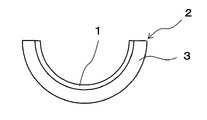
- FIG. 1A is a configuration diagram showing an example of a bearing alloy and a multilayer metal material for a bearing in which the sliding material of the present embodiment is used, and FIGS. 1B and 1C use the sliding material of the present embodiment. It is a manufacturing process figure which shows an example of the manufacturing method of the obtained alloy for bearings and the multilayer metal material for bearings.
- the bearing alloy 1 of the present embodiment is configured by compacting and sintering a powdery sliding material having the above-described composition into a predetermined shape.
- the bearing multi-layer metal material 2 of the present embodiment has a bearing alloy 1 bonded to one surface of a base metal 3 such as a steel material, and the sliding surface is a bearing alloy 1. Composed. Multi-layered metal materials made by joining steel and bearing alloy are designed to smoothly slide the sliding member with bearing alloy that supports high load with high mechanical strength steel and has sliding properties. ing.
- the bearing multilayer metal material 2 of the present embodiment is formed by compacting a powdered sliding material having the above-described composition into a predetermined shape and sintering it.
- the produced bearing alloy 1A is joined to a base metal 3A having a predetermined shape.
- the Cu—Ni—Si alloy has a high elongation rate of 5% or more, and the sliding material of the present embodiment can be produced as a thin wire. Therefore, as shown in FIG. 1C, the wire-shaped sliding material 4 having the above-described composition is supplied, and the laser beam S for welding is irradiated onto the wire-shaped sliding material 4 using the laser welding machine 5. As shown in FIG. 1A, overlay welding is performed on the base metal 3B, and the sliding material layer 1B made of the Cu—Ni—Si based alloy of the present embodiment is formed on one surface of the base metal 3B. A multi-layer metal material 2 for bearings is produced.
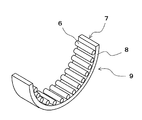
- FIG. 2 is a configuration diagram showing another example of a bearing alloy and a bearing multilayer metal material using the sliding material of the present embodiment.
- the bearing alloy 6 according to another embodiment is formed in a linear shape by rolling a sliding material having the above-described composition.
- the multi-layer metal material 7 for a bearing according to another embodiment is a cradle bearing having a configuration in which a plurality of cylindrical rollers are arranged between an inner race and an outer race, for example, used in a disk brake of a vehicle.
- An example in which a wire-like bearing alloy 6 having the above-described composition is used instead of the cylindrical roller is shown.
- the wire-like bearing alloy 6 is cut to a predetermined size and welded to the base metal 8 to form a semicircular bearing 9 in this example.
- the sliding material is the wire bearing alloy 6, the wire-like bearing alloy 6 is supplied to the base metal 8, cut to a predetermined length, overlay welding, etc. A series of processes can be performed using an automatic machine.
- Test pieces of Examples and Comparative Examples were prepared with the compositions shown in Table 1 below, and the dynamic friction coefficient, static friction coefficient, and specific wear amount in an oil-in-water environment and a dry environment were measured.
- a test piece is fixed inside a test container, and a mating material is rotated with a preset load and operation pattern in an oil-in-water environment and a dry environment, respectively.
- the dynamic friction coefficient, static friction coefficient, and specific wear amount were measured under the environment.
- Test machine used Thrust tester Test environment: Diesel engine oil (when in oil), no oil (when dry)
- Mating material SCM435 (chromium molybdenum steel)
- each of the Cu—Ni—Si based alloys having the compositions shown in Examples 1 to 3 showed high hardness characteristics, and as shown in Tables 1 and 2, either in an oily environment or in a dry environment. Even the amount of wear is small.
- the Cu—Ni—Si alloys having the compositions shown in Example 1 and Example 2 exhibit low friction and low wear characteristics in an oil environment.
- the Cu—Ni—Si alloy having the composition shown in Example 1 exhibits low friction and low wear characteristics even in a dry environment.
- the Cu—Ni—Si alloys having the compositions shown in Examples 1 to 3 showed low friction characteristics with a low friction coefficient without adding Pb, and added Pb. Compared with the sliding material, it has high hardness characteristics, so that the specific wear amount is kept low and exhibits low wear characteristics, and better sliding characteristics can be obtained than when Pb is added. Thereby, in the present invention, a sliding material for bearings having good sliding characteristics can be realized with Pb (lead) free, and since it has high hardness characteristics, even if it is applied to a part where a high load is applied, Good sliding characteristics can be obtained.
- the Cu—Ni—Si based alloy having the composition shown in Example 1 exhibits good low friction and low wear characteristics in both an oil-in-oil environment and a dry environment. This is suitable for such a boundary lubrication state.
- the Cu—Ni—Si based alloy having the composition shown in Example 2 exhibits good low friction and low wear characteristics in an oil environment, and is therefore suitable for a site where oil film breakage is relatively difficult, such as liquid lubrication. It is.
- the Cu-Ni-Si alloys having the compositions shown in Examples 1 to 3 all have a high hardness characteristic with a Vickers hardness (HV) of about 200.
- HV Vickers hardness
- the cavitation and erosion resistance is excellent in the field of hydraulic machines, and alloy erosion and fatigue hardly occur.
- the sliding material of the present invention exhibits good low friction and low wear characteristics even in a dry environment, it can also be applied to bearings used in areas where it is difficult to form an oil film.
Landscapes
- Engineering & Computer Science (AREA)
- Mechanical Engineering (AREA)
- Chemical & Material Sciences (AREA)
- Optics & Photonics (AREA)
- Physics & Mathematics (AREA)
- Materials Engineering (AREA)
- Metallurgy (AREA)
- Organic Chemistry (AREA)
- General Engineering & Computer Science (AREA)
- Plasma & Fusion (AREA)
- Sliding-Contact Bearings (AREA)
- Powder Metallurgy (AREA)
- Laser Beam Processing (AREA)
Abstract
La présente invention concerne un matériau glissant présentant une excellente résistance à l'usure du fait qu'il présente une dureté adaptée à un palier, présentant une excellente propriété de glissement du fait qu'il présente de faibles caractéristiques de friction. Ce matériau glissant est composé d'un alliage à base de Cu-Ni-Si et contient : 0,5-10,0 % en masse de Ni ; 0,1-5,0 % en masse de Si ; 0,1-5,0 % en masse de Cr ; le reste étant Cu et des impuretés inévitables, Sn étant contenu en tant qu'impureté. Afin d'améliorer la propriété de glissement par la fourniture d'un matériau glissant présentant des caractéristiques de faible friction, il est préférable d'inclure Bi, et il est préférable d'inclure 2,0-20,0 % en masse de Bi.
Applications Claiming Priority (2)
| Application Number | Priority Date | Filing Date | Title |
|---|---|---|---|
| JP2011-097302 | 2011-04-25 | ||
| JP2011097302A JP2012229465A (ja) | 2011-04-25 | 2011-04-25 | 摺動材料、軸受用合金及び軸受用複層金属材 |
Publications (1)
| Publication Number | Publication Date |
|---|---|
| WO2012147780A1 true WO2012147780A1 (fr) | 2012-11-01 |
Family
ID=47072298
Family Applications (1)
| Application Number | Title | Priority Date | Filing Date |
|---|---|---|---|
| PCT/JP2012/061071 Ceased WO2012147780A1 (fr) | 2011-04-25 | 2012-04-25 | Matériau glissant, alliage pour palier et matériau métallique multicouche pour palier |
Country Status (2)
| Country | Link |
|---|---|
| JP (1) | JP2012229465A (fr) |
| WO (1) | WO2012147780A1 (fr) |
Cited By (2)
| Publication number | Priority date | Publication date | Assignee | Title |
|---|---|---|---|---|
| CN111705238A (zh) * | 2020-07-20 | 2020-09-25 | 华东交通大学 | 一种高强高导耐热铜合金材料 |
| CN112840052A (zh) * | 2018-03-27 | 2021-05-25 | 万腾荣公司 | 具有增强的导热性和耐磨性的铜合金组合物 |
Families Citing this family (7)
| Publication number | Priority date | Publication date | Assignee | Title |
|---|---|---|---|---|
| PL3565912T3 (pl) * | 2017-01-06 | 2021-10-11 | Materion Corporation | Pierścienie tłokowe uszczelniające ze stopów miedzi |
| DE102017001846B4 (de) * | 2017-02-25 | 2025-02-20 | Wieland-Werke Ag | Gleitelement aus einer Kupferlegierung |
| JP7126656B2 (ja) * | 2018-09-13 | 2022-08-29 | 三芳合金工業株式会社 | 極低温部材用銅合金 |
| WO2020090084A1 (fr) * | 2018-11-01 | 2020-05-07 | 日立化成株式会社 | Procédé de production d'un corps fritté à base de cuivre |
| DE102018220056A1 (de) * | 2018-11-22 | 2020-05-28 | Ewellix AB | Präzisionsschienenherstellungsverfahren und Präzisionsschiene |
| CN111705237B (zh) * | 2020-06-03 | 2021-12-14 | 河海大学 | 一种船舶螺旋桨用耐腐蚀防污损抗空蚀铜基中熵合金涂层及其制备方法 |
| JPWO2024210037A1 (fr) * | 2023-04-05 | 2024-10-10 |
Citations (4)
| Publication number | Priority date | Publication date | Assignee | Title |
|---|---|---|---|---|
| JPH07310133A (ja) * | 1994-05-12 | 1995-11-28 | Chuetsu Gokin Chuko Kk | 無鉛快削黄銅合金 |
| JP2002302722A (ja) * | 2001-04-09 | 2002-10-18 | Chuetsu Metal Works Co Ltd | 高強度青銅系合金及びその製造方法 |
| JP2008223069A (ja) * | 2007-03-12 | 2008-09-25 | Miyoshi Gokin Kogyo Kk | 高強度高導電性銅合金及びその製造方法 |
| JP2010280984A (ja) * | 2009-06-08 | 2010-12-16 | Miyoshi Gokin Kogyo Kk | 発動機用摺動材に用いる銅合金の製造方法 |
-
2011
- 2011-04-25 JP JP2011097302A patent/JP2012229465A/ja not_active Withdrawn
-
2012
- 2012-04-25 WO PCT/JP2012/061071 patent/WO2012147780A1/fr not_active Ceased
Patent Citations (4)
| Publication number | Priority date | Publication date | Assignee | Title |
|---|---|---|---|---|
| JPH07310133A (ja) * | 1994-05-12 | 1995-11-28 | Chuetsu Gokin Chuko Kk | 無鉛快削黄銅合金 |
| JP2002302722A (ja) * | 2001-04-09 | 2002-10-18 | Chuetsu Metal Works Co Ltd | 高強度青銅系合金及びその製造方法 |
| JP2008223069A (ja) * | 2007-03-12 | 2008-09-25 | Miyoshi Gokin Kogyo Kk | 高強度高導電性銅合金及びその製造方法 |
| JP2010280984A (ja) * | 2009-06-08 | 2010-12-16 | Miyoshi Gokin Kogyo Kk | 発動機用摺動材に用いる銅合金の製造方法 |
Cited By (2)
| Publication number | Priority date | Publication date | Assignee | Title |
|---|---|---|---|---|
| CN112840052A (zh) * | 2018-03-27 | 2021-05-25 | 万腾荣公司 | 具有增强的导热性和耐磨性的铜合金组合物 |
| CN111705238A (zh) * | 2020-07-20 | 2020-09-25 | 华东交通大学 | 一种高强高导耐热铜合金材料 |
Also Published As
| Publication number | Publication date |
|---|---|
| JP2012229465A (ja) | 2012-11-22 |
Similar Documents
| Publication | Publication Date | Title |
|---|---|---|
| WO2012147780A1 (fr) | Matériau glissant, alliage pour palier et matériau métallique multicouche pour palier | |
| JP3939931B2 (ja) | 銅系複層摺動材料 | |
| US6652675B2 (en) | Copper alloy sliding material | |
| CN102728839B (zh) | 不含Pb的铜合金滑动材料的制造方法 | |
| US6334914B2 (en) | Copper alloy sliding material | |
| US6692548B2 (en) | Copper-based sliding material, method of manufacturing the same, and sliding bearing | |
| JP4476634B2 (ja) | Pbフリー銅合金摺動材料 | |
| JP2010535287A (ja) | 耐摩耗性の鉛フリー合金ブッシングおよびその製造方法 | |
| CN102149833A (zh) | 不含Pb的Cu-Bi系烧结材料制得的滑动部件 | |
| JP2004277883A (ja) | 熱間加工アルミニウム合金、その合金から作られた基層と軸受素子 | |
| KR102672968B1 (ko) | 미끄럼 이동 부재, 베어링, 미끄럼 이동 부재의 제조 방법, 베어링의 제조 방법 | |
| US5482782A (en) | Sliding-contact material excellent in corrosion resistance and wear resistance, and method of manufacturing the same | |
| CN102027251A (zh) | 滑动轴承 | |
| US8703660B2 (en) | Lead-free sintered lubricating material and sinter powder for manufacture of the same | |
| US20100002968A1 (en) | Plain Bearing | |
| GB2489601A (en) | Sliding bearing with a layer of a copper-bismuth-tin-phosphorous alloy | |
| GB2263950A (en) | Bearings. | |
| KR20130021332A (ko) | 구리계 슬라이딩 재료 | |
| JP2002310158A (ja) | 複層摺動材料 | |
| JP4389026B2 (ja) | 摺動材料およびその製造方法 | |
| JP7125647B1 (ja) | 摺動部材および軸受 | |
| JP6363931B2 (ja) | すべり軸受用銅合金 | |
| CN102227569B (zh) | 轴承材料 | |
| JP5073925B2 (ja) | 鉛フリー銅系摺動材料 | |
| JP2006037179A (ja) | 耐焼付性に優れたPbフリー銅合金系複合摺動材 |
Legal Events
| Date | Code | Title | Description |
|---|---|---|---|
| 121 | Ep: the epo has been informed by wipo that ep was designated in this application |
Ref document number: 12776920 Country of ref document: EP Kind code of ref document: A1 |
|
| WA | Withdrawal of international application | ||
| NENP | Non-entry into the national phase |
Ref country code: DE |