WO2012148017A1 - 바이오칩 제조용 졸-겔 키트 및 이를 이용한 바이오 칩의 제조방법 - Google Patents
바이오칩 제조용 졸-겔 키트 및 이를 이용한 바이오 칩의 제조방법 Download PDFInfo
- Publication number
- WO2012148017A1 WO2012148017A1 PCT/KR2011/003105 KR2011003105W WO2012148017A1 WO 2012148017 A1 WO2012148017 A1 WO 2012148017A1 KR 2011003105 W KR2011003105 W KR 2011003105W WO 2012148017 A1 WO2012148017 A1 WO 2012148017A1
- Authority
- WO
- WIPO (PCT)
- Prior art keywords
- biological material
- solution
- group
- sol
- solbs
- Prior art date
- Legal status (The legal status is an assumption and is not a legal conclusion. Google has not performed a legal analysis and makes no representation as to the accuracy of the status listed.)
- Ceased
Links
Images


Classifications
-
- G—PHYSICS
- G01—MEASURING; TESTING
- G01N—INVESTIGATING OR ANALYSING MATERIALS BY DETERMINING THEIR CHEMICAL OR PHYSICAL PROPERTIES
- G01N33/00—Investigating or analysing materials by specific methods not covered by groups G01N1/00 - G01N31/00
- G01N33/48—Biological material, e.g. blood, urine; Haemocytometers
- G01N33/50—Chemical analysis of biological material, e.g. blood, urine; Testing involving biospecific ligand binding methods; Immunological testing
- G01N33/53—Immunoassay; Biospecific binding assay; Materials therefor
- G01N33/543—Immunoassay; Biospecific binding assay; Materials therefor with an insoluble carrier for immobilising immunochemicals
- G01N33/551—Immunoassay; Biospecific binding assay; Materials therefor with an insoluble carrier for immobilising immunochemicals the carrier being inorganic
- G01N33/552—Glass or silica
Definitions
- the present invention uses a sol composition prepared by sequentially mixing specific solutions, or by directly dispensing the specific solution sequentially onto a substrate without a pretreatment process, and a method for simply preparing a biochip and a sol-gel kit for manufacturing a biochip. It is about.
- Biochips are representative examples of technologies incorporating new nanotechnology (NT), biotechnology (BT), and information technology (IT) technologies.
- Biochip is a high-density microarray of various kinds of biomaterials on the surface of a solid support, and according to the biomaterials attached to the surface, biochips are various kinds of chips such as DNA chips, protein chips, cell chips, and neuron chips. Can be divided.
- biochips are being developed into lab-on-a-chip (LOC) combined with microfluidic technology. Details of biochips include technology for fixing biomaterials, technology for making solid supports biomaterials, technology for finely arranging biomaterials, assays for conducting various bioreactions on the resulting chip, and detecting reaction results.
- a protein chip is a type of biochip, in which various kinds of proteins are highly integrated microarrays on the surface of a solid-phase support having a unit area.
- efforts have been made to manufacture protein chips by introducing the principles of production and elements of production of commercially available DNA chips.
- most of the commercialized DNA chips are produced by immobilizing DNA on a glass plate pre-treated with a coating material. Differences in the physicochemical properties of the target protein to be fixed when the protein chip is manufactured by a method similar to the method used to fabricate a DNA chip, that is, when the protein chip is prepared by immobilizing the protein on a glass plate pretreated with a coating material Due to this various problems are occurring.
- the initial protein chip was a simple binding assay after attaching the protein on the surface-treated glass plate as it is, but it is difficult to achieve the original purpose because the actual operation depends on the activity of the immobilized protein Many (MacBeath and Schreiber, Science 289: 1760, 2000). This problem is caused by denaturation, inactivation, degradation, etc. of the protein, which is caused by the difference in the inherent physicochemical properties of the protein as described above.
- researches on protein attachment surface treatment technology and protein fixation materials that meet the characteristics of proteins distinguished from DNA have been conducted. The research focuses on providing a method of maintaining the activity of a protein while simultaneously immobilizing a protein chip surface.
- the hydrolysis of Packard Bioscience which was recently acquired by PerkinElmer, Examples include Gelgel TM coated slides, Prolinx's Versalinx chips, and Zyomyx's biochip PDC chips.
- the sol-gel process has been used to make microstructures through microfabrication.
- the sol-gel process instead of chemically attaching biomolecules to inorganic materials, the sol-gel process forms a network through a gentle process and shares the biological molecules in the network. This technique has been widely used for immobilization by non-binding methods (Gill I. and Ballesteros A., Trends Biotechnol., 18: 282, 2000).
- biomolecules including enzymes
- biosensors Reetz, Adv. Mater., 9: 943, 1997), especially because of their optical clarity. It is also used for detection (Edminston, et al., J. Coll. Interf. Sci., 163: 395, 1994).
- biomolecules are known to be not only chemically stabilized but also thermally very stable when immobilized by a sol-gel reaction (Dave, et al., Anal. Chem., 66: 1120, 1994).
- the sol-gel reaction is used not only for fixing but also for forming and patterning a microstructure on a solid support.
- the patterning method is to form a gel in a sol state in the liquid phase by using a hydrodynamic, gelling, and then remove the mold to form a pattern.
- MIMIC micro-moduling in-capillaries
- the technique can be used for basic patterning of microfluidics.
- the activity of the protein is influenced by various factors such as pH, it is important to set the conditions for maintaining the activity by adding the protein from the sol state in the sol-gel process.
- techniques for patterning proteins by pre-mixing proteins and sol together using various mild conditions such as neutral pH (Kim, et al, Biotehnol. Bioeng., 73: 331, 2001) have been published.
- pH the sol-gel process has been rapidly progressed, causing problems such as cracking and opacity depending on the selection of the additive.
- the concentration of the spot is likely to be nonuniform because it has to go through a pretreatment process that mixes protein and sol together in advance.
- the present inventors have made diligent efforts to prevent the degradation and destruction of the biomaterials during the preparation of the sol composition, and as a result, specific silicate monomers and additives are sequentially mixed in a specific order and dispensed on the substrate, or sequentially dispensed directly on the substrate.
- specific silicate monomers and additives are sequentially mixed in a specific order and dispensed on the substrate, or sequentially dispensed directly on the substrate.
- gelation it is possible to produce a much more uniform biochip by delaying the gelation time compared to a conventionally used manufacturing method, and also prevents the degradation and destruction of biomaterials by the above components, and thus has excellent sensitivity. It was confirmed that the production can be completed the present invention.
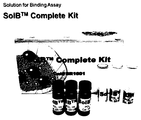
- the main object of the present invention is to kit the sol-gel material so that anyone can easily make and analyze biochips without any special equipment or technology.
- Another object of the present invention to provide a method for analyzing a target material using the biochip.
- a method for preparing a biochip using gelation of a sol composition comprising: dissolving a solution containing SolBS, a detection protein, and distilled water onto a substrate and gelling the same.
- methyltriethoxysilane MTES
- ethyltriethoxysilane EOS
- sodium silicate tetramethyl orthosilicate
- TMOS tetraethyl orthosilicate
- SolB 1 at least one first silicate monomer selected from the group consisting of tetraethyl orthosilicate (TEOS) and tetramethoxysilicate (TMS);
- aminopropyltriethoxysilane APTES
- 3-glycidoxypropyltrimethoxysilane GPTMOS
- N-triethoxysilylpropyl-O-polyethylene oxide urethane N-
- SolB 3 triethoxysilylpropyl-O-polyethylene oxide urethane (PEOU)
- glycerol PEG200, PEG400, PEG600, PEG1350 and PEG8000 is characterized in that it comprises one or more additives selected from the group consisting of.
- the present invention is a method for producing a biochip using gelation of the sol composition, comprising the following steps,
- SolB1 is methyltriethoxysilane (MTES), ethyltriethoxysilane (ETrEOS), sodium silicate (Sodium Silicate), tetramethyl orthosilicate (TMOS), tetraethyl orthosilicate at least one first silicate monomer selected from the group consisting of (tetraethyl orthosilicate, TEOS) and tetramethoxysilicate (TMS);
- SolB2 is 3-aminotrimethoxysilane (3-aminotrimethoxysilane (3-ATMS), diglycerylsilane (DGS), methyltrimethoxysilicate (MTMS), polyglycerylsilicate (polyglycerylsilicate) , PGS), polyvinylacetate, polyvinylpyrrolidone, glyceryl methacrylate, hydroxyethyl acrylate, N, N-dikushinimidylcarbo N, N-dicusinimidilcarbonate (DSC), 1,3,5-trimethylbenzene, cetyltrimethylammonium chloride, cetyltrimethylammonium bromide, 3- ( 3- (triethoxysily) propyl sucinic unhydride, N- (3-triethoxysilyl propyl) -4-hydroxy butylamide (N- (3-triethoxysily propyl)- 4-hydroxy butylamid e, SIT8189.5
- SolB3 is aminopropyltriethoxysilane (APTES), 3-glycidoxypropyltrimethoxysilane (GPTMOS), N-triethoxysilylpropyl-O-polyethylene oxide urethane (N- triethoxysilylpropyl-O-polyethylene oxide urethane (PEOU), glycerol, PEG200, PEG400, PEG600, PEG1350 and PEG8000 provides at least one additive selected from the group consisting of.
- APTES aminopropyltriethoxysilane
- GPTMOS 3-glycidoxypropyltrimethoxysilane
- N-triethoxysilylpropyl-O-polyethylene oxide urethane N- triethoxysilylpropyl-O-polyethylene oxide urethane (PEOU)
- glycerol PEG200, PEG400, PEG600, PEG1350 and PEG8000 provides at least one additive selected from the group
- the present invention also provides a method for producing a biochip using gelation of the sol composition, comprising the following steps,
- SolB1 is methyltriethoxysilane (MTES), ethyltriethoxysilane (ETrEOS), sodium silicate (Sodium Silicate), tetramethyl orthosilicate (TMOS), tetraethyl orthosilicate at least one first silicate monomer selected from the group consisting of (tetraethyl orthosilicate, TEOS) and tetramethoxysilicate (TMS);
- SolB2 is 3-aminotrimethoxysilane (3-aminotrimethoxysilane (3-ATMS), diglycerylsilane (DGS), methyltrimethoxysilicate (MTMS), polyglycerylsilicate (polyglycerylsilicate) , PGS), polyvinylacetate, polyvinylpyrrolidone, glyceryl methacrylate, hydroxyethyl acrylate, N, N-dikushinimidylcarbo N, N-dicusinimidilcarbonate (DSC), 1,3,5-trimethylbenzene, cetyltrimethylammonium chloride, cetyltrimethylammonium bromide, 3- ( 3- (triethoxysily) propyl sucinic unhydride, N- (3-triethoxysilyl propyl) -4-hydroxy butylamide (N- (3-triethoxysily propyl)- 4-hydroxy butylamid e, SIT8189.5
- SolB3 is aminopropyltriethoxysilane (APTES), 3-glycidoxypropyltrimethoxysilane (GPTMOS), N-triethoxysilylpropyl-O-polyethylene oxide urethane (N- triethoxysilylpropyl-O-polyethylene oxide urethane (PEOU), glycerol, PEG200, PEG400, PEG600, PEG1350 and PEG8000 provides at least one additive selected from the group consisting of.
- APTES aminopropyltriethoxysilane
- GPTMOS 3-glycidoxypropyltrimethoxysilane
- N-triethoxysilylpropyl-O-polyethylene oxide urethane N- triethoxysilylpropyl-O-polyethylene oxide urethane (PEOU)
- glycerol PEG200, PEG400, PEG600, PEG1350 and PEG8000 provides at least one additive selected from the group
- the present invention also relates to (i) methyltriethoxysilane (MTES), ethyltriethoxysilane (ETrEOS), sodium silicate, tetramethyl orthosilicate, TMOS), tetraethyl orthosilicate (TEOS) and tetramethoxysilicate (TMS), the first vessel comprising at least one first silicate monomer selected from the group consisting of SolB1; (ii) 3-aminotrimethoxysilane (3-ATMS), diglycerylsilane (DGS), methyltrimethoxysilicate (MTMS), polyglycerylsilicate (PGS) , Polyvinylacetate, polyvinylpyrrolidone, glyceryl metaacrylate, hydroxyethyl acrylate, N, N-dikushinimidyl carbonate (N , N-dicusinimidilcarbonate (DSC), 1,3,5-trimethylbenzene, cetyltrimethylammoni
- SolB1, SolB2 and SolB3 sol composition by mixing in order in order from SolBH selected from the group consisting of HCl, H 2 SO 4 , HNO 3 and CH 3 COOH, buffer solution SolBS and distilled water, biological material for detection It provides a kit for producing a biochip, characterized in that the mixture is gelled.
- the present invention also provides a method for analyzing a biochip prepared by the method and the sol composition and a target material which is a biomaterial using the same, and interacting with a biological material that interacts with the target biological material on the biochip manufactured by the method.
- Provided are methods of analyzing a target biological material comprising adding a sample containing a possible target biological material.
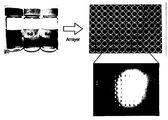
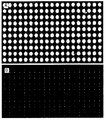
- FIG. 1 shows a biochip prepared by dispensing a sol mixed solution prepared from a sol composition (S-Sol), a solution I, and a solution II of the present invention into an array.
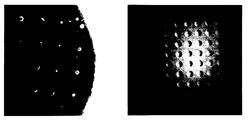
- Figure 2 shows the response to the serum of HIV patients in the spot containing five HIV1 antigens.
- 1, 2, 3, 4, and 5 are p24, p31, gp41, gp120, and gp160 as antigen markers for the diagnosis of HIV1 antibody.
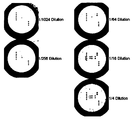
- FIG. 3 shows the response to sera of HIV patients serially diluted in spots containing serially diluted antigens.
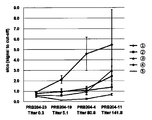
- Figure 4 is a graphical representation of the quantification of the response to the HIV standard serum in the spot containing each of the five HIV1 antigens.
- 1, 2, 3, 4, and 5 are p24, p31, gp41, gp120, and gp160 as antigen markers for the diagnosis of HIV1 antibody.
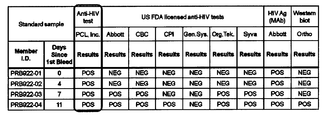
- Figure 5 is a table comparing the detection results using the biochip of the present invention and the conventional diagnostic kit for the serum of HIV1 patient collected by date after infection.
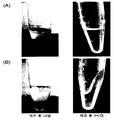
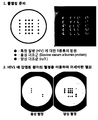
- FIG. 6 is an Axon GenePix scanner scan photograph (A) and a camera image photograph (B) of a chip fabricated using sciFLEXARRYER S11.
- FIG. 7 is a diagram illustrating the shape of a biochip having microchannels on its surface while including a detection protein in an encapsulation structure according to the present invention.
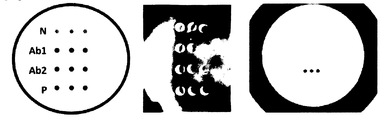
- FIG. 11 is a result of analyzing a specific antigen using a protein chip according to the present invention.
- the present invention is a method for producing a biochip using gelation of the sol composition, comprising the following steps,
- step (b) mixing SolBS, which is a buffer solution, and distilled water with the solution mixed in step (a), and then stabilizing at -20 ⁇ 4 ° C .;
- step (c) mixing a solution comprising a biological material interacting with the target biological material with a solution stabilized in step (b), dispensing onto a substrate and gelling,
- SolB1 is methyltriethoxysilane (MTES), ethyltriethoxysilane (ETrEOS), sodium silicate (Sodium Silicate), tetramethyl orthosilicate (TMOS), tetraethyl orthosilicate (tetraethyl orthosilicate (TEOS)) and tetramethoxysilicate (TMS) methyltriethoxysilane (MTES), ethyltriethoxysilane (ETrEOS), sodium silicate, tetramethyl orthosilicate (TEMS) tetramethyl orthosilicate (TMOS), tetraethyl orthosilicate (TEOS) and tetramethoxysilicate (TMS) at least one first silicate monomer selected from the group consisting of;
- SolB2 is methyltrimethoxysilicate (MTMS), 3-aminotrimethoxysilane (3-aminotrimethoxysilane (3-ATMS), polyglycerylsilicate (PGS), diglycerylsilane (diglycerylsilane) , DGS), polyvinylacetate, polyvinylpyrrolidone, glyceryl methacrylate, hydroxyethyl acrylate, N, N-dikushinimidylcarbo N, N-dicusinimidilcarbonate (DSC), 1,3,5-trimethylbenzene, cetyltrimethylammonium chloride, cetyltrimethylammonium bromide, 3- ( 3- (triethoxysily) propyl sucinic unhydride, N- (3-triethoxysilyl propyl) -4-hydroxy butylamide (N- (3-triethoxysily propyl)- 4-hydroxy butylami de, SIT8189.5), N-
- SolB3 is aminopropyltriethoxysilane (APTES), 3-glycidoxypropyltrimethoxysilane (GPTMOS), N-triethoxysilylpropyl-O-polyethylene oxide urethane (N- triethoxysilylpropyl-O-polyethylene oxide urethane (PEOU), glycerol, PEG200, PEG400, PEG600, PEG1350 and PEG8000 relates to a production method characterized in that at least one additive selected from the group consisting of.
- APTES aminopropyltriethoxysilane
- GPTMOS 3-glycidoxypropyltrimethoxysilane
- PEOU N-triethoxysilylpropyl-O-polyethylene oxide urethane
- PEG200, PEG400, PEG600, PEG1350 and PEG8000 relates to a production method characterized in that at least one additive selected from the group consisting of.
- the SolBH may be characterized in that from 1mM to 100mM.
- the SolBS may be one or more solutions selected from the group consisting of NaH 2 PO 4 , Na 2 HPO 4 , Na 3 PO 4 in the concentration range of 1mM to 100mM.
- the sol composition, the buffer, and the biological material interacting with the target biological material are randomly mixed in random order to form a sol mixed solution, and then vacuum treatment is performed.
- the method of gelling through post-treatment has been used.
- the sol composition, the buffer and the detection protein may be mixed by using vortex or ultrasonic vibration, and the method of forming the sol-gel may also form spots on the substrate wells, Has been coated with a sol-gel or poured into a mold and gelated.
- the concentration of the biological material interacting with the target biological material contained in each spot formed with the sol composition mixture solution may not be constant, and the concentration may vary according to the practitioner.
- the concentration may vary according to the practitioner.
- the biological material which interacts with the target biological material simply and uniformly by the sol-gel method has a uniform concentration for each spot, and thus the biological material can be detected more accurately and with high efficiency.
- a sol composition is prepared by mixing SolB1, which is the first silicate monomer, SolB2, which is the second silicate monomer, and SolB3, which is an additive, in that order.
- the SolB1 is methyltriethoxysilane (MTES), ethyltriethoxysilane (ETrEOS), sodium silicate (Sodium Silicate), tetramethyl orthosilicate (TMOS), tetraethyl orthosilicate (tetraethyl orthosilicate) , TEOS) and one or more substances selected from the group consisting of tetramethoxysilicate (TMS).
- TEOS was selected and used as a component of the first silicate monomer.
- the SolB2 is 3-aminotrimethoxysilane (3-aminotrimethoxysilane (3-ATMS), diglycerylsilane (DIGS), methyltrimethoxysilicate (MTMS), polyglycerylsilicate (polyglycerylsilicate, PGS), polyvinylacetate, polyvinylpyrrolidone, glyceryl methacrylate, hydroxyethyl acrylate, N, N-dikushinimidylcarbonate (N, N-dicusinimidilcarbonate, DSC), 1,3,5-trimethylbenzene, cetyltrimethylammonium chloride, cetyltrimethylammonium bromide, 3- (tri 3- (triethoxysily) propyl sucinic unhydride), N- (3-triethoxysilyl propyl) -4-hydroxy butylamide (N- (3-triethoxysily propyl) -4 -hydroxy but ylamide, SIT818
- SolB3 is an additive, aminopropyltriethoxysilane (aminopropyltriethoxysilane, APTES), 3-glycidoxypropyltrimethoxysilane (GPTMOS), N-triethoxysilylpropyl-O- polyethylene oxide urethane ( N-triethoxysilylpropyl-O-polyethylene oxide urethane (PEOU), glycerol, PEG200, PEG400, PEG600, PEG1350 and PEG8000 can be used at least one material selected from the group consisting of. In one embodiment of the present invention, PEG was used as the additive.
- the first silicate, the second silicate monomer and the additive may be appropriately selected and used as necessary according to the nature of the monomer biomaterial and the shape of the sol gel chip to be made.
- the first silicate monomer is about 2-30% by volume relative to the total volume of the sol composition
- the second silicate monomer is about 2-8% by volume
- the additive is about 0-5% by volume. It is preferred to be included. At this time, the sol composition is harmful when inhaled and prepared in a well-ventilated place.
- the sol composition for producing a biochip of the present invention when gelled, is characterized in that to form a fine channel by the voids.
- these channels provide a means to interact with the target material to be analyzed.
- the additive of component (iii) is a component used to control the channel size in the gel.
- the method may be performed by hand spotting without an arrayer or by using a non-contact arrayer.
- the substrate used in step (c) is optimized to a temperature above the dew point before use, where the temperature above the dew point means a temperature higher than the temperature at which dew begins to form on the substrate, Depending on the humidity conditions, this dew point may vary, for example, 8.6 ° C. when the ambient temperature is 20 ° C. above 50% relative humidity, and typically 14-17 ° C. at 70-80% humidity.
- the substrate may be polymethylmethacrylate (PMMA), plastic, silicon, glass, or the like.
- PMMA polymethylmethacrylate
- the biological material interacting with the target biological material may be any one selected from the group consisting of nucleic acids, proteins, peptides, small molecule materials and cells.
- the solution and the sol mixture mixed in the step (a) can be stabilized by leaving for 30 minutes or more under the condition of temperature -20 ⁇ 4 °C, the container to put the sol composition in the arrayer is the temperature above the dew point, Normally 14 ⁇ 17 °C (above dew point temperature at 70 ⁇ 80% of humidity), dispensing environment can be optimized for sol-gel by adjusting humidity of 70 ⁇ 80% and ambient temperature of 20 °C.
- the gelation rate of the sol composition may be slowed to facilitate spot formation, to prevent cracking of the spot after gelation, and to form fine channels in the chip.
- the sol composition and the mixed solution of SolBH and SolBS, the distilled water and the biological material interacting with the target biological material may be mixed in the range of 3: 1: 4 and 1: 2: 8, respectively, Concentrations of SolBH and SolBS may be 1mM ⁇ 100mM.
- the volume ratio of the SolBS: distilled water: biological material interacting with the target biological material is in the range between 1: 2: 1 and 2: 5: 1.
- the buffer may be sodium phosphate (sodium phosphate) in the pH range of 3-8.
- the substrate may be previously surface-treated, etched, or treated with PDMS or silicate monomers or polymer materials.
- the present invention provides a method for producing a biochip using gelation of the sol composition, comprising the following steps,
- SolB1 is methyltriethoxysilane (MTES), ethyltriethoxysilane (ETrEOS), sodium silicate (Sodium Silicate), tetramethyl orthosilicate (TMOS), tetraethyl orthosilicate (tetraethyl orthosilicate (TEOS)) and tetramethoxysilicate (TMS) at least one first silicate monomer;
- MTES methyltriethoxysilane
- EOS ethyltriethoxysilane
- TMOS tetramethyl orthosilicate
- TEOS tetraethyl orthosilicate
- TMS tetramethoxysilicate
- SolB2 is 3-aminotrimethoxysilane (3-aminotrimethoxysilane (3-ATMS), diglycerylsilane (DGS), methyltrimethoxysilicate (MTMS), polyglycerylsilicate (polyglycerylsilicate) , PGS), polyvinylacetate, polyvinylpyrrolidone, glyceryl methacrylate, hydroxyethyl acrylate, N, N-dikushinimidylcarbo N, N-dicusinimidilcarbonate (DSC), 1,3,5-trimethylbenzene, cetyltrimethylammonium chloride, cetyltrimethylammonium bromide, 3- ( 3- (triethoxysily) propyl sucinic unhydride, N- (3-triethoxysilyl propyl) -4-hydroxy butylamide (N- (3-triethoxysily propyl)- 4-hydroxy butylamid e, SIT8189.5
- SolB3 is aminopropyltriethoxysilane (APTES), 3-glycidoxypropyltrimethoxysilane (GPTMOS), N-triethoxysilylpropyl-O-polyethylene oxide urethane (N- triethoxysilylpropyl-O-polyethylene oxide urethane (PEOU), glycerol, PEG200, PEG400, PEG600, PEG1350 and PEG8000;
- APTES aminopropyltriethoxysilane
- GPTMOS 3-glycidoxypropyltrimethoxysilane
- PEOU N-triethoxysilylpropyl-O-polyethylene oxide urethane
- glycerol PEG200, PEG400, PEG600, PEG1350 and PEG8000;
- the SolBH solution is at least one solution selected from the group consisting of HCl, H 2 SO 4 , HNO 3 and CH 3 COOH in a concentration range of 1 mM to 100 mM;
- the SolBS solution relates to a production method characterized in that at least one solution selected from the group consisting of NaH 2 PO 4 , Na 2 HPO 4 , and Na 3 PO 4 in the concentration range of 1mM to 100mM.
- the substrate used in step (c) is optimized to a temperature above the dew point before use, where the temperature above the dew point means a temperature higher than the temperature at which dew begins to form on the substrate, Depending on the humidity conditions, this dew point may vary, for example, 8.6 ° C. when the ambient temperature is 20 ° C. above 50% relative humidity, and typically 14-17 ° C. at 70-80% humidity.
- the gelation of the sol composition is slowed down when dispensing each solution in order to facilitate spot formation, to prevent cracking of the spot after gelation, and to form fine channels in the chip.
- a solution I selected from the group consisting of HCl, H 2 SO 4 , HNO 3 and CH 3 COOH is dispensed thereon.
- Solution I serves to create a pH environment for inducing gelation of the sol composition.
- the concentration of HCl, H 2 SO 4 , HNO 3 or CH 3 COOH is preferably 5 ⁇ 30mM. Titrate to pH 1-3.
- Solution II comprising buffer SolBS, biological material interacting with the target biological material and distilled water is dispensed onto the substrate to gel.
- the SolBS may be sodium phosphate (sodium phosphate) in the pH range of 3-8.
- the buffer and secondary distilled water have a function of preventing destruction of a biological material (eg, protein).
- Biomaterials are prone to degradation or destruction at pH outside the proper range, and gelation of sol proceeds slowly at higher pH and faster at lower pH. It is important to titrate the pH so that it can be done.
- the biomaterial is stably present in the range of pH 5 to 8, and therefore, the buffer solution is used to prevent the destruction of the biomaterial in particular in the pH environment according to the solution I.
- the buffer that can be used is not particularly limited, and those skilled in the art can appropriately select and use the biomaterial to be added. In the present invention, sodium phosphate buffer in a pH range of 3-8 was used.
- biomaterial included in Solution II refers to a substance in the living body which can interact with the target substance (eg, a target protein) to be detected.
- target substance eg, a target protein
- Appropriate buffer solutions may be used to incorporate these detection proteins or biomaterials into Solution II. That is, a biomaterial for implementation is put in a buffer solution to make a sample solution for detection.
- PBS buffer phosphate-buffered saline
- the antibody Human Immunodeficiency virus 1 (target protein) was used as an antibody, and five antigen markers capable of binding to the HIV antibody with the detection protein were added to the PBS buffer. Mix was used.
- the mixing volume ratio of SolBS: distilled water: biological material interacting with the target biological material in the solution II is preferably in the range of 1: 2: 1 to 2: 5: 1, most preferably 1 : 2: 1.
- the buffer may be about 20-30% by volume, distilled water about 40-60% by volume, and the biological material interacting with the target biological material may be 20-30% by volume.
- the present invention was used by mixing 10 ⁇ l of the buffer solution, 20 ⁇ l of distilled water, 10 ⁇ l of a solution containing a detection protein (a biological substance that interacts with the target protein).
- the present invention is characterized in that homogeneous biochips are prepared by sequentially dispensing the sol composition, solution I and solution II in the correct amounts.
- the ratio of the dispensing amount of the sol composition: solution I: solution II, which is dispensed in the present invention, is between 3: 1: 4 and 1: 2: 8, preferably 3: 1: 4.
- the dispensing amount of the sol composition is preferably 25 to 35 ⁇ l, most preferably about 30 ⁇ l.
- the dispensing amount of the solution I is preferably 5-15 mu l, most preferably about 10 mu l.
- the dispensing amount of the solution II is preferably 35 to 45 mu l, most preferably about 40 mu l.
- a non-contact arrayer or a pipette or other tool is used directly. Spotting by hand is desirable.
- the manufacturing method may be characterized in that there is no pretreatment process, the pretreatment process, (i) SolB1, SolB2, SolB3, SolBH, SolBS, or a biological material that interacts with the target biological material is mixed Process of doing; (ii) vortexing after mixing; And (iii) may be any one or more selected from the group consisting of the process of stabilizing the mixed solution.
- the sol composition consisting of the SolB1, SolB2 and SolB3, SolBH, SolBS and the biological material interacting with the target biological material can be dispensed in the form of sucking up using a nozzle in a container before dispensing.
- the dispensing nozzle prior to dispensing the sol composition consisting of SolB1, SolB2 and SolB3, SolBH, SolBS and the biological material interacting with the target biological material, in advance in the high-capacity cartridge to which the dispensing nozzle is connected and dispenses at once
- the amount is more than 100 times that of dispensing in the form of sucking up using a nozzle, so mass production is possible.
- the chip When the chip is fabricated by sequentially dispensing the sol composition, solution I and solution II directly onto the substrate without pretreatment, it may be carried out using an arrayer that dispenses the correct amount. At this time, it is preferable to use a non-contact arrayer as the array word that can be used to dispense the sol composition, the solution I and the solution II in the correct volume.
- the contact arrayer uses a pin with a very thin space to detect the detection protein. Align to the surface.
- This method allows the solution containing the detection protein to be slightly out of the fins and directly aligned with the surface to align the different types of detection protein in a short time, but it is possible to precisely control the volume of the solution. As a result, uniformity may be lowered.
- the non-contact arrayer is a method in which a solution containing a detection protein is placed in a thin tube, placed directly on the chip surface, and aligned on the surface without direct contact by applying a constant pressure to the tube.
- This method has the advantage that it is possible to accurately determine the volume of solution dispensed. Therefore, it is preferable to use such a contactless arrayer in the present invention because the volume dispensed of each solution can be adjusted according to the ratio when the sol composition and the solution I and the solution II are sequentially dispensed without the pretreatment process.
- the sol composition; Solution I selected from the group consisting of HCl, H 2 SO 4 , HNO 3 and CH 3 COOH; And Solution II, which is a mixed solution of biological material, buffer and distilled water, which interact with the target biological material, may be sequentially dispensed onto the substrate well using a non-contact arrayer that dispenses an accurate volume.
- Solution II which is a mixed solution of biological material, buffer and distilled water, which interact with the target biological material, may be sequentially dispensed onto the substrate well using a non-contact arrayer that dispenses an accurate volume.
- the surface tension of the solution causes the entire solution not to spread but to form a spot shape, which converts the surface energy generated when the solution drops into vibrations, thereby causing A flow (convection) occurs and the two solutions mix well.
- the present invention has devised an automated method for manufacturing a sol-gel chip by spotting directly on a surface without pretreatment.
- a Microarrayer from Scienion AG can be used.
- the use of Scienion AG's dew point control technology eliminates the uncertainty of the concentration caused by the condensation of moisture on the surface of the plate, making it possible to produce spots with more accurate volume and size.
- sciFLEXARRAYER S11 (Scienion AG, Germany) was used as the array word.
- the biochip can be made more simply by dispensing each solution to the substrate by using the non-contact arrayer at the time of manufacturing the biochip, and the sol-gel monomer (sol It is possible to manufacture a more homogeneous biochip since there is no need for pretreatment such as -gel monomer), buffer, and detection protein sample.
- the substrate used in the present invention utilizes the property of being transparent when the sol composition is gelled
- the substrate well or slide should also be made of a material capable of maintaining good transparency.
- a plastic, silicone or glass component such as polymethylmethacrylate (PMMA) component having excellent transparency can be used.
- PMMA polymethylmethacrylate
- the substrate may be selected from plastic, silicon, glass, and the like, in addition to polymethyl methacrylate.
- the substrate used in the present invention should be surface treated so that the sol mixed solution can be fixed to the substrate while gelling.
- One of the important conditions of the biochip of the present invention is that the sol mixed solution is firmly fixed to the substrate while gelling, so that the spot does not drop when reacted with the solution containing the target substance. Therefore, in the analysis of the target material using the biochip, a strong washing process is required after reacting with the target material, and therefore, a strong fixation of the spot is necessary to overcome this physical force. It is preferable to use a substrate, a plastic substrate surface-treated with plasma, an unsurfaced glass substrate, a surface-treated glass substrate (for example, an etched glass substrate, etc.), or a silicon chip having a porous structure.
- the substrate may be previously plasma-treated, etched, or treated with PDMS or silicate monomers or polymeric materials.
- the biochip uses a special material called sol and gels over time, so that the sol is dispensed as quickly as possible to avoid gelation in the middle of dispensing using an arrayer. It is very important.
- Second is humidity and temperature.
- the initial humidity and temperature are very important. Therefore, when manufacturing a biochip using the sol-gel at all times, it is very important to set the humidity and temperature around the arrayer in advance.
- Preferred humidity in the present invention is about 50% or more, or more specifically 70 to 80%.
- preferable temperature is about 25 degreeC or less, More specifically, it is the range of 10-25 degreeC which can be said to be the range of normal temperature.
- the humidity must be prepared before the arraying is about 80%. Also, if the temperature is 25 ° C or higher, the sol gel tends to accelerate so that the lowest temperature is possible.
- each solution is dispensed step by step.
- the biological material that interacts with the target biological material may be a nucleic acid, a protein, a peptide, a small molecule material or a cell.
- the present invention also provides, in another aspect, methyltriethoxysilane (MTES), ethyltriethoxysilane (ETrEOS), sodium silicate, tetramethyl orthosilicate (TMOS), tetra
- a first vessel comprising SolB1, which is at least one first silicate monomer selected from the group consisting of ethyl orthosilicate (TEOS) and tetramethoxysilicate (TMS); 3-aminotrimethoxysilane (3-ATMS), diglycerylsilane (DGS), methyltrimethoxysilicate (MTMS), polyglycerylsilicate (PGS), polyvinyl Acetate (polyvinylacetate), polyvinylpyrrolidone, glyceryl metaacrylate, hydroxyethyl acrylate, N, N-dikushinimidylcarbonate (N, N- dicusinimidilcarbonate (DSC), 1,3,5-trimethylbenzene, cety
- SolBH selected from the group consisting of HCl, H 2 SO 4 , HNO 3, and CH 3 COOH in the sol composition mixed with SolB1, SolB2, and SolB3, buffer SolBS and distilled water, and biological material interacting with the target biological material
- the present invention relates to a kit for producing a biochip, wherein the sol mixture is gelled by mixing as it is.
- kits may take the form of bottles, tubs, small sachets, envelopes, tubes, ampoules, etc., which may be partially or wholly plastic , Glass, paper, foil, wax, and the like.
- the container may be equipped with a fully or partially separable stopper, which may initially be part of the container or attached to the container by mechanical, adhesive, or other means.
- the kit may include an external package, which may include instructions for use of the components.
- the present invention relates to a method for analyzing a target biological material using a biochip manufactured by the above method.
- the present invention relates to a method for analyzing a target biological material, comprising adding a sample containing a target biological material that can interact with the biological material to interact with the target biological material.
- the target biological material may be any one selected from the group consisting of nucleic acids, proteins, peptides, small molecule materials, and cells, and radioisotopes or fluorescent dyes or other kinds capable of detecting the target biological materials. It may further comprise the step of further reacting with a biological material, such as protein, aptamer labeled with a labeling substance.
- the biochip to react with the target biological material is prepared and then reacted with the solution containing the actual target biological material.
- the reaction solution is appropriate in an amount of 50 to 100 ⁇ l for the 96-well type, and the reaction time is 1 hour.
- the target biological material interacting with the biological material that interacts with the target biological material may also be a biological material, and may be a nucleic acid, a protein, a peptide, a small molecule material or a cell.
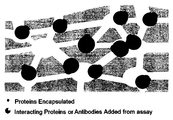
- the reaction solution containing the target biological material penetrates into the spot through the microporous structure in the spot and meets and interacts with the biological material fixed in the capsule structure (1st incubation).
- the target biological material may be reacted with a labeling protein, which is a labeling factor, to detect the target biological material.
- a labeling protein which is a labeling factor
- an antibody to a target protein to which a fluorescent dye (Cy3) is attached was used (2nd incubation). At this time, the reaction time is 30 minutes and the amount of the reaction solution is 50 ⁇ 100 ⁇ m.
- the above 1st and 2nd incubations are all performed at room temperature.
- a blocking process is performed before the 1st incubation process to prevent nonspecific binding of the biological substance interacting with the target biological substance in the biochip.
- the blocking solution required for this procedure may be used, such as skim milk, BSA (bovine serum albumin) or IgG.
- the washing liquid may be a conventional one, and in one embodiment of the present invention, a PBS buffer containing 0.2% Tween-20 is used. It was.
- the 1 st and the washing process is used for the ELISA washer as washing, do the washing 4 times and subjected to washing 4 times with 2 nd washing process. After the washing process, it is dried until all the solutions are removed from the wells.
- the method for analyzing the target biological material of the present invention further comprises the step of further reacting with a biological material such as a protein or aptamer labeled with radioisotopes, fluorescent dyes, luminescent materials, dyes or other types of labeling materials, etc. do.
- a biological material such as a protein or aptamer labeled with radioisotopes, fluorescent dyes, luminescent materials, dyes or other types of labeling materials, etc. do.
- the aptamer refers to a small single-stranded oligonucleic acid capable of specifically recognizing a biological substance that interacts with a target biological substance with high affinity.
- the present invention also includes a detection kit comprising a biochip manufactured by the above method.
- Detection kits for biological material detection may take the form of bottles, tubs, sachets, envelopes, tubes, ampoules, etc., which may be partially or wholly plastic, glass, paper, foil , Wax and the like.
- the container may be equipped with a fully or partially separable stopper, which may initially be part of the container or attached to the container by mechanical, adhesive, or other means.
- the kit may include an external package, which may include instructions for use of the components.
- the sol composition was prepared by mixing 20 ⁇ l of selected SolB1, 6 ⁇ l of SolB2, and 4 ⁇ l of SolB3, one each selected from the components illustrated in Table 1 below. And 10 microliters of SolBH was prepared for the solution I.
- Table 1 Components of each solution division ingredient SolB1 Methyltriethoxysilane (MTES), ethyltriethoxysilane (ETrEOS), sodium silicate, tetramethyl orthosilicate (TMOS), tetraethyl orthosilicate (TEOS) And tetramethoxysilicate (TMS); one first silicate monomer selected from the group consisting of SolB2 3-aminotrimethoxysilane (3-ATMS), diglycerylsilane (DGS), methyltrimethoxysilicate (MTMS), polyglycerylsilicate (PGS) polyvinylacetate (polyvinylacetate), polyvinylpyrrolidone, glyceryl metaacrylate, hydroxyethyl acrylate, N, N-dicusinimidylcarbonate (N, N-dicusinimidilcarbonate , DSC), 1,3,5-trimethylbenzene, cetyltrimethylammonium chloride
- 10 ⁇ l of one or more SolBS selected from the group consisting of NaH 2 PO 4 , Na 2 HPO 4 , and Na 3 PO 4 and 20 ⁇ l of double distilled water (DDW) are mixed, while interacting with the HIV1 antibody.
- About 10 to 200 ng of five detectable proteins (p24, p31, gp41, gp120, and gp160) are mixed in PBS buffer to make 10 ⁇ l of sample solution, which is added to the mixture, followed by vortexing and spin-down for 5 seconds.
- Solution II was prepared.
- a commercially available PMMA 96-well plate prepared by plasma surface treatment was purchased from SPL (Korea).
- the arrayer was set at a temperature of 16 ° C. and a humidity of 80% before spotting, and a general 384-well was prepared as a source well into which the sol mixed solution obtained in Example 1 was placed.
- a target well the PMMA 96-well plate of (1) was prepared.
- the sciFLEXARRYER S11 (Scienion, Germany) arrayer was prepared to dispense the correct volume as set.
- sol composition prepared by mixing 20 ⁇ l of SolB1, 6 ⁇ l of SolB2, and 4 ⁇ l of SolB3 in Example 1 to a source plate of sciFLEXARRYER S11 (Scienion, Germany) arrayer, 10 ⁇ l of SolBH (solution) I) and 40 [mu] l of the solution II were each added to the source plate of the arrayer.
- the sol composition, solution I, and solution II were dispensed in order by a predetermined volume on PMMA 96-well plates prepared in advance.
- the amount dispensed was to be less than 450 pl per spot, using a nozzle PDC90 (ScienionAG, Germany).
- Spotting frequency was set to 500 Hz.
- the spot size formed was about 300 ⁇ m (8 drops per spot).
- FIG. 6 shows photograph A scanned with an Axon GenePix scanner (Axon) at 532 nm and image photograph B by sciFLEXARRAYER equipped with a camera.
- the dot pitch between the proteins on the protein chip was 600 ⁇ m.
- protein chips were prepared by conventional methods known as controls. Silicate monomers, HCl, DW, SP and the sample solution was prepared by mixing sequentially, and then the pin solution was used to spot the mixed solution dispensed in the source plate on a PMMA 96-well plate. OnmiGrid Accent Arrayer (Genomic Solutions, USA) was used as the pin arrayer.
- Example 2 After blocking the protein chip prepared in Example 2 using a 10% skim milk solution, 50 ⁇ l of the diluted HIV patient was added to each well, followed by primary culture at room temperature for 1 hour. After completion of the primary culture, the serum was removed, the washing solution containing 0.2% Tween-20 was added using a washing machine for ELISA, and the step of vortex for 5 minutes was repeated four times (first wash). After the first wash, 50 ⁇ l of a ⁇ -Human antibody ( ⁇ -Human-Cy3, Jackson ImmunoResearch), which is labeled with a Cy3 fluorescent material and recognizes human antibodies, was added thereto, and then incubated for 2 hours at room temperature. It was. After the secondary culture, ⁇ -Human-Cy3 was removed, and the washing solution was added using a washing machine for ELISA and vortexed for 5 minutes was repeated four times (secondary washing).
- ⁇ -Human antibody ⁇ -Human-Cy3, Jackson ImmunoResearch
- the well in which the reaction was terminated was left to dry at room temperature for at least 10 minutes, and the spot where the reaction occurred was scanned with a laser scanner, FUJI FLA-9000 image scanner.
- the intensity of the fluorescence signal of each spot in which the reaction occurred was measured and quantified using ImageQuant TL, an image analysis program, to analyze the degree of reaction.
- Figure 3 shows the best response among the four antigens (p24, p31, gp41, gp120) and one successive dilution of one O-type antigen of HIV1 spotted in the wells, HIV standard serum The diluting and reaction results were shown sequentially, confirming that the quantification was performed quantitatively as expected. Based on the above results, it can be seen that the antigen-antibody reaction occurs specifically on the protein chip produced in the present invention.
- Figure 4 shows the results of quantifying the response to the HIV1 standard serum in each spot containing five antigens.
- X-axis of the figure shows the titer measured when diagnosing HIV with the standard ELISA diagnostic kit, showing that the analysis result of the protein chip of the present invention and the analysis result of the conventional diagnostic chip are correlated.
- PRB204-00 on the X-axis is available from Bostonbiomedica, Inc. Serum standard sample of the patient, purchased from Anti-HIV1 mixed titer performance panel and product number PRB204 (M).
- the Titer value is the s / co value measured by the existing diagnostic kit, indicating the signal to cut-off (positive and negative reference value) ratio.
- the Y axis of the figure refers to a value obtained by dividing the intensity (“signal”) value of the fluorescence signal of the spot by the intensity (“control”) value of the fluorescence signal of the negative control spot.
- Figure 5 is a table comparing the response to the seroconversion panel collected by date in patients with HIV compared with the conventional diagnostic kit.
- the patient's serum was taken from Bostonbiomedica, Inc. It is a standard sample purchased from, and the detection result using the existing diagnostic kit is also provided with the standard sample.
- the sample name for this sample is Anti-HIV1 seroconversion panel V and product number PRB922.
- the existing antibody diagnostic ELISA diagnostic kit did not detect HIV infection, but it can be seen that the protein chip of the present invention can detect positively from the initial stage of infection as in the antigen detection kit.
- the biochip has a much improved sensitivity than the conventional antibody diagnostic ELISA.
- Western blots and immunostaining are techniques for finding a specific protein from a mixture of several proteins, which are used to detect the presence of a specific protein by triggering an antigen-antibody reaction using an antibody against the desired protein.
- the process of finding a specific protein by western blot involves electrophoresis on SDS-polyacrylamide gel, separating it by size, transferring it to nitrocellulose or nylon membrane, and antigen-antibody on the membrane to which the protein is transferred.
- the reaction is used to find an antigen for a specific antibody.
- the antibody used is labeled with a radioisotope, a specific enzyme (horseradish peroxidase, etc.) or a fluorescence dye is bound to visualize the protein to be found.
- the protein mixture prepared in Example 2 is used to fix the protein mixture, and then assay with an antibody having a fluorescence-binding dye to bind the protein. Specific proteins could be found in the mixture.
- the sol-gel protein chip according to the present invention is more useful because it can immobilize the protein in its original form.
- sol-gel chip according to the present invention was found to be able to identify both denature and native forms.
- E. coli crude extract expressing p24 protein was fixed to the sol-gel protein chip by concentration (Lysate 1, 2, 3) and then assayed with an antibody against the expressed protein. Was positive in (FIG. 10).
- N is a negative control group to fix the E. coli crude extract that does not express a specific protein
- Lysate 1 is a specific protein E. coli crude extract
- Lysate 2 is expressed in a concentration of 0.09ug / ul
- Lysate 3 in which protein is expressed at a concentration of 0.18 ug / ul
- P is a positive control group to which the Cy3 fluorescent substance is fixed.
- N is a negative control chip without fixing the antibody
- Ab1 and Ab2 fix the antibody by concentration (0.063ug / ul, 0.125ug / ul).
- P fixed the Cy3 fluorescent material as a positive control.
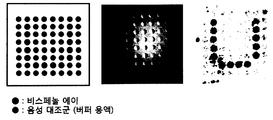
- a specific compound bisphenol A was fixed to the sol gel chip prepared in Example 2, and only the buffer solution used to dissolve the compound as a negative control was fixed to the chip. And, it was analyzed using a single strand DNA aptamer (commercially available from PCL Co., Ltd.) labeled with a fluorescent substance (cy3) and capable of binding to bisphenol A.
- a single strand DNA aptamer commercially available from PCL Co., Ltd.
- Protein-protein binding can be confirmed by yeast to hybrid or Immunoprecipitation (IP), but there are not a variety of methods for easily confirming compound-to-protein binding or compound-to-DNA binding.
- IP Immunoprecipitation
- the protein chip prepared in Example 2 can fix various kinds of materials from low molecular materials, such as compounds or DNA, to proteins, antibodies, so that the binding of various materials can be easily confirmed.
- the sol composition is obtained by mixing a sol composition consisting of SolB1, SolB2 and SolB3 with SolBH, SolBS, DW and a buffer solution in order and then stabilizing at a low temperature.
- a sol composition consisting of SolB1, SolB2 and SolB3 with SolBH, SolBS, DW and a buffer solution in order and then stabilizing at a low temperature.
Landscapes
- Health & Medical Sciences (AREA)
- Immunology (AREA)
- Life Sciences & Earth Sciences (AREA)
- Engineering & Computer Science (AREA)
- Chemical & Material Sciences (AREA)
- Urology & Nephrology (AREA)
- Hematology (AREA)
- Biomedical Technology (AREA)
- Molecular Biology (AREA)
- Medicinal Chemistry (AREA)
- Analytical Chemistry (AREA)
- Cell Biology (AREA)
- Inorganic Chemistry (AREA)
- Food Science & Technology (AREA)
- Biotechnology (AREA)
- Physics & Mathematics (AREA)
- Microbiology (AREA)
- Biochemistry (AREA)
- General Health & Medical Sciences (AREA)
- General Physics & Mathematics (AREA)
- Pathology (AREA)
- Apparatus Associated With Microorganisms And Enzymes (AREA)
- Immobilizing And Processing Of Enzymes And Microorganisms (AREA)
- Compositions Of Macromolecular Compounds (AREA)
Abstract
Description
| 구분 | 성분 |
| SolB1 | 메틸트리에톡시실란(methyltriethoxysilane, MTES), 에틸트리에톡시실란(ethyltriethoxysilane, ETrEOS), 소디움 실리케이트 (Sodium Silicate), 테트라메틸 오르토실리케이트(tetramethyl orthosilicate, TMOS), 테트라에틸 오르토실리케이트(tetraethyl orthosilicate, TEOS) 및 테트라메톡시실리케이트(tetramethoxysilicate, TMS)로 구성된 군에서 선택된 1종의 제1 실리케이트 단량체 |
| SolB2 | 3-아미노트리메톡시실란(3-aminotrimethoxysilane, 3-ATMS), 디글리세릴실란(diglycerylsilane, DGS), 메틸트리메톡시실리케이트(methyltrimethoxysilicate, MTMS), 폴리글리세릴실리케이트(polyglycerylsilicate, PGS) 폴리비닐아세테이트(polyvinylacetate), 폴리비닐피롤리돈(polyvinylpyrrolidone), 글리세릴 메타크릴레이트(glyceryl metaacrylate), 하이드록시에틸 아크릴레이트(hydroxyethyl acrylate), N,N-디쿠시니미딜카르보네이트(N,N-dicusinimidilcarbonate, DSC), 1,3,5-트리메틸벤젠(1,3,5-trimethylbenzene), 세틸트리메틸암모늄 클로라이드(cetyltrimethylammonium chloride), 세틸트리메틸암모늄 브로마이드(cetyltrimethylammonium bromide), 3-(트리에톡시실릴) 프로필 숙시닉 언하이드라이드(3-(triethoxysily), propyl sucinic unhydride), N-(3-트리에톡시실릴 프로필)-4-하이드록시 부틸아마이드(N-(3-triethoxysily propyl)-4-hydroxy butylamide, SIT8189.5), N-(트리에톡시실릴 프로필) 글루콘아마이드(N-(triethoxysilyl propyl) gluconamide, SIT8189.0) 50%, 플루로닉 L121(pluronic L121) 및 테트라메틸 암모늄 하이드록시드(tetramethyl ammonium hydroxide)로 구성된 군에서 선택된 1종의 제2 실리케이트 단량체 |
| SolB3 | 아미노프로필트리에톡실란 (aminopropyltriethoxysilane, APTES), 3-글리시독시프로필트리메톡시실란(3glycidoxypropyltrimethoxysilane, GPTMOS), N-트리에톡시실릴프로필-O-폴리에틸렌 옥사이드 우레탄(N-triethoxysilylpropyl-O-polyethylene oxide urethane, PEOU), 글리세롤, PEG200, PEG400, PEG600, PEG1350 및 PEG8000으로 구성된 군에서 선택된 1종의 첨가제 |
| SolBH | HCl, H2SO4, HNO3 및 CH3COOH로 구성된 군에서 선택된 1종 |
| 구성 성분 | |
| 졸 조성물 | SolB1 20㎕, SolB2 6㎕ 및 SolB3 4㎕ |
| 용액I | SolBH 10㎕ |
| 용액II | SolBS 10㎕ 및 DDW 20㎕5종의 HIV1 항원 포함 PBS solution 10㎕ |
Claims (29)
- 다음 단계를 포함하는, 졸 조성물의 겔화를 이용한 바이오 칩의 제조방법으로서,(a) SolB1, SolB2 및 SolB3를 포함하는 졸 조성물에 HCl, H2SO4, HNO3 및 CH3COOH로 구성된 군에서 선택된 SolBH (용액 I) 를 혼합하는 단계;(b) 완충액인 SolBS 와 증류수를 (a)단계에서 혼합된 용액과 혼합한 다음, -20~4℃에서 안정화 시키는 단계; 및(c) 표적 생물학적 물질과 상호작용하는 생물학적 물질을 포함하는 용액을 (b)단계에서 안정화된 용액과 혼합하여 기판 위에 분주한 후 겔화시키는 단계,이 때,(i) 상기 SolB1 은 메틸트리에톡시실란(methyltriethoxysilane, MTES), 에틸트리에톡시실란(ethyltriethoxysilane, ETrEOS), 소디움 실리케이트 (Sodium Silicate), 테트라메틸 오르토실리케이트(tetramethyl orthosilicate, TMOS), 테트라에틸 오르토실리케이트(tetraethyl orthosilicate, TEOS) 및 테트라메톡시실리케이트(tetramethoxysilicate, TMS)로 구성된 군에서 선택된 1종 이상의 제1 실리케이트 단량체이고;(ii) 상기 SolB2 는 3-아미노트리메톡시실란(3-aminotrimethoxysilane, 3-ATMS), 디글리세릴실란(diglycerylsilane, DGS), 메틸트리메톡시실리케이트(methyltrimethoxysilicate, MTMS), 폴리글리세릴실리케이트(polyglycerylsilicate, PGS), 폴리비닐아세테이트(polyvinylacetate), 폴리비닐피롤리돈(polyvinylpyrrolidone), 글리세릴 메타크릴레이트(glyceryl metaacrylate), 하이드록시에틸 아크릴레이트(hydroxyethyl acrylate), N,N-디쿠시니미딜카르보네이트(N,N-dicusinimidilcarbonate, DSC), 1,3,5-트리메틸벤젠(1,3,5-trimethylbenzene), 세틸트리메틸암모늄 클로라이드(cetyltrimethylammonium chloride), 세틸트리메틸암모늄 브로마이드(cetyltrimethylammonium bromide), 3-(트리에톡시실릴) 프로필 숙시닉 언하이드라이드(3-(triethoxysily) propyl sucinic unhydride), N-(3-트리에톡시실릴 프로필)-4-하이드록시 부틸아마이드(N-(3-triethoxysily propyl)-4-hydroxy butylamide, SIT8189.5), N-(트리에톡시실릴 프로필) 글루콘아마이드(N-(triethoxysilyl propyl) gluconamide, SIT8189.0) 50%, 플루로닉 L121(pluronic L121) 및 테트라메틸 암모늄 하이드록시드(tetramethyl ammonium hydroxide)로 구성된 군에서 선택된 1종 이상의 제2 실리케이트 단량체이고; 그리고(iii) 상기 SolB3 는 아미노프로필트리에톡실란 (aminopropyltriethoxysilane, APTES), 3-글리시독시프로필트리메톡시실란(3glycidoxypropyltrimethoxysilane, GPTMOS), N-트리에톡시실릴프로필-O-폴리에틸렌 옥사이드 우레탄(N-triethoxysilylpropyl-O-polyethylene oxide urethane, PEOU), 글리세롤, PEG200, PEG400, PEG600, PEG1350 및 PEG8000으로 구성된 군에서 선택된 1종 이상의 첨가제인 것을 특징으로 하는 제조방법.
- 제1항에 있어서, 상기 방법은 어레이어 없이 손으로 스팟팅을 수행하거나, 비접촉형 어레이어를 이용하는 것을 특징으로 하는 방법.
- 제1항에 있어서, 상기 기판은 폴리메틸메타크릴레이트 (polymethylmethacrylate, PMMA), 플라스틱, 실리콘, 및 유리로 구성된 군에서 선택되는 것을 특징으로 하는 방법.
- 제1항에 있어서, 상기 표적 생물학적 물질과 상호작용하는 생물학적 물질은 핵산, 단백질, 펩타이드, 저분자 물질 및 세포로 구성된 군에서 선택된 어느 하나인 것을 특징으로 하는 방법.
- 제1항에 있어서, 상기 (a)단계에서 혼합된 용액은 -20~4℃ 의 조건에서 30분 이상 방치하여 안정화시키는 것을 특징으로 하는 방법.
- 제1항에 있어서, 상기 (c) 단계에서 사용되는 기판은, 사용되기 전에 미리 이슬점 이상의 온도로 최적화하고, (c) 단계에서 습도 50% 이상의 조건에서 분주하는 것을 특징으로 하는 방법.
- 제1항에 있어서, 상기 졸 조성물과 SolBH와 SolBS의 혼합 용액, 증류수 및 표적 생물학적 물질과 상호작용하는 생물학적 물질은 각각 3: 1: 4 와 1: 2: 8 사이의 범위로 혼합되는 것을 특징으로 하는 방법.
- 제1항에 있어서, 상기 SolBH 및 SolBS의 농도는 1mM ~ 100mM 인 것을 특징으로 하는 방법.
- 제1항에 있어서, 상기 SolBS : 증류수 : 표적 생물학적 물질과 상호작용하는 생물학적 물질의 부피비는 1:2:1 와 2:5:1 사이의 범위인 것을 특징으로 하는 방법.
- 제1항에 있어서, 상기 완충액은 pH 3~8 범위의 소디움 포스페이트 (sodium phosphate)인 것을 특징으로 하는 방법.
- 제1항에 있어서, 상기 기판은 미리 플라즈마 표면처리 되거나, 에칭되거나, PDMS 나 실리케이트 단량체 또는 고분자 물질로 처리된 것을 특징으로 하는 방법.
- 다음 단계를 포함하는, 졸 조성물의 겔화를 이용한 바이오 칩의 제조방법으로서,(a) SolB1, SolB2 및 SolB3 로 구성된 졸 조성물을 기판 위에 분주한 다음, HCl, H2SO4, HNO3 및 CH3COOH로 구성된 군에서 선택된 SolBH (용액 I) 를 분주하는 단계; 및(b) 완충액인 SolBS, 표적 생물학적 물질과 상호작용하는 생물학적 물질 및 증류수를 포함하는 용액II를 기판 위에 분주한 후 겔화시키는 단계,이 때,(i) 상기 SolB1 은 메틸트리에톡시실란(methyltriethoxysilane, MTES), 에틸트리에톡시실란(ethyltriethoxysilane, ETrEOS), 소디움 실리케이트 (Sodium Silicate), 테트라메틸 오르토실리케이트(tetramethyl orthosilicate, TMOS), 테트라에틸 오르토실리케이트(tetraethyl orthosilicate, TEOS) 및 테트라메톡시실리케이트(tetramethoxysilicate, TMS)로 구성된 군에서 선택된 1종 이상의 제1 실리케이트 단량체이고;(ii) 상기 SolB2 는 3-아미노트리메톡시실란(3-aminotrimethoxysilane, 3-ATMS), 디글리세릴실란(diglycerylsilane, DGS), 메틸트리메톡시실리케이트(methyltrimethoxysilicate, MTMS), 폴리글리세릴실리케이트(polyglycerylsilicate, PGS), 폴리비닐아세테이트(polyvinylacetate), 폴리비닐피롤리돈(polyvinylpyrrolidone), 글리세릴 메타크릴레이트(glyceryl metaacrylate), 하이드록시에틸 아크릴레이트(hydroxyethyl acrylate), N,N-디쿠시니미딜카르보네이트(N,N-dicusinimidilcarbonate, DSC), 1,3,5-트리메틸벤젠(1,3,5-trimethylbenzene), 세틸트리메틸암모늄 클로라이드(cetyltrimethylammonium chloride), 세틸트리메틸암모늄 브로마이드(cetyltrimethylammonium bromide), 3-(트리에톡시실릴) 프로필 숙시닉 언하이드라이드(3-(triethoxysily) propyl sucinic unhydride), N-(3-트리에톡시실릴 프로필)-4-하이드록시 부틸아마이드(N-(3-triethoxysily propyl)-4-hydroxy butylamide, SIT8189.5), N-(트리에톡시실릴 프로필) 글루콘아마이드(N-(triethoxysilyl propyl) gluconamide, SIT8189.0) 50%, 플루로닉 L121(pluronic L121) 및 테트라메틸 암모늄 하이드록시드(tetramethyl ammonium hydroxide)로 구성된 군에서 선택된 1종 이상의 제2 실리케이트 단량체이고; 그리고(iii) 상기 SolB3 는 아미노프로필트리에톡실란 (aminopropyltriethoxysilane, APTES), 3-글리시독시프로필트리메톡시실란(3glycidoxypropyltrimethoxysilane, GPTMOS), N-트리에톡시실릴프로필-O-폴리에틸렌 옥사이드 우레탄(N-triethoxysilylpropyl-O-polyethylene oxide urethane, PEOU), 글리세롤, PEG200, PEG400, PEG600, PEG1350 및 PEG8000으로 구성된 군에서 선택된 1종 이상의 첨가제인 것을 특징으로 하는 제조방법.
- 제12항에 있어서, 상기 방법은 어레이어 없이 손으로 스팟팅을 수행하거나, 비접촉형 어레이어를 이용하는 것을 특징으로 하는 방법.
- 제 12 항에 있어서, 상기 방법은 전처리 과정이 없는 것을 특징으로 하는 방법.
- 제14항에 있어서, 상기 전처리 과정은, (i) SolB1, SolB2, SolB3, SolBH, SolBS, 또는 표적 생물학적 물질과 상호작용하는 생물학적 물질을 혼합하는 과정; (ii) 혼합한 후 볼텍싱(vortexing)하는 과정; 및 (iii) 상기 혼합된 용액을 안정화하는 과정으로 구성된 군에서 선택되는 어느 하나 이상인 것을 특징으로 하는 방법.
- 제 12 항에 있어서, 상기 SolB1, SolB2 및 SolB3 로 구성된 졸 조성물, SolBH, SolBS 및 표적 생물학적 물질과 상호작용하는 생물학적 물질을 분주 전에 용기에 담아 노즐을 이용하여 빨아올리는 형태로 분주하는 것을 특징으로 하는 방법.
- 제12항에 있어서, 상기 SolB1, SolB2 및 SolB3 로 구성된 졸 조성물, SolBH, SolBS 및 표적 생물학적 물질과 상호작용하는 생물학적 물질을 분주 전에 미리, 분주하는 노즐이 연결되어 있는 대용량 카트리지에 넣어, 한번에 분주하는 양이, 노즐을 이용하여 빨아올리는 형태로 분주하는 것에 비해 100배 이상이어서 대량 생산이 가능한 것을 특징으로 하는 방법.
- 제12항에 있어서, 상기 기판은 폴리메틸메타크릴레이트(polymethylmethacrylate, PMMA), 플라스틱, 실리콘, 및 유리로 구성된 군에서 선택되는 것을 특징으로 하는 방법.
- 제12항에 있어서, 상기 표적 생물학적 물질과 상호작용하는 생물학적 물질은 핵산, 단백질, 펩타이드, 저분자 물질 및 세포로 구성된 군에서 선택된 어느 하나인 것을 특징으로 하는 방법.
- 제12항에 있어서, 상기 기판은 이슬점 이상의 온도로 최적화 되고, 분주는 습도 50% 이상의 조건에서 수행하는 것을 특징으로 하는 방법.
- 제12항에 있어서, 상기 졸 조성물, 용액 I 및 용액 II 의 분주량은 각각 3: 1: 4 와 1: 2 :8 사이의 범위인 것을 특징으로 하는 방법.
- 제12항에 있어서, 상기 SolBH 및 SolBS 의 농도는 1mM ~ 100mM인 것을 특징으로 하는 방법.
- 제12항에 있어서, 상기 용액II은 SolBS : 증류수 : 표적 생물학적 물질과 상호작용하는 생물학적 물질의 부피비가 1:2:1 와 2:5:1사이의 범위인 것을 특징으로 하는 방법.
- 제12항에 있어서, 상기 SolBS 는 pH 3~8 범위의 소디움 포스페이트 (sodium phosphate)인 것을 특징으로 하는 방법.
- 제12항에 있어서, 상기 기판은 미리 플라즈마 표면처리 되거나, 에칭되거나, PDMS 나 실리케이트 단량체 또는 고분자 물질로 처리된 것을 특징으로 하는 방법.
- (i) 메틸트리에톡시실란(methyltriethoxysilane, MTES), 에틸트리에톡시실란(ethyltriethoxysilane, ETrEOS), 소디움 실리케이트 (Sodium Silicate), 테트라메틸 오르토실리케이트(tetramethyl orthosilicate, TMOS), 테트라에틸 오르토실리케이트(tetraethyl orthosilicate, TEOS) 및 테트라메톡시실리케이트(tetramethoxysilicate, TMS)로 구성된 군에서 선택된 1종 이상의 제1 실리케이트 단량체인 SolB1을 포함하는 제1용기; (ii) 3-아미노트리메톡시실란(3-aminotrimethoxysilane, 3-ATMS), 디글리세릴실란(diglycerylsilane, DGS), 메틸트리메톡시실리케이트(methyltrimethoxysilicate, MTMS), 폴리글리세릴실리케이트(polyglycerylsilicate, PGS), 폴리비닐아세테이트(polyvinylacetate), 폴리비닐피롤리돈(polyvinylpyrrolidone), 글리세릴 메타크릴레이트(glyceryl metaacrylate), 하이드록시에틸 아크릴레이트(hydroxyethyl acrylate), N,N-디쿠시니미딜카르보네이트(N,N-dicusinimidilcarbonate, DSC), 1,3,5-트리메틸벤젠(1,3,5-trimethylbenzene), 세틸트리메틸암모늄 클로라이드(cetyltrimethylammonium chloride), 세틸트리메틸암모늄 브로마이드(cetyltrimethylammonium bromide), 3-(트리에톡시실릴) 프로필 숙시닉 언하이드라이드(3-(triethoxysily) propyl sucinic unhydride), N-(3-트리에톡시실릴 프로필)-4-하이드록시 부틸아마이드(N-(3-triethoxysily propyl)-4-hydroxy butylamide, SIT8189.5), N-(트리에톡시실릴 프로필) 글루콘아마이드(N-(triethoxysilyl propyl) gluconamide, SIT8189.0) 50%, 플루로닉 L121(pluronic L121) 및 테트라메틸 암모늄 하이드록시드(tetramethyl ammonium hydroxide)로 구성된 군에서 선택된 1종 이상의 제2 실리케이트 단량체인 SolB2를 포함하는 제2용기; (iii) 아미노프로필트리에톡실란 (aminopropyltriethoxysilane, APTES), 3-글리시독시프로필트리메톡시실란(3-glycidoxypropyltrimethoxysilane, GPTMOS), N-트리에톡시실릴프로필-O-폴리에틸렌 옥사이드 우레탄(N-triethoxysilylpropyl-O-polyethylene oxide urethane, PEOU), 글리세롤, PEG200, PEG400, PEG600, PEG1350 및 PEG8000으로 구성된 군에서 선택된 1종 이상의 첨가제 인 SolB3을 포함하는 제3용기; (iv) HCl, H2SO4, HNO3 및 CH3COOH로 구성된 군에서 선택된 SolBH를 포함하는 제4용기; 및 (v) 완충액인 SolBS를 포함하는 제5용기로 구성되고,상기 SolB1, SolB2 및 SolB3를 혼합한 졸 조성물에 HCl, H2SO4, HNO3 및 CH3COOH로 구성된 군에서 선택된 SolBH, 완충액인 SolBS와 증류수, 탐지 하기 위한 생물학적 물질 순으로 순서대로 혼합함으로써 졸 혼합물이 겔화되는 것을 특징으로 하는 바이오 칩 제조용 키트.
- 제1항 내지 제12항 중 어느 한 항의 방법으로 제조된 바이오 칩에 상기 표적 생물학적 물질과 상호작용하는 생물학적 물질과 상호작용가능한 표적 생물학적 물질을 함유하는 시료를 첨가하는 단계를 포함하는 표적 생물학적 물질의 분석 방법.
- 제27항에 있어서, 상기 표적 생물학적 물질은 핵산, 단백질, 펩타이드, 저분자 물질 및 세포로 구성된 군에서 선택된 어느 하나인 것을 특징으로 하는 방법.
- 제27항에 있어서, 상기 표적 생물학적 물질을 탐지할 수 있는 방사성 동위원소, 형광염료, 염료, 또는 발광성 물질로 표지된 단백질, 항체 또는 압타머와 추가로 반응시키는 단계를 포함하는 것을 특징으로 하는 방법.
Priority Applications (4)
| Application Number | Priority Date | Filing Date | Title |
|---|---|---|---|
| JP2014508266A JP5770366B2 (ja) | 2011-04-27 | 2011-04-27 | バイオチップ製造用ゾル−ゲルキット及びこれを利用したバイオチップの製造方法 |
| CN201180002483.3A CN102893149B (zh) | 2011-04-27 | 2011-04-27 | 用于制备生物芯片的溶胶-凝胶试剂盒及使用其制备芯片的方法 |
| BR112013027811-0A BR112013027811B1 (pt) | 2011-04-27 | 2011-04-27 | Método para preparar um biochip por gelificação de uma composição sol |
| PCT/KR2011/003105 WO2012148017A1 (ko) | 2011-04-27 | 2011-04-27 | 바이오칩 제조용 졸-겔 키트 및 이를 이용한 바이오 칩의 제조방법 |
Applications Claiming Priority (1)
| Application Number | Priority Date | Filing Date | Title |
|---|---|---|---|
| PCT/KR2011/003105 WO2012148017A1 (ko) | 2011-04-27 | 2011-04-27 | 바이오칩 제조용 졸-겔 키트 및 이를 이용한 바이오 칩의 제조방법 |
Publications (1)
| Publication Number | Publication Date |
|---|---|
| WO2012148017A1 true WO2012148017A1 (ko) | 2012-11-01 |
Family
ID=47072520
Family Applications (1)
| Application Number | Title | Priority Date | Filing Date |
|---|---|---|---|
| PCT/KR2011/003105 Ceased WO2012148017A1 (ko) | 2011-04-27 | 2011-04-27 | 바이오칩 제조용 졸-겔 키트 및 이를 이용한 바이오 칩의 제조방법 |
Country Status (4)
| Country | Link |
|---|---|
| JP (1) | JP5770366B2 (ko) |
| CN (1) | CN102893149B (ko) |
| BR (1) | BR112013027811B1 (ko) |
| WO (1) | WO2012148017A1 (ko) |
Cited By (1)
| Publication number | Priority date | Publication date | Assignee | Title |
|---|---|---|---|---|
| JP2015045585A (ja) * | 2013-08-28 | 2015-03-12 | 国立大学法人埼玉大学 | レプリカマイクロアレイの作成方法及びその方法によって作製された対象物質含有オリジナルマイクロアレイ |
Families Citing this family (2)
| Publication number | Priority date | Publication date | Assignee | Title |
|---|---|---|---|---|
| CN106872714A (zh) * | 2017-02-28 | 2017-06-20 | 阿卡斯特(武汉)生物技术有限公司 | 一种高通量大规模筛选组蛋白修饰结合蛋白质的方法 |
| CN112888781A (zh) * | 2018-07-20 | 2021-06-01 | 路易斯·菲利普·艾豪·德·安德拉德 | 用于稳定活性生物材料的组合复合材料、其生产方法及用途 |
Citations (4)
| Publication number | Priority date | Publication date | Assignee | Title |
|---|---|---|---|---|
| KR20050056517A (ko) * | 2003-12-10 | 2005-06-16 | 학교법인 서강대학교 | 졸-겔 법을 이용하여 제조된 단백질 칩과 이의 제조방법 |
| JP2005539215A (ja) * | 2002-09-13 | 2005-12-22 | エルジー ケム. エルティーディ. | チップ基材上でのゲル化反応により作製されたバイオチップ |
| KR20070100836A (ko) * | 2005-02-03 | 2007-10-11 | 신벤션 아게 | 졸/겔 기술에 의하여 제조된 약물 전달 물질 |
| KR20100126994A (ko) * | 2009-05-25 | 2010-12-03 | 삼성전기주식회사 | 앱타머를 이용한 바이오칩과 그의 제조방법 |
Family Cites Families (9)
| Publication number | Priority date | Publication date | Assignee | Title |
|---|---|---|---|---|
| TW523548B (en) * | 2000-09-04 | 2003-03-11 | Ind Tech Res Inst | High-density functional slide and preparation method thereof |
| AU2002353997A1 (en) * | 2001-11-01 | 2003-05-12 | Rensselaer Polytechnic Institute | In vitro metabolic engineering on microscale devices |
| WO2004039487A1 (en) * | 2002-11-01 | 2004-05-13 | Mcmaster University | Multicomponent protein microarrays |
| GB0227424D0 (en) * | 2002-11-25 | 2002-12-31 | Univ Warwick | Coatings |
| FR2854696A1 (fr) * | 2003-05-06 | 2004-11-12 | Commissariat Energie Atomique | Support de biopuce utilisant des couches minces de materiau sol gel et procede de realisation |
| JP2005077153A (ja) * | 2003-08-28 | 2005-03-24 | Seiko Epson Corp | マイクロアレイ製造方法およびその製造装置 |
| JP4231869B2 (ja) * | 2005-12-09 | 2009-03-04 | シャープ株式会社 | バイオケミカルセンサ及び測定装置 |
| KR100784437B1 (ko) * | 2006-01-27 | 2007-12-11 | 김소연 | 표면처리 되지 않은 기질에 표지물질을 고정하기 위한졸-겔 바이오칩용 졸 조성물 및 그의 스크리닝 방법 |
| WO2010135834A1 (en) * | 2009-05-29 | 2010-12-02 | Mcmaster University | Biosensors utilizing ink jet-printed biomolecule compatible sol gel inks and uses thereof |
-
2011
- 2011-04-27 CN CN201180002483.3A patent/CN102893149B/zh active Active
- 2011-04-27 WO PCT/KR2011/003105 patent/WO2012148017A1/ko not_active Ceased
- 2011-04-27 JP JP2014508266A patent/JP5770366B2/ja not_active Expired - Fee Related
- 2011-04-27 BR BR112013027811-0A patent/BR112013027811B1/pt not_active IP Right Cessation
Patent Citations (4)
| Publication number | Priority date | Publication date | Assignee | Title |
|---|---|---|---|---|
| JP2005539215A (ja) * | 2002-09-13 | 2005-12-22 | エルジー ケム. エルティーディ. | チップ基材上でのゲル化反応により作製されたバイオチップ |
| KR20050056517A (ko) * | 2003-12-10 | 2005-06-16 | 학교법인 서강대학교 | 졸-겔 법을 이용하여 제조된 단백질 칩과 이의 제조방법 |
| KR20070100836A (ko) * | 2005-02-03 | 2007-10-11 | 신벤션 아게 | 졸/겔 기술에 의하여 제조된 약물 전달 물질 |
| KR20100126994A (ko) * | 2009-05-25 | 2010-12-03 | 삼성전기주식회사 | 앱타머를 이용한 바이오칩과 그의 제조방법 |
Cited By (1)
| Publication number | Priority date | Publication date | Assignee | Title |
|---|---|---|---|---|
| JP2015045585A (ja) * | 2013-08-28 | 2015-03-12 | 国立大学法人埼玉大学 | レプリカマイクロアレイの作成方法及びその方法によって作製された対象物質含有オリジナルマイクロアレイ |
Also Published As
| Publication number | Publication date |
|---|---|
| JP5770366B2 (ja) | 2015-08-26 |
| JP2014513797A (ja) | 2014-06-05 |
| CN102893149A (zh) | 2013-01-23 |
| CN102893149B (zh) | 2015-11-25 |
| BR112013027811B1 (pt) | 2022-01-18 |
| BR112013027811A2 (pt) | 2017-04-04 |
Similar Documents
| Publication | Publication Date | Title |
|---|---|---|
| CN100412203C (zh) | 在芯片基板上凝胶化制备的生物芯片 | |
| KR20040010041A (ko) | 단백질 활성의 스크리닝을 위한 고밀도 단백질 어레이 | |
| WO2015076527A1 (ko) | 마이크로 챔버 플레이트 | |
| CN105473745B (zh) | 用于表征人膜蛋白的功能和相互作用的病毒体展示阵列 | |
| WO2010137903A2 (ko) | 신개념 신약개발을 위한 타겟 단백질-단백질 상호작용을 저해하는 신약후보물질의 스크리닝 방법 | |
| WO2012148017A1 (ko) | 바이오칩 제조용 졸-겔 키트 및 이를 이용한 바이오 칩의 제조방법 | |
| US20110287973A1 (en) | Frameless multiplexed microarrays | |
| KR101274765B1 (ko) | 바이오칩 제조용 졸-겔 키트 및 이를 이용한 바이오 칩의 제조방법 | |
| Waltari et al. | Adaption of a conventional ELISA to a 96-well ELISA-Array for measuring the antibody responses to influenza virus proteins and vaccines | |
| CN104374921A (zh) | 一种用于莱姆病鞭毛抗原免疫血清学诊断的蛋白质芯片及其制备方法和应用 | |
| Marquette et al. | Electroaddressed immobilization of recombinant HIV-1 P24 capsid protein onto screen-printed arrays for serological testing | |
| US20090111709A1 (en) | Affinity Measurements Using Frameless Multiplexed Microarrays | |
| CN106645715A (zh) | 一种用于eb病毒衣壳抗原和核抗原1蛋白抗体联合检测的蛋白质芯片及其制备和应用 | |
| CN114308154A (zh) | 一种双环氧基修饰的生物芯片基片的制备方法 | |
| EP2518503B1 (en) | Sol-gel kit for preparing biochip and method for preparing biochip using the same | |
| WO2013001894A1 (ja) | 親水性層を有する基材 | |
| WO2014181896A1 (ko) | 막 기반 다중튜브를 포함하는 생체 물질 분석 장치 | |
| CN105548577A (zh) | 一种琥珀酰-β-环糊精修饰的莱姆病检测用蛋白质芯片及其制备与应用 | |
| KR20030012130A (ko) | 단백질 칩을 이용한 에이치아이브이 진단 시스템 | |
| CN106226517A (zh) | 乙型流感病毒化学发光免疫检测试剂盒及其制备方法 | |
| AU607177B2 (en) | Hiv gp160 virus envelope protein-containing strips and use thereof for detection of aids antibody | |
| CN118599644A (zh) | 一种基于无透镜成像的数字pcr系统 | |
| CN119368116A (zh) | 一种基于数字微流控芯片的高通量基因合成方法 | |
| JP2022114583A (ja) | ターゲット計測用デバイスの製造方法、及びターゲット計測用キット | |
| JP2009128093A (ja) | 生理活性物質の検出方法 |
Legal Events
| Date | Code | Title | Description |
|---|---|---|---|
| WWE | Wipo information: entry into national phase |
Ref document number: 201180002483.3 Country of ref document: CN |
|
| 121 | Ep: the epo has been informed by wipo that ep was designated in this application |
Ref document number: 11864134 Country of ref document: EP Kind code of ref document: A1 |
|
| ENP | Entry into the national phase |
Ref document number: 2014508266 Country of ref document: JP Kind code of ref document: A |
|
| NENP | Non-entry into the national phase |
Ref country code: DE |
|
| REG | Reference to national code |
Ref country code: BR Ref legal event code: B01A Ref document number: 112013027811 Country of ref document: BR |
|
| 122 | Ep: pct application non-entry in european phase |
Ref document number: 11864134 Country of ref document: EP Kind code of ref document: A1 |
|
| ENP | Entry into the national phase |
Ref document number: 112013027811 Country of ref document: BR Kind code of ref document: A2 Effective date: 20131029 |