WO2012153786A1 - 多元重合体の製造方法、および多元重合体 - Google Patents
多元重合体の製造方法、および多元重合体 Download PDFInfo
- Publication number
- WO2012153786A1 WO2012153786A1 PCT/JP2012/061922 JP2012061922W WO2012153786A1 WO 2012153786 A1 WO2012153786 A1 WO 2012153786A1 JP 2012061922 W JP2012061922 W JP 2012061922W WO 2012153786 A1 WO2012153786 A1 WO 2012153786A1
- Authority
- WO
- WIPO (PCT)
- Prior art keywords
- group
- monomer
- general formula
- catalyst
- polymer
- Prior art date
- Legal status (The legal status is an assumption and is not a legal conclusion. Google has not performed a legal analysis and makes no representation as to the accuracy of the status listed.)
- Ceased
Links
Images






Classifications
-
- C—CHEMISTRY; METALLURGY
- C08—ORGANIC MACROMOLECULAR COMPOUNDS; THEIR PREPARATION OR CHEMICAL WORKING-UP; COMPOSITIONS BASED THEREON
- C08F—MACROMOLECULAR COMPOUNDS OBTAINED BY REACTIONS ONLY INVOLVING CARBON-TO-CARBON UNSATURATED BONDS
- C08F236/00—Copolymers of compounds having one or more unsaturated aliphatic radicals, at least one having two or more carbon-to-carbon double bonds
- C08F236/02—Copolymers of compounds having one or more unsaturated aliphatic radicals, at least one having two or more carbon-to-carbon double bonds the radical having only two carbon-to-carbon double bonds
- C08F236/04—Copolymers of compounds having one or more unsaturated aliphatic radicals, at least one having two or more carbon-to-carbon double bonds the radical having only two carbon-to-carbon double bonds conjugated
- C08F236/10—Copolymers of compounds having one or more unsaturated aliphatic radicals, at least one having two or more carbon-to-carbon double bonds the radical having only two carbon-to-carbon double bonds conjugated with vinyl-aromatic monomers
-
- C—CHEMISTRY; METALLURGY
- C08—ORGANIC MACROMOLECULAR COMPOUNDS; THEIR PREPARATION OR CHEMICAL WORKING-UP; COMPOSITIONS BASED THEREON
- C08F—MACROMOLECULAR COMPOUNDS OBTAINED BY REACTIONS ONLY INVOLVING CARBON-TO-CARBON UNSATURATED BONDS
- C08F12/00—Homopolymers and copolymers of compounds having one or more unsaturated aliphatic radicals, each having only one carbon-to-carbon double bond, and at least one being terminated by an aromatic carbocyclic ring
- C08F12/02—Monomers containing only one unsaturated aliphatic radical
- C08F12/04—Monomers containing only one unsaturated aliphatic radical containing one ring
- C08F12/06—Hydrocarbons
- C08F12/08—Styrene
-
- C—CHEMISTRY; METALLURGY
- C08—ORGANIC MACROMOLECULAR COMPOUNDS; THEIR PREPARATION OR CHEMICAL WORKING-UP; COMPOSITIONS BASED THEREON
- C08F—MACROMOLECULAR COMPOUNDS OBTAINED BY REACTIONS ONLY INVOLVING CARBON-TO-CARBON UNSATURATED BONDS
- C08F236/00—Copolymers of compounds having one or more unsaturated aliphatic radicals, at least one having two or more carbon-to-carbon double bonds
- C08F236/02—Copolymers of compounds having one or more unsaturated aliphatic radicals, at least one having two or more carbon-to-carbon double bonds the radical having only two carbon-to-carbon double bonds
- C08F236/04—Copolymers of compounds having one or more unsaturated aliphatic radicals, at least one having two or more carbon-to-carbon double bonds the radical having only two carbon-to-carbon double bonds conjugated
- C08F236/06—Butadiene
-
- C—CHEMISTRY; METALLURGY
- C08—ORGANIC MACROMOLECULAR COMPOUNDS; THEIR PREPARATION OR CHEMICAL WORKING-UP; COMPOSITIONS BASED THEREON
- C08F—MACROMOLECULAR COMPOUNDS OBTAINED BY REACTIONS ONLY INVOLVING CARBON-TO-CARBON UNSATURATED BONDS
- C08F297/00—Macromolecular compounds obtained by successively polymerising different monomer systems using a catalyst of the ionic or coordination type without deactivating the intermediate polymer
- C08F297/02—Macromolecular compounds obtained by successively polymerising different monomer systems using a catalyst of the ionic or coordination type without deactivating the intermediate polymer using a catalyst of the anionic type
- C08F297/04—Macromolecular compounds obtained by successively polymerising different monomer systems using a catalyst of the ionic or coordination type without deactivating the intermediate polymer using a catalyst of the anionic type polymerising vinyl aromatic monomers and conjugated dienes
- C08F297/046—Macromolecular compounds obtained by successively polymerising different monomer systems using a catalyst of the ionic or coordination type without deactivating the intermediate polymer using a catalyst of the anionic type polymerising vinyl aromatic monomers and conjugated dienes polymerising vinyl aromatic monomers and isoprene, optionally with other conjugated dienes
-
- C—CHEMISTRY; METALLURGY
- C08—ORGANIC MACROMOLECULAR COMPOUNDS; THEIR PREPARATION OR CHEMICAL WORKING-UP; COMPOSITIONS BASED THEREON
- C08F—MACROMOLECULAR COMPOUNDS OBTAINED BY REACTIONS ONLY INVOLVING CARBON-TO-CARBON UNSATURATED BONDS
- C08F297/00—Macromolecular compounds obtained by successively polymerising different monomer systems using a catalyst of the ionic or coordination type without deactivating the intermediate polymer
- C08F297/06—Macromolecular compounds obtained by successively polymerising different monomer systems using a catalyst of the ionic or coordination type without deactivating the intermediate polymer using a catalyst of the coordination type
-
- C—CHEMISTRY; METALLURGY
- C08—ORGANIC MACROMOLECULAR COMPOUNDS; THEIR PREPARATION OR CHEMICAL WORKING-UP; COMPOSITIONS BASED THEREON
- C08F—MACROMOLECULAR COMPOUNDS OBTAINED BY REACTIONS ONLY INVOLVING CARBON-TO-CARBON UNSATURATED BONDS
- C08F2420/00—Metallocene catalysts
- C08F2420/01—Cp or analog bridged to a non-Cp X neutral donor
-
- C—CHEMISTRY; METALLURGY
- C08—ORGANIC MACROMOLECULAR COMPOUNDS; THEIR PREPARATION OR CHEMICAL WORKING-UP; COMPOSITIONS BASED THEREON
- C08F—MACROMOLECULAR COMPOUNDS OBTAINED BY REACTIONS ONLY INVOLVING CARBON-TO-CARBON UNSATURATED BONDS
- C08F2420/00—Metallocene catalysts
- C08F2420/03—Cp or analog not bridged to a non-Cp X ancillary neutral donor
-
- C—CHEMISTRY; METALLURGY
- C08—ORGANIC MACROMOLECULAR COMPOUNDS; THEIR PREPARATION OR CHEMICAL WORKING-UP; COMPOSITIONS BASED THEREON
- C08F—MACROMOLECULAR COMPOUNDS OBTAINED BY REACTIONS ONLY INVOLVING CARBON-TO-CARBON UNSATURATED BONDS
- C08F2420/00—Metallocene catalysts
- C08F2420/04—Cp or analog not bridged to a non-Cp X ancillary anionic donor
-
- C—CHEMISTRY; METALLURGY
- C08—ORGANIC MACROMOLECULAR COMPOUNDS; THEIR PREPARATION OR CHEMICAL WORKING-UP; COMPOSITIONS BASED THEREON
- C08F—MACROMOLECULAR COMPOUNDS OBTAINED BY REACTIONS ONLY INVOLVING CARBON-TO-CARBON UNSATURATED BONDS
- C08F2438/00—Living radical polymerisation
- C08F2438/03—Use of a di- or tri-thiocarbonylthio compound, e.g. di- or tri-thioester, di- or tri-thiocarbamate, or a xanthate as chain transfer agent, e.g . Reversible Addition Fragmentation chain Transfer [RAFT] or Macromolecular Design via Interchange of Xanthates [MADIX]
-
- C—CHEMISTRY; METALLURGY
- C08—ORGANIC MACROMOLECULAR COMPOUNDS; THEIR PREPARATION OR CHEMICAL WORKING-UP; COMPOSITIONS BASED THEREON
- C08F—MACROMOLECULAR COMPOUNDS OBTAINED BY REACTIONS ONLY INVOLVING CARBON-TO-CARBON UNSATURATED BONDS
- C08F4/00—Polymerisation catalysts
- C08F4/42—Metals; Metal hydrides; Metallo-organic compounds; Use thereof as catalyst precursors
- C08F4/44—Metals; Metal hydrides; Metallo-organic compounds; Use thereof as catalyst precursors selected from light metals, zinc, cadmium, mercury, copper, silver, gold, boron, gallium, indium, thallium, rare earths or actinides
- C08F4/60—Metals; Metal hydrides; Metallo-organic compounds; Use thereof as catalyst precursors selected from light metals, zinc, cadmium, mercury, copper, silver, gold, boron, gallium, indium, thallium, rare earths or actinides together with refractory metals, iron group metals, platinum group metals, manganese, rhenium technetium or compounds thereof
- C08F4/619—Component covered by group C08F4/60 containing a transition metal-carbon bond
- C08F4/61904—Component covered by group C08F4/60 containing a transition metal-carbon bond in combination with another component of C08F4/60
Definitions
- the present invention relates to a method for producing a multi-block copolymer using a chain transfer agent, and a multi-block copolymer.
- Patent Document 1 describes that a syndiotactic styrene polymer (sPS) can be produced by a polymerization reaction using a metallocene complex.
- sPS syndiotactic styrene polymer
- a copolymer is produced by polymerizing two or more monomers having different properties.
- Non-Patent Document 1 reports a synthesis example of a copolymer having a syndiotactic styrene chain by copolymerizing a styrene monomer and an isoprene monomer, but the repeating unit derived from isoprene in the copolymer is It has a random structure and is not subjected to position control or stereo control.
- the present invention has been made to solve the above-described problems, and an object thereof is to provide a novel method for producing a multi-block copolymer using a chain transfer agent, and a multi-block copolymer. To do.
- the inventors of the present application have made extensive studies to solve the above problems. As a result, it was found that by utilizing the difference in catalytic activity with respect to the monomer and using a chain transfer agent, a multi-polymer having highly controlled position or steric control can be obtained, leading to the present invention. It was.
- the present invention includes the following.
- ⁇ 1> A method for producing a multi-polymer comprising a repeating unit derived from a first monomer and a repeating unit derived from a second monomer different from the first monomer, wherein the first monomers
- a first catalyst that selectively catalyzes a regioselective or stereoselective polymerization reaction from a polymerization reaction between the second monomers and a polymerization reaction between the first monomer and the second monomer
- a second catalyst that selectively catalyzes a regioselective or stereoselective polymerization reaction between two monomers by a polymerization reaction between the first monomers and a polymerization reaction between the first monomer and the second monomer.
- a multi-component polymer that performs a polymerization reaction using the catalyst in the presence of the first catalyst, the second catalyst, the first monomer, the second monomer, and the chain transfer agent in the same reaction system Manufacturing method.
- Ligand Cp wherein the first catalyst includes (1) a central metal M which is a Group 3 metal atom or a lanthanoid metal atom, and a substituted or unsubstituted cyclopentadienyl derivative bonded to the central metal.
- the ligand Cp * in the general formula (I) has a cyclopentadienyl ring having a substituent, a substituted or unsubstituted fluorenyl ring, a substituted or unsubstituted octahydrofluorenyl ring, and a substituent. Any one selected from the group consisting of indenyl rings, When Cp * is a cyclopentadienyl ring having a substituent, it is represented by the following general formula (II):
- Rx is a hydrocarbyl group having 1 to 20 carbon atoms or a metalloid group substituted with a hydrocarbyl group having 1 to 20 carbon atoms, which is bonded to the carbon atom constituting the skeleton of the cyclopentadienyl ring.
- * represents a bond with M
- n is an integer of 3 to 5.
- one of the carbon atoms constituting the skeleton of the cyclopentadienyl ring shown in the general formula (II) is substituted with a group 14 atom (excluding carbon atoms and lead atoms) or a group 15 atom. It may be.
- Cp * is an indenyl ring having a substituent, it is represented by the following general formula (III).
- Rx1 is a metalloid substituted with a hydrocarbyl group having 1 to 20 carbon atoms or a hydrocarbyl group having 1 to 20 carbon atoms bonded to a carbon atom constituting a 5-membered skeleton of an indenyl ring.
- * represents a bond with M
- n1 is an integer of 1 to 3.
- the ligand Cp, wherein the second catalyst includes (1) a central metal M which is a Group 3 metal atom or a lanthanoid metal atom, and a substituted or unsubstituted cyclopentadienyl derivative bonded to the central metal.
- the ligand Cp * in the general formula (I) is any selected from the group consisting of a substituted or unsubstituted cyclopentadienyl ring and an unsubstituted indenyl ring,
- Cp * is a cyclopentadienyl ring having a substituent, it is represented by the following general formula (IV):
- Rx2 represents a hydrocarbyl group having 1 to 3 carbon atoms bonded to the carbon atom constituting the skeleton of the cyclopentadienyl ring, * represents a bond with M, and n2 represents 1 It is an integer of ⁇ 2.
- the second catalyst is a catalyst composition comprising (1) a complex represented by the general formula (V), and (2) an ionic compound comprising a non-coordinating anion and a cation. ⁇ 2> or the manufacturing method of the multicomponent polymer as described in ⁇ 3>.
- R 1 and R 2 each independently represents an alkyl group, a cyclohexyl group, an aryl group or an aralkyl group
- R 3 represents an alkyl group, alkenyl group, alkynyl group, aryl group or aralkyl group, aliphatic, aromatic or cyclic amino group, or phosphino group, boryl group, alkyl or arylthio group, alkoxy or aryloxy group
- M represents any of rare earth elements from lanthanum (La) to lutetium (Lu) excluding scandium (Sc), yttrium (Y) or promethium Pm
- Q 1 and Q 2 each independently represents a monoanionic ligand
- L represents a neutral Lewis base
- w represents an integer of 0 to 3.
- ⁇ 2> or ⁇ 3> above which is a catalyst composition comprising a complex represented by the general formula (VI) containing a child Cp * , and (2) an ionic compound comprising a non-coordinating anion and a cation.
- the ligand Cp * in the general formula (VI) is any selected from the group consisting of a substituted or unsubstituted cyclopentadienyl ring and an unsubstituted indenyl ring,
- Cp * is a cyclopentadienyl ring having a substituent, it is represented by the following general formula (IV):
- Rx2 represents a hydrocarbyl group having 1 to 3 carbon atoms bonded to the carbon atom constituting the skeleton of the cyclopentadienyl ring, * represents a bond with M, and n2 represents 1 It is an integer of ⁇ 2.
- Rx2 represents a hydrocarbyl group having 1 to 3 carbon atoms bonded to the carbon atom constituting the skeleton of the cyclopentadienyl ring, * represents a bond with M, and n2 represents 1 It is an integer of ⁇ 2.
- Rx2 represents a hydrocarbyl group having 1 to 3 carbon atoms bonded to the carbon atom constituting the skeleton of the cyclopentadienyl ring, * represents a bond with M, and n2 represents 1 It is an integer of ⁇ 2.
- ⁇ 8> The method according to any one of ⁇ 3> to ⁇ 7>, wherein the central metal M is scandium (Sc) or yttrium (Y).
- ⁇ 11> The production method according to any one of ⁇ 3> to ⁇ 6>, wherein the neutral Lewis base L is tetrahydrofuran.
- the polymer block obtained by polymerizing the styrene monomer contains an aromatic group having syndiotactic stereoregularity in the side chain, and the syndiotacticity is 80 rrrr% or more.
- ⁇ 13> The production method according to any one of ⁇ 2> to ⁇ 12>, wherein the polymer block obtained by polymerizing the styrene monomer is poly (alkylated) styrene or polyvinyl naphthalene.
- ⁇ 14> The production method according to any one of ⁇ 2> to ⁇ 13>, wherein the chain transfer agent is trialkylaluminum.
- ⁇ 15> A multipolymer produced by the production method according to any one of ⁇ 1> to ⁇ 14>, wherein the first polymer block is obtained by polymerizing the first monomer; A second polymer block obtained by polymerizing two monomers, each of the first polymer block and the second polymer block having a predetermined regioregularity or stereoregularity.
- FIG. 3 is a diagram showing a DSC curve of a block copolymer (run 3 shown in Table 1) in Part A-1 of an example.
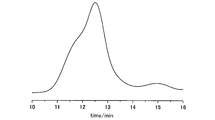
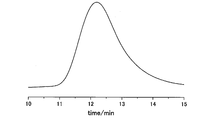
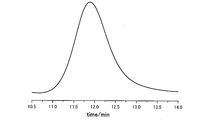
- FIG. 3 is a diagram showing a GPC graph of run1 (no chain transfer agent) shown in Table 2 in Part A-2 of Examples.
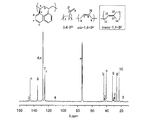
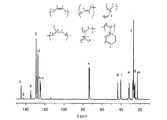
- 5 is a diagram showing a 13 C NMR spectrum of run4 shown in Table 4 in Part C of Examples.
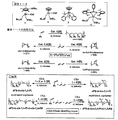
- FIG. It is a figure which shows the structural formula of the complex used for the Example, its general reaction, and reaction of an Example.
- the method for producing a multi-polymer according to the present invention is a method for producing a multi-polymer comprising a repeating unit derived from a first monomer and a repeating unit derived from a second monomer different from the first monomer.
- a catalyst A second catalyst that selectively catalyzes a regioselective or stereoselective polymerization reaction between the second monomers by a polymerization reaction between the first monomers and a polymerization reaction between the first monomer and the second monomer.
- the first catalyst, the second catalyst, the first monomer, the second monomer, and the chain transfer agent are present in the same reaction system to perform a polymerization reaction.
- the first polymer block that is the result of the regioselective or stereoselective polymerization reaction between the first monomers catalyzed by the first catalyst; And obtaining a novel block copolymer comprising a second polymer block that is a result of a regioselective or stereoselective polymerization reaction between the second monomers catalyzed by the second catalyst.
- a novel block copolymer comprising a second polymer block that is a result of a regioselective or stereoselective polymerization reaction between the second monomers catalyzed by the second catalyst.
- the third monomer in addition to the first monomer and the second monomer, another monomer (for convenience, referred to as a third monomer) is added to carry out a polymerization reaction, so It also includes obtaining a multi-component polymer.
- the third monomer is preferably one in which the polymerization reaction is catalyzed by the first catalyst or the second catalyst.
- the combination of the first catalyst, the second catalyst, the first monomer, and the second monomer is determined as follows. Those skilled in the art can determine these combinations based on the following description.
- an arbitrary combination of the first monomer and the second monomer is selected as the monomer constituting the block copolymer.
- a catalyst A first catalyst candidate
- a catalyst B (second catalyst candidate) that catalyzes a regioselective or stereoselective polymerization reaction between the second monomers is selected.
- the catalyst B has the ability to catalyze the polymerization reaction between the first monomers or the ability to catalyze the polymerization reaction between the first monomer and the second monomer. If there is no special report for any ability, it is determined that the second catalyst is suitable.
- the category of the document information includes information on the database.
- the chain transfer agent can be appropriately selected from known ones.
- the multi-component copolymer obtained by the production method of the present invention is preferably a first polymer block obtained by polymerizing the first monomer and a second polymer obtained by polymerizing the second monomer.
- Each block includes at least one block, and both the first polymer block and the second polymer block exhibit predetermined positional regularity or stereoregularity in each block.
- the types of regioregularity and stereoregularity are not particularly limited, and in one aspect, they exhibit properties such as syndiotactic or isotactic, i.e., are not atactic.
- regioregularity and stereoregularity are cis selectivity or transselectivity from another viewpoint.
- regioregularity and stereoregularity are, for example, when a single monomer may be incorporated into a polymer as a plurality of types of repeating units having different chemical structures. It also indicates that only is preferentially selected.
- isoprene may be incorporated into the polymer as cis 1,4 type or iso-3,4 type repeating units, so that the isoprene block in the polymer is substantially of cis 1,4 type.
- the case of being composed only of repeating units is also an example of a case exhibiting positional regularity and stereoregularity.
- the present invention produces a copolymer comprising a polymer block formed by polymerizing a styrene monomer, a polymer block formed by polymerizing isoprene and / or a polymer block formed by polymerizing butadiene.
- a copolymer comprising a polymer block formed by polymerizing a styrene monomer, a polymer block formed by polymerizing isoprene and / or a polymer block formed by polymerizing butadiene.
- Example of production method of multi-component polymer according to the present invention (1) ⁇ Outline of manufacturing method>
- a styrene monomer is used as the first monomer
- isoprene and / or butadiene is used as the second monomer.
- the catalyst composition (A1) mentioned later is used as a 1st catalyst which catalyzes the regioselective or stereoselective polymerization reaction of styrene-type monomers.
- the catalyst composition (B1) mentioned later is used as a 2nd catalyst which catalyzes the regioselective or stereoselective polymerization reaction of isoprene and / or butadiene.
- the catalyst composition (A1) catalyzes a syndiotactic polymerization reaction between styrene monomers, while a polymerization reaction between isoprenes, a polymerization reaction between butadienes, and a polymerization between these and a styrene monomer.
- the selectivity for the reaction is very low (ie there is a clear difference in the polymerization activity).
- the catalyst composition (B1) catalyzes a polymerization reaction between isoprenes or a polymerization reaction between butadienes, selectivity (catalytic effect) with respect to the polymerization reaction between these and a styrene monomer, and a styrene monomer
- selectivity (catalytic effect) for the polymerization reaction between the bodies is very low (that is, a clear difference is seen in the polymerization activity).
- the polymerization reaction is carried out by allowing the catalyst composition (A1), the catalyst composition (B1), the styrene monomer, isoprene and / or butadiene, and the chain transfer agent to be present in the same reaction system.
- the polymerization reaction a multi-polymer comprising a syndiotactic polystyrene block and a polyisoprene block and / or a polybutadiene block provided with a predetermined regioregularity or stereoregularity is obtained.
- the catalyst composition (A1) includes 1) a metatheron complex, and 2) an ionic compound composed of non-coordinating anions and cations.
- the metatheron complex includes a central metal M which is a Group 3 metal atom or a lanthanoid metal atom, a ligand Cp * containing a substituted or unsubstituted cyclopentadienyl derivative bonded to the central metal, a monoanionic ligand Q 1 and Q 2 , and W (W is an integer of 0 to 3) neutral Lewis base L, and the structure is represented by the following general formula (I).
- the complex is preferably a half metallocene complex.
- M is a central metal in a metallocene complex.
- the central metal M is a Group 3 metal or a lanthanoid metal. Since the metallocene complex used in the present invention can be used as one component of the polymerization catalyst composition (A1), the central metal M is appropriately selected depending on the type of monomer to be polymerized. Of these, Group 3 metals are preferable, scandium (Sc) and yttrium (Y) are more preferable, and Sc is more preferable.
- any Group 3 metal or lanthanoid metal may be used.
- the central metal M is Sc, Gd, Y, Lu. And Sc is more preferable.
- Cp * is a ligand containing a cyclopentadienyl derivative and is ⁇ -bonded to the central metal M.
- the ligand is, for example, a non-bridged ligand.
- the non-bridged ligand means a ligand having a coordination atom or a coordination group other than the cyclopentadienyl derivative, wherein the cyclopentadienyl derivative is ⁇ -bonded to the central metal.
- the ligand is, for example, a bridged ligand.
- the bridged ligand means a ligand having a coordination atom or a coordination group in addition to the cyclopentadienyl derivative.
- the substituted or unsubstituted cyclopentadienyl derivative included in Cp * includes a cyclopentadienyl ring having a substituent, a substituted or unsubstituted fluorenyl ring, a substituted or unsubstituted octahydrofluorenyl ring, and a substituted Any one selected from the group consisting of an indenyl ring having a group.
- the most preferred cyclopentadienyl derivative is a cyclopentadienyl ring having a substituent.
- Rx is a hydrocarbyl group having 1 to 20 carbon atoms or a metalloid group substituted with a hydrocarbyl group having 1 to 20 carbon atoms, which is bonded to the carbon atom constituting the skeleton of the cyclopentadienyl ring.
- * represents a bond with M
- n is an integer of 3 to 5.
- One of the carbon atoms constituting the skeleton of the cyclopentadienyl ring shown in the general formula (II) is a group 14 atom (excluding carbon atoms and lead atoms) or a group 15 atom (heteroatom). ) May be substituted.
- Preferred examples of the hetero atom are a nitrogen atom or a phosphorus atom.
- the hydrocarbyl group is preferably a hydrocarbyl group having 1 to 20 carbon atoms, more preferably an alkyl group having 1 to 20 carbon atoms (preferably 1 to 10 carbon atoms, more preferably 1 to 6 carbon atoms), phenyl Group or aryl group such as naphthyl group, benzyl group and the like, and most preferably methyl group.
- the hydrocarbyl group may have a substituent (referred to as a substituted hydrocarbyl group).
- the hydrocarbyl group in the substituted hydrocarbyl group is the same as the hydrocarbyl group described above.
- the substituted hydrocarbyl group is a hydrocarbyl group in which at least one hydrogen atom of the hydrocarbyl group is substituted with a halogen atom, an amide group, a phosphide group, an alkoxy group, an aryloxy group, or the like.
- Examples of the metalloid in the metalloid group substituted with the hydrocarbyl group include germyl (Ge), stannyl (Sn), and silyl (Si).
- the hydrocarbyl group substituted with a metalloid group is the same as the hydrocarbyl group described above, and the number of substitutions is determined by the type of metalloid (for example, in the case of a silyl group, the number of substitutions of the hydrocarbyl group is 3).
- At least one Rx of the cyclopentadienyl ring is a metalloid group (preferably a silyl group) substituted with a hydrocarbyl group, more preferably a trimethylsilyl group.
- n is preferably 4 or 5 and more preferably 5 from the viewpoint of further improving the syndiotacticity of the styrene monomer. More specifically, the cyclopentadienyl ring represented by the general formula (II) is more preferably tetramethyl (trimethylsilyl) cyclopentadienyl, pentamethylcyclopentadienyl, or tetramethylcyclopentadienyl. Tetramethyl (trimethylsilyl) cyclopentadienyl or pentamethylcyclopentadienyl is more preferable.
- One of the carbon atoms constituting the skeleton of the cyclopentadienyl ring shown in the general formula (II) is a group 14 atom (excluding the carbon atom and lead atom) or a group 15 atom (heteroatom). Rx may be bonded to this hetero atom.
- Rx1 is a metalloid substituted with a hydrocarbyl group having 1 to 20 carbon atoms or a hydrocarbyl group having 1 to 20 carbon atoms bonded to a carbon atom constituting a 5-membered skeleton of an indenyl ring.
- * represents a bond with M
- n1 is an integer of 1 to 3.
- the definition of the hydrocarbyl group and metalloid group in general formula (III) is the same as Rx in general formula (II).
- At least one of Rx1 of the indenyl ring is a metalloid group (preferably a silyl group) substituted with a hydrocarbyl group, more preferably a trimethylsilyl group.
- n is preferably 2 or 3, more preferably 3, in the general formula (III). More specifically, in the indenyl ring represented by the general formula (III), n is 3, and all three Rx1 are methyl groups, or two Rx1 are methyl groups and one Rx1 is a trimethylsilyl group. is there.
- the substituted or unsubstituted cyclopentadienyl derivative contained in Cp * is a substituted or unsubstituted fluorenyl ring (composition formula: C 13 H 9-x R x ), or a substituted or unsubstituted octahydrofluorenyl. It may be a ring (composition formula: C 13 H 17-x R x ).
- R is the same as Rx shown in the general formula (II) in the above-described cyclopentadienyl ring
- X is an integer of 0 to 9 or 0 to 17.
- Q 1 and Q 2 are the same or different monoanionic ligands (monoanionic ligands).
- Monoanionic ligands include 1) hydride, 2) halide, 3) substituted or unsubstituted hydrocarbyl group having 1 to 20 carbon atoms, 4) alkoxy group or aryloxy group, 5) amide group, or 6) Examples include, but are not limited to, phosphino groups.
- the category of Q 1 and Q 2 includes CH 2 C 6 H 4 N (CH 3 ) 2 -o and the like.
- Q 1 and Q 2 may be bonded to each other or may be combined to form a so-called dianionic ligand.
- dianionic ligands include alkylidene, dienes, cyclometallated hydrocarbyl groups, and bidentate chelate ligands.
- the halide may be any of chloride, bromide, fluoride and iodide.
- the hydrocarbyl group having 1 to 20 carbon atoms is preferably a methyl group, ethyl group, propyl group, butyl group, amyl group, isoamyl group, hexyl group, isobutyl group, heptyl group, octyl group, nonyl group, decyl group, cetyl group.
- alkyl group such as 2-ethylhexyl group, aryl group such as phenyl group or naphthyl group, unsubstituted hydrocarbyl group such as benzyl group, substituted benzyl group, trialkylsilylmethyl group, bis (trialkylsilyl) methyl group
- hydrocarbyl groups such as Examples of preferred hydrocarbyl groups include substituted or unsubstituted benzyl groups and trialkylsilylmethyl groups, and more preferred examples include ortho-dimethylaminobenzyl groups and trimethylsilylmethyl groups.
- the alkoxy group or aryloxy group is preferably a methoxy group, a substituted or unsubstituted phenoxy group, and the like.
- the amide group is preferably a dimethylamide group, a diethylamide group, a methylethylamide group, a di-t-butylamide group, a diisopropylamide group, an unsubstituted or substituted diphenylamide group, and the like.
- the phosphino group is preferably a diphenylphosphino group, a dicyclohexylphosphino group, a diethylphosphino group, a dimethylphosphino group, or the like.
- the alkylidene is preferably methylidene, ethylidene, propylidene or the like.
- the cyclometallated hydrocarbyl group is preferably propylene, butylene, pentylene, hexylene, octylene or the like.
- the diene is preferably 1,3-butadiene, 1,3-pentadiene, 1,4-pentadiene, 1,3-hexadiene, 1,4-hexadiene, 1,5-hexadiene, 2,4-dimethyl-1, 3-pentadiene, 2-methyl-1,3-hexadiene, 2,4-hexadiene and the like.
- L is a neutral Lewis base.
- Neutral Lewis bases include tetrahydrofuran, diethyl ether, dimethylaniline, trimethylphosphine, lithium chloride and the like.
- L may be bonded to Q 1 and / or Q 2 to form a so-called multidentate ligand.
- W of L W in the general formula (I) represents the number of neutral Lewis bases L.
- w is an integer of 0 to 3, preferably 0 to 1.
- the metallocene complex is prepared by the method described above, for example, (1) Reference: Tardif, O .; Nishiura, M .; Hou, Z. M. Organometallics 22, 1171, (2003)., (2) Reference: Hultzsch , K. C .; Spaniol, T. P .; Okuda, J. Angew. Chem. Int. Ed, 38, 227, (1999). (3) References: International Publication WO2006 / 004068 Pamphlet, (4) Reference: Can be synthesized according to the method described in Japanese Patent Application Publication No. 2008-222780.
- the catalyst composition (A1) contains an ionic compound.
- the ionic compound includes an ionic compound composed of a non-coordinating anion and a cation.
- the ionic compound is combined with the metallocene complex described above to cause the metallocene complex to exhibit activity as a polymerization catalyst. As the mechanism, it can be considered that the ionic compound reacts with the metallocene complex to generate a cationic complex (active species).
- a tetravalent boron anion is preferable, and tetra (phenyl) borate, tetrakis (monofluorophenyl) borate, tetrakis (difluorophenyl) borate, tetrakis (tri Fluorophenyl) borate, tetrakis (trifluorophenyl) borate, tetrakis (pentafluorophenyl) borate, tetrakis (tetrafluoromethylphenyl) borate, tetra (tolyl) borate, tetra (xylyl) borate, (triphenyl, pentafluorophenyl) Examples thereof include borate, [tris (pentafluorophenyl), phenyl] borate, and tridecahydride-7,8-dicarbaoundecaborate.
- tetrakis (pentafluorophenyl) borate is preferred.
- Examples of the cation that is a constituent component of the ionic compound include a carbonium cation, an oxonium cation, an ammonium cation, a phosphonium cation, a cycloheptatrienyl cation, and a ferrocenium cation having a transition metal.
- the carbonium cation include a tri-substituted carbonium cation such as a triphenyl carbonium cation and a tri-substituted phenyl carbonium cation.
- the tri-substituted phenyl carbonium cation include a tri (methylphenyl) carbonium cation and a tri (dimethylphenyl) carbonium cation.
- ammonium cation examples include a trialkylammonium cation, a triethylammonium cation, a tripropylammonium cation, a tributylammonium cation, a trialkylammonium cation such as a tri (n-butyl) ammonium cation, an N, N-dimethylanilinium cation, an N Dialkylammonium cations such as N, N-diethylanilinium cation, N, N-2,4,6-pentamethylanilinium cation, N, N-dialkylanilinium cation, di (isopropyl) ammonium cation, dicyclohexylammonium cation, etc. included.
- phosphonium cation examples include triarylphosphonium cations such as triphenylphosphonium cation, tri (methylphenyl) phosphonium cation, and tri (dimethylphenyl) phosphonium cation.
- anilinium cation or carbonium cation is preferable, and triphenylcarbonium cation is more preferable.
- the ionic compound contained in the catalyst composition of the present invention may be a combination of those selected from the aforementioned non-coordinating anions and cations.
- triphenylcarbonium tetrakis (pentafluorophenyl) borate triphenylcarbonium tetrakis (tetrafluorophenyl) borate, N, N-dimethylanilinium tetrakis (pentafluorophenyl) borate, 1,1′-dimethylferrocete Examples thereof include nium tetrakis (pentafluorophenyl) borate.
- One ionic compound may be used, or two or more ionic compounds may be used in combination.
- triphenylcarbonium tetrakis (pentafluorophenyl) borate are particularly preferred.
- B (C 6 F 5 ) 3 , Al (C 6 F 5 ) 3, etc. which are Lewis acids that can react with transition metal compounds to form cationic transition metal compounds, are used as ionic compounds. These may be used in combination with the ionic compound.
- an alkylaluminum compound (aluminoxane, preferably MAO or MMAO), or a combination of an alkylaluminum compound and a borate compound can also be used as the ionic compound, or may be used in combination with other ionic compounds.
- the monoanionic ligand Q of the complex (general formula (I)) is other than alkyl or hydride (for example, when it is halogen)
- it is an alkylaluminum compound, or a combination of an alkylaluminum compound and a borate compound. It is considered preferable to use
- the catalyst composition of the present invention can contain optional components in addition to the metallocene complex and the ionic compound.
- optional component include alkyl aluminum compounds, silane compounds, hydrogen and the like.
- the alkylaluminum compound usually includes an organoaluminum compound called aluminoxane (alumoxane) used in a metallocene polymerization catalyst.
- aluminoxane aluminoxane
- MAO methylaluminoxane
- silane compound examples include phenylsilane.
- the catalyst composition (A1) includes the metallocene complex and an ionic compound.
- the molar ratio of the ionic compound to the metallocene complex varies depending on the type of the complex and the ionic compound.
- the molar ratio is, for example, 0.5 to 1 when the ionic compound is composed of a carbonium cation and a boron anion (for example, [Ph 3 C] [B (C 6 F 5 ) 4 ]). In the case of MAO or the like, it is preferably about 300 to 4000. If the molar ratio of the ionic compound and the complex is within the above range, the metallocene complex can be sufficiently activated, and the ionic compound and the monomer to be polymerized react undesirably. It is possible to reduce the fear more reliably.
- compositions containing each component such as a metallocene complex and an ionic compound
- each component such as a metallocene complex and an ionic compound
- providing each component separately in the polymerization reaction system By constituting the composition, it can be used as a polymerization catalyst composition.
- “providing as a composition” includes providing a metallocene complex (active species) activated by reaction with an ionic compound.
- the catalyst composition (B1) contains 1) a metatheron complex, and 2) an ionic compound composed of non-coordinating anions and cations.
- the metatheron complex includes a central metal M which is a Group 3 metal atom or a lanthanoid metal atom, a ligand Cp * containing a substituted or unsubstituted cyclopentadienyl derivative bonded to the central metal, a monoanionic ligand Q 1 and Q 2 , and W (W is an integer of 0 to 3) neutral Lewis base L, the structure of which is represented by the above general formula (I) (for general formula (I), the catalyst composition (See column (A1)).
- the complex is preferably a half metallocene complex.
- the ligand Cp * in the general formula (I) is any one selected from the group consisting of a substituted or unsubstituted cyclopentadienyl ring and an unsubstituted indenyl ring.
- Polymerization of a styrene monomer From the viewpoint of reducing the ability to selectively catalyze the reaction and more selectively catalyzing the polymerization reaction between isoprenes or the polymerization reaction between butadienes, the ligand Cp * is an unsubstituted cyclopentadienyl ring or An unsubstituted indenyl ring is preferred, and an unsubstituted cyclopentadienyl ring is more preferred.
- Cp * is a cyclopentadienyl ring having a substituent, it is represented by the following general formula (IV):
- Rx2 represents a hydrocarbyl group having 1 to 3 carbon atoms bonded to the carbon atom constituting the skeleton of the cyclopentadienyl ring, * represents a bond with M, and n2 represents 1 It is an integer of ⁇ 2.
- the hydrocarbyl group is preferably an alkyl group having 1 to 3 carbon atoms, and most preferably a methyl group.
- the hydrocarbyl group may have a substituent (referred to as a substituted hydrocarbyl group).
- the hydrocarbyl group in the substituted hydrocarbyl group is the same as the hydrocarbyl group described above.
- the substituted hydrocarbyl group is a hydrocarbyl group in which at least one hydrogen atom of the hydrocarbyl group is substituted with a halogen atom, an amide group, a phosphide group, an alkoxy group, an aryloxy group, or the like.
- all Rx2 of the cyclopentadienyl ring are methyl groups, more preferably Rx2 is a methyl group and n2 is 1.
- the metallocene complex is synthesized according to the method described above, for example, (1) Reference J.JAm. Chem. Soc, 2009, 131, 13870, (2) Reference WO2006 / 004068. Can do.
- the catalyst composition (B1) contains an ionic compound.
- the ionic compound includes an ionic compound composed of a non-coordinating anion and a cation.
- the ionic compound is combined with the metallocene complex described above to cause the metallocene complex to exhibit activity as a polymerization catalyst.
- the metallocene complex As the mechanism, it can be considered that the ionic compound reacts with the metallocene complex to generate a cationic complex (active species).
- the same thing as what was demonstrated by the catalyst composition (A1) can be used for an ionic compound.
- the polymerization reaction is carried out by adding the catalyst composition (A1) and the catalyst composition (B1) to the same reaction system, one kind of ionic compounds (catalyst compositions (A1) and (B1) and It may be preferable to add a common ionic compound).
- the catalyst composition (B1) includes the metallocene complex and an ionic compound.
- the molar ratio of the ionic compound to the metallocene complex varies depending on the type of the complex and the ionic compound.
- the molar ratio is, for example, 0.5 to 1 when the ionic compound is composed of a carbonium cation and a boron anion (for example, [Ph 3 C] [B (C 6 F 5 ) 4 ]). In the case of MAO or the like, it is preferably about 300 to 4000. If the molar ratio of the ionic compound and the complex is within the above range, the metallocene complex can be sufficiently activated, and the ionic compound and the monomer to be polymerized react undesirably. It is possible to reduce the fear more reliably.
- compositions containing each component such as a metallocene complex and an ionic compound
- each component such as a metallocene complex and an ionic compound
- providing each component separately in the polymerization reaction system By constituting the composition, it can be used as a polymerization catalyst composition.
- “providing as a composition” includes providing a metallocene complex (active species) activated by reaction with an ionic compound.
- a styrene monomer is used as the first monomer, and isoprene and / or butadiene is used as the second monomer.
- the catalyst composition (A1) catalyzes a syndiotactic polymerization reaction exclusively between styrene monomers.
- the catalyst composition (B1) exclusively catalyzes the cis-1,4 polymerization reaction of isoprene and / or butadiene.
- the said styrene-type monomer refers to the substituted styrene which has a substituent on a benzene ring, or an unsubstituted styrene, Especially preferably, it is an unsubstituted styrene (namely, styrene).
- substituted styrene is not specifically limited, The following are illustrated.
- the catalyst composition (B1) can also perform a regioselective or stereoselective polymerization reaction of a conjugated diene other than butadiene.
- conjugated diene is not specifically limited here, For example, it is a chain conjugated diene or a cyclic conjugated diene.
- conjugated dienes examples include isoprene, 1,3-butadiene, 1,3-pentadiene, 1,4-pentadiene, 1,3-hexadiene, 1,4-hexadiene, 1,5-hexadiene, 2, Examples include 4-dimethyl-1,3-pentadiene, 2-methyl-1,3-hexadiene, 2,4-hexadiene, and cyclohexadiene.
- a chain transfer agent refers to an agent that performs a chain transfer reaction that receives a growing polymer chain and returns it back to the polymerization catalyst.
- the type of chain transfer agent is not particularly limited, and examples thereof include trialkylaluminum chain transfer agents such as triisobutylaluminum (TIBA), tripropylaluminum (TPA), and triethylaluminum (TEA); diethylzinc; .
- trialkylaluminum chain transfer agents such as triisobutylaluminum (TIBA), tripropylaluminum (TPA), and triethylaluminum (TEA) are preferable.
- a cis-1,4 polyisoprene and / or polybutadiene polymer block obtained by polymerizing (butadiene) is linked to produce a block multi-component copolymer in which position control or steric control is performed.
- the polymerization reaction is carried out by allowing the catalyst composition (A1), the catalyst composition (B1), the styrene monomer, isoprene and / or butadiene, and the chain transfer agent to be present in the same reaction system. Do it. There are no particular restrictions on the order, method, and the like of supplying these components into the reaction system.
- the polymerization method may be any method such as a gas phase polymerization method, a solution polymerization method, a suspension polymerization method, a liquid phase bulk polymerization method, an emulsion polymerization method, or a solid phase polymerization method.
- the solvent to be used is not particularly limited as long as it is inactive in the polymerization reaction and can dissolve the polymer material and the catalyst.
- saturated aliphatic hydrocarbons such as butane, pentane, hexane and heptane
- saturated alicyclic hydrocarbons such as cyclopentane and cyclohexane
- aromatic hydrocarbons such as benzene and toluene
- Halogenated hydrocarbons such as ethylene, perchlorethylene, 1,2-dichloroethane, chlorobenzene, bromobenzene, chlorotoluene and the like can be mentioned.
- a solvent having low toxicity to a living body is preferable.
- an aromatic hydrocarbon, particularly toluene is preferable.
- the solvent may be used alone or in combination of two or more.
- the amount of the solvent used is arbitrary, but the amount of the metallocene complex contained in the catalyst compositions (A1) and (B1) according to the present invention should be 0.1 to 0.0001 mol / l. preferable.
- the temperature at which the polymerization reaction is performed may be any temperature at which the polymerization reaction proceeds.
- the polymerization temperature can be performed, for example, around room temperature, that is, about 25 ° C.
- the polymerization time is, for example, about several seconds to several hours.
- the polymerization time may be, for example, 1 hour or less, and in some cases 30 minutes or less.
- the amount of the monomer to be subjected to the polymerization reaction can be appropriately set according to the intended multi-polymer to be produced.
- the styrene monomer is preferably 50 times or more and 2500 times or less, and 100 times or more and 1000 times or less in terms of molar ratio with respect to the metallocene complex constituting the catalyst composition (A1). More preferred.
- isoprene and / or butadiene is preferably 50 times or more and 2500 times or less, more preferably 100 times or more and 1000 times or less in molar ratio with respect to the metallocene complex constituting the catalyst composition (B1). More preferred.
- the activity and selectivity of the catalyst can be suitably maintained. Then, by supplying styrene monomer and isoprene and / or butadiene at a molar ratio of 50 times or more with respect to the metathelon complex, a polymer having a certain molecular weight is obtained. The properties of coalescence appear sufficiently.
- the amount of the chain transfer agent used for the polymerization reaction can be appropriately set according to the intended multi-polymer to be produced.
- the amount of the chain transfer agent used is in the range of 1 to 1000 times and in the range of 2 to 100 times in molar ratio with respect to the total of all catalyst compositions. It is preferable.
- a multi-polymer comprising a syndiotactic polystyrene block and a polyisoprene block and / or a polybutadiene block provided with a predetermined regioregularity or stereoregularity (cis-1,4) Is obtained.
- the multi-component copolymer obtained in Example (1) includes a syndiotactic polystyrene block, a polyisoprene block and / or a polybutadiene block provided with a predetermined regioregularity or stereoregularity. including.
- syndiotacticity represented by the polystyrene block is 80 rrrr% (for example, preferably 85 rrrr%, more preferably 90 rrrr%, particularly preferably 95 rrrr%, most preferably 99 rrrr%) in pentad display.
- syndiotacticities can be calculated from data obtained by measuring NMR (particularly 13 C-NMR) of the block multi-polymer of the present invention.
- % represents the percentage of all repeating units derived from polyisoprene and / or polybutadiene in the block multipolymer of the present invention as denominators and the repeating units having a cis-1,4 structure as numerators. It is.
- the number average molecular weight of the multipolymer according to the present invention is not particularly limited, but is, for example, in the range of 1 or more and 10 or less, preferably 1.1 or more and 8 or less, and more preferably 1.2. It is in the range of 5 or less above.
- Example (2) of Multi-Polymer Production Method According to the Present Invention ⁇ Outline of manufacturing method>
- a styrene monomer is used as the first monomer
- isoprene and / or butadiene is used as the second monomer.
- said catalyst composition (A1) is used as a 1st catalyst which catalyzes the regioselective or stereoselective polymerization reaction of styrene-type monomers.
- the catalyst composition (B2) mentioned later is used as a 2nd catalyst which catalyzes the regioselective or stereoselective polymerization reaction of isoprene and / or butadiene.
- the catalyst composition (B2) catalyzes a polymerization reaction between isoprenes or a polymerization reaction between butadienes, while selectivity (catalytic effect) for the polymerization reaction between these and a styrene monomer, and a styrene monomer
- selectivity (catalytic effect) for the polymerization reaction between the bodies is very low (that is, a clear difference is seen in the polymerization activity).
- the said catalyst composition (A1), the said catalyst composition (B2), a styrene-type monomer, isoprene and / or butadiene, and a chain transfer agent are made to exist in the same reaction system, and a polymerization reaction is performed.
- a polymerization reaction a multi-polymer comprising a syndiotactic polystyrene block and a polyisoprene block and / or a polybutadiene block provided with a predetermined regioregularity or stereoregularity is obtained.
- the catalyst composition (A1), styrene monomer (first monomer), isoprene and / or butadiene (second monomer), and chain transfer agent are the same as those described in [2. The same thing as what was demonstrated in the example of the manufacturing method of the multi-component polymer which concerns on this invention (1)] column can be used. Therefore, in the following description, the catalyst composition (B2) will be mainly described.
- the catalyst composition (B2) contains 1) a metathelone complex, and 2) an ionic compound composed of non-coordinating anions and cations.
- the metatheron complex includes a central metal M which is a Group 3 metal atom or a lanthanoid metal atom, and a ligand Cp * containing a substituted or unsubstituted cyclopentadienyl derivative bonded to the central metal,
- the structure is represented by Formula (VI).
- the complex is preferably a half metallocene complex.
- the ligand Cp * in the general formula (VI) reduces the ability to selectively catalyze the polymerization reaction of the styrene monomer.
- the ligand Cp * is preferably an unsubstituted cyclopentadienyl ring or an unsubstituted indenyl ring. An unsubstituted cyclopentadienyl ring is more preferred.
- the metallocene complex represented by the general formula (VI) is obtained by the above-described method, for example, (1) Reference: International Publication WO 2006/004068 Pamphlet, (2) Reference: Japan Published Patent Publication JP-A-2008-222780. It can be synthesized with reference to the method described.
- the catalyst composition (B2) contains an ionic compound.
- the ionic compound includes an ionic compound composed of a non-coordinating anion and a cation.
- the ionic compound is combined with the metallocene complex described above to cause the metallocene complex to exhibit activity as a polymerization catalyst.
- the ionic compound reacts with the metallocene complex to generate a cationic complex (active species).
- the same thing as what was demonstrated by the catalyst composition (A1) can be used for an ionic compound.
- the polymerization reaction is performed by adding the catalyst composition (A1) and the catalyst composition (B2) to the same reaction system, one kind of ionic compound (catalyst composition (A1) and (B2) and It may be preferable to add a common ionic compound).
- the catalyst composition (B2) includes the metallocene complex and an ionic compound.
- the molar ratio of the ionic compound to the metallocene complex varies depending on the type of the complex and the ionic compound.
- the molar ratio is, for example, 0.5 to 1 when the ionic compound is composed of a carbonium cation and a boron anion (for example, [Ph 3 C] [B (C 6 F 5 ) 4 ]). In the case of MAO or the like, it is preferably about 300 to 4000. If the molar ratio of the ionic compound and the complex is within the above range, the metallocene complex can be sufficiently activated, and the ionic compound and the monomer to be polymerized react undesirably. It is possible to reduce the fear more reliably.
- compositions containing each component such as a metallocene complex and an ionic compound
- each component such as a metallocene complex and an ionic compound
- providing each component separately in the polymerization reaction system By constituting the composition, it can be used as a polymerization catalyst composition.
- “providing as a composition” includes providing a metallocene complex (active species) activated by reaction with an ionic compound.
- the polymerization reaction is carried out by allowing the catalyst composition (A1), the catalyst composition (B2), the styrenic monomer, isoprene and / or butadiene, and the chain transfer agent to be present in the same reaction system. Do it. There are no particular restrictions on the order, method, and the like of supplying these components into the reaction system.
- the kind and amount of the solvent used in the case of the polymerization method and the solution polymerization method the temperature at which the polymerization reaction is carried out (polymerization temperature), the polymerization time, the amount of the monomer to be subjected to the polymerization reaction, and the chain transfer agent to be subjected to the polymerization reaction
- the amount of [2. The same conditions as described in the column (Example (1)) for producing the multi-component polymer according to the present invention can be applied.
- a multi-polymer comprising a syndiotactic polystyrene block and a polyisoprene block and / or a polybutadiene block provided with a predetermined regioregularity or stereoregularity (cis-1,4) Is obtained.
- the multi-component copolymer obtained in Example (2) includes a syndiotactic polystyrene block, a polyisoprene block and / or a polybutadiene block provided with a predetermined regioregularity or stereoregularity. including.
- syndiotacticity represented by the polystyrene block is 80 rrrr% (for example, preferably 85 rrrr%, more preferably 90 rrrr%, particularly preferably 95 rrrr%, most preferably 99 rrrr%) in pentad display.
- syndiotacticities can be calculated from data obtained by measuring NMR (particularly 13 C-NMR) of the block multi-polymer of the present invention.
- % represents the percentage of all repeating units derived from polyisoprene and / or polybutadiene in the block multipolymer of the present invention as denominators and the repeating units having a cis-1,4 structure as numerators. It is.
- the number average molecular weight of the multipolymer according to the present invention is not particularly limited, but is, for example, in the range of 1 or more and 10 or less, preferably 1.1 or more and 8 or less, and more preferably 1.2. It is in the range of 5 or less above.
- Still another example (3) of the method for producing a multi-component polymer according to the present invention ⁇ Outline of manufacturing method>
- a styrene monomer is used as the first monomer
- isoprene and / or butadiene is used as the second monomer.
- said catalyst composition (A1) is used as a 1st catalyst which catalyzes the regioselective or stereoselective polymerization reaction of styrene-type monomers.
- the catalyst composition (B3) mentioned later is used as a 2nd catalyst which catalyzes the regioselective or stereoselective polymerization reaction of isoprene and / or butadiene.
- the catalyst composition (B3) catalyzes a polymerization reaction between isoprenes or a polymerization reaction between butadienes, selectivity (catalytic effect) with respect to the polymerization reaction between these and a styrene monomer, and a styrene monomer
- selectivity (catalytic effect) for the polymerization reaction between the bodies is very low (that is, a clear difference is seen in the polymerization activity).
- the said catalyst composition (A1), the said catalyst composition (B3), a styrene-type monomer, isoprene and / or butadiene, and a chain transfer agent are made to exist in the same reaction system, and a polymerization reaction is performed.
- a polymerization reaction a multi-polymer comprising a syndiotactic polystyrene block and a polyisoprene block and / or a polybutadiene block provided with a predetermined regioregularity or stereoregularity is obtained.
- the catalyst composition (A1), styrene monomer (first monomer), isoprene and / or butadiene (second monomer), and chain transfer agent are the same as those described in [2. The same thing as what was demonstrated in the example of the manufacturing method of the multi-component polymer which concerns on this invention (1)] column can be used. Therefore, in the following description, the catalyst composition (B3) will be mainly described.
- the catalyst composition (B3) includes 1) a complex represented by the general formula (V), and 2) an ionic compound composed of a non-coordinating anion and cation.
- the complex includes a central metal M which is any of rare earth elements from lanthanum (La) to lutetium (Lu) excluding scandium (Sc), yttrium (Y) or promethium Pm; monoanionic ligands Q 1 and Q 2 And W (W is an integer of 0 to 3) neutral Lewis bases L;
- M is a central metal in the complex.
- the central metal M is any of rare earth elements from lanthanum (La) to lutetium (Lu) excluding scandium (Sc), yttrium (Y) or promethium Pm. Since the complex used in the present invention can be used as one component of the polymerization catalyst composition (B3), the central metal M is appropriately selected depending on the type of monomer to be polymerized. Among these, scandium Sc, yttrium Y or lutetium Lu is preferable, and scandium Sc or yttrium Y is particularly preferable.
- R 1 and R 2 each independently represents an alkyl group, a substituted or unsubstituted cyclohexyl group, an aryl group, or an aralkyl group.
- alkyl group include a methyl group, an ethyl group, an isopropyl group, an n-butyl group, and a t-butyl group.
- substituted cyclohexyl group include a cyclohexyl group having an alkyl group as a substituent, for example, a methylcyclohexyl group.
- the unsubstituted aryl group include a phenyl group.
- Examples of the substituted aryl group include a phenyl group having an alkyl group as a substituent.
- Examples of the unsubstituted aralkyl group include a benzyl group.
- Examples of the substituted aralkyl group include a benzyl group having an alkyl group as a substituent.
- phenyl having an alkyl group as a substituent is preferable, and 2,6-diisopropylphenyl group is particularly preferable.
- R 1 and R 2 may be the same or different, but both R 1 and R 2 are preferably phenyl groups having an alkyl group as a substituent, and both are preferably 2,6-diisopropylphenyl groups. preferable.
- R 3 is an alkyl group, alkenyl group, alkynyl group, aryl group or aralkyl group, aliphatic, aromatic or cyclic amino group, or phosphino group, boryl group, alkyl or arylthio group, alkoxy group or An aryloxy group is shown. Among these, an aryl group is preferable, and a phenyl group is particularly preferable.
- the complex represented by the general formula (V) can be prepared by the above-described method, for example, (1) Reference: Japanese Published Patent Publication No. 2007-238857, (2) Reference: Japanese Published Patent Publication No. 2008- It can be synthesized with reference to the method described in No. 222791.
- the catalyst composition (B3) contains an ionic compound.
- the ionic compound includes an ionic compound composed of a non-coordinating anion and a cation.
- the ionic compound is combined with the complex described above to cause the complex to exhibit activity as a polymerization catalyst. As the mechanism, it can be considered that the ionic compound reacts with the complex to form a cationic complex (active species).
- the same thing as what was demonstrated by the catalyst composition (A1) can be used for an ionic compound.
- the polymerization reaction is performed by adding the catalyst composition (A1) and the catalyst composition (B3) to the same reaction system, one kind of ionic compound (catalyst composition (A1) and (B3) and It may be preferable to add a common ionic compound).
- the catalyst composition (B3) includes the complex and an ionic compound.
- the molar ratio of the ionic compound to the complex varies depending on the type of the complex and the ionic compound.
- the molar ratio is, for example, 0.5 to 1 when the ionic compound is composed of a carbonium cation and a boron anion (for example, [Ph 3 C] [B (C 6 F 5 ) 4 ]). In the case of MAO or the like, it is preferably about 300 to 4000. If the molar ratio of the ionic compound and the complex is within the above range, the complex can be sufficiently activated, and the ionic compound and the monomer to be polymerized may cause an undesirable reaction. Can be more reliably reduced.
- a composition containing each component is provided in the polymerization reaction system, or 2) each component is separately provided in the polymerization reaction system, and the composition in the reaction system By constituting the product, it can be used as a polymerization catalyst composition.
- “providing as a composition” includes providing a complex (active species) activated by reaction with an ionic compound.
- the polymerization reaction is carried out by allowing the catalyst composition (A1), the catalyst composition (B3), the styrenic monomer, isoprene and / or butadiene, and the chain transfer agent to be present in the same reaction system. Do it. There are no particular restrictions on the order, method, and the like of supplying these components into the reaction system.
- the kind and amount of the solvent used in the case of the polymerization method and the solution polymerization method the temperature at which the polymerization reaction is carried out (polymerization temperature), the polymerization time, the amount of the monomer to be subjected to the polymerization reaction, and the chain transfer agent to be subjected to the polymerization reaction
- the amount of [2. The same conditions as described in the column (Example (1)) for producing the multi-component polymer according to the present invention can be applied.
- a multi-polymer comprising a syndiotactic polystyrene block and a polyisoprene block and / or a polybutadiene block provided with a predetermined regioregularity or stereoregularity is obtained.
- the positional regularity or stereoregularity of the polyisoprene block is iso-3,4, and the positional regularity or stereoregularity of the polybutadiene block is a repeating unit derived from 1,2-butadiene (see also FIG. 17).
- the multi-polymer obtained in Example (3) is composed of a syndiotactic polystyrene block and a polyisoprene block and / or a polybutadiene block given a predetermined regioregularity or stereoregularity. Including.
- syndiotacticity represented by the polystyrene block is 80 rrrr% (for example, preferably 85 rrrr%, more preferably 90 rrrr%, particularly preferably 95 rrrr%, most preferably 99 rrrr%) in pentad display.
- syndiotacticities can be calculated from data obtained by measuring NMR (particularly 13 C-NMR) of the block multi-polymer of the present invention.
- An example of the proportion of the iso-3,4 structure in the polyisoprene block is 60% or more, preferably 70% or more, more preferably 80% or more.
- “%” represents the percentage of all repeating units derived from polyisoprene in the block multi-polymer of the present invention as the denominator and the repeating units having the iso-3,4 structure as the numerator.
- An example of the proportion of the 1,2-butadiene-derived repeating unit in the polybutadiene block is 60% or more, preferably 70% or more, and more preferably 80% or more.
- “%” represents the percentage of all repeating units derived from polybutadiene in the block multi-polymer of the present invention as a denominator and the repeating units having a 1,2-butadiene-derived repeating unit structure as a numerator. .
- the number average molecular weight of the multipolymer according to the present invention is not particularly limited, but is, for example, in the range of 1 or more and 10 or less, preferably 1.1 or more and 8 or less, and more preferably 1.2. It is in the range of 5 or less above.
- Still another example (4) of the method for producing a multi-component polymer according to the present invention In this example (4), a styrene monomer is used as the first monomer, and isoprene and / or butadiene is used as the second monomer.
- the first catalyst for catalyzing the regioselective or stereoselective polymerization reaction between styrene monomers the above catalyst composition (A1) or an ansa-metallocene neodymium catalyst (ansa-neodimocene catalyst) ) Is used.
- the ansa-metallocene-based neodymium catalysts include those described in references J. Am. Chem. Soc., 2004, 126 (39), 12240. Thereby, a syndiotactic polystyrene block is formed.
- the first catalyst, the second catalyst, the first monomer, the second monomer, and the chain transfer agent are present in the same reaction system to perform the polymerization reaction.
- a multi-polymer comprising a syndiotactic polystyrene block and a polyisoprene block and / or a polybutadiene block provided with a predetermined regioregularity or stereoregularity is obtained.
- Part A1-1 Synthesis of Syndiotactic Polystyrene-Block-cis-1,4-Polyisoprene Block Copolymer
- Part A1-1 syndiotactic Polystyrene-block-cis- using cationic scandium dialkyl complexes (1) and (2) in the presence of TIBA or TPA
- TIBA or TPA cationic scandium dialkyl complexes
- Example 1 A typical polymerization reaction is shown below (Table 1, run 1).
- the mixture was stirred at room temperature for 2 minutes and a monomer mixture containing 1.04 g (10 mmol) styrene and 0.68 g (10 mmol) isoprene in 28 mL toluene was added to the flask.
- the copolymerization reaction was performed for 4 hours, the flask was removed from the glove box, and 10 mL of methanol was added to complete the polymerization reaction.
- the mixture was poured into methanol (400 mL) to precipitate the polymer product.
- the polymer was collected by filtration and vacuum dried at 60 ° C. until a constant weight was obtained.
- Example 2 A typical polymerization reaction is shown below (Table 1, run 2).
- Example 5 The copolymerization procedure and conditions (Table 1, run 5) are similar to Example 2 except that a monomer mixture containing 0.52 g (5 mmol) styrene and 1.36 g (20 mmol) isoprene was used. .
- Example 6 The copolymerization procedure and conditions (Table 1, run 6) are similar to Example 2 except that a monomer mixture containing 0.52 g (5 mmol) styrene and 2.04 g (30 mmol) isoprene was used. .
- Example 7 The copolymerization procedure and conditions (Table 1, run 7) are similar to Example 3 except that a monomer mixture containing 1.04 g (10 mmol) styrene and 1.36 g (20 mmol) isoprene was used. .
- TPA tripropyl-aluminum
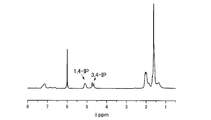
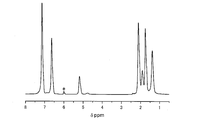
- FIG. 3 shows the 1 H NMR spectrum of run1 (without chain transfer agent) in Table 1.
- FIG. 6 shows a DSC curve of the block copolymer (run 3 in Table 1).
- Part A1-2 Synthesis of Syndiotactic Polystyrene-Block-cis-1,4-Polyisoprene Block Copolymer
- a block-1,4-polyisoprene block copolymer was synthesized. The results of synthesis, reaction conditions, etc. are summarized in Table 2.
- the copolymerization reaction was performed for 4 hours, the flask was removed from the glove box, and 10 mL of methanol was added to complete the polymerization reaction. The mixture was poured into methanol (400 mL) to precipitate the polymer product. The polymer was collected by filtration and vacuum dried at 60 ° C. until a constant weight was obtained.
- Example 2 A typical polymerization reaction is shown below (Table 2, run 2).
- Example 2 is the same as Example 2 except that a monomer mixture containing is used.
- Example 2 is the same as Example 2 except that a monomer mixture containing is used.
- FIG. 7 shows a GPC graph of run1 (without chain transfer agent) in Table 2.
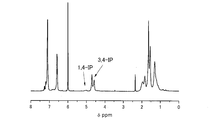
- FIG. 9 shows the 1 H NMR spectrum of run1 (without chain transfer agent) in Table 2.
- Part B Synthesis of Syndiotactic Polystyrene-Block-3,4-Polyisoprene Block Copolymer
- Part B syndiotactic polystyrene-block-3,4-in the presence of TIBA or TPA using cationic scandium alkyl complexes (1) and (4) as shown in Examples 1-7 below.
- a polyisoprene block copolymer was synthesized. The synthesis results, reaction conditions, etc. are summarized in Table 3.
- Example 1 A typical polymerization reaction is shown below (Table 3, run 1). A toluene solution (4 ml) of [Ph 3 C] [B (C 6 F 5 ) 4 ] (36 mg, 40 ⁇ mol) in a 100 mL flask at 25 ° C.
- the mixture was stirred at room temperature for 2 minutes and a monomer mixture containing 1.04 g (10 mmol) styrene and 0.68 g (10 mmol) isoprene in 28 mL toluene was added to the flask.
- the copolymerization reaction was performed for 4 hours, the flask was removed from the glove box, and 10 mL of methanol was added to complete the polymerization reaction.
- the mixture was poured into methanol (400 mL) to precipitate the polymer product.
- the polymer was collected by filtration and vacuum dried at 60 ° C. until a constant weight was obtained.
- Example 2 A typical polymerization reaction is shown below (Table 3, run 2).
- Example 4 The copolymerization procedure and conditions (Table 3, run 4) were similar to Example 3 except that a monomer mixture containing 1.04 g (10 mmol) styrene and 1.36 g (20 mmol) isoprene was used. .
- Example 2 is the same as Example 2 except that a monomer mixture containing is used.
- TPA tripropyl-aluminum
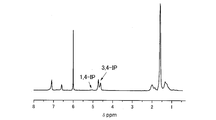
- FIG. 11 shows the 1 H NMR spectrum of run1 (without chain transfer agent) in Table 3.
- Part C Synthesis of Syndiotactic Polystyrene-Block-1,4-Polyisoprene-Block-1,4-Polybutadiene Block Copolymer
- Synthesis of block-1,4-polybutadiene block copolymer and syndiotactic polystyrene-block-3,4-polyisoprene-block-1,2-polybutadiene was carried out. The synthesis results, reaction conditions, etc. are summarized in Table 4.
- Example 1 A typical polymerization reaction is shown below (Table 4, run 1).
- the mixture is stirred at room temperature for 2 minutes and a monomer mixture containing 1.04 g (10 mmol) styrene, 0.68 g (10 mmol) isoprene, and 0.54 g (10 mmol) butadiene in 48 mL toluene is added to the flask. It was.
- the copolymerization reaction was performed for 0.5 hour, the flask was removed from the glove box, and 10 mL of methanol was added to complete the polymerization reaction.
- the mixture was poured into methanol (400 mL) to precipitate the polymer product.
- the polymer was collected by filtration and vacuum dried at 60 ° C. until a constant weight was obtained.
- Example 2 A typical polymerization reaction is shown below (Table 4, run 2).
- Example 4 The copolymerization procedure and conditions (Table 4, run 4) used a monomer mixture containing 1.04 g (10 mmol) styrene, 0.68 g (10 mmol) isoprene, and 1.14 g (20 mmol) butadiene.
- Table 4, run 4 The copolymerization procedure and conditions (Table 4, run 4) used a monomer mixture containing 1.04 g (10 mmol) styrene, 0.68 g (10 mmol) isoprene, and 1.14 g (20 mmol) butadiene.
- Table 4 The copolymerization procedure and conditions (Table 4, run 4) used a monomer mixture containing 1.04 g (10 mmol) styrene, 0.68 g (10 mmol) isoprene, and 1.14 g (20 mmol) butadiene.
- the third embodiment is the same as the third embodiment.
- Example 5 The copolymerization procedure and conditions (Table 4, run 5) used a monomer mixture containing 1.04 g (10 mmol) of styrene, 1.36 g (20 mmol) of isoprene and 0.57 g (10 mmol) of butadiene.
- Table 4, run 5 The copolymerization procedure and conditions (Table 4, run 5) used a monomer mixture containing 1.04 g (10 mmol) of styrene, 1.36 g (20 mmol) of isoprene and 0.57 g (10 mmol) of butadiene.
- Table 4 The copolymerization procedure and conditions (Table 4, run 5) used a monomer mixture containing 1.04 g (10 mmol) of styrene, 1.36 g (20 mmol) of isoprene and 0.57 g (10 mmol) of butadiene.
- the second embodiment is the same as the second embodiment.
- FIG. 16 shows the 13 C NMR spectrum of run4 in Table 4.
- FIG. 17 shows the structural formulas of the cationic scandium dialkyl complexes (1), (2), (4), and the scandium aminobenzyl complex (3) used in the above examples, their general reactions, and the reactions of the examples. Indicated.
- complexes 1, 2, and 4 correspond to the cationic scandium dialkyl complexes (1), (2), and (4), respectively
- complex 3 corresponds to the scandium aminobenzyl complex (3).
- the metal complexes 1d, 1e, 3d and 3e were found to be particularly suitable for syndiotactic polystyrene synthesis from the viewpoint of their catalytic activity and stereoselectivity (Table 5, Runs 4-6, Run10- 12).
- methoxyphenyl-bonded metal complex 2 also had very high catalytic activity for polystyrene synthesis under the same reaction conditions, and remarkably high selectivity for syndiotactic steric structures.
- the metal complexes 1a, 1b, 3a, and 3b are more excellent in reactivity with isoprene or butadiene, and a polymer that gives a predetermined regioregularity or stereoregularity can be obtained.
- the metal complex 3b ((C 5 H 4 Me) Sc (CH 2 C 6 H 4 NMe 2 -o) 2 ) was prepared as follows.
- a multi-polymer that is highly position-controlled or stereo-controlled and a method for producing the same.
Landscapes
- Chemical & Material Sciences (AREA)
- Health & Medical Sciences (AREA)
- Chemical Kinetics & Catalysis (AREA)
- Medicinal Chemistry (AREA)
- Polymers & Plastics (AREA)
- Organic Chemistry (AREA)
- Inorganic Chemistry (AREA)
- Addition Polymer Or Copolymer, Post-Treatments, Or Chemical Modifications (AREA)
- Transition And Organic Metals Composition Catalysts For Addition Polymerization (AREA)
- Polymerization Catalysts (AREA)
- Graft Or Block Polymers (AREA)
Priority Applications (3)
| Application Number | Priority Date | Filing Date | Title |
|---|---|---|---|
| EP12782831.7A EP2708562A4 (de) | 2011-05-09 | 2012-05-09 | Herstellungsverfahren für mehrdimensionale polymere und mehrdimensionales polymer |
| JP2013514042A JPWO2012153786A1 (ja) | 2011-05-09 | 2012-05-09 | 多元重合体の製造方法、および多元重合体 |
| US14/116,105 US20140088276A1 (en) | 2011-05-09 | 2012-05-09 | Manufacturing method for multidimensional polymer, and multidimensional polymer |
Applications Claiming Priority (2)
| Application Number | Priority Date | Filing Date | Title |
|---|---|---|---|
| JP2011-104790 | 2011-05-09 | ||
| JP2011104790 | 2011-05-09 |
Publications (1)
| Publication Number | Publication Date |
|---|---|
| WO2012153786A1 true WO2012153786A1 (ja) | 2012-11-15 |
Family
ID=47139262
Family Applications (1)
| Application Number | Title | Priority Date | Filing Date |
|---|---|---|---|
| PCT/JP2012/061922 Ceased WO2012153786A1 (ja) | 2011-05-09 | 2012-05-09 | 多元重合体の製造方法、および多元重合体 |
Country Status (4)
| Country | Link |
|---|---|
| US (1) | US20140088276A1 (de) |
| EP (1) | EP2708562A4 (de) |
| JP (1) | JPWO2012153786A1 (de) |
| WO (1) | WO2012153786A1 (de) |
Cited By (2)
| Publication number | Priority date | Publication date | Assignee | Title |
|---|---|---|---|---|
| CN103554365A (zh) * | 2013-10-11 | 2014-02-05 | 大连理工大学 | 一类基于稀土催化体系丁二烯异戊二烯二元共聚物及其制备方法 |
| WO2025225220A1 (ja) * | 2024-04-26 | 2025-10-30 | デンカ株式会社 | ブロック共重合体、樹脂組成物及び樹脂ペレット |
Families Citing this family (6)
| Publication number | Priority date | Publication date | Assignee | Title |
|---|---|---|---|---|
| US11208502B2 (en) * | 2017-03-15 | 2021-12-28 | Dow Global Technologies Llc | Catalyst system for multi-block coploymer formation |
| EP3596146B1 (de) * | 2017-03-15 | 2023-07-19 | Dow Global Technologies LLC | Katalysatorsystem für mehrblockcopolymerbildung |
| JP7627274B2 (ja) | 2020-01-31 | 2025-02-05 | ダウ グローバル テクノロジーズ エルエルシー | グループiii及びランタニドビス-フェニル-フェノキシ金属-配位子錯体 |
| EP4097152B1 (de) | 2020-01-31 | 2025-09-03 | Dow Global Technologies LLC | Polymerisationsverfahren, die gruppe iii und lanthanid-bis-phenylphenoxy metall-ligand-komplexe und kettenübertragungsmittel einschliessen |
| EP4263642B1 (de) * | 2020-12-18 | 2025-01-22 | Dow Global Technologies LLC | Doppelreaktorketten-shuttling-reaktionen für ethylen-/vinylaren-diblock- und triblock-interpolymere |
| EP4263629A1 (de) * | 2020-12-18 | 2023-10-25 | Dow Global Technologies LLC | Kettenübertragungsreaktionen in einem einzigen reaktor für ethylen-/vinylaren-multiblockinterpolymere |
Citations (16)
| Publication number | Priority date | Publication date | Assignee | Title |
|---|---|---|---|---|
| WO2000018808A1 (en) | 1998-09-30 | 2000-04-06 | Exxon Chemical Patents Inc. | Cationic group 3 catalyst system |
| JP2000313710A (ja) | 1999-03-04 | 2000-11-14 | Inst Of Physical & Chemical Res | 触媒組成物 |
| JP2001064313A (ja) | 1999-08-27 | 2001-03-13 | Inst Of Physical & Chemical Res | 触媒組成物 |
| JP2001288234A (ja) | 2000-04-07 | 2001-10-16 | Inst Of Physical & Chemical Res | ブロック共重合体の製造方法 |
| JP2002069117A (ja) | 2000-08-30 | 2002-03-08 | Inst Of Physical & Chemical Res | 触媒組成物 |
| JP2002187908A (ja) | 2000-12-19 | 2002-07-05 | Nippon Zeon Co Ltd | 共役ジエン重合触媒及び共役ジエン系重合体の製造方法 |
| JP2002256012A (ja) | 2001-02-28 | 2002-09-11 | Inst Of Physical & Chemical Res | 重合用触媒 |
| JP2002348342A (ja) * | 2001-05-25 | 2002-12-04 | Idemitsu Petrochem Co Ltd | スチレン系重合体、その製造方法及び該重合体を含む熱可塑性樹脂組成物 |
| JP2003292513A (ja) | 2002-03-29 | 2003-10-15 | Inst Of Physical & Chemical Res | 触媒組成物 |
| JP2004027103A (ja) | 2002-06-27 | 2004-01-29 | Inst Of Physical & Chemical Res | 触媒組成物 |
| JP2004027179A (ja) | 2002-05-08 | 2004-01-29 | Inst Of Physical & Chemical Res | 重合用触媒 |
| JP2004238637A (ja) | 2002-05-08 | 2004-08-26 | Institute Of Physical & Chemical Research | 重合用触媒 |
| WO2006004068A1 (ja) | 2004-07-02 | 2006-01-12 | Riken | メタロセン錯体を含む重合触媒組成物、およびそれを用いて製造される重合体 |
| JP2007238857A (ja) | 2006-03-10 | 2007-09-20 | Institute Of Physical & Chemical Research | イソプレン系化合物の重合用の重合触媒組成物 |
| JP2008222780A (ja) | 2007-03-09 | 2008-09-25 | Institute Of Physical & Chemical Research | 複素環配位子を含む金属錯体、及びそれを含む重合触媒組成物 |
| JP2008222791A (ja) | 2007-03-09 | 2008-09-25 | Institute Of Physical & Chemical Research | イソプレン系化合物の重合用の重合触媒組成物 |
Family Cites Families (2)
| Publication number | Priority date | Publication date | Assignee | Title |
|---|---|---|---|---|
| US7858706B2 (en) * | 2004-03-17 | 2010-12-28 | Dow Global Technologies Inc. | Catalyst composition comprising shuttling agent for ethylene multi-block copolymer formation |
| KR20080055837A (ko) * | 2005-09-15 | 2008-06-19 | 다우 글로벌 테크놀로지스 인크. | 중합가능한 셔틀링제를 통한 촉매성 올레핀 블럭 공중합체 |
-
2012
- 2012-05-09 WO PCT/JP2012/061922 patent/WO2012153786A1/ja not_active Ceased
- 2012-05-09 JP JP2013514042A patent/JPWO2012153786A1/ja active Pending
- 2012-05-09 US US14/116,105 patent/US20140088276A1/en not_active Abandoned
- 2012-05-09 EP EP12782831.7A patent/EP2708562A4/de not_active Withdrawn
Patent Citations (16)
| Publication number | Priority date | Publication date | Assignee | Title |
|---|---|---|---|---|
| WO2000018808A1 (en) | 1998-09-30 | 2000-04-06 | Exxon Chemical Patents Inc. | Cationic group 3 catalyst system |
| JP2000313710A (ja) | 1999-03-04 | 2000-11-14 | Inst Of Physical & Chemical Res | 触媒組成物 |
| JP2001064313A (ja) | 1999-08-27 | 2001-03-13 | Inst Of Physical & Chemical Res | 触媒組成物 |
| JP2001288234A (ja) | 2000-04-07 | 2001-10-16 | Inst Of Physical & Chemical Res | ブロック共重合体の製造方法 |
| JP2002069117A (ja) | 2000-08-30 | 2002-03-08 | Inst Of Physical & Chemical Res | 触媒組成物 |
| JP2002187908A (ja) | 2000-12-19 | 2002-07-05 | Nippon Zeon Co Ltd | 共役ジエン重合触媒及び共役ジエン系重合体の製造方法 |
| JP2002256012A (ja) | 2001-02-28 | 2002-09-11 | Inst Of Physical & Chemical Res | 重合用触媒 |
| JP2002348342A (ja) * | 2001-05-25 | 2002-12-04 | Idemitsu Petrochem Co Ltd | スチレン系重合体、その製造方法及び該重合体を含む熱可塑性樹脂組成物 |
| JP2003292513A (ja) | 2002-03-29 | 2003-10-15 | Inst Of Physical & Chemical Res | 触媒組成物 |
| JP2004027179A (ja) | 2002-05-08 | 2004-01-29 | Inst Of Physical & Chemical Res | 重合用触媒 |
| JP2004238637A (ja) | 2002-05-08 | 2004-08-26 | Institute Of Physical & Chemical Research | 重合用触媒 |
| JP2004027103A (ja) | 2002-06-27 | 2004-01-29 | Inst Of Physical & Chemical Res | 触媒組成物 |
| WO2006004068A1 (ja) | 2004-07-02 | 2006-01-12 | Riken | メタロセン錯体を含む重合触媒組成物、およびそれを用いて製造される重合体 |
| JP2007238857A (ja) | 2006-03-10 | 2007-09-20 | Institute Of Physical & Chemical Research | イソプレン系化合物の重合用の重合触媒組成物 |
| JP2008222780A (ja) | 2007-03-09 | 2008-09-25 | Institute Of Physical & Chemical Research | 複素環配位子を含む金属錯体、及びそれを含む重合触媒組成物 |
| JP2008222791A (ja) | 2007-03-09 | 2008-09-25 | Institute Of Physical & Chemical Research | イソプレン系化合物の重合用の重合触媒組成物 |
Non-Patent Citations (6)
| Title |
|---|
| ANDREIA VALENTE ET AL.: "Catalytic chain transfer (co-)polymerization: unprecedented polyisoprene CCG and a new concept to tune the composition of a statistical copolymer", MACROMOLECULAR RAPID COMMUNICATIONS, vol. 30, no. 7, 2009, pages 528 - 531, XP055135110 * |
| D. J. ARRIOLA; E. M. CARNAHAN; P. D. HUSTAD; R. L. KUHLMAN; T. T. WENZEL, SCIENCE, vol. 312, 2006, pages 714 |
| HULTZSCH, K. C.; SPANIOL, T. P.; OKUDA, J., ANGEW. CHEM. INT. ED, vol. 38, 1999, pages 227 |
| J. AM. CHEM. SOC., vol. 126, no. 39, 2004, pages 12240 |
| See also references of EP2708562A4 * |
| TARDIF, O.; NISHIURA, M.; HOU, Z. M., ORGANOMETALLICS, vol. 22, 2003, pages 1171 |
Cited By (2)
| Publication number | Priority date | Publication date | Assignee | Title |
|---|---|---|---|---|
| CN103554365A (zh) * | 2013-10-11 | 2014-02-05 | 大连理工大学 | 一类基于稀土催化体系丁二烯异戊二烯二元共聚物及其制备方法 |
| WO2025225220A1 (ja) * | 2024-04-26 | 2025-10-30 | デンカ株式会社 | ブロック共重合体、樹脂組成物及び樹脂ペレット |
Also Published As
| Publication number | Publication date |
|---|---|
| US20140088276A1 (en) | 2014-03-27 |
| JPWO2012153786A1 (ja) | 2014-07-31 |
| EP2708562A1 (de) | 2014-03-19 |
| EP2708562A4 (de) | 2014-12-10 |
Similar Documents
| Publication | Publication Date | Title |
|---|---|---|
| WO2012153786A1 (ja) | 多元重合体の製造方法、および多元重合体 | |
| Huang et al. | Precisely controlled polymerization of styrene and conjugated dienes by group 3 single‐site catalysts | |
| JP3624290B2 (ja) | 重合用触媒 | |
| EP1764375A1 (de) | Metallocenkomplexe enthaltende polymerisationskatalysatorzusammensetzungen und damit hergestellte polymere | |
| EP3121187B1 (de) | Metallocenkomplexe und verfahren zur herstellung von olefinpolymeren | |
| CA2462348A1 (en) | Metal complex compositions and their use as catalysts to produce polydienes | |
| JPH05186527A (ja) | スチレン系重合体の製造方法及びその触媒 | |
| JP5035864B2 (ja) | メタロセン錯体、およびそれを含む重合触媒組成物 | |
| Annunziata et al. | Chain growth polymerization of isoprene and stereoselective isoprene–styrene copolymerization promoted by an ansa-bis (indenyl) allyl–yttrium complex | |
| JP2004532320A (ja) | 金属錯体触媒の使用により製造されたランダムまたはブロック共重合体または三元重合体 | |
| KR101725349B1 (ko) | 혼성 담지 촉매 및 이를 이용하는 올레핀 중합체의 제조 방법 | |
| JP6176015B2 (ja) | メタロセン錯体およびオレフィンの重合方法 | |
| ES2222655T3 (es) | Polimero en bloque de estireno-butadieno. | |
| US6683140B2 (en) | Catalyst for polymerization | |
| JPS5927901A (ja) | 1,3‐ジエンモノマーの重合又は共重合用触媒 | |
| JP2000154221A (ja) | 共役ジエン系ブロック共重合体の製造方法、共役ジエン系ブロック共重合体、およびブタジエン系ブロック共重合体 | |
| JPWO2005085306A1 (ja) | アイソタクチック3,4−イソプレン系重合体 | |
| JP6613987B2 (ja) | メタロセン錯体、オレフィン重合用触媒、およびオレフィン重合体の製造方法 | |
| ES2225142T3 (es) | Procedimiento para la obtencion e soluciones de caucho en solucion de estireno con catalizadores de quelatos estericamente exigentes. | |
| JP2008222780A (ja) | 複素環配位子を含む金属錯体、及びそれを含む重合触媒組成物 | |
| US6960631B2 (en) | Catalyst composition and process for producing copolymer | |
| JP2014025043A (ja) | ペンタジエン単独又は共重合体の製造方法及びペンタジエン単独又は共重合体 | |
| JP2001064313A (ja) | 触媒組成物 | |
| JP2011190288A (ja) | ブロック共重合体の製造方法、それに用いる触媒組成物、およびブロック共重合体 | |
| JPH11286509A (ja) | 共役ジエン系共重合体の製造方法 |
Legal Events
| Date | Code | Title | Description |
|---|---|---|---|
| 121 | Ep: the epo has been informed by wipo that ep was designated in this application |
Ref document number: 12782831 Country of ref document: EP Kind code of ref document: A1 |
|
| ENP | Entry into the national phase |
Ref document number: 2013514042 Country of ref document: JP Kind code of ref document: A |
|
| NENP | Non-entry into the national phase |
Ref country code: DE |
|
| WWE | Wipo information: entry into national phase |
Ref document number: 2012782831 Country of ref document: EP |
|
| WWE | Wipo information: entry into national phase |
Ref document number: 14116105 Country of ref document: US |