WO2012157049A1 - Dispositif de commande de climatiseur - Google Patents
Dispositif de commande de climatiseur Download PDFInfo
- Publication number
- WO2012157049A1 WO2012157049A1 PCT/JP2011/061093 JP2011061093W WO2012157049A1 WO 2012157049 A1 WO2012157049 A1 WO 2012157049A1 JP 2011061093 W JP2011061093 W JP 2011061093W WO 2012157049 A1 WO2012157049 A1 WO 2012157049A1
- Authority
- WO
- WIPO (PCT)
- Prior art keywords
- air
- battery
- air conditioner
- amount
- passenger compartment
- Prior art date
- Legal status (The legal status is an assumption and is not a legal conclusion. Google has not performed a legal analysis and makes no representation as to the accuracy of the status listed.)
- Ceased
Links
Images

Classifications
-
- B—PERFORMING OPERATIONS; TRANSPORTING
- B60—VEHICLES IN GENERAL
- B60H—ARRANGEMENTS OF HEATING, COOLING, VENTILATING OR OTHER AIR-TREATING DEVICES SPECIALLY ADAPTED FOR PASSENGER OR GOODS SPACES OF VEHICLES
- B60H1/00—Heating, cooling or ventilating devices
- B60H1/00271—HVAC devices specially adapted for particular vehicle parts or components and being connected to the vehicle HVAC unit
- B60H1/00278—HVAC devices specially adapted for particular vehicle parts or components and being connected to the vehicle HVAC unit for the battery
-
- B—PERFORMING OPERATIONS; TRANSPORTING
- B60—VEHICLES IN GENERAL
- B60L—PROPULSION OF ELECTRICALLY-PROPELLED VEHICLES; SUPPLYING ELECTRIC POWER FOR AUXILIARY EQUIPMENT OF ELECTRICALLY-PROPELLED VEHICLES; ELECTRODYNAMIC BRAKE SYSTEMS FOR VEHICLES IN GENERAL; MAGNETIC SUSPENSION OR LEVITATION FOR VEHICLES; MONITORING OPERATING VARIABLES OF ELECTRICALLY-PROPELLED VEHICLES; ELECTRIC SAFETY DEVICES FOR ELECTRICALLY-PROPELLED VEHICLES
- B60L1/00—Supplying electric power to auxiliary equipment of vehicles
- B60L1/003—Supplying electric power to auxiliary equipment of vehicles to auxiliary motors, e.g. for pumps, compressors
-
- B—PERFORMING OPERATIONS; TRANSPORTING
- B60—VEHICLES IN GENERAL
- B60L—PROPULSION OF ELECTRICALLY-PROPELLED VEHICLES; SUPPLYING ELECTRIC POWER FOR AUXILIARY EQUIPMENT OF ELECTRICALLY-PROPELLED VEHICLES; ELECTRODYNAMIC BRAKE SYSTEMS FOR VEHICLES IN GENERAL; MAGNETIC SUSPENSION OR LEVITATION FOR VEHICLES; MONITORING OPERATING VARIABLES OF ELECTRICALLY-PROPELLED VEHICLES; ELECTRIC SAFETY DEVICES FOR ELECTRICALLY-PROPELLED VEHICLES
- B60L1/00—Supplying electric power to auxiliary equipment of vehicles
- B60L1/02—Supplying electric power to auxiliary equipment of vehicles to electric heating circuits
-
- B—PERFORMING OPERATIONS; TRANSPORTING
- B60—VEHICLES IN GENERAL
- B60L—PROPULSION OF ELECTRICALLY-PROPELLED VEHICLES; SUPPLYING ELECTRIC POWER FOR AUXILIARY EQUIPMENT OF ELECTRICALLY-PROPELLED VEHICLES; ELECTRODYNAMIC BRAKE SYSTEMS FOR VEHICLES IN GENERAL; MAGNETIC SUSPENSION OR LEVITATION FOR VEHICLES; MONITORING OPERATING VARIABLES OF ELECTRICALLY-PROPELLED VEHICLES; ELECTRIC SAFETY DEVICES FOR ELECTRICALLY-PROPELLED VEHICLES
- B60L58/00—Methods or circuit arrangements for monitoring or controlling batteries or fuel cells, specially adapted for electric vehicles
- B60L58/10—Methods or circuit arrangements for monitoring or controlling batteries or fuel cells, specially adapted for electric vehicles for monitoring or controlling batteries
- B60L58/12—Methods or circuit arrangements for monitoring or controlling batteries or fuel cells, specially adapted for electric vehicles for monitoring or controlling batteries responding to state of charge [SoC]
-
- B—PERFORMING OPERATIONS; TRANSPORTING
- B60—VEHICLES IN GENERAL
- B60L—PROPULSION OF ELECTRICALLY-PROPELLED VEHICLES; SUPPLYING ELECTRIC POWER FOR AUXILIARY EQUIPMENT OF ELECTRICALLY-PROPELLED VEHICLES; ELECTRODYNAMIC BRAKE SYSTEMS FOR VEHICLES IN GENERAL; MAGNETIC SUSPENSION OR LEVITATION FOR VEHICLES; MONITORING OPERATING VARIABLES OF ELECTRICALLY-PROPELLED VEHICLES; ELECTRIC SAFETY DEVICES FOR ELECTRICALLY-PROPELLED VEHICLES
- B60L58/00—Methods or circuit arrangements for monitoring or controlling batteries or fuel cells, specially adapted for electric vehicles
- B60L58/10—Methods or circuit arrangements for monitoring or controlling batteries or fuel cells, specially adapted for electric vehicles for monitoring or controlling batteries
- B60L58/24—Methods or circuit arrangements for monitoring or controlling batteries or fuel cells, specially adapted for electric vehicles for monitoring or controlling batteries for controlling the temperature of batteries
- B60L58/26—Methods or circuit arrangements for monitoring or controlling batteries or fuel cells, specially adapted for electric vehicles for monitoring or controlling batteries for controlling the temperature of batteries by cooling
-
- B—PERFORMING OPERATIONS; TRANSPORTING
- B60—VEHICLES IN GENERAL
- B60L—PROPULSION OF ELECTRICALLY-PROPELLED VEHICLES; SUPPLYING ELECTRIC POWER FOR AUXILIARY EQUIPMENT OF ELECTRICALLY-PROPELLED VEHICLES; ELECTRODYNAMIC BRAKE SYSTEMS FOR VEHICLES IN GENERAL; MAGNETIC SUSPENSION OR LEVITATION FOR VEHICLES; MONITORING OPERATING VARIABLES OF ELECTRICALLY-PROPELLED VEHICLES; ELECTRIC SAFETY DEVICES FOR ELECTRICALLY-PROPELLED VEHICLES
- B60L7/00—Electrodynamic brake systems for vehicles in general
- B60L7/10—Dynamic electric regenerative braking
- B60L7/18—Controlling the braking effect
-
- H—ELECTRICITY
- H01—ELECTRIC ELEMENTS
- H01M—PROCESSES OR MEANS, e.g. BATTERIES, FOR THE DIRECT CONVERSION OF CHEMICAL ENERGY INTO ELECTRICAL ENERGY
- H01M10/00—Secondary cells; Manufacture thereof
- H01M10/60—Heating or cooling; Temperature control
- H01M10/61—Types of temperature control
- H01M10/613—Cooling or keeping cold
-
- H—ELECTRICITY
- H01—ELECTRIC ELEMENTS
- H01M—PROCESSES OR MEANS, e.g. BATTERIES, FOR THE DIRECT CONVERSION OF CHEMICAL ENERGY INTO ELECTRICAL ENERGY
- H01M10/00—Secondary cells; Manufacture thereof
- H01M10/60—Heating or cooling; Temperature control
- H01M10/66—Heat-exchange relationships between the cells and other systems, e.g. central heating systems or fuel cells
- H01M10/663—Heat-exchange relationships between the cells and other systems, e.g. central heating systems or fuel cells the system being an air-conditioner or an engine
-
- B—PERFORMING OPERATIONS; TRANSPORTING
- B60—VEHICLES IN GENERAL
- B60H—ARRANGEMENTS OF HEATING, COOLING, VENTILATING OR OTHER AIR-TREATING DEVICES SPECIALLY ADAPTED FOR PASSENGER OR GOODS SPACES OF VEHICLES
- B60H1/00—Heating, cooling or ventilating devices
- B60H1/00271—HVAC devices specially adapted for particular vehicle parts or components and being connected to the vehicle HVAC unit
- B60H2001/003—Component temperature regulation using an air flow
-
- B—PERFORMING OPERATIONS; TRANSPORTING
- B60—VEHICLES IN GENERAL
- B60L—PROPULSION OF ELECTRICALLY-PROPELLED VEHICLES; SUPPLYING ELECTRIC POWER FOR AUXILIARY EQUIPMENT OF ELECTRICALLY-PROPELLED VEHICLES; ELECTRODYNAMIC BRAKE SYSTEMS FOR VEHICLES IN GENERAL; MAGNETIC SUSPENSION OR LEVITATION FOR VEHICLES; MONITORING OPERATING VARIABLES OF ELECTRICALLY-PROPELLED VEHICLES; ELECTRIC SAFETY DEVICES FOR ELECTRICALLY-PROPELLED VEHICLES
- B60L2240/00—Control parameters of input or output; Target parameters
- B60L2240/10—Vehicle control parameters
- B60L2240/12—Speed
-
- B—PERFORMING OPERATIONS; TRANSPORTING
- B60—VEHICLES IN GENERAL
- B60L—PROPULSION OF ELECTRICALLY-PROPELLED VEHICLES; SUPPLYING ELECTRIC POWER FOR AUXILIARY EQUIPMENT OF ELECTRICALLY-PROPELLED VEHICLES; ELECTRODYNAMIC BRAKE SYSTEMS FOR VEHICLES IN GENERAL; MAGNETIC SUSPENSION OR LEVITATION FOR VEHICLES; MONITORING OPERATING VARIABLES OF ELECTRICALLY-PROPELLED VEHICLES; ELECTRIC SAFETY DEVICES FOR ELECTRICALLY-PROPELLED VEHICLES
- B60L2240/00—Control parameters of input or output; Target parameters
- B60L2240/10—Vehicle control parameters
- B60L2240/34—Cabin temperature
-
- B—PERFORMING OPERATIONS; TRANSPORTING
- B60—VEHICLES IN GENERAL
- B60L—PROPULSION OF ELECTRICALLY-PROPELLED VEHICLES; SUPPLYING ELECTRIC POWER FOR AUXILIARY EQUIPMENT OF ELECTRICALLY-PROPELLED VEHICLES; ELECTRODYNAMIC BRAKE SYSTEMS FOR VEHICLES IN GENERAL; MAGNETIC SUSPENSION OR LEVITATION FOR VEHICLES; MONITORING OPERATING VARIABLES OF ELECTRICALLY-PROPELLED VEHICLES; ELECTRIC SAFETY DEVICES FOR ELECTRICALLY-PROPELLED VEHICLES
- B60L2240/00—Control parameters of input or output; Target parameters
- B60L2240/40—Drive Train control parameters
- B60L2240/54—Drive Train control parameters related to batteries
- B60L2240/545—Temperature
-
- B—PERFORMING OPERATIONS; TRANSPORTING
- B60—VEHICLES IN GENERAL
- B60L—PROPULSION OF ELECTRICALLY-PROPELLED VEHICLES; SUPPLYING ELECTRIC POWER FOR AUXILIARY EQUIPMENT OF ELECTRICALLY-PROPELLED VEHICLES; ELECTRODYNAMIC BRAKE SYSTEMS FOR VEHICLES IN GENERAL; MAGNETIC SUSPENSION OR LEVITATION FOR VEHICLES; MONITORING OPERATING VARIABLES OF ELECTRICALLY-PROPELLED VEHICLES; ELECTRIC SAFETY DEVICES FOR ELECTRICALLY-PROPELLED VEHICLES
- B60L2260/00—Operating Modes
- B60L2260/40—Control modes
- B60L2260/50—Control modes by future state prediction
- B60L2260/56—Temperature prediction, e.g. for pre-cooling
-
- Y—GENERAL TAGGING OF NEW TECHNOLOGICAL DEVELOPMENTS; GENERAL TAGGING OF CROSS-SECTIONAL TECHNOLOGIES SPANNING OVER SEVERAL SECTIONS OF THE IPC; TECHNICAL SUBJECTS COVERED BY FORMER USPC CROSS-REFERENCE ART COLLECTIONS [XRACs] AND DIGESTS
- Y02—TECHNOLOGIES OR APPLICATIONS FOR MITIGATION OR ADAPTATION AGAINST CLIMATE CHANGE
- Y02E—REDUCTION OF GREENHOUSE GAS [GHG] EMISSIONS, RELATED TO ENERGY GENERATION, TRANSMISSION OR DISTRIBUTION
- Y02E60/00—Enabling technologies; Technologies with a potential or indirect contribution to GHG emissions mitigation
- Y02E60/10—Energy storage using batteries
-
- Y—GENERAL TAGGING OF NEW TECHNOLOGICAL DEVELOPMENTS; GENERAL TAGGING OF CROSS-SECTIONAL TECHNOLOGIES SPANNING OVER SEVERAL SECTIONS OF THE IPC; TECHNICAL SUBJECTS COVERED BY FORMER USPC CROSS-REFERENCE ART COLLECTIONS [XRACs] AND DIGESTS
- Y02—TECHNOLOGIES OR APPLICATIONS FOR MITIGATION OR ADAPTATION AGAINST CLIMATE CHANGE
- Y02T—CLIMATE CHANGE MITIGATION TECHNOLOGIES RELATED TO TRANSPORTATION
- Y02T10/00—Road transport of goods or passengers
- Y02T10/60—Other road transportation technologies with climate change mitigation effect
- Y02T10/70—Energy storage systems for electromobility, e.g. batteries
Definitions
- the present invention is mounted on a vehicle that cools a battery with air sucked from a passenger compartment, blows air taken from the passenger compartment or outside the passenger compartment to the passenger compartment, and air inside the passenger compartment and air outside the passenger compartment. It is related with the control apparatus of the air conditioner which can switch the air taken in into the outside air which is.
- the air conditioner installed in the vehicle heats and cools the passenger compartment by heating and cooling the air taken in from the passenger compartment and outside the passenger compartment as necessary and blowing it to the passenger compartment.
- the vehicle is provided with two air intake ports, an internal air intake port for taking in air inside the vehicle interior, that is, internal air, and an outside air intake port for taking in air outside the vehicle interior, that is, outside air. Whether air is taken into the air conditioner from the air intake can be switched.
- Patent Document 1 a device described in Patent Document 1 is known as a control device for an air conditioner that is applied to a vehicle that cools a battery with the inside air.
- the air conditioner control device described in this document switches the air intake port of the air conditioner to the outside air intake port when the battery becomes hot, and changes the direction of the outside air cooled by the air conditioner for battery cooling. The air is directed to the suction port for sucking air.
- Such a control device for a conventional air conditioner is certainly effective in improving the cooling capacity of a battery that has become too hot.
- the cooling performance of the battery is considered, the power saving performance of the entire vehicle is not sufficiently considered, so there is still room for improvement in improving the efficiency of power use. Yes.
- This invention is made
- the objective is to provide the control apparatus of the air conditioner which can aim at the further improvement of an electric power balance through selection of the air taken in into an air conditioner. .
- an air conditioner control device is mounted on a vehicle that cools a battery with air sucked from a passenger compartment, and blows air taken from the passenger compartment or outside the passenger compartment into the passenger compartment.
- a control device for an air conditioner capable of switching between air taken into the vehicle interior air and air outside the vehicle compartment, the amount of electric power charged in the battery through regeneration and the air conditioning The air intake is selected by selecting the one with the better power balance with the amount of power consumed by the apparatus.
- the power consumption of the air conditioner varies depending on whether the inside air or outside air is taken in. For example, if the temperature of the outside air is higher than the temperature of the inside air, the cooling capacity of the air conditioner must be increased if the cooling is performed by taking in the higher temperature outside air than when the cooling is performed by taking in the lower temperature inside air. The power consumption increases.
- the amount of power charged in the battery through regeneration varies depending on whether inside air or outside air is taken into the air conditioner. Sometimes. This is due to the following reason.
- the temperature of the air sucked from the suction port changes between when the outside air is taken into the air conditioner and when the inside air is taken. And if the temperature of the air suck
- the amount of charge of the battery is limited to protect the battery, and it becomes impossible to charge the battery with all the electric power generated by the regeneration. Therefore, the amount of electric power charged in the battery through regeneration varies depending on whether the air to be taken in is inside air or outside air.
- the power consumption of the air conditioner and the regenerative power of the battery change depending on whether the inside air or the outside air is taken into the air conditioner.
- the power consumption of the air conditioner and the regenerative power of the battery The power balance, that is, the value obtained by subtracting the amount of power consumed by the air conditioner from the amount of power charged to the battery through regeneration also changes.
- the air intake is performed by selecting the better one of the inside air and the outside air that has a better power balance. Therefore, the power balance can be further improved through the selection of the air taken into the air conditioner.
- improvement of the power balance may be given priority or battery protection may be given priority.
- the battery temperature state and its cooling efficiency vary depending on the vehicle running conditions and environment, even if the above judgment value is appropriate under certain conditions, the value is inappropriate if the vehicle usage changes. It may become. Even in such a case, such a judgment value may be reduced as the frequency of the battery temperature becomes higher, or may be reduced as the ratio between the time when the battery is hot and the total traveling time of the vehicle is increased. For example, it is possible to optimize the balance between the improvement of the power balance and the protection of the battery in accordance with the temperature condition of the battery.
- another air conditioner control device is mounted on a vehicle that cools a battery with air sucked from the passenger compartment, and the air taken in from the passenger compartment or outside the passenger compartment is taken into the passenger compartment.
- the control device of the air conditioner capable of switching the intake air between the inside air and the outside air, the amount of increase in the regenerative power amount, which is the amount of power charged in the battery through regeneration, is changed by switching the intake air.
- the air to be taken in is switched when the air-conditioning power consumption that is the amount of power consumed by the air is exceeded.
- the switching is performed when the increase amount of the regenerative electric power according to the switching of the air taken into the air conditioner exceeds the increase amount of the air conditioning power consumption. Therefore, in the present invention, air having a better power balance is selected from the outside air and the inside air, and air is taken in, and the power balance is further improved through selection of air to be taken into the air conditioner. be able to.
- the amount of electric power generated by regeneration can be predicted from the standard deviation of the vehicle speed and the average vehicle speed. Therefore, using the predicted value of the amount of electric power generated by regeneration, which is obtained based on the standard deviation of the vehicle speed and the average vehicle speed, the amount of increase in the regenerative power amount of the battery when the air taken into the air conditioner is switched By performing the calculation, the power balance can be improved more effectively.
- control apparatus of the air conditioner which concerns on this Embodiment is applied to the air conditioner mounted in the hybrid vehicle provided with two drive sources, an electric motor and an internal combustion engine.
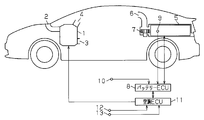
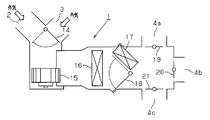
- an air conditioner 1 mounted on a hybrid vehicle has an outside air intake port 2 for taking in air outside the vehicle, that is, outside air, and air inside the vehicle, that is, inside air, as air intake ports. Two air intake ports, the inside air intake port 3 for intake, are provided.
- the air conditioner 1 heats or cools the air taken in from any one of these air intakes, and sends the air to the vehicle compartment from the air outlet 4 opened in the vehicle compartment.
- this hybrid vehicle is equipped with a battery 5 that stores electric power supplied to an electric motor or the like.
- the hybrid vehicle is provided with a battery cooling blower 7 for blowing air sucked from a suction port 6 opened in the vehicle compartment to the battery 5 in order to cool the battery 5.
- the battery 5 is controlled by a battery ECU (Electronic Control Unit) 8.
- the battery ECU 8 monitors the state of the battery 5 and performs control so that the charged state is appropriately maintained.
- the battery ECU 8 receives detection results such as a battery temperature sensor 9 that detects the temperature of the battery 5 and a vehicle speed sensor 10 that detects the vehicle speed.
- the battery ECU 8 is connected to an air conditioning ECU 11 that controls the air conditioner 1 through an in-vehicle network.
- the air conditioning ECU 11 receives detection results such as an outside air temperature sensor 12 that detects the temperature of the outside air and an inside air temperature sensor 13 that detects the temperature of the inside air.
- the air conditioner 1 is provided with an inside / outside air switching door 14 for switching between the outside air inlet 2 and the inside air inlet 3 to take in air, and downstream thereof.
- a blower 15 for taking in and blowing out air is installed.
- a cooler evaporator 16 for cooling the air taken in by the heat of vaporization due to the evaporation of the refrigerant is provided downstream of the blower 15. Further, downstream of the cooler evaporator 16, the mixing ratio of the heater unit 17 that heats the air taken in by the exhaust heat of the internal combustion engine and the cool air cooled by the cooler evaporator 16 and the warm air heated by the heater unit 17 is changed.
- An air mix door 18 is provided downstream of the cooler evaporator 16.
- the air conditioner 1 has a defroster 4a for blowing the temperature-adjusted air on the window to remove the fogging, and the temperature-adjusted air.
- a defroster 4a for blowing the temperature-adjusted air on the window to remove the fogging, and the temperature-adjusted air.
- mode switching doors 19 to 21 are provided for switching the air outlet that performs air blowing.
- the switching of the air intake port of the air conditioner 1 between the outside air intake port 2 and the inside air intake port 3 is automatically performed according to the situation at that time. To be done. Further, when the air conditioner 1 is operated in the manual mode, the air intake is switched manually by operating the air conditioning operation panel of the occupant. In such a case, the air intake can be switched as necessary. Switching may be forced. In the present embodiment, such switching control of the air intake port of the air conditioner 1 is performed by the battery ECU 8. Hereinafter, details of such air intake port selection control of the battery ECU 8 will be described.
- the load on the air conditioner 1 can be reduced and the power consumption can be reduced.
- the air conditioner 1 when the air conditioner 1 is operated, the temperature of the inside air is brought close to the set temperature of the air conditioner 1, so that the air conditioner 1 is taking in the inside air rather than taking in the outside air. The amount of power consumption is reduced.
- the hybrid vehicle equipped with the control device for the air conditioner according to the present embodiment power is generated by regeneration of the electric motor when the vehicle is decelerated or braked, and the generated power is charged in the battery 5. .
- the inside air is sent to the battery 5, thereby cooling the battery 5.
- the temperature of the air sucked from the suction port 6 for cooling the battery 5 changes depending on whether the inside air or the outside air is taken into the air conditioner 1. In which case the temperature of the air sucked from the suction port 6 becomes lower depends on the position where the suction port 6 is installed, but in this hybrid vehicle, the outside air is taken in more than when the inside air is taken in. The temperature of the air sprayed on the battery 5 becomes lower when the vehicle is on.
- the amount of charge of the battery 5 is limited in order to avoid a decrease in the durability of the battery 5 due to overheating.
- the amount of charge of the battery 5 is limited, only a part of the power generated by regeneration can be charged to the battery 5, and the amount of power charged to the battery 5 through regeneration (hereinafter referred to as regenerative power amount) is reduced. It will decrease.
- the air intake port of the air conditioner 1 is switched in consideration of only the power consumption of the air conditioner 1 or only the cooling capacity of the battery 5. However, it is necessary to switch the air intake port in consideration of the total power balance.
- the battery ECU 8 selects the air intake ECU 11 to select the one that improves the power balance between the regenerative power amount of the battery 5 and the power consumption amount of the air conditioner 1 from the inside air and the outside air. To let them do it. More specifically, the battery ECU 8 calculates the amount of increase in the amount of regenerative power of the battery 5 and the amount of power consumption of the air conditioner 1 when the air intake is switched. The battery ECU 8 switches the air intake port when the increase amount of the regenerative power amount of the battery 5 exceeds the increase amount of the power consumption amount of the air conditioner 1, and otherwise, the air intake amount The mouth is not switched.
- the increase amount A of the power consumption of the air conditioner 1 (hereinafter referred to as air conditioning power consumption) by switching the air intake port is calculated by the air conditioning ECU 11 in the following manner.
- the increase amount A when calculating the increase amount A, first, the current air-conditioning power consumption LB is measured. Next, when the air intake port is switched, the temperature of the air taken into the air conditioner 1 is measured, and the air intake port is switched based on the difference between the measured air temperature and the set temperature of the air conditioner 1. The air conditioning power consumption amount LA is calculated. Then, the increase A is calculated as a value obtained by subtracting the current air conditioning power consumption LB from the air conditioning power consumption LA when the air intake port is switched. The increase amount A calculated by the air conditioning ECU 11 is transmitted to the battery ECU 8 through the in-vehicle network.
- the increase amount B of the regenerative power generation amount of the battery 5 due to the switching of the air intake port is calculated by the battery ECU 8 in the following manner.
- the charge limit value Win of the battery 5 is a value indicating the upper limit value of the charge amount of the battery 5 that is currently allowed.
- the battery temperature TBA when the air intake port is switched is estimated, and the charge limit value Win (NEW) when the air intake port is switched is calculated from the estimated value.
- the amount of power generated by regeneration of the electric motor (hereinafter referred to as regenerative power generation amount RP) is predicted.
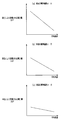
- the regenerative power generation amount RP is predicted in the following manner. Since the regenerative power generation of the electric motor is performed when the vehicle is decelerated or braked, the regenerative power generation amount RP increases as the vehicle speed increases or decreases more. The increase / decrease degree of the vehicle speed can be obtained from the standard deviation of the vehicle speed and the average vehicle speed.
- the vehicle speed standard deviation ⁇ is large (FIG. 3 (a)), medium (FIG. 3 (b)), and small (FIG. 3 (c)) per unit time.
- a calculation map showing the relationship between the average vehicle speed and the amount of regenerative power generation RP is provided. These calculation maps are obtained from the experimental results and are stored in the memory of the battery ECU 8. Then, using a calculation map corresponding to the standard deviation ⁇ of the current vehicle speed per unit time, a future regenerative power generation amount RP predicted from the current average vehicle speed per unit time is obtained.
- a future regenerative electric energy RB that is predicted when the air intake is not switched is calculated from the current charge limit value Win (NOW) and the predicted regenerative electric power generation RP.
- the future regenerative electric energy RA predicted when the air intake is switched is calculated from the charge limit value Win (NEW) when the air intake is switched and the regenerative power generation amount RP.
- the smaller the charging limit value Win, that is, the more severe the restriction on charging of the battery 5 the smaller the ratio between the regenerative power amounts RB and RA and the regenerative power generation amount RP.
- the increase amount B is calculated as a value obtained by subtracting the regenerative power amount RB when the air intake port is not switched from the regenerative power amount RA when the air intake port is switched.
- the increase amount A of the air-conditioning power consumption by switching the air intake port of the air conditioner 1 and the increase amount B of the regenerative power amount of the battery 5 are calculated.
- the battery ECU 8 determines whether or not to switch the air intake port of the air conditioner 1 according to the magnitude relationship between the increase amount A and the increase amount B.
- the battery ECU 8 instructs the air conditioning ECU 11 to switch the air intake port.
- the battery ECU 8 does not instruct the air conditioning ECU 11 to switch the air intake port, and maintains the air intake port of the air conditioner 1 as it is.
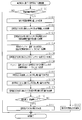
- the flowchart shown in FIG. 5 shows the processing procedure of the battery ECU 8 in the air intake selection control based on such a power balance. Note that the processing of this flowchart is repeatedly executed by the battery ECU 8 at regular control intervals.
- step S100 it is first determined in step S100 whether or not the air conditioner 1 is in operation. If the air conditioner 1 is stopped (S100: NO), the current process is terminated as it is.
- the current air conditioning power consumption LB is measured in step S101.
- the air-conditioning power consumption LA when the air intake port is switched is calculated.
- the air conditioning power consumption per unit time when the air intake port is switched as a value obtained by subtracting the current air conditioning power consumption amount LB from the air conditioning power consumption amount LA when the air intake port is switched. An amount increase A is calculated.
- next step S104 the current battery temperature TBB is measured, and the current charge limit value Win (NOW) is calculated from the measured value.
- the battery temperature TBA when the air intake port is switched is estimated, and in the subsequent step S106, the charge limit value Win (NEW) when the air intake port is switched is calculated from the estimated value. Calculated.
- the regenerative electric energy RB of the battery 5 when the air intake port of the air conditioner 1 is maintained as it is is predicted from the current charge limit value Win (NOW) and the regenerative electric power generation RP. .
- the regenerative power amount of the battery 5 when the air intake port of the air conditioner 1 is switched from the charge limit value Win (NEW) when the air intake port is switched and the regenerative power generation amount RP. RA is predicted.
- the increase amount B of the regenerative power amount of the battery 5 when the air intake port is switched is calculated as a value obtained by subtracting the regenerative power amount RB from the regenerative power amount RA.
- step S110 the increase amount A of the air-conditioning power consumption per unit time when the air intake port is switched is subtracted from the increase amount B of the regenerative power amount of the battery 5 when the air intake port is switched. It is determined whether or not the value (BA) is a positive value.
- the value obtained by subtracting the increase amount A from the increase amount B (BA) here means an increase in the power balance between the regenerative power amount of the battery 5 and the air conditioning power consumption amount when the air intake port is switched.
- the value represents the quantity.
- Step S112 if the value obtained by subtracting the increase amount A from the increase amount B is a positive value (S110: YES), the air intake port is switched through a command to the air conditioning ECU 11 in step S111. On the other hand, if the value obtained by subtracting the increase A from the increase B is not a positive value (S110: NO), the air intake is not switched, and as a result, the current air intake is maintained ( Step S112).
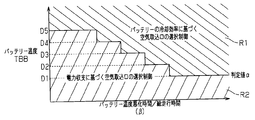
- the battery ECU 8 at this time does not perform the air intake switching control considering the improvement of the power balance as described above, and the cooling efficiency of the battery 5 from the outside air intake 2 and the inside air intake 3 is determined.
- the air conditioner 1 is made to take in air by selecting the one that becomes better. Specifically, when the current battery temperature TBB is higher than the determination value ⁇ , an air conditioner is selected from the outside air intake port 2 and the inside air intake port 3 to select a better cooling efficiency of the battery 5. 1 air is taken in.
- the air intake selection control is switched from the control based on the power balance to the control based on the cooling efficiency of the battery 5.
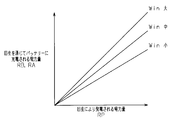
- the determination value ⁇ is set to a smaller value as the frequency at which the battery temperature TBB becomes higher is higher.
- the ratio ⁇ between the time when the battery 5 is at a high temperature (battery temperature deterioration time) and the total travel time of the vehicle is used. ing. For example, as shown in FIG. 6, when the ratio ⁇ increases, the determination value ⁇ is set to a smaller value. Thereafter, when the ratio ⁇ decreases, the determination value ⁇ is returned to a larger value.
- the selection is switched. That is, as the ratio ⁇ increases, the determination value ⁇ is set to a smaller value, and air intake selection control based on the cooling efficiency of the battery 5 is performed at a lower battery temperature TBB.
- air is taken in by selecting a better one in the power balance between the regenerative power amount of the battery 5 and the air-conditioning power consumption, among the inside air and the outside air. More specifically, the amount of increase in the regenerative power amount and the air conditioning power consumption amount of the battery 5 when the intake air is switched is obtained.
- the increase amount B of the regenerative power amount of the battery exceeds the increase amount A of the air conditioning power consumption amount, switching of the air to be taken in is performed, and when it is lower, switching of the air to be taken in is not performed. Therefore, the power balance can be further improved through the selection of the air taken into the air conditioner 1.
- the determination value ⁇ is set to a smaller value as the frequency at which the temperature of the battery 5 becomes higher is obtained from the ratio ⁇ between the battery temperature deterioration time and the total travel time of the vehicle. Yes. Therefore, it is possible to optimize the balance between the improvement of the power balance and the protection of the battery according to the temperature condition of the battery 5.
- the increase amount B of the regenerative power amount of the battery 5 is calculated using the predicted value of the regenerative power amount obtained based on the standard deviation of the vehicle speed and the average vehicle speed. Then, using the value obtained by subtracting the increase amount A of the air-conditioning power consumption amount from the calculated increase amount B of the regenerative power amount of the battery 5, it is determined whether or not to switch the air intake port. Therefore, the power balance can be improved more effectively.
- the regenerative power generation amount RP that is a predicted value of the amount of power generated by regeneration is calculated based on the standard deviation of the vehicle speed and the average vehicle speed.
- the regenerative power generation amount RP may be calculated in a calculation mode other than these modes. For example, it is possible to obtain vehicle route information from a car navigation system, predict a travel pattern of the vehicle from the route information, and calculate the regenerative power generation amount RP based on the prediction result. Further, when it can be assumed that the state of the future regenerative power generation does not change significantly from the current state, the current regenerative power generation amount can be used as it is as the regenerative power generation amount RP.
- the determination value ⁇ relating to the switching of the air intake selection control between the control based on the power balance and the control based on the cooling efficiency of the battery 5 is frequently performed in a state where the battery temperature is high. The smaller the value was.
- the determination value ⁇ may be a fixed value.
- the control based on the power balance and the control based on the cooling efficiency of the battery 5 are switched according to the battery temperature TBB.
- the temperature of the battery 5 can be increased only by the control based on the power balance. If it can be sufficiently prevented, only air intake selection control based on the power balance may be performed regardless of the battery temperature TBB.
- the configuration of the cooling device for the battery 5 by the air sucked from the air conditioner 1 or the passenger compartment in the above embodiment may be changed as appropriate.
- the control device of the present invention is mounted on a vehicle that cools a battery with air sucked from the passenger compartment, blows air taken from the passenger compartment or the outside of the passenger compartment to the passenger compartment, and is an internal air that is air in the passenger compartment. Any air conditioner can be used as long as it can switch the air taken into the outside air that is outside the passenger compartment.
- the present invention is a vehicle that cools a battery with air sucked from a passenger compartment. It can be applied to any vehicle.
Landscapes
- Engineering & Computer Science (AREA)
- Power Engineering (AREA)
- Mechanical Engineering (AREA)
- Transportation (AREA)
- Sustainable Energy (AREA)
- Life Sciences & Earth Sciences (AREA)
- Sustainable Development (AREA)
- Physics & Mathematics (AREA)
- Thermal Sciences (AREA)
- Manufacturing & Machinery (AREA)
- Chemical & Material Sciences (AREA)
- Chemical Kinetics & Catalysis (AREA)
- Electrochemistry (AREA)
- General Chemical & Material Sciences (AREA)
- Electric Propulsion And Braking For Vehicles (AREA)
Abstract
Un climatiseur (1), installé dans un véhicule dans lequel une batterie (5) est refroidie au moyen d'air aspiré depuis la cabine du véhicule, souffle l'air introduit depuis un orifice d'admission externe (2) ou un orifice d'admission interne (3) dans la cabine du véhicule. Un ECU de batterie (8), qui commande la batterie (5), donne à un ECU de climatiseur (11) l'instruction de commuter les orifices d'admission d'air de sorte que l'air soit aspiré en sélectionnant un orifice parmi l'orifice d'admission externe (2) et l'orifice d'admission interne (3) de manière à améliorer encore la quantité d'énergie électrique chargée dans la batterie (5) par le biais d'une régénération et la quantité d'énergie consommée par le climatiseur (1).
Priority Applications (1)
| Application Number | Priority Date | Filing Date | Title |
|---|---|---|---|
| PCT/JP2011/061093 WO2012157049A1 (fr) | 2011-05-13 | 2011-05-13 | Dispositif de commande de climatiseur |
Applications Claiming Priority (1)
| Application Number | Priority Date | Filing Date | Title |
|---|---|---|---|
| PCT/JP2011/061093 WO2012157049A1 (fr) | 2011-05-13 | 2011-05-13 | Dispositif de commande de climatiseur |
Publications (1)
| Publication Number | Publication Date |
|---|---|
| WO2012157049A1 true WO2012157049A1 (fr) | 2012-11-22 |
Family
ID=47176419
Family Applications (1)
| Application Number | Title | Priority Date | Filing Date |
|---|---|---|---|
| PCT/JP2011/061093 Ceased WO2012157049A1 (fr) | 2011-05-13 | 2011-05-13 | Dispositif de commande de climatiseur |
Country Status (1)
| Country | Link |
|---|---|
| WO (1) | WO2012157049A1 (fr) |
Citations (5)
| Publication number | Priority date | Publication date | Assignee | Title |
|---|---|---|---|---|
| WO1994021481A1 (fr) * | 1993-03-22 | 1994-09-29 | Seiko Epson Corporation | Vehicule electrique |
| JP2005253126A (ja) * | 2004-03-01 | 2005-09-15 | Nissan Motor Co Ltd | ハイブリッド車両の制動力制御装置および該制御装置を搭載した車両 |
| JP2005254974A (ja) * | 2004-03-11 | 2005-09-22 | Toyota Motor Corp | 車両用温度調節システム |
| JP2007153054A (ja) * | 2005-12-02 | 2007-06-21 | Toyota Motor Corp | 車両に搭載された電気機器の冷却装置 |
| JP2009056940A (ja) * | 2007-08-31 | 2009-03-19 | Toyota Motor Corp | 電池の冷却装置 |
-
2011
- 2011-05-13 WO PCT/JP2011/061093 patent/WO2012157049A1/fr not_active Ceased
Patent Citations (5)
| Publication number | Priority date | Publication date | Assignee | Title |
|---|---|---|---|---|
| WO1994021481A1 (fr) * | 1993-03-22 | 1994-09-29 | Seiko Epson Corporation | Vehicule electrique |
| JP2005253126A (ja) * | 2004-03-01 | 2005-09-15 | Nissan Motor Co Ltd | ハイブリッド車両の制動力制御装置および該制御装置を搭載した車両 |
| JP2005254974A (ja) * | 2004-03-11 | 2005-09-22 | Toyota Motor Corp | 車両用温度調節システム |
| JP2007153054A (ja) * | 2005-12-02 | 2007-06-21 | Toyota Motor Corp | 車両に搭載された電気機器の冷却装置 |
| JP2009056940A (ja) * | 2007-08-31 | 2009-03-19 | Toyota Motor Corp | 電池の冷却装置 |
Similar Documents
| Publication | Publication Date | Title |
|---|---|---|
| KR101430336B1 (ko) | 차량 공기 조화 시스템 | |
| JP5590336B2 (ja) | 空調制御装置 | |
| JP5652331B2 (ja) | 電池温調システムおよび電池充電システム | |
| JP4258503B2 (ja) | 車両用空調装置 | |
| JP4840372B2 (ja) | 冷却液循環装置 | |
| US20150380785A1 (en) | Temperature regulation device | |
| US20140144998A1 (en) | Air conditioner for vehicle | |
| US20130168458A1 (en) | Vehicle air conditioner | |
| JP2011246083A (ja) | 車両用空調装置 | |
| JP2004336832A (ja) | バッテリの温度制御装置 | |
| US20200156442A1 (en) | Vehicle component cooling through directed hvac cooling and operation | |
| US20150097041A1 (en) | Vehicle comprising air conditioning apparatus | |
| JP4923859B2 (ja) | 車両用空調装置及びプログラム | |
| CN114193998A (zh) | 车辆用控制装置 | |
| JP6319009B2 (ja) | 冷却装置 | |
| JP2010006218A (ja) | 車両用空調装置 | |
| WO2009096584A1 (fr) | Dispositif de protection de batterie de véhicule et procédé associé | |
| JP4670797B2 (ja) | 車両用電池冷却装置 | |
| WO2012157049A1 (fr) | Dispositif de commande de climatiseur | |
| KR101600300B1 (ko) | 전기자동차용 공조장치 | |
| JP2013224105A (ja) | 車両用バッテリ冷却装置 | |
| JP2016088176A (ja) | 車両用空調装置 | |
| JP2024178834A (ja) | 車両制御装置 | |
| JP2025147628A (ja) | 電動車両のバッテリ冷却装置 | |
| JP5556770B2 (ja) | 車両用空調装置 |
Legal Events
| Date | Code | Title | Description |
|---|---|---|---|
| 121 | Ep: the epo has been informed by wipo that ep was designated in this application |
Ref document number: 11865687 Country of ref document: EP Kind code of ref document: A1 |
|
| NENP | Non-entry into the national phase |
Ref country code: DE |
|
| 122 | Ep: pct application non-entry in european phase |
Ref document number: 11865687 Country of ref document: EP Kind code of ref document: A1 |
|
| NENP | Non-entry into the national phase |
Ref country code: JP |