WO2012157404A1 - 根寄生植物発芽調節剤及びそれを用いる根寄生植物の防除方法 - Google Patents
根寄生植物発芽調節剤及びそれを用いる根寄生植物の防除方法 Download PDFInfo
- Publication number
- WO2012157404A1 WO2012157404A1 PCT/JP2012/060817 JP2012060817W WO2012157404A1 WO 2012157404 A1 WO2012157404 A1 WO 2012157404A1 JP 2012060817 W JP2012060817 W JP 2012060817W WO 2012157404 A1 WO2012157404 A1 WO 2012157404A1
- Authority
- WO
- WIPO (PCT)
- Prior art keywords
- root parasitic
- parasitic plant
- methyl
- group
- hydrogen atom
- Prior art date
- Legal status (The legal status is an assumption and is not a legal conclusion. Google has not performed a legal analysis and makes no representation as to the accuracy of the status listed.)
- Ceased
Links
- 0 CC(C)(CCC1)C([C@]2OC3=O)=C1[C@](*)[C@]2C3=CO[C@](C=C1C)OC1=O Chemical compound CC(C)(CCC1)C([C@]2OC3=O)=C1[C@](*)[C@]2C3=CO[C@](C=C1C)OC1=O 0.000 description 1
- XHSDUVBUZOUAOQ-WJQMYRPNSA-N CC1=C[C@H](O/C=C(\[C@@H](Cc2c3cccc2)[C@@H]3O2)/C2=O)OC1=O Chemical compound CC1=C[C@H](O/C=C(\[C@@H](Cc2c3cccc2)[C@@H]3O2)/C2=O)OC1=O XHSDUVBUZOUAOQ-WJQMYRPNSA-N 0.000 description 1
Classifications
-
- A—HUMAN NECESSITIES
- A01—AGRICULTURE; FORESTRY; ANIMAL HUSBANDRY; HUNTING; TRAPPING; FISHING
- A01N—PRESERVATION OF BODIES OF HUMANS OR ANIMALS OR PLANTS OR PARTS THEREOF; BIOCIDES, e.g. AS DISINFECTANTS, AS PESTICIDES OR AS HERBICIDES; PEST REPELLANTS OR ATTRACTANTS; PLANT GROWTH REGULATORS
- A01N43/00—Biocides, pest repellants or attractants, or plant growth regulators containing heterocyclic compounds
- A01N43/02—Biocides, pest repellants or attractants, or plant growth regulators containing heterocyclic compounds having rings with one or more oxygen or sulfur atoms as the only ring hetero atoms
- A01N43/04—Biocides, pest repellants or attractants, or plant growth regulators containing heterocyclic compounds having rings with one or more oxygen or sulfur atoms as the only ring hetero atoms with one hetero atom
- A01N43/06—Biocides, pest repellants or attractants, or plant growth regulators containing heterocyclic compounds having rings with one or more oxygen or sulfur atoms as the only ring hetero atoms with one hetero atom five-membered rings
- A01N43/12—Biocides, pest repellants or attractants, or plant growth regulators containing heterocyclic compounds having rings with one or more oxygen or sulfur atoms as the only ring hetero atoms with one hetero atom five-membered rings condensed with a carbocyclic ring
Definitions
- the present invention relates to a novel root parasitic plant germination regulator. Moreover, this invention relates to the root parasitic plant control agent containing the said root parasitic plant germination regulator. Furthermore, it is related with the method of controlling a root parasitic plant using the said root parasitic plant control agent.
- symbiosis A phenomenon in which different organisms live together is called symbiosis. Among these, one (parasitoid) benefits and the other (host) suffers some harm. Parasitic plants form a special organ called a sucker, invade the host, connect conducting tissues, and grow through the removal of nutrients. It is called a stem parasitic plant or a root parasitic plant depending on the connection site with the host. Striga ( Striga spp. ), Orobanche ( Orobanche spp. ), Etc. are root parasitic plants, and many legumes and grains are used as hosts, causing tremendous damage to agriculture.
- Striga is a root parasitic plant distributed in the tropical to subtropical semi-arid regions of Africa and South Asia, and uses major plants such as sorghum and corn as a host, and causes severe damage to agricultural production.
- Striga includes S. hermonthica , S. aspera , S. forbesii , S. asiatica , S. gesnerioides and others.
- Orobanki is widely distributed from the temperate zone to the subarctic zone, mainly in the Mediterranean coast and the Middle East, and the damage is spreading in Europe and Australia. In Orobanki, there are O. ramosa , O. minor , O. cernua , O. aegyptiaca, etc.
- Root parasitic plant seeds are known to germinate only in the vicinity of the root of the host plant (hereinafter also simply referred to as “host plant”). This suggests that some seed germination stimulating substance is secreted from the root of the host plant, and the seed of the root parasitic plant germinates when it is detected.
- Strigol was first isolated as a seed germination stimulating substance from cotton root exudate (Non-patent Document 1).
- Sorgolactone and Alectrol having a structure similar to Strigol were isolated from sorghum and cowpea, which are Striga host plants, respectively (Non-patent Document 2).
- Orobanchol was isolated from the root exudate of red clover, the host plant of Orobanki. These substances are collectively called Strigolactones, and have been found to act as seed germination stimulating active substances for root parasitic plants.
- Root parasitic plants parasitize the roots of the host plants, and therefore herbicides that act on the host plants cannot be used. Therefore, as a method of controlling root parasitic plants such as Striga and Orobanki, seed germination stimulating substances (germination promoting substances) are sprayed on the soil before sowing the host plant, and the seeds of root parasitic plants in the soil are dispersed. A method has been proposed in which germination is forced and death occurs in the absence of a host plant in the surrounding area. This method makes use of the fact that the above-mentioned root parasitic plant does not infest the host and cannot survive independently.
- seed germination stimulating substances germination promoting substances
- the seed germination stimulating active substances include strigol, solgolactone, alexitol, olobancol, jasmonic acid, brassinolide, brassinosteroid (castasterone, etc.), cucurbic acid, dihydrosorgoleon, cotylenin, fusicoccin, GR-7, GR-24, Nijmegen-1 and so on.
- the following natural products, strigol and sorgolactone, and synthetic products, GR-7 and GR-24 are known to have high activity, and root parasitic plants using seed germination stimulating substances are known.
- Patent Document 1 There is a disclosure about a control method (Patent Document 1).
- Non-patent Document 3 the bud growth inhibitory activity with respect to the leguminous plant about the compound which has a specific three-dimensional structure among soranacol is reported in comparison with GR-24.
- An object of the present invention is to provide a novel root parasitic plant germination regulator. Moreover, this invention makes it a subject to provide the root parasitic plant control agent containing the said root parasitic plant germination regulator. Furthermore, it aims at providing the method of controlling a root parasitic plant using the said root parasitic plant control agent.
- the present inventors have expressed that the compound represented by the following general formula (I) and having a specific three-dimensional structure functions as a germination regulator for root parasitic plants.
- the present invention has been completed.
- compounds having the same molecular formula have a seed germination inhibitory action or a seed germination stimulating activity action on root parasitic plants due to the difference in three-dimensional structure.
- a root parasitic plant could be controlled by utilizing the root parasitic plant germination regulator of the present invention, that is, a seed germination inhibiting substance and / or a seed germination stimulating active substance, and completed the present invention.
- a root parasitic plant germination regulator comprising a compound represented by the following general formula (I) and having a specific three-dimensional structure.
- R 1 and R 2 may combine to form a 5- to 6-membered ring, and the ring is a benzene ring or unsubstituted or substituted with a methyl group.
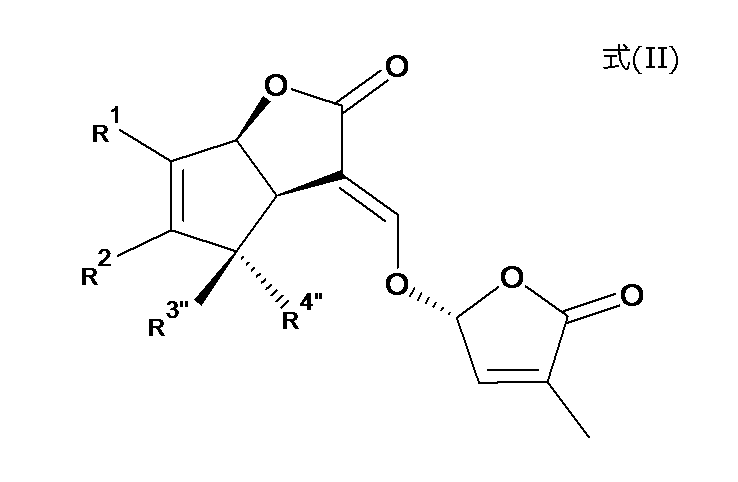
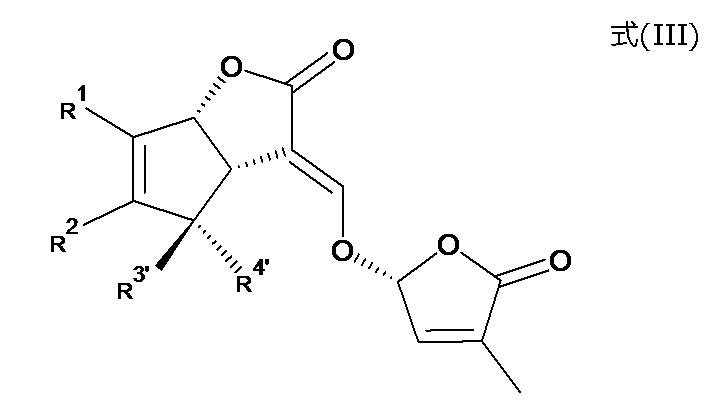
- the compound having a specific three-dimensional structure is represented by the following general formula (II) or general formula (III), the compound represented by the general formula (II) is a seed germination inhibitor of a root parasitic plant, 2.
- R 1 and R 2 may combine to form a 5- to 6-membered ring, and the ring is a benzene ring or unsubstituted or substituted with a methyl group.
- R 1 and R 2 may bond together to form one of the rings of five to six membered ring, said ring is substituted with benzene ring, or an unsubstituted or methyl group
- R 3 ′ represents R 4 ′ is a hydrogen atom selected from a hydrogen atom, a hydroxyl group and an acetoxy group, provided that, among the compounds represented by the above general formula (III), R 1 and R 2 are combined to form a benzene ring.
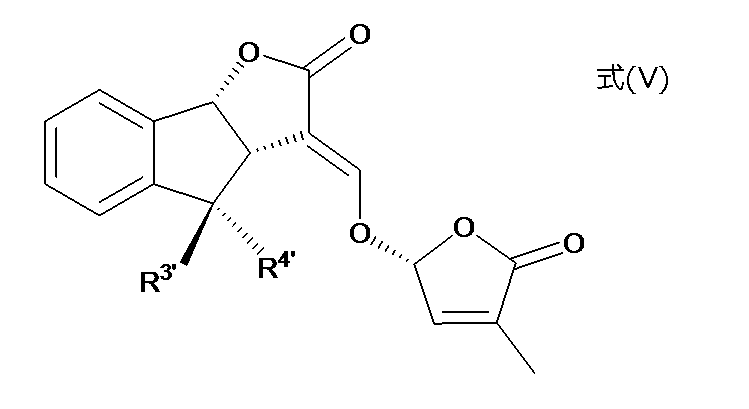
- a compound having a specific three-dimensional structure is represented by the following general formula (IV) or general formula (V), the compound represented by the general formula (IV) is a seed germination inhibitor of a root parasitic plant, and the general formula 3.
- the root parasitic plant germination regulator according to item 2 wherein the compound represented by (V) is a seed germination stimulating active substance of a root parasitic plant.
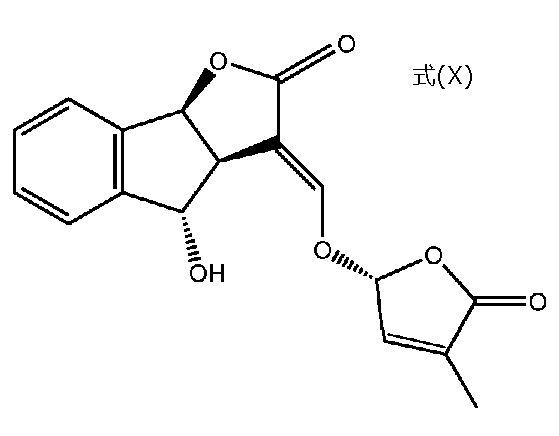
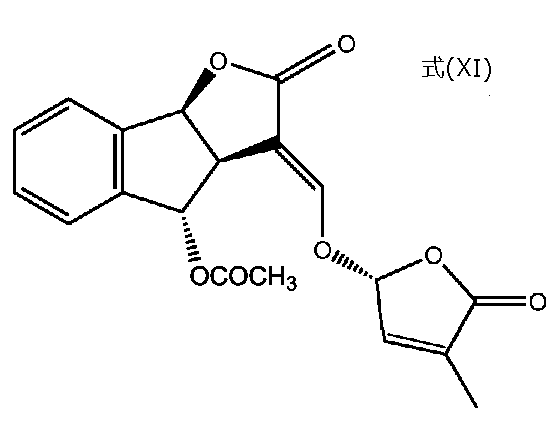
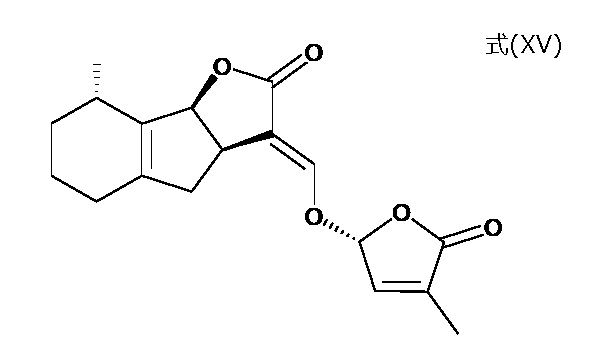
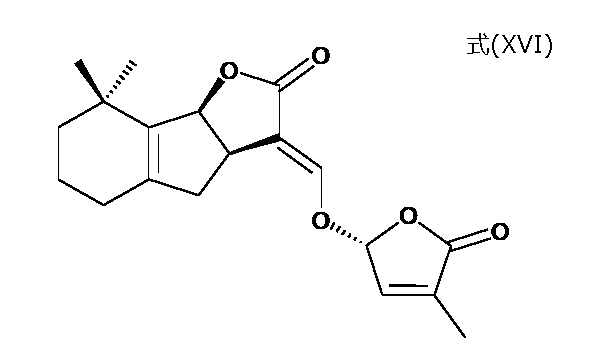
- the compound having a specific three-dimensional structure is a compound represented by any one of the following formulas (X) to (XVI), and is a seed germination inhibitor of a root parasitic plant, characterized in that the above item 2 or 3
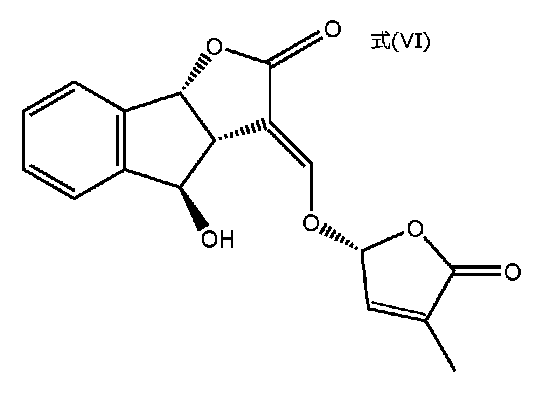
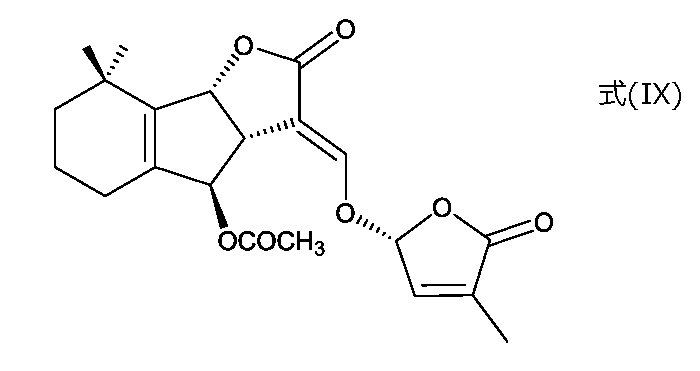
- the compound having a specific three-dimensional structure is a compound represented by any one of the following formulas (VI) to (IX), and is a seed germination stimulating substance of a root parasitic plant: 4.
- the root parasitic plant germination regulator according to 3. (3aR, 4R, 8bR, 2'R) -3- ⁇ [(E)-(2 ', 5'-dihydro-4'-methyl-5'-oxo-2'-furanyl) oxy] methylene ⁇ -3 , 3a, 4,8b-tetrahydro-4-hydroxy-2H-indeno [1,2-b] furan-2-one (3aR, 4R, 8bR, 2'R) -4-acetoxy-3- ⁇ [(E)-(2 ', 5'-dihydro-4'-methyl-5'-oxo-2'-furanyl) oxy] methylene ⁇ -3,3a, 4,8b-tetrahydro-2H-indeno [1,2-b] furan-2-
- a root parasitic plant control agent comprising the root parasitic plant germination regulator according to any one of 1 to 6 above. 8).
- a method for controlling a root parasitic plant comprising using the root parasitic plant germination regulator according to any one of items 1 to 6.
- the root parasitic plant germination regulator of the present invention even compounds represented by the same chemical formula have a seed germination inhibiting action or a seed germination stimulating action action on root parasitic plants due to the difference in the three-dimensional structure.
- a compound comprising a three-dimensional structural formula represented by the general formula (II) exhibits a seed germination inhibitory action of a root parasitic plant and is represented by the general formula (III).
- the compound consisting of the structural formulas described above has a seed germination stimulating activity of root parasitic plants. It was confirmed that the seed germination inhibitor of the present invention inhibits seed germination even when a seed germination stimulating substance is present.
- seed germination of the root parasitic plant can be inhibited, and the root parasitic plant infests the host plant. Can be controlled.
- seed germination stimulating active substance of the root parasitic plant germination regulator of the present invention when no host plant is present, no nutrition for the root parasitic plant is supplied from the host plant. Seeds can germinate and root parasitic plants can die. Thereby, a root parasitic plant can be controlled.
- the “root parasitic plant” refers to a plant that is parasitic on the root of the host as described above.
- Specific examples of root parasitic plants in the present specification include Striga spp. And Orobanche spp. , which have been shown in the background art. As Striga, S. hermonthica, S. aspera, S. forbesii, S. asiatica, etc. S. gesnerioides. Examples Orobanki, O. ramosa, O. minor, O. cernua, etc. O. aegyptiaca is illustrated .
- the root parasitic plant germination regulator of the present invention particularly preferably acts on S. gesnerioides .
- the “host plant” is not particularly limited as long as the root parasitic plant of the present specification can be parasitic.
- the root parasitic plant of the present specification can be parasitic.
- leguminous plants, solanaceous plants, cereals and the like can be mentioned, and more specifically cowpea and tobacco.
- the root parasitic plant germination regulator of the present invention comprises a compound represented by the following general formula (I) and having a specific steric structure.
- R 1 and R 2 may combine to form a 5- to 6-membered ring, and the ring is a benzene ring or unsubstituted or substituted with a methyl group.
- R 4 is a hydrogen atom selected from an atom, a hydroxyl group and an acetoxy group, provided that in the present invention, among the compounds represented by the general formula (I), R 1 and R 2 are bonded to form a benzene ring. In the case where R 3 and R 4 are both hydrogen atoms.
- seed germination regulators for root parasitic plants include seed germination inhibitors and seed germination stimulating substances, and any of them may be used, but seed germination inhibitors are particularly preferred.
- seed germination inhibitors are particularly preferred.
- the three-dimensional structural formulas of the seed germination inhibiting substance and the seed germination stimulating active substance will be shown by general formulas, and will be described more specifically. As specific examples below, the seed germination inhibitor and the seed germination stimulating substance will be described in any order.
- the compound consisting of the three-dimensional structural formula represented by the general formula (II) is a seed germination inhibitor of a root parasitic plant
- the compound consisting of the three-dimensional structural formula represented by the general formula (III) is It is a seed germination stimulating substance of parasitic plants.
- R 1 and R 2 may combine to form a 5- to 6-membered ring, and the ring is a benzene ring or unsubstituted or substituted with a methyl group.
- R 1 and R 2 may combine to form a 5- to 6-membered ring, and the ring is a benzene ring or unsubstituted or substituted with a methyl group.
- R 3 ′ and R 4 ′ are both hydrogen atoms.
- the compound comprising the three-dimensional structural formula represented by the general formula (IV) is a seed germination inhibitor, and the compound comprising the three-dimensional structural formula represented by the general formula (V) is a seed germination stimulating active substance. It is.
- R 3 ′′ is a hydrogen atom, and R 4 ′′ is a hydroxyl group or an acetoxy group.
- R 3 ′ is a hydroxyl group or an acetoxy group
- R 4 ′ is a hydrogen atom.
- specific examples of the seed germination stimulating active substance represented by the general formula (III) or (V) include compounds having three-dimensional structures represented by the following formulas (VI) to (IX).
- specific examples of the seed germination inhibitor represented by the general formula (II) or (IV) include compounds having the three-dimensional structures represented by the following formulas (X) to (XIV).
- the seed germination inhibiting substance refers to a substance having an activity capable of inhibiting germination by a seed germination stimulating active substance with respect to root parasitic plants.
- the seed germination stimulating active substance may be artificially added, but may be a seed germination stimulating substance secreted from a host plant, for example.
- the seed germination stimulating active substance may be a substance known per se, for example, strigol, solgolactone, alexitol, olobancol, jasmonic acid, brassinolide, brassinosteroid (castasterone, etc.), cucurbic acid , Dihydrosorgoleon, cotylenin, fusicoccin, GR-7, GR-24, Nijmegen-1 and the like. Since the seed germination inhibitor of the present invention can inhibit the germination of root parasitic plants in the presence of a seed germination stimulating substance secreted from the host plant, it does not affect the germination of the host plant. Only plant germination can be inhibited.
- the root parasitic plant germination regulator of the substance of the present invention can be produced by the following method.
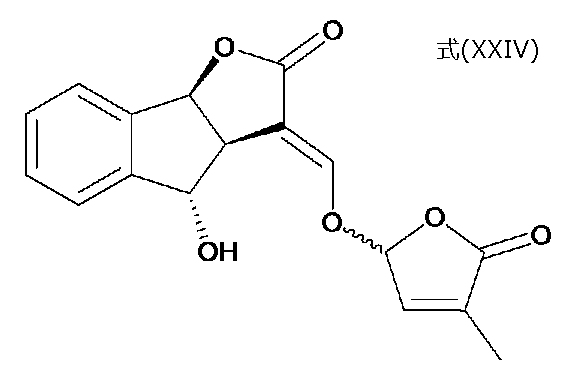
- the following optically active diastereomeric mixture of the formula (XXIII) and also the mixture of the formula (XXIV) are described in, for example, Non-Patent Document 4 (H. Takikawa, H. Imaishi, A. Tanaka, S. Jikumaru, M. Fujiwara , M. Sasaki, Tetrahedron: Asymmetry, 2010, 21, 1166-1168).
- the present invention also extends to a “root parasitic plant control agent” containing any of the above-mentioned root parasitic plant germination regulators.
- the dosage form of the root parasitic plant control agent of the present invention is not particularly limited as long as it is a dosage form generally used for root parasitic plant control agents. Examples of such materials include powders, fine granules, granules, emulsions, wettable powders, suspensions, dry flowables, flowables, aqueous liquids, oils, smoke agents, aerosols, and microcapsules. .
- Additives such as carriers, surfactants, fixing agents, dispersants, stabilizers and other additives used in the formulation of root parasitic plant control agents are those commonly used for root parasitic plant control agents. Can be appropriately selected.
- any of a solid carrier, a liquid carrier, and a gaseous carrier can be used.
- the solid support include clays (for example, kaolinite, acid clay, diatomaceous earth, synthetic silicon hydroxide, bentonite), talc, and other inorganic minerals (for example, calcium carbonate, quartz powder, activated carbon, hydration) Silica), chemical fertilizers (for example, ammonium sulfate, ammonium sulfate, phosphorous acid, urea), organic substances (for example, sugar cane, bark powder, tobacco stem powder), and the like can be mentioned.
- liquid carriers examples include water, alcohols (eg, methanol, ethanol, isopropanol), ketones (eg, acetone, methyl ethyl ketone), hydrocarbons (eg, benzene, toluene, xylene, cyclohexane, methylnaphthalene), esters (For example, ethyl acetate, butyl acetate), ethers (for example, dioxane, diisopropyl ether), acid amides (for example, dimethylformamide, dimethylacetamide) and the like.
- alcohols eg, methanol, ethanol, isopropanol
- ketones eg, acetone, methyl ethyl ketone
- hydrocarbons eg, benzene, toluene, xylene, cyclohexane, methylnaphthalene
- esters For example, ethyl acetate, buty
- surfactant examples include alkyl sulfates, alkyl sulfonates, alkyl aryl sulfonates, alkyl aryl ethers and polyoxyethylenates thereof, polyethylene glycol ethers, polyhydric alcohol esters, sugar alcohol derivatives, etc. Can be mentioned.
- sticking agent and dispersant examples include casein, gelatin, polysaccharides (for example, starch, gum arabic, cellulose derivatives), lignin derivatives, bentonite, saccharides, synthetic water-soluble polymers (for example, polyvinyl alcohol, polyvinyl pyrrolidone, Acrylic acid) and the like.
- the stabilizer examples include PAP (isopropyl acid phosphate), BHT (2,6-di-t-butyl-4-methylphenol), vegetable oil, mineral oil, fatty acid, and esters thereof.
- PAP isopropyl acid phosphate
- BHT 2,6-di-t-butyl-4-methylphenol
- vegetable oil mineral oil
- mineral oil fatty acid
- esters thereof examples include PAP (isopropyl acid phosphate), BHT (2,6-di-t-butyl-4-methylphenol), vegetable oil, mineral oil, fatty acid, and esters thereof.
- a raw material used for a formulation if it is a conventionally well-known raw material, it will not be limited to these.
- the present invention extends to a method for controlling root parasitic plants, characterized by using a root parasitic plant germination regulator.
- Root parasitic plants not only rely on nutrients from the host plant after establishing the parasitism, but are already closely related to the host plant in the early stages of the life cycle. That is, seeds of root parasitic plants awaken from dormancy under appropriate temperature and humidity conditions, and then germinate upon sensing the seed germination stimulating active substance secreted from the roots of host plants and the like.
- the “parasitic plant germination regulator” of the present invention can be controlled directly by causing the “seed germination inhibitor” to act directly on the seeds of the root parasitic plant. it can.
- seed germination stimulating active substances are sprayed on the seeds of root parasitic plants in the field before sowing the host plants, and the seeds of root parasitic plants in the soil are forced to germinate, so that nutrients from the host plants can be obtained. There is a method of leaving it in a state where it is not supplied and killing it.
- a “seed germination stimulating substance” can be used among the root parasitic plant germination regulators of the present invention.
- an aqueous agent or powder containing the root parasitic plant germination regulator is sprayed at a predetermined concentration in a symbiotic area or a cultivation area. Or by spraying. Moreover, you may make it osmose
- Non-Patent Document 4 An optically active tricyclic lactone (-)-(3aR, 4R, 8bR,)-4-hydroxy-3,3a, 4,8b-tetrahydro-4-hydroxy produced according to the method of Non-Patent Document 4 -2H-indeno [1,2-b] furan-2-one (101 mg, 0.532 mmol) is described in Non-Patent Document 5 (EM Mungnus, et al., Journal of Agricultural Food Chemistry, 1992, 40, 1230-1235). ) To an optically active diastereomeric mixture (A + epi-A, 53 mg, 32%).
- Seed germination test (1) 10 ⁇ mol of each test compound produced in Production Examples 1 and 2 was weighed and dissolved in 2 ml of acetone. These were diluted with distilled water to 0.1 ⁇ M and 10 ⁇ M, respectively. Next, filter paper was spread on the petri dish, and the striker seed conditioned on the filter paper was placed thereon, and each diluted test compound was treated with 20 ⁇ l per seed. In order to maintain the humidity, the filter paper moistened to such an extent that no water droplets flow out was folded in four and placed in the center of the petri dish. A parafilm was spread over the petri dish, and the petri dish was wrapped in aluminum foil and incubated at 30 ° C.
- Germination rate (%) was calculated from the number of seeds germinated with respect to the total number of seeds (number of germinated seeds / total number of seeds).
- the compounds tested (racemate (A (b) + epi-A (a)), racemate (A (a) + epi-A (b)) and four optical isomers (A (a), A (b) ), Epi-A (a) and epi-A (b))) for S. gesnerioides , the germination stimulating activity test results are shown in Table 2. As a result, a high seed germination stimulating activity was observed in the compound A (a) represented by the formula (VI).
- Seed germination test (2) Prepare a mixed solution of equal amounts of compound A (a) shown in formula (VI) and compound A (b) shown in formula (X) by the same method as in Test Example 1, and add 20 ⁇ l of each diluted test compound to seeds. Processed one by one. As a result, seed germination induction by compound A (a), which is a seed germination stimulating active substance, was inhibited by compound A (b) (Table 3). Therefore, it was confirmed that compound A (b) is a seed germination inhibitor.
- the compound represented by formula (VIII) is (3aR, 4R, 8bR, 2'R) -3- ⁇ [(E)-(2 ', 5'-dihydro-4'-methyl-5'-oxo-2' -furanyl) oxy] methylene ⁇ -3,3a, 4,5,6,7,8,8b-octahydro-4-hydroxy-8,8-dimethyl-2H-Indeno [1,2-b] furan-2-
- the compound represented by formula (IX) is (3aR, 4R, 8bR, 2'R) -4-acetoxy-3- ⁇ [(E)-(2 ', 5'-dihydro-4'-methyl -5'-oxo-2'-furanyl) oxy] methylene ⁇ -3,3a, 4,5,6,7,8,8b-octahydro-8,8-dimethyl-2H-Indeno [1,2-b] furan-2-one.
- Seed germination test (5) instead of compound A (b) in Test Example 3, compound A-Ac (b) represented by the formula (XI) was used. Also in this test example, a cowpea hydroponic solution was used. This cowpea hydroponic solution contains substances represented by the formulas (VIII) and (IX), which are compounds exhibiting the seed germination stimulating activity of the present invention.
- each racemate and each optical isomer showed no seed germination stimulating activity against S. gesnerioides .
- the root parasitic plant germination regulator of the present invention seed germination stimulating activity or seed germination inhibition on root parasitic plants due to differences in steric structure, even with compounds represented by the same chemical formula Has an effect.
- the seeds can be obtained in a state where no nutrients are supplied from the host plant to the root parasitic plant when the host plant does not exist.
- Germination and root parasitic plants can be killed. Thereby, a root parasitic plant can be controlled.
- germination of the root parasitic plant can be inhibited, and the root parasitic plant parasitizes the host plant. Can be controlled.
- a compound having a specific three-dimensional structure of the present invention has a seed germination stimulating activity or a seed germination inhibitory effect on root parasitic plants, particularly S. gesnerioides .
- root parasitic plant germination regulators of the present invention it is possible to reduce the enormous damage that has been exerted on agricultural production.
Landscapes
- Life Sciences & Earth Sciences (AREA)
- Agronomy & Crop Science (AREA)
- Pest Control & Pesticides (AREA)
- Plant Pathology (AREA)
- Health & Medical Sciences (AREA)
- Engineering & Computer Science (AREA)
- Dentistry (AREA)
- General Health & Medical Sciences (AREA)
- Wood Science & Technology (AREA)
- Zoology (AREA)
- Environmental Sciences (AREA)
- Agricultural Chemicals And Associated Chemicals (AREA)
- Pretreatment Of Seeds And Plants (AREA)
Abstract
発明は、新規な根寄生植物発芽調節剤を提供する。また、当該根寄生植物発芽調節剤を含む根寄生植物防除剤を提供する。さらには、当該根寄生植物防除剤を用いて根寄生植物を防除する方法を提供する。下記の一般式(I)で表され、かつ特定の立体構造を有する化合物による。(式(I)中、R1とR2は、結合して五~六員環のいずれかの環を形成していてもよく、前記環はベンゼン環、又は非置換若しくはメチル基で置換されていてもよいシクロアルケニル環であり、あるいはそれぞれ独立して水素原子、メチル基、エチル基、又はC3~C6の直鎖状若しくは分枝状の低級アルキル基を表し、R3は、水素原子、水酸基、アセトキシ基より選択され、R4は、水素原子である。)
Description
本発明は、新規な根寄生植物発芽調節剤に関する。また本発明は、当該根寄生植物発芽調節剤を含む根寄生植物防除剤に関する。さらには、当該根寄生植物防除剤を用いて根寄生植物を防除する方法に関する。
本出願は、参照によりここに援用されるところの日本出願、特願2011-111819号優先権を請求する。
異種の生物が一緒に生活している現象を共生といい、このうち、一方(寄生者)が利益を受け、他方(宿主)が何らかの害を被っている関係を寄生という。寄生植物は吸器と呼ばれる特殊な器官を形成して宿主に侵入し、通導組織を連結し、そこを通して養水分を奪って成長する。宿主との連結部位に応じて、茎寄生植物、根寄生植物と呼ぶ。ストライガ(Striga spp.)やオロバンキ(Orobanche spp.)などは根寄生植物であり、多くのマメ科植物や穀物を宿主とし、農業に甚大な被害をもたらしている。ストライガは、アフリカ、南アジアの熱帯から亜熱帯の半乾燥地域に分布している根寄生植物であり、ソルガム、トウモロコシ等の主要な植物を宿主とし、農業生産に甚大な被害を与えている。ストライガには、S. hermonthica、S. aspera、S. forbesii、S. asiatica、S. gesnerioidesなどがある。オロバンキは、地中海沿岸、中東地域を中心地域として温帯から亜寒帯まで広く分布しており、ヨーロッパ、オーストラリアで被害が拡大している。オロバンキには、O. ramosa、O. minor、O. cernua、O. aegyptiacaなどがある。
これらの根寄生植物の種子は、宿主となる植物(以降、単に「宿主植物」ともいう。)の根の近傍でのみ発芽することが知られている。これは、宿主植物の根から何らかの種子発芽刺激活性物質が分泌されており、それを感知して根寄生植物の種子が発芽するということを示唆している。1966年、ストリゴール(Strigol)がワタの根滲出液から種子発芽刺激活性物質として初めて単離された(非特許文献1)。さらに1990年代になって、ストリゴールと類似した構造を持つソルゴラクトン(Sorgolactone)とアレクトロール(Alectrol)が、それぞれストライガの宿主植物であるソルガムとササゲから単離された(非特許文献2)。また、オロバンキの宿主植物であるアカクローバーの根滲出液からはオロバンコール(Orobanchol)が単離された。これらの物質はストリゴラクトン(Strigolactones)と総称され、根寄生植物の種子発芽刺激活性物質として作用することが判明している。
根寄生植物は、宿主植物の根に寄生するため、宿主植物に作用する除草剤を使用することができない。従って、ストライガやオロバンキ等の根寄生植物の防除方法の一つとして、宿主植物を播種する前の土壌に、種子発芽刺激活性物質(発芽促進物質)を散布し、土壌中の根寄生植物種子を強制的に発芽させ、周囲に宿主植物がない状態で枯死に至らしめるという方法が提案されている。この方法は、上記根寄生植物が宿主に寄生することなく、独立しては生存できないことを利用している。この種子発芽刺激活性物質としては、ストリゴール、ソルゴラクトン、アレクトール、オロバンコール、ジャスモン酸、ブラシノライド、ブラシノステロイド(カスタステロン等)、ククルビン酸、ジヒドロソルゴレオン、コチレニン、フシコクシン、GR-7、GR-24、ナイメヘン-1などが挙げられる。これらの中でも、下記の天然物であるストリゴール及びソルゴラクトン、並びに合成物であるGR-7及びGR-24の活性が高いことが知られており、種子発芽刺激活性物質を用いた根寄生植物の防除方法について開示がある(特許文献1)。また、ストリゴラクトンと類似する化合物のうち、ソラナコール(Solanacol)についての報告もある(非特許文献3)。ここではソラナコールのうち特定の立体構造を有する化合物について、マメ科植物に対する腋芽成長抑制活性が、GR-24との比較において報告されている。
その後、根寄生植物の防除への利用を目的として、様々なストリゴラクトン類縁体の合成が行われたが、これまでのところ実用化に至ったものはない。
C. E. Cook, et al., Science, 1966, 154, 1189-1190
Y. Sugimoto, et al., Journal of Organic Chemistry, 1998, 63, 1259-1267
Victor X. Chen, et al., Chem. Eur. J., 2010, 16, 13941-13945
本発明は、新規な根寄生植物発芽調節剤を提供することを課題とする。また本発明は、当該根寄生植物発芽調節剤を含む根寄生植物防除剤を提供することを課題とする。さらには、当該根寄生植物防除剤を用いて根寄生植物を防除する方法を提供することを課題とする。
本発明者らは、上記課題を解決するために鋭意検討を重ねた結果、下記の一般式(I)で表され、かつ特定の立体構造を有する化合物が、根寄生植物の発芽調節剤として機能しうることを見出し、本発明を完成した。本発明において、同じ分子式からなる化合物であっても、立体構造の違いにより、根寄生植物に対して種子発芽阻害作用又は種子発芽刺激活性作用を有することを確認した。さらに、本発明の根寄生植物発芽調節剤、即ち種子発芽阻害物質及び/又は種子発芽刺激活性物質を利用することで、根寄生植物を防除しうることを見出し、本発明を完成した。

すなわち本発明は、以下よりなる。
1.下記の一般式(I)で表され、かつ特定の立体構造を有する化合物からなる根寄生植物発芽調節剤。
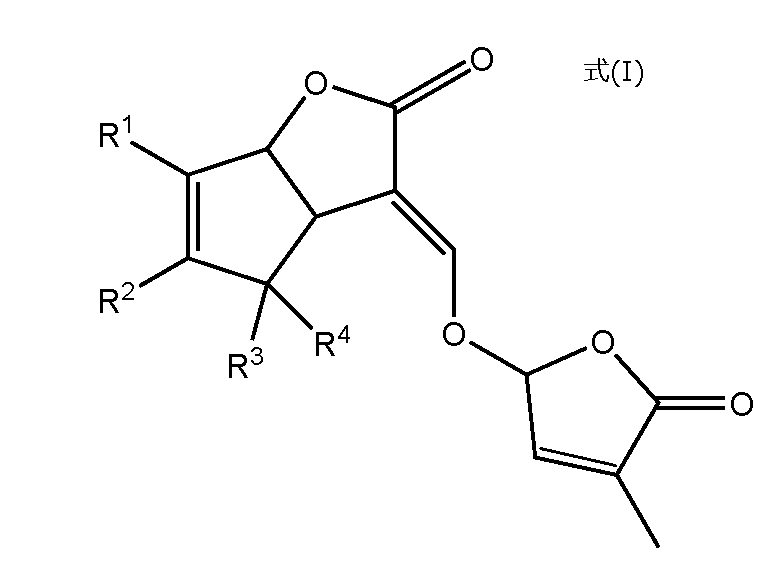
(式(I)中、R1とR2は、結合して五~六員環のいずれかの環を形成していてもよく、前記環はベンゼン環、又は非置換若しくはメチル基で置換されていてもよいシクロアルケニル環であり、あるいはそれぞれ独立して水素原子、メチル基、エチル基、又はC3~C6の直鎖状若しくは分枝状の低級アルキル基を表し、R3は、水素原子、水酸基、アセトキシ基より選択され、R4は、水素原子である。)
2.特定の立体構造を有する化合物が、以下の一般式(II)又は一般式(III)で表され、一般式(II)で表される化合物が根寄生植物の種子発芽阻害物質であり、一般式(III)で表される化合物が根寄生植物の種子発芽刺激活性物質であることを特徴とする、前項1に記載の根寄生植物発芽調節剤。

(式(II)中、R1とR2は、結合して五~六員環のいずれかの環を形成していてもよく、前記環はベンゼン環、又は非置換若しくはメチル基で置換されていてもよいシクロアルケニル環であり、あるいはそれぞれ独立して水素原子、メチル基、エチル基、又はC3~C6の直鎖状若しくは分枝状の低級アルキル基を表し、R3"は、水素原子であり、R4"は、水素原子、水酸基、若しくはアセトキシ基である。)

(式(III)中、R1とR2は、結合して五~六員環のいずれかの環を形成していてもよく、前記環はベンゼン環、又は非置換若しくはメチル基で置換されていてもよいシクロアルケニル環であり、あるいはそれぞれ独立して水素原子、メチル基、エチル基、又はC3~C6の直鎖状若しくは分枝状の低級アルキル基を表し、R3'は、水素原子、水酸基、アセトキシ基より選択され、R4'は、水素原子である。ただし、上記一般式(III)で表される化合物のうち、R1とR2が結合してベンゼン環を構成する場合は、R3'及びR4'が共に水素原子である場合を除く。)
3.特定の立体構造を有する化合物が、以下の一般式(IV)又は一般式(V)で表され、一般式(IV)で表される化合物が根寄生植物の種子発芽阻害物質であり、一般式(V)で表される化合物が根寄生植物の種子発芽刺激活性物質であることを特徴とする、前項2に記載の根寄生植物発芽調節剤。

(式(IV)中、R3"は、水素原子であり、R4"は、水素原子、水酸基、若しくはアセトキシ基である。)

(式(V)中、R3'は、水酸基、若しくはアセトキシ基であり、R4'は、水素原子である。)
4.特定の立体構造を有する化合物が、以下の式(X)~(XVI)のいずれかで表される化合物であり、根寄生植物の種子発芽阻害物質であることを特徴とする、前項2又は3に記載の根寄生植物発芽調節剤。
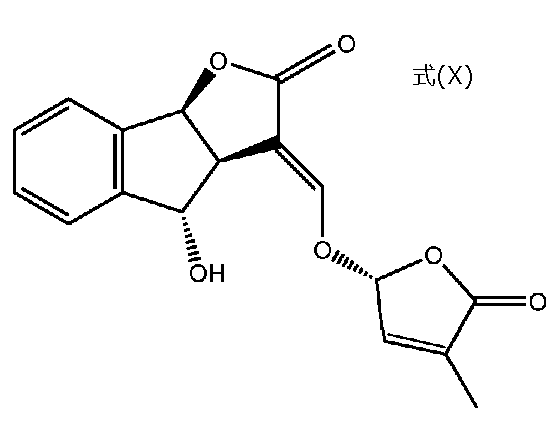
(3aS,4S,8bS,2'R)-3-{[(E)-(2',5'-dihydro-4'-methyl-5'-oxo-2'-furanyl)oxy]methylene}-3,3a,4,8b-tetrahydro-4-hydroxy-2H-indeno[1,2-b]furan-2-one

(3aS,4S,8bS,2'R)-4-acetoxy-3-{[(E)-(2',5'-dihydro-4'-methyl-5'-oxo-2'-furanyl)oxy]methylene}-3,3a,4,8b-tetrahydro-2H-indeno[1,2-b]furan-2-one

(3aS,4S,8bS,2'R)-3-{[(E)-(2',5'-dihydro-4'-methyl-5'-oxo-2'-furanyl)oxy]methylene}-3,3a,4,5,6,7,8,8b-octahydro-4-hydroxy-8,8-dimethyl-2H-Indeno[1,2-b]furan-2-one

(3aS,4S,8bS,2'R)-4-acetoxy-3-{[(E)-(2',5'-dihydro-4'-methyl-5'-oxo-2'-furanyl)oxy]methylene}-3,3a,4,5,6,7,8,8b-octahydro-8,8-dimethyl-2H-Indeno[1,2-b]furan-2-one

(3aR,8bS,2'R)-3-{[(E)-(2',5'-dihydro-4'-methyl-5'-oxo-2'-furanyl)oxy]methylene}-3,3a,4,8b-tetrahydro-2H-indeno[1,2-b]furan-2-one

(3aR,8S,8bS,2'R)-3-{[(E)-(2',5'-dihydro-4'-methyl-5'-oxo-2'-furanyl)oxy]methylene}-3,3a,4,5,6,7,8,8b-octahydro-8-methyl-2H-Indeno[1,2-b]furan-2-one

(3aR,8bS,2'R)-3-{[(E)-(2',5'-dihydro-4'-methyl-5'-oxo-2'-furanyl)oxy]methylene}-3,3a,4,5,6,7,8,8b-octahydro-8,8-dimethyl-2H-Indeno[1,2-b]furan-2-one
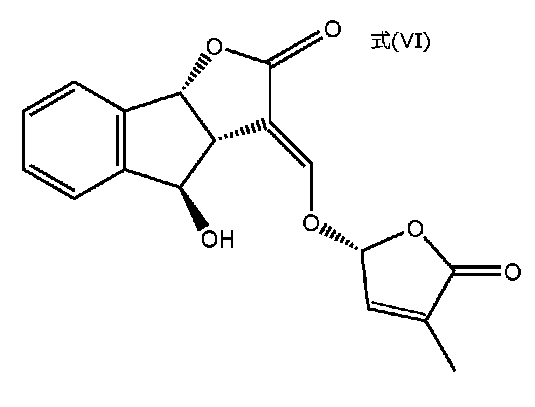
5.特定の立体構造を有する化合物が、以下の式(VI)~(IX)のいずれかで表される化合物であり、根寄生植物の種子発芽刺激活性物質であることを特徴とする、前項2又は3に記載の根寄生植物発芽調節剤。

(3aR,4R,8bR,2'R) -3-{[(E)-(2',5'-dihydro-4'-methyl-5'-oxo-2'-furanyl)oxy]methylene}-3,3a,4,8b-tetrahydro-4-hydroxy-2H-indeno[1,2-b]furan-2-one

(3aR,4R,8bR,2'R)-4-acetoxy-3-{[(E)-(2',5'-dihydro-4'-methyl-5'-oxo-2'-furanyl)oxy]methylene}-3,3a,4,8b-tetrahydro-2H-indeno[1,2-b]furan-2-one

(3aR,4R,8bR,2'R)-3-{[(E)-(2',5'-dihydro-4'-methyl-5'-oxo-2'-furanyl)oxy]methylene}-3,3a,4,5,6,7,8,8b-octahydro-4-hydroxy-8,8-dimethyl-2H-Indeno[1,2-b]furan-2-one

(3aR,4R,8bR,2'R)-4-acetoxy-3-{[(E)-(2',5'-dihydro-4'-methyl-5'-oxo-2'-furanyl)oxy]methylene}-3,3a,4,5,6,7,8,8b-octahydro-8,8-dimethyl-2H-Indeno[1,2-b]furan-2-one
6.根寄生植物が、ストライガゲスネルオイデス(S. gesnerioides)である、前項1~5のいずれか1に記載の根寄生植物発芽調節剤。
7.前項1~6のいずれか1に記載の根寄生植物発芽調節剤を含む根寄生植物防除剤。
8.前項1~6のいずれか1に記載の根寄生植物発芽調節剤を用いることを特徴とする、根寄生植物の防除方法。
1.下記の一般式(I)で表され、かつ特定の立体構造を有する化合物からなる根寄生植物発芽調節剤。
2.特定の立体構造を有する化合物が、以下の一般式(II)又は一般式(III)で表され、一般式(II)で表される化合物が根寄生植物の種子発芽阻害物質であり、一般式(III)で表される化合物が根寄生植物の種子発芽刺激活性物質であることを特徴とする、前項1に記載の根寄生植物発芽調節剤。
3.特定の立体構造を有する化合物が、以下の一般式(IV)又は一般式(V)で表され、一般式(IV)で表される化合物が根寄生植物の種子発芽阻害物質であり、一般式(V)で表される化合物が根寄生植物の種子発芽刺激活性物質であることを特徴とする、前項2に記載の根寄生植物発芽調節剤。
4.特定の立体構造を有する化合物が、以下の式(X)~(XVI)のいずれかで表される化合物であり、根寄生植物の種子発芽阻害物質であることを特徴とする、前項2又は3に記載の根寄生植物発芽調節剤。
5.特定の立体構造を有する化合物が、以下の式(VI)~(IX)のいずれかで表される化合物であり、根寄生植物の種子発芽刺激活性物質であることを特徴とする、前項2又は3に記載の根寄生植物発芽調節剤。
6.根寄生植物が、ストライガゲスネルオイデス(S. gesnerioides)である、前項1~5のいずれか1に記載の根寄生植物発芽調節剤。
7.前項1~6のいずれか1に記載の根寄生植物発芽調節剤を含む根寄生植物防除剤。
8.前項1~6のいずれか1に記載の根寄生植物発芽調節剤を用いることを特徴とする、根寄生植物の防除方法。
本発明の根寄生植物発芽調節剤によると、同じ化学式で示される化合物であっても、立体構造の違いにより、根寄生植物に対して種子発芽阻害作用又は種子発芽刺激活性作用を有する。本発明の根寄生植物発芽調節剤のうち、例えば、一般式(II)で表される立体構造式からなる化合物は、根寄生植物の種子発芽阻害作用を示し、一般式(III)で表される構造式からなる化合物は、根寄生植物の種子発芽刺激活性作用を示す。本発明の種子発芽阻害物質は、種子発芽刺激物質が存在する場合であっても、種子発芽を阻害することが確認された。
土壌等に、本発明の根寄生植物発芽調節剤のうち種子発芽阻害物質を用いて処理することで、根寄生植物の種子発芽を阻害することができ、根寄生植物が宿主植物に寄生するのを防除することができる。また、土壌等に、本発明の根寄生植物発芽調節剤のうち種子発芽刺激活性物質を用いて処理することで、宿主植物が存在しない場合に宿主植物から根寄生植物に対する栄養が供給されない状態で種子を発芽させ、根寄生植物を枯死させることができる。これにより、根寄生植物を防除することができる。
本明細書において、「根寄生植物」とは、前述のごとく宿主の根に連結して寄生する植物をいう。本明細書における根寄生植物の具体例として、背景技術の欄でも示したが、ストライガ(Striga spp.)やオロバンキ(Orobanche spp.)が挙げられる。ストライガとして、S. hermonthica、S. aspera、S. forbesii、S. asiatica、S. gesnerioidesなどが例示され、オロバンキとして、O. ramosa、O. minor、O. cernua、O. aegyptiacaなどが例示される。本発明の根寄生植物発芽調節剤は、特に好適にはS. gesnerioidesに対して作用する。本明細書において「宿主植物」とは、本明細書の根寄生植物が寄生しうる植物であればよく、特に限定されない。例えばマメ科植物やナス科植物、穀物等が挙げられ、より具体的には、ササゲ及びタバコなどが挙げられる。
本発明の根寄生植物発芽調節剤は、下記の一般式(I)で表され、かつ特定の立体構造を有する化合物からなる。

(式(I)中、R1とR2は、結合して五~六員環のいずれかの環を形成していてもよく、前記環はベンゼン環、又は非置換若しくはメチル基で置換されていてもよいシクロアルケニル環であり、あるいはそれぞれ独立して水素原子、メチル基、エチル基、又はC3~C6の直鎖状若しくは分枝状の低級アルキル基を表し、R3は、水素原子、水酸基、アセトキシ基より選択され、R4は、水素原子である。ただし、本発明において、上記一般式(I)で表される化合物のうち、R1とR2が結合してベンゼン環を構成する場合は、R3及びR4が共に水素原子である場合を除く。)
本発明において、根寄生植物の種子発芽調節剤としては、種子発芽阻害物質及び種子発芽刺激活性物質が挙げられ、何れであってもよいが、特に好適には種子発芽阻害物質が挙げられる。以下、種子発芽阻害物質及び種子発芽刺激活性物質の立体構造式を一般式で示し、さらに具体的に例示して説明する。以下の具体的な例示としては、種子発芽阻害物質及び種子発芽刺激活性物質は、順不同で説明する。
本発明において、根寄生植物発芽調節剤の立体構造の具体例として、以下の一般式(II)又は一般式(III)で表すことができる。本発明において、一般式(II)で表される立体構造式からなる化合物は、根寄生植物の種子発芽阻害物質であり、一般式(III)で表される立体構造式からなる化合物は、根寄生植物の種子発芽刺激活性物質である。

(式(II)中、R1とR2は、結合して五~六員環のいずれかの環を形成していてもよく、前記環はベンゼン環、又は非置換若しくはメチル基で置換されていてもよいシクロアルケニル環であり、あるいはそれぞれ独立して水素原子、メチル基、エチル基、又はC3~C6の直鎖状若しくは分枝状の低級アルキル基を表し、R3"は、水素原子であり、R4"は、水素原子、水酸基、若しくはアセトキシ基である。)

本発明において、以下の一般式(IV)又は一般式(V)で表すことができる。本発明において、一般式(IV)で表される立体構造式からなる化合物は、種子発芽阻害物質であり、一般式(V)で表される立体構造式からなる化合物は、種子発芽刺激活性物質である。

(式(IV)中、R3"は、水素原子であり、R4"は、水酸基、若しくはアセトキシ基である。)

(式(V)中、R3'は、水酸基、若しくはアセトキシ基であり、R4'は、水素原子である。)
本発明において、一般式(III)又は(V)で示される種子発芽刺激活性物質の具体例として、以下の式(VI)~式(IX)に示す立体構造からなる化合物が例示される。


本発明において、一般式(II)又は(IV)で示される種子発芽阻害物質の具体例として、以下の式(X)~式(XIV)に示す立体構造からなる化合物が例示される。
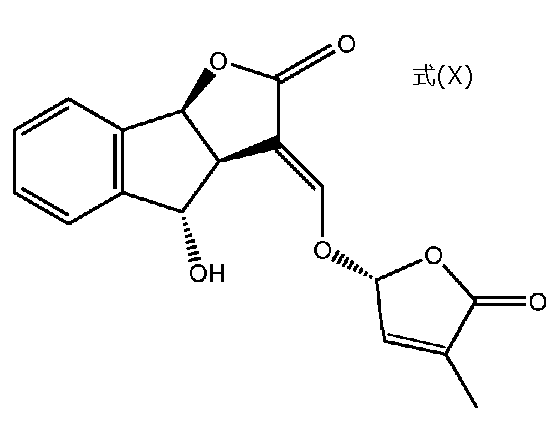
(3aS,4S,8bS,2'R)-3-{[(E)-(2',5'-dihydro-4'-methyl-5'-oxo-2'-furanyl)oxy]methylene}-3,3a,4,8b-tetrahydro-4-hydroxy-2H-indeno[1,2-b]furan-2-one

(3aS,4S,8bS,2'R)-4-acetoxy-3-{[(E)-(2',5'-dihydro-4'-methyl-5'-oxo-2'-furanyl)oxy]methylene}-3,3a,4,8b-tetrahydro-2H-indeno[1,2-b]furan-2-one
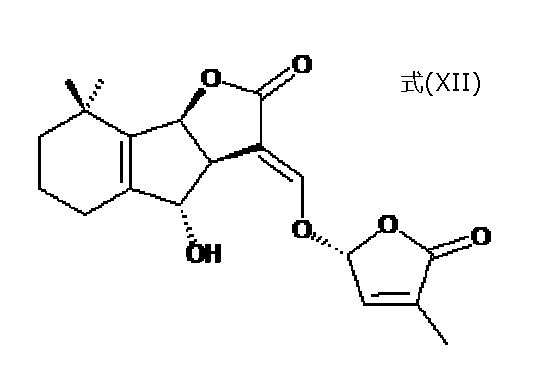
(3aS,4S,8bS,2'R)-3-{[(E)-(2',5'-dihydro-4'-methyl-5'-oxo-2'-furanyl)oxy]methylene}-3,3a,4,5,6,7,8,8b-octahydro-4-hydroxy-8,8-dimethyl-2H-Indeno[1,2-b]furan-2-one

(3aS,4S,8bS,2'R)-4-acetoxy-3-{[(E)-(2',5'-dihydro-4'-methyl-5'-oxo-2'-furanyl)oxy]methylene}-3,3a,4,5,6,7,8,8b-octahydro-8,8-dimethyl-2H-Indeno[1,2-b]furan-2-one

(3aR,8bS,2'R)-3-{[(E)-(2',5'-dihydro-4'-methyl-5'-oxo-2'-furanyl)oxy]methylene}-3,3a,4,8b-tetrahydro-2H-indeno[1,2-b]furan-2-one
本発明において、一般式(II)又は(IV)で示される種子発芽阻害物質の更なる具体例として、表1に示す以下の式(XV)~式(XXII)に示す立体構造からなる化合物が例示される。

本明細書において、種子発芽阻害物質は、根寄生植物に対して種子発芽刺激活性物質による発芽を阻害しうる活性を有する物質をいう。ここにおいて、種子発芽刺激活性物質は、人為的に添加されるものであってもよいが、例えば宿主植物から分泌される種子発芽刺激物質であってよい。この場合における種子発芽刺激活性物質としては、自体公知のものであってもよく、例えばストリゴール、ソルゴラクトン、アレクトール、オロバンコール、ジャスモン酸、ブラシノライド、ブラシノステロイド(カスタステロン等)、ククルビン酸、ジヒドロソルゴレオン、コチレニン、フシコクシン、GR-7、GR-24、ナイメヘン-1などが挙げられる。本発明の種子発芽阻害物質は、宿主植物から分泌される種子発芽刺激物質の存在下で、根寄生植物の発芽を阻害しうることから、宿主植物の発芽には影響を及ぼさないで、根寄生植物の発芽のみ阻害しうる。
本発明物質の根寄生植物発芽調節剤、次の方法により製造することができる。以下の式(XXIII)の光学活性ジアステレオマー混合物及び同様に式(XXIV)の混合物は、例えば、非特許文献4(H. Takikawa, H. Imaishi, A. Tanaka, S. Jikumaru, M. Fujiwara, M. Sasaki, Tetrahedron: Asymmetry, 2010, 21, 1166-1168)に記載の方法により製造することができる。式(XXIII)又は式(XXIV)で表される光学活性ジアステレオマー混合物を、カラムクロマトグラフィーにより分離、精製して、式(VI)に示す化合物A(a)又は式(X)に示す化合物A(b)を得ることができる。

本発明は、上記いずれかに示される根寄生植物発芽調節剤を含む「根寄生植物防除剤」にも及ぶ。本発明の根寄生植物防除剤の剤形としては、一般に根寄生植物防除剤に慣用されている剤形にしたものであればよく、特に限定されない。このようなものとしては、例えば粉剤、微粒剤、顆粒剤、乳剤、水和剤、懸濁剤、ドライフロアブル、フロアブル、水性液剤、油剤、燻煙剤、エアゾール剤、マイクロカプセル剤などが挙げられる。根寄生植物防除剤の製剤化に際して用いられる担体などの賦形剤、界面活性剤、固着剤、分散剤、安定剤などの添加剤については、一般に根寄生植物防除剤に慣用されているものの中から適宜選択することができる。
担体としては、固体担体、液体担体、ガス状担体のいずれも用いることができる。この固体担体の例としては、粘土類(例えば、カオリナイト、酸性白土、ケイソウ土、合成含水酸化ケイ素、ベントナイト)、タルク類、その他の無機鉱物(例えば、炭酸カルシウム、石英粉末、活性炭、水和シリカ)、化学肥料(例えば、硫安、塩安、燐安、尿素)、有機物(例えば、サトウキビ、樹皮末、タバコ茎末)等の微粉末あるいは粒状物を挙げることができる。液体担体の例としては、水、アルコール類(例えば、メタノール、エタノール、イソプロパノール)、ケトン類(例えば、アセトン、メチルエチルケトン)、炭化水素類(例えば、ベンゼン、トルエン、キシレン、シクロヘキサン、メチルナフタレン)、エステル類(例えば酢酸エチル、酢酸ブチル)、エーテル類(例えば、ジオキサン、ジイソプロピルエーテル)、酸アミド類(例えば、ジメチルホルムアミド、ジメチルアセトアミド)などを挙げることができる。
界面活性剤としては、例えば、アルキル硫酸エステル類、アルキルスルホン酸塩、アルキルアリールスルホン酸塩、アルキルアリールエーテル類及びそのポリオキシエチレン化物、ポリエチレングリコールエーテル類、多価アルコールエステル類、糖アルコール誘導体などを挙げることができる。
固着剤や分散剤としては、例えば、カゼイン、ゼラチン、多糖類(例えば、でんぷん、アラビアゴム、セルロース誘導体)、リグニン誘導体、ベントナイト、糖類、合成水溶性高分子(例えば、ポリビニルアルコール、ポリビニルピロリドン、ポリアクリル酸類)などを挙げることができる。
安定剤としてはPAP(酸性リン酸イソプロピル)、BHT(2,6‐ジ‐t‐ブチル‐4‐メチルフェノール)、植物油、鉱物油、脂肪酸、又はそのエステル類を挙げることができる。ただし、製剤に用いられる原料としては、従来公知の原料であれば、これらに限定されるものではない。
本発明は、根寄生植物発芽調節剤を用いることを特徴とする、根寄生植物の防除方法にも及ぶ。根寄生植物は寄生を確立した後で宿主植物からの養分に依存するだけではなく、生活環の初期の段階において、すでに宿主植物と密接に関係している。すなわち、根寄生植物の種子は適当な温湿度条件下で休眠から醒めた後、宿主植物等の根から分泌される種子発芽刺激活性物質を感受して発芽する。本発明の根寄生植物の防除方法として、本発明の根寄生植物発芽調節剤のうち「種子発芽阻害物質」を、根寄生植物の種子に直接作用させることで、根寄生植物を防除することができる。
一方、宿主植物を播種する前の畑に、根寄生植物の種子に対して種子発芽刺激活性物質を散布し、土壌中の根寄生植物種子を強制的に発芽させることで、宿主植物からの養分が供給されない状態にしておき、枯死させる方法が挙げられる。この場合には、本発明の根寄生植物発芽調節剤のうち、特に「種子発芽刺激活性物質」を利用することができる。
本発明の根寄生植物発芽調節剤を含む根寄生植物防除剤を上記用途に供するには、この根寄生植物発芽調節剤を含む水性剤や粉剤等を、共生地域又は栽培地域に所定濃度で散布するか、あるいは噴霧することによって達成される。また、あらかじめ栽培地域の土壌中に浸透させておいてもよい。
本発明の理解を深めるために、以下の製造例及び試験例により更に具体的に本発明を説明するが、本発明はこれらに限定されるものではないことは明らかである。
(製造例1)化合物A(a)(式(VI):(3aR,4R,8bR,2'R)-3-{[(E)-(2',5'-dihydro-4'-methyl-5'-oxo-2'-furanyl)oxy]methylene}-3,3a,4,8b-tetrahydro-4-hydroxy-2H-indeno[1,2-b]furan-2-one))の製造
非特許文献4の方法に従い製造された左旋性を有する光学活性三環性ラクトン(-)-(3aR,4R,8bR,)-4-hydroxy-3,3a,4,8b-tetrahydro-4-hydroxy-2H-indeno[1,2-b]furan-2-one (101 mg, 0.532 mmol)を、非特許文献5(E. M. Mungnus, et al., Journal of Agricultural Food Chemistry, 1992, 40, 1230-1235)に記載の方法により、光学活性ジアステレオマー混合物(A+epi-A, 53 mg, 32%)へと変換した。
得られた光学活性ジアステレオマー混合物(A+epi-A) をシリカゲルカラムクロマトグラフィー(ヘキサン/酢酸エチル=2/1)で精製し、溶出順序がより速い化合物 epi-A(27 mg)及び溶出順序がより遅い化合物A(24 mg)をそれぞれ得た。
得られた光学活性ジアステレオマー混合物(A+epi-A) をシリカゲルカラムクロマトグラフィー(ヘキサン/酢酸エチル=2/1)で精製し、溶出順序がより速い化合物 epi-A(27 mg)及び溶出順序がより遅い化合物A(24 mg)をそれぞれ得た。
化合物epi-A(a): mp. 68 - 69 ℃.[α]D
27 -264 (c 0.902, CHCl3). 1H-NMR (CDCl3,300 MHz)δ 2.04 (br s, 3H, 4'-Me), 3.81 (ddd, J = 1.8, 2.7, 7.5 Hz, 1H, 3a-H), 5.32 (br s, 1H, 4-H), 6.08 (d, J = 7.5 Hz, 1H, 8b-H), 6.24 (t, J = 1.5 Hz, 1H, 2'-H), 7.00 (t, J = 1.5 Hz, 1H, 3'-H), 7.42-7.54 (m, 5H, 5-, 6-, 7-, 8- and 9-H). 13C-NMR (CDCl3, 75 MHz)δ 10.7, 50.4, 79.6, 84.2, 100.5, 110.1, 125.6, 126.5, 130.0, 130.7, 136.2, 139.1, 140.9, 143.9, 151.8, 170.1, 170.9.
化合物A(a):mp. 65 - 66 ℃.[α]D
27 -154 (c 1.10, CHCl3). 1H-NMR (CDCl3,300 MHz)δ 2.05 (br s, 3H, 4'-Me), 3.80-3.84 ((ddd, J = 1.8, 2.7, 7.5 Hz, 1H, 3a-H), 5.32 (br s, 1H, 4-H), 6.10 (d, J = 7.5 Hz, 1H, 8b-H), 6.22 (t, J = 1.5 Hz, 1H, 2'-H), 7.00 (t, J = 1.5 Hz, 1H, 3'-H), 7.41-7.56 (m, 5H, 5-, 6-, 7-, 8- and 9-H). 13C-NMR (CDCl3, 75 MHz)δ 10.8, 50.4, 79.6, 84.1, 100.7, 110.1, 125.6, 126.6, 130.2, 130.8, 136.1, 139.2, 140.9, 143.8, 152.0, 170.1, 170.7.
(製造例2)化合物A(b)(式(X):(3aS,4S,8bS,2'R)-3-{[(E)-(2',5'-dihydro-4'-methyl-5'-oxo-2'-furanyl)oxy]methylene}-3,3a,4,8b-tetrahydro-4-hydroxy-2H-indeno[1,2-b]furan-2-one))の製造
製造例1に示す非特許文献4の方法に従い製造された右旋性を有する三環性ラクトン(+)-(3aS,4S,8bS,)-4-hydroxy-3,3a,4,8b-tetrahydro-4-hydroxy-2H-indeno[1,2-b]furan-2-one (119 mg, 0.620 mmol)を、同様に非特許文献5に記載の方法により、混合物(A(b) + epi-A(b),55 mg, 28%)へと変換した。得られた混合物(A(b) + epi-A(b)) をシリカゲルカラムクロマトグラフィー(ヘキサン/酢酸エチル=2/1)で精製し、溶出順序がより速い化合物A(b)(23 mg)及び溶出順序がより遅い化合物epi-A(b)(9.0 mg)をそれぞれ得た。また、ジアステレオマー混合物(33 mg)を回収した。
化合物A(b): mp. 64-65 ℃. [α]D 27 +267 (c 0.804, CHCl3).
化合物epi-A(b):mp. 78-80 ℃. [α]D 27 +177 (c 0.290, CHCl3).
化合物A(b): mp. 64-65 ℃. [α]D 27 +267 (c 0.804, CHCl3).
化合物epi-A(b):mp. 78-80 ℃. [α]D 27 +177 (c 0.290, CHCl3).
(試験例1)種子発芽試験(1)
製造例1及び2で製造した各試験化合物10μmolを秤量し、アセトン2 mlに溶かした。これらを蒸留水を用いて、各々0.1μM、10μMに希釈した。次に、シャーレにろ紙を敷き、ろ紙上にコンディショニングしたストライガの種子をのせ、希釈した各試験化合物を種子に対して20μlずつ処理した。湿度を維持するために、水滴が流れ出さない程度に湿らせたろ紙を四つ折にしてシャーレ中央に入れた。シャーレにパラフィルムを捲いて、シャーレをアルミホイルで包み、30℃でインキュベートした。48時間後、発芽した種子の数を数え、発芽率(%)を測定した。発芽率(%)は、全種子数に対する発芽した種子数(発芽した種子数/全種子数)により算出した。試験した化合物(ラセミ体(A(b) + epi-A(a))、ラセミ体(A(a)+ epi-A(b))及び4つの光学異性体(A(a)、A(b)、epi-A(a)及びepi-A(b)))のS. gesnerioidesに対する発芽刺激活性試験結果を表2に示した。上記の結果、式(VI)に示す化合物A(a)に高い種子発芽刺激活性が認められた。
製造例1及び2で製造した各試験化合物10μmolを秤量し、アセトン2 mlに溶かした。これらを蒸留水を用いて、各々0.1μM、10μMに希釈した。次に、シャーレにろ紙を敷き、ろ紙上にコンディショニングしたストライガの種子をのせ、希釈した各試験化合物を種子に対して20μlずつ処理した。湿度を維持するために、水滴が流れ出さない程度に湿らせたろ紙を四つ折にしてシャーレ中央に入れた。シャーレにパラフィルムを捲いて、シャーレをアルミホイルで包み、30℃でインキュベートした。48時間後、発芽した種子の数を数え、発芽率(%)を測定した。発芽率(%)は、全種子数に対する発芽した種子数(発芽した種子数/全種子数)により算出した。試験した化合物(ラセミ体(A(b) + epi-A(a))、ラセミ体(A(a)+ epi-A(b))及び4つの光学異性体(A(a)、A(b)、epi-A(a)及びepi-A(b)))のS. gesnerioidesに対する発芽刺激活性試験結果を表2に示した。上記の結果、式(VI)に示す化合物A(a)に高い種子発芽刺激活性が認められた。


(試験例2)種子発芽試験(2)
試験例1と同手法により式(VI)に示す化合物A(a)と式(X)に示す化合物A(b)の等量混合溶液を調製し、希釈した各試験化合物を種子に対して20μlずつ処理した。その結果、種子発芽刺激活性物質である化合物A(a)による種子発芽誘導は、化合物A(b)によって阻害された(表3)。従って、化合物A(b)は種子発芽阻害物質であることが確認された。
試験例1と同手法により式(VI)に示す化合物A(a)と式(X)に示す化合物A(b)の等量混合溶液を調製し、希釈した各試験化合物を種子に対して20μlずつ処理した。その結果、種子発芽刺激活性物質である化合物A(a)による種子発芽誘導は、化合物A(b)によって阻害された(表3)。従って、化合物A(b)は種子発芽阻害物質であることが確認された。

(試験例3)種子発芽試験(3)
試験例2の化合物A(a)の代わりにS. gesnerioidesの宿主植物であるササゲの水耕液を用いた。このササゲ水耕液には、本発明の種子発芽刺激活性作用を示す化合物である、式(VIII)及び式(IX)に示す物質が含まれている。なお、式(VIII)及び式(IX)に示す化合物及びその活性は、本発明において、初めて確認されたものである。

式(VIII)に示す化合物は、(3aR,4R,8bR,2'R)-3-{[(E)-(2',5'-dihydro-4'-methyl-5'-oxo-2'-furanyl)oxy]methylene}-3,3a,4,5,6,7,8,8b-octahydro-4-hydroxy-8,8-dimethyl-2H-Indeno[1,2-b]furan-2-oneであり、式(IX)に示す化合物は、(3aR,4R,8bR,2'R)-4-acetoxy-3-{[(E)-(2',5'-dihydro-4'-methyl-5'-oxo-2'-furanyl)oxy]methylene}-3,3a,4,5,6,7,8,8b-octahydro-8,8-dimethyl-2H-Indeno[1,2-b]furan-2-oneである。
試験例2の化合物A(a)の代わりにS. gesnerioidesの宿主植物であるササゲの水耕液を用いた。このササゲ水耕液には、本発明の種子発芽刺激活性作用を示す化合物である、式(VIII)及び式(IX)に示す物質が含まれている。なお、式(VIII)及び式(IX)に示す化合物及びその活性は、本発明において、初めて確認されたものである。
その結果、ササゲ水耕液による種子発芽誘導は、化合物A(b)によって阻害された(表4)。このことからも、化合物A(b)は種子発芽阻害物質であることが確認された。

(試験例4)種子発芽試験(4)
試験例3の化合物A(b)の代わりに式(XIV)に示す化合物B(b)を用いた。本試験例においても、ササゲの水耕液を用いた。このササゲ水耕液には、本発明の種子発芽刺激活性作用を示す化合物である、式(VIII)及び式(IX)に示す物質が含まれている。
試験例3の化合物A(b)の代わりに式(XIV)に示す化合物B(b)を用いた。本試験例においても、ササゲの水耕液を用いた。このササゲ水耕液には、本発明の種子発芽刺激活性作用を示す化合物である、式(VIII)及び式(IX)に示す物質が含まれている。
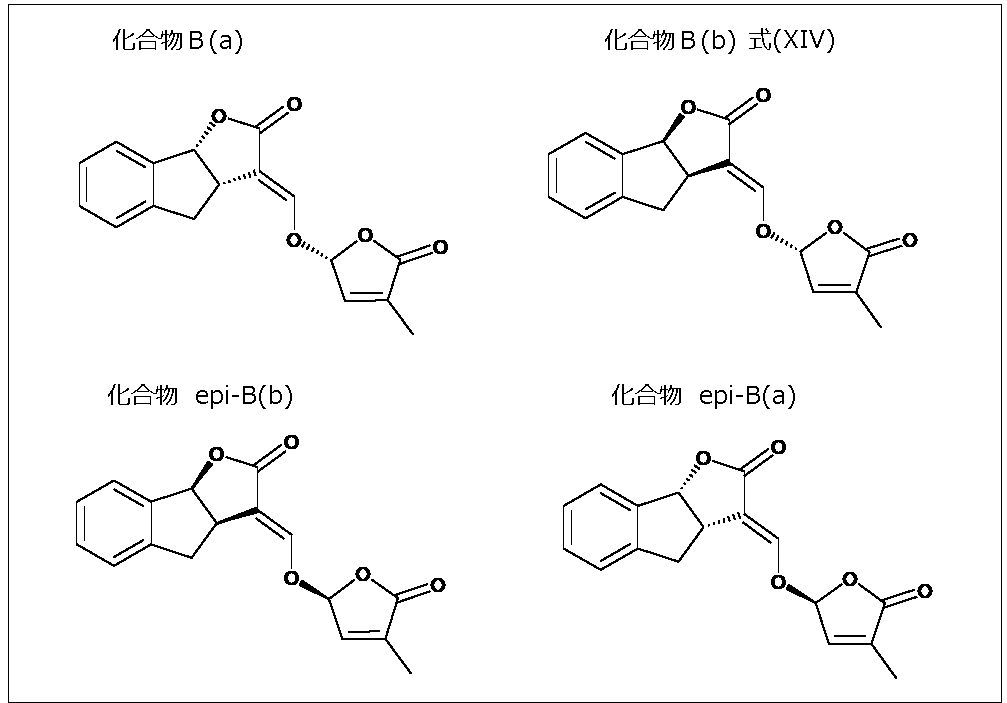
その結果、ササゲ水耕液による種子発芽誘導は、化合物B(b)によって阻害された(表5)。このことから、化合物B(b)は種子発芽阻害物質であることが確認された。

(試験例5)種子発芽試験(5)
試験例3の化合物A(b)の代わりに式(XI)に示す化合物A-Ac(b)を用いた。本試験例においても、ササゲの水耕液を用いた。このササゲ水耕液には、本発明の種子発芽刺激活性作用を示す化合物である、式(VIII)及び式(IX)に示す物質が含まれている。

試験例3の化合物A(b)の代わりに式(XI)に示す化合物A-Ac(b)を用いた。本試験例においても、ササゲの水耕液を用いた。このササゲ水耕液には、本発明の種子発芽刺激活性作用を示す化合物である、式(VIII)及び式(IX)に示す物質が含まれている。
その結果、ササゲ水耕液による種子発芽誘導は、化合物A-Ac(b)によって阻害された(表6)。このことから、化合物A-Ac(b)は種子発芽阻害物質であることが確認された。

(比較例)種子発芽試験(6)
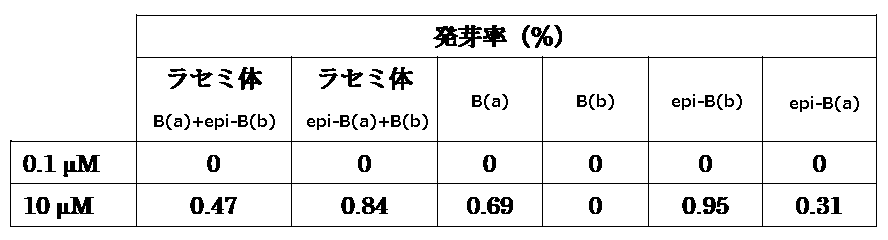
本比較例では、以下に示す化合物B(a), epi-B(a), B(b)及びepi-B(b)のいずれかを含むGR-24のラセミ体及び4つの光学異性体(非特許文献6:J. W. J. F. Thuring, et al, Journal of Agricultural and Food Chemistry, 1997, 45, 2278-2283)について、S. gesnerioidesに対する種子発芽刺激活性を、試験例1と同手法により確認した。
本比較例では、以下に示す化合物B(a), epi-B(a), B(b)及びepi-B(b)のいずれかを含むGR-24のラセミ体及び4つの光学異性体(非特許文献6:J. W. J. F. Thuring, et al, Journal of Agricultural and Food Chemistry, 1997, 45, 2278-2283)について、S. gesnerioidesに対する種子発芽刺激活性を、試験例1と同手法により確認した。

その結果、各ラセミ体及び各々光学異性体とも、S. gesnerioidesに対して種子発芽刺激活性は全く示さなかった。
以上詳述したように、本発明の根寄生植物発芽調節剤によると、同じ化学式で示される化合物であっても、立体構造の違いにより根寄生植物に対して種子発芽刺激活性作用又は種子発芽阻害作用を有する。土壌等に、本発明の根寄生植物発芽調節剤のうち種子発芽刺激活性物質を用いて処理することで、宿主植物が存在しない場合に宿主植物から根寄生植物に対する栄養が供給されない状態で種子を発芽させ、根寄生植物を枯死させることができる。これにより、根寄生植物を防除することができる。また、土壌等に、本発明の根寄生植物発芽調節剤のうち種子発芽阻害物質を用いて処理することで、根寄生植物の発芽を阻害することができ、根寄生植物が宿主植物に寄生するのを防除することができる。
本発明の特定の立体構造を有する化合物が、根寄生植物のうち特にS. gesnerioidesに対して種子発芽刺激活性作用又は種子発芽阻害作用を有することを初めて見出した。これらの本発明の根寄生植物発芽調節剤を用いることにより、農業生産に及ぼしている甚大な被害を軽減化することができる。
Claims (8)
- 下記の一般式(I)で表され、かつ特定の立体構造を有する化合物からなる根寄生植物発芽調節剤。

- 特定の立体構造を有する化合物が、以下の一般式(II)又は一般式(III)で表され、一般式(II)で表される化合物が根寄生植物の種子発芽阻害物質であり、一般式(III)で表される化合物が根寄生植物の種子発芽刺激活性物質であることを特徴とする、請求項1に記載の根寄生植物発芽調節剤。
- 特定の立体構造を有する化合物が、以下の一般式(IV)又は一般式(V)で表され、一般式(IV)で表される化合物が根寄生植物の種子発芽阻害物質であり、一般式(V)で表される化合物が根寄生植物の種子発芽刺激活性物質であることを特徴とする、請求項2に記載の根寄生植物発芽調節剤。

- 特定の立体構造を有する化合物が、以下の式(X)~(XVI)のいずれかで表される化合物であり、根寄生植物の種子発芽阻害物質であることを特徴とする、請求項2又は3に記載の根寄生植物発芽調節剤:


- 特定の立体構造を有する化合物が、以下の式(VI)~(IX)のいずれかで表される化合物であり、根寄生植物の種子発芽刺激活性物質であることを特徴とする、請求項2又は3に記載の根寄生植物発芽調節剤。


- 根寄生植物が、ストライガゲスネルオイデス(S. gesnerioides)である、請求項1~5のいずれか1に記載の根寄生植物発芽調節剤。
- 請求項1~6のいずれか1に記載の根寄生植物発芽調節剤を含む根寄生植物防除剤。
- 請求項1~6のいずれか1に記載の根寄生植物発芽調節剤を用いることを特徴とする、根寄生植物の防除方法。
Priority Applications (1)
| Application Number | Priority Date | Filing Date | Title |
|---|---|---|---|
| JP2013515055A JPWO2012157404A1 (ja) | 2011-05-18 | 2012-04-23 | 根寄生植物発芽調節剤及びそれを用いる根寄生植物の防除方法 |
Applications Claiming Priority (2)
| Application Number | Priority Date | Filing Date | Title |
|---|---|---|---|
| JP2011-111819 | 2011-05-18 | ||
| JP2011111819 | 2011-05-18 |
Publications (1)
| Publication Number | Publication Date |
|---|---|
| WO2012157404A1 true WO2012157404A1 (ja) | 2012-11-22 |
Family
ID=47176740
Family Applications (1)
| Application Number | Title | Priority Date | Filing Date |
|---|---|---|---|
| PCT/JP2012/060817 Ceased WO2012157404A1 (ja) | 2011-05-18 | 2012-04-23 | 根寄生植物発芽調節剤及びそれを用いる根寄生植物の防除方法 |
Country Status (2)
| Country | Link |
|---|---|
| JP (1) | JPWO2012157404A1 (ja) |
| WO (1) | WO2012157404A1 (ja) |
Cited By (3)
| Publication number | Priority date | Publication date | Assignee | Title |
|---|---|---|---|---|
| US20160159780A1 (en) * | 2013-10-25 | 2016-06-09 | Asilomar Bio, Inc. | Strigolactone formulations and uses thereof |
| EP3294063A4 (en) * | 2015-05-14 | 2018-12-05 | The State of Israel, Ministry of Agriculture and Rural Development, Agricultural Research Organisation, Volcani Center | Plant hormone application |
| WO2025253490A1 (ja) * | 2024-06-04 | 2025-12-11 | 学校法人明治大学 | 根寄生植物用発芽誘導剤 |
Citations (1)
| Publication number | Priority date | Publication date | Assignee | Title |
|---|---|---|---|---|
| JP2006282513A (ja) * | 2005-03-31 | 2006-10-19 | Morishita Jintan Kk | 植物根寄生植物の防除方法 |
-
2012
- 2012-04-23 WO PCT/JP2012/060817 patent/WO2012157404A1/ja not_active Ceased
- 2012-04-23 JP JP2013515055A patent/JPWO2012157404A1/ja active Pending
Patent Citations (1)
| Publication number | Priority date | Publication date | Assignee | Title |
|---|---|---|---|---|
| JP2006282513A (ja) * | 2005-03-31 | 2006-10-19 | Morishita Jintan Kk | 植物根寄生植物の防除方法 |
Non-Patent Citations (5)
| Title |
|---|
| AKIYAMA, KOHKI ET AL.: "Structural Requirements of Strigolactones for Hyphal Branching in AM Fungi", PLANT AND CELL PHYSIOLOGY, vol. 51, no. 7, 2010, pages 1104 - 1117 * |
| KIM, HYUN IL ET AL.: "Structure-activity relationship of naturally occurring strigolactones in Orobanche minor seed germination stimulation", JOURNAL OF PESTICIDE SCIENCE, vol. 35, no. 3, 2010, pages 344 - 347 * |
| THURING, JAN WILLEM J. F. ET AL.: "Asymmetric synthesis of all stereoisomers of the strigol analog GR24. Dependence of absolute configuration on stimulatory activity of Striga hermonthica and Orobanche crenata seed germination", JOURNAL OF AGRICULTURAL AND FOOD CHEMISTRY, vol. 45, no. 6, 1997, pages 2278 - 2283 * |
| UENO, KOTOMI ET AL.: "Ent-2'-epi-Orobanchol and Its Acetate, As Germination Stimulants for Striga gesnerioides Seeds Isolated from Cowpea and Red Clover", JOURNAL OF AGRICULTURAL AND FOOD CHEMISTRY, vol. 59, no. 19, 8 September 2001 (2001-09-08), pages 10485 - 10490 * |
| UENO, KOTOMI ET AL.: "Structural requirements of strigolactones for germination induction of Striga gesnerioides seeds", JOURNAL OF AGRICULTURAL AND FOOD CHEMISTRY, vol. 59, no. 17, 8 August 2011 (2011-08-08), pages 9226 - 9231 * |
Cited By (6)
| Publication number | Priority date | Publication date | Assignee | Title |
|---|---|---|---|---|
| US20160159780A1 (en) * | 2013-10-25 | 2016-06-09 | Asilomar Bio, Inc. | Strigolactone formulations and uses thereof |
| KR20160079013A (ko) * | 2013-10-25 | 2016-07-05 | 아실로마 바이오, 인크. | 스트리고락톤 제제 및 그의 용도 |
| US9994557B2 (en) * | 2013-10-25 | 2018-06-12 | Asilomar Bio, Inc. | Strigolactone formulations and uses thereof |
| KR102299236B1 (ko) | 2013-10-25 | 2021-09-06 | 사운드 애그리컬쳐 컴퍼니 | 스트리고락톤 제제 및 그의 용도 |
| EP3294063A4 (en) * | 2015-05-14 | 2018-12-05 | The State of Israel, Ministry of Agriculture and Rural Development, Agricultural Research Organisation, Volcani Center | Plant hormone application |
| WO2025253490A1 (ja) * | 2024-06-04 | 2025-12-11 | 学校法人明治大学 | 根寄生植物用発芽誘導剤 |
Also Published As
| Publication number | Publication date |
|---|---|
| JPWO2012157404A1 (ja) | 2014-07-31 |
Similar Documents
| Publication | Publication Date | Title |
|---|---|---|
| WO2013140946A1 (ja) | 根寄生植物発芽阻害剤およびそれを用いる根寄生植物の防除方法 | |
| JP4596795B2 (ja) | ピペリトールもしくはその誘導体を有効成分とする植物抑制剤 | |
| AU2016253008B2 (en) | Methods for hydraulic enhancement of crops | |
| EP2518062A1 (en) | Novel strigolactone analogues and their use | |
| Pena-Rodriguez et al. | Toxins from weed pathogens, I. Phytotoxins from a Bipolaris pathogen of Johnson grass | |
| Kato-Noguchi et al. | Involvement of allelopathy in the establishment of pure colony of Dicranopteris linearis | |
| KR20190054871A (ko) | 트레베지아 팔마타(Trevesia palmata) 추출물, 이의 분획물 또는 이로부터 분리한 화합물을 유효성분으로 함유하는 식물병 방제용 조성물 및 상기 조성물을 사용한 식물병 방제 방법 | |
| WO2012157404A1 (ja) | 根寄生植物発芽調節剤及びそれを用いる根寄生植物の防除方法 | |
| KR20210104633A (ko) | 측백나무 추출물에서 유래한 다이터페노이드 화합물을 유효성분으로 함유하는 식물병 방제용 조성물 및 상기 조성물을 사용한 식물병 방제 방법 | |
| KR20120078694A (ko) | 식물 성장 조정제 | |
| KR102634925B1 (ko) | 폴리알티아 롱지폴리아로부터 유래된 화합물을 포함하는 식물병 방제용 조성물 | |
| KR102389559B1 (ko) | 프테로카르야 톤키넨시스(Pterocarya tonkinensis)로부터 유래된 살균 활성 화합물을 포함하는 식물병 방제용 조성물 및 상기 조성물을 사용한 식물병 방제 방법 | |
| KR102389735B1 (ko) | 프테로카르야 톤키넨시스(Pterocaryatonkinensis) 추출물 또는 이의 분확물을 포함하는 식물병 방제용 조성물 및 상기 조성물을 사용한 식물병 방제 방법 | |
| KR102240972B1 (ko) | 측백나무 추출물 또는 이의 분획물을 유효성분으로 함유하는 식물병 방제용 조성물 및 상기 조성물을 사용한 식물병 방제 방법 | |
| US4449997A (en) | Plant growth regulator | |
| JP7090261B2 (ja) | ヤマブシタケ由来新規化合物 | |
| KR102522009B1 (ko) | 아스퍼질러스 캔디더스 균주로부터 유래된 살균 활성 화합물을 포함하는 식물병 방제용 조성물 | |
| CN104351179B (zh) | 8-苯基(异丙基)香豆素的农用抑菌活性 | |
| JP2018052866A (ja) | 植物成長調整剤 | |
| JP4535630B2 (ja) | ケトール脂肪酸化合物およびその製造方法並びにこのケトール脂肪酸化合物を有効成分とする花芽形成促進剤 | |
| KR102638877B1 (ko) | 아스퍼질러스 몬테네그로이 sfc20200425-m27 균주로부터 유래된 화합물을 포함하는 식물병 방제용 조성물 및 이의 제조방법 | |
| RU2652135C2 (ru) | Сукцинимидное соединение | |
| JPS59163379A (ja) | α−ピロン誘導体および植物生長調節剤 | |
| KR20100113862A (ko) | 보골지 추출물을 유효성분으로 함유하는 식물병 방제용 조성물 및 이를 이용한 식물병 방제방법 | |
| CN108617657B (zh) | γ-丁内酯类化合物在调节植物生长活性中的应用 |
Legal Events
| Date | Code | Title | Description |
|---|---|---|---|
| 121 | Ep: the epo has been informed by wipo that ep was designated in this application |
Ref document number: 12786435 Country of ref document: EP Kind code of ref document: A1 |
|
| DPE1 | Request for preliminary examination filed after expiration of 19th month from priority date (pct application filed from 20040101) | ||
| ENP | Entry into the national phase |
Ref document number: 2013515055 Country of ref document: JP Kind code of ref document: A |
|
| NENP | Non-entry into the national phase |
Ref country code: DE |
|
| 122 | Ep: pct application non-entry in european phase |
Ref document number: 12786435 Country of ref document: EP Kind code of ref document: A1 |