WO2012157761A1 - Fluide moteur, et système à cycle thermique - Google Patents
Fluide moteur, et système à cycle thermique Download PDFInfo
- Publication number
- WO2012157761A1 WO2012157761A1 PCT/JP2012/062840 JP2012062840W WO2012157761A1 WO 2012157761 A1 WO2012157761 A1 WO 2012157761A1 JP 2012062840 W JP2012062840 W JP 2012062840W WO 2012157761 A1 WO2012157761 A1 WO 2012157761A1
- Authority
- WO
- WIPO (PCT)
- Prior art keywords
- working medium
- heat
- cycle system
- hfc
- performance
- Prior art date
- Legal status (The legal status is an assumption and is not a legal conclusion. Google has not performed a legal analysis and makes no representation as to the accuracy of the status listed.)
- Ceased
Links
Images


Classifications
-
- C—CHEMISTRY; METALLURGY
- C09—DYES; PAINTS; POLISHES; NATURAL RESINS; ADHESIVES; COMPOSITIONS NOT OTHERWISE PROVIDED FOR; APPLICATIONS OF MATERIALS NOT OTHERWISE PROVIDED FOR
- C09K—MATERIALS FOR MISCELLANEOUS APPLICATIONS, NOT PROVIDED FOR ELSEWHERE
- C09K5/00—Heat-transfer, heat-exchange or heat-storage materials, e.g. refrigerants; Materials for the production of heat or cold by chemical reactions other than by combustion
- C09K5/02—Materials undergoing a change of physical state when used
- C09K5/04—Materials undergoing a change of physical state when used the change of state being from liquid to vapour or vice versa
- C09K5/041—Materials undergoing a change of physical state when used the change of state being from liquid to vapour or vice versa for compression-type refrigeration systems
- C09K5/044—Materials undergoing a change of physical state when used the change of state being from liquid to vapour or vice versa for compression-type refrigeration systems comprising halogenated compounds
-
- F—MECHANICAL ENGINEERING; LIGHTING; HEATING; WEAPONS; BLASTING
- F25—REFRIGERATION OR COOLING; COMBINED HEATING AND REFRIGERATION SYSTEMS; HEAT PUMP SYSTEMS; MANUFACTURE OR STORAGE OF ICE; LIQUEFACTION SOLIDIFICATION OF GASES
- F25B—REFRIGERATION MACHINES, PLANTS OR SYSTEMS; COMBINED HEATING AND REFRIGERATION SYSTEMS; HEAT PUMP SYSTEMS
- F25B2500/00—Problems to be solved
- F25B2500/14—Problems to be solved the presence of moisture in a refrigeration component or cycle
-
- F—MECHANICAL ENGINEERING; LIGHTING; HEATING; WEAPONS; BLASTING
- F25—REFRIGERATION OR COOLING; COMBINED HEATING AND REFRIGERATION SYSTEMS; HEAT PUMP SYSTEMS; MANUFACTURE OR STORAGE OF ICE; LIQUEFACTION SOLIDIFICATION OF GASES
- F25B—REFRIGERATION MACHINES, PLANTS OR SYSTEMS; COMBINED HEATING AND REFRIGERATION SYSTEMS; HEAT PUMP SYSTEMS
- F25B43/00—Arrangements for separating or purifying gases or liquids; Arrangements for vaporising the residuum of liquid refrigerant, e.g. by heat
-
- F—MECHANICAL ENGINEERING; LIGHTING; HEATING; WEAPONS; BLASTING
- F25—REFRIGERATION OR COOLING; COMBINED HEATING AND REFRIGERATION SYSTEMS; HEAT PUMP SYSTEMS; MANUFACTURE OR STORAGE OF ICE; LIQUEFACTION SOLIDIFICATION OF GASES
- F25B—REFRIGERATION MACHINES, PLANTS OR SYSTEMS; COMBINED HEATING AND REFRIGERATION SYSTEMS; HEAT PUMP SYSTEMS
- F25B9/00—Compression machines, plants or systems, in which the refrigerant is air or other gas of low boiling point
- F25B9/002—Compression machines, plants or systems, in which the refrigerant is air or other gas of low boiling point characterised by the refrigerant
- F25B9/006—Compression machines, plants or systems, in which the refrigerant is air or other gas of low boiling point characterised by the refrigerant the refrigerant containing more than one component
Definitions
- the present invention relates to a working medium and a heat cycle system using the working medium.
- a working medium for heat cycle such as a refrigerant for a refrigerator, a refrigerant for an air conditioner, a working fluid for a power generation system (waste heat recovery power generation, etc.), a working medium for a latent heat transport device (heat pipe, etc.), a secondary cooling medium, etc.
- Chlorofluorocarbons (CFC) such as chlorotrifluoromethane and dichlorodifluoromethane
- HCFC hydrochlorofluorocarbons
- chlorodifluoromethane have been used.
- CFCs and HCFCs are now subject to regulation because of their impact on the stratospheric ozone layer.
- HFCs hydrofluorocarbons
- HFC-32 difluoromethane
- tetrafluoroethane tetrafluoroethane
- pentafluoroethane pentafluoroethane and the like
- HFC may cause global warming. Therefore, there is an urgent need to develop a working medium for heat cycle that has little influence on the ozone layer and has a low global warming potential.
- 1,1,1,2-tetrafluoroethane (HFC-134a) used as a refrigerant for automobile air conditioning equipment has a large global warming potential of 1430 (100-year value).
- HFC-134a 1,1,1,2-tetrafluoroethane
- HFC-152a 1,1-difluoroethane
- Hydrochlorofluoroolefins HCFO
- chlorofluoroolefins CFO
- hydrochlorofluoropropene for example, 1-chloro-3,3,3-trifluoropropene (HCFO-1233zd) is known (Patent Document 1).
- HCFO-1233zd 1-chloro-3,3,3-trifluoropropene
- the present invention relates to a heat cycle working medium that provides a heat cycle system that has low combustibility, little influence on the ozone layer, little influence on global warming, and excellent cycle performance (efficiency and capacity), and safety.
- the thermal cycle system is ensured and has excellent cycle performance (efficiency and capacity).
- the present invention includes 1,2-dichloro-1,2-difluoroethylene (hereinafter also referred to as CFO-1112) as a thermal cycle working medium (hereinafter also simply referred to as a working medium). To do.
- the working medium of the present invention preferably further contains a hydrocarbon.
- the working medium of the present invention preferably further contains HFC.
- the thermal cycle system of the present invention uses the working medium of the present invention.
- the working medium of the present invention contains CFO-1112 having a high halogen content, the combustibility is suppressed.
- CFO-1112 having a carbon-carbon double bond that is easily decomposed by OH radicals in the atmosphere, it has little influence on the ozone layer and little influence on global warming.
- CFO-1112 is included, a thermal cycle system having excellent cycle performance (efficiency and capacity) is provided. Since the thermal cycle system of the present invention uses the working medium of the present invention with reduced combustibility, safety is ensured, and because it has excellent thermodynamic properties, cycle performance (efficiency and capacity) ). Furthermore, since the efficiency is excellent, the power consumption can be reduced and the ability is excellent, so that the system can be downsized.
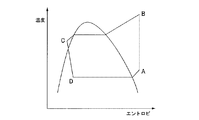
- FIG. 3 is a cycle diagram in which a change in state of a working medium in a refrigeration cycle system is described on a temperature-entropy diagram.
- FIG. 3 is a cycle diagram in which a change in state of a working medium in a refrigeration cycle system is described on a pressure-enthalpy diagram.
- the working medium of the present invention contains 1,2-dichloro-1,2-difluoroethylene.
- the working medium of the present invention may include other working medium that vaporizes and liquefies together with CFO 1112, such as hydrocarbons and HFC, as necessary.
- the working medium of the present invention can be used in combination with components other than the working medium used together with the working medium (hereinafter, a composition containing the working medium and components other than the working medium is referred to as a working medium-containing composition).
- components other than the working medium include lubricants, stabilizers, leak detection substances, desiccants, and other additives.
- the content of CFO-1112 is preferably 60% by mass or more, more preferably 70% by mass or more, still more preferably 80% by mass or more, and particularly preferably 100% by mass in the working medium (100% by mass).
- Hydrocarbon is a working medium component that improves the solubility of the working medium in mineral-based lubricating oil.
- the hydrocarbon preferably has 3 to 5 carbon atoms, and may be linear or branched. Specifically, propane, propylene, cyclopropane, butane, isobutane, pentane, and isopentane are preferable as the hydrocarbon, and propane, butane, and isobutane are particularly preferable.
- a hydrocarbon may be used individually by 1 type and may be used in combination of 2 or more type.
- the hydrocarbon content is preferably 1 to 30% by mass, more preferably 2 to 30% by mass in the working medium (100% by mass). If the hydrocarbon is 1% by mass or more, preferably 3% by mass or more, the solubility of the lubricating oil in the working medium is sufficiently improved.
- HFC HFC
- Capacity a working medium component that improves the cycle performance (capacity) of a thermal cycle system.
- HFC an HFC that has little influence on the ozone layer and little influence on global warming is preferable.
- the HFC preferably has 1 to 5 carbon atoms, and may be linear or branched. Specific examples of the HFC include difluoromethane, difluoroethane, trifluoroethane, tetrafluoroethane, pentafluoroethane, pentafluoropropane, hexafluoropropane, heptafluoropropane, pentafluorobutane, heptafluorocyclopentane, and the like. .
- HFC-32 difluoromethane
- HFC-152a 1,1-difluoroethane
- 1,1,2,2-tetra have a small impact on the ozone layer and a small impact on global warming.
- Fluoroethane (HFC-134), 1,1,1,2-tetrafluoroethane (HFC-134a) and pentafluoroethane (HFC-125) are particularly preferred.
- One HFC may be used alone, or two or more HFCs may be used in combination.
- the content of HFC in the working medium (100% by mass) is preferably in the range of 1 to 60% by mass, and more preferably in the range of 1 to 40% by mass.
- the refrigerating capacity is greatly improved without causing a decrease in the coefficient of performance in the range of 1 to 40% by mass.
- the refrigerating capacity is greatly improved without causing a decrease in the coefficient of performance in the range of 1 to 40% by mass.
- the refrigerating capacity is greatly improved without a significant decrease in the coefficient of performance in the range of 1 to 60 mass%.
- the refrigerating capacity is greatly improved without causing a decrease in the coefficient of performance in the range of 1 to 40% by mass.
- the refrigerating capacity is greatly improved without causing a decrease in the coefficient of performance in the range of 1 to 40% by mass.
- the HFC content can be controlled according to the required characteristics of the working medium.
- the lubricating oil used in the working medium-containing composition a known lubricating oil used in a heat cycle system is used.
- the lubricating oil include oxygen-containing synthetic oils (such as ester-based lubricating oils and ether-based lubricating oils), fluorine-based lubricating oils, mineral oils, and hydrocarbon-based synthetic oils.
- ester-based lubricating oil examples include dibasic acid ester oil, polyol ester oil, complex ester oil, and polyol carbonate oil.
- the dibasic acid ester oil includes a dibasic acid having 5 to 10 carbon atoms (glutaric acid, adipic acid, pimelic acid, suberic acid, azelaic acid, sebacic acid, etc.) and a carbon number having a linear or branched alkyl group.
- Esters with 1 to 15 monohydric alcohols methanol, ethanol, propanol, butanol, pentanol, hexanol, heptanol, octanol, nonanol, decanol, undecanol, dodecanol, tridecanol, tetradecanol, pentadecanol, etc. are preferred.
- ditridecyl glutarate di (2-ethylhexyl) adipate, diisodecyl adipate, ditridecyl adipate, di (3-ethylhexyl) sebacate and the like.
- Polyol ester oils include diols (ethylene glycol, 1,3-propanediol, propylene glycol, 1,4-butanediol, 1,2-butanediol, 1,5-pentadiol, neopentyl glycol, 1,7- Heptanediol, 1,12-dodecanediol, etc.) or polyol having 3 to 20 hydroxyl groups (trimethylolethane, trimethylolpropane, trimethylolbutane, pentaerythritol, glycerin, sorbitol, sorbitan, sorbitol glycerin condensate, etc.); Fatty acids having 6 to 20 carbon atoms (hexanoic acid, heptanoic acid, octanoic acid, nonanoic acid, decanoic acid, undecanoic acid, dodecanoic acid, eicosanoic acid,
- the polyol ester oil may have a free hydroxyl group.
- examples of polyol ester oils include esters of hindered alcohols (neopentyl glycol, trimethylol ethane, trimethylol propane, trimethylol butane, pentaerythritol, etc.) (trimethylol propane tripelargonate, pentaerythritol 2-ethylhexanoate). And pentaerythritol tetrapelargonate) are preferred.
- the complex ester oil is an ester of a fatty acid and a dibasic acid, a monohydric alcohol and a polyol.
- fatty acid, dibasic acid, monohydric alcohol, and polyol the same ones as described above can be used.
- the polyol carbonate oil is an ester of carbonic acid and polyol.
- examples of the polyol include the same diol as described above and the same polyol as described above.
- the polyol carbonate oil may be a ring-opening polymer of cyclic alkylene carbonate.
- ether lubricant examples include polyvinyl ether oil and polyoxyalkylene lubricant.
- polyvinyl ether oil include those obtained by polymerizing vinyl ether monomers such as alkyl vinyl ether, and copolymers obtained by copolymerizing vinyl ether monomers and hydrocarbon monomers having olefinic double bonds.
- a vinyl ether monomer may be used individually by 1 type, and may be used in combination of 2 or more type.
- hydrocarbon monomers having an olefinic double bond examples include ethylene, propylene, various butenes, various pentenes, various hexenes, various heptenes, various octenes, diisobutylene, triisobutylene, styrene, ⁇ -methylstyrene, various alkyl-substituted styrenes, etc. Is mentioned.
- the hydrocarbon monomer which has an olefinic double bond may be used individually by 1 type, and may be used in combination of 2 or more type.
- the polyvinyl ether copolymer may be either a block or a random copolymer. A polyvinyl ether may be used individually by 1 type, and may be used in combination of 2 or more type.
- polyoxyalkylene-based lubricating oil examples include polyoxyalkylene monool, polyoxyalkylene polyol, polyoxyalkylene monool and alkyl etherified product of polyoxyalkylene polyol, polyoxyalkylene monool and esterified product of polyoxyalkylene polyol, and the like. Can be mentioned. Polyoxyalkylene monools and polyoxyalkylene polyols are used to open a C 2-4 alkylene oxide (ethylene oxide, propylene oxide, etc.) in an initiator such as water or a hydroxyl group-containing compound in the presence of a catalyst such as an alkali hydroxide. Examples thereof include those obtained by a method of addition polymerization.
- the oxyalkylene units in the polyalkylene chain may be the same in one molecule, or two or more oxyalkylene units may be included. It is preferable that at least an oxypropylene unit is contained in one molecule.
- the initiator include water, monohydric alcohols such as methanol and butanol, and polyhydric alcohols such as ethylene glycol, propylene glycol, pentaerythritol, and glycerol.
- polyoxyalkylene-based lubricating oil an alkyl etherified product or an esterified product of polyoxyalkylene monool or polyoxyalkylene polyol is preferable.
- the polyoxyalkylene polyol is preferably polyoxyalkylene glycol.
- an alkyl etherified product of polyoxyalkylene glycol in which the terminal hydroxyl group of polyoxyalkylene glycol is capped with an alkyl group such as a methyl group, called polyglycol oil is preferable.
- fluorine-based lubricating oils include compounds in which hydrogen atoms of synthetic oils (mineral oils, poly ⁇ -olefins, alkylbenzenes, alkylnaphthalenes, etc. described later) are substituted with fluorine atoms, perfluoropolyether oils, fluorinated silicone oils, and the like. .
- a lubricating oil fraction obtained by subjecting crude oil to atmospheric distillation or vacuum distillation is refined (solvent removal, solvent extraction, hydrocracking, solvent dewaxing, catalytic dewaxing, hydrorefining, hydrorefining, And paraffinic mineral oils, naphthenic mineral oils, etc., which are refined by appropriately combining white clay treatment and the like.
- hydrocarbon synthetic oil examples include poly ⁇ -olefin, alkylbenzene, alkylnaphthalene and the like.
- a lubricating oil may be used individually by 1 type, and may be used in combination of 2 or more type.
- the content of the lubricating oil may be in a range that does not significantly reduce the effects of the present invention, and varies depending on the application, the type of the compressor, etc., but is 10 to 100 parts by mass with respect to the working medium (100 parts by mass).
- the amount is preferably 20 to 50 parts by mass.
- the stabilizer used in the working medium-containing composition is a component that improves the stability of the working medium against heat and oxidation.
- the stabilizer include an oxidation resistance improver, a heat resistance improver, and a metal deactivator.
- oxidation resistance improver and heat resistance improver examples include N, N′-diphenylphenylenediamine, p-octyldiphenylamine, p, p′-dioctyldiphenylamine, N-phenyl-1-naphthylamine, and N-phenyl-2-naphthylamine.
- the oxidation resistance improver and the heat resistance improver may be used alone or in combination of two or more.
- metal deactivators examples include imidazole, benzimidazole, 2-mercaptobenzthiazole, 2,5-dimethylcaptothiadiazole, salicylidine-propylenediamine, pyrazole, benzotriazole, toltriazole, 2-methylbenzamidazole, 3,5- Imethylpyrazole, methylenebis-benzotriazole, organic acids or their esters, primary, secondary or tertiary aliphatic amines, amine salts of organic or inorganic acids, heterocyclic nitrogen-containing compounds, alkyl acids Examples thereof include an amine salt of phosphate or a derivative thereof.
- the content of the stabilizer may be in a range that does not significantly reduce the effect of the present invention, and is preferably 5% by mass or less, more preferably 1% by mass or less in the working medium-containing composition (100% by mass).
- leak detection substance examples of leak detection substances used in the working medium-containing composition include ultraviolet fluorescent dyes, odorous gases and odor masking agents.
- the ultraviolet fluorescent dyes are described in U.S. Pat. No. 4,249,412, JP-T-10-502737, JP-T 2007-511645, JP-T 2008-500437, JP-T 2008-531836.
- known ultraviolet fluorescent dyes examples of the odor masking agent include known fragrances such as those described in JP-T-2008-500337 and JP-T-2008-531836.
- a solubilizing agent that improves the solubility of the leak detection substance in the working medium may be used.
- the solubilizer include those described in JP-T-2007-511645, JP-T-2008-500437, JP-T-2008-531836.
- the content of the leak detection substance may be in a range that does not significantly reduce the effect of the present invention, and is preferably 2% by mass or less, more preferably 0.5% by mass or less in the working medium-containing composition (100% by mass). .
- the working medium or the working medium-containing composition of the present invention is an alcohol having 1 to 4 carbon atoms, or a compound used as a conventional working medium, refrigerant, or heat transfer medium (hereinafter, the alcohol and the compound are collectively referred to as May be included as other compounds).
- Fluorine-containing ether perfluoropropyl methyl ether (C 3 F 7 OCH 3 ), perfluorobutyl methyl ether (C 4 F 9 OCH 3 ), perfluorobutyl ethyl ether (C 4 F 9 OC 2 H 5 ), 1, 1, 2 , 2-tetrafluoroethyl-2,2,2-trifluoroethyl ether (CF 2 HCF 2 OCH 2 CF 3 , manufactured by Asahi Glass Co., Ltd., AE-3000).
- the content of other compounds may be in a range that does not significantly reduce the effect of the present invention, and is preferably 30% by mass or less, more preferably 20% by mass or less, in the working medium-containing composition (100% by mass), 15 A mass% or less is particularly preferred.
- the thermal cycle system of the present invention is a system using the working medium of the present invention.
- Examples of the heat cycle system include a Rankine cycle system, a heat pump cycle system, a refrigeration cycle system, and a heat transport system.
- Refrigeratoration cycle system A refrigeration cycle system will be described as an example of a heat cycle system.
- the refrigeration cycle system is a system that cools the load fluid to a lower temperature by removing the thermal energy from the load fluid in the evaporator in the evaporator.
- FIG. 1 is a schematic configuration diagram showing an example of the refrigeration cycle system of the present invention.
- the refrigeration cycle system 10 compresses the working medium vapor A into a high-temperature and high-pressure working medium vapor B, and cools and liquefies the working medium vapor B discharged from the compressor 11 to operate at a low temperature and high pressure.
- the condenser 12 as the medium C, the expansion valve 13 that expands the working medium C discharged from the condenser 12 to form the low-temperature and low-pressure working medium D, and the working medium D discharged from the expansion valve 13 are heated.
- the working medium vapor A discharged from the evaporator 14 is compressed by the compressor 11 to obtain a high-temperature and high-pressure working medium vapor B.
- the working medium vapor B discharged from the compressor 11 is cooled by the fluid F in the condenser 12 and liquefied to obtain a low temperature and high pressure working medium C.
- the fluid F is heated to become a fluid F ′ and discharged from the condenser 12.
- the working medium C discharged from the condenser 12 is expanded by the expansion valve 13 to obtain a low-temperature and low-pressure working medium D.
- the refrigeration cycle system 10 is a cycle composed of adiabatic / isentropic change, isenthalpy change and isobaric change, and the state change of the working medium can be expressed as shown in FIG. 2 on a temperature-entropy diagram.
- the AB process is a process in which adiabatic compression is performed by the compressor 11 and the high-temperature and low-pressure working medium vapor A is converted into a high-temperature and high-pressure working medium vapor B.
- the BC process is a process in which isobaric cooling is performed by the condenser 12 and the high-temperature and high-pressure working medium vapor B is converted into a low-temperature and high-pressure working medium C.
- the CD process is a process in which isenthalpy expansion is performed by the expansion valve 13 and the low-temperature and high-pressure working medium C is used as the low-temperature and low-pressure working medium D.
- the DA process is a process in which isobaric heating is performed by the evaporator 14 and the low-temperature and low-pressure working medium D is returned to the high-temperature and low-pressure working medium vapor A.
- the water concentration of the working medium in the heat cycle system is preferably 100 ppm or less, and more preferably 20 ppm or less.
- a method for suppressing the water concentration in the heat cycle system a method using a desiccant (silica gel, activated alumina, zeolite, etc.) can be mentioned.
- a desiccant sica gel, activated alumina, zeolite, etc.
- a zeolitic desiccant is preferable from the viewpoint of the chemical reactivity between the desiccant and the working medium and the moisture absorption capacity of the desiccant.
- a zeolitic desiccant when a lubricating oil having a higher moisture absorption than conventional mineral-based lubricating oils is used, the compound represented by the following formula (1) is used as a main component from the viewpoint of excellent hygroscopic capacity.
- Zeolite desiccants are preferred.
- M is a Group 1 element such as Na or K, or a Group 2 element such as Ca
- n is a valence of M
- x and y are values determined by a crystal structure.
- pore diameter and breaking strength are important.
- a desiccant having a pore size larger than the molecular diameter of the working medium is used, the working medium is adsorbed in the desiccant, resulting in a chemical reaction between the working medium and the desiccant, and generation of a non-condensable gas.
- Undesirable phenomena such as a decrease in the strength of the desiccant and a decrease in the adsorption capacity will occur. Therefore, it is preferable to use a zeolitic desiccant having a small pore size as the desiccant.
- a sodium / potassium A type synthetic zeolite having a pore diameter of 3.5 mm or less is preferable.
- the shape is preferably granular or cylindrical.
- the zeolitic desiccant can be formed into an arbitrary shape by solidifying powdered zeolite with a binder (such as bentonite). As long as the zeolitic desiccant is mainly used, other desiccants (silica gel, activated alumina, etc.) may be used in combination.
- the use ratio of the zeolitic desiccant with respect to the working medium is not particularly limited.
- Non-condensable gas concentration If a non-condensable gas is mixed in the heat cycle system, it adversely affects the heat transfer in the condenser or the evaporator and the operating pressure rises. Therefore, it is necessary to suppress the mixing as much as possible.
- oxygen which is one of non-condensable gases, reacts with the working medium and lubricating oil to promote decomposition.
- the non-condensable gas concentration is preferably 1.5% by volume or less, particularly preferably 0.5% by volume or less in terms of the volume ratio with respect to the working medium in the gas phase part of the working medium.
- the refrigeration cycle performance (refrigeration capacity and coefficient of performance) was evaluated as the cycle performance (capacity and efficiency) when the working medium was applied to the refrigeration cycle system 10 of FIG.
- the evaluation sets the average evaporation temperature of the working medium in the evaporator 14, the average condensation temperature of the working medium in the condenser 12, the degree of supercooling of the working medium in the condenser 12, and the degree of superheating of the working medium in the evaporator 14, respectively. Carried out. In addition, it was assumed that there was no pressure loss in equipment efficiency and piping and heat exchanger.
- the refrigeration capacity Q and the coefficient of performance ⁇ can be obtained from the following equations (2) and (3) when the enthalpy h of each state (where the subscript h represents the state of the working medium).
- Q h A ⁇ h D (2).
- the coefficient of performance represents the efficiency of the refrigeration cycle system. The higher the coefficient of performance, the larger the output (refrigeration capacity) with the less input (the amount of power required to operate the compressor). Means you can.
- the refrigerating capacity means the ability to cool the load fluid, and the higher the refrigerating capacity, the more work can be done in the same system. In other words, when having a large refrigeration capacity, it means that the target performance can be obtained with a small amount of working medium, and the system can be downsized.
- Thermodynamic properties necessary for calculation of the refrigeration cycle performance were calculated based on a generalized equation of state (Soave-Redrich-Kwong equation) based on the corresponding state principle and thermodynamic relational equations. When characteristic values were not available, calculations were performed using an estimation method based on the group contribution method.
- Example 1 A refrigeration cycle when CFO-1112, HCFC-123, 1,1,1,3,3-pentafluoropropane (HFC-245fa) or HFC-134a is applied as a working medium to the refrigeration cycle system 10 of FIG. Performance (refrigeration capacity and coefficient of performance) was evaluated.
- the evaporation temperature of the working medium in the evaporator 14, the condensation temperature of the working medium in the condenser 12, the degree of supercooling of the working medium in the condenser 12, and the degree of superheating of the working medium in the evaporator 14 were the temperatures shown in Table 1.
- the relative performance (each working medium / HFC-245fa) of the refrigeration cycle performance (refrigeration capacity and coefficient of performance) of each working medium relative to HFC-245fa was determined. It shows in Table 1 for every working medium.
- Example 2 The refrigeration cycle performance (refrigeration capacity and coefficient of performance) was evaluated when a working medium comprising CFO-1112 and HCFC or HFC shown in Table 2 or 3 was applied to the refrigeration cycle system 10 of FIG.
- the average evaporation temperature of the working medium in the evaporator 14 is 0 ° C.
- the average condensation temperature of the working medium in the condenser 12 is 50 ° C.
- the degree of supercooling of the working medium in the condenser 12 is 5 ° C.
- the operation in the evaporator 14 is performed.
- the medium was heated at a degree of superheat of 5 ° C.
- the relative performance (each working medium / HFC-245fa) of the refrigeration cycle performance (refrigeration capacity and coefficient of performance) of each working medium relative to HFC-245fa was determined. It shows in Table 2 and Table 3 for every working medium.
- Example 3 The refrigeration cycle performance (refrigeration capacity and coefficient of performance) when a working medium composed of CFO-1112 and hydrocarbons shown in Table 4 was applied to the refrigeration cycle system 10 of FIG.
- the average evaporation temperature of the working medium in the evaporator 14 is 0 ° C.
- the average condensation temperature of the working medium in the condenser 12 is 50 ° C.
- the degree of supercooling of the working medium in the condenser 12 is 5 ° C.
- the operation in the evaporator 14 is performed.
- the medium was heated at a degree of superheat of 5 ° C.
- the relative performance (each working medium / HFC-245fa) of the refrigeration cycle performance (refrigeration capacity and coefficient of performance) of each working medium relative to HFC-245fa was determined. It shows in Table 4 for every working medium.
- Example 4 The refrigeration cycle performance (refrigeration capacity and coefficient of performance) when CFO-1112, HCFC-123, or HCFO-1233zd (E) was applied as the working medium to the refrigeration cycle system 10 of FIG. 1 was evaluated.
- the average evaporation temperature of the working medium in the evaporator 14 is ⁇ 10 to + 50 ° C.
- the average condensation temperature of the working medium in the condenser 12 is the average evaporation temperature + 50 ° C.
- the supercooling degree of the working medium in the condenser 12 is 5 ° C.
- the superheating degree of the working medium in the evaporator 14 was set to 5 ° C.
- the relative performance (respective working media / HCFC-123) of the refrigeration cycle performance (refrigeration capacity and coefficient of performance) of each working medium with respect to HCFC-123 was determined. It shows in Table 5 for every working medium.
- the working medium of the present invention includes a refrigerant for a refrigerator, a refrigerant for an air conditioner, a working fluid for a power generation system (waste heat recovery power generation, etc.), a working medium for a latent heat transport device (heat pipe, etc.), a secondary cooling medium, etc. It is useful as a working medium.
Landscapes
- Chemical & Material Sciences (AREA)
- Engineering & Computer Science (AREA)
- Physics & Mathematics (AREA)
- Chemical Kinetics & Catalysis (AREA)
- Combustion & Propulsion (AREA)
- Thermal Sciences (AREA)
- Materials Engineering (AREA)
- Organic Chemistry (AREA)
- Lubricants (AREA)
Abstract
L'invention fournit un fluide moteur pour cycle thermique qui présente des propriétés de combustion régulées, et un faible impact sur la couche d'ozone ainsi que sur le réchauffement de la planète, et qui confère un système à cycle thermique excellent en termes de performances cycliques (rendement et capacités). Ainsi, l'invention fournit également un système à cycle thermique excellent en termes de performances cycliques (rendement et capacités) dont la sécurité est garantie. Ce fluide moteur pour cycle thermique qui contient un 1,2-dichloro-1,2-difluoroéthylène, est mis en œuvre dans un système à cycle thermique (tel qu'un système à cycle Rankine, un système à cycle de pompe à chaleur, un système à cycle frigorifique (10), un système de transfert de chaleur, ou similaire).
Applications Claiming Priority (2)
| Application Number | Priority Date | Filing Date | Title |
|---|---|---|---|
| JP2011-112413 | 2011-05-19 | ||
| JP2011112413A JP2014141537A (ja) | 2011-05-19 | 2011-05-19 | 作動媒体および熱サイクルシステム |
Publications (1)
| Publication Number | Publication Date |
|---|---|
| WO2012157761A1 true WO2012157761A1 (fr) | 2012-11-22 |
Family
ID=47177075
Family Applications (1)
| Application Number | Title | Priority Date | Filing Date |
|---|---|---|---|
| PCT/JP2012/062840 Ceased WO2012157761A1 (fr) | 2011-05-19 | 2012-05-18 | Fluide moteur, et système à cycle thermique |
Country Status (2)
| Country | Link |
|---|---|
| JP (1) | JP2014141537A (fr) |
| WO (1) | WO2012157761A1 (fr) |
Cited By (3)
| Publication number | Priority date | Publication date | Assignee | Title |
|---|---|---|---|---|
| WO2020072731A1 (fr) * | 2018-10-05 | 2020-04-09 | The Chemours Company Fc, Llc | Compositions comprenant du 1,2-dichloro-1,2-difluoroéthylène destinées à être utilisées dans des applications de transfert thermique |
| WO2020072716A1 (fr) * | 2018-10-05 | 2020-04-09 | The Chemours Company Fc, Llc | Compositions comprenant du 1,2-dichloro-1,2-difluoroéthylène pour une utilisation dans des applications de nettoyage et de solvants |
| WO2025160007A1 (fr) * | 2024-01-22 | 2025-07-31 | The Chemours Company Fc, Llc | Chlorofluoroéthylène stabilisé |
Families Citing this family (1)
| Publication number | Priority date | Publication date | Assignee | Title |
|---|---|---|---|---|
| GB201418709D0 (en) * | 2014-10-21 | 2014-12-03 | Mexichem Fluor Sa De Cv | Compound |
Citations (4)
| Publication number | Priority date | Publication date | Assignee | Title |
|---|---|---|---|---|
| JPH03209338A (ja) * | 1990-01-11 | 1991-09-12 | Kanto Denka Kogyo Co Ltd | パーハロゲン化エチレンの製造法 |
| JPH0532567A (ja) * | 1991-02-22 | 1993-02-09 | A G Technol Kk | 飽和ハロゲン化炭化水素の精製方法 |
| WO2009132242A2 (fr) * | 2008-04-25 | 2009-10-29 | Honeywell International Inc. | Agents d’expansion pour mousses polymères |
| JP2010513827A (ja) * | 2006-09-01 | 2010-04-30 | イー・アイ・デュポン・ドウ・ヌムール・アンド・カンパニー | 閉ループ・サイクル中の選択された伝熱流体の循環方法 |
-
2011
- 2011-05-19 JP JP2011112413A patent/JP2014141537A/ja not_active Withdrawn
-
2012
- 2012-05-18 WO PCT/JP2012/062840 patent/WO2012157761A1/fr not_active Ceased
Patent Citations (4)
| Publication number | Priority date | Publication date | Assignee | Title |
|---|---|---|---|---|
| JPH03209338A (ja) * | 1990-01-11 | 1991-09-12 | Kanto Denka Kogyo Co Ltd | パーハロゲン化エチレンの製造法 |
| JPH0532567A (ja) * | 1991-02-22 | 1993-02-09 | A G Technol Kk | 飽和ハロゲン化炭化水素の精製方法 |
| JP2010513827A (ja) * | 2006-09-01 | 2010-04-30 | イー・アイ・デュポン・ドウ・ヌムール・アンド・カンパニー | 閉ループ・サイクル中の選択された伝熱流体の循環方法 |
| WO2009132242A2 (fr) * | 2008-04-25 | 2009-10-29 | Honeywell International Inc. | Agents d’expansion pour mousses polymères |
Non-Patent Citations (1)
| Title |
|---|
| ANAL.CHEM., vol. 68, 1996, pages 1347 - 1359 * |
Cited By (8)
| Publication number | Priority date | Publication date | Assignee | Title |
|---|---|---|---|---|
| WO2020072731A1 (fr) * | 2018-10-05 | 2020-04-09 | The Chemours Company Fc, Llc | Compositions comprenant du 1,2-dichloro-1,2-difluoroéthylène destinées à être utilisées dans des applications de transfert thermique |
| WO2020072716A1 (fr) * | 2018-10-05 | 2020-04-09 | The Chemours Company Fc, Llc | Compositions comprenant du 1,2-dichloro-1,2-difluoroéthylène pour une utilisation dans des applications de nettoyage et de solvants |
| CN112805351A (zh) * | 2018-10-05 | 2021-05-14 | 科慕埃弗西有限公司 | 用于热传递应用中的包含1,2-二氯-1,2-二氟乙烯的组合物 |
| US11390830B2 (en) | 2018-10-05 | 2022-07-19 | The Chemours Company Fc, Llc | Compositions comprising 1,2-dichloro-1,2-difluoroethylene for use in cleaning and solvent applications |
| US11702618B2 (en) | 2018-10-05 | 2023-07-18 | The Chemours Company Fc, Llc | Compositions comprising 1,2-dichloro-1,2-difluoroethylene for use in cleaning and solvent applications |
| EP4299689A3 (fr) * | 2018-10-05 | 2024-03-20 | The Chemours Company FC, LLC | Compositions comprenant du 1,2-dichloro-1,2-difluoroéthylène destinées à être utilisées dans des applications de transfert thermique |
| US12180407B2 (en) | 2018-10-05 | 2024-12-31 | The Chemours Company Fc, Llc | Compositions comprising 1,2-dichloro-1,2-difluoroethylene for use in heat transfer applications |
| WO2025160007A1 (fr) * | 2024-01-22 | 2025-07-31 | The Chemours Company Fc, Llc | Chlorofluoroéthylène stabilisé |
Also Published As
| Publication number | Publication date |
|---|---|
| JP2014141537A (ja) | 2014-08-07 |
Similar Documents
| Publication | Publication Date | Title |
|---|---|---|
| JP7456473B2 (ja) | 作動媒体および熱サイクルシステム | |
| JP7167975B2 (ja) | 組成物 | |
| JP5935799B2 (ja) | 作動媒体および熱サイクルシステム | |
| WO2012157762A1 (fr) | Fluide moteur, et système à cycle thermique | |
| WO2013015201A1 (fr) | Fluide moteur pour cycle de chauffage, et système de cycle de chauffage | |
| WO2015129548A1 (fr) | Fluide de travail pour cycle thermique, composition pour système à cycle thermique, et système à cycle thermique | |
| WO2012157761A1 (fr) | Fluide moteur, et système à cycle thermique |
Legal Events
| Date | Code | Title | Description |
|---|---|---|---|
| 121 | Ep: the epo has been informed by wipo that ep was designated in this application |
Ref document number: 12785871 Country of ref document: EP Kind code of ref document: A1 |
|
| NENP | Non-entry into the national phase |
Ref country code: DE |
|
| 122 | Ep: pct application non-entry in european phase |
Ref document number: 12785871 Country of ref document: EP Kind code of ref document: A1 |
|
| NENP | Non-entry into the national phase |
Ref country code: JP |