WO2012160727A1 - Procédé de culture par amendement du sol dans un sol de marais tourbeux - Google Patents
Procédé de culture par amendement du sol dans un sol de marais tourbeux Download PDFInfo
- Publication number
- WO2012160727A1 WO2012160727A1 PCT/JP2011/077487 JP2011077487W WO2012160727A1 WO 2012160727 A1 WO2012160727 A1 WO 2012160727A1 JP 2011077487 W JP2011077487 W JP 2011077487W WO 2012160727 A1 WO2012160727 A1 WO 2012160727A1
- Authority
- WO
- WIPO (PCT)
- Prior art keywords
- soil
- slag
- soil improvement
- improvement material
- present
- Prior art date
- Legal status (The legal status is an assumption and is not a legal conclusion. Google has not performed a legal analysis and makes no representation as to the accuracy of the status listed.)
- Ceased
Links
Images





Classifications
-
- C—CHEMISTRY; METALLURGY
- C09—DYES; PAINTS; POLISHES; NATURAL RESINS; ADHESIVES; COMPOSITIONS NOT OTHERWISE PROVIDED FOR; APPLICATIONS OF MATERIALS NOT OTHERWISE PROVIDED FOR
- C09K—MATERIALS FOR MISCELLANEOUS APPLICATIONS, NOT PROVIDED FOR ELSEWHERE
- C09K17/00—Soil-conditioning materials or soil-stabilising materials
- C09K17/02—Soil-conditioning materials or soil-stabilising materials containing inorganic compounds only
-
- C—CHEMISTRY; METALLURGY
- C05—FERTILISERS; MANUFACTURE THEREOF
- C05D—INORGANIC FERTILISERS NOT COVERED BY SUBCLASSES C05B, C05C; FERTILISERS PRODUCING CARBON DIOXIDE
- C05D3/00—Calcareous fertilisers
- C05D3/04—Calcareous fertilisers from blast-furnace slag or other slags containing lime or calcium silicates
-
- C—CHEMISTRY; METALLURGY
- C05—FERTILISERS; MANUFACTURE THEREOF
- C05F—ORGANIC FERTILISERS NOT COVERED BY SUBCLASSES C05B, C05C, e.g. FERTILISERS FROM WASTE OR REFUSE
- C05F11/00—Other organic fertilisers
- C05F11/02—Other organic fertilisers from peat, brown coal, and similar vegetable deposits
- C05F11/04—Horticultural earth from peat
Definitions
- the present invention relates to a method for cultivating a plant in a strongly acidic peat soil and a soil improvement material therefor.
- Strong acid peat soil is not suitable for agriculture, but in Japan, the area occupied by farmland of strong acid peat soil is small, and it is often used as farmland when used as farmland. There is little to be done. However, in the world, especially in Southeast Asia, the soil of strongly acidic peat swamps spreads over a large area, and as described above, the productivity in the farmland of the soil is low. Therefore, there is a need for inexpensive soil improvement materials, especially as soil improvement materials for strongly acidic peat soils.
- Patent Documents 1 to 4 As materials for reducing the acidity of soil, limes which are alkaline materials, and steel slag such as blast furnace slag and steelmaking slag are known (Patent Documents 1 to 4). As for steel slag, it is also known that these contain trace element components necessary for plant growth. For example, Patent Document 4 describes that the growth of sugar beet and spinach in acidic soil (pH 5.1) is improved by blast furnace granulated slag and / or converter slag.
- Patent Documents 1 to 4 the present inventors pay attention to the action (Patent Documents 1 to 4) for preventing the acidification of soil that slag has, and as a soil improvement material for growing plants in strongly acidic peat soil.
- Patent Documents 1 to 4 the action for preventing the acidification of soil that slag has, and as a soil improvement material for growing plants in strongly acidic peat soil.
- this invention relates to the method of improving strongly acidic peat soil including processing the soil improvement material which contains slag as an active ingredient.
- the present invention also relates to the above method, wherein the treatment amount of the soil improvement material is 5 to 60 ton / ha per crop.
- the present invention relates to any one of the above methods, comprising slag having a particle size of 2 mm or less.
- the present invention relates to the above-mentioned method, wherein the proportion of slag having a particle size of 5 mm or less is 5 to 60% by weight and the proportion of slag having a particle size of 20 mm or less is 50 to 100% by weight.
- the treatment amount of the soil improvement material is 30 to 60 ton / ha per crop
- the soil improvement material is a slag having a particle size of 2 mm or less and a particle size of 2 mm or less and 13 mm or less.
- the present invention relates to any one of the above methods, wherein the soil improvement material contains 0.1% by weight or more of Mn, 0.1% by weight or more of Fe and / or 0.01% by weight or more of P.
- the present invention relates to any one of the above methods, wherein the slag is steel slag.
- the present invention also relates to any one of the above methods, wherein the soil improvement material is treated in an amount 3 to 10 times the treatment amount per crop.
- this invention relates to the soil improvement material for strong acid peat soils which contain slag as an active ingredient and are used for any of the said methods.
- the present invention also relates to any one of the above soil improvement materials, comprising slag having a particle size of 2 mm or less.
- the present invention further provides the soil according to any one of the above, wherein the proportion of slag having a particle size of 5 mm or less is 5 to 60% by weight and the proportion of slag having a particle size of 20 mm or less is 50 to 100% by weight.
- improved materials The present invention also relates to the above soil improving material further comprising a slag having a particle size of 2 mm or less and a particle size of 2 mm or more and 13 mm or less.
- the present invention relates to any one of the above soil improvement materials, wherein the soil improvement material contains 0.1% by weight or more of Mn, 0.1% by weight or more of Fe and / or 0.01% by weight or more of P. Furthermore, this invention relates to the said soil improvement material whose slag is steel slag. The present invention also relates to any one of the above-mentioned soil improvement materials that can be processed in an amount 3 to 10 times the processing amount per crop.
- the method or the soil improvement material of the present invention it is possible to grow a plant in a strongly acidic peat soil, thereby enabling farming in a farmland including the strongly acidic peat soil.
- the method or soil amendment material of the present invention is particularly conducive to increasing food production in tropical regions such as Southeast Asia, Africa or South American countries.
- the method or the soil improvement material of the present invention has a particularly effective treatment amount as wide as 5 to 60 tons / ha, and not only exhibits a growth promoting action on plants even at a treatment amount of less than 5 tons / ha.
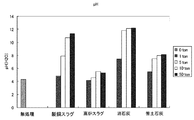
- the pH of the soil greatly exceeds the range of 6-8, which is generally considered suitable for plant growth. For example, it does not cause excessive harm even when the pH is 10 or more, but rather promotes plant growth. It has characteristics that are not found in other alkaline materials such as slaked lime and mashed lime.
- the method or the soil improvement material of the present invention since the method or the soil improvement material of the present invention has an extremely wide range of effective treatment amounts, it also has the effect of sufficiently promoting the growth of plants even in rough agriculture where the treatment amount tends to be biased. is there.
- the soil improvement material is treated in an amount 3 to 10 times the treatment amount per crop (minimum treatment amount necessary for promoting the growth of the target plant). Since the growth of the plant is promoted without processing the soil improvement material after the next crop, the effect of saving labor is also achieved.
- Patent Document 4 describes that blast furnace granulated slag and / or converter slag has improved the growth of corn and spinach in acidic soil (pH 5.1). It has also been reported that depending on the application amount of the above granulated blast furnace slag and / or converter slag, the pH becomes slightly higher at 9.0 and 9.3, and at least the growth of Santousai is rather inhibited. The fact that the effects of the method of the present invention or the soil improvement material when plant growth is promoted even when the pH of the soil is high, such as 10 or more, can be understood more clearly in view of such knowledge. Is done. In addition, the method or the soil improvement material of the present invention has an effect of sufficiently promoting the growth of plants without using a fertilizer.
- the method or soil amendment material of the present invention will not harm plants even if the pH exceeds the range of 6-8, which is generally considered suitable for plant growth. Rather, it can be presumed that the effect of promoting the growth of plants is due to one or more of the various nutrients contained in the slag.
- the method or the soil improvement material of the present invention uses slag, which is a by-product, it contributes to the formation of a recycling society.
- strongly acidic peat soil means a soil containing peat having a pH of about 4 or less, and particularly means a strongly acidic peat soil in the tropics.
- Strong acid peat soils in the tropics show strong acidity of pH 3.5-4, are poor in bases such as potassium, calcium, magnesium and phosphoric acid, and nitrogen is relatively large in total, but waited for peat decomposition
- the method for improving the soil quality of the strongly acidic peat soil of the present invention includes treating soil improvement materials containing slag as an active ingredient, and is not particularly limited as long as such treatment is included.
- the “slag” in the present invention is not particularly limited as long as it contains a mineral component of an ore host rock separated by melting from a metal that is a metallurgical object when a metal is smelted from ore.
- a preferable slag in the present invention is a steel slag (iron slag) including blast furnace slag and steel slag.
- Blast furnace slag contains a lot of silicic acid and is preferable for paddy rice cultivation.
- Steelmaking slag contains silicic acid and iron and has a high content of trace elements, so it is preferable for the cultivation of crops including paddy rice.
- the soil improvement material is preferably the method of the present invention containing 0.1% by weight or more of Mn, 0.1% by weight or more of Fe and / or 0.01% by weight or more of P and the soil improvement material.
- the treatment amount of the soil improvement material in the method of the present invention is not particularly limited.
- a preferable treatment amount is 5 to 60 tons / ha, more preferably 5 to 50 tons / ha, still more preferably 10 to 30 tons / ha, and still more preferably 10 to 20 tons / ha. ha.
- the method of the present invention including slag having a particle size of 2 mm or less and having a particle size of 2 mm to 13 mm is preferable.
- the method of the present invention further comprising those having the following particle diameters is more preferred, and those having a slag particle size of 0 to 13 mm are even more preferred.
- a method in which the soil improvement material is treated in an amount 3 to 10 times the treatment amount per crop is preferable, and a method in which the soil improvement material is treated in an amount 5 to 10 times is more preferable.
- the upper limit of the effective treatment amount is at most twice the minimum treatment amount necessary for promoting the growth of plants, and if it is larger, excess harm Will occur. Therefore, the method or the soil improvement material of the present invention that can treat the soil improvement material at a time up to about 10 times the processing amount per crop greatly contributes to labor saving.
- the treatment amount of the soil improvement material in the method of the present invention is expressed as a ratio to be mixed with the soil to be improved, the ratio is not particularly limited, but preferably 0.1 to 6% by volume with respect to the soil. More preferably, it is 0.1 to 3% by volume, and even more preferably 0.25 to 2.5% by volume.
- the shape of the slag is not particularly limited, and the shape can be, for example, granular or powdery. In the method and the soil improvement material of the present invention, it is preferable that the slag contains granular slag.
- the diameter of the slag is not particularly limited, but those containing slag having a particle diameter of 2 mm or less are preferable. By including slag having a particle diameter of 2 mm or less, the effect of promoting the growth of plants can be achieved more quickly.
- the method and the soil improvement material of the present invention in which the ratio of the slag having a particle diameter of 5 mm or less is 5 to 60% by weight and the ratio of the slag having a particle diameter of 20 mm or less is 50 to 100% by weight is also preferable. .
- the present invention further includes a soil improvement material of the present invention comprising a slag having a particle size of 2 mm or less and a soil improvement material of the present invention having a particle size of from 2 mm to 13 mm, and a soil improvement material of the present invention having a particle size of from 2 mm to 5 mm.
- the soil improving material of the present invention and the soil improving material of the present invention having a slag particle size of 0 to 13 mm are also preferred.
- those containing only slag with a relatively small particle size as slag are suitable for treatment with a relatively small amount of treatment, and slag is loaded with slag with a relatively small particle size as a particle size.
- the soil improvement material of the present invention in which the particle size of slag is 0 to 2 mm is suitable by a treatment of 5 to 30 ton / ha
- the soil improvement material of the present invention in which the particle size of slag is 0 to 13 mm is 30 It is suitable for a process of ⁇ 60 tons / ha.
- the soil improvement material of the present invention having a slag particle size of 0 to 5 mm is not easily affected by the amount of treatment, and is suitable for both 5 to 30 ton / ha treatment and 30 to 60 ton / ha treatment. It is.
- the method for treating the material is not particularly limited, and may be spraying on the soil surface, mixing with soil, or the like.
- a material consisting only of slag may be used as the material.
- the method and soil improvement material of this invention may use or contain components other than slag.
- Examples of components other than the above slag include organic soil improvers, inorganic soil improvers, and fertilizers.
- organic soil improver include peat moss, humus, compost and coconut shell
- examples of the inorganic soil improver include vermiculite, pearlite, sand, clay, zeolite, rock wool, styrofoam granules, pumice, red crust and Examples include charcoal
- examples of fertilizers include urea, ammonium sulfate, phosphoric acid, and potassium fertilizer.
- the soil improvement material of the present invention is applied to soil for the purpose of imparting a change in soil properties suitable for plant cultivation, but its use is not limited, and agriculture, horticulture, greening, forestry It can use for various uses, such as.
- Plant species to which the method and soil improvement material of the present invention can be applied are not particularly limited.
- the following plant species can be exemplified: Horticultural crops (eg, vegetables, flowers, fruit trees, etc.), food crops (eg, gramineous crops, beans, potatoes, etc.), feed crops (eg, pastures, green-cutting crops, root vegetables, green manures, etc.)
- Craft crops for example, fiber materials, oil materials, sugar materials, starches, taste materials, rubber / resin materials, fragrances, spices, dyes, medicines, etc.
- the manufacturing method of the soil improvement material of this invention is not specifically limited, You may use slag as it is or you may adjust to a desired magnitude
- the particle size can be adjusted using a sieve of about 20 to 30 mm mesh.
- it can also be mixed with the said other component suitably and can also be used as the soil improvement material of this invention.
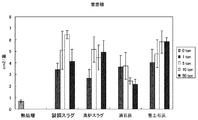
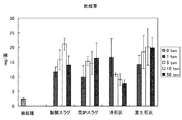
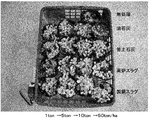
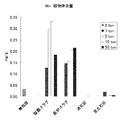
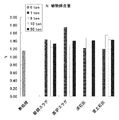
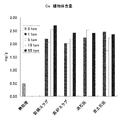
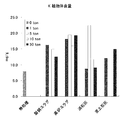
- Steel soil slag and blast furnace slag which are the soil improving materials of the present invention, and commercially available slaked lime (trade name: 70 fertilizer slaked lime) and mashed lime (trade name: powdered 15 mashed lime), 5, 10, and 50 tons / ha were mixed and kept in a greenhouse.
- Steelmaking slag and blast furnace slag were granular to powdery with a diameter of 2 mm or less, and slaked lime and bituminous lime were both powdery.
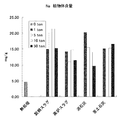
- Mn, Fe, and P are more than the slaked lime and bitter lime treatment zone, and N, Ca, K, and Na (FIGS. 4D to G).
- N, Ca, K, and Na were the same as other treatment areas.
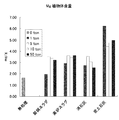
- Mg was almost equal to the slaked lime treated area, and was less than the mashed lime treated area (FIG. 4H).
- the method and the soil improvement material of the present invention not only have high acid neutralization ability but also have an effect of promoting the growth of plants.
- the effect on plant growth is particularly excellent when steelmaking slag is used.
- excessive damage is less likely to occur.
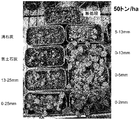
- the particle size of the slag was 0 to 2 mm, 0 to 5 mm, 0 to 13 mm, 5 to 13 mm, 0 to 25 mm, and 13 to 25 mm, and the slaked lime and the bitter lime were all powdery.
- Komatsuna was sown on each soil after mixing each material (July 11), and normal management was performed in the greenhouse. After 30 days, the growth of Komatsuna in each treatment area was examined by leaf area and dry weight. The test was conducted in a 5-run system.
- Table 2 shows the ratio of fertilizer components (alkali, soluble phosphorus, soluble soluble earth, and soluble manganese) of slag having particle sizes of 0 to 2 mm, 0 to 5 mm, 5 to 13 mm, and 13 to 25 mm. It was. Alkaline components and soluble components were measured by a fertilizer analysis method defined by official standards. As shown in Table 2, the fertilizer component was more abundant in slag containing fine particle sizes such as 0-2 mm and 0-5 mm.
- the present invention greatly contributes to the development of agriculture and related industries in a region where agricultural land, particularly including strongly acidic peat soil, is widely spread.
Landscapes
- Chemical & Material Sciences (AREA)
- Organic Chemistry (AREA)
- Inorganic Chemistry (AREA)
- Life Sciences & Earth Sciences (AREA)
- General Life Sciences & Earth Sciences (AREA)
- Soil Sciences (AREA)
- Engineering & Computer Science (AREA)
- Materials Engineering (AREA)
- Chemical Kinetics & Catalysis (AREA)
- Cultivation Of Plants (AREA)
- Soil Conditioners And Soil-Stabilizing Materials (AREA)
Abstract
L'invention porte sur un procédé d'amendement du sol ou une substance d'amendement du sol chacun pour la croissance d'une plante dans un sol tourbeux fortement acide. De façon spécifique l'invention porte sur : un procédé pour l'amendement d'un sol tourbeux fortement acide, comprenant le traitement du sol tourbeux avec une substance d'amendement du sol comprenant du laitier comme principe actif ; et une substance d'amendement du sol destinée à être utilisée dans le procédé.
Applications Claiming Priority (2)
| Application Number | Priority Date | Filing Date | Title |
|---|---|---|---|
| JP2011-113308 | 2011-05-20 | ||
| JP2011113308A JP2014156500A (ja) | 2011-05-20 | 2011-05-20 | 泥炭湿地土壌の土壌改良栽培法 |
Publications (1)
| Publication Number | Publication Date |
|---|---|
| WO2012160727A1 true WO2012160727A1 (fr) | 2012-11-29 |
Family
ID=47216822
Family Applications (1)
| Application Number | Title | Priority Date | Filing Date |
|---|---|---|---|
| PCT/JP2011/077487 Ceased WO2012160727A1 (fr) | 2011-05-20 | 2011-11-29 | Procédé de culture par amendement du sol dans un sol de marais tourbeux |
Country Status (2)
| Country | Link |
|---|---|
| JP (1) | JP2014156500A (fr) |
| WO (1) | WO2012160727A1 (fr) |
Families Citing this family (1)
| Publication number | Priority date | Publication date | Assignee | Title |
|---|---|---|---|---|
| CN105359772A (zh) * | 2015-10-10 | 2016-03-02 | 平顶山市玉龙山生态农业科技发展有限公司 | 一种药用芦荟的种植方法 |
Citations (5)
| Publication number | Priority date | Publication date | Assignee | Title |
|---|---|---|---|---|
| JPS627787A (ja) * | 1985-07-05 | 1987-01-14 | Sunaken Kk | 土壌改良剤 |
| JPS627786A (ja) * | 1985-07-04 | 1987-01-14 | Sunaken Kk | 土壌改良剤 |
| JPH1161119A (ja) * | 1997-08-21 | 1999-03-05 | Sumitomo Metal Ind Ltd | 酸性重粘質土壌用改良材 |
| JPH11209757A (ja) * | 1998-01-20 | 1999-08-03 | Sumitomo Metal Ind Ltd | 土壌酸性化防止ならびに微量元素補給方法 |
| WO2011055697A1 (fr) * | 2009-11-06 | 2011-05-12 | 住友金属工業株式会社 | Technique d'atténuation de l'acidité faisant appel à des scories de convertisseur |
-
2011
- 2011-05-20 JP JP2011113308A patent/JP2014156500A/ja not_active Withdrawn
- 2011-11-29 WO PCT/JP2011/077487 patent/WO2012160727A1/fr not_active Ceased
Patent Citations (5)
| Publication number | Priority date | Publication date | Assignee | Title |
|---|---|---|---|---|
| JPS627786A (ja) * | 1985-07-04 | 1987-01-14 | Sunaken Kk | 土壌改良剤 |
| JPS627787A (ja) * | 1985-07-05 | 1987-01-14 | Sunaken Kk | 土壌改良剤 |
| JPH1161119A (ja) * | 1997-08-21 | 1999-03-05 | Sumitomo Metal Ind Ltd | 酸性重粘質土壌用改良材 |
| JPH11209757A (ja) * | 1998-01-20 | 1999-08-03 | Sumitomo Metal Ind Ltd | 土壌酸性化防止ならびに微量元素補給方法 |
| WO2011055697A1 (fr) * | 2009-11-06 | 2011-05-12 | 住友金属工業株式会社 | Technique d'atténuation de l'acidité faisant appel à des scories de convertisseur |
Also Published As
| Publication number | Publication date |
|---|---|
| JP2014156500A (ja) | 2014-08-28 |
Similar Documents
| Publication | Publication Date | Title |
|---|---|---|
| Zhang et al. | Effects of urea enhanced with different weathered coal-derived humic acid components on maize yield and fate of fertilizer nitrogen | |
| Wu | Effects of incorporation of nano-carbon into slow-released fertilizer on rice yield and nitrogen loss in surface water of paddy soil | |
| JP2022510530A (ja) | 水稲の重金属カドミウム汚染又は蓄積を抑制する新規有機肥料、その製造方法及び施用方法 | |
| Waigwa et al. | Phosphorus availability as affected by the application of phosphate rock combined with organic materials to acid soils in western Kenya | |
| JPH049482B2 (fr) | ||
| KR102550898B1 (ko) | 이탄을 유효성분으로 포함하는 유기질 토양개량제 및 이의 용도 | |
| El-Etr et al. | Effect of potassium humate and bentonite on some soil chemical properties under different rates of nitrogen fertiliztion | |
| Thomas | Research on the nutrition of container-grown Proteaceae plants and other nursery stock | |
| JP3264838B2 (ja) | 育成培地とその製造法 | |
| CN110903143A (zh) | 一种天然矿物复合腐殖酸的土壤改良剂 | |
| JP5610501B2 (ja) | 粒状配合肥料及びその施肥方法 | |
| JP2014156500A (ja) | 泥炭湿地土壌の土壌改良栽培法 | |
| Arafat et al. | Improvement of nitrogen fertilizer efficiency with nitrification inhibitors in lowland rice | |
| Ma et al. | Fertility management of the soil-rhizosphere system for efficient fertilizer use in vegetable production | |
| Kumar et al. | Influence of long-term integrated nutrient management on soil properties, nutrient balance and productivity of rice–wheat cropping system in Central Indo-Gangetic plains | |
| Bazaraa et al. | Effect of growing media, bio and chemical fertilization on the production of Gladiolus (cv. Novalux) corms from cormlets | |
| KR100726345B1 (ko) | 석영섬록영암 화산석을 이용한 친환경 부산물 비료퇴비 | |
| Gweyi-Onyango et al. | Differential benefits of rock phosphate (RP) by tomato (Lycopersicon esculentum mill.) plant as affected by nitrogen forms and soil types | |
| Fawzi et al. | Soil properties improvement and nitrogen leaching induced compost and mineral fertilization for maximizing grapevines production in arid regions, El-Minia, Egypt | |
| El-Shall et al. | The influence of humic acid treatment on the performance and water requirements of plum trees planted in calcareous soil | |
| Lutz Jr et al. | Effect of Fertility Treatments on the Growth, Chemical Composition and Yield of No‐Tillage Corn on Orchardgrass Sod 1 | |
| Otitoloju | Effect of Integrated Use of Soil Conditioner with Fertilizers on Growth, Chlorophyll Content and Yield of Groundnut (Arachis hypogea L.) | |
| Bamboriya | Silicon Fertilization for Crop Stress Management | |
| De | Organic Nutrient Solutions for Com-mercial Cultiva-tion of Orchids | |
| Abdulkareem | Influence of Perl Humus Levels on Growth and Yield of Irrigated Lowland Rice (Oryza sativa) Varieties |
Legal Events
| Date | Code | Title | Description |
|---|---|---|---|
| 121 | Ep: the epo has been informed by wipo that ep was designated in this application |
Ref document number: 11866047 Country of ref document: EP Kind code of ref document: A1 |
|
| NENP | Non-entry into the national phase |
Ref country code: DE |
|
| 122 | Ep: pct application non-entry in european phase |
Ref document number: 11866047 Country of ref document: EP Kind code of ref document: A1 |
|
| NENP | Non-entry into the national phase |
Ref country code: JP |