WO2012160742A1 - Récepteur de contenu et procédé de transmission de données de contenu - Google Patents
Récepteur de contenu et procédé de transmission de données de contenu Download PDFInfo
- Publication number
- WO2012160742A1 WO2012160742A1 PCT/JP2012/002213 JP2012002213W WO2012160742A1 WO 2012160742 A1 WO2012160742 A1 WO 2012160742A1 JP 2012002213 W JP2012002213 W JP 2012002213W WO 2012160742 A1 WO2012160742 A1 WO 2012160742A1
- Authority
- WO
- WIPO (PCT)
- Prior art keywords
- content
- information
- video
- processing unit
- receiver
- Prior art date
- Legal status (The legal status is an assumption and is not a legal conclusion. Google has not performed a legal analysis and makes no representation as to the accuracy of the status listed.)
- Ceased
Links
Images












Classifications
-
- H—ELECTRICITY
- H04—ELECTRIC COMMUNICATION TECHNIQUE
- H04N—PICTORIAL COMMUNICATION, e.g. TELEVISION
- H04N21/00—Selective content distribution, e.g. interactive television or video on demand [VOD]
- H04N21/80—Generation or processing of content or additional data by content creator independently of the distribution process; Content per se
- H04N21/81—Monomedia components thereof
- H04N21/816—Monomedia components thereof involving special video data, e.g 3D video
-
- H—ELECTRICITY
- H04—ELECTRIC COMMUNICATION TECHNIQUE
- H04N—PICTORIAL COMMUNICATION, e.g. TELEVISION
- H04N13/00—Stereoscopic video systems; Multi-view video systems; Details thereof
- H04N13/10—Processing, recording or transmission of stereoscopic or multi-view image signals
- H04N13/106—Processing image signals
- H04N13/172—Processing image signals image signals comprising non-image signal components, e.g. headers or format information
- H04N13/178—Metadata, e.g. disparity information
-
- H—ELECTRICITY
- H04—ELECTRIC COMMUNICATION TECHNIQUE
- H04N—PICTORIAL COMMUNICATION, e.g. TELEVISION
- H04N13/00—Stereoscopic video systems; Multi-view video systems; Details thereof
- H04N13/10—Processing, recording or transmission of stereoscopic or multi-view image signals
- H04N13/194—Transmission of image signals
Definitions
- the present invention relates to a receiver that receives 3D video content distributed from a distribution system via a network, a reception method thereof, and a content distribution method in a content transmission / reception system including the distribution system and the receiver.
- Patent Document 1 describes an embodiment that realizes a distribution system including a server that distributes content and a receiver that downloads and reproduces content from the server via the Internet.
- the Internet browser obtains a download control file (referred to as a download control metafile in the present invention) describing the content download execution contents from the server, and this file is interpreted by the download agent and downloaded.
- a download control file referred to as a download control metafile in the present invention
- An object of the present invention is to make it possible to use information related to 3D video also on removable media in a receiver that downloads video content including 3D video and outputs it to removable media.
- the present application includes a plurality of means for solving the above-mentioned problems.
- video content and playback control information for transmitting information necessary for playback and external output of the video content are transmitted to a network.
- the content receiver includes a download control unit that receives the video content and an output control unit that outputs the received video content to an external medium
- the output control unit reproduces the playback when the video content is output to the external media.
- the management information of the external medium that records the content indicates whether or not the content contains 3D video.
- the present invention when video content including distributed 3D video is output to an external medium in a video content receiver, it can be determined that the video content exported to the external media includes 3D video.
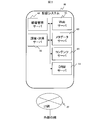
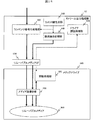
- FIG. 1 is an example of a configuration of a content transmission / reception system to which the present embodiment is applied.
- the distribution network includes a content distribution network 40 that is connected to a home via the router 43 and guarantees network quality within the network, and an external Internet network 45 that is connected from the content distribution network 40.
- the distribution system 60 may be connected to the content distribution network 40 via the network switch 42 or may be connected to the Internet network 45 via the router 44 with emphasis on versatility.
- Various network communication paths 46 such as coaxial cable, optical fiber, ADSL (Asymmetric Digital Subscriber Line), and wireless communication are assumed for home network connection, and modulation / demodulation suitable for each path is performed by the transmission line modem 45. And converted to an IP network.
- the IP network demodulated by the transmission path modulator / demodulator 46 and converted into a network interface is connected to a device in the home via the router 48.
- a receiver 50, a storage device (Network Attached Storage) 32 corresponding to an IP network, a personal computer 33, an AV device that can be connected to a network, and the like are assumed.
- the receiver 50 may have a function of playing back and storing broadcasts received from the antenna 35.
- FIG. 2 is a configuration example of the content distribution system 40.
- the content distribution system 60 is a meta server that distributes a Web server 61 that distributes a Web document 71, ECG metadata 400 that describes attribute information of the content to be distributed, and reproduction control information 200 that describes information necessary for reproducing the content.
- the servers are connected to each other by the IP network 67 and to the Internet network 45 or the content distribution network 40 of FIG.
- each server may be directly connected to the Internet network 45 or the content distribution network 40 without going through the IP network 67 and communicate with each other.
- Each server included in the distribution system 60 is merely a convenient model, and an actual distribution system may have a configuration in which a plurality of types of servers are integrated, and there are no servers. It may be okay.
- a server used for distributing a plurality of data such as the metadata server 62 may be configured by dividing the actual server for each type of data.
- Each server is connected by a network such as the Internet.
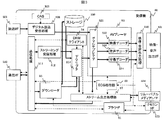
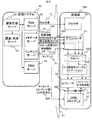
- FIG. 3 is a configuration example of the receiver 50.
- the receiver 50 has a storage 550 that can reproduce the received content, output it to a removable medium or a network, and store the content.
- solid arrows indicate the flow of content
- broken arrows indicate the flow of control.
- the receiver 50 is physically connected to the IP network, and transmits and receives an IP (Internet Protocol) data packet.
- IP Internet Protocol
- the communication interface 510 and the communication I / F 510 are used for TCP (Transmission Control Protocol), UDP.
- the communication processing unit 511 performs processing of various IP communication protocols such as (User Datagram Protocol), DHCP (Dynamic Host Configuration Protocol), DNS (domain name server), and HTTP (Hyper Text Transfer Protocol).
- the downloader 55 is a processing unit that performs processing for acquiring content and information related to the content.
- the DRM client 54 manages the copyright of the content and provides a function for controlling viewing and copying of the content according to the content purchase conditions.
- the decryptor 514 decrypts the content to be downloaded based on an instruction from the DRM client 54.
- the stream output processing unit 57 outputs the content to the removable medium 560 connected to the receiver 50. Alternatively, the stream output processing unit 57 outputs content to the network connection device 570 connected via the communication processing unit 511 and the communication I / F 510.
- the removable medium 560 is a removable storage medium that can be accessed via the removable medium I / F 534 connected to the stream output processing unit 541.
- the receiver 50 includes a remote control I / F 533 for operation, and is operated by the user according to the received remote control signal. Further, the receiver 50 may have a function of receiving a streaming delivery service for on-demand video / audio content. In this case, a streaming reception processing unit 512 that processes real-time reception of video / audio content via the communication processing unit 511 is provided.
- the AV player 53 decodes the downloaded content, the content distributed by streaming, or the content received by broadcasting, and converts it into video and audio signals.
- the AV player 53 has a demultiplexer 521 inside, and the processing unit separates the content decoded by the decryptor 514 into video, audio, and subtitle packets, and each packet is divided into a video decoder 522, an audio decoder 523, Send to subtitle decoder 524.
- These decoders 522, 523, and 524 decode the video, audio, and subtitle information, respectively, and the video / audio output process 530 converts them into integrated video / audio signals.
- This video / audio signal is output to the outside from the receiver 50 via the video / audio output I / F 531.
- the video / audio output processing 530 and the video / audio output I / F 531 may be HDMI (registered trademark) standard interfaces that process and output video and audio in an integrated manner. Examples such as video composite signal output and analog audio output that are processed and output to the outside are also possible.
- the receiver 50 may have a function of receiving and recording a digital broadcast.
- the receiver 50 receives a broadcast I / F 501 for inputting broadcast radio waves, a digital broadcast reception processing unit 502 that decodes a digital broadcast signal and converts it into a video / audio stream, and a copyright protection unit when decoding the digital broadcast signal.
- It has CAS (Conditional Access System) 503 for processing.
- the receiver 50 can output the downloaded content directly to the stream output processing unit 57 and output it to the removable medium 560 or the like.
- the receiver 50 can also temporarily store the downloaded content in the storage 550. In this case, thereafter, the stream output processing unit 57 outputs the content acquired from the storage 550 to the removable medium 560 or the like by the operation of the receiver.
- the downloaded content can be exported to the removable medium 560 via the stream output processing unit 57, so the content is stored in the storage 550.
- the receiver 50 of FIG. 3 performs only the service of directly exporting 560 to a removable medium without going through the storage 550, a cheaper receiver without the storage 550 can be realized. It becomes.
- the downloaded content is temporarily stored in the storage 550 without being decrypted, and the DRM client 54 receives a license from the DRM server 64 when the content stored in the storage 550 is reproduced or exported to the removable media 560 or the like. 300, and the decrypter 514 can decrypt the content stored in the storage 550 based on the content key 311 described in the license 300.
- the decryptor 514 decodes the content, and the demultiplexer 521 separates the video, audio, and caption data packets.
- the video decoder 522, the audio decoder 523, and the caption decoder 524 decode the separated video packets, audio packets, and caption data packets.
- the video / audio output processing unit 530 outputs the decoded video / audio to the outside via the video / audio output I / F 531. Through these processes, the user can view the content.
- the decryptor 514 decrypts the content, and the stream output processing unit 57 outputs the decrypted content to the removable medium 560 or the like.
- the audio output processing unit 530, the storage 550, the browser 51, the ECG processing unit 52, the AV player 53, the DRM client 54, the downloader 55, and the stream output processing unit 57 are integrated circuits as processing units for performing each processing. It can be realized by hardware.
- a digital broadcast reception processing program 502, a CAS program 503, a communication processing program 511, a streaming reception processing program 512, a decryptor program 514, a demultiplexer program 521 which are stored in a storage device such as a storage 550 or a memory (not shown).
- an arithmetic processor such as a central control unit (not shown)
- all or part of it is processed. It is also possible to realize processing by software.
- each process realized by executing various programs by the central control unit or the like is described mainly by each processing unit realized by the program.
- each processing unit When each processing unit is realized by hardware, each processing unit mainly performs each process.
- FIGS. 4 to 5 show only some of the blocks used in the processing flow from the receiver 50 in FIG. 3, each of which has other processing units of the receiver 50 in FIG.
- the configurations described in FIGS. 4 to 5 are not always necessary. Some may be omitted.
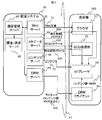
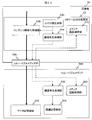
- the receiver 581 in FIG. 4 is a subset obtained by extracting blocks for exchanging data with the streaming distribution system from the receiver 50 in FIG. 3.
- the content distribution system 60 distributes a Web server 61 that distributes a Web document 71, ECG metadata 400 that describes attribute information of the content to be distributed, and a reproduction control metafile 200 that describes information necessary for reproducing the content.
- a transmission path 67 for data communication between the receiver 581 and the distribution system 60 assumes the distribution network of FIG.
- the browser 51 presents the Web document 71 received from the Web server 61 and operates the operation device such as a remote controller to search and search for the content 75 that the user wants to see.
- the ECG (Electric Content Guide) processing unit 52 of the receiver application presents the ECG metadata 400 acquired from the metadata server 62 to the user in the form of ECG, and the content that the user wants to see from the ECG.
- a method for searching and searching for 75 may be provided.
- the browser 51 acquires the playback control metafile 200 in which the reference destination is described in the Web document 71 from the metadata server 62, and A reproduction request is made to the AV player 53.
- the ECG processing unit 52 transmits the playback control metafile 200 in which the reference destination is described in the ECG metadata 400 from the metadata server 62. Obtaining and making a playback request to the AV player 53.
- the AV player 53 acquires the content key described in the content license 300 and the signal output restriction / copy control information called RMPI (Right. Management and Protection Information) from the DRM client 54 in accordance with the contents of the playback control metafile 200. Then, the content key is set in the decryptor 514, the output conditions such as video and audio are set in the video / audio output I / F 531 in accordance with RMPI, and the content 75 distributed from the content server 63 is streamed.
- RMPI Light. Management and Protection Information
- the DRM client 54 holds a valid license 300 and, if requested by the AV player 53 or the stream output control unit 57, provides a content key and RMPI from the corresponding license 300. If the requested license 300 has not been acquired, the license 300 necessary for content reproduction is acquired from the DRM server 64.
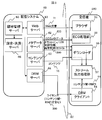
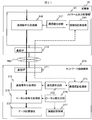
- the receiver 582 in FIG. 5 is a subset obtained by extracting blocks for exchanging data with the download distribution system from the receiver 50 in FIG. 3.
- the browser 51 presents the Web document 71 received from the Web server 61 and operates the operation device such as a remote controller to search and search for the content 75 that the user wants to see.
- the ECG processing unit 52 of the receiver application presents the ECG metadata 400 acquired from the metadata server 62 to the user in the form of an ECG, and searches the content 75 that the user wants to see from the ECG. A means of finding out may be provided.
- the browser 51 acquires the download control information 100 in which the reference destination is described in the Web document 71 from the metadata server 62, and the downloader.
- a download execution request is issued to 55.
- the ECG processing unit 52 acquires the download control information 100 in which the reference destination is described in the ECG metadata 400 from the metadata server 62. Then, a download execution request is made to the downloader 55.
- the downloader 55 obtains the playback control metafile 200, and in accordance with the content, the content key described in the content license 300 and signal output restriction / copy control called RMPI (Right. Management and Protection Information) are sent from the DRM client 54.
- the information is acquired, the content key is set in the decryptor 514, the output conditions such as video and audio are set for the export destination removable media 560 and the network connection device 570 in accordance with the RMPI, and the download control information 100 sets the distribution content.
- the content 75 specified by the URL indicating the location 156 is requested to the content server 63, the content 75 distributed from the content server 63 is downloaded, and the content decrypted by the decryptor 514 is output as a stream. And outputs to the control unit 57, performs the export process.
- the stream reproduction control information 710 may be downloaded and used as reference information when output to the stream output control unit 57.
- the receiver 583 in FIG. 6 has extracted and described blocks for exchanging data with the download distribution system via the storage 550 from the receiver 50 in FIG.
- the browser 51 presents the Web 71 received from the Web server 61 and operates the operation device such as a remote controller to search and search for the content 75 that the user wants to see.
- the ECG processing unit 52 of the receiver application presents the ECG metadata 400 acquired from the metadata server 62 to the user, and searches for the content 75 that the user wants to view. May provide a means of finding out.
- the browser 51 When the selection of the content to be viewed from the user is received and the user issues a content download instruction on the Web document 71, the browser 51 receives the download control information 100 in which the reference destination is described in the Web document 71 from the metadata server 62. Obtain the download and make a download execution request to the downloader 55. The downloader 55 acquires the ECG metadata 400, the playback control metafile 200, the stream playback control information 710, and the content 75 of the content to be downloaded, and accumulates them in the storage 550.
- the accumulated content 75 can be searched for, selected, reproduced, or exported by the ECG processing unit 52 of the receiver.
- the ECG processing unit 52 is instructed to reproduce the content
- the AV player 53 is activated to request reproduction
- the stream output control unit 57 is activated to export the content. Request processing.
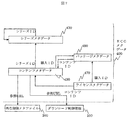
- FIG. 7 is a correlation diagram of ECG metadata 400 presented for content search by the ECG processing unit 52 as an ECG.
- the ECG metadata 400 is described in the XML format.
- ECG metadata 400 is content metadata 430 that describes attribute information such as the name and description of each distributed program, video, audio, genre, etc., and each program can be managed by grouping a series of series.
- Series metadata 410 can describe a group ID that uniquely identifies the series metadata 410 to which the program belongs, and the series metadata 410 describes the group ID of the series metadata 410 to which the program belongs. By doing so, a hierarchical group structure can be defined.
- the license metadata 470 has a content ID that uniquely identifies content metadata 430 of a program that can be used with the license, and a purchase ID that uniquely identifies package metadata 450 that can be used as a purchase condition.
- the package metadata 450 has a purchase ID and a content ID corresponding to each other.
- the content metadata 430 is the reference information for acquiring the playback control information 200 for streaming playback and the download control information 100 for downloading content when the content can be played back by streaming and / or downloaded. Can have.
- FIG. 8 shows a configuration example of the package metadata 470 in the ECG metadata 400.
- the package metadata 450 includes a billing validity period 451 describing the start date / time and end date / time of billing, a purchase ID 452 for uniquely identifying the package metadata 450, and a target content ID 453 for identifying the content to be purchased of the package metadata 450. Hold.
- the package metadata 450 can describe a plurality of packages in one package metadata, and has the following information for each package.
- the package name 461, the package price 462, and the description 465 are information for presenting the package contents to the user.
- the purchase type 463 is information for identifying the purchase form of the package, such as whether the package is a single content purchase, a series batch purchase, or a monthly contract purchase.
- the distribution type 464 is a content distribution type. Is information for identifying a distribution form such as whether it is streaming distribution, download distribution, or both.
- the purchase request URL 466 is information describing an access destination of a server that requests a purchase transaction based on a user's purchase operation.
- the ECG processing unit 52 refers to the content metadata 430 or the series metadata 410, presents a search screen, finds the content to be used, and refers to the license metadata 470 of the content.
- the purchase condition of the content is presented to the user, and the purchase operation is performed according to the package metadata 450.
- the playback control information 200 is acquired according to the URL described in the content metadata 430, and the AV player 53 plays back the playback control information 200. Streaming playback is performed according to the description content.
- the download control information 100 is acquired according to the URL described in the content metadata 430, and the downloader 55 downloads the download control information 100. Download the content according to the description.
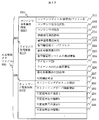
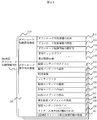
- FIG. 9 shows a configuration example of the download control information 100.
- the download control information 100 includes download control attribute information 110 describing the contents of the metafile itself, and download execution unit information 150 used to download one or more contents.
- the download control information 100 is described in RSS (RDF Site um Summary or Really Simple Syndication), for example.
- RSS RDF Site um Summary or Really Simple Syndication
- the download control information can be created (prepared) for a plurality of arbitrary contents in a certain package, but does not extend over a plurality of packages.
- download control information should be prepared so that all contents in the package can be downloaded.
- the download control information 100 may be updated, and the receiver checks at regular intervals and updates the difference.
- each content is uniquely identified by enclosure url.
- the download control information 100 includes a download control information name 111 indicating the name of the corresponding download control information 100 (eg, download reservation name, file name, ID, etc.), and the location of the corresponding download control information 100 (eg, download reservation).
- the URL on the Internet of the website providing the URL, but not limited to the URL, it may be another address. The same applies to the following.
- the explanation of the download control information location 112 and the corresponding download control information 100 ( For example, it has information such as a description 113 of download control information indicating a download reservation, a language type, an update check flag 114, an update deadline date 115, and the like.
- the update check flag 114 is a flag for determining whether or not the contents of the download control information 100 on the metadata server 62 have been changed, and whether or not to check periodically. After acquisition, it takes a “single” value that is not periodically checked.
- the update deadline date and time 115 is valid when the update check flag 114 is “update”, and describes the date and time of the deadline for continuously checking the update of the download control information 100.
- the update deadline date 115 indicates a deadline for monitoring content updates.
- the unit of time limit (day unit, hour unit, minute unit, etc.) is arbitrary. It is also possible to take a value indicating "no expiration", i.e. semi-permanent checking. Further, as another implementation method, a configuration in which the update check flag 114 is omitted by handling a special value (for example, all 0) of the update deadline date and time 115 as a value indicating the update check flag 114 “single” can be realized. .
- Multiple download execution unit information 150 can be described in the download control information 100.
- the title 151 of the distribution content indicating the title of the content (may be a program name or the like, or a file name or ID), description of the content (features, remarks, etc.)
- a description 152 of the distribution content indicating the distribution date
- a distribution date 153 indicating the date and time of distribution (may be in units of days or minutes)
- a content ID 154 of the distribution content uniquely identifying the content on the Internet and distribution Content type 155
- content location 156 indicating the acquisition destination URL of the distribution content
- ECG metadata location 157 indicating the acquisition destination URL of ECG metadata corresponding to the content
- Delivery content size 159 for storage of information such as stream reproduction control metafile stream reproduction control information location 160 indicating the acquisition destination of the URL of the file 710 that provide such picture playback position information of the content.
- the content ID identifier 154 is described by a character string defined by the schema “CRID: // authority / content_id”, and the authority part is a keyword that uniquely identifies the content distributor on the network. is there.
- the authority part is a keyword that uniquely identifies the content distributor on the network. is there.
- a domain name managed as a unique name on the Internet is used as authority.
- the content_id after authority / is an ID that uniquely identifies the content within authority, and the format of the character string may be freely operated with authority. Through such operations, it becomes possible to uniquely identify content on the Internet by the content identifier 154, and by accessing the content identifier 154 as a URL on the Internet, the target content and related metadata are acquired. It becomes possible to do.
- the distribution date and time 153 normally describes the date and time when the content is stored in the content server 63 and published. However, when the download control information 100 is distributed, the content is not yet released, and the distribution date and time 153 is scheduled to be distributed. Future date and time may be listed. In addition, once the content of the distributed content is updated, the updated date / time is described in the distribution date / time 153.
- the distribution content type 155 describes, for example, the type of video, photo, music, program, multimedia data distributed from the server.
- the video may be further subdivided into movies, news, sports, etc., and the music may be further subdivided into classical, rock, jazz, etc. types.
- Distribution content metadata is auxiliary information necessary for content playback and execution. Examples include content search genre and keyword information, and, if the content is video information, its thumbnail and chapter information. .
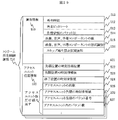
- FIG. 10 is a configuration example of the playback control metafile 200. A configuration of the reproduction control metafile 200 acquired by referring to the download control information 100 will be described.
- the playback control metafile 200 is decrypted by accessing the copyright management server in order to decrypt the content-specific attribute information 210, which is the AV stream information of the content necessary for content playback, and the encrypted content.
- 3 XML documents including license acquisition information 220 necessary for acquiring a content key and the like, and network control information 230 necessary for reproduction control in the case of streaming VOD.
- the network control information 230 is not necessary in the case of download distribution.
- the content unique attribute information 210 includes the file name and reference destination 211 of the content main body file, the identification information 212 indicating whether the content is encrypted, the time length 213 of the content, the video encoding method, the resolution / scanning / aspect ratio, etc. It provides video signal attribute information 214, audio signal attribute information 215 such as stereo / mono / multi-channel distinction, and the like.
- the content license acquisition information 220 includes copyright management server address information 221 as a license acquisition destination of the target content, copyright management method type information 223, a license ID 224 indicating the type of copyright protection range attached to the content, copyright Information such as the value 222 of the element to be signed and the reference destination 226, the license usage condition information 225, and the public key certificate 227 necessary for verifying a certain signature for performing server authentication between the management server and the client receiver. I will provide a.
- the network control information 230 includes various streaming server function information such as information 231 on the available streaming protocol method, special playback and content cueing method 232, whether paused playback can be resumed from the middle, In the case where the function allows variable-speed playback in a plurality of stages, information 233 indicating the magnification for each stage and information 234 on the playback method are described.
- a playback method a method that prepares and distributes a stream dedicated to variable-speed playback on the server side, a method that realizes pseudo high-speed playback by skipping and playing back still images included in the normal-speed playback stream, etc. Is done.
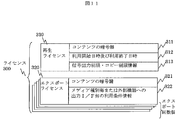
- FIG. 11 shows a configuration example of the license 300.
- a configuration of the license 300 that is acquired by referring to the download control information 100, or acquired at the start of content reproduction or export starts will be described.
- the license includes a reproduction license 310 that describes a right to view a program and an export license 320 that describes a right to output to an external medium or network.
- the license holds the encryption keys 311 and 321 of the content necessary for decrypting the content.
- the use start date and use end date 312 the signal output restriction at the time of playback and the copy control information 313 have.
- the use start date / time and use end date / time 312 can be designated indefinitely.
- use condition information 322 such as copy restriction and analog output restriction when outputting to each medium can be designated.
- the export license 320 can be exported once with one license, and N export licenses 320 are distributed from the DRM server 64 to the receiver 50 so that one content can be exported N times.
- FIG. 12 is an example of a content search screen 1000 realized by the ECG processing unit 52.
- Remote control On this screen activated on this screen, options such as keyword 1001, genre 1002, delivery date 1003, price 1004, provision form 1005, and input fields are prepared, and when a search start 1007 is instructed, the contents designated by the user In response, the ECG metadata 400 is searched.
- FIG. 13 is a display example of the search result screen 1100 displayed by the ECG processing unit 52.
- a list of search results is displayed, and purchase or details 1104, VOD viewing 1105, and DL related buttons 1106 are displayed as title 1101, provision form 1102, purchase status 1103, and operation buttons for content.
- the provision form column 1102 if the content is provided in the package metadata 450 only by VOD distribution (streaming distribution), “DL” if it is provided only by download distribution, if “DL” is provided by both. It is assumed that “VOD / DL” is displayed. VOD stands for Video On Demand.
- VOD stands for Video On Demand.
- the purchase status column 1103 information managed by the receiver, such as whether the content has been purchased by the user, not purchased, or free content, is presented.
- the purchase or detail button 1104 displays a “purchase” button if the content has not been purchased, and displays a “detail” button if the content has been purchased or purchase is not required for free.
- the “VOD viewing” button 1105 is displayed only when the content can be viewed by VOD (streaming). When this button is selected, VOD viewing is started.
- the DL-related button 1106 is displayed only for downloadable content, and according to the state, download is instructed, but for content that has not yet been downloaded, a “DL waiting” button that cannot be operated is displayed, and download starts. When the download is completed, “DL viewing” is displayed. When the “DL viewing” button is selected, the downloaded content can be viewed. Even in “in DL”, there may be a receiver that enables viewing of content as long as it is buffered to some extent.
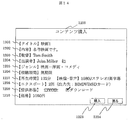
- FIG. 14 is an example of a content purchase screen 1200 displayed by the ECG processing unit 52.
- the content purchase screen 1200 is displayed when the “Purchase” button is selected on the search result screen 1100.
- the time and video / audio information 1207, the number of times of export and the output destination information 1208, the provision form option 1209, the price 1210, etc. are presented based on the ECG metadata 400, and the provision form 1209 is selectable, You can choose VOD, download, or both.
- “VOD” is displayed as being invalid due to a strike-through line, and “Download” is displayed as valid.
- a check mark indicates that the user has selected “download”.
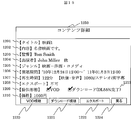
- FIG. 15 is an example of a content detail screen 1250 displayed by the ECG processing unit 52.
- the content detail screen 1250 is presented by selecting the “detail” button on the search result screen 1100.
- the displayed information is almost the same as the content purchase screen 1200, but since it has already been purchased, there is no “Purchase” button 1223. Instead, “VOD viewing” 1220, “Download viewing” 1221, “Export” 1222 Buttons are displayed, and the buttons are enabled and can be operated for the contents for which the respective functions are effective.
- the provision form 1209 column cannot be selected because it has already been purchased, and only the provision form of the purchased content is displayed. For the contents that can be downloaded and viewed, the download progress status 1211 may be displayed. is there.
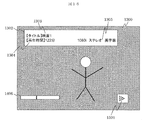
- FIG. 16 shows an example of a content playback screen 1300 displayed by the ECG processing unit 52.
- VOD viewing or download viewing is selected on the content search result screen 1100 or the content detail screen 1250, a content playback screen 1300 is presented.
- the title banner 1302 displays the title of the content 1303, the playback time 1304, and detailed video / audio information 1305.
- some receivers 1406 display the current reproduction position in the entire reproduction time depending on the receiver.
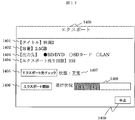
- FIG. 17 is an example of an export screen 1400 displayed by the ECG processing unit 52.
- an export screen 1400 is presented.
- the content title 1401, capacity 1402, and the like are displayed based on the ECG metadata 400, and allowed output destination options 1403 and the remaining number of exports 1404 managed by the receiver are displayed.
- the user selects an output destination and selects an “export destination check” button 1405, it is checked whether or not the content to be exported can be recorded on the export destination medium.
- the cause is displayed in the status column 1407.
- the ECG screen generated by the ECG processing unit 52 is configured.
- the Web document 71 acquired from the Web server 61 can be presented by the browser 51 instead of the ECG processing unit 52, so that content search and reproduction can be performed.
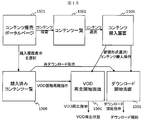
- FIG. 18 shows a transition example of the Web document 71 presented on the browser 51.
- the browser 51 first displays the content sales portal page 1501 by accepting selection of a home page or bookmark when the browser 51 is activated.
- the browser 51 displays a content list page 1502 of search results, and when content is selected from the search results, a content purchase page 1503 is displayed.
- the browser 51 displays the VOD playback start page 1504 and VOD playback is instructed. Then, the playback control metafile 200 is referred to, and the content playback screen of FIG. 16 is displayed.
- the browser 51 displays a download start page 1505.
- the download start instruction is issued, the content is downloaded in the background based on the download control information 100. Start.
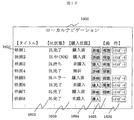
- FIG. 19 shows an example of a local navigation screen 1600 displayed by the browser 51.
- the status of the content that is downloaded and distributed is displayed on the local navigation screen 1600.
- a list of contents that have been instructed to be downloaded or contents that have been downloaded are displayed, and a “Purchase” or “Details” button 1604 is displayed as an operation button for the content title 1601, download state 1602, purchase state 1603, and content.
- a “view” button 1605 is displayed for contents that can be viewed as purchase conditions
- an “export” button 1606 is displayed for contents that can be exported.
- a search condition input field may be provided on the local navigation screen 1600 so that the search can be made within the range of the content instructed to be downloaded to the receiver 50 or the content already downloaded.
- the local search screen shown in FIG. As in the navigation screen, “detail”, “view”, and “export” buttons may be provided.
- the ECG processing unit 52 performs processing when selection of an operation button or input of a search instruction is received from a user.
- download status column 1602 “DL waiting” in which download is instructed but not yet downloaded, “download in progress” that displays the progress status of download, “DL completed” in which download is completed, and an error occurs during download Then, a status display such as “DL error” is displayed.
- buttons such as unpurchased, purchased, and free are displayed.
- a “purchase” button is displayed for unpurchased content
- a “details” button is displayed for purchased content.
- the viewing button becomes valid and can be selected when buffering has progressed to the extent that downloading is complete or playback is possible even during downloading.
- an “export” button 1606 is displayed as valid and can be selected.
- the screen transitions to the content viewing screen 1300, and when the “export” button 1606 is selected, the screen transitions to the export screen 1400.
- the screen transitions to the export screen 1400.
- FIG. 20 is a configuration example of an interface portion between the receiver and the removable medium.
- a removable HDD such as iVDR (registered trademark) is assumed. However, it is not limited to iVDR.
- solid arrows indicate the flow of content
- broken arrows indicate the flow of control.
- FIG. 20 shows a configuration example of the stream output processing unit 57 that performs export processing to a removable medium 560 having a copyright protection function.
- the stream output control unit 57 of the receiver 50 includes a media authentication processing unit 541 that authenticates with removable media, a content key generation unit 543 that generates an encryption key for encrypting content to be transferred to the media, and encrypts content based on the content key.
- Content encryption processing unit 542, and a key encryption processing unit 544 that encrypts and transfers the generated content key to a removable medium.
- the content input to the content encryption processing unit 542 is input from the decryptor 514 or the demultiplexer 521 of the receiver 50.
- the media authentication processing unit 541, the content key generation unit 543, the content encryption processing unit 542, and the key encryption processing unit 544 illustrated in FIG. 20 are all or partly integrated as a processing unit that performs each process. It can be realized by hardware by making it into a circuit.
- the media authentication processing program 541, the content key generation program 543, the content encryption processing program 542, the key encryption processing program 544 and the like stored in the storage 550 or a storage device such as a memory (not shown) are controlled by a central control (not shown).
- a central control not shown
- processing with an arithmetic processor such as a unit all or a part of each processing can be realized by software.
- each process realized by executing various programs by the central control unit or the like is described mainly with respect to each processing unit realized by the program.
- each processing unit mainly performs each process.
- the removable media 560 connected via the removable I / F 534 receives and decrypts the encrypted content key, the media authentication processing unit 561 that mutually authenticates with the media authentication processing unit 541 of the receiver 50.
- the key decryption processing unit 563 for extracting the content key and the protected storage area 564 that can be read and written only by the mutually-reliable and reliable receiver 50 indicate the received content key and the usage conditions (the number of copies, the expiration date for use) of the content. Information is stored in association with content.
- the number of times of copying indicates the number of recorded contents that can be further copied. If this number is M, M + 1 contents can be used in addition to the original contents body.
- the use time limit indicates the use time limit of the content on the removable medium, and the following description method is possible. (1) Relative time from when content is written to removable media, etc. (2) Relative time from first access to content on removable media (3) Absolute use start date / time, use end date / time (any Can also be omitted, and the omitted start date and time and end date and time are considered to be unlimited) Note that the media authentication processing unit 561 and the key decryption processing unit 563 described in FIG. 20 are realized by hardware by integrating all or part of them as a processing unit for performing each process. Can do.
- the media authentication processing program 561, the key decryption processing program 563, etc. stored in the data storage area 562, the protected storage area 564, a memory area (not shown), and the like are processed by an arithmetic processor such as a central control unit (not shown).
- an arithmetic processor such as a central control unit (not shown).
- a central control unit not shown
- all or a part of each process can be realized by software.
- each process realized by executing various programs by the central control unit or the like is described mainly with respect to each processing unit realized by the program.
- each processing unit When each processing unit is realized by hardware, each processing unit mainly performs each process.
- the content encrypted by the media encryption processing unit 542 is stored in the data storage area 562 through the removable I / F 534. It is conceivable that the media authentication processing unit 541 authenticates the reliability of the removable media 560 and authenticates the reliability of both the removable media 560 and the receiver 50 including the removable I / F 534.
- the mutually authenticated receiver 50 reads the content stored in the removable medium 560
- the content key of the content is read from the protected storage area 564, and the encrypted content read from the data storage area 562 is received. It can be used by decrypting the content key using the device 50.
- FIG. 21 is a configuration example of an interface portion between the receiver and the network connection device.
- FIG. 21 shows a configuration example of the stream output processing unit 57 that performs export processing via a network having a copyright protection function.
- the stream output control unit 57 of the receiver 50 generates a communication key for encrypting content based on the communication authentication processing unit 545 that performs mutual authentication with the network connection device and the common key exchanged at the time of authentication.
- the key generation unit 547 includes a communication encryption processing unit 546 that encrypts content based on the generated communication key and sends out the content via the communication I / F 510.
- the communication authentication processing unit 545, the communication encryption processing unit 546, and the communication key generation unit 547 described in FIG. 21 are all integrated into a circuit as a processing unit that performs each processing. It can be realized with wear. Further, the communication authentication processing program 545, the communication encryption processing program 546, the communication key generation program 547 and the like stored in the storage device 550 or a storage device such as a memory (not shown) are processed by an arithmetic processor such as a central control unit (not shown). Thus, all or a part of each processing can be realized by software. In order to simplify the description, each process realized by executing various programs by the central control unit or the like is described mainly with respect to each processing unit realized by the program. When each processing unit is realized by hardware, each processing unit mainly performs each process.
- the network connection device is connected to the network 580 via the communication I / F 571 and communicates with the receiver 50.
- the communication authentication processing unit 572 performs mutual authentication with the communication authentication processing unit 545 of the receiver.
- the communication key generation unit 574 generates a communication key for decrypting the content based on the common key exchanged at the time of authentication.
- the communication decryption processing unit 573 decrypts the content received via the communication I / F 510 based on the generated communication key.
- the content decrypted by the communication decryption processing unit 573 is encrypted by the local encryption processing unit 575 according to the encryption method of the network connection device 570 and stored in the data storage area 578 of the network connection device 570. Saved.
- the encryption key at this time is generated by the local key generation unit 576, and information indicating the local key corresponding to the content and the usage condition (number of copies, expiration date for use) of the content can be accessed only by a trusted device or software. It is stored in the protected storage area 577.
- the communication decryption processing unit 573, the communication key generation unit 574, the local encryption processing unit 575, and the local key generation unit 576 described in FIG. 21 are all or partly integrated as a processing unit that performs each process. It can be realized by hardware by making it into a circuit. Further, a communication decryption processing program 573, a communication key generation program 574, a local encryption processing program 575, a local key generation program 576, etc. stored in the data storage area 578, the protected storage area 577, a memory area (not shown), etc. By performing processing with an arithmetic processor such as a central control unit (not shown), all or part of each processing can be realized by software. In order to simplify the description, each process realized by executing various programs by the central control unit or the like is described mainly with respect to each processing unit realized by the program. When each processing unit is realized by hardware, each processing unit mainly performs each process.
- the network connection device 570 has a device-specific data storage area 578. However, the network connection device 570 has a removable I / F 534 as the receiver 50 of FIG. The content may be transferred to the removable medium 560 via the removable I / F 534. In this case, the configuration of the network connection device 570 conforms to the configuration of the receiver 50 in FIG.
- FIG. 22 is an example of a processing flow diagram 2000 of the ECG processing unit 52.
- the ECG processing unit 52 acquires ECG metadata from the metadata server (2001), converts the acquired ECG metadata into a database that can be easily processed, stores it in the storage (2002), and displays the content search screen 1000. Present (2003).
- the search condition is input and set (2004), and when a search execution is instructed, a search result screen 1100 is presented.
- the ECG processing unit 52 displays the content purchase screen 1200 (2007).
- the ECG processing unit 52 displays a content detail display screen 1250 (2009).
- the content detail display screen 1250 is also displayed by selecting the “detail” button from the search result screen 1100.
- the AV player When the user selects the “VOD viewing” button from the search result screen 1100, the AV player is activated and VOD viewing is started (2011). When the “DL viewing” button is selected, the AV player is activated and download viewing is started (2012).
- the AV player is activated and VOD viewing is started (2011).
- the “DL viewing” button is selected, the AV player is activated and download viewing is started (2012).
- the “export” button is selected, the screen transitions to the export screen 1400 (2013).
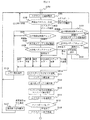
- FIG. 23 is an example of a processing flow of the stream output processing unit 57 when exporting content to the removable medium 560 on the export screen 1400.
- the stream output processing unit 57 sets the output destination. It is checked whether the removable medium 560 is connected (2103). If not connected, an error message indicating unconnected is presented (2110).
- the media authentication processing unit 541 confirms the authentication with the output destination removable medium 560 (2104), and performs a detailed check of the removable medium 560 (2105). If there is no abnormality for writing the content, a result indicating normality is presented (2106). If there is an abnormality, the cause of the error is presented (2110), and the operation returns to the operation accepting state on the export screen (2102). .
- the errors at this time include an authentication error caused by the cause of the removable medium 560 or the receiver 50, an error of insufficient remaining capacity necessary for writing the content, and a speed error of the removable media 560 that does not satisfy the speed necessary for reproducing the content.
- an authentication error caused by the cause of the removable medium 560 or the receiver 50 an error of insufficient remaining capacity necessary for writing the content
- a speed error of the removable media 560 that does not satisfy the speed necessary for reproducing the content.
- Various factors are conceivable, such as a storage format error when the file format specified by the removable medium 560 is not suitable for content storage, and a reading / writing error of the removable medium 560.
- the stream output processing unit 57 checks whether the removable medium 560 is connected to the output destination (2107). If not connected, an error message indicating unconnected is presented (2110). If it is connected, the stream output processing unit 57 next confirms authentication with the output destination removable medium 560 (2108), and performs a detailed check of the output destination removable medium 560 (2109). Here, if there is an abnormality in writing the content, the cause of the error is presented (2110), and the operation reception state of the export screen is returned (2102). If there are no abnormalities, proceed to export processing.
- the DRM client 54 acquires the export license 320 from the DRM server 64 (2118), and then the content key generation unit 543 generates a content key (2111).
- the key encryption processing unit 544 encrypts the key and exchanges the key with the output destination removable medium 560 (2112).
- the content key generation unit 543 sets a content key in the content encryption processing unit 542 (2113).
- the content encryption processing unit 542 executes export processing to the removable medium 560 (2114).
- the media authentication processing unit 561 performs processing such as saving the content key and content usage condition information to the removable medium 560, and updating the file management information. In other receivers and the like, the removable medium 560 can be read and written.
- the cause of abnormal termination is presented (2117), and the export screen is displayed again ( 2101).
- FIG. 24 is an example of a processing flow of the stream output processing unit 57 when exporting to the network connection device 570 on the export screen 1400.
- the communication authentication processing unit 545 After presenting the export screen 1400 (2201), when an output destination is selected by an operation on the screen (2202) and an “export destination check” button is selected, the communication authentication processing unit 545 connects to the output destination via a network. It is checked whether or not the device 570 is connected (2203). If not connected, an error message indicating unconnected is displayed (2210). If connected, the communication authentication processing unit 545 next confirms authentication with the network connection device 570 that is the output destination (2204), and performs a detailed check of the network connection device 570 (2105). If there is no abnormality for writing the content, a normal result is presented (2106). If there is an abnormality, the cause of the error is presented (2110), and the operation returns to the operation accepting state on the export screen (2102).
- the error in this case is also an authentication error caused by the cause on the network connection device 570 or the receiver 50 side, an error of insufficient remaining capacity on the network connection device 570 side necessary for storing the content,
- Various errors such as a speed error of the network connection device 570 that does not satisfy the speed required for playback, a storage format error when the file format specified by the network connection device 570 is not suitable for storing contents, a device abnormality of the network connection device 570, etc. There are various factors.
- the communication authentication processing unit 545 checks whether the removable medium 560 is connected to the output destination (2207). If not connected, an error message indicating unconnected is displayed (2210). If connected, next, the communication authentication processing unit 545 confirms the authentication with the output destination network connection device 570 (2208), and performs a detailed check of the output destination network connection device 570 (2209). Here, if there is an abnormality in writing the content, the cause of the error is presented (2210), and the operation reception state of the export screen is returned (2202). If there is no abnormality, the process proceeds to the export process.
- the DRM client 54 acquires the export license 320 from the DRM server 64 (2218), and the communication key generated based on the key exchanged at the time of mutual authentication by the communication authentication processing unit 545 is converted into the communication encryption processing unit.
- the communication encryption processing unit 546 executes export processing to the network connection device 570 (2214).
- processing such as closing the communication session is performed in the export end processing (2216).
- processing such as closing the communication session is performed in the export end processing (2216).
- the cause of the abnormal termination is presented (2217), and the display returns to the export screen presentation. (2201).
- FIG. 25 is an example of a processing flow diagram of the ECG processing unit 52 on the local navigation screen 1600 of FIG.
- the ECG processing unit 52 reads the ECG metadata of the content of download distribution stored in a storage unit (not shown) (2301), and presents the local navigation screen 1600 based on the information (2302).
- the ECG processing unit 52 displays the content purchase screen 1200 (2304).
- the ECG processing unit 52 displays a content detail display screen 1250 (2306).
- the content detail display screen 1250 is also displayed by selecting a “detail” button from the local navigation screen 1600.
- the ECG processing unit 52 activates the AV player 53 to start downloading and viewing (2308).
- the export screen 1400 is displayed. (2309).
- the export screen is displayed. A transition is made to 1400 (2309).
- the receiver 50 is connected to the network via the ECG displayed on the ECG processing unit 52, the Web screen displayed on the browser 51, or the local navigation 1600. Content can be acquired from and viewed.
- the browser 51 may generate a content search screen or a local navigation screen and perform similar processing, or the AV player 53 may generate a content search screen or a local navigation screen and perform similar processing. .
- FIGS. FIG. 26 shows an example in which the removable medium is an optical disk medium.
- a media drive 580 is connected to the removable medium I / F 534, and the removable medium 585 is inserted into the media drive 580, and the Can read and write.
- the stream output processing unit 57 includes a drive authentication processing unit 551, a content key generation unit 548, a key read / write processing unit 548, and a content encryption processing unit 550.
- a removable medium 585 having a copyright protection function is inserted into a media drive 580 having a copyright protection function, it is possible to read and write the copyright-protected content, but the stream output control unit 57 of the receiver 50 Performs authentication processing between the authentication processing unit 581 of the media drive 580 and the drive authentication processing unit 551 as to whether or not the removable media 585 and the media drive 580 support copyright protection.
- the key generated by the content key generation unit 548 is set in the content encryption processing unit 550, the content is encrypted and written to the removable medium 585, and the key is encrypted to the removable medium 585 through the key read / write processing unit 549.
- Information indicating the media key used for conversion and content usage conditions (number of copies, expiration date for use) is written.
- the drive authentication processing unit 551, the content key generation unit 548, the content encryption processing unit 550, and the key read / write processing unit 549 illustrated in FIG. 26 are all or partly integrated as a processing unit that performs each process. It can be realized by hardware by making it into a circuit. Further, a central control (not shown) controls a drive authentication processing program 551, a content key generation program 548, a content encryption processing program 550, a key read / write processing program 549, etc. stored in a storage device such as the storage 550 or a memory (not shown). By processing with an arithmetic processor such as a unit, all or a part of each processing can be realized by software. In order to simplify the description, each process realized by executing various programs by the central control unit or the like is described mainly with respect to each processing unit realized by the program. When each processing unit is realized by hardware, each processing unit mainly performs each process.
- the media read / write unit 582 and the authentication processing unit 581 illustrated in FIG. 26 can be realized by hardware by integrating all or part of them as a processing unit that performs each processing. .
- the media read / write program 582, the authentication processing program 581 and the like stored in a memory area (not shown) are processed by an arithmetic processor such as a central control unit (not shown) so that all or a part of each processing can be performed by software. Can also be realized.
- each process realized by executing various programs by the central control unit or the like is described mainly with respect to each processing unit realized by the program.
- each processing unit mainly performs each process.
- FIG. 27 shows an example in which the removable medium is a memory card.
- a removable medium 590 is directly connected to the removable medium I / F 534.
- the stream output processing unit 57 includes a drive authentication processing unit 552, a content key generation unit 553, a key read / write processing unit 554, and a content encryption processing unit 555.
- the direct removable medium 590 includes a general data storage area 591 and a protected storage area 592 that holds a key for encrypting data, and the drive authentication processing unit 552 protects whether the removable medium 590 is copyright protection-compatible. Judgment is made based on the presence / absence of the storage area 592, and after the authentication is established, the key generated by the content key generation unit 553 is set in the content encryption processing unit 555, and the content is encrypted and written to the data storage area 591 of the removable medium 590 Then, through the key read / write processing unit 554, the media key used in the protected storage area 592 and information indicating the usage conditions (the number of copies and the expiration date for use) are stored.
- the media authentication processing unit 552, the content key generation unit 553, the content encryption processing unit 555, and the key read / write processing unit 554 illustrated in FIG. 27 are all or partly integrated as a processing unit that performs each process. It can be realized by hardware by making it into a circuit. Further, the media authentication processing program 552, the content key generation program 553, the content encryption processing program 555, the key read / write processing program 554, etc. stored in the storage 550 or a storage device such as a memory (not shown) are controlled by a central control (not shown). By processing with an arithmetic processor such as a unit, all or a part of each processing can be realized by software. In order to simplify the description, each process realized by executing various programs by the central control unit or the like is described mainly with respect to each processing unit realized by the program. When each processing unit is realized by hardware, each processing unit mainly performs each process.
- the receiver 50 can export the copyright-protected content of the received content 75 to various types of removable media.
- a distribution system that downloads and distributes video content including 3D video (stereoscopic video that appears from a display device by stereoscopic viewing) and a receiver that receives and plays back the video content
- 3D video stereo video that appears from a display device by stereoscopic viewing
- the present embodiment mainly describes a receiver and is suitable for implementation in a receiver, but does not hinder application to other than the receiver. Moreover, it is not necessary to employ all the configurations of the embodiment, and can be selected.
- the 3D video format does not depend on the video codec, and SBS (Side by Side), which realizes 3D video by arranging the video for the right eye and the video for the left eye horizontally on the left and right of one screen
- SBS Seg by Side
- the H.264 / MPEG4 AVC format video format is expanded, and the main video data viewed from one viewpoint and the video viewed from the other viewpoint are composed of main video data difference information, resulting in a higher compression rate than SBS.
- MVC Multiview Video Coding
- the 3D video format is not limited to SBS and MVC.
- a precondition a plurality of 3D video formats and the number of viewpoints are not mixed in the same content.
- the number of viewpoints indicates the number of positions on an angle at which a 3D image can be viewed stereoscopically with respect to the display device.
- SBS the images of two viewpoints on the left and right when viewed from the front of the display device. Therefore, only when viewed from the front, the human eye can obtain a three-dimensional effect.
- the number of images corresponding to the angle seen by humans is called the number of viewpoints, and by preparing images with a larger number of viewpoints, it is possible to widen the viewing angle at which stereoscopic effect can be obtained.
- 3D video and 2D video (planar video) using a so-called VOD (Video On Demand) service in which a user individually distributes program content such as a movie via a network according to a user instruction.
- VOD Video On Demand
- the configuration of the video content distribution system may be the same as in FIGS. 1 and 2 as in the first embodiment.
- the configuration of the receiver may be the same as in FIG. 3 as in the first embodiment.
- the video decoder 522 decodes the content and reproduces it as 3D video, and the video output I Must be able to output to / F.
- Operations such as video content search, detailed information browsing, purchase, and download instruction are performed by operating the Web document 71 acquired from the Web server 61 via the browser 51, or as shown in FIGS.
- the ECG metadata 400 is received, and the ECG processing unit 52 performs an operation.
- the receiver acquires 3D-compatible download control information 700, which is download control information corresponding to video content including 3D video, from the metadata server 62. To do.
- FIG. 28 shows a data configuration example of the 3D-compatible download control information 700.
- the constituent elements of the 3D-compatible download control information 700 are obtained by adding the location 161 of the 3D-compatible stream reproduction control information to the download execution unit information 150 of the download control information 100 of FIG.
- the stream playback control information location 160 describes the acquisition URL of the 2D video content stream playback control information 710 via the Internet
- the 3D-compatible stream playback control information location 161 This is a description of the acquisition URL of 3D-compatible stream playback control information corresponding to video content including 3D video.
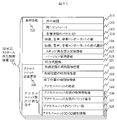
- FIG. 29 shows a data configuration example of 2D video content stream playback control information 710
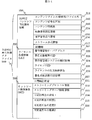
- FIG. 31 shows a data configuration example of 3D-compatible stream playback control information 720
- the stream reproduction control information 710 includes, as stream attribute information 510, reproduction time 511, reproduction bit rate 512, information of various information packet IDs 513 such as video, audio, and subtitles, and the number 514 of video, audio, and subtitle components included in the content.
- Format identification 515 indicating video, audio, subtitle component data format, skip reproduction prohibition section information 516 for designating a time zone in which video can be prohibited from being skipped, and the head position of the stream as access unit position information 520 Time information position 521, time information value 522 at the start position of the stream, time information value 523 at the end position of the stream, and the total number of access units 524 included in the stream, each of the numbers specified by the total number of access units 524 against the access unit , Access unit beginning of time information values 525, the access unit beginning of packet number 526, to hold the packet number 527 of the access unit.
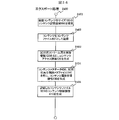
- each field of the access unit position information 520 will be described using an example of the data structure of the video stream shown in FIG.
- the video stream is composed of a combination of I, B, and P video pictures
- the I picture is a video picture that can be decoded as a single video.
- Is a picture format having the picture images before and after the I picture as difference information from the I picture, and cannot be decoded alone, but is decoded in combination with the information of the I picture.
- an access unit a group of an I picture most suitable for cueing a video and a B picture and a P picture of difference information between them is referred to as an access unit.
- the picture included in the access unit has time information for reproducing the video as time information value from the head of the stream as accompanying information, and on the basis of this time information, the video decoder 522 performs smooth synchronization synchronized with the time. Perform video playback.
- Such a video stream is transmitted as video packets after being divided into packets of a fixed length.
- Each video packet is assigned a packet number from the beginning of the stream in order, and the video packet is cued by the packet number. .
- Each field of the access unit position information 520 in FIG. 29 represents the information shown in FIG. 30 above the configuration of the video picture.
- the configuration of the 3D-compatible stream playback control information 720 corresponding to video content including 3D video is as follows.
- the attribute information 510 of the stream playback control information 710 in FIG. 29 includes version management information 517 and 3D system information 518 indicating the 3D video encoding system.
- 3D / 2D identification information 528 for each access unit is added to the access unit position information 520.
- the 3D-compatible stream playback control information 720 holds the 3D / 2D identification information 528 for each access unit, thereby determining whether or not the picture is a 3D video even when playing back from any I picture in the stream. Is possible.
- the web document 71 and the link indicated by the ECG metadata 400 are traced to obtain the download control information 100, and the downloader 55 is downloaded according to the contents of the download control information 100.
- the content includes 3D video
- 3D-compatible download control information 700 is linked from the Web document 71 and ECG metadata 400 instead of the download control information 100, and the downloader 55 downloads the 3D-compatible download control information.
- the ECG metadata 400, the playback control metafile 200, the stream playback control information 710, and the content 75 of the content to be downloaded are acquired and stored in the storage 550.
- the downloader 55 refers to the 3D-compatible download control information 700 and the location 161 of the 3D-compatible stream playback control information is described, the description of the location 160 of the stream playback control information is ignored, and the 3D-compatible stream playback control information
- the 3D-compatible stream playback control information 720 indicated by the location 161 is acquired.
- the processing flow of content reproduction and export stored in the storage 550 is the same as that in FIG. 25 of the first embodiment.
- the AV player 53 activated in block 2308 decodes the data read from the storage 550 and reproduces video, audio, and subtitles.
- the AV player 53 need only code the video stream data sequentially. For example, fast playback at fast speed, skip playback every few minutes, jump to a preset chapter position, etc. When special playback such as the above is instructed by the user, playback from the access unit in the middle of the video stream is required.
- the AV player 53 refers to the stream reproduction control information 710, acquires the position information of the access unit that needs to be reproduced by special reproduction, and starts decoding from the I picture of the access unit. As a result, no matter what special reproduction is performed, complete video reproduction can be started promptly.
- the AV player 53 When performing special playback of video content including 3D video, the AV player 53 refers to the 3D-compatible stream playback control information 720, and simultaneously acquires the position information of an access unit that needs to be played back by special playback.
- the access unit 3D / 2D identification information 528 of the access unit is acquired and the identification information is 2D
- decoding is started from the I picture of the access unit as 2D video, and the video output interface is also in the 2D output state.
- the identification information is 3D
- decoding is started from the I picture of the access unit as 3D video, and the video output interface is also set to the 3D output state.
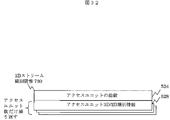
- Example 3 differs from Example 2 in the following points. First, instead of the 3D-compatible stream playback control information 720 transmitted when distributing content including 3D video, the stream playback control information 710 and the 3D stream identification information 730 in FIG. 32 are combined.
- the 3D stream identification information 730 is a table that independently holds only the access unit 3D / 2D identification information 528 for each access unit, which is increased when the stream reproduction control information 710 is expanded to the 3D-compatible stream reproduction control information 720. Yes, after the total number of access units 524, the access unit 3D / 2D identification information 528 is stored in order from the head of the access unit.
- the 3D-compatible stream playback control information location 161 of the 3D-compatible download control information 700 describes the acquisition URL of the 3D stream identification information 730 instead of the 3D-compatible stream playback control information 720, and the downloader 55 performs the 3D-compatible download control.
- the stream reproduction control information 710 indicated by the location 160 of the stream reproduction control information is acquired, and the 3D stream identification information 730 indicated by the location 161 of the 3D-compatible stream reproduction control information is acquired.
- the playback processing of the content stored in the storage 550 is basically the same as in the second embodiment. However, when special playback of video content including 3D video is performed, the AV player 53 refers to the stream playback control information 710. At the same time as obtaining the position information of the access unit that needs to be reproduced by special reproduction, the 3D stream identification information 730 is referenced to obtain the access unit 3D / 2D identification information 528 of the access unit. If it is 2D, decoding is started from the I picture of the access unit as 2D video, and the video output interface is also set to the 2D output state. If the identification information is 3D, decoding is started from the I picture of the access unit as 3D video, and the video output interface is also set to the 3D output state.
- the data structure of the stream playback control information 710 can be reused without changing the difference information necessary for including 3D video as a separate file.
- Example 4 is based on the same configuration as Example 2 or Example 3 unless otherwise described, and differs in the following points.
- FIG. 33 is a configuration example of the content metadata 430 included in the ECG metadata 400 distributed by the metadata server 62.
- the content metadata 430 includes at least title information 431, genre information 432, playback time 433, content detailed information 435 and information 434 about 3D.
- the title 431 indicates the name of the video content and is, for example, “Movie 1”.
- the genre information 432 is information relating to the type of video content, and describes information for performing classification such as “movie-foreign / comedy”, for example, using a classification name and a genre code.
- the playback time 433 describes the playback time of the video content
- the content detailed information 435 describes the content summary, detailed information of the video content such as performers and directors.
- 3D information 434 includes 3D / 2D mixed information 4341, 3D video format 4342, and the number of viewpoints 4343.
- the 3D / 2D mixing information 4341 indicates the mixing status of 3D and 2D video content.
- the video content is a full-length 3D video, “f3d”, and when the video content is only partly 3D, “p3d”. This is information for distinguishing the 3D / 2D mixing status of video content.
- the content metadata does not include 3D information 434.
- “f2d” may be described in the 3D information 434, and in this case, it is clearer that the entire 2D video is displayed.
- the 3D video format 4342 indicates the 3D video format used in the video content.
- the 3D video format of the video content is “Side by Side format”
- the 3D video format of the video content is “MVC ( “Multiview Video Coding” format ”is described as“ MVC ”and is information for distinguishing the 3D video format of the video content.
- the number of viewpoints 4343 indicates the number of viewpoints of 3D video of the video content, and is “2” when the number of viewpoints of the video content is 2, and “3” when the number of viewpoints of the video content is 3. Information for distinguishing the number of viewpoints of the video content.
- the number of viewpoints 4343 may not be included in the 3D information 434. Even if the score 4343 is included, there is no need to refer to it.
- the 3D video format of the video content is “MVC (Multiview Video Coding) format”
- the number of viewpoints 4343 is not included in the 3D information 434, the number of viewpoints of the video content is the minimum number of viewpoints. It may be “2”.
- the 3D information 434 is included in the content metadata 430 only when the video content is fully or partially compatible with 3D, and is not included in the content metadata 430 when the video content is compatible only with 2D. .
- FIG. 34 is a configuration example of the 3D-compatible reproduction control metafile 240 in the present embodiment.
- the 3D-compatible playback control metafile 240 is an extension of the playback control metafile 200 of the first embodiment, and the same numbering field is the same as the playback control metafile 200, but the content-specific attribute information 210 is 3D. Expanded to the corresponding content specific attribute information 250, stream format information 216 describing the format of the video stream and 3D information 217 of the video stream are added.
- the 3D information 217 may simply be a flag indicating whether or not 3D video is included in the video stream, 3D video format information such as Side by Side, MVC, etc., whether the video is full-length 3D or partly 3D. And 2D / 3D stream configuration information indicating whether the head starts with 2D or a part of the head starts with 3D and the head starts with 3D.
- FIG. 35 shows a configuration example of the data storage area 600 in the removable medium for recording the video content.
- the removable medium has a file system, and stores the information described in FIG. 33 as a file under the management of the file system.
- the video content is recorded as a content file 651 in the content storage area 650.
- the content storage information 610 it becomes possible to access the content file 651 in the content storage area 650, and by recording the content access information 620, the head of the video in the middle of the video content can be found. Can be done quickly.
- the content attribute management information 630 it is possible to realize a search based on various conditions of video content recorded in the removable medium.
- the number of video contents recorded on the removable media is stored in the registered content number 611 of the content storage information 610, and the information held for the recorded video content is as follows.
- the content file name 612 is a file name managed on the file system of the removable medium
- the head location 613 on the content storage area indicates the storage head position of the content file 651 on the content storage area 650, and is stored on the content storage area.
- the size 614 indicates the size of the content file 651 on the content storage area.
- the access unit management information location 615 is information for accessing the corresponding video content access unit management information 620
- the content attribute management information location 616 is for accessing the corresponding video content content attribute management information 630. Indicates information.
- the content storage information 610 may have unique management information in addition to the described information depending on the management method of the removable media.
- the content access information 620 has, for each video content, an access unit number 621 indicating the number of access units, which is a unit of pictures that can be searched for content, and has the following information for each access unit.
- the access unit time information 622 indicates the reproduction time from the top of the video content
- the picture storage location 623 indicates the relative storage position of the picture from the top of the content file 651.
- the access unit size 624 indicates the data size of each access unit.
- the content access information 620 may have unique management information in addition to the described information depending on the management method of the removable media.
- the content attribute management information 630 has the following information for each video content.
- the content name 631 describes a character string such as a video content title
- the content genre information 632 describes a classification name and a classification code for classifying the video content.
- the playback time 633 describes the playback time of the video content
- the content detailed explanation information 634 describes the video content commentary and various information such as performers and directors.
- the stream format 635 describes the format of the stream file of the video content, the configuration of components such as video, audio, and subtitles.
- the video codec format information 636 describes the video codec format of the video content, and the audio codec.
- the format information 637 describes the audio codec format.
- the recording source attribute information 639 describes information indicating the origin of the recorded video content. For example, recording of terrestrial or satellite digital broadcasting, recording of content Internet broadcasting downloaded from the Internet, recording of digital cable TV broadcasting, and the like. , So that it can be distinguished.
- the 3D content identification information 639 is information indicating whether or not 3D video is included in the video content.
- the 3D content identification information 639 has information on whether the 3D video is not included or includes at least 3D video. When the information is included, it is assumed that the information is retained by distinguishing whether the content is the entire 3D video content or part of the content is 3D video.
- the 3D content identification information 639 may be included in the video codec format information 636 and the stream format 635.
- the content attribute management information 630 may have unique management information depending on the management method of the removable media.
- a content storage area 650 capable of storing the video content is secured (2401), and the video content is recorded in the content storage area 650 as a content file 651. (4202).
- content access information 620 is generated and recorded based on the 3D-compatible stream playback control information 720 (4203), and the content attribute management information 630 is stored based on the content metadata 430 and the 3D-compatible playback control metafile 240.
- Generate and record (4204) and finally generate and record the content storage information 610 of the recorded content file 651 (4205), thereby completing the export of the content.
- step 2401 it is desirable to check whether or not the remaining capacity capable of storing the content to be recorded remains in the removable medium and to secure a recording area.
- Export may be executed without securing the recording capacity in advance, and the export may be stopped when the capacity shortage occurs.
- the received video content may be transcoded into a format that can be recorded on the removable media and exported.
- the capacity of the video content may change from the size 159 of the distribution content.
- the content storage area 650 may be secured based on the capacity expected from the transcoding process contents.
- transcoding refers to conversion of the video content stream format, video or audio codec format to another format, change of the code bit rate, and the like.
- the time information 622 of the content access information 620, the storage location 623 of the picture, and the size 624 of the access unit are obtained by converting the access unit position information 520 of the 3D-compatible stream playback control information 720 in accordance with the file system management mode specific to the export medium. Is generated.
- the video stream itself may be directly analyzed to determine the position of the content access unit, and the content access information 620 may be generated.
- the content attribute management information 630 includes content name 631, content genre information 632, playback time 633, content detailed description information 634, and the like.
- Data used for content search and extraction includes corresponding title information 431 of the content metadata 430, It is described based on the genre information 432, the reproduction time 433, and the content detailed information 435.
- the data format and the classification method do not always match, but in this case, the data format is recorded. Even if the classification method is changed according to the format of the media and the classification method does not completely match, a value as close to the intention of the original content metadata 430 as possible is described in the content attribute management information 630.
- the stream format 635, the video codec format information 636, and the audio codec format information 637 can be generated by analyzing the corresponding information of the content unique attribute information (ERI) 210 of the 3D-compatible playback control metafile 240 and the video stream itself.
- ERP content unique attribute information
- the 3D content identification information 639 is described based on the 3D-compatible playback control metafile 240 and the 3D-compatible stream playback control information 720. If the information to be described does not exactly match, a value as close as possible is described.
- the 3D content identification information 639 is flag information indicating whether or not 3D video is included, and the 3D information 217 of the original 3D compatible playback control metafile 240 indicates whether the video is full-length 3D or partly 3D and If it has one of the three values of whether the beginning starts with 2D or partly 3D and the beginning starts with 3D, the value of the 3D content identification information 639 is set to “includes 3D video” and 3D If there is no description of the information 217 itself, an example in which it is determined that 3D video is not included and “3D video is not included” may be set.
- the video content may be encrypted.
- the video content is encrypted by the method described in the second embodiment, the third embodiment, FIG. 20, FIG. 26, and FIG. .
- the information related to 3D associated with the original video content is transferred to the management information of the removable media in the form of utilizing as much as possible.
- the convenience of searching, extracting, and playing back 3D video content can be improved even on removable media.
- a removable medium storing content including 3D video when a removable medium storing content including 3D video is connected to another playback device, if the playback device does not have the ability to play back 3D video, management on the removable media is possible.
- management on the removable media is possible.
- it is possible to take measures such as viewing information and presenting content including 3D video as non-reproducible content, non-reproducible content, or presenting an unreproducible error or warning during reproduction.
- this invention is not limited to the above-mentioned Example, Various modifications are included.
- the above-described embodiments have been described in detail for easy understanding of the present invention, and are not necessarily limited to those having all the configurations described.
- a part of the configuration of one embodiment can be replaced with the configuration of another embodiment, and the configuration of another embodiment can be added to the configuration of one embodiment.
- each of the above-described configurations, functions, processing units, processing means, and the like may be realized by hardware by designing a part or all of them with, for example, an integrated circuit.
- Each of the above-described configurations, functions, and the like may be realized by software by interpreting and executing a program that realizes each function by the processor.
- Information such as programs, tables, and files for realizing each function can be stored in a recording device such as a memory, a hard disk, an SSD (Solid State Drive), or a recording medium such as an IC card, an SD card, or a DVD.
- control lines and information lines indicate what is considered necessary for the explanation, and not all the control lines and information lines on the product are necessarily shown. Actually, it may be considered that almost all the components are connected to each other.
Landscapes
- Engineering & Computer Science (AREA)
- Multimedia (AREA)
- Signal Processing (AREA)
- Library & Information Science (AREA)
- Two-Way Televisions, Distribution Of Moving Picture Or The Like (AREA)
- Television Signal Processing For Recording (AREA)
- Testing, Inspecting, Measuring Of Stereoscopic Televisions And Televisions (AREA)
Abstract
La présente invention a pour objectif de permettre à un support de stockage amovible d'utiliser des informations relatives à une vidéo en 3D, dans un récepteur qui télécharge un contenu vidéo comprenant de la vidéo 3D et qui transmet ledit contenu vidéo au support de stockage amovible. Un récepteur de contenu selon l'invention comprend : un module de commande de téléchargement, qui reçoit un contenu vidéo par le biais d'un réseau et qui lit des données de contrôle utilisées pour la lecture et la transmission du contenu vidéo à l'extérieur ; et un module de commande de transmission, qui transmet le contenu vidéo reçu à un support de stockage externe. Lors de la transmission du contenu vidéo au support de stockage externe, le module de commande de transmission insère, dans des données de gestion destinées au support de stockage externe qui va stocker le contenu, des secondes données vidéo en trois dimensions pour indiquer si le contenu vidéo comprend une vidéo en trois dimensions, ou non, sur la base de premières données vidéo en trois dimensions qui indiquent l'existence de la vidéo en trois dimensions dans le contenu vidéo, distribuées dans les données de commande de lecture.
Applications Claiming Priority (2)
| Application Number | Priority Date | Filing Date | Title |
|---|---|---|---|
| JP2011-113023 | 2011-05-20 | ||
| JP2011113023A JP2012244447A (ja) | 2011-05-20 | 2011-05-20 | コンテンツ受信機およびコンテンツ情報出力方法 |
Publications (1)
| Publication Number | Publication Date |
|---|---|
| WO2012160742A1 true WO2012160742A1 (fr) | 2012-11-29 |
Family
ID=47216837
Family Applications (1)
| Application Number | Title | Priority Date | Filing Date |
|---|---|---|---|
| PCT/JP2012/002213 Ceased WO2012160742A1 (fr) | 2011-05-20 | 2012-03-30 | Récepteur de contenu et procédé de transmission de données de contenu |
Country Status (2)
| Country | Link |
|---|---|
| JP (1) | JP2012244447A (fr) |
| WO (1) | WO2012160742A1 (fr) |
Cited By (1)
| Publication number | Priority date | Publication date | Assignee | Title |
|---|---|---|---|---|
| JP2018036889A (ja) * | 2016-08-31 | 2018-03-08 | 株式会社東芝 | 通信装置、通信方法及びプログラム |
Citations (4)
| Publication number | Priority date | Publication date | Assignee | Title |
|---|---|---|---|---|
| JP2010113607A (ja) * | 2008-11-07 | 2010-05-20 | Panasonic Corp | 記録媒体装置、コンテンツ利用システム及び記録媒体装置の制御方法 |
| JP2011082666A (ja) * | 2009-10-05 | 2011-04-21 | Sony Corp | 信号伝送方法、信号送信装置及び信号受信装置 |
| WO2011052289A1 (fr) * | 2009-10-30 | 2011-05-05 | 日立コンシューマエレクトロニクス株式会社 | Dispositif de réception de contenu |
| JP2011097227A (ja) * | 2009-10-28 | 2011-05-12 | Sony Corp | ストリーム受信装置、ストリーム受信方法、ストリーム送信装置、ストリーム送信方法及びコンピュータプログラム |
-
2011
- 2011-05-20 JP JP2011113023A patent/JP2012244447A/ja not_active Withdrawn
-
2012
- 2012-03-30 WO PCT/JP2012/002213 patent/WO2012160742A1/fr not_active Ceased
Patent Citations (4)
| Publication number | Priority date | Publication date | Assignee | Title |
|---|---|---|---|---|
| JP2010113607A (ja) * | 2008-11-07 | 2010-05-20 | Panasonic Corp | 記録媒体装置、コンテンツ利用システム及び記録媒体装置の制御方法 |
| JP2011082666A (ja) * | 2009-10-05 | 2011-04-21 | Sony Corp | 信号伝送方法、信号送信装置及び信号受信装置 |
| JP2011097227A (ja) * | 2009-10-28 | 2011-05-12 | Sony Corp | ストリーム受信装置、ストリーム受信方法、ストリーム送信装置、ストリーム送信方法及びコンピュータプログラム |
| WO2011052289A1 (fr) * | 2009-10-30 | 2011-05-05 | 日立コンシューマエレクトロニクス株式会社 | Dispositif de réception de contenu |
Cited By (1)
| Publication number | Priority date | Publication date | Assignee | Title |
|---|---|---|---|---|
| JP2018036889A (ja) * | 2016-08-31 | 2018-03-08 | 株式会社東芝 | 通信装置、通信方法及びプログラム |
Also Published As
| Publication number | Publication date |
|---|---|
| JP2012244447A (ja) | 2012-12-10 |
Similar Documents
| Publication | Publication Date | Title |
|---|---|---|
| JP5695972B2 (ja) | コンテンツ受信機およびコンテンツ情報出力方法 | |
| CN102577363B (zh) | 内容接收装置 | |
| CN102859539B (zh) | 内容接收装置和内容发布系统 | |
| US20120113218A1 (en) | Receiving apparatus and receiving method | |
| US8941724B2 (en) | Receiver | |
| US20120110117A1 (en) | Content receiving apparatus | |
| JP2012080310A (ja) | コンテンツ受信機 | |
| WO2012160742A1 (fr) | Récepteur de contenu et procédé de transmission de données de contenu | |
| JP2012222480A (ja) | コンテンツ受信機 | |
| JP2012222476A (ja) | コンテンツ受信機 | |
| WO2012160883A1 (fr) | Récepteur de contenu et procédé de réception de contenu | |
| JP5470324B2 (ja) | 受信装置、および受信方法 | |
| WO2012157447A1 (fr) | Dispositif de réception et procédé de réception | |
| JP5730524B2 (ja) | 受信装置、および、受信方法 | |
| WO2012137450A1 (fr) | Récepteur de contenu | |
| JP2011229092A (ja) | コンテンツ受信装置 | |
| JP2012222477A (ja) | コンテンツ受信機 | |
| JP2012222478A (ja) | コンテンツ受信機 | |
| JP2012222479A (ja) | コンテンツ受信機 | |
| JP2012244444A (ja) | コンテンツ受信機およびコンテンツ受信方法 | |
| JP2012080304A (ja) | コンテンツ受信機 | |
| JP2012080309A (ja) | コンテンツ受信機 | |
| WO2011030687A1 (fr) | Appareil de réception de contenu | |
| JP2012222475A (ja) | コンテンツ受信機 | |
| JP2012080303A (ja) | コンテンツ受信機 |
Legal Events
| Date | Code | Title | Description |
|---|---|---|---|
| 121 | Ep: the epo has been informed by wipo that ep was designated in this application |
Ref document number: 12789910 Country of ref document: EP Kind code of ref document: A1 |
|
| NENP | Non-entry into the national phase |
Ref country code: DE |
|
| 122 | Ep: pct application non-entry in european phase |
Ref document number: 12789910 Country of ref document: EP Kind code of ref document: A1 |