WO2012164708A1 - Inclination detection device for aircraft, and method for loading and unloading cargo using same - Google Patents
Inclination detection device for aircraft, and method for loading and unloading cargo using same Download PDFInfo
- Publication number
- WO2012164708A1 WO2012164708A1 PCT/JP2011/062637 JP2011062637W WO2012164708A1 WO 2012164708 A1 WO2012164708 A1 WO 2012164708A1 JP 2011062637 W JP2011062637 W JP 2011062637W WO 2012164708 A1 WO2012164708 A1 WO 2012164708A1
- Authority
- WO
- WIPO (PCT)
- Prior art keywords
- aircraft
- inclination
- cargo
- alarm
- loading
- Prior art date
- Legal status (The legal status is an assumption and is not a legal conclusion. Google has not performed a legal analysis and makes no representation as to the accuracy of the status listed.)
- Ceased
Links
Images

Classifications
-
- B—PERFORMING OPERATIONS; TRANSPORTING
- B64—AIRCRAFT; AVIATION; COSMONAUTICS
- B64D—EQUIPMENT FOR FITTING IN OR TO AIRCRAFT; FLIGHT SUITS; PARACHUTES; ARRANGEMENT OR MOUNTING OF POWER PLANTS OR PROPULSION TRANSMISSIONS IN AIRCRAFT
- B64D45/00—Aircraft indicators or protectors not otherwise provided for
-
- B—PERFORMING OPERATIONS; TRANSPORTING
- B64—AIRCRAFT; AVIATION; COSMONAUTICS
- B64D—EQUIPMENT FOR FITTING IN OR TO AIRCRAFT; FLIGHT SUITS; PARACHUTES; ARRANGEMENT OR MOUNTING OF POWER PLANTS OR PROPULSION TRANSMISSIONS IN AIRCRAFT
- B64D9/00—Equipment for handling freight; Equipment for facilitating passenger embarkation or the like
-
- G—PHYSICS
- G01—MEASURING; TESTING
- G01G—WEIGHING
- G01G19/00—Weighing apparatus or methods adapted for special purposes not provided for in the preceding groups
- G01G19/02—Weighing apparatus or methods adapted for special purposes not provided for in the preceding groups for weighing wheeled or rolling bodies, e.g. vehicles
- G01G19/07—Weighing apparatus or methods adapted for special purposes not provided for in the preceding groups for weighing wheeled or rolling bodies, e.g. vehicles for weighing aircraft
-
- G—PHYSICS
- G01—MEASURING; TESTING
- G01M—TESTING STATIC OR DYNAMIC BALANCE OF MACHINES OR STRUCTURES; TESTING OF STRUCTURES OR APPARATUS, NOT OTHERWISE PROVIDED FOR
- G01M1/00—Testing static or dynamic balance of machines or structures
- G01M1/12—Static balancing; Determining position of centre of gravity
- G01M1/122—Determining position of centre of gravity
- G01M1/125—Determining position of centre of gravity of aircraft
Definitions
- the present invention relates to an aircraft tilt detection device and an aircraft tilt detection device that enable an operator to grasp the tilting state of an aircraft when loading and unloading cargo on an aircraft, and to prevent an aircraft tail accident and a front leg damage accident.
- the present invention relates to a method for loading and unloading cargo.
- An aircraft landing gear consists of three points, one or more main legs set slightly behind the longitudinal center of the fuselage, and front legs provided near the front end of the fuselage.
- the main leg supports about 90% of the weight, and the front leg supports the remaining 10%. Since the cargo compartment is provided at the front and rear of the main landing gear, if the amount mounted on the rear cargo compartment becomes excessive, a so-called buttock accident occurs in which the front leg floats and the rear of the fuselage comes into contact with the ground.
- the front legs configured to be as light as possible, which have only enough strength to carry about 10% of the aircraft weight as described above, will break. This will lead to a so-called front leg damage accident. In either case, the rear-end accident or the front leg breakage will cause a great hindrance to the subsequent operation and enormous costs for repairing the aircraft, so it must be avoided.
- Tethering means that the rope is loosely stretched from the ground so that it is hooked on the front leg, and this tension is monitored by a dedicated observer, and when the front part of the fuselage is lifted and the rope is tensioned, the observer removes the cargo. It is a method to warn the worker who performs.
- Tail stanchions are heavy and cannot be carried on board.
- tethering can be done at any airport with simple equipment, but it is necessary to arrange a dedicated observer to monitor the tension of the rope, and it is neglected at airports where there are not enough personnel There is a possibility.
- tail stanchions and the execution of tethering can avoid the situation where the center of gravity of the aircraft moves backwards and causes a buttock accident, but conversely, the center of gravity of the aircraft moves forward and damages the front legs. This situation is difficult to avoid.
- the present invention has been made in view of such circumstances, and enables an operator who loads and unloads a cargo on an aircraft to grasp the inclination state of the aircraft, and prevents an aircraft tail accident and a front leg damage accident.
- An object of the present invention is to provide an aircraft inclination detection device capable of smoothly carrying on and off cargo loading and a cargo loading and unloading method using the same.
- An aircraft inclination detection device for solving the above-described problem includes an inclination angle detection means for detecting an inclination angle in the pitch direction when the aircraft is parked, an alarm means, and the inclination angle detection means. Control means for causing the alarm issuing means to issue an alarm when the detected inclination angle approaches an allowable limit inclination angle in the forward and backward tilt directions of the aircraft.
- the tilt angle in the pitch direction of the fuselage should be the limit tilt angle of the aircraft. Even when the vehicle approaches, the warning is issued from the warning issuing means, so that the loading / unloading work can be temporarily stopped to check the current state of the aircraft posture. For this reason, it is possible to prevent an accident with a buttock on the aircraft or a front leg damage accident.
- the control means provides the center-of-gravity management information unique to the aircraft before the cargo loading / unloading operation on the aircraft.
- the movable range in the forward tilt direction and the backward tilt direction until the limit tilt angle is reached is corrected based on the input gravity center management information.
- the control means can move in the forward and backward tilt directions until the control means reaches a new limit tilt angle based on this information. Correct the range.
- the tilt information of the aircraft may be input to the control means by operating a numeric keypad or the like, or may be input from other information devices to the control means by a storage medium such as a USB (Universal Serial Bus) memory.
- a storage medium such as a USB (Universal Serial Bus) memory.
- the aircraft tilt detection apparatus is characterized in that, in the first aspect of the present invention, the aircraft inclination detection apparatus can be installed at any place of the aircraft.
- the tilt detection device can be installed in or near the cargo room so that an operator who loads and unloads the cargo on the fuselage can be surely recognized an alarm, improving safety, The loading / unloading work can be performed smoothly.
- an aircraft inclination detection apparatus according to the first aspect, further comprising an isolation means for isolating vibration from the airframe between the inclination angle detection means and the airframe. It is characterized by that.
- vibrations caused by outside wind, cargo loading, passengers getting on and off, etc. are isolated from the inclination angle detection means, so that unnecessary alarms (false alarms) are prevented from being issued. Cargo loading and unloading work can be performed smoothly.
- the intensity of the alarm issued by the alarm notification means is increased as the aircraft inclination angle approaches the limit inclination angle. It is characterized by being strengthened.
- an operator who loads and unloads cargo on the fuselage can recognize that the limit of the tilt angle is approaching, and at the same time, loads and loads the cargo so that the limit of the tilt angle is far away. Therefore, the loading / unloading work can be performed smoothly without interruption.
- the aircraft tilt detection apparatus is the aircraft tilt detection apparatus according to the first aspect, wherein the type of alarm issued by the alarm notification means is the forward tilt direction or the rear tilt direction. It differs depending on the direction.
- the alarm since the worker who has recognized the alarm can know the tilt direction of the aircraft, the alarm can be released by mounting the cargo so that it is immediately tilted in the opposite direction. For this reason, the loading / unloading work can be performed smoothly without interruption.
- the cargo loading and unloading method according to the present invention is a method in which an operator who loads and unloads cargo in the cargo compartment of the aircraft obtains the center of gravity management information of the aircraft using the aircraft tilt detection device according to the present invention. It is characterized by performing a loading operation.
- the operator who carries out the loading / unloading work of the cargo can work while grasping the center of gravity management information of the aircraft, it can prevent the aircraft from the tail and the front leg from being damaged. Can be carried out smoothly.
- the operator can grasp the tilt state of the aircraft when loading and unloading cargo on the aircraft. As a result, it is possible to prevent a carcass tail accident and a front leg damage accident and smoothly carry out the loading and unloading work of the cargo.
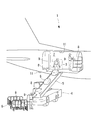
- FIG. 1 is a diagram showing a situation where cargo loading / unloading work is being carried out in an aircraft cargo compartment.
- the fuselage 1 is provided with a cargo compartment 2 at the tail thereof.
- cargo loading and unloading is performed from an opening 3 provided on the right side of the fuselage.
- a belt loader vehicle 4 is installed outside the opening 3
- the conveyor-type loader 5 is arranged so as to reach the opening 3
- the cargo 8 conveyed by the cargo transport vehicle 6 or the like is loaded by the operator 9. Carrying into room 2 or unloading from cargo room 2.
- the center of gravity of the airframe 1 moves back and forth.
- the center of gravity of the fuselage 1 also moves back and forth in the same manner when cargo is loaded into and unloaded from another cargo chamber (not shown) provided at the front of the fuselage 1 or the like. For this reason, cargo loading / unloading work is not performed simultaneously in the front and rear cargo compartments so that the center of gravity management of the airframe 1 is not confused.
- the tilt detection device 11 is attached to the airframe 1 and the tilt angle of the airframe 1 in the pitch direction is monitored.
- the tilt detection device 11 is installed in the vicinity of the cargo compartment 2 and at a position that can be visually recognized by an operator 9 who loads and unloads cargo in the cargo compartment 2, for example, on the ceiling of the cargo compartment 2 or the lower surface of the tail portion of the fuselage 1. .
- the number of installation may be one.
- the worker 9 performs the cargo loading / unloading operation while obtaining the inclination information of the airframe 1 from the inclination detection device 11.
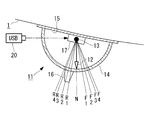
- the inclination detection device 11 is attached with, for example, a gravity sensor 13 (inclination angle detection means) having a weight 12, a hemispherical (dome-shaped) cover 14 covering the gravity sensor 13, and the gravity sensor 13 and the cover 14.
- the board 15 is configured to include an alarm 16 (alarm issuing means) provided outside the cover 14 and a control unit 17 (control means) configured to incorporate, for example, the gravity sensor 13. .
- the gravity sensor 13 detects the tilt angle in the pitch direction when the airframe 1 is parked. Further, the alarm device 16 issues an alarm when the tilt angle detected by the gravity sensor 13 approaches the allowable limit tilt angle in the forward tilt direction and the rear tilt direction of the airframe 1,
- a visual alarm such as a patrol light
- an audible alarm such as a buzzer
- the substrate 15 is provided with suction means such as a sucker, an adhesive part, or a magnet (not shown), and the tilt detection device 11 can be installed at any place on the machine body.
- suction means such as a sucker, an adhesive part, or a magnet (not shown)
- the tilt detection device 11 can be installed at any place on the machine body.
- the inclination detection apparatus 11 can be comprised lightweight, you may install in the airframe 1 stationary.
- the gravity sensor 13 rotates the weight 12 in a hemispherical shape within an angle range of about 180 degrees, and detects the inclination angle of the airframe 1 from the rotation position, so that the weight 12 is naturally suspended by gravity.
- the substrate 15 is installed in the machine body 1 so that the cover 14 is below the substrate 15.
- the tilt detection device 11 has a vibration isolating means between the gravity sensor 13 and the airframe 1 so that vibrations from the airframe 1 are isolated.
- the substrate 15 is formed of rubber, soft resin, or the like, so that the substrate 15 itself serves as a vibration isolating means.
- the present invention is not limited to this.
- a structure in which a vibration isolating member such as a cushion or a spring is interposed between the substrate 15 and the gravity sensor 13 (control unit 17) may be used.
- control unit 17 is input with the center-of-gravity management information unique to the airframe 1 by a storage medium such as the USB memory 20.
- the center-of-gravity management information unique to the aircraft 1 means that the amount of cargo 8 loaded in the cargo compartment 2 changes as the aircraft 1 passes through another airport, the number of passengers on board and the loading of fuel. This is information indicating the current position of the center of gravity of the airframe accompanying this when the amount or the like changes. Note that this information is not limited to the USB memory 20, and the operator 9 may directly input the information to the control unit 17 by providing a numeric keypad on the tilt detection device 11.
- the cargo loading / unloading operation in the cargo compartment 2 is started in a state where the weight 12 of the inclination detecting device 11 is at the neutral angle N as shown in FIG.
- the center of gravity of the airframe 1 moves back and forth, and when the airframe 1 begins to tilt backward or forward, the weight 12 of the gravity sensor 13 deviates from the neutral angle N.
- the control unit 17 causes the alarm device 16 to issue an alarm.
- the intensity of the alarm issued from the alarm device 16 is gradually increased as the tilt angle of the aircraft 1 approaches the limit tilt angles F4 and R4.
- the buzzer sounds at a low volume at the caution angles R1 and F1
- the buzzer sounds at a medium volume at the warning angles F2 and R2
- the buzzer sounds at a high volume at the danger angles F3 and R3, and the limit inclination angles F4 and R4.
- the buzzer sounds at a loud volume and the patrol light turns on at the same time.
- the tilt information unique to the airframe 1 is input to the control unit 17 by a storage medium such as the USB memory 20 before the loading / unloading operation of the cargo 8 in the cargo compartment 2. That is, the position of the center of gravity of the fuselage 1 calculated based on data such as the cargo and fuel loading amount, loading position, occupant, passenger number of passengers, etc. before the cargo loading / unloading operation is input. Based on this information, the control unit 17 corrects the allowable range until the aircraft body 1 reaches the limit tilt angles F4 and R4 in the forward and backward tilt directions.
- the tilt information (center of gravity information) of the airframe 1 is provided from a control center that manages the operation status of the airframe 1.
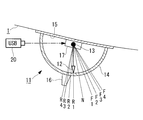
- the control unit 17 shifts the movable range forward until the weight 12 of the gravity sensor 13 reaches the limit inclination angle R4 on the backward inclination side. This shift amount is determined according to the current center-of-gravity position of the airframe 1.
- the weight 12 is not at the neutral angle N, but is placed near the caution angle R1, for example.
- the warning of backward tilting has already been issued at the time when the loading / unloading work is started (or just before the warning is issued), and the loading / unloading is performed such that the center of gravity further moves backward from here.
- a stronger warning is issued. Therefore, the operator can grasp the tilted state of the airframe before the buttocks accident of the airframe 1, and can prevent the buttocks accident.
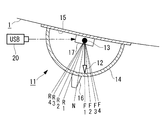
- the control unit 17 shifts the movable range to the rear until the weight 12 of the gravity sensor 13 reaches the limit inclination angle F4 on the forward inclination side. This shift amount is determined according to the current center-of-gravity position of the airframe 1.
- the weight 12 is not at the neutral angle N, but is placed near the caution angle F1, for example.
- a warning of a forward tilt warning has already been issued at the time when the loading / unloading work is started (or just before the warning is issued), and the loading / unloading is performed such that the center of gravity further moves forward from here.
- a stronger warning is issued. Therefore, the operator can grasp the tilted state of the airframe before the front leg breakage accident of the airframe 1 and the front leg breakage accident can be prevented.
- the control unit 17 causes the alarm device 16 to issue an alarm.
- control unit 17 is input with the center of gravity management information unique to the body 1 before the loading and unloading operation of the cargo 8 in the cargo compartment 2, and based on this center of gravity management information, the body 1 is connected to the limit inclination angle F4. , R4, the movable range in the forward and backward tilt directions is corrected. For this reason, the amount of cargo loaded in the cargo compartment 2 has changed, the number of passengers on board, the amount of fuel loaded, etc. have changed, such as when the aircraft 1 passes through another airport. However, such center-of-gravity management information unique to the airframe 1 is input to the control unit 17, and based on this information, the control unit 17 moves forward and backward until the limit inclination angles F4 and R4 are newly reached. Correct the movable range.
- the substrate 15 since the substrate 15 is formed flexibly, the substrate 15 itself plays a role as a vibration isolating means, and vibrations from the airframe 1 are isolated from the gravity sensor 13. Vibration due to mounting, passenger getting on and off, etc. is difficult to be applied to the gravity sensor 13. For this reason, for example, when the weight 12 of the gravity sensor 13 is in the vicinity of the critical point of the attention angle R1 or F1, the gravity sensor 13 reacts sensitively due to the influence of the vibration of the airframe 1, and the alarm 16 is warned (false). Can be prevented smoothly and without causing the loading / unloading operation of the cargo 8 to be interrupted.
- the intensity of the alarm issued by the alarm device 16 is increased stepwise as the inclination angle of the airframe 1 approaches the limit inclination angles F4 and R4.
- the limit of the inclination angle is approaching, and at the same time, it is possible to mount the cargo so that the limit of the inclination angle is far away. That is, for example, when the intensity of the alarm is increased at the same time that a specific cargo 8 is mounted at the rearmost part of the cargo compartment 2, the cargo 8 is installed at the front of the cargo compartment 2, or this cargo 8
- the alarm may be weakened by making a change such as mounting in the cargo compartment. Therefore, the loading / unloading work can be performed smoothly without interruption.
- the worker 9 who has recognized the alarm Since the tilt direction of the aircraft 1 can be known, the cargo 8 can be mounted and removed so as to tilt immediately in the opposite direction, and the alarm can be released. For this reason, the loading / unloading work can be performed smoothly without interruption.
- the operator 9 who loads and unloads the cargo 8 in the cargo compartment 2 of the airframe 1 obtains the center of gravity management information of the airframe 1 from the tilt detection device 11 and loads the cargo 8. Since the removal work is performed, the worker 9 can accurately mount and remove the cargo 8 while grasping the gravity center information (inclined state) of the airframe 1. As a result, it is possible to prevent the tail 1 accident and the front leg damage accident of the airframe 1 and to smoothly carry out the loading / unloading work of the cargo 8.
- the present invention is not limited to the configuration of the above-described embodiment, and may be modified to the extent that it does not depart from the scope of the claims.
- the configuration of the tilt detection device 11 does not necessarily have to be the configuration of the above embodiment.
- a laser level or other angle detection means may be substituted instead of using the gravity sensor 13 as the tilt angle detection means.
Landscapes
- Engineering & Computer Science (AREA)
- Aviation & Aerospace Engineering (AREA)
- Physics & Mathematics (AREA)
- General Physics & Mathematics (AREA)
- Emergency Alarm Devices (AREA)
- Jib Cranes (AREA)
Abstract
Description
本発明は、航空機に貨物を搭除載する時に、その作業者が機体の傾斜状態を把握できるようにし、機体の尻餅事故や前脚破損事故を防止するようにした、航空機の傾き検出装置およびこれを用いた貨物の積み降ろし方法に関するものである。 The present invention relates to an aircraft tilt detection device and an aircraft tilt detection device that enable an operator to grasp the tilting state of an aircraft when loading and unloading cargo on an aircraft, and to prevent an aircraft tail accident and a front leg damage accident. The present invention relates to a method for loading and unloading cargo.
航空機の駐機時においては、乗員・乗客の乗降、貨物や荷物の搭除載、燃料の搭載、機内食等のサービス品(官需機では任務用機材等)の搭除載、上水の搭載、汚水の排出等の作業を行うため、主にピッチ方向の姿勢の変化(機体の重心付近を中心とする前傾方向および後傾方向への動き)と上下動とが生じる。 When the aircraft is parked, passengers / passengers get on and off, cargo and baggage loading / unloading, fuel loading, in-flight meals and other service items (such as mission equipment), water supply Since operations such as mounting and discharging of sewage are performed, a change in posture in the pitch direction (movement in the forward and backward tilt directions around the center of gravity of the airframe) and vertical movement mainly occur.
通常は、機体の重量重心設計において、これらの姿勢変化に加えて外部要因(地上風、積雪、近くを通過する他機のエンジン後流等)を踏まえても、機体が安定姿勢を保つように十分な配慮がなされている。 Normally, in the design of the weight center of gravity of the aircraft, in addition to these changes in posture, the aircraft should maintain a stable posture even in consideration of external factors (ground wind, snow accumulation, engine wake of other aircraft passing nearby, etc.) Sufficient consideration has been given.
また、貨物輸送機に代表されるような、仕様設計上の考慮のみでは十分な対策ができない場合には、過度な頭上げ姿勢とならないように運用手順を定める場合もある。例えば、機体前方の貨物室を満載してから機体後方の貨物室に搭載する、あるいは主翼内部にある燃料タンクへの燃料搭載量が所定量に達していない間は、機体後方の貨物室への搭載を開始しない、といった運用手順が適用される。 In addition, if sufficient measures cannot be taken with only specification design considerations, such as freight transport aircraft, operational procedures may be established to prevent excessive head-up attitude. For example, after loading the cargo compartment in front of the fuselage and mounting it in the cargo compartment behind the aircraft, or while the amount of fuel loaded in the fuel tank inside the main wing has not reached the prescribed amount, Operation procedures such as not starting installation are applied.
航空機の降着装置は、機体の長手方向中央よりやや後方に、一対または複数本設定された主脚と、胴体の前端部付近に設けられた前脚との三点からなり、駐機時においては機体重量の90%程度を主脚が支持し、残る10%程度を前脚が支持している。貨物室は、主脚の前方と後方に設けられているため、後方の貨物室への搭載量が過剰になると、前脚が浮き上がり、胴体後部が接地する、いわゆる尻餅事故が起きてしまう。 An aircraft landing gear consists of three points, one or more main legs set slightly behind the longitudinal center of the fuselage, and front legs provided near the front end of the fuselage. The main leg supports about 90% of the weight, and the front leg supports the remaining 10%. Since the cargo compartment is provided at the front and rear of the main landing gear, if the amount mounted on the rear cargo compartment becomes excessive, a so-called buttock accident occurs in which the front leg floats and the rear of the fuselage comes into contact with the ground.
逆に、主脚よりも前方の貨物室への搭載量が過剰になると、上述のように機体重量の10%程度を担えるだけの強度しか持たない、極力軽量に構成された前脚が折れてしまう、いわゆる前脚破損事故に繋がってしまう。尻餅事故、前脚破損事故、いずれにしても、その後の運行に多大な支障が生じるとともに、機体の修理に莫大な費用が掛かるため、絶対に避けなければならない。 On the other hand, if the amount mounted in the cargo compartment in front of the main legs becomes excessive, the front legs configured to be as light as possible, which have only enough strength to carry about 10% of the aircraft weight as described above, will break. This will lead to a so-called front leg damage accident. In either case, the rear-end accident or the front leg breakage will cause a great hindrance to the subsequent operation and enormous costs for repairing the aircraft, so it must be avoided.
従来では、機体の尻餅事故を防ぐために、機体の尾部と地面との間にテール・スタンションと呼ばれる支持ポールを介在させて機体の尾部が下がることを防止したり、前脚の持ち上がり具合を監視するテザーリングと呼ばれる措置が採られたりしていた。テザーリングとは、前脚に掛かるように地面からロープを緩く張り、この張り具合を専用の監視員が監視し、機体の前部が持ち上がってロープが張ってきたら、監視員が貨物の搭除載を行う作業者に警告する方法である。 Conventionally, a tether that prevents the tail of the fuselage from falling down by interposing a support pole called tail stanchion between the tail of the aircraft and the ground to prevent the aircraft from buttock accidents, or monitoring the lifting of the front legs Measures called rings were taken. Tethering means that the rope is loosely stretched from the ground so that it is hooked on the front leg, and this tension is monitored by a dedicated observer, and when the front part of the fuselage is lifted and the rope is tensioned, the observer removes the cargo. It is a method to warn the worker who performs.
しかしながら、テール・スタンションを用いて尻餅事故を防止することができるのは、テール・スタンションを装備している空港、およびテール・スタンションを使用可能な機体に限られ、そうでない空港や機体においては尻餅事故が発生する懸念を排除することができない。なお、テール・スタンションは重量物であるため、機内に搭載して携行することは不可能である。 However, it is only possible to use tail stanchions to prevent buttock accidents at airports equipped with tail stanchions and aircraft that can use tail stanchions. The concern about accidents cannot be excluded. Tail stanchions are heavy and cannot be carried on board.
一方、テザーリングは簡易的な装備により何処の空港でも行うことができるが、ロープの張り具合を監視するために専用の監視員を配置する必要があり、人員に余裕のない空港では怠られてしまう可能性がある。 On the other hand, tethering can be done at any airport with simple equipment, but it is necessary to arrange a dedicated observer to monitor the tension of the rope, and it is neglected at airports where there are not enough personnel There is a possibility.
さらに、テール・スタンションの使用や、テザーリングの実行によれば、機体の重心が後方に移動して尻餅事故となる事態は回避できるが、逆に機体の重心が前方に移動して前脚破損事故となる事態は回避しにくい。 In addition, the use of tail stanchions and the execution of tethering can avoid the situation where the center of gravity of the aircraft moves backwards and causes a buttock accident, but conversely, the center of gravity of the aircraft moves forward and damages the front legs. This situation is difficult to avoid.
このように、機体の重心が過大に移動して尻餅事故や前脚破損事故が起きてしまう原因の一つとして、機体重心の位置を大きく変化させる貨物の搭除載を行う作業者が、時々刻々と変化する機体の姿勢を把握できていないことが挙げられる。 In this way, as one of the causes of a hips accident or front leg damage accident due to excessive movement of the center of gravity of the aircraft, workers who carry on and off cargoes that greatly change the position of the center of gravity of the aircraft are constantly It is mentioned that the attitude of the changing aircraft cannot be grasped.
本発明は、このような事情に鑑みてなされたものであり、航空機に貨物を搭除載する作業者が機体の傾斜状態を把握できるようにし、機体の尻餅事故や前脚破損事故を防止するとともに、貨物の搭除載作業をスムーズに行うことのできる航空機の傾き検出装置およびこれを用いた貨物の積み降ろし方法を提供することを目的とする。 The present invention has been made in view of such circumstances, and enables an operator who loads and unloads a cargo on an aircraft to grasp the inclination state of the aircraft, and prevents an aircraft tail accident and a front leg damage accident. An object of the present invention is to provide an aircraft inclination detection device capable of smoothly carrying on and off cargo loading and a cargo loading and unloading method using the same.
上述した課題を解決するための第1の発明に係る航空機の傾き検出装置は、機体の駐機時におけるピッチ方向の傾斜角度を検出する傾斜角度検出手段と、警報手段と、前記傾斜角度検出手段により検出された傾斜角度が、前記機体の前傾方向および後傾方向の、許容される限界傾斜角度に近付いた時に、前記警報発報手段に警報を発報させる制御手段とを備えたことを特徴とする。 An aircraft inclination detection device according to a first aspect of the present invention for solving the above-described problem includes an inclination angle detection means for detecting an inclination angle in the pitch direction when the aircraft is parked, an alarm means, and the inclination angle detection means. Control means for causing the alarm issuing means to issue an alarm when the detected inclination angle approaches an allowable limit inclination angle in the forward and backward tilt directions of the aircraft. Features.
上記構成によれば、機体に貨物を搭除載する作業者が、定められた手順に則って搭除載作業を行っている時に、万一機体のピッチ方向の傾斜角度が機体の限界傾斜角度に近付いても、警報発報手段から警報が発報されるため、搭除載作業を一旦中止して機体姿勢の現状を確認できる。このため、機体の尻餅事故や前脚破損事故を未然に防止することができる。 According to the above configuration, when an operator who loads and unloads cargo on the fuselage is performing loading and unloading work according to a predetermined procedure, the tilt angle in the pitch direction of the fuselage should be the limit tilt angle of the aircraft. Even when the vehicle approaches, the warning is issued from the warning issuing means, so that the loading / unloading work can be temporarily stopped to check the current state of the aircraft posture. For this reason, it is possible to prevent an accident with a buttock on the aircraft or a front leg damage accident.
また、第2の発明に係る航空機の傾き検出装置は、前記第1の発明において、前記制御手段は、前記機体への貨物の搭除載作業の前に、該機体の固有の重心管理情報を入力され、この重心管理情報に基づいて前記限界傾斜角度に達するまでの前傾方向および後傾方向への可動範囲を補正することを特徴とする。 According to a second aspect of the present invention, in the aircraft inclination detection device according to the first aspect, the control means provides the center-of-gravity management information unique to the aircraft before the cargo loading / unloading operation on the aircraft. The movable range in the forward tilt direction and the backward tilt direction until the limit tilt angle is reached is corrected based on the input gravity center management information.
上記構成によれば、フライト毎に変更される重心管理情報を制御手段に入力すれば、この情報に基づいて制御手段が新たに限界傾斜角度に達するまでの前傾方向および後傾方向への可動範囲を補正する。 According to the above configuration, if the center-of-gravity management information changed for each flight is input to the control means, the control means can move in the forward and backward tilt directions until the control means reaches a new limit tilt angle based on this information. Correct the range.
このため、例えば機体の重心位置が既に後方に寄っている場合には、限界傾斜角度までの可動範囲が前寄りに移行され、これにより、さらに重心が後方に移動するような搭除載が行われると早目に警報が発報される。機体の重心位置が既に前方に寄っている場合も同様である。したがって、機体の尻餅事故や前脚破損事故を確実に防止することができる。 For this reason, for example, when the center of gravity of the aircraft has already moved rearward, the movable range up to the limit inclination angle is shifted to the front, so that the center of gravity moves further rearward. An alarm is issued as soon as possible. The same applies to the case where the center of gravity of the aircraft has already moved forward. Therefore, it is possible to surely prevent the aircraft body buttocks accident and front leg damage accident.
機体の傾斜情報は、テンキー操作等により制御手段に入力してもよく、あるいはUSB(Universal Serial Bus)メモリ等の記憶媒体により、他の情報機器から制御手段に入力されるようにしてもよい。 The tilt information of the aircraft may be input to the control means by operating a numeric keypad or the like, or may be input from other information devices to the control means by a storage medium such as a USB (Universal Serial Bus) memory.
また、第3の発明に係る航空機の傾き検出装置は、前記第1の発明において、前記機体の任意の場所に設置することができることを特徴とする。 In addition, the aircraft tilt detection apparatus according to the third aspect of the present invention is characterized in that, in the first aspect of the present invention, the aircraft inclination detection apparatus can be installed at any place of the aircraft.
上記構成によれば、傾き検出装置を貨物室内や、その近傍に設置して、機体に貨物を搭除載する作業者に警報を確実に認識させることができ、安全性を高めるとともに、貨物の搭除載作業をスムーズに行うことができる。 According to the above configuration, the tilt detection device can be installed in or near the cargo room so that an operator who loads and unloads the cargo on the fuselage can be surely recognized an alarm, improving safety, The loading / unloading work can be performed smoothly.
また、第4の発明に係る航空機の傾き検出装置は、前記第1の発明において、前記傾斜角度検出手段と、前記機体との間に、前記機体からの振動を免振する免振手段を有することを特徴とする。 According to a fourth aspect of the present invention, there is provided an aircraft inclination detection apparatus according to the first aspect, further comprising an isolation means for isolating vibration from the airframe between the inclination angle detection means and the airframe. It is characterized by that.
上記構成によれば、外風や貨物の搭載、乗客の乗降等に伴う振動が傾斜角度検出手段に対して免振されるため、不必要な警報(誤報)が発報されることを防止し、貨物の搭除載作業をスムーズに行うことができる。 According to the above configuration, vibrations caused by outside wind, cargo loading, passengers getting on and off, etc. are isolated from the inclination angle detection means, so that unnecessary alarms (false alarms) are prevented from being issued. Cargo loading and unloading work can be performed smoothly.
また、第5の発明に係る航空機の傾き検出装置は、前記第1の発明において、前記警報発報手段が発報する警報の強度は、前記機体の傾斜角度が前記限界傾斜角度に近付くにつれて段階的に強められることを特徴とする。 According to a fifth aspect of the present invention, in the aircraft inclination detection device according to the first aspect, the intensity of the alarm issued by the alarm notification means is increased as the aircraft inclination angle approaches the limit inclination angle. It is characterized by being strengthened.
上記構成によれば、機体に貨物を搭除載する作業者が、傾斜角度の限界が近付いてくることを認識できると同時に、逆に傾斜角度の限界が遠のいて行くように貨物を搭除載することができるため、搭除載作業を中断することなくスムーズに行うことができる。 According to the above configuration, an operator who loads and unloads cargo on the fuselage can recognize that the limit of the tilt angle is approaching, and at the same time, loads and loads the cargo so that the limit of the tilt angle is far away. Therefore, the loading / unloading work can be performed smoothly without interruption.
また、第6の発明に係る航空機の傾き検出装置は、前記第1の発明において、前記警報発報手段が発報する警報の種類は、前記機体の傾斜方向が前傾方向であるか後傾方向であるかによって異なることを特徴とする。 The aircraft tilt detection apparatus according to a sixth aspect of the present invention is the aircraft tilt detection apparatus according to the first aspect, wherein the type of alarm issued by the alarm notification means is the forward tilt direction or the rear tilt direction. It differs depending on the direction.
上記構成によれば、警報を認識した作業者が、機体の傾斜方向を知ることができるため、直ちに逆の方向に傾斜するように貨物を搭除載して、警報を解除させることができる。このため、搭除載作業を中断することなくスムーズに行うことができる。 According to the above configuration, since the worker who has recognized the alarm can know the tilt direction of the aircraft, the alarm can be released by mounting the cargo so that it is immediately tilted in the opposite direction. For this reason, the loading / unloading work can be performed smoothly without interruption.
また、本発明に係る貨物の積み降ろし方法は、機体の貨物室に貨物を搭除載する作業者が、本発明に係る航空機の傾き検出装置により、機体の重心管理情報を得ながら貨物の搭除載作業を行うことを特徴とする。 The cargo loading and unloading method according to the present invention is a method in which an operator who loads and unloads cargo in the cargo compartment of the aircraft obtains the center of gravity management information of the aircraft using the aircraft tilt detection device according to the present invention. It is characterized by performing a loading operation.
上記方法によれば、貨物の搭除載作業を行う作業者が、機体の重心管理情報を把握しながら作業することができるため、機体の尻餅事故や前脚破損事故を未然に防止するとともに、貨物の搭除載作業をスムーズに行うことができる。 According to the above method, since the operator who carries out the loading / unloading work of the cargo can work while grasping the center of gravity management information of the aircraft, it can prevent the aircraft from the tail and the front leg from being damaged. Can be carried out smoothly.
以上のように、本発明に係る航空機の傾き検出装置およびこれを用いた貨物の積み降ろし方法によれば、航空機に貨物を搭除載する時に、その作業者が機体の傾斜状態を把握できるようにし、機体の尻餅事故や前脚破損事故を防止するとともに、貨物の搭除載作業をスムーズに行うことができる。 As described above, according to the aircraft tilt detection device and the cargo loading / unloading method using the aircraft tilt detection device according to the present invention, the operator can grasp the tilt state of the aircraft when loading and unloading cargo on the aircraft. As a result, it is possible to prevent a carcass tail accident and a front leg damage accident and smoothly carry out the loading and unloading work of the cargo.
以下、本発明の実施形態について図面を参照しながら説明する。 Hereinafter, embodiments of the present invention will be described with reference to the drawings.
図1は、航空機の貨物室において、貨物の搭除載作業が行われている状況を示す図である。機体1は、その尾部に貨物室2が設けられており、例えば機体の右側面に設けられた開口部3から貨物の搭除載が行われる。開口部3の外部にベルト・ローダ車4が設置され、そのコンベア状のローダ5が開口部3に届くように配置され、荷物搬送車6等により搬送されてきた貨物8が作業者9によって貨物室2内に搬入、もしくは貨物室2から搬出される。
FIG. 1 is a diagram showing a situation where cargo loading / unloading work is being carried out in an aircraft cargo compartment. The
貨物室2は機体1の尾部に設けられているため、貨物室2に貨物8が搭除載されると、機体1の重心が前後に移動する。また、機体1の前部等に設けられた図示しない他の貨物室に貨物が搭除載される場合も同様に機体1の重心位置が前後に移動する。このため、機体1の重心管理が混乱しないように、前部と後部の貨物室で同時に貨物の搭除載作業が行われることがないようにされる。
Since the
貨物室2に貨物8が搭載される際には、その積載重量が過大になったり、積載位置が後方に寄り過ぎたりすることによって、機体重心が主脚(非図示)よりも後方に移動し、前脚が浮き上がって胴体後部が接地する尻餅事故が起こることが予想される。また、例えば機体1の前部に設けられた貨物室に重量の重い貨物が積載されている場合には、機体1の尾部に設けられた貨物室2の貨物8が降ろされることにより、機体重心が前方に過大に移動し、前脚破損事故が起こることが予想される。
When the
そこで、本発明に係る傾き検出装置11が機体1に取り付けられて機体1のピッチ方向の傾斜角度が監視される。傾き検出装置11は、貨物室2の近傍、且つ貨物室2に貨物を搭除載する作業者9によって視認可能な位置、例えば貨物室2の天井や、機体1の尾部下面等に設置される。その設置数は1基でよい。そして、作業者9は、この傾き検出装置11から機体1の傾斜情報を得ながら貨物の搭除載作業を行う。
Therefore, the
傾き検出装置11は、例えば錘12を備えた重力センサ13(傾斜角度検出手段)と、この重力センサ13を覆う半球形状(ドーム状)のカバー14と、これら重力センサ13およびカバー14が取り付けられる基板15と、カバー14の外部に設けられた警報機16(警報発報手段)と、例えば重力センサ13を内蔵するように構成されたコントロールユニット17(制御手段)とを備えて構成されている。
The
重力センサ13は、機体1の駐機時におけるピッチ方向の傾斜角度を検出するものである。また、警報機16は、重力センサ13により検出された傾斜角度が、機体1の前傾方向および後傾方向の、許容される限界の傾斜角度に近付いた時に警報を発報するものであり、パトライト等のように視覚的な警報を発するものや、ブザー等のように聴覚的な警報を発するもの、およびこれらを兼ね備えたもの等が考えられる。
The
基板15は、図示しない吸盤や粘着部、もしくは磁石等の吸着手段を備えており、これによって傾き検出装置11を機体の任意の場所に設置することができる。なお、傾き検出装置11は軽量に構成できるため、機体1に据え置きに設置しておいてもよい。重力センサ13は錘12を凡そ180度の角度範囲内で半球形に回動させ、その回動位置から機体1の傾斜角度を検出するため、錘12が重力により自然に吊持されるよう、カバー14が基板15よりも下側となるように基板15を機体1に設置する。
The
また、傾き検出装置11は、重力センサ13と機体1との間に免振手段を有しており、これによって機体1からの振動が免振されるようになっている。この実施形態では、例えば基板15をゴムや軟質樹脂等で形成することにより、基板15自体に免振手段としての役割を担わせている。しかし、これに限らず、例えば基板15と重力センサ13(コントロールユニット17)との間にクッションやバネ等の防振部材を介装するといった構造にしてもよい。
Further, the
さらに、コントロールユニット17には、例えばUSBメモリ20等の記憶媒体により、機体1の固有の重心管理情報が入力されるようになっている。機体1の固有の重心管理情報とは、機体1が他の空港を経由する等して、貨物室2に搭載されている貨物8の量が変わったり、搭乗している乗客数および燃料の搭載量等が変化したりする場合に、これに伴う機体重心位置の現状を示した情報である。なお、この情報は、USBメモリ20に限らず、傾き検出装置11にテンキー操作盤を設ける等して作業者9がコントロールユニット17に直接入力するようにしてもよい。
Further, the
傾き検出装置11が機体1に取り付けられると、重力センサ13の錘12が重力により鉛直下に下垂し、コントロールユニット17によって、図3に示すように、重力センサ13の垂下した位置が中立角度Nとなり、重力センサ13により検知される傾斜角度の範囲がリセットされる。そして、例えば中立角度Nを中心に、機体1の前方に向かって、注意角度F1、警戒角度F2、危険角度F3、限界傾斜角度F4が設定される。また、機体1の後方に向かって注意角度R1、警戒角度R2、危険角度R3、限界傾斜角度R4が設定される。
When the
中立角度Nを起点にした場合、注意角度F1,R1までの角度は例えば2°、警戒角度F2,R2までの角度は3°、危険角度F3,R3までの角度は4°、限界傾斜角度F4,R4までの角度は4.5°に設定されている。限界傾斜角度F4とは、機体1が前脚破損事故を起こす可能性が高くなる限界付近の傾斜角度であり、限界傾斜角度R4とは、機体1が尻餅事故を起こす可能性が高くなる限界付近の傾斜角度である。したがって、概ねF3~N~R3の角度範囲が機体1の前傾方向および後傾方向へ許容される可動範囲となる。なお、これらの角度数値は機種や使用状況等によって異なり、ここではその一例を示したに過ぎない。
When the neutral angle N is the starting point, the angle to the caution angle F1, R1 is, for example, 2 °, the angle to the warning angle F2, R2 is 3 °, the angle to the danger angle F3, R3 is 4 °, and the limit inclination angle F4 , R4 are set to 4.5 °. The limit inclination angle F4 is an inclination angle near the limit at which the
機体1が完全に水平である場合は、図3に示すように、傾き検出装置11の錘12が中立角度Nにある状態で貨物室2における貨物搭除載作業が開始される。貨物室2に貨物8が搭除載されるにつれて機体1の重心が前後に移動し、機体1が後傾または前傾し始めると、重力センサ13の錘12が中立角度Nから乖離する。そして、錘12が注意角度R1またはF1に達した時点で、コントロールユニット17が警報機16に警報を発報させる。
When the
警報機16から発報される警報の強度は、機体1の傾斜角度が限界傾斜角度F4,R4に近付くにつれて段階的に強められる。例えば、注意角度R1,F1ではブザー音が小音量で鳴り、警戒角度F2,R2ではブザー音が中音量で鳴り、危険角度F3,R3ではブザー音が大音量で鳴り、限界傾斜角度F4,R4ではブザー音が大音量で鳴ると同時にパトライトが点灯する、という具合である。
The intensity of the alarm issued from the
また、警報機16から発報される警報の種類は、機体1の傾斜方向が前傾方向であるか後傾方向であるかによって異ならせるのが好ましい。つまり、錘12が中立角度NからF1~F4の方向に乖離した場合と、中立角度NからR1~R4の方向に乖離した場合とでは、例えば異なるブザー音が鳴る、あるいは前傾か後傾かを表明する音声が発せられる、といった明確な差別化を図るとよい。
Also, the type of alarm issued from the
さらに、前述のように、コントロールユニット17には、貨物室2への貨物8の搭除載作業の前に、USBメモリ20等の記憶媒体により、機体1の固有の傾斜情報が入力される。即ち、貨物の搭除載作業が行われる前における機体1の貨物および燃料の搭載量、搭載位置、乗員、乗客の搭乗人数、等のデータに基づいて算出された機体1の重心位置が入力され、コントロールユニット17は、この情報に基づき、機体1の前傾方向および後傾方向の限界傾斜角度F4,R4に達するまでの許容範囲を補正する。機体1の傾斜情報(重心情報)は、機体1の運行状況を管理する管制センター等から提供される。
Furthermore, as described above, the tilt information unique to the
例えば、貨物室2への貨物8の搭除載作業が開始される前段階で、既に機体1の重心位置が後方に寄っているとの重心管理情報がコントロールユニット17に入力された場合は、コントロールユニット17が、図4に示すように、重力センサ13の錘12が後傾側の限界傾斜角度R4に達するまでの可動範囲を前寄りに移行させる。この移行量は、機体1の現状の重心位置に応じて決定される。
For example, if the center of gravity management information that the center of gravity of the
このため、搭除載作業が開始される時点で、錘12は中立角度Nにはなく、例えば注意角度R1付近等に置かれている。これにより、搭除載作業が開始される時点で既に後傾注意の警報が発報されており(もしくは発報される寸前であり)、ここからさらに重心が後方に移動するような搭除載が行われると、すぐにより強い警報が発報される。したがって、機体1の尻餅事故が起こる前に作業者が機体の傾斜状態を把握することができ、尻餅事故を未然に防止することができる。
Therefore, when the loading / unloading work is started, the
また、貨物室2への貨物8の搭除載作業が開始される前段階で、既に機体1の重心位置が前方に寄っているとの重心管理情報がコントロールユニット17に入力された場合は、コントロールユニット17が、図5に示すように、重力センサ13の錘12が前傾側の限界傾斜角度F4に達するまでの可動範囲を後寄りに移行させる。この移行量は、機体1の現状の重心位置に応じて決定される。
If the center of gravity management information that the center of gravity of the
このため、搭除載作業が開始される時点で、錘12は中立角度Nにはなく、例えば注意角度F1付近等に置かれている。これにより、搭除載作業が開始される時点で既に前傾注意の警報が発報されており(もしくは発報される寸前であり)、ここからさらに重心が前方に移動するような搭除載が行われると、すぐにより強い警報が発報される。したがって、機体1の前脚破損事故が起こる前に作業者が機体の傾斜状態を把握することができ、前脚破損事故を未然に防止することができる。
For this reason, when the loading / unloading operation is started, the
以上のように構成された傾き検出装置11によれば、貨物室2に貨物8が搭除載される時に、重力センサ13によって機体1のピッチ方向の傾斜角度が検出され、この検出された傾斜角度が、機体1の前傾方向および後傾方向の許容される限界傾斜角度F4,R4に近付いた時に、コントロールユニット17が警報機16に警報を発報させる。
According to the
このため、機体1の貨物室2に貨物8を搭除載する作業者9が、定められた手順に則って搭除載作業を行っている時に、万一機体1のピッチ方向の傾斜角度が限界傾斜角度F4,R4に近付いても、傾き検出装置11によって警報が発報されることにより、搭除載作業を一旦中止して機体姿勢の現状を確認することができる。したがって、機体1の尻餅事故や前脚破損事故を未然に防止することができる。
For this reason, when the
また、コントロールユニット17は、貨物室2への貨物8の搭除載作業の前に、機体1の固有の重心管理情報を入力され、この重心管理情報に基づいて、機体1が限界傾斜角度F4,R4に達するまでの前傾方向および後傾方向への可動範囲を補正する。このため、機体1が他の空港を経由する等して、貨物室2に搭載されている貨物の量が変わったり、搭乗している乗客数および燃料の搭載量等が変化したりしていても、このような機体1の固有の重心管理情報がコントロールユニット17に入力され、この情報に基づいてコントロールユニット17が新たに限界傾斜角度F4,R4に達するまでの前傾方向および後傾方向への可動範囲を補正する。
Further, the
これにより、例えば機体1の重心位置が既に後方(または前方)に寄っている場合には、限界傾斜角度F4,R4までの可動範囲が前寄り(または前寄り)に移行され、ここからさらに重心が後方(または前方)に移動するような搭除載が行われると、直ちに警報が発報される。したがって、機体1の尻餅事故や前脚破損事故をより確実に防止することができる。
Thereby, for example, when the center of gravity of the
傾き検出装置11は、機体1の任意の場所に設置することができるため、貨物室2の内部や、その近傍に設置して、機体1に貨物8を搭除載する作業者9に警報を確実に認識させることができ、安全性を高めるとともに、貨物8の搭除載作業をスムーズに行うことができる。
Since the
また、基板15を柔軟に形成することにより、基板15自体に免振手段としての役割を担わせ、機体1からの振動を重力センサ13に対して免振するようにしたため、外風や貨物の搭載、乗客の乗降等に伴う振動が重力センサ13に加わりにくい。このため、例えば重力センサ13の錘12が注意角度R1またはF1の臨界点付近にある時に、機体1の振動の影響で重力センサ13が過敏に反応してしまい、警報機16に警報(誤報)を発報させるといった事態を防止し、これによって貨物8の搭除載作業を中断させることなく、スムーズに行わせることができる。
In addition, since the
一方、警報機16が発報する警報の強度は、機体1の傾斜角度が限界傾斜角度F4,R4に近付くにつれて段階的に強められるため、機体1に貨物8を搭除載する作業者9が、傾斜角度の限界が近付いてくることを認識できると同時に、逆に傾斜角度の限界が遠のいて行くように貨物を搭除載することができる。つまり、例えば貨物室2の最後部に特定の貨物8を搭載したと同時に警報の強度が高まった場合には、その貨物8を貨物室2の前部に搭載する、もしくはこの貨物8を前方の貨物室に搭載する、といった変更を加えることにより、警報が弱まるようにすればよい。したがって、搭除載作業を中断することなくスムーズに行うことができる。
On the other hand, the intensity of the alarm issued by the
また、警報機16が発報する警報の種類を、機体1の傾斜方向が前傾方向であるか後傾方向であるかによって異ならせるようにした場合には、警報を認識した作業者9が、機体1の傾斜方向を知ることができるため、直ちに逆の方向に傾斜するように貨物8を搭除載して、警報を解除させることができる。このため、搭除載作業を中断することなくスムーズに行うことができる。
Further, when the type of alarm issued by the
そして、本発明に係る貨物の積み降ろし方法は、機体1の貨物室2に貨物8を搭除載する作業者9が、傾き検出装置11から機体1の重心管理情報を得ながら貨物8の搭除載作業を行うものであるため、作業者9が機体1の重心情報(傾斜状態)を把握しながら貨物8を的確に搭除載することができる。これにより、機体1の尻餅事故や前脚破損事故を未然に防止するとともに、貨物8の搭除載作業をスムーズに行うことができる。
In the cargo loading and unloading method according to the present invention, the
なお、本発明は、上記の実施形態の構成のみに限定されることはなく、特許請求の範囲を逸脱しない程度に変更を加えてもよい。特に、傾き検出装置11の構成は、必ずしも上記実施形態の構成でなければならないことはない。例えば、傾斜角度検出手段として重力センサ13を用いる代わりにレーザ水準器や、他の角度検出手段を代用してもよい。
Note that the present invention is not limited to the configuration of the above-described embodiment, and may be modified to the extent that it does not depart from the scope of the claims. In particular, the configuration of the
1 機体
2 貨物室
8 貨物
9 作業者
11 傾き検出装置
12 錘
13 重力センサ(傾斜角度検出手段)
14 カバー
15 基板(免振手段)
16 警報機(警報手段)
17 コントロールユニット(制御手段)
20 USBメモリ
F4,R4 限界傾斜角度
DESCRIPTION OF
14
16 Alarm (alarm means)
17 Control unit (control means)
20 USB memory F4, R4 Limit tilt angle
Claims (7)
警報手段と、
前記傾斜角度検出手段により検出された傾斜角度が、前記機体の前傾方向および後傾方向の、許容される限界傾斜角度に近付いた時に、前記警報発報手段に警報を発報させる制御手段と、
を備えたことを特徴とする航空機の傾き検出装置。 Inclination angle detection means for detecting the inclination angle in the pitch direction when the aircraft is parked,
Alarm means;
Control means for causing the alarm notification means to issue an alarm when the inclination angle detected by the inclination angle detection means approaches an allowable limit inclination angle in the forward and backward tilt directions of the aircraft. ,
An aircraft tilt detection apparatus comprising:
Priority Applications (3)
| Application Number | Priority Date | Filing Date | Title |
|---|---|---|---|
| PCT/JP2011/062637 WO2012164708A1 (en) | 2011-06-01 | 2011-06-01 | Inclination detection device for aircraft, and method for loading and unloading cargo using same |
| JP2013517765A JP5822923B2 (en) | 2011-06-01 | 2011-06-01 | Aircraft tilt detection apparatus and cargo loading / unloading method using the same |
| US14/122,762 US9205930B2 (en) | 2011-06-01 | 2011-06-01 | Inclination detection device for aircraft, and method for loading and unloading cargo using same |
Applications Claiming Priority (1)
| Application Number | Priority Date | Filing Date | Title |
|---|---|---|---|
| PCT/JP2011/062637 WO2012164708A1 (en) | 2011-06-01 | 2011-06-01 | Inclination detection device for aircraft, and method for loading and unloading cargo using same |
Publications (1)
| Publication Number | Publication Date |
|---|---|
| WO2012164708A1 true WO2012164708A1 (en) | 2012-12-06 |
Family
ID=47258593
Family Applications (1)
| Application Number | Title | Priority Date | Filing Date |
|---|---|---|---|
| PCT/JP2011/062637 Ceased WO2012164708A1 (en) | 2011-06-01 | 2011-06-01 | Inclination detection device for aircraft, and method for loading and unloading cargo using same |
Country Status (3)
| Country | Link |
|---|---|
| US (1) | US9205930B2 (en) |
| JP (1) | JP5822923B2 (en) |
| WO (1) | WO2012164708A1 (en) |
Cited By (2)
| Publication number | Priority date | Publication date | Assignee | Title |
|---|---|---|---|---|
| JP2017159873A (en) * | 2016-03-11 | 2017-09-14 | 株式会社富士通アドバンストエンジニアリング | Flying object center of gravity position display method and flying object center of gravity position display system |
| JP2023148310A (en) * | 2022-03-30 | 2023-10-13 | 三菱重工業株式会社 | Traffic management system |
Families Citing this family (38)
| Publication number | Priority date | Publication date | Assignee | Title |
|---|---|---|---|---|
| EP2815982B1 (en) * | 2013-06-21 | 2018-06-20 | Airbus Operations GmbH | Cargo compartment and method for loading a cargo compartment |
| US20180216988A1 (en) * | 2013-10-01 | 2018-08-02 | C. Kirk Nance | Method and apparatus for monitoring and avoidance of unanticipated loads applied to aircraft landing gear |
| US9522741B2 (en) * | 2015-02-18 | 2016-12-20 | The Boeing Company | Aircraft tipping alarm system and method using fluid pressure measurement on nose landing gear shock strut |
| US10132709B2 (en) * | 2015-08-14 | 2018-11-20 | The Boeing Company | System and method for detecting vehicle anomalies during ground travel |
| US11145211B2 (en) | 2017-04-25 | 2021-10-12 | Joby Elevate, Inc. | Efficient VTOL resource management in an aviation transport network |
| US11136105B2 (en) | 2017-08-02 | 2021-10-05 | Joby Elevate, Inc. | VTOL aircraft for network system |
| CA3076391A1 (en) | 2017-09-29 | 2019-04-04 | Bombardier Inc. | Method, system, and graphical indicator for providing a lateral center of gravity of an aircraft |
| US11074540B2 (en) | 2017-10-10 | 2021-07-27 | Uber Technologies, Inc. | Network system including drones |
| US10759537B2 (en) | 2017-11-03 | 2020-09-01 | Uber Technologies, Inc. | Safe vertical take-off and landing aircraft payload assignment |
| US10913528B1 (en) * | 2017-11-03 | 2021-02-09 | Uber Technologies, Inc. | Safe vertical take-off and landing aircraft payload distribution and adjustment |
| AU2019259340A1 (en) | 2018-04-24 | 2020-12-17 | Joby Aero, Inc. | Determining VTOL departure time in an aviation transport network for efficient resource management |
| US11238745B2 (en) | 2018-05-07 | 2022-02-01 | Joby Aero, Inc. | Dynamic aircraft routing |
| US10593215B2 (en) | 2018-05-07 | 2020-03-17 | Uber Technologies, Inc. | Dynamic aircraft routing |
| WO2019217432A1 (en) | 2018-05-07 | 2019-11-14 | Uber Technologies, Inc. | System and method for landing and storing vertical take-off and landing aircraft |
| CN109229390B (en) * | 2018-10-23 | 2022-04-05 | 西北工业大学 | A multi-site non-stop land-air integrated cargo transportation system |
| US10589872B1 (en) * | 2019-01-29 | 2020-03-17 | Rockwell Collins, Inc. | Augmented weight sensing for aircraft cargo handling systems |
| US10837786B2 (en) | 2019-03-18 | 2020-11-17 | Uber Technologies, Inc. | Multi-modal transportation service planning and fulfillment |
| US11230384B2 (en) | 2019-04-23 | 2022-01-25 | Joby Aero, Inc. | Vehicle cabin thermal management system and method |
| US12339661B2 (en) | 2019-11-06 | 2025-06-24 | Joby Aero, Inc. | Aerial ride quality improvement system using feedback |
| US12211392B2 (en) | 2019-12-31 | 2025-01-28 | Joby Aero, Inc. | Systems and methods for providing aircraft sensory cues |
| US12012229B2 (en) | 2020-03-06 | 2024-06-18 | Joby Aero, Inc. | System and method for robotic charging aircraft |
| WO2021195382A1 (en) | 2020-03-25 | 2021-09-30 | Joby Elevate, Inc. | Systems and methods for generating flight plans used by a ride sharing network |
| US11988742B2 (en) * | 2020-04-07 | 2024-05-21 | MightyFly Inc. | Detect and avoid system and method for aerial vehicles |
| US20210309354A1 (en) * | 2020-04-07 | 2021-10-07 | MightyFly Inc. | System and method for package transportation |
| US12157580B2 (en) | 2020-04-29 | 2024-12-03 | Joby Aero, Inc. | Systems and methods for transferring aircraft |
| US12400160B2 (en) | 2020-05-07 | 2025-08-26 | Joby Aero, Inc. | Systems and methods for simulating aircraft systems |
| US12254777B2 (en) | 2020-05-28 | 2025-03-18 | Joby Aero, Inc. | Cloud service integration with onboard vehicle system |
| US11893521B2 (en) | 2020-09-01 | 2024-02-06 | Joby Aero, Inc. | Systems and methods for facilitating aerial vehicle services |
| US12560440B2 (en) | 2020-10-12 | 2026-02-24 | Joby Aero, Inc. | Systems and methods for mitigating third party contingencies |
| CN112304408B (en) * | 2020-11-24 | 2022-09-16 | 贵州航天特种车有限责任公司 | A multi-model aircraft weight center of gravity automatic measuring device |
| US12387607B2 (en) | 2020-12-10 | 2025-08-12 | Joby Aero, Inc. | Unmanned aircraft control using ground control station |
| US12372978B2 (en) | 2021-07-02 | 2025-07-29 | Joby Aero, Inc. | Vehicle autonomy architecture |
| US12597357B2 (en) | 2021-09-03 | 2026-04-07 | Joby Aero, Inc. | Automatic aircraft taxiing |
| KR20230107983A (en) | 2022-01-10 | 2023-07-18 | 현대자동차주식회사 | Apparatus for loading and unloading cargo |
| CN114486168B (en) * | 2022-04-19 | 2022-06-17 | 中国空气动力研究与发展中心低速空气动力研究所 | Three-degree-of-freedom model flight test angle limiting device |
| US12462697B2 (en) | 2023-01-17 | 2025-11-04 | Joby Aero, Inc. | Traffic pattern control of UAVS and automated downwind extensions |
| US12459666B2 (en) | 2023-03-07 | 2025-11-04 | Joby Aero, Inc. | Sidestripe identification, estimation and characterization for arbitrary runways |
| CN117552481B (en) * | 2023-12-28 | 2025-12-09 | 中国海洋大学 | Automatic detection device for verticality of offshore wind power pile |
Citations (5)
| Publication number | Priority date | Publication date | Assignee | Title |
|---|---|---|---|---|
| JPS5693017A (en) * | 1979-12-12 | 1981-07-28 | Sundstrand Data Control | Weight* balance* and tire pressure detector |
| JPS62187696A (en) * | 1986-02-13 | 1987-08-17 | 株式会社 タグ | Attitude detection system of aircraft |
| JPH02501562A (en) * | 1988-04-11 | 1990-05-31 | サンドストランド・データ・コントロール・インコーポレーテッド | Wind/shear recovery guide device with stall protection |
| JP2001328598A (en) * | 2000-05-20 | 2001-11-27 | Toshiko Fujisaki | Attitude confirming tool |
| JP2010261798A (en) * | 2009-05-07 | 2010-11-18 | Seiko Epson Corp | Attitude detection apparatus, attitude control apparatus, and control method of attitude control apparatus |
Family Cites Families (8)
| Publication number | Priority date | Publication date | Assignee | Title |
|---|---|---|---|---|
| US6432229B1 (en) * | 1998-12-02 | 2002-08-13 | Sanyo Machine Works, Ltd. | Method and apparatus for monitoring work heating temperature in flame hardening |
| ITUD20010206A1 (en) * | 2001-12-12 | 2003-06-12 | Univ Degli Studi Udine | ELECTROSTIMULATOR DEVICE FOR USERS OF TRANSPORT VEHICLES |
| US7967244B2 (en) * | 2006-11-16 | 2011-06-28 | The Boeing Company | Onboard aircraft weight and balance system |
| US8515656B2 (en) * | 2007-11-02 | 2013-08-20 | Goodrich Corporation | Integrated aircraft cargo loading and monitoring system |
| US7944372B2 (en) * | 2008-04-18 | 2011-05-17 | The Boeing Company | Aircraft tip alarm system |
| US8226040B2 (en) * | 2008-08-25 | 2012-07-24 | Embraer S.A. | Continuous fuel management system for automatic control of aircraft center of gravity |
| US20100063718A1 (en) * | 2008-09-10 | 2010-03-11 | Schmidt Willard H | Aircraft center of gravity automatic calculating system |
| US8060296B2 (en) * | 2008-11-12 | 2011-11-15 | Honeywell International Inc. | Low cost aircraft center of gravity monitoring systems and methods |
-
2011
- 2011-06-01 WO PCT/JP2011/062637 patent/WO2012164708A1/en not_active Ceased
- 2011-06-01 JP JP2013517765A patent/JP5822923B2/en not_active Expired - Fee Related
- 2011-06-01 US US14/122,762 patent/US9205930B2/en not_active Expired - Fee Related
Patent Citations (5)
| Publication number | Priority date | Publication date | Assignee | Title |
|---|---|---|---|---|
| JPS5693017A (en) * | 1979-12-12 | 1981-07-28 | Sundstrand Data Control | Weight* balance* and tire pressure detector |
| JPS62187696A (en) * | 1986-02-13 | 1987-08-17 | 株式会社 タグ | Attitude detection system of aircraft |
| JPH02501562A (en) * | 1988-04-11 | 1990-05-31 | サンドストランド・データ・コントロール・インコーポレーテッド | Wind/shear recovery guide device with stall protection |
| JP2001328598A (en) * | 2000-05-20 | 2001-11-27 | Toshiko Fujisaki | Attitude confirming tool |
| JP2010261798A (en) * | 2009-05-07 | 2010-11-18 | Seiko Epson Corp | Attitude detection apparatus, attitude control apparatus, and control method of attitude control apparatus |
Cited By (3)
| Publication number | Priority date | Publication date | Assignee | Title |
|---|---|---|---|---|
| JP2017159873A (en) * | 2016-03-11 | 2017-09-14 | 株式会社富士通アドバンストエンジニアリング | Flying object center of gravity position display method and flying object center of gravity position display system |
| JP2023148310A (en) * | 2022-03-30 | 2023-10-13 | 三菱重工業株式会社 | Traffic management system |
| JP7763699B2 (en) | 2022-03-30 | 2025-11-04 | 三菱重工業株式会社 | Traffic management system |
Also Published As
| Publication number | Publication date |
|---|---|
| US9205930B2 (en) | 2015-12-08 |
| JPWO2012164708A1 (en) | 2014-07-31 |
| US20140097297A1 (en) | 2014-04-10 |
| JP5822923B2 (en) | 2015-11-25 |
Similar Documents
| Publication | Publication Date | Title |
|---|---|---|
| JP5822923B2 (en) | Aircraft tilt detection apparatus and cargo loading / unloading method using the same | |
| US8226042B1 (en) | Spin control system for a suspended object that is to be deployed in or recovered from water | |
| JP6219171B2 (en) | Buoyancy system | |
| US8565981B2 (en) | Method of controlling a buoyancy system for an aircraft, and a control system implementing said method | |
| JP5819555B1 (en) | Vehicle driving support system | |
| EP3287366B1 (en) | An aircraft with an emergency floatation system | |
| US20110139934A1 (en) | System and method for prevention of inadvertent escape slide deployment for an aircraft | |
| US20100004803A1 (en) | Smart recovery system | |
| EP2206664A1 (en) | Method for docking of a vehicle, such as a truck, at a loading and unloading platform, and buffer | |
| US20100038481A1 (en) | Systems and Methods for Recovering an Airship | |
| EP3556656B1 (en) | Cargo restraint sensor system | |
| EP2081156A2 (en) | Damage detection system | |
| SE531324C2 (en) | System for autonomous or autopilot controlled aircraft landing | |
| CA2904109A1 (en) | Systeme et procede de recuperation d'un engin sous-marin autonome | |
| CN104875863A (en) | Device for preventing ship from capsizing | |
| US9004400B2 (en) | Method of controlling a buoyancy system for an aircraft, a buoyancy system implementing said method, and an aircraft | |
| US20190047702A1 (en) | Aerial vehicle | |
| WO2020136752A1 (en) | Unmanned aerial vehicle, alarm, aircraft and alarm release device | |
| KR20150058789A (en) | service platform apparatus for offshore structure lifeboat | |
| JP2018111474A (en) | Crash prevention for pilotless aircraft (drone) | |
| CN105539764A (en) | Improved self-rescue device for underwater vehicle | |
| US20150323641A1 (en) | Location detection system method and apparatus | |
| KR101636045B1 (en) | Automatic lifeboat releasing apparatus | |
| KR101901582B1 (en) | Drop sensing apparatus for unmanned vehicle | |
| US20150145697A1 (en) | In-cab ready signal sensing system |
Legal Events
| Date | Code | Title | Description |
|---|---|---|---|
| 121 | Ep: the epo has been informed by wipo that ep was designated in this application |
Ref document number: 11866693 Country of ref document: EP Kind code of ref document: A1 |
|
| ENP | Entry into the national phase |
Ref document number: 2013517765 Country of ref document: JP Kind code of ref document: A |
|
| NENP | Non-entry into the national phase |
Ref country code: DE |
|
| WWE | Wipo information: entry into national phase |
Ref document number: 14122762 Country of ref document: US |
|
| 122 | Ep: pct application non-entry in european phase |
Ref document number: 11866693 Country of ref document: EP Kind code of ref document: A1 |