WO2012165088A1 - Dispositif et programme de capture d'image - Google Patents
Dispositif et programme de capture d'image Download PDFInfo
- Publication number
- WO2012165088A1 WO2012165088A1 PCT/JP2012/060998 JP2012060998W WO2012165088A1 WO 2012165088 A1 WO2012165088 A1 WO 2012165088A1 JP 2012060998 W JP2012060998 W JP 2012060998W WO 2012165088 A1 WO2012165088 A1 WO 2012165088A1
- Authority
- WO
- WIPO (PCT)
- Prior art keywords
- information
- shooting
- scene
- shooting scene
- acquired
- Prior art date
- Legal status (The legal status is an assumption and is not a legal conclusion. Google has not performed a legal analysis and makes no representation as to the accuracy of the status listed.)
- Ceased
Links
Images





Classifications
-
- H—ELECTRICITY
- H04—ELECTRIC COMMUNICATION TECHNIQUE
- H04N—PICTORIAL COMMUNICATION, e.g. TELEVISION
- H04N1/00—Scanning, transmission or reproduction of documents or the like, e.g. facsimile transmission; Details thereof
- H04N1/21—Intermediate information storage
- H04N1/2104—Intermediate information storage for one or a few pictures
- H04N1/2112—Intermediate information storage for one or a few pictures using still video cameras
- H04N1/2125—Display of information relating to the still picture recording
-
- H—ELECTRICITY
- H04—ELECTRIC COMMUNICATION TECHNIQUE
- H04N—PICTORIAL COMMUNICATION, e.g. TELEVISION
- H04N9/00—Details of colour television systems
- H04N9/79—Processing of colour television signals in connection with recording
- H04N9/80—Transformation of the television signal for recording, e.g. modulation, frequency changing; Inverse transformation for playback
- H04N9/82—Transformation of the television signal for recording, e.g. modulation, frequency changing; Inverse transformation for playback the individual colour picture signal components being recorded simultaneously only
- H04N9/8205—Transformation of the television signal for recording, e.g. modulation, frequency changing; Inverse transformation for playback the individual colour picture signal components being recorded simultaneously only involving the multiplexing of an additional signal and the colour video signal
-
- H—ELECTRICITY
- H04—ELECTRIC COMMUNICATION TECHNIQUE
- H04N—PICTORIAL COMMUNICATION, e.g. TELEVISION
- H04N1/00—Scanning, transmission or reproduction of documents or the like, e.g. facsimile transmission; Details thereof
- H04N1/00127—Connection or combination of a still picture apparatus with another apparatus, e.g. for storage, processing or transmission of still picture signals or of information associated with a still picture
- H04N1/00323—Connection or combination of a still picture apparatus with another apparatus, e.g. for storage, processing or transmission of still picture signals or of information associated with a still picture with a measuring, monitoring or signaling apparatus, e.g. for transmitting measured information to a central location
-
- H—ELECTRICITY
- H04—ELECTRIC COMMUNICATION TECHNIQUE
- H04N—PICTORIAL COMMUNICATION, e.g. TELEVISION
- H04N23/00—Cameras or camera modules comprising electronic image sensors; Control thereof
- H04N23/60—Control of cameras or camera modules
- H04N23/64—Computer-aided capture of images, e.g. transfer from script file into camera, check of taken image quality, advice or proposal for image composition or decision on when to take image
-
- H—ELECTRICITY
- H04—ELECTRIC COMMUNICATION TECHNIQUE
- H04N—PICTORIAL COMMUNICATION, e.g. TELEVISION
- H04N21/00—Selective content distribution, e.g. interactive television or video on demand [VOD]
- H04N21/40—Client devices specifically adapted for the reception of or interaction with content, e.g. set-top-box [STB]; Operations thereof
- H04N21/41—Structure of client; Structure of client peripherals
- H04N21/422—Input-only peripherals, i.e. input devices connected to specially adapted client devices, e.g. global positioning system [GPS]
- H04N21/42202—Input-only peripherals, i.e. input devices connected to specially adapted client devices, e.g. global positioning system [GPS] environmental sensors, e.g. for detecting temperature, luminosity, pressure, earthquakes
-
- H—ELECTRICITY
- H04—ELECTRIC COMMUNICATION TECHNIQUE
- H04N—PICTORIAL COMMUNICATION, e.g. TELEVISION
- H04N21/00—Selective content distribution, e.g. interactive television or video on demand [VOD]
- H04N21/40—Client devices specifically adapted for the reception of or interaction with content, e.g. set-top-box [STB]; Operations thereof
- H04N21/41—Structure of client; Structure of client peripherals
- H04N21/422—Input-only peripherals, i.e. input devices connected to specially adapted client devices, e.g. global positioning system [GPS]
- H04N21/4223—Cameras
-
- H—ELECTRICITY
- H04—ELECTRIC COMMUNICATION TECHNIQUE
- H04N—PICTORIAL COMMUNICATION, e.g. TELEVISION
- H04N21/00—Selective content distribution, e.g. interactive television or video on demand [VOD]
- H04N21/40—Client devices specifically adapted for the reception of or interaction with content, e.g. set-top-box [STB]; Operations thereof
- H04N21/43—Processing of content or additional data, e.g. demultiplexing additional data from a digital video stream; Elementary client operations, e.g. monitoring of home network or synchronising decoder's clock; Client middleware
- H04N21/433—Content storage operation, e.g. storage operation in response to a pause request, caching operations
- H04N21/4334—Recording operations
-
- H—ELECTRICITY
- H04—ELECTRIC COMMUNICATION TECHNIQUE
- H04N—PICTORIAL COMMUNICATION, e.g. TELEVISION
- H04N21/00—Selective content distribution, e.g. interactive television or video on demand [VOD]
- H04N21/60—Network structure or processes for video distribution between server and client or between remote clients; Control signalling between clients, server and network components; Transmission of management data between server and client, e.g. sending from server to client commands for recording incoming content stream; Communication details between server and client
- H04N21/65—Transmission of management data between client and server
- H04N21/654—Transmission by server directed to the client
- H04N21/6547—Transmission by server directed to the client comprising parameters, e.g. for client setup
-
- H—ELECTRICITY
- H04—ELECTRIC COMMUNICATION TECHNIQUE
- H04N—PICTORIAL COMMUNICATION, e.g. TELEVISION
- H04N21/00—Selective content distribution, e.g. interactive television or video on demand [VOD]
- H04N21/60—Network structure or processes for video distribution between server and client or between remote clients; Control signalling between clients, server and network components; Transmission of management data between server and client, e.g. sending from server to client commands for recording incoming content stream; Communication details between server and client
- H04N21/65—Transmission of management data between client and server
- H04N21/658—Transmission by the client directed to the server
- H04N21/6581—Reference data, e.g. a movie identifier for ordering a movie or a product identifier in a home shopping application
-
- H—ELECTRICITY
- H04—ELECTRIC COMMUNICATION TECHNIQUE
- H04N—PICTORIAL COMMUNICATION, e.g. TELEVISION
- H04N2101/00—Still video cameras
Definitions
- the present invention relates to a photographing apparatus and a program having a function of recognizing a photographing scene.
- CMOS Complementary Metal Oxide Semiconductor
- this type of photographing apparatus has a function of recognizing a photographing scene suitable for the current state of the photographing point and photographing using a photographing condition uniquely determined for the recognized photographing scene. In this case, accurately recognizing the shooting scene is an important factor in performing shooting suitable for the current situation.
- techniques for recognizing a shooting scene techniques described in Japanese Patent Application Laid-Open Nos. 2007-228118 and 2007-306461 are known.
- Japanese Patent Laid-Open No. 2007-306461 discloses a plurality of shooting location categories (for example, “mountain”, “flat land”, “seaside”, “urban area”) in which the current position acquired by GPS is determined in advance. There is disclosed a technique for determining which one belongs, and recognizing a shooting scene according to the current situation of the shooting point according to the determined category.
- the technique described in Japanese Patent Laid-Open No. 2007-306461 is a technique for recognizing a shooting scene according to the category to which the current position acquired by GPS belongs. It is not clear whether they are selected. Even if a category can be selected from the current position acquired by the GPS by any method, the category is general-purpose and not specific to the shooting point. It must be said that the photographic scene recognized based on such a category is difficult to trust.
- the present invention has been made to solve the above problems, and an object thereof is to provide a photographing apparatus and a program capable of recognizing a photographing scene according to the situation with high accuracy.
- the photographing apparatus includes a photographing unit that obtains a subject image by photographing a subject, and a position of the photographing point using GPS when operated.
- the shooting scene information associated with the position information, the subject image acquired by the shooting means, and the subject image are captured.
- the operating unit When the operating unit is not operated based on at least one of the shooting support information that is acquired prior to shooting for shooting and the shooting support information that supports the shooting, and the operating unit is not operated, the operating unit If the GPS information is not acquired by the acquisition means even though the acquisition means is operated by the position information, and position information corresponding to the GPS information acquired by the acquisition means operated by the operation means is A scene recognizing unit for recognizing a shooting scene at a current shooting point based on at least one of a subject image acquired by the shooting unit and the shooting support information, in at least one case where the shooting unit is not stored in the storage unit; Constructed including.
- the imaging device of the second aspect of the present invention is the imaging device of the first aspect of the present invention, in which the GPS information acquired by the acquisition means operated by the operating means is acquired by the scene recognition means.
- the GPS information acquired by the acquisition means operated by the operating means is acquired by the scene recognition means.
- at least one of the subject image and the shooting condition acquired by the shooting unit from a plurality of shooting scene candidate information indicating a plurality of predetermined shooting scene candidates.
- Shooting scene candidate information that is similar with a predetermined degree of similarity or more is selected, and among the selected shooting scene candidate information, acquired by the acquisition unit of the shooting scene information stored in the storage unit.
- the storage means stores a photographing scene information group having a plurality of the photographing scene information, and the scene recognizing means.
- the plurality of shooting scene information groups includes the plurality of shooting scene candidate information.
- at least one of the subject image acquired by the imaging unit and the imaging support information is similar to the predetermined similarity or higher than the plurality of imaging scene candidate information.
- Shooting scene candidate information is selected, and the selected shooting scene candidate information includes the shooting scene information stored in the storage unit.
- a shooting scene candidate indicated by shooting scene candidate information corresponding to shooting scene information associated with the position information corresponding to the GPS information acquired by the acquiring means is recognized as a shooting scene at the current shooting point, and the at least one The number of the shooting scene candidate information is less than the number of the plurality of shooting scene information included in the shooting scene information group, the shooting scene candidate information is information corresponding to the shooting scene information, and the shooting scene candidate Among the information, the shooting scene candidate indicated by the shooting scene candidate information in which at least one of the subject image acquired by the shooting unit and the shooting condition is similar to each other with the predetermined similarity or higher is determined at the current shooting point. Recognized as a shooting scene.
- the storage means further uses the shooting scene information for the shooting scene information.
- GPS information acquired by the acquisition means operated by the actuating means further comprising time acquisition means for associating and storing time information indicating the time of the photographing scene shown, and acquiring the current time.
- time acquisition means for associating and storing time information indicating the time of the photographing scene shown, and acquiring the current time.
- the shooting scene candidate indicated by the candidate information is recognized as a shooting scene at the current shooting point.
- the storage means further includes a shooting scene indicated by the shooting scene information with respect to the shooting scene information.
- the scene recognition unit corresponds to the position information stored in the storage unit when the GPS information acquired by the acquisition unit operated by the operation unit corresponds to the plurality of photographing From the scene candidate information
- shooting scene candidate information is selected in which at least one of the subject image acquired by the shooting unit and the shooting support information is similar to the predetermined similarity or higher, and the selected shooting scene candidate information is selected.
- the position corresponding to the GPS information acquired by the acquisition unit is selected from the shooting scene information stored in the storage unit.
- the shooting scene candidate shown is recognized as a shooting scene at the current shooting point.
- the storage means further uses the shooting scene information for the shooting scene information.
- the scene recognition unit corresponds to the position information stored in the storage unit by the GPS information acquired by the acquisition unit operated by the operation unit Selecting, from the plurality of shooting scene candidate information, shooting scene candidate information in which at least one of the subject image acquired by the shooting means and the shooting support information is similar with a predetermined similarity or higher.
- the GPS acquired by the acquiring means among the photographed scene information stored in the storage means The shooting scene candidate indicated by the shooting scene candidate information corresponding to the shooting scene information corresponding to the position information corresponding to the information and corresponding to the shooting scene information with the reliability higher than the predetermined reliability is shot at the current shooting point. Recognized as a scene.
- the reliability is represented by a binary value in the photographing apparatus according to the fifth aspect or the sixth aspect of the present invention.
- receiving means for receiving an instruction to change the storage contents of the storage means in the photographing apparatus according to any one of the first to seventh aspects of the present invention, receiving means for receiving an instruction to change the storage contents of the storage means; Changing means for changing the storage content of the storage means in accordance with the instruction received by the receiving means.
- the photographing apparatus is the photographing apparatus according to any one of the first to eighth aspects of the present invention, wherein the acquisition means is set in advance after the acquisition means is operated by the operating means.
- the GPS information can be acquired at a predetermined period, and further includes a period changing means for changing the period when a predetermined change condition is satisfied as a condition for changing the period.
- a photographing scene detecting means for detecting a change in a photographing scene at a photographing point based on the image information acquired by the photographing means.
- the change condition is a condition that a change of a predetermined amount or more of the shooting scene is detected by the shooting scene detecting means.
- the photographing apparatus is the photographing apparatus according to the tenth aspect of the present invention, further comprising power detection means for detecting a remaining amount of power of the driving power source of the photographing apparatus, wherein the change The condition is that the remaining amount equal to or greater than a reference value is detected by the power detection unit, and a change of a predetermined amount or more of the shooting scene is detected by the shooting scene detection unit.
- the photographic device is the ninth photographing device of the present invention, further comprising power detection means for detecting a remaining amount of power of a driving power source for the photographing device, wherein the change condition is The power detection means detects the remaining amount equal to or higher than a reference value.
- the storage means further includes the photographing associated with the position information.
- a degree of similarity between a shooting scene indicated by the scene information and a shooting scene included in a predetermined area including the position indicated by the position information is stored in association with each position information, and the acquisition unit includes The position information can be acquired at a predetermined cycle after the acquisition unit is operated by the operation unit, and the similarity associated with the position information corresponding to the GPS information acquired by the acquisition unit is large.
- the apparatus further includes period changing means for increasing the period.
- the power for detecting the remaining power of the driving power source of the photographing apparatus includes detection means, and when the acquisition means is activated, the GPS information is acquired when the remaining amount equal to or greater than a reference value is detected by the power detection means.
- the accuracy of the position information is determined when the address on the map is recognized. The accuracy was lower than required.
- an acquisition means for acquiring GPS information for specifying the position of the shooting point using GPS is predetermined.
- Positioning information indicating the geographical position that can be specified by the GPS information, and the position information indicating that the GPS information acquired by the acquisition means operated by the operating means is activated when the condition is satisfied.
- the shooting scene information associated with the position information and the subject are shot.
- the subject image obtained by the photographing means for obtaining the subject image and the image obtained before the photographing for obtaining the subject image are obtained.
- the shooting scene at the current shooting point is recognized, and when the operation unit is not operated, the acquisition unit is operated by the operation unit.
- the computer is caused to function as a scene recognition unit for recognizing a shooting scene at the current shooting point based on at least one of the subject image acquired by the shooting unit and the shooting support information.
- the digital camera 10 includes an optical unit 22 configured to include a lens for forming a subject image, and a charge disposed behind the optical axis of the lens.
- a coupling element (hereinafter referred to as “CCD”) 24 and an analog signal processing unit 26 that performs various analog signal processing on the input analog signal are configured.
- the digital camera 10 also performs an analog / digital converter (hereinafter referred to as “ADC”) 28 that converts an input analog signal into digital data, and performs various digital signal processing on the input digital data. And a digital signal processing unit 30.
- ADC analog / digital converter
- the digital signal processing unit 30 includes a line buffer having a predetermined capacity, and also performs control for directly storing the input digital data in a predetermined area of the memory 48 described later.
- the output terminal of the CCD 24 is connected to the input terminal of the analog signal processing unit 26, the output terminal of the analog signal processing unit 26 is connected to the input terminal of the ADC 28, and the output terminal of the ADC 28 is connected to the input terminal of the digital signal processing unit 30.
- the analog signal indicating the subject image output from the CCD 24 is subjected to predetermined analog signal processing by the analog signal processing unit 26, converted into digital image data by the ADC 28, and then input to the digital signal processing unit 30.
- the digital camera 10 displays a liquid crystal display (hereinafter referred to as “LCD”) 38 that displays an image obtained by taking a picture, a menu screen, and the like, and a signal for causing the LCD 38 to display the image, the menu screen, and the like.
- LCD liquid crystal display
- An LCD interface 36 that is generated and supplied to the LCD 38, a CPU (central processing unit) 40 that controls the operation of the entire digital camera 10, a primary storage unit that temporarily stores digital image data and the like obtained by photographing, and a power source
- the memory 48 includes a secondary storage unit that stores information that should be retained even after being turned off, and a memory interface 46 that controls access to the memory 48.
- the digital camera 10 includes an external memory interface 50 for enabling the portable memory card 52 to be accessed by the digital camera 10, and a compression / decompression processing circuit 54 that performs compression processing and decompression processing on digital image data. It is configured to include.
- a flash memory is used as the memory 48 and an xD picture card (registered trademark) is used as the memory card 52.
- the form is not limited to this.
- the digital camera 10 is connected to an external device (not shown) such as a personal computer or other digital camera via a network (for example, the Internet, a local area network, etc.), and exchanges various information with the external device.
- a network for example, the Internet, a local area network, etc.
- a communication interface 57 is provided.
- the digital camera 10 receives radio waves transmitted from GPS satellites, and determines GPS information (in this embodiment, longitude, latitude, and altitude as an example) and current time, which specify a geographical current position.
- GPS information in this embodiment, longitude, latitude, and altitude as an example
- current time which specify a geographical current position.
- a GPS receiving unit 58 for receiving the time information shown is provided.
- the digital signal processing unit 30, the LCD interface 36, the CPU 40, the memory interface 46, the external memory interface 50, the compression / decompression processing circuit 54, the communication interface 57, and the GPS receiving unit 58 are connected to each other via a system bus BUS. Therefore, the CPU 40 controls the operation of the digital signal processing unit 30, the compression / decompression processing circuit 54 and the GPS receiving unit 58, acquires the GPS information and time information received by the GPS receiving unit 58, and the LCD interface 36 for the LCD 38. Display of various information via the memory, access to the memory 48 via the memory interface 46, access to the memory card 52 via the external memory interface 50, and access to the external device via the communication interface 57, respectively. It can be carried out.
- the digital camera 10 includes a timing generator 32 that mainly generates a timing signal (pulse signal) for driving the CCD 24 and supplies the timing signal to the CCD 24.
- the CPU 40 drives the CCD 24 via the timing generator 32. Be controlled.
- the digital camera 10 is provided with a motor drive unit 34, and driving of a focus adjustment motor, a zoom motor, and an aperture drive motor (not shown) provided in the optical unit 22 is also controlled by the CPU 40 via the motor drive unit 34.
- the motor drive unit 34 driving of a focus adjustment motor, a zoom motor, and an aperture drive motor (not shown) provided in the optical unit 22 is also controlled by the CPU 40 via the motor drive unit 34.
- the lens according to the present embodiment has a plurality of lenses, is configured as a zoom lens system capable of changing the focal length (magnification), and includes a lens driving mechanism (not shown).
- the lens drive mechanism includes the focus adjustment motor, the zoom motor, and the aperture drive motor, and these motors are each driven by a drive signal supplied from the motor drive unit 34 under the control of the CPU 40.
- the digital camera 10 includes a release switch (so-called shutter) that is pressed when performing shooting and a power switch that is operated when switching on / off the power of the digital camera 10.
- a portion 56 is provided.
- the operation unit 56 includes a transmissive touch panel overlaid on the LCD 38. Various types of information are displayed on the display surface of the LCD 38, and information and instructions are received when the user touches the touch panel. .
- a shooting mode designation button that is pressed when setting a shooting mode that enables shooting, and shooting is performed under shooting conditions suitable for each of a plurality of shooting scenes.
- a scene-specific shooting mode designation button that is pressed when setting a scene-specific shooting mode
- a shooting scene designation button that is pressed when specifying a shooting scene in the scene-specific shooting mode
- shooting A playback mode designation button that is pressed when setting the playback mode, which is a mode for playing back the image obtained on the LCD 38
- a menu display button that is pressed when displaying various menu screens on the LCD 38, and so on.
- Confirm button that is pressed when confirming the operation content of the button, and is pressed when canceling the previous operation content Extinguishing button, and the screen returns various buttons such as button is pressed to when to return to the previous screen is displayed on the display surface of the LCD38.
- buttons displayed on the display surface of the LCD 38 are pressed by being touched by the user via the touch panel.
- some of the instructions given to the digital camera 10 by the user are realized by a touch panel display.
- the present invention is not limited to this, and the digital camera can be operated with a numeric keypad or operation buttons without using the touch panel display. 10 may be instructed.
- the operation unit 56 configured as described above is connected to the CPU 40. Therefore, the CPU 40 can always grasp the operation state with respect to the operation unit 56.
- the release switch of the digital camera 10 is in a state where it is pressed down to an intermediate position (hereinafter referred to as “half-pressed state”) and a state where it is pressed down to a final pressed position beyond the intermediate position. (Hereinafter, referred to as a “fully pressed state”) is configured to be capable of detecting a two-stage pressing operation.
- the AF function is activated after the AE (Automatic Exposure) function is set by setting the release switch halfway and the exposure state (shutter speed, aperture state) is set. Focusing control is performed, and then exposure (photographing) is performed when the button is fully pressed.
- AE Automatic Exposure
- the digital camera 10 has a strobe 44 that emits light to irradiate the subject as necessary at the time of shooting, and is interposed between the strobe 44 and the CPU 40, and power for causing the strobe 44 to emit light under the control of the CPU 40. And a charging unit 42 for charging the battery.
- the strobe 44 is also connected to the CPU 40, and the light emission of the strobe 44 is controlled by the CPU 40.
- the user when the scene-specific shooting mode is set, the user can assist the user in specifying a shooting scene suitable for the current shooting point.
- a shooting scene recommendation function for recognizing a shooting scene at the current shooting point and recommending the recognized shooting scene to the user.
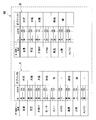
- FIG. 2 is a schematic diagram showing an example of the structure of the databases A and B.
- the databases A and B shown in FIG. 2 are based on the objects (for example, blue sky, evening sky, green leaves, snow, water, etc.) included in the subject image obtained by shooting and the colors included in the subject image. This is used to derive shooting scene information for recognizing (specifying) a shooting scene at a shooting point.
- Both the databases A and B have first shooting scene candidate information as shooting scene information for recognizing a plurality of shooting scenes (first shooting scene candidates).
- object information for recognizing the object is associated with the first shooting scene candidate information.
- the first shooting scene candidate information is associated with color information for recognizing a color included in the image when the first shooting scene candidate is displayed as an image on the display surface of the LCD 38.
- the color information is associated with an occupation ratio indicating the ratio of the area occupied by the color recognized by the color information to the entire image when the first shooting scene candidate is displayed on the display surface of the LCD 38.
- Database B is different from Database A in that the number of first shooting scene candidates is smaller.
- the first shooting scene candidate that recognizes the beach (the beach) and the first shooting scene candidate that recognizes the snow (snow scene) are included in the database A, but are not included in the database B. .
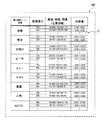
- FIG. 3 is a schematic diagram showing an example of the structure of the database C.
- the database C shown in FIG. 3 is used for deriving shooting scene information for recognizing a shooting scene at the current shooting point based on GPS information and time information received by the GPS receiver 58.
- the database C has second shooting scene candidate information as shooting scene information for recognizing a plurality of shooting scenes (second shooting scene candidates), and the second shooting scene candidate information is included in the database A. This corresponds to shooting scene candidate information.
- the second shooting scene candidate information is information indicating the latitude, longitude, and altitude of the shooting scene corresponding to the second shooting scene candidate recognized by the second shooting scene candidate information, and is specified by the GPS information. Location information indicating a possible geographical location and a time zone are associated. Further, the reliability when the second shooting scene candidate uniquely derived by the position information and the time zone is adopted as the final shooting scene is associated with one set of the position information and the time zone.
- the digital camera 10 displays a map on the LCD 38 using map software, and a place name (current position) (based on GPS information (latitude, longitude) received by the GPS receiver 58).
- a place name (current position) (based on GPS information (latitude, longitude) received by the GPS receiver 58).
- Country name, prefecture name, city name, street address, etc.) are specified, and a current location display mode for displaying the specified position on the map together with the location name is provided.
- This current location display mode is activated when an instruction is given from the user via the operation unit 56, and the LCD 38 can specify the address as shown in FIG. 4 as an example based on the GPS information received by the GPS receiving unit 58.
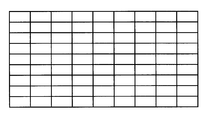
- the screen area is divided by a virtual mesh (a rectangular mesh having a uniform size that is not actually displayed on the screen).
- FIG. 4 is a map position specifying map with a fine position accuracy.
- the screen area is not required to be subdivided (accurate) as in the current position display mode. Therefore, in the scene-by-scene shooting mode, as shown in FIG. 5 as an example, the screen area is divided by a mesh that can identify a shooting scene and has a coarser mesh than the mesh used in the current location display mode. .
- FIG. 5 is a scene recognition map with a low positional accuracy, and the scene recognition map can be used to output the probability of each scene based on GPS information (latitude, longitude).
- each position information included in the database C defines the position and size of the mesh. That is, each piece of position information included in the database C according to the present embodiment is defined by latitude / longitude information indicating latitude and longitude for each of the upper left point and lower right point (diagonal point) of the mesh, and the mesh. It includes the altitude information indicating the lowest altitude and the highest altitude in the area.
- the second shooting scene candidate and the reliability of the second shooting scene candidate are uniquely identified from the GPS information received by the GPS receiver 58 as shown in FIG. It is determined.
- the reliability is expressed as a percentage, but the present invention is not limited to this, and as an example, the reliability may be defined by two values of ON and OFF as shown in FIG. In this case, a reduction in the storage capacity of the memory 48 required for storing the reliability can be expected.
- the CCD 24 performs imaging through the optical unit 22 and sequentially outputs analog signals for R (red), G (green), and B (blue) indicating the subject image to the analog signal processing unit 26.
- the analog signal processing unit 26 subjects the analog signal input from the CCD 24 to analog signal processing such as correlated double sampling processing, and then sequentially outputs the analog signal to the ADC 28.
- the ADC 28 converts the R, G, and B analog signals input from the analog signal processing unit 26 into R, G, and B signals (digital image data) each having a predetermined number of bits, and sequentially converts them to the digital signal processing unit 30. Output.
- the digital signal processing unit 30 accumulates digital image data sequentially input from the ADC 28 in a built-in line buffer and temporarily stores the digital image data directly in a predetermined area of the memory 48.
- the digital image data stored in a predetermined area of the memory 48 is read out by the digital signal processing unit 30 according to the control by the CPU 40, and is subjected to white gain by applying a digital gain for each of R, G, and B according to a predetermined physical quantity.
- digital image data having a predetermined number of bits is generated by performing gamma processing and sharpness processing.
- the digital signal processing unit 30 performs YC signal processing on the generated digital image data to generate a luminance signal Y and chroma signals Cr and Cb (hereinafter referred to as “YC signal”), and the YC signal is stored in the memory 48. Is stored in an area different from the predetermined area.
- the LCD 38 is configured to display a moving image (through image) obtained by continuous imaging by the CCD 24 and can be used as a finder.
- the LCD 38 is generated.
- the YC signals thus output are sequentially output to the LCD 38 via the LCD interface 36. As a result, a through image is displayed on the LCD 38.
- the compression / decompression processing circuit 54 compresses the YC signal in a predetermined compression format (JPEG format in the present embodiment), and then the external memory. Shooting is performed by recording an electronic file (image file) in the memory card 52 via the interface 50.
- FIG. 7 is a flowchart showing an example of the processing flow of the database update processing program executed by the CPU 40 when the power of the digital camera 10 is turned on.
- the program is stored in a predetermined program storage area of the memory 48. Stored in advance.
- a case will be described in which the contents of the database C are configured with default information (information at the time of initial setting) as a premise.
- a case where the digital camera 10 is connected to a server device (not shown) on the manufacturer side of the digital camera 10 via the communication interface 57 will be described as a premise.
- a description will be given of a case where the second shooting scene candidate to which the position information and time zone corresponding to the GPS information and time information received by the GPS receiving unit 58 belongs is specified. To do.
- step 100 the process waits until update instruction information for instructing the update method of the database C is received via the operation unit 56.
- the update instruction information is received in step 100, an affirmative determination is made and the process proceeds to step 102.
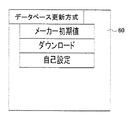
- step 102 a menu screen 60 (see FIG. 8) for allowing the user to specify the database update method is displayed on the LCD 38, and then the process proceeds to step 104 to determine whether or not the database C update method is specified. .
- FIG. 8 shows an example of the menu screen 60 displayed on the LCD 38.
- the current contents of the database C are stored in a storage area that is predetermined by the manufacturer when the digital camera 10 is manufactured.
- a “maker initial value” indicating that updating to the default information stored in advance in “1” can be specified, and the current contents of the database C are “download” for updating the information distributed from the manufacturer via the network.
- the specifiable item and the specifiable item “self-setting” for changing the current contents of the database C according to an instruction given from the user via the operation unit 56 are displayed.
- Step 104 is affirmed when any of the items that can be designated such as “manufacturer initial value”, “download”, and “self setting” is designated by the user via the operation unit 56 while the menu screen 60 is displayed. On the other hand, the process proceeds to step 106 as a result of the determination. On the other hand, if none of the specifiable items on the menu screen 60 is designated, the process proceeds to step 116.
- step 106 it is determined whether or not an item that can be designated as “manufacturer initial value” on the menu screen 60 (update to default information) is specified. If the determination is affirmative, the process proceeds to step 108.
- the default information stored in a predetermined storage area of the memory 48 is acquired, and in the next step 110, the specific contents of the current database C are changed to the default information acquired by the processing in the above step 108. Then, the process proceeds to step 112.
- step 112 the process waits until the change to the default information of the specific contents of the database C is completed. When the change of the specific contents of the database C to the default information is completed in step 112, the determination is affirmative and the process proceeds to step 114. Then, after the information indicating that the change of the specific contents of the database C has been completed (for example, a message “Database has been correctly updated”) is displayed on the LCD 38, the process proceeds to step 116.
- step 106 determines whether or not an item that can be designated as “download” (indicated as “DL” in the example shown in FIG. 7) on the menu screen 60 has been designated. If the determination is affirmative, the process proceeds to step 120. After the download of the contents of the database C from the manufacturer's server device is started, the process proceeds to step 122 and the specific contents of the database C are downloaded. Until the download is completed in step 122, the process proceeds to step 124.
- step 124 the change to the information downloaded by the processing of steps 120 and 122 is started for the specific contents of the database C, and the change of the specific contents of the database C is completed in the next step 126.
- the process waits, and when the change of the specific contents of the database C is completed in step 126, the determination is affirmative and the process proceeds to step 114.
- step 118 determines whether or not an item that can be designated as “self setting” is designated. If a negative determination is made at step 118 (when an item that can be designated as “self setting” is designated), the routine proceeds to step 128.
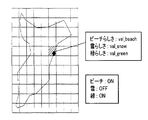
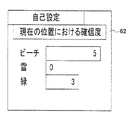
- FIG. 9 shows an example of the self-setting screen 62 displayed on the LCD 38.
- “confidence at the current position” (corresponding to “reliability” included in the database C shown in FIG. 3) is displayed under the item “self-setting”. Is displayed, and under the item, the second shooting scene candidate currently specified and the “confidence level at the current position” corresponding to the reliability associated with the second shooting scene candidate. Is shown graphically.
- the “confidence level at the current position” for the second shooting scene candidate for “Beach” is 5%
- “Confidence level at the current position” is 0%
- “Confidence level at the current position” for the second shooting scene candidate “green” is 3%.
- step 132 the process of step 130 is performed.
- the corresponding reliability of the database C is changed in accordance with the change instruction received by. For example, in the self-setting screen 62 shown in FIG. 9, with respect to a figure (horizontal rectangle in the example shown in FIG.
- the reliability of the database C corresponding to “degree” is also increased by “1”, and the graphic indicating “confidence at the current position” for the second photographed scene candidate “beach” on the display surface of the LCD 38 is “ When 1 is shrunk, the reliability of the database C corresponding to the “confidence level at the current position” corresponding thereto is also decreased by “1”.
- step 134 it is determined whether or not an instruction to end the change of the predetermined contents of the database C has been accepted through the operation unit 56. If the determination is negative, the process returns to step 130. If the determination is affirmative, the routine proceeds to step 114.
- step 116 it is determined whether or not a predetermined condition (for example, a condition that a predetermined operation has been performed on the operation unit 56) is satisfied as a condition for ending the update of the database C. If a negative determination is made, the process proceeds to step 104. If an affirmative determination is made, the database update processing program is terminated.
- a predetermined condition for example, a condition that a predetermined operation has been performed on the operation unit 56
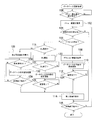
- FIG. 10 shows the GPS update executed by the CPU 40 in a predetermined cycle when a condition for operating the GPS receiver 58 (for example, a condition that the scene-specific shooting mode is set) is satisfied.
- 4 is a flowchart illustrating an example of a processing flow of a processing program, and the program is stored in advance in a predetermined program storage area of the memory.
- image information for example, YC signal
- image information for one frame obtained by shooting as a premise is an evaluation target used in GPS update processing (image information for obtaining a difference described later).
- image information for example, YC signal
- step 300 of FIG. 10 GPS information and time information have been received by the GPS receiver 58 from the time when the power of the digital camera 10 is turned on to the present time (updated from the time when the digital camera 10 is turned on until the present time. If the determination is affirmative, the process proceeds to step 302. If the determination is negative, the process proceeds to step 316.
- step 302 it is determined whether or not a predetermined time (for example, 60 seconds) has elapsed since the GPS information and time information were previously received by the GPS receiver 58. If the determination is negative, the GPS update processing program On the other hand, if the determination is affirmative, the process proceeds to step 304 to acquire image information (for example, YC signal) from the predetermined storage area ⁇ of the memory 48 and erase the stored contents of the storage area ⁇ . Thereafter, the process proceeds to step 306, and after acquiring the latest image information (for example, YC signal) for one frame obtained by photographing, the process proceeds to step 310.
- a predetermined time for example, 60 seconds
- step 310 the image information acquired by the process of step 306 is stored in the storage area ⁇ of the memory 48, and then the process proceeds to step 312 and the image information acquired by the process of step 304 and the process of step 306 are performed.
- the difference (in this embodiment, “absolute value of the difference”) with the image information acquired by the above is calculated.
- an example of calculating a difference between image information as a variation amount of a shooting scene is given.
- the present invention is not limited to this, and a photometric value, a divided photometric value, a focus position, and a focus evaluation value , And the variation amount of the face detection result may be calculated.
- step 314 it is determined whether or not the difference calculated by the process in step 312 exceeds a predetermined threshold value. If the determination is negative, the GPS update processing program is terminated, If it is determined, the process proceeds to step 316.
- step 316 acquisition of GPS information and time information is started by receiving radio waves transmitted from GPS satellites via the GPS receiver 58. If the determination in step 318 is affirmative, step 316 is performed.
- the process proceeds to 320, and the GPS information and time information acquired by the processing of steps 316 and 318 are stored in the storage area ⁇ of the memory 48, and then the GPS update processing program is terminated. It should be noted that the content stored in the storage area ⁇ is affirmative when the scene-specific shooting mode setting is canceled, when the power switch of the digital camera 10 is turned off, and at step 204 of the scene recognition processing program described later. If erased.
- step 318 the process proceeds to step 322, where it is determined whether or not a predetermined time (for example, 10 seconds) has elapsed since the processing of step 316 was executed. If the determination is affirmative, the process returns to step 318. If the determination is affirmative, the GPS update processing program is terminated.
- a predetermined time for example, 10 seconds
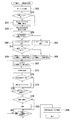
- FIG. 11 is a flowchart showing an example of a process flow of a scene recognition processing program executed by the CPU 40 every predetermined time (for example, every 15 seconds) when the power of the digital camera 10 is turned on. Are stored in advance in a predetermined program storage area of the memory 48.
- step 200 it is determined whether or not a condition for operating the GPS receiver 58 (for example, a condition that the scene-specific shooting mode is set) is satisfied. If the determination is affirmative, step 202 is performed. On the other hand, if a negative determination is made, the process proceeds to step 204, and whether or not the operation information is received by the operation unit 56, indicating that the GPS reception unit 58 does not receive information (does not use GPS). If the determination is affirmative, the process proceeds to step 208. If the determination is negative, the scene recognition processing program is terminated.
- a condition for operating the GPS receiver 58 for example, a condition that the scene-specific shooting mode is set
- step 202 the storage area ⁇ of the memory 48 is accessed and the acquisition of GPS information and time information is started. Then, the process proceeds to step 206, where it is determined whether or not the acquisition of GPS information and time information is completed. If the determination is affirmative, the process proceeds to step 208. If the determination is negative, the process proceeds to step 209. In step 209, it is determined whether or not the variable x is less than the threshold value N. If a negative determination is made, the process proceeds to step 208. If an affirmative determination is made, the process proceeds to step 212. After 1 is incremented, the process returns to step 206.
- step 208 after acquiring the latest one frame of image information (for example, YC signal) obtained by photographing and photographing support information for supporting the photographing, the process proceeds to step 210.
- the above-described photographing support information for example, brightness (divided photometric value; photometric value of each divided area obtained by dividing the screen into a plurality of areas (for example, 16 ⁇ 16 divided))
- Shooting support information that is acquired prior to shooting such as distance information, focus position, focus evaluation value, and face detection result and supports the shooting is applied.
- FIG. 12 is a flowchart showing an example of the processing flow of the first shooting scene candidate selection processing program, and the program is stored in advance in a predetermined program storage area of the memory 48.
- step 350 of FIG. 12 after recognizing a specific object included in the subject image indicated by the image information based on the image information and shooting support information acquired by the processing of step 208, the process proceeds to step 352.
- the object included in the subject image can be recognized by, for example, dividing the subject image into a plurality of regions and performing pattern matching using a predetermined template for each region obtained by the division. It is.
- “outside light”, “sun”, “beach”, “sand”, “green”, “snow”, “person's face”, and the like are applied as specific objects. Needless to say, other objects may be used.
- step 352 it is determined whether or not a specific object has been recognized by the processing in step 350. If the determination is affirmative, the process proceeds to step 354. If the determination is negative, the process proceeds to step 356. To do.
- step 354 the object information for recognizing the specific object recognized by the processing in step 350 is stored in the storage area ⁇ of the memory 48, and the process proceeds to step 356.
- step 356 the occupation ratio (for example, “number of pixels of a specific color / number of pixels of the entire image”) is calculated for the plurality of specific colors for the subject image subjected to the processing in step 350 above. After the calculated occupation ratio is stored in the storage area ⁇ of the memory 48, the process proceeds to step 358.
- step 358 it is determined whether or not the GPS receiving unit 58 is operating (in this case, GPS information and time information are stored in the storage area ⁇ of the memory 48 as an example). If the determination is negative, the process proceeds to step 362. In step 360, a flag is set for database A, and then the process proceeds to step 364. In step 362, a flag is set for the database B, and then the process proceeds to step 364.
- step 364 it is determined whether or not object information is stored in the storage area ⁇ of the memory 48. If the determination is affirmative, the process proceeds to step 366. If the determination is negative, the process proceeds to step 368. Transition. In step 366, the object information is acquired from the storage area ⁇ of the memory 48 and the storage content of the storage area ⁇ is erased, and acquired from the storage area ⁇ from the database (database A or database B) for which the flag is currently set. After acquiring all the first shooting scene candidate information associated with the object information corresponding to the object information, the process proceeds to step 369.
- step 368 from the database (database A or database B) for which the flag is currently set, first shooting scene candidate information (“-” shown in FIG. 2 corresponding to “-” shown in FIG. 2) that is not associated with object information. After all candidate information is acquired, the process proceeds to step 369. If object information is associated with all first shooting scene candidates in the databases A and B, the processing in steps 364 and 368 is not necessary.
- step 369 attention should be paid to one first shooting scene candidate information that has not yet been processed in steps 370 to 376 in the first shooting scene candidate information obtained by the processing in step 366 or step 368. After designating as first shooting scene candidate information, the process proceeds to step 370.
- step 370 the specific color occupancy is acquired from the storage area ⁇ of the memory 48, and then the process proceeds to step 372, where the specific color occupancy acquired by the processing in step 370 is the processing in step 369. Whether or not the degree of similarity is equal to or higher than a predetermined similarity by determining whether or not the occupancy ratio of the same color associated with the first shooting scene candidate information specified by is matched within a predetermined error If the determination is affirmative, the process proceeds to step 374, increments the variable i by 1, and then proceeds to step 376.
- step 376 it is determined whether or not the processing in steps 370 to 374 has been executed for the occupancy ratios of all colors stored in the storage area ⁇ of the memory 48. On the other hand, if the determination is affirmative, the process proceeds to step 378.
- the variable i is the image information and shooting support information (for example, image information) included in the first shooting scene candidate information in which the image information and shooting support information acquired by the processing in step 208 indicate the first shooting scene candidate.
- a threshold value for example, a value that serves as an index indicating the degree of similarity
- the process proceeds to step 380, where the first photographic scene candidate information acquired at the present time (the first 366 acquired by the process of step 366 or step 368) is acquired. 1 shooting scene candidate information) and the variable i are associated with each other and stored in the storage area ⁇ of the memory 48, and then the process proceeds to step 382.
- step 382 the first shooting scene candidate information (first shooting scene candidate information acquired by the processing of step 366 or step 368) acquired at the present time is still the processing target of steps 370 to 376. If there is a negative determination, the process returns to step 369. If the determination is affirmative, the process proceeds to step 384 to store the storage area ⁇ . After erasing the stored contents and canceling the flag setting for the database (database A or database B), the first shooting scene candidate selection processing program is terminated, and the process proceeds to step 214 in the flowchart shown in FIG.
- step 214 of FIG. 11 GPS information and time information are stored in the storage area ⁇ of the memory 48, and position information corresponding to the GPS information stored in the storage area ⁇ of the memory 48 and the storage area of the memory 48 are stored. It is determined whether or not the time zone corresponding to the time information stored in ⁇ is included in the database C. If the determination is affirmative, the process proceeds to step 216.
- step 216 as an example, the position information corresponding to the GPS information (latitude, longitude, and altitude) stored in the storage area ⁇ of the memory 48 is associated from the database C shown in FIG. After all the second shooting scene candidate information associated with the time zone to which the time information stored in the region ⁇ belongs is acquired, the process proceeds to step 218.
- step 218 it is determined whether or not there are a plurality of pieces of second shooting scene candidate information acquired by the processing in step 216. If the determination is affirmative, the process proceeds to step 220, while the determination is negative. If so, the process proceeds to step 222.
- each of the plurality of second shooting scene candidate information acquired by the processing in step 216 is uniquely identified from the database C by the GPS information and time information stored in the storage area ⁇ of the memory 48.
- the process proceeds to step 224.
- the second photographic scene candidate information acquired by the processing in step 216 is stored in the storage area ⁇ of the memory 48, and the process proceeds to step 224.
- step 224 whether or not first shooting scene candidate information corresponding to the second shooting scene candidate information stored in the storage area ⁇ by the processing in step 220 or step 222 is stored in the storage area ⁇ of the memory 48. If the determination is affirmative, the process proceeds to step 226.
- step 226 the second shooting scene candidate information stored in the storage area ⁇ by the processing in step 220 or step 222 is stored in the memory 48 as shooting scene information for specifying a shooting scene recommended by the shooting scene recommendation function. After storing in the area ⁇ , the scene recognition processing program is terminated.
- step 214 the process proceeds to step 228, and after acquiring the first shooting scene candidate information from the storage area ⁇ of the memory 48, the process proceeds to step 230 and the storage area ⁇ of the memory 48 Of the acquired first shooting scene candidate information, the most reliable information is stored in the storage area ⁇ of the memory 48 as shooting scene information for specifying a shooting scene recommended by the shooting scene recommendation function, and then the scene recognition is performed. Terminate the processing program.
- “the most reliable” in step 230 means, for example, the one having the largest variable i associated with the first shooting scene candidate information.
- step 232 the most reliable one of the first shooting scene candidate information stored in the storage area ⁇ of the memory 48 and the second shooting scene candidate information stored in the storage area ⁇ of the memory 48, After storing in the storage area ⁇ of the memory 48 as shooting scene information for specifying a shooting scene recommended by the shooting scene recommendation function, the present scene recognition processing program is terminated.
- “the most reliable” means, for example, the variable i associated with the first shooting scene candidate information stored in the storage area ⁇ of the memory 48 and the storage area of the memory 48.
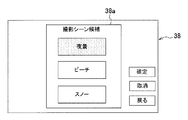
- FIG. 13 shows an example in which a shooting scene recommended by the shooting scene recommendation function is presented to the user.
- a shooting scene candidate screen showing a shooting scene candidate is displayed, and a confirmation button, a cancel button, and a screen return button are displayed.
- the shooting scene candidate screen 38a displays shooting scene information for specifying a plurality of shooting scenes in a button format that can be designated.
- shooting scene information for specifying a shooting scene of “night view”, shooting scene information for specifying a shooting scene of “beach”, and shooting scene information for specifying a shooting scene of “snow” are in button format.
- a button indicating shooting scene information for specifying a shooting scene recommended by the shooting scene recommendation function is displayed blinking.
- FIG. 13 shows an example in which a shooting scene recommended by the shooting scene recommendation function is presented to the user.
- a button related to shooting scene information for specifying a shooting scene of “night view” is displayed blinking.
- the designated button is highlighted, and when the confirmation button is subsequently designated, the button is highlighted.
- Shooting can be executed under shooting conditions that are predetermined as shooting conditions suitable for the shooting scene specified by the shooting scene information.
- the imaging system 12 as a photographing unit that obtains a subject image by photographing the subject, and the GPS using the GPS when operated is used.
- GPS receiving unit 58 as an acquisition unit for acquiring information
- CPU 40 as an operating unit for operating GPS receiving unit 58 when a predetermined condition for operating GPS receiving unit 58 is satisfied
- GPS information A database C that stores location information indicating an identifiable geographical position and second shooting scene candidate information as shooting scene information indicating a shooting scene at a position specified by the position information, and activated GPS reception.
- the GPS receiving unit 58 is activated, but the GPS information is not received by the GPS receiving unit 58, and the activated GPS receiving unit 58 is operated.
- At least the subject image obtained by photographing and the photographing condition used for photographing to obtain the subject image CPU 40 as a scene recognizing means for specifying a shooting scene at the current shooting point based on one side; Since with it can recognize shooting scene according to the situation with high precision.
- the CPU 40 corresponds to the position information stored in the database C when the GPS information acquired by the operated GPS receiving unit 58 corresponds to a plurality of predetermined multiple information. From among a plurality of first shooting scene candidates as shooting scene candidates, select a first shooting scene candidate in which at least one of a subject image acquired by shooting and a shooting condition are similar to each other with a predetermined similarity or higher. Among the first photographed scene candidates, the second photographed scene candidates associated with the position information corresponding to the GPS information received by the GPS receiver 58 among the second photographed scene candidates stored in the database C are selected. Since the corresponding second shooting scene candidate is specified as the shooting scene at the current shooting point, shooting according to the situation Can recognize over on to more accurately.
- the CPU 40 when the GPS information acquired by the activated GPS receiver 58 corresponds to the position information stored in the database C, the CPU 40 performs shooting from the database A.
- the first shooting scene candidate corresponding to the second shooting scene candidate associated with the position information corresponding to the GPS information received by the GPS receiver 58 is recognized as a shooting scene at the current shooting point. If the GPS receiver 58 is not activated, the GP is activated even though the GPS receiver 58 is activated.
- the database C further stores time information (time zone) indicating the time of the second shooting scene candidate in association with the second shooting scene candidate, and stores the current time information.
- time information time zone
- the CPU 40 corresponds to the position information stored in the database C when the GPS information acquired by the activated GPS receiver 58 is stored in the database From A (or database B), a first shooting scene candidate in which at least one of a subject image acquired by shooting and a shooting condition are similar to each other with a predetermined similarity or higher is selected, and the selected first shooting scene candidate is selected.
- the database C further stores the second shooting scene candidate in association with the reliability of the second shooting scene candidate, and the CPU 40 operates the GPS reception.
- the GPS information acquired by the unit 58 corresponds to the position information stored in the database C
- at least one of the subject image acquired by shooting and the shooting conditions is determined in advance from the database A (or database B).
- the first shooting scene candidates that are similar in degree of similarity or higher are selected, and the GPS receiving unit 58 among the second shooting scene candidates stored in the database C among the selected first shooting scene candidates is received.
- the second shooting scene candidate associated with the position information and time zone corresponding to the GPS information and time information Since the first photographic scene candidate corresponding to the second photographic scene candidate with the reliability of the predetermined reliability or higher is recognized as the photographic scene at the current photographic point, the photographic scene corresponding to the situation is recognized with higher accuracy. be able to.
- the operation unit 56 that receives an instruction to change the storage content of the database C and the CPU 40 that changes the storage content of the database C according to the instruction received by the operation unit 56 are provided. Convenience for the user can be improved.
- the GPS receiving unit 58 acquires GPS information at a predetermined cycle, and when a predetermined change condition is satisfied as a condition for changing the predetermined cycle, the cycle is set. Since the CPU 40 is further provided, the power consumption required for updating the GPS information can be suppressed while suppressing a decrease in the accuracy of specifying the shooting scene.
- the CPU 40 is further provided as a photographing scene detection means for detecting a change in the photographing scene at the photographing point based on the image information acquired by photographing.
- the condition for changing the predetermined cycle the condition that the CPU 40 has detected a change of a predetermined amount or more of the shooting scene is applied.
- the power consumption required for updating the GPS information can be suppressed while suppressing the decrease.
- the GPS update process is executed with a fixed cycle.
- the GPS update process may be changed.
- the remaining battery level of the digital camera 10 is greater than or equal to a reference value
- GPS information and time information using GPS can be acquired, and the update cycle may be changed according to the remaining battery level.
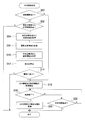
- steps 400, 402, and 404 are added before the step 300 of the GPS update processing program as shown in FIG.
- step 400 after the remaining battery level is acquired, the process proceeds to step 402, where it is determined whether the remaining battery level acquired by the process in step 400 is equal to or greater than a reference value, and a negative determination is made. If so, the GPS update processing program is terminated.
- step 402 the process proceeds to step 404, and after setting an update cycle according to the remaining battery level, the process proceeds to step 300.
- step 404 for example, a period uniquely determined for the remaining battery capacity may be set so that the update period becomes longer as the remaining battery capacity becomes smaller. Thereby, the power consumption required when acquiring GPS information and time information can be suppressed.
- the update cycle may be changed only when the remaining battery level of the digital camera 10 is equal to or greater than the reference value and a change of a predetermined amount or more of the shooting scene at the shooting point is detected.
- the update cycle may be changed only when a change of a predetermined amount or more of the shooting scene at the shooting point is detected.
- the second shooting associated with the GPS information is performed.
- the GPS information update cycle (GPS update cycle) is lengthened. There is almost no problem.
- the GPS scene at the shooting point changes rapidly (for example, a busy road in the city center), the GPS scene can be recognized with high accuracy by shortening the GPS information update cycle. Is possible.
- the first shooting scene candidate (second shooting scene candidate) in which the subject image is similar with a predetermined similarity or higher based on the color included in the specific object and the subject image is obtained.
- the first shooting scene candidate (second shooting scene candidate) in which the shooting support information is similar with a predetermined similarity or higher may be selected.
- shooting support information for example, divided photometric values
- shooting support information is associated with the first shooting scene candidate information included in the database A and the database B, and actual shooting is performed in the databases A and B. What is necessary is just to select the 1st imaging scene candidate information corresponding to the imaging
- a method of selecting first shooting scene candidate information from shooting support information provided for shooting is used in combination with a method of selecting first shooting scene candidate information based on a color included in a specific object and subject image. You may do it.
- “narrow down the first shooting scene candidate information” means, for example, that the shooting support information included in the first shooting scene candidate information among the plurality of pieces of first shooting scene candidate information is the shooting support information used for shooting. That is, the similar first shooting scene candidate information is selected.
- the digital camera 10 includes an RTC (real time clock).
- time information may be acquired from the RTC.
- the second shooting scene candidate is derived based on the GPS information and time information received by the GPS receiver 58 in the database C.
- the GPS receiver 58 The second shooting scene candidate may be derived from the GPS information or the time information received by.
- the second shooting scene associated with the position information corresponding to the GPS information received by the GPS receiver 58 and having a reliability equal to or higher than a predetermined reliability.
- a candidate may be derived, and the derived second photographing scene candidate may be recognized as a photographing scene at the current photographing point.
- the second shooting scene candidate information and the reliability are associated with all the position information in the database C, the position information directly corresponding to the GPS information acquired using the GPS is directly used.
- the second photographic scene candidate information and the reliability can be selected, the second photographic scene candidate information and the reliability may not be associated with all the position information included in the database C.
- the second shooting scene candidate and the reliability are obtained by interpolation from the second shooting scene candidate information and the reliability associated with each of the plurality of pieces of position information other than the position information corresponding to the GPS information acquired using the GPS. Should be derived. Further, in this case, it is possible to recognize the shooting scene with high accuracy by assigning weight values to the second shooting scene candidate information and the reliability in advance.
Landscapes
- Engineering & Computer Science (AREA)
- Multimedia (AREA)
- Signal Processing (AREA)
- Studio Devices (AREA)
- Camera Bodies And Camera Details Or Accessories (AREA)
- Camera Data Copying Or Recording (AREA)
Abstract
L'invention porte sur un dispositif et un programme de capture d'image aptes à identifier, avec un degré élevé de précision, des scènes de capture d'image correspondant à la situation. La scène de capture d'image au présent emplacement de capture d'image est identifiée sur la base d'au moins l'image du sujet acquise par capture d'image et/ou d'informations d'aide à la capture d'image dans au moins l'un des cas suivants : le cas dans lequel des informations GPS ne sont pas acquises par un récepteur GPS (58) dans une période prédéterminée après que le récepteur GPS (58) a été activé ; le cas dans lequel des informations GPS sont acquises par un récepteur GPS (58) dans une période prédéterminée après que le récepteur GPS (58) a été activé et dans lequel les informations GPS acquises ne sont pas enregistrées dans une base de données (C) ; et le cas dans lequel une image du sujet a été acquise par capture d'image sans que le récepteur GPS (58) ne soit activé.
Priority Applications (3)
| Application Number | Priority Date | Filing Date | Title |
|---|---|---|---|
| CN201280026660.6A CN103563351B (zh) | 2011-05-31 | 2012-04-24 | 拍摄装置及方法 |
| JP2013517931A JP5425341B2 (ja) | 2011-05-31 | 2012-04-24 | 撮影装置及びプログラム |
| US14/092,419 US8913158B2 (en) | 2011-05-31 | 2013-11-27 | Shooting device and program |
Applications Claiming Priority (2)
| Application Number | Priority Date | Filing Date | Title |
|---|---|---|---|
| JP2011-122119 | 2011-05-31 | ||
| JP2011122119 | 2011-05-31 |
Related Child Applications (1)
| Application Number | Title | Priority Date | Filing Date |
|---|---|---|---|
| US14/092,419 Continuation US8913158B2 (en) | 2011-05-31 | 2013-11-27 | Shooting device and program |
Publications (1)
| Publication Number | Publication Date |
|---|---|
| WO2012165088A1 true WO2012165088A1 (fr) | 2012-12-06 |
Family
ID=47258952
Family Applications (1)
| Application Number | Title | Priority Date | Filing Date |
|---|---|---|---|
| PCT/JP2012/060998 Ceased WO2012165088A1 (fr) | 2011-05-31 | 2012-04-24 | Dispositif et programme de capture d'image |
Country Status (4)
| Country | Link |
|---|---|
| US (1) | US8913158B2 (fr) |
| JP (1) | JP5425341B2 (fr) |
| CN (1) | CN103563351B (fr) |
| WO (1) | WO2012165088A1 (fr) |
Cited By (2)
| Publication number | Priority date | Publication date | Assignee | Title |
|---|---|---|---|---|
| JP2015162242A (ja) * | 2014-02-28 | 2015-09-07 | シャープ株式会社 | ネットワークシステム、通信方法、サーバ、サーバ用プログラム、端末、端末用プログラム |
| WO2016199213A1 (fr) * | 2015-06-09 | 2016-12-15 | 日立マクセル株式会社 | Appareil d'acquisition d'images et procédé d'acquisition d'informations de position utilisé à cet effet |
Families Citing this family (10)
| Publication number | Priority date | Publication date | Assignee | Title |
|---|---|---|---|---|
| JP2014155005A (ja) * | 2013-02-07 | 2014-08-25 | Canon Inc | 表示装置及びその制御方法 |
| CN105812646A (zh) * | 2014-12-30 | 2016-07-27 | Tcl集团股份有限公司 | 一种拍照方法、装置以及图像处理方法、装置和通信系统 |
| KR101692643B1 (ko) * | 2015-11-18 | 2017-01-03 | 재단법인 다차원 스마트 아이티 융합시스템 연구단 | 저전력 무선 카메라 및 센서 시스템 |
| US10679326B2 (en) * | 2015-11-24 | 2020-06-09 | Canon Kabushiki Kaisha | Image data processing apparatus and image data processing method that determine confidence data indicating a level of confidence in a pixel value in high resolution image data |
| JP2017220826A (ja) * | 2016-06-08 | 2017-12-14 | オリンパス株式会社 | 情報端末装置、撮影機会提供方法、及びプログラム |
| JP6914480B2 (ja) * | 2016-06-27 | 2021-08-04 | カシオ計算機株式会社 | 指標表示装置、指標表示方法、プログラム、及び指標表示システム |
| CN108600634B (zh) * | 2018-05-21 | 2020-07-21 | Oppo广东移动通信有限公司 | 图像处理方法和装置、存储介质、电子设备 |
| CN110619251B (zh) * | 2018-06-19 | 2022-06-10 | Oppo广东移动通信有限公司 | 图像处理方法和装置、存储介质、电子设备 |
| CN109271899A (zh) * | 2018-08-31 | 2019-01-25 | 朱钢 | 一种提高Ai智慧摄影场景识别准确率的实现方法 |
| US11388314B1 (en) * | 2020-11-12 | 2022-07-12 | Gopro, Inc. | GPS timing for video frames |
Citations (7)
| Publication number | Priority date | Publication date | Assignee | Title |
|---|---|---|---|---|
| JP2007228118A (ja) * | 2006-02-22 | 2007-09-06 | Seiko Epson Corp | 撮影シーンの決定 |
| JP2007258927A (ja) * | 2006-03-22 | 2007-10-04 | Seiko Epson Corp | 撮像装置 |
| JP2007306461A (ja) * | 2006-05-15 | 2007-11-22 | Sony Ericsson Mobilecommunications Japan Inc | カメラ付き携帯端末及びその撮影モード特定方法 |
| JP2008177780A (ja) * | 2007-01-17 | 2008-07-31 | Olympus Imaging Corp | デジタルカメラ |
| JP2009060195A (ja) * | 2007-08-30 | 2009-03-19 | Fujifilm Corp | 撮像装置および方法並びにプログラム |
| JP2009077157A (ja) * | 2007-09-20 | 2009-04-09 | Fujifilm Corp | 撮影制御方法、撮像装置、撮影意図判定装置、及び撮影システム |
| JP2010045436A (ja) * | 2008-08-08 | 2010-02-25 | Olympus Imaging Corp | カメラ及び撮影システム |
Family Cites Families (4)
| Publication number | Priority date | Publication date | Assignee | Title |
|---|---|---|---|---|
| US6301440B1 (en) * | 2000-04-13 | 2001-10-09 | International Business Machines Corp. | System and method for automatically setting image acquisition controls |
| JP2007184733A (ja) * | 2006-01-05 | 2007-07-19 | Fujifilm Corp | 撮像装置及び撮影モード表示方法 |
| JP4609338B2 (ja) * | 2006-02-09 | 2011-01-12 | セイコーエプソン株式会社 | 撮影パラメータ値の設定 |
| JP2008167307A (ja) * | 2006-12-28 | 2008-07-17 | Olympus Imaging Corp | デジタルカメラ |
-
2012
- 2012-04-24 CN CN201280026660.6A patent/CN103563351B/zh active Active
- 2012-04-24 WO PCT/JP2012/060998 patent/WO2012165088A1/fr not_active Ceased
- 2012-04-24 JP JP2013517931A patent/JP5425341B2/ja active Active
-
2013
- 2013-11-27 US US14/092,419 patent/US8913158B2/en active Active
Patent Citations (7)
| Publication number | Priority date | Publication date | Assignee | Title |
|---|---|---|---|---|
| JP2007228118A (ja) * | 2006-02-22 | 2007-09-06 | Seiko Epson Corp | 撮影シーンの決定 |
| JP2007258927A (ja) * | 2006-03-22 | 2007-10-04 | Seiko Epson Corp | 撮像装置 |
| JP2007306461A (ja) * | 2006-05-15 | 2007-11-22 | Sony Ericsson Mobilecommunications Japan Inc | カメラ付き携帯端末及びその撮影モード特定方法 |
| JP2008177780A (ja) * | 2007-01-17 | 2008-07-31 | Olympus Imaging Corp | デジタルカメラ |
| JP2009060195A (ja) * | 2007-08-30 | 2009-03-19 | Fujifilm Corp | 撮像装置および方法並びにプログラム |
| JP2009077157A (ja) * | 2007-09-20 | 2009-04-09 | Fujifilm Corp | 撮影制御方法、撮像装置、撮影意図判定装置、及び撮影システム |
| JP2010045436A (ja) * | 2008-08-08 | 2010-02-25 | Olympus Imaging Corp | カメラ及び撮影システム |
Cited By (2)
| Publication number | Priority date | Publication date | Assignee | Title |
|---|---|---|---|---|
| JP2015162242A (ja) * | 2014-02-28 | 2015-09-07 | シャープ株式会社 | ネットワークシステム、通信方法、サーバ、サーバ用プログラム、端末、端末用プログラム |
| WO2016199213A1 (fr) * | 2015-06-09 | 2016-12-15 | 日立マクセル株式会社 | Appareil d'acquisition d'images et procédé d'acquisition d'informations de position utilisé à cet effet |
Also Published As
| Publication number | Publication date |
|---|---|
| JP5425341B2 (ja) | 2014-02-26 |
| US8913158B2 (en) | 2014-12-16 |
| CN103563351A (zh) | 2014-02-05 |
| JPWO2012165088A1 (ja) | 2015-02-23 |
| CN103563351B (zh) | 2015-11-25 |
| US20140132801A1 (en) | 2014-05-15 |
Similar Documents
| Publication | Publication Date | Title |
|---|---|---|
| JP5425341B2 (ja) | 撮影装置及びプログラム | |
| US9013589B2 (en) | Digital image processing apparatus and digital image processing method capable of obtaining sensibility-based image | |
| US8558923B2 (en) | Image capturing apparatus and method for selective real time focus/parameter adjustment | |
| JP5194650B2 (ja) | 電子カメラ | |
| US20080068456A1 (en) | Camera | |
| US8412031B2 (en) | Camera with a function of automatically setting shooting conditions and shooting method | |
| US9900525B2 (en) | Image processing device, imaging device, image processing method, and image processing program generating a split image | |
| WO2010001778A1 (fr) | Dispositif d'imagerie, dispositif d'affichage d'image et caméra électronique | |
| CN113315956B (zh) | 图像处理设备、摄像设备、图像处理方法和机器可读介质 | |
| WO2006028108A1 (fr) | Systeme et procede de traitement d’images et terminal et serveur utilises pour le traitement d’images | |
| US20140210941A1 (en) | Image capture apparatus, image capture method, and image capture program | |
| CN101222582A (zh) | 摄像装置、连续摄影方法和存储程序的存储介质 | |
| US9325895B2 (en) | Digital photographing apparatus and control method thereof | |
| JP4984044B2 (ja) | 撮影システム及びその撮影条件の設定方法と、それに用いられる端末及びサーバ | |
| US8189055B2 (en) | Digital photographing apparatus and method of controlling the same | |
| JP5186984B2 (ja) | 電子カメラ | |
| JP2013085140A (ja) | 撮像装置およびその制御方法 | |
| JP2018006888A (ja) | 撮像装置、その制御方法、および制御プログラム | |
| JP5851133B2 (ja) | 画像再生装置、画像再生方法およびプログラム | |
| JP2018074514A (ja) | 撮像装置及びその表示制御方法、並びにプログラム | |
| JP2009111827A (ja) | 撮影装置及び画像ファイル提供システム | |
| JP2007258927A (ja) | 撮像装置 | |
| US20110205396A1 (en) | Apparatus and method, and computer readable recording medium for processing, reproducing, or storing image file including map data | |
| JP2006345162A (ja) | デジタルカメラ | |
| JP5181935B2 (ja) | 画像処理装置、プログラム及び被写体検出方法 |
Legal Events
| Date | Code | Title | Description |
|---|---|---|---|
| 121 | Ep: the epo has been informed by wipo that ep was designated in this application |
Ref document number: 12792098 Country of ref document: EP Kind code of ref document: A1 |
|
| ENP | Entry into the national phase |
Ref document number: 2013517931 Country of ref document: JP Kind code of ref document: A |
|
| NENP | Non-entry into the national phase |
Ref country code: DE |
|
| 122 | Ep: pct application non-entry in european phase |
Ref document number: 12792098 Country of ref document: EP Kind code of ref document: A1 |