WO2012165149A1 - Dispositif d'antenne et dispositif terminal de communication - Google Patents
Dispositif d'antenne et dispositif terminal de communication Download PDFInfo
- Publication number
- WO2012165149A1 WO2012165149A1 PCT/JP2012/062577 JP2012062577W WO2012165149A1 WO 2012165149 A1 WO2012165149 A1 WO 2012165149A1 JP 2012062577 W JP2012062577 W JP 2012062577W WO 2012165149 A1 WO2012165149 A1 WO 2012165149A1
- Authority
- WO
- WIPO (PCT)
- Prior art keywords
- conductor
- coil
- coiled conductor
- magnetic flux
- coiled
- Prior art date
- Legal status (The legal status is an assumption and is not a legal conclusion. Google has not performed a legal analysis and makes no representation as to the accuracy of the status listed.)
- Ceased
Links
Images





Classifications
-
- H—ELECTRICITY
- H01—ELECTRIC ELEMENTS
- H01Q—ANTENNAS, i.e. RADIO AERIALS
- H01Q1/00—Details of, or arrangements associated with, antennas
- H01Q1/50—Structural association of antennas with earthing switches, lead-in devices or lightning protectors
-
- H—ELECTRICITY
- H03—ELECTRONIC CIRCUITRY
- H03H—IMPEDANCE NETWORKS, e.g. RESONANT CIRCUITS; RESONATORS
- H03H7/00—Multiple-port networks comprising only passive electrical elements as network components
- H03H7/38—Impedance-matching networks
-
- H—ELECTRICITY
- H04—ELECTRIC COMMUNICATION TECHNIQUE
- H04B—TRANSMISSION
- H04B1/00—Details of transmission systems, not covered by a single one of groups H04B3/00 - H04B13/00; Details of transmission systems not characterised by the medium used for transmission
- H04B1/02—Transmitters
- H04B1/04—Circuits
- H04B1/0458—Arrangements for matching and coupling between power amplifier and antenna or between amplifying stages
-
- H—ELECTRICITY
- H01—ELECTRIC ELEMENTS
- H01F—MAGNETS; INDUCTANCES; TRANSFORMERS; SELECTION OF MATERIALS FOR THEIR MAGNETIC PROPERTIES
- H01F19/00—Fixed transformers or mutual inductances of the signal type
- H01F19/04—Transformers or mutual inductances suitable for handling frequencies considerably beyond the audio range
Definitions
- communication terminals including mobile phones have been used in communication systems such as GSM (registered trademark) (Global System for mobile Communications), DCS (Digital Communication System), PCS (Personal Communication Service), UMTS (Universal Mobile Telecommunications System), Furthermore, it may be required to support GPS (Global Positioning System), wireless LAN, Bluetooth (registered trademark), and the like. Therefore, the antenna device in such a communication terminal device is required to cover a wide frequency band from 800 MHz to 2.4 GHz.
- GSM Global System for mobile Communications
- DCS Digital Communication System
- PCS Personal Communication Service
- UMTS Universal Mobile Telecommunications System
- GPS Global Positioning System
- wireless LAN wireless local area network
- Bluetooth registered trademark
- an antenna device having a broadband matching circuit constituted by an LC parallel resonance circuit or an LC series resonance circuit is generally used. Is. Further, as an antenna device corresponding to a wide frequency band, for example, tunable antennas as disclosed in Patent Document 3 and Patent Document 4 are known.
- JP 2004-336250 A JP 2006-173697 A JP 2000-124728 A JP 2008-035065 A
- the matching circuits shown in Patent Documents 1 and 2 include a plurality of resonant circuits, the insertion loss in the matching circuit tends to increase and a sufficient gain may not be obtained.
- the tunable antennas disclosed in Patent Documents 3 and 4 require a circuit for controlling the variable capacitance element, that is, a switching circuit for switching the frequency band, so that the circuit configuration tends to be complicated. In addition, since a loss and distortion in the switching circuit are large, a sufficient gain may not be obtained.
- the present invention has been made in view of the above-described circumstances, and an object of the present invention is to provide an antenna device that impedance matches with a power feeding circuit in a wide frequency band, and a communication terminal device including the antenna device.
- An antenna device of the present invention is an antenna device including an antenna element and an impedance conversion circuit connected to the antenna element,
- the impedance conversion circuit includes a transformer-type circuit in which a first inductance element and a second inductance element are coupled through mutual inductance, The first end of the first inductance element is connected to the feeder circuit, and the second end is connected to the ground, A first end of the second inductance element is connected to the feeder circuit, and a second end is connected to the antenna element;
- the mutual inductance is larger than the inductance of the second inductance element.
- the first inductance element includes a first coil-shaped conductor and a second coil-shaped conductor
- the second inductance element includes a third coil-shaped conductor and a fourth coil-shaped conductor
- the first coil-shaped conductor and the second coil-shaped conductor are wound so that a closed loop of a first magnetic flux is generated by the first coil-shaped conductor and the second coil-shaped conductor so as to be electromagnetically coupled.
- the third coil-shaped conductor and the fourth coil-shaped conductor are wound so that a closed loop of the second magnetic flux is generated by the third coil-shaped conductor and the fourth coil-shaped conductor to be electromagnetically coupled. It is preferable that it is turned.
- the first coiled conductor, the second coiled conductor, the third coiled conductor, and the fourth coiled conductor have a closed loop of the first magnetic flux. It is preferable that the rotating magnetic flux (magnetic flux passing through the first closed magnetic path) and the magnetic flux rotating around the closed loop of the second magnetic flux (magnetic flux passing through the second closed magnetic path) are wound in opposite directions. .
- the first coiled conductor and the third coiled conductor are coupled to each other via a magnetic field and an electric field
- the second coiled conductor and the fourth coiled conductor are coupled to each other via a magnetic field and an electric field;
- the first coiled conductor, the second coiled conductor, the third coiled conductor, and the fourth coiled conductor are It is preferable that the conductive pattern is formed of a laminated body in which a plurality of dielectric layers or magnetic layers are laminated.
- the winding axis of each of the first coiled conductor, the second coiled conductor, the third coiled conductor, and the fourth coiled conductor is the laminated body. Facing in the stacking direction, The first coiled conductor and the second coiled conductor are juxtaposed with each other with different winding axes, The third coiled conductor and the fourth coiled conductor are juxtaposed with each other with different winding axes, Each winding range of the first coiled conductor and the third coiled conductor overlaps at least partially in plan view, and each winding range of the second coiled conductor and the fourth coiled conductor Are preferably overlapped at least partially in plan view.
- the impedance conversion circuit further includes a fifth coil-shaped conductor and a sixth coil-shaped conductor, The fifth coil-shaped conductor and the sixth coil-shaped conductor are connected in series to form a third inductance element, The fifth coil-shaped conductor and the sixth coil-shaped conductor are electromagnetically coupled by the fifth coil-shaped conductor and the sixth coil-shaped conductor generating a closed loop of the third magnetic flux (the third closed magnetic circuit is Configured), and A first end of the third inductance element is connected to the feeder circuit; a second end of the third inductance element is connected to the ground; The first coiled conductor, the second coiled conductor, the third coiled conductor, the fourth coiled conductor, the fifth coiled conductor and the sixth coiled conductor are It is preferable that the magnetic fluxes traveling around the closed loop of the second magnetic flux are sandwiched between the magnetic fluxes traveling around the closed loop of the first magnetic flux and the magnetic fluxes traveling around the closed
- the impedance conversion circuit further includes a fifth coil-shaped conductor and a sixth coil-shaped conductor, The fifth coil-shaped conductor and the sixth coil-shaped conductor are connected in series to form a third inductance element, The fifth coil-shaped conductor and the sixth coil-shaped conductor are electromagnetically coupled by the fifth coil-shaped conductor and the sixth coil-shaped conductor generating a closed loop of the third magnetic flux (the third closed magnetic circuit is Configured), and A first end of the third inductance element is connected to the feeder circuit; a second end of the third inductance element is connected to the ground; The first coiled conductor, the second coiled conductor, the third coiled conductor, the fourth coiled conductor, and the fifth coiled conductor go around a closed loop of the first magnetic flux. It is preferable that the magnetic flux is arranged so as to be sandwiched in the layer direction by the magnetic flux that goes around the closed loop of the second magnetic flux and the magnetic flux that goes around the closed
- a communication terminal device includes an antenna device including an antenna element, a power feeding circuit, and an impedance conversion circuit connected between the antenna element and the power feeding circuit.
- the impedance conversion circuit includes at least a first coiled conductor, a second coiled conductor, a third coiled conductor, and a fourth coiled conductor,
- the impedance conversion circuit includes a transformer-type circuit in which a first inductance element and a second inductance element are coupled through mutual inductance, The first end of the first inductance element is connected to the feeder circuit, and the second end is connected to the ground, A first end of the second inductance element is connected to the feeder circuit, and a second end is connected to the antenna element;
- the mutual inductance is larger than the inductance of the second inductance element.
- an insertion loss in a matching circuit is small, a switching circuit for switching a frequency band is unnecessary, and an antenna device that impedance-matches with a power feeding circuit over a wide frequency band, and a communication terminal device including the antenna device. Can be configured.
- the communication terminal apparatus of the present invention since the antenna apparatus is used, it is possible to realize a communication terminal apparatus that can support various communication systems having different frequency bands.
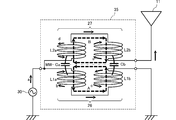
- FIG. 1A is a circuit diagram of the main part of the impedance conversion circuit 35 included in the antenna device 101 of the first embodiment
- FIG. 1B is a circuit diagram of the antenna device 101
- FIG. 2 is a diagram in which various arrows indicating states of magnetic field coupling and electric field coupling are written in the circuit illustrated in FIG.
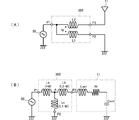
- FIG. 3A is a circuit diagram obtained by equivalently converting the antenna device 101 of the first embodiment
- FIG. 3B is a circuit diagram obtained by further equivalently converting it.
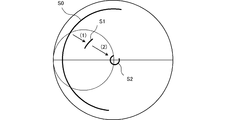
- FIG. 4 is a diagram schematically showing the action of the negative inductance component that is equivalently generated in the impedance conversion circuit 35 and the action of the impedance conversion circuit 35.
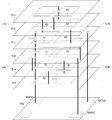
- FIG. 5 is an exploded perspective view of the laminated body when the impedance conversion circuit 35 is configured as a laminated body (multilayer substrate) in which dielectric layers or magnetic layers are laminated.
- FIG. 6 is a diagram showing main magnetic fluxes passing through the coiled conductor by the conductor pattern formed in each layer of the multilayer substrate shown in FIG.
- FIG. 7 is a circuit diagram of the antenna device 102 of the second embodiment.
- FIG. 8 is a circuit diagram of the antenna device 103 according to the third embodiment.
- FIG. 9 is an exploded perspective view of the laminated body in the case where the impedance conversion circuit 45 shown in FIG. 8 is configured as a laminated body in which dielectric layers or magnetic layers are laminated.
- FIG. 10 is a circuit diagram of the antenna device 104 of the fourth embodiment.
- FIG. 11A is a configuration diagram of a communication terminal apparatus as a first example of the fifth embodiment
- FIG. 11B is a configuration diagram of a communication terminal apparatus as a second example.
- FIG. 1A is a circuit diagram of the main part of the impedance conversion circuit 35 included in the antenna device 101 of the first embodiment
- FIG. 1B is a circuit diagram of the antenna device 101.
- the impedance conversion circuit 35 includes a first coiled conductor L1a, a second coiled conductor L1b, a third coiled conductor L2a, and a fourth coiled conductor L2b.
- the first coiled conductor L1a and the second coiled conductor L1b are connected in series to form a first series circuit 26, and the third coiled conductor L2a and the fourth coiled conductor L2b are in series. Is connected to the second series circuit 27.
- the first coiled conductor L1a and the second coiled conductor L1b are a first closed magnetic field in which the first coiled conductor L1a and the second coiled conductor L1b generate a closed loop of the first magnetic flux and are electromagnetically coupled. It is wound to form a road.
- the third coil-shaped conductor L2a and the fourth coil-shaped conductor L2b are electromagnetically coupled by the closed loop of the second magnetic flux generated by the third coil-shaped conductor L2a and the fourth coil-shaped conductor L2b. Two closed magnetic paths are wound.
- the antenna device 101 includes an antenna element 11 and an impedance conversion circuit 35 connected to the antenna element 11.
- the antenna element 11 is a monopole antenna, for example.
- the first terminal P11 of the first series circuit 26 and the first terminal P21 of the second series circuit 27 are connected to the first port P1 of the impedance conversion circuit 35.
- the second terminal P12 of the first series circuit 26 is connected to the second port P2 of the impedance conversion circuit 35.
- the second end P22 of the second series circuit 27 is connected to the third port P3 of the impedance conversion circuit 35.
- the antenna element 11 is connected to the third port P3 of the impedance conversion circuit 35, and the second port P2 is grounded.
- the power feeding circuit 30 is connected to the first port P ⁇ b> 1 of the impedance conversion circuit 35.
- the power supply circuit 30 is a power supply circuit for supplying a high-frequency signal to the antenna element 11 and generates and processes a high-frequency signal, but may include a circuit that combines and demultiplexes the high-frequency signal.
- FIG. 2 is a diagram in which various arrows indicating states of magnetic field coupling and electric field coupling are entered in the circuit illustrated in FIG.
- Capacitors Ca and Cb in FIG. 2 are symbols representing the coupling capacitance for the electric field coupling.
- the first coiled conductor L1a and the second coiled conductor L1b are coupled in phase with each other, and the third coiled conductor L2a and the fourth coiled conductor L2b are coupled in phase with each other to form a closed magnetic circuit. ing. Therefore, the two magnetic fluxes A and B are confined, and between the first coiled conductor L1a and the second coiled conductor L1b, and between the third coiled conductor L2a and the fourth coiled conductor L2b. The loss of energy during can be reduced.
- the inductance values of the first coil-shaped conductor L1a and the second coil-shaped conductor L1b and the inductance values of the third coil-shaped conductor L2a and the fourth coil-shaped conductor L2b are set to substantially the same element value, the closed magnetism The leakage magnetic field on the road is reduced, and the energy loss can be further reduced.
- the impedance conversion ratio can be controlled by appropriately designing the element value of each coiled conductor.
- the magnetic flux A excited by the primary current flowing in the first series circuit 26 and the magnetic flux B excited by the secondary current flowing in the second series circuit 27 are arranged so that the induced magnetic currents repel each other's magnetic flux ( To repel). That is, an equivalent magnetic barrier MW is generated between the first series circuit 26 and the second series circuit 27.
- an equivalent magnetic barrier MW is generated between the first series circuit 26 and the second series circuit 27.
- the first coiled conductor L1a and the third coiled conductor L2a, and the second coiled conductor L1b and the fourth coiled conductor L2b are coupled with a higher degree of coupling. That is, the first series circuit 26 and the second series circuit 27 are coupled with a high degree of coupling.
- FIG. 3A is a circuit diagram obtained by equivalently converting the antenna device 101 of the first embodiment
- FIG. 3B is a circuit diagram obtained by further equivalently converting it.
- the impedance conversion circuit 35E is a diagram showing the impedance conversion circuit 35 shown in FIG. 1B as a simple transformer circuit.
- the inductance of the first series circuit 26 connected to the power feeding circuit 30 shown in FIG. 1B is represented by L1
- the inductance of the second series circuit 27 is represented by L2.
- an impedance conversion circuit 35E is an equivalent conversion of the transformer circuit shown in FIG. 3A into a T-type circuit using inductance elements La, Lb, and Lc.
- the inductance of the inductance element La is (+ M)
- the inductance of the inductance element Lb is (L2-M)
- the inductance of the inductance element Lc is (L1-M). It is.
- L2 ⁇ M
- the inductance (L2-M) of the inductance element Lb is a negative value.
- the antenna element 11 includes an equivalent inductance component LANT, a radiation resistance component Rr, and a capacitance component CANT.
- the inductance component LANT of the antenna element 11 alone acts so as to be canceled out by the negative combined inductance component (L2-M) in the impedance conversion circuit 35E. That is, the inductance component (of the antenna element 11 including the inductance element (L2-M)) viewed from the point A of the impedance conversion circuit 35E is small (ideally zero), and as a result, The impedance frequency characteristic of the antenna device 101 is reduced.
- the impedance conversion ratio by the transformer circuit is L1: (L1 + L2), where L1 represents the inductance of the inductance element L1 and L2 represents the inductance of the inductance element L2.
- FIG. 4 is a diagram schematically showing the action of the negative inductance component that is equivalently generated in the impedance conversion circuit 35 and the action of the impedance conversion circuit 35.
- a curve S0 represents an impedance locus on the Smith chart when the frequency is swept over the use frequency band of the antenna element 11. Since the antenna element 11 alone has a relatively large inductance component LANT, the impedance changes greatly as shown in FIG.
- a curve S1 is an impedance locus when the antenna element 11 side is viewed from the point A of the impedance conversion circuit.
- the inductance component LANT of the antenna element is canceled by the equivalent negative inductance component of the impedance conversion circuit, and the locus of the impedance when the antenna element side is viewed from the point A is greatly reduced.
- a curve S2 is an impedance locus of the antenna device 101 as viewed from the power feeding circuit 30.
- the impedance conversion ratio L1: (L1 + L2) by the transformer-type circuit brings the impedance of the antenna device 101 closer to the impedance of the feeder circuit 30 (the center of the Smith chart).
- This fine adjustment of the impedance may be performed by adding a separate inductance element or capacitance element to the transformer type circuit.
- the impedance change of the antenna device can be suppressed over a wide band. Therefore, impedance matching with the feeder circuit can be achieved over a wide frequency band.
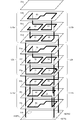
- FIG. 5 is an exploded perspective view of the laminated body when the impedance conversion circuit 35 is configured as a laminated body (multilayer substrate) in which dielectric layers or magnetic layers are laminated.
- each conductor pattern and interlayer connection conductor (via conductor) are drawn through each base material layer.
- the conductor pattern 63 is formed on the base material layer 51a of the laminate, the conductor patterns 62 and 64 are formed on the base material layer 51b, and the conductor patterns 61 and 65 are formed on the base material layer 51c. Yes.
- Conductive patterns 71 and 75 are formed on the base layer 51d, conductive patterns 72 and 74 are formed on the base layer 51e, and conductive patterns 73 are formed on the base layer 51f.
- On the back surface of the base material layer 51g a terminal 41 corresponding to the port P1, a terminal 42 corresponding to the port P2, and a terminal 43 corresponding to the port P3 are formed.
- a plain base material layer (not shown) is laminated on the base material layer 51a.
- the left half of the conductor patterns 61, 62 and 63 constitutes a first coiled conductor L1a
- the right half of the conductor pattern 63, 64 and 65 constitutes a second coiled conductor L1b.
- a third coiled conductor L2a is constituted by the left half of the conductor patterns 71, 72 and 73
- a fourth coiled conductor L2b is constituted by the right half, 74 and 75 of the conductor pattern 73.
- the conductor patterns 61 to 65, 71 to 75 and the terminals 41, 42, and 43 are connected via interlayer connection conductors (via conductors), as shown in FIG. Configure the circuit.
- the first coiled conductor L1a and the second coiled conductor L1b are arranged adjacent to each other so that the winding axes of the respective coil patterns are parallel to each other.
- the third coiled conductor L2a and the fourth coiled conductor L2b are arranged adjacent to each other so that the winding axes of the respective coil patterns are parallel to each other.
- first coiled conductor L1a and the third coiled conductor L2a are arranged close to each other (in a coaxial relationship) so that the winding axes of the respective coil patterns are substantially the same straight line.
- second coiled conductor L1b and the fourth coiled conductor L2b are arranged close to each other (coaxially) so that the winding axes of the respective coil patterns are substantially the same straight line. That is, when viewed from the stacking direction of the base material layers, the conductor patterns constituting each coil pattern are arranged so as to overlap each other.
- each of the coiled conductors L1a, L1b, L2a, and L2b is configured by a loop-shaped conductor having approximately three turns, but the number of turns is not limited thereto.
- the winding axes of the coil patterns of the first coiled conductor L1a and the third coiled conductor L2a do not have to be arranged so as to be exactly the same straight line.
- the coil opening of L1a and the 3rd coiled conductor L2a should just be wound so that it may mutually overlap.
- the coil patterns of the second coil-shaped conductor L1b and the fourth coil-shaped conductor L2b do not have to be arranged so that the winding axes are exactly the same straight line. It is only necessary that the coil openings of the conductor L1b and the fourth coiled conductor L2b are wound so as to overlap each other.
- the various conductor patterns 61 to 65 and 71 to 75 can be formed by screen printing a paste mainly composed of a conductive material such as silver or copper, or etching a metal foil.
- a glass ceramic material, an epoxy resin material or the like can be used if it is a dielectric, and a ferrite ceramic material or a resin material containing ferrite can be used if it is a magnetic material.
- a dielectric material having a high electrical insulation resistance in order to suppress eddy current loss in a high frequency region.
- a magnetic layer may be disposed, and the other layers may be constituted by dielectric layers.
- FIG. 6 shows the main magnetic flux passing through the coiled conductor by the conductor pattern formed in each layer of the multilayer substrate shown in FIG.
- the magnetic flux FP1 passes through the first coiled conductor L1a formed by the conductor patterns 61 to 63 and the second coiled conductor L1b formed by the conductor patterns 63 to 65.
- the magnetic flux FP2 passes through the third coiled conductor L2a formed by the conductor patterns 71 to 73 and the fourth coiled conductor L2b formed by the conductor patterns 73 to 75.
- the coiled conductors L1a, L1b, L2a, and L2b are built in a laminate made of a dielectric material or a magnetic material, and in particular, a region that becomes a coupling portion between the first series circuit and the second series circuit.
- the impedance conversion circuit 35 is hardly affected by other circuits and elements arranged adjacent to the laminated body. As a result, impedance matching can be further stabilized.
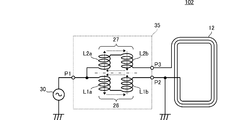
- FIG. 7 is a circuit diagram of the antenna device 102 of the second embodiment.
- the antenna device 102 includes an antenna element 12 and an impedance conversion circuit 35 connected to the antenna element 12.
- the antenna element 12 is a loop antenna.
- the first end of the first series circuit 26 and the first end of the second series circuit 27 are connected to the first port P1 of the impedance conversion circuit 35.
- the second end of the first series circuit 26 is connected to the second port P ⁇ b> 2 of the impedance conversion circuit 35.
- the second end of the second series circuit 27 is connected to the third port P3 of the impedance conversion circuit 35.
- the antenna element 12 is connected between the second port P2 and the third port P3 of the impedance conversion circuit 35, and the second port P2 is grounded.
- the power feeding circuit 30 is connected to the first port P ⁇ b> 1 of the impedance conversion circuit 35.
- the power supply circuit 30 is a power supply circuit for supplying a high-frequency signal to the antenna element 11 and generates and processes a high-frequency signal, but may include a circuit that combines and demultiplexes the high-frequency signal.
- the antenna device 102 of the second embodiment is an antenna device for an RFID tag, for example.
- the antenna element 12 is a relatively large loop antenna provided separately from the IC chip for RFID, and the impedance thereof is that of the feeder circuit 30. It is about twice the impedance.
- the impedance conversion ratio of the impedance conversion circuit 35 is 1: 2. Therefore, the power feeding circuit 30 and the antenna element 12 of the antenna device 102 are impedance matched.
- FIG. 8 is a circuit diagram of the antenna device 103 according to the third embodiment.
- the antenna device 103 includes an antenna element 11 and an impedance conversion circuit 45 connected to the antenna element 11.
- the first end of the first series circuit 26, the first end of the second series circuit 27, and the first end of the third series circuit 28 are connected to the first port P1 of the impedance conversion circuit 45, respectively.
- the second end of the first series circuit 26 and the second end of the third series circuit 28 are connected to the second port P2 of the impedance conversion circuit 35.
- the second end of the second series circuit 27 is connected to the third port P3 of the impedance conversion circuit 45.
- the closed loop A of the magnetic flux excited by the primary current flowing in the first series circuit 26 and the closed loop B of the magnetic flux excited by the secondary current flowing in the second series circuit 27 are arranged to repel each other's magnetic flux by the induced current. Occur (to repel each other). That is, an equivalent magnetic barrier MW is generated between the first series circuit 26 and the second series circuit 27.
- the closed loop C of the magnetic flux excited by the primary current flowing in the third series circuit 28 and the closed loop B of the magnetic flux excited by the secondary current flowing in the second series circuit 27 are mutually guided by the induced current. It happens to fit (to repel each other). That is, an equivalent magnetic barrier MW is generated between the third series circuit 28 and the second series circuit 27.
- the closed loop B of the magnetic flux of the central secondary coil has two It is sandwiched between magnetic barriers and sufficiently confined (the confinement effect increases). That is, it can act as a transformer having a larger coupling coefficient.
- FIG. 9 is an exploded perspective view of the laminated body in the case where the impedance conversion circuit 45 shown in FIG. 8 is configured as a laminated body (multilayer substrate) in which dielectric layers or magnetic layers are laminated.
- the base material layers 51a to 51k are made of a dielectric sheet or a magnetic sheet, and a coiled conductor is formed in each layer.
- Conductive pattern 83 is formed on base material layer 51b
- conductive patterns 82 and 84 are formed on base material layer 51c
- conductive patterns 81 and 85 are formed on base material layer 51d
- conductive pattern 73 is formed on base material layer 51e.
- the conductor patterns 72 and 74 are formed on the base material layer 51f, the conductor patterns 71 and 75 are formed on the base material layer 51g, the conductor patterns 61 and 65 are formed on the base material layer 51h, and the conductors are formed on the base material layer 51i. Patterns 62 and 64 are formed, and a conductor pattern 63 is formed on the base material layer 51j. Terminals 41, 42, 43 and the like corresponding to the ports P1, P2, P3 are formed on the lower surface of the base material layer 51k. The lines extending in the vertical direction in FIG. 9 are via electrodes, and the coiled conductors are connected between the layers.
- the first coiled conductor L11a is constituted by the left half of the conductor patterns 61, 62 and the conductor pattern 63
- the second coiled conductor L11b is constituted by the conductor patterns 65, 64 and the right half of the conductor pattern 63.
- the fifth coiled conductor L12a is constituted by the left half of the conductor patterns 81 and 82 and the conductor pattern 83
- the sixth coiled conductor L12b is constituted by the right half of the conductor patterns 85 and 84 and the conductor pattern 83. is doing.
- the third coiled conductor L2a is constituted by the left half of the conductor patterns 71 and 72 and the conductor pattern 73
- the fourth coiled conductor L2b is constituted by the right half of the conductor patterns 75 and 74 and the conductor pattern 73. is doing.
- FIG. 10 is a circuit diagram of the antenna device 104 of the fourth embodiment.
- the antenna device 104 includes an antenna element 11 and an impedance conversion circuit 55 connected to the antenna element 11.
- the first end of the first series circuit 26, the first end of the second series circuit 27, and the first end of the third series circuit 28 are connected to the first port P1 of the impedance conversion circuit 55, respectively.
- the second end of the first series circuit 26 is connected to the second port P ⁇ b> 2 of the impedance conversion circuit 55.
- the second end of the second series circuit 27 and the second end of the third series circuit 28 are connected to the third port P3 of the impedance conversion circuit 55.
- the closed loop A of the magnetic flux excited by the primary current flowing in the first series circuit 26 and the closed loop B of the magnetic flux excited by the secondary current flowing in the second series circuit 27 are arranged to repel each other's magnetic flux by the induced current. Occur (to repel each other). That is, an equivalent magnetic barrier MW is generated between the first series circuit 26 and the second series circuit 27.
- the closed loop A of the magnetic flux excited by the primary current flowing in the first series circuit 26 and the closed loop C of the magnetic flux excited by the secondary current flowing in the third series circuit 28 screen each other's magnetic flux by the induced current. It happens to fit (to repel each other). That is, an equivalent magnetic barrier MW is generated between the first series circuit 26 and the third series circuit 28.
- the closed loop A of the magnetic flux of the central primary coil is divided into two magnets. It is sandwiched by barriers and sufficiently confined (the confinement effect increases). That is, it can act as a transformer having a very large coupling coefficient.
- FIG. 11 is an RFID system circuit diagram of the fifth embodiment which is an example of the communication terminal device of the present invention.
- the RFID tag 106 includes an antenna element 12 that is a loop antenna, an impedance conversion circuit 35, an RFIC 91, and a baseband IC 92.
- the reader / writer 105 includes a reader / writer control circuit 93, an impedance conversion circuit 25, and an antenna element 13 that is a loop antenna.
- the wireless IC chip 70 includes an RFIC that constitutes a high-frequency circuit and a baseband IC that constitutes a logic circuit. As the impedance conversion circuits 25 and 35, the impedance conversion circuit shown in any one of the first to fourth embodiments is applied.
- the impedance of the antenna element 12 is higher than the impedance of the antenna-side port of the RFIC, and the impedance conversion circuit 35 matches the impedance of both.
- the impedance of the antenna element 13 is higher than the impedance of the antenna side port of the reader / writer control circuit 93, and the impedance conversion circuit 25 matches the impedance of both.
- the impedance of the antenna elements 12 and 13 is likely to change.
- the impedance matching state is stabilized by providing the impedance conversion circuits 25 and 35. be able to. That is, it becomes possible for the impedance conversion circuits 25 and 35 to perform frequency characteristic adjustment functions such as center frequency setting, passband width setting, and impedance matching setting, which are important matters regarding antenna design. Since the elements 12 and 13 need only mainly consider directivity and gain, antenna design is facilitated.
- second port P3 ... third port Rr antenna radiation Resistance component 10, 20 ... Housing 11 ... Antenna element 12 ... Antenna element 26 ... First series circuit 27 ... Second series circuit 28 ... third series circuit 30 ... feed circuit 35, 35E ... impedance conversion circuits 41, 42, 43 ... terminal 45 ... impedance conversion circuits 51a to 51k ... base material layer 55 ... impedance conversion circuits 61 to 65 ... conductor pattern 71 ... 75 ... Conductor patterns 81 to 85 ... Conductor patterns 101 to 104 ... Antenna device
Landscapes
- Engineering & Computer Science (AREA)
- Computer Networks & Wireless Communication (AREA)
- Signal Processing (AREA)
- Details Of Aerials (AREA)
- Near-Field Transmission Systems (AREA)
- Filters And Equalizers (AREA)
- Input Circuits Of Receivers And Coupling Of Receivers And Audio Equipment (AREA)
Abstract
L'invention concerne un dispositif d'antenne (101) comprenant un élément d'antenne (11) et un circuit de transformation d'impédance (35) qui est connecté à l'élément d'antenne (11). Le circuit de transformation d'impédance (35) est inséré entre l'élément d'antenne (11) et un circuit d'alimentation (30). Le circuit de transformation d'impédance (35) comprend un premier circuit en série (26) dans lequel un premier conducteur en forme de bobine (L1a) et un deuxième conducteur en forme de bobine (L1b) sont montés en série et un deuxième circuit en série (27) dans lequel un troisième conducteur en forme de bobine (L2a) et un quatrième conducteur en forme de bobine (L2b) sont montés en série. Le premier conducteur en forme de bobine (L1a) et le deuxième conducteur en forme de bobine (L1b) forment un circuit magnétique fermé dans lequel passe une boucle fermée d'un premier flux magnétique et le troisième conducteur en forme de bobine (L2a) et le quatrième conducteur en forme de bobine (L2b) forment un circuit magnétique fermé dans lequel passe une boucle fermée d'un deuxième flux magnétique. De ce fait, le dispositif d'antenne réalise une adaptation d'impédance avec le circuit d'alimentation sur une large bande de fréquences.
Priority Applications (3)
| Application Number | Priority Date | Filing Date | Title |
|---|---|---|---|
| CN201280026788.2A CN103620957B (zh) | 2011-05-31 | 2012-05-17 | 天线装置及通信终端装置 |
| JP2013517954A JP5454742B2 (ja) | 2011-05-31 | 2012-05-17 | アンテナ装置および通信端末装置 |
| US14/085,888 US8933859B2 (en) | 2011-05-31 | 2013-11-21 | Antenna device and communication terminal apparatus |
Applications Claiming Priority (2)
| Application Number | Priority Date | Filing Date | Title |
|---|---|---|---|
| JP2011122909 | 2011-05-31 | ||
| JP2011-122909 | 2011-05-31 |
Related Child Applications (1)
| Application Number | Title | Priority Date | Filing Date |
|---|---|---|---|
| US14/085,888 Continuation US8933859B2 (en) | 2011-05-31 | 2013-11-21 | Antenna device and communication terminal apparatus |
Publications (1)
| Publication Number | Publication Date |
|---|---|
| WO2012165149A1 true WO2012165149A1 (fr) | 2012-12-06 |
Family
ID=47259012
Family Applications (1)
| Application Number | Title | Priority Date | Filing Date |
|---|---|---|---|
| PCT/JP2012/062577 Ceased WO2012165149A1 (fr) | 2011-05-31 | 2012-05-17 | Dispositif d'antenne et dispositif terminal de communication |
Country Status (4)
| Country | Link |
|---|---|
| US (1) | US8933859B2 (fr) |
| JP (1) | JP5454742B2 (fr) |
| CN (1) | CN103620957B (fr) |
| WO (1) | WO2012165149A1 (fr) |
Cited By (3)
| Publication number | Priority date | Publication date | Assignee | Title |
|---|---|---|---|---|
| JP2013012702A (ja) * | 2011-05-31 | 2013-01-17 | Murata Mfg Co Ltd | コモンモードチョークコイルおよび高周波部品 |
| WO2015033632A1 (fr) * | 2013-09-05 | 2015-03-12 | 株式会社村田製作所 | Circuit de convertisseur d'impédance, appareil à antenne et appareil de communication sans fil |
| JPWO2015107922A1 (ja) * | 2014-01-15 | 2017-03-23 | 株式会社村田製作所 | 電気回路 |
Families Citing this family (8)
| Publication number | Priority date | Publication date | Assignee | Title |
|---|---|---|---|---|
| CN102668241B (zh) * | 2010-03-24 | 2015-01-28 | 株式会社村田制作所 | Rfid系统 |
| CN103518324B (zh) * | 2011-05-09 | 2016-06-15 | 株式会社村田制作所 | 阻抗变换电路以及通信终端装置 |
| TW201345050A (zh) * | 2012-04-27 | 2013-11-01 | Univ Nat Taiwan Science Tech | 可雙頻操作之圓極化天線 |
| US9456490B2 (en) * | 2014-08-30 | 2016-09-27 | Skyworks Solutions, Inc. | Signal path in radio-frequency module having laminate substrate |
| CN105720382B (zh) * | 2014-12-05 | 2021-08-17 | 深圳富泰宏精密工业有限公司 | 天线结构及具有该天线结构的无线通信装置 |
| CN207490881U (zh) * | 2015-03-11 | 2018-06-12 | 株式会社村田制作所 | 阻抗变换元件以及通信装置 |
| US11227825B2 (en) * | 2015-12-21 | 2022-01-18 | Intel Corporation | High performance integrated RF passives using dual lithography process |
| CN118430948B (zh) * | 2024-03-05 | 2025-04-11 | 北京平头哥信息技术有限公司 | 反向耦合电感和芯片 |
Citations (5)
| Publication number | Priority date | Publication date | Assignee | Title |
|---|---|---|---|---|
| JPH0380509A (ja) * | 1989-08-23 | 1991-04-05 | Murata Mfg Co Ltd | 積層トランス |
| JP2010510706A (ja) * | 2006-11-17 | 2010-04-02 | ノキア コーポレイション | 2つの素子が共通フィードを共有することを可能にする装置 |
| JP2012085250A (ja) * | 2010-08-11 | 2012-04-26 | Murata Mfg Co Ltd | 周波数安定化回路、アンテナ装置及び通信端末機器 |
| JP2012085305A (ja) * | 2010-01-19 | 2012-04-26 | Murata Mfg Co Ltd | アンテナ装置および通信端末装置 |
| JP2012084833A (ja) * | 2010-01-19 | 2012-04-26 | Murata Mfg Co Ltd | 高周波トランス、電子回路および電子機器 |
Family Cites Families (5)
| Publication number | Priority date | Publication date | Assignee | Title |
|---|---|---|---|---|
| JP3513033B2 (ja) | 1998-10-16 | 2004-03-31 | 三菱電機株式会社 | 多周波共用アンテナ装置 |
| JP2004336250A (ja) | 2003-05-02 | 2004-11-25 | Taiyo Yuden Co Ltd | アンテナ整合回路、アンテナ整合回路を有する移動体通信装置、アンテナ整合回路を有する誘電体アンテナ |
| JP2006173697A (ja) | 2004-12-13 | 2006-06-29 | Matsushita Electric Ind Co Ltd | アンテナ装置 |
| JP4715666B2 (ja) | 2006-07-27 | 2011-07-06 | 株式会社村田製作所 | 整合器およびアンテナ整合回路 |
| EP2388858B1 (fr) * | 2010-01-19 | 2016-09-21 | Murata Manufacturing Co., Ltd. | Dispositif à antenne et appareil terminal de communication |
-
2012
- 2012-05-17 WO PCT/JP2012/062577 patent/WO2012165149A1/fr not_active Ceased
- 2012-05-17 JP JP2013517954A patent/JP5454742B2/ja not_active Expired - Fee Related
- 2012-05-17 CN CN201280026788.2A patent/CN103620957B/zh not_active Expired - Fee Related
-
2013
- 2013-11-21 US US14/085,888 patent/US8933859B2/en active Active
Patent Citations (5)
| Publication number | Priority date | Publication date | Assignee | Title |
|---|---|---|---|---|
| JPH0380509A (ja) * | 1989-08-23 | 1991-04-05 | Murata Mfg Co Ltd | 積層トランス |
| JP2010510706A (ja) * | 2006-11-17 | 2010-04-02 | ノキア コーポレイション | 2つの素子が共通フィードを共有することを可能にする装置 |
| JP2012085305A (ja) * | 2010-01-19 | 2012-04-26 | Murata Mfg Co Ltd | アンテナ装置および通信端末装置 |
| JP2012084833A (ja) * | 2010-01-19 | 2012-04-26 | Murata Mfg Co Ltd | 高周波トランス、電子回路および電子機器 |
| JP2012085250A (ja) * | 2010-08-11 | 2012-04-26 | Murata Mfg Co Ltd | 周波数安定化回路、アンテナ装置及び通信端末機器 |
Cited By (5)
| Publication number | Priority date | Publication date | Assignee | Title |
|---|---|---|---|---|
| JP2013012702A (ja) * | 2011-05-31 | 2013-01-17 | Murata Mfg Co Ltd | コモンモードチョークコイルおよび高周波部品 |
| WO2015033632A1 (fr) * | 2013-09-05 | 2015-03-12 | 株式会社村田製作所 | Circuit de convertisseur d'impédance, appareil à antenne et appareil de communication sans fil |
| JP5950051B2 (ja) * | 2013-09-05 | 2016-07-13 | 株式会社村田製作所 | インピーダンス変換回路、アンテナ装置および無線通信装置 |
| US10348266B2 (en) | 2013-09-05 | 2019-07-09 | Murata Manufacturing Co., Ltd. | Impedance conversion circuit, antenna apparatus, and wireless communication apparatus |
| JPWO2015107922A1 (ja) * | 2014-01-15 | 2017-03-23 | 株式会社村田製作所 | 電気回路 |
Also Published As
| Publication number | Publication date |
|---|---|
| CN103620957A (zh) | 2014-03-05 |
| JP5454742B2 (ja) | 2014-03-26 |
| US8933859B2 (en) | 2015-01-13 |
| US20140078014A1 (en) | 2014-03-20 |
| CN103620957B (zh) | 2016-01-20 |
| JPWO2012165149A1 (ja) | 2015-02-23 |
Similar Documents
| Publication | Publication Date | Title |
|---|---|---|
| JP5454742B2 (ja) | アンテナ装置および通信端末装置 | |
| TWI466375B (zh) | An antenna device and a communication terminal device | |
| US9019168B2 (en) | Frequency stabilization circuit, frequency stabilization device, antenna apparatus and communication terminal equipment, and impedance conversion element | |
| TWI449066B (zh) | High coupling degree transformers, electronic circuits and electronic machines | |
| JP4935956B2 (ja) | アンテナ装置および通信端末装置 | |
| CN103518324B (zh) | 阻抗变换电路以及通信终端装置 | |
| JP5234084B2 (ja) | アンテナ装置および通信端末装置 | |
| JP5957816B2 (ja) | インピーダンス変換デバイス、アンテナ装置および通信端末装置 | |
| US9893708B2 (en) | Impedance conversion ratio setting method, impedance conversion circuit, and communication terminal apparatus | |
| JP5630566B2 (ja) | アンテナ装置及び通信端末機器 | |
| WO2011090050A1 (fr) | Dispositif d'antenne | |
| JP2012204415A (ja) | 高結合度トランス、インピーダンス変換回路、アンテナ装置および通信端末装置 |
Legal Events
| Date | Code | Title | Description |
|---|---|---|---|
| 121 | Ep: the epo has been informed by wipo that ep was designated in this application |
Ref document number: 12793839 Country of ref document: EP Kind code of ref document: A1 |
|
| ENP | Entry into the national phase |
Ref document number: 2013517954 Country of ref document: JP Kind code of ref document: A |
|
| NENP | Non-entry into the national phase |
Ref country code: DE |
|
| 122 | Ep: pct application non-entry in european phase |
Ref document number: 12793839 Country of ref document: EP Kind code of ref document: A1 |