WO2012165264A1 - メタクリル系樹脂組成物および成形体 - Google Patents
メタクリル系樹脂組成物および成形体 Download PDFInfo
- Publication number
- WO2012165264A1 WO2012165264A1 PCT/JP2012/063225 JP2012063225W WO2012165264A1 WO 2012165264 A1 WO2012165264 A1 WO 2012165264A1 JP 2012063225 W JP2012063225 W JP 2012063225W WO 2012165264 A1 WO2012165264 A1 WO 2012165264A1
- Authority
- WO
- WIPO (PCT)
- Prior art keywords
- methacrylic resin
- mass
- resin composition
- ethylene
- mol
- Prior art date
- Legal status (The legal status is an assumption and is not a legal conclusion. Google has not performed a legal analysis and makes no representation as to the accuracy of the status listed.)
- Ceased
Links
Images


Classifications
-
- C—CHEMISTRY; METALLURGY
- C08—ORGANIC MACROMOLECULAR COMPOUNDS; THEIR PREPARATION OR CHEMICAL WORKING-UP; COMPOSITIONS BASED THEREON
- C08L—COMPOSITIONS OF MACROMOLECULAR COMPOUNDS
- C08L33/00—Compositions of homopolymers or copolymers of compounds having one or more unsaturated aliphatic radicals, each having only one carbon-to-carbon double bond, and only one being terminated by only one carboxyl radical, or of salts, anhydrides, esters, amides, imides or nitriles thereof; Compositions of derivatives of such polymers
- C08L33/04—Homopolymers or copolymers of esters
-
- C—CHEMISTRY; METALLURGY
- C08—ORGANIC MACROMOLECULAR COMPOUNDS; THEIR PREPARATION OR CHEMICAL WORKING-UP; COMPOSITIONS BASED THEREON
- C08L—COMPOSITIONS OF MACROMOLECULAR COMPOUNDS
- C08L33/00—Compositions of homopolymers or copolymers of compounds having one or more unsaturated aliphatic radicals, each having only one carbon-to-carbon double bond, and only one being terminated by only one carboxyl radical, or of salts, anhydrides, esters, amides, imides or nitriles thereof; Compositions of derivatives of such polymers
- C08L33/04—Homopolymers or copolymers of esters
- C08L33/06—Homopolymers or copolymers of esters of esters containing only carbon, hydrogen and oxygen, which oxygen atoms are present only as part of the carboxyl radical
- C08L33/10—Homopolymers or copolymers of methacrylic acid esters
- C08L33/12—Homopolymers or copolymers of methyl methacrylate
-
- C—CHEMISTRY; METALLURGY
- C08—ORGANIC MACROMOLECULAR COMPOUNDS; THEIR PREPARATION OR CHEMICAL WORKING-UP; COMPOSITIONS BASED THEREON
- C08J—WORKING-UP; GENERAL PROCESSES OF COMPOUNDING; AFTER-TREATMENT NOT COVERED BY SUBCLASSES C08B, C08C, C08F, C08G or C08H
- C08J5/00—Manufacture of articles or shaped materials containing macromolecular substances
-
- C—CHEMISTRY; METALLURGY
- C08—ORGANIC MACROMOLECULAR COMPOUNDS; THEIR PREPARATION OR CHEMICAL WORKING-UP; COMPOSITIONS BASED THEREON
- C08K—Use of inorganic or non-macromolecular organic substances as compounding ingredients
- C08K5/00—Use of organic ingredients
- C08K5/04—Oxygen-containing compounds
- C08K5/09—Carboxylic acids; Metal salts thereof; Anhydrides thereof
- C08K5/092—Polycarboxylic acids
-
- C—CHEMISTRY; METALLURGY
- C08—ORGANIC MACROMOLECULAR COMPOUNDS; THEIR PREPARATION OR CHEMICAL WORKING-UP; COMPOSITIONS BASED THEREON
- C08L—COMPOSITIONS OF MACROMOLECULAR COMPOUNDS
- C08L23/00—Compositions of homopolymers or copolymers of unsaturated aliphatic hydrocarbons having only one carbon-to-carbon double bond; Compositions of derivatives of such polymers
- C08L23/26—Compositions of homopolymers or copolymers of unsaturated aliphatic hydrocarbons having only one carbon-to-carbon double bond; Compositions of derivatives of such polymers modified by chemical after-treatment
-
- C—CHEMISTRY; METALLURGY
- C08—ORGANIC MACROMOLECULAR COMPOUNDS; THEIR PREPARATION OR CHEMICAL WORKING-UP; COMPOSITIONS BASED THEREON
- C08L—COMPOSITIONS OF MACROMOLECULAR COMPOUNDS
- C08L33/00—Compositions of homopolymers or copolymers of compounds having one or more unsaturated aliphatic radicals, each having only one carbon-to-carbon double bond, and only one being terminated by only one carboxyl radical, or of salts, anhydrides, esters, amides, imides or nitriles thereof; Compositions of derivatives of such polymers
- C08L33/04—Homopolymers or copolymers of esters
- C08L33/06—Homopolymers or copolymers of esters of esters containing only carbon, hydrogen and oxygen, which oxygen atoms are present only as part of the carboxyl radical
- C08L33/10—Homopolymers or copolymers of methacrylic acid esters
Definitions
- the present invention relates to a methacrylic resin composition and a molded body.
- An ionomer is a partially neutralized copolymer of ethylene and unsaturated carboxylic acid with a metal, and alkali metals, especially those containing K, Rb, and Cs ions, exhibit excellent antistatic properties due to their ionic conduction. It has been known. In addition, it is known that the ionomer exhibits electrical conductivity even if it is not treated with an antistatic agent, and as a result, maintains the antistatic effect semipermanently.
- An ionomer composition comprising a mixture with a specific blending ratio with an ester copolymer and having no charge property, in particular, no humidity dependency is disclosed (for example, see JP-A No. 2002-12722).
- An injection-molded article of a resin composition comprising a potassium ionomer of an ethylene / (meth) acrylic acid random copolymer and a styrene polymer has been disclosed (see, for example, Japanese Patent No. 3565892).
- Methacrylic resins represented by methyl methacrylate resin (Poly methyl methacrylate; PMMA) and the like are known as resins having excellent transparency, but improvement in antistatic properties has been demanded.
- the inventors include a methacrylic resin (A) and a polymer saponified product obtained by saponifying an ethylene / unsaturated carboxylic acid ester copolymer, and having an alkali ion concentration, preferably a potassium ion concentration. It has been found that a resin composition having a specific concentration exhibits antistatic properties and solvent resistance while being as excellent in transparency as a methacrylic resin, and has completed the present invention based on this finding. In particular, a resin composition having a specific potassium ion concentration exhibits extremely excellent antistatic properties.
- a methacrylic resin composition excellent in transparency, antistatic properties, and solvent resistance, and a molded body are required.
- the present invention ⁇ 1> A methacrylic resin (A); A polymer saponified product (B) obtained by alkaline saponification of an ethylene / unsaturated carboxylic acid ester copolymer; And a methacrylic resin composition having an alkali ion concentration of 0.03 mol / kg to 2.8 mol / kg.
- the content of the methacrylic resin (A) is more than 50% by mass and less than 100% by mass, the alkali saponification is potassium saponification, and the potassium ion concentration is 0.1 mol / kg to 5.8.
- ⁇ 4> The methacrylic resin composition according to any one of ⁇ 1> to ⁇ 3>, further including dimer acid.
- the surface resistivity (measured under the conditions of an applied voltage of 500 V and an applied time of 10 seconds after aging for 24 hours under conditions of 23 ° C. and 50% RH) of a 2 mm thick sheet formed by injection molding is 1.0.
- ⁇ 6> The methacrylic resin composition according to any one of ⁇ 2> to ⁇ 5>, wherein the ethylene / unsaturated carboxylic acid ester copolymer to be saponified with potassium is an ethylene / acrylic acid ester copolymer. It is a thing.
- the content of the structural unit derived from the unsaturated carboxylic acid ester in the ethylene / unsaturated carboxylic acid ester copolymer to be saponified with potassium is in the range of 5% by mass to 50% by mass.
- ⁇ 8> The methacrylic resin composition according to any one of ⁇ 1> to ⁇ 7>, wherein the methacrylic resin (A) is a methacrylic ester resin.
- the content of the methacrylic resin (A) is 75% by mass to 97% by mass, and the content of the polymer saponified product (B) is 3% by mass to 25% by mass.
- ⁇ 11> The methacrylic resin composition according to any one of ⁇ 2> to ⁇ 10>, wherein a potassium ion concentration of the polymer saponified product (B) is in a range of 1 mol / kg to 3 mol / kg. It is a thing.
- ⁇ 12> The methacrylic resin composition according to any one of ⁇ 1> to ⁇ 11>, wherein the saponification degree of the polymer saponified product (B) is in the range of 10% to 90%.
- ⁇ 13> A molded body using the methacrylic resin composition according to any one of ⁇ 1> to ⁇ 12>.
- a methacrylic resin composition excellent in transparency, antistatic properties, and solvent resistance, and a molded article can be provided.
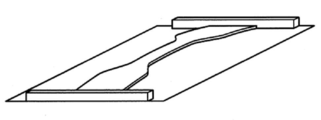
- FIG. 1A is a perspective view schematically showing a rising state of a test piece in a solvent resistance evaluation of an example.
- FIG. 1B is a side view schematically showing a rising state of the test piece in the solvent resistance evaluation of the example.
- FIG. 2 is a photograph showing the state of the test piece after the solvent resistance evaluation.
- the methacrylic resin composition of the present invention comprises a methacrylic resin (A) and a polymer saponified product (B) obtained by alkali saponifying an ethylene / unsaturated carboxylic acid ester copolymer, and has an alkali ion concentration. It is configured to be 0.03 mol / kg to 2.8 mol / kg.
- the methacrylic resin composition of the present invention may further contain other components as necessary.
- “to” means that the numerical values before and after “to” are included. For example, 0.03 mol / kg to 2.8 mol / kg has an alkali ion concentration of “0.03 mol / kg”.
- the methacrylic resin (A) is also referred to as “A component”.
- the polymer saponified product (B) obtained by alkali saponification of the ethylene / unsaturated carboxylic acid ester copolymer is also simply referred to as “polymer saponified product (B)” or “B component”.
- the methacrylic resin (A) which is the component A has high transparency (for example, total light transmittance of 85% or more) and excellent optical characteristics.
- a polymer saponified product (B) obtained by alkali saponifying an ethylene / unsaturated carboxylic acid ester copolymer as component B is obtained by converting an ethylene / unsaturated carboxylic acid ester copolymer into an alkali metal or alkaline earth metal.
- a compound saponified by a metal mainly has excellent solvent resistance due to the presence of an alkali metal, and particularly excellent in antistatic properties due to the presence of potassium metal.
- Factors that control the transparency of the resin composition include differences in the particle size of the constituent components, refractive index, etc., for example, even if the transparency of a particular constituent component is high, the resin composition When the refractive index of each component which comprises a thing differs, it is thought that the transparency of resin composition itself is impaired.
- the methacrylic resin composition of the present invention as a component constituting the methacrylic resin composition, in addition to the methacrylic resin (A), a polymer obtained by alkaline saponification of an ethylene / unsaturated carboxylic acid ester copolymer
- the methacrylic resin (A) is constituted by configuring so that the alkali ion concentration of the methacrylic resin composition is 0.03 mol / kg to 2.8 mol / kg, The refractive index of the saponified polymer (B) is almost the same. Details of the method of setting the alkali ion concentration of the methacrylic resin composition in the above range will be described later.
- a saponified product may be used.
- a methyl methacrylate resin (PMMA) is used as the methacrylic resin (A)
- an alkali saponified product of an ethylene / unsaturated carboxylic acid ester copolymer such as an ethylene / (meth) acrylic acid alkyl ester copolymer an alkali saponified product of an ethylene / unsaturated carboxylic acid ester copolymer such as an ethylene / (meth) acrylic acid alkyl ester copolymer
- the antistatic property derived from the B component is hardly impaired by mixing with the A component, as a result, the methacrylic resin composition of the present invention is charged while maintaining excellent transparency derived from the A component. It is considered that the prevention performance is also excellent.
- the B component possesses antistatic performance in the polymer skeleton, even when the A component and the B component are mixed, the occurrence of bleed-out is not observed and the initial antistatic agent, which tends to be an early antistatic agent, is often used. Although the antistatic performance is good, there is no phenomenon that the performance decreases with time. For this reason, the methacrylic resin composition of the present invention also has a feature that it can permanently maintain the antistatic performance that appears in the initial stage.
- the antistatic property is determined by the surface resistance value (surface resistivity) and ash adhesion evaluation. Ash adhesion shows a more sensitive reaction than the surface resistance value, and the antistatic property can be evaluated more strictly than the surface resistance measurement.
- the methacrylic resin composition of the present invention does not easily crack or crack even when in contact with a solvent, and has excellent solvent resistance.
- each component that the methacrylic resin composition of the present invention may contain will be described.
- the methacrylic resin composition of the present invention contains a methacrylic resin (A).
- the methacrylic resin (A) is a methacrylic acid resin in which the content of structural units derived from methacrylic acid exceeds 50% by mass, and the content of structural units derived from methacrylic acid esters is 50% by mass.
- a methacrylic acid ester-based resin exceeding The methacrylic acid resin is a homopolymer of methacrylic acid (content of structural unit derived from methacrylic acid is 100% by mass), a copolymer of methacrylic acid and one or more other copolymer components. Can be mentioned.
- the methacrylic acid ester resin is a methacrylic acid ester homopolymer (content of structural unit derived from methacrylic acid ester is 100% by mass), methacrylic acid ester and one or more copolymerization components. A copolymer is mentioned.
- Examples of the copolymer component that can be copolymerized with methacrylic acid ester include acrylic acid ester, acrylic acid, methacrylic acid, ⁇ -olefin, acrylonitrile, vinyl pyridine, vinyl morpholine, vinyl pyridone tetrahydrofurfuryl acrylate, N, N— Examples include dimethylaminoethyl acrylate, N, N-dimethylacrylamide, 2-hydroxy acrylate, ethylene glycol monoacrylate, glycerin monoacrylate, maleic anhydride, styrene, ⁇ -methylstyrene, and the like.
- the methacrylic acid ester is preferably a methacrylic acid alkyl ester.
- the alkyl moiety of the methacrylic acid alkyl ester may be linear, branched or cyclic, and examples thereof have 1 to 12 carbon atoms. More specifically, alkyl groups such as methyl, ethyl, n-propyl, isopropyl, n-butyl, isobutyl, secondary butyl, 2-ethylhexyl, isooctyl and the like can be exemplified.
- the alkyl moiety preferably has 1 to 5 carbon atoms, more preferably 1 to 3 carbon atoms, and particularly preferably 1 (namely, methyl methacrylate (MMA)).
- a methacrylic resin (A) may use only 1 type from the above, and may use 2 or more types together.
- the methacrylic resin (A) is preferably a methacrylic ester resin, more preferably a methyl methacrylate resin, and particularly preferably a methyl methacrylate resin (PMMA) which is a homopolymer of methyl methacrylate.
- the methacrylic resin (A) preferably has a melt flow rate (MFR) at 230 ° C. under a load of 3.8 kg (according to JIS K7210-1999) of 0.1 g / 10 min to 100 g / 10 min. More preferably, it is from 5 g / 10 min to 50 g / 10 min.
- MFR melt flow rate
- the methacrylic resin (A) can be synthesized by a conventional method.
- a methacrylic ester resin may be synthesized by an ACH method using acetocyanhydrin (ACH), an isobutylene direct oxidation method using isobutylene contained in spent BB obtained by separating butadiene from a naphtha C4 fraction, and the like. .
- the methacrylic resin composition of the present invention contains a polymer saponified product (B) formed by alkali saponification of an ethylene / unsaturated carboxylic acid ester copolymer.
- a polymer saponified product (B) formed by alkali saponification of an ethylene / unsaturated carboxylic acid ester copolymer.
- the ethylene / unsaturated carboxylic acid ester copolymer which is a material resin used for the polymer saponified product (B)
- a copolymer consisting of alkyl ester, crotonic acid alkyl ester, fumaric acid alkyl ester, maleic acid alkyl ester, maleic acid monoalkyl ester, maleic anhydride alkyl ester, itaconic acid alkyl ester and itaconic anhydride alkyl ester be able to.
- alkyl moiety of the alkyl ester examples include those having 1 to 12 carbon atoms, and more specifically, methyl, ethyl, n-propyl, isopropyl, n-butyl, isobutyl, secondary butyl, 2-ethylhexyl, An alkyl group such as isooctyl can be exemplified.
- the unsaturated carboxylic acid ester is particularly preferably methyl ester, ethyl ester, normal butyl ester, or isobutyl ester of acrylic acid or methacrylic acid.
- particularly preferred ethylene / unsaturated carboxylic acid ester copolymers are ethylene (meth) acrylic acid ester copolymers, especially ethylene / methyl acrylate copolymers, ethylene / ethyl acrylate copolymers.
- An ethylene / isobutyl methacrylate copolymer is preferred.
- the content of the structural unit derived from the unsaturated carboxylic acid ester in the ethylene / unsaturated carboxylic acid ester copolymer before saponification is preferably 5% by mass to 50% by mass, and 20% by mass to 35% by mass. More preferred. That is, when the content of the structural unit derived from the unsaturated carboxylic acid ester is within this range, the balance between antistatic properties, flexibility, and miscibility with other resins is excellent.
- the melt flow rate (MFR) [according to JIS K7210-1999] at 190 ° C.
- the ethylene / unsaturated carboxylic acid ester copolymer before saponification ranges from 1 g / 10 min to 1300 g / 10 min. It is preferable that it exists in.
- the ethylene / unsaturated carboxylic acid ester copolymer before saponification may be used in combination of two or more.
- the unsaturated carboxylic acid ester copolymer constituting the ethylene / unsaturated carboxylic acid ester copolymer is methyl acrylate
- the "content rate of the structural unit derived from the unsaturated carboxylic acid ester” also referred to as “MA content”.
- the unsaturated carboxylic acid ester copolymer constituting the ethylene / unsaturated carboxylic acid ester copolymer is ethyl acrylate
- the "content rate of the structural unit derived from the unsaturated carboxylic acid ester” also referred to as “EA content”.
- Such an ethylene / unsaturated carboxylic acid ester copolymer is produced, for example, by publicly known high-pressure radical copolymerization.
- the ethylene / unsaturated carboxylic acid ester copolymer is alkali saponified.
- the caustic metal ion species used for saponification include alkali metals and alkaline earth metals.
- alkali metals such as lithium (Li), sodium (Na), potassium (K), rubidium (Rb), and cesium (Cs) are preferable, and saponification with potassium is preferable from the viewpoint of antistatic properties.
- the concentration of alkali ions present in the saponified product as the carboxylic acid alkali salt is 0.1 mol / kg to 5.8 mol / kg, more preferably 1 mol / kg to 3 mol / kg. It is in the range of kg.
- the alkali ion concentration is at least the lower limit, 10 14 ⁇ / sq.
- the melt viscosity does not become too high and the moldability and workability are good.
- the polymer saponified product (B) has a melt flow rate (MFR) at 230 ° C. under a load of 10 kg (conforming to JIS K7210-1999) from the viewpoint of moldability and workability, 0.01 g / 10 min to 100 g / 10 min. Particularly preferred are those of 0.1 g / 10 min to 50 g / 10 min.
- the saponification of the polymer saponified product (B) with respect to the molar amount of all unsaturated carboxylic acid ester group units in the ethylene / unsaturated carboxylic acid ester copolymer to be alkali saponified is in the range of 0.1 to 0.9, that is, the saponification degree is in the range of 10% to 90%, preferably 20% to 80%,
- the saponified polymer is preferably 30% to 70% from the viewpoint of antistatic properties and miscibility with other resins.
- the ester component in the copolymer constituting the polymer saponified product (B) is partially changed to an alkali metal salt component by, for example, a saponification reaction with an alkali metal. It becomes a copolymer containing units, unsaturated carboxylic acid ester units, and unsaturated carboxylic acid alkali metal salt units, and does not contain free carboxyl group units. Even if the polymer alkali saponified product (B) in the present invention is blended with the methacrylic resin (A), its physical properties such as impact resistance represented by IZOD impact strength are not substantially impaired. , Antistatic properties can be exhibited.
- the alkali saponification of the ethylene / unsaturated carboxylic acid ester copolymer may be carried out by a method known per se with caustic.
- the alkali saponification method is carried out by mixing an ethylene / unsaturated carboxylic acid ester copolymer and a predetermined amount of caustic alkali such as alkali hydroxide in a kneading apparatus such as an extruder, kneader, Banbury mixer, etc.
- the mixture is melt-mixed at a temperature of 0 ° C., or the ethylene / unsaturated carboxylic acid ester copolymer is melted and homogenized with the above kneading apparatus, and then a predetermined amount of caustic alkali such as alkali hydroxide is added to the ethylene / unsaturated copolymer.
- a predetermined amount of caustic alkali such as alkali hydroxide is added to the ethylene / unsaturated copolymer.
- An example is a method of reacting an ester portion of a saturated carboxylic acid ester copolymer with a caustic alkali to obtain a saponified product.
- the methacrylic resin composition of the present invention is a methacrylic resin from the viewpoint of achieving both high antistatic properties and high transparency, from the viewpoint of miscibility between component A and component B, and from the viewpoint of solvent resistance.
- the content of the resin (A) is more than 50% by mass and less than 100% by mass, and the content of the polymer saponified product (B) is preferably more than 0% by mass and less than 50 parts by mass, methacrylic resin
- the content of (A) is 75% by mass to 97% by mass (75% by mass or more and 97% by mass or less), and the content of the polymer saponified product (B) is 3% by mass to 25% by mass. More preferred.
- the methacrylic resin composition of the present invention preferably further contains at least one of dimer acid and dimer acid metal salt from the viewpoint of improving moldability and processability.
- Dimer acid is a polyvalent carboxylic acid obtained by polymerization reaction of two or more molecules of unsaturated fatty acid, and is usually obtained as a mixture of two or more types and used for various applications as a mixture. .
- the dimer acid is obtained by dimerizing a linear or branched unsaturated fatty acid having 8 to 22 carbon atoms, and derivatives thereof are also included.
- Examples of the dimer acid derivative include a hydrogenated product. Specifically, hydrogenated dimer acid obtained by hydrogenating the dimer acid and reducing the unsaturated bond contained therein can be used.
- the dimer acid may be, for example, 3-octenoic acid, 10-undecenoic acid, oleic acid, linoleic acid, elaidic acid, palmitoleic acid, linolenic acid, or a mixture of two or more thereof, or these which are industrially available.
- the raw material may be a tall oil fatty acid, soybean oil fatty acid, palm oil fatty acid, rice bran oil fatty acid, linseed oil fatty acid or the like, which is a mixture of unsaturated carboxylic acids.
- These dimer acids may contain a small amount of monomeric acid or trimer acid.
- dimer acid can usually be produced by dimerizing unsaturated fatty acid such as tall oil fatty acid at high temperature using montmorillonite clay as a catalyst.
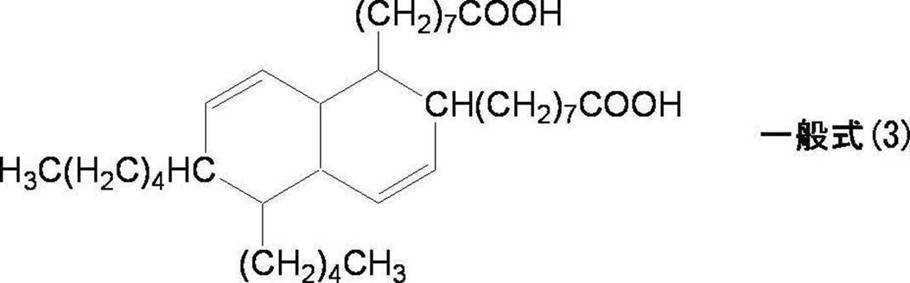
- dimer acid examples include chain dimer acid represented by the following general formula (1).
- dimer acids include, for example, Haridimer 200, 300 (manufactured by Harima Chemicals Co., Ltd.), Tsunodim 205, 395 (manufactured by Tsukino Food Industry Co., Ltd.), Empor 1026, 1028, 1061, 1062 [ Cognis Co., Ltd.] and hydrogenated dimer acid include, for example, ENPOL 1008, 1012 [Cognis Co., Ltd.] and the like.
- the methacrylic resin composition of the present invention contains the polymer saponified product (B) [component B] as described above.
- B component and the dimer acid component are melt-mixed when producing the composition, the alkali metal in the B component reacts with a part or all of the carboxy groups in the dimer acid component to cause dimer acid.
- the alkali metal salt structure can be obtained.
- blends a dimer acid with the form of a dimer acid alkali metal salt can be included as an aspect which contains a dimer acid in the methacrylic resin composition of this invention.
- Dimer acid alkali metal salts include dimer acid lithium salt (including partial salt), dimer acid sodium salt (including partial salt), dimer acid potassium salt (including partial salt), dimer acid rubidium salt (including partial salt) ) And dimer acid cesium salts (including partial salts), but potassium dimer acid salts (including partial salts) are preferred.
- the content of the dimer acid in the methacrylic resin composition of the present invention is preferably such that the total amount of the dimer acid and the polymer saponified product (B) is more than 0% by mass and less than 50 parts by mass. More preferably, the content is 3% by mass to 25% by mass.
- the content of dimer acid with respect to the total mass of polymer saponified product (B) and dimer acid is preferably 1% by mass to 50% by mass.
- Uniform dispersion of the polymer saponified product (B) in the methacrylic resin composition of the present invention when the content of the dimer acid with respect to the total mass of the polymer saponified product (B) and the dimer acid is 1% by mass or more.
- the methacrylic resin composition can impart good melt fluidity (for example, MFR (according to JIS K7210-1999) of 5 g / 10 min or less at 230 ° C. and a load of 10 kg).
- the content of the dimer acid with respect to the total mass of the polymer saponified product (B) and the dimer acid is 50% by mass or less, so that the melt fluidity of the polymer saponified product (B) is in an appropriate range for the molding process. be able to.
- the content ratio of the dimer acid to the total mass of the polymer saponified product (B) and the dimer acid is more preferably 2% by mass to 30% by mass, and particularly preferably 3% by mass to 15% by mass.
- the methacrylic resin composition of the present invention has an alkali ion concentration of 0.03 mol / kg to 2.8 mol / kg.
- alkali ions of the methacrylic resin composition The concentration is within the above range.
- the alkali ion concentration is a potassium ion concentration, the antistatic property is particularly excellent.
- the A component and the B component can be freely configured within the aforementioned range. it can.
- a polymer saponified product (B) whose alkaline saponification is potassium saponification can be used as the B component, and the ethylene / unsaturation constituting the polymer saponified product (B).
- a saponified polymer (B) having a saponification degree of the carboxylic acid ester copolymer in the range of 10% to 90% may be included in the methacrylic resin composition.
- the saponified polymer saponified by potassium saponification (B) is not used as the B component, a potassium compound such as potassium hydroxide is separately prepared, and the potassium compound content depends on the contents of the A component and the B component. What is necessary is just to include in a methacrylic resin composition, adjusting the quantity.
- additives can be further blended in the methacrylic resin composition of the present invention as long as the object of the present invention is not impaired.
- additives include antioxidants, anti-aging agents, light stabilizers, heat stabilizers, UV absorbers, lubricants, anti-blocking agents, plasticizers, adhesives, inorganic fillers, glass fibers, carbon Examples thereof include reinforcing fibers such as fibers, pigments, dyes, flame retardants, flame retardant aids, foaming agents and foaming aids.
- a normal antistatic agent can also be mix
- a methacrylic resin (A), a polymer saponified product (B) prepared in advance, and a component to be contained as required, such as dimer acid, are uniaxial.
- a method of melting and mixing with an extruder, a twin screw extruder, a Banbury mixer, a kneader, and the like include a method of melting and mixing with an extruder, a twin screw extruder, a Banbury mixer, a kneader, and the like.
- the molded body of the present invention is constituted using the methacrylic resin composition of the present invention.
- the molding method of the methacrylic resin composition include various methods such as melt extrusion, injection molding, blow molding and stretch molding. Further, as described above, since the methacrylic resin composition of the present invention has both excellent antistatic properties and excellent transparency, as a molded product, specifically, a transparent polymer Type antistatic material.
- the present invention will be described in more detail with reference to examples. However, the present invention is not limited by these examples.
- the raw material used for the following Example and the comparative example, the synthesized polymer saponified material, and the evaluation method of a polymer composition are as follows.
- the above-mentioned B1, B2, B2-A, B3, B6, B7, B7-A, B8, B8-A, and B9 as the polymer saponified product (B) were obtained as follows.
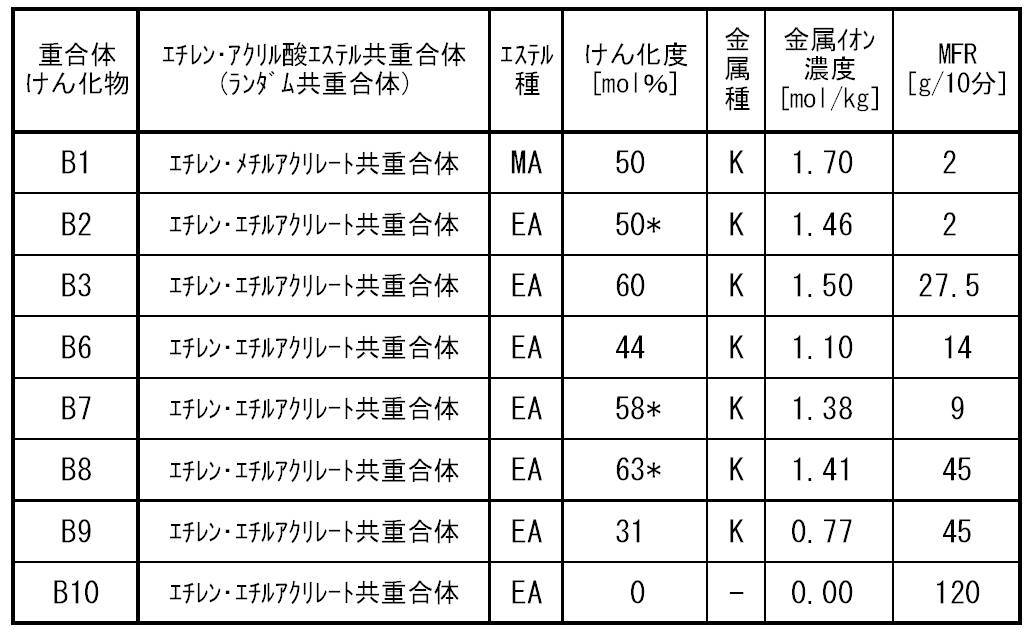
- a raw material resin (base resin) for preparing a saponified product 10 kg of an ethylene / acrylic acid ester copolymer (random copolymer) shown in Table 1 and potassium hydroxide (KOH) (for example, B1) corresponding to each degree of saponification
- KOH potassium hydroxide
- each polymer saponified product was obtained by melting, reacting, and extruding the ethylene / acrylic acid ester copolymer and potassium hydroxide in a kneading apparatus.
- the potassium ion concentration (K ion amount) present in the form of potassium acrylate in the saponified polymer was the value shown in Table 1 [mol / kg].
- Table 1 also shows the ratio (percentage; degree of saponification) of the alkali metal ions present in the saponified product to the molar amount of all acrylate group units in the ethylene / acrylic acid ester copolymer before saponification.
- B10 which is a non-saponified product is also shown.
- the amount of alkali metal ions (metal ion concentration) in polymer saponified products was measured by the following method. did.
- the sample was demetallized with hydrochloric acid using a mixed solvent of xylene / butanol, titrated with a thymol blue indicator, and the amount (molar amount) of the produced carboxy group (COOH) was measured.
- the amount of the generated carboxyl group (COOH) (molar quantity) is the equal to the molar amount of COOM +, the molar amount (metal ion concentration of COOM + per sample 1kg than the molar amount of the generated carboxyl group (COOH) ) was calculated.
- Examples 2 to 10, 13, 14 and Comparative Examples 4 to 7 and 9 The A component and B component shown in the above “1.
- Raw material are blended as shown in the following Table 2 (in Table 2, the unit of "blending ratio” is [% by mass]), and in a twin screw extruder, By melt-kneading, compositions 2 to 10, 13, and 14 and compositions 104 to 107 and 109 were obtained.
- the obtained compositions 2 to 10, 13, 14 and the compositions 104 to 107 and 109 were used in the same manner.
- 150 mm ⁇ 80 mm ⁇ 2 mm thick square plate sheets molded bodies 2 to 10, 13, 14 and molded bodies 104 to 107 and 109) were obtained.
- Comparative Examples 1 to 3 and Comparative Example 8 In Comparative Examples 1 to 3 and Comparative Example 8, only the component A was used and square plate sheets (molded bodies 101 to 103 and 108) were obtained in the same manner as in Example 1.
- Example 11 and Example 12 The A component and B component shown in the above “1. Raw material” are blended as shown in the following Table 2 (in Table 2, the unit of “blending ratio” is [mass%]), mixed without melting, Composition 11 and composition 12 were obtained. The obtained composition 11 and composition 12 were administered to the following injection molding machine, injection molded under the following conditions, and 150 mm ⁇ 80 mm ⁇ 2 mm thick square plate sheets (molded body 11 and molded body 12). Got.
- Injection molding machine Toshiba Machine Co., Ltd., IS-220F ⁇ Molding temperature: 240 °C -Mold: 6-point mold mold temperature: 50 ° C (chiller temperature)
- the total light transmittance (conforming to JIS K7361) and Haze (conforming to JIS K7105) of each molded body were measured using a haze meter HM-150 manufactured by Murakami Color Research Laboratory Co., Ltd.
- the total light transmittance and the HAZE were measured three times for each molded body, and the average values are shown in Table 2.
- the unit of total light transmittance and Haze is [%].
- the allowable range of total light transmittance is 85% or more, and the allowable range of Haze is 20% or less.
- the molded products 101 to 103 and 108 of Comparative Examples 1 to 3 and Comparative Example 8 consisting only of the methacrylic resin (A) are highly transparent, but ash adheres and the surface resistance is measured. The limit was exceeded, and the antistatic property required in the present invention was not exhibited.
- the molded products 104 to 107 of Comparative Examples 4 to 7 containing the A component and the comparative B component had antistatic properties, but were not as transparent as methacrylic resins.
- the molded products 1 to 7 of Examples 1 to 7 containing the A component and the B component exhibited excellent antistatic properties while maintaining the same high transparency as that of the methacrylic resin.
- the molded products 3, 6 and 7 of Examples 3, 6 and 7 using B2 containing dimer acid have antistatic properties in comparison with other examples having the same A: B blending ratio.
- a total light transmittance of 85% or more, particularly 88% to 95%, is obtained, and a haze is 20% or less, particularly 20% to 3%. Things are obtained.
- Example 15 to 18 Manufacture of test pieces (molded bodies)-
- the A component and the B component were blended as shown in the following Table 4 (in Table 4, the unit of “blending ratio” was [mass%]), mixed, and the Examples Each composition of 15 to Example 18 was obtained.
- “Dry” is shown in the “Composition” and “Mixing specifications” columns in Table 4, and the components are melted.
- “Melt” is shown in the column “Composition” and “Mixing specification” in Table 4.
- Comparative Example 10 only the component A shown in Table 4 was used.
- compositions of Examples 15 to 18 or the component A of Comparative Example 10 were administered to the following injection molding machine, injection molded under the following conditions, and the length was 175 mm ⁇ width 20 mm (parallel portion 10 mm). ) ⁇ dumbbell-shaped test pieces having a thickness of 3 mm (molded bodies 15 to 18 and molded body 110).
- the molded body 110 of Comparative Example 10 consisting only of the component A was cracked by dripping many solvents.
- the molded bodies 15 to 18 of Examples 15 to 18 containing the A component and the B component did not crack with respect to THF, ethyl acetate, and MEK as compared with the molded body 110.
- the molded bodies 16 and 17 of Examples 16 and 17 containing 10% or more of the B component did not crack with respect to any of the solvents used in the solvent resistance evaluation, and exhibited excellent solvent resistance. It was.
Landscapes
- Chemical & Material Sciences (AREA)
- Health & Medical Sciences (AREA)
- Chemical Kinetics & Catalysis (AREA)
- Medicinal Chemistry (AREA)
- Polymers & Plastics (AREA)
- Organic Chemistry (AREA)
- General Chemical & Material Sciences (AREA)
- Engineering & Computer Science (AREA)
- Manufacturing & Machinery (AREA)
- Materials Engineering (AREA)
- Compositions Of Macromolecular Compounds (AREA)
Abstract
Description
このような帯電防止性プラスチックとして使用されているものの中にアイオノマー樹脂がある。
エチレン・(メタ)アクリル酸ランダム共重合体のカリウムアイオノマーとスチレン系重合体とからなる樹脂組成物の射出成形品が開示されている(例えば、特許第3565892号明細書参参照)。
メタクリル酸メチル樹脂〔Poly methyl methacrylate;PMMA〕等に代表されるメタクリル系樹脂は、透明性に優れた樹脂として知られているが、帯電防止性については改善が求められていた。
<1>
メタクリル系樹脂(A)と、
エチレン・不飽和カルボン酸エステル共重合体をアルカリけん化してなる重合体けん化物(B)と、
を含み、アルカリイオン濃度が0.03モル/kg~2.8モル/kgであるメタクリル系樹脂組成物である。
本発明のメタクリル系樹脂組成物は、メタクリル系樹脂(A)と、エチレン・不飽和カルボン酸エステル共重合体をアルカリけん化してなる重合体けん化物(B)と、を含み、アルカリイオン濃度が0.03モル/kg~2.8モル/kgであるように構成される。本発明のメタクリル系樹脂組成物は、さらに必要に応じて、他の成分を含有していてもよい。
なお、数値範囲における「~」は、「~」の前後の数値を含むことを意味し、例えば、0.03モル/kg~2.8モル/kgはアルカリイオン濃度が「0.03モル/kg以上2.8モル/kg以下」であることを示す。
以下、メタクリル系樹脂(A)を「A成分」とも称する。また、エチレン・不飽和カルボン酸エステル共重合体をアルカリけん化してなる重合体けん化物(B)を、単に「重合体けん化物(B)」または「B成分」とも称する。
一方、B成分であるエチレン・不飽和カルボン酸エステル共重合体をアルカリけん化してなる重合体けん化物(B)は、エチレン・不飽和カルボン酸エステル共重合体を、アルカリ金属や、アルカリ土類金属によりけん化した化合物である。B成分は、主として、アルカリ金属の存在により優れた耐溶剤性を有し、また特にカリウム金属の存在により帯電防止性にも優れる。
これは、次の理由によるものと推測される。
本発明のメタクリル系樹脂組成物においては、メタクリル系樹脂組成物を構成する成分として、メタクリル系樹脂(A)のほかに、エチレン・不飽和カルボン酸エステル共重合体をアルカリけん化してなる重合体けん化物(B)を用いた場合、メタクリル系樹脂組成物のアルカリイオン濃度が0.03モル/kg~2.8モル/kgであるように構成することで、メタクリル系樹脂(A)と、重合体けん化物(B)との屈折率がほぼ同じになる。
メタクリル系樹脂組成物のアルカリイオン濃度を上記範囲とする手法の詳細は後述するが、例えば、エチレン・不飽和カルボン酸エステル共重合体を、後述する範囲のけん化度でアルカリけん化してなる重合体けん化物を用いればよい。
特に、B成分は高分子骨格中に帯電防止性能を保有するため、A成分とB成分とを混合しても、ブリードアウトの発生が見られず、通常の帯電防止剤にありがちな、初期の帯電防止性能は良いものの時間の経過と共に当該性能が低下していくという現象が見られない。このため、本発明のメタクリル系樹脂組成物は、初期に発現する帯電防止性能を永続的に維持できる特徴を併せ持つ。
なお、本発明において、帯電防止性は、表面抵抗の値(表面抵抗率)、及び、灰付着評価によって判断する。灰付着は、表面抵抗値よりも鋭敏な反応を示し、表面抵抗測定よりも厳しく帯電防止性を評価することができる。
次に、本発明のメタクリル系樹脂組成物が含み得る各成分について説明する。
本発明のメタクリル系樹脂組成物は、メタクリル系樹脂(A)を含む。
ここで、メタクリル系樹脂(A)とは、メタクリル酸に由来する構成単位の含有率が50質量%を超えるメタクリル酸系樹脂、及び、メタクリル酸エステルに由来する構成単位の含有率が50質量%を超えるメタクリル酸エステル系樹脂をいう。
メタクリル酸系樹脂は、メタクリル酸の単独重合体(メタクリル酸に由来する構成単位の含有率が100質量%)、メタクリル酸と他の1種または2種以上の共重合成分との共重合体が挙げられる。
メタクリル酸と共重合し得る前記共重合成分としては、例えば、メタクリル酸エステル、アクリル酸エステル、アクリル酸、α-オレフィン、アクリロニトリル、ビニルピリジン、ビニルモルホリン、ビニルピリドンテトラヒドロフルフリルアクリレート、N,N-ジメチルアミノエチルアクリレート、N,N-ジメチルアクリルアミド、2-ヒドロキシアクリレート、エチレングリコールモノアクリレート、グリセリンモノアクリレート、無水マレイン酸、スチレン、α-メチルスチレン等が挙げられる。
メタクリル酸エステルと共重合し得る前記共重合成分としては、例えば、アクリル酸エステル、アクリル酸、メタクリル酸、α-オレフィン、アクリロニトリル、ビニルピリジン、ビニルモルホリン、ビニルピリドンテトラヒドロフルフリルアクリレート、N,N-ジメチルアミノエチルアクリレート、N,N-ジメチルアクリルアミド、2-ヒドロキシアクリレート、エチレングリコールモノアクリレート、グリセリンモノアクリレート、無水マレイン酸、スチレン、α-メチルスチレン等が挙げられる。
アルキル部位の炭素数は1~5であることが好ましく、1~3であることがより好ましく、1であること、すなわち、メタクリル酸メチル(MMA)であることが特に好ましい。
メタクリル系樹脂(A)としては、上記の中でも、メタクリル酸エステル系樹脂が好ましく、メタクリル酸メチル系樹脂がより好ましく、メタクリル酸メチルの単独重合体であるメタクリル酸メチル樹脂(PMMA)が特に好ましい。
例えば、メタクリル酸エステル系樹脂は、アセトシアンヒドリン(ACH)を用いたACH法、ナフサのC4留分からブタジエンを分離したスペントBBに含まれるイソブチレンを用いたイソブチレン直接酸化法等によって合成すればよい。
本発明のメタクリル系樹脂組成物は、エチレン・不飽和カルボン酸エステル共重合体をアルカリけん化してなる重合体けん化物(B)を含む。
重合体けん化物(B)に用いる素材樹脂であるエチレン・不飽和カルボン酸エステル共重合体としては、エチレンと、不飽和カルボン酸のアルキルエステル、例えばアクリル酸アルキルエステル、メタクリル酸アルキルエステル、エタクリル酸アルキルエステル、クロトン酸アルキルエステル、フマル酸アルキルエステル、マレイン酸アルキルエステル、マレイン酸モノアルキルエステル、無水マレイン酸アルキルエステル、イタコン酸アルキルエステル及び無水イタコン酸アルキルエステルと、からなる共重合体を例示することができる。
本発明では、不飽和カルボン酸エステルとして、特にアクリル酸又はメタクリル酸のメチルエステル、エチルエステル、ノルマルブチルエステル、イソブチルエステルが好ましい。
本発明において、特に好ましいエチレン・不飽和カルボン酸エステル共重合体は、エチレン(メタ)アクリル酸エステル共重合体であり、とりわけ、エチレン・アクリル酸メチル共重合体、エチレン・アクリル酸エチル共重合体、エチレン・アクリル酸ノルマルブチル共重合体、エチレン・アクリル酸イソブチル共重合体、エチレン・メタアクリル酸メチル共重合体、エチレン・メタアクリル酸エチル共重合体、エチレン・メタアクリル酸ノルマルブチル共重合体、エチレン・メタアクリル酸イソブチル共重合体が好ましい。
また、前記けん化前のエチレン・不飽和カルボン酸エステル共重合体の190℃、2160g荷重におけるメルトフローレート(MFR)〔JIS K7210-1999に準拠〕は、1g/10分~1300g/10分の範囲にあることが好ましい。
また、前記けん化前のエチレン・不飽和カルボン酸エステル共重合体は2種以上を混合して用いてもよい。
また、エチレン・不飽和カルボン酸エステル共重合体を構成する不飽和カルボン酸エステル共重合体が、アクリル酸エチルである場合における「不飽和カルボン酸エステルに由来の構成単位の含有率」を、『EA含量』とも称する。
アルカリイオン濃度が前記下限以上であると、帯電防止性に必要とされる1014Ω/sq.程度以下の表面抵抗率を得ることができ、一方前記上限以下であると、溶融粘度が高くなりすぎる事がなく、成形性、加工性が良好である。
本発明における重合体アルカリけん化物(B)は、メタクリル系樹脂(A)とブレンドしても、その物性、例えばアイゾッド(IZOD)衝撃強度などで代表される耐衝撃性を実質的に損なうことなく、帯電防止性を発現することができる。
本発明のメタクリル系樹脂組成物は、成形性や加工性を高める観点から、さらに、ダイマー酸およびダイマー酸金属塩の少なくとも1種を含むことが好ましい。
ダイマー酸は、不飽和脂肪酸の2分子又はそれ以上の分子が重合反応して得られる多価カルボン酸であって、通常2種類以上の混合物として得られ、混合物として各種の用途に供されている。
また、ダイマー酸は、炭素原子数8~22の直鎖状又は分岐状の不飽和脂肪酸を二量化することによって得られるものであり、その誘導体も含まれる。ダイマー酸の誘導体としては、水素添加物などを挙げることができる。具体的には、前記ダイマー酸に水添して、含有される不飽和結合を還元した水添ダイマー酸などが使用できる。
ダイマー酸を重合体けん化物(B)とともに含有することにより、重合体けん化物(B)の流動性が向上する。


重合体けん化物(B)とダイマー酸との合計質量に対するダイマー酸の含有率が1質量%以上であることで、本発明のメタクリル系樹脂組成物中の重合体けん化物(B)の均一分散性を向上することができ、また、メタクリル系樹脂組成物として良好な溶融流動性〔例えば、230℃、荷重10kgにおけるMFR(JIS K7210-1999に準拠)が5g/10分以下〕を付与できる。
重合体けん化物(B)とダイマー酸との合計質量に対するダイマー酸の含有率が50質量%以下であることで、重合体けん化物(B)の溶融流動性を成形加工に適切な範囲とすることができる。重合体けん化物(B)とダイマー酸との合計質量に対するダイマー酸の含有率は、2質量%~30質量%、特に3質量%~15質量%であることがより好ましい。
本発明のメタクリル系樹脂組成物は、アルカリイオン濃度が0.03モル/kg~2.8モル/kgである。
メタクリル系樹脂組成物を既述のA成分とB成分とを含む樹脂組成物とする上で、優れた帯電防止性と、優れた透明性とを両立するため、メタクリル系樹脂組成物のアルカリイオン濃度を上記範囲とする。前記アルカリイオン濃度がカリウムイオン濃度である場合は、特に帯電防止性に優れる。
本発明のメタクリル系樹脂組成物は、アルカリイオン濃度が0.03モル/kg~2.8モル/kgであれば、A成分とB成分とは、既述の範囲で自由に構成することができる。例えば、カリウムイオン濃度を前記範囲にする方法は、B成分としてアルカリけん化がカリウムけん化である重合体けん化物(B)を用いることができ、重合体けん化物(B)を構成するエチレン・不飽和カルボン酸エステル共重合体のけん化度を10%~90%の範囲とした重合体けん化物(B)をメタクリル系樹脂組成物に含めればよい。
このような添加剤の例としては、酸化防止剤、老化防止剤、光安定剤、熱安定剤、紫外線吸収剤、滑剤、ブロッキング防止剤、可塑剤、粘着剤、無機充填剤、ガラス繊維、カーボン繊維などの強化繊維、顔料、染料、難燃剤、難燃助剤、発泡剤、発泡助剤などを挙げることができる。
また、少量であれば、通常の帯電防止剤を配合することもできる。
本発明の成形体は、本発明のメタクリル系樹脂組成物を用いて構成される。
メタクリル系樹脂組成物の成形方法としては、溶融押出、射出成形、ブロー成形、延伸成形等、種々の方法が挙げられる。また、既述のように、本発明のメタクリル系樹脂組成物は、優れた帯電防止性と優れた透明性とを兼ね備えていることから、成形体としては、具体的には、透明な高分子型帯電防止材が挙げられる。
なお、下記の実施例、比較例に用いた原料、合成した重合体けん化物及び重合体組成物の評価方法は次の通りである。
-A成分〔アクリル系樹脂(A)〕-
・PMMA-1
三菱レイヨン株式会社製、商品名:(登録商標)アクリペットMD
MFR=6g/10分 (230℃、荷重3.8kg、JIS K7210-1999に準拠)、アルカリ濃度0モル/kg
・PMMA-2
三菱レイヨン株式会社製、商品名:(登録商標)アクリペットVH
MFR=2g/10分 (230℃、荷重3.8kg、JIS K7210-1999に準拠)、アルカリ濃度0モル/kg
・PMMA-3
三菱レイヨン株式会社製、商品名:(登録商標)アクリペットMF
MFR=14g/10分 (230℃、荷重3.8kg、JIS K7210-1999に準拠)、アルカリ濃度0モル/kg
・PMMA-4
旭化成ケミカルズ株式会社製、商品名:(登録商標)デルペット80N
MFR=2g/10分 (230℃、荷重3.8kg、JIS7210―1999に準拠)、アルカリ濃度0モル/kg
・B1
エチレン・メチルアクリレート共重合体(エチレン含量70質量%、MA含量30質量%、MFR=15g/10分;190℃×2160g荷重)の50%カリウムけん化物
MFR=2g/10分(230℃、荷重10kg、JIS K7210-1999に準拠)、カリウムイオン濃度1.7モル/kg
下記B2-Aと下記B2-Bとを、B2-A/B2-B=85.7/14.3(質量%)で混合した組成物
MFR=2g/10分(230℃、10kg荷重、JIS K7210-1999に準拠)、カリウムイオン濃度1.46モル/kg
[B2-A]
エチレン・エチルアクリレート共重合体(エチレン含量66質量%、EA含量34質量%、)の50%カリウムけん化物、カリウムイオン濃度1.70モル/kg
[B2-B]
ダイマー酸〔商品名ツノダイムT395、築野食品工業社製〕
(成分組成:
ダイマー酸76.2質量%、モノマー酸10質量%、トリマー酸13.8質量%)
エチレン・エチルアクリレート共重合体(エチレン含量75質量%、EA含量25質量% MFR=800g/10分:190℃×2160g荷重)の60%カリウムけん化物 MFR=27.5g/10分(230℃、荷重10kg、JIS K7219-1999に準拠)、カリウムイオン濃度1.50モル/kg
BASFジャパン社製の高分子型帯電防止剤
商品名「イルガスタット P18」
(ポリアミド系共重合体をベースとした高分子量タイプの混合物)
・B5
三洋化成工業株式会社製の高分子型帯電防止剤
商品名「ペレスタット NC6321」
(ポリエーテルエステルアミドブロックコポリマー)
・B6
エチレン・エチルアクリレート共重合体(エチレン含量75質量%、EA含量25質量% MFR=250g/10分 190℃×2160g荷重)の44%カリウムけん化物
MFR=14g/10分(230℃、10kg荷重、JIS7210-1999に準拠)、カリウムイオン濃度1.10モル/kg)
下記B7-Aと上記B2-Bとを、B7-A/B2-B=95/5(質量%)で混合した組成物
MFR=9g/10分(230℃、10kg荷重、JIS K7210に準拠)、カリウムイオン濃度1.38モル/kg
[B7-A]
エチレン・エチルアクリレート共重合体(エチレン含量75質量%、EA含量25質量% MFR=250g/10分 190℃×2160g荷重)の58%カリウムけん化物
MFR=2.9g/10分(230℃、10kg荷重、JIS7210-1999に準拠)、カリウムイオン濃度1.45モル/kg
下記B8-Aと上記B2-Bとを、B7-A/B2-B=90/10(質量%)で混合した組成物
MFR=45g/10分(230℃、10kg荷重、JIS K7210に準拠)、カリウムイオン濃度1.41モル/kg
[B8-A]
エチレン・エチルアクリレート共重合体(エチレン含量75質量%、EA含量25質量% MFR=250g/10分 190℃×2160g荷重)の63%カリウムけん化物
MFR=1.7g/10分(230℃、10kg荷重、JIS7210-1999に準拠)、カリウムイオン濃度1.57モル/kg
エチレン・エチルアクリレート共重合体(エチレン含量75質量%、EA含量25質量% MFR=250g/10分 190℃×2160g荷重)の31%カリウムけん化物
MFR=45g/10分(230℃、10kg荷重、JIS7210-1999に準拠)、カリウムイオン濃度0.77モル/kg
エチレン・エチルアクリレート共重合体(エチレン含量81質量%、EA含量19質量% )、MFR=5g/10分 (190℃×2160g荷重)、MFR=120g/10分(230℃、10kg荷重、JIS7210-1999に準拠)、カリウムイオン濃度0モル/kg
けん化物調製用素材樹脂(ベース樹脂)として、表1に示すエチレン・アクリル酸エステル共重合体(ランダム共重合体)10kgと、それぞれのけん化度に見合う水酸化カリウム(KOH)(例えば、B1の場合、KOH純度85%のKOH試薬を1.15kg)とを混練装置にフィードした。次いで、混練装置中でエチレン・アクリル酸エステル共重合体と水酸化カリウムとを溶融、反応させ、押出すことにより、各重合体けん化物を得た。
重合体けん化物中にアクリル酸カリウム塩の形で存在するカリウムイオン濃度(Kイオン量)は、表1に示す値〔モル/kg〕であった。また、けん化前のエチレン・アクリル酸エステル共重合体における全アクリル酸エステル基単位のモル量に対するけん化物中に存在するアルカリ金属イオンモル量の割合(百分率;けん化度)も表1に示した。
比較のため、非けん化物であるB10も示した。
試料をキシレン/ブタノールの混合溶媒を用い、塩酸により脱メタル処理を行い、チモールブルー指示薬を用いて滴定し、生成したカルボキシ基(COOH)の量(モル量)を測定した。生成したカルボキシ基(COOH)の量(モル量)は、COOM+のモル量と等しいことから、この生成したカルボキシ基(COOH)のモル量より試料1kgあたりのCOOM+のモル量(金属イオン濃度)を算出した。
〔実施例1〕
上記「1.原料」に示したA成分と、B成分とを、下記表2のごとく配合し(表2中、「配合比」の単位は〔質量%〕)、溶融せずに混合し、組成物1を得た。
得られた組成物1を下記射出成形機に投与し、下記条件にて射出成形して、150mm×80mm×厚さ2mmの角板シート(成形体1)を得た。
-射出成形機および射出成形条件-
・射出成形機:東芝機械社製、IS-220F
・成形温度:240℃
・金型:金型6点取り
・金型温度:50℃
上記「1.原料」に示したA成分と、B成分とを、下記表2のごとく配合し(表2中、「配合比」の単位は〔質量%〕)、二軸押出機にて、溶融混練し、組成物2~10、13、14、ならびに、組成物104~107、および109を得た。
実施例1における成形体1の製造において、組成物1に代えて、得られた組成物2~10、13、14、ならびに、組成物104~107および109をそれぞれ用いた他は同様にして、150mm×80mm×厚さ2mmの角板シート(成形体2~10、13、14、ならびに、成形体104~107および109)を得た。
比較例1~比較例3および比較例8においては、A成分のみを用い、実施例1と同様にして、角板シート(成形体101~103および108)を得た。
上記「1.原料」に示したA成分と、B成分とを、下記表2のごとく配合し(表2中、「配合比」の単位は〔質量%〕)、溶融せずに混合し、組成物11、及び組成物12を得た。
得られた組成物11、及び組成物12を下記射出成形機に投与し、下記条件にて射出成形して、150mm×80mm×厚さ2mmの角板シート(成形体11、及び成形体12)を得た。
・射出成形機:東芝機械社製、IS-220F
・成形温度:240℃
・金型:金型6点取り
金型温度:50℃(チラー温度)
シート状の成形体1~14および成形体101~109について、下記評価を行ない、評価結果を表2に示した。
1)表面抵抗値(表面抵抗率)
各成形体を、恒温恒湿(23℃、50%RH)下で、24時間エージングした後、下記電気抵抗測定器を用いて、印加電圧500V、印加時間10秒の条件で、試料の表面抵抗値〔Ω/sq.〕を測定した。この電気抵抗測定器の測定限界(測定上限値)は、1.0×1014Ω/sq.であった。
なお、表面抵抗値は、3回測定し、その平均値を表2に示した。表面抵抗値は、数値が大きいほど絶縁性が大きく、数値が小さいほど導電性が大きいことを示す。許容範囲は、1.0×10¹⁴Ω/sq.以下である。
・測定使用機器:(株)三菱化学アナリテック社製、Hiresta-UP MCP-HT450、MCP-JB03
・測定モード:表面抵抗(Surface Resistivity)
・プローブ:JIS/ASTM (JボックスUタイプ)
各成形体を除電ブロワーで除電し、500gの錘をさらし布に包み、錘重のみで3回同方向に擦った。成形体のシート表面と灰との距離が1cmになるよう成形体を近づけ、灰の付着レベルを目視で確認し、下記基準で判定した。
-評価基準-
D:灰がシート表面全面に付着している。
C:シート表面に灰付着がみられ、吹いても灰が残っている。
B:シート表面に灰が僅かに付着(1-2点)するが、吹けば灰がなくなる。
A:シート表面に灰が全く付着していない。
各成形体の全光線透過率(JIS K7361に準拠)およびHaze(JIS K7105に準拠)を、(株)村上色彩技術研究所社製のヘイズメーター、HM-150を用いて測定した。
全光線透過率およびHAZEは、各成形体につき、それぞれ、3回測定し、その平均値を表2に示した。なお、表2中、全光線透過率およびHazeの単位は、共に〔%〕である。
全光線透過率の許容範囲は85%以上であり、Hazeの許容範囲は20%以下である。
実施例1~18、及び比較例9の各メタクリル系樹脂組成物のカリウムイオン濃度(Kイオン濃度)を、配合割合から算出し、表2及び表4に示した。

しかし、A成分とB成分とを含む実施例1~7の成形体1~7は、メタクリル系樹脂と同等の高い透明性を維持したまま、優れた帯電防止性を示した。特に、ダイマー酸を含むB2を用いた実施例3、6、及び7の成形体3、6、及び7は、A:Bの配合比が同じ他の実施例との比較において、帯電防止性が優れ、ダイマー酸の量が特に多い実施例7の成形体7は、全実施例の中でも特に優れた帯電防止性を示した。
このように本発明によれば、全光線透過率が85%以上、特に88%~95%の範囲のものが得られ、Haze(ヘイズ)が20%以下、特に20%~3%の範囲のものが得られる。
〔実施例15~実施例18、及び比較例10〕
実施例15~実施例18、及び比較例10について、次のようにして成形体15~18及び成形体110を製造し、各成形体について、耐溶剤性の評価を行なった。
実施例15~実施例18においては、A成分と、B成分とを、下記表4のごとく配合し(表4中、「配合比」の単位は〔質量%〕)、混合して、実施例15~実施例18の各組成物を得た。実施例15~実施例18において、A成分とB成分との混合は、溶融せずにそのまま混合した場合は、表4中「組成物」「混合仕様」欄に「Dry」と示し、溶融して混合した場合は、表4中「組成物」「混合仕様」欄に「Melt」と示した。
比較例10においては、表4に示すA成分のみを用いた。
・射出成形機:東芝機械社製、IS-220F
・成形温度:240℃
・金型温度:50℃
得られた175mm長の試験片を、長さ方向の一方の端辺と他方の端辺との距離が125mmになり、かつ、中心部のせり上がりが10mmとなる様にアーチ状に曲げて歪みを加えた状態(図1Aおよび図1B)で、注射器にて表3及び表4に示す溶剤を2~3ml滴下し、試験片の外観を目視観察した。
下記評価基準に基づいて評価した。評価結果を表4に示す。また、成形体110と成形体18にテトラヒドロフラン(THF)を滴下した結果を図2に示す。図2の上方に示されるPMMA-2が、成形体110であり、図2の下方に示される「PMAA-2」+B6が成形体18である。
ランク1:割れが生じた。
ランク2:ひびが生じたが割れなかった。
ランク3:ひびは生じなかった。


しかし、A成分とB成分とを含む実施例15~18の成形体15~18は、成形体110と比べてTHF、酢酸エチル、及びMEKに対してはひびも生じなかった。特に、B成分を10%以上含む実施例16、及び17の成形体16及び17は、耐溶剤性評価に用いたいずれの溶剤に対しても、ひびが生じず、優れた耐溶剤性を示した。
本明細書に記載された全ての文献、特許出願、及び技術規格は、個々の文献、特許出願、及び技術規格が参照により取り込まれることが具体的かつ個々に記された場合と同程度に、本明細書中に参照により取り込まれる。
Claims (13)
- メタクリル系樹脂(A)と、
エチレン・不飽和カルボン酸エステル共重合体をアルカリけん化してなる重合体けん化物(B)と、
を含み、アルカリイオン濃度が0.03モル/kg~2.8モル/kgであるメタクリル系樹脂組成物。 - メタクリル系樹脂(A)と、
エチレン・不飽和カルボン酸エステル共重合体をアルカリけん化してなる重合体けん化物(B)と、
を含み、カリウムイオン濃度が0.03モル/kg~2.8モル/kgであるメタクリル系樹脂組成物。 - 前記メタクリル系樹脂(A)の含有量が、50質量%を超え100質量%未満であり、
前記アルカリけん化がカリウムけん化であり、カリウムイオン濃度が0.1モル/kg~5.8モル/kgの範囲にある前記重合体けん化物(B)の含有量が、0質量%を超え50質量%未満である請求項2に記載のメタクリル系樹脂組成物。 - さらに、ダイマー酸を含む請求項1または請求項2に記載のメタクリル系樹脂組成物。
- 射出成形にて成形した2mm厚シートの表面抵抗率(23℃、50%RHの条件下、24時間エージングした後、印加電圧500V、印加時間10秒の条件で測定)が1.0×10¹⁴Ω/sq.以下である請求項1または請求項2に記載のメタクリル系樹脂組成物。
- カリウムけん化される前記エチレン・不飽和カルボン酸エステル共重合体がエチレン・アクリル酸エステル共重合体である請求項1または請求項2に記載のメタクリル系樹脂組成物。
- カリウムけん化される前記エチレン・不飽和カルボン酸エステル共重合体における不飽和カルボン酸エステルに由来する構成単位の含有率が5質量%~50質量%の範囲にある請求項2に記載のメタクリル系樹脂組成物。
- 前記メタクリル系樹脂(A)が、メタクリル酸エステル樹脂である請求項1または請求項2に記載のメタクリル系樹脂組成物。
- 前記不飽和カルボン酸エステルに由来する構成単位の含有率が、20質量%~35質量%の範囲にある請求項7に記載のメタクリル系樹脂組成物。
- 前記メタクリル系樹脂(A)の含有量が75質量%~97質量%であり、前記重合体けん化物(B)の含有量が25質量%~3質量%である請求項1または請求項2に記載のメタクリル系樹脂組成物。
- 前記重合体けん化物(B)のカリウムイオン濃度が1モル/kg~3モル/kgの範囲である請求項3に記載のメタクリル系樹脂組成物。
- 前記重合体けん化物(B)のけん化度が10%~90%の範囲である請求項1または請求項2に記載のメタクリル系樹脂組成物。
- 請求項1または請求項2に記載のメタクリル系樹脂組成物を用いてなる成形体。
Priority Applications (4)
| Application Number | Priority Date | Filing Date | Title |
|---|---|---|---|
| US14/119,976 US8969468B2 (en) | 2011-05-27 | 2012-05-23 | Methacrylic resin composition and molded article |
| KR1020137034371A KR101546874B1 (ko) | 2011-05-27 | 2012-05-23 | 메타크릴계 수지 조성물 및 성형체 |
| CN201280025622.9A CN103562304B (zh) | 2011-05-27 | 2012-05-23 | 甲基丙烯酸系树脂组合物及成型体 |
| JP2012533426A JP5107483B1 (ja) | 2011-05-27 | 2012-05-23 | メタクリル系樹脂組成物および成形体 |
Applications Claiming Priority (4)
| Application Number | Priority Date | Filing Date | Title |
|---|---|---|---|
| JP2011-119522 | 2011-05-27 | ||
| JP2011119522 | 2011-05-27 | ||
| JP2011-199851 | 2011-09-13 | ||
| JP2011199851 | 2011-09-13 |
Publications (1)
| Publication Number | Publication Date |
|---|---|
| WO2012165264A1 true WO2012165264A1 (ja) | 2012-12-06 |
Family
ID=47259123
Family Applications (1)
| Application Number | Title | Priority Date | Filing Date |
|---|---|---|---|
| PCT/JP2012/063225 Ceased WO2012165264A1 (ja) | 2011-05-27 | 2012-05-23 | メタクリル系樹脂組成物および成形体 |
Country Status (6)
| Country | Link |
|---|---|
| US (1) | US8969468B2 (ja) |
| JP (1) | JP5107483B1 (ja) |
| KR (1) | KR101546874B1 (ja) |
| CN (1) | CN103562304B (ja) |
| TW (1) | TWI468458B (ja) |
| WO (1) | WO2012165264A1 (ja) |
Cited By (2)
| Publication number | Priority date | Publication date | Assignee | Title |
|---|---|---|---|---|
| JP2017071073A (ja) * | 2015-10-05 | 2017-04-13 | 住化プラステック株式会社 | 熱可塑性樹脂製多層シート及び熱可塑性樹脂製段ボール構造体 |
| JPWO2016117552A1 (ja) * | 2015-01-23 | 2017-09-21 | 帝人株式会社 | 難燃性樹脂組成物およびそれからの成形品 |
Families Citing this family (3)
| Publication number | Priority date | Publication date | Assignee | Title |
|---|---|---|---|---|
| CN107540779B (zh) * | 2016-06-29 | 2021-04-13 | 旭化成株式会社 | 甲基丙烯酸系树脂组合物、该甲基丙烯酸系树脂组合物的制造方法、颗粒、以及成型体 |
| JP6679763B2 (ja) * | 2017-01-31 | 2020-04-15 | 富士フイルム株式会社 | 重合性組成物、及び、重合性組成物の製造方法 |
| CN113993909B (zh) * | 2019-12-19 | 2022-10-04 | 株式会社可乐丽 | 离聚物树脂、树脂片和夹层玻璃 |
Citations (7)
| Publication number | Priority date | Publication date | Assignee | Title |
|---|---|---|---|---|
| JPH03106954A (ja) * | 1989-09-21 | 1991-05-07 | Du Pont Mitsui Polychem Co Ltd | アイオノマー組成物 |
| JPH08267671A (ja) * | 1995-03-29 | 1996-10-15 | Du Pont Mitsui Polychem Co Ltd | 積層フィルム |
| JPH09111130A (ja) * | 1995-10-24 | 1997-04-28 | Sumitomo Chem Co Ltd | 熱可塑性樹脂組成物 |
| JP2007131735A (ja) * | 2005-11-10 | 2007-05-31 | Du Pont Mitsui Polychem Co Ltd | アイオノマー組成物、これを用いたフィルム、シートおよび包装体 |
| JP2007520586A (ja) * | 2004-02-04 | 2007-07-26 | 三井・デュポンポリケミカル株式会社 | 樹脂組成物及びその積層体 |
| JP2010006871A (ja) * | 2008-06-24 | 2010-01-14 | Du Pont Mitsui Polychem Co Ltd | 制電性に優れた重合体けん化物又は重合体組成物。 |
| WO2010013817A1 (ja) * | 2008-07-31 | 2010-02-04 | 三井・デュポンポリケミカル株式会社 | スチレン系樹脂含有組成物および成形体 |
Family Cites Families (8)
| Publication number | Priority date | Publication date | Assignee | Title |
|---|---|---|---|---|
| US4859727A (en) * | 1986-08-22 | 1989-08-22 | Mitsubishi Rayon Company Ltd. | Antistatic thermoplastic resin composition |
| US5631328A (en) * | 1993-10-27 | 1997-05-20 | Chevron Chemical Company | Low-haze ionomers of copolymers of alpha-olefins, carboxylic acid esters, and optional comonomers, and processes for making and acidifying these ionomers |
| JP3565892B2 (ja) * | 1994-01-28 | 2004-09-15 | 三井・デュポンポリケミカル株式会社 | 熱可塑性樹脂組成物 |
| JP3474285B2 (ja) | 1994-11-16 | 2003-12-08 | 三井・デュポンポリケミカル株式会社 | アイオノマー組成物及びその用途 |
| JP4669598B2 (ja) | 2000-06-29 | 2011-04-13 | 三井・デュポンポリケミカル株式会社 | 非帯電性アイオノマー組成物及びその用途 |
| JP4565904B2 (ja) * | 2004-06-22 | 2010-10-20 | 三井・デュポンポリケミカル株式会社 | 水性分散体及びその利用 |
| US20080132628A1 (en) * | 2006-11-30 | 2008-06-05 | Karlheinz Hausmann | Antistatic styrenic polymer compositions and articles therefrom |
| US20120208940A1 (en) * | 2009-10-09 | 2012-08-16 | Du Pont-Mitsui Polychemicals Co., Ltd. | Ionomer composition, formed body, and method of producing the same |
-
2012
- 2012-05-23 JP JP2012533426A patent/JP5107483B1/ja active Active
- 2012-05-23 US US14/119,976 patent/US8969468B2/en not_active Expired - Fee Related
- 2012-05-23 CN CN201280025622.9A patent/CN103562304B/zh active Active
- 2012-05-23 WO PCT/JP2012/063225 patent/WO2012165264A1/ja not_active Ceased
- 2012-05-23 KR KR1020137034371A patent/KR101546874B1/ko active Active
- 2012-05-25 TW TW101118664A patent/TWI468458B/zh active
Patent Citations (7)
| Publication number | Priority date | Publication date | Assignee | Title |
|---|---|---|---|---|
| JPH03106954A (ja) * | 1989-09-21 | 1991-05-07 | Du Pont Mitsui Polychem Co Ltd | アイオノマー組成物 |
| JPH08267671A (ja) * | 1995-03-29 | 1996-10-15 | Du Pont Mitsui Polychem Co Ltd | 積層フィルム |
| JPH09111130A (ja) * | 1995-10-24 | 1997-04-28 | Sumitomo Chem Co Ltd | 熱可塑性樹脂組成物 |
| JP2007520586A (ja) * | 2004-02-04 | 2007-07-26 | 三井・デュポンポリケミカル株式会社 | 樹脂組成物及びその積層体 |
| JP2007131735A (ja) * | 2005-11-10 | 2007-05-31 | Du Pont Mitsui Polychem Co Ltd | アイオノマー組成物、これを用いたフィルム、シートおよび包装体 |
| JP2010006871A (ja) * | 2008-06-24 | 2010-01-14 | Du Pont Mitsui Polychem Co Ltd | 制電性に優れた重合体けん化物又は重合体組成物。 |
| WO2010013817A1 (ja) * | 2008-07-31 | 2010-02-04 | 三井・デュポンポリケミカル株式会社 | スチレン系樹脂含有組成物および成形体 |
Cited By (2)
| Publication number | Priority date | Publication date | Assignee | Title |
|---|---|---|---|---|
| JPWO2016117552A1 (ja) * | 2015-01-23 | 2017-09-21 | 帝人株式会社 | 難燃性樹脂組成物およびそれからの成形品 |
| JP2017071073A (ja) * | 2015-10-05 | 2017-04-13 | 住化プラステック株式会社 | 熱可塑性樹脂製多層シート及び熱可塑性樹脂製段ボール構造体 |
Also Published As
| Publication number | Publication date |
|---|---|
| US8969468B2 (en) | 2015-03-03 |
| KR20140021683A (ko) | 2014-02-20 |
| TWI468458B (zh) | 2015-01-11 |
| US20140100322A1 (en) | 2014-04-10 |
| TW201307469A (zh) | 2013-02-16 |
| JP5107483B1 (ja) | 2012-12-26 |
| KR101546874B1 (ko) | 2015-08-24 |
| JPWO2012165264A1 (ja) | 2015-02-23 |
| CN103562304A (zh) | 2014-02-05 |
| CN103562304B (zh) | 2016-06-22 |
Similar Documents
| Publication | Publication Date | Title |
|---|---|---|
| JP5107483B1 (ja) | メタクリル系樹脂組成物および成形体 | |
| JP4828665B2 (ja) | 成形体用アイオノマー組成物並びに成形体及びその製造方法 | |
| JP6852384B2 (ja) | 樹脂組成物及び樹脂成形体 | |
| KR101097185B1 (ko) | 스티렌계 수지 함유 조성물 및 성형체 | |
| JP5571844B2 (ja) | 再生可能な資源に由来するポリマーの組成物 | |
| KR101229338B1 (ko) | 중합체 비누화물 함유 조성물, 고분자형 대전 방지제, 열가소성 스티렌계 수지 조성물, 성형체 및 그 제조 방법 | |
| WO2014208956A1 (ko) | 내약품성이 우수한 고내열 고분자 수지 조성물 | |
| WO2013157593A1 (ja) | ポリエステルエラストマ樹脂組成物及びそれを用いてなる成形体 | |
| JP5601727B2 (ja) | 高極性を有するワックス及び塩素含有熱可塑性プラスチックのための滑剤としてのその使用 | |
| JP5775400B2 (ja) | α−オレフィン・環状オレフィン共重合体組成物および成形体 | |
| JP5917968B2 (ja) | 高分子型帯電防止剤、重合体組成物、及び成形体 | |
| JP6470983B2 (ja) | メタクリル系樹脂組成物及び成形体 | |
| JP6322435B2 (ja) | 難燃性樹脂組成物及び成形体 | |
| JP2017031319A (ja) | メタクリル系樹脂組成物及び成形体 | |
| JP2016147952A (ja) | 塩化ビニル系樹脂組成物 | |
| JP2011122126A (ja) | ポリ乳酸樹脂の改質 |
Legal Events
| Date | Code | Title | Description |
|---|---|---|---|
| ENP | Entry into the national phase |
Ref document number: 2012533426 Country of ref document: JP Kind code of ref document: A |
|
| 121 | Ep: the epo has been informed by wipo that ep was designated in this application |
Ref document number: 12792168 Country of ref document: EP Kind code of ref document: A1 |
|
| WWE | Wipo information: entry into national phase |
Ref document number: 14119976 Country of ref document: US |
|
| NENP | Non-entry into the national phase |
Ref country code: DE |
|
| ENP | Entry into the national phase |
Ref document number: 20137034371 Country of ref document: KR Kind code of ref document: A |
|
| 122 | Ep: pct application non-entry in european phase |
Ref document number: 12792168 Country of ref document: EP Kind code of ref document: A1 |