WO2012165401A1 - Matériau ayant des polyrotaxanes réticulés et son procédé de fabrication - Google Patents
Matériau ayant des polyrotaxanes réticulés et son procédé de fabrication Download PDFInfo
- Publication number
- WO2012165401A1 WO2012165401A1 PCT/JP2012/063698 JP2012063698W WO2012165401A1 WO 2012165401 A1 WO2012165401 A1 WO 2012165401A1 JP 2012063698 W JP2012063698 W JP 2012063698W WO 2012165401 A1 WO2012165401 A1 WO 2012165401A1
- Authority
- WO
- WIPO (PCT)
- Prior art keywords
- group
- groups
- reactive
- polyrotaxane
- cross
- Prior art date
- Legal status (The legal status is an assumption and is not a legal conclusion. Google has not performed a legal analysis and makes no representation as to the accuracy of the status listed.)
- Ceased
Links
Images

Classifications
-
- C—CHEMISTRY; METALLURGY
- C08—ORGANIC MACROMOLECULAR COMPOUNDS; THEIR PREPARATION OR CHEMICAL WORKING-UP; COMPOSITIONS BASED THEREON
- C08J—WORKING-UP; GENERAL PROCESSES OF COMPOUNDING; AFTER-TREATMENT NOT COVERED BY SUBCLASSES C08B, C08C, C08F, C08G or C08H
- C08J3/00—Processes of treating or compounding macromolecular substances
- C08J3/24—Crosslinking, e.g. vulcanising, of macromolecules
- C08J3/246—Intercrosslinking of at least two polymers
-
- C—CHEMISTRY; METALLURGY
- C08—ORGANIC MACROMOLECULAR COMPOUNDS; THEIR PREPARATION OR CHEMICAL WORKING-UP; COMPOSITIONS BASED THEREON
- C08B—POLYSACCHARIDES; DERIVATIVES THEREOF
- C08B37/00—Preparation of polysaccharides not provided for in groups C08B1/00 - C08B35/00; Derivatives thereof
- C08B37/0006—Homoglycans, i.e. polysaccharides having a main chain consisting of one single sugar, e.g. colominic acid
- C08B37/0009—Homoglycans, i.e. polysaccharides having a main chain consisting of one single sugar, e.g. colominic acid alpha-D-Glucans, e.g. polydextrose, alternan, glycogen; (alpha-1,4)(alpha-1,6)-D-Glucans; (alpha-1,3)(alpha-1,4)-D-Glucans, e.g. isolichenan or nigeran; (alpha-1,4)-D-Glucans; (alpha-1,3)-D-Glucans, e.g. pseudonigeran; Derivatives thereof
- C08B37/0012—Cyclodextrin [CD], e.g. cycle with 6 units (alpha), with 7 units (beta) and with 8 units (gamma), large-ring cyclodextrin or cycloamylose with 9 units or more; Derivatives thereof
- C08B37/0015—Inclusion compounds, i.e. host-guest compounds, e.g. polyrotaxanes
-
- C—CHEMISTRY; METALLURGY
- C08—ORGANIC MACROMOLECULAR COMPOUNDS; THEIR PREPARATION OR CHEMICAL WORKING-UP; COMPOSITIONS BASED THEREON
- C08G—MACROMOLECULAR COMPOUNDS OBTAINED OTHERWISE THAN BY REACTIONS ONLY INVOLVING UNSATURATED CARBON-TO-CARBON BONDS
- C08G83/00—Macromolecular compounds not provided for in groups C08G2/00 - C08G81/00
- C08G83/007—Polyrotaxanes; Polycatenanes
-
- C—CHEMISTRY; METALLURGY
- C08—ORGANIC MACROMOLECULAR COMPOUNDS; THEIR PREPARATION OR CHEMICAL WORKING-UP; COMPOSITIONS BASED THEREON
- C08L—COMPOSITIONS OF MACROMOLECULAR COMPOUNDS
- C08L5/00—Compositions of polysaccharides or of their derivatives not provided for in groups C08L1/00 or C08L3/00
- C08L5/16—Cyclodextrin; Derivatives thereof
-
- C—CHEMISTRY; METALLURGY
- C08—ORGANIC MACROMOLECULAR COMPOUNDS; THEIR PREPARATION OR CHEMICAL WORKING-UP; COMPOSITIONS BASED THEREON
- C08J—WORKING-UP; GENERAL PROCESSES OF COMPOUNDING; AFTER-TREATMENT NOT COVERED BY SUBCLASSES C08B, C08C, C08F, C08G or C08H
- C08J2300/00—Characterised by the use of unspecified polymers
- C08J2300/20—Polymers characterized by their physical structure
- C08J2300/21—Polyrotaxanes; Polycatenanes
-
- C—CHEMISTRY; METALLURGY
- C08—ORGANIC MACROMOLECULAR COMPOUNDS; THEIR PREPARATION OR CHEMICAL WORKING-UP; COMPOSITIONS BASED THEREON
- C08K—Use of inorganic or non-macromolecular organic substances as compounding ingredients
- C08K2201/00—Specific properties of additives
- C08K2201/001—Conductive additives
-
- C—CHEMISTRY; METALLURGY
- C08—ORGANIC MACROMOLECULAR COMPOUNDS; THEIR PREPARATION OR CHEMICAL WORKING-UP; COMPOSITIONS BASED THEREON
- C08K—Use of inorganic or non-macromolecular organic substances as compounding ingredients
- C08K5/00—Use of organic ingredients
- C08K5/0008—Organic ingredients according to more than one of the "one dot" groups of C08K5/01 - C08K5/59
- C08K5/0025—Crosslinking or vulcanising agents; including accelerators
Definitions
- the present invention relates to a material having a crosslinked polyrotaxane, which is excellent in flexibility and has a desired thermal conductivity. Moreover, it is related with the manufacturing method of this material. Furthermore, it is related with the composition for obtaining this material, and the manufacturing method of this composition.
- Thermally conductive materials are often used in electrical equipment and electronic equipment parts.
- a resin composition containing a thermally conductive filler that enhances thermal conductivity, such as alumina, is molded into a sheet shape, for example, interposed between heat sinks such as heat sinks, heat sink fins, metal heat sinks, etc. It is used as an application (heat dissipating material) that dissipates heat generated by parts.
- These materials include silicone-containing materials such as silicone grease, silicone rubber sheet, and silicone gel sheet. Due to the high viscosity, it is difficult to handle and the problem of poor contact due to the generation of siloxane gas may also occur.
- Patent Document 1 discloses a material containing a condensation gel, silicone oil, and a heat conductive filler.
- Japanese Patent No. 3697645 Japanese Patent Application Laid-Open No. 2005-5695. Japanese Patent No. 4474607.
- An object of the present invention is to provide a material having excellent flexibility and desired thermal conductivity.
- an object of the present invention is to fill a material having a crosslinked polyrotaxane with a heat conductive filler and to have a material having excellent flexibility and desired heat conductivity, preferably flexibility, high strength, and stability.
- An object of the present invention is to provide a material having high thermal conductivity.
- the objective of this invention is providing the manufacturing method of this material in addition to the said objective or in addition to the said objective.
- the objective of this invention is providing the composition for obtaining this material other than the said objective, or in addition to the said objective, and the manufacturing method of this composition.
- a material having a first polyrotaxane and a second polyrotaxane The first polyrotaxane is prepared so that the first cyclic molecule is not detached at both ends of the first pseudopolyrotaxane in which the opening of the first cyclic molecule is skewered by the first linear molecule.
- a first blocking group is disposed;
- the second polyrotaxane is prepared so that the second cyclic molecule is not detached at both ends of the second pseudo-polyrotaxane in which the opening of the second cyclic molecule is skewered by the second linear molecule.
- a second blocking group is disposed;
- the first and second polyrotaxanes are crosslinked via first and second cyclic molecules,
- the material is solvent-free;
- the above material, wherein the material has at least one heat conductive material selected from the group consisting of metals, metal oxides, metal nitrides, metal carbides, and alloys.
- the material may have an initial elastic modulus of 10 MPa or less, preferably 5 MPa or less, more preferably 2 MPa or less.
- the material has a thermal conductivity of 0.5 W / (m ⁇ K) or more, preferably 1.0 W / (m ⁇ K) or more, by a transistor method. More preferably, it is 1.5 W / (m ⁇ K) or more.
- the material may have an elongation rate at 25 ° C. of 50% or more, preferably 100% or more, more preferably 300% or more.
- the thermally conductive material is aluminum, copper, nickel; alumina, magnesium oxide, beryllium oxide, chromium oxide, titanium oxide; boron nitride, aluminum nitride; boron carbide , Titanium carbide, silicon carbide; Fe—Si alloy, Fe—Al alloy, Fe—Si—Al alloy, Fe—Si—Cr alloy, Fe—Ni alloy, Fe—Ni—Co alloy, Fe—Ni—Mo alloy, Fe-Co alloy, Fe-Si-Al-Cr alloy, Fe-Si-B alloy, Fe-Si-Co-B alloy; and Mn-Zn ferrite, Mn-Mg-Zn ferrite, Mg-Cu-Zn ferrite, It may be at least one selected from the group consisting of Ni—Zn ferrite, Ni—Cu—Zn ferrite and Cu—Zn ferrite.
- the thermally conductive material is aluminum, copper, nickel; alumina, magnesium oxide, beryllium oxide
- a polymer site may be provided between the first and second cyclic molecules.
- the polymer portion may have 3 or more repeating units.
- the polymer site is a repeating unit selected from the group consisting of polyether, polyester, polysiloxane, polycarbonate, poly (meth) acrylate and polyene, and copolymers thereof. It is good to have 3 or more.
- the repeating unit is a polyether or a polycarbonate, or a copolymer thereof.
- the polymer part may have a number average molecular weight of 300 to 10,000, preferably 400 to 5000, more preferably 500 to 3000.
- the polymer site preferably has 3 or more repeating units, and the repeating unit of the polymer site is polyether, polyester, polysiloxane, polycarbonate, poly (meth) acrylate or polyene, or a copolymer thereof. It is good to be.
- the repeating unit is a polyether or a polycarbonate, or a copolymer thereof.
- the first and second cyclic molecules have first and second active groups, respectively. Having first and second reactive groups at each end of the polymer site; It is preferable that a bond is formed from the first active group and the first reactive group, a bond is formed from the second active group and the second reactive group, and a bridge is formed.
- the polymer portion may have 3 or more repeating units.
- the repeating unit may be a polyether, polyester, polysiloxane, polycarbonate, poly (meth) acrylate or polyene, or a copolymer thereof.
- the repeating unit is a polyether or a polycarbonate, or a copolymer thereof.
- the polymer portion may have a number average molecular weight of 300 or more and 10,000 or less, preferably 400 to 5000, more preferably 500 to 3000.
- the polymer site preferably has 3 or more repeating units, and the repeating unit of the polymer site is polyether, polyester, polysiloxane, polycarbonate, poly (meth) acrylate or polyene, or a copolymer thereof. It is good to be.
- the repeating unit is a polyether or a polycarbonate, or a copolymer thereof.
- the first cross-linking compound preferably has first and second reactive groups at both ends of the polymer site.
- the first cross-linking compound is c) -1) a step of obtaining a polymer site; and c) -2) a step of providing first and second reactive groups at both ends of the polymer site, respectively; It is good to be obtained.
- the first and second cyclic molecules have first and second active groups, respectively; It is preferable that a bond is formed from the first active group and the first reactive group, a bond is formed from the second active group and the second reactive group, and a bridge is formed.
- the crosslinking precursor may include a second crosslinking compound having at least a third and a fourth reactive group.
- the first and second cyclic molecules have first and second active groups, respectively;
- the first cross-linking compound has first and second reactive groups at both ends of the polymer site, A bond is formed from the first active group and the first reactive group, a bond is formed from the second active group and the second reactive group, and the first and second polyrotaxanes pass through the polymer site.
- a bond is formed from the first active group and the third reactive group, a bond is formed from the second active group and the fourth reactive group, and the first and second polyrotaxanes are: It may be crosslinked via a second crosslinking compound.
- the first cross-linking compound has first and second reactive groups at both ends of the polymer site, respectively, and the first and second reactive groups Are preferably protected by first and second protecting groups, respectively.
- the first cross-linking compound is c) -1) obtaining a polymer moiety having 3 or more repeating units; c) -2) providing first and second reactive groups at both ends of the polymer site; and c) -3) first and second protecting the first and second reactive groups, respectively.
- the first and second cyclic molecules have first and second active groups, respectively;
- the first and second protecting groups are deprotected, A bond is formed from the first active group and the first reactive group, a bond is formed from the second active group and the second reactive group, and the first and second polyrotaxanes pass through the polymer site. It should be crosslinked.
- the crosslinking precursor has at least the third and fourth reactive groups, and the third and fourth reactive groups are the third and fourth reactive groups, respectively. It may be protected by 4 protecting groups.
- the second cross-linking compound is f) providing a third and fourth protecting group for protecting the third and fourth reactive groups, respectively; Obtained with During the reaction of the crosslinking precursor, the third and fourth protecting groups are deprotected, A bond is formed from the first active group and the first reactive group, a bond is formed from the second active group and the second reactive group, and the first and second polyrotaxanes pass through the polymer site. And a bond is formed from the first active group and the third reactive group, a bond is formed from the second active group and the fourth reactive group, and the first and second polyrotaxanes are: It may be crosslinked via a second crosslinking compound.
- the first and second reactive groups each preferably have two or more functional groups.
- the polymer portion may include a plurality of polymers and a linker portion that connects the polymers.
- the polymer portion may have a branched chain.
- any of the plurality of polymers may have a branched chain, and / or the linker portion may have a branched chain.
- the first and second active groups are each independently —OH, —SH, —NH 2 , —COOH, —SO 3 It may be derived from a group selected from the group consisting of H and —PO 4 H.
- the first and second reactive groups, and the third and fourth reactive groups are each independently an isocyanate group or a thioisocyanate group.
- An oxirane group, an oxetane group, a carbodiimide group, a silanol group, an oxazoline group, and an aziridine group An isocyanate group or a thioisocyanate group is preferable, and an isocyanate group is more preferable.
- the first and second protective groups, and the third and fourth protective groups are each independently ⁇ -caprolactam, 1, 2-pyrazole, butanone oxime, 1,2,4-triazole, diisopropylamine, 3,5-dimethylpyrazole, diethyl malonate, dimethyl malonate, methyl acetoacetate, ethyl acetoacetate, N, N'-diphenylformamidine compound Preferably selected from the group consisting of protecting groups by reaction with.
- the two or more functional groups include an isocyanate group, a thioisocyanate group, an oxirane group, an oxetane group, a carbodiimide group, a silanol group, an oxazoline group, and an aziridine group. It may be two or more groups selected from the group. An isocyanate group or a thioisocyanate group is preferable, and an isocyanate group is more preferable.
- the first and second active groups are derived from —OH groups, and the first and second reactive groups or functional groups are isocyanate groups.
- the polymer portion may be polyether, polyester, polycarbonate, polysiloxane, or a copolymer thereof.
- composition means that all the substances contained in the composition are contained in one system, and that the substances contained in the composition are contained in two or more systems. Are also included.
- ⁇ 29> In the above item ⁇ 28>, it may further include IV) a second crosslinking compound having at least a third and a fourth reactive group. ⁇ 30> In the above item ⁇ 28> or ⁇ 29>, it may further include V) a catalyst for producing a crosslinked product.
- the first bridging compound is such that all or part of the first and second reactive groups are the first and second protecting groups, respectively. It should be protected.
- the second bridging compound is such that all or part of the third and fourth reactive groups are the third and fourth protecting groups, respectively. It should be protected.
- the first and second reactive groups, and the third and fourth reactive groups are each independently an isocyanate group, a thioisocyanate group, an oxirane group, It may be selected from the group consisting of an oxetane group, a carbodiimide group, a silanol group, an oxazoline group, and an aziridine group.
- An isocyanate group or a thioisocyanate group is preferable, and an isocyanate group is more preferable.
- the first and second protective groups, and the third and fourth protective groups are each independently ⁇ -caprolactam, 1,2-pyrazole, By reaction with butanone oxime, 1,2,4-triazole, diisopropylamine, 3,5-dimethylpyrazole, diethyl malonate, dimethyl malonate, methyl acetoacetate, ethyl acetoacetate, N, N'-diphenylformamidine compound Preferably selected from the group consisting of protecting groups.
- Preferred is ⁇ -caprolactam, 3,5-dimethylpyrazole or butanone oxime, and more preferred is ⁇ -caprolactam or 3,5-dimethylpyrazole.
- ⁇ 35> In any one of the above items ⁇ 31> to ⁇ 34>, II) in the first crosslinking compound, all of the first and second reactive groups are protected by the first and second protective groups, respectively.
- I) Polyrotaxane, II) First cross-linking compound, and III) Thermally conductive material may be disposed in the same system.
- the second crosslinking compound In the above ⁇ 35>, IV) the second crosslinking compound is such that all of the third and fourth reactive groups are protected by the third and fourth protective groups, respectively.
- I) polyrotaxane, II) first cross-linking compound, III) thermal conductive material and IV) second cross-linking compound may be arranged in the same system.
- ⁇ 37> A material obtained from the composition according to any one of the above ⁇ 28> to ⁇ 36>.
- step IV) includes a step of mixing the second crosslinking compound.
- step IV) includes a step of mixing the second crosslinking compound.
- the cyclic molecule may be independently selected from the group consisting of ⁇ -cyclodextrin, ⁇ -cyclodextrin and ⁇ -cyclodextrin.
- the linear molecules are each independently polyvinyl alcohol, polyvinyl pyrrolidone, poly (meth) acrylic acid, cellulose resin (carboxymethyl cellulose, hydroxyethyl cellulose, hydroxy Propylcellulose, etc.), polyacrylamide, polyethylene oxide, polyethylene glycol, polypropylene glycol, polyvinyl acetal resin, polyvinyl methyl ether, polyamine, polyethyleneimine, casein, gelatin, starch and / or copolymers thereof, polyethylene, polypropylene, And other polyolefin resins such as copolymer resins with olefin monomers, polyester resins, polyvinyl chloride resins, polystyrene and acrylonitrile-styrene Polystyrene resins such as len copolymer resins, acrylic resins such as polymethyl methacrylate and (meth) acrylic acid ester copolymers,
- Polydienes such as polydimethylsiloxane, polysulfones, polyimines, polyacetic anhydrides, polyureas, polysulfides, polyphosphazenes, polyketones
- polyphenylenes polyhaloolefins, and derivatives thereof, such as polyethylene glycol, polyisoprene, polyisobutylene, polybutadiene, polypropylene glycol, polytetrahydrofuran, polydimethylsiloxane, polyethylene, polypropylene, polyvinyl alcohol.
- polyvinyl methyl ether preferably polyethylene glycol.
- the linear molecules each independently have a weight average molecular weight of 3,000 or more, preferably 5,000 to 100,000, more preferably 10 000 to 50,000.
- the blocking groups are each independently dinitrophenyl groups, cyclodextrins, adamantane groups, trityl groups, fluoresceins, silsesquioxanes, Pyrenes, substituted benzenes (substituents include, but are not limited to, alkyl, alkyloxy, hydroxy, halogen, cyano, sulfonyl, carboxyl, amino, phenyl, etc.
- substituents there are one or more substituents.
- polynuclear aromatics which may be substituted the substituents may include the same ones as described above, but are not limited thereto.
- substituents may be present).
- a group consisting of steroids It is preferably selected from the group consisting of dinitrophenyl groups, cyclodextrins, adamantane groups, trityl groups, fluoresceins, silsesquioxanes, and pyrenes, more preferably adamantane groups or trityl groups. It should be similar.
- the cyclic molecule may be independently derived from ⁇ -cyclodextrin, and the linear molecule may be polyethylene glycol.
- the amount of cyclic molecules to be maximally included when the cyclic molecules are included in a skewered manner by linear molecules is 1,
- Each cyclic molecule is independently included in a skewered manner in a linear molecule in an amount of 0.001 to 0.6, preferably 0.01 to 0.5, more preferably 0.05 to 0.4. It is better.
- a material having excellent flexibility and desired thermal conductivity can be provided.
- a material having a crosslinked polyrotaxane is filled with a heat conductive filler, and is a material having excellent flexibility and desired heat conductivity, preferably flexibility, high strength, stability, and high heat conductivity.
- a method for producing the material can be provided in addition to or in addition to the above effects.
- the composition for obtaining this material other than the said effect, or in addition to the said effect, and the manufacturing method of this composition can be provided.
- the present application is a material having first and second polyrotaxanes, The first and second polyrotaxanes are crosslinked via respective cyclic molecules,
- the material is solvent-free;
- the material of the present invention provides a material having a desired flexibility and a desired thermal conductivity while being solvent-free.
- solvent-free means that there is more preferably no solvent, but it may contain a very small amount, that is, 3 wt% of the solvent (when the entire material is 100 wt%), preferably 1 wt% or less.
- solvent when the material of the present invention is produced under normal conditions, or when it is processed or processed, it may contain a solvent, but it means that the final amount of the solvent is within the above range. .
- the desired flexibility should have the following initial modulus and / or elongation: That is, the initial elastic modulus should be 10 MPa or less, preferably 5 MPa or less, more preferably 2 MPa or less. Further, the elongation at 25 ° C. should be 50% or more, preferably 100% or more, more preferably 300% or more.
- the initial elastic modulus and elongation rate are measured as follows. That is, the sheet-like material is pulled at a constant speed by a tensile tester, and the elongation rate (strain) and stress are converted into the elongation rate (strain) and stress by the material elongation and applied force. ) As the “initial elastic modulus”.
- the elongation rate can be expressed by the following equation.
- Lt is an effective length at the time of fracture
- Lo is an effective length before stretching.
- Elongation rate (%) ⁇ (Lt ⁇ Lo) / Lo ⁇ ⁇ 100.
- the thermal conductivity by the transistor method is 0.5 W / (m ⁇ K) or more, preferably 1.0 W / (m ⁇ K) or more, more preferably 1.5 W / (m ⁇ K). It is good that it is above.
- the thermal conductivity is measured by a transistor method which is a method for measuring the thermal resistance of a thermal conductive sheet. An outline of measurement by the transistor method will be described with reference to the drawings.
- FIG. 1 is a schematic diagram when measuring the thermal resistance value and thermal conductivity of a sample 102 of a thermal conductive sheet by a transistor method.
- the sample 102 when measuring the thermal resistance value of the sample 102, the sample 102 is placed between the heat source 101 and the heat sink 103.
- samples 102 having different thicknesses are prepared, the thickness t (m) and area (m 2 ) of the sample 102 are measured, and the thermal resistance value ⁇ is calculated.
- the slope 1 / ⁇ can be obtained, The thermal conductivity ⁇ (W / (m ⁇ K)) can be obtained from the reciprocal of the slope.
- Thermally conductive substances contained in the material of the present invention include metals such as aluminum, copper, and nickel; metal oxides such as alumina, magnesium oxide, beryllium oxide, chromium oxide, and titanium oxide; boron nitride, aluminum nitride, and the like Metal carbides of boron carbide, titanium carbide, silicon carbide, etc .; Fe—Si alloy, Fe—Al alloy, Fe—Si—Al alloy, Fe—Si—Cr alloy, Fe—Ni alloy, Fe— Soft magnetic alloys such as Ni-Co alloys, Fe-Ni-Mo alloys, Fe-Co alloys, Fe-Si-Al-Cr alloys, Fe-Si-B alloys, and Fe-Si-Co-B alloys; and Mn -Zn ferrite, Mn-Mg-Zn ferrite, Mg-Cu-Zn ferrite, Ni-Zn ferrite, Ni-Cu-Zn ferrite and Cu-Zn ferrite It
- the thermally conductive material is preferably alumina, boron nitride, or aluminum nitride, and more preferably alumina.
- the shape of the heat conductive material may be any shape, and examples thereof include a spherical shape, a needle shape, a disc shape, a rod shape, a flat shape, and an indefinite shape, but are not limited thereto.
- the thermally conductive material should be 30-90% by weight, preferably 50-85% by weight, in 100% by weight of the total weight of the present material.
- the material of the present invention may have a component other than the heat conductive substance.
- examples of the material of the present invention include, but are not limited to, an antioxidant, a silane coupling agent, a colorant, and an adhesion assistant.
- the material of the present invention having desired thermal conductivity and desired flexibility is suitable for industrial or household electrical / electronic components or machines that generate heat by driving and need to remove the heat.
- heat dissipation materials used for switch power supplies, power transistors, semiconductor application devices, etc . heat dissipation materials used for personal computer CPU, liquid crystal / PDP television, DVD, game machine, digital camera, mobile phone, LED lighting, etc.
- each of the first or second polyrotaxane has the following configuration. That is, the first (second) polyrotaxane includes a first (second) cyclic molecule in which the opening of the first (second) cyclic molecule is included in a skewered manner by the first (second) linear molecule. ), A first (second) blocking group is arranged at both ends of the pseudopolyrotaxane so that the first (second) cyclic molecule is not eliminated.
- the first and second polyrotaxanes may be the same or different. In short, in the present invention, it is necessary that two or more polyrotaxane molecules exist and two or more molecules are crosslinked. Regarding the elements constituting the first (second) polyrotaxane, ie, the first (second) cyclic molecule, the first (second) linear molecule, and the first (second) blocking group This will be described later.
- the material of the present invention is obtained by crosslinking the first and second polyrotaxanes via respective cyclic molecules. Specifically, a cross-link is preferably formed between the first and second cyclic molecules so as to have a polymer site.
- the polymer site may have 3 or more repeating units and / or the number average molecular weight of the polymer site is 300 or more and 10,000 or less, preferably 400 to 5000, more preferably 500 to 3000.
- the first and second cyclic molecules have first and second active groups, respectively, and have first and second reactive groups at both ends of the polymer site, respectively.
- the active group and the first reactive group, and the second active group and the second reactive group may be directly chemically bonded to form a bridge.
- the repeating unit of the “polymer part” may be divided in the middle of the polymer part by some spacer, but the repeating unit between the first and second reactive groups is in the above range. It is good.
- the molecular weight of the “polymer part” the polymer part may be divided by some spacer in the middle, but the molecular weight between the first and second reactive groups is in the above range. Is good.
- the polymer portion may have, for example, a plurality of polymers and a linker portion that connects the polymers. Even in this case, the repeating unit and / or molecular weight between the first and second reactive groups may be in the above-mentioned range.
- the polymer site may have a branched chain. In this case, the branched chain may be included in any of the plurality of polymers and / or in the linker portion.
- the polymer site may be derived from one monomer or from two or more monomers.
- polymer sites or polymer sites having first and second reactive groups at both ends examples include polyethers, polyesters, polysiloxanes, polycarbonates, poly (meth) acrylates or polyenes, or copolymers thereof. Or a mixture thereof may be mentioned.
- polyethylene glycol diol polyethylene glycol dicarboxylic acid terminal, polyethylene glycol dithiolic acid terminal, polypropylene diol, polytetrahydrofuran, poly (tetrahydrofuran) bis (3-aminopropyl) terminal, polypropylene glycol bis (2-aminopropyl ether) ), Glycerol propoxylate, glycerol tris [poly (propylene glycol) amino terminus], polyethers such as pentaerythritol ethoxylate, pentaerythritol propoxylate; poly (ethylene adipate), poly (1,3-propylene adipate) diol terminus Polyesters such as poly (1,4-butylene adipate) diol ends, polylactones; modified polybutadiene, modified polymers Polyenes such as isoprene; polydimethylsiloxane disilanol end, polydimethylsiloxane
- the polymer part can also have a reactive group at both ends thereof by reacting the group of the polymer part with a certain group.
- a reactive group given by the “certain group”
- isocyanate groups with polyfunctional isocyanates such as xylylene diisocyanate, 1,3-bis (isocyanatomethyl) cyclohexane, (4,4'-methylenedicyclohexyl) diisocyanate; oxirane compounds such as epichlorohydrin and epibromohydrin Giving an oxirane group with oxetane group with an oxetane compound such as 3- (chloromethyl) -3-methyloxetan
- the reactive group is included in those described above, but is preferably selected from the group consisting of an isocyanate group, a thioisocyanate group, an oxirane group, an oxetane group, a carbodiimide group, a silanol group, an oxazoline group, and an aziridine group.
- An isocyanate group or a thioisocyanate group is preferable, and an isocyanate group is more preferable.
- Each of the first and second reactive groups may have two or more functional groups.
- Two or more functional groups may be two or more groups selected from the group consisting of isocyanate groups, thioisocyanate groups, oxirane groups, oxetane groups, carbodiimide groups, silanol groups, oxazoline groups, and aziridine groups.
- An isocyanate group or a thioisocyanate group is preferable, and an isocyanate group is more preferable.
- the cyclic molecule is a molecule in which a linear molecule is included in a skewered manner in the opening, and is not particularly limited as long as it has an active group.
- the active group may be derived from a group selected from the group consisting of —OH, —SH, —NH 2 , —COOH, —SO 3 H, and —PO 4 H.
- the cyclic molecule may be selected from the group consisting of ⁇ -cyclodextrin, ⁇ -cyclodextrin and ⁇ -cyclodextrin, for example.
- a part of the —OH group such as ⁇ -cyclodextrin may be substituted with other groups, for example, the above-mentioned groups.
- the cyclic molecule may have a group other than the active group described above.
- groups other than active groups include acetyl, propionyl, hexanoyl, methyl, ethyl, propyl, 2-hydroxypropyl, 1,2-dihydroxypropyl, cyclohexyl, butylcarbamoyl, hexylcarbamoyl Group, phenyl group, polycaprolactone group, alkoxysilane group, acryloyl group, methacryloyl group or cinnamoyl group, polymer chain (polycaprolactone group, polycarbonate group, etc.), or derivatives thereof.
- the active group may be directly bonded to the cyclic molecule or may be bonded to the cyclic molecule via a group other than the active group.
- these groups in the cyclic molecule for example, improving the solubility of the polyrotaxane in the solvent in the step of producing a crosslinked product, improving the compatibility with the polymer site, and imparting specific functionality ( For example, a water / oil repellent function, a friction control function, a photocuring function, a surface adhesion improving function, etc.) can be achieved.
- linear molecule of the polyrotaxane of the present invention is not particularly limited as long as it can be clasped into the opening of the cyclic molecule.
- linear molecules polyvinyl alcohol, polyvinyl pyrrolidone, poly (meth) acrylic acid, cellulosic resins (carboxymethyl cellulose, hydroxyethyl cellulose, hydroxypropyl cellulose, etc.), polyacrylamide, polyethylene oxide, polyethylene glycol, polypropylene glycol, polyvinyl Polyolefin resins such as acetal resins, polyvinyl methyl ether, polyamines, polyethyleneimine, casein, gelatin, starch, and / or copolymers thereof, polyethylene, polypropylene, and copolymers of other olefin monomers; Polyester resins, polyvinyl chloride resins, polystyrene resins such as polystyrene and acrylonitrile-styrene cop
- polyethylene glycol polyisoprene, polyisobutylene, polybutadiene, polypropylene glycol, polytetrahydrofuran, polydimethylsiloxane, polyethylene, polypropylene, polyvinyl alcohol and polyvinyl methyl ether.
- polyethylene glycol Particularly preferred is polyethylene glycol.
- the linear molecule may have a weight average molecular weight of 3,000 or more, preferably 5,000 to 100,000, more preferably 10,000 to 50,000.
- the first (second) cyclic molecule may be derived from ⁇ -cyclodextrin, and the linear molecule may be polyethylene glycol.
- the cyclic molecules are 0.001 to 0.6, preferably 0.00. It is preferable to squeeze into linear molecules in an amount of 01 to 0.5, more preferably 0.05 to 0.4.
- the maximum inclusion amount of the cyclic molecule can be determined by the length of the linear molecule and the thickness of the cyclic molecule. For example, when the linear molecule is polyethylene glycol and the cyclic molecule is an ⁇ -cyclodextrin molecule, the maximum inclusion amount is experimentally determined (see Macromolecules 1993, 26, 5698-5703). The contents of this document are all incorporated herein).
- the blocking group of the polyrotaxane of the present invention is not particularly limited as long as it is a group that is arranged at both ends of the pseudopolyrotaxane and acts so that the cyclic molecule is not eliminated.
- a blocking group dinitrophenyl groups, cyclodextrins, adamantane groups, trityl groups, fluoresceins, silsesquioxanes, pyrenes, substituted benzenes (substituents are alkyl, alkyloxy, hydroxy, Examples include, but are not limited to, halogen, cyano, sulfonyl, carboxyl, amino, phenyl, etc.
- substituents may be present), optionally substituted polynuclear aromatics (substituted) Examples of the group include, but are not limited to, the same as described above, and one or more substituents may be present.) And a group consisting of steroids. It is preferably selected from the group consisting of dinitrophenyl groups, cyclodextrins, adamantane groups, trityl groups, fluoresceins, silsesquioxanes, and pyrenes, more preferably adamantane groups or trityl groups. It should be similar.
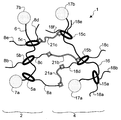
- FIG. 2 is a diagram schematically illustrating an embodiment 1 of a crosslinked polyrotaxane in the material of the present invention.
- the left side is derived from the first polyrotaxane 2
- the right side is derived from the second polyrotaxane 4, and both are crosslinked.
- the first polyrotaxane 2 has an opening of the first cyclic molecules 5 a, 5 b, and 5 c that is included in a skewered manner by the first linear molecules 6, and both ends of the first linear molecules 6
- the first blocking groups 7a and 7b are arranged so that the first cyclic molecules 5a, 5b and 5c are not detached.
- the first cyclic molecule 5a has a graft chain 8a as a group other than the active group
- the first cyclic molecule 5b has a graft chain 8b and 8c as a group other than the active group
- the first cyclic molecule 5c has graft chains 8d and 8e as groups other than the active group.
- the second polyrotaxane 4 also includes the second linear molecules 16 in which the openings of the second first cyclic molecules 15a, 15b, and 15c are clasped in a skewered manner.
- Second blocking groups 17a and 17b are arranged at both ends of the chain molecule 16 so that the second cyclic molecules 15a, 15b and 15c are not detached.
- the second cyclic molecule 15a has graft chains 18a and 18b as groups other than the active group
- the second cyclic molecule 15b has graft chains 18c and 18d as groups other than the active group in the second cyclic group.
- the molecule 15c has graft chains 18e and 18f as groups other than the active group.
- the first polyrotaxane 2 and the second polyrotaxane 4 are more specifically, the first cyclic molecule 5a, the graft chain 8a, and the polymer via the first cyclic molecule 5a and the second cyclic molecule 15b.
- Cross-linking is performed via the site 21a, the graft chain 18d, and the second cyclic molecule 15b.
- a bridge is also formed through the first cyclic molecule 5b and the second cyclic molecule 15b, and more specifically, the first cyclic molecule 5b, the graft chain 8c, the polymer portion 21b, and the second cyclic molecule 5b.
- Crosslinks are formed through the cyclic molecules 15b.
- a bridge is also formed through the first cyclic molecule 5c and the second cyclic molecule 15c, and more specifically, the first cyclic molecule 5c, the polymer portion 21c, and the second cyclic molecule 15c.
- Crosslinks are formed via
- the material of the present invention can realize a desired flexibility, specifically, a heat conductive material having the characteristics of low initial elastic modulus and high elongation by using polyrotaxane.
- the material of the present application can efficiently release heat, for example, as a heat dissipation material for industrial or household electrical / electronic parts or machines.
- the adhesion to the uneven surface of the component can be improved and / or bubbles generated at the contact surface with the component can be eliminated, resulting in improved heat conduction efficiency. be able to.
- the stress concerning material can be disperse
- the material of the present invention described above can be obtained, for example, by the following method. That is, a) First blocking so that the first cyclic molecule is not detached at both ends of the first pseudopolyrotaxane in which the opening of the first cyclic molecule is clasped by the first linear molecule. Providing a first polyrotaxane having a group disposed thereon; b) Second blocking so that the second cyclic molecule is not detached at both ends of the second pseudopolyrotaxane in which the opening of the second cyclic molecule is clasped by the second linear molecule.
- Steps a) and b) are steps for preparing a so-called polyrotaxane.
- the polyrotaxane can be obtained by referring to documents published before the filing of the present application (for example, WO2005-080469 and WO2005-108464, which are incorporated herein by reference in their entirety). it can. If the first and second polyrotaxanes are the same, steps a) and b) can be performed in one step. The first and second polyrotaxanes are the same as described above.
- Step c) is a step of preparing the first cross-linking compound.
- the polymer site is the same as described above, and has 3 or more repeating units, and / or the number average molecular weight of the polymer site is 300 or more and 10,000 or less, preferably 400 to 5000, more preferably. 500 to 3000 is preferable.
- the polymer part is the same in other respects.
- the first cross-linking compound is obtained by adding a reactive group to the above-mentioned “polymer part” or “polymer part having the first and second reactive groups”. Obtainable. That is, c) -1) obtaining a polymer moiety; and c) -2) providing first and second reactive groups at both ends of the polymer moiety, respectively. Obtainable. And c) -3) providing first and second protecting groups for protecting the first and second reactive groups, respectively.
- the first and second protective groups can provide a stabilized first cross-linking compound, which can be useful for long-term storage of the first cross-linking compound.
- crosslinking compound which has a 1st and 2nd protective group, the process of deprotecting this 1st and 2nd protective group in subsequent process e) or before process e). It is good to have.
- the first and second protecting groups are each independently ⁇ -caprolactam, 1,2-pyrazole, butanone oxime, 1,2,4-triazole, diisopropylamine, 3,5-dimethylpyrazole, diethyl malonate, dimethyl It may be selected from the group consisting of malonate, methyl acetoacetate, ethyl acetoacetate, and a protecting group by reaction with N, N′-diphenylformamidine compound.
- Preferred is ⁇ -caprolactam, 3,5-dimethylpyrazole or butanone oxime, and more preferred is ⁇ -caprolactam or 3,5-dimethylpyrazole.
- the deprotecting step can be performed mainly by heating.
- a deprotection catalyst that promotes deprotection may be added to the system.
- the catalyst for deprotection depends on the compound present in the system, the first and second protecting groups, etc., but dibutyltin dilaurate, dioctyltin dilaurate, tri (acetate) butyltin, di (acetate) dibutyltin , Acetate tributyltin, methoxytributyltin, tri (2-ethylhexanoate) butyltin, bis (2-ethylhexanoate) dibutyltin, tri (laurate) butyltin, di (octanoate) dibutyltin, tri (octanoate) )
- Tin-based catalysts such as butyltin, dibutyltin oxide, monobutyltin hydroxide oxide, stannous octoate; triethylenediamine, triethylamine,
- steps c) -1) and c) -2) i) a method of obtaining a cross-linked compound by reacting a polymer having a site capable of imparting a reactive group with a compound having two or more reactive groups; ii) monomer
- a method of obtaining a cross-linked compound by reacting a polymer having a site capable of imparting a reactive group with a compound having two or more reactive groups ii) monomer
- monomer can be exemplified by, but not limited to, a method of polymerizing by a general method, producing a polymer site, and adding a compound serving as a reactive group in the production process.
- the monomer here may be a monomer having a repeating unit.
- a compound having two or more reactive groups is generally reacted with a polymer in excess, and then the reaction product may be used as it is, or may be used after purification.
- the compound having two or more reactive groups include, but are not limited to, the compounds described above as the “reactive group” imparted by “a certain group”.
- a crosslinking compound obtained by adding glycidyl methacrylate to the polymerization of methyl (meth) acrylate, and ⁇ -methacryloyloxy- ⁇ -butyrolactone is added to the polymerization of methyl (meth) acrylate.
- Cross-linked compounds obtained by the above cross-linked compounds obtained by having terminal carboxylic acid groups by condensation polymerization of ethylene glycol and adipic acid, cross-linked compounds having an isocyanate terminal obtained by polyaddition of triethylene glycol and hexamethylene diisocyanate, etc.
- These reactions depend on the polymer site to be used, the “certain group” to be used, and the reactive group to be used. It can be carried out.
- Step d) is a step of preparing a heat conductive material.
- the thermally conductive material has the same definition as described above.
- the preparation includes a step of commercially purchasing the heat conductive material; or a step of preparing the heat conductive material; and a step of making the obtained heat conductive material into a desired shape.
- step e) the first and second polyrotaxanes, the first cross-linking compound, and the cross-linking precursor having a heat conductive material are reacted to cross-link the first and second polyrotaxanes through the polymer sites. It is a process to make. Step e) depends on the polyrotaxane to be used, the polymer site to be used, etc., but it is generally preferable to react in a solvent.
- dimethylacetamide, dimethylformamide, tetrahydrofuran, ethyl acetate, butyl acetate, toluene, xylene, acetonitrile, cyclohexanone, methyl ethyl ketone or acetone, or a mixed solvent thereof Although not limited to these, it is not limited to these.
- the reaction depends on the reactive group, the active group, and the solvent, and examples thereof include, but are not limited to, room temperature to 150 ° C., 5 minutes to 24 hours, conditions in the presence of a catalyst, and the like.
- a second cross-linking compound different from the first cross-linking compound may be included.
- the second cross-linking compound preferably has third and fourth reactive groups at both ends thereof. Further, the second crosslinking compound may further have a fifth reactive group.
- the third, fourth, and fifth reactive groups are each independently selected from the group consisting of isocyanate groups, thioisocyanate groups, oxirane groups, oxetane groups, carbodiimide groups, silanol groups, oxazoline groups, and aziridine groups. Is good. An isocyanate group or a thioisocyanate group is preferable, and an isocyanate group is more preferable.
- the second cross-linking compound may include the third and fourth reactive groups, and the fifth reactive group, if present, protected by the third, fourth, and fifth protective groups, respectively.
- the protecting group may be deprotected in step e) or before step e).
- the third, fourth and fifth protecting groups are each independently ⁇ -caprolactam, 1,2-pyrazole, butanone oxime, 1,2,4-triazole, diisopropylamine, 3,5-dimethylpyrazole, diethyl It may be selected from the group consisting of malonate, dimethyl malonate, methyl acetoacetate, ethyl acetoacetate, and a protecting group by reaction with N, N'-diphenylformamidine compound.
- ⁇ -caprolactam 3,5-dimethylpyrazole or butanone oxime
- ⁇ -caprolactam or 3,5-dimethylpyrazole Deprotection of the protecting group can be performed mainly by heating. Further, a deprotection catalyst that promotes deprotection may be added to the system.
- the deprotection catalyst depends on the compounds present in the system, such as the first and second polyrotaxanes; and the first and second protecting groups, but dibutyltin dilaurate, dioctyltin dilaurate, tri ( Acetate) butyltin, di (acetate) dibutyltin, acetate tributyltin, methoxytributyltin, tri (2-ethylhexanoate) butyltin, bis (2-ethylhexanoate) dibutyltin, tri (laurate) butyltin , Tin catalysts such as di (octanoate) dibutyltin, tri (octanoate) butyltin, dibutyltin oxide, monobutyltin hydroxide oxide, stannous octoate; triethylenediamine, triethylamine, N, N, N ', N'- Tetramethylpropylened
- drying steps may be provided after step e) or simultaneously with step e) in order to make the obtained material containing a crosslinked product solvent-free. Further, in step e), drying may be performed in a mold or on a substrate. Furthermore, in order to perform a drying process efficiently, you may provide a solvent substitution process before a drying process. Examples of the drying process include, but are not limited to, a drying process by standing at room temperature, natural drying, a drying process by normal pressure heating, a drying process by heating under reduced pressure, a freeze drying process, and the like.
- steps a), b), c), d), and e other steps may be provided.
- the drying step after step e), the step of including other components in the material during step e) and / or after step e), the step of washing with a solvent after step e), the first and first steps A deprotecting step of the protecting group in the case of having the second, third, fourth and fifth protecting groups.
- other components include other polymers or oligomers, plasticizers, low molecular weight crosslinking agents, surfactants, UV absorbers, antibacterial agents, antioxidants, silane coupling agents, and antifoaming agents. It is not limited.
- polyethylene glycol monomethyl ether polyethylene glycol monobutyl ether, polyethylene glycol dimethyl ether, polypropylene glycol monobutyl ether, one-end hydroxylated polycaprolactone, polycaprolactone, polydimethylsiloxane, one-end hydroxylated poly
- examples thereof include, but are not limited to, dimethylsiloxane, polycarbonate, one-end hydroxylated polycarbonate, polyester, and one-end hydroxylated polyester.
- plasticizers include dibutyl phthalate, di-2-ethylhexyl phthalate, butyl benzyl phthalate, dihexyl phthalate, dioctyl adipate, bis (2-ethylhexyl) adipate, tris trimellitic acid (2 -Ethylhexyl), tricresyl phosphate, and the like, but are not limited thereto.
- low molecular weight crosslinking agents include cyanuric chloride, trimesoyl chloride, terephthaloyl chloride, epichlorohydrin, dibromobenzene, glutaraldehyde, aliphatic polyfunctional isocyanate, aromatic polyfunctional isocyanate, diisocyanic acid Acid anhydrides such as trilein, hexamethylene diisocyanate, divinyl sulfone, 1,1′-carbonyldiimidazole, ethylenediaminetetraacetic acid dianhydride, meso-butane-1,2,3,4-tetracarboxylic dianhydride, Examples thereof include, but are not limited to, polyfunctional acid hydrazines, polyfunctional carboimides, alkoxysilanes, and derivatives thereof.
- nonionic surfactants such as polyoxyethylene (8) octylphenyl ether, sorbitan polyoxyethylene trioleate, sorbitan polyoxyethylene monostearate; sodium dodecyl sulfate, dodecyl sulfate
- examples include, but are not limited to, ionic surfactants such as sodium sulfonate, triethanolamine dodecyl sulfate, dodecyltrimethylammonium salt, and dodecylpyridinium chloride.
- UV absorbers 2-dimethylhexyl paradimethylaminobenzoate, 2-ethylhexyl salicylate, 2,4-dihydroxybenzophenone, 2-hydroxy-4-n-octylbenzophenone, 2- (2′-hydroxy) -5'-t-butylphenyl) benzotriazole, bis (2,2,6,6-tetramethyl-4-piperidyl) -sebacate, 2-ethylhexyl paramethoxycinnamate, isopropyl paramethoxycinnamate, ethylhexyl methoxycinnamate , Octyl methoxycinnamate, and the like, but are not limited thereto.
- antibacterial agents include, but are not limited to, silver, zinc, copper compounds or complexes and ions thereof; organosilicon compounds; organophosphorus compounds.
- examples of the antioxidant include, but are not limited to, a phenol-based antioxidant, a sulfur-based antioxidant, and a phosphorus-based antioxidant.
- examples of the silane coupling agent include vinyl silane, epoxy silane, and amino silane, but are not limited thereto.
- the present application provides a composition for obtaining the above material.
- the composition comprises I) a polyrotaxane in which blocking groups are arranged so that the cyclic molecule is not detached at both ends of a pseudopolyrotaxane in which openings of the cyclic molecule are skewered by linear molecules; II) a first crosslinking compound having a polymer moiety, the first crosslinking compound having first and second reactive groups at both ends of the polymer moiety; and III) a metal, a metal oxide, At least one thermally conductive material selected from the group consisting of metal nitrides, metal carbides, and alloys;
- composition means that all the substances contained in the composition are contained in one system, and that the substances contained in the composition are contained in two or more systems. Are also included.
- polyrotaxane has the same definition as the first and second polyrotaxanes described above.
- the polyrotaxane may be one type of polyrotaxane or may have two or more types of polyrotaxane.
- the first crosslinking compound also has the same definition as the first crosslinking compound described above, and the first and second reactive groups also have the same definition as described above. When all or part of the first and second reactive groups are protected by the first and second protecting groups, the first and second protecting groups have the same definition as described above.
- the thermally conductive material has the same definition as the above-described thermally conductive material.
- composition may further comprise IV) a second crosslinking compound having at least third and fourth reactive groups.
- a second crosslinking compound having at least third and fourth reactive groups.
- the cross-linking compound is advantageous in that when all of the reactive groups are protected with a protecting group, the reaction between the reactive group and the active group can be suppressed.
- the composition can be provided as one system.
- composition of the present invention may have other components other than the above I) to IV).
- other components include other polymers or oligomers, plasticizers, low molecular weight crosslinking agents, surfactants, UV absorbers, antibacterial agents, antioxidants, silane coupling agents, and antifoaming agents. It is not limited.
- Other components than the antifoaming agent have the same definition as described above. The antifoaming agent will be described later.
- composition of this application can be manufactured as follows. That is, A) I) a polyrotaxane in which a blocking group is arranged at both ends of a pseudopolyrotaxane in which the opening of a cyclic molecule is skewered by a linear molecule so that the cyclic molecule is not detached is prepared.
- step A) is the same as the above-described steps a) and b), that is, the steps of preparing the first and second polyrotaxanes.
- Step B) is the same as step c) described above.
- Step C) is the same as step d) described above.
- Step D) is a step of mixing I) polyrotaxane; II) first cross-linking compound; and III) heat conductive material.
- the mixing may be dry mixing without a solvent or may be mixing using a solvent.
- examples of the solvent include dimethylacetamide, dimethylformamide, tetrahydrofuran, ethyl acetate, butyl acetate, toluene, xylene, acetonitrile, cyclohexanone, methyl ethyl ketone, or acetone, or a mixed solvent thereof, but is not limited thereto. Not.
- the order of mixing is not limited.
- the mixing method include, but are not limited to, a magnetic stirrer, mechanical stirring, a homodisper machine, a high-pressure emulsifier, and an ultrasonic emulsifier / disperser.
- a defoaming step may be provided by a method such as vacuum defoaming or centrifugal defoaming.
- An antifoaming agent may be added during mixing.
- the antifoaming agent include, but are not limited to, silicone antifoaming agents; organic antifoaming agents such as surfactants, polyethers, and higher alcohols.
- the composition of the present invention has other components other than the above I) to IV)
- the other components are preferably mixed in the step D).
- the above manufacturing method may have other steps in addition to the above steps A) to D).
- a conventionally well-known process can be used for a shaping
- the process used for the molding method of a thermosetting resin can be used. More specifically, methods such as injection molding, mold molding, film forming by a coater and / or a coating machine can be exemplified, but the method is not limited thereto.
- the molecular weight and molecular weight distribution of the synthesized polyrotaxane were measured with a TOSOH HLC-8220 GPC apparatus.
- the concentration was measured under the conditions of about 0.2 wt / vol%, injection amount: 20 ⁇ l, pretreatment: filtration through a 0.2 ⁇ m filter, standard molecular weight: PEO (the same applies to Synthesis Example B-2).
- 1 H-NMR analysis was performed with 400 MHz JEOL JNM-AL400 (manufactured by JEOL Ltd.).
- Synthesis Example A-2 ⁇ Preparation of polyrotaxane having hydroxypropyl group and polycaprolactone group> 20 g of HAPR35 obtained in Synthesis Example A-1 was placed in a three-necked flask, and 90 g of ⁇ -caprolactone was introduced while slowly flowing nitrogen. After stirring uniformly with a mechanical stirrer at 100 ° C.
- HAPR35-g-PCL a reaction product in which a polycaprolactone group was introduced into HAPR35, and “having a polycaprolactone introduced into HAPR35” may be generally abbreviated as “HAPR35-g-PCL”.
- a peak derived from an ester at 1736 cm ⁇ 1 was observed.
- the weight average molecular weight Mw was 586,800 and molecular weight distribution Mw / Mn was 1.7 by GPC.
- Polycarbonate diol (polyalkylene carbonate diol (polyalkylene polycarbonate having 1,5-pentanediol and / or 1,6-hexanediol as a repeating unit) 96 wt% or more, 1,5-pentanediol 2 wt% or less, 1,6- (Polycarbonate having a composition of hexanediol of 2 wt% or less), DURANOL (registered trademark) T-5650J (manufactured by Asahi Kasei Chemicals Corporation, Mn: 800; 1,5-pentanediol and / or 1,6-hexanediol as repeating units) In this case, the repeating unit is 6 to 7.
- polycarbonate diol Duranol registered trademark
- T5650J polycarbonate diol Duranol
- Crosslinker B-1 (7.78 kg) having carbonate diol and 1,3-bis (isocyanatomethyl) cyclohexane was obtained.
- Polycarbonate diol polyalkylene carbonate diol having a repeating unit of 1,5-pentanediol and / or 1,6-hexanediol of 96 wt% or more, 1,5-pentanediol 2 wt% or less, 1,6-hexanediol 2 wt% or less Polycarbonate), Duranol (registered trademark) T-5650E (manufactured by Asahi Kasei Chemicals Corporation, Mn: 500; when 1,5-pentanediol and / or 1,6-hexanediol are used as repeating units, The unit is 4 to 5.
- polycarbonate diol DURANOL (registered trademark) T5650E”) is warmed to 70 ° C., slowly dropped into the reaction vessel over 2 hours, and further 3 hours With stirring, polycarbonate diol and 1,3-bis ( To obtain a cross-linking agent B-2 (6.32kg) with Socia isocyanatomethyl) cyclohexane.
- T5650J means “polycarbonate diol duranol (registered trademark) T5650J”
- T5650E polycarbonate diol duranol (registered trademark) T5650E”.
- the heat conductive sheets C-1 to C-5 which are the materials having the polyrotaxane of the present application, are excellent in flexibility as a heat conductive material. Specifically, the initial elastic modulus is small and the elongation rate is low. It can be seen that it is large and has sufficient tensile strength. Further, it can be seen that the heat conductive sheets C-1 to C-3 using alumina as a heat conductive material have little influence on the elongation rate even if the amount of alumina is large. Further, when comparing the heat conductive sheets C-1 to C-5 and X-1, the heat conductive sheets C-1 to C-5 have heat equivalent to or higher than that of the commercially available product (X-1) containing alumina. It can be seen that it has conductivity and is flexible.
Landscapes
- Chemical & Material Sciences (AREA)
- Health & Medical Sciences (AREA)
- Chemical Kinetics & Catalysis (AREA)
- Medicinal Chemistry (AREA)
- Polymers & Plastics (AREA)
- Organic Chemistry (AREA)
- Life Sciences & Earth Sciences (AREA)
- General Health & Medical Sciences (AREA)
- Molecular Biology (AREA)
- Engineering & Computer Science (AREA)
- Biochemistry (AREA)
- Materials Engineering (AREA)
- Compositions Of Macromolecular Compounds (AREA)
Abstract
L'invention concerne un matériau ayant une excellente flexibilité et une conductivité thermique désirée. L'invention concerne un matériau ayant un premier polyrotaxane et un second polyrotaxane, les premier et second polyrotaxanes étant réticulés par l'intermédiaire de première et seconde molécules cycliques appartenant respectivement à ceux-ci, le matériau est exempt de solvant, et le matériau comprend au moins un type de substance thermiquement conductrice choisie parmi un métal, un oxyde métallique, un nitrure métallique, un carbure métallique et un alliage.
Applications Claiming Priority (2)
| Application Number | Priority Date | Filing Date | Title |
|---|---|---|---|
| JP2011-120517 | 2011-05-30 | ||
| JP2011120517 | 2011-05-30 |
Publications (1)
| Publication Number | Publication Date |
|---|---|
| WO2012165401A1 true WO2012165401A1 (fr) | 2012-12-06 |
Family
ID=47259256
Family Applications (1)
| Application Number | Title | Priority Date | Filing Date |
|---|---|---|---|
| PCT/JP2012/063698 Ceased WO2012165401A1 (fr) | 2011-05-30 | 2012-05-29 | Matériau ayant des polyrotaxanes réticulés et son procédé de fabrication |
Country Status (1)
| Country | Link |
|---|---|
| WO (1) | WO2012165401A1 (fr) |
Cited By (13)
| Publication number | Priority date | Publication date | Assignee | Title |
|---|---|---|---|---|
| WO2014080981A1 (fr) * | 2012-11-22 | 2014-05-30 | 国立大学法人 東京大学 | Nouveau polyrotaxane et son procédé de préparation |
| KR20150110686A (ko) * | 2013-01-21 | 2015-10-02 | 스미또모 세이까 가부시키가이샤 | 연질 재료용 조성물 및 연질 재료 |
| WO2015159875A1 (fr) * | 2014-04-15 | 2015-10-22 | 宇部興産株式会社 | Élastomère de polyuréthane moulé de type à durcissement à chaud |
| WO2015174187A1 (fr) * | 2014-05-12 | 2015-11-19 | 宇部興産株式会社 | Résine de polyuréthane |
| US9349778B2 (en) | 2013-05-09 | 2016-05-24 | Lg Chem, Ltd. | Polymer film, flexible light emitting element display device, and rollable display device |
| WO2016114243A1 (fr) * | 2015-01-13 | 2016-07-21 | アドバンスト・ソフトマテリアルズ株式会社 | Composition élastomère thermoplastique, élastomère thermoplastique, et procédé de production d'élastomère thermoplastique |
| US10253140B2 (en) | 2013-10-31 | 2019-04-09 | Sumitomo Seika Chemicals Co., Ltd. | Polyrotaxane-containing composition |
| JP2020125504A (ja) * | 2015-09-01 | 2020-08-20 | 宇部興産株式会社 | 熱硬化型ポリウレタン |
| JP2021055029A (ja) * | 2019-10-02 | 2021-04-08 | Dic株式会社 | 熱硬化性ウレタン樹脂組成物 |
| JP2021055028A (ja) * | 2019-10-02 | 2021-04-08 | Dic株式会社 | 熱硬化性ウレタン樹脂組成物 |
| JP2021091211A (ja) * | 2019-11-29 | 2021-06-17 | 株式会社昭和丸筒 | 熱伝導体の製造方法 |
| CN114341310A (zh) * | 2019-07-31 | 2022-04-12 | 株式会社昭和丸筒 | 导热片及其制造方法 |
| JP2022106615A (ja) * | 2021-01-07 | 2022-07-20 | 株式会社昭和丸筒 | 熱伝導体 |
Citations (4)
| Publication number | Priority date | Publication date | Assignee | Title |
|---|---|---|---|---|
| WO2001083566A1 (fr) * | 2000-04-28 | 2001-11-08 | Center For Advanced Science And Technology Incubation, Ltd. | Compose contenant du polyrotaxane reticule |
| JP2006241396A (ja) * | 2005-03-07 | 2006-09-14 | Kaneka Corp | 架橋ポリロタキサン及びその製造方法 |
| WO2010024431A1 (fr) * | 2008-09-01 | 2010-03-04 | アドバンスト・ソフトマテリアルズ株式会社 | Matériau en polyrotaxanes réticulés sans solvant et son procédé de fabrication |
| WO2011108514A1 (fr) * | 2010-03-02 | 2011-09-09 | アドバンスト・ソフトマテリアルズ株式会社 | Matériau comprenant un polyrotaxane réticulé, et procédé de production associé |
-
2012
- 2012-05-29 WO PCT/JP2012/063698 patent/WO2012165401A1/fr not_active Ceased
Patent Citations (4)
| Publication number | Priority date | Publication date | Assignee | Title |
|---|---|---|---|---|
| WO2001083566A1 (fr) * | 2000-04-28 | 2001-11-08 | Center For Advanced Science And Technology Incubation, Ltd. | Compose contenant du polyrotaxane reticule |
| JP2006241396A (ja) * | 2005-03-07 | 2006-09-14 | Kaneka Corp | 架橋ポリロタキサン及びその製造方法 |
| WO2010024431A1 (fr) * | 2008-09-01 | 2010-03-04 | アドバンスト・ソフトマテリアルズ株式会社 | Matériau en polyrotaxanes réticulés sans solvant et son procédé de fabrication |
| WO2011108514A1 (fr) * | 2010-03-02 | 2011-09-09 | アドバンスト・ソフトマテリアルズ株式会社 | Matériau comprenant un polyrotaxane réticulé, et procédé de production associé |
Cited By (25)
| Publication number | Priority date | Publication date | Assignee | Title |
|---|---|---|---|---|
| JPWO2014080981A1 (ja) * | 2012-11-22 | 2017-01-05 | 国立大学法人 東京大学 | 新規ポリロタキサン及びその製造方法 |
| WO2014080981A1 (fr) * | 2012-11-22 | 2014-05-30 | 国立大学法人 東京大学 | Nouveau polyrotaxane et son procédé de préparation |
| US9657127B2 (en) | 2013-01-21 | 2017-05-23 | Sumitomo Seika Chemicals Co., Ltd. | Composition for soft materials, and soft material |
| KR102115062B1 (ko) | 2013-01-21 | 2020-05-25 | 스미또모 세이까 가부시키가이샤 | 연질 재료용 조성물 및 연질 재료 |
| EP2947104A4 (fr) * | 2013-01-21 | 2016-09-14 | Sumitomo Seika Chemicals | Composition pour matériaux souples et matériau souple |
| JPWO2014112234A1 (ja) * | 2013-01-21 | 2017-01-19 | 住友精化株式会社 | 軟質材料用組成物及び軟質材料 |
| KR20150110686A (ko) * | 2013-01-21 | 2015-10-02 | 스미또모 세이까 가부시키가이샤 | 연질 재료용 조성물 및 연질 재료 |
| US9349778B2 (en) | 2013-05-09 | 2016-05-24 | Lg Chem, Ltd. | Polymer film, flexible light emitting element display device, and rollable display device |
| US10253140B2 (en) | 2013-10-31 | 2019-04-09 | Sumitomo Seika Chemicals Co., Ltd. | Polyrotaxane-containing composition |
| JPWO2015159875A1 (ja) * | 2014-04-15 | 2017-04-13 | 宇部興産株式会社 | 注型熱硬化型ポリウレタンエラストマー |
| CN106164119A (zh) * | 2014-04-15 | 2016-11-23 | 宇部兴产株式会社 | 注塑热固化型聚氨酯弹性体 |
| WO2015159875A1 (fr) * | 2014-04-15 | 2015-10-22 | 宇部興産株式会社 | Élastomère de polyuréthane moulé de type à durcissement à chaud |
| JPWO2015174187A1 (ja) * | 2014-05-12 | 2017-04-20 | 宇部興産株式会社 | ポリウレタン樹脂 |
| WO2015174187A1 (fr) * | 2014-05-12 | 2015-11-19 | 宇部興産株式会社 | Résine de polyuréthane |
| WO2016114243A1 (fr) * | 2015-01-13 | 2016-07-21 | アドバンスト・ソフトマテリアルズ株式会社 | Composition élastomère thermoplastique, élastomère thermoplastique, et procédé de production d'élastomère thermoplastique |
| US10259940B2 (en) | 2015-01-13 | 2019-04-16 | Advanced Softmaterials Inc. | Thermoplastic elastomer composition, thermoplastic elastomer, and method for producing thermoplastic elastomer |
| JPWO2016114243A1 (ja) * | 2015-01-13 | 2017-10-19 | アドバンスト・ソフトマテリアルズ株式会社 | 熱可塑性エラストマー用組成物、熱可塑性エラストマー、及び熱可塑性エラストマーの製造方法 |
| JP2020125504A (ja) * | 2015-09-01 | 2020-08-20 | 宇部興産株式会社 | 熱硬化型ポリウレタン |
| CN114341310A (zh) * | 2019-07-31 | 2022-04-12 | 株式会社昭和丸筒 | 导热片及其制造方法 |
| JP2021055029A (ja) * | 2019-10-02 | 2021-04-08 | Dic株式会社 | 熱硬化性ウレタン樹脂組成物 |
| JP2021055028A (ja) * | 2019-10-02 | 2021-04-08 | Dic株式会社 | 熱硬化性ウレタン樹脂組成物 |
| JP2021091211A (ja) * | 2019-11-29 | 2021-06-17 | 株式会社昭和丸筒 | 熱伝導体の製造方法 |
| JP7535784B2 (ja) | 2019-11-29 | 2024-08-19 | 株式会社昭和丸筒 | 熱伝導体の製造方法 |
| JP2022106615A (ja) * | 2021-01-07 | 2022-07-20 | 株式会社昭和丸筒 | 熱伝導体 |
| JP7593622B2 (ja) | 2021-01-07 | 2024-12-03 | 株式会社昭和丸筒 | 熱伝導体 |
Similar Documents
| Publication | Publication Date | Title |
|---|---|---|
| WO2012165401A1 (fr) | Matériau ayant des polyrotaxanes réticulés et son procédé de fabrication | |
| JP2011241401A (ja) | 架橋ポリロタキサンを有する材料、及びその製造方法 | |
| KR101631724B1 (ko) | 용매 무함유의 가교 폴리로탁산을 갖는 재료, 및 그의 제조 방법 | |
| JP5701853B2 (ja) | 架橋ポリロタキサンを有する材料、及びその製造方法 | |
| US11226559B2 (en) | Blocking groups for light polymerizable resins useful in additive manufacturing | |
| KR101468220B1 (ko) | 폴리에테르-폴리실록산 폴리올 | |
| CN104024278B (zh) | 修饰化聚轮烷及其制造方法、以及具有修饰化聚轮烷而形成的材料 | |
| Zhang et al. | Synthesis and characterization of eugenol‐based silicone modified waterborne polyurethane with excellent properties | |
| WO2008072766A1 (fr) | Polymère contenant du fluor et composition de résine | |
| WO2008072765A1 (fr) | Polymère contenant du fluor et composition de résine | |
| JP7653148B2 (ja) | 高分子材料及びその製造方法 | |
| CN110010264B (zh) | 导电性复合体 | |
| JPWO2018105682A1 (ja) | グラフトコポリマー含有固形物およびその用途 | |
| JP6441632B2 (ja) | エポキシ樹脂の製造方法 | |
| Gu et al. | Improved shape memory performance of star-shaped POSS-polylactide based polyurethanes (POSS-PLAUs) | |
| Yan et al. | Constructing Self‐Renewing Silicone‐Hydrogel Hybrid Coatings with Integrated Fouling Resistant/Release/Killing Mode toward Superior Biofouling Defense | |
| Li et al. | Preparation and Performance Study of Polyurethane/Epoxy Resin Interpenetrating Networks with Self‐Healing, Shape Memory, and High Damping Properties | |
| Kostrzewa et al. | Property evaluation and structure analysis of polyurethane/epoxy graft interpenetrating polymer networks | |
| Akkus et al. | Bio-based benzoxazine-containing polycyclosiloxanes as flame-retardant adhesive materials | |
| KR101407617B1 (ko) | 자기 치유 능력이 있는 열경화성 코팅 조성물, 코팅 필름 및 코팅 필름의 제조 방법 | |
| WO2007041344A2 (fr) | Agents chimiques nanostructures metallises promoteurs de durcissement | |
| Madhavan et al. | Synthesis and characterization of polyurethane hybrids: Influence of the polydimethylsiloxane linear chain and silsesquioxane cubic structure on the thermal and mechanical properties of polyurethane hybrids | |
| JP7639347B2 (ja) | 熱硬化性樹脂組成物、樹脂シートおよび金属ベース基板 | |
| JP7601763B2 (ja) | 環状分子に長鎖アルキル基を有するポリロタキサン、該ポリロタキサンを有する組成物、及び該ポリロタキサンの製造方法 | |
| Tan et al. | Thermomechanical and surface properties of novel poly (ether urethane)/polyhedral oligomeric silsesquioxane nanohybrid elastomers |
Legal Events
| Date | Code | Title | Description |
|---|---|---|---|
| 121 | Ep: the epo has been informed by wipo that ep was designated in this application |
Ref document number: 12792242 Country of ref document: EP Kind code of ref document: A1 |
|
| NENP | Non-entry into the national phase |
Ref country code: DE |
|
| 122 | Ep: pct application non-entry in european phase |
Ref document number: 12792242 Country of ref document: EP Kind code of ref document: A1 |
|
| NENP | Non-entry into the national phase |
Ref country code: JP |