WO2012166848A2 - Methods and compositions for the detection of functional clostridium difficile toxins - Google Patents
Methods and compositions for the detection of functional clostridium difficile toxins Download PDFInfo
- Publication number
- WO2012166848A2 WO2012166848A2 PCT/US2012/040089 US2012040089W WO2012166848A2 WO 2012166848 A2 WO2012166848 A2 WO 2012166848A2 US 2012040089 W US2012040089 W US 2012040089W WO 2012166848 A2 WO2012166848 A2 WO 2012166848A2
- Authority
- WO
- WIPO (PCT)
- Prior art keywords
- toxin
- difficile
- glucopyranoside
- indicator
- substrate
- Prior art date
- Legal status (The legal status is an assumption and is not a legal conclusion. Google has not performed a legal analysis and makes no representation as to the accuracy of the status listed.)
- Ceased
Links
Classifications
-
- C—CHEMISTRY; METALLURGY
- C12—BIOCHEMISTRY; BEER; SPIRITS; WINE; VINEGAR; MICROBIOLOGY; ENZYMOLOGY; MUTATION OR GENETIC ENGINEERING
- C12Q—MEASURING OR TESTING PROCESSES INVOLVING ENZYMES, NUCLEIC ACIDS OR MICROORGANISMS; COMPOSITIONS OR TEST PAPERS THEREFOR; PROCESSES OF PREPARING SUCH COMPOSITIONS; CONDITION-RESPONSIVE CONTROL IN MICROBIOLOGICAL OR ENZYMOLOGICAL PROCESSES
- C12Q1/00—Measuring or testing processes involving enzymes, nucleic acids or microorganisms; Compositions therefor; Processes of preparing such compositions
- C12Q1/02—Measuring or testing processes involving enzymes, nucleic acids or microorganisms; Compositions therefor; Processes of preparing such compositions involving viable microorganisms
- C12Q1/04—Determining presence or kind of microorganism; Use of selective media for testing antibiotics or bacteriocides; Compositions containing a chemical indicator therefor
-
- C—CHEMISTRY; METALLURGY
- C12—BIOCHEMISTRY; BEER; SPIRITS; WINE; VINEGAR; MICROBIOLOGY; ENZYMOLOGY; MUTATION OR GENETIC ENGINEERING
- C12Q—MEASURING OR TESTING PROCESSES INVOLVING ENZYMES, NUCLEIC ACIDS OR MICROORGANISMS; COMPOSITIONS OR TEST PAPERS THEREFOR; PROCESSES OF PREPARING SUCH COMPOSITIONS; CONDITION-RESPONSIVE CONTROL IN MICROBIOLOGICAL OR ENZYMOLOGICAL PROCESSES
- C12Q1/00—Measuring or testing processes involving enzymes, nucleic acids or microorganisms; Compositions therefor; Processes of preparing such compositions
- C12Q1/02—Measuring or testing processes involving enzymes, nucleic acids or microorganisms; Compositions therefor; Processes of preparing such compositions involving viable microorganisms
- C12Q1/04—Determining presence or kind of microorganism; Use of selective media for testing antibiotics or bacteriocides; Compositions containing a chemical indicator therefor
- C12Q1/045—Culture media therefor
-
- C—CHEMISTRY; METALLURGY
- C12—BIOCHEMISTRY; BEER; SPIRITS; WINE; VINEGAR; MICROBIOLOGY; ENZYMOLOGY; MUTATION OR GENETIC ENGINEERING
- C12Q—MEASURING OR TESTING PROCESSES INVOLVING ENZYMES, NUCLEIC ACIDS OR MICROORGANISMS; COMPOSITIONS OR TEST PAPERS THEREFOR; PROCESSES OF PREPARING SUCH COMPOSITIONS; CONDITION-RESPONSIVE CONTROL IN MICROBIOLOGICAL OR ENZYMOLOGICAL PROCESSES
- C12Q1/00—Measuring or testing processes involving enzymes, nucleic acids or microorganisms; Compositions therefor; Processes of preparing such compositions
- C12Q1/48—Measuring or testing processes involving enzymes, nucleic acids or microorganisms; Compositions therefor; Processes of preparing such compositions involving transferase
-
- G—PHYSICS
- G01—MEASURING; TESTING
- G01N—INVESTIGATING OR ANALYSING MATERIALS BY DETERMINING THEIR CHEMICAL OR PHYSICAL PROPERTIES
- G01N2333/00—Assays involving biological materials from specific organisms or of a specific nature
- G01N2333/195—Assays involving biological materials from specific organisms or of a specific nature from bacteria
- G01N2333/33—Assays involving biological materials from specific organisms or of a specific nature from bacteria from Clostridium (G)
-
- G—PHYSICS
- G01—MEASURING; TESTING
- G01N—INVESTIGATING OR ANALYSING MATERIALS BY DETERMINING THEIR CHEMICAL OR PHYSICAL PROPERTIES
- G01N2333/00—Assays involving biological materials from specific organisms or of a specific nature
- G01N2333/90—Enzymes; Proenzymes
- G01N2333/91—Transferases (2.)
- G01N2333/91091—Glycosyltransferases (2.4)
- G01N2333/91097—Hexosyltransferases (general) (2.4.1)
-
- G—PHYSICS
- G01—MEASURING; TESTING
- G01N—INVESTIGATING OR ANALYSING MATERIALS BY DETERMINING THEIR CHEMICAL OR PHYSICAL PROPERTIES
- G01N2500/00—Screening for compounds of potential therapeutic value
- G01N2500/04—Screening involving studying the effect of compounds C directly on molecule A (e.g. C are potential ligands for a receptor A, or potential substrates for an enzyme A)
Definitions
- This disclosure relates to the detection of functional C. difficile toxins by identifying the presence of toxigenic strains of C. difficile, and to identification of active C. difficile toxins to aid in, among other things, diagnosis and indications for therapy.
- Clostridium difficile is the leading identifiable cause of nosocomial diarrhea worldwide due to its virulence, multi-drug resistance, spore-forming ability, and environmental persistence (Bartlett, J. G. 1992. Antibiotic-associated diarrhea. Clin Infect Dis 15:573-581 . McDonald, L. et al., 2005. An epidemic, toxin gene-variant strain of Clostridium difficile. N Engl J Med 353:2433-2441 ; Poutanen, S. M. et al., 2004. Clostridium difficile- associated diarrhea in adults. CMAJ 171 :51 -58; Warny, M., J. et al., 2005.
- This bacterium has been implicated as the causative organism for 10-25% of the reported cases of antibiotic-associated diarrhea, 50- 75% of antibiotic-associated colitis, and 90- 100% of pseudomembranous colitis (Bartlett, J. G. 2002. Clinical practice. Antibiotic-associated diarrhea. N Engl J Med 346:334-339; Warny, et al., 2005, ibid).
- the toxigenic strains of C. difficile possess a 1 9.6 kb pathogenicity locus that encodes two notable proteins: toxins A (308 kDa) and B (269 kDa).
- the central regions of the toxins possess a cysteine protease activity, which cleaves the N-terminal region in the presence of inositol hexakisphosphate, releasing the N- terminally located glucosyltransferase domain into the cytosol of the mammalian host (Egerer, M., T. et al. , 2007. Auto-catalytic cleavage of Clostridium difficile toxins A and B depends on cysteine protease activity. J Biol Chem 282:253 14-25321 . Hofmann, F., C. et al.,
- Rho proteins by Clostridium difficile toxin B. Nature 375:500-503. This monoglucosylation interrupts the normal function of the Rho GTPases leading to a variety of effects on intoxicated cells such as apoptosis, cell rounding, actin cytoskeleton dysregulation, and altered cellular signaling (Genth, H., et ai , 2008. Clostridium difficile toxins: more than mere inhibitors of Rho proteins, Int J Biochem Cell Biol 40:592-597; Hofmann, F et ai, 1997, ibid; Just, 1., and R. Gerhard. 2004, ibid; Just, 1., et ai, 1995, ibid).
- tissue culture cytotoxicity assay the tissue culture cytotoxicity assay
- tissue culture cytotoxicity method is not as sensitive as culture isolation combined with toxin testing (Bartlett, J. G. 2002, ibid; Choy, F. Y., and R. G. Davidson. 1 980.
- Gaucher's disease II Studies on the kinetics of beta-glucosidase and the effects of sodium taurocholate in normal and Gaucher tissues. Pediatr Res 14:54-59; Dillon, S. T., et ai, 1995), although it is considered by some laboratories as the gold standard.
- Other approaches include the glutamate dehydrogenase screening assay (McDonald, L. C, et ai, 2005, ibid; Peters, S.
- compositions and methods are based, in part, on the discovery that the A and B toxins of C. difficile cleave indicator-linked substrates that have stereochemical characteristics similar to their natural substrate, UDP-glucose.
- methods and compositions for detection of functional C. difficile toxins are disclosed.
- a quantitative assay (Cdifftox Activity assay) is provided that enables, in many cases, cost-efficient, sensitive, quantitative measurement of the cleavage activities of toxins A and B of C. difficile in both a culture supernatant and a selective and differential agar-based assay.
- CDPA Cdifftox Plate assay
- FIGURE 1 depicts the elution profile of the proteins in C. difficile culture supernatant separated by DEAE-Sepharose anion exchange chromatography. Fractions ( 1 0 ml) were examined using the Cdifftox Activity assay (A, top chart) and the antibody-based ELISA assay (B, lower chart). The Cdifftox Activity assay was performed by incubating 200 ⁇ of each fraction in 50 mM Tris-HCl containing 50 mM NaCl (pH 7.4) with PNPG substrate reagent at 37°C for 4 hrs. The assay was monitored by measuring absorbance at 41 0 nm. The protein concentration was determined using Bradford protein assay (BioRad). The ELISA assay was performed using the Wampole C. difficile TOX A/B II assay (TechLab, Blacksburg, VA).
- FIGURE 2 depicts the elution profile of the pooled C. difficile toxin-positive fractions purified by Sephacryl S-300 gel filtration chromatography. Fractions (5 ml) were examined using the Cdifftox Activity assay (A, top chart) and the antibody-based ELISA assay (B, bottom chart). The Cdifftox Activity assay was performed by incubating 200 ⁇ of each fraction in 50 mM Tris-HCl containing 50 mM NaCl (pH 7.4) with PNPG substrate reagent at 37°C for 4 hrs. The assay was monitored by measuring absorbance at 410 nm. The protein concentration was determined using Bradford protein assay (BioRad).
- FIGURE 3 A depicts a polyacrylamide gel electrophoresis (PAGE) analysis of C. difficile toxins A and B purification by anion exchange and gel filtration chromatography. Proteins (50 ⁇ g each) were separated through a 5% PAGE gel.
- the arrow indicates the location of toxins in the gel.
- FIGURE 4A depicts the effect of pH on the PNPG cleavage activities of toxins A and B.
- the Cdifftox Activity assay was performed by incubating 100 ⁇ g of toxin A or B with 1 0 mM PNPG at 37°C for 4 hrs in buffers at the various pH values shown. The following buffers were used for the pH values indicated: glycine-HCl buffer (pH 2-3); citrate buffer (pH 4-6); Tris-HCl buffer (pH 7- 10); disodium phosphate-sodium hydroxide buffer (pH 1 1 - 12); and KCl-NaOH (pH 13). The assay was monitored by absorbance at 410 nm. Error bars represent standard deviation between two replicate experiments.
- FIGURE 4B depicts the effect of temperature on the PNPG cleavage activities of toxins A and B.
- the Cdifftox Activity assay was performed by incubating 100 ⁇ g of toxin A or B in 50 mM Tris-HCl containing 50 mM NaCI (pH 7.4) with 10 mM PNPG at the temperatures indicated for 4 hrs. The assay was monitored by absorbance at 410 nm. Error bars represent standard deviation between two replicate experiments.
- FIGURE 5 depicts a Michaelis-Menten plot for the PNPG cleavage by C. dijficile toxins A and B based on non-linear regression method.
- FIGURE 6 depicts a dose response inhibition by sodium taurocholate of toxin A and B PNPG cleavage activities. These experiments were performed by incubating for 1 hr 55 ⁇ g of each toxin with the amount of sodium taurocholate indicated at 37°C in 30 mM Tris-HCl buffer (pH 7.4) containing 50 mM NaCl, and 10 mM of the PNPG. Error bars indicate standard deviation from three different experiments.
- FIGURE 7 depicts a comparison of the Cdifftox Activity assay and ELISA assay for the presence of C. difficile toxins A and B in clinical isolates.
- Supernatant (250 ⁇ ) from isolated strains cultured in BHI media was incubated with 10 mM of PNPG and incubated for 3 hrs at 37°C.
- FIGURE 8 depicts differentiation of toxigenic and non-toxigenic strains of C. difficile on the Cdifftox Plate assay. Colonies isolated from a stool sample was spread directly onto the plate and incubated anaerobically at 37°C for 48 hrs. Blue colonies are toxin-producing C. difficile (Tox + ); pale white colonies are non-toxin producing C. difficile (Tox " ).
- FIGURE 9 depicts a schematic representation of the analysis of 50 cytotoxic- and culture-positive stool samples. PCR amplification was performed using the genomic DNA isolated from the Tox + and Tox " colonies to identify a portion of the genes that encode toxin A (tcdA) and toxin B (tcdB).
- FIGURE 10 depicts results of a PCR analysis of representative Tox + and Tox " strains. Genomic DNA was isolated from the colonies and used as template in PCR reactions with primers specific for the genes that encode toxin A (tcdA) and toxin B (tcdB), and a conserved region of the C. difficile ribosomal RNA ( 16S rRNA) gene. ' M' represents 1 b marker (New England BioLabs, Ipswich, MA); lanes 1 -3: tcdA amplicons; lanes 4-6: tcdB amplicons; lanes 7-9: 16S rRNA amplicons.
- FIGURE 1 1 depicts C. difficile toxin production in culture supernatants of a representative Tox + and Tox " clinical isolates and defined ATCC strains. Toxin detection was performed by ELISA and the Cdifftox Activity Assay as described in the examples below.
- Clinical isolates: T 1 -T14 represents Tox + ; N 1 -N6 are Tox " ⁇ tcdA- and tcdB-). Error bars represent the standard deviation from two replicate experiments.
- indicator-linked substrate refers to a chromogen or a fluorescent or chemiluminescent molecule that is chemically bound ("linked") by a glycosidic bond to a sugar moiety on a chemical compound (e.g., glucopyranoside, galactopyranoside) which is recognized by a glycosyltransferase enzyme to cleave the glycosidic bond between the indicator and the sugar moiety.
- a chemical compound e.g., glucopyranoside, galactopyranoside
- the sugar moiety on the substrate i.e., chemical compound
- the sugar moiety on the substrate i.e., chemical compound
- chromogenic substrate refers to a chromogen-linked substrate in which a chromogen molecule becomes visibly colored or changes color after it is freed or cleaved from the substrate.
- the terms “treat,” “treating,” “treatment” and “therapy” contemplate an action that occurs while a patient is suffering from a C. difficile infection or associated disorder that reduces the severity of one or more symptoms or effects of the C. difficile infection or associated disorder, such as but not limited to bowel or gastrointestinal disorder or a related disease or disorder.
- the terms “treat,” “treating,” and “treatment” also refers to actions taken toward ensuring that individuals at increased risk of a C. difficile infection or associated disorder, such as but not limited to bowel or gastrointestinal disorder are able to receive appropriate surgical and/or other medical intervention prior to onset of a C.
- C. difficile infection or associated disorder such as but not limited to bowel or gastrointestinal disorders.
- prevent contemplate an action that occurs before a patient begins to suffer from C. difficile infection or associated disorder, such as but not limited to bowel or gastrointestinal disorder, that delays the onset of, and/or inhibits or reduces the severity of, a C. difficile infection or associated disorder, such as but not limited to bowel or gastrointestinal disorder.
- the terms “manage,” “managing,” and “management” encompass preventing, delaying, or reducing the severity of a recurrence of C. difficile infection or associated disorders, such as but not limited to bowel or gastrointestinal disorders in a patient who has already suffered from such a disease, disorder or condition.
- the terms encompass modulating the threshold, development, and/or duration of the C. difficile infection or associated disorder, such as but not limited to bowel or gastrointestinal disorder or changing how a patient responds to the C. difficile infection or associated disorder, such as but not limited to bowel or gastrointestinal disorder.
- a "therapeutically effective amount" of a compound is an amount sufficient to provide any therapeutic benefit in the treatment or management of a C. difficile infection or associated disorder, such as but not limited to bowel or gastrointestinal disorders or to delay or minimize one or more symptoms associated with a C. difficile infection or associated disorder, such as but not limited to bowel or gastrointestinal disorders.
- a therapeutically effective amount of a compound means an amount of the compound, alone or in combination with one or more other therapies and/or therapeutic agents that provide any therapeutic benefit in the treatment or management of a C. difficile infection or associated disorder, such as but not limited to bowel or gastrointestinal disorders, diarrhea or related diseases or disorders.
- the term "therapeutically effective amount" can encompass an amount that alleviates a C.
- the therapeutic benefit is inhibiting a bacterial infection or prolonging the survival of a subject with such a bacterial infection beyond that expected in the absence of such treatment.
- a prophylactically effective amount of a compound is an amount sufficient to prevent or delay the onset of a C. difficile infection or associated disorder, such as but not limited to bowel or gastrointestinal disorders, or one or more symptoms associated with rifamycin sensitive disorders, such as but not limited to bowel or gastrointestinal disorders or prevent or delay its recurrence.
- a prophylactically effective amount of a compound means an amount of the compound, alone or in combination with one or more other treatment and/or prophylactic agent that provides a prophylactic benefit in the prevention of a C. difficile infection or associated disorder, such as but not limited to bowel or gastrointestinal disorders.
- the term "prophylactically effective amount” can encompass an amount that prevents C.
- prophylactically effective amount can be prescribed prior to, for example, travel to a location in which gastrointestinal disorders or diarrhea are common.
- patient or “subject” includes organisms which are capable of suffering from a C. difficile infection or associated disorder, such as but not limited to human and non-human animals.
- Preferred human animals include human subjects.
- non- human animals as used in the present disclosure includes all vertebrates, such as but not limited to, mammals (for example non-human primates, rodents, mice, companion animals and livestock, e.g., sheep, dog, cattle, horses); as well as non-mammals (such as, but not limited to chickens, amphibians, reptiles, etc. ).
- Susceptible to a C. difficile infection or associated disorder is meant to include, but not be limited to, subjects at risk of developing a C. difficile infection or associated disorder such as but not limited to bowel or gastrointestinal disorders or infections, e.g. , subjects suffering from one or more of an immune suppression, subjects that have been exposed to other subjects with a bacterial infection, physicians, nurses, subjects traveling to remote areas known to harbor bacteria, subjects who drink amounts of alcohol that damage the liver, subjects with a history of hepatic dysfunction, etc.
- terms such as “element” or “component” encompass both elements and components comprising one unit and elements and components that comprise more than one subunit unless specifically stated otherwise.
- the use of the term "portion" can include part of a moiety or the entire moiety.
- the presently disclosed methods are based, in part, on the discovery that the A and B toxins of C. difficile cleave chromogenic substrates that have stereochemical characteristics similar to their natural substrate, UDP-glucose.
- the examples set forth herein demonstrate that methods and compositions for detection of functional C. difficile toxins, and among other things, a quantitative assay (Cdifftox Activity assay) that enables cost-efficient, sensitive, quantitative measurement of the cleavage activities of toxins A and B of C. difficile in a culture supernatant and a selective and differential agar-based assay, the Cdifftox Plate assay (CDPA), which enables identification of toxin-producing C. difficile directly from stool samples without the need for additional toxin-confirmatory tests.
- CDPA Cdifftox Plate assay
- C. difficile infection (CDI) has been increasing, so that it is now the leading definable cause of nosocomial diarrhea.
- Potential factors that have contributed to this prevalence are the increasing use of intestinal flora- altering antibiotics, the emergence of hypervirulent strains of C. difficile, the propensity of C. difficile to produce recurrent illness refractory to treatment, sub-optimal infection control practice and the appearance of toxin-producing mutant strains with a more potent activity.
- Pathogenic strains of C. difficile produce either toxin A and/or toxin B, which are important virulent factors in the pathogenesis of this bacterium.
- the presently disclosed methods are directed at detecting the functional activities of toxin A and/or toxin B of C. difficile and therefore they selectively identify only pathogenic, toxin- producing strains that cause disease.
- the presently disclosed methods are based on the glucosyltransferase activity of the C. difficile toxins, not the bacteria.
- a non- toxin-producing strain of C. difficile which does not cause disease, will test negative utilizing the presently disclosed methods but would however appear to be positive in the assay based upon beta-glucosidase activity of the C. difficile bacteria as is described in US20100279330.
- the application of these methods reduces or eliminates the false positive identification of patients suspected of having been infected by a pathogenic strain of C. difficile, for example, based on symptoms. These patients may have symptoms that suggest possible infection with a pathogenic strain of C. difficile, but may actually colonized by C. difficile that is not producing toxin.
- the initiation of a therapy directed at an infection that the patient does not have, is both a waste of resources and may be unnecessarily detrimental to the patient's health. This results in among other things incorrect identification and incorrect therapy to resolve an infection the patient may not have. Furthermore, such indiscriminate use of antibiotics can lead to drug resistance.
- C. difficile strains can either be toxin-producing (toxigenic) or non-toxin producing (non-toxigenic).
- toxin A- and/or toxin B-producing strains cause disease.
- Current culture methods do not differentiate toxigenic and non-toxigenic strains, because they are unable to detect toxin activity.
- Current methods for diagnosing C. difficile infection are based on detection of the organism, the toxin genes and proteins, or the effect of the cytotoxin on tissue culture cells.
- the only method that can provide information about the activities of the toxins is the cell cytotoxicity assay.
- Such limitations are problematic for diagnosis and studies of these toxins.
- Described in some embodiments is a cost-efficient, sensitive, and reliable assay designated the Cdifftox Activity assay that uses the glucosyltransferase activities of the A and B toxins to identify toxigenic C. difficile.
- the Cdifftox Activity assay utilizes PNPG as a chromogenic substrate, which is similar to the native substrate of these toxins.
- toxins A and B were purified from culture supernatants using ammonium sulfate precipitation and chromatography through DEAE-Sepharose and gel filtration columns. The activities of the final fractions were quantitated using the Cdifftox Activity assay and compared to the toxin A- and B-specific ELISA-based antibody assay.
- the affinity for the substrate was more than 4-fold higher for toxin B than toxin A.
- the rate of cleavage of the substrate was 4.3-fold faster for toxin B than toxin A.
- the optimum temperature for both toxins ranged between 35-40°C at pH 8.
- an advantage of the Cdifftox Activity assay is that it detects both presence of the toxins and quantitates their substrate cleavage activities.
- the Cdifftox Activity assay identifies the presence of functional toxin.
- the total bile acid concentration in the small intestine varies depending on diet and other metabolic conditions. However, only about 2-5% of the bile acids secreted in normal humans enter the colon because the majority of the bile acids are reabsorbed in the ileum. Demonstration of inhibition of the C. difficile toxins by a major bile acid may explain why the pathology of C. difficile infection is almost exclusively restricted to the bile acid-poor colon with relative sparing of the bile-rich small bowel.
- Sodium taurocholate is known to non-competitively inhibit mammalian ⁇ - glucosidases.
- These enzymes including giucosyltransferases, belong to a large family of enzymes that mediate a wide variety of functions such as carbohydrate biosynthesis, metabolite storage, and cellular signaling.
- Glycosyltransferases transfer a monosaccharide from an activated nucleotide sugar donor to specific sugar residues, proteins, lipids, DNA or small molecule acceptors. This transfer has been shown to occur either by inversion or retention of the configuration of the anomeric carbon.
- toxin A and B activities by a molecule that also inhibits glucosidases suggest that the cleavage of the PNPG substrate utilized in the Cdifftox Activity assay may be due to the glucosyltransferase activities of the toxins.
- further confirmatory experiments are planned to test the activity of the toxins A and B glucosyltransferase domains.
- the use of the glucosyltransferase activities of the A and B toxins to identify toxigenic C. difficile is unique and has not previously been reported.
- toxins A and B activities that is quantitative, cost-efficient, and utilizes a substrate that is stereochemically similar to the native substrate of the toxins, UDP-glucose.
- Toxin activity was characterized and toxins A and B were purified from culture supernatants using ammonium sulfate precipitation and chromatography through DEAE-Sepharose and gel filtration columns. The activities of the final fractions were quantitated using the Cdi fftox Activity assay and compared to the toxin A- and B-specific ELISA-based antibody assay. The affinity for the substrate was more than 4-fold higher for toxin B than toxin A.
- the rate of cleavage of the substrate was 4.3-fold faster for toxin B than toxin A.
- the optimum temperature for both toxins ranged between 35-40 C at pH 8.
- Culture supernatant from clinical isolates obtained from the stools of patients suspected to be suffering from CDI were tested using the Cdifftox Activity assay and the results were compared to the EL1SA assay and PCR amplification of the toxin genes. Demonstrating that, among other things, this new assay is comparable to the current commercial ELISA test for detecting the toxins in the samples tested and has the added advantage of quantitating toxin activity.
- Strains of C. difficile are broadly classified as either toxin-producing strains (toxigenic) or non-toxin producing strains (non-toxigenic). It has been established that only the toxin-producing strains cause disease and that toxins A and B play critical roles in. the pathogenesis of C. difficile. The alarming emergence of hypervirulent strains of C. difficile with increased toxin production, severity of disease, and mortality emphasizes the need for a sensitive diagnostic method that can simultaneously isolate and identify toxigenic strains. Such a method would enable faster and more appropriate treatment of affected patients. The current available culture methods do not differentiate toxigenic and non-toxigenic strains of C. difficile.
- a Cdifftox Plate assay that advances and improves the culture approach by combining the isolation of strains with toxin detection, such that pathogenic toxin-producing strains can be differentiated from non-pathogenic non-toxin- producing strains, which do not cause disease.
- the Cdifftox Plate assay identifies toxin-producing C. difficile colonies by their ability to cleave a chromogenic substrate, 5-bromo-4-chloro-3-indolyl-P-D- galactopyranoside, into a distinct insoluble blue product that precipitates around the toxin- producing cells.
- This substrate cleavage by the toxins was confirmed by the examination of 528 independent C. difficile colonies isolated from 50 stool samples from different patients suffering from C. difficile infection.
- non-toxigenic strains of C. difficile can also grow on the CDPA plates, none of the non-C. difficile enterobacteriaceae tested could grow on these plates under the same culture conditions.
- the CDPA plate medium was similarly selective as compared to CCFA (7), in that both culture methods allowed the growth of a similar number of viable colonies from 50 of the 60 stool samples analyzed.
- 10 stool samples evaluated as positive by the tissue culture cytotoxicity assay did not result in colony growth on any of the culture media utilized (selective and non-selective) under anaerobic conditions.
- 10 of the 60 cytotoxic-positive samples were false positives. This could have resulted from mishandling of the samples, that the cells in the 10 samples were non-viable, or that the initial cytotoxicity assay results were misinterpreted. This suggests that it is necessary to culture a toxigenic C. difficile bacterium from the stool to confirm diagnosis of an active infection or colonization.
- the bacterial cells may not have been exposed to the necessary conditions to activate toxin gene expression.
- Factors that have been suggested to influence toxin production are cell density, exposure to antibiotics, phage lysogeny, growth medium composition, and nutrient limitation.
- C. difficile cells in stool samples may exist as either vegetative cells at different growth stages or as spores. Perhaps, variations in cell physiology explain why some colonies became Tox + later than others. Regardless, the results indicate that this heterogeneity did not lead to false negative interpretations of any of the samples analyzed by the Cdifftox Plate assay.
- the present disclosure describes the first use of the glucosyltransferase activities of the A and B toxins to identify toxigenic C. difficile.
- the Cdifftox Plate assay represents a new detection method with potentially improved sensitivity and efficiency compared to current diagnostic methods.
- a selective and differential culture method (Cdifftox Plate assay) combines in a single step the isolation of C. difficile strains with detection of active toxin production. This assay was developed based on our recent finding that the A and B toxins of C. difficile cleave chromogenic substrates that have stereochemical characteristics similar to their natural substrate, UDP-glucose. The Cdifftox Plate assay was validated through the analysis of 528 independent C.
- a method of identifying the presence of a functional C. difficile toxin comprises: obtaining a sample suspected of containing a C. difficile toxin, adding the sample and a chromogenic substrate with stereochemical characteristics similar to UDP-glucose, incubating the sample and the chromogenic substrate together for a time sufficient to allow the cleavage of the chromogenic substrate in the presence of toxin, determining the amount of cleavage of the chromogenic substrate by monitoring for a change in color by the substrate, or monitoring for a change in absorbance at a predetermined wavelength. For example, in culture media the glucosyltransferase of the C.
- chromogenic substrate e.g. , 5-bromo-4-chloro-3-indolyl-P-D- galactopyranoside
- insoluble blue product precipitates around the toxin- producing cells or colonies.
- the chromogenic substrate is selected from a group consisting of p-nitrophenyl-a-D-glucopyranoside, p-nitrophenyl-P-D-glucopyranoside, 4-aminophenyl- a-D-glucopyranoside, 4-aminophenyl-P-D-glucopyranoside, 5-benzyloxy-3-indoxyl-P-D- glucopyranoside, 5-bromo-6-chloro-3-indoxyl-P-D-glucopyranoside, 6-bromo-2-naphthyl-a- D-glucopyranoside, 6-chloro-3-indoxyl-a-D-glucopyranoside, 6 chloro-3-indoxyl-N-acetyl- beta-D-glucosaminide, 5-bromo-3-indoxyl-P-D-galactopyranoside, and 5-bromo-4-chloro-3- ind
- the chromogenic substrate is p-nitrophenyl-P-D- glucopyranoside (PNPG).
- the chromogenic substrate is in a reagent solution comprising 2- 10 mM PNPG, 50 mM Tris-HCI (pH 7.4), 50 mM NaCI, and 100 ⁇ MnCl 2 .
- a method of identifying the presence of a functional C. difficile toxin, wherein said method comprises: obtaining a sample suspected of containing a C.
- a chromogenic substrate reagent comprising 2- 10 mM PNPG, 50 mM Tris-HCl (pH 7.4), 50 m NaCl, and 100 ⁇ MnCh, incubating the sample and the chromogenic substrate reagent at 37°C for 1 -4 hrs, stopping the reaction by adding 40 ⁇ of 3 M a2C0 3 and determining the cleavage of substrate by measuring the absorbance at 410 nm.
- a method of identifying the presence of a functional C. difficile toxin for example, a clinical sample wherein said method comprises: obtaining a sample suspected of containing a toxigenic C. difficile, streaking the sample directly onto a plate containing a medium comprising a chromogenic substrate with stereochemical characteristics similar to UDP-glucose, incubating the sample and the chromogenic substrate together for a time sufficient to allow the cleavage of the chromogenic substrate in the presence of toxin, determining the amount of cleavage of the chromogenic substrate by monitoring for a change in color by the substrate.
- a method of identifying the presence of a functional C for example, a clinical sample wherein said method comprises: obtaining a sample suspected of containing a toxigenic C. difficile, streaking the sample directly onto a plate containing a medium comprising a chromogenic substrate with stereochemical characteristics similar to UDP-glucose, incubating the sample and the chromogenic substrate together for
- said method comprises: obtaining a sample suspected of containing a toxigenic C. difficile, streaking the sample directly onto a plate comprising a medium that is selective for the growth of C. difficile and comprises a chromogenic substrate with stereochemical characteristics similar to UDP-glucose, incubating the plate in an anaerobic environment for a time sufficient to allow the growth of the C. difficile and the cleavage of the chromogenic substrate in the presence of toxin, determining the amount of cleavage of the chromogenic substrate by monitoring the color of a bacterial colonies.
- a method of identifying the presence of a functional C. difficile toxin for example, a clinical sample wherein said method comprises: obtaining a sample suspected of containing a toxigenic C. difficile, streaking the sample directly onto a plate comprising a medium that is selective for the growth of C. difficile, and further comprises a chromogenic substrate with stereochemical characteristics similar to UDP-glucose, incubating plate in an anaerobic environment for a time sufficient to allow the growth of C. difficile colonies and the cleavage of the chromogenic substrate in the presence of toxin, determining the presence of functional toxin as a result of cleavage of the chromogenic substrate and monitoring the color of the colonies.
- the chromogenic substrate is 5-bromo-4-chloro-3-indolyl-p-D-galactopyranoside.
- the toxin-producing C. difficile colonies appear blue while non-toxin producers remain pale white.
- the medium comprises BHI, peptic digest of animal tissue, pancreatic digest of gelatin, NaCl, dextrose, anhydrous Na2HPO
- the medium comprises BHI broth, sodium taurocholate, D-cycloserine and cefoxitin, 5-bromo-4-chloro-3-indolyl-P-D- galactopyranoside, 4-methylphenol, and defibrinated sheep or horse blood.
- an above-described medium may contain BHI (6 g/L), peptic digest of animal tissue (6 g/L), pancreatic digest of gelatin ( 14.5 g/L), NaCl (5 g/L), dextrose (3 g/L), anhydrous Na2HPC> (2.5 g/L), sodium taurocholate (0.1 %), D-cycloserine (250-500 mg/L) and 8- 16 mg/L of cefoxitin, 5-bromo-4-chloro-3-indolyl-P-D-galactopyranoside ( 100-200 mg/L), 4-methylphenol (0.025%), dimethyl sulfoxide (2-5%) and defibrinated sheep or horse blood (6-8%).
- Dimethyl sulfoxide is as an oxidizing agent used to facilitate the enzymatic color reaction even when the cultures remain in an anerobic environment.
- oxidizing agents that can be used include, but are not limited to, those that can support the growth of C. difficile without toxic effects, including ammonium iron (III) citrate, ferric ammonium citrate, potassium dichromate and others.
- ammonium iron (III) citrate, ferric ammonium citrate, potassium dichromate and others include, but are not limited to, those that can support the growth of C. difficile without toxic effects, including ammonium iron (III) citrate, ferric ammonium citrate, potassium dichromate and others.
- the addition of such agents may offer a particular advantage when, for example, the cultures are being maintained outside of the traditional fully equipped clinical laboratory environment, for example, in a anaerobic atmosphere generation bag out in the field facility.
- taurocholate is synthesized in the liver and released into the small bowel. At the ileum, about 95-98% is re-absorbed and channeled into the enterohepatic circulation. Thus, very little, if any taurocholate enters the colon, which is the only part of the body, that C. difficile is known to colonize. Hence, C. difficile releases its potent toxins into the colon that cause the problems associated with its infection. This supports the position that inhibiting the cleavage activity of the C. difficile toxins has a clinical significance. With antibiotic treatment of C.
- a method for detecting a compound's ability to inhibit C. difficile toxin activity comprising: obtaining a sample suspected of containing a C.
- a method for detecting a compound's ability to inhibit the pathogenesis of C. difficile toxin is identified by the compound's ability to inhibit the toxins cleavage activity, this method comprises: obtaining a sample suspected of containing a C.
- a process for identifying a patient infected with toxigenic C. difficile using the methods described.
- a process of identifying an individual as being a candidate for treatment for a toxigenic C. difficile comprising: obtaining a sample or culture from the individual and applying the methods described.
- a process of identifying an individual who is infected with toxigenic C. difficile comprising: obtaining a sample or culture from the individual and applying the methods described.
- a method of identifying an individual who is need of therapy for a toxigenic C. difficile infection said method comprising obtaining a sample from the individual and analyzing it using the methods described, for the presence of C. difficile toxins, determining the presence of functional C. difficile toxins and thus identifying the individual as being a valid candidate for therapy.
- a process to identify compounds for use in treating C. difficile toxin mediated disorders comprising the use of the methods disclosed herein.
- a test kit for identifying an individual infected with toxigenic C. difficile comprising the components required to assay a test sample by the methods described.
- the described methods are applied to the test samples that are a bodily fluid or cultures obtained from bodily fluids.
- the described methods the patient or individual is a mammal selected from the group consisting of human, canine, feline and equine.
- Bacterial strains C. difficile toxigenic strains ATCC#s 43255 (tcdA+IB+), the hypervirulent strain BAA- 1805 ⁇ tcdA+IB+; NAP 1 ), 700057 (tcdA-/B+), and BAA- 1 382 (tcdA+/B+) were purchased from the American Type Culture Collection (Manassas, VA). Clinical isolates were obtained from stool samples of hospitalized patients with antibiotic- associated diarrhea suspected to be C. difficile positive (see below).
- the bacteria were grown in brain heart infusion (BHl)-based medium (Becton Dickinson and Company, Cockeysville, MD) or on BHI-agar containing cefoxitin (8 ⁇ g/ml) and D-cycloserine (300 ⁇ g/ml) and liquid or plate cultures were incubated anaerobically in an atmosphere of 10% I-L, 5% CO 2, and 85% N2 at 37°C in a Controlled Atmosphere Anaerobic Chamber (PLAS LABS, Lansing, Ml).
- BHl brain heart infusion
- BHI-agar containing cefoxitin (8 ⁇ g/ml) and D-cycloserine 300 ⁇ g/ml
- Substrates for Glucosyltransferase The substrates 5-bromo-4-chloro-3-indolyl-a- D-glucopyranoside, 5-bromo-4-chloro-3-indolyl- -D-glucopyranoside, 5-bromo-4-chloro-3- indolyl-a-D-galactopyranoside, 5-bromo-4-chloro-3-indoxyl-P-D-galactopyranoside, 5- bromo-4-chloro-3-indoxyl phosphate, 5-bromo-4-chloro-3-indoxyl butyrate, 5-bromo-4- chloro-3-indoxyl- -D-xylopyranoside, 5-bromo-4-chloro-3-indoxyl palmitate, 5-bromo-4- chloro-3-indoxyl-a-D-maltotrioside, 5-bromo-4-chloro-3-indoxyl-
- chromogenic substrates were selected based on the presence of an O-glycosidic bond between the chromogen and the sugar moiety (glucopyranoside, galactopyranoside, etc.) in either an alpha or beta orientation. They have stereochemical characteristics similar to UDP-glucose, a natural substrate for glucosyltransferase. Other such chromogenic substrates may also be used in the present methods and compositions i f desired.
- c!eavable sugar moieties can also be covalently linked to a fluorescent molecule such as, but not limited to, fluorescein isothiocyanate, rhodamine, phycoerythrin, phycocyanin, allophycocyanin, o-phthaldehyde, and fluorescamine, or a chemiluminescent system such as bioluminescent molecules such as, but not limited to, luciferin, luciferase and aequorin (green fluorescent protein; see, e.g. , U.S. Patent Nos.
- a fluorescent molecule such as, but not limited to, fluorescein isothiocyanate, rhodamine, phycoerythrin, phycocyanin, allophycocyanin, o-phthaldehyde, and fluorescamine
- a chemiluminescent system such as bioluminescent molecules such as, but not limited to, luciferin, lucifera
- Sample Storage Conditions The clinical isolates were either stored short-term (less than 1 month) in chopped meat broth (BD Diagnostics, Franklin Lakes, NJ) at room temperature or long-term in 15% glycerol stocks at -80°C.
- the purified toxins and eluents were stored at 4°C for a maximum of one month or until use with no loss of activity.
- Culture supernatants were stored at 4°C for a maximum of 2 weeks with no loss of toxin activity.
- Clinical Stool Samples The clinical stool samples were obtained from an on-going study approved by the Institutional Review Boards of The University of Texas Health Science Center at Houston and St. Luke's Episcopal Hospital (Houston, TX). All of the participating patients or their legal guardians provided written informed consent upon admission to the hospital. All the stool samples used were tissue culture cytotoxicity assay- positive, as determined by the Medical Microbiology Laboratory at the St. Luke's Episcopal Hospital.
- C. difficile strain (ATCC #43255) was cultured anaerobically for 5 days at 37°C in Spectra/Por dialysis bags (50 ml) with a molecular weight cut-off of 100 kDa (Spectrum Laboratories, Collinso Dominguez, CA). Purification of the toxins was performed according to established methods with some modifications. Briefly, the culture was centrifuged at 10,000 x g for 10 minutes at 4°C and the resulting supernatant was filtered through a 0.45 ⁇ membrane filter (Millipore, Billerica, MA).
- the filtered supernatant was concentrated using a Pierce Concentrator (Thermo Scientific, Rockford, IL) with a molecular weight cut-off of 150 kDa.
- the concentrated supernatant was precipitated by the addition of ammonium sulfate (450 g/L) and incubated overnight at 4°C with gentle stirring, and subsequently centrifuged at 6,000 x g at 4°C for 20 min. The precipitate was washed and dissolved in 50 mM Tris-HCl buffer (pH 7.4).
- the sample was loaded onto a fast flow DEAE-Sepharose CL-6B (GE Healthcare Life Sciences, Piscataway, NJ) anion column pre-equilibrated with buffer D (50 mM Tris-HCl [pH 7.4] containing 50 mM NaCl) at a flow rate of 2 ml/min.
- buffer D 50 mM Tris-HCl [pH 7.4] containing 50 mM NaCl
- the column was washed with buffer D (approximately 350 ml) until all unbound proteins were removed.
- Toxin A was eluted first with a linear gradient of NaCl (50-250 mM) in.buffer D.
- the elution continued for toxin B with a NaCl gradient of 250- 1000 mM in buffer D, after a washing step with 250 ml of buffer D.
- the fractions ( 10 ml) were assayed for the presence of toxins by incubating 200 ⁇ with 10 mM PNPG for 3 hr at 37°C.
- the toxin-positive fractions were pooled and concentrated with 150 kDa Concentrator (ThermoScientific, Pittsburgh, PA) for further purification.
- the pooled fractions from the DEAE-Sepharose column were further purified by gel filtration chromatography.
- a 1 cm X 100 cm glass Econo column (Bio-Rad Laboratories, Gaithersburg, MD) was packed with Sephacryl S-300 high resolution beads (GE Healthcare Life Sciences) and calibrated using the following standards purchased from Bio-Rad Laboratories: vitamin B 12 ( 1 .35 kDa), myoglobin ( 1 7 kDa), ovalbumin (44 kDa), g-globulin ( 158 kDa), and thyroglobulin (670 kDa).
- the concentrated toxins were applied to the column and eluted with buffer D at a flow rate of 0.5 ml/min.
- Fractions (5 ml) were assayed for the presence of the toxins using 200 ⁇ as described above.
- the purity of the purified toxins was evaluated by electrophoresis through a 5% acrylamide: bisacrylamide PAGE gel (51 ).
- the protein concentration of samples was determined using Bradford assay (5) with bovine serum albumin as the standard.
- Clostridium difficile toxins A and B were purified seven-fold to characterize and evaluate their substrate cleavage specificities.
- the native toxins were purified from culture supernatant obtained from the toxin A- and B- positive strain cultured in a dialysis bag of 100 kDa molecular weight cut-off (MWCO).
- MWCO molecular weight cut-off
- the proteins in the culture supernatant were precipitated with ammonium sulfate, resuspended, and applied to a fast flow DEAE-Sepharose anion exchange chromatography column. After elution with a 50 m to 1 M NaCl step gradient, two peaks were observed by UV detection and confirmed by Bradford assay ( Figure 1 ).
- the initial narrow peak was determined by sodium dodecyl sulfate polyacrylamide gel electrophoresis (SDS-PAGE) to contain a protein corresponding to the molecular weight of toxin A (308 kDa) and the second broad peak was determined to contain a protein corresponding to toxin B (269 kDa).
- Cdifftox Activity Assay was used to identify fractions that contained PNPG cleavage activity.
- the assay consists of the Cdifftox substrate reagent composed of 10 mM PNPG, 50 mM Tris-HCl (pH 7.4), 50 mM NaCl, and 100 ⁇ MnCl 2 .
- the assay was performed in Costar sterile polystyrene 96-well plates (Corning Inc., NY) by adding to each well 200 ⁇ of sample or culture supernatant fluid containing the toxins and 100 ⁇ of the reagent.
- the plate was incubated at 37°C for 1 -4 hrs and each reaction was stopped by the addition to the well of 40 ⁇ ! of 3 M Na2CC"3. Cleavage of the substrate was monitored by measuring the absorbance between 400-500 nm, with a SPECTRA max at 410 nm.
- [00731 Plus 384 spectrophotometer (Molecular Devices, Sunnyvale, CA).
- substrates including: p-nitrophenyl-a-D- glucopyranoside, 4-aminophenyl-a-D-glucopyranoside, 4-amino-phenyl-p-D- glucopyranoside, 5-benzyloxy-3-indoxyl-P-D-glucopyranoside, 5-bromo-6-chloro-3-indoxyl- ⁇ -D-glucopyranoside, 6-bromo-2-naphthyl-a-D-glucopyranoside, 6-chloro-3-indoxyl-a-D- glucopyranoside, 6-chloro-3-indoxyl-N-acetyI-beta-D-glucos-aminide, 5-bromo-3-indoxyI-P- D-galactopyranoside, and 5-bromo
- PNPG was selected as the substrate of choice because its cleavage by the toxins was the most efficient and sensitive, and had the lowest background.
- a molar extinction coefficient for p- nitrophenol of ⁇ 17700 IvT'cm "1 was used in the calculations (Shikita, M., J. et ai, 1999. An unusual case of 'uncompetitive activation' by ascorbic acid: purification and kinetic properties of a myrosinase from Raphanus sativus seedlings. Biochem J 341 ( Pt 3):725-732).
- One unit of toxin activity was defined as the amount of the toxins required to cleave one micromole of the PNPG substrate per hour under the experimental conditions. Two toxin-positive fractions were identified that corresponded to the two protein peaks observed ( Figure 1 A).
- ELISA Assay An antibody-based enzyme-linked immunosorbent assay (ELISA), the Wampole C. difficile TOX A B II assay (TechLab, Blacksburg, VA) was used as per the protocol provided by the manufacturer to establish the presence of toxins A and B in samples. The presence of toxins A and B in the PNPG active fractions ( Figure I B) was identified. Specifically, all of the fractions that tested positive using the Cdifftox Activity assay also tested positive using the ELISA assay, and all of the fractions that were negative for the Cdifftox Activity assay were also negative using the ELISA assay. These results indicate that the Cdifftox Activity assay detects the activities of C. difficile toxins A and B.
- the toxin-positive fractions eluted from the DEAE-Sepharose column were pooled, concentrated using a filter with a 1 50 kDa MWCO, and applied to a Sephacryl S-300 gel filtration column. After elution with buffer D, three predominant peaks were observed by UV detection and confirmed by the Bradford protein assay (Figure 2A). Examination of the fractions using the Cdifftox assay showed that the PNPG cleavage activity was present in two peaks of different molecular weights. The fractions with PNPG cleavage activities were confirmed by the ELISA assay to contain the toxins ( Figure 2B).
- the fractions in the first peak corresponded to toxin A (308 kDa) and those in the second PNPG-active peak corresponded to toxin B (269 kDa).
- the fractions showing sufficient toxin activity were pooled and concentrated for further analysis by PAGE.
- the results from the PAGE gel revealed a single visible band in each of the two pooled fractions representing toxins A and B ( Figure 3A). This established that each toxin was purified to homogeneity.
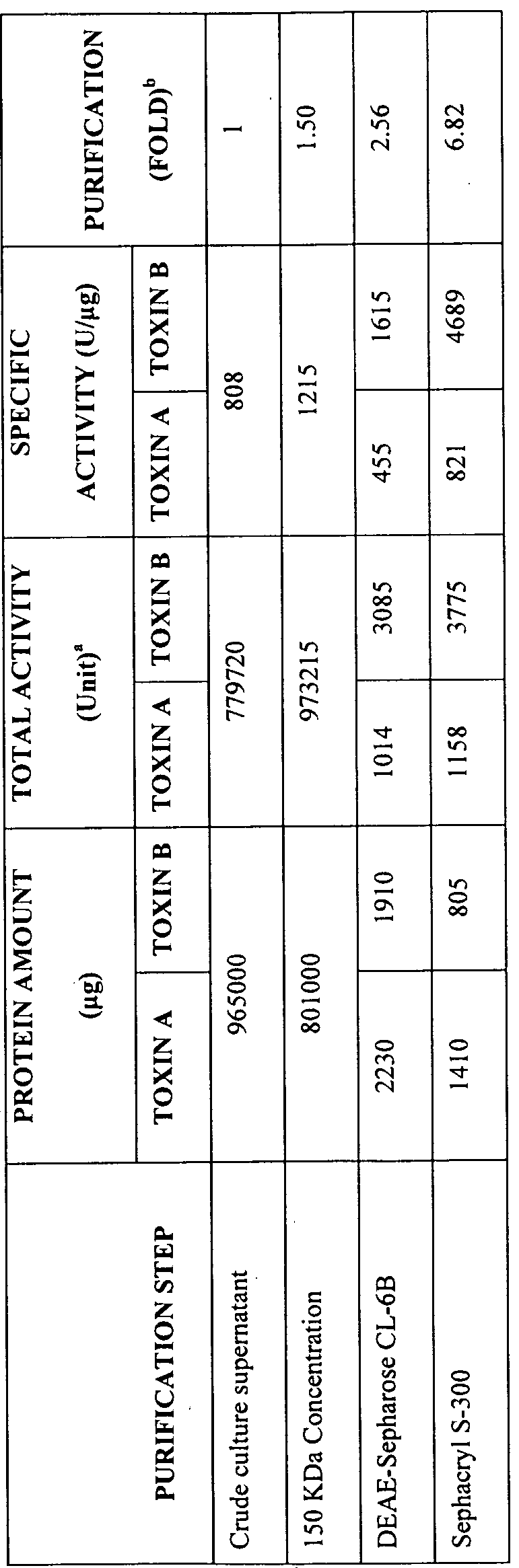
- the total PNPG substrate cleavage activities of the toxins from each of the purification steps are shown in Table 1 .
- the total enzyme units of cleavage activities of the toxins were enriched by 1 58-fold.
- the final substrate cleavage activities of the purified toxins were 0.821 U/mg and 4.7 U/mg for toxins A and B, respectively.
- the membrane was incubated with Biotin-XX goat anti-mouse IgG secondary antibody and following washing, incubated with the Qdot 625 streptavidin conjugate according to the manufacturer's instructions. Imaging and analysis of the treated membrane was performed using a UVP BioDoc-It Imaging system (Upland, CA).
- the Effect of pH and Temperature on Toxin A and B Activity (0078
- the pH experiments were performed using 5 different buffers to establish a wide range of buffering capacities. For the pH experiment, the following buffers were used: glycine-HCl buffer (pH 2-3); citrate buffer (pH 4-6); Tris-HCl buffer (pH 7-10); disodium phosphate-sodium hydroxide buffer (pH 1 1 - 12); and Cl-NaOH (pH 13).
- Each pH experiment was initiated by incubating 100 ⁇ g of toxin A or toxin B with 10 mM of PNPG, followed by incubation in the appropriate buffer at 37°C for 4 hrs. The reaction was monitored by measuring the absorbance at 410 nm.
- toxin A has 588 total charged residues out of 2710 residues, of which 54% and 46% are negatively and positively charged, respectively.
- Toxin B has more charged residues (597 out of a total of 2366 residues); 66% and 34% are negatively and positively charged, respectively.
- IEP isoelectric point
- Toxin A is computed to be more stable with an instability index (Guruprasad, K., et al., 1990.
- the activity of both toxins could be fit to the Michaelis-Menten curve, indicating a single active site reaction (Figure 5).
- the Michaelis-Menten constant (Km) values of the toxins for the PNPG substrate were determined by non-linear regression to be 1 .04 mM for toxin A and 0.24 mM for toxin B.
- the maximum velocity (Vmax) for toxin A was 1.5 ⁇ 3/ ⁇ 3 ⁇ 4/ ⁇ , whereas that for toxin B was 6.4 ⁇ 65/ ⁇ 3 ⁇ 4/ ⁇ .
- toxin-substrate interactions molecules or compounds that could inhibit the activities of toxins A and B were sought.
- compounds that inhibit the activity of C. difficile toxins A and B several compounds including sodium taurocholate, dimethyl sulfoxide, phenylmethylsulfonyl fluoride, and dimethyl formamide were tested. Different concentrations of these agents (0, 50, 100, 200 and 300 mM) were added to 55 ⁇ g of either toxin A or toxin B in buffer D in a total reaction volume of 300 ⁇ and incubated at 37°C for 10 minutes. After the toxin-inhibitor incubation period, 10 mM of the PNPG substrate was added and incubated at 37°C for 1 hr. Absorbance at 410 nm was measured and the percent inhibition was calculated as follows:
- C. difficile was isolated from clinical stool samples. Stool samples obtained from patients suspected to be infected by C. difficile were obtained from St. Luke's Hospital (Houston, Texas) in an I B-approved study.
- the isolates were not specifically typed to the strain level, but confirmed to be C. difficile based on PCR amplification of the genes that encode the toxins (tcdA and tcdB), as well as toxin production.
- Culture supernatants from 1 8 clinical isolates in addition to 4 ATCC strains [BAA- 1 805 (tcdA+/B+; NAP 1 ), 700057 (tcdA-/B+), 43255 (tcdA+/B+) and BAA- 1382 (tcdA+/B+)] were analyzed.
- toxin A (Forward 5'TGATGCTAATAATGAATCTAAAATGGTAAC3 ' (SEQ ID NO: 1) and Reverse- 5'ACCACCAGCTGCAGCCATA3'(SEQ ID NO: 2)); toxin B (Forward- 5 ' GTGTAGC A ATG A AGTCC A AGTTTACGC3 ' (SEQ ID NO: 3) and Reverse- 5'CACTTAGCTCTTTGATTGCTGCACCT3 '(SEQ ID NO: 4)) and 16S rRNA (Forwards' ACACGGTCCAAACTCCTACG3'(SEQ ID NO: 5) and Reverse- 5'AGGCGAGTTTCAGCCTACAA3'(SEQ ID NO: 6)).
- the DNA was amplified with an initial denaturation of 98°C for 30 sec and 36 cycles of 98°C for 10 sec, 62°C for 10 sec and 72°C for 10 sec with a final extension of 72°C for 1 min.
- the PCR products were analyzed using 1 .5% agarose gel electrophoresis.
- the Cdifftox Plate assay uses a novel selective and differential agar-based culture medium to specifically allow the growth of C. difficile and simultaneously identify colonies producing active toxins A and B, while inhibiting the growth of non-C. difficile colonies.
- Cdifftox Plate Assay Medium This agar-based culture medium was developed to specifically allow the growth of C. difficile and simultaneously identify toxins A- and B- producing colonies, while inhibiting the growth of non-C. difficile colonies. To identify a substrate that is stereochemical ly identical to UDP-glucose, the native substrate of the C. difficile toxins A and B, all the chromogenic substrates listed above were evaluated for cleavability and the stability of the product.
- CDPA Cdifftox Plate assay
- the CDPA medium can also be prepared with 37 g of BBL BHI broth, sodium taurocholate (0.1 %) (Sigma-Aldrich, St.
- CDPA plates Prior to application of the samples, the CDPA plates were placed in the anaerobic chamber for 4 hrs. Dimethly sulfoxide can be used to facilitate color development of the substrate cleavage product under anaerobic environment. However, color development can also be achieved by incubating the CDPA plates aerobically for at least 30 minutes.
- Cdifftox Plate Assay For the Cdifftox Plate assay, each stool sample was streaked directly onto two CDPA plates using a sterile loop. The plates were incubated anaerobically for 24-72 hrs at 37°C, until colonies appeared. The presumptive toxin-producing C. difficile colonies appeared blue while non-toxin producers remained pale white. The blue colonies were phenotypically classified as Tox + (presumably tcdA + and/or tcdB + ), whereas the pale white colonies were denoted Tox " (presumably tcdA ' and tcdB ' or mutants with genetic alterations that affect toxin production or activity).
- the assay was initially tested using the well-characterized toxigenic C. difficile strains ATCC 43255 (tcdA+/B+), ATCC BAA- 1382 (tcdA+/B+), ATCC 700057 (tcdA-/B+), and the hypervirulent strain, ATCC BAA 1805 (tcdA+/B+). After 24 hrs of incubation, colonies of these strains that were producing high levels of the toxins appeared blue (Tox + ), whereas those that were producing less toxins remained pale white (Tox " ), similar to the colonies shown in Figure 8. By 48 hrs, all the colonies had turned blue, indicating they were producing active toxins.
- the samples were also cultured on BHl-agar plates without antibiotics. All plates were incubated and grown for 1 -3 days under anaerobic conditions at 37°C. All 60 stool samples were spread directly onto each plate and incubated anaerobically at 37°C for 24-72 hrs.
- the CCFA and BH l-agar media allowed the growth of colonies from the same 50 of the 60 stool samples tested as the CDPA medium. Overall, more bacterial colonies were observed on the CCFA (approximately 1 5%) and BHl-agar media (about 40%) compared to the CDPA medium.
- non-Clostridium difficile bacteria were tested for growth under the same culture conditions as the clinical stool samples.
- the growth of non-Clostridium difficile bacteria on the CDPA medium under the standard conditions used for the stool samples was examined.
- the following strains were tested: Bacteroides fragilis, B. thetaiotaomicron, Campylobacter jejuni, C. perfringens, Enterobacter cloacae, enteropathogenic Escherichia coli, enterotoxigenic E.
- coli H I 0407 Lactobacillus spp, Plesiomonas shigelloides, Salmonella enteritica, Shigella flexneri, Staphylococcus aureus, Vibrio alginolyticus, V. parahaemolyticus, and Yersinia enterocolitica.
- rRNA 16S ribosomal RNA
- 1001031 Cdifftox Activity Assay The activity of toxins A- and B-producing C. difficile isolates was quantitated using the Cdifftox Activity assay described previously in Example 2. The assay was performed on 250 ⁇ of each sample supernatant fluid to which 100 ⁇ of the substrate reagent (10 mM p-nitrophenyl-P-D-glucopyranoside, 50 mM Tris-HCI, (pH 7.4), 50 mM NaCl, and 100 ⁇ MnCl 2 ) was added in a Costar sterile polystyrene 96-well plate (Corning Inc., NY).
- the substrate reagent 10 mM p-nitrophenyl-P-D-glucopyranoside, 50 mM Tris-HCI, (pH 7.4), 50 mM NaCl, and 100 ⁇ MnCl 2
- the Cdifftox Plate assay differentiates toxigenic from non-toxigenic C. difficile colonies via the activities of the toxins (either toxin A or B). To ensure that the Tox + C. difficile cells were able to secrete active toxins, the presence and activity of toxins in the culture supernatants of Tox + and Tox " isolates were evaluated. Toxin detection was performed on culture supernatants from three of each stool sample by EL1SA, an antibody- based assay, commonly used in clinical laboratories. Toxin detection and activity was tested of all the isolates by the Cdifftox Activity assay, described previously in Example 2.
- the Cdifftox Plate assay specifically and reliably detects toxigenic C. difficile in clinical stool samples.
- the Cdifftox Plate assay is advantageous in that it combines selective growth of the bacteria with the detection of the active toxins in a single step. Thus, drastically reducing the time and effort required to isolate and confirm an infection resulting from toxigenic C. difficile strains.
- identifying a patient infected with toxigenic C. difficile is done using a kit that contains all of the reagents required. All the materials and reagents required for conducting such determinations may be assembled together in a kit to facilitate the rapid and easy ' identification of patient samples containing toxigenic C. dijficile using the methods and reagents described in the examples above, such as but not limited to those of the Cdifftox Activity Assay and Cdifftox Plate Assay.
- the kit the user determines whether a particular sample of a patient's bodily fluid or a subculture of the sample contains functional C. difficile toxin ⁇ i.e., glucosyltransferase activity).
- These exemplary assays may be performed as two distinct assays or in combination or confirmatory of each another.
- the kit contains the necessary components for testing a bodily fluid for active C. difficile toxin, to determine whether the individual is infected with toxigenic C. difficile and in need of therapy.
- a test kit may have a single container or it may include individual containers for each reagent.
- test components are provided in the form of one or more liquid solutions, they are preferably provided as sterile aqueous solutions.
- Reagents may also be provided in dried or lyophilized forms. When reagents or components are provided as a dried form, reconstitution generally is by the addition of a suitable solvent.
- the solvent may be provided in another container means.
- the kit may also include one or more vials, test tubes, flasks, bottles, syringes or other suitable containers, into which the test reagent formulation is placed, preferably suitably allocated.
- a kit also comprises a second container for containing a sterile, pharmaceutically acceptable buffer or other diluent.
- the container may itself be a syringe, pipette, or other dispensing device that can be used for applying or mixing with other components of the kit.
- the kit also includes, or is packaged with, an instrument for signal detection and analysis.
- a kit includes suitable packaging for holding the various components (e.g., vials) in close confinement for commercial sale such as, for example, an injection or blow-molded plastic container in which the desired vials are retained. Instructions for use of the kit components may be provided in the kit.
- test strips are a logical expression of the described methods to facilitate assessment of C. difficile toxin levels.
- the principle behind the test strip is straightforward: the cleavable chromogenic substrate is bound to a solid support in such a way as to permit the C. difficile toxin to cleave it.
- the potential benefits of test strips in some cases include their user-friendly format, short time to provide test result, long-term stability over a wide range of climates, and relatively inexpensive production cost. These features make strip tests ideal for many applications such as home testing, rapid point of care testing, and testing in the field and during transport to a medical facility, or rapidly upon arrival at such a facility.
- test strips may provide reliable testing that might not otherwise be available to rural environments or third world countries.
- Gaucher's disease I I Studies on the kinetics of beta-glucosidase and the effects of sodium taurocholate in normal and Gaucher tissues. Pediatr Res 14: 54-59.
- Clostridium difficile toxins A and B are cation-dependent UDP-glucose hydrolases with differing catalytic activities. J Biol Chem 273: 16021 - 16026.
- Clostridium difficile toxins A and B can alter epithelial permeability and promote bacterial paracellular migration through HT-29 enterocytes. Shock 14:629-634.
- Clostridium difficile toxins more than mere inhibitors of Rho proteins. Int J Biochem Cell Biol 40: 592- 597.
- Clostridium difficile toxins mechanism of action and role in disease. Clin Microbiol Rev 18:247-263. Warny, M., J. Pepin, A. Fang, G. Killgore, A. Thompson, J. Brazier, E. Frost, and L. C. McDonald. 2005. Toxin production by an emerging strain of Clostridium difficile associated with outbreaks of severe disease in North America and Europe. Lancet 366: 1079- 1084.
- Clostridium difficile PCR ribotype 078 an emerging strain in humans and in pigs? J Clin Microbiol 46: 1 157; author reply 1 158.
- a One unit of toxin activity was defined as the amount of the toxins required to cleave one micromole of the PNPG substrate per hour under the experimental conditions.
Landscapes
- Chemical & Material Sciences (AREA)
- Life Sciences & Earth Sciences (AREA)
- Organic Chemistry (AREA)
- Health & Medical Sciences (AREA)
- Engineering & Computer Science (AREA)
- Zoology (AREA)
- Wood Science & Technology (AREA)
- Proteomics, Peptides & Aminoacids (AREA)
- Analytical Chemistry (AREA)
- General Engineering & Computer Science (AREA)
- Immunology (AREA)
- Microbiology (AREA)
- Molecular Biology (AREA)
- Biophysics (AREA)
- Physics & Mathematics (AREA)
- Genetics & Genomics (AREA)
- Biochemistry (AREA)
- Bioinformatics & Cheminformatics (AREA)
- Biotechnology (AREA)
- General Health & Medical Sciences (AREA)
- Toxicology (AREA)
- Measuring Or Testing Involving Enzymes Or Micro-Organisms (AREA)
- Investigating Or Analysing Biological Materials (AREA)
Abstract
Description

Claims
Priority Applications (5)
| Application Number | Priority Date | Filing Date | Title |
|---|---|---|---|
| CA 2837670 CA2837670A1 (en) | 2011-05-31 | 2012-05-31 | Methods and compositions for the detection of functional clostridium difficile toxins |
| EP12792248.2A EP2714923A4 (en) | 2011-05-31 | 2012-05-31 | METHODS AND COMPOSITIONS FOR THE DETECTION OF FUNCTIONAL DIFFICULT CLOSTRIDIUM TOXINS |
| AU2012262277A AU2012262277A1 (en) | 2011-05-31 | 2012-05-31 | Methods and compositions for the detection of functional clostridium difficile toxins |
| US14/123,197 US20150315627A1 (en) | 2011-05-31 | 2012-05-31 | Methods and compositions for the detection of functional clostridium difficile toxins |
| US15/632,619 US20180016616A1 (en) | 2011-05-31 | 2017-06-26 | Methods and compositions for the detection of functional clostridium difficile toxins |
Applications Claiming Priority (2)
| Application Number | Priority Date | Filing Date | Title |
|---|---|---|---|
| US201161491726P | 2011-05-31 | 2011-05-31 | |
| US61/491,726 | 2011-05-31 |
Related Child Applications (2)
| Application Number | Title | Priority Date | Filing Date |
|---|---|---|---|
| US14/123,197 A-371-Of-International US20150315627A1 (en) | 2011-05-31 | 2012-05-31 | Methods and compositions for the detection of functional clostridium difficile toxins |
| US15/632,619 Continuation US20180016616A1 (en) | 2011-05-31 | 2017-06-26 | Methods and compositions for the detection of functional clostridium difficile toxins |
Publications (2)
| Publication Number | Publication Date |
|---|---|
| WO2012166848A2 true WO2012166848A2 (en) | 2012-12-06 |
| WO2012166848A3 WO2012166848A3 (en) | 2013-03-28 |
Family
ID=47260299
Family Applications (1)
| Application Number | Title | Priority Date | Filing Date |
|---|---|---|---|
| PCT/US2012/040089 Ceased WO2012166848A2 (en) | 2011-05-31 | 2012-05-31 | Methods and compositions for the detection of functional clostridium difficile toxins |
Country Status (5)
| Country | Link |
|---|---|
| US (2) | US20150315627A1 (en) |
| EP (1) | EP2714923A4 (en) |
| AU (1) | AU2012262277A1 (en) |
| CA (1) | CA2837670A1 (en) |
| WO (1) | WO2012166848A2 (en) |
Cited By (5)
| Publication number | Priority date | Publication date | Assignee | Title |
|---|---|---|---|---|
| WO2014147628A1 (en) | 2013-03-21 | 2014-09-25 | Savyon Diagnostics Ltd. | Bacterial immunoassay |
| CN105838774A (en) * | 2016-05-31 | 2016-08-10 | 浙江省疾病预防控制中心 | Clostridium difficile chromogenic medium and application thereof |
| FR3074047A1 (en) * | 2017-11-30 | 2019-05-31 | Biomerieux | NON-IMPLANTABLE MEDICAL DEVICES INTEGRATING DEVICE FOR DETECTION AND / OR IDENTIFICATION OF MICROBIOLOGICAL INFECTIONS |
| FR3074046A1 (en) * | 2017-11-30 | 2019-05-31 | Biomerieux | DEVICES FOR DETECTION AND / OR IDENTIFICATION OF MICROBIOLOGICAL INFECTIONS, FOR NON-IMPLANTABLE MEDICAL DEVICES |
| EP4054561A4 (en) * | 2019-11-08 | 2023-12-20 | North Carolina State University | NETWORKING COMPOUNDS AND METHODS OF USE THEREOF |
Families Citing this family (2)
| Publication number | Priority date | Publication date | Assignee | Title |
|---|---|---|---|---|
| TWI820887B (en) * | 2022-08-31 | 2023-11-01 | 超極生技股份有限公司 | Method for detecting helicobacter pylori using an electrochemical test strip |
| TWI891033B (en) * | 2023-08-03 | 2025-07-21 | 超極生技股份有限公司 | Method for detecting helicobacter pylori using an electrochemical test strip |
Family Cites Families (6)
| Publication number | Priority date | Publication date | Assignee | Title |
|---|---|---|---|---|
| GB9609024D0 (en) * | 1996-05-01 | 1996-07-03 | Idg Uk Ltd | Compounds |
| US20040265947A1 (en) * | 1999-02-03 | 2004-12-30 | Alain Rambach | Method for detecting bacteria culture under anaerobic conditions |
| GB0306782D0 (en) * | 2003-03-25 | 2003-04-30 | Neutec Pharma Plc | Treatment of infection due to clostridium difficile |
| US20070004021A1 (en) * | 2004-06-28 | 2007-01-04 | Lawrence Restaino | Plating media for the identification of Yersinia pestis |
| FR2926563B1 (en) * | 2008-01-21 | 2013-04-26 | Biomerieux Sa | METHOD FOR DETECTION AND / OR IDENTIFICATION OF DIFFICULT CLOSTRIDIUM |
| EP2288719A4 (en) * | 2008-05-15 | 2012-01-11 | Univ Tufts | DIFFICULT CLOSTRIDIUM DIAGNOSTIC METHODS AND METHODS AND VECTORS FOR EXPRESSION OF RECOMBINANT TOXINS |
-
2012
- 2012-05-31 EP EP12792248.2A patent/EP2714923A4/en not_active Withdrawn
- 2012-05-31 US US14/123,197 patent/US20150315627A1/en not_active Abandoned
- 2012-05-31 CA CA 2837670 patent/CA2837670A1/en not_active Abandoned
- 2012-05-31 AU AU2012262277A patent/AU2012262277A1/en not_active Abandoned
- 2012-05-31 WO PCT/US2012/040089 patent/WO2012166848A2/en not_active Ceased
-
2017
- 2017-06-26 US US15/632,619 patent/US20180016616A1/en not_active Abandoned
Non-Patent Citations (1)
| Title |
|---|
| See references of EP2714923A4 * |
Cited By (8)
| Publication number | Priority date | Publication date | Assignee | Title |
|---|---|---|---|---|
| WO2014147628A1 (en) | 2013-03-21 | 2014-09-25 | Savyon Diagnostics Ltd. | Bacterial immunoassay |
| CN105838774A (en) * | 2016-05-31 | 2016-08-10 | 浙江省疾病预防控制中心 | Clostridium difficile chromogenic medium and application thereof |
| FR3074047A1 (en) * | 2017-11-30 | 2019-05-31 | Biomerieux | NON-IMPLANTABLE MEDICAL DEVICES INTEGRATING DEVICE FOR DETECTION AND / OR IDENTIFICATION OF MICROBIOLOGICAL INFECTIONS |
| FR3074046A1 (en) * | 2017-11-30 | 2019-05-31 | Biomerieux | DEVICES FOR DETECTION AND / OR IDENTIFICATION OF MICROBIOLOGICAL INFECTIONS, FOR NON-IMPLANTABLE MEDICAL DEVICES |
| WO2019106297A1 (en) * | 2017-11-30 | 2019-06-06 | bioMérieux | Devices for detecting and/or identifying microbiological infections, for non-implantable medical devices |
| WO2019106296A1 (en) * | 2017-11-30 | 2019-06-06 | Biomerieux | Non-implantable medical devices comprising a device for detecting and/or identifying microbiological infections |
| EP4054561A4 (en) * | 2019-11-08 | 2023-12-20 | North Carolina State University | NETWORKING COMPOUNDS AND METHODS OF USE THEREOF |
| US12502440B2 (en) | 2019-11-08 | 2025-12-23 | North Carolina State University | Cross-linking compounds and methods of use thereof |
Also Published As
| Publication number | Publication date |
|---|---|
| WO2012166848A3 (en) | 2013-03-28 |
| CA2837670A1 (en) | 2012-12-06 |
| EP2714923A4 (en) | 2015-07-08 |
| AU2012262277A1 (en) | 2013-12-19 |
| EP2714923A2 (en) | 2014-04-09 |
| US20150315627A1 (en) | 2015-11-05 |
| US20180016616A1 (en) | 2018-01-18 |
Similar Documents
| Publication | Publication Date | Title |
|---|---|---|
| US20180016616A1 (en) | Methods and compositions for the detection of functional clostridium difficile toxins | |
| Mattos-Graner et al. | Two-component signal transduction systems in oral bacteria | |
| Shin et al. | A multifaceted cellular damage repair and prevention pathway promotes high-level tolerance to β-lactam antibiotics | |
| Stevens et al. | Clostridium | |
| Gangaiah et al. | Polyphosphate kinase 2: a novel determinant of stress responses and pathogenesis in Campylobacter jejuni | |
| Mindolli | Dentification and Speciation of Acinetobacter and their Antimicrobial Susceptibility Testing | |
| Yonogi et al. | Development and application of a multiplex PCR assay for detection of the Clostridium perfringens enterotoxin-encoding genes cpe and becAB | |
| Darkoh et al. | Harnessing the glucosyltransferase activities of Clostridium difficile for functional studies of toxins A and B | |
| Darkoh et al. | Novel one-step method for detection and isolation of active-toxin-producing Clostridium difficile strains directly from stool samples | |
| Sommermeyer et al. | Clostridioides Difficile: Infections, Risk Factors, Prevention and Treatment | |
| Nibogora | Demographic Characteristics, Phenotypic and Genotypic Characterization of Antibiotic Resistant Klebsiella pneumoniae Isolated from Clinical Samples at The Nairobi Hospital, Kenya | |
| Sankaran et al. | Apyrase-based colorimetric test for detection of Shigella and enteroinvasive Escherichia coli in stool | |
| Darkoh | Regulation of toxin synthesis by Clostridium difficile | |
| Guiral Vilalta | Interplay of virulence, antibiotic resistance and epidemiology in Escherichia coli clinical isolates | |
| Soldavini Pelichotti et al. | Characterization of a Clostridioides difficile ST-293 isolate from a recurrent infection in Argentina | |
| Anglim et al. | Nosocomial diarrhea due to Clostridium difficile | |
| Mahmood | Investigation of the molecular mechanisms of metronidazole and β-lactam antibiotic resistance of Bacteroides species | |
| Allen et al. | Current issues and problems in dealing with anaerobes in the clinical laboratory | |
| Norris | Rho-Mediated Transcription Termination in Clostridioides difficile Phase Variation | |
| Warren Norris | Rho-mediated transcription termination in Clostridioides difficile phase variation | |
| Rao | Characterisation and Antimicrobial Susceptibility Pattern with Special Reference to Vancomycin Resistance in Various Clinical Isolates of Enterococci | |
| Mutuku | Molecular Characterization And Antimicrobial Resistance Patterns Of Enterococcus Species Isolated From Patients Attending Aga Khan Hospital, Nairobi, Kenya. | |
| Kalacheva et al. | Risk Factors in Diagnosing Clostridioides difficile Infections | |
| Martins | Cooperation between endogenous and an acquired penicillin-binding protein during spore differentiation in clinical isolates of Clostridioides difficile | |
| Almuttairi | Molecular Study of Metallo-β-lactamases with Integron Class I of Pseudomonas aeruginosa Isolates |
Legal Events
| Date | Code | Title | Description |
|---|---|---|---|
| 121 | Ep: the epo has been informed by wipo that ep was designated in this application |
Ref document number: 12792248 Country of ref document: EP Kind code of ref document: A2 |
|
| ENP | Entry into the national phase |
Ref document number: 2837670 Country of ref document: CA |
|
| NENP | Non-entry into the national phase |
Ref country code: DE |
|
| REEP | Request for entry into the european phase |
Ref document number: 2012792248 Country of ref document: EP |
|
| WWE | Wipo information: entry into national phase |
Ref document number: 2012792248 Country of ref document: EP |
|
| ENP | Entry into the national phase |
Ref document number: 2012262277 Country of ref document: AU Date of ref document: 20120531 Kind code of ref document: A |
|
| WWE | Wipo information: entry into national phase |
Ref document number: 14123197 Country of ref document: US |