WO2012169256A1 - Procédé de production d'une poudre granulée de molybdène et poudre granulée de molybdène - Google Patents
Procédé de production d'une poudre granulée de molybdène et poudre granulée de molybdène Download PDFInfo
- Publication number
- WO2012169256A1 WO2012169256A1 PCT/JP2012/057347 JP2012057347W WO2012169256A1 WO 2012169256 A1 WO2012169256 A1 WO 2012169256A1 JP 2012057347 W JP2012057347 W JP 2012057347W WO 2012169256 A1 WO2012169256 A1 WO 2012169256A1
- Authority
- WO
- WIPO (PCT)
- Prior art keywords
- molybdenum
- granulated powder
- powder
- average particle
- producing
- Prior art date
- Legal status (The legal status is an assumption and is not a legal conclusion. Google has not performed a legal analysis and makes no representation as to the accuracy of the status listed.)
- Ceased
Links
Images


Classifications
-
- C—CHEMISTRY; METALLURGY
- C22—METALLURGY; FERROUS OR NON-FERROUS ALLOYS; TREATMENT OF ALLOYS OR NON-FERROUS METALS
- C22C—ALLOYS
- C22C27/00—Alloys based on rhenium or a refractory metal not mentioned in groups C22C14/00 or C22C16/00
- C22C27/04—Alloys based on tungsten or molybdenum
-
- B—PERFORMING OPERATIONS; TRANSPORTING
- B22—CASTING; POWDER METALLURGY
- B22F—WORKING METALLIC POWDER; MANUFACTURE OF ARTICLES FROM METALLIC POWDER; MAKING METALLIC POWDER; APPARATUS OR DEVICES SPECIALLY ADAPTED FOR METALLIC POWDER
- B22F1/00—Metallic powder; Treatment of metallic powder, e.g. to facilitate working or to improve properties
-
- B—PERFORMING OPERATIONS; TRANSPORTING
- B22—CASTING; POWDER METALLURGY
- B22F—WORKING METALLIC POWDER; MANUFACTURE OF ARTICLES FROM METALLIC POWDER; MAKING METALLIC POWDER; APPARATUS OR DEVICES SPECIALLY ADAPTED FOR METALLIC POWDER
- B22F1/00—Metallic powder; Treatment of metallic powder, e.g. to facilitate working or to improve properties
- B22F1/10—Metallic powder containing lubricating or binding agents; Metallic powder containing organic material
- B22F1/107—Metallic powder containing lubricating or binding agents; Metallic powder containing organic material containing organic material comprising solvents, e.g. for slip casting
-
- B—PERFORMING OPERATIONS; TRANSPORTING
- B22—CASTING; POWDER METALLURGY
- B22F—WORKING METALLIC POWDER; MANUFACTURE OF ARTICLES FROM METALLIC POWDER; MAKING METALLIC POWDER; APPARATUS OR DEVICES SPECIALLY ADAPTED FOR METALLIC POWDER
- B22F9/00—Making metallic powder or suspensions thereof
- B22F9/02—Making metallic powder or suspensions thereof using physical processes
-
- B—PERFORMING OPERATIONS; TRANSPORTING
- B22—CASTING; POWDER METALLURGY
- B22F—WORKING METALLIC POWDER; MANUFACTURE OF ARTICLES FROM METALLIC POWDER; MAKING METALLIC POWDER; APPARATUS OR DEVICES SPECIALLY ADAPTED FOR METALLIC POWDER
- B22F2301/00—Metallic composition of the powder or its coating
- B22F2301/20—Refractory metals
Definitions
- the present invention relates to a method for producing molybdenum granulated powder and molybdenum granulated powder.
- Molybdenum (Mo) is used in various fields as a heat resistant material because it has a high melting point of 2620 ° C.
- it is used as a constituent material for thermal spraying materials, sintering furnace plates, electrode parts, magnetron stems, sputtering targets, and the like.
- the thermal spray material with Mo powder or Mo rod.
- the plate material may be manufactured by sintering, or may be manufactured by combining rolling and forging.
- an electrode component etc. may be manufactured by the case where a board
- Patent Document 1 discloses a sintered electrode for a cold cathode tube having a U-shaped cross section (cup shape).
- Patent Document 1 a cup-shaped electrode having a diameter of about 1 to 2 mm is manufactured using a sintering method.
- a sintering method When producing a sintered compact by a sintering method, a granulation process, a formation process, a degreasing process, a sintering process, etc. are implemented with respect to Mo powder. So far, in the sintering method, the improvement has been advanced mainly on the improvement of the degreasing process and the sintering process.
- paragraph [0027] of Patent Document 1 it is disclosed that the degreasing step is performed in a wet hydrogen atmosphere while the sintering step is performed in a hydrogen atmosphere. As a result, the sinterability is increased and the yield is improved.
- Patent Document 2 of International Publication WO2011 / 004887A1 discloses a method for producing high-purity molybdenum powder having an average particle size of 0.5 to 100 ⁇ m.
- Patent Document 2 discloses a molybdenum powder in which the proportion of primary particles is 50% or more.
- the improvement regarding Mo raw material powder, a degreasing process, and a sintering process has been advanced.
- the product yield has not necessarily reached 100%.
- Such a phenomenon also occurred in the same way for a Mo sintered body using Mo powder to which a dopant such as potassium was added.
- the inventors have investigated the reason why the yield of products using Mo powder as an initial raw material is not improved. As a result, it has been found that if there are large variations in the size, density, fluidity, etc. of the granulated powder, the raw powder filling density and supply amount in the molding process will vary, causing a decrease in product yield. Further, when Mo granulated powder is used as the thermal spray powder, the supply amount (supply speed) to the thermal spray flame varies, and there is a problem that the characteristics as the thermal spray film are not stabilized. As a result of pursuing this cause, it was found that there was a cause that the management according to the average particle size of the intended granulated powder was not performed in the granulation step.
- the present invention is for solving such problems, and provides a method for efficiently producing molybdenum granulated powder, which can improve the quality and yield of Mo products (powder or sintered body). Is to do.
- a method for producing a molybdenum granulated powder according to an embodiment of the present invention includes a step of putting an organic solvent in a container, a step of adding polyvinyl butyral as a binder to the organic solvent, and stirring the organic solvent while potassium component.
- the rotational speed of A is set to A (rpm) and the average particle diameter of the granulated powder is set to B ( ⁇ m)
- the molybdenum-containing solution is put into a spray dryer in which A / B is in the range of 50 to 700,
- a step of dispersing molybdenum-containing solution and drying to prepare molybdenum granulated powder is.
- a sieving step of passing a sieve having a mesh diameter 2 to 3 times the average particle size B of the molybdenum granulated powder after completion of the granulation step by a spray dryer is preferable to further carry out.
- the average particle diameter B of the molybdenum granulated powder is preferably 20 to 150 ⁇ m.
- the rotational speed A of the rotating plate of the spray dryer is preferably 5000 to 16000 rpm.
- an organic solvent is ethanol.
- the content (addition amount) of the potassium component is preferably in the range of 100 to 1000 ppm by mass in terms of potassium element alone.
- the content of the aluminum component is preferably in the range of 100 to 1000 ppm by mass in terms of a single aluminum element.
- the content of the silicon component is preferably in the range of 100 to 1000 ppm by mass in terms of silicon element.
- the volume of the binder is preferably 3 to 20 parts by volume.
- the apparent density of the resulting molybdenum granulated powder is preferably 1.3 to 3.0 g / cc.
- the molybdenum-containing solution preferably has an organic solvent amount of 0.2 to 1 liter when the molybdenum powder amount is 100 parts by mass.
- the spray dryer preferably dries the molybdenum granulated powder while supplying hot air at 100 to 300 ° C. Moreover, it is preferable that the spray drier carries out the drying of the molybdenum granulated powder in a reduced-pressure atmosphere below atmospheric pressure. Moreover, it is preferable that the fluidity of the obtained granulated powder is 50 sec / 50 g or less.
- the molybdenum granulated powder according to the present invention is characterized in that it contains at least one of a potassium component, an aluminum component, and a silicon component and has an apparent density of 1.3 to 3.0 g / cc.
- the average particle diameter of the molybdenum granulated powder is preferably 20 to 150 ⁇ m.
- the volume of the binder is preferably 3 to 20 parts by volume.
- the fluidity of the molybdenum granulated powder is preferably 50 sec / 50 g or less.
- the method for producing molybdenum granulated powder according to the present invention in the granulation step, while stirring the organic solvent, the dopant-added molybdenum powder and the binder are supplied, and the average particle diameter of the intended granulated powder is further increased. Since the rotation speed of the spray dryer is controlled within a predetermined range, molybdenum granulated powder having excellent average particle diameter, apparent density and fluidity can be efficiently produced with a high yield.
- the method for producing molybdenum granulated powder according to an embodiment of the present invention includes a step of adding an organic solvent to a container, a step of adding polyvinyl butyral as a binder to the organic solvent, and stirring the organic solvent while potassium is added.
- a step of preparing a molybdenum-containing solution by introducing a molybdenum powder having an average particle diameter of 1 to 10 ⁇ m to which at least one of a component, an aluminum component and a silicon component is added, and rotation of a spray dryer for dispersing the molybdenum-containing solution
- the rotational speed of the plate is A (rpm)
- the average particle diameter of the granulated powder is B ( ⁇ m)
- the molybdenum-containing solution is put into a spray dryer in which A / B is in the range of 50 to 700
- a step of dispersing the molybdenum-containing solution and drying to prepare a molybdenum granulated powder It is.
- reference numeral 1 is a container (a container for preparing a molybdenum-containing solution)
- 2 is an organic solvent
- 3 is a molybdenum powder (dope-containing molybdenum powder)
- 4 is a binder
- 5 is An organic solvent is charged again as necessary
- 6 is a molybdenum-containing solution.
- the organic solvent 2 is injected into the container 1.
- Alcohol etc. can be used as this organic solvent.
- ethanol ethyl alcohol: C 2 H 5 OH
- Ethyl alcohol is preferable because it easily dissolves a binder (polyvinyl butyral) described later.
- a step of adding the binder 4 to the organic solvent 2 is performed.
- Polyvinyl butyral (PVB) is used as the material of the binder.
- Polyvinyl butyral is readily soluble in organic solvents, especially ethanol.
- a binder stirring an organic solvent.
- a step of preparing a molybdenum-containing solution is performed by adding molybdenum powder having an average particle diameter of 1 to 10 ⁇ m while stirring the organic solvent.
- the average particle size of the molybdenum powder is the average particle size of the primary particle size.
- the value obtained by the FSSS method Fischer method is defined as the average particle size.
- the average particle size of the molybdenum powder is 1 to 10 ⁇ m. Further, 2 to 5 ⁇ m is preferable.
- a small amount for example, 0.5 to 2 kg.
- molybdenum powder after confirming that the entire amount of the binder is dissolved in the organic solvent.
- the binder When the binder is added in a powder state, it can be visually discriminated whether or not it is dissolved.
- polyvinyl butyral powder is used as the binder, when the polyvinyl butyral powder is completely dissolved in the organic solvent (ethanol), the organic solvent (ethanol) before adding the molybdenum powder becomes translucent. In order to make it easy to determine whether or not the binder is completely dissolved in the organic solvent (ethanol), it is preferable to add the molybdenum powder after the binder is added.
- the volume of the binder is 3 to 20 parts by volume. It is preferable to do.
- the binder serves as an adhesive that bonds the molybdenum powders together when forming the molybdenum granulated powder. Therefore, when the total amount of molybdenum powder is 100 parts by volume, if the amount of binder added is less than 3 parts by volume, the amount of binder may be too small to obtain uniform granulated powder.
- the addition amount of a binder exceeds 20 volume part, a binder will enter too much into the clearance gap between molybdenum powders, and it will become a granulated powder with a large dispersion
- the molybdenum-containing solution preferably has an organic solvent amount of 0.2 to 1 liter when the molybdenum powder amount is 100 parts by mass.
- the spray dryer is charged in a molybdenum-containing solution.
- the amount of the organic solvent is less than 0.2 liter with respect to 100 parts by mass of the molybdenum powder, the amount of the organic solvent is too small and the viscosity of the molybdenum-containing solution increases, and it is difficult to stably supply it to the spray dryer.
- the amount of the organic solvent exceeds 1 liter, the amount of the organic solvent is too large and stable supply is difficult.
- the amount of the organic solvent is large, there is also a method of stably supplying by supplying with stirring.
- the supply of the molybdenum-containing solution to the spray dryer can be mechanized and automated.
- ethanol has a relatively low boiling point of 78.3 ° C.
- the amount of solvent may change greatly due to evaporation of ethanol when a binder and molybdenum powder are added and mixed.
- the amount of the organic solvent is mixed with the binder and the molybdenum powder at 30 to 60% of the final amount, and then the remaining amount of the organic solvent.
- a method of adjusting the blending amount of molybdenum powder and the amount of organic solvent by additionally adding 70 to 40% is also possible. In order to make it easy to visually confirm whether or not the binder is completely dissolved in the organic solvent, it is effective to add the organic solvent.
- the molybdenum powder of the present invention is a molybdenum powder to which at least one of a potassium component, an aluminum component, and a silicon component is added.
- a potassium component aluminum component, or silicon component, compounds such as simple elements, oxides, and complex oxides are used, respectively.
- the content (addition amount) of the potassium component is preferably in the range of 100 to 1000 ppm by mass in terms of potassium element alone.
- the content of the aluminum component is preferably in the range of 100 to 1000 ppm by mass in terms of an aluminum element.
- the content of the silicon component is preferably in the range of 100 to 1000 ppm by mass in terms of silicon element. If the amount is less than 100 ppm by mass, the effect of addition is small.
- a dopant may be 1 type or may add 2 or more types.
- a potassium component, an aluminum component, and a silicon component are components called a dopant.
- the recrystallization temperature is increased and the high temperature strength is increased as compared with high purity molybdenum.
- secondary workability such as a drawing process to a wire, improves.
- Secondary processing includes wire bending processing, wire bending processing, plate material (plate material made of Mo sintered body) rolling processing, bending processing, punching processing, and the like. Further, the wire characteristics can improve non-sag, high-temperature vibration resistance, and blackening resistance.
- ammonium dimolybdate (NH 4 ) 2 .Mo 2 O 7 )
- Mo oxide is prepared as a raw material for molybdenum powder, and heated at a temperature of 600 to 750 ° C. in a hydrogen stream to obtain Mo oxide.
- Potassium silicate is added to the Mo oxide so that the amount of elemental potassium element per elemental Mo is 100 to 1000 ppm by mass.
- pure water is added, kneaded, heated to 100-140 ° C. with stirring, and dried to obtain a dopant-added molybdenum oxide powder.
- the dopant-added molybdenum oxide powder can be obtained by heating and reducing the dopant-added molybdenum oxide powder at a temperature of 1000 to 1200 ° C. for 2 to 5 hours in a hydrogen atmosphere.
- the above shows an example in which potassium is added as a dopant.
- silicon or aluminum is added as a dopant, silicon alone or a silicon compound, and aluminum alone or an aluminum compound are added, respectively.
- potassium silicate was used as the potassium component, the invention is not limited to this, and other potassium compounds may be used.
- when adding 2 or more types of potassium, aluminum, and silicon what is necessary is just to add each element or compound and to obtain a dopant addition molybdenum powder.
- the purity of the dopant-added molybdenum powder is not particularly limited, but the total of Mo and the dopant is preferably 99% by mass or more, and more preferably 99.9% by mass or more.
- Main impurities of the molybdenum powder include Fe (iron), Ca (calcium), and Mg (magnesium).
- Other impurities include Ni (nickel), Na (sodium), Pb (lead), Bi (bismuth), Cd (cadmium), Cu (copper), Mn (manganese), and Sn (tin). It is done.
- the measurement of the purity of molybdenum is Fe (iron), Ca (calcium), Mg (magnesium), Ni (nickel), Na (sodium), Pb (lead), Bi (bismuth), Cd (cadmium), Cu (copper) ), Mn (manganese) and Sn (tin) are subtracted from 100% by mass.
- Fe (iron) is 10 mass ppm (wtppm) or less
- Ca (calcium) is 30 mass ppm or less
- Mg (magnesium) is 20 mass ppm or less
- Ni (nickel) is 50 mass ppm.
- Na (sodium) is 10 mass ppm or less
- Pb (lead) is 70 mass ppm or less
- Bi (bismuth) is 70 mass ppm or less
- Cd (cadmium) is 70 mass ppm or less
- Cu (copper) is 70 mass ppm.
- Mn (manganese) is 20 mass ppm or less
- Sn (tin) is 30 mass ppm or less.
- gas components, such as oxygen are mentioned as impurities other than the said metal impurity. While the amount of oxygen is 7% by mass or less, the amount of nitrogen is preferably 7% by mass or less.
- FIG. 2 shows an example of a granulation process using a spray dryer.
- reference numeral 1 is a container containing a molybdenum-containing solution
- 6 is a molybdenum-containing solution
- 7 is an inlet for a molybdenum-containing aqueous solution
- 8 is a rotating plate
- 9 is a molybdenum granulated powder.
- Reference numeral 10 denotes an outer wall of the spray dryer
- reference numeral 11 denotes a molybdenum granulated powder collection container.
- the molybdenum-containing solution 6 prepared in the above process is poured into the charging port 7.
- the charging speed to the charging port 7 is preferably 10 to 80 cc / min.
- the input speed is less than 10 cc / min, the input amount is too small and the mass productivity is deteriorated.
- the charging speed exceeds 80 cc / min, the charging amount becomes excessive and the characteristics of the resulting granulated powder vary.
- the charged molybdenum-containing solution 6 is supplied onto the rotating plate 8.
- the rotating plate 8 rotates at a constant rotational speed.
- the molybdenum-containing solution 6 is supplied to the rotating rotating plate 8, it is repelled by a certain amount, and spherical molybdenum granulated powder 9 is formed by surface tension.
- the molybdenum granulated powder 9 falls along the outer wall 10 of the spray dryer and is collected in a molybdenum granulated powder collection container 11.
- the average particle diameter of the molybdenum granulated powder is highly related to the rotation speed of the rotating plate 8.
- a / B is controlled in the range of 50 to 700. It is characterized by.
- the molybdenum-containing solution 6 is supplied to the rotating plate 8, the molybdenum-containing solution 6 is repelled by a certain amount on the rotating plate 8, and the repelled molybdenum-containing solution 6 becomes spherical molybdenum granulated powder due to surface tension.
- uniform granulated powder can be manufactured also from having added the binder.
- the ratio A / B is less than 50, the rotational speed of the rotating plate is insufficient with respect to the average particle diameter of the intended granulated powder, and thus the average particle diameter B of the intended granulated powder is obtained. Absent. Moreover, when A / B is less than 50, it becomes a granulated powder having a larger average particle diameter than the average particle diameter B of the intended granulated powder. On the other hand, when A / B exceeds 700, the rotation speed of the rotating plate is too high with respect to the average particle diameter of the intended granulated powder, and thus the average particle diameter B of the intended granulated powder cannot be obtained.
- a / B exceeds 700, it becomes a small average particle diameter with respect to the average particle diameter B of the intended granulated powder.
- a / B exceeds 700, it becomes a small average particle diameter with respect to the average particle diameter B of the intended granulated powder.
- a granulated powder having an average particle diameter in the range of ⁇ 50% with respect to the average particle diameter B of the intended granulated powder can be obtained.
- the average particle size B of the intended granulated powder is 50 ⁇ m
- the average particle diameter of granulated powder uses an enlarged photograph, and makes the maximum diameter of the granulated powder reflected there the particle diameter, and the average value of 100 granulated powder is the average particle diameter of the granulated powder.
- the average particle size B of the molybdenum granulated powder is preferably 20 to 150 ⁇ m. If the average particle diameter of the molybdenum granulated powder is in the range of 20 to 150 ⁇ m, it can be applied to various applications. Further, the rotational speed A of the rotary plate 8 of the spray dryer is preferably 5000 to 16000 rpm. When the rotational speed A is in the range of 5000 to 16000 rpm, the molybdenum-containing solution is efficiently repelled on the rotating plate, and molybdenum granulated powder having a target average particle diameter can be easily obtained.
- the spray dryer preferably dries the molybdenum granulated powder while supplying hot air at 100 to 300 ° C.
- hot air By supplying hot air of 100 to 300 ° C. into the outer wall of the spray dryer, the organic solvent in the granulated powder can be evaporated, and the binding force between the molybdenum powders by the binder can be enhanced.
- molybdenum granulated powder having a target average particle diameter and high structural strength can be produced.
- the hot air is supplied into the outer wall 10 of the spray dryer from a hot air supply port (not shown) and exhausted from an exhaust port (not shown).
- the spray dryer performs drying of the molybdenum granulated powder in a reduced-pressure atmosphere of atmospheric pressure or lower.
- a reduced-pressure atmosphere of atmospheric pressure or lower By setting the inside of the outer wall 10 of the spray dryer to a reduced-pressure atmosphere of atmospheric pressure or less, the organic solvent in the granulated powder can be easily evaporated.
- the rotation speed of the rotating plate of the spray dryer is adjusted in accordance with the average particle diameter of the granulated powder, ⁇ A molybdenum granulated powder having a particle size in the range of 50% can be obtained.
- the apparent density of the resulting molybdenum granulated powder is preferably 1.3 to 3.0 g / cc.
- the average particle diameter of the molybdenum granulated powder is measured using an enlarged photograph. If it is this measuring method, the average particle diameter on an external appearance can be judged.
- the abundance ratio of the molybdenum powder partially varies. Arise. Variation in the existence ratio leads to variation in the product. For example, when granulated powder is used for the thermal spraying powder, if there are granulated powders with significantly different densities, the amount of molybdenum powder introduced into the flame flame flame will vary, resulting in variations in the characteristics of the thermal sprayed Mo film. Cause. Moreover, when producing a sintered compact, the amount of molybdenum with which a molding die is filled varies and the pores in the sintered compact may become larger than necessary.
- the apparent density of the molybdenum granulated powder is less than 1.3 g / cc, the amount of molybdenum in the granulated powder is too small, which causes variations in quality in subsequent product production.
- the apparent density exceeds 3.0 g / cc, the molybdenum powder is tightly packed, so that it is difficult to stably manufacture with a spray dryer.
- the apparent density is measured by a measuring method based on JIS-Z-2504.
- liquidity of the obtained molybdenum granulated powder is 50 sec / 50g or less. This fluidity measurement is also performed by a measuring method based on JIS-Z-2504.
- the fluidity is an index indicating how smoothly and quickly the granulated powder moves (flows).
- the fluidity is good (fluidity 50 sec / 50 g or less)
- the supply and filling into the molding die when commercialized can be carried out smoothly and rapidly.
- the granulated powder has good handleability.
- liquidity is good means that the shape of molybdenum granulated powder is close to a sphere.
- the aspect ratio is 1.5 or less.
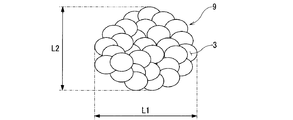
- FIG. 3 shows an example of molybdenum granulated powder.
- reference numeral 3 denotes a molybdenum powder
- 9 denotes a molybdenum granulated powder
- L1 denotes a short diameter of the molybdenum granulated powder
- L2 denotes a long diameter.
- the aspect ratio is calculated by “major axis L2 / minor axis L1”. An aspect ratio of 1.0 indicates a state close to a true sphere.
- the molybdenum granulated powder excellent in average particle diameter, apparent density, and fluidity
- the mesh diameter is 2 to 3 times the average particle diameter B of the granulated powder after completion of the granulation process by a spray dryer.
- a sieving step By carrying out this sieving step, excessive granulated powder can be removed. Thereby, the stricter control of the average particle diameter becomes possible. It is also effective to remove excessive granulated powder by a sieving step.
- molybdenum granulated powder having excellent average particle diameter, apparent density, and fluidity can be efficiently produced with a high yield. Therefore, the granulated powder according to each product can be manufactured with a good yield.
- Applications of these molybdenum granulated powders include powders for thermal spraying and raw material powders for various sintered bodies. By using molybdenum granulated powder with excellent average particle diameter, apparent density and fluidity as the powder for thermal spraying, the supply amount (feed speed) of the molybdenum granulated powder to the thermal spray flame can be stabilized. .
- molybdenum granulated powder for molding molds can be obtained by using molybdenum granulated powder with excellent average particle diameter, apparent density and fluidity. Can be homogenized. As a result, the density of the sintered body can be stabilized. In particular, the yield can be further improved by changing the average particle diameter according to the shape of the molding die.
- the average particle diameter of the granulated powder is set to about 50 ⁇ m, whereas in the sintered body having a thickness of about 5 mm, the average particle diameter of the granulated powder is set to about 100 ⁇ m. As a result, it is possible to efficiently fill the molding die.
- Example 1 (Examples 1 to 5 and Comparative Examples 1 and 2) A dopant-added molybdenum powder shown in Table 1 and polyvinyl butyral (PVB) powder and ethanol were prepared as binders. Ethanol was poured into a stainless steel container and the polyvinyl butyral powder was added while stirring at room temperature to dissolve all the added polyvinyl butyral powder. When all the polyvinyl butyral powder was dissolved, it was confirmed that the solution was a translucent solution. Thereafter, a total of 40 kg of molybdenum powder was added in an amount of 1-2 kg. When the molybdenum powder was agitated, ethanol was additionally added as needed for the shortage of ethanol evaporation. Examples 1 to 5 were molybdenum-containing solutions using polyvinyl alcohol powder as a binder. The conditions for the preparation steps of the molybdenum-containing solution so far are shown in Tables 1 and 2 below.
- the average particle diameter, aspect ratio, apparent density, fluidity and product yield of the granulated molybdenum powder obtained by the production methods of Examples 1A-5B and Comparative Examples 1-2 were investigated.
- the average particle size was obtained by extracting 100 arbitrary particles of the obtained molybdenum granulated powder, taking an enlarged photograph, obtaining the maximum diameter reflected therein, and taking the average value of 100 particles as the average particle size.
- the aspect ratio used the same enlarged photograph, calculated
- the apparent density and fluidity were measured by a measuring method based on JIS-Z-2504.
- the product yield was calculated from the ratio of the amount of molybdenum powder charged to 40 kg and the total amount of recovered molybdenum granulated powder ((total amount of granulated powder / 40 kg) ⁇ 100%). The measurement results are shown in Table 4 below.
- the molybdenum granulated powder produced by the method for producing molybdenum granulated powder according to each example has a small deviation from the target average particle diameter B, and has an aspect ratio and an apparent appearance. The density and fluidity were excellent. In addition, it was confirmed that the production method was high in yield and efficient. On the other hand, in Comparative Example 1 and Comparative Example 2 where A / B is outside the specified range in the present invention, both parameters showed a deteriorated characteristic.
Landscapes
- Chemical & Material Sciences (AREA)
- Engineering & Computer Science (AREA)
- Materials Engineering (AREA)
- Mechanical Engineering (AREA)
- Metallurgy (AREA)
- Organic Chemistry (AREA)
- Powder Metallurgy (AREA)
- Glanulating (AREA)
Abstract
L'invention concerne un procédé de production d'une poudre granulée de molybdène caractérisé en ce qu'il comporte : une étape consistant à placer un solvant organique dans un contenant ; une étape consistant à ajouter du butyral polyvinylique dans le solvant organique pour servir de liant ; une étape consistant à préparer une solution contenant du molybdène en chargeant de la poudre de molybdène ayant une taille moyenne des particules de 1 à 10 μm, à laquelle au moins l'un parmi un composant de potassium, un composant d'aluminium et un composant de silicium a été ajouté, tout en mélangeant le solvant organique ; et une étape consistant à charger la solution contenant du molybdène dans un sécheur par pulvérisation où, quand la vitesse de rotation d'un rotateur du sécheur par pulvérisation dans lequel la solution contenant du molybdène doit être dispersée est considérée comme étant A (tr/min), et quand la taille moyenne des particules de la poudre granulée est considérée comme étant B (μm), le rapport A/B va de 50 à 700, et à disperser et sécher la solution contenant du molybdène pour préparer la poudre granulée de molybdène. Le procédé mentionné ci-dessus permet de produire une poudre granulée de molybdène ayant la taille moyenne de particules prévue de manière efficace à haut rendement.
Applications Claiming Priority (2)
| Application Number | Priority Date | Filing Date | Title |
|---|---|---|---|
| JP2011-128730 | 2011-06-08 | ||
| JP2011128730 | 2011-06-08 |
Publications (1)
| Publication Number | Publication Date |
|---|---|
| WO2012169256A1 true WO2012169256A1 (fr) | 2012-12-13 |
Family
ID=47295829
Family Applications (1)
| Application Number | Title | Priority Date | Filing Date |
|---|---|---|---|
| PCT/JP2012/057347 Ceased WO2012169256A1 (fr) | 2011-06-08 | 2012-03-22 | Procédé de production d'une poudre granulée de molybdène et poudre granulée de molybdène |
Country Status (2)
| Country | Link |
|---|---|
| JP (1) | JPWO2012169256A1 (fr) |
| WO (1) | WO2012169256A1 (fr) |
Citations (8)
| Publication number | Priority date | Publication date | Assignee | Title |
|---|---|---|---|---|
| JPS59150073A (ja) * | 1983-02-10 | 1984-08-28 | Toshiba Corp | 高温熱処理用モリブデン治具の製造方法 |
| JPS59150070A (ja) * | 1983-02-10 | 1984-08-28 | Toshiba Corp | モリブデン材の製造方法 |
| JPH0198764A (ja) * | 1987-10-08 | 1989-04-17 | Teikoku Piston Ring Co Ltd | シリンダとピストンリングとの組合わせ |
| JPH11199948A (ja) * | 1998-01-06 | 1999-07-27 | Toshiba Corp | 低温延性材料 |
| JP2004052020A (ja) * | 2002-07-17 | 2004-02-19 | Matsushita Electric Ind Co Ltd | タングステン重合金からなる振動子の製造方法 |
| JP2005120400A (ja) * | 2003-10-15 | 2005-05-12 | Sumitomo Electric Ind Ltd | 顆粒状の金属粉末 |
| JP2005291530A (ja) * | 2004-03-31 | 2005-10-20 | Tdk Corp | 噴霧乾燥装置、粉体の乾燥方法およびフェライト粒の製造方法 |
| JP2008285759A (ja) * | 1995-11-27 | 2008-11-27 | Hc Starck Gmbh | 金属粉末造粒物製造方法 |
-
2012
- 2012-03-22 JP JP2013519409A patent/JPWO2012169256A1/ja active Pending
- 2012-03-22 WO PCT/JP2012/057347 patent/WO2012169256A1/fr not_active Ceased
Patent Citations (8)
| Publication number | Priority date | Publication date | Assignee | Title |
|---|---|---|---|---|
| JPS59150073A (ja) * | 1983-02-10 | 1984-08-28 | Toshiba Corp | 高温熱処理用モリブデン治具の製造方法 |
| JPS59150070A (ja) * | 1983-02-10 | 1984-08-28 | Toshiba Corp | モリブデン材の製造方法 |
| JPH0198764A (ja) * | 1987-10-08 | 1989-04-17 | Teikoku Piston Ring Co Ltd | シリンダとピストンリングとの組合わせ |
| JP2008285759A (ja) * | 1995-11-27 | 2008-11-27 | Hc Starck Gmbh | 金属粉末造粒物製造方法 |
| JPH11199948A (ja) * | 1998-01-06 | 1999-07-27 | Toshiba Corp | 低温延性材料 |
| JP2004052020A (ja) * | 2002-07-17 | 2004-02-19 | Matsushita Electric Ind Co Ltd | タングステン重合金からなる振動子の製造方法 |
| JP2005120400A (ja) * | 2003-10-15 | 2005-05-12 | Sumitomo Electric Ind Ltd | 顆粒状の金属粉末 |
| JP2005291530A (ja) * | 2004-03-31 | 2005-10-20 | Tdk Corp | 噴霧乾燥装置、粉体の乾燥方法およびフェライト粒の製造方法 |
Also Published As
| Publication number | Publication date |
|---|---|
| JPWO2012169256A1 (ja) | 2015-02-23 |
Similar Documents
| Publication | Publication Date | Title |
|---|---|---|
| CN101214546B (zh) | 一种钛铝合金靶材的粉末冶金制备方法 | |
| CN107309434B (zh) | 一种高纯致密球形钼粉的制备方法及应用 | |
| JP7042945B2 (ja) | 銀被覆金属粉末およびその製造方法 | |
| CN111139390A (zh) | 一种铬掺杂改性Mo2NiB2基金属陶瓷及其制备方法 | |
| CN113683408B (zh) | 一种应用于太阳能电池的陶瓷靶材及其制备方法 | |
| CN110625127A (zh) | 一种钴铬镍钨合金钎料粉末的制备方法 | |
| WO2018169428A1 (fr) | Procédé de production de matériaux nanocomposites à partir d'une matrice de cuivre | |
| JP4821014B2 (ja) | 銅粉の製造法 | |
| CN114029492B (zh) | 一种无缝镍铝复合粉芯丝材及其制备方法 | |
| CN105618723A (zh) | 一种基于惰性气氛的钛合金自耗电极凝壳熔炼铸造工艺 | |
| JP5917502B2 (ja) | モリブデン造粒粉の製造方法 | |
| WO2012169257A1 (fr) | Procédé de production d'une poudre granulée de molybdène et poudre granulée de molybdène | |
| JP2023512126A (ja) | バナジウムタングステン合金ターゲット素材の製造方法 | |
| JP5917503B2 (ja) | モリブデン造粒粉の製造方法 | |
| WO2012169255A1 (fr) | Procédé de production d'une poudre granulée de molybdène et poudre granulée de molybdène | |
| WO2012169256A1 (fr) | Procédé de production d'une poudre granulée de molybdène et poudre granulée de molybdène | |
| WO2012169258A1 (fr) | Procédé de production d'une poudre granulée de molybdène et poudre granulée de molybdène | |
| WO2012169262A1 (fr) | Procédé de production d'une poudre granulée de molybdène et poudre granulée de molybdène | |
| CN101876010A (zh) | 一种制备多孔非晶态合金块体材料的粉末挤压成形方法 | |
| JPWO2012169259A1 (ja) | 炭化モリブデン造粒粉の製造方法および炭化モリブデン造粒粉 | |
| JPWO2012169260A1 (ja) | 炭化モリブデン造粒粉の製造方法および炭化モリブデン造粒粉 | |
| JPWO2012169261A1 (ja) | モリブデン造粒粉の製造方法およびモリブデン造粒粉 | |
| CN102768906A (zh) | 一种热域环境中混合混粉制作钽电容器阳极块的方法 | |
| CN120555806B (zh) | 一种硬质合金的制备方法 | |
| CN105149565B (zh) | 一种粉末冶金材料及其制备方法 |
Legal Events
| Date | Code | Title | Description |
|---|---|---|---|
| 121 | Ep: the epo has been informed by wipo that ep was designated in this application |
Ref document number: 12797436 Country of ref document: EP Kind code of ref document: A1 |
|
| ENP | Entry into the national phase |
Ref document number: 2013519409 Country of ref document: JP Kind code of ref document: A |
|
| NENP | Non-entry into the national phase |
Ref country code: DE |
|
| 122 | Ep: pct application non-entry in european phase |
Ref document number: 12797436 Country of ref document: EP Kind code of ref document: A1 |