WO2012169522A1 - Agent chimique agricole ou horticole, procédé de lutte contre les maladies des plantes et produit pour lutter contre les maladies des plantes - Google Patents
Agent chimique agricole ou horticole, procédé de lutte contre les maladies des plantes et produit pour lutter contre les maladies des plantes Download PDFInfo
- Publication number
- WO2012169522A1 WO2012169522A1 PCT/JP2012/064547 JP2012064547W WO2012169522A1 WO 2012169522 A1 WO2012169522 A1 WO 2012169522A1 JP 2012064547 W JP2012064547 W JP 2012064547W WO 2012169522 A1 WO2012169522 A1 WO 2012169522A1
- Authority
- WO
- WIPO (PCT)
- Prior art keywords
- compound
- agricultural
- horticultural
- cyclopropyl group
- group
- Prior art date
- Legal status (The legal status is an assumption and is not a legal conclusion. Google has not performed a legal analysis and makes no representation as to the accuracy of the status listed.)
- Ceased
Links
- 0 CC(*)(C[n]1ncnc1)O Chemical compound CC(*)(C[n]1ncnc1)O 0.000 description 2
- XWPZUHJBOLQNMN-UHFFFAOYSA-N CC(C)(CCC1Cc(cc2)ccc2Cl)C1(C[n]1ncnc1)O Chemical compound CC(C)(CCC1Cc(cc2)ccc2Cl)C1(C[n]1ncnc1)O XWPZUHJBOLQNMN-UHFFFAOYSA-N 0.000 description 1
Images




Classifications
-
- A—HUMAN NECESSITIES
- A01—AGRICULTURE; FORESTRY; ANIMAL HUSBANDRY; HUNTING; TRAPPING; FISHING
- A01N—PRESERVATION OF BODIES OF HUMANS OR ANIMALS OR PLANTS OR PARTS THEREOF; BIOCIDES, e.g. AS DISINFECTANTS, AS PESTICIDES OR AS HERBICIDES; PEST REPELLANTS OR ATTRACTANTS; PLANT GROWTH REGULATORS
- A01N43/00—Biocides, pest repellants or attractants, or plant growth regulators containing heterocyclic compounds
- A01N43/64—Biocides, pest repellants or attractants, or plant growth regulators containing heterocyclic compounds having rings with three nitrogen atoms as the only ring hetero atoms
- A01N43/647—Triazoles; Hydrogenated triazoles
- A01N43/653—1,2,4-Triazoles; Hydrogenated 1,2,4-triazoles
Definitions
- the present invention relates to an agricultural and horticultural chemical and a method for controlling plant diseases. More specifically, it is an agricultural and horticultural drug containing at least one azole compound as an active ingredient, and relates to an agricultural and horticultural drug that can be used for disease control of wheat, paddy rice, fruit trees, sugar beet and the like. .
- the present invention also relates to a product for controlling plant diseases containing at least two active ingredients separately.
- a hydroxyethylazole derivative which is a hetero 5-membered ring containing one or more nitrogen atoms in the ring, and a cycloalkyl group or cyclohexane is further bonded to the carbon atom to which the hydroxy group is bonded.
- Many derivatives in which an alkyl group substituted with an alkyl group is bonded have been proposed (see, for example, Patent Documents 1 to 13).
- European Patent Application No. 0015756 European Patent Application Publication No. 0052424 European Patent Application Publication No. 0061835 European Patent Application No. 0297345 European Patent Application Publication No. 0047594
- European Patent Application No. 0212605 Japanese Patent Publication “JP-A-56-97276” Japanese Patent Publication “JP-A-61-226049” Japanese Patent Publication “JP-A-2-286664” Japanese Patent Publication “JP 59-98061 A” Japanese Patent Publication “Japanese Patent Laid-Open No. 61-271276” European Patent Application No.
- the present invention has been made in view of the above-described problems, and provides an agricultural and horticultural medicine that reduces the amount of spraying required to obtain the same level of effect as compared to conventional medicines. Main purpose.
- the present inventors synthesized a large number of azole derivatives and examined the chemical structure and physiological activity in detail. As a result, the present inventors have used an azole derivative represented by the following general formula (I) as a mixture with a conventionally used azole compound (especially at least one of metconazole and epoxiconazole). The present invention has been completed.
- the agricultural and horticultural agent according to the present invention is an agricultural and horticultural agent containing a plurality of active ingredients, and one of the active ingredients is an azole derivative represented by the following general formula (I). .
- R 1 represents a cyclopropyl group or an alkyl group having 1 or 2 carbon atoms in which one hydrogen atom is substituted with the cyclopropyl group. At least one of the cyclopropyl groups in R 1 The hydrogen atom may be substituted with a substituent selected from a bromine atom, a chlorine atom and a methyl group, and R 2 represents a carbon number in which a cyclopropyl group or one hydrogen atom is substituted with the cyclopropyl group. Represents an alkyl group of 1 or 2. At least one hydrogen atom of the cyclopropyl group in R 2 may be substituted with a chlorine atom.
- the azole derivative represented by the above general formula (I) exhibits a controlling effect against a wide range of plant diseases. Furthermore, the azole derivative represented by the general formula (I) is used in combination with other active ingredients and exhibits a synergistic effect as compared with the case where each is used alone. Therefore, in the agricultural and horticultural medicine containing the azole derivative represented by the general formula (I) as one of the active ingredients, the amount of spray for obtaining the same effect as that of the conventional medicine can be reduced.
- a product for controlling plant diseases comprising the azole derivative represented by the above general formula (I) and other active ingredients separately is also included in the present invention. Included in the category.
- a plant disease control method including a procedure for performing foliage treatment or non-foliage treatment using the above agricultural and horticultural chemicals is also included in the scope of the present invention.
- R 1 represented in the general formula (I) R 1 shown in the general formula (II) represents the same substituent, functional group or atom.
- the agricultural and horticultural medicine according to the present invention contains at least an azole derivative represented by the above general formula (I) as an active ingredient.
- Agricultural and horticultural drugs containing at least the azole derivative represented by the general formula (I) are more effective against many bacteria causing plant diseases than when other drugs contained as active ingredients are used alone. Show a synergistic bactericidal effect.
- the agricultural and horticultural medicine according to the present invention has an effect of reducing the amount of the medicine sprayed to show the same degree of control effect as compared with the case where the conventional medicine is used alone.
- the agricultural and horticultural medicine according to the present invention also has the effect of reducing the toxicity to non-target organisms and the burden on the environment, and suppressing the appearance of pathogenic bacteria having drug resistance.
- FIG. 2 is a drawing-substituting graph showing the results of a test for controlling effect on wheat red mold of Test Example 1.
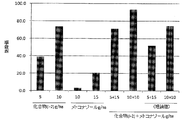
- FIG. 5 is a drawing-substituting graph showing the results of a test for controlling effect on wheat red mold of Test Example 2.
- FIG. 6 is a drawing-substituting graph showing the results of a test for controlling effect on wheat red mold of Test Example 4.
- FIG. 6 is a drawing-substituting graph showing the results of a control effect test for wheat leaf mold when using Compound I-4 and metconazole in Test Example 5.
- FIG. FIG. 5 is a drawing-substituting graph showing the results of a control effect test for wheat leaf blight when using Compound I-8 and metconazole in Test Example 5.
- FIG. It is a figure which shows the equal effect curve in the control value of the plant disease control composition in Test Example 21.
- the agricultural and horticultural agent according to the present invention is a so-called admixture and contains a plurality of active ingredients.
- One of the active ingredients is an azole derivative represented by the following general formula (I). That is, the agricultural and horticultural agent according to the present invention contains at least one compound as an active ingredient in addition to the azole derivative represented by the general formula (I).
- the active ingredient contained in the agricultural and horticultural medicine according to the present invention is not particularly limited as long as it is two kinds (components) or more.
- the compound contained as an active ingredient in addition to the azole derivative represented by the general formula (I) is a compound having an ergosterol biosynthesis inhibitory ability, an succinate dehydrogenase inhibitory ability. It is preferable to be at least one selected from a compound having a compound, a strobilurin-based compound, a benzimidazole compound, and metalaxyl. Specific examples of the active ingredient contained in the agricultural and horticultural chemical according to the present invention will be described in detail below.
- R 1 and R 2 R 1 represents a cyclopropyl group or an alkyl group having 1 or 2 carbon atoms in which one hydrogen atom is substituted with a cyclopropyl group. At least one hydrogen atom of these cyclopropyl groups may be substituted with one or more substituents selected from a bromine atom, a chlorine atom and a methyl group, for example, 1 to 4 substituents.
- alkyl group having 1 or 2 carbon atoms substituted with a cyclopropyl group include a cyclopropylmethyl group and a 2- (cyclopropyl) ethyl group.
- R 2 represents a cyclopropyl group or an alkyl group having 1 or 2 carbon atoms in which one hydrogen atom is substituted with a cyclopropyl group. At least one hydrogen atom of these cyclopropyl groups may be substituted with a chlorine atom, for example, 1 or 2 substituted.
- the number of substitutions by a substituent in the cyclopropyl group in R 1 is 1 to 4, and the number of substitutions by a chlorine atom in the cyclopropyl group in R 2 is 1 or 2. Is preferable from the viewpoint of activity.
- the agricultural and horticultural medicine according to the present invention contains the following ergosterol biosynthesis inhibiting compound and compound (I) as active ingredients, so that the ergosterol biosynthesis inhibiting compound shown below is used as a single agent. Thus, it is possible to reduce the spraying amount of the medicine necessary for obtaining the same effect.
- EBI ergosterol biosynthesis inhibition
- Examples of ergosterol biosynthesis inhibiting compounds include azaconazole, viteltanol, bromconazole, difenoconazole, cyproconazole, diniconazole, fenarimol, fenbuconazole, fenpropidin, fenpropimorph, flukinconazole, flusilazole, flutriafor, hexa Conazole, imazalyl, imibenconazole, metconazole, ipconazole, microbutanyl, nuarimol, oxpoconazole, pefazoate, penconazole, prochloraz, propiconazole, prothioconazole, epoxiconazole, cimeconazole, spiroxamine, tebuconazole, tetraconazole Triadimephone, Triadimenol, Triflumizole, Trifolin, Triticonazole, Fenhe Samido, mention may be made
- an azole compound or fenpropimorph is preferable, and metconazole, epoxiconazole, ipconazole, prothioconazole, prochloraz, tebuconazole, or fenpropimorph is more preferable.
- Agricultural and horticultural drugs including metconazole, epoxiconazole, ipconazole, prothioconazole, prochloraz, tebuconazole or fenpropimorph exhibit particularly high activity.
- Metoconazole (see the following structural formula) is known as a triazole compound that exhibits a high control effect on diseases such as wheat, fruit trees, sugar beet, shiba and rice. Metoconazole may be produced by a conventionally known method.
- Epoxyconazole (see the structural formula below) is known as a triazole compound that exhibits a high control effect on diseases such as wheat. Epoxyconazole may be produced by a conventionally known method.
- the agricultural and horticultural agent according to the present invention may contain a compound having an ability to inhibit succinate dehydrogenase (also referred to as an SDHI compound) as an active ingredient.
- a compound having an ability to inhibit succinate dehydrogenase also referred to as an SDHI compound
- the SDHI compound may be included instead of the above azole compound, or may be included together with the above azole compound.
- the agricultural and horticultural medicine according to the present invention contains the SDHI compound and the compound (I) shown below as active ingredients, so that it is comparable to the case of using the SDHI compound shown below as a single agent. It is possible to reduce the spray amount of the medicine necessary for obtaining the effect.
- SDHI compounds examples include bixafen, boscalid, pentiopyrad, isopyrazam, fluopyram, furametopyl, tifluzamide, flutolanil, mepronil, fenfuran, carboxin, oxycarboxyne and benodanyl.
- bixafen see the structural formula below
- Bixafen is known as an SDHI compound that exhibits a high control effect on diseases of vegetables such as cucumber.
- Bixafen may be produced by a conventionally known method.
- Agricultural and horticultural drugs including bixafen, boscalid, pentiopyrad, isopyrazam, fluopyram, furametopil, or benodanyl show particularly high activity.
- the agricultural or horticultural agent according to the present invention may contain a strobilurin-based compound as an active ingredient.
- a strobilurin-based compound is a compound that inhibits the electron transport system of pathogenic bacteria.
- the strobilurin compound may be included in place of the above azole compound and the above SDHI compound, or may be included together with at least one of the above azole compound and the above SDHI compound.
- the agricultural and horticultural agent according to the present invention contains the following strobilurin-based compound and compound (I) as active ingredients, so that it is comparable to when using the strobilurin-based compound shown below as a single agent. It is possible to reduce the spray amount of the medicine necessary for obtaining the effect.
- strobilurin-based compounds examples include pyraclostrobin, azoxystrobin, dimethoxystrobin, famoxadone, floxastrobin, metminostrobin, orisatrobin, pyraclostrobin, trifloxystrobin, dimoxystrobin, fenamidone, and Mention may be made of cresoxime methyl.
- pyraclostrobin see the following structural formula
- azoxystrobin, or cresoxime methyl is preferable.
- Pyraclostrobin is known as a strobilurin-based compound that exhibits a high control effect on a wide range of diseases such as rice, wheat, vegetables, and fruit trees. Note that pyraclostrobin may be produced by a conventionally known method. Agricultural and horticultural agents including pyraclostrobin, azoxystrobin or cresoxime methyl show particularly high activity.
- the agricultural and horticultural agent according to the present invention may contain a benzimidazole compound as an active ingredient.
- the benzimidazole compound may be included instead of the above azole compound, the above SDHI compound and the above strobilurin compound, or the above azole compound, the above SDHI compound and the above strobilurin compound. It may be included together with at least one of these.
- the agricultural and horticultural medicine according to the present invention contains the following benzimidazole compound and compound (I) as active ingredients, so that it is comparable to the case where the benzimidazole compound shown below is used alone. It is possible to reduce the spray amount of the medicine necessary for obtaining the effect.
- benzimidazole compounds include benomyl, carbendazim, fuberidazole, thiabendazole, thiophanate methyl, and dietofencarb. Among these, thiophanate methyl is preferable.
- the agricultural and horticultural agent according to the present invention may contain metalaxyl as an active ingredient.
- Metalaxyl may be included instead of the above azole compound, the above SDHI compound, the above strobilurin compound and the above benzimidazole compound, or the above azole compound, the above SDHI compound, or the above.
- the agricultural and horticultural medicine according to the present invention contains metalaxyl and compound (I) as active ingredients, so that it is necessary to spread the medicine necessary for obtaining the same effect as when using metalaxyl alone. The amount can be reduced.
- the active ingredient contained in the agricultural and horticultural medicine according to the present invention may be three or more.
- the agricultural and horticultural agent according to the present invention contains at least two kinds of the above-described compounds in addition to the compound (I). Of course, different series of compounds may be included. However, in order to make use of the effect of the compound (I), it is preferable that at least one of metconazole, epoxiconazole, bixaphene and pyractostrobin is contained.
- each compound mentioned above is an example, and even if it is a compound which is not mentioned above, if it has the same activity, it can be contained as an active ingredient in the agricultural and horticultural medicine which concerns on this invention.
- Step A1 Next, the manufacturing method of compound (I) is demonstrated.
- One embodiment of this production method includes a step of reacting an oxirane compound represented by the following general formula (II) with 1,2,4-triazole represented by the following general formula (III) (step A1). (See the following reaction formula (1)).
- the oxirane compound represented by the general formula (II) is referred to as “compound (II)”
- the 1,2,4-triazole represented by the general formula (III) is referred to as “compound (III)”.
- R 1 and R 2 are as described above.
- M represents a hydrogen atom or an alkali metal.
- a carbon atom in the oxirane ring of compound (II) is reacted with compound (III) to form a carbon-nitrogen bond between the carbon atom in the oxirane ring of compound (II) and the nitrogen atom of compound (III). Is generated.
- the solvent used is not particularly limited.
- the amount of compound (III) used relative to compound (II) is, for example, 0.5 to 10 times mol, preferably 0.8 to 5 times mol. Moreover, you may add a base if desired. In this case, the amount of the base used relative to compound (III) is, for example, 0 to 10 times mol (excluding 0), preferably 0.5 to 5 times mol.
- reaction temperature and reaction time can be appropriately set depending on the type of solvent and base used.
- R 1 and R 2 are as described above.
- X represents a halogen atom.
- Bases used include alkali metal or alkaline earth metal hydroxide salts such as sodium hydroxide, potassium hydroxide and calcium hydroxide; alkali metal carbonates or hydrogen carbonates such as sodium carbonate and potassium carbonate, etc. Can be preferably used, but is not limited thereto.
- the amount of the base is preferably 0.5 to 20 times mol, more preferably 0.8 to 5 times mol for the compound (VI).
- the solvent is not particularly limited.
- phase transfer of quaternary ammonium salts such as tetrabutylammonium salt, trimethylbenzylammonium salt and triethylbenzylammonium salt, crown ether and the like, etc. into the reaction mixture. It is also possible to carry out the reaction by adding a catalyst.
- step A3 The compound (VI) used in step A2 is a compound represented by the general formula (IV) with respect to the carbonyl group of the compound represented by the general formula (VII) (hereinafter referred to as “compound (VII)”) (hereinafter referred to as “compound (VII)”). , Referred to as “compound (IV)”, to produce a carbon-carbon bond (see the following reaction formula (3)).
- reaction formula (3)
- R 1 and R 2 are as described above.
- L includes alkali metal, alkaline earth metal-Q 1 (Q 1 is a halogen atom), 1/2 (Cu alkali metal), zinc-Q 2 (Q 2 is a halogen atom), etc. Is possible.
- the alkali metal include lithium, sodium, and potassium, and it is preferable to use lithium.
- the alkaline earth metal include magnesium.
- the solvent used is not particularly limited as long as it is an inert solvent under the reaction conditions.
- a phase transfer catalyst such as a quaternary ammonium salt such as tetrabutylammonium salt, trimethylbenzylammonium salt and triethylbenzylammonium salt, crown ether and the like is added to the reaction mixture. It is also possible to carry out the reaction by adding.
- the amount of compound (IV) to be used relative to compound (VII) is, for example, 0.5 to 10 times mol, preferably 0.8 to 5 times mol. In addition, it is preferable to use the compound (IV) prepared immediately before. Further, when L is zinc-Q 2 (Q 2 is a halogen atom), the reaction can be carried out while generating compound (IV) in the reaction system.
- a Lewis acid may be added if desired.
- the amount of the Lewis acid used relative to compound (IV) is, for example, 0 to 5 times mol (excluding 0), preferably 0.1 to 2 times mol.
- Examples of the Lewis acid used include aluminum chloride, zinc chloride, and cerium chloride.
- reaction temperature and reaction time can be appropriately set depending on the solvent used, the type of compound (VII), the type of compound (IV), and the like.
- the compound (IV) and compound (VII) used here may be produced by existing techniques.
- a compound having a gem-dihalocyclopropane structure in the molecule represented by the general formula (II-a) (hereinafter referred to as “compound (II-a)”) can be obtained by the following suitable second synthesis method. That is, it can be synthesized from an oxirane compound having a double bond in the molecule represented by the general formula (VIII) (hereinafter referred to as “compound (VIII)”) by reaction of trihalomethane with a base such as sodium hydroxide. it can. Alternatively, it can be synthesized from compound (VIII) by addition reaction of halocarbenes generated by thermal decomposition of trihaloacetate. These reactions are shown in the following reaction formula (4). Reaction formula (4)
- R 2 the definition content of R 2 is as described above.
- R 8 , R 9 , R 10 , R 11 , and R 12 each independently represent a hydrogen atom, a bromine atom, a chlorine atom, or a methyl group.
- n represents an integer of 0 to 2.
- R 11 and R 12 there are a plurality of R 11 and R 12 , but their definition contents independently represent the definition contents of R 11 and R 12 .
- X 1 and X 2 each independently represent a halogen atom.
- trihalomethane used examples include chloroform, bromoform, chlorodifluoromethane, dichlorofluoromethane, and dibromofluoromethane.
- the amount of trihalomethane used for compound (VIII) is not particularly limited.
- trihalomethane itself, or other solvents such as dichloromethane or toluene inert to the reaction can be used.
- phase transfer catalyst When adding a base, when using an aqueous solution such as an aqueous sodium hydroxide solution, it is preferable to use a phase transfer catalyst.
- the phase transfer catalyst that can be used is not particularly limited.
- the amount of the phase transfer catalyst used is, for example, 0.001 to 5 times mol, preferably 0.01 to 2 times mol, of the compound (VIII).
- the base used is not particularly limited.
- the amount of the base to be used is, for example, 0.1 to 100 times mol, preferably 0.8 to 50 times mol, of compound (VIII).
- the concentration of the aqueous alkali metal hydroxide solution at this time is, for example, 10% to a saturated aqueous solution, preferably 30% to a saturated aqueous solution.
- the reaction temperature is, for example, 0 ° C. to 200 ° C., preferably 10 ° C. to 150 ° C.
- the reaction time is 0.1 hour to several days, preferably 0.2 hour to 2 days.
- Process A4 Compound (VIII) used in step A2a can be obtained by the following first preferred synthesis method.
- the above-mentioned compound (VII) is reacted with an organometallic compound represented by the general formula (X) (hereinafter referred to as “compound (X)”), and the organometallic compound to the carbonyl carbon atom of the compound (VII) A carbon-carbon bond is formed by a nucleophilic addition reaction by.
- a halohydrin compound represented by the general formula (IX) hereinafter referred to as “compound (IX)”
- compound (IX) is oxiraneed in the presence of a base to obtain compound (VIII) (see the following reaction formula (5)).
- Reaction formula (5) Reaction formula (5)
- R 2 , R 8 , R 9 , R 10 , R 11 , R 12 , L, X, and n are as described above.
- the solvent used is not particularly limited as long as it is an inert solvent. These solvents can also be used as a mixture. Moreover, when using water for reaction, it is also possible to mix and use with an organic solvent. When water is used together with a hydrophobic organic solvent, a quaternary ammonium salt such as tetrabutylammonium salt, trimethylbenzylammonium salt and triethylbenzylammonium salt, crown ether and the like, etc. are added to the reaction mixture as necessary. A phase transfer catalyst may be added.
- the amount of compound (X) used relative to compound (VII) is, for example, 0.5 to 10-fold mol, preferably 0.8 to 5-fold mol. It is preferable to use the compound (X) prepared immediately before. Further, when L is zinc-Q 2 (Q 2 is a halogen atom), the reaction can be carried out while generating the compound (X) in the reaction system.
- a Lewis acid may be added.
- the amount of Lewis acid used relative to compound (VII) is, for example, 0 to 5 times mol (excluding 0), preferably 0.1 to 2 moles.
- the Lewis acid used include aluminum chloride, zinc chloride, and cerium chloride.
- reaction temperature and reaction time can be appropriately set depending on the type of solvent used, compound (VII), compound (X), and the like.
- the oxiraneation of compound (IX) in this step can be carried out under the same conditions as the synthesis of compound (II) from compound (VI) in step A2.
- compound (X) used here a compound that can be produced by an existing synthesis technique such as conversion of an alkenyl halide compound to an organometallic reagent may be used.
- L in compound (X) is zinc-Q 2 (Q 2 is a halogen atom)
- the method shown in the following reaction formula (6) can be employed.
- compound (Xa) In order to generate compound (Xa), a method of reacting alkenyl halide represented by compound (XVII) with zinc in the system is suitable. That is, compound (Xa) is prepared by mixing in a solvent in the presence of compound (XVII). Reaction formula (6)
- R 2 , R 8 , R 9 , R 10 , R 11 , R 12 , Q 2 , X, and n are as described above.
- the solvent used is not particularly limited.
- water for reaction it is also possible to mix and use with an organic solvent.
- a quaternary ammonium salt such as tetrabutylammonium salt, trimethylbenzylammonium salt and triethylbenzylammonium salt, crown ether and the like, etc. are added to the reaction mixture as necessary. You may make it react by adding a phase transfer catalyst.
- an organic solvent containing compound (VII) and an aqueous solution containing an additive that promotes activation of zinc such as a salt containing hydrogen halide or hydrogen halide
- an additive that promotes activation of zinc such as a salt containing hydrogen halide or hydrogen halide
- alkenyl halide represented by the compound (XVII) and zinc can be mixed under the conditions of contact with each other.
- Examples of the salt containing hydrogen halide include ammonium chloride and ammonium bromide.
- Examples of the hydrogen halide include hydrogen chloride and hydrogen bromide.
- the amount of compound (XVII) used at this time is, for example, 0.5 to 20-fold mol, preferably 0.8 to 10-fold mol based on compound (VII).
- the amount of zinc used is, for example, 0.5 to 20-fold mol, preferably 0.8 to 10-fold mol based on compound (VII).
- the reaction temperature is preferably 0 ° C. to 150 ° C., more preferably 5 ° C. to 100 ° C.
- the reaction time is preferably 0.1 to 24 hours, and more preferably 0.5 to 12 hours.
- the compound (VII) used in this step may be one produced by existing technology.
- R 2 the definition content of R 2 is as described above.
- R 13 represents an alkyl group having 1 to 4 carbon atoms.
- R 14 , R 15 , R 16 , R 17 , and R 18 each independently represent a hydrogen atom, a bromine atom, a chlorine atom, or a methyl group.
- n 1 or 2.
- R 17 and R 18 there are a plurality of R 17 and R 18 , but their definition contents independently represent the definition contents of R 17 and R 18 .
- X 3 represents a halogen atom.
- This reaction can be carried out in a solvent or using compound (XVI) as a solvent.
- the amount of the compound (XVI) used relative to the compound (XV) is, for example, 0.5 times to 20 times mol, preferably 0.8 times to 10 times mol.
- the base used is not particularly limited.
- the amount of the base used relative to compound (XV) is, for example, 0.5 to 10 times mol, preferably 0.8 to 5 times mol.
- the reaction temperature is, for example, 0 ° C. to 250 ° C., preferably room temperature to 150 ° C.
- the reaction time is, for example, 0.1 hour to several days, preferably 0.5 hour to 24 hours.
- the compound (XV) and compound (XVI) used here may be those synthesized by methods known in the literature.
- This reaction is usually performed in a solvent in the presence of a base.
- the amount of compound (XIV) used relative to compound (XIII) is, for example, 0.5 times to 10 times mol, preferably 0.8 times to 5 times mol.
- the base used is not particularly limited.
- the amount of the base used for compound (XIII) is, for example, 0.5 to 10 times mol, preferably 0.8 to 5 times mol.
- the acidity of the hydrogen atom in the methylene moiety between the carbonyl group and the ester group of the produced compound (XIII) is the compound ( Since the acidity of the hydrogen atom of the acetyl group of XV) is higher, an alkali metal salt of compound (XIII) is formed in the course of the reaction, so the reaction solution of compound (XIII) is used without isolation as it is. You can also. In that case, it is also possible to react without adding a new base.
- the reaction temperature is, for example, 0 ° C. to 250 ° C., preferably room temperature to 150 ° C.
- the reaction time is, for example, 0.1 hour to several days, preferably 0.5 hour to 24 hours.
- This hydrolysis and decarboxylation reaction can be carried out in a solvent under basic conditions or acidic conditions.
- an alkali metal base such as sodium hydroxide or potassium hydroxide is usually used as the base.
- water containing alcohol or the like is usually used in addition to water.
- the acid catalyst is preferably an inorganic acid such as hydrochloric acid, hydrobromic acid and sulfuric acid, or an organic acid such as acetic acid.
- the solvent is usually added by adding water or an organic acid such as acetic acid to water.
- the reaction temperature is, for example, 0 ° C. to the reflux point, preferably 10 ° C. to the reflux point.
- the reaction time is, for example, 0.1 hour to several days, preferably 0.5 hour to 24 hours.
- the sulfonium methylide or sulfoxonium methylide used is a sulfonium salt (for example, trimethylsulfonium iodide or trimethylsulfonium bromide) or a sulfoxonium salt (for example trimethylsulfoxonium iodide or trimethylsulfone) in a solvent.
- a sulfonium salt for example, trimethylsulfonium iodide or trimethylsulfonium bromide
- a sulfoxonium salt for example trimethylsulfoxonium iodide or trimethylsulfone
- the amount of the sulfonium methylides or sulfoxonium methylides is, for example, 0.5 to 10 times mol, preferably 0.8 to 5 times mol for the compound (XI).
- the solvent used is not particularly limited. Two or more kinds of solvents can be mixed and used.
- water when water is used in the reaction, it can be used by mixing with an organic solvent.
- a quaternary ammonium salt such as tetrabutylammonium salt, trimethylbenzylammonium salt and triethylbenzylammonium salt, crown ether and the like, etc. are added to the reaction mixture as necessary. It is also possible to carry out the reaction by adding a phase transfer catalyst.
- the base used for the production of sulfonium methylides and sulfoxonium methylides is not particularly limited.
- reaction temperature and reaction time can be appropriately set depending on the type of the solvent used, compound (XI), sulfonium salt or sulfoxonium salt, base and the like.
- the solvents, bases, acids, and the like used can be as follows unless otherwise specified.
- the solvent used is not particularly limited.
- halogenated hydrocarbons such as dichloromethane, chloroform and dichloroethane
- aromatic hydrocarbons such as benzene, toluene and xylene
- aliphatic ethers such as petroleum ether, hexane and methylcyclohexane.
- Hydrocarbons amides such as N, N-dimethylformamide, N, N-dimethylacetamide and N-methyl-2-pyrrolidinone
- ethers such as diethyl ether, tetrahydrofuran and dioxane
- alcohols such as methanol and ethanol Is mentioned.
- examples of the solvent include water, carbon disulfide, acetonitrile, ethyl acetate, pyridine, and dimethyl sulfoxide. These solvents can be used as a mixture of two or more.
- a solvent composition comprising a solvent that does not form a uniform layer with each other can be mentioned.
- a phase transfer catalyst such as a quaternary ammonium salt such as tetrabutylammonium salt, trimethylbenzylammonium salt and triethylbenzylammonium salt, crown ether and the like may be added to the reaction mixture to perform these reactions.
- the solvent to be used is not particularly limited, but benzene, chloroform, dichloromethane, hexane, toluene, tetrahydrofuran and the like can be used as the oil phase.
- alkali metal carbonates such as sodium carbonate, sodium hydrogen carbonate, potassium carbonate and potassium hydrogen carbonate
- alkaline earth metal carbonates such as calcium carbonate and barium carbonate
- Alkali metal hydroxides such as sodium and potassium hydroxide
- alkali metals such as lithium, sodium and potassium
- alkali metal alkoxides such as sodium methoxide, sodium ethoxide and potassium t-butoxide
- alkali metal hydrides such as lithium hydride
- organometallic compounds of alkali metals such as n-butyllithium and methylmagnesium bromide
- alkali metal amides such as lithium diisopropylamide
- triethylamine Pyridine 4-dimethylaminopyridine, N, N-dimethylaniline and 1,8-diazabicyclo-7- [5.4.0] Organic amines such as undecene, and the like.
- the acid to be used is not particularly limited.
- inorganic acids such as hydrochloric acid, hydrobromic acid, hydroiodic acid and sulfuric acid
- organic acids such as formic acid, acetic acid, butyric acid and p-toluenesulfonic acid
- chloride examples include Lewis acids such as lithium, lithium bromide, rhodium chloride, zinc chloride, iron chloride and aluminum chloride.
- Triazole Composition The plant disease control composition according to the present invention may be a plant disease control composition containing two types of triazole derivatives as its active ingredients.
- One triazole derivative is a compound represented by the following formula (I ′) (hereinafter referred to as “compound (I ′)”).
- the other triazole derivative is, for example, a compound represented by the following formula (XVIII) (hereinafter referred to as “compound (XVIII)”).
- R 25 represents a cyclopropyl group in which at least one hydrogen atom is substituted with a halogen atom, a methyl group or an ethyl group, or a carbon in which one hydrogen atom is substituted with the cyclopropyl group.
- R 26 represents an alkyl group having 1 to 4 and R 26 represents a cyclopropyl group in which at least one hydrogen atom is substituted with a halogen atom, or a carbon number in which one hydrogen atom is substituted with the cyclopropyl group 1 to 3 alkyl groups are represented.
- R 19 represents a haloalkyl group having 1 to 4 carbon atoms or a haloalkenyl group having 2 to 4 carbon atoms.
- R 19 include a chloromethyl group, a bromomethyl group, a chloroethyl group, and a 2-chloro-2-propenyl group.
- R 20 represents an alkyl group or haloalkyl group having 1 to 4 carbon atoms, or an alkenyl group or haloalkenyl group having 2 to 4 carbon atoms.
- R 20 include a methyl group, an ethyl group, and a chloromethyl group.
- Y represents a halogen atom. Of these, a fluorine atom, a chlorine atom and a bromine atom are preferable.
- P represents an integer of 0 to 3, preferably 0, 1 or 2, and more preferably 0 or 1.
- the plurality of Y may be the same halogen atom as each other or different from each other. There is no restriction
- Compound (I ′) may have optical isomers and diastereomers as in Compound (I).
- Compound (I ′) includes both those containing these isomers alone and those containing each isomer in an arbitrary ratio.
- compound (XVIII) has a stereoisomer based on the configuration of the organic group bonded to the cyclopentane ring, and an optical isomer exists for each stereoisomer. Therefore, the compound (XVIII) includes both those containing these isomers alone and those containing each isomer in an arbitrary ratio.
- Examples of one form of the compound (I ′) include a compound represented by the following formula (Ia ′).
- X 5 to X 7 represent a halogen atom or a hydrogen atom, and at least one of X 5 to X 7 is a halogen atom.
- X 5 is a hydrogen atom
- both X 6 and X 7 are halogen atoms.
- s 1 represents 0 or 1
- s 2 represents 0, 1 or 2.
- R 27 represents a hydrogen atom or a methyl group.
- R 28 to R 30 represent a hydrogen atom, a halogen atom or a methyl group, and are preferably a hydrogen atom or a halogen atom.
- X 8 and X 9 represent a halogen atom, and it is preferable that X 8 and X 9 are the same halogen atom species.
- Compound (XVIII) in the present embodiment is a compound represented by the following formula (XX) that can be produced using a known method as shown in the following Scheme 1 (hereinafter referred to as compound) (Referred to as (XX)). Note that the compound represented by the following formula (XVIIIb) has substantially the same structure as the compound represented by the formula (XVIII).
- R 21 represents a methylene group, a halomethylene group, an alkylene group or haloalkylene group having 2 to 4 carbon atoms, or an alkenylene group or haloalkenylene group having 2 to 4 carbon atoms.
- q denotes the number of hydroxy groups bonded to a functional group represented by R 21 in formula (XX).
- R 22 is a hydrogen atom an alkyl group of 1-3 1 carbon atoms which may be substituted, represents a phenyl group or a naphthyl group.
- X 4 represents a halogen atom.
- compound (XXa) a compound represented by the following formula (XXa) having a hydroxymethyl group at the 2-position
- compound (XXa) is a compound represented by the following formula ( XXVII) can be suitably obtained by the following synthesis method (see Scheme 2 below).
- R 23 and R 24 each independently represents an alkyl group having 1 to 4 carbon atoms.
- R 23 is the same functional group as R 20 in compound (X).
- Agricultural and horticultural chemicals Compound (I) blended as an active ingredient in the agricultural and horticultural chemicals according to the present invention exhibits a controlling effect against a wide range of plant diseases. Furthermore, compound (I) is used in combination with an ergosterol biosynthesis inhibitor compound, SDHI compound, strobilurin compound, benzimidazole compound, metalaxyl, etc., and has a synergistic effect as compared with the case where each is used alone. Demonstrate.
- compound (I) Since compound (I) has a 1,2,4-triazolyl group, it forms an acid addition salt with an inorganic acid or an organic acid, or a metal complex. Compound (I) may be used in the form of these acid addition salts and metal complexes.
- At least one of diastereomers or enantiomers present in the compound (I) can be used as an active ingredient such as an agricultural or horticultural agent.
- a drug containing at least compound (I) as an active ingredient exhibits a control effect against a wide range of plant diseases.
- Examples of applicable diseases include the following.
- Soybean rust (Phakopsora pachyrhizi, Phakopsora meibomiae), rice blast (Pyricularia grisea), rice sesame leaf blight (Cochliobolus miyabeanus), rice white leaf blight (Xanthomonas oryzae), rice rot (Rhizoctonia sol) Nuclear disease (Helminthosporium sigmoideun), rice idiot seedling (Gibberella fujikuroi), rice seedling blight (Pythium aphanidermatum), apple powdery mildew (Podosphaera leucotricha), apple black rot (Venturia inaequalis), apple peach linear Apple spotted leaf blight (Alternaria alternata), apple rot blight (Valsa mali), pear black blight (Alternaria kikuchiana), pear powdery mildew (Phyllactinia pyri), pear red blight
- grape rust Phakopsora ampelopsidis
- watermelon vine split Fusarium oxysporum f.sp.niveum
- cucumber vine split Feusarim oxysporum f.sp.cucumerinum
- radish yellow Fusarium oxysporum f. sp.raphani
- tobacco red star disease Alternaria longipes
- pea mosquito summer rot Alternaria solani
- soybean brown spot Septoria ines glycines
- soybean purpura Crocospora kikuchii
- Examples of applied plants include wild plants, plant cultivars, plants and plant cultivars obtained by conventional biological breeding such as crossbreeding or protoplast fusion, genetically modified plants and plant cultivars obtained by genetic manipulation. Can be mentioned.
- Examples of genetically modified plants and plant cultivars include herbicide-tolerant crops, pest-tolerant crops incorporating insecticidal protein production genes, disease-resistant crops incorporating resistance-inducing substance production genes for diseases, improved crops, improved yields
- Examples include crops, preservative-enhancing crops, and yield-enhancing crops.
- Specific examples of genetically modified plant cultivars include those containing registered trademarks such as ROUNDUP READY, LIBERTY LINK, CLEARFIELD, YIELDGARD, HERCULEX, and BOLLGARD.
- a drug containing at least compound (I) as an active ingredient exhibits an excellent effect of protecting the material from a wide range of harmful microorganisms that invade industrial materials.
- the mixing ratio of compound (I) to metconazole and / or epoxiconazole is 100: 1 to 1: 100, preferably 5: 2 to 50: 3.
- the same mixing ratio can be used for ergosterol biosynthesis inhibiting compounds other than metconazole and epoxiconazole, SDHI compounds, strobilurin compounds, benzimidazole compounds and metalaxyl.
- the agricultural and horticultural medicine according to the present invention includes a plurality of active ingredients in addition to the compound (I), the mixing ratio of the active ingredients other than the compound (I) may be appropriately set according to the intended use of the medicine. .
- the agricultural and horticultural preparation may contain various components and can be mixed with a solid carrier, a liquid carrier, a surfactant, or other preparation adjuvant.
- a solid carrier e.g., a styrene, a styrene, a styrene, a styrene, a styrene, a styrene, a styl, sulfate, a sulfate, a surfactant, or other preparation adjuvant.
- the dosage form of the agricultural and horticultural preparation include various forms such as powders, wettable powders, granules, and emulsions.
- the active ingredient is preferably contained in an amount of 0.1 to 95% by weight, more preferably 0.5 to 90% by weight, and more preferably 2 to 80% by weight based on the total amount of the preparation. Is more preferable.
- Examples of carriers, diluents, and surfactants used as formulation adjuvants include talc, kaolin, bentonite, diatomaceous earth, white carbon, and clay as solid carriers.
- Liquid diluents include water, xylene, toluene, chlorobenzene, cyclohexane, cyclohexanone, dimethyl sulfoxide, dimethylformamide, and alcohol.
- Surfactants should be properly used depending on the effect, such as polyoxyethylene alkylaryl ether and polyoxyethylene sorbitan monolaurate as emulsifiers, lignin sulfonate and dibutyl naphthalene sulfonate as dispersants,
- the wetting agent include alkyl sulfonates and alkyl phenyl sulfonates.
- the preparation may be used as it is, or diluted to a predetermined concentration with a diluent such as water.
- a diluent such as water.
- the concentration of the active ingredient is desirably in the range of 0.001 to 1.0% with respect to the total amount of drug after dilution.
- the amount of compound (I) used in the agricultural and horticultural agent according to the present invention is 20 to 5000 g, more preferably 50 to 2000 g, per 1 ha of agricultural and horticultural land such as fields, rice fields, orchards, and greenhouses. What is necessary is just to set suitably about content of the other active ingredient contained in the said agricultural and horticultural medicine based on the usage-amount of compound (I). Since these use concentrations and amounts vary depending on the dosage form, use time, use method, use place, target crop, etc., they can be increased or decreased without sticking to the above range.
- the agricultural and horticultural medicine according to the present invention is combined with other active ingredients (active ingredients contained in bactericides, insecticides, acaricides and herbicides) shown below in addition to the above-mentioned active ingredients, It can also be used with improved performance as a pharmaceutical agent.
- active ingredients contained in bactericides, insecticides, acaricides and herbicides
- MBI agents melanin biosynthesis inhibitors
- Carpropamide, diclocimet, phenoxanyl, fusalide, pyroxylone, and tricyclazole Carpropamide, diclocimet, phenoxanyl, fusalide, pyroxylone, and tricyclazole.
- ⁇ Insecticide / acaricide / nematicide> Abamectin, Acephate, Acrinathrin, Alanicarb, Aldicarb, Alletrin, Amitraz, Avermectin, Azadirachtin, Azamethifos, Azinphos-ethyl, Azinphos-methyl, Azocycline, Bacillus filmus, Bacillus subtilis, Bacillus thuringibulbbenthulbenbencarb , Benzoxymate, Bifenazite, Bifenthrin, Bioallethrin, Bioresmethrin, Bistriflurone, Buprofezin, Butocaboxin, ButoxyCarboxin, Kazusafos, Carbaryl, Carbofuran, Carbosulfan, Cartap, CGA 50439, Chlordein, Chloretifos, Chlorphenapal Chlorfenvin foss, chlor
- the plant disease control method according to the present embodiment is a method including a procedure for performing foliage treatment or non-foliage treatment using the above-mentioned agricultural and horticultural chemicals.
- a labor can be reduced compared with the case where a foliage process is performed.
- a wettable powder or powder is mixed with the seed and stirred, or the seed is immersed in a diluted wettable powder to attach the drug to the seed.
- the combined use amount of the active ingredients in the seed treatment is 0.01 to 10000 g, preferably 0.1 to 1000 g, per 100 kg of seeds.
- what is necessary is just to utilize the seed processed with the agricultural and horticultural chemical
- irrigation is performed by treating the planting hole and its surroundings with granules, etc. at the time of transplanting seedlings, or treating the soil around the seeds or plants with granules or wettable powder. .
- the total use amount of the active ingredients in the irrigation treatment is 0.01 to 10000 g, preferably 0.1 to 1000 g, per 1 m 2 of agricultural and horticultural land.
- Water surface treatment is performed by treating the surface of paddy fields with granules.
- the combined use amount of active ingredients in the case of water surface treatment is 0.1 to 10000 g, preferably 1 to 1000 g, per paddy field 10a.
- the total amount of active ingredients used is 20 to 5000 g, more preferably 50 to 2000 g, per ha of agricultural and horticultural lands such as fields, fields, orchards and greenhouses.
- concentration and amount used vary depending on the dosage form, time of use, method of use, place of use, target crop, etc., and can be increased or decreased without sticking to the above range.
- the ears of wheat at the flowering stage (variety: Norin 61) were cut from the top of the leaf and inserted into a 10 cm long test tube to which hydroponics (hyponex) was added (3 cut ears / test tube). After weighing a predetermined amount, each compound was dissolved in acetone and mixed to prepare a spray solution (acetone 10%, spreading agent (Guramin S) 60 ppm). The sprayed liquid was sprayed on the cut ears at a liquid volume equivalent to 1000 L / ha (one ward three-track system). After the spray solution was dried at room temperature, wheat spores spores (5 ⁇ 10 5 / ml) were spray-inoculated on the cut ears.
- Judgment of the cooperation effect by mixing was performed according to the iso-effect curve method described in the literature (see Pesticide Experiment Method Vol. 3, Soft Science, p109-116). From the control values when epoxiconazole and compound I-4 were used in combination at different concentrations, an isoeffect curve showing a certain control value was prepared. When the straight line of the equal effect is linear, the effect is determined to be additive, when it is curved upward, it is determined to be antagonistic, and when it is curved downward, it is determined to be synergistic.
- FIG. 1 shows an equi-effect curve that gives a control value of 90 when epoxiconazole and compound I-4 are used in combination at different concentrations.
- the isoeffect curve is curved downward, revealing that compound I-4 and epoxiconazole have a synergistic effect.
- a chemical solution containing pyraclostrobin and compound I-4 was prepared and sprayed on the cut ears so as to obtain a predetermined dose.
- the other test methods and the determination method of the cooperation effect are the same as in Test Example 1.
- FIG. 2 shows an equivalent effect curve in which a control value of 70 is obtained when pyraclostrobin and compound I-4 are used in combination at different concentrations.
- the isoeffect curve is curved downward, revealing that compound I-4 and pyraclostrobin have a synergistic effect.
- Cut ears were prepared from flowering wheat plants (variety: Norin 61). A medicinal solution containing bixaphene and compound I-4 was prepared and sprayed on the cut ears to give a predetermined dosage. Other test methods are the same as in Test Example 1.
- ⁇ and ⁇ are the control values when each agent is sprayed alone.
- Cut ears were prepared from flowering wheat plants (variety: Norin 61). A medicinal solution containing metconazole and compound I-2 was prepared and sprayed on the cut ears so as to obtain a predetermined dose. The cut ears were dried at room temperature for about 1 hour, and then sprayed and inoculated with a Fusarium graminearum ascospore suspension (1 ⁇ 10 5 cells / ml). It was kept in a room box at 20 ° C., and after 5 days, the disease was investigated according to the evaluation method described in the literature (see Ban & Suenaga Euphyitica 113, p87-99, (2000)). The test scale was three cut ears and one treatment zone.
- ⁇ and ⁇ are the control values when each agent is sprayed alone.
- Control effect test on wheat leaf mold> A control effect test for wheat leaf blight was conducted in the same manner as in Test Example 4 except that Compound I-4 or Compound I-8 was used instead of Compound I-2. The results when using Compound I-4 are shown in FIG. 4, and the results when using Compound I-8 are shown in FIG.
- ⁇ Test Example 6 In vitro antibacterial activity test> Boscalid and compound I-4 were mixed in PDA medium to a predetermined concentration. A 4 mm diameter flora disk was cut out from the vicinity of the colony of the wheat leaf blight fungus (Microdocum nivale) that had been pre-cultured in a PDA medium, and inoculated on the PDA medium mixed with the drug. After culturing at 25 ° C. for 3 days, the diameter of the grown colonies was measured, and the mycelial growth inhibition rate was determined by comparing with the colony diameter on the medium not containing the drug. The determination of the cooperation effect was performed by a method using the Colby equation as in Test Example 1.
- Example 7 In vitro antibacterial activity test> Isopyrazam and compound I-4 were mixed in a PDA medium at a predetermined concentration, and the mycelial growth inhibition rate of the wheat fungus (Microdocum nivale) was determined.
- the test method is the same as in Test Example 6.
- the determination of the cooperation effect was performed by a method using the Colby equation as in Test Example 1.
- ⁇ Test Example 8 In vitro antibacterial activity test> Fluopyram and compound I-4 were mixed in PDA medium to a predetermined concentration. A 4 mm diameter bacterial flora disc was cut out from around the colony of rice rot (Rhizoctonia oryzae) pre-cultured in PDA medium and inoculated on PDA medium mixed with the drug. After culturing at 25 ° C. for 1 day, the diameter of the grown colonies was measured, and the mycelial growth inhibition rate was determined by comparing with the colony diameter on the medium not containing the drug. The determination of the cooperation effect was performed by a method using the Colby equation as in Test Example 1.
- Example 9 In vitro antibacterial activity test> Frametopyr and the above compound I-4 were mixed in a PDA medium so as to have a predetermined concentration.
- a 4 mm-diameter flora disk was cut out from around a colony of wheat eye spot fungus (Pseudocercoporella herpotrichoides) that had been pre-cultured in PDA medium in advance, and inoculated on PDA medium mixed with the drug. After culturing at 20 ° C. for 7 days, the diameter of the grown colonies was measured, and the mycelial growth inhibition rate was determined by comparing with the colony diameter on the medium not containing the drug. The determination of the cooperation effect was performed by a method using the Colby equation as in Test Example 1.
- Example 10 In vitro antibacterial activity test> Benodanil and compound I-4 were mixed in PDA medium to a predetermined concentration. A 4 mm diameter bacterial flora disc was cut out from around the colony of wheat blight (Phaeosphaeria nodorum) that had been pre-cultured in a PDA medium, and inoculated on a PDA medium mixed with the drug. After culturing at 20 ° C. for 7 days, the diameter of the grown colonies was measured, and the mycelial growth inhibition rate was determined by comparing with the colony diameter on the medium not containing the drug. The determination of the cooperation effect was performed by a method using the Colby equation as in Test Example 1.
- Example 11 In vitro antibacterial activity test> Penthiopyrad and compound I-4 were mixed in PDA medium to a predetermined concentration. A 4 mm-diameter flora disk was cut out from around the colony of a wheat blight fungus (Gaeumannomyces graminis) that had been pre-cultured in a PDA medium in advance and inoculated on a PDA medium mixed with the drug. After culturing at 20 ° C. for 3 days, the diameter of the grown colonies was measured, and the mycelial growth inhibition rate was determined by comparing with the colony diameter on the medium not containing the drug. The determination of the cooperation effect was performed by a method using the Colby equation as in Test Example 1.
- ⁇ Test Example 12 In vitro antibacterial activity test> Azoxystrobin and compound I-4 were mixed in a PDA medium at a predetermined concentration, and the mycelial growth inhibition rate of the wheat fungus (Microdocum nivale) was determined.
- the test method is the same as in Test Example 7.
- the determination of the cooperation effect was performed by a method using the Colby equation as in Test Example 1.
- ⁇ Test Example 13 In vitro antibacterial activity test> Cresoxime methyl and compound I-4 were mixed in a PDA medium at a predetermined concentration, and the mycelial growth inhibition rate of the wheat fungus (Microdocum nivale) was determined. The test method is the same as in Test Example 7. The determination of the cooperation effect was performed by a method using the Colby equation as in Test Example 1.
- Example 14 In vitro antibacterial activity test> Ipconazole and Compound I-4 were mixed in a PDA medium at a predetermined concentration, and the mycelial growth inhibition rate of the wheat fungus (Microdocum nivale) was determined.
- the test method is the same as in Test Example 7.
- the determination of the cooperation effect was performed by a method using the Colby equation as in Test Example 1.
- ⁇ Test Example 15 In vitro antibacterial activity test> Prochloraz and compound I-4 were mixed in a PDA medium to a predetermined concentration, and the mycelial growth inhibition rate of the wheat fungus (Microdocum nivale) was determined. The test method is the same as in Test Example 7. The determination of the cooperation effect was performed by a method using the Colby equation as in Test Example 1.
- Example 16 In vitro antibacterial activity test> Prothioconazole and Compound I-4 were mixed in PDA medium to a predetermined concentration. A 4 mm diameter flora disk was cut out from around the colony of Botrytis cinerea pre-cultured in PDA medium, and inoculated on PDA medium mixed with the drug. After culturing at 20 ° C. for 2 days, the diameter of the grown colonies was measured, and the mycelial growth inhibition rate was determined by comparing with the colony diameter on the medium not containing the drug. The determination of the cooperation effect was performed by a method using the Colby equation as in Test Example 1.
- ⁇ Test Example 17 In vitro antibacterial activity test> Fenpropimorph and compound I-4 were mixed in a PDA medium at a predetermined concentration, and the mycelial growth inhibition rate of wheat leaf blight fungus (Gaeumannomyces graminis) was determined. The method is the same as in Test Example 11. The determination of the cooperation effect was performed by a method using the Colby equation as in Test Example 1.
- ⁇ Test Example 18 In vitro antibacterial activity test> Thiophanate methyl and compound I-4 were mixed in a PDA medium so as to have a predetermined concentration, and the mycelial growth inhibition rate of the wheat fungus (Microdocum nivale) was determined.
- the test method is the same as in Test Example 7.
- the determination of the cooperation effect was performed by a method using the Colby equation as in Test Example 1.
- ⁇ Test Example 19 In vitro antibacterial activity test> Tebuconazole and Compound I-4 were mixed in a PDA medium to a predetermined concentration, and the mycelial growth inhibition rate of the wheat fungus (Microdocum nivale) was determined.
- the test method is the same as in Test Example 7.
- the determination of the cooperation effect was performed by a method using the Colby equation as in Test Example 1.
- Example 20 In vitro antibacterial activity test> Metalaxyl and compound I-4 were mixed in a PDA medium to a predetermined concentration. A 4 mm diameter bacterial flora disk was cut out from around the colony of rice seedling blight (Pythium aphanidermatum) that had been pre-cultured in PDA medium in advance and inoculated on PDA medium mixed with the drug. After culturing at 25 ° C. for 3 days, the diameter of the grown colonies was measured, and the mycelial growth inhibition rate was determined by comparing with the colony diameter on the medium not containing the drug. The determination of the cooperation effect was performed by a method using the Colby equation as in Test Example 1.
- ⁇ Test Example 21 Wheat red mold control effect test by foliar spray treatment of plant disease control composition> Cut ears were prepared from flowering wheat plants (variety: Norin 61). A preparation in the form of a wettable powder such as Mixed Preparation Example 1 described later containing Compound I-2 and Compound XVIII-1 at a predetermined concentration is prepared, diluted and suspended to a predetermined concentration with water, and a ratio of 1,000 L / ha Scattered with. After air-drying the ear portion, (adjusted to 1 ⁇ 10 5 cells / ml, including Grameen S final concentration 60 ppm) spores of wheat Fusarium fungus were sprayed inoculated, 20 ° C., and held in high humidity conditions.
- a wettable powder such as Mixed Preparation Example 1 described later containing Compound I-2 and Compound XVIII-1 at a predetermined concentration is prepared, diluted and suspended to a predetermined concentration with water, and a ratio of 1,000 L /
- Control value (%) (1 ⁇ (average morbidity in sprayed area / average illness in non-sprayed area)) ⁇ 100
- the test scale was carried out with three cut ears and three treatment zones.
- Determination of the cooperative effect by mixing Compound I-2 and Compound XVIII-1 is based on the effect of mixing by the isoeffect curve method described in Agricultural Chemical Experiment Method Vol. 3 (Soft Science, March 1981), pages 109-116. The judgment method was used as a reference. According to this determination method, if the combination of the two compounds is additive, the isoeffect curve becomes linear, and if it is antagonistic, the curve curves upward (convex curve), and is cooperative (synergistic). ), The curve curves downward (concave curve).
- Compound I-2 used in this Test Example and the following Reference Test Example is a compound of Compound No. I-2a obtained in Production Example 2 described later.
- Control value (%) (1 ⁇ (average morbidity in sprayed area / average illness in non-sprayed area)) ⁇ 100 As a result, the preparation containing Compound I-2 showed a control value of 90% or more.
- the organic layer was washed with saturated aqueous sodium hydrogen carbonate, water and saturated brine, and dried over anhydrous sodium sulfate, and the solvent was evaporated.
- the obtained oil was purified by silica gel column chromatography to obtain the desired product.
- reaction solution was poured into ice water and extracted with hexane, and the organic layer was washed with water and saturated brine, and then dried over anhydrous sodium sulfate.
- the solvent was distilled off under reduced pressure, and the residue was purified by silica gel column chromatography to obtain the desired product.
- “1,2-cis”, “1,5-cis” And “1,2-trans” means that the hydroxy group at position 1 of the cyclopentane ring, the hydroxymethyl group at position 2 and the substituted or unsubstituted benzyl group at position 5 in compound (XXa), or compound (XXa) Mention is made of functional groups corresponding to these groups in the derivatives.
- each formulation example represents parts by weight.
- ⁇ Mixed preparation example 1 wettable powder
- Compound (I) 25 parts metconazole 25 parts lignin sulfonate 5 parts alkyl sulfonate 3 parts diatomaceous earth 42 parts are pulverized and mixed to obtain a wettable powder, diluted with water and used.
- ⁇ Mixed preparation example 2 (powder)> Compound (I) 3 parts metconazole 3 parts clay 40 parts talc 54 parts are ground and mixed and used as dust.
- ⁇ Mixed preparation example 3 (granule)> Compound (I) 2.5 parts metconazole 2.5 parts bentonite 43 parts clay 45 parts lignin sulfonate 7 parts uniformly mixed, water added and kneaded, processed into granules in an extrusion granulator, dried and granulated Use as an agent.
- ⁇ Mixed formulation example 4 (emulsion)> Compound (I) 5 parts metconazole 5 parts polyoxyethylene alkyl aryl ether 10 parts polyoxyethylene sorbitan monolaurate 3 parts Xylene 77 parts are mixed and dissolved uniformly to give an emulsion.
- the agricultural and horticultural medicine according to the present invention can be suitably used as a medicine for plant diseases such as wheat red mold.
Landscapes
- Life Sciences & Earth Sciences (AREA)
- Agronomy & Crop Science (AREA)
- Pest Control & Pesticides (AREA)
- Plant Pathology (AREA)
- Health & Medical Sciences (AREA)
- Engineering & Computer Science (AREA)
- Dentistry (AREA)
- General Health & Medical Sciences (AREA)
- Wood Science & Technology (AREA)
- Zoology (AREA)
- Environmental Sciences (AREA)
- Agricultural Chemicals And Associated Chemicals (AREA)
Abstract
La présente invention concerne un agent chimique agricole ou horticole contenant divers ingrédients actifs, dont un est un dérivé d'azole représenté par la formule générale (I). (Dans la formule, R1 représente un groupe cyclopropyle ou un groupe alkyle substitué par ledit groupe cyclopropyle. Ledit groupe cyclopropyle peut être substitué par un substituant sélectionné parmi un atome de brome, un atome de chlore et un groupe méthyle. R2 représente un groupe cyclopropyle ou un groupe alkyle substitué par ledit groupe cyclopropyle. Ledit groupe cyclopropyle peut être substitué par un atome de chlore.)
Applications Claiming Priority (4)
| Application Number | Priority Date | Filing Date | Title |
|---|---|---|---|
| JP2011-127767 | 2011-06-07 | ||
| JP2011127375 | 2011-06-07 | ||
| JP2011127767 | 2011-06-07 | ||
| JP2011-127375 | 2011-06-07 |
Publications (1)
| Publication Number | Publication Date |
|---|---|
| WO2012169522A1 true WO2012169522A1 (fr) | 2012-12-13 |
Family
ID=47296081
Family Applications (1)
| Application Number | Title | Priority Date | Filing Date |
|---|---|---|---|
| PCT/JP2012/064547 Ceased WO2012169522A1 (fr) | 2011-06-07 | 2012-06-06 | Agent chimique agricole ou horticole, procédé de lutte contre les maladies des plantes et produit pour lutter contre les maladies des plantes |
Country Status (1)
| Country | Link |
|---|---|
| WO (1) | WO2012169522A1 (fr) |
Cited By (1)
| Publication number | Priority date | Publication date | Assignee | Title |
|---|---|---|---|---|
| WO2014208243A1 (fr) * | 2013-06-26 | 2014-12-31 | 株式会社クレハ | Procédé d'obtention de dérivé d'azole |
Citations (5)
| Publication number | Priority date | Publication date | Assignee | Title |
|---|---|---|---|---|
| JPS6239581A (ja) * | 1985-08-07 | 1987-02-20 | インペリアル・ケミカル・インダストリ−ズ・ピ−エルシ− | トリアゾ−ル誘導体、その製造方法およびこれを含有する植物生長調整剤組成物 |
| JPS62192371A (ja) * | 1986-02-18 | 1987-08-22 | インペリアル・ケミカル・インダストリ−ズ・ピ−エルシ− | トリアゾ−ル化合物、その製造法及びそれを含有する植物生長調節組成物 |
| JPH02286664A (ja) * | 1989-03-25 | 1990-11-26 | Basf Ag | アゾリルエチルシクロプロパンおよび該化合物を含有する殺菌剤 |
| JPH0687703A (ja) * | 1992-07-31 | 1994-03-29 | Shell Internatl Res Maatschappij Bv | 殺菌組成物 |
| WO2011070742A1 (fr) * | 2009-12-08 | 2011-06-16 | Kureha Corporation | Dérivés azole et leurs procédés de production, composés intermédiaires pour synthétiser les dérivés et leurs procédés de production, et agents agro-horticoles et agents de protection de produits industriels contenant les dérivés |
-
2012
- 2012-06-06 WO PCT/JP2012/064547 patent/WO2012169522A1/fr not_active Ceased
Patent Citations (5)
| Publication number | Priority date | Publication date | Assignee | Title |
|---|---|---|---|---|
| JPS6239581A (ja) * | 1985-08-07 | 1987-02-20 | インペリアル・ケミカル・インダストリ−ズ・ピ−エルシ− | トリアゾ−ル誘導体、その製造方法およびこれを含有する植物生長調整剤組成物 |
| JPS62192371A (ja) * | 1986-02-18 | 1987-08-22 | インペリアル・ケミカル・インダストリ−ズ・ピ−エルシ− | トリアゾ−ル化合物、その製造法及びそれを含有する植物生長調節組成物 |
| JPH02286664A (ja) * | 1989-03-25 | 1990-11-26 | Basf Ag | アゾリルエチルシクロプロパンおよび該化合物を含有する殺菌剤 |
| JPH0687703A (ja) * | 1992-07-31 | 1994-03-29 | Shell Internatl Res Maatschappij Bv | 殺菌組成物 |
| WO2011070742A1 (fr) * | 2009-12-08 | 2011-06-16 | Kureha Corporation | Dérivés azole et leurs procédés de production, composés intermédiaires pour synthétiser les dérivés et leurs procédés de production, et agents agro-horticoles et agents de protection de produits industriels contenant les dérivés |
Cited By (2)
| Publication number | Priority date | Publication date | Assignee | Title |
|---|---|---|---|---|
| WO2014208243A1 (fr) * | 2013-06-26 | 2014-12-31 | 株式会社クレハ | Procédé d'obtention de dérivé d'azole |
| CN105246885A (zh) * | 2013-06-26 | 2016-01-13 | 株式会社吴羽 | 唑衍生物制备方法 |
Similar Documents
| Publication | Publication Date | Title |
|---|---|---|
| JP5831990B2 (ja) | アゾール誘導体およびその製造方法、該誘導体の中間体化合物、ならびに農園芸用薬剤 | |
| JP5886847B2 (ja) | アゾール誘導体、その製造方法、中間体化合物、ならびに農園芸用薬剤および工業用材料保護剤 | |
| JP2012501294A (ja) | 5−ベンジル−4−アゾリルメチル−4−スピロ[2.4]ヘプタノール誘導体、その製造方法、農園芸用薬剤および工業用材料保護剤 | |
| JP5881733B2 (ja) | アゾール誘導体、およびその利用 | |
| JP2013512857A (ja) | アゾール誘導体及びその製造方法、該誘導体の中間体化合物及びその製造方法、並びに該誘導体を含有する農園芸用薬剤及び工業用材料保護剤 | |
| JP5826839B2 (ja) | アゾール誘導体、アゾール誘導体の製造方法、および中間体化合物 | |
| JP5858999B2 (ja) | 農園芸用薬剤、植物病害防除組成物、植物病害防除方法および植物病害防除用製品 | |
| WO2009088070A1 (fr) | Dérivé de (méthyl hétérocyclique)azolylméthylcyclopentanol et son intermédiaire, procédé de fabrication du dérivé et préparation pour l'agriculture ou l'horticulture et agent protecteur pour une substance industrielle comprenant chacun le dérivé | |
| JP2012219019A (ja) | ヒドロキシイソキサゾール誘導体およびこれを含有する殺菌剤 | |
| WO2010074021A1 (fr) | Dérivé de 1-(1-chlorocyclopropyle)-2-(1h-1,2,4-triazole-1-yle)-2-propène-1-ole substitué, son procédé de production, et produit chimique employé en agriculture/horticulture et agent de protection des équipements industriels contenant celui-ci | |
| WO2012169522A1 (fr) | Agent chimique agricole ou horticole, procédé de lutte contre les maladies des plantes et produit pour lutter contre les maladies des plantes | |
| JP5859000B2 (ja) | オキセタン化合物の製造方法、アゾリルメチルシクロペンタノール化合物の製造方法、および中間体化合物 | |
| JP2013100238A (ja) | トリアゾール誘導体、中間体化合物、およびトリアゾール誘導体の製造方法、ならびに農園芸用薬剤および工業用材料保護剤 | |
| JP2012250942A (ja) | 茎葉病害防除剤および植物病害防除方法 | |
| WO2014024897A1 (fr) | Dérivés de thiazolidinediones et de pyrrolidinediones et germicide utilisant ces composés en tant qu'ingrédients actifs | |
| CN103596934B (zh) | 三氮杂茂化合物、及其运用 | |
| JP2012219020A (ja) | 5−メチル−3(2h)−イソキサゾロン誘導体およびこれを含有する農園芸用薬剤 | |
| WO2012165498A1 (fr) | Composé de triazole et son utilisation | |
| JP2012250961A (ja) | アゾール誘導体およびその製造方法、該誘導体の中間体化合物ならびに該誘導体を含有する農園芸用薬剤および工業用材料保護剤 | |
| WO2013047308A1 (fr) | Dérivé d'azole, produit chimique pour l'agriculture/l'horticulture, agent protecteur de matière industrielle, procédé de contrôle d'une maladie des plantes et semence | |
| WO2014024890A1 (fr) | Dérivé d'hydroxyisoxazole et germicide le contenant | |
| JP2016033127A (ja) | 農園芸用薬剤 | |
| WO2013084770A1 (fr) | Dérivé d'azole, procédé de production d'un dérivé d'azole, composé intermédiaire, médicament pour des applications agricoles et horticoles et protecteur d'une substance industrielle |
Legal Events
| Date | Code | Title | Description |
|---|---|---|---|
| 121 | Ep: the epo has been informed by wipo that ep was designated in this application |
Ref document number: 12796061 Country of ref document: EP Kind code of ref document: A1 |
|
| NENP | Non-entry into the national phase |
Ref country code: DE |
|
| 122 | Ep: pct application non-entry in european phase |
Ref document number: 12796061 Country of ref document: EP Kind code of ref document: A1 |
|
| NENP | Non-entry into the national phase |
Ref country code: JP |