WO2012170845A2 - Metabotropic glutamate receptor 5 modulators and methods of use thereof - Google Patents
Metabotropic glutamate receptor 5 modulators and methods of use thereof Download PDFInfo
- Publication number
- WO2012170845A2 WO2012170845A2 PCT/US2012/041595 US2012041595W WO2012170845A2 WO 2012170845 A2 WO2012170845 A2 WO 2012170845A2 US 2012041595 W US2012041595 W US 2012041595W WO 2012170845 A2 WO2012170845 A2 WO 2012170845A2
- Authority
- WO
- WIPO (PCT)
- Prior art keywords
- hydrogen
- certain embodiments
- methyl
- equiv
- compound
- Prior art date
- Legal status (The legal status is an assumption and is not a legal conclusion. Google has not performed a legal analysis and makes no representation as to the accuracy of the status listed.)
- Ceased
Links
- 0 C*c1cc(F)cc(F)c1 Chemical compound C*c1cc(F)cc(F)c1 0.000 description 26
- WVUHHPQQQLBMOE-UHFFFAOYSA-N Cc1cnc(C)[s]1 Chemical compound Cc1cnc(C)[s]1 WVUHHPQQQLBMOE-UHFFFAOYSA-N 0.000 description 3
- PVDUNSUXPOKRFU-UHFFFAOYSA-N CC(C)(C(C1)CN2C1=Nc1cc(Br)ccc1C2)O Chemical compound CC(C)(C(C1)CN2C1=Nc1cc(Br)ccc1C2)O PVDUNSUXPOKRFU-UHFFFAOYSA-N 0.000 description 1
- PZMGZFKCGOTDSS-UHFFFAOYSA-N CC(C)(C(CC1=Nc2c3ccc(Br)c2)CN1C3=C)OC Chemical compound CC(C)(C(CC1=Nc2c3ccc(Br)c2)CN1C3=C)OC PZMGZFKCGOTDSS-UHFFFAOYSA-N 0.000 description 1
- YLXXRDDXYJOLCW-UHFFFAOYSA-N CC(C)(C)OC(N(CCC12)CC1C2(F)F)=O Chemical compound CC(C)(C)OC(N(CCC12)CC1C2(F)F)=O YLXXRDDXYJOLCW-UHFFFAOYSA-N 0.000 description 1
- KDONEIVYYVZFQD-UHFFFAOYSA-N CC(C)(C)OC(N1C(C)(C)CCC1C=O)=O Chemical compound CC(C)(C)OC(N1C(C)(C)CCC1C=O)=O KDONEIVYYVZFQD-UHFFFAOYSA-N 0.000 description 1
- WEVUWHRKMLMMGE-UHFFFAOYSA-N CC(C)(C)OC(N1C(C)(C)CCC1CN)=O Chemical compound CC(C)(C)OC(N1C(C)(C)CCC1CN)=O WEVUWHRKMLMMGE-UHFFFAOYSA-N 0.000 description 1
- SHHHRQFHCPINIB-UHFFFAOYSA-N CC(C)(C)OC(N1CC=CCC1)=O Chemical compound CC(C)(C)OC(N1CC=CCC1)=O SHHHRQFHCPINIB-UHFFFAOYSA-N 0.000 description 1
- LNMNJCDYEBDIIG-ZZXKWVIFSA-N CC(C)(CCC1=Nc2c3ccc(/C=C/c(nc4)ccc4C#N)c2)CN1C3=O Chemical compound CC(C)(CCC1=Nc2c3ccc(/C=C/c(nc4)ccc4C#N)c2)CN1C3=O LNMNJCDYEBDIIG-ZZXKWVIFSA-N 0.000 description 1
- SKUJEJJOSYWXSF-UHFFFAOYSA-N CC(C)(CCC1=Nc2c3ccc(C(Cc4ccccn4)=O)c2)CN1C3=O Chemical compound CC(C)(CCC1=Nc2c3ccc(C(Cc4ccccn4)=O)c2)CN1C3=O SKUJEJJOSYWXSF-UHFFFAOYSA-N 0.000 description 1
- TYZJPYUFXNGALA-UHFFFAOYSA-N CC(C)(CCC1=Nc2cc(C#Cc3ccccn3)ccc22)CN1C2=O Chemical compound CC(C)(CCC1=Nc2cc(C#Cc3ccccn3)ccc22)CN1C2=O TYZJPYUFXNGALA-UHFFFAOYSA-N 0.000 description 1
- HQTVYMXBQSLMKV-UHFFFAOYSA-N CC(C)(CCN12)CC1=Nc(cc(cc1)C#C)c1C2=O Chemical compound CC(C)(CCN12)CC1=Nc(cc(cc1)C#C)c1C2=O HQTVYMXBQSLMKV-UHFFFAOYSA-N 0.000 description 1
- UYODVOLPBBFNFO-UHFFFAOYSA-N CC(C)(CCN12)CC1=Nc1cc(C#Cc3cccc(C#N)n3)ccc1C2=O Chemical compound CC(C)(CCN12)CC1=Nc1cc(C#Cc3cccc(C#N)n3)ccc1C2=O UYODVOLPBBFNFO-UHFFFAOYSA-N 0.000 description 1
- XBYNMTQQVSTPAB-UHFFFAOYSA-N CC(C)(CN(C(c(c(N1)c2)ccc2Br)=O)C1=O)CO Chemical compound CC(C)(CN(C(c(c(N1)c2)ccc2Br)=O)C1=O)CO XBYNMTQQVSTPAB-UHFFFAOYSA-N 0.000 description 1
- WOQZAPIJIYFGOI-UHFFFAOYSA-N CC(C)(CN12)COC1=Nc1cc(Br)ccc1C2=O Chemical compound CC(C)(CN12)COC1=Nc1cc(Br)ccc1C2=O WOQZAPIJIYFGOI-UHFFFAOYSA-N 0.000 description 1
- WQQWILUEFPROIB-UHFFFAOYSA-N CC(C)c(nc1)ccc1C#N Chemical compound CC(C)c(nc1)ccc1C#N WQQWILUEFPROIB-UHFFFAOYSA-N 0.000 description 1
- HSDPZZMLYGAUFQ-UHFFFAOYSA-N CC(C)c1cc(C#N)ccn1 Chemical compound CC(C)c1cc(C#N)ccn1 HSDPZZMLYGAUFQ-UHFFFAOYSA-N 0.000 description 1
- KWNLASDDYJPRNX-UHFFFAOYSA-N CC(C)c1nc(cccn2)c2[s]1 Chemical compound CC(C)c1nc(cccn2)c2[s]1 KWNLASDDYJPRNX-UHFFFAOYSA-N 0.000 description 1
- OFDJYCPTBXHXFQ-UHFFFAOYSA-N CC(C=C)c1nc(CCC2)c2[s]1 Chemical compound CC(C=C)c1nc(CCC2)c2[s]1 OFDJYCPTBXHXFQ-UHFFFAOYSA-N 0.000 description 1
- AFCOTJOAYFEMMV-UHFFFAOYSA-N CC(CC1(CC2)OCCO1)C2=O Chemical compound CC(CC1(CC2)OCCO1)C2=O AFCOTJOAYFEMMV-UHFFFAOYSA-N 0.000 description 1
- KJDWMLPGIPYDEP-UHFFFAOYSA-N CC(CCC1)(C2)N1CC(C(OC)=O)C2=O Chemical compound CC(CCC1)(C2)N1CC(C(OC)=O)C2=O KJDWMLPGIPYDEP-UHFFFAOYSA-N 0.000 description 1
- LUNKAQRVUQYWAH-UHFFFAOYSA-N CC1(CC(OC)=O)N(CCC(OC)=O)CCC1 Chemical compound CC1(CC(OC)=O)N(CCC(OC)=O)CCC1 LUNKAQRVUQYWAH-UHFFFAOYSA-N 0.000 description 1
- GDOPTJXRTPNYNR-UHFFFAOYSA-N CC1CCCC1 Chemical compound CC1CCCC1 GDOPTJXRTPNYNR-UHFFFAOYSA-N 0.000 description 1
- IIHPVYJPDKJYOU-UHFFFAOYSA-N CCOC(C=P(c1ccccc1)(c1ccccc1)c1ccccc1)=O Chemical compound CCOC(C=P(c1ccccc1)(c1ccccc1)c1ccccc1)=O IIHPVYJPDKJYOU-UHFFFAOYSA-N 0.000 description 1
- UTRDPGNHMAWOPV-UHFFFAOYSA-N CCc(cncc1)c1F Chemical compound CCc(cncc1)c1F UTRDPGNHMAWOPV-UHFFFAOYSA-N 0.000 description 1
- PTFMFULKNBGVEZ-UHFFFAOYSA-N CN(CCC1)C1(CCC1=Nc2c3ccc(C#Cc4ccccn4)c2)CN1C3=O Chemical compound CN(CCC1)C1(CCC1=Nc2c3ccc(C#Cc4ccccn4)c2)CN1C3=O PTFMFULKNBGVEZ-UHFFFAOYSA-N 0.000 description 1
- RXYPXQSKLGGKOL-UHFFFAOYSA-N CN1CCN(C)CC1 Chemical compound CN1CCN(C)CC1 RXYPXQSKLGGKOL-UHFFFAOYSA-N 0.000 description 1
- IWTMRYLZIDOZHL-UHFFFAOYSA-N Cc(cc1)ccc1S(CN=C)(=O)=O Chemical compound Cc(cc1)ccc1S(CN=C)(=O)=O IWTMRYLZIDOZHL-UHFFFAOYSA-N 0.000 description 1
- NYBGUUAUUFVYSG-UHFFFAOYSA-N Cc(cc1)ccc1S(c1c(-c2ccccn2)[o]cn1)(=O)=O Chemical compound Cc(cc1)ccc1S(c1c(-c2ccccn2)[o]cn1)(=O)=O NYBGUUAUUFVYSG-UHFFFAOYSA-N 0.000 description 1
- FZMPLKVGINKUJZ-UHFFFAOYSA-N Cc(cc1F)ccc1F Chemical compound Cc(cc1F)ccc1F FZMPLKVGINKUJZ-UHFFFAOYSA-N 0.000 description 1
- LXAHHHIGZXPRKQ-UHFFFAOYSA-N Cc(nc1)ccc1F Chemical compound Cc(nc1)ccc1F LXAHHHIGZXPRKQ-UHFFFAOYSA-N 0.000 description 1
- PHMCZHCYHMGMLP-UHFFFAOYSA-N Cc(nc1)ncc1F Chemical compound Cc(nc1)ncc1F PHMCZHCYHMGMLP-UHFFFAOYSA-N 0.000 description 1
- IRIHSZDBTACXCT-UHFFFAOYSA-N Cc(nccc1)c1F Chemical compound Cc(nccc1)c1F IRIHSZDBTACXCT-UHFFFAOYSA-N 0.000 description 1
- IVSZLXZYQVIEFR-UHFFFAOYSA-N Cc1cc(C)ccc1 Chemical compound Cc1cc(C)ccc1 IVSZLXZYQVIEFR-UHFFFAOYSA-N 0.000 description 1
- LEJYGRVERQVBLB-UHFFFAOYSA-N Cc1cc(F)ccn1 Chemical compound Cc1cc(F)ccn1 LEJYGRVERQVBLB-UHFFFAOYSA-N 0.000 description 1
- CKQXPRSCSFUGRC-UHFFFAOYSA-N Cc1cc(F)cnc1 Chemical compound Cc1cc(F)cnc1 CKQXPRSCSFUGRC-UHFFFAOYSA-N 0.000 description 1
- BOHCMQZJWOGWTA-UHFFFAOYSA-N Cc1cccc(C#N)c1 Chemical compound Cc1cccc(C#N)c1 BOHCMQZJWOGWTA-UHFFFAOYSA-N 0.000 description 1
- CMADFEQMYFNYCF-UHFFFAOYSA-N Cc1cccc(C#N)n1 Chemical compound Cc1cccc(C#N)n1 CMADFEQMYFNYCF-UHFFFAOYSA-N 0.000 description 1
- UDMNVTJFUISBFD-UHFFFAOYSA-N Cc1cccc(F)n1 Chemical compound Cc1cccc(F)n1 UDMNVTJFUISBFD-UHFFFAOYSA-N 0.000 description 1
- YXFVVABEGXRONW-UHFFFAOYSA-N Cc1ccccc1 Chemical compound Cc1ccccc1 YXFVVABEGXRONW-UHFFFAOYSA-N 0.000 description 1
- ZBFAXMKJADVOGH-UHFFFAOYSA-N Cc1ccnc(F)c1 Chemical compound Cc1ccnc(F)c1 ZBFAXMKJADVOGH-UHFFFAOYSA-N 0.000 description 1
- IWENMMUGBHGGDI-UHFFFAOYSA-N Cc1ccnc(F)c1F Chemical compound Cc1ccnc(F)c1F IWENMMUGBHGGDI-UHFFFAOYSA-N 0.000 description 1
- BAEACXLWSZGCAZ-UHFFFAOYSA-N Cc1n[s]c(C)c1 Chemical compound Cc1n[s]c(C)c1 BAEACXLWSZGCAZ-UHFFFAOYSA-N 0.000 description 1
- DQMSQXZUGHBBDL-UHFFFAOYSA-N Cc1nc(CCCC2)c2[s]1 Chemical compound Cc1nc(CCCC2)c2[s]1 DQMSQXZUGHBBDL-UHFFFAOYSA-N 0.000 description 1
- HNEBPTAKURBYRM-UHFFFAOYSA-N N#Cc1nc(Br)ccc1 Chemical compound N#Cc1nc(Br)ccc1 HNEBPTAKURBYRM-UHFFFAOYSA-N 0.000 description 1
- RHPBLLCTOLJFPH-UHFFFAOYSA-N NCC1NCCCC1 Chemical compound NCC1NCCCC1 RHPBLLCTOLJFPH-UHFFFAOYSA-N 0.000 description 1
- VKRKCBWIVLSRBJ-UHFFFAOYSA-N O=C(CC1)CCC11OCCO1 Chemical compound O=C(CC1)CCC11OCCO1 VKRKCBWIVLSRBJ-UHFFFAOYSA-N 0.000 description 1
- QIWVINXQBDDSBJ-UHFFFAOYSA-N O=C(NC1)N2C1CCCC2 Chemical compound O=C(NC1)N2C1CCCC2 QIWVINXQBDDSBJ-UHFFFAOYSA-N 0.000 description 1
- PFKFTWBEEFSNDU-UHFFFAOYSA-N O=C([n]1cncc1)[n]1cncc1 Chemical compound O=C([n]1cncc1)[n]1cncc1 PFKFTWBEEFSNDU-UHFFFAOYSA-N 0.000 description 1
- SGOYCDQRCIOYIM-UHFFFAOYSA-N O=C1N(CC2(COC2)CCC2)C2=Nc2c1ccc(Br)c2 Chemical compound O=C1N(CC2(COC2)CCC2)C2=Nc2c1ccc(Br)c2 SGOYCDQRCIOYIM-UHFFFAOYSA-N 0.000 description 1
- DOADGHVKWFFBPA-UHFFFAOYSA-N O=C1NCC2(COC2)CCC1 Chemical compound O=C1NCC2(COC2)CCC1 DOADGHVKWFFBPA-UHFFFAOYSA-N 0.000 description 1
- CSDSSGBPEUDDEE-UHFFFAOYSA-N O=Cc1ncccc1 Chemical compound O=Cc1ncccc1 CSDSSGBPEUDDEE-UHFFFAOYSA-N 0.000 description 1
- KUUNXXFHSSWKII-UHFFFAOYSA-N OCC(C1)(CCN23)C1C2=Nc(cc(cc1)Br)c1C3=O Chemical compound OCC(C1)(CCN23)C1C2=Nc(cc(cc1)Br)c1C3=O KUUNXXFHSSWKII-UHFFFAOYSA-N 0.000 description 1
- AYYGOUJPENCETQ-UHFFFAOYSA-N OCC(CO)(CCN12)CC1=Nc(cc(cc1)Br)c1C2=O Chemical compound OCC(CO)(CCN12)CC1=Nc(cc(cc1)Br)c1C2=O AYYGOUJPENCETQ-UHFFFAOYSA-N 0.000 description 1
- RUHAWWJUERMTEW-UHFFFAOYSA-N OCC1(CO)CC=CC1 Chemical compound OCC1(CO)CC=CC1 RUHAWWJUERMTEW-UHFFFAOYSA-N 0.000 description 1
- JUJWROOIHBZHMG-UHFFFAOYSA-N c1ccncc1 Chemical compound c1ccncc1 JUJWROOIHBZHMG-UHFFFAOYSA-N 0.000 description 1
Classifications
-
- C—CHEMISTRY; METALLURGY
- C07—ORGANIC CHEMISTRY
- C07D—HETEROCYCLIC COMPOUNDS
- C07D487/00—Heterocyclic compounds containing nitrogen atoms as the only ring hetero atoms in the condensed system, not provided for by groups C07D451/00 - C07D477/00
- C07D487/02—Heterocyclic compounds containing nitrogen atoms as the only ring hetero atoms in the condensed system, not provided for by groups C07D451/00 - C07D477/00 in which the condensed system contains two hetero rings
- C07D487/04—Ortho-condensed systems
-
- C—CHEMISTRY; METALLURGY
- C07—ORGANIC CHEMISTRY
- C07D—HETEROCYCLIC COMPOUNDS
- C07D471/00—Heterocyclic compounds containing nitrogen atoms as the only ring hetero atoms in the condensed system, at least one ring being a six-membered ring with one nitrogen atom, not provided for by groups C07D451/00 - C07D463/00
- C07D471/02—Heterocyclic compounds containing nitrogen atoms as the only ring hetero atoms in the condensed system, at least one ring being a six-membered ring with one nitrogen atom, not provided for by groups C07D451/00 - C07D463/00 in which the condensed system contains two hetero rings
- C07D471/04—Ortho-condensed systems
-
- C—CHEMISTRY; METALLURGY
- C07—ORGANIC CHEMISTRY
- C07D—HETEROCYCLIC COMPOUNDS
- C07D471/00—Heterocyclic compounds containing nitrogen atoms as the only ring hetero atoms in the condensed system, at least one ring being a six-membered ring with one nitrogen atom, not provided for by groups C07D451/00 - C07D463/00
- C07D471/12—Heterocyclic compounds containing nitrogen atoms as the only ring hetero atoms in the condensed system, at least one ring being a six-membered ring with one nitrogen atom, not provided for by groups C07D451/00 - C07D463/00 in which the condensed system contains three hetero rings
- C07D471/14—Ortho-condensed systems
-
- C—CHEMISTRY; METALLURGY
- C07—ORGANIC CHEMISTRY
- C07D—HETEROCYCLIC COMPOUNDS
- C07D471/00—Heterocyclic compounds containing nitrogen atoms as the only ring hetero atoms in the condensed system, at least one ring being a six-membered ring with one nitrogen atom, not provided for by groups C07D451/00 - C07D463/00
- C07D471/12—Heterocyclic compounds containing nitrogen atoms as the only ring hetero atoms in the condensed system, at least one ring being a six-membered ring with one nitrogen atom, not provided for by groups C07D451/00 - C07D463/00 in which the condensed system contains three hetero rings
- C07D471/20—Spiro-condensed systems
-
- C—CHEMISTRY; METALLURGY
- C07—ORGANIC CHEMISTRY
- C07D—HETEROCYCLIC COMPOUNDS
- C07D487/00—Heterocyclic compounds containing nitrogen atoms as the only ring hetero atoms in the condensed system, not provided for by groups C07D451/00 - C07D477/00
- C07D487/02—Heterocyclic compounds containing nitrogen atoms as the only ring hetero atoms in the condensed system, not provided for by groups C07D451/00 - C07D477/00 in which the condensed system contains two hetero rings
- C07D487/10—Spiro-condensed systems
-
- C—CHEMISTRY; METALLURGY
- C07—ORGANIC CHEMISTRY
- C07D—HETEROCYCLIC COMPOUNDS
- C07D487/00—Heterocyclic compounds containing nitrogen atoms as the only ring hetero atoms in the condensed system, not provided for by groups C07D451/00 - C07D477/00
- C07D487/12—Heterocyclic compounds containing nitrogen atoms as the only ring hetero atoms in the condensed system, not provided for by groups C07D451/00 - C07D477/00 in which the condensed system contains three hetero rings
- C07D487/14—Ortho-condensed systems
-
- C—CHEMISTRY; METALLURGY
- C07—ORGANIC CHEMISTRY
- C07D—HETEROCYCLIC COMPOUNDS
- C07D487/00—Heterocyclic compounds containing nitrogen atoms as the only ring hetero atoms in the condensed system, not provided for by groups C07D451/00 - C07D477/00
- C07D487/12—Heterocyclic compounds containing nitrogen atoms as the only ring hetero atoms in the condensed system, not provided for by groups C07D451/00 - C07D477/00 in which the condensed system contains three hetero rings
- C07D487/18—Bridged systems
-
- C—CHEMISTRY; METALLURGY
- C07—ORGANIC CHEMISTRY
- C07D—HETEROCYCLIC COMPOUNDS
- C07D491/00—Heterocyclic compounds containing in the condensed ring system both one or more rings having oxygen atoms as the only ring hetero atoms and one or more rings having nitrogen atoms as the only ring hetero atoms, not provided for by groups C07D451/00 - C07D459/00, C07D463/00, C07D477/00 or C07D489/00
- C07D491/12—Heterocyclic compounds containing in the condensed ring system both one or more rings having oxygen atoms as the only ring hetero atoms and one or more rings having nitrogen atoms as the only ring hetero atoms, not provided for by groups C07D451/00 - C07D459/00, C07D463/00, C07D477/00 or C07D489/00 in which the condensed system contains three hetero rings
- C07D491/14—Ortho-condensed systems
- C07D491/147—Ortho-condensed systems the condensed system containing one ring with oxygen as ring hetero atom and two rings with nitrogen as ring hetero atom
-
- C—CHEMISTRY; METALLURGY
- C07—ORGANIC CHEMISTRY
- C07D—HETEROCYCLIC COMPOUNDS
- C07D491/00—Heterocyclic compounds containing in the condensed ring system both one or more rings having oxygen atoms as the only ring hetero atoms and one or more rings having nitrogen atoms as the only ring hetero atoms, not provided for by groups C07D451/00 - C07D459/00, C07D463/00, C07D477/00 or C07D489/00
- C07D491/12—Heterocyclic compounds containing in the condensed ring system both one or more rings having oxygen atoms as the only ring hetero atoms and one or more rings having nitrogen atoms as the only ring hetero atoms, not provided for by groups C07D451/00 - C07D459/00, C07D463/00, C07D477/00 or C07D489/00 in which the condensed system contains three hetero rings
- C07D491/20—Spiro-condensed systems
-
- C—CHEMISTRY; METALLURGY
- C07—ORGANIC CHEMISTRY
- C07D—HETEROCYCLIC COMPOUNDS
- C07D491/00—Heterocyclic compounds containing in the condensed ring system both one or more rings having oxygen atoms as the only ring hetero atoms and one or more rings having nitrogen atoms as the only ring hetero atoms, not provided for by groups C07D451/00 - C07D459/00, C07D463/00, C07D477/00 or C07D489/00
- C07D491/22—Heterocyclic compounds containing in the condensed ring system both one or more rings having oxygen atoms as the only ring hetero atoms and one or more rings having nitrogen atoms as the only ring hetero atoms, not provided for by groups C07D451/00 - C07D459/00, C07D463/00, C07D477/00 or C07D489/00 in which the condensed system contains four or more hetero rings
-
- C—CHEMISTRY; METALLURGY
- C07—ORGANIC CHEMISTRY
- C07D—HETEROCYCLIC COMPOUNDS
- C07D498/00—Heterocyclic compounds containing in the condensed system at least one hetero ring having nitrogen and oxygen atoms as the only ring hetero atoms
- C07D498/02—Heterocyclic compounds containing in the condensed system at least one hetero ring having nitrogen and oxygen atoms as the only ring hetero atoms in which the condensed system contains two hetero rings
- C07D498/04—Ortho-condensed systems
Definitions
- the amino acid L-glutamate (which herein is referred to simply as glutamate) is the principal excitatory neurotransmitter in the brain and other elements of the central nervous system of mammals. Glutamate binds to neurons and activates cell surface receptors. Glutamate has significant roles in motor control, cognitive function, sensory perception, and acts as a mediator of persistent changes in the strength of synaptic signaling (synaptic plasticity), thereby modulating long term potentiation (LTP) and long term depression (LTD), which form the basis of learning and memory.
- LTP long term potentiation
- LTD long term depression
- Many neurological and neuropsychiatric disorders including, but not limited to, psychosis spectrum disorders, schizophrenia and other cognitive deficits, are associated with aberrations in the function of (or the regulation by, or the regulation of) glutamate signaling systems.
- Glutamate mediates its effect via two distinct types of receptors, the ionotropic receptors and the metabotropic receptors.
- the family of the metabo tropic receptors consists of eight different subtypes, which are further classified into three subgroups based on sequence homology, effector coupling and pharmacology.
- group I mGlu receptors mGluRl and mGluR5
- group II mGlu receptors mGluR2 and mGluR3
- group III receptors mGluR4, mGluR6, mGluR7, and mGluR8 are negatively coupled to adenylate cyclase (Conn et al. Annu. Rev.
- mGluR5 which is widely expressed in the central nervous system, has at least two discrete allosteric binding sites, in addition to the orthosteric site, and has been implicated in a range of physiological functions, including phosphoinositide hydrolysis responses, modulation of potassium and voltage dependent calcium channels, modulation of ligand-gated ion channels and acting as a presynaptic autoreceptor at glutamatergic synapses, thereby modulating glutamate release (Conn et ah, supra).
- mGluR5 via direct agonism or antagonism or by positive or negative allosteric modulation may prove useful for treatment of disorders influenced by the forgoing physiological functions, such as neurological disorders, neuropsychiatric disorders, GERD, drug addiction and alcohol addiction.
- the present invention is based, at least in part, on the discovery that the compounds as disclosed herein are allosteric modulators of mGluR5, for example, negative or positive allosteric modulators.
- Q is CR y or N
- n are each independently 0 or 1 ;
- X is F, CI, Br, or I
- R 1 , R 2 , R 3 , R 4 , R 5 , R 6 , R 7 , and R 8 are each independently hydrogen, X, alkyl, heteroalkyl, cycloalkyl, or alkenyl; or any two of R 1 , R 2 , R 3 , R 4 , R 5 and R 6 together with the atoms to which they are attached, form a cycloalkyl ring; and
- R 9 is hydrogen or alkyl
- R 1 , R 2 , R 3 , R 4 , R 5 , R 6 , R 7 , and R 8 is either X, or alkyl or heteroalkyl substituted with at least one X; or a cycloalkyl ring formed by any two of R 1 , R 2 , R 3 , R 4 , R 5 and R 6 together with the atoms to which they are attached is substituted with at least one X;
- R 3 and R 4 are not hydrogen; when m and n are both 1, Q is CH, and R 1 , R 2 , R 4 , R 5 , and R 6 are all H, then R 3 is not CF 3 or F;
- Q is CR 7 or N
- G is CH 2 or O
- R 1 and R 2 are independently hydrogen, alkyl, cyano, or heteroalkyl; or R 1 and R 2 together with the atom to which they are attached form a cycloalkyl or heterocycloalkyl ring; and
- R 7 is selected from hydrogen and alkyl
- R 1 , R 2 , R 3 , and R 4 are each independently hydrogen, alkyl, hydroxyl, alkenyl, heteroalkyl, or cyano; or
- R 1 and R 2 or R 3 and R 4 together with the atom to which they are attached form a cycloalkyl or heterocycloalkyl ring; or
- R 2 and R 3 together with the atoms to which they are attached form a cycloalkyl ring
- R 5 is hydrogen or alkyl
- R 6 , R 7 , and R 8 are each independently hydrogen, CN, heteroalkyl, alkyl, or X;
- X is F, CI, Br, or I
- R 1 , R 2 , R 3 , and R 4 are all hydrogen, then at least one of R 5 , R 6 , R 7 , and R 8 is not hydrogen;
- R 3 , R 4 , R 5 , R 6 , R 7 , and R 8 is other than hydrogen
- R 1 , R 2 , R 5 , R 6 , R 7 , and R 8 is not hydrogen
- R 1 , R 2 , R 3 , and R 4 when one of R 1 , R 2 , R 3 , and R 4 is methyl, and the other three of R 1 , R 2 , R 3 , and R 4 are all hydrogen, then at least one of R 5 , R 6 , R 7 , and R 8 is not hydrogen;
- R 1 and R 2 when one of R 1 and R 2 is hydroxymethyl or methoxymethyl and the other of R 1 and R 2 is hydrogen, then at least one of R 3 , R 4 , R 5 , R 6 , R 7 , and R 8 is not hydrogen; when one of R 3 and R 4 is hydroxymethyl, hydroxy, methoxy, methoxymethyl, or fluoro, and the other of R and R is hydrogen, then at least one of R , R , R , R , and R 8 is not hydrogen; when one of R 3 and R 4 is methyl and the other of R 3 and R 4 is hydroxyl or methoxy, then at least one of R 1 , R 2 , R 5 , R 6 , R 7 , and R 8 is not hydrogen;
- R 3 and R 4 are both F, then at least one of R 1 , R 2 , R 5 , R 6 , R 7 , and R 8 is not hydrogen.
- n are each independently 0 or 1 ;
- R 1 , R 2 , R 3 , R 4 , R 5 , and R 6 are each independently hydrogen, alkyl, or heteroalkyl; or
- R 1 and R 2 , R 3 and R 4 , or R 5 and R 6 together with the atom to which they are bonded form a cycloalkyl or heterocycloalkyl ring;
- R 1 , R 2 , R 3 , R 4 , R 5 , and R 6 is not hydrogen
- R 3 and R 4 when m and n are both 1 or both m and n are 0, one of R 3 and R 4 is methyl, and the other of R 3 and R 4 is hydrogen, then at least one of R 1 , R 2 , R 5 , and R 6 is not hydrogen;
- R 5 and R 6 when m and n are both 0, one of R 5 and R 6 is hydroxymethyl or methoxymethyl, and the other of R 5 and R 6 is hydrogen, then at least one of R 1 , R 2 , R 3 , and R 4 is not hydrogen.
- R 1 , R 2 , R 3 , R 4 , R 5 , and R 6 are each independently hydrogen or alkyl
- Q is O or S
- R 7 and R 8 are hydrogen or alkyl; or R 7 and R 8 together with the atoms to which they are attached form a cyclolalkyl, heterocycloalkyl, aryl, or heteroaryl ring;
- n and n are independently 0 or 1 ;
- X is F, CI, Br, or I
- R 1 , R 2 , R 3 , R 4 , R 5 , and R 6 are each independently hydrogen, alkyl, or X;
- R 7 is hydrogen or cyano
- each R 8 is hydrogen or X
- R 9 and R 10 are each independently hydrogen or alkyl; provided that
- R are both methyl, and R is hydrogen or cyano, then Pyr is not
- R are both methyl, and R is hydrogen or cyano, then Pyr is not
- a compound of formula (VII) or a pharmaceutically acceptable salt thereof in various embodiments, a compound of formula (VII) or a pharmaceutically acceptable salt thereof.
- n and n are independently 0 or 1 ;
- R 1 , R 2 , R 3 , R 4 , R 5 , and R 6 are each independently hydrogen, alkyl, or heteroalkyl; or
- R 1 and R 2 , R 3 and R 4 , or R 5 and R 6 together with the atom to which they are bonded form loalkyl ring;
- R s is H, F, CI, Br, or I
- X, Y, and Z are independently O, N, or S;
- each Q is independently CH or N;
- R 7 is not
- the invention provides pharmaceutical compositions comprising a therapeutically effective amount of a compound as disclosed herein and a pharmaceutically acceptable carrier.
- the invention provides methods for treating a disorder or disease mediated by mGluR5, comprising administering to a subject in need thereof a therapeutically effective amount of a compound as disclosed herein.
- the invention provides methods for treating neurological disorders, such as neurodegenerative diseases, neuropsychiatric diseases, affective disorders, loss of cognitive function, and learning and memory disorders, comprising administering to a subject in need thereof a therapeutically effective amount of a compound as disclosed herein.
- neurological disorders such as neurodegenerative diseases, neuropsychiatric diseases, affective disorders, loss of cognitive function, and learning and memory disorders
- methods are provided for treating psychosis, comprising administering to a subject in need thereof a therapeutically effective amount of a compound as disclosed herein.
- methods are provided for treating schizophrenia, comprising administering to a subject in need thereof a therapeutically effective amount of a compound as disclosed herein.
- methods for treating Alzheimer's disease, comprising administering to a subject in need thereof a therapeutically effective amount of a compound as disclosed herein.
- methods for treating cognitive disorders, comprising administering to a subject in need thereof a therapeutically effective amount of a compound as disclosed herein.
- methods for treating cognitive impairment associated with schizophrenia, comprising administering to a subject in need thereof a therapeutically effective amount of a compound as disclosed herein.
- methods are provided for treating tubular sclerosis.
- the invention provides methods for modulating mGluR5 in a subject by administering to the subject a therapeutically effective amount of a compound as disclosed herein.
- the invention provides methods for modulating mGluR5 in a cell by contacting the cell with an effective amount of a compound as disclosed herein.
- the articles “a” and “an” mean “one or more” or “at least one,” unless otherwise indicated. That is, reference to any element of the present invention by the indefinite article “a” or “an” does not exclude the possibility that more than one of the element is present.
- Q is CR 9 or N
- n are each independently 0 or 1 ;
- X is F, CI, Br, or I
- R 1 , R 2 , R 3 , R 4 , R 5 , R 6 , R 7 , and R 8 are each independently hydrogen, X, alkyl, heteroalkyl, cycloalkyl, or alkenyl; or any two of R 1 , R 2 , R 3 , R 4 , R 5 and R 6 together with the atoms to which they are attached, form a cycloalkyl ring; and
- R 9 is hydrogen or alkyl
- R 1 , R 2 , R 3 , R 4 , R 5 , R 6 , R 7 , and R 8 is either X, or alkyl or heteroalkyl substituted with at least one X; or a cycloalkyl ring formed by any two of R 1 , RR 22 ,, RR 33 ,, RR 44 ,, RR 55 aanndd R R 6 together with the atoms to which they are attached is substituted with at least one X;
- R 3 and R 4 is not hydrogen
- R 3 is not CF 3 or F;
- R 4 are not both F
- R 1 , R 2 , R 3 , R 4 , R 5 R 6 , R 7 , and R 8 are each independently hydrogen, X, alkyl, heteroalkyl, or alkenyl; or any two of R 1 , R 2 , R 3 , R 4 , R 5 and R 6 together with the atoms to which they are attached, form a cycloalkyl ring
- Q is CR 9 .
- Q is N.
- Q is CH or N.
- Q is CH.
- n is 0. In certain embodiments, n is 1.
- X is F. In certain embodiments, X is CI. In certain embodiments, X is Br. In certain embodiments, X is I.
- R 1 is hydrogen. In certain embodiments, R 1 is X. In certain embodiments, R 1 is alkyl. In certain embodiments, R 1 is heteroalkyl. In certain embodiments, R 1 is alkenyl.
- R 2 is hydrogen. In certain embodiments, R 2 is X. In certain embodiments, R 2 is alkyl. In certain embodiments, R 2 is heteroalkyl. In certain embodiments, R 2 is alkenyl.
- R 3 is hydrogen. In certain embodiments, R 3 is X. In certain embodiments, R 3 is alkyl. In certain embodiments, R 3 is heteroalkyl. In certain embodiments, R 3 is alkenyl.
- R 4 is hydrogen. In certain embodiments, R 4 is X. In certain embodiments, R 4 is alkyl. In certain embodiments, R 4 is heteroalkyl. In certain embodiments, R 4 is alkenyl.
- R 5 is hydrogen. In certain embodiments, R 5 is X. In certain embodiments, R 5 is alkyl. In certain embodiments, R 5 is heteroalkyl. In certain embodiments, R 5 is alkenyl.
- R 6 is hydrogen. In certain embodiments, R 6 is X. In certain embodiments, R 6 is alkyl. In certain embodiments, R 6 is heteroalkyl. In certain embodiments, R 6 is alkenyl.
- R 7 is hydrogen. In certain embodiments, R 7 is X. In certain embodiments, R 7 is alkyl. In certain embodiments, R 7 is heteroalkyl. In certain embodiments, R 7 is alkenyl.
- R 8 is hydrogen. In certain embodiments, R 8 is X. In certain embodiments, R 8 is alkyl. In certain embodiments, R 8 is heteroalkyl. In certain embodiments, R 8 is alkenyl.
- R 1 and R 2 together with the atoms to which they are attached, form a cycloalkyl ring.
- R 1 and R 3 together with the atoms to which they are attached, form a cycloalkyl ring.
- R 1 and R 4 together with the atoms to which they are attached, form a cycloalkyl ring.
- R 1 and R 5 together with the atoms to which they are attached, form a cycloalkyl ring.
- R 1 and R 6 together with the atoms to which they are attached, form a cycloalkyl ring.
- R 2 and R 3 together with the atoms to which they are attached, form a cycloalkyl ring.
- R 2 and R 4 together with the atoms to which they are attached form a cycloalkyl ring.
- R 2 and R 5 together with the atoms to which they are attached, form a cycloalkyl ring.
- R 2 and R 6 together with the atoms to which they are attached, form a cycloalkyl ring.
- R 2 and R 7 together with the atoms to which they are attached, form a cycloalkyl ring.
- R 2 and R 8 together with the atoms to which they are attached, form a cycloalkyl ring.
- R 3 and R 4 together with the atoms to which they are attached, form a cycloalkyl ring.
- R 3 and R 5 together with the atoms to which they are attached, form a cycloalkyl ring.
- R 3 and R 6 together with the atoms to which they are attached, form a cycloalkyl ring.
- R 3 and R 7 together with the atoms to which they are attached, form a cycloalkyl ring.
- R 3 and R 8 together with the atoms to which they are attached, form a cycloalkyl ring.
- R 4 and R 5 together with the atoms to which they are attached, form a cycloalkyl ring.
- R 4 and R 6 together with the atoms to which they are attached, form a cycloalkyl ring.
- R 4 and R 7 together with the atoms to which they are attached, form a cycloalkyl ring.
- R 4 and R 8 together with the atoms to which they are attached, form a cycloalkyl ring.
- R 5 and R 6 together with the atoms to which they are attached form a cycloalkyl ring.
- R 5 and R 7 together with the atoms to which they are attached form a cycloalkyl ring.
- R 5 and R 8 together with the atoms to which they are attached form a cycloalkyl ring.
- R 6 and R 7 together with the atoms to which they are attached form a cycloalkyl ring.
- R 6 and R 8 together with the atoms to which they are attached form a cycloalkyl ring.
- R 7 and R 8 together with the atoms to which they are attached, form a cycloalkyl ring.
- a compound of Formula (I) is
- Q is CR 7 or N
- G is CH 2 or O
- R 1 and R 2 are independently hydrogen, alkyl, cyano, or heteroalkyl; or R 1 and R 2 together with the atom to which they are attached form a cycloalkyl or heterocycloalkyl ring; and
- R 7 is selected from hydrogen and alkyl
- R 1 and R 2 together with the atom to which they are attached form a heterocycloalkyl ring, then R 1 and R 2 together are not -(CH 2 ) 2 0(CH 2 ) 2 -.
- Q is CR 7 . In certain embodiments, Q is N.
- G is CH 2 . In certain embodiments, G is O. In certain embodiments, R is hydrogen. In certain embodiments, R is alkyl. In certain embodiments, R 1 is cyano. In certain embodiments, R 1 is heteroalkyl.
- R 2 is hydrogen. In certain embodiments, R 2 is alkyl. In certain embodiments, R 2 is cyano. In certain embodiments, R 2 is heteroalkyl.
- R J and R 2 together with the atom to which they are attached form a cycloalkyl ring. In certain embodiments, R J and R 2 together with the atom to which they are attached form a heterocycloalkyl ring.
- R 7 is hydrogen. In certain embodiments, R 7 is alkyl.
- R 1 , R 2 , R 3 , and R 4 are each independently hydrogen, alkyl, hydroxyl, alkenyl, heteroalkyl, or cyano; or R 1 and R 2 or R 3 and R 4 together with the atom to which they are attached form a cycloalkyl or heterocycloalkyl ring; or
- R 2 and R 3 together with the atoms to which they are attached form a cycloalkyl ring
- R 5 is hydrogen or alkyl
- R 6 , R 7 , and R 8 are each independently hydrogen, CN, heteroalkyl, alkyl, or X;
- X is F, CI, Br, or I
- R 1 , R 2 , R 3 , and R 4 are all hydrogen, then at least one of R 5 , R 6 , R 7 , and R 8 is not hydrogen;
- R 3 , R 4 , R 5 , R 6 , R 7 , and R 8 is other than hydrogen
- R 1 , R 2 , R 5 , R 6 , R 7 , and R 8 is not hydrogen
- R 1 , R 2 , R 3 , and R 4 when one of R 1 , R 2 , R 3 , and R 4 is methyl, and the other three of R 1 , R 2 , R 3 , and R 4 are all hydrogen, then at least one of R 5 , R 6 , R 7 , and R 8 is not hydrogen;
- R 1 and R 2 when one of R 1 and R 2 is hydroxymethyl or methoxymethyl and the other of R 1 and R 2 is hydrogen, then at least one of R 3 , R 4 , R 5 , R 6 , R 7 , and R 8 is not hydrogen; when one of R 3 and R 4 is hydroxymethyl, hydroxy, methoxy, methoxymethyl, or fluoro, and the other of R and R is hydrogen, then at least one of R , R , R , R , R , and R 8 is not hydrogen;
- R 3 and R 4 when one of R 3 and R 4 is methyl and the other of R 3 and R 4 is hydroxyl or methoxy, then at least one of R 1 , R 2 , R 5 , R 6 , R 7 , and R 8 is not hydrogen;
- R 3 and R 4 are both F, then at least one of R 1 , R 2 , R 5 , R 6 , R 7 , and R 8 is not hydrogen.
- R 6 , R 7 , and R 8 are all hydrogen.
- R 1 is hydrogen. In certain embodiments, R 1 is alkyl. In certain embodiments, R 1 is hydroxyl. In certain embodiments, R 1 is alkenyl. In certain embodiments, R 1 is heteroalkyl. In certain embodiments, R 1 is cyano. In certain embodiments, R 2 is hydrogen. In certain embodiments, R 2 is alkyl. In certain embodiments, R 2 is hydroxyl. In certain embodiments, R 2 is alkenyl. In certain embodiments, R 2 is heteroalkyl. In certain embodiments, R 2 is cyano.
- R 3 is hydrogen. In certain embodiments, R 3 is alkyl. In certain embodiments, R 3 is hydroxyl. In certain embodiments, R 3 is alkenyl. In certain embodiments, R 3 is heteroalkyl. In certain embodiments, R 3 is cyano.
- R 4 is hydrogen. In certain embodiments, R 4 is alkyl. In certain embodiments, R 4 is hydroxyl. In certain embodiments, R 4 is alkenyl. In certain embodiments, R 4 is heteroalkyl. In certain embodiments, R 4 is cyano.
- R 1 and R 2 together with the atom to which they are attached form a cycloalkyl ring. In certain embodiments, R 1 and R 2 together with the atom to which they are attached form a heterocycloalkyl ring.
- R 3 and R 4 together with the atom to which they are attached form a cycloalkyl ring. In certain embodiments, R 3 and R 4 together with the atom to which they are attached form a heterocycloalkyl ring.
- R 2 and R 3 together with the atoms to which they are attached form a cycloalkyl ring.
- R 5 is hydrogen. In certain embodiments, R 5 is alkyl.
- R 6 is hydrogen. In certain embodiments, R 6 is CN. In certain embodiments, R 6 is heteroalkyl. In certain embodiments, R 6 is alkyl. In certain embodiments, R 6 is X.
- R 7 is hydrogen. In certain embodiments, R 7 is CN. In certain embodiments, R 7 is heteroalkyl. In certain embodiments, R 7 is alkyl. In certain embodiments, R 7 is X.
- R 8 is hydrogen. In certain embodiments, R 8 is CN. In certain embodiments, R 8 is heteroalkyl. In certain embodiments, R 8 is alkyl. In certain embodiments, R 8 is X.
- X is F. In certain embodiments, X is CI. In certain embodiments, X is Br. In certain embodiments, X is I.
- a compound of formula (III) is
- n are each independently 0 or 1 ;
- R 1 , R 2 , R 3 , R 4 , R 5 , and R 6 are each independently hydrogen, alkyl, or heteroalkyl; or
- R 1 and R 2 , R 3 and R 4 , or R 5 and R 6 together with the atom to which they are bonded form a cycloalkyl or heterocycloalkyl ring;
- R 1 , R 2 , R 3 , R 4 , R 5 , and R 6 is not hydrogen
- R 3 and R 4 when m and n are both 1 or both m and n are 0, one of R 3 and R 4 is methyl, and the other of R 3 and R 4 is hydrogen, then at least one of R 1 , R 2 , R 5 , and R 6 is not hydrogen;
- R 1 , R 2 , R 5 and R 6 when m and n are both 0 and both R 3 and R 4 are methyl, then at least one of R 1 , R 2 , R 5 and R 6 is not hydrogen; and when m and n are both 0, one of R 5 and R 6 is hydroxymethyl or methoxymethyl, and the other of R 5 and R 6 is hydrogen, then at least one of R 1 , R 2 , R 3 , and R 4 is not hydrogen.
- R 1 , R 2 , R 3 , R 4 , R 5 , and R 6 do not comprise any halogen atoms.
- n is 0. In certain embodiments, n is 1.
- R 1 is hydrogen. In certain embodiments, R 1 is alkyl. In certain embodiments, R 1 is heteroalkyl.
- R 2 is hydrogen. In certain embodiments, R 2 is alkyl. In certain embodiments, R 2 is heteroalkyl.
- R 3 is hydrogen. In certain embodiments, R 3 is alkyl. In certain embodiments, R 3 is heteroalkyl.
- R 4 is hydrogen. In certain embodiments, R 4 is alkyl. In certain embodiments, R 4 is heteroalkyl.
- R 5 is hydrogen. In certain embodiments, R 5 is alkyl. In certain embodiments, R 5 is heteroalkyl.
- R 6 is hydrogen. In certain embodiments, R 6 is alkyl. In certain embodiments, R 6 is heteroalkyl.
- R 1 and R 2 together with the atom to which they are bonded form a cycloalkyl ring. In certain embodiments, R 1 and R 2 together with the atom to which they are bonded form a heterocycloalkyl ring.
- R 3 and R 4 together with the atom to which they are bonded form a cycloalkyl ring. In certain embodiments, R 3 and R 4 together with the atom to which they are bonded form a heterocycloalkyl ring.
- R 5 and R 6 together with the atom to which they are bonded form a cycloalkyl ring. In certain embodiments, R 5 and R 6 together with the atom to which they are bonded form a heterocycloalkyl ring.
- a compound of Formula (IV) is
- R 1 , R , R- 4 , R i , and j R- 6 are each independently hydrogen or alkyl
- Q is O or S
- R 7 and R 8 are hydrogen or alkyl; or R 7 and R 8 together with the atoms to which they are attached form a cyclolalkyl, heterocycloalkyl, aryl, or heteroaryl ring;
- R 2 , R 5 and R 6 is not hydrogen.
- Z is . In certain embodiments, Z is
- R 1 is hydrogen. In certain embodiments, R 1 is alkyl.
- R 2 is hydrogen. In certain embodiments, R 2 is alkyl.
- R 3 is hydrogen. In certain embodiments, R 3 is alkyl. In certain embodiments, R 4 is hydrogen. In certain embodiments, R 4 is alkyl.
- R 5 is hydrogen. In certain embodiments, R 5 is alkyl
- R 6 is hydrogen. In certain embodiments, R 6 is alkyl.
- R 7 is hydrogen. In certain embodiments, R 7 is alkyl.
- R 8 is hydrogen. In certain embodiments, R 8 is alkyl. In certain embodiments, R 7 and R 8 together with the atoms to which they are attached form a cyclolalkyl ring. In certain embodiments, R 7 and R 8 together with the atoms to which they are attached form a heterocycloalkyl ring. In certain embodiments, R 7 and R 8 together with the atoms to which they are attached form an aryl ring. In certain embodiments, R 7 and R 8 together with the atoms to which they are attached form a heteroaryl ring.
- a compound of Formula (V) is
- n and n are independently 0 or 1 ;
- X is F, CI, Br, or I
- R 1 , R 2 , R 3 , R 4 , R 5 , and R 6 are each independently hydrogen, alkyl, or X; R 7 is hydrogen or cyano;
- each R 8 is hydrogen or X
- R 9 and R 10 are each independently hydrogen or alkyl
- Pyr is not N ⁇ CN or y N .
- Pyr is not ⁇ N CN or
- n is 0. In certain embodiments, n is 1. In certain embodiments, n is 0. In certain embodiments, n is 1.
- X is F. In certain embodiments, X is CI. In certain embodiments, X is Br. In certain embodiments, X is I.
- R 1 is hydrogen. In certain embodiments, R 1 is alkyl. In certain embodiments, R 1 is X. In certain embodiments, R 2 is hydrogen. In certain embodiments, R 2 is alkyl. In certain embodiments, R 2 is X.
- R 3 is hydrogen. In certain embodiments, R 3 is alkyl. In certain embodiments, R 3 is X.
- R 4 is hydrogen. In certain embodiments, R 4 is alkyl. In certain embodiments, R 4 is X.
- R 5 is hydrogen. In certain embodiments, R 5 is alkyl. In certain embodiments, R 5 is X.
- R 6 is hydrogen. In certain embodiments, R 6 is alkyl. In certain embodiments, R 6 is X.
- R 7 is hydrogen. In certain embodiments, R 7 is cyano. In certain embodiments, R 8 is hydrogen. In certain embodiments, R 8 is X. In certain embodiments, R 9 is hydrogen. In certain embodiments, R 9 is alkyl. In certain embodiments, R 10 is alkyl. In certain embodiments, R 10 is hydrogen.
- Z is n certain embodiments, Z is 1 ⁇ 2 N . In certain embodiments, Z is ⁇ N . In certain embodiments, Z is * N . In certain embodiments, Z is 3 ⁇ 4 N . In certain
- Z is In certain embodiments, Z is 3 ⁇ 4 . In certain embodiments, Z is . In certain embodiments, Z is * . In certain embodiments, Z is In certain embodiments, Z is . In certain embodiments, Z is . In certain embodiments, Z is . In certain embodiments, Z is ⁇ N . In certain embodiments, Z is ⁇ N F . In certain
- Z is 1 ⁇ 2 . In certain embodiments, Z is ⁇ . In certain embodiments, Z is 1 ⁇ 2 . In certain embodiments, Z is ⁇ . In certain embodiments, Z is 1 ⁇ 2 . In certain embodiments, Z is ⁇ . In certain embodiments, Z is 1 ⁇ 2 . In certain embodiments, Z is ⁇ . In certain embodiments, Z is 1 ⁇ 2 . In certain embodiments, Z is ⁇ . In certain
- Z is F . in certain embodiments, Z is . In certain embodiments, Z is . In certain embodiments, Z is . In certain embodiments, Z is . In certain embodiments, Z is . In certain embodiments, Z is . In certain embodiments, Z is n certain embodiments, Z is . In certain embodiments, Z is . in certain embodiments, Z is . In certain embodiments, Z is . In certain embodiments, Z is . In certain embodiments, Z is . in certain embodiments, Z is . In certain embodiments, Z is . in certain embodiments, Z is . In certain embodiments, Z is . in certain embodiments, Z is , Z is . In certain embodiments, Z is . in certain embodiments, Z is , Z is ,
- n and n are independently 0 or 1 ;
- R 1 , R 2 , R 3 , R 4 , R 5 , and R 6 are each independently hydrogen, alkyl, or heteroalkyl; or
- R 1 and R 2 , R 3 and R 4 , or R 5 and R 6 together with the atom to which they are bonded form a cycloalkyl or heterocycloalkyl ring;
- R' is Y N or Y ⁇ R8 ;
- R 8 is H, F, CI, Br, or I
- X, Y, and Z are independently O, N, or S;
- each Q is independently CH or N;
- R 7 is not
- n is 0. In certain embodiments, m is 1.
- n is 0. In certain embodiments, n is 1.
- R 1 is hydrogen. In certain embodiments, R 2 is hydrogen.
- R 3 is hydrogen. In certain embodiments, R 3 is alkyl (e.g., methyl). In certain embodiments, R 4 is hydrogen. In certain embodiments, R 4 is alkyl
- R 5 is hydrogen. In certain embodiments, R 5 is alkyl (e.g., methyl).
- R 6 is hydrogen. In certain embodiments, R 6 is alkyl (e.g., methyl).
- L is . In certain embodiments, L is n embodiments, L is -C(0)NHNHC(0)-. In certain embodiments, L is In certain embodiments, L is
- L is .
- X is N.
- Y is O.
- Z is N.
- X is N, Y is O and Z is N.
- L is .
- X is N.
- Y is O.
- Y is S.
- Z is N.
- X is N, Y is O and Z is N.
- X is N, Y is S and Z is N.
- L is .
- X is N.
- Y is N.
- X is N and Y is N.
- L In certain embodiments, X is N. In certain embodiments, Y is N. In cer embodiments, X is N and Y is N.
- L is .
- X is N.
- Y is O.
- X is N and Y is O.
- L is ⁇ i .
- X is O.
- X is S.
- Y is N.
- X is O and Y is N.
- X is S and Y is N.
- L is .
- X is O.
- X is S.
- Y is N.
- X is O and Y is N.
- X is S and Y is N.
- L is .
- X is N.
- Y is S.
- X is N and Y is S. z 7"
- L is ⁇ .
- X is N.
- Y is N.
- Z is N.
- X, Y and Z are N.
- L is In certain embodiments, X is N. In certain embodiments Y is N. In certain embodiments, Z is N. In certain embodiments, X, Y and Z are N.
- L is . In certain embodiments, each occurrence of Q is CH. In certain embodiments, one occurrence of Q is N and each remaining occurrence of Q is CH. In certain embodiments, two occurrences of Q are N and two occurrenc In certain embodiments, L is In certain embodiments, L is . In certain embodiments, L is . In certain embodiments, L is ertain embodiments, R , is ⁇ O . In certain embodiments, R is . In certain embodiments, R is H. In certain embodiments, R is F.
- alkyl includes linear saturated monovalent hydrocarbon radicals that have 1 to 20 (Ci -20 ), 1 to 15 (CMS), 1 to 12 (Ci-i 2 ), 1 to 10 (Ci_ io), or 1 to 6 (Ci-6) carbon atoms, or branched saturated monovalent hydrocarbon radicals having 3 to 20 (C3-20), 3 to 15 (C3-15), 3 to 12 (C3-12), 3 to 10 (C3-10), or 3 to 6 (C3-6) carbon atoms.
- linear Ci_6 and branched C 3 -6 alkyl groups are also referred to as "lower alkyl.”
- alkyl groups include, but are not limited to, methyl, ethyl, propyl (including all isomeric forms, e.g., H-propyl, isopropyl), butyl (including all isomeric forms, e.g. , H-butyl, isobutyl, i-butyl), pentyl (including all isomeric forms), and hexyl (including all isomeric forms).
- Ci_6 alkyl refers to a linear saturated monovalent hydrocarbon radical of 1 to 6 carbon atoms or a branched saturated monovalent hydrocarbon radical of 3 to 6 carbon atoms.
- the alkyl is optionally substituted as described herein elsewhere.
- the alkyl is optionally substituted with one or more halo ("haloalkyl").
- alkenyl refers to a linear or branched monovalent hydrocarbon radical, which contains one or more, in one embodiment, one to five, carbon-carbon double bonds.
- the alkenyl may be optionally substituted with one or more substituents.
- alkenyl encompasses radicals having "cis” and “trans” configurations, or alternatively, "£"' and “Z” configurations, as appreciated by those of ordinary skill in the art.
- alkenyl encompasses both linear and branched alkenyl, unless otherwise specified.
- C2-6 alkenyl refers to a linear unsaturated monovalent hydrocarbon radical of 2 to 6 carbon atoms or a branched unsaturated monovalent hydrocarbon radical of 3 to 6 carbon atoms.
- the alkenyl is a linear monovalent hydrocarbon radical of 2 to 20 (C 2 _ 20 ), 2 to 15 (C 2 _i 5 ), 2 to 12 (C 2 _i 2 ), 2 to 10 (C 2 _io), or 2 to 6 (C 2 _ 6 ) carbon atoms, or a branched monovalent hydrocarbon radical of 3 to 20 (C3 -2 o), 3 to 15 (C 3 -15), 3 to 12 (C3_i 2 ), 3 to 10 (C 3 -1 0 ), or 3 to 6 (C 3 -6) carbon atoms.
- alkenyl groups include, but are not limited to, ethenyl, propen-l-yl, propen-2-yl, allyl, butenyl, and 4-methylbutenyl. In certain embodiments, the alkenyl is optionally substituted as described herein elsewhere.
- alkoxy refers to a straight or branched chain, containing the stated number of carbon atoms and an oxygen atom at the terminal position through which the alkoxy group is attached to the molecule.
- alkoxy include, but are not limited to, -O-CH 3 , -O-CF 3 , -0-CH 2 - CH 3 , -O-CH2-CH2-CH3, -0-CH-(CH 3 ) 2 , and -0-CH 2 -CH 2 -0-CH 3 .
- the alkoxy is optionally substituted as described herein elsewhere.
- alkynyl refers to a linear or branched monovalent hydrocarbon radical, which contains one or more, in one embodiment, one to five, carbon-carbon triple bonds.
- the alkynyl may be optionally substituted with one or more substituents.
- alkynyl also encompasses both linear and branched alkynyl, unless otherwise specified.
- the alkynyl is a linear monovalent hydrocarbon radical of 2 to 20 (C 2-2 o), 2 to 15 (C2-15), 2 to 12 (C2-12), 2 to 10 (C2-10), or 2 to 6 (C2-6) carbon atoms, or a branched monovalent hydrocarbon radical of 3 to 20 (C3-20), 3 to 15 (C3-15), 3 to 12 (C3-12), 3 to 10 (C3-10), or 3 to 6 (C 3 -6) carbon atoms.
- alkynyl groups include, but are not limited to, ethynyl (-C ⁇ CH) and propargyl (-CH2C ⁇ CH).
- C2-6 alkynyl refers to a linear unsaturated monovalent hydrocarbon radical of 2 to 6 carbon atoms or a branched unsaturated monovalent hydrocarbon radical of 3 to 6 carbon atoms.
- the alkynyl is optionally substituted as described herein elsewhere.
- aralkyl refers to a monovalent alkyl group substituted with aryl.
- Aralkyl includes, but is not limited to, phenylmethyl (benzyl). In certain embodiments, both the alkyl and aryl portions may be optionally substituted with one or more substituents as described herein elsewhere.
- aryl refers to an optionally substituted monocyclic or multicyclic radical or ring system that contains at least one aromatic hydrocarbon ring. In certain embodiments, the aryl has from 6 to 20, from 6 to 15, or from 6 to 10 ring atoms. Examples of aryl groups include, but are not limited to, phenyl, naphthyl, fluorenyl, azulenyl, anthryl, phenanthryl, pyrenyl, biphenyl, and terphenyl.
- aryl may be bicyclic, tricyclic, or tetracyclic , where one of the rings is aromatic and the other(s) of the rings may be saturated, partially unsaturated, or aromatic, for example, dihydronaphthyl, indenyl, indanyl, or tetrahydronaphthyl (tetralinyl).
- aryl may be a bicyclic, tricyclic, or tetracyclic ring system, where at least one of the rings is aromatic and one or more of the ring(s) is/are saturated or partially unsaturated containing one or more heteroatoms independently selected from O, S, and N.
- the aryl is optionally substituted with one or more substituents as described herein elsewhere.
- the terms "bicyclic” and “multicyclic” as used herein include fused, spirocylic, and bridged bicyclic and multicyclic compounds.
- cycloalkyl refers to a cyclic fully or partially saturated bridged and/or non-bridged hydrocarbon radical or ring system, which may be optionally substituted with one or more substituents.
- the cycloalkyl has from 3 to 20 (C 3 -20), from 3 to 15 (C 3 -15), from 3 to 12 (C3-12 from 3 to 10 (3 ⁇ 4_ ⁇ or from 3 to 7 (C 3-7 ) carbon atoms.
- cycloalkyl may be a bicyclic, tricyclic, or tetracyclic ring system, where at least one of the rings is a cycloalkyl ring.
- cycloalkyl groups include, but are not limited to, cyclopropyl, cyclobutyl, cyclopentyl, cyclohexyl, cycloheptyl, decalinyl, and adamantyl.
- the cycloalkyl is optionally substituted as described herein elsewhere.
- haloalkyl refers to an alkyl as defined above that is substituted by one or more halo groups.
- the haloalkyl is monohaloalkyl, dihaloalkyl or polyhaloalkyl, including perhaloalkyl.
- a monohaloalkyl can have one iodo, bromo, chloro or fluoro within the alkyl group.
- Dihaloalkyl and polyhaloalkyl groups can have two or more of the same halo atoms or a combination of different halo groups within the alkyl.
- the polyhaloalkyl contains up to 12 or 10 or 8 or 6 or 4 or 3 or 2 halo groups.
- haloalkyl moieties include fluoromethyl, difluoromethyl, trifluoromethyl, chloromethyl, dichloromethyl, trichloromethyl, pentafluoroethyl, heptafluoropropyl, difluorochloromethyl, dichlorofluoromethyl, difluoroethyl, difluoropropyl, dichloromethyl and dichloropropyl.
- a perhaloalkyl includes alkyl groups having all hydrogen atoms replaced with halo atoms.
- halogen or "halo” includes fluorine, bromine, chlorine, and iodine.
- heteroalkyl refers to a stable straight or branched chain (saturated or unsaturated), or cyclic hydrocarbon radical, or combinations thereof, consisting of the stated number of carbon atoms and at least one, such as one to three, heteroatoms selected from O, N, Si, and S, and wherein the nitrogen and sulfur atoms are optionally oxidized and the nitrogen heteroatom can optionally be quaternized.
- the heteroatom(s) may be placed at any interior position of the heteroalkyl group.
- the heteroatom(s) may be placed at any interior position of the heteroalkyl group.
- heteroatom(s) may be placed at a terminal position, such as the position at which the alkyl group is attached to the remainder of the molecule.
- a terminal position such as the position at which the alkyl group is attached to the remainder of the molecule.
- an oxygen atom is at the terminal position where the alkyl group is attached to the remainder of the molecule, it is referred to as an "alkoxy" group.
- heteroalkyl is optionally substituted as described herein elsewhere.
- heteroarylkyl refers to a monovalent alkyl group substituted with heteroaryl.
- Heteroaralkyl includes, but is not limited to, pyridylmethyl.
- both the alkyl and heteroaryl portions may be optionally substituted with one or more substituents as described herein elsewhere.
- heteroaryl refers to an optionally substituted monocyclic or multicyclic radical or ring system which contains at least one aromatic ring having one or more heteroatoms independently selected from O, S, and N.
- each ring of a heteroaryl group can contain one or two O atoms, one or two S atoms, and/or one to four N atoms, provided that the total number of heteroatoms in each ring is four or less and each ring contains at least one carbon atom.
- each ring of a heteroaryl group can contain one O atom, one S atoms, and/or one to four N atoms, provided that the total number of heteroatoms in each ring is four or less and each ring contains at least one carbon atom.
- the heteroaryl has from 5 to 20, from 5 to 15, or from 5 to 10 ring atoms.
- heteroaryl also refers to bicyclic, tricyclic, or tetracyclic ring systems, where one of the rings is aromatic having one or more heteroatoms independently selected from O, S, and N, and the other(s) of the rings may be saturated, partially unsaturated, or aromatic and may be carbocyclic or contain one or more heteroatoms independently selected from O, S, and N.
- monocyclic heteroaryl groups include, but are not limited to, furanyl, imidazolyl, isothiazolyl, isoxazolyl, oxadiazolyl, oxazolyl, pyrazinyl, pyrazolyl, pyridazinyl, pyridyl, pyrimidinyl, pyrrolyl, thiadiazolyl, thiazolyl, thienyl, tetrazolyl, triazinyl, and triazolyl.
- bicyclic heteroaryl groups include, but are not limited to, benzofuranyl, benzimidazolyl, benzoisoxazolyl, benzopyranyl, benzothiadiazolyl, benzothiazolyl, benzothienyl, benzotriazolyl, benzoxazolyl, furopyridyl, imidazopyridinyl,
- imidazothiazolyl indolizinyl, indolyl, indazolyl, isobenzofuranyl, isobenzothienyl, isoindolyl, isoquinolinyl, isothiazolyl, naphthyridinyl, oxazolopyridinyl, phthalazinyl, pteridinyl, purinyl, pyridopyridyl, pyrrolopyridyl, quinolinyl, quinoxalinyl, quinazolinyl, thiadiazolopyrimidyl, and thienopyridyl.
- tricyclic heteroaryl groups include, but are not limited to, acridinyl, benzindolyl, carbazolyl, dibenzofuranyl, perimidinyl, phenanthrolinyl, phenanthridinyl, phenarsazinyl, phenazinyl,
- heteroaryl is optionally substituted with one or more substituents as described herein elsewhere.
- heteroatom includes atoms of any element other than carbon or hydrogen, including, but not limited to, nitrogen, oxygen and sulfur.
- heterocycloalkyl refers to an optionally substituted monocyclic or multicyclic radical or ring system which contains at least one non-aromatic (saturated or partially saturated) ring having one or more heteroatoms independently selected from O, S, and N.
- the heterocyclyl or heterocycloalkyl group has from 3 to 20, from 3 to 15, from 3 to 10, from 3 to 8, from 4 to 7, or from 5 to 6 ring atoms.
- the heterocyclyl or heterocycloalkyl is a monocyclic, bicyclic, tricyclic, or tetracyclic ring system, and the other(s) of the rings may be saturated, partially unsaturated, or aromatic and may be carbocyclic or contain one or more heteroatoms independently selected from O, S, and N.
- nitrogen or sulfur atoms may be optionally oxidized and the nitrogen atoms may be optionally quatemized.
- the heterocycloalkyl or heterocyclyl may be attached to the remainder of the molecule at a heteroatom or a carbon atom.
- Examples include, but are not limited to, azepinyl, benzodioxanyl, benzodioxolyl, benzofuranonyl, benzopyranonyl, benzopyranyl, benzotetrahydrofuranyl, benzotetrahydrothienyl, benzothiopyranyl, benzoxazinyl, ⁇ - carbolinyl, chromanyl, chromonyl, cinnolinyl, coumarinyl, decahydroisoquinolinyl, dihydrobenzisothiazinyl, dihydrobenzisoxazinyl, dihydrofuryl, dihydroisoindolyl, dihydropyranyl, dihydropyrazolyl, dihydropyrazinyl, dihydropyridinyl,
- heterocyclyl or heterocycloalkyl is optionally substituted with one or more substituents as described herein elsewhere.
- the terms “optionally substituted” and “substituted” are intended to mean that a group, including, but not limited to, alkyl, alkenyl, alkynyl, cycloalkyl, heteroalkyl, alkoxy, aryl, aralkyl, heteroaralkyl, heteroaryl, or heterocyclyl, may be substituted with one or more substituents independently selected from, e.g.
- each R e , R f , R g , and R h is independently (i) hydrogen; (ii) Ci_ 6 alkyl, C2-6 alkenyl, C2-6 alkynyl, C3-7 cycloalkyl, C 6 -i4 aryl, C7 5 aralkyl, heteroaryl, or heterocyclyl; or
- a compound of the present invention may be in the form of one of the possible isomers, rotamers, atropisomers, tautomers or mixtures thereof, for example, as substantially pure geometric (e.g. , cis or trans) isomers, diastereomers, optical isomers (e.g. , antipodes), racemates or mixtures thereof.
- solvate refers to a compound provided herein or a salt thereof, which further includes a stoichiometric or non-stoichiometric amount of solvent bound by non-covalent intermolecular forces. Where the solvent is water, the solvate is a hydrate.
- stereoisomer encompasses all enantiomerically/stereomerically pure and enantiomerically/ stereomerically enriched compounds provided herein.
- stereomerically pure means a composition that comprises one stereoisomer of a compound and is
- stereomerically pure composition of a compound having one chiral center will be substantially free of the opposite enantiomer of the compound.
- a stereomerically pure composition of a compound having two or more chiral centers is substantially free of other diastereomers.
- a typical stereomerically pure compound comprises greater than about 80% by weight of one stereoisomer, greater than about 90% by weight of one stereoisomer, greater than about 95% by weight of one stereoisomer, greater than about 97% by weight of one stereoisomer, greater than about 99% by weight, greater than 99.5%, or even greater than 99.9% of one stereoisomer.
- the prefixes R and S are used to denote the absolute configuration of the molecule about its chiral center(s).
- the (+) and (-) notations are used to denote the optical rotation of the compound, that is, the direction in which a plane of polarized light is rotated by the optically active compound.
- the (-) prefix indicates that the compound is levorotatory, that is, the compound rotates the plane of polarized light to the left or counterclockwise.
- the (+) prefix indicates that the compound is dextrorotatory, that is, the compound rotates the plane of polarized light to the right or clockwise.
- the sign of optical rotation, (+) and (-) is not related to the absolute configuration of the molecule, R and S.
- the terms “treat,” “treating” and “treatment” refer to the eradication or amelioration of a disease or disorder, or of one or more symptoms associated with the disease or disorder. In certain embodiments, the terms refer to minimizing the spread or worsening of the disease or disorder resulting from the administration of one or more prophylactic or therapeutic agents to a subject with such a disease or disorder. In some embodiments, the terms refer to the
- a "therapeutically effective amount" of a compound is an amount sufficient to provide a therapeutic benefit in the treatment or management of a disease or disorder, or to delay or minimize one or more symptoms associated with the disease or disorder.
- a therapeutically effective amount of a compound means an amount of therapeutic agent, alone or in combination with other therapies, which provides a therapeutic benefit in the treatment or management of the disease or disorder.
- the term "therapeutically effective amount” can encompass an amount that improves overall therapy, reduces or avoids symptoms or causes of disease or disorder, or enhances the therapeutic efficacy of another therapeutic agent.
- pharmaceutically acceptable salts refers to salts prepared from pharmaceutically acceptable non-toxic acids, including inorganic acids and organic acids; or from pharmaceutically acceptable non-toxic bases, including inorganic bases and organic bases.
- suitable non-toxic acids include, but are not limited to, acetic, alginic, anthranilic, benzenesulfonic, benzoic, camphorsulfonic, citric, ethenesulfonic, formic, fumaric, furoic, gluconic, glutamic, glucorenic, galacturonic, glycidic, hydrobromic,
- any formula given herein is also intended to include unlabeled forms as well as isotopically labeled forms of the compounds.
- any hydrogen represented by "H” in the formulae herein is intended to represent all isotopic forms of hydrogen (e.g. , 1 H, 2 H or D, or 3 H or T) unless otherwise specified;
- any carbon represented in any of the formulae disclosed herein are intended to represent all isotopic forms of carbon (e.g. , n C, 13 C, 14 C) unless otherwise specified;
- any nitrogen represented by "N” is intended to represent all isotopic forms of nitrogen (e.g., 14 N, 18 N) unless otherwise specified.
- isotopes include, but are not limited to, oxygen, sulfur, phosphorous, fluorine, iodine and chlorine, such as 18 F, 15 0, 31 P, 32 P, 35 S, 36 C1 and 125 I.
- the invention includes various isotopically labeled compounds as defined herein, for example those into which radioactive isotopes, such as 3 H, 13 C and 14 C are present.
- the atoms in the formulae herein occur in their natural abundance.
- one or more hydrogen atom may be enriched in 2 H; or/and one or more carbon atom may be enriched in n C, 13 C or 14 C; or/and one or more nitrogen may be enriched in 14 N.
- Isotopically labeled compounds of this invention can generally be prepared by carrying out the procedures disclosed in the schemes or in the examples and preparations described below by substituting a readily available isotopically labeled reagent for a non-isotopically labeled reagent.
- neurodegenerative disorder includes diseases, disorders or conditions of the central or peripheral nervous system of a mammal.
- neurodegenerative disorder includes, but is not limited to, neurodegenerative diseases, neuropsychiatric diseases, affective disorders, and loss of cognitive function, learning and memory disorders.
- neurological disorder also includes conditions associated with the disorder. For instance, a method of treating a neurodegenerative disorder includes methods of treating loss of memory and/or loss of cognition associated with a neurodegenerative disorder.
- neurological disorder also includes diseases or conditions that are implicated, at least in part, in monoamine (e.g. , norepinephrine) signaling pathways (e.g. , cardiovascular disease).
- neurodegenerative disease includes diseases and disorders that are associated with the progressive loss of structure or function of neurons, or death of neurons.
- Neurodegenerative diseases and disorders include, but are not limited to, Alzheimer's disease (including the associated symptoms of mild, moderate, or severe cognitive impairment); amyotrophic lateral sclerosis (ALS); anoxic and ischemic injuries; ataxia and convulsion (including for the treatment and prevention and prevention of seizures that are caused by schizoaffective disorder or by drugs used to treat schizophrenia); benign forgetfulness; brain edema; cerebellar ataxia including McLeod neuroacanthocytosis syndrome (MLS); closed head injury; coma; contusive injuries (e.g.
- dementias including multi-infarct dementia and senile dementia; disturbances of consciousness; Down syndrome; drug- induced or medication-induced Parkinsonism (such as neuroleptic-induced acute akathisia, acute dystonia, Parkinsonism, or tardive dyskinesia, neuroleptic malignant syndrome, or medication-induced postural tremor); epilepsy; fragile X syndrome; Gilles de la Tourette's syndrome; head trauma; hearing impairment and loss; Huntington's disease; Lennox syndrome; levodopa-induced dyskinesia; mental retardation; movement disorders including akinesias and akinetic (rigid) syndromes (including basal ganglia calcification, corticobasal degeneration, multiple system atrophy, Parkinsonism- ALS dementia complex, Parkinson' s disease, postencephalitic parkinsonism, and
- muscular spasms and disorders associated with muscular spasticity or weakness including chorea (such as benign hereditary chorea, drug-induced chorea, hemiballism, Huntington's disease, neuroacanthocytosis,
- chorea such as benign hereditary chorea, drug-induced chorea, hemiballism, Huntington's disease, neuroacanthocytosis,
- dyskinesia including tics such as complex tics, simple tics, and symptomatic tics
- myoclonus including generalized myoclonus and focal cyloclonus
- tremor such as rest tremor, postural tremor, and intention tremor
- dystonia including axial dystonia, dystonic writer's cramp, hemiplegic dystonia, paroxymal dystonia, and focal dystonia such as blepharospasm, oromandibular dystonia, and spasmodic dysphonia and torticollis
- neuronal damage including ocular damage, retinopathy or macular degeneration of the eye
- neurotoxic injury which follows cerebral stroke, thromboembolic stroke, hemorrhagic stroke, cerebral ischemia, cerebral vasospasm, hypoglycemia, amnesia, hypoxia, anoxia, perinatal asphyxia and cardiac arrest
- Parkinson's chorea including tics such as complex tics,
- Neurodegenerative diseases also include, but are not limited to, neurotoxic injury which follows cerebral stroke, thromboembolic stroke, hemorrhagic stroke, cerebral ischemia, cerebral vasospasm, hypoglycemia, amnesia, hypoxia, anoxia, perinatal asphyxia and cardiac arrest.
- Methods of treating or preventing a neurodegenerative disease also include treating or preventing loss of neuronal function characteristic of
- neuropsychiatric disease includes those neuropsychiatric diseases and disorders set forth in The Diagnostic and Statistical Manual of Mental Disorders, Revised, Fourth Ed., (DSM-IV-R), published by the American Psychiatric Association, which is incorporated herein by reference.
- Such disorders include, but are not limited to, aggression; attention disorders including attention-deficit disorder (ADD), attention- deficit-hyperactivity disorder (ADHD) and conduct disorder; delirium; delusional disorder; persisting dementia; pervasive development disorder including autism, autistic disorder and autism spectrum disorder; psychosis and psychotic disorders (including psychosis associated with affective disorders, brief reactive psychosis, brief psychotic disorder, shared psychotic disorder, and psychotic disorder due to a general medical condition and substance-induced or drug-induced psychotic disorder (e.g.
- schizophrenia including schizoaffective psychosis and "schizophrenia-spectrum" disorders such as schizoid or schizotypal personality disorders, or illnesses associated with psychosis (such as major depression, manic depressive (bipolar) disorder, Alzheimer' s disease and post-traumatic stress syndrome) including both the positive and negative symptoms of schizophrenia and other psychoses; and sensory hyper-excitability.
- AD attention deficit disorder
- ADH attention deficit disorder with hyperactivity
- AD/HD attention deficit/hyperactivity disorder
- the term "psychosis” includes mental states in which a subject suffering from psychosis undergoes a loss of contact with reality. Symptoms of pyschosis include hallucinations, delusions and impaired sight.
- the psychosis may be associated with another neuropsychiatric disorder, for example, schizophrenia, schizophreniform disorder, schizoaffective disorder, brief psychotic disorder, bipolar disorder, clinical depression, psychosocial disorder.
- the psychosis is related to general medical conditions, for example, brain tumors, brain damage, an epileptic disorder, dementia, multiple sclerosis, Lyme disease, Alzheimer's disease, Parkinson's disease, electrolyte disorders, hypoglycemia and AIDS.
- the psychosis is substance-induced psychosis.
- schizophrenia includes a mental disorders characterized by the disintegration of the process of thinking and emotional responsiveness, and includes symptoms such as auditory hallucinations, paranoid delusions, disorganized speech, disorganized thinking, and extensive withdrawal of the patient's interests from other people.
- the term “schizophrenia” also includes schizophreniform disorder and schizoaffective disorder. So-called negative symptoms of schizophrenia include affect blunting, anergia, alogia and social withdrawal. Positive symptoms of schizophrenia include delusion and hallucination. Cognitive symptoms of schizophrenia include impairment in obtaining, organizing, and using intellectual knowledge. Affective Disorders
- the term "affective disorder” includes agoraphobia; anxiety and anxiety disorders (including but not limited to acute stress disorder, anxiety due to a general medical condition, dental phobia, generalized anxiety disorder, panic disorder, separation anxiety disorder, social anxiety disorder, social phobia, specific phobia, and substance-induced anxiety disorder); bipolar disorders; depression (including but not limited to dysthymia, major depressive disorder, seasonal affective disorder, seasonal depression, unipolar depression, and post-partum depression); fatigue associated with depression including but limited to chronic fatigue syndrome; mood disorders (including disorders due to a general medical condition and substance-induced mood-disorders); obsessive-compulsive disorder; panic attack;
- premenstrual syndrome and premenstrual dysphoric disorder (PDD); and sleep disorders including insomnia and narcolepsy.
- PMS premenstrual syndrome
- PDD premenstrual dysphoric disorder
- sleep disorders including insomnia and narcolepsy.
- disorders that may be treated by improving mammalian brain function.
- the terms include disorders in which subjects exhibit symptoms of memory or learning loss, have impaired ability to learn new information or to recall previously learned information or past efforts. In some embodiments, these disorders cause marked impairment in social or occupational functioning and represent a significant decline from a previous level of functions.
- the cognitive dysfunction may be associated with, for example, adult and childhood learning disorders; altruism; amnestic disorders (including Alzheimer' s disease-related cognitive decline, normal age-related cognitive decline and persisting amnestic disorder); associative learning; attention; benign forgetfulness; cognitive deficits induced by situational stress (including but not limited to operating machinery for extended time periods or working in emergency or combat situations); cognitive disorders including dementia (associated with acquired immunodeficiency disease, Alzheimer's disease, Creutzfeldt- Jacob disease, HIV infection, Huntington' s disease, ischemia, multi-infarct dementia, Parkinson' s disease, perinatal hypoxia, Pick's disease, trauma, vascular problems or stroke, other general medical conditions or substance abuse); cooperativity; declarative memory; early consolidation; empathy; episodic memory; executive function; explicit memory; implicit memory; imprinting; language; late consolidation; learning (including electronic, formal, informal, multimedia and rote learning); low IQ; memory deficit; memory loss; mild cognitive impairment (MCI); non-verbal and verbal commun
- substance abuse includes a pattern of behavior in which a subject uses a substance in an abusive manner and is used herein in a manner consistent with its accepted meaning in the art.
- Examples of substance abuse include abuse of or addiction to canabbis, cocaine, morphine, opioids, nicotine, or alcohol; substance-abuse related disorders and addictive behaviors (including substance- induced delirium); tolerance, dependence or withdrawal from substances including alcohol, amphetamines, anxiolytics, cannabis, cocaine, hallucinogens, hypnotics, inhalants, nicotine, opioids, phencyclidine, or sedatives.
- Eating disorder refers to abnormal compulsions to avoid eating or uncontrollable impulses to consume abnormally large amounts of food. Eating disorders include, but are not limited to, anorexia nervosa, binge eating, bulimia nervosa, cachexia, compulsive eating disorder, emesis, and obesity. Pain
- pain refers to an unpleasant sensory and emotional experience.
- Pain is also meant to include mixed etiology pain, dual mechanism pain, allodynia, causalgia, central pain, hyperesthesia, hyperpathia, dysesthesia, and hyperalgesia.
- pain includes pain resulting from dysfunction of the nervous system: organic pain states that share clinical features of neuropathic pain and possible common pathophysiology mechanisms, but are not initiated by an identifiable lesion in any part of the nervous system.
- somatic pain refers to a normal nerve response to a noxious stimulus such as injury or illness, e.g., trauma, burn, infection, inflammation, or disease process such as cancer, and includes both cutaneous pain ⁇ e.g. , skin, muscle or joint derived) and visceral pain ⁇ e.g., organ derived).
- neuropathic pain refers to a heterogeneous group of neurological conditions that result from damage to the nervous system.
- the term also refers to pain resulting from injury to or dysfunctions of peripheral and/or central sensory pathways, and from dysfunctions of the nervous system, where the pain often occurs or persists without an obvious noxious input. This includes pain related to peripheral neuropathies as well as central neuropathic pain.
- diabetic neuropathy also called diabetic peripheral neuropathic pain, or DN, DPN, or DPNP
- PPN post-herpetic neuralgia
- TON trigeminal neuralgia
- neuropathic pain involving damage to the brain or spinal cord, can occur following stroke, spinal cord injury, and as a result of multiple sclerosis, and is also encompassed by the term.
- Other types of pain that are meant to be included in the definition of neuropathic pain include, but are not limited to, pain from
- neuropathic cancer pain HIV/ AIDS induced pain
- phantom limb pain and complex regional pain syndrome.
- neuropathic pain also encompasses the common clinical features of neuropathic pain including, but not limited to, sensory loss, allodynia (non-noxious stimuli produce pain), hyperalgesia and hyperpathia (delayed perception, summation, and painful after sensation). Pain is often a combination of nociceptive and neuropathic types, for example, mechanical spinal pain and radiculopathy or myelopathy.
- acute pain refers to the normal, predicted physiological response to a noxious chemical, thermal or mechanical stimulus typically associated with invasive procedures, trauma and disease. It is generally time-limited, and may be viewed as an appropriate response to a stimulus that threatens and/or produces tissue injury. The term also refers to pain which is marked by short duration or sudden onset.
- chronic pain encompasses the pain occurring in a wide range of disorders, for example, trauma, malignancies and chronic inflammatory diseases such as rheumatoid arthritis. Chronic pain may last more than about six months. In addition, the intensity of chronic pain may be disproportionate to the intensity of the noxious stimulus or underlying process. The term also refers to pain associated with a chronic disorder, or pain that persists beyond resolution of an underlying disorder or healing of an injury, and that is often more intense than the underlying process would predict. It may be subject to frequent recurrence.
- inflammatory pain is pain in response to tissue injury and the resulting inflammatory process. Inflammatory pain is adaptive in that it elicits physiologic responses that promote healing. However, inflammation may also affect neuronal function. Inflammatory mediators, including PGE2 induced by the COX2 enzyme, bradykinins, and other substances, bind to receptors on pain-transmitting neurons and alter their function, increasing their excitability and thus increasing pain sensation. Much chronic pain has an inflammatory component. The term also refers to pain which is produced as a symptom or a result of inflammation or an immune system disorder.
- visceral pain refers to pain which is located in an internal organ.
- mixed etiology pain refers to pain that contains both inflammatory and neuropathic components.
- the term “dual mechanism pain” refers to pain that is amplified and maintained by both peripheral and central sensitization.
- the term “causalgia” refers to a syndrome of sustained burning, allodynia, and hyperpathia after a traumatic nerve lesion, often combined with vasomotor and sudomotor dysfunction and later trophic changes.
- central pain refers to pain initiated by a primary lesion or dysfunction in the central nervous system.
- hypoesthesia refers to increased sensitivity to stimulation, excluding the special senses.
- hypopathia refers to a painful syndrome characterized by an abnormally painful reaction to a stimulus, especially a repetitive stimulus, as well as an increased threshold. It may occur with allodynia, hyperesthesia, hyperalgesia, or dysesthesia.
- dysesthesia refers to an unpleasant abnormal sensation, whether spontaneous or evoked.
- dysesthesia include hyperalgesia and allodynia.
- hypoalgesia refers to an increased response to a stimulus that is normally painful. It reflects increased pain on suprathreshold stimulation.
- allodynia refers to pain due to a stimulus that does not normally provoke pain.
- DPNP Diabetic Peripheral Neuropathic Pain
- DN diabetic peripheral neuropathy
- DN diabetic peripheral neuropathy
- DN diabetic peripheral neuropathy
- Neuralgia also called “Postherpetic Neuralgia (PHN)” refers to a painful condition affecting nerve fibers and skin. Without being limited by a particular theory, it is a complication of shingles, a second outbreak of the varicella zoster virus (VZV), which initially causes chickenpox.
- VZV varicella zoster virus
- the term "neuropathic cancer pain” refers to peripheral neuropathic pain as a result of cancer, and can be caused directly by infiltration or compression of a nerve by a tumor, or indirectly by cancer treatments such as radiation therapy and chemotherapy (chemotherapy-induced neuropathy).
- HIV/ AIDS peripheral neuropathy or "HIV/ AIDS related neuropathy” refers to peripheral neuropathy caused by HIV/ AIDS, such as acute or chronic inflammatory demyelinating neuropathy (AIDP and CIDP, respectively), as well as peripheral neuropathy resulting as a side effect of drugs used to treat HIV/AIDS.
- HIV/ AIDS peripheral neuropathy or "HIV/ AIDS related neuropathy” refers to peripheral neuropathy caused by HIV/ AIDS, such as acute or chronic inflammatory demyelinating neuropathy (AIDP and CIDP, respectively), as well as peripheral neuropathy resulting as a side effect of drugs used to treat HIV/AIDS.
- Phantom Limb Pain refers to pain appearing to come from where an amputated limb used to be. Phantom limb pain can also occur in limbs following paralysis (e.g. , following spinal cord injury). "Phantom Limb Pain” is usually chronic in nature.
- TN cranial cranial nerve
- TN cranial cranial nerve that causes episodes of intense, stabbing, electric-shock-like pain in the areas of the face where the branches of the nerve are distributed (lips, eyes, nose, scalp, forehead, upper jaw, and lower jaw). It is also known as the "suicide disease”.
- CRPS Pain Syndrome
- RSD Reflex Sympathetic Dystrophy
- fibromyalgia refers to a chronic condition characterized by diffuse or specific muscle, joint, or bone pain, along with fatigue and a range of other symptoms. Previously, fibromyalgia was known by other names such as fibrositis, chronic muscle pain syndrome, psychogenic rheumatism and tension myalgias.
- convulsion refers to a neurological disorder and is used interchangeably with “seizure,” although there are many types of seizure, some of which have subtle or mild symptoms instead of convulsions. Seizures of all types may be caused by disorganized and sudden electrical activity in the brain. In some embodiments, convulsions are a rapid and uncontrollable shaking during which the muscles contract and relax repeatedly.
- the present invention provides a pharmaceutical composition
- a pharmaceutical composition comprising a compound as disclosed herein and a pharmaceutically acceptable carrier.
- pharmaceutically acceptable carrier includes any and all solvents, dispersion media, coatings, surfactants, antioxidants, preservatives (e.g. , antibacterial agents, antifungal agents), isotonic agents, absorption delaying agents, salts,
- preservatives drugs, drug stabilizers, binders, excipients, disintegration agents, lubricants, sweetening agents, flavoring agents, dyes, such like materials and
- the pharmaceutical composition may be formulated for particular routes of administration such as oral, intravenous, intraperitoneal, parenteral, enteral, sublingual, vaginal, subcutaneous, transdermal, transmucosal, sublabial, buccal, intracerebral, intracerebroventricular, intramuscular, intranasal, intrathecal, inhalation, topical , or rectal administration, etc.
- routes of administration such as oral, intravenous, intraperitoneal, parenteral, enteral, sublingual, vaginal, subcutaneous, transdermal, transmucosal, sublabial, buccal, intracerebral, intracerebroventricular, intramuscular, intranasal, intrathecal, inhalation, topical , or rectal administration, etc.
- the pharmaceutical compositions of the present invention may be in a solid form including capsules, tablets, pills, granules, powders, thin film, or suppositories, or in a liquid form including solutions, suspensions,
- compositions may be subjected to conventional pharmaceutical operations such as sterilization and/or can contain conventional inert diluents, lubricating agents or buffering agents, as well as adjuvants, such as preservatives, stabilizers, wetting agents, emulsifiers and buffers.
- conventional pharmaceutical operations such as sterilization and/or can contain conventional inert diluents, lubricating agents or buffering agents, as well as adjuvants, such as preservatives, stabilizers, wetting agents, emulsifiers and buffers.
- the pharmaceutical compositions are tablets or gelatin capsules comprising the active ingredient together with a) diluents, (e.g. , lactose, dextrose, sucrose, mannitol, sorbitol, cellulose and/or glycine); b) lubricants, (e.g. , silica, talcum, stearic acid, its magnesium or calcium salt and/or polyethyleneglycol); c) binders, (e.g. , magnesium aluminum silicate, starch paste, gelatin, tragacanth, methylcellulose, sodium carboxymethylcellulose and/or polyvinylpyrrolidone); d) disintegrants, (e.g. , starches, agar, alginic acid or its sodium salt, or effervescent mixtures); or e) absorbents, colorants, flavors and sweeteners; or any combination thereof.
- diluents e.g. , lactose, dextrose,
- Tablets may be either film coated or enteric coated according to methods known in the art.
- compositions for oral administration include an effective amount of a compound as disclosed herein in the form of tablets, lozenges, aqueous or oily suspensions, dispersible powders or granules, emulsion, hard or soft capsules, or syrups or elixirs.
- Compositions intended for oral use are prepared according to any method known in the art for the manufacture of pharmaceutical compositions and such compositions may contain one or more agents selected from sweetening agents, flavoring agents, coloring agents and preservatives. Tablets generally contain the active ingredient(s) in admixture with nontoxic pharmaceutically acceptable excipients that are suitable for the manufacture of tablets.
- excipients are, for example, inert diluents, such as calcium carbonate, sodium carbonate, lactose, calcium phosphate or sodium phosphate; granulating and disintegrating agents, for example, corn starch, or alginic acid; binding agents, for example, starch, gelatin or acacia; and lubricating agents, for example magnesium stearate, stearic acid or talc.
- the tablets may be uncoated or coated by known techniques to delay disintegration and absorption in the gastrointestinal tract and thereby provide a sustained action over a longer period.
- a time delay material such as glyceryl monostearate or glyceryl distearate may be employed.
- Formulations for oral use may be presented as hard gelatin capsules in which the active ingredient(s) are mixed with an inert solid diluent, for example, calcium carbonate, calcium phosphate or kaolin, or as soft gelatin capsules wherein the active ingredient is mixed with water or an oil medium, for example, peanut oil, liquid paraffin or olive oil.
- an inert solid diluent for example, calcium carbonate, calcium phosphate or kaolin
- an oil medium for example, peanut oil, liquid paraffin or olive oil.
- compositions are aqueous isotonic solutions or suspensions, and suppositories may be prepared from fatty emulsions or suspensions.
- Such compositions may be sterilized and/or contain adjuvants, such as preserving, stabilizing, wetting or emulsifying agents, solution promoters, salts for regulating the osmotic pressure and/or buffers. In addition, they may also contain other therapeutic agents.
- adjuvants such as preserving, stabilizing, wetting or emulsifying agents, solution promoters, salts for regulating the osmotic pressure and/or buffers.
- Such compositions may be prepared according to conventional mixing, granulating or coating methods, respectively, and contain about 0.1-75%, or contain about 1-50%, of the active ingredient.
- compositions for transdermal application include an effective amount of a compound as disclosed herein with a carrier.
- Carriers include absorbable
- transdermal devices may be in the form of a bandage comprising a backing member, a reservoir containing the compound optionally with carriers, optionally a rate controlling barrier to deliver the compound of the skin of the host at a controlled and predetermined rate over a prolonged period of time, and means to secure the device to the skin.
- compositions for topical application include aqueous solutions, suspensions, ointments, creams, gels or sprayable formulations, (e.g. , for delivery by aerosol and the like).
- topical compositions may contain solubilizers, stabilizers, tonicity enhancing agents, buffers and preservatives.
- Topical application may also pertain to an inhalation or to an intranasal application.
- Such compositions may be delivered in the form of a dry powder (either alone, as a mixture, for example, a dry blend with lactose, or a mixed component particle, for example with phospholipids) from a dry powder inhaler or an aerosol spray presentation from a pressurized container, pump, spray, atomizer or nebuliser, with or without the use of a suitable propellant.
- the present invention further provides anhydrous pharmaceutical compositions and dosage forms comprising a compound as disclosed herein as active ingredient(s), since water may facilitate the degradation of certain compounds.
- Anhydrous pharmaceutical compositions and dosage forms of the invention may be prepared using anhydrous or low moisture containing ingredients and low moisture or low humidity conditions.
- An anhydrous pharmaceutical composition may be prepared and stored such that its anhydrous nature is maintained.
- anhydrous compositions are preferably packaged using materials known to prevent exposure to water such that they can be included in suitable formulary kits. Examples of suitable packaging include hermetically sealed foils, plastics, unit dose containers (e.g. , vials), blister packs, and strip packs.
- compositions and dosage forms that comprise one or more agents that reduce the rate by which a compound as disclosed herein will decompose.
- agents include antioxidants such as ascorbic acid, pH buffers, or salt buffers, etc.
- the pharmaceutical composition or combination of the present invention may be present in a unit dosage in an amount of about 0.001 mg -10 g, 0.01-500 mg or about 0.01-250 mg or about 0.01-150 mg or about 0.01-100 mg, or about 0.01-50 mg of active ingredient for a subject of about 50-70 kg.
- the therapeutically effective dosage of a compound, the pharmaceutical composition, or the combinations thereof is dependent on the species of the subject, the body weight, age and individual condition, the disorder or disease or the severity thereof being treated. A physician, clinician or veterinarian of ordinary skill can readily determine the effective amount of each of the active ingredients necessary to prevent, treat or inhibit the progress of the disorder or disease.
- a therapeutically effective amount in vivo may range depending on the route of administration, between about 0.0001-500 mg/kg, or between about 0.0001-100 mg/kg, or between about 0.0003-10 mg/kg.
- a method of binding a compound as disclosed herein to a metabotropic glutamate receptor, such as mGluR5 comprises contacting mGluR5 with an amount of compound as disclosed herein effective to bind a metabotropic glutamate receptor.
- a method of modulating the activity of mGluR5 via the binding of an mGluR5 ligand to mGluR5 comprises contacting mGluR5 with an amount of a compound as disclosed herein effective to modulate the activity of mGluR5.
- the ligand is L- glutamate.
- the ligand is a drug molecule or another small molecule known to have binding affinity to mGluR5.
- the mGluR5 ligand is a radioactively labeled compound, known to bind to mGluR5.
- binding to metabotropic glutamate receptor may be assessed using PET imaging as is known in the art, e.g. utilizing appropriate PET ligands.
- the ligand is an allosteric modulator (e.g. , a positive or negative allosteric modulator), antagonist, or inverse agonist of mGluR5.
- a method of modulating e.g., inhibiting or augmenting the activity of a metabotropic glutamate receptor, such as mGluR5 is provided.
- the method comprises contacting the receptor, such as mGluR5, with an amount of a compound as disclosed herein, or a pharmaceutically acceptable salt thereof effective to modulate the activity of a metabotropic glutamate receptor, in vitro or in vivo.
- mGluR5 is contacted with a compound as disclosed herein by
- the subject may be a mammal, such as a human, dog, monkey, baboon, rat, or mouse, preferably a human.
- a compound as disclosed herein increases or augments the activity of metabotropic glutamate receptor, such as mGluR5.
- metabotropic glutamate receptor such as mGluR5.
- the activity of mGluR5 is increased or augmented in the presence or absence of an mGluR5 ligand (e.g., glutamate) by about 1%, about 5%, about 10%, about 20%, about 30%, about 40%, about 50%, about 60%, about 70%, about 80%, about 90%, about 95%, about 99% or more, as compared with the activity obtained in the absence of a compound as disclosed herein.
- an mGluR5 ligand e.g., glutamate
- a compound as disclosed herein will not increase or augment the activity of mGluR5 in the absence of glutamate.
- the increase or augmentation of receptor activity is dose-dependent.
- Increase of mGluR5 activity may be measured using assays known in the art, for example, by in vitro functional assays as described herein elsewhere.
- the functional assay utilizes an appropriate cell-line expressing the desired metabotropic glutamate receptor, such as mGluR5.
- the functional assay utilizes synaptosomes isolated from brain tissue of an appropriate organism.
- inhibition of metabotropic glutamate receptor activity may be assessed using receptor binding experiments known in the art, e.g. , utilizing appropriate membrane preparations.
- the assay involves treatment of a test subject (e.g.
- the mGluR5 modulator is a positive allosteric modulator.
- methods of increasing or augmenting the activity of a metabotropic glutamate receptor, such as mGluR5 in the presence or absence of glutamate, in a subject comprising administering to the subject an effective amount of compound as disclosed herein are provided.
- the activity of mGluR5 is increased or augmented by about 1%, about 5%, about 10%, about 20%, about 30%, about 40%, about 50%, about 60%, about 70%, about 80%, about 90%, about 95%, about 99% or more, when measured using an assay known in the art compared to the activity obtained in the absence of administration of a compound as disclosed herein.
- a method of increasing or augmenting the activity of a metabotropic glutamate receptor, such as mGluR5, by a metabotropic glutamate receptor ligand comprises contacting mGluR5 receptor with a potentiator, an allosteric agonist, or a positive allosteric modulator of the mGluR5 receptor in an amount effective to increase or augment the activity.
- a potentiator, an allosteric agonist, or a positive allosteric modulator of the mGluR5 receptor is a compound as disclosed herein.
- a compound as disclosed herein inhibits or reduces the activity of metabotropic glutamate receptor, such as mGluR5.
- the activity of mGluR5 is inhibited or reduced by about 1%, about 5%, about 10%, about 20%, about 30%, about 40%, about 50%, about 60%, about 70%, about 80%, about 90%, about 95%, about 99% or more, as compared with the activity obtained without contacting with the compounds as disclosed herein.
- the inhibition or reduction of receptor activity is dose-dependent. Inhibition of mGluR5 activity may be measured using assays known in the art, for example, the in vitro functional assays as described herein elsewhere.
- the functional assay utilizes an appropriate cell-line expressing the desired metabotropic glutamate receptor, such as mGluR5.
- the functional assay utilizes synaptosomes isolated from brain tissue of an appropriate organism.
- inhibition of metabotropic glutamate receptor activity may be assessed using receptor binding experiments known in the art, e.g. utilizing appropriate membrane preparations.
- the assay involves treatment of a test subject (e.g. , a mice or a rat) with a compound set forth herein as well as a reference compound, followed by isolation of brain tissue and ex vivo analysis of receptor occupancy.
- the mGluR5 modulator is a negative allosteric modulator.
- methods of inhibiting or reducing the activity of a metabotropic glutamate receptor, such as mGluR5, in a subject comprising administering to the subject an effective amount of a compound as disclosed herein are provided.
- the activity of mGluR5 is inhibited or reduced by about 1%, about 5%, about 10%, about 20%, about 30%, about 40%, about 50%, about 60%, about 70%, about 80%, about 90%, about 95%, about 99% or more, when measured using an assay known in the art and compared to the activity obtained in the absence of administration of a compound as disclosed herein.
- a method of inhibiting or reducing the activity of a metabotropic glutamate receptor, such as mGluR5, by a metabotropic glutamate receptor ligand comprises contacting mGluR5 receptor with an amount of an antagonist, an inverse agonist, or an allosteric modulator of the mGluR5 receptor effective to inhibit or reduce the activity of the metabotropic glutamate receptor.
- an antagonist, an inverse agonist, or an allosteric modulator of the mGluR5 receptor is a compound as disclosed herein.
- a method of treating, preventing, and/or managing a neurological disorder such as a neurodegenerative disorder, neuropsychiatric disorder, affective disorder, or a cognitive function, learning or memory disorder, comprising administering to a subject in need thereof an effective amount of a compound as disclosed herein is provided.
- a neurological disorder such as a neurodegenerative disorder, neuropsychiatric disorder, affective disorder, or a cognitive function, learning or memory disorder
- a method of treating psychosis, schizophrenia, cognitive impairment associated with schizophrenia, or a cognitive disorder comprising administering to a subject in need thereof an effective amount of a compound as disclosed herein is provided.
- the compounds as disclosed herein inhibit the activity of mGluR5. In certain embodiments, the compounds as disclosed herein are positive allosteric modulators of mGluR5. In other embodiments, the compounds as disclosed herein are antagonists of mGluR5. In certain embodiments, the compounds as disclosed herein are selective for mGluR5 over other CNS -related targets. In certain
- the compounds as disclosed herein are highly brain penetrable in mammals, such as rodents, and human.
- inhibition or potentiation of mGluR5 activity may be assessed by functional assays as described herein elsewhere.
- the efficacious concentration of the compounds set forth herein is less than 10 nM, less than 100 nM, less than 1 ⁇ , less than 10 ⁇ , less than 100 ⁇ , less than 1 ⁇ , or less than 1 mM,
- compound's activity may be assessed in various art-recognized animal models.
- a method of treating, preventing, and/or managing a neurodegenerative disease including but not limited to: Alzheimer's disease (including the accompanying symptoms of mild, moderate, or severe cognitive impairment);
- amyotropic lateral sclerosis ALS
- anoxic and ischemic injuries including for the treatment and prevention of seizures that are caused by schizoaffective disorder or by drugs used to treat schizophrenia
- benign forgetfulness brain edema
- cerebellar ataxia including McLeod neuroacanthocytosis syndrome (MLS)
- closed head injury coma
- contusive injuries e.g.
- dementias including multi-infarct dementia and senile dementia; disturbances of consciousness; Down syndrome; drug-induced or medication-induced Parkinsonism (such as neuroleptic-induced acute akathisia, acute dystonia, Parkinsonism, or tardive dyskinesia, neuroleptic malignant syndrome, or medication-induced postural tremor); epilepsy; fragile X syndrome; Gilles de la Tourette's syndrome; head trauma; hearing impairment and loss; Huntington's disease; Lennox syndrome; levodopa-induced dyskinesia; mental retardation; movement disorders including akinesias and akinetic (rigid) syndromes (including basal ganglia calcification, corticobasal degeneration, multiple system atrophy, parkinsonism- ALS dementia complex, Parkinson's disease, postencephalitic parkinsonism, and progressively supranuclear palsy); muscular spasms and disorders associated with muscular spasticity or weakness including chorea (such as benign hereditary
- neuronal damage including ocular damage, retinopathy or macular degeneration of the eye; neurotoxic injury which follows cerebral stroke, thromboembolic stroke, hemorrhagic stroke, cerebral ischemia, cerebral vasospasm, hypoglycemia, amnesia, hypoxia, anoxia, perinatal asphyxia and cardiac arrest; Parkinson's disease; seizure; status epilecticus; stroke; tinn
- mGluR5 modulators may be effective in treating Parkinson's disease, and efficacious in a variety of animal models for Parkinson's disease. See, e.g. , Jaeschke, G., et al., Expert Opin. Ther. Pat. 2008, 18, 123; Glatthar R., et al. , WO 2006/89700 Al.
- a method of treating, preventing, and/or managing a neuropsychiatric disorder including but limited to: aggression; attention disorders including attention-deficit disorder (ADD), attention-deficit-hyperactivity disorder (ADHD) and conduct disorder; delirium; delusional disorder; persisting dementia;
- a neuropsychiatric disorder including but limited to: aggression; attention disorders including attention-deficit disorder (ADD), attention-deficit-hyperactivity disorder (ADHD) and conduct disorder; delirium; delusional disorder; persisting dementia;
- pervasive development disorder including autism, autistic disorder and autism spectrum disorder; psychosis and psychotic disorders (including psychosis associated with affective disorders, brief reactive psychosis, brief psychotic disorder, shared psychotic disorder, psychotic disorder due to a general medical condition and substance-induced or drug-induced psychotic disorder (e.g., caused by phencyclidine, ketamine and other dissociative anaesthetics, amphetamine, cocaine and other psychostimulants));
- schizophrenia including schizoaffective psychosis and "schizophrenia-spectrum” disorders such as schizoid or schizotypal personality disorders, or illnesses associated with psychosis (such as major depression, manic depressive (bipolar) disorder,
- Alzheimer's disease and post- traumatic stress syndrome including both the positive and negative symptoms of schizophrenia and other psychoses); and sensory hyper- excitability
- administering comprising administering to a subject in need thereof an effective amount of a compound as disclosed herein
- a method of treating, preventing and/or managing disorders of cognition, learning or memory or of improving cognitive function, memory and learning abilities including but not limited to: adult and childhood learning disorders; altruism; amnestic disorders (including Alzheimer's disease-related cognitive decline, normal age-related cognitive decline and persisting amnestic disorder);
- cognitive disorders including dementia (associated with acquired immunodeficiency disease, Alzheimer's disease, Creutzfeldt- Jacob disease, HIV infection, Huntington's disease, ischemia, multi-infarct dementia, Parkinson's disease, perinatal hypoxia, Pick's disease, trauma, vascular problems or stroke, other general medical conditions or substance abuse); cooperativity; declarative memory; early consolidation; empathy; episodic memory; executive function; explicit memory; implicit memory; imprinting; language; late consolidation; learning (including electronic, formal, informal, multimedia and rote learning); low IQ; memory deficit; memory loss; mild cognitive impairment (MCI); non-verbal and verbal communicative skills; play; rehearsal; retrieval, semantic memory; sensory integration of environmental cues including temperature, odor, sounds, touch, and taste; social cognition; and speech disorders), comprising administering to a subject in need thereof an effective amount of a cognitive disorders, comprising administering to a subject in need thereof an effective amount of a cognitive disorders, comprising administering to a subject in need thereof an effective amount of
- a method of treating, preventing, and/or managing gastrointestinal disorders including but not limited to acid reflux; dyspepsia;
- gastroesophageal reflux disorder (GERD); and irritable bowel syndrome), comprising administering to a subject in need thereof an effective amount of a as disclosed herein is provided.
- mGluR5 modulators may be effective in treating gastrointestinal disorders in human. See, e.g., Jaeschke, G., et al, Expert Opin. Ther. Pat. 2008, 18, 123; Bolea C, et al, WO
- a method of treating, preventing, and/or managing all categories of pain including but not limited to: pain described in terms of stimulus or nerve response; somatic pain (normal nerve response to a noxious stimulus); neuropathic pain (abnormal response of a injured or altered sensory pathway often without clear noxious input, and including chemotherapy-induced neuropathy, diabetic peripheral neuropathic pain, HIV/ AIDS peripheral neuropathy, neuropathic cancer pain, and postherpetic neuralgia); abdominal pain; acute thermal hyperalgesia; allodynia; burns;
- central pain central pain
- complex regional pain syndrome dental pain
- dual mechanism pain dysesthesia
- ear ache episiotomy pain
- eye pain fibromyalgia
- gynecological pain including dysmeorrhoea; headache (including acute and chronic tension headache and cluster headache); heart pain; hyperalgesia; hyperesthesia;
- hyperpathia hyperpathia; itching conditions including contact dermatitis, pruritis, and itch due to atopic dermatitis and hemodialysis; labor pain; low back pain; mechanical allodynia; mixed etiology pain; musculo- skeletal pain including that following physical trauma; neck pain; orofacial pain; pain associated with cystitis; pain cause by convulsion; pain resulting from dysfunction of the nervous system (i.e., organic pain states that share clinical features of neuropathic pain and possibly common pathophysiology mechanism, but are not initiated by an identifiable lesion in any part of the nervous system); pain that is a symptom or a result of a disease state or syndrome (such as AIDS pain, ankylosing spondylitis; arthritis pain, cancer pain, cardiac ischaemia, carpal tunnel syndrome, diabetic peripheral neuropathic pain, episcleritis, gout, inflammation, irritable bowel syndrome, migraine, neuropathy arising from chronic alcohol use, repetitive motion injury, pain from autoimmune diseases
- a method of treating, preventing, and/or managing migraine comprising administering to a subject in need thereof an effective amount of a compound as disclosed herein.
- mGluR5 modulators may be effective in the treatment and prevention of migraine in human, and may have comparable efficacy to triptans in treating migraine. See, e.g., Jaeschke, G., et al., Expert Opin. Ther. Pat. 2008, 18, 123.
- a method of treating, preventing, and/or managing substance abuse disorder or eating disorder including but not limited to the abuse of or addiction to canabbis, cocaine, morphine, opioid, nicotine, or alcohol; substance- abuse related disorders and addictive behaviors (including substance-induced delirium);
- a method of treating, preventing, and/or managing a disorder of the genitourinary tract or a sexual disorder including but limited to: lower urinary tract disorder; overactive bladder; urinary incontinence including without limitation involuntary voiding of urine, dribbling or leakage of urine, stress urinary incontinence (SUI), urge incontinence, urinary exertional incontinence, reflex incontinence, passive incontinence, and overflow incontinence; and sexual dysfunction, in men or women, including without limitation sexual dysfunction caused by
- erectile dysfunction premature ejaculation, vaginal dryness, lack of sexual excitement, inability to obtain orgasm, and psycho- sexual dysfunction, including without limitation, inhibited sexual desire, inhibited sexual excitement, inhibited female orgasm, inhibited male orgasm, functional dyspareunia, functional vaginismus, and atypical psychosexual dysfunction), comprising
- a method of treating, preventing, and/or managing cancer including but not limited to, oral cancer and glioneuronal cancer, comprising
- a compound as disclosed herein is active in at least one model, which can be used to measure the activity of the compounds and estimate their efficacy in treating a disorder related to mGluR5.
- the model is for depression ⁇ e.g., mean immobility
- the compounds are active when they inhibit mean immobility of a test subject by about 5%, about 10%, about 20%, about 30%, about 40%, about 50%, about 60%, about 70%, about 80%, about 90%, about 95%, about 99%, or more, when compared to vehicle.
- the compound as disclosed herein produce a similar disparity in measured endpoint between treated animals and animals administered vehicle.
- exemplary diseases and conditions that may be treated, prevented, and/or managed using the methods, compounds as disclosed herein and compositions thereof, include, but are not limited to: metabolic diseases including diabetes and
- pulmonary/respiratory diseases including asthma, chronic obstructive pulmonary disease (COPD), chronic bronchitis, cystic fibrosis, and emphysema.
- COPD chronic obstructive pulmonary disease
- chronic bronchitis cystic fibrosis
- emphysema emphysema
- the compounds as described herein treat, prevent, and/or manage a neurological disorder, without causing addiction to said compounds.
- Any suitable route of administration can be employed for providing the patient with a therapeutically or prophylactically effective dose of an active ingredient.
- oral, mucosal e.g. , nasal, sublingual, buccal, rectal, vaginal
- parenteral e.g. , intravenous, intramuscular
- transdermal and subcutaneous routes
- exemplary routes of administration include oral, transdermal, and mucosal.
- Suitable dosage forms for such routes include, but are not limited to, transdermal patches, ophthalmic solutions, sprays, and aerosols.
- Transdermal compositions can also take the form of creams, lotions, and/or emulsions, which can be included in an appropriate adhesive for application to the skin or can be included in a transdermal patch of the matrix or reservoir type as are conventional in the art for this purpose.
- An exemplary transdermal dosage form is a "reservoir type” or “matrix type” patch, which is applied to the skin and worn for a specific period of time to permit the penetration of a desired amount of active ingredient.
- the patch can be replaced with a fresh patch when necessary to provide constant administration of the active ingredient to the patient.
- the amount to be administered to a patient to treat, prevent, and/or manage the disorders described herein will depend upon a variety of factors including the activity of the particular compound employed, or the ester, salt or amide thereof, the route of administration, the time of administration, the rate of excretion or metabolism of the particular compound being employed, the duration of the treatment, other drugs, compounds and/or materials used in combination with the particular compound employed, the age, sex, weight, condition, general health and prior medical history of the patient being treated, and like factors well known in the medical arts.
- a physician or veterinarian having ordinary skill in the art can readily determine and prescribe the effective amount required.
- the physician or veterinarian could start doses of the compounds employed at levels lower than that required in order to achieve the desired therapeutic effect and gradually increase the dosage until the desired effect is achieved.
- a suitable daily dose of a compound set forth herein will be that amount of the compound which is the lowest dose effective to produce a therapeutic or prophylactic effect. Such an effective dose will generally depend upon the factors described above.
- oral, intravenous, intracerebro ventricular, and subcutaneous doses of the compounds set forth herein for a patient will range from about 0.005 to about 100 mg per kilogram or about 0.05 mg per kilogram to about 5 mg per kilogram of body weight per day.
- the oral dose of a compound set forth herein will range from about 1 mg to about 1 g per day or 10 mg to about 300 mg per day.
- the oral dose of a compound set forth herein will range from about 20 mg to about 250 mg per day.
- the oral dose of a compound set forth herein will range from about 100 mg to about 300 mg per day. In another embodiment, the oral dose of a compound set forth herein will range from about 10 mg to about 100 mg per day. In another embodiment, the oral dose of a compound set forth herein will range from about 25 mg to about 50 mg per day. In another embodiment, the oral dose of a compound set forth herein will range from about 50 mg to about 200 mg per day.
- Each of the above-recited dosage ranges may be formulated as a single or multiple unit dosage formulations.
- the compounds disclosed herein may be used in combination with one or more second active agents to treat, prevent, and/or manage disorders described herein.
- the second compound is an antipsychotic agent.
- the second active agent is an atypical antipsychotic agent.
- the second active agent is an agent that is useful for the treatment of Alzheimer's disease.
- the second active agent is a cholinesterase inhibitor.
- the second active agent is lurasidone, olanzapine, risperidone, aripiprazole, amisulpride, asenapine, blonanserin, clozapine, clotiapine, illoperidone, mosapramine, paliperidone, quetiapine, remoxipride, sertindole, sulpiride, ziprasidone, zotepine, pimavanserin, loxapine, donepezil, rivastigmine, memantine, galantamine, tacrine, amphetamine,
- Peak multiplicities are designated as follows: s, singlet; d, doublet; dd, doublet of doublets; t, triplet; dt, doublet of triplets; q, quartet; br, broadened; and m, multiplet. Coupling constants are given in Hertz (Hz). Mass spectra (MS) data were obtained using a mass spectrometer with APCI or ESI ionization.
- LAH lithium aluminum hydride
- LDA lithium diisopropylamide
- M means molar concentration
- m-CPBA 3-chloro- perbenzoic acid
- Me means methyl
- MeCN means acetonitrile
- MeOH means methanol
- Ms means mesyl (CH 3 SO 2 -)
- min means minute(s)
- MTBE means methyl i-butyl ether
- NBS means N-bromosuccinimide
- N-N-bromosuccinimide N-bromosuccinimide
- Fluorobenzenesulfonimide " ⁇ ” means N-methylpyrrolidone, "PCC” means pyridinium chlorochromate, "PE” means petroleum ether, “PPA” means polyphosphoric acid, “psi” or “PSI” means pounds force per square inch, “RT” or “rt” means room temperature, “Rt” means retention time, "Selectfluor” means l-(chloromethyl)-4-fluoro- l,4-diazoniabicyclo[2.2.0]octane ditetrafluoroborate, "?" means tert, "TBDMSCl” means ferf-butyldimethylsilyl chloride, “i-BuOH” means ferf-butanol, “i-BuONa” means sodium ferf-butoxide, "TBTU” means 2-(lH-benzotriazole-l-yl)-l, 1,3,3- tetramethyluronium tetrafluorobo
- Example A2 Step 1
- ethynyltrimethylsilane (2 equiv)
- Pd(AcO)2 0.2 equiv
- PPI1 3 0.8 equiv
- Cul 0.2 equiv
- ⁇ 3 ⁇ 4 ⁇ 0.2 equiv
- the mixture was stirred in a sealed tube at approximately 80 °C until the reaction was complete (approximately 3.5 h).
- the reaction was then cooled to room temperature, diluted with 3 ⁇ 40, and extracted with ethyl acetate.
- the combined organic layers were washed with brine and dried over anhydrous sodium sulfate, then concentrated under reduced pressure to obtain the desired
- trimethylsilylalkyne-containing desired product e.g., 7,7-dimethyl-3- ((trimethylsilyl)ethynyl)-8,9- dihydro-6H-pyrido[2,l-&]quinazolin-l l(7H)-one.
- desired product e.g., 7,7-dimethyl-3- ((trimethylsilyl)ethynyl)-8,9- dihydro-6H-pyrido[2,l-&]quinazolin-l l(7H)-one.
- the crude product was directly used for the next step without purification.
- Example A2 Step 2.
- a solution of the trimethylsilylalkyne-containing starting material e.g., 7,7-dimethyl-3-((trimethylsilyl)ethynyl)-8,9-dihydro-6H-pyrido[2,l-&] quinazolin- l l(7H)-one, 1 equiv
- 1 N ⁇ aqueous in methanol was stirred at room
- Example A4 Step 1
- a solution of aryl bromide e.g., 3-bromo-8,8-dimethyl-8,9- dihydro-6H-pyrido[2,l-&]quinazolin-l l(7H)-one, 1 equiv
- bis(pinacolato)diboron 1.2 equiv
- CH 3 COOK 2 equiv
- tetrakis(triphenylphosphine)palladium 0.05 equiv
- 1,4-dioxane was stirred under N 2 at 90 °C for 6 h .
- the reaction mixture was poured into 3 ⁇ 40 and extracted with EtOAc.
- the combined organic layers were washed with brine, then dried over Na 2 S0 4 . After filtration and
- Example A4 Step 2.
- a solution of the boric ester e.g., 8,8-dimethyl-3-(4,4,5,5- tetramethyl-l,3,2-dioxaborolan-2-yl)-8,9-dihydro-6H-pyrido[2,l-&]quinazolin-l l(7H)- one, 1 equiv
- aryl bromide e.g., 2-bromobenzo[if]thiazole, 1.5 equiv
- CS 2 CO 3 (2 equiv)
- tetrakis(triphenylphosphine)palladium 0.1 equiv
- aryl bromide or aryl chloride e.g., [2,l-&]quinazolin-l l(7H)-one, 1 equiv
- 2-(tributylstannyl)pyridine 1.5 equiv
- tetrakis(triphenylphosphine)palladium 0.1 equiv
- CsF 2.2 equiv
- thiazole e.g., 8,8-dimethyl-3-(thiazol-2-yl)-8,9-dihydro-6H-pyrido[2,l-&] quinazolin-l l(7H)-one, 1 equiv
- aryl iodine e.g., 2-iodopyridine, 1.3 equiv
- Example A8 Step 1. To a solution of diisopropylamine (1.2 equiv) in dry THF was added H-BuLi (1.2 equiv) slowly at 0 °C under nitrogen. After 30 min, the mixture was cooled to -78 °C, and then the ketone (e.g., ferf-butyl 3-oxopyrrolidine-l-carboxylate, 1 equiv) in THF was added dropwise. The mixture was stirred for 30 min. Tf 2 NPh (1.1 equiv) in THF was added dropwise to the reaction mixture and stirred at 0 °C overnight.
- H-BuLi 1.2 equiv
- Example A8 Step 2.
- the triflate e.g., ferf-butyl 4- (trifluoromethylsulfonyloxy)-2,3-dihydro- lH-pyrrole-l-carboxylate, 1 equiv
- the triflate e.g., ferf-butyl 4- (trifluoromethylsulfonyloxy)-2,3-dihydro- lH-pyrrole-l-carboxylate, 1 equiv
- Example B2 General experimental for the condensation of an imidate with a bromoisochroman-l,3-dione or a chloroisochroman-l,3-dione
- Example B General experimental for the synthesis of precursors, condensation to quinazoline-2,4(lH,3H)-diones, and further ring cyclization
- Step 3 Example B3, Step 1.
- the solution of the amino-ester starting material e.g., ethyl 2- amino-4-bromobenzoate, 1 equiv), ethyl chloroformate (2 equiv), K 2 CO 3 (2 equiv) in 1,4-dioxane (0.24 M) was stirred at approximately 70 °C until the reaction was complete.
- the reaction was diluted with 3 ⁇ 40 (200 mL) and extracted with EtOAc. The organic layers were washed with brine, dried over NaS0 4 and concentrated to give the desired carbonate product (e.g. ethyl 4-bromo-2-(ethoxycarbonylamino)benzoate).
- Example B3 Step 2.
- a mixture of the carbonate starting material e.g., ethyl 4-bromo- 2-(ethoxycarbonylamino)benzoate, 1 equiv
- neat amino alcohol e.g., 3-amino-2,2- dimethylpropan-l-ol, 20 equiv
- the reaction mixture was concentrated and the residue was purified by column
- Example B3, Step 3 To a solution of the alcohol-containing starting material (e.g., 7- bromo-3-(3-hydroxy-2,2-dimethylpropyl)quinazoline-2,4(lH,3H)-dione, 1 equiv) in CH2CI2 (0.03 M) was added methanesulfonyl chloride (2 equiv) and Et 3 N (2.5 equiv). The mixture was stirred at room temperature overnight or until complete.
- the alcohol-containing starting material e.g., 7- bromo-3-(3-hydroxy-2,2-dimethylpropyl)quinazoline-2,4(lH,3H)-dione, 1 equiv
- CH2CI2 0.03 M
- methanesulfonyl chloride 2 equiv
- Et 3 N 2.5 equiv
- Example B4 Step 1. To a stirred mixture of iron powder (10 g, 178.6 mmol) and ammonium chloride (2.4 g, 44.8 mmol) in H 2 0 (200 mL) was added diethyl 4- nitrophthalate (8 g, 28.4 mmol) at 55 °C. After stirring at the same temperature for 3 hours, the reaction mixture was basified to pH to 9 with aqueous solution of sodium hydroxide and extracted with ethyl acetate (2 x 200 mL). The combined organic layers were washed with brine (200 mL), dried over Na 2 S0 4 and concentrated under reduced pressure. The crude product (diethyl 4-aminophthalate) was used for the next step without further purification. MS (ESI+): m/z 238 (MH + ).
- Example B4 Step 2. To a solution of diethyl 4-aminophthalate (7.0 g, 27.9 mmol) in 250 mL acetonitrile below 0 °C was added cuprous bromide (9.2 g, 55.8 mmol) and then i-butyl nitrite. The mixture was warmed to room temperature and stirred overnight. The reaction mixture was then concentrated to 100 mL and diluted with water (300 mL). The resulting mixture was adjusted to pH around 5-6 and extracted with ethyl acetate (3 x 300 mL). The combined organic layers were washed with brine and dried over Na 2 S0 4 . After filtration and concentration, the residue was purified by silica gel chromatography to give 5.0 g of diethyl 4-bromophthalate. MS (ESI+): m/z 301, 303 (MH + ).
- Example B4 Step 3
- diethyl 4-bromophthalate 5.0 g, 15.9 mmol
- acetonitrile 180 mL
- an aqueous solution 60 mL
- potassium hydroxide 3.6 g, 63.7 mmol
- the mixture was stirred at 60 °C overnight and then concentrated to 100 mL.
- the residue was diluted with 150 mL of water, adjusted pH to 2 and extracted with ethyl acetate (3 x 300 mL).
- the combined organic layers were washed with brine, dried over Na 2 S0 4 and concentrated under reduced pressure to give 4-bromo-2- carboxymethyl-benzoic acid (4.5 g).
- Example B4 Step 4.
- a solution of 4-bromo-2-carboxymethyl-benzoic acid (500 mg, 1.94 mmol) in 4 mL acetone was treated with acetyl chloride (912 mg, 11.6 mmol) and the solution was stirred at room temperature for 17 h.
- the reaction mixture was concentrated and then azeotroped with toluene to yield the crude desired product and it was used for the next step without further purification.
- Example B5. General experimental for the condensation of a lactam with an aromatic amino acid
- Example B5 Step 1
- a solution of the lactam e.g., 2-oxa-6-azaspiro[3.4]octan-7-one, 1 equiv
- methyl trifluoromethanesulfonate (2 equiv)
- CH 2 CI 2 0.03 M
- the reaction mixture was then quenched with saturated sodium carbonate and extracted with CH 2 CI 2 .
- the combined organic layers were washed with brine, dried over Na 2 S0 4 and concentrated to give the desired product (e.g., 7-methoxy-2-oxa-6-azaspiro[3.4]oct-6- ene).
- Example B5 Step 2.
- a solution of the starting material e.g., 7-methoxy-2-oxa-6- azaspiro[3.4]oct-6-ene, 1 equiv
- 3-amino-5-bromopicolinic acid 1.5 equiv
- toluene 0.02 M
- concentration the residue was purified by silica gel chromatography to give the desired product (e.g., 6'-bromo-l'H-spiro[oxetane-3,2'-pyrrolo[2,l- 6]quinazolin]-9'(3'H)-one).
- Example CI Step 1, Version 1.
- THF COOEt triethyl phosphonoacetate
- Example CI Step 1, Version 2.
- carboethoxymethylidene triphenyl phosphorane approximately 1.2 equiv
- ketone starting material e.g., trifluoroacetaldehyde hydrate, 1 equiv.
- the reaction was stirred at room temperature until the reaction was complete.
- the solvent was evaporated, and ethyl ether was added.
- the mixture was filtered and the residue was washed with ethyl ether.
- the filtrate was dried over Na 2 S0 4 and concentrated under reduced pressure.
- the desired product ⁇ , ⁇ -unsaturated ester e.g., ethyl 4,4,4-trifluorobut-2-enoate
- Example CI Step 2.
- ⁇ , ⁇ -unsaturated ester e.g., ethyl 3-methyl-pent-2- enoate, 1 equiv
- nitroalkane e.g., MeN0 2 , approximately 5.2 equiv
- DBU approximately 1 equiv
- Et 2 The organic layers were washed with brine and dried over Na 2 S0 4 . After concentration, the residue was purified by silica gel chromatography to give the desired nitro-containing product (e.g., ethyl 3-methyl-3-(nitromethyl)pentanoate).
- Example CI Step 3.
- the solution of the nitro-containing starting material e.g., ethyl 3-methyl-3-(nitromethyl)pentanoate, 1 equiv), 10% Pd/C (approximately 14.5 mg/mmol nitro-containing starting material) in methanol (approximately 0.14 M) was stirred under a hydrogen atmosphere until the hydrogenation of the nitro group was complete.
- the mixture was filtered and the solvent was evaporated under reduced pressure.
- the residue was dissolved in ethanol and refluxed until the cyclization was complete (approximately 2 h).
- the solvent was concentrated to give the desired lactam product (e.g., 4-ethyl-4- methylpyrrolidin-2-one) .
- Example C2 Step 1
- a solution of the ketone starting material e.g., 3- methylcyclopentanone, 1 equiv
- hydroxylamine hydrochloride 2.0 equiv
- Na 2 C0 3 3 equiv
- MeOH/ water 1.7:1, 0.6 M
- the solvent was then removed from the reaction mixture under reduced pressure.
- the residue was partitioned between ethyl acetate and water, and the organic layer was washed with brine and dried over anhydrous sodium sulfate. Concentration under reduced pressure provided the crude product (e.g., 3-methylcyclopentanone oxime) that was used without purification in the next step.
- Example C2 Step 2.
- oxime starting material e.g., 3- methylcyclopentanone oxime, 1 equiv
- Na 2 C(3 ⁇ 4 (4 equiv) in acetone (0.18 M) and water (0.18 M) was added phenylsulfonyl chloride (2 equiv) dropwise at 0 °C.
- the reaction mixture was stirred overnight, quenched with water, and extracted with CH 2 CI 2 .
- the combined organic layers were dried over Na 2 S0 4 and concentrated under reduced pressure to give the desired lactam product (e.g. 4-methylpiperidin-2-one and 5- methylpiperidin-2-one).
- Example C5 Step 1.
- a solution of the amine e.g., ferf-butyl 5-(aminomethyl)-2,2- dimethylpyrrolidine-1 -carboxylate, 4 g
- 2-chloroacetyl chloride 4 mL, excess amount
- z ' Pr 2 NEt 5 mL
- the reaction was concentrated under reduced pressure, and the desired amide-containing product was purified by column chromatography.
- Example C5 Step 3.
- a solution of the starting material e.g., 2-chloro-N-((5,5- dimethylpyrrolidin-2-yl)methyl)acetamide (crude, synthesized according to Example F3) K 2 CO 3 (3.0 g, 21.6 mmol, based on 9.9 mmol of starting material used in the previous step) and catalytic amount of Nal in CH 3 CN was stirred at 80 °C until the reaction was complete (approximately 3 h). Then the suspension was quenched with water and extracted with CH 2 CI 2 . The organic layer was concentrated to give the desired lactam product (e.g., 6,6-dimethylhexahydropyrrolo[l,2-a]pyrazin-3(4H)-one, 1.5 g).
- the desired lactam product e.g., 6,6-dimethylhexahydropyrrolo[l,2-a]pyrazin-3(4H)-one, 1.5 g.
- Example C6 Step 1: To a solution of diisopropyl amine (54 mmol) in anhydrous THF (70 mL) was added 2.5 N H-BuLi in hexanes (21 mL, 52 mmol) at approximately -35 °C. The solution was stirred at 0 °C for 30 min., and was then cooled to -78 °C.
- Example C6, Step 2 The mixture of the cyano-ester starting material (e.g., ethyl 4- cyano-4-methylpentanoate, 30 mmol) and ⁇ 3 ⁇ 4 (65 mg) in AcOH (10 mL) was purged with N2 three times, then subjected to hydrogen gas to at 80 to 120 Psi until hydrogen uptake stopped. The catalyst was filtered and rinsed with EtOAc. The filtrate was slowly added into 6N NaOH (aq), then diluted with EtOAc. The aqueous layer was extracted with additional EtOAc. The combined organic layer was washed with brine and concentrated to give the desired lactam product (e.g. 5,5-dimethylpiperidin-2-one, 84% yield).
- the cyano-ester starting material e.g., ethyl 4- cyano-4-methylpentanoate, 30 mmol
- ⁇ 3 ⁇ 4 65 mg
- Example Dl General experimental for the synthesis of substituted 2-amino-4- bromobenzoic acids and 2-amino-4-chlorobenzoic acids
- Example Dl Step 1.
- a mixture of the 2-amino-4-bromobenzoic acid e.g., 3-bromo-2- fluoroaniline, 1 equiv
- HC1 approximately 0.45 mL/mmol benzoic acid
- water approximately 0.09 mL
- Example Dl Step 2.
- the hydroxyimino acetamide starting material e.g., (E)-N-(3- bromo-2-fluorophenyl)-2-(hydroxyimino)acetamide, 1 equiv
- H 2 SC 3.9 mL/mmol starting material
- 6-bromoindoline-2,3-dione e.g., 6-bromo-7-fluoroindoline- 2,3-dione
- product was filtered and washed with water, evaporated to obtained crude that was used directly in the next step.
- Example Dl Step 3.
- 6-bromoindoline-2,3-dione e.g., 6-bromo-7- fluoroindoline-2,3-dione, 1 equiv
- H 2 0 2 1.8 M
- the mixture was filtered and the filtrate was acidified to pH 2 with hydrochloric acid.
- the precipitate that formed was filtered, washed with water, and concentrated to provide the 2-amino-4-bromobenzoic acid (e.g., 2-amino-4-bromo-3-fluorobenzoic acid).
- General Example E Fluorination chemistry
- Example El General experimental for the conversion of an alcohol to group to a fluoro group
- ketone starting material e.g., 1-ieri-butyl 2-methyl 4-oxopyrrolidine- 1,2 -dicarboxylate, 0.75 g
- DAST approximately 57 equiv
- the reaction mixture was stirred at room temperature overnight or until the reaction was complete.
- the reaction mixture was washed with 3 ⁇ 40 and extracted with CH 2 CI 2 .
- the combined organic layers were dried over Na 2 S0 4 , then concentrated under reduced pressure to give the desired difluoro- substituted product (e.g., 1-ieri-butyl 2-methyl 4,4-difluoropyrrolidine-l,2- dicarboxylate.
- Boc-protected amine starting material e.g., 2-(2-methoxy-2-oxoethyl)- 2-methylpyrrolidine-l-carboxylate, 1 equiv
- TFA 1.2 M
- CH 2 C1 2 0.44 M
- Example G Various Functional Group Inter con versions
- Example Gl General experimental for the esterification of a carboxylic acid
- ester product e.g., 1-ferf-butyl 2-methyl 4-oxopyrrolidine- 1 ,2-dicarboxylate.
- ester e.g., (8,8-dimethyl- l l-oxo-7,8,9,l l-tetrahydro-6H-pyrido[2,l-&]quinazolin-3-yl)methyl acetate.
- Example G General experimental for the conversion of a methyl ester to a primary amide
- methyl ester starting material e.g., methyl 6-bromo-9- oxo-l,2,3,9-tetrahydropyrrolo[2,l-/ ] quinazoline-2-carboxylate, 1 equiv
- excess NHs/MeOH solution was stirred at approximately 80 °C until the reaction was complete (approximately 5 h).
- the mixture was concentrated under reduced pressure to give the desired amide product (e.g., 6-bromo-9- oxo-l,2,3,9-tetrahydropyrrolo [2,l-/ ]quinazoline-2-carboxamide).
- Example G5 Step 1. Under N 2 atmosphere, the carboxylic acid (e.g., ⁇ -(tert- butoxycarbonyl)-2-methylpyrrolidine-2-carboxylic acid, 1 equiv) was dissolved in dry THF (0.3 M) and cooled to -30 °C, then ⁇ 3 ⁇ 4 ⁇ (1.1 equiv) was added. To the solution was added isobutyl carbonochloridate (1.1 equiv) dropwise.
- carboxylic acid e.g., ⁇ -(tert- butoxycarbonyl)-2-methylpyrrolidine-2-carboxylic acid, 1 equiv
- Example G5 Step 2. PhCOOAg in Et 3 N (0.3 M in PhCOOAg) was added dropwise to the solution of the diazo starting material (e.g., ferf-butyl 2-(2-diazoacetyl)-2- methylpyrrolidine-1- carboxylate, 1 equiv) in MeOH (0.26 M) at -35 °C under nitrogen atmosphere. Then the mixture reaction was stirred until the reaction was complete, and the temperature was allowed to warm to room temperature slowly. The solution was evaporated and the residue was dissolved in ethyl acetate.
- the diazo starting material e.g., ferf-butyl 2-(2-diazoacetyl)-2- methylpyrrolidine-1- carboxylate, 1 equiv
- ester starting material e.g., methyl 6-bromo-9-oxo-l,2,3,9- tetrahydropyrrolo[2,l-&]quinazoline- 2-carboxylate, 1 equiv
- the Grignard reagent e.g., CHsMgBr, 2 equiv
- diester starting material e.g., methyl 3-(2-(2-methoxy-2-oxoethyl)-2- methylpyrrolidin-l-yl)-propanoate, 1 equiv
- diester starting material e.g., methyl 3-(2-(2-methoxy-2-oxoethyl)-2- methylpyrrolidin-l-yl)-propanoate, 1 equiv
- NaH 5.0 equiv, 60% in oil
- MeOH was added to quench the reaction after the reaction was stirred overnight.
- the solution was concentrated to give the a-keto ester desired product (e.g., methyl 8a-methyl-7- oxooctahydroindolizine-6-carboxylate), which was used for the next step without further purification.
- Example G12 General experimental for decarboxylation of an ester
- ester starting material e.g., methyl 8-methyl-7-oxooctahydroindolizine-6- carboxylate
- 4M HCI aqueous HCl
- the solution was extracted with CH 2 CI 2 (6 x 50 mL).
- the organic layers were combined, dried over Na 2 S0 4 , filtered and concentrated to give the desired decarboxylated product (e.g., 8a-methylhexahydroindolizin-7(lH)-one).
- Example G13 General experimental for alkylatioii of an alcohol
- alcohol starting material e.g., 6-bromo-2-(2-hydroxypropan-2-yl)-2,3- dihydropyrrolo[2,l-&]quinazolin-9(lH)-one, 1 equiv
- sodium hydride e.g., 6-bromo-2-(2-hydroxypropan-2-yl)-2,3- dihydropyrrolo[2,l-&]quinazolin-9(lH)-one, 1 equiv
- Example G15 General experimental for oxidation of an alcohol to an aldehyde or a ketone
- the desired ketone product e.g., 3- bromo-6H-pyrido[2,l-&]quinazoline-8,l l (7H,9H)-dione
- was obtained which was directly used for the next step without further purification.
- ester starting material e.g., 1-ieri-butyl 2-methyl 5,5- dimethylpyrrolidine-l,2-dicarboxylate, 1 equiv
- DIBAL-H 37.4 mmol, 1.7mol/L
- Example G18 General experimental for reductive amination of an aldehyde
- the starting amine e.g., ferf-butyl 5-formyl- 2,2-dimethylpyrrolidine-l-carboxylate, 22 mmol
- 10% Pd/C 10% Pd/C
- the crude was purified by silica gel chromatography to give the desired alcohol product (e.g., 3 -hydroxy- 8,8- dimethyl- 8 ,9-dihydro- 6H-pyrido [2,1 -b] quinazolin- 11 (7H) -one) .
- the desired alcohol product e.g., 3 -hydroxy- 8,8- dimethyl- 8 ,9-dihydro- 6H-pyrido [2,1 -b] quinazolin- 11 (7H) -one
- Example G20 General experimental for conversion of an alcohol to the corresponding mesylate
- the crude mixture was purified by silica gel chromatography to give the desired ether product (e.g., 8,8-dimethyl-3- (pyridin-2-ylmethoxy)-8,9-dihydro-6H-pyrido[2,l-&]quinazolin-l l(7H)-one, 80 mg).
- desired ether product e.g., 8,8-dimethyl-3- (pyridin-2-ylmethoxy)-8,9-dihydro-6H-pyrido[2,l-&]quinazolin-l l(7H)-one, 80 mg.
- Cyclopropanation of the olefin can be effected by various modifications of Simmons- Smith reaction as described by O. Irie et a.l in Bioorg. Med. Chem. Lett. 2008, 18, 4642- 46460 or by A.B. Charette, A. Beauchemin et al. in Journal of Organometallic
- Example G24 General experimental for the cvclopropanation of an olefin
- Reductive cleavage of tertial allylic alcohol to the corresponding alkane can be effected by the procedure described in WO 2008/124922, example 16, compound 79, page 118.
- the crude carbonyl chloride (e.g., 8,8-dimethyl-l l-oxo-7,8,9,l l-tetrahydro-6H- pyrido[2,l-&]quinazoline-3-carbonyl chloride) from Example G26 was dissolved in anhydrous THF and added to a solution of the aromatic amine (0.81 mmol) in CHCI 3 (10 mL). The reaction was stirred at room temperature until the reaction was complete (approximately 0.5 h), and then poured into water. The mixture was extracted with ethyl acetate, and the organic layer was washed with brine, dried over anhydrous sodium sulfate. After filtration and concentration, the crude product was purified by silica gel chromatography purification to provide the desired amide product.
- the aromatic amine e.g., 8,8-dimethyl-l l-oxo-7,8,9,l l-tetrahydro-6H- pyrido
- Example G28 General experimental for amide formation by direct coupling of carboxylic acid and amine
- the nitro-containing starting material (e.g., 8,8-dimethyl-3-nitro-8,9-dihydro-6H- pyrido[2,l-&]quinazolin-l l(7H)-one, 0.25 mmol) was dissolved in MeOH (5 mL). To the solution was added a catalytic amount of Pd/C. The reaction mixture was vacuumed and then back filled with hydrogen gas three times. The solution was stirred under 3 ⁇ 4 (1 atm) for 1 h. The reaction mixture was filtered and washed with methanol. The filtration was concentrated to give the desired amine product (e.g., 3-amino-8,8-dimethyl-8,9- dihydro-6H-pyrido[2, 1 -&]quinazolin- 11 (7H)-one).
- the mixture was then adjusted H to 8 with aqueous ammonia and extracted with CH 2 CI 2 .
- the combined organic layers were washed with brine twice and dried over Na 2 S0 4 .
- the solvents were removed to 1/5 of the original volume at 15 °C under reduced pressure.
- the crude product was directly used for the next step.
- aryl bromide e.g., 3-bromo-8,8-dimethyl-8,9-dihydro-6H-pyrido[2,l- &]quinazolin-l l(7H)-one, 1 equiv
- aromatic amine e.g., pyridin-2-amine, 1.1 equiv
- K 2 CO 3 2.3 equiv
- Cul 0.2 equiv
- N, N-dimethylethane-l,2-diamine 0.5 equiv
- 1,4-dioxane was stirred at 105 °C under ⁇ 2 overnight .
- the reaction was cooled to room temperature, then the reaction mixture was diluted with 3 ⁇ 40 and extracted with EtOAc. The combined organic layers were washed with brine, dried over Na 2 S0 4 . After filtration and concentration, the crude product was purified by silica column chromatography to give the desired product.
- aryl bromide e.g., 2-bromopyridine, 1.5 equiv
- imidazole e.g., 4-bromo- lH-imidazole, 1 equiv
- L- Proline 0.2 equiv
- Cul 0.1 equiv
- K 2 CO 3 2 equiv
- Example G33 General experimental for hvdrogenation of olefin or alkyne
- alkyne or olefin e.g., (£ ' )-8,8-dimethyl-3-(3-(pyridin-2-yl)prop-l-enyl)- 8,9-dihydro-6H-pyrido[2,l-&]quinazolin-l l(7H)-one and Pd/C (catalytic amount) in EtOH was stirred under 3 ⁇ 4 atmosphere at 1 atm for 2 h. The reaction mixture was filtered and concentrated under reduced pressure.
- alkyne or olefin e.g., (£ ' )-8,8-dimethyl-3-(3-(pyridin-2-yl)prop-l-enyl)- 8,9-dihydro-6H-pyrido[2,l-&]quinazolin-l l(7H)-one and Pd/C (catalytic amount) in EtOH was stirred under 3 ⁇ 4 atmosphere at 1 atm for 2 h. The reaction mixture was
- the crude product was purified by column chromatography on silica gel to give the alkyl product (e.g., 8,8-dimethyl-3-(3- (pyridin-2-yl)propyl)-6,7,8,9-tetrahydropyrido[2,l-&]quinazolin-l l-one).
- alkyl product e.g., 8,8-dimethyl-3-(3- (pyridin-2-yl)propyl)-6,7,8,9-tetrahydropyrido[2,l-&]quinazolin-l l-one).
- Example G34 General experimental for oxidation of alkyne to ketone
- aryl bromide or aryl chloride e.g., chlorobenzene, 1 equiv), Cul (0.1 equip), L-Proline (0.3 equiv), NaN 3 (2 equiv) and NaOH (1 equiv) in ethanol/water (7:3 ratio) was heated at reflux overnight. The reaction was cooled to room temperature, then the mixture was extracted with ⁇ 3 ⁇ 40. The combined organic layers were washed with brine, dried over Na 2 S0 4 . After filtration, the filtrate was concentrated to 1/5 volume and directly used for the next step.
- aryl bromide or aryl chloride e.g., chlorobenzene, 1 equiv
- Cul 0.1 equip
- L-Proline 0.3 equiv
- NaN 3 2 equiv
- NaOH NaOH
- alkyne e.g., 2-ethynylpyridine, 3 equip
- C]3 ⁇ 4MgBr 3 equiv
- the resulting solution was stirred for additional 15 min.
- aldehyde e.g., 8,8-dimethyl-l l-oxo- 7,8,9,1 l-tetrahydro-6H-pyrido[2,l-&]quinazoline-3-carbaldehyde, 1 equiv
- the reaction mixture was diluted with water and extracted with ethyl acetate.
Landscapes
- Chemical & Material Sciences (AREA)
- Organic Chemistry (AREA)
- Pharmaceuticals Containing Other Organic And Inorganic Compounds (AREA)
- Acyclic And Carbocyclic Compounds In Medicinal Compositions (AREA)
- Medicines That Contain Protein Lipid Enzymes And Other Medicines (AREA)
Abstract
Description


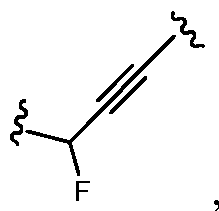


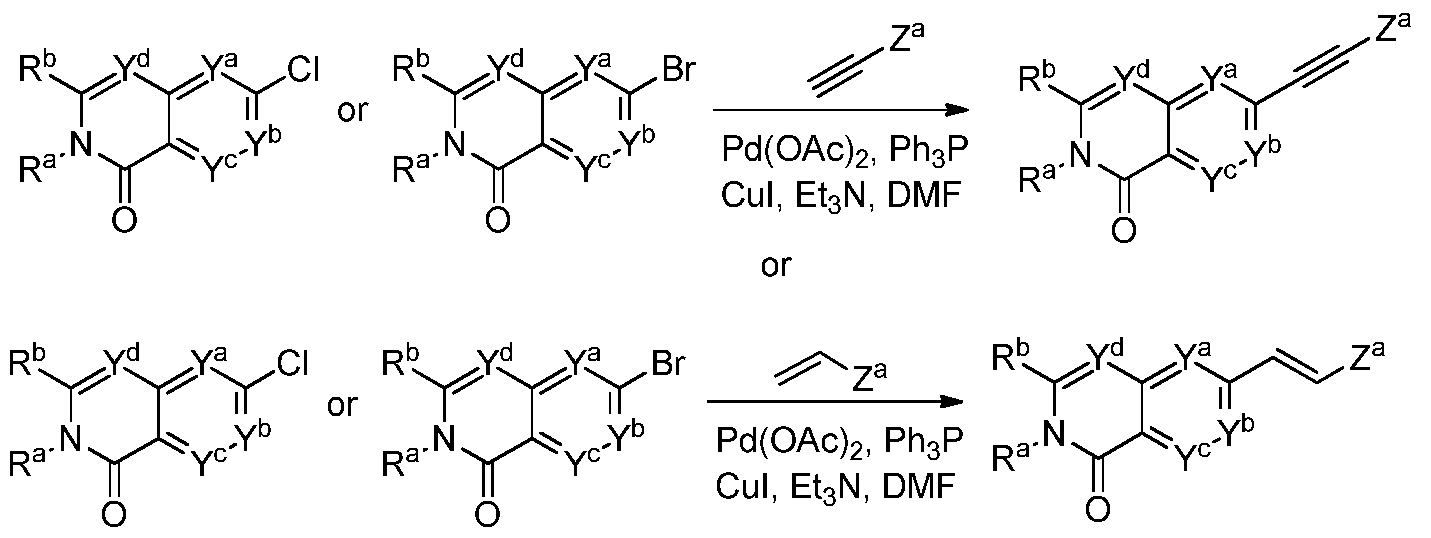





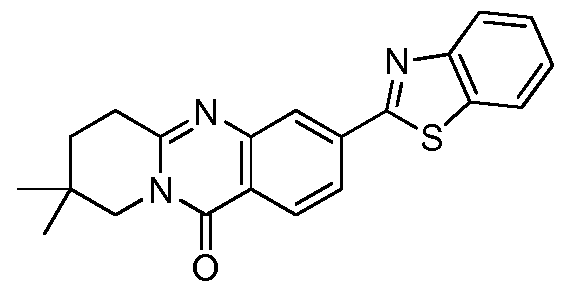





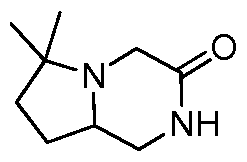


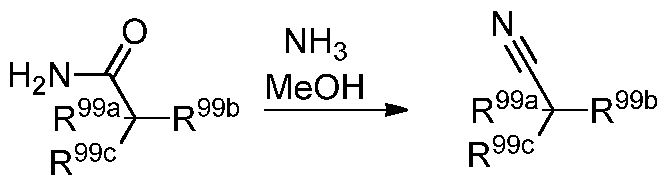





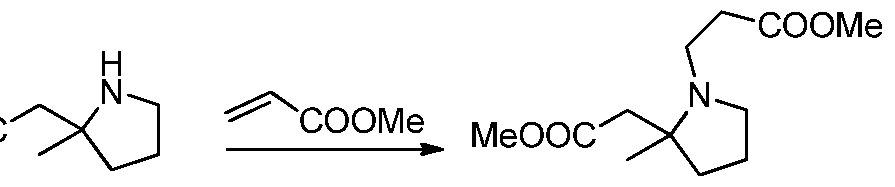


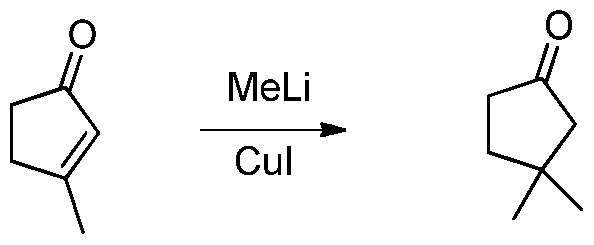





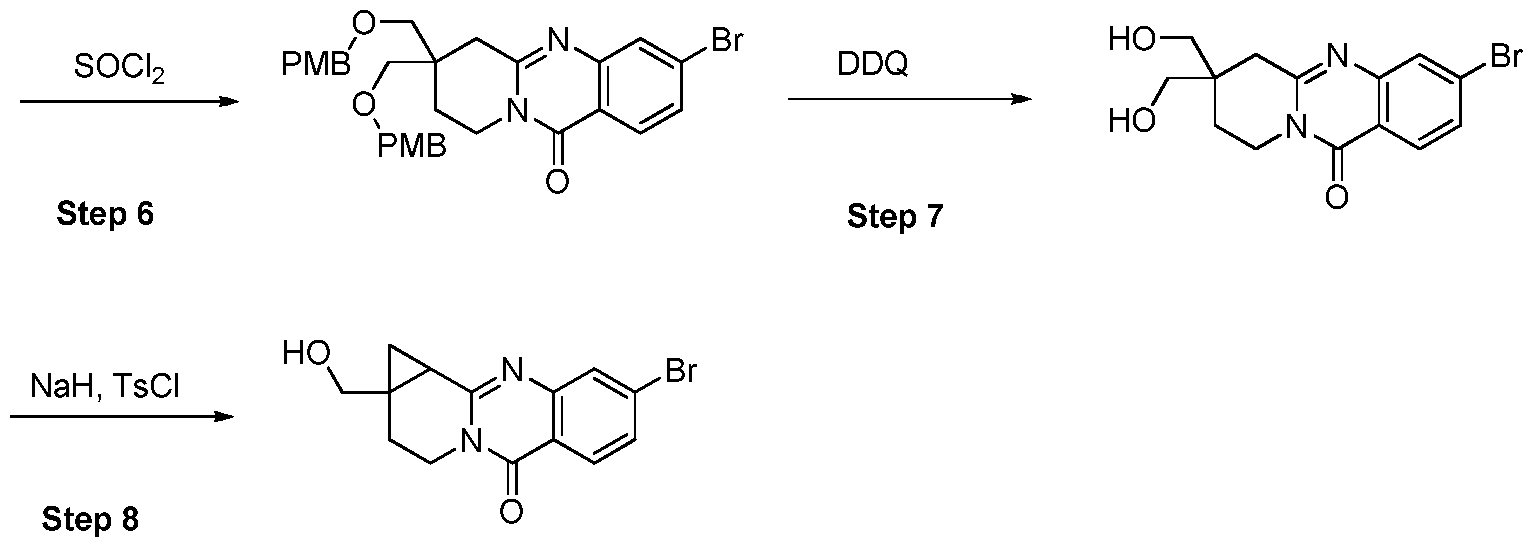


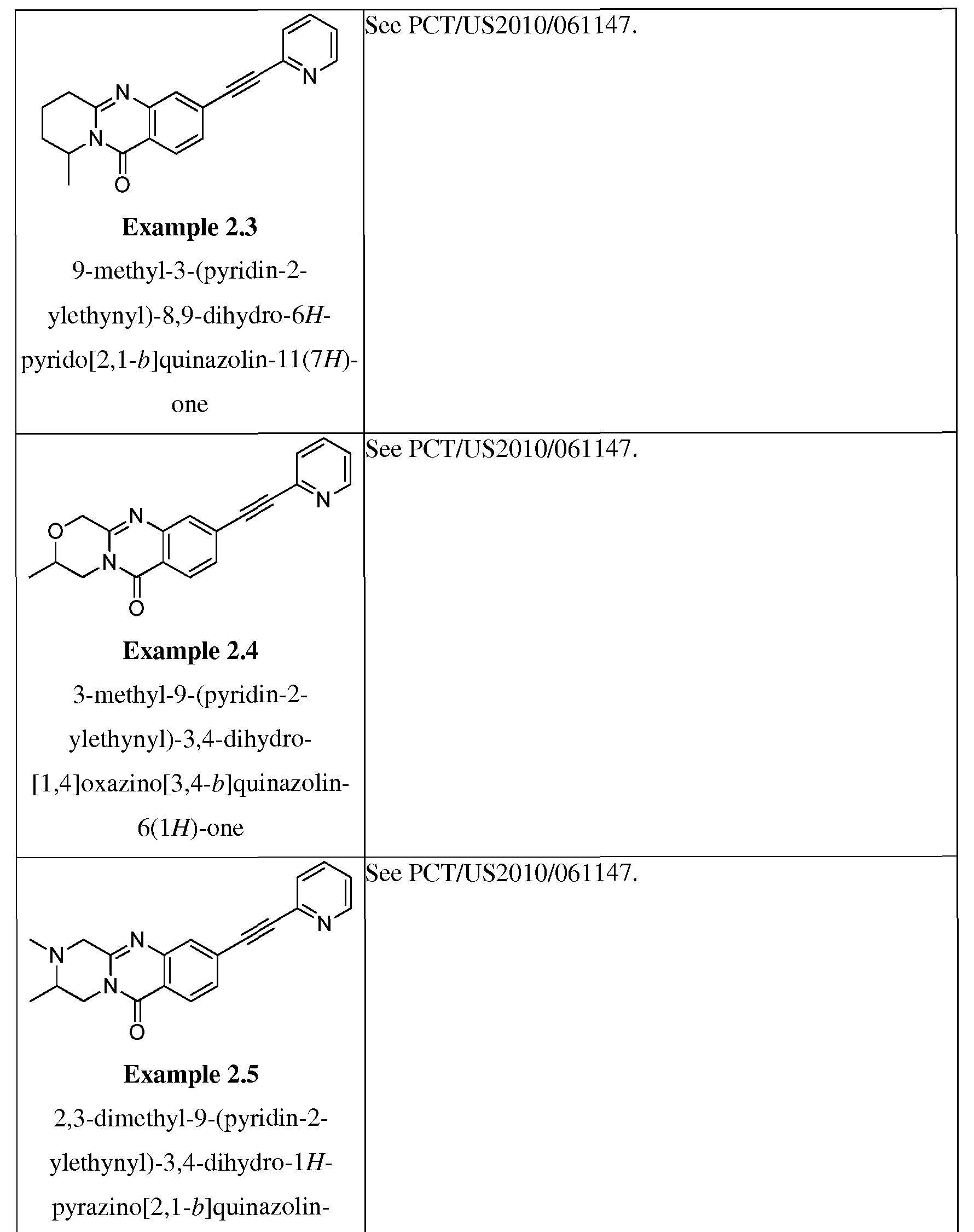


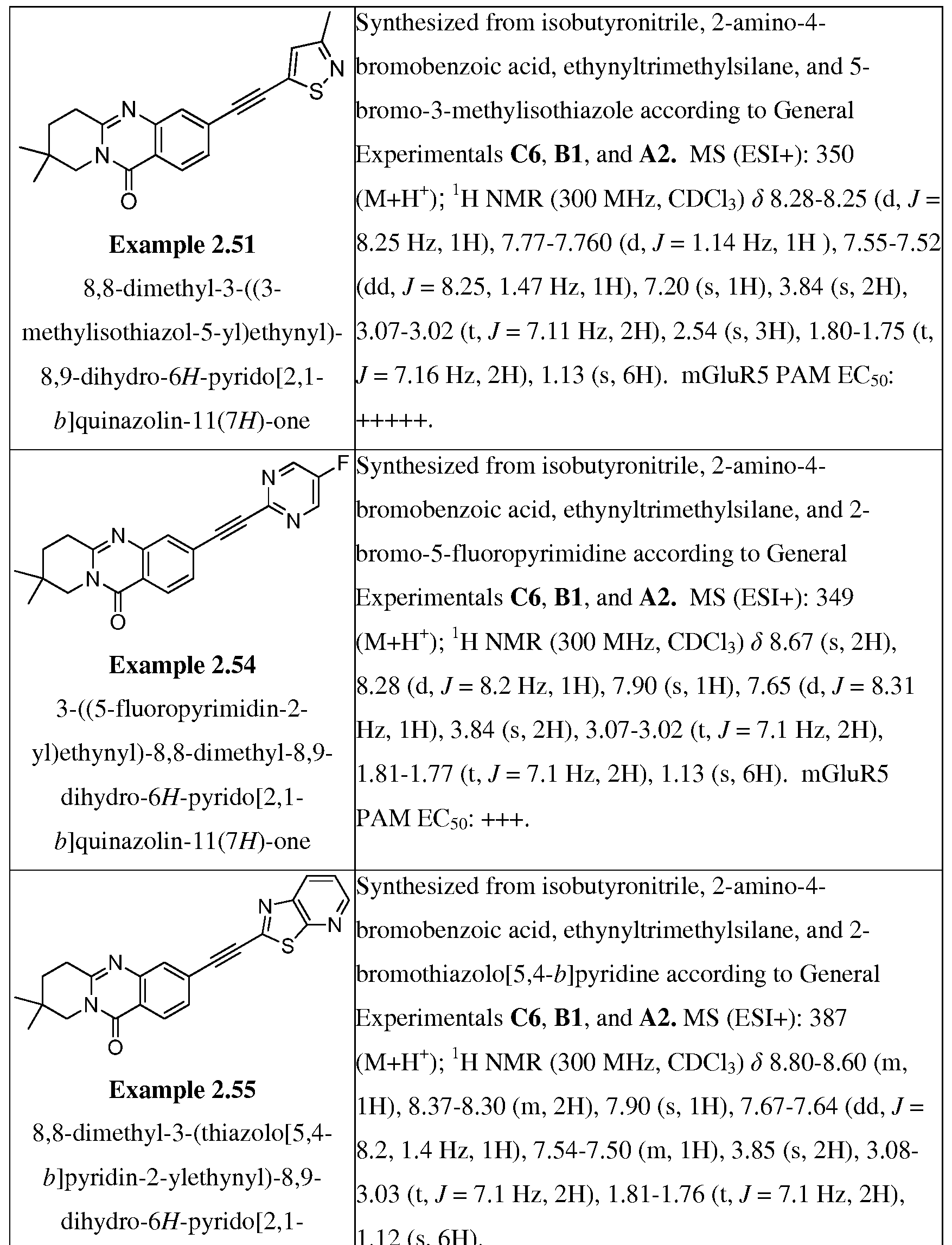


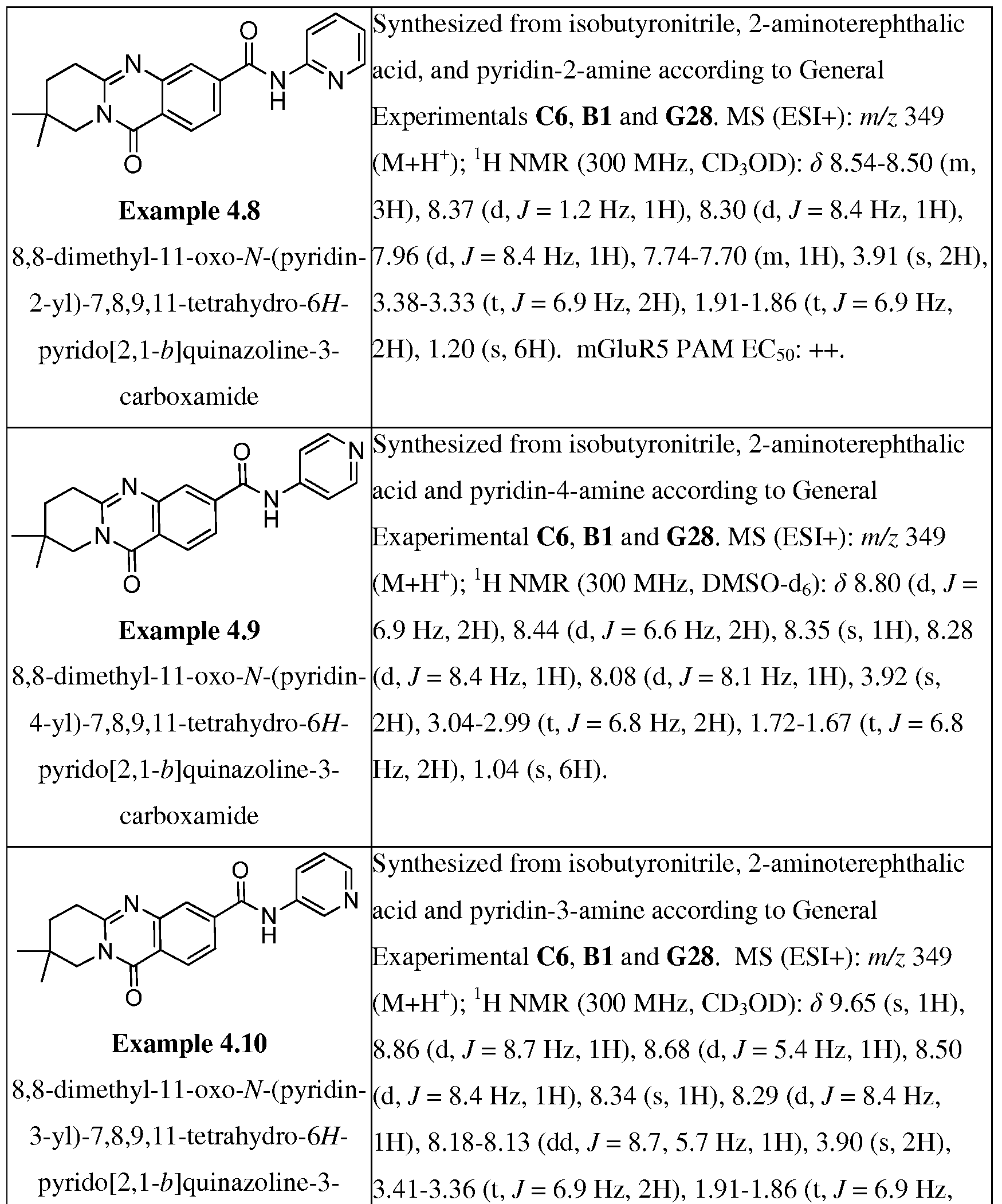


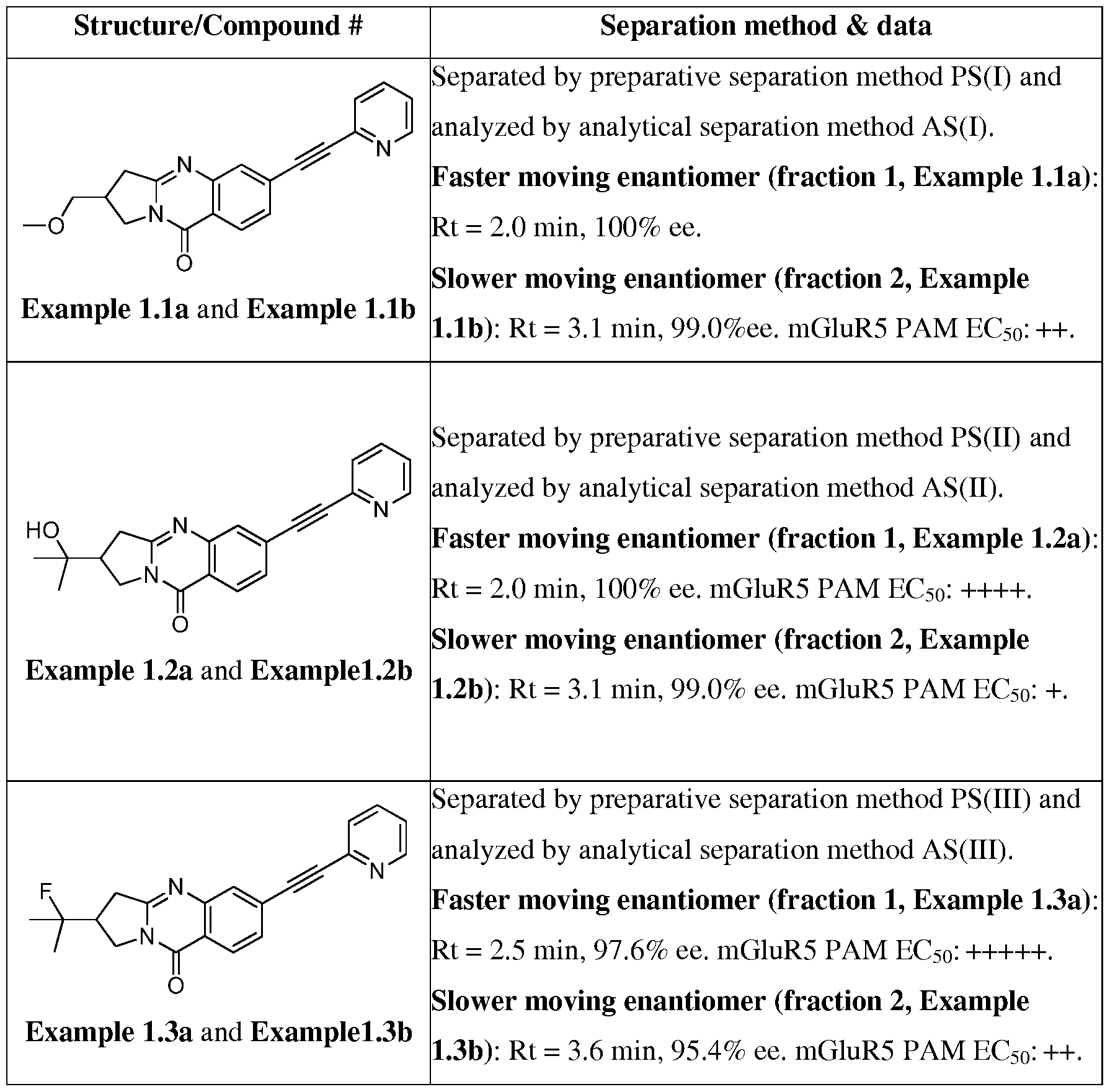


Claims


Priority Applications (6)
| Application Number | Priority Date | Filing Date | Title |
|---|---|---|---|
| AU2012267622A AU2012267622B2 (en) | 2011-06-08 | 2012-06-08 | Metabotropic glutamate receptor 5 modulators and methods of use thereof |
| US14/124,455 US9260452B2 (en) | 2011-06-08 | 2012-06-08 | Metabotrophic glutamate receptor 5 modulators and methods of use thereof |
| CA2837883A CA2837883C (en) | 2011-06-08 | 2012-06-08 | Metabotropic glutamate receptor 5 modulators and methods of use thereof |
| US15/013,741 US9708331B2 (en) | 2011-06-08 | 2016-02-02 | Metabotrophic glutamate receptor 5 modulators and methods of use thereof |
| US15/625,604 US10196399B2 (en) | 2011-06-08 | 2017-06-16 | Metabotrophic glutamate receptor 5 modulators and methods use thereof |
| US16/211,338 US10640510B2 (en) | 2011-06-08 | 2018-12-06 | Metabotrophic glutamate receptor 5 modulators and methods use thereof |
Applications Claiming Priority (2)
| Application Number | Priority Date | Filing Date | Title |
|---|---|---|---|
| US201161494731P | 2011-06-08 | 2011-06-08 | |
| US61/494,731 | 2011-06-08 |
Related Child Applications (2)
| Application Number | Title | Priority Date | Filing Date |
|---|---|---|---|
| US14/124,455 A-371-Of-International US9260452B2 (en) | 2011-06-08 | 2012-06-08 | Metabotrophic glutamate receptor 5 modulators and methods of use thereof |
| US15/013,741 Division US9708331B2 (en) | 2011-06-08 | 2016-02-02 | Metabotrophic glutamate receptor 5 modulators and methods of use thereof |
Publications (2)
| Publication Number | Publication Date |
|---|---|
| WO2012170845A2 true WO2012170845A2 (en) | 2012-12-13 |
| WO2012170845A3 WO2012170845A3 (en) | 2013-04-04 |
Family
ID=47296767
Family Applications (1)
| Application Number | Title | Priority Date | Filing Date |
|---|---|---|---|
| PCT/US2012/041595 Ceased WO2012170845A2 (en) | 2011-06-08 | 2012-06-08 | Metabotropic glutamate receptor 5 modulators and methods of use thereof |
Country Status (4)
| Country | Link |
|---|---|
| US (4) | US9260452B2 (en) |
| AU (1) | AU2012267622B2 (en) |
| CA (1) | CA2837883C (en) |
| WO (1) | WO2012170845A2 (en) |
Cited By (8)
| Publication number | Priority date | Publication date | Assignee | Title |
|---|---|---|---|---|
| CN103965097A (en) * | 2014-05-22 | 2014-08-06 | 南开大学 | A kind of preparation method of 2-piperidone |
| WO2015051341A1 (en) * | 2013-10-03 | 2015-04-09 | Araxes Pharma Llc | Inhibitors of erk and methods of use |
| CN105272986A (en) * | 2015-06-15 | 2016-01-27 | 厦门医学高等专科学校 | A compound for inhibiting acetylcholinesterase activity, and preparation method and uses thereof |
| US9796686B2 (en) | 2014-05-16 | 2017-10-24 | Idorsia Pharmaceuticals Ltd | Antibacterial quinazoline-4(3H)-one derivatives |
| CN108896676A (en) * | 2018-07-12 | 2018-11-27 | 吉林化工学院 | A kind of magnetic Nano microsphere and its method to five kinds of trace fluoroquinolone antibiotics extractions and analysis in water body |
| US20190135815A1 (en) * | 2011-06-08 | 2019-05-09 | Sunovion Pharmaceuticals Inc. | Metabotrophic glutamate receptor 5 modulators and methods use thereof |
| CN113754602A (en) * | 2020-06-02 | 2021-12-07 | 山东润博生物科技有限公司 | Synthesis method of 5, 5-dimethyl-4, 5-dihydroisoxazole-3-ketone |
| CN118772160A (en) * | 2024-07-12 | 2024-10-15 | 西北师范大学 | A dihydropyrroloquinazolinone compound containing trifluoromethyl and a synthesis method thereof |
Families Citing this family (5)
| Publication number | Priority date | Publication date | Assignee | Title |
|---|---|---|---|---|
| SE533410C2 (en) | 2006-07-11 | 2010-09-14 | Vaelinge Innovation Ab | Floor panels with mechanical locking systems with a flexible and slidable tongue as well as heavy therefore |
| US9537718B2 (en) | 2013-03-15 | 2017-01-03 | Cisco Technology, Inc. | Segment routing over label distribution protocol |
| JP6576929B2 (en) * | 2013-09-11 | 2019-09-18 | メルク パテント ゲーエムベーハー | Heterocyclic compounds |
| CN111848552B (en) * | 2019-04-28 | 2023-12-19 | 南京富润凯德生物医药有限公司 | Preparation method and application of 3- (substituted phenyl) oxetane-3-carboxylic acid and intermediate thereof |
| CN115572300A (en) * | 2022-09-26 | 2023-01-06 | 江苏理工学院 | Synthesis method of sulfonamide substituted polycyclic quinazolinone compound |
Family Cites Families (6)
| Publication number | Priority date | Publication date | Assignee | Title |
|---|---|---|---|---|
| US7799913B2 (en) | 2001-11-26 | 2010-09-21 | Cortex Pharmaceuticals, Inc. | Carbonylbenzoxazine compounds for enhancing glutamatergic synaptic responses |
| TW200819458A (en) | 2006-06-23 | 2008-05-01 | Merz Pharma Gmbh & Co Kgaa | Metabotropic glutamate receptor modulators |
| CA2709784A1 (en) * | 2007-12-21 | 2009-07-09 | University Of Rochester | Method for altering the lifespan of eukaryotic organisms |
| TW201116532A (en) * | 2009-08-05 | 2011-05-16 | Merz Pharma Gmbh & Co Kgaa | Metabotropic glutamate receptor modulators |
| CA2784830C (en) * | 2009-12-18 | 2018-03-27 | Sunovion Pharmaceuticals Inc. | Compounds for treating disorders mediated by metabotropic glutamate receptor 5, and methods of use thereof |
| WO2012170845A2 (en) * | 2011-06-08 | 2012-12-13 | Heffernan Michele L R | Metabotropic glutamate receptor 5 modulators and methods of use thereof |
-
2012
- 2012-06-08 WO PCT/US2012/041595 patent/WO2012170845A2/en not_active Ceased
- 2012-06-08 US US14/124,455 patent/US9260452B2/en active Active
- 2012-06-08 CA CA2837883A patent/CA2837883C/en active Active
- 2012-06-08 AU AU2012267622A patent/AU2012267622B2/en not_active Ceased
-
2016
- 2016-02-02 US US15/013,741 patent/US9708331B2/en not_active Expired - Fee Related
-
2017
- 2017-06-16 US US15/625,604 patent/US10196399B2/en active Active
-
2018
- 2018-12-06 US US16/211,338 patent/US10640510B2/en not_active Expired - Fee Related
Cited By (16)
| Publication number | Priority date | Publication date | Assignee | Title |
|---|---|---|---|---|
| US20190135815A1 (en) * | 2011-06-08 | 2019-05-09 | Sunovion Pharmaceuticals Inc. | Metabotrophic glutamate receptor 5 modulators and methods use thereof |
| US10640510B2 (en) * | 2011-06-08 | 2020-05-05 | Sunovion Pharmaceuticals Inc. | Metabotrophic glutamate receptor 5 modulators and methods use thereof |
| EA032196B1 (en) * | 2013-10-03 | 2019-04-30 | Кура Онколоджи, Инк. | Inhibitors of erk and methods of use |
| US10301317B2 (en) | 2013-10-03 | 2019-05-28 | Kura Oncology, Inc. | Inhibitors of ERK and methods of use |
| US9624228B2 (en) | 2013-10-03 | 2017-04-18 | Kura Oncology, Inc. | Inhibitors of ERK and methods of use |
| US9951078B2 (en) | 2013-10-03 | 2018-04-24 | Kura Oncology, Inc. | Inhibitors of ERK and methods of use |
| WO2015051341A1 (en) * | 2013-10-03 | 2015-04-09 | Araxes Pharma Llc | Inhibitors of erk and methods of use |
| JP2016531952A (en) * | 2013-10-03 | 2016-10-13 | クラ オンコロジー, インコーポレイテッド | Inhibitors of ERK and methods of use |
| US9796686B2 (en) | 2014-05-16 | 2017-10-24 | Idorsia Pharmaceuticals Ltd | Antibacterial quinazoline-4(3H)-one derivatives |
| CN103965097A (en) * | 2014-05-22 | 2014-08-06 | 南开大学 | A kind of preparation method of 2-piperidone |
| CN105272986A (en) * | 2015-06-15 | 2016-01-27 | 厦门医学高等专科学校 | A compound for inhibiting acetylcholinesterase activity, and preparation method and uses thereof |
| CN108896676A (en) * | 2018-07-12 | 2018-11-27 | 吉林化工学院 | A kind of magnetic Nano microsphere and its method to five kinds of trace fluoroquinolone antibiotics extractions and analysis in water body |
| CN108896676B (en) * | 2018-07-12 | 2020-11-06 | 吉林化工学院 | Magnetic nano-microsphere and method for extracting and analyzing five trace fluoroquinolone antibiotics in water body by using same |
| CN113754602A (en) * | 2020-06-02 | 2021-12-07 | 山东润博生物科技有限公司 | Synthesis method of 5, 5-dimethyl-4, 5-dihydroisoxazole-3-ketone |
| CN113754602B (en) * | 2020-06-02 | 2023-04-25 | 山东润博生物科技有限公司 | Synthesis method of 5, 5-dimethyl-4, 5-dihydro-isoxazole-3-one |
| CN118772160A (en) * | 2024-07-12 | 2024-10-15 | 西北师范大学 | A dihydropyrroloquinazolinone compound containing trifluoromethyl and a synthesis method thereof |
Also Published As
| Publication number | Publication date |
|---|---|
| US9260452B2 (en) | 2016-02-16 |
| US20180037585A1 (en) | 2018-02-08 |
| AU2012267622A1 (en) | 2014-01-09 |
| US20190135815A1 (en) | 2019-05-09 |
| CA2837883A1 (en) | 2012-12-13 |
| CA2837883C (en) | 2019-10-29 |
| US10640510B2 (en) | 2020-05-05 |
| WO2012170845A3 (en) | 2013-04-04 |
| AU2012267622B2 (en) | 2017-06-22 |
| US20160251359A1 (en) | 2016-09-01 |
| US20200079778A9 (en) | 2020-03-12 |
| US9708331B2 (en) | 2017-07-18 |
| US10196399B2 (en) | 2019-02-05 |
| US20140179682A1 (en) | 2014-06-26 |
Similar Documents
| Publication | Publication Date | Title |
|---|---|---|
| US10640510B2 (en) | Metabotrophic glutamate receptor 5 modulators and methods use thereof | |
| US10077243B2 (en) | Compounds for treating disorders mediated by metabotropic glutamate receptor 5, and methods of use thereof | |
| US11919902B2 (en) | Aryl-bipyridine amine derivatives as phosphatidylinositol phosphate kinase inhibitors | |
| US10287299B2 (en) | Substituted benzo[b][1,4]oxazines and pyrido[3,2-b][1,4]oxazines as modulators of tumor necrosis factor activity | |
| AU2012258618B2 (en) | Metabotropic glutamate receptors 5 modulators and methods of use thereof | |
| IL296918A (en) | Allosteric chromenone inhibitors of phosphoinositide 3-kinase (pi3k) for the treatment of diseases associated with p13k modulation | |
| JP7335893B2 (en) | Chromenopyridine Derivatives as Phosphatidylinositol Phosphate Kinase Inhibitors | |
| AU2010214101A1 (en) | Histamine H3 inverse agonists and antagonists and methods of use thereof | |
| CA2932008A1 (en) | Fused tricyclic benzimidazoles derivatives as modulators of tnf activity | |
| AU2012258618A1 (en) | Metabotropic glutamate receptors 5 modulators and methods of use thereof | |
| EP3083573B1 (en) | Inhibitors of the renal outer medullary potassium channel | |
| WO2025136936A1 (en) | Agonists of trem2 activity | |
| AU2016371387B2 (en) | Tricyclic compounds and compositions as kinase inhibitors | |
| US20230183237A1 (en) | Competitive and noncompetitive inhibitors of the muscarinic acetylcholine receptor m5 |
Legal Events
| Date | Code | Title | Description |
|---|---|---|---|
| 121 | Ep: the epo has been informed by wipo that ep was designated in this application |
Ref document number: 12796737 Country of ref document: EP Kind code of ref document: A2 |
|
| ENP | Entry into the national phase |
Ref document number: 2837883 Country of ref document: CA |
|
| NENP | Non-entry into the national phase |
Ref country code: DE |
|
| ENP | Entry into the national phase |
Ref document number: 2012267622 Country of ref document: AU Date of ref document: 20120608 Kind code of ref document: A |
|
| WWE | Wipo information: entry into national phase |
Ref document number: 14124455 Country of ref document: US |
|
| 122 | Ep: pct application non-entry in european phase |
Ref document number: 12796737 Country of ref document: EP Kind code of ref document: A2 |