WO2012172734A1 - Dispositif d'assistance d'ouverture de porte coulissante - Google Patents
Dispositif d'assistance d'ouverture de porte coulissante Download PDFInfo
- Publication number
- WO2012172734A1 WO2012172734A1 PCT/JP2012/003415 JP2012003415W WO2012172734A1 WO 2012172734 A1 WO2012172734 A1 WO 2012172734A1 JP 2012003415 W JP2012003415 W JP 2012003415W WO 2012172734 A1 WO2012172734 A1 WO 2012172734A1
- Authority
- WO
- WIPO (PCT)
- Prior art keywords
- sliding door
- opening
- pressed
- door
- pressing member
- Prior art date
- Legal status (The legal status is an assumption and is not a legal conclusion. Google has not performed a legal analysis and makes no representation as to the accuracy of the status listed.)
- Ceased
Links
Images






Classifications
-
- E—FIXED CONSTRUCTIONS
- E05—LOCKS; KEYS; WINDOW OR DOOR FITTINGS; SAFES
- E05B—LOCKS; ACCESSORIES THEREFOR; HANDCUFFS
- E05B17/00—Accessories in connection with locks
- E05B17/0025—Devices for forcing the wing firmly against its seat or to initiate the opening of the wing
- E05B17/0033—Devices for forcing the wing firmly against its seat or to initiate the opening of the wing for opening only
-
- E—FIXED CONSTRUCTIONS
- E05—LOCKS; KEYS; WINDOW OR DOOR FITTINGS; SAFES
- E05B—LOCKS; ACCESSORIES THEREFOR; HANDCUFFS
- E05B65/00—Locks or fastenings for special use
- E05B65/08—Locks or fastenings for special use for sliding wings
- E05B65/0835—Locks or fastenings for special use for sliding wings the bolts pivoting about an axis parallel to the wings
- E05B65/0841—Locks or fastenings for special use for sliding wings the bolts pivoting about an axis parallel to the wings and parallel to the sliding direction of the wings
-
- E—FIXED CONSTRUCTIONS
- E05—LOCKS; KEYS; WINDOW OR DOOR FITTINGS; SAFES
- E05C—BOLTS OR FASTENING DEVICES FOR WINGS, SPECIALLY FOR DOORS OR WINDOWS
- E05C3/00—Fastening devices with bolts moving pivotally or rotatively
- E05C3/02—Fastening devices with bolts moving pivotally or rotatively without latching action
- E05C3/04—Fastening devices with bolts moving pivotally or rotatively without latching action with operating handle or equivalent member rigid with the bolt
- E05C3/041—Fastening devices with bolts moving pivotally or rotatively without latching action with operating handle or equivalent member rigid with the bolt rotating about an axis perpendicular to the surface on which the fastener is mounted
- E05C3/046—Fastening devices with bolts moving pivotally or rotatively without latching action with operating handle or equivalent member rigid with the bolt rotating about an axis perpendicular to the surface on which the fastener is mounted in the form of a crescent-shaped cam
Definitions
- the present invention relates to a sliding door opening auxiliary device attached to a window or an entrance of a building or the like.
- an opening assistance device has been developed to assist the operator in initial operation when such a sliding door is opened.
- sliding doors that can be opened and closed in a square frame formed in the opening of a building so that they can be opened and closed in a sliding manner or in a single-drawing manner, they are provided on the door toe to help reduce the initial operation at the time of opening.
- an opening / closing assist device that performs unlocking of a hook lock provided as a door-end lock on a door-end collar in conjunction with an opening operation of the opening / closing assist device (see Patent Document 1).
- the opening assist device is provided on the door-end side (door-end fence) of the sliding door, and the operation handle is arranged so as to protrude from the main surface of the sliding door. . Therefore, when increasing the overlap of the two sliding doors to maximize the opening, the opening assisting device including the handle hits the door butt (summing bowl) of the other sliding doors and completely overlaps the two sliding doors. There is a problem that it cannot be combined. That is, there is a problem that the opening assist device limits the opening / closing range of the sliding door. This problem occurs when the handle abuts against the opening edge of the door pocket even when the sliding door is moved in and out of the door pocket.
- This invention is made in view of the above problem, and makes it a subject that the opening assistance apparatus of a sliding door does not restrict
- the present invention provides an opening assist device (1, 100) for assisting an initial operation when the sliding door (3) is opened from the closed position, wherein the sliding door is in the closed position.
- the pressing member is arranged apart from the sliding door so as not to come into contact with the sliding door when the sliding door opens and closes at the initial position.
- the operating member and the pressing member are supported by the support member, and the pressing member acting on the door bottom does not contact the sliding door that opens and closes at the initial position. There is no regulation.
- the door butt portion includes a sump that protrudes toward the support member so as to form a stepped portion, and the pressing member extends from the direction along the opening / closing direction of the sliding door. It is characterized by pressing the summon bowl in the opening direction.
- the pressing member presses the summon bowl provided on the sliding door.
- Another aspect of the present invention is characterized in that a pressed portion (53) to be pressed by the pressing member is provided on the summing pad so as to protrude in a closing direction along the surface of the sliding door.
- Another aspect of the present invention is characterized in that the pressing member is supported by the support member so as to be rotatable between the initial position and the post-drive position.
- the pressing member that is separated from the sliding door in the initial position, and that presses the summon candy in the opening direction from the direction along the opening / closing direction of the sliding door when driven by the operation member has a simple structure. Can be configured.
- the pressing member protrudes to one side in a tangential direction centering on the rotating shaft from the distal end of the base portion (44) extending in the radial direction of the rotating shaft, and presses the summing rod
- An end (45) and a pressed end (46) protruding to the other side in the tangential direction and pressed by the operating member, and a protruding length of the pressed end from the tip of the base Is characterized in that the pressing end portion is longer than the protruding length from the tip of the base portion.
- the door butt portion is between a first position extending along an opening / closing direction of the sliding door and a second position extending in a standing state with respect to the main surface of the sliding door.
- the pressing member driven by the operation member is pressed to the side opposite to the first position to displace the sliding door in the opening direction, while the sliding door moves in the opening direction. In this case, it is pressed by the support member and is displaced from the second position to the first position against the urging force of the urging member.
- the pressing member since the pressing member moves the sliding door in the opening direction by pressing the pressed member, the pressing member can be disposed at a position separated from the sliding door. In addition, the pressed member escapes to the first position when it hits the support member, so the pressed member does not restrict the opening / closing range of the sliding door.
- the door bottom has a holder (113) in which a locking hole (116) is formed, and the support member protrudes toward the door bottom.
- the pressed member has a locking projection (120) locked to the locking hole when positioned at the first position, and changes from a state where the sliding door is opened to the closed position.
- An engaging projection (118) that abuts against the projecting piece, and the locking projection is locked in the locking hole to resist the biasing force of the biasing member.
- the pressed member is held at the first position when the sliding door moves in the opening direction from the closed position, and the pressed member returns from the first position to the second position when the sliding door returns to the closed position.
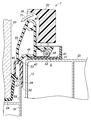
- VII-VII sectional view of FIG. 6 showing the initial state of the opening assistance device Sectional drawing which shows the state after a drive of an opening assistance apparatus
- a sliding door opening assist device (hereinafter simply referred to as an opening assist device) according to the present invention will be described with reference to the drawings.
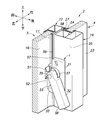
- the term indicating the direction follows the direction indicated by the arrows in FIGS. 1 and 2 in principle.
- the opening assist device 1 As shown in FIG. 1, the opening assist device 1 according to the first embodiment of the present invention is installed in a sliding sash window 2 and assists an initial operation when an operator (not shown) opens the sash window 2.
- the sash window 2 is composed of a rectangular outer frame (not shown) installed in an opening of a building or the like, and a left window 3 and a right window 4 supported by the outer frame.
- the left window 3 is disposed at a position deviated to the front side with respect to the right window 4, and the left window 3 and the right window 4 are slidable in the left-right direction relative to the outer frame independently of each other.
- the left window 3 has a quadrangular frame made up of a door-tower 11, a summoner 12, an upper arm 13 and a lower arm 14, and a plate glass 16 supported by the frame.
- a packing 17 is interposed between the frame body and the plate glass 16.
- the right window 4 includes a rectangular frame made up of a door toe 18, a sump 19, an upper eave 20 and a lower eave 21, a plate glass 23 supported by the frame, a frame and a plate glass 23. And a packing 24 interposed therebetween.
- Each of the glass plates 16 and 23 has a smaller thickness (length in the front-rear direction) than each of the ridges 11 to 14 and 18 to 21.
- the ridges 11 to 14 of the left window 3 and the ridges 18 to 21 of the right window 4 The left window 3 and the right window 4 are arranged with a gap in the front-rear direction so that they do not come into contact with each other when sliding.
- the state in which the door-towers 11 and 18 are close to an outer frame (not shown) and the summons 12 and 19 are opposed to each other in the front-rear direction is referred to as a closed state of the sash window 2 (a state shown in FIG. 1).
- a closed state of the sash window 2 a state shown in FIG. 1.
- the right window 4 is fixed with respect to the outer frame, and the left window 3 is slid with respect to the outer frame.
- the summing bowl 12 of the left window 3 is provided with a flexible weather strip 27 for closing the gap in the front-rear direction with the summing bowl 19 of the right window 4 in the closed state (FIG. 2). , 12).
- the opening assistance device 1 is attached to a summoning bowl 19 of the right window 4 as a support member. As shown in FIGS. 2 and 3, the opening assist device 1 includes a base member 31 attached to the left end surface 25 of the summoning tub 19, and an operation lever 32 and a pressing member 33 that are supported by the base member 31 so as to be displaceable. Prepare mainly. The base member 31 is fastened to the summoning bar 19 with screws.
- the operation lever 32 includes a stepped through hole 35 at one end, and a shaft 36 having an enlarged head at one end is coupled to the through hole 35 so as not to rotate.
- the other end of the shaft 36 is rotatably supported by the base member 31.
- the operation lever 32 is rotatably supported by the base member 31 with the axis A of the shaft 36 extending in the left-right direction as the rotation axis.
- a half-moon-shaped crescent 37 is attached to the right side of the operation lever 32 (base member 31 side), and the crescent 37 rotates integrally with the operation lever 32.
- the other end of the operation lever 32 is a grip portion 38 that is gripped by the operator. As shown in FIG. 4, the intermediate portion in the longitudinal direction of the operation lever 32, and the portion facing the pressing member 33 when rotating downward, is cut off obliquely including the corner portion. A cam surface 39 that can be engaged with 33 is formed.
- the pressing member 33 is pivotally supported by a shaft 42 supported by a U-shaped housing 41.
- the base member 31 is formed with a housing receiving portion 43 that continuously opens from the left side to the front side thereof, and the housing 41 is fitted into the housing receiving portion 43 and fixed. In a state where the housing 41 is coupled to the base member 31, the shaft 42 extends in the vertical direction.
- the pressing member 33 is rotatably supported by the base member 31 with the axis B of the shaft 42 extending in the vertical direction as the rotation axis via the shaft 42 and the housing 41.
- the pressing member 33 has a base portion 44 that extends in a radial direction of the shaft 42 from a portion pivotally supported by the shaft 42. At the tip of the base portion 44, a pressing end portion 45 projecting in one of the tangential directions around the shaft 42 and a pressed end portion 46 projecting in the other of the tangential directions are provided. That is, the pressing member 33 has a substantially T shape.
- the protruding length of the pressing end 45 from the tip of the base 44 is longer than the protruding length of the pressed end 46 from the tip of the base 44, and is set to about 5 times in this embodiment.
- the upper portion of the tip end portion of the pressed end portion 46 is formed as a smooth curved surface 47.
- the curved surface 47 may include a spherical surface.
- a torsion coil spring 48 is interposed between the housing 41 and the base 44 of the pressing member 33.
- the torsion coil spring 48 urges the pressing member 33 in the rotational direction (the clockwise direction as viewed from below as shown in FIG. 7) that faces the protruding direction of the pressed end 46.
- the base 44 biased by the torsion coil spring 48 is partly brought into contact with the housing 41 so that the rotation is restricted at a predetermined position.
- the position of the pressing member 33 at this time is set as an initial position.
- the base portion 44 extends substantially to the left, and the tip end of the pressing end portion 45 is disposed so as not to protrude forward from the summing bar 19 of the right window 4.
- the tip end portion of the pressed end portion 46 protrudes leftward from the base member 31 and is disposed rearward of the shaft 42 that is the rotation shaft of the pressing member 33.
- a receiving member 52 combined with a striker 51 is attached to the summoning bowl 12 of the left window 3.
- the receiving member 52 is a flat rectangular parallelepiped member extending in the up-down direction, and has a thickness in the front-rear direction that is thinner than a thickness in the left-right direction.
- a support hole 54 penetrating from the left end 53 to the right end is formed in the upper portion of the receiving member 52.
- the striker 51 has an engaging portion that can engage with the crescent 37 at one end, is inserted into the support hole 54 from the other end, and the engaging portion protrudes leftward with respect to the receiving member 52. ing.
- a cutout 55 extending in the vertical direction is formed at the right end of the receiving member 52.
- the receiving member 52 and the striker 51 are integrally coupled to the summing bowl 12.
- a known coupling method such as screw fastening or adhesion may be applied to the coupling between the receiving member 52 and the summoning bar 12.
- the left end portion 53 of the receiving member 52 extends to the left from the left side wall 57 of the sump 12.
- the receiving member 52 and the striker 51 are thin in the front-rear direction, when the left window 3 and the right window 4 are moved relative to each other, they contact the summing bar 19, the door toe 18 and the plate glass 23 of the right window 4. There is no. Further, the receiving member 52 does not come into contact with the pressing end portion 45 of the pressing member 33 in the initial position.
- the engagement and release of the crescent 37 and the striker 51 are selectively switched by the rotation of the operation lever 32.
- the crescent 37 is separated from the striker 51 and the engagement is released. This state is called an unlocked state.
- the operation lever 32 is rotated from the unlocked state so that the grip portion 38 is disposed above the rotation axis of the operation lever 32 as shown in FIG. 1, the crescent 37 engages with the striker 51.
- the crescent 37 and the striker 51 are engaged with each other. This state is called a locked state. In the locked state, the relative movement of the left window 3 and the right window 4 is restricted, and the opening of the sash window 2 is prohibited.
- FIG. 6 From the unlocked state where the crescent 37 and the striker 51 are separated from each other, the user grips the grip portion 38, and the operation lever 32 moves downward with respect to the rotation axis of the operation lever 32.
- the cam surface 39 of the operation lever 32 moves the curved surface 47 of the pressed end portion 46 of the pressing member 33 forward as shown in FIG. 7. Press.
- the pressing member 33 rotates in the rotational direction (counterclockwise direction in FIG.
- the opening assisting device 1 configured as described above drives the pressing member 33 by rotating the operation lever 32, presses the summing bar 12 of the left window 3 by the pressing member 33, and moves the left window 3.
- the right window 4 can be moved relative to the right. Since the rotation operation of the operation lever 32 at this time is a rotation operation in the same direction as the operation of releasing the engagement between the crescent 37 and the striker 51, the sash window is operated by one operation of rotating the operation lever 32. Following the unlocking of 2, the sash window 2 can be opened.
- the pressing member 33 is configured not to protrude forward (retracted rearward) from the summing bar 19 of the right window 4 at the initial position, so that the left window 3 and the right window 4 are relative to each other.
- the pressing member 33 does not contact the left window 3 and does not interfere with the relative movement of the left window 3 and the right window 4. Therefore, the left window 3 and the right window 4 can move to a position where they overlap each other in the front-rear direction, or to a position where the right window 4 is displaced to the left of the left window 3.
- the pressing member 33 is disposed at a position where it does not protrude forward from the summing bowl 19 at the initial position.
- the pressing member 33 protrudes forward from the summing bowl 19, the front end of the pressing member 33 is disposed. If the portion (pressing end 45) is arranged behind the summing bowl 12, the receiving member 52 and the door-end fence 11 of the left window 3, and a gap is formed between them, the pressing member 33 is on the left The movement of the window 3 is not hindered.
- the opening assistance device 100 according to the second embodiment differs from the opening assistance device 1 according to the first embodiment in the configuration of the base member 31, the pressing member 33, and the receiving member 52.
- symbol is attached
- the base member 101 of the opening assisting device 100 is attached to the left end surface 25 of the summing bar 19 of the right window 4 on the right side, and receives continuously from the left side to the front side. Is recessed.
- Guide rails 103 projecting to the left are provided on the upper and lower edges of the receiving hole 102.
- Each guide rail 103 is formed with a guide slot 104 extending in the left-right direction.
- the pressing member 106 includes a cylindrical base 107 that extends in the left-right direction.
- the base 107 is formed in a size that can enter the receiving hole 102.
- Guide protrusions 108 project from the upper and lower portions of the base 107, and when the guide protrusion 108 engages with the guide slot 104, the base 107 is predetermined in the left-right direction with respect to the receiving hole 102. It is supported to be able to invade in the range of.
- the position when the pressing member 106 is at the leftmost position (the position that protrudes most from the receiving hole 102) is the initial position, and the position when it is at the rightmost position (the position that is most immersed in the receiving hole 102) is the post-drive position. .
- the base 107 is closed at the left end and receives one end of the compression coil spring 110 inside.
- the other end of the compression coil spring 110 is in contact with the bottom of the receiving hole 102. Thereby, the pressing member 106 is urged to the initial position by the compression coil spring 110.
- a pressed end 109 protruding backward is formed at the left end of the base 107.
- the tip end of the pressed end 109 is formed into a smooth curved surface. As will be described later, the pressed end 109 is pressed against the cam surface 39 of the operation lever 32 when the operation lever 32 is rotated.
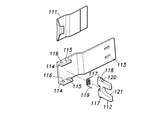
- the striker 111 and the receiving member 112 are separated from each other as shown in FIG. It is provided on the mating bar 12.
- the striker 111 has an engaging portion similar to the striker 51, and is bolted to the summing rod 12 so that the engaging portion protrudes to the left from the summing rod 12.
- the receiving member 112 is supported by the summoning bowl 12 through the holder 113.
- the holder 113 is formed in a plate shape extending in the left-right direction, the right end is bolted to the summing bar 12, and the left end extends leftward from the summing bar 12.
- a pair of opposing support pieces 114 projecting rearward are formed on the upper and lower portions of the left end portion of the holder 113. Both support pieces 114 are formed with support holes 115 penetrating in the vertical direction.
- a locking hole 116 penetrating in the vertical direction is formed on both support pieces 114 to the left of the support hole 115.
- the receiving member 112 is a plate-like member, and has a shaft 117 protruding from one side (base end side) of the upper end surface and the lower end surface. Each shaft 117 is rotatably received in the support hole 115 of the holder 113, so that the receiving member 112 is rotatably supported by the holder 113.
- the receiving member 112 is rotatable between a first position where the tip end portion (free end portion) faces leftward and a second position where the tip end portion faces rearward. That is, the receiving member 112 has a rotation range of approximately 90 °.
- the rotation range is regulated by the main surface of the receiving member 112 coming into contact with the holder 113, and in the second position, the regulating wall 118 protruding from the main surface of the receiving member 112 is the holder 113.
- the rotation range is regulated by abutting on.
- a torsion coil spring 119 is interposed between the receiving member 112 and the holder 113, and the receiving member 112 is urged by the torsion coil spring 119 in the rotational direction from the first position to the second position. Further, locking projections 120 that are locked to the locking holes 116 of the holder 113 at the first position protrude from the upper end surface and the lower end surface of the receiving member 112. When the locking projection 120 is locked in the locking hole 116, the receiving member 112 is held at the first position against the urging force of the torsion coil spring 118.
- a notch 121 extending toward the proximal end is formed at the distal end of the receiving member 112. By this notch 121, the front end of the receiving member 112 is bifurcated.
- the receiving member 112 has a leading end protruding rearward from the front side surface of the summing bar 19 of the right window 4 at the second position.
- the receiving member 112 In the closed state of the sash window 2 in which the summing rods 12 and 19 of the windows 3 and 4 face each other, the receiving member 112 is disposed between the base 107 and the base member 101 of the pressing member 106 in the left-right direction. Further, the compression coil spring 110 is disposed in the notch 121 of the receiving member 112.
- the base member 101 is formed with a protruding piece 122 that protrudes forward. As will be described later, the projecting piece 122 is provided in order to contact the receiving member 112 and displace the position.
- the opening assistance device 100 By rotating the operation lever 32, the crescent 37 and the striker 111 are selected between the unlocked state and the unlocked state, similarly to the opening assisting device 100.
- the cam surface 39 of the operating lever 32 is pressed against the pressed end portion 109 of the pressing member 106 as shown in FIG. Press to the right. Accordingly, the pressing member 106 is displaced rightward from the initial position to the post-drive position against the urging force of the compression coil spring 110.
- the cam surface 39 displaces the pressing member 106 to the right while sliding on the pressed end 109. That is, the operation lever 32 drives the pressing member 106.
- the base 107 of the pressing member 106 presses the receiving member 112 to the right. Since the rotation of the receiving member 112 is restricted by the restriction wall 118, the receiving member 112 maintains the posture with respect to the holder 113 even when pressed by the pressing member 106. As a result, the left window 3 coupled to the holder 113 is displaced to the right with respect to the right window 4. That is, the left window 3 is opened.
- the receiving member 112 comes into contact with the protruding piece 122 of the base member 101.
- the receiving member 112 is pressed by the projecting piece 122 and resists the biasing force of the torsion coil spring 119 from the second position to the first position. Rotate to position.
- the receiving member 112 can avoid the protruding piece 122 and the sump 19, and does not hinder the displacement of the left window 3 to the right with respect to the right window 4.
- the receiving member 112 reaches the first position, the locking projection 120 of the receiving member 112 is locked in the locking hole 116 of the holder 113, and the receiving member 112 is held in the first position.
- the receiving member 52 is a separate member from the summoning bowl 12, but in other embodiments, the receiving member 52 may be configured as a part of the summing bowl 12.
Landscapes
- Engineering & Computer Science (AREA)
- Mechanical Engineering (AREA)
- Specific Sealing Or Ventilating Devices For Doors And Windows (AREA)
Abstract
[Problème] Empêcher un dispositif d'assistance d'ouverture de porte coulissante de limiter le débattement à l'ouverture et à la fermeture d'une porte coulissante. [Solution] L'invention concerne un dispositif d'assistance d'ouverture (1, 100) assistant une manipulation initiale lors de l'ouverture d'une porte coulissante (3) depuis une position fermée, le dispositif comportant : un élément de support (19) mis en œuvre pour être orienté vers une extrémité de porte (12) de la porte coulissante dans la position fermée ; un élément de manipulation (32) qui est supporté par l'élément de support d'une manière déplaçable et qui est manipulé par un utilisateur lors de l'ouverture de la porte coulissante ; et un élément de compression (33) qui est supporté par l'élément de support d'une manière déplaçable, qui est déplacé en réponse au déplacement de l'élément de manipulation à des fins de déplacement entre une position initiale et une position de post-mouvement afin de comprimer l'extrémité de porte dans la direction d'ouverture de la porte coulissante ; et l'élément de compression étant arrangé dans la position initiale à distance de la porte coulissante de manière à ne pas toucher la porte coulissante lors de l'ouverture ou de la fermeture de la porte coulissante.
Applications Claiming Priority (2)
| Application Number | Priority Date | Filing Date | Title |
|---|---|---|---|
| JP2011133345A JP2013002105A (ja) | 2011-06-15 | 2011-06-15 | 引き戸の開放補助装置 |
| JP2011-133345 | 2011-06-15 |
Publications (1)
| Publication Number | Publication Date |
|---|---|
| WO2012172734A1 true WO2012172734A1 (fr) | 2012-12-20 |
Family
ID=47356749
Family Applications (1)
| Application Number | Title | Priority Date | Filing Date |
|---|---|---|---|
| PCT/JP2012/003415 Ceased WO2012172734A1 (fr) | 2011-06-15 | 2012-05-25 | Dispositif d'assistance d'ouverture de porte coulissante |
Country Status (2)
| Country | Link |
|---|---|
| JP (1) | JP2013002105A (fr) |
| WO (1) | WO2012172734A1 (fr) |
Cited By (2)
| Publication number | Priority date | Publication date | Assignee | Title |
|---|---|---|---|---|
| US11008775B2 (en) * | 2015-12-03 | 2021-05-18 | Lawrence E Chaffin | Lift glide door lock assembly and lift glide window lock assembly and dual lift glide door lock assembly and dual lift glide window lock assembly |
| US20220112745A1 (en) * | 2020-10-14 | 2022-04-14 | Emtek Products, Inc. | Privacy Lock And Flush Pull With Integrated Strike Lockset |
Citations (3)
| Publication number | Priority date | Publication date | Assignee | Title |
|---|---|---|---|---|
| JPH08135302A (ja) * | 1994-11-14 | 1996-05-28 | Haseko Corp | サッシ |
| JP3927938B2 (ja) * | 2003-09-24 | 2007-06-13 | Ykk Ap株式会社 | 開放補助機構付き引手、およびサッシ窓 |
| JP2010196458A (ja) * | 2009-02-02 | 2010-09-09 | Nifco Inc | 開放補助機構付き引き手 |
-
2011
- 2011-06-15 JP JP2011133345A patent/JP2013002105A/ja active Pending
-
2012
- 2012-05-25 WO PCT/JP2012/003415 patent/WO2012172734A1/fr not_active Ceased
Patent Citations (3)
| Publication number | Priority date | Publication date | Assignee | Title |
|---|---|---|---|---|
| JPH08135302A (ja) * | 1994-11-14 | 1996-05-28 | Haseko Corp | サッシ |
| JP3927938B2 (ja) * | 2003-09-24 | 2007-06-13 | Ykk Ap株式会社 | 開放補助機構付き引手、およびサッシ窓 |
| JP2010196458A (ja) * | 2009-02-02 | 2010-09-09 | Nifco Inc | 開放補助機構付き引き手 |
Cited By (2)
| Publication number | Priority date | Publication date | Assignee | Title |
|---|---|---|---|---|
| US11008775B2 (en) * | 2015-12-03 | 2021-05-18 | Lawrence E Chaffin | Lift glide door lock assembly and lift glide window lock assembly and dual lift glide door lock assembly and dual lift glide window lock assembly |
| US20220112745A1 (en) * | 2020-10-14 | 2022-04-14 | Emtek Products, Inc. | Privacy Lock And Flush Pull With Integrated Strike Lockset |
Also Published As
| Publication number | Publication date |
|---|---|
| JP2013002105A (ja) | 2013-01-07 |
Similar Documents
| Publication | Publication Date | Title |
|---|---|---|
| TWI529290B (zh) | 多取用方式門鎖機構 | |
| JP6576628B2 (ja) | 車両用ドアのロック装置 | |
| TWI592560B (zh) | Lock device and sliding door with the lock device | |
| JP5358692B2 (ja) | 引き戸の開放補助装置 | |
| WO2012172734A1 (fr) | Dispositif d'assistance d'ouverture de porte coulissante | |
| JP5345503B2 (ja) | 開動助勢機構 | |
| KR100926467B1 (ko) | 전기정 스트라이커 | |
| JP2009189642A (ja) | 遊技機のヒンジ構造およびそのヒンジ構造を用いた遊技機 | |
| JP2011099219A5 (fr) | ||
| JP4368565B2 (ja) | 錠前の反転ラッチ用ストッパー機構 | |
| JP5007198B2 (ja) | 扉用錠装置 | |
| JP3386821B2 (ja) | 窓装置 | |
| KR101467284B1 (ko) | 래치볼트 고정레버의 작동장치 | |
| JP5727802B2 (ja) | ラッチ錠における内外気圧差解消装置 | |
| JP2004285656A (ja) | 扉の構造 | |
| JP5942104B2 (ja) | 建具用ラッチ錠 | |
| JP5740166B2 (ja) | ラッチ錠における内外気圧差解消装置 | |
| JP5330732B2 (ja) | プッシュプル電気錠 | |
| JP6384855B2 (ja) | 引き戸装置およびセーフティーストッパー | |
| JP2012097465A (ja) | 錠装置 | |
| JP5806888B2 (ja) | 開き戸用の内外気圧差解消装置 | |
| JP4514076B2 (ja) | 鎌錠 | |
| JP2014029096A (ja) | 引戸開放アシスト装置および引戸 | |
| JP4811368B2 (ja) | 引き戸の施開錠構造 | |
| JP4656435B2 (ja) | 建具 |
Legal Events
| Date | Code | Title | Description |
|---|---|---|---|
| 121 | Ep: the epo has been informed by wipo that ep was designated in this application |
Ref document number: 12800434 Country of ref document: EP Kind code of ref document: A1 |
|
| NENP | Non-entry into the national phase |
Ref country code: DE |
|
| 122 | Ep: pct application non-entry in european phase |
Ref document number: 12800434 Country of ref document: EP Kind code of ref document: A1 |