WO2012172899A1 - Système d'alimentation électrique sans contact de type à résonance - Google Patents
Système d'alimentation électrique sans contact de type à résonance Download PDFInfo
- Publication number
- WO2012172899A1 WO2012172899A1 PCT/JP2012/062179 JP2012062179W WO2012172899A1 WO 2012172899 A1 WO2012172899 A1 WO 2012172899A1 JP 2012062179 W JP2012062179 W JP 2012062179W WO 2012172899 A1 WO2012172899 A1 WO 2012172899A1
- Authority
- WO
- WIPO (PCT)
- Prior art keywords
- frequency
- resonance
- power
- power supply
- coil
- Prior art date
- Legal status (The legal status is an assumption and is not a legal conclusion. Google has not performed a legal analysis and makes no representation as to the accuracy of the status listed.)
- Ceased
Links
Images

Classifications
-
- H—ELECTRICITY
- H01—ELECTRIC ELEMENTS
- H01M—PROCESSES OR MEANS, e.g. BATTERIES, FOR THE DIRECT CONVERSION OF CHEMICAL ENERGY INTO ELECTRICAL ENERGY
- H01M10/00—Secondary cells; Manufacture thereof
- H01M10/42—Methods or arrangements for servicing or maintenance of secondary cells or secondary half-cells
- H01M10/46—Accumulators structurally combined with charging apparatus
-
- B—PERFORMING OPERATIONS; TRANSPORTING
- B60—VEHICLES IN GENERAL
- B60L—PROPULSION OF ELECTRICALLY-PROPELLED VEHICLES; SUPPLYING ELECTRIC POWER FOR AUXILIARY EQUIPMENT OF ELECTRICALLY-PROPELLED VEHICLES; ELECTRODYNAMIC BRAKE SYSTEMS FOR VEHICLES IN GENERAL; MAGNETIC SUSPENSION OR LEVITATION FOR VEHICLES; MONITORING OPERATING VARIABLES OF ELECTRICALLY-PROPELLED VEHICLES; ELECTRIC SAFETY DEVICES FOR ELECTRICALLY-PROPELLED VEHICLES
- B60L53/00—Methods of charging batteries, specially adapted for electric vehicles; Charging stations or on-board charging equipment therefor; Exchange of energy storage elements in electric vehicles
- B60L53/10—Methods of charging batteries, specially adapted for electric vehicles; Charging stations or on-board charging equipment therefor; Exchange of energy storage elements in electric vehicles characterised by the energy transfer between the charging station and the vehicle
- B60L53/12—Inductive energy transfer
- B60L53/122—Circuits or methods for driving the primary coil, e.g. supplying electric power to the coil
-
- B—PERFORMING OPERATIONS; TRANSPORTING
- B60—VEHICLES IN GENERAL
- B60L—PROPULSION OF ELECTRICALLY-PROPELLED VEHICLES; SUPPLYING ELECTRIC POWER FOR AUXILIARY EQUIPMENT OF ELECTRICALLY-PROPELLED VEHICLES; ELECTRODYNAMIC BRAKE SYSTEMS FOR VEHICLES IN GENERAL; MAGNETIC SUSPENSION OR LEVITATION FOR VEHICLES; MONITORING OPERATING VARIABLES OF ELECTRICALLY-PROPELLED VEHICLES; ELECTRIC SAFETY DEVICES FOR ELECTRICALLY-PROPELLED VEHICLES
- B60L53/00—Methods of charging batteries, specially adapted for electric vehicles; Charging stations or on-board charging equipment therefor; Exchange of energy storage elements in electric vehicles
- B60L53/10—Methods of charging batteries, specially adapted for electric vehicles; Charging stations or on-board charging equipment therefor; Exchange of energy storage elements in electric vehicles characterised by the energy transfer between the charging station and the vehicle
- B60L53/12—Inductive energy transfer
- B60L53/126—Methods for pairing a vehicle and a charging station, e.g. establishing a one-to-one relation between a wireless power transmitter and a wireless power receiver
-
- H—ELECTRICITY
- H02—GENERATION; CONVERSION OR DISTRIBUTION OF ELECTRIC POWER
- H02J—ELECTRIC POWER NETWORKS; CIRCUIT ARRANGEMENTS OR SYSTEMS FOR SUPPLYING OR DISTRIBUTING ELECTRIC POWER; SYSTEMS FOR STORING ELECTRIC ENERGY
- H02J50/00—Circuit arrangements or systems for wireless supply or distribution of electric power
- H02J50/10—Circuit arrangements or systems for wireless supply or distribution of electric power using inductive coupling
- H02J50/12—Circuit arrangements or systems for wireless supply or distribution of electric power using inductive coupling of the resonant type
-
- H—ELECTRICITY
- H02—GENERATION; CONVERSION OR DISTRIBUTION OF ELECTRIC POWER
- H02J—ELECTRIC POWER NETWORKS; CIRCUIT ARRANGEMENTS OR SYSTEMS FOR SUPPLYING OR DISTRIBUTING ELECTRIC POWER; SYSTEMS FOR STORING ELECTRIC ENERGY
- H02J50/00—Circuit arrangements or systems for wireless supply or distribution of electric power
- H02J50/80—Circuit arrangements or systems for wireless supply or distribution of electric power involving the exchange of data, concerning supply or distribution of electric power, between transmitting devices and receiving devices
-
- H—ELECTRICITY
- H02—GENERATION; CONVERSION OR DISTRIBUTION OF ELECTRIC POWER
- H02J—ELECTRIC POWER NETWORKS; CIRCUIT ARRANGEMENTS OR SYSTEMS FOR SUPPLYING OR DISTRIBUTING ELECTRIC POWER; SYSTEMS FOR STORING ELECTRIC ENERGY
- H02J7/00—Circuit arrangements for charging or discharging batteries or for supplying loads from batteries
- H02J7/90—Regulation of charging or discharging current or voltage
- H02J7/933—Regulation of charging or discharging current or voltage the cycle being controlled or terminated in response to electric parameters
-
- H—ELECTRICITY
- H02—GENERATION; CONVERSION OR DISTRIBUTION OF ELECTRIC POWER
- H02J—ELECTRIC POWER NETWORKS; CIRCUIT ARRANGEMENTS OR SYSTEMS FOR SUPPLYING OR DISTRIBUTING ELECTRIC POWER; SYSTEMS FOR STORING ELECTRIC ENERGY
- H02J7/00—Circuit arrangements for charging or discharging batteries or for supplying loads from batteries
- H02J7/40—Circuit arrangements for charging or discharging batteries or for supplying loads from batteries characterised by the exchange of charge or discharge related data
- H02J7/42—Circuit arrangements for charging or discharging batteries or for supplying loads from batteries characterised by the exchange of charge or discharge related data with electronic devices having internal batteries, e.g. mobile phones
-
- Y—GENERAL TAGGING OF NEW TECHNOLOGICAL DEVELOPMENTS; GENERAL TAGGING OF CROSS-SECTIONAL TECHNOLOGIES SPANNING OVER SEVERAL SECTIONS OF THE IPC; TECHNICAL SUBJECTS COVERED BY FORMER USPC CROSS-REFERENCE ART COLLECTIONS [XRACs] AND DIGESTS
- Y02—TECHNOLOGIES OR APPLICATIONS FOR MITIGATION OR ADAPTATION AGAINST CLIMATE CHANGE
- Y02E—REDUCTION OF GREENHOUSE GAS [GHG] EMISSIONS, RELATED TO ENERGY GENERATION, TRANSMISSION OR DISTRIBUTION
- Y02E60/00—Enabling technologies; Technologies with a potential or indirect contribution to GHG emissions mitigation
- Y02E60/10—Energy storage using batteries
-
- Y—GENERAL TAGGING OF NEW TECHNOLOGICAL DEVELOPMENTS; GENERAL TAGGING OF CROSS-SECTIONAL TECHNOLOGIES SPANNING OVER SEVERAL SECTIONS OF THE IPC; TECHNICAL SUBJECTS COVERED BY FORMER USPC CROSS-REFERENCE ART COLLECTIONS [XRACs] AND DIGESTS
- Y02—TECHNOLOGIES OR APPLICATIONS FOR MITIGATION OR ADAPTATION AGAINST CLIMATE CHANGE
- Y02T—CLIMATE CHANGE MITIGATION TECHNOLOGIES RELATED TO TRANSPORTATION
- Y02T10/00—Road transport of goods or passengers
- Y02T10/60—Other road transportation technologies with climate change mitigation effect
- Y02T10/70—Energy storage systems for electromobility, e.g. batteries
-
- Y—GENERAL TAGGING OF NEW TECHNOLOGICAL DEVELOPMENTS; GENERAL TAGGING OF CROSS-SECTIONAL TECHNOLOGIES SPANNING OVER SEVERAL SECTIONS OF THE IPC; TECHNICAL SUBJECTS COVERED BY FORMER USPC CROSS-REFERENCE ART COLLECTIONS [XRACs] AND DIGESTS
- Y02—TECHNOLOGIES OR APPLICATIONS FOR MITIGATION OR ADAPTATION AGAINST CLIMATE CHANGE
- Y02T—CLIMATE CHANGE MITIGATION TECHNOLOGIES RELATED TO TRANSPORTATION
- Y02T10/00—Road transport of goods or passengers
- Y02T10/60—Other road transportation technologies with climate change mitigation effect
- Y02T10/7072—Electromobility specific charging systems or methods for batteries, ultracapacitors, supercapacitors or double-layer capacitors
-
- Y—GENERAL TAGGING OF NEW TECHNOLOGICAL DEVELOPMENTS; GENERAL TAGGING OF CROSS-SECTIONAL TECHNOLOGIES SPANNING OVER SEVERAL SECTIONS OF THE IPC; TECHNICAL SUBJECTS COVERED BY FORMER USPC CROSS-REFERENCE ART COLLECTIONS [XRACs] AND DIGESTS
- Y02—TECHNOLOGIES OR APPLICATIONS FOR MITIGATION OR ADAPTATION AGAINST CLIMATE CHANGE
- Y02T—CLIMATE CHANGE MITIGATION TECHNOLOGIES RELATED TO TRANSPORTATION
- Y02T90/00—Enabling technologies or technologies with a potential or indirect contribution to GHG emissions mitigation
- Y02T90/10—Technologies relating to charging of electric vehicles
- Y02T90/12—Electric charging stations
-
- Y—GENERAL TAGGING OF NEW TECHNOLOGICAL DEVELOPMENTS; GENERAL TAGGING OF CROSS-SECTIONAL TECHNOLOGIES SPANNING OVER SEVERAL SECTIONS OF THE IPC; TECHNICAL SUBJECTS COVERED BY FORMER USPC CROSS-REFERENCE ART COLLECTIONS [XRACs] AND DIGESTS
- Y02—TECHNOLOGIES OR APPLICATIONS FOR MITIGATION OR ADAPTATION AGAINST CLIMATE CHANGE
- Y02T—CLIMATE CHANGE MITIGATION TECHNOLOGIES RELATED TO TRANSPORTATION
- Y02T90/00—Enabling technologies or technologies with a potential or indirect contribution to GHG emissions mitigation
- Y02T90/10—Technologies relating to charging of electric vehicles
- Y02T90/14—Plug-in electric vehicles
Definitions
- the present invention relates to a resonance type non-contact power feeding system.
- Patent Document 1 does not disclose a specific method for specifying the resonance frequency of a resonance system that performs magnetic field resonance. Therefore, it has been difficult to design and manufacture a resonance type non-contact power feeding system that efficiently transmits power. Thus, a non-contact power transmission device that is easy to design and manufacture has been proposed (see, for example, Patent Document 2).
- Patent Document 2 does not consider the load fluctuation on the power receiving side. However, when power transmission is performed by magnetic field resonance, the resonance frequency of the resonance system changes due to a change in the load. Therefore, it is necessary to cope with a change in the resonance frequency of the resonance system due to a change in the load.
- An object of the present invention is to provide a resonance type non-contact power feeding system that is easy to design and manufacture and that can efficiently supply power from a power supply unit to a load even when the load fluctuates.
- a power supply facility including a power supply unit, a primary resonance coil that receives power supply from the power supply unit, and the power from the primary resonance coil as a magnetic field
- a power receiving facility including a secondary side resonance coil that receives power by resonance and a load to which the power received by the secondary side resonance coil is supplied, and at least the primary side resonance coil and the secondary side resonance coil And a resonance-type non-contact power feeding system in which a resonance system is constituted by the load.
- the power supply unit is configured to be change the output frequency
- the impedance measuring means for measuring the input impedance of the resonant system impedance measuring section
- the output frequency f o is the frequency f 1 ⁇ f of the power supply unit
- the output frequency of the power supply unit is changed so that the frequency f 2n-1 ⁇ f o ⁇ f 2n exists in the range of o ⁇ frequency f 2 , frequency f 3 ⁇ f o ⁇ frequency f 4 ,.
- it has a control means (control part) which controls to perform formal power transmission to the said power receiving equipment.
- the "official power”, in a state that satisfies the condition output frequency f o of the power supply unit, means to transmit power to the power receiving equipment, the range of the output frequency f o satisfying the conditions It does not include the transmission of power to the receiving equipment in the preparation stage until setting.
- the frequency f 1 ⁇ f o1 ⁇ frequency f 2 the frequency f 3 ⁇ f o2 ⁇ frequency f 4, ⁇ ⁇ ⁇ , present in the range of the frequency f 2n-1 ⁇ f on ⁇ frequency f 2n.
- the “resonance frequency” means a frequency at which the power transmission efficiency in the resonance system is maximized.
- the output frequency of the power supply unit is set to f 1 , f 2 , f 3 ,. .. , F 2n-1 ⁇ f 2n (f 1 ⁇ f 2 ⁇ f 3 ⁇ ... ⁇ F 2n-1 ⁇ f 2n ), the input impedances Z 1 , Z 2 , Z 3 , ..., Z 2n-1 and Z 2n are measured by the impedance measuring means.
- the output frequency f o of the power supply section exists in any of the ranges, the knowledge which the inventors of the present invention have found, that the output frequency f o is the deviation from equal to or resonance frequency in the resonant frequency of the resonant system It becomes a small frequency. Therefore, even if the load of the power receiving facility fluctuates, power can be efficiently supplied from the power supply unit to the load. In addition, the resonance type non-contact power feeding system can be easily designed and manufactured.
- the induction coil which supplies the electric power supplied from the said power supply part to the said primary side resonance coil by electromagnetic induction, or the said secondary side resonance coil to at least one of the said electric power feeding installation and the said electric power reception installation
- An induction coil for taking out the electric power received by the electromagnetic induction is provided, and at least the induction coil, the primary side resonance coil, the secondary side resonance coil, and the load constitute a resonance system.
- At least two resonance coils that is, the primary side resonance coil and the secondary side resonance coil exist.
- at least one induction coil of an induction coil that supplies electric power supplied from the power supply unit to the primary resonance coil by electromagnetic induction and an induction coil that extracts electric power received by the secondary resonance coil by electromagnetic induction is provided. If it is provided, it becomes easier to adjust to the aligned state. Further, the configuration including all of the primary side resonance coil, the secondary side resonance coil, and the two induction coils makes it easier to adjust the matching state.
- the control means sets the frequencies to f 1 , f 2 , f 3 ,..., F 2n ⁇ 1 , f 2n (f 1 ⁇ f 2 ⁇ f 3 ⁇ ⁇ f 2n-1 ⁇ f 2n) and determined, the output frequency of the power supply unit based on a result f o frequency f 1 ⁇ f o ⁇ frequency f 2, the frequency f 3 ⁇ f o ⁇ frequency f 4, ⁇ , after changing the output frequency of the power supply unit to select whether to present at any scope of frequency f 2n-1 ⁇ f o ⁇ frequency f 2n, starts formal transmission .
- the frequencies f 1 ′ , f 2 ′ , and f 3 ', ⁇ , f 2n-1 ', f 2n seek '(f 1' ⁇ f 2 ' ⁇ f 3' ⁇ f 2n-1 ' ⁇ f 2n'), based on the results frequency f 1 the output frequency f o of the power supply unit ' ⁇ f o ⁇ frequency f 2', the frequency f 3 ' ⁇ f o ⁇ frequency f 4', ⁇ , the frequency f 2n-1 ' ⁇ f o ⁇ f
- control is performed to perform formal power transmission.
- the resonance frequency of the resonance system is constant, power transmission is performed efficiently by once setting the output frequency of the power supply unit to the resonance frequency of the resonance system.
- the resonance frequency changes in response to the load fluctuations. Therefore, if the output frequency of the power supply unit is constant, the output frequency deviates from the resonance frequency, resulting in power transmission efficiency. Decreases.
- the output frequency fo of the power supply unit is changed in accordance with the fluctuation of the resonance frequency within a range where power transmission is performed efficiently. Is done. Therefore, even when the load fluctuation is large, power transmission is performed efficiently.
- the power receiving facility is installed in a vehicle, and the vehicle includes a rectifier and a battery as the load.
- the resonance system may vary depending on when the load varies greatly during power transmission or when the vehicle stops for power reception (charging).
- the resonance frequency changes.
- the resonant frequency of the resonant system be varied, the output frequency f o of the power supply unit is changed by the control means, the power transmission is performed efficiently.
- the present invention it is possible to provide a resonance type non-contact power feeding system that is easy to design and manufacture, and that can efficiently supply power from the power source to the load even when the load fluctuates.
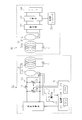
- the block diagram of the resonance-type non-contact charge system of 1st Embodiment The circuit diagram which abbreviate
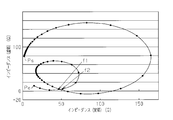
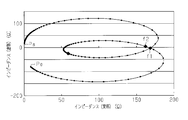
- the graph which shows the relationship between the real part and imaginary part of input impedance at the time of supplying electric power with a different frequency.
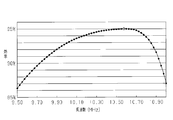
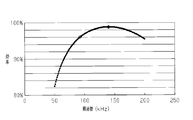
- the graph which shows the relationship between the output frequency of a high frequency power supply, and electric power transmission efficiency.
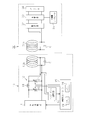
- omits and shows the resonance type non-contact charge system of 2nd Embodiment.
- the graph which shows the relationship between the output frequency of a high frequency power supply, and electric power transmission efficiency.
- a resonance type non-contact charging system as a resonance type non-contact power feeding system includes a power feeding facility 10 provided on the ground side and a power receiving facility 30 mounted on a vehicle as a moving body. Yes.
- the power supply facility 10 includes a high-frequency power source 11 as a power source unit, a matching unit 12 connected to an output unit of the high-frequency power source 11, a primary coil 13, an impedance measuring unit (impedance measuring unit) 14, and a power source-side controller 15. And.
- a power measuring device and a phase measuring device are used as the impedance measuring means 14.
- the power receiving facility includes a secondary coil 31, a rectifier 32, a charger 33, a battery (secondary battery) 34 connected to the charger 33, and a vehicle controller 35.
- the rectifier 32, the charger 33, and the battery 34 constitute a load.
- the matching system 12, the primary side coil 13, the secondary side coil 31, and the load constitute a resonance system.
- the resonance frequency of the resonance system varies depending on the power value of the power supplied to the battery 34.
- the vehicle-side controller 35 is supplied with a detection signal from a detection unit (not shown) (detection unit, that is, a power detection unit or a power detection unit) that detects a power value of the power supplied to the battery 34 and is supplied to the battery 34. It is possible to check the power value of the power.
- the power supply side controller 15 and the vehicle side controller 35 can communicate with each other via a wireless communication device (not shown), and the power supply side controller 15 obtains information on the charging state from the vehicle side controller 35.
- the primary coil 13 is composed of a primary coil 13a as an induction coil and a primary resonance coil 13b.
- the primary coil 13a is connected to the high frequency power supply 11 via the matching unit 12.
- the primary coil 13a and the primary side resonance coil 13b are disposed so as to be coaxially connected, and a capacitor C is connected to the primary side resonance coil 13b.
- the primary coil 13a is coupled to the primary side resonance coil 13b by electromagnetic induction, and AC power supplied from the high frequency power supply 11 to the primary coil 13a is supplied to the primary side resonance coil 13b by electromagnetic induction.
- the impedance measuring means 14 is connected to the primary coil 13 a of the primary side coil 13, and its detection signal is output to the power supply side controller 15.
- the secondary coil 31 includes a secondary coil 31a as an induction coil and a secondary resonance coil 31b.
- the secondary coil 31a and the secondary resonance coil 31b are disposed so as to be coaxially connected, and a capacitor C is connected to the secondary resonance coil 31b.
- the secondary coil 31a is coupled to the secondary side resonance coil 31b by electromagnetic induction, and AC power supplied from the primary side resonance coil 13b to the secondary side resonance coil 31b by resonance is supplied to the secondary coil 31a by electromagnetic induction.
- the secondary coil 31 a is connected to the rectifier 32.
- the primary resonance coil 13b and the secondary resonance coil 31b are formed in the same manner, and capacitors having the same capacitance value are used as the capacitors C.
- the matching unit 12 includes two variable capacitors 16 and 17 and an inductor 18.
- One variable capacitor 16 is connected to the high frequency power supply 11, and the other variable capacitor 17 is connected in parallel to the primary coil 13a.
- the inductor 18 is connected between the variable capacitors 16 and 17.
- the impedance of the matching unit 12 is changed by changing the capacitance of the variable capacitors 16 and 17.
- the matching unit 12 is controlled by the power supply side controller 15.
- the high frequency power supply 11 is configured to be able to change the output frequency, and outputs AC power having an output frequency instructed by a command signal from the power supply side controller 15.
- the impedance measuring means 14 is connected to the primary coil 13a of the primary side coil 13 and measures the input impedance of the resonance system. The detection signal of the impedance measuring means 14 is output to the power supply side controller 15.
- the memory 20 stores a control program for setting the output frequency of the high frequency power supply 11 within a resonance frequency of the resonance system or a range shifted by a preset value from the resonance frequency.
- the CPU 19 calculates the existence range of the resonance frequency of the resonance system based on the detection signal of the impedance measuring means 14 and sets the output frequency of the high frequency power supply 11. More specifically, the output frequency of the high frequency power supply 11 is set to f 1 , f 2 , f 3 ,..., F 2n ⁇ 1 , f 2n (f 1 ⁇ f 2 ⁇ f 3 ⁇ ...
- the resonance frequency f o1, f o2, f o3 , ⁇ , f 1 ⁇ f o1 ⁇ f 2 is a condition in which f on is satisfied, f 3 ⁇ f o2 ⁇ f 4 , ⁇ , is set to be present in either the range of f 2n-1 ⁇ f on ⁇ f 2n.
- CPU 19 is the output frequency f o is the frequency f 1 ⁇ f o ⁇ frequency f 2 of the high frequency power source 11, the frequency f 3 ⁇ f o ⁇ frequency f 4, ⁇ ⁇ ⁇ , the frequency f 2n-1 ⁇ f o ⁇ f
- the power supply facility 10 is controlled to perform formal power transmission to the power receiving facility 30.
- the actual part of the input impedance when the input impedance of the resonance system is measured by changing the output frequency in the range of 9.50 MHz to 11.00 MHz using a general high-frequency power source whose output impedance is fixed at 50 ⁇ .
- the relationship with the imaginary part is shown in FIG.
- the output frequency was changed from 9.50 MHz to 0.025 MHz.
- a point indicated by Ps corresponds to an output frequency of 9.50 MHz
- a point indicated by Pe corresponds to an output frequency of 11.00 MHz.
- the input impedance of the resonance system does not simply change in response to the increase in the output frequency of the high frequency power supply, but the input impedance increases with the frequency when the frequency is 9.50 MHz to 10.10 MHz.
- the real part and the imaginary part of the input impedance increased, and thereafter, the real part of the input impedance increased and the imaginary part decreased as the frequency increased up to a frequency of 10.18 MHz.
- the real and imaginary parts of the input impedance decrease, the real part decreases and the imaginary part increases, the real and imaginary parts increase, and the real part increases.
- the imaginary part is reduced, the real part and the imaginary part are both reduced, and the real part is reduced and the imaginary part is increased.
- the input impedance Z 1 at the point indicated by f 1 is substantially equal to the input impedance Z 2 at the point indicated by f 2 .
- FIG. 4 shows the result of measuring the power transmission efficiency at each frequency by changing the output frequency of the high frequency power source in the range of 9.5 MHz to 11.0 MHz. From FIG. 4, the frequency of 10.575 MHz at which the power transmission efficiency in the resonance system is maximized (95.05%) becomes the resonance frequency f o1 of the resonance system.
- the resonant frequency f o1 (10.575MHz) will become a value between f 1 (10.325MHz) and f 2 (10.925MHz), satisfy the relationship of f 1 ⁇ f o1 ⁇ f 2 .
- the battery 34 When charging the battery 34 mounted on the vehicle, the battery 34 is charged with the vehicle stopped at a predetermined position near the power supply facility 10.
- the vehicle-side controller 35 transmits a charge request signal to the power supply-side controller 15. Further, the vehicle-side controller 35 confirms the state of charge (SOC) of the battery 34 and transmits the information to the power-side controller 15.
- SOC state of charge
- the matching unit 12 performs matching.
- the CPU 19 sets the output frequency of the high-frequency power supply 11 as follows prior to the formal power transmission of the power supply facility 10. Note that the "formal power" for frequencies f 1, f2 of the output frequency f o of the high frequency power source 11 meets the configured relationship of f 1 ⁇ f o1 ⁇ f 2 as the, f 1 ⁇ f It means that power is transmitted to the power receiving facility 30 in a state satisfying the relationship of o ⁇ f 2 .
- the CPU 19 sets the output frequency fo of the high-frequency power supply 11 to satisfy the resonance frequencies f o1 , f o2 , f o3 ,..., F on , f 1 ⁇ f o1 ⁇ f 2 , f 3 ⁇ f o2 ⁇ f 4 ,..., F 2n ⁇ 1 ⁇ f on ⁇ f 2n .
- a frequency in the range of the output frequency f o of the high frequency power source 11 is the set, for example, after changing so that f 1 ⁇ f o ⁇ f 2 , starts formal transmission.
- high frequency power is output from the high frequency power supply 11 at a frequency set to the primary coil 13a, and a magnetic field is generated in the primary coil 13a to which power is supplied by electromagnetic induction.
- This magnetic field is enhanced by magnetic field resonance by the primary resonance coil 13b and the secondary resonance coil 31b.
- AC power is extracted from the magnetic field in the vicinity of the enhanced secondary resonance coil 31b by the secondary coil 31a using electromagnetic induction, rectified by the rectifier 32, and then charged to the battery 34 by the charger 33.
- the CPU19 receives the detection signal of the impedance measuring unit 14 in a predetermined period, whether the output frequency f o on the basis of the measurement result deviates from the range previously selected or, that is, the output frequency f o is f 1 ⁇ f It is determined whether or not o ⁇ f 2 is satisfied.
- the CPU 19 determines that the frequencies f 1 ′ , f 2 ′ , f 3 ′ ,..., F 2n ⁇ 1 ′ , f 2n ′ (f 1 ′ ⁇ f 2 ′ ⁇ f 3 ′ ⁇ ... ⁇ f 2n ⁇ 1 ′ ⁇ f 2n ′ ) is obtained.
- the results are based on the output frequency f o frequency f 1 ' ⁇ f o ⁇ frequency f 2' of the high frequency power source 11, the frequency f 3 ' ⁇ f o ⁇ frequency f 4', ⁇ ⁇ ⁇ , frequency f 2n- After selecting the range of 1 ′ ⁇ f o ⁇ f 2n ′ and changing the output frequency of the high-frequency power supply 11, control is performed so that formal power transmission is performed.
- the vehicle-side controller 35 stops charging by the charger 33 and transmits a charging end signal to the power-side controller 15. Even before full charge is reached, for example, when a charge stop command is input by the driver, charging by the charger 33 is stopped and a charge end signal is transmitted to the power supply side controller 15.
- the power supply side controller 15 will complete
- the power supply unit (high-frequency power supply 11) is configured to be able to change the output frequency, and is provided with impedance measuring means 14 for measuring the input impedance of the resonance system.
- Control means control unit, i.e., CPU 19
- the output frequency f o is the frequency f 1 ⁇ f o ⁇ frequency f 2 of the high frequency power source 11, the frequency f 3 ⁇ f o ⁇ frequency f 4, ⁇ ⁇ ⁇ , frequency f 2n- after changing the output frequency f o of the high frequency power source 11 to be present in any of a range of 1 ⁇ f o ⁇ f 2n, and it controls to perform formal power transmission to the power receiving equipment 30.
- the resonance type non-contact power feeding system can be easily designed and manufactured.
- the control means Prior to the formal power transmission of the power supply facility 10, the control means (CPU 19) has frequencies f 1 , f 2 , f 3 ,..., F 2n ⁇ 1 , f 2n (f 1 ⁇ f 2 ⁇ f 3 ⁇ ... ⁇ f 2n-1 ⁇ f 2n ) is obtained. And thus the frequency f1 ⁇ f o ⁇ frequency f 2 to the output frequency fo of the high frequency power source 11 on the basis the frequency f 3 ⁇ f o ⁇ frequency f 4, ⁇ ⁇ ⁇ , the frequency f 2n-1 ⁇ f o ⁇ frequency After selecting the range in the range of f 2n and changing the output frequency of the high frequency power supply 11, formal power transmission is started.
- control unit determines whether or not the output frequency f o on the basis of the measurement result of the impedance measuring unit 14 in a predetermined cycle deviates the selected range, when deviating frequency f 1 ', f 2 ', f 3', ⁇ , f 2n-1 ', f 2n' (f 1 ' ⁇ f 2' ⁇ f 3 ' ⁇ ⁇ f 2n-1' ⁇ f 2n ') is determined.
- the resonance frequency changes in response to the load change. Therefore, if the output frequency of the high frequency power supply 11 is constant, the output frequency deviates from the resonance frequency, and the power transmission efficiency Decreases.
- the output frequency f o of the high frequency power source 11 be varied resonant frequency of the resonant system with variation of the load during charging, the output frequency f o of the high frequency power source 11, the variation of the resonance frequency within the range power transmission is performed efficiently It is changed together. Therefore, even when the load fluctuation is large, power transmission is performed efficiently.
- the power receiving facility 30 is installed in a vehicle, and the vehicle includes a rectifier 32, a charger 33, and a battery 34 as loads.
- the power receiving facility 30 is mounted on a vehicle and includes a battery 34 as a load, resonance occurs depending on a load fluctuation during power transmission or a stop state when the vehicle stops for power reception (charging).
- the resonance frequency of the system changes.
- the control means CPU 19
- the primary resonance coil 13 b is connected to the high frequency power supply 11 through the matching unit 12.
- the secondary resonance coil 31 b is connected to the rectifier 32. That is, the primary side coil 13 is configured by only the primary side resonance coil 13b without including the primary coil 13a as the induction coil, and the secondary side coil 31 is not provided with the secondary coil 31a as the induction coil. It is comprised only by the side resonance coil 31b.
- the power supply side controller 15 and the vehicle side controller 35 sequentially control according to the same procedure as in the first embodiment. Then, high frequency power is output from the high frequency power source 11 to the primary side resonance coil 13b at the resonance frequency of the resonance system, and the power is enhanced by magnetic field resonance by the primary side resonance coil 13b and the secondary side resonance coil 31b.
- the AC power output from the resonance coil 31 b is rectified by the rectifier 32 and then charged to the battery 34 by the charger 33.
- the CPU 19 has confirmed that the resonance frequency existence range of the resonance system can be calculated based on the detection signal of the impedance measuring means 14.
- FIG. 6 shows the relationship between the real part and the imaginary part of the input impedance when the output frequency is changed in the range of 50 kHz to 200 kHz and the input impedance of the resonance system is measured.
- the output frequency was changed from 50 kHz to increase by 1 kHz.
- a point indicated by Ps corresponds to an output frequency of 50 kHz
- a point indicated by Pe corresponds to an output frequency of 200 kHz.
- the input impedance of the resonance system does not simply change in response to an increase in the output frequency of the high-frequency power supply, but when the frequency is 50 kHz to 114 kHz, the real part of the input impedance and The imaginary part increased, and thereafter, up to a frequency of 121 kHz, the real part of the input impedance increased and the imaginary part decreased as the frequency increased.
- the real and imaginary parts of the input impedance decrease, the real part decreases and the imaginary part increases, the real and imaginary parts increase, and the real part increases.
- the imaginary part is reduced, the real part and the imaginary part are both reduced, and the real part is reduced and the imaginary part is increased.
- the input impedance Z 1 at the point indicated by f 1 is substantially equal to the input impedance Z 2 at the point indicated by f 2 .
- FIG. 7 shows the result of measuring the power transmission efficiency at each frequency by changing the output frequency of the high frequency power source in the range of 50 kHz to 200 kHz.
- Power transmission efficiency in the resonant system from FIG. 7 is the maximum frequency 140kHz become (98.80%) is the resonant frequency f o of the resonant system.
- the resonance frequency f o (140 kHz) is a value between f 1 (123 kHz) and f 2 (171 kHz), and satisfies the relationship f 1 ⁇ f o ⁇ f 2 .
- the output frequency of the high-frequency power is varied in a range of 50 kHz ⁇ 200kHz measures power transmission efficiency at each frequency
- the frequency at which the power transmission efficiency is maximized exists between f 1 and f 2 .
- the following effects can be obtained in addition to the same effects as the effects (1) to (4) of the first embodiment.
- the number of coils constituting the resonance system is one for both the power supply facility 10 and the power reception facility 30, it is possible to reduce the size of the resonance system, and to secure a mounting space when the power reception facility 30 is mounted on a vehicle. It becomes easy and the degree of freedom of the mounting position increases.
- Embodiments are not limited to the above-described embodiments, and may be embodied as follows, for example.
- the primary coil 13a, the primary side resonance coil 13b, the secondary coil 31a, and the secondary side resonance coil 31b are not essential, and both the primary coil 13a and the secondary coil 31a as induction coils may be omitted as in the second embodiment. Moreover, you may abbreviate
- the configuration including all of the primary coil 13a, the primary side resonance coil 13b, the secondary coil 31a, and the secondary side resonance coil 31b is easier to adjust to the matching state.
- a matching unit may also be provided in the power receiving facility 30.
- a matching device may be provided between the secondary coil 31a and the rectifier 32, and the vehicle-side controller 35 may adjust the matching device.
- a matching unit is provided in both the power supply facility 10 and the power reception facility 30. Is preferred.
- ⁇ Matching device 12 may be provided only on the secondary side (power receiving equipment 30 side). Moreover, it is good also as a structure which does not provide the matching device 12 in any of a primary side (power supply equipment 10 side) and a secondary side (power receiving equipment 30 side).
- a plurality of matching units 12 may be provided on the primary side (power supply facility 10 side) and the secondary side (power reception facility 30 side), respectively.
- the matching unit 12 is not limited to the configuration including the two variable capacitors 16 and 17 and the inductor 18.
- the matching unit 12 includes a variable inductor as the inductor 18 or a configuration including a variable inductor and two non-variable capacitors. Also good.
- the matching unit is not limited to a configuration that can adjust the impedance, but may have a configuration with a fixed impedance.
- ⁇ one without providing also for a matching device power feeding equipment 10 and the power receiving equipment 30, a predetermined amount or more from the value at the time of setting the output frequency f o at the official start of transmission resonance frequency of the resonant system by variation of the input impedance of the resonant system when displaced, only it may be associated by setting a value corresponding to the output frequency f o to the resonant frequency after the variation.
- a power factor correction circuit may be provided instead of the matching unit.
- a phase difference measuring unit phase difference measuring unit is provided instead of the impedance measuring unit 14.
- the position where the impedance is measured is not limited to the position shown in FIG. 2, that is, the position where the input impedance of the primary coil 13 is measured.
- the impedance of the input terminal of the matching device 12 may be measured.
- the rectifier 32 may be built in the charger 33.
- the battery 34 may be directly charged after the AC current output from the secondary coil 31 is rectified by the rectifier 32.
- the power supply unit is not limited to the high-frequency power supply 11, and any power supply unit may be used as long as it is configured to output alternating current.
- the vehicle as a moving body is not limited to a vehicle that requires a driver, and may be an automated guided vehicle.
- the resonance-type contactless charging system is not limited to a system that performs contactless charging to the battery 34 mounted on the vehicle.
- a system that performs non-contact charging on a battery mounted on a mobile body such as a ship or a self-propelled robot, or a battery mounted on a portable electronic device such as a mobile phone or a portable personal computer. Also good.
- the resonance-type non-contact power supply system is not limited to the resonance-type non-contact charging system, and may be applied to a device that supplies electric power to an electric device equipped on a moving body such as a robot.
- Resonance-type non-contact power supply system is moved to a work position determined by transfer means (transfer unit) such as a conveyor driven by normal power without receiving non-contact power transmission as a power source, and constant power It is good also as a structure equipped with the power receiving equipment 30 in the apparatus provided with the motor driven by 1 as a load.
- transfer means transfer unit
- the diameters of the primary coil 13a and the secondary coil 31a are not limited to the same configuration as the diameters of the primary resonance coil 13b and the secondary resonance coil 31b, and may be small or large.
- the primary-side resonance coil 13b and the secondary-side resonance coil 31b are not limited to a plurality of turns, and a coil having a turn number of 1 may be used.
- Capacitor C connected to primary side resonance coil 13b and secondary side resonance coil 31b may be omitted.
- the configuration in which the capacitor C is connected can lower the resonance frequency compared to the case where the capacitor C is omitted.
- the resonance frequency is the same, the primary resonance coil 13b and the secondary resonance coil 31b can be downsized compared to the case where the capacitor C is omitted.
- a matching unit is connected to the output power source.
- the output frequency of the power supply section satisfies a condition that is permitted to be used by the Radio Law.
Landscapes
- Engineering & Computer Science (AREA)
- Power Engineering (AREA)
- Computer Networks & Wireless Communication (AREA)
- Mechanical Engineering (AREA)
- Transportation (AREA)
- Electrochemistry (AREA)
- General Chemical & Material Sciences (AREA)
- Chemical Kinetics & Catalysis (AREA)
- Chemical & Material Sciences (AREA)
- Manufacturing & Machinery (AREA)
- Electric Propulsion And Braking For Vehicles (AREA)
- Charge And Discharge Circuits For Batteries Or The Like (AREA)
- Current-Collector Devices For Electrically Propelled Vehicles (AREA)
- Arrangement Or Mounting Of Propulsion Units For Vehicles (AREA)
Abstract
Priority Applications (4)
| Application Number | Priority Date | Filing Date | Title |
|---|---|---|---|
| CN201280028777.8A CN103608998A (zh) | 2011-06-17 | 2012-05-11 | 共振型非接触供电系统 |
| US14/125,786 US20140203658A1 (en) | 2011-06-17 | 2012-05-11 | Resonance-type non-contact power supply system |
| EP12800882.8A EP2722967A4 (fr) | 2011-06-17 | 2012-05-11 | Système d'alimentation électrique sans contact de type à résonance |
| JP2013520475A JP5751326B2 (ja) | 2011-06-17 | 2012-05-11 | 共鳴型非接触給電システム |
Applications Claiming Priority (4)
| Application Number | Priority Date | Filing Date | Title |
|---|---|---|---|
| JP2011135390 | 2011-06-17 | ||
| JP2011-135390 | 2011-06-17 | ||
| JP2011-174155 | 2011-08-09 | ||
| JP2011174155 | 2011-08-09 |
Publications (1)
| Publication Number | Publication Date |
|---|---|
| WO2012172899A1 true WO2012172899A1 (fr) | 2012-12-20 |
Family
ID=47356894
Family Applications (1)
| Application Number | Title | Priority Date | Filing Date |
|---|---|---|---|
| PCT/JP2012/062179 Ceased WO2012172899A1 (fr) | 2011-06-17 | 2012-05-11 | Système d'alimentation électrique sans contact de type à résonance |
Country Status (5)
| Country | Link |
|---|---|
| US (1) | US20140203658A1 (fr) |
| EP (1) | EP2722967A4 (fr) |
| JP (1) | JP5751326B2 (fr) |
| CN (1) | CN103608998A (fr) |
| WO (1) | WO2012172899A1 (fr) |
Cited By (3)
| Publication number | Priority date | Publication date | Assignee | Title |
|---|---|---|---|---|
| JP2015035868A (ja) * | 2013-08-08 | 2015-02-19 | 日立マクセル株式会社 | 非接触電力伝送装置 |
| CN105359376A (zh) * | 2013-07-09 | 2016-02-24 | 日东电工株式会社 | 无线电力传输装置和无线电力传输装置的供给电力控制方法 |
| EP3031129A4 (fr) * | 2013-08-06 | 2017-05-31 | The University of Hong Kong | Procédés d'identification de paramètre, surveillance de charge et commande de puissance de sortie dans des systèmes de transfert de puissance sans fil |
Families Citing this family (6)
| Publication number | Priority date | Publication date | Assignee | Title |
|---|---|---|---|---|
| JP5751327B2 (ja) * | 2011-06-17 | 2015-07-22 | 株式会社豊田自動織機 | 共鳴型非接触給電システム |
| JP6200167B2 (ja) * | 2013-02-27 | 2017-09-20 | デクセリアルズ株式会社 | 受電装置、受電電力調整方法、受電電力調整プログラム、及び半導体装置 |
| US20160172867A1 (en) * | 2014-12-12 | 2016-06-16 | Freescale Semiconductor, Inc. | Control of power transfer |
| FR3033453B1 (fr) * | 2015-03-04 | 2018-04-13 | Charles Salvi | Dispositif et systeme d'alimentation d'une charge sans contact |
| KR101771804B1 (ko) * | 2015-09-25 | 2017-08-25 | 삼성전기주식회사 | 무선 전력 송신 장치 및 그를 이용한 공진 주파수 제어 방법 |
| NL2022589B1 (en) * | 2019-02-15 | 2020-08-28 | Prodrive Tech Bv | Continuous control of a contactless electrical energy transfer system |
Citations (3)
| Publication number | Priority date | Publication date | Assignee | Title |
|---|---|---|---|---|
| JP2005184526A (ja) * | 2003-12-19 | 2005-07-07 | Ntt Docomo Inc | アンテナ装置 |
| JP2010041558A (ja) * | 2008-08-07 | 2010-02-18 | Yokohama National Univ | インピーダンス整合装置、およびインピーダンス整合方法 |
| JP2010114964A (ja) | 2008-11-04 | 2010-05-20 | Toyota Industries Corp | 非接触電力伝送装置及びその設計方法 |
Family Cites Families (12)
| Publication number | Priority date | Publication date | Assignee | Title |
|---|---|---|---|---|
| EP0782209A1 (fr) * | 1995-12-29 | 1997-07-02 | FINMECCANICA S.p.A. AZIENDA ANSALDO | Système d'alimentation à piles à combustible et batterie tampon pour véhicule à alimentation autonome à entraînement électrique |
| JP4192775B2 (ja) * | 2003-12-05 | 2008-12-10 | 株式会社ダイフク | 無接触給電設備 |
| JP4762134B2 (ja) * | 2004-05-07 | 2011-08-31 | パナソニック株式会社 | 共振型スイッチング電源装置 |
| FR2920927B1 (fr) * | 2007-09-11 | 2011-05-06 | Commissariat Energie Atomique | Procede d'adaptation automatique d'impedance de circuit radiofrequence et chaine d'emission ou reception a adaptation automatique |
| TW200950257A (en) * | 2008-05-20 | 2009-12-01 | Darfon Electronics Corp | Wireless charging module and electronic apparatus |
| JP4911148B2 (ja) * | 2008-09-02 | 2012-04-04 | ソニー株式会社 | 非接触給電装置 |
| KR101248453B1 (ko) * | 2008-12-09 | 2013-04-01 | 도요타지도샤가부시키가이샤 | 비접촉 전력 전송 장치 및 비접촉 전력 전송 장치에 있어서의 전력 전송 방법 |
| JP5585098B2 (ja) * | 2009-03-06 | 2014-09-10 | 日産自動車株式会社 | 非接触電力供給装置及び方法 |
| JP5459058B2 (ja) * | 2009-11-09 | 2014-04-02 | 株式会社豊田自動織機 | 共鳴型非接触電力伝送装置 |
| KR101817320B1 (ko) * | 2010-06-10 | 2018-01-11 | 액세스 비지니스 그룹 인터내셔날 엘엘씨 | 유도 전력 전달을 위한 코일 구성 |
| KR101222749B1 (ko) * | 2010-12-14 | 2013-01-16 | 삼성전기주식회사 | 무선 전력 전송 장치 및 그 전송 방법 |
| JP5751327B2 (ja) * | 2011-06-17 | 2015-07-22 | 株式会社豊田自動織機 | 共鳴型非接触給電システム |
-
2012
- 2012-05-11 WO PCT/JP2012/062179 patent/WO2012172899A1/fr not_active Ceased
- 2012-05-11 EP EP12800882.8A patent/EP2722967A4/fr not_active Withdrawn
- 2012-05-11 JP JP2013520475A patent/JP5751326B2/ja not_active Expired - Fee Related
- 2012-05-11 US US14/125,786 patent/US20140203658A1/en not_active Abandoned
- 2012-05-11 CN CN201280028777.8A patent/CN103608998A/zh active Pending
Patent Citations (3)
| Publication number | Priority date | Publication date | Assignee | Title |
|---|---|---|---|---|
| JP2005184526A (ja) * | 2003-12-19 | 2005-07-07 | Ntt Docomo Inc | アンテナ装置 |
| JP2010041558A (ja) * | 2008-08-07 | 2010-02-18 | Yokohama National Univ | インピーダンス整合装置、およびインピーダンス整合方法 |
| JP2010114964A (ja) | 2008-11-04 | 2010-05-20 | Toyota Industries Corp | 非接触電力伝送装置及びその設計方法 |
Non-Patent Citations (2)
| Title |
|---|
| See also references of EP2722967A4 |
| TAKEHIRO IMURA ET AL.: "Study of Magnetic and Electric Coupling for Contactless Power Transfer Using Equivalent Circuits", IEEJ TRANSACTIONS ON INDUSTRY APPLICATIONS, DENGAKURON D, vol. 130, no. 1, January 2010 (2010-01-01), pages 84 - 88, XP008172698 * |
Cited By (4)
| Publication number | Priority date | Publication date | Assignee | Title |
|---|---|---|---|---|
| CN105359376A (zh) * | 2013-07-09 | 2016-02-24 | 日东电工株式会社 | 无线电力传输装置和无线电力传输装置的供给电力控制方法 |
| EP3031129A4 (fr) * | 2013-08-06 | 2017-05-31 | The University of Hong Kong | Procédés d'identification de paramètre, surveillance de charge et commande de puissance de sortie dans des systèmes de transfert de puissance sans fil |
| US10224751B2 (en) | 2013-08-06 | 2019-03-05 | The University Of Hong Kong | Methods for parameter identification, load monitoring and output power control in wireless power transfer systems |
| JP2015035868A (ja) * | 2013-08-08 | 2015-02-19 | 日立マクセル株式会社 | 非接触電力伝送装置 |
Also Published As
| Publication number | Publication date |
|---|---|
| EP2722967A1 (fr) | 2014-04-23 |
| CN103608998A (zh) | 2014-02-26 |
| JPWO2012172899A1 (ja) | 2015-02-23 |
| JP5751326B2 (ja) | 2015-07-22 |
| US20140203658A1 (en) | 2014-07-24 |
| EP2722967A4 (fr) | 2015-09-09 |
Similar Documents
| Publication | Publication Date | Title |
|---|---|---|
| JP5751326B2 (ja) | 共鳴型非接触給電システム | |
| JP5751327B2 (ja) | 共鳴型非接触給電システム | |
| US9391468B2 (en) | Resonance-type non-contact power supply system, and adjustment method for matching unit during charging of resonance-type non-contact power supply system | |
| JP5826547B2 (ja) | 給電側設備及び共鳴型非接触給電システム | |
| JP5459058B2 (ja) | 共鳴型非接触電力伝送装置 | |
| US9203475B2 (en) | Wireless power transmission system, wireless power receiving apparatus, and wireless power receiving method | |
| CN103068618B (zh) | 谐振型非接触电力供应系统 | |
| JP5690251B2 (ja) | 共鳴型ワイヤレス充電装置 | |
| WO2013084754A1 (fr) | Dispositif de transmission de puissance électrique sans contact | |
| JP6535003B2 (ja) | 無線電力受信装置 | |
| JP2013034367A (ja) | 非接触給電装置 | |
| WO2014007352A1 (fr) | Dispositif de transmission et dispositif de transmission d'énergie électrique sans contact | |
| JP6040510B2 (ja) | 電力伝送システム | |
| JP5991380B2 (ja) | 非接触電力伝送装置 | |
| JP2015195675A (ja) | 電力伝送システム | |
| JP2015061425A (ja) | 受電機器及び非接触電力伝送装置 | |
| WO2015098747A1 (fr) | Dispositif de transmission d'énergie et appareil de transmission d'énergie sans contact |
Legal Events
| Date | Code | Title | Description |
|---|---|---|---|
| 121 | Ep: the epo has been informed by wipo that ep was designated in this application |
Ref document number: 12800882 Country of ref document: EP Kind code of ref document: A1 |
|
| ENP | Entry into the national phase |
Ref document number: 2013520475 Country of ref document: JP Kind code of ref document: A |
|
| NENP | Non-entry into the national phase |
Ref country code: DE |
|
| REEP | Request for entry into the european phase |
Ref document number: 2012800882 Country of ref document: EP |
|
| WWE | Wipo information: entry into national phase |
Ref document number: 14125786 Country of ref document: US |