WO2012172982A1 - Procédé pour la fabrication de plastique renforcé par des fibres - Google Patents
Procédé pour la fabrication de plastique renforcé par des fibres Download PDFInfo
- Publication number
- WO2012172982A1 WO2012172982A1 PCT/JP2012/064023 JP2012064023W WO2012172982A1 WO 2012172982 A1 WO2012172982 A1 WO 2012172982A1 JP 2012064023 W JP2012064023 W JP 2012064023W WO 2012172982 A1 WO2012172982 A1 WO 2012172982A1
- Authority
- WO
- WIPO (PCT)
- Prior art keywords
- fiber
- mold
- reinforced plastic
- cavity
- thermoplastic resin
- Prior art date
- Legal status (The legal status is an assumption and is not a legal conclusion. Google has not performed a legal analysis and makes no representation as to the accuracy of the status listed.)
- Ceased
Links
Images



Classifications
-
- B—PERFORMING OPERATIONS; TRANSPORTING
- B29—WORKING OF PLASTICS; WORKING OF SUBSTANCES IN A PLASTIC STATE IN GENERAL
- B29C—SHAPING OR JOINING OF PLASTICS; SHAPING OF MATERIAL IN A PLASTIC STATE, NOT OTHERWISE PROVIDED FOR; AFTER-TREATMENT OF THE SHAPED PRODUCTS, e.g. REPAIRING
- B29C43/00—Compression moulding, i.e. applying external pressure to flow the moulding material; Apparatus therefor
- B29C43/02—Compression moulding, i.e. applying external pressure to flow the moulding material; Apparatus therefor of articles of definite length, i.e. discrete articles
- B29C43/18—Compression moulding, i.e. applying external pressure to flow the moulding material; Apparatus therefor of articles of definite length, i.e. discrete articles incorporating preformed parts or layers, e.g. compression moulding around inserts or for coating articles
-
- B—PERFORMING OPERATIONS; TRANSPORTING
- B29—WORKING OF PLASTICS; WORKING OF SUBSTANCES IN A PLASTIC STATE IN GENERAL
- B29C—SHAPING OR JOINING OF PLASTICS; SHAPING OF MATERIAL IN A PLASTIC STATE, NOT OTHERWISE PROVIDED FOR; AFTER-TREATMENT OF THE SHAPED PRODUCTS, e.g. REPAIRING
- B29C43/00—Compression moulding, i.e. applying external pressure to flow the moulding material; Apparatus therefor
- B29C43/32—Component parts, details or accessories; Auxiliary operations
- B29C43/34—Feeding the material to the mould or the compression means
-
- B—PERFORMING OPERATIONS; TRANSPORTING
- B29—WORKING OF PLASTICS; WORKING OF SUBSTANCES IN A PLASTIC STATE IN GENERAL
- B29C—SHAPING OR JOINING OF PLASTICS; SHAPING OF MATERIAL IN A PLASTIC STATE, NOT OTHERWISE PROVIDED FOR; AFTER-TREATMENT OF THE SHAPED PRODUCTS, e.g. REPAIRING
- B29C45/00—Injection moulding, i.e. forcing the required volume of moulding material through a nozzle into a closed mould; Apparatus therefor
- B29C45/0005—Injection moulding, i.e. forcing the required volume of moulding material through a nozzle into a closed mould; Apparatus therefor using fibre reinforcements
-
- B—PERFORMING OPERATIONS; TRANSPORTING
- B29—WORKING OF PLASTICS; WORKING OF SUBSTANCES IN A PLASTIC STATE IN GENERAL
- B29C—SHAPING OR JOINING OF PLASTICS; SHAPING OF MATERIAL IN A PLASTIC STATE, NOT OTHERWISE PROVIDED FOR; AFTER-TREATMENT OF THE SHAPED PRODUCTS, e.g. REPAIRING
- B29C45/00—Injection moulding, i.e. forcing the required volume of moulding material through a nozzle into a closed mould; Apparatus therefor
- B29C45/14—Injection moulding, i.e. forcing the required volume of moulding material through a nozzle into a closed mould; Apparatus therefor incorporating preformed parts or layers, e.g. injection moulding around inserts or for coating articles
- B29C45/14778—Injection moulding, i.e. forcing the required volume of moulding material through a nozzle into a closed mould; Apparatus therefor incorporating preformed parts or layers, e.g. injection moulding around inserts or for coating articles the article consisting of a material with particular properties, e.g. porous, brittle
- B29C45/14786—Fibrous material or fibre containing material, e.g. fibre mats or fibre reinforced material
-
- B—PERFORMING OPERATIONS; TRANSPORTING
- B29—WORKING OF PLASTICS; WORKING OF SUBSTANCES IN A PLASTIC STATE IN GENERAL
- B29C—SHAPING OR JOINING OF PLASTICS; SHAPING OF MATERIAL IN A PLASTIC STATE, NOT OTHERWISE PROVIDED FOR; AFTER-TREATMENT OF THE SHAPED PRODUCTS, e.g. REPAIRING
- B29C45/00—Injection moulding, i.e. forcing the required volume of moulding material through a nozzle into a closed mould; Apparatus therefor
- B29C45/17—Component parts, details or accessories; Auxiliary operations
- B29C45/46—Means for plasticising or homogenising the moulding material or forcing it into the mould
- B29C45/56—Means for plasticising or homogenising the moulding material or forcing it into the mould using mould parts movable during or after injection, e.g. injection-compression moulding
- B29C45/561—Injection-compression moulding
-
- B—PERFORMING OPERATIONS; TRANSPORTING
- B29—WORKING OF PLASTICS; WORKING OF SUBSTANCES IN A PLASTIC STATE IN GENERAL
- B29C—SHAPING OR JOINING OF PLASTICS; SHAPING OF MATERIAL IN A PLASTIC STATE, NOT OTHERWISE PROVIDED FOR; AFTER-TREATMENT OF THE SHAPED PRODUCTS, e.g. REPAIRING
- B29C70/00—Shaping composites, i.e. plastics material comprising reinforcements, fillers or preformed parts, e.g. inserts
- B29C70/04—Shaping composites, i.e. plastics material comprising reinforcements, fillers or preformed parts, e.g. inserts comprising reinforcements only, e.g. self-reinforcing plastics
- B29C70/06—Fibrous reinforcements only
- B29C70/10—Fibrous reinforcements only characterised by the structure of fibrous reinforcements, e.g. hollow fibres
- B29C70/12—Fibrous reinforcements only characterised by the structure of fibrous reinforcements, e.g. hollow fibres using fibres of short length, e.g. in the form of a mat
-
- B—PERFORMING OPERATIONS; TRANSPORTING
- B29—WORKING OF PLASTICS; WORKING OF SUBSTANCES IN A PLASTIC STATE IN GENERAL
- B29C—SHAPING OR JOINING OF PLASTICS; SHAPING OF MATERIAL IN A PLASTIC STATE, NOT OTHERWISE PROVIDED FOR; AFTER-TREATMENT OF THE SHAPED PRODUCTS, e.g. REPAIRING
- B29C70/00—Shaping composites, i.e. plastics material comprising reinforcements, fillers or preformed parts, e.g. inserts
- B29C70/04—Shaping composites, i.e. plastics material comprising reinforcements, fillers or preformed parts, e.g. inserts comprising reinforcements only, e.g. self-reinforcing plastics
- B29C70/28—Shaping operations therefor
- B29C70/40—Shaping or impregnating by compression not applied
- B29C70/42—Shaping or impregnating by compression not applied for producing articles of definite length, i.e. discrete articles
- B29C70/46—Shaping or impregnating by compression not applied for producing articles of definite length, i.e. discrete articles using matched moulds, e.g. for deforming sheet moulding compounds [SMC] or prepregs
- B29C70/461—Rigid movable compressing mould parts acting independently from opening or closing action of the main mould
-
- B—PERFORMING OPERATIONS; TRANSPORTING
- B29—WORKING OF PLASTICS; WORKING OF SUBSTANCES IN A PLASTIC STATE IN GENERAL
- B29C—SHAPING OR JOINING OF PLASTICS; SHAPING OF MATERIAL IN A PLASTIC STATE, NOT OTHERWISE PROVIDED FOR; AFTER-TREATMENT OF THE SHAPED PRODUCTS, e.g. REPAIRING
- B29C70/00—Shaping composites, i.e. plastics material comprising reinforcements, fillers or preformed parts, e.g. inserts
- B29C70/04—Shaping composites, i.e. plastics material comprising reinforcements, fillers or preformed parts, e.g. inserts comprising reinforcements only, e.g. self-reinforcing plastics
- B29C70/28—Shaping operations therefor
- B29C70/40—Shaping or impregnating by compression not applied
- B29C70/42—Shaping or impregnating by compression not applied for producing articles of definite length, i.e. discrete articles
- B29C70/46—Shaping or impregnating by compression not applied for producing articles of definite length, i.e. discrete articles using matched moulds, e.g. for deforming sheet moulding compounds [SMC] or prepregs
- B29C70/48—Shaping or impregnating by compression not applied for producing articles of definite length, i.e. discrete articles using matched moulds, e.g. for deforming sheet moulding compounds [SMC] or prepregs and impregnating the reinforcements in the closed mould, e.g. resin transfer moulding [RTM], e.g. by vacuum
-
- B—PERFORMING OPERATIONS; TRANSPORTING
- B29—WORKING OF PLASTICS; WORKING OF SUBSTANCES IN A PLASTIC STATE IN GENERAL
- B29C—SHAPING OR JOINING OF PLASTICS; SHAPING OF MATERIAL IN A PLASTIC STATE, NOT OTHERWISE PROVIDED FOR; AFTER-TREATMENT OF THE SHAPED PRODUCTS, e.g. REPAIRING
- B29C45/00—Injection moulding, i.e. forcing the required volume of moulding material through a nozzle into a closed mould; Apparatus therefor
- B29C45/17—Component parts, details or accessories; Auxiliary operations
- B29C45/46—Means for plasticising or homogenising the moulding material or forcing it into the mould
- B29C45/56—Means for plasticising or homogenising the moulding material or forcing it into the mould using mould parts movable during or after injection, e.g. injection-compression moulding
- B29C45/561—Injection-compression moulding
- B29C2045/564—Compression drive means acting independently from the mould closing and clamping means
Definitions
- the present invention relates to a method for producing a fiber reinforced plastic, and more particularly to a method for producing a fiber reinforced plastic capable of easily and inexpensively molding a fiber reinforced plastic having a high mechanical property even in a complicated shape.
- Fiber reinforced plastic made of reinforced fiber and matrix resin also called FRP [Fiber Reinforced Plastic]
- CFRP Carbon Fiber Reinforced Plastic
- CFRP Carbon Fiber Reinforced Plastic
- thermosetting resin when used as a matrix resin, since the viscosity of the thermosetting resin before curing is low, the reinforcing fiber base material is impregnated in the mold. It can be cured.
- This method has the advantage that an expensive autoclave is not required and the molding time is relatively short.
- thermoplastic resin having better moldability as the matrix resin, particularly in order to deal with mass-produced products.
- the thermoplastic resin generally has a high viscosity at the time of melting compared to the thermosetting resin, and thus it is often difficult to impregnate the reinforcing fiber base with the molten resin in a short time, It has been difficult to produce FRP with high productivity by a molding method in which a reinforcing fiber base material is impregnated in a mold.
- the reinforcing fiber base material is formed into a nonwoven fabric using discontinuous reinforcing fibers, and the base material It is conceivable to increase the porosity to facilitate impregnation with a high viscosity resin. However, it is not easy to impregnate the thermoplastic resin even with such a high fiber-reinforced base material, and the state in which the matrix resin is once formed into a sheet shape such as a nonwoven fabric and laminated with the reinforcing fiber base material. Only a method of applying pressure while heating is known (for example, Patent Documents 1 and 2). Even if such a reinforcing fiber base material with a high porosity is placed in an injection mold and a thermoplastic resin is injected, only CFRP with a very low fiber content or a large number of voids can be obtained. It was.
- an object of the present invention is to provide a method for producing a fiber reinforced plastic that can easily and inexpensively form a fiber reinforced plastic having high mechanical properties even in a complicated shape.
- a method for producing a fiber-reinforced plastic includes disposing a compressible reinforcing fiber substrate made of discontinuous reinforcing fibers in a cavity of a mold and melting the cavity in the cavity.
- the mold is configured as a mold whose cavity volume is variable, and the molten thermoplastic resin is injected. Then, the method comprises compressing the reinforcing fiber base impregnated with or impregnated with a thermoplastic resin in the cavity by reducing the cavity volume of the mold.
- the reinforcing fiber base is formed of discontinuous reinforcing fibers, and therefore has a higher porosity and viscosity than a dense woven base. It is formed on a substrate that is relatively easily impregnated with a high melt thermoplastic resin. Therefore, when only this reinforcing fiber base material is seen, it has a good resin impregnation property, and an excellent moldability is expressed from this surface. However, simply impregnating the reinforcing fiber substrate with a high-viscosity thermoplastic resin decreases the fiber volume content of the reinforcing fiber, as described above, and when the FRP is molded into a desired high mechanical property.
- the reinforcing fiber base having such a good resin impregnation property is disposed in the cavity of the mold, for example, before or after the fiber reinforced base is disposed in the mold.
- the mold After injecting the molten thermoplastic resin into the mold after heating, the mold is configured in a mold whose cavity volume can be changed, and after injecting the molten thermoplastic resin into the mold cavity, Mechanically reduce the cavity volume of the mold. Then, by reducing the cavity volume of the mold, the reinforcing fiber base impregnated with or being impregnated with the thermoplastic resin is compressed in the cavity.
- the apparent porosity is reduced, the fiber volume content of the molded FRP is increased, and high mechanical properties as FRP are realized.
- the apparent porosity of the reinforced fiber base material By reducing the apparent porosity of the reinforced fiber base material, voids that were trying to be confined in the base material are pushed out or suppressed to a very low level, ensuring good quality after being molded into FRP.
- the resin By pressing after the substantial filling, the resin can be rapidly impregnated with a short impregnation distance from the entire surface facing the space of the reinforcing fiber substrate to the substrate having a high porosity.
- the reinforcing fiber substrate is also compressed by the press, so that the fiber volume content is increased and high mechanical properties as FRP are obtained.
- the reinforcing fiber base formed from discontinuous reinforcing fibers for example, in the form of non-woven fabric, has excellent formability and can easily cope with complicated molded shapes.
- Such reinforcing fibers Good moldability is maintained by using a substrate. This good moldability is not hindered at all by the compression in the mold after the reinforcing fiber substrate is placed in the mold. That is, high mechanical properties as FRP and good quality can be easily secured while maintaining good moldability.
- the cavity volume of the mold can be reduced as follows.
- the cavity volume of the mold can be reduced by injecting the molten thermoplastic resin into the mold cavity with the mold opened in advance and then clamping the mold.
- the mold is opened with a resin pressure that injects the molten thermoplastic resin into the cavity, and then the cavity volume is reduced. it can.
- the base material is easily and sufficiently impregnated with a thermoplastic fiber in the state of a reinforced fiber base material having a high apparent porosity and good resin impregnation property.
- the reinforcing fiber substrate that is being compressed can be compressed in the cavity, thereby increasing the fiber volume content of the molded FRP and realizing high mechanical properties as FRP.
- the compressive force when reducing the cavity volume is 10 MPa or more. That is, the reinforcing fiber base impregnated or impregnated with resin in the cavity is compressed, and in order to achieve a sufficiently low apparent porosity (sufficiently high fiber volume content) by compression.
- the compressive force is preferably 10 MPa or more.
- the mold capable of changing the cavity volume for example, a mold that can be mold-clamped and opened via an inlay structure or a movable core can be used. That is, in the mold having the inlay structure, the cavity volume can be reduced by operating the molds in the mold open state in the mold clamping direction. In a mold having a movable core, the cavity volume can be reduced by operating the movable core in a specific direction within the cavity.
- other molds can be used as long as the cavity volume is variable.
- the molten thermoplastic resin can be injected with the inside of the cavity being decompressed, and the cavity volume may be reduced after the resin injection. Since the gas can be smoothly discharged from the reinforcing fiber base by reducing the pressure, the generation of voids due to the gas can be further suppressed. Further, by injecting the molten thermoplastic resin into the cavity having a reduced pressure, it becomes possible to spread the resin into the cavity more easily and uniformly.
- the reinforcing fiber substrate has a high porosity as much as possible as its initial characteristics and is easily impregnated with a high-viscosity molten thermoplastic resin.
- the porosity is kept as low as possible in order to achieve a high fiber volume content.
- the apparent porosity of the substrate is preferably 70% or more.
- the apparent porosity of the base material when the reinforcing fiber base material is compressed at 10 MPa is 40% or less.
- the type of reinforcing fiber of the reinforcing fiber base is not particularly limited, and carbon fiber, glass fiber, aramid fiber, etc., or a combination of reinforcing fibers having a hybrid configuration can be used.
- the reinforcing fiber of the reinforcing fiber base is made of carbon fiber.
- the weight average fiber length of the carbon fiber contained in the reinforcing fiber base is 1 mm or more in order to realize high mechanical properties. Is preferred.
- the weight average fiber length is too short, the function as the reinforcing fiber is reduced and the effect of improving the mechanical properties is reduced.
- the weight average fiber length of the carbon fibers contained in the reinforcing fiber substrate is 100 mm or less. If the weight-average fiber length is too long, it becomes close to continuous fibers, and the shapeability of the base material and the moldability of FRP may be reduced.
- the reinforcing fiber substrate can contain 3 to 50% by weight of a thermoplastic resin.
- This thermoplastic resin has a main role of an adhesive function for maintaining the form of the reinforcing fiber base, and is different from the matrix resin for FRP molding.
- the resin type may be the same type as the matrix resin.
- the reinforcing fiber substrate formed from the discontinuous reinforcing fibers is a non-woven fabric. It is desirable to be formed in the form. Such a desirable form is realizable by the said reinforcement fiber base material being produced by papermaking, or the said reinforcement fiber base material being produced by the card apparatus.
- the above-mentioned reinforcing fiber base material is randomly oriented with discontinuous reinforcing fibers.
- the form which consists of a thing is preferable.
- the reinforcing fiber base is formed by disposing at least a part of discontinuous reinforcing fibers in the specific direction.
- the form which consists of is preferable.
- the orientation of at least a part of the discontinuous reinforcing fibers in a specific direction can also be realized by the card device described above.
- the elastic modulus in the specific direction and the elastic modulus in the direction perpendicular to the specific direction of the fiber-reinforced plastic after molding can be, for example, in the range of 2: 1 to 10: 1.
- the type of the thermoplastic resin as the matrix resin impregnated in the reinforcing fiber base is not particularly limited, but the molding temperature is preferably 100 ° C. or higher, for example.
- the molding temperature of the thermoplastic resin is preferably 100 ° C. or higher.
- thermoplastic resin examples include those selected from the group consisting of polyolefin, polyamide, polyester, polyphenylene sulfide, polycarbonate, polyetherketone, and polyetherimide.
- an injection compression molding mold in which gas venting is provided in a cavity portion on the opposite side to the gate filled with the thermoplastic resin can be used as the mold.
- the gas is appropriately discharged through venting, and also suitable for reducing the mold cavity volume. The gas is discharged to enable smooth compression molding.
- a base material in which the compressible reinforcing fiber base material is held in a state of being depressurized in the resin film pack. Can be arranged. If the base material in such a form is used, it becomes possible to keep the desirable compressible state of the reinforcing fiber base material during handling, and only when compression is required, it is subjected to the compression. It becomes possible.
- the reinforcing fibers may be present in a fiber bundle state in the compressible reinforcing fiber base material.
- the ratio of the fiber bundles in the reinforcing fiber base material is If the amount is too large, the fluidity of the reinforcing fiber-containing resin during compression molding may be impaired. Therefore, in the compressible reinforcing fiber base, for example, a fiber bundle having 50 to 1000 reinforcing fibers can be suppressed to an amount of 80% by weight or less based on the entire compressible reinforcing fiber base. preferable.
- carbon fibers cut to a weight average fiber length of 50 mm are used as discontinuous reinforcing fibers, and the carbon fibers are supplied to a card device to produce a compressible sheet-like carbon fiber substrate.
- This base material sheet is arrange
- the mold is heated to a temperature of 100 ° C. or higher, and a molten polyamide resin, for example, is injected as a thermoplastic resin into the mold cavity.
- the inside of the mold is compressed by reducing the cavity volume of the mold.
- FIG. 4 illustrates a schematic configuration in the case where the reinforcing fiber base material is produced by a card device in the present invention.
- the card device 41 shown in FIG. 4 includes a cylinder roll 42, a take-in roll 43 provided on the upstream side close to the outer peripheral surface thereof, and an outer periphery of the cylinder roll 42 on the downstream side opposite to the take-in roll 43.
- a doffer roll 44 provided close to the surface, a plurality of worker rolls 45 provided close to the outer peripheral surface of the cylinder roll 42 between the take-in roll 43 and the doffer roll 44, and a worker roll 45
- the stripper roll 46 is provided in the vicinity of the take-in roll 43, and the feed roll 47 and the belt conveyor 48 are provided in the vicinity of the take-in roll 43.
- an aggregate of discontinuous carbon fibers 49 cut to a weight average fiber length of 50 mm is supplied.
- the discontinuous carbon fibers 49 are the outer peripheral surface of the feed roll 47 and then the outer peripheral surface of the take-in roll 43. Is introduced onto the outer peripheral surface of the cylinder roll 42. Until this stage, the discontinuous carbon fibers 29 are in a cotton-like form. A part of the cotton-like carbon fiber introduced on the outer peripheral surface of the cylinder roll 42 is wound around the outer peripheral surface of each worker roll 45, but this carbon fiber is peeled off by each stripper roll 46 and again the cylinder roll 42. It is returned to the outer peripheral surface of.
- a large number of needles and protrusions are present on the outer peripheral surface of each of the feed roll 47, take-in roll 43, cylinder roll 42, worker roll 45, and stripper roll 46. Is opened into a single fiber shape by the action of the needle, and at the same time, the orientation direction of most carbon fibers is aligned with a specific direction, that is, the rotation direction of the cylinder roll 42.
- the carbon fiber that has been opened through such a process and whose fiber orientation has been advanced moves onto the outer peripheral surface of the doffer roll 44 as a sheet-like web 50 that is one form of the carbon fiber aggregate. Further, by pulling the web 50 while reducing its width to a predetermined width, a sheet-like base material made of discontinuous carbon fibers is formed.
- the aggregate of the discontinuous carbon fibers 29 may be composed only of carbon fibers, but the carding is performed by mixing discontinuous organic fibers, particularly fibers made of thermoplastic resin. Can also be done.
- it is preferable to add thermoplastic resin fibers when carding because the carbon fibers can be prevented from breaking during carding. Since carbon fiber is rigid and brittle, it is difficult to be entangled and easily broken. Therefore, in the carbon fiber aggregate which consists only of carbon fiber, there exists a problem that a carbon fiber is easy to cut during carding, or a carbon fiber tends to drop out.
- thermoplastic resin fibers that are flexible, difficult to break, and easily entangled, it is possible to form a carbon fiber aggregate in which the carbon fibers are hardly cut and the carbon fibers are not easily dropped. It is also preferable to perform carding by mixing such thermoplastic resin fibers, and after the carding, at least a part of the thermoplastic resin fibers is melted and then pressed. That is, a state in which a moderately small amount of thermoplastic resin fiber is mixed and the carbon fiber is subjected to a predetermined carding treatment, for example, a carding treatment so that a part of the carbon fibers are oriented in a specific direction.
- a predetermined carding treatment for example, a carding treatment so that a part of the carbon fibers are oriented in a specific direction.
- the thermoplastic resin fiber serves as a binder for maintaining the form of the predetermined sheet-like base material, and is retained by applying a press in that state. It is also preferable that the formed shape is appropriately fixed through thermoplastic resin fibers.
- the carbon fiber content in the carbon fiber aggregate is preferably 50 to 95% by mass, more preferably 70 to 95% by mass. is there. If the proportion of carbon fiber is low, it will be difficult to obtain high mechanical properties when carbon fiber reinforced plastic is used, and conversely if the proportion of thermoplastic resin fiber is too low, the above-mentioned carbon fiber aggregate will contain thermoplastic resin fibers. The role of the thermoplastic resin fiber when mixing is not expected or becomes smaller.
- thermoplastic resin fibers in order to further enhance the entanglement effect by the above-described thermoplastic resin fibers, it is preferable to crimp the thermoplastic resin fibers.
- the degree of crimping is not particularly limited, but in general, thermoplastic resin fibers having a number of crimps of about 5 to 25 crests / 25 mm and a crimping ratio of about 3 to 30% can be used.
- the material for the thermoplastic resin fiber is not particularly limited, and can be appropriately selected as long as the mechanical properties of the carbon fiber reinforced plastic are not greatly deteriorated.
- polyolefin resins such as polyethylene and polypropylene, polyamide resins such as nylon 6 and nylon 6,6, polyester resins such as polyethylene terephthalate and polybutylene terephthalate, polyether ketone, polyether sulfone, aromatic polyamide, etc.
- a fiber obtained by spinning a resin of the above can be used.
- the material of the thermoplastic resin fiber is preferably selected as appropriate in combination with a matrix resin of carbon fiber reinforced plastic.
- a thermoplastic resin fiber using the same resin as the matrix resin, a resin compatible with the matrix resin, or a resin having high adhesiveness with the matrix resin is preferable because it does not deteriorate the mechanical properties of the carbon fiber reinforced plastic.
- thermoplastic resin fiber is mixed with carbon fiber to perform carding as described above, and after carding, at least a part of the thermoplastic resin fiber is melted and then pressed.
- a normal press machine that presses between flat plates or a calender roll that presses between a pair of rolls can be used.
- thermoplastic resin fibers are mixed in the carbon fiber aggregate and have a binder function for maintaining the sheet-like substrate form.
- the properties of the substrate itself in particular, the apparent porosity of the substrate when compressed at 2 MPa as described above or the substrate when compressed at 10 MPa. It is possible to control the apparent porosity of the desired properties.
- the compressible base material is placed in a mold, and the mold is placed at, for example, 100 ° C. or more before or after the base material is placed.
- High mechanical properties can be achieved even for complex molded shapes by heating to a temperature of, and injecting molten thermoplastic resin into the mold by injection or the like, and compressing the inside of the mold with or after injection. It is possible to easily and inexpensively manufacture the fiber-reinforced plastic having the same.
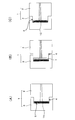
- FIG. 1 shows each step in the method for producing a fiber-reinforced plastic according to one embodiment of the present invention.
- a mold 1 is used in which molds 2 and 3 arranged opposite each other have an inlay structure 4, and inside the cavity 5 of the mold 1 in the mold open state, as described above.
- the produced reinforcing fiber base 6 having a relatively low apparent porosity is disposed.
- the molten thermoplastic resin 7 is injected and supplied through the one mold 2 into the cavity 5 by injection.
- FIG. 1C the molds 2 and 3 are accurately clamped via the inlay structure 4, and the volume of the cavity 5 is reduced.
- the inside of the cavity 5 of the mold 1 is compressed, and the reinforcing fiber base 6 impregnated with or being impregnated with the thermoplastic resin 7 is also compressed.
- an excellent resin-impregnated state in which voids are suppressed is obtained, a high fiber volume content is achieved, and a fiber-reinforced plastic 8 having high mechanical properties is obtained.
- FIG. 2 shows each step in the method for producing a fiber-reinforced plastic according to another embodiment of the present invention.
- a mold 1 having an inlay structure 4 in which molds 2 and 3 are arranged opposite to each other, similar to the above-described embodiment, is used, and a reinforced fiber base material in the cavity 5 thereof. 11 is placed and clamped first. At this time, the base material 11 is not greatly compressed.
- the molten thermoplastic resin 7 is injected and supplied through the one mold 2 into the cavity 5 by injection, and the resin pressure at the time of injection is changed to the mold.
- the two and three are slightly opened with high accuracy through the spigot structure 4.
- the molten thermoplastic resin 7 filled in the cavity 5 begins to be impregnated into the reinforcing fiber base 11 having a relatively large porosity. Then, as shown in FIG. 2C, the molds 2 and 3 are accurately clamped via the inlay structure 4, and the volume of the cavity 5 is reduced. By reducing the cavity volume at this stage, the inside of the cavity 5 of the mold 1 is compressed, and the reinforcing fiber substrate 11 impregnated with or being impregnated with the thermoplastic resin 7 is also compressed. Through this compression, an excellent resin-impregnated state in which voids are suppressed is obtained, a high fiber volume content is achieved, and a fiber-reinforced plastic 12 having high mechanical properties is obtained.
- FIG. 3 shows each step in the method for manufacturing a fiber-reinforced plastic according to still another embodiment of the present invention.
- a mold 21 is used that forms a cavity 24 between molds 22 and 23 that are arranged to face each other.
- a movable core 25 movable within the cavity 24 is provided in the cavity 24, and the movable core 25 is driven by a driving means 26 (for example, a driving means comprising a ball screw) provided in one mold 23.
- the cavity 24 can be forcibly moved in both directions.
- the reinforcing fiber base 27 having a relatively low apparent porosity produced as described above is disposed.
- the valve 28 provided in the other mold 22 is opened, and the inside of the cavity 24 is decompressed by suction (arrow) through the suction path 29. At this time, the cavity 24 is sealed from the outside by a sealing material 30 disposed between the molds 22 and 23.
- the molten thermoplastic resin 31 is injected and supplied through the one mold 22 into the cavity 24 by injection. At this time, the valve 28 is closed and the clogging of the suction passage 29 is avoided.
- the molten thermoplastic resin 31 filled in the cavity 24 begins to impregnate the reinforcing fiber base 27 having a relatively large porosity. As shown in FIG.
- the movable core 25 is forcibly moved in the cavity 24 by the driving means 26, and the volume of the cavity 24 is reduced.
- the reinforcing fiber base material 27 impregnated with or being impregnated with the thermoplastic resin 31 is also compressed. Through this compression, an excellent resin-impregnated state in which voids are suppressed is obtained, a high fiber volume content is achieved, and a fiber-reinforced plastic 32 having high mechanical properties is obtained.
- the method according to the present invention is basically applicable to the production of any fiber reinforced plastic using a thermoplastic resin as a matrix resin.
Landscapes
- Engineering & Computer Science (AREA)
- Mechanical Engineering (AREA)
- Chemical & Material Sciences (AREA)
- Composite Materials (AREA)
- Manufacturing & Machinery (AREA)
- Textile Engineering (AREA)
- Casting Or Compression Moulding Of Plastics Or The Like (AREA)
- Reinforced Plastic Materials (AREA)
Abstract
Priority Applications (4)
| Application Number | Priority Date | Filing Date | Title |
|---|---|---|---|
| JP2012549188A JP5862575B2 (ja) | 2011-06-16 | 2012-05-31 | 繊維強化プラスチックの製造方法 |
| US14/125,207 US9011747B2 (en) | 2011-06-16 | 2012-05-31 | Method for manufacturing fiber-reinforced plastic |
| EP12800101.3A EP2722147A4 (fr) | 2011-06-16 | 2012-05-31 | Procédé pour la fabrication de plastique renforcé par des fibres |
| CN201280025548.0A CN103561931B (zh) | 2011-06-16 | 2012-05-31 | 纤维增强塑料的制造方法 |
Applications Claiming Priority (4)
| Application Number | Priority Date | Filing Date | Title |
|---|---|---|---|
| JP2011134451 | 2011-06-16 | ||
| JP2011-134451 | 2011-06-16 | ||
| JP2011-148952 | 2011-07-05 | ||
| JP2011148952 | 2011-07-05 |
Publications (1)
| Publication Number | Publication Date |
|---|---|
| WO2012172982A1 true WO2012172982A1 (fr) | 2012-12-20 |
Family
ID=47356974
Family Applications (1)
| Application Number | Title | Priority Date | Filing Date |
|---|---|---|---|
| PCT/JP2012/064023 Ceased WO2012172982A1 (fr) | 2011-06-16 | 2012-05-31 | Procédé pour la fabrication de plastique renforcé par des fibres |
Country Status (5)
| Country | Link |
|---|---|
| US (1) | US9011747B2 (fr) |
| EP (1) | EP2722147A4 (fr) |
| JP (1) | JP5862575B2 (fr) |
| CN (1) | CN103561931B (fr) |
| WO (1) | WO2012172982A1 (fr) |
Cited By (5)
| Publication number | Priority date | Publication date | Assignee | Title |
|---|---|---|---|---|
| JP2014136365A (ja) * | 2013-01-17 | 2014-07-28 | Meiki Co Ltd | 繊維複合成形品の圧縮成形方法および繊維複合成形品の圧縮成形装置 |
| CN104802424A (zh) * | 2014-01-27 | 2015-07-29 | 宝马股份公司 | 用于制造纤维增强的空心型材构件的方法 |
| JP2017077637A (ja) * | 2015-10-19 | 2017-04-27 | 株式会社イノアックコーポレーション | 複合部材の製造方法 |
| JP2018149748A (ja) * | 2017-03-13 | 2018-09-27 | 株式会社東芝 | 膜部材およびその製造方法 |
| US11084187B2 (en) | 2015-04-17 | 2021-08-10 | Mitsubishi Chemical Corporation | Fiber-reinforced composite material molded article and method for manufacturing same |
Families Citing this family (16)
| Publication number | Priority date | Publication date | Assignee | Title |
|---|---|---|---|---|
| DE102014007869B4 (de) | 2014-06-03 | 2016-02-11 | Airbus Defence and Space GmbH | Vorrichtung und Verfahren zum Infiltrieren von Fasermaterial mit Harz zur Herstellung eines Faserverbundbauteils |
| FR3028797B1 (fr) * | 2014-11-21 | 2017-09-08 | Anthony Bertrand Patrick Mahe | Procede d'impregnation sequentiel d'une structure textile |
| JP6602552B2 (ja) * | 2015-04-14 | 2019-11-06 | 国立大学法人岐阜大学 | 成形体の製造方法 |
| BR112018069080A2 (pt) * | 2016-03-24 | 2019-01-29 | Honda Motor Co Ltd | método e dispositivo de moldagem por prensagem de folha frp e artigo moldado de frp |
| WO2017202671A1 (fr) * | 2016-05-25 | 2017-11-30 | Basf Se | Confection de mousses renforcées de fibres |
| JP6426684B2 (ja) * | 2016-12-15 | 2018-11-21 | 本田技研工業株式会社 | 繊維強化樹脂成形品の製造方法 |
| EP3590674B1 (fr) * | 2017-03-01 | 2021-10-27 | Nissan Motor Co., Ltd. | Corps moulé en résine renforcée de fibres de carbone et procédé de fabrication dudit corps moulé en résine renforcée de fibres de carbone |
| EP3427921B1 (fr) | 2017-07-14 | 2021-11-17 | Crompton Technology Group Limited | Vis à bille en matériau composite |
| CN109278242B (zh) * | 2018-09-06 | 2019-11-12 | 华中科技大学 | 一种树脂塑件上一体化成形热塑性复合结构的方法 |
| CN110027226B (zh) * | 2019-02-28 | 2020-09-15 | 东华大学 | 一种用于制备增强复合材料的p-rtm成型工艺 |
| CN113939389B (zh) * | 2019-06-12 | 2024-01-30 | 三菱瓦斯化学株式会社 | 成型品的制造方法 |
| CN111391216A (zh) * | 2020-03-19 | 2020-07-10 | 福建省闽清双棱竹业有限公司 | 竹塑复合板热压机及热压工艺 |
| EP3984715B1 (fr) * | 2020-10-13 | 2023-11-15 | Technische Universität München | Noyau soluble renforcé en fibre et procédé pour sa fabrication |
| CN112706432A (zh) * | 2021-01-20 | 2021-04-27 | 惠州市奔达建材实业有限公司 | 纤维增强塑料混凝土的制备方法 |
| CN115592981B (zh) * | 2022-10-14 | 2023-10-13 | 惠州硕贝德新材料技术有限公司 | 浸润料热塑成型工艺 |
| US20240383213A1 (en) * | 2023-05-19 | 2024-11-21 | B/E Aerospace, Inc | Three dimensional preform based thermoplastic composite panels for ballistic applications formed by compression resin transfer molding |
Citations (7)
| Publication number | Priority date | Publication date | Assignee | Title |
|---|---|---|---|---|
| JPH03261519A (ja) * | 1990-03-09 | 1991-11-21 | Sumitomo Chem Co Ltd | 繊維強化熱可塑性樹脂成形品の製造方法 |
| JPH08174689A (ja) * | 1994-12-22 | 1996-07-09 | Toyota Motor Corp | 繊維強化樹脂複合体 |
| JP2003159735A (ja) * | 2001-11-27 | 2003-06-03 | Matsushita Electric Works Ltd | 薄肉成形品の製造方法及びそれに用いる成形金型装置 |
| JP2003211500A (ja) * | 2002-01-23 | 2003-07-29 | Matsushita Electric Ind Co Ltd | プラスチックレンズの成形金型及び成形方法 |
| JP2010037358A (ja) | 2008-07-31 | 2010-02-18 | Toray Ind Inc | 繊維強化成形基材の製造方法 |
| JP2010235779A (ja) | 2009-03-31 | 2010-10-21 | Toray Ind Inc | プリプレグ、プリフォームおよび成形品 |
| JP2011031481A (ja) * | 2009-07-31 | 2011-02-17 | Nissan Motor Co Ltd | 繊維強化樹脂部品およびその製造方法並びに製造装置 |
Family Cites Families (13)
| Publication number | Priority date | Publication date | Assignee | Title |
|---|---|---|---|---|
| ES2077684T3 (es) * | 1989-08-21 | 1995-12-01 | Sumitomo Chemical Co | Metodo para producir un articulo moldeado de resina termoplastica reforzada con fibra. |
| JP2503782B2 (ja) * | 1990-12-21 | 1996-06-05 | 住友化学工業株式会社 | 多層成形品の成形方法 |
| US5424017A (en) * | 1993-04-12 | 1995-06-13 | Hinduja; Murli L. | Method for forming fiber-reinforced articles |
| US5518385A (en) * | 1994-11-09 | 1996-05-21 | United Technologies Corporation | Apparatus for resin transfer molding |
| DE10258630A1 (de) * | 2002-12-16 | 2004-07-08 | Daimlerchrysler Ag | Verfahren zu Herstellung langfaserverstärkter, thermoplastischer Bauteile |
| JP4414801B2 (ja) * | 2004-03-26 | 2010-02-10 | 日産自動車株式会社 | 繊維強化プラスチックの成形方法および成形装置 |
| CN101157265A (zh) * | 2006-01-10 | 2008-04-09 | 马自达汽车株式会社 | 树脂成型品的成型方法及成型装置 |
| US8597562B2 (en) * | 2006-03-30 | 2013-12-03 | GM Global Technology Operations LLC | Composite products and methods of making the same |
| US7931845B2 (en) * | 2007-05-21 | 2011-04-26 | O & D Manufacturing | Gravity injection of molding material for compression molding and related methods |
| JP2009061767A (ja) * | 2007-08-09 | 2009-03-26 | Meiki Co Ltd | 射出プレス成形方法 |
| JP5557997B2 (ja) * | 2008-11-19 | 2014-07-23 | 三菱重工業株式会社 | 繊維強化複合材の製造方法、及び繊維強化複合材の製造装置 |
| JP4825899B2 (ja) * | 2009-06-22 | 2011-11-30 | トヨタ自動車株式会社 | 繊維強化樹脂の製造方法、繊維強化樹脂の製造装置 |
| US9333690B2 (en) * | 2010-03-26 | 2016-05-10 | Mitsubishi Heavy Industries Plastic Technology | Method for manufacturing a fiber-reinforced composite material |
-
2012
- 2012-05-31 WO PCT/JP2012/064023 patent/WO2012172982A1/fr not_active Ceased
- 2012-05-31 EP EP12800101.3A patent/EP2722147A4/fr not_active Withdrawn
- 2012-05-31 JP JP2012549188A patent/JP5862575B2/ja not_active Expired - Fee Related
- 2012-05-31 CN CN201280025548.0A patent/CN103561931B/zh not_active Expired - Fee Related
- 2012-05-31 US US14/125,207 patent/US9011747B2/en not_active Expired - Fee Related
Patent Citations (7)
| Publication number | Priority date | Publication date | Assignee | Title |
|---|---|---|---|---|
| JPH03261519A (ja) * | 1990-03-09 | 1991-11-21 | Sumitomo Chem Co Ltd | 繊維強化熱可塑性樹脂成形品の製造方法 |
| JPH08174689A (ja) * | 1994-12-22 | 1996-07-09 | Toyota Motor Corp | 繊維強化樹脂複合体 |
| JP2003159735A (ja) * | 2001-11-27 | 2003-06-03 | Matsushita Electric Works Ltd | 薄肉成形品の製造方法及びそれに用いる成形金型装置 |
| JP2003211500A (ja) * | 2002-01-23 | 2003-07-29 | Matsushita Electric Ind Co Ltd | プラスチックレンズの成形金型及び成形方法 |
| JP2010037358A (ja) | 2008-07-31 | 2010-02-18 | Toray Ind Inc | 繊維強化成形基材の製造方法 |
| JP2010235779A (ja) | 2009-03-31 | 2010-10-21 | Toray Ind Inc | プリプレグ、プリフォームおよび成形品 |
| JP2011031481A (ja) * | 2009-07-31 | 2011-02-17 | Nissan Motor Co Ltd | 繊維強化樹脂部品およびその製造方法並びに製造装置 |
Non-Patent Citations (1)
| Title |
|---|
| See also references of EP2722147A4 |
Cited By (6)
| Publication number | Priority date | Publication date | Assignee | Title |
|---|---|---|---|---|
| JP2014136365A (ja) * | 2013-01-17 | 2014-07-28 | Meiki Co Ltd | 繊維複合成形品の圧縮成形方法および繊維複合成形品の圧縮成形装置 |
| CN104802424A (zh) * | 2014-01-27 | 2015-07-29 | 宝马股份公司 | 用于制造纤维增强的空心型材构件的方法 |
| CN104802424B (zh) * | 2014-01-27 | 2018-06-01 | 宝马股份公司 | 用于制造纤维增强的空心型材构件的方法 |
| US11084187B2 (en) | 2015-04-17 | 2021-08-10 | Mitsubishi Chemical Corporation | Fiber-reinforced composite material molded article and method for manufacturing same |
| JP2017077637A (ja) * | 2015-10-19 | 2017-04-27 | 株式会社イノアックコーポレーション | 複合部材の製造方法 |
| JP2018149748A (ja) * | 2017-03-13 | 2018-09-27 | 株式会社東芝 | 膜部材およびその製造方法 |
Also Published As
| Publication number | Publication date |
|---|---|
| JPWO2012172982A1 (ja) | 2015-02-23 |
| EP2722147A1 (fr) | 2014-04-23 |
| EP2722147A4 (fr) | 2015-12-30 |
| JP5862575B2 (ja) | 2016-02-16 |
| CN103561931B (zh) | 2016-04-06 |
| CN103561931A (zh) | 2014-02-05 |
| US9011747B2 (en) | 2015-04-21 |
| US20140124976A1 (en) | 2014-05-08 |
Similar Documents
| Publication | Publication Date | Title |
|---|---|---|
| JP5862575B2 (ja) | 繊維強化プラスチックの製造方法 | |
| JP5920227B2 (ja) | 炭素繊維強化プラスチックの製造方法 | |
| CN103119209B (zh) | 碳纤维聚集体的制造方法和碳纤维增强塑料的制造方法 | |
| US11084187B2 (en) | Fiber-reinforced composite material molded article and method for manufacturing same | |
| US20100178495A1 (en) | Chopped fiber bundle, molding material, and fiber reinforced plastic, and process for producing them | |
| KR101684821B1 (ko) | 섬유 강화된 수지 기재 또는 수지 성형체의 제조 방법 및 이 제조 방법에 사용하는 가소화 토출기 | |
| JP5952510B2 (ja) | 開口部を有する成形体の製造方法 | |
| EP2733161A1 (fr) | Pré-imprégné en résine thermoplastique, préforme moulée et composite moulé l'utilisant et procédé de production desdits préforme moulée et composite moulé | |
| US20080290560A1 (en) | Gravity injection of molding material for compression molding and related methods | |
| JP6083239B2 (ja) | 繊維強化プラスチックおよびその製造方法 | |
| JP5839114B2 (ja) | スタンパブルシート | |
| EP1693180B1 (fr) | Procédé et dispositif pour la régularité d'une préforme | |
| KR101348948B1 (ko) | 함침이 용이한 열가소성 복합재 및 그 제조방법 | |
| JP2013067135A (ja) | 複合成形体およびその製造方法 | |
| JP2013184356A (ja) | 繊維強化された樹脂基材、樹脂成形体の製造方法及びその実施のための樹脂加工機 |
Legal Events
| Date | Code | Title | Description |
|---|---|---|---|
| WWE | Wipo information: entry into national phase |
Ref document number: 201280025548.0 Country of ref document: CN |
|
| ENP | Entry into the national phase |
Ref document number: 2012549188 Country of ref document: JP Kind code of ref document: A |
|
| 121 | Ep: the epo has been informed by wipo that ep was designated in this application |
Ref document number: 12800101 Country of ref document: EP Kind code of ref document: A1 |
|
| WWE | Wipo information: entry into national phase |
Ref document number: 14125207 Country of ref document: US |
|
| NENP | Non-entry into the national phase |
Ref country code: DE |
|
| WWE | Wipo information: entry into national phase |
Ref document number: 2012800101 Country of ref document: EP |