WO2012173202A1 - ポリイミド積層体の製造方法、およびポリイミド積層体 - Google Patents
ポリイミド積層体の製造方法、およびポリイミド積層体 Download PDFInfo
- Publication number
- WO2012173202A1 WO2012173202A1 PCT/JP2012/065272 JP2012065272W WO2012173202A1 WO 2012173202 A1 WO2012173202 A1 WO 2012173202A1 JP 2012065272 W JP2012065272 W JP 2012065272W WO 2012173202 A1 WO2012173202 A1 WO 2012173202A1
- Authority
- WO
- WIPO (PCT)
- Prior art keywords
- polyimide
- polyamic acid
- acid solution
- minutes
- substrate
- Prior art date
- Legal status (The legal status is an assumption and is not a legal conclusion. Google has not performed a legal analysis and makes no representation as to the accuracy of the status listed.)
- Ceased
Links
Classifications
-
- B—PERFORMING OPERATIONS; TRANSPORTING
- B32—LAYERED PRODUCTS
- B32B—LAYERED PRODUCTS, i.e. PRODUCTS BUILT-UP OF STRATA OF FLAT OR NON-FLAT, e.g. CELLULAR OR HONEYCOMB, FORM
- B32B27/00—Layered products comprising a layer of synthetic resin
- B32B27/28—Layered products comprising a layer of synthetic resin comprising synthetic resins not wholly covered by any one of the sub-groups B32B27/30 - B32B27/42
- B32B27/281—Layered products comprising a layer of synthetic resin comprising synthetic resins not wholly covered by any one of the sub-groups B32B27/30 - B32B27/42 comprising polyimides
-
- B—PERFORMING OPERATIONS; TRANSPORTING
- B05—SPRAYING OR ATOMISING IN GENERAL; APPLYING FLUENT MATERIALS TO SURFACES, IN GENERAL
- B05D—PROCESSES FOR APPLYING FLUENT MATERIALS TO SURFACES, IN GENERAL
- B05D3/00—Pretreatment of surfaces to which liquids or other fluent materials are to be applied; After-treatment of applied coatings, e.g. intermediate treating of an applied coating preparatory to subsequent applications of liquids or other fluent materials
- B05D3/02—Pretreatment of surfaces to which liquids or other fluent materials are to be applied; After-treatment of applied coatings, e.g. intermediate treating of an applied coating preparatory to subsequent applications of liquids or other fluent materials by baking
-
- B—PERFORMING OPERATIONS; TRANSPORTING
- B32—LAYERED PRODUCTS
- B32B—LAYERED PRODUCTS, i.e. PRODUCTS BUILT-UP OF STRATA OF FLAT OR NON-FLAT, e.g. CELLULAR OR HONEYCOMB, FORM
- B32B27/00—Layered products comprising a layer of synthetic resin
- B32B27/18—Layered products comprising a layer of synthetic resin characterised by the use of special additives
-
- B—PERFORMING OPERATIONS; TRANSPORTING
- B32—LAYERED PRODUCTS
- B32B—LAYERED PRODUCTS, i.e. PRODUCTS BUILT-UP OF STRATA OF FLAT OR NON-FLAT, e.g. CELLULAR OR HONEYCOMB, FORM
- B32B37/00—Methods or apparatus for laminating, e.g. by curing or by ultrasonic bonding
- B32B37/06—Methods or apparatus for laminating, e.g. by curing or by ultrasonic bonding characterised by the heating method
-
- C—CHEMISTRY; METALLURGY
- C08—ORGANIC MACROMOLECULAR COMPOUNDS; THEIR PREPARATION OR CHEMICAL WORKING-UP; COMPOSITIONS BASED THEREON
- C08G—MACROMOLECULAR COMPOUNDS OBTAINED OTHERWISE THAN BY REACTIONS ONLY INVOLVING UNSATURATED CARBON-TO-CARBON BONDS
- C08G73/00—Macromolecular compounds obtained by reactions forming a linkage containing nitrogen with or without oxygen or carbon in the main chain of the macromolecule, not provided for in groups C08G12/00 - C08G71/00
- C08G73/06—Polycondensates having nitrogen-containing heterocyclic rings in the main chain of the macromolecule
- C08G73/10—Polyimides; Polyester-imides; Polyamide-imides; Polyamide acids or similar polyimide precursors
- C08G73/1067—Wholly aromatic polyimides, i.e. having both tetracarboxylic and diamino moieties aromatically bound
-
- C—CHEMISTRY; METALLURGY
- C08—ORGANIC MACROMOLECULAR COMPOUNDS; THEIR PREPARATION OR CHEMICAL WORKING-UP; COMPOSITIONS BASED THEREON
- C08J—WORKING-UP; GENERAL PROCESSES OF COMPOUNDING; AFTER-TREATMENT NOT COVERED BY SUBCLASSES C08B, C08C, C08F, C08G or C08H
- C08J7/00—Chemical treatment or coating of shaped articles made of macromolecular substances
- C08J7/04—Coating
-
- C—CHEMISTRY; METALLURGY
- C09—DYES; PAINTS; POLISHES; NATURAL RESINS; ADHESIVES; COMPOSITIONS NOT OTHERWISE PROVIDED FOR; APPLICATIONS OF MATERIALS NOT OTHERWISE PROVIDED FOR
- C09D—COATING COMPOSITIONS, e.g. PAINTS, VARNISHES OR LACQUERS; FILLING PASTES; CHEMICAL PAINT OR INK REMOVERS; INKS; CORRECTING FLUIDS; WOODSTAINS; PASTES OR SOLIDS FOR COLOURING OR PRINTING; USE OF MATERIALS THEREFOR
- C09D179/00—Coating compositions based on macromolecular compounds obtained by reactions forming in the main chain of the macromolecule a linkage containing nitrogen, with or without oxygen, or carbon only, not provided for in groups C09D161/00 - C09D177/00
- C09D179/04—Polycondensates having nitrogen-containing heterocyclic rings in the main chain; Polyhydrazides; Polyamide acids or similar polyimide precursors
- C09D179/08—Polyimides; Polyester-imides; Polyamide-imides; Polyamide acids or similar polyimide precursors
-
- B—PERFORMING OPERATIONS; TRANSPORTING
- B32—LAYERED PRODUCTS
- B32B—LAYERED PRODUCTS, i.e. PRODUCTS BUILT-UP OF STRATA OF FLAT OR NON-FLAT, e.g. CELLULAR OR HONEYCOMB, FORM
- B32B2309/00—Parameters for the laminating or treatment process; Apparatus details
- B32B2309/02—Temperature
-
- B—PERFORMING OPERATIONS; TRANSPORTING
- B32—LAYERED PRODUCTS
- B32B—LAYERED PRODUCTS, i.e. PRODUCTS BUILT-UP OF STRATA OF FLAT OR NON-FLAT, e.g. CELLULAR OR HONEYCOMB, FORM
- B32B2309/00—Parameters for the laminating or treatment process; Apparatus details
- B32B2309/08—Dimensions, e.g. volume
- B32B2309/10—Dimensions, e.g. volume linear, e.g. length, distance, width
- B32B2309/105—Thickness
-
- Y—GENERAL TAGGING OF NEW TECHNOLOGICAL DEVELOPMENTS; GENERAL TAGGING OF CROSS-SECTIONAL TECHNOLOGIES SPANNING OVER SEVERAL SECTIONS OF THE IPC; TECHNICAL SUBJECTS COVERED BY FORMER USPC CROSS-REFERENCE ART COLLECTIONS [XRACs] AND DIGESTS
- Y10—TECHNICAL SUBJECTS COVERED BY FORMER USPC
- Y10T—TECHNICAL SUBJECTS COVERED BY FORMER US CLASSIFICATION
- Y10T428/00—Stock material or miscellaneous articles
- Y10T428/26—Web or sheet containing structurally defined element or component, the element or component having a specified physical dimension
- Y10T428/263—Coating layer not in excess of 5 mils thick or equivalent
- Y10T428/264—Up to 3 mils
-
- Y—GENERAL TAGGING OF NEW TECHNOLOGICAL DEVELOPMENTS; GENERAL TAGGING OF CROSS-SECTIONAL TECHNOLOGIES SPANNING OVER SEVERAL SECTIONS OF THE IPC; TECHNICAL SUBJECTS COVERED BY FORMER USPC CROSS-REFERENCE ART COLLECTIONS [XRACs] AND DIGESTS
- Y10—TECHNICAL SUBJECTS COVERED BY FORMER USPC
- Y10T—TECHNICAL SUBJECTS COVERED BY FORMER US CLASSIFICATION
- Y10T428/00—Stock material or miscellaneous articles
- Y10T428/26—Web or sheet containing structurally defined element or component, the element or component having a specified physical dimension
- Y10T428/263—Coating layer not in excess of 5 mils thick or equivalent
- Y10T428/264—Up to 3 mils
- Y10T428/265—1 mil or less
Definitions
- the present invention relates to a method for producing a polyimide laminate having a high heat resistance polyimide layer in which thermal decomposition is suppressed in a temperature range of 500 ° C. to 650 ° C.
- Dimethylacetamide is used as an approximately equimolar amount of an aromatic tetracarboxylic dianhydride mainly composed of 3,3 ′, 4,4′-biphenyltetracarboxylic dianhydride and an aromatic diamine mainly composed of paraphenylenediamine.
- a polyamic acid solution obtained by reacting at a relatively low temperature in an aprotic polar solvent such as is applied to a substrate, the resulting coating film is dried by heating to form a self-supporting film, and then a self-supporting film is formed. It is possible to produce a polyimide film with particularly excellent properties such as heat resistance, chemical resistance, radiation resistance, electrical insulation, dimensional stability and mechanical properties by further heat imidization treatment after peeling from the substrate. It is known.
- Patent Document 1 discloses an adhesive having a specific ratio of carbon, oxygen, and nitrogen elements on the film surface produced by the above-described method, and a phosphorus content in the entire film of 5 to 500 ppm.
- An improved polyimide film is disclosed. Some of the polyimide films are obtained from 3,3 ', 4,4'-biphenyltetracarboxylic dianhydride and paraphenylenediamine (Reference Example 1, Example 1).
- a polyamic acid solution having a relatively high molecular weight (logarithmic viscosity of 2.66) is cast-coated on a stainless steel belt, dried at 120 ° C. for 20 minutes, and then the stainless steel belt.
- the film is peeled off to obtain a self-supporting film, and then the self-supporting film is heat treated and imidized at 150 ° C. for 5 minutes, 200 ° C. for 7 minutes, 250 ° C. for 9 minutes, and 450 ° C. for 7 minutes, and has a thickness of 75 ⁇ m.
- the polyimide film is obtained. Also in other examples, a self-supporting film was produced and subjected to the same heat treatment as in Example 1 to obtain a polyimide film having a thickness of 75 ⁇ m.
- Patent Document 2 proposes a polyimide film with improved mechanical strength, which is produced by the above-described method and contains an organic phosphorus compound in an amount of 0.5 to 5% by weight based on the polyimide.
- This polyimide may be composed of a very wide range of tetracarboxylic acid component and diamine component, and is preferably composed mainly of pyromellitic dianhydride and 4,4′-diaminodiphenyl ether. Also included are those obtained from biphenyltetracarboxylic dianhydride and paraphenylenediamine (Example 4).
- an organic phosphorus compound, acetic anhydride as a dehydrating ring-closing agent, and isoquinoline as a catalyst are mixed in a polyamic acid solution, and the mixed solution is cast on a smooth surface in a film form. Then, after drying it at 100 ° C. for 10 minutes to form a self-supporting film, the self-supporting film was peeled off from the smooth surface, and the four corners of the obtained self-supporting film were mechanically fixed, A polyimide film having a thickness of 125 ⁇ m is obtained by heat treatment at 300 ° C. for 10 minutes and 420 ° C. for 3 minutes.
- Patent Document 3 relates to a method for manufacturing a flexible thin-film solar cell.
- a polyimide precursor is applied on a support substrate (base material) such as glass, and is heated and imidized to form a polyimide film (heat-resistant resin layer) to form a heat-resistant base substrate.
- a transparent electrode layer such as glass
- an amorphous silicon layer such as a back electrode layer, etc.
- a protective layer peeling between the support substrate (base material) and the heat-resistant base substrate (polyimide film)
- substrate polyimide membrane
- Patent Document 4 relates to an aromatic polyamide film.
- a thin film such as ITO is formed on the film surface by a sputtering method or the like, the volatile component generated from the inside of the film reduces the degree of vacuum in the system during sputtering.
- the efficiency of the process deteriorates, the normal deposition of ITO particles is hindered, the adhesive strength between the ITO film and the film is reduced and the heat resistance is poor, and when used as a liquid crystal substrate, other outgassing occurs due to outgassing during use. It is described that a member, for example, a liquid crystal element or the like may be deteriorated.
- the present invention has excellent characteristics such as heat resistance, chemical resistance, radiation resistance, electrical insulation, dimensional stability and mechanical properties on the base material, and particularly in the temperature range of 500 ° C. to 650 ° C. It aims at providing the manufacturing method of the polyimide laminated body which has a highly heat-resistant polyimide layer by which thermal decomposition was suppressed.
- the polyamic acid solution composition preferably the main component of the tetracarboxylic acid component is 3,3 ′, 4,4′-biphenyltetracarboxylic dianhydride.
- a polyamic acid solution composition containing a polyamic acid whose main component of the diamine component is paraphenylenediamine, particularly preferably the main component of the tetracarboxylic acid component is 3,3 ′, 4,4′-biphenyltetracarboxylic acid
- a thin film composed of a polyamic acid solution composition comprising a polyamic acid, which is a dianhydride and the main component of the diamine component is paraphenylenediamine, and a phosphorus compound is formed on the substrate, and the obtained substrate and the polyamic acid
- the laminate comprising the thin film of the solution composition is at least 10 minutes at a temperature range of more than 150 ° C.
- heat treatment is performed at a maximum temperature of 400 ° C. to 550 ° C. to form a polyimide layer having a thickness of less than 50 ⁇ m on the base material. It has been found that a highly heat-resistant polyimide layer in which thermal decomposition is suppressed in a temperature range of 500 ° C. to 650 ° C. can be formed on a substrate while maintaining the excellent characteristics of the present invention.
- the present invention relates to the following items.
- a method for producing a polyimide laminate comprising a substrate and a polyimide layer having a thickness of less than 50 ⁇ m, A thin film comprising a polyamic acid solution composition is formed on a substrate, and the resulting laminate comprising the substrate and the thin film of the polyamic acid solution composition is subjected to a temperature range of at least 150 ° C. to less than 200 ° C. for 10 minutes.
- a method for producing a polyimide laminate, wherein the polyimide layer having a thickness of less than 50 ⁇ m is formed on a substrate by performing heat treatment at a maximum temperature of 400 ° C. to 550 ° C. after the heat treatment. 2. Item 2.
- the polyimide laminate according to Item 1 wherein the laminate comprising the base material and the polyamic acid solution composition is subjected to a heat treatment in a temperature range of more than 150 ° C to less than 200 ° C for 30 minutes or more. Manufacturing method. 3.
- the polyamic acid solution composition is obtained from a tetracarboxylic acid component containing 3,3 ′, 4,4′-biphenyltetracarboxylic dianhydride as a main component and a diamine component containing paraphenylenediamine as a main component Item 3.
- the method for producing a polyimide laminate according to Item 1 or 2 comprising a polyamic acid. 4). Item 4.
- Item 5. The method for producing a polyimide laminate according to Item 4, wherein the phosphorus content in the formed polyimide layer [phosphorus mass / polyimide layer mass] is 100 to 3700 ppm. 6).
- Item 6. The method for producing a polyimide laminate according to any one of Items 3 to 5, wherein the phosphorus compound does not have an alkyl chain or has an alkyl chain having 16 or less carbon atoms. 7.
- a thin film comprising a polyamic acid solution composition is formed on a substrate, and the resulting laminate comprising the substrate and the thin film of the polyamic acid solution composition is subjected to a temperature range of at least 150 ° C. to less than 200 ° C. for 10 minutes.
- the substrate has excellent characteristics such as heat resistance, chemical resistance, radiation resistance, electrical insulation, dimensional stability, mechanical properties, and thermal decomposition particularly in a temperature range of 500 ° C. to 650 ° C.
- the method of manufacturing the polyimide laminated body which has a highly heat-resistant polyimide layer by which suppression was carried out can be provided.
- the polyimide of the polyimide layer is preferably obtained from a tetracarboxylic acid component whose main component is 3,3 ′, 4,4′-biphenyltetracarboxylic dianhydride and a diamine component whose main component is paraphenylenediamine. It is This polyimide is particularly excellent in properties such as heat resistance, chemical resistance, radiation resistance, electrical insulation, dimensional stability, mechanical properties, etc., and is more thermally decomposed particularly in the temperature range of 500 ° C. to 650 ° C. A suppressed high heat resistance polyimide layer can be formed.
- a thin film comprising a polyamic acid solution composition is formed on a substrate, and the laminate comprising the obtained base material and the polyamic acid solution composition thin film is at least at a temperature of more than 150 ° C. to less than 200 ° C.
- the heat treatment in a range of 10 minutes or more, preferably 30 minutes or more, particularly preferably 60 minutes or more, the heat treatment is performed at a maximum temperature of 400 ° C. to 550 ° C., and the thickness is less than 50 ⁇ m on the substrate.
- a polyimide layer is formed.
- the polyamic acid solution composition is preferably obtained from a tetracarboxylic acid component containing 3,3 ′, 4,4′-biphenyltetracarboxylic dianhydride as a main component and a diamine component containing paraphenylenediamine as a main component. It is preferable that a polyamic acid is contained and further a phosphorus compound is contained.
- the polyamic acid has a tetracarboxylic acid component such as tetracarboxylic dianhydride and a diamine component in an approximately equimolar amount in a solvent at 100 ° C. or lower, preferably 80 ° C. or lower.
- a polyamic acid solution uniformly dissolved in a solvent can be suitably obtained.
- the phosphorus compound may be added before the polymerization, and the tetracarboxylic dianhydride and the diamine may be reacted in the presence of the phosphorus compound, or the polyamic acid solution obtained after the polymerization may be reacted.
- a phosphorus compound may be added.
- the obtained polyamic acid solution can be used for forming a polyimide layer as it is or after adding a desired component if necessary.
- the polyamic acid used in the present invention is not particularly limited, but the main component of the tetracarboxylic acid component (that is, 50 mol% or more) is preferably 80 mol% or more, more preferably 90 mol% or more, More preferably, 100 mol% is 3,3 ′, 4,4′-biphenyltetracarboxylic dianhydride, and the main component of the diamine component (that is, 50 mol% or more), preferably 80 mol% or more, More preferably, 90 mol% or more, and even more preferably 100 mol% is paraphenylenediamine.
- a polyimide layer having particularly excellent characteristics such as heat resistance, chemical resistance, radiation resistance, electrical insulation, dimensional stability, and mechanical properties can be obtained.
- a highly heat-resistant polyimide layer in which thermal decomposition is suppressed particularly in a temperature range of 500 ° C. to 650 ° C.
- the tetracarboxylic acid component that can be used in combination with 3,3 ′, 4,4′-biphenyltetracarboxylic dianhydride includes p-terphenyl-3,3 ′′, 4,4 ′′ -tetra Carboxylic dianhydride, 5,5 ′-(1,1′-biphenyl-4,4′-diyl) bis-isobenzofuran-1,3-dione, naphthalene-1,4,5,8-tetracarboxylic acid And dianhydrides and naphthalene-2,3,6,7-tetracarboxylic dianhydrides.
- the solvent used in the present invention may be any solvent as long as polyamic acid can be polymerized.
- an aprotic polar solvent can be suitably used.
- the solvent used in the present invention is not particularly limited, but N, N-dilower alkyl carboxylamides such as N, N-dimethylformamide, N, N-dimethylacetamide, N, N-dimethylmethoxyacetamide, N- Methyl-2-pyrrolidone, dimethyl sulfoxide, dimethyl sulfone, 1,3-dimethyl-2-imidazolidinone, ⁇ -butyrolactone, diglyme, m-cresol, hexamethylphosphoramide, N-acetyl-2-pyrrolidone, hexamethyl
- Preferable examples include phosphoramide, ethyl cellosolve acetate, diethylene glycol dimethyl ether, sulfolane, p-chlorophenol and the like.
- acetic anhydride as an anhydrous agent
- imidazole compounds such as 1,2-dimethylimidazole as imidization catalysts
- heterocyclic compounds containing nitrogen atoms such as isoquinoline
- basic compounds such as triethylamine and triethanolamine
- a dehydrating agent or an imidization catalyst is used, the stability of the polyamic acid solution decreases, making it difficult to cast to a base material, and further, thermal decomposition is suppressed in a temperature range of 500 ° C. to 650 ° C. Since it may be difficult to form a heat-resistant polyimide layer, it is preferable not to use them.
- a tetracarboxylic acid component and a diamine component are reacted in a solvent at a relatively low temperature of 100 ° C. or lower, preferably 80 ° C. or lower, which can suppress the imidization reaction.
- a polyamic acid solution composition can be obtained.
- the reaction temperature is usually 25 ° C. to 100 ° C., preferably 40 ° C. to 80 ° C., more preferably 50 ° C. to 80 ° C.
- the reaction time is about 0.1 to 24 hours, preferably It is preferably about 2 to 12 hours.
- the molar ratio of the tetracarboxylic acid component to be reacted and the diamine component [tetracarboxylic acid component / diamine component] is preferably about 0.90 to 1.10, more preferably about 0.95 to 1.05.
- the solid content (polyimide conversion) concentration of the polyamic acid in the polyamic acid solution composition is not particularly limited, but is preferably 2 to 50% by mass, and preferably 5 to 40% by mass.
- the solution (rotational) viscosity of the polyamic acid solution composition is not particularly limited, but it is preferably 1 to 3000 poise, preferably 5 to 2000 poise at 30 ° C.
- the molecular weight of the polyamic acid used in the present invention is not particularly limited.
- a relatively high molecular weight polyamic acid having a logarithmic viscosity ( ⁇ ) exceeding 2.0 dL / g is used in order to achieve sufficient characteristics.
- a relatively low molecular weight polyamic acid having a logarithmic viscosity of 2.0 dL / g or less is used, it is difficult to form a polyimide layer that satisfies the characteristics that should be obtained with the chemical composition. In particular, it becomes difficult to form a polyimide layer in which thermal decomposition is suppressed in a temperature range of 500 ° C. to 650 ° C.
- the present invention that is, after the heat treatment of the thin film comprising the polyamic acid solution composition formed on the substrate at least in the temperature range of more than 150 ° C. to less than 200 ° C. for 10 minutes or more, the maximum temperature Is subjected to heat treatment and imidization in a temperature range of 400 ° C. to 550 ° C. to form a polyimide layer having a thickness of less than 50 ⁇ m, so that a logarithmic viscosity ( ⁇ ) that is not normally used is 2.0 dL / g or less, preferably 1.
- thermal decomposition is suppressed in the temperature range of 500 ° C. to 650 ° C. even when a polyamic acid solution having a relatively low molecular weight, which is not used when producing a normal polyimide film, is used.
- a highly heat-resistant polyimide layer can be formed on the substrate.
- the polyamic acid solution composition cast on the base material may contain a phosphorus compound in addition to the polyamic acid.
- the phosphorus compound used in the present invention is not particularly limited as long as it is a compound containing a phosphorus atom in the molecule, and can be used.
- the phosphorus compound used in the present invention is not limited in the valence of phosphorus.
- phosphoric acid, phosphorous acid, phosphonic acid, phosphonous acid, phosphinic acid, phosphinic acid, phosphine oxide, phosphine, and hydrogen atoms thereof can be used.
- An organic phosphorus compound substituted with an organic substituent can be mentioned.
- inorganic phosphorus such as red phosphorus and polyphosphoric acid can also be used.
- Examples of preferable phosphorus compounds include phosphoric acid organic phosphorus compounds such as triethyl phosphate, triphenyl phosphate, and 2-ethylhexyl phosphate.
- Examples of the organic phosphorus compound of phosphonic acid include aminomethylphosphonic acid, decylphosphonic acid, and phenylphosphonic acid.
- Examples of the organic phosphorus compound of phosphinic acid include diphenylphosphinic acid, 2-carboxyethylphosphinic acid, dimethylphosphinic acid, 9,10-dihydro-9-oxa-10-phosphaphenanthrene-10-oxide, and the like.
- organophosphorus compound of phosphine examples include trimethylphosphine, triphenylphosphine, ethylenebisdiphenylphosphine, and 2,2'-bis (diphenylphosphino) -1,1'-binaphthyl.
- Examples of phosphorus compounds having an alkyl chain include monoethyl phosphate, monopropyl phosphate, monobutyl phosphate, monopentyl phosphate, monohexyl phosphate, monocaproyl phosphate, monooctyl phosphate, mono Lauryl phosphate, monomyristyl phosphate, monocetyl phosphate, monostearyl phosphate, monophosphate of triethylene glycol monotridecyl ether, monophosphate of tetraethylene glycol monolauryl ether, diethylene glyco -Monophosphate ester of dimonostearyl ether, dicaproyl phosphate ester, dioctyl phosphate ester, dicapryl phosphate ester, dilauryl phosphate ester, dimyristyl Acid ester, dicetyl phosphate, distearyl phosphate, diethylene ester of tetraethylene glycol mononeopentyl ether, di
- Phosphorus compounds that do not have excess alkyl chains are desirable.
- phosphate esters such as triphenyl phosphate are preferred.
- a phosphorus compound may use 1 type or may use 2 or more types together.
- the concentration of the phosphorus compound in the polyamic acid solution composition is a concentration corresponding to 1 to 25 mol%, preferably 1 to 20 mol%, more preferably 1 to 18 mol% with respect to 100 mol% of the tetracarboxylic acid component. Is preferred. However, in the case of polyphosphoric acid, the repeating unit is assumed to be mol% calculated on the assumption that the molecular weight is the molecular weight.
- the concentration of the phosphorus compound in the polyamic acid solution composition is about 0.5 to 20% by mass, preferably about 0.5 to 15% by mass with respect to the total mass of the tetracarboxylic acid component and the diamine component. Is preferred.
- the concentration of the phosphorus compound in the polyamic acid solution composition is too small, it may be difficult to sufficiently obtain the effect of suppressing thermal decomposition in the temperature range of 500 ° C to 650 ° C.
- the concentration of the phosphorus compound is too high, a large amount of phosphorus remains in the polyimide layer, which may cause volatile components (outgas), which is not preferable.
- the addition of the phosphorus compound to the polyamic acid solution may be before or after polymerization. That is, after a tetracarboxylic acid component and a diamine component are reacted in a solvent to obtain a polyamic acid solution composition, a phosphorus compound is added thereto to obtain a polyamic acid solution composition containing a phosphorus compound.
- a polyamic acid solution containing a phosphorus compound can also be obtained by adding a tetracarboxylic acid component, a diamine component, and a phosphorus compound to a solvent, and reacting the tetracarboxylic acid component and the diamine component in the solvent in the presence of the phosphorus compound.
- a composition can be obtained.
- the amount of phosphorus remaining in the polyimide layer formed in the present invention is 3700 ppm or less with respect to the weight of the polyimide layer.
- the concentration (ratio) is preferably about 100 to 3700 ppm, more preferably about 100 to 2000 ppm, more preferably about 100 to 1000 ppm, and still more preferably about 100 to 500 ppm. If the concentration is more than this range, it may cause a volatile component (outgas), which is not preferable.
- the polyamic acid solution composition is cast on a substrate and volatilized by adjusting the phosphorus content ratio [phosphorus mass / polyimide layer mass] of the formed polyimide layer to 100 to 3700 ppm. Even if the component is evaporated from only one side and heat-treated to imidize, it may be easy to form a polyimide layer having good characteristics.
- polyamic acid solution composition of the present invention can be added with other additive components such as a filler, if necessary.
- a thin film made of the polyamic acid solution composition as described above is formed on a base material, and a laminate comprising the obtained base material and the thin film of the polyamic acid solution composition is at least over 150 ° C. to 200 ° C.
- a heat treatment at a temperature range of less than 10 ° C. for 10 minutes or more, preferably 30 minutes or more, particularly preferably 60 minutes or more, the heat treatment is performed at a temperature range of 400 ° C. to 550 ° C. to obtain a thickness on the substrate.
- the substrate is not particularly limited as long as it can form a polyimide film on the surface thereof, but in the present invention, since it is heat-treated at an extremely high temperature, it can withstand the high temperature and expands due to heat. It is desirable to be made of a material having a small coefficient.
- the shape of the substrate is not particularly limited, but is usually a planar shape.
- the base material may be, for example, a metal plate made of various metals, a ceramic plate made of various ceramics, or the like, but a glass plate can be preferably used particularly from the high temperature resistance and the linear expansion coefficient.
- the casting method of the polyamic acid solution composition onto the substrate is not particularly limited as long as it can form a coating film having a small thickness.
- a spin coating method for example, a screen printing method, a bar coater method, an electrodeposition method, etc.
- the conventionally known methods can be suitably used.
- the base material is formed of a material that does not substantially transmit gas, such as a glass plate.
- the volatile components (solvents, etc.) generated from the layer (coating layer) of the polyamic acid solution composition Water generated as a result of imidization cannot evaporate from the substrate surface, but evaporates only from the air (or other gas) surface of the other surface.
- the polyamic acid solution composition layer is not peeled off as a self-supporting film and is not heat-treated, and the volatile components evaporate only from one side until heat treatment at a high temperature at which imidization is completed. Heat treatment in the state to be.
- a polyamic acid solution composition is cast on a base material to form a polyamic acid solution composition film on the base material, and a laminate comprising the base material and the polyamic acid solution composition film After obtaining this, this is heat-treated to complete imidization, thereby forming a polyimide layer on the substrate.
- the heat treatment conditions at least 150 ° C. to less than 200 ° C., the lower limit is preferably more than 155 ° C., more preferably more than 160 ° C., still more preferably more than 165 ° C., and particularly preferably more than 170 ° C.
- Heat treatment is performed at a temperature range of ⁇ 550 ° C., preferably 430 ° C. to 530 ° C., more preferably 460 ° C. to 530 ° C. Note that the time for heat treatment at a temperature of 200 ° C. or higher (including the time for heat treatment at the maximum temperature) can be appropriately determined, and is not particularly limited.
- a polyimide layer comprising a substrate and a polyimide layer can be obtained by thus forming a polyimide layer on the substrate.
- the content ratio of phosphorus in the polyimide layer is not particularly limited, but is 100 to 3700 ppm, more preferably 100. It is preferably about 2000 to 2000 ppm, more preferably about 100 to 1000 ppm, and particularly preferably about 100 to 500 ppm.
- the thickness of the polyimide layer of the polyimide laminate obtained in the present invention is less than 50 ⁇ m, preferably 30 ⁇ m or less, more preferably 20 ⁇ m or less. As the thickness of the polyimide layer exceeds the above range, a decomposition product derived from a phosphorus compound tends to remain, which may cause an excess volatile component (outgas) to be generated. Moreover, the formed polyimide layer is foamed and may not be used practically.
- the lower limit of the thickness of the polyimide layer is not particularly limited, but is preferably 0.1 ⁇ m or more, more preferably 1 ⁇ m or more, and more preferably 2 ⁇ m or more.
- the polyimide layer of the polyimide laminate obtained by the present invention has high heat resistance because thermal decomposition is suppressed in the temperature range of 500 ° C. to 650 ° C.
- the fact that the thermal decomposition is suppressed in the temperature range of 500 ° C. to 650 ° C. is indicated by 5% weight loss temperature (° C.) when the polyimide layer is heat-treated as one index.
- 5% weight loss temperature shows a high value of 610 ° C. or higher, preferably 615 ° C. or higher, it indicates that thermal decomposition is suppressed to a higher temperature, and a temperature of 500 ° C. to 650 ° C. It can be seen that the thermal decomposition in the region was sufficiently suppressed.
- this temperature is a low value of 605 ° C. or lower, particularly 600 ° C. or lower, and even 595 ° C.
- the thermal decomposition occurs at a relatively low temperature, and 500 ° C. to 650 ° C. Thermal decomposition is not suppressed in the temperature range of ° C. Desirably, the 5% weight loss temperature exceeds at least 595 ° C.
- the polyimide laminate obtained by the present invention is particularly excellent in characteristics such as heat resistance, chemical resistance, radiation resistance, electrical insulation, dimensional stability, mechanical properties, and particularly in a temperature range of 500 ° C. to 650 ° C.
- This is a polyimide laminate in which a highly heat-resistant polyimide layer in which thermal decomposition is suppressed is formed. Therefore, for example, by sputtering the polyimide laminate, other materials such as ITO and amorphous silicon layers can be suitably laminated on the polyimide layer surface.
- the laminated body which consists of a polyimide and another material can be obtained suitably by isolate
- Such a laminate made of polyimide and another material can be suitably used for applications such as a flexible liquid crystal display, EL display, electronic paper, and thin film solar cell using a polyimide layer as a substrate.
- the solid content concentration of the polyamic acid solution is a value obtained by drying the polyamic acid solution at 350 ° C. for 30 minutes and obtaining the weight W1 before drying and the weight W2 after drying by the following formula.
- the logarithmic viscosity ( ⁇ inh ) of the polyamic acid was obtained by preparing a solution in which the polyamic acid solution was uniformly dissolved in N-methyl-2-pyrrolidone so that the polyamic acid concentration was 0.5 g / 100 ml solvent.
- the solution viscosity with the solvent was measured at 30 ° C. and calculated by the following formula.
- this 5% weight reduction is considered to be caused by the generation of volatile components (outgas) due to thermal decomposition. Therefore, in the present invention, this 5% weight reduction temperature is used as a standard for thermal decomposition in the temperature range of 500 ° C to 650 ° C. evaluated.
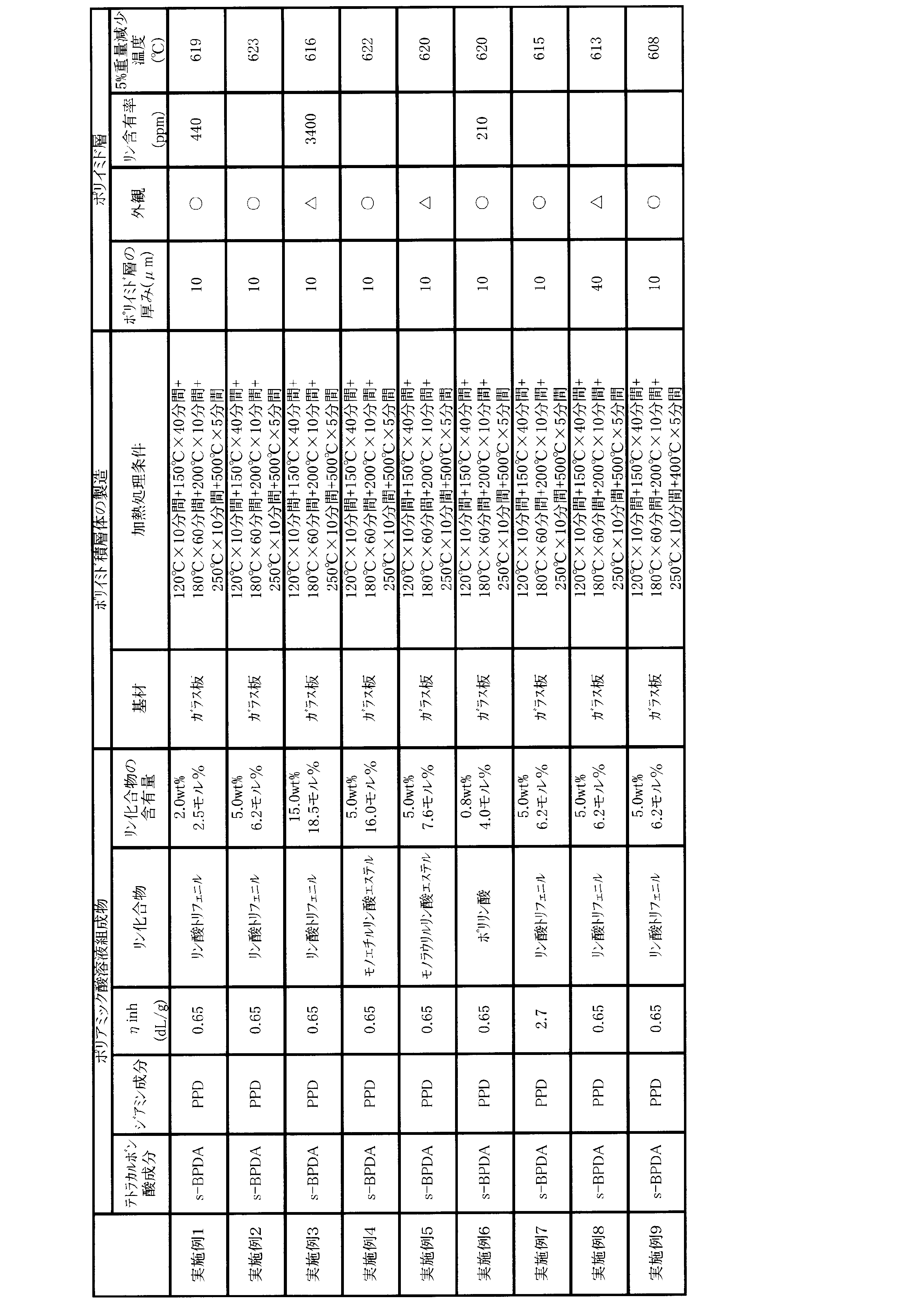
- N-methyl-2-pyrrolidone 410.1267 g was added as a solvent to a glass reaction vessel having an internal volume of 500 mL equipped with a stirrer and a nitrogen gas introduction / discharge tube, and 26.8886 g (0.2486 mol) of PPD was added thereto. Then, 73.1431 g (0.2486 mol) of s-BPDA was added and stirred at 50 ° C. to obtain a polyamic acid solution having a solid content concentration of 18.21% and a logarithmic viscosity of 0.65 dL / g.
- This polyamic acid solution was coated on a glass plate of a substrate by a bar coater, and the coating film was applied at 120 ° C. for 10 minutes, 150 ° C. for 40 minutes, 180 ° C. for 60 minutes, 200 ° C., 250 ° C. And 10 minutes at 500 ° C. for 5 minutes to form a polyimide layer having a thickness of 10 ⁇ m on the glass plate to obtain a polyimide laminate.
- the polyimide layer was separated from the base material and then subjected to TGA measurement, and a 5% weight loss temperature was measured as a standard for evaluating the outgas generation rate.
- the film coloring evaluation was also performed. The results are shown in Table 1.
- Example 2 The same operation as in Example 1 was performed except that 5.0016 g (0.0153 mol, 6.2 mol%, 5.0 wt%) of triphenyl phosphate was added as the phosphorus compound. The results are shown in Table 1.
- Example 3 The same operation as in Example 1 was performed except that 15.0160 g (0.0460 mol, 18.5 mol%, 15.0 wt%) of triphenyl phosphate was added as the phosphorus compound. The results are shown in Table 1.
- Example 4 The same operation as in Example 1 was performed except that 5.0012 g (0.0397 mol, 16.0 mol%, 5.0 wt%) of monoethyl phosphate was added as the phosphorus compound. The results are shown in Table 1.
- Example 5 The same operation as in Example 1 was performed except that 5.0012 g (0.0188 mol, 7.6 mol%, 5.0 wt%) of monolauryl phosphate was added as the phosphorus compound. The results are shown in Table 1.
- Example 6 The same operation as in Example 1 was performed, except that 1.2504 g (0.0100 mol, 4.0 mol%, 0.8 wt%) of polyphosphoric acid was added as the phosphorus compound. The results are shown in Table 1.
- Example 7 N-methyl-2-pyrrolidone (449.9976 g) was added as a solvent to a glass reaction vessel having an internal volume of 500 ml equipped with a stirrer and a nitrogen gas inlet / outlet tube, and 13.4400 g (0.1243 mol) of PPD was added thereto. Then, 36.5598 g (0.1243 mol) of s-BPDA was added and stirred at 50 ° C. to obtain a polyamic acid solution having a solid content concentration of 9.10% and a logarithmic viscosity of 2.70 dL / g. To the obtained polyamic acid solution, 2.5008 g (0.0077 mol, 6.2 mol%, 5.0 wt%) of triphenyl phosphate as a phosphorus compound was added.
- This polyamic acid solution was coated on a glass plate of a substrate by a bar coater, and the coating film was applied at 120 ° C. for 10 minutes, 150 ° C. for 40 minutes, 180 ° C. for 60 minutes, 200 ° C., 250 ° C. And 10 minutes at 500 ° C. for 5 minutes to form a polyimide layer having a thickness of 10 ⁇ m on the glass plate to obtain a polyimide laminate.
- the polyimide layer was separated from the base material, and then TGA measurement was performed to measure a 5% weight loss temperature, which was used as a measure of the outgas generation rate.
- the film coloring evaluation was also performed. The results are shown in Table 1.
- Example 8 The same operation as in Example 2 was performed except that the thickness of the polyimide layer to be formed was 40 ⁇ m. The results are shown in Table 1.
- Example 9 The coating film of the polyamic acid solution is heated at 120 ° C. for 10 minutes, 150 ° C. for 40 minutes, 180 ° C. for 60 minutes, 200 ° C., 250 ° C. for 10 minutes each, and 400 ° C. for 5 minutes. The same operation as in Example 2 was performed except that a polyimide layer was formed. The results are shown in Table 1.
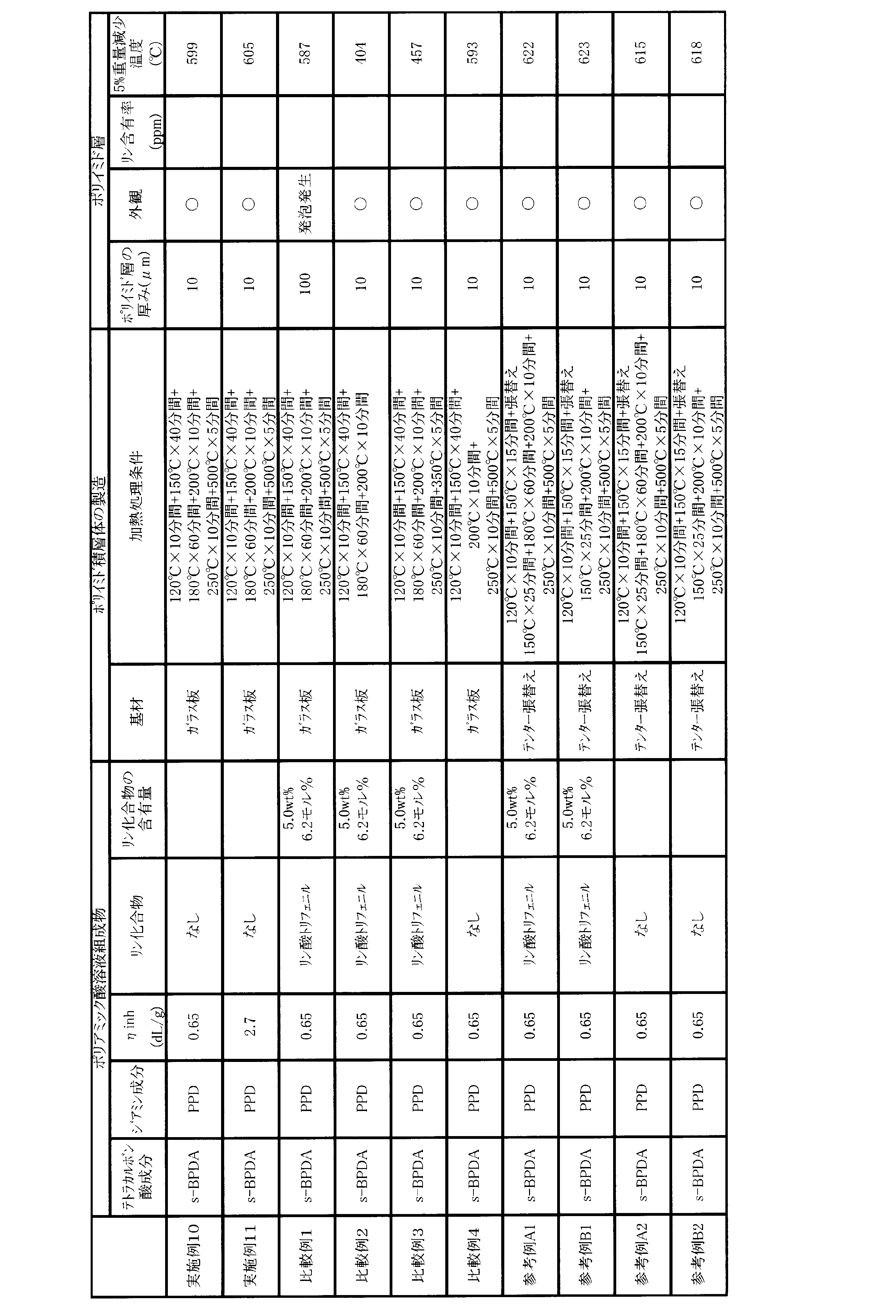
- Example 10 N-methyl-2-pyrrolidone (410.1267 g) was added as a solvent to a glass reaction vessel having an internal volume of 500 ml equipped with a stirrer and a nitrogen gas introduction / discharge tube, and 26.8886 g (0.2486 mol) of PPD was added thereto. Then, 73.1431 g (0.2486 mol) of s-BPDA was added and stirred at 50 ° C. to obtain a polyamic acid solution having a solid content concentration of 18.21% and a logarithmic viscosity of 0.65 dL / g.
- This polyamic acid solution was coated on a glass plate of a substrate by a bar coater, and the coating film was applied at 120 ° C. for 10 minutes, 150 ° C. for 40 minutes, 180 ° C. for 60 minutes, 200 ° C., 250 ° C. And 10 minutes at 500 ° C. for 5 minutes to form a polyimide layer having a thickness of 10 ⁇ m on the glass plate to obtain a polyimide laminate.
- the polyimide layer was separated from the base material, and then TGA measurement was performed to measure a 5% weight loss temperature, which was used as a measure of the outgas generation rate.
- the film coloring evaluation was also performed. Table 2 shows the results.
- Example 11 N-methyl-2-pyrrolidone (449.9976 g) was added as a solvent to a glass reaction vessel having an internal volume of 500 ml equipped with a stirrer and a nitrogen gas inlet / outlet tube, and 13.4400 g (0.1243 mol) of PPD was added thereto. Then, 36.5598 g (0.1243 mol) of s-BPDA was added and stirred at 50 ° C. to obtain a polyamic acid solution having a solid content concentration of 9.10% and a logarithmic viscosity of 2.70 dL / g.
- This polyamic acid solution was coated on a glass plate of a substrate by a bar coater, and the coating film was applied at 120 ° C. for 10 minutes, 150 ° C. for 40 minutes, 180 ° C. for 60 minutes, 200 ° C., 250 ° C. For 10 minutes each and 5 minutes at 500 ° C. to obtain a laminate comprising a glass plate and a polyimide film having a thickness of 10 ⁇ m.
- the polyimide layer was separated from the base material, and then TGA measurement was performed to measure a 5% weight loss temperature, which was used as a measure of the outgas generation rate.
- the film coloring evaluation was also performed. Table 2 shows the results.
- Example 1 The same operation as in Example 2 was performed to obtain a polyamic solution.
- This polyamic acid solution was coated on a glass plate of a substrate by a bar coater, and the coating film was applied at 120 ° C. for 10 minutes, 150 ° C. for 40 minutes, 180 ° C. for 60 minutes, 200 ° C., 250 ° C. And 10 minutes at 500 ° C. for 5 minutes, and a polyimide layer having a thickness of 100 ⁇ m was formed on the glass plate to obtain a polyimide laminate.
- the obtained polyimide layer was foamed, and a practical polyimide layer could not be obtained.
- the polyimide layer was separated from the base material, and then TGA measurement was performed to measure a 5% weight loss temperature, which was used as a measure of the outgas generation rate. The results are shown in Table 2.
- Example 2 with the exception that the polyamic acid solution coating film was heat treated at 120 ° C. for 10 minutes, 150 ° C. for 40 minutes, 180 ° C. for 60 minutes, and 200 ° C. for 10 minutes to form a polyimide layer. The same operation was performed. The results are shown in Table 2.
- Example 3 The coating film of the polyamic acid solution was heated at 120 ° C. for 10 minutes, 150 ° C. for 40 minutes, 180 ° C. for 60 minutes, 200 ° C., 250 ° C. for 10 minutes each, and 350 ° C. for 5 minutes. The same operation as in Example 2 was performed except that a polyimide layer was formed. The results are shown in Table 2.
- This polyamic acid solution is applied onto a glass plate of a substrate by a bar coater, and the coating film is heat-treated at 120 ° C. for 10 minutes and at 150 ° C. for 15 minutes, and peeled off from the substrate to be self-supporting. A film was obtained.
- the four sides of this self-supporting film were fixed with a pin tenter and heat-treated at 150 ° C. for 25 minutes, 180 ° C. for 60 minutes, 200 ° C. and 250 ° C. for 10 minutes each, and 500 ° C. for 5 minutes.
- a polyimide film having a thickness of 10 ⁇ m was obtained.
- the polyimide film was subjected to TGA measurement, and the 5% weight loss temperature was measured as a standard for the outgas generation rate. The film coloring evaluation was also performed. Table 2 shows the results.
- This polyamic acid solution is applied onto a glass plate of a substrate by a bar coater, and the coating film is heat-treated at 120 ° C. for 10 minutes and at 150 ° C. for 15 minutes, and peeled off from the substrate to be self-supporting. A film was obtained.
- the four sides of this self-supporting film were fixed with a pin tenter and heat-treated at 150 ° C. for 25 minutes, 200 ° C., 250 ° C. for 10 minutes each, and 500 ° C. for 5 minutes, and a polyimide having a thickness of 10 ⁇ m. A film was obtained.
- the polyimide film was subjected to TGA measurement, and the 5% weight loss temperature was measured as a standard for the outgas generation rate. The film coloring evaluation was also performed. Table 2 shows the results.
- This polyamic acid solution is applied onto a glass plate of a substrate by a bar coater, and the coating film is heat-treated at 120 ° C. for 10 minutes and at 150 ° C. for 15 minutes, and peeled off from the substrate to be self-supporting. A film was obtained.
- the four sides of this self-supporting film were fixed with a pin tenter and heat-treated at 150 ° C. for 25 minutes, 180 ° C. for 60 minutes, 200 ° C. and 250 ° C. for 10 minutes each, and 500 ° C. for 5 minutes.
- a polyimide film having a thickness of 10 ⁇ m was obtained.
- the polyimide film was subjected to TGA measurement, and the 5% weight loss temperature was measured as a standard for the outgas generation rate. The film coloring evaluation was also performed. Table 2 shows the results.
- This polyamic acid solution is applied onto a glass plate of a substrate by a bar coater, and the coating film is heat-treated at 120 ° C. for 10 minutes and at 150 ° C. for 15 minutes, and peeled off from the substrate to be self-supporting. A film was obtained.
- the four sides of this self-supporting film were fixed with a pin tenter and heat-treated at 150 ° C. for 25 minutes, 200 ° C., 250 ° C. for 10 minutes each, and 500 ° C. for 5 minutes, and a polyimide having a thickness of 10 ⁇ m. A film was obtained.
- the polyimide film was subjected to TGA measurement, and the 5% weight loss temperature was measured as a standard for the outgas generation rate. The film coloring evaluation was also performed. Table 2 shows the results.
- the self-supporting film was produced unlike the case of heat imidization treatment in the state where the volatile components of Examples 1 to 10 were evaporated from only one side.
- the polyamic acid solution is heated at least in the temperature range of more than 150 ° C. to less than 200 ° C. for 10 minutes or more, and then the maximum Even if the temperature is 400 ° C to 550 ° C and heat-treated in the temperature range, and imidized without heat treatment in the temperature range above 150 ° C to less than 200 ° C, the 5% weight loss temperature is almost the same. I know that there is.
- a specific tetracarboxylic acid component and a diamine component that is, a tetracarboxylic acid component and a main component whose main component is 3,3 ′, 4,4′-biphenyltetracarboxylic dianhydride are preferably formed on a substrate.
- the component is composed of a diamine component which is paraphenylenediamine, and therefore has a polyimide layer having excellent characteristics such as heat resistance, chemical resistance, radiation resistance, electrical insulation, dimensional stability, mechanical properties, and particularly It is possible to provide a method for producing a polyimide laminate in which a highly heat-resistant polyimide layer in which thermal decomposition is suppressed in a temperature range of 500 ° C. to 650 ° C. can be provided.
- the present invention even when a relatively low molecular weight polyamic acid solution, which is not used when producing a normal polyimide film, is used, a high temperature in which thermal decomposition is suppressed in a temperature range of 500 ° C. to 650 ° C.
- the manufacturing method of the polyimide laminated body which can form a heat resistant polyimide layer can be provided.
- the polyimide laminate of the present invention is a substitute for a glass substrate for a display device such as a liquid crystal display, EL display, and electronic paper by further laminating other materials on the polyimide layer surface and finally separating the base material. It can be suitably used as a plastic substrate.
Landscapes
- Chemical & Material Sciences (AREA)
- Chemical Kinetics & Catalysis (AREA)
- Organic Chemistry (AREA)
- Health & Medical Sciences (AREA)
- Medicinal Chemistry (AREA)
- Polymers & Plastics (AREA)
- Life Sciences & Earth Sciences (AREA)
- Engineering & Computer Science (AREA)
- Materials Engineering (AREA)
- Wood Science & Technology (AREA)
- Laminated Bodies (AREA)
- Macromolecular Compounds Obtained By Forming Nitrogen-Containing Linkages In General (AREA)
- Compositions Of Macromolecular Compounds (AREA)
- Application Of Or Painting With Fluid Materials (AREA)
Abstract
Description
ポリアミック酸溶液組成物からなる薄膜を基材上に形成し、得られた基材とポリアミック酸溶液組成物の薄膜とからなる積層体を、少なくとも150℃超~200℃未満の温度範囲で10分間以上加熱処理した後で、最高温度が400℃~550℃の温度範囲で加熱処理して、基材上に厚みが50μm未満のポリイミド層を形成することを特徴とするポリイミド積層体の製造方法。
2. 基材とポリアミック酸溶液組成物とからなる積層体を、150℃超~200℃未満の温度範囲で加熱処理する時間が30分間以上であることを特徴とする前記項1に記載のポリイミド積層体の製造方法。
3. 前記ポリアミック酸溶液組成物が、3,3’,4,4’-ビフェニルテトラカルボン酸二無水物を主成分として含むテトラカルボン酸成分と、パラフェニレンジアミンを主成分として含むジアミン成分とから得られるポリアミック酸を含むことを特徴とする前記項1または2に記載のポリイミド積層体の製造方法。
4. 前記ポリアミック酸溶液組成物が、リン化合物を含むことを特徴とする前記項1~3のいずれかに記載のポリイミド積層体の製造方法。
5. 形成されたポリイミド層のリンの含有割合[リンの質量/ポリイミド層の質量]が100~3700ppmであることを特徴とする前記項4に記載のポリイミド積層体の製造方法。
6. 前記リン化合物がアルキル鎖を有しないか、或いは炭素数が16以下のアルキル鎖を有することを特徴とする前記項3~5のいずれかに記載のポリイミド積層体の製造方法。
7. 前記ポリアミック酸溶液組成物のポリアミック酸の対数粘度が2.0dL/g以下であることを特徴とする前記項1~6のいずれかに記載のポリイミド積層体の製造方法。
9. 前記項8に記載のポリイミド積層体のポリイミド層表面に、さらに他の材料を積層して得られる積層体。
10. 前記項9に記載の積層体から、ポリイミド積層体の基材を分離して得られる積層体。
本発明では、ポリアミック酸溶液組成物からなる薄膜を基材上に形成し、得られた基材とポリアミック酸溶液組成物の薄膜とからなる積層体を、少なくとも150℃超~200℃未満の温度範囲で10分間以上、好ましくは30分間以上、特に好ましくは60分間以上加熱処理した後で、最高温度が400℃~550℃の温度範囲で加熱処理して、基材上に厚みが50μm未満のポリイミド層を形成する。ポリアミック酸溶液組成物は、好ましくは、3,3’,4,4’-ビフェニルテトラカルボン酸二無水物を主成分として含むテトラカルボン酸成分とパラフェニレンジアミンを主成分として含むジアミン成分とから得られるポリアミック酸を含み、さらに、リン化合物を含むことが好ましい。
本発明で得られるポリイミド積層体は、前述のとおり、ポリイミド層のリンの含有割合[リンの質量/ポリイミド層の質量]は、特に限定されるものではないが、100~3700ppm、より好ましくは100~2000ppm、さらに好ましくは100~1000ppm、特に好ましくは100~500ppm程度であることが好ましい。
本発明により得られるポリイミド積層体のポリイミド層は、500℃~650℃の温度領域において熱分解が抑制されて、高い耐熱性を有する。
本発明によって得られるポリイミド積層体は、耐熱性、耐薬品性、耐放射線性、電気絶縁性、寸法安定性、機械的性質などの特性が特に優れ、且つ特に500℃~650℃の温度領域において熱分解が抑制された高耐熱性のポリイミド層が形成されたポリイミド積層体である。したがって、例えばポリイミド積層体に対してスパッタリングを行うことにより、ポリイミド層表面にITO、アモルファスシリコン層などの他の材料を好適に積層することができる。そして、得られた基材とポリイミドと他の材料とからなる積層体から、基材を分離することによって、ポリイミドと他の材料とからなる積層体を好適に得ることが出来る。
s-BPDA:3,3’,4,4’-ビフェニルテトラカルボン酸二無水物
PPD:パラフェニレンジアミン
ポリアミック酸溶液の固形分濃度は、ポリアミック酸溶液を350℃で30分間乾燥し、乾燥前の重量W1と乾燥後の重量W2とから次式によって求めた値である。
ポリアミック酸の対数粘度(ηinh)は、ポリアミック酸溶液をポリアミック酸濃度が0.5g/100ミリリットル溶媒となるようにN-メチル-2-ピロリドンに均一に溶解した溶液を調製し、その溶液と溶媒との溶液粘度を30℃で測定して次式で算出した。

TG-DTA2000S(マックサイエンス)を用い、室温(25℃)から700℃まで20℃/minにて昇温を行い、150℃における重量を100%として5%重量減少温度を測定した。
ポリイミド層試料約50mgを石英製容器にはかりとり、硝酸を入れて密閉し、マイクロ波を照射して試料の分解を行い、超純水で定容して検液とした。高分解能型誘導結合プラズマ質量分析法HR-ICP-MS(サーモフィッシャーサイエンティフィック製、AxiomSCplus型)を用いてリン含有量の定量分析を行った。
加熱処理後のポリイミド層の外観の目視観察を行い、同一条件でリン化合物を添加していないポリイミド層と比較して、透明性がほぼ変わらない場合は○、透明性が部分的に低下した場合は△、透明性が著しく低下した場合は×とした。
攪拌機、窒素ガス導入・排出管を備えた内容積500mLのガラス製の反応容器に、溶媒としてN-メチル-2-ピロリドン410.1267gを加え、これにPPDを26.8886g(0.2486モル)と、s-BPDAの73.1431g(0.2486モル)を加え、50℃で撹拌して、固形分濃度18.21%、対数粘度0.65dL/gのポリアミック酸溶液を得た。得られたポリアミック酸溶液にリン化合物としてリン酸トリフェニルを2.0006g(0.0061モル、テトラカルボン酸成分100モル%に対して2.5モル%、テトラカルボン酸成分とジアミン成分の合計質量に対して2.0wt%、以下同様)添加した。
リン化合物としてリン酸トリフェニルを5.0016g(0.0153モル、6.2モル%、5.0wt%)添加した以外は実施例1と同様の操作をおこなった。結果を表1に示す。
リン化合物としてリン酸トリフェニルを15.0160g(0.0460モル、18.5モル%、15.0wt%)添加した以外は実施例1と同様の操作をおこなった。結果を表1に示す。
リン化合物としてモノエチルリン酸エステルを5.0012g(0.0397モル、16.0モル%、5.0wt%)添加した以外は実施例1と同様の操作をおこなった。結果を表1に示す。
リン化合物としてモノラウリルリン酸エステルを5.0012g(0.0188モル、7.6モル%、5.0wt%)添加した以外は実施例1と同様の操作をおこなった。結果を表1に示す。
リン化合物としてポリリン酸を1.2504g(0.0100モル、4.0モル%、0.8wt%)添加した以外は実施例1と同様の操作をおこなった。結果を表1に示す。
攪拌機、窒素ガス導入・排出管を備えた内容積500mlのガラス製の反応容器に、溶媒としてN-メチル-2-ピロリドン449.9976gを加え、これにPPDを13.4400g(0.1243モル)と、s-BPDAの36.5598g(0.1243モル)を加え、50℃で撹拌して、固形分濃度9.10%、対数粘度2.70dL/gのポリアミック酸溶液を得た。得られたポリアミック酸溶液にリン化合物としてリン酸トリフェニルを2.5008g(0.0077モル、6.2モル%、5.0wt%)添加した。
形成するポリイミド層の厚みを40μmにした以外は実施例2と同様の操作をおこなった。結果を表1に示す。
ポリアミック酸溶液の塗膜を、120℃にて10分間、150℃にて40分間、180℃にて60分間、200℃、250℃にて各10分間、400℃にて5分間加熱処理してポリイミド層を形成した以外は実施例2と同様の操作をおこなった。結果を表1に示す。
攪拌機、窒素ガス導入・排出管を備えた内容積500mlのガラス製の反応容器に、溶媒としてN-メチル-2-ピロリドン410.1267gを加え、これにPPDを26.8886g(0.2486モル)と、s-BPDAの73.1431g(0.2486モル)を加え、50℃で撹拌して、固形分濃度18.21%、対数粘度0.65dL/gのポリアミック酸溶液を得た。
攪拌機、窒素ガス導入・排出管を備えた内容積500mlのガラス製の反応容器に、溶媒としてN-メチル-2-ピロリドン449.9976gを加え、これにPPDを13.4400g(0.1243モル)と、s-BPDAの36.5598g(0.1243モル)を加え、50℃で撹拌して、固形分濃度9.10%、対数粘度2.70dL/gのポリアミック酸溶液を得た。
実施例2と同様の操作をおこないポリアミック溶液を得た。
ポリアミック酸溶液の塗膜を、120℃にて10分間、150℃にて40分間、180℃にて60分間、200℃にて10分間加熱処理してポリイミド層を形成した以外は実施例2と同様の操作をおこなった。結果を表2に示す。
ポリアミック酸溶液の塗膜を、120℃にて10分間、150℃にて40分間、180℃にて60分間、200℃、250℃にて各10分間、350℃にて5分間加熱処理してポリイミド層を形成した以外は実施例2と同様の操作をおこなった。結果を表2に示す。
ポリアミック酸溶液の塗膜を、120℃にて10分間、150℃にて40分間、200℃、250℃にて各10分間、500℃にて5分間加熱処理してポリイミド層を形成した以外は実施例10と同様の操作をおこなった。結果を表2に示す。
実施例2と同様の操作をおこないポリアミック溶液を得た。
実施例2と同様の操作をおこないポリアミック溶液を得た。
実施例10と同様の操作をおこないポリアミック溶液を得た。
実施例10と同様の操作をおこないポリアミック溶液を得た。
Claims (10)
- 基材と厚みが50μm未満のポリイミド層とからなるポリイミド積層体を製造する方法であって、
ポリアミック酸溶液組成物からなる薄膜を基材上に形成し、得られた基材とポリアミック酸溶液組成物の薄膜とからなる積層体を、少なくとも150℃超~200℃未満の温度範囲で10分間以上加熱処理した後で、最高温度が400℃~550℃の温度範囲で加熱処理して、基材上に厚みが50μm未満のポリイミド層を形成することを特徴とするポリイミド積層体の製造方法。 - 基材とポリアミック酸溶液組成物とからなる積層体を、150℃超~200℃未満の温度範囲で加熱処理する時間が30分間以上であることを特徴とする請求項1に記載のポリイミド積層体の製造方法。
- 前記ポリアミック酸溶液組成物が、3,3’,4,4’-ビフェニルテトラカルボン酸二無水物を主成分として含むテトラカルボン酸成分と、パラフェニレンジアミンを主成分として含むジアミン成分とから得られるポリアミック酸を含むことを特徴とする請求項1または2に記載のポリイミド積層体の製造方法。
- 前記ポリアミック酸溶液組成物が、リン化合物を含むことを特徴とする請求項1~3のいずれかに記載のポリイミド積層体の製造方法。
- 形成されたポリイミド層のリンの含有割合[リンの質量/ポリイミド層の質量]が100~3700ppmであることを特徴とする請求項4に記載のポリイミド積層体の製造方法。
- 前記リン化合物がアルキル鎖を有しないか、或いは炭素数が16以下のアルキル鎖を有することを特徴とする請求項3~5のいずれかに記載のポリイミド積層体の製造方法。
- 前記ポリアミック酸溶液組成物のポリアミック酸の対数粘度が2.0dL/g以下であることを特徴とする請求項1~6のいずれかに記載のポリイミド積層体の製造方法。
- ポリアミック酸溶液組成物からなる薄膜を基材上に形成し、得られた基材とポリアミック酸溶液組成物の薄膜とからなる積層体を、少なくとも150℃超~200℃未満の温度範囲で10分間以上加熱処理した後で、最高温度が400℃~550℃の温度範囲で加熱処理して、基材上に厚みが50μm未満のポリイミド層を形成することによって得られるポリイミド積層体。
- 請求項8に記載のポリイミド積層体のポリイミド層表面に、さらに他の材料を積層して得られる積層体。
- 請求項9に記載の積層体から、ポリイミド積層体の基材を分離して得られる積層体。
Priority Applications (5)
| Application Number | Priority Date | Filing Date | Title |
|---|---|---|---|
| US14/126,111 US20140134428A1 (en) | 2011-06-14 | 2012-06-14 | Method for producing polyimide laminate, and polyimide laminate |
| KR1020147000879A KR101892783B1 (ko) | 2011-06-14 | 2012-06-14 | 폴리이미드 적층체의 제조 방법, 및 폴리이미드 적층체 |
| JP2013520585A JP6032202B2 (ja) | 2011-06-14 | 2012-06-14 | ポリイミド積層体の製造方法、およびポリイミド積層体 |
| EP12801082.4A EP2722174A4 (en) | 2011-06-14 | 2012-06-14 | METHOD FOR PRODUCING A POLYIMID LAMINATE AND POLYIMID LAMINATE |
| CN201280039651.0A CN103732405A (zh) | 2011-06-14 | 2012-06-14 | 制备聚酰亚胺层压制品的方法以及该聚酰亚胺层压制品 |
Applications Claiming Priority (2)
| Application Number | Priority Date | Filing Date | Title |
|---|---|---|---|
| JP2011-132739 | 2011-06-14 | ||
| JP2011132739 | 2011-06-14 |
Publications (1)
| Publication Number | Publication Date |
|---|---|
| WO2012173202A1 true WO2012173202A1 (ja) | 2012-12-20 |
Family
ID=47357183
Family Applications (1)
| Application Number | Title | Priority Date | Filing Date |
|---|---|---|---|
| PCT/JP2012/065272 Ceased WO2012173202A1 (ja) | 2011-06-14 | 2012-06-14 | ポリイミド積層体の製造方法、およびポリイミド積層体 |
Country Status (7)
| Country | Link |
|---|---|
| US (1) | US20140134428A1 (ja) |
| EP (1) | EP2722174A4 (ja) |
| JP (1) | JP6032202B2 (ja) |
| KR (1) | KR101892783B1 (ja) |
| CN (1) | CN103732405A (ja) |
| TW (1) | TWI569970B (ja) |
| WO (1) | WO2012173202A1 (ja) |
Cited By (3)
| Publication number | Priority date | Publication date | Assignee | Title |
|---|---|---|---|---|
| WO2015080139A1 (ja) * | 2013-11-27 | 2015-06-04 | 宇部興産株式会社 | ポリイミド前駆体組成物、ポリイミドの製造方法、ポリイミド、ポリイミドフィルム、及び基板 |
| JP2015231738A (ja) * | 2014-05-14 | 2015-12-24 | 宇部興産株式会社 | ポリイミド積層体、及びその製造方法 |
| JP2024521539A (ja) * | 2021-06-07 | 2024-05-31 | デュポン エレクトロニクス インコーポレイテッド | 電子デバイスで使用するためのポリマー |
Families Citing this family (2)
| Publication number | Priority date | Publication date | Assignee | Title |
|---|---|---|---|---|
| KR102264420B1 (ko) | 2017-11-03 | 2021-06-11 | 주식회사 엘지화학 | 디스플레이 기판용 폴리이미드 필름 |
| KR102281613B1 (ko) * | 2017-11-21 | 2021-07-23 | 주식회사 엘지화학 | 디스플레이 기판용 폴리이미드 필름 |
Citations (8)
| Publication number | Priority date | Publication date | Assignee | Title |
|---|---|---|---|---|
| JPS60206639A (ja) * | 1984-03-31 | 1985-10-18 | 日東電工株式会社 | ポリイミド−金属箔複合フイルムの製造方法 |
| JPS62136275A (ja) * | 1985-12-09 | 1987-06-19 | Hitachi Chem Co Ltd | フレキシブル金属張板の製造方法 |
| JPH0228257A (ja) | 1988-07-15 | 1990-01-30 | Kanegafuchi Chem Ind Co Ltd | 改良されたポリイミド及びポリイミドフィルム及びポリイミドフィルムの製造方法 |
| JPH03215581A (ja) * | 1990-01-19 | 1991-09-20 | Daicel Chem Ind Ltd | ポリイミド塗膜の密着性改良方法 |
| JPH05315630A (ja) | 1992-05-13 | 1993-11-26 | Sanyo Electric Co Ltd | 可撓性のある薄膜太陽電池の製造方法 |
| JPH08143688A (ja) | 1994-09-20 | 1996-06-04 | Ube Ind Ltd | 改質されたポリイミドフィルムおよび積層体 |
| JP2005298590A (ja) | 2004-04-08 | 2005-10-27 | Toray Ind Inc | 芳香族ポリアミドフィルムおよびプラスチック基板 |
| JP2007260608A (ja) * | 2006-03-29 | 2007-10-11 | Nippon Steel Chem Co Ltd | 銅張積層板の製造方法 |
Family Cites Families (31)
| Publication number | Priority date | Publication date | Assignee | Title |
|---|---|---|---|---|
| US5286811A (en) * | 1983-09-27 | 1994-02-15 | The Boeing Company | Blended polyimide oligomers and method of curing polyimides |
| JPS60244507A (ja) * | 1984-05-18 | 1985-12-04 | Ube Ind Ltd | 芳香族ポリイミドフイルムの製造法 |
| DE3789296T2 (de) * | 1986-11-29 | 1994-10-13 | Kanegafuchi Chemical Ind | Polyimid mit Formstabilität beim Erhitzen. |
| JP2744786B2 (ja) * | 1987-01-20 | 1998-04-28 | 鐘淵化学工業株式会社 | 熱的寸法安定性にすぐれたポリイミド及びそれに用いるポリアミド酸 |
| US5304626A (en) * | 1988-06-28 | 1994-04-19 | Amoco Corporation | Polyimide copolymers containing 3,3',4,4'-tetracarboxybiphenyl dianhydride (BPDA) moieties |
| US5077382A (en) * | 1989-10-26 | 1991-12-31 | Occidental Chemical Corporation | Copolyimide odpa/bpda/4,4'-oda or p-pda |
| JP2775647B2 (ja) * | 1989-11-17 | 1998-07-16 | 宇部興産株式会社 | メタライズドポリイミドフィルムの製法 |
| US5741598A (en) * | 1995-08-01 | 1998-04-21 | Ube Industries, Ltd. | Polyimide/metal composite sheet |
| US6746639B2 (en) * | 2000-09-11 | 2004-06-08 | Kaneka Corporation | Process for preparing polyimide film |
| JP2002317045A (ja) * | 2001-04-23 | 2002-10-31 | Jsr Corp | 可溶性熱可塑性ポリイミドの製造方法 |
| CN1421490A (zh) * | 2002-12-19 | 2003-06-04 | 中国科学院兰州化学物理研究所 | 聚酰亚胺薄膜的制备方法 |
| CN100487024C (zh) * | 2003-05-07 | 2009-05-13 | 上海金山前峰绝缘材料有限公司 | 覆铜用聚酰亚胺薄膜的制备方法 |
| GB0327093D0 (en) * | 2003-11-21 | 2003-12-24 | Koninkl Philips Electronics Nv | Active matrix displays and other electronic devices having plastic substrates |
| US20060019102A1 (en) * | 2004-07-26 | 2006-01-26 | Kuppsuamy Kanakarajan | Flame-retardant halogen-free polyimide films useful as thermal insulation in aircraft applications and methods relating thereto |
| JP5323315B2 (ja) * | 2004-09-15 | 2013-10-23 | 株式会社カネカ | 高い接着性を有するポリイミドフィルムおよびその製造方法 |
| TW200626364A (en) * | 2004-09-29 | 2006-08-01 | Ube Industries | Polyimide film and polyimide composite sheet |
| CN1288194C (zh) * | 2005-01-31 | 2006-12-06 | 南京工业大学 | 一种挠性印刷线路板用聚酰亚胺薄膜的制备方法 |
| KR100967326B1 (ko) * | 2005-04-07 | 2010-07-05 | 우베 고산 가부시키가이샤 | 폴리이미드 필름의 제조 방법 및 폴리이미드 필름 |
| JP2006335875A (ja) * | 2005-06-02 | 2006-12-14 | Ube Ind Ltd | ポリイミドフィルムおよびその製造法 |
| CN101808791B (zh) * | 2007-07-27 | 2016-01-20 | 宇部兴产株式会社 | 聚酰亚胺膜和配线板 |
| WO2009038205A1 (ja) * | 2007-09-20 | 2009-03-26 | Ube Industries, Ltd. | ポリイミド膜の製造方法、及びポリアミック酸溶液組成物 |
| JP2009079165A (ja) * | 2007-09-27 | 2009-04-16 | Du Pont Toray Co Ltd | ポリイミドフィルム |
| US8816017B2 (en) * | 2007-11-29 | 2014-08-26 | Ube Industries, Ltd. | Process for producing polyamic acid solution and polyamic acid solution |
| JP2010071463A (ja) * | 2008-08-18 | 2010-04-02 | Nihon Univ | ポリイミド薄膜のダイヤフラム製造方法 |
| CN102471576B (zh) * | 2009-06-29 | 2014-05-07 | 宇部兴产株式会社 | 含有填充剂的聚酰亚胺前体溶液组成物及使用其的聚酰亚胺膜 |
| JP5594289B2 (ja) * | 2009-08-20 | 2014-09-24 | 宇部興産株式会社 | ポリイミドフィルムおよびポリイミドフィルムの製造方法 |
| KR101149433B1 (ko) * | 2009-08-28 | 2012-05-22 | 삼성모바일디스플레이주식회사 | 플렉서블 표시 장치 및 그 제조 방법 |
| KR20120101660A (ko) * | 2009-10-27 | 2012-09-14 | 이 아이 듀폰 디 네모아 앤드 캄파니 | 고온 마모 용도를 위한 폴리이미드 수지 |
| EP2596949A4 (en) * | 2010-07-22 | 2014-01-15 | Ube Industries | METHOD FOR PRODUCING A POLYIMIDE FILM COATING AND POLYIMIDE FILM COATING |
| TWI573691B (zh) * | 2011-06-14 | 2017-03-11 | 宇部興產股份有限公司 | 聚醯亞胺疊層體之製造方法及聚醯亞胺疊層體 |
| JP5781999B2 (ja) * | 2012-04-13 | 2015-09-24 | 達勝科技股▲ふん▼有限公司 | ポリイミドフィルム及びその製造方法 |
-
2012
- 2012-06-14 TW TW101121350A patent/TWI569970B/zh active
- 2012-06-14 JP JP2013520585A patent/JP6032202B2/ja active Active
- 2012-06-14 CN CN201280039651.0A patent/CN103732405A/zh active Pending
- 2012-06-14 KR KR1020147000879A patent/KR101892783B1/ko active Active
- 2012-06-14 US US14/126,111 patent/US20140134428A1/en not_active Abandoned
- 2012-06-14 WO PCT/JP2012/065272 patent/WO2012173202A1/ja not_active Ceased
- 2012-06-14 EP EP12801082.4A patent/EP2722174A4/en not_active Withdrawn
Patent Citations (8)
| Publication number | Priority date | Publication date | Assignee | Title |
|---|---|---|---|---|
| JPS60206639A (ja) * | 1984-03-31 | 1985-10-18 | 日東電工株式会社 | ポリイミド−金属箔複合フイルムの製造方法 |
| JPS62136275A (ja) * | 1985-12-09 | 1987-06-19 | Hitachi Chem Co Ltd | フレキシブル金属張板の製造方法 |
| JPH0228257A (ja) | 1988-07-15 | 1990-01-30 | Kanegafuchi Chem Ind Co Ltd | 改良されたポリイミド及びポリイミドフィルム及びポリイミドフィルムの製造方法 |
| JPH03215581A (ja) * | 1990-01-19 | 1991-09-20 | Daicel Chem Ind Ltd | ポリイミド塗膜の密着性改良方法 |
| JPH05315630A (ja) | 1992-05-13 | 1993-11-26 | Sanyo Electric Co Ltd | 可撓性のある薄膜太陽電池の製造方法 |
| JPH08143688A (ja) | 1994-09-20 | 1996-06-04 | Ube Ind Ltd | 改質されたポリイミドフィルムおよび積層体 |
| JP2005298590A (ja) | 2004-04-08 | 2005-10-27 | Toray Ind Inc | 芳香族ポリアミドフィルムおよびプラスチック基板 |
| JP2007260608A (ja) * | 2006-03-29 | 2007-10-11 | Nippon Steel Chem Co Ltd | 銅張積層板の製造方法 |
Non-Patent Citations (1)
| Title |
|---|
| See also references of EP2722174A4 * |
Cited By (8)
| Publication number | Priority date | Publication date | Assignee | Title |
|---|---|---|---|---|
| WO2015080139A1 (ja) * | 2013-11-27 | 2015-06-04 | 宇部興産株式会社 | ポリイミド前駆体組成物、ポリイミドの製造方法、ポリイミド、ポリイミドフィルム、及び基板 |
| CN105764990A (zh) * | 2013-11-27 | 2016-07-13 | 宇部兴产株式会社 | 聚酰亚胺前体组合物、聚酰亚胺的制造方法、聚酰亚胺、聚酰亚胺膜和基板 |
| KR20160091935A (ko) * | 2013-11-27 | 2016-08-03 | 우베 고산 가부시키가이샤 | 폴리이미드 전구체 조성물, 폴리이미드의 제조 방법, 폴리이미드, 폴리이미드 필름, 및 기판 |
| JPWO2015080139A1 (ja) * | 2013-11-27 | 2017-03-16 | 宇部興産株式会社 | ポリイミド前駆体組成物、ポリイミドの製造方法、ポリイミド、ポリイミドフィルム、及び基板 |
| CN105764990B (zh) * | 2013-11-27 | 2018-03-20 | 宇部兴产株式会社 | 聚酰亚胺前体组合物、聚酰亚胺的制造方法、聚酰亚胺、聚酰亚胺膜和基板 |
| KR102188483B1 (ko) | 2013-11-27 | 2020-12-08 | 우베 고산 가부시키가이샤 | 폴리이미드 전구체 조성물, 폴리이미드의 제조 방법, 폴리이미드, 폴리이미드 필름, 및 기판 |
| JP2015231738A (ja) * | 2014-05-14 | 2015-12-24 | 宇部興産株式会社 | ポリイミド積層体、及びその製造方法 |
| JP2024521539A (ja) * | 2021-06-07 | 2024-05-31 | デュポン エレクトロニクス インコーポレイテッド | 電子デバイスで使用するためのポリマー |
Also Published As
| Publication number | Publication date |
|---|---|
| EP2722174A1 (en) | 2014-04-23 |
| JP6032202B2 (ja) | 2016-11-24 |
| EP2722174A4 (en) | 2015-02-18 |
| KR20140037925A (ko) | 2014-03-27 |
| KR101892783B1 (ko) | 2018-08-28 |
| TW201307071A (zh) | 2013-02-16 |
| US20140134428A1 (en) | 2014-05-15 |
| CN103732405A (zh) | 2014-04-16 |
| TWI569970B (zh) | 2017-02-11 |
| JPWO2012173202A1 (ja) | 2015-02-23 |
Similar Documents
| Publication | Publication Date | Title |
|---|---|---|
| JP5900497B2 (ja) | ポリイミド積層体の製造方法、およびポリイミド積層体 | |
| JP6516048B2 (ja) | ポリイミド前駆体、及びポリイミド | |
| JP6539965B2 (ja) | フレキシブルデバイスの製造方法 | |
| JP7635775B2 (ja) | ポリイミド前駆体組成物、およびそれを用いた絶縁被覆層の製造方法 | |
| EP3135670A1 (en) | Tetracarboxylic dianhydride, polyamic acid, polyimide, methods for producing same, and polyamic acid solution | |
| JP6032202B2 (ja) | ポリイミド積層体の製造方法、およびポリイミド積層体 | |
| JP2009221309A (ja) | 含リンエステル基含有テトラカルボン酸またはその二無水物及び含リンポリエステルイミド | |
| JP6790756B2 (ja) | ポリイミド、ポリイミド前駆体、及びポリイミドフィルム | |
| TWI544006B (zh) | 難燃化之脂環式聚醯亞胺樹脂組成物及其薄壁成型體 | |
| KR20240117105A (ko) | 폴리이미드 필름, 고주파 회로 기판, 플렉시블 전자 디바이스 기판 | |
| TWI699387B (zh) | 聚醯亞胺前驅體組成物及利用此組成物之絕緣被覆層之製造方法 | |
| CN114423823B (zh) | 聚酰亚胺前体组合物和柔性电子器件的制造方法 | |
| WO2023074350A1 (ja) | ポリアミド酸、ポリアミド酸組成物、ポリイミド、ポリイミド膜、積層体、積層体の製造方法及び電子デバイス | |
| JP6558067B2 (ja) | ポリイミド積層体、及びその製造方法 | |
| TW202532519A (zh) | 聚醯胺酸、聚醯胺酸組合物、聚醯亞胺、聚醯亞胺膜、積層體、積層體之製造方法及電子裝置 | |
| JP2026031420A (ja) | ポリアミド酸、ポリアミド酸組成物、ポリイミド、ポリイミド膜、積層体、積層体の製造方法及び電子デバイス | |
| KR20240154650A (ko) | 디스플레이 기판용 폴리이미드 전구체, 디스플레이 기판용 폴리이미드 필름 및 디스플레이 기판 | |
| TW202319445A (zh) | 聚醯胺酸、聚醯胺酸組合物、聚醯亞胺、聚醯亞胺膜、積層體、積層體之製造方法及電子裝置 |
Legal Events
| Date | Code | Title | Description |
|---|---|---|---|
| 121 | Ep: the epo has been informed by wipo that ep was designated in this application |
Ref document number: 12801082 Country of ref document: EP Kind code of ref document: A1 |
|
| ENP | Entry into the national phase |
Ref document number: 2013520585 Country of ref document: JP Kind code of ref document: A |
|
| WWE | Wipo information: entry into national phase |
Ref document number: 14126111 Country of ref document: US |
|
| NENP | Non-entry into the national phase |
Ref country code: DE |
|
| ENP | Entry into the national phase |
Ref document number: 20147000879 Country of ref document: KR Kind code of ref document: A |