WO2012175774A1 - Utilisation de biocapsules de levure comme agents de fermentation dans la seconde fermentation alcoolique en bouteille et son utilisation pour l'élaboration de vin mousseux et de boissons alcoolisées mousseuses - Google Patents
Utilisation de biocapsules de levure comme agents de fermentation dans la seconde fermentation alcoolique en bouteille et son utilisation pour l'élaboration de vin mousseux et de boissons alcoolisées mousseuses Download PDFInfo
- Publication number
- WO2012175774A1 WO2012175774A1 PCT/ES2012/070452 ES2012070452W WO2012175774A1 WO 2012175774 A1 WO2012175774 A1 WO 2012175774A1 ES 2012070452 W ES2012070452 W ES 2012070452W WO 2012175774 A1 WO2012175774 A1 WO 2012175774A1
- Authority
- WO
- WIPO (PCT)
- Prior art keywords
- biocapsules
- yeast
- fermentation
- bottle
- wine
- Prior art date
- Legal status (The legal status is an assumption and is not a legal conclusion. Google has not performed a legal analysis and makes no representation as to the accuracy of the status listed.)
- Ceased
Links
Images


Classifications
-
- C—CHEMISTRY; METALLURGY
- C12—BIOCHEMISTRY; BEER; SPIRITS; WINE; VINEGAR; MICROBIOLOGY; ENZYMOLOGY; MUTATION OR GENETIC ENGINEERING
- C12G—WINE; PREPARATION THEREOF; ALCOHOLIC BEVERAGES; PREPARATION OF ALCOHOLIC BEVERAGES NOT PROVIDED FOR IN SUBCLASSES C12C OR C12H
- C12G1/00—Preparation of wine or sparkling wine
- C12G1/06—Preparation of sparkling wine; Impregnation of wine with carbon dioxide
- C12G1/064—Preparation of sparkling wine; Impregnation of wine with carbon dioxide using enclosed yeast
-
- C—CHEMISTRY; METALLURGY
- C12—BIOCHEMISTRY; BEER; SPIRITS; WINE; VINEGAR; MICROBIOLOGY; ENZYMOLOGY; MUTATION OR GENETIC ENGINEERING
- C12G—WINE; PREPARATION THEREOF; ALCOHOLIC BEVERAGES; PREPARATION OF ALCOHOLIC BEVERAGES NOT PROVIDED FOR IN SUBCLASSES C12C OR C12H
- C12G2200/00—Special features
- C12G2200/05—Use of particular microorganisms in the preparation of wine
Definitions
- the present invention falls within the framework of Industrial Microbiology, providing technical optimization and qualitative of an existing manufacturing process.
- the object of the invention is to cause the second fermentation in the bottle for the production of a sparkling alcoholic beverage, in particular for the production of sparkling wine, by the traditional method by means of a yeast system ( Saccharomyces cerevisiae or Saccharomyces bayanus ) co-immobilized naturally with a fungus of the species Penicillium chrysogenum .
- yeast system Saccharomyces cerevisiae or Saccharomyces bayanus
- the small spheres thus formed, biocapsules, present a series of technical advantages over existing immobilization systems and used for a similar purpose.
- the sparkling wine is made from a second alcoholic fermentation of a base wine to which sugar is added and a strain of yeast of the species S. cerevisiae or S. bayanus selected for this purpose.
- the fermentation of sparkling wine made by the traditional method or 'champenoise' is carried out inside commercially available 'champagne' bottles.
- the yeasts When the second fermentation is completed and after a period of aging established by the regulatory body of each country for this type of alcoholic beverages, the yeasts must be completely extracted from the medium where they have been fermented to avoid turbidity of the product before leaving for market. This same procedure can also be used to obtain other sparkling alcoholic drinks fermented in bottles.
- yeast cells are they find immobilized in a calcium alginate gel and concentrate on the Bottle neck quickly without shaking.
- yeast cells for production of sparkling wine are immobilized in alginate spheres and subsequently they cover with a layer of calcium alginate in order to make sure that no cells are released from the fixed assets.
- US5070019 describes a method of immobilization of yeasts in spheres of calcium alginate that improves the system proposed in EP0173915, where it is ensured that there is no calcium release to the environment that can cause precipitation crystalline
- Patent ES2204316 describes the procedure for obtaining a new immobilization procedure for yeasts based on a natural and spontaneous co-immobilization between a yeast of the Saccharomyces cerevisiae species and a filamentous fungus of the Penicillium chrysogenum species without the need for external or compound supports binding chemicals, using appropriate conditions to favor symbiotic binding between the two microorganisms.
- the present invention provides a method for carrying out the second alcoholic fermentation in a suitable container to contain a pressurized liquid, preferably a bottle, using this new system, yeast biocapsules co-immobilized naturally and spontaneously with a filamentous fungus of the species Penicillium chrysogenum , to obtain a sparkling alcoholic beverage, in particular sparkling wine, including champagnes and champagnes.
- a pressurized liquid preferably a bottle
- yeast biocapsules co-immobilized naturally and spontaneously with a filamentous fungus of the species Penicillium chrysogenum , to obtain a sparkling alcoholic beverage, in particular sparkling wine, including champagnes and champagnes.
- This procedure allows, once the fermentation is complete, to remove the yeast used easily and efficiently.
- the procedure avoids the use of external supports that can affect the catalytic activity of the yeast and / or transfer substances outside the product to be prepared.
- the present invention relates to a process of obtaining a sparkling alcoholic beverage, characterized in that said method comprises a fermentation stage in a suitable container to contain a liquid under pressure using biocapsules comprising a yeast immobilized in a filamentous fungus.
- the novelty of the present invention resides in apply a system of foaming alcoholic beverage cellular immobilization that uses an organism as an immobilization substrate alive (the mentioned filamentous fungus) instead of a physical-chemical support artificial that can yield substances outside the product you want to elaborate.
- the present invention takes place in a suitable container to contain a liquid to pressure that allows the elimination of yeast and fungus biocapsules sedimented filamentous.
- the suitable container used in The process of the present invention is a bottle, more preferably a 'champagne' type bottle.
- the procedure of the present invention makes it possible to suppress the stage of removal and thinning of the bottles in the manufacture of sparkling beverages, since fermentation yeast is capable of sedimentation in the neck of the bottle by gravity before the process of disgust. Sedimentation without stirring before disgorgement allows savings considerable labor and time, since the sedimentation of yeasts immobilized in biocapsules is fast.
- the present invention relates to a method of obtaining a sparkling wine, characterized in that said process comprises a fermentation stage in a suitable container for containing a pressurized liquid using biocapsules comprising a yeast immobilized in a filamentous fungus.
- the suitable container used in the process of The present invention is a bottle, more preferably a type bottle 'champagne'
- the yeast comprised in the biocapsules used in the process of the present invention may be a yeast of the genus Saccharomyces, preferably the yeast comprised in the biocapsules is chosen from Saccharomyces cerevisiae and Saccharomyces bayanus.
- the filamentous fungus comprised in the biocapsules used in the process of the present invention may be a fungus of the genus Penicillium, preferably the filamentous fungus comprised in the biocapsules is Penicillium chrysogenum.
- the culture medium used for spontaneous co-immobilization between the filamentous fungus and the yeast is not usable by the yeast, according to another aspect of the present invention, it is preferred that the fungus co-immobilize a minimum 1 x 10 6 yeast cells per ml of alcoholic base drink in the case of obtaining sparkling wine so that the necessary biocapsules are formed. In the particular case of using 750 ml bottles, this minimum number of yeast cells corresponds to 7.5 x 10 8 cells per bottle.
- the fungus co-immobilizes a maximum amount of 2 x 10 6 yeast cells per ml of base wine so that the necessary biocapsules are formed. In the particular case of using 750 ml bottles, this minimum number of yeast cells corresponds to 1.5 x 10 9 cells per bottle.
- Biocapsules once formed, can be collected in a 0.2 mm sieve and wash thoroughly with preferably cold water (between 6oC and 12oC). Water used for washing is partially recommended demineralized or deionized and sterile. The resulting biocapsules are can be submerged in distilled and sterile water at a temperature of 4 ° C for 4 weeks or even more without losing your activity or they can be immediately used for the production of sparkling wine.
- the process according to the present invention can perform the inoculum of the biocapsules in each container, preferably in each bottle, which contains the wine and sugar to ferment by means of a funnel metal.
- Yeasts immobilized in biocapsules can be different size depending on the weather and especially the stirring speed orbital to which your training has been done.
- These biocapsules with larger size may present cracks on the surface due to a greater effect of the pressure inside the bottles due to its greater surface area of exposure, leading to the release of part of the yeast cells in the middle.
- the inventors left the biocapsules more time in the training medium, preferably 14 days. This way you achieves a greater development of hyphae of the fungus, impacting on a greater consistency and resistance of the biocapsule wall.
- biocapsules approximately 0.45 to 0.55 cm in diameter by applying a 150 rpm speed for a time interval between 7 and 14 days.
- the number of biocapsules inoculated in each container depends on the diameter they have acquired. So, according to another preferred aspect of the present invention, the number of biocapsules per 750 ml bottle according to the description of the process of the present invention corresponds to: (a) 5 biocapsules / 750 ml if they have a diameter greater than 0.55 cm; (b) 20 ⁇ 2 biocapsules / 750 ml if the diameter is 0.45-0.55 cm and (c) of 180 to 200 biocapsules / 750 ml if the spheres have a diameter smaller than 0.45 cm
- the biocapsules used in the procedure described in the This patent application has a diameter with a maximum dispersion of 10 mm In this way all the biocapsules of the container, and preferably of the same lot, settle at the same speed in the operation of 'putting in tip 'or clarification.
- the process of the invention has the advantage that no foreign substance belonging to the immobilization support is released to the medium, that is, to the frothy alcoholic beverage produced. On the contrary it happens with the use of immobilized yeasts in calcium alginate beads where it has been detected a release of calcium to the medium, as demonstrated in the studies comparatives detailed in the examples of this invention.
- the invention described herein offers the advantage of rapid settling by severity of yeasts immobilized in biocapsules: less than two minutes, saving the removal phase. This allows considerable economic savings, both in time and in labor.
- the process according to this invention produces a Yeast immobilized in a simple way, which can be used for fermentation of sparkling alcoholic beverages, in particular sparkling wine, during which no clouding of the environment due to precipitations of crystals of tartrate or calcium malate or releases of yeast cells from their immobilization site.
- the resulting foamy beverage has a turbidity value less than 0.7 NTU, equivalent to a transparent sparkling wine, ready for the final stages of disgorgement and labeling, before its release to the market.
- the larger biocapsules settle more quickly by having a higher density. However, they have a lower surface / volume of nutrient exchange, which translates into a lower fermentative kinetics with respect to smaller biocapsules. In However, smaller biocapsules have a larger surface / volume of contact and, consequently, a greater fermentative kinetics.
- the biocapsules used in the process of the present invention have a diameter of less than 10 mm, preferably between 2 and 3 mm.
- the procedure described in this patent application is characterized in that the fermentation stage comprises the addition of yeast and fungus biocapsules filamentous to a fermentation medium comprising at least wine and sugar.
- the product obtained by the process of the present invention is attached to a designation of origin, the characteristics of the base wine, added sugar and characteristics of the final product, must comply with the provisions of said regulation.
- the examples shown in the present invention have been fulfilled the provisions of the regulation of the Cava Designation of Origin and its Regulatory Council (Order 14.11.91 (BOE 20.11.91) and modified by orders from 09.01.92 (BOE 16.02.02), 08.07.92 (BOE 21.07.92), 06.05.93 (BOE 19.05.93), 15.09.95 (BOE 23.09.95), 06.02.98 (BOE 12.02.98) and 23.02.07 (BOE 27.02.07).
- the stage of fermentation comprised in the process of the present invention can take place in a temperature range between 10 oC and 16 oC.
- the fermentation stage included in the process herein invention can take place in a period of 2 months, although the time of aging of the product made before the disgorgement phase is, by regulation, of a minimum of 9 months.
- the fermentation stage included in the process herein invention may comprise sucrose as a source of sugar, preferably in a concentration between 20 and 25 g / l.
- the fermentation stage included in the process herein invention may comprise a base wine with an alcoholic strength between 9.5% vol. and 11.5% vol.
- the fermentation stage included in the process herein invention gives rise to a product with an alcoholic strength acquired between 10.8% vol. and 12.8% vol.
- reaction medium of the fermentation stage comprised in the The process of the present invention is characterized by a pH between 2.8 and 3.3.
- the reaction medium of the fermentation stage comprised in the The process of the present invention is characterized by total acidity minimum in tartaric acid of 5.5 g / l.
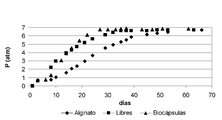
- Figure 1 Evolution of the rate of production of CO 2 by immobilized yeast cells in calcium alginate beads, biocapsules and free cells (control) obtained in example 1.
- Figure 2 Evolution of the rate of production of CO 2 by immobilized yeast cells in calcium alginate beads, biocapsules and free cells (control) obtained in Example 2.
- Figure 3 Evolution of the rate of production of CO 2 by the immobilized yeast cells in calcium alginate beads, biocapsules and free cells (control) obtained in example 3.
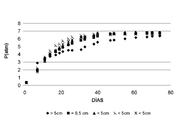
- Figure 4 Evolution of the rate of production of CO 2 by yeast cells immobilized in biocapsules of different sizes obtained in example 4.
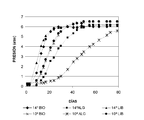
- Figure 5 Evolution of the rate of production of CO 2 by immobilized yeast cells in calcium alginate beads, biocapsules and free cells (control) at two fermentation temperatures obtained in example 5.
- Example 1 Elaboration of sparkling wine 'cava': lot 1 .
- the yeast used was the commercial strain Saccharomyces cerevisiae QA23 marketed by Lallemand BIO.
- the base wine used presented the following characteristics: wine of the Denomination of Origin Cava, mixture of Macabeo (28.3%), Xarel ⁇ lo (29.2%), Parellada (25.8%) and Chardonnay varieties (16.7%); residual sugar: 0.3 g / L; alcoholic strength: 11% vol; pH: 3.06; acidity Total: 5.8 g / L (expressed in g / L of tartaric acid).
- the inoculum concentration of each of the formats was calculated for each of the bottles, at the beginning of the second fermentation, there was a concentration of 1x10 6 cells / ml.
- the sedimentation rate was checked once Once the fermentation is over and after a bottle aging period of one minimum of 9 months, regulatory in the Cava Designation of Origin.
- the yeasts included in alginate spheres had a very sedimentation Fast: between 5 and 15 seconds, depending on the bottle. Those included in biocapsules they were a little slower but they did it in less than 2 minutes compared to the sedimentation of several days of the bottles made with cells free.
- yeasts immobilized in biocapsules makes it possible to dispense with the Removal or thinning stage, being able to perform the disgorgement stage immediately.
- Example 2 Elaboration of sparkling wine 'cava': lot 2 .
- Example 1 was reproduced, but in this case the strain Sacccharomyces cerevisiae P29 (CECT 11770), isolated in the Penedés Designation of Origin, was used.
- Figure 2 shows the evolution of the pressure at over time
- the inoculum formats of yeasts in cells free and immobilized in biocapsules presented kinetics more or less parallel. Fermentation start-up with immobilized calcium alginate It was slower. The total duration of the fermentation, detected from Pressure stabilization time was 27 days for biocapsules, 35 for free cells and 63 days for cavas made with Yeasts included in calcium alginate beads.
- Example 3 Elaboration of sparkling wine 'cava': lot 3 .
- Figure 3 shows the evolution of the pressure in all three test cases.
- the two inoculum formats with immobilized yeasts presented a period of adaptation to the upper environment (between 11 and 14 days) to which they presented free cells (7 days).
- the second fermentation ended at 43 days for case of free yeasts and was delayed up to 52 days for the case of yeasts immobilized in alginate and biocapsules.
- Example 4 Elaboration of sparkling wine 'cava' with biocapsules of different sizes.
- Biocapsules obtained from S. cerevisae strain P29 and Penicillium chrysogenum were used .
- the speed of orbital agitation, according to the procedure for obtaining biocapsules, was varied to achieve spheres of different sizes.
- the base wine for making cava it was the same as in example 1 and 2, to which 22 g / L of sugar was added.
- the number of biocapsules inoculated in each bottle depended on its diameter: (a) 5 biocapsules / 750 ml if they had a diameter greater than 0.5 cm; (b) 20 ⁇ 2 biocapsules / 750 ml if the diameter is approximately 0.5 cm, and (c) 180 to 200 biocapsules / 750 ml if the spheres They have a diameter of less than 0.5 cm.
- the second fermentation took place at a temperature stable at 14 ° C.
- Figure 4 shows the speed of fermentation of some representative bottles of these lots. In it she you can check that the ones that had the best fermentation kinetics were the corresponding to the inoculums with biocapsules less than 0.5 cm in diameter, secondly the bottle with spheres of approximately 0.5 cm in diameter and Finally, the one that was inoculated with larger biocapsules. This behavior can be explained by the surface / volume ratio and the number of spheres in each bottle: the bottles that contained more biocapsules although They were smaller in size and had a larger contact surface (and therefore, for the exchange of nutrients) with the medium to be fermented.
- the present invention refers to different speeds of taking of foam, or of second fermentation, depending of the applied size of immobilized yeasts in biocapsules.
- Example 5 Elaboration of sparkling wine 'cava' with biocapsules at two fermentation temperatures.
- Example 2 S. cerevisiae strain P29, base wine described in Example 1 and three formats yeast inoculation also described in Example 1.
- variable to experience was the influence that could have a second fermentation temperature considered limit: 10 ° C, against a standard temperature: 14oC.
- Figure 5 shows the kinetics fermentative of the 6 cases studied. In both temperatures, yeasts immobilized in biocapsules and free yeasts had a behavior parallel, evolving at the same speed.
- the yeast inoculums in Calcium alginate pearl format presented a delay both at the beginning as at the end of the fermentation with respect to the other two cases both at 10 ° C as at 14 ° C.
- the present invention shows that wine yeasts immobilized in biocapsules can perfectly ferment temperature limits, behaving in the same way as inoculation Traditional yeast in free form.
Landscapes
- Chemical & Material Sciences (AREA)
- Organic Chemistry (AREA)
- Life Sciences & Earth Sciences (AREA)
- General Engineering & Computer Science (AREA)
- Health & Medical Sciences (AREA)
- Engineering & Computer Science (AREA)
- Biochemistry (AREA)
- Bioinformatics & Cheminformatics (AREA)
- Mycology (AREA)
- General Health & Medical Sciences (AREA)
- Genetics & Genomics (AREA)
- Microbiology (AREA)
- Wood Science & Technology (AREA)
- Zoology (AREA)
- Immobilizing And Processing Of Enzymes And Microorganisms (AREA)
- Micro-Organisms Or Cultivation Processes Thereof (AREA)
Abstract
L'invention concerne l'utilisation de levures immobilisées dans des biocapsules et leur utilisation dans la production de vin mousseux élaboré à partir de la seconde fermentation alcoolique en bouteille effectuée par ces levures. L'invention comprend l'obtention des biocapsules dans une concentration appropriée et leur utilisation comme biocatalyseur dans un processus de fermentation industriel particulier.
Applications Claiming Priority (2)
| Application Number | Priority Date | Filing Date | Title |
|---|---|---|---|
| ES201131039A ES2395020B1 (es) | 2011-06-20 | 2011-06-20 | Utilización de biocápsulas de levadura como agentes fermentativos en la segunda fermentación alcohólica en botella y su aplicación para la elaboración de vino espumoso y bebidas alcohólicas espumosas |
| ESP201131039 | 2011-06-20 |
Publications (1)
| Publication Number | Publication Date |
|---|---|
| WO2012175774A1 true WO2012175774A1 (fr) | 2012-12-27 |
Family
ID=47422070
Family Applications (1)
| Application Number | Title | Priority Date | Filing Date |
|---|---|---|---|
| PCT/ES2012/070452 Ceased WO2012175774A1 (fr) | 2011-06-20 | 2012-06-20 | Utilisation de biocapsules de levure comme agents de fermentation dans la seconde fermentation alcoolique en bouteille et son utilisation pour l'élaboration de vin mousseux et de boissons alcoolisées mousseuses |
Country Status (2)
| Country | Link |
|---|---|
| ES (1) | ES2395020B1 (fr) |
| WO (1) | WO2012175774A1 (fr) |
Cited By (1)
| Publication number | Priority date | Publication date | Assignee | Title |
|---|---|---|---|---|
| ES2480916R1 (es) * | 2013-01-25 | 2014-10-28 | Marta MARTINEZ BEYA | Procedimiento de preparación de vinos espumosos. |
Citations (2)
| Publication number | Priority date | Publication date | Assignee | Title |
|---|---|---|---|---|
| US5070019A (en) * | 1989-03-18 | 1991-12-03 | Huels Aktiengesellschaft | Immobilization of yeast in alginate beads for production of alcoholic beverages |
| ES2204316A1 (es) * | 2002-09-25 | 2004-04-16 | Universidad De Cordoba | Procedimiento de obtencion de biocapsular de levaduras, biocapsulas asi obtenidas y aplicaciones. |
-
2011
- 2011-06-20 ES ES201131039A patent/ES2395020B1/es active Active
-
2012
- 2012-06-20 WO PCT/ES2012/070452 patent/WO2012175774A1/fr not_active Ceased
Patent Citations (2)
| Publication number | Priority date | Publication date | Assignee | Title |
|---|---|---|---|---|
| US5070019A (en) * | 1989-03-18 | 1991-12-03 | Huels Aktiengesellschaft | Immobilization of yeast in alginate beads for production of alcoholic beverages |
| ES2204316A1 (es) * | 2002-09-25 | 2004-04-16 | Universidad De Cordoba | Procedimiento de obtencion de biocapsular de levaduras, biocapsulas asi obtenidas y aplicaciones. |
Non-Patent Citations (3)
| Title |
|---|
| HIDALGO TOGORES: "J. Elaboracion of vinos espumosos con levaduras inmovilizadas.", AGRICULTURA, vol. 651, 1986, pages 721 - 724 * |
| PEINADO, R. ET AL.: "Yeast biocapsules: a new immobilization method and their applications.", ENZYME AND MICROBIAL TECHNOLOGY, vol. 40, 2006, pages 79 - 84 * |
| PUIG, A. ET AL.: "Levaduras inmovilizadas: Evaluacion of su potencial enologico.", TRABAJOS PRESENTADOS CON MOTIVO DEL VII FORO MUNDIAL DEL VINO., 12 May 2010 (2010-05-12), LOGRONO, THE RIOJA ESPANA., pages 86 * |
Cited By (1)
| Publication number | Priority date | Publication date | Assignee | Title |
|---|---|---|---|---|
| ES2480916R1 (es) * | 2013-01-25 | 2014-10-28 | Marta MARTINEZ BEYA | Procedimiento de preparación de vinos espumosos. |
Also Published As
| Publication number | Publication date |
|---|---|
| ES2395020B1 (es) | 2013-12-13 |
| ES2395020A1 (es) | 2013-02-07 |
Similar Documents
| Publication | Publication Date | Title |
|---|---|---|
| CN102771864A (zh) | 一种发酵型苹果醋饮料及其制备方法 | |
| CN101792719B (zh) | 一株酿酒酵母及其在酿造葡萄酒中的应用 | |
| RU2585846C2 (ru) | Способ инокуляции дрожжей во фруктовый сок | |
| ES2334753B1 (es) | Cepa de saccharomyces cerevisiae cect 13030 y su uso para la elaboracion de bebidas alcoholicas. | |
| CN108559713B (zh) | 一种酿酒酵母及其应用 | |
| ES2433921T3 (es) | Cepas malolácticas tolerantes al alcohol para la maduración de los vinos de pH medio o elevado | |
| HU207123B (en) | Process for producing fixed yeasts | |
| JP2020534014A (ja) | バチルス・コアグランスを含有するアルコール飲料組成物 | |
| Maicas et al. | The potential of positively-charged cellulose sponge for malolactic fermentation of wine, using Oenococcus oeni | |
| WO2012175774A1 (fr) | Utilisation de biocapsules de levure comme agents de fermentation dans la seconde fermentation alcoolique en bouteille et son utilisation pour l'élaboration de vin mousseux et de boissons alcoolisées mousseuses | |
| CN113502233B (zh) | 一株美极梅奇酵母及其在葡萄酒酿造中的应用 | |
| CN1995311A (zh) | 一种沙棘酒及其生产方法 | |
| ES2902202T3 (es) | Una cepa de levadura Saccharomyces bayanus | |
| CN1115406C (zh) | 蜂蜜发酵酒及制备方法 | |
| EP0285225A1 (fr) | Sachet de levure | |
| CN105296369A (zh) | 一株具有陈酿风格的酿酒酵母及其在葡萄酒酿造中的应用 | |
| ES2650273T3 (es) | Método para la fermentación alcohólica de mosto de miel, con alto contenido de azúcar | |
| ES2824170T3 (es) | Cepas de levadura para bebidas fermentadas y, particularmente para el vino | |
| WO2024068943A1 (fr) | Procédé de production de biocapsules microbiennes, biocapsules microbiennes obtenues par ledit procédé et leurs utilisations | |
| Simó et al. | Malolactic fermentation induced by silica‐alginate encapsulated Oenococcus oeni with different inoculation regimes | |
| CN102807946B (zh) | 一种年份枸杞果酒的陈酿工艺 | |
| EP1848792A1 (fr) | Procede de preparation d'une boisson | |
| GB2475397A (en) | Secondary fermentation of a beverage using yeast immobilised in support structures | |
| CN105567486A (zh) | 单/双粒葡萄单独酿造、包装的葡萄酒及其方法 | |
| ES2480916A2 (es) | Procedimiento de preparación de vinos espumosos. |
Legal Events
| Date | Code | Title | Description |
|---|---|---|---|
| 121 | Ep: the epo has been informed by wipo that ep was designated in this application |
Ref document number: 12802560 Country of ref document: EP Kind code of ref document: A1 |
|
| NENP | Non-entry into the national phase |
Ref country code: DE |
|
| 122 | Ep: pct application non-entry in european phase |
Ref document number: 12802560 Country of ref document: EP Kind code of ref document: A1 |