WO2012176389A1 - ズームレンズおよび撮像装置 - Google Patents
ズームレンズおよび撮像装置 Download PDFInfo
- Publication number
- WO2012176389A1 WO2012176389A1 PCT/JP2012/003693 JP2012003693W WO2012176389A1 WO 2012176389 A1 WO2012176389 A1 WO 2012176389A1 JP 2012003693 W JP2012003693 W JP 2012003693W WO 2012176389 A1 WO2012176389 A1 WO 2012176389A1
- Authority
- WO
- WIPO (PCT)
- Prior art keywords
- lens
- lens group
- conditional expression
- zoom
- zoom lens
- Prior art date
- Legal status (The legal status is an assumption and is not a legal conclusion. Google has not performed a legal analysis and makes no representation as to the accuracy of the status listed.)
- Ceased
Links
Images




Classifications
-
- G—PHYSICS
- G02—OPTICS
- G02B—OPTICAL ELEMENTS, SYSTEMS OR APPARATUS
- G02B15/00—Optical objectives with means for varying the magnification
- G02B15/14—Optical objectives with means for varying the magnification by axial movement of one or more lenses or groups of lenses relative to the image plane for continuously varying the equivalent focal length of the objective
- G02B15/16—Optical objectives with means for varying the magnification by axial movement of one or more lenses or groups of lenses relative to the image plane for continuously varying the equivalent focal length of the objective with interdependent non-linearly related movements between one lens or lens group, and another lens or lens group
- G02B15/177—Optical objectives with means for varying the magnification by axial movement of one or more lenses or groups of lenses relative to the image plane for continuously varying the equivalent focal length of the objective with interdependent non-linearly related movements between one lens or lens group, and another lens or lens group having a negative front lens or group of lenses
-
- G—PHYSICS
- G02—OPTICS
- G02B—OPTICAL ELEMENTS, SYSTEMS OR APPARATUS
- G02B13/00—Optical objectives specially designed for the purposes specified below
- G02B13/001—Miniaturised objectives for electronic devices, e.g. portable telephones, webcams, PDAs, small digital cameras
- G02B13/009—Miniaturised objectives for electronic devices, e.g. portable telephones, webcams, PDAs, small digital cameras having zoom function
-
- G—PHYSICS
- G02—OPTICS
- G02B—OPTICAL ELEMENTS, SYSTEMS OR APPARATUS
- G02B15/00—Optical objectives with means for varying the magnification
- G02B15/14—Optical objectives with means for varying the magnification by axial movement of one or more lenses or groups of lenses relative to the image plane for continuously varying the equivalent focal length of the objective
-
- G—PHYSICS
- G02—OPTICS
- G02B—OPTICAL ELEMENTS, SYSTEMS OR APPARATUS
- G02B15/00—Optical objectives with means for varying the magnification
- G02B15/14—Optical objectives with means for varying the magnification by axial movement of one or more lenses or groups of lenses relative to the image plane for continuously varying the equivalent focal length of the objective
- G02B15/142—Optical objectives with means for varying the magnification by axial movement of one or more lenses or groups of lenses relative to the image plane for continuously varying the equivalent focal length of the objective having two groups only
- G02B15/1425—Optical objectives with means for varying the magnification by axial movement of one or more lenses or groups of lenses relative to the image plane for continuously varying the equivalent focal length of the objective having two groups only the first group being negative
-
- G—PHYSICS
- G02—OPTICS
- G02B—OPTICAL ELEMENTS, SYSTEMS OR APPARATUS
- G02B15/00—Optical objectives with means for varying the magnification
- G02B15/14—Optical objectives with means for varying the magnification by axial movement of one or more lenses or groups of lenses relative to the image plane for continuously varying the equivalent focal length of the objective
- G02B15/16—Optical objectives with means for varying the magnification by axial movement of one or more lenses or groups of lenses relative to the image plane for continuously varying the equivalent focal length of the objective with interdependent non-linearly related movements between one lens or lens group, and another lens or lens group
Definitions
- the present invention relates to a zoom lens and an imaging apparatus, and more particularly, to a zoom lens that can be suitably used for a small camera or a portable terminal apparatus, and an imaging apparatus including such a zoom lens.
- Patent Document 1 discloses an example of a second group type and a third group type.
- aberration correction can be performed more advantageously by arranging a lens further on the image plane side of the second lens group to form a three-group configuration.
- this configuration since the degree of freedom in design is increased, effects such as higher performance, smaller size, and higher zoom ratio can be obtained as compared with the second group type.
- the first lens group is often configured by arranging a negative lens and a positive lens in order from the object side.
- a lens that is relatively easy to be made of plastic is a positive lens in view of moldability.
- the positive lens arranged in the first lens group is made of a plastic material (see, for example, Patent Documents 2 and 3). More specifically, Patent Document 2 discloses that the positive lens of the first lens group is made of a material having a refractive index of 1.58 and an Abbe number of 30.9, and Patent Document 3 discloses that the positive lens of the first lens group is positive. It describes that the lens is made of a material having a refractive index of 1.61 and an Abbe number of 26.6. It is preferable that the positive lens arranged in the first lens group and another negative lens have a large difference in Abbe number, and therefore it is desirable to apply a material having a smaller Abbe number to the positive lens. .
- the positive lens material has an Abbe number of about 23 to 24 so that the Abbe number difference between the positive lens and the negative lens arranged in the first lens group can be increased. It has been shown to apply.
- the zoom lenses described in Patent Documents 2 and 3 have zoom ratios of about 2.4 and 2.0, respectively, and the zoom ratio is slightly small in order to ensure superiority as a zoom lens. It can be said.
- the positive lens material of the first lens group has an Abbe number of about 23 to 24.
- the first lens group For the negative lens a material having a refractive index of 1.75 or more and a slightly small Abbe number is used. That is, it is considered that the zoom lenses described in these documents are based on a design that prioritizes miniaturization of the lens system over chromatic aberration correction.
- the zoom lens described in Patent Documents 4 and 5 in which a high refractive index material is applied to a negative lens, considering that it is easy to apply a material such as low-cost plastic. It can be said that there is still room for improvement in terms of cost reduction.
- the present invention has been made in view of the above circumstances, and while achieving a zoom ratio of about 3 times with a small number of lenses, it achieves cost reduction by adopting a plastic lens and has good optical performance.
- An object is to provide a zoom lens.
- the first zoom lens comprises: In order from the object side, a first lens group having a negative refractive power and a second lens group having a positive refractive power are provided, and the distance between the first lens group and the second lens group changes upon zooming.
- the first lens group includes two lenses, a first lens having a negative refractive power and a second lens having a positive refractive power and made of plastic,
- the refractive index of the first lens with respect to the d-line is Nd1n
- the refractive index of the second lens with respect to the d-line and the Abbe number are Nd1p and ⁇ d1p, respectively
- the air space on the optical axis between the first lens and the second lens is d2.
- the “second lens group” in the zoom lens of the present invention includes not only a lens composed of a plurality of lenses but also a lens composed of only one lens.
- a cemented lens may be used as the lens constituting the second lens group. However, if the cemented lens is configured by bonding of n sheets, it is counted as n lenses.
- the zoom lens of the present invention may include other lens groups as appropriate in addition to the first lens group and the second lens group.
- the description of “the zoom lens of the present invention” or “the zoom lens of the present invention” refers to both the first zoom lens according to the present invention and the second zoom lens described later unless otherwise specified. Shall be pointed to.
- the lens surface shape and the sign of refractive power in the zoom lens according to the present invention are considered in the paraxial region when an aspheric surface is included.
- the second zoom lens according to the present invention includes: In order from the object side, a first lens group having a negative refractive power and a second lens group having a positive refractive power are provided, and the distance between the first lens group and the second lens group changes upon zooming.
- the first lens group has a negative lens closest to the object side and a positive lens made of plastic.
- the refractive index and Abbe number of the positive lens of the first lens group with respect to the d-line are respectively Nd1p, ⁇ d1p, the maximum image height is Y, and the most of the first lens group when the first lens group is located closest to the object side.
- the first lens group in the second zoom lens according to the present invention may include other lenses in addition to the negative lens and the positive lens.
- a cemented lens may be used as a lens constituting the first lens group. However, if the cemented lens is configured by bonding n sheets, it is counted as n lenses.
- the first lens group includes only two lenses, a first lens having a negative refractive power and a second lens having a positive refractive power, which are arranged in order from the object side. More preferably it is configured.
- the zoom lens of the present invention when the second lens group has at least one negative lens, and the refractive index and Abbe number for the d-line of the negative lens are Nd2n and ⁇ d2n, the following conditional expressions: 1.60 ⁇ Nd2n ⁇ 1.70 (6) 20.0 ⁇ d2n ⁇ 28.0 (7) It is more desirable to satisfy the above.
- the second lens group has only one negative lens, and the negative lens is a plastic lens.
- the paraxial radius of curvature described above indicates the radius of curvature when the lens surface is approximated to a spherical surface.
- the second lens group may be composed of two positive lenses and one negative lens.
- the zoom lens of the present invention substantially has only the first lens group and the second lens group as a lens group.
- substantially only the first lens group and the second lens group as the lens group means a lens having substantially no power, a lens such as a diaphragm or a cover glass other than those lens groups. This includes cases where there are other optical elements, lens flanges, lens barrels, imaging elements, camera shake correction mechanisms, and the like.
- the following conditional expression 48 ⁇ d1n ⁇ 65 (9) Is preferably satisfied.
- Is d12t, and the distance on the optical axis from the most object side lens surface of the second lens group to the most image side lens surface is d2gt, the following conditional expression 0.22 ⁇ d12t / d2gt ⁇ 0. 60 (11) It is more desirable to satisfy the above.
- a positive lens is disposed on the most object side of the second lens group, and when the refractive index and Abbe number of the positive lens with respect to the d-line are Nd2p and ⁇ d2p, respectively, 1.48 ⁇ Nd2p ⁇ 1.65 (13) 45 ⁇ d2p ⁇ 65 (14) It is more desirable to satisfy the above.
- the negative lens arranged closest to the object side in the first lens group is an aspheric lens, and the negative lens is a plastic lens for cost reduction.
- the plastic lens having positive refractive power arranged in the first lens group is preferably an aspheric lens.
- the lens disposed closest to the object side of the second lens group is preferably an aspheric lens, and the lens is preferably a plastic lens for cost reduction.
- the lens disposed closest to the image plane in the second lens group is preferably an aspheric lens, and the lens is preferably a plastic lens for cost reduction.
- all the lens systems are composed of five or less lenses.
- the second lens group may be composed of one positive lens and one negative lens.
- all the lenses of the lens system may be plastic lenses.
- the entire second lens group or a part of the lenses arranged in the second lens group is moved along the optical axis during focusing from infinity to a short distance. It is preferable.
- the second lens group is composed of a third lens having positive refractive power, a fourth lens having negative refractive power, and a fifth lens having positive refractive power in order from the object side, More preferably, only five lenses are moved along the optical axis.
- an imaging apparatus is characterized by including the first or second zoom lens according to the present invention described above.
- a first zoom lens according to the present invention includes, in order from the object side, a first lens group having a negative refractive power and a second lens group having a positive refractive power.
- the first lens group is composed of two lenses, a first lens having a negative refractive power and a second lens having a positive refractive power and made of plastic.
- the refractive index of the first lens with respect to the d-line is Nd1n
- the refractive index of the second lens with respect to the d-line and the Abbe number are Nd1p and ⁇ d1p, respectively, and the air spacing on the optical axis of the first lens and the second lens.
- Conditional expression (1) defines the refractive index of the negative lens (first lens) disposed on the most object side of the first lens group, and is disposed in the first lens group for cost reduction.
- the positive lens (second lens) is made of plastic having the optical characteristics indicated by conditional expression (2) and conditional expression (3), when the upper limit of conditional expression (1) is exceeded, The power of the negative lens arranged on the object side and the positive lens arranged in the first lens group is increased, which makes it difficult to correct spherical aberration and coma aberration, which is not preferable.
- conditional expression (1) On the other hand, if it is below the lower limit value of conditional expression (1), it is difficult to correct lateral chromatic aberration and astigmatism in a balanced manner, which is not preferable. When the conditional expression (1) is satisfied, the above problems can be prevented. Furthermore, by satisfying conditional expression (1), it is possible to obtain an effect that it is easy to employ a relatively inexpensive lens material such as plastic.
- Conditional expression (2) defines the refractive index of the positive lens made of plastic disposed in the first lens group.
- the curvature approximately curvature
- the amount of various aberrations and lateral chromatic aberration generated is increased, which is not preferable.
- astigmatism increases, which is not preferable. In that case, it becomes difficult to select a plastic material having good optical characteristics.
- Conditional expression (3) defines the Abbe number of a positive lens made of plastic disposed in the first lens group.
- the lower limit of conditional expression (3) is not reached, axial chromatic aberration and lateral chromatic aberration are balanced. It becomes difficult to correct, which is not preferable.
- the upper limit of conditional expression (3) is exceeded, the Abbe number difference from the negative lens arranged in the first lens group becomes small, and it is necessary to increase the power of the lens for chromatic aberration correction. Correction of spherical aberration and astigmatism becomes difficult, which is not preferable.
- the conditional expression (3) is satisfied, the above problems can be prevented.
- Conditional expression (4) defines the relationship between the air distance between the negative lens and the positive lens arranged in the first lens group and the focal length of the entire system at the wide-angle end, and is equal to or lower than the lower limit value of conditional expression (4). Then, it is advantageous for downsizing, but it is not preferable because correction of spherical aberration becomes difficult. On the other hand, if the value is equal to or greater than the upper limit value of conditional expression (4), the entire first lens group is undesirably enlarged. When the conditional expression (4) is satisfied, the above problems can be prevented.
- the second zoom lens according to the present invention includes, in order from the object side, a first lens group having a negative refractive power and a second lens group having a positive refractive power.
- the first lens group has a negative lens closest to the object side, a positive lens made of plastic, and d of the positive lens of the first lens group.
- the refractive index and Abbe number for the line are Nd1p and ⁇ d1p, the maximum image height is Y, and when the first lens group is located closest to the object side, the lens surface closest to the object side to the imaging surface of the first lens group When the distance on the optical axis is TL, the conditional expressions (2 ′), (3 ′) and (5) are satisfied, so that the zoom ratio is about 3 times with a small number of lenses. While ensuring the plastic len While achieving cost reduction by adopting, it may be assumed to have a good optical performance.
- Conditional expression (5) defines the product of the maximum image height and the optical total length. If the conditional expression (5) exceeds the upper limit value of conditional expression (5), it becomes a large size as a compact camera, which is not preferable in terms of portability. . Conversely, when the zoom lens becomes smaller than the lower limit value of the conditional expression (5), the zoom lens becomes very small, but the number of pixels of the applicable image pickup device decreases, or the pixel size is small if the number of pixels is the same. Become. In any case, it leads to a decrease in image quality, which is not preferable. When the conditional expression (5) is satisfied, the above problems can be prevented.
- the first lens group includes only two lenses, a first lens having a negative refractive power and a second lens having a positive refractive power, which are arranged in order from the object side.
- the number of lenses is suppressed, and further cost reduction is realized.
- conditional expression (6) defines the refractive index of the negative lens disposed in the second lens group, and if out of the range of conditional expression (6), spherical aberration and astigmatism are corrected in a balanced manner. Is difficult and undesirable.
- conditional expression (6) is satisfied, the above problems can be prevented.
- Conditional expression (7) defines the Abbe number of the negative lens arranged in the second lens group. If the conditional expression (7) is outside the range of conditional expression (7), the axial chromatic aberration and the lateral chromatic aberration are balanced in the entire zoom range. It becomes difficult to correct. When the conditional expression (7) is satisfied, the above problems can be prevented.
- the zoom lens of the present invention particularly when the second lens group has only one negative lens and the negative lens is a plastic lens, further cost reduction is realized.
- the conditional expression (8) defines the shape factor of a plastic lens having a positive refractive power disposed in the first lens group.
- the conditional expression (8) is less than or equal to the lower limit value of the conditional expression (8), The power of the arranged negative lens and positive lens becomes strong, and it becomes difficult to correct spherical aberration and coma. It also becomes difficult to correct lateral chromatic aberration and astigmatism in a balanced manner.
- conditional expression (8) when the upper limit of conditional expression (8) is exceeded, the power of the negative lens and the positive lens arranged in the first lens group becomes too weak, and it becomes difficult to correct axial chromatic aberration and lateral chromatic aberration in a balanced manner. .
- conditional expression (8) When the conditional expression (8) is satisfied, the above problems can be prevented.
- the zoom lens of the present invention in particular, when the second lens group is composed of two positive lenses and one negative lens, the cost reduction effect becomes more prominent.
- the zoom lens of the present invention substantially has only the first lens group and the second lens group as the lens group, the cost reduction effect becomes more remarkable.
- the conditional expression (9) when the conditional expression (9) is satisfied, the following effects can be obtained. That is, if the range of conditional expression (9) is not satisfied, it is difficult to correct axial chromatic aberration and lateral chromatic aberration in a balanced manner in the entire zoom range, which is not preferable. When the conditional expression (9) is satisfied, the above problems can be prevented.
- conditional expression (10) when the conditional expression (10) is satisfied, the following effects can be obtained.
- the lower limit of conditional expression (10) is not reached, it is difficult to increase the zoom ratio. Further, at this time, the power of the second lens group must be increased, which is not preferable because the allowable amount of manufacturing error and assembly error is reduced.
- the value is equal to or greater than the upper limit value of conditional expression (10)
- the amount of movement of the second lens group becomes large and the lens system becomes large, which is not preferable.
- the conditional expression (11) when the conditional expression (11) is satisfied, the following effects can be obtained. That is, when the value is equal to or lower than the lower limit value of the conditional expression (11), it is difficult to avoid interference between the lenses constituting the first lens group and the second lens group, the lens holding member, and the like. On the other hand, when the value is equal to or greater than the upper limit value of conditional expression (11), it is difficult to obtain a desired zoom ratio while keeping the optical total length constant, which is not preferable. When the conditional expression (11) is satisfied, the above problems can be prevented.
- the zoom lens of the present invention in particular, when the conditional expression (12) is satisfied, the following effects can be obtained.
- the zoom lens when the zoom lens is smaller than the lower limit value of the conditional expression (12), the zoom lens can be reduced in size, but the power of each lens becomes strong, making it difficult to correct aberrations, and manufacturing errors and assembly errors of the lens. This is not preferable because the allowable amount decreases. If the upper limit of conditional expression (12) is exceeded, the optical total length becomes large, which is not preferable.
- the conditional expression (12) is satisfied, the above problems can be prevented.
- conditional expressions (13) and (14) when the conditional expressions (13) and (14) are satisfied, the following effects can be obtained. That is, if the lower limit of conditional expression (13) is not reached, the curvature of the lens (approximate curvature) increases, the center thickness for securing the necessary edge increases, and the second lens group becomes large. And the amount of various aberrations increases, which is not preferable. On the other hand, if the upper limit of conditional expression (13) is exceeded, it is difficult to correct spherical aberration in a balanced manner, which is not preferable.
- conditional expression (14) it is difficult to correct axial chromatic aberration and lateral chromatic aberration in a balanced manner in the entire zoom range, which is not preferable.
- conditional expressions (13) and (14) are satisfied, the above problems can be prevented.
- the zoom lens of the present invention in particular, when all the lens systems are composed of five or less lenses, or when the second lens group is composed of one positive lens and one negative lens, In the case where all the lenses of the lens system are plastic lenses, the effect of cost reduction becomes more remarkable.
- the zoom lens according to the present invention when focusing from infinity to a short distance, the entire second lens group or a part of the lenses arranged in the second lens group is moved along the optical axis.
- the second lens group includes, in order from the object side, a third lens having a positive refractive power, a fourth lens having a negative refractive power, and a fifth lens having a positive refractive power.
- the zoom type lens used in the present invention the entire first lens group, the entire second lens group, or a part of the second lens group is selected as a lens to be moved during focusing.
- the image pickup apparatus according to the present invention includes the zoom lens according to the present invention that achieves the above-described effects, it is possible to achieve cost reduction while providing good optical performance.
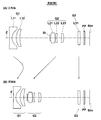
- Sectional view showing the lens configuration of the zoom lens according to Example 1 of the present invention Sectional drawing which shows the lens structure of the zoom lens concerning Example 2 of this invention. Sectional drawing which shows the lens structure of the zoom lens concerning Example 3 of this invention. Sectional drawing which shows the lens structure of the zoom lens concerning Example 4 of this invention. Sectional drawing which shows the lens structure of the zoom lens concerning Example 5 of this invention. Sectional drawing which shows the lens structure of the zoom lens concerning Example 6 of this invention. Sectional drawing which shows the lens structure of the zoom lens concerning Example 7 of this invention. Sectional drawing which shows the lens structure of the zoom lens concerning Example 8 of this invention. (A) to (H) are aberration diagrams of the zoom lens of Example 1 of the present invention.
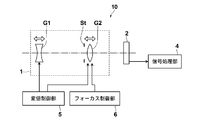
- FIG. 1 is a schematic configuration diagram of an imaging apparatus according to an embodiment of the present invention.
- FIG. 1 is a cross-sectional view illustrating a configuration example of a zoom lens according to an embodiment of the present invention, and corresponds to a zoom lens of Example 1 described later.
- FIGS. 2 to 8 are cross-sectional views showing other configuration examples according to the embodiment of the present invention, which respectively correspond to zoom lenses of Examples 2 to 8 described later.
- the basic configuration of the example shown in FIGS. 1 to 8 is that the second lens group G2 is composed of two lenses in the embodiment of FIG. 7, and has the third lens group G3 in the embodiment of FIG.
- the zoom lens according to the embodiment of the present invention will be described mainly with reference to FIG. 1 because the other methods are the same as each other and the illustrated method is the same. Further, the points of the embodiment of FIGS. 7 and 8 different from the other embodiments will be described in detail later.
- FIG. 1 the left side is the object side, the right side is the image side, (A) is the infinitely focused state and the optical system arrangement at the wide angle end (shortest focal length state), and (B) is the infinitely focused state. And the arrangement of the optical system at the telephoto end (longest focal length state). The same applies to FIGS. 2 to 8 described later.
- the zoom lens according to the embodiment of the present invention includes, in order from the object side, a first lens group G1 having a negative refractive power and a second lens group G2 having a positive refractive power arranged as a lens group.
- the second lens group G2 includes an aperture stop St.
- the aperture stop St shown here does not necessarily indicate the size or shape, but indicates the position on the optical axis Z.
- FIG. 1 shows an example in which a parallel plate-shaped optical member PP is disposed between the second lens group G2 and the image plane Sim.
- various filters such as a cover glass, an infrared cut filter, and a low-pass filter are arranged between the optical system and the image plane Sim according to the configuration of the camera on which the lens is mounted. It is preferable.
- the optical member PP assumes such cover glass and various filters.
- some image pickup apparatuses employ a 3CCD system that uses a CCD for each color in order to improve image quality.
- a color separation optical system such as a color separation prism is used. It is inserted between the lens system and the image plane Sim. In that case, a color separation optical system may be arranged at the position of the optical member PP.
- This zoom lens is configured to change the magnification by changing the distance between the first lens group G1 and the second lens group G2. More specifically, when zooming from the wide-angle end to the telephoto end, the first lens group G1 moves so as to draw a convex locus on the image plane Sim side, and the second lens group G2 monotonously on the object side.
- the aperture stop St is configured to move integrally with the second lens group G2.
- FIG. 1 the movement trajectories of the first lens group G1 and the second lens group G2 when zooming from the wide-angle end to the telephoto end are schematically shown by solid line arrows between (A) and (B). Is shown.
- the first lens group G1 includes a first lens L11 having a negative refractive power and a second lens L12 having a positive refractive power, which are arranged in order from the object side.
- the first lens L11 can be a biconcave lens
- the second lens L12 can be a positive meniscus lens.
- the latter of the first lens L11 and the second lens L12 is necessarily a plastic lens, but in the present embodiment, both are particularly plastic lenses.
- the second lens group G2 is arranged in order from the object side, the third lens L21 having a positive refractive power, the fourth lens L22 having a negative refractive power, and the fifth lens having a positive refractive power. It is comprised from the lens L23.
- the third lens L21 can be a biconvex lens
- the fourth lens L22 can be a biconcave lens
- the fifth lens L23 can be a positive meniscus lens.
- all the lenses L21, L22, and L23 of the second lens group G2 are plastic lenses.
- the first lens group G1 is composed of the first lens L11 and the second lens L12, and at least the second lens L12 of the two lenses is a plastic lens (more preferably both are plastic lenses). And satisfying conditional expressions (1) to (4), which will be described later, and conditional expressions (2 ′), (3 ′) and (5), this zoom lens can be made with a small number of lenses. While securing a zoom ratio of about 3 times, the use of a plastic lens achieves cost reduction and has good optical performance.
- the second lens group G2 includes only two lenses, that is, the third lens L21 and the fourth lens L22.
- the above-described actions and effects can be obtained.
- a third lens group G3 including one sixth lens L31 is provided in addition to the first lens group G1 and the second lens group G2. Even in this configuration, the above-described actions and effects can be obtained.
- the third lens group G3 does not move during zooming of the zoom lens.
- the sixth lens L31 constituting the third lens group G3 can be, for example, a biconvex lens as shown in FIG.
- the refractive index of the first lens L11 with respect to the d-line is Nd1n
- the refractive index of the second lens L12 with respect to the d-line and the Abbe number are Nd1p and ⁇ d1p, respectively, on the optical axis of the first lens L11 and the second lens L12.
- d2 is the air spacing
- fw is the focal length of the entire system at the wide angle end
- the zoom lens further includes Nd1p, ⁇ d1p, Y for the maximum image height, Y for the maximum image height, and the most object for the first lens group G1, with respect to the d-line of the positive lens (second lens L12) of the first lens group G1.
- Nd1p the distance on the optical axis from the most object-side lens surface (the object-side lens surface of the first lens L11) of the first lens group G1 to the image formation surface when positioned on the side
- Formula 1.621 ⁇ Nd1p ⁇ 1.650 (2 ′) 18 ⁇ d1p ⁇ 24 (3 ′) 50 ⁇ Y ⁇ TL ⁇ 550 (5) See Table 25. The same applies hereinafter).
- the following conditional expression 0.5 ⁇ (Rpr + Rpf) / (Rpr ⁇ Rpf) ⁇ 6.2 (8) Is satisfied.
- the paraxial radius of curvature is the radius of curvature when the lens surface is approximated to a spherical surface.
- this zoom lens has the most object side of the second lens group G2 from the lens surface closest to the image side of the first lens group G1 (the lens side of the image side of the second lens L12) at the telephoto end when focusing on an object at infinity.
- the air distance on the optical axis of the lens surface on the side is d12t
- the lens surface on the most image side is the fifth lens surface from the most object side lens surface of the second lens group G2.
- the distance on the optical axis from the most object-side lens surface (the object-side lens surface of the first lens L11) of the first lens group G1 at the wide-angle end to the imaging plane Sim is TLw, and the wide-angle end.
- fw is the focal length of the entire system
- this zoom lens has a positive lens (third lens L21) disposed on the most object side of the second lens group G2, and the refractive index and Abbe number of the third lens L21 with respect to the d-line are respectively shown.
- Nd2p and ⁇ d2p the following conditional expression 1.48 ⁇ Nd2p ⁇ 1.65 (13) 45 ⁇ d2p ⁇ 65 (14) Is satisfied.
- the negative lens (first lens L11) disposed on the most object side of the first lens group G1 is an aspherical lens, and the first lens L11 is a plastic lens, so that the cost is low. It is planned.
- a plastic lens (second lens L12) having a positive refractive power disposed in the first lens group G1 is also an aspheric lens.
- the lens (third lens L21) disposed on the most object side of the second lens group G2 is an aspheric plastic lens, so that the cost is reduced. Further, the lens (fifth lens L23) arranged closest to the image plane of the second lens group G2 is also an aspheric plastic lens, so that further cost reduction is achieved.
- the zoom lens has a configuration in which the entire second lens group G2 is moved along the optical axis during focusing from infinity to a short distance.
- the entire second lens group G2 is moved along the optical axis during focusing from infinity to a short distance.
- the fifth lens L23 having a positive refractive power may be moved along the optical axis.
- the more preferable ranges of the conditions indicated by the expressions (1), (3), (5), (6), (8), and (9) are as follows. .48 ⁇ Nd1n ⁇ 1.70 (1 ′) 19 ⁇ d1p ⁇ 24 (3 ′′) 55 ⁇ Y ⁇ TL ⁇ 530 (5 ′) 1.60 ⁇ Nd2n ⁇ 1.69 (6 ′) 1.6 ⁇ (Rpr + Rpf) / (Rpr ⁇ Rpf) ⁇ 6.1 (8 ′) 50 ⁇ d1n ⁇ 65 (9 ′)
- Conditional expression (3 ′′) is more preferable than the above-described expression (3 ′).
- Conditional expression (1) defines the refractive index of the negative lens (first lens L11) disposed closest to the object side of the first lens group G1, and the first lens group G1 has a refractive index for cost reduction.
- the arranged positive lens (second lens L12) is made of plastic having optical characteristics represented by the conditional expression (2) and the conditional expression (3), if the upper limit value of the conditional expression (1) is exceeded, the first The powers of the first lens L11, which is a negative lens arranged closest to the object side of the lens group G1, and the second lens L12, which is a positive lens arranged in the first lens group G2, become stronger, and spherical aberration and coma aberration.
- conditional expression (1) it is possible to obtain an effect that it is easy to employ a relatively inexpensive lens material such as plastic.
- Conditional expression (2) prescribes the refractive index of the positive lens (second lens L12) made of plastic disposed in the first lens group G1, and the curvature ( (Approximate curvature) is increased, and therefore, the generation of various aberrations and lateral chromatic aberrations is increased, which is not preferable.
- conditional expression (2) when the value exceeds the upper limit value of conditional expression (2), astigmatism increases, which is not preferable. In that case, it becomes difficult to select a plastic material having good optical characteristics.
- conditional expression (2) is satisfied, the above problems can be prevented.
- Conditional expression (3) defines the Abbe number of the positive lens (second lens L12) made of plastic disposed in the first lens group G1. It becomes difficult to correct chromatic aberration and lateral chromatic aberration in a balanced manner, which is not preferable. Conversely, when the upper limit of conditional expression (3) is exceeded, the Abbe number difference from the first lens L11, which is a negative lens arranged in the first lens group G1, decreases, and the lens power is reduced for chromatic aberration correction. This is not preferable because it becomes difficult to correct spherical aberration and astigmatism. When the conditional expression (3) is satisfied, the above problems can be prevented.
- Conditional expression (4) defines the relationship between the air distance between the negative lens and the positive lens arranged in the first lens group G1, that is, the first lens L11 and the second lens L12, and the focal length of the entire system at the wide angle end. If the value is less than or equal to the lower limit value of conditional expression (4), it is advantageous for downsizing, but it is not preferable because correction of spherical aberration becomes difficult. On the other hand, if the value is equal to or greater than the upper limit value of the conditional expression (4), the entire first lens group G1 is enlarged, which is not preferable. When the conditional expression (4) is satisfied, the above problems can be prevented.
- the refractive index and Abbe number of the positive lens (second lens L12) of the first lens group G1 with respect to the d-line are Nd1p and ⁇ d1p, the maximum image height is Y, and the first lens group G1 is the most object.
- the plastics are made so as to satisfy the conditional expressions (2 ′), (3 ′) and (5).
- Conditional expression (5) defines the product of the maximum image height and the optical total length. If the conditional expression (5) exceeds the upper limit value of conditional expression (5), it becomes a large size as a compact camera, which is not preferable in terms of portability. . Conversely, when the zoom lens becomes smaller than the lower limit value of the conditional expression (5), the zoom lens becomes very small, but the number of pixels of the applicable image pickup device decreases, or the pixel size is small if the number of pixels is the same. Become. In any case, it leads to a decrease in image quality, which is not preferable. When the conditional expression (5) is satisfied, the above problems can be prevented.
- the first lens group G1 is composed of only two lenses, a first lens L11 having a negative refractive power and a second lens L12 having a positive refractive power, which are arranged in order from the object side.
- the number of lenses can be reduced, and further cost reduction can be realized.
- the conditional expression (6) defines the refractive index of the negative lens (fourth lens L22) disposed in the second lens group G2, and if it falls outside the range of the conditional expression (6), spherical aberration and astigmatism It is difficult to correct aberrations in a balanced manner, which is not preferable.
- the conditional expression (6) is satisfied, the above problems can be prevented.
- Conditional expression (7) defines the Abbe number of the negative lens (fourth lens L22) disposed in the second lens group G2. If the conditional expression (7) is out of the range of conditional expression (7), the conditional expression (7) is axial on the entire zoom range. It becomes difficult to correct chromatic aberration and lateral chromatic aberration in a balanced manner. When the conditional expression (7) is satisfied, the above problems can be prevented.
- the second lens group G2 since the second lens group G2 has only one negative lens (fourth lens L22) and the negative lens is a plastic lens, further cost reduction is realized. .
- the conditional expression (8) defines the shape factor of the plastic lens (second lens L12) having a positive refractive power disposed in the first lens group G1, and is equal to or lower than the lower limit value of the conditional expression (8). Then, the powers of the negative lens and the positive lens arranged in the first lens group G1, that is, the first lens L11 and the second lens L12 become strong, and it becomes difficult to correct spherical aberration and coma aberration. It also becomes difficult to correct lateral chromatic aberration and astigmatism in a balanced manner.
- conditional expression (8) when the upper limit value of conditional expression (8) is exceeded, the powers of the negative lens and the positive lens arranged in the first lens group G1, that is, the first lens L11 and the second lens L12 become too weak, and axial chromatic aberration and It becomes difficult to correct lateral chromatic aberration in a balanced manner.
- conditional expression (8) When the conditional expression (8) is satisfied, the above problems can be prevented.
- the second lens group G2 is composed of two positive lenses (third lens L21 and fifth lens L23) and one negative lens (fourth lens L22). The cost effect becomes more prominent.
- the present zoom lens substantially has only the first lens group G1 and the second lens group G2 as the lens group, the effect of cost reduction becomes more remarkable.
- conditional expression (9) since the conditional expression (9) is satisfied, the following effects can be obtained. That is, if the range of conditional expression (9) is not satisfied, it is difficult to correct axial chromatic aberration and lateral chromatic aberration in a balanced manner in the entire zoom range, which is not preferable. When the conditional expression (9) is satisfied, the above problems can be prevented.
- conditional expression (10) since the conditional expression (10) is satisfied, the following effects can be obtained. In other words, if the lower limit of conditional expression (10) is not reached, it is difficult to increase the zoom ratio. Further, at this time, the power of the second lens group G2 must be increased, which is not preferable because the allowable amount of manufacturing error and assembly error is reduced. On the contrary, if the value is equal to or greater than the upper limit value of the conditional expression (10), the movement amount of the second lens group G2 becomes large and the lens system becomes large, which is not preferable. When the conditional expression (10) is satisfied, the above problems can be prevented.
- conditional expression (11) since the conditional expression (11) is satisfied, the following effects can be obtained. That is, when the value is equal to or lower than the lower limit value of the conditional expression (11), it is difficult to avoid interference between the lenses constituting the first lens group G1 and the second lens group G2, the lens holding member, etc., which is not preferable. On the other hand, when the value is equal to or greater than the upper limit value of conditional expression (11), it is difficult to obtain a desired zoom ratio while keeping the optical total length constant, which is not preferable. When the conditional expression (11) is satisfied, the above problems can be prevented.
- the conditional expression (12) since the conditional expression (12) is satisfied, the following effects can be obtained.
- the zoom lens when the zoom lens is smaller than the lower limit value of the conditional expression (12), the zoom lens can be reduced in size, but the power of each lens becomes strong, making it difficult to correct aberrations, and manufacturing errors and assembly errors of the lens. This is not preferable because the allowable amount decreases. If the upper limit of conditional expression (12) is exceeded, the optical total length becomes large, which is not preferable. When the conditional expression (12) is satisfied, the above problems can be prevented.
- conditional expressions (13) and (14) are satisfied, the following effects can be obtained. That is, when the lower limit of conditional expression (13) is not reached, the curvature of the lens (approximate curvature) increases, the center thickness for securing the necessary edge (edge) increases, and the second lens group G2 As the size increases, the amount of various aberrations increases, which is not preferable. On the other hand, if the upper limit of conditional expression (13) is exceeded, it is difficult to correct spherical aberration in a balanced manner, which is not preferable.
- conditional expression (14) it is difficult to correct axial chromatic aberration and lateral chromatic aberration in a balanced manner in the entire zoom range, which is not preferable.
- conditional expressions (13) and (14) are satisfied, the above problems can be prevented.
- all the lens systems are composed of five or less lenses, and all the lenses of the lens system are plastic lenses, so the cost reduction effect becomes more prominent.
- the second lens group G2 is composed of only one positive lens and one negative lens (the third lens L21 and the fourth lens L22), both of which are plastic lenses. Therefore, the effect of cost reduction becomes more remarkable.
- the entire second lens group is moved along the optical axis during focusing from infinity to a short distance, the following effects can be obtained. That is, in the zoom type lens used in the present invention, as the lens to be moved during focusing, the entire first lens group G1, the entire second lens group G2, or a part of the second lens group G2, etc. However, in the method in which the entire first lens group G1 is extended and focused, the effective diameter of the first lens group G1 is increased or the outer diameter is large. There is a problem that the lens needs to be moved. If a configuration in which focusing is performed by moving the entire second lens group G2, such a problem can be prevented. This effect can be obtained in the same manner when focusing is performed by moving a part of the lenses of the second lens group G2.
- FIG. 1 shows an example in which the optical member PP is disposed between the lens system and the imaging plane, but instead of disposing a low-pass filter, various filters that cut a specific wavelength range, etc. These various filters may be disposed between the lenses, or a coating having the same action as the various filters may be applied to the lens surface of any lens.
- Table 1 shows basic lens data of the zoom lens of Example 1
- Table 2 shows data relating to zooming
- Table 3 shows aspherical data
- Tables 4 to 24 show basic lens data, zoom-related data, and aspherical data of the zoom lenses of Examples 2 to 8.
- the meaning of the symbols in the table will be described using the example 1 as an example, but the same applies to the examples 2 to 8.
- the i-th (i 1, 2, 3,...) That sequentially increases toward the image side with the object-side surface of the most object-side component as the first.
- the surface number is indicated
- the Ri column indicates the radius of curvature of the i-th surface
- the Di column indicates the surface interval on the optical axis Z between the i-th surface and the i + 1-th surface.
- the sign of the radius of curvature is positive when the surface shape is convex on the object side and negative when the surface shape is convex on the image side.
- the basic lens data also includes the aperture stop St, and ⁇ (aperture stop) is described in the column of the radius of curvature of the surface corresponding to the aperture stop St.
- D4 and D11 in the basic lens data in Table 1 are surface intervals that change during zooming.
- D4 is the distance between the first lens group G1 and the second lens group G2
- D11 is the distance between the second lens group G2 and the optical member PP.
- D9 is used instead of D11.
- the zoom-related data in Table 2 includes the focal length (f), F value (Fno.), Total angle of view (2 ⁇ ), and the distance between each surface that changes during zooming at the wide-angle end and the telephoto end. Is shown.
- the surface number of the aspheric surface is marked with *, and the paraxial radius of curvature is shown as the radius of curvature of the aspheric surface.
- the aspheric data in Table 3 shows the surface number of the aspheric surface and the aspheric coefficient for each aspheric surface.
- the numerical value “E ⁇ n” (n: integer) of the aspheric surface data in Table 3 means “ ⁇ 10 ⁇ n ”.
- Zd C ⁇ h 2 / ⁇ 1+ (1 ⁇ KA ⁇ C 2 ⁇ h 2 ) 1/2 ⁇ + ⁇ RAm ⁇ h m
- Zd Depth of aspheric surface (length of a perpendicular line drawn from a point on the aspherical surface at height h to a plane perpendicular to the optical axis where the aspherical vertex contacts)
- h Height (distance from the optical axis to the lens surface)
- C Reciprocal number of paraxial radius of curvature KA
- values rounded to a predetermined digit are shown.
- surface described below although the degree is used as a unit of angle and mm is used as a unit of length, an optical system can be used by proportional expansion or proportional reduction. Thus, other suitable units can be used.
- Table 25 shows values corresponding to the conditional expressions (1) to (14) of the zoom lenses of Examples 1 to 8.
- the values in Table 25 relate to the d line.
- FIGS. 9 (A) to 9 (D) show spherical aberration, astigmatism, distortion (distortion aberration), and lateral chromatic aberration (chromatic aberration of magnification) at the wide-angle end of the zoom lens of Example 1
- FIGS. 9E to 9H show spherical aberration, astigmatism, distortion (distortion aberration), and lateral chromatic aberration (chromatic aberration of magnification) at the edges, respectively.
- Each aberration diagram is based on the d-line (wavelength 587.6 nm), but the spherical aberration diagram also shows aberrations relating to wavelengths 460.0 nm and 615.0 nm, and the lateral chromatic aberration diagram shows wavelengths 460.0 nm and 615.0 nm. The aberration about is shown. In the astigmatism diagram, the sagittal direction is indicated by a solid line, and the tangential direction is indicated by a dotted line. Fno. Of spherical aberration diagram. Means F value, and ⁇ in other aberration diagrams means half angle of view.
- FIGS. 10A to 10H the aberration diagrams at the wide-angle end and the telephoto end of the zoom lens of Example 2 are shown in FIGS. 10A to 10H, and the aberration diagrams of Examples 3 to 8 are respectively the same in the same manner. It is shown in FIGS.
- FIG. 17 shows a schematic configuration diagram of an imaging apparatus 10 using the zoom lens 1 of the embodiment of the present invention as an example of the imaging apparatus of the embodiment of the present invention.
- the imaging device include a surveillance camera, a video camera, and an electronic still camera.
- An image pickup apparatus 10 shown in FIG. 17 includes a zoom lens 1, an image pickup device 2 that is disposed on the image side of the zoom lens 1 and picks up an image of a subject formed by the zoom lens 1, and an output from the image pickup device 2.
- a signal processing unit 4 that performs signal processing, a zooming control unit 5 for zooming the zoom lens 1, and a focus control unit 6 for performing focus adjustment are provided.
- a filter or the like may be appropriately disposed between the zoom lens 1 and the image sensor 2.
- the zoom lens 1 includes a first lens group G1 having a negative refractive power and a second lens group G2 having a positive refractive power, and changes the interval between the first lens group G1 and the second lens group G2. Is configured to scale.
- the first lens group G1 includes a first lens L11 having a negative refractive power and a second lens L12 having a positive refractive power. Both the lenses L11 and L12 are plastic lenses. ing.
- the image pickup device 2 picks up an optical image formed by the zoom lens 1 and outputs an electric signal.
- the image pickup element 2 for example, a CCD or CMOS can be used.
- the imaging device 10 moves a lens having a positive refractive power that constitutes a part of the second lens group G2 in a direction perpendicular to the optical axis Z, for example, You may make it further provide the shake correction mechanism which corrects the blur of the picked-up image at the time of camera shake.
- the present invention has been described with reference to the embodiments and examples, the present invention is not limited to the above-described embodiments and examples, and various modifications are possible.
- the values of the radius of curvature, the surface interval, the refractive index, the Abbe number, the aspherical coefficient, etc. of each lens component are not limited to the values shown in the above numerical examples, and can take other values.
Landscapes
- Physics & Mathematics (AREA)
- General Physics & Mathematics (AREA)
- Optics & Photonics (AREA)
- Nonlinear Science (AREA)
- Lenses (AREA)
Abstract
【課題】ズームレンズにおいて、低コスト化、良好な光学性能を実現する。 【解決手段】ズームレンズを、物体側より順に負の屈折力を有する第1レンズ群(G1)と、正の屈折力を有する第2レンズ群(G2)とを有するものとし、第1レンズ群(G1)は負の屈折力を有する第1レンズ(L11)と、正の屈折力を有しプラスチックよりなる第2レンズ(L12)との2枚より構成する。そして第1レンズ(L11)のd線に対する屈折率をNd1n、第2レンズ(L12)のd線に対する屈折率およびアッベ数をそれぞれNd1p、νd1p、第1レンズ(L11)と第2レンズ(L12)の光軸上での空気間隔をd2、広角端における全系の焦点距離をfwとして、以下の条件式を満足させる。 1.48<Nd1n<1.71 …(1) 1.60<Nd1p<1.65 …(2) 18<νd1p<25 …(3) 0.2<d2/fw<0.5 …(4)
Description
本発明は、ズームレンズおよび撮像装置に関し、特に、小型のカメラや携帯端末装置に好適に使用可能なズームレンズおよび、そのようなズームレンズを備えた撮像装置に関するものである。
従来、コンパクトなデジタルカメラやビデオカメラ、携帯端末装置などに搭載されるズームレンズとして、負レンズ群先行(物体側に負レンズ群を配置した構成)の2群あるいは3群タイプのズームレンズが広く知られており、例えば特許文献1には、2群タイプおよび、3群タイプの例がそれぞれ示されている。該特許文献1に記載されているように、第2レンズ群の像面側に更にレンズを配置して3群構成とすることで、収差補正をより有利に行うことができる。またこの構成によれば、設計の自由度が高くなるため、2群タイプと比較して、高性能化、小型化、高変倍比化などの効果を得ることができる。
ここで、ズームレンズの低コスト化のための1つの方策として、よりコストの安いプラスチックレンズを採用することが考えられる。コンパクトデジタルカメラ等に用いられる2群タイプや3群タイプのズームレンズでは、第1レンズ群が、物体側より順に負レンズ、正レンズの2枚を配置して構成されたものが多いが、それらのレンズのうち比較的プラスチックで構成し易いのは、成形性の点から考えれば正レンズである。
そのように、第1レンズ群に配置される正レンズをプラスチック材料で構成することも従来提案されている(例えば特許文献2、3参照)。より具体的に特許文献2には、第1レンズ群の正レンズを屈折率1.58、アッベ数30.9の材料で構成することが、また特許文献3には、第1レンズ群の正レンズを屈折率1.61、アッベ数26.6の材料で構成することが記載されている。この第1レンズ群に配置された正レンズと、別の負レンズとは、互いにアッベ数の差が大きい方がより好ましく、そこで正レンズにはさらにアッベ数の小さい材料を適用することが望まれる。
特許文献4や特許文献5には、第1レンズ群に配置された正レンズと負レンズとのアッベ数差を大きくすることができるように、正レンズの材料に、アッベ数が23ないし24程度のものを適用することが示されている。
上記の特許文献2、3に記載されたズームレンズは、変倍比がそれぞれ約2.4、約2.0程度であり、ズームレンズとしての優位性を確保する上では変倍比がやや小さいと言える。
特許文献4、5に記載されたズームレンズにおいては、前述した通り第1レンズ群の正レンズの材料にアッベ数が23ないし24程度のものが適用されているが、その反面、第1レンズ群の負レンズには屈折率が1.75以上でアッベ数がやや小さい材料が用いられている。つまり、これらに記載されたズームレンズは、色収差補正よりもレンズ系の小型化を優先した設計に基づくものであると考えられる。
色収差補正の観点から考えれば、第1レンズ群に配置される負レンズには、低屈折率・低分散の材料を用いた方が好ましい。また、低屈折率材料を用いる場合はコストの安いプラスチック等の材料が適用容易になるということを考えれば、負レンズに高屈折率材料を適用した特許文献4、5に記載のズームレンズは、低コスト化の点において改良の余地が残されていると言える。
本発明は上記の事情に鑑みてなされたものであり、少ないレンズ枚数で3倍程度の変倍比を確保しつつ、プラスチックレンズの採用によって低コスト化を達成するとともに、良好な光学性能を有するズームレンズを提供することを目的とする。
本発明による第1のズームレンズは、
物体側より順に、負の屈折力を有する第1レンズ群と、正の屈折力を有する第2レンズ群とを有し、変倍に際して前記第1レンズ群と第2レンズ群の間隔が変化するズームレンズにおいて、
前記第1レンズ群は、負の屈折力を有する第1レンズと、正の屈折力を有しプラスチックよりなる第2レンズとの2枚より構成され、
前記第1レンズのd線に対する屈折率をNd1n、前記第2レンズのd線に対する屈折率およびアッベ数をそれぞれNd1p、νd1p、前記第1レンズと第2レンズの光軸上での空気間隔をd2、広角端における全系の焦点距離をfwとしたとき、以下の条件式
1.48<Nd1n<1.71 …(1)
1.60<Nd1p<1.65 …(2)
18<νd1p<25 …(3)
0.2<d2/fw<0.5 …(4)
を満足することを特徴とするものである。
物体側より順に、負の屈折力を有する第1レンズ群と、正の屈折力を有する第2レンズ群とを有し、変倍に際して前記第1レンズ群と第2レンズ群の間隔が変化するズームレンズにおいて、
前記第1レンズ群は、負の屈折力を有する第1レンズと、正の屈折力を有しプラスチックよりなる第2レンズとの2枚より構成され、
前記第1レンズのd線に対する屈折率をNd1n、前記第2レンズのd線に対する屈折率およびアッベ数をそれぞれNd1p、νd1p、前記第1レンズと第2レンズの光軸上での空気間隔をd2、広角端における全系の焦点距離をfwとしたとき、以下の条件式
1.48<Nd1n<1.71 …(1)
1.60<Nd1p<1.65 …(2)
18<νd1p<25 …(3)
0.2<d2/fw<0.5 …(4)
を満足することを特徴とするものである。
なお、本発明のズームレンズにおける「第2レンズ群」は、必ずしも複数のレンズから構成されるものだけでなく、1枚のレンズのみで構成されるものも含むものとする。また、第2レンズ群を構成するレンズには接合レンズが用いられてもよいが、接合レンズはn枚の貼り合わせで構成されていれば、n枚のレンズとして数えるものとする。さらに、本発明のズームレンズは、第1レンズ群および第2レンズ群に加えて、その他のレンズ群を適宜備えていてもよい。
また、本明細書における「本発明のズームレンズ」あるいは「本発明によるズームレンズ」との記載は、特にことわりがなければ本発明による第1のズームレンズおよび、後述する第2のズームレンズの双方を指すものとする。
そして、本発明のズームレンズにおけるレンズの面形状、屈折力の符号は、非球面が含まれているものについては近軸領域で考えるものとする。
また、本発明による第2のズームレンズは、
物体側より順に、負の屈折力を有する第1レンズ群と、正の屈折力を有する第2レンズ群とを有し、変倍に際して前記第1レンズ群と第2レンズ群の間隔が変化するズームレンズにおいて、
前記第1レンズ群は、最も物体側に負レンズを有するとともに、プラスチックよりなる正レンズを有し、
前記第1レンズ群の正レンズのd線に対する屈折率およびアッベ数をそれぞれ、Nd1p、νd1p、最大像高をY、第1レンズ群が最も物体側に位置するときの該第1レンズ群の最も物体側のレンズ面から結像面までの光軸上の距離をTLとしたとき、以下の条件式
1.621<Nd1p<1.650 …(2’)
18<νd1p<24 …(3’)
50<Y×TL<550 …(5)
を満足することを特徴とするものである。
物体側より順に、負の屈折力を有する第1レンズ群と、正の屈折力を有する第2レンズ群とを有し、変倍に際して前記第1レンズ群と第2レンズ群の間隔が変化するズームレンズにおいて、
前記第1レンズ群は、最も物体側に負レンズを有するとともに、プラスチックよりなる正レンズを有し、
前記第1レンズ群の正レンズのd線に対する屈折率およびアッベ数をそれぞれ、Nd1p、νd1p、最大像高をY、第1レンズ群が最も物体側に位置するときの該第1レンズ群の最も物体側のレンズ面から結像面までの光軸上の距離をTLとしたとき、以下の条件式
1.621<Nd1p<1.650 …(2’)
18<νd1p<24 …(3’)
50<Y×TL<550 …(5)
を満足することを特徴とするものである。
なお、本発明による第2のズームレンズにおける第1レンズ群は、上記負レンズおよび正レンズに加えて、その他のレンズを含むものであってもよい。また、この第1レンズ群を構成するレンズには接合レンズが用いられてもよいが、接合レンズはn枚の貼り合わせで構成されていれば、n枚のレンズとして数えるものとする。
また、以上述べた本発明による第2のズームレンズは、第1レンズ群の最も物体側に配置された負レンズのd線に対する屈折率をNd1nとしたとき、先に述べた条件式
1.48<Nd1n<1.71 …(1)
を満足するものであることがより望ましい。
1.48<Nd1n<1.71 …(1)
を満足するものであることがより望ましい。
また本発明による第2のズームレンズにおいては、第1レンズ群が、物体側より順に配された、負の屈折力を有する第1レンズおよび正の屈折力を有する第2レンズの2枚のみから構成されることがより望ましい。
そして、そのように第2のズームレンズを構成する場合は、前記第1レンズと第2レンズの光軸上での空気間隔をd2、広角端における全系の焦点距離をfwとしたとき、以下の条件式
0.2<d2/fw<0.5 …(4)
を満足していることがより望ましい。
0.2<d2/fw<0.5 …(4)
を満足していることがより望ましい。
また本発明のズームレンズにおいては、第2レンズ群が、少なくとも1枚の負レンズを有し、該負レンズのd線に対する屈折率およびアッベ数をそれぞれNd2n、νd2nとしたとき、以下の条件式
1.60<Nd2n<1.70 …(6)
20.0<νd2n<28.0 …(7)
を満足するものであることがより望ましい。
1.60<Nd2n<1.70 …(6)
20.0<νd2n<28.0 …(7)
を満足するものであることがより望ましい。
また本発明のズームレンズにおいては、第2レンズ群が負レンズを1枚のみ有し、該負レンズがプラスチックレンズであることがより望ましい。
また本発明のズームレンズは、第1レンズ群に配置された正の屈折力を有するプラスチックレンズの物体側レンズ面および、像側レンズ面の近軸曲率半径をそれぞれ、Rpf、Rprとしたとき、以下の条件式
0.5<(Rpr+Rpf)/(Rpr-Rpf)<6.2 …(8)
を満足するものであることがより望ましい。
0.5<(Rpr+Rpf)/(Rpr-Rpf)<6.2 …(8)
を満足するものであることがより望ましい。
なお上記の近軸曲率半径は、レンズ面を球面に近似させた場合の曲率半径を示すものである。
また本発明のズームレンズにおいては、第2レンズ群が、2枚の正レンズと1枚の負レンズとから構成されてもよい。
さらに本発明のズームレンズは、実質的に、前記第1レンズ群および、第2レンズ群のみをレンズ群として有することがより望ましい。ここで、「実質的に第1レンズ群および、第2レンズ群のみをレンズ群として有する」とは、それらのレンズ群以外に、実質的にパワーを有さないレンズ、絞りやカバーガラス等レンズ以外の光学要素、レンズフランジ、レンズバレル、撮像素子、手振れ補正機構等の機構部分等を持つ場合も含むものとする。
また本発明のズームレンズは、前記第1レンズ群の最も物体側に配置された負レンズのd線に対するアッベ数をνd1nとしたとき、以下の条件式
48<νd1n<65 …(9)
を満足するものであることが好ましい。
48<νd1n<65 …(9)
を満足するものであることが好ましい。
また本発明のズームレンズは、広角端から望遠端まで変倍する際の第2レンズ群の移動量をM2、望遠端における全系の焦点距離をftとしたとき、以下の条件式
0.45<M2/ft<0.75 …(10)
を満足するものであることがより望ましい。
0.45<M2/ft<0.75 …(10)
を満足するものであることがより望ましい。
また本発明のズームレンズは、望遠端における無限遠物体合焦時の第1レンズ群の最も像側のレンズ面から、第2レンズ群の最も物体側のレンズ面の光軸上での空気間隔をd12t、第2レンズ群の最も物体側のレンズ面から、最も像側のレンズ面までの光軸上での距離をd2gtとしたとき、以下の条件式
0.22<d12t/d2gt<0.60 …(11)
を満足するものであることがより望ましい。
0.22<d12t/d2gt<0.60 …(11)
を満足するものであることがより望ましい。
また本発明のズームレンズは、広角端における第1レンズ群の最も物体側のレンズ面から結像面までの光軸上の距離をTLw、広角端における全系の焦点距離をfwとしたとき、以下の条件式
5.8<TLw/fw<8.4 …(12)
を満足するものであることがより望ましい。
5.8<TLw/fw<8.4 …(12)
を満足するものであることがより望ましい。
さらに本発明のズームレンズは、第2レンズ群の最も物体側には正レンズが配置され、この正レンズのd線に対する屈折率およびアッベ数をそれぞれ、Nd2p、νd2pとしたとき、以下の条件式
1.48<Nd2p<1.65 …(13)
45<νd2p<65 …(14)
を満足するものであることがより望ましい。
1.48<Nd2p<1.65 …(13)
45<νd2p<65 …(14)
を満足するものであることがより望ましい。
また本発明のズームレンズにおいては、第1レンズ群の最も物体側に配置された負レンズが非球面レンズであることが好ましく、さらにその負レンズは、低コスト化のためプラスチックレンズであることが好ましい。また、第1レンズ群に配置された正の屈折力を有するプラスチックレンズは、非球面レンズであることが好ましい。
また本発明のズームレンズにおいては、第2レンズ群の最も物体側に配置されたレンズが非球面レンズであることが好ましく、さらにそのレンズは、低コスト化のためプラスチックレンズであることが好ましい。また、第2レンズ群の最も像面側に配置されたレンズは非球面レンズであることが好ましく、さらにそのレンズは、低コスト化のためプラスチックレンズであることが好ましい。
また本発明のズームレンズにおいては、全部のレンズ系が、5枚以下のレンズより構成されることが好ましい。また第2レンズ群は、1枚の正レンズと1枚の負レンズより構成されてもよい。さらに、レンズ系の全てのレンズがプラスチックレンズとされてもよい。
また本発明のズームレンズにおいては、無限遠から近距離へのフォーカシングに際して、第2レンズ群全体、または第2レンズ群に配置された一部のレンズを光軸に沿って移動させる構成となっていることが好ましい。具体的には、第2レンズ群を物体側より順に、正の屈折力を有する第3レンズ、負の屈折力を有する第4レンズ、正の屈折力を有する第5レンズより構成したとき、第5レンズのみを光軸に沿って移動させることがより好ましい。
なお本発明のズームレンズにおいて、前記(1)、(3)、(5)、(6)、(8)および(9)式で示した各条件のより望ましい範囲は下記の通りである。
1.48<Nd1n<1.70 …(1’)
19<νd1p<24 …(3”)
55<Y×TL<530 …(5’)
1.60<Nd2n<1.69 …(6’)
1.6<(Rpr+Rpf)/(Rpr-Rpf)<6.1 …(8’)
50<νd1n<65 …(9’)
なお上記条件式(3”)は、先に挙げた条件式(3’)よりもさらに好ましいものである。
19<νd1p<24 …(3”)
55<Y×TL<530 …(5’)
1.60<Nd2n<1.69 …(6’)
1.6<(Rpr+Rpf)/(Rpr-Rpf)<6.1 …(8’)
50<νd1n<65 …(9’)
なお上記条件式(3”)は、先に挙げた条件式(3’)よりもさらに好ましいものである。
他方、本発明による撮像装置は、以上説明した本発明による第1あるいは第2のズームレンズを備えたことを特徴とするものである。
本発明による第1のズームレンズは、物体側より順に、負の屈折力を有する第1レンズ群と、正の屈折力を有する第2レンズ群とを有し、変倍に際して前記第1レンズ群と第2レンズ群の間隔が変化するズームレンズにおいて、第1レンズ群は、負の屈折力を有する第1レンズと、正の屈折力を有しプラスチックよりなる第2レンズとの2枚より構成され、前記第1レンズのd線に対する屈折率をNd1n、前記第2レンズのd線に対する屈折率およびアッベ数をそれぞれNd1p、νd1p、前記第1レンズと第2レンズの光軸上での空気間隔をd2、広角端における全系の焦点距離をfwとしたとき、条件式(1)~(4)を満足するように構成されているので、少ないレンズ枚数で3倍程度の変倍比を確保しつつ、プラスチックレンズの採用によって低コスト化を達成するとともに、良好な光学性能を有するものとなり得る。
以下、上に述べた効果についてさらに詳しく説明する。条件式(1)は、第1レンズ群の最も物体側に配置された負レンズ(第1レンズ)の屈折率を規定しており、低コスト化のために、第1レンズ群に配置された正レンズ(第2レンズ)を条件式(2)や条件式(3)で示される光学特性を有するプラスチックで構成した場合、条件式(1)の上限値以上になると、第1レンズ群の最も物体側に配置された負レンズおよび、第1レンズ群に配置された正レンズのパワーが強くなって、球面収差やコマ収差の補正が難しくなり好ましくない。逆に、条件式(1)の下限値以下になると、倍率色収差や非点収差をバランスよく補正することが困難になるため好ましくない。条件式(1)が満足されている場合は、以上の不具合を防止することができる。さらに、条件式(1)を満足することによって、比較的安価なプラスチック等のレンズ材料を採用し易くなるという効果も得られる。
以上の効果は、条件式(1)の範囲の中で特に、前記条件式(1’)が満足されている場合は、より顕著なものとなる。
条件式(2)は、第1レンズ群に配置されたプラスチックよりなる正レンズの屈折率を規定しており、条件式(2)の下限値以下になると、曲率(近似曲率)が大きくなり、そのために諸収差、倍率色収差の発生量が大きくなってしまい好ましくない。逆に、条件式(2)の上限値以上になると、非点収差が大きくなり好ましくない。またその場合は、良好な光学特性を有するプラスチック材料を選択することが困難になる。条件式(2)が満足されている場合は、以上の不具合を防止することができる。
条件式(3)は、第1レンズ群に配置されたプラスチックよりなる正レンズのアッベ数を規定しており、条件式(3)の下限値以下になると、軸上色収差および倍率色収差をバランスよく補正することが困難になり、好ましくない。逆に、条件式(3)の上限値以上になると、第1レンズ群に配置された負レンズとのアッベ数差が小さくなり、色収差補正のためにレンズのパワーを強くする必要が生じて、球面収差や非点収差の補正が困難になり、好ましくない。条件式(3)が満足されている場合は、以上の不具合を防止することができる。
以上の効果は、条件式(3)の範囲の中で特に、前記条件式(3”)が満足されている場合は、より顕著なものとなる。
条件式(4)は、第1レンズ群に配置された負レンズと正レンズの空気間隔と、広角端における全系の焦点距離の関係を規定しており、条件式(4)の下限値以下になると、コンパクト化には有利になるが、球面収差の補正が難しくなるため好ましくない。逆に、条件式(4)の上限値以上になると、第1レンズ群全体が大型化してしまうため、好ましくない。条件式(4)が満足されている場合は、以上の不具合を防止することができる。
一方、本発明による第2のズームレンズは、物体側より順に、負の屈折力を有する第1レンズ群と、正の屈折力を有する第2レンズ群とを有し、変倍に際して前記第1レンズ群と第2レンズ群の間隔が変化するズームレンズにおいて、第1レンズ群は、最も物体側に負レンズを有するとともに、プラスチックよりなる正レンズを有し、第1レンズ群の正レンズのd線に対する屈折率およびアッベ数をそれぞれ、Nd1p、νd1p、最大像高をY、第1レンズ群が最も物体側に位置するときの該第1レンズ群の最も物体側のレンズ面から結像面までの光軸上の距離をTLとしたとき、前記条件式(2’)、(3’)および(5)を満足するように構成されているので、少ないレンズ枚数で3倍程度の変倍比を確保しつつ、プラスチックレンズの採用によって低コスト化を達成するとともに、良好な光学性能を有するものとなり得る。
以下、上に述べた効果についてさらに詳しく説明する。条件式(2’)、(3’)による効果は、基本的に前記条件式(2)、(3)による効果と同じであるが、この場合はそれらの効果がより顕著なものとなる。また条件式(3’)による効果は、それが規定する範囲の中で特に、前記条件式(3”)が満足されている場合は、さらに顕著なものとなる。
条件式(5)は、最大像高と光学全長の積を規定したものであり、条件式(5)の上限値以上になると、コンパクトカメラとしては大型のサイズとなり、携帯性の面で好ましくない。逆に、条件式(5)の下限値以下になると、ズームレンズが非常に小型にはなるが、適用できる撮像素子の画素数が低下するか、あるいは、同じ画素数であれば画素サイズが小さくなる。いずれにせよ、画質の低下に繋がり好ましくない。条件式(5)が満足されている場合は、以上の不具合を防止することができる。
以上の効果は、条件式(5)の範囲の中で特に、前記条件式(5’)が満足されている場合は、より顕著なものとなる。
なお、本発明による第2のズームレンズにおいて特に、条件式(1)が満足されている場合は、先に述べた条件式(1)による効果が同様に得られることになる。
また本発明による第2のズームレンズにおいて特に、第1レンズ群が、物体側より順に配された、負の屈折力を有する第1レンズおよび正の屈折力を有する第2レンズの2枚のみから構成されている場合は、レンズ枚数が抑えられて、より一層の低コスト化が実現される。
さらに、そのように第2のズームレンズを構成する場合において特に、条件式(4)が満足されている場合は、先に述べた条件式(4)による効果が同様に得られることになる。
他方、本発明のズームレンズにおいて特に前記条件式(6)、(7)が満足されている場合は、下記の効果を得ることができる。すなわち条件式(6)は、第2レンズ群に配置された負レンズの屈折率を規定しており、条件式(6)の範囲を外れると、球面収差や非点収差をバランスよく補正することが難しくなり、好ましくない。条件式(6)が満足されている場合は、以上の不具合を防止することができる。
以上の効果は、条件式(6)の範囲の中で特に、前記条件式(6’)が満足されている場合は、より顕著なものとなる。
条件式(7)は、第2レンズ群に配置される負レンズのアッベ数を規定しており、条件式(7)の範囲を外れると、全ズーム域において軸上色収差と倍率色収差をバランスよく補正することが困難になる。条件式(7)が満足されている場合は、以上の不具合を防止することができる。
また本発明のズームレンズにおいて特に、第2レンズ群が負レンズを1枚のみ有し、該負レンズがプラスチックレンズとされている場合は、より一層の低コスト化が実現される。
また本発明のズームレンズにおいて特に、前記条件式(8)が満足されている場合は、下記の効果を得ることができる。すなわち条件式(8)は、第1レンズ群に配置された正の屈折力を有するプラスチックレンズのシェイプファクターを規定しており、条件式(8)の下限値以下になると、第1レンズ群に配置された負レンズおよび正レンズのパワーが強くなり、球面収差やコマ収差の補正が難しくなる。また、倍率色収差や非点収差をバランスよく補正することも困難になる。逆に条件式(8)の上限値以上になると、第1レンズ群に配置される負レンズおよび正レンズのパワーが弱くなり過ぎ、軸上色収差や倍率色収差をバランスよく補正することが困難になる。条件式(8)が満足されている場合は、以上の不具合を防止することができる。
以上の効果は、条件式(8)の範囲の中で特に、前記条件式(8’)が満足されている場合は、より顕著なものとなる。
また本発明のズームレンズにおいて特に、第2レンズ群が、2枚の正レンズと1枚の負レンズより構成されている場合は、低コスト化の効果がより顕著なものとなる。
さらに、本発明のズームレンズが実質的に、第1レンズ群および第2レンズ群のみをレンズ群として有する場合も、低コスト化の効果がより顕著なものとなる。
また本発明のズームレンズにおいて特に、前記条件式(9)が満足されている場合は、下記の効果を得ることができる。すなわち、条件式(9)の範囲を外れると、全ズーム域において軸上色収差と倍率色収差をバランスよく補正することが困難になり、好ましくない。条件式(9)が満足されている場合は、以上の不具合を防止することができる。
以上の効果は、条件式(9)の範囲の中で特に、前記条件式(9’)が満足されている場合は、より顕著なものとなる。
また本発明のズームレンズにおいて特に、前記条件式(10)が満足されている場合は、下記の効果を得ることができる。すなわち、条件式(10)の下限値以下になると、変倍比を大きくすることが困難になる。また、そのとき、第2レンズ群のパワーを強くしなければならず、製造誤差や組立誤差の許容量が少なくなって好ましくない。逆に、条件式(10)の上限値以上になると、第2レンズ群の移動量が大きくなり、レンズ系が大型化するため、好ましくない。条件式(10)が満足されている場合は、以上の不具合を防止することができる。
また本発明のズームレンズにおいて特に、前記条件式(11)が満足されている場合は、下記の効果を得ることができる。すなわち、条件式(11)の下限値以下になると、第1レンズ群や第2レンズ群を構成するレンズや、レンズ保持部材等の干渉を避けることが困難になり、好ましくない。逆に、条件式(11)の上限値以上になると、ある一定の光学全長に抑えながら、所望の変倍比を得ることが困難になるため、好ましくない。条件式(11)が満足されている場合は、以上の不具合を防止することができる。
また本発明のズームレンズにおいて特に、前記条件式(12)が満足されている場合は、下記の効果を得ることができる。すなわち、条件式(12)の下限値以下になると、ズームレンズを小型化することができるが、各レンズのパワーが強くなって、収差補正が困難になるとともに、レンズの製造誤差や組立誤差の許容量が少なくなってしまうため好ましくない。条件式(12)の上限値以上になると、光学全長が大きくなり好ましくない。条件式(12)が満足されている場合は、以上の不具合を防止することができる。
また本発明のズームレンズにおいて特に、前記条件式(13)、(14)が満足されている場合は、下記の効果を得ることができる。すなわち、条件式(13)の下限値以下になると、レンズの曲率(近似曲率)が大きくなって、必要なコバ(縁肉)を確保するための中心厚が大きくなり、第2レンズ群が大型化するとともに、諸収差の発生量も大きくなり、好ましくない。逆に、条件式(13)の上限値以上になると、球面収差をバランスよく補正することが難しくなり、好ましくない。一方、条件式(14)の範囲を外れると、全ズーム域において軸上色収差および倍率色収差をバランスよく補正することが困難になり、好ましくない。条件式(13)、(14)が満足されている場合は、以上の不具合を防止することができる。
また本発明のズームレンズにおいて特に、全部のレンズ系が5枚以下のレンズより構成されている場合や、第2レンズ群が1枚の正レンズと1枚の負レンズより構成されている場合や、レンズ系の全てのレンズがプラスチックレンズである場合は、低コスト化の効果がより顕著になる。
また本発明のズームレンズにおいて特に、無限遠から近距離へのフォーカシングに際して、第2レンズ群全体、または第2レンズ群に配置された一部のレンズを光軸に沿って移動させる構成が適用された場合や、より具体的に、第2レンズ群を物体側より順に、正の屈折力を有する第3レンズ、負の屈折力を有する第4レンズ、正の屈折力を有する第5レンズより構成したとき、第5レンズのみを光軸に沿って移動させる構成が適用された場合は、下記の効果を得ることができる。すなわち、本発明に用いたズームタイプのレンズにおいては、フォーカシング時に移動させるレンズとして、第1レンズ群全体、第2レンズ群全体、あるいは、第2レンズ群の一部のレンズ等、どれを選択しても良好な光学性能を得ることが可能であるが、第1レンズ群全体を繰り出してフォーカスする方式においては、第1レンズ群の有効径が大きくなったり、外径の大きなレンズを動かす必要が生じたりする不具合が生じる。第2レンズ群全体、あるいは、第2レンズ群の一部のレンズを移動させてフォーカシングを行う構成を適用すれば、そのような不具合を防止することができる。
他方、本発明による撮像装置は、以上説明した効果を奏する本発明のズームレンズを備えたものであるから、良好な光学性能を備えた上で低コスト化を達成できるものとなる。
以下、本発明の実施形態について図面を参照して詳細に説明する。図1は、本発明の実施形態にかかるズームレンズの構成例を示す断面図であり、後述の実施例1のズームレンズに対応している。また、図2~図8は、本発明の実施形態にかかる別の構成例を示す断面図であり、それぞれ後述の実施例2~8のズームレンズに対応している。
図1~図8に示す例の基本的な構成は、図7の実施例では第2レンズ群G2が2枚のレンズからなる、また図8の実施例では第3レンズ群G3を有しているという点を除けば、その他は互いに同様であり、図示方法も同様であるので、ここでは主に図1を参照しながら、本発明の実施形態にかかるズームレンズについて説明する。また、上記図7、8の実施例の、他の実施例と異なる点については後に詳述する。
図1では、左側が物体側、右側が像側として、(A)は無限遠合焦状態でかつ広角端(最短焦点距離状態)での光学系配置を、(B)は無限遠合焦状態でかつ望遠端(最長焦点距離状態)での光学系配置を示している。これは、後述する図2~8においても同様である。
本発明の実施形態にかかるズームレンズは、物体側から順に、負の屈折力を有する第1レンズ群G1と、正の屈折力を有する第2レンズ群G2とがレンズ群として配列されてなる。また第2レンズ群G2には、開口絞りStが含まれている。ここに示す開口絞りStは必ずしも大きさや形状を表すものではなく、光軸Z上の位置を示すものである。
なお、図1には、第2レンズ群G2と像面Simとの間に、平行平板状の光学部材PPが配置された例を示している。ズームレンズを撮像装置に適用する際には、レンズを装着するカメラ側の構成に応じて、光学系と像面Simの間にカバーガラス、赤外線カットフィルタやローパスフィルタなどの各種フィルタ等を配置することが好ましい。光学部材PPは、これらカバーガラスや各種フィルタ等を想定したものである。また、近年の撮像装置は高画質化のために各色毎にCCDを用いる3CCD方式を採用しているものがあり、この3CCD方式に対応するためには、色分解プリズム等の色分解光学系をレンズ系と像面Simの間に挿入することになる。その場合には、光学部材PPの位置に色分解光学系を配置してもよい。
このズームレンズは、第1レンズ群G1と第2レンズ群G2との間隔を変えて変倍するように構成されている。より具体的には、広角端から望遠端に変倍する際に、第1レンズ群G1は像面Sim側に凸状の軌跡を描くように移動し、第2レンズ群G2は物体側に単調移動し、開口絞りStは第2レンズ群G2と一体で移動するように構成されている。図1には、広角端から望遠端へ変倍するときの第1レンズ群G1および第2レンズ群G2の移動軌跡を、(A)と(B)との間に付した実線の矢印で模式的に示している。
第1レンズ群G1は、物体側から順に配置された、負の屈折力を有する第1レンズL11と、正の屈折力を有する第2レンズL12とから構成されている。ここで、例えば図1に示す例のように、第1レンズL11は両凹形状のレンズとし、第2レンズL12は正メニスカス形状のレンズとすることができる。本発明のズームレンズにおいて、これらの第1レンズL11および第2レンズL12のうち後者は必ずプラスチックレンズとされるが、本実施例では特に双方ともプラスチックレンズとされている。
本ズームレンズにおいて第2レンズ群G2は、物体側より順に配置された、正の屈折力を有する第3レンズL21、負の屈折力を有する第4レンズL22、および正の屈折力を有する第5レンズL23より構成されている。例えば図1の例のように上記第3レンズL21は両凸形状のレンズ、第4レンズL22は両凹形状のレンズ、第5レンズL23は正メニスカス形状のレンズとすることができる。なお図1の構成では特に、第2レンズ群G2の全てのレンズL21、L22、およびL23がプラスチックレンズとされている。
ここで、その他の図2~図8の構成におけるレンズ材料に関して説明すると、図3の第3レンズL21、図4の第1レンズL11、第3レンズL21および第4レンズL22、並びに図5の第1レンズL11以外は全てプラスチックレンズとされている。
以上説明の通り、第1レンズ群G1を第1レンズL11および第2レンズL12から構成した上で、それら2枚のレンズのうち少なくとも第2レンズL12をプラスチックレンズ(より好ましくは双方ともプラスチックレンズ)とし、そして後述する条件式(1)~(4)を、さらには条件式(2’)、(3’)および(5)を満足させていることにより、本ズームレンズは、少ないレンズ枚数で3倍程度の変倍比を確保しつつ、プラスチックレンズの採用によって低コスト化を達成するとともに、良好な光学性能を有するものとなっている。
なお、図1~図8の構成のうち特に図7の構成では、その他の構成と異なって、第2レンズ群G2が2枚のレンズつまり第3レンズL21および第4レンズL22のみから構成されているが、この構成においても上記の作用、効果を得ることができる。
また特に図8の構成では、その他の構成と異なって、第1レンズ群G1および第2レンズ群G2に加えて、1枚の第6レンズL31からなる第3レンズ群G3が設けられているが、この構成においても上記の作用、効果を得ることができる。なお第3レンズ群G3は、ズームレンズの変倍に際して移動することはない。また、この第3レンズ群G3を構成する上記第6レンズL31は、同図に示すように例えば両凸形状のレンズとすることができる。
次に、本ズームレンズの、前記各条件式に係る構成について説明する。本ズームレンズは、第1レンズL11のd線に対する屈折率をNd1n、第2レンズL12のd線に対する屈折率およびアッベ数をそれぞれNd1p、νd1p、第1レンズL11と第2レンズL12の光軸上での空気間隔をd2、広角端における全系の焦点距離をfwとしたとき、以下の条件式
1.48<Nd1n<1.71 …(1)
1.60<Nd1p<1.65 …(2)
18<νd1p<25 …(3)
0.2<d2/fw<0.5 …(4)
を満足している。
1.48<Nd1n<1.71 …(1)
1.60<Nd1p<1.65 …(2)
18<νd1p<25 …(3)
0.2<d2/fw<0.5 …(4)
を満足している。
なお、以上の条件式(1)~(4)で規定される各条件の数値例を、実施例毎にまとめて表25に示してある。またこの表25には、後述する(5)以下の条件式で規定される各条件の数値例も併せて示してある。
本ズームレンズはさらに、第1レンズ群G1の正レンズ(第2レンズL12)のd線に対する屈折率およびアッベ数をそれぞれ、Nd1p、νd1p、最大像高をY、第1レンズ群G1が最も物体側に位置するときの該第1レンズ群G1の最も物体側のレンズ面(第1レンズL11の物体側レンズ面)から結像面までの光軸上の距離をTLとしたとき、以下の条件式
1.621<Nd1p<1.650 …(2’)
18<νd1p<24 …(3’)
50<Y×TL<550 …(5)
を満足している(表25参照。以下、同様)。
1.621<Nd1p<1.650 …(2’)
18<νd1p<24 …(3’)
50<Y×TL<550 …(5)
を満足している(表25参照。以下、同様)。
また本ズームレンズは、第2レンズ群G2の負レンズ(第4レンズL22)のd線に対する屈折率およびアッベ数をそれぞれNd2n、νd2nとしたとき、以下の条件式
1.60<Nd2n<1.70 …(6)
20.0<νd2n<28.0 …(7)
を満足している。
1.60<Nd2n<1.70 …(6)
20.0<νd2n<28.0 …(7)
を満足している。
また本例のズームレンズは、第1レンズ群G1に配置された正の屈折力を有するプラスチックレンズ(第2レンズL12)の物体側レンズ面および、像側レンズ面の近軸曲率半径をそれぞれ、Rpf、Rprとしたとき、以下の条件式
0.5<(Rpr+Rpf)/(Rpr-Rpf)<6.2 …(8)
を満足している。なお上記の近軸曲率半径は、レンズ面を球面に近似させた場合の曲率半径である。
0.5<(Rpr+Rpf)/(Rpr-Rpf)<6.2 …(8)
を満足している。なお上記の近軸曲率半径は、レンズ面を球面に近似させた場合の曲率半径である。
また本ズームレンズは、第1レンズ群G1の最も物体側に配置された負レンズ(第1レンズL11)のd線に対するアッベ数をνd1nとしたとき、以下の条件式
48<νd1n<65 …(9)
を満足している。
48<νd1n<65 …(9)
を満足している。
さらに本ズームレンズは、広角端から望遠端まで変倍する際の第2レンズ群G2の移動量をM2、望遠端における全系の焦点距離をftとしたとき、以下の条件式
0.45<M2/ft<0.75 …(10)
を満足している。
0.45<M2/ft<0.75 …(10)
を満足している。
また本ズームレンズは、望遠端における無限遠物体合焦時の第1レンズ群G1の最も像側のレンズ面(第2レンズL12の像側のレンズ面)から、第2レンズ群G2の最も物体側のレンズ面(第3レンズL21の物体側のレンズ面)の光軸上での空気間隔をd12t、第2レンズ群G2の最も物体側のレンズ面から、最も像側のレンズ面(第5レンズL23の像側のレンズ面)までの光軸上での距離をd2gtとしたとき、以下の条件式
0.22<d12t/d2gt<0.60 …(11)
を満足している。
0.22<d12t/d2gt<0.60 …(11)
を満足している。
また本ズームレンズは、広角端における第1レンズ群G1の最も物体側のレンズ面(第1レンズL11の物体側のレンズ面)から結像面Simまでの光軸上の距離をTLw、広角端における全系の焦点距離をfwとしたとき、以下の条件式
5.8<TLw/fw<8.4 …(12)
を満足している。
5.8<TLw/fw<8.4 …(12)
を満足している。
さらに本ズームレンズは、第2レンズ群G2の最も物体側に正レンズ(第3レンズL21)が配置されてなるものであり、この第3レンズL21のd線に対する屈折率およびアッベ数をそれぞれ、Nd2p、νd2pとしたとき、以下の条件式
1.48<Nd2p<1.65 …(13)
45<νd2p<65 …(14)
を満足している。
1.48<Nd2p<1.65 …(13)
45<νd2p<65 …(14)
を満足している。
また本ズームレンズにおいては、第1レンズ群G1の最も物体側に配置された負レンズ(第1レンズL11)が非球面レンズとされ、そしてその第1レンズL11はプラスチックレンズとされて、低コスト化が図られている。また、第1レンズ群G1に配置された正の屈折力を有するプラスチックレンズ(第2レンズL12)も非球面レンズとされている。
また本ズームレンズにおいては、第2レンズ群G2の最も物体側に配置されたレンズ(第3レンズL21)が非球面のプラスチックレンズとされて、低コスト化が図られている。そして、第2レンズ群G2の最も像面側に配置されたレンズ(第5レンズL23)も非球面のプラスチックレンズとされて、さらなる低コスト化が図られている。
また本ズームレンズにおいては、無限遠から近距離へのフォーカシングに際して、第2レンズ群G2全体を光軸に沿って移動させる構成となっている。しかし、この構成に限らずに、第2レンズ群G2に配置された一部のレンズ、例えば正の屈折力を有する第5レンズL23のみを光軸に沿って移動させるようにしてもよい。
なお本発明のズームレンズにおいて、前記(1)、(3)、(5)、(6)、(8)および(9)式で示した各条件のより望ましい範囲は、前述したように下記
1.48<Nd1n<1.70 …(1’)
19<νd1p<24 …(3”)
55<Y×TL<530 …(5’)
1.60<Nd2n<1.69 …(6’)
1.6<(Rpr+Rpf)/(Rpr-Rpf)<6.1 …(8’)
50<νd1n<65 …(9’)
の通りであるが、本ズームレンズにおいては、以上の条件式(1’)、(3”)、(5’)、(6’)、(8’)および(9’)も満足されている。なお条件式(3”)は、先に挙げた(3’)式に対しても、より好ましいものである。
1.48<Nd1n<1.70 …(1’)
19<νd1p<24 …(3”)
55<Y×TL<530 …(5’)
1.60<Nd2n<1.69 …(6’)
1.6<(Rpr+Rpf)/(Rpr-Rpf)<6.1 …(8’)
50<νd1n<65 …(9’)
の通りであるが、本ズームレンズにおいては、以上の条件式(1’)、(3”)、(5’)、(6’)、(8’)および(9’)も満足されている。なお条件式(3”)は、先に挙げた(3’)式に対しても、より好ましいものである。
以下、上に述べた効果についてさらに詳しく説明する。条件式(1)は、第1レンズ群G1の最も物体側に配置された負レンズ(第1レンズL11)の屈折率を規定しており、低コスト化のために、第1レンズ群G1に配置された正レンズ(第2レンズL12)を条件式(2)や条件式(3)で示される光学特性を有するプラスチックで構成した場合、条件式(1)の上限値以上になると、第1レンズ群G1の最も物体側に配置された負レンズである第1レンズL11および、第1レンズ群G2に配置された正レンズである第2レンズL12のパワーが強くなって、球面収差やコマ収差の補正が難しくなり好ましくない。逆に、条件式(1)の下限値以下になると、倍率色収差や非点収差をバランスよく補正することが困難になるため好ましくない。条件式(1)が満足されている場合は、以上の不具合を防止することができる。さらに、条件式(1)を満足することによって、比較的安価なプラスチック等のレンズ材料を採用し易くなるという効果も得られる。
本ズームレンズでは、条件式(1)の範囲の中で特に前記条件式(1’)が満足されているので、以上の効果がより顕著なものとなる。
条件式(2)は、第1レンズ群G1に配置されたプラスチックよりなる正レンズ(第2レンズL12)の屈折率を規定しており、条件式(2)の下限値以下になると、曲率(近似曲率)が大きくなり、そのために諸収差、倍率色収差の発生量が大きくなってしまい好ましくない。逆に、条件式(2)の上限値以上になると、非点収差が大きくなり好ましくない。またその場合は、良好な光学特性を有するプラスチック材料を選択することが困難になる。条件式(2)が満足されている場合は、以上の不具合を防止することができる。
条件式(3)は、第1レンズ群G1に配置されたプラスチックよりなる正レンズ(第2レンズL12)のアッベ数を規定しており、条件式(3)の下限値以下になると、軸上色収差および倍率色収差をバランスよく補正することが困難になり、好ましくない。逆に、条件式(3)の上限値以上になると、第1レンズ群G1に配置された負レンズである第1レンズL11とのアッベ数差が小さくなり、色収差補正のためにレンズのパワーを強くする必要が生じて、球面収差や非点収差の補正が困難になり、好ましくない。条件式(3)が満足されている場合は、以上の不具合を防止することができる。
本ズームレンズでは、条件式(3)の範囲の中で特に前記条件式(3”)が満足されているので、以上の効果がより顕著なものとなる。
条件式(4)は、第1レンズ群G1に配置された負レンズと正レンズ、つまり第1レンズL11と第2レンズL12の空気間隔と、広角端における全系の焦点距離の関係を規定しており、条件式(4)の下限値以下になると、コンパクト化には有利になるが、球面収差の補正が難しくなるため好ましくない。逆に、条件式(4)の上限値以上になると、第1レンズ群G1全体が大型化してしまうため、好ましくない。条件式(4)が満足されている場合は、以上の不具合を防止することができる。
また本ズームレンズは、第1レンズ群G1の正レンズ(第2レンズL12)のd線に対する屈折率およびアッベ数をそれぞれ、Nd1p、νd1p、最大像高をY、第1レンズ群G1が最も物体側に位置するときの該第1レンズ群G1の最も物体側のレンズ面(第1レンズL11の物体側のレンズ面である)から結像面Simまでの光軸上の距離をTLとしたとき、前記条件式(2’)、(3’)および(5)を満足するように構成されているので、この点からも、少ないレンズ枚数で3倍程度の変倍比を確保しつつ、プラスチックレンズの採用によって低コスト化を達成するとともに、良好な光学性能を有するものとなり得る。
以下、上に述べた効果についてさらに詳しく説明する。条件式(2’)、(3’)による効果は、基本的に前記条件式(2)、(3)による効果と同じであるが、この場合はそれらの効果がより顕著なものとなる。また条件式(3’)による効果は、それが規定する範囲の中で特に、前記条件式(3”)が満足されているので、さらに顕著なものとなる。
条件式(5)は、最大像高と光学全長の積を規定したものであり、条件式(5)の上限値以上になると、コンパクトカメラとしては大型のサイズとなり、携帯性の面で好ましくない。逆に、条件式(5)の下限値以下になると、ズームレンズが非常に小型にはなるが、適用できる撮像素子の画素数が低下するか、あるいは、同じ画素数であれば画素サイズが小さくなる。いずれにせよ、画質の低下に繋がり好ましくない。条件式(5)が満足されている場合は、以上の不具合を防止することができる。
本ズームレンズでは、条件式(5)の範囲の中で特に前記条件式(5’)が満足されているので、以上の効果がより顕著なものとなる。
また本ズームレンズにおいては特に、第1レンズ群G1が、物体側より順に配された、負の屈折力を有する第1レンズL11および正の屈折力を有する第2レンズL12の2枚のみから構成されているので、レンズ枚数が抑えられて、より一層の低コスト化が実現される。
他方、本ズームレンズにおいては特に前記条件式(6)、(7)が満足されているので、下記の効果を得ることができる。すなわち条件式(6)は、第2レンズ群G2に配置される負レンズ(第4レンズL22)の屈折率を規定しており、条件式(6)の範囲を外れると、球面収差や非点収差をバランスよく補正することが難しくなり、好ましくない。条件式(6)が満足されている場合は、以上の不具合を防止することができる。
本ズームレンズでは、条件式(6)の範囲の中で特に前記条件式(6’)が満足されているので、以上の効果がより顕著なものとなる。
条件式(7)は、第2レンズ群G2に配置される負レンズ(第4レンズL22)のアッベ数を規定しており、条件式(7)の範囲を外れると、全ズーム域において軸上色収差と倍率色収差をバランスよく補正することが困難になる。条件式(7)が満足されている場合は、以上の不具合を防止することができる。
また本ズームレンズにおいては、第2レンズ群G2が負レンズ(第4レンズL22)を1枚のみ有し、該負レンズがプラスチックレンズとされているので、より一層の低コスト化が実現される。
また本ズームレンズにおいては、前記条件式(8)が満足されているので、下記の効果を得ることができる。すなわち条件式(8)は、第1レンズ群G1に配置された正の屈折力を有するプラスチックレンズ(第2レンズL12)のシェイプファクターを規定しており、条件式(8)の下限値以下になると、第1レンズ群G1に配置された負レンズおよび正レンズ、つまり第1レンズL11および第2レンズL12のパワーが強くなり、球面収差やコマ収差の補正が難しくなる。また、倍率色収差や非点収差をバランスよく補正することも困難になる。逆に条件式(8)の上限値以上になると、第1レンズ群G1に配置される負レンズおよび正レンズ、つまり第1レンズL11および第2レンズL12のパワーが弱くなり過ぎ、軸上色収差や倍率色収差をバランスよく補正することが困難になる。条件式(8)が満足されている場合は、以上の不具合を防止することができる。
本ズームレンズでは、条件式(8)の範囲の中で特に前記条件式(8’)が満足されているので、以上の効果がより顕著なものとなる。
また本ズームレンズにおいては、第2レンズ群G2が、2枚の正レンズ(第3レンズL21および第5レンズL23)と1枚の負レンズ(第4レンズL22)より構成されているので、低コスト化の効果がより顕著なものとなる。
さらに本ズームレンズは、実質的に、第1レンズ群G1および第2レンズ群G2のみをレンズ群として有しているので、低コスト化の効果がより顕著なものとなる。
また本ズームレンズにおいては、前記条件式(9)が満足されているので、下記の効果を得ることができる。すなわち、条件式(9)の範囲を外れると、全ズーム域において軸上色収差と倍率色収差をバランスよく補正することが困難になり、好ましくない。条件式(9)が満足されている場合は、以上の不具合を防止することができる。
本ズームレンズでは、条件式(9)の範囲の中で特に前記条件式(9’)が満足されているので、以上の効果がより顕著なものとなる。
また本ズームレンズにおいては、前記条件式(10)が満足されているので、下記の効果を得ることができる。すなわち、条件式(10)の下限値以下になると、変倍比を大きくすることが困難になる。また、そのとき、第2レンズ群G2のパワーを強くしなければならず、製造誤差や組立誤差の許容量が少なくなって好ましくない。逆に、条件式(10)の上限値以上になると、第2レンズ群G2の移動量が大きくなり、レンズ系が大型化するため、好ましくない。条件式(10)が満足されている場合は、以上の不具合を防止することができる。
また本ズームレンズにおいては、前記条件式(11)が満足されているので、下記の効果を得ることができる。すなわち、条件式(11)の下限値以下になると、第1レンズ群G1や第2レンズ群G2を構成するレンズや、レンズ保持部材等の干渉を避けることが困難になり、好ましくない。逆に、条件式(11)の上限値以上になると、ある一定の光学全長に抑えながら、所望の変倍比を得ることが困難になるため、好ましくない。条件式(11)が満足されている場合は、以上の不具合を防止することができる。
また本ズームレンズにおいては、前記条件式(12)が満足されているので、下記の効果を得ることができる。すなわち、条件式(12)の下限値以下になると、ズームレンズを小型化することができるが、各レンズのパワーが強くなって、収差補正が困難になるとともに、レンズの製造誤差や組立誤差の許容量が少なくなってしまうため好ましくない。条件式(12)の上限値以上になると、光学全長が大きくなり好ましくない。条件式(12)が満足されている場合は、以上の不具合を防止することができる。
また本ズームレンズにおいては、前記条件式(13)、(14)が満足されているので、下記の効果を得ることができる。すなわち、条件式(13)の下限値以下になると、レンズの曲率(近似曲率)が大きくなって、必要なコバ(縁肉)を確保するための中心厚が大きくなり、第2レンズ群G2が大型化するとともに、諸収差の発生量も大きくなり、好ましくない。逆に、条件式(13)の上限値以上になると、球面収差をバランスよく補正することが難しくなり、好ましくない。一方、条件式(14)の範囲を外れると、全ズーム域において軸上色収差および倍率色収差をバランスよく補正することが困難になり、好ましくない。条件式(13)、(14)が満足されている場合は、以上の不具合を防止することができる。
また本ズームレンズにおいては、全部のレンズ系が5枚以下のレンズより構成され、そしてレンズ系の全てのレンズがプラスチックレンズとされているので、低コスト化の効果がより顕著になる。
なお特に図7の構成では特に、第2レンズ群G2が1枚の正レンズと1枚の負レンズ(第3レンズL21と第4レンズL22)のみから構成され、そしてそれらのレンズが共にプラスチックレンズとされているので、低コスト化の効果がより顕著になる。
また本ズームレンズにおいては、無限遠から近距離へのフォーカシングに際して、第2レンズ群全体を光軸に沿って移動させる構成が適用されているので、下記の効果を得ることができる。すなわち、本発明に用いたズームタイプのレンズにおいては、フォーカシング時に移動させるレンズとして、第1レンズ群G1全体、第2レンズ群G2全体、あるいは、第2レンズ群G2の一部のレンズ等、どれを選択しても良好な光学性能を得ることが可能であるが、第1レンズ群G1全体を繰り出してフォーカスする方式においては、第1レンズ群G1の有効径が大きくなったり、外径の大きなレンズを動かす必要が生じたりする不具合が生じる。第2レンズ群G2全体を移動させてフォーカシングを行う構成を適用すれば、そのような不具合を防止することができる。この効果は、第2レンズ群G2の一部のレンズを移動させてフォーカシングを行うようにした場合も同様に得られるものである。
なお図1には、レンズ系と結像面との間に光学部材PPを配置した例を示したが、ローパスフィルタや特定の波長域をカットするような各種フィルタ等を配置する代わりに、各レンズの間にこれらの各種フィルタを配置してもよく、あるいは、いずれかのレンズのレンズ面に、各種フィルタと同様の作用を有するコートを施してもよい。
次に、本発明のズームレンズの数値実施例について説明する。実施例1~8のズームレンズのレンズ断面図はそれぞれ図1~8に示したものである。そして、実施例1のズームレンズの基本レンズデータを表1に、ズームに関するデータを表2に、非球面データを表3に示す。同様に、実施例2~8のズームレンズの基本レンズデータ、ズームに関するデータ、非球面データを表4~表24に示す。以下では、表中の記号の意味について、実施例1のものを例に挙げて説明するが、実施例2~8のものについても基本的に同様である。
表1の基本レンズデータにおいて、Siの欄には最も物体側の構成要素の物体側の面を1番目として像側に向かうに従い順次増加するi番目(i=1、2、3、…)の面番号を示し、Riの欄にはi番目の面の曲率半径を示し、Diの欄にはi番目の面とi+1番目の面との光軸Z上の面間隔を示している。なお、曲率半径の符号は、面形状が物体側に凸の場合を正、像側に凸の場合を負としている。
また、基本レンズデータにおいて、Ndjの欄には最も物体側のレンズを1番目として像側に向かうに従い順次増加するj番目(j=1、2、3、…)の構成要素のd線(波長587.6nm)に対する屈折率を示し、νdjの欄にはj番目の構成要素のd線に対するアッベ数を示している。なお、基本レンズデータには、開口絞りStも含めて示しており、開口絞りStに相当する面の曲率半径の欄には、∞(開口絞り)と記載している。
表1の基本レンズデータにおけるD4、D11は、変倍時に変化する面間隔である。D4は第1レンズ群G1と第2レンズ群G2との間隔であり、D11は第2レンズ群G2と光学部材PPとの間隔である。ただし実施例7では、上記D11の代わりにD9を用いている。
表2のズームに関するデータには、広角端、望遠端それぞれにおける、全系の焦点距離(f)、F値(Fno.)、全画角(2ω)、変倍時に変化する各面間隔の値を示している。
表1のレンズデータでは、非球面の面番号に*印を付しており、非球面の曲率半径として近軸の曲率半径の数値を示している。表3の非球面データには、非球面の面番号と、各非球面に関する非球面係数を示す。表3の非球面データの数値の「E-n」(n:整数)は、「×10-n」を意味する。なお、非球面係数は、下記非球面式における各係数KA、RAm(m=3、4、5、…12)の値である。
Zd=C・h2/{1+(1-KA・C2・h2)1/2}+ΣRAm・hm
ただし、
Zd:非球面深さ(高さhの非球面上の点から、非球面頂点が接する光軸に垂直な平面に下ろした垂線の長さ)
h:高さ(光軸からのレンズ面までの距離)
C:近軸曲率半径の逆数
KA、RAm:非球面係数(m=3、4、5、…12)
以下に記載する表では、所定の桁で丸めた数値を記載している。また、以下に記載する表のデータにおいて、角度の単位としては度を用い、長さの単位としてはmmを用いているが、光学系は比例拡大又は比例縮小して使用することが可能であるので、他の適当な単位を用いることもできる。


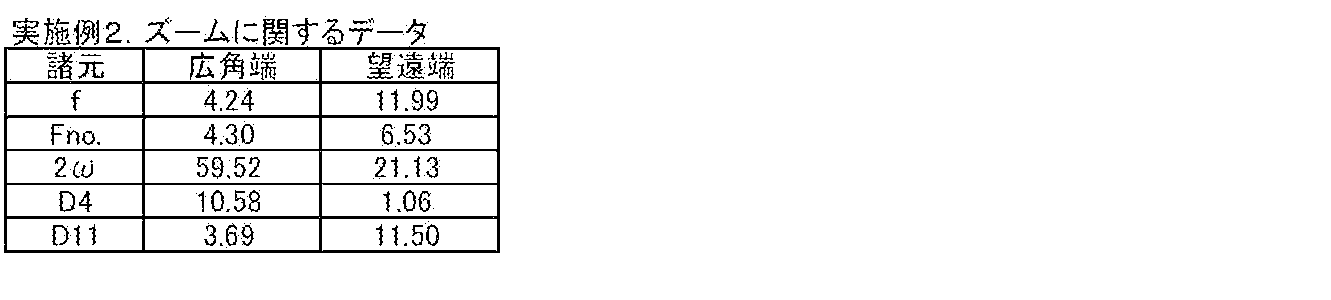

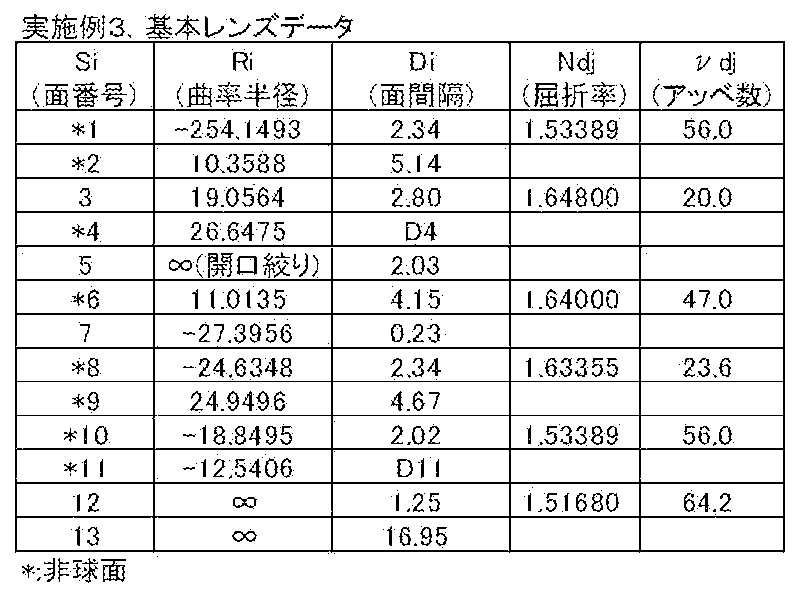
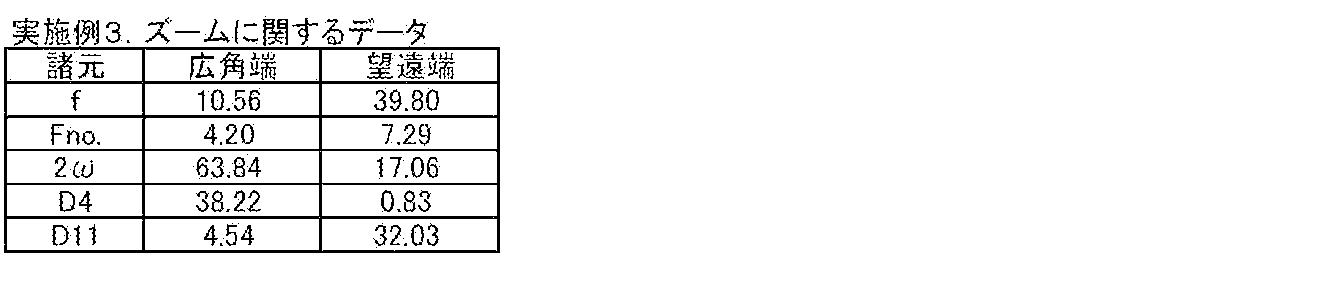
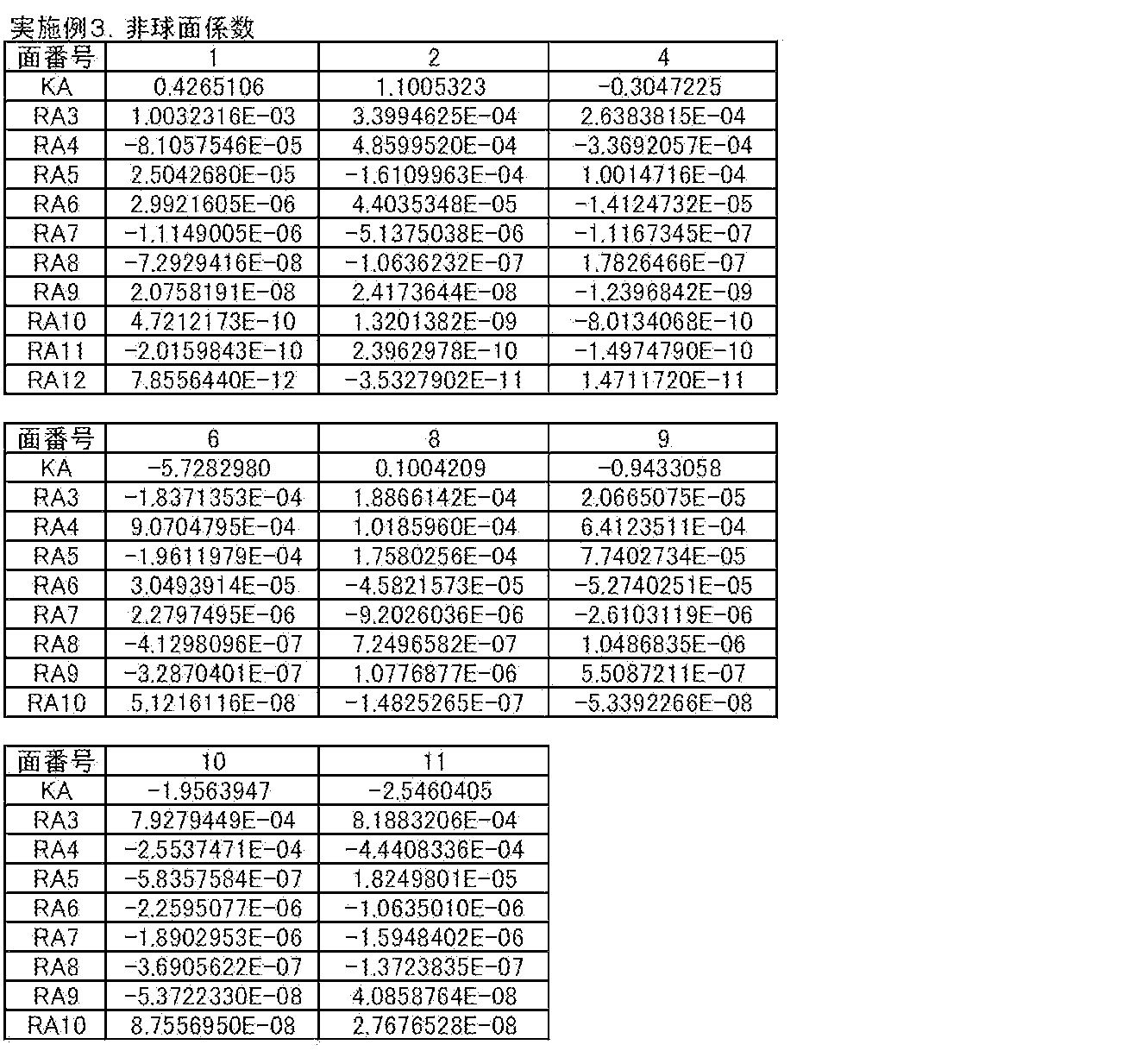
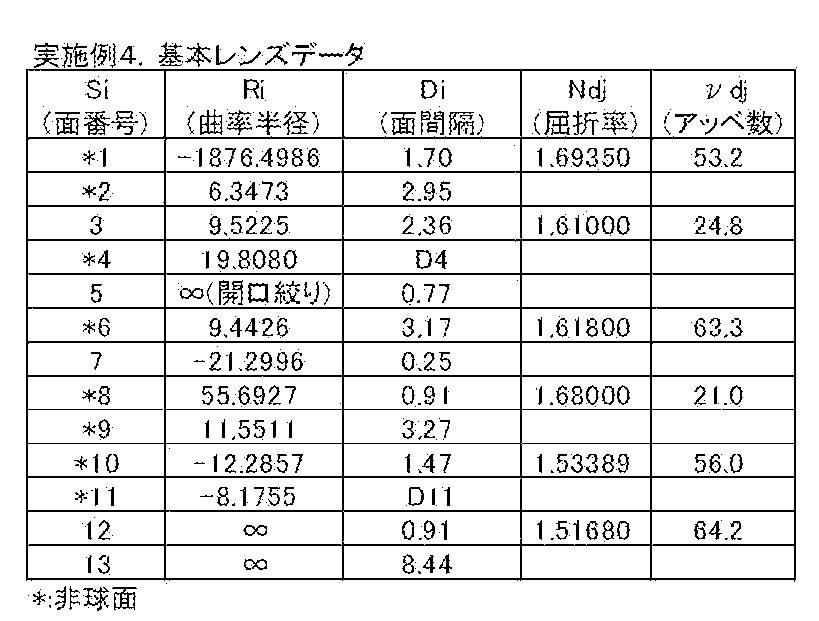
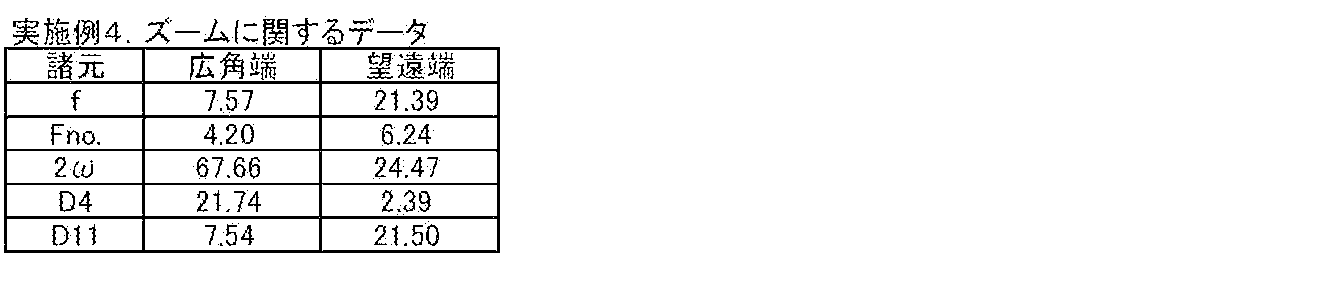
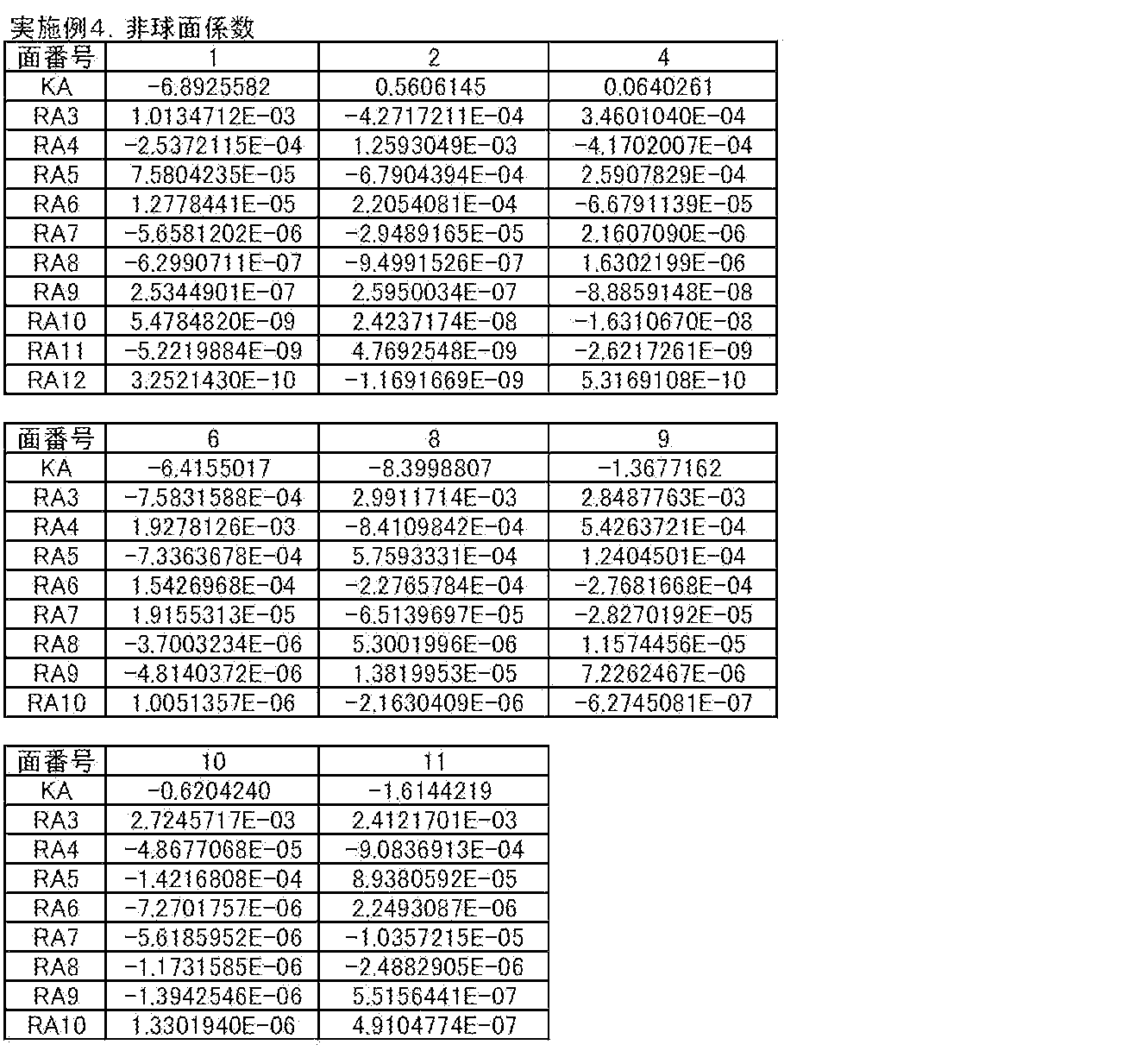

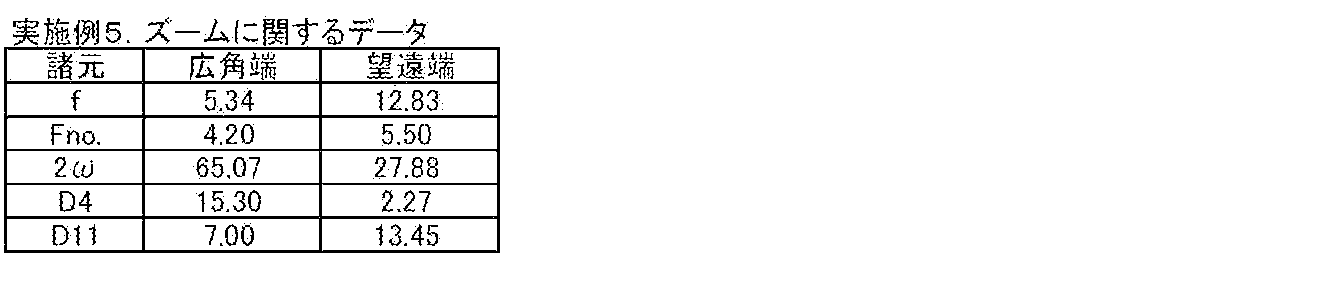


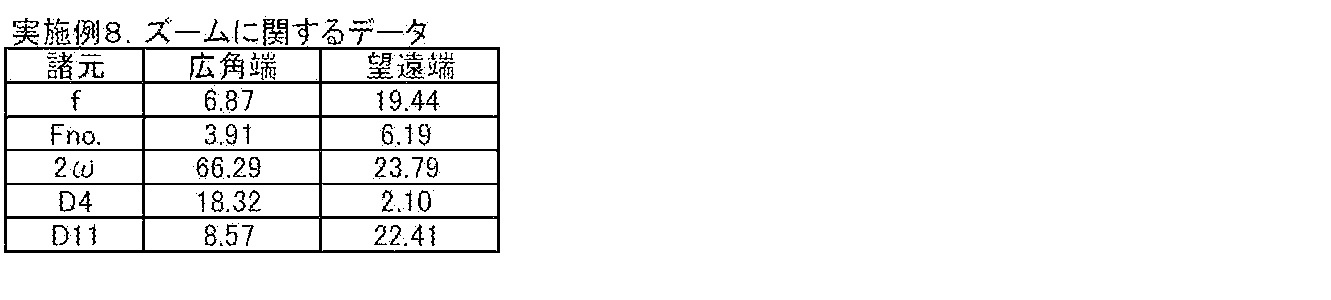

ただし、
Zd:非球面深さ(高さhの非球面上の点から、非球面頂点が接する光軸に垂直な平面に下ろした垂線の長さ)
h:高さ(光軸からのレンズ面までの距離)
C:近軸曲率半径の逆数
KA、RAm:非球面係数(m=3、4、5、…12)
以下に記載する表では、所定の桁で丸めた数値を記載している。また、以下に記載する表のデータにおいて、角度の単位としては度を用い、長さの単位としてはmmを用いているが、光学系は比例拡大又は比例縮小して使用することが可能であるので、他の適当な単位を用いることもできる。
また表25に、実施例1~8のズームレンズの条件式(1)~(14)に対応する値を示す。この表25の値はd線に関するものである。

ここで、実施例1のズームレンズの広角端における球面収差、非点収差、ディストーション(歪曲収差)、倍率色収差(倍率の色収差)をそれぞれ図9(A)~図9(D)に示し、望遠端における球面収差、非点収差、ディストーション(歪曲収差)、倍率色収差(倍率の色収差)をそれぞれ図9(E)~図9(H)に示す。
各収差図はd線(波長587.6nm)を基準としたものであるが、球面収差図では波長460.0nmおよび615.0nmに関する収差も示し、倍率色収差図では波長460.0nmおよび615.0nmに関する収差を示す。非点収差図では、サジタル方向については実線で、タンジェンシャル方向については点線で示している。球面収差図のFno.はF値を意味し、その他の収差図のωは半画角を意味する。
同様に、実施例2のズームレンズの広角端、望遠端における各収差図を図10(A)~図10(H)に示し、以下全く同様にして実施例3~8の各収差図をそれぞれ図11~図16に示す。
次に、本発明の実施形態にかかる撮像装置について説明する。図17に、本発明の実施形態の撮像装置の一例として、本発明の実施形態のズームレンズ1を用いた撮像装置10の概略構成図を示す。撮像装置としては、例えば、監視カメラ、ビデオカメラ、電子スチルカメラ等を挙げることができる。
図17に示す撮像装置10は、ズームレンズ1と、ズームレンズ1の像側に配置されて、ズームレンズ1により結像された被写体の像を撮像する撮像素子2と、撮像素子2からの出力信号を演算処理する信号処理部4と、ズームレンズ1の変倍を行うための変倍制御部5と、フォーカス調整を行うためのフォーカス制御部6とを備えている。なお、ズームレンズ1と撮像素子2との間に、適宜フィルタ等が配設されてもよい。
ズームレンズ1は、負の屈折力を有する第1レンズ群G1と、正の屈折力を有する第2レンズ群G2とを有し、第1レンズ群G1と第2レンズ群G2の間隔を変化させて変倍するように構成されている。上記第1レンズ群G1は、負の屈折力を有する第1レンズL11と、正の屈折力を有する第2レンズL12との2枚から構成され、それら両レンズL11およびL12は共にプラスチックレンズとされている。
撮像素子2は、ズームレンズ1により形成される光学像を撮像して電気信号を出力するものであり、その撮像面はズームレンズ1の像面に一致するように配置されている。撮像素子2としては例えばCCDやCMOS等からなるものを用いることができる。
なお、図17では図示していないが、撮像装置10は、例えば第2レンズ群G2の一部を構成する正の屈折力を有するレンズを光軸Zに垂直な方向に移動させて、振動や手振れ時の撮影画像のぶれを補正するぶれ補正機構をさらに備えるようにしてもよい。
以上、実施形態および実施例を挙げて本発明を説明したが、本発明は上記実施形態および実施例に限定されるものではなく、種々の変形が可能である。例えば、各レンズ成分の曲率半径、面間隔、屈折率、アッベ数、非球面係数等の値は、上記各数値実施例で示した値に限定されず、他の値をとり得るものである。
Claims (16)
- 物体側より順に、負の屈折力を有する第1レンズ群と、正の屈折力を有する第2レンズ群とを有し、変倍に際して前記第1レンズ群と第2レンズ群の間隔が変化するズームレンズにおいて、
前記第1レンズ群は、負の屈折力を有する第1レンズと、正の屈折力を有しプラスチックよりなる第2レンズとの2枚より構成され、
前記第1レンズのd線に対する屈折率をNd1n、前記第2レンズのd線に対する屈折率およびアッベ数をそれぞれNd1p、νd1p、前記第1レンズと第2レンズの光軸上での空気間隔をd2、広角端における全系の焦点距離をfwとしたとき、以下の条件式を満足することを特徴とするズームレンズ。
1.48<Nd1n<1.71 …(1)
1.60<Nd1p<1.65 …(2)
18<νd1p<25 …(3)
0.2<d2/fw<0.5 …(4) - 以下の条件式の少なくとも1つを満足することを特徴とする請求項1に記載のズームレンズ。
1.48<Nd1n<1.70 …(1’)
1.621<Nd1p<1.650 …(2’)
19<νd1p<24 …(3”) - 物体側より順に、負の屈折力を有する第1レンズ群と、正の屈折力を有する第2レンズ群とを有し、変倍に際して前記第1レンズ群と第2レンズ群の間隔が変化するズームレンズにおいて、
前記第1レンズ群は、最も物体側に負レンズを有するとともに、プラスチックよりなる正レンズを有し、
前記第1レンズ群の正レンズのd線に対する屈折率およびアッベ数をそれぞれ、Nd1p、νd1p、最大像高をY、第1レンズ群が最も物体側に位置するときの該第1レンズ群の最も物体側のレンズ面から結像面までの光軸上の距離をTLとしたとき、以下の条件式を満足することを特徴とするズームレンズ。
1.621<Nd1p<1.650 …(2’)
18<νd1p<24 …(3’)
50<Y×TL<550 …(5) - 以下の条件式を満足することを特徴とする請求項3に記載のズームレンズ。
19<νd1p<24 …(3”) - 前記第1レンズ群の最も物体側に配置された負レンズのd線に対する屈折率をNd1nとしたとき、以下の条件式を満足することを特徴とする請求項3または4に記載のズームレンズ。
1.48<Nd1n<1.71 …(1) - 以下の条件式を満足することを特徴とする請求項5に記載のズームレンズ。
1.48<Nd1n<1.70 …(1’) - 前記第1レンズ群が、物体側より順に配された、負の屈折力を有する第1レンズおよび正の屈折力を有する第2レンズの2枚のみから構成されていることを特徴とする請求項3から6のいずれか1項に記載のズームレンズ。
- 前記第1レンズと第2レンズの光軸上での空気間隔をd2、広角端における全系の焦点距離をfwとしたとき、以下の条件式を満足することを特徴とする請求項7に記載のズームレンズ。
0.2<d2/fw<0.5 …(4) - 前記第2レンズ群が、少なくとも1枚の負レンズを有し、該負レンズのd線に対する屈折率およびアッベ数をそれぞれNd2n、νd2nとしたとき、以下の条件式を満足することを特徴とする請求項1から8のいずれか1項に記載のズームレンズ。
1.60<Nd2n<1.70 …(6)
20.0<νd2n<28.0 …(7) - 以下の条件式を満足することを特徴とする請求項9に記載のズームレンズ。
1.60<Nd2n<1.69 …(6’) - 前記第2レンズ群が負レンズを1枚のみ有し、該負レンズがプラスチックレンズであることを特徴とする請求項1から10のいずれか1項に記載のズームレンズ。
- 前記第1レンズ群に配置された正の屈折力を有するプラスチックレンズの物体側レンズ面および、像側レンズ面の近軸曲率半径をそれぞれ、Rpf、Rprとしたとき、以下の条件式を満足することを特徴とする請求項1から11のいずれか1項に記載のズームレンズ。
0.5<(Rpr+Rpf)/(Rpr-Rpf)<6.2 …(8) - 以下の条件式を満足することを特徴とする請求項12に記載のズームレンズ。
1.6<(Rpr+Rpf)/(Rpr-Rpf)<6.1 …(8’) - 前記第2レンズ群が、2枚の正レンズと1枚の負レンズより構成されていることを特徴とする請求項1から13のいずれか1項に記載のズームレンズ。
- 実質的に、前記第1レンズ群および、第2レンズ群のみをレンズ群として有することを特徴とする請求項1から14のいずれか1項に記載のズームレンズ。
- 請求項1から15のいずれか1項に記載のズームレンズを備えたことを特徴とする撮像装置。
Priority Applications (3)
| Application Number | Priority Date | Filing Date | Title |
|---|---|---|---|
| JP2013521425A JP5905883B2 (ja) | 2011-06-24 | 2012-06-06 | ズームレンズおよび撮像装置 |
| CN201280031196.XA CN103620470B (zh) | 2011-06-24 | 2012-06-06 | 变焦镜头和成像设备 |
| US14/100,036 US9007697B2 (en) | 2011-06-24 | 2013-12-09 | Zoom lens and imaging apparatus |
Applications Claiming Priority (2)
| Application Number | Priority Date | Filing Date | Title |
|---|---|---|---|
| JP2011-140026 | 2011-06-24 | ||
| JP2011140026 | 2011-06-24 |
Related Child Applications (1)
| Application Number | Title | Priority Date | Filing Date |
|---|---|---|---|
| US14/100,036 Continuation US9007697B2 (en) | 2011-06-24 | 2013-12-09 | Zoom lens and imaging apparatus |
Publications (1)
| Publication Number | Publication Date |
|---|---|
| WO2012176389A1 true WO2012176389A1 (ja) | 2012-12-27 |
Family
ID=47422252
Family Applications (1)
| Application Number | Title | Priority Date | Filing Date |
|---|---|---|---|
| PCT/JP2012/003693 Ceased WO2012176389A1 (ja) | 2011-06-24 | 2012-06-06 | ズームレンズおよび撮像装置 |
Country Status (4)
| Country | Link |
|---|---|
| US (1) | US9007697B2 (ja) |
| JP (1) | JP5905883B2 (ja) |
| CN (1) | CN103620470B (ja) |
| WO (1) | WO2012176389A1 (ja) |
Cited By (1)
| Publication number | Priority date | Publication date | Assignee | Title |
|---|---|---|---|---|
| JP2014225002A (ja) * | 2013-04-25 | 2014-12-04 | キヤノン株式会社 | ズームレンズ及びそれを有する撮像装置 |
Families Citing this family (3)
| Publication number | Priority date | Publication date | Assignee | Title |
|---|---|---|---|---|
| CN103620471B (zh) * | 2011-06-24 | 2016-08-31 | 富士胶片株式会社 | 变焦镜头和成像设备 |
| CN105589182B (zh) | 2014-10-24 | 2018-02-02 | 玉晶光电(厦门)有限公司 | 光学成像镜头及应用此镜头的电子装置 |
| CN115308890B (zh) * | 2022-10-12 | 2022-12-20 | 昆明全波红外科技有限公司 | 一种紧凑型长波手动变焦红外镜头 |
Citations (14)
| Publication number | Priority date | Publication date | Assignee | Title |
|---|---|---|---|---|
| JP2005258067A (ja) * | 2004-03-11 | 2005-09-22 | Konica Minolta Photo Imaging Inc | 撮像装置 |
| JP2007155836A (ja) * | 2005-11-30 | 2007-06-21 | Canon Inc | ズームレンズ及びそれを有する撮像装置 |
| JP2007193140A (ja) * | 2006-01-19 | 2007-08-02 | Fujinon Corp | 結像変倍光学系およびこれを用いた撮像装置 |
| JP2008058600A (ja) * | 2006-08-31 | 2008-03-13 | Canon Inc | ズームレンズ及びそれを有する撮像装置 |
| JP2008181118A (ja) * | 2006-12-28 | 2008-08-07 | Hoya Corp | 標準ズームレンズ系 |
| JP2008257179A (ja) * | 2007-03-12 | 2008-10-23 | Olympus Imaging Corp | 結像光学系及びそれを有する電子撮像装置 |
| JP2011095328A (ja) * | 2009-10-27 | 2011-05-12 | Sony Corp | ズームレンズ及び撮像装置 |
| JP2012042811A (ja) * | 2010-08-20 | 2012-03-01 | Sony Corp | ズームレンズ及び撮像装置 |
| JP2012053223A (ja) * | 2010-08-31 | 2012-03-15 | Nikon Corp | ズームレンズ、光学機器及びズームレンズの製造方法 |
| JP2012053222A (ja) * | 2010-08-31 | 2012-03-15 | Nikon Corp | ズームレンズ、光学機器及びズームレンズの製造方法 |
| JP2012068327A (ja) * | 2010-09-21 | 2012-04-05 | Hoya Corp | ズームレンズ系及びこれを用いた電子撮像装置 |
| JP2012098459A (ja) * | 2010-11-01 | 2012-05-24 | Hoya Corp | ズームレンズ系及びこれを用いた電子撮像装置 |
| JP2012103416A (ja) * | 2010-11-09 | 2012-05-31 | Olympus Imaging Corp | ズームレンズ及びそれを用いた撮像装置 |
| JP2012103675A (ja) * | 2010-10-15 | 2012-05-31 | Nikon Corp | ズームレンズ、光学機器、およびズームレンズの製造方法 |
Family Cites Families (13)
| Publication number | Priority date | Publication date | Assignee | Title |
|---|---|---|---|---|
| JP2006039182A (ja) | 2004-07-27 | 2006-02-09 | Konica Minolta Photo Imaging Inc | 撮像装置 |
| JP2007025373A (ja) | 2005-07-19 | 2007-02-01 | Matsushita Electric Ind Co Ltd | 変倍レンズ光学系、並びにそれを用いた撮像光学機器及び携帯型情報端末機器 |
| JP2007187740A (ja) | 2006-01-11 | 2007-07-26 | Largan Precision Co Ltd | ズームレンズ |
| JP2010091948A (ja) | 2008-10-10 | 2010-04-22 | Olympus Imaging Corp | ズームレンズ及びそれを備えた撮像装置 |
| US8289632B2 (en) * | 2009-10-27 | 2012-10-16 | Sony Corporation | Zoom lens and image pickup device |
| JP5558254B2 (ja) * | 2010-08-02 | 2014-07-23 | オリンパスイメージング株式会社 | 光学装置 |
| US8503093B2 (en) | 2010-08-31 | 2013-08-06 | Nikon Corporation | Zoom lens, optical apparatus and method for manufacturing zoom lens |
| US8879162B2 (en) | 2010-11-09 | 2014-11-04 | Olympus Imaging Corp. | Zoom lens and image pickup apparatus equipped with same |
| JP2012226019A (ja) * | 2011-04-15 | 2012-11-15 | Olympus Imaging Corp | ズームレンズおよびそれを用いた撮像装置 |
| JP2012108279A (ja) * | 2010-11-17 | 2012-06-07 | Olympus Imaging Corp | 光路折り曲げ部材を有するズームレンズ及びそれを備える撮像装置 |
| JP5551055B2 (ja) * | 2010-12-08 | 2014-07-16 | Hoya株式会社 | ズームレンズ系 |
| WO2012176469A1 (ja) * | 2011-06-24 | 2012-12-27 | 富士フイルム株式会社 | ズームレンズおよび撮像装置 |
| CN103620471B (zh) * | 2011-06-24 | 2016-08-31 | 富士胶片株式会社 | 变焦镜头和成像设备 |
-
2012
- 2012-06-06 WO PCT/JP2012/003693 patent/WO2012176389A1/ja not_active Ceased
- 2012-06-06 CN CN201280031196.XA patent/CN103620470B/zh not_active Expired - Fee Related
- 2012-06-06 JP JP2013521425A patent/JP5905883B2/ja not_active Expired - Fee Related
-
2013
- 2013-12-09 US US14/100,036 patent/US9007697B2/en not_active Expired - Fee Related
Patent Citations (14)
| Publication number | Priority date | Publication date | Assignee | Title |
|---|---|---|---|---|
| JP2005258067A (ja) * | 2004-03-11 | 2005-09-22 | Konica Minolta Photo Imaging Inc | 撮像装置 |
| JP2007155836A (ja) * | 2005-11-30 | 2007-06-21 | Canon Inc | ズームレンズ及びそれを有する撮像装置 |
| JP2007193140A (ja) * | 2006-01-19 | 2007-08-02 | Fujinon Corp | 結像変倍光学系およびこれを用いた撮像装置 |
| JP2008058600A (ja) * | 2006-08-31 | 2008-03-13 | Canon Inc | ズームレンズ及びそれを有する撮像装置 |
| JP2008181118A (ja) * | 2006-12-28 | 2008-08-07 | Hoya Corp | 標準ズームレンズ系 |
| JP2008257179A (ja) * | 2007-03-12 | 2008-10-23 | Olympus Imaging Corp | 結像光学系及びそれを有する電子撮像装置 |
| JP2011095328A (ja) * | 2009-10-27 | 2011-05-12 | Sony Corp | ズームレンズ及び撮像装置 |
| JP2012042811A (ja) * | 2010-08-20 | 2012-03-01 | Sony Corp | ズームレンズ及び撮像装置 |
| JP2012053223A (ja) * | 2010-08-31 | 2012-03-15 | Nikon Corp | ズームレンズ、光学機器及びズームレンズの製造方法 |
| JP2012053222A (ja) * | 2010-08-31 | 2012-03-15 | Nikon Corp | ズームレンズ、光学機器及びズームレンズの製造方法 |
| JP2012068327A (ja) * | 2010-09-21 | 2012-04-05 | Hoya Corp | ズームレンズ系及びこれを用いた電子撮像装置 |
| JP2012103675A (ja) * | 2010-10-15 | 2012-05-31 | Nikon Corp | ズームレンズ、光学機器、およびズームレンズの製造方法 |
| JP2012098459A (ja) * | 2010-11-01 | 2012-05-24 | Hoya Corp | ズームレンズ系及びこれを用いた電子撮像装置 |
| JP2012103416A (ja) * | 2010-11-09 | 2012-05-31 | Olympus Imaging Corp | ズームレンズ及びそれを用いた撮像装置 |
Cited By (1)
| Publication number | Priority date | Publication date | Assignee | Title |
|---|---|---|---|---|
| JP2014225002A (ja) * | 2013-04-25 | 2014-12-04 | キヤノン株式会社 | ズームレンズ及びそれを有する撮像装置 |
Also Published As
| Publication number | Publication date |
|---|---|
| US9007697B2 (en) | 2015-04-14 |
| CN103620470A (zh) | 2014-03-05 |
| CN103620470B (zh) | 2015-12-09 |
| US20140092485A1 (en) | 2014-04-03 |
| JP5905883B2 (ja) | 2016-04-20 |
| JPWO2012176389A1 (ja) | 2015-02-23 |
Similar Documents
| Publication | Publication Date | Title |
|---|---|---|
| CN104024912B (zh) | 变焦透镜和摄像装置 | |
| JP5767335B2 (ja) | ズームレンズおよび撮像装置 | |
| WO2014041786A1 (ja) | ズームレンズおよび撮像装置 | |
| JP5787999B2 (ja) | ズームレンズおよび撮像装置 | |
| CN103917911B (zh) | 变焦透镜和摄像装置 | |
| WO2013031180A1 (ja) | ズームレンズおよび撮像装置 | |
| WO2013031185A1 (ja) | ズームレンズおよび撮像装置 | |
| JP5905883B2 (ja) | ズームレンズおよび撮像装置 | |
| JP5647570B2 (ja) | ズームレンズおよび撮像装置 | |
| JP5767330B2 (ja) | ズームレンズおよび撮像装置 | |
| WO2013031183A1 (ja) | ズームレンズおよび撮像装置 | |
| JP5778276B2 (ja) | ズームレンズおよび撮像装置 | |
| WO2013031184A1 (ja) | ズームレンズおよび撮像装置 | |
| JP5767710B2 (ja) | ズームレンズおよび撮像装置 | |
| JP5767333B2 (ja) | ズームレンズおよび撮像装置 | |
| JPWO2013031182A1 (ja) | ズームレンズおよび撮像装置 | |
| WO2013031179A1 (ja) | ズームレンズおよび撮像装置 | |
| WO2013031187A1 (ja) | ズームレンズおよび撮像装置 | |
| WO2013031178A1 (ja) | ズームレンズおよび撮像装置 | |
| WO2013031109A1 (ja) | ズームレンズおよび撮像装置 | |
| WO2013031176A1 (ja) | ズームレンズおよび撮像装置 | |
| WO2012176470A1 (ja) | ズームレンズおよび撮像装置 | |
| WO2013031189A1 (ja) | ズームレンズおよび撮像装置 |
Legal Events
| Date | Code | Title | Description |
|---|---|---|---|
| 121 | Ep: the epo has been informed by wipo that ep was designated in this application |
Ref document number: 12803212 Country of ref document: EP Kind code of ref document: A1 |
|
| ENP | Entry into the national phase |
Ref document number: 2013521425 Country of ref document: JP Kind code of ref document: A |
|
| NENP | Non-entry into the national phase |
Ref country code: DE |
|
| 122 | Ep: pct application non-entry in european phase |
Ref document number: 12803212 Country of ref document: EP Kind code of ref document: A1 |