WO2012176577A1 - ポリウレタン樹脂組成物およびそれを用いてなる中空糸膜モジュール - Google Patents
ポリウレタン樹脂組成物およびそれを用いてなる中空糸膜モジュール Download PDFInfo
- Publication number
- WO2012176577A1 WO2012176577A1 PCT/JP2012/063425 JP2012063425W WO2012176577A1 WO 2012176577 A1 WO2012176577 A1 WO 2012176577A1 JP 2012063425 W JP2012063425 W JP 2012063425W WO 2012176577 A1 WO2012176577 A1 WO 2012176577A1
- Authority
- WO
- WIPO (PCT)
- Prior art keywords
- polyurethane resin
- resin composition
- hollow fiber
- polyol
- fiber membrane
- Prior art date
- Legal status (The legal status is an assumption and is not a legal conclusion. Google has not performed a legal analysis and makes no representation as to the accuracy of the status listed.)
- Ceased
Links
Classifications
-
- C—CHEMISTRY; METALLURGY
- C08—ORGANIC MACROMOLECULAR COMPOUNDS; THEIR PREPARATION OR CHEMICAL WORKING-UP; COMPOSITIONS BASED THEREON
- C08L—COMPOSITIONS OF MACROMOLECULAR COMPOUNDS
- C08L75/00—Compositions of polyureas or polyurethanes; Compositions of derivatives of such polymers
- C08L75/04—Polyurethanes
-
- C—CHEMISTRY; METALLURGY
- C08—ORGANIC MACROMOLECULAR COMPOUNDS; THEIR PREPARATION OR CHEMICAL WORKING-UP; COMPOSITIONS BASED THEREON
- C08G—MACROMOLECULAR COMPOUNDS OBTAINED OTHERWISE THAN BY REACTIONS ONLY INVOLVING UNSATURATED CARBON-TO-CARBON BONDS
- C08G18/00—Polymeric products of isocyanates or isothiocyanates
- C08G18/06—Polymeric products of isocyanates or isothiocyanates with compounds having active hydrogen
- C08G18/28—Polymeric products of isocyanates or isothiocyanates with compounds having active hydrogen characterised by the compounds used containing active hydrogen
- C08G18/40—High-molecular-weight compounds
- C08G18/48—Polyethers
- C08G18/4829—Polyethers containing at least three hydroxy groups
-
- B—PERFORMING OPERATIONS; TRANSPORTING
- B01—PHYSICAL OR CHEMICAL PROCESSES OR APPARATUS IN GENERAL
- B01D—SEPARATION
- B01D65/00—Accessories or auxiliary operations, in general, for separation processes or apparatus using semi-permeable membranes
- B01D65/08—Prevention of membrane fouling or of concentration polarisation
-
- B—PERFORMING OPERATIONS; TRANSPORTING
- B01—PHYSICAL OR CHEMICAL PROCESSES OR APPARATUS IN GENERAL
- B01D—SEPARATION
- B01D69/00—Semi-permeable membranes for separation processes or apparatus characterised by their form, structure or properties; Manufacturing processes specially adapted therefor
- B01D69/08—Hollow fibre membranes
-
- B—PERFORMING OPERATIONS; TRANSPORTING
- B01—PHYSICAL OR CHEMICAL PROCESSES OR APPARATUS IN GENERAL
- B01D—SEPARATION
- B01D71/00—Semi-permeable membranes for separation processes or apparatus characterised by the material; Manufacturing processes specially adapted therefor
- B01D71/06—Organic material
- B01D71/54—Polyureas; Polyurethanes
-
- C—CHEMISTRY; METALLURGY
- C08—ORGANIC MACROMOLECULAR COMPOUNDS; THEIR PREPARATION OR CHEMICAL WORKING-UP; COMPOSITIONS BASED THEREON
- C08G—MACROMOLECULAR COMPOUNDS OBTAINED OTHERWISE THAN BY REACTIONS ONLY INVOLVING UNSATURATED CARBON-TO-CARBON BONDS
- C08G18/00—Polymeric products of isocyanates or isothiocyanates
- C08G18/06—Polymeric products of isocyanates or isothiocyanates with compounds having active hydrogen
- C08G18/08—Processes
- C08G18/10—Prepolymer processes involving reaction of isocyanates or isothiocyanates with compounds having active hydrogen in a first reaction step
- C08G18/12—Prepolymer processes involving reaction of isocyanates or isothiocyanates with compounds having active hydrogen in a first reaction step using two or more compounds having active hydrogen in the first polymerisation step
-
- C—CHEMISTRY; METALLURGY
- C08—ORGANIC MACROMOLECULAR COMPOUNDS; THEIR PREPARATION OR CHEMICAL WORKING-UP; COMPOSITIONS BASED THEREON
- C08G—MACROMOLECULAR COMPOUNDS OBTAINED OTHERWISE THAN BY REACTIONS ONLY INVOLVING UNSATURATED CARBON-TO-CARBON BONDS
- C08G18/00—Polymeric products of isocyanates or isothiocyanates
- C08G18/06—Polymeric products of isocyanates or isothiocyanates with compounds having active hydrogen
- C08G18/28—Polymeric products of isocyanates or isothiocyanates with compounds having active hydrogen characterised by the compounds used containing active hydrogen
- C08G18/65—Low-molecular-weight compounds having active hydrogen with high-molecular-weight compounds having active hydrogen
- C08G18/66—Compounds of groups C08G18/42, C08G18/48, or C08G18/52
- C08G18/6666—Compounds of group C08G18/48 or C08G18/52
- C08G18/6692—Compounds of group C08G18/48 or C08G18/52 with compounds of group C08G18/34
-
- C—CHEMISTRY; METALLURGY
- C08—ORGANIC MACROMOLECULAR COMPOUNDS; THEIR PREPARATION OR CHEMICAL WORKING-UP; COMPOSITIONS BASED THEREON
- C08G—MACROMOLECULAR COMPOUNDS OBTAINED OTHERWISE THAN BY REACTIONS ONLY INVOLVING UNSATURATED CARBON-TO-CARBON BONDS
- C08G18/00—Polymeric products of isocyanates or isothiocyanates
- C08G18/06—Polymeric products of isocyanates or isothiocyanates with compounds having active hydrogen
- C08G18/28—Polymeric products of isocyanates or isothiocyanates with compounds having active hydrogen characterised by the compounds used containing active hydrogen
- C08G18/65—Low-molecular-weight compounds having active hydrogen with high-molecular-weight compounds having active hydrogen
- C08G18/66—Compounds of groups C08G18/42, C08G18/48, or C08G18/52
- C08G18/6666—Compounds of group C08G18/48 or C08G18/52
- C08G18/6696—Compounds of group C08G18/48 or C08G18/52 with compounds of group C08G18/36 or hydroxylated esters of higher fatty acids of C08G18/38
-
- C—CHEMISTRY; METALLURGY
- C08—ORGANIC MACROMOLECULAR COMPOUNDS; THEIR PREPARATION OR CHEMICAL WORKING-UP; COMPOSITIONS BASED THEREON
- C08G—MACROMOLECULAR COMPOUNDS OBTAINED OTHERWISE THAN BY REACTIONS ONLY INVOLVING UNSATURATED CARBON-TO-CARBON BONDS
- C08G18/00—Polymeric products of isocyanates or isothiocyanates
- C08G18/06—Polymeric products of isocyanates or isothiocyanates with compounds having active hydrogen
- C08G18/70—Polymeric products of isocyanates or isothiocyanates with compounds having active hydrogen characterised by the isocyanates or isothiocyanates used
- C08G18/72—Polyisocyanates or polyisothiocyanates
- C08G18/80—Masked polyisocyanates
- C08G18/8003—Masked polyisocyanates masked with compounds having at least two groups containing active hydrogen
- C08G18/8051—Masked polyisocyanates masked with compounds having at least two groups containing active hydrogen with compounds of C08G18/36
Definitions
- the present invention relates to a polyurethane resin composition, and more particularly to a polyurethane resin composition used as a binding material for hollow fiber membranes.
- Patent Document 1 proposes a polyurethane resin composition for a hollow fiber membrane binding material using a polyol component containing a polyol obtained by modifying castor oil or castor oil fatty acid with trimethylolalkane and an isocyanate component.
- a polyol component containing a polyol obtained by modifying castor oil or castor oil fatty acid with trimethylolalkane and an isocyanate component there are various types of hollow fiber membranes having different pore diameters depending on the purpose of use, and the conventional resin composition has a problem that the hollow fiber membrane may be blocked depending on the type of the hollow fiber membrane.
- the present invention is an invention made to solve the above conventional problems, and when used as a binding material for a hollow fiber membrane, a polyurethane resin composition capable of suppressing the blockage regardless of the type of the hollow fiber membrane, Another object of the present invention is to provide a hollow fiber membrane module using the same.
- the present invention comprises a main agent (I) containing an isocyanate group-terminated urethane prepolymer (A) and a curing agent (II) containing a hydroxyl group-terminated urethane prepolymer (B), wherein the hydroxyl group-terminated urethane prepolymer (B) is And a polyurethane resin composition which is a reaction product of a polyol component (a) containing a castor oil-based polyol (a1) and a polyisocyanate (b).
- the polyol component (a) preferably further contains a polyether polyol (a2) having 4 to 8 hydroxyl groups.
- the polyurethane resin composition is preferably a composition for binding hollow fibers.
- the present invention relates to a hollow fiber membrane module using the polyurethane resin composition.
- the polyurethane resin composition of the present invention When used as a binding material for a hollow fiber membrane, it can suppress clogging of the hollow fiber membrane regardless of the type of the hollow fiber membrane.
- the polyurethane resin composition of the present invention comprises a main agent (I) containing an isocyanate group-terminated urethane prepolymer (A) and a curing agent (II) containing a hydroxyl group-terminated urethane prepolymer (B).
- the main agent (I) contains an isocyanate group-terminated urethane prepolymer (A), and this isocyanate group-terminated urethane prepolymer (A) is a reaction product of a polyisocyanate and a polyol component.
- Polyisocyanates used in the isocyanate group-terminated urethane prepolymer (A) include tolylene diisocyanate, diphenylmethane diisocyanate, polymethylene polyphenyl polyisocyanate (polymeric MDI), xylylene diisocyanate and ⁇ , ⁇ , ⁇ , ⁇ -tetramethylxylylene.
- Aromatic polyisocyanates such as diisocyanate, tetramethylene diisocyanate, hexamethylene diisocyanate, aliphatic polyisocyanates such as 2,2,4-trimethylhexamethylene diisocyanate and 2,4,4-trimethylhexamethylene diisocyanate, isophorone diisocyanate, hydrogenated Alicyclic polymers such as xylylene diisocyanate and 4,4'-dicyclohexylmethane diisocyanate Cyanate, and carbodiimide modified some of these, biuret, allophanate-modified, include such as those isocyanurate-modified, they alone or may be used in combination.
- aromatic polyisocyanates and parts thereof modified with carbodiimide, biuret, allophanate, and isocyanurate are preferred because of their high reactivity with hydroxyl groups.
- polymethylene polyphenyl polyisocyanate, diphenylmethane diisocyanate partially modified with carbodiimide, or a mixture thereof is more preferable because of low crystallinity and good storage stability of the main agent (I).
- polyol component used in the isocyanate group-terminated urethane prepolymer (A) examples include polyether polyol, polyester polyol, polycarbonate polyol, polybutadiene polyol, polyisoprene polyol, castor oil-based polyol, alkylene diol, and the like. Can be used alone or in combination. Of these, castor oil-based polyols are preferable in that the amount of organic substances eluted into water can be reduced, and among these, castor oil is more preferable.
- castor oil a normal grade used for the production of an isocyanate group-terminated urethane prepolymer can be used.
- castor oil having an average hydroxyl value of about 160 mgKOH / g is exemplified.
- the reaction between the polyisocyanate and the polyol component can be performed by a conventionally known method.
- an isocyanate group can be provided at the end of the urethane prepolymer by reacting a polyisocyanate containing 20 to 48% by mass of free NCO with a polyol component.
- the NCO / OH ratio (molar ratio) of the isocyanate group-terminated urethane prepolymer (A) in the main agent (I) is not particularly limited, but is preferably 2 to 10 from the viewpoint of low crystallinity and excellent storage stability. More preferably, it is 3-8. Therefore, the blending ratio of the polyisocyanate and the polyol component used in the isocyanate group-terminated urethane prepolymer (A) and the content of the isocyanate group-terminated urethane prepolymer (A) in the main agent (I) are the same as above. To the NCO / OH ratio.
- the viscosity at 25 ° C. of the main component (I) containing the above-mentioned components is not particularly limited, but is preferably 1000 to 8000 mPa ⁇ s in order to sufficiently ensure fluidity after mixing with a curing agent for an appropriate pot life. s.
- the viscosities of the main agent and the curing agent described later are values measured at 25 ° C. in accordance with JIS Z8803 using a rotational viscometer.
- the curing agent (II) contains a hydroxyl group-terminated urethane prepolymer (B), and this hydroxyl group-terminated urethane prepolymer (B) comprises a polyol component (a) containing a castor oil-based polyol (a1) and a polyisocyanate (b). It is a reaction product.
- the polyol component (a) contains castor oil-based polyol (a1).
- the castor oil-based polyol (a1) is a polyol produced using castor oil, castor oil fatty acid, hydrogenated castor oil hydrogenated to castor oil, or hydrogenated castor oil fatty acid hydrogenated to castor oil fatty acid.
- castor oil-based polyol (a1) castor oil, a transesterification product of castor oil and other natural fats and oils, a reaction product of castor oil and polyhydric alcohol, an esterification reaction product of castor oil fatty acid and polyhydric alcohol, water Additive castor oil, transesterified product of hydrogenated castor oil and other natural fats and oils, reaction product of hydrogenated castor oil and polyhydric alcohol, esterification reaction product of hydrogenated castor oil fatty acid and polyhydric alcohol, and alkylene oxide And polyols obtained by addition polymerization of these can be used, and these can be used alone or in combination.
- the average hydroxyl value of the castor oil-based polyol (a1) is not particularly limited, but is preferably 50 to 300 mgKOH / g, because the strength of the cured product is excellent and the fluidity after mixing with the curing agent can be sufficiently secured. More preferably, it is 100 to 200 mg KOH / g.
- the content of the castor oil-based polyol (a1) in the polyol component (a) is not particularly limited, but is preferable because it is excellent in compatibility with the main agent and can sufficiently secure the fluidity after mixing with the curing agent. Is 50 to 100% by mass, more preferably 60 to 90% by mass, and most preferably 65 to 85% by mass.
- the polyol component (a) may also contain a polyether polyol (a2) having 4 to 8 hydroxyl groups.
- the polyether polyol (a2) having 4 to 8 hydroxyl groups is a polyether obtained by adding an alkylene oxide such as ethylene oxide, propylene oxide and butylene oxide to a polyol having 4 to 8 hydroxyl groups such as pentaerythritol, sorbitol and sucrose.
- a polyol etc. are mentioned, These can be used individually or in combination. Of these, those using propylene oxide and butylene oxide as the alkylene oxide are preferable because of excellent water resistance. Moreover, what uses sorbitol as a polyol which is excellent in durability and can fully ensure the fluidity
- the average hydroxyl value of the polyether polyol (a2) having 4 to 8 hydroxyl groups is not particularly limited, but is preferably 300 to increase the hardness of the cured product and improve its durability when used in a hollow fiber membrane module. It is ⁇ 800 mgKOH / g, more preferably 400 to 600 mgKOH / g.
- the content of the polyether polyol (a2) having 4 to 8 hydroxyl groups in the polyol component (a) is not particularly limited, but it increases the hardness of the cured product and improves its durability when used in a hollow fiber membrane module. Therefore, the content is preferably 10 to 40% by mass, more preferably 15 to 35% by mass.
- the polyol component (a) may further contain other polyol (a3) in addition to the castor oil-based polyol (a1) and the polyether polyol (a2) having 4 to 8 hydroxyl groups.
- Other polyols (a3) include, for example, polyols having 2 hydroxyl groups such as ethylene glycol, propylene glycol, diethylene glycol, dipropylene glycol and triethylene glycol, polyols having 3 hydroxyl groups such as glycerol and trimethylolpropane, and pentaerythritol.
- a polyol having 4 hydroxyl groups a polyol having 6 hydroxyl groups such as sorbitol, a polyol having 8 hydroxyl groups such as sucrose, a polyether polyol obtained by adding an alkylene oxide to the polyol having 2 or 3 hydroxyl groups, aniline, tolylenediamine, Examples include polyether polyols such as amine polyols to which amine compound alkylene oxides such as ethylenediamine and diethylenetriamine are added. Polyester polyols and polybutadiene polyols can also be used.
- content of the other polyol (a3) in a polyol component (a) is not specifically limited, In order not to impair the effect of this invention, it is preferable to set it as 20 mass% or less.
- the same polyisocyanate used for the preparation of the isocyanate group-terminated urethane prepolymer (A) is preferably exemplified.
- the reaction between the polyol component (a) and the polyisocyanate (b) can be carried out by a conventionally known method.
- the urethane prepolymer can have a hydroxyl group at the terminal.
- the NCO / OH ratio (molar ratio) of the hydroxyl group-terminated urethane prepolymer (B) in the curing agent (II) is not particularly limited, but is excellent in compatibility with the main agent and sufficiently fluid after mixing with the curing agent. Is preferably from 0.01 to 0.5, more preferably from 0.05 to 0.3. Therefore, the blending ratio of the polyol component (a) and the polyisocyanate (b), and the content of the hydroxyl group-terminated urethane prepolymer (B) in the curing agent (II) are determined based on the NCO / OH ratio for the same reason as described above. It is preferable to set so as to satisfy.
- the average hydroxyl value of the curing agent (II) containing the above-mentioned components is not particularly limited, but it is preferable because the viscosity after mixing with the main agent can be further lowered and higher hardness can be imparted to the cured polyurethane resin. Is 100 to 300 mg KOH / g, more preferably 150 to 250 mg KOH / g.
- the viscosity of the curing agent (II) at 25 ° C. is not particularly limited, but is preferably 4000 to 30,000 mPa ⁇ s because the fluidity after mixing with the main agent can be sufficiently secured.
- the mixing ratio of the main agent (I) and the curing agent (II) is preferably 0.8 to 1.3 in terms of NCO / OH ratio (molar ratio) from the viewpoint of good curability.
- a more preferable NCO / OH ratio (molar ratio) is 0.9 to 1.2.
- the polyurethane resin composition of the present invention may contain a known curing catalyst as necessary.
- a metal catalyst or an amine catalyst which is usually used for producing a polyurethane resin
- Metal catalysts include tin catalysts such as dibutyltin dilaurate, dioctyltin dilaurate and dibutyltin dioctate, lead catalysts such as lead octylate, lead octenoate and lead naphthenate, bismuth catalysts such as bismuth octylate and bismuth neodecanoate, etc.
- amine-based catalysts include diethylenetriamine, and these can be used alone or in combination.
- the content of the curing catalyst in the polyurethane resin composition can be appropriately adjusted according to the required curing rate, but generally, with respect to a total of 100 parts by mass of the main agent (I) and the curing agent (II). 0.0001 to 3 parts by mass.
- the polyurethane resin composition of the present invention may contain an isocyanate compound in the main agent (I) or separately from the main agent (I) as long as the effects of the present invention are not impaired.
- an isocyanate compound the same thing as the polyisocyanate used for preparation of an isocyanate group terminal urethane prepolymer (A) is illustrated preferably.
- the polyurethane resin composition of the present invention may contain a polyol (C) in the curing agent (II) or separately from the curing agent (II) within a range not inhibiting the effects of the present invention.
- a polyol (C) those exemplified for the polyol component (a) are preferably exemplified.
- the polyurethane resin composition of the present invention is cured by mixing the main agent (I) and the curing agent (II) and, if necessary, a curing catalyst to produce a cured polyurethane resin.
- the polyurethane resin composition of the present invention is particularly useful as a composition for binding hollow fibers.
- the hollow fiber examples include a hollow fiber made of polysulfone, polyacrylonitrile, polyamide, cellulose acetate, polyvinylidene fluoride, and the like, and a hollow fiber membrane module in which a bundle of the hollow fibers is bound at the end by the polyurethane resin composition. It is used for various purposes.
- the polyurethane resin composition of the present invention is useful as a binding material for binding these hollow fiber bundles at the ends.
- the present invention relates to a hollow fiber membrane module using a cured product of the polyurethane resin composition as a binding material.
- the hollow fiber membrane module of the present invention is used in the fields of food industry, pharmaceutical production, chemical industry, civil engineering, semiconductor and electronic parts, paint, machinery, printing, textiles, medicine, etc. It is suitable as a hollow fiber membrane module used for a processor or the like.
- the obtained hollow fiber membrane module was filled with water, and the presence or absence of a leak was confirmed.
- Preparation Example 1 (Preparation of main agent (I)) A carbodiimide-modified 4,4′-diphenylmethane diisocyanate (free NCO amount: 29.5%, Luplanate MM-103 manufactured by BASFINOAC Polyurethane Co., Ltd .: trade name) and castor oil (average hydroxyl value: An isocyanate group-terminated urethane prepolymer having an NCO / OH ratio (molar ratio) of 5.8 by mixing and reacting with 160 mg KOH / g and 29.7 parts of castor oil Kakutoku A (trade name) manufactured by Ito Oil Co., Ltd. A main agent (I-1) comprising A) was prepared. The main compound (I-1) obtained had a free NCO content of 17% and a viscosity measured at 25 ° C. of 4500 mPa ⁇ s.
- Preparation Example 2 (Preparation of curing agent (II)) ⁇ Raw materials used>
- the raw materials used in the preparation of the curing agent (II) are as follows.
- a1-2 Castor oil-based polyol (average hydroxyl value: 200 mg KOH / g, URIC H-52 manufactured by Ito Oil Co., Ltd .: trade name)
- a hydroxyl-terminated urethane prepolymer (BCO) having an NCO / OH ratio (molar ratio) of 0.17 is prepared by mixing and reacting 7.1 parts of 4,4′-diphenylmethane diisocyanate partially modified with carbodiimide and 100 parts of castor oil.
- Examples 1 to 8 and Comparative Example 1 The main agent (I-1) prepared in Preparation Example 1 and the curing agents (II-1) to (II-9) prepared in Preparation Example 2 have an NCO / OH ratio (molar ratio) of 1.0.
- the pot life, the hardness of the cured product, and the hollow fiber membrane were evaluated using the obtained mixed solution obtained by mixing at 25 ° C. in an amount and stirring for 2 minutes. The results are shown in Table 1.
- the polyurethane resin compositions (Examples 1 to 8) using the curing agent (II) containing the hydroxyl group-terminated urethane prepolymer (B) have a pot life within an appropriate range, Moreover, blockage of the hollow fiber membrane could be suppressed.
- a cured product of a polyurethane resin composition (Examples 2 to 8) using a combination of a castor oil-based polyol (a1) and a polyether polyol (a2) having 4 to 8 hydroxyl groups as the polyol component (a) Even when a hollow fiber membrane having a high hardness and a pore diameter of 1 ⁇ m was used, the blockage could be further suppressed.
- the polyurethane resin composition (Comparative Example 1) using a mixture of a castor oil-based polyol (a1) and a polyether polyol (a2) having 4 to 8 hydroxyl groups as the curing agent (II) has the effect of blocking the hollow fiber membrane module.
- a1 castor oil-based polyol
- a2 polyether polyol
- the curing agent (II) has the effect of blocking the hollow fiber membrane module.
- the polyurethane resin composition of the present invention can be used as a binding material for hollow fiber membranes used in water purifiers and blood treatment devices.
Landscapes
- Chemical & Material Sciences (AREA)
- Chemical Kinetics & Catalysis (AREA)
- Health & Medical Sciences (AREA)
- Medicinal Chemistry (AREA)
- Polymers & Plastics (AREA)
- Organic Chemistry (AREA)
- Polyurethanes Or Polyureas (AREA)
- Separation Using Semi-Permeable Membranes (AREA)
Abstract
中空糸膜の結束材として用いた場合に、中空糸膜の種類にかかわらず、その閉塞を抑制できるポリウレタン樹脂組成物を提供する。 イソシアネート基末端ウレタンプレポリマー(A)を含有する主剤(I)と水酸基末端ウレタンプレポリマー(B)を含有する硬化剤(II)とを含み、水酸基末端ウレタンプレポリマー(B)が、ひまし油系ポリオール(a1)を含有するポリオール成分(a)とポリイソシアネート(b)との反応物であるポリウレタン樹脂組成物。
Description
本発明は、ポリウレタン樹脂組成物に関し、より詳しくは中空糸膜の結束材に用いられるポリウレタン樹脂組成物に関する。
中空糸膜の結束材として、ポリウレタン樹脂が用いられている。例えば、特許文献1には、ひまし油またはひまし油脂肪酸をトリメチロールアルカンで変性したポリオールを含むポリオール成分と、イソシアネート成分とを用いる中空糸膜の結束材用ポリウレタン樹脂組成物が提案されている。しかし、中空糸膜は、使用目的に応じて孔径の異なるものが多種存在し、上記従来の樹脂組成物では、中空糸膜の種類によっては中空糸膜が閉塞する場合があるという問題がある。
本発明は、上記従来の問題を解決するためになされた発明であり、中空糸膜の結束材として用いた場合に、中空糸膜の種類にかかわらず、その閉塞を抑制できるポリウレタン樹脂組成物、およびそれを用いてなる中空糸膜モジュールを提供することを目的とする。
本発明は、イソシアネート基末端ウレタンプレポリマー(A)を含有する主剤(I)と水酸基末端ウレタンプレポリマー(B)を含有する硬化剤(II)とを含み、水酸基末端ウレタンプレポリマー(B)が、ひまし油系ポリオール(a1)を含有するポリオール成分(a)とポリイソシアネート(b)との反応物であるポリウレタン樹脂組成物に関する。
また、ポリオール成分(a)が、さらに水酸基数4~8のポリエーテルポリオール(a2)を含有することが好ましい。
また、前記ポリウレタン樹脂組成物が、中空糸の結束用の組成物であることが好ましい。
本発明は、上記ポリウレタン樹脂組成物を用いてなる中空糸膜モジュールに関する。
本発明のポリウレタン樹脂組成物は、中空糸膜の結束材として用いた場合に、中空糸膜の種類にかかわらず、中空糸膜の閉塞を抑制できる。
本発明のポリウレタン樹脂組成物は、イソシアネート基末端ウレタンプレポリマー(A)を含有する主剤(I)と、水酸基末端ウレタンプレポリマー(B)を含有する硬化剤(II)とを含む。
主剤(I)はイソシアネート基末端ウレタンプレポリマー(A)を含有し、このイソシアネート基末端ウレタンプレポリマー(A)は、ポリイソシアネートとポリオール成分との反応物である。
イソシアネート基末端ウレタンプレポリマー(A)に用いられるポリイソシアネートとしては、トリレンジイソシアネート、ジフェニルメタンジイソシアネート、ポリメチレンポリフェニルポリイソシアネート(ポリメリックMDI)、キシリレンジイソシアネートおよびα,α,α,α-テトラメチルキシリレンジイソシアネートなどの芳香族ポリイソシアネート、テトラメチレンジイソシアネート、ヘキサメチレンジイソシアネート、2,2,4-トリメチルヘキサメチレンジイソシアネートおよび2,4,4-トリメチルヘキサメチレンジイソシアネートなどの脂肪族ポリイソシアネート、イソホロンジイソシアネート、水添キシリレンジイソシアネートおよび4,4’-ジシクロヘキシルメタンジイソシアネートなどの脂環族ポリイソシアネート、ならびに、これらの一部をカルボジイミド変性、ビウレット変性、アロファネート変性、イソシアヌレート変性したものなどが挙げられ、これらは単独でまたは組み合わせて使用することができる。これらのうち、水酸基との高い反応性を有することから、芳香族ポリイソシアネートおよびこれらの一部をカルボジイミド変性、ビウレット変性、アロファネート変性、イソシアヌレート変性したものの1種または2種以上が好ましい。なかでも、結晶性が低く、主剤(I)の貯蔵安定性が良好であることから、ポリメチレンポリフェニルポリイソシアネート、一部をカルボジイミド変性したジフェニルメタンジイソシアネート、またはこれらの混合物がより好ましい。
イソシアネート基末端ウレタンプレポリマー(A)に用いられるポリオール成分としては、ポリエーテルポリオール、ポリエステルポリオール、ポリカーボネートポリオール、ポリブタジエンポリオール、ポリイソプレンポリオール、ひまし油系ポリオール、アルキレンジオールなどが挙げられ、これら公知のものを単独でまたは組み合わせて使用することができる。これらのうち、有機物の水中への溶出量を減少できるという点で、ひまし油系ポリオールが好ましく、なかでも、ひまし油がより好ましい。
ひまし油は、イソシアネート基末端ウレタンプレポリマーの製造に使用される通常のグレードのものが使用でき、例えば平均水酸基価が約160mgKOH/gのひまし油が例示される。
ポリイソシアネートとポリオール成分との反応は、従来公知の方法で行なうことができる。例えば、遊離のNCOを20~48質量%含むポリイソシアネートとポリオール成分を反応させることにより、ウレタンプレポリマーの末端にイソシアネート基を持たすことができる。
主剤(I)中のイソシアネート基末端ウレタンプレポリマー(A)のNCO/OH比(モル比)は、特に限定されないが、結晶性が低く、貯蔵安定性に優れるという観点から、好ましくは2~10、より好ましくは3~8である。そのため、イソシアネート基末端ウレタンプレポリマー(A)に用いられるポリイソシアネートとポリオール成分との配合割合、および主剤(I)中のイソシアネート基末端ウレタンプレポリマー(A)の含有量は、上記と同様の理由から上記NCO/OH比を満たすように設定されることが好ましい。
上述した成分を含有する主剤(I)の25℃における粘度は、特に限定されないが、適度な可使時間、硬化剤と混合した後の流動性を十分に確保するため、好ましくは1000~8000mPa・sである。なお、本発明において、主剤および後述する硬化剤の粘度は、回転粘度計を用い、JIS Z8803に準拠して25℃にて測定した値である。
硬化剤(II)は、水酸基末端ウレタンプレポリマー(B)を含有し、この水酸基末端ウレタンプレポリマー(B)は、ひまし油系ポリオール(a1)を含有するポリオール成分(a)とポリイソシアネート(b)との反応物である。
ポリオール成分(a)は、ひまし油系ポリオール(a1)を含有する。ひまし油系ポリオール(a1)は、ひまし油、ひまし油脂肪酸、ひまし油に水素付加した水添ひまし油またはひまし油脂肪酸に水素付加した水添ひまし油脂肪酸を用いて製造されたポリオールである。このようなひまし油系ポリオール(a1)としては、ひまし油、ひまし油とその他の天然油脂とのエステル交換物、ひまし油と多価アルコールとの反応物、ひまし油脂肪酸と多価アルコールとのエステル化反応物、水添ひまし油、水添ひまし油とその他の天然油脂とのエステル交換物、水添ひまし油と多価アルコールとの反応物、水添ひまし油脂肪酸と多価アルコールとのエステル化反応物、および、これらにアルキレンオキサイドを付加重合したポリオールなどが挙げられ、これらは単独でまたは組み合わせて使用することができる。
ひまし油系ポリオール(a1)の平均水酸基価は、特に限定されないが、硬化物の強度が優れる、硬化剤と混合した後の流動性を十分に確保できるという理由から、好ましくは50~300mgKOH/g、より好ましくは100~200mgKOH/gである。
ポリオール成分(a)中のひまし油系ポリオール(a1)の含有量は、特に限定されないが、主剤との相溶性に優れる、硬化剤と混合した後の流動性を十分に確保できるという理由から、好ましくは50~100質量%、より好ましくは60~90質量%、最も好ましくは65~85質量%である。
ポリオール成分(a)はまた、水酸基数4~8のポリエーテルポリオール(a2)を含有してもよい。水酸基数4~8のポリエーテルポリオール(a2)としては、ペンタエリスリトール、ソルビトールおよびショ糖などの水酸基数4~8のポリオールに、エチレンオキサイド、プロピレンオキサイドおよびブチレンオキサイドなどのアルキレンオキサイドを付加したポリエーテルポリオールなどが挙げられ、これらは単独でまたは組み合わせて使用することができる。これらのうち、耐水性に優れることからアルキレンオキサイドとしてプロピレンオキサイドおよびブチレンオキサイドを使用したものが好ましい。また、耐久性に優れるとともに主剤と混合した後の流動性を十分に確保できるポリオールとしてソルビトールを使用したものが好ましい。
水酸基数4~8のポリエーテルポリオール(a2)の平均水酸基価は、特に限定されないが、硬化物の硬度を高め、中空糸膜モジュールに用いた場合にその耐久性を向上させるため、好ましくは300~800mgKOH/g、より好ましくは400~600mgKOH/gである。
ポリオール成分(a)中の水酸基数4~8のポリエーテルポリオール(a2)の含有量は、特に限定されないが、硬化物の硬度を高め、中空糸膜モジュールに用いた場合にその耐久性を向上させるため、好ましくは10~40質量%、より好ましくは15~35質量%である。
ポリオール成分(a)はさらに、ひまし油系ポリオール(a1)および水酸基数4~8のポリエーテルポリオール(a2)以外に、その他のポリオール(a3)を含有してもよい。その他のポリオール(a3)としては、例えば、エチレングリコール、プロピレングリコール、ジエチレングリコール、ジプロピレングリコールおよびトリエチレングリコールなどの水酸基数2のポリオール、グリセリンおよびトリメチロールプロパンなどの水酸基数3のポリオール、ペンタエリスリトールなどの水酸基数4のポリオール、ソルビトールなどの水酸基数6のポリオール、ショ糖などの水酸基数8のポリオール、前記水酸基数2または3のポリオールにアルキレンオキサイドを付加したポリエーテルポリオール、アニリン、トリレンジアミン、エチレンジアミンおよびジエチレントリアミンなどのアミン化合物アルキレンオキサイドを付加したアミンポリオールなどのポリエーテルポリオールが挙げられる。また、ポリエステルポリオールやポリブタジエンポリオールなども使用できる。
ポリオール成分(a)中のその他のポリオール(a3)の含有量は、特に限定されないが、本発明の効果を損なわないため、20質量%以下とすることが好ましい。
ポリイソシアネート(b)としては、イソシアネート基末端ウレタンプレポリマー(A)の調製に使用するポリイソシアネートと同じものが、好ましく例示される。
ポリオール成分(a)とポリイソシアネート(b)との反応は、従来公知の方法で行なうことができる。例えば、水酸基が過剰となる条件で、ポリオール成分(a)とポリイソシアネート(b)とを反応させることにより、ウレタンプレポリマーの末端に水酸基を持たすことができる。
硬化剤(II)中の水酸基末端ウレタンプレポリマー(B)のNCO/OH比(モル比)は、特に限定されないが、主剤との相溶性に優れる、硬化剤と混合した後の流動性を十分に確保できるという理由から、好ましくは0.01~0.5、より好ましくは0.05~0.3である。そのため、ポリオール成分(a)とポリイソシアネート(b)の配合割合、および硬化剤(II)中の水酸基末端ウレタンプレポリマー(B)の含有量は、上記と同様の理由から上記NCO/OH比を満たすように設定されることが好ましい。
上述した成分を含有する硬化剤(II)の平均水酸基価は、特に限定されないが、主剤と混合した後の粘度をより一層低くでき、しかもポリウレタン樹脂硬化物により一層高い硬度を付与できることから、好ましくは100~300mgKOH/g、より好ましくは150~250mgKOH/gである。
また、硬化剤(II)の25℃における粘度は、特に限定されないが、主剤と混合した後の流動性を十分に確保できるという理由から、好ましくは4000~30,000mPa・sである。
主剤(I)と硬化剤(II)の混合比率は、NCO/OH比(モル比)で0.8~1.3であることが硬化性が良好な点から好ましい。より好ましいNCO/OH比(モル比)は0.9~1.2である。
本発明のポリウレタン樹脂組成物は、必要に応じて公知の硬化触媒を含有してもよい。硬化触媒としては、通常、ポリウレタン樹脂の製造に使用される、金属触媒やアミン系触媒を使用することができる。金属触媒としては、ジブチルチンジラウレート、ジオクチルチンジラウレート、ジブチルチンジオクテートなどの錫触媒、オクチル酸鉛、オクテン酸鉛、ナフテン酸鉛などの鉛触媒、オクチル酸ビスマス、ネオデカン酸ビスマスなどのビスマス触媒などを挙げることができる。アミン系触媒としては、ジエチレントリアミンなどが挙げられ、これらは単独でまたは組み合わせて使用することができる。
ポリウレタン樹脂組成物中の硬化触媒の含有量は、求める硬化速度に応じて適宜調整することができるが、一般的には、主剤(I)および硬化剤(II)の合計100質量部に対して、0.0001~3質量部である。
本発明のポリウレタン樹脂組成物は、本発明の効果を阻害しない範囲内で、主剤(I)中に、または主剤(I)とは別にイソシアネート化合物を含有してもよい。イソシアネート化合物としては、イソシアネート基末端ウレタンプレポリマー(A)の調製に使用するポリイソシアネートと同じものが、好ましく例示される。
また、本発明のポリウレタン樹脂組成物は、本発明の効果を阻害しない範囲内で、硬化剤(II)中に、または硬化剤(II)とは別にポリオール(C)を含有してもよい。ポリオール(C)としては、ポリオール成分(a)で例示したものが好ましく例示される。
本発明のポリウレタン樹脂組成物は、主剤(I)と硬化剤(II)とを混合することにより、必要に応じて硬化触媒を混合することにより硬化が始まり、ポリウレタン樹脂硬化物を生成する。
本発明のポリウレタン樹脂組成物は、中空糸の結束用の組成物として特に有用である。
中空糸は、例えばポリスルホン、ポリアクリロニトリル、ポリアミド、酢酸セルロース、ポリフッ化ビニリデンなどからなる中空糸が挙げられ、その中空糸の束をその端部で上記ポリウレタン樹脂組成物により結束させた中空糸膜モジュールなどとして各種用途に用いられている。本発明のポリウレタン樹脂組成物はこれらの中空糸の束を端部で結束させるための結束材として有用である。
さらに本発明は、上記ポリウレタン樹脂組成物の硬化物を結束材として用いた中空糸膜モジュールにも関する。
また本発明の中空糸膜モジュールは、食品工業、医薬製造、化学工業、土木、半導体や電子部品の製造、塗料、機械、印刷、繊維、医学などの分野で使用され、特に、浄水器や血液処理器などに使用される中空糸膜モジュールとして好適である。
以下、実施例を挙げて本発明を具体的に説明するが、本発明はこれらの実施例によって限定されるものではない。なお、実施例中、「部」、「%」とあるのは、特に断りのない限り質量基準を示す。
<評価方法>
(平均水酸基価)
JIS K1557に準じて測定した。
(平均水酸基価)
JIS K1557に準じて測定した。
(粘度)
回転粘度計(ブルックフィールド・エンジニアリング・ラボラトリーズ社製、商品名:B型粘度計BM)を用いて、JIS Z8803に準拠し、25℃にて測定した。
回転粘度計(ブルックフィールド・エンジニアリング・ラボラトリーズ社製、商品名:B型粘度計BM)を用いて、JIS Z8803に準拠し、25℃にて測定した。
(可使時間)
主剤(I)と硬化剤(II)の混合液を25℃に静置し、混合開始から粘度が100,000mPa・sになるまでの時間(分)を可使時間として測定した。結果を表1に示す。可使時間が長い方が、大型装置へのポリウレタン樹脂組成物の注入作業を余裕を持って行うことができるなど作業性に優れる。ただし、可使時間が長すぎると硬化に時間がかかりすぎ、生産性が低下するため、好ましくない。
主剤(I)と硬化剤(II)の混合液を25℃に静置し、混合開始から粘度が100,000mPa・sになるまでの時間(分)を可使時間として測定した。結果を表1に示す。可使時間が長い方が、大型装置へのポリウレタン樹脂組成物の注入作業を余裕を持って行うことができるなど作業性に優れる。ただし、可使時間が長すぎると硬化に時間がかかりすぎ、生産性が低下するため、好ましくない。
(硬化物の硬度)
硬度計(高分子計器(株)製のASKER D型)を用い、JIS K6253に従ってショアD硬度を測定した。結果を表1に示す。
硬度計(高分子計器(株)製のASKER D型)を用い、JIS K6253に従ってショアD硬度を測定した。結果を表1に示す。
(中空糸膜の評価)
主剤(I)と硬化剤(II)の混合液100gを、ポリスルホン中空糸膜3000本が入ったポリカーボネート製筒状ケース(内径100mm)に入れて遠心成型することにより、中空糸膜相互の隙間および中空糸膜と筒状ケースとの隙間をシールした。続いて、25℃で4日間静置した後、シール部分の端部を切断して中空糸を開口することにより、中空糸膜モジュールを作製した。中空糸膜モジュールは、孔径が0.2μmであるポリスルホン中空糸膜を用いたものと、孔径が1μmであるポリスルホン中空糸膜を用いたものの2種類を作製した。
主剤(I)と硬化剤(II)の混合液100gを、ポリスルホン中空糸膜3000本が入ったポリカーボネート製筒状ケース(内径100mm)に入れて遠心成型することにより、中空糸膜相互の隙間および中空糸膜と筒状ケースとの隙間をシールした。続いて、25℃で4日間静置した後、シール部分の端部を切断して中空糸を開口することにより、中空糸膜モジュールを作製した。中空糸膜モジュールは、孔径が0.2μmであるポリスルホン中空糸膜を用いたものと、孔径が1μmであるポリスルホン中空糸膜を用いたものの2種類を作製した。
得られた中空糸膜モジュールの端部をルーペにより観察し、中空糸膜の閉塞の有無を下記のとおり評価した。
◎:閉塞が全体の7%未満(210本未満)
○:閉塞が全体の7%以上10%未満(210本以上300本未満)
×:閉塞が全体の10%以上(300本以上)
◎:閉塞が全体の7%未満(210本未満)
○:閉塞が全体の7%以上10%未満(210本以上300本未満)
×:閉塞が全体の10%以上(300本以上)
また、得られた中空糸膜モジュールに水を充填し、リークの有無を確認した。
調製例1(主剤(I)の調製)
一部をカルボジイミド変性した4,4’-ジフェニルメタンジイソシアネート(遊離NCO量:29.5%、BASFINOAC ポリウレタン(株)製のルプラネートMM-103:商品名)70.3部と、ひまし油(平均水酸基価:160mgKOH/g、伊藤製油(株)製のひまし油カクトクA:商品名)29.7部とを混合・反応させて、NCO/OH比(モル比)が5.8のイソシアネート基末端ウレタンプレポリマー(A)からなる主剤(I-1)を調製した。得られた主剤(I-1)の遊離NCO量は17%であり、25℃にて測定した粘度は4500mPa・sであった。
一部をカルボジイミド変性した4,4’-ジフェニルメタンジイソシアネート(遊離NCO量:29.5%、BASFINOAC ポリウレタン(株)製のルプラネートMM-103:商品名)70.3部と、ひまし油(平均水酸基価:160mgKOH/g、伊藤製油(株)製のひまし油カクトクA:商品名)29.7部とを混合・反応させて、NCO/OH比(モル比)が5.8のイソシアネート基末端ウレタンプレポリマー(A)からなる主剤(I-1)を調製した。得られた主剤(I-1)の遊離NCO量は17%であり、25℃にて測定した粘度は4500mPa・sであった。
調製例2(硬化剤(II)の調製)
<使用原材料>
硬化剤(II)の調製において使用した原材料は以下のとおりである。
ひまし油系ポリオール(a1)
a1-1:ひまし油(平均水酸基価:160mgKOH/g、伊藤製油(株)製のひまし油カクトクA:商品名)
a1-2:ひまし油系ポリオール(平均水酸基価:200mgKOH/g、伊藤製油(株)製のURIC H-52:商品名)
水酸基数4~8のポリエーテルポリオール(a2)
a2-1:ソルビトールにプロピレンオキサイドを付加したポリエーテルポリオール(平均水酸基価:450mgKOH/g)
a2-2:ソルビトールにプロピレンオキサイドを付加したポリエーテルポリオール(平均水酸基価:550mgKOH/g)
その他のポリオール(a3)
a3-1:グリセリンにプロピレンオキサイドを付加したポリエーテルポリオール(平均水酸基価:561mgKOH/g)
a3-2:トリメチロールプロパン
ポリイソシアネート(b)
b-1:一部をカルボジイミド変性した4,4’-ジフェニルメタンジイソシアネート(遊離NCO量:29.5%、BASFINOAC ポリウレタン(株)製のルプラネートMM-103:商品名)
<使用原材料>
硬化剤(II)の調製において使用した原材料は以下のとおりである。
ひまし油系ポリオール(a1)
a1-1:ひまし油(平均水酸基価:160mgKOH/g、伊藤製油(株)製のひまし油カクトクA:商品名)
a1-2:ひまし油系ポリオール(平均水酸基価:200mgKOH/g、伊藤製油(株)製のURIC H-52:商品名)
水酸基数4~8のポリエーテルポリオール(a2)
a2-1:ソルビトールにプロピレンオキサイドを付加したポリエーテルポリオール(平均水酸基価:450mgKOH/g)
a2-2:ソルビトールにプロピレンオキサイドを付加したポリエーテルポリオール(平均水酸基価:550mgKOH/g)
その他のポリオール(a3)
a3-1:グリセリンにプロピレンオキサイドを付加したポリエーテルポリオール(平均水酸基価:561mgKOH/g)
a3-2:トリメチロールプロパン
ポリイソシアネート(b)
b-1:一部をカルボジイミド変性した4,4’-ジフェニルメタンジイソシアネート(遊離NCO量:29.5%、BASFINOAC ポリウレタン(株)製のルプラネートMM-103:商品名)
(硬化剤(II-1)の調製)
一部をカルボジイミド変性した4,4’-ジフェニルメタンジイソシアネート7.1部と、ひまし油100部とを混合・反応させて、NCO/OH比(モル比)が0.17の水酸基末端ウレタンプレポリマー(B)からなる硬化剤(II-1)を調製した。得られた硬化剤(II-1)の平均水酸基価は123mgKOH/gであり、25℃にて測定した粘度は4100mPa・sであった。
一部をカルボジイミド変性した4,4’-ジフェニルメタンジイソシアネート7.1部と、ひまし油100部とを混合・反応させて、NCO/OH比(モル比)が0.17の水酸基末端ウレタンプレポリマー(B)からなる硬化剤(II-1)を調製した。得られた硬化剤(II-1)の平均水酸基価は123mgKOH/gであり、25℃にて測定した粘度は4100mPa・sであった。
(硬化剤(II-2)~(II-9)の調製)
表1に示す成分を同表に示す割合で混合・反応させて、水酸基末端ウレタンプレポリマー(B)からなる硬化剤(II-2)~(II-9)を調製し、NCO/OH比(モル比)、平均水酸基価および粘度(25℃)を調べた。結果を表1に示す。
表1に示す成分を同表に示す割合で混合・反応させて、水酸基末端ウレタンプレポリマー(B)からなる硬化剤(II-2)~(II-9)を調製し、NCO/OH比(モル比)、平均水酸基価および粘度(25℃)を調べた。結果を表1に示す。
実施例1~8および比較例1
調製例1で調製した主剤(I-1)と、調製例2で調製した硬化剤(II-1)~(II-9)とを、NCO/OH比(モル比)が1.0となる量で25℃にて混合し、2分間攪拌した得られた混合液を用いて、可使時間、硬化物の硬度および中空糸膜の評価を行った。結果を表1に示す。
調製例1で調製した主剤(I-1)と、調製例2で調製した硬化剤(II-1)~(II-9)とを、NCO/OH比(モル比)が1.0となる量で25℃にて混合し、2分間攪拌した得られた混合液を用いて、可使時間、硬化物の硬度および中空糸膜の評価を行った。結果を表1に示す。
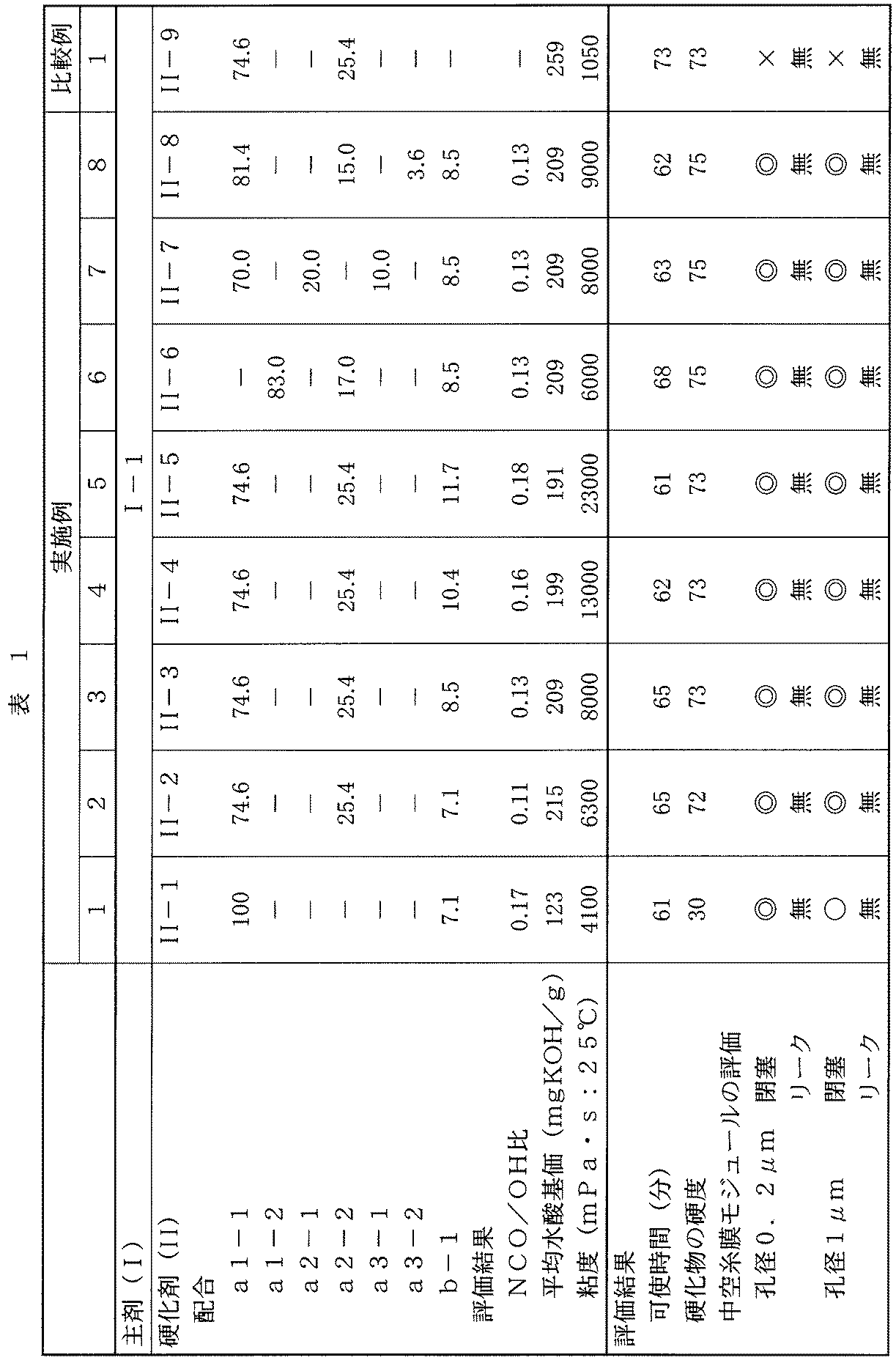
表1に示されるように、水酸基末端ウレタンプレポリマー(B)を含有する硬化剤(II)を用いたポリウレタン樹脂組成物(実施例1~8)は、適切な範囲の可使時間であり、かつ中空糸膜の閉塞を抑制できた。特に、ポリオール成分(a)として、ひまし油系ポリオール(a1)と水酸基数4~8のポリエーテルポリオール(a2)を併用したものを用いたポリウレタン樹脂組成物(実施例2~8)の硬化物は硬度が高く、また、孔径1μの中空糸膜を使用した場合にも閉塞をより抑制できた。一方、硬化剤(II)としてひまし油系ポリオール(a1)と水酸基数4~8のポリエーテルポリオール(a2)の混合物を用いたポリウレタン樹脂組成物(比較例1)は、中空糸膜モジュールの閉塞を抑制することができなかった。
本発明のポリウレタン樹脂組成物は、浄水器や血液処理器などに使用する中空糸膜の結束材として使用可能である。
Claims (4)
- イソシアネート基末端ウレタンプレポリマー(A)を含有する主剤(I)と水酸基末端ウレタンプレポリマー(B)を含有する硬化剤(II)とを含み、
水酸基末端ウレタンプレポリマー(B)が、ひまし油系ポリオール(a1)を含有するポリオール成分(a)とポリイソシアネート(b)との反応物であるポリウレタン樹脂組成物。 - ポリオール成分(a)が、さらに水酸基数4~8のポリエーテルポリオール(a2)を含有する請求項1記載のポリウレタン樹脂組成物。
- 前記ポリウレタン樹脂組成物が、中空糸の結束用の組成物である請求項1または2記載のポリウレタン樹脂組成物。
- 請求項1~3のいずれかに記載のポリウレタン樹脂組成物を用いてなる中空糸膜モジュール。
Priority Applications (2)
| Application Number | Priority Date | Filing Date | Title |
|---|---|---|---|
| US14/128,677 US9249298B2 (en) | 2011-06-23 | 2012-05-25 | Polyurethane resin composition and hollow fiber membrane module produced using same |
| CN201280030910.3A CN103619896B (zh) | 2011-06-23 | 2012-05-25 | 聚氨酯树脂组合物和使用其生产的中空纤维膜模块 |
Applications Claiming Priority (2)
| Application Number | Priority Date | Filing Date | Title |
|---|---|---|---|
| JP2011139592A JP5797475B2 (ja) | 2011-06-23 | 2011-06-23 | ポリウレタン樹脂組成物およびそれを用いてなる中空糸膜モジュール |
| JP2011-139592 | 2011-06-23 |
Publications (1)
| Publication Number | Publication Date |
|---|---|
| WO2012176577A1 true WO2012176577A1 (ja) | 2012-12-27 |
Family
ID=47422419
Family Applications (1)
| Application Number | Title | Priority Date | Filing Date |
|---|---|---|---|
| PCT/JP2012/063425 Ceased WO2012176577A1 (ja) | 2011-06-23 | 2012-05-25 | ポリウレタン樹脂組成物およびそれを用いてなる中空糸膜モジュール |
Country Status (4)
| Country | Link |
|---|---|
| US (1) | US9249298B2 (ja) |
| JP (1) | JP5797475B2 (ja) |
| CN (1) | CN103619896B (ja) |
| WO (1) | WO2012176577A1 (ja) |
Cited By (1)
| Publication number | Priority date | Publication date | Assignee | Title |
|---|---|---|---|---|
| WO2025249289A1 (ja) * | 2024-05-29 | 2025-12-04 | 三洋化成工業株式会社 | ポリウレタン樹脂形成性組成物、シール材、膜モジュール及び中空糸型血液処理器又は浄水器 |
Families Citing this family (2)
| Publication number | Priority date | Publication date | Assignee | Title |
|---|---|---|---|---|
| JP6133267B2 (ja) * | 2013-12-26 | 2017-05-24 | 三洋化成工業株式会社 | 浄水器に用いられる膜モジュールのシール材用ポリウレタン樹脂形成性組成物 |
| KR102259555B1 (ko) * | 2019-06-26 | 2021-06-03 | 주식회사 삼양사 | 히드록시-말단 프리폴리머 및 이를 포함하는 잠재성 경화제, 및 이 경화제를 포함하는 에폭시 수지 조성물 |
Citations (7)
| Publication number | Priority date | Publication date | Assignee | Title |
|---|---|---|---|---|
| JPS54132698A (en) * | 1978-03-25 | 1979-10-15 | Akzo Nv | Polyurethane sealing material and preparing same |
| JPS6058156A (ja) * | 1983-09-08 | 1985-04-04 | 三洋化成工業株式会社 | シ−ル材および人工臓器 |
| JPS60147426A (ja) * | 1984-01-13 | 1985-08-03 | Mitui Toatsu Chem Inc | 硬化性組成物 |
| JPS62227915A (ja) * | 1986-03-29 | 1987-10-06 | Ito Seiyu Kk | 防食塗料用二液ウレタン組成物 |
| JPS63246175A (ja) * | 1987-03-31 | 1988-10-13 | 三洋化成工業株式会社 | 人工臓器用シ−ル材 |
| WO2006035632A1 (ja) * | 2004-09-28 | 2006-04-06 | Nippon Polyurethane Industry Co., Ltd. | ポリウレタン樹脂形成性組成物、シール材及び中空糸膜モジュール |
| JP2011016993A (ja) * | 2009-06-12 | 2011-01-27 | Dai Ichi Kogyo Seiyaku Co Ltd | 2液型ポリウレタン樹脂組成物 |
Family Cites Families (3)
| Publication number | Priority date | Publication date | Assignee | Title |
|---|---|---|---|---|
| DE4134693A1 (de) * | 1991-10-21 | 1993-04-22 | Basf Ag | Transparente, heissdampfsterilisierbare, nicht zytotoxische, im wesentlichen kompakte polyurethan-vergussmassen, verfahren zu ihrer herstellung und ihre verwendung, insbesondere fuer medizinisch-technische artikel |
| JP4264976B2 (ja) | 2003-09-12 | 2009-05-20 | 日本ポリウレタン工業株式会社 | 膜シール材用ポリウレタン樹脂形成性組成物、及び該形成性組成物を用いた中空或いは平膜状繊維分離膜の膜シール材 |
| JP4875179B2 (ja) * | 2009-03-31 | 2012-02-15 | 本田技研工業株式会社 | 車両内装材用合成皮革及びその製造方法 |
-
2011
- 2011-06-23 JP JP2011139592A patent/JP5797475B2/ja active Active
-
2012
- 2012-05-25 US US14/128,677 patent/US9249298B2/en active Active
- 2012-05-25 CN CN201280030910.3A patent/CN103619896B/zh active Active
- 2012-05-25 WO PCT/JP2012/063425 patent/WO2012176577A1/ja not_active Ceased
Patent Citations (7)
| Publication number | Priority date | Publication date | Assignee | Title |
|---|---|---|---|---|
| JPS54132698A (en) * | 1978-03-25 | 1979-10-15 | Akzo Nv | Polyurethane sealing material and preparing same |
| JPS6058156A (ja) * | 1983-09-08 | 1985-04-04 | 三洋化成工業株式会社 | シ−ル材および人工臓器 |
| JPS60147426A (ja) * | 1984-01-13 | 1985-08-03 | Mitui Toatsu Chem Inc | 硬化性組成物 |
| JPS62227915A (ja) * | 1986-03-29 | 1987-10-06 | Ito Seiyu Kk | 防食塗料用二液ウレタン組成物 |
| JPS63246175A (ja) * | 1987-03-31 | 1988-10-13 | 三洋化成工業株式会社 | 人工臓器用シ−ル材 |
| WO2006035632A1 (ja) * | 2004-09-28 | 2006-04-06 | Nippon Polyurethane Industry Co., Ltd. | ポリウレタン樹脂形成性組成物、シール材及び中空糸膜モジュール |
| JP2011016993A (ja) * | 2009-06-12 | 2011-01-27 | Dai Ichi Kogyo Seiyaku Co Ltd | 2液型ポリウレタン樹脂組成物 |
Cited By (1)
| Publication number | Priority date | Publication date | Assignee | Title |
|---|---|---|---|---|
| WO2025249289A1 (ja) * | 2024-05-29 | 2025-12-04 | 三洋化成工業株式会社 | ポリウレタン樹脂形成性組成物、シール材、膜モジュール及び中空糸型血液処理器又は浄水器 |
Also Published As
| Publication number | Publication date |
|---|---|
| US20140128554A1 (en) | 2014-05-08 |
| CN103619896B (zh) | 2016-09-07 |
| JP2013006933A (ja) | 2013-01-10 |
| US9249298B2 (en) | 2016-02-02 |
| JP5797475B2 (ja) | 2015-10-21 |
| CN103619896A (zh) | 2014-03-05 |
Similar Documents
| Publication | Publication Date | Title |
|---|---|---|
| CN106336495B (zh) | 聚氨酯树脂形成性组合物、中空纤维膜组件用密封材料及中空纤维膜组件 | |
| JP5154606B2 (ja) | 2液型ポリウレタン樹脂組成物 | |
| CN101274979B (zh) | 胺固化的聚氨酯及其制备 | |
| EP2566906A1 (de) | Polyisocyanatprepolymere und deren verwendung | |
| EP2585509B1 (de) | Beschichtete teile und deren verwendung | |
| JP2010275425A (ja) | 2液反応型ポリウレタン樹脂組成物及びこれを硬化させてなるポリウレタン樹脂 | |
| JP5039535B2 (ja) | 2液型ポリウレタン樹脂組成物 | |
| JP4721064B2 (ja) | ポリウレタン樹脂形成性組成物、シール材の製造方法、及び中空糸膜モジュールの製造方法 | |
| JP5797475B2 (ja) | ポリウレタン樹脂組成物およびそれを用いてなる中空糸膜モジュール | |
| JP6878012B2 (ja) | ポリウレタン樹脂形成性組成物 | |
| JP5341346B2 (ja) | 2液反応型ポリウレタン樹脂組成物及びこれを硬化させてなるポリウレタン樹脂 | |
| CN101885828B (zh) | 两液型聚氨酯树脂组合物 | |
| EP3568424B1 (en) | Physical property improvement of polyurethanes | |
| JP5263916B2 (ja) | 水系ポリウレタン樹脂組成物 | |
| JP5707197B2 (ja) | ポリオール組成物及びポリウレタン樹脂 | |
| JP7690769B2 (ja) | ウレタンプレポリマーの製造方法 | |
| JP6705196B2 (ja) | ポリアルキレンオキシド組成物 | |
| EP2471831A1 (en) | Method for manufacturing an isocyanate-terminated prepolymer, prepolymer obtained thereby, and polyurethane resin | |
| MXPA04009801A (es) | Una mezcla reactiva a isocianato mejorada y procedimiento para su preparacion. | |
| JP2024033830A (ja) | 硬化性樹脂組成物およびその硬化体 | |
| JP2007224078A (ja) | 中空糸膜モジュールに用いられるシール材用ポリウレタン樹脂形成性組成物、及び該組成物を用いた中空糸膜モジュール用シール材 | |
| CN117083313A (zh) | 用于形成聚脲的组合物、形成聚脲的方法和用于形成聚脲的试剂盒 | |
| JP2006070185A (ja) | ポリウレタン系硬化性組成物 |
Legal Events
| Date | Code | Title | Description |
|---|---|---|---|
| 121 | Ep: the epo has been informed by wipo that ep was designated in this application |
Ref document number: 12801822 Country of ref document: EP Kind code of ref document: A1 |
|
| NENP | Non-entry into the national phase |
Ref country code: DE |
|
| WWE | Wipo information: entry into national phase |
Ref document number: 14128677 Country of ref document: US |
|
| 122 | Ep: pct application non-entry in european phase |
Ref document number: 12801822 Country of ref document: EP Kind code of ref document: A1 |