WO2012176741A1 - Brosse à dents - Google Patents
Brosse à dents Download PDFInfo
- Publication number
- WO2012176741A1 WO2012176741A1 PCT/JP2012/065551 JP2012065551W WO2012176741A1 WO 2012176741 A1 WO2012176741 A1 WO 2012176741A1 JP 2012065551 W JP2012065551 W JP 2012065551W WO 2012176741 A1 WO2012176741 A1 WO 2012176741A1
- Authority
- WO
- WIPO (PCT)
- Prior art keywords
- toothbrush
- neck
- exposed
- base
- head
- Prior art date
- Legal status (The legal status is an assumption and is not a legal conclusion. Google has not performed a legal analysis and makes no representation as to the accuracy of the status listed.)
- Ceased
Links
Images







Classifications
-
- A—HUMAN NECESSITIES
- A46—BRUSHWARE
- A46B—BRUSHES
- A46B5/00—Brush bodies; Handles integral with brushware
-
- A—HUMAN NECESSITIES
- A46—BRUSHWARE
- A46B—BRUSHES
- A46B2200/00—Brushes characterized by their functions, uses or applications
- A46B2200/10—For human or animal care
- A46B2200/1066—Toothbrush for cleaning the teeth or dentures
-
- A—HUMAN NECESSITIES
- A46—BRUSHWARE
- A46D—MANUFACTURE OF BRUSHES
- A46D3/00—Preparing, i.e. Manufacturing brush bodies
- A46D3/005—Preparing, i.e. Manufacturing brush bodies by moulding or casting a body around bristles or tufts of bristles
Definitions
- the handle body includes a head portion in which a hair bundle is implanted, and a handle portion extended to the head portion via a neck portion, and has a long shape as a whole.
- the head portion is often formed as thin as possible.
- the neck portion is often shaped to have a diameter smaller than that of the head portion in consideration of operability in the oral cavity.
- Patent Document 1 a toothbrush in which one surface of the head portion and the neck portion or the entire surface of the handle body is covered with a soft resin such as an elastomer resin has been proposed (for example, Patent Document 1).
- the head part and the neck part are simply covered with a soft resin as in the technique of Patent Document 1, the volume of the hard resin that becomes the core of the handle body is reduced and the strength is lowered.
- the volume of the hard resin is increased, the head portion and the neck portion are thickened, and the operability and usability are easily impaired.
- the head portion and the neck portion cannot be sufficiently prevented from being broken or broken.
- the core of the handle body is molded with a hard resin (primary molding), put into a mold, and the soft resin is injected into the mold (secondary molding).
- the head portion and neck portion can be prevented from being broken or broken, and can be easily manufactured.
- FIG. 1A It is a top view of a toothbrush concerning a second embodiment of the present invention. It is a bottom view of the toothbrush concerning a second embodiment of the present invention. It is a side view of the toothbrush concerning 2nd embodiment of this invention. It is D1-D1 sectional drawing of FIG. 2A. It is a top view of a toothbrush concerning a third embodiment of the present invention. It is a bottom view of a toothbrush concerning a third embodiment of the present invention. It is a side view of the toothbrush concerning 3rd embodiment of this invention.
- FIG. 3A It is D2-D2 sectional drawing of FIG. 3A. It is a top view of the toothbrush concerning a 4th embodiment of the present invention. It is a bottom view of the toothbrush concerning a 4th embodiment of the present invention. It is a side view of the toothbrush concerning a 4th embodiment of the present invention. It is D3-D3 sectional drawing of FIG. 4A. It is a top view of the toothbrush used for the comparative example. It is a bottom view of the toothbrush used for the comparative example. It is a side view of the toothbrush used for the comparative example. It is D4-D4 sectional drawing of FIG. 5A. It is a top view of the toothbrush used for the comparative example. It is a bottom view of the toothbrush used for the comparative example.
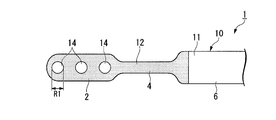
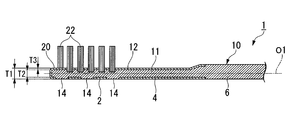
- a toothbrush 1 shown in FIGS. 1A to 1C includes a head body 2, a handle body 10 including a neck portion 4 extending to the head portion 2, and a handle portion 6 extending to the neck portion 4, and a head portion. And two or more hair bundles 22 planted on the second flocked surface 20.
- the number of hair bundles 22 is preferably 2 or more and 40 or less, and more preferably 10 or more and 30 or less from the viewpoint of cleaning power.
- the base end of the handle part in this embodiment that is, the boundary between the neck part 4 and the handle part 6 is a position (neck part end point) P2 at which the widening of the neck part 4 ends in plan view (see FIG. 1A).
- the base 11 is a member serving as a core of the handle body 10, and the head portion 2, the neck portion 4, and the portion that forms the handle portion 6 are integrally formed.
- the material of the base 11 can be determined in consideration of the rigidity and mechanical characteristics required for the toothbrush 1, and examples thereof include a hard resin having a flexural modulus (JIS K7203) in the range of 500 to 3000 MPa.
- a hard resin having a flexural modulus (JIS K7203) in the range of 500 to 3000 MPa.
- Examples of such a hard resin include polypropylene (PP), polyethylene terephthalate (PET), polybutylene terephthalate (PBT), polycyclohexylenedimethylene terephthalate (PCT), polyacetal (POM), polystyrene (PS), acrylonitrile.
- the thickness T2 of the base 11 in the head unit 2 can be determined in consideration of the material of the base 11 and the like, and is set to 2 to 4 mm, for example.
- the thickness of the base 11 in the neck portion 4 is the same as the thickness T2 of the base 11 in the head portion 11.
- the covering layer 12 covers 70% or more of the total surface area of the head portion 2 and the neck portion 4 (covering ratio 70%). For example, the covering layer 12 covers 70 to 95%, preferably 80 to 90%. What covers% is more preferable. As the coverage by the coating layer 12 increases, the head portion and the neck portion can be more highly prevented from being broken or broken.
- the surface area of the head portion 2 is the projected area from the front surface (the flocked surface 20) from the head portion distal end 21 to the head portion proximal end, that is, from the head portion distal end 21 to P1, which is the boundary between the head portion 2 and the neck portion 4. It is.
- the surface area of the neck portion 4 is a projected area from the front surface (the flocked surface 20) from the P1 to the position (neck portion end point) P2 where the widening of the neck portion 4 ends.
- the material of the coating layer 12 may be a soft resin that can prevent the handle body from being damaged.
- examples thereof include elastomer resins such as polyolefin elastomers, styrene elastomers, and polyester elastomers. Styrenic elastomers are preferred from the viewpoint of preventing defects more reliably.
- examples of the styrene-based elastomer include Septon (trade name, manufactured by Kuraray Co., Ltd.) and Rheostomer (trade name, manufactured by Riken Technos Co., Ltd.). More preferably, the material of the covering layer 12 is determined in consideration of the material of the base 11.
- the thickness T3 of the coating layer 12 can be determined in consideration of the material of the resin constituting the coating layer 12, and is preferably 0.5 to 2 mm, and more preferably 0.8 to 1.5 mm. If it is not less than the above lower limit value, it is possible to effectively prevent the handle body 10 from being damaged, and if it is not more than the above upper limit value, the thickness of the head portion 2 or the neck portion 4 does not become too thick and the operability of the handle body 10 is improved. To do.
- the thickness (hair bundle diameter) of the hair bundle 22 can be determined in consideration of the hair and the like required for the hair bundle 22 and is, for example, 1 to 2 mm. All the hair bundles 22 may have the same hair bundle diameter or may be different from each other.
- the material of the hair is, for example, polyamide such as 6-12 nylon (6-12NY) or 6-10 nylon (6-10NY), PET, PBT, polytrimethylene terephthalate (PTT), polyethylene naphthalate (PEN) Or polyester such as polybutylene naphthalate (PBN), polyolefin such as PP, or elastomer resin such as polyolefin elastomer or styrene elastomer. These resin materials can be used singly or in combination of two or more.
- the bristle include polyester bristle having a multi-core structure having a core part and at least one or more sheath parts provided outside the core part.
- the cross-sectional shape of the hair is not particularly limited, and may be a perfect circle, a circle such as an ellipse, a polygon, a star, a three-leaf clover, or a four-leaf clover.
- the cross-sectional shapes of all the hairs may be the same or different.
- a pair of primary molds that form a cavity corresponding to the shape of the base 11 is used, and a hard resin (sometimes referred to as a primary resin) constituting the base 11 is injected into the cavity. 11 is an operation of molding 11.
- the subsequent secondary molding uses a pair of secondary molds in which cavities corresponding to the shape of the coating layer 12 are formed, and the base 11 obtained by the primary molding is loaded into the cavity of the secondary mold.
- This is an operation of injecting a soft resin (sometimes referred to as a secondary resin) constituting the coating layer 12 into the secondary mold to form the coating layer 12.
- the cavity of the secondary mold is such that when the base 11 is loaded in the cavity, the space formed between the loaded base 11 and the cavity has a shape corresponding to the coating layer 12. is there.
- the base 11 is formed with a convex portion having a shape corresponding to the exposed portion 14, and this convex portion comes into contact with the inner surface of the secondary mold.
- a gap having a shape corresponding to the coating layer 12 is stably formed inside the secondary mold.
- a gap having a shape corresponding to the coating layer 12 is secured, so that the coating layer 12 can be stably formed with a desired thickness.
- a coating layer made of a soft resin covering 70% or more of the total surface area of the head part and the surface area of the neck part is formed on the surface of the base made of hard resin. Since it is formed, the handle body is not easily broken even if an excessive load is applied to the head portion or the neck portion. Further, even when the handle body is folded at the head portion or the neck portion, it is possible to prevent the folded portion from being exposed, or to hold the missing member with the coating layer. According to the toothbrush of this embodiment, since one or more exposed portions where the base is exposed are formed in the coating layer, the coating layer can be stably formed with a desired thickness.
- the exposed portion is not formed in a two-fold symmetric region with the axis of the neck portion as the axis of symmetry, when the head portion or the neck portion is bitten with teeth, the upper teeth and the lower jaw None of the teeth touches the exposed part directly.
- the load can be reduced by the coating layer. For this reason, it is possible to prevent an excessive load from being applied to the head portion or the neck portion, and to prevent the head portion and the neck portion from being broken or broken.
- FIGS. 2A to 2D A toothbrush according to a second embodiment of the present invention will be described with reference to FIGS. 2A to 2D.
- the same components as those in the first embodiment are denoted by the same reference numerals, description thereof is omitted, and differences from the first embodiment are mainly described.
- the difference from the first embodiment is the shape of the exposed portion and the position of the exposed portion.
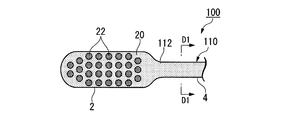
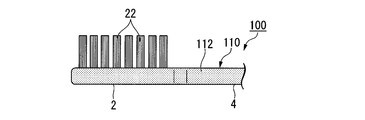
- the toothbrush 100 of the present embodiment includes a handle body 110 having a coating layer 112 formed on the surface of a base 111.
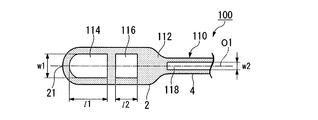
- a substantially semicircular exposed portion 114 is formed near the head portion tip 21, and a substantially square exposed portion 116 is formed near the head portion base end.
- a substantially rectangular exposed portion 118 is formed on the bottom surface of the neck portion 4 so as to extend from the head portion base end to the handle portion base end in the direction of the axis O1.
- the exposed portion 118 is substantially flush with the outer surface of the covering layer 112.
- the exposed portion 114 and the exposed portion 116 are also substantially flush with the outer surface of the coating layer 112, similar to the exposed portion 118.
- the region where the base 111 is exposed is not formed in a region that is symmetrical with the exposed portions 114, 116, and 118 with the axis O1 as the axis of symmetry.
- the length l1 of the exposed portion 114 can be determined in consideration of the length of the head portion 2 and the like, and is, for example, 5 to 15 mm.
- the width w1 of the exposed portion 114 can be determined in consideration of the width of the head portion 2, and is set to 3 to 8 mm, for example.
- the length l2 of the exposed portion 116 can be determined in consideration of the length of the head portion 2 and the like, and is set to 3 to 5 mm, for example.
- the width of the exposed portion 116 is the same as the width w1 of the exposed portion 114.
- the width w2 of the exposed portion 118 can be determined in consideration of the width of the neck portion 4 and the like, and is, for example, 1 to 4 mm.
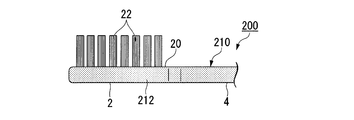
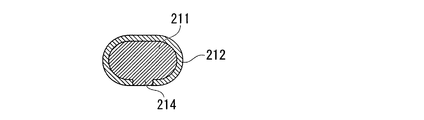
- FIGS. 3A to 3D A toothbrush according to a third embodiment of the present invention will be described with reference to FIGS. 3A to 3D.
- the same components as those in the first embodiment are denoted by the same reference numerals, description thereof is omitted, and differences from the first embodiment are mainly described.
- the difference from the first embodiment is the shape of the exposed portion and the position of the exposed portion.
- FIGS. 4A to 4D A toothbrush according to a fourth embodiment of the present invention will be described with reference to FIGS. 4A to 4D.
- the same components as those in the first embodiment are denoted by the same reference numerals, description thereof is omitted, and differences from the first embodiment are mainly described.
- This embodiment is different from the first embodiment in that a substantially rectangular exposed portion is formed on the bottom surface of the neck portion.
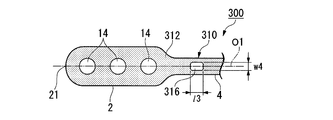
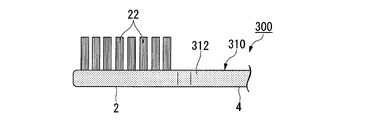
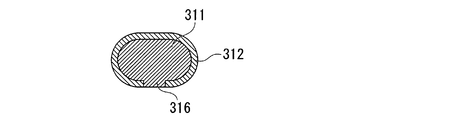
- the toothbrush 300 of the present embodiment includes a handle body 310 having a coating layer 312 formed on the surface of a base 311.
- the covering layer 312 three exposed portions 14 are formed on the bottom surface of the head portion 2, and one substantially rectangular exposed portion 316 whose longitudinal direction is the axis O 1 direction is formed on the bottom surface of the neck portion 4.
- the exposed portion 316 is substantially flush with the outer surface of the covering layer 312.
- an area where the base 311 is exposed is not formed in an area symmetrical to the exposed portion 316 with the axis O1 as the axis of symmetry.
- the length l3 of the exposed portion 316 can be determined in consideration of the length of the head portion 2 and the like, and is set to 1 to 5 mm, for example.
- the width w4 of the exposed portion 316 can be determined in consideration of the width of the neck portion 4 and the like, and is, for example, 1 to 4 mm.
- the base can be more stably fixed in the secondary mold.
- the exposed portion is formed only on the surface (bottom surface) opposite to the flocked surface, but the present invention is not limited to this, and is a surface facing in the same direction as the flocked surface ( An exposed portion may be formed on the upper surface) or the side surface. Alternatively, the exposed portion may be formed on any two or more of the bottom surface, the top surface, and the side surface. When the exposed portion is formed on any two or more of the bottom surface, the top surface, and the side surface, the base can be more stably fixed in the secondary mold.
- the substantially true circular exposed portion is formed in the head portion, but the present invention is not limited to this, and the shape of the exposed portion is elliptical, substantially polygonal, or the like. It may be.
- a substantially polygon is a concept including a shape in which corners are cut off by straight lines or curves.
- the shape of the exposed portion is preferably a circle such as a perfect circle or an ellipse, or a polygon cut off by a curve, in order to suppress peeling of the coating layer.
- the shape of the exposed portion formed in the neck portion is substantially rectangular, but the present invention is not limited to this, and the shape of the exposed portion formed in the neck portion is circular. It may be.
- the number of exposed portions 14, 114, 116, 118, 214, or 316 is 1, 3, or 4, but the present invention is not limited to this.
- the number of the exposed portions 14, 114, 116, 118, 214, or 316 can be determined according to the design, and is preferably 1 to 5, more preferably 2 to 4.
- the coating layer is formed in the region including the handle portion proximal end from the head portion distal end.
- the coating layer only needs to cover 70% or more of the total surface area of the head portion and the surface area of the neck portion.
- the coating layer is formed from the front end of the head portion to the front end of the handle portion.
- a coating layer may be formed up to the tip of the handle portion.
- Example 1 The base material shown in Table 1 is used as a primary resin, the base is manufactured, and then the coating layer material shown in Table 1 is used as a secondary resin to form a coating layer on the base.
- a toothbrush similar to 100 was produced. About the obtained toothbrush, head part intensity
- “polyester” indicates a polyester elastomer
- polyolefin indicates a polyolefin elastomer
- Example 2 A toothbrush similar to the toothbrush 200 of FIGS. 3A to 3D was manufactured in the same manner as in Example 1 except that the base material and the coating layer material were as shown in Table 1 and the exposed part was the following specification. About the obtained toothbrush, head part intensity
- Example 3 A toothbrush similar to the toothbrush 300 of FIGS. 4A to 4D was manufactured in the same manner as in Example 1 except that the base material and the coating layer material were as shown in Table 1 and the exposed portion was the following specification. About the obtained toothbrush, head part intensity
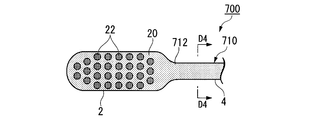
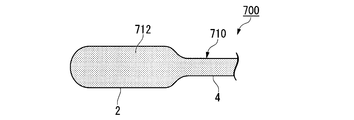
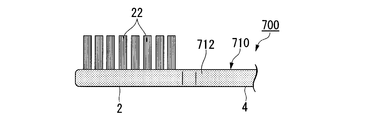
- Example 1 A toothbrush similar to the toothbrush 700 of FIGS. 5A to 5D was produced in the same manner as in Example 1 except that the base material and the coating layer material were those shown in Table 1. About the obtained toothbrush, head part intensity
- the toothbrush 700 includes a handle body 710 in which the entire base 711 is covered with a coating layer 712. In the handle body 710, 100% of the total surface area of the head portion 2 and the neck portion 4 is covered with the coating layer 712, and no exposed portion is formed.
- Example 2 A toothbrush similar to the toothbrush 800 of FIGS. 6A to 6D was manufactured in the same manner as in Example 1 except that the base material was as shown in Table 1 and secondary molding was not performed. About the obtained toothbrush, head part intensity
- the toothbrush 800 does not have a coating layer formed on the handle body 810, and is constituted only by a base.
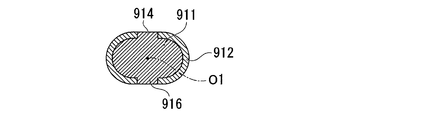
- the toothbrush 900 includes a handle body 910 having a coating layer 912 formed on the surface of a base 911.
- a substantially rectangular exposed portion 914 is formed on the upper surface of the neck portion 4, and a substantially rectangular exposed portion 916 is formed on the bottom surface of the neck portion 4.
- the exposed portion 914 and the exposed portion 916 are formed in a two-fold symmetric region with the axis O1 as the axis of symmetry.
- Example 1 As shown in Table 1, in each of Examples 1 to 3 to which the present invention was applied, the overall evaluation was “B” or “A”. In Examples 1 to 3, operability and usability in the oral cavity were all good. On the other hand, Comparative Example 1 in which no exposed part was formed had a moldability of “D”, and Comparative Example 2 in which no coating layer was formed showed separation of the handle body. In Comparative Example 3 in which the axis of the neck portion was the axis of symmetry and the exposed portion was formed in a region that was twice symmetric, the neck portion strength was “C”. From the above results, it was found that by applying the present invention, it is possible to obtain a toothbrush that can prevent the head portion and the neck portion from being broken or broken and can be easily manufactured.
- the present invention it is possible to provide a toothbrush that can prevent the head portion and the neck portion from being broken or broken and can be easily manufactured.
- Handle part 10 110, 210, 310 Handle body 11, 111, 211, 311 Base 12, 112, 212, 312 Coating layer 14, 114, 116, 118, 214, 316 exposed portion 20 flocked surface 22 hair bundle O1 axis
Landscapes
- Brushes (AREA)
Abstract
La présente invention porte sur une brosse à dents (1), laquelle brosse à dents comporte un corps de manche (10) comprenant une partie tête (2) où au moins deux faisceaux de poils (22) ont été transplantés sur une surface d'implantation de poils (20), une partie col (4) disposée dans la partie tête (2), et une partie manche (6) disposée dans la partie col (4). Dans la partie manche (10), une couche de revêtement (12) est constituée par une résine molle recouvrant au moins 70 % du total de la surface de la partie tête (2) et de la surface de la partie col (4), et est disposée sur la surface d'une base (11) constituée par une résine rigide. Au moins une partie exposée (14) où la base (11) est exposée est disposée sur la couche de revêtement (12) de la brosse à dents (1), et la partie exposée (14) n'est pas disposée dans une zone symétrique double avec une ligne d'arbre (O1) de la partie col (4) constituant un axe de symétrie. Selon la présente invention, une détérioration et une rupture de la partie tête et de la partie col peuvent être empêchées, et la brosse à dents peut être fabriquée facilement.
Priority Applications (2)
| Application Number | Priority Date | Filing Date | Title |
|---|---|---|---|
| KR1020137030615A KR102085517B1 (ko) | 2011-06-20 | 2012-06-18 | 칫솔 |
| CN201280014091.3A CN103442614B (zh) | 2011-06-20 | 2012-06-18 | 牙刷 |
Applications Claiming Priority (2)
| Application Number | Priority Date | Filing Date | Title |
|---|---|---|---|
| JP2011136480A JP5830277B2 (ja) | 2011-06-20 | 2011-06-20 | 歯ブラシ |
| JP2011-136480 | 2011-06-20 |
Publications (1)
| Publication Number | Publication Date |
|---|---|
| WO2012176741A1 true WO2012176741A1 (fr) | 2012-12-27 |
Family
ID=47422578
Family Applications (1)
| Application Number | Title | Priority Date | Filing Date |
|---|---|---|---|
| PCT/JP2012/065551 Ceased WO2012176741A1 (fr) | 2011-06-20 | 2012-06-18 | Brosse à dents |
Country Status (4)
| Country | Link |
|---|---|
| JP (1) | JP5830277B2 (fr) |
| KR (1) | KR102085517B1 (fr) |
| CN (1) | CN103442614B (fr) |
| WO (1) | WO2012176741A1 (fr) |
Cited By (19)
| Publication number | Priority date | Publication date | Assignee | Title |
|---|---|---|---|---|
| USD777446S1 (en) | 2015-07-23 | 2017-01-31 | Colgate-Palmolive Company | Oral care implement handle |
| USD780457S1 (en) | 2014-12-23 | 2017-03-07 | Colgate-Palmolive Company | Oral care implement |
| US9802347B2 (en) | 2015-02-02 | 2017-10-31 | Colgate-Palmolive Company | Method of forming an oral care implement |
| US10021959B2 (en) | 2014-12-23 | 2018-07-17 | Colgate-Palmolive Company | Oral care implement having multi-component handle |
| US10182644B2 (en) | 2014-12-23 | 2019-01-22 | Colgate-Palmolive Company | Oral care implement |
| US10226118B2 (en) | 2014-12-23 | 2019-03-12 | Colgate-Palmolive Company | Oral care implement having multi-component handle |
| US10426250B2 (en) | 2014-12-23 | 2019-10-01 | Colgate-Palmolive Company | Oral care implement |
| US10455931B2 (en) | 2014-12-23 | 2019-10-29 | Colgate-Palmolive Company | Oral care implement |
| US10595628B2 (en) | 2014-12-23 | 2020-03-24 | Colgate-Palmolive Company | Oral care implement |
| US10660430B2 (en) | 2014-12-23 | 2020-05-26 | Colgate-Palmolive Company | Oral care implement having multi-component handle |
| US10687610B2 (en) | 2014-12-23 | 2020-06-23 | Colgate-Palmolive Company | Oral care implement |
| US10743646B2 (en) | 2014-12-23 | 2020-08-18 | Colgate-Palmolive Company | Oral care implement |
| US11229281B2 (en) | 2014-12-23 | 2022-01-25 | Colgate-Palmolive Company | Oral care implement |
| US11291293B2 (en) | 2014-12-23 | 2022-04-05 | Colgate-Palmolive Company | Oral care implement |
| USD960582S1 (en) | 2020-12-10 | 2022-08-16 | Colgate-Palmolive Company | Oral care refill head |
| US11517412B2 (en) | 2017-12-12 | 2022-12-06 | Colgate-Palmolive Company | Oral care implement |
| USD997567S1 (en) | 2018-12-18 | 2023-09-05 | Colgate-Palmolive Company | Electric toothbrush |
| US11833004B2 (en) | 2017-12-12 | 2023-12-05 | Colgate-Palmolive Company | Oral care implement and handle and refill head thereof |
| USD1044284S1 (en) | 2017-12-12 | 2024-10-01 | Colgate-Palmolive Company | Oral care implement |
Families Citing this family (9)
| Publication number | Priority date | Publication date | Assignee | Title |
|---|---|---|---|---|
| CN111449408B (zh) * | 2014-09-01 | 2023-09-08 | 狮王株式会社 | 牙刷 |
| JP6552091B2 (ja) * | 2015-06-19 | 2019-07-31 | ライオン株式会社 | 歯ブラシハンドルおよび歯ブラシ |
| KR102788834B1 (ko) | 2015-09-25 | 2025-03-31 | 라이온 가부시키가이샤 | 칫솔 |
| JP6914024B2 (ja) * | 2016-10-28 | 2021-08-04 | ライオン株式会社 | 歯ブラシおよび歯ブラシ製造方法 |
| KR102748253B1 (ko) * | 2018-12-27 | 2024-12-31 | 라이온 가부시키가이샤 | 칫솔 |
| CN112704319A (zh) * | 2019-10-25 | 2021-04-27 | 广州仓杰科技有限公司 | 无金属刷毛电动牙刷头及其制造方法 |
| CN112133968B (zh) * | 2020-10-09 | 2022-03-29 | 深圳市量能科技有限公司 | 一种二次圆柱形镍系电池及其制作方法 |
| JP7786937B2 (ja) * | 2021-12-17 | 2025-12-16 | サンスター株式会社 | オーラルケア用品の成形品およびオーラルケア用品 |
| CN220554522U (zh) * | 2023-08-29 | 2024-03-05 | 广州星际悦动股份有限公司 | 电动牙刷头及电动牙刷 |
Citations (3)
| Publication number | Priority date | Publication date | Assignee | Title |
|---|---|---|---|---|
| JPS59123433U (ja) * | 1983-02-10 | 1984-08-20 | 有限会社スズアイリ−ス | 歯ブラシ |
| JPH02143035U (fr) * | 1989-05-10 | 1990-12-04 | ||
| JP2002034659A (ja) * | 2000-07-19 | 2002-02-05 | Lion Corp | 歯ブラシハンドルおよびその製造方法 |
Family Cites Families (8)
| Publication number | Priority date | Publication date | Assignee | Title |
|---|---|---|---|---|
| JPH02143035A (ja) | 1988-11-25 | 1990-06-01 | Toshiba Audio Video Eng Corp | 天井設置形空気調和機 |
| CN2320103Y (zh) * | 1998-04-10 | 1999-05-26 | 黄于民 | 安全牙刷 |
| JP2001299450A (ja) * | 2000-04-27 | 2001-10-30 | Lion Corp | 歯ブラシ |
| WO2002078489A1 (fr) * | 2001-03-30 | 2002-10-10 | Unilever N.V. | Brosse a dents |
| JP2003144232A (ja) * | 2001-08-30 | 2003-05-20 | Lion Corp | 歯ブラシハンドルの製造方法 |
| ATE499860T1 (de) * | 2003-11-18 | 2011-03-15 | Trisa Holding Ag | Zahnbürstenkörper |
| CN2699730Y (zh) * | 2004-02-26 | 2005-05-18 | 张文平 | 一种新型安全牙刷 |
| JP4558384B2 (ja) * | 2004-06-15 | 2010-10-06 | ライオン株式会社 | 歯ブラシ |
-
2011
- 2011-06-20 JP JP2011136480A patent/JP5830277B2/ja active Active
-
2012
- 2012-06-18 KR KR1020137030615A patent/KR102085517B1/ko active Active
- 2012-06-18 CN CN201280014091.3A patent/CN103442614B/zh active Active
- 2012-06-18 WO PCT/JP2012/065551 patent/WO2012176741A1/fr not_active Ceased
Patent Citations (3)
| Publication number | Priority date | Publication date | Assignee | Title |
|---|---|---|---|---|
| JPS59123433U (ja) * | 1983-02-10 | 1984-08-20 | 有限会社スズアイリ−ス | 歯ブラシ |
| JPH02143035U (fr) * | 1989-05-10 | 1990-12-04 | ||
| JP2002034659A (ja) * | 2000-07-19 | 2002-02-05 | Lion Corp | 歯ブラシハンドルおよびその製造方法 |
Cited By (30)
| Publication number | Priority date | Publication date | Assignee | Title |
|---|---|---|---|---|
| US10455931B2 (en) | 2014-12-23 | 2019-10-29 | Colgate-Palmolive Company | Oral care implement |
| US10595628B2 (en) | 2014-12-23 | 2020-03-24 | Colgate-Palmolive Company | Oral care implement |
| USD1098756S1 (en) | 2014-12-23 | 2025-10-21 | Colgate-Palmolive Company | Portion for oral care implement |
| US10021959B2 (en) | 2014-12-23 | 2018-07-17 | Colgate-Palmolive Company | Oral care implement having multi-component handle |
| US10182644B2 (en) | 2014-12-23 | 2019-01-22 | Colgate-Palmolive Company | Oral care implement |
| USD1004980S1 (en) | 2014-12-23 | 2023-11-21 | Colgate-Palmolive Company | Oral care implement |
| US10226118B2 (en) | 2014-12-23 | 2019-03-12 | Colgate-Palmolive Company | Oral care implement having multi-component handle |
| US10426250B2 (en) | 2014-12-23 | 2019-10-01 | Colgate-Palmolive Company | Oral care implement |
| USD780457S1 (en) | 2014-12-23 | 2017-03-07 | Colgate-Palmolive Company | Oral care implement |
| USD883676S1 (en) | 2014-12-23 | 2020-05-12 | Colgate-Palmolive Company | Oral care implement and portions thereof |
| US11229281B2 (en) | 2014-12-23 | 2022-01-25 | Colgate-Palmolive Company | Oral care implement |
| US10660430B2 (en) | 2014-12-23 | 2020-05-26 | Colgate-Palmolive Company | Oral care implement having multi-component handle |
| US11779102B2 (en) | 2014-12-23 | 2023-10-10 | Colgate-Palmolive Company | Oral care implement |
| US10687610B2 (en) | 2014-12-23 | 2020-06-23 | Colgate-Palmolive Company | Oral care implement |
| US11291293B2 (en) | 2014-12-23 | 2022-04-05 | Colgate-Palmolive Company | Oral care implement |
| US10743646B2 (en) | 2014-12-23 | 2020-08-18 | Colgate-Palmolive Company | Oral care implement |
| US10835026B2 (en) | 2014-12-23 | 2020-11-17 | Colgate-Palmolive Company | Oral care implement |
| US10723052B2 (en) | 2015-02-02 | 2020-07-28 | Colgate-Palmolive Company | System and method for forming an oral care implement |
| US11577435B2 (en) | 2015-02-02 | 2023-02-14 | Colgate-Palmolive Company | System and method for forming an oral care implement |
| US9802347B2 (en) | 2015-02-02 | 2017-10-31 | Colgate-Palmolive Company | Method of forming an oral care implement |
| USD777446S1 (en) | 2015-07-23 | 2017-01-31 | Colgate-Palmolive Company | Oral care implement handle |
| USD987298S1 (en) | 2015-07-23 | 2023-05-30 | Colgate-Palmolive Company | Oral care implement |
| USD887144S1 (en) | 2015-07-23 | 2020-06-16 | Colgate-Palmolive Company | Oral care implement |
| USD840691S1 (en) | 2015-07-23 | 2019-02-19 | Colgate-Palmolive Company | Oral care implement |
| US11517412B2 (en) | 2017-12-12 | 2022-12-06 | Colgate-Palmolive Company | Oral care implement |
| US11833004B2 (en) | 2017-12-12 | 2023-12-05 | Colgate-Palmolive Company | Oral care implement and handle and refill head thereof |
| USD1044284S1 (en) | 2017-12-12 | 2024-10-01 | Colgate-Palmolive Company | Oral care implement |
| USD997567S1 (en) | 2018-12-18 | 2023-09-05 | Colgate-Palmolive Company | Electric toothbrush |
| USD960582S1 (en) | 2020-12-10 | 2022-08-16 | Colgate-Palmolive Company | Oral care refill head |
| USD1079268S1 (en) | 2020-12-10 | 2025-06-17 | Colgate-Palmolive Company | Oral care implement |
Also Published As
| Publication number | Publication date |
|---|---|
| KR102085517B1 (ko) | 2020-03-05 |
| JP2013000458A (ja) | 2013-01-07 |
| JP5830277B2 (ja) | 2015-12-09 |
| KR20140036187A (ko) | 2014-03-25 |
| CN103442614A (zh) | 2013-12-11 |
| CN103442614B (zh) | 2016-06-08 |
Similar Documents
| Publication | Publication Date | Title |
|---|---|---|
| JP5830277B2 (ja) | 歯ブラシ | |
| CN103957744B (zh) | 牙刷 | |
| CN105530833B (zh) | 牙刷用柄体及其制造方法、以及牙刷 | |
| JP7069377B2 (ja) | 歯ブラシ | |
| TWI520698B (zh) | 牙刷 | |
| KR102771313B1 (ko) | 칫솔 | |
| CN105451602B (zh) | 牙刷 | |
| JP5879118B2 (ja) | 歯ブラシ | |
| CN107635432A (zh) | 牙刷 | |
| CN104284612B (zh) | 牙刷 | |
| WO2016167191A1 (fr) | Brosse interdentaire | |
| WO2017169967A1 (fr) | Corps de manche pour brosse à dents et brosse à dents | |
| JP7212457B2 (ja) | 歯間清掃具 | |
| JP6433065B2 (ja) | 歯間ブラシ | |
| KR102892717B1 (ko) | 칫솔 | |
| CN221845058U (zh) | 牙间刷组 | |
| KR20220029539A (ko) | 칫솔 | |
| JP7370179B2 (ja) | 歯ブラシ | |
| CN102573560B (zh) | 牙刷 |
Legal Events
| Date | Code | Title | Description |
|---|---|---|---|
| 121 | Ep: the epo has been informed by wipo that ep was designated in this application |
Ref document number: 12802186 Country of ref document: EP Kind code of ref document: A1 |
|
| ENP | Entry into the national phase |
Ref document number: 20137030615 Country of ref document: KR Kind code of ref document: A |
|
| NENP | Non-entry into the national phase |
Ref country code: DE |
|
| 122 | Ep: pct application non-entry in european phase |
Ref document number: 12802186 Country of ref document: EP Kind code of ref document: A1 |