WO2012176818A1 - Elément électroluminescent organique - Google Patents
Elément électroluminescent organique Download PDFInfo
- Publication number
- WO2012176818A1 WO2012176818A1 PCT/JP2012/065778 JP2012065778W WO2012176818A1 WO 2012176818 A1 WO2012176818 A1 WO 2012176818A1 JP 2012065778 W JP2012065778 W JP 2012065778W WO 2012176818 A1 WO2012176818 A1 WO 2012176818A1
- Authority
- WO
- WIPO (PCT)
- Prior art keywords
- group
- carbon atoms
- substituted
- general formula
- unsubstituted
- Prior art date
- Legal status (The legal status is an assumption and is not a legal conclusion. Google has not performed a legal analysis and makes no representation as to the accuracy of the status listed.)
- Ceased
Links
Images


Classifications
-
- H—ELECTRICITY
- H10—SEMICONDUCTOR DEVICES; ELECTRIC SOLID-STATE DEVICES NOT OTHERWISE PROVIDED FOR
- H10K—ORGANIC ELECTRIC SOLID-STATE DEVICES
- H10K50/00—Organic light-emitting devices
-
- C—CHEMISTRY; METALLURGY
- C07—ORGANIC CHEMISTRY
- C07D—HETEROCYCLIC COMPOUNDS
- C07D209/00—Heterocyclic compounds containing five-membered rings, condensed with other rings, with one nitrogen atom as the only ring hetero atom
- C07D209/56—Ring systems containing three or more rings
- C07D209/80—[b, c]- or [b, d]-condensed
- C07D209/82—Carbazoles; Hydrogenated carbazoles
- C07D209/86—Carbazoles; Hydrogenated carbazoles with only hydrogen atoms, hydrocarbon or substituted hydrocarbon radicals, directly attached to carbon atoms of the ring system
-
- C—CHEMISTRY; METALLURGY
- C07—ORGANIC CHEMISTRY
- C07D—HETEROCYCLIC COMPOUNDS
- C07D235/00—Heterocyclic compounds containing 1,3-diazole or hydrogenated 1,3-diazole rings, condensed with other rings
- C07D235/02—Heterocyclic compounds containing 1,3-diazole or hydrogenated 1,3-diazole rings, condensed with other rings condensed with carbocyclic rings or ring systems
- C07D235/04—Benzimidazoles; Hydrogenated benzimidazoles
- C07D235/06—Benzimidazoles; Hydrogenated benzimidazoles with only hydrogen atoms, hydrocarbon or substituted hydrocarbon radicals, directly attached in position 2
- C07D235/08—Radicals containing only hydrogen and carbon atoms
-
- C—CHEMISTRY; METALLURGY
- C07—ORGANIC CHEMISTRY
- C07D—HETEROCYCLIC COMPOUNDS
- C07D235/00—Heterocyclic compounds containing 1,3-diazole or hydrogenated 1,3-diazole rings, condensed with other rings
- C07D235/02—Heterocyclic compounds containing 1,3-diazole or hydrogenated 1,3-diazole rings, condensed with other rings condensed with carbocyclic rings or ring systems
- C07D235/04—Benzimidazoles; Hydrogenated benzimidazoles
- C07D235/18—Benzimidazoles; Hydrogenated benzimidazoles with aryl radicals directly attached in position 2
-
- C—CHEMISTRY; METALLURGY
- C07—ORGANIC CHEMISTRY
- C07D—HETEROCYCLIC COMPOUNDS
- C07D307/00—Heterocyclic compounds containing five-membered rings having one oxygen atom as the only ring hetero atom
- C07D307/77—Heterocyclic compounds containing five-membered rings having one oxygen atom as the only ring hetero atom ortho- or peri-condensed with carbocyclic rings or ring systems
- C07D307/91—Dibenzofurans; Hydrogenated dibenzofurans
-
- C—CHEMISTRY; METALLURGY
- C07—ORGANIC CHEMISTRY
- C07D—HETEROCYCLIC COMPOUNDS
- C07D403/00—Heterocyclic compounds containing two or more hetero rings, having nitrogen atoms as the only ring hetero atoms, not provided for by group C07D401/00
- C07D403/02—Heterocyclic compounds containing two or more hetero rings, having nitrogen atoms as the only ring hetero atoms, not provided for by group C07D401/00 containing two hetero rings
- C07D403/04—Heterocyclic compounds containing two or more hetero rings, having nitrogen atoms as the only ring hetero atoms, not provided for by group C07D401/00 containing two hetero rings directly linked by a ring-member-to-ring-member bond
-
- C—CHEMISTRY; METALLURGY
- C07—ORGANIC CHEMISTRY
- C07D—HETEROCYCLIC COMPOUNDS
- C07D403/00—Heterocyclic compounds containing two or more hetero rings, having nitrogen atoms as the only ring hetero atoms, not provided for by group C07D401/00
- C07D403/02—Heterocyclic compounds containing two or more hetero rings, having nitrogen atoms as the only ring hetero atoms, not provided for by group C07D401/00 containing two hetero rings
- C07D403/10—Heterocyclic compounds containing two or more hetero rings, having nitrogen atoms as the only ring hetero atoms, not provided for by group C07D401/00 containing two hetero rings linked by a carbon chain containing aromatic rings
-
- C—CHEMISTRY; METALLURGY
- C07—ORGANIC CHEMISTRY
- C07D—HETEROCYCLIC COMPOUNDS
- C07D403/00—Heterocyclic compounds containing two or more hetero rings, having nitrogen atoms as the only ring hetero atoms, not provided for by group C07D401/00
- C07D403/14—Heterocyclic compounds containing two or more hetero rings, having nitrogen atoms as the only ring hetero atoms, not provided for by group C07D401/00 containing three or more hetero rings
-
- C—CHEMISTRY; METALLURGY
- C07—ORGANIC CHEMISTRY
- C07D—HETEROCYCLIC COMPOUNDS
- C07D487/00—Heterocyclic compounds containing nitrogen atoms as the only ring hetero atoms in the condensed system, not provided for by groups C07D451/00 - C07D477/00
- C07D487/12—Heterocyclic compounds containing nitrogen atoms as the only ring hetero atoms in the condensed system, not provided for by groups C07D451/00 - C07D477/00 in which the condensed system contains three hetero rings
- C07D487/14—Ortho-condensed systems
-
- C—CHEMISTRY; METALLURGY
- C07—ORGANIC CHEMISTRY
- C07D—HETEROCYCLIC COMPOUNDS
- C07D491/00—Heterocyclic compounds containing in the condensed ring system both one or more rings having oxygen atoms as the only ring hetero atoms and one or more rings having nitrogen atoms as the only ring hetero atoms, not provided for by groups C07D451/00 - C07D459/00, C07D463/00, C07D477/00 or C07D489/00
- C07D491/02—Heterocyclic compounds containing in the condensed ring system both one or more rings having oxygen atoms as the only ring hetero atoms and one or more rings having nitrogen atoms as the only ring hetero atoms, not provided for by groups C07D451/00 - C07D459/00, C07D463/00, C07D477/00 or C07D489/00 in which the condensed system contains two hetero rings
- C07D491/04—Ortho-condensed systems
- C07D491/044—Ortho-condensed systems with only one oxygen atom as ring hetero atom in the oxygen-containing ring
- C07D491/048—Ortho-condensed systems with only one oxygen atom as ring hetero atom in the oxygen-containing ring the oxygen-containing ring being five-membered
-
- C—CHEMISTRY; METALLURGY
- C09—DYES; PAINTS; POLISHES; NATURAL RESINS; ADHESIVES; COMPOSITIONS NOT OTHERWISE PROVIDED FOR; APPLICATIONS OF MATERIALS NOT OTHERWISE PROVIDED FOR
- C09K—MATERIALS FOR MISCELLANEOUS APPLICATIONS, NOT PROVIDED FOR ELSEWHERE
- C09K11/00—Luminescent materials, e.g. electroluminescent or chemiluminescent
- C09K11/06—Luminescent materials, e.g. electroluminescent or chemiluminescent containing organic luminescent materials
-
- H—ELECTRICITY
- H05—ELECTRIC TECHNIQUES NOT OTHERWISE PROVIDED FOR
- H05B—ELECTRIC HEATING; ELECTRIC LIGHT SOURCES NOT OTHERWISE PROVIDED FOR; CIRCUIT ARRANGEMENTS FOR ELECTRIC LIGHT SOURCES, IN GENERAL
- H05B33/00—Electroluminescent light sources
- H05B33/12—Light sources with substantially two-dimensional [2D] radiating surfaces
- H05B33/14—Light sources with substantially two-dimensional [2D] radiating surfaces characterised by the chemical or physical composition or the arrangement of the electroluminescent material, or by the simultaneous addition of the electroluminescent material in or onto the light source
-
- H—ELECTRICITY
- H10—SEMICONDUCTOR DEVICES; ELECTRIC SOLID-STATE DEVICES NOT OTHERWISE PROVIDED FOR
- H10K—ORGANIC ELECTRIC SOLID-STATE DEVICES
- H10K85/00—Organic materials used in the body or electrodes of devices covered by this subclass
- H10K85/60—Organic compounds having low molecular weight
- H10K85/631—Amine compounds having at least two aryl rest on at least one amine-nitrogen atom, e.g. triphenylamine
- H10K85/633—Amine compounds having at least two aryl rest on at least one amine-nitrogen atom, e.g. triphenylamine comprising polycyclic condensed aromatic hydrocarbons as substituents on the nitrogen atom
-
- H—ELECTRICITY
- H10—SEMICONDUCTOR DEVICES; ELECTRIC SOLID-STATE DEVICES NOT OTHERWISE PROVIDED FOR
- H10K—ORGANIC ELECTRIC SOLID-STATE DEVICES
- H10K85/00—Organic materials used in the body or electrodes of devices covered by this subclass
- H10K85/60—Organic compounds having low molecular weight
- H10K85/631—Amine compounds having at least two aryl rest on at least one amine-nitrogen atom, e.g. triphenylamine
- H10K85/636—Amine compounds having at least two aryl rest on at least one amine-nitrogen atom, e.g. triphenylamine comprising heteroaromatic hydrocarbons as substituents on the nitrogen atom
-
- H—ELECTRICITY
- H10—SEMICONDUCTOR DEVICES; ELECTRIC SOLID-STATE DEVICES NOT OTHERWISE PROVIDED FOR
- H10K—ORGANIC ELECTRIC SOLID-STATE DEVICES
- H10K85/00—Organic materials used in the body or electrodes of devices covered by this subclass
- H10K85/60—Organic compounds having low molecular weight
- H10K85/649—Aromatic compounds comprising a hetero atom
- H10K85/654—Aromatic compounds comprising a hetero atom comprising only nitrogen as heteroatom
-
- H—ELECTRICITY
- H10—SEMICONDUCTOR DEVICES; ELECTRIC SOLID-STATE DEVICES NOT OTHERWISE PROVIDED FOR
- H10K—ORGANIC ELECTRIC SOLID-STATE DEVICES
- H10K85/00—Organic materials used in the body or electrodes of devices covered by this subclass
- H10K85/60—Organic compounds having low molecular weight
- H10K85/649—Aromatic compounds comprising a hetero atom
- H10K85/657—Polycyclic condensed heteroaromatic hydrocarbons
- H10K85/6572—Polycyclic condensed heteroaromatic hydrocarbons comprising only nitrogen in the heteroaromatic polycondensed ring system, e.g. phenanthroline or carbazole
-
- C—CHEMISTRY; METALLURGY
- C09—DYES; PAINTS; POLISHES; NATURAL RESINS; ADHESIVES; COMPOSITIONS NOT OTHERWISE PROVIDED FOR; APPLICATIONS OF MATERIALS NOT OTHERWISE PROVIDED FOR
- C09K—MATERIALS FOR MISCELLANEOUS APPLICATIONS, NOT PROVIDED FOR ELSEWHERE
- C09K2211/00—Chemical nature of organic luminescent or tenebrescent compounds
- C09K2211/10—Non-macromolecular compounds
- C09K2211/1003—Carbocyclic compounds
- C09K2211/1007—Non-condensed systems
-
- C—CHEMISTRY; METALLURGY
- C09—DYES; PAINTS; POLISHES; NATURAL RESINS; ADHESIVES; COMPOSITIONS NOT OTHERWISE PROVIDED FOR; APPLICATIONS OF MATERIALS NOT OTHERWISE PROVIDED FOR
- C09K—MATERIALS FOR MISCELLANEOUS APPLICATIONS, NOT PROVIDED FOR ELSEWHERE
- C09K2211/00—Chemical nature of organic luminescent or tenebrescent compounds
- C09K2211/10—Non-macromolecular compounds
- C09K2211/1003—Carbocyclic compounds
- C09K2211/1011—Condensed systems
-
- C—CHEMISTRY; METALLURGY
- C09—DYES; PAINTS; POLISHES; NATURAL RESINS; ADHESIVES; COMPOSITIONS NOT OTHERWISE PROVIDED FOR; APPLICATIONS OF MATERIALS NOT OTHERWISE PROVIDED FOR
- C09K—MATERIALS FOR MISCELLANEOUS APPLICATIONS, NOT PROVIDED FOR ELSEWHERE
- C09K2211/00—Chemical nature of organic luminescent or tenebrescent compounds
- C09K2211/10—Non-macromolecular compounds
- C09K2211/1018—Heterocyclic compounds
- C09K2211/1025—Heterocyclic compounds characterised by ligands
- C09K2211/1029—Heterocyclic compounds characterised by ligands containing one nitrogen atom as the heteroatom
-
- C—CHEMISTRY; METALLURGY
- C09—DYES; PAINTS; POLISHES; NATURAL RESINS; ADHESIVES; COMPOSITIONS NOT OTHERWISE PROVIDED FOR; APPLICATIONS OF MATERIALS NOT OTHERWISE PROVIDED FOR
- C09K—MATERIALS FOR MISCELLANEOUS APPLICATIONS, NOT PROVIDED FOR ELSEWHERE
- C09K2211/00—Chemical nature of organic luminescent or tenebrescent compounds
- C09K2211/10—Non-macromolecular compounds
- C09K2211/1018—Heterocyclic compounds
- C09K2211/1025—Heterocyclic compounds characterised by ligands
- C09K2211/1044—Heterocyclic compounds characterised by ligands containing two nitrogen atoms as heteroatoms
-
- C—CHEMISTRY; METALLURGY
- C09—DYES; PAINTS; POLISHES; NATURAL RESINS; ADHESIVES; COMPOSITIONS NOT OTHERWISE PROVIDED FOR; APPLICATIONS OF MATERIALS NOT OTHERWISE PROVIDED FOR
- C09K—MATERIALS FOR MISCELLANEOUS APPLICATIONS, NOT PROVIDED FOR ELSEWHERE
- C09K2211/00—Chemical nature of organic luminescent or tenebrescent compounds
- C09K2211/10—Non-macromolecular compounds
- C09K2211/1018—Heterocyclic compounds
- C09K2211/1025—Heterocyclic compounds characterised by ligands
- C09K2211/1059—Heterocyclic compounds characterised by ligands containing three nitrogen atoms as heteroatoms
-
- C—CHEMISTRY; METALLURGY
- C09—DYES; PAINTS; POLISHES; NATURAL RESINS; ADHESIVES; COMPOSITIONS NOT OTHERWISE PROVIDED FOR; APPLICATIONS OF MATERIALS NOT OTHERWISE PROVIDED FOR
- C09K—MATERIALS FOR MISCELLANEOUS APPLICATIONS, NOT PROVIDED FOR ELSEWHERE
- C09K2211/00—Chemical nature of organic luminescent or tenebrescent compounds
- C09K2211/10—Non-macromolecular compounds
- C09K2211/1018—Heterocyclic compounds
- C09K2211/1025—Heterocyclic compounds characterised by ligands
- C09K2211/1088—Heterocyclic compounds characterised by ligands containing oxygen as the only heteroatom
-
- C—CHEMISTRY; METALLURGY
- C09—DYES; PAINTS; POLISHES; NATURAL RESINS; ADHESIVES; COMPOSITIONS NOT OTHERWISE PROVIDED FOR; APPLICATIONS OF MATERIALS NOT OTHERWISE PROVIDED FOR
- C09K—MATERIALS FOR MISCELLANEOUS APPLICATIONS, NOT PROVIDED FOR ELSEWHERE
- C09K2211/00—Chemical nature of organic luminescent or tenebrescent compounds
- C09K2211/10—Non-macromolecular compounds
- C09K2211/1018—Heterocyclic compounds
- C09K2211/1025—Heterocyclic compounds characterised by ligands
- C09K2211/1092—Heterocyclic compounds characterised by ligands containing sulfur as the only heteroatom
-
- C—CHEMISTRY; METALLURGY
- C09—DYES; PAINTS; POLISHES; NATURAL RESINS; ADHESIVES; COMPOSITIONS NOT OTHERWISE PROVIDED FOR; APPLICATIONS OF MATERIALS NOT OTHERWISE PROVIDED FOR
- C09K—MATERIALS FOR MISCELLANEOUS APPLICATIONS, NOT PROVIDED FOR ELSEWHERE
- C09K2211/00—Chemical nature of organic luminescent or tenebrescent compounds
- C09K2211/18—Metal complexes
- C09K2211/185—Metal complexes of the platinum group, i.e. Os, Ir, Pt, Ru, Rh or Pd
-
- H—ELECTRICITY
- H10—SEMICONDUCTOR DEVICES; ELECTRIC SOLID-STATE DEVICES NOT OTHERWISE PROVIDED FOR
- H10K—ORGANIC ELECTRIC SOLID-STATE DEVICES
- H10K2101/00—Properties of the organic materials covered by group H10K85/00
- H10K2101/90—Multiple hosts in the emissive layer
-
- H—ELECTRICITY
- H10—SEMICONDUCTOR DEVICES; ELECTRIC SOLID-STATE DEVICES NOT OTHERWISE PROVIDED FOR
- H10K—ORGANIC ELECTRIC SOLID-STATE DEVICES
- H10K85/00—Organic materials used in the body or electrodes of devices covered by this subclass
- H10K85/30—Coordination compounds
- H10K85/341—Transition metal complexes, e.g. Ru(II)polypyridine complexes
- H10K85/342—Transition metal complexes, e.g. Ru(II)polypyridine complexes comprising iridium
Definitions
- the present invention relates to an organic electroluminescence element.
- An organic electroluminescence device (hereinafter referred to as an organic electroluminescence device) that has a light emitting unit including a light emitting layer between an anode and a cathode, and emits light from exciton energy generated by recombination of holes and electrons injected into the light emitting layer.
- EL element As an organic EL element, a phosphorescent organic EL element using a phosphorescent dopant material as a light emitting material is known.
- a phosphorescent organic EL element can achieve high luminous efficiency by utilizing the singlet state and the triplet state of the excited state of the phosphorescent dopant material.
- Patent Document 1 describes a compound in which a nitrogen-containing heterocyclic group is bonded to an arylcarbazoyl group or carbazoylalkylene group suitable as a phosphorescent host material that can be used in combination with a phosphorescent dopant material. Then, by using the phosphorescent dopant material and this compound in the light emitting layer, an organic EL element that is driven at a low voltage and has high color purity can be obtained.
- the phosphorescent host material described in Patent Document 1 has a large HOMO and it is difficult to inject holes into the light emitting layer. Therefore, in the organic EL device described in Patent Document 1, holes are injected into the light emitting layer using HOMO of the phosphorescent dopant material, and the concentration of the phosphorescent dopant material affects the performance of the organic EL device. It was. When the concentration of the phosphorescent dopant material is low, it becomes difficult to inject holes into the light-emitting layer, the recombination of holes and electrons is insufficient, and the initial characteristics are deteriorated. There is a problem that the lifetime is also shortened. However, when the concentration of the phosphorescent dopant material is increased, there is a problem in that the luminous efficiency is reduced due to concentration quenching.
- An object of the present invention is to provide an organic electroluminescence device having a high luminous efficiency and a long life even when the concentration of the phosphorescent dopant material is low.
- the present inventors have made the light emitting layer contain a specific first host material as a main component in combination with a specific second host material, It has been found that the energy barrier between the light emitting layer and the adjacent layer can be reduced, and the efficiency of hole injection into the light emitting layer can be improved while suppressing the phosphorescent dopant material content.
- the present invention has been completed based on such findings.
- the organic electroluminescent device of the present invention is an organic electroluminescent device in which at least a light emitting layer exists between an anode and a cathode, and the anode and the cathode, and the light emitting layer includes a first host material as a main component and A second host material and a phosphorescent dopant material, wherein the first host material is a compound represented by the following general formula (1), and the second host material is represented by the following general formula (2): It is a compound represented.
- Z 1 represents a ring structure represented by the following general formula (1-1) or (1-2) condensed in a.
- Z 2 represents a ring structure represented by the following general formula (1-1) or (1-2) condensed at b.
- at least one of Z 1 and Z 2 is represented by the following general formula (1-1).
- M is a substituted or unsubstituted nitrogen-containing heteroaromatic ring having 2 to 40 ring carbon atoms
- L 1 is A single bond or a linking group
- a substituted or unsubstituted aromatic hydrocarbon group having 6 to 30 ring carbon atoms A substituted or unsubstituted aromatic heterocyclic group having 2 to 30 ring carbon atoms, A cyclic hydrocarbon group having 5 to 30 ring carbon atoms, or These represent groups bonded to each other.
- m is 1 or 2.
- R 11 and R 31 are each independently Hydrogen atom, fluorine atom, cyano group, A substituted or unsubstituted alkyl group having 1 to 20 carbon atoms, A substituted or unsubstituted alkoxy group having 1 to 20 carbon atoms, A substituted or unsubstituted haloalkyl group having 1 to 20 carbon atoms, A substituted or unsubstituted haloalkoxy group having 1 to 20 carbon atoms, A substituted or unsubstituted alkylsilyl group having 1 to 10 carbon atoms, A substituted or unsubstituted arylsilyl group having 6 to 30 carbon atoms, A substituted or unsubstituted aromatic hydrocarbon group having 6 to 30 ring carbon atoms, or It represents a substituted or unsubstituted aromatic hetero
- R ⁇ 11 > may mutually be same or different,
- the plurality of R 31 may be the same as or different from each other.
- X 3 is a sulfur atom, an oxygen atom, or N—R 32 , R 32 has the same meaning as R 11 and R 31 above. ]
- X 2 represents a sulfur atom, an oxygen atom, or N—R 5 ;
- L 2 is a single bond or a linking group and has the same meaning as L 1 in the general formula (1).
- R 2 to R 3 are each independently A substituted or unsubstituted aromatic hydrocarbon group having 6 to 30 ring carbon atoms or a substituted or unsubstituted aromatic heterocyclic group having 2 to 30 ring carbon atoms.
- R 4 to R 5 have the same meanings as R 11 and R 31 in the general formulas (1-1) and (1-2), respectively.
- p and q each represent an integer of 0 to 2
- r represents an integer of 1 to 3
- p + q + r 3.
- s represents an integer of 1 to 4.
- the plurality of R 4 may be the same or different.
- the main component means that the light emitting layer contains 50 mass% or more of the first host material. Furthermore, in the organic electroluminescent element of this invention, it is preferable that said 1st host material is represented by following General formula (3).
- Z 1 represents a ring structure represented by the general formula (1-1) or (1-2) condensed in a.
- Z 2 represents a ring structure represented by the general formula (1-1) or (1-2) condensed at b.
- at least one of Z 1 or Z 2 is represented by the general formula (1-1).
- L 1 is A single bond or a linking group, A substituted or unsubstituted aromatic hydrocarbon group having 6 to 30 ring carbon atoms, A substituted or unsubstituted aromatic heterocyclic group having 2 to 30 ring carbon atoms, A cyclic hydrocarbon group having 5 to 30 ring carbon atoms, or These represent groups bonded to each other.
- X 1 is a nitrogen atom or C—R 10 , and at least one of the plurality of X 1 is a nitrogen atom.
- R 1 and R 10 are each independently Hydrogen atom, fluorine atom, cyano group, A substituted or unsubstituted alkyl group having 1 to 20 carbon atoms, A substituted or unsubstituted alkoxy group having 1 to 20 carbon atoms, A substituted or unsubstituted haloalkyl group having 1 to 20 carbon atoms, A substituted or unsubstituted haloalkoxy group having 1 to 20 carbon atoms, A substituted or unsubstituted alkylsilyl group having 1 to 10 carbon atoms, A substituted or unsubstituted arylsilyl group having 6 to 30 carbon atoms, A substituted or unsubstituted aromatic hydrocarbon group having 6 to 30 ring carbon atoms, or It represents a substituted or unsubstituted aromatic heterocyclic
- examples of the compound in which the general formulas (1-1) and (1-2) are condensed in a and b in the general formula (3) include those represented by the following general formula.
- said 1st host material is represented by following General formula (4).
- L 1 is A single bond or a linking group, A substituted or unsubstituted aromatic hydrocarbon group having 6 to 30 ring carbon atoms, A substituted or unsubstituted aromatic heterocyclic group having 2 to 30 ring carbon atoms, A cyclic hydrocarbon group having 5 to 30 ring carbon atoms, or These represent groups bonded to each other.
- X 1 is a nitrogen atom or C—R 10 , and at least one of the plurality of X 1 is a nitrogen atom.
- R 1 , R 10 and R 11 are each independently Hydrogen atom, fluorine atom, cyano group, A substituted or unsubstituted alkyl group having 1 to 20 carbon atoms, A substituted or unsubstituted alkoxy group having 1 to 20 carbon atoms, A substituted or unsubstituted haloalkyl group having 1 to 20 carbon atoms, A substituted or unsubstituted haloalkoxy group having 1 to 20 carbon atoms, A substituted or unsubstituted alkylsilyl group having 1 to 10 carbon atoms, A substituted or unsubstituted arylsilyl group having 6 to 30 carbon atoms, A substituted or unsubstituted aromatic hydrocarbon group having 6 to 30 ring carbon atoms, or It represents a substituted or unsubstituted aromatic heterocyclic group having 2 to 30 ring carbon atoms.
- m and n each represents an integer of 1 to 2.
- the ionization potential Ip (h1) of the first host material, the ionization potential Ip (h2) of the second host material, and the ionization potential Ip (d) of the phosphorescent dopant material Preferably satisfies the following relationship. Ip (h1)> Ip (h2)> Ip (d)
- the emission peak wavelength of the phosphorescent dopant material is preferably 510 nm or more and 570 nm or less.
- an organic electroluminescence device having a high luminous efficiency and a long life even when the concentration of the phosphorescent dopant material is low.
- the “light emitting layer” is an organic layer that generally employs a doping system and includes a host material and a dopant material.
- the host material generally promotes recombination of electrons and holes, and transmits excitation energy generated by the recombination to the dopant material.
- the dopant material a compound having a high quantum yield is preferred, and the dopant material that has received excitation energy from the host material exhibits high light emission performance.
- the above “hole injection / transport layer” means “at least one of a hole injection layer and a hole transport layer”, and “electron injection / transport layer” means “an electron injection layer and an electron transport layer”.
- At least one of them when it has a positive hole injection layer and a positive hole transport layer, it is preferable that the positive hole injection layer is provided in the anode side. Moreover, when it has an electron injection layer and an electron carrying layer, it is preferable that the electron injection layer is provided in the cathode side.
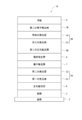
- the organic EL element 1 in the first embodiment includes a transparent substrate 2, an anode 3, a cathode 4, a hole transport layer 6, a light emitting layer 5, and an electron transport layer 7. Then, the hole transport layer 6, the light emitting layer 5, the electron transport layer 7 and the cathode 4 are laminated in this order from the anode 3 side.
- the light emitting layer 5 contains a first host material, a second host material, and a phosphorescent dopant material as main components.
- the first host material is 50% by mass to 90% by mass
- the second host material is 5% by mass to less than 50% by mass
- the phosphorescent dopant material is 0.1% by mass or more.
- the content is preferably 30% by mass or less.
- the total amount of the first host material, the second host material, and the phosphorescent dopant is preferably 100% by mass.
- Such a light emitting layer 5 provides a field for recombination of electrons and holes, and has a function of connecting this to light emission.
- First host material As the first host material used in the organic EL device of the present invention, a compound represented by the following general formula (1) can be used.
- Z 1 represents a ring structure represented by the following general formula (1-1) or (1-2) condensed in a.
- Z 2 represents a ring structure represented by the following general formula (1-1) or (1-2) condensed at b.
- at least one of Z 1 and Z 2 is represented by the following general formula (1-1).
- M is a substituted or unsubstituted nitrogen-containing heteroaromatic ring having 2 to 40 ring carbon atoms
- L 1 is A single bond or a linking group
- a substituted or unsubstituted aromatic hydrocarbon group having 6 to 30 ring carbon atoms A substituted or unsubstituted aromatic heterocyclic group having 2 to 30 ring carbon atoms, A cyclic hydrocarbon group having 5 to 30 ring carbon atoms, or These represent groups bonded to each other.
- m is 1 or 2.
- R 11 and R 31 are each independently Hydrogen atom, fluorine atom, cyano group, A substituted or unsubstituted alkyl group having 1 to 20 carbon atoms, A substituted or unsubstituted alkoxy group having 1 to 20 carbon atoms, A substituted or unsubstituted haloalkyl group having 1 to 20 carbon atoms, A substituted or unsubstituted haloalkoxy group having 1 to 20 carbon atoms, A substituted or unsubstituted alkylsilyl group having 1 to 10 carbon atoms, A substituted or unsubstituted arylsilyl group having 6 to 30 carbon atoms, A substituted or unsubstituted aromatic hydrocarbon group having 6 to 30 ring carbon atoms, or It represents a substituted or unsubstituted
- R ⁇ 11 > may mutually be same or different,
- the plurality of R 31 may be the same as or different from each other.
- X 3 is a sulfur atom, an oxygen atom, or N—R 32 , R 32 has the same meaning as R 11 and R 31 above.
- c represents condensation in a or b in the general formula (1).
- any of d, e, and f represents condensation in a or b in the general formula (1).
- the main component means that the light emitting layer contains 50 mass% or more of the first host material.
- the “nitrogen-containing heteroaromatic ring” includes an azine ring.
- the hydrogen atom includes isotopes having different numbers of neutrons, that is, light hydrogen (protium), deuterium (triuterium), and tritium.
- Examples of the nitrogen-containing heteroaromatic ring represented by M in the general formula (1) include pyridine, pyrimidine, pyrazine, triazine, aziridine, azaindolizine, indolizine, imidazole, indole, isoindole, indazole, purine, and pteridine. , ⁇ -carboline, naphthyridine, quinoxaline, terpyridine, bipyridine, acridine, phenanthroline, phenazine, imidazopyridine and the like.
- the first host material is preferably represented by the following general formula (3).
- Z 1 represents a ring structure represented by the general formula (1-1) or (1-2) condensed in a.
- Z 2 represents a ring structure represented by the general formula (1-1) or (1-2) condensed at b.
- L 1 is A single bond or a linking group, A substituted or unsubstituted aromatic hydrocarbon group having 6 to 30 ring carbon atoms, A substituted or unsubstituted aromatic heterocyclic group having 2 to 30 ring carbon atoms, A cyclic hydrocarbon group having 5 to 30 ring carbon atoms, or These represent groups bonded to each other.
- X 1 is a nitrogen atom or C—R 10 , and at least one of the plurality of X 1 is a nitrogen atom.
- R 1 and R 10 are each independently, Hydrogen atom, fluorine atom, cyano group, A substituted or unsubstituted alkyl group having 1 to 20 carbon atoms, A substituted or unsubstituted alkoxy group having 1 to 20 carbon atoms, A substituted or unsubstituted haloalkyl group having 1 to 20 carbon atoms, A substituted or unsubstituted haloalkoxy group having 1 to 20 carbon atoms, A substituted or unsubstituted alkylsilyl group having 1 to 10 carbon atoms, A substituted or unsubstituted arylsilyl group having 6 to 30 carbon atoms, A substituted or unsubstituted aromatic hydrocarbon group having 6 to 30 ring carbon atoms, or It represents a substituted or unsubstituted aromatic heterocycl
- n and n each represents an integer of 1 to 2.
- c, d, e, and f each represent a condensation in a or b in the general formula (3).
- a and b are those in which the general formula (1-1) is condensed in c, or the general formula (1-2) is condensed in any of d, e, and f.
- a plurality of X 1 may be the same or different from each other.
- n is 2
- the plurality of R 1 may be the same as or different from each other.
- examples of the compound in which the general formulas (1-1) and (1-2) are condensed in a and b in the general formula (3) include those represented by the following general formula.
- the first host material is more preferably represented by the following general formula (4).
- L 1 is A single bond or a linking group, A substituted or unsubstituted aromatic hydrocarbon group having 6 to 30 ring carbon atoms, A substituted or unsubstituted aromatic heterocyclic group having 2 to 30 ring carbon atoms, A cyclic hydrocarbon group having 5 to 30 ring carbon atoms, or These represent groups bonded to each other.
- X 1 is a nitrogen atom or C—R 10 , and at least one of the plurality of X 1 is a nitrogen atom.
- R 1 , R 10 and R 11 are each independently Hydrogen atom, fluorine atom, cyano group, A substituted or unsubstituted alkyl group having 1 to 20 carbon atoms, A substituted or unsubstituted alkoxy group having 1 to 20 carbon atoms, A substituted or unsubstituted haloalkyl group having 1 to 20 carbon atoms, A substituted or unsubstituted haloalkoxy group having 1 to 20 carbon atoms, A substituted or unsubstituted alkylsilyl group having 1 to 10 carbon atoms, A substituted or unsubstituted arylsilyl group having 6 to 30 carbon atoms, A substituted or unsubstituted aromatic hydrocarbon group having 6 to 30 ring carbon atoms, or It represents a substituted or unsubstituted aromatic heterocyclic group having 2 to 30 ring carbon atoms.
- n each represents an integer of 1 to 2.
- the plurality of R 11 may be the same or different from each other
- the plurality of X 1 may be the same or different from each other
- the plurality of R 1 may be the same or different from each other.
- n is 2
- the plurality of R 1 may be the same as or different from each other.
- the group, haloalkyl group, haloalkoxy group and alkylsilyl group may be linear, branched or cyclic.
- examples of the alkyl group having 1 to 20 carbon atoms include a methyl group, an ethyl group, and a propyl group.
- the alkoxy group having 1 to 20 carbon atoms is preferably an alkoxy group having 1 to 6 carbon atoms. Specific examples include a methoxy group, an ethoxy group, a propoxy group, a butoxy group, a pentyloxy group, and a hexyloxy group. It is done.
- Examples of the haloalkyl group having 1 to 20 carbon atoms include those in which the alkyl group having 1 to 20 carbon atoms is substituted with one or more halogen groups.
- Examples of the haloalkoxy group having 1 to 20 carbon atoms include those in which the alkoxy group having 1 to 20 carbon atoms is substituted with one or more halogen groups.
- alkylsilyl group having 1 to 10 carbon atoms examples include trimethylsilyl group, triethylsilyl group, tributylsilyl group, dimethylethylsilyl group, dimethylisopropylsilyl group, dimethylpropylsilyl group, dimethylbutylsilyl group, dimethyltertiarybutyl.
- a silyl group, a diethyl isopropyl silyl group, etc. are mentioned.
- Examples of the arylsilyl group having 6 to 30 carbon atoms include a phenyldimethylsilyl group, a diphenylmethylsilyl group, a diphenyl tertiary butylsilyl group, and a triphenylsilyl group.
- aromatic heterocyclic group having 2 to 30 ring carbon atoms examples include pyrrolyl group, pyrazinyl group, pyridinyl group, indolyl group, isoindolyl group, furyl group, benzofuranyl group, Benzofuranyl group, dibenzofuranyl group, dibenzothiophenyl group, quinolyl group, isoquinolyl group, quinoxalinyl group, carbazolyl group, phenanthridinyl group, acridinyl group, phenanthrolinyl group, thienyl group, and pyridine ring, pyrazine Ring, pyrimidine ring, pyridazine ring, triazine ring, indole ring, quinoline ring, acridine ring, pyrrolidine ring, dioxane ring, piperidine ring, morpholine
- Examples of the aromatic hydrocarbon group having 6 to 30 ring carbon atoms include a phenyl group, a naphthyl group, a phenanthryl group, a biphenyl group, a terphenyl group, a quarterphenyl group, and fluoran. Examples include a tenenyl group, a triphenylenyl group, a phenanthrenyl group, and a fluorenyl group.
- Examples of the aromatic hydrocarbon group having 6 to 30 ring carbon atoms and the aromatic heterocyclic group having 2 to 30 ring carbon atoms represented by L 1 in the general formulas (1) and (3) to (4) are as follows: And groups corresponding to the divalent groups described above.
- Examples of the cyclic hydrocarbon group having 5 to 30 ring carbon atoms include a cyclopentylene group, a cyclohexylene group, and a cycloheptylene group.
- the substituent is a linear, branched or cyclic alkyl group having 1 to 20 carbon atoms, a linear, branched or cyclic carbon number of 1; Alkoxy group of ⁇ 20, linear, branched or cyclic haloalkyl group having 1 to 20 carbon atoms, linear, branched or cyclic alkylsilyl group of 1 to 10 carbon atoms, ring carbon number of 6 30 to 30 arylsilyl groups, cyano groups, halogen atoms, aromatic hydrocarbon groups having 6 to 30 ring carbon atoms or condensed aromatic hydrocarbon groups, or aromatic heterocyclic groups having 2 to 30 ring carbon atoms or condensed It is preferably an aromatic heterocyclic group.
- Examples of the aromatic hydrocarbon group or condensed aromatic hydrocarbon group having 30 to 30 and the aromatic heterocyclic group or condensed aromatic heterocyclic group having 2 to 30 ring-forming carbon atoms include the groups described above.
- Examples of the halogen atom include a fluorine atom.
- Examples of the compounds represented by the general formulas (1) to (4) include the following.
- the first host material has an ionization potential Ip (h1) of 5.5 eV to 6.2 eV. Preferably, it is 5.7 eV or more and 6.1 eV or less.
- X 2 represents a sulfur atom, an oxygen atom, or N—R 5 ;
- L 2 is a single bond or a linking group and has the same meaning as L 1 in the general formula (1).
- R 2 to R 3 are each independently A substituted or unsubstituted aromatic hydrocarbon group having 6 to 30 ring carbon atoms or a substituted or unsubstituted aromatic heterocyclic group having 2 to 30 ring carbon atoms.
- R 4 to R 5 have the same meanings as R 11 and R 31 in the general formulas (1-1) and (1-2), respectively.
- p and q each represent an integer of 0 to 2
- r represents an integer of 1 to 3
- p + q + r 3.
- s represents an integer of 1 to 4.
- the plurality of R 4 may be the same or different.
- r is an integer of 2 to 3
- the plurality of X 2 may be the same or different
- the plurality of L 2 may be the same or different.
- p is 2
- the plurality of R 2 may be the same or different.
- q is 2
- the plurality of R 3 may be the same or different.
- the alkyl group, alkoxy group, haloalkyl group, haloalkoxy group, and alkylsilyl group represented by R 2 to R 5 may be linear, branched, or cyclic. Good.
- Alkylsilyl groups, arylsilyl groups having 6 to 30 carbon atoms, aromatic hydrocarbon groups having 6 to 30 ring carbon atoms, condensed aromatic hydrocarbon groups having 6 to 30 ring carbon atoms, and 2 to The 30 aromatic heterocyclic group and the condensed aromatic heterocyclic group having 2 to 30 ring carbon atoms are the same as those in the general formula (1).
- Examples of the compound represented by the general formula (2) include the following.
- the second host material has an ionization potential Ip (h2) of 5.3 eV or more and 5.7 eV or less. Preferably, it is 5.4 eV or more and 5.6 eV or less.
- the phosphorescent dopant material contains a metal complex, which is Ir (iridium), Pt (platinum), Os (osmium), Au (gold), Cu (copper), Re (rhenium), and Ru (rhenium). It is preferable to have a metal atom selected from ruthenium) and a ligand. In particular, the ligand preferably has an ortho metal bond.
- an organometallic complex composed of a ligand selected from phenylquinoline, phenylisoquinoline, phenylpyridine, phenylpyrimidine, phenylpyrazine and phenylimidazole is preferable from the viewpoint of luminous efficiency and the like. Specific examples of preferable metal complexes are shown below.
- the phosphorescent dopant material may be used alone or in combination of two or more. At least one of the phosphorescent dopant materials contained in the light emitting layer 5 preferably has an emission wavelength peak of 500 nm or more and 650 nm or less, and more preferably 510 nm or more and 630 nm or less. As the luminescent color in this embodiment, green is preferable. In general, the emission wavelength peak indicating green is from 495 nm to 570 nm. In the present embodiment, the emission wavelength is particularly preferably from 510 nm to 570 nm.
- the ionization potential Ip (h1) of the first host material, the ionization potential Ip (h2) of the second host material, and the ionization potential IP (d) of the phosphorescent dopant material satisfy the following relationship: Is preferred. Ip (h1)> Ip (h2)> Ip (d) (Formula 1) The ionization potential (Ip) is measured by a measurement method described later.
- the hole injection into the HOMO of the first host material is Holes are injected into the HOMO phosphorescent dopant material that does not occur directly and has a lower energy barrier.
- the second host material represented by the general formula (2) and the ionization potential Ip (h2) satisfying the above (Formula 1) is included, in addition to the phosphorescent dopant material, Holes are also injected into HOMO.
- the concentration of the phosphorescent dopant material in order to increase the efficiency of hole injection into the first host material, it is conceivable to increase the concentration of the phosphorescent dopant material.
- concentration of the phosphorescent dopant material is increased, light emission by concentration quenching is possible.
- the need for more phosphorescent dopant material which is generally expensive, increases costs.
- concentration of the phosphorescent dopant material is reduced, the holes in the light emitting layer are insufficient, and the recombination of holes and electrons is localized at the adjacent hole transport layer interface, thereby shortening the lifetime.
- the concentration of the phosphorescent dopant material is reduced to reduce the cost, while reducing the cost.
- the hole injection efficiency can be maintained.
- the phosphorescent dopant material can be suppressed to a low concentration, the occurrence of concentration quenching can be suppressed.
- the carrier balance in the light emitting layer can be improved, the recombination of holes and electrons can be spread over the entire light emitting layer 5. Thereby, in the organic EL element 1, luminous efficiency and lifetime can be improved while maintaining initial characteristics such as drive voltage.
- the organic EL element 1 is configured by laminating an anode 3, a light emitting layer 5, a cathode 4 and the like on a translucent substrate 2.
- the substrate 2 is a substrate that supports the anode 3 and the like, and is preferably a smooth substrate having a light transmittance in the visible region of 400 nm to 700 nm of 50% or more.
- the light-transmitting substrate include a glass plate and a polymer plate.
- the glass plate include those using soda lime glass, barium / strontium-containing glass, lead glass, aluminosilicate glass, borosilicate glass, barium borosilicate glass, quartz and the like as raw materials.
- the polymer plate include those using polycarbonate, acrylic, polyethylene terephthalate, polyether sulfide, polysulfone and the like as raw materials.
- the anode 3 of the organic EL element 1 plays a role of injecting holes into the hole injection layer, the hole transport layer 6 or the light emitting layer 5 and has an effective work function of 4.5 eV or more. is there.
- Specific examples of the anode material include indium tin oxide alloy (ITO), tin oxide (NESA), indium zinc oxide, gold, silver, platinum, copper, and the like.
- the anode 3 can be produced by forming a thin film of these anode materials on the substrate 2 by a method such as vapor deposition or sputtering.
- the transmittance of light in the visible region of the anode 3 is larger than 10%.
- the sheet resistance of the anode 3 is preferably several hundred ⁇ / ⁇ or less.
- the film thickness of the anode 3 depends on the material, it is usually selected in the range of 10 nm to 1 ⁇ m, preferably 10 nm to 200 nm.
- the cathode a material having a small work function is preferable for the purpose of injecting electrons into the light emitting layer.
- the cathode material is not particularly limited, and specifically, indium, aluminum, magnesium, magnesium-indium alloy, magnesium-aluminum alloy, aluminum-lithium alloy, aluminum-scandium-lithium alloy, magnesium-silver alloy and the like can be used.
- the cathode 4 can also be produced by forming a thin film on the electron transport layer 7 by a method such as vapor deposition or sputtering. Further, it is possible to adopt a mode in which light emission from the light emitting layer 5 is taken out from the cathode 4 side.
- the transmittance of light in the visible region of the cathode 4 is larger than 10%.
- the sheet resistance of the cathode is preferably several hundred ⁇ / ⁇ or less.
- the thickness of the cathode depends on the material, but is usually selected in the range of 10 nm to 1 ⁇ m, preferably 50 to 200 nm.
- a hole injection layer a hole transport layer, an electron injection layer, or the like may be provided as necessary.
- the organic EL element 1 is provided with a hole transport layer 6 and an electron transport layer 7.
- the light emission and the ionization potential Ip (HT) of an adjacent layer (hole injection layer, hole transport layer, etc.) provided adjacent to the anode side of the light emitting layer 5 are emitted.
- the difference ⁇ Ip (EML ⁇ HT) from the ionization potential Ip (EML) of the layer 5 preferably satisfies the relationship of the following equation, and the smaller ⁇ Ip (EML ⁇ HT) is more preferable.
- the difference between Ip (HT) and the ionization potential Ip (EML2) of the light-emitting layer containing the first host material and the phosphorescent dopant material and not containing the second host material is ⁇ Ip (EML2-HT).
- the difference between ⁇ Ip (EML2 ⁇ HT) and ⁇ Ip (EML ⁇ HT) and the ratio of ⁇ Ip (EML ⁇ HT) satisfy the following relationship (Equation 2).
- the ionization potential Ip (EML) of the light emitting layer 5 includes the ionization potential Ip (h1) of the first host material, the ionization potential Ip (h2) of the second host material, and the ionization potential Ip (d of the phosphorescent dopant material). ) And the concentration (mass%) of each material in the light emitting layer, the following (Equation 3) is obtained.
- Ip (EML) Ip (h1) ⁇ Q (h1) / 100 + Ip (H2) ⁇ Q (h2) / 100 + Ip (d) ⁇ Q (d) / 100 (Equation 3)
- Q (h1) is the concentration (mass%) of the first host material
- Q (h2) is the concentration (mass%) of the second host material
- Q (d) is the concentration (mass of the phosphorescent dopant material). %).
- the hole transport layer 6 is a layer that assists hole injection into the light emitting layer and transports holes to the light emitting region, and has a high hole mobility and a low ionization potential.
- the hole transport material for forming the hole transport layer 6 a material that transports holes to the light emitting layer 5 with lower electric field strength is preferable, and the second host material represented by the general formula (2) of the present invention. Can be used.
- an aromatic amine derivative represented by the following general formula (A1) is preferably used.
- Ar 1 to Ar 4 are An aromatic hydrocarbon group having 6 to 50 ring carbon atoms, A condensed aromatic hydrocarbon group having 6 to 50 ring carbon atoms, An aromatic heterocyclic group having 2 to 40 ring carbon atoms, A condensed aromatic heterocyclic group having 2 to 40 ring carbon atoms, A group in which the aromatic hydrocarbon group and the aromatic heterocyclic group are bonded, A group in which the aromatic hydrocarbon group and the condensed aromatic heterocyclic group are bonded together, a group in which the condensed aromatic hydrocarbon group and the aromatic heterocyclic group are combined, or a condensed aromatic hydrocarbon group with the condensed aromatic hydrocarbon group A group obtained by bonding these condensed aromatic heterocyclic groups, Represents.
- the aromatic hydrocarbon group, condensed aromatic hydrocarbon group, aromatic heterocyclic group, and condensed aromatic heterocyclic group mentioned here may have a substituent.
- L is a linking group, A divalent aromatic hydrocarbon group having 6 to 50 ring carbon atoms, A divalent condensed aromatic hydrocarbon group having 6 to 50 ring carbon atoms, A divalent aromatic heterocyclic group having 5 to 50 ring carbon atoms, A divalent fused aromatic heterocyclic group having 5 to 50 ring carbon atoms, A single bond of two or more aromatic hydrocarbon groups or aromatic heterocyclic groups, Ether bond, Thioether bond, An alkylene group having 1 to 20 carbon atoms, An alkenylene group having 2 to 20 carbon atoms, or a divalent group obtained by bonding with an amino group, Represents.
- the divalent aromatic hydrocarbon group, divalent condensed aromatic hydrocarbon group, divalent aromatic heterocyclic group, and divalent condensed aromatic heterocyclic group mentioned here have a substituent. May be.
- an aromatic amine of the following general formula (A2) is also preferably used for forming the hole transport layer.
- the hole transport material has an ionization potential Ip (HT) of 5.3 eV or more and 5.7 eV or less. Preferably there is.
- the electron transport layer 7 is a layer that assists the injection of electrons into the light emitting layer 5 and has a high electron mobility.
- the electron transport layer 7 is provided between the light emitting layer 5 and the cathode, and the electron transport layer 7 preferably contains a nitrogen-containing ring derivative as a main component.
- the electron injection layer may be a layer that functions as an electron transport layer. “As a main component” means that the electron transport layer 7 contains 50% by mass or more of a nitrogen-containing ring derivative.
- an aromatic heterocyclic compound containing one or more heteroatoms in the molecule is preferably used, and a nitrogen-containing ring derivative is particularly preferable.
- a nitrogen-containing ring derivative an aromatic ring having a nitrogen-containing 6-membered ring or 5-membered ring skeleton, or a condensed aromatic ring compound having a nitrogen-containing 6-membered ring or 5-membered ring skeleton is preferable.
- this nitrogen-containing ring derivative for example, a nitrogen-containing ring metal chelate complex represented by the following general formula (B1) is preferable.
- R 2 to R 7 in the general formula (B1) are independently Hydrogen atom, A halogen atom, An oxy group, An amino group, A hydrocarbon group having 1 to 40 carbon atoms, An alkoxy group, An aryloxy group, An alkoxycarbonyl group, or An aromatic heterocyclic group, These may have a substituent.
- the halogen atom include fluorine, chlorine, bromine and iodine.
- the optionally substituted amino group include an alkylamino group, an arylamino group, and an aralkylamino group.
- the alkoxycarbonyl group is represented as —COOY ′, and examples of Y ′ include the same as the alkyl group.
- the alkylamino group and the aralkylamino group are represented as —NQ 1 Q 2 .
- Specific examples of Q 1 and Q 2 are the same as those described above for the alkyl group and the aralkyl group (a group in which a hydrogen atom of the alkyl group is substituted with an aryl group). Preferred examples Is the same.
- One of Q 1 and Q 2 may be a hydrogen atom.
- the aralkyl group is a group in which a hydrogen atom of the alkyl group is substituted with the aryl group.
- the arylamino group is represented by —NAr 1 Ar 2, and specific examples of Ar 1 and Ar 2 are the same as those described for the non-condensed aromatic hydrocarbon group and the condensed aromatic hydrocarbon group, respectively.
- One of Ar 1 and Ar 2 may be a hydrogen atom.
- M is aluminum (Al), gallium (Ga) or indium (In), and is preferably In.
- L in the general formula (B1) is a group represented by the following general formula (B2) or (B3).
- R 8 to R 12 are independently A hydrogen atom or a hydrocarbon group having 1 to 40 carbon atoms, and groups adjacent to each other may form a cyclic structure. This hydrocarbon group may have a substituent.
- R 13 to R 27 are independently A hydrogen atom or a hydrocarbon group having 1 to 40 carbon atoms, Adjacent groups may form a cyclic structure. This hydrocarbon group may have a substituent. Examples of the hydrocarbon group having 1 to 40 carbon atoms represented by R 8 to R 12 and R 13 to R 27 in the general formula (B2) and the general formula (B3) include those in the general formula (B1). those from R 2 similar to the specific examples to R 7 can be exemplified.
- examples of the divalent group include a tetramethylene group, a pentamethylene group, a hexamethylene group, diphenylmethane- Examples include 2,2′-diyl group, diphenylethane-3,3′-diyl group, and diphenylpropane-4,4′-diyl group.
- the electron transport layer preferably contains at least one of nitrogen-containing heterocyclic derivatives represented by the following general formulas (B4) to (B6).
- R is Hydrogen atom, An aromatic hydrocarbon group having 6 to 60 ring carbon atoms, A condensed aromatic hydrocarbon group having 6 to 60 ring carbon atoms, Pyridyl group, A quinolyl group, An alkyl group having 1 to 20 carbon atoms or an alkoxy group having 1 to 20 carbon atoms.
- n is an integer of 0 or more and 4 or less.
- R 1 is An aromatic hydrocarbon group having 6 to 60 ring carbon atoms, a condensed aromatic hydrocarbon group having 6 to 60 ring carbon atoms, Pyridyl group, A quinolyl group, An alkyl group having 1 to 20 carbon atoms or an alkoxy group having 1 to 20 carbon atoms.
- R 2 and R 3 are independently Hydrogen atom, An aromatic hydrocarbon group having 6 to 60 ring carbon atoms, a condensed aromatic hydrocarbon group having 6 to 60 ring carbon atoms, Pyridyl group, A quinolyl group, An alkyl group having 1 to 20 carbon atoms or an alkoxy group having 1 to 20 carbon atoms.
- L is An aromatic hydrocarbon group having 6 to 60 ring carbon atoms, a condensed aromatic hydrocarbon group having 6 to 60 ring carbon atoms, A pyridinylene group, It is a quinolinylene group or a fluorenylene group.
- Ar 1 is An aromatic hydrocarbon group having 6 to 60 ring carbon atoms, a condensed aromatic hydrocarbon group having 6 to 60 ring carbon atoms, A pyridinylene group, It is a quinolinylene group.
- Ar 2 is An aromatic hydrocarbon group having 6 to 60 ring carbon atoms, a condensed aromatic hydrocarbon group having 6 to 60 ring carbon atoms, Pyridyl group, A quinolyl group, An alkyl group having 1 to 20 carbon atoms or an alkoxy group having 1 to 20 carbon atoms.
- Ar 3 is An aromatic hydrocarbon group having 6 to 60 ring carbon atoms, a condensed aromatic hydrocarbon group having 6 to 60 ring carbon atoms, Pyridyl group, A quinolyl group, An alkyl group having 1 to 20 carbon atoms, An alkoxy group having 1 to 20 carbon atoms, or a group represented by “—Ar 1 —Ar 2 ” (Ar 1 and Ar 2 are the same as defined above), respectively.
- the condensed aromatic hydrocarbon groups mentioned in the description of R, R 1 , R 2 , R 3 , L, Ar 1 , Ar 2 , and Ar 3 in the general formulas (B4) to (B6) may have a substituent.
- 8-hydroxyquinoline or a metal complex of its derivative, an oxadiazole derivative, or a nitrogen-containing heterocyclic derivative is preferable.
- a metal chelate oxinoid compound containing a chelate of oxine (generally 8-quinolinol or 8-hydroxyquinoline), for example, tris (8-quinolinol) aluminum is used.
- 8-quinolinol or 8-hydroxyquinoline for example, tris (8-quinolinol
- Ar 17 , Ar 18 , Ar 19 , Ar 21 , Ar 22 and Ar 25 are It is an aromatic hydrocarbon group having 6 to 40 ring carbon atoms or a condensed aromatic hydrocarbon group having 6 to 40 ring carbon atoms. However, the aromatic hydrocarbon group and condensed aromatic hydrocarbon group mentioned here may have a substituent. Ar 17 and Ar 18 , Ar 19 and Ar 21 , Ar 22 and Ar 25 may be the same as or different from each other.
- aromatic hydrocarbon group or condensed aromatic hydrocarbon group mentioned here examples include a phenyl group, a naphthyl group, a biphenyl group, an anthranyl group, a perylenyl group, and a pyrenyl group. And as a substituent to these, a C1-C10 alkyl group, a C1-C10 alkoxy group, a cyano group, etc. are mentioned.
- Ar 20 , Ar 23 and Ar 24 are A divalent aromatic hydrocarbon group having 6 to 40 ring carbon atoms or a divalent condensed aromatic hydrocarbon group having 6 to 40 ring carbon atoms.
- the aromatic hydrocarbon group and condensed aromatic hydrocarbon group mentioned here may have a substituent.
- Ar 23 and Ar 24 may be the same as or different from each other.
- Examples of the divalent aromatic hydrocarbon group or the divalent condensed aromatic hydrocarbon group mentioned here include a phenylene group, a naphthylene group, a biphenylene group, an anthranylene group, a peryleneylene group, and a pyrenylene group.
- a C1-C10 alkyl group, a C1-C10 alkoxy group, a cyano group, etc. are mentioned.
- electron transfer compounds those having good thin film forming properties are preferably used.
- Specific examples of these electron transfer compounds include the following.
- the nitrogen-containing heterocyclic derivative as the electron transfer compound is a nitrogen-containing heterocyclic derivative composed of an organic compound having the following general formula, and includes a nitrogen-containing compound that is not a metal complex.
- a 5-membered or 6-membered ring containing a skeleton represented by the following general formula (B7) and a structure represented by the following general formula (B8) can be given.
- X represents a carbon atom or a nitrogen atom.
- Z 1 and Z 2 each independently represents an atomic group capable of forming a nitrogen-containing heterocycle.
- the nitrogen-containing heterocyclic derivative is more preferably an organic compound having a nitrogen-containing aromatic polycyclic group consisting of a 5-membered ring or a 6-membered ring. Further, in the case of such a nitrogen-containing aromatic polycyclic group having a plurality of nitrogen atoms, a skeleton combining the above general formulas (B7) and (B8) or the above general formula (B7) and the following general formula (B9) is used.
- the nitrogen-containing aromatic polycyclic organic compound having is preferable.
- the nitrogen-containing group of the nitrogen-containing aromatic polycyclic organic compound is selected from, for example, nitrogen-containing heterocyclic groups represented by the following general formula.
- R is An aromatic hydrocarbon group having 6 to 40 ring carbon atoms, A condensed aromatic hydrocarbon group having 6 to 40 ring carbon atoms, An aromatic heterocyclic group having 2 to 40 ring carbon atoms, A condensed aromatic heterocyclic group having 2 to 40 ring carbon atoms, An alkyl group having 1 to 20 carbon atoms or an alkoxy group having 1 to 20 carbon atoms.
- n is an integer of 0 or more and 5 or less, and when n is an integer of 2 or more, a plurality of R may be the same or different from each other.
- preferred specific compounds include nitrogen-containing heterocyclic derivatives represented by the following general formula (B10).
- HAr-L 1 -Ar 1 -Ar 2 (B10)
- HAr is A nitrogen-containing heterocyclic group having 1 to 40 ring carbon atoms.
- L 1 is Single bond, An aromatic hydrocarbon group having 6 to 40 ring carbon atoms, A condensed aromatic hydrocarbon group having 6 to 40 ring carbon atoms, An aromatic heterocyclic group having 2 to 40 ring carbon atoms or a condensed aromatic heterocyclic group having 2 to 40 ring carbon atoms.
- Ar 1 is A divalent aromatic hydrocarbon group having 6 to 40 ring carbon atoms.
- Ar 2 is An aromatic hydrocarbon group having 6 to 40 ring carbon atoms, A condensed aromatic hydrocarbon group having 6 to 40 ring carbon atoms, An aromatic heterocyclic group having 2 to 40 ring carbon atoms or a condensed aromatic heterocyclic group having 2 to 40 ring carbon atoms.
- the ring group and the condensed aromatic heterocyclic group may have a substituent.
- HAr in the formula of the general formula (B10) is selected from the following group, for example.
- L 1 in the formula (B10) is, for example, selected from the following group.
- Ar 1 in the formula (B10) is, for example, selected from the following arylanthranyl groups.
- R 1 to R 14 are independently Hydrogen atom, A halogen atom, An alkyl group having 1 to 20 carbon atoms, An alkoxy group having 1 to 20 carbon atoms, An aryloxy group having 6 to 40 ring carbon atoms, An aromatic hydrocarbon group having 6 to 40 ring carbon atoms, A condensed aromatic hydrocarbon group having 6 to 40 ring carbon atoms, An aromatic heterocyclic group having 2 to 40 ring carbon atoms or a condensed aromatic heterocyclic group having 2 to 40 ring carbon atoms.
- Ar 3 is An aromatic hydrocarbon group having 6 to 40 ring carbon atoms, A condensed aromatic hydrocarbon group having 6 to 40 ring carbon atoms, An aromatic heterocyclic group having 2 to 40 ring carbon atoms or a condensed aromatic heterocyclic group having 2 to 40 ring carbon atoms.
- the cyclic group may have a substituent.
- any of R 1 to R 8 may be a nitrogen-containing heterocyclic derivative which is a hydrogen atom.
- Ar 2 is selected from the following group, for example.
- the nitrogen-containing aromatic polycyclic organic compound as the electron transfer compound, the following compounds (see JP-A-9-3448) are also preferably used.
- R 1 to R 4 are independently Hydrogen atom, Aliphatic groups, An aliphatic cyclic group, Represents a carbocyclic aromatic ring group or a heterocyclic group. However, the aliphatic group, aliphatic cyclic group, carbocyclic aromatic ring group, and heterocyclic group mentioned here may have a substituent.
- X 1 and X 2 independently represent an oxygen atom, a sulfur atom, or a dicyanomethylene group.
- R 1 , R 2 , R 3, and R 4 are the same or different groups, and are an aromatic hydrocarbon group or a condensed aromatic hydrocarbon group represented by the following general formula.
- R 5 , R 6 , R 7 , R 8 and R 9 are the same or different groups, and hydrogen atom or at least one of them is a saturated or unsaturated alkoxyl group, alkyl group, amino group A group or an alkylamino group.
- the electron transfer compound may be a polymer compound containing the nitrogen-containing heterocyclic group or the nitrogen-containing heterocyclic derivative.
- the nitrogen-containing ring derivative it is preferable to use an insulator or a semiconductor as the inorganic compound as a component of the electron injection layer. If the electron injection layer is made of an insulator or a semiconductor, current leakage can be effectively prevented and the electron injection property can be improved. Furthermore, it is preferable that the electron injection layer in the present invention contains a reducing dopant.
- the thickness of each layer provided between the anode and the cathode is not particularly limited except for those specifically defined in the above description. However, if the thickness is too thick, a high applied voltage is required and the efficiency is deteriorated. Therefore, the range of several nm to 1 ⁇ m is usually preferable.
- each layer can be formed by a vacuum deposition method, a casting method, a coating method, a spin coating method, or the like.
- a solution in which an organic material of each layer is dispersed in a transparent polymer such as polycarbonate, polyurethane, polystyrene, polyarylate, and polyester, the organic material and the transparent polymer are simultaneously used. It can also be formed by vapor deposition.
- Ionization potential The material is irradiated with light from a deuterium lamp (excitation light) dispersed with a monochromator, the emitted photoelectron emission is measured with an electrometer, and the photoelectron emission threshold from the photon energy curve of the obtained photoelectron emission is outside Obtain and measure by insertion method.
- An atmospheric ultraviolet photoelectron analyzer AC-3 (manufactured by Riken Keiki Co., Ltd.) is used as a measuring instrument.
- the same components as those in the first embodiment are denoted by the same reference numerals and names, and the description thereof is omitted or simplified.
- the same materials and compounds as those described in the first embodiment can be used.
- the organic EL element 1A according to the second embodiment the light emitting unit 5A and the third light emitting layer 53 are provided, and the spacing layer 8 is provided between the light emitting unit 5A and the third light emitting layer 53. This is different from the first embodiment. As shown in FIG.
- the light emitting unit 5A includes a first light emitting layer 51 formed continuously with the hole transport layer 6, and a second light emitting layer formed continuously between the first light emitting layer 51 and the spacing layer 8. 52.
- the first light emitting layer 51 contains a first host material and a first light emitting material.
- the first host material is preferably an amine derivative such as a monoamine compound, a diamine compound, a triamine compound, a tetramine compound, or an amine compound substituted with a carbazole group.
- the first host material the same material as the first host material represented by the general formula (1) and the second host material represented by the general formula (2) may be used.
- the first luminescent material preferably exhibits an emission peak of 570 nm or more.
- the emission color showing an emission peak of 570 nm or more is, for example, red.
- the second light emitting layer 52 is the light emitting layer of the present invention, that is, the same as the light emitting layer 5 of the first embodiment.
- the spacing layer 8 refers to the second light emitting layer 52 and the third light emitting layer 53 by providing an energy barrier of HOMO level and LUMO level between the adjacent second light emitting layer 52 and the third light emitting layer 53.
- This is a layer for adjusting charge (hole or electron) injection to the second light-emitting layer 52 and the third light-emitting layer 53 and adjusting the balance of charges injected into the second light-emitting layer 52 and the third light-emitting layer 53.
- a triplet energy barrier it is possible to prevent the triplet energy generated in the second light emitting layer 52 from diffusing into the third light emitting layer 53, and efficiently in the second light emitting layer 52. This is a layer for emitting light.
- the third light emitting layer 53 is, for example, a layer that emits blue fluorescent light, and has a peak wavelength of 450 nm or more and 500 nm or less.
- the third light emitting layer 53A contains a third host material and a third light emitting material. Examples of the third host material include compounds having a structure represented by the following formula (41) having an anthracene central skeleton.
- a 41 and A 42 are each a group derived from an aromatic ring having 6 to 20 nuclear carbon atoms which may have a substituent.
- R 41 to R 48 are each a hydrogen atom, an aryl group having 6 to 50 nuclear carbon atoms that may have a substituent, a heteroaryl group having 5 to 50 nuclear atoms that may have a substituent, and a substituent.
- Examples of the third light emitting material include arylamine compounds, styrylamine compounds, anthracene, naphthalene, phenanthrene, pyrene, tetracene, coronene, chrysene, fluorescein, perylene, phthaloperylene, naphthaloperylene, perinone, phthaloperinone, naphthaloperinone, diphenylbutadiene, tetra Phenylbutadiene, coumarin, oxadiazole, aldazine, bisbenzoxazoline, bisstyryl, pyrazine, cyclopentadiene, quinoline metal complex, aminoquinoline metal complex, benzoquinoline metal complex, imine, diphenylethylene, vinylanthracene, diaminocarbazole, pyran, Thiopyran, polymethine, merocyanine, imidazole chelating oxinoid compounds, quinac
- the organic EL element 1A includes the first light emitting layer 51 that emits red light, the second light emitting layer 52 that emits green light, and the third light emitting layer 53 that emits blue light, the entire element emits white light. Can do. Therefore, the organic EL element 1A can be suitably used as a surface light source such as an illumination or a backlight.
- the organic EL element of the third embodiment is a so-called tandem element that includes a charge generation layer and two or more light emitting units. Since the charge supplied from the charge generation layer is injected into the light emitting unit in addition to the charge injected from the pair of electrodes, the emission efficiency (current efficiency) with respect to the injected current is provided by providing the charge generation layer. ) Will improve.
- the organic EL element 1B of the third embodiment includes an anode 3, a hole transport layer 6, a first light emitting unit 5A, an electron transport layer 7, a charge generation layer 9, on a substrate 2.
- the second hole transport layer 6B, the second light emitting unit 5B, the second electron transport layer 7B, and the cathode 4 are laminated in this order.
- the first light emitting unit 5A is the same as the first light emitting unit in the second embodiment
- the second light emitting layer 52 constituting the first light emitting unit 5A is the light emitting layer of the present invention. This is the same as the light emitting layer 5 of the first embodiment and the second light emitting layer of the second embodiment.
- the second light emitting unit 5B is continuous between the third light emitting layer 53 formed continuously with the second hole transport layer 6B, and between the third light emitting layer 53 and the second electron transport layer 7B. And a fourth light emitting layer 54 formed.
- the third light emitting layer 53 is the same as the third light emitting layer of the second embodiment.
- the fourth light-emitting layer 54B is a fluorescent light-emitting layer that emits green light, and has a peak wavelength of approximately 500 nm or more and 570 nm or less.
- the fourth light emitting layer 54 contains a fourth host material and a fourth light emitting material.
- the charge generation layer 9 is a layer that generates charges when an electric field is applied to the organic EL element 1B, and injects electrons into the electron transport layer 7 and injects holes into the second hole transport layer 6B.
- a material of the charge generation layer 9 a known material or a material described in, for example, US 7,358,661 can be used. Specific examples include metal oxides such as In, Sn, Zn, Ti, Zr, Hf, V, Mo, Cu, Ga, Sr, La, and Ru, nitrides, iodides, borides, and the like.
- a donor typified by an alkali metal in the vicinity of the charge generation layer interface in the electron transport layer 7.
- a donor metal typified by an alkali metal
- a donor metal compound typified by an alkali metal
- a donor metal complex can be selected. Specific examples of compounds that can be used for such donor metal, donor metal compound, and donor metal complex include compounds described in Japanese Patent Application No. PCT / JP2010 / 003434.
- the second hole transport layer 6B and the second electron transport layer 7B are the same as the hole transport layer and the electron transport layer of the first embodiment. Since the organic EL element 1B is a so-called tandem element, the drive current can be reduced and the durability can be improved.
- the present invention is not limited to the above description, and modifications within a range not departing from the gist of the present invention are included in the present invention.
- a hole injection layer may be further formed between the anode and the hole transport layer.
- a porphyrin compound an aromatic tertiary amine compound or a styrylamine compound, and in particular, an aromatic tertiary amine compound such as hexacyanohexaazatriphenylene (HAT). Is preferably used.
- the configuration in which the electron transport layer is formed continuously with the cathode has been described.
- an electron injection layer may be further formed between the cathode and the electron transport layer.
- the configuration in which two light emitting units are formed is shown, but three or more light emitting units may be formed.
- Example 1 The organic EL element according to Example 1 was manufactured as follows. A glass substrate (manufactured by Geomatic Co., Ltd.) with an ITO transparent electrode (anode) having a thickness of 25 mm ⁇ 75 mm ⁇ 1.1 mm was subjected to ultrasonic cleaning in isopropyl alcohol for 5 minutes, and then UV ozone cleaning was performed for 30 minutes. A glass substrate with a transparent electrode line after washing is mounted on a substrate holder of a vacuum deposition apparatus, and firstly compound HA-1 is deposited so as to cover the transparent electrode on the surface where the transparent electrode line is formed. Then, an HA-1 film having a thickness of 5 nm was formed. This HA-1 film functions as a hole injection layer.
- the compound HT-1 was vapor-deposited to form a 55 nm-thick HT-1 film.
- This HT-1 film functions as a first hole transport layer.
- a compound GH1-1 was deposited on the HT-1 film to form a GH1-1 film having a thickness of 10 nm.
- This GH1-1 film functions as a second hole transport layer.
- compound GH2-1 as a first host material
- compound GH1-1 as a second host material
- Ir (Pppy) 3 as a phosphorescent dopant material were co-evaporated.
- a light emitting layer having a thickness of 35 nm and emitting green light was formed.
- concentration of a phosphorescent dopant material were 10 mass%, and the remainder was made into the 1st host material.
- a compound GH2-1 was vapor-deposited on this light emitting layer to form a hole blocking layer having a thickness of 5 nm.
- Compound ET-1 was vapor-deposited on this hole blocking layer to form an electron transport layer having a thickness of 30 nm.
- LiF was deposited on the electron transport layer at a rate of 1 kg / min to form an electron injection layer having a thickness of 1 nm.
- metal Al was vapor-deposited on the electron injecting cathode to form a cathode having a thickness of 80 nm.
- Example 1 An organic EL device was produced in the same manner as in Example 1 except that the compound GH1-1 as the second host material was not used.
- Table 1 shows element configurations of Example 1 and Comparative Example 1.
- the numbers in parentheses () without a unit indicate the thickness (unit: nm) of each layer.
- what has a display of% shows the mass% concentration of the said compound.
- the mass% concentrations of the second host material and the phosphorescent dopant material are shown, and the description of the concentration of the first host material is omitted.
- Example 2 to 9 and Comparative Examples 2 to 6 were the same as in Example 1 except that the materials of Example 1, the thickness of each layer, and the concentration of each material were changed as shown in Table 1. A device was created. The compounds used in Examples 1 to 9 and Comparative Examples 1 to 6 are shown below. In Examples 1 to 9, GH2-1, GH2-2, and GH2-4 included in the light emitting layer are the first host materials in the present invention, and GH1-1, GH1-2, and GH1-3 are in the present invention. In the second host material. Table 2 shows the results of evaluating these organic EL elements in the same manner as in Example 1.
- the element systems indicated by A to C indicate differences in element configurations other than the compound of the first host material, the compound of the second host material, and their addition concentrations.
- the element system A uses Ir (Pppy) 3 as the dopant material
- the element system B uses Ir (ppy) 3 .
- the element system B is that the film thickness of the first and second hole transport layers, the hole blocking layer is not provided, and the compound used for the electron transport layer is ET-2. Is different.
- Table 3 shows the measurement results of the ionization potential of each of the first host material, the second host material, and the hole transport material.
- the measurement was performed using a photoelectron spectrometer (manufactured by Riken Keiki Co., Ltd .: AC-3) in the atmosphere as described above. Specifically, the measurement was performed by irradiating the material with light and measuring the amount of electrons generated by charge separation at that time.
- the host material contains the same compound as the first host material of Examples, and the phosphorescent dopant concentration is the same as that of Examples.
- the organic EL elements of the examples all have higher efficiency and longer life than the organic EL elements of the comparative examples.
- the organic EL element of Example 1 by adding 10% by mass of GH1-1 as the second host material, the driving voltage, current efficiency, and the like, compared with Comparative Example 1 in which the second host material is not added, Improvement was seen in all of voltage efficiency, external quantum efficiency EQE, and lifetime.
- the organic EL element of Comparative Example 6 contains 10% by mass of the phosphorescent dopant material Ir (ppy) 3 , whereas the organic EL element of Comparative Example 5 has 5% by mass.
- Comparative Example 5 with a small amount of phosphorescent dopant material is inferior to Comparative Example 6 in all the evaluation items.
- the organic EL device of Example 6 containing GH1-1 as the second host material even if the content of the phosphorescent dopant material is 5% by mass, which is the same as that of Comparative Example 5, not only Comparative Example 5 but also Comparative Example Compared to 6, it can be seen that the performance is improved. That is, in Example 6, by adding the second host material, it is possible to improve the performance, particularly efficiency and lifetime of the organic EL element while suppressing the content of the phosphorescent dopant material.
- Example 10 The organic EL device of Example 10 was implemented except that each material of Example 1, the thickness of each layer, and the concentration of each material were changed as shown in Table 5 and an electron transport layer was provided on the light emitting layer. Prepared in the same manner as in Example 1. That is, the organic EL element of Example 10 was not provided with a hole blocking layer. For comparison with Example 10, the element configuration of Comparative Example 6 will be described below.
- Example 10 Compound GH2-5 used in Example 10 is shown. Other materials are the same as described above.
- GH2-5 contained in the light emitting layer is the first host material in the present invention, and GH1-1 is the second host material in the present invention.
- the ionization potential of compound GH2-5 was 5.9 eV. The ionization potential was measured in the same manner as described above.
- the organic EL device of Example 10 had high luminous efficiency, and the device life was about 1.5 times that of the organic EL device of Comparative Example 6.
- Example 10 when the ionization potential Ip (EML) of the light emitting layer of Example 10 was calculated based on the above (Formula 3) from the ionization potential of each compound described above, in Example 10, the above formula (Formula 2) It was confirmed that the relationship was established. Table 7 shows the calculation results. Note that the value of Ip (EML2) includes the first host material (compound GH2-5) and the phosphorescent dopant material (Ir (ppy) 3 ) and does not contain the second host material (compound GH1-1). Calculated as a layer. At this time, in Example 10, the concentration of each material in the light emitting layer was 90 mass% for the first host material and 10 mass% for the phosphorescent dopant material. That is, the mass of the second host material not included was increased as the first host material.
- Ip (EML2) includes the first host material (compound GH2-5) and the phosphorescent dopant material (Ir (ppy) 3 ) and does not contain the second host material (compound
- the organic EL element of the present invention can be used for displays and lighting devices.
Landscapes
- Chemical & Material Sciences (AREA)
- Organic Chemistry (AREA)
- Engineering & Computer Science (AREA)
- Materials Engineering (AREA)
- Physics & Mathematics (AREA)
- Spectroscopy & Molecular Physics (AREA)
- Optics & Photonics (AREA)
- Electroluminescent Light Sources (AREA)
- Furan Compounds (AREA)
- Nitrogen Condensed Heterocyclic Rings (AREA)
- Plural Heterocyclic Compounds (AREA)
- Indole Compounds (AREA)
Abstract
Priority Applications (4)
| Application Number | Priority Date | Filing Date | Title |
|---|---|---|---|
| CN201280030391.0A CN103620808B (zh) | 2011-06-24 | 2012-06-20 | 有机电致发光元件 |
| JP2013521607A JP5898194B2 (ja) | 2011-06-24 | 2012-06-20 | 有機エレクトロルミネッセンス素子 |
| US14/128,132 US20140217378A1 (en) | 2011-06-24 | 2012-06-20 | Organic electroluminescent element |
| KR1020137033685A KR101993015B1 (ko) | 2011-06-24 | 2012-06-20 | 유기 일렉트로루미네선스 소자 |
Applications Claiming Priority (2)
| Application Number | Priority Date | Filing Date | Title |
|---|---|---|---|
| JP2011-141258 | 2011-06-24 | ||
| JP2011141258 | 2011-06-24 |
Publications (1)
| Publication Number | Publication Date |
|---|---|
| WO2012176818A1 true WO2012176818A1 (fr) | 2012-12-27 |
Family
ID=47422649
Family Applications (1)
| Application Number | Title | Priority Date | Filing Date |
|---|---|---|---|
| PCT/JP2012/065778 Ceased WO2012176818A1 (fr) | 2011-06-24 | 2012-06-20 | Elément électroluminescent organique |
Country Status (6)
| Country | Link |
|---|---|
| US (1) | US20140217378A1 (fr) |
| JP (1) | JP5898194B2 (fr) |
| KR (1) | KR101993015B1 (fr) |
| CN (1) | CN103620808B (fr) |
| TW (1) | TWI553093B (fr) |
| WO (1) | WO2012176818A1 (fr) |
Cited By (16)
| Publication number | Priority date | Publication date | Assignee | Title |
|---|---|---|---|---|
| WO2014021441A1 (fr) * | 2012-08-03 | 2014-02-06 | Semiconductor Energy Laboratory Co., Ltd. | Élément électroluminescent, dispositif électroluminescent, dispositif électronique et dispositif d'éclairage |
| US20140319492A1 (en) * | 2013-04-26 | 2014-10-30 | Semiconductor Energy Laboratory Co., Ltd. | Light-Emitting Element, Light-Emitting Device, Display Device, Electronic Device, and Lighting Device |
| JP2015065152A (ja) * | 2013-06-28 | 2015-04-09 | 株式会社半導体エネルギー研究所 | 発光素子の作製方法及び発光素子 |
| WO2015156587A1 (fr) | 2014-04-08 | 2015-10-15 | Rohm And Haas Electronic Materials Korea Ltd. | Matériau hôte à plusieurs composants et dispositif électroluminescent organique le comprenant |
| US20150318488A1 (en) * | 2014-05-02 | 2015-11-05 | Samsung Display Co., Ltd. | Organic light-emitting device |
| WO2016024637A1 (fr) * | 2014-08-15 | 2016-02-18 | 出光興産株式会社 | Composé, matériau de dispositif électroluminescent organique, dispositif électroluminescent organique et équipement électronique |
| US9564598B2 (en) | 2014-05-02 | 2017-02-07 | Samsung Display Co., Ltd. | Organic light-emitting device |
| WO2017199622A1 (fr) * | 2016-05-19 | 2017-11-23 | コニカミノルタ株式会社 | Élément électroluminescent organique, dispositif d'affichage, et dispositif d'éclairage |
| KR20180027468A (ko) * | 2014-04-08 | 2018-03-14 | 롬엔드하스전자재료코리아유한회사 | 복수종의 호스트 재료와 이를 포함하는 유기 전계 발광 소자 |
| US10014477B2 (en) | 2012-08-31 | 2018-07-03 | Idemitsu Kosan Co., Ltd. | Aromatic amine derivative, and organic electroluminescent element using same |
| US10020459B2 (en) | 2014-05-02 | 2018-07-10 | Samsung Display Co., Ltd. | Organic light-emitting device |
| US10431766B2 (en) | 2014-05-02 | 2019-10-01 | Samsung Display Co., Ltd. | Organic light-emitting device |
| JPWO2018173600A1 (ja) * | 2017-03-21 | 2020-01-23 | コニカミノルタ株式会社 | 有機エレクトロルミネッセンス素子 |
| WO2020116561A1 (fr) * | 2018-12-05 | 2020-06-11 | 出光興産株式会社 | Élément électroluminescent organique et appareil électronique |
| US10833281B2 (en) | 2013-08-09 | 2020-11-10 | Idemitsu Kosan Co., Ltd. | Organic electroluminescence composition, material for organic electroluminescence element, solution of material for organic electroluminescence element, and organic electroluminescence element |
| JP2022009893A (ja) * | 2012-08-03 | 2022-01-14 | 株式会社半導体エネルギー研究所 | 発光素子、発光装置、電子機器及び照明装置 |
Families Citing this family (14)
| Publication number | Priority date | Publication date | Assignee | Title |
|---|---|---|---|---|
| WO2013077352A1 (fr) | 2011-11-22 | 2013-05-30 | 出光興産株式会社 | Dérivé hétérocyclique aromatique, matière pour élément électroluminescent organique et élément électroluminescent organique |
| JPWO2014129048A1 (ja) | 2013-02-22 | 2017-02-02 | 出光興産株式会社 | アントラセン誘導体、有機エレクトロルミネッセンス素子用材料、有機エレクトロルミネッセンス素子、および電子機器 |
| EP2821459B2 (fr) | 2013-07-01 | 2026-08-12 | Cheil Industries Inc. | Composition et dispositif optoélectronique organique et dispositif d'affichage |
| KR101502316B1 (ko) * | 2014-04-18 | 2015-03-13 | 롬엔드하스전자재료코리아유한회사 | 복수종의 호스트 재료 및 이를 포함하는 유기 전계 발광 소자 |
| KR102327086B1 (ko) * | 2014-06-11 | 2021-11-17 | 삼성디스플레이 주식회사 | 유기 발광 소자 |
| KR102273047B1 (ko) * | 2014-06-30 | 2021-07-06 | 삼성디스플레이 주식회사 | 유기 발광 소자 |
| KR102914550B1 (ko) | 2015-09-30 | 2026-01-19 | 가부시키가이샤 한도오따이 에네루기 켄큐쇼 | 발광 소자, 표시 장치, 전자 기기, 및 조명 장치 |
| CN107531718B (zh) * | 2016-03-16 | 2021-04-06 | 德山新勒克斯有限公司 | 有机电致器件用化合物、利用该化合物的有机电致器件及其电子装置 |
| US11008280B2 (en) * | 2016-04-26 | 2021-05-18 | Duk San Neolux Co., Ltd. | Compound for organic electric element, organic electric element using same, and electronic device comprising same organic electronic element |
| KR101744248B1 (ko) * | 2016-09-06 | 2017-06-07 | 주식회사 엘지화학 | 유기발광 소자 |
| CN106684252B (zh) * | 2016-12-16 | 2018-06-19 | 江苏三月光电科技有限公司 | 一种双主体结构的有机发光器件 |
| EP3647338A4 (fr) * | 2017-06-30 | 2021-03-24 | Sumitomo Chemical Company Limited | Composé macromoléculaire, et élément luminescent mettant en oeuvre celui-ci |
| CN109293637B (zh) * | 2018-09-18 | 2021-02-19 | 南京邮电大学 | 一种二嗪类异构体蓝光材料 |
| CN113013365B (zh) * | 2019-12-20 | 2026-07-17 | 杜邦特种材料韩国有限公司 | 多种主体材料及包含其的有机电致发光装置 |
Citations (1)
| Publication number | Priority date | Publication date | Assignee | Title |
|---|---|---|---|---|
| KR20100131745A (ko) * | 2009-06-08 | 2010-12-16 | 제일모직주식회사 | 유기광전소자용 조성물 및 이를 이용한 유기광전소자 |
Family Cites Families (10)
| Publication number | Priority date | Publication date | Assignee | Title |
|---|---|---|---|---|
| EP2169028B1 (fr) * | 2002-03-22 | 2018-11-21 | Idemitsu Kosan Co., Ltd. | Matériau pour dispositifs électroluminescents organiques et dispositifs électroluminescents organiques l'utilisant |
| CN100366703C (zh) * | 2002-03-22 | 2008-02-06 | 出光兴产株式会社 | 用于有机电致发光器件的材料以及使用该材料的有机电致发光器件 |
| KR100787428B1 (ko) * | 2005-03-05 | 2007-12-26 | 삼성에스디아이 주식회사 | 유기 전계 발광 소자 |
| EP2080762B1 (fr) * | 2006-11-09 | 2016-09-14 | Nippon Steel & Sumikin Chemical Co., Ltd. | Composé pour un dispositif électroluminescent organique et dispositif électroluminescent organique |
| JP5133259B2 (ja) * | 2006-11-24 | 2013-01-30 | 出光興産株式会社 | 芳香族アミン誘導体及びそれを用いた有機エレクトロルミネッセンス素子 |
| KR20090036504A (ko) * | 2007-10-09 | 2009-04-14 | 삼성전자주식회사 | 백색 유기발광소자 |
| WO2009136596A1 (fr) * | 2008-05-08 | 2009-11-12 | 新日鐵化学株式会社 | Élément organique électroluminescent |
| KR101587307B1 (ko) * | 2008-09-04 | 2016-01-20 | 유니버셜 디스플레이 코포레이션 | 백색 인광성 유기 발광 디바이스 |
| CN102326273B (zh) * | 2009-02-27 | 2014-03-12 | 新日铁住金化学株式会社 | 有机电致发光元件 |
| DE102009023155A1 (de) * | 2009-05-29 | 2010-12-02 | Merck Patent Gmbh | Materialien für organische Elektrolumineszenzvorrichtungen |
-
2012
- 2012-06-20 WO PCT/JP2012/065778 patent/WO2012176818A1/fr not_active Ceased
- 2012-06-20 US US14/128,132 patent/US20140217378A1/en not_active Abandoned
- 2012-06-20 KR KR1020137033685A patent/KR101993015B1/ko active Active
- 2012-06-20 CN CN201280030391.0A patent/CN103620808B/zh active Active
- 2012-06-20 JP JP2013521607A patent/JP5898194B2/ja active Active
- 2012-06-22 TW TW101122478A patent/TWI553093B/zh active
Patent Citations (1)
| Publication number | Priority date | Publication date | Assignee | Title |
|---|---|---|---|---|
| KR20100131745A (ko) * | 2009-06-08 | 2010-12-16 | 제일모직주식회사 | 유기광전소자용 조성물 및 이를 이용한 유기광전소자 |
Cited By (52)
| Publication number | Priority date | Publication date | Assignee | Title |
|---|---|---|---|---|
| JP2019024115A (ja) * | 2012-08-03 | 2019-02-14 | 株式会社半導体エネルギー研究所 | 発光装置および発光装置用化合物 |
| JP2014197657A (ja) * | 2012-08-03 | 2014-10-16 | 株式会社半導体エネルギー研究所 | 発光素子、発光装置、電子機器、及び照明装置 |
| US12295256B2 (en) | 2012-08-03 | 2025-05-06 | Semiconductor Energy Laboratory Co., Ltd. | Light-emitting element, light-emitting device, electronic device, and lighting device |
| JP2025022996A (ja) * | 2012-08-03 | 2025-02-14 | 株式会社半導体エネルギー研究所 | 発光素子 |
| JP2024163181A (ja) * | 2012-08-03 | 2024-11-21 | 株式会社半導体エネルギー研究所 | 発光素子、発光装置、電子機器及び照明装置 |
| DE112013007830B4 (de) * | 2012-08-03 | 2024-07-04 | Semiconductor Energy Laboratory Co., Ltd. | Lichtemittierendes Element, lichtemittierende Vorrichtung und Beleuchtungsvorrichtung |
| US11968889B2 (en) | 2012-08-03 | 2024-04-23 | Semiconductor Energy Laboratory Co., Ltd. | Light-emitting element, light-emitting device, electronic device, and lighting device |
| US9412962B2 (en) | 2012-08-03 | 2016-08-09 | Semiconductor Energy Laboratory Co., Ltd. | Light-emitting element, light-emitting device, electronic device, and lighting device |
| JP2023096131A (ja) * | 2012-08-03 | 2023-07-06 | 株式会社半導体エネルギー研究所 | 発光素子、発光装置、電子機器及び照明装置 |
| JP7199475B2 (ja) | 2012-08-03 | 2023-01-06 | 株式会社半導体エネルギー研究所 | 発光装置 |
| JP2022009893A (ja) * | 2012-08-03 | 2022-01-14 | 株式会社半導体エネルギー研究所 | 発光素子、発光装置、電子機器及び照明装置 |
| JP2021170644A (ja) * | 2012-08-03 | 2021-10-28 | 株式会社半導体エネルギー研究所 | 発光装置 |
| US11043637B2 (en) | 2012-08-03 | 2021-06-22 | Semiconductor Energy Laboratory Co., Ltd. | Light-emitting element, light-emitting device, electronic device, and lighting device |
| JP2018085524A (ja) * | 2012-08-03 | 2018-05-31 | 株式会社半導体エネルギー研究所 | 発光素子、発光装置、電子機器、および照明装置 |
| WO2014021441A1 (fr) * | 2012-08-03 | 2014-02-06 | Semiconductor Energy Laboratory Co., Ltd. | Élément électroluminescent, dispositif électroluminescent, dispositif électronique et dispositif d'éclairage |
| US10897012B2 (en) | 2012-08-03 | 2021-01-19 | Semiconductor Energy Laboratory Co., Ltd. | Light-emitting element, light-emitting device, electronic device, and lighting device |
| JP2020025111A (ja) * | 2012-08-03 | 2020-02-13 | 株式会社半導体エネルギー研究所 | 発光層用材料 |
| JP2020017751A (ja) * | 2012-08-03 | 2020-01-30 | 株式会社半導体エネルギー研究所 | 発光素子、発光装置、電子機器、及び照明装置 |
| US10069076B2 (en) | 2012-08-03 | 2018-09-04 | Semiconductor Energy Laboratory Co., Ltd. | Light-emitting element, light-emitting device, electronic device, and lighting device |
| US10014477B2 (en) | 2012-08-31 | 2018-07-03 | Idemitsu Kosan Co., Ltd. | Aromatic amine derivative, and organic electroluminescent element using same |
| US11362279B2 (en) | 2012-08-31 | 2022-06-14 | Idemitsu Kosan Co., Ltd. | Aromatic amine derivative, and organic electroluminescent element using same |
| US11444246B2 (en) | 2012-08-31 | 2022-09-13 | Idemitsu Kosan Co., Ltd. | Aromatic amine derivative, and organic electroluminescent element using same |
| US10043982B2 (en) * | 2013-04-26 | 2018-08-07 | Semiconductor Energy Laboratory Co., Ltd. | Light-emitting element, light-emitting device, display device, electronic device, and lighting device |
| US20140319492A1 (en) * | 2013-04-26 | 2014-10-30 | Semiconductor Energy Laboratory Co., Ltd. | Light-Emitting Element, Light-Emitting Device, Display Device, Electronic Device, and Lighting Device |
| JP2019149550A (ja) * | 2013-04-26 | 2019-09-05 | 株式会社半導体エネルギー研究所 | 発光素子、発光装置、表示装置、電子機器及び照明装置 |
| US10833279B2 (en) | 2013-04-26 | 2020-11-10 | Semiconductor Energy Laboratory Co., Ltd. | Light-emitting element, light-emitting device, display device, electronic device, and lighting device |
| JP2015065152A (ja) * | 2013-06-28 | 2015-04-09 | 株式会社半導体エネルギー研究所 | 発光素子の作製方法及び発光素子 |
| US10121969B2 (en) | 2013-06-28 | 2018-11-06 | Semiconductor Energy Laboratory Co., Ltd. | Method for fabricating light-emitting element using chamber with mass spectrometer |
| US10833281B2 (en) | 2013-08-09 | 2020-11-10 | Idemitsu Kosan Co., Ltd. | Organic electroluminescence composition, material for organic electroluminescence element, solution of material for organic electroluminescence element, and organic electroluminescence element |
| EP3129446B1 (fr) * | 2014-04-08 | 2025-01-22 | DuPont Specialty Materials Korea Ltd. | Matériau hôte à plusieurs composants et dispositif électroluminescent organique le comprenant |
| WO2015156587A1 (fr) | 2014-04-08 | 2015-10-15 | Rohm And Haas Electronic Materials Korea Ltd. | Matériau hôte à plusieurs composants et dispositif électroluminescent organique le comprenant |
| EP4450590A3 (fr) * | 2014-04-08 | 2024-10-30 | DuPont Specialty Materials Korea Ltd. | Matériau hôte à plusieurs composants et dispositif électroluminescent organique le comprenant |
| KR20180027468A (ko) * | 2014-04-08 | 2018-03-14 | 롬엔드하스전자재료코리아유한회사 | 복수종의 호스트 재료와 이를 포함하는 유기 전계 발광 소자 |
| US12402531B2 (en) | 2014-04-08 | 2025-08-26 | Dupont Specialty Materials Korea Ltd. | Multi-component host material and organic electroluminescent device comprising the same |
| KR102332629B1 (ko) * | 2014-04-08 | 2021-12-01 | 롬엔드하스전자재료코리아유한회사 | 복수종의 호스트 재료와 이를 포함하는 유기 전계 발광 소자 |
| US20150318488A1 (en) * | 2014-05-02 | 2015-11-05 | Samsung Display Co., Ltd. | Organic light-emitting device |
| US10573839B2 (en) | 2014-05-02 | 2020-02-25 | Samsung Display Co., Ltd. | Organic light-emitting device |
| US9748510B2 (en) * | 2014-05-02 | 2017-08-29 | Samsung Display Co., Ltd. | Organic light-emitting device |
| US10431766B2 (en) | 2014-05-02 | 2019-10-01 | Samsung Display Co., Ltd. | Organic light-emitting device |
| US12262578B2 (en) | 2014-05-02 | 2025-03-25 | Samsung Display Co., Ltd. | Organic light-emitting device |
| US11316124B2 (en) | 2014-05-02 | 2022-04-26 | Samsung Display Co., Ltd. | Organic light-emitting device |
| US9564598B2 (en) | 2014-05-02 | 2017-02-07 | Samsung Display Co., Ltd. | Organic light-emitting device |
| US11882714B2 (en) | 2014-05-02 | 2024-01-23 | Samsung Display Co., Ltd. | Organic light-emitting device |
| US10056562B2 (en) | 2014-05-02 | 2018-08-21 | Samsung Display Co., Ltd. | Organic light-emitting device |
| US10020459B2 (en) | 2014-05-02 | 2018-07-10 | Samsung Display Co., Ltd. | Organic light-emitting device |
| JPWO2016024637A1 (ja) * | 2014-08-15 | 2017-06-01 | 出光興産株式会社 | 化合物、有機エレクトロルミネッセンス素子用材料、有機エレクトロルミネッセンス素子、及び電子機器 |
| WO2016024637A1 (fr) * | 2014-08-15 | 2016-02-18 | 出光興産株式会社 | Composé, matériau de dispositif électroluminescent organique, dispositif électroluminescent organique et équipement électronique |
| WO2017199622A1 (fr) * | 2016-05-19 | 2017-11-23 | コニカミノルタ株式会社 | Élément électroluminescent organique, dispositif d'affichage, et dispositif d'éclairage |
| JPWO2017199622A1 (ja) * | 2016-05-19 | 2019-03-14 | コニカミノルタ株式会社 | 有機エレクトロルミネッセンス素子、表示装置及び照明装置 |
| JPWO2018173600A1 (ja) * | 2017-03-21 | 2020-01-23 | コニカミノルタ株式会社 | 有機エレクトロルミネッセンス素子 |
| JP7124818B2 (ja) | 2017-03-21 | 2022-08-24 | コニカミノルタ株式会社 | 有機エレクトロルミネッセンス素子 |
| WO2020116561A1 (fr) * | 2018-12-05 | 2020-06-11 | 出光興産株式会社 | Élément électroluminescent organique et appareil électronique |
Also Published As
| Publication number | Publication date |
|---|---|
| KR20140043091A (ko) | 2014-04-08 |
| TW201305314A (zh) | 2013-02-01 |
| KR101993015B1 (ko) | 2019-06-25 |
| JPWO2012176818A1 (ja) | 2015-02-23 |
| TWI553093B (zh) | 2016-10-11 |
| US20140217378A1 (en) | 2014-08-07 |
| CN103620808B (zh) | 2017-10-03 |
| JP5898194B2 (ja) | 2016-04-06 |
| CN103620808A (zh) | 2014-03-05 |
Similar Documents
| Publication | Publication Date | Title |
|---|---|---|
| JP5898194B2 (ja) | 有機エレクトロルミネッセンス素子 | |
| JP5870045B2 (ja) | ビスカルバゾール誘導体及びそれを用いた有機エレクトロルミネッセンス素子 | |
| JP6195828B2 (ja) | 有機エレクトロルミネッセンス素子用材料、及びそれを用いた有機エレクトロルミネッセンス素子 | |
| JP5993934B2 (ja) | 有機エレクトロルミネッセンス素子用材料及び有機エレクトロルミネッセンス素子 | |
| CN104885249B (zh) | 有机电致发光元件 | |
| US9601708B2 (en) | Organic light emitting device and materials for use in same | |
| JP6133583B2 (ja) | 有機エレクトロルミネッセンス素子 | |
| JP2012156499A (ja) | 有機エレクトロルミネッセンス素子 | |
| WO2013084885A1 (fr) | Élément électroluminescent organique | |
| WO2014027676A1 (fr) | Élément électroluminescent organique | |
| WO2013145923A1 (fr) | Élément électroluminescent organique | |
| WO2017086357A1 (fr) | Élément électroluminescent organique | |
| JP6421211B2 (ja) | 有機エレクトロルミネッセンス素子 | |
| WO2014021280A1 (fr) | Élément organique électroluminescent | |
| WO2014051004A1 (fr) | Matériau pour éléments électroluminescents organiques, et élément électroluminescent organique | |
| WO2014054263A1 (fr) | Matériau destiné à un élément organique électroluminescent, et élément organique électroluminescent produit en utilisant ledit matériau | |
| JP2018170383A (ja) | 有機電界発光素子用材料及びこれを用いた有機電界発光素子 | |
| JP2014198697A (ja) | 含窒素芳香族複素環誘導体、有機エレクトロルミネッセンス素子用材料、及び有機エレクトロルミネッセンス素子 | |
| JP2014196252A (ja) | ヘテロアレーン誘導体、有機エレクトロルミネッセンス素子用材料、及び有機エレクトロルミネッセンス素子 | |
| JP2014196251A (ja) | ヘテロアレーン誘導体、有機エレクトロルミネッセンス素子用材料、及び有機エレクトロルミネッセンス素子 |
Legal Events
| Date | Code | Title | Description |
|---|---|---|---|
| 121 | Ep: the epo has been informed by wipo that ep was designated in this application |
Ref document number: 12802177 Country of ref document: EP Kind code of ref document: A1 |
|
| ENP | Entry into the national phase |
Ref document number: 2013521607 Country of ref document: JP Kind code of ref document: A |
|
| ENP | Entry into the national phase |
Ref document number: 20137033685 Country of ref document: KR Kind code of ref document: A |
|
| WWE | Wipo information: entry into national phase |
Ref document number: 14128132 Country of ref document: US |
|
| NENP | Non-entry into the national phase |
Ref country code: DE |
|
| 122 | Ep: pct application non-entry in european phase |
Ref document number: 12802177 Country of ref document: EP Kind code of ref document: A1 |