WO2013013902A2 - Method for the treatment of human perspiration using a polyvalent cation salt and an anion salt - Google Patents
Method for the treatment of human perspiration using a polyvalent cation salt and an anion salt Download PDFInfo
- Publication number
- WO2013013902A2 WO2013013902A2 PCT/EP2012/061876 EP2012061876W WO2013013902A2 WO 2013013902 A2 WO2013013902 A2 WO 2013013902A2 EP 2012061876 W EP2012061876 W EP 2012061876W WO 2013013902 A2 WO2013013902 A2 WO 2013013902A2
- Authority
- WO
- WIPO (PCT)
- Prior art keywords
- composition
- calcium
- salt
- magnesium
- anion
- Prior art date
- Legal status (The legal status is an assumption and is not a legal conclusion. Google has not performed a legal analysis and makes no representation as to the accuracy of the status listed.)
- Ceased
Links
Classifications
-
- A—HUMAN NECESSITIES
- A61—MEDICAL OR VETERINARY SCIENCE; HYGIENE
- A61K—PREPARATIONS FOR MEDICAL, DENTAL OR TOILETRY PURPOSES
- A61K8/00—Cosmetics or similar toiletry preparations
- A61K8/18—Cosmetics or similar toiletry preparations characterised by the composition
- A61K8/19—Cosmetics or similar toiletry preparations characterised by the composition containing inorganic ingredients
- A61K8/24—Phosphorous; Compounds thereof
-
- A—HUMAN NECESSITIES
- A61—MEDICAL OR VETERINARY SCIENCE; HYGIENE
- A61K—PREPARATIONS FOR MEDICAL, DENTAL OR TOILETRY PURPOSES
- A61K8/00—Cosmetics or similar toiletry preparations
- A61K8/18—Cosmetics or similar toiletry preparations characterised by the composition
- A61K8/19—Cosmetics or similar toiletry preparations characterised by the composition containing inorganic ingredients
-
- A—HUMAN NECESSITIES
- A61—MEDICAL OR VETERINARY SCIENCE; HYGIENE
- A61K—PREPARATIONS FOR MEDICAL, DENTAL OR TOILETRY PURPOSES
- A61K8/00—Cosmetics or similar toiletry preparations
- A61K8/18—Cosmetics or similar toiletry preparations characterised by the composition
- A61K8/19—Cosmetics or similar toiletry preparations characterised by the composition containing inorganic ingredients
- A61K8/20—Halogens; Compounds thereof
-
- A—HUMAN NECESSITIES
- A61—MEDICAL OR VETERINARY SCIENCE; HYGIENE
- A61K—PREPARATIONS FOR MEDICAL, DENTAL OR TOILETRY PURPOSES
- A61K8/00—Cosmetics or similar toiletry preparations
- A61K8/18—Cosmetics or similar toiletry preparations characterised by the composition
- A61K8/30—Cosmetics or similar toiletry preparations characterised by the composition containing organic compounds
- A61K8/33—Cosmetics or similar toiletry preparations characterised by the composition containing organic compounds containing oxygen
- A61K8/36—Carboxylic acids; Salts or anhydrides thereof
-
- A—HUMAN NECESSITIES
- A61—MEDICAL OR VETERINARY SCIENCE; HYGIENE
- A61K—PREPARATIONS FOR MEDICAL, DENTAL OR TOILETRY PURPOSES
- A61K8/00—Cosmetics or similar toiletry preparations
- A61K8/18—Cosmetics or similar toiletry preparations characterised by the composition
- A61K8/30—Cosmetics or similar toiletry preparations characterised by the composition containing organic compounds
- A61K8/33—Cosmetics or similar toiletry preparations characterised by the composition containing organic compounds containing oxygen
- A61K8/36—Carboxylic acids; Salts or anhydrides thereof
- A61K8/365—Hydroxycarboxylic acids; Ketocarboxylic acids
-
- A—HUMAN NECESSITIES
- A61—MEDICAL OR VETERINARY SCIENCE; HYGIENE
- A61K—PREPARATIONS FOR MEDICAL, DENTAL OR TOILETRY PURPOSES
- A61K8/00—Cosmetics or similar toiletry preparations
- A61K8/18—Cosmetics or similar toiletry preparations characterised by the composition
- A61K8/30—Cosmetics or similar toiletry preparations characterised by the composition containing organic compounds
- A61K8/49—Cosmetics or similar toiletry preparations characterised by the composition containing organic compounds containing heterocyclic compounds
- A61K8/4906—Cosmetics or similar toiletry preparations characterised by the composition containing organic compounds containing heterocyclic compounds with one nitrogen as the only hetero atom
- A61K8/4913—Cosmetics or similar toiletry preparations characterised by the composition containing organic compounds containing heterocyclic compounds with one nitrogen as the only hetero atom having five membered rings, e.g. pyrrolidone carboxylic acid
-
- A—HUMAN NECESSITIES
- A61—MEDICAL OR VETERINARY SCIENCE; HYGIENE
- A61K—PREPARATIONS FOR MEDICAL, DENTAL OR TOILETRY PURPOSES
- A61K8/00—Cosmetics or similar toiletry preparations
- A61K8/18—Cosmetics or similar toiletry preparations characterised by the composition
- A61K8/30—Cosmetics or similar toiletry preparations characterised by the composition containing organic compounds
- A61K8/67—Vitamins
- A61K8/673—Vitamin B group
-
- A—HUMAN NECESSITIES
- A61—MEDICAL OR VETERINARY SCIENCE; HYGIENE
- A61K—PREPARATIONS FOR MEDICAL, DENTAL OR TOILETRY PURPOSES
- A61K8/00—Cosmetics or similar toiletry preparations
- A61K8/18—Cosmetics or similar toiletry preparations characterised by the composition
- A61K8/30—Cosmetics or similar toiletry preparations characterised by the composition containing organic compounds
- A61K8/67—Vitamins
- A61K8/676—Ascorbic acid, i.e. vitamin C
-
- A—HUMAN NECESSITIES
- A61—MEDICAL OR VETERINARY SCIENCE; HYGIENE
- A61Q—SPECIFIC USE OF COSMETICS OR SIMILAR TOILETRY PREPARATIONS
- A61Q15/00—Anti-perspirants or body deodorants
-
- A—HUMAN NECESSITIES
- A61—MEDICAL OR VETERINARY SCIENCE; HYGIENE
- A61K—PREPARATIONS FOR MEDICAL, DENTAL OR TOILETRY PURPOSES
- A61K2800/00—Properties of cosmetic compositions or active ingredients thereof or formulation aids used therein and process related aspects
- A61K2800/80—Process related aspects concerning the preparation of the cosmetic composition or the storage or application thereof
- A61K2800/88—Two- or multipart kits
- A61K2800/882—Mixing prior to application
-
- A—HUMAN NECESSITIES
- A61—MEDICAL OR VETERINARY SCIENCE; HYGIENE
- A61K—PREPARATIONS FOR MEDICAL, DENTAL OR TOILETRY PURPOSES
- A61K2800/00—Properties of cosmetic compositions or active ingredients thereof or formulation aids used therein and process related aspects
- A61K2800/80—Process related aspects concerning the preparation of the cosmetic composition or the storage or application thereof
- A61K2800/88—Two- or multipart kits
- A61K2800/884—Sequential application
Definitions
- the present invention relates to a method for the treatment of human perspiration, which comprises:
- composition A comprising at least one polyvalent cation halide
- composition B comprising at least one non-nitrogenous salt of an anion; the said halide and the said anion salt forming in situ, on the skin, by cation/anion ionic interaction, an antiperspirant salt.
- the present invention relates to a method for the treatment of human perspiration resulting from perspiration, which comprises at least:
- composition A' comprising at least one polyvalent cation non- halogenated salt
- composition B' comprising at least one anion salt; the said polyvalent cation salt and the said anion salt forming in situ, on the skin, by cation/anion ionic interaction, an antiperspirant salt.
- the armpits and also certain other parts of the body are generally the site of much discomfort that may arise directly or indirectly from perspiration.
- This perspiration often leads to unpleasant and disagreeable sensations that are mainly due to the presence of sweat resulting from perspiration, which may, in certain cases, make the skin and clothing wet, especially in the region of the armpits or of the back, thus leaving visible marks.
- the presence of sweat can give rise to the production of body odours, which are generally unpleasant.
- sweat may also leave salts and/or proteins on the surface of the skin, which may result in whitish marks on the clothing. Such discomfort should not be disregarded, even in the case of moderate perspiration.
- antiperspirant products containing substances that have the effect of limiting or indeed even preventing the flow of sweat in order to overcome the problems mentioned above.
- These products are generally available in the form of roll-ons, sticks, aerosols or sprays.
- Antiperspirant substances generally consist of aluminium and/or zirconium chlorohydrates. These substances make it possible to reduce the flow of sweat by forming a plug in the sweat duct. However, these substances may cause discomfort in some users in connection with the acidic pH of the formulations.
- these antiperspirant substances may also leave marks during their application, which has the consequence of staining the clothing.
- the presence of aluminium and/or zirconium salts remains essential in these antiperspirant formulations.
- Patent FR 2 940 062 as alternative to aluminium and/or zirconium chlorohydrates, for a multicomponent agent for the treatment of human perspiration comprising two components which are intended to be mixed before application to the skin or to be applied to the skin simultaneously, separately or offset in time; the said components being capable of reacting with one another to form one or more physical interactions in order to confer an antiperspirant effect.
- Mentioned among the two components capable of reacting by physical bonding are cations and anions and more particularly calcium chloride and ammonium hydrogencarbonate.
- the antiperspirant effectiveness obtained is not completely satisfactory.
- the Applicant Company has discovered, surprisingly, that it is possible to achieve this objective by resorting to a cosmetic method for the treatment of human perspiration and optionally of the body odours resulting from perspiration, which comprises: (i) either the extemporaneous mixing of at least one composition A and of at least one composition B packaged separately and the application of the said mixture to the surface of the skin;
- composition A comprising, in a cosmetically acceptable medium, at least one polyvalent cation halide
- composition B comprising, in a cosmetically acceptable medium, at least one non-nitrogenous salt of an anion; the said halide and the said anion salt forming in situ, on the skin, by cation/anion ionic interaction, an antiperspirant salt.
- the present invention thus relates to a cosmetic method for the treatment of human perspiration resulting from perspiration, which comprises:
- composition A comprising, in a cosmetically acceptable medium, at least one polyvalent cation halide
- composition B comprising, in a cosmetically acceptable medium, at least one non-nitrogenous salt of an anion
- the Applicant Company has discovered, surprisingly, that it is possible to achieve this objective by resorting to a method for the treatment of human perspiration resulting from perspiration, which comprises at least:
- composition A' comprising at least one polyvalent cation non- halogenated salt
- composition B' comprising at least one anion salt; the said polyvalent cation salt and the said anion salt forming in situ, on the skin, by cation/anion ionic interaction, an antiperspirant salt.
- the present invention relates to a cosmetic method for the treatment of human perspiration resulting from perspiration, which comprises at least:
- composition A' comprising, in a cosmetically acceptable medium, at least one polyvalent cation non-halogenated salt
- composition B' comprising, in a cosmetically acceptable medium, at least one nitrogenous or non-nitrogenous anion salt; the said polyvalent cation salt and the said anion salt forming in situ, on the skin, by cation/anion ionic interaction, an antiperspirant salt.
- antiperspirant agent means any substance or any composition which has the effect of reducing the flow of sweat and/or of reducing the sensation of dampness associated with human sweat, and/or of masking human sweat.
- cosmetically acceptable medium means a medium that is compatible with the skin and/or its superficial body growths or mucous membranes, having a pleasant colour, odour and feel and not causing any unacceptable discomfort (tingling, tightness or redness) liable to discourage the consumer from using this composition.
- polyvalent cation is understood to mean any monoatomic or polyatomic ion comprising at least two positive electric charges and having a valency of at least 2 and preferably 2 or 3.
- anion is understood to mean any monoatomic or polyatomic ion carrying one or more negative electric charge(s).
- compositions A and B or of the compositions A' and B'
- mixing at the moment of use of the compositions A and B or of the compositions A' and B' which are formulated beforehand, each in different packagings.
- non-nitrogenous salt is understood to mean any salt not comprising a nitrogen atom in its structure, in particular not comprising a cation of the ammonium or amine type.
- the polyvalent cations of the halides present in the composition A of the invention are preferably inorganic cations and are more preferably chosen from:
- alkaline earth cations such as beryllium, magnesium, calcium, strontium or barium;
- halogens are a chemical series composed of the chemical elements from Group 17 of the Periodic Table, also known as Group VII or Vila. Use will be made, as halogens, of fluorides (fluorine), chlorides (chlorine), bromides (bromine) and iodides (iodine) and more particularly chlorides.
- magnesium halides and in particular of magnesium chloride.
- concentration of the polyvalent cation halide of the invention in the composition preferably varies from 0.1 % to 20% and more preferably from 0.5% to 15%.
- the polyvalent cations of the non-halogenated salts present in the composition A' are preferably inorganic cations and are chosen from:
- alkaline earth cations such as beryllium, magnesium, calcium, strontium or barium;
- transition metal cations such as titanium (Ti 2+ , Ti 3+ , Ti 4+ ), manganese (Mn 2+ , Mn 3+ , Mn 4+ , Mn 7+ ), zinc (Zn 2+ ), zirconium (Zr 4+ ), hafnium (Hf 4* ) or aluminium (Al 3+ ).
- the preferred alkaline earth cations will be chosen from strontium, magnesium and calcium.
- the preferred transition metal cations will be chosen from zinc, manganese and aluminium.
- the polyvalent metal cation salts which can be used according to the invention exhibit a solubility in water of greater than 2%, between 15°C and 30°C at a pH of between 5 and 9.
- carboxylic acid salts such as acetates, propionates, pyrrol idonecarboxylates (or pidolates) or sorbates; poly hydroxy I ated carboxylic acid salts, such as gluconates, heptagluconates, ketogluconates, lactate gluconates, ascorbates or pantothenates; mono- or polycarboxyl hydroxy acid salts, such as citrates or lactates; amino acid salts, such as aspartates or glutamates; or fulvate salts.
- carboxylic acid salts such as acetates, propionates, pyrrol idonecarboxylates (or pidolates) or sorbates
- poly hydroxy I ated carboxylic acid salts such as gluconates, heptagluconates, ketogluconates, lactate gluconates, ascorbates or pantothenates
- mono- or polycarboxyl hydroxy acid salts such as cit
- SO 4 2" - sulphate (SO 4 2" ) salts such as magnesium sulphate, double sulphate salts, such as aluminium double sulphates, for example alum: KAI(SO 4 )2.12H 2 O, sulphonate (SO3 2" ) salts, hydrogensulphate (HSO 4 " ) salts or hydrogensulphonate (HSO3 " ) salts. Mention may also be made of nitrates, such as calcium nitrate; Ca(NOs)2.
- Use will more preferably be made of acetate salts, lactate salts, lactate gluconate salts, aspartate salts, pantothenate salts, ascorbate salts, pidolate salts, bicarbonate salts, propionate salts, sorbate salts or fulvate salts.
- the choice will preferably be made of calcium aspartate, calcium lactate, calcium propionate, calcium pidolate, calcium pantothenate, calcium bicarbonate, calcium sorbate, calcium ascorbate, calcium lactate gluconate or calcium fulvate and more particularly of calcium lactate, calcium propionate, calcium pidolate, calcium pantothenate or calcium ascorbate.
- the concentration of the polyvalent cation non-halogenated salt of the invention in the composition preferably varies from 0.1 % to 20% and more preferably from 0.5% to 15%.
- the anions in the non-nitrogenous salt form present in the composition B or B' are preferably inorganic anions and are more preferably chosen from carbonate (CO3 2" ), hydrogencarbonate (HCO3 " ), phosphate (PO 4 3 ⁇ ), polyphosphates, such as diphosphate P2O 7 4" (also known as pyrophosphate) or triphosphate P3O10 5" , phosphonate (PO3 3" ), hydrogenphosphate (HPO 4 2” ), sulphate (SO 4 2” ), sulphonate (SO3 ), hydrogensulphate (HSO 4 " ) or hydrogensulphonate (HSO3 " ).
- Use will more particularly be made of hydrogenphosphate (HPO 4 2" ) or hydrogencarbonate
- the anion non-nitrogenous salt can be chosen, for example, from:
- alkali metal salts of an alkali metal, such as potassium or sodium.
- an alkali metal salt in particular a sodium or potassium salt.
- Use will preferably be made of sodium hydrogencarbonate NaHCO3.
- ammonium salts or amine salts in particular salts of mono-, di- or trialkanolamines; comprising from 1 to 3 identical or different Ci-C 4 hydroxyalkyl radicals.
- alkanolamine compounds of monoethanolamine, diethanolamine, triethanolamine, monoisopropanolamine, diisopropanolamine, N- dimethylaminoethanolamine, 2-amino-2-methyl-1 -propanol, triisopropanolamine, 2-amino-2-methyl-1 ,3-propanediol, 3-amino-1 ,2-propanediol, 3-dimethylamino-1 ,2- propanediol or tris(hydroxymethyl)aminomethane.
- Salt resulting from the cation/anion interaction Generally, the polyvalent cation salt and the anion salt form, when they are brought into contact, a salt having a solubility product in water at 25°C of less than 10 "4 and preferably of less than 10 "5 , more preferably still of less than 10 "8 .
- solubility product in water at 25°C is understood to mean the equilibrium constant at 25°C corresponding to the dissolution of the salt X n Y m in water.
- the solubility product is written Ks and has the value: Mention may be made, as examples of antiperspirant salts formed after application of the composition A and of the composition B (or of the composition A' and of the composition B'), of the following salts and their solubility product: CaSO 4 (7.1 x 10 "5 ), CaCO 3 (4.96 x 10 “9 ), Ca 3 (PO 4 ) 2 (2.07 x 10 "33 ), MgCO 3 (6.82 x 10 "6 ), Mg 3 (PO 4 ) 2 (9.86 x 10 "25 ), MnCO 3 (2.24 x 10 "11 ), SrCO 3 (5.6 x 10 "10 ) or ZnCO 3 (1 .19 x 10 "10 ).
- the values cited are those referenced in the Handbook of Chemistry and Physics (70th edition), CRC Press, pages b207-b208.
- the molar ratio of the cation of the composition A to the anion of the composition B preferably varies from 10/1 to 1/10 and more preferably from 4/1 to 1/4.
- the molar ratio of the cation of the composition A' to the anion of the composition B' preferably varies from 10/1 to 1/10 and more preferably from 4/1 to 1/4.
- the total concentration of cation halide and of anion non-nitrogenous salt preferably varies from 2 to 25% by weight and more preferably from 5 to 20% by weight, relative to the total weight of the compositions A and B.
- the total concentration of cation non-halogenated salt and of anion salt preferably varies from 2 to 25% by weight and more preferably from 5 to 20% by weight, relative to the total weight of the compositions A' and B'.
- the composition A comprising the polyvalent cation halide (or the composition A' comprising the polyvalent cation non-halogenated salt), and the composition B, comprising the anion non-nitrogenous salt (or the composition B'), which are packaged separately, are mixed immediately before use (extemporaneous mixing) and then the mixture thus obtained is applied to the surface of the skin to be treated.
- compositions A and B or the compositions A' and B' will preferably be in the form of aqueous solutions, alcoholic solutions or aqueous/alcoholic solutions.
- the composition A and the composition B or the composition A' and the composition B' will be packaged separately and will be applied simultaneously to the surface of the skin to be treated.
- compositions A and B or the compositions A' and B' can, for example, be packaged in a device comprising at least two compartments comprising respectively the composition A and the composition B or respectively the composition A' and the composition B', such as a twin tube, a two-compartment pump-action spray, an aerosol device comprising two compartments which can comprise one or more outlet orifices (single-nozzle or twin-nozzle), a device provided with an openwork wall, such as a grating, comprising two compartments; a device comprising two compartments each equipped with a ball applicator (multiball roll-on); or a double stick.
- a device comprising at least two compartments comprising respectively the composition A and the composition B or respectively the composition A' and the composition B'
- a twin tube such as a twin tube, a two-compartment pump-action spray, an aerosol device comprising two compartments which can comprise one or more outlet orifices (single-nozzle or twin-nozzle), a device provided with an open
- the composition A and the composition B or else the composition A' and the composition B' will be packaged separately and will be applied sequentially to the surface of the skin.
- the time interval separating the application of the composition A or A' from the application of the composition B or B' can vary from 10 seconds to 24 hours, more preferably from 2 minutes to 24 hours and more preferably still from 1 hour to 24 hours.
- the composition A or A' comprising the polyvalent cation salt will be applied first.
- compositions A and B or else the compositions A' and B' can be packaged in the same types of devices recommended in the second alternative form of perspiration treatment method.
- compositions A and/or B or the compositions A' and/or B' according to the invention can, independently of one another, be provided in all the formulation forms conventionally used for a topical application and in particular in the form of aqueous gels, aqueous solutions or aqueous/alcoholic solutions.
- a fatty or oily phase By adding a fatty or oily phase, they may also be provided in the form of dispersions of lotion type, of emulsions of liquid or semi-liquid consistency of milk type, obtained by dispersing a fatty phase in an aqueous phase (O/W) or conversely (W/O), or of suspensions or emulsions of soft, semi-solid or solid consistency of the cream or gel type, or alternatively of multiple emulsions (W/O/W or O/W/O), of microemulsions, of vesicular dispersions of ionic and/or nonionic type, or of wax/aqueous phase dispersions.
- These compositions are prepared according to the usual methods.
- compositions A and/or B or the compositions A' and/or B' may especially be packaged in pressurized form in an aerosol device or in a pump-action spray; packaged in a device equipped with an openwork wall, especially a grating; packaged in a device equipped with a ball applicator ("roll-on"); packaged in the form of sticks or in the form of loose or compacted powder.
- they contain the ingredients generally used in products of this type, which are well known to those skilled in the art.
- compositions A and/or B or the compositions A' and/or B' according to the invention can be anhydrous.
- anhydrous composition means a composition containing less than 2% by weight of water, indeed even less than 0.5% of water, and especially devoid of water, the water not being added during the preparation of the composition but corresponding to the residual water contributed by the mixed ingredients.
- compositions A and/or B according to the invention may be solid, in particular in stick form; or in the form of loose or compacted powder.
- solid composition means that the maximum force measured by texturometry during the penetration of a probe into the sample of formula must be at least equal to 0.25 newtons, in particular at least equal to 0.30 newtons and especially at least equal to 0.35 newtons, assessed under precise measuring conditions as follows.
- the formulae are poured hot into jars 4 cm in diameter and 3 cm deep. Cooling is performed at ambient temperature. The hardness of the formulae produced is measured after an interval of 24 hours.
- the jars containing the samples are characterized in texturometry using a texture analyser such as the machine sold by the company Rheo TA-XT2, according to the following protocol: a stainless- steel ball probe 5 mm in diameter is brought into contact with the sample at a speed of 1 mm/s.
- the measuring system detects the interface with the sample, with a detection threshold equal to 0.005 newtons.
- the probe penetrates 0.3 mm into the sample, at a speed of 0.1 mm/s.
- the measuring machine records the change in force measured in compression over time, during the penetration phase.
- the hardness of the sample corresponds to the average of the maximum force values detected during penetration, over at least three measurements.
- the formulation forms will preferably be aqueous, alcoholic or aqueous/alcoholic solutions.
- compositions A and/or B or the compositions A' and/or B' according to the invention intended for the cosmetic use can comprise at least one aqueous phase. They are especially formulated as aqueous lotions or as water-in-oil or oil-in-water emulsions or as multiple emulsions (oil-in-water-in-oil or water-in-oil-in-water triple emulsion (such emulsions are known and described, for example, by C. Fox in "Cosmetics and Toiletries” - November 1986 - Vol. 101 - pages 101 -1 12)).
- the aqueous phase of the said compositions contains water and generally other water-soluble or water-miscible solvents.
- the water-soluble or water-miscible solvents comprise short chain, for example Ci-C 4 , monoalcohols, such as ethanol or isopropanol; diols or polyols, for instance ethylene glycol, 1 ,2-propylene glycol, 1 ,3-butylene glycol, hexylene glycol, diethylene glycol, dipropylene glycol, 2- ethoxyethanol, diethylene glycol monomethyl ether, triethylene glycol monomethyl ether and sorbitol.
- Propylene glycol and glycerol, propane-1 ,3-diol will be used more particularly.
- emulsifiers which can be used in oil-in-water emulsions or oil-in-water-in-oil triple emulsions, of emulsifiers having an HLB of greater than or equal to 8, in particular ranging from 8 to 25.
- non-ionic emulsifiers such as oxyalkylenated (more particularly polyoxyethylenated) fatty acid esters of glycerol; oxyalkylenated fatty acid esters of sorbitan; oxyalkylenated (oxyethylenated and/or oxypropylenated) fatty acid esters; oxyalkylenated (oxyethylenated and/or oxypropylenated) fatty alcohol ethers; sugar esters such as sucrose stearate; and mixtures thereof, such as the mixture of glyceryl stearate and PEG-40 stearate.
- emulsifiers which can be used in water-in-oil emulsions or water-in-oil-in-water triple emulsions, of emulsifiers having an HLB (hydrophilic/lipophilic balance) of less than or equal to 6, in particular ranging from 4 to 6.
- HLB hydrophilic/lipophilic balance
- first emulsifiers of polyol fatty esters, in particular glycerol or sorbitol fatty esters, and in particular polyol isostearic, oleic and ricinoleic esters, such as the mixture of petrolatum, polyglyceryl-3 oleate, glyceryl isostearate, hydrogenated castor oil and ozokerite sold under the name Protegin W® by the company Goldschmidt, sorbitan isostearate, polyglyceryl diisostearate, polyglyceryl-2 sesquiisostearate; polysaccharide esters and ethers, such as "Methyl glucose dioleate”; metallic fatty acid salts such as magnesium lanolate; dimethicone copolyols and alkyl dimethicone copolyols.
- polyol fatty esters in particular glycerol or sorbitol fatty esters
- Ri denotes a linear or branched C12-C20 and preferably C12-C18 alkyl group
- R 2 denotes the group: ⁇ CnH2n ⁇ (-OC2H 4 -) x ⁇ (-OC 3 H6-)y ⁇ O— R 3 ;
- R 3 denotes a hydrogen atom or a linear or branched alkyl radical comprising from 1 to 12 carbon atoms;
- a is an integer ranging from 1 to about 500;
- b denotes an integer ranging from 1 to about 500;
- n is an integer ranging from 2 to 12 and preferably from 2 to 5;
- x denotes an integer ranging from 1 to about 50 and preferably from 1 to 30;
- y denotes an integer ranging from 0 to about 49 and preferably from 0 to 29, with the proviso that, when y is other than zero, the ratio x/y is greater than 1 and preferably ranges from 2 to 1 1 .
- alkyl dimethicone copolyol emulsifiers of formula (I) that are preferred, mention will be made more particularly of Cetyl PEG/PPG-10/1 Dimethicone and more particularly the mixture Cetyl PEG/PPG-10/1 Dimethicone and Dimethicone (INCI name), for instance the product sold under the trade name Abil EM90 by the company Goldschmidt, or alternatively the mixture (Polyglyceryl-4 Stearate and Cetyl PEG/PPG-10 (and) Dimethicone (and) Hexyl Laurate), for instance the product sold under the trade name Abil WE09 by the same company.
- R 4 denotes the group: ⁇ C m H2m ⁇ (-OC2H 4 -) s ⁇ (-OC3H 6 -)t ⁇ O— R 5 ;
- R 5 denotes a hydrogen atom or a linear or branched alkyl radical comprising from
- c is an integer ranging from 1 to about 500;
- d denotes an integer ranging from 1 to about 500;
- n is an integer ranging from 2 to 12 and preferably from 2 to 5;
- s denotes an integer ranging from 1 to about 50 and preferably from 1 to 30;
- t denotes an integer ranging from 0 to about 50 and preferably from 0 to 30; with the proviso that the sum s+t is greater than or equal to 1 .
- PEG-18/PPG-18 Dimethicone and more particularly the mixture Cyclopentasiloxane (and) PEG-18/PPG-18 Dimethicone (INCI name), such as the product sold by the company Dow Corning under the trade name Silicone DC 5225 C or KF-6040 from the company Shin-Etsu.
- Use will be made more particularly of a mixture of PEG-18/PPG-18 Dimethicone and Cetyl PEG/PPG-10/1 Dimethicone and even more particularly of a mixture of (Cyclopentasiloxane (and) PEG-18/PPG-18 Dimethicone) and of Cetyl PEG/PPG- 10/1 Dimethicone and Dimethicone or of (Polyglyceryl-4 Stearate and Cetyl PEG/PPG-10 (and) Dimethicone (and) Hexyl Laurate).
- water-in-oil emulsifiers mention may also be made of non-ionic emulsifiers derived from fatty acids and polyols, alkylpolyglycosides (APGs), sugar esters and mixtures thereof.
- APGs alkylpolyglycosides
- non-ionic emulsifiers derived from fatty acids and polyols use may be made especially of fatty acid esters of polyols, the fatty acid especially containing a Cs- C2 4 alkyl chain, and the polyols being, for example, glycerol and sorbitan.
- Fatty acid esters of polyols that may especially be mentioned include isostearic acid esters of polyols, stearic acid esters of polyols, and mixtures thereof, in particular isostearic acid esters of glycerol and/or sorbitan.
- Stearic acid esters of polyols that may especially be mentioned include the polyethylene glycol esters, for instance PEG-30 Dipolyhydroxystearate, such as the product sold under the name Arlacel P135 by the company ICI.
- Glycerol and/or sorbitan esters that may be mentioned, for example, include polyglyceryl isostearate, such as the product sold under the name Isolan Gl 34 by the company Goldschmidt; sorbitan isostearate, such as the product sold under the name Arlacel 987 by the company ICI; sorbitan glyceryl isostearate, such as the product sold under the name Arlacel 986 by the company ICI, the mixture of sorbitan isostearate and polyglyceryl isostearate (3 mol) sold under the name Arlacel 1690 by the company Uniqema, and mixtures thereof.
- polyglyceryl isostearate such as the product sold under the name Isolan Gl 34 by the company Goldschmidt
- sorbitan isostearate such as the product sold under the name Arlacel 987 by the company ICI
- sorbitan glyceryl isostearate such as the product sold under the name Arlacel 986 by the company
- the emulsifier may also be chosen from alkylpolyglycosides with an HLB of less than 7, for example those represented by the general formula (1 ) below: R-0-(G)x (1 ) in which R represents a branched and/or unsaturated alkyl radical comprising from 14 to 24 carbon atoms, G represents a reduced sugar comprising 5 or 6 carbon atoms, and x is a value ranging from 1 to 10 and preferably from 1 to 4, and G especially denotes glucose, fructose or galactose.
- R-0-(G)x (1 ) in which R represents a branched and/or unsaturated alkyl radical comprising from 14 to 24 carbon atoms, G represents a reduced sugar comprising 5 or 6 carbon atoms, and x is a value ranging from 1 to 10 and preferably from 1 to 4, and G especially denotes glucose, fructose or galactose.
- the unsaturated alkyl radical may comprise one or more ethylenic unsaturations, and in particular one or two ethylenic unsaturations.
- This alkylpolyglucoside may be used as a mixture with a coemulsifier, more especially with a fatty alcohol and especially a fatty alcohol containing the same fatty chain as that of the alkylpolyglucoside, i.e. comprising from 14 to 24 carbon atoms and containing a branched and/or unsaturated chain, for example isostearyl alcohol when the alkylpolyglucoside is isostearyl glucoside, and oleyl alcohol when the alkylpolyglucoside is oleyl glucoside, optionally in the form of a self-emulsifying composition, as described, for example, in the document WO-A- 92/06778.
- Use may be made, for example, of the mixture of isostearyl glucoside and isostearyl alcohol, sold under the name Montanov WO 18 by the company SEPPIC, and also the mixture of octyldodecanol and octyldodecyl xyloside sold under the name Fludanov 20X by the company SEPPIC.
- succinic-terminated polyolefins for instance esterified succinic-terminated polyisobutylenes and salts thereof, especially the diethanolamine salts, such as the products sold under the names Lubrizol 2724, Lubrizol 2722 and Lubrizol 5603 by the company Lubrizol or the commercial product Chemcinnate 2000.
- oxyalkylenated silicone elastomers in particular polyoxyethylenated and/or polyoxypropylenated and more particularly polyoxyethylenated silicone elastomers, such as those described in the documents US-A-5 236 986, US-A-5 412 004, US-A-5 837 793 and US-A-5 81 1 487.
- the polyoxyalkylenated silicone elastomer is preferably conveyed in the form of a gel in at least one hydrocarbon oil and/or one silicone oil. In these gels, the polyoxyalkylenated elastomer is often in the form of non- spherical particles.
- Polyoxyalkylenated silicone elastomers are especially:
- KSG-21 (containing 27% active material. INCI name: Dimethicone/PEG-10 Dimethicone Vinyl Dimethicone Crosspolymer),
- KSG-20 (containing 95% active material. INCI name: PEG-10 Dimethicone Crosspolymer),
- KSG-30 (containing 100% active material. INCI name: Lauryl PEG-15 Dimethicone Vinyl Dimethicone Crosspolymer),
- KSG-31 (containing 25% active material. INCI name: Lauryl PEG-15 Dimethicone Vinyl Dimethicone Crosspolymer),
- KSG-32 or KSG-42 or KSG-320 or KSG-30 containing 25% active material.
- INCI name Lauryl PEG-15 Dimethicone Vinyl Dimethicone Crosspolymer
- KSG-210 (containing 25% active material. INCI name: Dimethicone/PEG-10/15 Crosspolymer),
- KSG-310 lauryl-modified crosslinked polyoxyethylenated polydimethylsiloxane in mineral oil
- DC9010 (containing 9% active material. INCI name: PEG-12 Dimethicone Crosspolymer)
- DC901 1 (containing 1 1 % active material). These products are generally provided in the form of oily gels containing silicone elastomer particles.
- KSG-210 (INCI name: Dimethicone/PEG-10/15 Crosspolymer), which contains 25% silicone elastomer active material in silicone oil, is preferably used.
- KSG-710 (containing 25% active material. INCI name: Dimethicone/Polyglycerin-3 Crosspolymer),
- the total amount of emulsifiers in the composition will preferably be, in the composition according to the invention, at active material contents ranging from 1 % to 8% by weight and more particularly from 2% to 6% by weight, relative to the total weight of the composition.
- compositions A and/or B or the compositions A' and/or B' of the invention in the emulsion form can be prepared according to the phase inversion manufacturing technique.
- This technique is, in its principle, well known and is described in particular in the article "Phase Inversion Emulsification" by Th. Forster et al. which appeared in Cosmetics & Toiletries, Vol. 106, December 1991 , pages 49-52.
- a fatty phase, on the one hand, and an aqueous phase, on the other hand, are mixed with stirring in the presence of a suitable emulsifying system, the said mixing being carried out at a temperature greater than the phase inversion temperature (PIT) of the medium, so as to obtain an emulsion of water-in-oil type,
- PIT phase inversion temperature
- the temperature of the emulsion thus obtained is brought back to a temperature lower than the said phase inversion temperature, whereby an ultrafine emulsion of oil-in-water type is obtained
- Inorganic nanopigments are introduced during the implementation of stage (i) and/or on conclusion of stage (ii).
- the systems suitable are emulsifiers of non-ionic type chosen from polyoxyethylenated and/or polyoxypropylenated fatty alcohols (i.e., compounds obtained by reaction between an aliphatic fatty alcohol, such as behenyl alcohol or cetyl alcohol, and ethylene oxide or propylene oxide or an ethylene oxide/propylene oxide mixture) and esters of fatty acids and of polyols, which are optionally polyoxyethylenated and/or polyoxypropylenated (i.e., compounds obtained by reaction of a fatty acid, such as stearic acid or oleic acid, with a polyol, such as, for example, an alkylene glycol or glycerol or a polyglycerol, optionally in the presence of ethylene oxide or propylene oxide or an ethylene oxide/propylene oxide mixture), or their mixtures.
- polyoxyethylenated and/or polyoxypropylenated fatty alcohols i.e
- the content of emulsifying agent(s) is between 0.5% and 40% by weight and preferably between 2% and 10% by weight, relative to the total weight of the emulsion.
- compositions A and/or B or the compositions A' and/or B' according to the invention can comprise at least one water-immiscible organic liquid phase referred to as fatty phase.
- This phase generally comprises one or more hydrophobic compounds that render the said phase water-immiscible.
- the said phase is liquid (in the absence of structuring agent) at ambient temperature (20-25°C).
- the water-immiscible organic liquid phase in accordance with the invention generally comprises at least one volatile oil and/or one non-volatile oil and optionally at least one structuring agent.
- oil means a fatty substance that is liquid at ambient temperature (20- 25°C) and atmospheric pressure (760 mmHg, i.e. 105 Pa).
- the oil may be volatile or non-volatile.
- volatile oil means an oil that is capable of evaporating on contact with the skin or the keratin fibre in less than one hour, at ambient temperature and atmospheric pressure.
- volatile oils of the invention are volatile cosmetic oils, which are liquid at ambient temperature, having a non-zero vapour pressure, at ambient temperature and atmospheric pressure, ranging in particular from 0.13 Pa to 40 000 Pa (10 "3 to 300 mmHg), in particular ranging from 1 .3 Pa to 13 000 Pa (0.01 to 100 mmHg) and more particularly ranging from 1 .3 Pa to 1300 Pa (0.01 to 10 mmHg).
- non-volatile oil means an oil that remains on the skin or the keratin fibre at ambient temperature and atmospheric pressure for at least several hours, and that especially has a vapour pressure of less than 10 "3 mmHg (0.13 Pa).
- the oil may be chosen from any physiologically acceptable oil and in particular cosmetically acceptable oil, especially mineral, animal, vegetable or synthetic oils; in particular volatile or non-volatile hydrocarbon oils and/or silicone oils and/or fluoro oils, and mixtures thereof.
- hydrocarbon oil means an oil mainly comprising carbon and hydrogen atoms and optionally one or more functional groups chosen from hydroxyl, ester, ether and carboxylic functional groups.
- the oil has a viscosity of from 0.5 to 100 000 mPa.s, preferably from 50 to 50 000 mPa.s and more preferably from 100 to 300 000 mPa.s.
- volatile oils that may be used in the invention, mention may be made of:
- hydrocarbon oils chosen from hydrocarbon oils containing from 8 to 16 carbon atoms, and especially Cs-Ci6 isoalkanes of petroleum origin (also known as isoparaffins), for instance isododecane (also known as 2,2,4,4,6- pentamethylheptane), isodecane and isohexadecane, for example the oils sold under the trade names Isopar or Permethyl, branched Cs-Ci6 esters, isohexyl neopentanoate, and mixtures thereof.
- Cs-Ci6 isoalkanes of petroleum origin also known as isoparaffins
- isododecane also known as 2,2,4,4,6- pentamethylheptane
- isodecane and isohexadecane for example the oils sold under the trade names Isopar or Permethyl, branched Cs-Ci6 esters, isohexyl neopentanoate, and mixtures thereof.
- volatile hydrocarbon oils for instance petroleum distillates, especially those sold under the name Shell Solt by the company Shell, may also be used; volatile linear alkanes, such as those described in Patent Application DE10 2008 012 457 from the company Cognis.
- volatile silicones for instance volatile linear or cyclic silicone oils, especially those with a viscosity ⁇ 8 centistokes (8x10 "6 m 2 /s) and especially containing from 2 to 7 silicon atoms, these silicones optionally comprising alkyl or alkoxy groups containing from 1 to 10 carbon atoms.
- volatile silicone oils that may be used in the invention, mention may be made especially of octamethylcyclotetrasiloxane, decamethylcyclopentasiloxane, dodecamethylcyclohexasiloxane, heptamethylhexyltrisiloxane, heptamethyloctyltrisiloxane, hexamethyldisiloxane, octamethyltrisiloxane, decamethyltetrasiloxane or dodecamethylpentasiloxane;
- R represents an alkyl group containing from 2 to 4 carbon atoms, one or more hydrogen atoms of which may be replaced by a fluorine or chlorine atom.
- oils of general formula (I) that may be mentioned are:
- non-volatile oils that may be used in the invention, mention may be made of:
- hydrocarbon vegetable oils such as liquid triglycerides of fatty acids of 4 to 24 carbon atoms, for instance heptanoic or octanoic acid triglycerides, or wheatgerm oil, olive oil, sweet almond oil, palm oil, rapeseed oil, cottonseed oil, alfalfa oil, poppy oil, pumpkin oil, marrow oil, blackcurrant oil, evening primrose oil, millet oil, barley oil, quinoa oil, rye oil, safflower oil, candlenut oil, passion flower oil, musk rose oil, sunflower oil, maize oil, soybean oil, grapeseed oil, sesame seed oil, hazelnut oil, apricot oil, macadamia oil, castor oil, avocado oil, caprylic/capric acid triglycerides, for instance those sold by the company Stearinerie Dubois or those sold under the names Miglyol 810, 812 and 818 by the company Sasol, jojoba oil
- - synthetic esters especially of fatty acids, for instance the oils of formula R 1 COOR 2 in which Ri represents a linear or branched higher fatty acid residue containing from 1 to 40 carbon atoms and R 2 represents a hydrocarbon chain, which is especially branched, containing from 1 to 40 carbon atoms, with Ri + R 2 > 10, for instance purcellin oil (cetostearyl octanoate), isononyl isononanoate, isopropyl myristate, isopropyl palmitate, C12-C15 alkyl benzoate, hexyl laurate, diisopropyl adipate, isononyl isononanoate, 2-ethylhexyl palmitate, 2-octyldodecyl stearate, 2-octyldodecyl erucate, isostearyl isostearate or tridecyl trimellitate; octanoates, decanoates
- - fatty alcohols that are liquid at ambient temperature, containing a branched and/or unsaturated carbon chain containing from 12 to 26 carbon atoms, for instance octyldodecanol, isostearyl alcohol, 2-butyloctanol, 2-hexyldecanol, 2- undecylpentadecanol or oleyl alcohol;
- fluoro oils that are optionally partially hydrocarbon-based and/or silicone-based, for instance fluorosilicone oils, fluoro polyethers and fluorosilicones as described in the document EP-A-847 752;
- silicone oils for instance non-volatile linear or cyclic polydimethylsiloxanes (PDMSs); polydimethylsiloxanes comprising alkyl, alkoxy or phenyl groups, which are pendant or at the end of a silicone chain, these groups containing from 2 to 24 carbon atoms; phenyl silicones, for instance phenyl trimethicones, phenyl dimethicones, phenyl trimethylsiloxy diphenyl siloxanes, diphenyl dimethicones, diphenyl methyldiphenyl trisiloxanes and 2-phenylethyl trimethylsiloxy silicates, and
- compositions A and/or B or the compositions A' and/or B' according to the invention comprising a fatty phase may also contain at least one agent for structuring the said fatty phase, which may preferably be chosen from waxes, pasty compounds, thickeners, inorganic or organic lipophilic gelling agents, and mixtures thereof. It is understood that the amount of these compounds may be adjusted by a person skilled in the art so as not to harm the effect desired in the context of the present invention.
- the wax is in general a lipophilic compound that is solid at ambient temperature (25°C), with a reversible solid/liquid change in state, having a melting point of greater than or equal to 30°C, which may be up to 200°C and in particular up to 120°C.
- the waxes that are suitable for the invention may have a melting point of greater than or equal to 45°C and in particular of greater than or equal to 55°C.
- the melting point corresponds to the temperature of the most endothermic peak observed on thermal analysis (DSC) as described in Standard ISO 1 1357-3; 1999.
- the melting point of the wax may be measured using a differential scanning calorimeter (DSC), for example the calorimeter sold under the name MDSC 2920 by the company TA Instruments.
- DSC differential scanning calorimeter
- a sample of 5 mg of wax placed in a crucible is subjected to a first temperature rise ranging from -20°C to 100°C, at a heating rate of 10°C/minute, it is then cooled from 100°C to -20°C at a cooling rate of 10°C/minute and it is finally subjected to a second temperature rise ranging from -20°C to 100°C at a heating rate of 5°C/minute.
- the variation in the difference in power absorbed by the empty crucible and by the crucible containing the sample of wax is measured as a function of the temperature.
- the melting point of the compound is the temperature value corresponding to the top of the peak of the curve representing the variation in the difference in power absorbed as a function of the temperature.
- the waxes that may be used in the compositions according to the invention are chosen from waxes that are solid at ambient temperature of animal, vegetable, mineral or synthetic origin, and mixtures thereof.
- waxes that are suitable for the invention, mention may be made especially of hydrocarbon waxes, for instance beeswax, lanolin wax, Chinese insect waxes, rice bran wax, carnauba wax, candelilla wax, ouricury wax, esparto grass wax, berry wax, shellac wax, Japan wax and sumach wax; montan wax, orange wax and lemon wax, refined sunflower wax sold under the name Sunflower Wax by Koster Keunen, microcrystalline waxes, paraffins and ozokerite; polyethylene waxes, the waxes obtained by the Fischer-Tropsch synthesis and waxy copolymers, and also esters thereof.
- hydrocarbon waxes for instance beeswax, lanolin wax, Chinese insect waxes, rice bran wax, carnauba wax, candelilla wax, ouricury wax, esparto grass wax, berry wax, shellac wax, Japan wax and sumach wax
- montan wax, orange wax and lemon wax refined sunflower wax sold
- Mention may also be made of waxes obtained by catalytic hydrogenation of animal or vegetable oils containing linear or branched C8-C32 fatty chains. Mention may especially be made, among these waxes, of isomerized jojoba oil such as the trans-isomerized partially hydrogenated jojoba oil manufactured or sold by the company Desert Whale under the commercial reference lso-Jojoba-50®, hydrogenated sunflower oil, hydrogenated castor oil, hydrogenated coconut oil, hydrogenated lanolin oil and bis(1 ,1 ,1 -trimethylolpropane) tetrastearate sold under the name Hest 2T-4S® by the company Heterene. Mention may also be made of silicone waxes (C3o -4 5 alkyl dimethicone) or fluoro waxes.
- isomerized jojoba oil such as the trans-isomerized partially hydrogenated jojoba oil manufactured or sold by the company Desert Whale under the commercial reference lso-Jojoba
- waxes obtained by hydrogenation of castor oil esterified with cetyl alcohol sold under the names Phytowax Castor 16L64® and 22L73® by the company Sophim, may also be used. Such waxes are described in Application FR-A-2 792 190.
- a wax that may be used is a C2o-C 4 o alkyl (hydroxystearyloxy)stearate (the alkyl group containing from 20 to 40 carbon atoms), alone or as a mixture.
- Such a wax is especially sold under the names Kester Wax K 82 P®, Hydroxypolyester K 82 P® and Kester Wax K 80 P® by the company Koster Keunen.
- microwaxes that may be used in the compositions according to the invention, mention may be made especially of carnauba microwaxes, such as the product sold under the name MicroCare 350® by the company Micro Powders, microwaxes of synthetic wax, such as the product sold under the name MicroEase 1 14S® by the company Micro Powders, microwaxes consisting of a mixture of carnauba wax and polyethylene wax, such as the products sold under the names Micro Care 300® and 310® by the company Micro Powders, microwaxes consisting of a mixture of carnauba wax and synthetic wax, such as the product sold under the name Micro Care 325® by the company Micro Powders, polyethylene microwaxes, such as the products sold under the names Micropoly 200®, 220®, 220L® and 250S® by the company Micro Powders, the commercial products Performalene 400 Polyethylene and Performalene 500-L Polyethylene from New Phase Technologies, Performalene 655 Polyethylene or paraffin waxes, for instance the wax having the INCI name
- composition according to the invention will preferably comprise a content of wax(es) ranging from 3% to 20% by weight relative to the total weight of the composition, in particular from 5% to 15% and more particularly from 6% to 15%.
- anhydrous solid compositions in stick form use will be made of polyethylene microwaxes in the form of crystallites with an aspect ratio at least equal to 2, and with a melting point ranging from 70 to 1 10°C and preferably from 70 to 100°C, in order to reduce or indeed even eliminate the presence of strata in the solid composition.
- crystallites in needle form and especially the dimensions thereof may be characterized visually according to the following method.
- the wax is deposited on a microscope slide, which is placed on a hotplate.
- the slide and the wax are heated to a temperature generally at least 5°C higher than the melting point of the wax or of the mixture of waxes under consideration.
- the liquid thus obtained and the microscope slide are allowed to cool in order to solidify.
- Observation of the crystallites is performed using a Leica DMLB100 optical microscope, with an objective lens selected as a function of the size of the objects to be viewed, and under polarized light.
- the dimensions of the crystallites are measured using image analysis software such as that sold by the company Microvision.
- the crystallite polyethylene waxes in accordance with the invention preferably have an average length ranging from 5 to 10 ⁇ .
- the term "average length" denotes the dimension given by the statistical particle size distribution at half the population, which is written as D50.
- the term "pasty compound” is intended to denote a lipophilic fatty compound that undergoes a reversible solid/liquid change in state, which has in the solid form an anisotropic crystal organization, and that comprises, at a temperature of 23°C, a liquid fraction and a solid fraction.
- the pasty compound is preferably chosen from synthetic compounds and compounds of vegetable origin.
- a pasty compound may be obtained by synthesis from starting materials of vegetable origin.
- esters the following are especially preferred:
- - esters of a glycerol oligomer especially diglycerol esters, in particular condensates of adipic acid and of glycerol, for which some of the hydroxyl groups of the glycerols have reacted with a mixture of fatty acids such as stearic acid, capric acid, stearic acid and isostearic acid and 12-hydroxystearic acid, especially such as those sold under the brand name Softisan 649 by the company Sasol,
- esters of a diol dimer and of a diacid dimer where appropriate esterified on their free alcohol or acid functional group(s) by acid or alcohol radicals, such as
- Inorganic and lipophilic thickeners, gelling agents and suspending agents Use may be made, as inorganic lipophilic thickener, gelling agent or suspending agent, of modified clays which are preferably chosen from hydrophobically modified montmorillonite clays, such as hydrophobically modified bentonites or hectorites.
- modified clays which are preferably chosen from hydrophobically modified montmorillonite clays, such as hydrophobically modified bentonites or hectorites.
- CTFA name Stearalkonium Bentonite
- CTFA name reaction product of bentonite and the quaternary ammonium stearalkonium chloride
- CTFA name Disteardimonium Hectorite
- Bentone 38 or Bentone Gel by the company Elementis Specialities.
- fumed silica optionally subjected to a hydrophobic surface treatment, the particle size of which is less than 1 ⁇ . This is because it is possible to chemically modify the surface of the silica, by chemical reaction generating a reduced number of silanol groups present at the surface of the silica. It is especially possible to substitute silanol groups with hydrophobic groups: a hydrophobic silica is then obtained.
- the hydrophobic groups may be trimethylsiloxyl groups, which are obtained especially by treating fumed silica in the presence of hexamethyldisilazane. Silicas thus treated are known as "silica silylate" according to the CTFA (8th Edition, 2000).
- hydrophobic groups may be also dimethylsilyloxyl or polydimethylsiloxane groups, which are obtained especially by treating fumed silica in the presence of polydimethylsiloxane or dimethyldichlorosilane. Silicas thus treated are known as "silica dimethyl silylate" according to the CTFA (8th Edition, 2000).
- Aerosil R972® and Aerosil R974® by the company Degussa
- Cab- O-Sil TS-610® and Cab-O-Sil TS-720® by the company Cabot.
- the hydrophobic fumed silica in particular has a particle size that may be nanometric to micrometric, for example ranging from about 5 to 200 nm.
- the organic lipophilic thickeners or gelling agents are, for example, partially or totally crosslinked elastomeric organopolysiloxanes of three-dimensional structure, for instance those sold under the names KSG6®, KSG16® and KSG18® by the company Shin-Etsu, Trefil E-505C® and Trefil E-506C® by the company Dow Corning, Gransil SR-CYC®, SR DMF10®, SR-DC556®, SR 5CYC gel®, SR DMF 10 gel® and SR DC 556 gel® by the company Grant Industries and SF 1204® and JK 1 13® by the company General Electric; ethylcellulose, for instance the product sold under the name Ethocel® by the company Dow Chemical; galactomannans comprising from one to six and in particular from two to four hydroxyl groups per monosaccharide, substituted by a saturated or unsaturated alkyl chain, for instance guar gum alkylated by Ci to C6 and in particular
- Block copolymers of "diblock”, “triblock” or “radial” type, of the polystyrene/polyisoprene or polystyrene/polybutadiene type such as the products sold under the name Luvitol HSB® by the company BASF, of the polystyrene/copoly(ethylene-propylene) type, such as the products sold under the name Kraton® by the company Shell Chemical Co., or of the polystyrene/copoly(ethylene-butylene) type, and mixtures of triblock and radial (star) copolymers in isododecane, such as those sold by the company Penreco under the name Versagel®, for instance the mixture of butylene/etnylene/styrene triblock copolymer and of ethylene/propylene/styrene star copolymer in isododecane (Versagel M 5960).
- Lipophilic thickeners or gelling agents that may also be mentioned include polymers with a weight-average molecular weight of less than 100 000, comprising a) a polymer backbone with hydrocarbon repeat units containing at least one heteroatom, and optionally b) at least one optionally functionalized pendent fatty chain and/or at least one optionally functionalized terminal fatty chain, containing from 6 to 120 carbon atoms and being linked to these hydrocarbon units, as described in Applications WO-A-02/056847 and WO-A-02/47619, in particular polyamide resins (especially comprising alkyl groups containing from 12 to 22 carbon atoms) such as those described in US-A-5 783 657.
- polymers with a weight-average molecular weight of less than 100 000 comprising a) a polymer backbone with hydrocarbon repeat units containing at least one heteroatom, and optionally b) at least one optionally functionalized pendent fatty chain and/or at least one optionally functionalized terminal fatty chain, containing
- lipophilic thickeners or gelling agents that may be used in the compositions according to the invention, mention may also be made of fatty acid esters of dextrin, such as dextrin palmitates, especially such as the products sold under the name Rheopearl TL® or Rheopearl KL® by the company Chiba Flour.
- Silicone polyamides of the polyorganosiloxane type may also be used, such as those described in the documents US-A-5 874 069, US-A-5 919 441 , US-A-6 051 216 and US-A-5 981 680. These silicone polymers may belong to the following two families:
- - polyorganosiloxanes comprising at least two groups capable of establishing hydrogen interactions, these two groups being located on grafts or branches.
- the thickening agents, gelling agents and/or suspending agents are preferably present in amounts ranging from 0.1 % to 15% by weight and more preferentially from 0.2% to 10% by weight relative to the total weight of the composition.
- the amounts of these various constituents that may be present in the cosmetic composition according to the invention are those conventionally used in compositions for treating perspiration.
- moisture absorbers for instance perlites and preferably expanded perlites.
- the perlites that may be used according to the invention are generally aluminosilicates of volcanic origin and have the composition:
- the perlite is ground, dried and then calibrated in a first step.
- the product obtained known as perlite ore, is grey-coloured and has a size of about 100 ⁇ .
- the perlite ore is then expanded (1000°C/2 seconds) to give more or less white particles.
- the temperature reaches 850-900°C, the water trapped in the structure of the material evaporates and brings about the expansion of the material relative to its original volume.
- the expanded perlite particles in accordance with the invention may be obtained via the expansion process described in Patent US 5 002 698.
- the perlite particles used will be ground: in this case, they are known as Expanded Milled Perlite (EMP). They preferably have a particle size defined by a median diameter D 50 ranging from 0.5 to 50 ⁇ and preferably from 0.5 to 40 ⁇ .
- EMP Expanded Milled Perlite
- the perlite particles used have a loose bulk density at 25°C ranging from 10 to 400 kg/m 3 (Standard DIN 53468) and preferably from 10 to 300 kg/m 3 .
- the expanded perlite particles according to the invention have a water- absorbing capacity, measured at the wet point, ranging from 200% to 1500% and preferably from 250% to 800%.
- the wet point corresponds to the amount of water that needs to be added to 1 g of particle in order to obtain a homogeneous paste.
- This method is derived directly from that of the oil uptake applied to solvents.
- the measurements are taken in the same manner by means of the wet point and the flow point, which have, respectively, the following definitions: wet point: weight expressed in grams per 100 g of product corresponding to the production of a homogeneous paste during the addition of a solvent to a powder; flow point: weight expressed in grams per 100 g of product at and above which the amount of solvent is greater than the capacity of the powder to retain it. This is reflected by the production of a more or less homogeneous mixture that flows over the glass plate.
- the wet point and the flow point are measured according to the following protocol: Protocol for measuring the water absorption
- compositions A and/or B or the compositions A' and/or B' can additionally comprise deodorant agents.
- deodorant active agent refers to any substance that is capable of masking, absorbing, improving and/or reducing the unpleasant odour resulting from the decomposition of human sweat by bacteria.
- the deodorant agents may be bacteriostatic agents or bactericides that act on underarm odour microorganisms, such as 2,4,4'-trichloro-2'-hydroxydiphenyl ether ( ⁇ Triclosan), 2,4-dichloro-2'-hydroxydiphenyl ether, 3',4',5'-trichlorosalicylanilide, 1 -(3',4'-dichlorophenyl)-3-(4'-chlorophenyl)urea ( ⁇ Triclocarban) or 3,7,1 1 - trimethyldodeca-2,5,10-trienol ( ⁇ Farnesol); quaternary ammonium salts such as cetyltrimethylammonium salts, cetylpyridinium salts, DPTA (1 ,3- diaminopropanetetraacetic acid), 1 ,2-decanediol (Symdariol from the company Symrise), glycerol derivatives
- deodorant active agents in accordance with the invention, mention may also be made of - zinc salts, for instance zinc salicylate, zinc gluconate, zinc pidolate; zinc sulphate, zinc chloride, zinc lactate, zinc phenolsulphonate; salicylic acid and derivatives thereof such as 5-(n-octanoyl)salicylic acid.
- - zinc salts for instance zinc salicylate, zinc gluconate, zinc pidolate; zinc sulphate, zinc chloride, zinc lactate, zinc phenolsulphonate; salicylic acid and derivatives thereof such as 5-(n-octanoyl)salicylic acid.
- the deodorant active agents may be odour absorbers such as zinc ricinoleate, sodium bicarbonate; metallic or non-metallic zeolites, cyclodextrins or alum.
- It may also be a chelating agent such as Dissolvine GL-47-S from Akzo Nobel, EDTA; DPTA. It may also be a polyol such as glycerol or propane-1 ,3-diol (Zemea Propanediol sold by Dupont Tate and Lyle Bioproducts).
- it may be an enzyme inhibitor such as triethyl citrate.
- some of the agents mentioned above may be incorporated into spherules, especially ionic or nonionic vesicles, and/or particles (capsules and/or spheres).
- the deodorant agents may preferably be present in the compositions according to the invention in weight concentrations ranging from 0.01 % to 15% by weight relative to the total weight of the composition A or B.
- compositions A and/or B or the compositions A' and/or B' according to the invention will additionally comprise an organic powder.
- organic powder means any solid that is insoluble in the medium at ambient temperature (25°C).
- compositions A and/or B or the compositions A' and/or B' according to the invention may also comprise cosmetic adjuvants chosen from softeners, antioxidants, opacifiers, stabilizers, moisturizers, vitamins, bactericides, preservatives, polymers, fragrances, thickening agents or suspending agents, propellants or any other ingredient usually used in cosmetics for this type of application.
- cosmetic adjuvants chosen from softeners, antioxidants, opacifiers, stabilizers, moisturizers, vitamins, bactericides, preservatives, polymers, fragrances, thickening agents or suspending agents, propellants or any other ingredient usually used in cosmetics for this type of application.
- compositions according to the invention may also be pressurized and may be packaged in an aerosol device formed by: (A) a container comprising an antiperspirant composition as defined previously,
- the propellants generally used in products of this type and that are well known to those skilled in the art are, for instance, dimethyl ether (DME); volatile hydrocarbons such as n-butane, propane, isobutane and mixtures thereof, optionally with at least one chlorohydrocarbon and/or fluorohydrocarbon; among these derivatives, mention may be made of the compounds sold by the company DuPont de Nemours under the names Freon® and Dymel®, and in particular monofluorotrichloromethane, difluorodichloromethane, tetrafluorodichloroethane and 1 ,1 -difluoroethane sold especially under the trade name Dymel 152 A by the company DuPont. Carbon dioxide, nitrous oxide, nitrogen or compressed air may also be used as propellant.
- DME dimethyl ether
- volatile hydrocarbons such as n-butane, propane, isobutane and mixtures thereof, optionally with at least one chlorohydrocarbon and/or
- compositions containing perlite particles as defined previously and the propellant(s) may be in the same compartment or in different compartments in the aerosol container.
- concentration of propellant generally varies from 5% to 95% by weight of pressurized composition, and more preferentially from 50% to 85% by weight relative to the total weight of the pressurized composition.
- the dispensing means which forms a part of the aerosol device, is generally formed by a dispensing valve controlled by a dispensing head, which itself comprises a nozzle via which the aerosol composition is vaporized.
- the container containing the pressurized composition may be opaque or transparent. It may be made of glass, polymer or metal, optionally coated with a protective varnish coat.
- compositions Ai and Bi according to Example 1 were evaluated on a panel of 22 women, according to the following protocol:
- composition Ai and then the composition Bi are applied with occlusion for 1 hour for 4 consecutive days, with gentle massaging of the antiperspirant products. Total amount applied: 3.75 mg/cm . 24 hours after the last application:
- the amount of sweat is evaluated by weighing the cellulose squares before and after sweating.
- phase A and B are heated separately to 70°C.
- a and B are mixed with stirring for 5 minutes using an Ultra-Turrax.
- the mixture is then allowed to cool to 55° C using a paddle stirrer.
- Phase A and phase B are introduced.
- the mixture is heated at 90°C until homogenized, and sufficient stirring is carried out, if necessary.
- Phase C is added at 90°C.
- This phase can comprise preservatives, active agents or other temperature-sensitive starting materials which it is preferable not to heat for an excessive period of time.
- the mixture is heated to 95°C in order to be able to pour sticks at 91 -92°C.
- Polyethylene glycol (8 OE) distearate (PEG-400 distearate 6.5
- the cydopentasiloxane is heated to 65°C.
- the other ingredients are added (one by one) while remaining at 65-70°C.
- the combined mixture is homogenized (transparent solution) for 15 minutes.
- the perlite is added. Cooling is carried out to about 55°C (a few °C above the thickening of the mixture) and the mixture is poured into sticks. The sticks are placed at 4°C for 30 minutes.
- Stick A 3 is applied first, followed by stick B 3 approximately 15 minutes later.
- Aerosol B Ingredient (INCI Name) Aerosol B
- the salts are dispersed in the mixture of the other starting materials forming phase A, using a paddle stirrer. Pressurization is carried out in an aerosol can with isobutane.
- Aerosol A4 is applied in the morning, and aerosol B is applied in the evening or during the day.
- Composition Ai is prepared with the ingredients described below. The percentage shown is the percentage of active material, relative to the total weight of the composition:
- Composition B 5 is prepared with the ingredients described below. The percentage shown is the percentage of active material, relative to the total weight of the composition:
- compositions A 5 and B 5 according to Example 5 were evaluated on a panel of 22 women, according to the following protocol:
- composition A 5 and then, 30 minutes later, the composition B 5 are applied with occlusion for 1 hour for 4 consecutive days, with gentle massaging of the antiperspirant products. Total amount applied: 3.75 mg/cm 2 .
- the amount of sweat is evaluated by weighing the cellulose squares before and after sweating.
- Connposition A 6 is prepared with the ingredients described below. The percentage shown is the percentage of active material, relative to the total weight of the composition:
- composition A R Composition A R
- Composition B 2 is prepared with the ingredients described below. The percentage shown is the percentage of active material, relative to the total weight of the composition:
- compositions A 6 and B 6 according to Example 6 were evaluated on a panel of 22 women, according to the following protocol:
- composition A 6 and then, 30 minutes later, the composition B 6 are applied with occlusion for 1 hour for 4 consecutive days, with gentle massaging of the antiperspirant products. Total amount applied: 3.75 mg/cm 2 .
- the amount of sweat is evaluated by weighing the cellulose squares before and after sweating.
- Composition A 7 is prepared with the ingredients described below. The percentage shown is the percentage of active material, relative to the total weight of the composition:
- Composition B 7 is prepared with the ingredients described below. The percentage shown is the percentage of active material, relative to the total weight of the composition: Composition B 7
- compositions A 7 and B 7 according to Example 7 were evaluated on a panel of 22 women, according to the following protocol:
- composition A 7 and then, 30 minutes later, the composition B 7 are applied with occlusion for 1 hour for 4 consecutive days, with gentle massaging of the antiperspirant products. Total amount applied: 3.75 mg/cm 2 .
- the amount of sweat is evaluated by weighing the cellulose squares before and after sweating.
- Example 8 Composition A 8 is prepared with the ingredients described below. The percentage shown is the percentage of active material, relative to the total weight of the composition:
- composition A Composition A
- Composition B 8 is prepared with the ingredients described below. The percentage shown is the percentage of active material, relative to the total weight of the composition:
- compositions A 8 and B 8 according to Example 8 were evaluated on a panel of 22 women, according to the following protocol:
- composition A 8 and then, 30 minutes later, the composition B 8 are applied with occlusion for 1 hour for 4 consecutive days, with gentle massaging of the antiperspirant products. Total amount applied: 3.75 mg/cm 2 . 24 hours after the last application: iii) The back is washed with water to remove any remaining trace of product; cellulose squares are fixed onto the various areas, and the person is then made to sweat in a sauna for 15 minutes at 80°C.
- the amount of sweat is evaluated by weighing the cellulose squares before and after sweating.
- Composition A 9 is prepared with the ingredients described below. The percentage shown is the percentage of active material, relative to the total weight of the composition:
- Composition B 9 Water q.s. for 100 Composition B 9 is prepared with the ingredients described below. The percentage shown is the percentage of active material, relative to the total weight of the composition:
- compositions A 9 and B 9 according to Example 9 were evaluated on a panel of 22 women, according to the following protocol:
- composition A 9 and then, 30 minutes later, the composition B 9 are applied with occlusion for 1 hour for 4 consecutive days, with gentle massaging of the antiperspirant products. Total amount applied: 3.75 mg/cm 2 .
- the amount of sweat is evaluated by weighing the cellulose squares before and after sweating.
- Composition Aio is prepared with the ingredients described below. The percentage shown is the percentage of active material, relative to the total weight of the composition: Composition Am
- Composition Bio is prepared with the ingredients described below. The percentage shown is the percentage of active material, relative to the total weight of the composition: Composition Bm
- compositions Ai 0 and Bio according to Example 10 were evaluated on a panel of 22 women, according to the following protocol:
- composition Ai 0 and then, 30 minutes later, the composition Bio are applied with occlusion for 1 hour for 4 consecutive days, with gentle massaging of the antiperspirant products. Total amount applied: 3.75 mg/cm 2 .
Landscapes
- Health & Medical Sciences (AREA)
- Life Sciences & Earth Sciences (AREA)
- Animal Behavior & Ethology (AREA)
- General Health & Medical Sciences (AREA)
- Public Health (AREA)
- Veterinary Medicine (AREA)
- Birds (AREA)
- Epidemiology (AREA)
- Chemical & Material Sciences (AREA)
- Inorganic Chemistry (AREA)
- Emergency Medicine (AREA)
- Cosmetics (AREA)
Abstract
The present invention relates to a method for the treatment of human perspiration, which comprises: (i) either the extemporaneous mixing of at least one composition A and of at least one composition B packaged separately and the application of the said mixture to the surface of the skin; (ii) or the application to the surface of the skin, simultaneously or sequentially, of at least one composition A and of at least one composition B packaged separately; - the said composition A comprising at least one polyvalent cation halide; - the said composition B comprising at least one non-nitrogenous salt of an anion; the said halide and the said anion salt forming in situ, on the skin, by cation/anion ionic interaction, an antiperspirant salt. The present invention relates to a method for the treatment of human perspiration resulting from perspiration, which comprises at least: (i) either the extemporaneous mixing of at least one composition A' and of at least one composition B' packaged separately and the application of the said mixture to the surface of the skin; (ii) or the application to the surface of the skin, simultaneously or sequentially, of at least one composition A' and of at least one composition B' packaged separately; - the said composition A' comprising at least one polyvalent cation non-halogenated salt; - the said composition B' comprising at least one anion salt; the said polyvalent cation salt and the said anion salt forming in situ, on the skin, by cation/anion ionic interaction, an antiperspirant salt.
Description
METHOD FOR THE TREATMENT OF HUMAN PERSPIRATION USING A POLYVALENT CATION SALT AND AN ANION SALT The present invention relates to a method for the treatment of human perspiration, which comprises:
(i) either the extemporaneous mixing of at least one composition A and of at least one composition B packaged separately and the application of the said mixture to the surface of the skin;
(ii) or the application to the surface of the skin, simultaneously or sequentially, of at least one composition A and of at least one composition B packaged separately;
- the said composition A comprising at least one polyvalent cation halide;
- the said composition B comprising at least one non-nitrogenous salt of an anion; the said halide and the said anion salt forming in situ, on the skin, by cation/anion ionic interaction, an antiperspirant salt.
The present invention relates to a method for the treatment of human perspiration resulting from perspiration, which comprises at least:
(i) either the extemporaneous mixing of at least one composition A' and of at least one composition B' packaged separately and the application of the said mixture to the surface of the skin;
(ii) or the application to the surface of the skin, simultaneously or sequentially, of at least one composition A' and of at least one composition B' packaged separately;
- the said composition A' comprising at least one polyvalent cation non- halogenated salt;
- the said composition B' comprising at least one anion salt; the said polyvalent cation salt and the said anion salt forming in situ, on the skin, by cation/anion ionic interaction, an antiperspirant salt.
The armpits and also certain other parts of the body are generally the site of much discomfort that may arise directly or indirectly from perspiration. This perspiration often leads to unpleasant and disagreeable sensations that are mainly due to the presence of sweat resulting from perspiration, which may, in certain cases, make the skin and clothing wet, especially in the region of the armpits or of the back, thus leaving visible marks. Moreover, the presence of sweat can give rise to the production of body odours, which are generally unpleasant. Finally, during its evaporation, sweat may also leave salts and/or proteins on the surface of the skin, which may result in whitish marks on the clothing. Such discomfort should not be disregarded, even in the case of moderate perspiration.
In the cosmetic field, it is thus well known to use, in topical application, antiperspirant products containing substances that have the effect of limiting or indeed even preventing the flow of sweat in order to overcome the problems mentioned above. These products are generally available in the form of roll-ons, sticks, aerosols or sprays.
Antiperspirant substances generally consist of aluminium and/or zirconium chlorohydrates. These substances make it possible to reduce the flow of sweat by forming a plug in the sweat duct. However, these substances may cause discomfort in some users in connection with the acidic pH of the formulations.
Finally, these antiperspirant substances may also leave marks during their application, which has the consequence of staining the clothing.
To overcome all of the drawbacks mentioned above, it has been proposed to seek other effective active substances, which are well tolerated by the skin and easy to formulate, in order to replace all or some of the aluminium and/or zirconium chlorohydrates.
Provision has already been made, in Application US 20070196303, to use cations of the calcium type and/or of the strontium type in the presence of a buffer composed of an amino acid and of a betaine in order to reinforce the activity of aluminium chorohydrates.
Provision has also already been made, in Application WO00/10512, to use cations of the calcium type in the presence of an acidic solution based on amino acid and/or on hydroxy acid to reinforce the activity of aluminium and/or zirconium salts. The presence of aluminium and/or zirconium salts remains essential in these antiperspirant formulations.
Provision has already been made, in Patent FR 2 940 062, as alternative to aluminium and/or zirconium chlorohydrates, for a multicomponent agent for the treatment of human perspiration comprising two components which are intended to be mixed before application to the skin or to be applied to the skin simultaneously, separately or offset in time; the said components being capable of reacting with one another to form one or more physical interactions in order to confer an antiperspirant effect. Mentioned among the two components capable of reacting by physical bonding are cations and anions and more particularly calcium chloride and ammonium hydrogencarbonate. However, the antiperspirant effectiveness obtained is not completely satisfactory.
Thus, there therefore exists a real need to employ, on the skin, an agent intended for the treatment of human perspiration which substitutes for the conventional aluminium and/or zirconium halogenated salts, which does not exhibit the combination of disadvantages described above, that is to say which confers a satisfactory antiperspirant effect, in particular in terms of effectiveness and resistance to sweat, and which is well tolerated by the skin. The Applicant Company has discovered, surprisingly, that it is possible to achieve this objective by resorting to a cosmetic method for the treatment of human perspiration and optionally of the body odours resulting from perspiration, which comprises:
(i) either the extemporaneous mixing of at least one composition A and of at least one composition B packaged separately and the application of the said mixture to the surface of the skin;
(ii) or the application to the surface of the skin, simultaneously or sequentially, of at least one composition A and of at least one composition B packaged separately;
- the said composition A comprising, in a cosmetically acceptable medium, at least one polyvalent cation halide;
- the said composition B comprising, in a cosmetically acceptable medium, at least one non-nitrogenous salt of an anion; the said halide and the said anion salt forming in situ, on the skin, by cation/anion ionic interaction, an antiperspirant salt.
The present invention thus relates to a cosmetic method for the treatment of human perspiration resulting from perspiration, which comprises:
(i) either the extemporaneous mixing of at least one composition A and of at least one composition B packaged separately and the application of the said mixture to the surface of the skin;
(ii) or the application to the surface of the skin, simultaneously or sequentially, of at least one composition A and of at least one composition B packaged separately;
- the said composition A comprising, in a cosmetically acceptable medium, at least one polyvalent cation halide;
- the said composition B comprising, in a cosmetically acceptable medium, at least one non-nitrogenous salt of an anion;
the said halide and the said anion salt forming in situ, on the skin, by cation/anion ionic interaction, an antiperspirant salt.
The Applicant Company has discovered, surprisingly, that it is possible to achieve this objective by resorting to a method for the treatment of human perspiration resulting from perspiration, which comprises at least:
(i) either the extemporaneous mixing of at least one composition A' and of at least one composition B' packaged separately and the application of the said mixture to the surface of the skin;
(ii) or the application to the surface of the skin, simultaneously or sequentially, of at least one composition A' and of at least one composition B' packaged separately;
- the said composition A' comprising at least one polyvalent cation non- halogenated salt;
- the said composition B' comprising at least one anion salt; the said polyvalent cation salt and the said anion salt forming in situ, on the skin, by cation/anion ionic interaction, an antiperspirant salt.
The present invention relates to a cosmetic method for the treatment of human perspiration resulting from perspiration, which comprises at least:
(iii) either the extemporaneous mixing of at least one composition A' and of at least one composition B' packaged separately and the application of the said mixture to the surface of the skin;
(iv)or the application to the surface of the skin, simultaneously or sequentially, of at least one composition A' and of at least one composition B' packaged separately;
- the said composition A' comprising, in a cosmetically acceptable medium, at least one polyvalent cation non-halogenated salt;
- the said composition B' comprising, in a cosmetically acceptable medium, at least one nitrogenous or non-nitrogenous anion salt; the said polyvalent cation salt and the said anion salt forming in situ, on the skin, by cation/anion ionic interaction, an antiperspirant salt.
The term "antiperspirant agent" means any substance or any composition which has the effect of reducing the flow of sweat and/or of reducing the sensation of dampness associated with human sweat, and/or of masking human sweat. The term "cosmetically acceptable medium" means a medium that is compatible with the skin and/or its superficial body growths or mucous membranes, having a pleasant colour, odour and feel and not causing any unacceptable discomfort (tingling, tightness or redness) liable to discourage the consumer from using this composition.
The term "polyvalent cation" is understood to mean any monoatomic or polyatomic ion comprising at least two positive electric charges and having a valency of at least 2 and preferably 2 or 3. The term "anion" is understood to mean any monoatomic or polyatomic ion carrying one or more negative electric charge(s).
The term "sequential" is understood to mean a successive (immediate) or delayed administration.
The expression "extemporaneous mixing of the compositions A and B (or of the compositions A' and B')" is understood to mean the mixing at the moment of use of the compositions A and B (or of the compositions A' and B') which are formulated beforehand, each in different packagings.
The term "non-nitrogenous salt" is understood to mean any salt not comprising a nitrogen atom in its structure, in particular not comprising a cation of the ammonium or amine type. POLYVALENT CATION HALIDES
The polyvalent cations of the halides present in the composition A of the invention are preferably inorganic cations and are more preferably chosen from:
- alkaline earth cations, such as beryllium, magnesium, calcium, strontium or barium;
- transition metal cations, such as titanium (Ti2+, Ti3+, Ti4+), manganese (Mn2+, Mn3+, Mn4+, Mn7+), zinc (Zn2+), zirconium (Zr4+), hafnium (Hf4*) or aluminium (Al3+).
The halogens are a chemical series composed of the chemical elements from Group 17 of the Periodic Table, also known as Group VII or Vila. Use will be made, as halogens, of fluorides (fluorine), chlorides (chlorine), bromides (bromine) and iodides (iodine) and more particularly chlorides.
According to a particularly preferred form of the invention, use will be made of manganese halides or zinc halides.
According to a particularly preferred form of the invention, use will be made of magnesium halides and in particular of magnesium chloride.
According to another particularly preferred form of the invention, use will be made of calcium halides and more preferably of calcium chloride. The concentration of the polyvalent cation halide of the invention in the composition preferably varies from 0.1 % to 20% and more preferably from 0.5% to 15%.
POLYVALENT CATION NON-HALOGENATED SALTS
The polyvalent cations of the non-halogenated salts present in the composition A' are preferably inorganic cations and are chosen from:
- alkaline earth cations, such as beryllium, magnesium, calcium, strontium or barium;
- transition metal cations, such as titanium (Ti2+, Ti3+, Ti4+), manganese (Mn2+, Mn3+, Mn4+, Mn7+), zinc (Zn2+), zirconium (Zr4+), hafnium (Hf4*) or aluminium (Al3+).
The preferred alkaline earth cations will be chosen from strontium, magnesium and calcium.
The preferred transition metal cations will be chosen from zinc, manganese and aluminium.
Preferably, the polyvalent metal cation salts which can be used according to the invention exhibit a solubility in water of greater than 2%, between 15°C and 30°C at a pH of between 5 and 9.
Mention may in particular be made of carboxylic acid salts, such as acetates, propionates, pyrrol idonecarboxylates (or pidolates) or sorbates; poly hydroxy I ated carboxylic acid salts, such as gluconates, heptagluconates, ketogluconates, lactate gluconates, ascorbates or pantothenates; mono- or polycarboxyl hydroxy acid salts, such as citrates or lactates; amino acid salts, such as aspartates or glutamates; or fulvate salts. Mention may also be made of bicarbonates, also known as hydrogencarbonates.
- sulphate (SO4 2") salts, such as magnesium sulphate, double sulphate salts, such as aluminium double sulphates, for example alum: KAI(SO4)2.12H2O, sulphonate (SO32") salts, hydrogensulphate (HSO4 ") salts or hydrogensulphonate (HSO3") salts.
Mention may also be made of nitrates, such as calcium nitrate; Ca(NOs)2.
Use will more preferably be made of acetate salts, lactate salts, lactate gluconate salts, aspartate salts, pantothenate salts, ascorbate salts, pidolate salts, bicarbonate salts, propionate salts, sorbate salts or fulvate salts.
Mention may be made, as examples of polyvalent inorganic cation salts of the invention, of calcium pidolate, calcium aspartate, calcium glutamate, calcium heptagluconate, calcium propionate, calcium 2-ketogluconate, calcium lactate, calcium ascorbate, calcium pantothenate, calcium bicarbonate, calcium sorbate, calcium nitrate, calcium lactate gluconate, calcium gluconate, calcium fulvate, magnesium sulphate, magnesium acetate, magnesium pidolate, magnesium gluconate, magnesium glutamate, magnesium heptagluconate, magnesium 2- ketogluconate, magnesium lactate, magnesium ascorbate, magnesium citrate, magnesium aspartate, magnesium pantothenate, magnesium bicarbonate, magnesium sorbate, magnesium nitrate, magnesium lactate gluconate, magnesium fulvate or manganese gluconate. The choice will preferably be made of calcium aspartate, calcium lactate, calcium propionate, calcium pidolate, calcium pantothenate, calcium bicarbonate, calcium sorbate, calcium ascorbate, calcium lactate gluconate or calcium fulvate and more particularly of calcium lactate, calcium propionate, calcium pidolate, calcium pantothenate or calcium ascorbate.
The concentration of the polyvalent cation non-halogenated salt of the invention in the composition preferably varies from 0.1 % to 20% and more preferably from 0.5% to 15%. ANION NON-NITROGENOUS SALTS
The anions in the non-nitrogenous salt form present in the composition B or B' are preferably inorganic anions and are more preferably chosen from carbonate (CO32"), hydrogencarbonate (HCO3"), phosphate (PO4 3~), polyphosphates, such as diphosphate P2O7 4" (also known as pyrophosphate) or triphosphate P3O105", phosphonate (PO33"), hydrogenphosphate (HPO4 2"), sulphate (SO4 2"), sulphonate (SO3 ), hydrogensulphate (HSO4 ") or hydrogensulphonate (HSO3"). Use will more particularly be made of hydrogenphosphate (HPO4 2") or hydrogencarbonate
The anion non-nitrogenous salt can be chosen, for example, from:
- the alkaline earth metal salts as defined above;
- salts of an alkali metal, such as potassium or sodium. Preferably, use will be made of an alkali metal salt, in particular a sodium or potassium salt.
Mention may be made, among the preferred anion non-nitrogenous salts, of Na2CO3, K2CO3, NaHCOs, KHCO3, Na3PO3, Na2HPO4, NaH2PO4, Na2H2P2O7,
Na4P2O7, K2HPO4j KH2PO4, K2H2P2O7j K4P2O7, Na2SO4 or K2SO4. Use will preferably be made of sodium hydrogencarbonate NaHCO3.
ANION NITROGENOUS SALTS
Mention may be made, among the anion nitrogenous salts which may be present in the composition B', of ammonium salts or amine salts, in particular salts of mono-, di- or trialkanolamines; comprising from 1 to 3 identical or different Ci-C4 hydroxyalkyl radicals.
Mention may be made, among alkanolamine compounds, of monoethanolamine, diethanolamine, triethanolamine, monoisopropanolamine, diisopropanolamine, N- dimethylaminoethanolamine, 2-amino-2-methyl-1 -propanol, triisopropanolamine, 2-amino-2-methyl-1 ,3-propanediol, 3-amino-1 ,2-propanediol, 3-dimethylamino-1 ,2- propanediol or tris(hydroxymethyl)aminomethane.
Salt resulting from the cation/anion interaction Generally, the polyvalent cation salt and the anion salt form, when they are brought into contact, a salt having a solubility product in water at 25°C of less than 10"4 and preferably of less than 10"5, more preferably still of less than 10"8.
The expression "solubility product in water at 25°C" is understood to mean the equilibrium constant at 25°C corresponding to the dissolution of the salt XnYm in water.
The dissociation reaction in water of the solid ionic compound XnYm, where n and m are the respective valences of the cation X and of the anion Y, is:
XnYm - nX + mY
The solubility product is written Ks and has the value:

 Mention may be made, as examples of antiperspirant salts formed after application of the composition A and of the composition B (or of the composition A' and of the composition B'), of the following salts and their solubility product: CaSO4 (7.1 x 10"5), CaCO3 (4.96 x 10"9), Ca3(PO4)2 (2.07 x 10"33), MgCO3 (6.82 x 10"6), Mg3(PO4)2 (9.86 x 10"25), MnCO3 (2.24 x 10"11), SrCO3 (5.6 x 10"10) or ZnCO3 (1 .19 x 10"10). The values cited are those referenced in the Handbook of Chemistry and Physics (70th edition), CRC Press, pages b207-b208.
The molar ratio of the cation of the composition A to the anion of the composition B preferably varies from 10/1 to 1/10 and more preferably from 4/1 to 1/4.
The molar ratio of the cation of the composition A' to the anion of the composition B' preferably varies from 10/1 to 1/10 and more preferably from 4/1 to 1/4.
The total concentration of cation halide and of anion non-nitrogenous salt preferably varies from 2 to 25% by weight and more preferably from 5 to 20% by weight, relative to the total weight of the compositions A and B.
The total concentration of cation non-halogenated salt and of anion salt preferably varies from 2 to 25% by weight and more preferably from 5 to 20% by weight, relative to the total weight of the compositions A' and B'. APPLICATION METHOD
In order to obtain an antiperspirant effect on the skin, according to a first alternative form of the perspiration treatment method of the invention, the composition A, comprising the polyvalent cation halide (or the composition A' comprising the polyvalent cation non-halogenated salt), and the composition B, comprising the anion non-nitrogenous salt (or the composition B'), which are packaged separately, are mixed immediately before use (extemporaneous mixing) and then the mixture thus obtained is applied to the surface of the skin to be treated.
According to this first alternative form, the compositions A and B or the compositions A' and B' will preferably be in the form of aqueous solutions, alcoholic solutions or aqueous/alcoholic solutions. According to a second alternative form of the antiperspirant method of the invention, the composition A and the composition B or the composition A' and the composition B' will be packaged separately and will be applied simultaneously to the surface of the skin to be treated. The compositions A and B or the compositions A' and B' can, for example, be packaged in a device comprising at least two compartments comprising respectively the composition A and the composition B or respectively the composition A' and the composition B', such as a twin tube, a two-compartment pump-action spray, an aerosol device comprising two compartments which can comprise one or more outlet orifices (single-nozzle or twin-nozzle), a device provided with an openwork wall, such as a grating, comprising two compartments; a device comprising two compartments each equipped with a ball applicator (multiball roll-on); or a double stick. According to a third alternative form of the antiperspirant method of the invention, the composition A and the composition B or else the composition A' and the composition B' will be packaged separately and will be applied sequentially to the surface of the skin. According to this alternative form, the time interval separating the application of the composition A or A' from the application of the composition B or B' can vary from 10 seconds to 24 hours, more preferably from 2 minutes to 24 hours and more preferably still from 1 hour to 24 hours.
Preferably, the composition A or A' comprising the polyvalent cation salt will be applied first.
The compositions A and B or else the compositions A' and B' can be packaged in the same types of devices recommended in the second alternative form of perspiration treatment method.
FORMULATION FORMS The compositions A and/or B or the compositions A' and/or B' according to the invention can, independently of one another, be provided in all the formulation forms conventionally used for a topical application and in particular in the form of aqueous gels, aqueous solutions or aqueous/alcoholic solutions. By adding a fatty or oily phase, they may also be provided in the form of dispersions of lotion type, of emulsions of liquid or semi-liquid consistency of milk type, obtained by dispersing a fatty phase in an aqueous phase (O/W) or conversely (W/O), or of suspensions or emulsions of soft, semi-solid or solid consistency of the cream or gel type, or alternatively of multiple emulsions (W/O/W or O/W/O), of microemulsions, of vesicular dispersions of ionic and/or nonionic type, or of wax/aqueous phase dispersions. These compositions are prepared according to the usual methods.
The compositions A and/or B or the compositions A' and/or B' may especially be packaged in pressurized form in an aerosol device or in a pump-action spray; packaged in a device equipped with an openwork wall, especially a grating; packaged in a device equipped with a ball applicator ("roll-on"); packaged in the form of sticks or in the form of loose or compacted powder. In this regard, they contain the ingredients generally used in products of this type, which are well known to those skilled in the art.
According to another specific form of the invention, the compositions A and/or B or the compositions A' and/or B' according to the invention can be anhydrous.
The term "anhydrous composition" means a composition containing less than 2% by weight of water, indeed even less than 0.5% of water, and especially devoid of water, the water not being added during the preparation of the composition but corresponding to the residual water contributed by the mixed ingredients.
According to another particular form of the invention, the compositions A and/or B according to the invention may be solid, in particular in stick form; or in the form of loose or compacted powder.
The term "solid composition" means that the maximum force measured by texturometry during the penetration of a probe into the sample of formula must be at least equal to 0.25 newtons, in particular at least equal to 0.30 newtons and especially at least equal to 0.35 newtons, assessed under precise measuring conditions as follows.
The formulae are poured hot into jars 4 cm in diameter and 3 cm deep. Cooling is performed at ambient temperature. The hardness of the formulae produced is
measured after an interval of 24 hours. The jars containing the samples are characterized in texturometry using a texture analyser such as the machine sold by the company Rheo TA-XT2, according to the following protocol: a stainless- steel ball probe 5 mm in diameter is brought into contact with the sample at a speed of 1 mm/s. The measuring system detects the interface with the sample, with a detection threshold equal to 0.005 newtons. The probe penetrates 0.3 mm into the sample, at a speed of 0.1 mm/s. The measuring machine records the change in force measured in compression over time, during the penetration phase. The hardness of the sample corresponds to the average of the maximum force values detected during penetration, over at least three measurements.
In the case where the compositions A and B or the compositions A' and B' are mixed extemporaneously, the formulation forms will preferably be aqueous, alcoholic or aqueous/alcoholic solutions.
AQUEOUS PHASE
The compositions A and/or B or the compositions A' and/or B' according to the invention intended for the cosmetic use can comprise at least one aqueous phase. They are especially formulated as aqueous lotions or as water-in-oil or oil-in-water emulsions or as multiple emulsions (oil-in-water-in-oil or water-in-oil-in-water triple emulsion (such emulsions are known and described, for example, by C. Fox in "Cosmetics and Toiletries" - November 1986 - Vol. 101 - pages 101 -1 12)). The aqueous phase of the said compositions contains water and generally other water-soluble or water-miscible solvents. The water-soluble or water-miscible solvents comprise short chain, for example Ci-C4, monoalcohols, such as ethanol or isopropanol; diols or polyols, for instance ethylene glycol, 1 ,2-propylene glycol, 1 ,3-butylene glycol, hexylene glycol, diethylene glycol, dipropylene glycol, 2- ethoxyethanol, diethylene glycol monomethyl ether, triethylene glycol monomethyl ether and sorbitol. Propylene glycol and glycerol, propane-1 ,3-diol, will be used more particularly.
EMULSIFIERS a) Oil-in-water emulsifiers
Mention may be made, as emulsifiers which can be used in oil-in-water emulsions or oil-in-water-in-oil triple emulsions, of emulsifiers having an HLB of greater than or equal to 8, in particular ranging from 8 to 25.
Mention may be made, as examples, of the following emulsifiers:
non-ionic emulsifiers, such as oxyalkylenated (more particularly polyoxyethylenated) fatty acid esters of glycerol; oxyalkylenated fatty acid esters of sorbitan; oxyalkylenated (oxyethylenated and/or oxypropylenated) fatty acid esters; oxyalkylenated (oxyethylenated and/or oxypropylenated) fatty alcohol ethers; sugar esters such as sucrose stearate; and mixtures thereof, such as the mixture of glyceryl stearate and PEG-40 stearate.
Mention may also be made of fatty alcohol/alkylpolyglycoside emulsifying mixtures as described in Patent Applications WO 92/06778, WO 95/13863 and WO 98/47610, for instance the commercial products sold by the company SEPPIC under the name Montanov ®. b) Water-in-oil emulsifiers
Mention may be made, among the emulsifiers which can be used in water-in-oil emulsions or water-in-oil-in-water triple emulsions, of emulsifiers having an HLB (hydrophilic/lipophilic balance) of less than or equal to 6, in particular ranging from 4 to 6.
Mention may be made, as examples of first emulsifiers, of polyol fatty esters, in particular glycerol or sorbitol fatty esters, and in particular polyol isostearic, oleic and ricinoleic esters, such as the mixture of petrolatum, polyglyceryl-3 oleate, glyceryl isostearate, hydrogenated castor oil and ozokerite sold under the name Protegin W® by the company Goldschmidt, sorbitan isostearate, polyglyceryl diisostearate, polyglyceryl-2 sesquiisostearate; polysaccharide esters and ethers, such as "Methyl glucose dioleate"; metallic fatty acid salts such as magnesium lanolate; dimethicone copolyols and alkyl dimethicone copolyols.
Mention may be made, by way of example, of the alkyl dimethicone copolyols corresponding to the following formula (I):
CH,
I CH,
CH3 - Si Si ■Si - O- ■Si - CHQ (I)
I
CHQ
R in which:
Ri denotes a linear or branched C12-C20 and preferably C12-C18 alkyl group;
R2 denotes the group: ~CnH2n~(-OC2H4-)x~(-OC3H6-)y~O— R3;
R3 denotes a hydrogen atom or a linear or branched alkyl radical comprising from 1 to 12 carbon atoms;
a is an integer ranging from 1 to about 500;
b denotes an integer ranging from 1 to about 500;
n is an integer ranging from 2 to 12 and preferably from 2 to 5;
x denotes an integer ranging from 1 to about 50 and preferably from 1 to 30;
y denotes an integer ranging from 0 to about 49 and preferably from 0 to 29, with the proviso that, when y is other than zero, the ratio x/y is greater than 1 and preferably ranges from 2 to 1 1 . Among the alkyl dimethicone copolyol emulsifiers of formula (I) that are preferred, mention will be made more particularly of Cetyl PEG/PPG-10/1 Dimethicone and more particularly the mixture Cetyl PEG/PPG-10/1 Dimethicone and Dimethicone (INCI name), for instance the product sold under the trade name Abil EM90 by the company Goldschmidt, or alternatively the mixture (Polyglyceryl-4 Stearate and
Cetyl PEG/PPG-10 (and) Dimethicone (and) Hexyl Laurate), for instance the product sold under the trade name Abil WE09 by the same company.
Among the water-in-oil emulsifiers, mention may also be made of the dimethicone copolyols corresponding to formula (II) below:
CH3
CH3 - Si -Si -O ■Si - 0 Si CH, (N)
R. in which:
R4 denotes the group: ~CmH2m~(-OC2H4-)s~(-OC3H6-)t~O— R5;
R5 denotes a hydrogen atom or a linear or branched alkyl radical comprising from
1 to 12 carbon atoms;
c is an integer ranging from 1 to about 500;
d denotes an integer ranging from 1 to about 500;
m is an integer ranging from 2 to 12 and preferably from 2 to 5;
s denotes an integer ranging from 1 to about 50 and preferably from 1 to 30;
t denotes an integer ranging from 0 to about 50 and preferably from 0 to 30; with the proviso that the sum s+t is greater than or equal to 1 . Among these preferential dimethicone copolyol emulsifiers of formula (II), use will particularly be made of PEG-18/PPG-18 Dimethicone and more particularly the mixture Cyclopentasiloxane (and) PEG-18/PPG-18 Dimethicone (INCI name), such as the product sold by the company Dow Corning under the trade name Silicone DC 5225 C or KF-6040 from the company Shin-Etsu.
According to a particularly preferred form, use will be made of a mixture of at least one emulsifier of formula (I) and of at least one emulsifier of formula (II).
Use will be made more particularly of a mixture of PEG-18/PPG-18 Dimethicone and Cetyl PEG/PPG-10/1 Dimethicone and even more particularly of a mixture of (Cyclopentasiloxane (and) PEG-18/PPG-18 Dimethicone) and of Cetyl PEG/PPG- 10/1 Dimethicone and Dimethicone or of (Polyglyceryl-4 Stearate and Cetyl PEG/PPG-10 (and) Dimethicone (and) Hexyl Laurate). Among the water-in-oil emulsifiers, mention may also be made of non-ionic emulsifiers derived from fatty acids and polyols, alkylpolyglycosides (APGs), sugar esters and mixtures thereof.
As non-ionic emulsifiers derived from fatty acids and polyols, use may be made especially of fatty acid esters of polyols, the fatty acid especially containing a Cs- C24 alkyl chain, and the polyols being, for example, glycerol and sorbitan.
Fatty acid esters of polyols that may especially be mentioned include isostearic acid esters of polyols, stearic acid esters of polyols, and mixtures thereof, in particular isostearic acid esters of glycerol and/or sorbitan. Stearic acid esters of polyols that may especially be mentioned include the polyethylene glycol esters, for instance PEG-30 Dipolyhydroxystearate, such as the product sold under the name Arlacel P135 by the company ICI.
Glycerol and/or sorbitan esters that may be mentioned, for example, include polyglyceryl isostearate, such as the product sold under the name Isolan Gl 34 by the company Goldschmidt; sorbitan isostearate, such as the product sold under the name Arlacel 987 by the company ICI; sorbitan glyceryl isostearate, such as the product sold under the name Arlacel 986 by the company ICI, the mixture of sorbitan isostearate and polyglyceryl isostearate (3 mol) sold under the name Arlacel 1690 by the company Uniqema, and mixtures thereof.
The emulsifier may also be chosen from alkylpolyglycosides with an HLB of less than 7, for example those represented by the general formula (1 ) below: R-0-(G)x (1 ) in which R represents a branched and/or unsaturated alkyl radical comprising from 14 to 24 carbon atoms, G represents a reduced sugar comprising 5 or 6 carbon atoms, and x is a value ranging from 1 to 10 and preferably from 1 to 4, and G especially denotes glucose, fructose or galactose.
The unsaturated alkyl radical may comprise one or more ethylenic unsaturations, and in particular one or two ethylenic unsaturations. As alkylpolyglycosides of this type, mention may be made of alkylpolyglucosides (G = glucose in formula (I)), and especially the compounds of formula (I) in which R more particularly represents an oleyl radical (unsaturated Cis radical) or isostearyl radical (saturated Cis radical), G denotes glucose, x is a value ranging from 1 to 2, especially isostearyl glucoside or oleyl glucoside, and mixtures thereof. This alkylpolyglucoside may be used as a mixture with a coemulsifier, more especially with a fatty alcohol and especially a fatty alcohol containing the same fatty chain as that of the alkylpolyglucoside, i.e. comprising from 14 to 24 carbon atoms and containing a branched and/or unsaturated chain, for example isostearyl alcohol when the alkylpolyglucoside is isostearyl glucoside, and oleyl alcohol when the alkylpolyglucoside is oleyl glucoside, optionally in the form of a self-emulsifying composition, as described, for example, in the document WO-A- 92/06778. Use may be made, for example, of the mixture of isostearyl glucoside and isostearyl alcohol, sold under the name Montanov WO 18 by the company SEPPIC, and also the mixture of octyldodecanol and octyldodecyl xyloside sold under the name Fludanov 20X by the company SEPPIC.
Mention may also be made of succinic-terminated polyolefins, for instance esterified succinic-terminated polyisobutylenes and salts thereof, especially the diethanolamine salts, such as the products sold under the names Lubrizol 2724,
Lubrizol 2722 and Lubrizol 5603 by the company Lubrizol or the commercial product Chemcinnate 2000.
Mention may also be made, among water-in-oil emulsifiers, of oxyalkylenated silicone elastomers, in particular polyoxyethylenated and/or polyoxypropylenated and more particularly polyoxyethylenated silicone elastomers, such as those described in the documents US-A-5 236 986, US-A-5 412 004, US-A-5 837 793 and US-A-5 81 1 487. The polyoxyalkylenated silicone elastomer is preferably conveyed in the form of a gel in at least one hydrocarbon oil and/or one silicone oil. In these gels, the polyoxyalkylenated elastomer is often in the form of non- spherical particles.
Polyoxyalkylenated silicone elastomers are especially:
As polyoxyethylenated silicone elastomers, it is possible to use those sold by the company Shin-Etsu under the names:
KSG-21 (containing 27% active material. INCI name: Dimethicone/PEG-10 Dimethicone Vinyl Dimethicone Crosspolymer),
KSG-20 (containing 95% active material. INCI name: PEG-10 Dimethicone Crosspolymer),
KSG-30 (containing 100% active material. INCI name: Lauryl PEG-15 Dimethicone Vinyl Dimethicone Crosspolymer),
KSG-31 (containing 25% active material. INCI name: Lauryl PEG-15 Dimethicone Vinyl Dimethicone Crosspolymer),
KSG-32 or KSG-42 or KSG-320 or KSG-30 (containing 25% active material. INCI name: Lauryl PEG-15 Dimethicone Vinyl Dimethicone Crosspolymer),
KSG-33 (containing 20% active material),
KSG-210 (containing 25% active material. INCI name: Dimethicone/PEG-10/15 Crosspolymer),
KSG-310: lauryl-modified crosslinked polyoxyethylenated polydimethylsiloxane in mineral oil,
KSG-330,
KSG-340,
X-226146 (containing 32% active material. INCI name: Dimethicone/PEG-10 Dimethicone Vinyl Dimethicone Crosspolymer),
or those sold by the company Dow Corning under the names:
DC9010 (containing 9% active material. INCI name: PEG-12 Dimethicone Crosspolymer)
DC901 1 (containing 1 1 % active material). These products are generally provided in the form of oily gels containing silicone elastomer particles.
KSG-210 (INCI name: Dimethicone/PEG-10/15 Crosspolymer), which contains 25% silicone elastomer active material in silicone oil, is preferably used.
Mention may also be made, among water-in-oil emulsifiers, of polyglycerolated silicone elastomers. Such elastomers are described in particular in the document WO-A-2004/024798.
Use may be made, as polyglycerolated silicone elastomers, of those sold under the names:
KSG-710 (containing 25% active material. INCI name: Dimethicone/Polyglycerin-3 Crosspolymer),
KSG-810,
KSG-820,
KSG-830,
KSG-840,
by the company Shin-Etsu.
The total amount of emulsifiers in the composition will preferably be, in the composition according to the invention, at active material contents ranging from 1 % to 8% by weight and more particularly from 2% to 6% by weight, relative to the total weight of the composition.
According to a specific form of the invention, the compositions A and/or B or the compositions A' and/or B' of the invention in the emulsion form can be prepared according to the phase inversion manufacturing technique. This technique is, in its principle, well known and is described in particular in the article "Phase Inversion Emulsification" by Th. Forster et al. which appeared in Cosmetics & Toiletries, Vol. 106, December 1991 , pages 49-52. Its principle is as follows: (i) A fatty phase, on the one hand, and an aqueous phase, on the other hand, are mixed with stirring in the presence of a suitable emulsifying system, the said mixing being carried out at a temperature greater than the phase inversion temperature (PIT) of the medium, so as to obtain an emulsion of water-in-oil type, (ii) The temperature of the emulsion thus obtained is brought back to a temperature lower than the said phase inversion temperature, whereby an ultrafine emulsion of oil-in-water type is obtained, (iii) Inorganic nanopigments are introduced during the implementation of stage (i) and/or on conclusion of stage (ii).
The systems suitable are emulsifiers of non-ionic type chosen from polyoxyethylenated and/or polyoxypropylenated fatty alcohols (i.e., compounds obtained by reaction between an aliphatic fatty alcohol, such as behenyl alcohol or cetyl alcohol, and ethylene oxide or propylene oxide or an ethylene oxide/propylene oxide mixture) and esters of fatty acids and of polyols, which are optionally polyoxyethylenated and/or polyoxypropylenated (i.e., compounds obtained by reaction of a fatty acid, such as stearic acid or oleic acid, with a polyol, such as, for example, an alkylene glycol or glycerol or a polyglycerol, optionally in the presence of ethylene oxide or propylene oxide or an ethylene oxide/propylene oxide mixture), or their mixtures. Furthermore and preferably, the emulsifying system selected will exhibit an overall HLB (HLB = Hydrophilic/Lipophilic Balance, within the meaning of Griffin; see J. Soc. Cosm. Chem., 1954 (Vol. 5), pp 249-256; the equilibrium between the hydrophilic nature and the lipophilic nature of the surface-active agent) ranging from 9.5 to 1 1 .5 approximately, advantageously about 10, so as to make it possible to obtain a phase inversion at a temperature of less than 90°C (PIT < 90°C). The content of emulsifying agent(s) is between 0.5% and 40% by weight and preferably between 2% and 10% by weight, relative to the total weight of the emulsion.
FATTY PHASE
The compositions A and/or B or the compositions A' and/or B' according to the invention can comprise at least one water-immiscible organic liquid phase referred to as fatty phase. This phase generally comprises one or more hydrophobic compounds that render the said phase water-immiscible. The said phase is liquid (in the absence of structuring agent) at ambient temperature (20-25°C). Preferentially, the water-immiscible organic liquid phase in accordance with the invention generally comprises at least one volatile oil and/or one non-volatile oil and optionally at least one structuring agent.
The term "oil" means a fatty substance that is liquid at ambient temperature (20- 25°C) and atmospheric pressure (760 mmHg, i.e. 105 Pa). The oil may be volatile or non-volatile.
Within the meaning of the invention, the term "volatile oil" means an oil that is capable of evaporating on contact with the skin or the keratin fibre in less than one hour, at ambient temperature and atmospheric pressure. The volatile oils of the invention are volatile cosmetic oils, which are liquid at ambient temperature, having a non-zero vapour pressure, at ambient temperature and atmospheric pressure, ranging in particular from 0.13 Pa to 40 000 Pa (10"3 to 300 mmHg), in particular ranging from 1 .3 Pa to 13 000 Pa (0.01 to 100 mmHg) and more particularly ranging from 1 .3 Pa to 1300 Pa (0.01 to 10 mmHg). The term "non-volatile oil" means an oil that remains on the skin or the keratin fibre at ambient temperature and atmospheric pressure for at least several hours, and that especially has a vapour pressure of less than 10"3 mmHg (0.13 Pa).
The oil may be chosen from any physiologically acceptable oil and in particular cosmetically acceptable oil, especially mineral, animal, vegetable or synthetic oils; in particular volatile or non-volatile hydrocarbon oils and/or silicone oils and/or fluoro oils, and mixtures thereof.
More precisely, the term "hydrocarbon oil" means an oil mainly comprising carbon and hydrogen atoms and optionally one or more functional groups chosen from hydroxyl, ester, ether and carboxylic functional groups. Generally, the oil has a viscosity of from 0.5 to 100 000 mPa.s, preferably from 50 to 50 000 mPa.s and more preferably from 100 to 300 000 mPa.s. As examples of volatile oils that may be used in the invention, mention may be made of:
- volatile hydrocarbon oils chosen from hydrocarbon oils containing from 8 to 16 carbon atoms, and especially Cs-Ci6 isoalkanes of petroleum origin (also known as isoparaffins), for instance isododecane (also known as 2,2,4,4,6- pentamethylheptane), isodecane and isohexadecane, for example the oils sold under the trade names Isopar or Permethyl, branched Cs-Ci6 esters, isohexyl neopentanoate, and mixtures thereof. Other volatile hydrocarbon oils, for instance petroleum distillates, especially those sold under the name Shell Solt by the company Shell, may also be used; volatile linear alkanes, such as those described in Patent Application DE10 2008 012 457 from the company Cognis.
- volatile silicones, for instance volatile linear or cyclic silicone oils, especially those with a viscosity < 8 centistokes (8x10"6 m2/s) and especially containing from 2 to 7 silicon atoms, these silicones optionally comprising alkyl or alkoxy groups containing from 1 to 10 carbon atoms. As volatile silicone oils that may be used in the invention, mention may be made especially of octamethylcyclotetrasiloxane, decamethylcyclopentasiloxane, dodecamethylcyclohexasiloxane, heptamethylhexyltrisiloxane, heptamethyloctyltrisiloxane, hexamethyldisiloxane, octamethyltrisiloxane, decamethyltetrasiloxane or dodecamethylpentasiloxane;
- and mixtures thereof.
Mention may also be made of volatile linear alkyltrisiloxane oils of general formula (I):
CH CHj3— SiO— Si O SijcH j
R
in which R represents an alkyl group containing from 2 to 4 carbon atoms, one or more hydrogen atoms of which may be replaced by a fluorine or chlorine atom.
Among the oils of general formula (I) that may be mentioned are:
3-butyl-1 ,1 ,1 ,3,5,5,5-heptamethyltrisiloxane,
3-propyl-1 ,1 ,1 ,3,5,5,5-heptamethyltrisiloxane, and
3-ethyl-1 ,1 ,1 ,3,5,5,5-heptamethyltrisiloxane,
corresponding to the oils of formula (I) for which R is, respectively, a butyl group, a propyl group or an ethyl group.
As examples of non-volatile oils that may be used in the invention, mention may be made of:
- hydrocarbon oils of animal origin, such as perhydrosqualene;
- hydrocarbon vegetable oils, such as liquid triglycerides of fatty acids of 4 to 24 carbon atoms, for instance heptanoic or octanoic acid triglycerides, or wheatgerm oil, olive oil, sweet almond oil, palm oil, rapeseed oil, cottonseed oil, alfalfa oil, poppy oil, pumpkin oil, marrow oil, blackcurrant oil, evening primrose oil, millet oil, barley oil, quinoa oil, rye oil, safflower oil, candlenut oil, passion flower oil, musk rose oil, sunflower oil, maize oil, soybean oil, grapeseed oil, sesame seed oil, hazelnut oil, apricot oil, macadamia oil, castor oil, avocado oil, caprylic/capric acid triglycerides, for instance those sold by the company Stearinerie Dubois or those sold under the names Miglyol 810, 812 and 818 by the company Sasol, jojoba oil or shea butter oil;
- linear or branched hydrocarbons, of mineral or synthetic origin, such as liquid paraffins and derivatives thereof, petroleum jelly, polydecenes, polybutenes, hydrogenated polyisobutene such as Parleam, or squalane;
- synthetic ethers containing from 10 to 40 carbon atoms;
- synthetic esters, especially of fatty acids, for instance the oils of formula R1COOR2 in which Ri represents a linear or branched higher fatty acid residue containing from 1 to 40 carbon atoms and R2 represents a hydrocarbon chain, which is especially branched, containing from 1 to 40 carbon atoms, with Ri + R2 >
10, for instance purcellin oil (cetostearyl octanoate), isononyl isononanoate, isopropyl myristate, isopropyl palmitate, C12-C15 alkyl benzoate, hexyl laurate, diisopropyl adipate, isononyl isononanoate, 2-ethylhexyl palmitate, 2-octyldodecyl stearate, 2-octyldodecyl erucate, isostearyl isostearate or tridecyl trimellitate; octanoates, decanoates or ricinoleates of alcohols or polyalcohols, for instance propylene glycol dioctanoate; hydroxylated esters, for instance isostearyl lactate, octyl hydroxystearate, octyldodecyl hydroxystearate, diisostearyl malate, triisocetyl citrate, and fatty alcohol heptanoates, octanoates or decanoates; polyol esters, for instance propylene glycol dioctanoate, neopentyl glycol diheptanoate or diethylene glycol diisononanoate; and pentaerythritol esters, for instance pentaerythrityl tetraisostearate;
- fatty alcohols that are liquid at ambient temperature, containing a branched and/or unsaturated carbon chain containing from 12 to 26 carbon atoms, for instance octyldodecanol, isostearyl alcohol, 2-butyloctanol, 2-hexyldecanol, 2- undecylpentadecanol or oleyl alcohol;
- higher fatty acids such as oleic acid, linoleic acid or linolenic acid;
- carbonates;
- acetates;
- citrates;
- fluoro oils that are optionally partially hydrocarbon-based and/or silicone-based, for instance fluorosilicone oils, fluoro polyethers and fluorosilicones as described in the document EP-A-847 752;
- silicone oils, for instance non-volatile linear or cyclic polydimethylsiloxanes (PDMSs); polydimethylsiloxanes comprising alkyl, alkoxy or phenyl groups, which are pendant or at the end of a silicone chain, these groups containing from 2 to 24 carbon atoms; phenyl silicones, for instance phenyl trimethicones, phenyl dimethicones, phenyl trimethylsiloxy diphenyl siloxanes, diphenyl dimethicones, diphenyl methyldiphenyl trisiloxanes and 2-phenylethyl trimethylsiloxy silicates, and
- mixtures thereof.
STRUCTURING AGENT
The compositions A and/or B or the compositions A' and/or B' according to the invention comprising a fatty phase may also contain at least one agent for structuring the said fatty phase, which may preferably be chosen from waxes, pasty compounds, thickeners, inorganic or organic lipophilic gelling agents, and mixtures thereof. It is understood that the amount of these compounds may be adjusted by a person skilled in the art so as not to harm the effect desired in the context of the present invention.
Wax(es)
The wax is in general a lipophilic compound that is solid at ambient temperature (25°C), with a reversible solid/liquid change in state, having a melting point of greater than or equal to 30°C, which may be up to 200°C and in particular up to 120°C.
In particular, the waxes that are suitable for the invention may have a melting point of greater than or equal to 45°C and in particular of greater than or equal to 55°C.
Within the meaning of the invention, the melting point corresponds to the temperature of the most endothermic peak observed on thermal analysis (DSC) as described in Standard ISO 1 1357-3; 1999. The melting point of the wax may be measured using a differential scanning calorimeter (DSC), for example the calorimeter sold under the name MDSC 2920 by the company TA Instruments. The measuring protocol is as follows:
A sample of 5 mg of wax placed in a crucible is subjected to a first temperature rise ranging from -20°C to 100°C, at a heating rate of 10°C/minute, it is then cooled from 100°C to -20°C at a cooling rate of 10°C/minute and it is finally subjected to a second temperature rise ranging from -20°C to 100°C at a heating rate of 5°C/minute. During the second temperature rise, the variation in the difference in power absorbed by the empty crucible and by the crucible containing the sample of wax is measured as a function of the temperature. The melting point of the compound is the temperature value corresponding to the top of the peak of the curve representing the variation in the difference in power absorbed as a function of the temperature.
The waxes that may be used in the compositions according to the invention are chosen from waxes that are solid at ambient temperature of animal, vegetable, mineral or synthetic origin, and mixtures thereof.
As illustrations of waxes that are suitable for the invention, mention may be made especially of hydrocarbon waxes, for instance beeswax, lanolin wax, Chinese insect waxes, rice bran wax, carnauba wax, candelilla wax, ouricury wax, esparto grass wax, berry wax, shellac wax, Japan wax and sumach wax; montan wax, orange wax and lemon wax, refined sunflower wax sold under the name Sunflower Wax by Koster Keunen, microcrystalline waxes, paraffins and ozokerite; polyethylene waxes, the waxes obtained by the Fischer-Tropsch synthesis and waxy copolymers, and also esters thereof.
Mention may also be made of waxes obtained by catalytic hydrogenation of animal or vegetable oils containing linear or branched C8-C32 fatty chains. Mention may especially be made, among these waxes, of isomerized jojoba oil such as the trans-isomerized partially hydrogenated jojoba oil manufactured or sold by the company Desert Whale under the commercial reference lso-Jojoba-50®, hydrogenated sunflower oil, hydrogenated castor oil, hydrogenated coconut oil, hydrogenated lanolin oil and bis(1 ,1 ,1 -trimethylolpropane) tetrastearate sold under the name Hest 2T-4S® by the company Heterene. Mention may also be made of silicone waxes (C3o-45 alkyl dimethicone) or fluoro waxes.
The waxes obtained by hydrogenation of castor oil esterified with cetyl alcohol, sold under the names Phytowax Castor 16L64® and 22L73® by the company
Sophim, may also be used. Such waxes are described in Application FR-A-2 792 190.
A wax that may be used is a C2o-C4o alkyl (hydroxystearyloxy)stearate (the alkyl group containing from 20 to 40 carbon atoms), alone or as a mixture.
Such a wax is especially sold under the names Kester Wax K 82 P®, Hydroxypolyester K 82 P® and Kester Wax K 80 P® by the company Koster Keunen.
As microwaxes that may be used in the compositions according to the invention, mention may be made especially of carnauba microwaxes, such as the product sold under the name MicroCare 350® by the company Micro Powders, microwaxes of synthetic wax, such as the product sold under the name MicroEase 1 14S® by the company Micro Powders, microwaxes consisting of a mixture of carnauba wax and polyethylene wax, such as the products sold under the names Micro Care 300® and 310® by the company Micro Powders, microwaxes consisting of a mixture of carnauba wax and synthetic wax, such as the product sold under the name Micro Care 325® by the company Micro Powders, polyethylene microwaxes, such as the products sold under the names Micropoly 200®, 220®, 220L® and 250S® by the company Micro Powders, the commercial products Performalene 400 Polyethylene and Performalene 500-L Polyethylene from New Phase Technologies, Performalene 655 Polyethylene or paraffin waxes, for instance the wax having the INCI name Microcrystalline Wax and Synthetic Wax and sold under the trade name Microlease by the company Sochibo; polytetrafluoroethylene microwaxes such as those sold under the names Microslip 519® and 519 L® by the company Micro Powders.
The composition according to the invention will preferably comprise a content of wax(es) ranging from 3% to 20% by weight relative to the total weight of the composition, in particular from 5% to 15% and more particularly from 6% to 15%.
According to a particular form of the invention, in the context of anhydrous solid compositions in stick form, use will be made of polyethylene microwaxes in the form of crystallites with an aspect ratio at least equal to 2, and with a melting point ranging from 70 to 1 10°C and preferably from 70 to 100°C, in order to reduce or indeed even eliminate the presence of strata in the solid composition.
These crystallites in needle form and especially the dimensions thereof may be characterized visually according to the following method.
The wax is deposited on a microscope slide, which is placed on a hotplate. The slide and the wax are heated to a temperature generally at least 5°C higher than the melting point of the wax or of the mixture of waxes under consideration. At the end of melting, the liquid thus obtained and the microscope slide are allowed to cool in order to solidify. Observation of the crystallites is performed using a Leica DMLB100 optical microscope, with an objective lens selected as a function of the size of the objects to be viewed, and under polarized light. The dimensions of the crystallites are measured using image analysis software such as that sold by the company Microvision.
The crystallite polyethylene waxes in accordance with the invention preferably have an average length ranging from 5 to 10 μιτι. The term "average length" denotes the dimension given by the statistical particle size distribution at half the population, which is written as D50.
Use will be made more particularly of a mixture of Performalene 400 Polyethylene and Performalene 500-L Polyethylene waxes from New Phase Technologies. Pasty compounds
Within the meaning of the present invention, the term "pasty compound" is intended to denote a lipophilic fatty compound that undergoes a reversible solid/liquid change in state, which has in the solid form an anisotropic crystal organization, and that comprises, at a temperature of 23°C, a liquid fraction and a solid fraction.
The pasty compound is preferably chosen from synthetic compounds and compounds of vegetable origin. A pasty compound may be obtained by synthesis from starting materials of vegetable origin.
The pasty compound may be advantageously chosen from:
- lanolin and derivatives thereof,
- polymeric or non-polymeric silicone compounds,
- polymeric or non-polymeric fluoro compounds,
- vinyl polymers, especially:
- olefin homopolymers,
- olefin copolymers,
- hydrogenated diene homopolymers and copolymers,
- linear or branched oligomers, homopolymers or copolymers of alkyl (meth)acrylates preferably containing a C8-C30 alkyl group,
- oligomers, homopolymers and copolymers of vinyl esters containing C8-C30 alkyl groups,
- oligomers, homopolymers and copolymers of vinyl ethers containing C8-C30 alkyl groups,
- fat-soluble polyethers resulting from the polyetherification between one or more C2-C100 and preferably C2-C5o diols,
- esters,
- mixtures thereof.
Among the esters, the following are especially preferred:
- esters of a glycerol oligomer, especially diglycerol esters, in particular condensates of adipic acid and of glycerol, for which some of the hydroxyl groups of the glycerols have reacted with a mixture of fatty acids such as stearic acid, capric acid, stearic acid and isostearic acid and 12-hydroxystearic acid, especially such as those sold under the brand name Softisan 649 by the company Sasol,
- the arachidyl propionate sold under the brand name Waxenol 801 by Alzo,
- phytosterol esters,
- fatty acid triglycerides and derivatives thereof,
- pentaerythritol esters,
- non-crossl inked polyesters resulting from the polycondensation between a linear or branched C4-C5o dicarboxylic acid or polycarboxylic acid and a C2-C50 diol or polyol,
- ester aliphatic esters resulting from the esterification of an aliphatic hydroxycarboxylic acid ester by an aliphatic carboxylic acid,
- polyesters resulting from the esterification, by a polycarboxylic acid, of an aliphatic hydroxycarboxylic acid ester, the said ester comprising at least two hydroxyl groups, such as the products Risocast DA-H® and Risocast DA-L®,
- esters of a diol dimer and of a diacid dimer, where appropriate esterified on their free alcohol or acid functional group(s) by acid or alcohol radicals, such as
Plandool-G,
- mixtures thereof.
Among the pasty compounds of vegetable origin that will preferably be chosen is a mixture of oxyethylenated (5 OE) oxypropylenated (5 OP) pentaerythritol and soybean sterols, sold under the reference Lanolide by the company Vevy.
Inorganic and lipophilic thickeners, gelling agents and suspending agents Use may be made, as inorganic lipophilic thickener, gelling agent or suspending agent, of modified clays which are preferably chosen from hydrophobically modified montmorillonite clays, such as hydrophobically modified bentonites or hectorites. Examples that may be mentioned include the product Stearalkonium Bentonite (CTFA name) (reaction product of bentonite and the quaternary ammonium stearalkonium chloride) such as the commercial product sold under the name Tixogel MP 250 by the company Sud Chemie Rheologicals, United Catalysts Inc. or the product Disteardimonium Hectorite (CTFA name) (reaction product of hectorite and distearyldimonium chloride) sold under the name Bentone 38 or Bentone Gel by the company Elementis Specialities.
Mention may also be made of fumed silica optionally subjected to a hydrophobic surface treatment, the particle size of which is less than 1 μιτι. This is because it is possible to chemically modify the surface of the silica, by chemical reaction generating a reduced number of silanol groups present at the surface of the silica. It is especially possible to substitute silanol groups with hydrophobic groups: a hydrophobic silica is then obtained. The hydrophobic groups may be trimethylsiloxyl groups, which are obtained especially by treating fumed silica in the presence of hexamethyldisilazane. Silicas thus treated are known as "silica silylate" according to the CTFA (8th Edition, 2000). They are sold, for example, under the references Aerosil R812® by the company Degussa, Cab-O-Sil TS- 530® by the company Cabo. The hydrophobic groups may be also dimethylsilyloxyl or polydimethylsiloxane groups, which are obtained especially by treating fumed silica in the presence of polydimethylsiloxane or dimethyldichlorosilane. Silicas thus treated are known as "silica dimethyl silylate" according to the CTFA (8th Edition, 2000). They are sold, for example, under the references Aerosil R972® and Aerosil R974® by the company Degussa, and Cab- O-Sil TS-610® and Cab-O-Sil TS-720® by the company Cabot.
The hydrophobic fumed silica in particular has a particle size that may be nanometric to micrometric, for example ranging from about 5 to 200 nm.
Organic and lipophilic thickeners, gelling agents and suspending agents
The organic lipophilic thickeners or gelling agents are, for example, partially or totally crosslinked elastomeric organopolysiloxanes of three-dimensional structure, for instance those sold under the names KSG6®, KSG16® and KSG18® by the company Shin-Etsu, Trefil E-505C® and Trefil E-506C® by the company Dow Corning, Gransil SR-CYC®, SR DMF10®, SR-DC556®, SR 5CYC gel®, SR DMF 10 gel® and SR DC 556 gel® by the company Grant Industries and SF 1204® and JK 1 13® by the company General Electric; ethylcellulose, for instance the product sold under the name Ethocel® by the company Dow Chemical; galactomannans comprising from one to six and in particular from two to four hydroxyl groups per monosaccharide, substituted by a saturated or unsaturated alkyl chain, for instance guar gum alkylated by Ci to C6 and in particular Ci to C3 alkyl chains, and mixtures thereof. Block copolymers of "diblock", "triblock" or "radial" type, of the polystyrene/polyisoprene or polystyrene/polybutadiene type, such as the products sold under the name Luvitol HSB® by the company BASF, of the polystyrene/copoly(ethylene-propylene) type, such as the products sold under the name Kraton® by the company Shell Chemical Co., or of the polystyrene/copoly(ethylene-butylene) type, and mixtures of triblock and radial (star) copolymers in isododecane, such as those sold by the company Penreco under the name Versagel®, for instance the mixture of butylene/etnylene/styrene triblock copolymer and of ethylene/propylene/styrene star copolymer in isododecane (Versagel M 5960).
Lipophilic thickeners or gelling agents that may also be mentioned include polymers with a weight-average molecular weight of less than 100 000, comprising a) a polymer backbone with hydrocarbon repeat units containing at least one heteroatom, and optionally b) at least one optionally functionalized pendent fatty chain and/or at least one optionally functionalized terminal fatty chain, containing from 6 to 120 carbon atoms and being linked to these hydrocarbon units, as described in Applications WO-A-02/056847 and WO-A-02/47619, in particular polyamide resins (especially comprising alkyl groups containing from 12 to 22 carbon atoms) such as those described in US-A-5 783 657.
Among the lipophilic thickeners or gelling agents that may be used in the compositions according to the invention, mention may also be made of fatty acid esters of dextrin, such as dextrin palmitates, especially such as the products sold under the name Rheopearl TL® or Rheopearl KL® by the company Chiba Flour.
Silicone polyamides of the polyorganosiloxane type may also be used, such as those described in the documents US-A-5 874 069, US-A-5 919 441 , US-A-6 051 216 and US-A-5 981 680. These silicone polymers may belong to the following two families:
- polyorganosiloxanes comprising at least two groups capable of establishing hydrogen interactions, these two groups being located in the chain of the polymer, and/or
- polyorganosiloxanes comprising at least two groups capable of establishing hydrogen interactions, these two groups being located on grafts or branches.
The thickening agents, gelling agents and/or suspending agents are preferably present in amounts ranging from 0.1 % to 15% by weight and more preferentially from 0.2% to 10% by weight relative to the total weight of the composition.
The amounts of these various constituents that may be present in the cosmetic composition according to the invention are those conventionally used in compositions for treating perspiration.
MOISTURE ABSORBERS
It is also possible to add moisture absorbers, for instance perlites and preferably expanded perlites.
The perlites that may be used according to the invention are generally aluminosilicates of volcanic origin and have the composition:
70.0-75.0% by weight of silica SiO2
12.0-15.0% by weight of aluminium oxide AI2O3
3.0-5.0% of sodium oxide Na2O
3.0-5.0% of potassium oxide K2O
0.5-2% of iron oxide Fe2O3 ->
0.2-0.7% of magnesium oxide MgO
0.5-1 .5% of calcium oxide CaO
0.05-0.15% of titanium oxide TiO2
The perlite is ground, dried and then calibrated in a first step. The product obtained, known as perlite ore, is grey-coloured and has a size of about 100 μιτι. The perlite ore is then expanded (1000°C/2 seconds) to give more or less white particles. When the temperature reaches 850-900°C, the water trapped in the structure of the material evaporates and brings about the expansion of the material relative to its original volume. The expanded perlite particles in accordance with the invention may be obtained via the expansion process described in Patent US 5 002 698.
Preferably, the perlite particles used will be ground: in this case, they are known as Expanded Milled Perlite (EMP). They preferably have a particle size defined by a median diameter D50 ranging from 0.5 to 50 μιτι and preferably from 0.5 to 40 μιτι.
Preferably, the perlite particles used have a loose bulk density at 25°C ranging from 10 to 400 kg/m3 (Standard DIN 53468) and preferably from 10 to 300 kg/m3. Preferably, the expanded perlite particles according to the invention have a water- absorbing capacity, measured at the wet point, ranging from 200% to 1500% and preferably from 250% to 800%.
The wet point corresponds to the amount of water that needs to be added to 1 g of particle in order to obtain a homogeneous paste. This method is derived directly
from that of the oil uptake applied to solvents. The measurements are taken in the same manner by means of the wet point and the flow point, which have, respectively, the following definitions: wet point: weight expressed in grams per 100 g of product corresponding to the production of a homogeneous paste during the addition of a solvent to a powder; flow point: weight expressed in grams per 100 g of product at and above which the amount of solvent is greater than the capacity of the powder to retain it. This is reflected by the production of a more or less homogeneous mixture that flows over the glass plate.
The wet point and the flow point are measured according to the following protocol: Protocol for measuring the water absorption
1 ) Equipment used
Glass plate (25 x 25 mm)
Spatula (wooden shaft and metal part, 15 x 2.7 mm)
Silk-bristled brush
Balance
2) Procedure The glass plate is placed on the balance and 1 g of perlite particles is weighed out. The beaker containing the solvent and the liquid sampling pipette is placed on the balance. The solvent is gradually added to the powder, the whole being regularly blended (every 3 to 4 drops) with the spatula.
The weight of solvent needed to obtain the wet point is noted. Further solvent is added and the weight which makes it possible to reach the flow point is noted. The average of three tests will be determined.
The expanded perlite particles sold under the trade names Optimat 1430 OR or Optimat 2550 by the company World Minerals will be used in particular.
DEODORANT AGENTS
The compositions A and/or B or the compositions A' and/or B' can additionally comprise deodorant agents.
The term "deodorant active agent" refers to any substance that is capable of masking, absorbing, improving and/or reducing the unpleasant odour resulting from the decomposition of human sweat by bacteria.
The deodorant agents may be bacteriostatic agents or bactericides that act on underarm odour microorganisms, such as 2,4,4'-trichloro-2'-hydroxydiphenyl ether (©Triclosan), 2,4-dichloro-2'-hydroxydiphenyl ether, 3',4',5'-trichlorosalicylanilide, 1 -(3',4'-dichlorophenyl)-3-(4'-chlorophenyl)urea (©Triclocarban) or 3,7,1 1 - trimethyldodeca-2,5,10-trienol (©Farnesol); quaternary ammonium salts such as
cetyltrimethylammonium salts, cetylpyridinium salts, DPTA (1 ,3- diaminopropanetetraacetic acid), 1 ,2-decanediol (Symdariol from the company Symrise), glycerol derivatives, for instance caprylic/capric glycerides (Capmul MCM from Abitec), glyceryl caprylate or caprate (Dermosoft GMCY and Dermosoft GMC, respectively from Straetmans), polyglyceryl-2 caprate (Dermosoft DGMC from Straetmans), and biguanide derivatives, for instance polyhexamethylene biguanide salts. - chlorhexidine and salts thereof; 4-phenyl-4,4-dimethyl-2-butanol (Symdeo MPP from Symrise).
Among the deodorant active agents in accordance with the invention, mention may also be made of - zinc salts, for instance zinc salicylate, zinc gluconate, zinc pidolate; zinc sulphate, zinc chloride, zinc lactate, zinc phenolsulphonate; salicylic acid and derivatives thereof such as 5-(n-octanoyl)salicylic acid.
The deodorant active agents may be odour absorbers such as zinc ricinoleate, sodium bicarbonate; metallic or non-metallic zeolites, cyclodextrins or alum.
It may also be a chelating agent such as Dissolvine GL-47-S from Akzo Nobel, EDTA; DPTA. It may also be a polyol such as glycerol or propane-1 ,3-diol (Zemea Propanediol sold by Dupont Tate and Lyle Bioproducts).
Alternatively, it may be an enzyme inhibitor such as triethyl citrate. In the event of incompatibility or to stabilize them, some of the agents mentioned above may be incorporated into spherules, especially ionic or nonionic vesicles, and/or particles (capsules and/or spheres).
The deodorant agents may preferably be present in the compositions according to the invention in weight concentrations ranging from 0.01 % to 15% by weight relative to the total weight of the composition A or B.
ORGANIC POWDER According to a specific form of the invention, the compositions A and/or B or the compositions A' and/or B' according to the invention will additionally comprise an organic powder.
In the present patent application, the term "organic powder" means any solid that is insoluble in the medium at ambient temperature (25°C).
As organic powders that may be used in the composition of the invention, examples that may be mentioned include polyamide particles and especially those sold under the Orgasol names by the company Atochem; nylon-6,6 fibres, especially the polyamide fibres sold by Etablissements P Bonte under the name Polyamide 0.9 Dtex 0.3 mm (INCI name: Nylon-6,6 or Polyamide 6,6) with a mean diameter of 6 μιτι, a weight of about 0.9 dtex and a length ranging from 0.3 mm to 1 .5 mm; polyethylene powders; microspheres based on acrylic copolymers, such as those made of ethylene glycol dimethacrylate/lauryl methacrylate copolymer, sold by the company Dow Corning under the name Polytrap; polymethyl
methacrylate microspheres, sold under the name Microsphere M-100 by the company Matsumoto or under the name Covabead LH85 by the company Wackherr; hollow polymethyl methacrylate microspheres (particle size: 6.5- 10.5 μιτι) sold under the name Ganzpearl GMP 0800 by Ganz Chemical; methyl methacrylate/ethylene glycol dimethacrylate copolymer microbeads (size: 6.5- 10.5 m) sold under the name Ganzpearl GMP 0820 by Ganz Chemical or Microsponge 5640 by the company Amcol Health & Beauty Solutions; ethylene- acrylate copolymer powders, such as those sold under the name Flobeads by the company Sumitomo Seika Chemicals; expanded powders such as hollow microspheres and especially microspheres formed from a terpolymer of vinylidene chloride, acrylonitrile and methacrylate and sold under the name Expancel by the company Kemanord Plast under the references 551 DE 12 (particle size of about 12 μιτι and density of 40 kg/m3), 551 DE 20 (particle size of about 30 μιτι and density of 65 kg/m3), 551 DE 50 (particle size of about 40 μιτι), or the microspheres sold under the name Micropearl F 80 ED by the company Matsumoto; powders of natural organic materials such as starch powders, especially of crosslinked or non-crossl inked maize, wheat or rice starch, such as the powders of starch crosslinked with octenylsuccinic anhydride, sold under the name Dry-Flo by the company National Starch; silicone resin microbeads such as those sold under the name Tospearl by the company Toshiba Silicone, especially Tospearl 240; amino acid powders such as the lauroyllysine powder sold under the name Amihope LL-1 1 by the company Ajinomoto; particles of wax microdispersion, which preferably have mean sizes of less than 1 μιτι and especially ranging from 0.02 μιτι to 1 μιτι, and which are formed essentially from a wax or a mixture of waxes, such as the products sold under the name Aquacer by the company Byk Cera, and especially: Aquacer 520 (mixture of synthetic and natural waxes), Aquacer 514 or 513 (polyethylene wax), Aquacer 51 1 (polymeric wax), or such as the products sold under the name Jonwax 120 by the company Johnson Polymer (mixture of polyethylene wax and paraffin wax) and under the name Ceraflour 961 by the company Byk Cera (micronized modified polyethylene wax); and mixtures thereof.
ADDITIVES The compositions A and/or B or the compositions A' and/or B' according to the invention may also comprise cosmetic adjuvants chosen from softeners, antioxidants, opacifiers, stabilizers, moisturizers, vitamins, bactericides, preservatives, polymers, fragrances, thickening agents or suspending agents, propellants or any other ingredient usually used in cosmetics for this type of application.
Needless to say, a person skilled in the art will take care to select this or these optional additional compounds such that the advantageous properties intrinsically associated with the cosmetic composition in accordance with the invention are not, or are not substantially, adversely affected by the envisaged addition(s).
AEROSOLS
The compositions according to the invention may also be pressurized and may be packaged in an aerosol device formed by:
(A) a container comprising an antiperspirant composition as defined previously,
(B) at least one propellant and a means for dispensing the said aerosol composition. The propellants generally used in products of this type and that are well known to those skilled in the art are, for instance, dimethyl ether (DME); volatile hydrocarbons such as n-butane, propane, isobutane and mixtures thereof, optionally with at least one chlorohydrocarbon and/or fluorohydrocarbon; among these derivatives, mention may be made of the compounds sold by the company DuPont de Nemours under the names Freon® and Dymel®, and in particular monofluorotrichloromethane, difluorodichloromethane, tetrafluorodichloroethane and 1 ,1 -difluoroethane sold especially under the trade name Dymel 152 A by the company DuPont. Carbon dioxide, nitrous oxide, nitrogen or compressed air may also be used as propellant.
The compositions containing perlite particles as defined previously and the propellant(s) may be in the same compartment or in different compartments in the aerosol container. According to the invention, the concentration of propellant generally varies from 5% to 95% by weight of pressurized composition, and more preferentially from 50% to 85% by weight relative to the total weight of the pressurized composition.
The dispensing means, which forms a part of the aerosol device, is generally formed by a dispensing valve controlled by a dispensing head, which itself comprises a nozzle via which the aerosol composition is vaporized. The container containing the pressurized composition may be opaque or transparent. It may be made of glass, polymer or metal, optionally coated with a protective varnish coat.
The examples that follow serve to illustrate the present invention.
Example 1
Composition Ai
CaCI2 7.5%
Water q.s. for
Composition Bi
NaHCOs 4.3%
Water q.s. for
The antiperspirant effectiveness of the compositions Ai and Bi according to Example 1 was evaluated on a panel of 22 women, according to the following protocol:
i) Two times 8 areas (4 x 5 cm2) are delimited on either side of the spinal column. Each product area has a corresponding symmetrical untreated control area. ii) The composition Ai and then the composition Bi are applied with occlusion for 1 hour for 4 consecutive days, with gentle massaging of the antiperspirant products. Total amount applied: 3.75 mg/cm .
24 hours after the last application:
iii) The back is washed with water to remove any remaining trace of product; cellulose squares are fixed onto the various areas, and the person is then made to sweat in a sauna for 15 minutes at 80°C.
iv) The amount of sweat is evaluated by weighing the cellulose squares before and after sweating.
A significant reduction in the sweating is measured relative to the untreated control: from 29% to 42%.
Example 2: Roll-ons
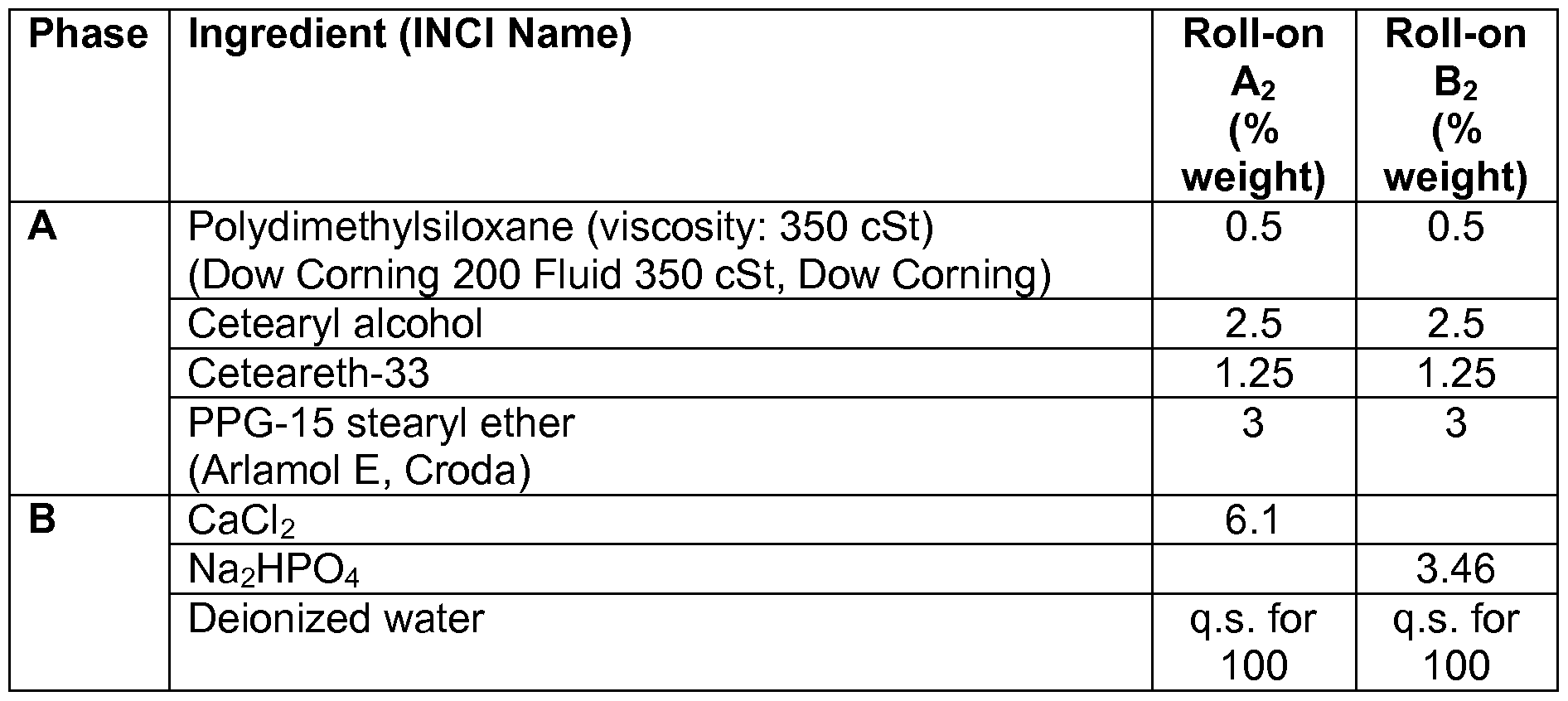
Procedure
The phases A and B are heated separately to 70°C. A and B are mixed with stirring for 5 minutes using an Ultra-Turrax. The mixture is then allowed to cool to 55° C using a paddle stirrer.
Use of the products The two roll-on products are used alternately, the roll-on A2 in the morning and the roll-on B2 in the evening.
Example 3: Sticks
Ingredient (INCI Name) Stick A3
(% weight)
A Ethylene homopolymer 9
(Performalene 400 Polyethylene,
New Phase Technologies)
Beneth-10 2

Procedure Phase A and phase B are introduced. The mixture is heated at 90°C until homogenized, and sufficient stirring is carried out, if necessary. Phase C is added at 90°C. This phase can comprise preservatives, active agents or other temperature-sensitive starting materials which it is preferable not to heat for an excessive period of time. The mixture is heated to 95°C in order to be able to pour sticks at 91 -92°C.
Ingredient (INCI Name) Stick B3
(% weight)
Oxypropylenated butyl alcohol 4.1
(Fluid AP, Low Odor, from Amerchol, Dow Chemical)
Isopropyl palmitate 8.3
Stearyl alcohol 28.5
Hydrogenated castor oil 19.6
(Cutina HR Powder, Cognis)
Polyethylene glycol (8 OE) distearate (PEG-400 distearate 6.5
(DUB DS PEG 8), Stearinerie Dubois)
Cyclopentadimethylsiloxane 21 .0
(Dow Corning 245 Fluid, Dow Corning)
NaHCOs 6
Expanded milled perlite 6
(Optimat 1430 OR, World Minerals)
Procedure
The cydopentasiloxane is heated to 65°C. The other ingredients are added (one by one) while remaining at 65-70°C. The combined mixture is homogenized (transparent solution) for 15 minutes. The perlite is added. Cooling is carried out to about 55°C (a few °C above the thickening of the mixture) and the mixture is poured into sticks. The sticks are placed at 4°C for 30 minutes.
Use of the products
Stick A3 is applied first, followed by stick B3 approximately 15 minutes later.
Example 4: Aerosols
Ingredient (INCI Name) Aerosol A
(% weight)
Triethyl citrate 1
(Citroflex 2, Reilly Chemicals)
Stearalkonium bentonite 0.2
(Tixogel MP 250, Sud Chemie Rheolog.)
Isopropyl palmitate 0.9
Dimethicone 9.0
(Dow Corning SH 200 C Fluid 10 cS, Dow Corning)
Cydopentasiloxane (and) dimethiconol 1 .3
(Dow Corning 1501 Fluid, Dow Corning)
CaCI2 5.25
Isobutane q.s. for 100 (A-31 , Aeropres)
Ingredient (INCI Name) Aerosol B
(% weight)
Triethyl citrate 1
(Citroflex 2, Reilly Chemicals)
Stearalkonium bentonite 0.2
(Tixogel MP 250, Sud Chemie Rheolog.)
Isopropyl palmitate 0.9
Dimethicone 9.0
(Dow Corning SH 200 C Fluid 10 cS, Dow Corning)
Cydopentasiloxane (and) Dimethiconol 1 .3
(Dow Corning 1501 Fluid, Dow Corning)
KHCOs 4.5
Isobutane (A-31 , Aeropres) q.s. for 100
Procedure
The salts are dispersed in the mixture of the other starting materials forming phase A, using a paddle stirrer. Pressurization is carried out in an aerosol can with isobutane.
Use of the products
Aerosol A4 is applied in the morning, and aerosol B is applied in the evening or during the day.
Example 5
Composition Ai is prepared with the ingredients described below. The percentage shown is the percentage of active material, relative to the total weight of the composition:
Composition A5
Calcium pidolate 14.83%
Water q.s. for 100
Composition B5 is prepared with the ingredients described below. The percentage shown is the percentage of active material, relative to the total weight of the composition:
Composition B5
NaHCOs 4.3%
Water q.s. for 100 The antiperspirant effectiveness of the compositions A5 and B5 according to Example 5 was evaluated on a panel of 22 women, according to the following protocol:
i) Two times 8 areas (4 x 5 cm2) are delimited on either side of the spinal column. Each product area has a corresponding symmetrical untreated control area.
ii) The composition A5 and then, 30 minutes later, the composition B5 are applied with occlusion for 1 hour for 4 consecutive days, with gentle massaging of the antiperspirant products. Total amount applied: 3.75 mg/cm2.
24 hours after the last application:
iii) The back is washed with water to remove any remaining trace of product; cellulose squares are fixed onto the various areas, and the person is then made to sweat in a sauna for 15 minutes at 80°C.
iv) The amount of sweat is evaluated by weighing the cellulose squares before and after sweating.
Under these test conditions, a significant reduction in sweating is measured.
Example 6
Connposition A6 is prepared with the ingredients described below. The percentage shown is the percentage of active material, relative to the total weight of the composition:
Composition AR
Calcium pantothenate 23.83%
Water q.s. for 100
Composition B2 is prepared with the ingredients described below. The percentage shown is the percentage of active material, relative to the total weight of the composition:
Composition BR
NaHCOs 4.3%
Water q.s. for 100
The antiperspirant effectiveness of the compositions A6 and B6 according to Example 6 was evaluated on a panel of 22 women, according to the following protocol:
i) Two times 8 areas (4 x 5 cm2) are delimited on either side of the spinal column. Each product area has a corresponding symmetrical untreated control area.
ii) The composition A6 and then, 30 minutes later, the composition B6 are applied with occlusion for 1 hour for 4 consecutive days, with gentle massaging of the antiperspirant products. Total amount applied: 3.75 mg/cm2.
24 hours after the last application:
iii) The back is washed with water to remove any remaining trace of product; cellulose squares are fixed onto the various areas, and the person is then made to sweat in a sauna for 15 minutes at 80°C.
iv) The amount of sweat is evaluated by weighing the cellulose squares before and after sweating.
Under these test conditions, a significant reduction in sweating is measured.
Example 7
Composition A7 is prepared with the ingredients described below. The percentage shown is the percentage of active material, relative to the total weight of the composition:
Composition A7
Calcium propionate 9.31 %
Water q.s. for 100
Composition B7 is prepared with the ingredients described below. The percentage shown is the percentage of active material, relative to the total weight of the composition:
Composition B7
NaHCOs 4.3%
Water q.s. for 100 The antiperspirant effectiveness of the compositions A7 and B7 according to Example 7 was evaluated on a panel of 22 women, according to the following protocol:
i) Two times 8 areas (4 x 5 cm2) are delimited on either side of the spinal column. Each product area has a corresponding symmetrical untreated control area.
ii) The composition A7 and then, 30 minutes later, the composition B7 are applied with occlusion for 1 hour for 4 consecutive days, with gentle massaging of the antiperspirant products. Total amount applied: 3.75 mg/cm2.
24 hours after the last application:
iii) The back is washed with water to remove any remaining trace of product; cellulose squares are fixed onto the various areas, and the person is then made to sweat in a sauna for 15 minutes at 80°C.
iv) The amount of sweat is evaluated by weighing the cellulose squares before and after sweating.
Under these test conditions, a significant reduction in sweating is measured. Example 8 Composition A8 is prepared with the ingredients described below. The percentage shown is the percentage of active material, relative to the total weight of the composition:
Composition A
Calcium lactate 15.41 %
Water q.s. for 100
Composition B8 is prepared with the ingredients described below. The percentage shown is the percentage of active material, relative to the total weight of the composition:
Composition B
NaHCOs 4.3%
Water q.s. for 100
The antiperspirant effectiveness of the compositions A8 and B8 according to Example 8 was evaluated on a panel of 22 women, according to the following protocol:
i) Two times 8 areas (4 x 5 cm2) are delimited on either side of the spinal column. Each product area has a corresponding symmetrical untreated control area.
ii) The composition A8 and then, 30 minutes later, the composition B8 are applied with occlusion for 1 hour for 4 consecutive days, with gentle massaging of the antiperspirant products. Total amount applied: 3.75 mg/cm2. 24 hours after the last application:
iii) The back is washed with water to remove any remaining trace of product; cellulose squares are fixed onto the various areas, and the person is then made to sweat in a sauna for 15 minutes at 80°C.
iv) The amount of sweat is evaluated by weighing the cellulose squares before and after sweating.
Under these test conditions, a significant reduction in sweating is measured. Example 9
Composition A9 is prepared with the ingredients described below. The percentage shown is the percentage of active material, relative to the total weight of the composition:
Composition As
Calcium ascorbate 21 .32%
Water q.s. for 100 Composition B9 is prepared with the ingredients described below. The percentage shown is the percentage of active material, relative to the total weight of the composition:
Composition B9
NaHCOs 4.3%
Water q.s. for 100
The antiperspirant effectiveness of the compositions A9 and B9 according to Example 9 was evaluated on a panel of 22 women, according to the following protocol:
i) Two times 8 areas (4 x 5 cm2) are delimited on either side of the spinal column. Each product area has a corresponding symmetrical untreated control area.
ii) The composition A9 and then, 30 minutes later, the composition B9 are applied with occlusion for 1 hour for 4 consecutive days, with gentle massaging of the antiperspirant products. Total amount applied: 3.75 mg/cm2.
24 hours after the last application:
iii) The back is washed with water to remove any remaining trace of product; cellulose squares are fixed onto the various areas, and the person is then made to sweat in a sauna for 15 minutes at 80°C.
iv) The amount of sweat is evaluated by weighing the cellulose squares before and after sweating.
Under these test conditions, a significant reduction in sweating is measured.
Example 10
Composition Aio is prepared with the ingredients described below. The percentage shown is the percentage of active material, relative to the total weight of the composition:
Composition Am
Calcium pidolate 14.83%
Water q.s. for 100
Composition Bio is prepared with the ingredients described below. The percentage shown is the percentage of active material, relative to the total weight of the composition: Composition Bm
Na2HPO4 3.46%
Water q.s. for 100
The antiperspirant effectiveness of the compositions Ai0 and Bio according to Example 10 was evaluated on a panel of 22 women, according to the following protocol:
i) Two times 8 areas (4 x 5 cm2) are delimited on either side of the spinal column. Each product area has a corresponding symmetrical untreated control area.
ii) The composition Ai0 and then, 30 minutes later, the composition Bio are applied with occlusion for 1 hour for 4 consecutive days, with gentle massaging of the antiperspirant products. Total amount applied: 3.75 mg/cm2.
24 hours after the last application:
iii) The back is washed with water to remove any remaining trace of product; cellulose squares are fixed onto the various areas, and the person is then made to sweat in a sauna for 15 minutes at 80°C.
iv) The amount of sweat is evaluated by weighing the cellulose squares before and after sweating. Under these test conditions, a significant reduction in sweating is measured.
Claims
1. Cosmetic method for the treatment of human perspiration resulting from perspiration, which comprises:
(i) either the extemporaneous mixing of at least one composition A and of at least one composition B packaged separately and the application of the said mixture to the surface of the skin;
(ii) or the application to the surface of the skin, simultaneously or sequentially, of at least one composition A and of at least one composition B packaged separately;
- the said composition A comprising, in a cosmetically acceptable medium, at least one polyvalent cation halide;
- the said composition B comprising, in a cosmetically acceptable medium, at least one non-nitrogenous salt of an anion;
- the said halide and the said anion salt forming in situ, on the skin, by cation/anion ionic interaction, an antiperspirant salt.
2. Method for the treatment of human perspiration resulting from perspiration, which comprises at least:
(i) either the extemporaneous mixing of at least one composition A' and of at least one composition B' packaged separately and the application of the said mixture to the surface of the skin;
(ii) or the application to the surface of the skin, simultaneously or sequentially, of at least one composition A' and of at least one composition B' packaged separately;
- the said composition A' comprising at least one polyvalent cation non- halogenated salt;
- the said composition B' comprising at least one nitrogenous or non-nitrogenous anion salt; the said polyvalent cation salt and the said anion salt forming in situ, on the skin, by cation/anion ionic interaction, an antiperspirant salt.
3. Method according to Claim 1 or 2, where the polyvalent cation of the composition A or A' is chosen from:
- alkaline earth cations;
- transition metal cations.
4. Method according to Claim 1 or 2, where the polyvalent cation halide is chosen from manganese halides or zinc halides.
5. Method according to any one of Claims 1 to 3, where the polyvalent cation halide is a polyvalent cation chloride.
6. Method according to any one of Claims 1 to 3, where the polyvalent cation halide is magnesium chloride.
7. Method according to any one of Claims 1 to 3, where the polyvalent cation halide is calcium chloride.
8. Method according to Claim 3, where the alkaline earth cation of the composition A' is chosen from strontium, magnesium and calcium.
9. Method according to Claim 3, where the transition metal cation is chosen from zinc, manganese and aluminium.
10. Method according to any one of Claims 2 to 4, where the polyvalent cation non-halogenated salt exhibits a solubility in water of greater than 2%, between 15°C and 30°C at a pH of between 5 and 9, and is preferably chosen from:
- carboxylic acid salts, such as acetates, propionates, pyrrol idonecarboxylates (or pidolates) or sorbates;
- polyhydroxylated carboxylic acid salts, such as gluconates, heptagluconates, ketogluconates, lactate gluconates, ascorbates or pantothenates;
- mono- or polycarboxyl hydroxy acid salts, such as citrates or lactates;
- amino acid salts, such as aspartates or glutamates;
- fulvate salts;
- bicarbonate salts;
- nitrates;
- sulphates, such as magnesium sulphate, or aluminium double sulphates, such as alum: KAI(SO4)2.12H2O.
11. Method according to Claim 10, where the polyvalent cation non-halogenated salt is chosen from calcium pidolate, calcium aspartate, calcium gluconate, calcium glutamate, calcium neptagluconate, calcium propionate, calcium 2- ketogluconate, calcium lactate, calcium ascorbate, calcium pantothenate, calcium bicarbonate, calcium sorbate, calcium lactate gluconate, calcium fulvate, magnesium sulphate, magnesium acetate, magnesium pidolate, magnesium gluconate, magnesium glutamate, magnesium heptagluconate, magnesium 2- ketogluconate, magnesium lactate, magnesium ascorbate, magnesium citrate, magnesium aspartate, magnesium pantothenate, magnesium bicarbonate, magnesium sorbate, magnesium lactate gluconate, magnesium fulvate or manganese gluconate.
12. Method according to Claim 1 1 , where the polyvalent cation non-halogenated salt is chosen from calcium aspartate, calcium lactate, calcium propionate, calcium pidolate, calcium pantothenate, calcium bicarbonate, calcium sorbate, calcium ascorbate, calcium lactate gluconate or calcium fulvate and is more particularly chosen from calcium lactate, calcium propionate, calcium pidolate, calcium pantothenate or calcium ascorbate.
13. Method according to any one of Claims 1 to 12, where the anion non- nitrogenous salt of the composition B or B' is chosen from:
- alkaline earth metal salts;
- alkali metal salts.
14. Method according to Claim 13, where the anion non-nitrogenous salt of the composition B or B' is a sodium or potassium salt.
15. Method according to Claim 14, where the anion non-nitrogenous salt is chosen from Na2CO3, K2CO3, NaHCO3, KHCO3, Na3PO3, Na2HPO4, NaH2PO4, Na2H2P2O7, Na4P2O7, K2HPO4, KH2PO4, K2H2P2O7, K4P2O7, Na2SO4 or K2SO4, and more particularly sodium hydrogencarbonate NaHCO3.
16. Method according to any one of Claims 1 to 6, where the anion nitrogenous salts are chosen from ammonium salts or amine salts, in particular salts of mono-, di- or trialkanolamines comprising from 1 to 3 identical or different Ci-C4 hydroxyalkyl radicals.
17. Method according to any one of Claims 1 to 16, where the polyvalent cation salt of the composition A or A' and the anion salt of the composition B or B' form, when they are brought into contact, a salt having a solubility product in water at 25°C of less than 10"4 and preferably of less than 10"5.
18. Method according to any one of Claims 1 to 17, where the molar ratio of the polyvalent cation of the composition A or A' to the anion of the composition B or B' varies from 10/1 to 1/10 and more preferably from 4/1 to 1/4.
19. Method according to any one of Claims 1 to 18, where the total concentration of polyvalent cation salt of the composition A or A' and of anion salt of the composition B or B' varies from 2 to 25% by weight and more preferably from 5 to 20% by weight, relative to the total weight of the compositions A and B or of the compositions A' and B'.
20. Method according to any one of Claims 1 to 19, in which the composition A or A' comprising the polyvalent cation salt and the composition B or B' comprising the anion salt are packaged separately and are applied to the surface of the skin sequentially with a time interval ranging from 10 seconds to 24 hours, more preferably from 2 minutes to 24 hours and more preferably still from 1 hour to 24 hours.
Applications Claiming Priority (8)
| Application Number | Priority Date | Filing Date | Title |
|---|---|---|---|
| FR1156656 | 2011-07-22 | ||
| FR1156657A FR2978033B1 (en) | 2011-07-22 | 2011-07-22 | PROCESS FOR TREATING HUMAN TRANSPIRATION USING SALT FORMED FROM NON-HALOGENIC MULTIVALENT CATION SALT AND ANION SALT |
| FR1156657 | 2011-07-22 | ||
| FR1156656A FR2978032B1 (en) | 2011-07-22 | 2011-07-22 | PROCESS FOR TREATING HUMAN TRANSPIRATION USING MULTIVALENT CATION HALIDE AND NONION NITROGEN SALT |
| US201161511730P | 2011-07-26 | 2011-07-26 | |
| US201161511699P | 2011-07-26 | 2011-07-26 | |
| US61/511,730 | 2011-07-26 | ||
| US61/511,699 | 2011-07-26 |
Publications (2)
| Publication Number | Publication Date |
|---|---|
| WO2013013902A2 true WO2013013902A2 (en) | 2013-01-31 |
| WO2013013902A3 WO2013013902A3 (en) | 2013-11-14 |
Family
ID=47601590
Family Applications (1)
| Application Number | Title | Priority Date | Filing Date |
|---|---|---|---|
| PCT/EP2012/061876 Ceased WO2013013902A2 (en) | 2011-07-22 | 2012-06-20 | Method for the treatment of human perspiration using a polyvalent cation salt and an anion salt |
Country Status (1)
| Country | Link |
|---|---|
| WO (1) | WO2013013902A2 (en) |
Cited By (13)
| Publication number | Priority date | Publication date | Assignee | Title |
|---|---|---|---|---|
| US20140227215A1 (en) * | 2011-09-28 | 2014-08-14 | Michael Richard Baker | Antiperspirant compositions and method for reducing perspiration |
| WO2014137350A1 (en) * | 2013-03-08 | 2014-09-12 | Monroe Manus Bernard | Citrate salts for eliminating odors |
| WO2014161792A1 (en) * | 2013-04-03 | 2014-10-09 | Unilever Plc | Method for the manufacture of anhydrous cosmetic compositions |
| WO2019072831A1 (en) | 2017-10-09 | 2019-04-18 | L'oreal | Process for treating human transpiration using a cation and an anion in presence of a modulator |
| US10342749B2 (en) | 2014-12-15 | 2019-07-09 | Conopco, Inc. | Antiperspirant compositions comprising alums |
| US10350151B2 (en) | 2014-12-26 | 2019-07-16 | Colgate-Palmolive Company | Zinc phosphate complex |
| WO2020187699A1 (en) | 2019-03-18 | 2020-09-24 | Unilever N.V. | An antiperspirant composition comprising reactive salts |
| WO2020187686A1 (en) | 2019-03-18 | 2020-09-24 | Unilever N.V. | An antiperspirant composition comprising reactive salts |
| US11213466B2 (en) | 2014-12-26 | 2022-01-04 | Colgate-Palmolive Company | Personal care compositions with zinc phosphate active |
| FR3117804A1 (en) * | 2020-12-22 | 2022-06-24 | L'oreal | METHOD FOR TREATMENT OF HUMAN PERSPIRATION AND BODY ODOR USING MAGNESIUM OXIDE AND A PHOSPHATE SALT |
| US11690791B2 (en) | 2014-12-26 | 2023-07-04 | Colgate-Palmolive Company | Zinc phosphate complex |
| US12005076B2 (en) | 2014-12-26 | 2024-06-11 | Colgate-Palmolive Company | Zinc phosphate complex |
| WO2025132660A1 (en) * | 2023-12-22 | 2025-06-26 | L'oreal | Method for treating human perspiration, and associated composition |
Citations (21)
| Publication number | Priority date | Publication date | Assignee | Title |
|---|---|---|---|---|
| US5002698A (en) | 1986-01-10 | 1991-03-26 | Ciba-Geigy Corporation | Sulfur- and nitrogen-containing lubricant additives |
| WO1992006778A1 (en) | 1990-10-17 | 1992-04-30 | Societe D'exploitation De Produits Pour Les Industries Chimiques (S.E.P.P.I.C.) | Use of fatty alcohol based compositions for preparing emulsions, method of preparing emulsions and emulsions so obtained |
| US5236986A (en) | 1991-02-27 | 1993-08-17 | Shin-Etsu Chemical Co., Ltd. | Silicone polymers and water-dispersable, pasty silicone oil compositions comprising the same |
| US5412004A (en) | 1991-11-21 | 1995-05-02 | Kose Corporation | Silicone polymer, paste-like silicone composition, and w/o-type cosmetic composition comprising the same |
| WO1995013863A1 (en) | 1993-11-19 | 1995-05-26 | Societe D'exploitation De Produits Pour Les Industries Chimiques, S.E.P.P.I.C. | Alkylglycoside-containing concentrate and uses thereof |
| EP0847752A1 (en) | 1996-11-26 | 1998-06-17 | L'oreal | Without rub off topical composition containing a fluorosilicon compound |
| US5783657A (en) | 1996-10-18 | 1998-07-21 | Union Camp Corporation | Ester-terminated polyamides of polymerized fatty acids useful in formulating transparent gels in low polarity liquids |
| US5811487A (en) | 1996-12-16 | 1998-09-22 | Dow Corning Corporation | Thickening silicones with elastomeric silicone polyethers |
| WO1998047610A1 (en) | 1997-04-21 | 1998-10-29 | Societe D'exploitation De Produits Pour Les Industries Chimiques - Seppic | Composition based on alkylpolyglycosides and fatty alcohols, and uses thereof |
| US5837793A (en) | 1996-03-22 | 1998-11-17 | Dow Corning Toray Silicone Co., Ltd. | Silicone rubber powder and method for the preparation thereof |
| US5874069A (en) | 1997-01-24 | 1999-02-23 | Colgate-Palmolive Company | Cosmetic composition containing silicon-modified amides as thickening agents and method of forming same |
| US5919441A (en) | 1996-04-01 | 1999-07-06 | Colgate-Palmolive Company | Cosmetic composition containing thickening agent of siloxane polymer with hydrogen-bonding groups |
| US5981680A (en) | 1998-07-13 | 1999-11-09 | Dow Corning Corporation | Method of making siloxane-based polyamides |
| US6051216A (en) | 1997-08-01 | 2000-04-18 | Colgate-Palmolive Company | Cosmetic composition containing siloxane based polyamides as thickening agents |
| FR2792190A1 (en) | 1999-04-16 | 2000-10-20 | Sophim | Non-greasy wax-ester emollients for use in skin care preparations obtained by interesterification of triglycerides with an alcohol, distilling off residual alcohol, decolorizing and fridge or hydrogenating the product |
| WO2002047619A2 (en) | 2000-12-12 | 2002-06-20 | L'oreal S.A. | Cosmetic composition comprising a polymer and fibres |
| WO2002056847A1 (en) | 2001-01-17 | 2002-07-25 | L'oreal | Cosmetic composition comprising a polymer and a fluorinated oil |
| WO2004024798A1 (en) | 2002-09-12 | 2004-03-25 | Shin-Etsu Chemical Co., Ltd. | Novel organopolysiloxane polymer, pasty composition, and cosmetic preparation containing the composition |
| US20070196303A1 (en) | 2006-02-17 | 2007-08-23 | Reheis, Inc. | Stable buffered aluminum compositions having high hplc bands iii and iv containing calcium/strontium |
| DE102008012457A1 (en) | 2007-06-19 | 2008-12-24 | Cognis Ip Management Gmbh | Hydrocarbon mixture, useful e.g. in decorative cosmetics, preferably lipsticks, lip gloss, eye shade, mascara, eye pencil, nail polish and make-up formulations and eye shade, comprises linear hydrocarbons |
| FR2940062A1 (en) | 2008-12-19 | 2010-06-25 | Oreal | Multi-component anti-perspirant agent, useful to treat human sweat, comprises first component having cosmetic composition and second component comprising cosmetic composition different from composition of the first compartment |
-
2012
- 2012-06-20 WO PCT/EP2012/061876 patent/WO2013013902A2/en not_active Ceased
Patent Citations (21)
| Publication number | Priority date | Publication date | Assignee | Title |
|---|---|---|---|---|
| US5002698A (en) | 1986-01-10 | 1991-03-26 | Ciba-Geigy Corporation | Sulfur- and nitrogen-containing lubricant additives |
| WO1992006778A1 (en) | 1990-10-17 | 1992-04-30 | Societe D'exploitation De Produits Pour Les Industries Chimiques (S.E.P.P.I.C.) | Use of fatty alcohol based compositions for preparing emulsions, method of preparing emulsions and emulsions so obtained |
| US5236986A (en) | 1991-02-27 | 1993-08-17 | Shin-Etsu Chemical Co., Ltd. | Silicone polymers and water-dispersable, pasty silicone oil compositions comprising the same |
| US5412004A (en) | 1991-11-21 | 1995-05-02 | Kose Corporation | Silicone polymer, paste-like silicone composition, and w/o-type cosmetic composition comprising the same |
| WO1995013863A1 (en) | 1993-11-19 | 1995-05-26 | Societe D'exploitation De Produits Pour Les Industries Chimiques, S.E.P.P.I.C. | Alkylglycoside-containing concentrate and uses thereof |
| US5837793A (en) | 1996-03-22 | 1998-11-17 | Dow Corning Toray Silicone Co., Ltd. | Silicone rubber powder and method for the preparation thereof |
| US5919441A (en) | 1996-04-01 | 1999-07-06 | Colgate-Palmolive Company | Cosmetic composition containing thickening agent of siloxane polymer with hydrogen-bonding groups |
| US5783657A (en) | 1996-10-18 | 1998-07-21 | Union Camp Corporation | Ester-terminated polyamides of polymerized fatty acids useful in formulating transparent gels in low polarity liquids |
| EP0847752A1 (en) | 1996-11-26 | 1998-06-17 | L'oreal | Without rub off topical composition containing a fluorosilicon compound |
| US5811487A (en) | 1996-12-16 | 1998-09-22 | Dow Corning Corporation | Thickening silicones with elastomeric silicone polyethers |
| US5874069A (en) | 1997-01-24 | 1999-02-23 | Colgate-Palmolive Company | Cosmetic composition containing silicon-modified amides as thickening agents and method of forming same |
| WO1998047610A1 (en) | 1997-04-21 | 1998-10-29 | Societe D'exploitation De Produits Pour Les Industries Chimiques - Seppic | Composition based on alkylpolyglycosides and fatty alcohols, and uses thereof |
| US6051216A (en) | 1997-08-01 | 2000-04-18 | Colgate-Palmolive Company | Cosmetic composition containing siloxane based polyamides as thickening agents |
| US5981680A (en) | 1998-07-13 | 1999-11-09 | Dow Corning Corporation | Method of making siloxane-based polyamides |
| FR2792190A1 (en) | 1999-04-16 | 2000-10-20 | Sophim | Non-greasy wax-ester emollients for use in skin care preparations obtained by interesterification of triglycerides with an alcohol, distilling off residual alcohol, decolorizing and fridge or hydrogenating the product |
| WO2002047619A2 (en) | 2000-12-12 | 2002-06-20 | L'oreal S.A. | Cosmetic composition comprising a polymer and fibres |
| WO2002056847A1 (en) | 2001-01-17 | 2002-07-25 | L'oreal | Cosmetic composition comprising a polymer and a fluorinated oil |
| WO2004024798A1 (en) | 2002-09-12 | 2004-03-25 | Shin-Etsu Chemical Co., Ltd. | Novel organopolysiloxane polymer, pasty composition, and cosmetic preparation containing the composition |
| US20070196303A1 (en) | 2006-02-17 | 2007-08-23 | Reheis, Inc. | Stable buffered aluminum compositions having high hplc bands iii and iv containing calcium/strontium |
| DE102008012457A1 (en) | 2007-06-19 | 2008-12-24 | Cognis Ip Management Gmbh | Hydrocarbon mixture, useful e.g. in decorative cosmetics, preferably lipsticks, lip gloss, eye shade, mascara, eye pencil, nail polish and make-up formulations and eye shade, comprises linear hydrocarbons |
| FR2940062A1 (en) | 2008-12-19 | 2010-06-25 | Oreal | Multi-component anti-perspirant agent, useful to treat human sweat, comprises first component having cosmetic composition and second component comprising cosmetic composition different from composition of the first compartment |
Non-Patent Citations (3)
| Title |
|---|
| C. FOX, COSMETICS AND TOILETRIES, vol. 101, November 1986 (1986-11-01), pages 101 - 112 |
| J. SOC. COSM. CHEM., vol. 5, 1954, pages 249 - 256 |
| TH. FORSTER ET AL.: "Phase Inversion Emulsification", COSMETICS & TOILETRIES, vol. 106, December 1991 (1991-12-01), pages 49 - 52 |
Cited By (19)
| Publication number | Priority date | Publication date | Assignee | Title |
|---|---|---|---|---|
| US20140227215A1 (en) * | 2011-09-28 | 2014-08-14 | Michael Richard Baker | Antiperspirant compositions and method for reducing perspiration |
| WO2014137350A1 (en) * | 2013-03-08 | 2014-09-12 | Monroe Manus Bernard | Citrate salts for eliminating odors |
| US11154474B2 (en) | 2013-03-08 | 2021-10-26 | Manus B. Monroe | Chemical formulations and their use in neutralizing or eliminating odors |
| US20160045406A1 (en) * | 2013-04-03 | 2016-02-18 | Conopco, Inc., D/B/A Unilever | Method for the manufacture of anhydrous cosmetic compositions |
| WO2014161792A1 (en) * | 2013-04-03 | 2014-10-09 | Unilever Plc | Method for the manufacture of anhydrous cosmetic compositions |
| US10342749B2 (en) | 2014-12-15 | 2019-07-09 | Conopco, Inc. | Antiperspirant compositions comprising alums |
| US10350151B2 (en) | 2014-12-26 | 2019-07-16 | Colgate-Palmolive Company | Zinc phosphate complex |
| US11690791B2 (en) | 2014-12-26 | 2023-07-04 | Colgate-Palmolive Company | Zinc phosphate complex |
| US11213466B2 (en) | 2014-12-26 | 2022-01-04 | Colgate-Palmolive Company | Personal care compositions with zinc phosphate active |
| US11344486B2 (en) | 2014-12-26 | 2022-05-31 | Colgate-Palmolive Company | Zinc phosphate complex |
| US12005076B2 (en) | 2014-12-26 | 2024-06-11 | Colgate-Palmolive Company | Zinc phosphate complex |
| WO2019072831A1 (en) | 2017-10-09 | 2019-04-18 | L'oreal | Process for treating human transpiration using a cation and an anion in presence of a modulator |
| US12496264B2 (en) * | 2017-10-09 | 2025-12-16 | L'oreal | Process for treating human transpiration using a cation and an anion in presence of a modulator |
| WO2020187686A1 (en) | 2019-03-18 | 2020-09-24 | Unilever N.V. | An antiperspirant composition comprising reactive salts |
| WO2020187699A1 (en) | 2019-03-18 | 2020-09-24 | Unilever N.V. | An antiperspirant composition comprising reactive salts |
| WO2022136507A1 (en) * | 2020-12-22 | 2022-06-30 | L'oreal | Process for treating human perspiration and body odors using magnesium oxide and a phosphate salt |
| FR3117804A1 (en) * | 2020-12-22 | 2022-06-24 | L'oreal | METHOD FOR TREATMENT OF HUMAN PERSPIRATION AND BODY ODOR USING MAGNESIUM OXIDE AND A PHOSPHATE SALT |
| WO2025132660A1 (en) * | 2023-12-22 | 2025-06-26 | L'oreal | Method for treating human perspiration, and associated composition |
| FR3157122A1 (en) * | 2023-12-22 | 2025-06-27 | L'oreal | Method for treating human perspiration and associated composition |
Also Published As
| Publication number | Publication date |
|---|---|
| WO2013013902A3 (en) | 2013-11-14 |
Similar Documents
| Publication | Publication Date | Title |
|---|---|---|
| EP2734175B2 (en) | Use, as antiperspirant, of a polyvalent cation salt without aluminium halide antiperspirant or compound capable of reacting with said salt in order to produce an antiperspirant effect | |
| ES2950993T3 (en) | Cosmetic procedure for treating human perspiration using particles of an expanded amorphous mineral material; compositions | |
| WO2013013902A2 (en) | Method for the treatment of human perspiration using a polyvalent cation salt and an anion salt | |
| US10117816B2 (en) | Cosmetic process for treating human body odor using a 4-(3-ethoxy-4-hydroxyphenyl)alkyl ketone or 2-ethoxy-4-hydroxyalkylphenol compound | |
| EP3562558B1 (en) | Anhydrous composition comprising a magnesium salt | |
| WO2013013903A1 (en) | Process for treating perspiration using an anhydrous composition comprising two reagents that together produce an antiperspirant effect in situ on the skin | |
| US10966913B2 (en) | Cosmetic use of spiculisporic acid as a deodorant active agent | |
| EP2854747B1 (en) | Cosmetic composition comprising the combination of a lipophilic salicylic acid derivative, an antiperspirant aluminium salt or complex and an amino acid-n,n-diacetic acid salt | |
| WO2012084520A2 (en) | Use of hydrophobic aerogel particles as deodorant active agent; method for the treatment of human body odours | |
| FR2978032A1 (en) | PROCESS FOR TREATING HUMAN TRANSPIRATION USING MULTIVALENT CATION HALIDE AND NONION NITROGEN SALT | |
| ES2719272T3 (en) | Cosmetic use of an essential oil rich in geraniol from Satureja montana as an active deodorant agent | |
| WO2011157609A2 (en) | Use of amino acid derivatives as agents for treating human perspiration, novel compounds, and compositions containing them | |
| WO2011047981A1 (en) | Use of a dialkylphenyl-4-aminopiperidine as agent for the treatment of human perspiration; novel compounds and compositions comprising them | |
| EP2642974B1 (en) | Process for treating perspiration using a carbonyl compound capable of reacting via the maillard reaction | |
| WO2011047982A2 (en) | Use of adenosine and/or of one of its derivatives as agent for the treatment of human perspiration | |
| FR2978033A1 (en) | PROCESS FOR TREATING HUMAN TRANSPIRATION USING SALT FORMED FROM NON-HALOGENIC MULTIVALENT CATION SALT AND ANION SALT | |
| BR112013025119B1 (en) | Cosmetic process for treating human body odors, cosmetic use and composition. |
Legal Events
| Date | Code | Title | Description |
|---|---|---|---|
| 121 | Ep: the epo has been informed by wipo that ep was designated in this application |
Ref document number: 12730881 Country of ref document: EP Kind code of ref document: A2 |
|
| 122 | Ep: pct application non-entry in european phase |
Ref document number: 12730881 Country of ref document: EP Kind code of ref document: A2 |