WO2013015212A1 - 有機酸の製造方法 - Google Patents
有機酸の製造方法 Download PDFInfo
- Publication number
- WO2013015212A1 WO2013015212A1 PCT/JP2012/068427 JP2012068427W WO2013015212A1 WO 2013015212 A1 WO2013015212 A1 WO 2013015212A1 JP 2012068427 W JP2012068427 W JP 2012068427W WO 2013015212 A1 WO2013015212 A1 WO 2013015212A1
- Authority
- WO
- WIPO (PCT)
- Prior art keywords
- acid
- organic acid
- producing
- lactic acid
- organic
- Prior art date
- Legal status (The legal status is an assumption and is not a legal conclusion. Google has not performed a legal analysis and makes no representation as to the accuracy of the status listed.)
- Ceased
Links
Classifications
-
- C—CHEMISTRY; METALLURGY
- C07—ORGANIC CHEMISTRY
- C07C—ACYCLIC OR CARBOCYCLIC COMPOUNDS
- C07C51/00—Preparation of carboxylic acids or their salts, halides or anhydrides
- C07C51/42—Separation; Purification; Stabilisation; Use of additives
- C07C51/50—Use of additives, e.g. for stabilisation
-
- C—CHEMISTRY; METALLURGY
- C12—BIOCHEMISTRY; BEER; SPIRITS; WINE; VINEGAR; MICROBIOLOGY; ENZYMOLOGY; MUTATION OR GENETIC ENGINEERING
- C12P—FERMENTATION OR ENZYME-USING PROCESSES TO SYNTHESISE A DESIRED CHEMICAL COMPOUND OR COMPOSITION OR TO SEPARATE OPTICAL ISOMERS FROM A RACEMIC MIXTURE
- C12P7/00—Preparation of oxygen-containing organic compounds
- C12P7/40—Preparation of oxygen-containing organic compounds containing a carboxyl group including Peroxycarboxylic acids
-
- C—CHEMISTRY; METALLURGY
- C07—ORGANIC CHEMISTRY
- C07C—ACYCLIC OR CARBOCYCLIC COMPOUNDS
- C07C51/00—Preparation of carboxylic acids or their salts, halides or anhydrides
- C07C51/42—Separation; Purification; Stabilisation; Use of additives
- C07C51/487—Separation; Purification; Stabilisation; Use of additives by treatment giving rise to chemical modification
-
- C—CHEMISTRY; METALLURGY
- C08—ORGANIC MACROMOLECULAR COMPOUNDS; THEIR PREPARATION OR CHEMICAL WORKING-UP; COMPOSITIONS BASED THEREON
- C08G—MACROMOLECULAR COMPOUNDS OBTAINED OTHERWISE THAN BY REACTIONS ONLY INVOLVING UNSATURATED CARBON-TO-CARBON BONDS
- C08G63/00—Macromolecular compounds obtained by reactions forming a carboxylic ester link in the main chain of the macromolecule
- C08G63/78—Preparation processes
-
- C—CHEMISTRY; METALLURGY
- C12—BIOCHEMISTRY; BEER; SPIRITS; WINE; VINEGAR; MICROBIOLOGY; ENZYMOLOGY; MUTATION OR GENETIC ENGINEERING
- C12P—FERMENTATION OR ENZYME-USING PROCESSES TO SYNTHESISE A DESIRED CHEMICAL COMPOUND OR COMPOSITION OR TO SEPARATE OPTICAL ISOMERS FROM A RACEMIC MIXTURE
- C12P7/00—Preparation of oxygen-containing organic compounds
- C12P7/40—Preparation of oxygen-containing organic compounds containing a carboxyl group including Peroxycarboxylic acids
- C12P7/44—Polycarboxylic acids
- C12P7/46—Dicarboxylic acids having four or less carbon atoms, e.g. fumaric acid, maleic acid
-
- C—CHEMISTRY; METALLURGY
- C12—BIOCHEMISTRY; BEER; SPIRITS; WINE; VINEGAR; MICROBIOLOGY; ENZYMOLOGY; MUTATION OR GENETIC ENGINEERING
- C12P—FERMENTATION OR ENZYME-USING PROCESSES TO SYNTHESISE A DESIRED CHEMICAL COMPOUND OR COMPOSITION OR TO SEPARATE OPTICAL ISOMERS FROM A RACEMIC MIXTURE
- C12P7/00—Preparation of oxygen-containing organic compounds
- C12P7/40—Preparation of oxygen-containing organic compounds containing a carboxyl group including Peroxycarboxylic acids
- C12P7/56—Lactic acid
Definitions
- the present invention relates to a method for producing an organic acid derived from biomass resources.
- organic acids which are raw materials such as polyester.
- Examples of the method for producing an organic acid derived from biomass resources include a method of obtaining an organic acid by chemical synthesis of a biomass-derived compound as it is, a method of obtaining an organic acid from a biomass-derived compound by fermentation fermentation of microorganisms, and the like.
- organic acids produced by these methods need to be combined with complicated purification steps such as crystallization, membrane separation, and distillation in order to remove many impurities derived from biomass resources. Impurities cause the subsequent polymer to be colored even in trace amounts.
- a polymer obtained using a colored organic acid still shows coloration, which not only impairs the commercial value, but also may cause the physical properties of the polymer to deteriorate due to the influence of a slightly contained coloring-causing substance.
- Patent Document 1 As a method for removing coloring impurities contained in biomass resource-derived organic acids, a treatment method using a reducing agent for a lactic acid aqueous solution containing pyruvic acid obtained by a fermentation method is known (Patent Document 1). According to this method, a low coloration lactic acid solution containing no pyruvic acid can be obtained, and a high molecular weight polylactic acid can be obtained using this solution.
- the present invention includes the following (1) to (7).
- a method for producing an organic acid comprising oxidizing an organic acid derived from biomass resources with an oxidizing agent.
- the oxidizing agent is one or more selected from the group consisting of hydrogen peroxide, tert-butyl hydroperoxide, ozone, sodium hypochlorite and sodium chlorite, and aqueous solutions thereof.
- the manufacturing method of the organic acid as described in (1).
- (3) The method for producing an organic acid according to (1) or (2), wherein the oxidation treatment is combined with a heat treatment.
- the organic acid is lactic acid, hydroxybutyric acid, 3-hydroxypropionic acid, itaconic acid, glycolic acid, adipic acid, muconic acid, acrylic acid, succinic acid, sebacic acid, 2,5-furandicarboxylic acid and terephthalic acid
- a method for producing an organic acid polymer characterized by polymerizing an organic acid obtained by the method for producing an organic acid according to any one of (1) to (6) as a raw material.
- an organic acid derived from a high-purity biomass resource with a reduced degree of coloring can be obtained.
- the organic acid obtained by the present invention is not impaired in physical properties by the treatment for removing the coloring impurities, the polymer obtained by polymerizing the organic acid has characteristics such as hue, weight average molecular weight, melting point, and heating weight loss rate. Is superior to polymers obtained by polymerizing organic acids obtained by conventional methods.
- Organic acids derived from biomass resources are obtained by fermentation culture of microorganisms that can assimilate raw materials derived from biomass resources, specifically polysaccharides such as cellulose and monosaccharides such as glucose and xylose. Fermentation of microorganisms capable of assimilating biomass resources in the present invention, which are manufactured, those manufactured by known synthesis and decomposition reactions from raw materials derived from biomass resources, or those combinations. It is particularly suitable when producing an organic acid obtained by culturing.
- the polymer raw material (monomer) in which quality deterioration is anxious about the coloring component derived from a biomass resource becomes a suitable object.
- the organic acid used as the polymer raw material include lactic acid, hydroxybutyric acid, 3-hydroxypropionic acid, itaconic acid, glycolic acid, adipic acid, muconic acid, acrylic acid, succinic acid, sebacic acid, and 2,5-furandicarboxylic acid. , Terephthalic acid, and one or more of them may be targeted.
- Examples of a method for producing an organic acid by fermentation culture of a microorganism capable of assimilating biomass resources include, for example, a method for producing lactic acid by fermentation culture of a microorganism described in JP-A-2008-029329, The method of producing 3-hydroxybutyric acid by fermentation culture of microorganisms described in US Pat. No. 38775, the method of producing 3-hydroxypropionic acid by fermentation culture of microorganisms described in Japanese Patent No. 4490628, A method for producing itaconic acid by fermentation culture of microorganisms described in Japanese Patent No. 1913914, a method for producing glycolic acid by fermentation culture of microorganisms described in Japanese Patent Application Laid-Open No. 2008-56654, and Japanese Patent No.
- the muconic acid fermentation ability described in US Pat. No. 5,487,987 can be used.
- a method for producing muconic acid by fermentation culture of microorganisms having the same, and further producing adipic acid that can be used as a nylon raw material by hydrogen reduction, or fermentation culture of microorganisms having muconic acid fermentation ability described in Japanese Patent No. 4490628 A method of producing acrylic acid by producing 3-hydroxypropionic acid by subjecting it to a dehydration reaction, and the like.
- the organic acid obtained by the above-described method may contain a coloring impurity
- the present inventors have found that the coloring impurity is decomposed by an oxidation reaction with an oxidizing agent, and the present invention. Was completed. The details will be described below.
- the oxidizing agent used in the present invention is not particularly limited, and an oxidizing agent used in a general chemical reaction can be used.
- Preferred examples include hydrogen peroxide or an aqueous solution thereof, sodium hypochlorite or its Aqueous solution, sodium chlorite, tert-butyl hydroperoxide or its aqueous solution, ozone or its aqueous solution, oxygen, 2-iodoxybenzoic acid, manganese dioxide, desmartin periodinane, 2,3-dicyano-5,6-dichloro- More preferred examples include hydrogen peroxide or an aqueous solution thereof, sodium hypochlorite or an aqueous solution thereof, sodium chlorite, tert-butyl hydroperoxide or an aqueous solution thereof, ozone or an aqueous solution thereof. can give.
- These oxidizing agents may be one kind or two or more kinds.
- the organic acid is preferably dissolved in the solvent, but the organic acid containing the biomass-derived colored substance is completely dissolved in the solvent. It may be in a slurry state. Further, the organic acid solvent can be applied either in an aqueous system or an organic solvent system, but an aqueous solvent is preferable.
- the method for adding the oxidant to the organic acid is not particularly limited.
- the oxidant may be added directly or as a solution, and when the oxidant is gaseous, May be added by a method of directly blowing into the organic acid solution or a method of separately dissolving a gaseous oxidant in water or dispersing as fine bubbles into the organic acid solution.
- the heat treatment here refers to applying heat of 35 ° C. or higher, preferably 35 to 200 ° C., more preferably 50 to 180 ° C., and still more preferably 60 to 180 ° C. This heat treatment may be performed prior to the oxidation treatment, or may be performed under heating conditions.
- the method is not limited to a method of simply heating the reaction solution.
- the heating operation in the distillation operation may be a heat treatment. That is, in this case, the reaction solution is distilled in the presence of an oxidizing agent.
- This method is preferably applied in the present invention because the isolation of the organic acid having a reduced degree of coloring can be performed simultaneously in addition to the oxidation treatment and the heat treatment.
- the oxidation treatment in the present invention may be combined with other purification operations. Depending on the type of oxidizing agent used, there is a possibility that it will dissolve or precipitate in the solution after reacting with the colored substance.
- separating these from the target organic acid is not specifically limited, For example, ion exchange, filtration, distillation, etc. are mentioned.
- the purification operation to be combined is distillation, it is efficient and particularly preferable because it can be performed together with the heat treatment as described above.
- the end point of the oxidant treatment is that the hue no longer changes.
- the time required until the hue does not change also varies depending on the type and amount of the oxidizing agent used.
- Whether the coloring component derived from biomass contained in the organic acid is reduced by the present invention is determined by determining the hue of the organic acid before and after the oxidation treatment by the number of APHA unit colors (JIS K 0071-1, October 20, 1998). Established, hereinafter referred to as APHA value). That is, when the APHA value after the oxidation treatment is reduced as compared with the APHA value before the oxidation treatment under the same treatment conditions except for the oxidation treatment, it is determined that the effect of the present invention is obtained.
- the organic acid polymer can be produced by a known polymerization method using the organic acid obtained by the present invention as a raw material.
- the organic acid polymer here is a polymer obtained by polymerizing an organic acid as a monomer.
- Specific examples of the organic acid polymer include the following organic acid polyesters and organic acid polyamides.
- Organic acid polyester For example, in the case of a bifunctional oxycarboxylic acid having a hydroxyl group in the molecule such as lactic acid, glycolic acid or hydroxybutyric acid, these can be polymerized alone to obtain a polyester.
- the polymerization method includes a two-stage polymerization method in which a cyclic dimer such as lactide in the case of polylactic acid and glycolide in the case of glycolic acid is once generated and then ring-opening polymerization, or the organic acid in a solvent.
- a cyclic dimer such as lactide in the case of polylactic acid and glycolide in the case of glycolic acid is once generated and then ring-opening polymerization, or the organic acid in a solvent.
- it can be produced by a one-step direct polymerization method in which dehydration polycondensation is performed directly under solvent-free conditions.
- Specific examples include polylactic acid, polyglycolic acid, polyhydroxypropionic acid, and polyhydroxybutyric
- an organic acid having two carboxyl groups in the molecule such as adipic acid, muconic acid, succinic acid, sebacic acid, itaconic acid, 2,5-furandicarboxylic acid, terephthalic acid, etc.
- diols and diamines are required for the production of polyester and polyamide using dicarboxylic acid as raw materials, respectively, but these may be derived from biomass resources or derived from petroleum.
- a known method can be used as it is.
- the catalyst or solvent used in the reaction may be optimized for the diol and dicarboxylic acid.
- the reaction tank is not particularly limited, and for example, a stirring tank type reaction tank, a mixer type reaction tank, a tower type reaction tank, an extruder type reaction tank, and the like can be used. Two or more reaction vessels can be used in combination.
- the reaction may be promoted using a catalyst.
- catalysts include titanium compounds, tin compounds, aluminum compounds, calcium compounds, lithium compounds, magnesium compounds, cobalt compounds, manganese compounds, antimony compounds, germanium compounds, zinc compounds, etc. This is preferable because the reaction rate and yield of the resulting polyester can be increased.
- the transesterification catalyst include alkali metal acetate, and examples of the polymerization catalyst include transition metal compounds such as cobalt, alkoxy titanate, and the like, in addition to antimony oxide with little contamination such as germanium oxide and bismuth.
- titanium compounds, tin compounds, aluminum compounds, antimony compounds, and germanium compounds are preferred in terms of shortening the reaction time and enabling efficient production, and the crystallization characteristics are easily controlled, and the thermal stability and hydrolysis resistance are preferred.
- Titanium compounds and / or tin compounds are more preferable in that polyesters excellent in quality such as property and thermal conductivity can be obtained, and titanium compounds are more preferable in terms of less burden on the environment.
- Titanium compounds include tetra-n-propyl ester, tetra-n-butyl ester, tetraisopropyl ester, tetraisobutyl ester, tetra-tert-butyl ester, cyclohexyl ester, phenyl ester, benzyl ester and tolyl ester. Or mixed esters thereof. Among them, tetrapropyl titanate, tetrabutyl titanate, and tetraisopropyl titanate are preferable, and tetra-n-butyl titanate is particularly preferable because polyester resin can be efficiently produced. .
- tin compounds include monobutyltin oxide, dibutyltin oxide, methylphenyltin oxide, tetraethyltin oxide, hexaethylditin oxide, cyclohexahexylditin oxide, didodecyltin oxide, triethyltin hydroxide, triphenyltin hydroxide, Examples include triisobutyltin acetate, dibutyltin diacetate, diphenyltin dilaurate, monobutyltin trichloride, dibutyltin dichloride, tributyltin chloride, dibutyltin sulfide and butylhydroxytin oxide, methylstannic acid, ethylstannic acid and butylstannic acid.
- polyester can be produced efficiently.
- Objects are preferably used. These compounds serving as catalysts may be used alone or in combination in the esterification reaction or transesterification reaction and the subsequent polycondensation reaction.
- the addition time can use any of the method of adding immediately after raw material addition, the method of adding together with a raw material, and the method of adding from the middle of reaction.
- the addition amount of the compound serving as a catalyst is preferably in the range of 0.01 to 0.3 parts by weight with respect to 100 parts by weight of the produced polyester, and the thermal stability, hue and reactivity of the polymer
- the range of 0.02 to 0.2 parts by weight is more preferable, and the range of 0.03 to 0.15 parts by weight is more preferable.
- polyesters are exemplified as specific examples of the organic acid polyester.
- Polyesters made from a dicarboxylic acid composition containing succinic acid as a main component include polyesters with ethylene glycol (polyethylene succinate), polyesters with 1,2-propanediol, and polyesters with 1,3-propanediol ( Polytrimethylene succinate), polyester with 1,4-butanediol (polybutylene succinate), and polyester with 2,3-propanediol.
- Polyesters made from a dicarboxylic acid composition mainly composed of adipic acid include polyesters with ethylene glycol (polyethylene adipate), polyesters with 1,2-propanediol, polyesters with 1,3-propanediol (polyester) Trimethylene adipate), polyester with 1,4-butanediol (polybutylene adipate), polyester with 2,3-propanediol are exemplified.
- Polyesters made from a dicarboxylic acid composition mainly composed of sebacic acid include polyesters with ethylene glycol (polyethylene sebacate), polyesters with 1,2-propanediol, and polyesters with 1,3-propanediol. (Polytrimethylene sebacate), polyester with 1,4-butanediol (polybutylene sebacate), and polyester with 2,3-propanediol are exemplified.
- Polyesters made from a dicarboxylic acid composition containing 2,5-furandicarboxylic acid as a main component include polyesters with ethylene glycol, polyesters with 1,2-propanediol, polyesters with 1,3-propanediol, Examples include polyesters with 1,4-butanediol and polyesters with 2,3-propanediol.
- Polyesters made from a dicarboxylic acid composition mainly composed of itaconic acid include polyesters with ethylene glycol, polyesters with 1,2-propanediol, polyesters with 1,3-propanediol, and 1,4-butane. Examples include polyesters with diols and polyesters with 2,3-propanediol.
- Polyesters made from a dicarboxylic acid composition mainly composed of terephthalic acid include polyesters with ethylene glycol (polyethylene terephthalate), polyesters with 1,2-propanediol, and polyesters with 1,3-propanediol (polyester) Trimethylene terephthalate), polyester with 1,4-butanediol (polybutylene terephthalate), and polyester with 2,3-propanediol are exemplified.
- Organic acid polyamide As a method for producing an organic acid-based polyamide using the organic acid obtained by the present invention as a raw material, a known method can be used as it is, and specifically, a method of polycondensation of the aforementioned dicarboxylic acid and diamine is applied. (Refer to Osamu Fukumoto, “Polyamide resin handbook”, Nikkan Kogyo Publishing Co., Ltd. (January 1998) or JP-A-2004-75932).
- organic acid polyamides As specific examples of organic acid polyamides, the following polyamides are exemplified.
- Polyamides made from a dicarboxylic acid composition mainly composed of succinic acid include polyamides with hexamethylenediamine (polyhexamethylenesuccinamide / nylon 64), polyamides with 1,5-pentanediamine (polypentamethylene) Succinamide / nylon 54), polyamide with 1,4-butanediamine (polytetramethylene succinamide / nylon 44), polyamide with 1,3-propanediamine (polytrimethylene succinamide / nylon 34), Examples include polyamides with 1,2-propanediamine, polyamides with 1,2-ethylenediamine (polyethylene succinamide / nylon 24), o-phenylenediamine, m-phenylenediamine, or polyamide with p-phenylenediamine. .
- Polyamides made from a dicarboxylic acid composition mainly composed of adipic acid include polyamides with hexamethylenediamine (polyhexamethylene adipamide / nylon 66), polyamides with 1,5-pentanediamine (polypentamethylene) Adipamide / nylon 56), polyamide with 1,4-butanediamine (polytetramethylene adipamide / nylon 46), polyamide with 1,3-propanediamine (polytrimethylene adipamide / nylon 36), Examples include polyamides with 1,2-propanediamine, polyamides with 1,2-ethylenediamine (polyethylene adipamide / nylon 26), polyamides with o-phenylenediamine, m-phenylenediamine, or p-phenylenediamine. .
- Polyamides made from a dicarboxylic acid composition mainly composed of sebacic acid include polyamides with hexamethylenediamine (polyhexamethylene sebacimide / nylon 610), polyamides with 1,5-pentanediamine (polypentamethylene).
- Sebacimide / Nylon 510 Polyamide with 1,4-butanediamine (Polytetramethylene Sebacimide / Nylon 410), Polyamide with 1,3-propanediamine (Polytrimethylene Sebacimide / Nylon 310), Examples include polyamides with 1,2-propanediamine, polyamides with 1,2-ethylenediamine (polyethylene sebacimide / nylon 210), o-phenylenediamine, m-phenylenediamine, or p-phenylenediamine. .
- Polyamides made from a dicarboxylic acid composition mainly composed of 2,5-furandicarboxylic acid include polyamides with hexamethylenediamine, polyamides with 1,5-pentanediamine, and polyamides with 1,4-butanediamine. Examples include polyamides with 1,3-propanediamine, polyamides with 1,2-propanediamine, polyamides with 1,2-ethylenediamine, polyamides with o-phenylenediamine, m-phenylenediamine, or p-phenylenediamine. Is done.
- Polyamides made from a dicarboxylic acid composition mainly composed of itaconic acid include polyamides with hexamethylenediamine, polyamides with 1,5-pentanediamine, polyamides with 1,4-butanediamine, 1,3- Examples include polyamides with propanediamine, polyamides with 1,2-propanediamine, polyamides with 1,2-ethylenediamine, polyamides with o-phenylenediamine, m-phenylenediamine, or p-phenylenediamine.
- Polyamides made from a dicarboxylic acid composition mainly composed of terephthalic acid include polyamides with hexamethylenediamine (polyhexamethylene terephthalamide / nylon 6T), polyamides with 1,5-pentanediamine (polypentamethylene terephthalate).
- Amide / nylon 5T polyamide with 1,4-butanediamine (polytetramethylene terephthalamide / nylon 4T), polyamide with 1,3-propanediamine (polytrimethylene terephthalamide / nylon 3T), 1,2- Examples include polyamides with propanediamine, polyamides with 1,2-ethylenediamine (polyethylene terephthalamide / nylon 2T), polyamides with o-phenylenediamine, m-phenylenediamine, or p-phenylenediamine. .
- the organic acid polymer obtained by the present invention is superior to the organic acid polymer derived from biomass resources obtained by a conventional method in terms of hue, weight average molecular weight, melting point, and heating weight reduction rate.
- the hue of the polymer preferably has an APHA value of 15 or less.
- the APHA value is 15 or less while being derived from biomass resources. An organic acid polymer having an excellent hue can be obtained.
- Reference Example 2 Production of L-lactic acid by batch fermentation Using the HI003 strain of Reference Example 1, using a raw sugar medium (70 g / L “Yuyakusei” (manufactured by Muso Co., Ltd.), 1.5 g / L ammonium sulfate) The batch fermentation test was conducted under the following culture conditions and methods. The medium was used after autoclaving (121 ° C., 15 minutes).
- reaction tank capacity (lactic acid fermentation medium amount): 30 (L), temperature adjustment: 32 (° C.), reaction tank aeration rate: 0.1 (L / min), reaction tank stirring speed: 200 (rpm), pH adjustment: Adjusted to pH 6.5 with 1N calcium hydroxide.
- the HI003 strain was cultured with shaking in a 5 ml raw sugar medium overnight in a test tube (pre-culture).
- the culture solution was inoculated into 100 ml of a fresh raw sugar medium and cultured with shaking in a 500 ml Sakaguchi flask for 24 hours (preculture). Temperature adjustment and pH adjustment were performed, and fermentation culture was performed.
- the lactic acid accumulation concentration in 50 hours was 45 to 49 g / L, and the optical purity was 100% for L-lactic acid.
- test solution Crude lactic acid aqueous solution
- Reference Example 3 Preparation of test solution (crude lactic acid aqueous solution) from L-lactic acid fermentation broth by yeast
- the cells were removed from 30 L of L-lactic acid broth prepared in Reference Example 2 using a centrifuge, and the pH was adjusted to 2.5. 95% sulfuric acid (manufactured by Sigma Aldrich) was added and stirred for 2 hours.
- the produced calcium sulfate is filtered off by suction filtration, and the filtrate is passed through a column packed with a strong anion exchange resin (“Diaion SA10A” manufactured by Mitsubishi Chemical Corporation) in a down flow, and then a strong cation exchange resin (Mitsubishi Chemical Corporation).
- Diaion SA10A manufactured by Mitsubishi Chemical Corporation
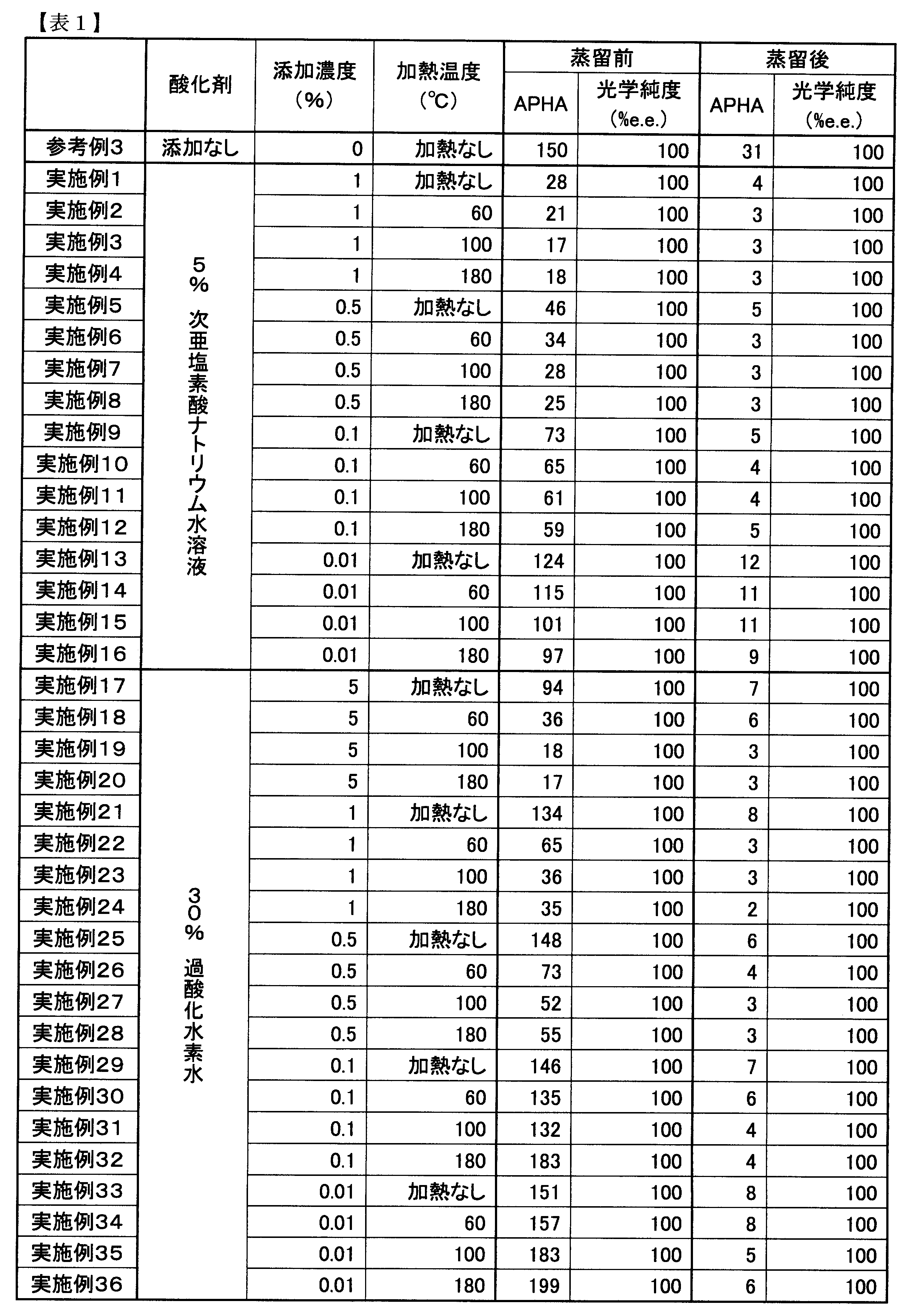
- the column was packed with “Diaion SK1B” manufactured by Komatsu Ltd.) in a down flow. Subsequently, the solution was filtered through a nanofiltration membrane (4-inch spiral element “SU-610” manufactured by Toray Industries, Inc.) to obtain a crude lactic acid aqueous solution 28L. Subsequently, the solution was concentrated to 47% by weight using a thin film evaporator (manufactured by Tokyo Rika Kikai Co., Ltd.), and this was used as a test solution. The color strength of the test solution was analyzed as the number of APHA unit colors by a colorimeter (manufactured by Nippon Denshoku Industries Co., Ltd.) according to JIS K 0071-1. As a result, the AHPA value of the test solution was 150. Table 1 shows the APHA value of lactic acid after distillation obtained by subjecting this test solution to vacuum distillation at 130 ° C. and 133 Pa, and the optical purity of lactic acid.
- Examples 1 to 68 Addition of oxidizing agent to crude lactic acid aqueous solution, distillation under reduced pressure and polylactic acid polymerization experiment 500 mL of the test solution obtained in Reference Example 3 was weighed into a glass Schlenk tube.
- various oxidizing agents Examples 1 to 16: 5% sodium hypochlorite aqueous solution, Examples 17 to 36: 30% hydrogen peroxide solution, Examples 37 to 52: Sodium chlorite, Examples 53 to 68: tert-butyl hydroperoxide; all reagents were manufactured by Wako Pure Chemical Industries, Ltd.
- the obtained prepolymer was pulverized using a hammer pulverizer and sieved to obtain a powder having an average particle diameter of 0.1 mm.
- 50 g of prepolymer was taken and introduced into an oven connected with an oil rotary pump, and subjected to a heat-reduced pressure treatment.
- the pressure was 50 Pa
- the heating temperature was 140 ° C .: 10 hours, 150 ° C .: 10 hours, and 160 ° C .: 20 hours.
- the obtained polylactic acid was subjected to a weight average molecular weight analysis by GPC, a melting point analysis by DSC, a heating weight loss rate analysis by TG, and a coloring degree measurement under the following conditions. The results are shown in Tables 3 and 4.
- the weight average molecular weight (Mw) of polylactic acid is a value of weight average molecular weight in terms of standard polymethyl methacrylate measured by gel permeation chromatography (GPC). GPC measurement was performed using a differential refractometer using HLC8320GPC (manufactured by Tosoh Corporation) as a GPC system and two TSK-GEL SuperHM-M (manufactured by Tosoh Corporation) connected in series to the column.
- the measurement conditions were a flow rate of 0.35 mL / min, hexafluoroisopropanol was used as a solvent, and 0.02 mL of a solution having a sample concentration of 1 mg / mL was injected.
- the melting point of polylactic acid is a value measured by a differential scanning calorimeter DSC7020 (manufactured by SII NanoTechnology). The measurement conditions were 10 mg of a sample, a nitrogen atmosphere, and a heating rate of 20 ° C./min.
- the heating weight reduction rate of polylactic acid was measured using a differential thermothermal weight simultaneous measurement apparatus TG / DTA7200 (manufactured by SII Nanotechnology).
- the measurement conditions were 10 mg of sample, a constant 200 ° C. under a nitrogen atmosphere, and a heating time of 30 minutes.
- a reducing solution consisting of 0.25 g / L cysteine ⁇ HCl and 0.25 g / L sodium sulfide was added, and 50 mL of the preculture was inoculated, and main culture was performed at a stirring speed of 200 rpm and 39 ° C. for 39 hours. Went. During the culture, the pH of the culture solution was adjusted to 6.4 using 5M calcium hydroxide.
- test solution Crude succinic acid aqueous solution
- the culture solution 100L prepared in Reference Example 4 was sterilized by heating at 120 ° C. for 20 minutes, centrifuged at 5000 ⁇ G for 20 minutes, and the supernatant was recovered. As a result, a culture solution containing calcium succinate was obtained.
- Ultrapure water and 95% sulfuric acid manufactured by Sigma-Aldrich were added to the culture supernatant until pH 2.5, and the produced calcium sulfate was separated by suction filtration to obtain an aqueous succinic acid solution.
- the mixture was further stirred at 4 ° C. for 12 hours, and the precipitated succinic acid crystals were separated into solid and liquid by suction filtration.
- the APHA value of 29 was obtained by adding 205 g of wet succinic acid crystals (water content 58%) obtained by the crystallization operation to 1600 g of ultrapure water and dissolving them to obtain a 5 wt% aqueous succinic acid solution.
- Oxidizing agent addition concentration (%) (weight of oxidizing agent excluding water / weight of succinic acid excluding water) ⁇ 100 (Equation 2).
- Example 137 to 141 Synthesis experiment of 1,4-butanediol and polybutylene terephthalate polymerization experiment using succinic acid as a raw material According to the example of Japanese Patent No. 4380654, hydrogenation reaction of succinic acid was carried out.
- -Butanediol was synthesized. Specifically, 80 g of succinic acid crystals obtained in Reference Example 5, Example 72, Example 92, Example 108, and Example 124 were added to 254 g of methanol (manufactured by Wako Pure Chemical Industries, Ltd.) and 95% sulfuric acid ( 1.6 g of Sigma-Aldrich) were mixed and stirred for 2 hours under reflux.
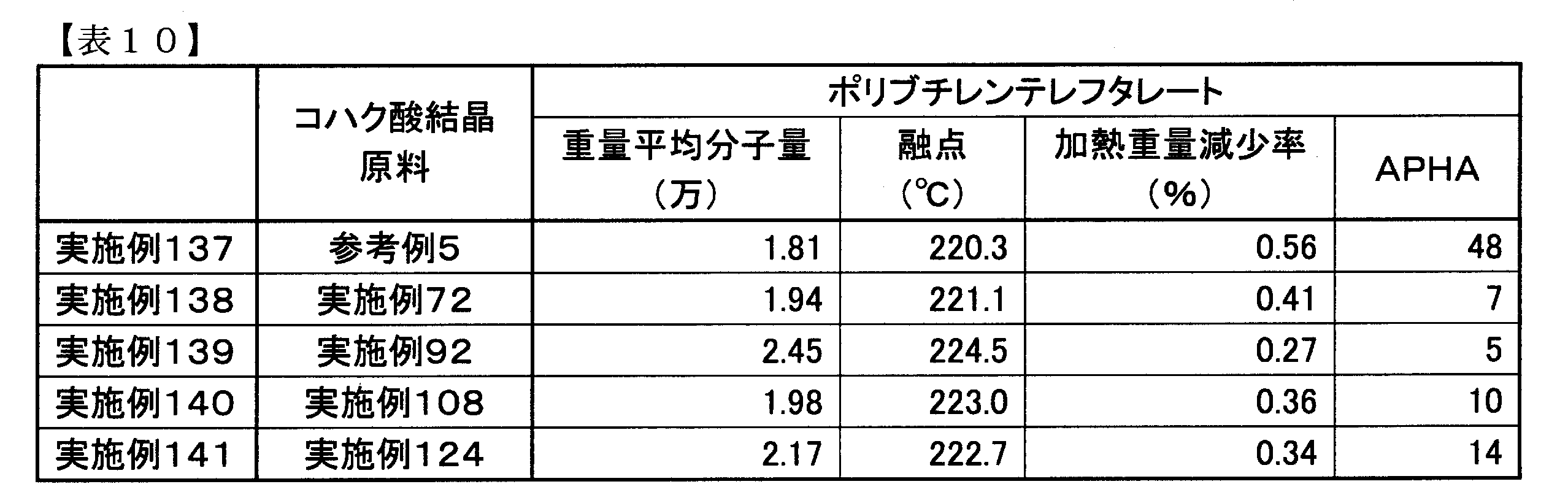
- the molecular weight, melting point, heating weight loss rate, and APHA of the produced polybutylene terephthalate were measured under the same conditions as the polylactic acid of Examples 1 to 68 (note that hexafluoroisopropyl alcohol was used as the solvent for the APHA measurement). .) The results are shown in Table 10.
- test liquid (crude lactic acid aqueous solution) from D-lactic acid fermentation broth 30L of D-lactic acid culture liquid prepared in Reference Example 5 was passed through a microfiltration membrane ("Microza” manufactured by Asahi Kasei Corporation). The cells were filtered, 95% sulfuric acid (manufactured by Sigma-Aldrich) was added until the pH reached 2.5, and the mixture was stirred for 2 hours. The produced calcium sulfate is filtered off by suction filtration, and the filtrate is passed through a column packed with a strong anion exchange resin (“Diaion SA10A” manufactured by Mitsubishi Chemical Corporation) in a down flow, and then a strong cation exchange resin (Mitsubishi Chemical Corporation).
- a strong anion exchange resin (“Diaion SA10A” manufactured by Mitsubishi Chemical Corporation) in a down flow, and then a strong cation exchange resin (Mitsubishi Chemical Corporation).
- the column was packed with “Diaion SK1B” manufactured by Komatsu Ltd.) in a down flow. Subsequently, the solution was filtered through a nanofiltration membrane (4-inch spiral element “SU-610” manufactured by Toray Industries, Inc.) to obtain a crude lactic acid aqueous solution 28L. Subsequently, it was concentrated to 56% by weight with a thin film evaporator (manufactured by Tokyo Rika Kikai Co., Ltd.), and this was used as a crude lactic acid test solution. The AHPA value of the crude lactic acid test solution was 49. Table 11 shows the APHA value of distilled lactic acid obtained by subjecting this crude lactic acid test solution to vacuum distillation at 130 ° C. and 133 Pa, and the optical purity of lactic acid.
- the obtained prepolymer was pulverized using a hammer pulverizer and sieved to obtain a powder having an average particle diameter of 0.1 mm.
- 10 g of prepolymer was taken and introduced into an oven connected with an oil rotary pump, and subjected to a heat-reducing treatment.
- the pressure was 50 Pa
- the heating temperature was 140 ° C .: 10 hours, 150 ° C .: 10 hours, and 160 ° C .: 20 hours.
- the obtained polylactic acid was subjected to a weight average molecular weight analysis by GPC, a melting point analysis by DSC, a heating weight loss analysis by TG, and a color degree measurement under the same conditions as in Examples 1 to 68. The results are shown in Table 12.
- Example 142 Experiment of adding ozone water to crude lactic acid test solution, distillation under reduced pressure, and polylactic acid polymerization experiment 80 mL of the crude lactic acid test solution obtained in Reference Example 6 was weighed into a glass Schlenk tube. 280 mL of 50 ppm ozone water (manufactured by Unno Giken Kogyo Co., Ltd.) was added and stirred at room temperature (25 ° C.) for 16 hours. At this time, the amount of ozone added is 0.03% according to (Equation 1). Subsequently, the test solution was concentrated under reduced pressure to a lactic acid concentration of 56% at 20 hPa while heating from room temperature to 35 ° C.
- Example 143 Hydrogen peroxide solution addition experiment, vacuum distillation experiment and polylactic acid polymerization experiment to crude lactic acid test solution 80 mL of the crude lactic acid test solution obtained in Reference Example 6 was weighed into a glass Schlenk tube. 1.5 mL of 30% hydrogen peroxide solution (manufactured by Wako Pure Chemical Industries, Ltd.) was added and stirred at 120 ° C. for 4 hours. At this time, the amount of hydrogen peroxide added is 1% according to (Equation 1). Table 11 shows the APHA value of lactic acid after distillation obtained by performing vacuum distillation at 130 ° C. and 133 Pa, and the optical purity of lactic acid. Subsequently, a polymerization test and analysis were performed in the same manner as in Reference Example 6. The results are shown in Table 12.
- Example 144 Dilute hydrogen peroxide solution addition experiment, vacuum distillation experiment and polylactic acid polymerization experiment to crude lactic acid test solution 80 mL of the crude lactic acid test solution obtained in Reference Example 6 was weighed into a glass Schlenk tube. 50 ppm hydrogen peroxide solution (280 mL of 30% hydrogen peroxide solution manufactured by Wako Pure Chemical Industries, Ltd. diluted with 280 mL of distilled water) was added and stirred at 120 ° C. for 4 hours. At this time, the amount of hydrogen peroxide added is 0.03% according to (Equation 1).
- test solution was once cooled to room temperature (25 ° C.) and then concentrated under reduced pressure to a lactic acid concentration of 56% at 20 hPa while being reheated to 35 ° C. Further, this was distilled under reduced pressure at 130 ° C. and 133 Pa to obtain D-lactic acid.
- Table 11 shows the APHA value of lactic acid after distillation and the optical purity of lactic acid.
- a polymerization test and analysis were performed in the same manner as in Reference Example 6. The results are shown in Table 12.
- the obtained organic acid can be suitably used as an industrial chemical such as a polymer raw material.
Landscapes
- Chemical & Material Sciences (AREA)
- Organic Chemistry (AREA)
- Engineering & Computer Science (AREA)
- Wood Science & Technology (AREA)
- Life Sciences & Earth Sciences (AREA)
- Zoology (AREA)
- Chemical Kinetics & Catalysis (AREA)
- General Chemical & Material Sciences (AREA)
- Health & Medical Sciences (AREA)
- Genetics & Genomics (AREA)
- Biotechnology (AREA)
- Biochemistry (AREA)
- Bioinformatics & Cheminformatics (AREA)
- General Engineering & Computer Science (AREA)
- General Health & Medical Sciences (AREA)
- Microbiology (AREA)
- Oil, Petroleum & Natural Gas (AREA)
- Medicinal Chemistry (AREA)
- Polymers & Plastics (AREA)
- Polyesters Or Polycarbonates (AREA)
- Organic Low-Molecular-Weight Compounds And Preparation Thereof (AREA)
- Preparation Of Compounds By Using Micro-Organisms (AREA)
Abstract
Description
(1)バイオマス資源由来の有機酸を酸化剤により酸化処理することを特徴とする、有機酸の製造方法。
(2)前記酸化剤が、過酸化水素、tert-ブチルヒドロペルオキシド、オゾン、次亜塩素酸ナトリウムおよび亜塩素酸ナトリウムならびにそれらの水溶液からなる群から選択される1種または2種以上である、(1)に記載の有機酸の製造方法。
(3)前記酸化処理に加熱処理を組み合わせることを特徴とする、(1)または(2)に記載の有機酸の製造方法。
(4)前記加熱処理が蒸留である、(3)に記載の有機酸の製造方法。
(5)前記有機酸が微生物の発酵培養によって得られる有機酸である、(1)から(4)のいずれかに記載の有機酸の製造方法。
(6)前記有機酸が、乳酸、ヒドロキシ酪酸、3-ヒドロキシプロピオン酸、イタコン酸、グリコール酸、アジピン酸、ムコン酸、アクリル酸、コハク酸、セバシン酸、2,5-フランジカルボン酸およびテレフタル酸からなる群から選択される1種または2種以上である、(1)から(5)のいずれかに記載の有機酸の製造方法。
(7)(1)から(6)のいずれかに記載の有機酸の製造方法により得られた有機酸を原料として重合することを特徴とする、有機酸系ポリマーの製造方法。
例えば、乳酸やグリコール酸、ヒドロキシ酪酸など分子内にヒドロキシル基を有する、2官能のオキシカルボン酸の場合には、これらを単独で重合し、ポリエステルを得ることができる。その重合方法は、ポリ乳酸の場合にはラクチド、グリコール酸の場合にはグリコリドといった環状2量体を一旦生成せしめ、その後、開環重合を行う2段階の重合法や、該有機酸を溶媒中もしくは無溶媒条件下で直接脱水重縮合を行う一段階の直接重合法により製造することができる。具体的には、ポリ乳酸、ポリグリコール酸、ポリヒドロキシプロピオン酸、ポリヒドロキシ酪酸が例示される。
本発明によって得られた有機酸を原料とする有機酸系ポリアミドの製造方法は、公知の方法をそのまま用いることができ、具体的には前述のジカルボン酸とジアミンとを重縮合させる方法が適用される(福本修編、「ポリアミド樹脂ハンドブック」日刊工業出版社(1998年1月)または特開2004-75932号公報を参照のこと。)。
WO2009/099044号の参考例1に記載のL-乳酸発酵酵母株であるHI003をL-乳酸を製造するための微生物として使用した。
参考例1のHI003株を用いて、原料糖培地(70g/L “優糖精”(ムソー株式会社製)、1.5g/L 硫酸アンモニウム)を用い、以下の培養条件、方法でバッチ発酵試験を行った。なお、培地は高圧蒸気滅菌(121℃、15分)して用いた。
反応槽容量(乳酸発酵培地量):30(L)、温度調整:32(℃)、反応槽通気量:0.1(L/min)、反応槽攪拌速度:200(rpm)、pH調整:1N 水酸化カルシウムによりpH6.5に調整。
HI003株を試験管で5mlの原料糖培地で一晩振とう培養した(前々培養)。前々培養液を新鮮な原料糖培地100mlに植菌し500ml容坂口フラスコで24時間振とう培養した(前培養)。温度調整、pH調整を行い、発酵培養を行った。
カラム:Shim-Pack SPR-H(株式会社島津製作所製)
移動相:5mM p-トルエンスルホン酸(流速0.8mL/min)
反応液:5mM p-トルエンスルホン酸、20mM ビストリス、0.1mM EDTA2Na(流速0.8mL/min)
検出方法:電気伝導度
温度:45℃。
L-乳酸およびD-乳酸の濃度を以下の条件で測定した。
カラム:TSK-gel Enantio L1(東ソー株式会社製)
移動相:1mM 硫酸銅水溶液
流速:1.0ml/min
検出方法:UV254nm
温度:30℃
次に、光学純度を次式で計算した。
光学純度(%e.e.)=100×(L-D)または(D-L)/(L+D)
ここで、LはL-乳酸の濃度、DはD-乳酸の濃度を表す。なお、ここでいう光学純度100%(100%ee)とは、後述の光学純度を測定するHPLCにおいてエナンチオマーのピークが検出できなかったことを意味する。
参考例2で作製したL-乳酸培養液30Lを遠心分離機で菌体を除去し、pH2.5になるまで95%硫酸(シグマアルドリッチ社製)を添加して2時間撹拌した。生成した硫酸カルシウムを吸引濾過で濾別し、濾液を強アニオン交換樹脂(三菱化学株式会社製“ダイヤイオンSA10A”)を充填したカラムにダウンフローで通じ、次いで強カチオン交換樹脂(三菱化学株式会社製“ダイヤイオンSK1B”)を充填したカラムにダウンフローで通じた。次いで、ナノろ過膜(東レ株式会社製4インチスパイラルエレメント“SU-610”)に通じて濾過し、粗乳酸水溶液28Lを得た。続いて薄膜式エバポレーター(東京理化器械株式会社製)により、47重量%まで濃縮し、これを試験液とした。試験液の色味の強度は、JIS K 0071-1に従って比色計(日本電色工業株式会社製)によりAPHA単位色数として分析した。その結果、試験液のAHPA値は150であった。この試験液を130℃、133Paで減圧蒸留を行って得られた蒸留後の乳酸のAPHA値、乳酸の光学純度を表1に示す。
参考例3で得られた試験液500mLをガラス製シュレンク管にはかり取った。これに対して種々の酸化剤(実施例1~16:5% 次亜塩素酸ナトリウム水溶液、実施例17~36:30% 過酸化水素水、実施例37~52:亜塩素酸ナトリウム、実施例53~68:tert-ブチルヒドロペルオキシド;いずれの試薬も和光純薬工業株式会社製。)を加え、25℃(加熱なし)、60℃、100℃、180℃の条件で2時間撹拌した。添加した酸化剤の種類、濃度および加熱条件、ならびに酸化剤処理後のAPHA値、乳酸の光学純度、130℃、133Paで減圧蒸留を行って得られた蒸留後の乳酸のAPHA値、乳酸の光学純度を前述の参考例に記載の測定方法に従って測定した結果を表1および2に示す。なお、添加した酸化剤濃度は、酸化剤が水溶液の場合、水を除いた純分換算として秤量し、試験液に添加した。酸化剤添加濃度は式1に示す計算式で計算した。
酸化剤添加濃度(%)=(水を除く酸化剤重量/水を除く乳酸重量)×100・・・・(式1)

ポリ乳酸の重量平均分子量(Mw)は、ゲルパーミエーションクロマトグラフィー(GPC)により測定した標準ポリメチルメタクリレート換算の重量平均分子量の値である。GPC測定は、GPCシステムとしてHLC8320GPC(東ソー株式会社製)を用い、カラムにTSK-GEL SuperHM-M(東ソー株式会社製)を直列に2本接続したものを使用し、示差屈折計によって検出した。測定条件は、流速0.35mL/分とし、溶媒にヘキサフルオロイソプロパノールを用い、試料濃度1mg/mLの溶液0.02mL注入した。
ポリ乳酸の融点は、示差走査型熱量計DSC7020(エスアイアイ・ナノテクノロジー製)により測定した値であり、測定条件は、試料10mg、窒素雰囲気下、昇温速度20℃/分で行った。
ポリ乳酸の加熱重量減少率は、示差熱熱重量同時測定装置TG/DTA7200(エスアイアイ・ナノテクノロジー製)を用いて測定した。測定条件は、試料10mg、窒素雰囲気下、200℃一定、加熱時間30分とした。
重合したポリ乳酸の着色度の測定方法としては、0.4gのポリ乳酸を25mLのクロロホルムに溶解させ、JIS K 0071-1に従って比色計(日本電色工業株式会社製)によりAPHA単位色数として分析した。


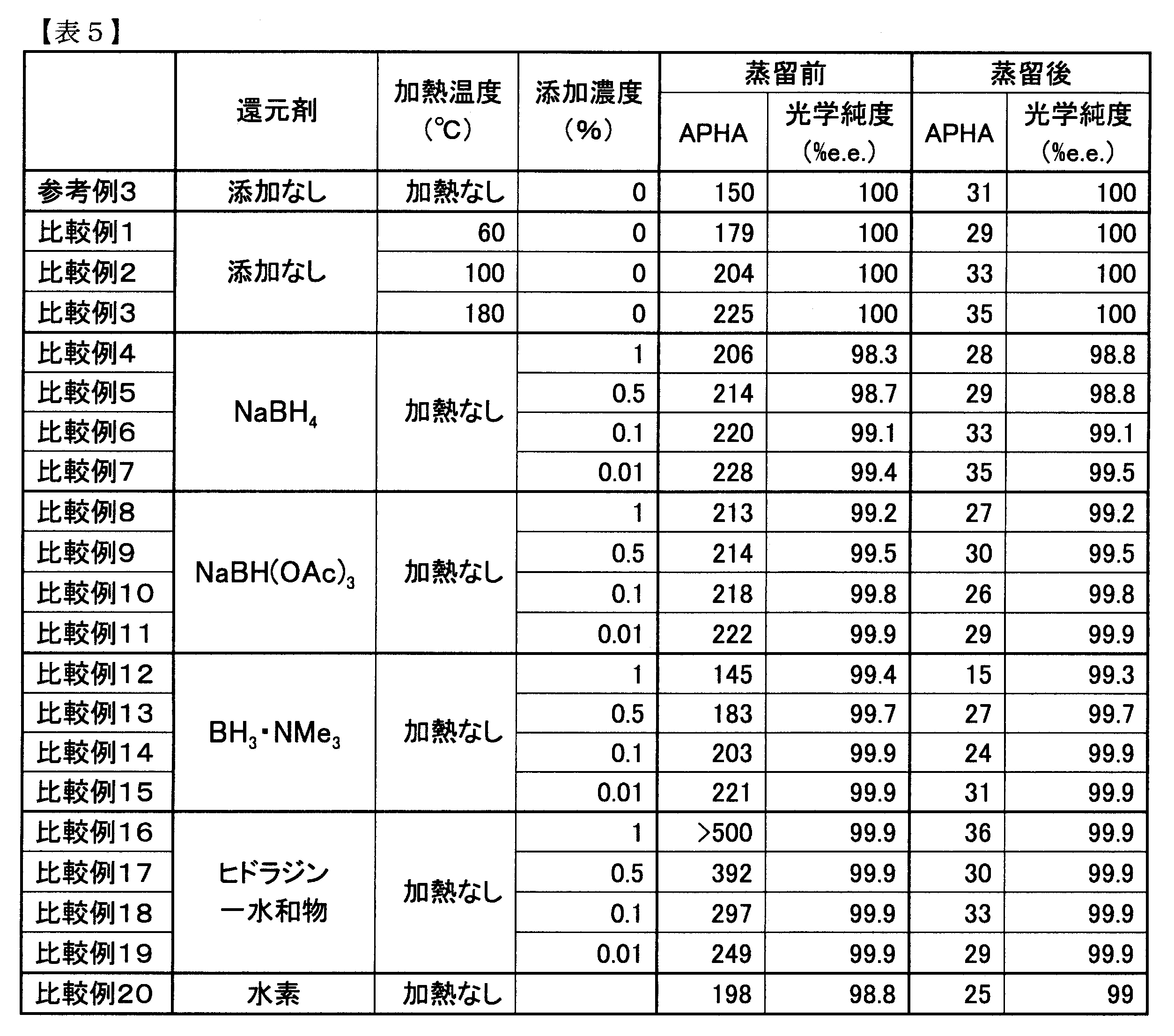
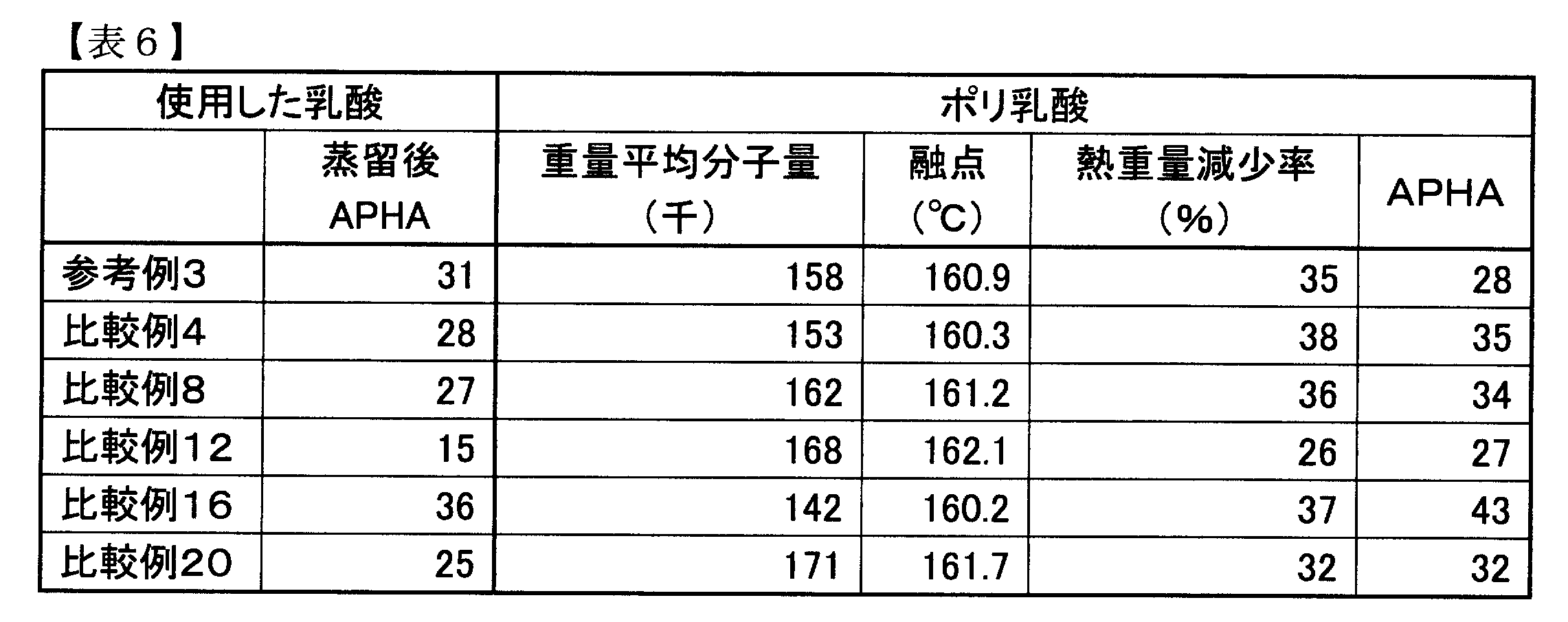
参考例3で得られた試験液500mLをガラス製シュレンク管にはかり取り、酸化剤を加えることなく60℃、100℃、180℃の条件で2時間撹拌した。加熱後のAPHA値、乳酸の光学純度、さらに130℃、133Paで減圧蒸留を行って得られた蒸留後の乳酸のAPHA値、乳酸の光学純度を表5に示す。続いてここで蒸留して得られた乳酸150gを実施例1~68と同様の方法で重合試験を行った。結果を表6に示す。
参考例3で得られた試験液500mLをガラス製シュレンク管にはかり取った。これに対して種々の還元剤を加え、25℃で2時間撹拌した。添加した還元剤の種類、および還元剤処理後のAPHA値、乳酸の光学純度、さらに130℃、133Paで減圧蒸留を行って得られた蒸留後の乳酸のAPHA値、乳酸の光学純度を表5に示す。さらに、比較例4、比較例8、比較例12、比較例16において蒸留して得られた乳酸150gを実施例1~68と同様の方法で重合試験を行った。結果を表6に示す。
参考例3で得られた試験液200mLガラス製シュレンク管にはかり取り、これに対して特許第3880175号に記載のように、触媒となる5% パラジウム-アルミナ(NEケムキャット製)を加えたのち、反応容器内を窒素置換した。続いて反応容器内を水素200mLで置換した後、激しく撹拌しながら常圧で接触還元処理を行った。水素の消費が完結した時点を還元処理の終点とし、触媒を定性濾紙NO2(アドバンテック製)を用いたろ過によって除去した。得られた溶液のAPHAは138と着色度は低下したが、光学純度は98.8%e.e.と低下した。ろ液を実施例1~68と同様に減圧蒸留したところ、APHA値は25、光学純度99.0%e.e.となった。蒸留して得られた乳酸150gを実施例1~68と同様の方法で重合試験を行った。結果を表6に示す。
121℃、2気圧で20分間加熱滅菌した20g/L グルコース、10g/L ポリペプトン、5g/L 酵母エキス、3g/L リン酸水素2カリウム、1g/L 塩化ナトリウム、1g/L 硫酸アンモニウム、0.2g/L 塩化マグネシウム6水和物および0.2g/L 塩化カルシウム2水和物からなる種培養用培地100mLを、嫌気グローブボックス内で、30mM 炭酸ナトリウムを1mLと180mM 硫酸0.15mLとを加え、さらに、0.25g/L システイン・HClと0.25g/L 硫化ナトリウムからなる還元溶液0.5mLを加えた後、アナエロビオスピリラム サクシニシプロデュセンス(Anaerobiospirillum succiniciproducens)ATCC53488を接種し、39℃で一晩静置培養することにより前培養液を調製した。
カラム:Shim-Pack SPR-H(株式会社島津製作所製)、45℃
移動相:5mM p-トルエンスルホン酸 0.8mL/min
反応液:5mM p-トルエンスルホン酸、20mM ビストリス、0.1M EDTA・2Na(0.8mL/min)
検出器:電気伝導度。
参考例4で作製した培養液100Lを120℃、20分間の加熱殺菌した後、5000×G、20分間遠心分離、上清を回収することで、コハク酸カルシウム含有培養液を得た。該培養上清に超純水および95%硫酸(シグマアルドリッチ製)をpH2.5になるまで添加し、生成した硫酸カルシウムを吸引濾過で分離することでコハク酸水溶液を得、さらに上記参考例3と同様に強カチオン、強アニオン交換樹脂により精製後、超純水を添加して1重量%コハク酸水溶液とし、これを試験液とした。試験液の色味の強度を、JIS K 0071-1に従って比色計(日本電色工業株式会社製)によりAPHA単位色数として分析したところ、試験液のAHPA値は121であった。試験液10Lを70℃、10kPaでロータリーエバポレーター(東京理化器械株式会社製)による濃縮操作を行い、10重量%コハク酸水溶液1Lを得た。さらに4℃で12時間撹拌し、析出したコハク酸結晶を吸引濾過で固液分離した。晶析操作により得られたコハク酸ウエット結晶205g(含水率58%)を1600gの超純水に添加、溶解させて5重量%のコハク酸水溶液としたAPHA値は29となった。
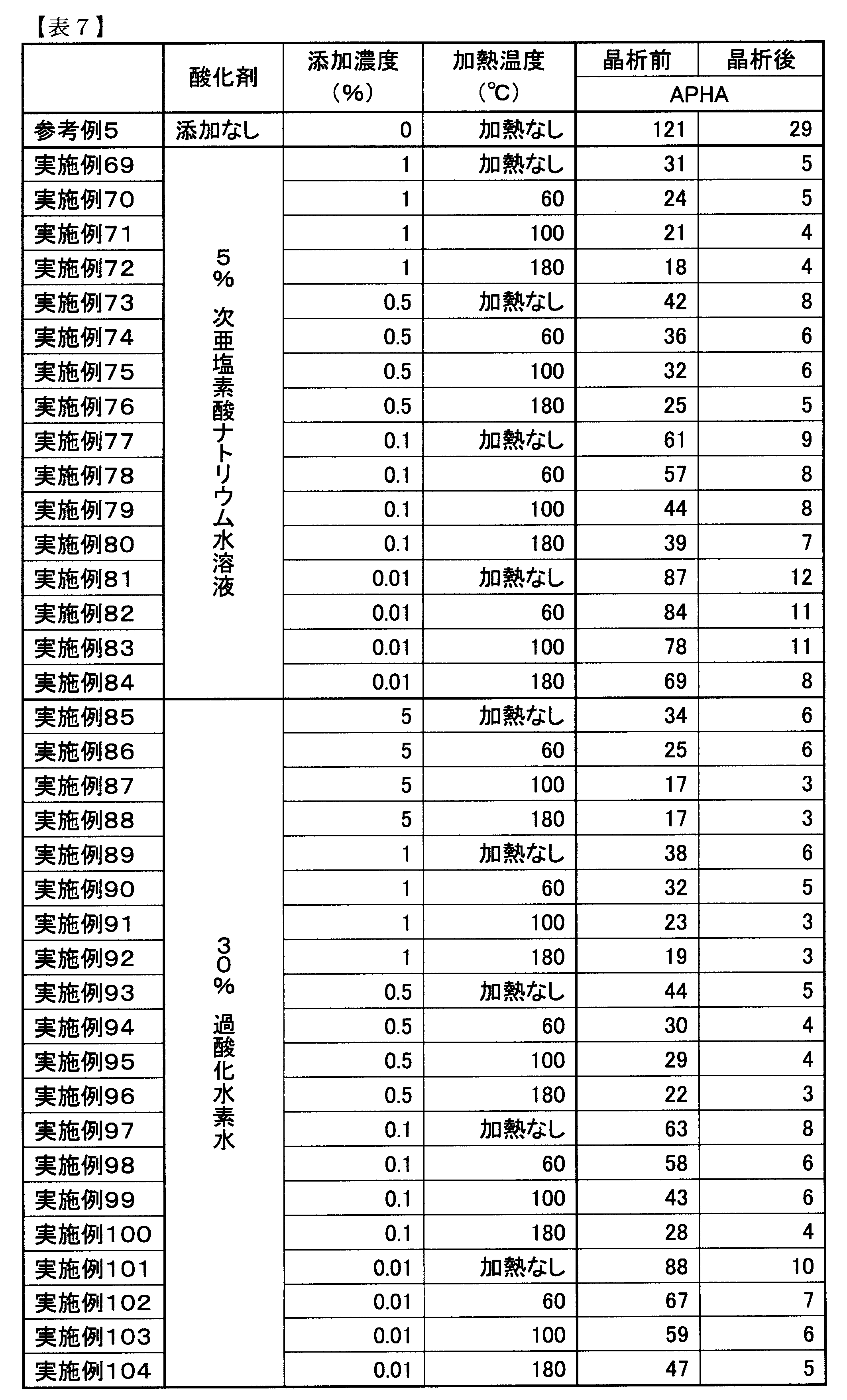
参考例5で得られた試験液10Lをガラス製フラスコにはかり取った。これに対して種々の酸化剤を加え、25℃(加熱なし)、60℃、100℃、180℃の条件で2時間撹拌した。添加した酸化剤の種類、濃度、加熱条件、および酸化剤処理後のAPHA値、さらに参考例4と同様にして濃縮、晶析、再溶解を行って得られた5重量% コハク酸水溶液のAPHA値を表7および8に示す。添加した酸化剤濃度は、酸化剤が水溶液の場合、水を除いた純分換算として秤量し、試験液に添加した。酸化剤添加濃度は式2に示す計算式で計算した。
酸化剤添加濃度(%)=(水を除く酸化剤重量/水を除くコハク酸重量)×100・・・(式2)。
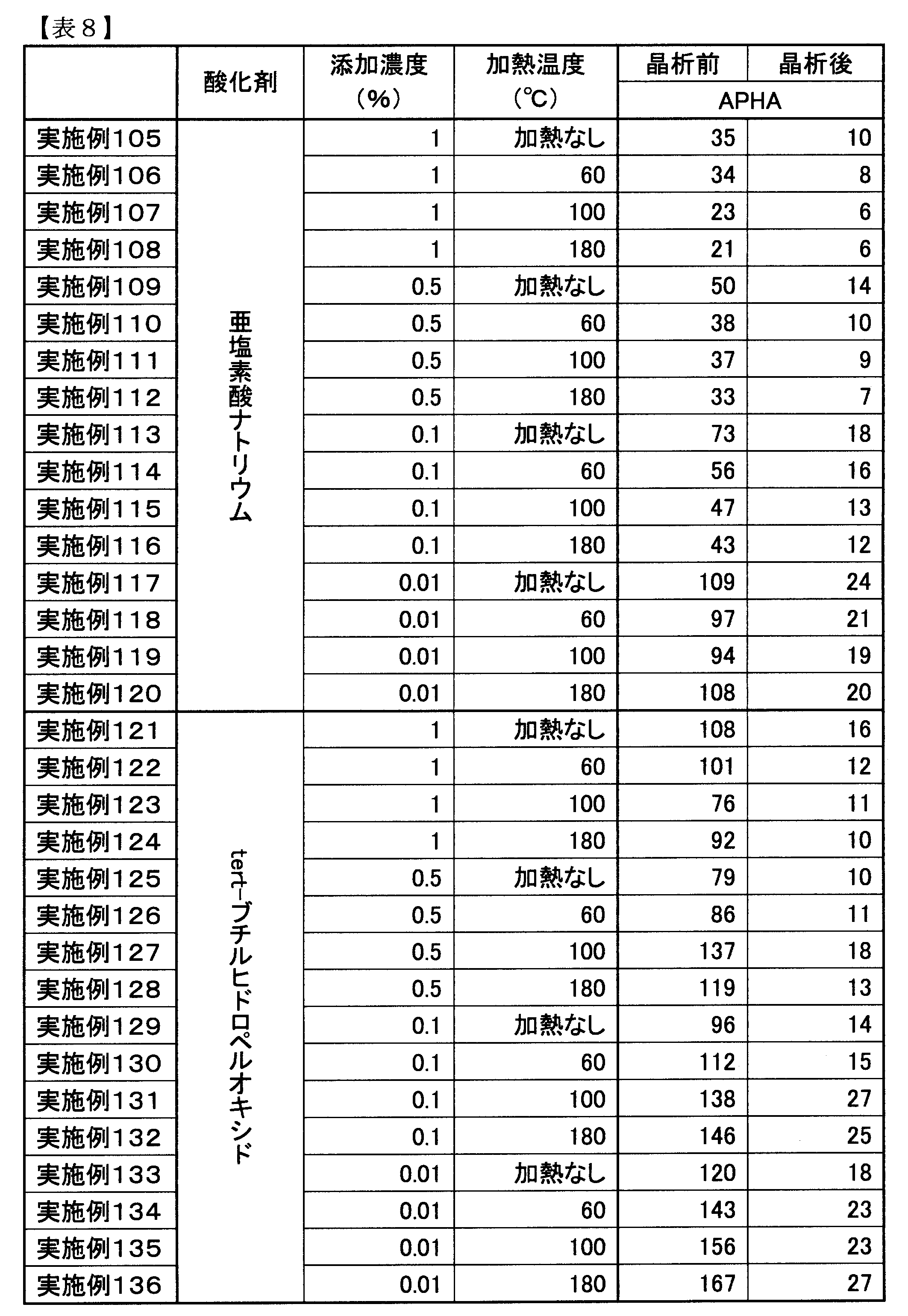
参考例5で得られた試験液10Lをガラス製フラスコにはかり取り、酸化剤を加えることなく60℃、100℃、180℃の条件で2時間撹拌した。加熱処理後のAPHA値、さらに参考例4と同様にして濃縮、晶析、再溶解を行って得られた5重量% コハク酸水溶液のAPHA値を表9に示す。
参考例5で得られた試験液10Lをガラス製フラスコにはかり取った。これに対して種々の還元剤を加え、25℃(加熱なし)で2時間撹拌した。添加した還元剤の種類、および還元剤処理後のAPHA値、さらに参考例4と同様にして濃縮、晶析、再溶解を行って得られた5重量% コハク酸水溶液のAPHA値を表9に示す。

特許第4380654号の実施例に従ってコハク酸の水添反応を実施し、1,4-ブタンジオールを合成した。具体的には、参考例5、実施例72、実施例92、実施例108、実施例124でそれぞれ得られたコハク酸結晶80gにメタノール(和光純薬工業株式会社製)254gおよび95%硫酸(シグマアルドリッチ製)1.6gを混合し、還流下で2時間撹拌反応させた。反応液を冷却後、炭酸水素ナトリウム2.9gを添加して、60℃で30分間撹拌した。これを常圧下で蒸留した後、蒸留残渣を濾過して、さらに減圧蒸留することで、コハク酸ジメチルを得た。該コハク酸ジメチルにCuO-ZnO触媒を添加し、加圧反応容器にて5MPaの水素下で撹拌しながら1時間かけて230℃まで昇温させた。その後、230℃で15MPaの水素加圧下で9時間反応させ、冷却後に脱ガスを行った。反応液から濾過により触媒を除去し、濾液を減圧蒸留することで、1,4-ブタンジオールを49g得た。
WO2010/140602の実施例8および10に記載の方法に従ってD-乳酸発酵酵母であるSU042の培養を行い、D-乳酸培養液を得た。
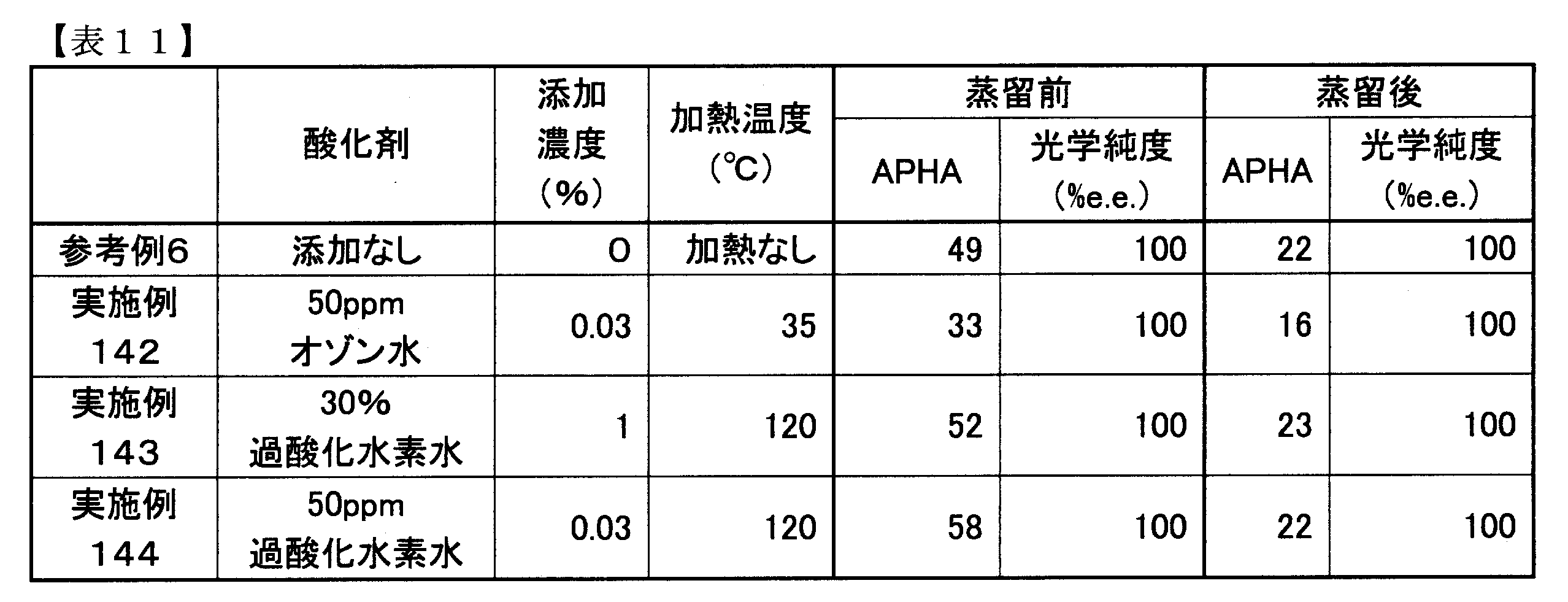
参考例5で作製したD-乳酸培養液30Lを精密濾過膜(“マイクローザ”、旭化成株式会社製)で菌体を濾過し、pH2.5になるまで95%硫酸(シグマアルドリッチ社製)を添加して2時間撹拌した。生成した硫酸カルシウムを吸引濾過で濾別し、濾液を強アニオン交換樹脂(三菱化学株式会社製“ダイヤイオンSA10A”)を充填したカラムにダウンフローで通じ、次いで強カチオン交換樹脂(三菱化学株式会社製“ダイヤイオンSK1B”)を充填したカラムにダウンフローで通じた。次いで、ナノろ過膜(東レ株式会社製4インチスパイラルエレメント“SU-610”)に通じて濾過し、粗乳酸水溶液28Lを得た。続いて薄膜式エバポレーター(東京理化器械株式会社製)により、56重量%まで濃縮し、これを粗乳酸試験液とした。粗乳酸試験液のAHPA値は49であった。この粗乳酸試験液を130℃、133Paで減圧蒸留を行って得られた蒸留後の乳酸のAPHA値、乳酸の光学純度を表11に示す。
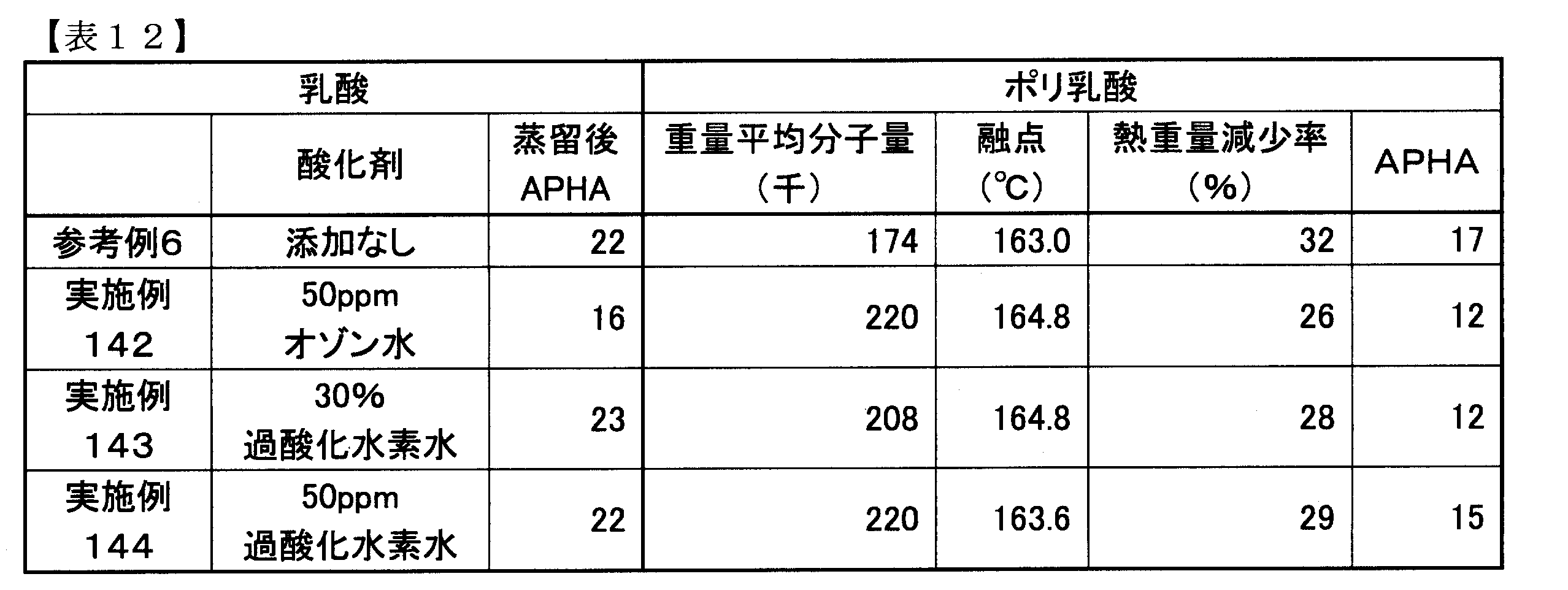
参考例6で得られた粗乳酸試験液80mLをガラス製シュレンク管にはかり取った。50ppmオゾン水(海野技研工業有限会社製)280mLを加え、室温(25℃)にて16時間撹拌した。このとき、オゾンの添加量は(式1)により、0.03%である。続いて試験液を室温から35℃に加熱しつつ、20hPaにて乳酸濃度56%まで減圧濃縮した。さらにこれを130℃、133Paにて減圧蒸留を行い、D-乳酸を得た。蒸留後の乳酸のAPHA値、乳酸の光学純度を表11に示す。続いて参考例6と同様の方法で重合試験および分析を行った。結果を表12に示す。
参考例6で得られた粗乳酸試験液80mLをガラス製シュレンク管にはかり取った。30% 過酸化水素水(和光純薬工業株式会社製)1.5mLを加え、120℃にて4時間撹拌した。このとき、過酸化水素の添加量は(式1)により、1%である。これを130℃、133Paで減圧蒸留を行って得られた蒸留後の乳酸のAPHA値、乳酸の光学純度を表11に示す。続いて参考例6と同様の方法で重合試験および分析を行った。結果を表12に示す。
参考例6で得られた粗乳酸試験液80mLをガラス製シュレンク管にはかり取った。50ppm 過酸化水素水(和光純薬工業株式会社製30%過酸化水素水47μLを280mLの蒸留水で希釈したもの)280mL)を加え、120℃にて4時間撹拌した。このとき、過酸化水素の添加量は(式1)により、0.03%である。続いて試験液を一旦室温(25℃)まで冷却したのち、35℃に再加熱しつつ、20hPaにて乳酸濃度56%まで減圧濃縮した。さらにこれを130℃、133Paにて減圧蒸留を行い、D-乳酸を得た。蒸留後の乳酸のAPHA値、乳酸の光学純度を表11に示す。続いて参考例6と同様の方法で重合試験および分析を行った。結果を表12に示す。
Claims (7)
- バイオマス資源由来の有機酸を酸化剤により酸化処理することを特徴とする、有機酸の製造方法。
- 前記酸化剤が、過酸化水素、tert-ブチルヒドロペルオキシド、オゾン、次亜塩素酸ナトリウムおよび亜塩素酸ナトリウムならびにそれらの水溶液からなる群から選択される1種または2種以上である、請求項1に記載の有機酸の製造方法。
- 前記酸化処理に加熱処理を組み合わせることを特徴とする、請求項1または2に記載の有機酸の製造方法。
- 前記加熱処理が蒸留である、請求項3に記載の有機酸の製造方法。
- 前記有機酸が微生物の発酵培養によって得られる有機酸である、請求項1から4のいずれかに記載の有機酸の製造方法。
- 前記有機酸が、乳酸、ヒドロキシ酪酸、3-ヒドロキシプロピオン酸、イタコン酸、グリコール酸、アジピン酸、ムコン酸、アクリル酸、コハク酸、セバシン酸、2,5-フランジカルボン酸およびテレフタル酸からなる群から選択される1種または2種以上である、請求項1から5のいずれかに記載の有機酸の製造方法。
- 請求項1から6のいずれかに記載の有機酸の製造方法により得られた有機酸を原料として重合することを特徴とする、有機酸系ポリマーの製造方法。
Priority Applications (7)
| Application Number | Priority Date | Filing Date | Title |
|---|---|---|---|
| CA2842581A CA2842581A1 (en) | 2011-07-22 | 2012-07-20 | Method for producing organic acid |
| AU2012287969A AU2012287969A1 (en) | 2011-07-22 | 2012-07-20 | Method for producing organic acid |
| CN201280033934.4A CN103649322A (zh) | 2011-07-22 | 2012-07-20 | 有机酸的制造方法 |
| US14/233,900 US20140171614A1 (en) | 2011-07-22 | 2012-07-20 | Method for producing organic acid |
| BR112014001469A BR112014001469A2 (pt) | 2011-07-22 | 2012-07-20 | métodos para a produção de ácido orgânico |
| EP12818183.1A EP2735615A4 (en) | 2011-07-22 | 2012-07-20 | PROCESS FOR PRODUCING ORGANIC ACID |
| RU2014106676/10A RU2014106676A (ru) | 2011-07-22 | 2012-07-20 | Способ производства органической кислоты |
Applications Claiming Priority (2)
| Application Number | Priority Date | Filing Date | Title |
|---|---|---|---|
| JP2011160643 | 2011-07-22 | ||
| JP2011-160643 | 2011-07-22 |
Publications (1)
| Publication Number | Publication Date |
|---|---|
| WO2013015212A1 true WO2013015212A1 (ja) | 2013-01-31 |
Family
ID=47601059
Family Applications (1)
| Application Number | Title | Priority Date | Filing Date |
|---|---|---|---|
| PCT/JP2012/068427 Ceased WO2013015212A1 (ja) | 2011-07-22 | 2012-07-20 | 有機酸の製造方法 |
Country Status (9)
| Country | Link |
|---|---|
| US (1) | US20140171614A1 (ja) |
| EP (1) | EP2735615A4 (ja) |
| JP (1) | JPWO2013015212A1 (ja) |
| CN (1) | CN103649322A (ja) |
| AU (1) | AU2012287969A1 (ja) |
| BR (1) | BR112014001469A2 (ja) |
| CA (1) | CA2842581A1 (ja) |
| RU (1) | RU2014106676A (ja) |
| WO (1) | WO2013015212A1 (ja) |
Cited By (2)
| Publication number | Priority date | Publication date | Assignee | Title |
|---|---|---|---|---|
| WO2022025110A1 (ja) * | 2020-07-31 | 2022-02-03 | 三菱瓦斯化学株式会社 | α-ヒドロキシカルボン酸組成物の製造方法 |
| WO2023157816A1 (ja) * | 2022-02-15 | 2023-08-24 | 東レ株式会社 | 3-ヒドロキシアジピン酸および/またはα-ヒドロムコン酸を生産するための遺伝子改変微生物および当該化学品の製造方法 |
Families Citing this family (3)
| Publication number | Priority date | Publication date | Assignee | Title |
|---|---|---|---|---|
| CN110054561A (zh) * | 2018-01-18 | 2019-07-26 | 凯赛(乌苏)生物技术有限公司 | 一种长链二元酸的氧化脱色工艺 |
| CN109776306B (zh) * | 2019-02-26 | 2021-12-07 | 安徽雪郎生物科技股份有限公司 | 一种树脂级丁二酸的制备方法 |
| CN116087157B (zh) * | 2021-11-05 | 2024-05-10 | 中国科学院宁波材料技术与工程研究所 | 2,5-呋喃二甲酸中微量有色杂质的检测方法 |
Citations (21)
| Publication number | Priority date | Publication date | Assignee | Title |
|---|---|---|---|---|
| JPH0638775A (ja) | 1992-05-25 | 1994-02-15 | Nippon Kayaku Co Ltd | 発酵法によるポリ(3−ヒドロキシ酪酸)及びその誘導体の製造方法 |
| JPH0642834B2 (ja) | 1989-07-04 | 1994-06-08 | 磐田化学工業株式会社 | イタコン酸の製造法 |
| US5487987A (en) | 1993-09-16 | 1996-01-30 | Purdue Research Foundation | Synthesis of adipic acid from biomass-derived carbon sources |
| JP2002510747A (ja) * | 1998-04-08 | 2002-04-09 | メタボリックス,インコーポレイテッド | バイオポリマーの分離および精製のための方法 |
| JP2004075932A (ja) | 2002-08-21 | 2004-03-11 | Toray Ind Inc | ポリペンタメチレンアジパミド樹脂の製造方法 |
| JP3880175B2 (ja) | 1996-12-20 | 2007-02-14 | 三井化学株式会社 | 乳酸の精製方法 |
| JP2008029329A (ja) | 2006-06-28 | 2008-02-14 | Toray Ind Inc | 酵母及びl−乳酸の製造方法 |
| JP2008504035A (ja) * | 2004-06-29 | 2008-02-14 | ザ プロクター アンド ギャンブル カンパニー | バイオマスからポリヒドロキシアルカノエート類を溶媒系抽出するための改良されたプロセス |
| JP2008054541A (ja) * | 2006-08-30 | 2008-03-13 | Kaneka Corp | 醗酵生産された3−ヒドロキシアルカン酸共重合体の分離精製方法 |
| JP2008056654A (ja) | 2006-08-02 | 2008-03-13 | Kureha Corp | ヒドロキシカルボン酸の精製方法、環状エステルの製造方法およびポリヒドロキシカルボン酸の製造方法 |
| JP2009142265A (ja) * | 2007-11-20 | 2009-07-02 | Toray Ind Inc | 乳酸の製造方法 |
| WO2009099044A1 (ja) | 2008-02-04 | 2009-08-13 | Toray Industries, Inc. | 連続発酵による乳酸の製造方法 |
| JP2009201506A (ja) * | 2008-01-29 | 2009-09-10 | Toray Ind Inc | 乳酸の製造方法 |
| JP4380654B2 (ja) | 2005-04-22 | 2009-12-09 | 三菱化学株式会社 | ポリエステル及びその製造方法 |
| WO2010035837A1 (ja) * | 2008-09-29 | 2010-04-01 | 三菱化学株式会社 | コハク酸およびその製造方法 |
| JP4490628B2 (ja) | 2000-11-20 | 2010-06-30 | カーギル インコーポレイテッド | 3−ヒドロキシプロピオン酸および他の有機化合物 |
| WO2010074222A1 (ja) * | 2008-12-26 | 2010-07-01 | 東レ株式会社 | 乳酸およびポリ乳酸の製造方法 |
| WO2010140602A1 (ja) | 2009-06-03 | 2010-12-09 | 東レ株式会社 | D-乳酸脱水素酵素活性を有するポリペプチド、該ポリペプチドをコードするポリヌクレオチドおよびd-乳酸の製造方法 |
| JP2010539911A (ja) * | 2007-09-24 | 2010-12-24 | ウーデ ゲゼルシャフト ミット ベシュレンクテル ハフツング | アミンでの発酵及び抽出により乳酸を製造する方法 |
| JP2011084540A (ja) | 2009-10-19 | 2011-04-28 | Canon Inc | 2,5−フランジカルボン酸の製造方法 |
| WO2011094131A1 (en) | 2010-01-29 | 2011-08-04 | Genomatica, Inc. | Microorganisms and methods for the biosynthesis of p-toluate and terephthalate |
Family Cites Families (7)
| Publication number | Priority date | Publication date | Assignee | Title |
|---|---|---|---|---|
| US2013096A (en) * | 1933-04-13 | 1935-09-03 | Du Pont | Purification of lactic acid |
| US2125383A (en) * | 1935-02-11 | 1938-08-02 | Du Pont | Purification of lactic acid |
| US2450858A (en) * | 1944-01-20 | 1948-10-05 | J D Fitzpatrick | Method of oxidizing unsaturated fatty bodies |
| NL7309044A (ja) * | 1972-08-09 | 1974-02-12 | Rhone Poulenc Textile | |
| US6660505B2 (en) * | 2000-06-22 | 2003-12-09 | Cognis Corporation | Isolation of carboxylic acids from fermentation broth |
| RU2012117756A (ru) * | 2009-09-30 | 2013-11-10 | Биоамбер, С.А.С. | Способ удаления частиц, придающих цвет, в процессе получения антиобледенителя для взлетно-посадочных полос |
| EP2371802A1 (en) * | 2010-03-30 | 2011-10-05 | DSM IP Assets B.V. | Process for the crystallization of succinic acid |
-
2012
- 2012-07-20 CN CN201280033934.4A patent/CN103649322A/zh active Pending
- 2012-07-20 BR BR112014001469A patent/BR112014001469A2/pt not_active IP Right Cessation
- 2012-07-20 EP EP12818183.1A patent/EP2735615A4/en not_active Withdrawn
- 2012-07-20 JP JP2012538526A patent/JPWO2013015212A1/ja active Pending
- 2012-07-20 WO PCT/JP2012/068427 patent/WO2013015212A1/ja not_active Ceased
- 2012-07-20 RU RU2014106676/10A patent/RU2014106676A/ru not_active Application Discontinuation
- 2012-07-20 AU AU2012287969A patent/AU2012287969A1/en not_active Abandoned
- 2012-07-20 US US14/233,900 patent/US20140171614A1/en not_active Abandoned
- 2012-07-20 CA CA2842581A patent/CA2842581A1/en not_active Abandoned
Patent Citations (21)
| Publication number | Priority date | Publication date | Assignee | Title |
|---|---|---|---|---|
| JPH0642834B2 (ja) | 1989-07-04 | 1994-06-08 | 磐田化学工業株式会社 | イタコン酸の製造法 |
| JPH0638775A (ja) | 1992-05-25 | 1994-02-15 | Nippon Kayaku Co Ltd | 発酵法によるポリ(3−ヒドロキシ酪酸)及びその誘導体の製造方法 |
| US5487987A (en) | 1993-09-16 | 1996-01-30 | Purdue Research Foundation | Synthesis of adipic acid from biomass-derived carbon sources |
| JP3880175B2 (ja) | 1996-12-20 | 2007-02-14 | 三井化学株式会社 | 乳酸の精製方法 |
| JP2002510747A (ja) * | 1998-04-08 | 2002-04-09 | メタボリックス,インコーポレイテッド | バイオポリマーの分離および精製のための方法 |
| JP4490628B2 (ja) | 2000-11-20 | 2010-06-30 | カーギル インコーポレイテッド | 3−ヒドロキシプロピオン酸および他の有機化合物 |
| JP2004075932A (ja) | 2002-08-21 | 2004-03-11 | Toray Ind Inc | ポリペンタメチレンアジパミド樹脂の製造方法 |
| JP2008504035A (ja) * | 2004-06-29 | 2008-02-14 | ザ プロクター アンド ギャンブル カンパニー | バイオマスからポリヒドロキシアルカノエート類を溶媒系抽出するための改良されたプロセス |
| JP4380654B2 (ja) | 2005-04-22 | 2009-12-09 | 三菱化学株式会社 | ポリエステル及びその製造方法 |
| JP2008029329A (ja) | 2006-06-28 | 2008-02-14 | Toray Ind Inc | 酵母及びl−乳酸の製造方法 |
| JP2008056654A (ja) | 2006-08-02 | 2008-03-13 | Kureha Corp | ヒドロキシカルボン酸の精製方法、環状エステルの製造方法およびポリヒドロキシカルボン酸の製造方法 |
| JP2008054541A (ja) * | 2006-08-30 | 2008-03-13 | Kaneka Corp | 醗酵生産された3−ヒドロキシアルカン酸共重合体の分離精製方法 |
| JP2010539911A (ja) * | 2007-09-24 | 2010-12-24 | ウーデ ゲゼルシャフト ミット ベシュレンクテル ハフツング | アミンでの発酵及び抽出により乳酸を製造する方法 |
| JP2009142265A (ja) * | 2007-11-20 | 2009-07-02 | Toray Ind Inc | 乳酸の製造方法 |
| JP2009201506A (ja) * | 2008-01-29 | 2009-09-10 | Toray Ind Inc | 乳酸の製造方法 |
| WO2009099044A1 (ja) | 2008-02-04 | 2009-08-13 | Toray Industries, Inc. | 連続発酵による乳酸の製造方法 |
| WO2010035837A1 (ja) * | 2008-09-29 | 2010-04-01 | 三菱化学株式会社 | コハク酸およびその製造方法 |
| WO2010074222A1 (ja) * | 2008-12-26 | 2010-07-01 | 東レ株式会社 | 乳酸およびポリ乳酸の製造方法 |
| WO2010140602A1 (ja) | 2009-06-03 | 2010-12-09 | 東レ株式会社 | D-乳酸脱水素酵素活性を有するポリペプチド、該ポリペプチドをコードするポリヌクレオチドおよびd-乳酸の製造方法 |
| JP2011084540A (ja) | 2009-10-19 | 2011-04-28 | Canon Inc | 2,5−フランジカルボン酸の製造方法 |
| WO2011094131A1 (en) | 2010-01-29 | 2011-08-04 | Genomatica, Inc. | Microorganisms and methods for the biosynthesis of p-toluate and terephthalate |
Non-Patent Citations (4)
| Title |
|---|
| ENZYME AND MICROBIAL TECHNOLOGY, vol. 27, 2000, pages 205 |
| OSAMU FUKUMOTO: "Polyamide Resin Handbook", January 1998, NIKKAN KOGYO SHIMBUN, LTD. |
| SCIENCE, vol. 330, 2010, pages 1222 |
| See also references of EP2735615A4 |
Cited By (5)
| Publication number | Priority date | Publication date | Assignee | Title |
|---|---|---|---|---|
| WO2022025110A1 (ja) * | 2020-07-31 | 2022-02-03 | 三菱瓦斯化学株式会社 | α-ヒドロキシカルボン酸組成物の製造方法 |
| JPWO2022025110A1 (ja) * | 2020-07-31 | 2022-02-03 | ||
| JP7786375B2 (ja) | 2020-07-31 | 2025-12-16 | 三菱瓦斯化学株式会社 | α-ヒドロキシカルボン酸組成物の製造方法 |
| US12522555B2 (en) | 2020-07-31 | 2026-01-13 | Mitsubishi Gas Chemical Company, Inc. | Method for producing α-hydroxy carboxylic acid composition |
| WO2023157816A1 (ja) * | 2022-02-15 | 2023-08-24 | 東レ株式会社 | 3-ヒドロキシアジピン酸および/またはα-ヒドロムコン酸を生産するための遺伝子改変微生物および当該化学品の製造方法 |
Also Published As
| Publication number | Publication date |
|---|---|
| CN103649322A (zh) | 2014-03-19 |
| AU2012287969A1 (en) | 2014-03-06 |
| BR112014001469A2 (pt) | 2017-02-21 |
| JPWO2013015212A1 (ja) | 2015-02-23 |
| EP2735615A1 (en) | 2014-05-28 |
| RU2014106676A (ru) | 2015-08-27 |
| CA2842581A1 (en) | 2013-01-31 |
| US20140171614A1 (en) | 2014-06-19 |
| EP2735615A4 (en) | 2015-02-25 |
Similar Documents
| Publication | Publication Date | Title |
|---|---|---|
| JP4582228B2 (ja) | ポリエステル | |
| US20140018514A1 (en) | Process for producing glycolic acid | |
| US20200291177A1 (en) | Diol composition and polyester | |
| WO2013015212A1 (ja) | 有機酸の製造方法 | |
| WO2010035837A1 (ja) | コハク酸およびその製造方法 | |
| KR101892580B1 (ko) | 고리형 디에스테르, 특히 디락타이드의 제조 방법 | |
| KR101230907B1 (ko) | 유산으로부터 락타이드의 제조 방법 | |
| RU2643147C2 (ru) | Способ получения молочной кислоты | |
| EP2246319A1 (en) | Fumaric acid crystallization process | |
| JP2025054171A (ja) | ポリエステルペレット、成形体及びフィルム | |
| JP2025121720A (ja) | 成形品及びプリフォーム | |
| NZ614029B2 (en) | Diol composition and polyester |
Legal Events
| Date | Code | Title | Description |
|---|---|---|---|
| ENP | Entry into the national phase |
Ref document number: 2012538526 Country of ref document: JP Kind code of ref document: A |
|
| 121 | Ep: the epo has been informed by wipo that ep was designated in this application |
Ref document number: 12818183 Country of ref document: EP Kind code of ref document: A1 |
|
| ENP | Entry into the national phase |
Ref document number: 2842581 Country of ref document: CA |
|
| WWE | Wipo information: entry into national phase |
Ref document number: 2012818183 Country of ref document: EP |
|
| NENP | Non-entry into the national phase |
Ref country code: DE |
|
| ENP | Entry into the national phase |
Ref document number: 2014106676 Country of ref document: RU Kind code of ref document: A |
|
| WWE | Wipo information: entry into national phase |
Ref document number: 14233900 Country of ref document: US |
|
| ENP | Entry into the national phase |
Ref document number: 2012287969 Country of ref document: AU Date of ref document: 20120720 Kind code of ref document: A |
|
| REG | Reference to national code |
Ref country code: BR Ref legal event code: B01A Ref document number: 112014001469 Country of ref document: BR |
|
| ENP | Entry into the national phase |
Ref document number: 112014001469 Country of ref document: BR Kind code of ref document: A2 Effective date: 20140122 |