WO2013047690A1 - 水素化ブロック共重合体、樹脂組成物、フィルム及び容器 - Google Patents
水素化ブロック共重合体、樹脂組成物、フィルム及び容器 Download PDFInfo
- Publication number
- WO2013047690A1 WO2013047690A1 PCT/JP2012/074950 JP2012074950W WO2013047690A1 WO 2013047690 A1 WO2013047690 A1 WO 2013047690A1 JP 2012074950 W JP2012074950 W JP 2012074950W WO 2013047690 A1 WO2013047690 A1 WO 2013047690A1
- Authority
- WO
- WIPO (PCT)
- Prior art keywords
- hydrogenated
- block copolymer
- mass
- polymer
- resin composition
- Prior art date
- Legal status (The legal status is an assumption and is not a legal conclusion. Google has not performed a legal analysis and makes no representation as to the accuracy of the status listed.)
- Ceased
Links
Classifications
-
- C—CHEMISTRY; METALLURGY
- C08—ORGANIC MACROMOLECULAR COMPOUNDS; THEIR PREPARATION OR CHEMICAL WORKING-UP; COMPOSITIONS BASED THEREON
- C08L—COMPOSITIONS OF MACROMOLECULAR COMPOUNDS
- C08L23/00—Compositions of homopolymers or copolymers of unsaturated aliphatic hydrocarbons having only one carbon-to-carbon double bond; Compositions of derivatives of such polymers
- C08L23/02—Compositions of homopolymers or copolymers of unsaturated aliphatic hydrocarbons having only one carbon-to-carbon double bond; Compositions of derivatives of such polymers not modified by chemical after-treatment
- C08L23/10—Homopolymers or copolymers of propene
- C08L23/14—Copolymers of propene
-
- C—CHEMISTRY; METALLURGY
- C08—ORGANIC MACROMOLECULAR COMPOUNDS; THEIR PREPARATION OR CHEMICAL WORKING-UP; COMPOSITIONS BASED THEREON
- C08F—MACROMOLECULAR COMPOUNDS OBTAINED BY REACTIONS ONLY INVOLVING CARBON-TO-CARBON UNSATURATED BONDS
- C08F293/00—Macromolecular compounds obtained by polymerisation on to a macromolecule having groups capable of inducing the formation of new polymer chains bound exclusively at one or both ends of the starting macromolecule
-
- C—CHEMISTRY; METALLURGY
- C08—ORGANIC MACROMOLECULAR COMPOUNDS; THEIR PREPARATION OR CHEMICAL WORKING-UP; COMPOSITIONS BASED THEREON
- C08F—MACROMOLECULAR COMPOUNDS OBTAINED BY REACTIONS ONLY INVOLVING CARBON-TO-CARBON UNSATURATED BONDS
- C08F297/00—Macromolecular compounds obtained by successively polymerising different monomer systems using a catalyst of the ionic or coordination type without deactivating the intermediate polymer
-
- C—CHEMISTRY; METALLURGY
- C08—ORGANIC MACROMOLECULAR COMPOUNDS; THEIR PREPARATION OR CHEMICAL WORKING-UP; COMPOSITIONS BASED THEREON
- C08F—MACROMOLECULAR COMPOUNDS OBTAINED BY REACTIONS ONLY INVOLVING CARBON-TO-CARBON UNSATURATED BONDS
- C08F297/00—Macromolecular compounds obtained by successively polymerising different monomer systems using a catalyst of the ionic or coordination type without deactivating the intermediate polymer
- C08F297/06—Macromolecular compounds obtained by successively polymerising different monomer systems using a catalyst of the ionic or coordination type without deactivating the intermediate polymer using a catalyst of the coordination type
- C08F297/08—Macromolecular compounds obtained by successively polymerising different monomer systems using a catalyst of the ionic or coordination type without deactivating the intermediate polymer using a catalyst of the coordination type polymerising mono-olefins
-
- C—CHEMISTRY; METALLURGY
- C08—ORGANIC MACROMOLECULAR COMPOUNDS; THEIR PREPARATION OR CHEMICAL WORKING-UP; COMPOSITIONS BASED THEREON
- C08F—MACROMOLECULAR COMPOUNDS OBTAINED BY REACTIONS ONLY INVOLVING CARBON-TO-CARBON UNSATURATED BONDS
- C08F8/00—Chemical modification by after-treatment
- C08F8/04—Reduction, e.g. hydrogenation
-
- C—CHEMISTRY; METALLURGY
- C08—ORGANIC MACROMOLECULAR COMPOUNDS; THEIR PREPARATION OR CHEMICAL WORKING-UP; COMPOSITIONS BASED THEREON
- C08J—WORKING-UP; GENERAL PROCESSES OF COMPOUNDING; AFTER-TREATMENT NOT COVERED BY SUBCLASSES C08B, C08C, C08F, C08G or C08H
- C08J5/00—Manufacture of articles or shaped materials containing macromolecular substances
- C08J5/18—Manufacture of films or sheets
-
- C—CHEMISTRY; METALLURGY
- C08—ORGANIC MACROMOLECULAR COMPOUNDS; THEIR PREPARATION OR CHEMICAL WORKING-UP; COMPOSITIONS BASED THEREON
- C08L—COMPOSITIONS OF MACROMOLECULAR COMPOUNDS
- C08L23/00—Compositions of homopolymers or copolymers of unsaturated aliphatic hydrocarbons having only one carbon-to-carbon double bond; Compositions of derivatives of such polymers
- C08L23/02—Compositions of homopolymers or copolymers of unsaturated aliphatic hydrocarbons having only one carbon-to-carbon double bond; Compositions of derivatives of such polymers not modified by chemical after-treatment
- C08L23/18—Homopolymers or copolymers of hydrocarbons having four or more carbon atoms
- C08L23/20—Homopolymers or copolymers of hydrocarbons having four or more carbon atoms having four to nine carbon atoms
- C08L23/22—Copolymers of isobutene; Butyl rubber; Homopolymers or copolymers of other iso-olefins
-
- C—CHEMISTRY; METALLURGY
- C08—ORGANIC MACROMOLECULAR COMPOUNDS; THEIR PREPARATION OR CHEMICAL WORKING-UP; COMPOSITIONS BASED THEREON
- C08L—COMPOSITIONS OF MACROMOLECULAR COMPOUNDS
- C08L45/00—Compositions of homopolymers or copolymers of compounds having no unsaturated aliphatic radicals in side chain, and having one or more carbon-to-carbon double bonds in a carbocyclic or in a heterocyclic ring system; Compositions of derivatives of such polymers
-
- C—CHEMISTRY; METALLURGY
- C08—ORGANIC MACROMOLECULAR COMPOUNDS; THEIR PREPARATION OR CHEMICAL WORKING-UP; COMPOSITIONS BASED THEREON
- C08L—COMPOSITIONS OF MACROMOLECULAR COMPOUNDS
- C08L53/00—Compositions of block copolymers containing at least one sequence of a polymer obtained by reactions only involving carbon-to-carbon unsaturated bonds; Compositions of derivatives of such polymers
- C08L53/005—Modified block copolymers
-
- C—CHEMISTRY; METALLURGY
- C08—ORGANIC MACROMOLECULAR COMPOUNDS; THEIR PREPARATION OR CHEMICAL WORKING-UP; COMPOSITIONS BASED THEREON
- C08L—COMPOSITIONS OF MACROMOLECULAR COMPOUNDS
- C08L53/00—Compositions of block copolymers containing at least one sequence of a polymer obtained by reactions only involving carbon-to-carbon unsaturated bonds; Compositions of derivatives of such polymers
- C08L53/02—Compositions of block copolymers containing at least one sequence of a polymer obtained by reactions only involving carbon-to-carbon unsaturated bonds; Compositions of derivatives of such polymers of vinyl-aromatic monomers and conjugated dienes
- C08L53/025—Compositions of block copolymers containing at least one sequence of a polymer obtained by reactions only involving carbon-to-carbon unsaturated bonds; Compositions of derivatives of such polymers of vinyl-aromatic monomers and conjugated dienes modified
-
- C—CHEMISTRY; METALLURGY
- C08—ORGANIC MACROMOLECULAR COMPOUNDS; THEIR PREPARATION OR CHEMICAL WORKING-UP; COMPOSITIONS BASED THEREON
- C08L—COMPOSITIONS OF MACROMOLECULAR COMPOUNDS
- C08L65/00—Compositions of macromolecular compounds obtained by reactions forming a carbon-to-carbon link in the main chain; Compositions of derivatives of such polymers
-
- C—CHEMISTRY; METALLURGY
- C08—ORGANIC MACROMOLECULAR COMPOUNDS; THEIR PREPARATION OR CHEMICAL WORKING-UP; COMPOSITIONS BASED THEREON
- C08G—MACROMOLECULAR COMPOUNDS OBTAINED OTHERWISE THAN BY REACTIONS ONLY INVOLVING UNSATURATED CARBON-TO-CARBON BONDS
- C08G2261/00—Macromolecular compounds obtained by reactions forming a carbon-to-carbon link in the main chain of the macromolecule
- C08G2261/30—Monomer units or repeat units incorporating structural elements in the main chain
- C08G2261/33—Monomer units or repeat units incorporating structural elements in the main chain incorporating non-aromatic structural elements in the main chain
- C08G2261/332—Monomer units or repeat units incorporating structural elements in the main chain incorporating non-aromatic structural elements in the main chain containing only carbon atoms
- C08G2261/3325—Monomer units or repeat units incorporating structural elements in the main chain incorporating non-aromatic structural elements in the main chain containing only carbon atoms derived from other polycyclic systems
-
- C—CHEMISTRY; METALLURGY
- C08—ORGANIC MACROMOLECULAR COMPOUNDS; THEIR PREPARATION OR CHEMICAL WORKING-UP; COMPOSITIONS BASED THEREON
- C08G—MACROMOLECULAR COMPOUNDS OBTAINED OTHERWISE THAN BY REACTIONS ONLY INVOLVING UNSATURATED CARBON-TO-CARBON BONDS
- C08G2261/00—Macromolecular compounds obtained by reactions forming a carbon-to-carbon link in the main chain of the macromolecule
- C08G2261/40—Polymerisation processes
- C08G2261/41—Organometallic coupling reactions
- C08G2261/418—Ring opening metathesis polymerisation [ROMP]
-
- C—CHEMISTRY; METALLURGY
- C08—ORGANIC MACROMOLECULAR COMPOUNDS; THEIR PREPARATION OR CHEMICAL WORKING-UP; COMPOSITIONS BASED THEREON
- C08G—MACROMOLECULAR COMPOUNDS OBTAINED OTHERWISE THAN BY REACTIONS ONLY INVOLVING UNSATURATED CARBON-TO-CARBON BONDS
- C08G2261/00—Macromolecular compounds obtained by reactions forming a carbon-to-carbon link in the main chain of the macromolecule
- C08G2261/70—Post-treatment
- C08G2261/72—Derivatisation
- C08G2261/724—Hydrogenation
-
- C—CHEMISTRY; METALLURGY
- C08—ORGANIC MACROMOLECULAR COMPOUNDS; THEIR PREPARATION OR CHEMICAL WORKING-UP; COMPOSITIONS BASED THEREON
- C08J—WORKING-UP; GENERAL PROCESSES OF COMPOUNDING; AFTER-TREATMENT NOT COVERED BY SUBCLASSES C08B, C08C, C08F, C08G or C08H
- C08J2323/00—Characterised by the use of homopolymers or copolymers of unsaturated aliphatic hydrocarbons having only one carbon-to-carbon double bond; Derivatives of such polymers
- C08J2323/02—Characterised by the use of homopolymers or copolymers of unsaturated aliphatic hydrocarbons having only one carbon-to-carbon double bond; Derivatives of such polymers not modified by chemical after treatment
- C08J2323/10—Homopolymers or copolymers of propene
- C08J2323/14—Copolymers of propene
-
- C—CHEMISTRY; METALLURGY
- C08—ORGANIC MACROMOLECULAR COMPOUNDS; THEIR PREPARATION OR CHEMICAL WORKING-UP; COMPOSITIONS BASED THEREON
- C08J—WORKING-UP; GENERAL PROCESSES OF COMPOUNDING; AFTER-TREATMENT NOT COVERED BY SUBCLASSES C08B, C08C, C08F, C08G or C08H
- C08J2353/00—Characterised by the use of block copolymers containing at least one sequence of a polymer obtained by reactions only involving carbon-to-carbon unsaturated bonds; Derivatives of such polymers
-
- C—CHEMISTRY; METALLURGY
- C08—ORGANIC MACROMOLECULAR COMPOUNDS; THEIR PREPARATION OR CHEMICAL WORKING-UP; COMPOSITIONS BASED THEREON
- C08J—WORKING-UP; GENERAL PROCESSES OF COMPOUNDING; AFTER-TREATMENT NOT COVERED BY SUBCLASSES C08B, C08C, C08F, C08G or C08H
- C08J2353/00—Characterised by the use of block copolymers containing at least one sequence of a polymer obtained by reactions only involving carbon-to-carbon unsaturated bonds; Derivatives of such polymers
- C08J2353/02—Characterised by the use of block copolymers containing at least one sequence of a polymer obtained by reactions only involving carbon-to-carbon unsaturated bonds; Derivatives of such polymers of vinyl aromatic monomers and conjugated dienes
-
- C—CHEMISTRY; METALLURGY
- C08—ORGANIC MACROMOLECULAR COMPOUNDS; THEIR PREPARATION OR CHEMICAL WORKING-UP; COMPOSITIONS BASED THEREON
- C08J—WORKING-UP; GENERAL PROCESSES OF COMPOUNDING; AFTER-TREATMENT NOT COVERED BY SUBCLASSES C08B, C08C, C08F, C08G or C08H
- C08J2365/00—Characterised by the use of macromolecular compounds obtained by reactions forming a carbon-to-carbon link in the main chain; Derivatives of such polymers
-
- C—CHEMISTRY; METALLURGY
- C08—ORGANIC MACROMOLECULAR COMPOUNDS; THEIR PREPARATION OR CHEMICAL WORKING-UP; COMPOSITIONS BASED THEREON
- C08J—WORKING-UP; GENERAL PROCESSES OF COMPOUNDING; AFTER-TREATMENT NOT COVERED BY SUBCLASSES C08B, C08C, C08F, C08G or C08H
- C08J2423/00—Characterised by the use of homopolymers or copolymers of unsaturated aliphatic hydrocarbons having only one carbon-to-carbon double bond; Derivatives of such polymers
- C08J2423/02—Characterised by the use of homopolymers or copolymers of unsaturated aliphatic hydrocarbons having only one carbon-to-carbon double bond; Derivatives of such polymers not modified by chemical after treatment
- C08J2423/10—Homopolymers or copolymers of propene
- C08J2423/14—Copolymers of propene
-
- C—CHEMISTRY; METALLURGY
- C08—ORGANIC MACROMOLECULAR COMPOUNDS; THEIR PREPARATION OR CHEMICAL WORKING-UP; COMPOSITIONS BASED THEREON
- C08J—WORKING-UP; GENERAL PROCESSES OF COMPOUNDING; AFTER-TREATMENT NOT COVERED BY SUBCLASSES C08B, C08C, C08F, C08G or C08H
- C08J2453/00—Characterised by the use of block copolymers containing at least one sequence of a polymer obtained by reactions only involving carbon-to-carbon unsaturated bonds; Derivatives of such polymers
-
- C—CHEMISTRY; METALLURGY
- C08—ORGANIC MACROMOLECULAR COMPOUNDS; THEIR PREPARATION OR CHEMICAL WORKING-UP; COMPOSITIONS BASED THEREON
- C08J—WORKING-UP; GENERAL PROCESSES OF COMPOUNDING; AFTER-TREATMENT NOT COVERED BY SUBCLASSES C08B, C08C, C08F, C08G or C08H
- C08J2453/00—Characterised by the use of block copolymers containing at least one sequence of a polymer obtained by reactions only involving carbon-to-carbon unsaturated bonds; Derivatives of such polymers
- C08J2453/02—Characterised by the use of block copolymers containing at least one sequence of a polymer obtained by reactions only involving carbon-to-carbon unsaturated bonds; Derivatives of such polymers of vinyl aromatic monomers and conjugated dienes
-
- C—CHEMISTRY; METALLURGY
- C08—ORGANIC MACROMOLECULAR COMPOUNDS; THEIR PREPARATION OR CHEMICAL WORKING-UP; COMPOSITIONS BASED THEREON
- C08L—COMPOSITIONS OF MACROMOLECULAR COMPOUNDS
- C08L2201/00—Properties
- C08L2201/08—Stabilised against heat, light or radiation or oxydation
-
- C—CHEMISTRY; METALLURGY
- C08—ORGANIC MACROMOLECULAR COMPOUNDS; THEIR PREPARATION OR CHEMICAL WORKING-UP; COMPOSITIONS BASED THEREON
- C08L—COMPOSITIONS OF MACROMOLECULAR COMPOUNDS
- C08L2201/00—Properties
- C08L2201/10—Transparent films; Clear coatings; Transparent materials
-
- C—CHEMISTRY; METALLURGY
- C08—ORGANIC MACROMOLECULAR COMPOUNDS; THEIR PREPARATION OR CHEMICAL WORKING-UP; COMPOSITIONS BASED THEREON
- C08L—COMPOSITIONS OF MACROMOLECULAR COMPOUNDS
- C08L2201/00—Properties
- C08L2201/14—Gas barrier composition
-
- C—CHEMISTRY; METALLURGY
- C08—ORGANIC MACROMOLECULAR COMPOUNDS; THEIR PREPARATION OR CHEMICAL WORKING-UP; COMPOSITIONS BASED THEREON
- C08L—COMPOSITIONS OF MACROMOLECULAR COMPOUNDS
- C08L2203/00—Applications
- C08L2203/16—Applications used for films
Definitions
- the present invention relates to a hydrogenated block copolymer having excellent balance in transparency, optical properties, flexibility, mechanical properties, moldability, heat resistance, gas barrier properties, low hygroscopicity, and chemical non-adsorption.
- the present invention also relates to a resin composition containing the hydrogenated block copolymer as a resin component, and a film and a container containing the composition.
- Patent Document 6 a block copolymer of a vinyl aromatic compound such as styrene and isobutylene has been known as a material excellent in gas barrier properties, transparency, flexibility, and chemical non-adsorption, and a production method thereof has also been proposed.
- Patent Document 6 a composition with a polyolefin such as polypropylene or a softener such as paraffin oil.
- a hydrogenated vinyl aromatic polymer obtained by hydrogenating an aromatic ring of a vinyl aromatic polymer such as polystyrene is known, and since this is excellent in low birefringence, it is optical. It is known that it can be used as a lens or an optical disk (Patent Document 3).
- Patent Document 3 it is known that a hydrogenated vinyl aromatic copolymer having excellent flexibility can be obtained by hydrogenating a block copolymer of a vinyl aromatic compound and a conjugated diene compound
- Japanese Unexamined Patent Publication No. 2005-187722 Japanese Unexamined Patent Publication No. 2005-105164 Japanese Unexamined Patent Publication No. 1-317728 Japanese Special Table 2002-540229 Japanese National Table 2003-502470 Japanese Laid-Open Patent Publication No. 11-100420 Japanese Unexamined Patent Publication No. 2007-16217 International Publication No. 2003/18656
- the copolymer as described in Patent Document 6 has a drawback that the moldability is poor and the surface appearance is not good when molded by injection molding. It was found. Moreover, the said patent document 1 or 2 which improves a fault like the said patent document 6 has the problem that a softness
- the present invention provides a hydrogenated block copolymer that is well-balanced in transparency, optical properties, flexibility, mechanical properties, moldability, heat resistance, gas barrier properties, low hygroscopicity, and non-adsorbability of chemicals. Let it be an issue.
- Another object of the present invention is to provide a resin composition containing the hydrogenated block copolymer as a resin component, and a film and a container containing the composition.
- the present inventors have intensively studied to solve the above problems, and found that the above problems can be solved by hydrogenating a vinyl aromatic block copolymer having a specific composition, thereby completing the present invention. It came to do.
- the gist of the present invention is the following [1] to [17].
- a resin composition comprising the hydrogenated block copolymer according to any one of [1] to [7].
- the content of the hydrogenated block copolymer is 10 to 90% by mass and the content of the polyolefin mainly composed of propylene is 90 to 10% by mass according to [9] or [10] Resin composition.
- the resin composition as described in [8] containing a hydrogenated vinyl aromatic block copolymer [15] The content of the hydrogenated block copolymer according to any one of [1] to [7] is 5 to 90% by mass, and the content of the hydrogenated vinyl aromatic block copolymer is 95 to The resin composition according to [14], which is 10% by mass. [16] A film comprising the resin composition according to any one of [8] to [15]. [17] A container comprising the resin composition according to any one of [8] to [15].
- a hydrogenated block copolymer having an excellent balance of transparency, optical properties, flexibility, mechanical properties, moldability, heat resistance, gas barrier properties, low hygroscopicity, and non-adsorption of chemicals, and the hydrogen
- a resin composition containing a block copolymer as a resin component, and a film and a container containing the composition.
- the hydrogenated block copolymer of the present invention has a hydrogenated vinyl aromatic polymer block A and a polymer block B mainly composed of isobutylene.
- the vinyl aromatics of the monomer before hydrogenation constituting the hydrogenated vinyl aromatic polymer block A of the hydrogenated block copolymer of the present invention include benzene ring, naphthalene ring, anthracene ring, fluorene ring, Examples include those in which a vinyl group is bonded to an aromatic ring such as a phenanthrene ring, and a substituent other than a vinyl group may be bonded to the aromatic ring.
- the hydrogenated vinyl aromatic polymer block A is usually a block composed only of vinyl aromatics hydrogenated as a monomer, but within a range not impairing the object of the present invention, for example, A monomer component other than vinyl aromatics may be contained in a proportion of 50% by mass or less of the total weight of the hydrogenated vinyl aromatic polymer block A.
- the polymer block B mainly composed of isobutylene contains isobutylene as a monomer component in an amount of more than 50% by mass, preferably 55% by mass or more of the total weight of the block B of the polymer mainly composed of isobutylene. More preferably, it contains 70% by mass or more, and more preferably 80-100% by mass of isobutylene. In the above range, other monomers may be copolymerized.
- isobutylene as a monomer component in the above range in the block B of the polymer mainly composed of isobutylene, transparency, optical properties, flexibility, mechanical properties, gas barrier properties, low moisture absorption, non-chemical liquid adsorption A well-balanced and excellent hydrogenated block copolymer is obtained.
- the “polymer mainly composed of isobutylene” means that isobutylene is contained in an amount of more than 50 mass% of the total weight of the block B.
- the block B of the polymer mainly composed of isobutylene contains other monomer components other than isobutylene, the other monomer is not particularly limited as long as it is a monomer that can be cationically polymerized with isobutylene.
- the hydrogenated block copolymer of the present invention has one or more segments A (hydrogenated vinyl aromatic polymer block A) and one or more segments B (polymer block B mainly composed of isobutylene),
- the combination is not particularly limited as long as the effects of the present invention can be obtained, and specifically, AB, A- (BA) n , (AB) m , BA- (B- A) n -B (wherein n represents an integer of 1 or more and m represents an integer of 2 or more).
- the molecular structure of the hydrogenated block copolymer of the present invention may be linear, branched, radial, or any combination thereof.
- the content of the hydrogenated vinyl aromatic polymer block A in the hydrogenated block copolymer of the present invention is preferably 5% by mass or more, more preferably 10% by mass or more, still more preferably 15% by mass or more, Preferably it is 95 mass% or less, More preferably, it is 80 mass% or less, More preferably, it is 60 mass% or less, Most preferably, it is 40 mass% or less.
- the content of the hydrogenated vinyl aromatic polymer block A in the hydrogenated block copolymer is not more than the above upper limit value, the flexibility and elasticity become good, and the impact resistance tends to be excellent.
- the amount is not less than the above lower limit, the heat resistance tends to be good.
- the hydrogenated block copolymer of the present invention may be any one having a hydrogenated vinyl aromatic polymer block A and a polymer block B mainly composed of isobutylene.
- You may have other polymer or copolymer block C other than the block B of the polymer which has A and isobutylene as a main component.
- the other block C for example, in the block B of a polymer mainly composed of isobutylene, a polymer or copolymer block having an isobutylene content of less than 50% by mass, aliphatic olefins, diene , Vinyl ethers, and polymers or copolymer blocks composed of one or more of ⁇ -pinene.
- the content of the other block C in the hydrogenated block copolymer of the present invention is too large, it contains a hydrogenated vinyl aromatic polymer block A and a block B of a polymer mainly composed of isobutylene. Since the effect of the hydrogenated block copolymer of the present invention by the present invention may be impaired, when the hydrogenated block copolymer of the present invention contains another block C, the content thereof is the hydrogenated block copolymer. It is preferable that it is 40 mass% or less with respect to the total weight of this, especially 20 mass% or less.
- any production method may be used as long as the above structure is obtained.
- a vinyl aromatic block copolymer obtained by cationic polymerization in an organic solvent using a Lewis acid catalyst or the like by the method described in the above-mentioned Patent Document 6 (Japanese Patent Application Laid-Open No. 11-100420). It can be obtained by hydrogenating the aromatic ring of the polymer.
- the hydrogenation method and reaction mode of the aromatic ring of the vinyl aromatic block copolymer are not particularly limited and may be carried out according to a known method, but the hydrogenation rate can be increased, and the polymer chain scission can be performed. A hydrogenation process with little reaction is preferred. Examples of such a preferable hydrogenation method include a method using a catalyst containing at least one metal selected from nickel, cobalt, iron, titanium, rhodium, palladium, platinum, ruthenium, rhenium and the like.
- the hydrogenation catalyst either a heterogeneous catalyst or a homogeneous catalyst can be used, and the hydrogenation reaction is preferably performed in an organic solvent.
- the heterogeneous catalyst can be used in the form of a metal or metal compound or supported on a suitable carrier.
- suitable carrier include activated carbon, silica, alumina, calcium carbonate, titania, magnesia, zirconia, diatomaceous earth, silicon carbide, calcium fluoride and the like. These may be used alone or in combination of two or more.
- the supported amount of the catalyst component is usually 0.1% by mass or more, preferably 1% by mass or more, and usually 60% by mass or less, preferably 50% by mass or less, based on the total amount of the catalyst component and the carrier.
- catalysts combining metal compounds such as nickel, cobalt, titanium or iron and organometallic compounds such as organoaluminum and organolithium; rhodium, palladium, ruthenium, rhenium, titanium, zirconium, hafnium, etc.
- organometallic complex of the above can be used.
- alkyl aluminum such as triethylaluminum and triisobutylaluminum
- alkylaluminum halide such as diethylaluminum chloride and ethylaluminum dichloride
- alkylaluminum hydride such as diisobutylaluminum hydride and the like are used.
- organometallic complex examples include ⁇ -dichloro- ⁇ -benzene complex, dichloro-tris (triphenylphosphine) complex, hydrido-chloro-tris (triphenylphosphine) complex of the above metals.
- the amount of the hydrogenation catalyst used is usually 0.001 part by mass or more, preferably 0.005 part by mass or more, more preferably 0.01 parts by mass, based on 100 parts by mass of the vinyl aromatic block copolymer. It is not less than 50 parts by mass, usually not more than 30 parts by mass, preferably not more than 30 parts by mass, more preferably not more than 15 parts by mass.
- the hydrogenation reaction is carried out at a pressure of 5 to 25 MPa at a temperature of 100 to 200 ° C., and a saturated hydrocarbon solvent such as cyclohexane, methylcyclohexane, n-octane, decalin, tetralin or naphtha as a solvent, or an ether such as tetrahydrofuran. It is preferable to use a system solvent. Although there is no restriction
- the hydrogenation rate of the aromatic ring of the vinyl aromatic block copolymer is preferably 50 mol% or more, more preferably 80 mol% or more, still more preferably 90 mol% or more. When the hydrogenation rate is not less than the above lower limit, the transparency, heat resistance, and moldability are excellent.
- the hydrogenation rate of the aromatic ring is calculated, for example, by 1 H-NMR from the integrated value of an aliphatic peak near 0.5 to 2.5 ppm and an aromatic ring peak near 6.0 to 8.0 ppm. be able to
- the method for recovering the hydrogenated block copolymer after completion of the hydrogenation reaction is not particularly limited.
- the recovery method is usually a steam coagulation method in which the hydrogenated catalyst residue is removed by a method such as filtration or centrifugation, and then the solvent is removed from the solution in which the hydrogenated block copolymer is dissolved by steam stripping, heating under reduced pressure.
- a known method such as a coagulation method for precipitating and solidifying can be employed.
- the hydrogenated block copolymer of the present invention has a polystyrene-reduced weight average molecular weight (Mw) measured by gel permeation chromatography (GPC) using tetrahydrofuran as a solvent, preferably 10,000 or more, more preferably 30000. More preferably, it is 50000 or more, preferably 200000 or less, more preferably 150,000 or less, and further preferably 130,000 or less.
- Mw polystyrene-reduced weight average molecular weight measured by gel permeation chromatography (GPC) using tetrahydrofuran as a solvent
- Mw polystyrene-reduced weight average molecular weight measured by gel permeation chromatography
- the molecular weight distribution of the hydrogenated block copolymer of the present invention can be appropriately selected according to the purpose of use, but the ratio (Mw / Mn) between the polystyrene-equivalent Mw and the number average molecular weight (Mn) measured by the above GPC. And is preferably 4 or less, more preferably 3 or less, and particularly preferably 2 or less. It is preferable for Mw / Mn to be equal to or lower than the above upper limit value because a molded article excellent in moldability, heat resistance, transparency and the like can be easily obtained.
- the lower limit of the melt flow rate (MFR) at 230 ° C. (nozzle diameter 2 mm) is usually 0.01, preferably 0.1, more preferably 0.5, and most preferably.
- Is 1 the upper limit of the MFR is usually 500, preferably 200, more preferably 100, and most preferably 50.
- the MFR is equal to or higher than the lower limit, the viscosity is suitable for molding and manufacturing, and the manufacturing is easy.
- the MFR is equal to or lower than the upper limit, the moldability during processing is good and the mechanical properties of the product are sufficient. Since it becomes easy to become, it is preferable.
- the injection moldability and transparency of the hydrogenated block copolymer of the present invention can be evaluated from the values of total haze and internal haze.
- the total haze reflects the surface irregularities (roughness) of the copolymer
- the measuring method can use the method described in the Example.
- the total haze of the hydrogenated block copolymer of the present invention is preferably 30% or less, more preferably 25% or less from the viewpoint of surface irregularities. .
- the internal haze of the hydrogenated block copolymer of the present invention is preferably 10% or less, and more preferably 8% or less, from the viewpoint of transparency.
- the A hardness of the hydrogenated block copolymer of the present invention can be appropriately adjusted according to the application.
- the measuring method can use the method described in the Example.
- the A hardness measured by the above method is preferably 15 or more, and more preferably 30 or more. Moreover, it is preferable that it is 99 or less, and it is still more preferable that it is 97 or less.
- the A hardness is equal to or higher than the above lower limit value, a molded article excellent in moldability and heat resistance tends to be obtained.
- the A hardness is equal to or lower than the upper limit value, excellent flexibility and impact resistance are obtained. It tends to be easy to obtain a molded product.
- the gas barrier property of the hydrogenated block copolymer of the present invention is preferably 5 g / m 2 ⁇ 24 h or less, preferably 3 g / m 2 ⁇ 24 h or less, as measured by the method described in the Examples. Further preferred. Moreover, there is no lower limit and the smaller one is preferable. By being below the above upper limit value, gas barrier properties (water vapor barrier properties) tend to be good.
- the resin composition of the present invention comprises the hydrogenated block copolymer of the present invention, and if necessary, the resin composition comprising the hydrogenated block copolymer of the present invention and other resin components, various additives, etc. It can be a thing.
- the hydrogenated block copolymer of the present invention may be referred to as “hydrogenated block copolymer (X)”.
- resin components (Y) contained in the resin composition of the present invention include ethylene / vinyl acetate copolymer, ethylene / acrylic acid copolymer, ethylene / methacrylic acid copolymer, ethylene / acrylic acid ester copolymer Polymer, ethylene / ⁇ -olefin copolymer such as ethylene / methacrylic acid ester copolymer, polyethylene, polypropylene, polybutene-1 resin, polyolefin resin such as amorphous polyolefin, polyphenylene ether resin, nylon 6, Polyamide resins such as nylon 66, aramid resins, aromatic polyester resins such as polyethylene terephthalate and polybutylene terephthalate, aliphatic polyester resins such as polylactic acid, polybutylene succinate and polycaprolactone, polycarbonate resins and polyarylate Polyoxymethylenes such as resins, modified polyphenylene oxide resins, polysulfone resins, polyphenylene sulf
- polyolefin (Y-1) containing propylene as a main component is a hydrogenated block copolymer of the present invention.
- the compatibility is good, and transparency is not impaired even as a resin composition with propylene. Accordingly, the resin composition containing (Y-1) has an excellent balance of transparency, optical properties, flexibility, mechanical properties, moldability, heat resistance, gas barrier properties, low hygroscopicity, and non-adsorbing properties for chemicals.
- Propylene as a main component means that propylene is contained in an amount of more than 50 mol% with respect to the whole monomer component of the raw material.
- Polyolefin (Y-1) containing propylene as a main component is obtained by polymerizing or copolymerizing a raw material containing propylene as a main component as a monomer component, and is a propylene homopolymer (polypropylene) or propylene. And a copolymer of propylene and other olefins.
- the polyolefin (Y-1) is a copolymer of propylene and other olefins
- the other olefins include ethylene, 1-butene, 1-pentene, 1-hexene, 1-heptene, 1-methyl-1- Examples include one or more ⁇ -olefins such as pentene and styrene.
- copolymers with ethylene and / or butene are particularly excellent in balance between heat resistance, impact resistance, transparency, and the like. preferable.
- Examples of copolymers of propylene and other olefins include propylene-ethylene copolymers, propylene-1-butene copolymers, propylene-ethylene-butene copolymers.
- the smaller the proportion of propylene within the above range the better the impact resistance. It tends to be.
- the hydrogenated block copolymer (X) has a content ratio of the hydrogenated block copolymer (X) of the present invention and the polyolefin (Y-1) mainly composed of propylene of 10 to 90% by mass and (Y-1) is preferably 90 to 10% by mass.
- the content ratio of the hydrogenated block copolymer (X) is not less than the above lower limit value, the effect of improving the balance between flexibility and gas barrier properties can be sufficiently obtained by blending the hydrogenated block copolymer (X).
- the content of the hydrogenated block copolymer (X) is not more than the above upper limit value because a heat resistance effect by blending the polyolefin (Y-1) can be sufficiently obtained.
- the hydrogenated block copolymer (X) is more preferably 20 to 80% by mass and the polyolefin (Y-1) is 80 to 20% by mass, particularly preferably hydrogenated block copolymer (X).
- the block copolymer (X) is 30 to 70% by mass, and the polyolefin (Y-1) is 70 to 30% by mass.
- the resin composition of the present invention may contain only one kind of the hydrogenated block copolymer (X) of the present invention, and the constituent components and compositions of the aforementioned block A and block B, weight average Two or more types of hydrogenated block copolymers (X) having different molecular weights or aromatic ring hydrogenation rates may be included.
- the polyolefin (Y-1) may contain only one kind of polyolefin (Y-1) mainly composed of propylene, and two or more kinds different in copolymerization component and copolymer composition of propylene. A polyolefin (Y-1) containing propylene as a main component may be contained.
- the resin composition of the present invention includes other resin components and various additives as necessary. Etc. may be included.
- the content of other resin components, various additives, etc. is effective for the effects of the present invention, particularly transparency and gas barrier properties. In order to obtain it, it is preferable to set it as 30 mass% or less as content in a resin composition, and it is still more preferable to set it as 15 mass% or less.
- the amorphous polyolefin (Y-2) has good compatibility with the hydrogenated block copolymer of the present invention, and as a resin composition with propylene, the transparency may be impaired.
- the resin composition with the amorphous polyolefin (Y-2) does not impair the original impact resistance of the amorphous polyolefin (Y-2), and the hydrogenated block copolymer (X) and the amorphous Since the functional polyolefin (Y-2) has an approximate refractive index, a resin composition having excellent transparency can be obtained. For this reason, in addition to being flexible and excellent in moldability, it is possible to provide a resin composition excellent in impact resistance, transparency and gas barrier properties.
- the amorphous polyolefin (Y-2) contained in the resin composition of the present invention is a copolymer (y1) of ethylene and a cyclic olefin (hereinafter sometimes referred to as “copolymer (y1)”), And a non-crystalline substance selected from a hydrogenated product (y2) of a ring-opened polymer of cyclic olefin (hereinafter sometimes referred to as “hydrogenated ring-opened polymer (y2)”). Polyolefin (Y-2) having properties that are not substantially observed).
- the copolymer (y1) is not limited to a copolymer composed of ethylene and a cyclic olefin, but may be a copolymer of ethylene, a cyclic olefin, and an olefin other than ethylene.
- the number average molecular weight or intrinsic viscosity number of the amorphous polyolefin (Y-2) is not particularly limited and can be suitably selected according to the purpose and the like, but in general, the number average molecular weight Is in the range of 10,000 to 500,000 or the intrinsic viscosity measured in decalin at 135 ° C. is preferably in the range of 0.01 to 20 dL / g. From the viewpoint of moldability, the number average molecular weight or intrinsic viscosity of the amorphous polyolefin (Y-2) is preferably not more than the above upper limit, and more preferably not less than the above lower limit.
- amorphous polyolefin (Y-2) examples include, for example, a polymer having a repeating unit represented by the following formula (1) and a polymer having a repeating unit represented by the following formula (2).
- the amorphous polyolefin (Y-2) used in the present invention is not limited to the following.
- Examples of the cyclic olefin of the copolymerization component of ethylene in the copolymer (y1) include norbornene, bicyclo [2.2.1] -2-heptene, and 5-methylbicyclo [2.2.1] -2-heptene. 5,6-dimethylbicyclo [2.2.1] -2-heptene, tetracyclo [4.4.0.1 2,5 . 1 7,10 ] -3-dodecene, 8-methyltetracyclo [4.4.0.1 2,5 . 1 7,10 ] -3-dodecene, 8,9-dimethyltetracyclo [4.4.0.1 2,5 .
- cyclic olefins may further have a substituent such as an alkyl group, a polar group such as halogen, ester, nitrile, and pyridyl. These cyclic olefins may be used alone or in combination of two or more. Among them, norbornene and tetracyclo [4.4.0.1 2,5 . 1 7,10 ] -3-dodecene is preferred.
- the copolymer (y1) contains an olefin other than ethylene as the copolymer component
- examples of the olefin include propylene, 1-butene, 4-methyl-1-pentene, 1-hexene, 1-octene
- examples thereof include ⁇ -olefins having 3 to 20 carbon atoms such as 1-decene, 1-dodecene, 1-tetradecene, 1-hexadecene, 1-octadecene and 1-eicocene. These olefins may be used alone or in combination of two or more.
- the smaller the amount of ethylene the higher the glass transition temperature of the copolymer (y1) and the better the heat resistance.
- the larger the amount in this range the better the moldability of the copolymer (y1).
- the toughness tends to be excellent.
- the ratio of the olefin other than ethylene is the same as that of ethylene in order to maintain the properties as a copolymer of ethylene and cyclic olefin. On the other hand, it is preferably 50 mol% or less, particularly preferably 30 mol% or less.
- the manufacturing method of such a copolymer (y1) is not specifically limited, A well-known various manufacturing method is employable.
- the copolymer (y1) can be produced, for example, by copolymerizing ethylene and a cyclic olefin, or an olefin other than ethylene used as necessary, in a liquid phase.
- the copolymerization in the liquid phase is performed, for example, in a hydrocarbon solvent such as cyclohexane in the presence of a catalyst composed of a soluble vanadium compound and an organoaluminum compound, at a temperature in the range of ⁇ 50 ° C. to 100 ° C., 0 to 50 kg. / Cm 2 G can be carried out at a pressure in the range.
- the copolymer (y1) is preferably a polymer having a repeating unit represented by the following formula (1).
- R 1 and R 2 may be the same or different and each represents a hydrogen atom, a hydrocarbon residue, or a polar group such as halogen, ester, nitrile, or pyridyl. R 1 and R 2 may be bonded to each other to form a ring.
- a is an integer of 1 or more
- b is an integer of 0 or more
- c is an integer of 1 or more.
- the copolymer (y1) is available as a commercial product. Specific examples thereof include a trade name “Apel (registered trademark)” manufactured by Mitsui Chemicals, Inc., and a trade name “Topas (registered trademark)” of Polyplastics Co., Ltd. ) "And the like.
- cyclic olefin constituting the hydrogenated ring-opening polymer (y2) examples include bicyclo [2.2.1] -2-heptene, 5-methylbicyclo [2.2.1] -2-heptene, 5, 6-dimethylbicyclo [2.2.1] -2-heptene, 5-carboxymethylbicyclo [2.2.1] -2-heptene, cyclopentadiene, dicyclopentadiene, 2,3-dihydrodicyclopentadiene, tetracyclo [4.4.0.1 2,5 .
- cyclic olefins may further have a substituent such as an alkyl group, a polar group such as halogen, ester, nitrile, and pyridyl. These cyclic olefins may be used alone or in combination of two or more.
- the production method of the hydrogenated ring-opening polymer (y2) is not particularly limited, and various known production methods can be employed.
- the hydrogenated ring-opening polymer (y2) can be produced, for example, by subjecting a cyclic olefin to ring-opening polymerization and then hydrogenating the olefinically unsaturated bond portion of the produced polymer.
- the ring-opening polymerization may be carried out by using, for example, a cyclic olefin, a transition metal compound or a platinum group metal compound and an organometallic compound such as an organoaluminum compound, and an aliphatic or aromatic tertiary amine as necessary.
- the hydrogenated ring-opening polymer (y2) is preferably a polymer having a repeating unit represented by the following formula (2), for example.
- R 3 and R 4 may be the same or different and each represents a hydrogen atom, a hydrocarbon residue, or a polar group such as halogen, ester, nitrile, or pyridyl. R 3 and R 4 may be bonded to each other to form a ring.
- e is an integer of 1 or more
- d is 0 or an integer of 1 or more.
- the hydrogenated ring-opened polymer (y2) may include a plurality of different structures among the structures represented by the above formula (2).
- those represented by the following formula (3) are preferably included, and more specifically those represented by the following formula (3) in the molecule. It is preferable that 30 mol% or more is contained.
- the hydrogenated ring-opening polymer (y2) is available as a commercial product. Specific examples thereof include hydrogenated polymers manufactured by Nippon Zeon Co., Ltd., trade names “Zeonor (registered trademark)”, manufactured by JSR Corporation. Product name “ARTON (registered trademark)”.
- the content of the amorphous polyolefin (Y-2) in the hydrogenated block copolymer (X) of the present invention is such that the hydrogenated block copolymer (X) is 5 to 90 mass. %, And the amorphous polyolefin (Y-2) is preferably 95 to 10% by mass.
- the content ratio of (X) is not less than the above lower limit value, there is a tendency that the balance between flexibility, transparency and gas barrier properties by blending the hydrogenated block copolymer (X) tends to be good, and the hydrogenated block
- the content ratio of the copolymer (X) is less than or equal to the above upper limit value, the effect of improving the gas barrier property by blending the amorphous polyolefin (Y-2) tends to be good, and this effect is better.
- more preferable content ratio is 5 to 80% by mass of the hydrogenated block copolymer (X) and 95 to 20% by mass of the amorphous polyolefin (Y-2).
- the block copolymer (X) is 10 to 60% by mass and the components are 90 to 40% by mass.
- the resin composition of the present invention may contain only one kind of the hydrogenated block copolymer (X) of the present invention, and the constituent components and compositions of the aforementioned block A and block B, weight average Two or more types of hydrogenated block copolymers (X) having different molecular weights or aromatic ring hydrogenation rates may be included.
- the amorphous polyolefin (Y-2) may contain only one kind of the copolymer (y1) or the hydrogenated ring-opened polymer (y2). Two or more types of copolymers (y1) and hydrogenated ring-opening polymers (y2) may be included.
- the 1 type (s) or 2 or more types of copolymer (y1) and the 1 type (s) or 2 or more types of hydrogenated ring-opening polymer (y2) may be contained.
- the resin composition of the present invention contains other resin components and various additives as necessary. You may go out.
- the content of other resin components and various additives is 30% by mass or less as the content in the resin composition in order to obtain the effects of the present invention, particularly transparency and water vapor permeability (gas barrier properties). It is preferable to make it 15% by mass or less.
- the vinyl hydride aromatic polymer (y3) is obtained by hydrogenating a vinyl aromatic polymer.
- the hydrogenated block copolymer (y4) is obtained by hydrogenating a block copolymer having a vinyl aromatic polymer block and a polymer block mainly composed of conjugated diene.
- the “polymer block mainly composed of a conjugated diene” means a polymer containing more than 50% by mass of the conjugated diene based on the total weight of the polymer block.
- Any aromatic compound may be used as long as it has an aromatic ring and a polymerizable vinyl group.
- Representative examples of the vinyl aromatics include those represented by the following formula (4).
- R 11 represents a hydrogen atom or an alkyl group
- R 12 to R 16 each independently represents a hydrogen atom, an alkyl group or a halogen atom.
- the alkyl group represented by R 11 in formula (1) is preferably a hydrogen atom or a lower alkyl group having 1 to 5 carbon atoms.
- the lower alkyl group include a methyl group, an ethyl group, and a propyl group. Group, isopropyl group, butyl group, isobutyl group, sec-butyl group, tert-butyl group, amyl group and the like.
- R 12 to R 16 are preferably a hydrogen atom or an alkyl group, more preferably a hydrogen atom or a lower alkyl group similar to R 11 .
- the halogen atom for R 12 to R 16 include a fluorine atom, a chlorine atom, a bromine atom, and an iodine atom.
- vinyl aromatics include, for example, styrene, ⁇ -methylstyrene, ⁇ -ethylstyrene, ⁇ -propylstyrene, ⁇ -isopropylstyrene, ⁇ -t-butylstyrene, 2-methylstyrene, and 3-methylstyrene.
- styrene ⁇ -methylstyrene, ⁇ -ethylstyrene, ⁇ -propylstyrene, ⁇ -isopropylstyrene, ⁇ -t-butylstyrene, 2-methylstyrene, 3-methylstyrene, 4-methylstyrene, 2, 4-diisopropyl styrene, 2,4-dimethyl styrene, 4-t-butyl styrene, 5-t-butyl-2-methyl styrene and the like are preferable.
- the styrene segment is a cyclohexylethyl segment.
- vinyl aromatics can be used alone or in combination of two or more.
- examples of the conjugated diene as the monomer component of the polymer block mainly composed of the conjugated diene before hydrogenation of the hydrogenated block copolymer (y4) include 1,3-butadiene, isoprene, 2,3- Examples thereof include conjugated dienes having 4 to 5 carbon atoms such as dimethyl-1,3-butadiene, 1,3-pentadiene and 1,3-hexadiene, and 1,3-butadiene is preferred.
- the 1,3-butadiene polymerization has 1,4 and 1,2 bond modes, but in hydrides, the 1,4 bond mode is a tetramethylene chain and the 1,2 bond mode is a butylene chain. It becomes.
- conjugated dienes can be used alone or in combination of two or more.
- the hydrogenated vinyl aromatic polymer (y3) and the hydrogenated vinyl aromatic polymer block a of the hydrogenated block copolymer (y4) are usually only vinyl aromatics hydrogenated as monomers. In the range that does not impair the object of the present invention, for example, vinyl aromatic in a proportion of 50% by mass or less of the total weight of the vinyl hydride aromatic polymer or vinyl hydride aromatic polymer block a. Other monomer components may be included.
- the polymer block b mainly composed of hydrogenated conjugated diene in the hydrogenated block copolymer (y4) is composed of a hydrogenated conjugated diene as a monomer component and a polymer block b mainly composed of a hydrogenated conjugated diene. More than 50% by weight, preferably 55% by weight or more, more preferably 60% by weight or more, still more preferably 70% by weight or more, particularly preferably 80 to 100% by weight, and the above range. In the above, other monomers may be copolymerized.
- a hydrogenated block copolymer (y4) having an excellent balance between transparency and toughness ) Is obtained.
- the block b of the polymer mainly composed of hydrogenated conjugated diene contains a monomer component other than the conjugated diene
- the other monomer may be any monomer capable of anionic polymerization with the conjugated diene.
- one or more of the above-mentioned vinyl aromatics, aliphatic olefins, dienes, vinyl ethers, ⁇ -pinene and the like can be mentioned.
- the hydrogenated block copolymer (y4) is preferably a block B of a polymer mainly comprising two or more segments a (hydrogenated vinyl aromatic polymer block a) and one or more segments b (hydrogenated conjugated diene). And combinations thereof include those having structures such as a- (ba) n , (ab) m , ba- (ba) n -b (provided that n represents an integer of 1 or more, and m represents an integer of 2 or more. Among these, a- (ba) n , particularly a triblock structure of aba, or abbbab- Those having a pentablock structure of a are preferred.
- the hydrogenated block copolymer (y4) has one segment a (hydrogenated vinyl aromatic polymer block a) and one segment b (polymer block b mainly composed of hydrogenated conjugated diene). Or ab.
- the content of the block b of the polymer mainly composed of hydrogenated conjugated diene of the hydrogenated block copolymer (y4) is preferably 5% by mass or more, more preferably 10% by mass or more, and still more preferably. On the other hand, it is preferably 80% by mass or less, more preferably 70% by mass or less, still more preferably 60% by mass or less, and particularly preferably 50% by mass or less. Hydrogenated block copolymer (y4) When the content of block b of the polymer mainly composed of hydrogenated conjugated diene is not more than the above upper limit value, it tends to be excellent in transparency. There exists a tendency for toughness to become favorable.
- the hydrogenated vinyl aromatic block copolymer (Y-3) preferably has a polymer block b mainly composed of a hydrogenated conjugated diene.
- a hydrogenated block copolymer (y4) is preferably used.
- the hydrogenated block copolymer (y4) may be any one having a hydrogenated vinyl aromatic polymer block a and a polymer block b mainly composed of hydrogenated conjugated diene. You may have other polymer or copolymer block c other than the polymer block b and the polymer block b which has a hydrogenated conjugated diene as a main component.
- the other block c for example, in a polymer block b mainly composed of a hydrogenated conjugated diene, a polymer or copolymer block having a hydrogenated conjugated diene content of less than 50% by mass, examples thereof include a polymer or copolymer block composed of one or more of aliphatic olefins, dienes, vinyl ethers, and ⁇ -pinene.
- the hydrogenated vinyl aromatic polymer block a and the polymer block b mainly composed of hydrogenated conjugated diene are combined.
- the content thereof is the hydrogenated block copolymer. It is preferable that it is 40 mass% or less with respect to the total weight of (y4), especially 20 mass% or less.
- the molecular structure of the hydrogenated vinyl aromatic polymer (y3) and the hydrogenated block copolymer (y4) may be any of linear, branched, radial, or any combination thereof.
- the above structure is obtained.
- any production method may be used, but usually a vinyl aromatic polymer before hydrogenation or a block having a vinyl aromatic polymer block and a polymer block mainly composed of a conjugated diene. It is produced by producing a copolymer and hydrogenating it.
- the initiator used in the above includes an organic alkali metal or a combination of an organic alkali metal and a Lewis base. In order to narrow the molecular weight distribution, an organic alkali metal and a Lewis base are used. A combination of these is preferred.
- organic alkali metal examples include monoorganolithium compounds such as n-butyllithium, sec-butyllithium, t-butyllithium, hexyllithium, phenyllithium and stilbenelithium; dilithiomethane, 1,4-dilithiobutane, 1,4 -Polyfunctional organolithium compounds such as dilithio-2-ethylcyclohexane and 1,3,5-trilithiobenzene; sodium naphthalene, potassium naphthalene and the like.
- an organolithium compound is preferable, and a monoorganolithium compound is particularly preferable.
- organic alkali metals can be used alone or in combination of two or more.
- the amount of the organic alkali metal used is appropriately selected depending on the required molecular weight of the produced (co) polymer, and is usually 0.05 to 100 mmol, preferably 0.10 to 50 mmol, per 100 parts by mass of the monomer. More preferably, it is in the range of 0.15 to 20 mmol.
- Lewis base is useful for obtaining a (co) polymer having a narrow molecular weight distribution.
- the Lewis base is not particularly limited as long as it is usually used in solution polymerization.
- ether compounds tertiary amine compounds such as tetramethylethylenediamine, trimethylamine, triethylamine, pyridine; potassium-t-amyl oxide, Examples include alkali metal alkoxide compounds such as potassium-t-butyl oxide; phosphine compounds such as triphenylphosphine.
- ether compounds are particularly preferable because the molecular weight distribution (Mw / Mn) of the obtained (co) polymer can be sufficiently narrowed.
- the ether compound is not particularly limited, and those having 2 to 100 carbon atoms, preferably 4 to 50 carbon atoms, more preferably 4 to 20 carbon atoms are suitably used.
- Specific examples include dimethyl ether, diethyl ether, diisopropyl ether, dibutyl ether, diamyl ether, diisoamyl ether, methyl ethyl ether, methyl propyl ether, methyl isopropyl ether, methyl butyl ether, methyl isoamyl ether, ethyl propyl ether, ethyl isopropyl ether.
- Aliphatic monoethers such as ethyl butyl ether; aromatic monoethers such as anisole, phenetole, diphenyl ether, and dibenzyl ether; cyclic monoethers such as tetrahydrofuran and tetrahydropyran; ethylene glycol dimethyl ether, ethylene glycol methyl ethyl ether, ethylene Glycol diethyl ether, ethylene glycol dipropyl ether, ethyl Glycol dibutyl ether, ethylene glycol diamyl ether, ethylene glycol dioctyl ether, propylene glycol dimethyl ether, propylene glycol diethyl ether, propylene glycol dibutyl ether, isopropylene glycol dimethyl ether, isopropylene glycol diethyl ether, butylene glycol dimethyl ether, butylene glycol diethyl ether, Alkylene glycol dialkyl ethers such
- Lewis bases can be used alone or in combination of two or more.
- the amount of these Lewis bases to be used is generally 0.001 to 10.0 mmol, preferably 0.01 to 5.0 mmol, more preferably 0.1 to 2 mol per mol of the organic alkali metal used as the initiator. The range is 0.0 mmol.
- the hydrocarbon solvent used in the (co) polymerization reaction is not particularly limited as long as it can dissolve the produced (co) polymer and does not deactivate the initiator.
- aliphatic hydrocarbons or alicyclic hydrocarbons because the hydrogenation reaction can be performed as it is.
- hydrocarbon solvents are used singly or in combination of two or more, and are usually used in a quantity ratio such that the monomer concentration of the raw material is 1 to 30% by mass.
- the (co) polymerization reaction may be either an isothermal reaction or an adiabatic reaction, and is usually performed in a polymerization temperature range of 0 to 150 ° C., preferably 20 to 120 ° C.
- the reaction time is usually in the range of 0.01 to 20 hours, preferably 0.1 to 10 hours.
- the (co) polymer can be recovered by a known method such as a steam stripping method, a direct desolvation method, or an alcohol coagulation method.
- a solvent inert to the hydrogenation reaction is used during the reaction, the (co) polymer is not recovered from the reaction solution and can be directly used in the hydrogenation step.
- the hydrogenation method of the vinyl aromatic (co) polymer thus obtained is not particularly limited as long as the hydrogenation method has a high hydrogenation rate of the aromatic ring and little (co) polymer chain scission. Absent.
- a method of using a hydrogenation catalyst containing at least one metal selected from nickel, cobalt, iron, titanium, rhodium, palladium, platinum, ruthenium and rhenium in an organic solvent there can be mentioned a method of using a hydrogenation catalyst containing at least one metal selected from nickel, cobalt, iron, titanium, rhodium, palladium, platinum, ruthenium and rhenium in an organic solvent.
- a nickel catalyst is particularly preferable because a hydrogenated product having a small Mw / Mn can be obtained.
- the hydrogenation catalyst may be a heterogeneous catalyst or a homogeneous catalyst.
- the heterogeneous catalyst can be used in the form of a metal or metal compound or supported on a suitable carrier.
- the carrier include activated carbon, silica, alumina, calcium carbonate, titania, magnesia, zirconia, diatomaceous earth, silicon carbide and the like. Among these, use of diatomaceous earth is preferable because the molecular weight distribution can be made narrower.
- the amount of the metal supported on the carrier is usually in the range of 0.01 to 80% by mass, preferably in the range of 0.05 to 60% by mass.
- Catalysts that combine nickel, cobalt, titanium or iron compounds with organometallic compounds such as organoaluminum compounds and organolithium compounds as homogeneous catalysts; organometallic complexes such as rhodium, palladium, platinum, ruthenium and rhenium Can be used.
- organometallic complexes such as rhodium, palladium, platinum, ruthenium and rhenium Can be used.
- the nickel, cobalt, titanium, or iron compound used in the homogeneous catalyst include acetylacetone salts, naphthenates, cyclopentadienyl compounds, cyclopentadienyl dichloro compounds of various metals, and the like.
- organoaluminum compounds include alkylaluminums such as triethylaluminum and triisobutylaluminum; alkylaluminum halides such as diethylaluminum chloride and ethylaluminum dichloride; alkylaluminum hydrides such as diisobutylaluminum hydride; and the like.
- organometallic complexes include ⁇ -dichloro- ⁇ -benzene complexes, dichloro-tris (triphenylphosphine) complexes, hydrido-chloro-tris (triphenylphosphine) complexes of the above metals.
- These hydrogenation catalysts can be used alone or in combination of two or more.
- the amount of the hydrogenation catalyst used is usually 0.03 to 50 parts by weight, preferably 0.16 to 33 parts by weight, more preferably 0.33 to 15 parts by weight per 100 parts by weight of the (co) polymer used for hydrogenation. Part range.
- organic solvent used in the hydrogenation method examples include the aliphatic hydrocarbons; the alicyclic hydrocarbons; ethers such as tetrahydrofuran and dioxane; alcohols; esters and the like. These organic solvents can be used alone or in combination of two or more.
- the organic solvent is used in such a range that the concentration of the (co) polymer used for hydrogenation is usually 1 to 50% by mass, preferably 3 to 40% by mass, more preferably 5 to 30% by mass.
- the temperature is usually 10 to 250 ° C., preferably 50 to 200 ° C., more preferably 80 to 180 ° C.
- the hydrogen pressure is usually 1 to 300 kg / cm 2 , preferably 10 to 250 kg / cm 2. 2 , more preferably 20 to 200 kg / cm 2 .
- the hydrogenation rate of the aromatic ring of the hydrogenated vinyl aromatic polymer (y3) and the hydrogenated block copolymer (y4) of the hydrogenated vinyl aromatic block copolymer (Y-3) is preferably 50 mol% or more More preferably, it is 80 mol% or more, More preferably, it is 90 mol% or more. When the hydrogenation rate is at least the above lower limit value, the heat resistance tends to be excellent.
- the hydrogenation rate of the aromatic ring is calculated, for example, by 1 H-NMR from the integral value of the peak derived from an aliphatic group around 0.5 to 2.5 ppm and the peak derived from an aromatic ring around 6.0 to 8.0 ppm. be able to.
- the method for recovering the hydrogenated vinyl aromatic polymer (y3) or the hydrogenated block copolymer (y4) after completion of the hydrogenation reaction is not particularly limited.
- a recovery method usually, after removing the hydrogenation catalyst residue by a method such as filtration, centrifugation, etc., from the solution in which the hydrogenated vinyl aromatic polymer (y3) or the hydrogenated block copolymer (y4) is dissolved, Steam coagulation method to remove solvent by steam stripping, direct solvent removal method to remove solvent under reduced pressure heating, vinyl hydride aromatic polymer such as methanol, ethanol, isopropyl alcohol, water, acetone, methyl ethyl ketone, ethyl acetate A solidification method in which a solution is poured into a poor solvent of (y3) or hydrogenated block copolymer (y4) to precipitate and solidify a hydrogenated vinyl aromatic polymer (y3) or hydrogenated block copolymer (y4). These known methods can be employed.
- the hydrogenated vinyl aromatic polymer (y3) or the hydrogenated block copolymer (y4) is a polystyrene-reduced weight average molecular weight (Mw) measured by gel permeation chromatography (GPC) using tetrahydrofuran as a solvent. However, it is usually 50,000 or more, preferably 60,000 or more, more preferably 70,000 or more, and usually 500,000 or less, preferably 300,000 or less, more preferably 200,000 or less.
- Mw of the hydrogenated vinyl aromatic polymer (y3) or the hydrogenated block copolymer (y4) is not less than the above lower limit, the toughness of the obtained molded article becomes favorable and is not more than the above upper limit. Thereby, the melt viscosity at the time of processing falls, and a moldability becomes favorable.
- the molecular weight distribution of the hydrogenated vinyl aromatic polymer (y3) or the hydrogenated block copolymer (y4) can be appropriately selected according to the purpose of use, but the polystyrene-equivalent Mw and number average molecular weight measured by GPC as described above.
- the ratio (Mw / Mn) to (Mn) of the hydrogenated vinyl aromatic polymer (y3) is preferably 10 or less, more preferably 7 or less, and particularly preferably 5 or less. When Mw / Mn is not more than the above upper limit value, it tends to be easy to obtain a molded article having an excellent balance between moldability and toughness.
- the molecular weight distribution of the hydrogenated block copolymer (y4) is preferably 4 or less, more preferably 3 or less, and particularly preferably 2 or less.
- Mw / Mn is not more than the above upper limit value, it tends to be easy to obtain a molded article having an excellent balance between moldability and toughness.
- the vinyl hydride aromatic polymer (y3) has a melt flow rate (MFR) lower limit of 240 g, 49 N (nozzle diameter 2 mm), usually 1.0 g / min or more, preferably 2.0 g / min or more, More preferably, it is 3.0 g / min or more, most preferably 5.0 g / min or more, and the upper limit of the MFR is usually 100 g / min or less, preferably 50 g / min or less, more preferably 30 g / min or less, most Preferably it is 20 g / min or less.
- MFR melt flow rate
- the viscosity is suitable for molding and manufacturing, and the manufacturing is easy.
- the lower limit value of the melt flow rate (MFR) at 240 ° C. and 49 N (nozzle diameter 2 mm) is usually 0.1 g / min or more, preferably 0.5 g / min or more.
- the upper limit of the MFR is usually 200 g / min or less, preferably 100 g / min or less, more preferably 50 g / min or less, most preferably 1.0 g / min or more, most preferably 2.0 g / min or more. Is 30 g / min or less.
- the MFR When the MFR is equal to or higher than the lower limit, the viscosity is suitable for molding and manufacturing, and the manufacturing is easy. When the MFR is equal to or lower than the upper limit, the moldability during processing is good and the mechanical properties of the product are sufficient. It becomes the tendency to become.
- the content of the hydrogenated block copolymer (y4) is 5 to 95% by mass in the hydrogenated block copolymer (X), and the vinyl hydride aromatic of the hydrogenated vinyl aromatic block copolymer (Y-3).
- the polymer (y3) and / or the hydrogenated block copolymer (y4) is preferably 95 to 5% by mass.
- the content ratio of the hydrogenated block copolymer (X) is not less than the above lower limit value, the effect of improving the flexibility, toughness, gas barrier property, etc., obtained by blending the hydrogenated block copolymer (X) is sufficiently obtained. It is preferable that the content ratio of the hydrogenated block copolymer (X) is not more than the above upper limit value, and the effect of heat resistance by blending the vinyl hydride aromatic block copolymer (Y-3) is sufficient. It is preferable because it is easy to obtain. From the viewpoint of improving these effects, more preferable content ratio is 10 to 90% by mass of the hydrogenated block copolymer (X), and the vinyl hydrogenated aromatic block copolymer (Y-3). 90 to 10% by mass, particularly preferably 20 to 80% by mass of the hydrogenated block copolymer (X) and 80 to 20% by mass of the vinyl hydride aromatic block copolymer (Y-3).
- the resin composition of the present invention may contain only one kind of the hydrogenated block copolymer (X), and the constituent components and compositions of the block A and the block B described above, the weight average molecular weight and the fragrance. Two or more types of hydrogenated block copolymers (X) having different ring hydrogenation rates and the like may be contained.
- the hydrogenated vinyl aromatic block copolymer (Y-3) may contain only one of the hydrogenated vinyl aromatic polymer (y3) or the hydrogenated block copolymer (y4).
- 2 or more types of hydrogenated vinyl aromatic polymer (y3) or 2 or more types of hydrogenated block copolymer (y4) may be contained, and 1 type of hydrogenated vinyl aromatic polymer (y3) Or 2 or more types and 1 type, or 2 or more types of hydrogenated block copolymer (y4) may be contained.
- the resin composition of the present invention includes other resin components, various types as necessary. Additives and the like may be included. Further, the content of other resin components and various additives is preferably 30% by mass or less as the content in the resin composition in order to obtain the effects of the present invention, in particular, transparency and gas barrier properties. More preferably, it is 15 mass% or less.
- the resin composition of the present invention may contain include antioxidants, heat stabilizers, light stabilizers, ultraviolet absorbers, fillers such as fillers, neutralizers, lubricants, antifogging agents, Blocking agent, slip agent, dispersant, colorant, flame retardant, antistatic agent, conductivity-imparting agent, cross-linking agent, cross-linking aid, metal deactivator, molecular weight regulator, antibacterial agent, antifungal agent, fluorescence Light diffusing agents such as brighteners, organic diffusing agents, and inorganic diffusing agents are listed.
- the resin composition of the present invention can be produced, for example, by a method of mechanically melting and kneading the above components.
- the melt kneader that can be used here include a single-screw extruder, a twin-screw extruder, a Brabender, a Banbury mixer, a kneader blender, and a roll mill.
- the lower limit of the kneading temperature is usually 100 ° C, preferably 145 ° C, more preferably 160 ° C.
- the upper limit of the kneading temperature is usually 350 ° C., preferably 300 ° C., more preferably 250 ° C.
- each component When kneading, each component may be kneaded all at once, or a multistage division kneading method may be used in which any component is kneaded and then the other remaining components are added and kneaded.
- Examples of the resin composition of the present invention include injection molding (insert molding method, two-color molding method, sandwich molding method, gas injection molding method, etc.), extrusion molding method, inflation molding method, T-die film molding method, laminate molding method, It can be processed into various molded articles by molding methods such as blow molding, hollow molding, compression molding, and calendar molding.
- injection molding insert molding method, two-color molding method, sandwich molding method, gas injection molding method, etc.
- extrusion molding method inflation molding method
- It can be processed into various molded articles by molding methods such as blow molding, hollow molding, compression molding, and calendar molding.
- the formed film can be uniaxially or biaxially stretched.
- the stretching method include a roll method, a tenter method, and a tubular method.
- surface treatments such as corona discharge treatment, flame treatment, plasma treatment, ozone treatment and the like which are usually used industrially can also be applied.
- coating materials such as electric wires, cords, wire harnesses, insulation sheets, OA (Office Automation) displays and touch panels, membrane switches, photo covers, relay parts, coil bobbins, IC sockets, fuse cases , Camera pressure plate, FDD collet, floppy hub, optical disc substrate in optical components field, optical disc pickup lens, optical lens, LCD substrate, PDP substrate, television screen for projection television, retardation film, fog lamp lens, illumination switch lens, sensor switch Lens, full-nel lens, protective glasses, projection lens, camera lens, sunglasses, light guide plate, camera strobe reflector, LED reflector, automobile Headlamp lens, turn signal lamp lens, tail lamp lens, resin window glass, meter cover, outer panel, door handle, rear panel, wheel cap, visor, roof rail, sunroof, instrument panel, panels, control cable covering material, air Bags, covers, mudguards, bumpers, boots, air hose
- the use of the molded product of the present invention in the film / sheet field is not particularly limited, but examples include the following uses. That is, stretch film for packaging, wrap film for business use or household use, pallet stretch film, stretch label, shrink film, shrink label, sealant film, retort film, retort sealant film, perfume heat seal film, A- PET sealant, frozen food containers and lids, cap seals, heat-sealing films, heat-bonding films, heat-sealing films, bag-in-box sealant films, retort pouches, standing pouches, spout pouches, laminated tubes, heavy bags , Food packaging such as fiber wrapping film, miscellaneous goods packaging field, house film, multi-film agricultural film field, infusion bag, high-calorie infusion and peritoneal dialysis (CAPD) multi-chamber container, peritoneal dialysis Liquid bar , Blood bags, urine bags, surgical bags, ice pillows, ampoule cases, medical film and sheet fields such as
- a pressure-sensitive adhesive composition or as a film / sheet field in which a pressure-sensitive adhesive is applied to a substrate to impart adhesiveness, carrier tape, pressure-sensitive adhesive tape, marking film, semiconductor or glass dicing film, surface protective film, Steel plate / plywood protective film, automotive protective film, adhesive tape for packaging / bundling, office / house adhesive tape, bonding adhesive tape, coating masking adhesive tape, surface protective adhesive tape, sealing adhesive tape, anti-corrosion / waterproof Adhesive tape for electrical insulation, adhesive tape for electrical insulation, adhesive tape for electronic equipment, adhesive film, adhesive tape for medical and sanitary materials such as base material film, identification and decoration adhesive tape, display tape, packaging tape, surgical tape, For example, an adhesive tape for labels.
- the use of the molded product of the present invention in the fiber and non-woven fabric fields is not particularly limited, but examples include the following uses. That is, by making non-woven fabric by continuous spinning, continuous crimped yarn, short fibers, monofilaments, flat yarn, melt blow method, spunbond method, sanitary materials such as disposable diapers, surgical clothes, medical supplies such as gloves, Applications include inner gloves, carpets, linings, and ropes. Further, canvases, tent materials, hoods, flexible containers, leisure sheets, tarpaulins, etc. by laminating these woven fabrics, monofilaments, flat yarns, slit tapes and the like with films / sheets.
- the resin composition of the present invention is particularly useful as a film molding material among the various uses described above because of its excellent mechanical strength, transparency, and gas barrier properties.
- the film of the present invention formed by molding the resin composition of the present invention may be a single-layer film made of the resin composition of the present invention, or two or more layers formed by coextrusion with other resin compositions. It may be a laminated film. Such a film is useful as a raw film for processing and forming into a container to be described later, or as a protective film for a display surface of an electronic device, a mobile phone, a smartphone or the like. The visibility of the display surface is not impaired, and the excellent mechanical strength and gas barrier properties make the device excellent in protective effect.
- the resin composition of the present invention is particularly useful as a molding material for containers among the various uses described above because of its excellent mechanical strength, transparency, and gas barrier properties, and its contents can be easily confirmed by its excellent transparency. can do.
- its excellent gas barrier properties and mechanical strength can prevent content deterioration and composition change due to external stress, permeation from the outside air, or content scattering, and keep the content stable. it can.
- a liquid contact member of a pharmaceutical container such as a prefilled syringe, an ampule or an infusion bag, and further a laminate composed of multiple layers, it is most suitable as an inner layer material or an intermediate layer material.
- Molecular weight The weight average molecular weight (Mw) and number average molecular weight (Mn) of the hydrogenated block copolymer or block copolymer are measured by gel permeation chromatography (GPC) and calculated in terms of standard polystyrene under the following conditions. It was. Apparatus: Waters 2690 manufactured by Nippon Waters Co., Ltd. Detector (RI detection): Waters 2410 manufactured by Nippon Waters Co., Ltd. Column: Shodex manufactured by Showa Denko KK Three each of KF-604, KF-603, and KF-602.50 connected in series was used. Solvent: Tetrahydrofuran Flow rate: 0.7 mL / min Temperature: 40 ° C
- Total haze (injection moldability): Using a test piece obtained by injection molding a hydrogenated block copolymer or a block copolymer, total haze was measured in accordance with JIS K7105 to evaluate surface smoothness in injection molding.
- a hardness Using a test piece obtained by injection molding a hydrogenated block copolymer or a block copolymer, the durometer A was measured according to JIS K6253.
- MFR The MFR of the hydrogenated block copolymer or block copolymer was measured under the conditions of 230 ° C. and 21.2 N load according to JIS K7210.
- Gas barrier property (water vapor barrier property): Gas barrier properties (g / m 2 ⁇ 24h) using a hydrogenated block copolymer or a press sheet having a thickness of 0.12 mm and an infrared sensor method in accordance with JIS K7129 B method (MOCON method) Asked.
- PS content polystyrene block content
- Mw weight average molecular weight
- Mn number average molecular weight
- a solution comprising 25 parts by mass of a styrene-isobutylene-styrene copolymer (hereinafter sometimes referred to as (A-1)) and 75 parts by mass of tetrahydrofuran, and 4 parts by mass of a 5% by mass palladium-supported activated carbon catalyst as a hydrogenation catalyst. And mixed.
- the inside of the reactor was replaced with hydrogen gas, and hydrogen gas was supplied while stirring the solution, and a hydrogenation reaction was performed at a temperature of 170 ° C. and a pressure of 10 MPa
- reaction solution was diluted with 100 parts by mass of tetrahydrofuran, and the solution was filtered to remove the hydrogenation catalyst.
- the filtrate was poured into 1200 parts by mass of methanol with stirring, and the precipitated hydrogenated block copolymer was separated by filtration and dried by a vacuum dryer.
- this hydrogenated block copolymer may be represented as (X-1).
- the obtained hydrogenated block copolymer (X-1) was evaluated based on the measurement methods (6) and (7). Further, the obtained hydrogenated block copolymer (X-1) was subjected to a cylinder temperature of 220 ° C. and a mold temperature of 40 ° C. using an injection molding machine (an injection molding unit was connected to a DSM Xplore micro compounder). A test piece of 80 mm ⁇ 30 mm and a thickness of 2 mm was produced by injection molding. Evaluation was performed using this test piece based on the measurement methods (3) to (5). The results are shown in Table 1.
- the obtained hydrogenated block copolymer was evaluated based on the measurement method of (6) above. Further, the obtained hydrogenated block copolymer was injection molded at a cylinder temperature of 180 ° C. and a mold temperature of 40 ° C. using the same injection molding machine as in Example 1, and was 80 mm ⁇ 30 mm and 2 mm in thickness. A test piece was prepared. The obtained test pieces were evaluated in the above (3) to (5). The results are shown in Table 1.
- a hydrogenated block copolymer was obtained in the same manner as in Example 1 except that the hydrogenation reaction time was changed to 4 hours.
- the hydrogenation rate was 96%.
- the obtained hydrogenated block copolymer was evaluated based on the measurement method of (6) above. Further, the obtained hydrogenated block copolymer was injection molded at a cylinder temperature of 190 ° C. and a mold temperature of 40 ° C. using the same injection molding machine as in Example 1, and was 80 mm ⁇ 30 mm and 2 mm in thickness. A test piece was prepared. The obtained test pieces were evaluated based on the measurement methods (3) to (5). The results are shown in Table 1.
- the obtained hydrogenated block copolymer was evaluated based on the measurement method of (6) above. Further, the obtained hydrogenated block copolymer was injection molded at a cylinder temperature of 190 ° C. and a mold temperature of 40 ° C. using the same injection molding machine as in Example 1, and was 80 mm ⁇ 30 mm and 2 mm in thickness. A test piece was prepared. The obtained test pieces were evaluated based on the measurement methods (3) to (5). The results are shown in Table 1.
- Example 1 The styrene-isobutylene-styrene copolymer (A-1) of Example 1 was evaluated based on the measurement methods (6) and (7). Also, the hydrogenation of the styrene-isobutylene-styrene copolymer (A-1) was not performed, and (A-1) was directly subjected to injection molding at a cylinder temperature of 220 ° C. and a mold temperature of 40 ° C. Similarly, injection molding was performed. However, since the fluidity was poor and molding could not be performed, the cylinder temperature was changed to 250 ° C. and injection molding was performed to produce a test piece of 80 mm ⁇ 30 mm and thickness 2 mm. The obtained test pieces were evaluated based on the measurement methods (3) to (5). The results are shown in Table 1.
- Example 2 The styrene-isobutylene-styrene copolymer (A-2) of Example 2 was evaluated based on the measurement method (6). Further, Example 2 was conducted except that the styrene-isobutylene-styrene copolymer (A-2) was not hydrogenated and (A-2) was directly injection molded at a cylinder temperature of 200 ° C. and a mold temperature of 40 ° C. Similarly, injection molding was performed to prepare a test piece of 80 mm ⁇ 30 mm and a thickness of 2 mm. The obtained test pieces were evaluated in the above (3) to (5). The results are shown in Table 1.
- Example 3 The styrene-isobutylene-styrene copolymer (A-3) of Example 3 was evaluated based on the measurement method of (6) above. Further, Example 3 and Example 3 were performed except that the styrene-isobutylene-styrene copolymer (A-3) was not hydrogenated and (A-3) was directly injection molded at a cylinder temperature of 220 ° C. and a mold temperature of 40 ° C. Similarly, injection molding was performed to prepare a test piece of 80 mm ⁇ 30 mm and a thickness of 2 mm. The obtained test pieces were evaluated in the above (3) to (5). The results are shown in Table 1.
- Example 4 The styrene-isobutylene-styrene copolymer (A-4) of Example 4 was evaluated based on the measurement method of (6) above. Further, the hydrogenation of the styrene-isobutylene-styrene copolymer (A-4) was not carried out, and (A-4) was directly subjected to injection molding at a cylinder temperature of 210 ° C. and a mold temperature of 40 ° C. Similarly, injection molding was performed to prepare a test piece of 80 mm ⁇ 30 mm and a thickness of 2 mm. The obtained test pieces were evaluated in the above (3) to (5). The results are shown in Table 1.
- the inside of the reactor was replaced with hydrogen gas, and hydrogen gas was supplied while stirring the solution, and a hydrogenation reaction was performed at a temperature of 170 ° C. and a pressure of 10 MPa for 5.5 hours.
- the above butylene refers to n-butylene. Unless otherwise specified, the butylene described in this example refers to n-butylene.
- the obtained hydrogenated block copolymer was evaluated based on the measurement methods (6) and (7). Further, a test piece of 80 mm ⁇ 30 mm and a thickness of 2 mm was prepared in the same manner as in Example 1 except that the obtained hydrogenated block copolymer was injection molded at a cylinder temperature of 220 ° C. and a mold temperature of 40 ° C. . The obtained test pieces were evaluated based on the measurement methods (3) to (5). The results are shown in Table 2.
- the obtained hydrogenated block copolymer was evaluated based on the measurement method of (6) above.
- a test piece of 80 mm ⁇ 30 mm and a thickness of 2 mm was prepared in the same manner as in Example 1 except that the obtained hydrogenated block copolymer was injection molded at a cylinder temperature of 240 ° C. and a mold temperature of 40 ° C.
- the obtained test pieces were evaluated in the above (3) to (5). The results are shown in Table 2.
- the obtained hydrogenated block copolymer was evaluated based on the measurement method of (6) above.
- a test piece of 80 mm ⁇ 30 mm and a thickness of 2 mm was prepared in the same manner as in Example 1 except that the obtained hydrogenated block copolymer was injection molded at a cylinder temperature of 210 ° C. and a mold temperature of 40 ° C.
- the obtained test pieces were evaluated in the above (3) to (5). The results are shown in Table 2.
- the hydrogenated block copolymers of Examples 1 to 4 have injection moldability (total haze) and transparency compared to the non-hydrogenated vinyl aromatic block copolymers (Comparative Examples 1 to 4).
- Property (internal haze) was improved, and heat resistance was also excellent.
- Example 1 is compared with Comparative Example 1, it can be seen that the gas barrier properties are also improved by hydrogenation.
- it is excellent in the balance of transparency and gas barrier property compared with the hydrogenated block copolymer (Comparative Examples 5, 7, and 9) having an ethylene / butylene block or an ethylene / propylene block instead of the isobutylene block. I understand that.
- the block copolymer having an isobutylene block is improved in transparency by hydrogenation (Examples 1 to 4, Comparative Examples 1 to 4), whereas the ethylene / butylene block or the ethylene / propylene block. It can be seen that the transparency of the block copolymer having a deteriorates when hydrogenated (Comparative Examples 5, 6, 9, 10).
- Gas barrier property (water vapor barrier property) (g / m 2 ⁇ 24h) using an infrared sensor method compliant with JIS K7129 B method (MOCON method) using a film having a thickness of 0.1 mm or 0.12 mm )
- MOCON method JIS K7129 B method
- Tensile modulus Based on JIS K7113, a film test piece having a length of 400 mm, a width of 10 mm, and a thickness of 0.1 mm was prepared so that the horizontal direction was the measurement direction, and an autograph AG-1000 manufactured by Shimadzu Corporation was used. The tensile modulus was measured under the conditions of a temperature of 23 ° C. and a tensile speed of 1 mm / min. The tensile modulus is an index of flexibility, and the smaller the tensile modulus, the better the flexibility.
- Example 5 50 parts by mass of the hydrogenated block copolymer (X-1) obtained in Example 1 and a propylene-based resin ("ZELAS (registered trademark) 7025” manufactured by Mitsubishi Chemical Corporation), ethylene content: 7% by mass 50 parts by mass of (10 mol%) propylene-ethylene copolymer) was melt-kneaded for 3 minutes at 200 ° C. and a rotation speed of 150 rpm using a Laboplast mill 20C200 type manufactured by Toyo Seiki to obtain pellets of a resin composition.
- the propylene resin “ZELAS (registered trademark) 7025” may be represented as (Z-1).
- the resin composition pellets obtained above were compression molded using a NSF-100 single-acting compression molding machine manufactured by Shindo Metal Industries, Ltd. under conditions of preheating at 200 ° C. for 2 minutes, pressing for 5 minutes, and cooling press for 3 minutes. Then, a film having a thickness of 0.2 mm or 0.12 mm was formed. The obtained (9) was evaluated using the obtained 0.2 mm thick film, and the obtained (10) was evaluated using the obtained 0.12 mm thick film. The evaluation results are shown in Table 3.
- Example 6 15 parts by mass of the hydrogenated block copolymer (X-1) obtained in Example 1 and a polymer having a repeating unit represented by the above formula (2) (R 3 and R 4 form a cyclopentyl ring structure.
- D is 0, and the repeating unit of the formula (2) corresponds to a hydrogenated product of a ring-opening polymer of dicyclopentadiene represented by the formula (3)),
- Example 6 instead of the hydrogenated block copolymer (X-1) obtained in Example 1, the non-hydrogenated styrene-isobutylene-styrene copolymer (A-1) of Comparative Example 1 was used.
- the resin composition was prepared and formed into a film in the same manner as in Example 6 except that it was melt-kneaded with "Zeonor (registered trademark) 1020R" (Z-2) as it was, and the evaluation results are shown in Table 4.
- Example 7 20 parts by mass of the hydrogenated block copolymer (X-1) obtained in Example 1 and 80 parts by mass of the following hydrogenated styrene-butadiene block copolymer (Z-3) were combined into two cylinders having a cylinder diameter of 30 mm. Pellets were obtained by melt-kneading at a set temperature of 250 ° C. using a screw extruder (PCM30 type, manufactured by Ikegai Co., Ltd.). The following hydrogenated styrene-butadiene block copolymer may be represented as (Z-3).
- PS polystyrene block
- PB polybutadiene block
- the resin composition pellets obtained above were hopper bottom temperature 175 ° C., cylinder temperature 240 ° C., nozzle temperature 230 ° C., gold
- a test piece having a mold temperature of 40 ° C. and a size of 80 mm ⁇ 30 mm and a thickness of 2 mm was injection molded.
- the resin composition pellets obtained above were compression molded using a NSF-100 type single-acting compression molding machine manufactured by Shindo Metal Industries, Ltd. under conditions of preheating at 230 ° C. for 2 minutes, pressing for 5 minutes, and cooling press for 3 minutes. Then, a film having a thickness of 0.1 mm was formed.
- Example 7 instead of the hydrogenated block copolymer (X-1) obtained in Example 1, the non-hydrogenated styrene-isobutylene-styrene copolymer (A-1) of Comparative Example 1 was used. The resin composition was prepared, and injection molding and compression molding were carried out in the same manner except that (A-1) was melt-kneaded with the hydrogenated styrene-butadiene block copolymer (Z-3) without hydrogenation. The evaluation results are shown in Table 5.
- Example 7 the following styrene-ethylene / butylene / styrene-styrene copolymer (Z-4) was used instead of the hydrogenated block copolymer (X-1) obtained in Example 1. Except for the above, the resin composition was prepared, injection molded and compression molded in the same manner, and the evaluation results are shown in Table 5. The following styrene-ethylene / butylene / styrene-styrene copolymer may be represented as (Z-4).
- Example 8 80 parts by mass of the hydrogenated block copolymer (X-1) obtained in Example 1 and 20 parts by mass of the hydrogenated styrene-butadiene block copolymer (Z-3) used in Example 7 were combined with Technobel.
- Example 8 film forming and evaluation of the resin composition were performed in the same manner as in Example 8 except that the composition of the resin composition was changed as shown in Table 6. These results are shown in Table 6.
- Example 7 using the resin composition of the present invention is excellent in both transparency and gas barrier properties.
- Comparative Example 13 using a non-hydrogenated block copolymer and Comparative Example 14 using a styrene-ethylene / butylene / styrene-styrene copolymer were more transparent than Example 7.
- gas barrier properties are inferior.
- a molded piece having a thickness of 2 mm was used in the evaluation of Table 5, but it can be seen that Example 7 is remarkably superior to Comparative Examples 13 and 14.
Landscapes
- Chemical & Material Sciences (AREA)
- Health & Medical Sciences (AREA)
- Chemical Kinetics & Catalysis (AREA)
- Medicinal Chemistry (AREA)
- Polymers & Plastics (AREA)
- Organic Chemistry (AREA)
- Inorganic Chemistry (AREA)
- General Chemical & Material Sciences (AREA)
- Manufacturing & Machinery (AREA)
- Engineering & Computer Science (AREA)
- Materials Engineering (AREA)
- Compositions Of Macromolecular Compounds (AREA)
- Manufacture Of Macromolecular Shaped Articles (AREA)
- Packages (AREA)
- Graft Or Block Polymers (AREA)
- Laminated Bodies (AREA)
- Addition Polymer Or Copolymer, Post-Treatments, Or Chemical Modifications (AREA)
Abstract
Description
また、成形性が悪く、射出成形により成形すると表面外観が良くないなどの欠点を改良するために、ポリプロピレンなどのポリオレフィンやパラフィンオイルなどの軟化剤との組成物とすることが知られている(特許文献1、2)。
本発明は、透明性、光学特性、柔軟性、機械物性、成形性、耐熱性、ガスバリア性、低吸湿性、並びに薬液非吸着性にバランスよく優れた水素化ブロック共重合体を提供することを課題とする。本発明はまた、該水素化ブロック共重合体を樹脂成分として含有する樹脂組成物及び該組成物を含むフィルム及び容器を提供することを課題とする。
[2] 重量平均分子量が10000以上、200000以下である[1]に記載の水素化ブロック共重合体。
[3] 前記水素化ビニル芳香族重合体ブロックAが、芳香環が水素化された水素化ポリスチレンブロックである[1]または[2]に記載の水素化ブロック共重合体。
[4] 前記水素化ビニル芳香族重合体ブロックAの芳香環の水素化率が50モル%以上である[1]~[3]のいずれか1に記載の水素化ブロック共重合体。
[5] 前記イソブチレンを含む重合体のブロックBが、単量体成分として、イソブチレンを70質量%以上含有する[1]~[4]のいずれか1に記載の水素化ブロック共重合体。
[6] 前記水素化ビニル芳香族重合体ブロックAを2つと、前記イソブチレンを含む重合体のブロックBを1つ有する[1]~[5]のいずれか1に記載の水素化ブロック共重合体。
[7] 前記水素化ブロック共重合体の全質量に対する前記水素化ビニル芳香族重合体ブロックAの含有割合が、40質量%以下である[1]~[6]のいずれか1に記載の水素化ブロック共重合体。
[8] [1]~[7]のいずれか1に記載の水素化ブロック共重合体を含む樹脂組成物。
[9] 更に、プロピレンを主成分とするポリオレフィンを含む[8]に記載の樹脂組成物。
[10] 前記プロピレンを主成分とするポリオレフィンが、プロピレンと、エチレン及び炭素数4から8のオレフィンのうち少なくとも一方との共重合体である[9]に記載の樹脂組成物。
[11] 前記水素化ブロック共重合体の含有量が10~90質量%で、前記プロピレンを主成分とするポリオレフィンの含有量が90~10質量%である[9]又は[10]に記載の樹脂組成物。
[12] 更に、エチレンと環状オレフィンとの共重合体、及び環状オレフィンの開環重合体の水素添加物から選ばれる少なくとも1つの非晶性ポリオレフィンを含む[8]に記載の樹脂組成物。
[13] 前記水素化ブロック共重合体の含有量が5~90質量%で、前記非晶性ポリオレフィンの含有量が95~10質量%である[12]に記載の樹脂組成物。
[14] 更に、水素化ビニル芳香族重合体、及び水素化ビニル芳香族重合体ブロックと水素化共役ジエンを主体とする重合体のブロックとを有する水素化ブロック共重合体から選ばれる少なくとも1つの水素化ビニル芳香族ブロック共重合体を含む[8]に記載の樹脂組成物。
[15] [1]~[7]のいずれか1に記載の水素化ブロック共重合体の含有量が5~90質量%で、前記水素化ビニル芳香族ブロック共重合体の含有量が95~10質量%である[14]に記載の樹脂組成物。
[16] [8]~[15]のいずれか1に記載の樹脂組成物を含むフィルム。
[17] [8]~[15]のいずれか1に記載の樹脂組成物を含む容器。
本明細書において“質量%”と“重量%”、及び“質量部”と“重量部”とは、それぞれ同義である。
本発明の水素化ブロック共重合体は、水素化ビニル芳香族重合体ブロックAと、イソブチレンを主体とする重合体のブロックBとを有することを特徴とする。
なお「イソブチレンを主体とする重合体」とは、イソブチレンをブロックBの全重量の50質量%より多く含有することを意味する。
イソブチレンを主体とする重合体のブロックBがイソブチレン以外の他の単量体成分を含む場合、他の単量体としては、イソブチレンとカチオン重合可能な単量体であれば特に限定されないが、例えば、上記のビニル芳香族類、脂肪族オレフィン類、ジエン類、ビニルエーテル類、β-ピネン等の1種又は2種以上が挙げられる。
この中でも、2以上のセグメントAと1以上のセグメントBを有することが本発明の効果を得るためには好ましく、これらのうち、A-(B-A)n、特にA-B-Aの構造を有するものがさらに好ましい。
ただし、本発明の水素化ブロック共重合体中の他のブロックCの含有量が多過ぎると、水素化ビニル芳香族重合体ブロックAとイソブチレンを主体とする重合体のブロックBとを含有することによる本発明の水素化ブロック共重合体の効果が損なわれるおそれがあるため、本発明の水素化ブロック共重合体が他のブロックCを含有する場合、その含有量は、水素化ブロック共重合体の全重量に対して40質量%以下、特に20質量%以下であることが好ましい。
本発明の水素化ブロック共重合体の内部ヘーズは、透明性の観点から、10%以下であることが好ましく、8%以下であることが更に好ましい。また、下限はなく、小さいほうが好ましい。
測定方法は実施例に記載した方法を用いることができる。上記の方法により測定されるA硬度は15以上であることが好ましく、30以上であることがさらに好ましい。また、99以下であることが好ましく、97以下であることが更に好ましい。A硬度が上記下限値以上であることにより、成形性や耐熱性に優れた成形体を得ることができる傾向があり、一方、上記上限値以下であることにより、柔軟性、耐衝撃性に優れた成形体を得られやすい傾向にある。
本発明の樹脂組成物は、本発明の水素化ブロック共重合体を含むものであり、必要に応じて本発明の水素化ブロック共重合体と他の樹脂成分、各種添加剤などを含む樹脂組成物とすることができる。
以下、本発明の水素化ブロック共重合体を「水素化ブロック共重合体(X)」と表すことがある。
ポリオレフィン樹脂の中でも、プロピレンを主成分とするポリオレフィン(Y-1)(本発明において、単に「ポリオレフィン(Y-1)」と称することがある。)は、本発明の水素化ブロック共重合体との相溶性も良好であり、プロピレンとの樹脂組成物としても、透明性を損なうことがない。従って、(Y-1)を含有する樹脂組成物は、透明性、光学特性、柔軟性、機械物性、成形性、耐熱性、ガスバリア性、低吸湿性、薬液非吸着性のバランスに優れる上に、特に、優れた透明性を有すると共に、ガスバリア性、水蒸気非透過性に優れるため、各種容器やフィルム、その他の製品の成形材料として幅広い用途に用いることができる。
なお、「プロピレンを主成分とする」とは原料の単量体成分全体に対してプロピレンを50モル%より多く含むことを意味する。
プロピレンを主成分とするポリオレフィン(Y-1)は、単量体成分としてプロピレンを主成分とする原料を重合又は共重合して得られるものであり、プロピレン単独重合体(ポリプロピレン)、或いは、プロピレンを主体とするプロピレンと他のオレフィンとの共重合体が挙げられる。ポリオレフィン(Y-1)がプロピレンと他のオレフィンとの共重合体である場合、他のオレフィンとしてはエチレン、1-ブテン、1-ペンテン、1-ヘキセン、1-ヘプテン、1-メチル-1-ペンテン、スチレン等のα-オレフィンの1種又は2種以上が挙げられ、これらのうち、特にエチレンおよびまたはブテンとの共重合体は、耐熱性と耐衝撃性、透明性等のバランスに優れるため好ましい。プロピレンと他のオレフィンとの共重合体としては、プロピレン-エチレン共重合体、プロピレン-1-ブテン共重合体、プロピレン-エチレン-ブテン共重合体などが挙げられる。これらのプロピレン系共重合体においては、プロピレン/他のオレフィンの組成比(モル比)は、プロピレン/他のオレフィン=50/50以上であり、特にプロピレン/他のオレフィン=96/4~70/30であることが好ましい。プロピレン系共重合体に含まれるプロピレンの割合が上記範囲内で大きいほど耐熱性と透明性のバランスが良好となる傾向にあり、一方、プロピレンの割合が上記範囲内で少ないほど耐衝撃性が良好となる傾向にある。
本発明の樹脂組成物において、本発明の水素化ブロック共重合体(X)とプロピレンを主成分とするポリオレフィン(Y-1)の含有割合は、水素化ブロック共重合体(X)が10~90質量%で、(Y-1)が90~10質量%であることが好ましい。水素化ブロック共重合体(X)の含有割合が上記下限値以上であると、水素化ブロック共重合体(X)を配合することによる柔軟性とガスバリア性のバランスの改善効果を十分に得られるために好ましく、水素化ブロック共重合体(X)の含有割合が上記上限値以下であるとポリオレフィン(Y-1)を配合することによる耐熱性の効果を十分に得ることができるために好ましい。これらの効果をより高める観点から、より好ましい含有割合は、水素化ブロック共重合体(X)が20~80質量%、ポリオレフィン(Y-1)が80~20質量%で、特に好ましくは水素化ブロック共重合体(X)が30~70質量%、ポリオレフィン(Y-1)が70~30質量%である。
ポリオレフィン樹脂の中でも、非晶性ポリオレフィン(Y-2)は、本発明の水素化ブロック共重合体との相溶性も良好であり、プロピレンとの樹脂組成物としても、透明性を損なうことが、非晶性ポリオレフィン(Y-2)との樹脂組成物としても非晶性ポリオレフィン(Y-2)本来の耐衝撃性を損なうことがなく、また、水素化ブロック共重合体(X)と非晶性ポリオレフィン(Y-2)は、屈折率が近似しているため、透明性に優れた樹脂組成物とすることができる。このため、柔軟で成形性に優れる上に、耐衝撃性、透明性、ガスバリア性に優れた樹脂組成物を提供することができる。
本発明の樹脂組成物に含まれる非晶性ポリオレフィン(Y-2)は、エチレンと環状オレフィンの共重合体(y1)(以下、「共重合体(y1)」と称す場合がある。)、及び環状オレフィンの開環重合体の水素添加物(y2)(以下、「水添開環重合体(y2)」と称す場合がある。)から選ばれる非晶性(すなわち、DSC測定により融点が実質的に観測されない性質)を有するポリオレフィン(Y-2)である。なお、共重合体(y1)は、エチレンと環状オレフィンとからなる共重合体に限らず、エチレンと環状オレフィンとエチレン以外のオレフィンとの共重合体であってもよい。
共重合体(y1)におけるエチレンの共重合成分の環状オレフィンとしては、例えば、ノルボルネン、ビシクロ[2.2.1]-2-ヘプテン、5-メチルビシクロ[2.2.1]-2-ヘプテン、5,6-ジメチルビシクロ[2.2.1]-2-ヘプテン、テトラシクロ[4.4.0.12,5.17,10]-3-ドデセン、8-メチルテトラシクロ[4.4.0.12,5.17,10]-3-ドデセン、8,9-ジメチルテトラシクロ[4.4.0.12,5.17,10]-3-ドデセン等のノルボルネン類が挙げられる。これらの環状オレフィンは、更にアルキル基、ハロゲン、エステル、ニトリル、ピリジル等の極性基等の置換基を有していてもよい。これらの環状オレフィンは、1種を単独で用いてもよく、2種以上を併用してもよい。中でも、ノルボルネン、テトラシクロ[4.4.0.12,5.17,10]-3-ドデセンが好ましい。

水添開環重合体(y2)を構成する環状オレフィンとしては、例えば、ビシクロ[2.2.1]-2-ヘプテン、5-メチルビシクロ[2.2.1]-2-ヘプテン、5,6-ジメチルビシクロ[2.2.1]-2-ヘプテン、5-カルボキシメチルビシクロ[2.2.1]-2-ヘプテン、シクロペンタジエン、ジシクロペンタジエン、2,3-ジヒドロジシクロペンタジエン、テトラシクロ[4.4.0.12,5.17,10]-3-ドデセン、8-メチルテトラシクロ[4.4.0.12,5.17,10]-3-ドデセン、8-エチルテトラシクロ[4.4.0.12,5.17,10]-3-ドデセン、8-カルボキシメチルテトラシクロ[4.4.0.12,5.17,10]-3-ドデセン、8-メチル-8-カルボキシメチルテトラシクロ[4.4.0.12,5.17,10]-3-ドデセン等のノルボルネン類などが挙げられる。これらの環状オレフィンは、更にアルキル基、ハロゲン、エステル、ニトリル、ピリジル等の極性基等の置換基を有していてもよい。これらの環状オレフィンは、1種を単独で用いてもよく、2種以上を併用してもよい。


本発明の樹脂組成物において、本発明の水素化ブロック共重合体(X)との非晶性ポリオレフィン(Y-2)の含有割合は、水素化ブロック共重合体(X)が5~90質量%で、非晶性ポリオレフィン(Y-2)が95~10質量%であることが好ましい。(X)の含有割合が上記下限値以上であると、水素化ブロック共重合体(X)を配合することによる柔軟性と透明性、ガスバリア性のバランスが良好となる傾向にあり、水素化ブロック共重合体(X)の含有割合が上記上限値以下であると非晶性ポリオレフィン(Y-2)を配合することによるガスバリア性の向上効果が良好となる傾向にあり、この効果をより良好なものとする観点から、より好ましい含有割合は、水素化ブロック共重合体(X)が5~80質量%、非晶性ポリオレフィン(Y-2)が95~20質量%で、特に好ましくは水素化ブロック共重合体(X)が10~60質量%、成分が90~40質量%である。
水素化ビニル芳香族ブロック共重合体(Y-3)中でも、水素化ビニル芳香族重合体(y3)及び/又は水素化ビニル芳香族重合体ブロックaと水素化共役ジエンを主体とする重合体のブロックbとを有する水素化ブロック共重合体(y4)(以下、単に「水素化ブロック共重合体(y4)」と称す場合がある。)を用いることで、特に、優れた透明性を有すると共に、柔軟性、透明性、ガスバリア性及び水蒸気非透過性に優れるため、各種容器やフィルム、その他の製品の成形材料として幅広い用途に用いることができる。
本発明の樹脂組成物に含まれる水素化ビニル芳香族ブロック共重合体(Y-3)のうち、水素化ビニル芳香族重合体(y3)は、ビニル芳香族類の重合体を水素化してなるものであり、水素化ブロック共重合体(y4)は、ビニル芳香族重合体ブロックと共役ジエンを主体とする重合体のブロックとを有するブロック共重合体を水素化してなるものである。
なお「共役ジエンを主体とする重合体のブロック」とは、共役ジエンを重合体のブロックの全重量の50質量%より多く含有するものを意味する。

ただし、水素化ブロック共重合体(y4)中の他のブロックcの含有量が多過ぎると、水素化ビニル芳香族重合体ブロックaと水素化共役ジエンを主体とする重合体のブロックbとを含有することによる水素化ブロック共重合体(y4)の効果が損なわれるため、水素化ブロック共重合体(y4)が他のブロックcを含有する場合、その含有量は、水素化ブロック共重合体(y4)の全重量に対して40質量%以下、特に20質量%以下であることが好ましい。
本発明の樹脂組成物において、本発明の水素化ブロック共重合体(X)と水素化ビニル芳香族ブロック共重合体(Y-3)の水素化ビニル芳香族重合体(y3)及び/又は水素化ブロック共重合体(y4)の含有割合は、水素化ブロック共重合体(X)が5~95質量%で、水素化ビニル芳香族ブロック共重合体(Y-3)の水素化ビニル芳香族重合体(y3)及び/又は水素化ブロック共重合体(y4)が95~5質量%であることが好ましい。水素化ブロック共重合体(X)の含有割合が上記下限値以上であると、水素化ブロック共重合体(X)を配合することによる柔軟性、靭性、ガスバリア性等の改善効果を十分に得られるために好ましく、水素化ブロック共重合体(X)の含有割合が上記上限値以下であると水素化ビニル芳香族ブロック共重合体(Y-3)を配合することによる耐熱性の効果を十分に得やすくなるために好ましい。これらの効果をより良好なものとする観点から、より好ましい含有割合は、水素化ブロック共重合体(X)が10~90質量%、水素化ビニル芳香族ブロック共重合体(Y-3)が90~10質量%で、特に好ましくは水素化ブロック共重合体(X)が20~80質量%、水素化ビニル芳香族ブロック共重合体(Y-3)が80~20質量%である。
本発明の樹脂組成物が含んでいても良い添加剤としては、酸化防止剤、熱安定剤、光安定剤、紫外線吸収剤、フィラーなどの充填剤、中和剤、滑剤、防曇剤、アンチブロッキング剤、スリップ剤、分散剤、着色剤、難燃剤、帯電防止剤、導電性付与剤、架橋剤、架橋助剤、金属不活性化剤、分子量調整剤、防菌剤、防黴材、蛍光増白剤、有機拡散剤や無機拡散剤等の光拡散剤等が挙げられる。
本発明の樹脂組成物は、例えば上記の各成分を機械的に溶融混練する方法によって製造することができる。ここで用いることができる溶融混練機としては、例えば単軸押出機、二軸押出機、ブラベンダー、バンバリーミキサー、ニーダーブレンダー、ロールミル等を挙げることができる。混練温度の下限は、通常100℃、好ましくは145℃、より好ましくは160℃である。混練温度の上限は、通常350℃、好ましくは300℃、より好ましくは250℃である。混練に際しては、各成分を一括して混練しても、また任意の成分を混練した後、他の残りの成分を添加して混練する多段分割混練法を用いてもよい。
本発明の樹脂組成物は、例えば射出成形(インサート成形法、二色成形法、サンドイッチ成形法、ガスインジェクション成形法等)、押出成形法、インフレーション成形法、Tダイフィルム成形法、ラミネート成形法、ブロー成形法、中空成形法、圧縮成形法、カレンダー成形法等の成形法により種々の成形体に加工することができる。成形体の形状には特に制限はなく、シート、フィルム、板状、粒子状、塊状体、繊維、棒状、多孔体、発泡体等が挙げられ、好ましくはシート、フィルム、板状である。また、成形されたフィルムは一軸あるいは二軸延伸することも可能である。延伸法としては、ロール法、テンター法、チューブラー法等が挙げられる。さらに、通常工業的に利用されるコロナ放電処理、火炎処理、プラズマ処理、オゾン処理等の表面処理を施すこともできる。
本発明の成形体の用途は特に限定されないが、一例として、下記のような用途を挙げることができる。すなわち、電気・電子部品分野における電線、コード類、ワイヤーハーネス等の被覆材料、絶縁シート、OA(Office Automation)機器のディスプレイやタッチパネル、メンブレンスイッチ、写真カバー、リレー部品、コイルボビン、ICソケット、ヒューズケース、カメラ圧板、FDDコレット、フロッピーハブ、光学部品分野における光ディスク基板、光ディスク用ピックアップレンズ、光学レンズ、LCD基板、PDP基板、プロジェクションテレビ用テレビスクリーン、位相差フィルム、フォグランプレンズ、照光スイッチレンズ、センサースイッチレンズ、フルネルレンズ、保護メガネ、プロジェクションレンズ、カメラレンズ、サングラス、導光板、カメラストロボリフレクター、LEDリフレクター、自動車部品におけるヘッドランプレンズ、ウインカーランプレンズ、テールランプレンズ、樹脂窓ガラス、メーターカバー、外板、ドアハンドル、リアパネル、ホイールキャップ、バイザー、ルーフレール、サンルーフ、インストルメントパネル、パネル類、コントロールケーブル被覆材、エアーバッグ・カバー、マッドガード、バンパー、ブーツ、エアホース、ランプパッキン類、ガスケット類、ウィンドウモール等の各種モール、サイトシールド、ウェザーストリップ、グラスランチャンネル、グロメット類、制震・遮音部材、建材分野における目地材、手すり、窓、テーブルエッジ材、サッシ、浴槽、窓枠、看板、照明カバー、水槽、階段腰板、カーポート、高速道路遮音壁、マルチウォールシート、鋼線被覆材、照明灯グローブ、スイッチブレーカー、工作機械の保護カバー、工業用深絞り真空成形容器、ポンプハウジング、家電、弱電分野における各種パッキン類、グリップ類、ベルト類、足ゴム、ローラー、プロテクター、吸盤、冷蔵庫等のガスケット類、スイッチ類、コネクターカバー、ゲーム機カバー、パチンコ台、OAハウジング、ノートPCハウジング、HDDヘッド用トレー、計器類の窓、透明ハウジング、OA用ギア付きローラー、スイッチケーススライダー、ガスコックつまみ、時計枠、時計輪列中置、アンバーキャップ、OA機器用各種ロール類、ホース、チューブ等の管状成形体、異型押し出し品、レザー調物品、咬合具、ソフトな触感の人形類等の玩具類、ペングリップ、ストラップ、吸盤、時計、傘骨、化粧品ケース、ハブラシ柄等の一般雑貨類、ハウスウェア、タッパーウェア等の容器類、結束バンド、ブロー成形による輸液ボトル、食品用ボトル、ウォーターボトル、化粧品用等のパーソナルケア用のボトル等各種ボトル、医療用部品におけるカテーテル、シリンジ、シリンジガスケット、点滴筒、チューブ、ポート、キャップ、ゴム栓、ダイヤライザー、血液コネクター、義歯、ディスポーザブル容器等、が挙げられ、また、発泡成形による用途にも適用可能である。
本発明の樹脂組成物は、特にその優れた機械的強度及び透明性とガスバリア性から、上記の各種用途のうち、フィルムの成形材料として有用である。
このようなフィルムは、後述の容器に加工成形するための原反フィルムとして、或いは、電子機器や携帯電話、スマートフォン等の表示面の保護フィルム等として有用であり、その優れた透明性によりフィルム下の表示面の視認性を損なうことがなく、また、その優れた機械的強度とガスバリア性から機器類の保護効果に優れたものとなる。
本発明の樹脂組成物は、特にその優れた機械的強度及び透明性とガスバリア性から、上記各種用途のうち、容器の成形材料として有用であり、その優れた透明性により内容物を容易に確認することができる。また、その優れたガスバリア性と機械的強度により、外部応力や、外気からの透過物、或いは内容物の気散による内容物の劣化や組成変化を防止して内容物を安定に保存することができる。特に、プレフィルドシリンジやアンプル、輸液バッグ等の医薬品容器の接液部材、さらに、それらが多層で構成される積層体の場合は、その内層材、中間層材として最適である。
(1)分子量:
水素化ブロック共重合体又はブロック共重合体の重量平均分子量(Mw)及び数平均分子量(Mn)の測定は、ゲルパーミエーションクロマトグラフィー(GPC)を使用し、下記条件で標準ポリスチレン換算にて求めた。
装置:日本ウォーターズ(株)製Waters 2690
検出器(RI検出):日本ウォーターズ(株)製Waters 2410
カラム:昭和電工株式会社製Shodex
KF-604・KF-603・KF-602.50の各1本を3本直列に連結したものを用いた。
溶媒:テトラヒドロフラン
流速:0.7mL/min
温度:40℃
水素化ブロック共重合体の芳香環の水素化率(モル%)は、1H-NMRスペクトルを測定して算出した。
水素化ブロック共重合体又はブロック共重合体を射出成形して得られた試験片を用いて、JIS K7105に準拠し、全ヘーズを測定して射出成形における表面平滑性を評価した。
水素化ブロック共重合体又はブロック共重合体を射出成形して得られた試験片にオイルを塗布し、表面凹凸の影響をなくして、JIS K7105に準拠し、内部ヘーズを測定して透明性を評価した。
水素化ブロック共重合体又はブロック共重合体を射出成形して得られた試験片を用いて、JIS K6253に準拠し、デュロ硬度Aを測定した。
水素化ブロック共重合体又はブロック共重合体のMFRをJIS K7210に準拠して、230℃、21.2N荷重の条件で測定した。
水素化ブロック共重合体又はブロック共重合体の厚さ0.12mmのプレスシートを用いて、JIS K7129 B法(MOCON法)に準拠した赤外線センサー法にてガスバリア性(g/m2・24h)を求めた。
[実施例1]
攪拌装置を備えたステンレス鋼製オートクレーブに、ポリスチレンブロック含有率(以下、PS含有量と表すことがある)が30質量%で、重量平均分子量(Mw)=111000、数平均分子量(Mn)=82100のスチレン-イソブチレン-スチレン共重合体(以下(A-1)と表すことがある)25質量部及びテトラヒドロフラン75質量部からなる溶液と、水素化触媒として5質量%パラジウム担持活性炭触媒4質量部を入れて混合した。反応器内部を水素ガスで置換し、さらに溶液を攪拌しながら水素ガスを供給し、温度170℃、圧力10MPaにて4.5時間水素化反応を行った。

また、得られた水素化ブロック共重合体(X-1)を、射出成形機(DSM社Xploreマイクロコンパウンダーに射出成形ユニットを接続した)を用いて、シリンダー温度220℃、金型温度40℃にて射出成形して80mm×30mm、厚さ2mmの試験片を作製した。この試験片を用いて前記(3)~(5)の測定方法に基づき評価を行なった。結果を表1に示す。
ポリスチレンブロック含有率が30質量%で、重量平均分子量(Mw)=70000、数平均分子量(Mn)=57000のスチレン-イソブチレン-スチレン共重合体(A-2)を用い、水素化反応時間を3.5時間に変更した以外は実施例1と同様にして水素化ブロック共重合体を得た。得られた水素化ブロック共重合体の重量平均分子量(Mw)は66000、数平均分子量(Mn)は54000であった(Mw/Mn=1.2)。また、水素化率は96%であった。
また、得られた水素化ブロック共重合体を、実施例1と同様の射出成形機を用いて、シリンダー温度180℃、金型温度40℃にて射出成形して、80mm×30mm、厚さ2mmの試験片を作製した。得られた試験片について、前記(3)~(5)の評価を行なった。結果を表1に示す。
ポリスチレンブロック含有率が15質量%で、重量平均分子量(Mw)=112000、数平均分子量(Mn)=93600のスチレン-イソブチレン-スチレン共重合体(以下、A-3と表すことがある)を用い、水素化反応時間を4時間に変更した以外は実施例1と同様にして水素化ブロック共重合体を得た。得られた水素化ブロック共重合体の重量平均分子量(Mw)は108000、数平均分子量(Mn)は89800であった(Mw/Mn=1.2)。また、水素化率は96%であった。
また、得られた水素化ブロック共重合体を、実施例1と同様の射出成形機を用いて、シリンダー温度190℃、金型温度40℃にて射出成形して、80mm×30mm、厚さ2mmの試験片を作製した。得られた試験片について、前記(3)~(5)の測定方法に基づき評価を行なった。結果を表1に示す。
ポリスチレンブロック含有率が50質量%で、重量平均分子量(Mw)=67400、数平均分子量(Mn)=46200のスチレン-イソブチレン-スチレン共重合体(以下、A-4と表すことがある)を用いた以外は実施例1と同様にして水素化ブロック共重合体を得た。得られた水素化ブロック共重合体の重量平均分子量(Mw)は59100、数平均分子量(Mn)は41500であった(Mw/Mn=1.4)。また、水素化率は94%であった。
また、得られた水素化ブロック共重合体を、実施例1と同様の射出成形機を用いて、シリンダー温度190℃、金型温度40℃にて射出成形して、80mm×30mm、厚さ2mmの試験片を作製した。得られた試験片について、前記(3)~(5)の測定方法に基づき評価を行なった。結果を表1に示す。
実施例1のスチレン-イソブチレン-スチレン共重合体(A-1)について、前記(6)、(7)の測定方法に基づき評価を行なった。
また、スチレン-イソブチレン-スチレン共重合体(A-1)の水素化を行なわず、(A-1)をそのままシリンダー温度220℃、金型温度40℃にて射出成形した以外は実施例1と同様に射出成形をおこなった。しかし、流動性が悪く成形できなかったため、シリンダー温度を250℃に変更して射出成形を行い、80mm×30mm、厚さ2mmの試験片を作製した。得られた試験片について、前記(3)~(5)の測定方法に基づき評価を行なった。結果を表1に示す。
実施例2のスチレン-イソブチレン-スチレン共重合体(A-2)について、前記(6)の測定方法に基づき評価を行なった。
また、スチレン-イソブチレン-スチレン共重合体(A-2)の水素化を行わず、(A-2)をそのままシリンダー温度200℃、金型温度40℃にて射出成形した以外は実施例2と同様に射出成形を行ない、80mm×30mm、厚さ2mmの試験片を作製した。得られた試験片について、前記(3)~(5)の評価を行なった。結果を表1に示す。
実施例3のスチレン-イソブチレン-スチレン共重合体(A-3)について、前記(6)の測定方法に基づき評価を行なった。
また、スチレン-イソブチレン-スチレン共重合体(A-3)の水素化を行わず、(A-3)をそのままシリンダー温度220℃、金型温度40℃にて射出成形した以外は実施例3と同様に射出成形を行い、80mm×30mm、厚さ2mmの試験片を作製した。得られた試験片について、前記(3)~(5)の評価を行なった。結果を表1に示す。
実施例4のスチレン-イソブチレン-スチレン共重合体(A-4)について、前記(6)の測定方法に基づき評価を行なった。
また、スチレン-イソブチレン-スチレン共重合体(A-4)の水素化を行わず、(A-4)をそのままシリンダー温度210℃、金型温度40℃にて射出成形した以外は実施例4と同様に射出成形を行い、80mm×30mm、厚さ2mmの試験片を作製した。得られた試験片について、前記(3)~(5)の評価を行なった。結果を表1に示す。
攪拌装置を備えたステンレス鋼製オートクレーブに、ポリスチレンブロック含有率が30質量%で、重量平均分子量(Mw)=70600、数平均分子量(Mn)=65000のスチレン-エチレン・ブチレン-スチレン共重合体(以下、B-1と表すことがある)25質量部及びテトラヒドロフラン75質量部からなる溶液と、水素化触媒として5質量%パラジウム担持活性炭触媒6質量部を入れて混合した。反応器内部を水素ガスで置換し、さらに溶液を攪拌しながら水素ガスを供給し、温度170℃、圧力10MPaにて5.5時間水素化反応を行った。なお、上記ブチレンは、n-ブチレンを指し、特に記載が無ければ本実施例に記載のブチレンは、n-ブチレンを指す。
また、得られた水素化ブロック共重合体を、シリンダー温度220℃、金型温度40℃にて射出成形した以外は実施例1と同様に、80mm×30mm、厚さ2mmの試験片を作製した。得られた試験片について、前記(3)~(5)の測定方法に基づき評価を行なった。結果を表2に示す。
比較例5のスチレン-エチレン・ブチレン-スチレン共重合体(B-1)について、前記(6)、(7)の測定方法に基づき評価を行なった。
また、スチレン-エチレン・ブチレン-スチレン共重合体(B-1)の水素化を行わず、(B-1)をそのままシリンダー温度270℃、金型温度40℃にて射出成形した以外は実施例1と同様にして、80mm×30mm、厚さ2mmの試験片を作製した。得られた試験片について、前記(3)~(5)の評価を行なった。結果を表2に示す。
攪拌装置を備えたステンレス鋼製オートクレーブに、ポリスチレンブロック含有率が30質量%で、重量平均分子量(Mw)=94300、数平均分子量(Mn)=86500のスチレン-エチレン・ブチレン-スチレン共重合体(以下、B-2と表すことがある)23質量部及びテトラヒドロフラン77質量部からなる溶液と、水素化触媒として5質量%パラジウム担持活性炭触媒6質量部を入れて混合した。反応器内部を水素ガスで置換し、さらに溶液を攪拌しながら水素ガスを供給し、温度170℃、圧力10MPaにて7時間水素化反応を行った。
また、得られた水素化ブロック共重合体を、シリンダー温度240℃、金型温度40℃にて射出成形した以外は実施例1と同様に80mm×30mm、厚さ2mmの試験片を作製した。得られた試験片について、前記(3)~(5)の評価を行なった。結果を表2に示す。
比較例7のスチレン-エチレン・ブチレン-スチレン共重合体(B-2)について、前記(6)の測定方法に基づき評価を行なったが、流動性が悪く、測定できなかった。
また、スチレン-エチレン・ブチレン-スチレン共重合体(B-2)の水素化を行わず、(B-2)をそのままシリンダー温度270℃、金型温度40℃にて射出成形したが、流動性が悪く成形できなかった。
攪拌装置を備えたステンレス鋼製オートクレーブに、ポリスチレンブロック含有率が30質量%で、重量平均分子量(Mw)=73900、数平均分子量(Mn)=69100のスチレン-エチレン・プロピレン-スチレン共重合体(以下、B-3と表すことがある)25質量部及びテトラヒドロフラン75質量部からなる溶液と、水素化触媒として5質量%パラジウム担持活性炭触媒6質量部を入れて混合した。反応器内部を水素ガスで置換し、さらに溶液を攪拌しながら水素ガスを供給し、温度170℃、圧力10MPaにて5時間水素化反応を行った。
また、得られた水素化ブロック共重合体を、シリンダー温度210℃、金型温度40℃にて射出成形した以外は実施例1と同様に80mm×30mm、厚さ2mmの試験片を作製した。得られた試験片について、前記(3)~(5)の評価を行なった。結果を表2に示す。
比較例9のスチレン-エチレン・プロピレン-スチレン共重合体(B-3)について、前記(6)の測定方法に基づき評価を行なった。
また、スチレン-エチレン・プロピレン-スチレン共重合体(B-3)の水素化を行わず、(B-3)をそのままシリンダー温度260℃、金型温度40℃にて射出成形した以外は実施例1と同様にして、80mm×30mm、厚さ2mmの試験片を作製した。得られた試験片について、前記(3)~(5)の評価を行なった。結果を表2に示す。


さらに、実施例1と比較例1を比較すると、水素化することによりガスバリア性も向上することがわかる。
また、イソブチレンブロックのかわりにエチレン・ブチレンブロックあるいはエチレン・プロピレンブロックを有する水素化ブロック共重合体(比較例5、7、9)と比較して、透明性、及びガスバリア性のバランスに優れていることがわかる。一方、イソブチレンブロックを有するブロック共重合体については、水素化することにより透明性が改善されるのに対し(実施例1~4、比較例1~4)、エチレン・ブチレンブロックあるいはエチレン・プロピレンブロックを有するブロック共重合体については、水素化することにより透明性が悪化することがわかる(比較例5、6、9、10)。
(9)ヘーズ及び全光線透過率
JIS K7105に基づいて、全光線透過率及び拡散透過率を測定し、ヘーズを以下の式で算出した。ヘーズの値が小さいものほど、また、全光線透過率が大きいものほど透明性に優れたものと評価される。
[ヘーズ]=〔[拡散透過率]/[全光線透過率]〕×100
厚さ0.1mm又は0.12mmのフィルムを用いて、JIS K7129 B法(MOCON法)に準拠した赤外線センサー法にてガスバリア性(水蒸気バリア性)(g/m2・24h)を求めた。ガスバリア性の値が小さいものほどガスバリア性に優れたものと評価される。
JIS K7113に基づき、横方向が測定方向となるように長さ400mm、幅10mm、厚み0.1mmのフィルム試験片を作製し、島津製作所製オートグラフAG-1000を用いて、温度23℃、引張速度1mm/minの条件で引張弾性率の測定を行った。なお、引張弾性率は柔軟性の指標であり、引張弾性率が小さい程柔軟性に優れたものと評価される。
得られた厚み0.2mmのフィルムを用いて、前記(9)の評価を行い、得られた厚み0.12mmのフィルムを用いて、前記(10)の評価を行なった。評価結果を表3に示した。
実施例1で得られた水素化ブロック共重合体の替わりに、水素化していない比較例1のスチレン-イソブチレン-スチレン共重合体(A-1)を用い、そのままプロピレン系樹脂(Z-1)と溶融混練したこと以外は実施例5と同様にして樹脂組成物の調製とフィルム成形を行い、その評価結果を表3に示した。
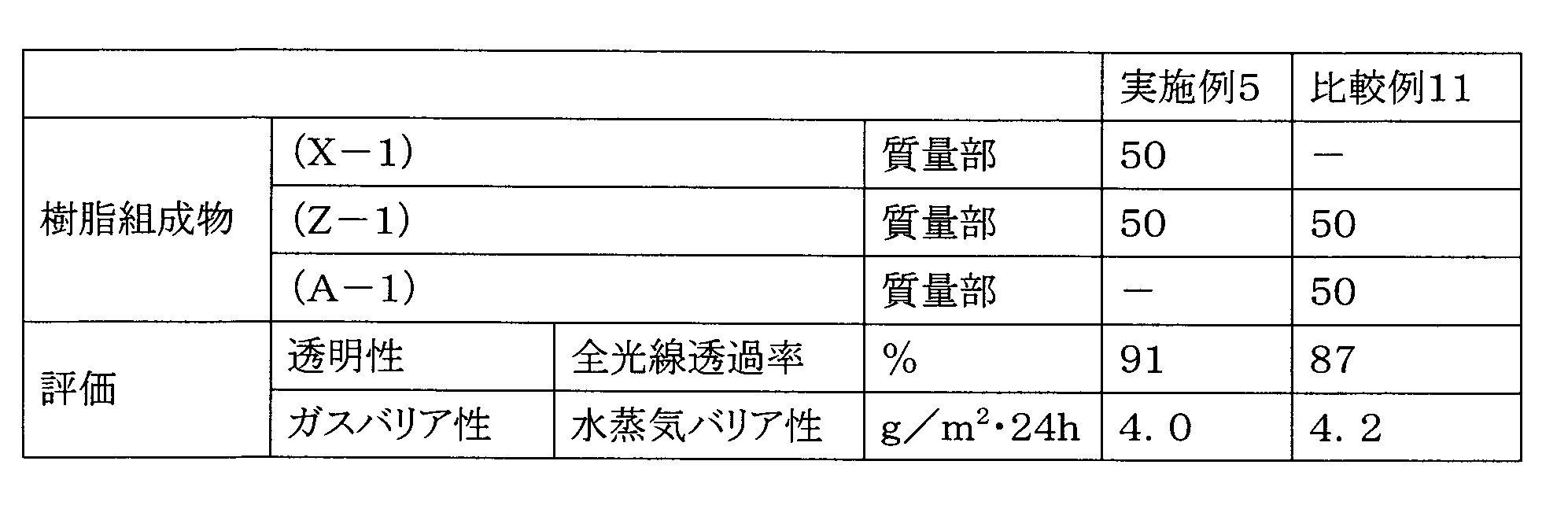
実施例1で得られた水素化ブロック共重合体(X-1)15質量部と、前記式(2)で表される繰り返し単位を有するポリマー(R3及びR4がシクロペンチル環構造を形成しており、dは0であり、式(2)の繰り返し単位が前記式(3)で表されるジシクロペンタジエンの開環重合体の水素添加物に相当しているもの)であって、前記式(3)で表されるジシクロペンタジエンの開環重合体の水素添加物を分子全体の85モル%含む化合物(日本ゼオン社製「Zeonor(登録商標)1020R」(MFR2.0g/分(230℃、21.2N))85質量部とを、テクノベル社製の、先端に幅150mm、リップ開度0.8mmのコートハンガータイプダイを設置した二軸押出し機KZW15(スクリュー径15mmφ、同方向2軸 L/D=45)にて、設定温度260℃、回転数500rpmで押し出し、150mmφの冷却ロールにてロール温度10℃、ライン速度5m/minで引き取ることで0.1mm厚のフィルムを得た。以下、「Zeonor(登録商標) 1020R」を(Z-2)と表すことがある。
得られたフィルムを用いて、前記(9)~(11)の評価を行い、結果を表4に示した。
実施例6において、実施例1で得られた水素化ブロック共重合体(X-1)の替わりに、水素化していない比較例1のスチレン-イソブチレン-スチレン共重合体(A-1)を用い、そのまま「Zeonor(登録商標) 1020R」(Z-2)と溶融混練したこと以外は実施例6と同様にして樹脂組成物の調製とフィルム成形を行い、その評価結果を表4に示した。
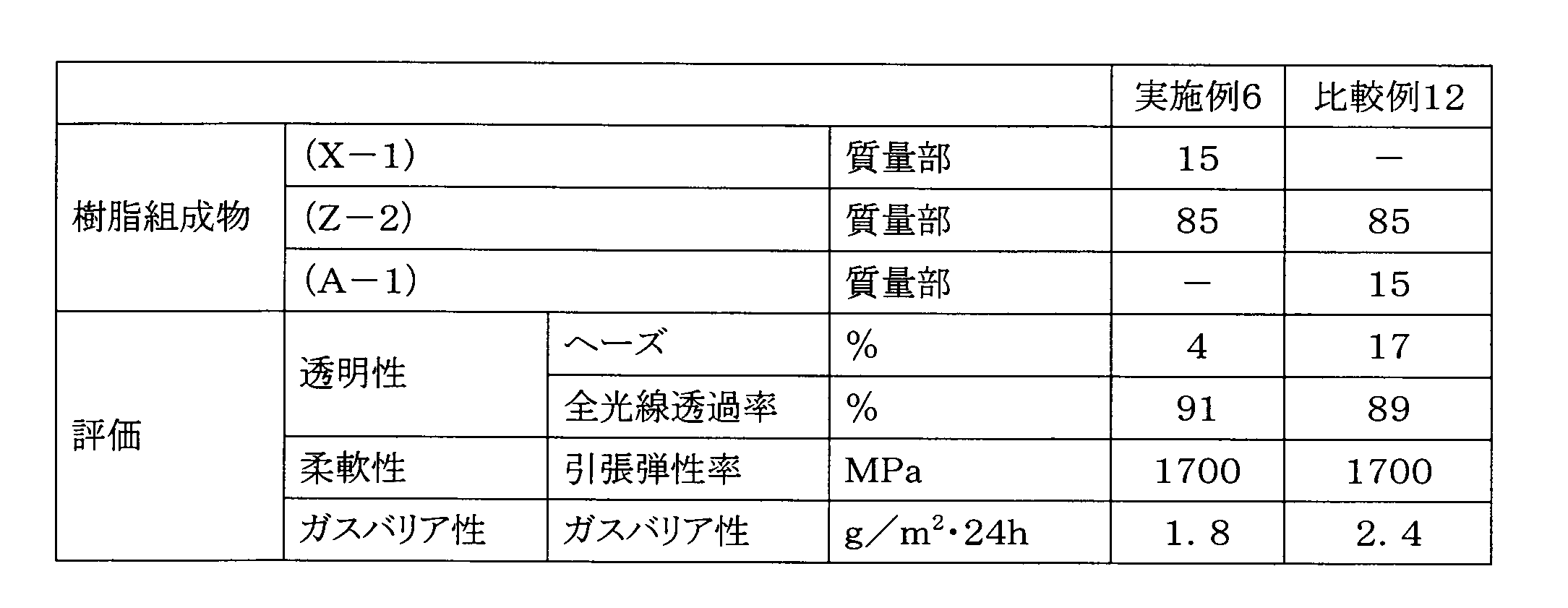
これに対して、水素化を行っていないブロック共重合体を用いた比較例12では、実施例6に比べて透明性もガスバリア性も劣る。
実施例1で得られた水素化ブロック共重合体(X-1)20質量部と、以下の水素化スチレン-ブタジエンブロック共重合体(Z-3)80質量部とを、シリンダー径30mmの二軸押出機(池貝社製PCM30型)を用いて設定温度250℃にて溶融混練してペレットを得た。
なお、以下の水素化スチレン-ブタジエンブロック共重合体を(Z-3)と表すことがある。
<水素化スチレン-ブタジエンブロック共重合体>
ポリスチレンブロック(PS)とポリブタジエンブロック(PB)とのPS-PB-PS-PB-PSの連鎖を有するペンタブロック共重合体の水素化物であり、MFR(240℃、49N)=96g/分、13C-NMRにより同定された構造が以下のものを用いた。
シクロヘキシルエチルセグメント:66モル%
テトラメチレンセグメント:31モル%
ブチレンセグメント:3モル%
実施例7において、実施例1で得られた水素化ブロック共重合体(X-1)に替えて、水素化していない比較例1のスチレン-イソブチレン-スチレン共重合体(A-1)を用い、(A-1)を水素化することなく、そのまま水素化スチレン-ブタジエンブロック共重合体(Z-3)と溶融混練したこと以外は同様にして樹脂組成物の調製と射出成形及び圧縮成形を行い、その評価結果を表5に示した。
実施例7において、実施例1で得られた水素化ブロック共重合体(X-1)に替えて、以下のスチレン-エチレン・ブチレン・スチレン-スチレン共重合体(Z-4)を用いたこと以外は、同様にして樹脂組成物の調製と射出成形及び圧縮成形を行い、その評価結果を表5に示した。
なお、以下のスチレン-エチレン・ブチレン・スチレン-スチレン共重合体を(Z-4)と表すことがある。
<スチレン-エチレン・ブチレン・スチレン-スチレン共重合体>
クレイトン社製A1536HU スチレン含量40質量%、
重量平均分子量(Mw)=127000
数平均分子量(Mn)=110000

実施例1で得られた水素化ブロック共重合体(X-1)80質量部と、実施例7において使用した水素化スチレン-ブタジエンブロック共重合体(Z-3)20質量部とを、テクノベル社製の、先端に幅150mmリップ開度0.8mmのコートハンガータイプダイを設置した二軸押出し機KZW15(スクリュー径15mmφ、同方向2軸 L/D=45)にて、設定温度260℃、回転数500rpmで押し出し、150mmφの冷却ロールにてロール温度10℃、ライン速度5m/minで引き取ることで0.1mm厚のフィルムを得た。
実施例8において、樹脂組成物の配合を表6に示すように変更した以外は実施例8と同様にして樹脂組成物のフィルム成形及び評価を行った。これらの結果を表6に示す。
Claims (17)
- 水素化ビニル芳香族重合体ブロックAと、イソブチレンを主体とする重合体のブロックBとを有する水素化ブロック共重合体。
- 重量平均分子量が10000以上、200000以下である請求項1に記載の水素化ブロック共重合体。
- 前記水素化ビニル芳香族重合体ブロックAが、芳香環が水素化された水素化ポリスチレンブロックである請求項1または2に記載の水素化ブロック共重合体。
- 前記水素化ビニル芳香族重合体ブロックAの芳香環の水素化率が50モル%以上である請求項1~3のいずれか1項に記載の水素化ブロック共重合体。
- 前記イソブチレンを主体とする重合体のブロックBが、単量体成分として、イソブチレンを70質量%以上含有する請求項1~4のいずれか1項に記載の水素化ブロック共重合体。
- 前記水素化ビニル芳香族重合体ブロックAを2つと、前記イソブチレンを主体とする重合体のブロックBを1つ有する請求項1~5のいずれか1項に記載の水素化ブロック共重合体。
- 前記水素化ブロック共重合体の全質量に対する前記水素化ビニル芳香族重合体ブロックAの含有割合が、40質量%以下である請求項1~6のいずれか1項に記載の水素化ブロック共重合体。
- 請求項1~7のいずれか1項に記載の水素化ブロック共重合体を含む樹脂組成物。
- 更に、プロピレンを主成分とするポリオレフィンを含む請求項8に記載の樹脂組成物。
- 前記プロピレンを主成分とするポリオレフィンが、プロピレンと、エチレン及び炭素数4から8のオレフィンのうち少なくとも一方との共重合体である請求項9に記載の樹脂組成物。
- 前記水素化ブロック共重合体の含有量が10~90質量%で、前記プロピレンを主成分とするポリオレフィンの含有量が90~10質量%である請求項9又は10に記載の樹脂組成物。
- 更に、エチレンと環状オレフィンとの共重合体、及び環状オレフィンの開環重合体の水素添加物から選ばれる少なくとも1つの非晶性ポリオレフィンを含む請求項8に記載の樹脂組成物。
- 前記水素化ブロック共重合体の含有量が5~90質量%で、前記非晶性ポリオレフィンの含有量が95~10質量%である請求項12に記載の樹脂組成物。
- 更に、水素化ビニル芳香族重合体、及び水素化ビニル芳香族重合体ブロックと水素化共役ジエンを主体とする重合体のブロックとを有する水素化ブロック共重合体から選ばれる少なくとも1つの水素化ビニル芳香族ブロック共重合体を含む請求項8に記載の樹脂組成物。
- 請求項1~7のいずれか1項に記載の水素化ブロック共重合体の含有量が5~90質量%で、前記水素化ビニル芳香族ブロック共重合体の含有量が95~10質量%である請求項14に記載の樹脂組成物。
- 請求項8~15のいずれか1項に記載の樹脂組成物を含むフィルム。
- 請求項8~15のいずれか1項に記載の樹脂組成物を含む容器。
Priority Applications (4)
| Application Number | Priority Date | Filing Date | Title |
|---|---|---|---|
| EP12837525.0A EP2762505B1 (en) | 2011-09-29 | 2012-09-27 | Hydrogenated block copolymer, resin composition, film and container |
| KR1020147007829A KR101935078B1 (ko) | 2011-09-29 | 2012-09-27 | 수소화 블록 공중합체, 수지 조성물, 필름 및 용기 |
| CN201280047239.3A CN103827157B (zh) | 2011-09-29 | 2012-09-27 | 氢化嵌段共聚物、树脂组合物、膜及容器 |
| US14/230,905 US9127112B2 (en) | 2011-09-29 | 2014-03-31 | Hydrogenated block copolymer, resin composition, film and container |
Applications Claiming Priority (8)
| Application Number | Priority Date | Filing Date | Title |
|---|---|---|---|
| JP2011-214648 | 2011-09-29 | ||
| JP2011214648 | 2011-09-29 | ||
| JP2012159632A JP5888161B2 (ja) | 2012-07-18 | 2012-07-18 | 樹脂組成物、並びにこの樹脂組成物からなるフィルム及び容器 |
| JP2012159631 | 2012-07-18 | ||
| JP2012-159633 | 2012-07-18 | ||
| JP2012-159632 | 2012-07-18 | ||
| JP2012-159631 | 2012-07-18 | ||
| JP2012159633 | 2012-07-18 |
Related Child Applications (1)
| Application Number | Title | Priority Date | Filing Date |
|---|---|---|---|
| US14/230,905 Continuation US9127112B2 (en) | 2011-09-29 | 2014-03-31 | Hydrogenated block copolymer, resin composition, film and container |
Publications (1)
| Publication Number | Publication Date |
|---|---|
| WO2013047690A1 true WO2013047690A1 (ja) | 2013-04-04 |
Family
ID=47995718
Family Applications (1)
| Application Number | Title | Priority Date | Filing Date |
|---|---|---|---|
| PCT/JP2012/074950 Ceased WO2013047690A1 (ja) | 2011-09-29 | 2012-09-27 | 水素化ブロック共重合体、樹脂組成物、フィルム及び容器 |
Country Status (6)
| Country | Link |
|---|---|
| US (1) | US9127112B2 (ja) |
| EP (1) | EP2762505B1 (ja) |
| KR (1) | KR101935078B1 (ja) |
| CN (3) | CN103827157B (ja) |
| TW (2) | TWI502014B (ja) |
| WO (1) | WO2013047690A1 (ja) |
Cited By (6)
| Publication number | Priority date | Publication date | Assignee | Title |
|---|---|---|---|---|
| JP2014196438A (ja) * | 2013-03-29 | 2014-10-16 | 三菱化学株式会社 | 医療用複室容器 |
| JP2017084982A (ja) * | 2015-10-29 | 2017-05-18 | ダイヤプラスフィルム株式会社 | 半導体製造工程用フィルム |
| WO2019216245A1 (ja) * | 2018-05-08 | 2019-11-14 | Mcppイノベーション合同会社 | 積層体、容器及び輸液バッグ |
| JP2020179594A (ja) * | 2019-04-25 | 2020-11-05 | 三菱ケミカル株式会社 | ヒートシール性多層フィルムおよび易開封性包装体 |
| JP2021075690A (ja) * | 2019-11-12 | 2021-05-20 | Mcppイノベーション合同会社 | 熱可塑性樹脂組成物、成形体及び積層体 |
| CN117447805A (zh) * | 2023-10-26 | 2024-01-26 | 青岛炯晟新材料科技有限公司 | 一种耐低温聚苯乙烯类弹性体制备方法及其在冰箱内胆材料中的应用 |
Families Citing this family (25)
| Publication number | Priority date | Publication date | Assignee | Title |
|---|---|---|---|---|
| EP2930211B1 (en) * | 2012-12-05 | 2020-10-07 | Zeon Corporation | Resin composition and medical drug container using same |
| JP6318764B2 (ja) * | 2013-03-29 | 2018-05-09 | 三菱ケミカル株式会社 | 積層体 |
| US9768817B2 (en) * | 2014-12-31 | 2017-09-19 | Al SANTELLI | Cell phone case and method of manufacturing the same by blending an additive with a polymer |
| JP2016135860A (ja) * | 2015-01-15 | 2016-07-28 | 三菱化学株式会社 | 硬化性組成物及びそれを用いた封止材料 |
| KR102013180B1 (ko) * | 2015-06-17 | 2019-08-22 | 주식회사 엘지화학 | 폴리(아릴렌 에테르) 수지 조성물 및 이로 피복된 케이블 |
| CN107921769B (zh) * | 2015-09-09 | 2019-07-05 | 旭化成株式会社 | 膜 |
| JP6762311B2 (ja) * | 2015-10-16 | 2020-09-30 | 株式会社ブリヂストン | 多元共重合体、ゴム組成物、架橋ゴム組成物、及びゴム物品 |
| JP6602151B2 (ja) * | 2015-10-16 | 2019-11-06 | 株式会社ブリヂストン | 多元共重合体、ゴム組成物、架橋ゴム組成物、及びゴム物品 |
| KR102651494B1 (ko) * | 2015-11-18 | 2024-03-25 | 니폰 제온 가부시키가이샤 | 광학 필름 및 편광판 |
| JP6229824B2 (ja) * | 2015-11-18 | 2017-11-15 | 日本ゼオン株式会社 | 光学フィルム及び偏光板 |
| ES2955021T3 (es) * | 2016-04-25 | 2023-11-28 | Asahi Chemical Ind | Copolímero en bloque hidrogenado, composición de resina de polipropileno, y cuerpo moldeado |
| EP3459982B1 (en) | 2016-05-18 | 2025-08-06 | Kuraray Co., Ltd. | Hydrogenated block copolymer, vibration damper, sound insulator, interlayer for laminated glass, dam rubber, shoe sole material, flooring material, laminate, and laminated glass |
| CN106213699A (zh) * | 2016-08-24 | 2016-12-14 | 道晟拉链科技(太仓)有限公司 | 一种夜光树脂拉链的制备方法 |
| KR102373433B1 (ko) | 2017-04-29 | 2022-03-10 | 엘지디스플레이 주식회사 | 표시 장치 |
| TWI766073B (zh) * | 2017-07-21 | 2022-06-01 | 台橡股份有限公司 | 用於製備發泡體的組合物、發泡體以及包含該發泡體的鞋體 |
| KR102352563B1 (ko) | 2017-08-04 | 2022-01-17 | 엘지디스플레이 주식회사 | 표시장치 |
| CN107686911A (zh) * | 2017-08-31 | 2018-02-13 | 安徽青花坊瓷业股份有限公司 | 一种用于制备陶瓷文件架的组合物 |
| CN107556719A (zh) * | 2017-10-19 | 2018-01-09 | 奇瑞汽车股份有限公司 | 一种电动车电池包箱体上盖制备方法 |
| TWI774882B (zh) * | 2017-11-22 | 2022-08-21 | 日商可樂麗股份有限公司 | 嵌段共聚物或其氫化物 |
| RU2760281C1 (ru) * | 2018-01-31 | 2021-11-23 | Меникон Ко., Лтд. | Материал для интраокулярной линзы |
| CN111684625B (zh) * | 2018-03-07 | 2023-05-12 | 日本瑞翁株式会社 | 粘结剂组合物、功能层、浆料组合物和非水系二次电池 |
| US11466115B2 (en) | 2018-06-01 | 2022-10-11 | 3M Innovative Properties Company | Porous membranes including triblock copolymers |
| CN110819141B (zh) * | 2018-08-10 | 2022-07-12 | Jsr株式会社 | 硬化性组合物及化合物 |
| CN109810456B (zh) * | 2018-11-09 | 2021-11-12 | 台橡(上海)实业有限公司 | 一种热塑性弹性体吸盘材料 |
| WO2021153183A1 (ja) | 2020-01-30 | 2021-08-05 | Mcppイノベーション合同会社 | 熱可塑性エラストマー組成物及びそれよりなる成形体 |
Citations (13)
| Publication number | Priority date | Publication date | Assignee | Title |
|---|---|---|---|---|
| JPH01317728A (ja) | 1988-06-17 | 1989-12-22 | Mitsubishi Kasei Corp | ポリビニルシクロヘキサン系樹脂製光ディスク基板の製造法 |
| JPH059389A (ja) * | 1991-07-01 | 1993-01-19 | Nippon Zeon Co Ltd | アスフアルトとブロツク共重合体との組成物 |
| JPH11100420A (ja) | 1997-09-25 | 1999-04-13 | Kuraray Co Ltd | ブロック共重合体とその製造方法及び樹脂組成物 |
| WO2001092412A1 (en) * | 2000-05-31 | 2001-12-06 | Zeon Corporation | Resin composition |
| JP2002540229A (ja) | 1999-03-19 | 2002-11-26 | ザ ダウ ケミカル カンパニー | 水素化ブロックコポリマー |
| JP2003502470A (ja) | 1999-06-11 | 2003-01-21 | ザ ダウ ケミカル カンパニー | 水素添加ブロック共重合体からなる組成物及びその最終用途への利用 |
| WO2003018656A1 (en) | 2001-08-22 | 2003-03-06 | Zeon Corporation | Block copolymer, process for producing the same, and molded object |
| JP2003534412A (ja) * | 2000-05-19 | 2003-11-18 | ダウ グローバル テクノロジーズ インコーポレーテッド | 水素化ブロックコポリマー組成物 |
| JP2005105164A (ja) | 2003-09-30 | 2005-04-21 | Kaneka Corp | 樹脂組成物からなる成形体および改質剤 |
| JP2005187722A (ja) | 2003-12-26 | 2005-07-14 | Kaneka Corp | 熱可塑性樹脂組成物 |
| JP2007002886A (ja) * | 2005-06-22 | 2007-01-11 | Mitsubishi Chemicals Corp | ガスケット用の熱可塑性エラストマー組成物及びガスケット |
| JP2007016217A (ja) | 2005-06-06 | 2007-01-25 | Sekisui Chem Co Ltd | 表面保護フィルム |
| JP2007099846A (ja) * | 2005-09-30 | 2007-04-19 | Kuraray Co Ltd | ブロック共重合体、及び該共重合体を含有する熱可塑性エラストマー組成物 |
Family Cites Families (10)
| Publication number | Priority date | Publication date | Assignee | Title |
|---|---|---|---|---|
| JP3360335B2 (ja) * | 1992-12-28 | 2002-12-24 | 日本ゼオン株式会社 | ビニル化環状炭化水素系重合体から成る成形材料 |
| JPH07216152A (ja) * | 1994-02-07 | 1995-08-15 | Mitsui Petrochem Ind Ltd | 環状オレフィン系樹脂組成物製容器 |
| DE19921943A1 (de) | 1999-05-12 | 2000-11-16 | Bayer Ag | Substrate für optische Speichermedien |
| US20010048991A1 (en) | 1999-06-11 | 2001-12-06 | Henri-Luc Martin | Compositions for flexible optical media discs |
| WO2002016449A2 (en) * | 2000-08-25 | 2002-02-28 | Kraton Polymers Research B.V. | A method for making selectively hydrogenated block copolymers of vinyl aromatic hydrocarbons and conjugated dienes |
| US6667364B2 (en) * | 2000-12-29 | 2003-12-23 | Advanced Elastomer Systems Lp | Processable polyethylene/EPDM thermoplastic vulcanizates |
| CA2355578A1 (en) * | 2001-07-31 | 2003-01-31 | Bayer Inc. | Covulcanisation of polymers |
| EP1431343B1 (en) | 2001-09-25 | 2008-07-30 | Bridgestone Corporation | Article comprising a resin composition |
| US20090117379A1 (en) | 2005-06-06 | 2009-05-07 | Katsunori Toyoshima | Surface protection film |
| JP5595525B2 (ja) * | 2010-01-27 | 2014-09-24 | クレイトン・ポリマーズ・ユー・エス・エル・エル・シー | スチレン−イソブチレン−スチレンおよびスチレン−エチレン/ブチレン−スチレンブロックコポリマーを含有する組成物 |
-
2012
- 2012-09-27 EP EP12837525.0A patent/EP2762505B1/en active Active
- 2012-09-27 CN CN201280047239.3A patent/CN103827157B/zh active Active
- 2012-09-27 KR KR1020147007829A patent/KR101935078B1/ko active Active
- 2012-09-27 CN CN201611219708.1A patent/CN106632926B/zh active Active
- 2012-09-27 WO PCT/JP2012/074950 patent/WO2013047690A1/ja not_active Ceased
- 2012-09-27 CN CN201611218852.3A patent/CN106608955A/zh active Pending
- 2012-09-28 TW TW102136174A patent/TWI502014B/zh active
- 2012-09-28 TW TW101135850A patent/TWI445756B/zh active
-
2014
- 2014-03-31 US US14/230,905 patent/US9127112B2/en active Active
Patent Citations (13)
| Publication number | Priority date | Publication date | Assignee | Title |
|---|---|---|---|---|
| JPH01317728A (ja) | 1988-06-17 | 1989-12-22 | Mitsubishi Kasei Corp | ポリビニルシクロヘキサン系樹脂製光ディスク基板の製造法 |
| JPH059389A (ja) * | 1991-07-01 | 1993-01-19 | Nippon Zeon Co Ltd | アスフアルトとブロツク共重合体との組成物 |
| JPH11100420A (ja) | 1997-09-25 | 1999-04-13 | Kuraray Co Ltd | ブロック共重合体とその製造方法及び樹脂組成物 |
| JP2002540229A (ja) | 1999-03-19 | 2002-11-26 | ザ ダウ ケミカル カンパニー | 水素化ブロックコポリマー |
| JP2003502470A (ja) | 1999-06-11 | 2003-01-21 | ザ ダウ ケミカル カンパニー | 水素添加ブロック共重合体からなる組成物及びその最終用途への利用 |
| JP2003534412A (ja) * | 2000-05-19 | 2003-11-18 | ダウ グローバル テクノロジーズ インコーポレーテッド | 水素化ブロックコポリマー組成物 |
| WO2001092412A1 (en) * | 2000-05-31 | 2001-12-06 | Zeon Corporation | Resin composition |
| WO2003018656A1 (en) | 2001-08-22 | 2003-03-06 | Zeon Corporation | Block copolymer, process for producing the same, and molded object |
| JP2005105164A (ja) | 2003-09-30 | 2005-04-21 | Kaneka Corp | 樹脂組成物からなる成形体および改質剤 |
| JP2005187722A (ja) | 2003-12-26 | 2005-07-14 | Kaneka Corp | 熱可塑性樹脂組成物 |
| JP2007016217A (ja) | 2005-06-06 | 2007-01-25 | Sekisui Chem Co Ltd | 表面保護フィルム |
| JP2007002886A (ja) * | 2005-06-22 | 2007-01-11 | Mitsubishi Chemicals Corp | ガスケット用の熱可塑性エラストマー組成物及びガスケット |
| JP2007099846A (ja) * | 2005-09-30 | 2007-04-19 | Kuraray Co Ltd | ブロック共重合体、及び該共重合体を含有する熱可塑性エラストマー組成物 |
Non-Patent Citations (1)
| Title |
|---|
| See also references of EP2762505A4 |
Cited By (10)
| Publication number | Priority date | Publication date | Assignee | Title |
|---|---|---|---|---|
| JP2014196438A (ja) * | 2013-03-29 | 2014-10-16 | 三菱化学株式会社 | 医療用複室容器 |
| JP2017084982A (ja) * | 2015-10-29 | 2017-05-18 | ダイヤプラスフィルム株式会社 | 半導体製造工程用フィルム |
| WO2019216245A1 (ja) * | 2018-05-08 | 2019-11-14 | Mcppイノベーション合同会社 | 積層体、容器及び輸液バッグ |
| JPWO2019216245A1 (ja) * | 2018-05-08 | 2021-06-17 | Mcppイノベーション合同会社 | 積層体、容器及び輸液バッグ |
| JP7184080B2 (ja) | 2018-05-08 | 2022-12-06 | Mcppイノベーション合同会社 | 積層体、容器及び輸液バッグ |
| JP2020179594A (ja) * | 2019-04-25 | 2020-11-05 | 三菱ケミカル株式会社 | ヒートシール性多層フィルムおよび易開封性包装体 |
| JP7238578B2 (ja) | 2019-04-25 | 2023-03-14 | 三菱ケミカル株式会社 | ヒートシール性多層フィルムおよび易開封性包装体 |
| JP2021075690A (ja) * | 2019-11-12 | 2021-05-20 | Mcppイノベーション合同会社 | 熱可塑性樹脂組成物、成形体及び積層体 |
| JP7530767B2 (ja) | 2019-11-12 | 2024-08-08 | Mcppイノベーション合同会社 | 熱可塑性樹脂組成物、成形体及び積層体 |
| CN117447805A (zh) * | 2023-10-26 | 2024-01-26 | 青岛炯晟新材料科技有限公司 | 一种耐低温聚苯乙烯类弹性体制备方法及其在冰箱内胆材料中的应用 |
Also Published As
| Publication number | Publication date |
|---|---|
| CN103827157A (zh) | 2014-05-28 |
| US9127112B2 (en) | 2015-09-08 |
| TW201402686A (zh) | 2014-01-16 |
| EP2762505A4 (en) | 2015-02-25 |
| CN106608955A (zh) | 2017-05-03 |
| EP2762505B1 (en) | 2016-09-07 |
| KR20140069026A (ko) | 2014-06-09 |
| KR101935078B1 (ko) | 2019-01-03 |
| US20140213728A1 (en) | 2014-07-31 |
| CN106632926B (zh) | 2019-07-30 |
| CN106632926A (zh) | 2017-05-10 |
| TW201319153A (zh) | 2013-05-16 |
| TWI502014B (zh) | 2015-10-01 |
| EP2762505A1 (en) | 2014-08-06 |
| TWI445756B (zh) | 2014-07-21 |
| CN103827157B (zh) | 2017-05-31 |
Similar Documents
| Publication | Publication Date | Title |
|---|---|---|
| EP2762505B1 (en) | Hydrogenated block copolymer, resin composition, film and container | |
| JP5333692B2 (ja) | 水素化ブロック共重合体及びその樹脂組成物、並びに該樹脂組成物を含むフィルム及び容器 | |
| TWI540167B (zh) | A hydrogenated block copolymer composition and a molded body using the same | |
| JP3949110B2 (ja) | 水添共重合体 | |
| TWI399387B (zh) | 氫化嵌段共聚物及其交聯用組合物 | |
| EP1852446B1 (en) | Hydrogenated block copolymer and composition thereof | |
| CN1312215C (zh) | 聚合物组合物及其应用 | |
| JP6505848B2 (ja) | 水素化ブロック共重合体並びにこれを用いたポリプロピレン系樹脂組成物及びその成型体 | |
| TWI540166B (zh) | Thermoplastic polymer compositions, flakes, films, and complex layer films | |
| JP6064817B2 (ja) | 樹脂組成物、並びにこの樹脂組成物からなるフィルム及び容器 | |
| JP5888161B2 (ja) | 樹脂組成物、並びにこの樹脂組成物からなるフィルム及び容器 | |
| JP6318764B2 (ja) | 積層体 | |
| JP6070452B2 (ja) | 樹脂組成物、並びにこの樹脂組成物からなるフィルム及び容器 | |
| CN115485334B (zh) | 氢化共聚物、树脂组合物、成型体和粘合性膜 | |
| TWI799645B (zh) | 樹脂組成物、樹脂薄膜及堆疊體 | |
| JP7643867B2 (ja) | 水添共重合体、及び成形体 | |
| TW546341B (en) | Single-layer films based on vinylcyclohexane | |
| JP6264988B2 (ja) | 積層体 | |
| JP2016145303A (ja) | プロピレン系ランダム共重合体組成物及びその成形体 | |
| TW201906876A (zh) | 含乙烯基芳香族聚合物成分之聚合物,及其之製造方法 |
Legal Events
| Date | Code | Title | Description |
|---|---|---|---|
| 121 | Ep: the epo has been informed by wipo that ep was designated in this application |
Ref document number: 12837525 Country of ref document: EP Kind code of ref document: A1 |
|
| ENP | Entry into the national phase |
Ref document number: 20147007829 Country of ref document: KR Kind code of ref document: A |
|
| REEP | Request for entry into the european phase |
Ref document number: 2012837525 Country of ref document: EP |
|
| WWE | Wipo information: entry into national phase |
Ref document number: 2012837525 Country of ref document: EP |
|
| NENP | Non-entry into the national phase |
Ref country code: DE |