WO2013077363A1 - フェライト系耐熱鋼及びその製造方法 - Google Patents
フェライト系耐熱鋼及びその製造方法 Download PDFInfo
- Publication number
- WO2013077363A1 WO2013077363A1 PCT/JP2012/080198 JP2012080198W WO2013077363A1 WO 2013077363 A1 WO2013077363 A1 WO 2013077363A1 JP 2012080198 W JP2012080198 W JP 2012080198W WO 2013077363 A1 WO2013077363 A1 WO 2013077363A1
- Authority
- WO
- WIPO (PCT)
- Prior art keywords
- less
- oxide film
- resistant steel
- ferritic heat
- base material
- Prior art date
- Legal status (The legal status is an assumption and is not a legal conclusion. Google has not performed a legal analysis and makes no representation as to the accuracy of the status listed.)
- Ceased
Links
Classifications
-
- C—CHEMISTRY; METALLURGY
- C23—COATING METALLIC MATERIAL; COATING MATERIAL WITH METALLIC MATERIAL; CHEMICAL SURFACE TREATMENT; DIFFUSION TREATMENT OF METALLIC MATERIAL; COATING BY VACUUM EVAPORATION, BY SPUTTERING, BY ION IMPLANTATION OR BY CHEMICAL VAPOUR DEPOSITION, IN GENERAL; INHIBITING CORROSION OF METALLIC MATERIAL OR INCRUSTATION IN GENERAL
- C23C—COATING METALLIC MATERIAL; COATING MATERIAL WITH METALLIC MATERIAL; SURFACE TREATMENT OF METALLIC MATERIAL BY DIFFUSION INTO THE SURFACE, BY CHEMICAL CONVERSION OR SUBSTITUTION; COATING BY VACUUM EVAPORATION, BY SPUTTERING, BY ION IMPLANTATION OR BY CHEMICAL VAPOUR DEPOSITION, IN GENERAL
- C23C8/00—Solid state diffusion of only non-metal elements into metallic material surfaces; Chemical surface treatment of metallic material by reaction of the surface with a reactive gas, leaving reaction products of surface material in the coating, e.g. conversion coatings, passivation of metals
- C23C8/06—Solid state diffusion of only non-metal elements into metallic material surfaces; Chemical surface treatment of metallic material by reaction of the surface with a reactive gas, leaving reaction products of surface material in the coating, e.g. conversion coatings, passivation of metals using gases
- C23C8/08—Solid state diffusion of only non-metal elements into metallic material surfaces; Chemical surface treatment of metallic material by reaction of the surface with a reactive gas, leaving reaction products of surface material in the coating, e.g. conversion coatings, passivation of metals using gases only one element being applied
- C23C8/10—Oxidising
- C23C8/12—Oxidising using elemental oxygen or ozone
- C23C8/14—Oxidising of ferrous surfaces
-
- C—CHEMISTRY; METALLURGY
- C21—METALLURGY OF IRON
- C21D—MODIFYING THE PHYSICAL STRUCTURE OF FERROUS METALS; GENERAL DEVICES FOR HEAT TREATMENT OF FERROUS OR NON-FERROUS METALS OR ALLOYS; MAKING METAL MALLEABLE, e.g. BY DECARBURISATION OR TEMPERING
- C21D6/00—Heat treatment of ferrous alloys
- C21D6/002—Heat treatment of ferrous alloys containing Cr
-
- C—CHEMISTRY; METALLURGY
- C21—METALLURGY OF IRON
- C21D—MODIFYING THE PHYSICAL STRUCTURE OF FERROUS METALS; GENERAL DEVICES FOR HEAT TREATMENT OF FERROUS OR NON-FERROUS METALS OR ALLOYS; MAKING METAL MALLEABLE, e.g. BY DECARBURISATION OR TEMPERING
- C21D6/00—Heat treatment of ferrous alloys
- C21D6/004—Heat treatment of ferrous alloys containing Cr and Ni
-
- C—CHEMISTRY; METALLURGY
- C21—METALLURGY OF IRON
- C21D—MODIFYING THE PHYSICAL STRUCTURE OF FERROUS METALS; GENERAL DEVICES FOR HEAT TREATMENT OF FERROUS OR NON-FERROUS METALS OR ALLOYS; MAKING METAL MALLEABLE, e.g. BY DECARBURISATION OR TEMPERING
- C21D6/00—Heat treatment of ferrous alloys
- C21D6/005—Heat treatment of ferrous alloys containing Mn
-
- C—CHEMISTRY; METALLURGY
- C21—METALLURGY OF IRON
- C21D—MODIFYING THE PHYSICAL STRUCTURE OF FERROUS METALS; GENERAL DEVICES FOR HEAT TREATMENT OF FERROUS OR NON-FERROUS METALS OR ALLOYS; MAKING METAL MALLEABLE, e.g. BY DECARBURISATION OR TEMPERING
- C21D6/00—Heat treatment of ferrous alloys
- C21D6/007—Heat treatment of ferrous alloys containing Co
-
- C—CHEMISTRY; METALLURGY
- C21—METALLURGY OF IRON
- C21D—MODIFYING THE PHYSICAL STRUCTURE OF FERROUS METALS; GENERAL DEVICES FOR HEAT TREATMENT OF FERROUS OR NON-FERROUS METALS OR ALLOYS; MAKING METAL MALLEABLE, e.g. BY DECARBURISATION OR TEMPERING
- C21D6/00—Heat treatment of ferrous alloys
- C21D6/008—Heat treatment of ferrous alloys containing Si
-
- C—CHEMISTRY; METALLURGY
- C22—METALLURGY; FERROUS OR NON-FERROUS ALLOYS; TREATMENT OF ALLOYS OR NON-FERROUS METALS
- C22C—ALLOYS
- C22C38/00—Ferrous alloys, e.g. steel alloys
- C22C38/001—Ferrous alloys, e.g. steel alloys containing N
-
- C—CHEMISTRY; METALLURGY
- C22—METALLURGY; FERROUS OR NON-FERROUS ALLOYS; TREATMENT OF ALLOYS OR NON-FERROUS METALS
- C22C—ALLOYS
- C22C38/00—Ferrous alloys, e.g. steel alloys
- C22C38/002—Ferrous alloys, e.g. steel alloys containing In, Mg, or other elements not provided for in one single group C22C38/001 - C22C38/60
-
- C—CHEMISTRY; METALLURGY
- C22—METALLURGY; FERROUS OR NON-FERROUS ALLOYS; TREATMENT OF ALLOYS OR NON-FERROUS METALS
- C22C—ALLOYS
- C22C38/00—Ferrous alloys, e.g. steel alloys
- C22C38/005—Ferrous alloys, e.g. steel alloys containing rare earths, i.e. Sc, Y, Lanthanides
-
- C—CHEMISTRY; METALLURGY
- C22—METALLURGY; FERROUS OR NON-FERROUS ALLOYS; TREATMENT OF ALLOYS OR NON-FERROUS METALS
- C22C—ALLOYS
- C22C38/00—Ferrous alloys, e.g. steel alloys
- C22C38/02—Ferrous alloys, e.g. steel alloys containing silicon
-
- C—CHEMISTRY; METALLURGY
- C22—METALLURGY; FERROUS OR NON-FERROUS ALLOYS; TREATMENT OF ALLOYS OR NON-FERROUS METALS
- C22C—ALLOYS
- C22C38/00—Ferrous alloys, e.g. steel alloys
- C22C38/04—Ferrous alloys, e.g. steel alloys containing manganese
-
- C—CHEMISTRY; METALLURGY
- C22—METALLURGY; FERROUS OR NON-FERROUS ALLOYS; TREATMENT OF ALLOYS OR NON-FERROUS METALS
- C22C—ALLOYS
- C22C38/00—Ferrous alloys, e.g. steel alloys
- C22C38/06—Ferrous alloys, e.g. steel alloys containing aluminium
-
- C—CHEMISTRY; METALLURGY
- C22—METALLURGY; FERROUS OR NON-FERROUS ALLOYS; TREATMENT OF ALLOYS OR NON-FERROUS METALS
- C22C—ALLOYS
- C22C38/00—Ferrous alloys, e.g. steel alloys
- C22C38/14—Ferrous alloys, e.g. steel alloys containing titanium or zirconium
-
- C—CHEMISTRY; METALLURGY
- C22—METALLURGY; FERROUS OR NON-FERROUS ALLOYS; TREATMENT OF ALLOYS OR NON-FERROUS METALS
- C22C—ALLOYS
- C22C38/00—Ferrous alloys, e.g. steel alloys
- C22C38/18—Ferrous alloys, e.g. steel alloys containing chromium
-
- C—CHEMISTRY; METALLURGY
- C22—METALLURGY; FERROUS OR NON-FERROUS ALLOYS; TREATMENT OF ALLOYS OR NON-FERROUS METALS
- C22C—ALLOYS
- C22C38/00—Ferrous alloys, e.g. steel alloys
- C22C38/18—Ferrous alloys, e.g. steel alloys containing chromium
- C22C38/20—Ferrous alloys, e.g. steel alloys containing chromium with copper
-
- C—CHEMISTRY; METALLURGY
- C22—METALLURGY; FERROUS OR NON-FERROUS ALLOYS; TREATMENT OF ALLOYS OR NON-FERROUS METALS
- C22C—ALLOYS
- C22C38/00—Ferrous alloys, e.g. steel alloys
- C22C38/18—Ferrous alloys, e.g. steel alloys containing chromium
- C22C38/22—Ferrous alloys, e.g. steel alloys containing chromium with molybdenum or tungsten
-
- C—CHEMISTRY; METALLURGY
- C22—METALLURGY; FERROUS OR NON-FERROUS ALLOYS; TREATMENT OF ALLOYS OR NON-FERROUS METALS
- C22C—ALLOYS
- C22C38/00—Ferrous alloys, e.g. steel alloys
- C22C38/18—Ferrous alloys, e.g. steel alloys containing chromium
- C22C38/24—Ferrous alloys, e.g. steel alloys containing chromium with vanadium
-
- C—CHEMISTRY; METALLURGY
- C22—METALLURGY; FERROUS OR NON-FERROUS ALLOYS; TREATMENT OF ALLOYS OR NON-FERROUS METALS
- C22C—ALLOYS
- C22C38/00—Ferrous alloys, e.g. steel alloys
- C22C38/18—Ferrous alloys, e.g. steel alloys containing chromium
- C22C38/26—Ferrous alloys, e.g. steel alloys containing chromium with niobium or tantalum
-
- C—CHEMISTRY; METALLURGY
- C22—METALLURGY; FERROUS OR NON-FERROUS ALLOYS; TREATMENT OF ALLOYS OR NON-FERROUS METALS
- C22C—ALLOYS
- C22C38/00—Ferrous alloys, e.g. steel alloys
- C22C38/18—Ferrous alloys, e.g. steel alloys containing chromium
- C22C38/28—Ferrous alloys, e.g. steel alloys containing chromium with titanium or zirconium
-
- C—CHEMISTRY; METALLURGY
- C22—METALLURGY; FERROUS OR NON-FERROUS ALLOYS; TREATMENT OF ALLOYS OR NON-FERROUS METALS
- C22C—ALLOYS
- C22C38/00—Ferrous alloys, e.g. steel alloys
- C22C38/18—Ferrous alloys, e.g. steel alloys containing chromium
- C22C38/30—Ferrous alloys, e.g. steel alloys containing chromium with cobalt
-
- C—CHEMISTRY; METALLURGY
- C22—METALLURGY; FERROUS OR NON-FERROUS ALLOYS; TREATMENT OF ALLOYS OR NON-FERROUS METALS
- C22C—ALLOYS
- C22C38/00—Ferrous alloys, e.g. steel alloys
- C22C38/18—Ferrous alloys, e.g. steel alloys containing chromium
- C22C38/32—Ferrous alloys, e.g. steel alloys containing chromium with boron
-
- C—CHEMISTRY; METALLURGY
- C22—METALLURGY; FERROUS OR NON-FERROUS ALLOYS; TREATMENT OF ALLOYS OR NON-FERROUS METALS
- C22C—ALLOYS
- C22C38/00—Ferrous alloys, e.g. steel alloys
- C22C38/18—Ferrous alloys, e.g. steel alloys containing chromium
- C22C38/38—Ferrous alloys, e.g. steel alloys containing chromium with more than 1.5% by weight of manganese
-
- C—CHEMISTRY; METALLURGY
- C22—METALLURGY; FERROUS OR NON-FERROUS ALLOYS; TREATMENT OF ALLOYS OR NON-FERROUS METALS
- C22C—ALLOYS
- C22C38/00—Ferrous alloys, e.g. steel alloys
- C22C38/18—Ferrous alloys, e.g. steel alloys containing chromium
- C22C38/40—Ferrous alloys, e.g. steel alloys containing chromium with nickel
- C22C38/42—Ferrous alloys, e.g. steel alloys containing chromium with nickel with copper
-
- C—CHEMISTRY; METALLURGY
- C22—METALLURGY; FERROUS OR NON-FERROUS ALLOYS; TREATMENT OF ALLOYS OR NON-FERROUS METALS
- C22C—ALLOYS
- C22C38/00—Ferrous alloys, e.g. steel alloys
- C22C38/18—Ferrous alloys, e.g. steel alloys containing chromium
- C22C38/40—Ferrous alloys, e.g. steel alloys containing chromium with nickel
- C22C38/44—Ferrous alloys, e.g. steel alloys containing chromium with nickel with molybdenum or tungsten
-
- C—CHEMISTRY; METALLURGY
- C22—METALLURGY; FERROUS OR NON-FERROUS ALLOYS; TREATMENT OF ALLOYS OR NON-FERROUS METALS
- C22C—ALLOYS
- C22C38/00—Ferrous alloys, e.g. steel alloys
- C22C38/18—Ferrous alloys, e.g. steel alloys containing chromium
- C22C38/40—Ferrous alloys, e.g. steel alloys containing chromium with nickel
- C22C38/58—Ferrous alloys, e.g. steel alloys containing chromium with nickel with more than 1.5% by weight of manganese
-
- C—CHEMISTRY; METALLURGY
- C23—COATING METALLIC MATERIAL; COATING MATERIAL WITH METALLIC MATERIAL; CHEMICAL SURFACE TREATMENT; DIFFUSION TREATMENT OF METALLIC MATERIAL; COATING BY VACUUM EVAPORATION, BY SPUTTERING, BY ION IMPLANTATION OR BY CHEMICAL VAPOUR DEPOSITION, IN GENERAL; INHIBITING CORROSION OF METALLIC MATERIAL OR INCRUSTATION IN GENERAL
- C23C—COATING METALLIC MATERIAL; COATING MATERIAL WITH METALLIC MATERIAL; SURFACE TREATMENT OF METALLIC MATERIAL BY DIFFUSION INTO THE SURFACE, BY CHEMICAL CONVERSION OR SUBSTITUTION; COATING BY VACUUM EVAPORATION, BY SPUTTERING, BY ION IMPLANTATION OR BY CHEMICAL VAPOUR DEPOSITION, IN GENERAL
- C23C4/00—Coating by spraying the coating material in the molten state, e.g. by flame, plasma or electric discharge
- C23C4/04—Coating by spraying the coating material in the molten state, e.g. by flame, plasma or electric discharge characterised by the coating material
- C23C4/10—Oxides, borides, carbides, nitrides or silicides; Mixtures thereof
- C23C4/11—Oxides
-
- C—CHEMISTRY; METALLURGY
- C23—COATING METALLIC MATERIAL; COATING MATERIAL WITH METALLIC MATERIAL; CHEMICAL SURFACE TREATMENT; DIFFUSION TREATMENT OF METALLIC MATERIAL; COATING BY VACUUM EVAPORATION, BY SPUTTERING, BY ION IMPLANTATION OR BY CHEMICAL VAPOUR DEPOSITION, IN GENERAL; INHIBITING CORROSION OF METALLIC MATERIAL OR INCRUSTATION IN GENERAL
- C23C—COATING METALLIC MATERIAL; COATING MATERIAL WITH METALLIC MATERIAL; SURFACE TREATMENT OF METALLIC MATERIAL BY DIFFUSION INTO THE SURFACE, BY CHEMICAL CONVERSION OR SUBSTITUTION; COATING BY VACUUM EVAPORATION, BY SPUTTERING, BY ION IMPLANTATION OR BY CHEMICAL VAPOUR DEPOSITION, IN GENERAL
- C23C4/00—Coating by spraying the coating material in the molten state, e.g. by flame, plasma or electric discharge
- C23C4/12—Coating by spraying the coating material in the molten state, e.g. by flame, plasma or electric discharge characterised by the method of spraying
- C23C4/134—Plasma spraying
-
- C—CHEMISTRY; METALLURGY
- C23—COATING METALLIC MATERIAL; COATING MATERIAL WITH METALLIC MATERIAL; CHEMICAL SURFACE TREATMENT; DIFFUSION TREATMENT OF METALLIC MATERIAL; COATING BY VACUUM EVAPORATION, BY SPUTTERING, BY ION IMPLANTATION OR BY CHEMICAL VAPOUR DEPOSITION, IN GENERAL; INHIBITING CORROSION OF METALLIC MATERIAL OR INCRUSTATION IN GENERAL
- C23C—COATING METALLIC MATERIAL; COATING MATERIAL WITH METALLIC MATERIAL; SURFACE TREATMENT OF METALLIC MATERIAL BY DIFFUSION INTO THE SURFACE, BY CHEMICAL CONVERSION OR SUBSTITUTION; COATING BY VACUUM EVAPORATION, BY SPUTTERING, BY ION IMPLANTATION OR BY CHEMICAL VAPOUR DEPOSITION, IN GENERAL
- C23C8/00—Solid state diffusion of only non-metal elements into metallic material surfaces; Chemical surface treatment of metallic material by reaction of the surface with a reactive gas, leaving reaction products of surface material in the coating, e.g. conversion coatings, passivation of metals
- C23C8/06—Solid state diffusion of only non-metal elements into metallic material surfaces; Chemical surface treatment of metallic material by reaction of the surface with a reactive gas, leaving reaction products of surface material in the coating, e.g. conversion coatings, passivation of metals using gases
- C23C8/08—Solid state diffusion of only non-metal elements into metallic material surfaces; Chemical surface treatment of metallic material by reaction of the surface with a reactive gas, leaving reaction products of surface material in the coating, e.g. conversion coatings, passivation of metals using gases only one element being applied
- C23C8/10—Oxidising
- C23C8/16—Oxidising using oxygen-containing compounds, e.g. water, carbon dioxide
- C23C8/18—Oxidising of ferrous surfaces
-
- F—MECHANICAL ENGINEERING; LIGHTING; HEATING; WEAPONS; BLASTING
- F24—HEATING; RANGES; VENTILATING
- F24S—SOLAR HEAT COLLECTORS; SOLAR HEAT SYSTEMS
- F24S70/00—Details of absorbing elements
- F24S70/20—Details of absorbing elements characterised by absorbing coatings; characterised by surface treatment for increasing absorption
- F24S70/225—Details of absorbing elements characterised by absorbing coatings; characterised by surface treatment for increasing absorption for spectrally selective absorption
-
- F—MECHANICAL ENGINEERING; LIGHTING; HEATING; WEAPONS; BLASTING
- F24—HEATING; RANGES; VENTILATING
- F24S—SOLAR HEAT COLLECTORS; SOLAR HEAT SYSTEMS
- F24S70/00—Details of absorbing elements
- F24S70/20—Details of absorbing elements characterised by absorbing coatings; characterised by surface treatment for increasing absorption
- F24S70/25—Coatings made of metallic material
-
- C—CHEMISTRY; METALLURGY
- C21—METALLURGY OF IRON
- C21D—MODIFYING THE PHYSICAL STRUCTURE OF FERROUS METALS; GENERAL DEVICES FOR HEAT TREATMENT OF FERROUS OR NON-FERROUS METALS OR ALLOYS; MAKING METAL MALLEABLE, e.g. BY DECARBURISATION OR TEMPERING
- C21D2211/00—Microstructure comprising significant phases
- C21D2211/005—Ferrite
-
- F—MECHANICAL ENGINEERING; LIGHTING; HEATING; WEAPONS; BLASTING
- F24—HEATING; RANGES; VENTILATING
- F24S—SOLAR HEAT COLLECTORS; SOLAR HEAT SYSTEMS
- F24S20/00—Solar heat collectors specially adapted for particular uses or environments
- F24S20/20—Solar heat collectors for receiving concentrated solar energy, e.g. receivers for solar power plants
-
- Y—GENERAL TAGGING OF NEW TECHNOLOGICAL DEVELOPMENTS; GENERAL TAGGING OF CROSS-SECTIONAL TECHNOLOGIES SPANNING OVER SEVERAL SECTIONS OF THE IPC; TECHNICAL SUBJECTS COVERED BY FORMER USPC CROSS-REFERENCE ART COLLECTIONS [XRACs] AND DIGESTS
- Y02—TECHNOLOGIES OR APPLICATIONS FOR MITIGATION OR ADAPTATION AGAINST CLIMATE CHANGE
- Y02E—REDUCTION OF GREENHOUSE GAS [GHG] EMISSIONS, RELATED TO ENERGY GENERATION, TRANSMISSION OR DISTRIBUTION
- Y02E10/00—Energy generation through renewable energy sources
- Y02E10/40—Solar thermal energy, e.g. solar towers
Definitions
- the present invention relates to a heat resistant steel and a manufacturing method thereof, and more particularly to a ferritic heat resistant steel and a manufacturing method thereof.
- the light selective absorptivity is a characteristic that the absorptivity changes in different wavelength regions.
- Excellent light selective absorption means high absorption for light (electromagnetic waves) in the visible to near-infrared region (wavelength: 0.3 to 1 ⁇ m, hereinafter referred to as “low wavelength side”), medium to far For light (electromagnetic waves) in the infrared region (wavelength 2.5 to 25 ⁇ m, hereinafter referred to as “high wavelength side”), it means that the radiation is low.
- light selective absorption means that the reflectance of light on the low wavelength side is low and the reflectance of light on the high wavelength side is high.
- Patent Document 1 Japanese Patent Application Laid-Open No. 52-126434 (Patent Document 1) and Japanese Patent Application Laid-Open No. 58-195746 (Patent Document 2) form an organic coating film on the surface of a steel material to enhance the light selective absorption.
- the paint disclosed in Patent Document 1 includes semiconductor particles having an energy band width of 0.4 to 1.5 eV, a polyvinyl butyral organic binder, and a solvent.
- the coating for light selective absorption film disclosed in Patent Document 2 contains a carboxylic acid amide copolymer, an oxide, and a solvent-based coating.
- JP-A-53-75132 (Patent Document 3), JP-A-60-57157 (Patent Document 4) and JP-A-62-182553 (Patent Document 5) are for obtaining light selective absorption.
- ferrous tetroxide Fe 3 O 4 : magnetite
- a base material mainly composed of iron is immersed in a high-temperature alkaline solution to form a selective absorption film made of magnetite.
- membrane which consists of magnetite is formed by performing electrolytic oxidation in an acidic solution with respect to the base material which has iron as a main component.
- membrane which consists of magnetite is formed by electrolytic oxidation in an acidic solution.
- Patent Document 6 an oxide film mainly composed of Fe having a film thickness of 500 to 2000 mm and containing 11.00 to 26.00% by weight of Cr is formed by chemical conversion treatment or the like. It is formed on the surface of steel and the surface of the oxide film is a mirror surface. Thereby, it is described that the light selective absorptivity increases.
- Patent Document 7 a film made of iron oxide is formed on the surface of steel by thermal spraying. Thereby, it is described that the light selective absorptivity increases.
- the boiler steam temperature of solar power generation has become a high temperature of 500-600 ° C, and further higher temperatures are expected in the future.
- the coating films described in Patent Document 1 and Patent Document 2 are organic, they are difficult to apply to the high temperature environment described above.
- the oxide films of Patent Documents 3 to 5 are made of magnetite. Therefore, the radiation at a high temperature, that is, the radiation on the high wavelength side is high, and the light selective absorptivity is poor.
- the oxide film of Patent Document 6 may also have low light selective absorption at high temperatures.
- the oxide film of Patent Document 7 may also have high radioactivity particularly at high temperatures, that is, high radioactivity on the high wavelength side.
- An object of the present invention is to provide a ferritic heat resistant steel having excellent light selective absorption.
- the ferritic heat resistant steel according to the present invention is, in mass%, C: 0.01 to 0.3%, Si: 0.01 to 2%, Mn: 0.01 to 2%, P: 0.10% or less, S: 0.03% or less, Cr: 7.5 to 14.0%, sol. Al: 0.3% or less, and N: 0.005 to 0.15%, with the balance being a base material made of Fe and impurities, and a chemical composition formed on the base material, excluding oxygen and carbon An oxide film containing 25 to 97% Fe and 3 to 75% Cr.
- the oxide film contains a spinel oxide and Cr 2 O 3 .
- the ferritic heat resistant steel according to the present invention is excellent in light selective absorption.
- the present inventors have studied and studied a ferritic heat-resistant steel excellent in light selective absorption. As a result, the present inventors obtained the following knowledge.
- ferrous oxide triiron tetroxide (hereinafter referred to as magnetite) is light in the visible to near infrared region (wavelength 0.3 to 1 ⁇ m, “low wavelength side”) ( For electromagnetic waves), it exhibits excellent absorbency. However, it is highly radioactive with respect to light (electromagnetic waves) in the middle to far infrared region (wavelength 2.5 to 25 ⁇ m, “high wavelength side”). That is, heat is likely to be radiated in a high temperature environment of 500 to 600 ° C.
- the oxide film contains an Fe-based oxide and a Cr-based oxide, or when the Fe-based oxide itself in the oxide film contains Cr, the radiation on the high wavelength side can be suppressed.
- Cr in the oxide film further suppresses the growth of the oxide film in a high temperature environment. Therefore, Cr can maintain the light selective absorption of the oxide film for a long time.
- the chemical composition of the oxide film contains 25 to 97% Fe and 3 to 75% Cr, a ferritic heat resistant steel excellent in light selective absorption can be obtained.
- the spinel type oxide also includes magnetite.
- Spinel type oxides other than magnetite are, for example, oxides containing Fe and Cr and having a spinel type structure.
- Cr 2 O 3 increases the reflectance on the high wavelength side and suppresses thermal radiation of steel. Cr 2 O 3 further improves oxidation resistance. Therefore, if the oxide film contains not only the spinel type oxide but also Cr 2 O 3 , the oxidation resistance of the ferritic heat resistant steel having the oxide film is excellent, and the light selective absorption is also excellent. Specifically, the reflectance of light (electromagnetic waves) on the low wavelength side is low, and the reflectance of light on the high wavelength side is high.
- the formula (1 ) when the maximum diffraction peak intensity of the spinel oxide obtained by X-ray surface analysis (XRD method) is defined as Is and the maximum diffraction peak intensity of Cr 2 O 3 is defined as Ic, the formula (1 ), The ferritic heat resistant steel has excellent light selective absorption. This is because if the formula (1) is satisfied, a sufficient amount of Cr 2 O 3 is included in the oxide film to increase the reflectance on the high wavelength side. 0.010 ⁇ Ic / Is ⁇ 10 (1)
- Fe 2 O 3 (hematite) contained in the oxide film is suppressed.
- the more Fe 2 O 3 contained in the oxide film the reflectance becomes high in the light of low wavelength side of the oxide film (electromagnetic wave), light reflectance on the high wavelength side becomes lower. As a result, the light selective absorptivity decreases. Therefore, it is preferable that Fe 2 O 3 (hematite) in the oxide film is small.
- the maximum diffraction peak intensity of Fe 2 O 3 is defined as Ih, it is preferable to satisfy the formula (2). Satisfies oxide film of ferritic heat-resistant steel produced has the formula (2), relative to the content of Fe 2 O 3, is Cr 2 O 3 in an amount sufficient to increase the reflectance on the high wavelength side oxide Since it is contained in the film, excellent light selective absorption can be obtained. Ih / (Is + Ic) ⁇ 0.05 (2)
- the oxide film of ferritic heat-resistant steel is generated by oxidation treatment.
- the oxygen partial pressure Po 2 (atm) in the gas atmosphere satisfies the formula (3)
- Fe 2 O 3 is effectively suppressed.
- the oxygen partial pressure Po 2 (atm) satisfies the formula (3)
- the generated oxide film satisfies the formula (2).
- R is a gas constant
- the unit is J ⁇ K ⁇ 1 ⁇ mol ⁇ 1 .
- T is temperature and the unit is K.
- ferritic heat resistant steel completed according to the present embodiment and the manufacturing method thereof are as follows.
- the ferritic heat resistant steel according to the present embodiment includes a base material and an oxide film.
- the base material is, in mass%, C: 0.01 to 0.3%, Si: 0.01 to 2%, Mn: 0.01 to 2%, P: 0.10% or less, S: 0.03 % Or less, Cr: 7.5 to 14.0%, sol. Al: not more than 0.3% and N: 0.005 to 0.15%, with the balance being Fe and impurities.
- the oxide film is formed on the substrate, and the chemical composition excluding oxygen and carbon in the oxide film contains 25 to 97% Fe and 3 to 75% Cr.
- the oxide film contains a spinel oxide and Cr 2 O 3 .
- the ferritic heat resistant steel has excellent light selective absorption.
- the base material of the above-mentioned ferritic heat resistant steel may further contain one or more elements selected from the first group to the fourth group in place of a part of Fe.
- First group Cu: 5% or less, Ni: 5% or less and Co: 5% or less
- Second group Ti: 1.0% or less, V: 1.0% or less, Nb: 1.0% or less, Zr : 1.0% or less and Hf: 1.0% or less
- Group 3 Mo: 5% or less, Ta: 5% or less, W: 5% or less and Re: 5% or less
- Group 4 Ca: 0.1 % Or less, Mg: 0.1% or less, B: 0.1% or less, and rare earth metal (REM): 0.1% or less
- the method for manufacturing a ferritic heat resistant steel according to the present embodiment includes a step of preparing a base material having the above-described chemical composition, and a gas atmosphere in which the oxygen partial pressure Po 2 (atm) satisfies formula (3). And an oxidation treatment at 500 to 1150 ° C. to form an oxide film on the substrate.
- R is a gas constant
- the unit is J ⁇ K ⁇ 1 ⁇ mol ⁇ 1 .
- T is temperature and the unit is K.
- the ferritic heat resistant steel manufactured by this manufacturing method has excellent light selective absorption.
- the ferritic heat resistant steel according to the present embodiment includes a base material and an oxide film formed on the base material.
- the substrate has the following chemical composition.
- Carbon (C) is an austenite stabilizing element for making the base material martensite. Carbon further forms carbides and increases the high temperature strength of the steel. On the other hand, if the C content is too high, carbides precipitate excessively, and the workability and weldability of the steel deteriorate. Therefore, the C content is 0.01 to 0.3%.
- the minimum of preferable C content is higher than 0.01%, More preferably, it is 0.03%.
- the upper limit of the preferable C content is less than 0.3%, and more preferably 0.15%.
- Si 0.01-2% Silicon (Si) deoxidizes steel. Si further increases the steam oxidation resistance of the steel. On the other hand, if the Si content is too high, the toughness of the steel decreases. If the Si content is too high, the oxide film further contains Si, so that the steel is likely to dissipate heat and the light selective absorptivity decreases. Therefore, the Si content is 0.01 to 2%.
- the minimum of preferable Si content is higher than 0.01%, More preferably, it is 0.05%, More preferably, it is 0.1%.
- the upper limit of the preferable Si content is less than 2%, more preferably 1.0%, and further preferably 0.5%.
- Mn 0.01-2%
- Manganese (Mn) deoxidizes steel. Further, Mn combines with S in the base material to form MnS and enhances the hot workability of the steel. On the other hand, if the Mn content is too high, the steel becomes brittle and the high-temperature strength of the steel also decreases. Therefore, the Mn content is 0.01-2%.
- the minimum of preferable Mn content is higher than 0.01%, More preferably, it is 0.05%, More preferably, it is 0.1%.
- the upper limit of the preferable Mn content is less than 2%, more preferably 1.0%, and further preferably 0.8%.
- P 0.10% or less
- S 0.03% or less
- Phosphorus (P) and sulfur (S) are both impurities.
- P and S are segregated at the grain boundaries in the base material and reduce the hot workability of the steel. Further, P and S are concentrated at the interface between the oxide film and the base material, thereby reducing the adhesion of the oxide film. Therefore, the P content and the S content are preferably as low as possible.
- the P content is 0.10% or less, and the S content is 0.03% or less.
- a preferable P content is 0.03% or less, and a preferable S content is 0.015% or less.
- Chromium (Cr) increases the oxidation resistance of the steel. Further, Cr is contained in the oxide film and enhances the light selective absorption of steel. In particular, it increases the reflectance on the high wavelength side and contributes to the suppression of heat radiation of steel. Cr further enhances the adhesion of the steel to the oxide film. On the other hand, if the Cr content is too high, the amount of delta ferrite increases and the strength and toughness of the steel decrease. Furthermore, by oxidation treatment, the oxide film on the substrate contains a large amount of Cr 2 O 3 , and in particular, light absorption on the low wavelength side is reduced. Therefore, the Cr content is 7.5 to 14.0%. The lower limit of the preferable Cr content is higher than 7.5%, more preferably 7.7%, and still more preferably 8.0%. The upper limit of the preferable Cr content is less than 14.0%, more preferably 12.0%, and still more preferably 10.0%.
- sol. Al 0.3% or less Aluminum (Al) deoxidizes steel. On the other hand, if the Al content is too high, the cleanliness of the steel decreases and the hot workability of the steel decreases. Therefore, sol. Al content is 0.3% or less. Preferred sol. The lower limit of the Al content is 0.001%. The upper limit of the preferable Al content is less than 0.3%, and more preferably 0.1%. sol. Al means acid-soluble Al.
- N 0.005 to 0.15%
- Nitrogen (N) strengthens the steel by solid solution. N further precipitates and strengthens the steel by forming nitrides and / or carbonitrides.
- the N content is 0.005 to 0.15%.
- the lower limit of the preferable N content is higher than 0.005%, more preferably 0.01%.
- the upper limit of the preferable N content is less than 0.15%, more preferably 0.10%.
- the balance of the base material of the ferritic heat resistant steel according to the present embodiment is Fe and impurities.
- the impurities referred to in the present specification refer to elements mixed from ores and scraps used as a raw material of steel or the environment of the manufacturing process.
- the impurity is, for example, oxygen (O).
- the base material of the ferritic heat resistant steel according to the present embodiment may further contain one or more elements selected from the following first group to fourth group instead of a part of Fe.
- First group Cu: 5% or less, Ni: 5% or less and Co: 5% or less
- Second group Ti: 1.0% or less, V: 1.0% or less, Nb: 1.0% or less, Zr : 1.0% or less and Hf: 1.0% or less
- Group 3 Mo: 5% or less, Ta: 5% or less, W: 5% or less and Re: 5% or less
- Group 4 Ca: 0.1 % Or less, Mg: 0.1% or less, B: 0.1% or less, and rare earth metal (REM): 0.1% or less
- Cu 5% or less
- Ni 5% or less
- Co 5% or less
- Copper (Cu), nickel (Ni), and cobalt (Co) are all selective elements. These elements are austenite stabilizing elements and suppress the formation of delta ferrite. If at least one of these elements is contained even a little, the above effect can be obtained. On the other hand, if the content of these elements is too high, the creep strength on the long time side decreases. Therefore, the Cu content is 5% or less, the Ni content is 5% or less, and the Co content is 5% or less.
- the preferable lower limit of each element content is 0.005%.
- the upper limit of each element content is preferably less than 5%, more preferably 3%, and further preferably 1%.
- Second group Ti: 1.0% or less, V: 1.0% or less, Nb: 1.0% or less, Zr: 1.0% or less, and Hf: 1.0% or less Titanium (Ti), Vanadium ( V), niobium (Nb), zirconium (Zr), and hafnium (Hf) are all selective elements. These elements form carbides, nitrides or carbonitrides and precipitate strengthen the steel. If at least one of these elements is contained even a little, the above effect can be obtained. On the other hand, if the content of these elements is too high, the workability of the steel decreases.
- Ti content is 1.0% or less
- V content is 1.0% or less
- Nb content is 1.0% or less
- Zr content is 1.0% or less
- the Hf content is 1.0% or less.
- a preferable lower limit of the content of each element is 0.01%.
- the upper limit of the content of each of these elements is preferably less than 1.0%, more preferably 0.8%, and further preferably 0.4%.
- Mo molybdenum
- Ta tantalum
- W tungsten
- Re rhenium
- Mo molybdenum
- Ta tantalum
- W tungsten
- Re rhenium
- the Mo content is 5% or less
- the Ta content is 5% or less
- the W content is 5% or less
- the Re content is 5% or less.
- the minimum with preferable each content of these each is 0.01%, More preferably, it is 0.1%.
- the upper limit of the content of each of these elements is preferably less than 5%, more preferably 4%, and further preferably 3%.
- Group 4 Ca: 0.1% or less, Mg: 0.1% or less, B: 0.1% or less, and rare earth metal (REM): 0.1% or less Calcium (Ca), Magnesium (Mg), Boron Both (B) and rare earth metal (REM) are selective elements. All of these elements increase the strength, workability and oxidation resistance of steel. If at least one of these elements is contained even a little, the above effect can be obtained. On the other hand, if the content of these elements is too high, the toughness and weldability of the steel will decrease. Therefore, the Ca content is 0.1% or less, the Mg content is 0.1% or less, the B content is 0.1% or less, and the REM content is 0.1% or less.
- REM is a generic name for 17 elements in the periodic table, in which yttrium (Y) and scandium (Sc) are added to elements from lanthanum (La) having atomic number 57 to lutetium (Lu) having atomic number 71.
- the oxide film of the ferritic heat resistant steel according to the present embodiment is formed on the substrate.
- the ferritic heat resistant steel according to the present embodiment has excellent light selective absorption by having an oxide film described below.
- the oxide film is made of an oxide.
- the chemical composition of the oxide film contains 25 to 97% Fe and 3 to 75% Cr.
- the content of the chemical composition of the oxide film here is the content after excluding oxygen (O) and carbon (C).
- oxygen (O) and carbon (C) In addition to Fe and Cr, for example, an element having a high affinity with oxygen, such as Al, Si, Ti, Mn, and Nb, may be contained at about 5% or less.
- the chemical composition of the oxide film can be measured, for example, by EDX (energy dispersive X-ray analysis) from the surface of the substrate having the oxide film. As described above, the chemical composition is determined from the detection elements excluding oxygen (O) and carbon (C).
- EDX energy dispersive X-ray analysis
- a preferred chemical composition contains 50 to 95% Fe and 5 to 50% Cr.
- a more preferred chemical composition contains 70-95% Fe and 5-30% Cr.
- the oxide film contains a plurality of oxides.
- the oxide film mainly contains spinel type oxide and Cr 2 O 3 .
- “mainly” means that when the cross section in the thickness direction of the oxide film is micro-observed, the area ratio of the spinel oxide and Cr 2 O 3 is 60% or more of the entire oxide film. .
- the oxide film may include an oxide containing Al, Si, Ti, Mn, and Nb in addition to the spinel oxide and Cr 2 O 3 . If the oxide film contains a spinel oxide and Cr 2 O 3 , the ferritic heat-resistant steel can obtain excellent light selective absorption. More specifically, when the oxide film contains Cr 2 O 3 , the reflectance on the high wavelength side is further increased, and radiation of heat in a high temperature environment is suppressed.
- the oxide in the oxide film is identified by, for example, the XRD method (X-ray diffraction) in which X-rays are incident on the surface of the base material (ferritic heat resistant steel) having the oxide film.
- XRD method X-ray diffraction
- a Co tube may be used as the X-ray tube, or another tube may be used.
- the ferritic heat resistant steel satisfies the formula (1). 0.010 ⁇ Ic / Is ⁇ 10 (1)
- Is means the maximum diffraction peak intensity of the spinel oxide in the oxide film obtained by the XRD method.
- Ic means the maximum diffraction peak intensity of Cr 2 O 3 in the oxide film.
- the maximum diffraction peak intensity referred to in this specification corresponds to the intensity in the (311) plane in the spinel type oxide, and corresponds to the intensity in the (104) plane in Cr 2 O 3 .
- the volume ratio of each oxide is obtained from the integration of peak intensity.
- the oxide film satisfies the expression (1) defined by the maximum diffraction peak intensity ratio, the ferritic heat-resistant steel exhibits excellent light selective absorption.
- IR1 Ic / Is. If IR1 is less than 0.010, the ratio of Cr 2 O 3 in the oxide film is excessively reduced. For this reason, the light selective absorptivity decreases. In particular, the reflectance on the high wavelength side is lowered. Furthermore, the oxidation resistance of the ferritic heat resistant steel decreases.
- the ferritic heat-resistant steel easily absorbs light and hardly dissipates heat. Specifically, the reflectance on the low wavelength side decreases and the reflectance on the high wavelength side increases.
- the lower limit of preferable IR1 is higher than 0.010, more preferably 0.020, and further preferably 0.050.
- the upper limit of IR1 is preferably less than 10, more preferably 7, and further preferably 5.
- the content of Fe 2 O 3 is preferably low.
- the content of Fe 2 O 3 is high, the reflectance of light (electromagnetic waves) on the low wavelength side of the oxide film is high, and the reflectance of light on the high wavelength side is low. That is, the light selective absorptivity of the oxide film is lowered. Therefore, it is preferable that the content of Fe 2 O 3 in the oxide film is low.
- the oxide film of the ferritic heat resistant steel preferably satisfies the formula (2).
- Ih means the maximum diffraction peak intensity of Fe 2 O 3 in the oxide film.
- the maximum diffraction peak intensity referred to in this specification corresponds to the intensity in the (104) plane in Fe 2 O 3 .
- the volume ratio of each oxide is obtained from the integration of peak intensity.
- the oxide film satisfies the formula (2) defined by the maximum diffraction peak intensity ratio, the ferritic heat-resistant steel exhibits further excellent light selective absorption.
- IRh Ih / (Is + Ic). If IRh is 0.05 or less, the proportion of Fe 2 O 3 in the oxide film is sufficiently reduced. Therefore, ferritic heat-resistant steel is easy to absorb light and hardly dissipate heat. Specifically, the reflectance on the low wavelength side decreases and the reflectance on the high wavelength side increases.
- the upper limit of IRh is preferably less than 0.05, more preferably 0.010 or less, and further preferably 0.005 or less.
- the oxide film according to the present embodiment may contain FeO (wustite). Since wustite is formed closer to the base material than magnetite, which is a spinel oxide, it is difficult to expose on the surface of the oxide film. That is, wustite is difficult to be formed on the outermost layer of the oxide film. Therefore, wustite does not substantially affect the light selective absorption. Therefore, the oxide film may or may not contain wustite.
- the method for producing a ferritic heat resistant steel according to the present embodiment includes a step of preparing a base material (base material preparation step) and a step of oxidizing the prepared base material to form an oxide film on the base material ( Oxidation treatment step).
- base material preparation step a step of preparing a base material
- Oxidation treatment step a step of oxidizing the prepared base material to form an oxide film on the base material
- the material may be a slab, bloom, billet manufactured by a continuous casting method (including round CC). Moreover, the billet manufactured by hot-working the ingot manufactured by the ingot-making method may be sufficient. It may be a billet manufactured by hot working from a slab or bloom.
- the prepared material is charged into a heating furnace or soaking furnace and heated.
- the heated material is hot processed to produce a substrate.
- the Mannesmann method is performed as hot working. Specifically, the material is pierced and rolled with a piercing machine to form a raw pipe.
- the base material as a seamless steel pipe is manufactured by drawing and rolling the material with a mandrel mill and a sizing mill.
- the base material may be manufactured by hot extrusion as hot working, or the base material may be manufactured by hot forging. If necessary, heat treatment may be performed on the base material manufactured by hot working, or cold working may be performed.
- the cold working is, for example, cold rolling or cold drawing.
- the base material which is a seamless steel pipe is manufactured by the above process.
- the base material may be a steel plate.
- the base material as a steel plate is manufactured by hot working the material.
- the base material as a welded steel pipe may be manufactured by welding steel plates.
- An oxide film is formed on the manufactured substrate.
- An oxide film is manufactured by the following method, for example.
- the oxidation treatment is performed in a gas atmosphere such as a mixed gas or a combustion gas.
- a preferred oxidation treatment temperature is 1150 ° C. or less, and a preferred oxidation treatment time is 3 hours or less.
- the preferred oxidation treatment temperature is 500 ° C. to 1150 ° C.
- an oxide film satisfying the formula (2) can be obtained by controlling the gas atmosphere of the oxidation treatment and changing the structure of the oxide film. More specifically, it is preferable that the oxygen partial pressure Po 2 in the gas atmosphere of the oxidation treatment satisfies the formula (3). Po 2 ⁇ 2.76 ⁇ 10 15 ⁇ exp ⁇ 493.6 ⁇ 10 3 / (RT) ⁇ (3)
- the oxygen partial pressure in the gas atmosphere is less than the oxygen partial pressure necessary for thermodynamically stable formation of Fe 2 O 3 . Therefore, the generation of Fe 2 O 3 can be restricted.
- the oxygen partial pressure Po 2 satisfies the formula (4). Po 2 ⁇ 1.00 ⁇ 10 14 ⁇ exp ⁇ 493.6 ⁇ 10 3 / (RT) ⁇ (4)
- the gas atmosphere for the oxidation treatment may be, for example, controlling the air-fuel ratio in the combustion gas. Specifically, when the air-fuel ratio is controlled, the gas composition in the gas atmosphere changes.
- the oxygen partial pressure is determined based on the gas composition in the oxidation treatment gas atmosphere.
- the oxygen partial pressure can be calculated based on the gas composition by, for example, thermal power calculation software “MALT-2 for WIN”.
- Natural gas, methane, propane, butane, or the like may be used as the fuel. Further, a mixed gas such as H 2 —H 2 O or CO—CO 2 may be used. Furthermore, you may use the oxidation process gas atmosphere which mixed these.
- An oxidation treatment that also serves as a normal treatment may be performed.
- normalization is performed on the substrate after cold rolling.
- a preferable oxidation treatment temperature in this case is 900 ° C. or higher.
- a preferable oxidation treatment time is 30 minutes or less, more preferably 20 minutes or less.
- An oxidation treatment that also serves as a tempering treatment may be performed.
- an oxidation treatment that also serves as a temper treatment is performed on the base material after the normal treatment.
- a preferable oxidation treatment temperature is 650 ° C. to 850 ° C.
- a preferable oxidation treatment time is 2 hours or less.
- Oxidation treatment may be performed after normalization treatment and temper treatment. In this case, it is preferable not to alter the base material structure formed by the norma treatment and the temper treatment. Therefore, a preferable oxidation treatment temperature is not higher than the tempering treatment temperature. Since the oxidation treatment temperature in this case is as low as the tempering treatment temperature or less, the oxidation rate is small. Therefore, the oxidation treatment time may be long. However, in consideration of productivity, the preferable oxidation treatment time is 3 hours or less.
- the oxide film may be formed on the entire surface of the substrate. However, it may be formed only on a surface that is required to have excellent light selective absorptivity, such as an outer peripheral surface of a tube that is a base material.
- the above oxidation treatment may be performed once or a plurality of times. Bending, correction, and the like may be performed mechanically after each process of normalization, tempering, and oxidation. When oil or dirt adheres to the surface of the oxide film formed on the substrate, the properties of the oxide film do not change even if treatment such as degreasing or washing is performed.
- the composition of the oxide film can be changed by controlling the concentration of the combustion gas.
- the ferritic heat resistant steel provided with the base material and the oxide film of the present embodiment can be manufactured by the above steps.
- Fe 2 O 3 hematite
- the oxide film of this embodiment containing magnetite, spinel oxide and Cr 2 O 3 is formed.
- the steels with steel numbers 1 to 7 were within the range of the chemical composition of the base material of the present invention.
- steels with steel numbers 8 and 9 were outside the range of the chemical composition of the base material of the present invention.
- the Cr content of Steel No. 8 exceeded the upper limit of the Cr content of the base material of the present invention.
- the Cr content of Steel No. 9 was less than the lower limit of the Cr content of the base material of the present invention.
- the base material was a steel plate.
- the manufactured base material was oxidized under various conditions to form an oxide film on the base material surface.
- Table 2 shows the steel numbers used in each test number and the oxidation treatment conditions.
- test numbers 1 to 3, 6, 7, 9, 11 to 15 were subjected to an oxidation treatment that also served as a normal treatment. Specifically, the oxidation treatment was performed at an oxidation treatment temperature of 900 ° C. to 1160 ° C. and an oxidation treatment time of 30 minutes or less.
- test numbers 1 to 3, 6, 7, 9, and 13 to 15 The oxygen concentration Po 2 in the gas atmosphere in the oxidation treatment of each test number did not satisfy the formula (3). Therefore, for test numbers 1 to 3, 6, 7, 9, and 13 to 15, the surface of the oxide film was thinly ground by shot blasting after the oxidation treatment to remove hematite. On the other hand, in test numbers 11 and 12, shot blasting was not performed.
- Test numbers 4, 8, and 10 were subjected to an oxidation treatment that also served as a tempering treatment. Specifically, the oxidation treatment was performed at an oxidation treatment temperature of 650 ° C. to 850 ° C. and an oxidation treatment time of 2 hours or less. For test number 5, the oxidation treatment was performed assuming the oxidation treatment after the normal treatment and the temper treatment. Specifically, the oxidation treatment was performed at an oxidation treatment temperature of 600 ° C. and an oxidation treatment time of 60 minutes.
- the oxygen concentration Po 2 in the gas atmosphere in the oxidation treatment of each test number did not satisfy the formula (3). Therefore, also in test numbers 4, 5, 8, and 10, shot blasting was performed after the oxidation treatment, and the surface of the oxide film was thinly ground to remove hematite.
- the structure of the oxide film of each test number was identified by the following method. A test piece containing an oxide film was taken from the steel plate of each test number. The oxide which comprises an oxide film was identified using the XRD method with respect to the surface in which the oxide film was formed. In the XRD method, a Co tube was used. The identified oxides are shown in Table 2.
- the maximum diffraction peak intensity Is of the spinel oxide, the maximum diffraction peak intensity Ic of Cr 2 O 3 , and the maximum diffraction peak intensity Ih of hematite were measured.
- the obtained IR1 and IRh are shown in Table 2.
- the light selective absorptivity of each test number steel plate was evaluated by the following evaluation test. Reflectance of each test number on the low wavelength side (wavelength 0.3 to 1.0 ⁇ m, visible to near infrared region) and reflectance on the high wavelength side (wavelength 2.5 to 25 ⁇ m, mid to far infrared region) And measured. Specifically, for the reflectance on the low wavelength side, the reflectance of light having a wavelength of 0.5 ⁇ m was measured with a UV-Vis apparatus (Cary 4000 spectrophotometer manufactured by VARIAN Inc.). With respect to the reflectance on the high wavelength side, the reflectance of light having a wavelength of 10 ⁇ m was measured with an FT-IR apparatus (Varian 670-IR spectrometer manufactured by VARIAN Inc.).
- the reflectance is low on the low wavelength side.
- low light is required for light on the high wavelength side. Therefore, it is preferable that the reflectance is higher on the high wavelength side.
- the reflectance on the low wavelength side when the reflectance on the low wavelength side (light having a wavelength of 0.5 ⁇ m) is 10% or less and the reflectance on the high wavelength side (light having a wavelength of 10 ⁇ m) is 30% or more, High light selective absorption ”.
- the reflectance on either the high-frequency side or the low-frequency side does not satisfy the above condition, it was evaluated that “the light selective absorptivity is low”.
- Table 2 shows the test results.
- “Spinel” in the “Oxide” column in Table 2 means that the oxide film of the corresponding test number contains a spinel oxide.
- “Spinel, Cr 2 O 3 ” means that the oxide film contains a spinel oxide and Cr 2 O 3 .
- “Spinel, Cr 2 O 3 , Fe 2 O 3 ” means that the oxide film contains a spinel oxide, Cr 2 O 3, and Fe 2 O 3 .
- the chemical composition of the substrate was within the scope of the present invention
- the chemical composition of the oxide film was within the scope of the present invention.
- oxide film comprising a spinel-type oxides, and the like, and Cr 2 O 3. Therefore, the reflectance on the low wavelength side is 10% or less, and the reflectance on the high wavelength side is 30% or more, indicating excellent light selective absorption.
- Test numbers 1, 3 to 12 further satisfied the formula (1). Therefore, the light selective absorptivity, particularly the high wavelength side reflectivity was as high as 35% or more. On the other hand, since test number 2 did not satisfy the formula (1), the reflectance on the high wavelength side was 35% or less. In Test No. 2, since the spinel oxide contains a large amount of Cr and the ratio of Cr 2 O 3 was small, it is considered that the reflectance on the high wavelength side was lower than that of Test Nos. 1 and 3-12.
- test numbers 1, 3 to 10 satisfied the formula (2). Therefore, the light selective absorptivity, in particular, the reflectance on the high wavelength side was as high as 40% or more. On the other hand, since test numbers 11 and 12 did not satisfy Expression (2), the reflectance on the high wavelength side was less than 40%. In the oxide films of test numbers 11 and 12, the ratio of the content of Fe 2 O 3 to the content of spinel oxide and Cr 2 O 3 was high, so that the higher wavelength side compared to test numbers 1 and 3 to 10 It is thought that the reflectance of was low.
- test number 13 the chemical composition of the substrate was within the scope of the present invention.
- the Cr content of the oxide film was less than the lower limit of the present invention, and IR1 did not satisfy the formula (1).
- the reflectance on the high wavelength side was low, and the light selective absorptivity was low.
- the oxidation treatment temperature was high, the ratio of Cr 2 O 3 in the oxide film was small, and as a result, it was considered that the light selective absorption was low.
- the Cr content of the substrate exceeded the upper limit of the present invention. Therefore, the chemical composition of the oxide film was outside the scope of the present invention. Specifically, the Fe content in the oxide film was less than the lower limit of the present invention, and the Cr content exceeded the upper limit of the present invention. Furthermore, IR1 exceeded the upper limit of Formula (1). Therefore, the reflectance on the low wavelength side exceeded 10%, the reflectance on the high wavelength side was less than 30%, and the light selective absorptivity was low. Since the ratio of Cr 2 O 3 in the oxide film was too high, it is considered that the light selective absorptivity was low.
- the Cr content of the substrate was less than the lower limit of the present invention. Therefore, the Fe content in the oxide film exceeded the upper limit of the present invention, and the Cr content was less than the lower limit of the present invention. Furthermore, IR1 was less than the lower limit of Formula (1). Therefore, the reflectance on the high wavelength side was less than 30%, and the light selective absorptivity was low. Since the ratio of Cr 2 O 3 in the oxide film was too small, it is considered that the steel was easy to dissipate heat.
- the steels with steel numbers 10 to 18 were within the range of the chemical composition of the base material of the present invention.
- steels with steel numbers 19 and 20 were outside the range of the chemical composition of the base material of the present invention.
- the Cr content of Steel No. 10 exceeded the upper limit of the Cr content of the base material of the present invention.
- the Si content of Steel No. 11 exceeded the upper limit of the Si content of the base material of the present invention.
- a substrate (steel plate) was manufactured in the same manner as in Example 1.
- the manufactured base material was oxidized under various conditions to form an oxide film on the base material surface.
- Table 4 shows the steel numbers used in each test number and the oxidation treatment conditions.
- test numbers 21 to 25, 27, 30, and 32 to 36 were subjected to an oxidation treatment that also served as a normal treatment. Specifically, the oxidation treatment was performed at an oxidation treatment temperature of 980 ° C. to 1100 ° C. and an oxidation treatment time of 30 minutes or less. In test number 31, an oxidation treatment was performed which also served as an annealing (annealing) treatment. Specifically, the oxidation treatment was performed at an oxidation treatment temperature of 1150 ° C. and an oxidation treatment time of 3 minutes.
- annealing annealing
- Test number 26 was subjected to an oxidation treatment that also served as a tempering treatment. Specifically, the oxidation treatment was performed at an oxidation treatment temperature of 720 ° C. and an oxidation treatment time of 60 minutes. Test numbers 28 and 29 were subjected to an oxidation treatment at a low temperature assuming an oxidation treatment after a normal treatment and a temper treatment. Specifically, the oxidation treatment was performed at an oxidation treatment temperature of 620 ° C. and an oxidation treatment time of 100 minutes.
- the oxygen partial pressures Po 2 of test numbers 21 to 23, 25 to 27, and 29 to 36 were equal to or lower than Pref, and the expression (1) was satisfied.
- the oxygen partial pressure Po 2 of test numbers 24 and 28 was higher than Pref, and did not satisfy the formula (1).
- the chemical composition of the base material and the chemical composition of the oxide film are within the scope of the present invention, and the oxide film contains spinel oxide and Cr 2 O 3 . Contained. Furthermore, IR1 satisfy
- the Cr content of the substrate exceeded the upper limit of the present invention. Therefore, the reflectance on the low wavelength side exceeded 10%, the reflectance on the high wavelength side was less than 40%, and the light selective absorptivity was low. Since the ratio of Cr 2 O 3 in the oxide film was too high, it is considered that the light selective absorptivity was low.
- the Si content of the substrate exceeded the upper limit of the present invention. Therefore, the reflectance on the high wavelength side was less than 30%, and the light selective absorptivity was low. It is considered that the steel was easy to dissipate heat because an oxide film containing a large amount of Si was generated.
- the ferritic heat resistant steel in the present embodiment can be widely applied to applications that require light selective absorption.
- it is suitable as a steel material for boilers for solar thermal power generation.
Landscapes
- Chemical & Material Sciences (AREA)
- Engineering & Computer Science (AREA)
- Mechanical Engineering (AREA)
- Materials Engineering (AREA)
- Metallurgy (AREA)
- Organic Chemistry (AREA)
- Physics & Mathematics (AREA)
- Thermal Sciences (AREA)
- Crystallography & Structural Chemistry (AREA)
- Chemical Kinetics & Catalysis (AREA)
- Life Sciences & Earth Sciences (AREA)
- Sustainable Development (AREA)
- Sustainable Energy (AREA)
- Combustion & Propulsion (AREA)
- General Engineering & Computer Science (AREA)
- Plasma & Fusion (AREA)
- Spectroscopy & Molecular Physics (AREA)
- Heat Treatment Of Sheet Steel (AREA)
Abstract
Description
0.010≦Ic/Is≦10 (1)
Ih/(Is+Ic)≦0.05 (2)
Po2≦2.76×10¹⁵×exp{-493.6×10³/(RT)} (3)
ここで、Rは気体定数で、単位はJ・K-1・mol-1である。Tは温度で、単位はKである。
0.010≦Ic/Is≦10 (1)
第1群:Cu:5%以下、Ni:5%以下及びCo:5%以下
第2群:Ti:1.0%以下、V:1.0%以下、Nb:1.0%以下、Zr:1.0%以下及びHf:1.0%以下
第3群:Mo:5%以下、Ta:5%以下、W:5%以下及びRe:5%以下
第4群:Ca:0.1%以下、Mg:0.1%以下、B:0.1%以下及び希土類金属(REM):0.1%以下
Po2≦2.76×10¹⁵×exp{-493.6×10³/(RT)} (3)
ここで、Rは気体定数で、単位はJ・K-1・mol-1である。Tは温度で、単位はKである。
本実施の形態によるフェライト系耐熱鋼は、基材と、基材上に形成される酸化皮膜とを備える。
基材は、次の化学組成を有する。
炭素(C)は、基材のマルテンサイト化を図るためのオーステナイト安定化元素である。炭素はさらに、炭化物を形成して鋼の高温強度を高める。一方、C含有量が高すぎれば、炭化物が過剰に析出し、鋼の加工性及び溶接性が低下する。したがって、C含有量は0.01~0.3%である。好ましいC含有量の下限は、0.01%よりも高く、さらに好ましくは、0.03%である。好ましいC含有量の上限は、0.3%未満であり、さらに好ましくは、0.15%である。
シリコン(Si)は鋼を脱酸する。Siはさらに、鋼の耐水蒸気酸化性を高める。一方、Si含有量が高すぎれば、鋼の靭性が低下する。Si含有量が高すぎればさらに、酸化皮膜がSiを含有するため、鋼が放熱しやすくなり、光選択吸収性が低下する。したがって、Si含有量は、0.01~2%である。好ましいSi含有量の下限は0.01%よりも高く、さらに好ましくは、0.05%であり、さらに好ましくは0.1%である。好ましいSi含有量の上限は、2%未満であり、さらに好ましくは1.0%であり、さらに好ましくは0.5%である。
マンガン(Mn)は、鋼を脱酸する。Mnはさらに、基材中でSと結合してMnSを形成し、鋼の熱間加工性を高める。一方、Mn含有量が高すぎれば、鋼が脆化し、鋼の高温強度も低下する。したがって、Mn含有量は、0.01~2%である。好ましいMn含有量の下限は0.01%よりも高く、さらに好ましくは、0.05%であり、さらに好ましくは、0.1%である。好ましいMn含有量の上限は2%未満であり、さらに好ましくは、1.0%であり、さらに好ましくは、0.8%である。
S:0.03%以下
燐(P)及び硫黄(S)はいずれも不純物である。P及びSは基材中の結晶粒界に偏析し、鋼の熱間加工性を低下する。P及びSはさらに、酸化皮膜と基材との界面に濃化し、酸化皮膜の密着性を低下する。したがって、P含有量及びS含有量はなるべく低い方が好ましい。P含有量は0.10%以下であり、S含有量は0.03%以下である。好ましいP含有量は0.03%以下であり、好ましいS含有量は0.015%以下である。
クロム(Cr)は、鋼の耐酸化性を高める。Crはさらに、酸化皮膜中に含有され、鋼の光選択吸収性を高める。特に、高波長側の反射率を高め、鋼の熱の放射の抑制に寄与する。Crはさらに、鋼の酸化皮膜に対する密着性を高める。一方、Cr含有量が高すぎれば、デルタフェライト量が増大し、鋼の強度及び靭性が低下する。さらに、酸化処理により、基材上の酸化皮膜にCr2O3を多く含有することになり、特に、低波長側の光吸収が低下する。したがって、Cr含有量は、7.5~14.0%である。好ましいCr含有量の下限は、7.5%よりも高く、さらに好ましくは、7.7%であり、さらに好ましくは、8.0%である。好ましいCr含有量の上限は、14.0%未満であり、さらに好ましくは、12.0%であり、さらに好ましくは、10.0%である。
アルミニウム(Al)は、鋼を脱酸する。一方、Al含有量が高すぎれば、鋼の清浄度が低下し、鋼の熱間加工性が低下する。したがって、sol.Al含有量は、0.3%以下である。好ましいsol.Al含有量の下限は0.001%である。好ましいAl含有量の上限は、0.3%未満であり、さらに好ましくは、0.1%である。sol.Alとは、酸可溶Alを意味する。
窒素(N)は、鋼を固溶強化する。Nはさらに、窒化物及び/又は炭窒化物を形成して鋼を析出強化する。一方、N含有量が高すぎれば、窒化物及び炭窒化物が粗大化し、鋼の靭性が低下する。したがって、N含有量は0.005~0.15%である。好ましいN含有量の下限は0.005%よりも高く、さらに好ましくは0.01%である。好ましいN含有量の上限は0.15%未満であり、さらに好ましくは0.10%である。
第1群:Cu:5%以下、Ni:5%以下及びCo:5%以下
第2群:Ti:1.0%以下、V:1.0%以下、Nb:1.0%以下、Zr:1.0%以下及びHf:1.0%以下
第3群:Mo:5%以下、Ta:5%以下、W:5%以下及びRe:5%以下
第4群:Ca:0.1%以下、Mg:0.1%以下、B:0.1%以下及び希土類金属(REM):0.1%以下
銅(Cu)、ニッケル(Ni)及びコバルト(Co)はいずれも選択元素である。これらの元素はオーステナイト安定化元素であり、デルタフェライトの生成を抑制する。これらの元素の少なくとも1種以上が少しでも含有されれば、上記効果が得られる。一方、これらの元素含有量が高すぎれば、長時間側のクリープ強度が低下する。したがって、Cu含有量は5%以下であり、Ni含有量は5%以下であり、Co含有量は5%以下である。各元素含有量の好ましい下限はそれぞれ0.005%である。各元素含有量の好ましい上限はそれぞれ5%未満であり、さらに好ましくは3%であり、さらに好ましくは1%である。
チタン(Ti)、バナジウム(V)、ニオブ(Nb)、ジルコニウム(Zr)及びハフニウム(Hf)はいずれも選択元素である。これらの元素は、炭化物、窒化物又は炭窒化物を形成し、鋼を析出強化する。これらの元素の少なくとも1種以上が少しでも含有されれば、上記効果が得られる。一方、これらの元素含有量が高すぎれば、鋼の加工性が低下する。したがって、Ti含有量は1.0%以下であり、V含有量は1.0%以下であり、Nb含有量は1.0%以下であり、Zr含有量は1.0%以下であり、Hf含有量は1.0%以下である。これらの各元素含有量の好ましい下限はそれぞれ0.01%である。これらの各元素含有量の好ましい上限はそれぞれ1.0%未満であり、さらに好ましくは0.8%であり、さらに好ましくは0.4%である。
モリブデン(Mo)、タンタル(Ta)、タングステン(W)及びレニウム(Re)はいずれも選択元素である。これらの元素はいずれも鋼の強度を高める。これらの元素の少なくとも1種以上が少しでも含有されれば、上記効果が得られる。一方、これらの元素含有量が高すぎれば、鋼の靭性、延性及び加工性が低下する。したがって、Mo含有量は5%以下であり、Ta含有量は5%以下であり、W含有量は5%以下であり、Re含有量は5%以下である。これらの各元素含有量の好ましい下限はそれぞれ0.01%であり、さらに好ましくは0.1%である。これらの各元素含有量の好ましい上限はそれぞれ5%未満であり、さらに好ましくは4%であり、さらに好ましくは3%である。
カルシウム(Ca)、マグネシウム(Mg)、ボロン(B)及び希土類金属(REM)はいずれも選択元素である。これらの元素はいずれも鋼の強度、加工性及び耐酸化性を高める。これらの元素の少なくとも1種以上が少しでも含有されれば、上記効果が得られる。一方、これらの元素含有量が高すぎれば、鋼の靭性及び溶接性が低下する。したがって、Ca含有量は0.1%以下であり、Mg含有量は0.1%以下であり、B含有量は0.1%以下であり、REM含有量は0.1%以下である。これらの各元素含有量の好ましい下限はいずれも、0.0015%である。これらの各元素含有量の好ましい上限は、0.1%未満であり、さらに好ましくは0.05%である。REMは、周期律表中の原子番号57のランタン(La)から原子番号71のルテチウム(Lu)までの元素に、イットリウム(Y)とスカンジウム(Sc)とを加えた17元素の総称である。
本実施形態によるフェライト系耐熱鋼の酸化皮膜は、基材上に形成される。本実施形態によるフェライト系耐熱鋼は、以降に説明する酸化皮膜を有することにより、優れた光選択吸収性を有する。
酸化皮膜は酸化物からなる。酸化皮膜の化学組成は、25~97%のFeと、3~75%のCrとを含有する。ここでいう酸化皮膜の化学組成の含有量は、酸素(O)及び炭素(C)を除いた上での含有量である。FeとCr以外にたとえば、Al、Si、Ti、Mn及びNb等の酸素との親和力の高い元素を約5%以下で含有してもよい。酸化皮膜が上述の化学組成を有することにより、特に、Cr含有量が上述の範囲を満たすことにより、フェライト系耐熱鋼は優れた耐酸化性及び光選択吸収性を得ることができる。
酸化皮膜は、複数の酸化物を含有する。好ましくは、酸化皮膜は主として、スピネル型酸化物とCr2O3とを含有する。ここでいう「主として」とは、酸化皮膜の厚さ方向の断面をミクロ観察した場合、スピネル型酸化物とCr2O3の面積割合が、酸化皮膜全体の60%以上であることを意味する。
0.010≦Ic/Is≦10 (1)
ここで、Isは、XRD法により得られた、酸化皮膜中のスピネル型酸化物の最大回折ピーク強度を意味する。Icは、酸化皮膜中のCr2O3の最大回折ピーク強度を意味する。本明細書でいう最大回折ピーク強度は、スピネル型酸化物では(311)面における強度に相当し、Cr2O3では(104)面における強度に相当する。一般的に、各酸化物の体積比は、ピーク強度の積分から求められる。しかしながら上述のとおり、最大回折ピーク強度比により定義される式(1)を酸化皮膜が満たせば、フェライト系耐熱鋼は優れた光選択吸収性を示す。
Ih/(Is+Ic)≦0.05 (2)
ここで、Ihは、酸化皮膜中のFe2O3の最大回折ピーク強度を意味する。本明細書でいう最大回折ピーク強度は、Fe2O3では(104)面における強度に相当する。一般的に、各酸化物の体積比は、ピーク強度の積分から求められる。しかしながら上述のとおり、酸化皮膜が、最大回折ピーク強度比により定義される式(2)を満たせば、フェライト系耐熱鋼はさらに優れた光選択吸収性を示す。
本実施の形態によるフェライト系耐熱鋼の製造方法の一例を説明する。
上述の化学組成を有する素材を準備する。素材は、連続鋳造法(ラウンドCCを含む)により製造されたスラブ、ブルーム、ビレットであってもよい。また、造塊法により製造されたインゴットを熱間加工して製造されたビレットであってもよい。スラブ又はブルームから熱間加工により製造されたビレットであってもよい。
続いて、製造された基材上に酸化皮膜を形成する。酸化皮膜はたとえば、次の方法で製造する。
Po2≦2.76×10¹⁵×exp{-493.6×10³/(RT)} (3)
Po2≦1.00×10¹⁴×exp{-493.6×10³/(RT)} (4)
表1に示す化学組成を有する鋼番号1~9のフェライト系耐熱鋼を溶製し、インゴットを製造した。

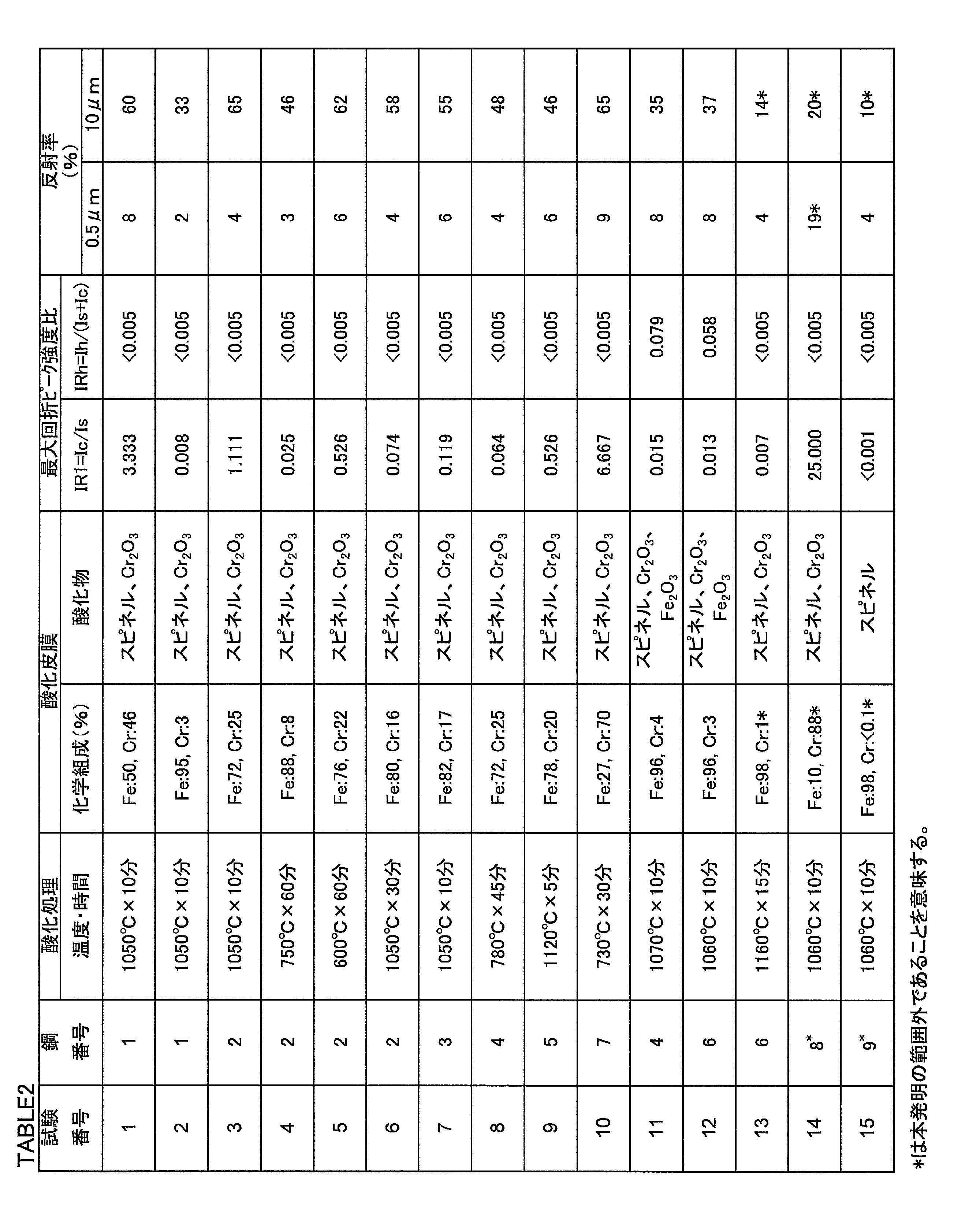
各試験番号の酸化皮膜の化学組成を、次の方法で測定した。各試験番号の鋼板から、酸化皮膜を含む試験片を採取した。試験片のうち、酸化皮膜の表面から、EDX法により、酸化皮膜の化学組成を分析した。そして、酸素及び炭素を除く検出元素の組成を求めた。表2に各試験番号で製造された酸化皮膜の化学組成を示す。
各試験番号の酸化皮膜の構造を、次の方法で同定した。各試験番号の鋼板から、酸化皮膜を含む試験片を採取した。酸化皮膜が形成された表面に対して、XRD法を用いて、酸化皮膜を構成する酸化物を同定した。XRD法ではCo管球を用いた。同定された酸化物を表2に示す。
各試験番号の鋼板の光選択吸収性を次の評価試験により評価した。各試験番号の低波長側(波長0.3~1.0μm、可視~近赤外領域)の反射率と、高波長側(波長2.5~25μm、中~遠赤外領域)の反射率とを測定した。具体的には、低波長側の反射率については、UV-Vis装置(VARIAN inc.製Cary4000spectrophotometer)により、0.5μmの波長の光の反射率を測定した。高波長側の反射率については、FT-IR装置(VARIAN inc.製Varian670-IRspectrometer)により、10μmの波長の光の反射率を測定した。
表2に試験結果を示す。表2中の「酸化物」欄の「スピネル」は、対応する試験番号の酸化皮膜が、スピネル型酸化物を含有することを意味する。「スピネル、Cr2O3」は、酸化皮膜が、スピネル型酸化物及びCr2O3を含有することを意味する。「スピネル、Cr2O3、Fe2O3」は、酸化皮膜が、スピネル型酸化物とCr2O3とFe2O3とを含有することを意味する。
表3に示す化学組成を有する鋼番号10~20のフェライト系耐熱鋼を溶製し、インゴットを製造した。
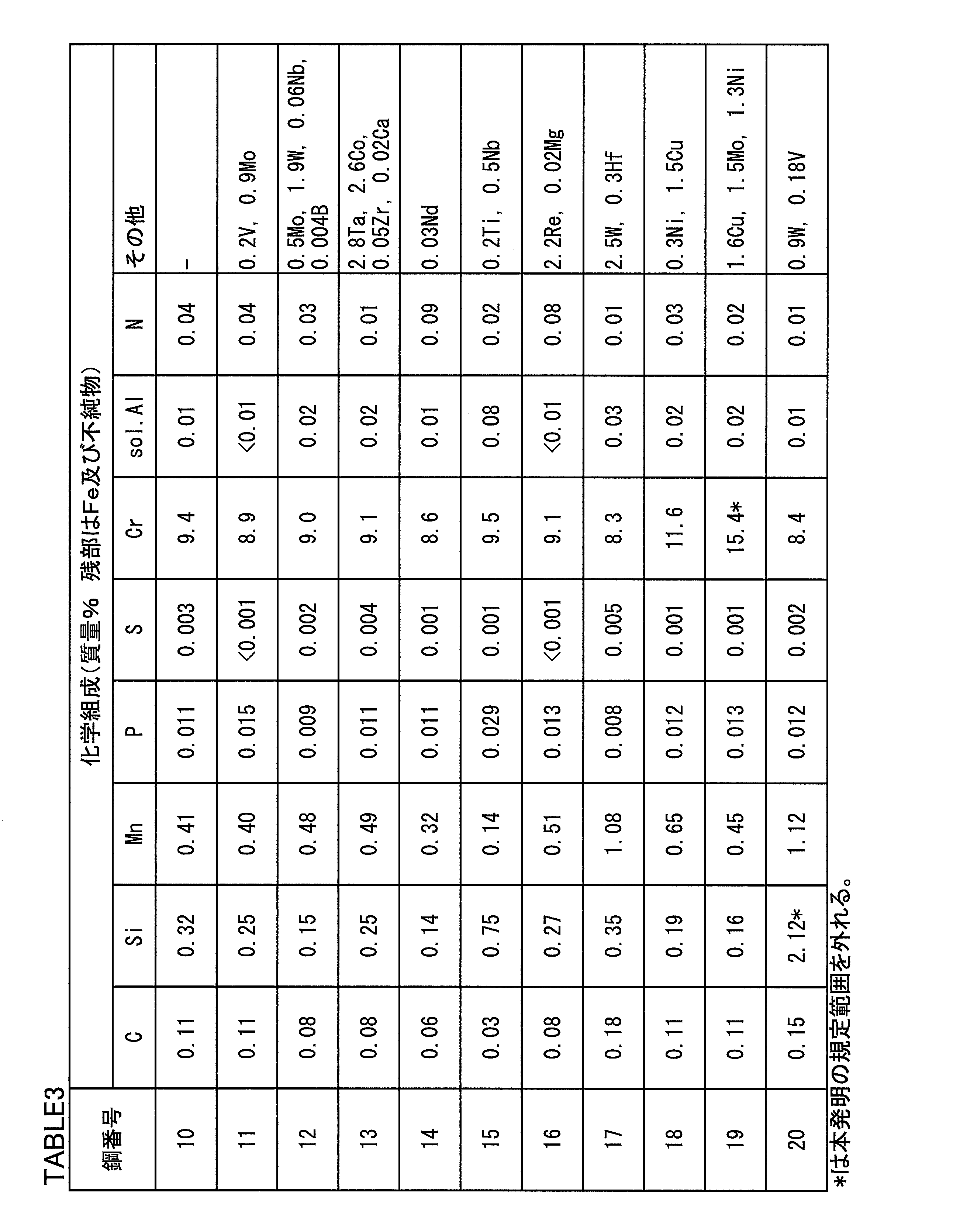

各試験番号の酸化皮膜の構造を、実施例1と同じ方法(XRD法)で同定した。さらに、得られたX線回折スペクトルから、スピネル型酸化物の最大回折ピーク強度Isと、Cr2O3の最大回折ピーク強度Icと、Fe2O3の最大回折ピーク強度Ihとを測定し、IR1及びIRhを求めた。求めたIR1及びIRhを表4に示す。
各試験番号の鋼板の光選択吸収性を、実施例1と同じ評価試験により評価した。
表4に試験結果を示す。
Claims (6)
- 質量%で、C:0.01~0.3%、Si:0.01~2%、Mn:0.01~2%、P:0.10%以下、S:0.03%以下、Cr:7.5~14.0%、sol.Al:0.3%以下、及びN:0.005~0.15%を含有し、残部はFe及び不純物からなる基材と、
前記基材上に形成され、酸素及び炭素を除いた化学組成が25~97%のFeと、3~75%のCrとを含有する酸化皮膜とを備え、
前記酸化皮膜は、スピネル型酸化物とCr2O3とを含有する、フェライト系耐熱鋼。 - 請求項1に記載のフェライト系耐熱鋼であってさらに、
X線回折により得られる前記酸化皮膜中のCr2O3の最大回折ピーク強度をIc、前記X線回折により得られる前記酸化皮膜中のスピネル型酸化物の最大回折ピーク強度をIsとするとき、以下の式(1)を満足する、フェライト系耐熱鋼。
0.010≦Ic/Is≦10 (1) - 請求項2に記載のフェライト系耐熱鋼であってさらに、
前記X線回析により得られる前記酸化皮膜中のFe2O3の最大回折ピーク強度をIhとするとき、式(2)を満たす、フェライト系耐熱鋼。
Ih/(Is+Ic)≦0.05 (2) - 請求項1~請求項3のいずれか1項に記載のフェライト系耐熱鋼であって、
前記基材はさらに、Feの一部に代えて、第1群~第4群から選択された1種又は2種以上の元素を含有する、フェライト系耐熱鋼。
第1群:Cu:5%以下、Ni:5%以下及びCo:5%以下
第2群:Ti:1.0%以下、V:1.0%以下、Nb:1.0%以下、Zr:1.0%以下及びHf:1.0%以下
第3群:Mo:5%以下、Ta:5%以下、W:5%以下及びRe:5%以下
第4群:Ca:0.1%以下、Mg:0.1%以下、B:0.1%以下及び希土類金属(REM):0.1%以下 - 質量%で、C:0.01~0.3%、Si:0.01~2%、Mn:0.01~2%、P:0.10%以下、S:0.03%以下、Cr:7.5~14.0%、sol.Al:0.3%以下、及びN:0.005~0.15%を含有し、残部はFe及び不純物からなる基材を準備する工程と、
前記基材を、酸素分圧Po2(atm)が式(3)を満足するガス雰囲気中で500~1150℃で酸化処理して、前記基材上に酸化皮膜を形成する工程とを備える、フェライト系耐熱鋼の製造方法。
Po2≦2.76×10¹⁵×exp{-493.6×10³/(RT)} (3)
ここで、Rは気体定数で、単位はJ・K-1・mol-1である。Tは温度で、単位はKである。 - 請求項5に記載のフェライト系耐熱鋼の製造方法であって、
前記基材はさらに、Feの一部に代えて、第1群~第4群から選択された1種又は2種以上の元素を含有する、フェライト系耐熱鋼の製造方法。
第1群:Cu:5%以下、Ni:5%以下及びCo:5%以下
第2群:Ti:1.0%以下、V:1.0%以下、Nb:1.0%以下、Zr:1.0%以下及びHf:1.0%以下
第3群:Mo:5%以下、Ta:5%以下、W:5%以下及びRe:5%以下
第4群:Ca:0.1%以下、Mg:0.1%以下、B:0.1%以下及び希土類金属(REM):0.1%以下
Priority Applications (9)
| Application Number | Priority Date | Filing Date | Title |
|---|---|---|---|
| CN201280057624.6A CN103946413B (zh) | 2011-11-22 | 2012-11-21 | 铁素体系耐热钢及其制造方法 |
| US14/359,735 US9657383B2 (en) | 2011-11-22 | 2012-11-21 | Heat resistant ferritic steel and method for producing the same |
| JP2012554539A JP5344103B1 (ja) | 2011-11-22 | 2012-11-21 | フェライト系耐熱鋼及びその製造方法 |
| RU2014120543/02A RU2566122C1 (ru) | 2011-11-22 | 2012-11-21 | Жаростойкая ферритная сталь и способ ее получения |
| KR1020147013618A KR101607789B1 (ko) | 2011-11-22 | 2012-11-21 | 페라이트계 내열강 및 그 제조 방법 |
| ES12850846.2T ES2604714T3 (es) | 2011-11-22 | 2012-11-21 | Acero ferrítico resistente al calor, y el método de fabricación del mismo |
| EP12850846.2A EP2784172B1 (en) | 2011-11-22 | 2012-11-21 | Ferritic heat-resistant steel, and manufacturing method for same |
| ZA2014/03446A ZA201403446B (en) | 2011-11-22 | 2014-05-13 | Ferritic heat-resistant steel, and manufacturing method for same |
| US15/486,595 US10385438B2 (en) | 2011-11-22 | 2017-04-13 | Heat resistant ferritic steel and method for producing the same |
Applications Claiming Priority (4)
| Application Number | Priority Date | Filing Date | Title |
|---|---|---|---|
| JP2011255461 | 2011-11-22 | ||
| JP2011-255461 | 2011-11-22 | ||
| JP2011275725 | 2011-12-16 | ||
| JP2011-275725 | 2011-12-16 |
Related Child Applications (2)
| Application Number | Title | Priority Date | Filing Date |
|---|---|---|---|
| US14/359,735 A-371-Of-International US9657383B2 (en) | 2011-11-22 | 2012-11-21 | Heat resistant ferritic steel and method for producing the same |
| US15/486,595 Division US10385438B2 (en) | 2011-11-22 | 2017-04-13 | Heat resistant ferritic steel and method for producing the same |
Publications (1)
| Publication Number | Publication Date |
|---|---|
| WO2013077363A1 true WO2013077363A1 (ja) | 2013-05-30 |
Family
ID=48469805
Family Applications (1)
| Application Number | Title | Priority Date | Filing Date |
|---|---|---|---|
| PCT/JP2012/080198 Ceased WO2013077363A1 (ja) | 2011-11-22 | 2012-11-21 | フェライト系耐熱鋼及びその製造方法 |
Country Status (9)
| Country | Link |
|---|---|
| US (2) | US9657383B2 (ja) |
| EP (1) | EP2784172B1 (ja) |
| JP (1) | JP5344103B1 (ja) |
| KR (1) | KR101607789B1 (ja) |
| CN (1) | CN103946413B (ja) |
| ES (1) | ES2604714T3 (ja) |
| RU (1) | RU2566122C1 (ja) |
| WO (1) | WO2013077363A1 (ja) |
| ZA (1) | ZA201403446B (ja) |
Cited By (5)
| Publication number | Priority date | Publication date | Assignee | Title |
|---|---|---|---|---|
| CN103668002A (zh) * | 2013-11-20 | 2014-03-26 | 马鞍山瑞辉实业有限公司 | 一种新型的铁素体耐热铸钢及其生产方法 |
| CN103820740A (zh) * | 2014-02-28 | 2014-05-28 | 南车戚墅堰机车车辆工艺研究所有限公司 | 一种铁素体耐热铸钢及其制备方法和应用 |
| CN104033666A (zh) * | 2014-06-30 | 2014-09-10 | 张家港华程机车精密制管有限公司 | 耐热异形钢管 |
| WO2015087021A1 (fr) * | 2013-12-13 | 2015-06-18 | Commissariat A L'energie Atomique Et Aux Energies Alternatives | Procédé de réalisation d'un élément absorbeur de rayonnements solaires pour centrale solaire thermique a concentration, élément absorbeur de rayonnements solaires |
| WO2018003941A1 (ja) * | 2016-06-29 | 2018-01-04 | 新日鐵住金株式会社 | フェライト系耐熱鋼及びフェライト系伝熱部材 |
Families Citing this family (27)
| Publication number | Priority date | Publication date | Assignee | Title |
|---|---|---|---|---|
| CA2861581C (en) | 2011-12-30 | 2021-05-04 | Scoperta, Inc. | Coating compositions |
| US9802387B2 (en) | 2013-11-26 | 2017-10-31 | Scoperta, Inc. | Corrosion resistant hardfacing alloy |
| CA2951628C (en) | 2014-06-09 | 2024-03-19 | Scoperta, Inc. | Crack resistant hardfacing alloys |
| CN107532265B (zh) | 2014-12-16 | 2020-04-21 | 思高博塔公司 | 含多种硬质相的韧性和耐磨铁合金 |
| CN104775085A (zh) * | 2015-04-21 | 2015-07-15 | 苏州统明机械有限公司 | 用于热喷涂的耐腐蚀铁基合金涂层及其制备方法 |
| CN104818431A (zh) * | 2015-04-23 | 2015-08-05 | 苏州劲元油压机械有限公司 | 一种耐650℃高温节流阀的铸造工艺 |
| CN108350528B (zh) | 2015-09-04 | 2020-07-10 | 思高博塔公司 | 无铬和低铬耐磨合金 |
| JP7049244B2 (ja) | 2015-09-08 | 2022-04-06 | エリコン メテコ(ユーエス)インコーポレイテッド | パウダー製造のための非磁性強炭化物形成合金 |
| EP3374536A4 (en) * | 2015-11-10 | 2019-03-20 | Scoperta, Inc. | DOUBLE WIRE ARC TOOL WITH OXIDATION CONTROL |
| WO2017165546A1 (en) | 2016-03-22 | 2017-09-28 | Scoperta, Inc. | Fully readable thermal spray coating |
| RU2615931C1 (ru) * | 2016-06-16 | 2017-04-11 | Юлия Алексеевна Щепочкина | Сплав на основе железа |
| CN106834957A (zh) * | 2016-12-10 | 2017-06-13 | 天长市天龙泵阀成套设备厂 | 双层挤压成型模具用钢 |
| CN107723619A (zh) * | 2017-10-31 | 2018-02-23 | 任丽 | 一种锅炉用耐热构件的热处理方法 |
| CN107794435A (zh) * | 2017-10-31 | 2018-03-13 | 浠讳附 | 一种Fe‑Cr‑Ni基耐热板材的制备方法 |
| EP3739080B1 (en) * | 2018-01-10 | 2024-05-01 | Nippon Steel Corporation | Austenitic heat-resistant alloy, method for producing same, and austenitic heat-resistant alloy material |
| CN108342661A (zh) * | 2018-01-22 | 2018-07-31 | 江苏理工学院 | 一种火电机组用耐热钢合金材料及其制造工艺 |
| FR3078979B1 (fr) | 2018-03-15 | 2020-10-16 | Commissariat Energie Atomique | Procede pour former une couche d'oxyde (fe, cr)2o3 de structure rhomboedrique sur un substrat en acier |
| CA3095046A1 (en) | 2018-03-29 | 2019-10-03 | Oerlikon Metco (Us) Inc. | Reduced carbides ferrous alloys |
| CN110629110A (zh) * | 2018-06-25 | 2019-12-31 | 宝山钢铁股份有限公司 | 一种抗蒸汽腐蚀氧化和高温持久性能良好的超超临界火电机组用钢及其制备方法 |
| JP7641218B2 (ja) | 2018-10-26 | 2025-03-06 | エリコン メテコ(ユーエス)インコーポレイテッド | 耐食性かつ耐摩耗性のニッケル系合金 |
| KR20200115739A (ko) | 2019-03-25 | 2020-10-08 | 주식회사 피디텍 | 내열강 제조를 위한 원심주조 방법 |
| CN113631750A (zh) | 2019-03-28 | 2021-11-09 | 欧瑞康美科(美国)公司 | 用于涂布发动机气缸孔的热喷涂铁基合金 |
| EP3962693A1 (en) | 2019-05-03 | 2022-03-09 | Oerlikon Metco (US) Inc. | Powder feedstock for wear resistant bulk welding configured to optimize manufacturability |
| EP3997252B1 (en) | 2019-07-09 | 2025-10-29 | Oerlikon Metco (US) Inc. | Iron-based alloys designed for wear and corrosion resistance |
| CN114672605B (zh) * | 2022-05-30 | 2022-09-16 | 江苏沙钢集团有限公司 | 耐蚀钢筋机械连接套筒、盘条及盘条的生产方法 |
| CN114959485A (zh) * | 2022-06-07 | 2022-08-30 | 江阴市龙润法兰有限公司 | 压力容器法兰及其生产工艺 |
| CN116065096B (zh) * | 2023-03-05 | 2023-08-04 | 襄阳金耐特机械股份有限公司 | 一种铁素体耐热铸钢 |
Citations (12)
| Publication number | Priority date | Publication date | Assignee | Title |
|---|---|---|---|---|
| JPS52126434A (en) | 1976-04-16 | 1977-10-24 | Agency Of Ind Science & Technol | Paint for forming film capable of selectively absorbing light and material capable of selectively absorbing light |
| JPS5375132A (en) | 1976-12-17 | 1978-07-04 | Kogyo Gijutsuin | Heat collecting body |
| JPS5577667A (en) | 1979-11-26 | 1980-06-11 | Yazaki Corp | Selective absorption section of solar heat collector and method of producting the same |
| JPS58195746A (ja) | 1982-05-10 | 1983-11-15 | Matsushita Electric Ind Co Ltd | 太陽熱選択吸収塗膜の形成方法 |
| JPS6057157A (ja) | 1983-09-07 | 1985-04-02 | Nippon Electric Glass Co Ltd | 太陽熱集熱体の製造方法 |
| JPS62182553A (ja) | 1986-02-03 | 1987-08-10 | Nippon Electric Glass Co Ltd | 太陽熱吸収体の製造方法 |
| WO1993021356A1 (fr) * | 1992-04-09 | 1993-10-28 | Nippon Steel Corporation | Acier inoxydable ferritique a resistance excellente a l'alteration saline a temperature elevee et a resistance aux temperatures elevees |
| JPH07325212A (ja) | 1994-05-31 | 1995-12-12 | Daiichi Meteko Kk | 光吸収・放射膜および光吸収・放射体の製造方法 |
| JP2006131945A (ja) * | 2004-11-04 | 2006-05-25 | Nisshin Steel Co Ltd | 耐高温水蒸気酸化性に優れたフェライト系鋼材およびその使用方法 |
| JP2006218595A (ja) * | 2005-02-14 | 2006-08-24 | Institute Of Physical & Chemical Research | 被加工物の表面仕上げ方法および加工品 |
| JP2010078336A (ja) * | 2008-09-24 | 2010-04-08 | Seiko Epson Corp | 時計針およびその製造方法 |
| JP2010159487A (ja) * | 2008-12-09 | 2010-07-22 | Nippon Steel & Sumikin Stainless Steel Corp | 耐銹性に優れた高純度フェライト系ステンレス鋼およびその製造方法 |
Family Cites Families (21)
| Publication number | Priority date | Publication date | Assignee | Title |
|---|---|---|---|---|
| JPS5272950A (en) * | 1975-12-15 | 1977-06-18 | Agency Of Ind Science & Technol | Surface finishing preparation of being capable of select absorving for electro magnetic waves |
| JPS54163440A (en) * | 1978-06-14 | 1979-12-26 | Nippon Steel Corp | Solar heat absorbing plate |
| JPS55158445A (en) * | 1979-05-28 | 1980-12-09 | Nippon Steel Corp | Manufacturing method of material for selective absorbing surface for solar heat utilizing heat collector |
| JPS6044772A (ja) * | 1983-08-22 | 1985-03-09 | Kawasaki Steel Corp | 太陽熱温水器用集熱板およびその製造方法 |
| JPS61124580A (ja) * | 1984-11-22 | 1986-06-12 | Nippon Steel Corp | 太陽熱吸収板の製造法 |
| US4799972A (en) * | 1985-10-14 | 1989-01-24 | Sumitomo Metal Industries, Ltd. | Process for producing a high strength high-Cr ferritic heat-resistant steel |
| JPS6447880A (en) | 1987-08-18 | 1989-02-22 | Nippon Steel Corp | Stainless steel having ceramics layer on surface |
| JPH0244149A (ja) * | 1988-08-05 | 1990-02-14 | Osaka Gas Co Ltd | 太陽熱選択吸収板およびその製造方法 |
| JPH0452252A (ja) | 1990-06-21 | 1992-02-20 | Nisshin Steel Co Ltd | 活性アルミナコーティング性に優れたフェライト系ステンレス鋼及びその製造方法 |
| RU2017856C1 (ru) * | 1992-03-26 | 1994-08-15 | Научно-производственное акционерное общество "РостНИИТМ" | Нержавеющая сталь |
| JP3245806B2 (ja) * | 1994-04-14 | 2002-01-15 | 新日本製鐵株式会社 | フェライト系ステンレス鋼の製造方法 |
| TW426753B (en) * | 1997-06-30 | 2001-03-21 | Sumitomo Metal Ind | Method of oxidizing inner surface of ferritic stainless steel pipe |
| RU2209845C1 (ru) * | 2001-12-26 | 2003-08-10 | Сибирский государственный индустриальный университет | Сталь |
| US8118305B2 (en) | 2003-07-17 | 2012-02-21 | Shuffle Master, Inc. | Mechanized playing card dealing shoe with automatic jam recovery |
| JP2007039745A (ja) * | 2005-08-03 | 2007-02-15 | Babcock Hitachi Kk | フェライト系耐熱鋼の耐水蒸気酸化性改善方法及び耐水蒸気酸化性に優れたフェライト系耐熱鋼並びにボイラ用耐熱鋼 |
| KR20080089418A (ko) * | 2005-12-21 | 2008-10-06 | 엑손모빌 리서치 앤드 엔지니어링 컴퍼니 | 파울링 감소를 위한 내식성 물질, 내식성 및 내파울링성이개선된 열 전달 부품, 및 파울링 감소 방법 |
| JP5105822B2 (ja) | 2006-10-18 | 2012-12-26 | 日新製鋼株式会社 | 集熱用伝熱材およびその製造法 |
| JP2008223128A (ja) * | 2007-03-16 | 2008-09-25 | Institute Of National Colleges Of Technology Japan | 耐酸化性にすぐれた鋼管およびその製造方法 |
| JP4986975B2 (ja) * | 2008-10-24 | 2012-07-25 | 新日鐵住金ステンレス株式会社 | 加工性、耐酸化性に優れたAl含有耐熱フェライト系ステンレス鋼板及びその製造方法 |
| DE102009039552B4 (de) * | 2009-09-01 | 2011-05-26 | Thyssenkrupp Vdm Gmbh | Verfahren zur Herstellung einer Eisen-Chrom-Legierung |
| JP5578893B2 (ja) * | 2010-03-12 | 2014-08-27 | 株式会社日立製作所 | 蒸気タービンの摺動部を有する部材 |
-
2012
- 2012-11-21 RU RU2014120543/02A patent/RU2566122C1/ru not_active IP Right Cessation
- 2012-11-21 WO PCT/JP2012/080198 patent/WO2013077363A1/ja not_active Ceased
- 2012-11-21 EP EP12850846.2A patent/EP2784172B1/en active Active
- 2012-11-21 ES ES12850846.2T patent/ES2604714T3/es active Active
- 2012-11-21 KR KR1020147013618A patent/KR101607789B1/ko active Active
- 2012-11-21 JP JP2012554539A patent/JP5344103B1/ja active Active
- 2012-11-21 CN CN201280057624.6A patent/CN103946413B/zh active Active
- 2012-11-21 US US14/359,735 patent/US9657383B2/en active Active
-
2014
- 2014-05-13 ZA ZA2014/03446A patent/ZA201403446B/en unknown
-
2017
- 2017-04-13 US US15/486,595 patent/US10385438B2/en active Active
Patent Citations (12)
| Publication number | Priority date | Publication date | Assignee | Title |
|---|---|---|---|---|
| JPS52126434A (en) | 1976-04-16 | 1977-10-24 | Agency Of Ind Science & Technol | Paint for forming film capable of selectively absorbing light and material capable of selectively absorbing light |
| JPS5375132A (en) | 1976-12-17 | 1978-07-04 | Kogyo Gijutsuin | Heat collecting body |
| JPS5577667A (en) | 1979-11-26 | 1980-06-11 | Yazaki Corp | Selective absorption section of solar heat collector and method of producting the same |
| JPS58195746A (ja) | 1982-05-10 | 1983-11-15 | Matsushita Electric Ind Co Ltd | 太陽熱選択吸収塗膜の形成方法 |
| JPS6057157A (ja) | 1983-09-07 | 1985-04-02 | Nippon Electric Glass Co Ltd | 太陽熱集熱体の製造方法 |
| JPS62182553A (ja) | 1986-02-03 | 1987-08-10 | Nippon Electric Glass Co Ltd | 太陽熱吸収体の製造方法 |
| WO1993021356A1 (fr) * | 1992-04-09 | 1993-10-28 | Nippon Steel Corporation | Acier inoxydable ferritique a resistance excellente a l'alteration saline a temperature elevee et a resistance aux temperatures elevees |
| JPH07325212A (ja) | 1994-05-31 | 1995-12-12 | Daiichi Meteko Kk | 光吸収・放射膜および光吸収・放射体の製造方法 |
| JP2006131945A (ja) * | 2004-11-04 | 2006-05-25 | Nisshin Steel Co Ltd | 耐高温水蒸気酸化性に優れたフェライト系鋼材およびその使用方法 |
| JP2006218595A (ja) * | 2005-02-14 | 2006-08-24 | Institute Of Physical & Chemical Research | 被加工物の表面仕上げ方法および加工品 |
| JP2010078336A (ja) * | 2008-09-24 | 2010-04-08 | Seiko Epson Corp | 時計針およびその製造方法 |
| JP2010159487A (ja) * | 2008-12-09 | 2010-07-22 | Nippon Steel & Sumikin Stainless Steel Corp | 耐銹性に優れた高純度フェライト系ステンレス鋼およびその製造方法 |
Non-Patent Citations (1)
| Title |
|---|
| See also references of EP2784172A4 |
Cited By (7)
| Publication number | Priority date | Publication date | Assignee | Title |
|---|---|---|---|---|
| CN103668002A (zh) * | 2013-11-20 | 2014-03-26 | 马鞍山瑞辉实业有限公司 | 一种新型的铁素体耐热铸钢及其生产方法 |
| WO2015087021A1 (fr) * | 2013-12-13 | 2015-06-18 | Commissariat A L'energie Atomique Et Aux Energies Alternatives | Procédé de réalisation d'un élément absorbeur de rayonnements solaires pour centrale solaire thermique a concentration, élément absorbeur de rayonnements solaires |
| CN103820740A (zh) * | 2014-02-28 | 2014-05-28 | 南车戚墅堰机车车辆工艺研究所有限公司 | 一种铁素体耐热铸钢及其制备方法和应用 |
| CN104033666A (zh) * | 2014-06-30 | 2014-09-10 | 张家港华程机车精密制管有限公司 | 耐热异形钢管 |
| WO2018003941A1 (ja) * | 2016-06-29 | 2018-01-04 | 新日鐵住金株式会社 | フェライト系耐熱鋼及びフェライト系伝熱部材 |
| KR20190022779A (ko) * | 2016-06-29 | 2019-03-06 | 신닛테츠스미킨 카부시키카이샤 | 페라이트계 내열강 및 페라이트계 전열 부재 |
| KR102165758B1 (ko) | 2016-06-29 | 2020-10-14 | 닛폰세이테츠 가부시키가이샤 | 페라이트계 내열강 및 페라이트계 전열 부재 |
Also Published As
| Publication number | Publication date |
|---|---|
| JPWO2013077363A1 (ja) | 2015-04-27 |
| US20140295194A1 (en) | 2014-10-02 |
| KR20140093954A (ko) | 2014-07-29 |
| ES2604714T3 (es) | 2017-03-08 |
| EP2784172B1 (en) | 2016-10-26 |
| US9657383B2 (en) | 2017-05-23 |
| EP2784172A1 (en) | 2014-10-01 |
| US10385438B2 (en) | 2019-08-20 |
| EP2784172A4 (en) | 2015-11-04 |
| CN103946413B (zh) | 2016-08-24 |
| JP5344103B1 (ja) | 2013-11-20 |
| ZA201403446B (en) | 2015-06-24 |
| US20170218496A1 (en) | 2017-08-03 |
| RU2566122C1 (ru) | 2015-10-20 |
| KR101607789B1 (ko) | 2016-03-30 |
| CN103946413A (zh) | 2014-07-23 |
Similar Documents
| Publication | Publication Date | Title |
|---|---|---|
| JP5344103B1 (ja) | フェライト系耐熱鋼及びその製造方法 | |
| JP5500038B2 (ja) | 皮膜に対する密着性に優れたオーステナイト系ステンレス鋼 | |
| CN110225988B (zh) | 铁素体系不锈钢热轧钢板及其制造方法 | |
| CN104379791B (zh) | 一种含锰钢及其生产方法 | |
| JP6805574B2 (ja) | オーステナイト系耐熱鋼及びオーステナイト系伝熱部材 | |
| JP6950753B2 (ja) | オーステナイト系耐熱合金及びその製造方法、及び、オーステナイト系耐熱合金材 | |
| TWI653346B (zh) | 黑色肥粒鐵系不銹鋼板 | |
| JP6801712B2 (ja) | フェライト系耐熱鋼及びフェライト系伝熱部材 | |
| CN108486492A (zh) | 1200MPa级高强度高塑性低密度钢板及其制造方法 | |
| WO2011111871A1 (ja) | 耐酸化性に優れたフェライト系ステンレス鋼板並びに耐熱性に優れたフェライト系ステンレス鋼板及びその製造方法 | |
| JP2011190468A (ja) | 耐熱性に優れたフェライト系ステンレス鋼板およびその製造方法 | |
| CN111601913B (zh) | 奥氏体系耐热合金及其制造方法 | |
| JP7270444B2 (ja) | フェライト系ステンレス鋼板およびその製造方法 | |
| JP5239089B2 (ja) | 硫酸に対する耐食性が優れた鉄鋼及びその製造方法 | |
| JP2020172694A (ja) | オーステナイト系ステンレス鋼およびその製造方法 | |
| CN103741065B (zh) | 一种抗高温氧化的奥氏体耐热不锈钢 | |
| JP2011236465A (ja) | オーステナイト系ステンレス鋼、ステンレス鋼製品およびそれらの製造方法 | |
| JP2018150606A (ja) | オーステナイト系ステンレス鋼板およびガスケット | |
| JP7402325B2 (ja) | 高温酸化抵抗性及び高温強度に優れたクロム鋼板並びにその製造方法 | |
| JP2017020054A (ja) | ステンレス鋼およびステンレス鋼管 | |
| JP4571754B2 (ja) | 成形性に優れた鋼管の製造法 | |
| JP4201310B2 (ja) | 耐sr特性に優れた高強度鋼板及びその製造方法 | |
| JPH10237602A (ja) | 熱延板の低温靱性に優れたNb含有フェライト系ステンレス鋼 |
Legal Events
| Date | Code | Title | Description |
|---|---|---|---|
| ENP | Entry into the national phase |
Ref document number: 2012554539 Country of ref document: JP Kind code of ref document: A |
|
| 121 | Ep: the epo has been informed by wipo that ep was designated in this application |
Ref document number: 12850846 Country of ref document: EP Kind code of ref document: A1 |
|
| REEP | Request for entry into the european phase |
Ref document number: 2012850846 Country of ref document: EP |
|
| WWE | Wipo information: entry into national phase |
Ref document number: 2012850846 Country of ref document: EP |
|
| WWE | Wipo information: entry into national phase |
Ref document number: IDP00201402738 Country of ref document: ID |
|
| ENP | Entry into the national phase |
Ref document number: 20147013618 Country of ref document: KR Kind code of ref document: A |
|
| WWE | Wipo information: entry into national phase |
Ref document number: 14359735 Country of ref document: US |
|
| NENP | Non-entry into the national phase |
Ref country code: DE |
|
| ENP | Entry into the national phase |
Ref document number: 2014120543 Country of ref document: RU Kind code of ref document: A |