WO2013100014A1 - 抗腫瘍剤の効果増強剤 - Google Patents
抗腫瘍剤の効果増強剤 Download PDFInfo
- Publication number
- WO2013100014A1 WO2013100014A1 PCT/JP2012/083794 JP2012083794W WO2013100014A1 WO 2013100014 A1 WO2013100014 A1 WO 2013100014A1 JP 2012083794 W JP2012083794 W JP 2012083794W WO 2013100014 A1 WO2013100014 A1 WO 2013100014A1
- Authority
- WO
- WIPO (PCT)
- Prior art keywords
- group
- substituent
- fluorine atom
- methoxy
- hydroxyl
- Prior art date
- Legal status (The legal status is an assumption and is not a legal conclusion. Google has not performed a legal analysis and makes no representation as to the accuracy of the status listed.)
- Ceased
Links
Images


Classifications
-
- A—HUMAN NECESSITIES
- A61—MEDICAL OR VETERINARY SCIENCE; HYGIENE
- A61K—PREPARATIONS FOR MEDICAL, DENTAL OR TOILETRY PURPOSES
- A61K31/00—Medicinal preparations containing organic active ingredients
- A61K31/33—Heterocyclic compounds
- A61K31/395—Heterocyclic compounds having nitrogen as a ring hetero atom, e.g. guanethidine or rifamycins
- A61K31/435—Heterocyclic compounds having nitrogen as a ring hetero atom, e.g. guanethidine or rifamycins having six-membered rings with one nitrogen as the only ring hetero atom
- A61K31/47—Quinolines; Isoquinolines
-
- A—HUMAN NECESSITIES
- A61—MEDICAL OR VETERINARY SCIENCE; HYGIENE
- A61K—PREPARATIONS FOR MEDICAL, DENTAL OR TOILETRY PURPOSES
- A61K31/00—Medicinal preparations containing organic active ingredients
- A61K31/33—Heterocyclic compounds
- A61K31/335—Heterocyclic compounds having oxygen as the only ring hetero atom, e.g. fungichromin
- A61K31/337—Heterocyclic compounds having oxygen as the only ring hetero atom, e.g. fungichromin having four-membered rings, e.g. taxol
-
- A—HUMAN NECESSITIES
- A61—MEDICAL OR VETERINARY SCIENCE; HYGIENE
- A61K—PREPARATIONS FOR MEDICAL, DENTAL OR TOILETRY PURPOSES
- A61K31/00—Medicinal preparations containing organic active ingredients
- A61K31/33—Heterocyclic compounds
- A61K31/395—Heterocyclic compounds having nitrogen as a ring hetero atom, e.g. guanethidine or rifamycins
- A61K31/435—Heterocyclic compounds having nitrogen as a ring hetero atom, e.g. guanethidine or rifamycins having six-membered rings with one nitrogen as the only ring hetero atom
- A61K31/44—Non condensed pyridines; Hydrogenated derivatives thereof
- A61K31/4412—Non condensed pyridines; Hydrogenated derivatives thereof having oxo groups directly attached to the heterocyclic ring
-
- A—HUMAN NECESSITIES
- A61—MEDICAL OR VETERINARY SCIENCE; HYGIENE
- A61K—PREPARATIONS FOR MEDICAL, DENTAL OR TOILETRY PURPOSES
- A61K31/00—Medicinal preparations containing organic active ingredients
- A61K31/33—Heterocyclic compounds
- A61K31/395—Heterocyclic compounds having nitrogen as a ring hetero atom, e.g. guanethidine or rifamycins
- A61K31/435—Heterocyclic compounds having nitrogen as a ring hetero atom, e.g. guanethidine or rifamycins having six-membered rings with one nitrogen as the only ring hetero atom
- A61K31/47—Quinolines; Isoquinolines
- A61K31/4738—Quinolines; Isoquinolines ortho- or peri-condensed with heterocyclic ring systems
- A61K31/4745—Quinolines; Isoquinolines ortho- or peri-condensed with heterocyclic ring systems condensed with ring systems having nitrogen as a ring hetero atom, e.g. phenantrolines
-
- A—HUMAN NECESSITIES
- A61—MEDICAL OR VETERINARY SCIENCE; HYGIENE
- A61K—PREPARATIONS FOR MEDICAL, DENTAL OR TOILETRY PURPOSES
- A61K31/00—Medicinal preparations containing organic active ingredients
- A61K31/33—Heterocyclic compounds
- A61K31/395—Heterocyclic compounds having nitrogen as a ring hetero atom, e.g. guanethidine or rifamycins
- A61K31/495—Heterocyclic compounds having nitrogen as a ring hetero atom, e.g. guanethidine or rifamycins having six-membered rings with two or more nitrogen atoms as the only ring heteroatoms, e.g. piperazine or tetrazines
- A61K31/505—Pyrimidines; Hydrogenated pyrimidines, e.g. trimethoprim
- A61K31/513—Pyrimidines; Hydrogenated pyrimidines, e.g. trimethoprim having oxo groups directly attached to the heterocyclic ring, e.g. cytosine
-
- A—HUMAN NECESSITIES
- A61—MEDICAL OR VETERINARY SCIENCE; HYGIENE
- A61K—PREPARATIONS FOR MEDICAL, DENTAL OR TOILETRY PURPOSES
- A61K31/00—Medicinal preparations containing organic active ingredients
- A61K31/33—Heterocyclic compounds
- A61K31/395—Heterocyclic compounds having nitrogen as a ring hetero atom, e.g. guanethidine or rifamycins
- A61K31/495—Heterocyclic compounds having nitrogen as a ring hetero atom, e.g. guanethidine or rifamycins having six-membered rings with two or more nitrogen atoms as the only ring heteroatoms, e.g. piperazine or tetrazines
- A61K31/505—Pyrimidines; Hydrogenated pyrimidines, e.g. trimethoprim
- A61K31/517—Pyrimidines; Hydrogenated pyrimidines, e.g. trimethoprim ortho- or peri-condensed with carbocyclic ring systems, e.g. quinazoline, perimidine
-
- A—HUMAN NECESSITIES
- A61—MEDICAL OR VETERINARY SCIENCE; HYGIENE
- A61K—PREPARATIONS FOR MEDICAL, DENTAL OR TOILETRY PURPOSES
- A61K31/00—Medicinal preparations containing organic active ingredients
- A61K31/33—Heterocyclic compounds
- A61K31/395—Heterocyclic compounds having nitrogen as a ring hetero atom, e.g. guanethidine or rifamycins
- A61K31/53—Heterocyclic compounds having nitrogen as a ring hetero atom, e.g. guanethidine or rifamycins having six-membered rings with three nitrogens as the only ring hetero atoms, e.g. chlorazanil, melamine
-
- A—HUMAN NECESSITIES
- A61—MEDICAL OR VETERINARY SCIENCE; HYGIENE
- A61K—PREPARATIONS FOR MEDICAL, DENTAL OR TOILETRY PURPOSES
- A61K31/00—Medicinal preparations containing organic active ingredients
- A61K31/33—Heterocyclic compounds
- A61K31/395—Heterocyclic compounds having nitrogen as a ring hetero atom, e.g. guanethidine or rifamycins
- A61K31/535—Heterocyclic compounds having nitrogen as a ring hetero atom, e.g. guanethidine or rifamycins having six-membered rings with at least one nitrogen and one oxygen as the ring hetero atoms, e.g. 1,2-oxazines
- A61K31/5375—1,4-Oxazines, e.g. morpholine
- A61K31/5377—1,4-Oxazines, e.g. morpholine not condensed and containing further heterocyclic rings, e.g. timolol
-
- A—HUMAN NECESSITIES
- A61—MEDICAL OR VETERINARY SCIENCE; HYGIENE
- A61K—PREPARATIONS FOR MEDICAL, DENTAL OR TOILETRY PURPOSES
- A61K31/00—Medicinal preparations containing organic active ingredients
- A61K31/70—Carbohydrates; Sugars; Derivatives thereof
- A61K31/7042—Compounds having saccharide radicals and heterocyclic rings
- A61K31/7052—Compounds having saccharide radicals and heterocyclic rings having nitrogen as a ring hetero atom, e.g. nucleosides, nucleotides
- A61K31/706—Compounds having saccharide radicals and heterocyclic rings having nitrogen as a ring hetero atom, e.g. nucleosides, nucleotides containing six-membered rings with nitrogen as a ring hetero atom
- A61K31/7064—Compounds having saccharide radicals and heterocyclic rings having nitrogen as a ring hetero atom, e.g. nucleosides, nucleotides containing six-membered rings with nitrogen as a ring hetero atom containing condensed or non-condensed pyrimidines
- A61K31/7068—Compounds having saccharide radicals and heterocyclic rings having nitrogen as a ring hetero atom, e.g. nucleosides, nucleotides containing six-membered rings with nitrogen as a ring hetero atom containing condensed or non-condensed pyrimidines having oxo groups directly attached to the pyrimidine ring, e.g. cytidine, cytidylic acid
-
- A—HUMAN NECESSITIES
- A61—MEDICAL OR VETERINARY SCIENCE; HYGIENE
- A61K—PREPARATIONS FOR MEDICAL, DENTAL OR TOILETRY PURPOSES
- A61K45/00—Medicinal preparations containing active ingredients not provided for in groups A61K31/00 - A61K41/00
- A61K45/06—Mixtures of active ingredients without chemical characterisation, e.g. antiphlogistics and cardiaca
-
- A—HUMAN NECESSITIES
- A61—MEDICAL OR VETERINARY SCIENCE; HYGIENE
- A61P—SPECIFIC THERAPEUTIC ACTIVITY OF CHEMICAL COMPOUNDS OR MEDICINAL PREPARATIONS
- A61P35/00—Antineoplastic agents
-
- A—HUMAN NECESSITIES
- A61—MEDICAL OR VETERINARY SCIENCE; HYGIENE
- A61P—SPECIFIC THERAPEUTIC ACTIVITY OF CHEMICAL COMPOUNDS OR MEDICINAL PREPARATIONS
- A61P43/00—Drugs for specific purposes, not provided for in groups A61P1/00-A61P41/00
-
- C—CHEMISTRY; METALLURGY
- C07—ORGANIC CHEMISTRY
- C07D—HETEROCYCLIC COMPOUNDS
- C07D215/00—Heterocyclic compounds containing quinoline or hydrogenated quinoline ring systems
- C07D215/02—Heterocyclic compounds containing quinoline or hydrogenated quinoline ring systems having no bond between the ring nitrogen atom and a non-ring member or having only hydrogen atoms or carbon atoms directly attached to the ring nitrogen atom
- C07D215/16—Heterocyclic compounds containing quinoline or hydrogenated quinoline ring systems having no bond between the ring nitrogen atom and a non-ring member or having only hydrogen atoms or carbon atoms directly attached to the ring nitrogen atom with hetero atoms or with carbon atoms having three bonds to hetero atoms with at the most one bond to halogen, e.g. ester or nitrile radicals, directly attached to ring carbon atoms
- C07D215/48—Carbon atoms having three bonds to hetero atoms with at the most one bond to halogen
Definitions
- the present invention relates to an antitumor effect enhancer and an antitumor agent combined with another antitumor agent.
- antitumor agents There are a wide variety of targets for antitumor agents, and they are roughly classified into alkylating agents, platinum compounds, antimetabolites, topoisomerase inhibitors, microtubule inhibitors, antitumor antibiotics, molecular targeted drugs and the like. In recent years, an antitumor agent is not administered alone, but a combination therapy is widely performed.
- Patent Document 1 4- (3-chloro-4- (cyclopropylaminocarbonyl) aminophenoxy) -7-methoxy-6-quinolinecarboxamide, which has a VEGF receptor kinase inhibitory action and is a vascular inhibitor, has been reported.
- Patent Document 1 4- (3-chloro-4- (cyclopropylaminocarbonyl) aminophenoxy) -7-methoxy-6-quinolinecarboxamide, which has a VEGF receptor kinase inhibitory action and is a vascular inhibitor.
- c-Met is a receptor tyrosine kinase identified as one of Proto-oncogene.
- cancers renal cell cancer, stomach cancer, lung cancer, colon cancer, pancreatic cancer, ovarian cancer, hepatocellular carcinoma, head and neck cancer, melanoma, etc.
- c-Met is overexpressed, mutated or translocated with high frequency. It has been reported that the activation state is enhanced and contributes to cell proliferation, invasion / metastasis, tumor formation, angiogenesis and anti-apoptosis (for example, Non-Patent Document 1). Therefore, it is known that a compound having a c-Met inhibitory effect is useful as an antitumor agent (Patent Document 2).
- a combination of a quinoline derivative that is one of c-Met inhibitors and is a multikinase inhibitor including c-Met and AXL and an ErbB inhibitor has also been reported (Patent Document 3).
- An object of the present invention is to provide a combination in which the antitumor effect is enhanced by the combined use of two kinds of antitumor agents.
- the present inventors have focused on one type of c-Met inhibitor and studied the action when the compound is used in combination with another antitumor agent.
- the quinoline ring represented by the following formula (I) is examined.
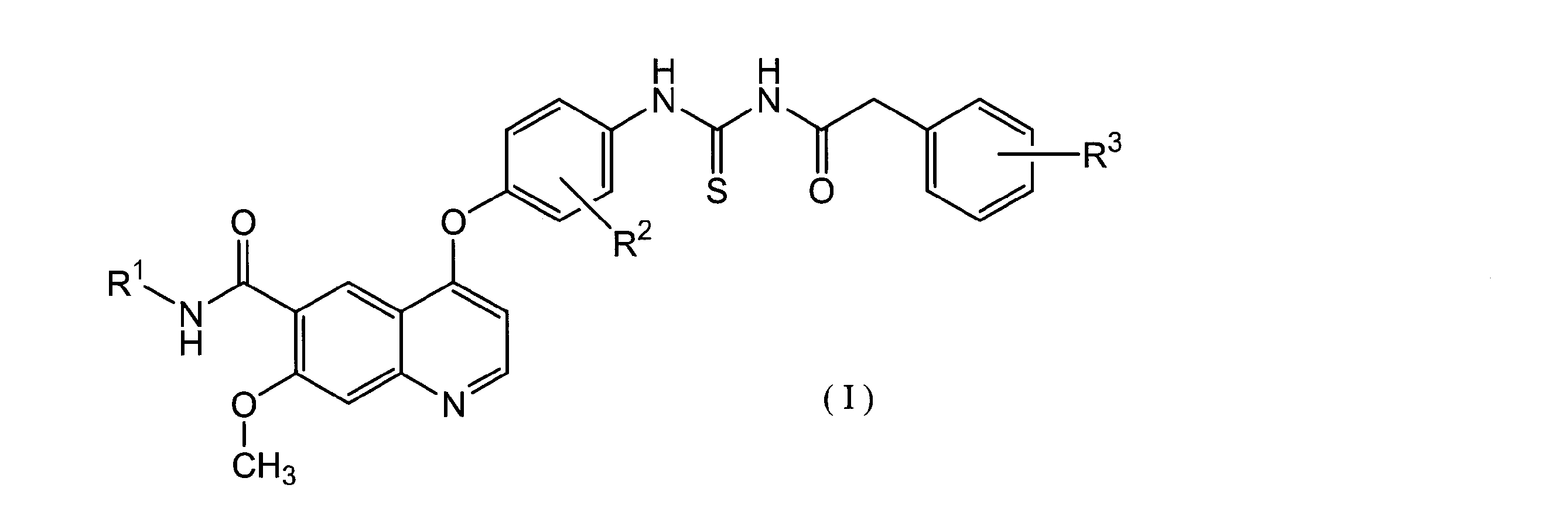
- An acylthiourea compound having an aminocarbonyl group as the 6-position substituent and an alkoxy group as the 7-position substituent, or a pharmaceutically acceptable salt thereof acts as a potent c-Met inhibitor with reduced side effects.
- the inventors have found that the effective area and antitumor spectrum are expanded by an excellent antitumor effect enhancing action, and the present invention has been completed.
- R 1 represents a C 1-6 alkyl group which may have a substituent, and the substituent may have a hydroxyl group, a C 3-10 cycloalkyl group, or a substituent.
- the antitumor effect enhancer of the other antitumor agent which uses the acylthiourea compound represented by these, or its pharmaceutically acceptable
- An antitumor agent comprising an acylthiourea compound represented by the above formula (I) or a pharmaceutically acceptable salt thereof in combination with another antitumor agent.
- An antitumor agent comprising: an acylthiourea compound represented by formula (I) or a pharmaceutically acceptable salt thereof and another antitumor agent; Antitumor effect enhancement method.
- a method for treating a tumor comprising administering an acylthiourea compound represented by the formula (I) or a pharmaceutically acceptable salt thereof and another antitumor agent to a patient in need thereof.
- Acylthiourea compound (I) or a pharmaceutically acceptable salt thereof enhances the effects of these antitumor agents when used in combination with various antitumor agents. That is, 1) The acylthiourea compound (I) hardly enhances the side effects of the combined antitumor agent, so that the maximum effect of each drug alone can be achieved without reducing the effective dose of the combined antitumor agent. 2) enhances the anti-tumor effect of the concomitant drug regardless of the drug sensitivity of the anti-tumor drug used in combination, and 3) the anti-tumor effect of the acylthiourea compound (I It is also observed at low doses where it does not show antitumor effects. As a result of the above, the present invention leads to provision of a therapeutic method with high clinical usefulness such as expansion of the cancer therapeutic effect area and improvement of the therapeutic effect.
- acylthiourea compound (I) of the present invention when “may have a substituent” for a certain structure, 1 is located at a chemically possible position on the structure. It means that there may be one or more “substituents”.
- the kind of substituents present in the structure, the number of substituents, and the substitution position are not particularly limited, and when two or more substituents are present, they may be the same or different.
- substituent a halogen atom, hydroxyl group, cyano group, nitro group, C 1-6 alkanoyl group, C 1-6 alkyl group, C 3-10 cycloalkyl group, C 2-6 alkenyl group, C 1 -6 alkoxy group, amino group, C 1-6 alkylamino group, C 1-6 alkanoylamino group, C 1-6 alkylaminocarbonyl group, C 1-6 alkylsulfonyl group, C 6-14 aromatic hydrocarbon group A saturated or unsaturated heterocyclic group, a saturated or unsaturated heterocyclic carbonyl group, an oxo group, and the like.
- the number is typically 1 to 3.
- C 1-6 alkyl group of the "optionally substituted C 1-6 alkyl group” represented by R 1 is a straight-chain or branched having 1 to 6 carbon atoms
- Examples thereof include C 1-4 alkyl group, more preferably methyl group, ethyl group, n-propyl group, isopropyl group, n-butyl group and sec-butyl group.
- the “C 3-10 cycloalkyl group” shown as a substituent of the “ optionally substituted C 1-6 alkyl group” of R 1 is a cyclohexane having 3 to 10 carbon atoms.
- An alkyl group is exemplified, and a cyclopropyl group, a cyclobutyl group, a cyclopentyl group, and a cyclohexyl group are exemplified, and a cyclohexyl group is more preferable.
- the R 1 of the "optionally substituted C 1-6 alkoxy group” represented as the substituent of the "C 1-6 alkyl group optionally having substituents” “C 1-6 alkoxy group” means a linear or branched alkoxy group having 1 to 6 carbon atoms, and includes a methoxy group, an ethoxy group, an n-propyloxy group, an isopropyloxy group, an n-butyloxy group, sec Examples include -butyloxy group, tert-butyloxy group, n-pentyloxy group, and n-hexyloxy group, and methoxy group, ethoxy group, and isopropyloxy group are particularly preferable.
- the “substituent” is preferably a hydroxyl group.
- C 1-6 alkylamino group represented as the substituent of the "optionally substituted C 1-6 alkyl group” for R 1
- C 1-6 alkylamino group represents an amino group mono- or di-substituted with the above C 1-6 alkyl group, methylamino group, ethylamino group, dimethylamino group, methylethylamino group, Examples include n-propylamino group, isopropylamino group, n-butylamino group, sec-butylamino group, tert-butylamino group, n-pentylamino group, and n-hexylamino group, and diethylamino group is more preferable.
- C 1-6 alkanoylamino group shown as a substituent of “optionally substituted C 1-6 alkyl group” of R 1 is formyl group, acetyl group, propionyl. Group, butyryl group and the like, and an acetylamino group is more preferable.
- C 1-6 alkylsulfonyl group represented as the substituent of the "optionally substituted C 1-6 alkyl group” for R 1, wherein the C 1-6 alkyl A sulfonyl group substituted with a group is shown, and a methylsulfonyl group is more preferable.
- the “optionally substituted C 6-14 aromatic hydrocarbon” shown as a substituent of the “ optionally substituted C 1-6 alkyl group” of R 1 The “C 6-14 aromatic hydrocarbon group” in the “group” represents an aromatic hydrocarbon group having 6 to 14 carbon atoms, and examples thereof include a phenyl group and a naphthyl group, and a phenyl group is more preferable.
- the “saturated or unsaturated heterocyclic group” in the above represents a monocyclic or bicyclic saturated or unsaturated heterocyclic group having one or two oxygen atoms, nitrogen atoms or sulfur atoms,
- a 5- to 7-membered heterocyclic group having 1 to 4 nitrogen atoms and / or oxygen atoms is more preferable, and a pyrrolidinyl group, a morpholino group, a dioxolane group, a tetrahydropyranyl group, a pyridyl group, and a tetrazolyl group are particularly preferable.
- the saturated or unsaturated heterocyclic group may further have a substituent, and the substituent is preferably a C 1-6 alkyl group (particularly a methyl group) or an oxo group.
- C 1-6 alkylaminocarbonyl group in, "optionally substituted C 1-6 alkylaminocarbonyl group represented as the substituent of the" optionally substituted C 1-6 alkyl group "for R 1 “C 1-6 alkylaminocarbonyl group” means a carbonyl group having the above C 1-6 alkylamino group, more preferably an ethylaminocarbonyl group, a dimethylamino group, or a methylbutylamino group.
- the C 1-6 alkylaminocarbonyl group may further have a substituent, and the substituent is preferably a hydroxyl group or a C 1-6 alkoxy group (particularly a methoxy group).
- the “saturated or unsaturated heterocyclic group carbonyl group” in the “group” means a carbonyl group having the above saturated or unsaturated heterocyclic group, and is a 5- to 7-membered having 1 to 2 nitrogen atoms and / or oxygen atoms.
- a saturated heterocyclic carbonyl group is more preferable, and a pyrrolidinylcarbonyl group and a morpholinocarbonyl group are particularly preferable.
- the saturated or unsaturated heterocyclic carbonyl group may further have a substituent, and the substituent may be a halogen atom (particularly a fluorine atom) or a C 1-6 alkyl group (particularly a hydroxyl group).
- a methyl group is preferred.
- the C 1-6 alkyl group of the C 1-6 alkyl group which may have a substituent represented by R 1 , a methyl group, an ethyl group, an n-propyl group, an isopropyl group, an n-butyl group, or A sec-butyl group is preferred, and examples of the substituent on the alkyl group include a hydroxyl group, a cyclohexyl group, a methoxy group, an ethoxy group, an isopropyloxy group, a diethylamino group, an acetylamino group, a methylsulfonyl group, a phenyl group, a pyrrolidinyl group, A morpholino group, a dioxolane group, a tetrahydropyranyl group, a pyridyl group, a triazolyl group, an ethylaminocarbonyl group, a dimethylaminocarbon
- the C 1-6 alkyl group of the C 1-6 alkyl group which may have a substituent represented by R 1 , a methyl group, an ethyl group, an n-propyl group, an isopropyl group, an n-butyl group, or A sec-butyl group is preferred, and the substituent on the alkyl group is preferably a hydroxyl group, a methoxy group, or a morpholino group.
- R 1 is methyl, methoxyethyl, morpholinoethyl, morpholinocarbonylmethyl, 2-hydroxy-n-butyl, 2-hydroxy-2-methyl-n-propyl, 1-hydroxy-n-butane.
- a -2-yl group is more preferred, and in the case of a 1-hydroxy-n-butan-2-yl group, the S form is preferred.
- R 2 is preferably the 2-position or the 3-position, and particularly preferably the 2-position.
- R 2 is preferably a fluorine atom or a chlorine atom, and more preferably a fluorine atom.
- R 3 is preferably the 2-position or the 4-position.
- R 1 is preferably a hydrogen atom, a fluorine atom or a chlorine atom, more preferably a hydrogen atom or a fluorine atom.
- R 1 is an optionally substituted methyl group, ethyl group, n-propyl group, isopropyl group, n-butyl group, or sec-butyl group.
- the substituent on the alkyl group is preferably a hydroxyl group, a methoxy group, or a morpholino group
- R 2 is a fluorine atom
- R 3 is a hydrogen atom or a fluorine atom.
- preferred specific examples of the compound represented by the formula (I) include the following compounds.
- (1) 4- (2-Fluoro-4- (3- (2-phenylacetyl) thioureido) phenoxy) -7-methoxy-N-methylquinoline-6-carboxamide (Compound (1))
- (2) 4- (2-Fluoro-4- (3- (2-phenylacetyl) thioureido) phenoxy) -7-methoxy-N- (2-morpholinoethyl) quinoline-6-carboxamide (compound (2))
- Pharmaceutically acceptable salts of the acylthiourea compound (I) include inorganic acids such as hydrochloric acid, hydrobromic acid, hydroiodic acid, sulfuric acid, nitric acid, phosphoric acid, formic acid, acetic acid, propionic acid, and oxalic acid.
- inorganic acids such as hydrochloric acid, hydrobromic acid, hydroiodic acid, sulfuric acid, nitric acid, phosphoric acid, formic acid, acetic acid, propionic acid, and oxalic acid.
- Acid addition salts with organic acids such as malonic acid, succinic acid, fumaric acid, maleic acid, lactic acid, malic acid, citric acid, tartaric acid, carbonic acid, picric acid, methanesulfonic acid, paratoluenesulfonic acid, glutamic acid, sodium
- organic acids such as malonic acid, succinic acid, fumaric acid, maleic acid, lactic acid, malic acid, citric acid, tartaric acid, carbonic acid, picric acid, methanesulfonic acid, paratoluenesulfonic acid, glutamic acid, sodium
- examples thereof include salts and ammonium salts with inorganic bases such as potassium, magnesium, calcium and aluminum, organic bases such as methylamine, ethylamine, meglumine and ethanolamine, or basic amino acids such as lysine, arginine and ornithine.
- the acylthiourea compound (I) includes optical isomers and hydrates.
- the acylthiourea compound (I) exhibiting an antitumor effect enhancing action according to the present invention can be produced by the method described in International Publication No. 2009/125597.
- the acylthiourea compound (I) is an antitumor agent having an excellent c-Met inhibitory action and reduced side effects, but was used in combination with various other antitumor agents (hereinafter referred to as antitumor agent A).
- antitumor agent A various other antitumor agents
- the anti-tumor agent A has an action of enhancing the anti-tumor effect without showing a marked increase in toxicity.
- the antitumor agent A whose action is enhanced by the acylthiourea compound (I) is not particularly limited.
- antitumor antibiotics such as doxorubicin, doxyl, and epirubicin
- alkylating agents such as cyclophosphamide and nimustine
- Platinum preparations such as cisplatin, carboplatin, and oxaliplatin
- 5-fluorouracil (5-FU) tegafur, gimeracil, and oteracil potassium
- TS-1 generic name “tegafur, gimeracil, and oteracil potassium combination” (trade name: “ TS-1 ”)
- tegafur uracil UFT, generic name“ tegafur uracil combination agent ”(trade name:“ YUFT ”)
- capecitabine doxyfluridine, 5-fluoro-2′-deoxyuridine (FdUrd), gemcitabine , Cytarabine and other
- antitumor agent A whose action is enhanced by the acylthiourea compound (I), paclitaxel (taxol, Abraxane etc.), gemcitabine, lapatinib, tegafur / gimeracil / oteracil potassium combination agent, and irinotecan are preferable.
- the malignant tumor that can be treated together with the antitumor agent A in which the acylthiourea compound (I) is enhanced is not particularly limited, and examples thereof include head and neck cancer, esophageal cancer, stomach cancer, colon cancer, rectal cancer, liver cancer, Gallbladder / bile duct cancer, pancreatic cancer, lung cancer, breast cancer, ovarian cancer, cervical cancer, endometrial cancer, kidney cancer, bladder cancer, prostate cancer, testicular tumor, bone / soft tissue sarcoma, leukemia, malignant lymphoma, multiple myeloma, Examples include skin cancer and brain tumor.
- an antitumor agent having an enhanced antitumor effect can be obtained.
- a single-form preparation form containing acylthiourea compound (I) or a pharmaceutically acceptable salt thereof and antitumor agent A may be used, or an acylthiourea compound
- the preparation containing (I) or a pharmaceutically acceptable salt thereof and the preparation containing the antitumor agent A may be in separate preparation forms.
- the administration means of the composition containing the acylthiourea compound (I) and the administration means of the composition containing the antitumor agent A may be the same or different (for example, oral administration and injection). .
- acylthiourea compound (I) or a pharmaceutically acceptable salt thereof When the acylthiourea compound (I) or a pharmaceutically acceptable salt thereof is contained in a pharmaceutical composition, it can be combined with a pharmaceutical carrier as necessary, and various dosage forms can be adopted depending on the purpose of prevention or treatment. Examples of such forms include oral preparations, injections, suppositories, ointments, patches, and the like, with oral preparations being preferred. Each of these dosage forms can be produced by a conventional formulation method known to those skilled in the art.
- the pharmaceutical carrier various organic or inorganic carrier substances commonly used as pharmaceutical materials are used. Excipients, binders, disintegrants, lubricants, colorants in solid preparations; solvents, dissolution aids, suspensions in liquid preparations. It is blended as a turbidity agent, tonicity agent, buffering agent, soothing agent and the like. Moreover, formulation additives such as preservatives, antioxidants, colorants, sweeteners, stabilizers and the like can be used as necessary.
- a binder, a disintegrating agent, a lubricant, a coloring agent, a corrigent / flavoring agent, etc. to the compound of the present invention, a tablet is prepared by a conventional method. Coated tablets, granules, powders, capsules and the like can be produced.
- excipient examples include lactose, sucrose, D-mannitol, glucose, starch, calcium carbonate, kaolin, microcrystalline cellulose, and anhydrous silicic acid.
- binder examples include water, ethanol, 1-propanol, 2-propanol, simple syrup, glucose solution, ⁇ -starch solution, gelatin solution, D-mannitol, carboxymethylcellulose, hydroxypropylcellulose, hydroxypropyl starch, methylcellulose, ethylcellulose, Shellac, calcium phosphate, polyvinylpyrrolidone and the like can be mentioned.
- Examples of the disintegrant include dry starch, sodium alginate, agar powder, sodium hydrogen carbonate, calcium carbonate, sodium lauryl sulfate, stearic acid monoglyceride, and lactose.
- Examples of the lubricant include purified talc, sodium stearate, magnesium stearate, borax, and polyethylene glycol.
- Examples of the colorant include titanium oxide and iron oxide.
- Examples of the flavoring / flavoring agent include sucrose, orange peel, citric acid, tartaric acid and the like.
- the coating can be applied to the oral preparation by a known method for the purpose of enteric coating or to maintain the effect.
- a coating agent include hydroxypropylmethylcellulose, ethylcellulose, hydroxymethylcellulose, hydroxypropylcellulose, polyoxyethylene glycol, Tween 80 (registered trademark), and the like.
- the flavoring / flavoring agent may be those listed above
- examples of the buffer include sodium citrate
- examples of the stabilizer include tragacanth, gum arabic, and gelatin.
- acylthiourea compound (I) When preparing injections, add pH adjusters, buffers, stabilizers, tonicity agents, local anesthetics, etc. to acylthiourea compound (I), and use subcutaneous, intramuscular and intravenous methods by conventional methods.
- An injection can be produced.
- examples of the pH adjuster and buffer include sodium citrate, sodium acetate, and sodium phosphate.
- examples of the stabilizer include sodium pyrosulfite, EDTA, thioglycolic acid, thiolactic acid and the like.
- local anesthetics include procaine hydrochloride and lidocaine hydrochloride.
- isotonic agents include sodium chloride, glucose, D-mannitol, glycerin and the like.
- a formulation carrier known in the art such as polyethylene glycol, lanolin, cocoa butter, fatty acid triglyceride, etc., and an interface such as Tween 80 (registered trademark) are added to the compound of the present invention as necessary. After adding an activator etc., it can manufacture by a conventional method.
- bases, stabilizers, wetting agents, preservatives and the like that are usually used for the compound of the present invention are blended as necessary, and mixed and formulated by a conventional method.
- the base include liquid paraffin, white petrolatum, white beeswax, octyldodecyl alcohol, paraffin and the like.
- the preservative include methyl paraoxybenzoate, ethyl paraoxybenzoate, and propyl paraoxybenzoate.
- the ointment, cream, gel, paste or the like may be applied to a normal support by a conventional method.
- a woven fabric, nonwoven fabric, soft vinyl chloride, polyethylene, polyurethane film or foam sheet made of cotton, suf, chemical fiber is suitable.
- the amount of acylthiourea compound (I) to be incorporated in each dosage unit form is not constant depending on the symptoms of the patient to which it is applied, or its dosage form, etc.
- the dosage is about 0.05 to 2,000 mg, the injection is about 0.01 to 100 mg, and the suppository is about 1 to 2,000 mg.
- the daily dose of the drug having the above-mentioned dosage form varies depending on the patient's symptoms, body weight, age, sex, etc., and cannot be determined unconditionally.
- the dose is about 5,000 mg, preferably 0.1 to 2,000 mg, and is preferably administered once a day or divided into about 2 to 3 times a day.
- the preparation containing the acylthiourea compound (I) or a salt thereof and the preparation containing the antitumor agent A are separate preparations, the preparations can be used at the same time, or at any time before or after administration of one component. Other ingredients can be administered.
- the administration or blending ratio of the acylthiourea compound (I) or a pharmaceutically acceptable salt thereof and the antitumor agent A is not particularly limited as long as the antitumor effect is enhanced, but the antitumor agent A1 mol
- the acylthiourea compound (I) or a pharmaceutically acceptable salt thereof may be about 0.001 to 100 mol, preferably about 0.005 to 50 mol.
- the antitumor agent A is paclitaxel (taxol, abraxane, etc.)
- 0.1 mol of acylthiourea compound (I) or a pharmaceutically acceptable salt thereof is added to 1 mol of paclitaxel (taxol, abraxane, etc.).
- the amount of the acylthiourea compound (I) or a pharmaceutically acceptable salt thereof is about 0.005 to 5 mol with respect to 1 mol of gemcitabine.
- the amount of acylthiourea compound (I) or a pharmaceutically acceptable salt thereof is about 0.01 to 20 moles per mole of lapatinib.
- antitumor agent A is a combination drug of tegafur, gimeracil and oteracil potassium, 0.05 to 50 mol of acylthiourea compound (I) or a pharmaceutically acceptable salt thereof is added to 1 mol of tegafur.
- the amount of the acylthiourea compound (I) or a pharmaceutically acceptable salt thereof is about 0.05 to 30 mol with respect to 1 mol of irinotecan.
- the amount of the acylthiourea compound (I) or a pharmaceutically acceptable salt thereof is about 0.05 to 20 mol with respect to 1 mol of pemetrexed.
- Example 1 4- (2-Fluoro-4- (3- (2-phenylacetyl) thioureido) phenoxy) -7-methoxy-N-methylquinoline-6-carboxamide (compound (1)) is disclosed in WO2009 / 125597. It was synthesized by the method described in the pamphlet.
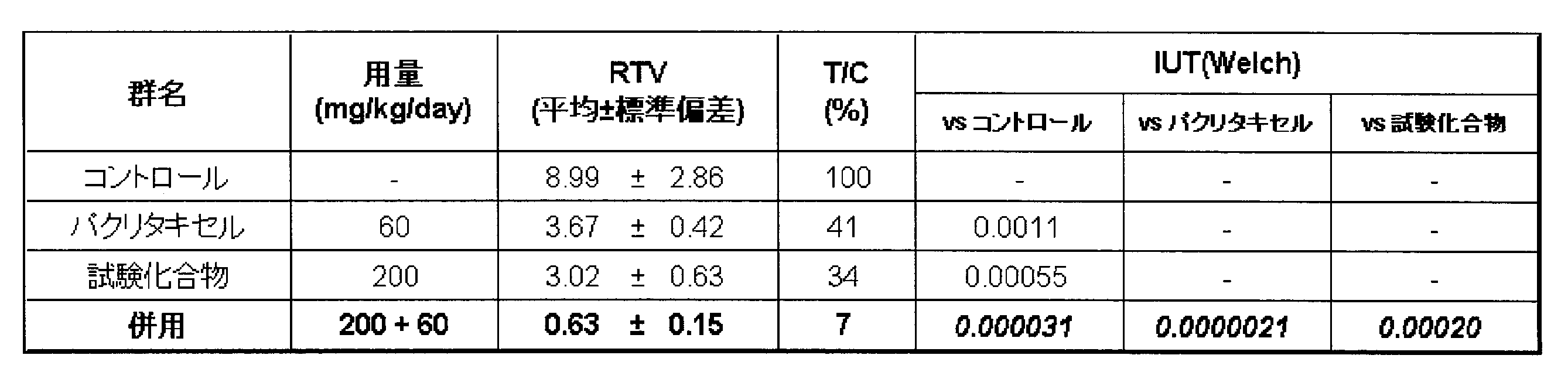
- Test Example 1 Enhancement of antitumor effect on paclitaxel
- the test solution of paclitaxel (Taxol Injection, Bristol Pharmaceutical Co., Ltd.) alone group was prepared so that the dose of paclitaxel was 60 mg / kg / day.
- test liquid of the compound (1) single group was prepared so that it might become 200 mg / kg / day.
- Compound (1) was orally administered daily for 14 days from day 1, and paclitaxel was administered to day 1 from the mouse tail vein.
- paclitaxel was administered to day 1 from the mouse tail vein.
- combination administration group Compound (1) was administered at 200 mg / kg / day and paclitaxel was administered at 60 mg / kg / day.
- the TV at day 15 was measured in each drug administration group, and the relative tumor volume (RTV) relative to day 1 and T / C (%) were calculated by the following formula to calculate anti-tumor effect. Tumor effect was evaluated. Evaluation of combination effect is used when the mean RTV value of the combination treatment group is statistically significant (Welch's IUT, over all maximum p ⁇ 0.05) smaller than the mean RTV value of the individual administration group Judged as effective. The results are shown in FIG. In the figure, * indicates that a statistically significant difference was observed for the single group.
- body weight [body weight: BW] was measured over time as an index of toxicity, and the average weight change rate [body weight change: BWC (%)] up to day 15 with respect to day 1 was calculated by the following formula (n: 2 This is the body weight measurement date carried out twice a week, and the last measurement date corresponds to day 15 which is the final evaluation date).
- n 2 This is the body weight measurement date carried out twice a week, and the last measurement date corresponds to day 15 which is the final evaluation date).
- FIG. BWC (%) [(BW at Day n) ⁇ (BW at Day 1)] / (BW at Day 1) ⁇ 100
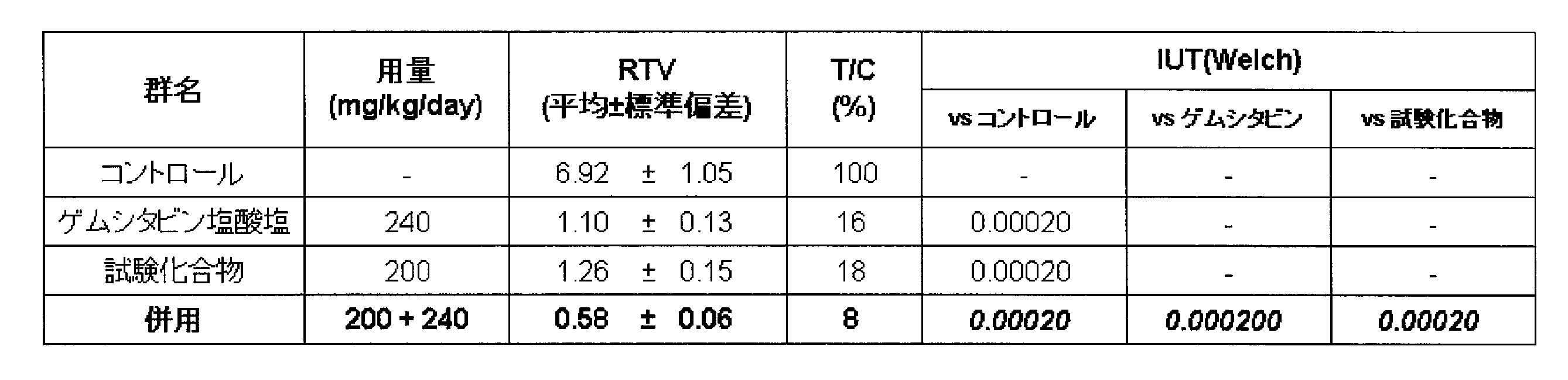
- Test Example 2 Antitumor Effect Enhancement Action on Gemcitabine Hydrochloride Human lung cancer strain (NCI-H441) was transplanted into the right breast of 5-6 weeks old male BALB / cA Jcl-nu mice, and as in Test Example 1. Using. Gemcitabine hydrochloride (Gemzar, manufactured by Eli Lilly and Company) alone group was prepared so that the dose was 240 mg / kg / day. A test solution of compound (1) was prepared to be 200 mg / kg / day. Compound (1) was orally administered daily for 14 days from day 1, and gemcitabine hydrochloride was administered to mice 1 and 8 from the tail vein of mice.
- NCI-H441 Human lung cancer strain
- Compound (1) was administered at 200 mg / kg / day and gemcitabine hydrochloride was administered at 240 mg / kg / day, and evaluated in the same manner as in Test Example 1. The results are shown in FIG. In the figure, * indicates that a statistically significant difference was observed for each single group.
- Test Example 3 Antitumor Effect Enhancement Action on TS-1
- NUGC-4 human gastric cancer strain
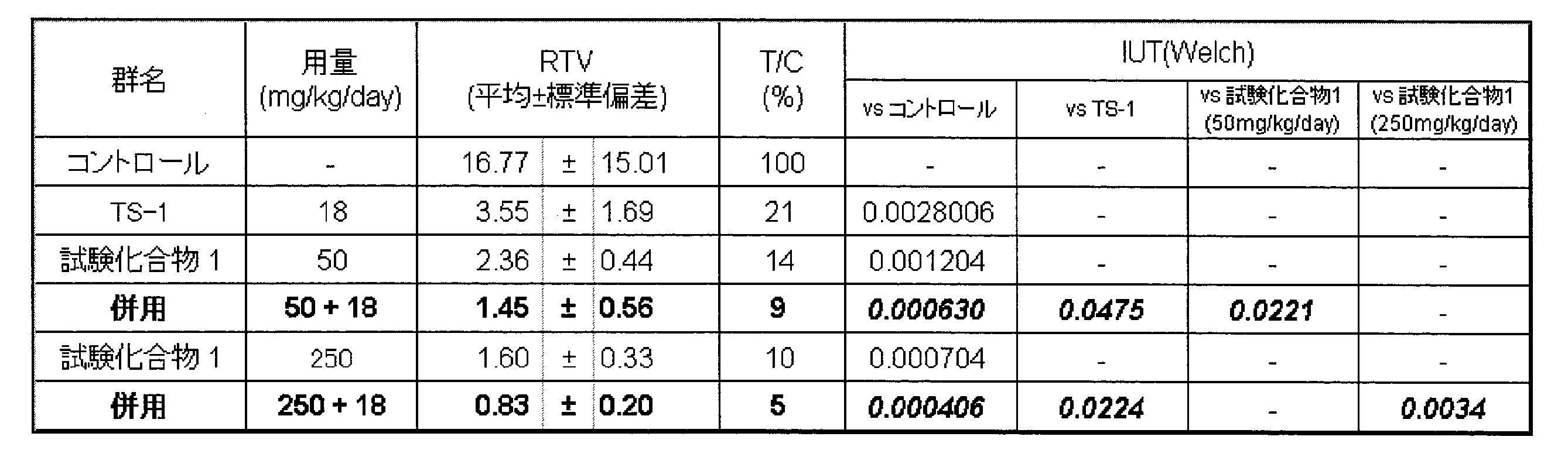
- the test solution of TS-1 (TS-1 manufactured by Taiho Pharmaceutical Co., Ltd.) alone was prepared so that the tegafur dose was 18 mg / kg / day.
- the test solution for compound (1) was prepared to be compound (1) 250 and 50 mg / kg / day.
- Compound (1) and TS-1 were orally administered daily for 14 days from day 1.
- Compound (1) was administered at 250 and 50 mg / kg / day and TS-1 was administered at 18 mg / kg / day, and evaluation was performed in the same manner as in Test Example 1. The results are shown in FIG.
- Test Example 4 Antitumor effect enhancing action against lapatinib
- a human gastric cancer strain (NCI-N87) was transplanted into the right breast of 5-6 week old male BALB / cA Jcl-nu mice and used as in Test Example 1. .
- the test solution of lapatinib (manufactured by LC laboratories) alone group was prepared so that the dose was 100 mg / kg / day.
- a test solution of compound (1) was prepared so as to be 200 mg / kg / day of compound (1).
- Compound (1) and lapatinib were orally administered daily for 14 days from day 1.
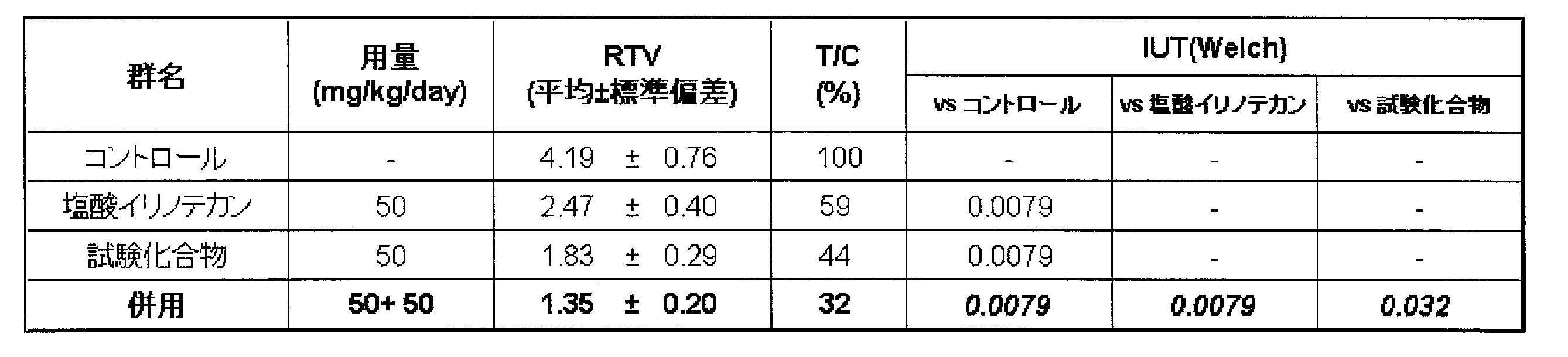
- Test Example 5 Antitumor effect enhancing action against irinotecan hydrochloride Human colon cancer strain (HT-29) was transplanted into the right breast of 5-6 week old male BALB / cA Jcl-nu mice, and as in Test Example 1. Using. The test solution of irinotecan hydrochloride (campto injection, Yakult Co., Ltd.) alone group was prepared so that the dose was 50 mg / kg / day. The test solution of the compound (1) single group was prepared to be 50 mg / kg / day. In the combination administration group, compound (1) was administered at 50 mg / kg / day and irinotecan hydrochloride was administered at 50 mg / kg / day.
- irinotecan hydrochloride was administered at 50 mg / kg / day.
- Compound (1) was orally administered daily for 14 days from day 1, and irinotecan hydrochloride was administered to mice 1, 5, and 9 from the tail vein of mice and evaluated in the same manner as in Test Example 1. The results are shown in FIG. In the figure, * indicates that a statistically significant difference was observed for the single group. The change in body weight over time, which is an index of toxicity, was also evaluated in the same manner as in Test Example 1. The results are shown in FIG.
- Test Example 6 Antitumor effect potentiating action on paclitaxel
- NUGC-4 human gastric cancer strain
- the test solution of paclitaxel (Taxol Injection, manufactured by Bristol Pharmaceutical Co., Ltd.) alone group was prepared so that the paclitaxel dose was 60 mg / kg / day.
- the test liquid of the compound (1) single group was prepared so that it might become 12.5 mg / kg / day.
- Compound (1) was administered at 12.5 mg / kg / day and paclitaxel at 60 mg / kg / day.
- Compound (1) was orally administered daily for 14 days from day 1, and paclitaxel was administered to day 1 from the mouse tail vein and evaluated in the same manner as in Test Example 1. The results are shown in FIG. In the figure, * indicates that a statistically significant difference was observed for the single group. The change in body weight over time, which is an index of toxicity, was also evaluated in the same manner as in Test Example 1. The results are shown in FIG.
- acylthiourea compound (I) or a pharmaceutically acceptable salt thereof markedly enhanced the antitumor effects of various antitumor agents.
- the effect is observed from 12.5 mg / kg / day, which is a low dose of acylthiourea compound (I) (dose that does not show antitumor effect, FIG. 8, Table 6).
- weight loss was not aggravated in the combined administration (FIGS. 2, 7, and 9). Therefore, the combined use of the compound of the present invention and various antitumor agents ensures an effective range of at least 16 times or more.
- paclitaxel has a difference in its antitumor effect (drug sensitivity) depending on the tumor even when the same dose is used, but it is used in combination with acylthiourea compound (I).
- drug sensitivity drug sensitivity
- acylthiourea compound (I) the enhancement of the effect is recognized. That is, even in a tumor having low sensitivity to the concomitant drug paclitaxel, it is expected that paclitaxel enhances the tumor growth inhibitory effect by using it together with the acylthiourea compound (I). This means that the combined use of acylthiourea compound (I) expands the antitumor spectrum of other antitumor agents.
- acylthiourea compound (I) or a pharmaceutically acceptable salt thereof and various antitumor agents does not show a significant increase in toxicity, shows the combined effect, and expands the therapeutic effect range and antitumor spectrum. Admitted to do.
- the dosage of the pharmaceutically acceptable salt of the acylthiourea compound (I) or a salt thereof is preferably about 0.005 to 50 mol with respect to 1 mol of the other antitumor agent.
Landscapes
- Health & Medical Sciences (AREA)
- Chemical & Material Sciences (AREA)
- Life Sciences & Earth Sciences (AREA)
- Pharmacology & Pharmacy (AREA)
- Veterinary Medicine (AREA)
- Public Health (AREA)
- General Health & Medical Sciences (AREA)
- Medicinal Chemistry (AREA)
- Animal Behavior & Ethology (AREA)
- Epidemiology (AREA)
- Organic Chemistry (AREA)
- Molecular Biology (AREA)
- Nuclear Medicine, Radiotherapy & Molecular Imaging (AREA)
- General Chemical & Material Sciences (AREA)
- Chemical Kinetics & Catalysis (AREA)
- Bioinformatics & Cheminformatics (AREA)
- Engineering & Computer Science (AREA)
- Pharmaceuticals Containing Other Organic And Inorganic Compounds (AREA)
- Quinoline Compounds (AREA)
- Medicines That Contain Protein Lipid Enzymes And Other Medicines (AREA)
Description
本発明の課題は、2種の抗腫瘍剤の併用により、それらの抗腫瘍効果が増強される組み合わせを提供することにある。
[1]下記式(I)

で表されるアシルチオウレア化合物又はその薬学的に許容される塩を有効成分とする他の抗腫瘍剤の抗腫瘍効果増強剤。
[2]上記式(I)で表されるアシルチオウレア化合物又はその薬学的に許容される塩と、他の抗腫瘍剤とを組み合せてなる抗腫瘍薬。
[3]他の抗腫瘍剤の抗腫瘍効果を増強するための、式(I)で表されるアシルチオウレア化合物又はその薬学的に許容される塩。
[4]他の抗腫瘍剤と、一剤型の製剤形態、又は別個の製剤形態として投与することにより腫瘍を治療するための、式(I)で表されるアシルチオウレア化合物又はその薬学的に許容される塩。
[5]式(I)で表されるアシルチオウレア化合物又はその薬学的に許容される塩の、他の抗腫瘍剤の抗腫瘍効果増強剤製造のための使用。
[6]式(I)で表されるアシルチオウレア化合物又はその薬学的に許容される塩の、他の抗腫瘍剤と組み合わせてなる抗腫瘍薬製造のための使用。
[8]式(I)で表されるアシルチオウレア化合物又はその薬学的に許容される塩と他の抗腫瘍剤とを、必要な患者に投与することを特徴とする、腫瘍の治療方法。
(1)4-(2-フルオロ-4-(3-(2-フェニルアセチル)チオウレイド)フェノキシ)-7-メトキシ-N-メチルキノリン-6-カルボキサミド(化合物(1))
(2)4-(2-フルオロ-4-(3-(2-フェニルアセチル)チオウレイド)フェノキシ)-7-メトキシ-N-(2-モルホリノエチル)キノリン-6-カルボキサミド(化合物(2))
(3)(S)-4-(2-フルオロ-4-(3-(2-(4-フルオロフェニル)アセチル)チオウレイド)フェノキシ)-N-(1-ヒドロキシブタン-2-イル)-7-メトキシキノリン-6-カルボキサミド(化合物(3))
経口用固形製剤を調製する場合は、本発明化合物に賦形剤、必要に応じて、結合剤、崩壊剤、滑沢剤、着色剤、矯味・矯臭剤等を加えた後、常法により錠剤、被覆錠剤、顆粒剤、散剤、カプセル剤等を製造することができる。
結合剤としては、水、エタノール、1-プロパノール、2-プロパノール、単シロップ、ブドウ糖液、α-デンプン液、ゼラチン液、D-マンニトール、カルボキシメチルセルロース、ヒドロキシプロピルセルロース、ヒドロキシプロピルスターチ、メチルセルロース、エチルセルロース、シェラック、リン酸カルシウム、ポリビニルピロリドン等が挙げられる。
崩壊剤としては、乾燥デンプン、アルギン酸ナトリウム、カンテン末、炭酸水素ナトリウム、炭酸カルシウム、ラウリル硫酸ナトリウム、ステアリン酸モノグリセリド、乳糖等が挙げられる。
滑沢剤としては、精製タルク、ステアリン酸塩ナトリウム、ステアリン酸マグネシウム、ホウ砂、ポリエチレングリコール等が挙げられる。
着色剤としては、酸化チタン、酸化鉄等が挙げられる。
矯味・矯臭剤としては白糖、橙皮、クエン酸、酒石酸等が挙げられる。
例えば抗腫瘍剤Aがパクリタキセル(タキソール、アブラキサン等)である場合には、パクリタキセル(タキソール、アブラキサン等)1モルに対して、アシルチオウレア化合物(I)又はその薬学的に許容される塩を0.05~50モル程度である。抗腫瘍剤Aがゲムシタビンである場合には、ゲムシタビン1モルに対して、アシルチオウレア化合物(I)又はその薬学的に許容される塩を0.005~5モル程度である。抗腫瘍剤Aがラパチニブである場合には、ラパチニブ1モルに対して、アシルチオウレア化合物(I)又はその薬学的に許容される塩を0.01~20モル程度である。抗腫瘍剤Aがテガフール・ギメラシル・オテラシルカリウム配合剤である場合には、テガフール1モルに対して、アシルチオウレア化合物(I)又はその薬学的に許容される塩を0.05~50モル程度である。抗腫瘍剤Aがイリノテカンである場合には、イリノテカン1モルに対して、アシルチオウレア化合物(I)又はその薬学的に許容される塩を0.05~30モル程度である。抗腫瘍剤Aがペメトレキセドである場合には、ペメトレキセド1モルに対して、アシルチオウレア化合物(I)又はその薬学的に許容される塩を0.05~20モル程度である。
抗腫瘍剤は最大薬効を示す用量と毒性発現用量が極めて近く、その薬剤が持つ最大抗腫瘍効果を動物モデルで評価するためにはMTD近傍において評価することが一般的であり、以下の試験例においては、MTDと最大効果発揮用量を同義としている。
4-(2-フルオロ-4-(3-(2-フェニルアセチル)チオウレイド)フェノキシ)-7-メトキシ-N-メチルキノリン-6-カルボキサミド(化合物(1))は、国際公開第2009/125597号パンフレットに記載の方法により合成した。
ヒト肺癌株(NCI-H460)を生後5~6週齢の雄性BALB/cA Jcl-nuマウスの右側胸部に移植した。腫瘍移植後に腫瘍の長径(mm)及び短径(mm)を測定し、腫瘍体積(tumor volume:TV)を算出後、各群の平均TVが均等になるように各群にマウスを割り付け、この群分け(n=5)を実施した日をday 1とした。
パクリタキセル(タキソール注、ブリストル製薬株式会社)単独群の被検液は、パクリタキセル投与用量として60mg/kg/dayとなるよう調製した。また化合物(1)単独群の被検液は、200mg/kg/dayとなるよう調製した。化合物(1)はday 1から14日間連日経口投与し、パクリタキセルはday 1にマウス尾静脈より投与した。併用投与群では、化合物(1)を200mg/kg/dayとパクリタキセルを60mg/kg/dayで投与した。
TV(mm3)=(長径×短径2)/2
RTV=(Day 15におけるTV)/(Day 1におけるTV)
T/C(%)=(被検液投与群の平均RTV値)/(対照群の平均RTV値)×100
BWC(%)=[(Day nにおけるBW)-(Day 1におけるBW)]/(Day 1におけるBW)×100
ヒト肺癌株(NCI-H441)を、生後5~6週齢の雄性BALB/cA Jcl-nuマウスの右側胸部に移植し、試験例1と同様に用いた。
ゲムシタビン塩酸塩(ジェムザール,イーライリリー社製)単独群の被検液は、投与量が240mg/kg/dayとなるよう調製した。また化合物(1)の被検液は、200mg/kg/dayとなるよう調製した。
化合物(1)は、day 1から14日間連日経口投与し、ゲムシタビン塩酸塩はday 1及び8にマウス尾静脈より投与した。併用投与群では、化合物(1)を200mg/kg/dayとゲムシタビン塩酸塩を240mg/kg/dayで投与し、試験例1と同様に評価した。結果を図3及び表2に示す。図中、*印は各単独群に対して統計学的有意差が認められたことを示す。
ヒト胃癌株(NUGC-4) を生後5~6週齢の雄性ヌードラットの右側胸部に移植し、試験例1と同様に用いた。TS-1(ティーエスワン,大鵬薬品工業社製)単独群の被検液はテガフール投与量が18mg/kg/dayとなるよう調製した。また化合物(1)の被検液は、化合物(1)250及び50mg/kg/dayとなるよう調製した。
化合物(1)及びTS-1をday 1から14日間連日経口投与した。併用投与群では、化合物(1)を250及び50mg/kg/dayと、TS-1を18mg/kg/dayで投与し、試験例1と同様に評価した。結果を図4及び表3に示す。
ヒト胃癌株(NCI-N87)を、生後5~6週齢の雄性BALB/cA Jcl-nuマウスの右側胸部に移植し、試験例1と同様に用いた。ラパチニブ(LC laboratories社製)単独群の被検液は、投与量が100mg/kg/dayとなるよう調製した。また化合物(1)の被検液は、化合物(1)200mg/kg/dayとなるよう調製した。
化合物(1)及びラパチニブをday 1から14日間連日経口投与した。併用投与群では、化合物(1)を200mg/kg/dayと、ラパチニブを100mg/kg/dayで投与し、試験例1と同様に評価した。結果を図5及び表4に示す。図中、*印は各単独群に対して統計学的有意差が認められたことを示す。

ヒト大腸癌株(HT-29)を、生後5~6週齢の雄性BALB/cA Jcl-nuマウスの右側胸部に移植し、試験例1と同様に用いた。
塩酸イリノテカン(カンプト注、ヤクルト社製)単独群の被検液は、投与量が50mg/kg/dayとなるよう調製した。
化合物(1)単独群の被検液は、50mg/kg/dayとなるよう調製した。併用投与群では、化合物(1)を50mg/kg/dayと塩酸イリノテカンを50mg/kg/dayで投与した。化合物(1)はday 1から14日間連日経口投与し、塩酸イリノテカンはday 1、5、9にマウス尾静脈より投与し、試験例1と同様に評価した。結果を図6及び表5に示す。図中、*印は単独群に対して統計学的有意差が認められたことを示す。
また、毒性の指標である経時的な体重変化についても試験例1と同様に評価した。結果を図7に示す。
ヒト胃癌株(NUGC-4) を、生後5~6週齢の雄性BALB/cA Jcl-nuマウスの右側胸部に移植し、試験例1と同様に用いた。
パクリタキセル(タキソール注、ブリストル製薬株式会社製)単独群の被検液は、パクリタキセル投与量として60mg/kg/dayとなるよう調製した。
化合物(1)単独群の被検液は、12.5mg/kg/dayとなるよう調製した。併用投与群では、化合物(1)を12.5mg/kg/dayとパクリタキセルを60mg/kg/dayで投与した。化合物(1)はday 1から14日間連日経口投与し、パクリタキセルはday 1にマウス尾静脈より投与し、試験例1と同様に評価した。結果を図8及び表6に示す。図中、*印は単独群に対して統計学的有意差が認められたことを示す。
また毒性の指標である経時的な体重変化についても、試験例1と同様に評価した。結果を図9に示す。

Claims (40)
- 一般式(I)

で表されるアシルチオウレア化合物又はその薬学的に許容される塩を有効成分とする他の抗腫瘍剤の抗腫瘍効果増強剤。 - 式(I)中、R1が、置換基を有していてもよいメチル基、エチル基、n-プロピル基、イソプロピル基、n-ブチル基、又はsec-ブチル基であって、該アルキル基上の置換基が、ヒドロキシル基、シクロヘキシル基、メトキシ基、エトキシ基、イソプロピルオキシ基、ジエチルアミノ基、アセチルアミノ基、メチルスルホニル基、フェニル基、ピロリジニル基、モルホリノ基、ジオキソラン基、テトラヒドロピラニル基、ピリジル基、トリアゾリル基、エチルアミノカルボニル基、ジメチルアミノカルボニル基、メチルブチルアミノカルボニル基、ピロリジニルカルボニル基、又はモルホリノカルボニル基であって、該アルコキシ基はさらに置換基としてヒドロキシル基を有していてもよく、該複素環基はさらに置換基としてメチル基、又はオキソ基を有していてもよく、該アルキルアミノカルボニル基はさらに置換基としてヒドロキシル基、又はメトキシ基を有していてもよく、該複素環カルボニル基はさらに置換基としてフッ素原子、ヒドロキシル基を有していてもよいメチル基を有していてもよく、R2がフッ素原子、又は塩素原子であり、R3が水素原子、フッ素原子、又は塩素原子である請求項1記載の抗腫瘍効果増強剤。
- R1は水素原子を示し、R1が、置換基を有していてもよいメチル基、エチル基、n-プロピル基、イソプロピル基、n-ブチル基、又はsec-ブチル基であって、該アルキル基上の置換基が、ヒドロキシル基、メトキシ基、又はモルホリノ基であり、R2がフッ素原子であり、R3が水素原子又はフッ素原子である請求項1又は2に記載の抗腫瘍効果増強剤。
- 式(I)の化合物が、以下の群から選択される、請求項1に記載の抗腫瘍効果増強剤。
(1)4-(2-フルオロ-4-(3-(2-フェニルアセチル)チオウレイド)フェノキシ)-7-メトキシ-N-メチルキノリン-6-カルボキサミド
(2)4-(2-フルオロ-4-(3-(2-フェニルアセチル)チオウレイド)フェノキシ)-7-メトキシ-N-(2-モルホリノエチル)キノリン-6-カルボキサミド
(3)(S)-4-(2-フルオロ-4-(3-(2-(4-フルオロフェニル)アセチル)チオウレイド)フェノキシ)-N-(1-ヒドロキシブタン-2-イル)-7-メトキシキノリン-6-カルボキサミド - 他の抗腫瘍剤が、パクリタキセル(タキソール、アブラキサン等)、ゲムシタビン、ラパニチブ、デカフール・ギメラシル・オテラシルカリウム配合剤、イリノテカンのいずれかである請求項1~4のいずれかに記載の抗腫瘍効果増強剤。
- 一般式(1)で表されるアシルチオウレア化合物又はその薬学的に許容される塩と、他の抗腫瘍剤を組み合せてなる抗腫瘍薬。
- 他の抗腫瘍剤が、パクリタキセル(タキソール、アブラキサン等)、ゲムシタビン、ラパチニブ、テガフール・ギメラシル・オテラシルカリウム配合剤、イリノテカンのいずれかである請求項6記載の抗腫瘍薬。
- 式(I)中、R1が、置換基を有していてもよいメチル基、エチル基、n-プロピル基、イソプロピル基、n-ブチル基、又はsec-ブチル基であって、該アルキル基上の置換基が、ヒドロキシル基、シクロヘキシル基、メトキシ基、エトキシ基、イソプロピルオキシ基、ジエチルアミノ基、アセチルアミノ基、メチルスルホニル基、フェニル基、ピロリジニル基、モルホリノ基、ジオキソラン基、テトラヒドロピラニル基、ピリジル基、トリアゾリル基、エチルアミノカルボニル基、ジメチルアミノカルボニル基、メチルブチルアミノカルボニル基、ピロリジニルカルボニル基、又はモルホリノカルボニル基であって、該アルコキシ基はさらに置換基としてヒドロキシル基を有していてもよく、該複素環基はさらに置換基としてメチル基、又はオキソ基を有していてもよく、該アルキルアミノカルボニル基はさらに置換基としてヒドロキシル基、又はメトキシ基を有していてもよく、該複素環カルボニル基はさらに置換基としてフッ素原子、ヒドロキシル基を有していてもよいメチル基を有していてもよく、R2がフッ素原子、又は塩素原子であり、R3が水素原子、フッ素原子、又は塩素原子である請求項6又は7に記載の抗腫瘍薬。
- R1は水素原子を示し、R1が、置換基を有していてもよいメチル基、エチル基、n-プロピル基、イソプロピル基、n-ブチル基、又はsec-ブチル基であって、該アルキル基上の置換基が、ヒドロキシル基、メトキシ基、又はモルホリノ基であり、R2がフッ素原子であり、R3が水素原子又はフッ素原子である請求項6~8のいずれかに記載の抗腫瘍薬。
- 式(I)の化合物が、以下の群から選択される、請求項6~9のいずれかに記載の抗腫瘍薬。
(1)4-(2-フルオロ-4-(3-(2-フェニルアセチル)チオウレイド)フェノキシ)-7-メトキシ-N-メチルキノリン-6-カルボキサミド
(2)4-(2-フルオロ-4-(3-(2-フェニルアセチル)チオウレイド)フェノキシ)-7-メトキシ-N-(2-モルホリノエチル)キノリン-6-カルボキサミド
(3)(S)-4-(2-フルオロ-4-(3-(2-(4-フルオロフェニル)アセチル)チオウレイド)フェノキシ)-N-(1-ヒドロキシブタン-2-イル)-7-メトキシキノリン-6-カルボキサミド - 他の抗腫瘍剤の抗腫瘍効果を増強するための、式(I)で表されるアシルチオウレア化合物又はその薬学的に許容される塩。

- 式(I)中、R1が、置換基を有していてもよいメチル基、エチル基、n-プロピル基、イソプロピル基、n-ブチル基、又はsec-ブチル基であって、該アルキル基上の置換基が、ヒドロキシル基、シクロヘキシル基、メトキシ基、エトキシ基、イソプロピルオキシ基、ジエチルアミノ基、アセチルアミノ基、メチルスルホニル基、フェニル基、ピロリジニル基、モルホリノ基、ジオキソラン基、テトラヒドロピラニル基、ピリジル基、トリアゾリル基、エチルアミノカルボニル基、ジメチルアミノカルボニル基、メチルブチルアミノカルボニル基、ピロリジニルカルボニル基、又はモルホリノカルボニル基であって、該アルコキシ基はさらに置換基としてヒドロキシル基を有していてもよく、該複素環基はさらに置換基としてメチル基、又はオキソ基を有していてもよく、該アルキルアミノカルボニル基はさらに置換基としてヒドロキシル基、又はメトキシ基を有していてもよく、該複素環カルボニル基はさらに置換基としてフッ素原子、ヒドロキシル基を有していてもよいメチル基を有していてもよく、R2がフッ素原子、又は塩素原子であり、R3が水素原子、フッ素原子、又は塩素原子である請求項11記載の化合物。
- R1は水素原子を示し、R1が、置換基を有していてもよいメチル基、エチル基、n-プロピル基、イソプロピル基、n-ブチル基、又はsec-ブチル基であって、該アルキル基上の置換基が、ヒドロキシル基、メトキシ基、又はモルホリノ基であり、R2がフッ素原子であり、R3が水素原子又はフッ素原子である請求項11又は12に記載の化合物。
- 式(I)の化合物が、以下の群から選択される、請求項11~13のいずれかに記載の化合物。
(1)4-(2-フルオロ-4-(3-(2-フェニルアセチル)チオウレイド)フェノキシ)-7-メトキシ-N-メチルキノリン-6-カルボキサミド
(2)4-(2-フルオロ-4-(3-(2-フェニルアセチル)チオウレイド)フェノキシ)-7-メトキシ-N-(2-モルホリノエチル)キノリン-6-カルボキサミド
(3)(S)-4-(2-フルオロ-4-(3-(2-(4-フルオロフェニル)アセチル)チオウレイド)フェノキシ)-N-(1-ヒドロキシブタン-2-イル)-7-メトキシキノリン-6-カルボキサミド - 他の抗腫瘍剤が、パクリタキセル(タキソール、アブラキサン等)、ゲムシタビン、ラパニチブ、デカフール・ギメラシル・オテラシルカリウム配合剤、イリノテカンのいずれかである請求項11~14のいずれかに記載の化合物。
- 他の抗腫瘍剤と、一剤型の製剤形態、又は別個の製剤形態として投与することにより腫瘍を治療するための、式(I)で表されるアシルチオウレア化合物又はその薬学的に許容される塩。

- 他の抗腫瘍剤が、パクリタキセル(タキソール、アブラキサン等)、ゲムシタビン、ラパニチブ、デカフール・ギメラシル・オテラシルカリウム配合剤、イリノテカンのいずれかである請求項16記載の化合物。
- 式(I)中、R1が、置換基を有していてもよいメチル基、エチル基、n-プロピル基、イソプロピル基、n-ブチル基、又はsec-ブチル基であって、該アルキル基上の置換基が、ヒドロキシル基、シクロヘキシル基、メトキシ基、エトキシ基、イソプロピルオキシ基、ジエチルアミノ基、アセチルアミノ基、メチルスルホニル基、フェニル基、ピロリジニル基、モルホリノ基、ジオキソラン基、テトラヒドロピラニル基、ピリジル基、トリアゾリル基、エチルアミノカルボニル基、ジメチルアミノカルボニル基、メチルブチルアミノカルボニル基、ピロリジニルカルボニル基、又はモルホリノカルボニル基であって、該アルコキシ基はさらに置換基としてヒドロキシル基を有していてもよく、該複素環基はさらに置換基としてメチル基、又はオキソ基を有していてもよく、該アルキルアミノカルボニル基はさらに置換基としてヒドロキシル基、又はメトキシ基を有していてもよく、該複素環カルボニル基はさらに置換基としてフッ素原子、ヒドロキシル基を有していてもよいメチル基を有していてもよく、R2がフッ素原子、又は塩素原子であり、R3が水素原子、フッ素原子、又は塩素原子である請求項16又は17に記載の化合物。
- R1は水素原子を示し、R1が、置換基を有していてもよいメチル基、エチル基、n-プロピル基、イソプロピル基、n-ブチル基、又はsec-ブチル基であって、該アルキル基上の置換基が、ヒドロキシル基、メトキシ基、又はモルホリノ基であり、R2がフッ素原子であり、R3が水素原子又はフッ素原子である請求項16~18のいずれかに記載の化合物。
- 式(I)の化合物が、以下の群から選択される、請求項16~19のいずれかに記載の化合物。
(1)4-(2-フルオロ-4-(3-(2-フェニルアセチル)チオウレイド)フェノキシ)-7-メトキシ-N-メチルキノリン-6-カルボキサミド
(2)4-(2-フルオロ-4-(3-(2-フェニルアセチル)チオウレイド)フェノキシ)-7-メトキシ-N-(2-モルホリノエチル)キノリン-6-カルボキサミド
(3)(S)-4-(2-フルオロ-4-(3-(2-(4-フルオロフェニル)アセチル)チオウレイド)フェノキシ)-N-(1-ヒドロキシブタン-2-イル)-7-メトキシキノリン-6-カルボキサミド - 式(I)で表されるアシルチオウレア化合物又はその薬学的に許容される塩の、他の抗腫瘍剤の抗腫瘍効果増強剤製造のための使用。

- 式(I)中、R1が、置換基を有していてもよいメチル基、エチル基、n-プロピル基、イソプロピル基、n-ブチル基、又はsec-ブチル基であって、該アルキル基上の置換基が、ヒドロキシル基、シクロヘキシル基、メトキシ基、エトキシ基、イソプロピルオキシ基、ジエチルアミノ基、アセチルアミノ基、メチルスルホニル基、フェニル基、ピロリジニル基、モルホリノ基、ジオキソラン基、テトラヒドロピラニル基、ピリジル基、トリアゾリル基、エチルアミノカルボニル基、ジメチルアミノカルボニル基、メチルブチルアミノカルボニル基、ピロリジニルカルボニル基、又はモルホリノカルボニル基であって、該アルコキシ基はさらに置換基としてヒドロキシル基を有していてもよく、該複素環基はさらに置換基としてメチル基、又はオキソ基を有していてもよく、該アルキルアミノカルボニル基はさらに置換基としてヒドロキシル基、又はメトキシ基を有していてもよく、該複素環カルボニル基はさらに置換基としてフッ素原子、ヒドロキシル基を有していてもよいメチル基を有していてもよく、R2がフッ素原子、又は塩素原子であり、R3が水素原子、フッ素原子、又は塩素原子である請求項21記載の使用。
- R1は水素原子を示し、R1が、置換基を有していてもよいメチル基、エチル基、n-プロピル基、イソプロピル基、n-ブチル基、又はsec-ブチル基であって、該アルキル基上の置換基が、ヒドロキシル基、メトキシ基、又はモルホリノ基であり、R2がフッ素原子であり、R3が水素原子又はフッ素原子である請求項21又は22に記載の使用。
- 式(I)の化合物が、以下の群から選択される、請求項21~23のいずれかに記載の使用。
(1)4-(2-フルオロ-4-(3-(2-フェニルアセチル)チオウレイド)フェノキシ)-7-メトキシ-N-メチルキノリン-6-カルボキサミド
(2)4-(2-フルオロ-4-(3-(2-フェニルアセチル)チオウレイド)フェノキシ)-7-メトキシ-N-(2-モルホリノエチル)キノリン-6-カルボキサミド
(3)(S)-4-(2-フルオロ-4-(3-(2-(4-フルオロフェニル)アセチル)チオウレイド)フェノキシ)-N-(1-ヒドロキシブタン-2-イル)-7-メトキシキノリン-6-カルボキサミド - 他の抗腫瘍剤が、パクリタキセル(タキソール、アブラキサン等)、ゲムシタビン、ラパニチブ、デカフール・ギメラシル・オテラシルカリウム配合剤、イリノテカンのいずれかである請求項21~24のいずれかに記載の使用。
- 式(I)で表されるアシルチオウレア化合物又はその薬学的に許容される塩の、他の抗腫瘍剤と組み合わせてなる抗腫瘍薬製造のための使用。

- 他の抗腫瘍剤が、パクリタキセル(タキソール、アブラキサン等)、ゲムシタビン、ラパチニブ、テガフール・ギメラシル・オテラシルカリウム配合剤、イリノテカンのいずれかである請求項26記載の使用。
- 式(I)中、R1が、置換基を有していてもよいメチル基、エチル基、n-プロピル基、イソプロピル基、n-ブチル基、又はsec-ブチル基であって、該アルキル基上の置換基が、ヒドロキシル基、シクロヘキシル基、メトキシ基、エトキシ基、イソプロピルオキシ基、ジエチルアミノ基、アセチルアミノ基、メチルスルホニル基、フェニル基、ピロリジニル基、モルホリノ基、ジオキソラン基、テトラヒドロピラニル基、ピリジル基、トリアゾリル基、エチルアミノカルボニル基、ジメチルアミノカルボニル基、メチルブチルアミノカルボニル基、ピロリジニルカルボニル基、又はモルホリノカルボニル基であって、該アルコキシ基はさらに置換基としてヒドロキシル基を有していてもよく、該複素環基はさらに置換基としてメチル基、又はオキソ基を有していてもよく、該アルキルアミノカルボニル基はさらに置換基としてヒドロキシル基、又はメトキシ基を有していてもよく、該複素環カルボニル基はさらに置換基としてフッ素原子、ヒドロキシル基を有していてもよいメチル基を有していてもよく、R2がフッ素原子、又は塩素原子であり、R3が水素原子、フッ素原子、又は塩素原子である請求項26又は27に記載の使用。
- R1は水素原子を示し、R1が、置換基を有していてもよいメチル基、エチル基、n-プロピル基、イソプロピル基、n-ブチル基、又はsec-ブチル基であって、該アルキル基上の置換基が、ヒドロキシル基、メトキシ基、又はモルホリノ基であり、R2がフッ素原子であり、R3が水素原子又はフッ素原子である請求項26~28のいずれかに記載の使用。
- 式(I)の化合物が、以下の群から選択される、請求項26~29のいずれかに記載の使用。
(1)4-(2-フルオロ-4-(3-(2-フェニルアセチル)チオウレイド)フェノキシ)-7-メトキシ-N-メチルキノリン-6-カルボキサミド
(2)4-(2-フルオロ-4-(3-(2-フェニルアセチル)チオウレイド)フェノキシ)-7-メトキシ-N-(2-モルホリノエチル)キノリン-6-カルボキサミド
(3)(S)-4-(2-フルオロ-4-(3-(2-(4-フルオロフェニル)アセチル)チオウレイド)フェノキシ)-N-(1-ヒドロキシブタン-2-イル)-7-メトキシキノリン-6-カルボキサミド - 式(I)で表されるアシルチオウレア化合物又はその薬学的に許容される塩と他の抗腫瘍剤とを、必要な患者に投与することを特徴とする、他の抗腫瘍剤の抗腫瘍効果増強方法。

- 式(I)中、R1が、置換基を有していてもよいメチル基、エチル基、n-プロピル基、イソプロピル基、n-ブチル基、又はsec-ブチル基であって、該アルキル基上の置換基が、ヒドロキシル基、シクロヘキシル基、メトキシ基、エトキシ基、イソプロピルオキシ基、ジエチルアミノ基、アセチルアミノ基、メチルスルホニル基、フェニル基、ピロリジニル基、モルホリノ基、ジオキソラン基、テトラヒドロピラニル基、ピリジル基、トリアゾリル基、エチルアミノカルボニル基、ジメチルアミノカルボニル基、メチルブチルアミノカルボニル基、ピロリジニルカルボニル基、又はモルホリノカルボニル基であって、該アルコキシ基はさらに置換基としてヒドロキシル基を有していてもよく、該複素環基はさらに置換基としてメチル基、又はオキソ基を有していてもよく、該アルキルアミノカルボニル基はさらに置換基としてヒドロキシル基、又はメトキシ基を有していてもよく、該複素環カルボニル基はさらに置換基としてフッ素原子、ヒドロキシル基を有していてもよいメチル基を有していてもよく、R2がフッ素原子、又は塩素原子であり、R3が水素原子、フッ素原子、又は塩素原子である請求項31記載の方法。
- R1は水素原子を示し、R1が、置換基を有していてもよいメチル基、エチル基、n-プロピル基、イソプロピル基、n-ブチル基、又はsec-ブチル基であって、該アルキル基上の置換基が、ヒドロキシル基、メトキシ基、又はモルホリノ基であり、R2がフッ素原子であり、R3が水素原子又はフッ素原子である請求項31記載の方法。
- 式(I)の化合物が、以下の群から選択される、請求項31記載の方法。
(1)4-(2-フルオロ-4-(3-(2-フェニルアセチル)チオウレイド)フェノキシ)-7-メトキシ-N-メチルキノリン-6-カルボキサミド
(2)4-(2-フルオロ-4-(3-(2-フェニルアセチル)チオウレイド)フェノキシ)-7-メトキシ-N-(2-モルホリノエチル)キノリン-6-カルボキサミド
(3)(S)-4-(2-フルオロ-4-(3-(2-(4-フルオロフェニル)アセチル)チオウレイド)フェノキシ)-N-(1-ヒドロキシブタン-2-イル)-7-メトキシキノリン-6-カルボキサミド - 他の抗腫瘍剤が、パクリタキセル(タキソール、アブラキサン等)、ゲムシタビン、ラパニチブ、デカフール・ギメラシル・オテラシルカリウム配合剤、イリノテカンのいずれかである請求項31記載の方法。
- 式(I)で表されるアシルチオウレア化合物又はその薬学的に許容される塩と他の抗腫瘍剤とを、必要な患者に投与することを特徴とする、腫瘍の治療方法。

- 他の抗腫瘍剤が、パクリタキセル(タキソール、アブラキサン等)、ゲムシタビン、ラパニチブ、デカフール・ギメラシル・オテラシルカリウム配合剤、イリノテカンのいずれかである請求項36記載の方法。
- 式(I)中、R1が、置換基を有していてもよいメチル基、エチル基、n-プロピル基、イソプロピル基、n-ブチル基、又はsec-ブチル基であって、該アルキル基上の置換基が、ヒドロキシル基、シクロヘキシル基、メトキシ基、エトキシ基、イソプロピルオキシ基、ジエチルアミノ基、アセチルアミノ基、メチルスルホニル基、フェニル基、ピロリジニル基、モルホリノ基、ジオキソラン基、テトラヒドロピラニル基、ピリジル基、トリアゾリル基、エチルアミノカルボニル基、ジメチルアミノカルボニル基、メチルブチルアミノカルボニル基、ピロリジニルカルボニル基、又はモルホリノカルボニル基であって、該アルコキシ基はさらに置換基としてヒドロキシル基を有していてもよく、該複素環基はさらに置換基としてメチル基、又はオキソ基を有していてもよく、該アルキルアミノカルボニル基はさらに置換基としてヒドロキシル基、又はメトキシ基を有していてもよく、該複素環カルボニル基はさらに置換基としてフッ素原子、ヒドロキシル基を有していてもよいメチル基を有していてもよく、R2がフッ素原子、又は塩素原子であり、R3が水素原子、フッ素原子、又は塩素原子である請求項36記載の方法。
- R1は水素原子を示し、R1が、置換基を有していてもよいメチル基、エチル基、n-プロピル基、イソプロピル基、n-ブチル基、又はsec-ブチル基であって、該アルキル基上の置換基が、ヒドロキシル基、メトキシ基、又はモルホリノ基であり、R2がフッ素原子であり、R3が水素原子又はフッ素原子である請求項36記載の方法。
- 式(I)の化合物が、以下の群から選択される、請求項36記載の方法。
(1)4-(2-フルオロ-4-(3-(2-フェニルアセチル)チオウレイド)フェノキシ)-7-メトキシ-N-メチルキノリン-6-カルボキサミド
(2)4-(2-フルオロ-4-(3-(2-フェニルアセチル)チオウレイド)フェノキシ)-7-メトキシ-N-(2-モルホリノエチル)キノリン-6-カルボキサミド
(3)(S)-4-(2-フルオロ-4-(3-(2-(4-フルオロフェニル)アセチル)チオウレイド)フェノキシ)-N-(1-ヒドロキシブタン-2-イル)-7-メトキシキノリン-6-カルボキサミド
Priority Applications (9)
| Application Number | Priority Date | Filing Date | Title |
|---|---|---|---|
| DK12863476.3T DK2799070T3 (en) | 2011-12-28 | 2012-12-27 | EFFECTIVE AMPLIFIER FOR ANTITUMUM AGENTS |
| EP12863476.3A EP2799070B1 (en) | 2011-12-28 | 2012-12-27 | Effect potentiator for antitumor agents |
| JP2013551770A JP5852678B2 (ja) | 2011-12-28 | 2012-12-27 | 抗腫瘍剤の効果増強剤 |
| PL12863476T PL2799070T3 (pl) | 2011-12-28 | 2012-12-27 | Środek wzmacniający działanie środków przeciwnowotworowych |
| AU2012361581A AU2012361581B2 (en) | 2011-12-28 | 2012-12-27 | Effect potentiator for antitumor agents |
| KR1020147016594A KR101668931B1 (ko) | 2011-12-28 | 2012-12-27 | 항종양제의 효과 증강제 |
| US14/369,060 US20140378409A1 (en) | 2011-12-28 | 2012-12-27 | Effect potentiator for antitumor agents |
| ES12863476T ES2717898T3 (es) | 2011-12-28 | 2012-12-27 | Efecto potenciador para agentes antitumorales |
| RU2014131058/04A RU2589713C2 (ru) | 2011-12-28 | 2012-12-27 | Средство, усиливающее действие противоопухолевых средств |
Applications Claiming Priority (2)
| Application Number | Priority Date | Filing Date | Title |
|---|---|---|---|
| JP2011290125 | 2011-12-28 | ||
| JP2011-290125 | 2011-12-28 |
Publications (1)
| Publication Number | Publication Date |
|---|---|
| WO2013100014A1 true WO2013100014A1 (ja) | 2013-07-04 |
Family
ID=48697493
Family Applications (1)
| Application Number | Title | Priority Date | Filing Date |
|---|---|---|---|
| PCT/JP2012/083794 Ceased WO2013100014A1 (ja) | 2011-12-28 | 2012-12-27 | 抗腫瘍剤の効果増強剤 |
Country Status (13)
| Country | Link |
|---|---|
| US (1) | US20140378409A1 (ja) |
| EP (1) | EP2799070B1 (ja) |
| JP (1) | JP5852678B2 (ja) |
| KR (1) | KR101668931B1 (ja) |
| AU (2) | AU2012361581B2 (ja) |
| DK (1) | DK2799070T3 (ja) |
| ES (1) | ES2717898T3 (ja) |
| HU (1) | HUE043991T2 (ja) |
| PL (1) | PL2799070T3 (ja) |
| PT (1) | PT2799070T (ja) |
| RU (1) | RU2589713C2 (ja) |
| TW (1) | TWI594986B (ja) |
| WO (1) | WO2013100014A1 (ja) |
Cited By (12)
| Publication number | Priority date | Publication date | Assignee | Title |
|---|---|---|---|---|
| WO2015046484A1 (ja) | 2013-09-30 | 2015-04-02 | 国立大学法人東京農工大学 | 骨粗鬆症治療剤 |
| CN105683195A (zh) * | 2013-08-22 | 2016-06-15 | 大鹏药品工业株式会社 | 新的喹啉取代的化合物 |
| WO2016175305A1 (ja) * | 2015-04-30 | 2016-11-03 | 大鵬薬品工業株式会社 | アシルチオウレア化合物のメシル酸塩及びその結晶並びにそれらの製造方法 |
| KR20180021682A (ko) | 2015-06-25 | 2018-03-05 | 다이호야쿠힌고교 가부시키가이샤 | 섬유증 치료제 |
| WO2018151177A1 (ja) | 2017-02-15 | 2018-08-23 | 大鵬薬品工業株式会社 | 医薬組成物 |
| WO2019049956A1 (ja) | 2017-09-08 | 2019-03-14 | 大鵬薬品工業株式会社 | 抗腫瘍剤及び抗腫瘍効果増強剤 |
| KR20190034310A (ko) | 2016-08-31 | 2019-04-01 | 후지필름 가부시키가이샤 | 항종양제, 항종양 효과 증강제 및 항종양용 키트 |
| WO2019176984A1 (ja) | 2018-03-13 | 2019-09-19 | 富士フイルム株式会社 | 抗腫瘍剤、抗腫瘍効果増強剤及び抗腫瘍用キット |
| WO2020059744A1 (ja) | 2018-09-18 | 2020-03-26 | 大鵬薬品工業株式会社 | アシルチオウレア化合物とアビラテロンの併用療法 |
| US11141421B2 (en) | 2018-01-29 | 2021-10-12 | Fujifilm Corporation | Antitumor agent for biliary tract cancer and method for treating biliary tract cancer |
| US11701359B2 (en) | 2017-09-01 | 2023-07-18 | Taiho Pharmaceutical Co., Ltd. | Exon 18 and/or exon 21 mutant EGFR selective inhibitor |
| US11857513B2 (en) | 2016-10-31 | 2024-01-02 | Taiho Pharmaceutical Co., Ltd. | Selective inhibitor of exon 20 insertion mutant EGFR |
Families Citing this family (2)
| Publication number | Priority date | Publication date | Assignee | Title |
|---|---|---|---|---|
| TWI872203B (zh) * | 2020-02-14 | 2025-02-11 | 日商大鵬藥品工業股份有限公司 | 醯基硫脲化合物的製造方法 |
| CN117820332B (zh) * | 2024-03-04 | 2024-05-14 | 烟台大学 | 苯并噻吩-硫脲类化合物及其制备方法和应用 |
Citations (5)
| Publication number | Priority date | Publication date | Assignee | Title |
|---|---|---|---|---|
| WO2006108059A1 (en) * | 2005-04-06 | 2006-10-12 | Exelixis, Inc. | C-met modulators and methods of use |
| WO2009096377A1 (ja) | 2008-01-29 | 2009-08-06 | Eisai R & D Management Co., Ltd. | 血管阻害物質とタキサンとの併用 |
| WO2009125597A1 (ja) | 2008-04-10 | 2009-10-15 | 大鵬薬品工業株式会社 | アシルチオウレア化合物又はその塩、及びその用途 |
| WO2009137429A1 (en) | 2008-05-05 | 2009-11-12 | Smithkline Beecham Corporation | Method of treating cancer using a cmet and axl inhibitor and an erbb inhibitor |
| WO2009140549A1 (en) * | 2008-05-14 | 2009-11-19 | Amgen Inc. | Combinations vegf(r) inhibitors and hepatocyte growth factor (c-met) inhibitors for the treatment of cancer |
Family Cites Families (3)
| Publication number | Priority date | Publication date | Assignee | Title |
|---|---|---|---|---|
| DE60137273D1 (de) * | 2000-10-20 | 2009-02-12 | Eisai R&D Man Co Ltd | Verfahren zur Herstellung von 4-Phenoxy chinolin Derivaten |
| RU2601892C2 (ru) * | 2008-03-06 | 2016-11-10 | Дженентек, Инк. | Комбинированная терапия антагонистами с-мет и egfr |
| BRPI1007972A2 (pt) * | 2009-02-12 | 2016-09-13 | Arqule Inc | composições de combinação e métodos para o tratamento de câncer |
-
2012
- 2012-12-26 TW TW101150217A patent/TWI594986B/zh active
- 2012-12-27 PT PT12863476T patent/PT2799070T/pt unknown
- 2012-12-27 DK DK12863476.3T patent/DK2799070T3/en active
- 2012-12-27 EP EP12863476.3A patent/EP2799070B1/en active Active
- 2012-12-27 RU RU2014131058/04A patent/RU2589713C2/ru active
- 2012-12-27 US US14/369,060 patent/US20140378409A1/en not_active Abandoned
- 2012-12-27 PL PL12863476T patent/PL2799070T3/pl unknown
- 2012-12-27 HU HUE12863476A patent/HUE043991T2/hu unknown
- 2012-12-27 AU AU2012361581A patent/AU2012361581B2/en active Active
- 2012-12-27 KR KR1020147016594A patent/KR101668931B1/ko active Active
- 2012-12-27 ES ES12863476T patent/ES2717898T3/es active Active
- 2012-12-27 JP JP2013551770A patent/JP5852678B2/ja active Active
- 2012-12-27 WO PCT/JP2012/083794 patent/WO2013100014A1/ja not_active Ceased
-
2016
- 2016-06-16 AU AU2016204054A patent/AU2016204054A1/en not_active Abandoned
Patent Citations (5)
| Publication number | Priority date | Publication date | Assignee | Title |
|---|---|---|---|---|
| WO2006108059A1 (en) * | 2005-04-06 | 2006-10-12 | Exelixis, Inc. | C-met modulators and methods of use |
| WO2009096377A1 (ja) | 2008-01-29 | 2009-08-06 | Eisai R & D Management Co., Ltd. | 血管阻害物質とタキサンとの併用 |
| WO2009125597A1 (ja) | 2008-04-10 | 2009-10-15 | 大鵬薬品工業株式会社 | アシルチオウレア化合物又はその塩、及びその用途 |
| WO2009137429A1 (en) | 2008-05-05 | 2009-11-12 | Smithkline Beecham Corporation | Method of treating cancer using a cmet and axl inhibitor and an erbb inhibitor |
| WO2009140549A1 (en) * | 2008-05-14 | 2009-11-19 | Amgen Inc. | Combinations vegf(r) inhibitors and hepatocyte growth factor (c-met) inhibitors for the treatment of cancer |
Non-Patent Citations (6)
| Title |
|---|
| "ASCO Hokoku: Haigan Ryoiki", MOLECULAR TARGETED THERAPY FOR CANCER, vol. 8, no. 4, 2010, pages 267 - 270, XP008174122 * |
| "c-Met Sogaizai wa Igan Kansaibo-yo SP Saibo no Koganzai Kanjusei o Zokyo suru", JOURNAL OF THE JAPAN SOCIETY FOR CANCER THERAPY, vol. 43, no. 2, 1 October 2008 (2008-10-01), pages 390, XP008174092 * |
| "EGFR Sayoyaku irreversible EFGR-TKI ya c-Met Sogaizai Nado tono Heiyo", MEBIO ONCOLOGY, vol. 6, no. 1, 2009, pages 23 - 31, XP008174395 * |
| "HGF/c-Met o Hyoteki to shita Bunshi Chiryoyaku Kaihatsu no Genjo", EXPERIMENTAL MEDICINE, vol. 29, no. 2, January 2011 (2011-01-01), pages 303 - 309, XP008174130 * |
| "HGF/Met Signal ni yoru EFGR-TK Sogaiyaku Taisei", RESPIRATORY MEDICINE, vol. 17, no. 3, 2010, pages 283 - 288, XP008174129 * |
| J. CELL BIOL., vol. 111, 1990, pages 2097 - 2108 |
Cited By (34)
| Publication number | Priority date | Publication date | Assignee | Title |
|---|---|---|---|---|
| CN105683195A (zh) * | 2013-08-22 | 2016-06-15 | 大鹏药品工业株式会社 | 新的喹啉取代的化合物 |
| US9650386B2 (en) | 2013-08-22 | 2017-05-16 | Taiho Pharmaceutical Co., Inc. | Quinoline-substituted compound |
| US9758526B2 (en) | 2013-08-22 | 2017-09-12 | Taiho Pharmaceutical Co., Ltd. | Quinoline-substituted compound |
| CN105683195B (zh) * | 2013-08-22 | 2017-11-10 | 大鹏药品工业株式会社 | 喹啉取代的化合物 |
| US9149471B2 (en) | 2013-09-30 | 2015-10-06 | National University Corporation Tokyo University Of Agriculture And Technology | Therapeutic agent for osteoporosis |
| WO2015046484A1 (ja) | 2013-09-30 | 2015-04-02 | 国立大学法人東京農工大学 | 骨粗鬆症治療剤 |
| CN107614489B (zh) * | 2015-04-30 | 2021-05-11 | 大鹏药品工业株式会社 | 酰基硫脲化合物的甲磺酸盐及其晶体、以及它们的制造方法 |
| WO2016175305A1 (ja) * | 2015-04-30 | 2016-11-03 | 大鵬薬品工業株式会社 | アシルチオウレア化合物のメシル酸塩及びその結晶並びにそれらの製造方法 |
| CN107614489A (zh) * | 2015-04-30 | 2018-01-19 | 大鹏药品工业株式会社 | 酰基硫脲化合物的甲磺酸盐及其晶体、以及它们的制造方法 |
| JPWO2016175305A1 (ja) * | 2015-04-30 | 2018-04-12 | 大鵬薬品工業株式会社 | アシルチオウレア化合物のメシル酸塩及びその結晶並びにそれらの製造方法 |
| US10449189B2 (en) | 2015-06-25 | 2019-10-22 | Taiho Pharmaceutical Co., Ltd. | Therapeutic agent for fibrosis |
| US11690838B2 (en) | 2015-06-25 | 2023-07-04 | Taiho Pharmaceutical Co., Ltd. | Therapeutic agent for fibrosis |
| EP3973962A1 (en) | 2015-06-25 | 2022-03-30 | Taiho Pharmaceutical Co., Ltd. | Therapeutic agent for fibrosis |
| US11191759B2 (en) | 2015-06-25 | 2021-12-07 | Taiho Pharmaceutical Co., Ltd. | Therapeutic agent for fibrosis |
| KR20180021682A (ko) | 2015-06-25 | 2018-03-05 | 다이호야쿠힌고교 가부시키가이샤 | 섬유증 치료제 |
| US10695340B2 (en) | 2015-06-25 | 2020-06-30 | Taiho Pharmaceutical Co., Ltd. | Therapeutic agent for fibrosis |
| CN112716952A (zh) * | 2015-06-25 | 2021-04-30 | 大鹏药品工业株式会社 | 纤维化病治疗剂 |
| KR20190034310A (ko) | 2016-08-31 | 2019-04-01 | 후지필름 가부시키가이샤 | 항종양제, 항종양 효과 증강제 및 항종양용 키트 |
| US11369625B2 (en) | 2016-08-31 | 2022-06-28 | Fujifilm Corporation | Anti-tumor agent, anti-tumor effect enhancer, and anti-tumor kit |
| US11857513B2 (en) | 2016-10-31 | 2024-01-02 | Taiho Pharmaceutical Co., Ltd. | Selective inhibitor of exon 20 insertion mutant EGFR |
| KR20210135354A (ko) | 2017-02-15 | 2021-11-12 | 다이호야쿠힌고교 가부시키가이샤 | 의약 조성물 |
| KR20190113831A (ko) | 2017-02-15 | 2019-10-08 | 다이호야쿠힌고교 가부시키가이샤 | 의약 조성물 |
| US11110062B2 (en) | 2017-02-15 | 2021-09-07 | Taiho Pharmaceutical Co., Ltd. | Pharmaceutical composition |
| US12144892B2 (en) | 2017-02-15 | 2024-11-19 | Taiho Pharmaceutical Co., Ltd. | Pharmaceutical composition |
| WO2018151177A1 (ja) | 2017-02-15 | 2018-08-23 | 大鵬薬品工業株式会社 | 医薬組成物 |
| US11701359B2 (en) | 2017-09-01 | 2023-07-18 | Taiho Pharmaceutical Co., Ltd. | Exon 18 and/or exon 21 mutant EGFR selective inhibitor |
| AU2018329881B2 (en) * | 2017-09-08 | 2021-12-02 | Taiho Pharmaceutical Co., Ltd. | Antitumor agent and antitumor effect potentiator |
| WO2019049956A1 (ja) | 2017-09-08 | 2019-03-14 | 大鵬薬品工業株式会社 | 抗腫瘍剤及び抗腫瘍効果増強剤 |
| KR20200037354A (ko) | 2017-09-08 | 2020-04-08 | 다이호야쿠힌고교 가부시키가이샤 | 항종양제 및 항종양 효과 증강제 |
| US12280045B2 (en) | 2017-09-08 | 2025-04-22 | Taiho Pharmaceutical Co., Ltd. | Antitumor agent and antitumor effect potentiator |
| US11141421B2 (en) | 2018-01-29 | 2021-10-12 | Fujifilm Corporation | Antitumor agent for biliary tract cancer and method for treating biliary tract cancer |
| WO2019176984A1 (ja) | 2018-03-13 | 2019-09-19 | 富士フイルム株式会社 | 抗腫瘍剤、抗腫瘍効果増強剤及び抗腫瘍用キット |
| WO2020059744A1 (ja) | 2018-09-18 | 2020-03-26 | 大鵬薬品工業株式会社 | アシルチオウレア化合物とアビラテロンの併用療法 |
| KR20210060465A (ko) | 2018-09-18 | 2021-05-26 | 다이호야쿠힌고교 가부시키가이샤 | 아실티오우레아 화합물과 아비라테론의 병용 요법 |
Also Published As
| Publication number | Publication date |
|---|---|
| RU2014131058A (ru) | 2016-02-20 |
| HUE043991T2 (hu) | 2019-09-30 |
| RU2589713C2 (ru) | 2016-07-10 |
| DK2799070T3 (en) | 2019-04-23 |
| ES2717898T3 (es) | 2019-06-26 |
| PL2799070T3 (pl) | 2019-07-31 |
| JP5852678B2 (ja) | 2016-02-03 |
| AU2012361581B2 (en) | 2016-06-30 |
| EP2799070A4 (en) | 2015-05-27 |
| AU2016204054A1 (en) | 2016-07-07 |
| PT2799070T (pt) | 2019-04-03 |
| JPWO2013100014A1 (ja) | 2015-05-11 |
| TW201331182A (zh) | 2013-08-01 |
| EP2799070B1 (en) | 2019-02-13 |
| TWI594986B (zh) | 2017-08-11 |
| US20140378409A1 (en) | 2014-12-25 |
| EP2799070A1 (en) | 2014-11-05 |
| KR20140096375A (ko) | 2014-08-05 |
| KR101668931B1 (ko) | 2016-10-24 |
| AU2012361581A1 (en) | 2014-07-24 |
Similar Documents
| Publication | Publication Date | Title |
|---|---|---|
| JP5852678B2 (ja) | 抗腫瘍剤の効果増強剤 | |
| KR101950044B1 (ko) | Akt 억제제 화합물 및 베무라페닙의 조합물, 및 사용 방법 | |
| AU2014289762B2 (en) | Protein tyrosine kinase modulators and methods of use | |
| WO2025067459A2 (en) | Therapies for the treatment of cancer | |
| CN112912077A (zh) | 用于治疗三阴性乳腺癌的组合疗法 | |
| RU2618423C2 (ru) | Усилитель противоопухолевого эффекта, содержащий имидазооксазиновое соединение | |
| JP6364546B2 (ja) | 抗腫瘍剤の副作用軽減剤 | |
| EP2714031B1 (en) | A synergistic pharmaceutical combination for the treatment of squamous cell carcinoma of head and neck | |
| JPWO2018159613A1 (ja) | ピラゾロ[3,4−d]ピリミジン化合物を用いた抗腫瘍効果増強剤 | |
| JP2020524659A (ja) | 化合物 | |
| WO2020045461A1 (ja) | ピラゾロ[3,4-d]ピリミジン化合物を有効成分とする治療剤 | |
| JP2022506289A (ja) | インダゾールキナーゼ阻害剤及びその使用 | |
| WO2016050016A1 (zh) | 作为激酶抑制剂的取代杂环化合物及其制备方法和用途 | |
| HK40028536A (en) | Combinations of akt inhibitor compounds and chemotherapeutic agents, and methods of use | |
| JP2010018601A (ja) | 複素環化合物、その製造法および用途 | |
| HK1245640B (zh) | 抗肿瘤剂的副作用减轻剂 | |
| WO2011152516A1 (ja) | キナーゼ阻害剤を組み合わせた抗腫瘍剤 | |
| JP2010031001A (ja) | 複素環化合物、その製造法および用途 | |
| HK1195737B (en) | Combinations of akt inhibitor compounds and chemotherapeutic agents, and methods of use |
Legal Events
| Date | Code | Title | Description |
|---|---|---|---|
| 121 | Ep: the epo has been informed by wipo that ep was designated in this application |
Ref document number: 12863476 Country of ref document: EP Kind code of ref document: A1 |
|
| ENP | Entry into the national phase |
Ref document number: 2013551770 Country of ref document: JP Kind code of ref document: A |
|
| ENP | Entry into the national phase |
Ref document number: 20147016594 Country of ref document: KR Kind code of ref document: A |
|
| WWE | Wipo information: entry into national phase |
Ref document number: 2012863476 Country of ref document: EP |
|
| WWE | Wipo information: entry into national phase |
Ref document number: 14369060 Country of ref document: US |
|
| NENP | Non-entry into the national phase |
Ref country code: DE |
|
| ENP | Entry into the national phase |
Ref document number: 2012361581 Country of ref document: AU Date of ref document: 20121227 Kind code of ref document: A |
|
| ENP | Entry into the national phase |
Ref document number: 2014131058 Country of ref document: RU Kind code of ref document: A |