WO2013100148A1 - Fonte à graphite sphéroïdal présentant une résistance et une ductilité exceptionnelles et son procédé de fabrication - Google Patents
Fonte à graphite sphéroïdal présentant une résistance et une ductilité exceptionnelles et son procédé de fabrication Download PDFInfo
- Publication number
- WO2013100148A1 WO2013100148A1 PCT/JP2012/084215 JP2012084215W WO2013100148A1 WO 2013100148 A1 WO2013100148 A1 WO 2013100148A1 JP 2012084215 W JP2012084215 W JP 2012084215W WO 2013100148 A1 WO2013100148 A1 WO 2013100148A1
- Authority
- WO
- WIPO (PCT)
- Prior art keywords
- phase
- cast iron
- pearlite
- spheroidal graphite
- graphite cast
- Prior art date
- Legal status (The legal status is an assumption and is not a legal conclusion. Google has not performed a legal analysis and makes no representation as to the accuracy of the status listed.)
- Ceased
Links
Images
Classifications
-
- C—CHEMISTRY; METALLURGY
- C22—METALLURGY; FERROUS OR NON-FERROUS ALLOYS; TREATMENT OF ALLOYS OR NON-FERROUS METALS
- C22C—ALLOYS
- C22C37/00—Cast-iron alloys
- C22C37/04—Cast-iron alloys containing spheroidal graphite
-
- C—CHEMISTRY; METALLURGY
- C21—METALLURGY OF IRON
- C21D—MODIFYING THE PHYSICAL STRUCTURE OF FERROUS METALS; GENERAL DEVICES FOR HEAT TREATMENT OF FERROUS OR NON-FERROUS METALS OR ALLOYS; MAKING METAL MALLEABLE, e.g. BY DECARBURISATION OR TEMPERING
- C21D5/00—Heat treatments of cast-iron
-
- C—CHEMISTRY; METALLURGY
- C22—METALLURGY; FERROUS OR NON-FERROUS ALLOYS; TREATMENT OF ALLOYS OR NON-FERROUS METALS
- C22C—ALLOYS
- C22C33/00—Making ferrous alloys
- C22C33/08—Making cast-iron alloys
-
- C—CHEMISTRY; METALLURGY
- C22—METALLURGY; FERROUS OR NON-FERROUS ALLOYS; TREATMENT OF ALLOYS OR NON-FERROUS METALS
- C22C—ALLOYS
- C22C33/00—Making ferrous alloys
- C22C33/08—Making cast-iron alloys
- C22C33/10—Making cast-iron alloys including procedures for adding magnesium
-
- C—CHEMISTRY; METALLURGY
- C22—METALLURGY; FERROUS OR NON-FERROUS ALLOYS; TREATMENT OF ALLOYS OR NON-FERROUS METALS
- C22C—ALLOYS
- C22C37/00—Cast-iron alloys
- C22C37/10—Cast-iron alloys containing aluminium or silicon
-
- C—CHEMISTRY; METALLURGY
- C21—METALLURGY OF IRON
- C21D—MODIFYING THE PHYSICAL STRUCTURE OF FERROUS METALS; GENERAL DEVICES FOR HEAT TREATMENT OF FERROUS OR NON-FERROUS METALS OR ALLOYS; MAKING METAL MALLEABLE, e.g. BY DECARBURISATION OR TEMPERING
- C21D2211/00—Microstructure comprising significant phases
- C21D2211/005—Ferrite
-
- C—CHEMISTRY; METALLURGY
- C21—METALLURGY OF IRON
- C21D—MODIFYING THE PHYSICAL STRUCTURE OF FERROUS METALS; GENERAL DEVICES FOR HEAT TREATMENT OF FERROUS OR NON-FERROUS METALS OR ALLOYS; MAKING METAL MALLEABLE, e.g. BY DECARBURISATION OR TEMPERING
- C21D2211/00—Microstructure comprising significant phases
- C21D2211/006—Graphite
-
- C—CHEMISTRY; METALLURGY
- C21—METALLURGY OF IRON
- C21D—MODIFYING THE PHYSICAL STRUCTURE OF FERROUS METALS; GENERAL DEVICES FOR HEAT TREATMENT OF FERROUS OR NON-FERROUS METALS OR ALLOYS; MAKING METAL MALLEABLE, e.g. BY DECARBURISATION OR TEMPERING
- C21D2211/00—Microstructure comprising significant phases
- C21D2211/009—Pearlite
Definitions
- the present invention relates to a spheroidal graphite cast iron excellent in strength and toughness and a method for producing the same.
- Spheroidal graphite cast iron has excellent mechanical properties and good castability, so it is widely used in various machines and automotive parts.
- suspension parts such as automobile suspension arms and steering knuckles require not only static strength and fatigue strength to support the vehicle body, but also impact resistance to prevent damage in the event of an impact due to an accident. Is done. Since automobiles are used even in cold regions, impact resistance at low temperatures such as ⁇ 30 ° C. is also important.
- the spheroidal graphite cast iron used for the suspension device parts is required to have toughness such as elongation and low-temperature impact strength in addition to tensile strength and yield strength.
- FCD400, FCD450, etc. defined in JIS G ⁇ ⁇ ⁇ 5502 have been used as spheroidal graphite cast iron whose base structure is mainly composed of ferrite phase and has toughness.
- Japanese Patent Application Laid-Open No. 2001-214233 is a spheroidal graphite cast iron member having a thin portion with a thickness of 1 cm or less, and is composed of spheroidal graphite cast iron containing 0.5 to 1% by mass of Cu.
- Proposals have been made on spheroidal graphite cast iron members.
- the toughness is secured in the surface layer portion having a thickness of 0.05 to 0.45 mm and containing many ferrite phases, and the strength is secured in the interior made of the pearlite phase.
- the toughness is low. Also, if the thin ferrite surface layer is reduced due to local wear and oxidation, the toughness required for the suspension device parts may not be maintained.
- Japanese Patent Application Laid-Open No. 8-13079 describes weight ratios of C: 3.0 to 4.0%, Si: 1.5 to 3.0%, Mn: 1.0% or less, P: 0.030% or less, S: 0.020% or less, Cu: less than 1.0%, Mg: 0.02 to 0.08% Spheroidal graphite cast iron whose balance is iron is raised to a temperature T 1 (870 ° C. or higher) in the austenite region, and then held at T 1 for a predetermined time (eg, 2 hours).
- the temperature is kept at T 2 for a predetermined time (for example, 1 hour), and finally air-cooled to room temperature.
- T 1 of the austenitization as high as 870 ° C. or higher (930 ° C. in this embodiment), and since the retention time as long as 2 hours, the austenite crystal grains (becomes perlite grains after cooling)
- the toughness is reduced due to the coarsening.
- the low-strength ferrite phase formed along the crystal grain boundary becomes a path for crack propagation, there is a possibility that sufficient strength cannot be obtained.
- an object of the present invention is to provide a spheroidal graphite cast iron having excellent strength and toughness, and a method for producing the same.
- the present inventors have optimized (a) the contents of Mn, Cu and Sn, which are pearlite phase stabilizing elements, and ( b) As the heat treatment conditions, if the holding temperature and holding time in the austenitizing temperature range and the cooling rate in the eutectoid transformation range are set within a predetermined range, the fine ferrite phase of 2 to 40% and 60 to 98 in area ratio are set. % Of the pearlite phase is formed around graphite dispersed in the two-phase mixed matrix structure, and the maximum length of the ferrite phase is 300 ⁇ m or less. Thus, it was discovered that a spheroidal graphite cast iron having excellent strength and toughness was obtained, and the present invention was conceived.
- the spheroidal graphite cast iron excellent in strength and toughness of the present invention is (a) By mass ratio, C: 3.4-4%, Si: 1.9-2.8%, Mg: 0.02-0.06%, Mn: 0.2-1%, Cu: 0.2-2%, Sn: 0-0.1%, ( Mn + Cu + 10 ⁇ Sn): 0.85 to 3%, P: 0.05% or less, S: 0.02% or less, having a composition comprising the balance Fe and inevitable impurities, (b) having a two-phase mixed matrix structure consisting of a fine ferrite phase of 2 to 40% and a fine pearlite phase of 60 to 98% by area ratio, and the maximum length of the ferrite phase is 300 ⁇ m or less; (c) The pearlite phase is formed around graphite dispersed in the two-phase mixed matrix structure.
- Percentage of graphite having a pearlite ratio of 50 to 95% of the total number of graphite per unit area Is preferably 50% or more.
- the spheroidal graphite cast iron of the present invention has a tensile strength of 650 MPa or more as an indicator of strength, and an impact strength by a notched Charpy impact test at ⁇ 30 ° C. as an indicator of toughness of 30 J / cm 2 or more. Is preferred.
- the method for producing spheroidal graphite cast iron excellent in strength and toughness of the present invention is as follows. (1) By mass ratio, C: 3.4-4%, Si: 1.9-2.8%, Mg: 0.02-0.06%, Mn: 0.2-1%, Cu: 0.2-2%, Sn: 0-0.1%, ( Mn + Cu + 10 ⁇ Sn): 0.85 to 3%, P: 0.05% or less, S: 0.02% or less, cast a molten metal composed of the balance Fe and unavoidable impurities, solidify, (2) (i) The process of generating fine austenite grains (transformed into pearlite grains after cooling) by maintaining the temperature at the temperature at which the entire base is austenitized, and (ii) within the temperature range where eutectoid transformation occurs In the predetermined temperature interval, heat treatment having a step of cooling at a cooling rate at which a fine ferrite phase is generated, (A) having a two-phase mixed matrix structure composed of a fine ferrite phase
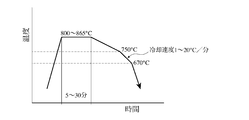
- the austenitizing heat treatment condition is 800 to 865 ° C. for 5 to 30 minutes in order to produce fine austenite crystal grains, and that the eutectoid transformation occurs within the temperature range. It is preferable that the predetermined temperature section is 750 to 670 ° C., and the cooling rate in the temperature section is 1 to 20 ° C./min.
- the spheroidal graphite cast iron of the present invention has a two-phase mixed matrix structure composed of a fine ferrite phase of 2 to 40% and a fine pearlite phase of 60 to 98% in area ratio, and the maximum length of the ferrite phase is 300 ⁇ m or less.
- the pearlite phase is formed around the graphite dispersed in the two-phase mixed matrix structure, the suspension is excellent in strength and toughness, and is required for automobile parts, particularly impact resistance at low temperatures. It is suitable for parts and contributes to reducing fuel consumption of automobiles by reducing the weight of parts.
- the spheroidal graphite cast iron of the present invention and the production method thereof will be described in detail below. Unless otherwise specified, the content of the constituent elements of the alloy is indicated by mass%.
- Si 1.9-2.8% Si is necessary for promoting the crystallization of graphite and enhancing the fluidity of the molten metal.
- Si content is less than 1.9%, chill is likely to be generated, and the machinability and toughness of the spheroidal graphite cast iron are reduced.
- Si content exceeds 2.8%, the effect of suppressing pearlite is increased and the strength of the spheroidal graphite cast iron is reduced.
- the low temperature toughness of the ferrite phase also deteriorates. Therefore, the Si content is 1.9 to 2.8%.
- a preferable Si content is 2.0 to 2.6%.
- Mg 0.02-0.06%
- Mg is an element necessary for spheroidizing graphite, but if its content is less than 0.02%, the effect of spheroidizing graphite is insufficient.
- the Mg content exceeds 0.06%, chill is likely to be generated, and the machinability and low-temperature toughness of spheroidal graphite cast iron are reduced. Therefore, the Mg content is 0.02 to 0.06%.
- the preferred Mg content is 0.03-0.05%.
- Mn 0.2-1%
- Mn is an element that is inevitably mixed from the raw material, and has the effect of precipitating a pearlite phase as a pearlite phase stabilizing element.
- Mn content is less than 0.2%, a pearlite phase cannot be sufficiently generated, and necessary strength such as tensile strength and proof stress cannot be obtained.
- the Mn content that promotes pearlite can be tolerated up to 1%, but if it exceeds 1%, chilling becomes prominent, and the machinability and toughness of spheroidal graphite cast iron deteriorate. For this reason, the Mn content is set to 0.2 to 1%.
- the Mn content is preferably 0.4 to 0.8%, more preferably 0.5 to 0.7%.
- Cu 0.2-2% Cu is necessary for precipitating the pearlite phase as a pearlite phase stabilizing element.
- Cu suppresses the diffusion of carbon from the austenite phase to the graphite particles due to the barrier effect at the interface between the graphite and the matrix, thereby delaying the transformation from the austenite phase to the ferrite phase. It is thought to suppress precipitation and growth. If the Cu content is less than 0.2%, the pearlite phase cannot be sufficiently generated, and the tensile strength of the spheroidal graphite cast iron decreases.
- the Cu content is 0.2-2%.
- the Cu content is preferably 0.4 to 2%, more preferably 0.5 to 1%.
- Sn 0-0.1%
- Sn is not an essential element in the present invention, but it may be added together with Mn and Cu because it is a pearlite phase stabilizing element that precipitates a pearlite phase like Mn and Cu.
- Sn 0.005% or more of Sn is contained, pearlite formation is promoted, and the strength and hardness of the spheroidal graphite cast iron are improved.
- Sn exceeding 0.1% inhibits graphite spheroidization, and segregates at the eutectic cell boundary to lower toughness such as low-temperature impact strength.
- the Sn content is preferably 0.005 to 0.02%, more preferably 0.005 to 0.01%.
- Each element symbol in the above formula indicates the content (%) of each element.
- Cu and Mn are essential elements and contain Sn as required. Since the effect of Sn is almost 10 times that of Mn and Cu, 10 times the Sn content (10 ⁇ Sn) is equivalent to the Mn content and the Cu content.
- (Mn + Cu + 10 ⁇ Sn) is less than 0.85%, a sufficient pearlite phase stabilizing effect cannot be obtained, and the strength such as tensile strength and proof stress becomes insufficient.
- (Mn + Cu + 10 ⁇ Sn) exceeds 3%, precipitation of the pearlite phase becomes excessive, impact strength and elongation at low temperatures are reduced, and toughness is impaired. Therefore, (Mn + Cu + 10 ⁇ Sn) is set to 0.85 to 3%.
- (Mn + Cu + 10 ⁇ Sn) is preferably 1.0 to 2.5%, more preferably 1.0 to 2.0%.
- P 0.05% or less
- P is a graphite spheroidization inhibiting element inevitably mixed from the raw material, so its content is 0.05% or less.
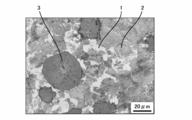
- FIG. 1 is an optical micrograph showing the structure of the spheroidal graphite cast iron of the present invention.
- a white portion 1 is a ferrite phase
- a gray portion 2 is a pearlite phase
- a black lump 3 is spheroidal graphite.
- the matrix structure of the spheroidal graphite cast iron of the present invention is a two-phase mixed structure in which the fine ferrite phase and the fine pearlite phase are distributed in a camouflage pattern (or the fine ferrite phase is dispersed in an island sea shape in the pearlite phase). is there.
- the area ratio of the ferrite phase in the base structure is 2 to 40% (the pearlite phase is 60 to 98%).
- the area ratio of the ferrite phase in the matrix structure is preferably 20 to 40% when spheroidal graphite cast iron is required to have high toughness (60 to 80% for pearlite phase), and spheroidal graphite cast iron requires high strength.
- the content is preferably 2 to 10% (the pearlite phase is 90 to 98%).
- the fine pearlite phase is a pearlite transformed from the fine crystal grains (austenite crystal grains) of the base completely austenitized by the austenitizing heat treatment without coarsening due to the temperature drop.
- the fine ferrite phase is obtained by suppressing the precipitation and growth of the ferrite phase by the pearlite phase stabilizing element and by suppressing the precipitation and growth of the ferrite phase by heat treatment in the eutectoid transformation temperature range. It is formed along the boundary.
- the fine ferrite phase is not network-like, but has an elongated shape divided by pearlite crystal grains. Such a ferrite phase shape may be called “dendritic”.
- the degree of “fineness” of the ferrite phase can be expressed by the maximum length of the ferrite phase.
- the shorter the maximum length of the ferrite phase the more the ferrite phase is divided by the pearlite crystal grains, and the ferrite phase is refined.
- the maximum length of the ferrite phase is preferably 300 ⁇ m or less. If the maximum length of the ferrite phase exceeds 300 ⁇ m, it cannot be said that the ferrite phase is refined, and the spheroidal graphite cast iron does not have sufficient strength due to the presence of the coarse ferrite phase.
- the maximum length of the ferrite phase is more preferably 200 ⁇ m or less, and most preferably 150 ⁇ m or less. The maximum length of the ferrite phase can be obtained on an optical micrograph.
- the precipitation amount of the pearlite phase around the graphite is expressed by the ratio of the graphite peripherite.
- the “graphite circumferential pearlite ratio” is defined as the percentage of the length of the portion of the graphite outer periphery that is in contact with the pearlite phase.
- the ratio of the number of graphite having a graphite peripheral pearlite conversion rate of 50 to 95% is 50% or more with respect to the total number of graphite per unit area.
- the ratio of the number of graphites is less than 50%, the interface between graphite and ferrite phase, which is likely to be the starting point of cracking, increases, and the impact characteristics at low temperatures are deteriorated.
- the ratio of the number of graphites having a graphite peripheral pearlite conversion rate of 50 to 95% is more preferably 60% or more, and most preferably 70% or more.
- the graphite to be counted is graphite having a diameter of 5 ⁇ m or more in terms of a circle equivalent diameter.
- Cracks in spheroidal graphite cast iron mainly occur at grain boundaries or the interface between graphite and matrix, and the energy absorbed in the process of fracture is the sum of crack initiation energy and crack propagation energy. In general, most of the absorbed energy is crack generation energy, and the higher the hardness of the base structure, the higher the ratio of crack generation energy to the absorbed energy.
- the spheroidal graphite cast iron of the present invention having the structure having the characteristics described in the above (1) and (2) has excellent strength and toughness since the occurrence of cracks is suppressed by the following action. (a) In a two-phase mixed structure, cracks are unlikely to occur because the pearlite grains refined have a small accumulation of strain at the grain boundary when an external force is applied.
- the crack propagation path contains alternating ferrite phases that are easily deformed and pearlite phases that are difficult to deform. Absorbed by deformation of ferrite phase.
- a high-strength pearlite phase surrounds the graphite, the base near the graphite is strengthened, and the generation of cracks at the interface between the graphite and the base is suppressed.
- the spheroidal graphite cast iron of the present invention preferably has a tensile strength of 650 MPa or more and an impact strength by a notched Charpy impact test at ⁇ 30 ° C. of 30 J / cm 2 or more.
- the tensile strength is more preferably 700 MPa or more, most preferably 750 MPa or more.
- the impact strength by the unnotched Charpy impact test at ⁇ 30 ° C. is more preferably 40 J / cm 2 or more, and most preferably 50 J / cm 2 or more.
- the spheroidal graphite cast iron of the present invention preferably has a 0.2% proof stress of 370 MPa or more and an elongation of 8% or more.
- the 0.2% proof stress of the spheroidal graphite cast iron of the present invention is more preferably 400 MPa or more, most preferably 430 MPa or more, and the elongation is more preferably 12% or more, and most preferably 13% or more.
- [C] Production Method of Spheroidal Graphite Cast Iron The production method of the spheroidal graphite cast iron of the present invention is as follows: (1) Mass ratio: C: 3.4 to 4%, Si: 1.9 to 2.8%, Mg: 0.02 to 0.06%, Mn: 0.2 to 1%, Cu: 0.2 to 2%, Sn: 0 to 0.1%, (Mn + Cu + 10 ⁇ Sn): 0.85 to 3%, P: 0.05% or less, S: 0.02% or less, remaining Fe and inevitable impurities After casting and melting the molten metal having the composition, (2) (i) By maintaining the entire base at a temperature at which it becomes austenite, fine austenite crystal grains (transformed into pearlite crystal grains after cooling) are generated.
- FIG. 3 schematically shows a heat treatment pattern for producing the spheroidal graphite cast iron of the present invention.
- Austenitic heat treatment conditions By maintaining the temperature at which the entire base structure is completely austenitized, fine austenite crystal grains (transformed into pearlite crystal grains after cooling) are generated.
- the austenitizing temperature is preferably 800 to 865 ° C. When this temperature is less than 800 ° C., the pearlite phase remains, and since the ferrite phase is generated and grows from the pearlite phase after the temperature falls to the eutectoid transformation temperature range, the crystal grains become coarse and the strength decreases.
- this temperature exceeds 865 ° C., austenite crystal grains (transformed into pearlite crystal grains after cooling down) become coarse, toughness, particularly impact properties at low temperatures deteriorate, and heat treatment strain increases.
- the holding time at the austenitizing temperature varies depending on the holding temperature, but is preferably 5 to 30 minutes. If it is less than 5 minutes, it becomes difficult to fully austenite, and the ferrite phase grows and the strength decreases, and if it exceeds 30 minutes, the austenite crystal grains become coarse, a fine pearlite phase cannot be obtained after cooling, the toughness deteriorates, and heat treatment Strain increases.
- the austenitizing heat treatment temperature is preferably 800 to 860 ° C, more preferably 800 to 855 ° C.
- the austenitizing heat treatment time is preferably 10 to 25 minutes.
- the temperature range where eutectoid transformation occurs is the cooling process in the heat treatment, from the temperature Ar 3 at which transformation from austenite to ferrite starts, and the transformation of austenite to ferrite or ferrite and cementite.
- the temperature range up to the completion temperature Ar 1 (eutectoid transformation temperature).
- the predetermined temperature range within the temperature range causing the eutectoid transformation is preferably 750 to 670 ° C. When cooled at a predetermined cooling rate described later in a temperature range of 750 to 670 ° C., a two-phase mixed structure is obtained.
- the upper limit of the predetermined temperature section may be 730 ° C.
- the cooling rate in a predetermined temperature section within the temperature range where eutectoid transformation occurs is important for making the matrix structure a two-phase mixed structure and generating a pearlite phase around the graphite. Specifically, 1 to 20 ° C / Minutes are preferred. When the cooling rate is less than 1 ° C./min, ferrite formation around the graphite is promoted, and a fine ferrite phase cannot be obtained, resulting in a decrease in strength. On the other hand, if the cooling rate exceeds 20 ° C./min, the ferrite phase is insufficiently formed at the pearlite grain boundaries, the impact properties at low temperatures deteriorate, and sufficient toughness cannot be obtained. A more preferable cooling rate is 5 to 15 ° C./min.
- the temperature history in a predetermined temperature section within the temperature range where eutectoid transformation occurs is a continuous rate at a constant rate as long as a fine ferrite phase is generated at the pearlite grain boundary without excess and deficiency and a pearlite phase is generated around graphite. Cooling or intermittent cooling may be used. After heat treatment in the eutectoid transformation temperature range, cool to room temperature.
- the cooling rate from the austenitizing temperature to the eutectoid transformation temperature range is preferably 2 to 20 ° C./min.
- Molten iron, steel plate scrap and spheroidal graphite cast iron return scrap which are raw materials, are melted in a high-frequency melting furnace with a capacity of 100 kg, and a carburetor, a pearlite phase stabilizing element, and an Fe-Si alloy are added to melt the component adjusted melt.
- a molten metal as a graphite spheroidizing agent, a ladle in which a Fe-Si-Mg alloy and a cover material made of steel plate covering the molten metal were installed was poured out at about 1500 ° C. and subjected to a spheroidizing process by a sandwich method.
- the spheroidized molten metal was poured into a sand mold at about 1400 ° C. to cast a plurality of 1 inch Y blocks.
- Fe-Si alloy powder was added to the molten metal stream and inoculated.
- spheroidal graphite cast iron having the composition shown in Table 1 was obtained.
- Cast irons A to I are spheroidal graphite cast irons within the composition range of the present invention
- cast irons J to L are spheroidal graphite cast irons outside the composition range of the present invention.
- the cast iron A to L the cast iron A is spheroidal graphite cast iron having a composition range disclosed in Japanese Patent Laid-Open No. 8-13079.
- cast iron F corresponds to FCD700 having a pearlite phase base
- cast iron K corresponds to FCD450 having a ferrite phase base, both of which are the same as conventional spheroidal graphite cast iron as-cast.
- test piece Cut out a test piece of about 25 mm square and about 170 mm long from the lower part of the Y block made of cast iron A to L, and perform the austenitizing heat treatment and heat treatment in the eutectoid transformation temperature range under the heat treatment conditions shown in Table 2. It was.
- specimens with one-digit or tenth digits added to the alphabet such as A1, B1... E10, E11 are specimens heat-treated under the conditions of the present invention
- A51, D51 ⁇ L51 is a test material that is heat treated under conditions outside the scope of the present invention.
- Specimen A51 is a specimen subjected to austenitizing heat treatment under the same conditions as described in JP-A-8-13079.
- Specimen D51 is a specimen that was heat-treated in the eutectoid transformation temperature range under the same conditions as described in JP-A-2001-214233.
- the test materials F51 and K52 are an as-cast test material of cast iron F equivalent to FCD700 and an as-cast test material of cast iron K equivalent to FCD450, respectively. The following tests were performed on each sample material.
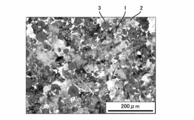
- FIGS. 1 and 2 are optical micrographs showing the structure of the specimen F1 (the spheroidal graphite cast iron of the present invention). 1 and 2, the white portion 1 is a ferrite phase, the gray portion 2 is a pearlite phase, and the black lump 3 is spheroidal graphite. As shown in FIG. 1 and FIG. 2, the spheroidal graphite cast iron of the present invention has a matrix structure in which a fine ferrite phase and a fine pearlite phase are mixed in a complicated manner. It had the structure
- the maximum length of the ferrite phase and the ratio of the number of graphite having a graphite peripheral pearlite conversion rate of 50 to 95% were determined.
- the maximum length of the ferrite phase is determined by tracing the longest ferrite phase outline on the tracing paper in the field of view (530 ⁇ m x 710 ⁇ m) of the optical micrograph of the tissue (magnification 100 times), and then the both ends of the maximum distance of the contour.
- IP-1000 manufactured by Asahi Kasei Corporation.
- Peripheralization rate of graphite is the total number Na of graphite having an equivalent circle diameter of 5 ⁇ m or more among the graphite in the field of view observed with an optical microscope, and the outline of the counted graphite and the outline of the pearlite phase in contact with the graphite are obtained. Trace on the tracing paper, and measure the length Lg of each graphite outer periphery and the length Lp of the perimeter of each pearlite phase in contact with each graphite contour using the above image analyzer, and Lp / Lg ⁇ 100 (% ), And the obtained value was obtained by averaging all the counted graphites.
- the ratio of the number of graphites with a graphite peripheration rate of 50 to 95% is calculated by counting the number Np of graphite with a graphite periphery rate of 50 to 95% and calculating Np / Na x 100 (%).
- the maximum length of the ferrite phase and the ratio of the number of graphite having a graphite peripheral pearlite conversion rate of 50 to 95% are both average values obtained from arbitrary five visual fields. The results are shown in Table 2.
- the area ratio of ferrite phase is (100-area ratio of pearlite phase)%.
- test materials consisting of cast irons A to I within the composition range of the present invention all of the test materials A1 to I1 heat-treated under the conditions of the present invention are a fine ferrite phase and a fine pearlite phase.
- the maximum length of the ferrite phase is 300 ⁇ m or less
- the ratio of the number of graphite with a graphite perlite conversion rate of 50 to 95% is 50% or more
- tensile The strength was 650 MPa or more
- the unnotched Charpy impact strength at ⁇ 30 ° C. was 30 J / cm 2 or more. From these data, it can be seen that the test materials A1 to I1 within the scope of the present invention have high strength and toughness.
- Table 2 shows that the strength is improved by increasing the content of the pearlite phase stabilizing element and increasing the cooling rate in the eutectoid transformation temperature range.
- specimens J51 and K51 having a low pearlite phase stabilizing element content outside the composition range of the present invention have low tensile strengths of 509 MPa and 637 MPa, respectively, even when heat-treated under the conditions of the present invention. I only had it.
- the test material L51 outside the composition range of the present invention with a large content of the pearlite phase stabilizing element has a high tensile strength of 866 MPa, but has a low impact strength of 15.1 J / cm 2 , The requirement of combining high strength and toughness was not met.
- sample material E51 which is within the composition range of the present invention but has an austenitizing temperature lower than that of the present invention at 790 ° C., had a tensile strength as low as 618 MPa. This is presumably because the austenitizing temperature was too low and the pearlite phase remained, so that the ferrite phase grew from the residual pearlite phase after the temperature fell to the eutectoid transformation temperature range, and the crystal grains became coarse.
- the test material A1 to G1 within the composition range of the present invention has an unnotched Charpy impact strength at ⁇ 30 ° C. of 40 J / cm 2 or more.
- Specimen K52 outside the scope of the present invention is an as-cast (no heat treatment) spheroidal graphite cast iron composed of a ferrite phase matrix and has a notch-free Charpy impact strength of 39.2 J / cm 2 . From this, it was found that the impact strength of the test materials A1 to G1 of the present invention is equal to or higher than that of FCD450.
- test materials F1 and F51 are made of cast iron F (equivalent to FCD700) with (Mn + Cu + 10 ⁇ Sn) of 1.26%, and the test material F1 was heat-treated under the conditions of the present invention. Had a perlite phase base.
- the specimen F1 of the present invention has a tensile strength equivalent to that of the specimen F51, and is 52.3 J / cm 2, which is about 4 times as high as 13.3 J / cm 2 of the specimen F51. It was found to have impact strength.
- the test material A51 in which the austenitizing heat treatment conditions were the same as that of Japanese Patent Laid-Open No. 8-13079, 870 ° C. ⁇ 60 minutes, high temperature and long time had a low impact strength of 10.5 J / cm 2 .
- specimen E52 having an austenitizing temperature as high as 870 ° C. had a low impact strength of 7.8 J / cm 2 .
- the impact strength of the test materials A51 and E52 was considered to be because the austenite crystal grains (transformed into pearlite crystal grains after cooling) were coarsened and the toughness was lowered due to the high austenitizing temperature.
- Specimen D51 is a specimen within the composition range of the present invention, but the heat treatment conditions in the eutectoid transformation temperature range are the same as those in JP-A-2001-214233.
- the heat treatment conditions (within the eutectoid transformation temperature range) for the test material D51 in the temperature range of 750 to 670 ° C. were air cooling at a cooling rate of 50 ° C./min.
- the specimen D51 had high tensile strength, but the impact strength was as low as 19.5 J / cm 2 . This is presumably because the cooling rate in the eutectoid transformation temperature range was too high, and the formation of ferrite phase at the pearlite grain boundaries was insufficient, resulting in a decrease in toughness.
- the spheroidal graphite cast iron of the present invention is a spheroidal graphite cast iron having tensile strength equivalent to FCD700 and impact strength equivalent to FCD450, and having excellent strength and toughness.
Landscapes
- Chemical & Material Sciences (AREA)
- Engineering & Computer Science (AREA)
- Materials Engineering (AREA)
- Mechanical Engineering (AREA)
- Metallurgy (AREA)
- Organic Chemistry (AREA)
- Physics & Mathematics (AREA)
- Thermal Sciences (AREA)
- Crystallography & Structural Chemistry (AREA)
- Refinement Of Pig-Iron, Manufacture Of Cast Iron, And Steel Manufacture Other Than In Revolving Furnaces (AREA)
- Heat Treatment Of Steel (AREA)
Priority Applications (5)
| Application Number | Priority Date | Filing Date | Title |
|---|---|---|---|
| US14/369,497 US10087509B2 (en) | 2011-12-28 | 2012-12-28 | Spheroidal graphite cast iron having excellent strength and toughness and its production method |
| CN201280065426.4A CN104024450B (zh) | 2011-12-28 | 2012-12-28 | 强度和韧性优异的球状石墨铸铁及其制造方法 |
| KR1020147018077A KR101957274B1 (ko) | 2011-12-28 | 2012-12-28 | 강도 및 인성이 우수한 구형 흑연 주철 및 그 제조 방법 |
| JP2013551867A JP6079641B2 (ja) | 2011-12-28 | 2012-12-28 | 強度及び靭性に優れた球状黒鉛鋳鉄及びその製造方法 |
| EP12861849.3A EP2799565B1 (fr) | 2011-12-28 | 2012-12-28 | Fonte à graphite sphéroïdal présentant une résistance et une ductilité exceptionnelles et son procédé de fabrication |
Applications Claiming Priority (2)
| Application Number | Priority Date | Filing Date | Title |
|---|---|---|---|
| JP2011-288986 | 2011-12-28 | ||
| JP2011288986 | 2011-12-28 |
Publications (1)
| Publication Number | Publication Date |
|---|---|
| WO2013100148A1 true WO2013100148A1 (fr) | 2013-07-04 |
Family
ID=48697625
Family Applications (1)
| Application Number | Title | Priority Date | Filing Date |
|---|---|---|---|
| PCT/JP2012/084215 Ceased WO2013100148A1 (fr) | 2011-12-28 | 2012-12-28 | Fonte à graphite sphéroïdal présentant une résistance et une ductilité exceptionnelles et son procédé de fabrication |
Country Status (6)
| Country | Link |
|---|---|
| US (1) | US10087509B2 (fr) |
| EP (1) | EP2799565B1 (fr) |
| JP (1) | JP6079641B2 (fr) |
| KR (1) | KR101957274B1 (fr) |
| CN (1) | CN104024450B (fr) |
| WO (1) | WO2013100148A1 (fr) |
Cited By (9)
| Publication number | Priority date | Publication date | Assignee | Title |
|---|---|---|---|---|
| JP2017039977A (ja) * | 2015-08-20 | 2017-02-23 | 虹技株式会社 | 球状黒鉛鋳鉄とその製造方法 |
| US20180112294A1 (en) * | 2015-03-30 | 2018-04-26 | Kabushiki Kaisha Riken | High rigid spheroidal graphite cast iron |
| JP2018204082A (ja) * | 2017-06-08 | 2018-12-27 | 青梅鋳造 株式会社 | 球状黒鉛鋳鉄及びその製造方法 |
| JP2018204083A (ja) * | 2017-06-08 | 2018-12-27 | 青梅鋳造 株式会社 | 球状黒鉛鋳鉄及びその製造方法 |
| JP2019119924A (ja) * | 2018-01-11 | 2019-07-22 | トヨタ自動車株式会社 | 球状黒鉛鋳鉄 |
| JP2020183558A (ja) * | 2019-05-07 | 2020-11-12 | 株式会社リケン | 球状黒鉛鋳鉄、および球状黒鉛鋳鉄の製造方法と、自動車足回り用部品 |
| JP2021042432A (ja) * | 2019-09-11 | 2021-03-18 | 日立造船株式会社 | 球状黒鉛鋳鉄を用いた研磨定盤 |
| JP2021059752A (ja) * | 2019-10-07 | 2021-04-15 | 日立金属株式会社 | 強度及び靭性に優れ、かつ低硬度な球状黒鉛鋳鉄 |
| US12522901B2 (en) | 2016-03-24 | 2026-01-13 | Proterial, Ltd. | Spheroidal graphite cast iron, cast article and automobile structure part made thereof, and method for producing spheroidal graphite cast iron article |
Families Citing this family (12)
| Publication number | Priority date | Publication date | Assignee | Title |
|---|---|---|---|---|
| CN104526274A (zh) * | 2014-12-02 | 2015-04-22 | 芜湖福司精密模具有限公司 | 一种打夯机底座的制造方法 |
| DE102015111915A1 (de) * | 2015-07-22 | 2017-01-26 | Eickhoff Gießerei GmbH | Ferritisches Gusseisen mit Kugelgraphit |
| CN108138275B (zh) * | 2015-09-30 | 2020-10-27 | 日立金属株式会社 | 耐气体缺陷性优异的球状石墨铸铁 |
| CN107090562A (zh) * | 2017-04-20 | 2017-08-25 | 龙邹 | 一种铸铁汽车后桥及其制备方法 |
| CN106929749A (zh) * | 2017-04-21 | 2017-07-07 | 龙邹 | 一种铸铁齿轮及其制备方法 |
| US20200095655A1 (en) * | 2018-09-20 | 2020-03-26 | GM Global Technology Operations LLC | As-cast high strength nodular iron with favorable machinability |
| CN111876656B (zh) * | 2020-07-14 | 2022-03-15 | 东风汽车零部件(集团)有限公司通用铸锻分公司 | 一种Mn-Cu系球墨铸铁成形模具毛坯及其热处理方法 |
| CN111876657A (zh) * | 2020-07-16 | 2020-11-03 | 阜新宏顺机械有限公司 | 一种超低温球墨铸铁及其制备方法 |
| CN112430774A (zh) * | 2020-10-27 | 2021-03-02 | 宁国东方碾磨材料股份有限公司 | 一种大型球磨机用高抗磨强韧性衬板及其制备工艺 |
| CN115074609B (zh) * | 2022-07-05 | 2022-12-06 | 襄阳金耐特机械股份有限公司 | 一种低残余应力、高弹性模量球墨铸铁及其应用 |
| CN116043098A (zh) * | 2022-12-08 | 2023-05-02 | 新兴铸管股份有限公司 | 一种水冷金属型离心球墨铸铁管及其制备方法 |
| CN118109745A (zh) * | 2024-02-18 | 2024-05-31 | 烟台杰瑞石油服务集团股份有限公司 | 箱体和箱体的3d打印铸造工艺 |
Citations (6)
| Publication number | Priority date | Publication date | Assignee | Title |
|---|---|---|---|---|
| JPS51123719A (en) * | 1975-04-22 | 1976-10-28 | Katsuya Igawa | Tough spherical graphite cast-iron and heat treatment thereof |
| JPH0813079A (ja) | 1994-07-01 | 1996-01-16 | Mazda Motor Corp | 球状黒鉛鋳鉄とその製造方法 |
| JP2001214233A (ja) | 2000-01-28 | 2001-08-07 | Hitachi Metals Ltd | 高剛性・高耐衝撃性球状黒鉛鋳鉄部材 |
| JP2002317238A (ja) * | 2001-04-23 | 2002-10-31 | Tokyo Tekko Co Ltd | 鋳放し球状黒鉛鋳鉄品の組織 |
| JP2009001865A (ja) * | 2007-06-21 | 2009-01-08 | Asahi Tec Corp | 球状黒鉛鋳鉄部材 |
| JP2010189706A (ja) * | 2009-02-18 | 2010-09-02 | Kurimoto Ltd | 球状黒鉛鋳鉄管およびその製造方法 |
Family Cites Families (6)
| Publication number | Priority date | Publication date | Assignee | Title |
|---|---|---|---|---|
| US4099994A (en) | 1975-04-22 | 1978-07-11 | Riken Piston Ring Industrial Co. Ltd. | High duty ductile case iron and its heat treatment method |
| JPS586922A (ja) | 1981-07-06 | 1983-01-14 | Takaoka Kogyo Kk | 鋳放しパ−ライト地球状黒鉛鋳鉄の製造方法 |
| JP2599780B2 (ja) | 1988-12-26 | 1997-04-16 | 日立金属株式会社 | 高速回転部材の製造法 |
| US5346561A (en) | 1992-02-27 | 1994-09-13 | Hitachi Metals, Ltd. | Spheroidal graphite cast iron member having improved mechanical strength hand method of producing same |
| JP3204293B2 (ja) * | 1996-04-29 | 2001-09-04 | 日立金属株式会社 | 球状黒鉛鋳鉄部材の製造方法 |
| CN102115801B (zh) * | 2011-03-31 | 2014-05-21 | 芜湖市金贸流体科技股份有限公司 | 一种优质球墨铸铁的生产方法及由其制备的球墨铸铁 |
-
2012
- 2012-12-28 WO PCT/JP2012/084215 patent/WO2013100148A1/fr not_active Ceased
- 2012-12-28 US US14/369,497 patent/US10087509B2/en active Active
- 2012-12-28 KR KR1020147018077A patent/KR101957274B1/ko active Active
- 2012-12-28 JP JP2013551867A patent/JP6079641B2/ja active Active
- 2012-12-28 CN CN201280065426.4A patent/CN104024450B/zh active Active
- 2012-12-28 EP EP12861849.3A patent/EP2799565B1/fr active Active
Patent Citations (6)
| Publication number | Priority date | Publication date | Assignee | Title |
|---|---|---|---|---|
| JPS51123719A (en) * | 1975-04-22 | 1976-10-28 | Katsuya Igawa | Tough spherical graphite cast-iron and heat treatment thereof |
| JPH0813079A (ja) | 1994-07-01 | 1996-01-16 | Mazda Motor Corp | 球状黒鉛鋳鉄とその製造方法 |
| JP2001214233A (ja) | 2000-01-28 | 2001-08-07 | Hitachi Metals Ltd | 高剛性・高耐衝撃性球状黒鉛鋳鉄部材 |
| JP2002317238A (ja) * | 2001-04-23 | 2002-10-31 | Tokyo Tekko Co Ltd | 鋳放し球状黒鉛鋳鉄品の組織 |
| JP2009001865A (ja) * | 2007-06-21 | 2009-01-08 | Asahi Tec Corp | 球状黒鉛鋳鉄部材 |
| JP2010189706A (ja) * | 2009-02-18 | 2010-09-02 | Kurimoto Ltd | 球状黒鉛鋳鉄管およびその製造方法 |
Cited By (14)
| Publication number | Priority date | Publication date | Assignee | Title |
|---|---|---|---|---|
| US20180112294A1 (en) * | 2015-03-30 | 2018-04-26 | Kabushiki Kaisha Riken | High rigid spheroidal graphite cast iron |
| US10745784B2 (en) * | 2015-03-30 | 2020-08-18 | Kabushiki Kaisha Riken | High rigid spheroidal graphite cast iron |
| JP2017039977A (ja) * | 2015-08-20 | 2017-02-23 | 虹技株式会社 | 球状黒鉛鋳鉄とその製造方法 |
| US12522901B2 (en) | 2016-03-24 | 2026-01-13 | Proterial, Ltd. | Spheroidal graphite cast iron, cast article and automobile structure part made thereof, and method for producing spheroidal graphite cast iron article |
| JP2018204082A (ja) * | 2017-06-08 | 2018-12-27 | 青梅鋳造 株式会社 | 球状黒鉛鋳鉄及びその製造方法 |
| JP2018204083A (ja) * | 2017-06-08 | 2018-12-27 | 青梅鋳造 株式会社 | 球状黒鉛鋳鉄及びその製造方法 |
| JP2019119924A (ja) * | 2018-01-11 | 2019-07-22 | トヨタ自動車株式会社 | 球状黒鉛鋳鉄 |
| JP2020183558A (ja) * | 2019-05-07 | 2020-11-12 | 株式会社リケン | 球状黒鉛鋳鉄、および球状黒鉛鋳鉄の製造方法と、自動車足回り用部品 |
| US11946109B2 (en) | 2019-05-07 | 2024-04-02 | Kabushiki Kaisha Riken | Spheroidal graphite cast iron and method of producing spheroidal graphite cast iron, and vehicle undercarriage parts |
| WO2020226037A1 (fr) * | 2019-05-07 | 2020-11-12 | 株式会社リケン | Fonte à graphite sphéroïdal, procédé de fabrication de fonte à graphite sphéroïdal et pièces pour périphérie de roue de véhicule |
| JP2021042432A (ja) * | 2019-09-11 | 2021-03-18 | 日立造船株式会社 | 球状黒鉛鋳鉄を用いた研磨定盤 |
| JP7300351B2 (ja) | 2019-09-11 | 2023-06-29 | 日立造船株式会社 | 球状黒鉛鋳鉄を用いた研磨定盤 |
| JP2021059752A (ja) * | 2019-10-07 | 2021-04-15 | 日立金属株式会社 | 強度及び靭性に優れ、かつ低硬度な球状黒鉛鋳鉄 |
| JP7380051B2 (ja) | 2019-10-07 | 2023-11-15 | 株式会社プロテリアル | 強度及び靭性に優れ、かつ低硬度な球状黒鉛鋳鉄 |
Also Published As
| Publication number | Publication date |
|---|---|
| KR101957274B1 (ko) | 2019-03-12 |
| JP6079641B2 (ja) | 2017-02-15 |
| KR20140107351A (ko) | 2014-09-04 |
| EP2799565B1 (fr) | 2017-11-08 |
| EP2799565A1 (fr) | 2014-11-05 |
| EP2799565A4 (fr) | 2015-07-15 |
| US10087509B2 (en) | 2018-10-02 |
| CN104024450A (zh) | 2014-09-03 |
| US20140352851A1 (en) | 2014-12-04 |
| CN104024450B (zh) | 2017-03-29 |
| JPWO2013100148A1 (ja) | 2015-05-11 |
Similar Documents
| Publication | Publication Date | Title |
|---|---|---|
| JP6079641B2 (ja) | 強度及び靭性に優れた球状黒鉛鋳鉄及びその製造方法 | |
| CN106661705B (zh) | 渗碳合金钢及其制备方法和应用 | |
| US8333923B2 (en) | High strength gray cast iron | |
| KR102223539B1 (ko) | 구상 흑연 주철 | |
| JP4825886B2 (ja) | フェライト系球状黒鉛鋳鉄 | |
| WO2010125841A1 (fr) | Acier moulé ferritique résistant à la chaleur et composant de système d'échappement | |
| CN102747305A (zh) | 地热发电涡轮机转子用低合金钢和地热发电涡轮机转子用低合金材料及其制造方法 | |
| JP2013253277A (ja) | マルエージング鋼 | |
| CN103952621A (zh) | 一种钒钛灰铸铁及其生产工艺 | |
| CN102383044B (zh) | 用于制造轧辊的多元高速钢 | |
| JP5753365B2 (ja) | 高クロム鋳鉄 | |
| CN106103766A (zh) | 耐热球状石墨铸铁、其制造方法及包含其的发动机排气系统 | |
| WO2017017989A1 (fr) | Matériau en acier coulé | |
| JP5379651B2 (ja) | 冷間加工用鋼材およびその製造方法ならびに冷間加工部品 | |
| JP7287448B1 (ja) | 浸炭用温間鍛造部品及びその製造方法 | |
| JP6328968B2 (ja) | 球状黒鉛鋳鉄、及び球状黒鉛鋳鉄の製造方法 | |
| JP2007154295A (ja) | 耐摩耗性鋳鋼およびその製造方法 | |
| JP5475380B2 (ja) | オーステナイト系鋳鉄とその製造方法およびオーステナイト系鋳鉄鋳物 | |
| CN113795604A (zh) | 球墨铸铁和球墨铸铁的制造方法、以及车辆底盘用部件 | |
| JP7380051B2 (ja) | 強度及び靭性に優れ、かつ低硬度な球状黒鉛鋳鉄 | |
| US20110256017A1 (en) | High temperature cast iron with niobium and having compacted graphite structures | |
| KR20130046916A (ko) | 고탄소강 및 그 제조 방법 | |
| JP2008057027A (ja) | 耐熱性および耐食性に優れた鋳鉄 |
Legal Events
| Date | Code | Title | Description |
|---|---|---|---|
| 121 | Ep: the epo has been informed by wipo that ep was designated in this application |
Ref document number: 12861849 Country of ref document: EP Kind code of ref document: A1 |
|
| ENP | Entry into the national phase |
Ref document number: 2013551867 Country of ref document: JP Kind code of ref document: A |
|
| WWE | Wipo information: entry into national phase |
Ref document number: 14369497 Country of ref document: US |
|
| ENP | Entry into the national phase |
Ref document number: 20147018077 Country of ref document: KR Kind code of ref document: A |
|
| NENP | Non-entry into the national phase |
Ref country code: DE |
|
| REEP | Request for entry into the european phase |
Ref document number: 2012861849 Country of ref document: EP |
|
| WWE | Wipo information: entry into national phase |
Ref document number: 2012861849 Country of ref document: EP |