WO2013100494A1 - Procédé de préparation de copolymère polysiloxane - polycarbonate - Google Patents
Procédé de préparation de copolymère polysiloxane - polycarbonate Download PDFInfo
- Publication number
- WO2013100494A1 WO2013100494A1 PCT/KR2012/011232 KR2012011232W WO2013100494A1 WO 2013100494 A1 WO2013100494 A1 WO 2013100494A1 KR 2012011232 W KR2012011232 W KR 2012011232W WO 2013100494 A1 WO2013100494 A1 WO 2013100494A1
- Authority
- WO
- WIPO (PCT)
- Prior art keywords
- group
- polysiloxane
- chemical formula
- polycarbonate
- hydroxy
- Prior art date
- Legal status (The legal status is an assumption and is not a legal conclusion. Google has not performed a legal analysis and makes no representation as to the accuracy of the status listed.)
- Ceased
Links
- GYRFHNRGVXMFFF-UHFFFAOYSA-N CC(CCCc1ccccc1O)(C1)[Si]1(C)O[Si](C)(C)CCCc(cccc1)c1O Chemical compound CC(CCCc1ccccc1O)(C1)[Si]1(C)O[Si](C)(C)CCCc(cccc1)c1O GYRFHNRGVXMFFF-UHFFFAOYSA-N 0.000 description 1
Images
Classifications
-
- C—CHEMISTRY; METALLURGY
- C08—ORGANIC MACROMOLECULAR COMPOUNDS; THEIR PREPARATION OR CHEMICAL WORKING-UP; COMPOSITIONS BASED THEREON
- C08G—MACROMOLECULAR COMPOUNDS OBTAINED OTHERWISE THAN BY REACTIONS ONLY INVOLVING UNSATURATED CARBON-TO-CARBON BONDS
- C08G64/00—Macromolecular compounds obtained by reactions forming a carbonic ester link in the main chain of the macromolecule
- C08G64/18—Block or graft polymers
- C08G64/186—Block or graft polymers containing polysiloxane sequences
-
- C—CHEMISTRY; METALLURGY
- C08—ORGANIC MACROMOLECULAR COMPOUNDS; THEIR PREPARATION OR CHEMICAL WORKING-UP; COMPOSITIONS BASED THEREON
- C08G—MACROMOLECULAR COMPOUNDS OBTAINED OTHERWISE THAN BY REACTIONS ONLY INVOLVING UNSATURATED CARBON-TO-CARBON BONDS
- C08G64/00—Macromolecular compounds obtained by reactions forming a carbonic ester link in the main chain of the macromolecule
- C08G64/18—Block or graft polymers
-
- C—CHEMISTRY; METALLURGY
- C08—ORGANIC MACROMOLECULAR COMPOUNDS; THEIR PREPARATION OR CHEMICAL WORKING-UP; COMPOSITIONS BASED THEREON
- C08G—MACROMOLECULAR COMPOUNDS OBTAINED OTHERWISE THAN BY REACTIONS ONLY INVOLVING UNSATURATED CARBON-TO-CARBON BONDS
- C08G77/00—Macromolecular compounds obtained by reactions forming a linkage containing silicon with or without sulfur, nitrogen, oxygen or carbon in the main chain of the macromolecule
- C08G77/42—Block-or graft-polymers containing polysiloxane sequences
- C08G77/448—Block-or graft-polymers containing polysiloxane sequences containing polycarbonate sequences
-
- C—CHEMISTRY; METALLURGY
- C08—ORGANIC MACROMOLECULAR COMPOUNDS; THEIR PREPARATION OR CHEMICAL WORKING-UP; COMPOSITIONS BASED THEREON
- C08L—COMPOSITIONS OF MACROMOLECULAR COMPOUNDS
- C08L83/00—Compositions of macromolecular compounds obtained by reactions forming in the main chain of the macromolecule a linkage containing silicon with or without sulfur, nitrogen, oxygen or carbon only; Compositions of derivatives of such polymers
- C08L83/04—Polysiloxanes
-
- C—CHEMISTRY; METALLURGY
- C08—ORGANIC MACROMOLECULAR COMPOUNDS; THEIR PREPARATION OR CHEMICAL WORKING-UP; COMPOSITIONS BASED THEREON
- C08L—COMPOSITIONS OF MACROMOLECULAR COMPOUNDS
- C08L83/00—Compositions of macromolecular compounds obtained by reactions forming in the main chain of the macromolecule a linkage containing silicon with or without sulfur, nitrogen, oxygen or carbon only; Compositions of derivatives of such polymers
- C08L83/10—Block- or graft-copolymers containing polysiloxane sequences
-
- C—CHEMISTRY; METALLURGY
- C08—ORGANIC MACROMOLECULAR COMPOUNDS; THEIR PREPARATION OR CHEMICAL WORKING-UP; COMPOSITIONS BASED THEREON
- C08G—MACROMOLECULAR COMPOUNDS OBTAINED OTHERWISE THAN BY REACTIONS ONLY INVOLVING UNSATURATED CARBON-TO-CARBON BONDS
- C08G77/00—Macromolecular compounds obtained by reactions forming a linkage containing silicon with or without sulfur, nitrogen, oxygen or carbon in the main chain of the macromolecule
- C08G77/04—Polysiloxanes
- C08G77/14—Polysiloxanes containing silicon bound to oxygen-containing groups
- C08G77/16—Polysiloxanes containing silicon bound to oxygen-containing groups to hydroxy groups
Definitions
- the present invention relates to a method of preparing polysiloxane-polycarbonate copolymer. More specifically, the present invention relates to a method of preparing polysiloxane-polycarbonate copolymer which can improve a silicon monomer reaction ratio and secure superior low-temperature impact resistance and ductility ratio by controlling the addition time of silicon monomer depending on the molecular weight of oligomeric polycarbonate in the synthesis of the polysiloxane-polycarbonate copolymer.
- Polycarbonate has good mechanical properties such as tensile strength, impact resistance, etc. and also has good dimensional stability, heat resistance and optical transparency. Thus, it has been extensively used in many industries. However, although polycarbonate has good impact resistance at room temperature, its impact resistance is rapidly deteriorated at low temperature.
- polysiloxane-polycarbonate copolymer consists of a beginning step, an oligomerization step, a first polymerization step and second polymerization step.
- a silicon monomer is added at the oligomerization step, and an intermediate is formed via a reaction with an oligomeric polycarbonate.
- Such synthesis of polysiloxane-polycarbonate copolymer is through an interfacial reaction which occurs at the interface between a heavy liquid of methylene chloride (MC) layer and a light liquid of water layer.
- MC methylene chloride
- the synthesis of polysiloxane-polycarbonate copolymer requires a process to decrease the reaction rate by lowering pH and increasing a water phase ratio in the beginning step and oligomerization step. That is why the molecular weight distribution of the oligomers broadens, and accordingly the molecular weight distribution of final products also widens when high pH and low water phase ratio are maintained in the initial stage.
- silicon monomers having a higher molecular weight number average molecular weight, Mn
- Mn number average molecular weight
- silicon monomers which fail to bind to polycarbonate oligomer in the low pH-oligomerization step stay at the interface of heavy/light liquid layers and are omitted from the reaction solution during transferring the heavy liquid into the next step.
- Such missing of the silicon monomers results in a decrease of the silicon content in final products and leads to deterioration in the physical properties.
- the silicon monomers omitted are accumulated in the middle layer part during the oligomerization step as the processes go through and then irregularly introduced into the first polymerization step during transferring the heavy/light liquid, which causes differences between LOTs of the final product and occurrence of defective products and also contaminates the process line.
- the increase of production cost is inevitable.
- the present invention is intended to solve the problems involved in the prior arts as stated above.
- the technical purpose of the present invention is to provide a method of preparing polysiloxane-polycarbonate copolymer, which can improve a silicon monomer reaction ratio and secure superior low-temperature impact resistance and ductility ratio.
- the present invention provides a method for preparing the polysiloxane-polycarbonate copolymer comprising: a) a step of preparing an oligomeric polycarbonate having a viscosity average molecular weight of 3,000 to 20,000; b) a step of admixing a hydroxy-terminated siloxane to the prepared oligomeric polycarbonate; and c) a step of reacting the oligomeric polycarbonate and the hydroxy-terminated siloxane under an interfacial reaction condition to polymerize.
- the present invention also provides a polysiloxane-polycarbonate copolymer prepared according to said method.
- the present invention also provides a thermoplastic resin composition
- a thermoplastic resin composition comprising a polysiloxane-polycarbonate copolymer prepared according to said method and an additive.
- the present invention also provides a molded article prepared from said thermoplastic resin composition.
- a silicon monomer reaction ratio is significantly improved; desired physical properties such as low-temperature impact resistance, ductility ratio, etc. can be secured even when a viscosity average molecular weight of the copolymer is maintained low; and a polysiloxane-polycarbonate copolymer can be economically synthesized without the need for an additional process or manufacture of a reactor.
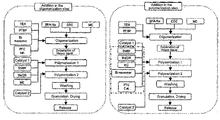
- Figure 1 is a flow chart illustrating the process of adding a silicon monomer in the polymerization step of the present invention, comparing with a conventional process of adding a silicon monomer in the oligomerization step.
- reaction product means a substance that is formed by reacting two or more reactants.
- first,” “second” and the like are used herein for the description of polymerization catalysts, the polymerization catalysts are not limited by these terms. These terms are just used to distinguish the polymerization catalysts from each other.
- a first polymerization catalyst and a second polymerization catalyst may be of the same kind of catalyst or different kinds of catalyst.
- R is not limited by such a subscript.
- R independently represents hydrogen, halogen atom and/or hydrocarbon group, etc.
- R may represent the same hydrocarbon group or different hydrocarbon groups.
- R may represent the same hydrocarbon group or different hydrocarbon groups.
- the method for preparing a polysiloxane-polycarbonate copolymer according to the present invention comprises a) a step of preparing an oligomeric polycarbonate having a viscosity average molecular weight of 3,000 to 20,000; b) a step of admixing a hydroxy-terminated siloxane to the prepared oligomeric polycarbonate; and c) a step of reacting the oligomeric polycarbonate and the hydroxy-terminated siloxane under an interfacial reaction condition to polymerize.
- This step is for preparing an oligomeric polycarbonate to be used in the formation of polysiloxane-polycarbonate copolymer (Si-PC) by polymerization with silicon monomers.
- Silicon monomers are not added in this step and a viscosity average molecular weight (M v ) of the oligomeric polycarbonate is adjusted to 3,000 to 20,000, and preferably 4,000 to 15,000. If the polymerization with silicon monomers is conducted when a viscosity average molecular weight of the oligomeric polycarbonate is less than 3,000, the molecular weight distribution may broaden and the physical properties may be deteriorated. If the polymerization with silicon monomers is conducted when a viscosity average molecular weight of the oligomeric polycarbonate is greater than 20,000, the reactivity may be severely deteriorated.
- the oligomeric polycarbonate may be prepared by adding a dihydric phenol compound to an aqueous alkaline solution to make it in a phenol salt form, and then adding the phenol compound in a salt form to methylene chloride (MC) or dichloromethane containing injected phosgene gas for reaction.
- MC methylene chloride
- dichloromethane containing injected phosgene gas for reaction.
- Triethylamine may be used as a catalyst for forming the oligomers of this step, but it is not limited thereto.
- a monofunctional compound similar to a monomer used in preparation of polycarbonate may be used as the molecular weight regulator.
- the monofunctional compound may be, for example, a derivative based on phenol such as p-isopropylphenol, p- tert -butylphenol (PTBP), p-cumylphenol, p-isooctylphenol and p-isononylphenol, or an aliphatic alcohol.
- PTBP p- tert -butylphenol
- PTBP p- tert -butylphenol
- the above reaction may suitably be conducted under a pH range of 6 to 8 and a temperature range of 15 to 40°C, and alkali metal hydroxide (for example, sodium hydroxide) may be used to adjust pH of the reaction mixture. If pH of the reaction mixture is less than 6, the reactivity may be deteriorated to decline the increase of molecular weight or to extend the reaction time. If pH of the reaction mixture is higher than 8, the molecular weight distribution of the oligomers may broaden, which causes the problem of widening the molecular weight distribution of final products.
- alkali metal hydroxide for example, sodium hydroxide
- the polysiloxane-polycarbonate copolymer prepared according to the present invention comprises, as a repeating unit, a polycarbonate block of the following chemical formula 4:
- R 5 represents aromatic hydrocarbon group having 6 to 30 carbon atoms that is unsubstituted or substituted with alkyl group having 1 to 20 carbon atoms (for example, alkyl group having 1 to 13 carbon atoms), cycloalkyl group (for example, cycloalkyl group having 3 to 6 carbon atoms), alkenyl group (for example, alkenyl group having 2 to 13 carbon atoms), alkoxy group (for example, alkoxy group having 1 to 13 carbon atoms), halogen atom or nitro.
- alkyl group having 1 to 20 carbon atoms for example, alkyl group having 1 to 13 carbon atoms
- cycloalkyl group for example, cycloalkyl group having 3 to 6 carbon atoms
- alkenyl group for example, alkenyl group having 2 to 13 carbon atoms
- alkoxy group for example, alkoxy group having 1 to 13 carbon atoms
- halogen atom or nitro for example, alkyl group having
- the aromatic hydrocarbon group may be derived from a compound of the following chemical formula 4a.
- X represents alkylene group; linear, branched or cyclic alkylene group having no functional group; or linear, branched or cyclic alkylene group comprising a functional group such as sulfide, ether, sulfoxide, sulfone, ketone, naphthyl, isobutylphenyl.
- X may be linear or branched alkylene group having 1 to 10 carbon atoms, or cyclic alkylene group having 3 to 6 carbon atoms.
- R 6 independently represents hydrogen atom, halogen atom or alkyl group ⁇ for example, linear or branched alkyl group having 1 to 20 carbon atoms, or cyclic alkyl group having 3 to 20 (preferably, 3 to 6) carbon atoms.
- n and m independently represent an integer of 0 to 4.
- the compound of the above chemical formula 4a may be, for example, bis(4-hydroxyphenyl)methane, bis(4-hydroxyphenyl)phenylmethane, bis(4-hydroxyphenyl)naphthylmethane, bis(4-hydroxyphenyl)-(4-isobutylphenyl)methane, 1,1-bis(4-hydroxyphenyl)ethane, 1-ethyl-1,1-bis(4-hydroxyphenyl)propane, 1-phenyl-1,1-bis(4-hydroxyphenyl)ethane, 1-naphthyl-1,1-bis(4-hydroxyphenyl)ethane, 1,2-bis(4-hydroxyphenyl)ethane, 1,10-bis(4-hydroxyphenyl)decane, 2-methyl-1,1-bis(4-hydroxyphenyl)propane, 2,2-bis(4-hydroxyphenyl)propane, 2,2-bis(4-hydroxyphenyl)butane,
- the representative one is 2,2-bis(4-hydroxyphenyl)propane (bisphenol A).
- bisphenol A 2,2-bis(4-hydroxyphenyl)propane
- US Patent Nos. 2,999,835; 3,028,365; 3,153,008 and 3,334,154 may be referred to.
- the above dihydric phenol may be used alone or in combination of two or more of them.
- carbonate precursor for example, carbonyl chloride (phosgene), carbonyl bromide, bis halo formate, diphenylcarbonate, dimethylcarbonate, etc. may be used as another monomer of the polycarbonate resin.
- the heavy liquid comprising the oligomeric polycarbonate prepared in this step is extracted and separated from the reaction mixture, and then used in the next polymerization step.
- This step is for forming the polysiloxane-polycarbonate copolymer by admixing the hydroxy-terminated siloxane as a silicon monomer to the oligomeric polycarbonate prepared in the a) step; and reacting them under an interfacial reaction condition consisting of an aqueous alkaline solution and an organic phase to polymerize.
- the present invention is characterized in that the addition of silicon monomer for forming the copolymer is carried out after the oligomeric polycarbonate of which viscosity average molecular weight is adjusted to a certain high level is firstly prepared, unlike the conventional method where the silicon monomer is added in an oligomerization step.
- the mixture of oligomeric polycarbonate and hydroxy-terminated siloxane may further comprise a molecular weight regulator, a first polymerization catalyst, a phase transfer catalyst, a pH adjusting agent (for example, NaOH) and methylene chloride (MC), etc.
- the polysiloxane-polycarbonate copolymer may be prepared by adding the hydroxy-terminated siloxane to an organic phase-aqueous phase mixture comprising the oligomeric polycarbonate, and subsequently adding a molecular weight regulator, a catalyst, etc. in the order.
- a monofunctional compound similar to a monomer used in preparation of polycarbonate as stated above may be used.
- a polymerization catalyst and/or a phase transfer catalyst may be used.
- the polymerization catalyst may be, for example, triethylamine (TEA), and the phase transfer catalyst may be a compound of the following chemical formula 5.
- R 7 represents alkyl group having 1 to 10 carbon atoms; Q represents nitrogen or phosphorus; and X represents halogen atom or -OR 8 wherein R 8 represents hydrogen atom, alkyl group having 1 to 18 carbon atoms or aryl group having 6 to 18 carbon atoms.
- the phase transfer catalyst may be, for example, [CH 3 (CH 2 ) 3 ] 4 NX, [CH 3 (CH 2 ) 3 ] 4 PX, [CH 3 (CH 2 ) 5 ] 4 NX, [CH 3 (CH 2 ) 6 ] 4 NX, [CH 3 (CH 2 ) 4 ] 4 NX, CH 3 [CH 3 (CH 2 ) 3 ] 3 NX or CH 3 [CH 3 (CH 2 ) 2 ] 3 NX, wherein X represents Cl, Br or -OR 8 where R 8 represents hydrogen atom, alkyl group having 1 to 18 carbon atoms or aryl group having 6 to 18 carbon atoms.
- the amount of the phase transfer catalyst is preferably about 0.01 to 10% by weight, and more preferably 0.1 to 10% by weight based on total weight of the hydroxy-terminated siloxane and the oligomeric polycarbonate. If the amount of the phase transfer catalyst is less than 0.01% by weight, the reactivity may be lowered. If the amount of the phase transfer catalyst is greater than 10% by weight, precipitation may happen or the transparency may be deteriorated.
- the hydroxy-terminated siloxane that is fed in this step has a molecular weight (number average molecular weight, M n ) of 2,500 to 15,000, more preferably 3,000 to 8,000. If the molecular weight of hydroxy-terminated siloxane is less than 2,500, the low-temperature impact resistance and ductility ratio may be deteriorated. If the molecular weight is greater than 15,000, the reactivity may be lowered and thus there may be a problem in synthesizing the polysiloxane-polycarbonate copolymer with a desired molecular weight.
- M n number average molecular weight
- the weight ratio of oligomeric polycarbonate : hydroxy-terminated siloxane is preferably 80 : 20 to 99 : 1, more preferably 85 : 15 to 97 : 3, in this step.
- the feed amount of hydroxy-terminated siloxane in the preparation of the polysiloxane-polycarbonate copolymer according to the present invention is preferably 1 to 20% by weight, more preferably 3 to 15% by weight, based on the total reactants. If the feed amount of hydroxy-terminated siloxane is less than 1% by weight, the low-temperature impact resistance may be deteriorated. If the feed amount is greater than 20% by weight, physical properties such as flowability, heat resistance, transparency, etc.
- excellent low-temperature impact resistance can be achieved even in a relatively low amount of siloxane ⁇ i.e., a level of 1 to 20% by weight ⁇ by maximizing the reaction ratio through controlling the addition time of a hydroxy-terminated siloxane.
- the addition of hydroxy-terminated siloxane and polymerization in this step is conducted at a high pH range (for example, a pH range of 9 to 14). If pH is lower than 9, the reactivity may be lowered, and thus unreacted silicon may remain or the polysiloxane-polycarbonate copolymer may not reach the desired molecular weight. If pH is higher than 14, a molecular weight distribution may broaden due to a drastic reaction or a large amount of acid should be introduced in the washing process after the reaction for neutralization, and thus extra costs may occur.
- a high pH range for example, a pH range of 9 to 14
- the method of the present invention can effectively complete the reaction without unreacted silicon monomer by adding the silicon monomer in the polymerization step whose pH is high due to the addition of significant amount of NaOH after undergoing an oligomerization step for homogenizing the oligomeric polycarbonate.
- the polymerization of oligomeric polycarbonate and hydroxy-terminated siloxane is successively performed through first and second steps of polymerization. Specifically, after conducting the first polymerization from the mixture in which a hydroxy-terminated siloxane, a first polymerization catalyst, a phase transfer catalyst, a molecular weight regulator, a pH adjusting agent (for example, NaOH), methylene chloride (MC), etc. are added to the oligomeric polycarbonate, the second polymerization is successively conducted by adding a second polymerization catalyst.
- the second polymerization step may be performed by providing a second polymerization catalyst to the resulting mixture after completion of the first polymerization step.
- a viscosity average molecular weight of the polysiloxane-polycarbonate copolymer prepared according to the present invention is from 15,000 to 30,000, and more preferably from 17,000 to 22,000. If the viscosity average molecular weight of the copolymer is less than 15,000, the mechanical properties may significantly be deteriorated. If the viscosity average molecular weight is greater than 30,000, the melt viscosity increases and thus there may be a problem in resin processing.
- formability can be enhanced under the same processing condition since good low-temperature impact resistance and ductility ratio can be secured even when the viscosity average molecular weight of the copolymer is lowered to a level of 30,000 or less by maximizing the reaction ratio through controlling the addition time of hydroxy-terminated siloxane. Accordingly, molding can be effectively performed even when the processing temperature for extrusion/injection is lowered compared to when the viscosity average molecular weight is 30,000, and thus a production increase in continuous injection may be expected by decreasing energy cost required for raising temperature and shortening cooling time. In addition, a kneading with other resins of poor heat-stability becomes available, which facilitates developments for more various uses.
- the polysiloxane-polycarbonate copolymer prepared according to the present invention comprises, as repeating units, a hydroxy-terminated siloxane of the following chemical formula 1a or chemical formula 1; and a polycarbonate block of the above chemical formula 4:
- R 1 independently represents hydrogen atom, halogen atom, hydroxy group, or alkyl group, alkoxy group or aryl group having 1 to 20 carbon atoms.
- the halogen atom may be Cl or Br
- the alkyl group may be an alkyl group having 1 to 13 carbon atoms such as methyl, ethyl or propyl.
- the alkoxy group may be an alkoxy group having 1 to 13 carbon atoms such as methoxy, ethoxy or propoxy
- the aryl group may be an aryl group having 6 to 10 carbon atoms such as phenyl, chlorophenyl or tolyl.
- R 2 independently represents substituted or unsubstituted aryl group having 6 to 30 carbon atoms, hydrocarbon group having 1 to 13 carbon atoms or hydroxy group.
- R 2 may be alkyl or alkoxy group having 1 to 13 carbon atoms, alkenyl or alkenyloxy group having 2 to 13 carbon atoms, cycloalkyl or cycloalkoxy group having 3 to 6 carbon atoms, aryl or aryloxy group having 6 to 10 carbon atoms, aralkyl or aralkoxy group having 7 to 13 carbon atoms, or alkaryl or alkaryloxy group having 7 to 13 carbon atoms.
- R 3 independently represents alkylene group having 2 to 8 carbon atoms.
- n independently represents an integer of 30 to 200, preferably 40 to 170, and more preferably 50 to 120.
- a silicon monomer available from Dow Corning ( ) may be used, but it is not limited thereto.
- R 1 , R 2 , R 3 and m are the same as defined in chemical formula 1a above, and n independently represents an integer of 15 to 100, preferably 20 to 80, and more preferably 25 to 60.
- A represents a structure of the following chemical formula 2 or 3.
- X represents Y or NH-Y-NH, wherein Y represents linear or branched aliphatic group having 1 to 20 carbon atoms, cycloalkylene group (for example, cycloalkylene group having 3 to 6 carbon atoms), or mono- or polycyclic arylene group having 6 to 30 carbon atoms and being unsubstituted or substituted with halogen atom, alkyl group, alkoxy group, aryl group or carboxyl group.
- Y represents linear or branched aliphatic group having 1 to 20 carbon atoms, cycloalkylene group (for example, cycloalkylene group having 3 to 6 carbon atoms), or mono- or polycyclic arylene group having 6 to 30 carbon atoms and being unsubstituted or substituted with halogen atom, alkyl group, alkoxy group, aryl group or carboxyl group.
- Y may be an aliphatic group that is unsubstituted or substituted with halogen atom, an aliphatic group that contains oxygen, nitrogen or sulfur atom in its main chain, or an arylene group that can be derived from bisphenol A, resorcinol, hydroquinone or diphenylphenol.
- Y can be represented, for example, by one of the following chemical formulas 2a to 2h.
- R 4 represents an aromatic hydrocarbon group or aromatic/aliphatic mixed-type hydrocarbon group having 6 to 30 carbon atoms, or an aliphatic hydrocarbon group having 1 to 20 carbon atoms.
- R 4 may have a structure containing halogen, oxygen, nitrogen or sulfur as well as carbon atom(s).
- R 4 may be phenyl, chlorophenyl or tolyl (preferably, phenyl).
- the hydroxy-terminated siloxane of chemical formula 1 may be a reaction product of a hydroxy-terminated siloxane of the above chemical formula 1a (provided that n is an integer of 15 to 100) and an acyl compound.
- the acyl compound may have, for example, an aromatic structure, an aliphatic structure, or a mixed type structure comprising both aromatic and aliphatic forms.
- the acyl compound When the acyl compound is of an aromatic structure or a mixed type structure, it can have 6 to 30 carbon atoms, and when the acyl compound is of an aliphatic structure, it can have 1 to 20 carbon atoms.
- the acyl compound may further comprise halogen, oxygen, nitrogen or sulfur atom.
- the hydroxy-terminated siloxane of the above chemical formula 1 may be a reaction product of a hydroxy-terminated siloxane of the above chemical formula 1a (provided that n is an integer of 15 to 100) and a diisocyanate compound.
- the diisocyanate compound may be, for example, 1,4-phenylenediisocyanate, 1,3-phenylenediisocyanate or 4,4'-methylenediphenyl diisocyanate.
- the hydroxy-terminated siloxane of the above chemical formula 1 may be a reaction product of a hydroxy-terminated siloxane of the above chemical formula 1a (provided that n is an integer of 15 to 100) and a phosphorous-containing compound (an aromatic or an aliphatic phosphate compound).
- the phosphorous-containing compound may have a structure of the following chemical formula 1b.
- R 4 is the same as defined in chemical formula 3 above, and Z independently represents phosphorus, halogen atom, hydroxyl group, carboxyl group, or alkyl group, alkoxy group or aryl group (having 1 to 20 carbon atoms).
- the organic phase dispersed in methylene chloride is washed with alkali and then separated. Subsequently, the organic phase is washed with 0.1 N solution of hydrochloric acid and then rinsed with distilled water 2 or 3 times. After rinsing is completed, the concentration of the organic phase dispersed in methylene chloride is adjusted constantly and granulation is conducted by using a certain amount of demineralized water at 30 to 100°C, preferably 60 to 80°C. If the temperature of the demineralized water is lower than 30°C, the granulation rate is low and thus the granulation time may be too long.
- the temperature of the demineralized water is higher than 100°C, it may be difficult to obtain the polycarbonate in uniformly sized morphology.
- the polysiloxane-polycarbonate copolymer prepared according to the methods of the present invention is provided.
- the polysiloxane-polycarbonate copolymer of the present invention has various applications since it has good processability and formabiltity as well as superior low-temperature impact resistance and ductility ratio due to its low viscosity average molecular weight.
- thermoplastic resin composition comprising the polysiloxane-polycarbonate copolymer prepared according to the methods of the present invention and an additive.
- additive those typically added to the thermoplastic resin composition (for example, heat stabilizer, antioxidant, UV stabilizer, flame retardant, release agent, etc.) may be used.
- thermoplastic resin composition a molded article prepared from the thermoplastic resin composition above.
- methods typically used for processing thermoplastic resin compositions for example, extrusion, thermoforming, injection, etc. may be used.
- hydroxy-terminated siloxane having the linkage of chemical formula 6 was dissolved in 300mL of chloroform, and then 67mL of triethylamine (TEA) catalyst was added thereto under nitrogen atmosphere. Under refluxing the resulting solution, 0.2 mol of terephthaloylchloride (TCL) dissolved in 1,000mL of chloroform was slowly added thereto for 1 hour, and the resulting solution was refluxed for 12 hours. After the reaction was completed, the solvent was removed from the solution, and the product was dissolved in acetone and washed with hot distilled water.
- TAA triethylamine
- the hydroxy-terminated siloxane having ester linkage of the following chemical formula 7 (number average molecular weight: 4,000) was prepared.
- the synthesis was confirmed by H-NMR analysis wherein the peak of methylene group of the polysiloxane was observed at 2.6ppm, the peak of hydrogen of benzene ring of TCL was observed at 8.35ppm and the peak of hydrogen of benzene ring of the polysiloxane was observed at 6.75-7.35ppm.
- An interfacial reaction of bisphenol A in an aqueous solution phase of sodium hydroxide and phosgene gas was conducted in the presence of methylene chloride to prepare an oligomeric polycarbonate mixture having a viscosity average molecular weight of about 1,000.
- oligomeric polycarbonate mixture 2.6g of p- tert -butylphenol (PTBP) and 275 ⁇ l of triethylamine (TEA, 15 wt% aqueous solution) were admixed and reacted for 30 minutes to prepare 400mL of an oligomeric polycarbonate mixture having a viscosity average molecular weight of 3,000 to 6,000.
- PTBP p- tert -butylphenol
- TEA triethylamine
- oligomeric polycarbonate mixture 4.5% by weight of the hydroxy-terminated siloxane having ester linkage of chemical formula 7 dissolved in methylene chloride, 0.8mL of tetrabutylammonium chloride (TBACl, 43 wt% aqueous solution), 160g of an aqueous solution of sodium hydroxide, 300g of methylene chloride and 25 ⁇ l of triethylamine (15 wt% aqueous solution) were admixed and reacted for 1 hour for the first step of polymerization. After 260 ⁇ l of triethylamine (TEA, 15 wt% aqueous solution) was admixed, the reaction was conducted for 30 minutes.
- TBACl tetrabutylammonium chloride
- the viscosity-increased organic phase was washed with alkali and separated. Next, the resulting organic phase was washed with 0.1N hydrochloric acid solution and then rinsed with distilled water 2 to 3 times. After rinsing was completed, the organic phase was granulated at 76°C using a certain amount of demineralized water. After granulation was completed, the product was dried first at 110°C for 8 hours, and second at 120°C for 10 hours.
- An interfacial reaction of bisphenol A in an aqueous solution phase of sodium hydroxide and phosgene gas was conducted in the presence of methylene chloride to prepare an oligomeric polycarbonate mixture having a viscosity average molecular weight of about 1,000.
- oligomeric polycarbonate mixture 2.6g of p- tert -butylphenol (PTBP) and 275 ⁇ l of triethylamine (TEA, 15 wt% aqueous solution) were admixed and reacted for 30 minutes to prepare 400mL of an oligomeric polycarbonate mixture having a viscosity average molecular weight of 3,000 to 6,000.
- PTBP p- tert -butylphenol
- TEA triethylamine
- oligomeric polycarbonate mixture 4.5% by weight of the hydroxy-terminated siloxane having urethane linkage of chemical formula 8 dissolved in methylene chloride, 0.8mL of tetrabutylammonium chloride (TBACl, 43 wt% aqueous solution), 160g of an aqueous solution of sodium hydroxide, 300g of methylene chloride and 25 ⁇ l of triethylamine (15 wt% aqueous solution) were admixed and reacted for 1 hour for the first step of polymerization. After 260 ⁇ l of triethylamine (TEA, 15 wt% aqueous solution) was admixed, the reaction was conducted for 30 minutes.
- TBACl tetrabutylammonium chloride
- the viscosity-increased organic phase was washed with alkali and separated. Next, the resulting organic phase was washed with 0.1N hydrochloric acid solution and then rinsed with distilled water 2 to 3 times. After rinsing was completed, the organic phase was granulated at 76°C by using a certain amount of demineralized water. After granulation was completed, the product was dried first at 110°C for 8 hours, and second at 120°C for 10 hours.
- An interfacial reaction of bisphenol A in an aqueous solution phase of sodium hydroxide and phosgene gas was conducted in the presence of methylene chloride to prepare an oligomeric polycarbonate mixture having a viscosity average molecular weight of about 1,000.
- oligomeric polycarbonate mixture 2.6g of p- tert -butylphenol (PTBP) and 275 ⁇ l of triethylamine (TEA, 15 wt% aqueous solution) were admixed and reacted for 30 minutes to prepare 400mL of an oligomeric polycarbonate mixture having a viscosity average molecular weight of 3,000 to 6,000.
- PTBP p- tert -butylphenol
- TEA triethylamine
- tetrabutylammonium chloride TBACl, 43 wt% aqueous solution
- 160g of an aqueous solution of sodium hydroxide, 300g of methylene chloride and 25 ⁇ l of triethylamine (15 wt% aqueous solution) were admixed and reacted for 1 hour for the first step of polymerization.
- TEA triethylamine
- the viscosity-increased organic phase was washed with alkali and separated.
- the resulting organic phase was washed with 0.1N hydrochloric acid solution and then rinsed with distilled water 2 to 3 times.
- the organic phase was granulated at 76°C by using a certain amount of demineralized water. After granulation was completed, the product was dried first at 110°C for 8 hours, and second at 120°C for 10 hours.
- Table 1 The physical properties of the prepared polysiloxane-polycarbonate copolymer were measured, and the results are shown in Table 1 below.
- a polysiloxane-polycarbonate copolymer was prepared by the same method as described in Example 1, except that the polysiloxane-polycarbonate copolymer was prepared by using 4.5% by weight of hydroxy-terminated siloxane BY16-752 (molecular weight: 3,000, Dow Corning). The physical properties of the prepared polysiloxane-polycarbonate copolymer were measured, and the results are shown in Table 1 below.
- the hydroxy-terminated siloxane having ester linkage of the above chemical formula 7 (number average molecular weight: 4,000) was prepared by the same method as described in Example 1.
- oligomeric polycarbonate mixture 160g of an aqueous solution of sodium hydroxide, 300g of methylene chloride and 25 ⁇ l of triethylamine (15 wt% aqueous solution) were admixed and reacted for 1 hour for the first step of polymerization to prepare an oligomeric polycarbonate mixture having a viscosity average molecular weight of 8,000 to 12,000.
- the organic phase was granulated at 76°C by using a certain amount of demineralized water. After granulation was completed, the product was dried first at 110°C for 8 hours, and second at 120°C for 10 hours.
- the synthesis of the copolymer was confirmed by H-NMR analysis wherein the peaks of methylene group of the polysiloxane were observed at 2.6ppm and 2.65ppm, the peak of hydrogen of benzene ring of TCL was observed at 8.35ppm, and the peak of hydrogen of benzene ring of the polysiloxane was observed at 6.95 to 7.5ppm.
- the physical properties of the prepared polysiloxane-polycarbonate copolymer were measured, and the results are shown in Table 1 below.
- the hydroxy-terminated siloxane having ester linkage of the above chemical formula 7 (number average molecular weight: 4,000) was prepared by the same method as described in Example 1.
- oligomeric polycarbonate mixture 4.5% by weight of the hydroxy-terminated siloxane having ester linkage of the above chemical formula 7 dissolved in methylene chloride, 0.8mL of tetrabutylammonium chloride (TBACl), 2.6g of p- tert -butylphenol (PTBP) and 275 ⁇ l of triethylamine (TEA, 15 wt% aqueous solution) were admixed and reacted for 30 minutes. The reacted oligomeric polycarbonate mixture was kept for phase separation.
- TBACl tetrabutylammonium chloride
- PTBP p- tert -butylphenol
- TEA triethylamine
- the organic phase was granulated by using a certain amount of demineralized water at 76°C. After the granulation was completed, the product was dried first at 110°C for 8 hours and second at 120°C for 10 hours.
- the synthesis of the copolymer was confirmed by H-NMR analysis wherein the peaks of methylene group of the polysiloxane were observed at 2.6ppm and 2.65ppm, the peak of hydrogen of benzene ring of TCL was observed at 8.35ppm, and the peak of hydrogen of benzene ring of the polysiloxane was observed at 6.95 to 7.5ppm.
- the physical properties of the prepared polysiloxane-polycarbonate copolymer were measured, and the results are shown in Table 1 below.
- a polysiloxane-polycarbonate copolymer was prepared by the same method as described in Comparative Example 4, except that the polysiloxane-polycarbonate copolymer was prepared by using hydroxy-terminated siloxane having urethane linkage of the above chemical formula 7 (molecular weight: 4,000). The physical properties of the prepared polysiloxane-polycarbonate copolymer were measured, and the results are shown in Table 1 below.
- a polysiloxane-polycarbonate copolymer was prepared by the same method as described in Comparative Example 4, except that the polysiloxane-polycarbonate copolymer was prepared by using phosphate-containing hydroxy-terminated siloxane of the above chemical formula 9 (molecular weight: 4,000). The physical properties of the prepared polysiloxane-polycarbonate copolymer were measured, and the results are shown in Table 1 below.
- a polysiloxane-polycarbonate copolymer was prepared by the same method as described in Comparative Example 4, except that the polysiloxane-polycarbonate copolymer was prepared by using hydroxy-terminated siloxane BY16-752 (molecular weight: 3,000, Dow Corning). The physical properties of the prepared polysiloxane-polycarbonate copolymer were measured, and the results are shown in Table 1 below.
- the polysiloxane-polycarbonate copolymer prepared according to the Examples showed superior low-temperature impact strength, silicon monomer reaction ratio and ductility ratio, as compared with the polysiloxane-polycarbonate copolymer (or linear polycarbonate) prepared according to the Comparative Examples.
- Viscosity average molecular weight (M v ) The viscosity of methylene chloride solution was measured by using an Ubbelohde Viscometer at 20°C, and the limiting viscosity [ ⁇ ] therefrom was calculated according to the following equation.
- Impact strength was measured by using an impact test machine (RESIL IMPACTOR, CEAST Co., Ltd.) at room temperature and -50°C.
- Ductility ratio measured under impact loading at -50°C The ductility ratio was calculated by dividing the ductility of specimen by the ductility of all specimens, and then multiplying it by 100.
- Si-monomer silicon monomer
- PTC cat. phase transfer catalyst
- Catalyst 1 first polymerization catalyst
- Catalyst 2 second polymerization catalyst
- BPA-Na bisphenol A-Na
Landscapes
- Chemical & Material Sciences (AREA)
- Health & Medical Sciences (AREA)
- Chemical Kinetics & Catalysis (AREA)
- Medicinal Chemistry (AREA)
- Polymers & Plastics (AREA)
- Organic Chemistry (AREA)
- Polyesters Or Polycarbonates (AREA)
- Silicon Polymers (AREA)
Abstract
La présente invention concerne un procédé de préparation de copolymère polysiloxane - polycarbonate. Plus particulièrement, la présente invention concerne un procédé de préparation de copolymère polysiloxane - polycarbonate qui peut améliorer un rapport de réaction de monomère de silicium et assurer une résistance aux impacts et un ratio de ductilité à basse température supérieurs en contrôlant la durée d'addition du monomère de silicium en fonction du poids moléculaire du polycarbonate oligomère dans la synthèse du copolymère polysiloxane - polycarbonate.
Applications Claiming Priority (2)
| Application Number | Priority Date | Filing Date | Title |
|---|---|---|---|
| KR20110142454 | 2011-12-26 | ||
| KR10-2011-0142454 | 2011-12-26 |
Publications (1)
| Publication Number | Publication Date |
|---|---|
| WO2013100494A1 true WO2013100494A1 (fr) | 2013-07-04 |
Family
ID=48697870
Family Applications (1)
| Application Number | Title | Priority Date | Filing Date |
|---|---|---|---|
| PCT/KR2012/011232 Ceased WO2013100494A1 (fr) | 2011-12-26 | 2012-12-21 | Procédé de préparation de copolymère polysiloxane - polycarbonate |
Country Status (3)
| Country | Link |
|---|---|
| KR (1) | KR101492956B1 (fr) |
| TW (1) | TW201333078A (fr) |
| WO (1) | WO2013100494A1 (fr) |
Cited By (1)
| Publication number | Priority date | Publication date | Assignee | Title |
|---|---|---|---|---|
| WO2016133667A1 (fr) | 2015-02-20 | 2016-08-25 | 3M Innovative Properties Company | Polymères à base de carbonate et de silicone à utiliser en tant que couches de libération pour articles contenant un adhésif sensible à la pression |
Families Citing this family (10)
| Publication number | Priority date | Publication date | Assignee | Title |
|---|---|---|---|---|
| KR101530322B1 (ko) * | 2013-07-24 | 2015-06-22 | 주식회사 삼양사 | 투명성이 향상된 폴리실록산-폴리카보네이트 공중합체 및 그 제조방법 |
| KR101528362B1 (ko) * | 2013-07-25 | 2015-06-19 | 주식회사 삼양사 | 투명성이 향상된 폴리실록산-폴리카보네이트 공중합체 및 그 제조방법 |
| KR101779188B1 (ko) | 2014-09-05 | 2017-09-15 | 주식회사 엘지화학 | 코폴리카보네이트 및 이를 포함하는 조성물 |
| KR101685665B1 (ko) | 2014-12-04 | 2016-12-12 | 주식회사 엘지화학 | 코폴리카보네이트 및 이를 포함하는 조성물 |
| KR20160067714A (ko) | 2014-12-04 | 2016-06-14 | 주식회사 엘지화학 | 코폴리카보네이트 및 이를 포함하는 물품 |
| US11760841B2 (en) * | 2018-12-21 | 2023-09-19 | Dow Silicones Corporation | Silicone-polycarbonate copolymer, sealants comprising same, and related methods |
| CN114096835A (zh) * | 2019-06-20 | 2022-02-25 | 株式会社Lg化学 | 分析共聚碳酸酯的方法 |
| CN112390941A (zh) * | 2020-12-02 | 2021-02-23 | 甘肃银光聚银化工有限公司 | 一种制备透明硅氧烷聚碳酸酯的方法 |
| KR102733236B1 (ko) * | 2021-12-24 | 2024-11-25 | 주식회사 삼양사 | 폴리실록산-폴리카보네이트 공중합체 및 그 제조 방법 |
| KR102864084B1 (ko) * | 2023-01-13 | 2025-09-24 | 단국대학교 산학협력단 | 고유동성 및 고연신 특성을 갖는 폴리카보네이트 블렌드 수지 조성물의 제조방법 |
Citations (5)
| Publication number | Priority date | Publication date | Assignee | Title |
|---|---|---|---|---|
| US5451632A (en) * | 1992-10-26 | 1995-09-19 | Idemitsu Petrochemical Co., Ltd. | Polycarbonate-polyorganosiloxane copolymer and a resin composition |
| US20080242804A1 (en) * | 2007-03-29 | 2008-10-02 | General Electric Company | Polycarbonate-polysiloxane copolymers, methods for the preparation thereof, and articles derived therefrom |
| US20090326183A1 (en) * | 2008-06-30 | 2009-12-31 | Schultz Laura G | Branched polycarbonate-polysiloxane copolymers and processes for producing the same |
| KR20110021630A (ko) * | 2009-08-25 | 2011-03-04 | 주식회사 삼양사 | 우레탄 결합을 갖는 히드록시 말단 실록산, 폴리실록산-폴리카보네이트 공중합체 및 그 제조 방법 |
| WO2011122767A2 (fr) * | 2010-03-29 | 2011-10-06 | 주식회사 삼양사 | Siloxane à terminaison hydroxy, copolymère polysiloxane-polycarbonate, et leurs méthodes de synthèse |
Family Cites Families (4)
| Publication number | Priority date | Publication date | Assignee | Title |
|---|---|---|---|---|
| CN102161753B (zh) * | 2003-02-21 | 2015-07-15 | 沙特基础全球技术有限公司 | 透明和高热聚碳酸酯-聚硅氧烷共聚物和含有聚碳酸酯的透明共混物及其制造过程 |
| KR100846371B1 (ko) * | 2005-11-18 | 2008-07-15 | 주식회사 삼양사 | 고유동성 폴리카보네이트 수지 조성물 및 그 제조방법 |
| KR101400348B1 (ko) * | 2011-10-26 | 2014-05-27 | 다미폴리켐 주식회사 | 포스페이트-함유 히드록시 말단 실록산, 폴리실록산-폴리카보네이트 공중합체 및 그 제조방법 |
| WO2013066002A1 (fr) * | 2011-10-31 | 2013-05-10 | Samyang Corporation | Copolymère de polysiloxane et de polycarbonate, et procédé de fabrication correspondant |
-
2012
- 2012-12-14 KR KR20120145998A patent/KR101492956B1/ko active Active
- 2012-12-21 WO PCT/KR2012/011232 patent/WO2013100494A1/fr not_active Ceased
- 2012-12-25 TW TW101149712A patent/TW201333078A/zh unknown
Patent Citations (5)
| Publication number | Priority date | Publication date | Assignee | Title |
|---|---|---|---|---|
| US5451632A (en) * | 1992-10-26 | 1995-09-19 | Idemitsu Petrochemical Co., Ltd. | Polycarbonate-polyorganosiloxane copolymer and a resin composition |
| US20080242804A1 (en) * | 2007-03-29 | 2008-10-02 | General Electric Company | Polycarbonate-polysiloxane copolymers, methods for the preparation thereof, and articles derived therefrom |
| US20090326183A1 (en) * | 2008-06-30 | 2009-12-31 | Schultz Laura G | Branched polycarbonate-polysiloxane copolymers and processes for producing the same |
| KR20110021630A (ko) * | 2009-08-25 | 2011-03-04 | 주식회사 삼양사 | 우레탄 결합을 갖는 히드록시 말단 실록산, 폴리실록산-폴리카보네이트 공중합체 및 그 제조 방법 |
| WO2011122767A2 (fr) * | 2010-03-29 | 2011-10-06 | 주식회사 삼양사 | Siloxane à terminaison hydroxy, copolymère polysiloxane-polycarbonate, et leurs méthodes de synthèse |
Cited By (2)
| Publication number | Priority date | Publication date | Assignee | Title |
|---|---|---|---|---|
| WO2016133667A1 (fr) | 2015-02-20 | 2016-08-25 | 3M Innovative Properties Company | Polymères à base de carbonate et de silicone à utiliser en tant que couches de libération pour articles contenant un adhésif sensible à la pression |
| US10611123B2 (en) | 2015-02-20 | 2020-04-07 | 3M Innovative Properties Company | Silicone carbonate polymers as release layers for pressure sensitive adhesive containing articles |
Also Published As
| Publication number | Publication date |
|---|---|
| KR101492956B1 (ko) | 2015-02-13 |
| TW201333078A (zh) | 2013-08-16 |
| KR20130074748A (ko) | 2013-07-04 |
Similar Documents
| Publication | Publication Date | Title |
|---|---|---|
| WO2013100494A1 (fr) | Procédé de préparation de copolymère polysiloxane - polycarbonate | |
| EP2773689A1 (fr) | Copolymère de polysiloxane et de polycarbonate, et procédé de fabrication correspondant | |
| WO2013066000A1 (fr) | Composition de résine de polycarbonate ayant une résistance au choc améliorée à basse température et son procédé de fabrication | |
| WO2011122767A2 (fr) | Siloxane à terminaison hydroxy, copolymère polysiloxane-polycarbonate, et leurs méthodes de synthèse | |
| WO2013100606A1 (fr) | Composition de résine thermoplastique retardatrice de flamme et article moulé à base de celle-ci | |
| WO2014204146A1 (fr) | Résine copolymère thermoplastique présentant d'excellentes propriétés d'ignifugation et de transparence et procédé de préparation de ladite résine | |
| WO2015002427A1 (fr) | Composé de polyorganosiloxane, son procédé de préparation, et résine copolycarbonate le comprenant | |
| WO2018105907A1 (fr) | Composition de résine de polycarbonate ayant une excellente résistance à la chaleur et une excellente fluidité et produit moulé la comprenant | |
| WO2012091293A2 (fr) | Composition de résine de polycarbonate présentant une excellente résistance chimique | |
| WO2015041441A1 (fr) | Résine de copolycarbonate et produit comportant celle-ci | |
| WO2020060148A1 (fr) | Copolymère de polysiloxane-polycarbonate ayant une résistance aux chocs, une résistance à la flamme et une transparence élevées, et son procédé de préparation | |
| WO2012060516A1 (fr) | Résine polycarbonate et composition de résine thermoplastique la contenant | |
| WO2017126901A1 (fr) | Copolymère de polyester-polycarbonate et son procédé de production | |
| WO2020055178A1 (fr) | Composé diol, polycarbonate et son procédé de production | |
| WO2014092276A1 (fr) | Procédé pour la production continue de copolymère de polyester aliphatique/aromatique biodégradable | |
| WO2015002429A1 (fr) | Monomère de coiffe hydroxy, son polycarbonate, et article le comprenant | |
| WO2014092243A1 (fr) | Résine de polycarbonate, son procédé de production et article moulé la comprenant | |
| WO2015178676A1 (fr) | Copolymère de polysiloxane-polycarbonate présentant une transparence améliorée et une résistance améliorée aux chocs et son procédé de préparation | |
| WO2013100288A1 (fr) | Copolymère polycarbonate-polysiloxane ramifié et son procédé de préparation | |
| WO2021133048A1 (fr) | Copolymère de polycarbonate comprenant des unités dérivées d'alcool d'anhydrosucre et d'alcool d'anhydrosucre-alkylène glycol, son procédé de production, et article moulé le comprenant | |
| WO2021215838A1 (fr) | Copolymère polysiloxane-polycarbonate utilisant un mélange de polysiloxane à terminaisons hydroxy et son procédé de production | |
| WO2016003132A1 (fr) | Copolymère de polysiloxane-polycarbonate ayant une transparence et une résistance au choc à basses températures améliorées et son procédé de préparation | |
| WO2023282559A1 (fr) | Polysiloxane à terminaison hydroxyphényle, copolymère polysiloxane-polycarbonate doté d'une excellente transparence et d'une ininflammabilité améliorée, le comprenant comme unité récurrente, et procédé de préparation dudit copolymère | |
| WO2023234584A1 (fr) | Copolymère de polycarbonate | |
| WO2021086033A1 (fr) | Résine de polycarbonate et son procédé de préparation |
Legal Events
| Date | Code | Title | Description |
|---|---|---|---|
| 121 | Ep: the epo has been informed by wipo that ep was designated in this application |
Ref document number: 12863053 Country of ref document: EP Kind code of ref document: A1 |
|
| NENP | Non-entry into the national phase |
Ref country code: DE |
|
| 122 | Ep: pct application non-entry in european phase |
Ref document number: 12863053 Country of ref document: EP Kind code of ref document: A1 |