WO2013102792A2 - Method for processing crustaceans to produce low fluoride/low trimethyl amine products thereof - Google Patents
Method for processing crustaceans to produce low fluoride/low trimethyl amine products thereof Download PDFInfo
- Publication number
- WO2013102792A2 WO2013102792A2 PCT/IB2012/003004 IB2012003004W WO2013102792A2 WO 2013102792 A2 WO2013102792 A2 WO 2013102792A2 IB 2012003004 W IB2012003004 W IB 2012003004W WO 2013102792 A2 WO2013102792 A2 WO 2013102792A2
- Authority
- WO
- WIPO (PCT)
- Prior art keywords
- composition
- crustacean
- approximately
- ppc
- fluoride
- Prior art date
- Legal status (The legal status is an assumption and is not a legal conclusion. Google has not performed a legal analysis and makes no representation as to the accuracy of the status listed.)
- Ceased
Links
Classifications
-
- A—HUMAN NECESSITIES
- A23—FOODS OR FOODSTUFFS; TREATMENT THEREOF, NOT COVERED BY OTHER CLASSES
- A23L—FOODS, FOODSTUFFS OR NON-ALCOHOLIC BEVERAGES, NOT OTHERWISE PROVIDED FOR; PREPARATION OR TREATMENT THEREOF
- A23L17/00—Food-from-the-sea products; Fish products; Fish meal; Fish-egg substitutes; Preparation or treatment thereof
- A23L17/40—Shell-fish
-
- A—HUMAN NECESSITIES
- A23—FOODS OR FOODSTUFFS; TREATMENT THEREOF, NOT COVERED BY OTHER CLASSES
- A23J—PROTEIN COMPOSITIONS FOR FOODSTUFFS; WORKING-UP PROTEINS FOR FOODSTUFFS; PHOSPHATIDE COMPOSITIONS FOR FOODSTUFFS
- A23J3/00—Working-up of proteins for foodstuffs
- A23J3/04—Animal proteins
-
- A—HUMAN NECESSITIES
- A23—FOODS OR FOODSTUFFS; TREATMENT THEREOF, NOT COVERED BY OTHER CLASSES
- A23D—EDIBLE OILS OR FATS, e.g. MARGARINES, SHORTENINGS OR COOKING OILS
- A23D9/00—Other edible oils or fats, e.g. shortenings or cooking oils
- A23D9/007—Other edible oils or fats, e.g. shortenings or cooking oils characterised by ingredients other than fatty acid triglycerides
-
- A—HUMAN NECESSITIES
- A23—FOODS OR FOODSTUFFS; TREATMENT THEREOF, NOT COVERED BY OTHER CLASSES
- A23D—EDIBLE OILS OR FATS, e.g. MARGARINES, SHORTENINGS OR COOKING OILS
- A23D9/00—Other edible oils or fats, e.g. shortenings or cooking oils
- A23D9/007—Other edible oils or fats, e.g. shortenings or cooking oils characterised by ingredients other than fatty acid triglycerides
- A23D9/013—Other fatty acid esters, e.g. phosphatides
-
- A—HUMAN NECESSITIES
- A23—FOODS OR FOODSTUFFS; TREATMENT THEREOF, NOT COVERED BY OTHER CLASSES
- A23D—EDIBLE OILS OR FATS, e.g. MARGARINES, SHORTENINGS OR COOKING OILS
- A23D9/00—Other edible oils or fats, e.g. shortenings or cooking oils
- A23D9/02—Other edible oils or fats, e.g. shortenings or cooking oils characterised by the production or working-up
-
- A—HUMAN NECESSITIES
- A23—FOODS OR FOODSTUFFS; TREATMENT THEREOF, NOT COVERED BY OTHER CLASSES
- A23J—PROTEIN COMPOSITIONS FOR FOODSTUFFS; WORKING-UP PROTEINS FOR FOODSTUFFS; PHOSPHATIDE COMPOSITIONS FOR FOODSTUFFS
- A23J1/00—Obtaining protein compositions for foodstuffs; Bulk opening of eggs and separation of yolks from whites
- A23J1/04—Obtaining protein compositions for foodstuffs; Bulk opening of eggs and separation of yolks from whites from fish or other sea animals
-
- A—HUMAN NECESSITIES
- A23—FOODS OR FOODSTUFFS; TREATMENT THEREOF, NOT COVERED BY OTHER CLASSES
- A23J—PROTEIN COMPOSITIONS FOR FOODSTUFFS; WORKING-UP PROTEINS FOR FOODSTUFFS; PHOSPHATIDE COMPOSITIONS FOR FOODSTUFFS
- A23J3/00—Working-up of proteins for foodstuffs
- A23J3/30—Working-up of proteins for foodstuffs by hydrolysis
- A23J3/32—Working-up of proteins for foodstuffs by hydrolysis using chemical agents
- A23J3/34—Working-up of proteins for foodstuffs by hydrolysis using chemical agents using enzymes
-
- A—HUMAN NECESSITIES
- A23—FOODS OR FOODSTUFFS; TREATMENT THEREOF, NOT COVERED BY OTHER CLASSES
- A23L—FOODS, FOODSTUFFS OR NON-ALCOHOLIC BEVERAGES, NOT OTHERWISE PROVIDED FOR; PREPARATION OR TREATMENT THEREOF
- A23L17/00—Food-from-the-sea products; Fish products; Fish meal; Fish-egg substitutes; Preparation or treatment thereof
- A23L17/65—Addition of, or treatment with, microorganisms or enzymes
-
- A—HUMAN NECESSITIES
- A23—FOODS OR FOODSTUFFS; TREATMENT THEREOF, NOT COVERED BY OTHER CLASSES
- A23L—FOODS, FOODSTUFFS OR NON-ALCOHOLIC BEVERAGES, NOT OTHERWISE PROVIDED FOR; PREPARATION OR TREATMENT THEREOF
- A23L33/00—Modifying nutritive qualities of foods; Dietetic products; Preparation or treatment thereof
- A23L33/10—Modifying nutritive qualities of foods; Dietetic products; Preparation or treatment thereof using additives
- A23L33/115—Fatty acids or derivatives thereof; Fats or oils
-
- A—HUMAN NECESSITIES
- A23—FOODS OR FOODSTUFFS; TREATMENT THEREOF, NOT COVERED BY OTHER CLASSES
- A23L—FOODS, FOODSTUFFS OR NON-ALCOHOLIC BEVERAGES, NOT OTHERWISE PROVIDED FOR; PREPARATION OR TREATMENT THEREOF
- A23L33/00—Modifying nutritive qualities of foods; Dietetic products; Preparation or treatment thereof
- A23L33/10—Modifying nutritive qualities of foods; Dietetic products; Preparation or treatment thereof using additives
- A23L33/17—Amino acids, peptides or proteins
- A23L33/18—Peptides; Protein hydrolysates
-
- A—HUMAN NECESSITIES
- A23—FOODS OR FOODSTUFFS; TREATMENT THEREOF, NOT COVERED BY OTHER CLASSES
- A23L—FOODS, FOODSTUFFS OR NON-ALCOHOLIC BEVERAGES, NOT OTHERWISE PROVIDED FOR; PREPARATION OR TREATMENT THEREOF
- A23L5/00—Preparation or treatment of foods or foodstuffs, in general; Food or foodstuffs obtained thereby; Materials therefor
- A23L5/20—Removal of unwanted matter, e.g. deodorisation or detoxification
- A23L5/23—Removal of unwanted matter, e.g. deodorisation or detoxification by extraction with solvents
-
- A—HUMAN NECESSITIES
- A23—FOODS OR FOODSTUFFS; TREATMENT THEREOF, NOT COVERED BY OTHER CLASSES
- A23L—FOODS, FOODSTUFFS OR NON-ALCOHOLIC BEVERAGES, NOT OTHERWISE PROVIDED FOR; PREPARATION OR TREATMENT THEREOF
- A23L5/00—Preparation or treatment of foods or foodstuffs, in general; Food or foodstuffs obtained thereby; Materials therefor
- A23L5/20—Removal of unwanted matter, e.g. deodorisation or detoxification
- A23L5/25—Removal of unwanted matter, e.g. deodorisation or detoxification using enzymes
-
- A—HUMAN NECESSITIES
- A61—MEDICAL OR VETERINARY SCIENCE; HYGIENE
- A61P—SPECIFIC THERAPEUTIC ACTIVITY OF CHEMICAL COMPOUNDS OR MEDICINAL PREPARATIONS
- A61P3/00—Drugs for disorders of the metabolism
- A61P3/02—Nutrients, e.g. vitamins, minerals
-
- C—CHEMISTRY; METALLURGY
- C07—ORGANIC CHEMISTRY
- C07K—PEPTIDES
- C07K14/00—Peptides having more than 20 amino acids; Gastrins; Somatostatins; Melanotropins; Derivatives thereof
- C07K14/435—Peptides having more than 20 amino acids; Gastrins; Somatostatins; Melanotropins; Derivatives thereof from animals; from humans
- C07K14/43504—Peptides having more than 20 amino acids; Gastrins; Somatostatins; Melanotropins; Derivatives thereof from animals; from humans from invertebrates
- C07K14/43509—Peptides having more than 20 amino acids; Gastrins; Somatostatins; Melanotropins; Derivatives thereof from animals; from humans from invertebrates from crustaceans
-
- C—CHEMISTRY; METALLURGY
- C07—ORGANIC CHEMISTRY
- C07K—PEPTIDES
- C07K19/00—Hybrid peptides, i.e. peptides covalently bound to nucleic acids, or non-covalently bound protein-protein complexes
-
- C—CHEMISTRY; METALLURGY
- C11—ANIMAL OR VEGETABLE OILS, FATS, FATTY SUBSTANCES OR WAXES; FATTY ACIDS THEREFROM; DETERGENTS; CANDLES
- C11B—PRODUCING, e.g. BY PRESSING RAW MATERIALS OR BY EXTRACTION FROM WASTE MATERIALS, REFINING OR PRESERVING FATS, FATTY SUBSTANCES, e.g. LANOLIN, FATTY OILS OR WAXES; ESSENTIAL OILS; PERFUMES
- C11B1/00—Production of fats or fatty oils from raw materials
- C11B1/02—Pretreatment
- C11B1/025—Pretreatment by enzymes or microorganisms, living or dead
-
- C—CHEMISTRY; METALLURGY
- C11—ANIMAL OR VEGETABLE OILS, FATS, FATTY SUBSTANCES OR WAXES; FATTY ACIDS THEREFROM; DETERGENTS; CANDLES
- C11B—PRODUCING, e.g. BY PRESSING RAW MATERIALS OR BY EXTRACTION FROM WASTE MATERIALS, REFINING OR PRESERVING FATS, FATTY SUBSTANCES, e.g. LANOLIN, FATTY OILS OR WAXES; ESSENTIAL OILS; PERFUMES
- C11B1/00—Production of fats or fatty oils from raw materials
- C11B1/10—Production of fats or fatty oils from raw materials by extracting
-
- C—CHEMISTRY; METALLURGY
- C11—ANIMAL OR VEGETABLE OILS, FATS, FATTY SUBSTANCES OR WAXES; FATTY ACIDS THEREFROM; DETERGENTS; CANDLES
- C11B—PRODUCING, e.g. BY PRESSING RAW MATERIALS OR BY EXTRACTION FROM WASTE MATERIALS, REFINING OR PRESERVING FATS, FATTY SUBSTANCES, e.g. LANOLIN, FATTY OILS OR WAXES; ESSENTIAL OILS; PERFUMES
- C11B1/00—Production of fats or fatty oils from raw materials
- C11B1/10—Production of fats or fatty oils from raw materials by extracting
- C11B1/104—Production of fats or fatty oils from raw materials by extracting using super critical gases or vapours
-
- C—CHEMISTRY; METALLURGY
- C11—ANIMAL OR VEGETABLE OILS, FATS, FATTY SUBSTANCES OR WAXES; FATTY ACIDS THEREFROM; DETERGENTS; CANDLES
- C11B—PRODUCING, e.g. BY PRESSING RAW MATERIALS OR BY EXTRACTION FROM WASTE MATERIALS, REFINING OR PRESERVING FATS, FATTY SUBSTANCES, e.g. LANOLIN, FATTY OILS OR WAXES; ESSENTIAL OILS; PERFUMES
- C11B3/00—Refining fats or fatty oils
- C11B3/006—Refining fats or fatty oils by extraction
-
- Y—GENERAL TAGGING OF NEW TECHNOLOGICAL DEVELOPMENTS; GENERAL TAGGING OF CROSS-SECTIONAL TECHNOLOGIES SPANNING OVER SEVERAL SECTIONS OF THE IPC; TECHNICAL SUBJECTS COVERED BY FORMER USPC CROSS-REFERENCE ART COLLECTIONS [XRACs] AND DIGESTS
- Y02—TECHNOLOGIES OR APPLICATIONS FOR MITIGATION OR ADAPTATION AGAINST CLIMATE CHANGE
- Y02P—CLIMATE CHANGE MITIGATION TECHNOLOGIES IN THE PRODUCTION OR PROCESSING OF GOODS
- Y02P20/00—Technologies relating to chemical industry
- Y02P20/50—Improvements relating to the production of bulk chemicals
- Y02P20/54—Improvements relating to the production of bulk chemicals using solvents, e.g. supercritical solvents or ionic liquids
Definitions
- the invention relates to a method for processing crustaceans (i.e., for example, krill) rich in lipids to produce compositions low in fluoride, trimethyl amine and trimethyl amine oxide comprising phospholipids, proteinaceous nutrients and oil (i.e., for example, neutral lipids and/or triglycerides).
- crustaceans i.e., for example, krill
- trimethyl amine and trimethyl amine oxide comprising phospholipids, proteinaceous nutrients and oil (i.e., for example, neutral lipids and/or triglycerides).
- the crustaceans especially krill, represent a vast resource as biological material.
- the amount of Antarctic krill (Euphausia superba), depending on the calculation method and investigation, is roughly 1 to 2xl0 9 tons and the possible weight of the annual catch is estimated at 5 to 7xl0 6 tons.
- These small crustaceans which live in the cold waters around the Antarctic, are interesting as a source for proteins, lipids such as phospholipids, polyunsaturated fatty acids etc., chitin/chitosan, astaxanthin and other carotenoids, enzymes and other materials.
- the products may contain unwanted trace material included in the exoskeleton (also called integument or cuticle) of the crustaceans.
- krill accumulates fluoride in their exoskeleton, thereby increasing the fluoride amount of any produced material either through the inclusion of parts of the exoskeleton or through extraction processes not taking into account the transfer of fluoride to the final material.
- free fluoride or loosely bound fluoride may diffuse from the exoskeletal material and into the further processed material, making the end product high in fluoride ions and/or fluorinated compounds.
- Fluoride is a compound that in high concentrations is detrimental for the health of land-dwelling animals as well as all kind of fish and crustaceans and especially fresh-water fish species, since fluoride atoms have the tendency of entering into the bone structure of such organisms and creating fluorosis, or weakening of the bone structure similar in its effect to osteoporosis, but different since it is the bone structure itself, and not the porosity of the bone that is affected.
- Skeletal fluorosis is a condition characterized by skeletal abnormahties and joint pain. It is caused by pathological bone formation due to the mitogenic action of fluoride on osteoblasts. In its more severe forms, skeletal fluorosis causes kyphosis, crippling and invalidism.
- Polar lipids such as phospholipids are essential for cell membranes and are also called membrane lipids.
- the content of polar lipids is nearly constant. However, this does not hold for the Antarctic krill.
- the phospholipids content varies from 2% up to 10% depending on the season.
- the high content, e.g. more than 5%, of the phospholipids is in principle good, but means also a problem, because it may result in strong emulsions in industrial processes. The emulsions complicate the separation of the lipid and proteinaceous fractions in the processes, such as hydrolysis.
- the krill oil is one the valuable products made from krills. It contains inter alia phospholipids, triglycerides and carotenoid astaxanthin while being essentially free of protein, carbohydrates and minerals. Different portions of the krill material are separated from each other by, inter alia: i) crushing krill mechanically; ii) pressing them, iii) hydrolysis with heat and enzymes; iv) centrifugal force in rotating devices; and v) solvent extraction.
- a disintegrated raw crustacean material may be separated and/or extracted into various enriched low-fluoride, low trimethyl amine and/or low trimethyl amine oxide crustacean meal and/or oil compositions.
- the invention relates to a method for processing crustaceans (i.e., for example, krill) rich in lipids to produce compositions low in fluoride, trimethyl amine and trimethyl amine oxide comprising phospholipids, proteinaceous nutrients and oil (i.e., for example, neutral lipids and/or triglycerides).
- crustaceans i.e., for example, krill
- trimethyl amine and trimethyl amine oxide comprising phospholipids, proteinaceous nutrients and oil (i.e., for example, neutral lipids and/or triglycerides).
- the present invention contemplates a crustacean oil composition comprising phospholipids and less than approximately 0.5 ppm fluoride.
- the crustacean oil composition further comprises less than approximately 0.001% (w/w) trimethyl amine.
- the crustacean oil composition further comprises less than approximately 0.02% (w/w) trimethyl amine oxide.
- the phospholipids are between approximately 39-52 wt%, wherein said phospholipids comprise at least approximately 65% phosphatidylcholine and at least approximately 2.4 wt%
- the crustacean oil further comprises triglycerides, neutral lipids, approximately 20 - 26 wt% Omega-3 (e.g., n-3) fatty acids, and at least approximately 0.8 wt% free fatty acids.
- the crustacean oil composition is krill oil.
- the present invention contemplates a crustacean phospholipid- peptide complex (PPC) composition comprising a matrix of hydrolyzed protein,
- the crustacean PPC composition further comprises approximately 0.044% (w/w) trimethyl amine and approximately 0.354% (w/w) trimethyl amine oxide. In one embodiment, the crustacean PPC composition further comprises at least 40% (w/w) triglycerides.
- the present invention contemplates a crustacean de-oiled phospholipid-peptide complex (PPC) composition
- PPC crustacean de-oiled phospholipid-peptide complex
- the total fat comprises less than 20% triglycerides, and approximately 69% other lipid components.
- total fat comprises approximately 35.2% fatty acids, wherein approximately 30 wt% of said fatty acids are n-3 fatty acids.
- the total lipids further comprise at least 68% phospholipids.
- the de-oiled PPC further comprises approximately 2.2% lysophosphatidyl choline.
- the de-oiled PPC further comprises approximately 115 mg/kg astaxanthin.
- the present invention contemplates a method for creating low fluoride crustacean compositions, comprising: a) disintegrating a crustacean catch into a material having a particle size ranging between approximately 1 - 25 millimeters; and b) separating said disintegrated crustacean material into a phospholipid-peptide complex (PPC) composition subfraction, wherein said subtraction comprises a fluoride content of less than 500 ppm.
- the method further comprises extracting said PPC
- composition subfraction with a fluid comprising a solvent wherein a low fluoride oil is created, said oil having a fluoride content of less than 0.5 ppm.
- the extracting further creates a low trimethyl amme/trimethyl amine oxide oil, wherein said trimethyl amine is less than approximately 0.001% (w/w) and said trimethyl amine oxide is less than approximately 0.02% (w/w).
- the separating is performed without emulsification.
- the solvent comprises a non-polar solvent.
- the solvent comprises at least one polar solvent.
- the solvent comprises said non-polar solvent and said at least one polar solvent.
- the non-polar solvent includes, but is not limited to, supercritical carbon dioxide and supercritical dimethyl ether. In one embodiment, the polar solvent includes, but is not limited to, ethanol and acetone. In one embodiment, the method further comprises hydrolyzing said crustacean material before said separating. In one embodiment, the extracting further creates a de-oiled PPC composition. In one embodiment, the polar solvent separates a phospholipid composition and a protein hydrolysate composition from said de- oiled PPC composition. In one embodiment, the extracting comprises less than ten hours. In one embodiment, the extracting comprises less than five hours. In one embodiment, the extracting comprises less than two hours. In one embodiment, the crustacean material is krill material. In one embodiment, the separating comprises a centrifugal force of between approximately 1,000 - 1,800 g. In one embodiment, the separating comprises a centrifugal force of between approximately 5,000 - 10,000 g.
- the present invention contemplates a composition comprising a mixture of a low fluoride crustacean PPC and a low fluoride de-oiled PPC, wherein said fluoride level ranges between approximately 200 - 500 ppm.
- the crustacean PPC is krill PPC.
- the crustacean de-oiled PPC is krill de- oiled PPC.
- the crustacean PPC and crustacean de-oiled PPC are in a 1 : 1 ratio.
- the mixture comprises a milled fine powder.
- the powder comprises a particle size of approximately 250 ⁇ .
- the composition comprises a peroxide level of less than 0.1 %;(mEq/kg).
- the composition comprises ananiside level of less than 0.1 % (w/w). In one embodiment, the composition further comprises microencapsulated polyunsaturated Omega-3 fatty acids. In one embodiment, the composition further comprises zinc oxide. In one embodiment, the composition further comprises marine peptides. In one embodiment, the composition further comprises at least one supplemental amino acid.
- the present invention contemplates a method, comprising formulating a composition comprising a low fluoride crustacean PPC and a low fluoride crustacean de-oiled PPC, wherein said fluoride level ranges between approximately 200 - 500 ppm.
- the method further comprises milling said composition into a powder.
- the method further comprises tabletting said composition into a tablet.
- the method further comprises encapsulating said composition into a capsule.
- the method further comprises mixing said powder with a food product.
- the formulating further comprises microencapsulated polyunsaturated Omega-3 fatty acids.
- the formulating further comprises zinc oxide.
- the formulating further comprises marine peptides.
- the formulating further comprises at least one supplemental amino acid.
- the present invention contemplates a composition comprising a mixture of a low fluoride crustacean PPC and a crustacean protein hydrolysate, wherein said fluoride level ranges between approximately 200 - 500 ppm.
- the crustacean PPC is krill PPC.
- the crustacean protein hydrolysate is a krill protein hydrolysate.
- the crustacean PPC and crustacean protein hydrolysate are in a 1:1 ratio.
- the mixture comprises a milled fine powder.
- the powder comprises a particle size of approximately 250 ⁇ .
- the composition comprises a peroxide level of less than 0.1
- the composition comprises ananiside level of less than 0.1 % (w/w). In one embodiment, the composition further comprises microencapsulated polyunsaturated Omega-3 fatty acids. In one embodiment, the composition further comprises zinc oxide. In one embodiment, the composition further comprises marine peptides. In one embodiment, the composition further comprises at least one supplemental amino acid.
- the present invention contemplates a method, comprising formulating a composition comprising a low fluoride crustacean PPC and a crustacean protein hydrolysate, wherein said fluoride level ranges between approximately 200 - 500 ppm.
- the method further comprises milling said composition into a powder.
- the method further comprises tabletting said composition into a tablet.
- the method further comprises encapsulating said composition into a capsule.
- the method further comprises mixing said powder with a food product.
- the formulating further comprises microencapsulated polyunsaturated Omega-3 fatty acids.
- the formulating further comprises zinc oxide.
- the formulating further comprises marine peptides.
- the formulating further comprises at least one supplemental amino acid.
- the present invention contemplates a phospholipid-peptide complex (PPC) composition comprising a range between approximately 40 - 50% lipids and less than 0.5 mg/kg fluoride.
- the lipids comprise phospholipids.
- the present invention contemplates an oil composition comprising
- the present invention contemplates a de-oiled phospholipid-peptide complex (PPC) composition comprising approximately 300-400 grams/kg lipids, wherein approximately 0.1-1.0 % are free fatty acids and a range between approximately 22-27 % (w/w) that are Omega-3 fatty acids.
- the lipids comprise phospholipids.
- the present invention contemplates a crustacean lipid composition comprising at least 75% phospholipids.
- the lipid composition comprises between approximately 75% - 90% phospholipids. In one embodiment, the lipid composition comprises between approximately 75% - 80% phospholipids. In one embodiment, the present invention contemplates a dried protein hydrolysate composition comprising approximately 70 - 80% protein, approximately 1.5 - 3.0% lipids, and approximately 5 -7 % ash.
- the present invention contemplates a method, comprising: a) providing; i) a hydrolyzed and disintegrated crustacean material; ii) at least one horizontal centrifuge capable of separating said hydrolyzed crustacean material; and iii) a fluid comprising a solvent; and b) separating said hydrolyzed crustacean material into a high fluoride solid fraction and a low fluoride hydrolyzed material fraction with a first horizontal centrifuge; c) separating said low fluoride hydrolyzed material fraction into a phospholipid- peptide complex (PPC) composition subfiraction and a concentrated hydrolysate subfiraction with a second horizontal centrifuge; and d) contacting said PPC composition subfiraction with said fluid, wherein a low fluoride oil is extracted.
- PPC phospholipid- peptide complex
- the disintegrated crustacean material has particle sizes between approximately 1 - 25 millimeters.
- the first horizontal centrifuge separates said hydrolyzed crustacean material without emuhsification.
- the solvent comprises a non-polar solvent.
- the non-polar solvent comprises supercritical CO 2 .
- the solvent comprises a polar solvent.
- the polar solvent comprises ethanol.
- the second horizontal centrifuge comprises an extended separation pathway.
- the contacting is performed at a pressure of less than 300 bar.
- the non-polar solvent further extracts a de-oiled PPC composition from said PPC composition subfraction.
- the ethanol separates a phospholipid composition and a protein hydrolysate composition from said de-oiled PPC composition.
- the de-oiled PPC is separated from the PPC in less than ten hours. In one embodiment, the de-oiled PPC is separated from the PPC in less than five hours. In one embodiment, the de-oiled PPC is separated from the PPC in less than two hours.
- the hydrolyzed crustacean material comprises hydrolyzed krill material. In one embodiment, the separating said hydrolyzed crustacean material is performed at a centrifugal force of between approximately 1,000 - 1,800 g.
- the separating said low fluoride hydrolyzed material fraction is performed at a centrifugal force of between approximately 5,000 - 10,000 g.
- the method produces a phospholipid- peptide complex (PPC) composition comprising a range between approximately 40%- 50% lipid and less than 0.5 mg/kg fluoride.
- the method produces an oil composition comprising approximately 400-500 grams/kg phospholipids, approximately 200- 260 grams/kg Omega-3 fatty acids, less than 0.5 mg/kg fluoride, approximately 15 grams/kg lysophosphatidic acid, and less than approximately 8 grams/kg free fatty acids.
- PPC phospholipid- peptide complex
- the method produces a de-oiled phospholipid-peptide complex (PPC) composition comprising approximately 300-400 grams/kg lipids, wherein approximately 0.1- 1.0 % are free fatty acids and a range between approximately 20-28 % (w/w) are Omega-3 fatty acids.
- the method produces a crustacean lipid composition comprising at least 75% phospholipids.
- the lipid composition comprises a range between approximately 75% - 90% phospholipids.
- the lipid composition comprises a range between approximately 75% - 80% phospholipids.
- the method produces a dried protein hydrolysate composition comprising approximately 70 - 80% protein, approximately 1.5 - 3.0% lipids, and approximately 5 -7 % ash.
- the present invention contemplates a system comprising: a) a solvent unit comprising at least one non-polar solvent inlet; b) an extraction tank unit in fluidic communication with the solvent unit, wherein the tank comprises an inlet configured to receive a phospholipid-protein complex composition; c) a separator unit comprising an outlet configured to release a low fluoride oil composition and residual co-solvent, wherein the separator is in fluidic communication with the tank; d) an absorbent unit in fluidic communication with the separator unit, wherein the absorbent unit is capable of recycling the non-polar solvent.
- the non-polar solvent is a supercritical fluid.
- the supercritical fluid comprises carbon dioxide.
- the supercritical fluid comprises dimethyl ether.
- the solvent unit further comprises a co-solvent inlet.
- the co-solvent is a polar solvent.
- the polar solvent is ethanol or acetone.
- the at least one non-polar solvent inlet comprises an unused non-polar solvent inlet.
- the at least one non-polar solvent inlet comprises a recycled non-polar solvent inlet.
- the solvent unit further comprises a fluid pump.
- the tank unit is pressurized by the fluid pump.
- the solvent unit further comprises a heater.
- the phospholipid-protein complex composition in the tank unit is heated by the heater.
- the separator outlet is in fluid communication with an evaporator.
- the separator further comprises a horizontal centrifuge.
- the horizontal centrifuge is a decanter centrifuge having an extended separation pathway.
- the phospholipid-protein complex composition is a low fluoride crustacean phospholipid-protein complex composition.
- the low fluoride crustacean phospholipid-protein complex composition is a low fluoride krill phospholipid-protein complex composition.
- the present invention contemplates a method for processing crustaceans, especially krills, in which method the crustaceans are disintegrated into smaller particles, fresh water is added to the disintegrated material, the water with the disintegrated material is heated and enzyme(s) are added for hydrolyzing the disintegrated material and said enzyme(s) is/are deactivated, the method further comprising steps: a) removing solids from the hydrolyzed material to reduce fluoride content of the material; b) separating phospholipid-peptide complex material and concentrated hydrolysate fraction from each other; c) drying said phospholipid-peptide complex material; and d) dividing the drying result, or PPC, to components by extraction(s) using at least a supercritical C0 2 as solvent, wherein the processing of crustaceans is started as soon as a crustacean catch has been decked on a ship or boat.
- the fluoride content solids are removed from the hydrolyzed material by a decanter.
- the phospholipid-peptide complex material and concentrated hydrolysate fraction are separated from each other by a sedicanter with high centrifugal forces and long clarification/separation zones to avoid an emulsification.
- the method further comprises using in the extraction ethanol as a co-solvent in addition to the supercritical C0 2 to separate: i) a krill oil consisting of phospholipids and triglycerides, or neutral oil, and ii) a protein hydrolysate from the PPC.
- the pressure of the solvent being at most 300 bar.
- the extraction includes two steps: i) first using only the supercritical C0 2 as solvent to separate de-oiled PPC from the PPC; and ii) second using only ethanol as solvent to separate phospholipids and protein hydrolysate from the de-oiled PPC.
- the duration of the step when said de-oiled PPC is extracted from the PPC is at most three hours.
- the method produces a phospholipid-peptide complex (PPC) composition comprising approximately 40% - 50% lipid and approximately 0.5 mg/kg fluoride.
- the lipid comprises phospholipids.
- the method produces an oil composition comprising approximately 400-500 grams/kg phospholipids, approximately 200-260 grams/kg Omega-3 fatty acids, approximately 0.5 mg/kg fluoride, approximately 15 grams/kg lysophosphatidic acid, and less than
- the method produces a de- oiled phospholipid-peptide complex (PPC) composition comprising approximately 300-400 grams/kg lipids, wherein approximately 0.1-1.0 % are free fatty acids and approximately 22- 27 % (w/w) are Omega-3 fatty acids.
- the method produces a crustacean phospholipid composition comprising approximately 75% polar lipids.
- the method produces a dried protein hydrolysate composition comprising approximately 70 - 80% protein, approximately 1.5 - 3.0% lipids, and approximately 5 -7 % ash.
- disintegrated material refers to any biological material that has been subjected to a mechanical destruction and/or disruption that results in a composition having particle sizes of between approximately 1 - 25 millimeters, preferably between approximately 3 - 15 millimeters, more preferably between approximately 5 - 10 millimeters and most preferably approximately 8 millimeters.
- hydrolyzed material refers to any biological material that has been subjected to high heat and/or enzymatic treatment. Such hydrolyzed materials would be expected to have phospholipid/peptide components that are physically separated from the components of the chitinous exoskeleton.
- crustacean refers to any marine organism have a hard outside shell (e.g., a chitinous exoskeleton combined with a carbonate) encompassing a fleshy interior that is a living organism. More specifically, the crustaceans are usually considered a large class of mostly aquatic arthropods that have a chitinous or calcareous and chitinous exoskeleton, a pair of often much modified appendages on each segment, and two pairs of antennae. For example, a crustacean may include but not limited to, krill, lobsters, shrimps, crabs, wood lice, water fleas, and/or barnacles.
- horizontal centrifuge refers to any device that is capable of rotating a mixture in the Z-plane (as opposed to the X-plane and/or Y-plane as with conventional centrifuges). This rotation is generated by a screw-type conveyor element aligned horizontally within a tube shaped enclosure. The induced centrifugal force then layers the heavier particles to the outside edges of the enclosure, while the lighter particles form layers closer to the center of the enclosure.
- Some horizontal centrifuges are modified to comprise an extended separation pathway and induce high gravitational forces (e.g., a sedicanter).
- polar solvent refers to any compound, or compound mixture, that is miscible with water.
- polar solvent compounds include, but are not limited to, ethanol, propanol and/or ethyl acetate.
- non-polar solvent refers to any compound, or compound mixture, that is not miscible with water.
- non-polar solvent compounds include, but are not Hmited to, hexane, pentane, dimethyl ether and/or C0 2 . Either dimethyl ether or C0 2 may be used in a supercritical phase.
- supercritical refers to any mixture comprising a chemical (e.g., for example, carbon dioxide (C0 2 ) or dimethyl ether) in a fluid state while held at, or above, its critical temperature and critical pressure where its characteristics expand to fill a container like a gas but with a density like that of a liquid.
- a chemical e.g., carbon dioxide (C0 2 ) or dimethyl ether
- C0 2 carbon dioxide
- dimethyl ether e.g., dimethyl ether
- carbon dioxide becomes a supercritical fluid above 31.1 °C and 72.9 atm/7.39 MPa.
- Carbon dioxide usually behaves as a gas in air at standard temperature and pressure (STP), or as a solid called dry ice when frozen. If the temperature and pressure are both increased from STP to be at or above the critical point for carbon dioxide, it can adopt properties midway between a gas and a liquid.
- supercritical C0 2 can be used as a commercial and industrial solvent during chemical extractions, in addition to its low toxicity and minimal environmental impact.
- the relatively low temperature of the process and the stability of C0 2 also allows most compounds (i.e., for example, biological compounds) to be extracted with little damage or denaturing.
- compounds i.e., for example, biological compounds
- solubility of many extracted compounds in C0 2 may vary with pressure, supercritical C0 2 is useful in performing selective extractions.
- fluoride as used herein interchangeably and refer to any compound containing an organofluoride and/or an inorganic fluoride.
- high fluoride solid fraction refers to a composition containing the vast majority of a crustacean's exoskeleton following a low g-force (e.g., between approximately 1,000 - 1,800 g) horizontal centrifugation separation of a hydrolyzed and disintegrated crustacean material. This fraction contains small particles of exoskeleton of the crustacean that retains the vast majority of fluoride (i.e., for example, between 50 - 95%) in these organisms.
- g-force e.g., between approximately 1,000 - 1,800 g
- low fluoride may refer to the product of any method and/or process that reduced the fluoride from the original material by approximately 10-fold (i.e., for example, from 5 ppm to 0.5 ppm).
- 'a low fluoride crustacean phospholipid- protein complex' comprises ten-fold less fluoride than 'a low fluoride hydrolyzed and disintegrated crustacean material'.
- low fluoride hydrolyzed material fraction refers to a composition containing the vast majority of a crustacean's fleshy internal material following a low g-force (e.g., between approximately 1,000 - 1,800 g) horizontal centrifugation separation of a hydrolyzed and disintegrated crustacean material.
- This fraction contains small particles of phospholipids, neutral lipids, proteins and/or peptides that is largely devoid of any fluoride (i.e., for example, between 5% - 50% of the raw hydrolyzed and disintegrated material).
- a low fluoride phospholipid-peptide complex composition subtraction refers to a low fluoride composition containing the vast majority of lipid material following a high g-force (e.g., between approximately 5,000 - 10,000 g) horizontal centrifugation separation of a low fluoride hydrolyzed material fraction.
- a high g-force e.g., between approximately 5,000 - 10,000 g
- concentrated hydrolysate composition subtraction refers to a low fluoride composition containing the vast majority of water soluble lean material following a high g-force (e.g., between approximately 5,000 - 10,000 g) horizontal centrifuge separation of a low fluoride hydrolyzed material fraction.
- low fluoride oil refers to a lipid-rich composition created by the extraction of a phospholipid-peptide complex composition subtraction using a selective extraction process, such as with a supercritical carbon dioxide fluid. Such a process removes approximately ten-fold of the fluoride from the raw hydrolyzed and disintegrated crustacean material.
- de-oiled phospholipid-peptide complex refers to a low fluoride composition containing the vast majority of dry matter composition created by the extraction of a phospholipid-peptide complex composition subfraction using selective extraction process, such as a supercritical carbon dioxide fluid.
- a de-oiled PPC generally comprises a reduced triglyceride content in comparison to PPC.
- phospholipid composition refers to a low fluoride composition comprising a high percentage of polar lipids (e.g., approximately 75%) created by the extraction of a de-oiled phospholipid-peptide complex using a co-solvent, such as ethanol.
- protein hydrolysate refers to a low fluoride composition comprising a high percentage of protein (e.g., approximately 70 - 80%) created by the extraction of a de-oiled phospholipid-peptide complex using a co-solvent, such as ethanol.
- immediately refers to a minimum practical period between decking a crustacean catch in a trawl bag and/or net coupled with a direct transfer to a suitable disintegraor.
- this minimum practical period should preferably not exceed 60 minutes, more preferred to not exceed 30 minutes, even more preferred to not exceed 15 minutes.
- hydrolysis refers to any break and/or disruption made in a protein structure of a disintegrated crustacean material, wherein in the naturally occurring protein sequences become shorter (i.e.., for example, by breaking peptide bonds of the amino acid sequence primary structure) and/or denatured (i.e., for example, an unfolding of the amino acid sequence secondary, tertiary and/or quaternary structure).
- This process may be controlled by hydrolytic enzyme(s).
- one or more exogenous proteolytic enzymes e.g. alkalase, neutrase, and enzymes derived from microorganisms or plant species
- Co-factors such as specific ions can be added depending on the used enzymes.
- the selected enzyme(s) can also be chosen for reducing emulsions caused by high content of phospholipids in the raw material.
- the hydrolysis takes place within optimal or near-optimal pH and sufficient time.
- the exogenous enzyme alkalase the optimum pH is about 8, optimum temperature about 60°C and the hydrolysis time 40-120 minutes.
- solvent unit refers to any enclosed volume configure to heat and pressurize a mixture of supercritical carbon dioxide fluid and/or a co-solvent (e.g., ethanol).
- a co-solvent e.g., ethanol
- Such an enclosed volume may be constructed out of any suitable material including but not limited to metals (e.g., steel, aluminum, iron etc.), plastics (e.g., polycarbonate, polyethylene etc.), fiberglass (etc.).
- extraction tank refers to any enclosed volume configured to withstand heat and pressure sufficient to perform lipid and protein extraction from a raw biomass using a supercritical carbon dioxide fluid.
- the extraction tank contemplated herein is configured such that the solvents containing the extracted lipids and proteins rise to the tank top for transfer to a separator unit.
- Such an enclosed volume may be constructed out of any suitable material including but not limited to metals (e.g., steel, aluminum, iron etc.), plastics (e.g., polycarbonate, polyethylene etc.), fiberglass (etc.).
- separatator unif ' refers to any enclosed volume configured with a centrifuge capable of separating the components of the extracted lipids and proteins received from an extraction tank.
- the respective extraction components exit the separator unit via outlet ports such that the remaining solvents (i.e., supercritical C0 2 ) are transferred to an absorbent unit for recycling.
- Such an enclosed volume may be constructed out of any suitable material including but not limited to metals (e.g., steel, aluminum, iron etc.), plastics (e.g., polycarbonate, polyethylene etc.), fiberglass (etc.).
- absorbent unit refers to any enclosed volume configured with materials that will remove contaminants from a supercritical C0 2 fluid.
- materials may include, but are not limited to charchol, coal, purifying gases, plastic polymer resins and/or filtration cartridges comprising single or dual-flat extruded nets (Tenax UK LTD, Wrexham, North Wales LL13 9JT, UK).
- Such an enclosed volume may be constructed out of any suitable material including but not limited to metals (e.g., steel, aluminum, iron etc.), plastics (e.g., polycarbonate, polyethylene etc.), fiberglass (etc.).
- in fluidic communication refers to any means by which a fluid can be transported from one location to another location.
- Such means may include, but are not limited to pipes, buckets and/or troughs.
- Such means may be constructed out of any suitable material including but not limited to metals (e.g., steel, aluminum, iron etc.), plastics (e.g., polycarbonate, polyethylene etc.), fiberglass (etc.).
- Figure 1 presents a flow diagram of one embodiment of a method to produce a low fluoride crustacean material.
- Figure 2 presents a longitudinal centrifuge with an extended separation path.
- This specific example is a FLOTTWEG SEDICANTER horizontal decanter centrifuge.
- Figure 3 depicts one example of an extraction plant suitable for use in the presently disclosed method.
- the plant comprises a solvent unit (21), an extraction tank (22), separators (23) and adsorbents (24).
- Figure 4 present exemplary data showing the extraction efficiencies of two different runs in accordance with one embodiment of the present invention.
- the invention relates to a method for processing crustaceans (i.e., for example, krill) rich in lipids to produce compositions low in fluoride, trimethyl amine and trimethyl amine oxide comprising phospholipids, proteinaceous nutrients and oil (i.e., for example, neutral lipids and/or triglycerides).
- crustaceans i.e., for example, krill
- trimethyl amine and trimethyl amine oxide comprising phospholipids, proteinaceous nutrients and oil (i.e., for example, neutral lipids and/or triglycerides).
- Krill oil comprises lipids extracted with solvents from krill biomass.
- Krill biomass can be either fresh, whole krill (WO2008/060163A1), frozen whole krill (Neptune
- Krill oil comprises a lipid fraction of raw krill biomass that is essentially free of protein, carbohydrates and/or minerals.
- Krill oil also comprises neutral lipids (e.g., mostly triglycerides), polar lipids (e.g., mostly phospholipids) and carotenoid astaxanthin.
- the present invention contemplates methods of processing crustacean biomass having unexpected findings including, but not limited to: i) removal of most of the exoskeleton from the crustacean biomass that results in low level of fluorides in a PPC composition and very low levels of fluoride in krill oil extracted from the PPC composition by a non-polar solvent (e.g., supercritical C0 2 ) and, optionally, a polar co- solvent (e.g., ethanol); ii) a level of fluorides in the crustacean oil that is less than 0.5 ppm in contrast to conventional krill oil with fluoride content of approximately 5 - 100 ppm; iii) crustacean oil extracted from PPC by supercritical C0 2 and ethanol co-solvent has a minimal brown color suggesting that minimal degradation of astaxanthin or formation of tertiary oxidation products has occurred; iv) a reduced dark/brown color as measured on a Hunter L* scale; v) a reduced dark/brown color
- Publication GB 2240786 discloses a method for processing krill including removing a part of the fluoride content of krill. The removing is based on passing electric current through pulverized krill. However, fluoride-containing solid particles remain in the material.
- Publication WO 2008/060163 discloses a method for obtaining krill oil using supercritical C0 2 and either ethanol, methanol, propanol or isopropanol as co-solvent. Fresh or pre-heated (about 90 °C) whole krills are used as the extraction feed material.
- Publication WO 02/102394 discloses a method for obtaining krill oil using in different phases acetone and ethanol or e.g. ethyl acetate as solvents. Frozen whole krill is used as feed material.
- Publication JP 2215351 discloses a method for obtaining krill oil using ethanol as solvent. Lyophilized whole krills are used as feed material.
- a brown color resulting from this non-enzymatic process results from oxidative degradation due to a reaction of secondary lipid oxidation products with amino groups from amino acids or proteins creating so-called tertiary oxidation products; iii) freezing the crustacean biomass for transportation to an extraction plant can result in relative stabiUty, but some changes in the product are known to occur over time, for example, one characteristic change in frozen krill is a partial hydrolysis of the lipids resulting in the accumulation of free fatty acids (FFA) arising from degradation of triglycerides, phospholipids and/or
- FFA free fatty acids
- lysophospholipids specifically lysophophatidylcholine (LPC), arising from hydrolysis of phosphatidylcholine; and iv) the use of heat and frozen storage can induce oxidation of lipids and proteins in crustacean biomass, where primary oxidation leads into formation of secondary oxidation products that are volatile and can be detected in krill oil as off-flavors or undesirable odor; and v) the separation of the krill oil from the feed material is quite inefficient, wherein only about a half of the oil can be extracted.
- LPC lysophophatidylcholine
- the present invention contemplates a method comprising forming a phospholipid-peptide complex (PPC) composition from a crustacean (i.e., for example, krill) immediately after the catch has been brought upon on board (e.g., decked) a boat and/or ship (i.e., for example, a fishing vessel).
- a crustacean i.e., for example, krill
- on board e.g., decked
- ship i.e., for example, a fishing vessel
- the process of creating the PPC composition comprises disintegrating the crustaceans into a disintegrated material comprising smaller particles (i.e., for example, between approximately 1 - 25 millimeters), adding water, heating the disintegrated material, adding enzyme(s) to hydrolyze the disintegrated material, deactivating the enzyme(s), removing solids (i.e., for example, exoskeleton, shell, and/or carapace) from the enzymatically processed material to reduce the fluoride content of the material, separating and drying the PPC composition.
- a disintegrated material comprising smaller particles (i.e., for example, between approximately 1 - 25 millimeters)
- adding water heating the disintegrated material
- adding enzyme(s) to hydrolyze the disintegrated material
- deactivating the enzyme(s) deactivating the enzyme(s)
- solids i.e., for example, exoskeleton, shell, and/or carapace
- the PPC composition is transferred to an on-shore facility (i.e., a fish oil extraction plant) where a low-fluoride crustacean oil is separated from the PPC composition using solvents including, but not limited to, supercritical CO 2 and/or ethanol.
- solvents including, but not limited to, supercritical CO 2 and/or ethanol.
- de-oiled PPC compositions, phospolipids and/or protein hydrolysate compositions are also separated from the PPC composition.
- crustacean products like krill oil, have a low fluoride content. This is due to the fact that the solid crusteacean exoskeletal particles (i.e., for example, shell and/or carapace) are effectively removed from mass to be processed.
- solid crusteacean exoskeletal particles i.e., for example, shell and/or carapace
- crustacean oil can be separated effectively, abnost completely, from the disintegrated crustacean material (e.g., feed material) during the extraction.
- the feed material comprises a PPC composition.
- the phospholipids of the feed material are embedded in a matrix of hydrolyzed protein which means that the close association between the phospholipids and hydrophobic/phosphorylated proteins is broken thus facilitating the extraction of the lipids.
- An advantage of the invention is that relatively low pressure and temperature can be used in the extraction, which means lower production costs.
- a further advantage of the invention is that disposal of residual solvents, common when using other more conventional lipid solvents, is avoided when using supercritical C0 2 as a solvent.
- a further advantage of the invention is that phosphatidylserine (PS), free fatty acids
- FFA lysophosphocholine
- LPC lysophosphocholine
- a further advantage of the invention is that a low fluoride crustacean oil product (i.e., for example, a low fluoride krill oil) has very little brown color. It is believed in the art that apperance of a brown color in crustacean oil indicates that unfavorable processes are occuring during the the manufacture of the feed material (e.g., a disintegrated crustacean material).
- the present invention provides an industrial method for processing catches of crustaceans comprising a number of steps beginning with a very early and substantially complete removal of the crustacean's exoskeleton (i.e., for example, the crust, carapace and/or shell).
- the crustacean exoskeleton comprises a vast majority of fluoride in the organism. Consequently, this step thereby results in a substantial removal of fluoride from the crustacean material.
- the method also uses longitudinal centrifugation techniques that prevents separation problems caused by emulsions when processing a raw material with high content of phospholipids.
- the method according to the present invention is initiated immediately after decking a catch of crustacean. It is of importance that the method according to the present invention is initiated as soon as possible after the crustacean catch has been decked since fluoride starts to leak/diffuse immediately from the exoskeleton into the crustacean's flesh and juices.
- this relates to the period from decking the crustacean catch and to the initial disintegration of the cmstacean.
- This period of time should be kept to a minimum, and should preferably not exceed 60 minutes, more preferred not exceed 30 minutes, even more preferred not exceed 15 minutes, and should include a direct transfer of the crustacean catch from the trawl bag and/or net to a suitable disintegrator.
- a disintegrator of the crustacean material may be a conventional pulping, milling, grinding or shredding machine.
- the crustacean catch is initially loaded into a disintegration appratus where the crustacean catch is subjected to pulping, milling, grinding and/or shredding to create a disintegrated crustacean material.
- the temperature of the disintegration process is around the ambient temperature of the water (i.e., for example, between approximately -2 and +1° C, but more preferably between approximately +0° C to +6° C) and may be performed by any convenient disintegration method.
- This disintegration process is also conventionally done by the previous known processing methods, and represents one of the obstacles according to the prior art because it produces large amounts of exoskeletal particles from the crustacean mixing in the milled material and producing a disintegrated paste with a high fluoride content.
- this high fluoride content is one of the reasons why the prior art processed crustacean material has limited applications and is less suitable for food, feed or
- the crustacean material is separated into a particle size suitable for a further separation step that does not interfer with the subsequent extraction steps.
- the disintegrating process is performed continuously and produces particle sizes up to 25 mm, a preferred particle size range is between approximately 0.5 - 10 mm and a more preferred size range is between approximately 1.0 - 8 mm.
- this small particle size distribution represents one of advantages of the present invention because the fluoride has a tendency to leak out of the milled material and mingle with the rest of the raw material.
- this leaking process takes time and is not rapid enough to negatively impact a subsequent enzymatic hydrolysis step, provided the hydrolysis step is performed within specific parameters with respect to time and optimal, or near-optimal conditions, such as pH and temperature and optionally with the addition of co-factors such as specific ions depending on the used enzymes.
- the temperature of the disintegrated material may, according to the present invention, be elevated to a temperature suitable for the subsequent enzymatic hydrolysis.
- the temperature may be increased within seconds (e.g., 1-300 seconds, more preferred 1-100 seconds, even more preferred 1-60 seconds, most preferred 1-10 seconds) subsequent to the disintegrating step for reducing the processing time and thereby preventing diffusion of fluoride and for preparing the material for the enzymatic hydrolysis.
- enzymes may be added directly to the disintegrated material or through the added water or both, before, during or after the disintegration process.
- exogenous proteolytic enzymes e.g., alkalase, neutrase, enzymes derived from microorganisms including, but not limited to, Bacillus subtilis and/or Aspergillus niger, and/or or enzymes derived from plant species
- the added enzyme(s) may be in the form of one single enzyme or a mixture of enzymes.
- the conditions of the hydrolysis should match the optimal hydrolytic conditions of the added enzyme(s) and the selection of optimal conditions for the selected exogenous hydrolytic enzyme(s) is known to the person skilled in the art.
- the exogenous enzyme alkalase having a pH optimum of about 8, a temperature optimum of 60° C and a hydrolysis time of 40-120 minutes.
- the selected enzymes, or combination of enzymes should also be chosen for reducing emulsions caused by high content of phospholipids in the raw material.
- An efficient amount of proteolytic enzyme(s) will be set after a process- and product optimization process that depends upon the efficiency of a specific chosen commercial enzyme or mix of enzymes.
- a typical amount by weight of commercial enzymes, as a ratio of the amount of the weight of the disintegrated raw material, are preferably between 0.5% and 0.05%, more preferably between 0.3% and 0.07% and most preferable between 0.2% and 0.09%.
- This hydrolysis step is aided by endogenous (natural) enzymes because rapid and uncontrolled autolysis is well known in fresh caught crustaceans.
- the exogenous enzymes breakdown the proteinaceous material in the disintegrated substance as well as speed up and/or accelerate the hydrolysis of the material to avoid and/or preclude the leaking of fluoride from the shell, carapace and crust.
- hydrolytic enzymes or a combination of hydrolytic enzymes, should also be carefully chosen to reduce emulsion in the separation process.
- such enzymes may be selected from exo- and/or endopeptidases. If a mixture of enzymes is used, such a mixture may also include one or more chitinases for subsequently making the chitin-containing fraction(s) more amenable to further downstream processing.
- chitinases are used, care must be taken for not increasing the leakage of fluoride from the shell/crust/carapace of the crustacean into the other fractions. However, since such fluoride leakage takes time, it is possible to perform such an enzymatic treatment within the preferred time parameters.
- a more convenient alternative to including chitinases in the enzyme mix of the initial hydrolysis step will be to process the separated c trn-containing fraction subsequently to the separation step.
- the leaking of fluoride from the milled exoskeletal material into the milled fleshy material is avoided by completing the disintegration/hydrolozing steps within a time interval of 100 minutes, preferably within 60 minutes, most preferred within 45 minutes calculated from the addition of the endogenous enzyme(s).
- the amount of enzyme(s) added is related to the type of enzyme product used. As an example it may be mentioned that the enzyme alkalase may be added in an amount of 0.1-0.5% (w/w) of the raw material. This should be taken into context with the added endogenous enzymes since the addition of more enzymes will reduce the time interval of the hydrolytic step. Although it is not necessary to understand the mechanism of an invention, it is believed that a short hydroloysis duration reduces the diffusion time of fluoride from particles of the exoskeleton into the proteinaceous material.
- the hydrolyzed and distintegrated crustacean material is passed through a particle removal device operating through a gravitational force such as a longitudinal centrifuge (i.e., for example, a decanter).
- a longitudinal centrifuge i.e., for example, a decanter
- This first separation step removes the fine particles containing a considerable amount of the fluoride from the hydrolysed or hydrolysing crustacean material to create a solids fraction.
- the centrifuge is operated with a g force between 1,000 and 1,800 g, more preferably between 1,200 and 1,600 g and most preferably between 1,300 and 1,500 g.
- This particle removal step a substantial amount of fluoride is removed from the proteinaceous crustacean fraction.
- the reduction of fluoride on a dry weight basis as compared to conventional crustacean meal, with a typical fluoride content of 1,500 ppm, may be up to 50%, even more preferred up to 85%, most preferred up to 95%.
- the enzymatic hydrolysis may be terminated by heating of the hydrolysing material (incubate) to a temperature over 90° C, preferably between 92-98° C and most preferred between 92-95° C, prior to, during or after the separation step, as long as the hydrolysis duration lies within the above given boundaries.
- the hydrolysis is terminated before, during, or after the fine particle removal step, most preferred after the fine particle removal step.
- the temperature of the first centrifugation particle removal step in one embodiment, depend on the optimal activity temperature of the enzyme (in the case where the enzymatic hydrolysis step is terminated by heating after the fine particle separation step).
- the fluoride content in the prior art processed krill protein material (e.g., -1,500 ppm) has limited applications and are less suitable for food or feed or corresponding food or feed additives.
- removal of the fluoride content from the exoskeletal material may be followed by a further separation/purification of materials such as chitin, chitosan and astaxanthin.
- Such isolation procedures are known within the art. Steps may also be taken to further reduce the fluoride content from the isolated exoskeletal material using techniques including, but not limited to, dialysis, nanofiltration, electrophoresis or other appropriate technologies.
- Hydrolytic enzyme(s) deactivation may be performed in different ways, such as adding inhibitors, removing co-factors (e.g., crucial ions through dialysis), through thermal inactivation and/or by any other deactivating means.
- thermal inactivation is preferred by heating the proteinaceous material to a temperature where the hydrolytic enzymes become denatured and deactivated.
- other means than heating for deactivating the hydrolytic enzymes should be selected.
- a first centrifugation forms a de-fluoridated hydrolyzed and disintegrated crustacean material fraction and a solids fraction (e.g., containing high fluoride exoskeleton particles).
- the low fluoride hydrolyzed and disintegrated crustacean material fraction may be subsequently separated (e.g., by a second centrifugation) to form a low fluoride phospholipid-peptide complex (PPC) composition fraction and a lean low fluoride concentrated hydrolysate fraction (CHF) fraction that can be used as a food and/or feed additives, and a lipid fraction mainly consisting of neutral lipids.
- PPC low fluoride phospholipid-peptide complex
- CHF lean low fluoride concentrated hydrolysate fraction
- the PPC composition subfraction is rich in Upids, like a smooth cream with no particles, wherein the Upids are well suspended within the peptide components. This suspension results in small density differences between the different PPC composition components thereby making it difficult to further separate the PPC composition with common centrifugal separators and/or decanters. This is especially accentuated with crustacean catches during the second half of the fishing season.
- Standard decanters cannot separate the PPC composition subfraction into its respective components due to a low g force limitation, short separation zone and an intermixing of light and heavy phases at the discharge of heavy phase from the machine.
- the present invention contemplates a method comprising separating a low fluoride PPC material into subtractions using a horizontal decanter centrifuge with an extended separation path. See, Figure 2.
- Horizontal centrifuges e.g., generating a rotational force in the Z plane
- modified convention decanter centrifuges For example, a PPC composition subfraction would enter an ordinary decanter from a bowl through a central placed feed pipe in the middle of the separation zone.
- horizontal centrifuges as
- the PPC composition subfraction enters at the end and at the opposite side of the outlet (1).
- This modification provides a significant improvement in the separation process by providing a considerably longer clarification/separation zone than ordinary decanters and utilizes the total available separation length (2) of the machine.
- the drive is able to impart high g-forces: 10,000 g for small machines and 5,000 to 6,000 g for high capacity machines, facilitating the separation of very fine, slow-settling PPC composition subfractions without the complications of emulsification.
- the PPC composition subfraction will be subjected to the highest g-force just before entering under the baffle (3).
- the different liquid layers separated from PPC composition subfraction are concentrated gradually along the axis of the horizontal centrifuge thereby exiting the machine under baffle (3) by the g force pressure generated by the machine (4).
- the separation of the PPC composition subfraction into a layer comprising about 27-30% dry matter makes the downstream processing efficient in terms of operating/robustness and as well economically considering both yield and costs of preparing the dry matter into a meal composition.
- the PPC composition subfraction separation also creates a layer comprising a lean hydrolysate that can be evaporated into a concentrated hydrolysate of greater than 60%.
- One embodiment according to the invention is depicted as a flow diagram for the processing of krill. See, Figure 1.
- the function according to the method, or the process according to the invention is initiated immediately as a krill catch has been raised to the ship.
- fluoride immediately starts to leak/diffuse from the chitinous exoskeleton into the flesh and juices of the dead krills.
- "Immediately" means here a period at most 60 minutes, in practice, for example 15 minutes.
- the krill catch is transferred from the trawl/net to a suitable disintegrator. In the disintegrator the krill material is crushed to relatively small particles.
- the disintegrating can be performed by any convenient method: pulping, milling, grinding or shredding.
- the temperature in the disintegration process is around the ambient temperature of the water, i.e. between -2°C and +10°C, preferably between +0°C and +6°C.
- the disintegration produces large amount of chitinous debris among the rest of the krill material, thereby contributing to a high fluoride content.
- the particle size distribution of the disintegrated krill material is significant because of the above-mentioned fluoride leak from the chitinous debris and to the rest of the raw material. It is believed that the smaller particle sizes results in a more complete separation of the solids fraction from the disintegrated krill material. For this reason the preferable range of the particle size is 1.0 - 8 mm. However, the leaking process is relatively slow and has not time to be realized during the following process phases.
- step 11 fresh water is added to the disintegrated krill material (step 11).
- the volume/L of the water added is, for example, same as the weight/kg of the disintegrated krill material to be processed during the subsequent process phase of enzymatic hydrolysis.
- the temperature of the disintegrated krill material with the added water is increased such that it is suitable for the hydrolysis and enzyme(s) are added.
- the heating is carried out fast, within at most five minutes, after the disintegrating step to reduce the processing time and thereby to prevent diffusion of fluoride and to prepare the material for the enzymatic hydrolysis.
- the enzyme(s) can be added directly to the disintegrated krill material, or through the added water or both, before, during or after the heating step.
- hydrolysis means that breaks are made in the protein structure in the disintegrated substance, and the protein chains become shorter. This process is controlled by hydrolytic enzyme(s).
- hydrolytic enzyme(s) for example, one or more exogenous proteolytic enzymes (e.g. alkalase, neutrase, and enzymes derived from microorganisms or plant species) may be used in the process. Co-factors such as specific ions can be added depending on the used enzymes.
- the selected enzyme(s) can also be chosen for reducing emulsions caused by high content of phospholipids in the raw material.
- the hydrolysis takes place within optimal or near-optimal pH and sufficient time (e.g., for example, the exogenous enzyme alkalase the optimum pH is about 8, optimum temperature about 60°C and the hydrolysis time 40-120 minutes).
- the amount of proteolytic enzyme(s) can be set after a process/product optimization, and depends naturally on the efficiency of the chosen enzyme or mix of enzymes.
- a typical ratio of the weight of added commercial enzymes to the weight of the disintegrated krill material is between 0.05% and 0.5%, preferably between 0.1% and 0.2%.
- Fresh caught krill is known for rapid and uncontrolled autolysis, or the destruction of the cells by endogenous (natural) enzymes, for which reason the treatment described here has to be proceeded without delays when the catch is not frozen.
- the enzymatic hydrolysis also causes removing the bindings between the soft tissue of the krill and the exoskeleton.
- the mixture may also include one or more chitinases to facilitate the further processing of the cMtm-containing fractions.
- Chitinases are enzymes that break down glycosidic bonds in chitin.
- the enzymatic hydrolysis is finished within 100 minutes from the addition of the endogenous enzyme(s).
- the preferred duration At of the hydrolysis is shorter, for example 45 minutes (step 12). Relatively short hydrolysis duration is important, because in that case the diffusion of the fluoride from the exoskeleton particles to the other material is reduced.
- the hydrolysis is stopped by deactivating the hydrolytic enzyme(s) (step 13).
- deactivating the hydrolytic enzyme(s) There are many ways to deactivate the enzymes.
- the thermal one the temperature of the enzymatically processed material is increased over 90°C, preferably between 92-98°C, in which case the hydrolytic enzymes become denatured.
- the deactivating of the hydrolytic enzyme(s) can be performed also during or after the solid particle removal.
- the solid particles are removed from the enzymatically hydrolyzed and disintegrated krill material by passage through a device based on the centrifugal force such as a conventional horizontal centrifuge and/or decanter (step 14).
- a device based on the centrifugal force such as a conventional horizontal centrifuge and/or decanter (step 14).
- the decanter is operated with a force between 1,000 and 1,800 g, preferably between 1,300 and 1,500 g.
- the temperature in the decanter is for example 90°C, and if the deactivation of the enzyme(s) is done after the removal of solids, the temperature in the decanter is then increased to e.g. 93°C.
- the hydrolyzed and disintegrated krill material with low fluoride content is modified by passage through an extended separation path horizontal centrifuge (i.e., for example, a sedicanter). See, Figure 1 step 1 , and Figure 2.
- a sedicanter the hydrolyzed and disintegrated krill material, is separated into the valuable fatty portion, or PPC
- the sedicanter is a modified horizontal centrifuge including a long horizontal clarification/ separation zone and generating high centrifugal forces (5,000 to 6,000 g). These features facilitate the separation of fine, slow-settling PPC without emulsification. The latter is a problem in the ordinary centrifuges with short separation zone and lower forces, and in which water is used in emptying and cleaning cycles.
- the dry matter concentration of PPC material, pressured out from the sedicanter is about 27-30%.
- the PPC material may be then dried to a meal to avoid the lipid oxidation.
- Figure 1, step 16 The drying process is gentle with low temperature (0-15°C, preferably 2-8°C) and inert conditions, which give a reduced oxidative stress on the long-chain poly-unsaturated omega-3 fatty acids. A lyophilisation process would also be suitable since this avoids an over-heating of the product.
- the PPC krill meal, or more briefly PPC, is then packed in air tight bags under nitrogen atmosphere for later direct use and continuation process.
- the fluoride content, prior to separation, in hydrolyzed and disintegrated krill material is 1.2 g/kg, whereas, after separation, the PPC is at most 0.5 g/kg and typically 0.3 g/kg. Thus, about two thirds of the fluoride has been removed.
- a solvent may be used.
- Figure 1 For example, to obtain krill oil from the PPC, supercritical C0 2 and/or ethanol may be utililzed, either separately or in combination.
- the extraction process yields, in addition to the krill oil, a protein hydrolysate (step 18).
- a material e.g., for example, carbon dioxide or dimethyl ether
- the density is intermediate between a liquid and a gas and can be varied as a function of temperature and pressure.
- C0 2 is a commonly utilized supercritical fluid as its critical parameters can easily be reached. For example, one report has demonstrated a low yield of krill phospholipids by using supercritical fluid extraction at a pressure of 500 bar and a temperature of 100°C. Yamaguchi (1986).
- a second report provides data on specific process conditions, which include pressure and temperature ranges (e.g., 300 to 500 bar and 60 to 75°C). These data are from a pilot scale process wherein an extraction of 84 to 90% of krill total lipids was achieved. Bruheim et al, United States Patent Application Publication Number 2008/0274203 (herein incorporated by reference).
- Supercritical C0 2 is also non-flammable, cheap and inert, wherein such factors are relevant when considering industrial applicability.
- the inertness results in low grade of oxidation of labile compounds during extraction.
- C0 2 also has a low surface tension which is an advantage so that the extraction medium can penetrate the material efficiently.
- the C0 2 can be mixed with a polar solvent such as ethanol.
- the level of modifier can be varied to provide extra selectivity as well.
- co-solvents are used with supercritical C02 or supercritical dimethyl ether either alone or in various combinations of ethanol, hexane, acetone.
- ethanol is used alone as an extraction solvent, it has been observed that krill material is less selective than extraction with supercritical C0 2 .
- krill meal comprising hydrolyzed protein allows for easier extraction of the associated lipids in particular the phospholipid rich fraction of krill oil.
- the properties of such a supercritical fluid can be altered by varying the pressure and temperature, allowing selective component extraction.
- Extraction conditions for supercritical C0 2 are above the critical temperature of 31°C and critical pressure of 74 bar. Addition of modifiers may slightly alter these values.
- neutral lipids and cholesterol can be extracted from egg yolk with C0 2 pressures up to 370 bar and temperature up to 45°C, while using higher temperature, e.g. 55°C, would result in increased rate of phospholipid extraction.
- C0 2 has a high industrial applicability because it is non-flammable, cheap and inert. The inertness results in low oxidation of labile compounds during extraction.
- either supercritical C0 2 or supercritical dimethyl ether is fluid. Its density is intermediate between a liquid and a gas and can be varied as a function of temperature and pressure. Hence, the solubility of supercritical fluids can be tuned so that selective extractions can be obtained. Due to the gas-like properties, rapid extractions can be accomplished compared to liquid-extractions. In the present method the extraction is effective; even 95% of the krill oil existing in the PPC is separated.
- the phospholipids of the feed material are embbded in a matrix of hydrolyzed protein which means that the close association between the phospholipids and hydrophobic/phosphorylated proteins is broken thus facilitating the extraction of the lipids.
- a minimal amount of fluoride content is transferred to oil during the C0 2 extraction process.
- the fluoride content of PPC is about 0.3 g/kg, but after the C0 2 extraction the fluoride content of the krill oil is less than 0.5 mg/kg.
- triglycerides and/or neutral oil may be separated from the PPC composition subtraction.
- Figure 1 step 19.
- supercritical C0 2 -only extraction also generates a low fluoride 'de-oiled PPC composition.
- de-oiled PPC is the most valuable portion of the PPC composition subtraction.
- the de-oiled PPC composition may be extracted using ethanol as a solvent, wherein a phospholipid subtraction and a protein hydrolysate fraction is also generated. See, Figure 1, step 1A.
- the present invention contemplates a system comprising an extraction plant, including but not limited to, a solvent unit 21, vertical tank 22, separators 23 and adsorbents 24. See, Figure 3.
- a solvent unit 21 which comprises a pump to generate a certain pressure (p) and a heater to generate a certain temperature (T).
- the supercritical C0 2 with possible co-solvent are then fed to the lower end of the tank 22.
- the feed material in this case the PPC, is fed to the tank by means of a pump. Material affected by the solvent flows out of the upper end of the tank.
- the separators 22 separate the extract result, for example krill oil, to output of the system. If ethanol is used as co-solvent, it follows the extract proper and has to be evaporated away.
- the C0 2 continues its circulation to adsorbents 23, where it is cleaned, and thereafter back to the solvent unit 21.
- the present invention contemplates low fluoride PPC
- compositions including, but not limited to, polar lipids ( ⁇ 43% w/w) and/or neutral lipids ( ⁇ 46% w/w).
- the PPC neutral lipids may range between approximately 40 - 50% (w/w).
- the polar lipids include, but are not limited to,
- phosphatidylethanoamine ( ⁇ 3% w/w), phosphatidylinositol ( ⁇ ⁇ 1% w/w),
- phosphatidylserine ( ⁇ 1% w/w), phosphatidylcholine ( ⁇ 38% w/w) and/or
- the neutral lipids include, but are not limited to triacylglycerol ( ⁇ 40% w/w), diacylglycerol ( ⁇ 1.6% w/w), monoacylglycerol ( ⁇ ⁇ 1% w/w), cholesterol ( ⁇ 2% w/w), cholesterol esters ( ⁇ 0.5% w/w), free fatty acids ( ⁇ 2% w/w) and fat ( ⁇ 48% w/w).
- the neutral lipid fat comprises approximately 75% fatty acids.
- the neutral lipid fat fatty acids include, but are not limited to, saturated fatty acids ( ⁇ 28% w/w), monenoic fatty acids ( ⁇ 22% w/w), n-6 polyunsaturated fatty acids ( ⁇ 2% w/w) and/or n-3 polyunsaturated fatty acids ( ⁇ 26% w/w). See, Example XIII.
- Phospholipid profiles have been created to evaluate low fluoride krill oil extracted by the methods described herein. For example, nuclear magnetic resonance technology has determined that phosphatidylcholine is the largest phospholipid component of krill oil and its proportion is relatively stable. Several krill oil samples underwent independent analysis. See, Example XII.
- the present invention contemplates a low fluoride krill oil comprising approximately 39 - 52% (w/w) phospholipids.
- the phospholipids comprise phosphatidylcholine ranging between approximately 65 - 80% (w/w).
- the phospholipids comprise alkyl acyl phosphatidylcholine ranging between approximately 6 - 10% (w/w).
- the phospholipids comprise phosphatidylinositol ranging between approximately 0.3 - 1.6% (w/w). In one embodiment, the phospholipids comprise phosphatidylserine ranging between approximately 0.0 - 0.7 % (w/w). In one embodiment, the phospholipids comprise lysophosphatidylcholine ranging between approximately 2.4 - 19% (w/w). In one embodiment, the phospholipids comprise lyso acyl alkyl phosphatidylcholine ranging between approximately 0.6 - 1.3% (w/w). In one embodiment, the phospholipids comprise phosphatidylethanolamine ranging between approximately 1.4 - 4.9% (w/w).
- the phospholipids comprise alkyl acyl phosphatidylethanolamine ranging between approximately 0.0 - 2.1 % (w/w). In one embodiment, the phospholipids comprise a combination of cardiolipin and N- acylphosphatidylethanolamine ranging between approximately 1 - 3% (w/w). In one embodiment, the phospholipids comprise lysophosphatidylethanolamine ranging between approximately 0.5 - 1.3% (w/w). In one embodiment, the phospholipids comprise lyso alkyl acyl phosphatidylethanolamine ranging between approximately 0.0 and 0.3% (w/w).
- the low fluoride de-oiled phospholipid-protein complex comprises a fluoride content similar to the low fluoride PPC complex (e.g., between approximately 200 - 500 ppm).
- a component analysis of de-oiled PPC includes, but is not limited to, polar lipids ( ⁇ 69% w/w) and/or neutral lipids ( ⁇ 20% w/w).
- the polar lipids include, but are not limited to, phosphatidylethanoamine ( ⁇ 4.2% w/w), phosphatidylinositol ( ⁇ ⁇ 1% w/w), phosphatidylserine ( ⁇ ⁇ 1% w/w), phosphatidylcholine ( ⁇ 62%o w/w) and/or lysophosphatidylcholine ( ⁇ 2% w/w).
- the neutral lipids include, but are not limited to triacylglycerol ( ⁇ 17% w/w), diacylglycerol ( ⁇ 0.6% w/w), monoacylglycerol ( ⁇ ⁇ 1% w/w), cholesterol ( ⁇ 1% w/w), cholesterol esters ( ⁇ 0.5% w/w), free fatty acids ( ⁇ 1% w/w) and fat ( ⁇ 35% w/w).
- the neutral lipid fat comprises approximately 69% fatty acids.
- the neutral lipid fat fatty acids include, but are not limited to, saturated fatty acids (- 21% w/w), monenoic fatty acids ( ⁇ 13% w/w), n-6 polyunsaturated fatty acids ( ⁇ 2% w/w) and/or n-3 polyunsaturated fatty acids (- 31 ) w/w). See, Example IX.
- Tnmethylamine is an organic compound comprising a chemical formula of
- TMA is a colorless, hygroscopic, and flammable tertiary amine that may have a strong "fishy" odor in low concentrations and an ammonia-like odor at higher concentrations.
- TMA may be produced commercially and is also a natural by-product of plant and/or animal decomposition. It is the substance mainly responsible for the odor often associated with rotting fish, some infections, and bad breath. It is also associated with taking large doses of choline and carnitine.
- TMA comprises a nitrogenous base and can be readily protonated to give trimethylarnmonium cation.
- Trimethylammonium chloride is a hygroscopic colorless solid prepared from hydrochloric acid. Trimethylamine is a good nucleophile, and this reaction is the basis of most of its applications.
- Trimethylamine N-oxide is an organic compound comprising a formula (CH 3 ) 3 NO. This colorless solid is usually encountered as the dihydrate.
- TMAO is an oxidation product of TMA, a common metabolite in animals.
- TMAO is also an osmolyte found in saltwater fish, sharks and rays, molluscs, and crustaceans. Further, TMAO may function as a protein stabilizer that may serve to counteract urea, the major osmolyte of sharks, skates and rays.
- TMAO has high concentration in deep-sea fishes and crustaceans, where it may counteract the protein-destabilizing effects of pressure. Yancey, P.
- TMA trimethylamine
- the present invention contemplates a method comprising extracting a low fluoride protein peptide complex (PPC) is a suitable raw material for krill oil production by extraction with any combination of solvents including, but not limited to, ethanol, acetone, ethyl acetate, carbon dioxide, or dimethyl ether to produce a low fluoride- low trimethyl amine crustacean product.
- the low fluoride-low trimethyl amine crustacean product comprises an oil.
- the low fluoride-low trimethyl amine crustacean produce comprises a de-oiled PPC.
- Dimethyl ether has been previously reported as an extraction solvent for polyunsaturated fatty, but not for the preparation of low TMA products. Catchpole et al. "Extraction Of Highly Unsaturated Lipids With Liquid Dimethyl Ether” WO 2007/136281. When DME is in a supercritical form, the solvent has sufficient solvent power to extract phospholipids resulting in rapid and gentle extractions. DME can be used on wet raw materials and can be operated at low pressures as compared to other supercritical fluids such as C0 2 .
- the present invention contemplates a crustacean extraction product comprising krill oils with a low TMA/TMAO crustacean oil.
- the low TMA/TMAO crustacean oil is a krill oil.
- the present invention contemplates compositions comprising low fluoride crustacean PPC or compositions comprising low fluoride crustacean de-oiled PPC compositions and/or protein hydro lysates as described herein.
- the compositions comprises mixtures of the crustacean PPC complex, crustacean de-oiled PPC and the protein hydrolysates in any combination.
- the mixed ratio can be any ratio but is preferably a ratio of approximately 1:1.
- the mixture comprises a milled fine powder.
- the powder has a particle size of approximately 250 ⁇ .
- the compositions have improved stability because of lower peroxide (e.g., ⁇ 0.1 %; mEq/kg) and/or aniside levels ( ⁇ 0.1 %; w/w). In one embodiment, the compositions have improved stability because of lower microbiological contamination. In one embodiment, the composition further comprises microencapsulated polyunsaturated
- the composition further comprises zinc oxide. In one embodiment, the composition further comprises marine peptides. In one embodiment, the composition further comprises at least one supplemental amino acid. In some embodiments, the present invention contemplates a method for formulating a composition comprising a low fluoride crustacean PPC and/or a low fluoride crustacean de- oiled PPC and/or a protein hydrolysate as described herein. In one embodiment, the composition is a powder. In one embodiment, the composition is a tablet. In one embodiment, the composition is a capsule. In one embodiment, the method further comprises mixing the powder with a food product. In one embodiment, the mixing further comprises a microencapsulated polyunsaturated Omega-3 fatty acids. In one embodiment, the mixing further comprises zinc oxide. In one embodiment, the mixing further comprises marine peptides. In one embodiment the mixing further comprises at least one supplemental amino acid.
- the feed material 'Emerald krill meal' granules (Olymeg ® or low fluoride PPC prepared as described herein), were supplied in a sealed plastic bag containing approximately 25kg. The feed material was kept frozen until used in extractions. The granules have a size distribution typically in the range 2 to 5mm, but a number of fine fragments were also present. The granules are greasy to the touch but still break up under compression rather than smear,
- the extracted krill oil material was passed through two separation vessels in series, held at 90 bar and 45-50 bar respectively.
- the final krill oil material collected from both separators was pooled together and the ethanol was evaporated.
- the residual feed material comprises a de- oiled feed material (e.g., for example, de-oiled PPC) having a reduced lipid content in comparison to the starting feed material. See, Example IX.
- a total yield of 41-42 wt% of the feed material was achieved for all runs.
- the curves indicate that the extraction is virtually complete at Sample Number 5 after a cumulative C0 2 use ranging between 21.5 - 22.0 kg per kg of feed material.
- Estimated maximum extraction is achieved at a point where the C0 2 :feed ratio is 26.5: 1. See, Figure 3 (estimated maximum extraction is marked by an arrow).
- the ratio of azeotropic ethanol to C0 2 was 0.24: 1 for the 300 bar runs, and slightly higher at 0.26: 1 for the lower pressure run.
- This method of krill oil production resulted in the near complete extraction of total lipids from the krill meal (e.g., for example, approximately 95% of neutral lipids and 90% of phospholipids.
- the final yield was similar for both the high and low pressure runs, but neutral lipids were more rapidly extracted at higher pressure.
- the phospholipid extraction rate was similar under both extraction conditions.
- the pooled krill oil total lipid had an overall phospholipid level of just over 40 wt% and both phosphatidyl inositol and phosphatidyl serine were poorly extracted.
- the first column shows the specific phospolipids that were analyzed.
- the second column show the phospholipid profile of the starting feed material (e.g., a low fluoride PPC prepared as described herein, or Olymeg ® ').
- Columns three - eight (Extracts 1 - 6) show the phospholipid profile of each krill oil sample taken during the extraction process as described above.
- the last two columns show the phospholipid profile of the residual extracted feed material sampled from either the top and/or the bottom of the phospholipid extraction column.
- PC phosphatidyl choline
- phospholipids including contributions from both alkyl acyl phosphatidyl choline (AAPC) and lyso phosphatidyl cholines (e.g., for example, LPC and/or LAAPC).
- AAPC alkyl acyl phosphatidyl choline
- lyso phosphatidyl cholines e.g., for example, LPC and/or LAAPC.
- Smaller amounts of phosphatidyl ethanolamine (PE) are present in both the feed material (column 1, ⁇ 5.3%) and in the krill oil extract samples (columns 3 - 8), ⁇ 3.5 - 4.5%).
- Alkyl acyl and lyso forms of PE (AAPE, LPE) are also present in the feed material and krill oil extracts.
- Phosphatidyl inositol (PI) and phosphatidyl serine (PS) are present in the feed material, but because they are poorly soluble in ethanol, these phospholipids are poorly extracted and are therefore concentrated in the extracted feed material residue (e.g., having a higher level in the residual PPC in comparison to the feed material, see columns 9 and 10). Further analysis determined the overall relative lipid component proportions of the extracted krill oil. See, Figure V.
- the data show: i) a relative absence of free fatty acids (FFAs); ii) less than 2% of sterols; iii) 40 wt% of triacylglycerides (TAGs); and iv) approxiately 50% phospholipids (e.g., polar lipids). While FFA's were not detected (ND) in this particular example, it is believed that extracted krill oils may comprise between approximately 0.01 - 0.1 % FFA of total lipids. As described above, the extraction process results a yield of between approximately 92.2 - 95.3% of the feed material total lipid.
- FFAs free fatty acids
- TAGs triacylglycerides
- This example demonstrates an exemplary analytical lipid extraction with the Soxhlet method comparing conventional krill meal with a low fluoride krill meal (e.g. low fluoride PPC) as described herein.
- Soxhlet method is a standard method in quantitative determination of fat content of foods and feeds and thus it can be used as a reference method to determine the extractability of various krill meals.
- the Soxhlet method may be carried out as below using petroleum ether (boiling point 30-60 °C).
- Conventional krill meal was prepared as described in US 2008/0274203 (Alter Biomarine ASA, Bruheim et al.) and the low fluoride PPC was prepared according to the present invention.
- the neutral lipids are often part of large aggregates in storage tissues, from which they are relatively easily extracted.
- the polar hpids are present as constituents of membranes, where they occur in a close association with proteins and polysaccharides, with which they interact, and therefore are not extracted so readily.
- the phospholipids are relatively tightly bound with hydrophobic proteins and in particular with the phosphorylated proteins.
- non-polar organic solvents e.g., for example, supercritical C0 2 , ethanol, and/or petroleum ether.
- This example presents one method of determining fluoride content of krill products as fluoride by chemical analysis using an ion selective electrode.
- a low fluoride PPC krill meal was prepared as described herein and extracted in accordance with Example I to create a low fluoride krill oil were analyzed for fluoride content and compared with conventional preparation processes. Briefly, the method disclosed herein removes, in most part, the krill exoskeleton from the krill meal thereby reducing the fluoride content. In contrast, the krill exoskeleton is included in the conventional krill meal thereby having relatively high levels of fluoride. Conventional processes are, for example, described in WO 2002/102394 (Neptune Technologies & Bioresources) and US 2008/0274203 (Aker Biomarine ASA). The krill meals analyzed for fluoride content were produced by: i) a low fluoride method of present invention; and ii) a whole krill material produced by a conventional process. See, Table VII.
- the fluoride content of the krill meal and the krill oil produced from the meal have a markedly reduced fluoride content (e.g., 3 - 10 fold reduction).
- Krill oil has typically a strong red colour arising from the carotenoid astaxanthin present in the oil at levels varying from 50 ppm to 1500 ppm. Color of krill oil can be determined with a LabScan ® XE spectrophotometer (Hunter Associates Laboratory, INC. Resbon, VA, USA) and reported in CIELAB colour scales (L*, a* and b* values). Deviation from the red colour of astaxanthin can occur when the krill biomass is processed at high temperature and under conditions that induce oxidation. Typical oxidation induced deviation in krill oil color is an increase in the brownish hue. Brown color in krill oil arises from oxidation of lipids and formation of secondary and tertiary oxidation products with amino residues. This process is also called non-enzymatic browning.
- Strecker degradation products and pyrroles are products of non-enzymatic browning that have been characterized in samples of krill oil.
- polymerization of pyrroles results in formation of brown, melatonin like macromolecules.
- pyrrole content of krill oil can be determined spectroscopically with absorbance at 570 nm.
- Samples of three krill oils will be examined for color.
- One produced by the method of the present invention one produced from frozen krill by a method described in WO
- krill oil produced by the method of the present invention has the lowest level of brown color determined spectrophotometrically by using CIELAB colour scales (L*, a* and b* values) and/or the lowest level of pyrroles determined spectroscopically.
- Organoleptic quality of krill oil is conventionally determined by chemical analysis of volatile nitrogenous compounds arising from the decomposition of krill proteins and trimethyl amine oxide (TMAO). Nitrogenous compounds analyzed are total volatile nitrogen (TVN) and trimethylamine (TMA). In simplified terms the level of nitrogenous compounds correlate with the level of spoilage in the raw material i.e. krill biomass used for extraction of the oil.
- TMAO trimethyl amine oxide
- the sensory properties to be determined include several pre-defined parameters of smell and taste. It is to be found that the novel krill oil has an improved sensory profile compared to the other oils tested.
- the other oils to be tested include one extracted from frozen krill by a method described in WO 2002/102394 (Neptune Technologies & Bioresources) and one extracted from dried krill meal with ethanol alone as described in US 2008/0274203 (Aker Biomarine ASA).
- This example describes one method to produce low TMA crustacean products using a krill meal material composition.
- a krill meal material composition may have variable fluoride content, including fluoride contents below 0.5 ppm, in addition to the basic components described below. See, Table VIII.
- a krill oil may then be prepared from the krill meal using ethanol extraction as described above that has the basic components described below. See, Table IX.
- krill oil was prepared by krill meal extraction at 40 bars and 40°C using supercritical dimethyl ether (SC DME).
- SC DME supercritical dimethyl ether
- the DME extract composition was dried on a Rotavapor ® and then flushed with nitrogen.
- the components of the resultant dried composition is listed below. See, Table X.
- the example presents data showing the lipid compositional analysis of a low fluoride phospholipid-protein complex composition created by the methods described herein.
- the PPC comprises approximately 46.7 g/100 g (e.g., ⁇ 47%) total fat, 11.8 g/100 g (e.g., ⁇ 12%) eicosapentaenoic Acid (EPA) and 6.7 g/ 100 g (e.g., ⁇ 7%) docosahexaenoic acid (DHA).
- the total lipid content of the PPC total fat was approximately 87.7 % (w/w) and comprises between approximately 115 - 260 mg/kg astaxanthin and between approximately
- the example presents data showing the lipid compositional analysis of a low fluoride de-oiled phospholipid-protein complex composition created by the methods described herein. Consequently, it would be expected that the fluoride content of the compositions described below are less than 500 ppm.
- the de-oiled PPC comprises approximately 35 g/ 100 g (e.g., ⁇ 35%) total fat, 16.6 g/100 g (e.g., ⁇ 17%) eicosapentaenoic Acid (EPA) and 10.0 g/ 100 g (e.g., ⁇ 10%) docosahexaenoic acid (DHA).
- the total lipid content of the de-oiled PPC total fat was approximately 87.7 % (w/w) and comprises approximately 115 mg/kg astaxanthin and approximately 35.2% unextracted oil.
- the example presents data showing the lipid compositional analysis of a low fluoride phospholipid-protein complex mixed with a protein hydrolysate composition created by the methods described herein in an approximate 60/40 ratio. It would be expected that the fluoride content of the compositions described below are less than 500 ppm.
- the mixture comprises between approximately 28-30 g/100 g (e.g., ⁇ 30%) total fat, approximately 98 mg/kg astaxantine esters, approximately less than 1 mg/kg astaxanthine, a peroxide level of less than 0.1 %;(mEq/kg) and/or an ananiside level of less than 0.1 % (w/w).
Landscapes
- Chemical & Material Sciences (AREA)
- Life Sciences & Earth Sciences (AREA)
- Engineering & Computer Science (AREA)
- Food Science & Technology (AREA)
- Polymers & Plastics (AREA)
- Health & Medical Sciences (AREA)
- Oil, Petroleum & Natural Gas (AREA)
- Nutrition Science (AREA)
- Biochemistry (AREA)
- Organic Chemistry (AREA)
- Chemical Kinetics & Catalysis (AREA)
- Zoology (AREA)
- Wood Science & Technology (AREA)
- Microbiology (AREA)
- Marine Sciences & Fisheries (AREA)
- Molecular Biology (AREA)
- Proteomics, Peptides & Aminoacids (AREA)
- Mycology (AREA)
- General Chemical & Material Sciences (AREA)
- Medicinal Chemistry (AREA)
- General Health & Medical Sciences (AREA)
- Genetics & Genomics (AREA)
- Biophysics (AREA)
- Insects & Arthropods (AREA)
- Gastroenterology & Hepatology (AREA)
- Toxicology (AREA)
- Tropical Medicine & Parasitology (AREA)
- Obesity (AREA)
- Bioinformatics & Cheminformatics (AREA)
- Hematology (AREA)
- Nuclear Medicine, Radiotherapy & Molecular Imaging (AREA)
- Pharmacology & Pharmacy (AREA)
- Animal Behavior & Ethology (AREA)
- Veterinary Medicine (AREA)
- Public Health (AREA)
- Diabetes (AREA)
- Medicines Containing Material From Animals Or Micro-Organisms (AREA)
- Fats And Perfumes (AREA)
- Meat, Egg Or Seafood Products (AREA)
- Fodder In General (AREA)
Abstract
Description
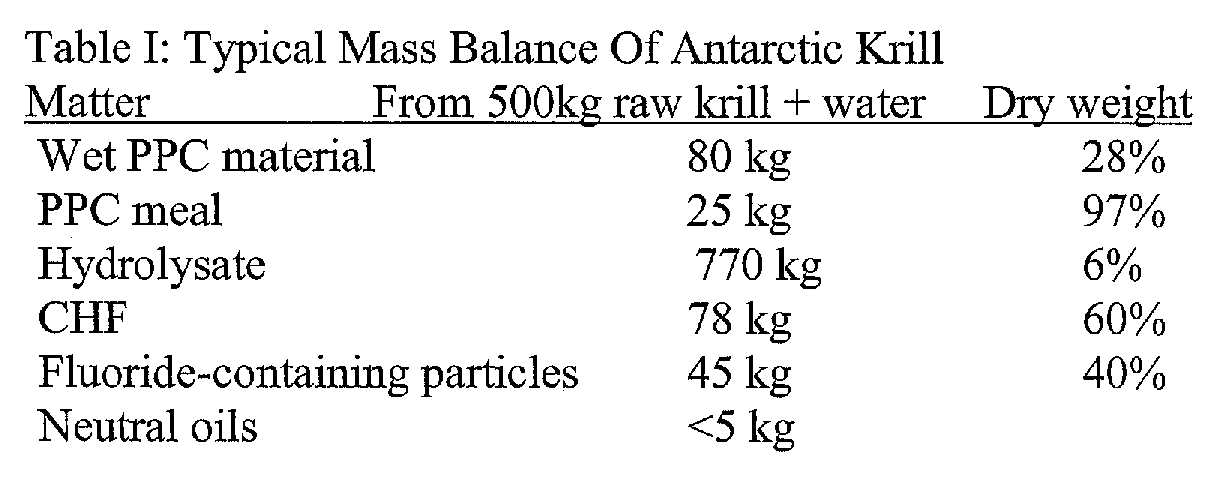


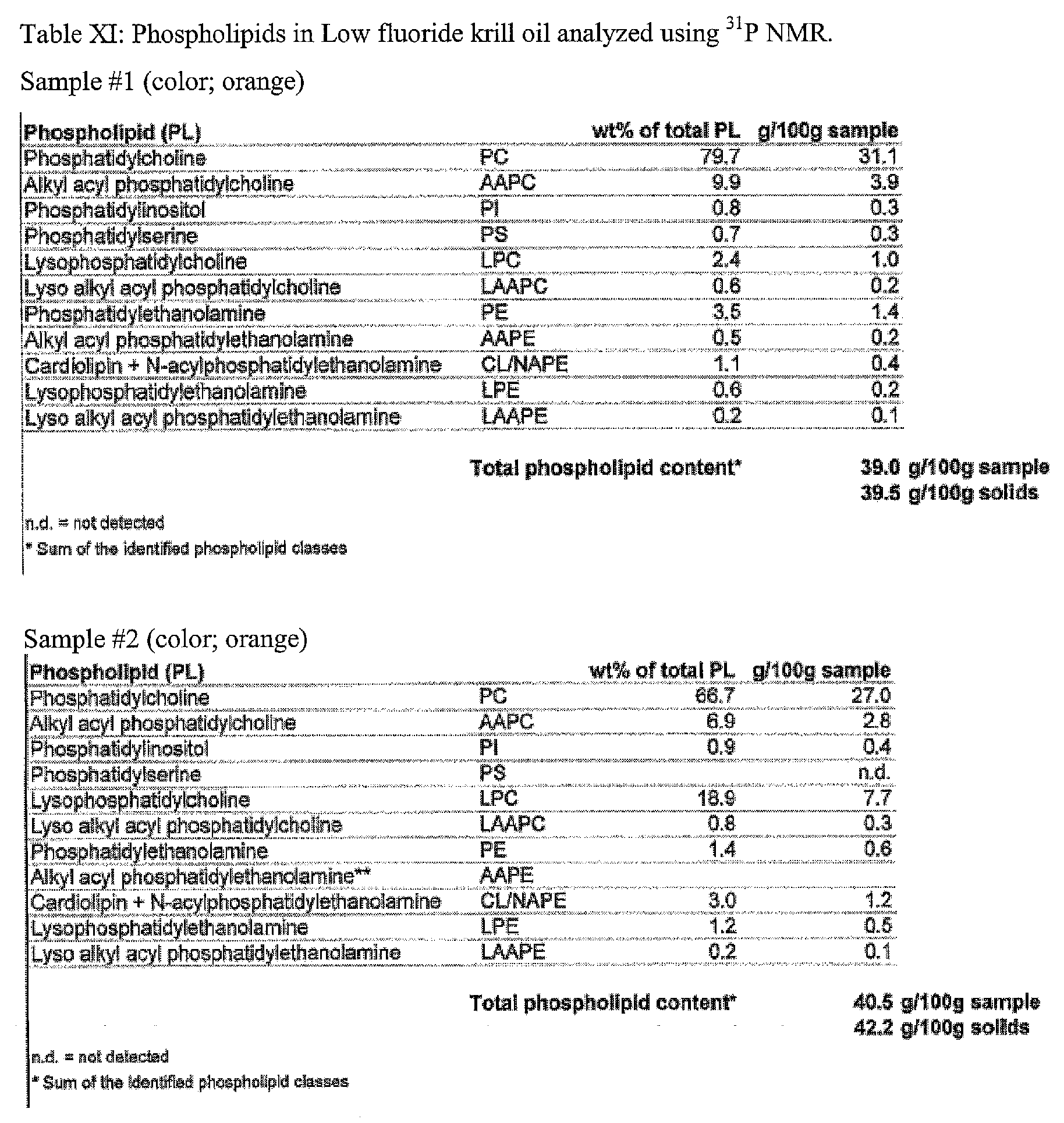


Claims
Priority Applications (16)
| Application Number | Priority Date | Filing Date | Title |
|---|---|---|---|
| KR1020197028701A KR102175037B1 (en) | 2012-01-03 | 2012-12-21 | Method for processing crustaceans to produce low fluoride/low trimethyl amine products thereof |
| CA2862261A CA2862261C (en) | 2012-01-03 | 2012-12-21 | A crustacean oil composition with low fluoride and trimethyl amine content |
| EP12837639.9A EP2800481B1 (en) | 2012-01-03 | 2012-12-21 | Method for processing crustaceans to produce low fluoride/low trimethyl amine products thereof |
| AU2012364278A AU2012364278C1 (en) | 2012-01-03 | 2012-12-21 | Method for processing crustaceans to produce low fluoride/low trimethyl amine products thereof |
| NZ626764A NZ626764B2 (en) | 2012-01-03 | 2012-12-21 | Method for processing crustaceans to produce low fluoride/low trimethyl amine products thereof |
| EP17204677.3A EP3311679B1 (en) | 2012-01-03 | 2012-12-21 | Low fluoride/low trimethyl amine krill oil |
| ES12837639.9T ES2666048T3 (en) | 2012-01-03 | 2012-12-21 | Method for processing crustaceans to produce products with low fluoride content / low trimethylamine content thereof |
| US14/370,324 US9814256B2 (en) | 2009-09-14 | 2012-12-21 | Method for processing crustaceans to produce low fluoride/low trimethyl amine products thereof |
| EP25198405.0A EP4666860A3 (en) | 2012-01-03 | 2012-12-21 | Method for processing crustaceans to produce low fluoride/low trimethyl amine products thereof |
| CN201280071115.9A CN104159456A (en) | 2012-01-03 | 2012-12-21 | Method for processing crustaceans to produce low fluoride/low trimethyl amine products thereof |
| JP2014550767A JP6308950B2 (en) | 2012-01-03 | 2012-12-21 | Process for treating crustaceans to produce their low fluoride / low trimethylamine products |
| DK12837639.9T DK2800481T3 (en) | 2012-01-03 | 2012-12-21 | PROCEDURE FOR TREATING CANCER ANIMALS FOR THE PRODUCTION OF PRODUCTS THEREOF WITH LOW CONTENT OF FLUORIDE / LOW CONTENT OF TRIMETHYLAMINE |
| KR1020147021397A KR102213517B1 (en) | 2012-01-03 | 2012-12-21 | Method for processing crustaceans to produce low fluoride/low trimethyl amine products thereof |
| EP21209685.3A EP4005395A3 (en) | 2012-01-03 | 2012-12-21 | Method for processing crustaceans to produce low fluoride/low trimethyl amine products thereof |
| US15/171,886 US10499673B2 (en) | 2008-09-12 | 2016-06-02 | Method for processing crustaceans to produce low fluoride/low trimethyl amine products thereof |
| AU2017203646A AU2017203646C1 (en) | 2012-01-03 | 2017-05-31 | Method for processing crustaceans to produce low fluoride/low trimethyl amine products thereof |
Applications Claiming Priority (2)
| Application Number | Priority Date | Filing Date | Title |
|---|---|---|---|
| US13/342,664 | 2012-01-03 | ||
| US13/342,664 US8557297B2 (en) | 2008-09-12 | 2012-01-03 | Method for processing crustaceans and products thereof |
Related Parent Applications (1)
| Application Number | Title | Priority Date | Filing Date |
|---|---|---|---|
| US13/342,664 Continuation-In-Part US8557297B2 (en) | 2008-09-12 | 2012-01-03 | Method for processing crustaceans and products thereof |
Related Child Applications (2)
| Application Number | Title | Priority Date | Filing Date |
|---|---|---|---|
| US14/370,324 A-371-Of-International US9814256B2 (en) | 2008-09-12 | 2012-12-21 | Method for processing crustaceans to produce low fluoride/low trimethyl amine products thereof |
| US15/171,886 Continuation US10499673B2 (en) | 2008-09-12 | 2016-06-02 | Method for processing crustaceans to produce low fluoride/low trimethyl amine products thereof |
Publications (2)
| Publication Number | Publication Date |
|---|---|
| WO2013102792A2 true WO2013102792A2 (en) | 2013-07-11 |
| WO2013102792A3 WO2013102792A3 (en) | 2013-12-27 |
Family
ID=48014102
Family Applications (1)
| Application Number | Title | Priority Date | Filing Date |
|---|---|---|---|
| PCT/IB2012/003004 Ceased WO2013102792A2 (en) | 2008-09-12 | 2012-12-21 | Method for processing crustaceans to produce low fluoride/low trimethyl amine products thereof |
Country Status (11)
| Country | Link |
|---|---|
| US (3) | US8557297B2 (en) |
| EP (4) | EP3311679B1 (en) |
| JP (1) | JP6308950B2 (en) |
| KR (2) | KR102213517B1 (en) |
| CN (1) | CN104159456A (en) |
| AU (2) | AU2012364278C1 (en) |
| CA (1) | CA2862261C (en) |
| CL (1) | CL2014001751A1 (en) |
| DK (2) | DK3311679T3 (en) |
| ES (2) | ES2666048T3 (en) |
| WO (1) | WO2013102792A2 (en) |
Cited By (14)
| Publication number | Priority date | Publication date | Assignee | Title |
|---|---|---|---|---|
| WO2014207571A2 (en) | 2013-06-14 | 2014-12-31 | Aker Biomarine As | Lipid extraction processes |
| WO2016097854A1 (en) | 2014-12-19 | 2016-06-23 | Aker Biomarine Antarctic As | Enhanced omega-3 formulations |
| WO2016190748A1 (en) | 2015-05-27 | 2016-12-01 | Rimfrost As | A flowable concentrated phospholipid krill oil composition |
| US9644170B2 (en) | 2007-03-28 | 2017-05-09 | Aker Biomarine Antarctic As | Bioeffective krill oil compositions |
| US9730966B2 (en) | 2007-03-28 | 2017-08-15 | Aker Biomarine Antartic As | Method of reducing appetite in a human subject comprising administering krill oil composition |
| US9867856B2 (en) | 2014-01-10 | 2018-01-16 | Aker Biomarine Antarctic As | Phospholipid compositions and their preparation |
| US10080803B2 (en) | 2014-04-25 | 2018-09-25 | Aker Biomarine Antartic As | Emulsified krill phospholipid compositions |
| WO2019150197A1 (en) | 2018-01-30 | 2019-08-08 | Aker Biomarine Antarctic As | Marine protein hydrolysate with low fluoride and trimethylamin content |
| US10456412B2 (en) | 2015-02-11 | 2019-10-29 | Aker Biomarine Antarctic As | Lipid extraction processes |
| US10709148B2 (en) | 2017-12-04 | 2020-07-14 | Rimfrost Technologies | Method for producing a protein phospholipid complex from a crustacean catch |
| US10806742B2 (en) | 2014-02-12 | 2020-10-20 | Aker Biomarine Antarctic As | Liquid phospholipid-containing compositions for the preparation of pharmaceuticals |
| US10864223B2 (en) | 2015-02-11 | 2020-12-15 | Aker Biomarine Antarctic As | Lipid compositions |
| US10960016B2 (en) | 2014-02-12 | 2021-03-30 | Aker Biomarine Antarctic As | Capsules containing high doses of krill phospholipids |
| US11654163B2 (en) | 2017-12-22 | 2023-05-23 | Pharmalink International Limited | Lipid combinations |
Families Citing this family (12)
| Publication number | Priority date | Publication date | Assignee | Title |
|---|---|---|---|---|
| BRPI0918538A2 (en) * | 2008-09-12 | 2015-10-06 | Emerald Fisheries As | process for removing fluoride from a shellfish catch, concentrated hydrolyzate fraction, and complex peptide / peptide flour |
| US9814256B2 (en) | 2009-09-14 | 2017-11-14 | Rimfrost Technologies As | Method for processing crustaceans to produce low fluoride/low trimethyl amine products thereof |
| SI2697345T1 (en) * | 2011-04-14 | 2016-08-31 | Polar Omega A/S | A process for the isolation of a phospholipid |
| US9604153B1 (en) * | 2012-07-31 | 2017-03-28 | Quinlan Properties, LLC | Separation systems and methods of using them |
| WO2014184655A1 (en) | 2013-02-07 | 2014-11-20 | Olympic Seafood As | Methods for using crustacean phospholipid-peptide-protein complexes |
| KR101499199B1 (en) * | 2013-11-04 | 2015-03-09 | 부경대학교 산학협력단 | Manufacturing method of krill oil of low fluorine, low acid value, low peroxide value and high astaxanthin, and krill oil manufactured by the same |
| WO2017019556A1 (en) * | 2015-07-24 | 2017-02-02 | Solix Algredients, Inc. | Methods and systems for extracting products from biological materials using supercritical fluid extraction |
| CN108913352B (en) * | 2018-07-27 | 2020-08-11 | 山东鲁华海洋生物科技有限公司 | Amine-removed low-fishy-smell krill oil and preparation method thereof |
| KR101966081B1 (en) * | 2018-12-05 | 2019-04-05 | 이상수 | Composition of krill oil and method of manufacturing the same |
| CN110558499A (en) * | 2019-09-19 | 2019-12-13 | 福建启元堂生物技术有限公司 | Pretreatment method for double-super-extraction of marine nutrients |
| KR102222043B1 (en) * | 2020-08-07 | 2021-03-04 | 주식회사 동원에프앤비 | Method of krill oil preparation and composition of krill oil |
| CN114404561B (en) * | 2022-03-18 | 2022-11-01 | 山东大学齐鲁医院(青岛) | A protective agent for reducing vascular endothelial function damage |
Citations (8)
| Publication number | Priority date | Publication date | Assignee | Title |
|---|---|---|---|---|
| JPH02215351A (en) | 1989-02-14 | 1990-08-28 | Taiyo Fishery Co Ltd | Method for collecting krill phospholipid and functional food and nerve function improving agent having nerve function improving effect |
| GB2240786A (en) | 1990-02-13 | 1991-08-14 | Korea Food Res Inst | A process for reducing the fluorine content of krill (euphausia superba) by electric concentration |
| WO2000023546A1 (en) | 1998-10-21 | 2000-04-27 | Universite De Sherbrooke | Method of extracting lipids from marine and aquatic animal tissues |
| WO2002102394A2 (en) | 2001-06-18 | 2002-12-27 | Neptune Technologies & Bioressources Inc. | Krill and/or marine extracts for prevention and/or treatment of cardiovascular diseases, arthritis, skin cancer, diabetes, premenstrual syndrome and transdermal transport |
| WO2007136281A1 (en) | 2006-05-24 | 2007-11-29 | Industrial Research Limited | Extraction of highly unsaturated lipids with liquid dimethyl ether |
| WO2008060163A1 (en) | 2006-11-16 | 2008-05-22 | Pronova Biopharma Norge As | Process for production of omega-3 rich marine phospholipids from krill |
| US20080274203A1 (en) | 2007-03-28 | 2008-11-06 | Aker Biomarine Asa | Bioeffective krill oil compositions |
| US20110224450A1 (en) | 2009-10-30 | 2011-09-15 | Tharos Ltd. | Solvent-free process for obtaining phospholipids and neutral enriched krill oils |
Family Cites Families (25)
| Publication number | Priority date | Publication date | Assignee | Title |
|---|---|---|---|---|
| JPS5264453A (en) | 1975-11-21 | 1977-05-27 | Kiyokuyou Kk | Method of separating protein from euphausiid |
| JPS5823053B2 (en) | 1979-04-19 | 1983-05-12 | 東海区水産研究所長 | Method for separating salt-soluble proteins from krill |
| US5053234A (en) | 1984-04-30 | 1991-10-01 | Advanced Hydrolyzing Systems, Inc. | Method for producing a proteinaceous product by digestion of raw animal parts |
| US5006281A (en) * | 1985-03-26 | 1991-04-09 | Century Laboratories, Inc. | Process for the production of a marine animal oil |
| NO176323C (en) | 1988-11-18 | 1995-03-15 | Mikalsen Ester | Process for Extraction of Astaxanthin, Related Carotenoids and Astaxanthin Esters from Krill, Shrimp and Other Crustaceans |
| JP2870871B2 (en) | 1989-10-23 | 1999-03-17 | 第三化成株式会社 | A method for treating crustacean shells using enzymes |
| EP0604467A1 (en) * | 1991-08-30 | 1994-07-06 | Teagasc, The Agriculture And Food Development Authority | Hypoallergenic whey protein hydrolysate |
| JP3397258B2 (en) | 1993-12-29 | 2003-04-14 | 日本水産株式会社 | Calcium absorption promoting water-soluble fraction, composition containing the same, and calcium absorption promoting additive |
| DE69704963T2 (en) * | 1996-01-18 | 2002-01-24 | Rapanelli Fioravante S.P.A., Foligno | Horizontal centrifuge for optimal oil extraction |
| CA2197137A1 (en) | 1997-02-07 | 1998-08-07 | Biozyme Systems Inc. | Method and apparatus for co-drying krill hydrolysate, liquid marine protein and dry carrier |
| US6555155B2 (en) * | 1996-10-21 | 2003-04-29 | Biozyme Systems, Inc. | Method and apparatus for harvesting, digestion and dehydrating of krill hydrolysates and co-drying and processing of such hydrolysates |
| JP3408958B2 (en) | 1997-10-24 | 2003-05-19 | 旭化成株式会社 | Composition containing useful substance derived from fish and shellfish and method for producing the useful substance |
| JP3961429B2 (en) | 1998-04-24 | 2007-08-22 | 哲夫 山根 | Nutritional enhancement composition for feed or feed |
| PT1227736E (en) | 1999-10-20 | 2004-05-31 | Nordur Ehf | HYDROLYSIS OF PROTEINS PRODUCED WITH THE USE OF MARINE PROTEASES |
| US6589574B2 (en) * | 2001-03-19 | 2003-07-08 | Council Of Scientific & Industrial Research | Process for preparation of protein-hydrolysate from milk protein |
| CA2493888C (en) | 2001-07-27 | 2013-07-16 | Neptune Technologies & Bioressources Inc. | Natural marine source phospholipids comprising flavonoids, polyunsaturated fatty acids and their applications |
| FR2835703B1 (en) | 2002-02-08 | 2006-05-05 | Techniagro | PROCESS FOR OBTAINING PROTEIN OIL AND HYDROLYSAT FROM A MARINE PROTEIN TISSUE SOURCE AND OIL AND PROTEIN HYDROLYSAT OBTAINED BY CARRYING OUT SAID METHOD |
| NO320964B1 (en) | 2004-05-26 | 2006-02-20 | Norcape Biotechnology As | Hydrolyzed marine protein product and a feed product comprising this, method of preparation and use |
| NO325805B1 (en) | 2006-11-27 | 2008-07-21 | Lars Aglen | Device for pressing krill and other marine organisms |
| WO2008072563A1 (en) | 2006-12-11 | 2008-06-19 | Nippon Suisan Kaisha, Ltd. | Feed using peeled krill as the starting material and method of preventing decrease in fish growth rate by using the same |
| JP5443979B2 (en) | 2007-05-11 | 2014-03-19 | 備前化成株式会社 | Novel leukotriene receptor antagonist |
| US20090061067A1 (en) * | 2007-08-29 | 2009-03-05 | Aker Biomarine Asa | Method for making krill meal |
| WO2009132463A1 (en) * | 2008-05-02 | 2009-11-05 | Neptune Technologies & Bioressources Inc. | New deodorization method and organoleptic improvement of marine oil extracts |
| BRPI0918538A2 (en) | 2008-09-12 | 2015-10-06 | Emerald Fisheries As | process for removing fluoride from a shellfish catch, concentrated hydrolyzate fraction, and complex peptide / peptide flour |
| CN101690538B (en) * | 2009-09-24 | 2012-05-23 | 中国海洋大学 | A kind of preparation method of low-fluorine Antarctic krill protein base material |
-
2012
- 2012-01-03 US US13/342,664 patent/US8557297B2/en active Active
- 2012-12-21 WO PCT/IB2012/003004 patent/WO2013102792A2/en not_active Ceased
- 2012-12-21 DK DK17204677.3T patent/DK3311679T3/en active
- 2012-12-21 EP EP17204677.3A patent/EP3311679B1/en not_active Revoked
- 2012-12-21 CN CN201280071115.9A patent/CN104159456A/en active Pending
- 2012-12-21 DK DK12837639.9T patent/DK2800481T3/en active
- 2012-12-21 EP EP12837639.9A patent/EP2800481B1/en not_active Revoked
- 2012-12-21 JP JP2014550767A patent/JP6308950B2/en active Active
- 2012-12-21 KR KR1020147021397A patent/KR102213517B1/en active Active
- 2012-12-21 AU AU2012364278A patent/AU2012364278C1/en active Active
- 2012-12-21 EP EP21209685.3A patent/EP4005395A3/en active Pending
- 2012-12-21 CA CA2862261A patent/CA2862261C/en active Active
- 2012-12-21 ES ES12837639.9T patent/ES2666048T3/en active Active
- 2012-12-21 ES ES17204677T patent/ES2906177T3/en active Active
- 2012-12-21 KR KR1020197028701A patent/KR102175037B1/en active Active
- 2012-12-21 EP EP25198405.0A patent/EP4666860A3/en active Pending
-
2013
- 2013-04-04 US US13/856,642 patent/US9068142B2/en active Active
-
2014
- 2014-06-27 CL CL2014001751A patent/CL2014001751A1/en unknown
-
2015
- 2015-05-20 US US14/717,140 patent/US9480273B2/en active Active
-
2017
- 2017-05-31 AU AU2017203646A patent/AU2017203646C1/en active Active
Patent Citations (8)
| Publication number | Priority date | Publication date | Assignee | Title |
|---|---|---|---|---|
| JPH02215351A (en) | 1989-02-14 | 1990-08-28 | Taiyo Fishery Co Ltd | Method for collecting krill phospholipid and functional food and nerve function improving agent having nerve function improving effect |
| GB2240786A (en) | 1990-02-13 | 1991-08-14 | Korea Food Res Inst | A process for reducing the fluorine content of krill (euphausia superba) by electric concentration |
| WO2000023546A1 (en) | 1998-10-21 | 2000-04-27 | Universite De Sherbrooke | Method of extracting lipids from marine and aquatic animal tissues |
| WO2002102394A2 (en) | 2001-06-18 | 2002-12-27 | Neptune Technologies & Bioressources Inc. | Krill and/or marine extracts for prevention and/or treatment of cardiovascular diseases, arthritis, skin cancer, diabetes, premenstrual syndrome and transdermal transport |
| WO2007136281A1 (en) | 2006-05-24 | 2007-11-29 | Industrial Research Limited | Extraction of highly unsaturated lipids with liquid dimethyl ether |
| WO2008060163A1 (en) | 2006-11-16 | 2008-05-22 | Pronova Biopharma Norge As | Process for production of omega-3 rich marine phospholipids from krill |
| US20080274203A1 (en) | 2007-03-28 | 2008-11-06 | Aker Biomarine Asa | Bioeffective krill oil compositions |
| US20110224450A1 (en) | 2009-10-30 | 2011-09-15 | Tharos Ltd. | Solvent-free process for obtaining phospholipids and neutral enriched krill oils |
Non-Patent Citations (2)
| Title |
|---|
| SOXHLET F.: "Die gewichtsanalytische bestimmung des milchfettes", DINGLER'S POLYTECH. J., vol. 232, pages 461 - 465 |
| YANCEY, P: "Organic osmolytes as compatible, metabolic, and counteracting cytoprotectants in high osmolarity and other stresses", J. EXP. BIOL., vol. 208, no. 15, 2005, pages 2819 - 2830, XP002476122, DOI: doi:10.1242/jeb.01730 |
Cited By (28)
| Publication number | Priority date | Publication date | Assignee | Title |
|---|---|---|---|---|
| US10543237B2 (en) | 2007-03-28 | 2020-01-28 | Aker Biomarine Antarctic As | Bioeffective krill oil compositions |
| US11865143B2 (en) | 2007-03-28 | 2024-01-09 | Aker Biomarine Antarctic As | Bioeffective krill oil compositions |
| US9644170B2 (en) | 2007-03-28 | 2017-05-09 | Aker Biomarine Antarctic As | Bioeffective krill oil compositions |
| US9644169B2 (en) | 2007-03-28 | 2017-05-09 | Aker Biomarine Antarctic As | Bioeffective krill oil compositions |
| US9730966B2 (en) | 2007-03-28 | 2017-08-15 | Aker Biomarine Antartic As | Method of reducing appetite in a human subject comprising administering krill oil composition |
| US9816046B2 (en) | 2007-03-28 | 2017-11-14 | Aker Biomarine Antarctic As | Bioeffective krill oil compositions |
| US9889163B2 (en) | 2007-03-28 | 2018-02-13 | Aker Biomarine Antarctic As | Bioeffective krill oil compositions |
| US10010567B2 (en) | 2007-03-28 | 2018-07-03 | Aker Biomarine Antarctic As | Bioeffective krill oil compositions |
| EP3008156B1 (en) | 2013-06-14 | 2023-06-07 | Aker Biomarine Antarctic As | Lipid extraction processes |
| WO2014207571A2 (en) | 2013-06-14 | 2014-12-31 | Aker Biomarine As | Lipid extraction processes |
| US10704011B2 (en) | 2013-06-14 | 2020-07-07 | Aker Biomarine Antarctic As | Lipid extraction processes |
| US9867856B2 (en) | 2014-01-10 | 2018-01-16 | Aker Biomarine Antarctic As | Phospholipid compositions and their preparation |
| US10960016B2 (en) | 2014-02-12 | 2021-03-30 | Aker Biomarine Antarctic As | Capsules containing high doses of krill phospholipids |
| US10806742B2 (en) | 2014-02-12 | 2020-10-20 | Aker Biomarine Antarctic As | Liquid phospholipid-containing compositions for the preparation of pharmaceuticals |
| US10080803B2 (en) | 2014-04-25 | 2018-09-25 | Aker Biomarine Antartic As | Emulsified krill phospholipid compositions |
| US11147841B2 (en) | 2014-12-19 | 2021-10-19 | Aker Biomarine Antarctic As | Enhanced omega-3 formulations |
| WO2016097854A1 (en) | 2014-12-19 | 2016-06-23 | Aker Biomarine Antarctic As | Enhanced omega-3 formulations |
| US10864223B2 (en) | 2015-02-11 | 2020-12-15 | Aker Biomarine Antarctic As | Lipid compositions |
| US10456412B2 (en) | 2015-02-11 | 2019-10-29 | Aker Biomarine Antarctic As | Lipid extraction processes |
| US11819509B2 (en) | 2015-02-11 | 2023-11-21 | Aker Biomarine Antarctic As | Lipid compositions |
| US10328105B2 (en) | 2015-05-27 | 2019-06-25 | Rimfrost Technologies As | Flowable concentrated phospholipid krill oil composition |
| US10525087B2 (en) | 2015-05-27 | 2020-01-07 | Rimfrost Technologies As | Flowable concentrated phospholipid krill oil composition |
| WO2016190748A1 (en) | 2015-05-27 | 2016-12-01 | Rimfrost As | A flowable concentrated phospholipid krill oil composition |
| US10709148B2 (en) | 2017-12-04 | 2020-07-14 | Rimfrost Technologies | Method for producing a protein phospholipid complex from a crustacean catch |
| US20200296984A1 (en) * | 2017-12-04 | 2020-09-24 | Rimfrost Technologies As | Nutritional crustacean oil supplements |
| US11654163B2 (en) | 2017-12-22 | 2023-05-23 | Pharmalink International Limited | Lipid combinations |
| WO2019150197A1 (en) | 2018-01-30 | 2019-08-08 | Aker Biomarine Antarctic As | Marine protein hydrolysate with low fluoride and trimethylamin content |
| EP4091620A1 (en) | 2018-01-30 | 2022-11-23 | Aker Biomarine Antarctic As | Krill protein hydrolysate with low fluoride and trimethylamin content |
Also Published As
Similar Documents
| Publication | Publication Date | Title |
|---|---|---|
| AU2017203646B2 (en) | Method for processing crustaceans to produce low fluoride/low trimethyl amine products thereof | |
| EP3238551B1 (en) | Process for reducing the fluoride content when producing proteinaceous concentrates from krill | |
| US10499673B2 (en) | Method for processing crustaceans to produce low fluoride/low trimethyl amine products thereof | |
| AU2015100022B4 (en) | Method for processing crustaceans to produce low fluoride/low trimethyl amine products thereof | |
| NZ626764B2 (en) | Method for processing crustaceans to produce low fluoride/low trimethyl amine products thereof |
Legal Events
| Date | Code | Title | Description |
|---|---|---|---|
| 121 | Ep: the epo has been informed by wipo that ep was designated in this application |
Ref document number: 12837639 Country of ref document: EP Kind code of ref document: A2 |
|
| ENP | Entry into the national phase |
Ref document number: 2862261 Country of ref document: CA |
|
| WWE | Wipo information: entry into national phase |
Ref document number: 2014001751 Country of ref document: CL |
|
| ENP | Entry into the national phase |
Ref document number: 2014550767 Country of ref document: JP Kind code of ref document: A |
|
| WWE | Wipo information: entry into national phase |
Ref document number: 14370324 Country of ref document: US |
|
| WWE | Wipo information: entry into national phase |
Ref document number: 2012837639 Country of ref document: EP |
|
| ENP | Entry into the national phase |
Ref document number: 2012364278 Country of ref document: AU Date of ref document: 20121221 Kind code of ref document: A |
|
| ENP | Entry into the national phase |
Ref document number: 20147021397 Country of ref document: KR Kind code of ref document: A |