WO2013103065A1 - Composition d'adhésif - Google Patents
Composition d'adhésif Download PDFInfo
- Publication number
- WO2013103065A1 WO2013103065A1 PCT/JP2012/081629 JP2012081629W WO2013103065A1 WO 2013103065 A1 WO2013103065 A1 WO 2013103065A1 JP 2012081629 W JP2012081629 W JP 2012081629W WO 2013103065 A1 WO2013103065 A1 WO 2013103065A1
- Authority
- WO
- WIPO (PCT)
- Prior art keywords
- adhesive composition
- pressure
- sensitive adhesive
- meth
- seawater
- Prior art date
- Legal status (The legal status is an assumption and is not a legal conclusion. Google has not performed a legal analysis and makes no representation as to the accuracy of the status listed.)
- Ceased
Links
Images
Classifications
-
- A—HUMAN NECESSITIES
- A01—AGRICULTURE; FORESTRY; ANIMAL HUSBANDRY; HUNTING; TRAPPING; FISHING
- A01N—PRESERVATION OF BODIES OF HUMANS OR ANIMALS OR PLANTS OR PARTS THEREOF; BIOCIDES, e.g. AS DISINFECTANTS, AS PESTICIDES OR AS HERBICIDES; PEST REPELLANTS OR ATTRACTANTS; PLANT GROWTH REGULATORS
- A01N25/00—Biocides, pest repellants or attractants, or plant growth regulators, characterised by their forms, or by their non-active ingredients or by their methods of application, e.g. seed treatment or sequential application; Substances for reducing the noxious effect of the active ingredients to organisms other than pests
- A01N25/34—Shaped forms, e.g. sheets, not provided for in any other sub-group of this main group
-
- B—PERFORMING OPERATIONS; TRANSPORTING
- B32—LAYERED PRODUCTS
- B32B—LAYERED PRODUCTS, i.e. PRODUCTS BUILT-UP OF STRATA OF FLAT OR NON-FLAT, e.g. CELLULAR OR HONEYCOMB, FORM
- B32B27/00—Layered products comprising a layer of synthetic resin
- B32B27/06—Layered products comprising a layer of synthetic resin as the main or only constituent of a layer, which is next to another layer of the same or of a different material
-
- B—PERFORMING OPERATIONS; TRANSPORTING
- B32—LAYERED PRODUCTS
- B32B—LAYERED PRODUCTS, i.e. PRODUCTS BUILT-UP OF STRATA OF FLAT OR NON-FLAT, e.g. CELLULAR OR HONEYCOMB, FORM
- B32B27/00—Layered products comprising a layer of synthetic resin
- B32B27/30—Layered products comprising a layer of synthetic resin comprising vinyl (co)polymers; comprising acrylic (co)polymers
- B32B27/308—Layered products comprising a layer of synthetic resin comprising vinyl (co)polymers; comprising acrylic (co)polymers comprising acrylic (co)polymers
-
- B—PERFORMING OPERATIONS; TRANSPORTING
- B32—LAYERED PRODUCTS
- B32B—LAYERED PRODUCTS, i.e. PRODUCTS BUILT-UP OF STRATA OF FLAT OR NON-FLAT, e.g. CELLULAR OR HONEYCOMB, FORM
- B32B7/00—Layered products characterised by the relation between layers; Layered products characterised by the relative orientation of features between layers, or by the relative values of a measurable parameter between layers, i.e. products comprising layers having different physical, chemical or physicochemical properties; Layered products characterised by the interconnection of layers
- B32B7/04—Interconnection of layers
- B32B7/06—Interconnection of layers permitting easy separation
-
- B—PERFORMING OPERATIONS; TRANSPORTING
- B32—LAYERED PRODUCTS
- B32B—LAYERED PRODUCTS, i.e. PRODUCTS BUILT-UP OF STRATA OF FLAT OR NON-FLAT, e.g. CELLULAR OR HONEYCOMB, FORM
- B32B7/00—Layered products characterised by the relation between layers; Layered products characterised by the relative orientation of features between layers, or by the relative values of a measurable parameter between layers, i.e. products comprising layers having different physical, chemical or physicochemical properties; Layered products characterised by the interconnection of layers
- B32B7/04—Interconnection of layers
- B32B7/12—Interconnection of layers using interposed adhesives or interposed materials with bonding properties
-
- B—PERFORMING OPERATIONS; TRANSPORTING
- B63—SHIPS OR OTHER WATERBORNE VESSELS; RELATED EQUIPMENT
- B63B—SHIPS OR OTHER WATERBORNE VESSELS; EQUIPMENT FOR SHIPPING
- B63B59/00—Hull protection specially adapted for vessels; Cleaning devices specially adapted for vessels
- B63B59/04—Preventing hull fouling
-
- C—CHEMISTRY; METALLURGY
- C09—DYES; PAINTS; POLISHES; NATURAL RESINS; ADHESIVES; COMPOSITIONS NOT OTHERWISE PROVIDED FOR; APPLICATIONS OF MATERIALS NOT OTHERWISE PROVIDED FOR
- C09D—COATING COMPOSITIONS, e.g. PAINTS, VARNISHES OR LACQUERS; FILLING PASTES; CHEMICAL PAINT OR INK REMOVERS; INKS; CORRECTING FLUIDS; WOODSTAINS; PASTES OR SOLIDS FOR COLOURING OR PRINTING; USE OF MATERIALS THEREFOR
- C09D5/00—Coating compositions, e.g. paints, varnishes or lacquers, characterised by their physical nature or the effects produced; Filling pastes
- C09D5/16—Antifouling paints; Underwater paints
- C09D5/1656—Antifouling paints; Underwater paints characterised by the film-forming substance
- C09D5/1662—Synthetic film-forming substance
- C09D5/1668—Vinyl-type polymers
-
- C—CHEMISTRY; METALLURGY
- C09—DYES; PAINTS; POLISHES; NATURAL RESINS; ADHESIVES; COMPOSITIONS NOT OTHERWISE PROVIDED FOR; APPLICATIONS OF MATERIALS NOT OTHERWISE PROVIDED FOR
- C09J—ADHESIVES; NON-MECHANICAL ASPECTS OF ADHESIVE PROCESSES IN GENERAL; ADHESIVE PROCESSES NOT PROVIDED FOR ELSEWHERE; USE OF MATERIALS AS ADHESIVES
- C09J133/00—Adhesives based on homopolymers or copolymers of compounds having one or more unsaturated aliphatic radicals, each having only one carbon-to-carbon double bond, and at least one being terminated by only one carboxyl radical, or of salts, anhydrides, esters, amides, imides, or nitriles thereof; Adhesives based on derivatives of such polymers
- C09J133/02—Homopolymers or copolymers of acids; Metal or ammonium salts thereof
-
- C—CHEMISTRY; METALLURGY
- C09—DYES; PAINTS; POLISHES; NATURAL RESINS; ADHESIVES; COMPOSITIONS NOT OTHERWISE PROVIDED FOR; APPLICATIONS OF MATERIALS NOT OTHERWISE PROVIDED FOR
- C09J—ADHESIVES; NON-MECHANICAL ASPECTS OF ADHESIVE PROCESSES IN GENERAL; ADHESIVE PROCESSES NOT PROVIDED FOR ELSEWHERE; USE OF MATERIALS AS ADHESIVES
- C09J4/00—Adhesives based on organic non-macromolecular compounds having at least one polymerisable carbon-to-carbon unsaturated bond ; adhesives, based on monomers of macromolecular compounds of groups C09J183/00 - C09J183/16
- C09J4/06—Organic non-macromolecular compounds having at least one polymerisable carbon-to-carbon unsaturated bond in combination with a macromolecular compound other than an unsaturated polymer of groups C09J159/00 - C09J187/00
-
- C—CHEMISTRY; METALLURGY
- C09—DYES; PAINTS; POLISHES; NATURAL RESINS; ADHESIVES; COMPOSITIONS NOT OTHERWISE PROVIDED FOR; APPLICATIONS OF MATERIALS NOT OTHERWISE PROVIDED FOR
- C09J—ADHESIVES; NON-MECHANICAL ASPECTS OF ADHESIVE PROCESSES IN GENERAL; ADHESIVE PROCESSES NOT PROVIDED FOR ELSEWHERE; USE OF MATERIALS AS ADHESIVES
- C09J7/00—Adhesives in the form of films or foils
- C09J7/30—Adhesives in the form of films or foils characterised by the adhesive composition
- C09J7/38—Pressure-sensitive adhesives [PSA]
- C09J7/381—Pressure-sensitive adhesives [PSA] based on macromolecular compounds obtained by reactions involving only carbon-to-carbon unsaturated bonds
- C09J7/385—Acrylic polymers
-
- B—PERFORMING OPERATIONS; TRANSPORTING
- B32—LAYERED PRODUCTS
- B32B—LAYERED PRODUCTS, i.e. PRODUCTS BUILT-UP OF STRATA OF FLAT OR NON-FLAT, e.g. CELLULAR OR HONEYCOMB, FORM
- B32B2307/00—Properties of the layers or laminate
- B32B2307/50—Properties of the layers or laminate having particular mechanical properties
- B32B2307/51—Elastic
-
- B—PERFORMING OPERATIONS; TRANSPORTING
- B32—LAYERED PRODUCTS
- B32B—LAYERED PRODUCTS, i.e. PRODUCTS BUILT-UP OF STRATA OF FLAT OR NON-FLAT, e.g. CELLULAR OR HONEYCOMB, FORM
- B32B2405/00—Adhesive articles, e.g. adhesive tapes
-
- C—CHEMISTRY; METALLURGY
- C08—ORGANIC MACROMOLECULAR COMPOUNDS; THEIR PREPARATION OR CHEMICAL WORKING-UP; COMPOSITIONS BASED THEREON
- C08F—MACROMOLECULAR COMPOUNDS OBTAINED BY REACTIONS ONLY INVOLVING CARBON-TO-CARBON UNSATURATED BONDS
- C08F222/00—Copolymers of compounds having one or more unsaturated aliphatic radicals, each having only one carbon-to-carbon double bond, and at least one being terminated by a carboxyl radical and containing at least one other carboxyl radical in the molecule; Salts, anhydrides, esters, amides, imides, or nitriles thereof
- C08F222/10—Esters
- C08F222/1006—Esters of polyhydric alcohols or polyhydric phenols
- C08F222/102—Esters of polyhydric alcohols or polyhydric phenols of dialcohols, e.g. ethylene glycol di(meth)acrylate or 1,4-butanediol dimethacrylate
-
- C—CHEMISTRY; METALLURGY
- C09—DYES; PAINTS; POLISHES; NATURAL RESINS; ADHESIVES; COMPOSITIONS NOT OTHERWISE PROVIDED FOR; APPLICATIONS OF MATERIALS NOT OTHERWISE PROVIDED FOR
- C09J—ADHESIVES; NON-MECHANICAL ASPECTS OF ADHESIVE PROCESSES IN GENERAL; ADHESIVE PROCESSES NOT PROVIDED FOR ELSEWHERE; USE OF MATERIALS AS ADHESIVES
- C09J2301/00—Additional features of adhesives in the form of films or foils
- C09J2301/30—Additional features of adhesives in the form of films or foils characterized by the chemical, physicochemical or physical properties of the adhesive or the carrier
- C09J2301/312—Additional features of adhesives in the form of films or foils characterized by the chemical, physicochemical or physical properties of the adhesive or the carrier parameters being the characterizing feature
Definitions
- the present invention relates to an adhesive composition.
- the present invention relates to a pressure-sensitive adhesive composition suitable for use in seawater.
- a pressure-sensitive adhesive composition can be used, for example, for underwater organisms in underwater structures (such as ships, buoys, harbor facilities, offshore oilfield facilities, power plant cooling water channels, factory cooling water channels, water floating channels, etc.). It can be used for an aquatic organism adhesion prevention adhesive tape for preventing adhering and breeding.
- antifouling paint In order to prevent such damage, antifouling paint has been conventionally applied to underwater structures. Antifouling paints have long contained toxic antifouling agents such as organotin compounds and now cuprous oxide. The adhesion growth of marine organisms can be almost suppressed by the toxicity of antifouling paints, but toxic antifouling agents such as organotin compounds and cuprous oxide have a considerable adverse effect on the human body and the environment. It becomes. Further, when the antifouling paint is dried after being applied, about 30% by weight of the organic solvent (VOC) is volatilized, which adversely affects the work environment and the surrounding environment. In spray coating, in addition to discharging VOC into the atmosphere, it is said that 10% to 20% by weight of the paint is scattered around by the wind.
- VOC organic solvent
- antifouling paints so far have an adhesion inhibiting effect on marine organisms, they have a great adverse effect on the human body and the environment, and the current situation is that many problems have not been solved. .
- an adhesive tape has been proposed in which an adhesive mainly composed of an elastomer of natural rubber or synthetic rubber and a copper foil are bonded together via a primer (see Patent Documents 1 and 2).
- an adhesive tape marine organism adhesion suppression is realized by the copper component of the copper foil.
- the adhesive layer is in contact with seawater, resulting in a decrease in adhesive strength to the adherend, and the adhesive layer is peeled off from the adherend during use.
- the pressure-sensitive adhesive tapes proposed in Patent Documents 1 and 2 are designed to have a peel adhesion strength of 2.6 kg / 25 mm or 7.5 kg / 25 mm (after primer pretreatment) to the FRP plate, which is very large. The problem that the pressure-sensitive adhesive layer peels off from the adherend during use is avoided.
- the pressure-sensitive adhesive composition that can be used for the pressure-sensitive adhesive layer of the pressure-sensitive adhesive tape suitable for use in seawater has a property that it is difficult to peel off from an adherend during use in seawater, and is covered after use in seawater. It is required that the property of being easily peeled off from the body can be balanced with each other.
- the problem of the present invention is that the property that it is difficult to peel off from the adherend during use in seawater and the property that it is easy to re-peel off from the adherend after use in seawater are compatible with each other in a balanced manner. It is providing the adhesive composition suitable for use in the inside. Moreover, it is providing the aquatic organism adhesion prevention adhesive tape containing the adhesion layer which consists of such an adhesive composition.
- the pressure-sensitive adhesive composition of the present invention is An adhesive composition suitable for use in sea water, The initial elastic modulus is increased by immersion in sea water.
- the pressure-sensitive adhesive composition of the present invention has an increase rate of the initial elastic modulus (c) after being immersed in seawater at 60 ° C. for 7 days with respect to the initial initial elastic modulus (a) before immersion (( c) / (a)) is 1.1 to 100 times.
- the pressure-sensitive adhesive composition of the present invention has a modulus of elasticity (c) by a nanoindenter after immersion in seawater at 60 ° C. for 7 days, a modulus of elasticity (a) by an initial nanoindenter before immersion (a ) (1.1) to 100 times the increase rate ((c) / (a)).
- the pressure-sensitive adhesive composition of the present invention is obtained from the initial 180-degree peel adhesive strength (a) before immersion of 180-degree peel adhesive strength (c) after being immersed in seawater at 60 ° C. for 7 days.
- the amount of change ((c)-(a)) is 0.5 N / 20 mm to 40 N / 20 mm.
- the pressure-sensitive adhesive composition of the present invention contains a carboxyl group-containing acrylic polymer as a main component, and the content ratio of the carboxyl group-containing monomer in all the monomer components constituting the carboxyl group-containing acrylic polymer is 30. Less than% by weight.
- the content ratio of the carboxyl group-containing monomer in all the monomer components constituting the carboxyl group-containing acrylic polymer is 0.5 wt% to 25 wt%.
- the pressure-sensitive adhesive composition of the present invention has a slower peeling rate in seawater than a peeling rate in pure water in a constant load test.
- the aquatic organism adhesion preventing pressure-sensitive adhesive tape of the present invention includes a pressure-sensitive adhesive layer and a base material layer made of the pressure-sensitive adhesive composition of the present invention.
- an antifouling layer is provided on the side opposite to the adhesive layer of the base material layer.
- the property that it is difficult to peel off from the adherend during use in seawater and the property that it can be easily peeled off from the adherend after use in seawater can be balanced with each other.
- An adhesive composition suitable for use therein can be provided.
- the aquatic organism adhesion prevention adhesive tape containing the adhesion layer which consists of such an adhesive composition can be provided.
- the pressure-sensitive adhesive composition of the present invention is a pressure-sensitive adhesive composition suitable for use in seawater.
- the pressure-sensitive adhesive composition of the present invention has an initial elastic modulus (c) after being immersed in seawater at 60 ° C. for 7 days as an initial elastic modulus (initial elastic modulus by SS curve).
- the rate of increase ((c) / (a)) with respect to rate (a) is preferably 1.1 to 100 times, more preferably 1.2 to 80 times, and even more preferably 1.5 times ⁇ 50 times.
- the pressure-sensitive adhesive composition of the present invention has a property that it is difficult to peel off from an adherend during use in seawater, and it is covered after use in seawater. The property of being easily peeled off from the body can be balanced with each other.
- the pressure-sensitive adhesive composition according to the present invention has an elastic modulus (c) after being immersed in seawater at 60 ° C. for 7 days with respect to the elastic modulus by the nanoindenter, and the rate of increase relative to the initial elastic modulus (a) before immersion (( c) / (a)) is preferably 1.1 times to 100 times, more preferably 1.2 times to 80 times, and still more preferably 1.5 times to 50 times.
- the rate of increase is 1.1 to 100 times
- the pressure-sensitive adhesive composition of the present invention has a property that it is difficult to peel off from an adherend during use in seawater, and it is covered after use in seawater. The property of being easily peeled off from the body can be balanced with each other.
- the pressure-sensitive adhesive composition of the present invention has a 180-degree peel adhesive strength (c) after being immersed in seawater at 60 ° C. for 7 days for a 180-degree peel adhesive strength to an FRP plate at 23 ° C. and 65% RH.
- the amount of change from the initial 180 degree peel adhesive strength (a) ((c)-(a)) is preferably 0.5 N / 20 mm to 40 N / 20 mm, more preferably 1 N / 20 mm to 30 N / 20 mm. More preferably, it is 2 N / 20 mm to 20 N / 20 mm.
- the pressure-sensitive adhesive composition of the present invention has a characteristic that it is difficult to peel off from the adherend during use in seawater, and the use in seawater. The property that it can be easily peeled off from the adherend later can be balanced with each other.
- the pressure-sensitive adhesive composition of the present invention preferably has a slower peeling rate in seawater than a peeling rate in pure water in a constant load test.
- the constant load test will be described later.
- the pressure-sensitive adhesive composition of the present invention has the property that it is difficult to peel off from the adherend during use in seawater because the peel rate in seawater is slower than the peel rate in pure water. It can be expressed even more.
- the gel fraction after being immersed in seawater at 60 ° C. for 7 days is increased in comparison with the initial gel fraction before immersion. From this, the pressure-sensitive adhesive composition of the present invention has the characteristics that it is difficult to peel off from the adherend during use in seawater, and the property that it is easily peeled off from the adherend after use in seawater. Can balance each other in a balanced manner.
- the pressure-sensitive adhesive composition of the present invention preferably contains a carboxyl group-containing acrylic polymer as a main component.
- the content of the carboxyl group-containing acrylic polymer in the pressure-sensitive adhesive composition of the present invention is preferably 50% to 100% by weight, more preferably 70% to 99% by weight, and still more preferably 90% to 98% by weight.
- the pressure-sensitive adhesive composition of the present invention is difficult to peel off from the adherend during use in seawater. And the property of being easy to re-peel off from the adherend after use in seawater can be achieved in a balanced manner.
- the monomer component constituting the carboxyl group-containing acrylic polymer preferably contains a (meth) acrylic acid alkyl ester having a linear or branched alkyl group having 1 to 20 carbon atoms. Only one (meth) acrylic acid alkyl ester may be used, or two or more thereof may be used.
- (meth) acryl means acryl and / or methacryl
- (meth) acrylate means acrylate and / or methacrylate.
- the content ratio of linear or branched alkyl (meth) acrylic acid alkyl ester having 1 to 20 carbon atoms in all monomer components constituting the carboxyl group-containing acrylic polymer is preferably 50% by weight or more. More preferably, it is 50 wt% to 99.9 wt%, more preferably 60 wt% to 99 wt%, still more preferably 70 wt% to 98 wt%, and particularly preferably 70 wt%. ⁇ 95% by weight, most preferably 70% by weight to 93% by weight.
- the pressure-sensitive adhesive composition of the present invention has a good balance between the property of being difficult to peel off from the adherend during use in seawater and the property of being easily peeled off from the adherend after use in seawater. It becomes easy to achieve both.
- Examples of the (meth) acrylic acid alkyl ester having an alkyl group having 1 to 20 carbon atoms include methyl (meth) acrylate, ethyl (meth) acrylate, propyl (meth) acrylate, isopropyl (meth) acrylate, Butyl (meth) acrylate, isobutyl (meth) acrylate, s-butyl (meth) acrylate, t-butyl (meth) acrylate, pentyl (meth) acrylate, isopentyl (meth) acrylate, (meth) acryl Hexyl acid, heptyl (meth) acrylate, octyl (meth) acrylate, 2-ethylhexyl (meth) acrylate, isooctyl (meth) acrylate, nonyl (meth) acrylate, isononyl (meth) acrylate, (meth) Decy
- the monomer component constituting the carboxyl group-containing acrylic polymer may contain a (meth) acrylic acid ester other than the (meth) acrylic acid alkyl ester having an alkyl group having 1 to 20 carbon atoms.
- Such (meth) acrylic acid ester may be only one kind, or two or more kinds.
- Examples of such (meth) acrylic acid esters include (meth) acrylic acid esters having an alicyclic hydrocarbon group such as cyclopentyl (meth) acrylate, cyclohexyl (meth) acrylate, and isobornyl (meth) acrylate; (Meth) acrylic acid ester having an aromatic hydrocarbon group such as (meth) acrylate; (meth) acrylic acid ester obtained from terpene compound derivative alcohol; and the like.
- the monomer component constituting the carboxyl group-containing acrylic polymer contains a carboxyl group-containing monomer.
- a carboxyl group-containing monomer may be only one kind or two or more kinds.
- the pressure-sensitive adhesive composition of the present invention has the property that it is difficult to peel off from the adherend during use in seawater, It becomes easy to balance the properties of being easily peeled off from the adherend after use in a well-balanced manner.
- the content ratio of the carboxyl group-containing monomer in all the monomer components constituting the carboxyl group-containing acrylic polymer is preferably less than 30% by weight, more preferably 0.5% by weight to 25% by weight, and further preferably It is 1 to 20% by weight, particularly preferably 1.5 to 18% by weight, and most preferably 2 to 15% by weight.
- the pressure-sensitive adhesive composition of the present invention is removed from the adherend during use in seawater. The property that it is difficult to peel off and the property that it is easy to peel again from the adherend after use in seawater can easily be balanced with each other.
- carboxyl group-containing monomer examples include acrylic acid, methacrylic acid, carboxyethyl acrylate, carboxypentyl acrylate, itaconic acid, maleic acid, fumaric acid, crotonic acid, and isocrotonic acid.
- carboxyl group-containing monomer is preferably acrylic acid or methacrylic acid, and more preferably acrylic acid.
- the monomer component constituting the carboxyl group-containing acrylic polymer may contain other monomers.
- Such other monomers may be only one kind or two or more kinds. Examples of such other monomers include hydroxyethyl (meth) acrylate, hydroxypropyl (meth) acrylate, hydroxybutyl (meth) acrylate, hydroxyhexyl (meth) acrylate, and hydroxyoctyl (meth) acrylate.
- Hydroxyl-containing monomers such as hydroxydecyl (meth) acrylate, hydroxylauryl (meth) acrylate, and (4-hydroxymethylcyclohexyl) methyl methacrylate; monomers containing acid anhydride groups such as maleic anhydride and itaconic anhydride; Styrene sulfonic acid, aryl sulfonic acid, 2- (meth) acrylamide-2-methylpropane sulfonic acid, (meth) acrylamide propane sulfonic acid, sulfopropyl (meth) acrylate, (meth) acryloyloxynaphthalene sulfonic acid Sulfonic acid group-containing monomers; 2-hydroxyethyl acryloyl phosphate and other phosphate group-containing monomers; (meth) acrylamide, N, N-dimethyl (meth) acrylamide, N, N-diethyl (meth) acrylamide, N-isoprop
- Cuxinimide monomers such as N-cyclohexylmaleimide, N-isopropylmaleimide, N-laurylmaleimide, N-phenylmaleimide; N-methylitaconimide, N-ethylitaconimide, N-butylitaconimide, N-octyl Itacimide monomers such as itacimide, N-2-ethylhexylitaconimide, N-cyclohexylitaconimide, N-laurylitaconimide; vinyl esters such as vinyl acetate and vinyl propionate; N-vinyl-2- Pyrrolidone, N-methylvinylpyrrolidone, N-vinylpyridine, N-vinylpiperidone, N-vinylpyrimidine, N-vinylpiperazine, N-vinylpyrazine, N-vinylpyrrole, N-vinylimidazole, N-viny
- Olefin monomers such as isoprene, butadiene and isobutylene
- Vinyl ether monomers such as methyl vinyl ether and ethyl vinyl ether, thioglycolic acid
- Vinyl acetate, Pro Vinyl esters such as vinyl pionate
- aromatic vinyl compounds such as styrene and vinyl toluene
- olefins or dienes such as ethylene, butadiene, isoprene and isobutylene
- vinyl ethers such as vinyl alkyl ether; vinyl chloride; (meth) acrylic acid (Meth) acrylic acid alkoxyalkyl monomers such as methoxyethyl and ethoxyethyl (meth) acrylate; sulfonic acid group-containing monomers such as sodium vinyl sulfonate; imide group-containing monomers such as cyclohexylmaleimide and isopropylmaleimide; 2-isocyanatoethyl Examples thereof include
- the monomer component constituting the carboxyl group-containing acrylic polymer may contain a polyfunctional monomer as necessary for the purpose of adjusting the cohesion of the resulting polymer.
- a polyfunctional monomer as necessary for the purpose of adjusting the cohesion of the resulting polymer.
- Such polyfunctional monomers may be used alone or in combination of two or more.
- polyfunctional monomer examples include (poly) ethylene glycol di (meth) acrylate, (poly) propylene glycol di (meth) acrylate, neopentyl glycol di (meth) acrylate, pentaerythritol di (meth) acrylate, and pentaerythritol.
- the polyfunctional monomer is preferably trimethylolpropane tri (meth) acrylate, 1,6-hexanediol di (meth) acrylate, or dipentaerythritol hexa (meth) acrylate.
- the content ratio of the polyfunctional monomer in all the monomer components constituting the carboxyl group-containing acrylic polymer is preferably 0.01 wt% to 3.0 wt%, more preferably 0.02 wt% to 2. wt%. It is 0% by weight, more preferably 0.03% by weight to 1.5% by weight.
- the content ratio of the polyfunctional monomer in all the monomer components constituting the carboxyl group-containing acrylic polymer exceeds 3.0% by weight, the cohesive force of the pressure-sensitive adhesive may be too high.
- the content ratio of the polyfunctional monomer in all monomer components constituting the carboxyl group-containing acrylic polymer is less than 0.01% by weight, the cohesive force of the pressure-sensitive adhesive may be reduced.
- a polymerization initiator such as a thermal polymerization initiator or a photopolymerization initiator (photoinitiator) can be used.
- a photopolymerization initiator can be preferably used as the polymerization initiator. Only one kind of such polymerization initiator may be used, or two or more kinds thereof may be used.
- thermal polymerization initiator examples include 2,2′-azobisisobutyronitrile, 2,2′-azobis-2-methylbutyronitrile, 2,2′-azobis (2-methylpropionic acid) dimethyl, 4,4'-azobis-4-cyanovaleric acid, azobisisovaleronitrile, 2,2'-azobis (2-amidinopropane) dihydrochloride, 2,2'-azobis [2- (5-methyl-2- Imidazolin-2-yl) propane] dihydrochloride, 2,2'-azobis (2-methylpropionamidine) disulfate, 2,2'-azobis (N, N'-dimethyleneisobutylamidine) dihydrochloride and other azo Polymerization initiators; peroxide polymerization initiators such as dibenzoyl peroxide, t-butylpermaleate and lauroyl peroxide; Agent; and the like.
- peroxide polymerization initiators such as dibenzoyl peroxide, t-
- the photopolymerization initiator examples include a benzoin ether photopolymerization initiator, an acetophenone photopolymerization initiator, an ⁇ -ketol photopolymerization initiator, an aromatic sulfonyl chloride photopolymerization initiator, and a photoactive oxime photopolymerization initiator.
- Agents benzoin photopolymerization initiators, benzyl photopolymerization initiators, benzophenone photopolymerization initiators, ketal photopolymerization initiators, thioxanthone photopolymerization initiators, acylphosphine oxide photopolymerization initiators, and the like. .
- benzoin ether photopolymerization initiator examples include benzoin methyl ether, benzoin ethyl ether, benzoin propyl ether, benzoin isopropyl ether, benzoin isobutyl ether, 2,2-dimethoxy-1,2-diphenylethane-1-one (for example, Manufactured by BASF, trade name “Irgacure 651”), anisole methyl ether, and the like.
- acetophenone photopolymerization initiator examples include 1-hydroxycyclohexyl phenyl ketone (for example, trade name “Irgacure 184” manufactured by BASF), 4-phenoxydichloroacetophenone, 4-t-butyl-dichloroacetophenone, 1- [4 -(2-hydroxyethoxy) -phenyl] -2-hydroxy-2-methyl-1-propan-1-one (for example, trade name “Irgacure 2959” manufactured by BASF), 2-hydroxy-2-methyl-1- Examples include phenyl-propan-1-one (for example, trade name “Darocur 1173” manufactured by BASF), methoxyacetophenone, and the like.
- 1-hydroxycyclohexyl phenyl ketone for example, trade name “Irgacure 184” manufactured by BASF
- 4-phenoxydichloroacetophenone 4-t-butyl-dichloroacetophenone
- Examples of the ⁇ -ketol photopolymerization initiator include 2-methyl-2-hydroxypropiophenone, 1- [4- (2-hydroxyethyl) -phenyl] -2-hydroxy-2-methylpropane-1- ON etc. are mentioned.
- aromatic sulfonyl chloride photopolymerization initiator examples include 2-naphthalene sulfonyl chloride.
- Examples of the photoactive oxime photopolymerization initiator include 1-phenyl-1,1-propanedione-2- (o-ethoxycarbonyl) -oxime.
- benzoin photopolymerization initiator examples include benzoin.
- benzyl photopolymerization initiator examples include benzyl.
- benzophenone photopolymerization initiator examples include benzophenone, benzoylbenzoic acid, 3,3′-dimethyl-4-methoxybenzophenone, polyvinylbenzophenone, ⁇ -hydroxycyclohexyl phenyl ketone, and the like.
- ketal photopolymerization initiator examples include benzyl dimethyl ketal.
- Examples of the thioxanthone photopolymerization initiator include thioxanthone, 2-chlorothioxanthone, 2-methylthioxanthone, 2,4-dimethylthioxanthone, isopropylthioxanthone, 2,4-dichlorothioxanthone, 2,4-diethylthioxanthone, isopropylthioxanthone, Examples include 2,4-diisopropylthioxanthone and dodecylthioxanthone.
- acylphosphine photopolymerization initiator examples include bis (2,6-dimethoxybenzoyl) phenylphosphine oxide, bis (2,6-dimethoxybenzoyl) (2,4,4-trimethylpentyl) phosphine oxide, bis ( 2,6-dimethoxybenzoyl) -n-butylphosphine oxide, bis (2,6-dimethoxybenzoyl)-(2-methylpropan-1-yl) phosphine oxide, bis (2,6-dimethoxybenzoyl)-(1- Methylpropan-1-yl) phosphine oxide, bis (2,6-dimethoxybenzoyl) -t-butylphosphine oxide, bis (2,6-dimethoxybenzoyl) cyclohexylphosphine oxide, bis (2,6-dimethoxybenzoyl) octylphosphine Oxides, bis (2- T
- acylphosphine-based photopolymerization initiator bis (2,4,6-trimethylbenzoyl) phenylphosphine oxide (for example, trade name “Irgacure 819” manufactured by BASF), bis (2, 4,6-trimethylbenzoyl) -2,4-di-n-butoxyphenylphosphine oxide, 2,4,6-trimethylbenzoyldiphenylphosphine oxide (for example, product name “Lucirin TPO” manufactured by BASF), bis (2, 6-dimethoxybenzoyl) -2,4,4-trimethylpentylphosphine oxide.
- bis (2,4,6-trimethylbenzoyl) phenylphosphine oxide for example, trade name “Irgacure 819” manufactured by BASF
- bis (2, 4,6-trimethylbenzoyl) -2,4-di-n-butoxyphenylphosphine oxide bis 2,4,6-trimethylbenzoyldipheny
- the amount of the photopolymerization initiator used is preferably 0.01% by weight to 5% by weight, more preferably 0.03% by weight to 3%, based on all monomer components constituting the carboxyl group-containing acrylic polymer. % By weight, more preferably 0.05% by weight to 2% by weight. If the amount of the photopolymerization initiator used is less than 0.01% by weight based on the total monomer components constituting the carboxyl group-containing acrylic polymer, the polymerization reaction may be insufficient.
- the photopolymerization initiator absorbs ultraviolet rays, so that ultraviolet rays do not reach the inside of the adhesive layer. There is a possibility that the polymerization rate is lowered, and the cohesive force of the pressure-sensitive adhesive to be formed may be lowered by decreasing the molecular weight of the produced polymer.
- the monomer component constituting the carboxyl group-containing acrylic polymer may contain a crosslinking agent as necessary for the purpose of adjusting the cohesive strength of the resulting polymer.
- a crosslinking agent may be only 1 type, and may be 2 or more types.
- crosslinking agents include epoxy crosslinking agents, isocyanate crosslinking agents, silicone crosslinking agents, oxazoline crosslinking agents, aziridine crosslinking agents, silane crosslinking agents, alkyl etherified melamine crosslinking agents, metal chelates. Examples thereof include a system cross-linking agent.
- the crosslinking agent is preferably an isocyanate crosslinking agent or an epoxy crosslinking agent.
- isocyanate crosslinking agents include tolylene diisocyanate, hexamethylene diisocyanate, isophorone diisocyanate, xylylene diisocyanate, hydrogenated xylylene diisocyanate, diphenylmethane diisocyanate, hydrogenated diphenylmethane diisocyanate, tetramethylxylylene diisocyanate, naphthalene diisocyanate, triphenylmethane.
- examples include triisocyanate, polymethylene polyphenyl isocyanate, and adducts of these with polyols such as trimethylolpropane.
- epoxy crosslinking agent examples include bisphenol A, epichlorohydrin type epoxy resin, ethylene glycidyl ether, polyethylene glycol diglycidyl ether, glycerin diglycidyl ether, glycerin triglycidyl ether, 1,6-hexanediol glycidyl ether, and trimethylol.
- the carboxyl group-containing acrylic polymer can be produced by any appropriate method using the monomer components.
- it can be prepared as a partial polymer (acrylic polymer syrup) obtained by irradiating a mixture containing the monomer component and the polymerization initiator with ultraviolet rays (UV) to partially polymerize the monomer.
- UV ultraviolet rays
- the weight average molecular weight (Mw) of the carboxyl group-containing acrylic polymer is preferably 100,000 to 5,000,000.
- the aquatic organism adhesion preventing pressure-sensitive adhesive tape of the present invention includes a pressure-sensitive adhesive layer and a base material layer made of the pressure-sensitive adhesive composition of the present invention.
- the aquatic organism adhesion preventing adhesive tape of the present invention preferably has an antifouling layer on the side opposite to the adhesive layer of the base material layer.
- the aquatic organism adhesion-preventing pressure-sensitive adhesive tape of the present invention preferably includes an antifouling layer, a base material layer, and an adhesive layer in this order, and has any other appropriate layer as long as the effects of the present invention are not impaired. May be.
- the thickness of the aquatic organism adhesion prevention adhesive tape of this invention is set to arbitrary appropriate thickness in the range which does not impair the effect of this invention by the thickness of each layer contained in it.
- the thickness of the aquatic organism adhesion preventing adhesive tape of the present invention is preferably 50 ⁇ m to 5000 ⁇ m.
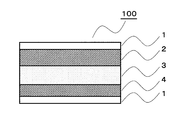
- FIG. 1 shows a schematic cross-sectional view of an example of the aquatic organism adhesion preventing adhesive tape of the present invention.
- the aquatic organism adhesion prevention adhesive tape 100 of this invention contains the antifouling layer 2, the base material layer 3, and the adhesion layer 4 in this order.
- a release film 1 may be provided on the surface of the antifouling layer 2 or the surface of the adhesive layer 4.
- the antifouling layer preferably contains a silicone resin.
- the content of the silicone resin in the antifouling layer is preferably 30% to 98% by weight, more preferably 40% to 97% by weight, still more preferably 45% to 96% by weight, and particularly preferably 50% by weight. ⁇ 95% by weight.
- the content ratio of the silicone resin in the antifouling layer is less than 30% by weight, the mechanical properties of the antifouling layer may be deteriorated.
- the content ratio of the silicone resin in the antifouling layer exceeds 98% by weight, the antifouling effect of the antifouling layer may not be sufficiently exhibited.
- any appropriate silicone resin can be adopted as long as the effects of the present invention are not impaired. Only one type of silicone resin may be used, or two or more types may be used. Such a silicone resin may be a silicone resin that is liquid at normal temperature, or may be a silicone resin that is solid at normal temperature. Such a silicone resin may be a one-component silicone resin that is dried alone, or a two-component silicone resin that contains a curing agent. In the present invention, among these, a one-component room temperature curable (RTV) resin and a two-component room temperature curable (RTV) resin are preferable.
- RTV room temperature curable
- RTV room temperature curable
- Examples of the one-component RTV resin include KE-3475, KE-45S, KE-445, KE-44, KE-441, KE-3497, and KE-4896 manufactured by Shin-Etsu Chemical Co., Ltd. .
- Examples of the two-component RTV resin include KE-66, KE-1031, and KE-1800 manufactured by Shin-Etsu Chemical Co., Ltd.
- the silicone resin can be easily peeled off due to elastic deformation of the resin surface due to water pressure at the time of water washing removal.
- a silicone resin having such physical properties is preferred.
- Such a silicone resin has a 100% modulus (tensile stress) of the silicone resin of preferably 0.1 MPa to 10 MPa, more preferably 0.1 MPa to 6 MPa.
- Such silicone resin is preferably soluble in an organic solvent.
- the antifouling layer preferably contains an antifouling agent. Only one type of antifouling agent may be used, or two or more types may be used.
- the antifouling agent migrates to the surface of the silicone resin as a matrix and covers the surface with an antifouling substance, thereby suppressing the adhesion of aquatic organisms to the silicone resin surface. Furthermore, since it is non-hydrolyzable, it can exhibit the effect of maintaining a high antifouling effect for a long period of time.
- the content of the antifouling agent in the antifouling layer is preferably 2% by weight or more, more preferably 2% by weight to 200% by weight, still more preferably 3% by weight to 150% by weight, and particularly preferably 4% by weight. % To 120% by weight, most preferably 5% to 100% by weight.
- the content ratio of the antifouling agent to the silicone resin is less than 2% by weight, the antifouling effect of the antifouling layer may not be sufficiently exhibited.
- the content of the antifouling agent relative to the silicone resin exceeds 200% by weight, the appearance of the final molded product or the film may be deteriorated, and the antifouling layer strength is lowered and the antifouling property cannot be maintained. There is a fear.
- any appropriate antifouling agent can be adopted as long as the effects of the present invention are not impaired.
- examples of such an antifouling agent include silicone oil, liquid paraffin, surfactant, wax, petrolatum, animal fats, fatty acids and the like.
- the antifouling agent is preferably at least one selected from silicone oil, liquid paraffin, and surfactant.
- the silicone oil is preferably one that does not have reactivity with the silicone resin or self-condensation.
- any appropriate silicone oil can be adopted as long as the effects of the present invention are not impaired.
- Such a silicone oil is preferably incompatible with the organopolysiloxane contained in the silicone resin to some extent, and is represented by, for example, the general formula (I) in that the antifouling effect can be maintained over a long period of time. Silicone oil is preferred.
- R 1 is the same or different and represents an alkyl group having 1 to 10 carbon atoms, an aryl group, an aralkyl group, a fluoroalkyl group, a polyether group, or a hydroxyl group
- R 2 is the same or Differently, it represents an alkyl group having 1 to 10 carbon atoms, an aryl group, an aralkyl group, a polyether group or a fluoroalkyl group
- n represents an integer of 0 to 150.
- R 1 in the general formula (I) is preferably a methyl group, a phenyl group, or a hydroxyl group.
- R 2 in the general formula (I) is preferably a methyl group, a phenyl group, or a 4-trifluorobutyl group.
- the silicone oil represented by the general formula (I) has a number average molecular weight of preferably 180 to 20000, more preferably 1000 to 10,000.
- the viscosity of the silicone oil represented by the general formula (I) is preferably 10 centistokes to 10000 centistokes, more preferably 100 centistokes to 5000 centistokes.
- silicone oil represented by the general formula (I) specifically, for example, terminal hydroxyl group-containing dimethyl silicone oil R 1 at both ends or one end is a hydroxyl group, all of R 1 and R 2 is a methyl group And dimethyl silicone oils in which some of the methyl groups of these dimethyl silicone oils are substituted with phenyl groups.
- silicone oils represented by the general formula (I) include KF96L, KF96, KF69, KF99, KF50, KF54, KF410, KF412, KF414, FL, Toray Dow Corning manufactured by Shin-Etsu Chemical Co., Ltd. BY16-846, SF8416, SH203, SH230, SF8419, FS1265, SH510, SH550, SH710, FZ-2110, and FZ-2203 manufactured by Corporation may be mentioned.
- surfactant examples include an anionic surfactant, a cationic surfactant, and a nonionic surfactant.
- antifouling agents diatomaceous adhesion inhibitors, agricultural chemicals, pharmaceuticals (such as medetomidine), enzyme activity inhibitors (such as alkylphenols and alkylresorcinol), and biological repellents may be used.
- pharmaceuticals such as medetomidine
- enzyme activity inhibitors such as alkylphenols and alkylresorcinol
- biological repellents may be used.
- the antifouling layer may contain any appropriate other additive as long as the effects of the present invention are not impaired.
- the thickness of the antifouling layer may be any appropriate thickness depending on the application or use environment of the aquatic organism adhesion preventing adhesive tape of the present invention.
- the thickness of the antifouling layer is preferably 5 ⁇ m to 500 ⁇ m. When the thickness of the antifouling layer is less than 5 ⁇ m, the period during which the antifouling effect is effective is shortened and may not be practical. If the antifouling layer is thicker than 500 ⁇ m, the aquatic organism adhesion-preventing adhesive tape of the present invention becomes thick and increases in weight, resulting in poor handling, large irregularities at the joints of the tape, and dirt. There is a fear.
- any appropriate base material layer can be adopted as long as the effects of the present invention are not impaired.
- a material for the base material layer is preferably excellent in water resistance, strength, flexibility and tearability.
- the material for the base material layer include polyurethane resin, polyurethane acrylic resin, rubber resin, vinyl chloride resin, polyester resin, silicone resin, elastomers, fluororesin, polyamide resin, polyolefin resin (polyethylene, polypropylene, etc.) ) And the like.
- the material of such a base material layer may be only one type or two or more types.
- the base material layer has an elongation of preferably 100% or more, more preferably 120% or more, and further preferably 150% or more.
- the aquatic organism adhesion-preventing pressure-sensitive adhesive tape of the present invention can follow the shape of various adherends well and can be affixed to a flat surface well. It can be satisfactorily applied to curved surface portions, 90-degree angle portions, acute angle portions, and the like.
- the elongation of the base material layer is less than 100%, the shape of various adherends cannot be sufficiently followed, and wrinkles and unbonded portions of the adhesive may be generated, which may cause poor appearance and poor adhesion.
- the upper limit of the elongation of the base material layer is preferably 2000% or less from the viewpoint of the strength of the base material layer.
- the base material layer has a breaking stress of preferably 10 MPa or more, more preferably 12 MPa or more, and further preferably 15 MPa or more.
- the upper limit of the breaking point stress of the base material layer is preferably 200 MPa or less from the viewpoint of the handleability of the base material layer.
- the elastic modulus of the base material layer is preferably 4000 MPa or less, more preferably 1000 MPa or less, still more preferably 100 MPa or less, and particularly preferably 50 MPa or less.
- the lower limit of the elastic modulus of the base material layer is preferably 0.1 MPa or more from the viewpoint of handleability of the base material layer.
- the base material layer may contain any appropriate additive as long as the effects of the present invention are not impaired.
- additives include olefin resins, silicone polymers, liquid acrylic copolymers, tackifiers, anti-aging agents, hindered amine light stabilizers, ultraviolet absorbers, antioxidants, and antistatic agents. , Polyethyleneimine, fatty acid amide, fatty acid ester, phosphate ester, lubricant, surfactant, filler and pigment (for example, calcium oxide, magnesium oxide, silica, zinc oxide, titanium oxide, carbon black, etc.).
- the base material layer preferably contains an ultraviolet absorber.
- the weather resistance of the aquatic organism adhesion prevention adhesive tape of this invention improves because a base material layer contains a ultraviolet absorber.
- the base material layer does not contain an ultraviolet absorber, the base material is likely to be deteriorated by sunlight during outdoor use, and it may be difficult to maintain the initial base material strength.
- the base material layer is frequently cut when the used aquatic organism adhesion preventing adhesive tape of the present invention is peeled off from the adherend, and the work efficiency may be significantly deteriorated. There is.
- the thickness of the base material layer is preferably 20 ⁇ m to 500 ⁇ m.
- the thickness of the base material layer is less than 20 ⁇ m, the handleability is deteriorated, the role as a base material cannot be fulfilled, and there is a possibility that it is not practical.
- the thickness of the base material layer is more than 500 ⁇ m, it becomes impossible to sufficiently follow the shape of the adherend, the concavities and convexities at the joint portion of the tape become large, and there is a possibility that it is likely to be soiled.
- a primer may be applied to the base material layer in advance, or a silane coupling agent may be added in advance.
- adhesion to the base material layer may be low due to the low surface energy that is a characteristic of the silicone resin. If the adhesion between the antifouling layer and the base material layer is low, the antifouling layer that exhibits the antifouling effect peels off from the base material layer due to impact or physical damage during use, and the original antifouling effect continues. It may not be possible.
- a primer is applied to the surface of the base material layer in advance to improve the adhesion to the antifouling layer, or silanol groups and alkoxysilane groups that react with the silicone resin are introduced into the base material layer with a silane coupling agent.
- the adhesion can be improved by performing a condensation reaction with a reactive group on the base material layer during application of the condensation type silicone resin.
- silane coupling agent Only one type of silane coupling agent may be used, or two or more types may be used. Specific examples of commercially available silane coupling agents include KBM5103, KBM1003, KBM903, KBM403, and KBM802 manufactured by Shin-Etsu Chemical Co., Ltd.
- the content ratio of the silane coupling agent in the base material layer is preferably 0.01% by weight to 10% by weight.
- the content rate of the silane coupling agent in a base material layer exceeds 10 weight%, there exists a possibility that a silane coupling agent may become a crosslinking point and a base material layer may become hard.
- the content rate of the silane coupling agent in a base material layer is less than 0.01 weight%, there exists a possibility that sufficient adhesiveness cannot be expressed between a base material layer and an antifouling layer.
- the thickness of the adhesive layer any appropriate thickness can be adopted depending on the application and use environment of the aquatic organism adhesion preventing adhesive tape of the present invention.
- the thickness of the adhesive layer is preferably 10 ⁇ m or more.
- the upper limit of the thickness of the pressure-sensitive adhesive layer is preferably 100 ⁇ m or less from the viewpoint of handleability.
- the aquatic organism adhesion preventing adhesive tape of the present invention can be produced by any appropriate method.
- a method of forming an antifouling layer by applying an antifouling layer forming material on the base material layer after pasting a separately prepared base material layer and an adhesive layer, and one of the base material layers.
- a method of forming an adhesive layer by applying an adhesive layer forming material on the surface and forming an antifouling layer by applying an antifouling layer forming material to the other surface of the base material layer, the base layer forming material and the adhesive layer For example, a method of forming the antifouling layer by applying the antifouling layer forming material on the base material layer after co-extrusion of the forming material to form a base material layer / adhesive layer laminate.
- Examples of the method for applying the antifouling layer forming material on the base material layer include spraying, brushing, roller, curtain flow, roll, dip and the like.
- the antifouling layer-forming material is applied onto the base material layer by these methods, and the antifouling layer is formed, for example, by drying at a temperature from room temperature to 250 ° C. (preferably from room temperature to 180 ° C.). can do.
- ⁇ Measurement of gel fraction About 0.1 g of the pressure-sensitive adhesive composition cut into 50 mm ⁇ 50 mm and folded to a size of about 5 mm square was placed on the center of a Teflon (registered trademark) sheet cut into 100 mm ⁇ 100 mm. The Teflon (registered trademark) sheet was folded at the corners of the sheet so that the adhesive composition did not come out, folded into a bag, tied at the end with a thread, and the bag opening was closed. This was immersed in a 50 ml sample bottle filled with ethyl acetate, allowed to stand at 23 ° C. for 1 week, dried at 130 ° C.
- the gel fraction was defined as the insoluble content of the adhesive after immersion in ethyl acetate relative to the weight of the adhesive before immersion. 3 of an initial pressure-sensitive adhesive composition (not immersed in seawater or pure water), a pressure-sensitive adhesive composition after immersion in pure water at 60 ° C. for 7 days, and a pressure-sensitive adhesive composition after immersion in seawater at 60 ° C. for 7 days The gel fractions were compared by type. In addition, since it was difficult to handle the pressure-sensitive adhesive composition alone when immersed in pure water or seawater, the pressure-sensitive adhesive composition was immersed with a separator on one side.
- the pressure-sensitive adhesive composition was cut into 30 mm ⁇ 40 mm and rounded, and the pressure-sensitive adhesive composition was molded into a columnar shape having a length of 30 mm. Using this, the SS curve was measured. For comparison, measurements were made on the initial state and the pressure-sensitive adhesive composition immersed in pure water at 60 ° C. and sea water at 60 ° C. for 7 days.
- the pressure-sensitive adhesive composition was transferred to a polyester film (trade name “S-10”, manufactured by Toray Industries, Inc., thickness 38 ⁇ m) using a hand roller to obtain a pressure-sensitive adhesive sheet with a substrate. This was cut into a test piece size of 80 mm ⁇ 20 mm.
- a plastic FRP plate reinforced by putting a glass cloth in an epoxy resin of 30 mm ⁇ 100 mm ⁇ thickness 2 mm was used as the adherend.
- the test piece was adhered to the adherend by reciprocating once with a 2 kg roller, and allowed to stand at 23 ° C. for 30 minutes, and then the initial 180-degree peel adhesive strength was measured.
- the tensile speed was 300 mm / min.
- the 180 degree peel adhesion after leaving for 30 minutes after bonding and immersing in artificial seawater at 60 ° C is the same. Measured.
- the pressure-sensitive adhesive composition was prepared in the same manner as the 180-degree peel adhesive test piece to obtain a pressure-sensitive adhesive sheet with a substrate. This was cut into a test piece size of 80 mm ⁇ 20 mm. An FRP plate having a size of 30 mm ⁇ 100 mm ⁇ thickness 2 mm was used as the adherend. A test piece of 50 mm was attached to the adherend with a hand roller, and a weight adjusted to 100 g in seawater was attached to the remaining 30 mm portion to prepare a sample. Prepare artificial seawater at 60 ° C.
- the elastic modulus of the pressure-sensitive adhesive composition was measured using a nanoindenter. That is, the elastic modulus of the pressure-sensitive adhesive composition was measured using a nanoindenter (manufactured by Hysitron Inc., Tribo Scope).
- the indenter used was Berkovich, the measurement method was single indentation measurement, the measurement temperature was 25 ° C., and the indentation depth was about 1100 nm. Measured under these conditions, a curve of displacement (indentation depth) and load (force required for indentation) was drawn, and the elastic modulus was calculated therefrom.
- Example 1 2-Ethylhexyl acrylate (2EHA, manufactured by Toa Gosei Co., Ltd.) as a (meth) acrylic monomer in a mixing ratio shown in Table 1 in a reaction vessel equipped with a cooling pipe, a nitrogen introduction pipe, a thermometer, and a stirrer , N-butyl acrylate (BA, manufactured by Toa Gosei Co., Ltd.), 4-hydroxybutyl acrylate (4HBA, manufactured by Nippon Kasei Co., Ltd.), acrylic acid (AA, manufactured by Toa Gosei Co., Ltd.), photopolymerization initiator 2,2-dimethoxy-1,2-diphenylethane-1-one (trade name “Irgacure 651”, manufactured by Ciba Geigy Co., Ltd.) was added and dispersed, and UV irradiation was performed from above in a nitrogen stream while stirring.
- BA manufactured by Toa Gosei Co., Ltd.
- HBA 4-hydroxybut
- an acrylic monomer / polymer mixture was obtained by converting a part of the monomer into a polymer and adjusting the viscosity so that it could be applied.
- 1,6-hexanediol diacrylate (HDDA, manufactured by Shin-Nakamura Chemical Co., Ltd.) was added to the obtained acrylic monomer / polymer mixture, and the resulting resin composition was separated into a separator (trade name “MRF38”, It is applied to the surface of Mitsubishi Plastics Co., Ltd. (thickness 38 ⁇ m) with an applicator, and a cover separator (trade name “MRF38”, Mitsubishi Plastics Co., Ltd., thickness 38 ⁇ m) is pasted together with a hand roller.
- a separator trade name “MRF38”
- MRF38 Mitsubishi Plastics Co., Ltd., thickness 38 ⁇ m
- a pressure-sensitive adhesive composition (1) having a thickness of 50 ⁇ m was obtained by irradiating with ultraviolet rays (BL type) (ultraviolet illuminance: 3.4 mW / cm 2 , cumulative irradiation amount: 2000 mJ / cm 2).
- BL type ultraviolet rays
- Tables 2 to 6 Various evaluation results are shown in Tables 2 to 6.
- Example 2 A pressure-sensitive adhesive composition (2) having a thickness of 50 ⁇ m was obtained in the same manner as in Example 1 except that the monomer and photopolymerization initiator were mixed as shown in Table 1. Various evaluation results are shown in Tables 2 to 6.
- Example 3 A pressure-sensitive adhesive composition (3) having a thickness of 50 ⁇ m was obtained in the same manner as in Example 1 except that the monomer and photopolymerization initiator were mixed as shown in Table 1. Various evaluation results are shown in Tables 2 to 6.
- Example 4 2-Ethylhexyl acrylate (2EHA, manufactured by Toa Gosei Co., Ltd.) as a (meth) acrylic monomer in a mixing ratio shown in Table 1 in a reaction vessel equipped with a cooling pipe, a nitrogen introduction pipe, a thermometer, and a stirrer
- toluene 150 parts by weight were charged and polymerized at 60 ° C. for 8 hours. A combined toluene solution was obtained.
- An isocyanate-based crosslinking agent (trade name “Coronate L”, manufactured by Nippon Polyurethane Industry Co., Ltd.) was added to the solid content of the obtained polymer toluene solution to obtain a pressure-sensitive adhesive toluene solution.
- the obtained adhesive toluene solution was applied to a separator (trade name “MRF38”, manufactured by Mitsubishi Plastics Co., Ltd., thickness 38 ⁇ m) with an applicator, and then dried at 120 ° C. for 3 minutes, whereby an adhesive composition having a thickness of 50 ⁇ m was obtained.
- a product (4) was obtained.
- Example 1 A pressure-sensitive adhesive composition (C1) having a thickness of 50 ⁇ m was obtained in the same manner as in Example 1 except that the monomer and photopolymerization initiator were mixed as shown in Table 1. Various evaluation results are shown in Tables 2 to 6.
- Example 2 A pressure-sensitive adhesive composition (C2) having a thickness of 50 ⁇ m was obtained in the same manner as in Example 1 except that the monomer and photopolymerization initiator were mixed as shown in Table 1. Various evaluation results are shown in Tables 2 to 6.
- Example 5 ⁇ Creation of base material layer>
- a reaction vessel equipped with a condenser, a thermometer, and a stirrer 71 parts by weight of isobornyl acrylate (trade name “IBXA”, manufactured by Osaka Organic Chemical Industry Co., Ltd.) as a (meth) acrylic monomer, n -Poly (oxytetramethylene) glycol (PTMG650, Mitsubishi Chemical Corporation) having a number average molecular weight of 650, 19 parts by weight of butyl acrylate (BA, manufactured by Toa Gosei Co., Ltd.), 10 parts by weight of acrylic acid (AA), and polyol.
- IBXA isobornyl acrylate
- PTMG650 n -Poly (oxytetramethylene) glycol
- BA manufactured by Toa Gosei Co., Ltd.
- acrylic acid acrylic acid
- a syrup was coated on the surface of a separator (trade name “MRF38”, manufactured by Mitsubishi Plastics, Inc., thickness 38 ⁇ m) with an applicator to form a base material syrup layer having a thickness of 150 ⁇ m.
- a cover separator (trade name “MRF38”, manufactured by Mitsubishi Plastics Co., Ltd., thickness 38 ⁇ m) is bonded to the base material syrup layer with a hand roller, and further irradiated with ultraviolet rays (BL type) (ultraviolet illuminance: 3 4 mW / cm 2 , cumulative irradiation amount: 2000 mJ / cm 2 ), and a substrate layer having a thickness of 150 ⁇ m was obtained.
- BL type ultraviolet rays
- Silicone resin (KE445, room temperature curable (RTV) resin, manufactured by Shin-Etsu Chemical Co., Ltd.): 100 parts by weight of silicone oil as an antifouling agent (KF50-100cs, non-reactive silicone oil, Shin-Etsu Chemical Co., Ltd.) Product): After adding 10 parts by weight, the mixture was stirred using a homomixer to uniformly dissolve or disperse the antifouling agent in the resin. After stirring, defoaming was performed to obtain an antifouling layer-forming material for coating on the base material layer.
- RTV room temperature curable
- ⁇ Creation of adhesive tape The pressure-sensitive adhesive composition having a thickness of 50 ⁇ m prepared in Example 1 was attached to the base material layer by transfer. Then, the said antifouling layer forming material was apply
- the pressure-sensitive adhesive composition of the present invention has, for example, an underwater organism in an underwater structure (a ship, a buoy, a port facility, a marine oil field facility, a water channel for power plant cooling water, a water channel for factory cooling water, a water floating channel, etc.). It can be used for an aquatic organism adhesion prevention adhesive tape for preventing adhering and breeding.
Landscapes
- Life Sciences & Earth Sciences (AREA)
- Chemical & Material Sciences (AREA)
- Health & Medical Sciences (AREA)
- Organic Chemistry (AREA)
- Engineering & Computer Science (AREA)
- General Health & Medical Sciences (AREA)
- Wood Science & Technology (AREA)
- Pest Control & Pesticides (AREA)
- Zoology (AREA)
- Environmental Sciences (AREA)
- Agronomy & Crop Science (AREA)
- Plant Pathology (AREA)
- Toxicology (AREA)
- Dentistry (AREA)
- Materials Engineering (AREA)
- Chemical Kinetics & Catalysis (AREA)
- Combustion & Propulsion (AREA)
- Mechanical Engineering (AREA)
- Ocean & Marine Engineering (AREA)
- Adhesive Tapes (AREA)
- Adhesives Or Adhesive Processes (AREA)
Abstract
La présente invention concerne une composition d'adhésif, conçu pour être utilisé dans de l'eau de mer, qui peut offrir un équilibre favorable entre la propriété de décollement moins facile d'une partie adhérée pendant l'utilisation dans de l'eau de mer et la propriété d'être plus facilement retiré de la partie adhérée après utilisation dans l' eau de mer. L'invention concerne également un ruban adhésif pour empêcher la salissure organique aquatique, l'adhésif du ruban adhésif étant élaboré selon la présente description. Cette composition d'adhésif est appropriée pour une utilisation dans l'eau de mer, l'immersion dans de l'eau de mer entraînant une augmentation du module élastique initial.
Applications Claiming Priority (6)
| Application Number | Priority Date | Filing Date | Title |
|---|---|---|---|
| JP2012000056 | 2012-01-04 | ||
| JP2012-000056 | 2012-01-04 | ||
| JP2012000055A JP2013139520A (ja) | 2012-01-04 | 2012-01-04 | 粘着剤組成物 |
| JP2012-000055 | 2012-01-04 | ||
| JP2012251063A JP2013155367A (ja) | 2012-01-04 | 2012-11-15 | 粘着剤組成物 |
| JP2012-251063 | 2012-11-15 |
Publications (1)
| Publication Number | Publication Date |
|---|---|
| WO2013103065A1 true WO2013103065A1 (fr) | 2013-07-11 |
Family
ID=48745129
Family Applications (1)
| Application Number | Title | Priority Date | Filing Date |
|---|---|---|---|
| PCT/JP2012/081629 Ceased WO2013103065A1 (fr) | 2012-01-04 | 2012-12-06 | Composition d'adhésif |
Country Status (1)
| Country | Link |
|---|---|
| WO (1) | WO2013103065A1 (fr) |
Citations (5)
| Publication number | Priority date | Publication date | Assignee | Title |
|---|---|---|---|---|
| JPH0633024A (ja) * | 1992-07-16 | 1994-02-08 | Kansai Paint Co Ltd | 無毒防汚性貼着シート |
| JPH06322344A (ja) * | 1993-05-12 | 1994-11-22 | Sekisui Chem Co Ltd | アクリル系感圧性接着剤組成物 |
| JPH08209077A (ja) * | 1995-02-08 | 1996-08-13 | Sekisui Chem Co Ltd | 水中防汚フィルム |
| JP2001220524A (ja) * | 2000-02-08 | 2001-08-14 | Mizusawa Kikai Shoji:Kk | 水中用コーティング組成物、水中用コーティング塗膜形成方法および水中用コーティング部材 |
| JP2002069246A (ja) * | 2000-06-08 | 2002-03-08 | Daikin Ind Ltd | 高疎水性エラストマー組成物 |
-
2012
- 2012-12-06 WO PCT/JP2012/081629 patent/WO2013103065A1/fr not_active Ceased
Patent Citations (5)
| Publication number | Priority date | Publication date | Assignee | Title |
|---|---|---|---|---|
| JPH0633024A (ja) * | 1992-07-16 | 1994-02-08 | Kansai Paint Co Ltd | 無毒防汚性貼着シート |
| JPH06322344A (ja) * | 1993-05-12 | 1994-11-22 | Sekisui Chem Co Ltd | アクリル系感圧性接着剤組成物 |
| JPH08209077A (ja) * | 1995-02-08 | 1996-08-13 | Sekisui Chem Co Ltd | 水中防汚フィルム |
| JP2001220524A (ja) * | 2000-02-08 | 2001-08-14 | Mizusawa Kikai Shoji:Kk | 水中用コーティング組成物、水中用コーティング塗膜形成方法および水中用コーティング部材 |
| JP2002069246A (ja) * | 2000-06-08 | 2002-03-08 | Daikin Ind Ltd | 高疎水性エラストマー組成物 |
Similar Documents
| Publication | Publication Date | Title |
|---|---|---|
| EP2796522B1 (fr) | Ruban adhésif empêchant l'adhérence d'organismes aquatiques | |
| WO2013103092A1 (fr) | Ruban adhésif pour empêcher l'encrassement biologique aquatique | |
| JP2013129724A (ja) | 防汚層付粘着テープ | |
| EP2832808A1 (fr) | Bande adhésive pour prévenir le bioencrassement aquatique | |
| JP6177820B2 (ja) | 水生生物付着防止粘着テープ | |
| WO2014038478A1 (fr) | Feuille adhésive anti-salissure, et procédé de traitement anti-salissure pour une structure, utilisant ladite feuille adhésive anti-salissure | |
| JP2013139534A (ja) | 水生生物付着防止粘着テープ | |
| JP5486625B2 (ja) | 防汚層付粘着テープ | |
| JP2014185268A (ja) | 粘着剤組成物 | |
| WO2013157436A1 (fr) | Ruban adhésif pour empêcher un encrassement biologique aquatique | |
| JP2013139520A (ja) | 粘着剤組成物 | |
| WO2013146726A1 (fr) | Bande adhésive pour prévenir l'adhérence d'organismes aquatiques | |
| JP2013155367A (ja) | 粘着剤組成物 | |
| WO2014038658A1 (fr) | Composition adhésive | |
| JP2014169351A (ja) | 水生生物付着防止粘着テープ | |
| WO2013103065A1 (fr) | Composition d'adhésif | |
| WO2014046157A1 (fr) | Ruban adhésif pour prévenir l'adhérence d'organismes aquatiques | |
| WO2014046080A1 (fr) | Ruban adhésif pour prévenir l'adhérence d'organismes aquatiques | |
| JP2013139533A (ja) | 水生生物付着防止粘着テープ | |
| WO2013103085A1 (fr) | Ruban adhésif pour empêcher l'encrassement biologique aquatique | |
| JP2016023306A (ja) | 水生生物付着防止粘着テープまたはシート | |
| JP2015028151A (ja) | 水生生物付着防止粘着テープ | |
| JP2013139535A (ja) | 水生生物付着防止粘着テープ | |
| JP2013129725A (ja) | 水生生物付着防止粘着テープ | |
| JP2014062215A (ja) | 水生生物付着防止粘着テープ |
Legal Events
| Date | Code | Title | Description |
|---|---|---|---|
| 121 | Ep: the epo has been informed by wipo that ep was designated in this application |
Ref document number: 12864490 Country of ref document: EP Kind code of ref document: A1 |
|
| NENP | Non-entry into the national phase |
Ref country code: DE |
|
| 122 | Ep: pct application non-entry in european phase |
Ref document number: 12864490 Country of ref document: EP Kind code of ref document: A1 |