WO2013105234A1 - Outil d'enseignement pour instruction arithmétique - Google Patents
Outil d'enseignement pour instruction arithmétique Download PDFInfo
- Publication number
- WO2013105234A1 WO2013105234A1 PCT/JP2012/050397 JP2012050397W WO2013105234A1 WO 2013105234 A1 WO2013105234 A1 WO 2013105234A1 JP 2012050397 W JP2012050397 W JP 2012050397W WO 2013105234 A1 WO2013105234 A1 WO 2013105234A1
- Authority
- WO
- WIPO (PCT)
- Prior art keywords
- container
- spheres
- sphere
- regions
- lid
- Prior art date
- Legal status (The legal status is an assumption and is not a legal conclusion. Google has not performed a legal analysis and makes no representation as to the accuracy of the status listed.)
- Ceased
Links
Images

Classifications
-
- G—PHYSICS
- G09—EDUCATION; CRYPTOGRAPHY; DISPLAY; ADVERTISING; SEALS
- G09B—EDUCATIONAL OR DEMONSTRATION APPLIANCES; APPLIANCES FOR TEACHING, OR COMMUNICATING WITH, THE BLIND, DEAF OR MUTE; MODELS; PLANETARIA; GLOBES; MAPS; DIAGRAMS
- G09B23/00—Models for scientific, medical, or mathematical purposes, e.g. full-sized devices for demonstration purposes
- G09B23/02—Models for scientific, medical, or mathematical purposes, e.g. full-sized devices for demonstration purposes for mathematics
-
- G—PHYSICS
- G09—EDUCATION; CRYPTOGRAPHY; DISPLAY; ADVERTISING; SEALS
- G09B—EDUCATIONAL OR DEMONSTRATION APPLIANCES; APPLIANCES FOR TEACHING, OR COMMUNICATING WITH, THE BLIND, DEAF OR MUTE; MODELS; PLANETARIA; GLOBES; MAPS; DIAGRAMS
- G09B19/00—Teaching not covered by other main groups of this subclass
- G09B19/02—Counting; Calculating
Definitions
- the present invention relates to a teaching tool for arithmetic education.
- teaching tools for arithmetic education disclosed in Patent Document 1 are known.
- the arithmetic teaching tool has a drawer member partitioned so as to form two areas communicating with each other, and a plurality of spheres arranged on the drawer member.
- the sphere in the drawer member is moved between two areas, or the sphere is moved into and out of the area to change the number and arrangement of the spheres in the area. Teach children how to recognize and calculate numbers.
- the spheres are independent of each other, it is necessary to move them individually, which is not convenient for use. For example, when a certain number of spheres are reduced from an area, the spheres must be individually moved and taken out by hand, and it takes time and effort, so that education cannot be performed efficiently. Even if you hide the sphere with your hands or other objects without moving it, toddlers and children will recognize the number effectively because it appears that the sphere has only been hidden, not actually disappeared. In the end, I had to move the sphere.
- This invention is made in view of the said subject, The objective is to provide the teaching tool for arithmetic education which can perform education more efficiently.
- An arithmetic teaching tool of the present invention includes a container and a plurality of spheres arranged in the container, and the container is defined by a partition that defines boundaries of a plurality of regions, and the partition.
- a communication portion that communicates the plurality of regions, and at least one region of the plurality of regions of the container is arranged such that five spheres are arranged in a plurality of rows along a first direction of the container.
- the plurality of spheres include five spheres connected to each other.
- the five spheres are connected via a string.
- each of the five spheres is provided with a through hole.
- the upper surface of the container is open, and the arithmetic teaching tool further includes a lid attached to the container so that the upper surface of the container can be opened and closed.
- the lid has a plurality of regions corresponding to the plurality of regions of the container, and the plurality of regions of the lid can be opened and closed independently of each other.
- the arithmetic teaching tool of the present invention includes five spheres connected to each other and can move the five spheres at once, so it takes less time and effort to move the spheres. It can be done more efficiently.
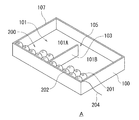
- FIG. 1 is a schematic diagram showing an arithmetic teaching tool A according to Embodiment 1 of the present invention.
- the arithmetic teaching tool A includes a container 100 and a plurality of spheres 200.
- the container 100 is a rectangular hollow casing, and the plurality of spheres 200 are arranged in the container 100.
- the container 100 has a partition part 103 and a communication part 105.
- the partition 103 is provided inside the container 100 and serves as a boundary, and defines two regions 101 (101A and 101B) arranged in the first direction (longitudinal direction of the container 100).
- Each of the regions 101A and 101B is configured such that a plurality of spheres 200 are arranged in four rows along the first direction, and communicated by a communication unit 105 interposed between the regions 101.
- a communication unit 105 interposed between the regions 101.
- five of the plurality of spheres 200 are arranged in a row along the first direction.
- the partition 103 is provided so as to be orthogonal to the longitudinal direction of the container 100, and one end side is connected to the inner side wall of the container 100.
- the communication part 105 is a space between the other end side of the partition part 103 and the other inner side wall of the container 100, and is formed so that only one of the plurality of spheres 200 can pass through.
- the partition 103 defines the two regions 101A and 101B arranged in the longitudinal direction of the container 100, but the present invention is not limited to this.
- the partition 103 may be provided along the longitudinal direction of the container 100 and may define two regions arranged in a direction orthogonal to the longitudinal direction of the container 100.
- the direction orthogonal to the longitudinal direction of the container 100 is the first direction
- the two regions of the container 100 are configured such that a plurality of spheres 200 are arranged in four rows along the direction orthogonal to the longitudinal direction of the container 100. Is done.
- the plurality of spheres 200 include two types of spheres 201 and 202 having the same size.
- the spheres 201 are configured to be movable independently of each other.
- the spheres 202 are connected in a row in units of five, and are configured to be movable in units of five.
- the plurality of spheres 200 are arranged in one or both of the two regions 101 ⁇ / b> A and 101 ⁇ / b> B of the container 100, and can move to the other region 101 through the communication part 105.
- the material of the sphere 201 and the sphere 202 in the plurality of spheres 200 is not particularly limited, and examples thereof include plastic balls and glass balls.
- As the colors of the sphere 201 and the sphere 202 it is preferable to use a cute color such as white, for example, because it can incite the interest of infants and children.
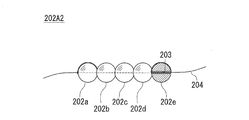
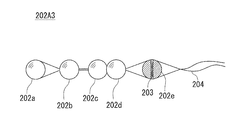
- FIGS. 2 to 4 are schematic diagrams showing a sphere set 202A (202A1, 202A2, 202A3) in which five spheres 202 (202a, 202b, 202c, 202d, 202e) are connected in a line.
- the sphere 202 can be connected through a string 204, for example. Specifically, this can be achieved by providing a through hole 203 in each of the five spheres 202 and passing the string 204 through the through hole 203 to tie the string.
- the method of tying the string 204 is not particularly limited as long as the five spheres 202 can be connected. For example, the methods shown in FIGS. 2 to 4 can be used.
- one end side of the string 204 is passed through the through-hole 203 of each sphere 202 in the order of the spheres 202a to 202e, and then both side ends of the string 204 are respectively connected to the sphere 202a and the sphere 202e.
- the five spheres 202 are connected to each other by winding the side surface and passing through the through-hole 203 again, and tying a string 204 between the outside of the sphere 202a and the outside of the sphere 202e.
- the sphere set 202A3 shown in FIG. 4 will be described below.
- one end of the string 204 is passed through the through hole 203 of the sphere 202a.
- the both ends of the string 204 are passed through the through holes 203 of the spheres 202 in the order of the spheres 202b, 202c, and 202d.
- the five spheres 202 are connected by tying knots after passing the both ends of the string 204 from different sides of the through hole 203 of the sphere 202e.
- the plurality of spheres 200 in the region 101 ⁇ / b> A and the region 101 ⁇ / b> B can be shown to an infant or a child.
- the total number of spheres 201 and spheres 202 to be placed in the respective regions 101A and 101B of the container 100 is set to the first stage (1 to 3), the second stage (1 to 5), and the third stage (1 You can educate while increasing the number of items (from 10 to 10) and 4th stage (1 to 20).
- the number of the sphere 201 and the sphere 202 in each of the regions 101A and 101B is taught at each stage, which is more or less or the same, and the spheres 201 in the region 101A and the region 101B. This is done by answering how many spheres 202 are added and how many are obtained when a predetermined number is subtracted from either region 101. Note that the total number of spheres 201 and spheres 202 to be put in each of the regions 101A and 101B is up to 20 because about 90% of the number and the learning ability of calculation are learning calculations based on the numbers 1 to 20 Because it is said that it can be raised in
- Each of the regions 101A and 101B of the container 100 is configured such that five spheres 201 and spheres 202 are arranged in a row.
- the regions 101A and 101B are based on 5 and 10, that is, the regions 101A and 101B.
- the five or ten spheres 201 and 202 are arranged in a row to create a reference of 5 or 10, and the number of spheres 201 and 202 is understood by how many or less than the reference. For example, when teaching the number 8, teach 3 more than 5, 2 less than 10, teach 9, teach 4 more than 5, 1 less than 10, 10 When teaching a number, teach 5 more than 5 and when teaching a number greater than 10, teach how many more than 10.
- the plurality of spheres 200 include a sphere set 202A in which five spheres 202 are connected to each other by a string 204, so the number and arrangement of the plurality of spheres 200 in the region 101 are changed.
- the sphere set 202A is moved, the five spheres 202 can be added and pulled at a time, and the movement does not take time and effort. For this reason, education can be performed more efficiently.
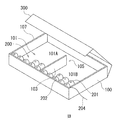
- FIG. 5 is a schematic diagram showing the arithmetic teaching tool B according to Embodiment 2 of the present invention.
- the arithmetic teaching tool B includes a container 100, a plurality of spheres 200, and a lid 300.
- the container 100 is a rectangular hollow housing whose upper surface 107 is open, and the plurality of spheres 200 are arranged in the container 100. Since the container 100 and the plurality of spheres 200 have the same structure as that of the first embodiment described above, redundant description is omitted to avoid redundancy.
- the lid 300 is attached to the container 100 so that the upper surface 107 of the container 100 can be opened and closed.
- the lid 300 is formed in a sheet shape that can cover the upper surface 107 of the container 100, and one side end of the lid 300 is arranged at the rear of the container 100 so that the upper surface 107 of the container 100 can be opened and closed. It is connected to the side end. If the lid 300 configured in this manner is lifted upward from the upper surface 107, the region 101 of the container 100 can be exposed, and if it is closed to the upper surface 107, the region 101 of the container 100 can be shielded.
- cover 300 this invention is not limited to this.
- the lid can be a hollow housing that is open on both sides. In this case, if the container 100 is accommodated in the hollow casing, the regions 101A and 101B are shielded by the hollow casing.
- magic tape registered trademark
- the lid is applied by the adhesive force of the magic tape (registered trademark).
- 300 free ends can be fixed to the front end of the container 100.
- a fixing means what is necessary is just to be able to fix the lid
- the container 100 is further provided with a lid 300, and the sphere 201 and the sphere 202 are enclosed in the two regions 101 of the container 100 by closing the lid 300.
- the lid 300 is closed, the container 100 is shaken, and the sphere 201 and the sphere 202 are moved between the regions 101A and 101B via the communication unit 105. Can do.
- the sphere 201 and the sphere 202 in the left and right regions 101A and 101B are collected in one of the regions 101A and 101B, or the sphere 201 and the sphere 202 in one of the regions 101A and 101B are collected in the left and right regions 101A, 101B.
- the number of teaching methods is increased, such as opening the lid 300 and showing it to an infant or a child so that the numbers of the spheres 201 and 202 are applied.
- the movement of picking up and shaking the container 100 and the sound generated when the sphere 201 and the sphere 202 in the container 100 hit the wall of the container 100 have an effect of arousing interest. Can teach numbers and calculations.
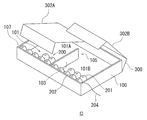
- FIG. 6 is a schematic diagram showing the arithmetic teaching tool C according to the third embodiment of the present invention.
- the arithmetic teaching tool C includes a container 100, a plurality of spheres 200, and a lid 300.
- the container 100 is a rectangular hollow housing whose upper surface 107 is open, and the plurality of spheres 200 are arranged in the container 100. Since the container 100 and the plurality of spheres 200 have the same structure as that of the first embodiment described above, redundant description is omitted to avoid redundancy.
- the lid 300 is attached to the container 100 so that the upper surface 107 of the container 100 can be opened and closed.
- the lid 300 has two regions 302A and 302B corresponding to the two regions 101A and 101B of the container 100, and the two regions 302A and 302B of the lid 300 can be opened and closed independently of each other.
- the lid 300 is formed in a sheet shape that can cover the upper surface 107 of the container 100, and one side end of the lid 300 is arranged at the rear of the container 100 so that the upper surface 107 of the container 100 can be opened and closed. It is connected to the side end.
- the lid 300 is divided along the boundary between the two regions 101A and 101B of the container 100, and has two regions 302A and 302B corresponding to the two regions 101A and 101B of the container 100.
- the regions 302A and 302B are independent from each other, and are configured so that the upper surface 107 of the container 100 can be opened and closed.
- the region 302A is lifted upward from the upper surface 107, the region 101A of the container 100 can be exposed, and if the region 302A is closed to the upper surface 107, the region 101A can be shielded.
- the region 101B is lifted upward from the upper surface 107, the region 101B of the container 100 can be exposed, and when the region 302B is closed to the upper surface 107, the region 101B can be shielded.
- said example was given as a structure of the lid
- both the front end of the container 100 and the free ends of the regions 302A and 302B of the lid 300 are provided so that the closed lid 300 does not open unexpectedly.
- Velcro tape registered trademark
- magic tape registered trademark
- the container 100 is further provided with a lid 300 having regions 302A and 302B that can be opened and closed independently. Therefore, education can be performed by opening one of the lids of the region 302A and the region 302B and showing the sphere 201 and the sphere 202 only in the region corresponding to the opened lid. For example, after putting the sphere 201 and the sphere 202 in either the region 101A or the region 101B of the container 100, the container 100 is shaken to disperse the sphere 201 and the sphere 202 into the region 101A and the region 101B, respectively.
- the region 302A (or region 302B) of the lid 300 is opened to show the sphere 201 and sphere 202 in the region 101A (or region 101B) of the container 100, and the sphere 201 and sphere in the region 101B (or region 101A) of the container 100 are shown. If the number of spheres 201 and spheres 202 in the region 101A (or region 101B) remaining after the dispersion is subtracted from the number of spheres 201 and spheres 202 that are initially placed, the number is 202. Subtraction education can be done by teaching how to answer. Further, if both the region 302A and the region 302B of the lid 300 are closed, the teaching method described in the second embodiment can be performed.
- two regions are defined in the container, and the plurality of spheres arranged in the region include one sphere set.
- the container may be formed so that two or more regions are defined according to the necessity for education, and one or more sphere sets may be arranged in the region.
- the container may be formed so that the colors of the plurality of regions are different from each other. By assigning different colors to each area, it becomes easy to distinguish the areas, and it is possible for an infant or a child to instantly recognize a certain area when performing education.
- the present invention can be used as a teaching tool for arithmetic education used for teaching number recognition and addition / subtraction calculation to infants and elementary school children.
- A, B, C Math educational tool 100 Container 101, 101A, 101B Area 103 Partition part 105 Communication part 107 Upper surface 200 Multiple spheres 201 Sphere 202 Sphere 202A Sphere set 203 Through hole 204 String 300 Lid 302A, 302B area
Landscapes
- Engineering & Computer Science (AREA)
- Business, Economics & Management (AREA)
- Physics & Mathematics (AREA)
- General Physics & Mathematics (AREA)
- Educational Administration (AREA)
- Educational Technology (AREA)
- Theoretical Computer Science (AREA)
- Entrepreneurship & Innovation (AREA)
- Computational Mathematics (AREA)
- Mathematical Analysis (AREA)
- Mathematical Optimization (AREA)
- Mathematical Physics (AREA)
- Pure & Applied Mathematics (AREA)
- Algebra (AREA)
- Toys (AREA)
- Closures For Containers (AREA)
Priority Applications (8)
| Application Number | Priority Date | Filing Date | Title |
|---|---|---|---|
| KR1020137000402A KR20130091312A (ko) | 2012-01-11 | 2012-01-11 | 산수 교육용 교구 |
| JP2012555631A JP5249473B1 (ja) | 2012-01-11 | 2012-01-11 | 算数教育用教具 |
| SG11201404006VA SG11201404006VA (en) | 2012-01-11 | 2012-01-11 | Math teaching tool |
| HK15100756.7A HK1200586A1 (en) | 2012-01-11 | 2012-01-11 | Teaching tool for arithmetic instruction |
| PCT/JP2012/050397 WO2013105234A1 (fr) | 2012-01-11 | 2012-01-11 | Outil d'enseignement pour instruction arithmétique |
| CN201280059203.7A CN104137166A (zh) | 2012-01-11 | 2012-01-11 | 算数教育用教具 |
| US14/370,860 US9542857B2 (en) | 2012-01-11 | 2012-01-11 | Math teaching tool |
| TW101149521A TWI564850B (zh) | 2012-01-11 | 2012-12-24 | Teaching aids for arithmetic education |
Applications Claiming Priority (1)
| Application Number | Priority Date | Filing Date | Title |
|---|---|---|---|
| PCT/JP2012/050397 WO2013105234A1 (fr) | 2012-01-11 | 2012-01-11 | Outil d'enseignement pour instruction arithmétique |
Publications (1)
| Publication Number | Publication Date |
|---|---|
| WO2013105234A1 true WO2013105234A1 (fr) | 2013-07-18 |
Family
ID=48781208
Family Applications (1)
| Application Number | Title | Priority Date | Filing Date |
|---|---|---|---|
| PCT/JP2012/050397 Ceased WO2013105234A1 (fr) | 2012-01-11 | 2012-01-11 | Outil d'enseignement pour instruction arithmétique |
Country Status (8)
| Country | Link |
|---|---|
| US (1) | US9542857B2 (fr) |
| JP (1) | JP5249473B1 (fr) |
| KR (1) | KR20130091312A (fr) |
| CN (1) | CN104137166A (fr) |
| HK (1) | HK1200586A1 (fr) |
| SG (1) | SG11201404006VA (fr) |
| TW (1) | TWI564850B (fr) |
| WO (1) | WO2013105234A1 (fr) |
Families Citing this family (4)
| Publication number | Priority date | Publication date | Assignee | Title |
|---|---|---|---|---|
| US11250725B1 (en) * | 2015-12-07 | 2022-02-15 | Thanaa Salloum | Arithmetic educational tool |
| US10062299B1 (en) * | 2015-12-07 | 2018-08-28 | Bonderiffic Math LLC | Arithmetic educational tool |
| US10546513B1 (en) * | 2015-12-07 | 2020-01-28 | Bonderiffic Math LLC | Arithmetic educational tool |
| TWI913055B (zh) * | 2024-12-17 | 2026-01-21 | 建國科技大學 | 長者防災知識互動教具 |
Citations (4)
| Publication number | Priority date | Publication date | Assignee | Title |
|---|---|---|---|---|
| JPS5714166U (fr) * | 1980-06-27 | 1982-01-25 | ||
| JPS5921410Y2 (ja) * | 1980-10-09 | 1984-06-23 | 株式会社光文書院 | 算数教習具 |
| JPS63162371U (fr) * | 1987-04-11 | 1988-10-24 | ||
| JP2007212552A (ja) * | 2006-02-07 | 2007-08-23 | Shinobu Ito | 算数教育用教具 |
Family Cites Families (18)
| Publication number | Priority date | Publication date | Assignee | Title |
|---|---|---|---|---|
| US1244000A (en) * | 1917-04-09 | 1917-10-23 | Henriette Soltoft | Educational appliance. |
| US3534964A (en) * | 1968-12-09 | 1970-10-20 | Charles W Guill | Mixing and dispensing marble game |
| US3811205A (en) * | 1973-01-22 | 1974-05-21 | M Pitzler | Sensorial counting board |
| US3864850A (en) * | 1973-07-11 | 1975-02-11 | Crocker Country Day School Inc | Teaching aid |
| US4210093A (en) * | 1978-10-23 | 1980-07-01 | Baker Richard A | Counting device |
| JPS61148085A (ja) * | 1984-12-24 | 1986-07-05 | Canon Inc | 電子機器 |
| US4553944A (en) * | 1985-02-08 | 1985-11-19 | Maureen Flanagan | Mathematical teaching device |
| CN2077145U (zh) * | 1990-09-08 | 1991-05-15 | 林一成 | 儿童多功能学习板 |
| US5395245A (en) * | 1993-11-04 | 1995-03-07 | Heinz; Ted | Elastic pattern abacus and tool for changing arrangement of abacus beads |
| US5971269A (en) * | 1996-03-12 | 1999-10-26 | Baguley; Bruce H. | Computational teaching device |
| JPH10310140A (ja) * | 1997-05-08 | 1998-11-24 | Sony Corp | 物品収納装置 |
| US6241572B1 (en) * | 1998-03-26 | 2001-06-05 | Leonid Braginsky | Manipulable beaded string |
| JP2006029937A (ja) | 2004-07-15 | 2006-02-02 | Matsushita Electric Ind Co Ltd | 回転角度検出装置の回転角補正方法 |
| JP3943586B1 (ja) * | 2006-11-17 | 2007-07-11 | 実子 菰田 | 算数教習具 |
| US8021159B1 (en) * | 2008-03-18 | 2011-09-20 | String Math, LLC. | String math manipulative system and method |
| CN101354845A (zh) * | 2008-08-20 | 2009-01-28 | 王金辉 | 数学学习器 |
| CN201255941Y (zh) * | 2008-09-01 | 2009-06-10 | 张寒 | 儿童数学算具 |
| CN201454098U (zh) * | 2009-06-25 | 2010-05-12 | 马达伟 | 一种儿童玩具 |
-
2012
- 2012-01-11 KR KR1020137000402A patent/KR20130091312A/ko not_active Ceased
- 2012-01-11 US US14/370,860 patent/US9542857B2/en active Active
- 2012-01-11 SG SG11201404006VA patent/SG11201404006VA/en unknown
- 2012-01-11 HK HK15100756.7A patent/HK1200586A1/xx unknown
- 2012-01-11 CN CN201280059203.7A patent/CN104137166A/zh active Pending
- 2012-01-11 JP JP2012555631A patent/JP5249473B1/ja not_active Expired - Fee Related
- 2012-01-11 WO PCT/JP2012/050397 patent/WO2013105234A1/fr not_active Ceased
- 2012-12-24 TW TW101149521A patent/TWI564850B/zh not_active IP Right Cessation
Patent Citations (4)
| Publication number | Priority date | Publication date | Assignee | Title |
|---|---|---|---|---|
| JPS5714166U (fr) * | 1980-06-27 | 1982-01-25 | ||
| JPS5921410Y2 (ja) * | 1980-10-09 | 1984-06-23 | 株式会社光文書院 | 算数教習具 |
| JPS63162371U (fr) * | 1987-04-11 | 1988-10-24 | ||
| JP2007212552A (ja) * | 2006-02-07 | 2007-08-23 | Shinobu Ito | 算数教育用教具 |
Also Published As
| Publication number | Publication date |
|---|---|
| CN104137166A (zh) | 2014-11-05 |
| KR20130091312A (ko) | 2013-08-16 |
| US9542857B2 (en) | 2017-01-10 |
| JPWO2013105234A1 (ja) | 2015-05-11 |
| US20150294596A1 (en) | 2015-10-15 |
| HK1200586A1 (en) | 2015-08-07 |
| TWI564850B (zh) | 2017-01-01 |
| JP5249473B1 (ja) | 2013-07-31 |
| SG11201404006VA (en) | 2015-06-29 |
| TW201337859A (zh) | 2013-09-16 |
Similar Documents
| Publication | Publication Date | Title |
|---|---|---|
| Mondada et al. | Bringing robotics to formal education: The thymio open-source hardware robot | |
| JP5249473B1 (ja) | 算数教育用教具 | |
| Trninic et al. | Embodied interaction as designed mediation of conceptual performance | |
| US20070009867A1 (en) | Arithmetic block | |
| KR20170051831A (ko) | 스토리텔링과 촉감을 활용한 학습교구 세트 | |
| Putman et al. | I can see it! | |
| Trninic et al. | Embodied artifacts and conceptual performances | |
| KR200363414Y1 (ko) | 곱셈학습교구 | |
| CN108295459A (zh) | 多功能棋具 | |
| KR20170026698A (ko) | 스토리텔링과 촉감을 활용한 학습교구 | |
| KR200333877Y1 (ko) | 도형구성용 퍼즐 | |
| JP5713456B2 (ja) | 数の分解用学習具及び数の分解用学習システム | |
| JP6489395B2 (ja) | パズルゲームセット | |
| Kaltman | Hands-on learning | |
| JP3202206U (ja) | パズルゲームセット | |
| KR200485714Y1 (ko) | 구구단 교육용 학습교구 | |
| Petrenko et al. | The concept of fine motor skills development of preschool children using haptic gloves | |
| CN205508179U (zh) | 一种行为模拟教育装置 | |
| JP5087227B2 (ja) | 算数教育用教具、及びこれを用いた算数教育方法 | |
| JP3151518U (ja) | 立体学習用教材 | |
| CN213123448U (zh) | 体验式组件以及体验式装置 | |
| RU2403624C2 (ru) | Способ обучения арифметике детей дошкольного возраста | |
| CN207909382U (zh) | 一种立体教具 | |
| KR20180000257U (ko) | 가르기/모으기 구슬상자를 사용한 덧셈, 뺄셈 교육용 학습교재 | |
| KR200418966Y1 (ko) | 유아용 블록 학습교구 |
Legal Events
| Date | Code | Title | Description |
|---|---|---|---|
| ENP | Entry into the national phase |
Ref document number: 2012555631 Country of ref document: JP Kind code of ref document: A |
|
| ENP | Entry into the national phase |
Ref document number: 20137000402 Country of ref document: KR Kind code of ref document: A |
|
| 121 | Ep: the epo has been informed by wipo that ep was designated in this application |
Ref document number: 12865182 Country of ref document: EP Kind code of ref document: A1 |
|
| WWE | Wipo information: entry into national phase |
Ref document number: 14370860 Country of ref document: US |
|
| NENP | Non-entry into the national phase |
Ref country code: DE |
|
| 122 | Ep: pct application non-entry in european phase |
Ref document number: 12865182 Country of ref document: EP Kind code of ref document: A1 |