WO2013105486A1 - 太陽電池保護シート用易接着剤、太陽電池保護シート、及び太陽電池モジュール - Google Patents
太陽電池保護シート用易接着剤、太陽電池保護シート、及び太陽電池モジュール Download PDFInfo
- Publication number
- WO2013105486A1 WO2013105486A1 PCT/JP2013/000020 JP2013000020W WO2013105486A1 WO 2013105486 A1 WO2013105486 A1 WO 2013105486A1 JP 2013000020 W JP2013000020 W JP 2013000020W WO 2013105486 A1 WO2013105486 A1 WO 2013105486A1
- Authority
- WO
- WIPO (PCT)
- Prior art keywords
- resin
- solar cell
- meth
- group
- easy
- Prior art date
- Legal status (The legal status is an assumption and is not a legal conclusion. Google has not performed a legal analysis and makes no representation as to the accuracy of the status listed.)
- Ceased
Links
Images

Classifications
-
- C—CHEMISTRY; METALLURGY
- C09—DYES; PAINTS; POLISHES; NATURAL RESINS; ADHESIVES; COMPOSITIONS NOT OTHERWISE PROVIDED FOR; APPLICATIONS OF MATERIALS NOT OTHERWISE PROVIDED FOR
- C09J—ADHESIVES; NON-MECHANICAL ASPECTS OF ADHESIVE PROCESSES IN GENERAL; ADHESIVE PROCESSES NOT PROVIDED FOR ELSEWHERE; USE OF MATERIALS AS ADHESIVES
- C09J4/00—Adhesives based on organic non-macromolecular compounds having at least one polymerisable carbon-to-carbon unsaturated bond ; adhesives, based on monomers of macromolecular compounds of groups C09J183/00 - C09J183/16
- C09J4/06—Organic non-macromolecular compounds having at least one polymerisable carbon-to-carbon unsaturated bond in combination with a macromolecular compound other than an unsaturated polymer of groups C09J159/00 - C09J187/00
-
- C—CHEMISTRY; METALLURGY
- C09—DYES; PAINTS; POLISHES; NATURAL RESINS; ADHESIVES; COMPOSITIONS NOT OTHERWISE PROVIDED FOR; APPLICATIONS OF MATERIALS NOT OTHERWISE PROVIDED FOR
- C09J—ADHESIVES; NON-MECHANICAL ASPECTS OF ADHESIVE PROCESSES IN GENERAL; ADHESIVE PROCESSES NOT PROVIDED FOR ELSEWHERE; USE OF MATERIALS AS ADHESIVES
- C09J201/00—Adhesives based on unspecified macromolecular compounds
- C09J201/02—Adhesives based on unspecified macromolecular compounds characterised by the presence of specified groups, e.g. terminal or pendant functional groups
-
- C—CHEMISTRY; METALLURGY
- C09—DYES; PAINTS; POLISHES; NATURAL RESINS; ADHESIVES; COMPOSITIONS NOT OTHERWISE PROVIDED FOR; APPLICATIONS OF MATERIALS NOT OTHERWISE PROVIDED FOR
- C09J—ADHESIVES; NON-MECHANICAL ASPECTS OF ADHESIVE PROCESSES IN GENERAL; ADHESIVE PROCESSES NOT PROVIDED FOR ELSEWHERE; USE OF MATERIALS AS ADHESIVES
- C09J7/00—Adhesives in the form of films or foils
- C09J7/20—Adhesives in the form of films or foils characterised by their carriers
-
- H—ELECTRICITY
- H10—SEMICONDUCTOR DEVICES; ELECTRIC SOLID-STATE DEVICES NOT OTHERWISE PROVIDED FOR
- H10F—INORGANIC SEMICONDUCTOR DEVICES SENSITIVE TO INFRARED RADIATION, LIGHT, ELECTROMAGNETIC RADIATION OF SHORTER WAVELENGTH OR CORPUSCULAR RADIATION
- H10F19/00—Integrated devices, or assemblies of multiple devices, comprising at least one photovoltaic cell covered by group H10F10/00, e.g. photovoltaic modules
- H10F19/80—Encapsulations or containers for integrated devices, or assemblies of multiple devices, having photovoltaic cells
-
- C—CHEMISTRY; METALLURGY
- C09—DYES; PAINTS; POLISHES; NATURAL RESINS; ADHESIVES; COMPOSITIONS NOT OTHERWISE PROVIDED FOR; APPLICATIONS OF MATERIALS NOT OTHERWISE PROVIDED FOR
- C09J—ADHESIVES; NON-MECHANICAL ASPECTS OF ADHESIVE PROCESSES IN GENERAL; ADHESIVE PROCESSES NOT PROVIDED FOR ELSEWHERE; USE OF MATERIALS AS ADHESIVES
- C09J2203/00—Applications of adhesives in processes or use of adhesives in the form of films or foils
- C09J2203/322—Applications of adhesives in processes or use of adhesives in the form of films or foils for the production of solar panels
-
- C—CHEMISTRY; METALLURGY
- C09—DYES; PAINTS; POLISHES; NATURAL RESINS; ADHESIVES; COMPOSITIONS NOT OTHERWISE PROVIDED FOR; APPLICATIONS OF MATERIALS NOT OTHERWISE PROVIDED FOR
- C09J—ADHESIVES; NON-MECHANICAL ASPECTS OF ADHESIVE PROCESSES IN GENERAL; ADHESIVE PROCESSES NOT PROVIDED FOR ELSEWHERE; USE OF MATERIALS AS ADHESIVES
- C09J2301/00—Additional features of adhesives in the form of films or foils
- C09J2301/30—Additional features of adhesives in the form of films or foils characterized by the chemical, physicochemical or physical properties of the adhesive or the carrier
- C09J2301/312—Additional features of adhesives in the form of films or foils characterized by the chemical, physicochemical or physical properties of the adhesive or the carrier parameters being the characterizing feature
-
- Y—GENERAL TAGGING OF NEW TECHNOLOGICAL DEVELOPMENTS; GENERAL TAGGING OF CROSS-SECTIONAL TECHNOLOGIES SPANNING OVER SEVERAL SECTIONS OF THE IPC; TECHNICAL SUBJECTS COVERED BY FORMER USPC CROSS-REFERENCE ART COLLECTIONS [XRACs] AND DIGESTS
- Y02—TECHNOLOGIES OR APPLICATIONS FOR MITIGATION OR ADAPTATION AGAINST CLIMATE CHANGE
- Y02E—REDUCTION OF GREENHOUSE GAS [GHG] EMISSIONS, RELATED TO ENERGY GENERATION, TRANSMISSION OR DISTRIBUTION
- Y02E10/00—Energy generation through renewable energy sources
- Y02E10/50—Photovoltaic [PV] energy
Definitions
- the present invention relates to an easily adhesive for a solar cell protective sheet. Moreover, it is related with the solar cell protection sheet which uses the said solar cell protection sheet easily adhesive agent, and the solar cell module which uses this solar cell protection sheet.
- solar cells have been attracting attention as a clean energy source free from environmental pollution due to increasing awareness of environmental problems, and have been intensively studied and put into practical use in terms of the use of useful energy resources.
- solar cell elements include a crystalline silicon solar cell element, a polycrystalline silicon solar cell element, an amorphous silicon solar cell element, a copper indium selenide solar cell element, and a compound semiconductor solar. Battery elements and the like are known.
- the polycrystalline silicon solar cell element, the amorphous silicon solar cell element, and the compound semiconductor solar cell element are relatively low-cost and can be increased in area, and thus are actively researched and developed in various fields. Has been done.
- a thin film solar cell element represented by an amorphous silicon solar cell element in which silicon is laminated on a conductive metal substrate and a transparent conductive layer is further formed thereon is lightweight, Moreover, since it is rich in impact resistance and flexibility, it is considered promising as a future form in solar cells.
- a simple one of the solar cell modules has a configuration in which a sealing material and a protective material are sequentially laminated on both sides of the solar cell element.
- the protective material include a glass plate, a solar cell protective sheet (hereinafter also referred to as “protective sheet”), and the like.
- a glass plate is very excellent in transparency, weather resistance, and scratch resistance, but has problems in cost, safety, and workability.
- the protective sheet is excellent in terms of cost, safety, and workability, various protective sheets have been proposed (for example, Patent Document 1).
- an ethylene-vinyl acetate copolymer hereinafter referred to as “EVA” having high transparency and excellent moisture resistance is generally used.
- the protective sheet includes (i) a monolayer film such as a polyester film, (ii) a polyester film provided with a metal oxide or non-metal oxide deposition layer, (iii) a polyester film, a fluorine film Examples thereof include a multilayer film obtained by laminating films such as a film, an olefin film, and an aluminum foil.
- the protective sheet having a multilayer structure can impart various performances due to the multilayer structure. For example, insulating properties can be imparted by using a polyester film, and water vapor barrier properties can be imparted by using an aluminum foil (see Patent Documents 2 to 4).
- adhesion to the sealing material and adhesion durability are basic and important performance requirements. If the adhesiveness to the sealing material is insufficient, the protective sheet is peeled off and the solar cell cannot be protected from moisture or external factors, leading to deterioration of the output of the solar cell.
- Examples of the method (1) include surface treatment such as corona treatment, and easy adhesion coating treatment in which an easy adhesive is applied.
- the former surface treatment such as corona treatment ensures initial adhesion, but has a problem of poor adhesion durability.
- Patent Documents 1, 5, and 6 disclose easy adhesives used in the latter easy adhesive coating treatment.
- Patent Document 5 discloses a crosslinking agent selected from the group consisting of an oxazoline group-containing polymer, a urea resin, a melamine resin and an epoxy resin, and a crosslinking agent selected from a polyester resin or an acrylic resin having a glass transition point of 20 to 100 ° C.
- a coating liquid containing a resin component is disclosed (see claims 2 and 3 of the same document). More specifically, an example using a coating liquid containing an epoxy resin and an acrylic resin is described (see Example 5 of the same document).
- the adhesive strength with the EVA sheet in this example is about 10 to 20 N with a width of 20 mm (that is, 7.5 to 15 N with a width of 15 mm) (see Table 2 of the same document).
- Patent Document 6 an adhesion improving layer in which at least one resin selected from the group consisting of a polyester resin and a polyester polyurethane resin is crosslinked with an alkylated melamine or polyisocyanate crosslinking agent is sealed on a polyester film.
- connects a stop material is disclosed.
- Patent Document 7 uses polybutylene terephthalate (PBT). A method is described.
- PBT polybutylene terephthalate
- Patent Document 8 discloses an acrylic polymer obtained by polymerizing a monomer component containing a monomer represented by the following general formula (I) on a surface bonded to a filler (sealing material) constituting a solar cell module. There is disclosed a back sheet for a solar cell module in which an adhesive layer made of an acrylic adhesive is contained.
- ⁇ Chemical Formula 1> CH 2 C (R 1 ) -CO-OZ Formula (1)
- R 1 represents a hydrogen atom or a methyl group
- Z represents a hydrocarbon group having 4 to 25 carbon atoms.
- Patent Document 9 discloses a polymer having a fluorine copolymer, an acrylic copolymer, or a polyurethane copolymer (polymer a) and one or more ethylenically unsaturated groups for photocuring.
- Solar cell having a primer layer comprising a monomer and / or oligomer (monomer b) and / or a compound (polyisocyanate c) containing one or more ethylenically unsaturated groups and two or more isocyanate groups in the molecule
- An element protective sheet is disclosed.
- JP 2009-246360 A Japanese Patent Laid-Open No. 2004-200322 JP 2004-223925 A Japanese Patent Laid-Open No. 2001-119051 JP 2006-152013 A JP 2007-136911 A JP 2010-114154 A JP 2010-263193 A JP 2011-18872 A
- An object of the present invention is to provide an easy-adhesive for a solar cell protective sheet and a solar cell protective sheet that are excellent in adhesiveness and adhesion durability, and a solar cell module using the solar cell protective sheet.
- the easy-adhesive for a solar cell protective sheet of the present invention contains a resin (R) other than the (meth) acrylic copolymer (A) and the amount of carbon-carbon double bonds derived from the (meth) acryloyl group.
- R resin other than the (meth) acrylic copolymer (A)
- the amount of carbon-carbon double bonds derived from the (meth) acryloyl group has an iodine value of 0.01 to 50 (g / 100 g).
- Preferred embodiments of the resin (R) include those having a number average molecular weight of 10,000 to 250,000 and a glass transition temperature of ⁇ 40 to 100 ° C.
- a preferred embodiment of the resin (R) has a resin having at least one of a hydroxyl group and an amino group and a sum of the hydroxyl value and the amine value of 2 to 100 (mgKOH / g).
- a preferred embodiment of the resin (R) includes a resin selected from the group consisting of a fluorine resin, an olefin resin, a polyester resin, a polyurethane resin, a polyurethane urea resin, and a polyamide resin.
- the resin (R) has at least one of a hydroxyl group and an amino group, and the isocyanate group is 0.1 to 10 mole amount relative to the mole amount of the hydroxyl group and amino group.
- the resin (R) has at least one of a hydroxyl group and an amino group, and the isocyanate group is 0.1 to 10 mole amount relative to the mole amount of the hydroxyl group and amino group.
- the resin (Ra) is a resin (Ra-) described in at least one of the following (1-1) to (1-5): Some are 1) to (Ra-2).
- the resin (Rb) has at least one of a hydroxyl group and an amino group, and (meth) acrylic having at least one of the hydroxyl group and the amino group of the resin (Rb) has an isocyanate group Resin (Ra-1) obtained by adding a monomer.
- the resin (Rb) has a carboxyl group, and a resin obtained by adding a (meth) acrylic monomer having a glycidyl group to the carboxyl group in the resin (Rb) ( Ra-2).
- the resin (Rb) has a glycidyl group, and a resin obtained by adding a (meth) acrylic monomer having a carboxyl group to the glycidyl group in the resin (Rb) ( Ra-3).
- the resin (Rb) has an acid anhydride group, and is obtained by adding a (meth) acrylic monomer having a hydroxyl group to the acid anhydride group in the resin (Rb). Resin (Ra-4).
- (1-5) A side group obtained by polymerizing a component having a mutually polymerizable functional group and having a (meth) acryloyl group in the side chain and a component having no (meth) acryloyl group in the side chain Resin (Ra-5) containing a carbon-carbon double bond derived from a (meth) acryloyl group in the chain.
- the compound (B) having the (meth) acryloyl group is added in an amount of 0.1 to 20% by weight with respect to 100 parts by weight of the resin (Rb). There are some parts. Moreover, in a preferable embodiment of the compound (B) having the (meth) acryloyl group, there is one having two or more (meth) acryloyl groups in the molecule.
- the solar cell protective sheet (Z ′) of the present invention has an easy-adhesive layer (D ′) formed on the outermost surface, and a plastic film (E ′) on which one main surface supports the easy-adhesive layer (D ′). ), And the easy-adhesive layer (D ′) is formed of the easy-adhesive for solar cell protective sheets according to any one of the above.
- the solar cell module of the present invention includes a solar cell (III), a solar cell surface protective material (I) positioned on the light receiving surface side of the solar cell, and a seal positioned on the light receiving surface side of the solar cell (III). Stop material (II), sealing material (IV) located on the non-light-receiving surface side of the solar cell (III), and solar battery back surface protective material (on the non-light-receiving surface side of the solar cell (III)) V), and the solar cell surface protective material (I) includes an easy-adhesive layer (D ′) provided on the solar cell protective sheet (Z ′) of the above aspect.
- the sealing material (II) and the sealing material (IV) contains an organic peroxide.
- at least one of the sealing material (II) and the sealing material (IV) is mainly composed of an ethylene-vinyl acetate copolymer (EVA). There is something.
- the solar cell protective sheet, the solar cell protective sheet, and the solar cell using the solar cell protective sheet are excellent in adhesion and adhesion durability. It has the outstanding effect that a battery module can be provided.
- the solar cell protective sheet of the present invention it is possible to provide a solar cell module having a small output drop even when exposed to a high temperature and high humidity environment for a long time.
- the numerical range specified using “to” includes the numerical values described before and after “to” as the range of the lower limit value and the upper limit value.
- film and “sheet” are not distinguished by thickness.
- the “sheet” in this specification includes a thin film-like material
- the “film” in this specification includes a thick sheet-like material.
- (meth) acrylic copolymer” includes “acrylic copolymer”, “methacrylic copolymer”, and “acrylic-methacrylic copolymer”. Yes, “(meth) acryloyl” means “acryloyl” and “methacryloyl”, and “(meth) acryl” means “acryl” and “methacryl”.
- FIG. 1 is a schematic cross-sectional view of a solar cell module according to the present invention.
- the solar cell module includes a solar cell surface protective material (I), a light receiving surface side sealing material (II), a solar battery cell (III), a non-light receiving surface side sealing material (IV), a solar cell back surface protective material ( V) at least.
- the light receiving surface side of the solar battery cell (III) is protected by the solar cell surface protecting material (I) through the sealing material (II) on the light receiving surface side.
- the non-light-receiving surface side of the solar battery cell (III) is protected by the solar battery back surface protective material (V) via the sealing material (IV) on the non-light-receiving surface side.
- At least one of the solar cell surface protective material (I) and the solar cell back surface protective material (V) is obtained by the following steps. That is, the solar cell surface protective material (I) is easily disposed by placing an easy-adhesive layer (D ′) provided on a solar cell protective sheet (Z ′), which will be described later, in contact with the sealing material (II).
- the adhesive layer (D ′) is obtained by curing, and / or the solar cell back surface protective material (V) is an easy adhesive layer (Z ′) provided on a solar cell protective sheet (Z ′) described later ( D ′) is placed in contact with the sealing material (IV), and the easy-adhesive layer (D ′) is cured.
- the solar cell protective sheet (Z ′) can take various known modes and is not limited. However, as a preferable configuration, the easy-adhesive layer (D ′) formed on the surface layer and one main surface are The structure which comprised the plastic film (E) which supported the said easily adhesive layer (D ') can be illustrated.
- the easy-adhesive layer (D ′) is formed by the easy-adhesive for solar cell protective sheets of the present invention (hereinafter, also simply referred to as “adhesive”).
- the easy-adhesive for solar cell protective sheets of the present invention contains a resin (R) other than the (meth) acrylic copolymer (A), and is a carbon-carbon double derived from a (meth) acryloyl group.
- the amount of bonds is 0.01 to 50 (g / 100 g) in terms of iodine value.
- the easy-adhesive layer (D ′) formed by the easy-adhesive for solar cell protective sheets of the present invention undergoes a crosslinking reaction using a thermocompression bonding step when forming a solar cell module.
- the easy-adhesive layer before the thermocompression bonding step is distinguished as the easy-adhesive layer (D ′)
- the cross-linked easy-adhesive layer after the thermocompression-bonding step is distinguished as the easy-adhesive layer (D).
- the solar cell protection sheet before the thermocompression bonding step is distinguished as a solar cell protection sheet (Z ′)
- the solar cell protection sheet after the thermocompression bonding step is distinguished as a solar cell protection sheet (Z).
- the resin (R) other than the (meth) acrylic copolymer (A) in the present invention (hereinafter also simply referred to as the resin (R)) will be described.
- the (meth) acrylic copolymer (A) referred to here is obtained by polymerizing various monomers as exemplified below to produce a main chain.
- the monomer include (meth) acrylic monomers having an alkyl group, (meth) acrylic monomers having a hydroxyl group, (meth) acrylic monomers having a carboxyl group, and (meth) acrylic monomers having a glycidyl group. is there.
- what copolymerized these with vinyl acetate, maleic anhydride, vinyl ether, vinyl propionate, styrene etc. is mentioned.
- Examples of the (meth) acrylic monomer having an alkyl group include methyl (meth) acrylate, ethyl (meth) acrylate, n-butyl (meth) acrylate, 2-ethylhexyl (meth) acrylate, octyl (meth) acrylate, and the like.
- Examples of the (meth) acrylic monomer having a hydroxyl group include 2-hydroxyethyl (meth) acrylate, 2-hydroxypropyl (meth) acrylate, 4-hydroxybutyl (meth) acrylate and the like.
- Examples of the (meth) acrylic monomer having a carboxyl group include acrylic acid, methacrylic acid, crotonic acid, itaconic acid, and citraconic acid.
- Examples of the (meth) acrylic monomer having a glycidyl group include glycidyl acrylate, glycidyl methacrylate, and 4-hydroxybutyl acrylate glycidyl ether.
- Examples of the resin (R) other than the (meth) acrylic copolymer (A) include an olefin resin (r1), a fluorine resin (r2), a polyester resin (r3), a polyurethane resin (r4), and a polyurethane urea. Resin (r5), polyamide resin (r6) and the like. These may be used alone or as a blend of a plurality of types.
- the olefin resin (r1) a polymerizable ethylenic monomer can be obtained by an ordinary radical polymerization method.
- the olefin resin (r1) may be a homopolymer or a copolymer (copolymer), and is preferably a copolymer (copolymer).
- polymerizable ethylenic monomers examples include olefins such as ethylene, propylene, n-butene, isobutylene, 2-butene, cyclopentene, cyclohexene, methyl vinyl ether, ethyl vinyl ether, propyl vinyl ether, butyl vinyl ether, n-hexyl vinyl ether, 2 -Vinyl ethers such as ethyl hexyl vinyl ether, cyclohexyl vinyl ether, hydroxyethyl vinyl ether, hydroxypropyl vinyl ether, hydroxybutyl vinyl ether, vinyl acetate, vinyl caproate, vinyl laurate, vinyl palmitate, vinyl stearate, vinyl benzoate, vinyl cyclohexyl carboxylate And vinyl esters.
- olefins such as ethylene, propylene, n-butene, isobutylene, 2-butene, cyclopentene,
- ethylenic monomers may be used independently or may be used in mixture of multiple types.
- the resin when the monomer used for olefin resin (r1) contains the fluoro olefin monomer mentioned later, the resin shall belong to fluorine resin (r2).
- the olefin resin (r1) products include “Unistor” (manufactured by Mitsui Chemicals), “Auroren” (manufactured by Nippon Paper Chemicals).
- the fluororesin (r2) a polymerizable fluoroolefin monomer can be obtained by an ordinary radical polymerization method.
- the fluororesin (r2) may be a homopolymer or a copolymer (copolymer), and is preferably a copolymer.
- the copolymer may be a copolymer of fluorine-containing monomers or a copolymer of a fluorine-containing monomer and a monomer not containing fluorine.
- Examples of the polymerizable fluoroolefin monomer include vinyl fluoride, trifluoroethylene, tetrafluoroethylene, perfluoroalkyl vinyl ether, hexafluoropropylene, chlorotrifluoroethylene, and vinylidene fluoride. These fluoroolefin monomers may be used alone or as a mixture of plural kinds. Moreover, you may mix and use the ethylenic monomer etc. which were mentioned above as needed.
- fluororesin (r2) product examples include “Lumiflon” (manufactured by Asahi Glass Co., Ltd.), “Fluonate” (manufactured by DIC Corporation), “Zeffle” (manufactured by Daikin Industries, Ltd.), and the like.
- the polyester resin (r3) is a resin obtained by reacting a carboxylic acid component and a hydroxyl component (esterification reaction, transesterification reaction).
- the carboxylic acid component constituting the polyester resin (r3) includes benzoic acid, p-tert-butylbenzoic acid, phthalic anhydride, isophthalic acid, terephthalic acid, succinic anhydride, adipic acid, azelaic acid, tetrahydrophthalic anhydride , Hexahydrophthalic anhydride, maleic anhydride, fumaric acid, itaconic acid, tetrachlorophthalic anhydride, 1,4-cyclohexanedicarboxylic acid, trimellitic anhydride, methylcyclohexeric carboxylic anhydride, pyromellitic anhydride, ⁇ -caprolactone, A fatty acid can be illustrated.
- polyester resin (r3) examples include ethylene glycol, propylene glycol, 1,3-butylene glycol, 1,6-hexanediol, diethylene glycol, dipropylene glycol, neopentyl glycol, triethylene glycol, 3-ethylene glycol,
- diol components such as methylpentanediol and 1,4-cyclohexanedimethanol
- polyfunctional alcohols such as glycerin, trimethylolethane, trimethylolpropane, trishydroxymethylaminomethane, pentaerythritol and dipentaerythritol can be exemplified.
- a polyester resin (r3) obtained by polymerizing these carboxylic acid component and hydroxyl group component to obtain a predetermined polyester resin can be used.
- the polyurethane resin (r4) is a resin obtained by reacting an isocyanate compound with a hydroxyl component.
- an isocyanate compound which comprises a polyurethane-type resin (r4) the thing similar to the polyisocyanate compound (C) mentioned later can be illustrated.
- Trimethylene diisocyanate (TDI), hexamethylene diisocyanate (HDI), methylenebis (4,1-phenylene) diisocyanate (MDI), 3-isocyanate methyl-3,5,5-trimethylcyclohexyl isocyanate (IPDI), xylylene diisocyanate ( Examples thereof include diisocyanates such as XDI).
- the trimethylol propane adduct body of these diisocyanates, the isocyanurate body which is a trimer, and the burette coupling body can be illustrated.
- polymeric diisocyanate etc. can be illustrated.
- Examples of the hydroxyl component constituting the polyurethane resin (r4) include polyester polyol, polyether polyol, and polycarbonate polyol.
- polyurethane polyol which is a reaction product of these polyols and diisocyanate can be used.
- the polyester polyol for example, a polyester resin (r3) having a terminal hydroxyl group can be used.
- the polyether polyol a known polyether polyol can be used.
- Ether polyols can be used. Specifically, those having 2 or more functional groups such as polypropylene glycol, polyethylene glycol, and polytetramethylene glycol can be used.
- the polycarbonate polyol include (1) a reaction between a compound having two or more hydroxyl groups such as ethylene glycol and propylene glycol and a carbonic acid ester, and (2) a compound having two or more hydroxyl groups as described above. And the like obtained by a reaction in which phosgene is allowed to act in the presence of.
- Specific examples of the carbonic acid ester used in the production method (1) include dimethyl carbonate, diethyl carbonate, diphenyl carbonate, ethylene carbonate, and propylene carbonate.
- polyester polyol, polyether polyol, and polyurethane polyol which is a reaction product of polycarbonate polyol and diisocyanate, can be obtained by urethanizing these polyols and diisocyanate so that both ends are hydroxyl groups.
- polyurethane urea-based resin (r5) for example, a urethane prepolymer is synthesized with a hydroxyl group component and a diisocyanate compound such as the above-described polyester polyol, polyether polyol, and polycarbonate polyol so that both ends are isocyanate groups, Further, a resin obtained by reacting this urethane prepolymer with a compound (Am) having two or more amino groups can be used. Moreover, reaction can also be controlled using a reaction terminator (S) as needed.
- a reaction terminator (S) as needed.
- a well-known thing can be used as a compound (Am) which has two or more amino groups.
- Aliphatic polyamines such as piperazine;
- Aliphatic polyamines including alicyclic polyamines such as isophorone diamine and dicyclohexylmethane-4,4′-diamine;
- Aromatic polyamines such as phenylenediamine and xylylenediamine; 1,3-diamino-2-propanol, 1,4-diamino-2-butanol, 1-amino-3- (aminomethyl) -3,5,5-trimethylcyclohexan
- Examples of the compound that can be used as the reaction terminator (S) include compounds having a monofunctional alcohol, a secondary amine, a hydroxyl group, and one secondary amino group.
- Examples of the monofunctional alcohol include methyl alcohol, ethyl alcohol, propyl alcohol, butyl alcohol, pentyl alcohol, hexyl alcohol, heptyl alcohol, octyl alcohol, nonyl alcohol, decanyl alcohol, undecanyl alcohol, dodecyl alcohol, and tridecyl alcohol.
- Tetradecyl alcohol pentadecyl alcohol, isobutyl alcohol, isopentyl alcohol, isohexyl alcohol, isoheptyl alcohol, isooctyl alcohol, isononyl alcohol, isodecanyl alcohol, isoundecanyl alcohol, isododecyl alcohol, isotridecyl Monofunctional aliphatic alcohols such as alcohol, isotetradecyl alcohol, isopentadecyl alcohol; Benzyl alcohol, methylphenylmethanol, methoxyphenylmethanol, ethylphenylmethanol, ethoxyphenylmethanol, butylphenylmethanol, butoxyphenylmethanol, phenylethanol, methylphenylethanol, methoxyphenylethanol, ethylphenylethanol, ethoxyphenylethanol, butylphenylethanol, Butoxyphenylethanol, phenylpropanol,
- Secondary amines include, for example, dibutylamine, dipentylamine, dihexylamine, di- (2-ethylhexyl) amine, diheptylamine, dioctylamine, dinonylamine, didecanylamine, diundecanylamine, didodecylamine, ditridecylamine , Ditetradecylamine, dipentadecylamine, diisobutylamine, diisopentylamine, diisohexylamine, diisoheptylamine, diisooctylamine, diisononylamine, diisodecanylamine, diisoundecanylamine, diiso Isododecylamine, diisotridecylamine, diisotetradecylamine, diisopentadecylamine, butylpentylamine, butylhexylamine, hexyl
- Examples of the compound having a hydroxyl group and one secondary amino group include monoethanolamine, diethanolamine, 2-amino-2-methyl-1-propanol, tri (hydroxymethyl) aminomethane, 2-amino-2-ethyl. -1,3-propanediol, 2-aminopropanol, and 3-aminopropanol.
- reaction terminators (S) a compound having a hydroxyl group and one secondary amino group is preferred because a polyurethane urea resin (r5) having a hydroxyl group at the terminal can be obtained.
- the hydroxyl group present at the terminal can also serve as a crosslinking site when the polyisocyanate compound (C) is added to the polyurethane urea resin (r5) for crosslinking.
- 2-amino-2-methyl-propanol is particularly preferable because the reaction can be easily controlled.
- the polyamide resin (r6) can be obtained, for example, by reacting the above-described carboxylic acid component with a compound (Am) having two or more amino groups.
- reaction for obtaining the polyamide-based resin (r6) for example, a carboxylic acid component and a compound having two or more amino groups (Am) are charged all at once in the absence of a solvent, and can be obtained by a dehydration condensation reaction. This reaction may be carried out under normal pressure or reduced pressure.
- the easy-adhesive of the present invention contains a carbon-carbon double bond derived from a (meth) acryloyl group in an amount specified in the range of iodine value of 0.01 to 50 (g / 100 g). .
- the iodine value is preferably in the range of 0.1 to 30 (g / 100 g), more preferably 0.5 to 20 (g / 100 g).
- the iodine value can be determined by the following measuring method. Weigh out a 0.3-1 g sample in an Erlenmeyer flask to the order of 0.1 mg, add 50 cm 3 of chloroform, and leave it in a constant temperature water bath at 25 ° C. for 30 minutes. The Erlenmeyer flask is taken out from the thermostatic water bath, and 25 cm 3 of the Wiis solution is added using a pipette, stoppered, shaken gently until uniform, and then left in a thermostatic water bath at 25 ° C. for 120 minutes.
- the iodine value is determined by the following formula.
- the iodine value is a value converted to the solid content of the easy-adhesive (unit: g / 100 g).
- Iodine number (g / 100g) [ ⁇ (V0 ⁇ V1) ⁇ c ⁇ 12.69 ⁇ / m] / (solid content concentration / 100)
- m is the amount of sample collected (g)
- c Concentration of sodium thiosulfate solution (mol / L) The iodine value of this invention has described the value measured by said method.
- the Wiis solution used for the titration of iodine value is prepared by the following procedure. 4.8-5.2 g of iodine trichloride is weighed to the nearest 0.1 g and placed in a 1 L brown bottle with a stopper coated with polytetrafluoroethylene. In a 1 L Erlenmeyer flask with a stopper, 5.5 g of iodine is weighed to a unit of 0.1 g, and 640 cm 3 of acetic acid is added and dissolved. This solution is added to a brown bottle containing iodine trichloride and mixed to make a Wies solution. In the present invention, after the solution was prepared, it was stored in a cool dark place, and a solution within 30 days after the solution preparation was used.
- the sealing material (II) and the sealing material (IV) of the solar battery cell (III) are not particularly limited, and known materials can be suitably applied. Suitable materials include EVA (ethylene-vinyl acetate copolymer), polyvinyl butyral, polyurethane, polyolefin and the like. Of these, EVA is mainly used from the viewpoint of cost.
- EVA ethylene-vinyl acetate copolymer
- polyvinyl butyral polyurethane
- polyolefin polyolefin
- EVA ethylene-vinyl acetate copolymer
- a sheet including a film
- At least one of the sealing material (II) and the sealing material (IV) may contain an organic peroxide.
- the solar cell (III) is sandwiched between the sealing material (II) and the sealing material (IV) and heated (at the time of thermocompression bonding), and the sealing material ( II) can be crosslinked, the sealing material (II) and the sealing material (IV) can be crosslinked, or the sealing material (IV) can be crosslinked with high efficiency. That is, the crosslinking reaction can be promoted.
- the carbon-carbon double bond in the easy-adhesive layer (D ′) can be formed at the time of heat sealing.
- the organic peroxide acts to crosslink the sealing material and the easy-adhesive layer (D ′) or promote cross-linking in the easy-adhesive layer (D ′).
- the carbon-carbon double bond of the easy-adhesive that forms the easy-adhesive layer (D ′) of the present invention is a carbon-carbon double bond site (C ⁇ C) that can be polymerized with each other by radical reaction activity.
- reaction-inactive carbon-carbon double bonds such as benzene ring and pyridine ring.
- a highly reactive carbon-carbon double bond such as a (meth) acryloyl group is important, and a carbon-carbon double bond such as a vinyl group is extremely inferior in reactivity.
- the “curing treatment” in the present specification refers to a treatment for bonding the encapsulating materials (II, IV) and the solar cell protective sheet (Z ′) and then bonding them.
- the resin (R) of (i) at this time is a resin (Ra) other than the (meth) acrylic copolymer (A) having a carbon-carbon double bond derived from a (meth) acryloyl group (hereinafter,
- the resin (R) in (ii) is a resin (Rb) other than the (meth) acrylic copolymer (A) that does not have a (meth) acryloyl group (hereinafter referred to as “resin (Ra)”). Simply referred to as “resin (Rb)”.
- (I) and (ii) may be used alone or in a mixed system of (i) and (ii).
- the resin (Ra) include the resins (Ra-1) to (Ra-5) described in at least one of the following (1-1) to (1-5).
- (1-1) Resin (Rb) has at least one of hydroxyl group and amino group, and (meth) acrylic monomer having isocyanate group is added to at least one of hydroxyl group and amino group of resin (Rb) Resin (Ra-1) thus obtained.
- the resin (Ra-1) By introducing a (meth) acryloyl group from the hydroxyl group and / or amino group of the resin (Rb) as a base point, the resin (Ra-1) can be obtained.
- the (meth) acrylic monomer having an isocyanate group used here include 2-isocyanatoethyl acrylate and 2-isocyanatoethyl methacrylate. Examples of these products include Karenz AOI manufactured by Showa Denko KK There is Karenz MOI.
- the resin (Rb) has a carboxyl group, and a resin (Ra-2) obtained by adding a (meth) acrylic monomer having a glycidyl group to a carboxyl group in the resin (Rb) ).
- the resin (Ra-2) By introducing a (meth) acryloyl group starting from the carboxyl group of the resin (Rb), the resin (Ra-2) can be obtained.
- the resin (Rb) has a glycidyl group, and a resin (Ra-3) obtained by adding a (meth) acrylic monomer having a carboxyl group to the glycidyl group in the resin (Rb) ).
- a resin (Ra-3) By introducing a (meth) acryloyl group from the glycidyl group of the resin (Rb) as a base point, a resin (Ra-3) is obtained.
- the resin (Rb) has an acid anhydride group, and a resin obtained by adding a (meth) acrylic monomer having a hydroxyl group to the acid anhydride group in the resin (Rb) ( Ra-4). By introducing a (meth) acryloyl group starting from the acid anhydride group of the resin (Rb), the resin (Ra-4) can be obtained.
- (1-5) A side group obtained by polymerizing a component having a mutually polymerizable functional group and having a (meth) acryloyl group in the side chain and a component having no (meth) acryloyl group in the side chain Resin (Ra-5) containing a carbon-carbon double bond derived from a (meth) acryloyl group in the chain.
- (1-5) can be particularly utilized when obtaining the polyurethane resin (r4) and the polyurethane urea resin (r5).
- a polyurethane-based resin (r4) having a (meth) acryloyl group can be synthesized.
- a known catalyst may be used for the addition reactions (1-1) to (1-4).
- Examples thereof include tertiary amine compounds and organometallic compounds.
- tertiary amine compound examples include triethylamine, triethylenediamine, N, N-dimethylbenzylamine, N-methylmorpholine, 1,8-diazabicyclo- (5,4,0) -undecene-7 (DBU), and the like. Can be mentioned.
- organometallic compounds include tin compounds and non-tin compounds.
- tin compounds include dibutyltin dichloride, dibutyltin oxide, dibutyltin dibromide, dibutyltin dimaleate, dibutyltin dilaurate (DBTDL), dibutyltin diacetate, dibutyltin sulfide, tributyltin sulfide, tributyltin oxide, tributyltin acetate, Examples thereof include triethyltin ethoxide, tributyltin ethoxide, dioctyltin oxide, tributyltin chloride, tributyltin trichloroacetate, and tin 2-ethylhexanoate.
- Non-tin compounds include, for example, titanium compounds such as dibutyltitanium dichloride, tetrabutyltitanate, butoxytitanium trichloride, lead compounds such as lead oleate, lead 2-ethylhexanoate, lead benzoate, lead naphthenate, 2- Examples include iron such as iron ethylhexanoate and iron acetylacetonate, cobalt benzoate, cobalt such as cobalt 2-ethylhexanoate, zinc such as zinc naphthenate and zinc 2-ethylhexanoate, and zirconium naphthenate. It is done.
- Examples of the hydroxyl component (T) (hydroxyl component having a (meth) acryloyl group and two or more hydroxyl groups) used in the method (1-5) include an epoxy group of a compound having two or more epoxy groups.
- Compound (U) to which (meth) acrylic acid is added glycerin mono (meth) acrylate, trimethylolethane mono (meth) acrylate, trimethylolpropane mono (meth) acrylate, pentaerythritol mono (meth) acrylate, pentaerythritol di ( And (meth) acrylate, dipentaerythritol tetra (meth) acrylate, dipentaerythritol tri (meth) acrylate, and the like.
- the hydroxyl component (T) may be used alone or in combination of two or more.
- Examples of the compound (U) (a compound obtained by adding (meth) acrylic acid to an epoxy group of a compound having two or more epoxy groups) include propylene glycol diglycidyl ether (meth) acrylic acid adducts, 1, (Meth) acrylic acid adduct of 6-hexanediol diglycidyl ether, (meth) acrylic acid adduct of ethylene glycol diglycidyl ether, (meth) acrylic acid adduct of 1,4-butanediol diglycidyl ether, 1, (Meth) acrylic acid adduct of 5-pentanediol diglycidyl ether, (meth) acrylic acid adduct of 1,6-hexanediol diglycidyl ether, (meth) acrylic acid addition of 1,9-nonanediol diglycidyl ether , (Meth) a of neopentyl glycol diglycidyl ether Examples include ly
- the resin (R) contained in the easy-adhesive is a resin (Rb) other than the (meth) acrylic copolymer (A) that does not have a (meth) acryloyl group, and is derived from the (meth) acryloyl group.
- the compound (B) having a (meth) acryloyl group as a carbon-carbon double bond is contained.
- the compound (B) having a (meth) acryloyl group of the present invention may be any compound as long as it has at least one (meth) acryloyl group in the molecule.
- trimethylolpropane tri (meth) ) Acrylate ditrimethylolpropane tetra (meth) acrylate, pentaerythritol tetra (meth) acrylate, dipentaerythritol hexa (meth) acrylate and other polyhydric alcohol (meth) acrylate, bisphenol A diglycidyl ether di (meth) acrylate And epoxy (meth) acrylates such as di (meth) acrylate of polyethylene glycol diglycidyl ether.
- the compound (B) preferably has 2 or more (meth) acryloyl groups in the molecule, and more preferably 3 or more in the molecule.
- the compound (B) may contain a hydroxyl group or another functional group to such an extent that the crosslinking between the resin (Rb) and the polyisocyanate compound (C) is not inhibited.
- the organic peroxide contained in the sealing material (II) and / or the sealing material (IV) is preferably used in an amount of 0.05 to 3.0 parts by weight with respect to 100 parts by weight of the resin of the sealing material.
- Specific examples of the organic peroxide include tert-butyl peroxyisopropyl carbonate, tert-butyl peroxy-2-ethylhexyl isopropyl carbonate, tert-butyl peroxyacetate, tert-butylcumyl peroxide, 2,5-dimethyl- 2,5-di (tert-butylperoxy) hexane, di-tert-butyl peroxide, 2,5-dimethyl-2,5-di (tert-butylperoxy) hexyne-3,2,5-dimethyl- 2,5-di (tert-butylperoxy) hexane, 1,1-di (tert-hexylperoxy) -3,3,
- the compound (B) having a (meth) acryloyl group is preferably contained in a proportion of 0.1 to 20 parts by weight, more preferably 0.5 to 15 parts by weight, relative to 100 parts by weight of the resin (Rb).
- a ratio is preferable, and a ratio of 1 to 10 parts by weight is particularly preferable.
- the resin (R) preferably has a number average molecular weight of 10,000 to 250,000 and a glass transition temperature of ⁇ 40 to 100 ° C.
- the number average molecular weight of the resin (R) is preferably 10,000 to 150,000, more preferably 10,000 to 100,000, and more preferably 15,000 to 75,000. It is more preferably 20,000 to 60,000.
- said number average molecular weight (Mn) is the value of polystyrene conversion by the gel permeation chromatography (GPC) of resin (R).
- GPC gel permeation chromatography
- the temperature of the columns (KF-805L, KF-803L, and KF-802 manufactured by Showa Denko KK) is 40 ° C.
- THF is used as the eluent
- the flow rate is 0.2 mL / min
- the detection is performed by RI.
- the sample concentration was 0.02%
- polystyrene was used as a standard sample.
- the number average molecular weight of the present invention describes the value measured by the above method.
- the glass transition temperature of the resin (R) is more preferably ⁇ 10 to 80 ° C., and particularly preferably 10 to 70 ° C.
- Glass transition temperature refers to a value measured by differential scanning calorimetry (DSC) for a resin obtained by drying resin (R) to a solid content of 100%.
- DSC differential scanning calorimetry
- R drying resin
- an aluminum pan with a sample weighed about 10 mg and an aluminum pan without a sample are set in a DSC apparatus, and this is rapidly cooled to ⁇ 100 ° C. using liquid nitrogen in a nitrogen stream. Thereafter, the temperature is raised to 200 ° C. at 20 ° C./min, and a DSC curve is plotted.
- the slope of the DSC curve on the low temperature side (the DSC curve portion in the temperature region where no transition or reaction occurs in the test piece) is extended to the high temperature side, and the slope of the step change portion of the glass transition is maximized. From the intersection with the tangent drawn at such a point, the extrapolated glass transition start temperature (Tig) can be determined, and this can be determined as the glass transition temperature.
- the glass transition temperature of this invention has described
- the resin (R) is used for the purpose of improving the adhesion between the plastic film (E) and the sealing material by cross-linking or imparting wet heat resistance to the easy-adhesive layer. It is preferable to have these.
- the sum of the hydroxyl value and amine value of the resin (R) is preferably 2 to 100 (mgKOH / g), more preferably 2 to 50 (mgKOH / g), and further 2 to 30 (mgKOH). / G) is more preferable.
- the amine value (mgKOH / g) in the present invention can be determined by the following measuring method. Weigh 0.1-3 g of sample into a beaker to the nearest 0.1 mg, add 10 mL of acetic acid and stir slowly until the sample is completely dissolved. The test solution is potentiometrically titrated with an 0.10 mol / L perchloric acid acetic acid solution to an end point near 600 mV using an automatic titrator. The amine value of the sample is calculated by the following formula.
- V Volume of 0.10 mol / L perchloric acid acetic acid solution required for sample titration
- F Concentration factor of 0.10 mol / L perchloric acid acetic acid solution
- c Concentration of sodium thiosulfate solution (mol / L)
- the amine value of the present invention is a value measured by the above method.
- the polyisocyanate compound (C) reacts with a hydroxyl group and / or an amino group in the resin (R) to crosslink the resins (R) with each other, thereby imparting moisture and heat resistance to the easy-adhesive layer, and a solar cell. Adhesiveness with the plastic film (E) and the sealing material (II) and / or the sealing material (IV) constituting the protective sheet can be improved. Therefore, the polyisocyanate compound (C) preferably has two or more isocyanate groups in one molecule. For example, aromatic polyisocyanate, chain aliphatic polyisocyanate, alicyclic polyisocyanate and the like can be mentioned. The polyisocyanate compound (C) may be used alone or in combination of two or more compounds.
- Aromatic polyisocyanates include 1,3-phenylene diisocyanate, 4,4′-diphenyl diisocyanate, 1,4-phenylene diisocyanate, 4,4′-diphenylmethane diisocyanate, 2,4-tolylene diisocyanate, 2,6-tolylene diisocyanate. Range isocyanate, 4,4'-toluidine diisocyanate, 2,4,6-triisocyanate toluene, 1,3,5-triisocyanate benzene, dianisidine diisocyanate, 4,4'-diphenyl ether diisocyanate, 4,4 ', 4 " -Triphenylmethane triisocyanate and the like.
- chain aliphatic polyisocyanates examples include trimethylene diisocyanate, tetramethylene diisocyanate, hexamethylene diisocyanate (HDI), pentamethylene diisocyanate, 1,2-propylene diisocyanate, 2,3-butylene diisocyanate, 1,3-butylene diisocyanate, dodeca Examples include methylene diisocyanate and 2,4,4-trimethylhexamethylene diisocyanate.
- alicyclic polyisocyanates examples include 3-isocyanate methyl-3,5,5-trimethylcyclohexyl isocyanate (IPDI), 1,3-cyclopentane diisocyanate, 1,3-cyclohexane diisocyanate, 1,4-cyclohexane diisocyanate, methyl- Examples include 2,4-cyclohexane diisocyanate, methyl-2,6-cyclohexane diisocyanate, 4,4′-methylenebis (cyclohexyl isocyanate), 1,4-bis (isocyanatomethyl) cyclohexane and the like.
- IPDI 3-isocyanate methyl-3,5,5-trimethylcyclohexyl isocyanate
- 1,3-cyclopentane diisocyanate 1,3-cyclohexane diisocyanate
- 1,4-cyclohexane diisocyanate examples include 2,4-cyclohexane diisocyanate
- an adduct of the polyisocyanate and a polyol compound such as trimethylolpropane, a burette or isocyanurate of the polyisocyanate, and further, the polyisocyanate and a known polyether polyol or polyester polyol, Examples thereof include adducts with acrylic polyol, polybutadiene polyol, polyisoprene polyol and the like.
- polyisocyanate compounds (C) a low yellowing type aliphatic or alicyclic polyisocyanate is preferable from the viewpoint of design, and an isocyanurate body is preferable from the viewpoint of heat and heat resistance. More specifically, hexamethylene diisocyanate (HDI) isocyanurate and 3-isocyanate methyl-3,5,5-trimethylcyclohexyl isocyanate (IPDI) isocyanurate are preferred.
- HDI hexamethylene diisocyanate
- IPDI 3-isocyanate methyl-3,5,5-trimethylcyclohexyl isocyanate
- the blocked polyisocyanate compound (C1) can be obtained by reacting almost all of the isocyanate groups of the polyisocyanate compound (C) with the blocking agent.
- the easy-adhesive layer (D ′) before the curing treatment obtained by applying the easy-adhesive for solar cell protective sheets in the present invention is uncrosslinked until it is bonded to a sealing material to produce a solar cell module. Therefore, the polyisocyanate compound (C) is preferably a blocked polyisocyanate compound (C1).
- the blocking agent examples include phenols such as phenol, thiophenol, methylthiophenol, xylenol, cresol, resorcinol, nitrophenol, chlorophenol, oximes such as acetone oxime, methyl ethyl ketone oxime, cyclohexanone oxime, methanol, ethanol, n- Alcohols such as propyl alcohol, isopropyl alcohol, n-butyl alcohol, isobutyl alcohol, t-butyl alcohol, t-pentanol, ethylene glycol monoethyl ether, ethylene glycol monobutyl ether, diethylene glycol monoethyl ether, propylene glycol monomethyl ether, benzyl alcohol , Pyrazo such as 3,5-dimethylpyrazole, 1,2-pyrazole, etc.
- phenols such as phenol, thiophenol, methylthiophenol, xylenol, cresol, res
- Triazoles such as 1,2,4-triazole, halogen-substituted alcohols such as ethylene chlorohydrin and 1,3-dichloro-2-propanol, ⁇ -caprolactam, ⁇ -valerolactam, ⁇ -butyrolactam, ⁇ -Lactams such as propyl lactam, and active methylene compounds such as methyl acetoacetate, ethyl acetoacetate, acetylacetone, methyl malonate, and ethyl malonate.
- Other examples include amines, imides, mercaptans, imines, ureas, and diaryls.
- One blocking agent may be used, or two or more blocking agents may be used in combination.
- these blocking agents those having a dissociation temperature of 80 to 150 ° C. are preferable.
- the dissociation temperature is less than 80 ° C., when the easy-adhesive is applied and the solvent is volatilized, the curing reaction proceeds and the adhesiveness to the filler may be reduced.
- the dissociation temperature exceeds 150 ° C., the curing reaction does not proceed sufficiently in the vacuum thermocompression bonding step when forming the solar cell module, and the adhesion with the filler is lowered.
- Examples of the blocking agent having a dissociation temperature of 80 ° C. to 150 ° C. include methyl ethyl ketone oxime (dissociation temperature: 140 ° C., the same applies hereinafter), 3,5-dimethylpyrazole (120 ° C.), diisopropylamine (120 ° C.), and the like.
- the amount of the polyisocyanate compound (C) in the easy-adhesive agent of the present invention is such that the isocyanate group is present in the range of 0.1 to 10 mol with respect to 1 mol of the sum of the hydroxyl group and amino group of the resin (R).
- the amount is preferably in the range of 0.5 to 5 mol.
- the easy-adhesive of the present invention can contain 0.01 to 30 parts by weight of organic particles or inorganic particles described later with respect to 100 parts by weight of the solid content. By adding these particles, tackiness on the surface of the easy-adhesive layer (D ′) before the curing treatment can be reduced. In particular, it is more preferable to add 5 to 30 parts by weight of inorganic particles because an effect of improving heat and moisture resistance can be expected. Among inorganic particles, talc, hydrotalcite, mica, and kaolin are more preferable.
- the tack of the easy-adhesive layer (D ′) before the curing process cannot be sufficiently reduced, and by setting it to 30 parts by weight or less, Adhesion between the easy-adhesive layer (D ′) and the sealing material can be kept good, and the adhesive force can be effectively increased.
- Organic particles having a melting point or softening point of 150 ° C. or higher can be preferably used. If the melting point or softening point of the organic particles is lower than 150 ° C., the particles may be softened in the vacuum thermocompression bonding process when forming the solar cell module, and the adhesion with the sealing material may be hindered.
- organic particles include polymethyl methacrylate resin, polystyrene resin, nylon (registered trademark) resin, melamine resin, guanamine resin, phenol resin, urea resin, silicon resin, methacrylate resin, acrylate resin and other polymer particles, Alternatively, cellulose powder, nitrocellulose powder, wood powder, waste paper powder, rice husk powder, starch and the like can be mentioned. One type of organic particles may be used, or two or more types may be used in combination.
- the polymer particles can be obtained by a polymerization method such as an emulsion polymerization method, a suspension polymerization method, a dispersion polymerization method, a soap-free polymerization method, a seed polymerization method, or a micro suspension polymerization method.
- the organic particles may contain impurities to the extent that the characteristics are not impaired.
- the shape of the particles may be any shape such as powder, granule, granule, flat plate, and fiber.
- inorganic particles include inorganic oxides containing metal oxides such as magnesium, calcium, barium, zinc, zirconium, molybdenum, silicon, antimony, and titanium, hydroxides, sulfates, carbonates, and silicates. System particles.
- metal oxides such as magnesium, calcium, barium, zinc, zirconium, molybdenum, silicon, antimony, and titanium, hydroxides, sulfates, carbonates, and silicates.
- silica gel aluminum oxide, calcium hydroxide, calcium carbonate, magnesium oxide, magnesium hydroxide, magnesium carbonate, zinc oxide, lead oxide, diatomaceous earth, zeolite, aluminosilicate, talc, white carbon, mica Glass fiber, glass powder, glass beads, clay, wollastonite, iron oxide, antimony oxide, titanium oxide, lithopone, pumice powder, aluminum sulfate, zirconium silicate, barium carbonate, dolomite, molybdenum disulfide, iron sand, carbon black, etc.
- examples thereof include inorganic particles.
- One kind of inorganic particles may be used, or two or more kinds may be used in combination.
- grain may contain the impurity to such an extent that the characteristic is not impaired.
- the shape of the particles may be any shape such as powder, granule, granule, flat plate, and fiber.
- a cross-linking accelerator may be added to the easy-adhesive agent in the present invention, if necessary, within a range that does not interfere with the effects of the present invention.
- the crosslinking accelerator plays a role as a catalyst for promoting the crosslinking reaction between the hydroxyl group and amino group of the resin (R) other than the (meth) acrylic copolymer (A) and the isocyanate of the polyisocyanate compound (C).
- the crosslinking accelerator include tin compounds, metal salts, bases and the like.
- tin octylate dibutyltin diacetate, dibutyltin dilaurate, dioctyltin dilaurate, tin chloride, iron octylate, cobalt octylate, and naphthenic acid.
- Zinc, triethylamine, triethylenediamine and the like can be mentioned. These can be used alone or in combination.
- the easy-adhesive in the present invention includes, if necessary, a filler, a thixotropy imparting agent, an anti-aging agent, an antioxidant, an antistatic agent, a flame retardant, and a heat conduction, as long as the effects of the present invention are not hindered.
- Various additives such as property improvers, plasticizers, anti-sagging agents, antifouling agents, antiseptics, bactericides, antifoaming agents, leveling agents, curing agents, thickeners, pigment dispersants, silane coupling agents It may be added.
- an epoxy resin (Ep) to the easily adhesive in this invention.
- the addition amount of the epoxy resin (Ep) is preferably 0.1 to 70 parts by weight, more preferably 0.5 to 60 parts by weight, and further 1 to 50 parts by weight with respect to 100 parts of the resin (R). Is more preferable.
- the epoxy resin (Ep) include glycidyl ether compounds and glycidyl ester compounds.
- Examples of the glycidyl ether compound include bisphenol type epoxy resins, novolac type epoxy resins, biphenol type epoxy resins, bixylenol type epoxy resins, trihydroxyphenylmethane type epoxy resins, tetraphenylolethane type epoxy resins and the like.
- Examples of the bisphenol type epoxy resin include bisphenol A type epoxy resin, bisphenol F type epoxy resin, bisphenol S type epoxy resin, brominated bisphenol A type epoxy resin, and hydrogenated bisphenol A type epoxy resin.
- novolak type epoxy resin examples include phenol novolak type epoxy resin, cresol novolak type epoxy resin, brominated phenol novolak type epoxy resin, naphthalene skeleton containing phenol novolak type epoxy resin, dicyclopentadiene skeleton containing phenol novolak type epoxy resin and the like. It is done.
- Examples of the glycidyl ester compound include terephthalic acid diglycidyl ester. These epoxy resins may be used alone or in combination of two or more.
- the easy-adhesive used in the present invention contains a solvent.
- a solvent As the solvent, alcohols such as methanol, ethanol, propanol, butanol, ethylene glycol methyl ether, diethylene glycol methyl ether, Ketones such as acetone, methyl ethyl ketone, methyl isobutyl ketone, cyclohexanone, Ethers such as tetrahydrofuran, dioxane, ethylene glycol dimethyl ether, diethylene glycol dimethyl ether, Hydrocarbons such as hexane, heptane, octane, Aromatics such as benzene, toluene, xylene, cumene, Among the esters such as ethyl acetate and butyl acetate, those suitable for the composition of the resin composition can be used, but those having a boiling point of 50 ° C.
- the boiling point is lower than 50 ° C., the solvent easily evaporates when applying the easy-adhesive agent, and the solid content becomes high, making it difficult to apply with a uniform film thickness.
- the boiling point is higher than 200 ° C., it is difficult to dry the solvent. Two or more solvents may be used.
- the easy-adhesive agent of the present invention is applied to the plastic film (E) to form an easy-adhesive layer (D ′), thereby adhering to the sealing material (II) and / or the sealing material (IV).
- a solar cell protective sheet (Z ′) with good properties can be produced.
- the easy-adhesive layer (D ′) before the curing treatment can be formed by applying the easy-adhesive by these methods and volatilizing the solvent by heat drying.
- the thickness of the easy-adhesive layer (D ′) formed before the curing treatment is preferably 0.01 to 30 ⁇ m, and more preferably 0.1 to 10 ⁇ m.
- plastic film (E) examples include polyester resin films such as polyethylene terephthalate, polybutylene terephthalate, and polyethylene naphthalate, olefin films such as polyethylene, polypropylene, and polycyclopentadiene, polyvinyl fluoride, polyvinylidene fluoride film, and polytetra Fluorine films such as fluoroethylene films and ethylene-tetrafluoroethylene copolymer films, acrylic films, and triacetyl cellulose films can be used. From the viewpoint of film rigidity and cost, a polyester resin film is preferable, and among these, a polyethylene terephthalate film is preferable.
- the plastic film (E) may have a single layer or a multilayer structure of two or more layers. Furthermore, the vapor deposition film which vapor-deposited the metal oxide and the nonmetallic inorganic oxide may be laminated
- the film is formed from a polyester resin having an intrinsic viscosity of 0.6 (dL / g) or more and a cyclic trimer content of 1% by weight or less. It is preferable that it is the polyester-type resin film made. Further, the intrinsic viscosity is more preferably 0.6 to 1.2 (dL / g). Further, the cyclic trimer content is preferably as small as possible, but more preferably 0.5% by weight or less. By using such a film, strength deterioration due to hydrolysis can be suppressed during long-term exposure outdoors or the like.
- the cyclic trimer content of the polyester resin forming the polyester resin film described above can be determined by dissolving 100 mg of the polyester resin in 2 mL of orthochlorophenol and measuring the weight percentage by liquid chromatography.
- ⁇ 0 is the viscosity of the solvent
- c (g / mL) is the concentration of the resin in the solvent
- ⁇ is the viscosity of the resin solution at c (g / mL)
- ⁇ sp is the ratio of the viscosity of the resin solution to the viscosity of the solvent .
- Examples of the metal oxide or nonmetal inorganic oxide deposited on the plastic film (E) include oxides such as silicon, aluminum, magnesium, calcium, potassium, tin, sodium, boron, titanium, lead, zirconium, and yttrium. Can be used. Alkali metal and alkaline earth metal fluorides can also be used, and these can be used alone or in combination. These metal oxides or non-metal inorganic oxides can be deposited using a conventionally known PVD method such as vacuum deposition, ion plating, sputtering, or the like, or a CVD method such as plasma CVD or microwave CVD.
- a conventionally known PVD method such as vacuum deposition, ion plating, sputtering, or the like
- a CVD method such as plasma CVD or microwave CVD.
- the plastic film (E) constituting the solar cell protective sheet (Z ′) may be colorless, or may be a pigment or a dye.
- the coloring component may be contained.
- the plastic film (E) constituting the solar cell protective sheet (Z ′) is preferably colorless. Examples of the method of containing the coloring component include a method of kneading the coloring component in advance at the time of film formation, a method of printing the coloring component on a colorless transparent film substrate, and the like. Further, a colored film and a colorless transparent film may be bonded together.
- the solar cell protective sheet (Z ′) is a film such as a metal foil (F) or a weather resistant resin layer (G) on the surface of the plastic film (E) where the easy adhesive layer (D ′) is not formed.
- a single layer or a plurality of layers may be provided.
- the metal foil (F) aluminum foil, iron foil, zinc plywood and the like can be used, and among these, aluminum foil is preferable from the viewpoint of corrosion resistance.
- the thickness is preferably 10 ⁇ m to 100 ⁇ m, more preferably 20 ⁇ m to 50 ⁇ m.
- Various conventionally known adhesives can be used for laminating the metal foil (F).
- Examples of the weather resistant resin layer (G) include those obtained by laminating polyester resin films such as polyvinylidene fluoride film, polyethylene terephthalate, polybutylene terephthalate, and polynaphthalene terephthalate using various conventionally known adhesives, Asahi Glass Co., Ltd. ) And a coating layer formed by applying a highly weather-resistant paint such as Lumiflon.
- polyester resin films such as polyvinylidene fluoride film, polyethylene terephthalate, polybutylene terephthalate, and polynaphthalene terephthalate using various conventionally known adhesives, Asahi Glass Co., Ltd.
- a coating layer formed by applying a highly weather-resistant paint such as Lumiflon.
- the solar cell module of the present invention has a solar cell surface protective material (I) positioned on the light receiving surface side of the solar battery cell with respect to the solar cell (III) before the curing treatment positioned on the light receiving surface side of the solar cell. Laminate through the sealing material (II), and stack the solar cell back surface protective material (V) through the sealing material (IV) before the curing treatment located on the non-light-receiving surface side of the solar battery cell, and reduce the pressure. Can be obtained by high-temperature thermocompression bonding.
- the solar cell surface protective material (I) and the solar cell back surface protective material (V) include glass plates, polycarbonate and polyacrylate plastic plates, at least one of which is the solar cell protective sheet ( Z ′) is preferred. From the viewpoint of practical durability and flammability, the solar cell module of the present invention uses a glass plate for the solar cell surface protection material (I), and the solar cell back surface protection material (V) is the solar cell protection of the present invention. It is preferably formed from a sheet (Z ′).
- Sealing materials such as EVA used as sealing materials (II) and (IV) include UV absorbers for improving weather resistance, light stabilizers, and organic peroxides for crosslinking EVA itself.
- the additive may be contained.
- an electrode is provided on a photoelectric conversion layer such as crystalline silicon, amorphous silicon, and a compound semiconductor represented by copper indium selenide, and further, these are laminated on a substrate such as glass.
- a photoelectric conversion layer such as crystalline silicon, amorphous silicon, and a compound semiconductor represented by copper indium selenide, and further, these are laminated on a substrate such as glass.
- Etc. can be exemplified.
- Tg glass transition temperature
- ⁇ Measurement of hydroxyl value (OHV)> About 1 g of a sample is accurately weighed in a stoppered Erlenmeyer flask and dissolved by adding 100 mL of a toluene / ethanol (volume ratio: toluene / ethanol 2/1) mixed solution. Further, exactly 5 mL of an acetylating agent (a solution in which 25 g of acetic anhydride was dissolved in pyridine to make a volume of 100 mL) was added and stirred for about 1 hour. To this, phenolphthalein reagent is added as an indicator and lasts for 30 seconds.
- an acetylating agent a solution in which 25 g of acetic anhydride was dissolved in pyridine to make a volume of 100 mL
- the hydroxyl value was determined by the following formula.
- the hydroxyl value was a numerical value in the dry state of the resin (unit: mgKOH / g).
- ⁇ Olefin resin R11 solution> A pressure-resistant autoclave was charged with 2,000 g of butyl acetate, 420 g of vinyl 2,2-methylpropylpentanoate, 100 g of vinyl benzoate, and 15 g of 4-hydroxybutyl vinyl ether, and the autoclave was purged with nitrogen under reduced pressure. Next, the pressure was reduced again, and 70 g of ethylene was charged. After the temperature was raised to 60 ° C., 20 g of t-butyl peroxypivalate was charged, and a polymerization reaction was performed.
- the reaction was stopped when the internal pressure of the reactor reached a specific pressure, and an olefin resin R11 having a number average molecular weight of 16,000, a hydroxyl value of 11.1 (mgKOH / g), and a Tg of 25 ° C. was obtained. This was dissolved in toluene to give a solid content of 20% to obtain an olefin resin R11 solution.
- olefin resins R12 to R14, R16 to R18 solutions were synthesized in the same manner as the olefin resin R11 solution, except that the composition of the monomers used was changed as shown in Table 1.
- Table 1 shows the Tg, number average molecular weight, and hydroxyl value of the resulting olefinic resin.
- Table 1 shows the Tg, number average molecular weight, and hydroxyl value of the olefin resin R15.
- ⁇ Olefin resin R11 'solution> In a three-necked flask equipped with a cooling tube, a nitrogen introduction tube, a stirring device, and a thermometer, 500 parts of the olefin resin R11 solution was heated to 40 ° C. while stirring. 0.03 part of dibutyltin dilaurate was added, and 7.1 part of 2-isocyanatoethyl methacrylate (hereinafter abbreviated as MOI) was added dropwise over 3 hours with stirring at 40 ° C.
- MOI 2-isocyanatoethyl methacrylate
- ⁇ Fluorine resin R21 solution> A pressure-resistant autoclave was charged with 2,000 g of butyl acetate, 350 g of vinyl 2,2-methylpropylpentanoate, 50 g of vinyl benzoate, and 15 g of 4-hydroxybutyl vinyl ether, and the autoclave was purged with nitrogen under reduced pressure. Next, the pressure was reduced again, and 100 g of trifluoroethylene and 70 g of ethylene were charged. After the temperature was raised to 60 ° C., 20 g of t-butyl peroxypivalate was charged and a polymerization reaction was performed.
- the reaction was stopped when the internal pressure of the reactor reached a specific pressure, and a fluororesin R21 having a number average molecular weight of 17,000, a hydroxyl value of 12.8 (mgKOH / g), and a Tg of 41 ° C. was obtained. This was dissolved in coal tar naphtha to give a solid content of 20% to obtain a fluororesin R21 solution.
- Table 3 shows the Tg, number average molecular weight, hydroxyl value, and amine value of the olefin resin R25.
- ⁇ Polyester resin R31 solution> In a polymerization tank of a polymerization reactor equipped with a polymerization tank, a stirrer, a thermometer, a water separator, a reflux condenser, and a nitrogen introduction tube, 8 parts of terephthalic acid, 8 parts of isophthalic acid, 5 parts of adipic acid, 40 parts of sebacic acid, 10 parts of ethylene glycol, 11 parts of neopentyl glycol, and 17 parts of 1,6-hexanediol were charged into a polymerization tank and heated to 160 to 240 ° C. with stirring under a nitrogen stream to conduct a transesterification reaction.
- Polyester resins R32 to R35, R37, and R38 solutions were synthesized in the same manner as the polyester resin R31 solution except that the composition of the monomer used was changed as shown in Table 5 in the synthesis of the polyester resin R31 solution.
- Table 5 shows the Tg, number average molecular weight, and hydroxyl value of the obtained polyester resin.
- TPA terephthalic acid
- IPA isophthalic acid
- AdA adipic acid
- SeA sebacic acid
- EG ethylene glycol
- NPG neopentyl glycol
- 1,6-HD 1,6-hexanediol
- TMP trimethylolpropane
- polyester resins R31 'to R39'solutions In the synthesis of the fluororesin R21 ′ solution, the polyester resin was used in the same manner as the fluororesin R21 ′ solution, except that the resin solution used and the amount of 2-isocyanatoethyl methacrylate (MOI) were changed as shown in Table 6. Resins R31 ′ to R39 ′ solutions were synthesized. Table 6 shows the Tg, number average molecular weight, hydroxyl value, and iodine value of the obtained polyester resin.
- MOI 2-isocyanatoethyl methacrylate
- Polyurethane resin R42 to R47 solution In the synthesis of the polyurethane resin R41 solution, polyurethane resin R42 to R47 solutions were synthesized in the same manner as the polyurethane resin R41 solution, except that the composition of the hydroxyl group component and isocyanate compound used was changed as shown in Table 7. Table 7 shows Tg, number average molecular weight and hydroxyl value of the obtained polyurethane resin.
- Table 7 shows what was shown in the above-mentioned table
- C-2090 polycarbonate polyol, Kuraray Co., Ltd.
- PTMG-3000 polytetramethylene ether glycol, Mitsubishi Chemical Co., Ltd.
- CHDM cyclohexanedimethanol
- XDI xylylene diisocyanate
- HDI hexamethylene diisocyanate
- IPDI isophorone diisocyanate
- ⁇ Polyurethane urea resin R51 solution> In a four-necked flask equipped with a condenser, a nitrogen inlet, a stirrer, a thermometer, and a dropping funnel, 310 parts of C-2090 (manufactured by Kuraray Co., Ltd., polycarbonate polyol), 64 parts of xylylene diisocyanate, and 100 parts of toluene. First, 0.03 part of dibutyltin dilaurate was charged as a catalyst, the temperature was gradually raised to 100 ° C., and the reaction was performed for 3 hours. After cooling to 40 ° C.
- Polyurethane urea resins R52 to R59 solutions In the synthesis of the polyurethane urea resin R51 solution, the composition of the hydroxyl group component, isocyanate compound, and compound having two or more amino groups used was changed as shown in Table 9 in the same manner as in the polyurethane urea resin R51 solution. Polyurethane urea resins R52 to R59 solutions were synthesized. Table 9 shows Tg, number average molecular weight, and hydroxyl value of the obtained polyurethaneurea resin.
- Table 9 shows what was shown in the above-mentioned table
- HDA hexamethylenediamine
- IPDA isophoronediamine
- XDA xylylenediamine
- DAB 1,4-diamino-2-butanol
- ⁇ Polyamide resin R61 solution> A flask equipped with a stirrer, thermometer, nitrogen inlet tube, reflux dehydrator, and distillation tube was charged with 180 parts of ion exchange water, 73 parts of adipic acid, 100 parts of sebacic acid, and 127 parts of hexamethylenediamine. The mixture was stirred until the temperature of the exotherm became constant, and when the temperature stabilized, the temperature was raised to 110 ° C. 30 minutes after confirming the distillation of water, the temperature was raised to 120 ° C., and then every 30 minutes, the temperature was raised by 10 ° C. until the temperature reached 220 ° C. The reaction was continued at 220 ° C.
- ⁇ Polyamide resin R62 to R66 solution> In the synthesis of the polyamide resin R61 solution, a polyamide resin was obtained in the same manner as the polyamide resin R61 solution except that the composition of the carboxylic acid component used and the compound having two or more amino groups was changed as shown in Table 11. R62 to R67 solutions were synthesized. Table 11 shows the Tg, number average molecular weight, and amine value of the obtained polyamide-based resin.
- ⁇ excellent adhesive solution 1'-30 '> Represents olefin resin solution, fluorine resin solution, polyester resin solution, polyurethane resin solution, polyurethane urea resin solution, polyamide resin solution, allyl group-containing compound (H), polyisocyanate compound (C) solution, catalyst. 14, 16, 18, 20, 22, and 24 were mixed to obtain easy adhesive solutions 1 ′ to 30 ′.
- Thickness was measured using a polyester resin having an intrinsic viscosity of 0.67 (dL / g) and a cyclic trimer content of 0.5% by weight with a T-die extruder at a set temperature of 250 ° C. A 125 ⁇ m polyester film 1 was produced.
- solar cell protective sheets 2 to 221 were prepared using the easy-adhesive solutions 2 to 221.
- adhesive strength evaluation samples 2 to 56 were prepared using the solar cell protective sheets 2 to 56.
- Example 1 Using the adhesive strength evaluation sample 1, the adhesion of the easy-adhesive layer to the EVA film and the wet heat resistance test (1000 hours and 2000 hours) were evaluated by the method described later.
- Adhesive strength evaluation sample 1 was allowed to stand for 1000 hours and 2000 hours under the environmental conditions of a temperature of 85 ° C. and a relative humidity of 85% RH, and then the adhesion evaluation after the wet heat resistance test was performed in the same manner as the adhesion measurement. It was.
- Examples 2 to 221 [Comparative Examples 1 to 30]
- the adhesive strength evaluation samples 2 to 221 and 1 ′ to 30 ′ were used to evaluate the adhesiveness of the easy adhesive layer to the EVA film and the adhesiveness after the wet heat resistance test.
- B1 Aronix M-215 (manufactured by Toagosei Co., Ltd., isocyanuric acid EO-modified diacrylate)
- B2 Aronix M-315 (manufactured by Toagosei Co., Ltd., isocyanuric acid EO-modified triacrylate)
- B3 Epoxy ester 70PA (manufactured by Kyoeisha Chemical Co., Ltd., Epolite 70P acrylic acid adduct)
- B4 KAYARAD PET-30 (Nippon Kayaku Co., Ltd., pentaerythritol triacrylate)
- B5 TMPTA (trimethylolpropane triacrylate)
- B6 DPHA (dipentaerythritol hexaacrylate)
- ⁇ Polyisocyanate compound solution C> The isocyanurate of hexamethylene diisocyanate blocked with 3,5-dimethylpyrazole was diluted to 75% with ethyl acetate to obtain a polyisocyanate compound solution (C).
- H1 TAIC (Nippon Kasei Co., Ltd., triallyl isocyanurate)
- H2 Neoallyl E-10 (manufactured by Daiso Corporation, glycerin monoallyl ether)
- H3 Neoallyl T-20 (manufactured by Daiso Corporation, trimethylolpropane diarylate)
- H4 Neoallyl P-30M (manufactured by Daiso Corporation, pentaerythritol triallyl ether)
- Ep1 to Ep3 For the epoxy resins Ep1 to Ep3, the following compounds were used as they were.
- ⁇ Inorganic particles M1 to M4> The inorganic particles described below were used as they were for the inorganic particles M1 to M4.
- M1 Talc LMS-400 (Fuji Talc Industry Co., Ltd.)
- M2 Hydrotalcite DHT-4A (Kyowa Chemical Industry Co., Ltd.)
- M3 Kaolinite SATINTONE W (Hayashi Kasei Co., Ltd.)
- M4 Montmorillonite Kunipia F (Kunimine Industry Co., Ltd.)
- Comparative Examples 1 to 30 use an easy-adhesive that does not have a (meth) acryloyl group, and therefore are inferior in adhesion after the initial and wet heat resistance tests.
- Examples 223 to 245 [Comparative Examples 31 to 36]
- the solar cell protective sheets 11, 25, 34, 39, 49, 63, 71, 78, 87, 102, 110, 115, 125, 139, 146, 150, 160, 174, 183, 189, 198, 211, 218, 5 ′, 10 ′, 15 ′, 20 ′, 25 ′, 30 ′ are used to fabricate solar cell modules 1-30, and the photoelectric conversion efficiency (initial, after heat and humidity resistance test) It was measured. The results are shown in Table 25.
- Examples 222 to 245 do not show a large decrease in output, but Comparative Examples 31 to 36 have insufficient adhesion between the EVA film and the solar cell protective sheet, so that moisture intrudes. The solar cell element is deteriorated, and the photoelectric conversion efficiency is lowered.
Landscapes
- Chemical & Material Sciences (AREA)
- Organic Chemistry (AREA)
- Photovoltaic Devices (AREA)
- Adhesives Or Adhesive Processes (AREA)
- Laminated Bodies (AREA)
- Adhesive Tapes (AREA)
- Addition Polymer Or Copolymer, Post-Treatments, Or Chemical Modifications (AREA)
Description
太陽電池素子には様々な形態があり、その代表的なものとして、結晶シリコン太陽電池素子、多結晶シリコン太陽電池素子、非晶質シリコン太陽電池素子、銅インジウムセレナイド太陽電池素子、化合物半導体太陽電池素子等が知られている。この中でも多結晶シリコン太陽電池素子、非晶質シリコン太陽電池素子、及び化合物半導体太陽電池素子は、比較的に低コストであり、大面積化が可能であるため、各方面で活発に研究開発が行われている。また、これらの太陽電池素子の中でも、導体金属基板上にシリコンを積層し、更にその上に透明導電層を形成した非晶質シリコン太陽電池素子に代表される薄膜太陽電池素子は軽量であり、また耐衝撃性やフレキシブル性に富んでいるので、太陽電池における将来の形態として有望視されている。
多層構造の保護シートは、その多層構造により、さまざまな性能を付与することができる。例えば、ポリエステル系フィルムを用いることで絶縁性を、アルミニウム箔を用いることで水蒸気バリア性を付与することができる(特許文献2~4参照)。
しかし、前者のコロナ処理などの表面処理は、初期の接着性は確保されるが、接着耐久性に劣ることが問題となっている。後者の易接着コート処理の場合に用いられる易接着剤として特許文献1、5、6に開示されている。
しかし、このようなフィルムは一般的に数十μmの厚みがあるため、上記の易接着処理に比べてコストが高くなってしまうという問題がある。
<化1> CH2=C(R1)-CO-OZ ・・・式(1)
式(1)中のR1は、水素原子またはメチル基、Zは炭素数4~25の炭化水素基を示す。
また、特許文献9には、フッ素系共重合体、アクリル系共重合体、又はポリウレタン系共重合体(重合体a)と、光硬化のためのエチレン性不飽和基を1個以上有する重合性モノマー及び/又はオリゴマー(モノマーb)、及び/又は分子内に1個以上のエチレン性不飽和基と2個以上のイソシアネート基を含有する化合物(ポリイソシアネートc)とからなるプライマー層を有する太陽電池素子の保護シートが開示されている。
前記樹脂(R)の好ましい態様には、数平均分子量が10,000~250,000、ガラス転移温度が-40~100℃のものがある。
また、前記樹脂(R)の好ましい態様には、水酸基およびアミノ基の少なくともいずれかを有し、水酸基価とアミン価の和が2~100(mgKOH/g)のものがある。
また、前記樹脂(R)の好ましい態様には、フッ素系樹脂、オレフィン系樹脂、ポリエステル系樹脂、ポリウレタン系樹脂、ポリウレタンウレア系樹脂およびポリアミド系樹脂からなる群より選ばれる樹脂がある。
また、前記(メタ)アクリロイル基に由来する炭素-炭素二重結合の好ましい態様には、(i)前記樹脂(R)に含まれている、及び(ii)前記樹脂(R)に含まれず、(メタ)アクリロイル基を有する化合物(B)に含まれている、の少なくともいずれかであり、前記(i)の前記樹脂(R)は、(メタ)アクリロイル基に由来する炭素-炭素二重結合を有する、(メタ)アクリル系共重合体(A)以外の樹脂(Ra)であり、前記(ii)の前記樹脂(R)は、(メタ)アクリロイル基を有しない、(メタ)アクリル系共重合体(A)以外の樹脂(Rb)であるものがある。
また、前記樹脂(R)の好ましい態様には、水酸基およびアミノ基の少なくともいずれかを有し、前記水酸基および前記アミノ基のモル量に対して、イソシアネート基が0.1~10モル量となる範囲でポリイソシアネート化合物(C)を含有するものがある。
(1-1)前記樹脂(Rb)が、水酸基およびアミノ基の少なくとも一方を有するものであり、前記樹脂(Rb)の前記水酸基および前記アミノ基の少なくとも一方に、イソシアネート基を有する(メタ)アクリル系モノマーを付加して得られる樹脂(Ra-1)。
(1-2)前記樹脂(Rb)が、カルボキシル基を有するものであり、前記樹脂(Rb)中の前記カルボキシル基に、グリシジル基を有する(メタ)アクリル系モノマーを付加して得られる樹脂(Ra-2)。
(1-3)前記樹脂(Rb)が、グリシジル基を有するものであり、前記樹脂(Rb)中の前記グリシジル基に、カルボキシル基を有する(メタ)アクリル系モノマーを付加して得られる樹脂(Ra-3)。
(1-4)前記樹脂(Rb)が、酸無水物基を有するものであり、前記樹脂(Rb)中の前記酸無水物基に、水酸基を有する(メタ)アクリル系モノマーを付加して得られる樹脂(Ra-4)。
(1-5)相互に重合し得る官能基を有し、側鎖に(メタ)アクリロイル基を有する成分と、側鎖に(メタ)アクリロイル基を有しない成分とを重合して得られる、側鎖に(メタ)アクリロイル基に由来する炭素-炭素二重結合を含有する樹脂(Ra-5)。
また、前記(メタ)アクリロイル基を有する化合物(B)の好ましい態様には、分子中に2個以上の(メタ)アクリロイル基を有するものがある。
また、本発明の太陽電池モジュールの好ましい態様には、前記封止材(II)及び前記封止材(IV)の少なくともいずれかが、エチレン-酢酸ビニル共重合体(EVA)を主成分とするものがある。
また、本明細書において、「(メタ)アクリル系共重合体」は、「アクリル系共重合体」、「メタクリル系共重合体」、「アクリル系-メタクリル系共重合体」を包含する意であり、「(メタ)アクリロイル」は、「アクリロイル」、「メタクリロイル」を包含する意であり、「(メタ)アクリル」は、「アクリル」「メタクリル」を包含する意である。
ここでいう(メタ)アクリル系共重合体(A)とは、次に例示するような種々のモノマーを重合し、主鎖を生成したものである。
モノマーとしては、例えば、アルキル基を有する(メタ)アクリル系モノマー、水酸基を有する(メタ)アクリル系モノマー、カルボキシル基を有する(メタ)アクリル系モノマー、グリシジル基を有する(メタ)アクリル系モノマーなどがある。また、これらと酢酸ビニル、無水マレイン酸、ビニルエーテル、プロピオン酸ビニル、スチレン等が共重合したものが挙げられる。
水酸基を有する(メタ)アクリル系モノマーとしては、2-ヒドロキシエチル(メタ)アクリレート、2-ヒドロキシプロピル(メタ)アクリレート、4-ヒドロキシブチル(メタ)アクリレートなどが例示できる。
カルボキシル基を有する(メタ)アクリル系モノマーとしては、アクリル酸、メタクリル酸、クロトン酸、イタコン酸、シトラコン酸などが挙げられる。
グリシジル基を有する(メタ)アクリル系モノマーとしては、アクリル酸グリシジル、メタクリル酸グリシジル、4-ヒドロキシブチルアクリレートグリシジルエーテルなどが例示できる。
オレフィン系樹脂(r1)の製品としては、「ユニストール」(三井化学(株)製)、「アウローレン」(日本製紙ケミカル(株)製)などが挙げられる。
これらのフルオロオレフィンモノマーは、単独で用いても複数種類を混合して用いてもよい。また、必要に応じて、上述したエチレン性モノマー等を混合して用いてもよい。
フッ素系樹脂(r2)の製品としては、「ルミフロン」(旭硝子(株)製)、「フルオネート」(DIC(株)製)、「ゼッフル」(ダイキン工業(株)製)などが挙げられる。
ポリエステル系樹脂(r3)を構成するカルボン酸成分としては、安息香酸、p-tert-ブチル安息香酸、無水フタル酸、イソフタル酸、テレフタル酸、無水コハク酸、アジピン酸、アゼライン酸、テトラヒドロ無水フタル酸、ヘキサヒドロ無水フタル酸、無水マレイン酸、フマル酸、イタコン酸、テトラクロル無水フタル酸、1,4-シクロヘキサンジカルボン酸、無水トリメリット酸、メチルシクロヘキセントリカルボン酸無水物、無水ピロメリット酸、ε-カプロラクトン、脂肪酸が例示できる。
ポリエステル系樹脂(r3)を構成する水酸基成分としては、エチレングリコール、プロピレングリコール、1,3-ブチレングリコール、1,6-ヘキサンジオール、ジエチレングリコール、ジプロピレングリコール、ネオペンチルグリコール、トリエチレングリコール、3-メチルペンタンジオール、1,4-シクロヘキサンジメタノール等のジオール成分の他、グリセリン、トリメチロールエタン、トリメチロールプロパン、トリスヒドロキシメチルアミノメタン、ペンタエリスリトール、ジペンタエリスリトールなどの多官能アルコールが例示できる。
常法に従いこれらのカルボン酸成分と水酸基成分とを重合させて所定のポリエステル樹脂としたものがポリエステル系樹脂(r3)として使用できる。
ポリウレタン系樹脂(r4)を構成するイソシアネート化合物としては、後述するポリイソシアネート化合物(C)と同様のものを例示できる。トリメチレンジイソシアネート(TDI)、ヘキサメチレンジイソシアネート(HDI)、メチレンビス(4,1-フェニレン)=ジイソシアネート(MDI)、3-イソシアネートメチル-3,5,5-トリメチルシクロヘキシルイソシアネート(IPDI)、キシリレンジイソシアネート(XDI)等のジイソシアネートが例示できる。また、これらジイソシアネートのトリメチロールプロパンアダクト体、三量体であるイソシアヌレート体、及びビュレット結合体が例示できる。さらに、ポリメリックジイソシアネートなども例示できる。
ポリエステルポリオールとしては、例えば、ポリエステル系樹脂(r3)において末端が水酸基であるものを用いることができる。
ポリエーテルポリオールとしては、公知のポリエーテルポリオールを用いることができる。例えば、エチレングリコール、プロピレングリコールのような2個以上の水酸基を有する化合物、又は水などを開始剤として用いて、エチレンオキシド、プロピレンオキシド、ブチレンオキシド、テトラヒドロフラン等のオキシラン化合物を重合させることにより得られるポリエーテルポリオールを用いることができる。具体的にはポリプロピレングリコール、ポリエチレングリコール、ポリテトラメチレングリコール等の官能基数が2以上のものを用いることができる。
ポリカーボネートポリオールとしては、例えば、(1)エチレングリコール、プロピレングリコールのような2個以上の水酸基を有する化合物と炭酸エステルとの反応、(2)上記のような2個以上の水酸基を有する化合物にアルカリの存在下でホスゲンを作用させる反応などで得られるものが挙げられる。
イソホロンジアミン、ジシクロヘキシルメタン-4,4'-ジアミン等の脂環式ポリアミンを含む脂肪族ポリアミン;
フェニレンジアミン、キシリレンジアミン等の芳香族ポリアミン;
及び1,3-ジアミノ-2-プロパノール、1,4-ジアミノ-2-ブタノール、1-アミノ-3-(アミノメチル)-3,5,5-トリメチルシクロヘキサン-1-オール、4-(2-アミノエチル)-4,7,10-トリアザデカン-2-オール、3-(2-ヒドロキシプロピル)-o-キシレン-α,α'-ジアミン、1,11-ジアミノ-6-ウンデカノール、1-(3-アミノプロピルアミノ)-3-アミノプロパン-2-オール、1-ビス(2-アミノエチル)アミノ-2-プロパノール、2-[ビス(2-アミノエチル)アミノ]エタノール、(2-ヒドロキシエチル)エチレンジアミン、N-(2-ヒドロキシエチル)プロピレンジアミン、(2-ヒドロキシエチル)プロピレンジアミン、(ジ-2-ヒドロキシエチル)エチレンジアミン、(ジ-2-ヒドロキシエチル)プロピレンジアミン、(2-ヒドロキシプロピル)エチレンジアミン、(ジ-2-ヒドロキシプロピル)エチレンジアミン等のジアミノアルコールが挙げられる。
ベンジルアルコール、メチルフェニルメタノール、メトキシフェニルメタノール、エチルフェニルメタノール、エトキシフェニルメタノール、ブチルフェニルメタノール、ブトキシフェニルメタノール、フェニルエタノール、メチルフェニルエタノール、メトキシフェニルエタノール、エチルフェニルエタノール、エトキシフェニルエタノール、ブチルフェニルエタノール、ブトキシフェニルエタノール、フェニルプロパノール、メチルフェニルプロパノール、メトキシフェニルプロパノール、エチルフェニルプロパノール、エトキシフェニルプロパノール、ブチルフェニルプロパノール、ブトキシフェニルプロパノール、フェニルブタノール、メチルフェニルブタノール、メトキシフェニルブタノール、エチルフェニルブタノール、エトキシフェニルブタノール、ブチルフェニルブタノール、ブトキシフェニルブタノール等の単官能芳香族アルコールが挙げられる。
ジベンジルアミン、ジ-(メチルベンジル)アミン、ジ-(メトキシベンジル)アミン、ジ-(エチルベンジル)アミン、ジ-(エトキシベンジル)アミン、ジ-(ブチルベンジル)アミン、ジ-(ブトキシベンジル)アミン、ジフェネチルアミン、ジ-(メチルフェネチル)アミン、ジ-(メトキシフェネチル)アミン、ジ-(エチルフェネチル)アミン、ジ-(エトキシフェネチル)アミン、ジ-(ブチルフェネチル)アミン、ジ-(ブトキシフェネチル)アミン、ジシンナミルアミン、ジ-(メチルシンナミル)アミン、ジ-(メトキシシンナミル)アミン、ジ-(エチルシンナミル)アミン、ジ-(エトキシシンナミル)アミン、ジ-(ブチルシンナミル)アミン、ジ-(ブトキシシンナミル)アミン等の芳香族第二級アミンが挙げられる。
なお、ここでのヨウ素価とは、以下の測定方法によって求めることができる。
三角フラスコに0.3~1gの試料を0.1mgの桁まで量り取り、クロロホルム50cm3を加えて、25℃の恒温水槽で30分間静置する。恒温水槽から三角フラスコを取り出し、ウィイス溶液25cm3を、ピペットを用いて加え、栓をして均一になるまで軽く振り混ぜた後、25℃の恒温水槽中で120分間静置する。恒温水槽から三角フラスコを取り出し、濃度が100g/Lのヨウ化カリウム水溶液を10cm3加え、栓をして強く振り混ぜる。次に、0.1mol/Lのチオ硫酸ナトリウム水溶液を用いて滴定する。上層の水槽が少し黄色になったときに1cm3のでんぷん溶液を加えて、溶液の紫色が消失するまで滴定を続ける。
ヨウ素価は次式により求める。ヨウ素価は易接着剤の固形分に換算した数値とする(単位:g/100g)。
ヨウ素価(g/100g)
=[{(V0-V1)×c×12.69}/m]/(固形分濃度/100)
但し、m:試料の採取量(g)
V0:空試験の滴定量(cm3)
V1:試料の滴定量(cm3)
c:チオ硫酸ナトリウム溶液の濃度(mol/L)
本発明のヨウ素価は、上記の方法により測定した値を記載している。
三塩化ヨウ素4.8~5.2gを0.1gの単位まで量り取り、ポリテトラフルオロエチレンで被覆した栓のついた1Lの褐色瓶に入れる。1Lの共栓付三角フラスコに、ヨウ素5.5gを0.1gの単位まで量り取り、酢酸640cm3を加えて溶解する。この溶液を三塩化ヨウ素の入った褐色瓶に加えて混合し、これをウィイス溶液とする。なお、本発明では溶液の調製後は冷暗所に保管し、溶液調製後30日以内のものを使用した。
封止材(II)及び封止材(IV)の少なくとも一方には、有機過酸化物が含まれていてもよい。有機過酸化物を含有させることによって、封止材(II)及び封止材(IV)で太陽電池セル(III)を挟み、加熱する際(加熱圧着の際)、ラジカル反応により封止材(II)を架橋させたり、封止材(II)と封止材(IV)とを架橋させたり、封止材(IV)を架橋させたりすることを高効率に行うことができる。即ち、架橋反応を促進させることができる。
封止材(II)及び/又は封止材(IV)中に有機過酸化物を含有させることによって、加熱封止の際、易接着剤層(D')中の炭素-炭素二重結合にも有機過酸化物が作用し、当該封止材と易接着剤層(D')とを架橋させたり、易接着剤層(D')内での架橋を促進させたりするものと考察される。太陽電池保護シートの接着性をより良好に促進させる観点からは、太陽電池保護シートと接する側の封止材について有機過酸化物を含有させることが好ましい。
従って、本発明の易接着剤層(D')を形成する易接着剤の炭素-炭素二重結合とは、ラジカル反応活性で、互いに重合し得る炭素-炭素二重結合部位(C=C)のことを指し、ベンゼン環、ピリジン環のような反応不活性な炭素-炭素二重結合はこれに該当しない。中でも、(メタ)アクリロイル基のように反応性の高い炭素-炭素二重結合であることが重要であり、ビニル基のような炭素-炭素二重結合では著しく反応性に劣る。なお、本明細書における「硬化処理」とは、封止材(II、IV)と太陽電池保護シート(Z')とを重ね合わせた後に、これらを接合するための処理を云う。
(i)樹脂(R)に含まれている、
(ii)樹脂(R)に含まれず、(メタ)アクリロイル基を有する化合物(B)に含まれているものを例示できる。
このときの(i)の樹脂(R)は、(メタ)アクリロイル基に由来する炭素-炭素二重結合を有する、(メタ)アクリル系共重合体(A)以外の樹脂(Ra)(以下、単に樹脂(Ra)とも称する)であり、(ii)の樹脂(R)は、(メタ)アクリロイル基を有しない、(メタ)アクリル系共重合体(A)以外の樹脂(Rb)(以下、単に「樹脂(Rb)」とも称する)である。
(i)及び(ii)は、単独で用いてもよいし、(i)と(ii)の混合系で用いてもよい。
(1-1)樹脂(Rb)が、水酸基およびアミノ基の少なくとも一方を有するものであり、樹脂(Rb)の水酸基およびアミノ基の少なくとも一方に、イソシアネート基を有する(メタ)アクリル系モノマーを付加して得られる樹脂(Ra-1)。樹脂(Rb)の水酸基及び/又はアミノ基を基点として、(メタ)アクリロイル基を導入することにより、樹脂(Ra-1)が得られる。
ここで用いられるイソシアネート基を有する(メタ)アクリル系モノマーとしては、2-イソシアナトエチルアクリレート、2-イソシアナトエチルメタクリレートなどが例示でき、これらの製品としては昭和電工(株)製のカレンズAOI、カレンズMOIなどがある。
(1-2)樹脂(Rb)が、カルボキシル基を有するものであり、樹脂(Rb)中のカルボキシル基に、グリシジル基を有する(メタ)アクリル系モノマーを付加して得られる樹脂(Ra-2)。樹脂(Rb)のカルボキシル基を基点として、(メタ)アクリロイル基を導入することにより、樹脂(Ra-2)が得られる。
(1-3)樹脂(Rb)が、グリシジル基を有するものであり、樹脂(Rb)中のグリシジル基に、カルボキシル基を有する(メタ)アクリル系モノマーを付加して得られる樹脂(Ra-3)。樹脂(Rb)のグリシジル基を基点として、(メタ)アクリロイル基を導入することにより、樹脂(Ra-3)が得られる。
(1-4)樹脂(Rb)が、酸無水物基を有するものであり、樹脂(Rb)中の酸無水物基に、水酸基を有する(メタ)アクリル系モノマーを付加して得られる樹脂(Ra-4)。樹脂(Rb)の酸無水物基を基点として、(メタ)アクリロイル基を導入することにより、樹脂(Ra-4)が得られる。
(1-5)相互に重合し得る官能基を有し、側鎖に(メタ)アクリロイル基を有する成分と、側鎖に(メタ)アクリロイル基を有しない成分とを重合して得られる、側鎖に(メタ)アクリロイル基に由来する炭素-炭素二重結合を含有する樹脂(Ra-5)。(1-5)は、ポリウレタン系樹脂(r4)、ポリウレタンウレア系樹脂(r5)を得る際に特に活用できる。
例えば、ポリウレタン系樹脂(r4)、ポリウレタンウレア系樹脂(r5)の場合は、水酸基成分の1つとして(メタ)アクリロイル基と2個以上の水酸基とを有する水酸基成分(T)を用いることによって、(メタ)アクリロイル基を有するポリウレタン系樹脂(r4)等を合成することができる。
錫系化合物としてはジブチル錫ジクロライド、ジブチル錫オキサイド、ジブチル錫ジブロマイド、ジブチル錫ジマレエート、ジブチル錫ジラウレート(DBTDL)、ジブチル錫ジアセテート、ジブチル錫スルファイド、トリブチル錫スルファイド、トリブチル錫オキサイド、トリブチル錫アセテート、トリエチル錫エトキサイド、トリブチル錫エトキサイド、ジオクチル錫オキサイド、トリブチル錫クロライド、トリブチル錫トリクロロアセテート、2-エチルヘキサン酸錫等が挙げられる。
非錫系化合物としては、例えばジブチルチタニウムジクロライド、テトラブチルチタネート、ブトキシチタニウムトリクロライドなどのチタン系、オレイン酸鉛、2-エチルヘキサン酸鉛、安息香酸鉛、ナフテン酸鉛などの鉛系、2-エチルヘキサン酸鉄、鉄アセチルアセトネートなどの鉄系、安息香酸コバルト、2-エチルヘキサン酸コバルトなどのコバルト系、ナフテン酸亜鉛、2-エチルヘキサン酸亜鉛などの亜鉛系、ナフテン酸ジルコニウムなどが挙げられる。
本発明の(メタ)アクリロイル基を有する化合物(B)は、分子中に少なくとも1個以上の(メタ)アクリロイル基を有していればどのようなものでもよく、例えば、トリメチロールプロパントリ(メタ)アクリレート、ジトリメチロールプロパンテトラ(メタ)アクリレート、ペンタエリスリトールテトラ(メタ)アクリレート、ジペンタエリスリトールヘキサ(メタ)アクリレートなどの多価アルコールの(メタ)アクリレート、ビスフェノールAジグリシジルエーテルのジ(メタ)アクリレート、ポリエチレングリコールジグリシジルエーテルのジ(メタ)アクリレートなどのエポキシ(メタ)アクリレートなどが挙げられる。
これらの中でも、反応性の観点から、化合物(B)は、分子中に2個以上の(メタ)アクリロイル基を有することが好ましく、さらには分子中に3個以上有することが好ましい。
また、化合物(B)は、樹脂(Rb)とポリイソシアネート化合物(C)との架橋を阻害しない程度にヒドロキシル基や他の官能基を含んでいてもよい。
樹脂(R)の数平均分子量を250,000以下とすることにより、封止材への接着力を効果的に引き出し、10,000以上とすることにより、易接着剤の塗膜の耐湿熱性を良好にし、湿熱試験後の封止材に対する接着力を良好に保つことができる。樹脂(R)の数平均分子量は、10,000~150,000であることが好ましく、さらには10,000~100,000であることがより好ましく、15,000~75,000であることがより好ましく、20,000~60,000であることが特に好ましい。
なお、上記の数平均分子量(Mn)は、樹脂(R)のゲルパーミエーションクロマトグラフィ(GPC)によるポリスチレン換算の値である。例えば、カラム(昭和電工(株)製KF-805L、KF-803L、及びKF-802)の温度を40℃として、溶離液としてTHFを用い、流速を0.2mL/minとし、検出をRI、試料濃度を0.02%とし、標準試料としてポリスチレンを用いて行ったものである。本発明の数平均分子量は、上記の方法により測定した値を記載している。
ビーカーに0.1~3gの試料を0.1mgの桁まで量り取り、10mLの酢酸を加え試料が完全に溶解するまでゆっくり撹拌する。試験溶液を、自動滴定装置を用いて0.10mol/L過塩素酸酢酸溶液で600mV近辺の終点まで電位差滴定する。
試料のアミン価は、以下の式で算出する。
アミン価(mgKOH/g)
={(V×F×5.61)/m}/(固形分濃度/100)
但し、m:試料の採取量(g)
V:試料滴定に要した0.10mol/L過塩素酸酢酸溶液の容量(mL)
F:0.10mol/L過塩素酸酢酸溶液の濃度ファクタ
c:チオ硫酸ナトリウム溶液の濃度(mol/L)
本発明のアミン価は、上記の方法により測定した値を記載している。
ポリイソシアネート化合物(C)は、樹脂(R)中の水酸基、及び/又はアミノ基と反応し、樹脂(R)同士を架橋させることで、易接着剤層に耐湿熱性を付与すると共に、太陽電池保護シートを構成するプラスチックフィルム(E)及び封止材(II)及び/又は封止材(IV)との密着性を向上させることができる。そのため、ポリイソシアネート化合物(C)は、一分子中に2つ以上のイソシアネート基を有することが好ましい。例えば、芳香族ポリイソシアネート、鎖式脂肪族ポリイソシアネート、脂環族ポリイソシアネート等が挙げられる。ポリイソシアネート化合物(C)は、1種類でも2種類以上の化合物を併用してもよい。
また、前記無機系粒子は、その特性を損なわない程度に不純物を含んでいてもよい。また、粒子の形状は、粉末状、粒状、顆粒状、平板状、繊維状など、どのような形状であってもよい。
上記エポキシ樹脂(Ep)としては、グリシジルエーテル化合物、グリシジルエステル化合物などが挙げられる。
上記ビスフェノール型エポキシ樹脂としては、ビスフェノールA型エポキシ樹脂、ビスフェノールF型エポキシ樹脂、ビスフェノールS型エポキシ樹脂、臭素化ビスフェノールA型エポキシ樹脂、水添ビスフェノールA型エポキシ樹脂が挙げられる。
溶剤としては、メタノール、エタノール、プロパノール、ブタノール、エチレングリコールメチルエーテル、ジエチレングリコールメチルエーテル等のアルコール類、
アセトン、メチルエチルケトン、メチルイソブチルケトン、シクロヘキサノン等のケトン類、
テトラヒドロフラン、ジオキサン、エチレングリコールジメチルエーテル、ジエチレングリコールジメチルエーテル等のエーテル類、
ヘキサン、ヘプタン、オクタン等の炭化水素類、
ベンゼン、トルエン、キシレン、クメン等の芳香族類、
酢酸エチル、酢酸ブチル等のエステル類、などの内から樹脂組成物の組成に応じ適当なものを使用できるが、沸点が50℃~200℃のものを好ましく用いることができる。沸点が50℃よりも低いと、易接着剤を塗布する際に溶剤が揮発しやすく、固形分が高くなって均一な膜厚で塗布することが難しくなる。沸点が200℃よりも高いと、溶剤を乾燥しづらくなる。なお、溶剤は2種以上用いてもよい。
形成される硬化処理前の易接着剤層(D')の厚みは、0.01~30μmであることが好ましく、0.1~10μmであることがより好ましい。
即ち、比粘度ηsp=(η/η0)-1を濃度cで除した量であるηsp/cを濃度0へ外挿して求める。
但し、η0は溶媒の粘度、c(g/mL)は溶媒中の樹脂の濃度、ηはc(g/mL)における樹脂溶液の粘度、ηspは樹脂溶液の粘度と溶媒の粘度の比である。
これらの金属酸化物もしくは非金属無機酸化物は、従来公知の真空蒸着、イオンプレーティング、スパッタリングなどのPVD方式や、プラズマCVD、マイクロウェーブCVDなどのCVD方式を用いて蒸着することができる。
着色成分を含有させる方法としては、例えば、フィルムの製膜時にあらかじめ着色成分を練りこんでおく方法、無色透明フィルム基材上に着色成分を印刷する方法等がある。また、着色フィルムと無色透明フィルムとを貼り合わせて使用してもよい。
本発明の太陽電池モジュールは、実用上の耐久性や燃焼性の観点からは、太陽電池表面保護材(I)にガラス板を用い、太陽電池裏面保護材(V)は本発明の太陽電池保護シート(Z')から形成されたものであることが好ましい。
≪実施例≫
また、ヨウ素価、数平均分子量(Mn)、アミン価は、前述した方法により測定した値を示す。ガラス転移温度および水酸基価は、下記に記述するようにして測定した。
ガラス転移温度の測定は、前述した示差走査熱量測定(DSC)法により求めた。なお、Tg測定用の試料は、上記のアクリル樹脂溶液を150℃で約15分、加熱し、乾固させたものを用いた。
共栓三角フラスコ中に試料約1gを精密に量り採り、トルエン/エタノール(容量比:トルエン/エタノール=2/1)混合液100mLを加えて溶解する。更にアセチル化剤(無水酢酸25gをピリジンで溶解し、容量100mLとした溶液)を正確に5mL加え、約1時間攪拌した。これに、フェノールフタレイン試液を指示薬として加え、30秒間持続する。その後、溶液が淡紅色を呈するまで0.1Nアルコール性水酸化カリウム溶液で滴定する。
水酸基価は次式により求めた。水酸基価は樹脂の乾燥状態の数値とした(単位:mgKOH/g)。
水酸基価(mgKOH/g)
=[{(b-a)×F×28.25}/S]/(不揮発分濃度/100)+D
但し、S:試料の採取量(g)
a:0.1Nアルコール性水酸化カリウム溶液の消費量(mL)
b:空実験の0.1Nアルコール性水酸化カリウム溶液の消費量(mL)
F:0.1Nアルコール性水酸化カリウム溶液の力価
D:酸価(mgKOH/g)
耐圧製のオートクレーブに酢酸ブチル2,000g、2,2-メチルプロピルペンタン酸ビニル420g、安息香酸ビニル100g、4-ヒドロキシブチルビニルエーテル15gを仕込み、オートクレーブ内の減圧窒素置換を行った。次に、再度減圧してエチレン70gを仕込み、60℃まで昇温した後、t-ブチルパーオキシピバレート20gを仕込み、重合反応を行った。反応器内圧が特定の圧力となった時点で反応を停止し、数平均分子量が16,000、水酸基価が11.1(mgKOH/g)、Tgが25℃のオレフィン系樹脂R11を得た。これをトルエンに溶解し、固形分20%としたものをオレフィン系樹脂R11溶液とした。
オレフィン系樹脂R11溶液の合成において、使用したモノマーの組成を表1のように変えたこと以外は、オレフィン系樹脂R11溶液と同様にしてオレフィン系樹脂R12~R14、R16~R18溶液を合成した。得られたオレフィン系樹脂のTg、数平均分子量、水酸基価を表1に示す。
ユニストールP801(三井化学(株)製)をオレフィン系樹脂R15溶液とした。オレフィン系樹脂R15のTg、数平均分子量、水酸基価を表1に示す。
ET:エチレン
nBVE:n-ブチルビニルエーテル
CHVE:シクロヘキシルビニルエーテル
MPPV:2,2-メチルプロピルペンタン酸ビニル
VBz:安息香酸ビニル
HBVE:4-ヒドロキシブチルビニルエーテル

冷却管、窒素導入管、撹拌装置、温度計を備えた3つ口フラスコに、オレフィン系樹脂R11溶液を500部、撹拌しながら40℃まで昇温した。ジブチルスズジラウレートを0.03部添加し、2-イソシアナトエチルメタクリレート(以下、MOIと略す)7.1部を、40℃で撹拌しながら3時間かけて滴下した。IRでイソシアネートピーク(2260cm-1)が消失したことを確認し、Tgが23℃、数平均分子量が16,000、水酸基価が5.0(mgKOH/g)、ヨウ素価が2.3(g/100g)、固形分20%のオレフィン系樹脂R11'溶液を得た。
オレフィン系樹脂R11'溶液の合成において、使用した2-イソシアナトエチルメタクリレート(MOI)の量を表2のように変えたこと以外は、オレフィン系樹脂R11'溶液と同様にしてオレフィン系樹脂R12'~R19'溶液を合成した。得られたオレフィン系樹脂のTg、数平均分子量、水酸基価、ヨウ素価を表2に示す。

耐圧製のオートクレーブに酢酸ブチル2,000g、2,2-メチルプロピルペンタン酸ビニル350g、安息香酸ビニル50g、4-ヒドロキシブチルビニルエーテル15gを仕込み、オートクレーブ内の減圧窒素置換を行った。次に、再度減圧してトリフルオロエチレン100g、エチレン70gを仕込み、60℃まで昇温した後、t-ブチルパーオキシピバレート20gを仕込み、重合反応を行った。反応器内圧が特定の圧力となった時点で反応を停止し、数平均分子量が17,000、水酸基価が12.8(mgKOH/g)、Tgが41℃のフッ素系樹脂R21を得た。これをコールタールナフサに溶解し、固形分20%としたものをフッ素系樹脂R21溶液とした。
フッ素系樹脂R21溶液の合成において、使用したモノマーの組成を表3のように変えたこと以外は、フッ素系樹脂R21溶液と同様にしてフッ素系樹脂R22~R24、R26~R28溶液を合成した。得られたフッ素系樹脂のTg、数平均分子量、水酸基価を表3に示す。
ルミフロンLF-200(旭化成ケミカルズ(株)製)をフッ素系樹脂R25溶液とした。オレフィン系樹脂R25のTg、数平均分子量、水酸基価、アミン価を表3に示す。
TFE:トリフルオロエチレン
CTFE:クロロトリフルオロエチレン
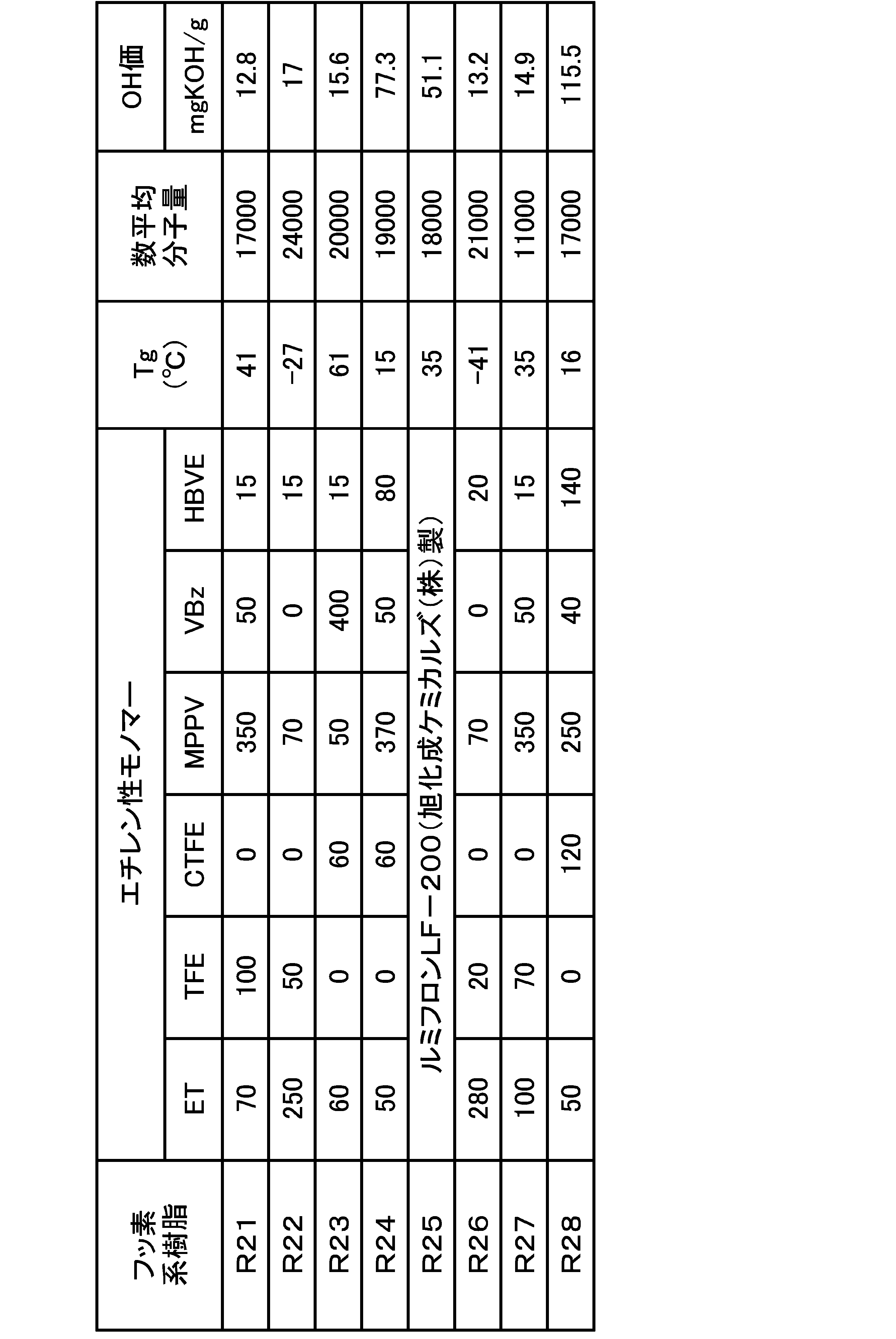
冷却管、窒素導入管、撹拌装置、温度計を備えた3つ口フラスコに、フッ素系樹脂R21溶液を500部、撹拌しながら40℃まで昇温した。ジブチルスズジラウレートを0.03部添加し、2-イソシアナトエチルメタクリレート(MOI)6.9部を、40℃で撹拌しながら3時間かけて滴下した。IRでイソシアネートピーク(2260cm-1)が消失したことを確認し、Tgが40℃、数平均分子量が17,000、水酸基価が7.9(mgKOH/g)、ヨウ素価が2.3(g/100g)、固形分20%のフッ素系樹脂R21'溶液を得た。
フッ素系樹脂R21'溶液の合成において、使用した2-イソシアナトエチルメタクリレート(MOI)の量を表4のように変えたこと以外は、フッ素系樹脂R21'溶液と同様にしてフッ素系樹脂R22'~R28'溶液を合成した。得られたフッ素系樹脂のTg、数平均分子量、水酸基価、ヨウ素価を表4に示す。
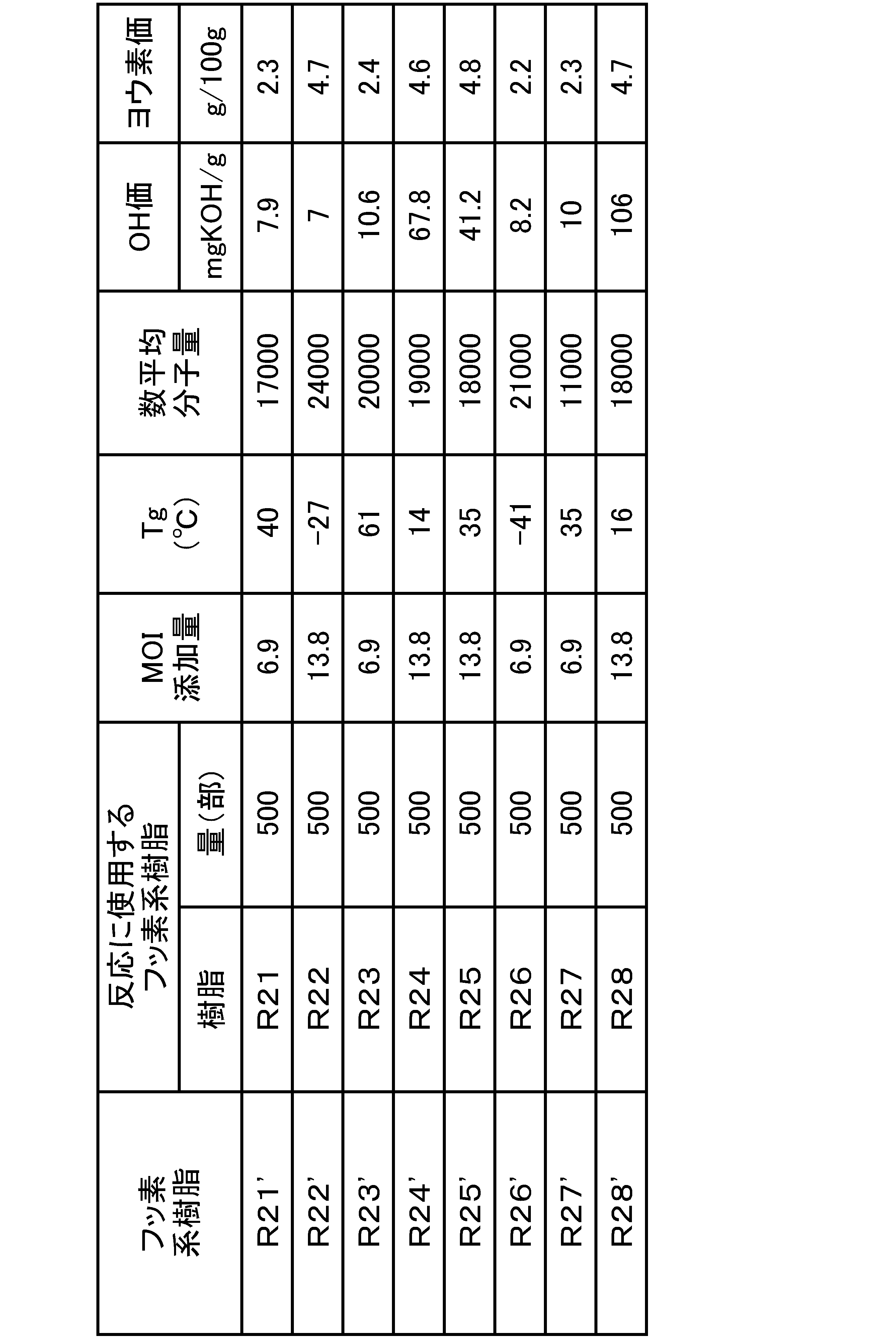
重合槽、攪拌機、温度計、水分離装置、還流冷却器、窒素導入管を備えた重合反応装置の重合槽に、テレフタル酸8部、イソフタル酸8部、アジピン酸5部、セバシン酸40部、エチレングリコール10部、ネオペンチルグリコール11部、及び1,6-ヘキサンジオール17部を重合槽に仕込み、窒素気流下で攪拌しながら160~240℃に加熱し、エステル交換反応を行なった。次いで重合槽を徐々に1~2トールまで減圧し、所定の粘度となったところで減圧下での反応を停止し、数平均分子量が18,000、水酸基価が6.5(mgKOH/g)、Tgが-37℃のポリエステルポリオールを得、酢酸エチルで希釈して、固形分50%のポリエステル系樹脂R31溶液を得た。
ポリエステル系樹脂R31溶液の合成において、使用したモノマーの組成を表5のように変えたこと以外は、ポリエステル系樹脂R31溶液と同様にしてポリエステル系樹脂R32~R35、R37、R38溶液を合成した。得られたポリエステル系樹脂のTg、数平均分子量、水酸基価を表5に示す。
バイロンGK880(東洋紡績(株)製)をMEKに溶解し、固形分を50%としたものを、ポリエステル系樹脂R36溶液とした。また、エリーテルUE-9900(ユニチカ(株)製)をトルエンに溶解し、固形分を30%としたものを、ポリエステル系樹脂R36溶液とした。得られたポリエステル系樹脂のTg、数平均分子量、水酸基価を表5に示す。
TPA:テレフタル酸
IPA:イソフタル酸
AdA:アジピン酸
SeA:セバシン酸
EG:エチレングリコール
NPG:ネオペンチルグリコール
1,6-HD:1,6-ヘキサンジオール
TMP:トリメチロールプロパン

フッ素系樹脂R21'溶液の合成において、使用した樹脂溶液と2-イソシアナトエチルメタクリレート(MOI)の量を表6のように変えたこと以外は、フッ素系樹脂R21'溶液と同様にしてポリエステル系樹脂R31'~R39'溶液を合成した。得られたポリエステル系樹脂のTg、数平均分子量、水酸基価、ヨウ素価を表6に示す。

冷却管、窒素導入管、撹拌装置、温度計、滴下ロートを備えた4つ口フラスコに、C-2090(クラレ(株)製、ポリカーボネートポリオール)368部、キシリレンジイソシアネート32部、トルエン100部を仕込み、触媒としてジブチル錫ジラウレート0.03部を仕込み、100℃まで徐々に昇温して、3時間反応を行った。IR測定によりNCOピークがないことを確認した後、酢酸エチル300部を添加して、数平均分子量が23,000、水酸基価が4.9(mgKOH/g)、Tgが-5℃、固形分50%のポリウレタン系樹脂R41溶液を得た。
ポリウレタン系樹脂R41溶液の合成において、使用した水酸基成分およびイソシアネート化合物の組成を表7のように変えたこと以外は、ポリウレタン系樹脂R41溶液と同様にしてポリウレタン系樹脂R42~R47溶液を合成した。得られたポリウレタン系樹脂のTg、数平均分子量、水酸基価を表7に示す。
C-2090:ポリカーボネートポリオール、クラレ(株)製
PTMG-3000:ポリテトラメチレンエーテルグリコール、三菱化学(株)製
CHDM:シクロヘキサンジメタノール
XDI:キシリレンジイソシアネート
HDI:ヘキサメチレンジイソシアネート
IPDI:イソホロンジイソシアネート
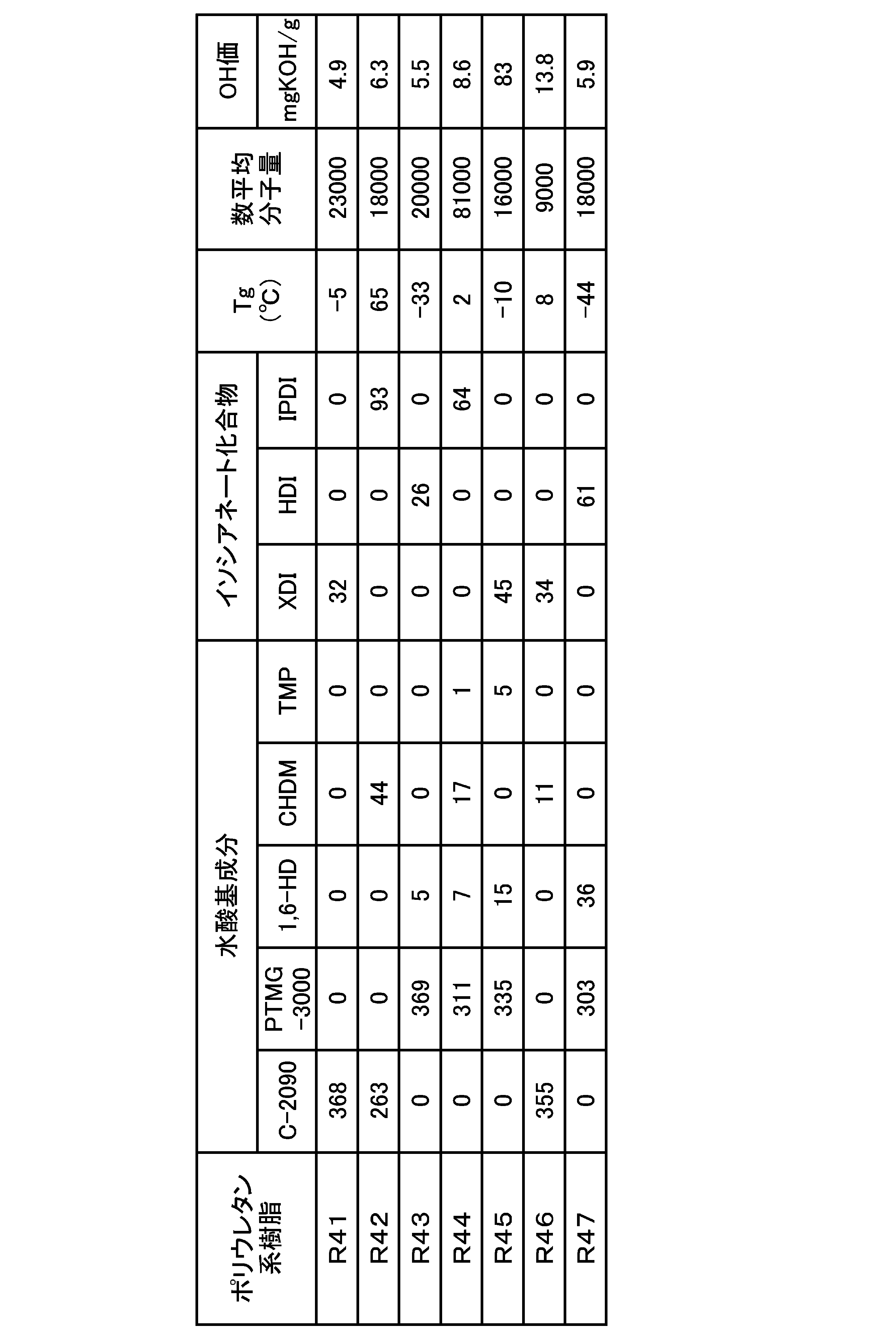
フッ素系樹脂R21'溶液の合成において、使用した樹脂溶液と2-イソシアナトエチルメタクリレート(MOI)の量を表8のように変えたこと以外は、フッ素系樹脂R21'溶液と同様にしてポリウレタン系樹脂R41'~R47'溶液を合成した。得られたポリウレタン系樹脂のTg、数平均分子量、水酸基価、ヨウ素価を表8に示す。
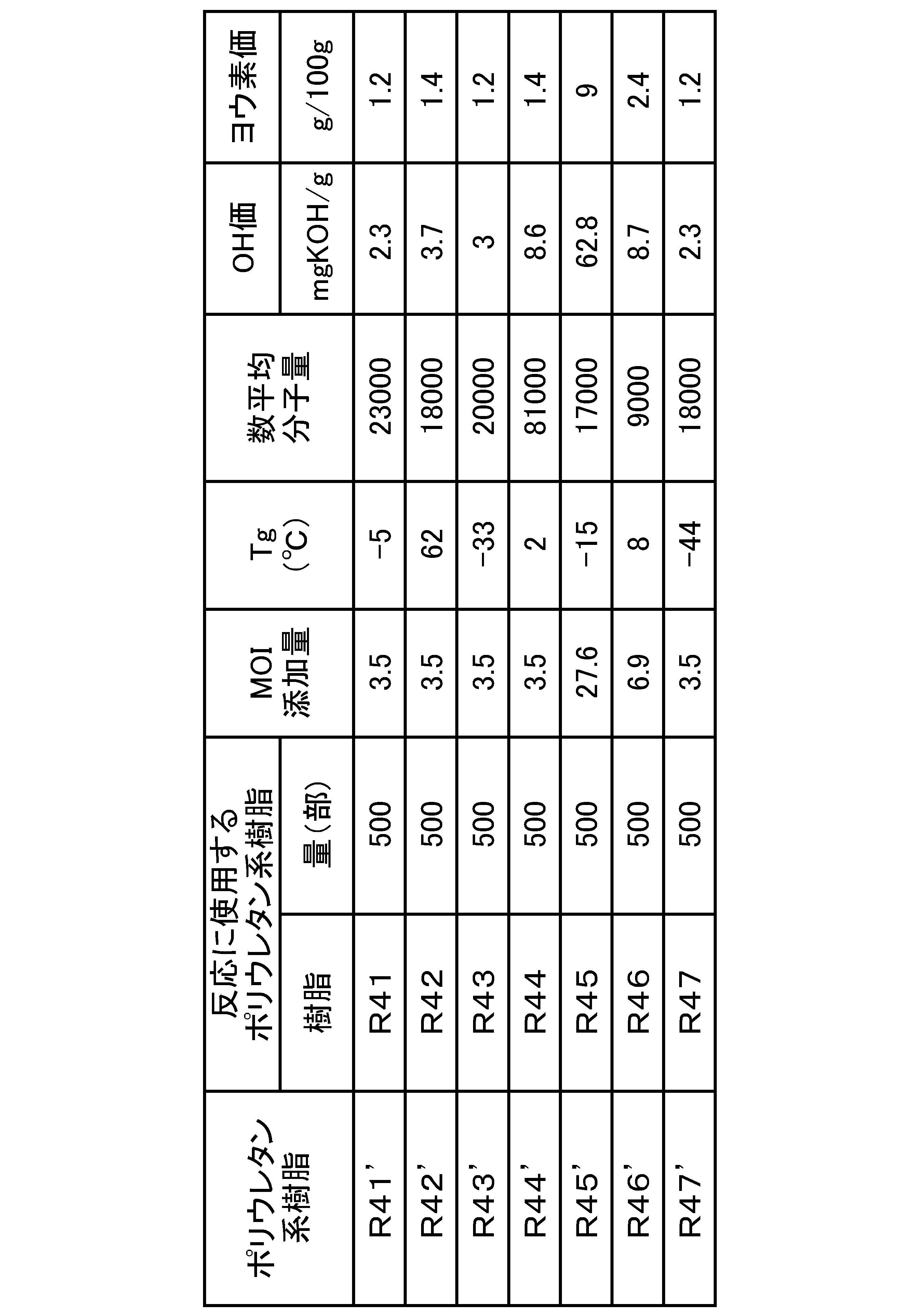
冷却管、窒素導入管、撹拌装置、温度計、滴下ロートを備えた4つ口フラスコに、C-2090(クラレ(株)製、ポリカーボネートポリオール)310部、キシリレンジイソシアネート64部、トルエン100部を仕込み、触媒としてジブチル錫ジラウレート0.03部を仕込み、100℃まで徐々に昇温して、3時間反応を行った。40℃まで冷却し、酢酸エチルを200部加えた後、イソホロンジアミン26部を1時間かけて滴下し、さらに1時間撹拌を続けた。2-アミノ-2-メチルプロパノールを添加しIR測定によりNCOピークがないことを確認した後、酢酸エチルで希釈することにより、数平均分子量が26,000、水酸基価が4.3(mgKOH/g)、Tgが32℃、固形分50%のポリウレタンウレア系樹脂R51溶液を得た。
ポリウレタンウレア系樹脂R51溶液の合成において、使用した水酸基成分、イソシアネート化合物およびアミノ基を2個以上有する化合物の組成を表9のように変えたこと以外は、ポリウレタンウレア系樹脂R51溶液と同様にしてポリウレタンウレア系樹脂R52~R59溶液を合成した。得られたポリウレタンウレア系樹脂のTg、数平均分子量、水酸基価を表9に示す。
HDA:ヘキサメチレンジアミン
IPDA:イソホロンジアミン
XDA:キシリレンジアミン
DAB:1,4-ジアミノ-2-ブタノール

フッ素系樹脂R21'溶液の合成において、使用した樹脂溶液と2-イソシアナトエチルメタクリレート(MOI)の量を表10のように変えたこと以外は、フッ素系樹脂R21'溶液と同様にしてポリウレタンウレア系樹脂R51'~R59'溶液を合成した。得られたポリウレタンウレア系樹脂のTg、数平均分子量、水酸基価、ヨウ素価を表10に示す。
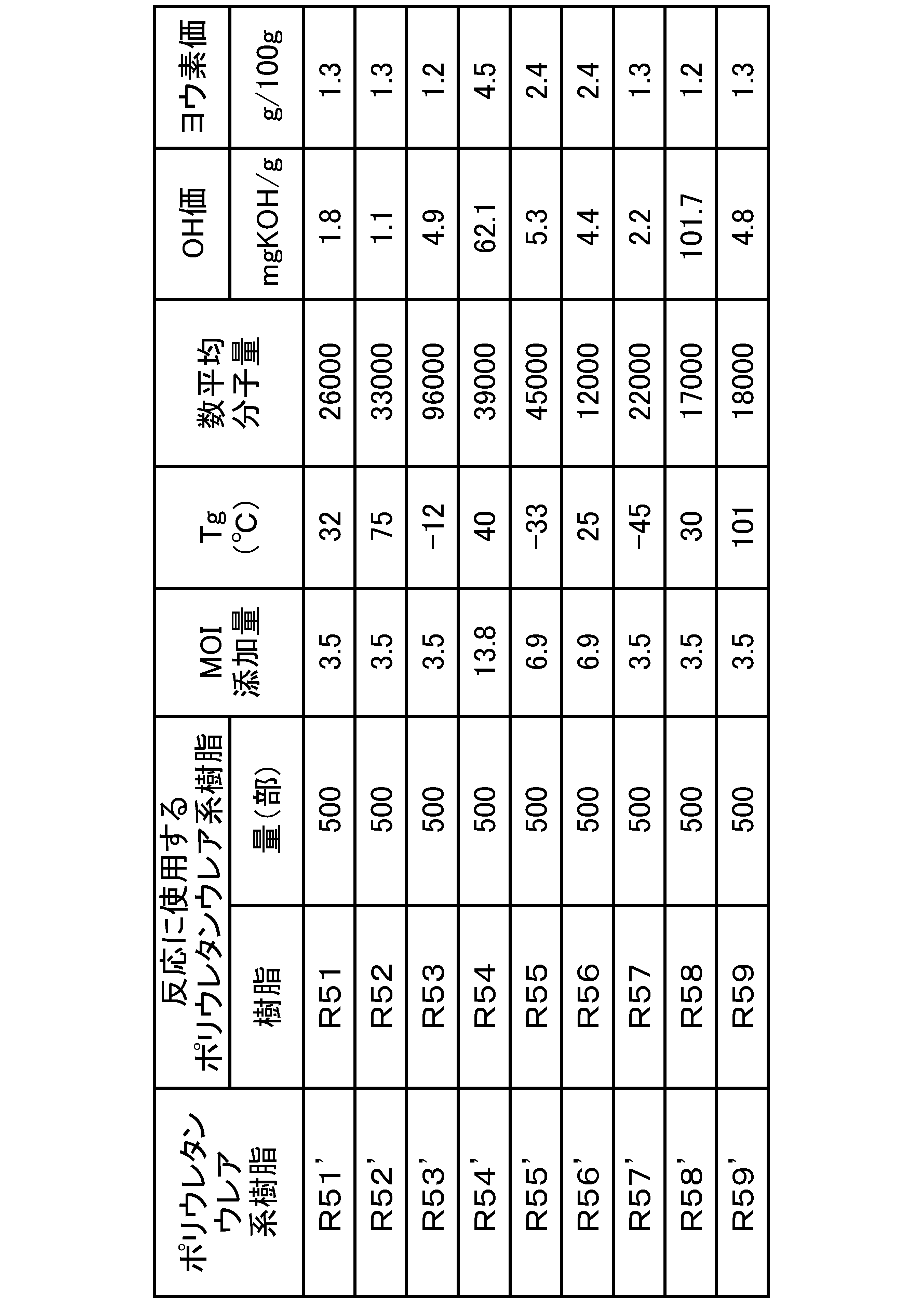
撹拌機、温度計、窒素導入管、還流脱水装置および蒸留管を備えたフラスコに、イオン交換水180部、アジピン酸73部、セバシン酸100部、ヘキサメチレンジアミン127部を仕込んだ。発熱の温度が一定になるまで撹拌し、温度が安定したら110℃まで昇温した。水の留出を確認してから30分後に温度を120℃に昇温し、その後30分おきに10℃ずつ、温度が220℃になるまで昇温した。220℃で3時間反応を続け、特定のアミン価となった時点で反応を終了し、トルエンで希釈することにより、数平均分子量が21,000、アミン価が4.4(mgKOH/g)、Tgが35℃、固形分30%のポリアミド系樹脂R61溶液を得た。
ポリアミド系樹脂R61溶液の合成において、使用したカルボン酸成分および2個以上のアミノ基を有する化合物の組成を表11のように変えたこと以外は、ポリアミド系樹脂R61溶液と同様にしてポリアミド系樹脂R62~R67溶液を合成した。得られたポリアミド系樹脂のTg、数平均分子量、アミン価を表11に示す。

フッ素系樹脂R21'溶液の合成において、使用した樹脂溶液と2-イソシアナトエチルメタクリレート(MOI)の量を表12のように変えたこと以外は、フッ素系樹脂R21'溶液と同様にしてポリアミド系樹脂R61'~R66'溶液を合成した。得られたポリアミド系樹脂のTg、数平均分子量、アミン価、ヨウ素価を表12に示す。
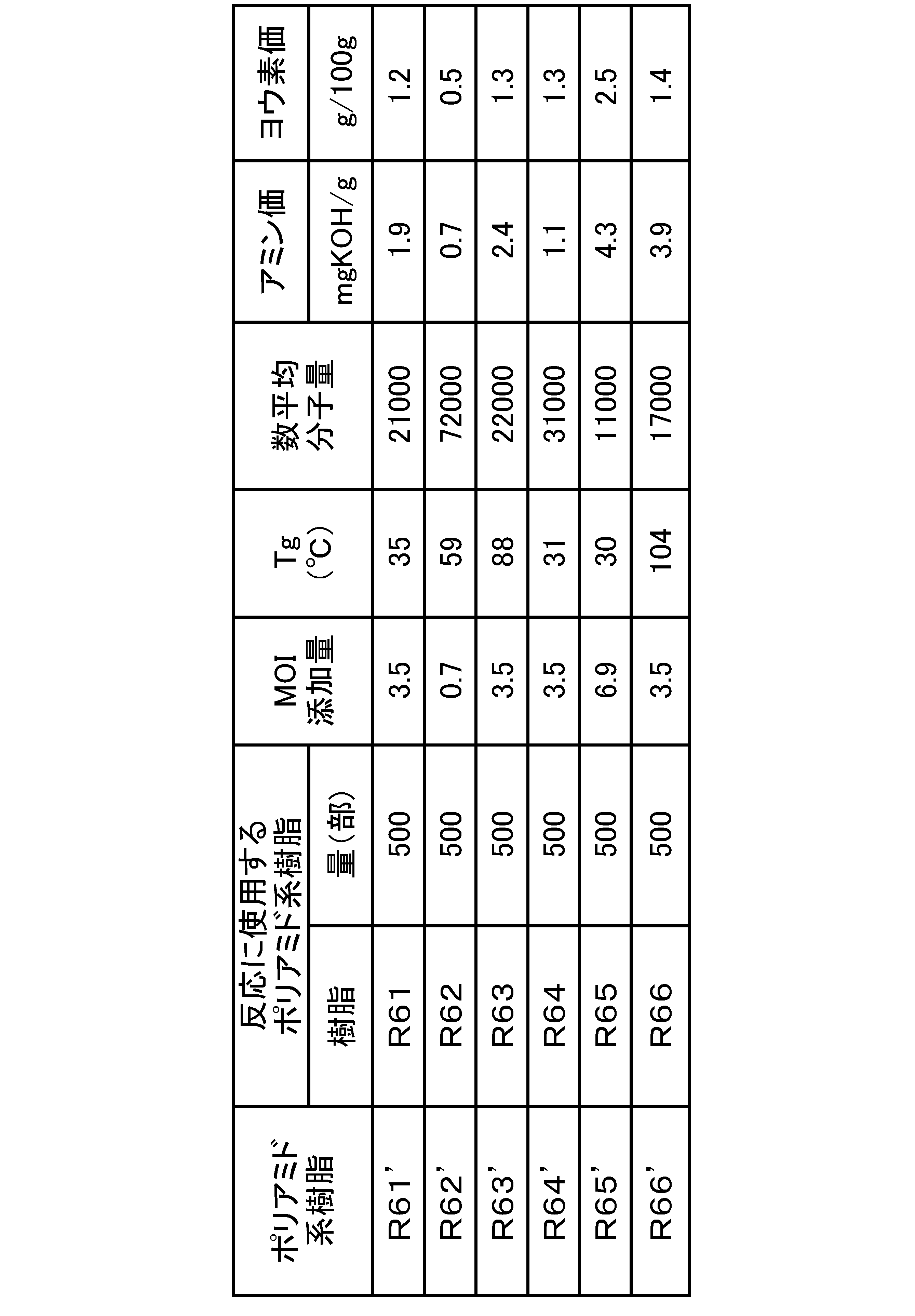
オレフィン系樹脂溶液、フッ素系樹脂溶液、ポリエステル系樹脂溶液、ポリウレタン系樹脂溶液、ポリウレタンウレア系樹脂溶液、ポリアミド系樹脂溶液、(メタ)アクリロイル基を有する化合物(B)、ポリイソシアネート化合物(C)溶液、エポキシ樹脂(Ep)、無機系粒子(M)、触媒を、表13-1、13-2、13-3、13-4、15-1A、15-1B、15-2、15-3A、15-3B、17-1A、17-1B、17-2A、17-2B、17-3A,17-3B、19-1A、19-1B、19-2A、19-2B、19-3A、19-3B、21-1A、21-1B、21-2A、21-2B、21-3A、21-3B、23-1、23-2、23-3に示す組成にて混合し、易接着剤溶液1~221を得た。
オレフィン系樹脂溶液、フッ素系樹脂溶液、ポリエステル系樹脂溶液、ポリウレタン系樹脂溶液、ポリウレタンウレア系樹脂溶液、ポリアミド系樹脂溶液、アリル基含有化合物(H)、ポリイソシアネート化合物(C)溶液、触媒を表14、16、18、20、22、24に示す組成にて混合し、易接着剤溶液1'~30'を得た。
固有粘度が0.67(dL/g)で、かつ、環状三量体含有量が0.5重量%のポリエステル樹脂を用いて、T-ダイ押出機により設定温度250℃の条件で、厚さ125μmのポリエステルフィルム1を作製した。
ポリエステルフィルム1の片面にコロナ処理し、その処理面に易接着剤溶液1をグラビアコーターによって塗布し、溶剤を乾燥させ、塗布量:1g/m2の易接着剤層を設け、太陽電池保護シート1を作製した。
白板ガラス、酢酸ビニル-エチレン共重合体フィルム(サンビック(株)製、スタンダードキュアタイプ、以下EVAフィルム)、太陽電池保護シート1を、太陽電池保護シート1の易接着剤層がEVAフィルムに接するように順に重ねた。その後、この積層体を真空ラミネーターに入れ、1Torr程度に真空排気して、プレス圧力0.1MPaで、150℃30分間加熱後、さらに150℃で30分間加熱し、10cm×10cm角の接着力評価用サンプル1を作製した。
接着力評価用サンプル1を用い、後述する方法で、易接着剤層のEVAフィルムへの接着性、耐湿熱試験(1000時間後、2000時間後)接着性の評価を行った。
接着力評価用サンプル1の太陽電池保護シート1面をカッターで15mm幅に切り、太陽電池保護シート1に形成された易接着剤層と封止材であるEVAフィルムとの接着力を測定した。測定には、引っ張り試験機を用い、荷重速度100mm/minで180度剥離試験を行った。得られた測定値に対して、以下のように評価した。
◎:50N/15mm以上
○:30N/15mm以上~50N/15mm未満
△:10N/15mm以上~30N/15mm未満
×:10N/15mm未満
接着力評価用サンプル1を、温度85℃、相対湿度85%RHの環境条件で、1000時間、2000時間静置した後、接着性測定と同様にして、耐湿熱試験後の接着性評価を行った。
実施例1と同様にして、接着力評価用サンプル2~221、1'~30'を用い、易接着剤層のEVAフィルムへの接着性、耐湿熱試験後の接着性の評価を行った。以上の結果を、表13-1、13-2、13-3、13-4、14、15-1A、15-1B、15-2、15-3A、15-3B、16、17-1A、17-1B、17-2A、17-2B、17-3A,17-3B、18、19-1A、19-1B、19-2A、19-2B、19-3A、19-3B、20、21-1A、21-1B、21-2A、21-2B、21-3A、21-3B、22、23-1、23-2、23-3、24に示す。
<(メタ)アクリロイル基を有する化合物B1~B6>
(メタ)アクリロイル基を有する化合物B1~B6には、以下に記載する化合物をそのまま用いた。
B1:アロニックスM-215(東亞合成(株)製、イソシアヌル酸EO変性ジアクリレート)
B2:アロニックスM-315(東亞合成(株)製、イソシアヌル酸EO変性トリアクリレート)
B3:エポキシエステル70PA(共栄社化学(株)製、エポライト70Pアクリル酸付加物)
B4:KAYARAD PET-30(日本化薬(株)製、ペンタエリスリトールトリアクリレート)
B5:TMPTA(トリメチロールプロパントリアクリレート)
B6:DPHA(ジペンタエリスリトールヘキサアクリレート)
3,5-ジメチルピラゾールでブロックされた、ヘキサメチレンジイソシアネートのイソシアヌレート体を、酢酸エチルで75%に希釈し、ポリイソシアネート化合物溶液(C)を得た。
アリル基含有化合物H1~H4には、以下に記載する化合物をそのまま用いた。
H1:TAIC(日本化成(株)製、トリアリルイソシアヌレート)
H2:ネオアリルE-10(ダイソー(株)製、グリセリンモノアリルエーテル)
H3:ネオアリルT-20(ダイソー(株)製、トリメチロールプロパンジアリレート)
H4:ネオアリルP-30M(ダイソー(株)製、ペンタエリスリトールトリアリルエーテル)
エポキシ樹脂Ep1~Ep3には、以下に記載する化合物をそのまま用いた。
Ep1:jER1001(三菱化学(株)製、ビスフェノールA型エポキシ樹脂)
Ep2:YDCN-704(東都化成(株)製、クレゾールノボラック型エポキシ樹脂)
Ep3:デナコールEX-821(ナガセケムテックス(株)製、ポリエチレングリコールジグリシジルエーテル)
無機粒子M1~M4には、以下に記載する無機粒子をそのまま用いた。
M1:タルクLMS-400(富士タルク工業(株)製)
M2:ハイドロタルサイトDHT-4A(協和化学工業(株)製)
M3:カオリナイトSATINTONE W(林化成(株)製)
M4:モンモリロナイト クニピアF(クニミネ工業(株)製)

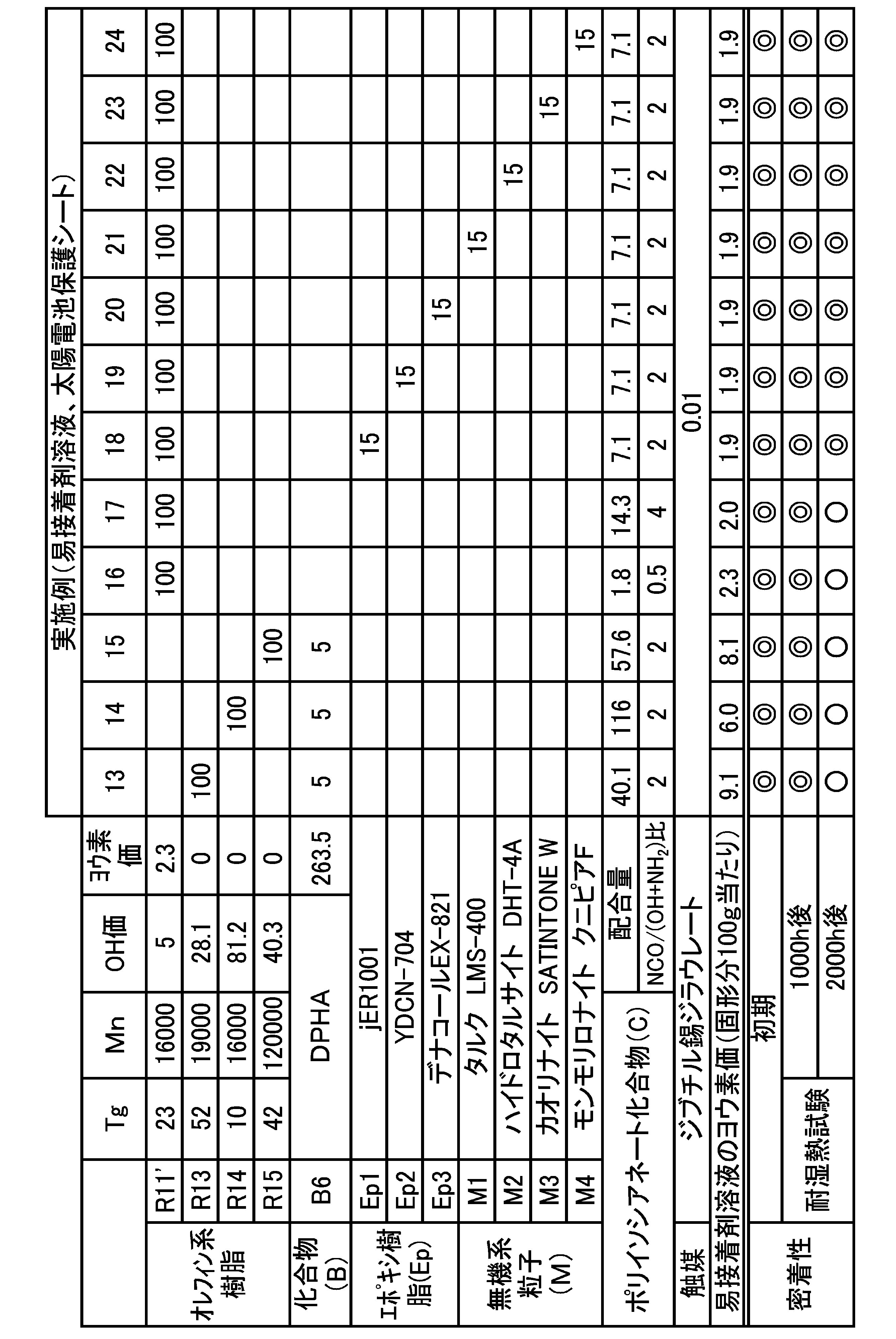


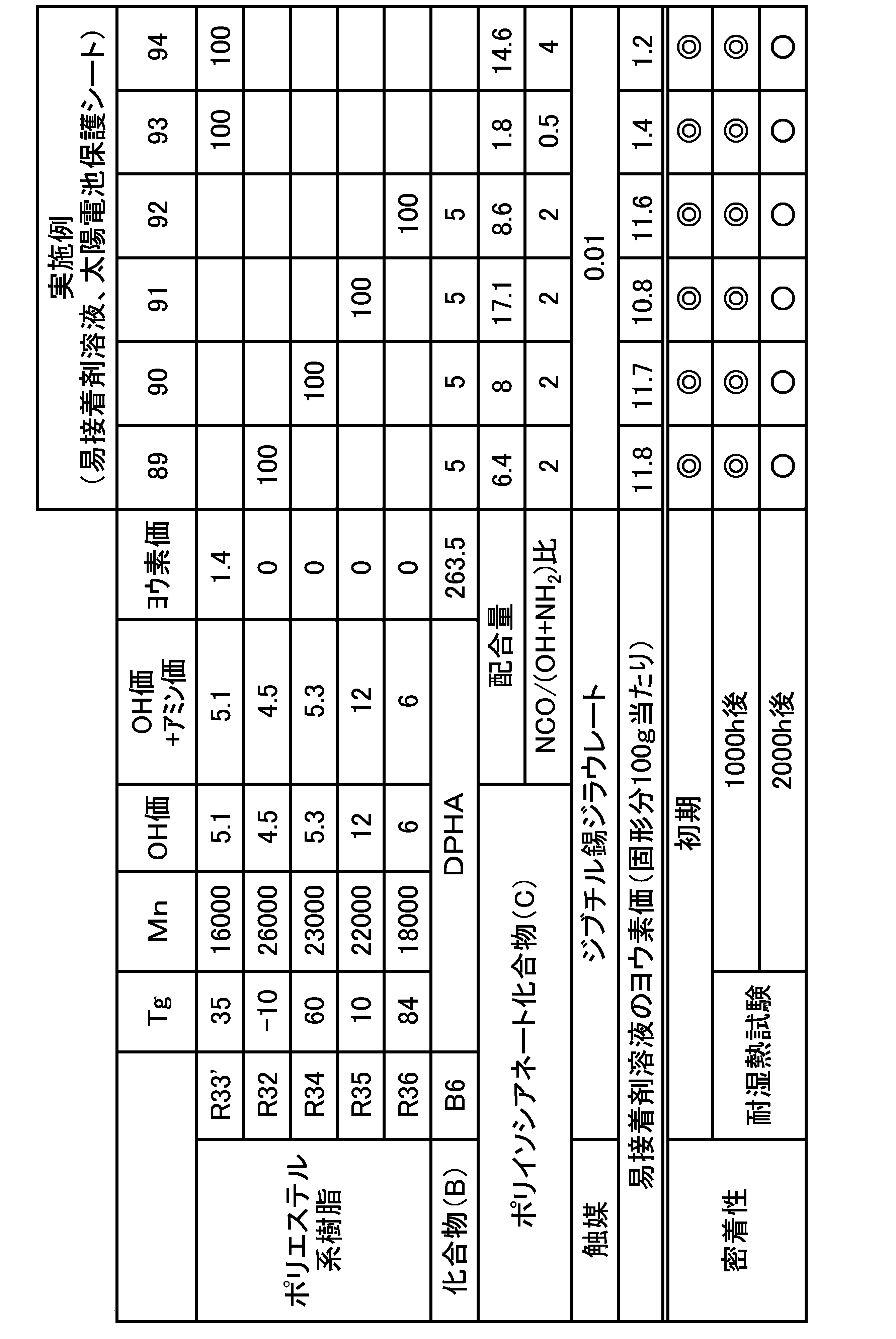

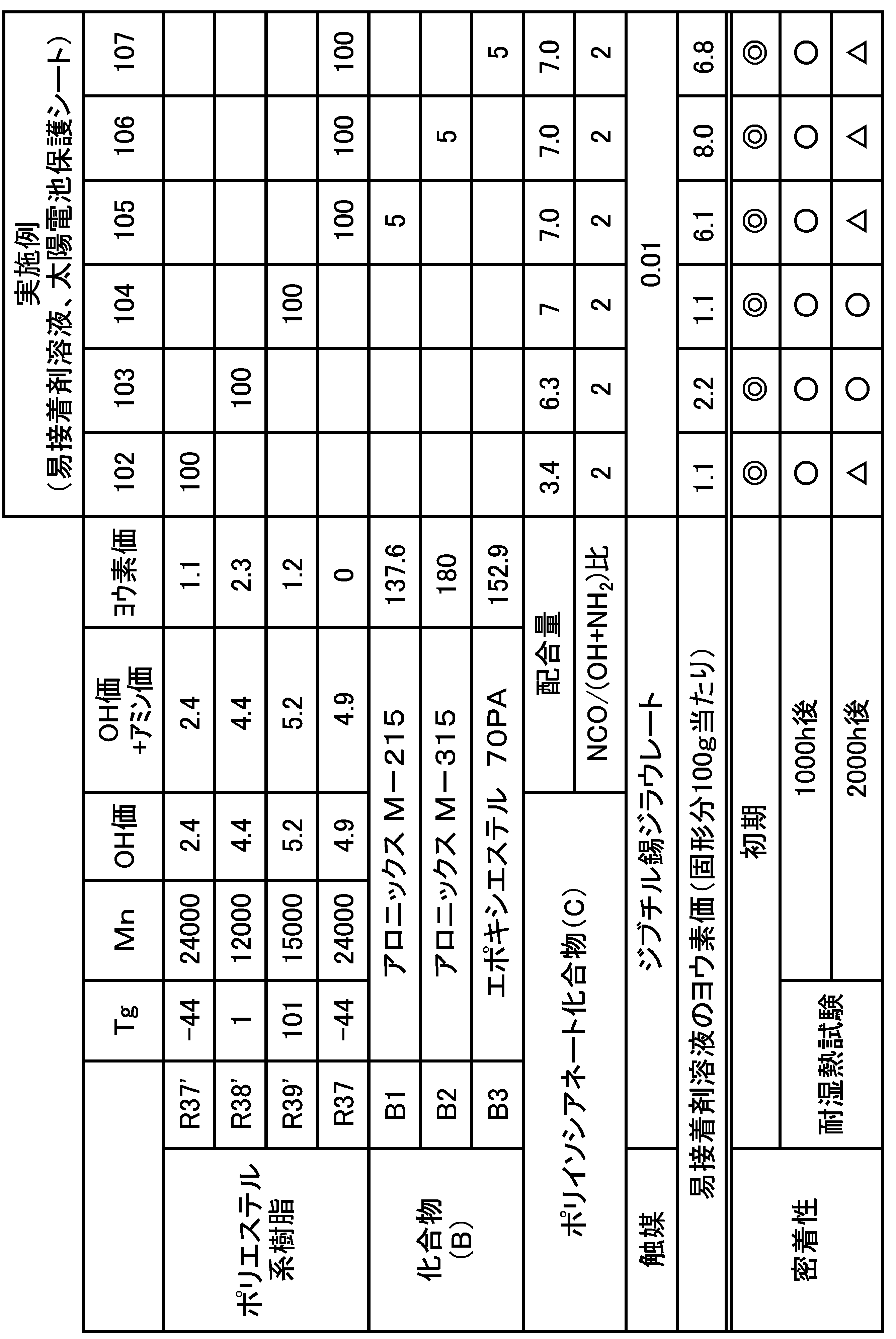


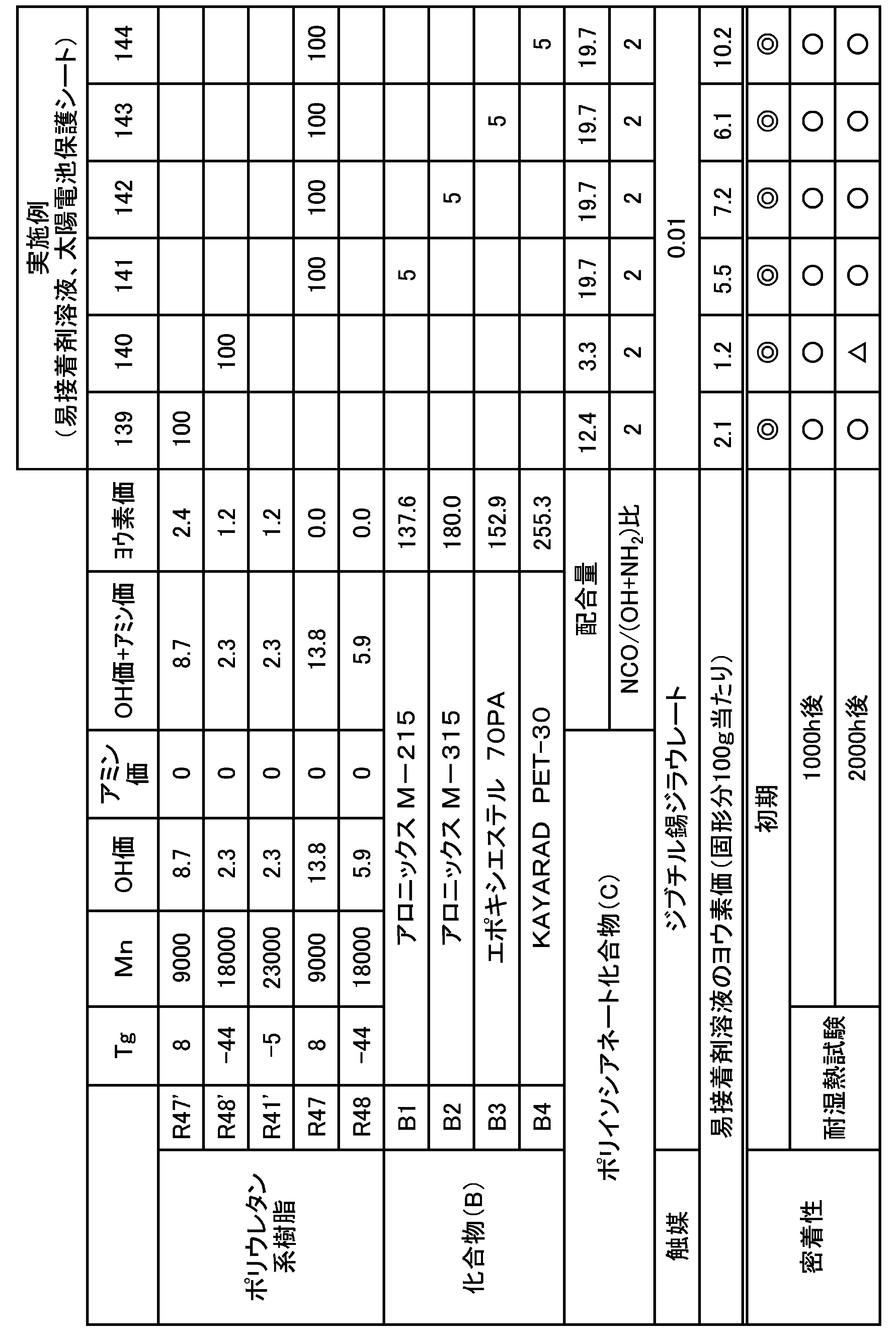


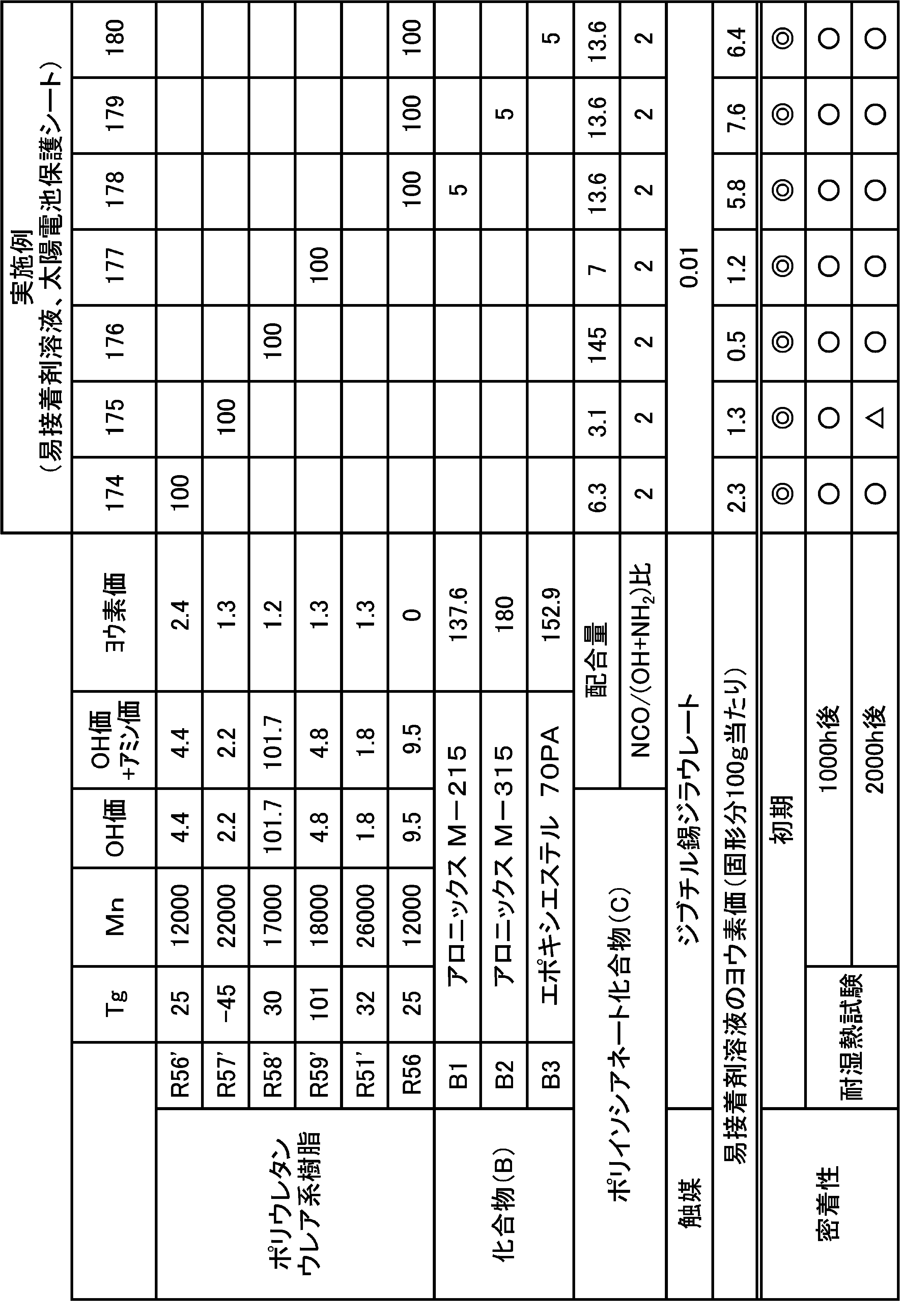


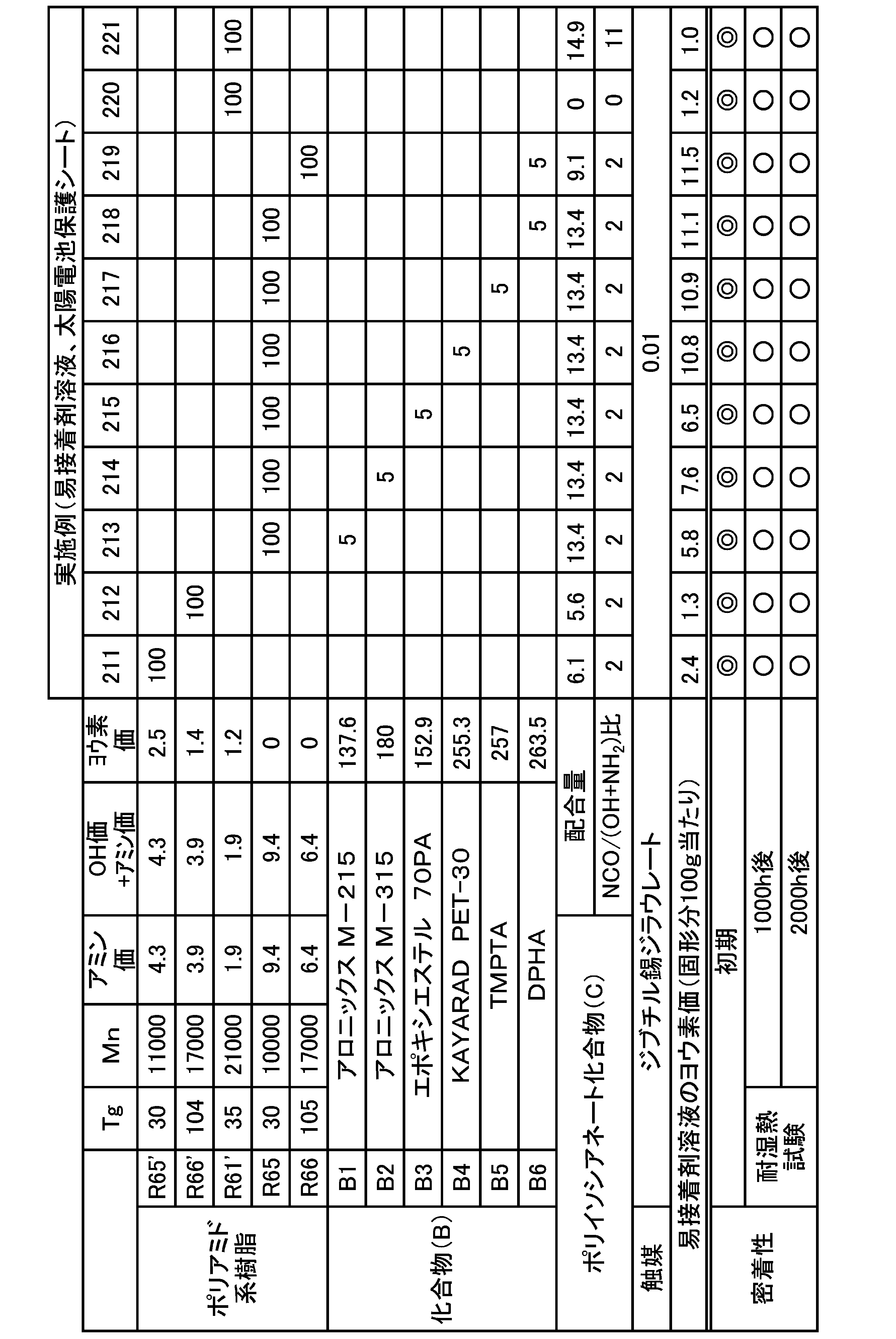

<太陽電池モジュールの作製>
白板ガラス・・・太陽電池表面保護材(I)
EVAフィルム・・・受光面側の封止材(II)
多結晶シリコン太陽電池素子・・・太陽電池セル(III)
EVAフィルム・・・非受光面側の封止材(IV)
上記(I)-(IV)及び太陽電池保護シート1を、太陽電池保護シート1の易接着剤層が非受光面側の封止材(IV)に接するように順に重ねた後、真空ラミネーターに入れ、1Torr程度に真空排気して、プレス圧力として大気圧の圧力をかけた状態で、150℃、30分間加熱後、さらに150℃で30分間加熱し、10cm×10cm角の光電変換効率評価用太陽電池モジュール1を作製した。
得られた太陽電池モジュール1の太陽電池出力を測定し、JIS C8912に従って、ソーラーシュミレーター(英弘精機製、SS-100XIL)を用いて光電変換効率を測定した。
さらに、温度85℃、相対湿度85%RHの環境条件で500時間、1000時間、1500時間、2000時間静置した後の耐湿熱試験後の光電変換効率を、同様にして測定した。初期の光電変換効率に対する、耐湿熱試験後の光電変換効率の低下の割合を計算し、以下のように評価した。
○:出力の低下が10%未満
△:出力の低下が10%以上~20%未満
×:出力の低下が20%以上
実施例222と同様にして、太陽電池保護シート11、25、34、39、49、63、71、78、87、102、110、115、125、139、146、150、160、174、183、189、198、211、218、5'、10'、15'、20'、25'、30'を用いて太陽電池モジュール1~30を作製し、光電変換効率(初期、耐湿熱試験後)を測定した。以上の結果を表25に示す。

II 太陽電池セルの受光面側に位置する封止材
III 太陽電池セル
IV 太陽電池セルの非受光面側に位置する封止材
V 太陽電池セルの非受光面側に位置する太陽電池裏面保護材
Claims (13)
- (メタ)アクリル系共重合体(A)以外の樹脂(R)を含有し、
(メタ)アクリロイル基に由来する炭素-炭素二重結合の量がヨウ素価で0.01~50(g/100g)である太陽電池保護シート用易接着剤。 - 前記樹脂(R)は、数平均分子量が10,000~250,000、ガラス転移温度が-40~100℃である請求項1に記載の太陽電池保護シート用易接着剤。
- 前記樹脂(R)が、水酸基およびアミノ基の少なくともいずれかを有し、水酸基価とアミン価の和が2~100(mgKOH/g)である、請求項1又は2に記載の太陽電池保護シート用易接着剤。
- 前記樹脂(R)が、フッ素系樹脂、オレフィン系樹脂、ポリエステル系樹脂、ポリウレタン系樹脂、ポリウレタンウレア系樹脂およびポリアミド系樹脂からなる群より選ばれる樹脂である、請求項1~3のいずれか1項に記載の太陽電池保護シート用易接着剤。
- 前記(メタ)アクリロイル基に由来する炭素-炭素二重結合は、
(i)前記樹脂(R)に含まれている、及び
(ii)前記樹脂(R)に含まれず、(メタ)アクリロイル基を有する化合物(B)に含まれている、の少なくともいずれかであり、
前記(i)の前記樹脂(R)は、(メタ)アクリロイル基に由来する炭素-炭素二重結合を有する、(メタ)アクリル系共重合体(A)以外の樹脂(Ra)であり、
前記(ii)の前記樹脂(R)は、(メタ)アクリロイル基を有しない、(メタ)アクリル系共重合体(A)以外の樹脂(Rb)である請求項1~4のいずれか1項に記載の太陽電池保護シート用易接着剤。 - 前記樹脂(R)が、水酸基およびアミノ基の少なくともいずれかを有し、前記水酸基および前記アミノ基のモル量の和に対して、イソシアネート基が0.1~10モル量となる範囲でポリイソシアネート化合物(C)を含有する、請求項1~5のいずれか1項に記載の太陽電池保護シート用易接着剤。
- 前記樹脂(Ra)が、以下の(1-1)~(1-5)の少なくともいずれかに記載の樹脂(Ra-1)~(Ra-5)である、請求項5に記載の太陽電池保護シート用易接着剤。
(1-1)前記樹脂(Rb)が、水酸基およびアミノ基の少なくとも一方を有するものであり、前記樹脂(Rb)の前記水酸基および前記アミノ基の少なくとも一方に、イソシアネート基を有する(メタ)アクリル系モノマーを付加して得られる樹脂(Ra-1)。
(1-2)前記樹脂(Rb)が、カルボキシル基を有するものであり、前記樹脂(Rb)中の前記カルボキシル基に、グリシジル基を有する(メタ)アクリル系モノマーを付加して得られる樹脂(Ra-2)。
(1-3)前記樹脂(Rb)が、グリシジル基を有するものであり、前記樹脂(Rb)中の前記グリシジル基に、カルボキシル基を有する(メタ)アクリル系モノマーを付加して得られる樹脂(Ra-3)。
(1-4)前記樹脂(Rb)が、酸無水物基を有するものであり、前記樹脂(Rb)中の前記酸無水物基に、水酸基を有する(メタ)アクリル系モノマーを付加して得られる樹脂(Ra-4)。
(1-5)相互に重合し得る官能基を有し、側鎖に(メタ)アクリロイル基を有する成分と、側鎖に(メタ)アクリロイル基を有しない成分とを重合して得られる、側鎖に(メタ)アクリロイル基に由来する炭素-炭素二重結合を含有する樹脂(Ra-5)。 - 前記樹脂(Rb)100重量部に対して、前記(メタ)アクリロイル基を有する化合物(B)を0.1~20重量部含有する請求項5に記載の太陽電池保護シート用易接着剤。
- 前記(メタ)アクリロイル基を有する化合物(B)は、分子中に2個以上の(メタ)アクリロイル基を有する請求項5又は8に記載の太陽電池保護シート用意接着剤。
- 最表面に形成された易接着剤層(D')と、一方の主面が前記易接着剤層(D')を支持したプラスチックフィルム(E)とを具備し、
前記易接着剤層(D')が、請求項1~9のいずれか1項に記載の太陽電池保護シート用易接着剤によって形成されたものである太陽電池保護シート(Z')。 - 太陽電池セル(III)、前記太陽電池セル(III)の受光面側に位置する太陽電池表面保護材(I)、前記太陽電池セル(III)の受光面側に位置する封止材(II)、前記太陽電池セル(III)の非受光面側に位置する封止材(IV)、及び前記太陽電池セル(III)の非受光面側に位置する太陽電池裏面保護材(V)を具備してなる太陽電池モジュールであって、
前記太陽電池表面保護材(I)は、請求項10に記載の太陽電池保護シート(Z')に設けられた易接着剤層(D')を前記封止材(II)に接するように配置して、前記易接着剤層(D')を硬化することによりを得たものである、及び/又は
前記太陽電池裏面保護材(V)は、請求項10に記載の太陽電池保護シート(Z')に設けられた易接着剤層(D')を前記封止材(IV)に接するように配置して、前記易接着剤層(D')を硬化することによりを得たものである太陽電池モジュール。 - 前記封止材(II)及び前記封止材(IV)の少なくともいずれかは、有機過酸化物が含有されている請求項11に記載の太陽電池モジュール。
- 前記封止材(II)及び前記封止材(IV)の少なくともいずれかは、エチレン-酢酸ビニル共重合体(EVA)を主成分とする請求項11又は12記載の太陽電池モジュール。
Priority Applications (3)
| Application Number | Priority Date | Filing Date | Title |
|---|---|---|---|
| JP2013553265A JP6303502B2 (ja) | 2012-01-10 | 2013-01-08 | 太陽電池保護シート用易接着剤、太陽電池保護シート、及び太陽電池モジュール |
| KR1020147022053A KR102048981B1 (ko) | 2012-01-10 | 2013-01-08 | 태양 전지 보호 시트용 용이 접착제, 태양 전지 보호 시트 및 태양 전지 모듈 |
| CN201380004872.9A CN104039907B (zh) | 2012-01-10 | 2013-01-08 | 太阳能电池保护片用易粘合剂、太阳能电池保护片、以及太阳能电池模块 |
Applications Claiming Priority (2)
| Application Number | Priority Date | Filing Date | Title |
|---|---|---|---|
| JP2012002616 | 2012-01-10 | ||
| JP2012-002616 | 2012-01-10 |
Publications (1)
| Publication Number | Publication Date |
|---|---|
| WO2013105486A1 true WO2013105486A1 (ja) | 2013-07-18 |
Family
ID=48781439
Family Applications (1)
| Application Number | Title | Priority Date | Filing Date |
|---|---|---|---|
| PCT/JP2013/000020 Ceased WO2013105486A1 (ja) | 2012-01-10 | 2013-01-08 | 太陽電池保護シート用易接着剤、太陽電池保護シート、及び太陽電池モジュール |
Country Status (5)
| Country | Link |
|---|---|
| JP (1) | JP6303502B2 (ja) |
| KR (1) | KR102048981B1 (ja) |
| CN (1) | CN104039907B (ja) |
| TW (1) | TWI563053B (ja) |
| WO (1) | WO2013105486A1 (ja) |
Cited By (4)
| Publication number | Priority date | Publication date | Assignee | Title |
|---|---|---|---|---|
| JP2018120919A (ja) * | 2017-01-24 | 2018-08-02 | 東洋インキScホールディングス株式会社 | 太陽電池保護シート用接着剤 |
| EP3561018A4 (en) * | 2016-12-22 | 2020-01-01 | Mitsubishi Chemical Corporation | ADHESIVE COMPOSITION, ADHESIVE, AND ADHESIVE TAPE |
| JP2023151039A (ja) * | 2022-03-31 | 2023-10-16 | 大日精化工業株式会社 | ホットメルト接着剤 |
| EP4371765A4 (en) * | 2021-07-16 | 2024-12-11 | Dainichiseika Color & Chemicals Mfg. Co., Ltd. | ADHESIVE |
Families Citing this family (2)
| Publication number | Priority date | Publication date | Assignee | Title |
|---|---|---|---|---|
| CN104409537A (zh) * | 2014-12-11 | 2015-03-11 | 东莞职业技术学院 | 一种树脂保护的太阳能电池板 |
| TWI759773B (zh) * | 2020-06-20 | 2022-04-01 | 國立臺灣大學 | 太陽能電池封裝方法與封裝結構 |
Citations (7)
| Publication number | Priority date | Publication date | Assignee | Title |
|---|---|---|---|---|
| JPS5823870A (ja) * | 1981-08-03 | 1983-02-12 | Du Pont Mitsui Polychem Co Ltd | 太陽電池用保護材と充填材との接着方法 |
| JPH04306282A (ja) * | 1991-04-03 | 1992-10-29 | Dainippon Ink & Chem Inc | 複合硬化型ラミネート用接着剤 |
| JPH10307201A (ja) * | 1997-05-08 | 1998-11-17 | Toppan Printing Co Ltd | 易接着層を表面に有するプラスチック層を支持体とした光学部材 |
| JP2004035774A (ja) * | 2002-07-04 | 2004-02-05 | Mitsubishi Chemicals Corp | プライマー用樹脂及びプライマー組成物及びそれからなる積層体 |
| JP2007136911A (ja) * | 2005-11-21 | 2007-06-07 | Toray Ind Inc | 太陽電池用裏面封止用シート |
| JP2007320993A (ja) * | 2006-05-30 | 2007-12-13 | Kyoeisha Chem Co Ltd | 活性エネルギー線硬化被膜形成組成物用の表面調整剤 |
| WO2010147090A1 (ja) * | 2009-06-15 | 2010-12-23 | 東洋インキ製造株式会社 | ウレタン樹脂、活性エネルギー線硬化性接着剤、及び太陽電池用裏面保護シート |
Family Cites Families (11)
| Publication number | Priority date | Publication date | Assignee | Title |
|---|---|---|---|---|
| JP2001119051A (ja) | 1999-10-19 | 2001-04-27 | Dainippon Printing Co Ltd | 太陽電池モジュ−ル用裏面保護シ−トおよびそれを使用した太陽電池モジュ−ル |
| JP4303951B2 (ja) | 2002-12-17 | 2009-07-29 | 大日本印刷株式会社 | 太陽電池モジュ−ル用裏面保護シ−トおよびそれを使用した太陽電池モジュ−ル |
| JP2004223925A (ja) | 2003-01-23 | 2004-08-12 | Mitsubishi Plastics Ind Ltd | 積層シート、太陽電池用裏面保護シート、並びに太陽電池及び太陽電池モジュール |
| JP2006152013A (ja) | 2004-11-25 | 2006-06-15 | Teijin Dupont Films Japan Ltd | 太陽電池裏面保護膜用易接着性ポリエステルフィルムおよびそれを用いた太陽電池裏面保護膜 |
| JP2007048944A (ja) * | 2005-08-10 | 2007-02-22 | Toppan Printing Co Ltd | 太陽電池裏面封止用シート |
| JP5237569B2 (ja) * | 2007-02-27 | 2013-07-17 | 東洋アルミニウム株式会社 | 太陽電池用裏面保護シートとそれを備えた太陽電池モジュール |
| JP5346629B2 (ja) | 2008-03-13 | 2013-11-20 | 株式会社日本触媒 | 太陽電池モジュール用バックシート |
| JP2010114154A (ja) | 2008-11-04 | 2010-05-20 | Toppan Printing Co Ltd | 太陽電池用裏面封止材及びそれを用いた太陽電池 |
| JP2010263193A (ja) | 2009-04-08 | 2010-11-18 | Nippon Shokubai Co Ltd | 太陽電池モジュール用バックシート |
| DE102009021712A1 (de) * | 2009-05-18 | 2010-11-25 | Mitsubishi Polyester Film Gmbh | Coextrudierte, biaxial orientierte Polyesterfolien mit verbesserten Hafteigenschaften, Rückseitenlaminate für Solarmodule und Solarmodule |
| JP2011018872A (ja) | 2009-06-11 | 2011-01-27 | Dainichiseika Color & Chem Mfg Co Ltd | 太陽電池モジュールおよびプライマー組成物 |
-
2013
- 2013-01-08 WO PCT/JP2013/000020 patent/WO2013105486A1/ja not_active Ceased
- 2013-01-08 KR KR1020147022053A patent/KR102048981B1/ko active Active
- 2013-01-08 JP JP2013553265A patent/JP6303502B2/ja active Active
- 2013-01-08 CN CN201380004872.9A patent/CN104039907B/zh active Active
- 2013-01-10 TW TW102100849A patent/TWI563053B/zh active
Patent Citations (7)
| Publication number | Priority date | Publication date | Assignee | Title |
|---|---|---|---|---|
| JPS5823870A (ja) * | 1981-08-03 | 1983-02-12 | Du Pont Mitsui Polychem Co Ltd | 太陽電池用保護材と充填材との接着方法 |
| JPH04306282A (ja) * | 1991-04-03 | 1992-10-29 | Dainippon Ink & Chem Inc | 複合硬化型ラミネート用接着剤 |
| JPH10307201A (ja) * | 1997-05-08 | 1998-11-17 | Toppan Printing Co Ltd | 易接着層を表面に有するプラスチック層を支持体とした光学部材 |
| JP2004035774A (ja) * | 2002-07-04 | 2004-02-05 | Mitsubishi Chemicals Corp | プライマー用樹脂及びプライマー組成物及びそれからなる積層体 |
| JP2007136911A (ja) * | 2005-11-21 | 2007-06-07 | Toray Ind Inc | 太陽電池用裏面封止用シート |
| JP2007320993A (ja) * | 2006-05-30 | 2007-12-13 | Kyoeisha Chem Co Ltd | 活性エネルギー線硬化被膜形成組成物用の表面調整剤 |
| WO2010147090A1 (ja) * | 2009-06-15 | 2010-12-23 | 東洋インキ製造株式会社 | ウレタン樹脂、活性エネルギー線硬化性接着剤、及び太陽電池用裏面保護シート |
Cited By (5)
| Publication number | Priority date | Publication date | Assignee | Title |
|---|---|---|---|---|
| EP3561018A4 (en) * | 2016-12-22 | 2020-01-01 | Mitsubishi Chemical Corporation | ADHESIVE COMPOSITION, ADHESIVE, AND ADHESIVE TAPE |
| JP2018120919A (ja) * | 2017-01-24 | 2018-08-02 | 東洋インキScホールディングス株式会社 | 太陽電池保護シート用接着剤 |
| EP4371765A4 (en) * | 2021-07-16 | 2024-12-11 | Dainichiseika Color & Chemicals Mfg. Co., Ltd. | ADHESIVE |
| JP2023151039A (ja) * | 2022-03-31 | 2023-10-16 | 大日精化工業株式会社 | ホットメルト接着剤 |
| JP7763702B2 (ja) | 2022-03-31 | 2025-11-04 | 大日精化工業株式会社 | ホットメルト接着剤 |
Also Published As
| Publication number | Publication date |
|---|---|
| TW201335315A (zh) | 2013-09-01 |
| JP6303502B2 (ja) | 2018-04-04 |
| CN104039907A (zh) | 2014-09-10 |
| TWI563053B (en) | 2016-12-21 |
| KR20140123947A (ko) | 2014-10-23 |
| CN104039907B (zh) | 2016-06-22 |
| KR102048981B1 (ko) | 2019-11-26 |
| JPWO2013105486A1 (ja) | 2015-05-11 |
Similar Documents
| Publication | Publication Date | Title |
|---|---|---|
| KR101405450B1 (ko) | 태양전지 이면 보호 시트용 접착제, 및 태양전지 이면 보호 시트, 및 태양전지 모듈 | |
| JP4924779B2 (ja) | 太陽電池裏面保護シート用易接着剤、及び太陽電池裏面保護シート、ならびに太陽電池モジュール | |
| JP4807473B2 (ja) | 太陽電池用裏面保護シート、その製造方法、及び太陽電池モジュール | |
| JP5776541B2 (ja) | 太陽電池用保護シート、ならびに太陽電池モジュール | |
| JP6303502B2 (ja) | 太陽電池保護シート用易接着剤、太陽電池保護シート、及び太陽電池モジュール | |
| JP5825105B2 (ja) | 太陽電池保護シート用易接着剤、及び太陽電池用保護シート、ならびに太陽電池モジュール | |
| JP5974294B2 (ja) | 太陽電池裏面保護シート用易接着剤、及び太陽電池裏面保護シート、ならびに太陽電池モジュール | |
| JP5867064B2 (ja) | 太陽電池裏面保護シート用易接着剤、及び太陽電池裏面保護シート、ならびに太陽電池モジュール | |
| JP5853668B2 (ja) | 太陽電池裏面保護シート用易接着剤、及び太陽電池裏面保護シート、ならびに太陽電池モジュール | |
| JP5751164B2 (ja) | 太陽電池表面保護シート用易接着剤、太陽電池表面保護シート、ならびに太陽電池モジュール | |
| JP5644456B2 (ja) | 太陽電池用裏面保護シート、及び該シートの製造方法、並びに太陽電池モジュール | |
| JP5707898B2 (ja) | (メタ)アクリロイル基を有するウレタン樹脂及び該ウレタン樹脂を含有する活性エネルギー線硬化性接着剤、並びに太陽電池用裏面保護シート | |
| JP5729292B2 (ja) | 太陽電池裏面保護シート用易接着剤、及び太陽電池裏面保護シート、ならびに太陽電池モジュール | |
| JP5741423B2 (ja) | 太陽電池裏面保護シート用易接着剤、及び太陽電池裏面保護シート、ならびに太陽電池モジュール | |
| JP6885074B2 (ja) | 太陽電池保護シート用接着剤 | |
| JP6504328B1 (ja) | アンカーコート剤 |
Legal Events
| Date | Code | Title | Description |
|---|---|---|---|
| 121 | Ep: the epo has been informed by wipo that ep was designated in this application |
Ref document number: 13736270 Country of ref document: EP Kind code of ref document: A1 |
|
| ENP | Entry into the national phase |
Ref document number: 2013553265 Country of ref document: JP Kind code of ref document: A |
|
| ENP | Entry into the national phase |
Ref document number: 20147022053 Country of ref document: KR Kind code of ref document: A |
|
| NENP | Non-entry into the national phase |
Ref country code: DE |
|
| 122 | Ep: pct application non-entry in european phase |
Ref document number: 13736270 Country of ref document: EP Kind code of ref document: A1 |