WO2013107624A2 - Kosmetikzusatzmittel enthaltend alkalipolyphosphate - Google Patents
Kosmetikzusatzmittel enthaltend alkalipolyphosphate Download PDFInfo
- Publication number
- WO2013107624A2 WO2013107624A2 PCT/EP2013/000084 EP2013000084W WO2013107624A2 WO 2013107624 A2 WO2013107624 A2 WO 2013107624A2 EP 2013000084 W EP2013000084 W EP 2013000084W WO 2013107624 A2 WO2013107624 A2 WO 2013107624A2
- Authority
- WO
- WIPO (PCT)
- Prior art keywords
- cosmetic
- polyphosphate
- oil
- formulation
- preparation
- Prior art date
- Legal status (The legal status is an assumption and is not a legal conclusion. Google has not performed a legal analysis and makes no representation as to the accuracy of the status listed.)
- Ceased
Links
Classifications
-
- A—HUMAN NECESSITIES
- A61—MEDICAL OR VETERINARY SCIENCE; HYGIENE
- A61K—PREPARATIONS FOR MEDICAL, DENTAL OR TOILETRY PURPOSES
- A61K8/00—Cosmetics or similar toiletry preparations
- A61K8/18—Cosmetics or similar toiletry preparations characterised by the composition
- A61K8/19—Cosmetics or similar toiletry preparations characterised by the composition containing inorganic ingredients
- A61K8/24—Phosphorous; Compounds thereof
-
- A—HUMAN NECESSITIES
- A61—MEDICAL OR VETERINARY SCIENCE; HYGIENE
- A61K—PREPARATIONS FOR MEDICAL, DENTAL OR TOILETRY PURPOSES
- A61K8/00—Cosmetics or similar toiletry preparations
- A61K8/18—Cosmetics or similar toiletry preparations characterised by the composition
- A61K8/19—Cosmetics or similar toiletry preparations characterised by the composition containing inorganic ingredients
- A61K8/29—Titanium; Compounds thereof
-
- A—HUMAN NECESSITIES
- A61—MEDICAL OR VETERINARY SCIENCE; HYGIENE
- A61K—PREPARATIONS FOR MEDICAL, DENTAL OR TOILETRY PURPOSES
- A61K8/00—Cosmetics or similar toiletry preparations
- A61K8/18—Cosmetics or similar toiletry preparations characterised by the composition
- A61K8/30—Cosmetics or similar toiletry preparations characterised by the composition containing organic compounds
- A61K8/33—Cosmetics or similar toiletry preparations characterised by the composition containing organic compounds containing oxygen
- A61K8/37—Esters of carboxylic acids
-
- A—HUMAN NECESSITIES
- A61—MEDICAL OR VETERINARY SCIENCE; HYGIENE
- A61Q—SPECIFIC USE OF COSMETICS OR SIMILAR TOILETRY PREPARATIONS
- A61Q17/00—Barrier preparations; Preparations brought into direct contact with the skin for affording protection against external influences, e.g. sunlight, X-rays or other harmful rays, corrosive materials, bacteria or insect stings
- A61Q17/005—Antimicrobial preparations
-
- A—HUMAN NECESSITIES
- A61—MEDICAL OR VETERINARY SCIENCE; HYGIENE
- A61Q—SPECIFIC USE OF COSMETICS OR SIMILAR TOILETRY PREPARATIONS
- A61Q17/00—Barrier preparations; Preparations brought into direct contact with the skin for affording protection against external influences, e.g. sunlight, X-rays or other harmful rays, corrosive materials, bacteria or insect stings
- A61Q17/04—Topical preparations for affording protection against sunlight or other radiation; Topical sun tanning preparations
-
- A—HUMAN NECESSITIES
- A61—MEDICAL OR VETERINARY SCIENCE; HYGIENE
- A61K—PREPARATIONS FOR MEDICAL, DENTAL OR TOILETRY PURPOSES
- A61K2800/00—Properties of cosmetic compositions or active ingredients thereof or formulation aids used therein and process related aspects
- A61K2800/40—Chemical, physico-chemical or functional or structural properties of particular ingredients
- A61K2800/51—Chelating agents
-
- A—HUMAN NECESSITIES
- A61—MEDICAL OR VETERINARY SCIENCE; HYGIENE
- A61K—PREPARATIONS FOR MEDICAL, DENTAL OR TOILETRY PURPOSES
- A61K2800/00—Properties of cosmetic compositions or active ingredients thereof or formulation aids used therein and process related aspects
- A61K2800/74—Biological properties of particular ingredients
Definitions
- the present innovation relates to cosmetic additives which a
- Phosphates are well known in the art, particularly in the food and detergent industries.
- the term phosphates refers to the salts or esters of phosphoric acid or the entire range of phosphate salts, of ortho- and di- to the polyphosphates and the esters of these acids.
- linear polyphosphates having at least 3 phosphate groups are of interest. Up to the chain length 10 they are also called oligophosphates.
- Polyphosphates can also be characterized by the P2O5 content, Table 1 gives an overview.
- phosphates Due to their diverse properties, the phosphates are used in very different applications.
- the best-known application in addition to fertilizers and water treatment are detergents and cleaners.
- the detergent phosphates were banned in Germany just over 20 years ago to prevent the so-called eutrophication of the waters.
- detergents such as dishwasher tablets, they are still largely allowed and are also used.
- the function that makes them suitable for these applications is their complexing effect on the dissolved calcium / magnesium ions, by means of which a water softening takes place and the dirt dispersion in the wash liquor.
- the use of phosphates in cosmetics has also been described in the prior art.
- phosphates called diphosphate, triphosphate and polyphosphate
- diphosphate, triphosphate and polyphosphate are to be added in ointments, creams, make-up, lipstick for the prevention and healing of fungal infestation of the skin.
- DE 690 08 168 T2 an addition of phosphates to sunscreen containing titanium dioxide is described as a UVA filter.
- the phosphate ions added in an amount of from 0.025 to 30% by weight associate spontaneously with the TiO 2 particles, ie a coating of phosphates forms on the surface of the TiO 2 particles, which prevents discoloration by the TiO 2 .
- DE 690 08 168 T2 can be found in the same efficacy of all phosphates.
- linear alkali polyphosphates in such a cosmetic formulation with or without coating of the TiO 2 particles with phosphates, both cause a significant antimicrobial effect, as well as a very effective dispersion with simultaneous complexation of ions.
- the present invention therefore solves the above problems with a complexing, dispersing and antimicrobial cosmetic additive comprising at least one linear alkali polyphosphate having a chain length of at least 3. Furthermore, the invention provides a mixture of at least one linear alkali polyphosphate having a chain length of at least 3. Furthermore, the invention provides a mixture of at least one linear alkali polyphosphate having a chain length of at least 3.
- Alkaline polyphosphate having a chain length of at least 3 and a paraben as a preservative for cosmetics and sunscreens containing the cosmetic additive or preservative ready. That's enough
- the linear alkali polyphosphate preferably has a chain length of
- the chain length is not limited; in fact, alkali polyphosphates having chain lengths of 10.5 to 50 phosphate groups have been found to be particularly effective. Even larger chain lengths show no better effectiveness. However, since the expense of synthesis and thus the cost increases with the chain length, alkali polyphosphates with chain lengths of up to 50, in particular up to 15 are preferred.
- chain length is meant the mean chain length, which can be determined, for example, by 31 P solution NMR.
- the alkali polyphosphates are sodium and / or potassium polyphosphates.
- Particular preference is already given to using alkali polyphosphates approved as cosmetic ingredients, such as those available, for example, under the name Carephos N®, Carephos 322®, Carephos 244® and Carephos 188® from BK Giulini GmbH, Germany.
- Alkali polyphosphates can also be characterized by the P 2 O 5 content and the pH of their aqueous solution.
- the P 2 O 5 content is in the range from 58 to 71%, preferably in the range from 60 to 70% and in particular in the range from 62 to 70%.
- the pH of an aqueous solution of the alkali polyphosphates according to the invention is in the range from 6.5 to 8.5, in particular from 7 to 7.5.
- the pH of the alkali polyphosphates is determined by the ratio of the alkali metal ions to the P 2 0 5 content.
- the additive according to the invention is preferably used in an amount of 0.005 to 10 wt .-%, in particular from 0.001 to 2 wt .-%, based on the total formulation as an additive for dispersing, complexing and preservation of cosmetic and medical formulations.
- the preparation of the cosmetic and medical formulations is carried out in a manner known per se.
- other additives and constituents which are known per se can and usually be contained; examples include dyes, pigments, active ingredients for cleaning, care, protection, fragrances, formulation and processing aids, etc. It is advantageous that the additive according to the invention can reduce the number of necessary ingredients, since it performs several functions. Thus it is possible to dispense with further complexing agents, dispersants and preservatives or to significantly reduce their amount.
- Cosmetic formulations include O / W (oil-in-water) or W / O (water-in-oil) emulsions containing water and a lipid component and the additive of the present invention.
- the lipid component is formed by one or more fat (s) and / wax (s).
- Suitable in principle are all known lipids, in particular animal fats, vegetable fats and oils, hydrogenated fats, synthetic triglycerides, solid and liquid waxes and wax-like compounds, fatty alcohols, sterols, saturated and unsaturated hydrocarbons and silicones.
- vegetable fats and oils for example apricot kernel oil, argan oil, avocado oil, babassu oil, cottonseed oil, borage oil, candelilla wax,
- Linseed oil macadamia nut oil, corn oil, almond oil, evening primrose oil, olive oil, palm kernel oil, palm oil, peach kernel oil, rapeseed oil, rice oil, castor oil, black
- a cosmetic formulation with the additive of the invention also contains one or more of the following ingredients:
- anionic emulsifiers for example sodium cetylstearyl sulphate or glycerol fatty acid compounds esterified with hydroxy acids such as lactic acid or
- - amphoteric emulsifiers e.g. Betaine, lecithins and phospholipids and proteins and their hydrolysates
- neutral emulsifiers e.g. Alkyl phosphates, fatty acids, esters of polyhydric alcohols having free hydroxyl groups, polyglycerol esters and ethers, ethoxylated mono- and diglycerides, macrogold alcohol ethers,
- Macrogolfettklatul partial fatty acid esters of sugar, sorbitan fatty acid esters, macrogol sorbitan fatty acid esters / polysorbates, and natural fat mixtures with higher molecular weight alcohols, silicone derivatives
- Coemulsifiers quasi-emulsifiers, e.g. Fatty alcohols, gum arabic, natural lipids (waxes, triglycerides), semi-synthetic lipids (waxes, triglycerides, hydrogenated fats), synthetic waxes or fats, free fatty acids and fatty alcohols, terpenes, sterols, saturated and unsaturated hydrocarbons and silicones
- quasi-emulsifiers e.g. Fatty alcohols, gum arabic, natural lipids (waxes, triglycerides), semi-synthetic lipids (waxes, triglycerides, hydrogenated fats), synthetic waxes or fats, free fatty acids and fatty alcohols, terpenes, sterols, saturated and unsaturated hydrocarbons and silicones
- Pigments and dyes such as titanium dioxide, aluminum silicates, Pigment Red, Pigment Violet, Pigment Yellow, iron oxides and hydroxides, barium sulfate, bentonite, chromium oxides, calcium carbonate, copper phthalocyanine, ultramarine, iron oxide, zinc oxide, manganese (III) ammonium diphosphate
- Fragrances such as essential oils, synthetic fragrances
- UV filters in particular titanium dioxide or zinc oxide and such organic filters that lead to metallic cations such as iron to undesirable discoloration, especially Butylmethoxydibenzoylmethane
- Preservatives in particular e.g. Parabens, but also benzoic acid, benzoic acid salts and esters, propionic acid and salts, salicylic acid and salts, sorbic acid and salts, o-phenylphenol, sodium o-phenylphenylate, chlorobutanol, 3-acetyl-6-methyl-2, 4 (3H) -pyrandion and salts, 5-bromo-5-nitro-dioxane, 2-bromo-2-nitro-1,3-propanediol, triclosan, imidazolidinyl urea, poly (hexamethylene diguanide) hydrochloride, phenoxyethanol, Quaternium 15, DMDM hydantoin, benzyl alcohol, piroctone olamine, 1, 2-dibromo-2,4-dicyanobutane, o-cymene-5-ol, methylchloro or methylisothiazolinone,
- additive according to the invention for formulations in which pigments are used, in particular formulations in which pigments are used, in particular formulations in which pigments are used, in particular formulations in which pigments are used, in particular formulations in which pigments are used, in particular formulations in which pigments are used, in particular formulations in which pigments are used, in particular formulations in which pigments are used, in particular formulations in which pigments are used, in particular formulations in which pigments are used, in particular formulations in which pigments are used, in particular formulations in which pigments are used, in particular formulations in which pigments are used, in particular formulations in which pigments are used, in particular formulations in which pigments are used, in particular formulations in which pigments are used, in particular formulations in which pigments are used, in particular formulations in which pigments are used, in particular formulations in which pigments are used, in particular formulations in which pigments are used, in particular formulations in which pigments are used, in particular formulations in which pigments are used, in particular formulations in which pigments
- Titanium dioxide is used, such. Sunscreen formulations. Furthermore, it is particularly suitable for formulations in which cations, such as iron, can lead to undesirable discoloration, especially formulations containing butylmethoxydibenzoylmethane, such as e.g. Sunscreen formulations. In addition, it is proven in cosmetic formulations that should contain the lowest possible amounts of preservatives, such as parabens.
- the cosmetic formulation may advantageously be provided in any desired consistency, from stable creams and ointments to less liquid lotions and milks to sprayable formulations.
- the additive according to the invention can be used in sunscreen mittein. These contain in a suitable basis at least one sunscreen active ingredient and the additive according to the invention. Typically, they contain other additives such as preservatives, binders and / or opacifiers, viscosity regulators, etc., most of which are combinations thereof contain. As a basis are known per se emulsions, creams, ointments, gels, etc. into consideration. The additive according to the invention can be incorporated in particular into the aqueous phase and therefore particularly advantageous in emulsions. Therefore, these are preferred as both oil-in-water and water-in-oil emulsions.
- alkali polyphosphates are ideally complementary in the preserving action with parabens or act synergistically.
- Parabens are well known preservatives that are widely used. However, they are sometimes not well tolerated, at least for some people.
- the combination with alkali polyphosphates a smaller amount of parabens can be used without the preservation is impaired.
- Typical and suitable according to the invention parabens are, for example, methylparaben, propylparaben, Benzylparaben, Butalparaben, Ethylparaben, Hexamidinparaben, Isobutylparaben and
- Isodecylparaben preferred are methyl and propylparaben.
- the invention also relates to all combinations of preferred embodiments, as far as these are not mutually exclusive.
- the information "about” or “approx.” in conjunction with a numerical indication, means that at least 10% higher or lower values or 5% higher or lower values and in any case 1% higher or lower values are included.
- the dispersing effect was determined by the following experiments
- phase B was dissolved in phase A until a homogeneous mass was obtained, which was then warmed to a temperature of 75 to 80 ° C.
- Phase C was prepared by dissolving Cosmedia Gel CC in the rest of Phase C until a homogeneous phase was obtained. This was also heated to about 75 to 80 ° C and then the phase D was added and then the phase E stirred. The mixture of phase C, D, and E was added to the water phase and this mixture was stirred for 5 minutes at 70 rpm. This mixture was homogenized at 60 ° C with an Ultra Turrax stirrer at 11000 rpm and then stirred at 200 rpm until the temperature had dropped to room temperature.
- the dynamic viscosities of these formulations were determined after 24 hours at 25.4 ° C. by means of the Thermo Haake Roto Visco 1 rotational viscometer at an approximate shear rate of 10 s -1 and are given in Table 3.
- Phases A and B were heated separately to 75 ° C. Phase B was added slowly to phase A with stirring. This mixture was emulsified at 400-500 rpm. At 60 ° C the mixture was added with an Ultra Turrax stirrer
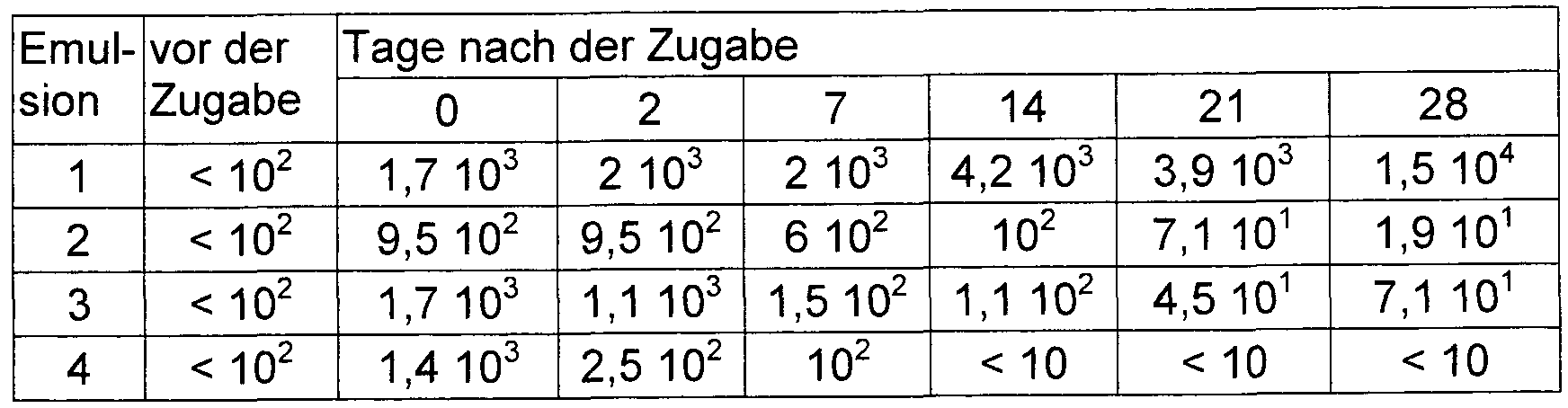
- test emulsions were prepared:
- Emulsion 1 Comparison without parabens and without polyphosphate pH: 7.96
- Emulsion 2 Comparison with parabens and without polyphosphate pH: 8,22
- Pharmacopoeia is given by the combination of polyphosphate and parabens, the polyphosphates support the preservation of parabens positive.
- iron ions are used which have been used in practice e.g. through pipelines, mixers or raw materials in recipes can be introduced.
- the basic formulation used was the formulation of a sunscreen formulation with butylmethoxydibenzoylmethane. This UVA filter forms an intense red complex even with traces of iron.
- the complexing effect was investigated on the following formulation:
- Alkali polyphosphate Alkali polyphosphate
- Disodium EDTA Disodium EDTA
- Utanit AF acid diphosphate to
- Phoskadent Pyro alkaline diphosphate for comparison
- the evaluation was carried out by means of a color measurement.
- the color status of the formulations was recorded after 6 weeks with the Minolta chroma meter CR 300. Numerical values are obtained during the measurement, whereby an objective comparison of the individual formulations is possible.
- three numbers are determined: L, a and b.
- the L value describes the light-dark values, where "0" stands for an ideal black and "100" for an ideal white.
- the a value describes the red-green Values and the b-value are based on the yellow-blue values.
- the a and b values have different signs, since the present CIE-Lab system assumes that no color can be both reddish and greenish at the same time or at the same time yellowish and bluish.
- Disodium EDTA could not be complexed in this case.
Landscapes
- Health & Medical Sciences (AREA)
- Life Sciences & Earth Sciences (AREA)
- Veterinary Medicine (AREA)
- Animal Behavior & Ethology (AREA)
- General Health & Medical Sciences (AREA)
- Public Health (AREA)
- Birds (AREA)
- Epidemiology (AREA)
- Inorganic Chemistry (AREA)
- Chemical & Material Sciences (AREA)
- Dermatology (AREA)
- Emergency Medicine (AREA)
- Cosmetics (AREA)
Description


Claims
Priority Applications (3)
| Application Number | Priority Date | Filing Date | Title |
|---|---|---|---|
| HRP20140602AA HRPK20140602B3 (hr) | 2012-01-19 | 2013-01-12 | Kozmetiäśki aditivi koji sadrže polifosfate |
| SK5036-2014U SK7228Y1 (sk) | 2012-01-19 | 2013-01-12 | Kozmetické aditívum s komplexačnými, dispergačnými a antimikrobiálnymi účinkami obsahujúce alkalické polyfosfáty a kozmetický prípravok s jeho obsahom |
| EA201491347A EA027948B1 (ru) | 2012-01-19 | 2013-01-12 | Косметический состав для получения солнцезащитных средств |
Applications Claiming Priority (2)
| Application Number | Priority Date | Filing Date | Title |
|---|---|---|---|
| DE202012000469.7 | 2012-01-19 | ||
| DE202012000469U DE202012000469U1 (de) | 2012-01-19 | 2012-01-19 | Kosmetikzusatzmittel enthaltend Alkalipolyphosphate |
Publications (2)
| Publication Number | Publication Date |
|---|---|
| WO2013107624A2 true WO2013107624A2 (de) | 2013-07-25 |
| WO2013107624A3 WO2013107624A3 (de) | 2013-11-21 |
Family
ID=45769518
Family Applications (1)
| Application Number | Title | Priority Date | Filing Date |
|---|---|---|---|
| PCT/EP2013/000084 Ceased WO2013107624A2 (de) | 2012-01-19 | 2013-01-12 | Kosmetikzusatzmittel enthaltend alkalipolyphosphate |
Country Status (12)
| Country | Link |
|---|---|
| US (2) | US20130189203A1 (de) |
| AT (1) | AT12811U1 (de) |
| CH (1) | CH706076B1 (de) |
| CZ (1) | CZ27460U1 (de) |
| DE (1) | DE202012000469U1 (de) |
| EA (1) | EA027948B1 (de) |
| ES (1) | ES2415081B1 (de) |
| HR (1) | HRPK20140602B3 (de) |
| RU (1) | RU2012107779A (de) |
| SK (1) | SK7228Y1 (de) |
| SM (1) | SM201200011B (de) |
| WO (1) | WO2013107624A2 (de) |
Families Citing this family (4)
| Publication number | Priority date | Publication date | Assignee | Title |
|---|---|---|---|---|
| DE102014207924A1 (de) | 2014-04-28 | 2015-10-29 | Beiersdorf Ag | Sonnenschutzmittel mit reduzierter Neigung zur Textilverfleckung IV |
| DE102014207916A1 (de) * | 2014-04-28 | 2015-10-29 | Beiersdorf Aktiengesellschaft | Sonnenschutzmittel mit reduzierter Neigung zur Textilverfleckung II |
| WO2017025647A1 (en) * | 2015-08-13 | 2017-02-16 | Arch Personal Care Products, Lp | Wet wipe concentrate |
| DE102020205042A1 (de) * | 2020-04-21 | 2021-10-21 | Beiersdorf Aktiengesellschaft | Farbstabiles Sonnenschutzmittel |
Family Cites Families (10)
| Publication number | Priority date | Publication date | Assignee | Title |
|---|---|---|---|---|
| NL291714A (de) * | 1962-04-21 | |||
| IN168163B (de) * | 1986-02-21 | 1991-02-16 | Colgate Palmolive Co | |
| GB8904490D0 (en) | 1989-02-28 | 1989-04-12 | Boots Co Plc | Sunscreen compositions |
| JP2000516642A (ja) * | 1998-05-07 | 2000-12-12 | ザ、プロクター、エンド、ギャンブル、カンパニー | 電解質を含む組成物 |
| EP1082099B1 (de) * | 1998-05-29 | 2004-10-20 | Showa Denko K K | Tensid für äusserlich anzuwendende hautpräparate und diese beinhaltende äusserlich anzuwendende hautpräparate |
| DE19900192A1 (de) | 1999-02-25 | 2000-08-31 | Lang Helmut | Anwendung von Phosphat und Stärke in der Medizin und Kosmetik |
| JP2001064182A (ja) * | 1999-08-26 | 2001-03-13 | Nissho Corp | スクラルファート懸濁液製剤 |
| US20060134020A1 (en) * | 2004-12-21 | 2006-06-22 | Robinson Richard S | Anti-caries oral care composition with a chelating agent |
| ES2315200B1 (es) * | 2007-09-14 | 2009-10-29 | Clayspray, S.L. | Composicion cosmetica para administracion topica en forma de spray. |
| DE102009027584A1 (de) * | 2009-07-09 | 2011-01-13 | Henkel Ag & Co. Kgaa | Verfahren zur Herstellung stabiler Emulsionen, insbesondere Sonnenschutzformulierungen |
-
2012
- 2012-01-19 DE DE202012000469U patent/DE202012000469U1/de not_active Expired - Lifetime
- 2012-01-27 AT ATGM35/2012U patent/AT12811U1/de not_active IP Right Cessation
- 2012-02-03 CH CH00150/12A patent/CH706076B1/de not_active IP Right Cessation
- 2012-02-27 US US13/405,900 patent/US20130189203A1/en not_active Abandoned
- 2012-02-29 ES ES201200192A patent/ES2415081B1/es not_active Expired - Fee Related
- 2012-03-01 RU RU2012107779/15A patent/RU2012107779A/ru not_active Application Discontinuation
- 2012-03-14 SM SM201200011A patent/SM201200011B/xx unknown
-
2013
- 2013-01-12 EA EA201491347A patent/EA027948B1/ru not_active IP Right Cessation
- 2013-01-12 CZ CZ2014-29762U patent/CZ27460U1/cs not_active IP Right Cessation
- 2013-01-12 HR HRP20140602AA patent/HRPK20140602B3/hr not_active IP Right Cessation
- 2013-01-12 SK SK5036-2014U patent/SK7228Y1/sk unknown
- 2013-01-12 WO PCT/EP2013/000084 patent/WO2013107624A2/de not_active Ceased
-
2014
- 2014-03-27 US US14/227,407 patent/US20150064119A1/en not_active Abandoned
Also Published As
| Publication number | Publication date |
|---|---|
| US20150064119A1 (en) | 2015-03-05 |
| WO2013107624A3 (de) | 2013-11-21 |
| EA027948B1 (ru) | 2017-09-29 |
| SM201200011B (it) | 2014-09-08 |
| SK50362014U1 (sk) | 2015-03-03 |
| CH706076B1 (de) | 2015-11-13 |
| CZ27460U1 (cs) | 2014-11-10 |
| RU2012107779A (ru) | 2013-09-10 |
| HRPK20140602B3 (hr) | 2015-08-14 |
| DE202012000469U1 (de) | 2012-01-31 |
| ES2415081B1 (es) | 2014-03-11 |
| US20130189203A1 (en) | 2013-07-25 |
| SM201200011A (it) | 2013-09-06 |
| CH706076A2 (de) | 2013-07-31 |
| ES2415081A1 (es) | 2013-07-23 |
| HRP20140602A2 (hr) | 2014-11-07 |
| SK7228Y1 (sk) | 2015-08-04 |
| EA201491347A1 (ru) | 2014-12-30 |
| AT12811U1 (de) | 2012-12-15 |
Similar Documents
| Publication | Publication Date | Title |
|---|---|---|
| EP0340592B2 (de) | Haarbehandlungsmittel mit natürlichen Inhaltsstoffen | |
| DE102010038952A1 (de) | Konservierungsmittel-Zusammensetzungen und Kosmetika enthaltend diese | |
| EP2739146A1 (de) | Verwendung von isosorbidmonoestern als antimikrobielle wirkstoffe | |
| WO2013017255A1 (de) | Verwendung von isosorbidmonoestern als verdicker | |
| WO2013107624A2 (de) | Kosmetikzusatzmittel enthaltend alkalipolyphosphate | |
| EP1071466B1 (de) | Glycolipid-cremes | |
| EP0776657B1 (de) | Kosmetische und/oder pharmazeutische Emulsionen | |
| DE102010044785A1 (de) | Octenidindihydrochlorid als Co-Emulgator in Mikroemulsionen | |
| DE69904567T2 (de) | Lipidmischung sowie ihre verwendung | |
| DE10221212A1 (de) | Sporopollenin enthaltende lösliche Zusammensetzung und Verwendung | |
| DE4215502C2 (de) | Kosmetisches Mittel | |
| DE102017114423A1 (de) | Verwendung von Alkylresorcinolen zur Verbesserung der Wirksamkeit von Kosmetikkonservierungsstoffen | |
| DE60106014T2 (de) | Verwendung von n,n'-dibenzylethylendiamindiessigsäurederivaten zum schutz gegen verschmutzung | |
| EP0776656B1 (de) | Kosmetische und/oder pharmazeutische Emulsionen | |
| EP3962434A1 (de) | Kosmetische o/w-emulsion mit skleroglucan und eisenoxidpigmenten | |
| DE102014116691A1 (de) | Kosmetische Zusammensetzung und deren Verwendung zur Prophylaxe und Behandlung von Hautunreinheiten, zu Akne neigender Haut und Akne | |
| DE29520747U1 (de) | Kosmetische und/oder pharmazeutische Emulsionen | |
| DE102009060147A1 (de) | Gefärbte kosmetische Emulsion | |
| DE3417361C2 (de) | ||
| DE202023102783U1 (de) | Zusammensetzung einer antibakteriellen Lotion mit Zitronengrasöl, angereichert mit Bioaktivstoffen | |
| DE10128315B4 (de) | Phospholipidische Zusammensetzung, Verwendung einer derartigen phospholipidischen Zusammensetzung sowie diese enthaltende Zubereitung | |
| EP3795136A1 (de) | Haarpflegezusammensetzung zur vermeidung von kopfschuppen | |
| WO2016102288A1 (de) | Antimikrobielle zubereitung umfassend bispyridiniumalkane, 1- oder 2-(c1 bis c24-alkyl)-glycerinether und alkan-1,2-diole | |
| DE102013226507A1 (de) | Zusammensetzung umfassend Ferulasäureethylester und Arylalkanol | |
| DE29520750U1 (de) | Kosmetische und/oder pharmazeutische Emulsionen |
Legal Events
| Date | Code | Title | Description |
|---|---|---|---|
| WWE | Wipo information: entry into national phase |
Ref document number: P20140602 Country of ref document: HR |
|
| WWE | Wipo information: entry into national phase |
Ref document number: PUV2014-29762 Country of ref document: CZ |
|
| WWE | Wipo information: entry into national phase |
Ref document number: 201491347 Country of ref document: EA |
|
| WWE | Wipo information: entry into national phase |
Ref document number: A201409241 Country of ref document: UA |
|
| WWE | Wipo information: entry into national phase |
Ref document number: 14387355 Country of ref document: US |
|
| 121 | Ep: the epo has been informed by wipo that ep was designated in this application |
Ref document number: 13700199 Country of ref document: EP Kind code of ref document: A2 |
|
| 122 | Ep: pct application non-entry in european phase |
Ref document number: 13700199 Country of ref document: EP Kind code of ref document: A2 |