WO2013108424A1 - 排ガス浄化触媒及びその製造方法 - Google Patents
排ガス浄化触媒及びその製造方法 Download PDFInfo
- Publication number
- WO2013108424A1 WO2013108424A1 PCT/JP2012/065528 JP2012065528W WO2013108424A1 WO 2013108424 A1 WO2013108424 A1 WO 2013108424A1 JP 2012065528 W JP2012065528 W JP 2012065528W WO 2013108424 A1 WO2013108424 A1 WO 2013108424A1
- Authority
- WO
- WIPO (PCT)
- Prior art keywords
- exhaust gas
- cobalt
- composite oxide
- ceria
- gas purification
- Prior art date
- Legal status (The legal status is an assumption and is not a legal conclusion. Google has not performed a legal analysis and makes no representation as to the accuracy of the status listed.)
- Ceased
Links
Images


Classifications
-
- B—PERFORMING OPERATIONS; TRANSPORTING
- B01—PHYSICAL OR CHEMICAL PROCESSES OR APPARATUS IN GENERAL
- B01J—CHEMICAL OR PHYSICAL PROCESSES, e.g. CATALYSIS OR COLLOID CHEMISTRY; THEIR RELEVANT APPARATUS
- B01J23/00—Catalysts comprising metals or metal oxides or hydroxides, not provided for in group B01J21/00
- B01J23/70—Catalysts comprising metals or metal oxides or hydroxides, not provided for in group B01J21/00 of the iron group metals or copper
- B01J23/76—Catalysts comprising metals or metal oxides or hydroxides, not provided for in group B01J21/00 of the iron group metals or copper combined with metals, oxides or hydroxides provided for in groups B01J23/02 - B01J23/36
- B01J23/83—Catalysts comprising metals or metal oxides or hydroxides, not provided for in group B01J21/00 of the iron group metals or copper combined with metals, oxides or hydroxides provided for in groups B01J23/02 - B01J23/36 with rare earths or actinides
-
- B—PERFORMING OPERATIONS; TRANSPORTING
- B01—PHYSICAL OR CHEMICAL PROCESSES OR APPARATUS IN GENERAL
- B01D—SEPARATION
- B01D53/00—Separation of gases or vapours; Recovering vapours of volatile solvents from gases; Chemical or biological purification of waste gases, e.g. engine exhaust gases, smoke, fumes, flue gases, aerosols
- B01D53/34—Chemical or biological purification of waste gases
- B01D53/92—Chemical or biological purification of waste gases of engine exhaust gases
- B01D53/94—Chemical or biological purification of waste gases of engine exhaust gases by catalytic processes
- B01D53/944—Simultaneously removing carbon monoxide, hydrocarbons or carbon making use of oxidation catalysts
-
- B—PERFORMING OPERATIONS; TRANSPORTING
- B01—PHYSICAL OR CHEMICAL PROCESSES OR APPARATUS IN GENERAL
- B01J—CHEMICAL OR PHYSICAL PROCESSES, e.g. CATALYSIS OR COLLOID CHEMISTRY; THEIR RELEVANT APPARATUS
- B01J23/00—Catalysts comprising metals or metal oxides or hydroxides, not provided for in group B01J21/00
- B01J23/70—Catalysts comprising metals or metal oxides or hydroxides, not provided for in group B01J21/00 of the iron group metals or copper
- B01J23/74—Iron group metals
- B01J23/75—Cobalt
-
- B—PERFORMING OPERATIONS; TRANSPORTING
- B01—PHYSICAL OR CHEMICAL PROCESSES OR APPARATUS IN GENERAL
- B01J—CHEMICAL OR PHYSICAL PROCESSES, e.g. CATALYSIS OR COLLOID CHEMISTRY; THEIR RELEVANT APPARATUS
- B01J23/00—Catalysts comprising metals or metal oxides or hydroxides, not provided for in group B01J21/00
- B01J23/70—Catalysts comprising metals or metal oxides or hydroxides, not provided for in group B01J21/00 of the iron group metals or copper
- B01J23/76—Catalysts comprising metals or metal oxides or hydroxides, not provided for in group B01J21/00 of the iron group metals or copper combined with metals, oxides or hydroxides provided for in groups B01J23/02 - B01J23/36
- B01J23/78—Catalysts comprising metals or metal oxides or hydroxides, not provided for in group B01J21/00 of the iron group metals or copper combined with metals, oxides or hydroxides provided for in groups B01J23/02 - B01J23/36 with alkali- or alkaline earth metals
-
- B—PERFORMING OPERATIONS; TRANSPORTING
- B01—PHYSICAL OR CHEMICAL PROCESSES OR APPARATUS IN GENERAL
- B01J—CHEMICAL OR PHYSICAL PROCESSES, e.g. CATALYSIS OR COLLOID CHEMISTRY; THEIR RELEVANT APPARATUS
- B01J23/00—Catalysts comprising metals or metal oxides or hydroxides, not provided for in group B01J21/00
- B01J23/70—Catalysts comprising metals or metal oxides or hydroxides, not provided for in group B01J21/00 of the iron group metals or copper
- B01J23/76—Catalysts comprising metals or metal oxides or hydroxides, not provided for in group B01J21/00 of the iron group metals or copper combined with metals, oxides or hydroxides provided for in groups B01J23/02 - B01J23/36
- B01J23/80—Catalysts comprising metals or metal oxides or hydroxides, not provided for in group B01J21/00 of the iron group metals or copper combined with metals, oxides or hydroxides provided for in groups B01J23/02 - B01J23/36 with zinc, cadmium or mercury
-
- B—PERFORMING OPERATIONS; TRANSPORTING
- B01—PHYSICAL OR CHEMICAL PROCESSES OR APPARATUS IN GENERAL
- B01J—CHEMICAL OR PHYSICAL PROCESSES, e.g. CATALYSIS OR COLLOID CHEMISTRY; THEIR RELEVANT APPARATUS
- B01J37/00—Processes, in general, for preparing catalysts; Processes, in general, for activation of catalysts
- B01J37/02—Impregnation, coating or precipitation
- B01J37/03—Precipitation; Co-precipitation
-
- B—PERFORMING OPERATIONS; TRANSPORTING
- B01—PHYSICAL OR CHEMICAL PROCESSES OR APPARATUS IN GENERAL
- B01D—SEPARATION
- B01D2255/00—Catalysts
- B01D2255/10—Noble metals or compounds thereof
- B01D2255/104—Silver
-
- B—PERFORMING OPERATIONS; TRANSPORTING
- B01—PHYSICAL OR CHEMICAL PROCESSES OR APPARATUS IN GENERAL
- B01D—SEPARATION
- B01D2255/00—Catalysts
- B01D2255/20—Metals or compounds thereof
- B01D2255/204—Alkaline earth metals
- B01D2255/2047—Magnesium
-
- B—PERFORMING OPERATIONS; TRANSPORTING
- B01—PHYSICAL OR CHEMICAL PROCESSES OR APPARATUS IN GENERAL
- B01D—SEPARATION
- B01D2255/00—Catalysts
- B01D2255/20—Metals or compounds thereof
- B01D2255/206—Rare earth metals
- B01D2255/2065—Cerium
-
- B—PERFORMING OPERATIONS; TRANSPORTING
- B01—PHYSICAL OR CHEMICAL PROCESSES OR APPARATUS IN GENERAL
- B01D—SEPARATION
- B01D2255/00—Catalysts
- B01D2255/20—Metals or compounds thereof
- B01D2255/207—Transition metals
- B01D2255/20746—Cobalt
-
- B—PERFORMING OPERATIONS; TRANSPORTING
- B01—PHYSICAL OR CHEMICAL PROCESSES OR APPARATUS IN GENERAL
- B01D—SEPARATION
- B01D2255/00—Catalysts
- B01D2255/20—Metals or compounds thereof
- B01D2255/207—Transition metals
- B01D2255/20753—Nickel
-
- B—PERFORMING OPERATIONS; TRANSPORTING
- B01—PHYSICAL OR CHEMICAL PROCESSES OR APPARATUS IN GENERAL
- B01D—SEPARATION
- B01D2255/00—Catalysts
- B01D2255/20—Metals or compounds thereof
- B01D2255/207—Transition metals
- B01D2255/20761—Copper
-
- B—PERFORMING OPERATIONS; TRANSPORTING
- B01—PHYSICAL OR CHEMICAL PROCESSES OR APPARATUS IN GENERAL
- B01D—SEPARATION
- B01D2255/00—Catalysts
- B01D2255/20—Metals or compounds thereof
- B01D2255/207—Transition metals
- B01D2255/20792—Zinc
-
- B—PERFORMING OPERATIONS; TRANSPORTING
- B01—PHYSICAL OR CHEMICAL PROCESSES OR APPARATUS IN GENERAL
- B01D—SEPARATION
- B01D2255/00—Catalysts
- B01D2255/20—Metals or compounds thereof
- B01D2255/209—Other metals
- B01D2255/2092—Aluminium
-
- B—PERFORMING OPERATIONS; TRANSPORTING
- B01—PHYSICAL OR CHEMICAL PROCESSES OR APPARATUS IN GENERAL
- B01D—SEPARATION
- B01D2255/00—Catalysts
- B01D2255/40—Mixed oxides
-
- B—PERFORMING OPERATIONS; TRANSPORTING
- B01—PHYSICAL OR CHEMICAL PROCESSES OR APPARATUS IN GENERAL
- B01D—SEPARATION
- B01D2255/00—Catalysts
- B01D2255/40—Mixed oxides
- B01D2255/405—Spinels
-
- B—PERFORMING OPERATIONS; TRANSPORTING
- B01—PHYSICAL OR CHEMICAL PROCESSES OR APPARATUS IN GENERAL
- B01D—SEPARATION
- B01D2255/00—Catalysts
- B01D2255/40—Mixed oxides
- B01D2255/407—Zr-Ce mixed oxides
-
- Y—GENERAL TAGGING OF NEW TECHNOLOGICAL DEVELOPMENTS; GENERAL TAGGING OF CROSS-SECTIONAL TECHNOLOGIES SPANNING OVER SEVERAL SECTIONS OF THE IPC; TECHNICAL SUBJECTS COVERED BY FORMER USPC CROSS-REFERENCE ART COLLECTIONS [XRACs] AND DIGESTS
- Y02—TECHNOLOGIES OR APPLICATIONS FOR MITIGATION OR ADAPTATION AGAINST CLIMATE CHANGE
- Y02A—TECHNOLOGIES FOR ADAPTATION TO CLIMATE CHANGE
- Y02A50/00—TECHNOLOGIES FOR ADAPTATION TO CLIMATE CHANGE in human health protection, e.g. against extreme weather
- Y02A50/20—Air quality improvement or preservation, e.g. vehicle emission control or emission reduction by using catalytic converters
Definitions
- the present invention relates to an exhaust gas purification catalyst and a method for producing the same. More specifically, the present invention relates to a non-noble metal-based exhaust gas purification catalyst capable of purifying unreacted substances such as carbon monoxide (CO) and hydrocarbon (HC) even at low temperatures and a method for producing the same.
- a non-noble metal-based exhaust gas purification catalyst capable of purifying unreacted substances such as carbon monoxide (CO) and hydrocarbon (HC) even at low temperatures and a method for producing the same.
- a catalyst in which a non-noble metal oxide such as cobalt oxide (Co 3 O 4 ) is supported on a carrier is known. Catalysts do not have sufficient exhaust gas purification activity, particularly exhaust gas purification performance at low temperatures, and their improvement is required.
- Patent Document 1 discloses exhaust gas purification in which zirconium oxide or titanium oxide supporting copper (Cu) and / or cobalt (Co) is mixed with copper-substituted zeolite. It is described that the catalyst for use can remove nitrogen oxides and carbon monoxide in the exhaust gas.
- Patent Document 1 as a specific example, a catalyst is shown in which a first component in which copper is supported on metal-supported zirconia or titania and a second component that is a copper-substituted zeolite are mixed.
- Patent Document 2 discloses an exhaust gas purification catalyst in which silver (Ag) ions or oxides thereof and cobalt (Co) ions or oxides thereof are supported in a mordenite structure, which are nitrogen oxides (NO x ). It is described that it has a purification performance of
- Patent Document 3 discloses, as a specific example, a purification catalyst obtained by adding a sodium hydroxide aqueous solution to a mixed solution of a cobalt nitrate aqueous solution and a cerium nitrate aqueous solution to form a precipitate, and drying and firing the precipitate. It is shown.
- an object of the present invention is to provide a non-noble metal-based exhaust gas purification catalyst capable of oxidizing carbon monoxide or the like in exhaust gas at a low temperature, and a method for producing the same.
- An exhaust gas purification catalyst comprising a metal element selected from the group consisting of: ⁇ 2>
- the ceria-based carrier includes ceria particles, ceria-zirconia composite oxide particles, ceria-alumina composite oxide particles, ceria-titania composite oxide particles, ceria-silica composite oxide particles, and ceria-zirconia-alumina.
- the exhaust gas purification catalyst according to ⁇ 1> or ⁇ 2> which is selected from the group consisting of composite oxide particles.
- ⁇ 4> The above ⁇ 1> to ⁇ 3>, wherein the molar ratio (Co: M) of cobalt (Co) to the additional metal element (M) in the composite oxide is 1: 0.1 to 1.0.
- ⁇ 5> The exhaust gas purifying catalyst according to any one of the above ⁇ 1> to ⁇ 4>, wherein the amount of cobalt in terms of metal supported on the ceria-based carrier is 1 to 20% by mass.
- the composite oxide has a spinel structure and the composite oxide is analyzed by a Rietveld analysis method, the composite oxide is compared with cobalt oxide not containing the additive metal element.
- the distance of the M TET —O bond in the spinel structure of FIG. 5 is extended by 0.01 mm or more and / or the distance of the M OCT —O bond in the spinel structure of the composite oxide is contracted by 0.01 mm or more.
- the exhaust gas purification catalyst according to any one of the above items ⁇ 1> to ⁇ 5>.
- ⁇ 11> a step of providing a raw material solution containing a cobalt salt, a salt of the additive metal element, and a complexing agent; and a step of impregnating the raw material solution into the ceria-based support, followed by drying and firing.
- the complexing agent is an organic acid having at least one hydroxyl group and at least one carboxyl group, the method for producing an exhaust gas purification catalyst according to any one of the above ⁇ 1> to ⁇ 10> .
- the raw material solution further contains a polyhydric alcohol (for example, ethylene glycol) and the ceria-based carrier is impregnated with the raw material solution, before the drying and baking, The method according to ⁇ 11>, wherein the raw material solution is heated.
- a polyhydric alcohol for example, ethylene glycol
- ⁇ 13> a step of providing a raw material solution containing a cobalt salt and a salt of the added metal element; and adding a neutralizing agent to the raw material solution to precipitate a precursor of the composite oxide, whereby the precursor Producing a slurry; Impregnating the ceria-based support with the precursor slurry, Drying and firing the ceria-based carrier impregnated with the precursor slurry,
- the method for producing an exhaust gas purification catalyst according to any one of ⁇ 1> to ⁇ 10> above, comprising: ⁇ 14> a step of preparing a cobalt salt and a copper salt in such a proportion that the amount of copper equivalent to the ceria-based carrier is 2 to 3% by mass;
- the above mixed solution of cobalt salt and copper salt and neutralizer is subjected to shear stress by super stirring to stir the mixed solution to precipitate a precursor of cobalt-copper composite oxide, thereby preparing the precursor slurry.
- ⁇ 15> The production method according to ⁇ 14>, wherein the cobalt salt is used in a proportion such that the metal-supported amount of cobalt with respect to the ceria-based carrier is 5% by mass.
- the neutralizing agent is an inorganic basic compound or an organic basic compound.
- carbon monoxide or the like can be oxidized and purified even at a low temperature.
- FIG. 1 is a graph showing the relationship between the type of additive metal element and the exhaust gas purification performance for the exhaust gas purification catalyst produced in Example A.
- FIG. 2 is a graph showing the relationship between the type of additive metal element and the exhaust gas purification performance for the exhaust gas purification catalyst produced in Example B.
- FIG. 3 is a graph showing the relationship between the type of additive metal element and the exhaust gas purification performance for the exhaust gas purification catalyst produced in Example C.
- FIG. 4 is a graph showing the relationship between the distance of the M TET —O bond and the exhaust gas purification performance in the spinel-type composite oxide for the exhaust gas purification catalysts produced in Examples A, B, and C.
- FIG. 1 is a graph showing the relationship between the type of additive metal element and the exhaust gas purification performance for the exhaust gas purification catalyst produced in Example A.
- FIG. 2 is a graph showing the relationship between the type of additive metal element and the exhaust gas purification performance for the exhaust gas purification catalyst produced in Example B.
- FIG. 3 is a graph
- FIG. 5 is a graph showing the relationship between the distance of the M OCT —O bond in the spinel-type composite oxide and the exhaust gas purification performance for the exhaust gas purification catalysts produced in Example A, Example B, and Example C.
- FIG. 6 is a graph showing the relationship between the composition of the composite oxide and the exhaust gas purification performance for the exhaust gas purification catalysts produced in Example E and Example F.
- FIG. 7 is a graph showing the relationship between the type of additive element and the exhaust gas purification performance for the exhaust gas purification catalyst produced in Example G.
- FIG. 8 is a graph showing the relationship between the type of additive element and the exhaust gas purification performance for the exhaust gas purification catalyst produced in Example G.
- FIG. 9 is a diagram for explaining the positions of the M TET —O bond and the M OCT —O bond in the spinel complex oxide.
- the exhaust gas purification catalyst of the present invention has a ceria-based carrier, and a composite oxide of cobalt and an additive metal element supported on the ceria-based carrier, and the additive metal element is copper, silver, magnesium, nickel, zinc And a metal element selected from the group consisting of combinations thereof, preferably copper.
- composite oxide means a material in which at least two types of metal oxides are at least partially in solid solution. Therefore, for example, in a composite oxide of cobalt and an additional metal element, cobalt oxide and an oxide of the additional metal element are at least partially solid-solved, and in particular, the cobalt and the additional metal element are at least partially It means that an oxide having a single crystal structure, for example, a spinel complex oxide is formed together. That is, for example, when the additive metal element is copper, the “composite oxide” includes not only the portion where cobalt oxide and the oxide of the additive metal element are in solid solution, but also the oxidation of cobalt oxide and the additive metal element. You may have the part in which each thing exists independently.
- the carbon monoxide purification performance of the spinel-type composite oxide containing cobalt is determined by the distance of the M TET —O bond of the composite oxide. And a clear correlation with the distance of M OCT -O bond. Specifically, compared to cobalt oxide containing no added metal element, the distance of M TET —O bond of this composite oxide is extended, and the distance of M OCT —O bond of this composite oxide is It has been found that the oxidation performance for carbon monoxide and the like is improved when contracted.
- the carbon monoxide purifying ability at a low temperature by the exhaust gas purifying catalyst of the present invention is a bond between metal and oxygen as compared with spinel-type cobalt oxide containing no added metal element. It is considered that an active site for supplying oxygen to carbon monoxide or the like is created.
- the cobalt oxide containing no added metal element is used.
- the distance of the M TET —O bond in the spinel structure of the composite oxide is extended by 0.01 mm or more, 0.02 mm or more, 0.03 mm or more, 0.04 mm or more, 0.05 mm or more. Good. Also, this extension may be, for example, 0.15 mm or less, 0.10 mm or less, 0.09 mm or less, 0.08 mm or less, 0.07 mm or less, or 0.06 mm or less.
- the additive metal element is not contained.
- the distance of the M OCT —O bond in the spinel structure of the composite oxide may be contracted by 0.01 ⁇ or more, 0.02 ⁇ or more, or 0.03 ⁇ or more.
- this shrinkage may be, for example, 0.10 mm or less, 0.09 mm or less, 0.08 mm or less, 0.07 mm or less, 0.06 mm or less, or 0.05 mm or less.
- the “distance of the M TET —O bond in the spinel structure” is the distance between the metal element (M 2+ ) and the coordinated oxygen (O 2 ⁇ ) at the center position of tetrahedral oxygen, as shown in FIG.
- the “distance of the M OCT —O bond in the spinel structure” is coordinated with the metal element (M 3+ ) at the center position of octahedral oxygen as shown in FIG. It means the bond distance between oxygen (O 2 ⁇ ).
- measured X-ray diffraction intensity data and spinel crystal structure model are given as input values, lattice constants, atomic fraction coordinates, atomic occupancy at each site, atomic displacement
- the calculated diffraction intensity and the measured diffraction intensity are refined as closely as possible. It also refines measurement methods such as background, zero point shift, sample displacement parameters, sample transmission parameters, surface roughness parameters, and profile symmetry parameters, as well as parameters derived from the sample state and apparatus.
- cobalt and an additive metal element can be used in an arbitrary ratio in the composite oxide as long as the effect of the exhaust gas purification catalyst of the present invention can be obtained.
- the molar ratio of cobalt (Co) and additive metal element (M) in the composite oxide ( Co: M) is from 1: 0.1 to 1.0, 1: 0.3 to 0.8, 1: 0.4 to 0.7, 1: 0.4 to 0.6, or about 2: 1 can be used.
- a composite oxide of cobalt and an additive metal element can be supported on a ceria-based support within the range where the effect of the exhaust gas purifying catalyst of the present invention can be obtained. Therefore, for example, the metal equivalent loading of cobalt with respect to the ceria-based carrier is 1% by mass or more, 2% by mass or more, 3% by mass or more, or 4% by mass or more, and / or 20% by mass or less, 15% by mass.
- a composite oxide of cobalt and an additive metal element can be used so that the content is 10% by mass or less.
- a cobalt-copper composite oxide is supported on a ceria-based support, and the amount of copper in terms of metal supported on the ceria-based support is 2 to 3% by mass.
- a cobalt-copper composite oxide is supported on a ceria-based support, and the cobalt-copper composite oxide has cobalt oxide particles having an average particle size of 20 to 100 nm. Copper oxide particles having an average particle diameter of 2 to 10 nm are dispersed and supported on the cobalt oxide particles, and copper is at least partially solid-solved in the cobalt oxide particles.
- ⁇ Ceria-based carrier> As shown with respect to Example D below, a complex oxide of cobalt and copper or the like exhibits particularly preferable properties when supported on a ceria-based support as a support. Therefore, it is considered that the oxygen storage ability (OSC ability) by ceria promotes the supply of oxygen to carbon monoxide as described above.
- OSC ability oxygen storage ability
- the ceria-based carrier that can be used in the exhaust gas purification catalyst of the present invention is a carrier particle containing ceria, particularly a composite oxide carrier particle of ceria and another metal.
- the ceria-based support that can be used in the exhaust gas purification catalyst of the present invention includes ceria particles, ceria-zirconia composite oxide particles, ceria-alumina composite oxide particles, ceria-titania composite oxide particles, ceria- It can be selected from the group consisting of silica composite oxide particles and ceria-zirconia-alumina composite oxide particles.
- the exhaust gas purifying catalyst of the present invention can be produced by any method such as impregnation method, coprecipitation method, sol-gel method, etc., and in particular, can be produced by the following method of the present invention.
- the method of the first present invention for producing an exhaust gas purification catalyst includes the following steps, and the following complexing agent is an organic acid having at least one hydroxyl group and at least one carboxyl group: A step of providing a raw material solution containing a cobalt salt, a salt of an additive metal element, and a complexing agent; and a step of impregnating the raw material solution into a ceria-based support, followed by drying and firing.
- the method of the present invention using the method of synthesizing citric acid of a composite oxide, cobalt ions and ions of added metal elements are complexed with a complexing agent, so that Even at a low firing temperature, formation of a uniform composite oxide can be promoted, that is, formation of a solid solution of cobalt and an additive metal element can be promoted.
- the total concentration of cobalt ions and added metal element ions in the raw material solution can be 0.01M to 0.2M.
- complexing agents that can be used in this method, that is, organic acids having at least one hydroxyl group and at least one carboxyl group include malic acid, tartaric acid, citric acid, and glycolic acid.
- the complexing agent can be used in an amount of 1 to 10 times, or 1 to 5 times as much as the molar ratio with respect to the total of cobalt ions and ions of the added metal element.
- the raw material solution further contains a polyhydric alcohol, such as ethylene glycol, and after impregnating the ceria-based carrier with the raw material solution and before drying and firing, The solution can be heated. This heating can be performed at a temperature of 100 ° C. to 160 ° C., for example.
- a polyhydric alcohol such as ethylene glycol
- the ester polymerization of cobalt and an additive metal element complex and a polyhydric alcohol the complex of cobalt and the additive metal element can be gelled and the formation of a uniform composite oxide can be promoted.
- the cobalt salt and added metal element salt that can be used in this method are as follows regarding the method of the second present invention for producing an exhaust gas purification catalyst. Reference can be made to the description.
- a second inventive method for producing an exhaust gas purification catalyst comprises the following steps: A step of providing a raw material solution containing a cobalt salt and a salt of an added metal element, and a step of adding a neutralizing agent to the raw material solution to precipitate a precursor of a composite oxide, thereby producing a precursor slurry, Impregnating the ceria-based support with the precursor slurry, A step of drying and baking the ceria-based carrier impregnated with the precursor slurry.
- cobalt salt examples include cobalt nitrate, sulfate, acetate, and the like.
- salt of the additive metal element examples include nitrate, sulfate, acetate and the like of the additive metal element, particularly copper nitrate, sulfate, acetate and the like.
- the neutralizing agent examples include inorganic basic compounds such as ammonia (NH 3 ), sodium carbonate (Na 2 CO 3 ), sodium hydroxide (NaOH), and potassium hydroxide (KOH).
- inorganic basic compounds such as ammonia (NH 3 ), sodium carbonate (Na 2 CO 3 ), sodium hydroxide (NaOH), and potassium hydroxide (KOH).
- organic basic compound of a pyridine and a (poly) ethylenediamine compound can be mentioned, for example, A (poly) ethylenediamine compound can be mentioned suitably.
- Examples of the (poly) ethylenediamine compound as a suitable neutralizing agent include those having 1 to 10 ethylene units, particularly those having 1 to 6 ethylene units.
- preferred polyethylene diamine compounds include ethylene diamine (EDA: H 2 NCH 2 CH 2 NH 2 ), diethylene triamine (DETA: H 2 NCH 2 CH 2 NHCH 2 CH 2 NH 2 ), triethylene tetramine (TETA: H 2 NCH 2 CH 2 NHCH 2 CH 2 NHCH 2 CH 2 NH 2), tetraethylene pentamine [TEPA: H 2 N (CH 2 CH 2 NH) 3 CH 2 CH 2 NH 2)], pentaethylene hexamine [PEHA : H 2 N (CH 2 CH 2 NH) 4 H 2 CH 2 NH 2], mention may be made in particular of ethylenediamine (DDA).
- DDA ethylenediamine
- Examples of the solvent for the raw material solution include alcohols such as methanol, ethanol and isopropanol, or water, and preferably water.
- the pH of the aqueous solution it is preferable to adjust the pH of the aqueous solution to a range of 6-9. In this regard, if the pH is too low, the precipitation reaction of cobalt and added metal elements does not occur. On the other hand, if the pH is too high, the deposited precursor may be dissolved.
- the raw material solution may further contain a dispersant such as sodium pyrrolidonecarboxylate (PAA-Na) or polyvinylpyrrolidone (PVP).
- a dispersant such as sodium pyrrolidonecarboxylate (PAA-Na) or polyvinylpyrrolidone (PVP).
- Drying and firing can be performed under any conditions that can obtain an exhaust gas purification catalyst.
- the drying can be performed in air at a temperature of 50 to 200 ° C.
- the baking is performed at a temperature of 300 ° C. or more and 600 ° C. or more and less than 800 ° C. and 700 ° C. or less. It can be carried out for ⁇ 10 hours, or 2-8 hours.
- reaction vessel for carrying out this method is not particularly limited, and a batch type reaction apparatus or a continuous type reaction apparatus can be used.
- the second inventive method for producing an exhaust gas purification catalyst includes, for example, the following steps: A step of preparing a cobalt salt and a copper salt at a ratio such that the amount of copper equivalent to the ceria-based support is 2 to 3% by mass; The mixed solution of the cobalt salt and the copper salt and the neutralizing agent is subjected to a shear stress by super stirring to stir the mixed solution to precipitate a precursor of the cobalt-copper composite oxide, thereby preparing the precursor slurry. Process, Mixing the precursor slurry and the ceria-based carrier powder; The process of isolate
- a method using a step of applying a shear stress by super stirring to a mixed solution of a cobalt salt and a copper salt and a neutralizing agent formation of a uniform composite oxide can be promoted. it can.
- each of cobalt oxide and copper oxide aggregates to form coarse secondary particles, thereby reducing the carbon monoxide oxidation activity.
- the method of the present invention using super stirring for the coprecipitation reaction promotes the formation of a uniform composite oxide even when compared with the coprecipitation synthesis method without using super stirring.
- super-stirring means stirring that provides a large shearing force, for example stirring at a rotational speed of, for example, 5,000 to 15,000 rpm, in particular 8,000 to 12,000 rpm.
- a precursor of the composite oxide is precipitated, and pure water is added to the precursor, followed by centrifugal separation or filtration, washing, and water is added if necessary to obtain a precursor slurry. Can be produced.
- the exhaust gas purification catalyst of the present invention can be used as an exhaust gas purification catalyst for purifying exhaust gas from an internal combustion engine such as an automobile engine.
- exhaust gas purification catalyst of the present invention can be used in any field where low temperature removal of carbon monoxide and / or hydrocarbon is necessary.
- the temperature of the region for carbon monoxide purification can be set lower than the temperature of the region for carbon monoxide purification.
- the exhaust gas purification catalyst of the present invention can be used as a catalyst device by coating a substrate such as a honeycomb.
- the honeycomb that can be used as the substrate can be formed of a ceramic material such as cordierite or a metal material such as stainless steel.
- the exhaust gas purification catalyst of the present invention can be formed into an arbitrary shape, for example, formed into a pellet.
- Example A to Example C >> In Examples A to C, the effect of the type of the additive metal element on the performance of the exhaust gas purification catalyst when the composite oxide of cobalt and the additive metal element was supported on the ceria-based support was examined. In Examples A to C, the influence of the method of synthesizing and supporting the composite oxide on the performance of the exhaust gas purification catalyst was also examined.
- Example A Production of exhaust gas purification catalyst by citric acid synthesis method
- copper is added as an additive metal element.
- a composite oxide was obtained by using any one of (Cu), nickel (Ni), magnesium (Mg), zinc (Zn), iron (Fe), and manganese (Mn) and by a citric acid synthesis method.
- cobalt oxide was obtained by a citric acid synthesis method using cobalt instead of the additive element, that is, using only cobalt as a raw material for the metal oxide.
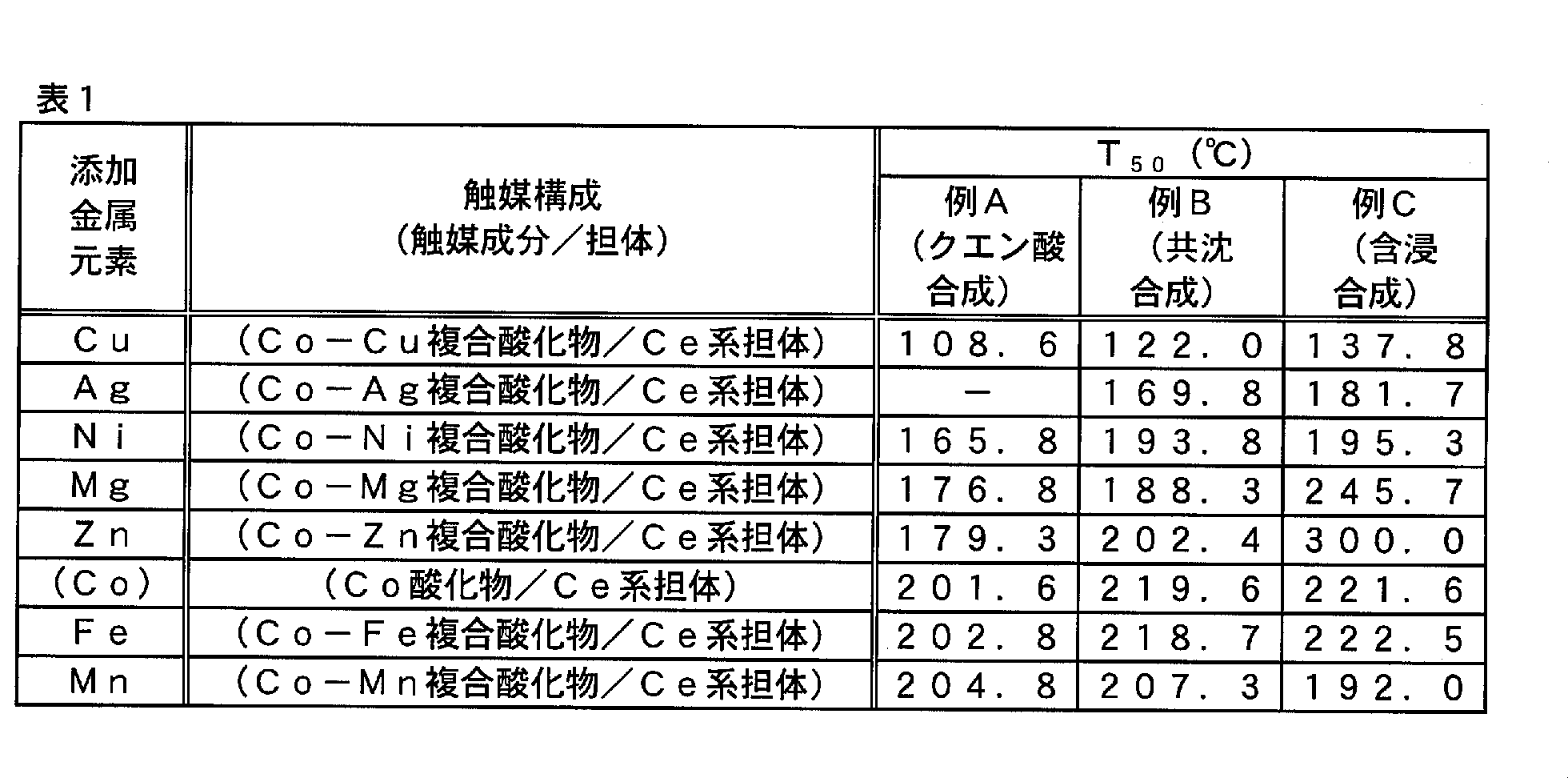
- Example A As shown in Table 1 below, exhaust gas purification catalysts having seven types of catalyst configurations were obtained. Specifically, in Example A, an exhaust gas purification catalyst was produced as follows.
- Citric acid (CA) as complexing agent and ethylene glycol (EG) as esterifying agent are combined with citric acid relative to the sum of cobalt (Co) and added metal element (M) in the metal salt solution.
- (CA) and ethylene glycol (EG) molar ratio (Co + M: CA: EG) was adjusted to 1: 3: 3, added to pure water, and sufficiently stirred and mixed to obtain a complexing agent solution. Obtained.
- the obtained catalyst powder was formed into pellets by a cold isostatic press (CIP) at a pressure of 1 ton to obtain an exhaust gas purification catalyst of Example A. Each pellet had a volume of 0.17 cm 3 .
- Example B Production of exhaust gas purification catalyst by coprecipitation synthesis method
- Example B in the production of an exhaust gas purification catalyst in which a composite oxide of cobalt and an additive metal element is supported on a ceria-based support, copper is added as an additive metal element.
- Silver, nickel, magnesium, zinc, iron, and manganese were used, and a composite oxide was obtained by a coprecipitation synthesis method.
- cobalt oxide was obtained by a coprecipitation synthesis method using cobalt instead of the additive element, that is, using only cobalt as a raw material for the metal oxide.
- Example B As shown in Table 1 below, exhaust gas purification catalysts having eight types of catalyst configurations were obtained. Specifically, in Example B, an exhaust gas purification catalyst was produced as follows.
- Example B Synthesis of Complex Oxide
- cobalt and added metal were added to the metal salt solution obtained as in Example A by adding sodium hydroxide solution dropwise with a pipette until the pH of the metal salt solution reached 9.
- a precursor of a complex oxide with elements was deposited to obtain a slurry.
- the obtained slurry was washed with water to obtain a slurry containing a complex oxide precursor.
- Example C Production of exhaust gas purification catalyst by impregnation synthesis method
- a composite oxide was obtained by an impregnation synthesis method using any one of silver, nickel, magnesium, zinc, iron, and manganese.
- cobalt oxide was obtained by an impregnation synthesis method using cobalt instead of the additive element, that is, using only cobalt as a raw material for the metal oxide.
- Example C As shown in Table 1 below, exhaust gas purification catalysts having eight types of catalyst configurations were obtained. Specifically, in Example C, an exhaust gas purification catalyst was produced as follows.
- Example C the metal salt solution obtained as in Example A is impregnated into the support powder used in Example A, dried at 120 ° C and calcined at 600 ° C. Thus, catalyst powder was obtained.
- Example A citric acid synthesis method
- Example B coprecipitation synthesis method
- the exhaust gas purification catalyst manufactured by the manufacturing method that promotes the formation of copper when copper (Cu), silver (Ag), nickel (Ni), magnesium (Mg), and zinc (Zn) are used as additive elements, Improved carbon monoxide purification performance.
- Example A citric acid synthesis method
- Example B coprecipitation synthesis method
- Example A citric acid synthesis method
- Example B coprecipitation synthesis method
- iron and manganese were used as additive elements
- carbon monoxide purification performance was not improved. That is, the complex oxide of cobalt and iron and the complex oxide of cobalt and manganese had only exhaust gas purification performance equivalent to that of cobalt oxide.
- Example C impregnation synthesis method
- Example A citric acid synthesis method
- Example B coprecipitation synthesis method
- Example A The composite oxide particles obtained as in Example A (citric acid synthesis method) were also evaluated in the same manner except that no carrier powder was used. However, here, only copper was used as the additive metal element. That is, for Example A, only the cobalt-copper composite oxide was evaluated.
- Example C the catalyst powder obtained as in Example C was evaluated in the same manner. However, here, only copper was used as the additive metal element. That is, for Example C, only the cobalt-copper composite oxide was evaluated.
- Example A citric acid synthesis method
- Example B coprecipitation synthesis method
- Example C impregnation synthesis method
- Table 2 shows the evaluation results of the carbon monoxide (CO) purification performance with respect to the distance of the M OCT —O bond.
- FIG. 4 shows the evaluation results of the carbon monoxide purification performance with respect to the distance of the M TET —O bond
- FIG. 5 shows the evaluation results of the carbon monoxide purification performance with respect to the distance of the M OCT —O bond. ing.
- the carbon monoxide purification performance of the spinel-type composite oxide containing cobalt (Co) depends on the M TET —O bond distance and the M OCT of the composite oxide. There was a clear correlation with the -O bond distance. That is, when the distance of the M TET —O bond in the spinel structure of the composite oxide is extended as compared with cobalt oxide containing no additive metal element, and / or in the spinel structure of the composite oxide. When the distance of the M OCT —O bond was contracted, the spinel composite oxide had excellent carbon monoxide purification performance.
- Example D the effect of the type of the carrier supporting the composite oxide of cobalt and the added metal element on the performance of the exhaust gas purification catalyst was examined.
- Example D any one of zirconia (ZrO 2 ) carrier particles, titania (TiO 2 ) carrier particles, alumina (Al 2 O 3 ) carrier particles, and silica (SiO 2 ) carrier particles was used as the carrier. Except for the above, a catalyst powder was obtained by supporting a composite oxide of cobalt and copper on a support by a coprecipitation method in the same manner as in Example B.
- Example D Further, the obtained catalyst powder was formed into pellets in the same manner as in Example A to obtain an exhaust gas purification catalyst of Example D.
- the obtained exhaust gas purification catalyst was evaluated for carbon monoxide purification performance in the same manner as in Examples A to C.
- the evaluation results are shown in Table 3.
- the carbon monoxide purification performance of the exhaust gas purification catalyst greatly depends on the type of support, and only when a ceria-based support is used as the support, good carbon monoxide purification performance is obtained. It was obtained.
- Example E and Example F the influence of the amount of copper on the performance of the exhaust gas purification catalyst was examined by changing the amount of copper while keeping the amount of cobalt constant or without using cobalt.
- Example E> the influence of the amount of copper on the performance of the exhaust gas purification catalyst was examined by changing the amount of copper while keeping the amount of cobalt constant.
- the metal conversion load of cobalt is 5% by mass with respect to the support and the metal conversion support of copper is 2.75% by mass with respect to the support, the molar ratio of cobalt to copper ( Co: Cu) was about 2: 1.
- Neutralizing Agent Solution A mixed aqueous solution composed of 1 mol / L sodium hydroxide (NaOH, manufactured by Aldrich) and pure water was sufficiently stirred and mixed to obtain a neutralizing agent solution.
- Ceria-zirconia composite oxide (CeO 2 —ZrO 2 ) support powder (Catalys Co., Ltd., ACTALLYSLISA) as a support is introduced into the obtained precursor slurry, evaporated to dryness, and dissolved. The mixture was crushed and calcined at 600 ° C. in the atmosphere for 4 hours to obtain an exhaust gas purification catalyst.
- the obtained exhaust gas purification catalyst was subjected to observation of the dispersed state of the supported catalyst by a scanning transmission electron microscope (STEM) and measurement of peak intensity by X-ray diffraction (XRD) measurement. According to this, the average particle diameter of cobalt oxide was about 40 nm, and it was confirmed that copper oxide particles having an average particle diameter of about 10 nm were distributed in a highly dispersed manner on the cobalt oxide particles.
- STEM scanning transmission electron microscope
- XRD X-ray diffraction
- STEM-EDX analysis confirmed that copper was partially dissolved in the cobalt oxide particles.
- Example F the influence of the amount of copper on the performance of the exhaust gas purification catalyst was examined by changing the amount of copper without using cobalt.
- Cobalt nitrate was not used, and the weight in terms of copper metal equivalent was 1.0%, 3.0%, 5.0%, and 6.0% by weight with respect to the support.
- Exhaust gas purification catalyst was obtained in the same manner as in Example E except that copper nitrate was used.
- Example G the effect of the type of additive metal element on the performance of the exhaust gas purification catalyst was examined by changing the type of additive metal element used with cobalt.
- Exhaust gas purification catalyst was obtained in the same manner as in Example E except that any one of magnesium nitrate, manganese nitrate, iron nitrate, nickel nitrate, silver nitrate and cerium nitrate was used instead of copper nitrate. . Note that the molar ratio (Co: M) of the added metal (M) such as cobalt (Co) and magnesium was about 2: 1. Further, an exhaust gas purification catalyst was obtained in the same manner as in Example E except that copper nitrate was not used, that is, using only cobalt as the metal oxide raw material.
- FIG. 7 shows that when copper (Cu), silver (Ag), cerium (Ce), nickel (Ni), and magnesium (Mg) are used as additive elements, the purification rate of carbon monoxide, particularly monoxide at a low temperature. It has been shown that the purification rate of carbon is significantly improved.
- Amount of catalyst used about 0.3g Gas flow rate: 100 mL / min Gas composition: CO: 1%, Air: 10%, He: 89%
Landscapes
- Chemical & Material Sciences (AREA)
- Engineering & Computer Science (AREA)
- Chemical Kinetics & Catalysis (AREA)
- Materials Engineering (AREA)
- Organic Chemistry (AREA)
- Health & Medical Sciences (AREA)
- Combustion & Propulsion (AREA)
- Biomedical Technology (AREA)
- Environmental & Geological Engineering (AREA)
- Analytical Chemistry (AREA)
- General Chemical & Material Sciences (AREA)
- Oil, Petroleum & Natural Gas (AREA)
- Catalysts (AREA)
- Exhaust Gas Treatment By Means Of Catalyst (AREA)
Abstract
Description
上記セリア系担体に担持されているコバルトと添加金属元素との複合酸化物
を有し、かつ上記添加金属元素が、銅、銀、マグネシウム、ニッケル、亜鉛、及びそれらの組合せからなる群より選択される金属元素を含む、排ガス浄化触媒。
〈2〉上記添加金属元素が銅を含む、上記〈1〉項に記載の排ガス浄化触媒。
〈3〉上記セリア系担体が、セリア粒子、セリア-ジルコニア複合酸化物粒子、セリア-アルミナ複合酸化物粒子、セリア-チタニア複合酸化物粒子、セリア-シリカ複合酸化物粒子、及びセリア-ジルコニア-アルミナ複合酸化物粒子からなる群より選択される、上記〈1〉又は〈2〉項に記載の排ガス浄化触媒。
〈4〉上記複合酸化物におけるコバルト(Co)と添加金属元素(M)とのモル比(Co:M)が、1:0.1~1.0である、上記〈1〉~〈3〉項のいずれか一項に記載の排ガス浄化触媒。
〈5〉上記セリア系担体に対するコバルトの金属換算担持量が1~20質量%である、上記〈1〉~〈4〉項のいずれか一項に記載の排ガス浄化触媒。
〈6〉上記複合酸化物が、スピネル型構造を有し、かつ
上記複合酸化物をリートベルト解析法によって解析したときに、上記添加金属元素を含有しない酸化コバルトと比較して、上記複合酸化物のスピネル型構造におけるMTET-O結合の距離が、0.01Å以上伸張しており、かつ/又は上記複合酸化物のスピネル型構造におけるMOCT-O結合の距離が、0.01Å以上収縮している、
上記〈1〉~〈5〉項のいずれか一項に記載の排ガス浄化触媒。
〈7〉上記複合酸化物が、スピネル型構造を有し、かつ
上記複合酸化物をリートベルト解析法によって解析したときに、上記添加金属元素を含有しない酸化コバルトと比較して、上記複合酸化物のスピネル型構造におけるMTET-O結合の距離が、0.01Å以上伸張している、
上記〈6〉項に記載の排ガス浄化触媒。
〈8〉上記複合酸化物が、スピネル型構造を有し、かつ
上記複合酸化物をリートベルト解析法によって解析したときに、上記添加金属元素を含有しない酸化コバルトと比較して、上記複合酸化物のスピネル型構造におけるMOCT-O結合の距離が、0.01Å以上収縮している、
上記〈6〉又は〈7〉項に記載の排ガス浄化触媒。
〈9〉上記セリア系担体にコバルト-銅複合酸化物が担持されており、かつ上記セリア系担体に対する銅の金属換算担持量が2~3質量%である、上記〈1〉項に記載の排ガス浄化触媒。
〈10〉上記セリア系担体にコバルト-銅複合酸化物が担持されており、コバルト-銅複合酸化物が、平均粒径20~100nmの酸化コバルト粒子を有しており、上記酸化コバルト粒子上に平均粒径2~10nmの酸化銅粒子が分散して担持されており、かつ上記酸化コバルト粒子内に銅が少なくとも部分的に固溶している、上記〈1〉項に記載の排ガス浄化触媒。
〈11〉コバルト塩、上記添加金属元素の塩、及び錯化剤を含有する原料溶液を提供する工程、及び
上記原料溶液を上記セリア系担体に含浸させて、乾燥及び焼成を行う工程、
を含み、かつ上記錯化剤が、少なくとも一種の水酸基と少なくとも一種のカルボキシル基を有する有機酸である、上記〈1〉~〈10〉項のいずれか一項に記載の排ガス浄化触媒の製造方法。
〈12〉上記原料溶液が、多価アルコール(例えばエチレングリコール)を更に含有しており、かつ上記原料溶液を上記セリア系担体に含浸させた後であって、乾燥及び焼成を行う前に、上記原料溶液を加熱する、上記〈11〉項に記載の方法。
〈13〉コバルト塩及び上記添加金属元素の塩を含有する原料溶液を提供する工程、及び
上記原料溶液に中和剤を加えて、上記複合酸化物の前駆体を析出させ、それによって上記前駆体スラリーを作製する工程、
上記前駆体スラリーを上記セリア系担体に含浸させる工程、
上記前駆体スラリーを含浸させたセリア系担体を、乾燥及び焼成する工程、
を含む、上記〈1〉~〈10〉項のいずれか一項に記載の排ガス浄化触媒の製造方法。
〈14〉上記セリア系担体に対する銅の金属換算担持量が2~3質量%となる割合で、コバルト塩及び銅塩を用意する工程、
上記コバルト塩及び銅塩と中和剤との混合溶液に超撹拌によるせん断応力を加えて混合溶液を撹拌し、コバルト-銅複合酸化物の前駆体を析出させ、それによって前記前駆体スラリーを作製する工程、
上記前駆体スラリーとセリア系担体粉末とを混合する工程、
得られた混合物から上記固形物の前駆体とセリア系担体粉末との固形混合物を分離し、乾燥、焼成する工程
を含む、上記〈1〉~〈10〉項のいずれか一項に記載の排ガス浄化触媒の製造方法。
〈15〉上記コバルト塩を、上記セリア系担体に対するコバルトの金属換算担持量が5質量%となる割合で用いる、上記〈14〉項に記載の製造方法。
〈16〉上記中和剤が、無機塩基性化合物又は有機塩基性化合物である、上記〈14〉又は〈15〉項に記載の製造方法。
〈17〉上記超撹拌によるせん断応力が、反応容器中において5,000~15,000rpmの回転速度で回転する撹拌機によって加えられる、上記〈14〉~〈16〉項のいずれか一項に記載の製造方法。
〈18〉上記混合液が水溶液である、上記〈14〉~〈17〉項のいずれか一項に記載の製造方法。
本発明の排ガス浄化触媒は、セリア系担体、及びセリア系担体に担持されているコバルトと添加金属元素との複合酸化物を有し、かつ添加金属元素が、銅、銀、マグネシウム、ニッケル、亜鉛、及びそれらの組合せからなる群より選択される金属元素、好ましくは銅を含む。
本発明に関して、「複合酸化物」は、少なくとも2種類の金属酸化物が少なくとも部分的に固溶している材料を意味している。したがって例えば、コバルトと添加金属元素との複合酸化物は、酸化コバルトと添加金属元素の酸化物とが少なくとも部分的に固溶しており、特にコバルトと添加金属元素とが、少なくとも部分的に、単一の結晶構造の酸化物、例えばスピネル型複合酸化物を共に形成していることを意味する。すなわち例えば、添加金属元素が銅である場合には、「複合酸化物」は、酸化コバルトと添加金属元素の酸化物とが固溶している部分だけでなく、酸化コバルトと添加金属元素の酸化物とがそれぞれ単独で存在している部分を有していてもよい。
下記の例Dに関して示されているように、コバルトと銅等との複合酸化物は、担体としてのセリア系担体に担持されているときに特に好ましい性質を示す。したがってセリアによる酸素給蔵能(OSC能)が、上記のような一酸化炭素等への酸素の供与を促進していると考えられる。
本発明の排ガス浄化触媒は含浸法、共沈法、ゾル-ゲル法等の任意の方法で製造することができ、特に下記の本発明の方法によって製造することができる。
排ガス浄化触媒を製造する第1の本発明の方法は、下記の工程を含み、かつ下記の錯化剤が、少なくとも一種の水酸基と少なくとも一種のカルボキシル基を有する有機酸である:
コバルト塩、添加金属元素の塩、及び錯化剤を含有する原料溶液を提供する工程、及び
原料溶液をセリア系担体に含浸させて、乾燥及び焼成を行う工程。
排ガス浄化触媒を製造する第2の本発明の方法は、下記の工程を含む:
コバルト塩及び添加金属元素の塩を含有する原料溶液を提供する工程、及び
原料溶液に中和剤を加えて、複合酸化物の前駆体を析出させ、それによって前駆体スラリーを作製する工程、
前駆体スラリーをセリア系担体に含浸させる工程、
前駆体スラリーを含浸させたセリア系担体を、乾燥及び焼成する工程。
排ガス浄化触媒を製造する第2の本発明の方法は、例えば、下記の工程を含む:
セリア系担体に対する銅の金属換算担持量が2~3質量%となる割合で、コバルト塩及び銅塩を用意する工程、
コバルト塩及び銅塩と中和剤との混合溶液に超撹拌によるせん断応力を加えて混合溶液を撹拌し、コバルト-銅複合酸化物の前駆体を析出させ、それによって前記前駆体スラリーを作製する工程、
前駆体スラリーとセリア系担体粉末とを混合する工程、
得られた混合物から固形物の前駆体とセリア系担体粉末との固形混合物を分離し、乾燥、焼成する工程。
本発明の排ガス浄化触媒は、自動車エンジンなどの内燃機関からの排ガスを浄化するための排ガス浄化用触媒として用いることができる。
例A~例Cでは、コバルトと添加金属元素との複合酸化物をセリア系担体に担持する際に、添加金属元素の種類が、排ガス浄化触媒の性能に与える影響について検討した。また、例A~Cでは、複合酸化物を合成して担持する方法が、排ガス浄化触媒の性能に与える影響についても検討した。
例Aでは、セリア系担体にコバルトと添加金属元素との複合酸化物が担持されている排ガス浄化触媒の製造において、添加金属元素として、銅(Cu)、ニッケル(Ni)、マグネシウム(Mg)、亜鉛(Zn)、鉄(Fe)、及びマンガン(Mn)のいずれか一種を用い、かつクエン酸合成法によって複合酸化物を得た。また、比較のために、添加元素の代わりにコバルトを用いて、すなわち金属酸化物の原料としてコバルトのみを用いて、クエン酸合成法によって酸化コバルトを得た。
硝酸コバルト及び添加金属元素の硝酸塩を、コバルト(Co)と添加金属元素(M)のモル比(Co:M)が1:0.5になるようにして、純水に溶解し、充分に撹拌及び混合して、金属塩溶液を得た。
錯化剤としてのクエン酸(CA)、及びエステル化剤としてのエチレングリコール(EG)を、金属塩溶液のコバルト(Co)及び添加金属元素(M)の合計に対するクエン酸(CA)及びエチレングリコール(EG)のモル比(Co+M:CA:EG)が、1:3:3になるようにして、純水に加え、充分に撹拌及び混合して、錯化剤溶液を得た。
金属塩溶液及び錯化剤溶液を室温において充分に撹拌して、原料混合溶液を得た。この原料混合溶液に、担体としてのセリア-ジルコニア複合酸化物(CeO2-ZrO2)担体粉末(株式会社キャタラー製、ACTALYSLISA)を、担体粉末に対するコバルトの金属換算担持量が5質量%になる量で加えて、室温で充分に撹拌し、エバポレーターにて、70℃で2時間にわたって減圧下で還流を行い、そして140℃で4時間にわたって加熱することによって、ゲル状前駆体生成物を得た。
得られたゲル状前駆体生成物を、電気炉において9時間にわたって400℃まで段階的に加熱し、そしてその後で、焼成炉において600℃で4時間にわたって焼成して、触媒粉末を得た。
得られた触媒粉末を、1トンの圧力の冷間等方圧プレス(CIP)によって、ペレット状に成形して、例Aの排ガス浄化触媒を得た。なお、個々のペレットは、0.17cm3の体積を有していた。
例Bでは、セリア系担体にコバルトと添加金属元素との複合酸化物が担持されている排ガス浄化触媒の製造において、添加金属元素として、銅、銀、ニッケル、マグネシウム、亜鉛、鉄、及びマンガンのいずれか一種を用い、かつ共沈合成法によって複合酸化物を得た。また、比較のために、添加元素の代わりにコバルトを用いて、すなわち金属酸化物の原料としてコバルトのみを用いて、共沈合成法によって酸化コバルトを得た。
例Bでは、例Aでのようにして得た金属塩溶液に、金属塩溶液のpHが9になるまで、ピペットで水酸化ナトリウム溶液を滴下することによって、コバルトと添加金属元素との複合酸化物の前駆体を析出させて、スラリーを得た。得られたスラリーをろ過によって水洗して、複合酸化物の前駆体を含有するスラリーを得た。
複合酸化物の前駆体を含有するスラリーを、例Aで用いたのと同じ担体粉末に含浸させ、120℃で乾燥し、そして600℃で焼成して、触媒粉末を得た。
得られた触媒粉末を、例Aと同様にして、ペレット状に成形して、例Bの排ガス浄化触媒を得た。
例Cでは、セリア系担体にコバルトと添加金属元素との複合酸化物が担持されている排ガス浄化触媒の製造において、添加金属元素として、銅、銀、ニッケル、マグネシウム、亜鉛、鉄、及びマンガンのいずれか一種を用い、かつ含浸合成法によって複合酸化物を得た。また、比較のために、添加元素の代わりにコバルトを用いて、すなわち金属酸化物の原料としてコバルトのみを用いて、含浸合成法によって酸化コバルトを得た。
例Cでは、例Aでのようにして得た金属塩溶液を、例Aで用いたのと担体粉末に含浸させ、120℃で乾燥し、そして600℃で焼成して、触媒粉末を得た。
得られた触媒粉末を、例Aと同様にして、ペレット状に成形して、例Cの排ガス浄化触媒を得た。
例A~例Cのそれぞれの排ガス浄化触媒について、下記の条件で評価ガス温度を600℃まで徐々に上げていき、一酸化炭素の浄化率が50%になる温度(T50)を調べた:
CO:0.65mol%
C3H6:0.05mol%(1500ppmC)
O2:0.58mol%
N2:残部
使用触媒量: 約0.75g
ガス流量: 1リットル/分
空燃比(A/F): 15.02
空間速度(SV): 90,000h-1
例A(クエン酸合成法)、例B(共沈合成法)、及び例C(含浸合成法)で得られた排ガス浄化触媒についての一酸化炭素浄化性能の評価結果を、表1に示している。また、明確さのために、例A、例B、及び例Cで得られた排ガス浄化触媒についての評価結果を、それぞれ図1~3に示している。
〈結晶構造のゆがみの評価〉
担体粉末を用いなかったことを除いて例B(共沈合成法)でのようにして得た複合酸化物粒子を、X線回折分析によって分析した。また、X線回折解析結果に基づいて、リートベルト解析方法によって、複合酸化物のスピネル型構造におけるMTET-O結合の距離、及びMOCT-O結合の距離を求めた。

例Dでは、コバルトと添加金属元素との複合酸化物を担持する担体の種類が、排ガス浄化触媒の性能に与える影響について検討した。

例E及び例Fでは、コバルトの量を一定にし、又はコバルトを用いずに、銅の量を変化させることによって、排ガス浄化触媒の性能に銅の量が与える影響について検討した。
例E~例Fでは、コバルトの量を一定にしつつ、銅の量を変化させることによって、排ガス浄化触媒の性能に銅の量が与える影響について検討した。
コバルトの金属換算担持量が、担体に対して5質量%となるように秤量した硝酸コバルト、並びに銅の金属換算担持量が、担体に対して、0.5質量%、1.0質量%、2.0質量%、2.75質量%、3.0質量%、4.0質量%、及び5.0質量%となるように秤量した硝酸銅を、純水に溶解し、充分に撹拌混合して、金属塩溶液を得た。
1mol/Lの水酸化ナトリウム(NaOH、アルドリッチ社製)、及び純水からなる混合水溶液を充分に撹拌混合して、中和剤溶液を得た。
撹拌装置付の反応器(SAリアクター)に、上記のようにして得た金属塩溶液及び中和剤溶液をそれぞれ2.5mL/分の送液速度で導入し、0~50℃の温度範囲を維持して、約1時間の中和反応を行わせて、コバルト-銅複合酸化物の前駆体を析出させた。なお、この中和反応の間には、8,000~12,000rpmの回転速度による超撹拌によって、強いせん断応力を混合水溶液に提供していた。
得られた前駆体に純水を導入し、遠心分離、ろ過、及び洗浄を行って、前駆体スラリーを得た。
得られた前駆体スラリーに、担体としてのセリア-ジルコニア複合酸化物(CeO2-ZrO2)担体粉末(株式会社キャタラー製、ACTALYSLISA)を導入して、蒸発乾固し、解砕し、そして600℃で大気下において4時間にわたって焼成して、排ガス浄化触媒を得た。
得られた触媒粉末を、例Aと同様にして、ペレット状に成形して、例Dの排ガス浄化触媒を得た。
例Fでは、コバルトを用いずに、銅の量を変化させることによって、排ガス浄化触媒の性能に銅の量が与える影響について検討した。
例A~例Cと同様にして、例E及び例Fのそれぞれの排ガス浄化触媒について、一酸化炭素の浄化率が50%になる温度(T50)を調べた。評価結果を図6に示している。
例Gでは、コバルトと共に用いる添加金属元素の種類を変化させることによって、排ガス浄化触媒の性能に添加金属元素の種類が与える影響について検討した。
例A~例Cと同様にして、例Gのそれぞれの排ガス浄化触媒について、一酸化炭素の浄化率を調べた。ただし、ここでは、一酸化炭素の浄化率が50%になる温度(T50)の代わりに、各温度に対する一酸化炭素の浄化率を調べた。評価結果を図7に示している。
例Gの排ガス浄化触媒のうち、添加金属元素として銅(Cu)、ニッケル(Ni)、及びマグネシウム(Mg)を用いた排ガス浄化触媒、並びに添加金属元素を用いなかった排ガス浄化触媒について、下記の条件で評価ガス温度を600℃まで徐々に上げる昇温プログラム還元(CO-TPR)試験を行って、発生する二酸化炭素(CO2)の量を評価した:
ガス流量:100mL/min
ガス組成: CO:1%、Air:10%、He:89%
Claims (18)
- セリア系担体、及び
前記セリア系担体に担持されているコバルトと添加金属元素との複合酸化物
を有し、かつ前記添加金属元素が、銅、銀、マグネシウム、ニッケル、亜鉛、及びそれらの組合せからなる群より選択される金属元素を含む、排ガス浄化触媒。 - 前記添加金属元素が銅を含む、請求項1に記載の排ガス浄化触媒。
- 前記セリア系担体が、セリア粒子、セリア-ジルコニア複合酸化物粒子、セリア-アルミナ複合酸化物粒子、セリア-チタニア複合酸化物粒子、セリア-シリカ複合酸化物粒子、及びセリア-ジルコニア-アルミナ複合酸化物粒子からなる群より選択される、請求項1又は2に記載の排ガス浄化触媒。
- 前記複合酸化物におけるコバルト(Co)と添加金属元素(M)とのモル比(Co:M)が、1:0.1~1.0である、請求項1~3のいずれか一項に記載の排ガス浄化触媒。
- 前記セリア系担体に対するコバルトの金属換算担持量が1~20質量%である、請求項1~4のいずれか一項に記載の排ガス浄化触媒。
- 前記複合酸化物が、スピネル型構造を有し、かつ
前記複合酸化物をリートベルト解析法によって解析したときに、前記添加金属元素を含有しない酸化コバルトと比較して、前記複合酸化物のスピネル型構造におけるMTET-O結合の距離が、0.01Å以上伸張しており、かつ/又は前記複合酸化物のスピネル型構造におけるMOCT-O結合の距離が、0.01Å以上収縮している、
請求項1~5のいずれか一項に記載の排ガス浄化触媒。 - 前記複合酸化物が、スピネル型構造を有し、かつ
前記複合酸化物をリートベルト解析法によって解析したときに、前記添加金属元素を含有しない酸化コバルトと比較して、前記複合酸化物のスピネル型構造におけるMTET-O結合の距離が、0.01Å以上伸張している、
請求項6に記載の排ガス浄化触媒。 - 前記複合酸化物が、スピネル型構造を有し、かつ
前記複合酸化物をリートベルト解析法によって解析したときに、前記添加金属元素を含有しない酸化コバルトと比較して、前記複合酸化物のスピネル型構造におけるMOCT-O結合の距離が、0.01Å以上収縮している、
請求項6又は7に記載の排ガス浄化触媒。 - 前記セリア系担体にコバルト-銅複合酸化物が担持されており、かつ前記セリア系担体に対する銅の金属換算担持量が2~3質量%である、請求項1に記載の排ガス浄化触媒。
- 前記セリア系担体にコバルト-銅複合酸化物が担持されており、コバルト-銅複合酸化物が、平均粒径20~100nmの酸化コバルト粒子を有しており、前記酸化コバルト粒子上に平均粒径2~10nmの酸化銅粒子が分散して担持されており、かつ前記酸化コバルト粒子内に銅が少なくとも部分的に固溶している、請求項1に記載の排ガス浄化触媒。
- コバルト塩、前記添加金属元素の塩、及び錯化剤を含有する原料溶液を提供する工程、及び
前記原料溶液を前記セリア系担体に含浸させて、乾燥及び焼成を行う工程、
を含み、かつ前記錯化剤が、少なくとも一種の水酸基と少なくとも一種のカルボキシル基を有する有機酸である、請求項1~10のいずれか一項に記載の排ガス浄化触媒の製造方法。 - 前記原料溶液が、多価アルコールを更に含有しており、かつ前記原料溶液を前記セリア系担体に含浸させた後であって、乾燥及び焼成を行う前に、前記原料溶液を加熱する、請求項11に記載の方法。
- コバルト塩及び前記添加金属元素の塩を含有する原料溶液を提供する工程、及び
前記原料溶液に中和剤を加えて、前記複合酸化物の前駆体を析出させ、それによって前記前駆体スラリーを作製する工程、
前記前駆体スラリーを前記セリア系担体に含浸させる工程、
前記前駆体スラリーを含浸させたセリア系担体を、乾燥及び焼成する工程、
を含む、請求項1~10のいずれか一項に記載の排ガス浄化触媒の製造方法。 - 前記セリア系担体に対する銅の金属換算担持量が2~3質量%となる割合で、コバルト塩及び銅塩を用意する工程、
前記コバルト塩及び銅塩と中和剤との混合溶液に超撹拌によるせん断応力を加えて混合溶液を撹拌し、コバルト-銅複合酸化物の前駆体を析出させ、それによって前記前駆体スラリーを作製する工程、
前記前駆体スラリーとセリア系担体粉末とを混合する工程、
得られた混合物から前記固形物の前駆体とセリア系担体粉末との固形混合物を分離し、乾燥、焼成する工程
を含む、請求項1~10のいずれか一項に記載の排ガス浄化触媒の製造方法。 - 前記コバルト塩を、前記セリア系担体に対するコバルトの金属換算担持量が5質量%となる割合で用いる、請求項14に記載の製造方法。
- 前記中和剤が、無機塩基性化合物又は有機塩基性化合物である、請求項14又は15に記載の製造方法。
- 前記超撹拌によるせん断応力が、反応容器中において5,000~15,000rpmの回転速度で回転する撹拌機によって加えられる、請求項14~16のいずれか一項に記載の製造方法。
- 前記混合液が水溶液である、請求項14~17のいずれか一項に記載の製造方法。
Priority Applications (4)
| Application Number | Priority Date | Filing Date | Title |
|---|---|---|---|
| EP12865953.9A EP2805766A4 (en) | 2012-01-19 | 2012-06-18 | EMISSION CONTROL CATALYST AND METHOD FOR THE PRODUCTION THEREOF |
| JP2013554178A JP5821973B2 (ja) | 2012-01-19 | 2012-06-18 | 排ガス浄化触媒及びその製造方法 |
| CN201280067174.9A CN104053503B (zh) | 2012-01-19 | 2012-06-18 | 排气净化催化剂及其制造方法 |
| US14/372,344 US9314775B2 (en) | 2012-01-19 | 2012-06-18 | Exhaust gas purifying catalyst and method for producing same |
Applications Claiming Priority (2)
| Application Number | Priority Date | Filing Date | Title |
|---|---|---|---|
| JP2012-009146 | 2012-01-19 | ||
| JP2012009146 | 2012-01-19 |
Publications (1)
| Publication Number | Publication Date |
|---|---|
| WO2013108424A1 true WO2013108424A1 (ja) | 2013-07-25 |
Family
ID=48798864
Family Applications (1)
| Application Number | Title | Priority Date | Filing Date |
|---|---|---|---|
| PCT/JP2012/065528 Ceased WO2013108424A1 (ja) | 2012-01-19 | 2012-06-18 | 排ガス浄化触媒及びその製造方法 |
Country Status (5)
| Country | Link |
|---|---|
| US (1) | US9314775B2 (ja) |
| EP (1) | EP2805766A4 (ja) |
| JP (1) | JP5821973B2 (ja) |
| CN (1) | CN104053503B (ja) |
| WO (1) | WO2013108424A1 (ja) |
Cited By (6)
| Publication number | Priority date | Publication date | Assignee | Title |
|---|---|---|---|---|
| US20150352530A1 (en) * | 2012-12-27 | 2015-12-10 | Mitsui Mining & Smelting Co., Ltd. | Catalyst composition for exhaust gas purification and catalyst for exhaust gas purification |
| US9314775B2 (en) | 2012-01-19 | 2016-04-19 | Toyota Jidosha Kabushiki Kaisha | Exhaust gas purifying catalyst and method for producing same |
| DE102018128250A1 (de) | 2017-12-26 | 2019-06-27 | Toyota Jidosha Kabushiki Kaisha | Verfahren zur Herstellung eines Abgasreinigungskatalysators und Abgasreinigungskatalysator |
| WO2020153156A1 (ja) * | 2019-01-21 | 2020-07-30 | 日本碍子株式会社 | 多孔質セラミック構造体 |
| CN112642429A (zh) * | 2019-10-12 | 2021-04-13 | 中国石油化工股份有限公司 | 浸渍液及其制备方法和催化剂及其制备方法和应用以及废气的处理方法 |
| CN114870857A (zh) * | 2022-06-21 | 2022-08-09 | 南京信息工程大学 | 一种球状MnFeOx-CeO2复合氧化物一体化催化剂及其制备方法 |
Families Citing this family (12)
| Publication number | Priority date | Publication date | Assignee | Title |
|---|---|---|---|---|
| JP6577895B2 (ja) * | 2016-03-30 | 2019-09-18 | 日本碍子株式会社 | ハニカム構造体 |
| CN106423184A (zh) * | 2016-10-10 | 2017-02-22 | 华北电力大学 | 一种联合脱除n2o、no和no2的催化剂及制备方法 |
| CN106732621A (zh) * | 2016-10-27 | 2017-05-31 | 南京工业大学 | 一种抗硫催化燃烧催化剂及制备方法和应用 |
| JP7119256B2 (ja) * | 2017-07-05 | 2022-08-17 | 地方独立行政法人東京都立産業技術研究センター | Voc処理用触媒の製造方法、voc処理方法及びvoc処理用触媒 |
| US11208928B2 (en) * | 2019-04-12 | 2021-12-28 | Toyota Motor Engineering & Manufacturing North America, Inc. | Passive NOx adsorption and decomposition |
| US11167272B2 (en) | 2019-07-15 | 2021-11-09 | Ford Global Technologies, Llc | Exhaust treatment system including nickel-containing catalyst |
| CN112844381B (zh) * | 2021-02-01 | 2021-12-14 | 四川大学 | 镁铝尖晶石改性的Pt基汽车尾气催化剂及制备方法和应用 |
| CN115282978B (zh) * | 2022-08-05 | 2023-05-23 | 苏州西热节能环保技术有限公司 | 一种用于多种污染物脱除的燃机催化剂及其制备方法 |
| CN116943668A (zh) * | 2023-06-29 | 2023-10-27 | 华亭煤业集团有限责任公司 | 可消除co的负载型非贵金属耦合催化剂、制备方法及应用 |
| CN117797863B (zh) * | 2024-02-06 | 2025-12-26 | 北京华电光大环境股份有限公司 | 一种用于脱除低温烧结烟气co成分的蜂窝式催化剂及其制备方法 |
| CN119657136B (zh) * | 2024-12-16 | 2025-08-15 | 郑州升达经贸管理学院 | 一种用于电池热失控废气的常温氧化催化剂及其制备方法 |
| CN119972095B (zh) * | 2025-01-21 | 2025-11-18 | 天津大学 | 一种CoCe复合氧化物催化剂及其制备方法和催化丙烷脱氢制丙烯的方法 |
Citations (9)
| Publication number | Priority date | Publication date | Assignee | Title |
|---|---|---|---|---|
| JPH02107315A (ja) | 1988-10-18 | 1990-04-19 | Babcock Hitachi Kk | 排ガス浄化用触媒および排ガス浄化方法 |
| JPH0741313A (ja) * | 1993-07-27 | 1995-02-10 | Tokyo Gas Co Ltd | 一酸化炭素の選択的酸化方法および該方法に用いられる触媒 |
| JPH09122492A (ja) * | 1995-11-07 | 1997-05-13 | Nissan Motor Co Ltd | 排気ガス浄化用触媒及びその製造方法 |
| JPH1094731A (ja) | 1996-09-20 | 1998-04-14 | Mitsubishi Motors Corp | エンジン排ガス浄化触媒とその製造方法及び前記触媒を用いた排ガス処理装置 |
| JP2004267872A (ja) * | 2003-03-06 | 2004-09-30 | Toyota Central Res & Dev Lab Inc | 排ガス浄化方法 |
| JP2006159134A (ja) * | 2004-12-09 | 2006-06-22 | Toyota Central Res & Dev Lab Inc | 排ガス浄化用触媒及びその製造方法 |
| JP2008284535A (ja) * | 2007-04-19 | 2008-11-27 | Mazda Motor Corp | 排気ガス浄化用触媒及びその製造方法 |
| JP2010104973A (ja) | 2007-12-14 | 2010-05-13 | Nissan Motor Co Ltd | 浄化触媒 |
| JP2011045840A (ja) * | 2009-08-27 | 2011-03-10 | Daihatsu Motor Co Ltd | 触媒組成物 |
Family Cites Families (9)
| Publication number | Priority date | Publication date | Assignee | Title |
|---|---|---|---|---|
| GB1534047A (en) * | 1975-05-23 | 1978-11-29 | Ecnpk Chimi I Chimikotech Prob | Catalyst suitable for oxidising the harmful constituents of engine exhaust gases |
| BG64170B1 (bg) * | 2002-01-24 | 2004-03-31 | Trays Iternationaly Limited Liability Company | Катализатор за обезвреждане на отработени газове от двигатели с вътрешно горене и метод за получаването му |
| EP1681271A1 (en) * | 2003-10-15 | 2006-07-19 | Mitsui Mining & Smelting Co., Ltd. | Composite black oxide particle, method for producing same, black coating material and black matrix |
| US20080268382A1 (en) * | 2005-11-30 | 2008-10-30 | Toray Industries, Inc. | Glass Paste, Method for Producing Display by Using Same, and Display |
| JP2008221200A (ja) * | 2007-02-16 | 2008-09-25 | Japan Science & Technology Agency | 酸素含有炭化水素の改質触媒、それを用いた水素又は合成ガスの製造方法及び燃料電池システム |
| JP5332556B2 (ja) | 2008-11-28 | 2013-11-06 | 日産自動車株式会社 | 浄化触媒 |
| JP5449924B2 (ja) * | 2009-08-27 | 2014-03-19 | ダイハツ工業株式会社 | 酸素吸蔵放出材 |
| CN102059127B (zh) * | 2010-11-09 | 2012-11-21 | 华东理工大学 | 一种用于co常温催化氧化的催化剂及其制备方法 |
| US9314775B2 (en) | 2012-01-19 | 2016-04-19 | Toyota Jidosha Kabushiki Kaisha | Exhaust gas purifying catalyst and method for producing same |
-
2012
- 2012-06-18 US US14/372,344 patent/US9314775B2/en not_active Expired - Fee Related
- 2012-06-18 WO PCT/JP2012/065528 patent/WO2013108424A1/ja not_active Ceased
- 2012-06-18 CN CN201280067174.9A patent/CN104053503B/zh not_active Expired - Fee Related
- 2012-06-18 JP JP2013554178A patent/JP5821973B2/ja not_active Expired - Fee Related
- 2012-06-18 EP EP12865953.9A patent/EP2805766A4/en not_active Withdrawn
Patent Citations (9)
| Publication number | Priority date | Publication date | Assignee | Title |
|---|---|---|---|---|
| JPH02107315A (ja) | 1988-10-18 | 1990-04-19 | Babcock Hitachi Kk | 排ガス浄化用触媒および排ガス浄化方法 |
| JPH0741313A (ja) * | 1993-07-27 | 1995-02-10 | Tokyo Gas Co Ltd | 一酸化炭素の選択的酸化方法および該方法に用いられる触媒 |
| JPH09122492A (ja) * | 1995-11-07 | 1997-05-13 | Nissan Motor Co Ltd | 排気ガス浄化用触媒及びその製造方法 |
| JPH1094731A (ja) | 1996-09-20 | 1998-04-14 | Mitsubishi Motors Corp | エンジン排ガス浄化触媒とその製造方法及び前記触媒を用いた排ガス処理装置 |
| JP2004267872A (ja) * | 2003-03-06 | 2004-09-30 | Toyota Central Res & Dev Lab Inc | 排ガス浄化方法 |
| JP2006159134A (ja) * | 2004-12-09 | 2006-06-22 | Toyota Central Res & Dev Lab Inc | 排ガス浄化用触媒及びその製造方法 |
| JP2008284535A (ja) * | 2007-04-19 | 2008-11-27 | Mazda Motor Corp | 排気ガス浄化用触媒及びその製造方法 |
| JP2010104973A (ja) | 2007-12-14 | 2010-05-13 | Nissan Motor Co Ltd | 浄化触媒 |
| JP2011045840A (ja) * | 2009-08-27 | 2011-03-10 | Daihatsu Motor Co Ltd | 触媒組成物 |
Non-Patent Citations (3)
| Title |
|---|
| B. M. REDDY ET AL.: "Copper promoted ceria-zirconia based bimetallic catalysts for low temperature soot oxidation", CATALYSIS COMMUNICATIONS, vol. 10, 2009, pages 1350 - 1353, XP026034286 * |
| M. LUO ET AL.: "Catalyst characterization and activity of Ag-Mn, Ag-Co and Ag-Ce composite oxides for oxidation of volatile organic compounds", APPLIED CATALYSIS A: GENERAL, vol. 175, 1998, pages 121 - 129, XP004271569 * |
| See also references of EP2805766A4 |
Cited By (12)
| Publication number | Priority date | Publication date | Assignee | Title |
|---|---|---|---|---|
| US9314775B2 (en) | 2012-01-19 | 2016-04-19 | Toyota Jidosha Kabushiki Kaisha | Exhaust gas purifying catalyst and method for producing same |
| US20150352530A1 (en) * | 2012-12-27 | 2015-12-10 | Mitsui Mining & Smelting Co., Ltd. | Catalyst composition for exhaust gas purification and catalyst for exhaust gas purification |
| US10350581B2 (en) * | 2012-12-27 | 2019-07-16 | Mitsui Mining & Smelting Co., Ltd. | Catalyst composition for exhaust gas purification and catalyst for exhaust gas purification |
| DE102018128250A1 (de) | 2017-12-26 | 2019-06-27 | Toyota Jidosha Kabushiki Kaisha | Verfahren zur Herstellung eines Abgasreinigungskatalysators und Abgasreinigungskatalysator |
| JP2019111511A (ja) * | 2017-12-26 | 2019-07-11 | トヨタ自動車株式会社 | 排ガス浄化用触媒の製造方法及び排ガス浄化用触媒 |
| JP7020110B2 (ja) | 2017-12-26 | 2022-02-16 | トヨタ自動車株式会社 | 排ガス浄化用触媒の製造方法及び排ガス浄化用触媒 |
| WO2020153156A1 (ja) * | 2019-01-21 | 2020-07-30 | 日本碍子株式会社 | 多孔質セラミック構造体 |
| JPWO2020153156A1 (ja) * | 2019-01-21 | 2021-10-21 | 日本碍子株式会社 | 多孔質セラミック構造体 |
| US11480081B2 (en) | 2019-01-21 | 2022-10-25 | Ngk Insulators, Ltd. | Porous ceramic structure |
| JP7191985B2 (ja) | 2019-01-21 | 2022-12-19 | 日本碍子株式会社 | 多孔質セラミック構造体 |
| CN112642429A (zh) * | 2019-10-12 | 2021-04-13 | 中国石油化工股份有限公司 | 浸渍液及其制备方法和催化剂及其制备方法和应用以及废气的处理方法 |
| CN114870857A (zh) * | 2022-06-21 | 2022-08-09 | 南京信息工程大学 | 一种球状MnFeOx-CeO2复合氧化物一体化催化剂及其制备方法 |
Also Published As
| Publication number | Publication date |
|---|---|
| CN104053503B (zh) | 2016-11-02 |
| JPWO2013108424A1 (ja) | 2015-05-11 |
| EP2805766A1 (en) | 2014-11-26 |
| US20150005160A1 (en) | 2015-01-01 |
| US9314775B2 (en) | 2016-04-19 |
| JP5821973B2 (ja) | 2015-11-24 |
| CN104053503A (zh) | 2014-09-17 |
| EP2805766A4 (en) | 2015-08-05 |
Similar Documents
| Publication | Publication Date | Title |
|---|---|---|
| JP5821973B2 (ja) | 排ガス浄化触媒及びその製造方法 | |
| RU2730496C2 (ru) | Содержащие родий катализаторы для обработки автомобильных выхлопов | |
| JP3262044B2 (ja) | 複合酸化物担体および複合酸化物含有触媒 | |
| RU2731104C2 (ru) | Катализаторы на основе металлов платиновой группы (pgm) для обработки автомобильных выхлопов | |
| JP5076377B2 (ja) | 排ガス浄化触媒 | |
| JP4503603B2 (ja) | 酸化セリウムと酸化ジルコニウムを主体とする向上した還元能と比表面積を有する組成物及び触媒 | |
| JP4513372B2 (ja) | 排ガス浄化用触媒及び排ガス浄化触媒 | |
| CN109963648B (zh) | 基于铈和锆的混合氧化物 | |
| KR102489849B1 (ko) | 세륨- 및 지르코늄-기재 혼합 산화물 | |
| CN103370153B (zh) | 金属粒子和含有该金属粒子的排气净化用催化剂、以及它们的制造方法 | |
| JP5660006B2 (ja) | 排ガス浄化用Co3O4/CeO2複合触媒の製造方法およびそれによって得られた触媒 | |
| Li et al. | Direct oxidation esterification of methacrolein with methanol: Oxygen vacancy promotion of Zr‐doped Au/CeO2 nanorods | |
| CN101998933A (zh) | 复合氧化物 | |
| EP2870997A1 (en) | Catalyst for emission gas purification and production method thereof | |
| JP5915520B2 (ja) | 排ガス浄化用触媒 | |
| JP2014237078A (ja) | 排ガス浄化用触媒及びその製造方法 | |
| JP2005254047A (ja) | 排ガス浄化触媒並びに、金属酸化物粒子及びその製造方法 | |
| JP5910486B2 (ja) | 排ガス浄化用触媒 | |
| JP2014121686A (ja) | 排ガス浄化用触媒 | |
| JP5967015B2 (ja) | 排ガス浄化用触媒 | |
| JP2018075550A (ja) | 排ガス浄化用三元触媒及びその製造方法、並びに排ガス浄化用触媒コンバータ | |
| JP2013111492A (ja) | 排ガス浄化用触媒及びその製造方法 | |
| JP2012217936A (ja) | Nox浄化用触媒および触媒装置 |
Legal Events
| Date | Code | Title | Description |
|---|---|---|---|
| 121 | Ep: the epo has been informed by wipo that ep was designated in this application |
Ref document number: 12865953 Country of ref document: EP Kind code of ref document: A1 |
|
| ENP | Entry into the national phase |
Ref document number: 2013554178 Country of ref document: JP Kind code of ref document: A |
|
| WWE | Wipo information: entry into national phase |
Ref document number: 14372344 Country of ref document: US Ref document number: 2012865953 Country of ref document: EP |
|
| NENP | Non-entry into the national phase |
Ref country code: DE |