WO2013108620A1 - Système de culture de plantes et procédé de culture de plantes - Google Patents
Système de culture de plantes et procédé de culture de plantes Download PDFInfo
- Publication number
- WO2013108620A1 WO2013108620A1 PCT/JP2013/000175 JP2013000175W WO2013108620A1 WO 2013108620 A1 WO2013108620 A1 WO 2013108620A1 JP 2013000175 W JP2013000175 W JP 2013000175W WO 2013108620 A1 WO2013108620 A1 WO 2013108620A1
- Authority
- WO
- WIPO (PCT)
- Prior art keywords
- plant
- negative
- support member
- solar panel
- shelf
- Prior art date
- Legal status (The legal status is an assumption and is not a legal conclusion. Google has not performed a legal analysis and makes no representation as to the accuracy of the status listed.)
- Ceased
Links
Images

Classifications
-
- A—HUMAN NECESSITIES
- A01—AGRICULTURE; FORESTRY; ANIMAL HUSBANDRY; HUNTING; TRAPPING; FISHING
- A01G—HORTICULTURE; CULTIVATION OF VEGETABLES, FLOWERS, RICE, FRUIT, VINES, HOPS OR SEAWEED; FORESTRY; WATERING
- A01G9/00—Cultivation in receptacles, forcing-frames or greenhouses; Edging for beds, lawn or the like
- A01G9/24—Devices or systems for heating, ventilating, regulating temperature, illuminating, or watering, in greenhouses, forcing-frames, or the like
- A01G9/243—Collecting solar energy
-
- Y—GENERAL TAGGING OF NEW TECHNOLOGICAL DEVELOPMENTS; GENERAL TAGGING OF CROSS-SECTIONAL TECHNOLOGIES SPANNING OVER SEVERAL SECTIONS OF THE IPC; TECHNICAL SUBJECTS COVERED BY FORMER USPC CROSS-REFERENCE ART COLLECTIONS [XRACs] AND DIGESTS
- Y02—TECHNOLOGIES OR APPLICATIONS FOR MITIGATION OR ADAPTATION AGAINST CLIMATE CHANGE
- Y02A—TECHNOLOGIES FOR ADAPTATION TO CLIMATE CHANGE
- Y02A40/00—Adaptation technologies in agriculture, forestry, livestock or agroalimentary production
- Y02A40/10—Adaptation technologies in agriculture, forestry, livestock or agroalimentary production in agriculture
- Y02A40/25—Greenhouse technology, e.g. cooling systems therefor
-
- Y—GENERAL TAGGING OF NEW TECHNOLOGICAL DEVELOPMENTS; GENERAL TAGGING OF CROSS-SECTIONAL TECHNOLOGIES SPANNING OVER SEVERAL SECTIONS OF THE IPC; TECHNICAL SUBJECTS COVERED BY FORMER USPC CROSS-REFERENCE ART COLLECTIONS [XRACs] AND DIGESTS
- Y02—TECHNOLOGIES OR APPLICATIONS FOR MITIGATION OR ADAPTATION AGAINST CLIMATE CHANGE
- Y02P—CLIMATE CHANGE MITIGATION TECHNOLOGIES IN THE PRODUCTION OR PROCESSING OF GOODS
- Y02P60/00—Technologies relating to agriculture, livestock or agroalimentary industries
- Y02P60/12—Technologies relating to agriculture, livestock or agroalimentary industries using renewable energies, e.g. solar water pumping
Definitions
- the present invention relates to a plant cultivation system and a plant cultivation method for cultivating a negative plant or a half-negative plant that prefers shade.
- the ginseng cultivation area is generally provided with a roof for awning to prevent direct exposure of ginseng to direct sunlight.
- awning roof there are known awning roofs made of straw or rice straw, and awning roofs made by placing a shading net on a vinyl chloride corrugated plate. (For example, see Non-Patent Document 1).
- an object of the present invention is to provide a plant cultivation system and a plant cultivation method capable of suppressing variations in growth of negative plants or semi-negative plants cultivated in the same cultivation area.
- the plant cultivation system of the present invention includes a solar panel and a support member that supports the solar panel, and a cultivation area of a negative plant or a half-negative plant is formed below the solar panel. It is characterized by having. Moreover, in order to solve said subject, the plant cultivation method of this invention cultivates a negative plant or a semi-negative plant under the solar panel supported by the supporting member, It is characterized by the above-mentioned.
- a cultivation area of negative plants or half-negative plants is formed below the solar panel.
- a negative plant or a half-negative plant is cultivated under the solar panel. Therefore, in this invention, it becomes possible to completely block the light irradiated from the upper side to the cultivated negative plant or semi-negative plant by the solar panel, and it becomes possible to eliminate the variation in the light blocking rate in the solar panel. Therefore, in the present invention, it becomes possible to suppress variation in the amount of light irradiated to negative plants or semi-negative plants cultivated in the same cultivated land, and as a result, negative plants cultivated in the same cultivated land or It becomes possible to suppress variation in the growth of half-negative plants.
- the plant cultivation system preferably includes a shelf installed in the cultivation area, and a pot and / or a planter that is placed on the shelf and in which a negative plant or a half-negative plant is planted.
- a shelf installed in the cultivation area
- a pot and / or a planter that is placed on the shelf and in which a negative plant or a half-negative plant is planted.
- Negative plants can be grown at once.
- the plant cultivation system includes, as a support member, a first support member and a second support member that is longer than the first support member, and a predetermined one direction in the horizontal direction is the first direction, When the direction perpendicular to the first direction in the horizontal direction is the second direction, the first support member and the second support member are spaced apart from each other in the second direction when viewed from the first direction.
- the solar panel is supported by the first support member and the second support member so as to be inclined with respect to the second direction when viewed from the first direction, and is cultivated when viewed from the first direction.
- a negative plant or a half-negative plant is directly planted on the ground on the first support member side of the region, and a shelf is installed on the second support member side of the cultivation region. If comprised in this way, since the shelf is installed in the 2nd support member side of the cultivation field where the height of the solar panel which inclines with respect to a horizontal direction becomes high, the comparatively large space under a solar panel is used. Thus, more pots and the like can be placed on the shelf. Therefore, it becomes possible to cultivate more negative plants and half-negative plants at a time using the shelf arranged on the second support member side of the cultivation area.
- the plant cultivation system includes a storage box that stores a pot in which a negative plant or a half-negative plant is planted, and a support rail that supports the storage box so that the storage box can be moved in the first direction.
- the ground on the first support member side of the cultivation area is formed with a ridge for directly planting a negative plant or a half-negative plant, and the support rail is a ridge and a shelf. It is preferable to arrange
- the second support member is disposed closer to the first member than the shelf in the second direction. If comprised in this way, when performing the operation
- the plant cultivation system preferably includes a light-shielding net or sheet attached to the end of the solar panel on the second member side in the second direction, and the net or sheet preferably covers the cultivation area. If comprised in this way, it will become possible to prevent or suppress light being irradiated with respect to a negative plant or a semi-negative plant from the 2nd supporting member side from which the height of a solar panel becomes high. Further, when configured in this way, on the second support member side where the height of the solar panel is increased, it is possible to prevent rain or wind from hitting negative plants or semi-negative plants by using a light-shielding net or sheet. It becomes possible to suppress.
- ginseng is cultivated in the cultivation area.
- the rain can be blocked by the solar panel, it is possible to appropriately cultivate ginseng that is free from moisture.
- it is possible to cultivate expensive ginseng while generating electricity with a solar panel it is possible to improve the economics of the land where ginseng is cultivated.
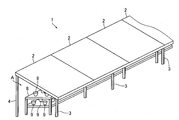
- FIG. 1 is a perspective view of a plant cultivation system 1 according to a first embodiment of the present invention.
- the plant cultivation system 1 of this embodiment is a system for cultivating ginseng which is a medicinal plant.
- the plant cultivation system 1 includes a plurality of solar panels (solar cell panels) 2 and two types of support columns 3 and 4 as support members that support the plurality of solar panels 2.
- the solar panel 2 and the columns 3 and 4 are installed on farmland or non-cultivated land.
- the plurality of solar panels 2 are placed on the upper ends of the plurality of columns 3 and 4 in a state of being in close contact with each other in the lateral direction.
- the support column 3 is shorter than the support column 4, and the light receiving surface of the solar panel 2 is inclined with respect to the horizontal direction. Moreover, the light-receiving surface of the solar panel 2 faces substantially south.
- the cultivation area A where ginseng is cultivated is formed under the solar panel 2. That is, the lower side of the solar panel 2 is a cultivation area A where ginseng is cultivated.
- a cocoon 5 is formed on the ground below the solar panel 2, and ginseng is planted in the cocoon 5.
- the periphery of the cultivation area A is covered with a light-shielding net or sheet not shown. This net or sheet is attached to the ends of the plurality of solar panels 2 and the columns 3 and 4 so as to hang from the ends of the plurality of solar panels 2, for example.
- the height is set. For example, the height of the column 3 is about 70 cm, and the height of the column 4 is about 180 cm.
- region A of the ginseng is formed in the lower side of the solar panel 2, the light irradiated from the upper side to the ginseng cultivated in the cultivation area A is sent by the solar panel 2. It becomes possible to block completely, and it becomes possible to eliminate the variation in the light blocking rate in the solar panel 2. Therefore, in this embodiment, it becomes possible to suppress variation in the amount of light irradiated to the ginseng cultivated in the cultivation region A, and as a result, variation in the growth of ginseng cultivated in the cultivation region A. It becomes possible to suppress. Moreover, in this form, since the solar panel 2 can block rain on ginseng, it is possible to appropriately cultivate ginseng that removes moisture.
- the basket 5 is formed on the lower ground of the solar panel 2, but as shown in FIG. 8 is installed, and ginseng may be planted in a pot 9 or a planter (not shown) placed on the shelf 8.
- ginseng When ginseng is cultivated on the ground using the cocoon 5, the ginseng can not be repeatedly cultivated in the cultivation area A unless the soil environment on the ground is prepared, so the maintenance of the soil environment becomes complicated. However, in this case, ginseng can be cultivated repeatedly in the cultivation area A if the soil environment in the pot 9 or the planter is prepared. Therefore, maintenance of the soil environment is facilitated.
- the shelf 8 is a multi-stage shelf, more ginseng is cultivated at a time in the cultivation area A than in the case where the ginseng is cultivated on the ground.
- negative or semi-negative medicinal plants (medicinal herbs) other than ginseng may be cultivated, and negative plants and semi-negative plants other than medicinal plants may be cultivated.
- negative plants such as mushrooms, udo or asparagus, and semi-negative plants may be cultivated in the cultivation area A.
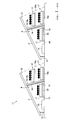
- FIG. 3 is a perspective view of the plant cultivation system 11 according to the second embodiment of the present invention.
- a predetermined one direction in the horizontal direction (X direction in FIG. 3 (vertical direction in FIG. 3)) is defined as the front-rear direction, and is orthogonal to the front-rear direction in the horizontal direction.
- the direction (Y direction in FIG. 3) is the left-right direction.
- one side in the Y direction (Y1 direction side in FIG. 3) is the right side
- the other side in the Y direction (Y2 direction side in FIG. 3) is the left side.
- the X direction is the first direction
- the Y direction is the second direction.
- the plant cultivation system 11 of this embodiment is a system for cultivating ginseng, similar to the plant cultivation system 1 of the first embodiment.
- the plant cultivation system 11 includes a plurality of solar panels 2 and two types of support columns 13 and 14 that support the plurality of solar panels 2.
- the solar panel 2 and the columns 13 and 14 are installed on farmland or non-cultivated land.
- the plurality of solar panels 2 are placed on the upper ends of the plurality of columns 13 and 14 in a state of being in close contact with each other in the front-rear direction.
- the length of the column 14 is longer than the length of the column 13.
- the support column 13 in this embodiment is a first support member, and the support column 14 is a second support member.
- the support column 13 supports the left end side of the solar panel 2, and the support column 14 supports a portion on the right side of the center in the left-right direction of the solar panel 2. That is, when viewed from the front-rear direction, the support column 13 and the support column 14 are arranged with a predetermined interval in the left-right direction, and the solar panel 2 is positioned with respect to the left-right direction when viewed from the front-rear direction. Leaning. That is, the light receiving surface of the solar panel 2 is inclined with respect to the horizontal direction. Further, similarly to the first embodiment, the light receiving surface of the solar panel 2 faces substantially south. Similar to the first embodiment, the lower side of the solar panel 2 is a cultivation area A where ginseng is cultivated. In this embodiment, the support column 13 stands up perpendicularly to the ground, and the support column 14 stands up in a state of being inclined toward the support column 13 with respect to the ground. However, the column 14 may stand up perpendicularly to the ground.
- ginseng When viewed from the front-rear direction, ginseng is directly planted on the ground on the support 13 side of the cultivation area A (that is, the ground on the left side of the cultivation area A). Is formed with a basket 15 for directly planting ginseng. Moreover, when viewed from the front-rear direction, a shelf 18 on which the storage box 17 is placed is installed on the support 14 side of the cultivation area A (that is, the right side portion of the cultivation area A). Furthermore, two support rails 19 that support the storage box 17 are installed between the basket 15 and the shelf 18 so that the storage box 17 can be moved in the front-rear direction when viewed from the front-rear direction. Has been.
- the storage box 17 stores a plurality of pots (not shown) in which ginseng is planted. Specifically, a honeycomb-shaped paper pot (paper pot) formed in a honeycomb shape is accommodated in the accommodating box 17, and ginseng is planted in each of the plurality of pots. A sheet having moisture retention and bactericidal properties is laid on the bottom side of the storage box 17. That is, a sheet having moisture retention and bactericidal properties is laid under the paper pot.
- a ginseng seedling planted in a pot accommodated in the accommodation box 17 is grown on the cocoon 15. That is, the cocoon 15 of this embodiment is a nursery bed for growing a ginseng seedling.
- the shelf 18 includes a mounting portion 18a on which the storage box 17 is mounted and a support column 18b that supports the mounting portion 18a.
- the shelf 18 in this embodiment is a two-stage shelf having two mounting portions 18 a that overlap in the vertical direction.
- the shelf 18 is disposed on the right side of the support column 14. That is, the support column 14 is disposed on the support column 13 side of the shelf 18 in the left-right direction.
- the column 18b is disposed so as to be adjacent to the right side of the column 14, and the mounting portion 18a protrudes from the column 18b to the right side.
- the shelf 18 may be a shelf having three or more levels, or may be a one-level shelf. In the case where the shelf 18 is a single shelf, for example, the lower mounting portion 18a in FIG. 3 may be removed. Further, the storage box 17 may be placed directly on the ground below the mounting portion 18a. In addition, a planter in which ginseng is planted may be mounted on the mounting portion 18a. Further, the support column 14 may support the right end side of the solar panel 2, and the shelf 18 may be disposed on the left side of the support column 14. Moreover, although the support
- the two support rails 19 are arranged with a predetermined interval in the left-right direction.
- a panel 20 is placed on the two support rails 19, and the storage box 17 is placed on the panel 20.
- the panel 20 is movable in the front-rear direction on the support rail 19. That is, the storage box 17 is movable in the front-rear direction on the support rail 19 together with the panel 20.
- the panel 20 is formed in a flat plate shape so that one storage box 17 is placed on the panel 20 when viewed from the front-rear direction, but when viewed from the front-rear direction.
- the panel 20 may be formed in a multistage manner so that the plurality of storage boxes 17 are placed on the panel 20 in a state where they are overlapped in the vertical direction.
- the light shielding net 21 is attached to the right end of the solar panel 2.
- the net 21 is attached to the solar panel 2 so as to cover the cultivation area A from the right side.
- a light shielding sheet may be attached to the solar panel 2 instead of the net 21.
- the shelf 18 is installed on the right side portion of the cultivation area A where the height of the solar panel 2 inclined with respect to the horizontal direction is increased. Therefore, in this embodiment, as shown in FIG. 3, it is possible to place more storage boxes 17 on the shelf 18 by using a relatively wide space under the solar panel 2. Therefore, in this embodiment, it is possible to cultivate more ginseng at a time using the shelf 18 arranged in the right part of the cultivation area A.
- the left part of the cultivation area A since the height of the solar panel 2 is low, it is difficult to install the shelf 18 as shown in FIG. Even in the left part of the cultivation area A where the space becomes narrower, ginseng can be cultivated using the straw 15.
- a support rail 19 is disposed between the basket 15 and the shelf 18 in the left-right direction. Therefore, in this embodiment, even if the storage box 17 supported by the support rail 19 is disposed between the basket 15 and the shelf 18 in the left-right direction, the support box 19 is used to move the storage box 17 in the front-rear direction. After being moved, it becomes possible to perform work on the ginseng planted in the pot accommodated in the storage box 17. Therefore, in this embodiment, even if the storage box 17 is disposed between the basket 15 and the shelf 18 in the left-right direction, the work on the ginseng stored in the storage box 17 becomes easy.
- the support column 14 is a hindrance when working on the ginseng planted in the pot stored in the storage box 17 on the shelf 18. None become. Therefore, with this form, the operation
- a light shielding net 21 is attached to the right end of the solar panel 2, and the cultivation area A is covered with the net 21 from the right side. Therefore, in this embodiment, it is possible to prevent or suppress light from being irradiated to the ginseng from the right side of the cultivation area A where the height of the solar panel 2 is increased. Further, in this embodiment, it is possible to prevent or suppress the rain and wind from hitting ginseng using the net 21 on the right side of the cultivation area A where the height of the solar panel 2 is increased.
Landscapes
- Life Sciences & Earth Sciences (AREA)
- Engineering & Computer Science (AREA)
- Sustainable Development (AREA)
- Sustainable Energy (AREA)
- Environmental Sciences (AREA)
- Cultivation Of Plants (AREA)
- Cultivation Receptacles Or Flower-Pots, Or Pots For Seedlings (AREA)
Priority Applications (1)
| Application Number | Priority Date | Filing Date | Title |
|---|---|---|---|
| JP2013554250A JP5565988B2 (ja) | 2012-01-18 | 2013-01-17 | 植物栽培システム |
Applications Claiming Priority (2)
| Application Number | Priority Date | Filing Date | Title |
|---|---|---|---|
| JP2012007605 | 2012-01-18 | ||
| JP2012-007605 | 2012-01-18 |
Publications (1)
| Publication Number | Publication Date |
|---|---|
| WO2013108620A1 true WO2013108620A1 (fr) | 2013-07-25 |
Family
ID=48799051
Family Applications (1)
| Application Number | Title | Priority Date | Filing Date |
|---|---|---|---|
| PCT/JP2013/000175 Ceased WO2013108620A1 (fr) | 2012-01-18 | 2013-01-17 | Système de culture de plantes et procédé de culture de plantes |
Country Status (2)
| Country | Link |
|---|---|
| JP (1) | JP5565988B2 (fr) |
| WO (1) | WO2013108620A1 (fr) |
Cited By (6)
| Publication number | Priority date | Publication date | Assignee | Title |
|---|---|---|---|---|
| JP2015092850A (ja) * | 2013-11-12 | 2015-05-18 | 由行 岡木 | 植物栽培用施設を兼ねる太陽光発電施設及びその使用方法 |
| JP2015181369A (ja) * | 2014-03-20 | 2015-10-22 | 国立大学法人 千葉大学 | オタネニンジンの生産方法 |
| KR20160146966A (ko) | 2014-06-09 | 2016-12-21 | 가부시키가이샤 쓰무라 | 고려인삼의 재배 방법 |
| US10470384B1 (en) | 2018-01-17 | 2019-11-12 | Donald J. Avery | Agricultural apparatus |
| US10729075B2 (en) | 2018-10-29 | 2020-08-04 | Donald J. Avery | Agricultural apparatus |
| WO2025056250A1 (fr) * | 2023-09-11 | 2025-03-20 | Tk Powerrenew Gmbh | Appareil de culture de champignons comestibles |
Citations (8)
| Publication number | Priority date | Publication date | Assignee | Title |
|---|---|---|---|---|
| JPS61133328U (fr) * | 1985-02-12 | 1986-08-20 | ||
| JPH0270651U (fr) * | 1988-11-15 | 1990-05-29 | ||
| JPH0537042U (ja) * | 1991-10-26 | 1993-05-21 | 昇 鈴木 | ルーフ付花壇 |
| JPH06217649A (ja) * | 1993-01-26 | 1994-08-09 | Koyo Plast Kk | 半陰性植物栽培ハウス用シート |
| JPH0928206A (ja) * | 1995-07-24 | 1997-02-04 | Yamamoto Sangyo:Kk | 移動ベンチ装置 |
| JPH11220943A (ja) * | 1998-02-09 | 1999-08-17 | Touyama Kousuke | 生食用朝鮮人参の栽培方法および生食用朝鮮人参 |
| JP2011172540A (ja) * | 2010-02-25 | 2011-09-08 | Tokyo Electric Power Co Inc:The | 太陽電池モジュールの設置方法 |
| JP2012147737A (ja) * | 2011-01-20 | 2012-08-09 | Gbiomix Co Ltd | 電子ビームを用いる高麗人参裁培用土壌の滅菌方法及び滅菌装置と、これを用いた高麗人参裁培システム |
-
2013
- 2013-01-17 WO PCT/JP2013/000175 patent/WO2013108620A1/fr not_active Ceased
- 2013-01-17 JP JP2013554250A patent/JP5565988B2/ja active Active
Patent Citations (8)
| Publication number | Priority date | Publication date | Assignee | Title |
|---|---|---|---|---|
| JPS61133328U (fr) * | 1985-02-12 | 1986-08-20 | ||
| JPH0270651U (fr) * | 1988-11-15 | 1990-05-29 | ||
| JPH0537042U (ja) * | 1991-10-26 | 1993-05-21 | 昇 鈴木 | ルーフ付花壇 |
| JPH06217649A (ja) * | 1993-01-26 | 1994-08-09 | Koyo Plast Kk | 半陰性植物栽培ハウス用シート |
| JPH0928206A (ja) * | 1995-07-24 | 1997-02-04 | Yamamoto Sangyo:Kk | 移動ベンチ装置 |
| JPH11220943A (ja) * | 1998-02-09 | 1999-08-17 | Touyama Kousuke | 生食用朝鮮人参の栽培方法および生食用朝鮮人参 |
| JP2011172540A (ja) * | 2010-02-25 | 2011-09-08 | Tokyo Electric Power Co Inc:The | 太陽電池モジュールの設置方法 |
| JP2012147737A (ja) * | 2011-01-20 | 2012-08-09 | Gbiomix Co Ltd | 電子ビームを用いる高麗人参裁培用土壌の滅菌方法及び滅菌装置と、これを用いた高麗人参裁培システム |
Cited By (6)
| Publication number | Priority date | Publication date | Assignee | Title |
|---|---|---|---|---|
| JP2015092850A (ja) * | 2013-11-12 | 2015-05-18 | 由行 岡木 | 植物栽培用施設を兼ねる太陽光発電施設及びその使用方法 |
| JP2015181369A (ja) * | 2014-03-20 | 2015-10-22 | 国立大学法人 千葉大学 | オタネニンジンの生産方法 |
| KR20160146966A (ko) | 2014-06-09 | 2016-12-21 | 가부시키가이샤 쓰무라 | 고려인삼의 재배 방법 |
| US10470384B1 (en) | 2018-01-17 | 2019-11-12 | Donald J. Avery | Agricultural apparatus |
| US10729075B2 (en) | 2018-10-29 | 2020-08-04 | Donald J. Avery | Agricultural apparatus |
| WO2025056250A1 (fr) * | 2023-09-11 | 2025-03-20 | Tk Powerrenew Gmbh | Appareil de culture de champignons comestibles |
Also Published As
| Publication number | Publication date |
|---|---|
| JPWO2013108620A1 (ja) | 2015-05-11 |
| JP5565988B2 (ja) | 2014-08-06 |
Similar Documents
| Publication | Publication Date | Title |
|---|---|---|
| JP5565988B2 (ja) | 植物栽培システム | |
| JP6275169B2 (ja) | 太陽電池パネル用移動架台、それを用いた太陽光発電システム、及び太陽電池パネルの設置方法 | |
| JP6302218B2 (ja) | 植物栽培用施設を兼ねる太陽光発電施設及びその使用方法 | |
| JP5898563B2 (ja) | ぶどうの短梢栽培用施設を兼ねる太陽光発電施設 | |
| JP3001511B2 (ja) | 栽培装置 | |
| JP4976482B2 (ja) | 移動式蔓性植物支持装置 | |
| JP2014018082A (ja) | ソーラー農業 | |
| KR20140140223A (ko) | 과채류 재배 및 육묘가 가능한 고설 베드 장치 | |
| KR20200109971A (ko) | 태양광 패널을 갖는 비닐하우스 | |
| JP6899579B2 (ja) | 自然薯栽培器及び自然薯栽培システム | |
| KR20110000268U (ko) | 태양추적식 직립형 식생장치 | |
| JP6598097B2 (ja) | 栽培装置 | |
| JP2018007650A (ja) | 緑化構造体及び簡易フェンス又は広告表示体 | |
| KR102265783B1 (ko) | 고설베드 재배 장치 | |
| NL2010815C2 (en) | Modular system for arranging plant compositions. | |
| KR102301118B1 (ko) | 3가지 작물 3배 수확용 입체적 스마트 팜 시설 하우스 | |
| JP2018046751A (ja) | 緑化装置 | |
| JP5300510B2 (ja) | 建物取付構造物および支持体 | |
| JP3183330U (ja) | 太陽光発電システム | |
| TWI660666B (zh) | 韭黃栽培系統 | |
| KR20120051271A (ko) | 작물 건조 및 재배용 다단계 하우스 | |
| KR102278314B1 (ko) | 수목재배지 상의 가림막 설치공법 | |
| CN215454167U (zh) | 一种适用于绿化树的种植装置 | |
| JP2013243938A (ja) | ソーラーパネルを備える植物栽培装置及び発電ファーム | |
| JP5094885B2 (ja) | 多年生つる性植物の育苗装置 |
Legal Events
| Date | Code | Title | Description |
|---|---|---|---|
| 121 | Ep: the epo has been informed by wipo that ep was designated in this application |
Ref document number: 13738867 Country of ref document: EP Kind code of ref document: A1 |
|
| ENP | Entry into the national phase |
Ref document number: 2013554250 Country of ref document: JP Kind code of ref document: A |
|
| NENP | Non-entry into the national phase |
Ref country code: DE |
|
| 122 | Ep: pct application non-entry in european phase |
Ref document number: 13738867 Country of ref document: EP Kind code of ref document: A1 |