WO2013108784A1 - Pâte de résine et procédé de fabrication de photopile - Google Patents
Pâte de résine et procédé de fabrication de photopile Download PDFInfo
- Publication number
- WO2013108784A1 WO2013108784A1 PCT/JP2013/050677 JP2013050677W WO2013108784A1 WO 2013108784 A1 WO2013108784 A1 WO 2013108784A1 JP 2013050677 W JP2013050677 W JP 2013050677W WO 2013108784 A1 WO2013108784 A1 WO 2013108784A1
- Authority
- WO
- WIPO (PCT)
- Prior art keywords
- resin
- resistant resin
- heat
- polar solvent
- heat resistant
- Prior art date
- Legal status (The legal status is an assumption and is not a legal conclusion. Google has not performed a legal analysis and makes no representation as to the accuracy of the status listed.)
- Ceased
Links
- UHOVQNZJYSORNB-UHFFFAOYSA-N c1ccccc1 Chemical compound c1ccccc1 UHOVQNZJYSORNB-UHFFFAOYSA-N 0.000 description 4
- DPZNOMCNRMUKPS-UHFFFAOYSA-N COc1cc(OC)ccc1 Chemical compound COc1cc(OC)ccc1 DPZNOMCNRMUKPS-UHFFFAOYSA-N 0.000 description 1
Images
Classifications
-
- H—ELECTRICITY
- H10—SEMICONDUCTOR DEVICES; ELECTRIC SOLID-STATE DEVICES NOT OTHERWISE PROVIDED FOR
- H10F—INORGANIC SEMICONDUCTOR DEVICES SENSITIVE TO INFRARED RADIATION, LIGHT, ELECTROMAGNETIC RADIATION OF SHORTER WAVELENGTH OR CORPUSCULAR RADIATION
- H10F19/00—Integrated devices, or assemblies of multiple devices, comprising at least one photovoltaic cell covered by group H10F10/00, e.g. photovoltaic modules
- H10F19/90—Structures for connecting between photovoltaic cells, e.g. interconnections or insulating spacers
- H10F19/902—Structures for connecting between photovoltaic cells, e.g. interconnections or insulating spacers for series or parallel connection of photovoltaic cells
- H10F19/906—Structures for connecting between photovoltaic cells, e.g. interconnections or insulating spacers for series or parallel connection of photovoltaic cells characterised by the materials of the structures
-
- C—CHEMISTRY; METALLURGY
- C08—ORGANIC MACROMOLECULAR COMPOUNDS; THEIR PREPARATION OR CHEMICAL WORKING-UP; COMPOSITIONS BASED THEREON
- C08G—MACROMOLECULAR COMPOUNDS OBTAINED OTHERWISE THAN BY REACTIONS ONLY INVOLVING UNSATURATED CARBON-TO-CARBON BONDS
- C08G73/00—Macromolecular compounds obtained by reactions forming a linkage containing nitrogen with or without oxygen or carbon in the main chain of the macromolecule, not provided for in groups C08G12/00 - C08G71/00
- C08G73/06—Polycondensates having nitrogen-containing heterocyclic rings in the main chain of the macromolecule
- C08G73/10—Polyimides; Polyester-imides; Polyamide-imides; Polyamide acids or similar polyimide precursors
-
- C—CHEMISTRY; METALLURGY
- C08—ORGANIC MACROMOLECULAR COMPOUNDS; THEIR PREPARATION OR CHEMICAL WORKING-UP; COMPOSITIONS BASED THEREON
- C08J—WORKING-UP; GENERAL PROCESSES OF COMPOUNDING; AFTER-TREATMENT NOT COVERED BY SUBCLASSES C08B, C08C, C08F, C08G or C08H
- C08J3/00—Processes of treating or compounding macromolecular substances
- C08J3/02—Making solutions, dispersions, lattices or gels by other methods than by solution, emulsion or suspension polymerisation techniques
- C08J3/09—Making solutions, dispersions, lattices or gels by other methods than by solution, emulsion or suspension polymerisation techniques in organic liquids
-
- C—CHEMISTRY; METALLURGY
- C08—ORGANIC MACROMOLECULAR COMPOUNDS; THEIR PREPARATION OR CHEMICAL WORKING-UP; COMPOSITIONS BASED THEREON
- C08L—COMPOSITIONS OF MACROMOLECULAR COMPOUNDS
- C08L79/00—Compositions of macromolecular compounds obtained by reactions forming in the main chain of the macromolecule a linkage containing nitrogen with or without oxygen or carbon only, not provided for in groups C08L61/00 - C08L77/00
- C08L79/04—Polycondensates having nitrogen-containing heterocyclic rings in the main chain; Polyhydrazides; Polyamide acids or similar polyimide precursors
- C08L79/08—Polyimides; Polyester-imides; Polyamide-imides; Polyamide acids or similar polyimide precursors
-
- H—ELECTRICITY
- H10—SEMICONDUCTOR DEVICES; ELECTRIC SOLID-STATE DEVICES NOT OTHERWISE PROVIDED FOR
- H10F—INORGANIC SEMICONDUCTOR DEVICES SENSITIVE TO INFRARED RADIATION, LIGHT, ELECTROMAGNETIC RADIATION OF SHORTER WAVELENGTH OR CORPUSCULAR RADIATION
- H10F77/00—Constructional details of devices covered by this subclass
- H10F77/20—Electrodes
- H10F77/206—Electrodes for devices having potential barriers
- H10F77/211—Electrodes for devices having potential barriers for photovoltaic cells
- H10F77/219—Arrangements for electrodes of back-contact photovoltaic cells
-
- H—ELECTRICITY
- H10—SEMICONDUCTOR DEVICES; ELECTRIC SOLID-STATE DEVICES NOT OTHERWISE PROVIDED FOR
- H10F—INORGANIC SEMICONDUCTOR DEVICES SENSITIVE TO INFRARED RADIATION, LIGHT, ELECTROMAGNETIC RADIATION OF SHORTER WAVELENGTH OR CORPUSCULAR RADIATION
- H10F77/00—Constructional details of devices covered by this subclass
- H10F77/93—Interconnections
- H10F77/933—Interconnections for devices having potential barriers
- H10F77/935—Interconnections for devices having potential barriers for photovoltaic devices or modules
- H10F77/937—Busbar structures for modules
-
- C—CHEMISTRY; METALLURGY
- C08—ORGANIC MACROMOLECULAR COMPOUNDS; THEIR PREPARATION OR CHEMICAL WORKING-UP; COMPOSITIONS BASED THEREON
- C08J—WORKING-UP; GENERAL PROCESSES OF COMPOUNDING; AFTER-TREATMENT NOT COVERED BY SUBCLASSES C08B, C08C, C08F, C08G or C08H
- C08J2379/00—Characterised by the use of macromolecular compounds obtained by reactions forming in the main chain of the macromolecule a linkage containing nitrogen with or without oxygen, or carbon only, not provided for in groups C08J2361/00 - C08J2377/00
- C08J2379/04—Polycondensates having nitrogen-containing heterocyclic rings in the main chain; Polyhydrazides; Polyamide acids or similar polyimide precursors
- C08J2379/08—Polyimides; Polyester-imides; Polyamide-imides; Polyamide acids or similar polyimide precursors
-
- C—CHEMISTRY; METALLURGY
- C08—ORGANIC MACROMOLECULAR COMPOUNDS; THEIR PREPARATION OR CHEMICAL WORKING-UP; COMPOSITIONS BASED THEREON
- C08J—WORKING-UP; GENERAL PROCESSES OF COMPOUNDING; AFTER-TREATMENT NOT COVERED BY SUBCLASSES C08B, C08C, C08F, C08G or C08H
- C08J2479/00—Characterised by the use of macromolecular compounds obtained by reactions forming in the main chain of the macromolecule a linkage containing nitrogen with or without oxygen, or carbon only, not provided for in groups C08J2461/00 - C08J2477/00
- C08J2479/04—Polycondensates having nitrogen-containing heterocyclic rings in the main chain; Polyhydrazides; Polyamide acids or similar polyimide precursors
- C08J2479/08—Polyimides; Polyester-imides; Polyamide-imides; Polyamide acids or similar polyimide precursors
-
- Y—GENERAL TAGGING OF NEW TECHNOLOGICAL DEVELOPMENTS; GENERAL TAGGING OF CROSS-SECTIONAL TECHNOLOGIES SPANNING OVER SEVERAL SECTIONS OF THE IPC; TECHNICAL SUBJECTS COVERED BY FORMER USPC CROSS-REFERENCE ART COLLECTIONS [XRACs] AND DIGESTS
- Y02—TECHNOLOGIES OR APPLICATIONS FOR MITIGATION OR ADAPTATION AGAINST CLIMATE CHANGE
- Y02E—REDUCTION OF GREENHOUSE GAS [GHG] EMISSIONS, RELATED TO ENERGY GENERATION, TRANSMISSION OR DISTRIBUTION
- Y02E10/00—Energy generation through renewable energy sources
- Y02E10/50—Photovoltaic [PV] energy
- Y02E10/547—Monocrystalline silicon PV cells
Definitions
- the present invention relates to a resin paste, a solar cell including a resin film formed from the resin paste, and a manufacturing method thereof.
- Resins such as polyimide resins having excellent heat resistance and mechanical properties are used in the field of electronics as surface protective films, interlayer insulating films, or stress relaxation materials for semiconductor elements.
- screen printing methods that do not require complicated processes such as exposure, development or etching have attracted attention as image forming methods for resin films used in these applications.
- a resin paste having a thixotropic property including a base resin, a filler, and a solvent as constituent components is used.
- silica fine particles or polyimide fine particles are often used as a filler for imparting thixotropy.
- Patent Document 1 a resin pattern is formed using a resin paste in which an organic filler (soluble filler) compatible with a base resin and a solvent during heating is mixed with the base resin and the solvent. It is disclosed. Patent Document 2 also discloses a technique of adding a low elastic filler, liquid rubber, or the like to impart characteristics such as low elasticity to the resin paste.
- the interaction of the filler weakens and the viscosity of the resin paste decreases as the number of times of screen printing increases, and the printed shape may bleed or sag.
- it becomes difficult to maintain a predetermined shape size by flowing the resin paste and there is a limit to the number of times of printing when the resin paste is used for continuous printing.
- an object of the present invention is to provide a resin paste excellent in shape retention and continuous printability, a solar cell including a resin film formed from the resin paste, and a method for manufacturing the solar cell.
- the present invention provides a mixed solvent containing the first polar solvent (A1) and the second polar solvent (A2), a heat-resistant resin (B) soluble in the mixed solvent at room temperature, and the first solvent at room temperature.
- a heat-resistant resin (C) that is soluble in the polar solvent (A1), insoluble in the second polar solvent (A2), and insoluble in the mixed solvent.
- the heat resistant resin (C) is an organic filler having an average particle size of 0.1 to 5.0 ⁇ m, and the heat resistant resin (B) and Resin paste having a weight average molecular weight of 10,000 to 100,000, a viscosity of 30 to 500 Pa ⁇ s at 25 ° C., and a thixotropic coefficient of 2.0 to 10.0. I will provide a.
- the resin paste is less likely to sag and fluidity with extremely high printing workability can be obtained. Thereby, it is possible to obtain a resin paste that is excellent in screen printability and excellent in shape retainability so that a predetermined shape can be retained even in continuous screen printing a plurality of times.
- the solubility of the heat-resistant resin (C) acting as a filler in the resin paste is increased when the resin film is formed, it is possible to form a resin film having excellent surface flatness. it can.
- the heat resistant resin (B) and the heat resistant resin (C) are each independently at least one selected from the group consisting of a polyamide resin, a polyimide resin, a polyamideimide resin, a polyimide resin precursor, and a polyamideimide resin precursor.
- a resin film excellent in heat resistance and mechanical properties can be obtained.
- the present invention also includes a step of screen-printing the resin paste of the present invention on the electrode-forming surface of the substrate having an electrode formed on at least one surface so that the electrode is exposed, and heat-curing the screen-printed resin paste. And the manufacturing method of a solar cell including the process of forming a resin film is provided.
- the present invention further provides a solar cell comprising a resin film formed from the resin paste. Since the solar cell according to the present invention is provided with the resin film, wiring plating abnormality, disconnection, and the like are reduced, and the reliability is excellent.
- the present invention it is possible to provide a resin paste excellent in shape retention and continuous printability, a solar cell including a resin film formed from the resin paste, and a method for manufacturing the solar cell.
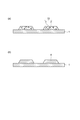
- (A) is a schematic cross section of the resin paste immediately after screen-printing on a base material
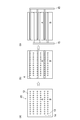
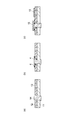
- (b) is a schematic cross section of the resin film obtained by heating the resin paste on a base material. It is a top view which shows typically the process of producing a photovoltaic cell. It is sectional drawing which shows typically the process of producing a photovoltaic cell.
- the resin paste according to this embodiment includes a mixed solvent including a first polar solvent (A1) and a second polar solvent (A2), and a first polar solvent (A1) and a second polar solvent (at room temperature).
- a heat-resistant resin (B) that is soluble in a mixed solvent with A2), at room temperature, soluble in the first polar solvent (A1), insoluble in the second polar solvent (A2), and And a heat resistant resin (C) that is insoluble in a mixed solvent of the first polar solvent (A1) and the second polar solvent (A2).
- “room temperature” is 25 degreeC.
- soluble in a solvent means a phenomenon in which a resin dissolves in a solvent at 25 ° C.
- insoluble means that the resin does not dissolve in the solvent at 25 ° C. It means a phenomenon that remains in the solvent.
- the heat resistant resin (B) is soluble in a mixed solvent of the first polar solvent (A1) and the second polar solvent (A2) at room temperature, and the heat resistant resin (C) is the first at room temperature. Insoluble in the mixed solvent of the polar solvent (A1) and the second polar solvent (A2). Therefore, in the resin paste, the heat resistant resin (C) is dispersed in a mixed solvent of the first polar solvent (A1), the second polar solvent (A2), and the heat resistant resin (B), and acts as a filler. . Thereby, in particular, the thixotropy value of the resin paste can be adjusted so that the screen printability of the resin paste and the shape retention of the resin film are improved. Furthermore, when the resin paste is heated to a temperature at which the heat resistant resin (C) is dissolved, the heat resistant resin (C) is dissolved and the filler disappears. Thereby, the flatness of the surface of the resin film can be improved.
- first polar solvent (A1) and the second polar solvent (A2) include diethylene glycol monomethyl ether, diethylene glycol monoethyl ether, triethylene glycol monomethyl ether, triethylene glycol monoethyl ether, tetraethylene glycol monomethyl ether, Polyether alcohol solvents such as tetraethylene glycol monoethyl ether, diethylene glycol dimethyl ether, diethylene glycol diethyl ether, diethylene glycol dipropyl ether, diethylene glycol dibutyl ether, triethylene glycol dimethyl ether, triethylene glycol diethyl ether, triethylene glycol dipropyl ether, triethylene Glycol dibutyl ether Ether solvents such as tetraethylene glycol dimethyl ether, tetraethylene glycol diethyl ether, tetraethylene glycol dipropyl ether, tetraethylene glycol dibutyl ether, sulfur-containing solvents such as dimethyl sulfoxide,
- the first polar solvent and the second polar solvent are different solvents.
- the combination of the first polar solvent (A1) and the second polar solvent (A2) is appropriately selected from these solvents according to the types of the heat resistant resin (B) and the heat resistant resin (C). Use it.
- the first polar solvent (A1) is preferably N-methylpyrrolidone, dimethylacetamide, dimethylformamide, 1,3-dimethyl-3,4,5,6-tetrahydro-2 (1H) -pyrimidinone, 1,3- Nitrogen-containing solvents such as dimethyl-2-imidazolidinone, sulfur-containing solvents such as dimethyl sulfoxide, diethyl sulfoxide, dimethyl sulfone, sulfolane, ⁇ -butyrolactone, ⁇ -valerolactone, ⁇ -caprolactone, ⁇ -heptalactone, ⁇ -Lactone solvents such as acetyl- ⁇ -butyrolactone, ⁇ -caprolactone, ketone solvents such as methyl ethyl ketone, methyl isobutyl ketone, cyclohexanone, acetophenone, alcohol solvents such as butanol, octyl alcohol, ethylene glycol
- the second polar solvent (A2) is preferably diethylene glycol dimethyl ether, diethylene glycol diethyl ether, diethylene glycol dipropyl ether, diethylene glycol dibutyl ether, triethylene glycol dimethyl ether, triethylene glycol diethyl ether, triethylene glycol dipropyl ether, triethylene glycol diester.
- Ether solvents such as butyl ether, tetraethylene glycol dimethyl ether, tetraethylene glycol diethyl ether, tetraethylene glycol dipropyl ether, tetraethylene glycol dibutyl ether, diethylene glycol monomethyl ether, diethylene glycol monoethyl ether, triethylene glycol monomethyl ether
- Polyether alcohol solvents such as triethylene glycol monoethyl ether, tetraethylene glycol monomethyl ether, tetraethylene glycol monoethyl ether, ester solvents such as ethyl acetate, butyl acetate, cellosolve acetate, ethyl cellosolve acetate, butyrocellosolve acetate, etc.
- the first polar solvent (A1) a nitrogen-containing solvent such as 1,3-dimethyl-3,4,5,6-tetrahydro-2 (1H) -pyrimidinone is used as the first polar solvent (A1)
- the second polar solvent (A2 ) Can also be combined with a lactone solvent such as ⁇ -butyrolactone.
- the boiling points of both the first polar solvent (A1) and the second polar solvent (A2) are preferably 100 ° C. or higher from the viewpoint of increasing the pot life of the resin paste during screen printing. More preferably, the temperature is 150 ° C. or higher. The upper limit of the boiling point is not particularly limited, but is about 450 ° C.
- the heat resistant resin (B) and the heat resistant resin (C) are each independently at least one selected from the group consisting of a polyamide resin, a polyimide resin, a polyamideimide resin, a polyimide resin precursor, and a polyamideimide resin precursor. It is preferable.
- the polyamide resin, polyimide resin, polyamideimide resin, polyimide resin precursor and polyamideimide resin precursor include aromatic, aliphatic or alicyclic diamine compounds and polyvalent carboxylic acids having 2 to 4 carboxyl groups. What is obtained by reaction with is mentioned.
- the polyimide resin precursor and the polyamideimide resin precursor mean polyamic acid (polyamide acid) which is a substance immediately before dehydration ring closure, which forms a polyimide resin or polyamideimide resin by dehydration ring closure.
- the heat-resistant resin (C) is preferably soluble in the above mixed solvent when heated at, for example, 60 ° C. or higher (preferably 60 to 200 ° C., more preferably 100 to 180 ° C.).
- an aromatic, aliphatic or alicyclic diamine compound an arylene group or an alkylene group which may have an unsaturated bond, a cycloalkylene group which may have an unsaturated bond, or a combination thereof
- diamine compounds having a group These groups may be bonded via a carbon atom, an oxygen atom, a sulfur atom, a silicon atom, or a group obtained by combining these atoms.
- a hydrogen atom bonded to the carbon skeleton of the alkylene group may be substituted with a fluorine atom. From the viewpoints of heat resistance and mechanical strength, aromatic diamines are preferred.
- Examples of the polyvalent carboxylic acid having 2 to 4 carboxyl groups include dicarboxylic acid or a reactive acid derivative thereof, tricarboxylic acid or a reactive acid derivative thereof, and tetracarboxylic dianhydride. These compounds are dicarboxylic acids, tricarboxylic acids, or reactive acid derivatives thereof in which a carboxyl group is bonded to an aryl group or a cycloalkyl group that may have a bridged structure or an unsaturated bond in the ring.
- it may be a tetracarboxylic dianhydride in which a carboxyl group is bonded to an aryl group or a cycloalkyl group that may have a crosslinked structure or an unsaturated bond in the ring.
- the dicarboxylic acid, tricarboxylic acid or a reactive acid derivative thereof, and tetracarboxylic dianhydride are bonded through a single bond, or a carbon atom, an oxygen atom, a sulfur atom, a silicon atom, or a combination thereof. It may be bonded via a group.
- a hydrogen atom bonded to the carbon skeleton of the alkylene group may be substituted with a fluorine atom.
- tetracarboxylic dianhydride is preferable from the viewpoint of heat resistance and mechanical strength.
- the combination of the aromatic, aliphatic or alicyclic diamine compound and the polyvalent carboxylic acid having 2 to 4 carboxyl groups can be appropriately selected depending on the reactivity and the like.
- the reaction can be carried out without using a solvent or in the presence of an organic solvent.
- the reaction temperature is preferably 25 ° C. to 250 ° C., and the reaction time can be appropriately selected depending on the scale of the batch, the reaction conditions employed, and the like.
- a thermal ring closure method in which dehydration ring closure is performed by heating under normal pressure or reduced pressure
- a chemical ring closure method using a dehydrating agent such as acetic anhydride in the presence or absence of a catalyst, and the like can be used.
- the thermal ring closure method is preferably performed while removing water generated by the dehydration reaction from the system.
- the reaction solution is heated to 80 to 400 ° C., preferably 100 to 250 ° C.
- a solvent that azeotropes with water such as benzene, toluene, xylene or the like may be used in combination to remove water azeotropically.
- the reaction is preferably carried out at 0 to 120 ° C., preferably 10 to 80 ° C. in the presence of a chemical dehydrating agent.
- a chemical dehydrating agent for example, acid anhydrides such as acetic anhydride, propionic anhydride, butyric anhydride, and benzoic acid, and carbodiimide compounds such as dicyclohexylcarbodiimide are preferably used.
- a substance that promotes the cyclization reaction such as pyridine, isoquinoline, trimethylamine, triethylamine, aminopyridine, imidazole.
- the chemical dehydrating agent is used in an amount of 90 to 600 mol% based on the total amount of the diamine compound, and the substance that accelerates the cyclization reaction is used in an amount of 40 to 300 mol% based on the total amount of the diamine compound.
- a dehydration catalyst such as triphenyl phosphite, tricyclohexyl phosphite, triphenyl phosphate, phosphorus compounds such as phosphoric acid and phosphorus pentoxide, and boron compounds such as boric acid and boric anhydride may be used.
- the reaction solution that has been imidized by the dehydration reaction is compatible with a large excess of the first polar solvent (A1) and the second polar solvent (A2), and has a heat resistant resin ( Pour into lower alcohol such as methanol, water, or a mixture thereof, which is a poor solvent for B) and (C), to obtain a resin precipitate, filter this, and dry the solvent
- a polyimide resin or a polyamideimide resin can be obtained.
- the thermal ring closure method is preferable.
- suitable types of the first polar solvent (A1) and the second polar solvent (A2) can be determined.
- suitable combinations (mixed solvents) of the first polar solvent (A1) and the second polar solvent (A2) include the following three types (a), (b) and (c).
- First polar solvent Nitrogen-containing solvent such as N-methylpyrrolidone and dimethylacetamide; Sulfur-containing solvent such as dimethyl sulfoxide; Lactone solvent such as ⁇ -butyrolactone; Xylenol and the like
- the phenolic solvent, Second polar solvent (A2): the ether solvent such as diethylene glycol dimethyl ether; the ketone solvent such as cyclohexanone; the ester solvent such as butyl cellosolve acetate; the alcohol solvent such as butanol; the aromatic carbon such as xylene. Combination with hydrogen solvent.
- first polar solvent the ether solvent such as tetraethylene glycol dimethyl ether; the ketone solvent such as cyclohexanone; Second polar solvent (A2): ester solvents such as butyl cellosolve acetate and ethyl acetate; alcohol solvents such as butanol; polyether alcohol solvents such as diethylene glycol monoethyl ether; aromatic hydrocarbons such as xylene Combination with system solvents.
- first polar solvent such as tetraethylene glycol dimethyl ether
- the ketone solvent such as cyclohexanone
- Second polar solvent ester solvents such as butyl cellosolve acetate and ethyl acetate
- alcohol solvents such as butanol
- polyether alcohol solvents such as diethylene glycol monoethyl ether
- aromatic hydrocarbons such as xylene Combination with system solvents.
- first polar solvent (A1) the above nitrogen-containing solvent such as 1,3-dimethyl-3,4,5,6-tetrahydro-2 (1H) -pyrimidinone
- Second polar solvent (A2) Combination with the above lactone solvent such as ⁇ -butyrolactone.
- heat resistant resin (B) and the heat resistant resin (C) applied to the (a) type mixed solvent include the following.
- Examples of the heat resistant resin (B) include resins having structural units represented by the following formulas (1) to (10).
- X is —CH 2 —, —O—, —CO—, —SO 2 —, or a group represented by the following formulas (a) to (i):
- p is an integer of 1 to 100.
- R 1 and R 2 are each a hydrogen atom or a hydrocarbon group having 1 to 6 carbon atoms, and may be the same or different from each other.
- X is the same as X in formula (1).
- M is a group represented by the following formula (c), (h), (i) or (j), and in formula (i), p is an integer of 1 to 100. .
- X is the same as X in formula (1).
- X is the same as X in formula (1).
- R 3 and R 4 are each a methyl group, an ethyl group, a propyl group, or a phenyl group, and may be the same or different from each other, and X is the same as X in formula (1). is there.
- x is 0 or 2
- X is the same as X in formula (1).
- Examples of the heat resistant resin (C) include resins having structural units represented by the following formulas (11) to (19).
- Y is a group represented by the following formula (a), (c) or (h).
- Y is the same as Y in formula (11).
- the part of * has couple
- Z is —CH 2 —, —O—, —CO—, —SO 2 —, or a group represented by the following formula (a) or (d).
- Z is the same as Z in formula (14).
- X is the same as X in formula (1), m is an integer of 20 to 70, and n is an integer of 30 to 80.
- a lactone solvent or a nitrogen-containing solvent is used as the first polar solvent (A1)
- an ether solvent or an ester solvent is used as the second polar solvent (A2)
- the heat resistant resin (B) is used. It is preferable to use the resin represented by the formula (20) or the formula (16) as the heat-resistant resin (C) as the resin represented by the formula (1).
- Examples of the heat resistant resin (B) and the heat resistant resin (C) applied to the (b) type mixed solvent include the following.
- the heat resistant resin (B) for example, a resin having a structural unit represented by the following formulas (21) and (22) or a polysiloxane imide represented by the above formula (6) is used.
- Z 1 is —O—, —CO—, or a group represented by the following formula (d), (e), (k) or (l).
- R 5 and R 6 are groups represented by the following formula (m) or (n), and may be the same or different from each other.
- p is an integer of 1 to 100.
- heat-resistant resin (C) for example, polyetheramideimide having a structural unit when X in the above formula (1) is a group represented by the following formula (a) or (b), or the above Polyimides represented by the formulas (5) to (9) (except that the X in the above formulas (5), (6) and (8) is the following formula (i)).
- p is an integer of 1 to 100.
- Raw material supply order in preparing the resin paste is not particularly limited.
- the resin paste raw materials may be mixed together.
- the heat-resistant resin (B) is mixed with a mixed solvent obtained by mixing the first polar solvent (A1) and the second polar solvent (A2), and then the first polar solvent (A1),
- the heat resistant resin (C) may be added to the mixed solution of the second polar solvent (A2) and the heat resistant resin (B).
- the resin paste raw material mixture is heated to a temperature at which the heat resistant resin (C) is sufficiently dissolved in the mixed solution of the first polar solvent (A1), the second polar solvent (A2) and the heat resistant resin (B). Heat and mix well with stirring.
- the resin paste obtained as described above has a heat resistant resin (C) in a solution containing the first polar solvent (A1), the second polar solvent (A2) and the heat resistant resin (B) at room temperature.
- a heat resistant resin (C) in a solution containing the first polar solvent (A1), the second polar solvent (A2) and the heat resistant resin (B) at room temperature.
- the heat resistant resin (C) is present as a filler in the resin paste, and the thixotropic property suitable for screen printing can be imparted to the resin paste.
- the heat resistant resin (C) dispersed in the resin paste is an organic filler having an average particle size of 0.1 to 5.0 ⁇ m.
- the average particle diameter of the organic filler is preferably 0.5 to 4.5 ⁇ m, more preferably 0.6 to 4.0 ⁇ m.
- the maximum particle diameter of the organic filler is preferably 10 ⁇ m or less, more preferably 5 ⁇ m or less.
- SALD-2200 particle size distribution measuring device manufactured by Shimadzu Corporation.
- the mixing ratio of the first polar solvent (A1) and the second polar solvent (A2) is the kind of the heat resistant resin (B) and the heat resistant resin (C), the first polar solvent (A1) and the second polar solvent (A2).
- the mixing ratio is preferably from 3: 7 to 9: 1, and from 1: 2 to The ratio is more preferably 8.5: 1.5, and particularly preferably 7: 3 to 8: 2.
- the first polar solvent (A1) and the second polar solvent (A2) with respect to 100 parts by mass of the total amount of the heat resistant resin (B) and the heat resistant resin (C). 100 to 3500 parts by mass, more preferably 150 to 1000 parts by mass, and even more preferably 200 to 500 parts by mass.
- the mixing ratio of the heat-resistant resin (B) and the heat-resistant resin (C) is not particularly limited and may be any compounding amount, but the heat-resistant resin (C) is added to 100 parts by mass of the total amount of the heat-resistant resin (B). On the other hand, it is preferable to add 10 to 300 parts by mass, more preferably 10 to 200 parts by mass, and more preferably 20 to 150 parts by mass.
- the amount of the heat resistant resin (C) used is 10 parts by mass or more, the thixotropic property of the obtained heat resistant resin paste tends to be good, and when it is 300 parts by mass or less, the physical properties of the obtained resin film are There is a tendency to improve.
- the resin paste according to the present embodiment has a viscosity at 25 ° C. of 30 to 500 Pa ⁇ s, preferably 30 to 400 Pa ⁇ s, from the viewpoint of slipping from the printing plate, resolution of the resin film, and shape retention. More preferably, it is 30 to 350 Pa ⁇ s. If the viscosity at 25 ° C. is less than 30 Pa ⁇ s, the shape cannot be maintained at the time of printing and the resolution of the resin film is lowered, and if it exceeds 500 Pa ⁇ s, the removability from the screen printing plate is lowered.
- the viscosity is adjusted by adjusting the nonvolatile content concentration of the resin paste (hereinafter referred to as NV), the content of the first polar solvent (A1), the molecular weight of the heat resistant resin (B) or the heat resistant resin (C), etc. Can be controlled.
- NV nonvolatile content concentration of the resin paste
- A1 the content of the first polar solvent
- B the molecular weight of the heat resistant resin
- C heat resistant resin
- the molecular weight of a resin obtained by mixing a heat-resistant resin (B) and a heat-resistant resin (C), measured in terms of standard polystyrene using gel permeation chromatography is 10,000 to 100,000, preferably 15,000 to It may be 90000, more preferably 20000 to 80000, and even more preferably 30000 to 60000.
- the resin paste according to this embodiment has a thixotropic coefficient of 2.0 to 10.0, preferably 2.0 to 6.0, more preferably 2.5 to 5.5, and still more preferably It is 2.5 to 5.0, particularly preferably 3.0 to 4.5. If the thixotropy coefficient is less than 2.0, the printability is lowered, and if it exceeds 10.0, the workability is lowered, and it becomes difficult to produce a resin paste.
- the nonvolatile content concentration (NV) of the resin paste is preferably 20 to 28% by mass, more preferably 21 to 27% by mass, and further preferably 22 to 26.5% by mass.
- the NV of the resin paste in this specification is a value calculated from the weight after drying a predetermined amount of the resin paste at 150 ° C. for 1 hour and 250 ° C. for 2 hours and the weight before drying.
- the resin paste according to this embodiment satisfies high heat resistance and insulation, and can be used for insulating films such as semiconductor devices and electrochemical devices. Further, for example, by adding a silane coupling agent or the like, it can be used as an adhesive for connecting a semiconductor device or the like.
- the elasticity of the resin paste at 25 ° C. is 30 to 500 Pa ⁇ s and the thixotropic coefficient is 2.0 to 10.0 depending on the application.
- a low elastic filler having Although there is no restriction
- the surface of the filler can be chemically modified with a functional group such as an epoxy group, amino group, acrylic group, vinyl group, phenyl group, etc. preferable.
- the low-elasticity filler having rubber elasticity is preferably finely divided into a spherical shape or an irregular shape.
- the average particle size of the low elastic filler is preferably 0.1 to 6 ⁇ m, more preferably 0.2 to 5 ⁇ m, and still more preferably 0.3 to 4 ⁇ m. When the average particle size is 0.1 ⁇ m or more, aggregation between particles hardly occurs and tends to disperse. When the average particle size is 6 ⁇ m or less, a filtration step can be introduced, and the surface flatness of the obtained coating film Tend to improve.
- the particle size distribution of the low elastic filler having rubber elasticity is preferably 0.01 to 15 ⁇ m, more preferably 0.02 to 15 ⁇ m, and further preferably 0.03 to 15 ⁇ m. If particles of less than 0.01 ⁇ m are present, aggregation between particles tends to occur and tends to be difficult to disperse sufficiently. If particles of more than 15 ⁇ m are present, it becomes difficult to introduce a filtration step, and the surface flatness of the resin film Tends to decrease.
- the blending amount of the low elastic filler having rubber elasticity is 5 to 900 mass with respect to 100 mass parts of the total amount of the heat resistant resin (B) and the heat resistant resin (C). Part, preferably 5 to 800 parts by weight.
- additives such as a colorant and a coupling agent, and a resin modifier may be further added.
- Coloring agents include carbon black, dyes, pigments and the like.
- Examples of the coupling agent include silane, titanium, and aluminum coupling agents, and the silane coupling agent is most preferable.
- the silane coupling agent is not particularly limited, and examples thereof include vinyltrichlorosilane, vinyltris ( ⁇ -methoxyethoxy) silane, vinyltriethoxysilane, vinyltrimethoxysilane, ⁇ -methacryloxypropyltrimethoxysilane, and ⁇ -methacrylate.
- the titanium-based coupling agent is not particularly limited.
- isopropyl trioctanoyl titanate isopropyl dimethacrylisostearoyl titanate, isopropyl tridodecylbenzenesulfonyl titanate, isopropyl isostearoyl diacryl titanate, isopropyl tri (dioctyl phosphate) titanate, Isopropyltricumylphenyl titanate, isopropyltris (dioctylpyrophosphate) titanate, isopropyltris (n-aminoethyl) titanate, tetraisopropylbis (dioctylphosphite) titanate, tetraoctylbis (ditridecylphosphite) titanate, tetra (2, 2-Diallyloxymethyl-1-butyl) bis (ditridecyl) phos
- the aluminum coupling agent is not particularly limited.
- Aluminum chelate compound, aluminum isopropylate, mono-sec-butoxyaluminum diisopropylate, aluminum-sec can be used butyrate, aluminum alcoholates of aluminum ethylate and the like. These 1 type (s) or 2 or more types can also be used together.
- the above additives are preferably blended in an amount of 50 parts by mass or less based on 100 parts by mass of the total amount of the heat resistant resin (B) and the heat resistant resin (C).
- the physical property of resin films such as heat resistance and mechanical strength
- the resin film according to the present embodiment is produced by a forming method including a step of screen-printing the resin paste according to the present invention on a substrate and a step of heating the resin paste after screen printing at 100 to 450 ° C. be able to.
- FIG. 1 is a cross-sectional view schematically showing the state of the resin film in each step in the method for forming a resin film according to this embodiment.
- the resin paste 10 which concerns on the said embodiment is screen-printed.
- the resin paste 10 has a heat resistant resin (C) 3 dispersed in a solution 2 containing a first polar solvent (A1), a second polar solvent (A2), and a heat resistant resin (B) at room temperature. It is in a state.
- the substrate 1 is, for example, silicon, and an emulsion layer may be formed on the substrate surface.
- the mesh plate and squeegee used for the screen printing machine can be used without particular limitation, but a rubber squeegee is suitable for application of the resin paste according to the present embodiment.
- the resin paste 10 after screen printing is heated at 100 to 450 ° C.
- the heating method can be performed by a known method.
- the heat-resistant resin (C) 3 is dissolved in the solution 2 containing the first polar solvent (A1), the second polar solvent (A2), and the heat-resistant resin (B).
- the polar solvent (A2) and the first polar solvent (A1) are volatilized and the resin film 4 is formed.
- the heating temperature is preferably 150 ° C to 400 ° C, more preferably 150 to 350 ° C.
- the heat-resistant resin (C) 3 includes a first polar solvent (A1), a second polar solvent (A2), and a heat-resistant resin (B). 2 often does not dissolve, and the surface flatness of the resulting resin film tends to decrease.
- voids may occur in the resin film 4 due to outgassing.
- the heat resistant resin (B) and the heat resistant resin (C) contains a polyimide resin precursor
- it is heated at 350 ° C. or more, specifically 350 to 450 ° C., in order to advance imidization.
- it is preferable to cure the resin. If it is 350 ° C. or lower, the reaction speed of imidization tends to be slow.
- the resin film 4 has extremely high flatness and a surface roughness of 2 ⁇ m or less.
- the surface roughness of the resin film in this embodiment refers to arithmetic mean roughness Ra.
- Arithmetic average roughness Ra is extracted from the roughness curve only the reference length (L) in the direction of the average line, the X-axis in the direction of the average line of the extracted portion, the Y-axis in the direction of the vertical magnification,
- the value obtained by the following formula is represented by micrometers ( ⁇ m). That is, Ra is a value represented by the following mathematical formula (1).
- the glass transition temperature Tg of the resin film is preferably 180 ° C. or higher and the thermal decomposition temperature is 300 ° C. or higher from the viewpoint of the usage mode. Is preferred.
- the resin film 4 has a sputtering resistance, a plating resistance, and an alkali resistance required in the process of forming the rewiring, and is therefore preferably used for a semiconductor device. Further, since the amount of warpage of the silicon wafer can be reduced by using the resin film 4, it is possible to expect an improvement in yield in the manufacture of semiconductor devices, and an improvement in productivity is possible.
- a resin substrate according to the present invention is screen-printed on a semiconductor substrate on which a plurality of wirings of the same structure are formed, heated to form a resin film, and an electrode on the semiconductor substrate is formed on the resin film as necessary. And a protective film is formed on the wiring or resin film, an external electrode terminal is formed on the protective film, and dicing is performed.
- a silicon wafer etc. are mentioned.
- the resin film 4 is excellent in insulation, it is preferably used for an insulating film and a protective film of a solar cell. It is particularly useful for back contact type solar cells.
- the back contact type structure include MWT (Metal Wrap Through), EWT (Emitter Wrap Through), IBC (Interdigitated Back Contact), and the like.
- the back contact type solar cell has a structure in which the positive electrode and the negative electrode are concentrated on the back surface of the light receiving surface and are close to each other for the purpose of improving electric conversion efficiency.
- the method for manufacturing a solar cell according to the present embodiment includes a step of screen-printing the electrode so that the electrode is exposed on an electrode-forming surface of a substrate on which an electrode is formed on at least one surface, and a screen-printed resin paste And heat curing to form a resin film. That is, the solar cell according to the present embodiment includes a resin film formed from the resin paste of the present invention.
- the thickness of the resin film 4 can be adjusted according to the purpose and is not particularly limited, but is preferably 0.1 to 30 ⁇ m when used as an insulating film of a solar cell.
- the insulating film and the protective film of the solar cell are obtained by screen-printing and heating the resin paste according to the present invention on a substrate formed with a plurality of positive electrodes and negative electrodes interspersed so as to remove the electrodes. It can be manufactured by forming a resin film.
- a resin film there is no restriction
- FIG. 2 is a top view schematically showing a process for manufacturing the solar cell according to the present embodiment
- FIG. 3 is a cross-sectional view schematically showing a process for manufacturing the solar cell according to the present embodiment.
- FIG. 3 schematically shows a cross section taken along line AB in FIG.
- a substrate 20 having a plurality of positive electrodes 13 and a plurality of negative electrodes 14 formed with aluminum wirings 12 on the back surface of the silicon wafer 11 and formed at a predetermined interval is prepared ((a) in FIGS. 2 and 3). reference).
- the plus electrode 13 is formed on the back surface of the silicon wafer 11, and the minus electrode 14 is formed so as to penetrate from the light receiving surface of the silicon wafer 11 to the back surface.
- the negative electrode 14 and the aluminum wiring 12 are not in contact with each other, and there is a gap between the negative electrode 14 and the aluminum wiring 12.
- the plus electrode 13 and the aluminum wiring 12 are in contact with each other.
- a resin paste is screen printed so that the negative electrode 14 is exposed on the aluminum wiring 12, and heated to form the resin film 4 (see FIGS. 2 and 3B).
- the resin film 4 is filled between the aluminum wiring 12 and the negative electrode 14.
- a Tab wiring 15 is formed on the negative electrode 14 and the positive electrode 13 so as to cover a part of the resin film 4 (see FIGS. 2 and 3C). Since the tab wiring 15 formed on the negative electrode 14 has the resin film 4, it does not contact the aluminum wiring 12 on the positive electrode 13 side, and no electron loss occurs between the two electrodes.
- the positive electrode 13 and the negative electrode 14 are preferably formed from a material mainly containing silver.
- a conductive adhesive can be used for the electrode part and the wiring connection part.
- the conductive adhesive include a conductive paste containing conductive particles such as silver particles and solder particles and a thermosetting resin, and a conductive film in which conductive particles such as Ni are dispersed.
- the weight average molecular weight (Mw) in this example is a value measured by gel permeation chromatography (GPC) and converted using a calibration curve based on standard polystyrene.
- GPC gel permeation chromatography
- the measurement conditions in GPC are as follows. Detector: JASCO Corporation UV detector 875-UV Column: Shodex solvent displacement separation column GPC KD-806M manufactured by Showa Denko K.K. Eluent: NMP containing H 3 PO 4 (0.06 mol / L) Temperature: 25 ° C Flow rate: 1.0 mL / min
- the average particle diameter of the heat resistant resin (C) was measured under the following conditions.
- BAPP 1,3-bis (3-aminopropyl) tetramethyldisiloxane
- NMP N-methyl-2-pyrrolidone
- Polyamideimide resin powder (PAIF-2) was obtained in the same manner as in Synthesis Example 2, except that 25.49 g (121.1 mmol) of TAC and 26.15 g (81.2 mmol) of BTDA were used. Mw of the obtained polyamideimide resin (PAIF-2) was 31,000.
- Polyamideimide resin powder (PAIF-3) was obtained in the same manner as in Synthesis Example 2, except that 24.61 g (116.9 mmol) of TAC and 25.02 g (77.7 mmol) of BTDA were used. Mw of the obtained polyamideimide resin (PAIF-3) was 52,000.
- Polyamideimide resin powder (PAIF-4) was obtained in the same manner as in Synthesis Example 2 except that 24.16 g (114.8 mmol) of TAC and 24.57 g (76.3 mmol) of BTDA were used. Mw of the obtained polyamideimide resin (PAIF-4) was 70000.
- Polyamideimide resin powder (PAIF-5) was obtained in the same manner as in Synthesis Example 2 except that 23.87 g (113.4 mmol) of TAC and 24.35 g (75.6 mmol) of BTDA were used. Mw of the obtained polyamideimide resin (PAIF-5) was 95,000.
- Example 1 In a 0.5 liter four-necked flask equipped with a thermometer, a stirrer, a nitrogen introducing tube and a cooling tube, 92.4 g of ⁇ -BL as a first polar solvent (A1) and a second polar solvent ( 39.6 g of triethylene glycol dimethyl ether (hereinafter referred to as DMTG) as A2), 30.8 g of the polyamideimide resin powder (PAI-1) obtained in Synthesis Example 1 as heat resistant resin (B), and heat resistant resin (C ) And 13.2 g of the polyimide resin powder (PAIF-1) obtained in Synthesis Example 2 were added and heated to 180 ° C. while stirring. After stirring at 180 ° C.
- A1 first polar solvent
- DMTG triethylene glycol dimethyl ether
- a filter KST-47 manufactured by Advantech Co., Ltd. was filled, a silicon rubber piston was inserted, and pressure filtration was performed at a pressure of 3.0 kg / cm 2 to obtain a resin paste (P-1).
- Example 2 Resin paste (P-2) was obtained in the same manner as in Example 1 except that the amount of solvent added at 60 ° C. after cooling was changed to 10.7 g of ⁇ -BL and 4.6 g of DMTG.
- Example 3 In a 0.5 liter four-necked flask equipped with a thermometer, a stirrer, a nitrogen introducing tube and a cooling tube, under a nitrogen stream, 312.3 g of ⁇ -BL as the first polar solvent (A1), the second polar solvent (DMTG 133.7 g as A2), polyamideimide resin powder (PAI-1) 102.7 g obtained in Synthesis Example 1 as heat resistant resin (B), and polyimide resin obtained in Synthesis Example 2 as heat resistant resin (C) Powder (PAIF-1) 84.1g was added and it heated up to 180 degreeC, stirring. After stirring at 180 ° C.
- a filter KST-47 manufactured by Advantech Co., Ltd. was filled, a silicon rubber piston was inserted, and pressure filtration was performed at a pressure of 3.0 kg / cm 2 to obtain a resin paste (P-3).
- Example 4 A heat-resistant resin solution obtained in Synthesis Example 11 as a heat-resistant resin (B) in a 1-liter four-necked flask equipped with a thermometer, a stirrer, a nitrogen introduction tube, and a cooling tube with an oil / water separator under a nitrogen stream ( PI-1) 300 g and heat-resistant resin (C) 400 g of heat-resistant resin filler solution (PIF-1) obtained in Synthesis Example 12 were charged and stirred at 50 to 70 ° C. for 2 hours to dissolve the heat-resistant resin. A resin paste (P-4) in which the heat-resistant resin filler was dispersed was obtained.
- Example 5 Other than using the polyamideimide resin powder (PAI-2) obtained in Synthesis Example 3 as the heat resistant resin (B) and the polyimide resin powder (PAIF-2) obtained in Synthesis Example 4 as the heat resistant resin (C) Obtained a resin paste (P-5) in the same manner as in Example 1.
- Example 6 Other than using the polyamideimide resin powder (PAI-3) obtained in Synthesis Example 5 as the heat resistant resin (B) and the polyimide resin powder (PAIF-3) obtained in Synthesis Example 6 as the heat resistant resin (C) was similar to Example 1 to obtain a resin paste (P-6).
- Example 7 Other than using the polyamideimide resin powder (PAI-4) obtained in Synthesis Example 7 as the heat resistant resin (B) and the polyimide resin powder (PAIF-4) obtained in Synthesis Example 8 as the heat resistant resin (C) Gave a resin paste (P-7) in the same manner as in Example 1.
- Resin paste (P-8) was obtained in the same manner as in Example 1 except that the amount of solvent added at 60 ° C. after cooling was changed to 38.9 g of ⁇ -BL and 16.7 g of DMTG.
- a filter KST-47 manufactured by Advantech Co., Ltd. was filled, a silicon rubber piston was inserted, and pressure filtration was performed at a pressure of 3.0 kg / cm 2 to obtain a resin paste (P-9).
- Non-volatile content (weight of resin paste after heat drying (g) / weight of resin paste before heat drying (g)) ⁇ 100
- Viscosity and thixotropy coefficient The viscosity and thixotropy coefficient (TI value) of the resin pastes obtained in Examples 1 to 7 and Comparative Examples 1 to 4 were measured with a high viscosity viscometer “RE-80U” (manufactured by Toki Sangyo Co., Ltd.). The viscosity was measured at a rotational speed of 0.5 rpm (min ⁇ 1 ), and the TI value was calculated as the ratio of the measured viscosity value at a rotational speed of 10 rpm to the measured viscosity value at a rotational speed of 1 rpm.
- the hole in the printed part of the resin paste corresponding to the circular emulsion opening having an emulsion thickness of 5 ⁇ m and a diameter of 300 ⁇ m at the time of the first screen printing was measured with a microscope.
- the shape retention is the average value of the diameters (hole diameters) of the five holes in the printed part of the resin paste, and the presence or absence of blurring occurs when blurring occurs around the hole and looks like a double hole shape. Judged that blurring occurred.
- Tables 1 and 2 show the compositions of the resin pastes obtained in Examples 1 to 4 and Comparative Examples 1 to 4 and the evaluation results thereof.
- PAIF-1 produced in Synthesis Example 2 was used as the heat resistant resin (C), but the particle size was controlled to be different depending on the NV when the resin paste was prepared. ing.
- the present invention it is possible to provide a resin paste excellent in shape retention and continuous printability, a solar cell including a resin film formed from the resin paste, and a method for manufacturing the solar cell.
- SYMBOLS 1 Base material, 2 ... Solution containing 1st polar solvent (A1), 2nd polar solvent (A2), and heat resistant resin (B), 3 ... Heat resistant resin (C), 4 ... Resin film
Landscapes
- Chemical & Material Sciences (AREA)
- Health & Medical Sciences (AREA)
- Chemical Kinetics & Catalysis (AREA)
- Medicinal Chemistry (AREA)
- Polymers & Plastics (AREA)
- Organic Chemistry (AREA)
- Dispersion Chemistry (AREA)
- Compositions Of Macromolecular Compounds (AREA)
- Photovoltaic Devices (AREA)
Applications Claiming Priority (2)
| Application Number | Priority Date | Filing Date | Title |
|---|---|---|---|
| JP2012007182 | 2012-01-17 | ||
| JP2012-007182 | 2012-01-17 |
Publications (1)
| Publication Number | Publication Date |
|---|---|
| WO2013108784A1 true WO2013108784A1 (fr) | 2013-07-25 |
Family
ID=48799209
Family Applications (1)
| Application Number | Title | Priority Date | Filing Date |
|---|---|---|---|
| PCT/JP2013/050677 Ceased WO2013108784A1 (fr) | 2012-01-17 | 2013-01-16 | Pâte de résine et procédé de fabrication de photopile |
Country Status (3)
| Country | Link |
|---|---|
| JP (1) | JP2013166925A (fr) |
| TW (1) | TW201335261A (fr) |
| WO (1) | WO2013108784A1 (fr) |
Cited By (1)
| Publication number | Priority date | Publication date | Assignee | Title |
|---|---|---|---|---|
| WO2019124414A1 (fr) * | 2017-12-20 | 2019-06-27 | 日立化成株式会社 | Résine polyamide-imide, composition de résine polyamide-imide et dispositif semi-conducteur faisant appel à une résine polyamide-imide et à une composition de résine polyamide-imide |
Families Citing this family (3)
| Publication number | Priority date | Publication date | Assignee | Title |
|---|---|---|---|---|
| JP6672815B2 (ja) * | 2015-04-14 | 2020-03-25 | Jsr株式会社 | 液晶配向剤、液晶配向膜及び液晶素子 |
| SG11201708251VA (en) * | 2015-04-15 | 2017-11-29 | Toray Industries | Heat-resistant resin composition, method for manufacturing heat-resistant resin film, method for manufacturing interlayer insulation film or surface protective film, and method for manufacturing electronic component or semiconductor component |
| SE543901C2 (en) * | 2017-08-10 | 2021-09-21 | Showa Denko Materials Co Ltd | Semiconductor device and method for producing same |
Citations (3)
| Publication number | Priority date | Publication date | Assignee | Title |
|---|---|---|---|---|
| JP2005248001A (ja) * | 2004-03-04 | 2005-09-15 | Hitachi Chem Co Ltd | 耐熱性樹脂ペーストとその製造方法 |
| JP2007246897A (ja) * | 2006-02-15 | 2007-09-27 | Hitachi Chem Co Ltd | 耐熱性樹脂ペースト、耐熱性樹脂ペーストの製造方法、及び耐熱性樹脂ペーストから得られる絶縁膜又は保護膜を有する半導体装置 |
| JP2008280509A (ja) * | 2007-04-13 | 2008-11-20 | Hitachi Chem Co Ltd | 耐熱性樹脂ペースト |
Family Cites Families (1)
| Publication number | Priority date | Publication date | Assignee | Title |
|---|---|---|---|---|
| JP2697215B2 (ja) * | 1988-12-29 | 1998-01-14 | 日立化成工業株式会社 | 耐熱樹脂ペーストおよびこれを用いたic |
-
2013
- 2013-01-16 WO PCT/JP2013/050677 patent/WO2013108784A1/fr not_active Ceased
- 2013-01-16 TW TW102101641A patent/TW201335261A/zh unknown
- 2013-01-16 JP JP2013005511A patent/JP2013166925A/ja active Pending
Patent Citations (3)
| Publication number | Priority date | Publication date | Assignee | Title |
|---|---|---|---|---|
| JP2005248001A (ja) * | 2004-03-04 | 2005-09-15 | Hitachi Chem Co Ltd | 耐熱性樹脂ペーストとその製造方法 |
| JP2007246897A (ja) * | 2006-02-15 | 2007-09-27 | Hitachi Chem Co Ltd | 耐熱性樹脂ペースト、耐熱性樹脂ペーストの製造方法、及び耐熱性樹脂ペーストから得られる絶縁膜又は保護膜を有する半導体装置 |
| JP2008280509A (ja) * | 2007-04-13 | 2008-11-20 | Hitachi Chem Co Ltd | 耐熱性樹脂ペースト |
Cited By (3)
| Publication number | Priority date | Publication date | Assignee | Title |
|---|---|---|---|---|
| WO2019124414A1 (fr) * | 2017-12-20 | 2019-06-27 | 日立化成株式会社 | Résine polyamide-imide, composition de résine polyamide-imide et dispositif semi-conducteur faisant appel à une résine polyamide-imide et à une composition de résine polyamide-imide |
| JPWO2019124414A1 (ja) * | 2017-12-20 | 2021-01-14 | 昭和電工マテリアルズ株式会社 | ポリアミドイミド樹脂及びポリアミドイミド樹脂組成物、並びにそれらを用いた半導体装置 |
| JP7298480B2 (ja) | 2017-12-20 | 2023-06-27 | 株式会社レゾナック | ポリアミドイミド樹脂及びポリアミドイミド樹脂組成物、並びにそれらを用いた半導体装置 |
Also Published As
| Publication number | Publication date |
|---|---|
| JP2013166925A (ja) | 2013-08-29 |
| TW201335261A (zh) | 2013-09-01 |
Similar Documents
| Publication | Publication Date | Title |
|---|---|---|
| JP6413434B2 (ja) | ポリイミド前駆体組成物、ポリイミド前駆体の製造方法、ポリイミド成形体、及びポリイミド成形体の製造方法 | |
| JP6254274B2 (ja) | 空隙を有するポリイミドフィルム及びその製造方法 | |
| EP3730536B1 (fr) | Résine polyamide-imide, composition de résine polyamide-imide et dispositif semi-conducteur faisant appel à une résine polyamide-imide et à une composition de résine polyamide-imide | |
| US20130233381A1 (en) | Polyimide resin composition for use in forming insulation film in photovoltaic cell and method of forming insulation film in photovoltaic cell used therewith | |
| JP5343562B2 (ja) | 耐熱性樹脂ペースト | |
| JP5873529B2 (ja) | シロキサン二酸無水物、重合体、液晶配向剤、液晶配向膜及び液晶表示素子 | |
| WO2013108784A1 (fr) | Pâte de résine et procédé de fabrication de photopile | |
| JP2007246897A (ja) | 耐熱性樹脂ペースト、耐熱性樹脂ペーストの製造方法、及び耐熱性樹脂ペーストから得られる絶縁膜又は保護膜を有する半導体装置 | |
| JP6496993B2 (ja) | ポリイミド前駆体組成物、ポリイミド前駆体の製造方法、ポリイミド成形体、及びポリイミド成形体の製造方法 | |
| CN114015233A (zh) | 一种聚酰亚胺材料及其制备方法和应用 | |
| WO2012133415A1 (fr) | Pâte de résine, cellule solaire, procédé de fabrication d'une cellule solaire, film de résine et dispositif semi-conducteur | |
| JP6007809B2 (ja) | ポリイミド成形体の製造方法、ポリイミド成形体、液晶配向膜、パッシベーション膜、電線被覆材、及び接着膜 | |
| JP4748155B2 (ja) | 樹脂組成物及びこれを用いた半導体装置 | |
| JP2008138159A (ja) | 樹脂組成物及びこれを用いた半導体装置 | |
| JP7342355B2 (ja) | 樹脂組成物、及び半導体装置 | |
| JP4725124B2 (ja) | 樹脂組成物及びこれを用いた半導体装置 | |
| JP2008280509A (ja) | 耐熱性樹脂ペースト | |
| JP2020113597A (ja) | 回路基板及びその製造方法、半導体デバイス | |
| JP2005239862A (ja) | 樹脂組成物の製造方法及びこれを用いた半導体装置 | |
| US20090227714A1 (en) | Resin composition and semiconductor device using the same |
Legal Events
| Date | Code | Title | Description |
|---|---|---|---|
| 121 | Ep: the epo has been informed by wipo that ep was designated in this application |
Ref document number: 13738732 Country of ref document: EP Kind code of ref document: A1 |
|
| 122 | Ep: pct application non-entry in european phase |
Ref document number: 13738732 Country of ref document: EP Kind code of ref document: A1 |
|
| NENP | Non-entry into the national phase |
Ref country code: DE |