WO2013115214A1 - Aliment/boisson conditionné dans un récipient transparent et procédé d'inhibition de la dégradation de la saveur dudit aliment/de ladite boisson - Google Patents
Aliment/boisson conditionné dans un récipient transparent et procédé d'inhibition de la dégradation de la saveur dudit aliment/de ladite boisson Download PDFInfo
- Publication number
- WO2013115214A1 WO2013115214A1 PCT/JP2013/051974 JP2013051974W WO2013115214A1 WO 2013115214 A1 WO2013115214 A1 WO 2013115214A1 JP 2013051974 W JP2013051974 W JP 2013051974W WO 2013115214 A1 WO2013115214 A1 WO 2013115214A1
- Authority
- WO
- WIPO (PCT)
- Prior art keywords
- transparent container
- food
- light
- transparent
- tea
- Prior art date
- Legal status (The legal status is an assumption and is not a legal conclusion. Google has not performed a legal analysis and makes no representation as to the accuracy of the status listed.)
- Ceased
Links
Images


Classifications
-
- A—HUMAN NECESSITIES
- A23—FOODS OR FOODSTUFFS; TREATMENT THEREOF, NOT COVERED BY OTHER CLASSES
- A23F—COFFEE; TEA; THEIR SUBSTITUTES; MANUFACTURE, PREPARATION, OR INFUSION THEREOF
- A23F3/00—Tea; Tea substitutes; Preparations thereof
- A23F3/16—Tea extraction; Tea extracts; Treating tea extract; Making instant tea
- A23F3/163—Liquid or semi-liquid tea extract preparations, e.g. gels or liquid extracts in solid capsules
-
- A—HUMAN NECESSITIES
- A23—FOODS OR FOODSTUFFS; TREATMENT THEREOF, NOT COVERED BY OTHER CLASSES
- A23G—COCOA; COCOA PRODUCTS, e.g. CHOCOLATE; SUBSTITUTES FOR COCOA OR COCOA PRODUCTS; CONFECTIONERY; CHEWING GUM; ICE-CREAM; PREPARATION THEREOF
- A23G9/00—Frozen sweets, e.g. ice confectionery, ice-cream; Mixtures therefor
- A23G9/44—Frozen sweets, e.g. ice confectionery, ice-cream; Mixtures therefor characterised by shape, structure or physical form
- A23G9/50—Products with edible or inedible supports, e.g. cornets
- A23G9/503—Products with edible or inedible supports, e.g. cornets products with an inedible support, e.g. a stick
-
- B—PERFORMING OPERATIONS; TRANSPORTING
- B65—CONVEYING; PACKING; STORING; HANDLING THIN OR FILAMENTARY MATERIAL
- B65D—CONTAINERS FOR STORAGE OR TRANSPORT OF ARTICLES OR MATERIALS, e.g. BAGS, BARRELS, BOTTLES, BOXES, CANS, CARTONS, CRATES, DRUMS, JARS, TANKS, HOPPERS, FORWARDING CONTAINERS; ACCESSORIES, CLOSURES, OR FITTINGS THEREFOR; PACKAGING ELEMENTS; PACKAGES
- B65D81/00—Containers, packaging elements, or packages, for contents presenting particular transport or storage problems, or adapted to be used for non-packaging purposes after removal of contents
- B65D81/24—Adaptations for preventing deterioration or decay of contents; Applications to the container or packaging material of food preservatives, fungicides, pesticides or animal repellants
- B65D81/30—Adaptations for preventing deterioration or decay of contents; Applications to the container or packaging material of food preservatives, fungicides, pesticides or animal repellants by excluding light or other outside radiation
Definitions
- the present invention relates to a food / beverage product in a transparent container, and particularly relates to a food / beverage product in a transparent container formed by filling a transparent container with food / beverage products containing tea.
- ice creams that are displayed and sold in stores are often provided in light-shielding paper containers or plastic containers.
- ice creams including tea are often provided in light-shielding paper containers or plastic containers.
- light-shielding containers contain vibrant teas that are characteristic of their contents, and various methods have been devised to mix milky white ice cream with other colors of tea. Even in the case where a pattern is applied, since the container itself is not transparent, ice cream containing tea cannot be visually observed from the outside, and the commercial value cannot be appealed.
- ice cream containing teas in a transparent container is also on sale.
- ice creams including tea are exposed to light such as sunlight and fluorescent lights at the time of store display, and have an off-flavor that is presumed to be caused by milk fat, vegetable oil, etc. generate.
- the main components of this off flavor are certain aldehydes, ketones and the like. Off-flavor can affect the flavor and quality of a product and can significantly impair the value of the product.
- Patent Document 1 a method of adding a specific type of antioxidant (such as Patent Document 1), ultraviolet light shielding Emphasis on the method of using a container containing baked black and / or aniline black (Patent Document 2, etc.), adjusting the average fat particle size and free fat percentage of ice cream to suppress oxidation (Patent Document) 3)
- Patent Document 4 A method in which ice confectionery or ice cream contains bubbles made of an inert gas (Patent Document 4) is known.
- Patent Document 1 when food additives such as antioxidants are used as in the technique of Patent Document 1, the original flavor may be impaired. Further, unlike the transparent container, the container described in Patent Document 2 is substantially incapable of visually observing the contents from the outside, and visually increases the commercial value even if it contains teas and the like. I can't. In addition, techniques such as those described in Patent Documents 3 to 4, such as adjusting the fat particle diameter and containing inert gas as bubbles, require special manufacturing processes and increase manufacturing costs. .
- the content of fat in tea exudates such as green tea and matcha tea is almost 0%, and it is considered that deterioration due to light irradiation by fat derived from tea does not occur.
- the present invention includes foods and drinks in transparent containers such as ice creams and desserts that are sold and sold in stores that are easily affected by sunlight and fluorescent lamps, especially foods and drinks including teas as contents. Even if it is a case where a transparent container is used as a container, it is an object to provide a food / beverage product in a transparent container that can greatly suppress the occurrence of off-flavor due to oxidation due to light exposure. .
- the present inventors have conducted intensive research in view of the above-mentioned conventional problems, and found that if a specific transparent container is used as a container for foods and drinks including teas, the occurrence of off-flavor can be suppressed.
- the present invention has been completed.
- the present invention provides a food / beverage product in a transparent container in which a food / beverage product containing tea is filled in a transparent container capable of substantially blocking light in a specific wavelength region.
- the transparent container is a transparent container that substantially blocks light in the wavelength region of 550 nm to 720 nm.
- a preferred example of the transparent container is made of a light shielding material.
- the transparent container include a transparent container body and a light-shielding coating layer formed by applying a paint to the transparent container body.
- a preferred form of the tea is matcha and / or green tea.
- the present invention also relates to a method for suppressing off-flavor generated by light irradiation to foods and drinks including tea, and the food and drink are contained in a transparent container that substantially blocks light in the wavelength region of 550 nm to 720 nm.
- An off-flavor suppressing method characterized by filling an article is provided.
- the food and drink in a transparent container of the present invention has the advantage that the amount of off-flavor generated due to oxidation due to light exposure is small even when sold in stores that are easily affected by sunlight or fluorescent lights. .
- ADVANTAGE OF THE INVENTION According to this invention, food / beverage products, such as ice cream and desserts which do not exhibit off-flavors, such as a metal odor, a raw odor (raw smell), and an oily odor, can be provided, for example.
- off-flavors such as a metal odor, a raw odor (raw smell), and an oily odor
- the transparent container since the transparent container is used, the contents can be visually observed from the outside, and the commercial value can be surely appealed.
- tea that is a feature of the contents, a state in which ice confections with tea are placed around a cylindrical ice cream, milky white ice cream, and other colors of tea
- the state with various patterns can be surely appealed.
- a great effect can be expected in desserts containing tea such as Matcha, which can visually appeal to products, ice cream containing teas such as Matcha, beverages containing tea, and the like.
- a transparent container in which the transparent container body is covered with a light-shielding film (aluminum foil, blue film, green film) or transparent film shown in FIG. 1, and frozen at a temperature of ⁇ 25 ° C.
- a light-shielding film (aluminum foil, blue film, green film) or transparent film shown in FIG. 1, and frozen at a temperature of ⁇ 25 ° C.
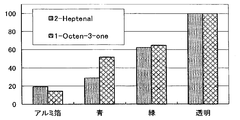
- the vertical axis of the bar graph represents the relative amount when the amount of production of “2-Heptenal” and “1-Octen-3-one”, which are the index components of oxidation, is 100, when the amount of production in the sample subjected to the transparent film is 100 Indicates the value.
- the food and drink used in the present invention is not particularly limited as long as it is a food and drink containing tea such as tea-containing ice cream (including ice confectionery) and tea-containing desserts.
- the types of teas in the food and drink used in the present invention include various types of teas such as teas themselves, tea grounds (eg, matcha powder), teas exudates (eg, liquid sencha), etc. What is obtained by this processing method is included and is not particularly limited.
- the food or drink used in the present invention may be a solid or pasty food or a liquid beverage. It does not specifically limit as an aspect of food / beverage products, For example, frozen goods, refrigerated goods, normal temperature preservation goods, warmed goods etc. are mentioned.
- frozen products and refrigerated products are preferred.
- the frozen products the ice creams exemplified below are the most preferred embodiment in the present invention because they have high palatability and are easy to appeal to the eye.
- the term “food or beverage” includes beverages and foods other than beverages.
- Ice creams that are one embodiment of the food and drink of the present invention include ice cream, ice milk, lact ice, ice confectionery, and the like.
- the ice cream (part excluding tea) used in the present invention uses, for example, milk and / or dairy products and sugars as main ingredients, and other auxiliary ingredients (for example, fragrances, stabilizers, For example, emulsifiers).
- ice milk, lacto ice, ice confectionery, etc. shall be included by ice cream with ice cream.
- frozen dessert shall include frozen desserts containing ice, such as shaved ice, crushed ice, and rock ice, in addition to narrowly-defined frozen dessert.
- the raw materials for ice creams are as follows.
- the main ingredients are animal milk (milk, sheep milk, buffalo milk, etc.), component-adjusted milk processed from it (skimmed milk, partially skimmed milk, high-fat milk, mineral-adjusted milk, concentrated milk, skimmed concentrated milk, etc.), Dairy products (cream, butter, condensed milk, powdered milk, cheese, fermented milk, whey, etc.), fats and oils (animal and vegetable oils such as rapeseed oil, soybean oil, palm oil, palm oil, lard, etc.), sugars (sugar, maltose, sucrose) , Trehalose, lactose, starch syrup, glucose fructose liquid sugar, etc.).
- flavor vanilla essence etc.
- stabilizer gelatin, sodium alginate, CMC, locust bean gum, pectin etc.
- emulsifier glycerin fatty acid ester, sorbitan fatty acid ester, propylene glycol fatty acid ester, sucrose fatty acid ester, Lecithin, etc.
- pigments are used as an auxiliary material.
- the teas that are the ingredients of the food and drink of the present invention are not particularly limited. And black teas.
- examples of preferred forms of tea include whole tea (for example, tea leaves), ground tea, and tea infusion.
- tea leaves for example, tea leaves
- a powder for example, green tea powder
- the crushed tea is accommodated in a transparent container so that it can be visually observed from the outside.
- a part of the food and drink in a container can be constituted.
- extraction method, extraction means, and degree of extraction of the tea leaching solution as long as the tea component is extracted.
- These teas can be added simply as a food or drink material, or added in a fluid state and allowed to flow, and then the flow is frozen and fixed with a transparent container visible. By doing so, a part of food / beverage products with a transparent container of this invention can be comprised.
- the method for producing a food / beverage product in a transparent container according to the present invention is not limited to a specific method.
- the raw materials, auxiliary materials, teas and the like are used in appropriate amounts, and are mixed and sterilized according to a conventional method.
- the method of obtaining food / beverage products with a transparent container is mentioned by cooling, filling to a transparent container, packaging, etc.
- the transparent container used in the present invention is a substantially transparent container formed of glass, synthetic resin or the like.
- substantially transparent means that the contents in the transparent container can be directly observed from the outside of the transparent container by transmitting at least a part of the light outside the light blocking wavelength region defined in the present invention. It can be done.
- the entire transparent container used in the present invention need not be transparent.
- transparent containers that are partially transparent include a label for displaying contents and a printed part that is opaque or translucent, and other parts that are transparent, or a transparent part and an opaque part in multiple places.
- a container having a design combined to represent different patterns, a container having only a transparent part as large as a viewing window, and a large number of opaque parts as a whole are included. Therefore, in other words, the transparent container used in the present invention is a container having a transparent region where at least a part of the food or drink filled in the container can be visually observed from the outside of the container.
- a general material used as a material for containers for food and drink can be used as appropriate.
- examples thereof include, but are not limited to, synthetic resins such as glass, polyethylene, polypropylene, polyethylene terephthalate, polyethylene naphthalate, ethylene / 1-alkene copolymer, nylon, polystyrene, and vinyl chloride.
- the shape of the transparent container used in the present invention is not particularly limited.
- a container for food or drink such as a bag shape corresponding to a general cup shape, glass shape, bottle shape, pack shape, bar or stick shape. All common shapes that can be applied are listed.
- a general method can be used also about the manufacturing method of a transparent container.
- the transparent container substantially shields light in a specific wavelength region.
- the wavelength region that is substantially shielded includes a specific wavelength region on the long wavelength side, and preferably includes a specific wavelength region on the long wavelength side and a specific wavelength region on the short wavelength side.
- the wavelength region on the long wavelength side that is substantially shielded from light is 550 nm to 720 nm, preferably 580 nm to 700 nm, more preferably 580 nm to 690 nm, more preferably 580 nm to 680 nm, and further preferably 600 nm to 680 nm.
- the wavelength region on the short wavelength side in the case of substantially shielding the wavelength region on the short wavelength side is 300 nm to 500 nm, preferably 300 nm to 480 nm, More preferably, it is 300 nm to 470 nm, more preferably 320 nm to 470 nm, more preferably 340 nm to 470 nm, still more preferably 360 nm to 470 nm, and further preferably 380 nm to 470 nm.
- the transmittance (transmittance) of the portion that is substantially shielded from light is 50% or less, preferably 40% or less, more preferably 30% or less, still more preferably 20% or less, and particularly preferably 10% or less.
- the method for imparting the above optical characteristics to the transparent container is not limited to this.
- a light-shielding pigment or dye having high absorption characteristics in the wavelength region hereinafter also referred to as “light-shielding pigment etc.”. And the like.
- a method for forming a transparent container by adding a light-shielding pigment or the like to the main material (for example, glass, synthetic resin, etc.) of the transparent container in advance or at the time of molding, or a predetermined outer surface of the transparent container body after molding A method for producing a transparent container in which a light-shielding pigment is applied to a region of the transparent container body to form a light-shielding coating layer on a part of the outer surface of the transparent container body, A light-shielding film colored with a light-shielding pigment or the like is adhered to and laminated on a predetermined region of the outer surface to produce a transparent container in which the light-shielding film is attached to a part of the outer surface of the transparent container body.
- the method etc. are mentioned.
- the light-shielding pigment and the like general pigments or dyes used in food and beverage containers can be used singly or in combination of two or more according to the use conditions.
- Example 1 Six lacto ice (trade name: Essel Super Cup Mini Matcha; content: 90 ml; manufactured by Meiji Co., Ltd.) containing Matcha in a transparent container was prepared.
- the container was made of polystyrene and sealed with a transparent film.
- Each of the six samples is divided into a light-shielding film (red, blue, yellow, green) having high absorption characteristics in a specific wavelength region, an aluminum foil (control as a substantially light-shielded state), and a transparent film (as a light-transmitting state). Covered with either).
- the sample using the green and blue light-shielding film is an Example applicable to this invention, as shown in FIG.
- a sample using a red and yellow light-shielding film, a sample using an aluminum foil, and a sample using a transparent film are comparative examples not corresponding to the present invention.
- the color that approximates each of the above-described colors which is a comparative example, may include one that substantially blocks light in a specific wavelength region defined in the present invention. That is, the transparent container used in the present invention can have any color as long as it satisfies the conditions of the transparent container defined in the present invention.
- the production amount (relative value) of “2-Heptenal”, “2-Octenal” and “1-Octen-3-one”, which are the index components of oxidation, is the value of the sample to which the transparent film was applied.
- the production amount of 100 was 100 (reference value)
- the relative values of the samples to which the aluminum foil was applied were 18 (2-heptenal), 22 (2-octenal), and 23 (1-octen-3-one).
- the relative values of the sample to which the blue light-shielding film was applied were 43 (2-heptenal), 53 (2-octenal), 51 (1-octen-3-one).
- the relative values of the samples to which the green light-shielding film was applied were 52 (2-heptenal), 62 (2-octenal), and 60 (1-octen-3-one).
- the relative values of the sample with the red light-shielding film were 65 (2-heptenal), 71 (2-octenal), and 77 (1-octen-3-one).
- the relative values of the sample with the yellow light-shielding film were 98 (2-heptenal), 96 (2-octenal), and 103 (1-octen-3-one).
- the test results are shown in FIG.
- the relative value of the sample subjected to the light-shielding film of either green or blue is the value of the sample subjected to the transparent film for any of 2-heptenal, 2-octenal and 1-octen-3-one. It was very small compared to the reference value (see FIG. 2). That is, it is clear from the spectral data of FIG. 1 that when either a green or blue light-shielding film is applied, the light is substantially shielded in the wavelength region of 550 nm to 720 nm. It turned out that the production
- the relative value of the sample to which the yellow light-shielding film was applied was at the same level as the reference value of the sample to which the transparent film was applied.
- the relative value of the sample subjected to the red light-shielding film was smaller than the reference value of the sample subjected to the transparent film, but was larger than the case where either the green or blue light-shielding film was applied. .
- Example 2 A dispersion was prepared by mixing with water such that the proportion of matcha tea was 1.6% by weight and the proportion of xanthan gum was 0.2% by weight in the total amount of matcha, xanthan gum and water. Next, 160 g of this dispersion was placed in a transparent container to prepare four samples (simulating food and drink in a transparent container). Each of the four samples is made up of a light-shielding filter (blue, green) having high light absorption characteristics in a specific wavelength region, an aluminum foil (control as a substantially light-shielding state), and a transparent film (control as a light-transmitting state). Covered with one.
- a light-shielding filter blue, green
- the relative values of the samples provided with the aluminum foil were 19 (2-heptenal) and 14 (1-octen-3-one).
- the relative values of the sample subjected to the blue light-shielding film were 29 (2-heptenal) and 52 (1-octen-3-one).
- the relative values of the samples with the green light-shielding film were 62 (2-heptenal) and 65 (1-octen-3-one).
- the test results are shown in FIG. As described above, the relative value of the sample subjected to either the green or blue light-shielding film is higher than the reference value of the sample subjected to the transparent film for both 2-heptenal and 1-octen-3-one. It was very small (see FIG. 3).
- the food / beverage products in the transparent container of the present invention are less likely to cause off-flavor due to oxidation due to light exposure even when they are displayed and sold in stores that are susceptible to the influence of sunlight and fluorescent lamps. It has an excellent characteristic that it does not exhibit off-flavor.
- the food / beverage products in the transparent container of the present invention can be sold over a long period of time even in store displays such as showcases.
- the visual goodness such as the color tone based on tea and various patterns can be appealed, and the commercial value can be appealed.
Landscapes
- Engineering & Computer Science (AREA)
- Chemical & Material Sciences (AREA)
- Food Science & Technology (AREA)
- Life Sciences & Earth Sciences (AREA)
- Polymers & Plastics (AREA)
- Mechanical Engineering (AREA)
- Dispersion Chemistry (AREA)
- Packages (AREA)
- Confectionery (AREA)
- Packging For Living Organisms, Food Or Medicinal Products That Are Sensitive To Environmental Conditiond (AREA)
- General Preparation And Processing Of Foods (AREA)
Priority Applications (2)
| Application Number | Priority Date | Filing Date | Title |
|---|---|---|---|
| CN201380005276.2A CN104039165A (zh) | 2012-01-31 | 2013-01-30 | 透明容器装饮用食品和异味抑制方法 |
| JP2013556430A JP6168999B2 (ja) | 2012-01-31 | 2013-01-30 | 透明容器入り飲食品及びオフフレーバー抑制方法 |
Applications Claiming Priority (2)
| Application Number | Priority Date | Filing Date | Title |
|---|---|---|---|
| JP2012019094 | 2012-01-31 | ||
| JP2012-019094 | 2012-01-31 |
Publications (1)
| Publication Number | Publication Date |
|---|---|
| WO2013115214A1 true WO2013115214A1 (fr) | 2013-08-08 |
Family
ID=48905247
Family Applications (1)
| Application Number | Title | Priority Date | Filing Date |
|---|---|---|---|
| PCT/JP2013/051974 Ceased WO2013115214A1 (fr) | 2012-01-31 | 2013-01-30 | Aliment/boisson conditionné dans un récipient transparent et procédé d'inhibition de la dégradation de la saveur dudit aliment/de ladite boisson |
Country Status (4)
| Country | Link |
|---|---|
| JP (1) | JP6168999B2 (fr) |
| CN (1) | CN104039165A (fr) |
| TW (1) | TW201343086A (fr) |
| WO (1) | WO2013115214A1 (fr) |
Cited By (3)
| Publication number | Priority date | Publication date | Assignee | Title |
|---|---|---|---|---|
| JP2019071813A (ja) * | 2017-10-13 | 2019-05-16 | 株式会社 伊藤園 | 容器詰緑茶飲料及びその製造方法並びに容器詰緑茶飲料の光劣化臭の発生抑制方法 |
| US11246323B2 (en) | 2017-12-29 | 2022-02-15 | Kraft Foods Group Brands Llc | Oxidative stability of oil-in-water emulsions using natural stabilizers |
| US12533310B2 (en) | 2019-11-01 | 2026-01-27 | Takasago International Corporation | Fragrance or flavor composition |
Citations (7)
| Publication number | Priority date | Publication date | Assignee | Title |
|---|---|---|---|---|
| JPH04144648A (ja) * | 1990-10-08 | 1992-05-19 | Ioki Eiyou Kogyo Kk | 氷菓及びその製造方法 |
| JPH09275948A (ja) * | 1996-04-11 | 1997-10-28 | Meiji Milk Prod Co Ltd | 液状食品における不溶性固形物の 沈降防止・風味改善法 |
| JP2001112414A (ja) * | 1999-08-10 | 2001-04-24 | Mitsui Norin Co Ltd | 褐変が防止された茶飲料の製造方法 |
| JP2002142734A (ja) * | 2000-11-17 | 2002-05-21 | Asama Chemical Co Ltd | 色調安定な茶系飲料 |
| JP2006321152A (ja) * | 2005-05-20 | 2006-11-30 | Toyo Seikan Kaisha Ltd | 遮光性容器及びその製造方法 |
| JP2007135509A (ja) * | 2005-11-21 | 2007-06-07 | Meiji Milk Prod Co Ltd | 透明容器入り乳性飲食品及びその製造方法 |
| WO2012017984A1 (fr) * | 2010-08-02 | 2012-02-09 | 株式会社明治 | Produit alimentaire sous emballage transparent, et procédé d'inhibition de goût altéré |
Family Cites Families (2)
| Publication number | Priority date | Publication date | Assignee | Title |
|---|---|---|---|---|
| US6787589B2 (en) * | 2002-10-31 | 2004-09-07 | Eastman Chemical Company | Amber polyester compositions and container articles produced therefrom |
| CN1321038C (zh) * | 2003-12-22 | 2007-06-13 | 玄金科技股份有限公司 | 具保护膜的瓶状容器 |
-
2013
- 2013-01-30 JP JP2013556430A patent/JP6168999B2/ja active Active
- 2013-01-30 WO PCT/JP2013/051974 patent/WO2013115214A1/fr not_active Ceased
- 2013-01-30 CN CN201380005276.2A patent/CN104039165A/zh active Pending
- 2013-01-31 TW TW102103720A patent/TW201343086A/zh unknown
Patent Citations (7)
| Publication number | Priority date | Publication date | Assignee | Title |
|---|---|---|---|---|
| JPH04144648A (ja) * | 1990-10-08 | 1992-05-19 | Ioki Eiyou Kogyo Kk | 氷菓及びその製造方法 |
| JPH09275948A (ja) * | 1996-04-11 | 1997-10-28 | Meiji Milk Prod Co Ltd | 液状食品における不溶性固形物の 沈降防止・風味改善法 |
| JP2001112414A (ja) * | 1999-08-10 | 2001-04-24 | Mitsui Norin Co Ltd | 褐変が防止された茶飲料の製造方法 |
| JP2002142734A (ja) * | 2000-11-17 | 2002-05-21 | Asama Chemical Co Ltd | 色調安定な茶系飲料 |
| JP2006321152A (ja) * | 2005-05-20 | 2006-11-30 | Toyo Seikan Kaisha Ltd | 遮光性容器及びその製造方法 |
| JP2007135509A (ja) * | 2005-11-21 | 2007-06-07 | Meiji Milk Prod Co Ltd | 透明容器入り乳性飲食品及びその製造方法 |
| WO2012017984A1 (fr) * | 2010-08-02 | 2012-02-09 | 株式会社明治 | Produit alimentaire sous emballage transparent, et procédé d'inhibition de goût altéré |
Cited By (5)
| Publication number | Priority date | Publication date | Assignee | Title |
|---|---|---|---|---|
| JP2019071813A (ja) * | 2017-10-13 | 2019-05-16 | 株式会社 伊藤園 | 容器詰緑茶飲料及びその製造方法並びに容器詰緑茶飲料の光劣化臭の発生抑制方法 |
| US11246323B2 (en) | 2017-12-29 | 2022-02-15 | Kraft Foods Group Brands Llc | Oxidative stability of oil-in-water emulsions using natural stabilizers |
| US12075794B2 (en) | 2017-12-29 | 2024-09-03 | Kraft Foods Group Brands Llc | Oxidative stability of oil-in-water emulsions using natural stabilizers |
| US12533310B2 (en) | 2019-11-01 | 2026-01-27 | Takasago International Corporation | Fragrance or flavor composition |
| US12605330B2 (en) | 2019-11-01 | 2026-04-21 | Takasago International Corporation | Screening method for offensive odor-suppressing material |
Also Published As
| Publication number | Publication date |
|---|---|
| JP6168999B2 (ja) | 2017-07-26 |
| JPWO2013115214A1 (ja) | 2015-05-11 |
| CN104039165A (zh) | 2014-09-10 |
| TW201343086A (zh) | 2013-11-01 |
Similar Documents
| Publication | Publication Date | Title |
|---|---|---|
| JP6080551B2 (ja) | 透明容器入り飲食品及びオフフレーバー抑制方法 | |
| Simmonds et al. | Thinking inside the box: How seeing products on, or through, the packaging influences consumer perceptions and purchase behaviour | |
| US20090258118A1 (en) | Coffee Package | |
| US11284639B2 (en) | Methods and compositions suitable for preserving the freshness of loaf-type food products | |
| JP6168999B2 (ja) | 透明容器入り飲食品及びオフフレーバー抑制方法 | |
| JP2013005787A (ja) | レモン風味を呈する飲料 | |
| Ekantari et al. | Stability of chocolate bars fortified with nanocapsules carotenoid of Spirulina platensis | |
| TW200915994A (en) | Edible oil and fat composition | |
| CN102076224B (zh) | 油脂组合物 | |
| US2504869A (en) | Frozen food improvements | |
| JP6774751B2 (ja) | 緑色飲食料品組成物 | |
| Galmarini et al. | The effect of trehalose, sucrose and maltodextrin addition on physicochemical and sensory aspects of freeze-dried strawberry puree | |
| Brody et al. | Flexible packaging of foods | |
| Goff et al. | Flavoring and Coloring Materials | |
| JP2019512248A (ja) | フレーバー送達システム | |
| HK1196228A (en) | Food/beverage in transparent container, and method for inhibiting flavor degradation | |
| EP2351693A1 (fr) | Conditionnement pourvu d'une étiquette protectrice permettant de préserver son contenu de la lumière | |
| HK1180904B (en) | Food or beverage in transparent container and off-flavor prevention method | |
| Kohan-nia et al. | Effect of packaging material on color properties of catsup tomato sauce | |
| KR101394530B1 (ko) | 초콜릿이 토핑된 음료 및 그 제조방법 | |
| CN112004422A (zh) | 乳化组合物 | |
| EP3177159B1 (fr) | Kit d'éléments contenant un produit alimentaire fromager et une préparation alimentaire naturelle | |
| CN104427886A (zh) | 由榅桲属汁液获得的红色组合物 | |
| JP2019010047A (ja) | 電子レンジ加温用容器詰飲料及びその販売方法 | |
| Popescu et al. | Legal issues regarding the information on the packages. |
Legal Events
| Date | Code | Title | Description |
|---|---|---|---|
| 121 | Ep: the epo has been informed by wipo that ep was designated in this application |
Ref document number: 13743250 Country of ref document: EP Kind code of ref document: A1 |
|
| ENP | Entry into the national phase |
Ref document number: 2013556430 Country of ref document: JP Kind code of ref document: A |
|
| NENP | Non-entry into the national phase |
Ref country code: DE |
|
| 122 | Ep: pct application non-entry in european phase |
Ref document number: 13743250 Country of ref document: EP Kind code of ref document: A1 |