WO2013118743A1 - アスコルビン酸の影響抑制方法 - Google Patents
アスコルビン酸の影響抑制方法 Download PDFInfo
- Publication number
- WO2013118743A1 WO2013118743A1 PCT/JP2013/052669 JP2013052669W WO2013118743A1 WO 2013118743 A1 WO2013118743 A1 WO 2013118743A1 JP 2013052669 W JP2013052669 W JP 2013052669W WO 2013118743 A1 WO2013118743 A1 WO 2013118743A1
- Authority
- WO
- WIPO (PCT)
- Prior art keywords
- hemoglobin
- glycated
- examples
- sample
- reagent
- Prior art date
- Legal status (The legal status is an assumption and is not a legal conclusion. Google has not performed a legal analysis and makes no representation as to the accuracy of the status listed.)
- Ceased
Links
Classifications
-
- C—CHEMISTRY; METALLURGY
- C12—BIOCHEMISTRY; BEER; SPIRITS; WINE; VINEGAR; MICROBIOLOGY; ENZYMOLOGY; MUTATION OR GENETIC ENGINEERING
- C12Q—MEASURING OR TESTING PROCESSES INVOLVING ENZYMES, NUCLEIC ACIDS OR MICROORGANISMS; COMPOSITIONS OR TEST PAPERS THEREFOR; PROCESSES OF PREPARING SUCH COMPOSITIONS; CONDITION-RESPONSIVE CONTROL IN MICROBIOLOGICAL OR ENZYMOLOGICAL PROCESSES
- C12Q1/00—Measuring or testing processes involving enzymes, nucleic acids or microorganisms; Compositions therefor; Processes of preparing such compositions
- C12Q1/54—Measuring or testing processes involving enzymes, nucleic acids or microorganisms; Compositions therefor; Processes of preparing such compositions involving glucose or galactose
-
- C—CHEMISTRY; METALLURGY
- C12—BIOCHEMISTRY; BEER; SPIRITS; WINE; VINEGAR; MICROBIOLOGY; ENZYMOLOGY; MUTATION OR GENETIC ENGINEERING
- C12Q—MEASURING OR TESTING PROCESSES INVOLVING ENZYMES, NUCLEIC ACIDS OR MICROORGANISMS; COMPOSITIONS OR TEST PAPERS THEREFOR; PROCESSES OF PREPARING SUCH COMPOSITIONS; CONDITION-RESPONSIVE CONTROL IN MICROBIOLOGICAL OR ENZYMOLOGICAL PROCESSES
- C12Q1/00—Measuring or testing processes involving enzymes, nucleic acids or microorganisms; Compositions therefor; Processes of preparing such compositions
- C12Q1/26—Measuring or testing processes involving enzymes, nucleic acids or microorganisms; Compositions therefor; Processes of preparing such compositions involving oxidoreductase
-
- C—CHEMISTRY; METALLURGY
- C12—BIOCHEMISTRY; BEER; SPIRITS; WINE; VINEGAR; MICROBIOLOGY; ENZYMOLOGY; MUTATION OR GENETIC ENGINEERING
- C12Q—MEASURING OR TESTING PROCESSES INVOLVING ENZYMES, NUCLEIC ACIDS OR MICROORGANISMS; COMPOSITIONS OR TEST PAPERS THEREFOR; PROCESSES OF PREPARING SUCH COMPOSITIONS; CONDITION-RESPONSIVE CONTROL IN MICROBIOLOGICAL OR ENZYMOLOGICAL PROCESSES
- C12Q1/00—Measuring or testing processes involving enzymes, nucleic acids or microorganisms; Compositions therefor; Processes of preparing such compositions
- C12Q1/34—Measuring or testing processes involving enzymes, nucleic acids or microorganisms; Compositions therefor; Processes of preparing such compositions involving hydrolase
- C12Q1/37—Measuring or testing processes involving enzymes, nucleic acids or microorganisms; Compositions therefor; Processes of preparing such compositions involving hydrolase involving peptidase or proteinase
-
- C—CHEMISTRY; METALLURGY
- C12—BIOCHEMISTRY; BEER; SPIRITS; WINE; VINEGAR; MICROBIOLOGY; ENZYMOLOGY; MUTATION OR GENETIC ENGINEERING
- C12Q—MEASURING OR TESTING PROCESSES INVOLVING ENZYMES, NUCLEIC ACIDS OR MICROORGANISMS; COMPOSITIONS OR TEST PAPERS THEREFOR; PROCESSES OF PREPARING SUCH COMPOSITIONS; CONDITION-RESPONSIVE CONTROL IN MICROBIOLOGICAL OR ENZYMOLOGICAL PROCESSES
- C12Q2523/00—Reactions characterised by treatment of reaction samples
- C12Q2523/10—Characterised by chemical treatment
- C12Q2523/113—Denaturating agents
Definitions
- the present invention relates to a method for suppressing the influence of ascorbic acid in measurement of glycated hemoglobin, and a reagent for measuring glycated hemoglobin.
- Glycated hemoglobin is a saccharified product in which glucose is bound to hemoglobin.
- Hemoglobin has a tetramer structure consisting of ⁇ and ⁇ chains, but the glycated N-terminus of ⁇ chain is called hemoglobin A1c, and increases as the blood glucose level increases. Measured in clinical tests.
- an immunoassay method using an antibody such as a chromatography method such as HPLC, electrophoresis, latex immunoagglutination, an enzyme that acts on glycated protein, and a glycated peptide and / or glycated amino acid.
- An enzyme measurement method using an enzyme is known.
- glycated hemoglobin As an enzyme measurement method for glycated hemoglobin, first, hemoglobin in a hemoglobin-containing sample is denatured with a denaturing agent, a proteolytic enzyme is allowed to act on the denatured hemoglobin, and then a glycated peptide oxidase is allowed to act on the produced glycated peptide. It is known to react the oxidized hydrogen peroxide with an oxidative coloring type chromogen in the presence of a peroxidase active substance such as peroxidase, lead to the dye, and measure the glycated hemoglobin from the absorbance of the dye produced (absorbance method). It has been.
- An object of the present invention is to provide a method for suppressing the influence of ascorbic acid in measuring glycated hemoglobin in a glycated hemoglobin-containing sample, and a reagent for measuring glycated hemoglobin.
- the present inventors diligently investigated this problem. After allowing a proteolytic enzyme to act on a glycated hemoglobin-containing sample, the produced glycated peptide was reacted with a glycated peptide oxidase, and the produced hydrogen peroxide was measured.
- the reaction between the glycated peptide and the glycated peptide oxidase is performed in the presence of a halogen oxide and a specific 5-membered ring heterocyclic compound containing a nitrogen atom and a sulfur atom.
- the present invention relates to the following [1] to [7].
- a method for measuring glycated hemoglobin in a sample by allowing a proteolytic enzyme to act on a glycated hemoglobin-containing sample, reacting the produced glycated peptide with a glycated peptide oxidase, and measuring the produced hydrogen peroxide.
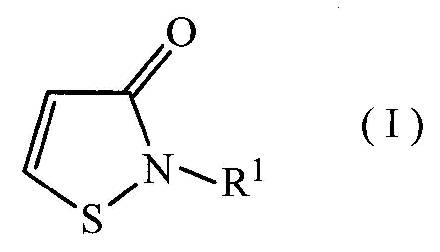
- the reaction between the glycated peptide and the glycated peptide oxidase is carried out by reacting the halogen oxide with the general formula (I)
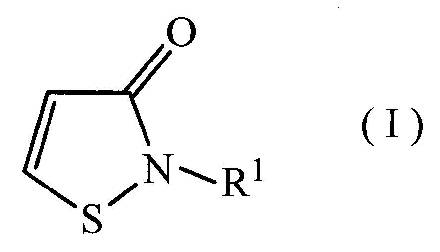
- R 1 represents substituted or unsubstituted alkyl
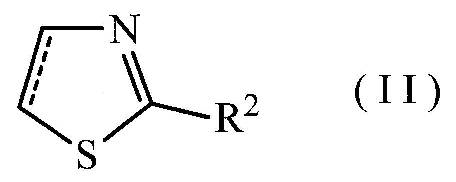
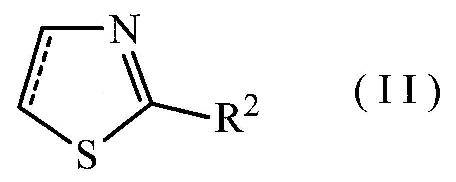
- R 2 represents substituted or unsubstituted alkyl, and --- represents a single bond or a double bond
- a substance selected from the group consisting of substances A method for suppressing the influence of ascorbic acid in measuring glycated hemoglobin in a sample.
- the halogen oxide is a halogen oxide selected from the group consisting of iodic acid or a salt thereof and bromic acid or a salt thereof.
- the glycated hemoglobin is hemoglobin A1c.
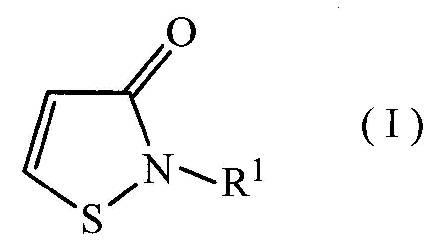
- R 1 represents substituted or unsubstituted alkyl
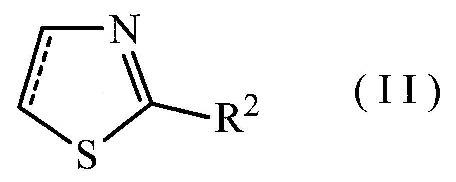
- R 2 represents substituted or unsubstituted alkyl, ---- represents a single bond or a double bond
- a hydrogen peroxide measuring reagent A reagent for measuring glycated hemoglobin in a sample.
- the halogen oxide is a halogen oxide selected from the group consisting of iodic acid or a salt thereof and bromic acid or a salt thereof.
- the present invention provides a method for suppressing the influence of ascorbic acid in the measurement of glycated hemoglobin and a reagent for measuring glycated hemoglobin.
- the method for suppressing the influence of ascorbic acid in the measurement of glycated hemoglobin in a glycated hemoglobin-containing sample works by applying a proteolytic enzyme to the glycated hemoglobin-containing sample.
- the reaction between the glycated peptide and glycated peptide oxidase is performed.
- a substance selected from the group consisting of [hereinafter referred to as compound (II)] In the presence of.
- the halogen oxide and a substance selected from the group consisting of compound (I) and compound (II) may coexist in the reaction between the glycated hemoglobin-containing sample and the proteolytic enzyme.
- the glycated hemoglobin-containing sample in the measurement method of the present invention is not particularly limited as long as it contains glycated hemoglobin and hemoglobin and enables the method for suppressing the influence of ascorbic acid of the present invention.
- whole blood, blood cells, blood cells examples include samples in which plasma is mixed, samples obtained by hemolyzing these samples, and the like.
- the hemolysis treatment is not particularly limited as long as it is a treatment that hemolyzes whole blood, blood cells, and a sample in which blood cells are mixed with plasma, and examples thereof include physical methods, chemical methods, and biological methods.
- Examples of the physical method include a method using a hypotonic solution such as distilled water and a method using ultrasonic waves.
- the chemical method include a method using an organic solvent such as methanol, ethanol, and acetone, and a method using a polyoxyethylene surfactant.
- biological methods include a method using an antibody or complement.
- the glycated hemoglobin in the present invention is produced by binding sugar such as glucose to hemoglobin, and examples thereof include hemoglobin A1a, hemoglobin A1b, hemoglobin A1c, and hemoglobin A1c is preferable.
- the halogen oxide in the present invention is not particularly limited as long as it is a halogen oxide that enables the method for suppressing the influence of ascorbic acid of the present invention.
- iodine acid or a salt thereof, bromic acid or a salt thereof, periodate examples thereof include acid or a salt thereof, and iodic acid or a salt thereof, bromic acid or a salt thereof is preferable.
- the salt include lithium salt, sodium salt, potassium salt, ammonium salt, calcium salt, magnesium salt and the like.
- halogen oxides include iodic acid, sodium iodate, potassium iodate, bromic acid, sodium bromate, potassium bromate, periodic acid, sodium periodate, potassium periodate, etc. Can be mentioned.
- the concentration of the halogen oxide in the reaction solution is not particularly limited as long as it is a concentration that enables the method for measuring glycated hemoglobin of the present invention, but usually 0.005 to 20 mmol / L, preferably 0.01 to 10 mmol / L.
- R 1 in the compound (I) in the present invention represents substituted or unsubstituted alkyl.
- alkyl in the substituted or unsubstituted alkyl include linear alkyl having 1 to 20 carbon atoms and branched alkyl having 3 to 20 carbon atoms.
- linear alkyl having 1 to 20 carbon atoms examples include methyl, ethyl, propyl, butyl, pentyl, hexyl, heptyl, octyl, nonyl, decyl, undecyl, dodecyl (lauryl), tridecyl, tetradecyl (myristyl), pentadecyl, hexadecyl (Cetyl), heptadecyl, octadecyl (stearyl), nonadecyl, icosyl and the like.
- Examples of the branched alkyl having 3 to 20 carbon atoms include isopropyl, isobutyl, isopentyl, isohexyl, isoheptyl, isooctyl, isononyl, isodecyl, isoundecyl, isododecyl, isotridecyl, isotetradecyl, isopentadecyl, isohexadecyl, isoheptadecyl, isooctadecyl , Isononadecyl, isoicosyl, octyldodecyl and the like.
- Examples of the substituent in the substituted alkyl include a phenyl group, a hydroxyl group, a sulfo group, a cyano group, and a halogen atom.
- Examples of the halogen atom include a chlorine atom, a bromine atom, and an iodine atom.
- products of the compound (I) include, for example, 2-octyl-4-isothiazolin-3-one (manufactured by Tokyo Chemical Industry Co., Ltd., Chemiclear), 2-methyl-4-isothiazolin-3-one (Sigma-Aldrich) Etc.).
- R 2 in the compound (II) in the present invention represents substituted or unsubstituted alkyl.
- alkyl in the substituted or unsubstituted alkyl include linear alkyl having 1 to 20 carbon atoms and branched alkyl having 3 to 20 carbon atoms.
- linear alkyl having 1 to 20 carbon atoms examples include methyl, ethyl, propyl, butyl, pentyl, hexyl, heptyl, octyl, nonyl, decyl, undecyl, dodecyl (lauryl), tridecyl, tetradecyl (myristyl), pentadecyl, hexadecyl (Cetyl), heptadecyl, octadecyl (stearyl), nonadecyl, icosyl and the like.
- Examples of the branched alkyl having 3 to 20 carbon atoms include isopropyl, isobutyl, isopentyl, isohexyl, isoheptyl, isooctyl, isononyl, isodecyl, isoundecyl, isododecyl, isotridecyl, isotetradecyl, isopentadecyl, isohexadecyl, isoheptadecyl, isooctadecyl , Isononadecyl, isoicosyl, octyldodecyl and the like.
- Examples of the substituent in the substituted alkyl include a phenyl group, a hydroxyl group, a sulfo group, a cyano group, and a halogen atom.
- Examples of the halogen atom include a chlorine atom, a bromine atom, and an iodine atom.
- Specific examples (products) of compound (II) include, for example, 2-methylthiazoline (manufactured by Tokyo Chemical Industry Co., Ltd.), 2-methylthiazole (manufactured by Tokyo Chemical Industry Co., Ltd.), 2-ethylthiazole (manufactured by Tokyo Chemical Industry Co., Ltd.), 2-propyl Examples include thiazole (manufactured by Tokyo Chemical Industry Co., Ltd.) 2-isobutylthiazole (manufactured by Tokyo Chemical Industry Co., Ltd.) and the like.
- the concentration of compound (I) and compound (II) in the reaction solution is not particularly limited as long as it is a concentration that enables the method for measuring glycated hemoglobin of the present invention. However, it is usually 0.005 to 20 mmol / L, preferably 0.01 to 10 mmol / L.
- the reaction for producing a glycated peptide by allowing a proteolytic enzyme to act on a glycated hemoglobin-containing sample can be performed under any conditions as long as the glycated peptide can be produced.
- the reaction that is, the reaction between the glycated hemoglobin and the proteolytic enzyme in the glycated hemoglobin-containing sample is preferably performed in an aqueous medium. Examples of the aqueous medium include an aqueous medium described later.
- the reaction can also be performed in the presence of a denaturing agent for glycated hemoglobin in the glycated hemoglobin-containing sample.
- the denaturing agent allows glycated hemoglobin to react with a proteolytic enzyme
- the reaction between the glycated hemoglobin and the proteolytic enzyme is preferably performed in the presence of the denaturing agent.
- the denaturing agent is not particularly limited as long as it is a denaturing agent capable of allowing glycated hemoglobin to react with a proteolytic enzyme.
- a cationic surfactant, an anionic surfactant, an amphoteric surfactant, Nonionic surfactants and the like can be mentioned.
- cationic surfactant examples include quaternary ammonium salts and pyridinium salts.
- quaternary ammonium salt having at least one linear alkyl having 8 to 20 carbon atoms is preferable.
- linear alkyl having 8 to 20 carbon atoms include octyl, nonyl, decyl, undecyl, dodecyl (lauryl), tridecyl, tetradecyl (myristyl), pentadecyl, hexadecyl (cetyl), heptadecyl, octadecyl (stearyl), nonadecyl, icosyl Etc.
- quaternary ammonium salts include, for example, decyltrimethylammonium chloride, decyltrimethylammonium bromide, dodecyltrimethylammonium chloride, dodecyltrimethylammonium bromide, tetradecyltrimethylammonium bromide (hereinafter referred to as C14TMA), hexadecyl Examples include trimethylammonium chloride, hexadecyltrimethylammonium bromide, didecyldimethylammonium chloride, didecyldimethylammonium bromide, didodecyldimethylammonium chloride, didodecyldimethylammonium bromide (all manufactured by Tokyo Chemical Industry Co., Ltd.).
- Examples of pyridinium salts include N-alkylpyridinium salts and N-alkenylpyridinium salts.
- Examples of the alkyl include straight chain alkyl having 1 to 20 carbon atoms and branched alkyl having 3 to 20 carbon atoms.
- linear alkyl having 1 to 20 carbon atoms examples include methyl, ethyl, propyl, butyl, pentyl, hexyl, heptyl, octyl, nonyl, decyl, undecyl, dodecyl (lauryl), tridecyl, tetradecyl (myristyl), pentadecyl, hexadecyl (Cetyl), heptadecyl, octadecyl (stearyl), nonadecyl, icosyl and the like.
- Examples of the branched alkyl having 3 to 20 carbon atoms include isopropyl, isobutyl, isopentyl, isohexyl, isoheptyl, isooctyl, isononyl, isodecyl, isoundecyl, isododecyl, isotridecyl, isotetradecyl, isopentadecyl, isohexadecyl, isoheptadecyl, isooctadecyl , Isononadecyl, isoicosyl, octyldodecyl and the like.
- alkenyl examples include alkenyl having 2 to 20 carbon atoms.
- alkenyl having 2 to 20 carbon atoms include vinyl, propenyl, allyl, butenyl, pentenyl, hexenyl, heptenyl, octenyl, nonenyl, decenyl, undecenyl, dodecenyl, tetradecenyl, pentadecenyl, hexadecenyl, heptadecenyl, octadecenyl, oleyl, nonadecenyl, Etc.
- substituted alkyl can be used as alkyl
- substituted alkenyl can also be used as alkenyl.
- substituent in the substituted alkyl and the substituted alkenyl include a phenyl group, a hydroxyl group, a sulfo group, a cyano group, and a halogen atom.
- halogen atom include a chlorine atom, a bromine atom, and an iodine atom.
- N-alkylpyridinium salts and N-alkenylpyridinium salts having substituents at the 2-6 positions on the pyridine ring can also be used.
- substituent at the 2-6 position on the pyridine ring include linear alkyl having 1 to 20 carbon atoms, branched alkyl having 3 to 20 carbon atoms, and alkenyl having 2 to 20 carbon atoms.
- linear alkyl having 1 to 20 carbon atoms include the aforementioned linear alkyl having 1 to 20 carbon atoms.
- Examples of the branched alkyl having 3 to 20 carbon atoms include the aforementioned branched alkyl having 3 to 20 carbon atoms.
- alkenyl having 2 to 20 carbon atoms include the above-mentioned linear alkenyl having 2 to 20 carbon atoms.
- pyridinium salts include, for example, 1-dodecylpyridinium chloride (hereinafter referred to as C12py; manufactured by Tokyo Chemical Industry Co., Ltd.), 1-cetylpyridinium chloride (manufactured by Tokyo Chemical Industry Co., Ltd.), 1-cetyl-4-methylpyridinium. Examples thereof include chloride (manufactured by Tokyo Chemical Industry Co., Ltd.) and N-octadecyl-4-stilbazole bromide (manufactured by Tokyo Chemical Industry Co., Ltd.).
- anionic surfactant examples include sulfate ester salt, carboxylate salt, sulfonate salt, phosphate ester salt, sulfosuccinate salt, N-methyl taurine salt, N-alkanoyl-N-methyl taurine salt and the like.
- amphoteric surfactants include tertiary amine oxides and alkylcarboxybetaines.
- nonionic surfactant examples include polyoxyethylene alkylamine, polyoxyethylene alkenylamine, polyoxyethylene alkyl ether, polyoxyethylene alkenyl ether, polyoxyethylene alkylphenyl ether, ethylenediaminetetrapolyoxyethylene, polyglycerin fatty acid.
- examples include esters, and polyoxyethylene alkylamines and polyoxyethylene alkyl ethers are preferred.
- alkyl in the polyoxyethylene alkylamine examples include alkyl having 8 to 20 carbon atoms.
- alkyl having 8 to 20 carbon atoms examples include octyl, nonyl, decyl, undecyl, dodecyl (lauryl), tridecyl, tetradecyl (myristyl), pentadecyl, hexadecyl (cetyl), heptadecyl, octadecyl (stearyl), nonadecyl, icosyl and the like. Can be mentioned.
- alkenyl in polyoxyethylene alkenylamine examples include alkenyl having 8 to 20 carbon atoms.
- alkenyl having 8 to 20 carbon atoms include octenyl, nonenyl, decenyl, undecenyl, dodecenyl, tetradecenyl, pentadecenyl, hexadecenyl, heptadecenyl, octadecenyl, oleyl, nonadecenyl, icocenyl and the like.
- alkyl in the polyoxyethylene alkyl ether examples include alkyl having 8 to 20 carbon atoms.
- alkyl having 8 to 20 carbon atoms examples include the aforementioned alkyl having 8 to 20 carbon atoms.
- alkenyl in the polyoxyethylene alkenyl ether examples include alkenyl having 8 to 20 carbon atoms.
- alkenyl having 8 to 20 carbon atoms include the aforementioned alkenyl having 8 to 20 carbon atoms.
- alkyl in the polyoxyethylene alkylphenyl ether examples include alkyl having 8 to 20 carbon atoms. Examples of the alkyl having 8 to 20 carbon atoms include the aforementioned alkyl having 8 to 20 carbon atoms.
- the reaction temperature in the reaction between the glycated hemoglobin in the glycated hemoglobin-containing sample and the proteolytic enzyme is usually 10 to 50 ° C., preferably 20 to 40 ° C., the reaction time is usually 1 minute to 3 hours, 2.5 Minute to 1 hour is preferred.
- the concentration of the proteolytic enzyme is not particularly limited as long as the reaction between the glycated hemoglobin in the hemoglobin-containing sample and the proteolytic enzyme proceeds, and is usually 50 to 25,000 kU / L, preferably 250 to 10,000. kU / L.
- the proteolytic enzyme is not particularly limited as long as it is an enzyme that acts on glycated hemoglobin in a hemoglobin-containing sample and generates a glycated peptide from glycated hemoglobin.
- serine protease chymotrypsin, subtilisin, etc.
- cysteine protease papain, caspase
- Etc. aspartic protease
- pepsin, cathepsin D, etc. metalloprotease (thermolysin, etc.)
- N-terminal threonine protease glutamic acid protease and the like.
- commercially available proteolytic enzymes can also be used.
- protease P “Amano” 3G examples include protease P “Amano” 3G, protease K “Amano” (above, Amano Enzyme), actinase AS, actinase E (above).
- protease P “Amano” 3G examples include protease P “Amano” 3G, protease K “Amano” (above, Amano Enzyme), actinase AS, actinase E (above).
- Kaken Pharma Co., Ltd. examples include thermolysin (manufactured by Daiwa Kasei Co., Ltd.), Sumiteam MP (manufactured by Shin Nippon Chemical Industry Co., Ltd.), etc.
- the concentration of the denaturing agent in the reaction that causes the proteolytic enzyme to act is not particularly limited as long as the reaction between the glycated hemoglobin in the glycated hemoglobin-containing sample and the proteolytic enzyme proceeds, and is usually 0.0001 to 10%. Yes, 0.0005 to 5% is preferable.
- a glycated peptide is produced by a reaction between glycated hemoglobin in a glycated hemoglobin-containing sample and a proteolytic enzyme.
- the produced glycated peptide reacts with glycated peptide oxidase to produce hydrogen peroxide.
- the reaction between the glycated peptide and the glycated peptide oxidase is preferably performed in an aqueous medium. Examples of the aqueous medium include an aqueous medium described later.
- the reaction temperature in the reaction between the glycated peptide and the glycated peptide oxidase is usually 10 to 50 ° C., preferably 20 to 40 ° C., and the reaction time is usually 1 minute to 3 hours, preferably 2.5 minutes to 1 hour. .
- the concentration of glycated peptide oxidase is not particularly limited as long as the reaction between fructosyl hemoglobin and glycated peptide oxidase proceeds, and is usually 0.1 to 30 kU / L, preferably 0.2 to 15 kU / L. It is.
- the glycated peptide oxidase is not particularly limited as long as it is an enzyme that acts on a glycated peptide to generate hydrogen peroxide.
- glycated peptide oxidation derived from filamentous fungi, yeast, actinomycetes, bacteria, or archaea. An enzyme etc. are mentioned.
- commercially available glycated peptide oxidase can also be used. Examples of commercially available products include FPOX-CE (manufactured by Kikkoman), FPOX-EE (manufactured by Kikkoman), FPOX-CET (manufactured by Kikkoman), and the like. Is mentioned.
- Examples of the method for measuring the generated hydrogen peroxide include a method using an electrode, a method using a hydrogen peroxide measuring reagent, and the like, and a method using a hydrogen peroxide measuring reagent is preferable.
- the reagent for measuring hydrogen peroxide is a reagent for converting hydrogen peroxide into a detectable substance.
- Examples of the detectable substance include a dye, light (luminescence), fluorescence, and the like, and a dye is preferable.
- examples of the reagent for measuring hydrogen peroxide include a reagent containing a peroxidase active substance such as peroxidase and an oxidative coloring type chromogen.
- examples of the oxidative coloring type chromogen include an oxidative coupling type chromogen and a leuco chromogen, and a leuco chromogen is preferred.
- leuco chromogen examples include phenothiazine chromogen, triphenylmethane chromogen, diphenylamine chromogen, o-phenylenediamine, hydroxypropionic acid, diaminobenzidine, tetramethylbenzidine and the like, and phenothiazine.
- a chromogen is preferred.
- the phenothiazine chromogen examples include 10-N-carboxymethylcarbamoyl-3,7-bis (dimethylamino) -10H-phenothiazine (CCAP), 10-N-methylcarbamoyl-3,7-bis (dimethylamino).
- -10H-phenothiazine MCDP
- 10-N- (carboxymethylaminocarbonyl) -3,7-bis (dimethylamino) -10H-phenothiazine sodium salt DA-67
- 10-N- (carboxymethylaminocarbonyl) -3,7-bis (dimethylamino) -10H-phenothiazine sodium salt DA-67
- 10-N- (carboxymethylaminocarbonyl) -3,7-bis (dimethylamino) -10H-phenothiazine sodium salt DA-67
- triphenylmethane chromogen examples include N, N, N ′, N ′, N ′′, N ′′ -hexa (3-sulfopropyl) -4,4 ′, 4 ′′ -triaminotriphenyl And methane (TPM-PS).
- diphenylamine chromogen examples include N- (carboxymethylaminocarbonyl) -4,4′-bis (dimethylamino) diphenylamine ⁇ ⁇ ⁇ ⁇ sodium salt (DA-64), 4,4′-bis (dimethylamino) diphenylamine, bis And [3-bis (4-chlorophenyl) methyl-4-dimethylaminophenyl] amine (BCMA).
- examples of the reagent for measuring hydrogen peroxide include a reagent containing a peroxidase active substance such as peroxidase and a chemiluminescent substance.
- examples of the chemiluminescent substance include luminol, isoluminol, lucigenin, and acridinium ester.
- examples of the reagent for measuring hydrogen peroxide include a reagent containing a peroxidase active substance such as peroxidase and a fluorescent substance.
- examples of the fluorescent substance include 4-hydroxyphenylacetic acid, 3- (4-hydroxyphenyl) propionic acid, and coumarin.
- the method for measuring glycated hemoglobin in a glycated hemoglobin-containing sample also includes a method of calculating the ratio of the glycated hemoglobin amount to the total hemoglobin amount in the glycated hemoglobin-containing sample.
- the total hemoglobin amount can be determined by a known method, for example, the cyanmethemoglobin method, the oxyhemoglobin method, the SLS-hemoglobin method, or the like.
- the total amount of hemoglobin is not only the glycated hemoglobin-containing sample itself, but also a sample obtained by adding a halogen oxide and a substance selected from the group consisting of compound (I) and compound (II) to a glycated hemoglobin-containing sample, A sample obtained by adding a halogen oxide, a substance selected from the group consisting of compound (I) and compound (II), and a proteolytic enzyme to a glycated hemoglobin-containing sample, the cyan methemoglobin method, oxyhemoglobin It can also be determined by applying the SLS-hemoglobin method.
- the glycated hemoglobin-measuring reagent in a glycated hemoglobin-containing sample of the present invention comprises a proteolytic enzyme, glycated peptide oxidase, halogen oxide, compound (I) and compound (II).
- the reagent for measuring glycated hemoglobin of the present invention is used in the method for suppressing the influence of ascorbic acid of the present invention.
- proteolytic enzyme examples include the aforementioned proteolytic enzyme and saccharification, respectively.
- Peptide oxidase, halogen oxide, compound (I), compound (II), hydrogen peroxide measuring reagent and the like can be mentioned.
- the concentration of the proteolytic enzyme in the measurement reagent of the present invention is usually 50 to 25,000 kU / L, preferably 250 to 10,000 kU / L.
- the concentration of the glycated peptide oxidase in the measurement reagent of the present invention is usually 0.1 to 30 kU / L, preferably 0.2 to 15 kU / L.
- the concentration of the halogen oxide in the measurement reagent of the present invention is usually 0.005 to 20 mmol / L, preferably 0.01 to 10 mmol / L.
- the concentration of compound (I) in the measurement reagent of the present invention is usually 0.005 to 20 mmol / L, preferably 0.01 to 10 mmol / L.
- the concentration of compound (II) in the measurement reagent of the present invention is usually 0.005 to 20 mmol / L, preferably 0.01 to 10 mmol / L.
- the measurement reagent of the present invention may contain an aqueous medium, a denaturing agent, a stabilizing agent, a preservative, a salt, an interfering substance influence inhibitor, a solubilizing agent, an organic solvent, and the like, if necessary.
- the aqueous medium include deionized water, distilled water, and a buffer solution, and a buffer solution is preferable.
- the pH of the aqueous medium is, for example, pH 4-10.
- a buffer solution is used as the aqueous medium, it is desirable to use a buffering agent corresponding to the set pH.
- the buffer used in the buffer include tris (hydroxymethyl) aminomethane buffer, phosphate buffer, borate buffer, Good's buffer, and the like.
- Good buffering agents include, for example, 2-morpholinoethanesulfonic acid (MES), bis (2-hydroxyethyl) iminotris (hydroxymethyl) methane (Bis-Tris), N- (2-acetamido) iminodiacetic acid (ADA) Piperazine-N, N′-bis (2-ethanesulfonic acid) (PIPES), N- (2-acetamido) -2-aminoethanesulfonic acid (ACES), 3-morpholino-2-hydroxypropanesulfonic acid (MOPSO) ), N, N-bis (2-hydroxyethyl) -2-aminoethanesulfonic acid (BES), 3-morpholinopropanesulfonic acid (MOPS), N- [tris (hydroxymethyl) methyl] -2-aminoethanesulfone Acid (TES), 2- [4- (2-hydroxyethyl) -1-piperazinyl] ethanesulfonic acid (HEPE
- the concentration of the buffer is usually 0.001 to 2.0 mol / L, preferably 0.005 to 1.0 mol / L.
- the concentration of the denaturing agent in the measurement reagent of the present invention is usually 0.0001 to 10%, preferably 0.0005 to 5%.
- Examples of the stabilizer include ethylenediaminetetraacetic acid (EDTA), sucrose, calcium chloride, calcium acetate, calcium nitrate, potassium ferrocyanide, bovine serum albumin (BSA), and the like.
- Examples of the preservative include sodium azide and antibiotics.
- Examples of the salts include sodium chloride, sodium nitrate, sodium sulfate, sodium carbonate, potassium chloride, potassium nitrate, potassium sulfate, potassium carbonate and the like.
- Examples of the inhibitor of the influence of interfering substances include pyruvic acid for suppressing the influence of peroxide.
- Examples of the solubilizer include nonionic surfactants such as polyoxyethylene alkyl ether and polyoxyethylene alkylphenyl ether.
- organic solvent examples include dimethylformamide (DMF), dimethyl sulfoxide (DMSO), dioxane, acetone, methanol, ethanol and the like for assisting dissolution of the leuco chromogen in an aqueous medium.
- the glycated hemoglobin measurement reagent of the present invention may take the form of a kit.
- the glycated hemoglobin measurement kit include a two-reagent kit, a three-reagent kit, and the like.
- the glycated hemoglobin measurement kit is a two-reagent kit, a substance selected from the group consisting of proteolytic enzyme, glycated peptide oxidase, halogen oxide, compound (I) and compound (II), and hydrogen peroxide measurement
- the arrangement of each component of the reagent can be appropriately selected by those skilled in the art from the viewpoint of the storage stability of the kit, but a kit containing a proteolytic enzyme and a glycated peptide oxidase in separate reagents is preferred.
- Bis-Tris (manufactured by Dojindo Laboratories), MOPS (manufactured by Dojindo Laboratories), calcium chloride dihydrate (manufactured by Kanto Chemical), sodium pyruvate (manufactured by Kanto Chemical), DMSO (Nacalai Tesque) DA-67 (manufactured by Wako Pure Chemical Industries, Ltd.), Triton X-405 (nonionic surfactant: Sigma Aldrich), 1-dodecylpyridinium chloride (C12py) (modifier: manufactured by Tokyo Chemical Industry Co., Ltd.) , Tetradecyltrimethylammonium bromide (C14TMA) (modifier: manufactured by Tokyo Chemical Industry Co., Ltd.), potassium iodate (halogen oxide; manufactured by Tokyo Chemical Industry Co., Ltd.), potassium bromate (halogen oxide; manufactured by Tokyo Chemical Industry Co., Ltd.), 2-octyl -4-isothiazolin-3-one [
- HbA1c measurement kits (kits 1 to 3; kits a to e) shown in Table 1 comprising the following first reagent and second reagent were prepared.
- First reagent Bis-Tris (pH 6.8) 10 mmol / L C12py 1.2g / L Potassium iodate Compound (I) or Compound (II) Calcium chloride dihydrate 16mmol / L Sodium pyruvate 2g / L Actinase E 340 kU / L DMSO 0.2mL / L DA-67 12.6 ⁇ mol / L
- Second reagent MOPS (pH 7.0) 50 mmol / L Triton X-405 7.1g / L Peroxidase 80 kU / L FPOX-CET 2.5 kU / L
- HbA1c measurement kits (kits 4 to 6; kits f to j) shown in Table 2 consisting of the following first reagent and second reagent were prepared.
- First reagent Bis-Tris (pH 6.8) 10 mmol / L C14TMA 0.6g / L Potassium iodate Compound (I) or Compound (II) Calcium chloride dihydrate 16mmol / L Sodium pyruvate 2g / L Actinase E 340 kU / L DMSO 0.2mL / L DA-67 12.6 ⁇ mol / L
- Second reagent MOPS (pH 7.0) 50 mmol / L Triton X-405 7.1g / L Peroxidase 80 kU / L FPOX-CET 2.5 kU / L
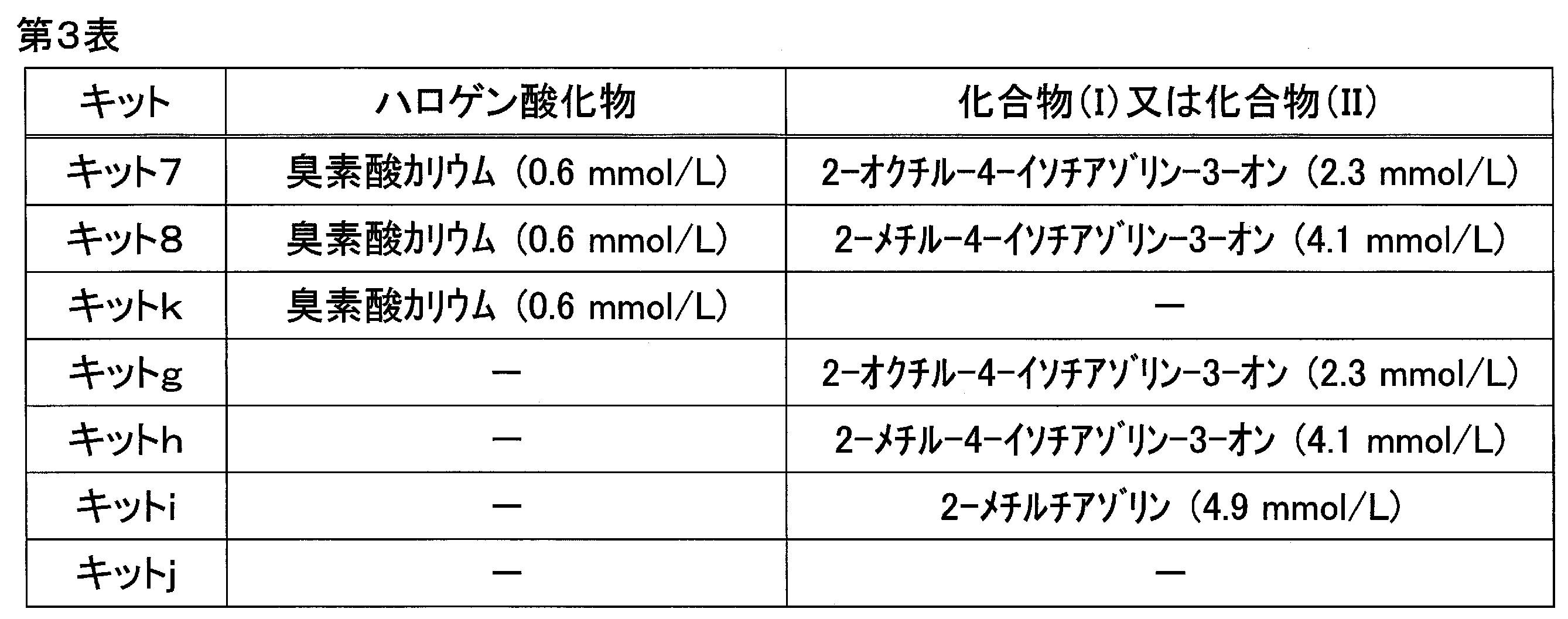
- HbA1c measurement kits (kits 7 to 8; kits k and g to j) shown in Table 3 comprising the following first reagent and second reagent were prepared.
- First reagent Bis-Tris (pH 6.8) 10 mmol / L C14TMA 0.6g / L Potassium bromate Compound (I) or Compound (II) Calcium chloride dihydrate 16mmol / L Sodium pyruvate 2g / L Actinase E 340 kU / L DMSO 0.2mL / L DA-67 12.6 ⁇ mol / L
- Second reagent MOPS (pH 7.0) 50 mmol / L Triton X-405 7.1g / L Peroxidase 80 kU / L FPOX-CET 2.5 kU / L
- Example 1 Using the kit 1 of Example 1 as the HbA1c measurement kit and the whole blood derived from 16 subjects suspected of having diabetes as a sample, the total hemoglobin concentration (the amount) of HbA1c concentration (amount) in each sample by the following procedure. The ratio [HbA1c (%)] to the amount) was determined.
- Nescoat hemokit-N cyanmethemoglobin method
- Alfresa Pharma cyanmethemoglobin method
- JDS Japan Diabetes Society
- each blood cell HbA1c (%) in the fraction was determined by an immunoassay using a determiner L HbA1c (manufactured by Kyowa Medex) according to the method described in the package insert of the determiner L HbA1c.
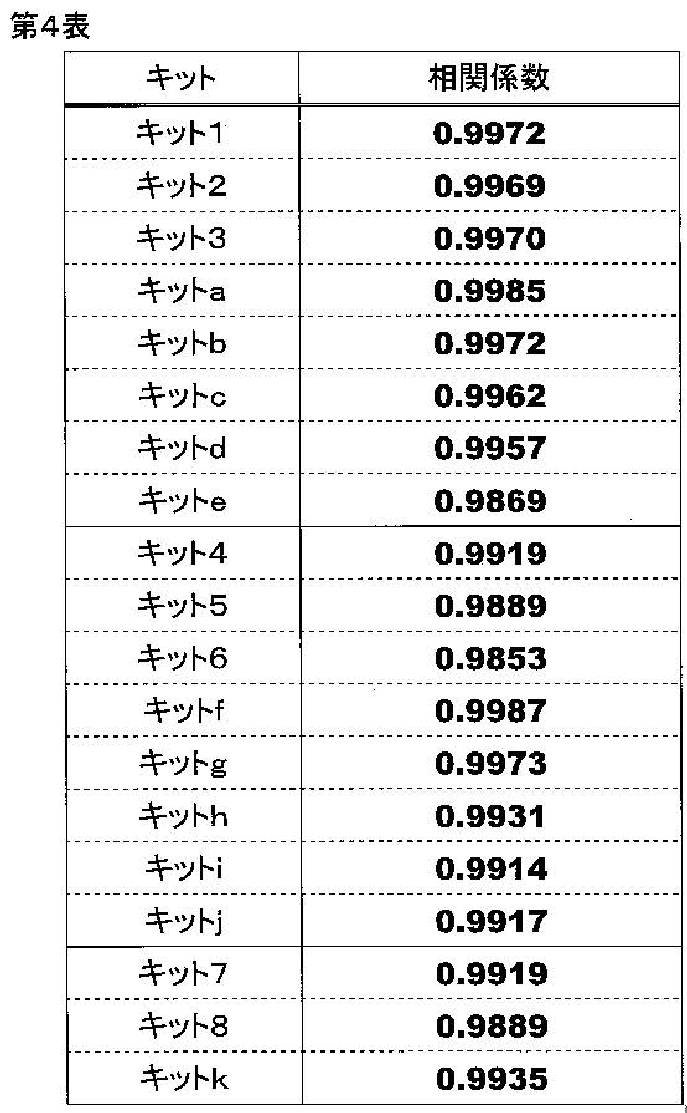
- kits 1 of example 1 instead of kit 1 of example 1, kits 2 to 3, kit a to e of example 1, kits 4 to 6 of example 2, kits f to j, kits 7 to 8 of example 3, Using each kit of the kit k, the correlation coefficient between the measurement using the determiner L HbA1c (manufactured by Kyowa Medex) was determined. The results are shown in Table 4.
- the HbA1c concentration ( ⁇ mol / L) in each sample was determined by the following procedure. Were determined.
- Nescoat hemokit-N cyanmethemoglobin method
- a kit for measuring total hemoglobin of the blood cell fraction obtained by centrifuging human blood (Alfresa Pharma) And the hemoglobin concentration was diluted with purified water and hemolyzed to prepare a hemoglobin solution having a hemoglobin concentration of 6.4 mg / mL.
- Ascorbic acid is added to the prepared hemoglobin solution, and ascorbic acid concentrations of 0.5 mg / dL, 1 mg / dL, 2 mg / dL, and 5 mg / dL are prepared, and the effects of ascorbic acid are confirmed.
- a sample was prepared.
- the prepared hemoglobin solution itself was used as a sample for confirming the effect of ascorbic acid having an ascorbic acid concentration of 0 mg / mL.
- Ascorbic acid concentration is 0.5 mg / dL, 1 mg / dL, 2 mg / dL when HbA1c concentration ( ⁇ mol / L) in the sample for confirming the effect of ascorbic acid with ascorbic acid concentration of 0 mg / dL is 100
- the relative value of the HbA1c concentration ( ⁇ mol / L) in each sample of the sample for confirming the influence of ascorbic acid was determined.
- kits 2 to 3 and the kits a to e of Example 1 were used in the same procedure, and the relative value of the HbA1c concentration ( ⁇ mol / L) in each sample was measured. It was determined. The determined relative values are shown in Table 5. The closer the relative value is to 100, the less likely it is to be affected by ascorbic acid.
- kits 1 to 3 containing potassium iodate and compound (I) or compound (II) at least potassium iodate and compound (I) or compound (II) It can be seen that the relative value of the HbA1c concentration is close to 100 and less susceptible to ascorbic acid than kits that do not contain one (kits a to e).
- Example 6 In the same manner as in Example 5 except that the kits 4 to 6 and kits f to j of Example 2 were used instead of the kit 1 of Example 1, each sample of the sample for confirming the effect of ascorbic acid was used. The relative value of HbA1c concentration ( ⁇ mol / L) was determined. Table 6 shows the relative values of the determined HbA1c concentration ( ⁇ mol / L).
- kits 4 to 6 containing potassium iodate and compound (I) or compound (II) any of potassium iodate and compound (I) or compound (II) It can be seen that the relative value of the HbA1c concentration is close to 100 and less susceptible to ascorbic acid as compared to the kit not containing either or both (kits f to j).
- Example 7 Each sample for confirming the effect of ascorbic acid was obtained in the same manner as in Example 5 except that the kits 7 to 8 and kits k and g to j of Example 3 were used instead of the kit 1 of Example 1.
- the relative value of the HbA1c concentration ( ⁇ mol / L) in the sample was determined.
- the relative values of the determined HbA1c concentration ( ⁇ mol / L) are shown in Table 7.
- kits 7 to 8 containing potassium bromate and compound (I) or compound (II) any one of potassium bromate and compound (I) or compound (II) It can be seen that the relative value of the HbA1c concentration is close to 100 and less susceptible to ascorbic acid compared to a kit not containing either or both (kits k, g to j).
- the present invention provides a method for suppressing the influence of ascorbic acid in the measurement of glycated hemoglobin in a glycated hemoglobin-containing sample and a reagent for measuring glycated hemoglobin in a glycated hemoglobin-containing sample.
- the method for suppressing the influence of ascorbic acid and the reagent for measuring glycated hemoglobin of the present invention are useful for diagnosis of diabetes and the like.
Landscapes
- Chemical & Material Sciences (AREA)
- Organic Chemistry (AREA)
- Life Sciences & Earth Sciences (AREA)
- Health & Medical Sciences (AREA)
- Zoology (AREA)
- Wood Science & Technology (AREA)
- Proteomics, Peptides & Aminoacids (AREA)
- Engineering & Computer Science (AREA)
- Microbiology (AREA)
- Biochemistry (AREA)
- Physics & Mathematics (AREA)
- Molecular Biology (AREA)
- Biotechnology (AREA)
- Biophysics (AREA)
- Analytical Chemistry (AREA)
- Immunology (AREA)
- Bioinformatics & Cheminformatics (AREA)
- General Engineering & Computer Science (AREA)
- General Health & Medical Sciences (AREA)
- Genetics & Genomics (AREA)
- Emergency Medicine (AREA)
- Measuring Or Testing Involving Enzymes Or Micro-Organisms (AREA)
Description
[2] ハロゲン酸化物が、ヨウ素酸若しくはその塩、及び、臭素酸若しくはその塩からなる群より選ばれるハロゲン酸化物である、[1]記載の方法。
[3] 糖化ヘモグロビンが、ヘモグロビンA1cである[1]又は[2]記載の方法。

[5] ハロゲン酸化物が、ヨウ素酸若しくはその塩、及び、臭素酸若しくはその塩からなる群より選ばれるハロゲン酸化物である、[4]記載の試薬。
[6] 糖化ヘモグロビンが、ヘモグロビンA1cである[4]又は[5]記載の試薬。
[7] 試料中の糖化ヘモグロビンの測定におけるアスコルビン酸の影響を抑制するための[4]~[6]のいずれかに記載の試薬。
本発明の、糖化ヘモグロビン含有試料中の糖化ヘモグロビンの測定におけるアスコルビン酸の影響抑制方法は、糖化ヘモグロビン含有試料にタンパク質分解酵素を作用させた後、生成した糖化ペプチドを糖化ペプチド酸化酵素と反応させ、生成した過酸化水素を測定することにより、試料中の糖化ヘモグロビンを測定する方法において、糖化ペプチドと糖化ペプチド酸化酵素との反応を、ハロゲン酸化物と、一般式(I)

本発明の、糖化ヘモグロビン含有試料中の糖化ヘモグロビン測定試薬は、タンパク質分解酵素、糖化ペプチド酸化酵素、ハロゲン酸化物、化合物(I)及び化合物(II)からなる群より選ばれる物質、及び、過酸化水素測定用試薬を含む試薬である。本発明の糖化ヘモグロビン測定試薬は、本発明のアスコルビン酸の影響抑制方法に使用される。
水性媒体としては、例えば脱イオン水、蒸留水、緩衝液等が挙げられ、緩衝液が好ましい。
第1試薬
Bis-Tris(pH6.8) 10mmol/L
C12py 1.2g/L
ヨウ素酸カリウム
化合物(I)又は化合物(II)
塩化カルシウム2水和物 16mmol/L
ピルビン酸ナトリウム 2g/L
アクチナーゼE 340kU/L
DMSO 0.2mL/L
DA-67 12.6μmol/L
第2試薬
MOPS(pH7.0) 50mmol/L
トリトンX-405 7.1g/L
ペルオキシダーゼ 80kU/L
FPOX-CET 2.5kU/L

第1試薬
Bis-Tris(pH6.8) 10mmol/L
C14TMA 0.6g/L
ヨウ素酸カリウム
化合物(I)又は化合物(II)
塩化カルシウム2水和物 16mmol/L
ピルビン酸ナトリウム 2g/L
アクチナーゼE 340kU/L
DMSO 0.2mL/L
DA-67 12.6μmol/L
第2試薬
MOPS(pH7.0) 50mmol/L
トリトンX-405 7.1g/L
ペルオキシダーゼ 80kU/L
FPOX-CET 2.5kU/L

第1試薬
Bis-Tris(pH6.8) 10mmol/L
C14TMA 0.6g/L
臭素酸カリウム
化合物(I)又は化合物(II)
塩化カルシウム2水和物 16mmol/L
ピルビン酸ナトリウム 2g/L
アクチナーゼE 340kU/L
DMSO 0.2mL/L
DA-67 12.6μmol/L
第2試薬
MOPS(pH7.0) 50mmol/L
トリトンX-405 7.1g/L
ペルオキシダーゼ 80kU/L
FPOX-CET 2.5kU/L
測定キットとして、総ヘモグロビン測定用キットであるネスコートヘモキット-N(シアンメトヘモグロビン法)(アルフレッサファーマ社製)を用いて、検体として、ネスコートヘモキット-Nに付属の標準液(ヘモグロビン濃度:15.3 g/dL)を用いて、ヘモグロビン濃度と吸光度との関係を示す検量線を作成した。
ラテックス免疫凝集法と、血球画分の総ヘモグロビン値とから、HbA1c濃度が2.97 μmol/L、7.80 μmol/Lと値付けされた2つの血球画分について、実施例1のキット1を用いて測定し、各血球画分に対する吸光度を測定した。当該血球画分の代わりに生理食塩水を用いて、生理食塩水に対するHbA1c濃度を測定した。当該血球画分に対するそれぞれの吸光度から、生理食塩水に対する吸光度を差し引いて算出した値を、当該血球画分に対するブランク補正吸光度とした。当該血球画分に対するブランク補正吸光度と、生理食塩水に対するブランク補正吸光度(0 Abs)とから、HbA1c濃度(μmol/L)と吸光度との間の関係を示す検量線を作成した。
各試料に対して、25℃、3,000 rpmで5分間遠心分離を行い、血球画分を得た。各血球画分について、ネスコートヘモキット-Nを用いて測定し、得られた測定値と(1)の検量線とから、各血球画分中のヘモグロビン濃度(μmol/L)を決定した。
各血球画分について、実施例1のキット1を用いて測定し、得られた測定値と(2)の検量線とから、各血球画分中のHbA1c濃度(μmol/L)を決定した。
上記(3)で決定した各血球画分におけるヘモグロビン濃度(μmol/L)と、上記(4)で決定した各血球画分におけるHbA1c濃度(μmol/L)とから、以下の式により、日本糖尿病学会(Japan Diabetes Society;JDS)値のHbA1c(%)を算出した。

上記(5)でのHbA1c(%)の決定に使用した血球画分と同一の血球画分を用いて、各血球画分中のHbA1c(%)を、デタミナーL HbA1c(協和メデックス社製)を用いる免疫測定法により、デタミナーL HbA1cの添付文書に記載の方法に従って決定した。
本発明の測定キットを用いる測定方法により、上記(5)で決定したHbA1c(%)と、免疫測定法を用いて、上記(6)で決定したHbA1c(%)とから、本発明の測定方法と免疫測定法との間の相関関係を検証し、相関係数を決定した。
ヒト血液を遠心分離して得られた血球画分について、総ヘモグロビン測定用キットであるネスコートヘモキット-N(シアンメトヘモグロビン法)(アルフレッサファーマ社製)を用いてヘモグロビン濃度を決定した後、当該血球画分を精製水で希釈すると共に、溶血させて、ヘモグロビン濃度6.4 mg/mLのヘモグロビン溶液を調製した。
実施例4の(2)の方法により、HbA1c濃度(μmol/L)と吸光度との間の関係を示す検量線を作成した。
上記(1)で調製したアスコルビン酸の影響確認用試料の各試料について、実施例1のキット1を用いて測定し、得られた測定値と(2)の検量線とから、各試料中のHbA1c濃度(μmol/L)を決定した。アスコルビン酸濃度が0 mg/dLであるアスコルビン酸の影響確認用試料におけるHbA1c濃度(μmol/L)を100としたときの、アスコルビン酸濃度が0.5 mg/dL、1 mg/dL、2 mg/dLであるアスコルビン酸の影響確認用試料の各試料中のHbA1c濃度(μmol/L)の相対値を決定した。


Claims (7)
- 糖化ヘモグロビン含有試料にタンパク質分解酵素を作用させた後、生成した糖化ペプチドを糖化ペプチド酸化酵素と反応させ、生成した過酸化水素を測定することにより、試料中の糖化ヘモグロビンを測定する方法において、糖化ペプチドと糖化ペプチド酸化酵素との反応を、ハロゲン酸化物と、一般式(I)

- ハロゲン酸化物が、ヨウ素酸若しくはその塩、及び、臭素酸若しくはその塩からなる群より選ばれるハロゲン酸化物である、請求項1記載の方法。
- 糖化ヘモグロビンが、ヘモグロビンA1cである請求項1又は2記載の方法。
- タンパク質分解酵素、糖化ペプチド酸化酵素、ハロゲン酸化物、一般式(I)

- ハロゲン酸化物が、ヨウ素酸若しくはその塩、及び、臭素酸若しくはその塩からなる群より選ばれるハロゲン酸化物である、請求項4記載の試薬。
- 糖化ヘモグロビンが、ヘモグロビンA1cである請求項4又は5記載の試薬。
- 試料中の糖化ヘモグロビンの測定におけるアスコルビン酸の影響を抑制するための請求項4~6のいずれかに記載の試薬。
Priority Applications (5)
| Application Number | Priority Date | Filing Date | Title |
|---|---|---|---|
| JP2013557533A JP6144208B2 (ja) | 2012-02-09 | 2013-02-06 | アスコルビン酸の影響抑制方法 |
| EP13746840.1A EP2813577A4 (en) | 2012-02-09 | 2013-02-06 | METHOD OF SUPPRESSING THE EFFECTS OF ASCORBIC ACID |
| US14/372,766 US20150004635A1 (en) | 2012-02-09 | 2013-02-06 | Method for suppressing the effects of ascorbic acid |
| CN201380008109.3A CN104093852B (zh) | 2012-02-09 | 2013-02-06 | 抑制抗坏血酸的影响的方法 |
| HK15103114.8A HK1202592A1 (en) | 2012-02-09 | 2013-02-06 | Method for suppressing the effects of ascorbic acid |
Applications Claiming Priority (2)
| Application Number | Priority Date | Filing Date | Title |
|---|---|---|---|
| JP2012-026215 | 2012-02-09 | ||
| JP2012026215 | 2012-02-09 |
Publications (1)
| Publication Number | Publication Date |
|---|---|
| WO2013118743A1 true WO2013118743A1 (ja) | 2013-08-15 |
Family
ID=48947504
Family Applications (1)
| Application Number | Title | Priority Date | Filing Date |
|---|---|---|---|
| PCT/JP2013/052669 Ceased WO2013118743A1 (ja) | 2012-02-09 | 2013-02-06 | アスコルビン酸の影響抑制方法 |
Country Status (6)
| Country | Link |
|---|---|
| US (1) | US20150004635A1 (ja) |
| EP (1) | EP2813577A4 (ja) |
| JP (1) | JP6144208B2 (ja) |
| CN (1) | CN104093852B (ja) |
| HK (1) | HK1202592A1 (ja) |
| WO (1) | WO2013118743A1 (ja) |
Cited By (1)
| Publication number | Priority date | Publication date | Assignee | Title |
|---|---|---|---|---|
| CN104808006A (zh) * | 2015-03-17 | 2015-07-29 | 卫生部北京医院 | 一种糖化血红蛋白标准物质及其制备方法 |
Families Citing this family (3)
| Publication number | Priority date | Publication date | Assignee | Title |
|---|---|---|---|---|
| WO2016186521A1 (en) * | 2015-05-15 | 2016-11-24 | Canterbury Scientific Limited | Haemolysis stabilising composition |
| CN111999349A (zh) * | 2019-05-26 | 2020-11-27 | 谢艳 | 一种过氧化氢的检测方法或试剂盒 |
| CN111999351A (zh) * | 2019-05-26 | 2020-11-27 | 谢艳 | 一种检测方法或试剂盒 |
Citations (12)
| Publication number | Priority date | Publication date | Assignee | Title |
|---|---|---|---|---|
| JPS5639198A (en) | 1979-09-06 | 1981-04-14 | Kazue Tanaka | Inverse pressure unit in piston filtering unit |
| JPS56151358A (en) | 1980-03-29 | 1981-11-24 | Boehringer Mannheim Gmbh | Method of and diagnosing agent for detecting redox reaction |
| JPS6339871A (ja) | 1986-06-03 | 1988-02-20 | ジーイーシィ―マルコニー リミテッド | ホトクロミック性γ−ブチロラクトン |
| JPS6367139A (ja) | 1978-07-14 | 1988-03-25 | ウインドメーレル ウント ヘルシェル | 交差底部を有する弁付き袋の製造方法 |
| JPS6441223A (en) | 1987-08-07 | 1989-02-13 | Nec Corp | Method of controlling dislocation |
| JPH0838195A (ja) * | 1994-08-02 | 1996-02-13 | Hitachi Chem Co Ltd | 化学発光測定方法 |
| JPH08271504A (ja) | 1995-03-30 | 1996-10-18 | Kdk Corp | アスコルビン酸影響回避の方法及び組成物 |
| JPH11124373A (ja) * | 1997-10-22 | 1999-05-11 | Sumitomo Chem Co Ltd | チアゾリン類、その製造法およびそれを用いる不斉シクロプロパンカルボン酸類の製造法 |
| WO2003107011A1 (ja) * | 2002-06-14 | 2003-12-24 | アークレイ株式会社 | スルホン酸化合物およびニトロ化合物を用いた測定方法 |
| JP2009544315A (ja) * | 2006-07-25 | 2009-12-17 | ジェネラル アトミクス | 糖化ヘモグロビンのパーセントを定量するための方法 |
| WO2012020744A1 (ja) * | 2010-08-11 | 2012-02-16 | 協和メデックス株式会社 | 糖化ヘモグロビンの測定方法 |
| WO2012173185A1 (ja) * | 2011-06-17 | 2012-12-20 | 協和メデックス株式会社 | 糖化ヘモグロビンの測定方法、測定試薬、及び、測定キット |
Family Cites Families (4)
| Publication number | Priority date | Publication date | Assignee | Title |
|---|---|---|---|---|
| US6352835B1 (en) * | 1998-11-17 | 2002-03-05 | Kyoto Daiichi Kagaku Co. Ltd. | Method of measuring substance in sample using a redox reaction |
| JPWO2005049858A1 (ja) * | 2003-11-19 | 2007-11-29 | 第一化学薬品株式会社 | ヘモグロビン含有試料中の基質の測定方法 |
| ES2363228T3 (es) * | 2003-11-19 | 2011-07-27 | Sekisui Medical Co., Ltd. | Procedimiento de ensayo de proteína glicosilada. |
| CA2560104A1 (en) * | 2004-03-17 | 2005-09-22 | Daiichi Pure Chemicals Co., Ltd. | Method of measuring glycoprotein |
-
2013
- 2013-02-06 US US14/372,766 patent/US20150004635A1/en not_active Abandoned
- 2013-02-06 WO PCT/JP2013/052669 patent/WO2013118743A1/ja not_active Ceased
- 2013-02-06 HK HK15103114.8A patent/HK1202592A1/en unknown
- 2013-02-06 CN CN201380008109.3A patent/CN104093852B/zh not_active Expired - Fee Related
- 2013-02-06 EP EP13746840.1A patent/EP2813577A4/en not_active Withdrawn
- 2013-02-06 JP JP2013557533A patent/JP6144208B2/ja active Active
Patent Citations (12)
| Publication number | Priority date | Publication date | Assignee | Title |
|---|---|---|---|---|
| JPS6367139A (ja) | 1978-07-14 | 1988-03-25 | ウインドメーレル ウント ヘルシェル | 交差底部を有する弁付き袋の製造方法 |
| JPS5639198A (en) | 1979-09-06 | 1981-04-14 | Kazue Tanaka | Inverse pressure unit in piston filtering unit |
| JPS56151358A (en) | 1980-03-29 | 1981-11-24 | Boehringer Mannheim Gmbh | Method of and diagnosing agent for detecting redox reaction |
| JPS6339871A (ja) | 1986-06-03 | 1988-02-20 | ジーイーシィ―マルコニー リミテッド | ホトクロミック性γ−ブチロラクトン |
| JPS6441223A (en) | 1987-08-07 | 1989-02-13 | Nec Corp | Method of controlling dislocation |
| JPH0838195A (ja) * | 1994-08-02 | 1996-02-13 | Hitachi Chem Co Ltd | 化学発光測定方法 |
| JPH08271504A (ja) | 1995-03-30 | 1996-10-18 | Kdk Corp | アスコルビン酸影響回避の方法及び組成物 |
| JPH11124373A (ja) * | 1997-10-22 | 1999-05-11 | Sumitomo Chem Co Ltd | チアゾリン類、その製造法およびそれを用いる不斉シクロプロパンカルボン酸類の製造法 |
| WO2003107011A1 (ja) * | 2002-06-14 | 2003-12-24 | アークレイ株式会社 | スルホン酸化合物およびニトロ化合物を用いた測定方法 |
| JP2009544315A (ja) * | 2006-07-25 | 2009-12-17 | ジェネラル アトミクス | 糖化ヘモグロビンのパーセントを定量するための方法 |
| WO2012020744A1 (ja) * | 2010-08-11 | 2012-02-16 | 協和メデックス株式会社 | 糖化ヘモグロビンの測定方法 |
| WO2012173185A1 (ja) * | 2011-06-17 | 2012-12-20 | 協和メデックス株式会社 | 糖化ヘモグロビンの測定方法、測定試薬、及び、測定キット |
Non-Patent Citations (1)
| Title |
|---|
| See also references of EP2813577A4 |
Cited By (1)
| Publication number | Priority date | Publication date | Assignee | Title |
|---|---|---|---|---|
| CN104808006A (zh) * | 2015-03-17 | 2015-07-29 | 卫生部北京医院 | 一种糖化血红蛋白标准物质及其制备方法 |
Also Published As
| Publication number | Publication date |
|---|---|
| HK1202592A1 (en) | 2015-10-02 |
| US20150004635A1 (en) | 2015-01-01 |
| EP2813577A4 (en) | 2015-07-15 |
| CN104093852A (zh) | 2014-10-08 |
| EP2813577A1 (en) | 2014-12-17 |
| JPWO2013118743A1 (ja) | 2015-05-11 |
| CN104093852B (zh) | 2015-11-25 |
| JP6144208B2 (ja) | 2017-06-07 |
Similar Documents
| Publication | Publication Date | Title |
|---|---|---|
| JP5871800B2 (ja) | 糖化ヘモグロビンの測定方法 | |
| JP6236318B2 (ja) | 糖化ヘモグロビンの測定方法、測定試薬、及び、測定キット | |
| JP5955220B2 (ja) | 糖化ヘモグロビンの測定方法 | |
| JP7020413B2 (ja) | 糖化ヘモグロビンの測定方法 | |
| JP6144208B2 (ja) | アスコルビン酸の影響抑制方法 | |
| JPWO2005087946A1 (ja) | 糖化蛋白質の測定方法 | |
| US11313863B2 (en) | Measurement of glycoprotein | |
| JP7195847B2 (ja) | 糖化蛋白質の測定 | |
| JPWO2018221446A1 (ja) | 糖化ヘモグロビンの測定方法 | |
| HK1182742A (en) | Method for measuring glycated hemoglobin | |
| HK1181425A (en) | Method for measuring glycated hemoglobin | |
| HK1182742B (en) | Method for measuring glycated hemoglobin |
Legal Events
| Date | Code | Title | Description |
|---|---|---|---|
| 121 | Ep: the epo has been informed by wipo that ep was designated in this application |
Ref document number: 13746840 Country of ref document: EP Kind code of ref document: A1 |
|
| ENP | Entry into the national phase |
Ref document number: 2013557533 Country of ref document: JP Kind code of ref document: A |
|
| WWE | Wipo information: entry into national phase |
Ref document number: 14372766 Country of ref document: US |
|
| REEP | Request for entry into the european phase |
Ref document number: 2013746840 Country of ref document: EP |
|
| WWE | Wipo information: entry into national phase |
Ref document number: 2013746840 Country of ref document: EP |
|
| NENP | Non-entry into the national phase |
Ref country code: DE |