WO2013122247A1 - Membrane composite pour la séparation de gaz, procédé de production associé, module de séparation de gaz l'utilisant, dispositif de séparation de gaz et procédé de séparation de gaz - Google Patents
Membrane composite pour la séparation de gaz, procédé de production associé, module de séparation de gaz l'utilisant, dispositif de séparation de gaz et procédé de séparation de gaz Download PDFInfo
- Publication number
- WO2013122247A1 WO2013122247A1 PCT/JP2013/053829 JP2013053829W WO2013122247A1 WO 2013122247 A1 WO2013122247 A1 WO 2013122247A1 JP 2013053829 W JP2013053829 W JP 2013053829W WO 2013122247 A1 WO2013122247 A1 WO 2013122247A1
- Authority
- WO
- WIPO (PCT)
- Prior art keywords
- group
- gas separation
- composite membrane
- general formula
- gas
- Prior art date
- Legal status (The legal status is an assumption and is not a legal conclusion. Google has not performed a legal analysis and makes no representation as to the accuracy of the status listed.)
- Ceased
Links
- 0 Cc1cc(C*Cc(cc2N)ccc2N)ccc1* Chemical compound Cc1cc(C*Cc(cc2N)ccc2N)ccc1* 0.000 description 11
- ADEGJURGRZIJQG-UHFFFAOYSA-N CC(CC(C/C=[O]/C)C(C1)N)C1N Chemical compound CC(CC(C/C=[O]/C)C(C1)N)C1N ADEGJURGRZIJQG-UHFFFAOYSA-N 0.000 description 2
Images

Classifications
-
- B—PERFORMING OPERATIONS; TRANSPORTING
- B01—PHYSICAL OR CHEMICAL PROCESSES OR APPARATUS IN GENERAL
- B01D—SEPARATION
- B01D71/00—Semi-permeable membranes for separation processes or apparatus characterised by the material; Manufacturing processes specially adapted therefor
- B01D71/06—Organic material
- B01D71/72—Macromolecular compounds obtained otherwise than by reactions only involving carbon-to-carbon unsaturated bonds, not provided for in a single one of the groups B01D71/46 - B01D71/70 and B01D71/701 - B01D71/702
-
- B—PERFORMING OPERATIONS; TRANSPORTING
- B01—PHYSICAL OR CHEMICAL PROCESSES OR APPARATUS IN GENERAL
- B01D—SEPARATION
- B01D53/00—Separation of gases or vapours; Recovering vapours of volatile solvents from gases; Chemical or biological purification of waste gases, e.g. engine exhaust gases, smoke, fumes, flue gases, aerosols
- B01D53/22—Separation of gases or vapours; Recovering vapours of volatile solvents from gases; Chemical or biological purification of waste gases, e.g. engine exhaust gases, smoke, fumes, flue gases, aerosols by diffusion
- B01D53/228—Separation of gases or vapours; Recovering vapours of volatile solvents from gases; Chemical or biological purification of waste gases, e.g. engine exhaust gases, smoke, fumes, flue gases, aerosols by diffusion characterised by specific membranes
-
- B—PERFORMING OPERATIONS; TRANSPORTING
- B01—PHYSICAL OR CHEMICAL PROCESSES OR APPARATUS IN GENERAL
- B01D—SEPARATION
- B01D67/00—Processes specially adapted for manufacturing semi-permeable membranes for separation processes or apparatus
- B01D67/0002—Organic membrane manufacture
- B01D67/0006—Organic membrane manufacture by chemical reactions
-
- B—PERFORMING OPERATIONS; TRANSPORTING
- B01—PHYSICAL OR CHEMICAL PROCESSES OR APPARATUS IN GENERAL
- B01D—SEPARATION
- B01D67/00—Processes specially adapted for manufacturing semi-permeable membranes for separation processes or apparatus
- B01D67/0079—Manufacture of membranes comprising organic and inorganic components
-
- B—PERFORMING OPERATIONS; TRANSPORTING
- B01—PHYSICAL OR CHEMICAL PROCESSES OR APPARATUS IN GENERAL
- B01D—SEPARATION
- B01D67/00—Processes specially adapted for manufacturing semi-permeable membranes for separation processes or apparatus
- B01D67/0081—After-treatment of organic or inorganic membranes
- B01D67/009—After-treatment of organic or inorganic membranes with wave-energy, particle-radiation or plasma
-
- B—PERFORMING OPERATIONS; TRANSPORTING
- B01—PHYSICAL OR CHEMICAL PROCESSES OR APPARATUS IN GENERAL
- B01D—SEPARATION
- B01D69/00—Semi-permeable membranes for separation processes or apparatus characterised by their form, structure or properties; Manufacturing processes specially adapted therefor
- B01D69/12—Composite membranes; Ultra-thin membranes
- B01D69/125—In situ manufacturing by polymerisation, polycondensation, cross-linking or chemical reaction
-
- B—PERFORMING OPERATIONS; TRANSPORTING
- B01—PHYSICAL OR CHEMICAL PROCESSES OR APPARATUS IN GENERAL
- B01D—SEPARATION
- B01D69/00—Semi-permeable membranes for separation processes or apparatus characterised by their form, structure or properties; Manufacturing processes specially adapted therefor
- B01D69/14—Dynamic membranes
- B01D69/141—Heterogeneous membranes, e.g. containing dispersed material; Mixed matrix membranes
- B01D69/148—Organic/inorganic mixed matrix membranes
-
- B—PERFORMING OPERATIONS; TRANSPORTING
- B01—PHYSICAL OR CHEMICAL PROCESSES OR APPARATUS IN GENERAL
- B01D—SEPARATION
- B01D71/00—Semi-permeable membranes for separation processes or apparatus characterised by the material; Manufacturing processes specially adapted therefor
- B01D71/06—Organic material
- B01D71/58—Other polymers having nitrogen in the main chain, with or without oxygen or carbon only
- B01D71/62—Polycondensates having nitrogen-containing heterocyclic rings in the main chain
- B01D71/64—Polyimides; Polyamide-imides; Polyester-imides; Polyamide acids or similar polyimide precursors
-
- B—PERFORMING OPERATIONS; TRANSPORTING
- B01—PHYSICAL OR CHEMICAL PROCESSES OR APPARATUS IN GENERAL
- B01D—SEPARATION
- B01D71/00—Semi-permeable membranes for separation processes or apparatus characterised by the material; Manufacturing processes specially adapted therefor
- B01D71/06—Organic material
- B01D71/70—Polymers having silicon in the main chain, with or without sulfur, nitrogen, oxygen or carbon only
- B01D71/702—Polysilsesquioxanes or combination of silica with bridging organosilane groups
-
- C—CHEMISTRY; METALLURGY
- C07—ORGANIC CHEMISTRY
- C07C—ACYCLIC OR CARBOCYCLIC COMPOUNDS
- C07C7/00—Purification; Separation; Use of additives
- C07C7/144—Purification; Separation; Use of additives using membranes, e.g. selective permeation
-
- C—CHEMISTRY; METALLURGY
- C08—ORGANIC MACROMOLECULAR COMPOUNDS; THEIR PREPARATION OR CHEMICAL WORKING-UP; COMPOSITIONS BASED THEREON
- C08G—MACROMOLECULAR COMPOUNDS OBTAINED OTHERWISE THAN BY REACTIONS ONLY INVOLVING UNSATURATED CARBON-TO-CARBON BONDS
- C08G65/00—Macromolecular compounds obtained by reactions forming an ether link in the main chain of the macromolecule
- C08G65/34—Macromolecular compounds obtained by reactions forming an ether link in the main chain of the macromolecule from hydroxy compounds or their metallic derivatives
- C08G65/38—Macromolecular compounds obtained by reactions forming an ether link in the main chain of the macromolecule from hydroxy compounds or their metallic derivatives derived from phenols
- C08G65/40—Macromolecular compounds obtained by reactions forming an ether link in the main chain of the macromolecule from hydroxy compounds or their metallic derivatives derived from phenols from phenols (I) and other compounds (II), e.g. OH-Ar-OH + X-Ar-X, where X is halogen atom, i.e. leaving group
-
- C—CHEMISTRY; METALLURGY
- C08—ORGANIC MACROMOLECULAR COMPOUNDS; THEIR PREPARATION OR CHEMICAL WORKING-UP; COMPOSITIONS BASED THEREON
- C08G—MACROMOLECULAR COMPOUNDS OBTAINED OTHERWISE THAN BY REACTIONS ONLY INVOLVING UNSATURATED CARBON-TO-CARBON BONDS
- C08G73/00—Macromolecular compounds obtained by reactions forming a linkage containing nitrogen with or without oxygen or carbon in the main chain of the macromolecule, not provided for in groups C08G12/00 - C08G71/00
- C08G73/06—Polycondensates having nitrogen-containing heterocyclic rings in the main chain of the macromolecule
- C08G73/10—Polyimides; Polyester-imides; Polyamide-imides; Polyamide acids or similar polyimide precursors
- C08G73/1039—Polyimides; Polyester-imides; Polyamide-imides; Polyamide acids or similar polyimide precursors comprising halogen-containing substituents
-
- C—CHEMISTRY; METALLURGY
- C08—ORGANIC MACROMOLECULAR COMPOUNDS; THEIR PREPARATION OR CHEMICAL WORKING-UP; COMPOSITIONS BASED THEREON
- C08G—MACROMOLECULAR COMPOUNDS OBTAINED OTHERWISE THAN BY REACTIONS ONLY INVOLVING UNSATURATED CARBON-TO-CARBON BONDS
- C08G73/00—Macromolecular compounds obtained by reactions forming a linkage containing nitrogen with or without oxygen or carbon in the main chain of the macromolecule, not provided for in groups C08G12/00 - C08G71/00
- C08G73/06—Polycondensates having nitrogen-containing heterocyclic rings in the main chain of the macromolecule
- C08G73/10—Polyimides; Polyester-imides; Polyamide-imides; Polyamide acids or similar polyimide precursors
- C08G73/1042—Copolyimides derived from at least two different tetracarboxylic compounds or two different diamino compounds
-
- C—CHEMISTRY; METALLURGY
- C08—ORGANIC MACROMOLECULAR COMPOUNDS; THEIR PREPARATION OR CHEMICAL WORKING-UP; COMPOSITIONS BASED THEREON
- C08G—MACROMOLECULAR COMPOUNDS OBTAINED OTHERWISE THAN BY REACTIONS ONLY INVOLVING UNSATURATED CARBON-TO-CARBON BONDS
- C08G73/00—Macromolecular compounds obtained by reactions forming a linkage containing nitrogen with or without oxygen or carbon in the main chain of the macromolecule, not provided for in groups C08G12/00 - C08G71/00
- C08G73/06—Polycondensates having nitrogen-containing heterocyclic rings in the main chain of the macromolecule
- C08G73/10—Polyimides; Polyester-imides; Polyamide-imides; Polyamide acids or similar polyimide precursors
- C08G73/1067—Wholly aromatic polyimides, i.e. having both tetracarboxylic and diamino moieties aromatically bound
-
- C—CHEMISTRY; METALLURGY
- C08—ORGANIC MACROMOLECULAR COMPOUNDS; THEIR PREPARATION OR CHEMICAL WORKING-UP; COMPOSITIONS BASED THEREON
- C08G—MACROMOLECULAR COMPOUNDS OBTAINED OTHERWISE THAN BY REACTIONS ONLY INVOLVING UNSATURATED CARBON-TO-CARBON BONDS
- C08G73/00—Macromolecular compounds obtained by reactions forming a linkage containing nitrogen with or without oxygen or carbon in the main chain of the macromolecule, not provided for in groups C08G12/00 - C08G71/00
- C08G73/06—Polycondensates having nitrogen-containing heterocyclic rings in the main chain of the macromolecule
- C08G73/10—Polyimides; Polyester-imides; Polyamide-imides; Polyamide acids or similar polyimide precursors
- C08G73/14—Polyamide-imides
-
- B—PERFORMING OPERATIONS; TRANSPORTING
- B01—PHYSICAL OR CHEMICAL PROCESSES OR APPARATUS IN GENERAL
- B01D—SEPARATION
- B01D53/00—Separation of gases or vapours; Recovering vapours of volatile solvents from gases; Chemical or biological purification of waste gases, e.g. engine exhaust gases, smoke, fumes, flue gases, aerosols
- B01D53/22—Separation of gases or vapours; Recovering vapours of volatile solvents from gases; Chemical or biological purification of waste gases, e.g. engine exhaust gases, smoke, fumes, flue gases, aerosols by diffusion
- B01D2053/221—Devices
-
- B—PERFORMING OPERATIONS; TRANSPORTING
- B01—PHYSICAL OR CHEMICAL PROCESSES OR APPARATUS IN GENERAL
- B01D—SEPARATION
- B01D2256/00—Main component in the product gas stream after treatment
- B01D2256/24—Hydrocarbons
- B01D2256/245—Methane
-
- B—PERFORMING OPERATIONS; TRANSPORTING
- B01—PHYSICAL OR CHEMICAL PROCESSES OR APPARATUS IN GENERAL
- B01D—SEPARATION
- B01D2257/00—Components to be removed
- B01D2257/50—Carbon oxides
- B01D2257/504—Carbon dioxide
-
- B—PERFORMING OPERATIONS; TRANSPORTING
- B01—PHYSICAL OR CHEMICAL PROCESSES OR APPARATUS IN GENERAL
- B01D—SEPARATION
- B01D2258/00—Sources of waste gases
- B01D2258/02—Other waste gases
- B01D2258/0233—Other waste gases from cement factories
-
- B—PERFORMING OPERATIONS; TRANSPORTING
- B01—PHYSICAL OR CHEMICAL PROCESSES OR APPARATUS IN GENERAL
- B01D—SEPARATION
- B01D2258/00—Sources of waste gases
- B01D2258/02—Other waste gases
- B01D2258/025—Other waste gases from metallurgy plants
-
- B—PERFORMING OPERATIONS; TRANSPORTING
- B01—PHYSICAL OR CHEMICAL PROCESSES OR APPARATUS IN GENERAL
- B01D—SEPARATION
- B01D2258/00—Sources of waste gases
- B01D2258/02—Other waste gases
- B01D2258/0283—Flue gases
-
- B—PERFORMING OPERATIONS; TRANSPORTING
- B01—PHYSICAL OR CHEMICAL PROCESSES OR APPARATUS IN GENERAL
- B01D—SEPARATION
- B01D2323/00—Details relating to membrane preparation
- B01D2323/30—Cross-linking
-
- B—PERFORMING OPERATIONS; TRANSPORTING
- B01—PHYSICAL OR CHEMICAL PROCESSES OR APPARATUS IN GENERAL
- B01D—SEPARATION
- B01D2323/00—Details relating to membrane preparation
- B01D2323/34—Use of radiation
-
- B—PERFORMING OPERATIONS; TRANSPORTING
- B01—PHYSICAL OR CHEMICAL PROCESSES OR APPARATUS IN GENERAL
- B01D—SEPARATION
- B01D2323/00—Details relating to membrane preparation
- B01D2323/40—Details relating to membrane preparation in-situ membrane formation
-
- Y—GENERAL TAGGING OF NEW TECHNOLOGICAL DEVELOPMENTS; GENERAL TAGGING OF CROSS-SECTIONAL TECHNOLOGIES SPANNING OVER SEVERAL SECTIONS OF THE IPC; TECHNICAL SUBJECTS COVERED BY FORMER USPC CROSS-REFERENCE ART COLLECTIONS [XRACs] AND DIGESTS
- Y02—TECHNOLOGIES OR APPLICATIONS FOR MITIGATION OR ADAPTATION AGAINST CLIMATE CHANGE
- Y02C—CAPTURE, STORAGE, SEQUESTRATION OR DISPOSAL OF GREENHOUSE GASES [GHG]
- Y02C20/00—Capture or disposal of greenhouse gases
- Y02C20/20—Capture or disposal of greenhouse gases of methane
-
- Y—GENERAL TAGGING OF NEW TECHNOLOGICAL DEVELOPMENTS; GENERAL TAGGING OF CROSS-SECTIONAL TECHNOLOGIES SPANNING OVER SEVERAL SECTIONS OF THE IPC; TECHNICAL SUBJECTS COVERED BY FORMER USPC CROSS-REFERENCE ART COLLECTIONS [XRACs] AND DIGESTS
- Y02—TECHNOLOGIES OR APPLICATIONS FOR MITIGATION OR ADAPTATION AGAINST CLIMATE CHANGE
- Y02C—CAPTURE, STORAGE, SEQUESTRATION OR DISPOSAL OF GREENHOUSE GASES [GHG]
- Y02C20/00—Capture or disposal of greenhouse gases
- Y02C20/40—Capture or disposal of greenhouse gases of CO2
-
- Y—GENERAL TAGGING OF NEW TECHNOLOGICAL DEVELOPMENTS; GENERAL TAGGING OF CROSS-SECTIONAL TECHNOLOGIES SPANNING OVER SEVERAL SECTIONS OF THE IPC; TECHNICAL SUBJECTS COVERED BY FORMER USPC CROSS-REFERENCE ART COLLECTIONS [XRACs] AND DIGESTS
- Y02—TECHNOLOGIES OR APPLICATIONS FOR MITIGATION OR ADAPTATION AGAINST CLIMATE CHANGE
- Y02P—CLIMATE CHANGE MITIGATION TECHNOLOGIES IN THE PRODUCTION OR PROCESSING OF GOODS
- Y02P20/00—Technologies relating to chemical industry
- Y02P20/151—Reduction of greenhouse gas [GHG] emissions, e.g. CO2
Definitions
- the present invention relates to a gas separation composite membrane, a production method thereof, a gas separation module using the same, a gas separation apparatus, and a gas separation method.
- a material made of a polymer compound has a gas permeability unique to each material. Based on the property, a desired gas component can be selectively permeated and separated by a membrane composed of a specific polymer compound. As an industrial utilization mode of this gas separation membrane, it is considered to separate and recover it from a large-scale carbon dioxide generation source in a thermal power plant, a cement plant, a steelworks blast furnace, etc. in connection with the problem of global warming. Has been. And this membrane separation technique attracts attention as a means for solving environmental problems that can be achieved with relatively small energy.
- Non-patent Document 1 pages 3-27, Patent Document 1
- Patent Document 2 Non-Patent Documents 4, 5, 6 and the like are used as a gas separation membrane using a cross-linked membrane.
- Patent Documents 2 to 4, Non-Patent Documents 7 and 8 high performance by an organic-inorganic hybrid structure has been studied.
- a single material is an asymmetric membrane, and a portion contributing to separation is made into a thin layer called a skin layer so as to satisfy high gas permeability, separation selectivity, and mechanical strength.
- a composite membrane using a separation material and a function for imparting mechanical strength as separate materials is desirable from the viewpoint of performance and cost, and composite membranes are becoming mainstream in reverse osmosis membranes for water treatment.
- gas separation membranes it cannot be said that research on composite membranes has been sufficiently conducted.
- Patent Documents 2 and 3 Non-Patent Documents 5, 6, 7, and 8
- a high temperature of 100 ° C. or higher is necessary for crosslinking, or a very long time is required for crosslinking.
- the present invention realizes high gas separation selectivity while having excellent gas permeability, and further, suitability for use under high pressure conditions and stability against plasticizing impurities such as toluene.
- the purpose is to grant.
- a gas separation composite membrane having a gas separation layer containing a crosslinked organic-inorganic hybrid resin on the upper side of a gas permeable support layer
- the crosslinked organic-inorganic hybrid resin has a structure in which a polymer or polyimide compound incorporating an oxanthrene unit is crosslinked with a specific crosslinked chain, and the specific crosslinked chain includes a site represented by the following general formula (A) Gas separation composite membrane.
- R a represents an alkyl group, a cycloalkyl group, an aryl group, an alkoxy group, an aryloxy group, or * —O — **. * Means a bond with M 1 in the formula.
- M 1 represents a metal atom selected from the group consisting of Si, Ge, Mg, Al, Ti, Zr, and Sb.
- Pa represents a polyimide compound or a polymer incorporating an oxanthrene unit.
- L a represents a connecting portion with adjacent M 1 .
- the structural part derived from the polyimide compound includes a repeating unit represented by the following general formula (I) and a repeating unit represented by the general formula (III-a) or (III-b) [1 ]
- R represents an atomic group selected from the following formulas (1-a) to (1-g).
- X 1 represents a single bond or a divalent linking group.
- Y represents a methylene group or a vinylene group.
- R 1 and R 2 each independently represent a hydrogen atom or a substituent, and R 1 and R 2 may be bonded to each other to form a ring.
- * Represents a bonding site with the carbonyl group of the imide in the general formula (I). ]
- R 6 , R 7 and R 8 represent a substituent.
- J 1 , J 2 and W 1 each represents a single bond or a divalent linking group.
- l2, m2, and n2 are integers of 0 to 3.
- L 1 represents a divalent linking group.
- R 3 , R 4 , and R 5 represent an alkyl group, a hydroxyl group, a carboxyl group, a sulfonic acid group, an amino group, a mercapto group, an amide group, an alkoxy group, a sulfone group, or a halogen atom.
- l1, m1 and n1 are integers of 0 to 4.
- X 2 represents a single bond or a divalent linking group.
- the polymer incorporating an oxanthrene unit is a polymer including a repeating unit represented by the following general formula (IV-a) and a repeating unit represented by the following general formula (IV-b) [1] Alternatively, the gas separation composite membrane according to [4].
- R 10 to R 20 represent a hydrogen atom or a substituent.
- J 3 , J 4 and W 2 represent a single bond or a divalent linking group.
- L 2 represents a divalent linking group.
- r represents an integer of 0 or more.
- Y 1 and Y 2 represent an atomic group that forms a ring together with the carbon atom and the benzene ring.
- Lc means a connecting part with M 1 in the general formula (A).
- the gas to be supplied is a mixed gas of carbon dioxide and methane, the permeation rate of carbon dioxide at 40 ° C. and 40 atm is over 20 GPU, and the permeation rate ratio of carbon dioxide and methane (R CO2 / R 6.
- the gas separation composite membrane according to [7] wherein the molecular weight cutoff of the porous layer is 100,000 or less.
- R 2 O represents an alkyl group, an aryl group, an alkoxy group, or an aryloxy group.
- the crosslinking agent is a compound represented by the following general formula (B).
- a 2 represents a reactive group.
- L 3 represents a single bond or a divalent linking group.
- R 21 , R 22 and R 23 represent an alkyl group, a cycloalkyl group, an aryl group, an alkoxy group or an aryloxy group.
- M 1 is the same as.
- R 2 O represents an alkyl group, an aryl group, an alkoxy group, or an aryloxy group.
- the polyimide compound is a compound containing a repeating unit represented by the following general formula (I) and a repeating unit represented by the following general formula (VI-a) or general formula (VI-b) [ [12] The method for producing an organic-inorganic hybrid gas separation composite membrane as described in any one of [14].
- R represents an atomic group selected from the following formulas (1-a) to (1-g).
- X 1 represents a single bond or a divalent linking group.
- Y represents a methylene group or a vinylene group.
- R 1 and R 2 each independently represent a hydrogen atom or a substituent, and R 1 and R 2 may be bonded to each other to form a ring.
- * Represents a bonding site with the carbonyl group of the imide in the general formula (I). ) [Wherein R 6 , R 7 and R 8 represent a substituent.
- J 1 represents a single bond or a divalent linking group.
- l2, m2, and n2 are integers of 0 to 3.
- q represents an integer of 1 or more and 4 or less.
- X 3 is a single bond or a divalent linking group.
- a 1 represents a reactive group.
- R 16 to R 20 represent a hydrogen atom or a substituent.
- J 3 represents a single bond or a divalent linking group.
- Y 1 and Y 2 represent an atomic group that forms a ring together with the carbon atom and the benzene ring.
- a 1 represents a hydroxyl group, a carboxyl group, a sulfonic acid group, an alkenyl group, an alkynyl group or a mercapto group.
- a gas separation module comprising the gas separation composite membrane according to any one of [1] to [11].
- a gas separation device comprising the gas separation module according to [18].
- substituents when there are a plurality of substituents or linking groups (hereinafter referred to as substituents) indicated by specific symbols, or when a plurality of substituents are specified simultaneously or alternatively,
- the groups and the like may be the same as or different from each other. Further, even if not specifically stated, when a plurality of substituents and the like are close to each other, they may be connected to each other or condensed to form a ring. Further, when the repeating unit is represented by a general formula, it means that it may be included in one kind or in two or more kinds.
- the gas separation composite membrane of the present invention realizes high gas separation selectivity while having excellent gas permeability, and further has suitability for use under high pressure conditions and stability against plasticizing impurities such as toluene.
- the method for producing a gas separation composite membrane of the present invention it is possible to produce a gas separation composite membrane that exhibits the above high performance.
- the gas separation composite membrane of the present invention has a separation layer containing a crosslinked resin crosslinked with a crosslinked chain having a specific inorganic component.
- the separation gas such as natural gas usually contains a trace amount of moisture and impurities such as benzene, toluene, and higher aliphatic chain hydrocarbons.
- the organic-inorganic hybrid film of the present invention maintains the advantages of the organic resin that forms the main skeleton, and suppresses swelling due to the water / oil repellent effect of the inorganic component that forms a cross-linked chain thereon. Therefore, it is considered that the performance degradation was effectively suppressed.
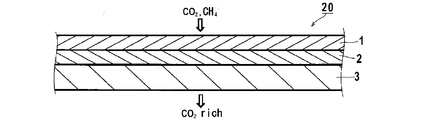
- FIG. 1 is a cross-sectional view schematically showing a gas separation composite membrane 10 which is a preferred embodiment of the present invention.
- 1 is a gas separation layer
- 2 is a support layer which consists of a porous layer.
- FIG. 2 is a cross-sectional view schematically showing a gas separation composite membrane 20 which is a preferred embodiment of the present invention.
- a nonwoven fabric layer 3 is added as a support layer in addition to the gas separation layer 1 and the porous layer 2.
- the upper side of the support layer means that another layer may be interposed between the support layer and the gas separation layer.
- the direction in which the gas to be separated is supplied is “upper”, and the direction in which the separated gas is emitted is “lower”.
- a gas separation layer may be formed and disposed on the surface or inner surface of the porous support, and at least on the surface, the composite membrane can be easily formed.
- a gas separation layer By forming a gas separation layer on at least the surface of the porous support, a composite membrane having the advantages of having both high separation selectivity, high gas permeability, and mechanical strength can be obtained.
- the thickness of the separation layer is preferably a thin film as much as possible under the condition of imparting high gas permeability while maintaining mechanical strength and separation selectivity.
- the thickness of the gas separation layer is not particularly limited, but is preferably 0.01 to 5.0 ⁇ m, and more preferably 0.1 to 1.0 ⁇ m.
- the porous support preferably applied to the support layer is not particularly limited as long as it has the purpose of meeting the provision of mechanical strength and high gas permeability.
- a porous film of an organic polymer is preferable, and the thickness thereof is 1 to 3000 ⁇ m, preferably 5 to 500 ⁇ m, and more preferably 5 to 150 ⁇ m.
- the pore structure of this porous membrane is usually that the average pore diameter is 10 ⁇ m or less, preferably 0.5 ⁇ m or less, more preferably 0.2 ⁇ m or less, and the porosity is preferably 20 to 90%. Preferably, it is 30 to 80%.
- the gas permeability is preferably 3 ⁇ 10 ⁇ 5 cm 3 (STP) / cm ⁇ sec ⁇ cmHg or more in terms of carbon dioxide permeation rate.
- porous membrane materials include conventionally known polymers such as polyolefin resins such as polyethylene and polypropylene, fluorine-containing resins such as polytetrafluoroethylene, polyvinyl fluoride, and polyvinylidene fluoride, polystyrene, cellulose acetate, and polyurethane. And various resins such as polyacrylonitrile, polyphenylene oxide, polysulfone, polyethersulfone, polyimide, and polyaramid.
- the support layer is made of polyacrylonitrile, polysulfone, polyphenylene oxide from the viewpoint of achieving excellent production suitability when the polyimide compound is applied and crosslinked, and simultaneously achieving high gas permeability and separation selectivity. It is preferable that it is made of polyacrylonitrile.
- the shape of the porous membrane can be any shape such as a flat plate shape, a spiral shape, a tubular shape, and a hollow fiber shape.
- the support layer is a thin and porous material because sufficient gas permeability can be secured.
- the thin film porous form is preferable.
- the gas separation composite membrane using the crosslinkable organic-inorganic hybrid structure adopted by the present invention can be formed under mild conditions, exhibiting an excellent effect, and having good suitability and product quality. It can demonstrate high performance on both sides.
- a support is formed as a support layer for forming the gas separation layer in order to further impart mechanical strength.
- the support include woven fabric, non-woven fabric, and net, and the non-woven fabric is preferably used from the viewpoint of film forming property and cost.
- the nonwoven fabric fibers made of polyester, polypropylene, polyacrylonitrile, polyethylene, polyamide or the like may be used alone or in combination.
- the nonwoven fabric can be produced, for example, by making a main fiber and a binder fiber uniformly dispersed in water using a circular net or a long net, and drying with a dryer.
- it is also preferable to apply a heat treatment by sandwiching a non-woven fabric between two rolls for the purpose of removing fluff and improving mechanical properties.
- the gas separation composite membrane of the present invention can be suitably used as a gas separation recovery method and a gas separation purification method.
- a gas separation membrane capable of efficiently separating a specific gas from a gas mixture containing a gas such as a perfluoro compound.
- a gas separation membrane for selectively separating carbon dioxide from a gas mixture containing carbon dioxide / hydrocarbon (methane), a production method thereof, a module using the same, and a separation device are preferable.
- the supplied gas is a mixed gas of carbon dioxide and methane
- the permeation rate of carbon dioxide at a high pressure of 40 ° C. and 40 atm is preferably more than 20 GPU, more preferably 20 to 300 GPU.
- the permeation rate ratio between carbon dioxide and methane (R CO2 / R CH4 ) is preferably 15 or more, more preferably 20 or more, and particularly preferably 20 to 50.
- the pressure of the supplied gas is preferably 10 atm or more, more preferably 20 atm or more, and preferably 30 atm or more. More preferably, it is particularly preferably 40 atm or more.
- Actual natural gas contains impurities such as long-chain hydrocarbons and toluene in addition to the main component methane.
- the composition and content of these hydrocarbon-based impurity gases vary greatly depending on the location where they are produced, so it is difficult to estimate the degree of influence, but the film may be plasticized or the free volume of the film
- the gas separation performance is stable even when it is 1 vol% or more, and 3 vol% or more. In some cases, it is more preferable to be stable, and even when it is 5 vol% or more, it is more preferable to be stable.
- the selective gas permeation is considered to involve a mechanism of dissolution / diffusion into the membrane, but taking advantage of this viewpoint, a separation membrane containing a polyethyleneoxy (PEO) composition has been studied (Journal of Membrane Science 1999). 160, 87-99). This is because carbon dioxide has a strong interaction with the polyethyleneoxy composition. Since this polyethyleneoxy membrane is a flexible rubber-like polymer membrane having a low glass transition temperature, the difference in diffusion coefficient due to the gas species is small, and the separation selectivity is mainly due to the effect of the difference in solubility. On the other hand, according to the present invention, the glass transition temperature of the polyimide compound applied thereto is high, and it can be greatly improved in terms of the thermal durability of the film while exhibiting the above-described dissolution / diffusion action. it can.
- PEO polyethyleneoxy
- the cross-linked organic-inorganic hybrid resin applied to the gas separation layer in the present invention has a structure in which a polymer incorporating a polyimide compound or an oxanthrene unit is cross-linked with a cross-linking chain including a site represented by the general formula (I).
- R a represents an alkyl group, a cycloalkyl group, an aryl group, an alkoxy group, an aryloxy group, or * —O — **.
- * Means a bond with M 1 in the formula. ** means a connecting part with adjacent M 1 .
- substituent Z described below are given for preferable alkyl groups, cycloalkyl groups, aryl groups, alkoxy groups, and aryloxy groups. Of these, an alkyl group, an alkoxy group, an aryloxy group, and the like are particularly preferable.
- R a preferably represents an alkyl group, an alkoxy group, or * —O — **. When R a represents an alkoxy group, a part of the sol-gel reaction is unreacted and remains as a reaction residue. Is preferable for realizing a stable cross-linked structure.
- M 1 represents a metal atom selected from the group consisting of Si, Ge, Mg, Al, Ti, Zr, and Sb. Si, Ge, Mg, and Ti are preferable, and Si and Ge are more preferable. It is also desirable that M 1 has an organic-inorganic hybrid structure in which different atoms are combined by combining a plurality of crosslinking agents described later.
- ⁇ P a Pa represents a polymer structure site incorporating a polyimide compound or an oxanthrene unit. Preferred ones for each resin are described in detail in the next section.
- ⁇ L a L a represents a connecting portion with adjacent M 1 .
- the site of the general formula (A) forms a silsesquioxane bond to form a cross-linked network. Since silicon has four bonds, the basic structural unit of polysiloxane is classified according to the number of organic groups typified by methyl and phenyl groups per silicon atom. It can be divided into two. In the following formula, R is an organic group.
- Silsesquioxane is a general term for polysiloxanes whose basic structural units are T units. Since silicon in silsesquioxane is bonded to three oxygens and oxygen is bonded to two silicons, the theoretical composition is RSiO 3/2 (the Latin word for three-half is “Sesquix (SESQUI) ").
- R means a bond with Pa in the above T unit formula.
- the three bonds may be bonded to adjacent M 1 (Si) or may be bonded to other constituent elements. That is, as described above, there are some unreacted moiety, does not constitute to -Si-O-Si- bonds may be made and the other groups defined by R a as the Si-R a .
- Polyimide compound structure The part having the structure of the polyimide compound in Pa is A repeating unit represented by the general formula (I); A polyimide compound containing a repeating unit represented by the general formula (III-a) or (III-b) is preferable.
- the structure of the polyimide compound may further include a repeating unit represented by the general formula (II-a) or the general formula (II-b) as necessary.
- each repeating unit only needs to contain at least one kind, and it means that a plurality of the same kind may be contained.
- R is a structural part containing one or more hydrocarbon rings having 4 to 12 carbon atoms.
- R is represented by the following general formula (1-a), formula (1-b), general formula (1-c), formula (1-d), formula (1-e), general formula (1-f), and An atomic group selected from the group consisting of formula (1-g) is preferable.
- the mother nucleus (R) is preferably the formulas (1-a), (1-b), (1-c), more preferably (1-a), (1-c), 1-a) is particularly preferred.
- X 1 , X 2 , X 3 X 1 , X 2 and X 3 each independently represent a single bond or a divalent linking group.
- R F represents a hydrogen atom or a substituent. When R F is a substituent, they may be linked to each other to form a condensed ring), * —O—. *, * -SO 2- *, * -CO- *, * -S- * are preferred, * -CR F 2- *, * -O- *, * -SO 2- *, * -CO -* Is more preferable.
- R F represents a substituent
- substituent Z include the substituent Z described below, among which a halogenated alkyl group is preferable, a fluorinated alkyl group is more preferable, and a trifluoromethyl group is particularly preferable.
- the phrase “may be bonded to each other to form a ring” means that a ring structure may be formed by condensing with a single bond, a double bond or the like to form a condensed ring structure. May be formed.
- ⁇ Y Y represents a methylene group or a vinylene group.
- a vinylene group is preferred.
- R 1 , R 2 R 1 and R 2 each independently represents a hydrogen atom or a substituent.
- any one selected from the substituent group Z shown below can be used independently.
- the following substituent Z is a preferred range unless otherwise specified.
- R 1 and R 2 may be bonded to each other to form a ring.
- R 1 and R 2 are preferably a hydrogen atom or an alkyl group, more preferably a hydrogen atom, a methyl group or an ethyl group, and even more preferably a hydrogen atom.
- R 3 , R 4 , R 5 R 3 , R 4 , and R 5 each independently represent a substituent, an alkyl group, a hydroxyl group, a carboxyl group, a sulfonic acid group, an amino group, a mercapto group, an amide group (carbamoyl group), an alkoxy group, a sulfonyl group-containing group ( Preferably an alkylsulfonyl group or the like, or a halogen atom.
- the preferred one is as defined for the substituent Z.
- L1, m1, and n1 representing the number of the substituents are integers of 0 to 4, preferably 1 to 4, and more preferably 3 to 4.
- R 3 , R 4 and R 5 are a plurality of alkyl groups, they may be bonded to each other to form a ring.
- R 6 , R 7 , R 8 R 6 , R 7 and R 8 each independently represent a substituent.
- the preferred one is as defined for the substituent Z.
- L2, m2, and n2 representing the number of substituents are integers of 0 to 3, preferably 1 to 4, and more preferably 2 to 3.
- J 1, J 2 J 1 and J 2 represent a single bond or a divalent linking group.
- * The J 2 eaves L 1 side, a phenylene group side of the bond when J 1, ** represents a bond and vice versa.
- R J1 to R J7 are each a hydrogen atom, an alkyl group, an aryl group, or an aralkyl group. Among them, * -CO-**, * -COO-**, * -CONR J1 -**, * -OCO-**, methylene group, phenylene group, or * -C 6 H 4 CO-** group It is preferable to represent.
- the preferred range of R J1 to R J7 is synonymous with the preferred range of the alkyl group and aryl group described in the substituent group Z. Of these, J 1 and J 2 are preferably * -CO-**, * -COO-** or * -OCO-**, and particularly preferably * -COO-**.
- ⁇ W 1 W 1 represents a single bond or a divalent linking group.
- the divalent linking group include a linear, branched or cyclic alkylene group (preferably an alkylene group having 1 to 30 carbon atoms, more preferably 1 to 12 carbon atoms, and still more preferably 1 to 4 carbon atoms).
- a linear, branched or cyclic alkylene group preferably an alkylene group having 1 to 30 carbon atoms, more preferably 1 to 12 carbon atoms, and still more preferably 1 to 4 carbon atoms.
- an alkyleneoxy group preferably having 1 to 30 carbon atoms, more preferably 1 to 12 carbon atoms, still more preferably carbon atoms.
- aralkylene group having 7 to 30 carbon atoms more preferably 7 to 13 carbon atoms.
- benzylidene, cinnamylidene, etc. an arylene group (preferably an arylene group having 6 to 30 carbon atoms, more preferably 6 to 15 carbon atoms, such as phenylene, cumenylene, mesitylene, tolylene, xylylene, etc.) And the like.
- the further substituent is preferably a hydroxy group or a halogen atom, more preferably a hydroxy group or a fluorine atom, and particularly preferably a fluorine atom.
- an ether bond is included in the molecule.
- ⁇ L 1 L 1 represents a divalent linking group, and specific examples thereof include the structural units represented by the following (L-1) to (L-35) or linking groups constituted by combining them. Can do.
- * of the following connecting group is a bond on the W 1 side, and ** is a bond on the J 2 side.
- L 1 is preferably (L-1) to (L-35), an alkylene group, an alkyleneoxy group or an arylene group, and more preferably an alkylene group or an alkyleneoxy group.
- ⁇ P p represents an integer of 0 or more.
- An integer represented by 0 to 10 is preferable, and an integer represented by 0 to 5 is more preferable.
- ⁇ Q q represents an integer of 1 or more and 4 or less.
- ⁇ Lb Lb means a connecting portion with M 1 in the general formula (A).
- the polymer structure part incorporating the oxanthrene unit preferably has a skeleton of an intrinsic porous resin (PIM: Polymer of Intrinsic Microporosity), a repeating unit represented by the following general formula (IV-a), and a general formula A compound containing a repeating unit represented by (IV-b) is preferred.
- PIM Polymer of Intrinsic Microporosity
- IV-a a repeating unit represented by the following general formula
- a compound containing a repeating unit represented by (IV-b) is preferred.
- each repeating unit only needs to contain at least one kind, and it means that a plurality of the same kind may be contained.
- R 10 to R 20 each independently represents a hydrogen atom or a substituent.
- substituent any one selected from the substituent group Z described later can be used.
- a hydrogen atom or an alkyl group, a cyano group, a halogen, a heterocyclic group, or a carboxyl group is preferable, and a hydrogen atom, a cyano group, or a carboxyl group is more preferable.
- J 3 and J 4 each represent a single bond or a divalent linking group.
- the preferred ranges are the same as J 1 , J 2 and W 1 , respectively.
- ⁇ L 2 L 2 represents a divalent linking group.
- the preferred range is the same as L 1 described above.
- ⁇ R r represents an integer of 0 or more.
- r is 2 or more, a plurality of L 2 and J 4 may be the same or different.
- ⁇ Y 1 , Y 2 Y 1 and Y 2 represent a carbon atom and an atomic group forming a ring with a benzene ring.
- it is an atomic group consisting of a carbon atom, an oxygen atom, a hydrogen atom, and / or a nitrogen atom, more preferably an atomic group consisting of a carbon atom, a hydrogen atom, and / or an oxygen atom.
- More preferred is an alkylene group having 1 to 4 carbon atoms or an alkyleneoxy group having 1 to 4 carbon atoms.
- Y 1 and Y 2 form a ring, they may have a substituent, and the substituent is selected from the substituent group Z described later. Especially, it is preferable that the alkyl group is substituted.
- ⁇ Lc Lc means a connecting portion with M 1 in the general formula (A).
- the crosslinked organic-inorganic hybrid film of the present invention comprises a polymer incorporating a polyimide compound or an oxanthrene unit, and a crosslinking agent having a metal atom M 1 below (preferably, a crosslinking agent represented by the following general formula (B)). It is desirable that the coating solution is formed on the support layer by applying a crosslinking reaction by irradiating the coating solution with actinic radiation or applying heat.
- a 2 represents a reactive group, preferably a hydroxyl group, an alkenyl group, an alkynyl group, an amino group, a cyano group, an alkoxy group, an isocyanate group or a mercapto group, more preferably an alkenyl group, an alkoxy group, Represents an amino group or a mercapto group.
- Preferred examples of the alkenyl group and alkynyl group include the examples of the substituent Z described later.
- a vinyl group is particularly preferred.
- L 2 O represents a single bond or a linking group.
- the linking group an alkylene group having 1 to 10 carbon atoms (more preferably 1 to 6 carbon atoms, more preferably 1 to 3 carbon atoms), an alkenylene group having 2 to 10 carbon atoms (more preferably 2 to 6 carbon atoms, further Preferably 2 to 4), an arylene group having 6 to 22 carbon atoms (more preferably 6 to 10 carbon atoms), a carbonyl group, an ether group (—O—), a thioether group (—S—), an imino group (—NR N- : RN is preferably an alkyl group having 1 to 6 carbon atoms, more preferably 1 to 3 carbon atoms, or a linking group in combination of these.
- an alkylene group having the above carbon number an alkenylene group having the above carbon number, a carbonyl group, an oxycarbonyl group, a carbonyloxy group, a carbonate group, an amide group, a urethane group, (an oligo group having 1 to 20 carbon atoms) )
- preferred examples include the alkylene group having the carbon number, the alkenylene group having the carbon number, the (oligo) alkyleneoxy group having the carbon number, the carbonyl (oligo) oxyalkylene group having the carbon number, and the carbonyl having the carbon number.
- An oxy (oligo) alkyleneoxy group, an alkylene (oligo) iminoalkylene group having the above carbon number, and a carbonyl (oligo) iminoalkylene group having the above carbon number are preferable.
- Lr is preferably an alkylene group having 1 to 6 carbon atoms, and more preferably an alkylene group having 1 to 3 carbon atoms. A plurality of Lr, R N , x, etc. need not be the same.
- R 2 O represents an alkyl group (preferably having 1 to 12 carbon atoms, more preferably 1 to 6 carbon atoms, particularly preferably 1 to 3 carbon atoms), an aryl group (preferably having 6 to 22 carbon atoms, more preferably 6 to 14 carbon atoms), an alkoxy group. (Preferably having 1 to 12 carbon atoms, more preferably 1 to 6 carbon atoms, particularly preferably 1 to 3 carbon atoms) or an aryloxy group (preferably having 6 to 22 carbon atoms and more preferably 6 to 14 carbon atoms).
- ⁇ L 3 L 3 represents a single bond or a divalent linking group.
- the linking group include the structural units represented by the above (L-1) to (L-35) or a linking group constituted by a combination thereof.
- R 21, R 22, R 23 R 21 , R 22 and R 23 represent an alkyl group, a cycloalkyl group, an aryl group, an alkoxy group, or an aryloxy group, and more preferably an alkoxy group.
- substituent Z described below are given for preferable alkyl groups, cycloalkyl groups, aryl groups, alkoxy groups, and aryloxy groups. Of these, an alkyl group, an alkoxy group, an aryloxy group, and the like are particularly preferable.
- Two or more of R 21 to R 23 and A 2 may be bonded to each other to form a ring.
- ⁇ M 1 M 1 has the same meaning as M 1 in formula (A).
- the polyimide compound is preferably a polymer having a repeating unit represented by the general formula (I) and a repeating unit represented by the following general formula (VI-a) or (VI-b). .
- the polyimide compound may further have a repeating unit represented by the general formula (II-a) or (II-b).
- a 1 represents a reactive group, preferably a hydroxyl group, a carboxyl group, a sulfonic acid group, an alkenyl group, an alkoxy group, an alkynyl group or a mercapto group, more preferably a hydroxyl group, a carboxyl group, an alkenyl group, It is a mercapto group, more preferably a carboxyl group, an alkenyl group, or a mercapto group, and particularly preferably a carboxyl group or a mercapto group.
- R 6 , R 7 , R 8 , J 1 , 12, m 2, n 2, X 3 , q are as defined above for general formula (III-a) or general formula (III-b), respectively.
- the preferred range is also the same.
- Polyimide can be synthesized by condensation polymerization of acid anhydride and diamine.
- the method the method described in a general book (for example, published by NTS, edited by Ikuo Imai, Rikio Yokota, latest polyimide-basics and applications-pages 3-49, etc.) is appropriately selected. be able to.
- Specific examples of general acid anhydrides that can be used in the present invention include the following.
- Polymer incorporating oxanthrene unit As the polymer incorporating the oxanthrene unit, a polymer compound containing at least one repeating unit represented by the general formula (V) is more preferable.
- the polymer may have a repeating unit represented by the general formula (IV-a).
- R 16 to R 20 , Y 1 , Y 2 and J 3 are synonymous with those in the general formula (IV-b), and preferred ranges thereof are also synonymous.
- a 1 has the same meaning as A 1 in the general formula (VI-a) or general formula (VI-b), the preferable ranges thereof are also the same.
- an appropriate organic alkoxide compound can be selected and added after selecting an appropriate polymer, whereby an arbitrary organic-inorganic hybrid structure, composition ratio, and crosslinking density can be obtained.
- an appropriate polymer whereby an arbitrary organic-inorganic hybrid structure, composition ratio, and crosslinking density can be obtained.
- Obtainable In general, when the gas separation membrane is crosslinked, the free volume space is reduced, and thus the gas permeability is remarkably reduced.
- the reduction is caused by the organic-inorganic hybrid membrane crosslinked by the sol-gel method. The rate is small as compared with other crosslinking methods, and even if the inorganic alkoxide is increased, the separation selectivity is improved while suppressing the decrease in gas permeability.
- a stronger cross-linked film can be obtained by acid-base interaction with a polymer having a carboxyl group or an enethiol reaction with a polymer having a thiol group. It is easily soluble in organic solvents that are highly suitable for film formation, and can also cause a sol-gel reaction by irradiating actinic radiation in the presence of a photo-radical acid generator. A gas separation membrane having a structure can be obtained.
- the term “compound” or “resin” when added at the end, or a specific compound is indicated by its name or formula, it includes the salt itself and its ion in addition to the compound itself. Use for meaning. In addition, it is meant to include a derivative with a predetermined substituent or modified in a predetermined form within a range where a desired effect is exhibited. Further, in this specification, when the term “group” is added to the end of the description, or when a specific compound is referred to by its name, the group or compound may have an arbitrary substituent. Meaning.
- Substituent group Z An alkyl group (preferably an alkyl group having 1 to 30 carbon atoms, more preferably 1 to 20 carbon atoms, particularly preferably 1 to 10 carbon atoms, such as methyl, ethyl, Iso-propyl, tert-butyl, n-octyl) , N-decyl, n-hexadecyl), a cycloalkyl group (preferably a cycloalkyl group having 3 to 30 carbon atoms, more preferably 1 to 20 carbon atoms, particularly preferably 3 to 10 carbon atoms, such as cyclopropyl, Cyclopentyl, cyclohexyl, etc.), an alkenyl group (preferably an alkenyl group having 2 to 30 carbon atoms, more preferably 2 to 20 carbon atoms, particularly preferably 2 to 10 carbon atoms, such as vinyl, allyl, -Butenyl, 3-pentenyl, etc.), al
- An aryl group having 6 to 12 carbon atoms particularly preferably phenyl, p-methylphenyl, naphthyl, anthranyl, etc., an amino group (preferably having 0 to 30 carbon atoms, more preferably carbon
- an alkoxy group preferably A carbon atom having 1 to 30 carbon atoms, more preferably 1 to 20 carbon atoms, and particularly preferably 1 to 10 carbon atoms.
- a alkoxy group such as methoxy, ethoxy, butoxy, 2-ethylhexyloxy, etc.
- an aryloxy group preferably having 6 to 30 carbon atoms, more preferably 6 to 20 carbon atoms, particularly preferably carbon atoms.
- 6-12 aryloxy groups such as phenyloxy, 1-naphthyloxy, 2-naphthyloxy and the like, and heterocyclic oxy groups (preferably having 1 to 30 carbon atoms, more preferably 1 to carbon atoms).
- a heterocyclic oxy group having 1 to 12 carbon atoms such as pyridyloxy, pyrazyloxy, pyrimidyloxy, quinolyloxy and the like.
- An acyl group (preferably an acyl group having 1 to 30 carbon atoms, more preferably 1 to 20 carbon atoms, particularly preferably 1 to 12 carbon atoms, such as acetyl, benzoyl, formyl, pivaloyl, etc.), alkoxy A carbonyl group (preferably an alkoxycarbonyl group having 2 to 30 carbon atoms, more preferably 2 to 20 carbon atoms, particularly preferably 2 to 12 carbon atoms, such as methoxycarbonyl, ethoxycarbonyl, etc.), aryloxy A carbonyl group (preferably an aryloxycarbonyl group having 7 to 30 carbon atoms, more preferably 7 to 20 carbon atoms, particularly preferably 7 to 12 carbon atoms, such as phenyloxycarbonyl), an acyloxy group ( Preferably 2-30 carbon atoms, more preferably 2-20 carbon atoms, especially Preferably, it is an acyloxy group having 2 to 10 carbon atoms, such as acet
- alkoxycarbonylamino group preferably an alkoxycarbonylamino group having 2 to 30 carbon atoms, more preferably 2 to 20 carbon atoms, particularly preferably 2 to 12 carbon atoms, such as methoxycarbonylamino
- aryl Oxycarbonylamino group preferably an aryloxycarbonylamino group having 7 to 30 carbon atoms, more preferably 7 to 20 carbon atoms, particularly preferably 7 to 12 carbon atoms, and examples thereof include phenyloxycarbonylamino group
- a sulfonylamino group preferably having 1 to 30 carbon atoms, more preferably 1 to 20 carbon atoms, particularly preferably 1 to 12 carbon atoms, such as methanesulfonylamino, benzenesulfonylamino, etc.
- a sulfamoyl group Preferably 0-30 carbon atoms, more preferred 0 to 20 carbon atoms, particularly preferably a sulfam
- a carbamoyl group (preferably a carbamoyl group having 1 to 30 carbon atoms, more preferably 1 to 20 carbon atoms, particularly preferably 1 to 12 carbon atoms, and examples thereof include carbamoyl, methylcarbamoyl, diethylcarbamoyl, phenylcarbamoyl and the like.
- An alkylthio group preferably an alkylthio group having 1 to 30 carbon atoms, more preferably 1 to 20 carbon atoms, particularly preferably 1 to 12 carbon atoms, such as methylthio and ethylthio
- an arylthio group Preferably, it is an arylthio group having 6 to 30 carbon atoms, more preferably 6 to 20 carbon atoms, particularly preferably 6 to 12 carbon atoms, such as phenylthio, etc.
- a heterocyclic thio group preferably having 1 carbon atom
- a heterocyclic thio group e.g. pyridylthio, 2-benzoxazolyl thio, and 2-benzthiazolylthio the like.
- a sulfonyl group (preferably a sulfonyl group having 1 to 30 carbon atoms, more preferably 1 to 20 carbon atoms, particularly preferably 1 to 12 carbon atoms, such as mesyl, tosyl, etc.), a sulfinyl group (preferably A sulfinyl group having 1 to 30 carbon atoms, more preferably 1 to 20 carbon atoms, particularly preferably 1 to 12 carbon atoms, such as methanesulfinyl, benzenesulfinyl, etc.), ureido group (preferably having 1 carbon atom) -30, more preferably a ureido group having 1 to 20 carbon atoms, particularly preferably 1 to 12 carbon atoms, such as ureido, methylureido, phenylureido, etc.), a phosphoramide group (preferably having a carbon number) A phosphoric acid amide group having 1 to 30, more preferably 1 to 20 carbon
- hetero atom examples include a nitrogen atom, oxygen atom, sulfur atom, specifically imidazolyl, pyridyl, quinolyl, furyl, thienyl, piperidyl, morpholino, benzoxazolyl, benzimidazolyl, benzthiazolyl, carbazolyl Group, azepinyl group, etc.), silyl group (preferably a silyl group having 3 to 40 carbon atoms, more preferably 3 to 30 carbon atoms, particularly preferably 3 to 24 carbon atoms, such as trimethylsilyl, triphenyl Silyl, etc.), silyloxy groups (preferably having 3 to 0, more preferably from 3 to 30 carbon atoms, particularly preferably a silyloxy group having 3 to 24 carbon atoms, for example trimethylsilyloxy, etc.
- silyl group preferably a silyl group having 3 to 40 carbon atoms, more preferably 3 to 30 carbon atoms, particularly preferably 3 to 24 carbon atom
- substituents may be further substituted with any one or more substituents selected from the above substituent group Z.
- substituents when one structural site has a plurality of substituents, these substituents are connected to each other to form a ring, or condensed with a part or all of the above structural sites to form an aromatic group. A ring or an unsaturated heterocyclic ring may be formed.
- polymers are listed below, but the present invention is not limited thereto.
- these polymers may be combined with a crosslinking agent described later, or may be used alone when the polymer contains an inorganic alkoxide component.
- the molecular weight is a weight average molecular weight.
- the polymer according to the present invention may be a copolymer with another monomer.
- examples of other monomers used include acrylic esters, methacrylic esters, acrylamides, methacrylamides, vinyl esters, styrenes, acrylic acid, methacrylic acid, acrylonitrile, maleic anhydride, maleic imide, etc. These known monomers are also included. By copolymerizing such monomers, various physical properties such as film forming property, film strength, hydrophilicity, hydrophobicity, solubility, reactivity, and stability can be improved.
- Examples of monomer synthesis methods include, for example, ester synthesis items in “5th edition, Experimental Chemistry Course 16: Synthesis of Organic Compounds (II-1)” edited by The Chemical Society of Japan, Maruzen Co., Ltd., and “5th edition, Experimental Chemistry Course 26, Polymer”.
- the handling of the monomer in “Chemistry”, items of purification, etc. can be referred to.
- crosslinking agent that can be used in combination with the polymer of the present invention are listed below, but the present invention is not limited thereto.
- the gas separation membrane of the present invention can be formed by curing by applying some energy such as heat or light.
- an oligomer or prepolymer may be used as the monomer corresponding to the partial structure of the polymer incorporating the polyimide compound or oxanthrene unit.
- the polymer for obtaining the polymer compound may be a block copolymer, or a copolymer having any form such as a random copolymer or a graft copolymer.
- the ratio of the partial structures represented by the general formulas (I), (II-a), (II-b), (III-a), (III-b) is not particularly specified.
- the composition ratio is preferably 1 to 50% by mass, preferably 5 to 30% by mass.
- the composition ratio is not limited to this range, and the purpose is for gas separation (recovery rate, purity, etc.). The gas permeability and separation selectivity are adjusted by changing the composition ratio accordingly.
- the copolymerization ratio (R III ) of the structural units of -a) and (III-b) is not particularly limited, but is preferably the following.
- Preferred More preferred Particularly preferred R II 0 to 90 mol% 1 to 60 mol% 5 to 30 mol% R III 0.1 to 90 mol% 5 to 50 mol% 5 to 30 mol% R IV 0 to 90 mol% 0.1 to 90 mol% 1 to 90 mol% * R IV is the copolymerization ratio of other structural units.
- R I R II + R III + R IV is satisfied.
- the molecular weight of the polymer incorporating the polyimide compound or oxanthrene unit is not particularly limited because it is a crosslinked film.
- the polymer corresponding to each partial structure preferably has a weight average molecular weight of 1,000 to 1,000,000, more preferably 5,000 to 500,000, and still more preferably 5,000 to 100,000.
- the molecular weight and the degree of dispersion are values measured using a GPC (gel filtration chromatography) method, and the molecular weight is a weight average molecular weight in terms of polystyrene.
- the gel packed in the column used in the GPC method is preferably a gel having an aromatic compound as a repeating unit, and examples thereof include a gel made of a styrene-divinylbenzene copolymer. Two to six columns are preferably connected and used.
- the solvent used include ether solvents such as tetrahydrofuran and amide solvents such as N-methylpyrrolidinone.
- the measurement is preferably performed at a solvent flow rate in the range of 0.1 to 2 mL / min, and most preferably in the range of 0.5 to 1.5 mL / min. By performing the measurement within this range, the apparatus is not loaded and the measurement can be performed more efficiently.
- the measurement temperature is preferably 10 to 50 ° C, most preferably 20 to 40 ° C.
- the column and carrier to be used can be appropriately selected according to the physical properties of the polymer compound to be measured.
- the ratio [ ⁇ ] (number of crosslinking sites / number of imide groups) of imide groups and crosslinking sites of the polyimide compound in the crosslinked polyimide compound is preferably 0.13 or more. 15 or more is more preferable, and 0.3 or more is more preferable. Moreover, 0.49 or less is preferable, 0.48 or less is more preferable, 0.46 or less is further more preferable, and 0.4 or less is especially preferable.
- crosslinking site ratio [(eta)] is based on the number of crosslinkable functional groups that have been cross-linked, and excludes the number of crosslinkable functional groups that have been introduced into the polyimide compound but have not been cross-linked. Calculated value (ratio). In general, it is known that even if the crosslinking site ratio is as low as about 1 to 2% ( ⁇ 0.01 to 0.02), the properties as a crosslinked film are sufficiently exhibited.
- the proportion of functional cross-linking groups (for example, cross-linkable functional group density [ ⁇ ] described later) is appropriately adjusted during the synthesis of the polyimide compound, or the cross-linking reaction conditions are changed. Or by adjusting the cross-linking conversion rate (for example, the ratio of the number of cross-linked functional groups to the total number of cross-linkable functional groups (cross-linking conversion rate) [ ⁇ ]).
- the cross-linking conversion rate for example, the ratio of the number of cross-linked functional groups to the total number of cross-linkable functional groups (cross-linking conversion rate) [ ⁇ ]).
- the cross-linking site ratio can be increased by increasing the composition ratio of the monomer having a cross-linking site within a predetermined range, increasing the reactivity, polyfunctionalizing, or using a material having another cross-linkable substituent. [ ⁇ ] can be increased.
- the ratio of the number of functional groups Lb in the general formula (III-a) to the general formula (III-b) to the repeating unit represented by the general formula (I) is referred to as a crosslinkable functional group density [ ⁇ ].
- the preferred range of ⁇ (number of functional groups Lb / number of repeating units represented by formula (I)) is preferably 0.1 or more, more preferably 0.3 or more, and more preferably Is 0.5 or more, more preferably 0.6 or more, and most preferably 0.7 or more.
- the upper limit is not particularly limited, but is practically 2.0 or less, and preferably 0.95 or less.
- a crosslinkable density [ ⁇ ] can be calculated assuming that the number of oxanthrene rings corresponds to the number of the general formula (I).
- a preferable range is shown for each polymer type, it is preferably 0.6 or more, more preferably 0.7 or more in the case of a polyimide resin.
- 0.95 or less is practical.
- an oxanthrene-based resin it is preferably 1.2 or more, and more preferably 1.4 or more.
- 4 or less is practical.
- ⁇ represents the density of polar groups and can be a parameter that affects the gas separation selectivity. Is done. According to the present inventor's knowledge so far, when the ratio of the polar groups is increased, the interaction between the polymer chains becomes stronger, so that the density of the film increases. That is, both the ratio of the free volume in the film and the average size of the free volume space are reduced. When the average size of the free volume is reduced, the separation selectivity of the gas molecule diffusion coefficient due to the size of the gas molecule is improved, so that the separation selectivity is improved while the proportion of the free volume space is reduced. On the other hand, gas permeability tends to decrease.
- This crosslinkable functional group density can be adjusted by the amount of substrate (monomer) charged when the polyimide compound is synthesized.
- the cross-linking conversion rate [ ⁇ ] of the present invention is generally difficult to analyze because it is a cross-linked film.
- the peak of —O—M 1 —O— bond M 1 is synonymous with the general formula (A) .
- M 1 is Si, it is generally 1100 cm ⁇ 1
- the crosslinking conversion rate is preferably 20% or more and 100% or less, more preferably 50% or more and 94% or less, and further preferably 30% or more and 89% or less.
- This crosslinking conversion rate can be adjusted by the addition amount of the crosslinking agent and the crosslinking conditions of the sol-gel reaction of the compound.
- the total energy of heat or light energy is increased, or if the material is a photoinitiator (such as a ketone compound) that is a polymerization initiator or Increasing the activity of a thermal initiator (such as a compound having a low decomposition temperature if it is an azo compound) can be mentioned.
- a photoinitiator such as a ketone compound
- a thermal initiator such as a compound having a low decomposition temperature if it is an azo compound
- the method for producing a gas separation membrane of the present invention is preferably a production method in which a coating liquid containing the polyimide compound is applied to a support and the coating film is formed by irradiating with active radiation.
- the component composition of the coating liquid (dope) for comprising a coating film is not specifically limited, It is preferable that the said polyimide compound and a polymerization initiator are included in the organic solvent.
- the content of the polyimide compound is not particularly limited, but is preferably 0.1 to 30% by mass and more preferably 1 to 10% by mass in the coating solution.
- the concentration is lower than the above lower limit value
- the surface layer that contributes to separation may be defective because it easily penetrates into the lower layer.
- the layer thickness or permeability is reduced due to high concentration in the pores. Can be minimized.
- the gas separation membrane of the present invention can be appropriately produced by adjusting the molecular weight, structure, composition, and solution viscosity of the polymer in the separation layer.
- the heating temperature is not particularly limited, but is preferably 100 ° C. or less, more preferably 70 ° C. or less in consideration of suppression of deterioration of the support due to excessive heating. From the viewpoint of efficient heat treatment, the temperature is preferably 20 ° C. or higher, and more preferably 40 ° C. or higher.
- the heating time is not particularly limited, but is practically 10 minutes or longer and 16 hours or shorter.
- the organic solvent is not particularly limited, but hydrocarbon organic solvents such as n-hexane and n-heptane, ester organic solvents such as methyl acetate, ethyl acetate and butyl acetate, methanol, ethanol, n- Lower alcohols such as propanol, isopropanol, n-butanol, isobutanol, tert-butanol, aliphatic ketones such as acetone, methyl ethyl ketone, methyl isobutyl ketone, diacetone alcohol, cyclopentanone, cyclohexanone, ethylene glycol, diethylene glycol, triethylene glycol Glycerin, propylene glycol, ethylene glycol monomethyl or monoethyl ether, propylene glycol methyl ether, dipropylene glycol methyl ether, tripropylene glycol Ether organic solvents such as chill ether, ethylene glycol
- organic solvents are appropriately selected as long as they do not adversely affect the substrate, such as ester-based (preferably butyl acetate), alcohol-based (preferably methanol, ethanol, isopropanol).
- ester-based preferably butyl acetate
- alcohol-based preferably methanol, ethanol, isopropanol
- Isobutanol aliphatic ketones (preferably methyl ethyl ketone, methyl isobutyl ketone, diacetone alcohol, cyclopentanone, cyclohexanone)
- ether type ethylene glycol, diethylene glycol monomethyl ether, methyl cyclopentyl ether
- these can be used 1 type or in combination of 2 or more types.
- the actinic radiation is not particularly limited as long as it can impart energy capable of generating an initiating species in the film composition by the irradiation, and ⁇ -rays, ⁇ -rays, X-rays, ultraviolet rays, Including visible light, electron beam, and the like.
- ultraviolet rays and electron beams are preferred from the viewpoint of curing sensitivity and device availability, and ultraviolet rays are particularly preferred.
- the acceleration voltage is 30 to 1000 kV, preferably 50 to 300 kV.
- the absorbed dose is preferably 5 to 200 kGy (0.5 to 20 Mrad), more preferably 20 to 100 kGy (2 to 10 Mrad).
- the atmosphere in which the electron beam is irradiated is preferably a nitrogen atmosphere with an oxygen concentration of 200 ppm or less. Within this range, the crosslinking and curing reaction in the vicinity of the surface proceeds well.
- a mercury lamp is used as the ultraviolet light source.
- the mercury lamp uses a lamp of 20 to 240 W / cm 2 and is used at a speed of 0.3 to 20 m / min.
- the distance between the membrane and the mercury lamp is preferably 1 to 30 cm.
- UV / EB Curing Technology published by General Technology Center Co., Ltd.
- Applied Technology for Low Energy Electron Beam Irradiation 2000, issued by CMC Co., Ltd.
- the photopolymerization initiator in the present invention is a compound that undergoes a chemical change through the action of light or interaction with the electronically excited state of a sensitizing dye to generate at least one of radicals, acids, and bases. It is.
- the photopolymerization initiator is an active light to be irradiated, for example, 400 to 200 nm ultraviolet rays, far ultraviolet rays, g rays, h rays, i rays, KrF excimer laser rays, ArF excimer laser rays, electron rays, X rays, molecular rays. Or what has a sensitivity to an ion beam etc. can be selected suitably, and can be used.
- Preferred photopolymerization initiators include (a) aromatic ketones, (b) aromatic onium salt compounds, (c) organic peroxides, (d) hexaarylbiimidazole compounds, (e) ketoxime ester compounds, f) borate compounds, (g) azinium compounds, (h) metallocene compounds, (i) active ester compounds, (j) compounds having a carbon halogen bond, and the like.
- aromatic ketones include “RADIATION CURING IN POLYMER SCIENCE AND TECHNOLOGY” P. FOUASSIER J. F. Examples thereof include compounds having a benzophenone skeleton or a thioxanthone skeleton as described in RABEK (1993), p77-117. More preferable examples of (a) aromatic ketones include ⁇ -thiobenzophenone compounds described in JP-B-47-6416, benzoin ether compounds described in JP-B-47-3981, and ⁇ -substituted benzoin compounds described in JP-B-47-22326.
- JP-A-2-211452 P-Di (dimethylaminobenzoyl) benzene JP-A 61-194062 discloses a thio-substituted aromatic ketone
- JP-B-2-9597 discloses an acylphosphine sulfide
- JP-B-2-9596 discloses an acylphosphine
- JP-B-63-61950 discloses Examples thereof include thioxanthones and coumarins described in JP-B-59-42864.
- aromatic onium salts elements of Group V, VI and VII of the Periodic Table, specifically N, P, As, Sb, Bi, O, S, Se, Te, or I fragrances Group onium salts are included.
- diazonium salts such as benzenediazonium which may have a substituent
- diazonium salt resins formaldehyde resin of diazodiphenylamine, etc.
- N-alkoxy described in each specification of U.S. Pat. No. 2,833,827 Pyridinium salts etc.
- Japanese Patent No. 4,743,528, JP-A-63-138345, JP-A-63-142345, JP-A-63-142346, JP-B-46-42363, etc. Specifically, 1-methoxy-4-phenylpyridinium, tetrafluoroborate, etc.
- the compounds described in each publication are preferably used. These generate radicals and acids as active species.
- Organic peroxide includes almost all organic compounds having one or more oxygen-oxygen bonds in the molecule. Examples thereof include 3,3′4,4′-tetra- ( t-butylperoxycarbonyl) benzophenone, 3,3'4,4'-tetra- (t-amylperoxycarbonyl) benzophenone, 3,3'4,4'-tetra- (t-hexylperoxycarbonyl) benzophenone 3,3'4,4'-tetra- (t-octylperoxycarbonyl) benzophenone, 3,3'4,4'-tetra- (cumylperoxycarbonyl) benzophenone, 3,3'4,4'- Peroxide esters such as tetra- (p-isopropylcumylperoxycarbonyl) benzophenone and di-t-butyldiperoxyisophthalate are preferred.
- hexaarylbiimidazoles examples include lophine dimers described in JP-B Nos. 45-37377 and 44-86516, such as 2,2′-bis (o-chlorophenyl) -4,4 ′, 5.
- ketoxime esters 3-benzoyloxyiminobutan-2-one, 3-acetoxyiminobutan-2-one, 3-propionyloxyiminobutan-2-one, 2-acetoxyiminopentane-3-one 2-acetoxyimino-1-phenylpropan-1-one, 2-benzoyloxyimino-1-phenylpropan-1-one, 3-p-toluenesulfonyloxyiminobutan-2-one, 2-ethoxycarbonyloxy And imino-1-phenylpropan-1-one.
- Examples of (f) borate salts which are other examples of photopolymerization initiators that can be used in the present invention include US Pat. Nos. 3,567,453, 4,343,891 and European Patent 109. , 772 and 109,773, and the like.
- Other examples of the photopolymerization initiator examples include JP-A 63-138345, JP-A 63-142345, JP-A 63-142346, and JP-A 63-142346. Examples include compounds having an N—O bond described in JP-A-63-143537 and JP-B-46-42363.
- Examples of (h) metallocene compounds that are other examples of photopolymerization initiators include JP-A-59-152396, JP-A-61-151197, JP-A-63-41484, and JP-A-2. And titanocene compounds described in JP-A No.-249 and JP-A-2-4705, and iron-arene complexes described in JP-A-1-304453 and JP-A-1-152109. Specific examples of the titanocene compound include di-cyclopentadienyl-Ti-di-chloride, di-cyclopentadienyl-Ti-bis-phenyl, and di-cyclopentadienyl-Ti-bis-2,3.
- Examples of the active ester compound include EP 0290750, 046083, 156153, 271851, and 0388343, U.S. Pat. No. 3,901,710. Nitrobenzester compounds described in JP-A-60-198538 and JP-A-53-133022, European Patent 0199672, Nos. 84515, 199672, 0441115, and 0101122, U.S. Pat. Nos. 4,618,564, 4,371,605, and 4,431,774.
- Preferable examples of the compound having a carbon halogen bond include, for example, Wakabayashi et al., Bull. Chem. Soc. Examples include compounds described in Japan, 42, 2924 (1969), compounds described in British Patent 1388492, compounds described in JP-A-53-133428, compounds described in German Patent 3333724, and the like. .
- the organic-inorganic hybrid structure in the present invention is preferably constructed by a sol-gel reaction (reference: Sakuo Sakuo, development of sol-gel method application, CMC Publishing).
- the sol-gel reaction is a reaction in which water is added to an inorganic alkoxide for hydrolysis, and the reaction is promoted in the presence of an acid or a base. Therefore, an activator that generates radicals and further acids or bases upon irradiation with actinic radiation is more preferably used in the present invention.
- O-tosylbenzoin (CAS: 1678-43-9) or the like is preferably used as a photoacid radical generator (reference: 1) Photo-curing of acrylic-functional alkoxysilane a) Hiroshi Inoue, Matsukawa Koyo, Toshikatsu Arisu, Yoshiko Tanaka, Noboru Nishioka, Network Polymer, 19, 195 (1998); Inoue, K.K. Matsukawa, Y.M. Tanaka, N.A. Nishioka, J.A. Photopolym. Sci. Technol. , 12, 129 (1999). 2) Photocuring of acrylic-silica organic-inorganic hybrid H. Inoue, Y. Matsuura, K.M. Matsukawa, Y.M. Otani, N. Higashi, M.H. Niwa, J .; Photopolym. Sci. Technol. , 13, 109 (2000). ).
- the amount of the polymerization initiator used is preferably 0.001 to 10 parts by mass, more preferably 0.01 to 5 parts by mass with respect to 1 part by mass of the polymerizable compound.
- a known compound having an action such as further improving sensitivity or suppressing polymerization inhibition by oxygen may be further added as a co-sensitizer.
- cosensitizers include amines such as M.I. R. Sander et al., “Journal of Polymer Society”, Volume 10, 3173 (1972), Japanese Patent Publication No. 44-20189, Japanese Patent Publication No. 51-82102, Japanese Patent Publication No. 52-134692, Japanese Patent Publication No. 59-138205. No. 60-84305, JP-A 62-18537, JP-A 64-33104, Research Disclosure 33825, and the like. Specific examples include triethanol. Examples include amines, ethyl p-dimethylaminobenzoate, p-formyldimethylaniline, p-methylthiodimethylaniline.
- examples include thiols and sulfides such as those described in JP-A-53-702, JP-B-55-500806, JP-A-5-142773, and JP-A-56-75643.
- examples include disulfide compounds, and specific examples include 2-mercaptobenzothiazole, 2-mercaptobenzoxazole, 2-mercaptobenzimidazole, 2-mercapto-4 (3H) -quinazoline, ⁇ -mercaptonaphthalene, and the like.
- Other examples include amino acid compounds (eg, N-phenylglycine), organometallic compounds described in Japanese Patent Publication No. 48-42965 (eg, tributyltin acetate), and Japanese Patent Publication No. 55-34414.
- Hydrogen donors sulfur compounds (eg, trithiane) described in JP-A-6-308727, phosphorus compounds (diethylphosphite, etc.) described in JP-A-6-250387, Japanese Patent Application No. 6-191605 Examples thereof include Si—H and Ge—H compounds described in the specification.
- Various polymer compounds can be added to the gas separation membrane of the present invention in order to adjust the membrane properties.
- High molecular compounds include acrylic polymer, polyurethane resin, polyamide resin, polyester resin, epoxy resin, phenol resin, polycarbonate resin, polyvinyl butyral resin, polyvinyl formal resin, shellac, vinyl resin, acrylic resin, rubber resin Waxes and other natural resins can be used. Two or more of these may be used in combination.
- nonionic surfactants, cationic surfactants, organic fluoro compounds, and the like can be added to adjust liquid properties.
- the surfactant include alkylbenzene sulfonate, alkylnaphthalene sulfonate, higher fatty acid salt, sulfonate of higher fatty acid ester, sulfate ester of higher alcohol ether, sulfonate of higher alcohol ether, higher alkyl
- Anionic surfactants such as alkyl carboxylates of sulfonamides, alkyl phosphates, polyoxyethylene alkyl ethers, polyoxyethylene alkyl phenyl ethers, polyoxyethylene fatty acid esters, sorbitan fatty acid esters, ethylene oxide adducts of acetylene glycol,
- Nonionic surfactants such as ethylene oxide adducts of glycerin and polyoxyethylene sorbitan fatty acid esters, and other amphoteric boundaries such as alkyl betaines and amide betaines
- polymer dispersant examples include polyvinyl pyrrolidone, polyvinyl alcohol, polyvinyl methyl ether, polyethylene oxide, polyethylene glycol, polypropylene glycol, and polyacrylamide.
- polyvinyl pyrrolidone is also preferably used.
- the conditions for forming the gas separation membrane of the present invention are not particularly limited, but the temperature is preferably ⁇ 30 to 100 ° C., more preferably ⁇ 10 to 80 ° C., and particularly preferably 5 to 50 ° C.
- a gas such as air or oxygen may coexist at the time of forming the film, but it is preferably in an inert gas atmosphere.
- an organic solvent can be added as a medium.
- organic solvents that can be used include hydrocarbon organic solvents such as n-hexane and n-heptane, ester organic solvents such as methyl acetate, ethyl acetate, and butyl acetate, methanol, Lower alcohols such as ethanol, n-propanol, isopropanol, n-butanol, isobutanol, tert-butanol, aliphatic ketones such as acetone, methyl ethyl ketone, methyl isobutyl ketone, diacetone alcohol, ethylene glycol, diethylene glycol, triethylene glycol, glycerin , Propylene glycol, ethylene glycol monomethyl or monoethyl ether, propylene glycol methyl ether, dipropylene glycol methyl ether, tripropylene glycol methyl ether,
- the thickness of the gas separation membrane of the present invention is preferably from 0.01 to 100 ⁇ m, more preferably from 0.1 to 2 ⁇ m.
- the method for separating a gas mixture of the present invention is a method of separating an acidic gas from a gas mixture containing at least one kind of acidic gas by a gas separation membrane, wherein the acidic gas capable of using the gas separation membrane of the present invention or the composite membrane is Carbon dioxide or hydrogen sulfide is preferred.
- the components of the raw gas mixture are not particularly defined, but the main components of the gas mixture are preferably carbon dioxide and methane or carbon dioxide and hydrogen. .
- the gas mixture exhibits particularly excellent performance in the presence of acidic gases such as carbon dioxide and hydrogen sulfide, and preferably in the separation of hydrocarbons such as carbon dioxide and methane, carbon dioxide and nitrogen, and carbon dioxide and hydrogen. Demonstrate.
- the gas separation membrane of the present invention is preferably a composite membrane combined with a porous support, and more preferably a gas separation membrane module using this. Moreover, it can be set as the gas separation apparatus which has a means for carrying out separation collection
- the gas separation membrane of the present invention can be suitably used in a modular form. Examples of modules include spiral type, hollow fiber type, pleated type, tubular type, plate & frame type and the like. Further, the polymer membrane of the present invention may be applied to a gas separation / recovery device as a membrane / absorption hybrid method used in combination with an absorbing solution as described in JP-A-2007-297605, for example.
- Example 1 and Comparative Example 1 In a 50 ml brown vial, 0.6 g of polymer (P-1) and 8.6 g of tetrahydrofuran were mixed and stirred for 30 minutes, and then a crosslinking agent aminopropyltrimethoxysilane (R-6): 0.0568 g in tetrahydrofuran solution 38 ml was added and stirred for another 30 minutes.
- a polyacrylonitrile porous membrane manufactured by GMT
- the polymer solution is thinly cast on the porous support membrane surface using an applicator, and a polypropylene lid is applied. And allowed to stand overnight, and then dried at 70 ° C. for 3 hours with a blow dryer (composite film 101).
- the thickness of the polymer (P-1) layer was about 0.3 ⁇ m, and the thickness of the polyacrylonitrile porous membrane including the nonwoven fabric was about 170 ⁇ m.
- the thickness of the polymer (P-2) layer was about 0.2 ⁇ m, and the thickness of the polyacrylonitrile porous membrane including the nonwoven fabric was about 180 ⁇ m.
- a composite membrane 103 was produced in the same manner except that P-3 was used instead of P-2 in the membrane 102 and the crosslinking agent was changed to (R-4).
- the polymer, the cross-linking agent, and the porous support membrane were changed as shown in Table 1 to produce corresponding composite membranes.
- polymer (A) 8.3 g of polymer (A).
- propylene glycol was added in an equal amount of 3,5-diaminobenzoic acid, and using the same method as described in US Pat. No. 7,247,191B2, polyacrylonitrile (PAN), polysulfone (Psf) and polyphenylene oxide (PPO)
- PAN polyacrylonitrile
- Psf polysulfone
- PPO polyphenylene oxide
- the cross-linked composite membranes c11, c12, and c13 were prepared on each porous support membrane of (1) using an applicator in the same manner as the sample 101.
- the gas separation membrane of the present invention is preferably used as a package filled with a membrane called a module or element.
- a gas separation membrane When a gas separation membrane is used as a module, it is packed with a high density to increase the membrane surface area, and a flat membrane must be bent and filled in a spiral shape, so that it must have sufficient bending strength. .
- the composite membrane obtained to confirm this performance was bent by 180 degrees and returned 50 times, and then it was confirmed whether the gas permeability could be measured again.
- B The transmittance could not be measured.
- Table 1 shows the gas permeability and the results of the bending test.
- PAN polyacrylonitrile
- PSf polysulfone
- PPO polyphenylene oxide
- PTFE polytetrafluoroethylene
- c17 and c18 are those disclosed in US Pat. No. 7,619,042 and Journal of Membrane Science. 2002, 202, 97. Is a compound synthesized based on the above, and is a polymer obtained by condensing the polymer having the structure described above by hydrolysis and crosslinking. Room temperature: about 25 ° C
- the gas separation membrane of the present invention is excellent in high carbon dioxide permeability and separation selectivity, and further has a high bending strength.
- Example 2 and Comparative Example 2 (Sample error rate) 50 samples of each of the gas separation membranes described in Examples and Comparative Examples were prepared, and the hydrogen permeability was measured at that time. The gas permeability value exceeded 1 ⁇ 10 6 ml / m 2 ⁇ 24 h ⁇ atm. A sample was judged as a film with a pinhole, and a value obtained by dividing the number of samples prepared was calculated as a sample error rate.
- Table 2 below shows the results of the sample error rates of the gas separation membranes described in the above examples and comparative examples.
- the gas separation composite membrane of the present invention can produce a good membrane with few pinholes in the formation of the gas separation layer.
- Example 3 and Comparative Example 3 the gas separation composite membranes produced in the examples and comparative examples were stored for 24 hours under conditions of 80 ° C. and 90% humidity (Isuzu Manufacturing Co., Ltd., low temperature and humidity chamber, crystal), and then the gas permeability test was performed as described above. And the change in CO 2 / CH 4 separation selectivity was examined and the results are shown below.
- Example 4 and Comparative Example 4 Next, a 100 ml beaker is allowed to stand in a glass container that can be covered with a toluene solvent, and the gas separation composite membranes prepared in Examples and Comparative Examples are placed in the beaker, and a glass lid is applied. , A closed system. Then, after storing for 24 hours under the condition of 40 ° C., the gas permeability test was performed in the same manner as described above, and the results of examining the change in CO 2 / CH 4 separation selectivity are shown below.
- the gas separation membrane of the present invention is excellent in gas permeability and gas separation selectivity under high pressure conditions, particularly in selective permeability of carbon dioxide, and is excellent as a carbon dioxide / methane separation membrane. I understand that. Furthermore, since a strong composite film can be produced at a low temperature in a short time, it is excellent in production suitability. In addition, it has excellent stability under wet heat aging and in the presence of toluene, and exhibits stable performance over a long period of time.
- a gas separation and gas purification apparatus including a separation membrane module can be provided.
- crosslinking site ratio [ ⁇ ] and the crosslinkable functional group density [ ⁇ ] of each crosslinked resin were as shown in Table 5 below.
- the permeability and separation selectivity can be set within desired ranges by adjusting the crosslinkable functional group density [ ⁇ ] of the raw material resin.
Landscapes
- Chemical & Material Sciences (AREA)
- Chemical Kinetics & Catalysis (AREA)
- Organic Chemistry (AREA)
- Engineering & Computer Science (AREA)
- Polymers & Plastics (AREA)
- Health & Medical Sciences (AREA)
- Medicinal Chemistry (AREA)
- Manufacturing & Machinery (AREA)
- Inorganic Chemistry (AREA)
- Oil, Petroleum & Natural Gas (AREA)
- Analytical Chemistry (AREA)
- General Chemical & Material Sciences (AREA)
- Dispersion Chemistry (AREA)
- Water Supply & Treatment (AREA)
- Plasma & Fusion (AREA)
- Physics & Mathematics (AREA)
- Separation Using Semi-Permeable Membranes (AREA)
- Macromolecular Compounds Obtained By Forming Nitrogen-Containing Linkages In General (AREA)
- Silicon Polymers (AREA)
- Polyethers (AREA)
Priority Applications (1)
| Application Number | Priority Date | Filing Date | Title |
|---|---|---|---|
| US14/457,577 US9452392B2 (en) | 2012-02-17 | 2014-08-12 | Gas separation composite membrane and method of producing the same, and gas separating module, gas separation apparatus and gas separation method using the same |
Applications Claiming Priority (2)
| Application Number | Priority Date | Filing Date | Title |
|---|---|---|---|
| JP2012033399 | 2012-02-17 | ||
| JP2012-033399 | 2012-02-17 |
Related Child Applications (1)
| Application Number | Title | Priority Date | Filing Date |
|---|---|---|---|
| US14/457,577 Continuation US9452392B2 (en) | 2012-02-17 | 2014-08-12 | Gas separation composite membrane and method of producing the same, and gas separating module, gas separation apparatus and gas separation method using the same |
Publications (1)
| Publication Number | Publication Date |
|---|---|
| WO2013122247A1 true WO2013122247A1 (fr) | 2013-08-22 |
Family
ID=48984354
Family Applications (1)
| Application Number | Title | Priority Date | Filing Date |
|---|---|---|---|
| PCT/JP2013/053829 Ceased WO2013122247A1 (fr) | 2012-02-17 | 2013-02-18 | Membrane composite pour la séparation de gaz, procédé de production associé, module de séparation de gaz l'utilisant, dispositif de séparation de gaz et procédé de séparation de gaz |
Country Status (4)
| Country | Link |
|---|---|
| US (1) | US9452392B2 (fr) |
| JP (1) | JP2013188742A (fr) |
| MY (1) | MY167459A (fr) |
| WO (1) | WO2013122247A1 (fr) |
Cited By (6)
| Publication number | Priority date | Publication date | Assignee | Title |
|---|---|---|---|---|
| WO2016009272A1 (fr) * | 2014-07-18 | 2016-01-21 | King Abdullah University Of Science And Technology | Membranes polymères asymétriques contenant une couche dense riche en métaux à épaisseur contrôlée et son procédé de fabrication |
| EP3057689A4 (fr) * | 2013-12-16 | 2016-08-31 | Sabic Global Technologies Bv | Membranes polymères traitées par rayonnement ultraviolet et thermiquement |
| EP3057691A4 (fr) * | 2013-12-16 | 2016-08-31 | Sabic Global Technologies Bv | Membranes polymères traitées au plasma |
| EP3057687A4 (fr) * | 2013-12-16 | 2016-08-31 | Sabic Global Technologies Bv | Membranes polymères traitées au plasma et aux ultraviolets |
| US9522364B2 (en) | 2013-12-16 | 2016-12-20 | Sabic Global Technologies B.V. | Treated mixed matrix polymeric membranes |
| EP3659695A1 (fr) * | 2013-09-02 | 2020-06-03 | Universiteit Twente | Membranes polyimide-silsesquioxane hybrides hautement réticulées |
Families Citing this family (20)
| Publication number | Priority date | Publication date | Assignee | Title |
|---|---|---|---|---|
| JP5848154B2 (ja) * | 2012-02-17 | 2016-01-27 | 富士フイルム株式会社 | ガス分離複合膜、その製造方法、それを用いたガス分離モジュール、及びガス分離装置、並びにガス分離方法 |
| EP2902097B1 (fr) * | 2012-09-28 | 2017-11-29 | FUJIFILM Corporation | Membrane de polymère fonctionnel et son procédé de fabrication |
| JP5972774B2 (ja) * | 2012-12-10 | 2016-08-17 | 富士フイルム株式会社 | ガス分離複合膜及びその製造方法 |
| JP6071920B2 (ja) | 2014-02-12 | 2017-02-01 | 富士フイルム株式会社 | ガス分離複合膜、ガス分離モジュール、ガス分離装置、ガス分離方法、及びガス分離複合膜の製造方法 |
| JP2015160166A (ja) * | 2014-02-26 | 2015-09-07 | 富士フイルム株式会社 | ガス分離膜、ガス分離モジュール、ガス分離装置、及びガス分離方法 |
| CN103894080B (zh) * | 2014-03-21 | 2015-10-07 | 天津大学 | 填充水凝胶微球调节膜中水含量的杂化膜及制备和应用 |
| WO2016136294A1 (fr) * | 2015-02-27 | 2016-09-01 | 富士フイルム株式会社 | Membrane de séparation de gaz, module de séparation de gaz, dispositif de séparation de gaz, procédé de séparation de gaz et procédé pour la production de membrane asymétrique de séparation de gaz |
| MY183267A (en) * | 2015-06-30 | 2021-02-18 | Fujifilm Corp | Gas separation membrane, gas separation module, gas separation device, gas separation method, and polyimide compound |
| JP6537914B2 (ja) * | 2015-07-24 | 2019-07-03 | 株式会社日本触媒 | ガス分離膜、ガス分離モジュール及びガス分離装置 |
| JPWO2017122486A1 (ja) * | 2016-01-12 | 2018-09-20 | 富士フイルム株式会社 | ガス分離膜、ガス分離膜の製造方法、ガス分離膜モジュール及びガス分離装置 |
| WO2017145432A1 (fr) * | 2016-02-26 | 2017-08-31 | 富士フイルム株式会社 | Membrane de séparation de gaz, module de séparation de gaz, dispositif de séparation de gaz, procédé de séparation de gaz, composition de formation de couche de séparation de gaz, procédé de production de membrane de séparation de gaz, compose de polyimide et monomère de diamine |
| TWI764984B (zh) * | 2017-02-28 | 2022-05-21 | 南韓商羅門哈斯電子材料韓國公司 | 有機電致發光化合物及包含其之有機電致發光裝置 |
| US11338242B2 (en) * | 2017-12-27 | 2022-05-24 | Renaissance Energy Research Corporation | Method and apparatus for removing CO2 |
| JP7420629B2 (ja) * | 2020-04-10 | 2024-01-23 | 旭化成株式会社 | 高分子電解質 |
| TWI740758B (zh) * | 2020-12-25 | 2021-09-21 | 律勝科技股份有限公司 | 聚醯胺醯亞胺共聚物及含其之薄膜 |
| US11673098B2 (en) | 2021-01-04 | 2023-06-13 | Saudi Arabian Oil Company | Hybrid membrane for gas separation |
| US11717787B2 (en) | 2021-01-04 | 2023-08-08 | Saudi Arabian Oil Company | High free volume membrane for gas separation |
| CN112946122A (zh) * | 2021-01-28 | 2021-06-11 | 中国科学院生态环境研究中心 | 高纯气体中氮氧化物的检测方法 |
| US12179157B2 (en) | 2021-10-28 | 2024-12-31 | Saudi Arabian Oil Company | Membranes of glassy polymer blends with peg-crosslinked intrinsic microporous polymers for gas separations |
| WO2025220746A1 (fr) * | 2024-04-19 | 2025-10-23 | 国立大学法人広島大学 | Membrane de séparation, membrane composite et procédé de production de membrane de séparation |
Citations (10)
| Publication number | Priority date | Publication date | Assignee | Title |
|---|---|---|---|---|
| JPH04110029A (ja) * | 1990-08-31 | 1992-04-10 | Daicel Chem Ind Ltd | 芳香族系分離膜 |
| JPH04110030A (ja) * | 1990-08-31 | 1992-04-10 | Daicel Chem Ind Ltd | 芳香族系共重合分離膜 |
| JPH07236822A (ja) * | 1994-02-28 | 1995-09-12 | Dainippon Ink & Chem Inc | 表面改質ポリイミド系樹脂気体分離膜及びその製造方法 |
| JPH09173801A (ja) * | 1995-12-28 | 1997-07-08 | Tokyo Electric Power Co Inc:The | ガス分離膜及びその製造方法 |
| JP2007045969A (ja) * | 2005-08-11 | 2007-02-22 | Meiji Univ | 改質多孔質支持体膜及びその製造方法 |
| JP2007044653A (ja) * | 2005-08-11 | 2007-02-22 | Meiji Univ | 架橋された気体分離膜 |
| WO2013015335A1 (fr) * | 2011-07-28 | 2013-01-31 | 富士フイルム株式会社 | Membrane composite pour la séparation de gaz, son procédé de production, module de séparation de gaz qui l'utilise, dispositif de séparation de gaz et procédé de séparation de gaz |
| WO2013015336A1 (fr) * | 2011-07-28 | 2013-01-31 | 富士フイルム株式会社 | Membrane composite de séparation de gaz, son procédé de fabrication, module de séparation de gaz qui l'utilise, dispositif et procédé de séparation de gaz |
| WO2013015338A1 (fr) * | 2011-07-28 | 2013-01-31 | 富士フイルム株式会社 | Membrane composite de séparation de gaz, module de séparation de gaz qui l'utilise, dispositif et procédé de séparation de gaz |
| WO2013015337A1 (fr) * | 2011-07-28 | 2013-01-31 | 富士フイルム株式会社 | Membrane composite de séparation de gaz, module de séparation de gaz qui l'utilise, dispositif et procédé de séparation de gaz |
Family Cites Families (16)
| Publication number | Priority date | Publication date | Assignee | Title |
|---|---|---|---|---|
| DE3925099A1 (de) * | 1989-07-28 | 1991-01-31 | Consortium Elektrochem Ind | Verfahren zur herstellung von poly(imid-siloxanen) |
| JPH02164427A (ja) | 1989-11-13 | 1990-06-25 | Nitto Denko Corp | 複合膜の製造方法 |
| US5198316A (en) * | 1990-08-17 | 1993-03-30 | Ciba-Geigy Corporation | Copolyimides, their preparation and the use thereof |
| JPH0852332A (ja) | 1994-06-08 | 1996-02-27 | Nitto Denko Corp | 気体用複合分離膜及びその製造方法 |
| US5817165A (en) * | 1995-06-15 | 1998-10-06 | Nitto Denko Corporation | Fluorine-containing polyimide gas separation membrane and method of manufacturing the same |
| JP3261047B2 (ja) | 1996-09-13 | 2002-02-25 | 大日精化工業株式会社 | 荷電モザイク膜、その製造方法、該荷電モザイク膜の使用方法及び該荷電モザイク膜を備えた装置 |
| US20030126990A1 (en) | 2001-12-20 | 2003-07-10 | Koros William J. | Crosslinked and crosslinkable hollow fiber membrane and method of making same |
| US7109140B2 (en) * | 2002-04-10 | 2006-09-19 | Virginia Tech Intellectual Properties, Inc. | Mixed matrix membranes |
| JP2005074317A (ja) | 2003-09-01 | 2005-03-24 | Daiso Co Ltd | 気体分離膜 |
| WO2006025327A1 (fr) | 2004-08-30 | 2006-03-09 | National University Corporation Nagoya Institute Of Technology | Matière hybride de polyimide multibranche |
| US20100270234A1 (en) | 2006-09-29 | 2010-10-28 | Uop Llc | Plasticization resistant membranes |
| US20100326273A1 (en) * | 2006-09-29 | 2010-12-30 | Uop Llc | Plasticization resistant membranes |
| EP2188330B1 (fr) | 2007-09-07 | 2016-11-30 | NeXolve Corporation | Polymère polyimide à silsesquioxane oligomère |
| KR101896721B1 (ko) | 2009-07-23 | 2018-09-07 | 에보닉 피브레 게엠베하 | 중합 용액으로 제조된 폴리이미드 막 |
| JP5763752B2 (ja) * | 2010-05-13 | 2015-08-12 | エア プロダクツ アンド ケミカルズ インコーポレイテッドAir Products And Chemicals Incorporated | ポリマー、ポリマー膜及びその製造方法 |
| MX2013007192A (es) * | 2010-12-20 | 2013-07-12 | Dow Global Technologies Llc | Material molecularmente autoensamblable modificado con silano entrelazado. |
-
2013
- 2013-02-15 JP JP2013028238A patent/JP2013188742A/ja not_active Abandoned
- 2013-02-18 WO PCT/JP2013/053829 patent/WO2013122247A1/fr not_active Ceased
- 2013-02-18 MY MYPI2014002394A patent/MY167459A/en unknown
-
2014
- 2014-08-12 US US14/457,577 patent/US9452392B2/en active Active
Patent Citations (10)
| Publication number | Priority date | Publication date | Assignee | Title |
|---|---|---|---|---|
| JPH04110029A (ja) * | 1990-08-31 | 1992-04-10 | Daicel Chem Ind Ltd | 芳香族系分離膜 |
| JPH04110030A (ja) * | 1990-08-31 | 1992-04-10 | Daicel Chem Ind Ltd | 芳香族系共重合分離膜 |
| JPH07236822A (ja) * | 1994-02-28 | 1995-09-12 | Dainippon Ink & Chem Inc | 表面改質ポリイミド系樹脂気体分離膜及びその製造方法 |
| JPH09173801A (ja) * | 1995-12-28 | 1997-07-08 | Tokyo Electric Power Co Inc:The | ガス分離膜及びその製造方法 |
| JP2007045969A (ja) * | 2005-08-11 | 2007-02-22 | Meiji Univ | 改質多孔質支持体膜及びその製造方法 |
| JP2007044653A (ja) * | 2005-08-11 | 2007-02-22 | Meiji Univ | 架橋された気体分離膜 |
| WO2013015335A1 (fr) * | 2011-07-28 | 2013-01-31 | 富士フイルム株式会社 | Membrane composite pour la séparation de gaz, son procédé de production, module de séparation de gaz qui l'utilise, dispositif de séparation de gaz et procédé de séparation de gaz |
| WO2013015336A1 (fr) * | 2011-07-28 | 2013-01-31 | 富士フイルム株式会社 | Membrane composite de séparation de gaz, son procédé de fabrication, module de séparation de gaz qui l'utilise, dispositif et procédé de séparation de gaz |
| WO2013015338A1 (fr) * | 2011-07-28 | 2013-01-31 | 富士フイルム株式会社 | Membrane composite de séparation de gaz, module de séparation de gaz qui l'utilise, dispositif et procédé de séparation de gaz |
| WO2013015337A1 (fr) * | 2011-07-28 | 2013-01-31 | 富士フイルム株式会社 | Membrane composite de séparation de gaz, module de séparation de gaz qui l'utilise, dispositif et procédé de séparation de gaz |
Cited By (10)
| Publication number | Priority date | Publication date | Assignee | Title |
|---|---|---|---|---|
| EP3659695A1 (fr) * | 2013-09-02 | 2020-06-03 | Universiteit Twente | Membranes polyimide-silsesquioxane hybrides hautement réticulées |
| EP3057689A4 (fr) * | 2013-12-16 | 2016-08-31 | Sabic Global Technologies Bv | Membranes polymères traitées par rayonnement ultraviolet et thermiquement |
| EP3057691A4 (fr) * | 2013-12-16 | 2016-08-31 | Sabic Global Technologies Bv | Membranes polymères traitées au plasma |
| EP3057687A4 (fr) * | 2013-12-16 | 2016-08-31 | Sabic Global Technologies Bv | Membranes polymères traitées au plasma et aux ultraviolets |
| US9492785B2 (en) | 2013-12-16 | 2016-11-15 | Sabic Global Technologies B.V. | UV and thermally treated polymeric membranes |
| US9522364B2 (en) | 2013-12-16 | 2016-12-20 | Sabic Global Technologies B.V. | Treated mixed matrix polymeric membranes |
| JP2017500186A (ja) * | 2013-12-16 | 2017-01-05 | サビック グローバル テクノロジーズ ビー.ブイ. | Uvおよび熱処理された高分子膜 |
| JP2017500185A (ja) * | 2013-12-16 | 2017-01-05 | サビック グローバル テクノロジーズ ビー.ブイ. | プラズマ処理された高分子膜 |
| WO2016009272A1 (fr) * | 2014-07-18 | 2016-01-21 | King Abdullah University Of Science And Technology | Membranes polymères asymétriques contenant une couche dense riche en métaux à épaisseur contrôlée et son procédé de fabrication |
| US10696025B2 (en) | 2014-07-18 | 2020-06-30 | King Abdullah University Of Science And Technology | Asymmetric polymeric membranes containing a metal-rich dense layer with a controlled thickness and method of making same |
Also Published As
| Publication number | Publication date |
|---|---|
| JP2013188742A (ja) | 2013-09-26 |
| MY167459A (en) | 2018-08-28 |
| US9452392B2 (en) | 2016-09-27 |
| US20140345456A1 (en) | 2014-11-27 |
Similar Documents
| Publication | Publication Date | Title |
|---|---|---|
| WO2013122247A1 (fr) | Membrane composite pour la séparation de gaz, procédé de production associé, module de séparation de gaz l'utilisant, dispositif de séparation de gaz et procédé de séparation de gaz | |
| JP5848154B2 (ja) | ガス分離複合膜、その製造方法、それを用いたガス分離モジュール、及びガス分離装置、並びにガス分離方法 | |
| JP5526067B2 (ja) | ガス分離膜、ガス分離膜の製造方法、それらを用いたガス混合物の分離方法、ガス分離膜モジュール、気体分離装置 | |
| JP5526055B2 (ja) | ガス分離膜、ガス分離膜の製造方法、ガス混合物の分離方法、ガス分離膜モジュール及び気体分離装置 | |
| WO2013015336A1 (fr) | Membrane composite de séparation de gaz, son procédé de fabrication, module de séparation de gaz qui l'utilise, dispositif et procédé de séparation de gaz | |
| US9272248B2 (en) | Gas separation composite membrane, and gas separating module, gas separation apparatus and gas separation method using the same | |
| JP2011161387A (ja) | ガス分離膜その製造方法、それらを用いたガス混合物の分離方法、ガス分離膜モジュール、気体分離装置 | |
| US9238204B2 (en) | Gas separation composite membrane and gas separating module, gas separation apparatus and gas separation method using the same | |
| JP2011041938A (ja) | ガス分離膜及び複合膜、それらの製造方法、それらを用いたモジュール、分離装置 | |
| US9975092B2 (en) | Gas separation membrane and gas separation membrane module | |
| WO2018020949A1 (fr) | Membrane de séparation de gaz, module de membrane de séparation de gaz et dispositif de séparation de gaz | |
| WO2013015335A1 (fr) | Membrane composite pour la séparation de gaz, son procédé de production, module de séparation de gaz qui l'utilise, dispositif de séparation de gaz et procédé de séparation de gaz | |
| WO2018030114A1 (fr) | Membrane de séparation de gaz, module de membranes de séparation de gaz et dispositif de séparation de gaz | |
| Qian et al. | Six-membered ring copolyimides as novel high performance membrane materials for gas separations | |
| JP6999611B2 (ja) | ポリマー及びその製造方法、このポリマーを用いたガス分離膜、ガス分離モジュール、及びガス分離装置、並びにm-フェニレンジアミン化合物 | |
| WO2017145728A1 (fr) | Membrane de séparation de gaz, module de séparation de gaz, dispositif de séparation de gaz, procédé de séparation de gaz, et composé de polyimide | |
| WO2017145432A1 (fr) | Membrane de séparation de gaz, module de séparation de gaz, dispositif de séparation de gaz, procédé de séparation de gaz, composition de formation de couche de séparation de gaz, procédé de production de membrane de séparation de gaz, compose de polyimide et monomère de diamine | |
| WO2021014821A1 (fr) | Composé m-phénylènediamine, polymère et procédé de sa production, membrane de séparation de gaz utilisant ce polymère, module de séparation de gaz et appareil de séparation de gaz |
Legal Events
| Date | Code | Title | Description |
|---|---|---|---|
| 121 | Ep: the epo has been informed by wipo that ep was designated in this application |
Ref document number: 13749815 Country of ref document: EP Kind code of ref document: A1 |
|
| NENP | Non-entry into the national phase |
Ref country code: DE |
|
| 122 | Ep: pct application non-entry in european phase |
Ref document number: 13749815 Country of ref document: EP Kind code of ref document: A1 |