WO2013124880A1 - Appareil de traitement d'informations et programme de refroidissement - Google Patents
Appareil de traitement d'informations et programme de refroidissement Download PDFInfo
- Publication number
- WO2013124880A1 WO2013124880A1 PCT/JP2012/001126 JP2012001126W WO2013124880A1 WO 2013124880 A1 WO2013124880 A1 WO 2013124880A1 JP 2012001126 W JP2012001126 W JP 2012001126W WO 2013124880 A1 WO2013124880 A1 WO 2013124880A1
- Authority
- WO
- WIPO (PCT)
- Prior art keywords
- temperature
- cooling
- electronic device
- guarantee period
- operation guarantee
- Prior art date
- Legal status (The legal status is an assumption and is not a legal conclusion. Google has not performed a legal analysis and makes no representation as to the accuracy of the status listed.)
- Ceased
Links
Images




Classifications
-
- G—PHYSICS
- G05—CONTROLLING; REGULATING
- G05B—CONTROL OR REGULATING SYSTEMS IN GENERAL; FUNCTIONAL ELEMENTS OF SUCH SYSTEMS; MONITORING OR TESTING ARRANGEMENTS FOR SUCH SYSTEMS OR ELEMENTS
- G05B15/00—Systems controlled by a computer
- G05B15/02—Systems controlled by a computer electric
-
- G—PHYSICS
- G06—COMPUTING OR CALCULATING; COUNTING
- G06F—ELECTRIC DIGITAL DATA PROCESSING
- G06F1/00—Details not covered by groups G06F3/00 - G06F13/00 and G06F21/00
- G06F1/16—Constructional details or arrangements
- G06F1/20—Cooling means
- G06F1/206—Cooling means comprising thermal management
-
- F—MECHANICAL ENGINEERING; LIGHTING; HEATING; WEAPONS; BLASTING
- F28—HEAT EXCHANGE IN GENERAL
- F28F—DETAILS OF HEAT-EXCHANGE AND HEAT-TRANSFER APPARATUS, OF GENERAL APPLICATION
- F28F27/00—Control arrangements or safety devices specially adapted for heat-exchange or heat-transfer apparatus
-
- H—ELECTRICITY
- H05—ELECTRIC TECHNIQUES NOT OTHERWISE PROVIDED FOR
- H05K—PRINTED CIRCUITS; CASINGS OR CONSTRUCTIONAL DETAILS OF ELECTRIC APPARATUS; MANUFACTURE OF ASSEMBLAGES OF ELECTRICAL COMPONENTS
- H05K7/00—Constructional details common to different types of electric apparatus
- H05K7/20—Modifications to facilitate cooling, ventilating, or heating
- H05K7/20709—Modifications to facilitate cooling, ventilating, or heating for server racks or cabinets; for data centers, e.g. 19-inch computer racks
- H05K7/20836—Thermal management, e.g. server temperature control
-
- Y—GENERAL TAGGING OF NEW TECHNOLOGICAL DEVELOPMENTS; GENERAL TAGGING OF CROSS-SECTIONAL TECHNOLOGIES SPANNING OVER SEVERAL SECTIONS OF THE IPC; TECHNICAL SUBJECTS COVERED BY FORMER USPC CROSS-REFERENCE ART COLLECTIONS [XRACs] AND DIGESTS
- Y02—TECHNOLOGIES OR APPLICATIONS FOR MITIGATION OR ADAPTATION AGAINST CLIMATE CHANGE
- Y02D—CLIMATE CHANGE MITIGATION TECHNOLOGIES IN INFORMATION AND COMMUNICATION TECHNOLOGIES [ICT], I.E. INFORMATION AND COMMUNICATION TECHNOLOGIES AIMING AT THE REDUCTION OF THEIR OWN ENERGY USE
- Y02D10/00—Energy efficient computing, e.g. low power processors, power management or thermal management
Definitions
- the present invention relates to an information processing apparatus and a cooling program.
- An information processing device such as a server device incorporates an electronic device such as a CPU (Central Processing Unit) or an HDD (Hard Disk Drive). These electronic devices deteriorate as the usage time elapses, and the operation as a component becomes unstable. For this reason, the operation guarantee period of the information processing apparatus is set based on the lifetime of the components used.
- a CPU Central Processing Unit
- HDD Hard Disk Drive
- the aging deterioration of an electronic device depends on the use environment temperature of the information processing apparatus, and the aging deterioration is more likely to be promoted as the use environment temperature is higher. For this reason, it is preferable that the information processing apparatus perform sufficient cooling so as to ensure the operation guarantee period.
- the amount of heat generated has increased more than before, and the power consumed for cooling has also increased as the performance of CPUs in information processing apparatuses has increased.
- the CPU is cooled by, for example, a cooling fan.
- the cooling fan can control the number of rotations of the cooling fan so that the heat source to be cooled has a predetermined use environment temperature.
- JP 2007-295703 A Japanese Patent No. 4075455 Japanese Patent No. 3387395
- the information processing apparatus calculates a lifetime on the assumption that it is continuously used at an arbitrary use environment temperature, and an operation guarantee period is set based on the calculated lifetime. For example, when the upper limit temperature of the use environment temperature is 35 ° C., the rotation speed of the cooling fan is set so that the use environment temperature of 35 ° C. can be maintained. By performing the cooling at the set rotation speed, the operation guarantee period of the information processing apparatus can be satisfied.
- the rotation speed of the cooling fan is set on the assumption that the operating environment temperature is 35 ° C. even though there is a margin in the service life. Therefore, the cooling fan is overcooled and consumes more power than necessary.
- an object of the present invention is to provide an information processing apparatus and a cooling program that can save power in cooling.
- a first information processing device including an electronic device and a temperature sensor that acquires a temperature history of the electronic device, a remaining life of the electronic device is calculated based on the temperature history, When the remaining life is longer than the remaining operation guarantee period, the electronic device by the cooling device is arranged so that the remaining life approaches the remaining operation guarantee period based on the remaining life and the remaining operation guarantee period.
- An information processing apparatus includes a second information processing apparatus including a processor that determines the cooling set temperature.
- FIG. 1 is a diagram illustrating an example of an information processing apparatus according to an embodiment of the present invention.
- FIG. 2 is a diagram illustrating an example of the relationship between the use environment temperature of the device to be cooled and the rotation speed of the cooling fan.
- FIG. 2 is a diagram illustrating an Arrhenius model based on the Arrhenius model formula.
- FIG. 3 is a sequence diagram showing processing for storing various types of information used for determining the cooling set temperature in the embodiment of the present invention.
- FIG. 5 is a sequence diagram illustrating processing from storing various types of information used for determining the cooling set temperature to starting the processing for determining the cooling set temperature in the embodiment of the present invention.
- FIG. 6 is a sequence diagram showing processing for determining the cooling set temperature in the embodiment of the present invention.
- FIG. 7 is a diagram for explaining the relationship between the elapsed time from the use start date and the consumption lifetime in the embodiment of the present invention.
- FIG. 8 is a diagram for explaining the effect of reducing power consumption by updating the cooling set temperature.
- FIG. 9 is a diagram illustrating an example of a database in which the use environment temperature is associated with the acceleration coefficient.
- FIG. 1 is a diagram illustrating an example of an information processing apparatus according to an embodiment of the present invention.
- the information processing apparatus 10 includes a CPU blade 1, a cooling device 2 that cools the CPU blade 1, and a management blade 3 that controls the cooling device 2.
- the CPU blade 1 and the management blade 3 are examples of a blade server, and include a motherboard (not shown) on which components (electronic devices) constituting the server such as a CPU and a hard disk are mounted.
- the CPU blade 1 and the management blade 3 are housed in a rack (rack) (not shown) so that they can be inserted into and removed from the rack, and connected to each other so that they can communicate with each other. Is building.
- rack rack
- the CPU blade 1 includes a temperature sensor 4, a processor 5, and a memory 6.
- the CPU blade 1 is an example of a cooling target device in the embodiment of the present invention.
- the temperature sensor 4 is mounted in the vicinity of an intake port (not shown) of the CPU blade 1 and can measure the use environment temperature of the CPU blade 1.
- the processor 5 instructs the temperature sensor 4 to measure the use environment temperature of the CPU blade 1 and controls the acquired use environment temperature information to be stored in the memory 7.
- the processor 5 is a CPU, for example.
- information on the operating environment temperature acquired by the temperature sensor 4 is stored as a temperature history.
- the memory 6 stores information on the upper limit temperature of the operating environment temperature of the CPU blade 1.
- the information on the upper limit temperature is stored in, for example, firmware installed in the memory 6.
- a semiconductor memory such as a ROM (Read Only Memory), a RAM (Random Access Memory), or an HDD can be used.
- the memory 6 is not limited to a single unit, and a plurality of memories 6 can be provided depending on the application.
- the cooling device 2 is, for example, a cooling fan.
- the heat generation of the CPU blade 1 often occurs mainly when an electronic device such as a CPU mounted on the CPU blade 1 generates heat, and the cooling device 2 is disposed in the vicinity of the electronic device so as to be cooled. preferable.
- the cooling device 2 is connected to the management blade 3 that is a control source of the cooling device 2 so as to be able to communicate with each other.
- the cooling device 2 may be installed in, for example, the CPU plate 1 or is disposed on a heat sink provided above the electronic device mounted on the board, and is configured in a form in which the heat sink and the fan motor are integrated. May be. *
- FIG. 2 is a diagram showing an example of the relationship between the operating environment temperature of the device to be cooled and the rotational speed of the cooling fan.
- the cooling set temperature which is the target temperature for cooling, is set to 35 ° C.
- the number of rotations of the cooling fan depends on the use environment temperature of the device to be cooled.
- the cooling fan has a function of controlling the number of rotations so that the number of rotations automatically increases when the use environment temperature rises, and this prevents the use environment temperature from exceeding the cooling set temperature.
- the management blade 3 is a blade server having a function of controlling the cooling operation by the cooling device 2 and includes a processor 7 and a memory 8.
- the processor 7 is, for example, a CPU.
- the processor 7 has a function of determining and updating a cooling set temperature set for cooling the CPU blade 1 at a predetermined timing.
- the memory 8 stores various information such as update timing, operation guarantee period, operation start date and time, recommended intake air temperature, and cooling set temperature used for determining the cooling set temperature.
- a semiconductor memory such as a ROM or a RAM, or an HDD can be used.
- a plurality of memories 8 can be provided depending on the application.
- the processor 7 can execute processing for determining the cooling set temperature while reading the above-described various information from the memory 6 or the memory 8. A method for determining the cooling set temperature will be described later.
- the management blade 3 is connected to the terminal 9 so as to communicate with each other.
- the terminal 9 is used as a user interface, and a signal including information input to the terminal 9 by the user is transmitted to the management blade 3 via an optical line or wireless.
- the terminal 9 is a mobile terminal such as a personal computer (PC: Personal Computer) or a mobile phone. Note that a plurality of terminals 9 may be separately connected to one management blade 3 so as to be able to communicate with each other. Also, one terminal 9 can be connected to a plurality of management blades 3 so as to communicate with each other.
- the aging deterioration of electronic devices depends on the use environment temperature of the electronic devices, and the aging deterioration is more likely to be promoted as the use environment temperature is higher.
- the lifetime L of the electronic device can be approximated by the following Arrhenius model equation.
- A is a constant
- ⁇ is an activation energy
- K is a Boltzmann constant
- T is an absolute temperature
- FIG. 3 is a diagram illustrating an Arrhenius model based on Equation (1).
- the horizontal axis represents the reciprocal of absolute temperature (unit: Kelvin), and the vertical axis represents the natural logarithm of life.
- L 1 is the lifetime under the environment of temperature T 1
- L 2 is the lifetime under the environment of temperature T 2 .
- the use environment temperature and the information processing apparatus follow the Arrhenius model, and it can be seen that the service life becomes longer as the use environment temperature is lower. Therefore, it is preferable that the operation guarantee period of the information processing apparatus is set by calculating a lifetime based on an assumed use environment temperature and adding a margin based on the calculated lifetime.
- the cooling set temperature is determined and updated based on the life margin generated during the operation guarantee period, thereby optimizing the cooling conditions for the heat source.
- FIG. 4 is a sequence diagram showing processing for storing various types of information used for determining the cooling set temperature in the embodiment of the present invention.
- the processor 5 transmits a signal for instructing the temperature sensor 4 to measure the operating temperature of the CPU blade 1.
- the temperature sensor 4 that has received the signal for instructing the measurement of the use environment temperature measures the use environment temperature of the CPU blade 1 (S101), and transmits a signal including information on the measured use environment temperature to the processor 5.
- the processor 5 receives a signal including information on the use environment temperature from the temperature sensor 4 (S102), and stores information on the use environment temperature included in the signal in the memory 7 (S103).
- the measurement interval of the operating environment temperature of the CPU blade 1 is, for example, every 1 min.
- the processor 5 receives a signal including update timing information from the terminal 9 (S104), and stores the update timing information included in the received signal in the memory 6 (S105).
- the update timing is information indicating the timing for reviewing the cooling set temperature, which is the upper limit temperature (target temperature) that should not be exceeded when the CPU blade 1 is cooled.
- the update timing may be information indicating a time interval for determining the cooling set temperature, or may be information indicating the date and time when the cooling set temperature is actually determined.
- the update timing may be set at a constant time interval or may be set at a random time interval that is not constant. For example, the period of the update timing may be set to be gradually shorter as the operation guarantee period is approached.
- the period may be set to be shorter in the second half than in the first half of the operation guarantee period. According to this method, even if a sudden change in the operating environment temperature occurs during the time period before the end of the operation guarantee period, the rotation speed of the cooling fan can be corrected at a high frequency according to the temperature change. It is possible to prevent the end of the service life before expiration.
- the processor 7 receives a signal including information on the operation guarantee period of the information processing apparatus from the terminal 9 (S106), and stores the information on the operation guarantee period included in the received signal in the memory 8 (S107).
- the operation guarantee period is a period during which the provider of the information processing apparatus guarantees the user who provides the information processing apparatus that the information processing apparatus operates without a failure.
- the processor 7 receives a signal including information on the operation start date and time of the CPU blade 1 from the terminal 9 (S108), and stores information on the operation start date and time of the CPU blade 1 included in the received signal in the memory 8 ( S109).
- the operation start date and time of the CPU blade 1 is the date and time when the CPU blade 1 started the operation.
- the processor 7 receives a signal including information on the recommended intake air temperature of the CPU blade 1 from the terminal 9 (S110).
- the recommended intake air temperature of the CPU blade 1 is the specification of the intake air temperature recommended by the supplier of the CPU mounted on the CPU blade 1, and depends on the type of CPU.
- the recommended intake air temperature of the CPU blade 1 can be used as an index indicating a cooling upper limit temperature that is an upper limit allowable as a cooling set temperature when the CPU blade 1 is cooled using a cooling device.
- the processor 7 stores the recommended intake air temperature information of the CPU blade included in the received signal in the memory 8 (S111).
- the processor 7 reads a signal including information on the cooling set temperature of the CPU blade 1 from the memory 6 (S112) and stores it in the memory 8 (S113).
- FIG. 5 is a sequence diagram showing processing from storing various information used for determining the cooling set temperature to starting the processing for determining the cooling set temperature in the embodiment of the present invention.
- the processor 7 reads the information on the operation guarantee period and the information on the operation start date and time of the CPU blade 1 stored in the memory 8, and determines whether the current date and time is within the operation guarantee period based on the information. (S201). When it is determined that the current date and time is not within the operation guarantee period (No in S201), the processor 7 ends the process (S202). When it is determined that the current date and time is within the operation guarantee period (Yes in S201), the processor 7 determines whether or not the current date and time is the update timing of the cooling set temperature (S203).
- the processor 7 When it is determined that the current date / time is not the update timing of the cooling set temperature (No at S203), the processor 7 reads out information on the operating environment temperature of the CPU blade from the memory 6 (S204) and stores it in the memory 8 (S205). . Information on the use environment temperature stored in the memory 8 can be accumulated and used as information on the temperature history of the CPU blade 1. Thereafter, the process proceeds to S206.
- the process of updating the cooling set temperature is started (S210). The process for determining the cooling set temperature will be described later.
- the processor 7 reads the latest information on the operating environment temperature of the CPU blade from the memory 8, and determines whether the rotation speed of the cooling fan in operation is appropriate for the read operating environment temperature. When it is determined that the operating environment temperature of the CPU blade is higher than the operating environment temperature corresponding to the rotational speed of the cooling fan being operated (Yes in S206), the processor 7 increases the speed of the cooling fan in the cooling device. A signal for instructing is transmitted (S207). The cooling device 2 that has received the signal from the processor 7 increases the rotation speed of the cooling fan to the rotation speed corresponding to the use environment temperature according to the profile of the rotation speed of the cooling fan corresponding to the use environment temperature as illustrated in FIG. To increase the speed (S208).
- the processor 7 causes the cooling device 2 to reduce the rotational speed of the cooling fan.
- a signal for instructing conversion is transmitted (S209). Thereafter, the process proceeds to S211.
- the cooling device 2 that has received the signal from the processor 7 reduces the rotation speed of the cooling fan to the rotation speed corresponding to the use environment temperature according to the cooling fan rotation speed profile corresponding to the use environment temperature as illustrated in FIG. The speed is reduced (S210).
- the processor 7 calculates a difference between the use environment temperature of the CPU blade 1 and the use environment temperature of the CPU blade 1 acquired last time, and determines whether it is higher than a preset threshold value. If it is determined that the difference between the operating environment temperature of the CPU blade 1 acquired this time and the operating environment temperature of the CPU blade 1 acquired last time is equal to or less than the threshold (No in S211), the process proceeds to S201. If it is determined that the difference between the operating environment temperature of the CPU blade 1 acquired this time and the operating environment temperature of the CPU blade 1 acquired last time is higher than the threshold (Yes in S211), the process proceeds to S212 and the process of updating the cooling set temperature is performed. Start.
- the cooling set temperature is updated regardless of the update timing. If the temperature history suddenly changes, the remaining life of the device to be cooled also changes.
- the cooling set temperature can be changed in real time according to the changed remaining life, and the cooling set temperature can be further optimized. It becomes possible to carry out with high precision.
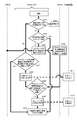
- FIG. 6 is a sequence diagram showing processing for determining the cooling set temperature in the embodiment of the present invention.
- the processor 7 reads temperature history information relating to the operating environment temperature of the CPU blade 1 from the memory 8 (S301).
- the processor 7 extracts the highest temperature from the read temperature history information (S302).
- the cumulative value of the life margin in the period from the operation start date and time to the update timing is calculated (S303).
- the lifetime margin is a period obtained as a lifetime due to the operation of the information processing apparatus at a use environment temperature lower than expected.
- the processor 7 calculates an acceleration coefficient in a period between the previous cooling set temperature update timing and the current cooling set temperature update timing.
- the acceleration factor is obtained by defining the ratio of the life of the case where the relative lifetime for fixed environmental temperature at a predetermined temperature T 1, is operated in the actual use environment temperature T 2.
- the acceleration coefficient ⁇ can be expressed by the following equation using the Arrhenius model equation.
- the life margin can be obtained by the following equation (3), for example.
- the processor 7 reads the operation guarantee period and the operation start date and time from the memory 8 (S304).
- the processor 7 calculates the remaining operation guarantee period based on the read operation guarantee period and use start date, and the current date and time (S305).
- the operation guarantee period can be obtained by the following equation (4).
- (Remaining operation guarantee period) (Operation guarantee period) ⁇ ⁇ (Current date and time) ⁇ (Use start date and time) ⁇ (4)
- the current date and time information is originally owned by the management blade processing unit, but can also be acquired from the memory 8 together with information on the operation guarantee period and use start date and time.
- the processor 7 calculates an allowable acceleration coefficient using the calculated remaining operation guarantee period (S306).
- the allowable acceleration coefficient is the ratio of the remaining life actually possessed at the time to the operation guarantee period remaining at the time of the update timing.
- the remaining life and the allowable acceleration coefficient can be obtained by, for example, the following expressions.
- the cumulative value of the life margin indicates the total value of the life margin calculated from the operation start date and time to the current update timing of the cooling set temperature.
- the lifetime margin calculated at the update timing of the current cooling set temperature is added to the accumulated value to obtain a new accumulated value, which is substituted into Equation (5).
- the life margin calculated this time is regarded as an accumulated value and is substituted into Expression (5).
- the processor 7 calculates a use environment temperature corresponding to the allowable acceleration coefficient using the calculated allowable acceleration coefficient (S307).
- the use environment temperature T 3 ′ corresponding to the allowable acceleration coefficient is T ′ 3 satisfying the following equation (7) using the Arrhenius model equation, where L 3 is the remaining operation guarantee period and L ′ 3 is the remaining life. It can be obtained by searching.
- the use environment temperature is set in units of 1 ° C.
- the processor 7 reads the recommended intake air temperature of the CPU blade 1 from the memory 8 (S308).
- the processor 7 compares the read value of the recommended intake air temperature of the CPU blade 1 with the use environment temperature T ′ 3 corresponding to the allowable acceleration coefficient obtained in S308 (S309).
- the processor 7 determines T ′ 3 as the cooling set temperature (S310), and the determined cooling set temperature The value is stored in the memory 8 as a new cooling set temperature (S311).
- the processor 7 determines the recommended intake air temperature of the CPU blade 1 as a cooling set temperature (S312), determining The value of the set cooling temperature is stored in the memory 8 as a new cooling set temperature (S311). After S311, the process returns to S201 shown in FIG.
- the cooling set temperature is updated as described above.
- FIG. 7 is a diagram for explaining the relationship between the elapsed time from the use start date of the CPU blade 1 and the consumption life in the embodiment of the present invention.
- the operation guarantee period is 2 years
- the horizontal axis indicates the elapsed time from the use start date
- the vertical axis indicates the remaining life.
- Graph A shows the case where the cooling set temperature is fixed at 35 ° C.
- graph B shows the case where the cooling set temperature is updated every 0.5 years.
- the recommended intake air temperature of the CPU mounted on the CPU blade 1 is set to 45 ° C.
- the lifetime L 0 is the case for life expectancy L 0 when the environmental temperature 35 ° C.
- a ratio L 0-0.5 / L 0 of ⁇ 0.5 is defined as an acceleration coefficient ⁇ 0-0.5 .
- the highest temperature that is the worst case in the period is defined as the use environment temperature T 0 -0.5 .
- the acceleration coefficient ⁇ 0-0.5 in the period is activated. If the energy is 0.7 eV, from equation (2)
- T ′ 0.5-1.0 310.15 K (37 ° C.) can be obtained.
- the cooling device receives update data including information of 37 ° C. from the management blade as the determined cooling set temperature.
- the cooling device recognizes that the cooling set temperature has been updated to 37 ° C., and changes the rotation speed of the cooling fan so that cooling can be performed at the cooling set temperature of 37 ° C.
- the rotation speed corresponding to the cooling set temperature of 37 ° C. is smaller than the rotation speed corresponding to the cooling set temperature of 35 ° C. For this reason, it is possible to reduce the power while satisfying the operation guarantee period.
- 5-1.0 / L 0 is defined by the acceleration coefficient ⁇ 0.5-1.0 .
- the highest temperature which is the worst case in the period is defined as T 0.5-1.0 .
- the maximum cooling set temperature T ′ 0.5-1.0 that satisfies the allowable acceleration coefficient 1.295 is
- 38 ° C. is lower than the recommended intake temperature of the CPU (45 ° C.)
- 38 ° C. is determined as the cooling set temperature from the 1.0th year to the 1.5th year.
- the cooling device receives update data including information of 38 ° C. from the management blade as the determined cooling set temperature.
- the cooling device recognizes that the cooling set temperature has been updated to 38 ° C., and changes the rotation speed of the cooling fan so that the cooling can be performed at the cooling set temperature of 38 ° C.
- the life L when the actual use environment temperature in the 1.0th to 1.5th years is T 1.0-1.5 against the assumed life L 0 when the use environment temperature is 35 ° C.
- the ratio L 1.0-1.5 / L 0 of 1.0-1.5 defined acceleration coefficient alpha 1.0-1.5.
- the highest temperature that is the worst case in the period is defined as T 1.0-1.5 .
- 40 ° C. is lower than the recommended intake temperature (45 ° C.) of the CPU, 40 ° C. is determined as the cooling set temperature from the 1.5th year to the 2.0th year.
- Various numerical data obtained as described above are shown in FIG.
- the cooling device receives update data including information of 40 ° C. from the management blade as the determined cooling set temperature.
- the cooling device recognizes that the cooling set temperature has been updated to 40 ° C., and changes the rotation speed of the cooling fan so that the cooling can be performed at the cooling set temperature of 40 ° C.
- the cooling set temperature is fixed at 35 ° C.
- the cooling set temperature is exceeded. Therefore, the fan rotation speed is made faster than when the use environment temperature is 35 ° C., and the use environment temperature is lowered to 35 ° C. It was necessary to perform cooling until.
- the cooling set temperature is periodically reviewed based on the life margin. In the example shown in FIG. 7, the cooling set temperature is 40 ° C., which is higher than 35 ° C. Therefore, it is not necessary to increase the rotational speed of the cooling fan.
- FIG. 8 is a diagram for explaining the effect of reducing power consumption by updating the cooling set temperature.
- the horizontal axis indicates the operating environment temperature of the cooling target device
- the vertical axis indicates the power consumption required for cooling.
- Graph C shows a case where the cooling set temperature is set to 35 ° C.
- Graph D shows a case where the cooling set temperature is changed from 35 ° C. to 40 ° C.
- the rotation speed of the cooling fan at the operating environment temperature of 35 ° C. can be set smaller than when the cooling set temperature is 35 ° C.
- the power consumption required also decreases. As described above, by executing the process of reviewing the cooling set temperature in the middle of the operation guarantee period, it is possible to reduce the power consumption.
- the cooling set temperature of the CPU blade is determined again based on the remaining life, the guaranteed remaining period, and the temperature history based on the temperature history of the CPU blade.
- the cooling conditions for the heat source can be optimized while satisfying the operation guarantee period, so that it is possible to save power for cooling.
- FIG. 9 is a diagram showing an example of a database in which the use environment temperature is associated with the acceleration coefficient.
- data in which the acceleration coefficient is associated with the use environment temperature is stored in the memory 9 of the information processing apparatus shown in FIG. 1 as a database, and the maximum satisfying the allowable acceleration coefficient is searched while searching the database. It is also possible to determine the environmental temperature of the use. For example, when the acceleration coefficient is calculated as 1.1967, referring to FIG. 7, the maximum acceleration coefficient value satisfying 1.1967 is 1.19, and the use environment temperature corresponding to the acceleration coefficient 1.19 is 37. It turns out that it is ° C.
- the calculation process can be simplified and the processing speed can be improved as compared with the method of obtaining the use environment temperature using the above-mentioned Arrhenius model formula.
- the computer-readable recording medium includes, for example, a flexible disk, a hard disk, a CD-ROM (Compact Disc-Read Only Memory), an MO (Magneto Optical Disc), a DVD (Digital Video Disc), and a DVD-ROM (DVD- Read-Only Memory, DVD-RAM (DVD-Random Access Memory), BD (Blue-ray Disc), and semiconductor memory.
- the computer program of the present invention can be recorded in the memory 8.
- the computer program is not limited to the one recorded on the recording medium, and may be transmitted via an electric communication line, a wireless or wired communication line, a network represented by the Internet, or the like.
- the preferable Example of this invention is not limited to a specific Example, A various deformation
- the CPU blade is taken up as an example of an electronic device to be cooled.
- a single CPU mounted on a board on which a semiconductor component that generates heat or a board in an information processing apparatus such as a PC is mounted.
- the disclosed cooling method can also be applied to an air cooling mechanism or the like.
- the process ends when the current current date and time is not within the operation guarantee period in S201. However, even after the operation guarantee period expires, the recommended intake air temperature of the CPU can be maintained. The operation of the cooling fan may be continued.
Landscapes
- Engineering & Computer Science (AREA)
- Physics & Mathematics (AREA)
- General Engineering & Computer Science (AREA)
- Theoretical Computer Science (AREA)
- General Physics & Mathematics (AREA)
- Thermal Sciences (AREA)
- Human Computer Interaction (AREA)
- Computer Hardware Design (AREA)
- Microelectronics & Electronic Packaging (AREA)
- Mechanical Engineering (AREA)
- Automation & Control Theory (AREA)
- Cooling Or The Like Of Electrical Apparatus (AREA)
Abstract
Le problème décrit par la présente invention consiste à proposer un appareil de traitement d'informations et un programme de refroidissement qui permettent une réduction des exigences de puissance de refroidissement par l'optimisation d'une condition de refroidissement pour une source de génération de chaleur. La solution de l'invention consiste en un appareil de traitement d'informations prévu avec : un premier dispositif de traitement d'informations pourvu d'un unité électronique, et d'un capteur de température permettant d'acquérir l'historique de température de l'unité électronique ; et un second dispositif de traitement d'informations équipé d'un processeur permettant de calculer la durée de vie restante de l'unité électronique sur la base de l'historique de température, et lorsque la durée de vie restante est plus longue qu'une période de garantie de fonctionnement restante, sur la base de la durée de vie restante et le reste de la période de garantie de fonctionnement, déterminer la température réglée de refroidissement de l'unité électronique par un dispositif de refroidissement de telle sorte que la durée de vie restante s'approche de la période de garantie de fonctionnement restante.
Priority Applications (2)
| Application Number | Priority Date | Filing Date | Title |
|---|---|---|---|
| PCT/JP2012/001126 WO2013124880A1 (fr) | 2012-02-20 | 2012-02-20 | Appareil de traitement d'informations et programme de refroidissement |
| US14/452,109 US20140343748A1 (en) | 2012-02-20 | 2014-08-05 | Cooling method for cooling electronic device, information processing apparatus and storage medium |
Applications Claiming Priority (1)
| Application Number | Priority Date | Filing Date | Title |
|---|---|---|---|
| PCT/JP2012/001126 WO2013124880A1 (fr) | 2012-02-20 | 2012-02-20 | Appareil de traitement d'informations et programme de refroidissement |
Related Child Applications (1)
| Application Number | Title | Priority Date | Filing Date |
|---|---|---|---|
| US14/452,109 Continuation US20140343748A1 (en) | 2012-02-20 | 2014-08-05 | Cooling method for cooling electronic device, information processing apparatus and storage medium |
Publications (1)
| Publication Number | Publication Date |
|---|---|
| WO2013124880A1 true WO2013124880A1 (fr) | 2013-08-29 |
Family
ID=49005110
Family Applications (1)
| Application Number | Title | Priority Date | Filing Date |
|---|---|---|---|
| PCT/JP2012/001126 Ceased WO2013124880A1 (fr) | 2012-02-20 | 2012-02-20 | Appareil de traitement d'informations et programme de refroidissement |
Country Status (2)
| Country | Link |
|---|---|
| US (1) | US20140343748A1 (fr) |
| WO (1) | WO2013124880A1 (fr) |
Cited By (5)
| Publication number | Priority date | Publication date | Assignee | Title |
|---|---|---|---|---|
| JP2018096572A (ja) * | 2016-12-09 | 2018-06-21 | 富士通株式会社 | 空調制御プログラム、装置、及び方法 |
| WO2018193556A1 (fr) * | 2017-04-19 | 2018-10-25 | 株式会社日立製作所 | Procédé de commande de la température ambiante d'une unité de stockage |
| JP2019535061A (ja) * | 2016-09-07 | 2019-12-05 | アドバンスト・マイクロ・ディバイシズ・インコーポレイテッドAdvanced Micro Devices Incorporated | 動的信頼性品質モニタリング |
| CN113742881A (zh) * | 2020-05-28 | 2021-12-03 | 北京小米移动软件有限公司 | 液冷散热系统工作寿命预测方法、装置及存储介质 |
| CN115326443A (zh) * | 2022-07-18 | 2022-11-11 | 岚图汽车科技有限公司 | 设备可靠性加速实验的参数确定方法及相关设备 |
Families Citing this family (6)
| Publication number | Priority date | Publication date | Assignee | Title |
|---|---|---|---|---|
| EP3308178B1 (fr) * | 2015-07-17 | 2019-11-06 | Hewlett-Packard Enterprise Development LP | Détermination d'une fréquence de fonctionnement |
| EP3502890A1 (fr) * | 2017-12-22 | 2019-06-26 | Bull SAS | Procédé de gestion des ressources d'une grappe d'ordinateurs au moyen de données historiques |
| CN108459945B (zh) * | 2018-03-31 | 2021-03-05 | 深圳忆联信息系统有限公司 | 一种电子设备及其运行状态的控制方法 |
| FR3094499B1 (fr) * | 2019-03-28 | 2021-11-19 | Continental Automotive | Procédé et dispositif d’estimation du vieillissement d’un composant électronique |
| TWI800777B (zh) | 2020-12-15 | 2023-05-01 | 宏碁股份有限公司 | 溫度控制方法與資料儲存系統 |
| US12588168B2 (en) * | 2022-06-01 | 2026-03-24 | Google Llc | Adaptive thermal control of data center and IT equipment |
Citations (2)
| Publication number | Priority date | Publication date | Assignee | Title |
|---|---|---|---|---|
| JP2008235696A (ja) * | 2007-03-22 | 2008-10-02 | Nec Corp | ファン回転制御方法、ファン回転制御システム、およびファン回転制御プログラム |
| JP2010206070A (ja) * | 2009-03-05 | 2010-09-16 | Nec Computertechno Ltd | 発熱体冷却装置及び発熱体冷却方法 |
Family Cites Families (11)
| Publication number | Priority date | Publication date | Assignee | Title |
|---|---|---|---|---|
| DE4008560C2 (de) * | 1989-03-17 | 1995-11-02 | Hitachi Ltd | Verfahren und Vorrichtung zum Bestimmen einer Restlebensdauer eines Aggregats |
| US8417360B2 (en) * | 2001-08-10 | 2013-04-09 | Rockwell Automation Technologies, Inc. | System and method for dynamic multi-objective optimization of machine selection, integration and utilization |
| US20030074173A1 (en) * | 2001-10-17 | 2003-04-17 | Intel Corporation | Technique for defining probabilistic reliability test requirements |
| US20030158803A1 (en) * | 2001-12-20 | 2003-08-21 | Darken Christian J. | System and method for estimation of asset lifetimes |
| JP4042475B2 (ja) * | 2002-06-12 | 2008-02-06 | トヨタ自動車株式会社 | 電池の劣化度算出装置および劣化度算出方法 |
| US20040167832A1 (en) * | 2003-02-06 | 2004-08-26 | Volkmar Wille | Method and data processing system for managing products and product parts, associated computer product, and computer readable medium |
| US7606948B2 (en) * | 2004-12-02 | 2009-10-20 | Hitachi Global Storage Technologies Netherlands B.V. | System and method for generating warranty and pricing information for data storage apparatus |
| US7401263B2 (en) * | 2005-05-19 | 2008-07-15 | International Business Machines Corporation | System and method for early detection of system component failure |
| US8103463B2 (en) * | 2006-09-21 | 2012-01-24 | Impact Technologies, Llc | Systems and methods for predicting failure of electronic systems and assessing level of degradation and remaining useful life |
| US9172118B2 (en) * | 2009-06-17 | 2015-10-27 | Gm Global Technology Operations, Llc. | Method and system for estimating battery life |
| US8984216B2 (en) * | 2010-09-09 | 2015-03-17 | Fusion-Io, Llc | Apparatus, system, and method for managing lifetime of a storage device |
-
2012
- 2012-02-20 WO PCT/JP2012/001126 patent/WO2013124880A1/fr not_active Ceased
-
2014
- 2014-08-05 US US14/452,109 patent/US20140343748A1/en not_active Abandoned
Patent Citations (2)
| Publication number | Priority date | Publication date | Assignee | Title |
|---|---|---|---|---|
| JP2008235696A (ja) * | 2007-03-22 | 2008-10-02 | Nec Corp | ファン回転制御方法、ファン回転制御システム、およびファン回転制御プログラム |
| JP2010206070A (ja) * | 2009-03-05 | 2010-09-16 | Nec Computertechno Ltd | 発熱体冷却装置及び発熱体冷却方法 |
Cited By (8)
| Publication number | Priority date | Publication date | Assignee | Title |
|---|---|---|---|---|
| JP2019535061A (ja) * | 2016-09-07 | 2019-12-05 | アドバンスト・マイクロ・ディバイシズ・インコーポレイテッドAdvanced Micro Devices Incorporated | 動的信頼性品質モニタリング |
| JP7014778B2 (ja) | 2016-09-07 | 2022-02-01 | アドバンスト・マイクロ・ディバイシズ・インコーポレイテッド | 動的信頼性品質モニタリング |
| JP2018096572A (ja) * | 2016-12-09 | 2018-06-21 | 富士通株式会社 | 空調制御プログラム、装置、及び方法 |
| WO2018193556A1 (fr) * | 2017-04-19 | 2018-10-25 | 株式会社日立製作所 | Procédé de commande de la température ambiante d'une unité de stockage |
| US10896700B2 (en) | 2017-04-19 | 2021-01-19 | Hitachi, Ltd. | Control method of environmental temperature of storage drive |
| CN113742881A (zh) * | 2020-05-28 | 2021-12-03 | 北京小米移动软件有限公司 | 液冷散热系统工作寿命预测方法、装置及存储介质 |
| CN113742881B (zh) * | 2020-05-28 | 2024-06-11 | 北京小米移动软件有限公司 | 液冷散热系统工作寿命预测方法、装置及存储介质 |
| CN115326443A (zh) * | 2022-07-18 | 2022-11-11 | 岚图汽车科技有限公司 | 设备可靠性加速实验的参数确定方法及相关设备 |
Also Published As
| Publication number | Publication date |
|---|---|
| US20140343748A1 (en) | 2014-11-20 |
Similar Documents
| Publication | Publication Date | Title |
|---|---|---|
| WO2013124880A1 (fr) | Appareil de traitement d'informations et programme de refroidissement | |
| US8762097B2 (en) | Method and apparatus for a thermal control system based on virtual temperature sensor | |
| US20150148981A1 (en) | System and method for multi-correlative learning thermal management of a system on a chip in a portable computing device | |
| US10852791B2 (en) | Optimized touch temperature thermal management | |
| CN101283323B (zh) | 用于动态热控制的方法和设备 | |
| CN103649869B (zh) | 电子设备中的多级热量管理 | |
| EP2929409B1 (fr) | Système et procédé pour estimer la température ambiante à partir d'un dispositif informatique portable | |
| US10101049B2 (en) | Determining parameters of air-cooling mechanisms | |
| US10539986B2 (en) | Semiconductor device, operating condition controlling method, and non-transitory computer readable medium | |
| JP2020067270A (ja) | 空調制御プログラム、空調制御方法および空調制御装置 | |
| WO2010106688A1 (fr) | Appareil électronique comportant un appareil de refroidissement, et programme de refroidissement | |
| US11545848B1 (en) | Systems and methods for improved battery energy storage system thermal management | |
| JP5428810B2 (ja) | 余寿命推定方法及び余寿命推定システム | |
| CN104603712B (zh) | 环境与处理器温差比较 | |
| US10561043B2 (en) | Air conditioning control device and air conditioning control method | |
| US20060053316A1 (en) | Information processing apparatus, control method, and program product | |
| CN116301282B (zh) | 一种多核处理器芯片的低功耗控制方法和装置 | |
| JP7215069B2 (ja) | 制御プログラム、制御方法および制御装置 | |
| JP5515794B2 (ja) | 電子機器制御システム及び制御方法 | |
| JP7215070B2 (ja) | 制御プログラム、制御方法および制御装置 | |
| JPWO2013124880A1 (ja) | 情報処理装置および冷却プログラム | |
| JP2020034473A (ja) | ファンモータの寿命予測方法およびファンモータの寿命予測装置 | |
| US12073098B2 (en) | Memory system and information processing system | |
| CN120947247B (zh) | 抑制热泵设备噪音的方法、装置、存储介质及程序产品 | |
| JP2024126242A (ja) | 温度制御装置、回路、温度制御方法、およびプログラム |
Legal Events
| Date | Code | Title | Description |
|---|---|---|---|
| 121 | Ep: the epo has been informed by wipo that ep was designated in this application |
Ref document number: 12869367 Country of ref document: EP Kind code of ref document: A1 |
|
| ENP | Entry into the national phase |
Ref document number: 2014500550 Country of ref document: JP Kind code of ref document: A |
|
| NENP | Non-entry into the national phase |
Ref country code: DE |
|
| 122 | Ep: pct application non-entry in european phase |
Ref document number: 12869367 Country of ref document: EP Kind code of ref document: A1 |